Persecution and Promise

1 Now when the adversaries of Judah and Benjamin heard that the returned exiles were building a temple to the Lord, the God of Israel, they approached Zerubbabel and the heads of fathers’ houses and said to them, “Let us build with you, for we worship your God as you do, and we have been sacrificing to him ever since the days of Esarhaddon king of Assyria who brought us here.” But Zerubbabel, Jeshua, and the rest of the heads of fathers’ houses in Israel said to them, “You have nothing to do with us in building a house to our God; but we alone will build to the Lord, the God of Israel, as King Cyrus the king of Persia has commanded us.”

Then the people of the land discouraged the people of Judah and made them afraid to build and bribed counselors against them to frustrate their purpose, all the days of Cyrus king of Persia, even until the reign of Darius king of Persia.

And in the reign of Ahasuerus, in the beginning of his reign, they wrote an accusation against the inhabitants of Judah and Jerusalem.

In the days of Artaxerxes, Bishlam and Mithredath and Tabeel and the rest of their associates wrote to Artaxerxes king of Persia. The letter was written in Aramaic and translated. Ezra 4:1-7 ESV

The returning remnant of Judah got off to a great start by reinstituting the sacrificial system and celebrating the feasts that Yahweh had ordained. But it would not be long before they had trouble with the local residents. During the 70 years the exiles spent in Babylon, the land of Judah and Jerusalem had been overrun with squatters. These unwelcome invaders took advantage of the situation by moving into the abandoned towns and villages. Even the vacated homes of Jerusalem became rent-free housing for whoever wanted to occupy them. So, when the exiles began to return in ever-increasing numbers, the local occupants viewed them as unwanted invaders. Their presence was not wanted or welcomed.

In 722 B.C., the Assyrians captured Samaria, the capital city of the northern kingdom of Israel. The fall of Samaria marked the end of a 20-year campaign against the Israelites that had been sanctioned by Yahweh Himself. The fall of the northern kingdom was His punishment for their ongoing unfaithfulness and refusal to repent. He had sent countless prophets to plead with the people to change their ways and return to the worship of Him alone. But the calls to repent and the warnings of coming judgment fell on deaf ears and during the 20-year-long Assyrian conquest, tens of thousands of Israelites were captured and deported to serve as slaves to their new masters. As the Book of 2 Kings reveals, the former occupants of Israel were replaced with people from a variety of different nations.

Israel was exiled from their own land to Assyria until this day. And the king of Assyria brought people from Babylon, Cuthah, Avva, Hamath, and Sepharvaim, and placed them in the cities of Samaria instead of the people of Israel. And they took possession of Samaria and lived in its cities. – 2 Kings 17:23-24 ESV

The text goes on to reveal that “at the beginning of their dwelling there, they did not fear the Lord. Therefore the Lord sent lions among them, which killed some of them” (2 Kings 17:25 ESV). God was going to protect the integrity of the land He had given to the Israelites as their inheritance. He would not allow it to become a spiritual wasteland occupied only by pagans who worshiped false gods. So, He used natural means to torment the land’s new occupants with supernatural judgment. The news of this “natural” disaster reached the ears of the king of Assyria.

“The nations that you have carried away and placed in the cities of Samaria do not know the law of the god of the land. Therefore he has sent lions among them, and behold, they are killing them, because they do not know the law of the god of the land.” – 2 Kings 17:26 ESV

In response, the king sent an Israelite priest to “teach them the law of the god of the land” (2 Kings 17:27 ESV). The common belief among the ancient polytheistic nations was that gods were localized deities who ruled over specific geographic domains. So, Yahweh was seen as the local God of Israel and was to be treated with dignity and honor. The Book of 2 Kings reveals that the king’s plan was only partially successful.

But every nation still made gods of its own and put them in the shrines of the high places that the Samaritans had made, every nation in the cities in which they lived.

They also feared the Lord and appointed from among themselves all sorts of people as priests of the high places, who sacrificed for them in the shrines of the high places. So they feared the Lord but also served their own gods, after the manner of the nations from among whom they had been carried away. – 2 Kings 17:29, 32-33 ESV

These equal-opportunity idolaters were the ones who had moved into the villages and homes of the people of Judah during their absence. They would have intermarried with the Judahites left behind after the Babylonian invasion. The author of Ezra describes them as “enemies” (Ezra 4:1 ESV), and while they initially display a desire to cooperate with the returning exiles, it doesn’t take long for their true colors to show.

The first interaction between the Judahites and their “enemies” appears cordial. After watching the Judahites offer sacrifices to Yawheh, “the people of the land” approached and presented themselves as fellow God-followers.

“Let us build with you, for we worship your God just as you do. We have sacrificed to him ever since King Esarhaddon of Assyria brought us here.” – Ezra 4:2 NLT

They failed to acknowledge that they were actually pagan idolaters who only worshiped Yahweh as one more god among many. They had no allegiance to the God of Abraham, Isaac, and Jacob. Most of these people were non-Hebrews who had merely adopted the Israelite God out of duress. If He could protect them from the ravaging lions, then they were more than willing to add him to their long list of deities.

But Zerubbabel and Jeshua wisely turned down the offer of these pagan posers. They could tell that “the people of the land” were not the people of God, so they rejected any overtures of cooperation and cohabitation. The remnant that returned was made up of card-carrying members of the tribe of Judah and they were not about to jeopardize their chances of rebuilding and reoccupying the land of promise by joining forces with the opportunistic people of the land. The leaders of the remnant were unapologetic and uncompromising in their response.

“You may have no part in this work. We alone will build the Temple for the Lord, the God of Israel, just as King Cyrus of Persia commanded us.” – Ezra 4:3 NLT

This was not the answer the local residents wanted to hear and it didn’t take long for their disappointment to turn to outright disdain.

Then the local residents tried to discourage and frighten the people of Judah to keep them from their work. They bribed agents to work against them and to frustrate their plans. This went on during the entire reign of King Cyrus of Persia and lasted until King Darius of Persia took the throne. – Ezra 4:4-5 NLT

They viewed the returning Judahites as a threat to their way of life and were willing to do anything to thwart their relocation efforts.

What makes this scenario so interesting is that God had sovereignly ordained the return of His people. He had orchestrated all the events leading up to their arrival in the land, including Cyrus’ decree and the funding of their relocation plans. When they arrived in the land, they immediately revealed their faithfulness by reinstituting the sacrificial system and the annual festivals. They offered sacrifices to Yahweh and laid the foundation of the Temple. So why would God allow them to undergo the constant harassment they endured at the hands of their enemies?

From the moment they returned, they suffered a daily barrage of verbal attacks. They were libeled, slandered, and falsely accused by their enemies. As will become evident, the verbal campaign would only intensify, as the local residents became increasingly more frustrated by the Judahites and their relentless rebuilding campaign. And, with each passing day, new caravans arrived bearing additional exiles who added to the numbers and increased the chances that the Judahites would be successful.

This animosity for the people of Judah would last for decades and increase in intensity. Verse 5 mentions that subversive efforts of the people of the land “went on during the entire reign of King Cyrus of Persia and lasted until King Darius of Persia took the throne” (Ezra 4:5 NLT), a period of nearly four decades. Verses 6 and 7 reveal that the opposition campaign extended through the reigns of two additional Persian kings: Xerxes (Ahasuerus) and Artaxerxes.

Years later when Xerxes began his reign, the enemies of Judah wrote a letter of accusation against the people of Judah and Jerusalem.

Even later, during the reign of King Artaxerxes of Persia, the enemies of Judah, led by Bishlam, Mithredath, and Tabeel, sent a letter to Artaxerxes in the Aramaic language… – Ezra 4:6-7 NLT

This was a long-term and relentless effort to demoralize and defeat the people of Judah. Their enemies used words, bribes, threats, and official letters to undermine God’s plans for His people. Yet, under the leadership of Zerubbabel and Jeshua, the people remained committed to the cause. They continued to build even in the face of ongoing opposition. The work was difficult and, at times, discouraging. At times, the people would lose heart and become distracted by the constant harassment. The presence of resistance sometimes overwhelmed God’s promise of success. There must have been days when the weary Judahites wondered if it was all worth the pain and persecution. Would they ever complete the Temple? Would the persecution ever stop? Was Yahweh not powerful enough to deal with this ragtag collection of idol-worshiping pagans?

The people of God could not envision what He had in store for them. But the apostle John shares an insight that would have been an encouragement to them in their plight.

Little children, you are from God and have overcome them, for he who is in you is greater than he who is in the world. They are from the world; therefore they speak from the world, and the world listens to them. We are from God. Whoever knows God listens to us; whoever is not from God does not listen to us. By this we know the Spirit of truth and the spirit of error. – 1 John 4:4-6 NLT

The Judahites would continue to face opposition and endure moments of desperation but they could eventually learn that God was in control. The persecution they faced will only make their eventual success that much sweeter and more significant.

“Without this foretaste of history to reveal the full seriousness of the opposition, we would not properly appreciate the achievements recorded in the next two chapters (5 and 6) nor the dangers hidden in the mixed marriages which Ezra would set himself to stamp out (chaps. 7-10).” – Derek Kidner, Ezra and Nehemiah. Tyndale Old Testament Commentaries series

English Standard Version (ESV)
The Holy Bible, English Standard Version. ESV® Permanent Text Edition® (2016). Copyright © 2001 by Crossway Bibles, a publishing ministry of Good News Publishers.

New Living Translation (NLT)
Holy Bible, New Living Translation, copyright © 1996, 2004, 2015 by Tyndale House Foundation. Used by permission of Tyndale House Publishers Inc., Carol Stream, Illinois 60188. All rights reserved.

The Message (MSG)Copyright © 1993, 1994, 1995, 1996, 2000, 2001, 2002 by Eugene H. Peterson

If a Tree Falls In the Forest…

10 The visions of my head as I lay in bed were these: I saw, and behold, a tree in the midst of the earth, and its height was great. 11 The tree grew and became strong, and its top reached to heaven, and it was visible to the end of the whole earth. 12 Its leaves were beautiful and its fruit abundant, and in it was food for all. The beasts of the field found shade under it, and the birds of the heavens lived in its branches, and all flesh was fed from it.

13 “I saw in the visions of my head as I lay in bed, and behold, a watcher, a holy one, came down from heaven. 14 He proclaimed aloud and said thus: ‘Chop down the tree and lop off its branches, strip off its leaves and scatter its fruit. Let the beasts flee from under it and the birds from its branches. 15 But leave the stump of its roots in the earth, bound with a band of iron and bronze, amid the tender grass of the field. Let him be wet with the dew of heaven. Let his portion be with the beasts in the grass of the earth. 16 Let his mind be changed from a man’s, and let a beast’s mind be given to him; and let seven periods of time pass over him. 17 The sentence is by the decree of the watchers, the decision by the word of the holy ones, to the end that the living may know that the Most High rules the kingdom of men and gives it to whom he will and sets over it the lowliest of men.’ 18 This dream I, King Nebuchadnezzar, saw. And you, O Belteshazzar, tell me the interpretation, because all the wise men of my kingdom are not able to make known to me the interpretation, but you are able, for the spirit of the holy gods is in you.” – Daniel 4:10-18 ESV

On this occasion, Nebuchadnezzar shares the content of his dream with Daniel. When Nebuchadnezzar experienced his first disturbing dream, Daniel was forced to reveal its content and meaning (Daniel 2). This dream, like the first, left the king disturbed, frightened, and anxious to know what the imagery symbolized. But in recounting the details of the dream to Daniel, Nebuchadnezzar appears to have already reached his own conclusion about its meaning.

It didn’t take a soothsayer or fortune-teller to inform Nebuchadnezzar that the dream was about him. He seems to have already surmised that the tree featured in his vision was somehow meant to represent him and his kingdom. It would have been difficult to miss the symbolism and its less-than-encouraging message. The dream starts out well, as a large, healthy tree suddenly appears in the middle of the earth. This fully grown tree then began to grow ever larger, “reaching high into the heavens for all the world to see” (Daniel 4:11 NLT). So far, so good.

At this point in the dream, Nebuchadnezzar must have viewed the lush, healthy tree as an apt symbol of his own ever-expanding kingdom. After all, the tree was fruitful and beneficial to all those around it.

“It had fresh green leaves, and it was loaded with fruit for all to eat. Wild animals lived in its shade, and birds nested in its branches. All the world was fed from this tree.” – Daniel 4:14 NLT

Nebuchadnezzar would have enjoyed this part of the dream, viewing the imagery as justification and validation for his quest for global domination. He was doing the world a favor. The expansion of his kingdom had been a good thing, delivering peace and prosperity to the nations of the world. At least, that’s the way he would have seen it. But his dream doesn’t reflect the real outcome of his campaign to become the world’s reigning superpower: death, devastation, and destruction.

Nebuchadnezzar had long ago convinced himself that his conquests had been the right thing to do. After all, he had benefited greatly from his invasion of foreign lands and the subjugation of innocent people. His kingdom flourished and its melting pot of citizens lived in relative peace and harmony. The early portion of the dream seems to have confirmed the king’s sanitized view of his quest for global ascendency.

Then the dream takes a dark turn with the appearance of a “watcher.” This Aramaic term refers to one who stays awake to keep watch. Every kingdom had men who served as watchmen on the walls and played an important role as an early warning defense system, protecting the nation from threats. But in his dream, Nebuchadnezzar recognized this watcher as “a holy one, coming down from heaven” (Daniel 4:13 NLT). This was some kind of divine being who delivered a very disturbing message, transforming the king’s dream into a nightmare.

“Cut down the tree and lop off its branches!
    Shake off its leaves and scatter its fruit! – Daniel 4:14 NLT

This would have been when the king’s heart rate increased and his blood pressure spiked. The message was not what he wanted or expected to hear. This was some kind of divine decree, ordering the tree’s immediate destruction. Nothing about this message could be viewed as encouraging or uplifting. No amount of spin could make it sound beneficial or positive. Nebuchadnezzar knew full well that this message did not bode well for him or his kingdom. What made his dream so frightening was its rather obvious meaning. Nebuchadnezzar wasn’t looking for Daniel to provide an interpretation as much as clarification. He knew something was coming but he had no way of knowing what to expect. That is what frightened him most.

As Nebuchadnezzar continued to relay the specifics of the dream, he noted that the watcher gave further instructions to an invisible and unidentifiable audience. These unseen agents of destruction were ordered to chase away all the birds and animals and then cut down the tree, leaving only a stump. The entire scene was to be transformed from one of peace and tranquility to one of chaos and destruction. Then the limbless, fruitless stump was to be “bound with a band of iron and bronze and surrounded by tender grass” (Daniel 4:15 NLT).

That’s when the watcher’s message takes a sudden and disturbing twist. He shifts from talking about a defoliated tree and begins referring to an unidentified man.

“Now let him be drenched with the dew of heaven,
    and let him live with the wild animals among the plants of the field.
For seven periods of time,
    let him have the mind of a wild animal
    instead of the mind of a human.” – Daniel 4:15-16 NLT

This obviously caught the king’s attention. He no longer had to doubt whether the tree represented him or his kingdom; it was now perfectly and painfully clear. But what did it mean? What was the watcher describing and how would it turn out?

The dream ends without a clear resolution. The watcher simply states that the dream is of a heavenly origin and has a divine purpose: “that the living may know that the Most High rules the kingdom of men and gives it to whom he will and sets over it the lowliest of men” (Daniel 4:17 ESV). That part the king understood. But what did the rest of the dream mean? He must have assumed he was the man in the dream, but he had no idea what the watcher’s words meant. That’s where Daniel was to come in, so the king concluded his recounting of his dream with a desperate plea to his trusted counselor.

“‘Belteshazzar, that was the dream that I, King Nebuchadnezzar, had. Now tell me what it means, for none of the wise men of my kingdom can do so. But you can tell me because the spirit of the holy gods is in you.’ – Daniel 4:18 NLT

The stage was set and the expectations were high. Once again, Daniel found himself in the unenviable position of having to deliver not-so-good news to the most powerful man in the world. But Daniel would step up to the challenge and provide the message God had for the prideful and fear-filled king.

English Standard Version (ESV) The Holy Bible, English Standard Version. ESV® Permanent Text Edition® (2016). Copyright © 2001 by Crossway Bibles, a publishing ministry of Good News Publishers.

New Living Translation (NLT) Holy Bible, New Living Translation, copyright © 1996, 2004, 2015 by Tyndale House Foundation. Used by permission of Tyndale House Publishers Inc., Carol Stream, Illinois 60188. All rights reserved.

New English Translation (NET)NET Bible® copyright ©1996-2017 by Biblical Studies Press, L.L.C. http://netbible.com All rights reserved.

Less Is More

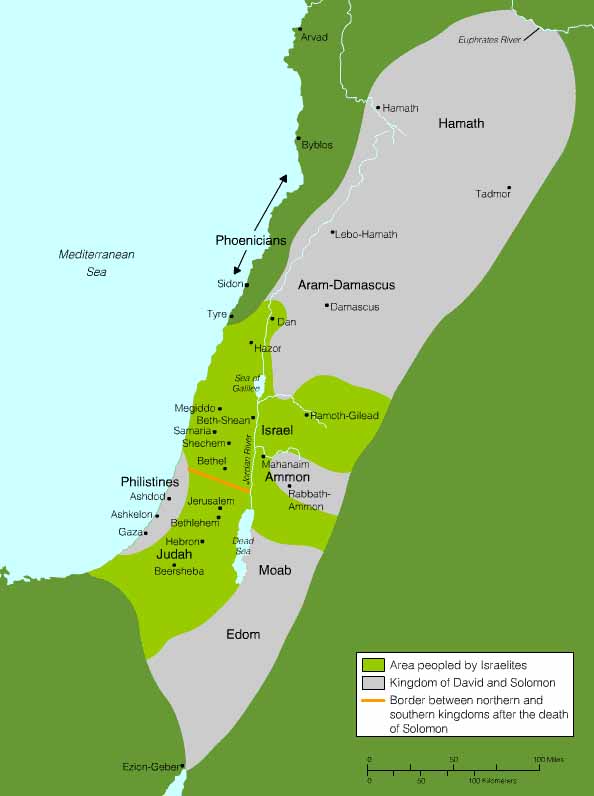
The Lord spoke to Moses, saying, “Command the people of Israel, and say to them, When you enter the land of Canaan (this is the land that shall fall to you for an inheritance, the land of Canaan as defined by its borders), your south side shall be from the wilderness of Zin alongside Edom, and your southern border shall run from the end of the Salt Sea on the east. And your border shall turn south of the ascent of Akrabbim, and cross to Zin, and its limit shall be south of Kadesh-barnea. Then it shall go on to Hazar-addar, and pass along to Azmon. And the border shall turn from Azmon to the Brook of Egypt, and its limit shall be at the sea.

“For the western border, you shall have the Great Sea and its coast. This shall be your western border.

“This shall be your northern border: from the Great Sea you shall draw a line to Mount Hor. From Mount Hor you shall draw a line to Lebo-hamath, and the limit of the border shall be at Zedad. Then the border shall extend to Ziphron, and its limit shall be at Hazar-enan. This shall be your northern border.

10 “You shall draw a line for your eastern border from Hazar-enan to Shepham. 11 And the border shall go down from Shepham to Riblah on the east side of Ain. And the border shall go down and reach to the shoulder of the Sea of Chinnereth on the east. 12 And the border shall go down to the Jordan, and its limit shall be at the Salt Sea. This shall be your land as defined by its borders all around.”

13 Moses commanded the people of Israel, saying, “This is the land that you shall inherit by lot, which the Lord has commanded to give to the nine tribes and to the half-tribe. 14 For the tribe of the people of Reuben by fathers’ houses and the tribe of the people of Gad by their fathers’ houses have received their inheritance, and also the half-tribe of Manasseh. 15 The two tribes and the half-tribe have received their inheritance beyond the Jordan east of Jericho, toward the sunrise.” Numbers 34:1-15 ESV

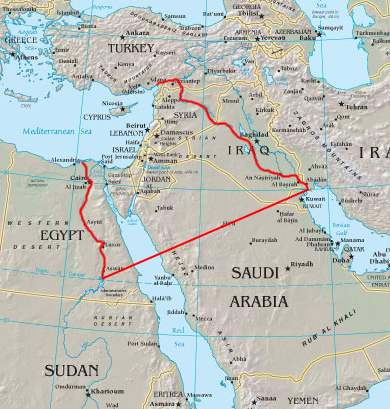
As the people prepared to enter the land of promise, Moses provided them with the boundary markers that would establish their future territory. But it is important to note that the description given by Moses is distinctly different than the one God had originally given to Abram at the point of his calling. The borders that Moses outlines in this passage are far more restrictive than the ones God proposed to Abram.  At that point in time, God had designated a far larger area as the future homeland for Abram’s descendants.

“To your offspring I give this land, from the river of Egypt to the great river, the river Euphrates…” – Genesis 15:18 ESV

The two primary boundary markers that God gave Abram were “the river of Egypt,” which most likely refers to the Nile, to “the river Euphrates,” which extends from the southern border of modern-day Turkey all the way to the Persian Gulf.

God had a much larger geographic region in mind when He made His original promise to Abram. But centuries later, by the time the descendants of Abram were ready to cross over the Jordan and occupy the land, the boundaries had shrunk significantly.

Moses provided a detailed description of the eastern, western, southern, and northern boundaries of the Israelite’s future homeland. At this point in their history, there were not ready or equipped to conquer and occupy the much larger region promised by God to Abram. Their army was far too small to attempt a conquest of the original promised land. Even though the nation was comprised of 12 tribes, there were not enough soldiers to take on the armies of “the Kenites, the Kenizzites, the Kadmonites, the Hittites, the Perizzites, the Rephaim, the Amorites, the Canaanites, the Girgashites and the Jebusites” (Genesis 15:19-21 NLT).

In a sense, God was starting small, but He had every intention of sticking to His original promise if the people of Israel proved obedient and successful at accomplishing His will. The reduced boundaries were not a sign of God reneging on His promise. He was not going back on His word. He was simply asking the people of Israel to prove their willingness to be faithful and obedient.

The borders of the land, while greatly reduced, would prove more than enough territory for the 12 tribes of Israel. In fact, as Moses points out, two and a half of the tribes would end up locating outside those boundaries.

“This territory is the homeland you are to divide among yourselves by sacred lot. The Lord has commanded that the land be divided among the nine and a half remaining tribes. The families of the tribes of Reuben, Gad, and half the tribe of Manasseh have already received their grants of land  on the east side of the Jordan River, across from Jericho toward the sunrise.” – Numbers 34:13-15 NLT

Technically, according to the original description given by God to Abram, the land occupied by the tribes of Reuben, Gad, and half the tribe of Manasseh was in the land of promise. But their land allotments would be considered separate from the rest of the tribes. Yet, one day, God would extend Israel’s borders under the leadership of King David. Then, when his son, Solomon came to power, the kingdom would expand even further. God would slowly extend the borders of Israel but because of the nation’s disobedience, He would one day spit the kingdom in half and dramatically reduce their land holdings and influence in the region.

But at the point at which Moses was preparing the send the people into the land for the very first time, they were faced with the formidable and seemingly insurmountable task of conquering a vast expanse of enemy-occupied territory. Yet Moses reminded them that the land was as good as theirs.

“This shall be your land as defined by its borders all around.” – Numbers 34:15 ESV

It was theirs but they would have to do their part. According to God, it belonged to them but it wouldn’t come without a fight. It was Jesus who declared the need for follow-through in the life of God’s people.

“…a servant who knows what the master wants, but isn’t prepared and doesn’t carry out those instructions, will be severely punished. But someone who does not know, and then does something wrong, will be punished only lightly. When someone has been given much, much will be required in return; and when someone has been entrusted with much, even more will be required.” – Luke 12:47-48 NLT

The Israelites had their marching orders and a detailed map of their battle zone. Now it was time to exhibit faith and fight for what was rightfully theirs.

English Standard Version (ESV) The Holy Bible, English Standard Version. ESV® Permanent Text Edition® (2016). Copyright © 2001

New Living Translation (NLT) Holy Bible, New Living Translation, copyright © 1996, 2004, 2015 by Tyndale House Foundation. Used by permission of Tyndale House Publishers Inc., Carol Stream, Illinois 60188. All rights reserved.

Faith is the Victory

25 The Lord said to Moses, 26 “Take the count of the plunder that was taken, both of man and of beast, you and Eleazar the priest and the heads of the fathers’ houses of the congregation, 27 and divide the plunder into two parts between the warriors who went out to battle and all the congregation. 28 And levy for the Lord a tribute from the men of war who went out to battle, one out of five hundred, of the people and of the oxen and of the donkeys and of the flocks. 29 Take it from their half and give it to Eleazar the priest as a contribution to the Lord. 30 And from the people of Israel’s half you shall take one drawn out of every fifty, of the people, of the oxen, of the donkeys, and of the flocks, of all the cattle, and give them to the Levites who keep guard over the tabernacle of the Lord.” 31 And Moses and Eleazar the priest did as the Lord commanded Moses.

32 Now the plunder remaining of the spoil that the army took was 675,000 sheep, 33 72,000 cattle, 34 61,000 donkeys, 35 and 32,000 persons in all, women who had not known man by lying with him. 36 And the half, the portion of those who had gone out in the army, numbered 337,500 sheep, 37 and the Lord’s tribute of sheep was 675. 38 The cattle were 36,000, of which the Lord’s tribute was 72. 39 The donkeys were 30,500, of which the Lord’s tribute was 61. 40 The persons were 16,000, of which the Lord’s tribute was 32 persons. 41 And Moses gave the tribute, which was the contribution for the Lord, to Eleazar the priest, as the Lord commanded Moses.

42 From the people of Israel’s half, which Moses separated from that of the men who had served in the army— 43 now the congregation’s half was 337,500 sheep, 44 36,000 cattle, 45 and 30,500 donkeys, 46 and 16,000 persons— 47 from the people of Israel’s half Moses took one of every 50, both of persons and of beasts, and gave them to the Levites who kept guard over the tabernacle of the Lord, as the Lord commanded Moses.

48 Then the officers who were over the thousands of the army, the commanders of thousands and the commanders of hundreds, came near to Moses 49 and said to Moses, “Your servants have counted the men of war who are under our command, and there is not a man missing from us. 50 And we have brought the Lord’s offering, what each man found, articles of gold, armlets and bracelets, signet rings, earrings, and beads, to make atonement for ourselves before the Lord.” 51 And Moses and Eleazar the priest received from them the gold, all crafted articles. 52 And all the gold of the contribution that they presented to the Lord, from the commanders of thousands and the commanders of hundreds, was 16,750 shekels. 53 (The men in the army had each taken plunder for himself.) 54 And Moses and Eleazar the priest received the gold from the commanders of thousands and of hundreds, and brought it into the tent of meeting, as a memorial for the people of Israel before the Lord.  Numbers 31:25-54 ESV

There were 12,000 Israelite soldiers chosen to go into battle against the Midianites; 1,000 men from every tribe. That is a relatively small number when compared with the 601,730 men deemed battle worthy according to the recent census taken by Moses. This small contingent of soldiers easily defeated their enemy and brought back an abundance of plunder from their raids of the towns and villages of the Midianites. And according to the military leaders, they had not lost a single man in the process.

“We, your servants, have accounted for all the men who went out to battle under our command; not one of us is missing! – Numbers 31:49 NLT

The mission had been a rousing success, and the bounty they had taken from the Midianites was substantial. But before anyone could enjoy the riches they had plundered, everyone and everything had to be purified.

“Anything made of gold, silver, bronze, iron, tin, or lead—that is, all metals that do not burn—must be passed through fire in order to be made ceremonially pure. These metal objects must then be further purified with the water of purification. But everything that burns must be purified by the water alone. On the seventh day you must wash your clothes and be purified. Then you may return to the camp.” – Numbers 31:22-24 NLT

Moses warned the soldiers that they must go through a purification ritual before they could enter the camp.

“…all of you who have killed anyone or touched a dead body must stay outside the camp for seven days. You must purify yourselves and your captives on the third and seventh days. Purify all your clothing, too, and everything made of leather, goat hair, or wood.” – Numbers 31:19-20 NLT

Contact with the enemy had rendered these men ceremonially impure. That required them to go through a period of forced isolation and cleansing, along with all those taken captive during the mission. This was the process God had established and communicated to Moses back in chapter 19.

“All those who touch a dead human body will be ceremonially unclean for seven days. They must purify themselves on the third and seventh days with the water of purification; then they will be purified. But if they do not do this on the third and seventh days, they will continue to be unclean even after the seventh day. All those who touch a dead body and do not purify themselves in the proper way defile the Lord’s Tabernacle, and they will be cut off from the community of Israel. Since the water of purification was not sprinkled on them, their defilement continues. – Numbers 19:11-13 NLT

Once the men and their captives had completed the purification process, the booty was divided. The 12,000 combatants would receive their fair share of the reward, but those who remained behind would not be left out. This pattern of equity among those who went into battle and their brothers who remained behind would become a norm for the nation of Israel.

After a rousing victory over the Amalekites, King David encountered a problem among his soldiers. The ones who had assisted him in the battle were angry at having to share their plunder with those who had remained behind.

“They didn’t go with us, so they can’t have any of the plunder we recovered. Give them their wives and children, and tell them to be gone.” – 1 Samuel 30:22 NLT

These men wanted all the plunder for themselves. But David denied their selfish demands, saying: “No, my brothers! Don’t be selfish with what the Lord has given us. He has kept us safe and helped us defeat the band of raiders that attacked us. Who will listen when you talk like this? We share and share alike—those who go to battle and those who guard the equipment” (1 Samuel 23-24 NLT).

Moses followed a similar plan, first making a detailed list of all the plunder taken from the Midianites. Once that was done, he ordered that half be equally divided between the 12,000 men who had fought in the battle. The other half would be divided between the rest of the Israelites.

But a portion of all the plunder was to be dedicated to God. From the soldier’s share 1/500th of all that was taken was to be given to the Lord.

“…one of every 500 of the prisoners and of the cattle, donkeys, sheep, and goats…” – Numbers 31:28 NLT

This share was to be given to Eleazar the priest as an offering to the Lord, and the numbers are staggering. The quantity of sheep and goats dedicated to God was 675. But there were also 72 cattle, 61 donkeys, and 32 virgin girls set aside for the Lord. It is likely that the young women became servants to the Levitical priests and assisted in the maintenance of the tabernacle. Of the plunder given to the rest of the people, 1/50th of it was given to the Levites.

Moses took one of every fifty prisoners and animals and gave them to the Levites, who maintained the Lord’s Tabernacle. All this was done as the Lord had commanded Moses. – Numbers 31:47 NLT

There was one final offering presented to Yahweh. The military leaders who oversaw the battle came before Moses with an offering of atonement. Out of gratitude for God’s protection of their men, they brought a large number of gold armbands, bracelets, rings, earrings, and necklaces that the soldiers had taken as plunder. This would have been from the portion of the booty that belonged to the 12,000 soldiers. These men willingly gave up part of their reward as an offering to God.

“…we are presenting the items of gold we captured as an offering to the Lord from our share of the plunder—armbands, bracelets, rings, earrings, and necklaces. This will purify our lives before the Lord and make us right with him.” – Numbers 31:50 NLT

In essence, this was a ransom for the lives that God had graciously spared. Not one man had died in this expedition and the generals and captains were expressing their gratitude to God for His mercy and providential care.

This entire scenario paints a picture of how things will begin to unfold as the Israelites enter the land of Canaan. It served as a practice run in preparation for their future conquest of the promised land. There would be many more battles ahead. And every victory they enjoyed would be because of the grace and mercy of God. He would be going before them and fighting alongside them. And they were never to forget to render their thanksgiving to Him for His protection and provision.

Moses would repeatedly warn the people to take their relationship with God seriously. Without Him, they were nothing. And he knew they would always face the temptation to take credit for their own success; a dangerous prospect that was to be avoided at all costs.

“Beware that in your plenty you do not forget the Lord your God and disobey his commands, regulations, and decrees that I am giving you today. For when you have become full and prosperous and have built fine homes to live in, and when your flocks and herds have become very large and your silver and gold have multiplied along with everything else, be careful!” – Deuteronomy 8:11-13 NLT

With every victory would come the temptation to glory in their success and celebrate their newfound wealth. But Moses wanted to remember that faithfulness was far more important than fame or financial success.

“Remember the Lord your God. He is the one who gives you power to be successful, in order to fulfill the covenant he confirmed to your ancestors with an oath.” – Deuteronomy 8:18 NLT

English Standard Version (ESV) The Holy Bible, English Standard Version. ESV® Permanent Text Edition® (2016). Copyright © 2001

New Living Translation (NLT) Holy Bible, New Living Translation, copyright © 1996, 2004, 2015 by Tyndale House Foundation. Used by permission of Tyndale House Publishers Inc., Carol Stream, Illinois 60188. All rights reserved.

Our Great God

17 Moses and Aaron took these men who had been named, 18 and on the first day of the second month, they assembled the whole congregation together, who registered themselves by clans, by fathers’ houses, according to the number of names from twenty years old and upward, head by head, 19 as the Lord commanded Moses. So he listed them in the wilderness of Sinai.

20 The people of Reuben, Israel’s firstborn, their generations, by their clans, by their fathers’ houses, according to the number of names, head by head, every male from twenty years old and upward, all who were able to go to war: 21 those listed of the tribe of Reuben were 46,500.

22 Of the people of Simeon, their generations, by their clans, by their fathers’ houses, those of them who were listed, according to the number of names, head by head, every male from twenty years old and upward, all who were able to go to war: 23 those listed of the tribe of Simeon were 59,300.

24 Of the people of Gad, their generations, by their clans, by their fathers’ houses, according to the number of the names, from twenty years old and upward, all who were able to go to war: 25 those listed of the tribe of Gad were 45,650.

26 Of the people of Judah, their generations, by their clans, by their fathers’ houses, according to the number of names, from twenty years old and upward, every man able to go to war: 27 those listed of the tribe of Judah were 74,600.

28 Of the people of Issachar, their generations, by their clans, by their fathers’ houses, according to the number of names, from twenty years old and upward, every man able to go to war: 29 those listed of the tribe of Issachar were 54,400.

30 Of the people of Zebulun, their generations, by their clans, by their fathers’ houses, according to the number of names, from twenty years old and upward, every man able to go to war: 31 those listed of the tribe of Zebulun were 57,400.

32 Of the people of Joseph, namely, of the people of Ephraim, their generations, by their clans, by their fathers’ houses, according to the number of names, from twenty years old and upward, every man able to go to war: 33 those listed of the tribe of Ephraim were 40,500.

34 Of the people of Manasseh, their generations, by their clans, by their fathers’ houses, according to the number of names, from twenty years old and upward, every man able to go to war: 35 those listed of the tribe of Manasseh were 32,200.

36 Of the people of Benjamin, their generations, by their clans, by their fathers’ houses, according to the number of names, from twenty years old and upward, every man able to go to war: 37 those listed of the tribe of Benjamin were 35,400.

38 Of the people of Dan, their generations, by their clans, by their fathers’ houses, according to the number of names, from twenty years old and upward, every man able to go to war: 39 those listed of the tribe of Dan were 62,700.

40 Of the people of Asher, their generations, by their clans, by their fathers’ houses, according to the number of names, from twenty years old and upward, every man able to go to war: 41 those listed of the tribe of Asher were 41,500.

42 Of the people of Naphtali, their generations, by their clans, by their fathers’ houses, according to the number of names, from twenty years old and upward, every man able to go to war: 43 those listed of the tribe of Naphtali were 53,400.

44 These are those who were listed, whom Moses and Aaron listed with the help of the chiefs of Israel, twelve men, each representing his father’s house. 45 So all those listed of the people of Israel, by their fathers’ houses, from twenty years old and upward, every man able to go to war in Israel— 46 all those listed were 603,550. – Numbers 1:17-46 ESV

Twelve tribes yielded over 600,000 men of fighting age. That is a staggering number, and when you consider that it only included men who were 20-years-old and older, and does not take into account women and children, you can begin to sense the size of the Israelite community. Some scholars have estimated that, based on the size of Israel’s fighting force, the total number of Israelites could have been from one to two million. But those astounding estimates have caused concern among some scholars who question the impossibility of that many people surviving life in the unforgiving wilderness for more than 40 years. The NET Study Bible provides the following summary of their misgivings.

“There has been much discussion about the numbers in the Israelite wilderness experience. The immediate difficulty for even the casual reader is the enormous number of the population. If indeed there were 603,550 men twenty years of age and older who could fight, the total population of the exodus community counting women and children would have been well over a million, or even two million as calculated by some. This is not a figure that the Bible ever gives, but given the sizes of families the estimate would not be far off. This is a staggering number to have cross the Sea, drink from the oases, or assemble in the plain by Sinai. It is not a question of whether or not God could provide for such a number; it is rather a problem of logistics for a population of that size in that period of time. The problem is not with the text itself, but with the interpretation of the word אֶלֶף (’elef), traditionally translated “thousand.” The word certainly can be taken as “thousand,” and most often is. But in view of the problem of the large number here, some scholars have chosen one of the other meanings attested in literature for this word…” – see A. H. McNeile, Numbers, 7; J. Garstang, Joshua-Judges, 120; J. Bright, History of Israel, 144

In an attempt to come up with a more reasonable and believable number, other interpretations of the word אֶלֶף (’elef) have been utilized. And while these rather clever reinterpretations have resulted in a drastic reduction in the number of fighting men and, therefore, the total number of Israelites, they are not without their flaws. One such effort managed to reduce the total size of the Israelite army to about 18,000 men, resulting in an estimated population of 72,000 Israelites. This drastic reduction may make the total number of Israelites more acceptable and believable, but it plays fast and lose with the text.

It is clear that God commanded Moses to “take a census of all the congregation of the people of Israel, by clans, by fathers’ houses, according to the number of names, every male, head by head” (Numbers 1:2 ESV). The Hebrew word translated as “head” is actually גֻּלְגֹּלֶת (gulgōleṯ), which means “skull.” Moses had been instructed to count every skull of every man in the Israelite community.

“…the count appears to have been literal, and the totals calculated accordingly, totals which match other passages in the text. If some formula is used to reduce the thousands in this army, then there is the problem of knowing what to do when a battle has only five thousand, or three thousand men. One can only conclude that on the basis of what we know the word should be left with the translation ‘thousand,’ no matter what difficulties this might suggest to the reader.” – NET Bible Study Notes

There is no accurate way of calculating the overall size of the Israelite community based on these numbers. S,o we must be careful when throwing around numbers like one or two million. We just don’t know. But at the same time, we must refrain from questioning the integrity of the text just because we find it difficult to accept the idea of an army of 603,550 men.

While we may find these numbers difficult to comprehend, the text provides no conclusive evidence to doubt their veracity. If anything, the size of Israel’s army supports the fear that drove Pharaoh to begin persecuting the people of Israel in the first place. The book of Exodus reminds us that during their stay in Egypt the descendants of Jacob had multiplied greatly.

…the people of Israel were fruitful and increased greatly; they multiplied and grew exceedingly strong, so that the land was filled with them. – Exodus 1:7 ESV

The dramatic increase in their numbers had been significant enough to catch the attention of Pharaoh.

“Behold, the people of Israel are too many and too mighty for us. Come, let us deal shrewdly with them, lest they multiply, and, if war breaks out, they join our enemies and fight against us and escape from the land.” – Exodus 1:9-10 ESV

Exodus 13:18 states that when the Israelites left Egypt they marched out like an army arrayed for battle. They were so large that they were required to line up in regiments or groups, most likely according to the various tribes. They were a vast number of men, women, and children. They were even accompanied by non-Israelites as they made their way out of Egypt. And it’s interesting to note that the book of Exodus reports that the number of men who left Egypt was virtually the same as the number of men determined by the census.

And the people of Israel journeyed from Rameses to Succoth, about six hundred thousand men on foot, besides women and children. A mixed multitude also went up with them, and very much livestock, both flocks and herds. – Exodus 12:37-38 ESV

Unless we can find a convincing reason to dismiss the numbers that Moses recorded, it is best to accept them as proof of God’s promise to Abraham that his descendants would become a great nation (Genesis 15:5).

“I believe we should take eleph in census contexts as thousands until further investigation clearly indicates that we should interpret it differently.” – Dr. Thomas L. Constable, Notes on Numbers

During their 400 years of captivity in Egypt, God had been blessing and preparing His people for the future conquest of the land of Canaan. He had multiplied them greatly and transformed them from an army of slaves into a military force made up of freemen who were heirs to the land of promise. The numbers should stagger us. The miraculous nature of Israel’s transformation is meant to amaze us. For more than four centuries, God had protected and provided for them. He had multiplied them. And when the time was right, He had delivered them. Now, He was ready to use their vast numbers to conquer the land of Canaan. And just before his death, Moses reminded the people of Israel that their God would go before them when they entered the land.

“The Lord will cause your enemies who rise against you to be defeated before you. They shall come out against you one way and flee before you seven ways. – Deuteronomy 28:7 ESV

Their future victories would be the result of God’s greatness and glory, not the size of their army. They were not to place their confidence in the might of their military. They were to trust in the unfathomable greatness of God. The words God later spoke to the prophet Zechariah sum up the attitude the Israelites were to have regarding the results of the census.

“Not by might, nor by power, but by my Spirit, says the LORD of hosts.” – Zechariah 4:6 ESV

Whether their army numbered 60,000 or 600,000, any victory they hoped to have would come from the Lord. He was the Lord of Heavens Armies and their only hope of future success.

English Standard Version (ESV) The Holy Bible, English Standard Version. ESV® Permanent Text Edition® (2016). Copyright © 2001

New Living Translation (NLT) Holy Bible, New Living Translation, copyright © 1996, 2004, 2015 by Tyndale House Foundation. Used by permission of Tyndale House Publishers Inc., Carol Stream, Illinois 60188. All rights reserved.

Misplaced Trust.

Though you play the whore, O Israel, let not Judah become guilty.  Enter not into Gilgal, nor go up to Beth-aven, and swear not, “As the Lord lives.” Like a stubborn heifer, Israel is stubborn; can the Lord now feed them like a lamb in a broad pasture? Ephraim is joined to idols; leave him alone. When their drink is gone, they give themselves to whoring; their rulers dearly love shame. A wind has wrapped them in its wings, and they shall be ashamed because of their sacrifices. – Hosea 4L15-19 ESV

God warned the northern kingdom of Israel not to pollute the southern kingdom of Judah with its unfaithful practices. While Judah had not been exactly an icon of virtue and faithfulness as a nation, it had not yet sunk to the all-time low that Israel had. The northern kingdom was guilty of having set up pagan shrines throughout its territory, in places like Gilgal and Bethel. Hosea sarcastically referred to Bethel (house of God) as Beth-aven (house of wickedness) because of the pagan worship performed there. And he warns the people of Israel not to go to these pagan shrines and make oaths to God, because they no longer worshiped Him. Hosea knew that once they heard of God’s pending judgment against them, the Israelites would try and call on His name in an insincere attempt to avoid punishment. They were stubborn and set in their ways. They were not going to change and God was no longer going to treat them like one of His own.

Ephraim was the largest of the ten tribes that made up the northern kingdom and so God uses the name of this tribe as another reference to Israel. The greatest and largest tribe had joined themselves to idols, and they were shameless in their abandonment of God. Even the leaders of the people felt no remorse or shame. So God was going to abandon them and called on all others to do the same. He would give them up to their desires and allow them to place all their faith and trust in false gods. But a wind of judgment was coming. The punishment for their rejection of God would catch them up like a mighty wind and blow them into captivity in Assyria, where they would finally recognize the folly of their ways. But up until that moment, they would remain stubborn and unresponsive to the calls of Hosea to repent and return to God.

It is amazing how stubborn we can become when we begin to stray from our faithfulness to God. We learn to justify our actions and defend our behavior, trying to prove that what we are doing is not all that bad. We argue that we have not really abandoned God, but our actions tell a different story. We stubbornly reject conviction, demanding that what we are doing is fully acceptable. We demand that we have really rejected or abandoned God, but are simply doing what is necessary to survive in this world. That’s how we end up justifying our more subtle forms of idol worship, turning seemingly innocent things like money, success, entertainment, pleasure, education, and materialism into replacements for God. When someone tries to point out that we have made a god out of money, having placed all our hope and faith in it and seeing it as our source of hope and contentment, we stubbornly deny it. But the very thought of losing or giving up our money frightens us beyond belief. If someone suggested that entertainment had become our god, providing us with joy and pleasure, we would vehemently deny it. But if we were challenged to give it up or fast from it for a month, the very thought would send chills up our spines. If we were accused of having made a god out of material things, we would scoff, arguing that we were simply enjoying the blessings of God. But if we were encouraged to give up those things and live simpler lives, trusting in the goodness of God, we would find the very though disconcerting.

There is nothing wrong with money, success, entertainment, pleasure, education, or materialism. In fact, God has promised to bless His people. But when we make gods out of those things, giving them prominence over the one true God, we are standing on shaky ground. When we look to anything other than God for our hope, happiness, fulfillment, satisfaction or peace, we are worshiping false gods. And when the threat of losing any of these things causes us to panic, it is a good sign that we have placed more trust in them than we have in God. Even our health can become a god. We can worship good health, trying to prolong our lives by spending inordinate amounts of time and money on our physical well-being, while neglecting our spiritual health. Paul warned Timothy, “Physical training is good, but training for godliness is much better, promising benefits in this life and in the life to come” (1 Timothy 4:8 NLT). The constant danger we all face as believers is making the things of this world our primary emphasis and focus. At the heart of faith is trust. It is a reliance on and belief in the promises of God, that He will supply all our needs. It is trusting that He has our best in mind and that material things, while not sinful in themselves, are not the primary indicator of God’s blessings. That is why Paul said, “I know how to live on almost nothing or with everything. I have learned the secret of living in every situation, whether it is with a full stomach or empty, with plenty or little. For I can do everything through Christ, who gives me strength” (Philippians 4:11-13 NLT). He had learned to place his trust in God, so that his circumstances no longer served as his source of contentment or happiness. God was enough. But can most of us say the same thing? Is God enough? Or have we developed a litany of other things we have to have in order to be happy, content, satisfied, and fulfilled? The fact that we have other things we worship is not so much the problem as our stubbornness and refusal to let go of them. God is calling us to trust in Him and Him alone. But will we?

2 Corinthians 3:1-6

Giving God the Credit.

2 Corinthians 3:1-6

It is not that we think we are qualified to do anything on our own. Our qualification comes from God. He has enabled us to be ministers of his new covenant. This is a covenant not of written laws, but of the Spirit. The old written covenant ends in death; but under the new covenant, the Spirit gives life. – 2 Corinthians 3:5-6 NLT

There is no doubt that some among the believers in Corinth had been questioning Paul’s authority. They had been spreading rumors that Paul was not really qualified to address the various issues he been writing about. Evidently, false teachers had been influencing the Corinthians, contradicting the teachings of Paul, and using as their basis of authority, forged letters of recommendation from Judea. In other words, they had papers to back them up. It appeared as if they were official representatives “true” apostles back in Jerusalem. The inference was that Paul was an imposter and charlatan. He was a fake. And all that he had been teaching was to be rejected as false and dangerous.

But Paul had no desire to play their game. He was not going to waste his time trying to prove his validity by producing letters written by men. He knew his calling and who it was that had issued his call. As far as Paul was concerned, the proof of his ministry’s integrity was to be seen in the transformed lives of the men and women of Corinth. He knew that others could see the change and that was why the Corinthian believers were suffering persecution. Paul viewed their changed lives as “a letter from Christ showing the result of our ministry among you” (2 Corinthians 3:3 NLT). The Spirit had clearly been at work in Corinth, opening the eyes of men and women as they had heard the gospel message proclaimed by Paul. This had not been the result of Paul’s efforts, but it had been the work of the Spirit – from beginning to end. Paul didn’t need letters of recommendation, because it wasn’t his work to begin with. It was God’s work. Paul had no delusions of grandeur. In fact, he fully understood that he was not “qualified to do anything” on his own. The work in Corinth had nothing to do with Paul’s competence or credibility. It had everything to do with God and His decision to work through someone like Paul. “Our qualification comes from God. He has enabled us to be ministers of his new covenant” (2 Corinthians 3:5-6 NLT). In essence, Paul was telling those who were casting aspersions on his ministry, to take it up with God. What Paul had been able to accomplish in Corinth had been a clear work of God, made possible through the power of the Holy Spirit. He had simply been a tool in the hands of God to accomplish His will.

How easy it is for us to believe that we are vital to God’s plan. How quickly we can assume that God needs us to accomplish His will. We can find ourselves taking credit for what God has done and becoming prideful about our own competence and significance to His Kingdom cause. We want to boast about our credentials and brag about our qualifications. But Paul knew that he was nothing without the Spirit’s work. He knew that he was not qualified or competent to do anything on his own. The ministry of life transformation and redemption was entirely the work of God, not man. Our degrees, diplomas, education, intelligence, gifts, abilities, talents and resumes mean nothing if God is not in it. He is not dependent on us. We are dependent on Him. If lives are being changed as a result of anything we have done, it is because God has chosen to work through us. We are not accomplishing great things for God, but instead, He is simply choosing to accomplish His work through us, and oftentimes, in spite of us. God did not need Paul to accomplish His will. But He had chosen and commissioned him to spread the good news about Jesus Christ among the Gentiles. And God’s Spirit had clearly worked through Paul, preparing hearts to hear and accept the gospel message. Paul didn’t need any other proof than the transformed lives of the Corinthian believers. He knew that God was at work, because he could see it. Paul had no reason to brag, but he also had no reason to doubt. It could have been easy for him to question whether or not what he had been doing was truly of God, but the evidence was undeniable and irrefutable. Lives had been changed, and only God can bring about true, long-lasting life transformation. Only the Spirit can give life. So Paul was confident and content that what he was doing had God’s blessing and complete recommendation.

Father, we need to look for life transformation. We need to learn to see where Your Spirit is at work in our midst. Too often we base our success based on our own qualifications and efforts. But the true criteria for success in Your work is changed lives. And only You can bring that about. Open our eyes so that we might see where You are at work. Don’t let us focus on what we are doing, but on what You are doing through us. We can measure programs and we can count heads and think we are making a difference. But if lives are not being changed and if people are not being saved, our work is in vain. Remove from us any desire to please or prove our significance to men. Let us be content with the proof of changed lives as Your Spirit works among us. Amen.

Ken Miller
Grow Pastor & Minister to Men
kenm@christchapelbc.org

Proverbs 16d

Guaranteed Success.

“Commit your actions to the Lord, and your plans will succeed.” – Proverbs 16:3 NLT

There are some verses in the Book of Proverbs that sound almost too good to be true. They seem to offer us some pretty significant promises; like guaranteed success in all our plans if we simply commit those plans to God. But is that what this verse is really saying? Is this some kind of spiritual secret to success that assures us of a positive outcome no matter what we plan to do? Common sense would tell you that if it sounds too good to be true, it probably is too good to be true. The first part of this verse is critical to understanding what’s offered in the second half. “Commit your actions to the Lord.” That word “commit” can literally be translated “roll over.” It conveys the idea of rolling over or transferring something from one person to another. It is the idea of rolling over or committing your actions to God. Give them over to Him. The word “actions” are those works you intend to do. It has to do with your future plans. In other words, we are to give over to God those works that we want to do. Hand them over to Him. Share them with Him. Get His opinion about them. Don’t move forward without His blessing and approval. If you look closely, you can see that this verse is really talking about submitting to God’s authority in your life. It is encouraging an attitude of complete dependence on Him. In order to us to “roll over” our plans to God, we will have to humble ourselves under His sovereign will and submit to His plan for our lives. He may very well say no to our plans. He may give us a completely different agenda to follow. The key is that we are being encouraged to bring all our plans to God before we put them into action. We must seek His approval and permission.

Then, and only then, will our plans succeed. Verse nine supports this idea. “We can make our plans, but the Lord determines our steps.” Ultimately, God is in control. His plan for our lives supersedes any goals or objectives we may establish. As believers we are obligated to turn to God for direction and insight into where He would have us go. We should want to know what He has for us to do. If we seek to discover His will for our lives, we can rest assured that it will succeed. God will always accomplish what He sets out to do. His plans are never thwarted. The Hebrew word that is translated here as “success” really means “securely determined.” In other words, it’s as good as done. There are no doubts, worries, or possibilities that His plan will fail to happen. When we bring our plans to Him and allow Him to either confirm or replace them with His divine plan, we can rest easy knowing that whatever we do will turn out just the way God intended it to. And even if the end result does not appear to be what WE expected, it WILL be what God intended. When Joseph found himself sold into slavery by his brothers, it did not appear to be a successful plan, but it was just what God had ordained to happen. When he was put into prison under false accusations, Joseph had to wonder how this was a part of God’s plan for his life. But it was exactly what God had planned. All along the way, he encountered what appeared to be setbacks and detours for his life, but it was all a part of God’s grand plan for his life.

If we commit our future actions to God, and if we are willing to listen to what He has to say and allow Him to possibly redirect our steps, we will find that His will always gets done in the end. We will encounter success. But on His terms and in His timing.

Father, forgive me for making my own plans so often and failing to bring them to You. I tend to forget that You are God and too often try to act as my own god. Then I wonder why my plans don’t turn out like I expected. But I know that if I submit my plans to You and trust You with the outcome, I don’t have to worry about whether I am in Your will – regardless of how things may appear. Amen.

Ken Miller

Grow Pastor & Minister to Men
kenm@christchapelbc.org

Proverbs 22b

The Secret To Success.

“True humility and fear of the Lord lead to riches, honor, and long life.” – Proverbs 22:4 NLT

Does this verse contain the secret to success? Yes, but we tend to put the focus on the wrong end of the verse. We look at the words, “riches, honor, and long life” and stop there. We assume that because we are Christians, we have the first part of the verse down and so we should automatically receive the “promises” it offers. We then define what riches, honor and long life should look like according to our plans. But the real point of this verse is contained in the description, “true humility and the fear of the Lord.” Those two things are critical and non-negotiable to any blessings beings received from God. They describe the life of the person who has a right relationship with God. They reveal the heart of the individual who loves God and shows Him the proper awe, reverence and fear He deserves as the Almighty God of the Universe. The humility is based on an understanding of who God is. In the face of God’s power, majesty, magnitude, intelligence, holiness, and complete righteousness, this person responds with an awareness of their own sinfulness, weakness, unfaithfulness, powerlessness, need, and unrighteousness. That awareness produces dependence. It results in a growing reliance on God for ALL things, including not only salvation, but daily sanctification. It drives out self-righteousness and any thought that we somehow deserve the blessings of God. Humility is our response to God’s majesty and glory. It is a “true” humility, not some kind of false self-abasement to impress others. It is real and the result of a growing awareness of just how great God really is.

Humility goes hand-in-hand with the fear of God. Over in Proverbs 9:10, Solomon reminds us that “Fear of the Lord is the foundation of wisdom.” When we learn to fear God, we grow in wisdom. We begin to realize just how much we need Him and all that He offers. We need His help in order to live the life He has called us to live on this fallen planet. We need His wisdom to navigate all the issues that face us each and every day. We need discernment, knowledge, discretion, and good old common sense – all of which come directly from God. What Solomon is telling us in today’s verse is that any degree of riches, honor and long life will come only as we learn to humble ourselves before the mighty hand of God. They will only come about if we learn to fear Him, honor Him, worship Him and show Him the awe He so rightly deserves. But if we begin to worship riches, honor and long life, we miss the point. We can easily make idols out of the blessings and miss the One who alone can provide them. That is NOT the fear of God. We can find ourselves expecting God to give us happy homes, great jobs, good incomes, solid marriages, successful careers, obedient kids, and a host of other blessings. The problem is that many of us know nothing of true humility and the fear of God. We almost demand that He bless us, like the prodigal son demanding his inheritance from his father. No love, no respect, no honor, no fear. Back in Proverbs 9, Solomon tells us that the fear of God is the foundation of wisdom. In other words, it is the starting point, the very beginning of our quest for wisdom. It begins with the fear of God. So not until we fear God will we receive the wisdom we need that can help us succeed in life, marriage, parenting, work, and every other area of our lives. Proverbs 22:4 is not some kind of magic mantra that guarantees success. It is a reminder that the fear of the Lord is what should be the singular focus of our lives. Don’t obsess over the gifts, focus on the Giver. Make Him your highest priority. Make getting to know Him more important than getting things from Him. Then You will have true success.

Father, continue to teach me what it means to fear You. Don’t let me shy away from that concept just because I find it difficult to understand and unattractive to my sensibilities. The fear of You is the key to receiving wisdom from You. And without Your wisdom, there is no way that I will ever find true spiritual success in this world. Amen.

Ken Miller

Grow Pastor & Minister to Men
kenm@christchapelbc.org