No Honor, Even in Death

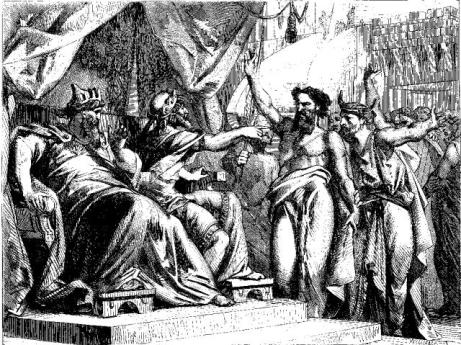
At that time Rezin the king of Syria recovered Elath for Syria and drove the men of Judah from Elath, and the Edomites came to Elath, where they dwell to this day. So Ahaz sent messengers to Tiglath-pileser king of Assyria, saying, “I am your servant and your son. Come up and rescue me from the hand of the king of Syria and from the hand of the king of Israel, who are attacking me.” Ahaz also took the silver and gold that was found in the house of the LORD and in the treasures of the king’s house and sent a present to the king of Assyria. And the king of Assyria listened to him. The king of Assyria marched up against Damascus and took it, carrying its people captive to Kir, and he killed Rezin.

10 When King Ahaz went to Damascus to meet Tiglath-pileser king of Assyria, he saw the altar that was at Damascus. And King Ahaz sent to Uriah the priest a model of the altar, and its pattern, exact in all its details. 11 And Uriah the priest built the altar; in accordance with all that King Ahaz had sent from Damascus, so Uriah the priest made it, before King Ahaz arrived from Damascus. 12 And when the king came from Damascus, the king viewed the altar. Then the king drew near to the altar and went up on it 13 and burned his burnt offering and his grain offering and poured his drink offering and threw the blood of his peace offerings on the altar. 14 And the bronze altar that was before the LORD he removed from the front of the house, from the place between his altar and the house of the LORD, and put it on the north side of his altar. 15 And King Ahaz commanded Uriah the priest, saying, “On the great altar burn the morning burnt offering and the evening grain offering and the king’s burnt offering and his grain offering, with the burnt offering of all the people of the land, and their grain offering and their drink offering. And throw on it all the blood of the burnt offering and all the blood of the sacrifice, but the bronze altar shall be for me to inquire by.” 16 Uriah the priest did all this, as King Ahaz commanded.

17 And King Ahaz cut off the frames of the stands and removed the basin from them, and he took down the sea from off the bronze oxen that were under it and put it on a stone pedestal. 18 And the covered way for the Sabbath that had been built inside the house and the outer entrance for the king he caused to go around the house of the LORD, because of the king of Assyria. 19 Now the rest of the acts of Ahaz that he did, are they not written in the Book of the Chronicles of the Kings of Judah? 20 And Ahaz slept with his fathers and was buried with his fathers in the city of David, and Hezekiah his son reigned in his place. 2 Kings 16:6-20 ESV

As we have already seen, Ahaz patterned his reign after his contemporaries in the northern kingdom. The author states that “he did not do what was right in the eyes of the LORD his God, as his father David had done, but he walked in the way of the kings of Israel” (2 Kings 16:2 ESV). Rather than promote the worship of Yawheh, Ahaz adopted a variety of pagan gods and not only authorized but encouraged their worship. As evidence of his personal commitment to these false gods, Ahaz offered human sacrifices, including his own sons, on their altars.

He even made metal images for the Baals, and he made offerings in the Valley of the Son of Hinnom and burned his sons as an offering, according to the abominations of the nations whom the LORD drove out before the people of Israel. – 2 Chronicles 28:2-3 ESV

As a result, God authorized the Syrians and the Israelites to act as His agents of judgment against the kingdom of Judah. However, while these two nations ended up making Ahaz’s life miserable, they were not allowed to defeat Judah. Yet their constant attacks resulted in the loss of land and lives. Hundreds of thousands of the citizens of Judah were killed or captured, leaving the rest of the people in a state of constant fear. And because Judah’s army had been unable to prevent these costly attacks, Ahaz was forced to seek assistance from the Assyrians.

King Ahaz sent messengers to King Tiglath-pileser of Assyria with this message: “I am your servant and your vassal. Come up and rescue me from the attacking armies of Aram and Israel.” – 2 Kings 16:7 NLT

Of course, Ahaz knew that Tiglath-pileser would not provide assistance without some form of compensation, so, to pay off his rescuers, Ahaz drained the royal treasury and pilfered silver and gold from the Temple coffers to sweeten the deal. And while Ahaz’s plan came with a high price tag, it proved effective. The Assyrians immediately launched an attack against Damascus, the capital city of Syria. Rezin, the king of Syria, was killed in the battle, and Damascus was taken. When King Ahaz received word of the victory, he traveled to Damascus to meet King Tiglath-pileser. While there, he became obsessed with one of the many altars dedicated to the Syrian gods. He had a model made and sent to Uriah the high priest, who was ordered to build an exact replica in Jerusalem. Uriah complied with the king’s command, and when Ahaz returned to Jerusalem, he offered sacrifices to the Syrian god. Adding insult to injury, he also ordered the removal and relocation of the bronze altar that stood in the Temple courtyard.

These were just a few of the many “reforms” that Ahaz instituted. He was making wholesale changes to the religious institution that God had ordained for His chosen people. While Ahaz didn’t sanction the complete abandonment of Yahweh worship, he did create an unauthorized, fully syncretized form of religion that transformed Judah’s religion from monotheism to polytheism. God Almighty became just one more deity among the many whose altars and high places filled the land of Judah.

But Ahaz would soon discover the error of his ways because, in time, the ambitious king of Assyria would turn his sights on Judah. Ahaz’s former “savior” would become his potential destroyer.

So when King Tiglath-pileser of Assyria arrived, he attacked Ahaz instead of helping him. Ahaz took valuable items from the LORD’s Temple, the royal palace, and from the homes of his officials and gave them to the king of Assyria as tribute. But this did not help him. – 2 Chronicles 28:20-21 NLT

Once Tiglath-pileser saw how easily Damascus had fallen, he became greedy and determined to make Jerusalem his next point of conquest. So, as he had done before, King Ahaz attempted to buy off the Assyrians. With the treasuries of the palace and Temple depleted, he was forced to ransack the private property of his own officials. But this time, his plan failed. King Tiglath-pileser gladly took his money but refused to call off his troops. This left Ahaz in a state of desperation, and with no other choice but to seek divine help. But rather than seek the aid of Yahweh, Ahaz “offered sacrifices to the gods of Damascus who had defeated him” (2 Chronicles 28:23 NLT). Ironically, in an attempt to thwart the Assyrians, Ahaz put his hope in the gods of the nation whom the Assyrians had easily defeated. He unwisely rationalized, “Since these gods helped the kings of Aram, they will help me, too, if I sacrifice to them” (2 Chronicles 28:23 NLT).

But his reasoning proved faulty, producing a painfully predictable outcome. Rather than providing deliverance from his enemies, his appeal to these non-existent gods produced “his ruin and the ruin of all Judah” (2 Chronicles 28:23 NLT). Displaying a blatant and stubborn disregard for Yahweh, Ahaz continued to place all his hope in the pagan deities he had adopted. Not only that, in anger and defiance, Ahaz ordered the desecration of Yahweh’s Temple and barred the doors to prevent anyone from worshiping or calling upon the one true God.

The king took the various articles from the Temple of God and broke them into pieces. He shut the doors of the LORD’s Temple so that no one could worship there, and he set up altars to pagan gods in every corner of Jerusalem. He made pagan shrines in all the towns of Judah for offering sacrifices to other gods. In this way, he aroused the anger of the LORD, the God of his ancestors. – 2 Chronicles 28:24-25 NLT

Ahaz did all of this in a misguided attempt to stop the Assyrian threat. But what he failed to realize was that the presence of the Assyrians was due to his disregard and disrespect for God. Everything he was doing was going to backfire because he was refusing to give Yahweh the glory and honor He deserved. Ahaz had tried to relegate God Almighty to an inferior status among his growing retinue of false gods. He treated Yahweh with contempt, acting as if He were powerless and incapable of delivering either redemption or judgment. But little did he know that this “impotent” God was about to bring down judgment against Judah’s northern neighbor, and would use the dreaded Assyrians to accomplish His divine will.

Ahaz’s wholesale and completely unauthorized “renovation” of God’s house was meant to please the Assyrian king. It seems that Ahaz was desperate to win the favor of this powerful ruler to prevent any further threats to Judah’s national sovereignty. But Ahaz would not live long enough to experience the consequences of his ill-advised renovation plans. His death brought his reign to an end, and his son, Hezekiah, inherited his throne and less-than-stable kingdom. The Book of 2 Chronicles adds an insightful fact to Ahaz’s royal funeral.

When Ahaz died, he was buried in Jerusalem but not in the royal cemetery of the kings of Judah. Then his son Hezekiah became the next king. – 2 Chronicles 28:27 NLT

According to the Book of 1 Kings, David and his son, Solomon, were both buried within the walls of the old city of David. This was the original site of David’s capital, which was later greatly expanded as his kingdom grew. The author’s reference to “the royal cemetery of the kings of Judah” indicates that there was a site within the old city set apart to memorialize the kings of Judah.

Then David died and was buried with his ancestors in the City of David. – 1 Kings 2:10 NLT

When he [Solomon] died, he was buried in the City of David, named for his father. – 1 Kings 11:43 NLT

When Rehoboam died, he was buried among his ancestors in the City of David. – 1 Kings 14:31 NLT

When Abijam died, he was buried in the City of David. – 1 Kings 15:8 NLT

One might conclude that this royal cemetery was reserved for the “good” kings of Judah, but the interments of Rehoboam and Abijam alongside David and Solomon seem to belie that assumption. Both of those men were far from righteous, and their reigns were marked by apostasy and idolatry. Yet, Ahaz was not afforded the same privilege of being buried among his illustrious predecessors.

There is no explanation given for this decision, but it might be that Ahaz was deemed unworthy of the honor. His desecration of God’s house and his plunder of the Temple treasury would have alienated him from the priesthood and likely led to the decision to bar his interment among the kings of Judah. It is interesting to note that Ahaz’s son and successor, Hezekiah, would institute reforms designed to restore the worship of Yahweh and reopen the doors of the Temple his father had closed. As a result, when Hezekiah died, “they buried him in the upper part of the tombs of the sons of David” (2 Chronicles 32:33 ESV). Unlike his apostate father, Hezekiah was buried alongside David, Solomon, and the other kings of Judah within the walls of the old city of David. His many religious reforms secured him a spot among his royal predecessors, a privilege denied his father.

English Standard Version (ESV) The Holy Bible, English Standard Version. ESV® Permanent Text Edition® (2016). Copyright © 2001 by Crossway Bibles, a publishing ministry of Good News Publishers.

New Living Translation (NLT) Holy Bible, New Living Translation, copyright © 1996, 2004, 2015 by Tyndale House Foundation. Used by permission of Tyndale House Publishers Inc., Carol Stream, Illinois 60188. All rights reserved.

The Curse of Low Expectations

10 In the thirty-seventh year of Joash king of Judah, Jehoash the son of Jehoahaz began to reign over Israel in Samaria, and he reigned sixteen years. 11 He also did what was evil in the sight of the LORD. He did not depart from all the sins of Jeroboam the son of Nebat, which he made Israel to sin, but he walked in them. 12 Now the rest of the acts of Joash and all that he did, and the might with which he fought against Amaziah king of Judah, are they not written in the Book of the Chronicles of the Kings of Israel? 13 So Joash slept with his fathers, and Jeroboam sat on his throne. And Joash was buried in Samaria with the kings of Israel.

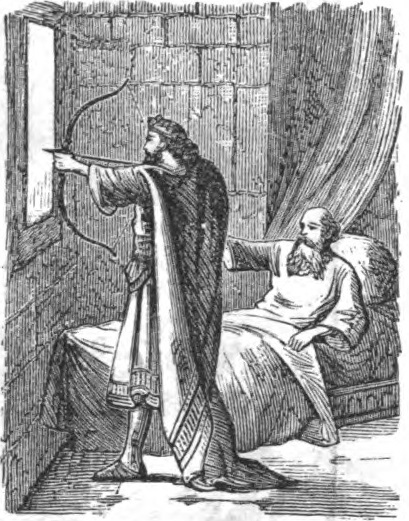
14 Now when Elisha had fallen sick with the illness of which he was to die, Joash king of Israel went down to him and wept before him, crying, “My father, my father! The chariots of Israel and its horsemen!” 15 And Elisha said to him, “Take a bow and arrows.” So he took a bow and arrows. 16 Then he said to the king of Israel, “Draw the bow,” and he drew it. And Elisha laid his hands on the king’s hands. 17 And he said, “Open the window eastward,” and he opened it. Then Elisha said, “Shoot,” and he shot. And he said, “The LORD‘s arrow of victory, the arrow of victory over Syria! For you shall fight the Syrians in Aphek until you have made an end of them.” 18 And he said, “Take the arrows,” and he took them. And he said to the king of Israel, “Strike the ground with them.” And he struck three times and stopped. 19 Then the man of God was angry with him and said, “You should have struck five or six times; then you would have struck down Syria until you had made an end of it, but now you will strike down Syria only three times.”

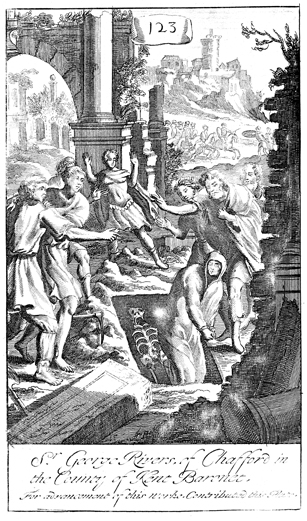
20 So Elisha died, and they buried him. Now bands of Moabites used to invade the land in the spring of the year. 21 And as a man was being buried, behold, a marauding band was seen and the man was thrown into the grave of Elisha, and as soon as the man touched the bones of Elisha, he revived and stood on his feet.

22 Now Hazael king of Syria oppressed Israel all the days of Jehoahaz. 23 But the LORD was gracious to them and had compassion on them, and he turned toward them, because of his covenant with Abraham, Isaac, and Jacob, and would not destroy them, nor has he cast them from his presence until now.

24 When Hazael king of Syria died, Ben-hadad his son became king in his place. 25 Then Jehoash the son of Jehoahaz took again from Ben-hadad the son of Hazael the cities that he had taken from Jehoahaz his father in war. Three times Joash defeated him and recovered the cities of Israel. 2 Kings 13:10-25 ESV

Keeping up with the revolving door of kings who reigned over Israel and Judah is hard enough as it is, but it becomes even more difficult when two kings with the same name end up ruling at the same time. That’s the case in this particular passage. Jehoash ascended to the throne of Israel after the death of his father, Jehoahaz, and it just so happened that the king of Judah bore the same name. It seems only fitting and a bit ironic that these two nations that shared the same predilection for idolatry and apostasy would end up with rulers who shared the same name. While their reigns would only intersect for a period of about two years, they shared more in common than their name. In the end, both men proved to be ungodly leaders who failed to lead their people back to the worship of Yahweh.

When Jehoash, the king of Judah, received a less-than-encouraging message from God, he ordered the stoning of the messenger. It just so happened that the man he executed was Zechariah, the son of Jehoiada the priest. This was the same Jehoiada who had saved the infant Jehoash from the hands of Queen Athaliah by providing him with sanctuary in the temple for six years. On Jehoash’s seventh birthday, Jehoiada had anointed him as the king of Judah. But years later, after Jehoiada’s death, Jehoash began to listen to the counsel of his ungodly advisors and ultimately forsake Yahweh. As a result, Judah suffered defeat at the hands of a much smaller Syrian force. He was wounded in the battle and, while recuperating from his injuries, he was assassinated by two of his own officials.

And the king of Israel, who bore the same name, shared a similar story of unfaithfulness and rebellion. The author sums up his 16-year reign with the words: “he did what was evil in the LORD’s sight. He refused to turn from the sins that Jeroboam son of Nebat had led Israel to commit” (2 Kings 13:11 NLT). He, too, forsook the LORD and led the people to continue their love affair with false gods. And it’s interesting to note that the heir to his throne was his son, Jeroboam II, whom he had named after the first king of the northern kingdom of Israel. His admiration for Jeroboam seems obvious but undeserved. After all, Jeroboam had been responsible for leading the Israelites into idolatry. When God split the nation of Israel in two after the reign of Solomon, He gave the ten northern tribes to Jeroboam as his kingdom. But Jeroboam responded to this gracious gift from God by erecting two golden calves and encouraging his people to forsake the worship of Yahweh. Yet Jehoash thought enough of this man to name his own son after him.

But sometime during his reign, Jehoash of Israel received word that the prophet Elisha was on his deathbed. Surprisingly, the king was grieved over this news and made a personal visit to see the dying prophet. While Jehoash was anything but a faithful worshiper of Yahweh, he knew that Elisha had great power and influence. This elderly prophet had proven time and time again that he spoke on behalf of God and was empowered by God. That’s why Jehoash greeted him with the somewhat cryptic statement: “My father, my father! The chariots of Israel and its horsemen!” (2 Kings 13:14 ESV). Evidently, Jehoash had heard the story of Elijah’s miraculous departure and Elisha’s role in it. Perhaps Elisha had shared with the king the details of that fateful day when God had used a whirlwind to take Elijah from the earth.

…as they still went on and talked, behold, chariots of fire and horses of fire separated the two of them. And Elijah went up by a whirlwind into heaven. And Elisha saw it and he cried, “My father, my father! The chariots of Israel and its horsemen!” And he saw him no more. – 2 Kings 2:11-12 ESV

This event followed Elisha’s request that Elijah give him a double portion of his spirit. He was to be Elijah’s replacement, and he felt ill-equipped for the task. It could be that King Jehoash hoped Elisha would pour out his spirit on him as well. He understood that Elisha possessed power and had direct access to Yahweh. With the prophet’s death, all of that might be lost. But rather than pour out his spirit on the apostate king, Elisha commanded him to take his bow and shoot an arrow out the window.

Elisha said, “Shoot,” and he shot. And he said, “The LORD‘s arrow of victory, the arrow of victory over Syria! For you shall fight the Syrians in Aphek until you have made an end of them.” – 2 Kings 13:17 ESV

Next, the prophet told the king to take his remaining arrows and strike the ground with them. Jehoash dutifully obeyed, but when he stopped after the third blow, Elisha responded in anger.

“You should have struck the ground five or six times!” he exclaimed. “Then you would have beaten Aram until it was entirely destroyed. Now you will be victorious only three times.” – 2 Kings 13:19 NLT

In a sense, Elisha had poured out his spirit on King Jehoash. He had placed his hands on those of the king and, together, they had shot the first arrow out the window. He then assured the king of his victory over the Syrians. But the extent of that victory would depend on Jehoash’s faith. By limiting the number of times he struck the ground, Jehoash was unwittingly revealing his lack of faith. The first arrow had symbolized the LORD’s victory over the Syrians. When Elisha had commanded Jehoash to take the remaining arrows and strike the ground, he should have done so until the prophet told him to stop. Each blow was meant to symbolize a victory over the enemy. But Jehoash had chosen to limit his expectations. In doing so, he inadvertently limited his chances of success over his enemy.

Having pronounced his last prophetic message, Elisha died. But the author relates a story that reveals one last miracle associated with the prophet of God. Sometime later, the body of a recently deceased man was inadvertently thrown into the cave containing Elisha’s bones. When the body of the dead man came into contact with Elisha’s remains, he was immediately restored to life. Amazingly, the author provides no further details about the story to indicate what happened to this newly resurrected man or how the story came to be known. But its inclusion in the narrative was meant to reveal that, though Elisha was dead,  Yahweh was alive and well. Elisha’s departure was not meant to be mistaken for God’s abandonment of Israel. He was still fully capable of restoring life to the lifeless. The all-powerful God of Israel used the bones of a dead prophet to restore life to a dead Israelite, a clear symbol of His desire to renew those among His chosen people who were marked by spiritual death.

The author reminds his readers that God remained faithful to His disobedient people, refusing to abandon them despite their constant rejection of Him.

the LORD was gracious and merciful to the people of Israel, and they were not totally destroyed. He pitied them because of his covenant with Abraham, Isaac, and Jacob. – 2 Kings 13:23 NLT

The author also reveals that Yahweh kept His word concerning the fate of the Syrians. Jehoash experienced three separate victories over his enemy, matching the exact number of times he struck the ground with his arrows — no more, no less. God allowed Jehoash to recover some of the territory stolen by the Syrians, but the fighting would continue throughout the rest of his reign. The sad reality is that the same God who raised a dead man back to life was fully capable of restoring a spiritually dead nation. Still, their continued stubbornness and lack of faithfulness would prevent them from experiencing the life-transformative power of Yahweh.

English Standard Version (ESV) The Holy Bible, English Standard Version. ESV® Permanent Text Edition® (2016). Copyright © 2001 by Crossway Bibles, a publishing ministry of Good News Publishers.

New Living Translation (NLT) Holy Bible, New Living Translation, copyright © 1996, 2004, 2015 by Tyndale House Foundation. Used by permission of Tyndale House Publishers Inc., Carol Stream, Illinois 60188. All rights reserved.
Godly Grief Vs Worldly Grief

1 In the twenty-third year of Joash the son of Ahaziah, king of Judah, Jehoahaz the son of Jehu began to reign over Israel in Samaria, and he reigned seventeen years. He did what was evil in the sight of the LORD and followed the sins of Jeroboam the son of Nebat, which he made Israel to sin; he did not depart from them. And the anger of the LORD was kindled against Israel, and he gave them continually into the hand of Hazael king of Syria and into the hand of Ben-hadad the son of Hazael. Then Jehoahaz sought the favor of the LORD, and the LORD listened to him, for he saw the oppression of Israel, how the king of Syria oppressed them. (Therefore the LORD gave Israel a savior, so that they escaped from the hand of the Syrians, and the people of Israel lived in their homes as formerly. Nevertheless, they did not depart from the sins of the house of Jeroboam, which he made Israel to sin, but walked in them; and the Asherah also remained in Samaria.) For there was not left to Jehoahaz an army of more than fifty horsemen and ten chariots and ten thousand footmen, for the king of Syria had destroyed them and made them like the dust at threshing. Now the rest of the acts of Jehoahaz and all that he did, and his might, are they not written in the Book of the Chronicles of the Kings of Israel? So Jehoahaz slept with his fathers, and they buried him in Samaria, and Joash his son reigned in his place. 2 Kings 13:1-9 ESV

God had used the Syrians to inflict judgment upon the southern kingdom of Judah. Because of the rebellion of His people, God had given King Hazael and his Syrian troops a resounding victory over the much larger and more powerful army of King Jehoash. Having been wounded in battle against the Syrians, Jehoash became an easy target for some of his disgruntled officials. They strongly opposed his murder of Zechariah, the son of Jehoiada the priest, and saw the nation’s recent defeat by a much smaller Syrian force as a sign of God’s judgment. So, these two men took it upon themselves to assassinate the king while he was lying in bed recovering from his injuries. He was then replaced by his son, Amaziah.

In the meantime, the northern kingdom of Israel was having its own set of struggles with the Syrians. Jehoahaz had ascended to the throne of his father, Jehu, and had managed to keep Israel’s legacy of apostasy alive and well.

He did what was evil in the sight of the LORD and followed the sins of Jeroboam the son of Nebat, which he made Israel to sin; he did not depart from them. – 2 Kings 13:2 ESV

In other words, it was business as usual in Israel. But God had grown weary of watching each successive royal administration try to outdo the sins of their predecessors. Fed up with their stubbornness and blatant unfaithfulness, He unleashed His righteous indignation against Israel and “gave them continually into the hand of Hazael king of Syria and into the hand of Ben-hadad the son of Hazael” (2 Kings 13:3 ESV).

The Syrians became the proverbial thorn in the side of the disobedient Israelites. This imagery was in keeping with God’s earlier warnings against Israel compromising with the pagan nations that occupied the promised land.

But if you do not drive out the inhabitants of the land from before you, then those of them whom you let remain shall be as barbs in your eyes and thorns in your sides, and they shall trouble you in the land where you dwell. – Numbers 33:55 ESV

God would later provide the Israelites with another warning, meant to discourage them from intermarrying with the pagan nations that occupied the land of Canaan.

…know for certain that the LORD your God will no longer drive out these nations before you, but they shall be a snare and a trap for you, a whip on your sides and thorns in your eyes, until you perish from off this good ground that the LORD your God has given you. – Joshua 23:13 ESV

And when the Israelites failed to drive out the inhabitants of the land, God announced that they were on their own; He was abandoning them to their wicked ways. They would have to deal with the consequences of their disobedience.

“So now I say, I will not drive them out before you, but they shall become thorns in your sides, and their gods shall be a snare to you.” – Judges 2:3 ESV

Yet, when God sent the Syrians to plague and provoke the unfaithful people of Israel, King Jehoahaz “sought the favor of the LORD” (2 Kings 13:4 ESV). The constant pain inflicted by this divinely-ordained “thorn” was more than Jehoahaz could bear, so he did something none of his predecessors had ever done: He humbled himself and cried out to God. And his cry was heard and answered. The author states that God, the very one who sent the Syrians, “saw the oppression of Israel, how the king of Syria oppressed them” (2 Kings 13:4 ESV). This statement makes it sound like God was surprised by what He saw, but it would be better interpreted as a declaration of God’s recognition of the suffering His chosen people were having to endure. His judgment, while fully just and well-deserved, had produced its intended results, and He felt compassion for the plight of His people. His discipline of His children was not because He had fallen out of love with them. In fact, the book of Proverbs reminds us, “the LORD corrects those he loves, just as a father corrects a child in whom he delights” (Proverbs3:12 NLT). And the author of Hebrews quotes this very proverb, then adds a further point of clarification.

As you endure this divine discipline, remember that God is treating you as his own children. Who ever heard of a child who is never disciplined by its father? If God doesn’t discipline you as he does all of his children, it means that you are illegitimate and are not really his children at all. – Hebrews 12:7-8 NLT

God had lovingly disciplined them for their disobedience and unfaithfulness. But, as the text reveals, He heard the humbled cry of their king and responded in love and compassion. He did for them what they couldn’t do for themselves; He rescued them from the very plight they had brought upon themselves.

Therefore the LORD gave Israel a savior, so that they escaped from the hand of the Syrians, and the people of Israel lived in their homes as formerly… – 2 Kings 13:5 ESV

This scene brings to mind the book of Judges, which chronicles the period of Israelite history long before they had a king. They had managed to enter Canaan, but failed to completely eliminate the pagan nations that occupied the land before them. As a result, they ended up intermarrying with these nations and worshiping their false gods. This led God to punish them.

…the people of Israel did what was evil in the sight of the LORD and served the Baals. And they abandoned the LORD, the God of their fathers, who had brought them out of the land of Egypt. They went after other gods, from among the gods of the peoples who were around them, and bowed down to them. And they provoked the LORD to anger. They abandoned the LORD and served the Baals and the Ashtaroth.  So the anger of the LORD was kindled against Israel, and he gave them over to plunderers, who plundered them. And he sold them into the hand of their surrounding enemies, so that they could no longer withstand their enemies. – Judges 2:11-14 ESV

But in time, God raised up deliverers who rescued His wayward people and restored them to a right relationship with Him.

Then the LORD raised up judges, who saved them out of the hand of those who plundered them. – Judges 2:17 ESV

Sadly, this cycle would repeat itself over and over again. The people would sin, so God would send a plunderer. Then, when the suffering became unbearable, the people would cry out, and another deliverer would show up to rescue them.

Now, hundreds of years later, the people of Israel would reveal that little had changed. They cried out, and God sent them a savior. We have no way of knowing the identity of this individual. Some have speculated that it was King Adad-Nirari III of Assyria. The Assyrians were the new kids on the block, an up-and-coming nation that was beginning to flex its military muscle in the region. To access the Mediterranean Sea and the fertile valleys located in Canaan, they would have to pass through the land belonging to Syria. It could be that God used this rapidly expanding world power to harass and distract the Syrians, buying King Jehoahaz and the Israelites a much-needed respite.

But regardless of the identity of this God-appointed “savior,” the people of Israel proved to be far from grateful for their rescue. In time, they fell back into their old habits.

But they continued to sin, following the evil example of Jeroboam. They also allowed the Asherah pole in Samaria to remain standing. – 2 Kings 13:6 NLT

Nothing had changed. Jehoahaz remained just as stubborn and unrepentant as always. Even the fact that God had allowed the Syrians to drastically reduce the fighting capacity of Israel’s army failed to elicit a change in Jehoahaz. The oppression of the Syrians got his attention and forced him to cry out to God, but once rescued, he continued to pursue the same ungodly agenda as before. The loving discipline and gracious deliverance of God failed to make a lasting impression on Jehoahaz. He was allowed to complete his reign, but with his decimated army,  he was a king in name only. He would die, and his son would inherit his throne and a diminished kingdom.

God’s loving discipline was meant to bring His wayward people to repentance. But Jehoahaz, like so many of his predecessors, failed to respond to God’s gracious deliverance appropriately. Despite his decimated army, Jehoahaz enjoyed an unexpected break from the Syrian oppression because Yahweh sent a “savior” to restore their fortunes. Yet, once the people “escaped from the hand of the Syrians, and…lived in their homes as formerly” (2 Kings 13:5 ESV), they refused to give up their old pagan practices. With the threat of the Syrians eliminated and their former lifestyles restored, the Israelites forsook Yahweh once again. The author provides an unflattering assessment of their response to Yahweh’s deliverance. “They continued to sin, following the evil example of Jeroboam. They also allowed the Asherah pole in Samaria to remain standing” (2 Kings 13:6 NLT).

This brings to mind a message that Jesus gave to the church in Laodicea, recorded in the Book of Revelation by the apostle John.

“I know all the things you do, that you are neither hot nor cold. I wish that you were one or the other! But since you are like lukewarm water, neither hot nor cold, I will spit you out of my mouth! You say, ‘I am rich. I have everything I want. I don’t need a thing!’ And you don’t realize that you are wretched and miserable and poor and blind and naked. So I advise you to buy gold from me—gold that has been purified by fire. Then you will be rich. Also buy white garments from me so you will not be shamed by your nakedness, and ointment for your eyes so you will be able to see. I correct and discipline everyone I love. So be diligent and turn from your indifference. – Revelation 3:15-19 NLT

That last line says it all. God the Father and Jesus Christ His Son demand true and lasting repentance. The apostle Paul refers to this kind of repentance and associates it with “godly grief.”

I rejoice, not because you were grieved, but because you were grieved into repenting. For you felt a godly grief, so that you suffered no loss through us.

For godly grief produces a repentance that leads to salvation without regret, whereas worldly grief produces death. – 2 Corinthians 7:9-10 ESV

The beleaguered people of Israel had suffered under the unrelenting attacks of the Syrians, and it seems that their grief was worldly and not godly. This produced a false form of repentance that failed to recognize their need for Yahweh. Once delivered from their oppression, their “grief” was replaced with a false sense of optimism and hope, but failed to produce a reverence for and dependence upon Yahweh as their true “savior.” They stubbornly refused to admit that they were “wretched and miserable and poor and blind and naked” (Revelation 3:17 NLT). And their “worldly grief” would ultimately result in death. 

English Standard Version (ESV) The Holy Bible, English Standard Version. ESV® Permanent Text Edition® (2016). Copyright © 2001 by Crossway Bibles, a publishing ministry of Good News Publishers.

New Living Translation (NLT) Holy Bible, New Living Translation, copyright © 1996, 2004, 2015 by Tyndale House Foundation. Used by permission of Tyndale House Publishers Inc., Carol Stream, Illinois 60188. All rights reserved.
Robbing God Is Risky

17 At that time Hazael king of Syria went up and fought against Gath and took it. But when Hazael set his face to go up against Jerusalem, 18 Jehoash king of Judah took all the sacred gifts that Jehoshaphat and Jehoram and Ahaziah his fathers, the kings of Judah, had dedicated, and his own sacred gifts, and all the gold that was found in the treasuries of the house of the LORD and of the king’s house, and sent these to Hazael king of Syria. Then Hazael went away from Jerusalem.

19 Now the rest of the acts of Joash and all that he did, are they not written in the Book of the Chronicles of the Kings of Judah? 20 His servants arose and made a conspiracy and struck down Joash in the house of Millo, on the way that goes down to Silla. 21 It was Jozacar the son of Shimeath and Jehozabad the son of Shomer, his servants, who struck him down, so that he died. And they buried him with his fathers in the city of David, and Amaziah his son reigned in his place. 2 Kings 12:17-21 ESV

With the death of Jehoiada the priest, King Jehoash became like a ship without a rudder. His former mentor and father figure had been a stabilizing factor in his life, and his departure left the king directionless and vulnerable to the influence of others. The book of 2 Chronicles reveals that not long after Jehoiada’s death, “the leaders of Judah came and bowed before King Joash and persuaded him to listen to their advice. They decided to abandon the Temple of the Lord, the God of their ancestors, and they worshiped Asherah poles and idols instead! Because of this sin, divine anger fell on Judah and Jerusalem” (2 Chronicles 24:17-18 NLT). Though God sent prophets who called the nation to repentance, the people refused to listen, and King Jehoash led the way in rejecting the messengers of Yahweh.

God placed His Spirit upon Zechariah, the son of Jehoiada, who delivered a stinging indictment against the nation.

“This is what God says: Why do you disobey the LORD’s commands and keep yourselves from prospering? You have abandoned the LORD, and now he has abandoned you!” – 2 Chronicles 24:20 NLT

But his words fell on deaf ears and hard hearts. Rather than call the people to repentance, King Jehoash repaid his former mentor, Jehoiada, by having his son stoned to death in the Temple courtyard. As Zechariah died, he cried out, “May the LORD see what they are doing and avenge my death!” (2 Chronicles 24:22 NLT).

This curse from the lips of God’s dying prophet would come to fruition. God would avenge the death of Zechariah, and He would use the pagan nation of Syria to do it. For years, the Syrians had been harassing the northern kingdom of Israel. All the while Jehoash had been king in Judah, his counterpart in Israel had been waging an ongoing war against the Syrians. King Jehoahaz had ascended to the throne of his father, Jehu, and had picked up where his father had left off, doing “what was evil in the sight of the LORD and followed the sins of Jeroboam the son of Nebat” (2 Kings 13:2 ESV). As a result, God “gave them continually into the hand of Hazael king of Syria and into the hand of Ben-hadad the son of Hazael” (2 Kings 13:3 ESV). This continued throughout the reign of King Jehoahaz.

But now, God was going to use the Syrians to punish the rebellious and unrepentant nation of Judah. King Hazael took his campaign of terror further south, moving along the coast of the Mediterranean, and eventually capturing the city of Gath, deep within Judean territory. Then he set his sights on Jerusalem. In the spring of the year, Hazael and his army attacked the capital city, “and destroyed all the princes of the people from among the people and sent all their spoil to the king of Damascus” (2 Chronicles 24:23 ESV). The chronicler goes on to reveal that this victory was God-ordained.

Though the army of the Syrians had come with few men, the LORD delivered into their hand a very great army, because Judah had forsaken the LORD, the God of their fathers. Thus they executed judgment on Joash. – 2 Chronicles 24:24 ESV

The attack left Jehoash wounded, and, in desperation, the king decided to do whatever he had to do to keep Hazael from capturing the city. So, he stripped bare the Temple treasury, sending all the sacred items and the gold to Hazael as a form of ransom.

Jehoash king of Judah took all the sacred gifts that Jehoshaphat and Jehoram and Ahaziah his fathers, the kings of Judah, had dedicated, and his own sacred gifts, and all the gold that was found in the treasuries of the house of the LORD and of the king’s house, and sent these to Hazael king of Syria. Then Hazael went away from Jerusalem. – 2 Kings 12:18 ESV

This king, who had been raised by the priest of God in the house of God, sold out Yahweh. In the face of the Syrian assault, Jehoash resorted to paying off his attackers, stripping the Temple of all its holy treasures and priceless valuables. Rather than turning to Yahweh for help, Jehoash took what had been consecrated to God and used it to buy off the enemy, and his plan seemed to work.

Hazael took the treasure and left, but Jehoash’s troubles were far from over. Still suffering from the wounds he had received in the attack on Jerusalem, Jehoash was in a vulnerable state. His treasury was bankrupt, and he was a physically broken man. It seems that some of his officials recognized that Judah’s recent defeat at the hands of the Syrians had something to do with Jehoash’s decision to kill Zechariah. The curse uttered by the dying prophet had come true. So, they decided to eliminate the cause of all their troubles.

…his own officials plotted to kill him for murdering the son of Jehoiada the priest. They assassinated him as he lay in bed. – 2 Chronicles 24:25 NLT

The author of 2 Kings even provides the names of the two conspirators.

The assassins were Jozacar son of Shimeath and Jehozabad son of Shomer—both trusted advisers. – 2 Kings 12:21 NLT

These men would have had easy access to the king because he trusted them. They had become replacements for Jehoiada, providing the king with counsel and acting as his mentors. But unlike the former priest, these men had no love for Jehoash. They viewed him as a plague upon the nation and determined that his removal might placate God and prevent further judgment. Yet, it’s important to understand that their actions were ordained by God. It’s interesting to note that these two men were actually foreigners. One was the son of an Ammonite woman, and the other was the son of a Moabite woman. This reference to their birth mothers is significant because it links the events in this chapter all the way back to the Book of Genesis.

Genesis 19 contains the account of God’s rescue of Lot and his daughters from the wicked city of Sodom. Lot, the nephew of Abraham, had decided to settle in the fertile valleys of the Jordan, but it wasn’t long before he “moved his tent as far as Sodom” (Genesis 13:12 ESV). This proved to be a poor decision, becausethe men of Sodom were wicked, great sinners against the LORD” (Genesis 13:12 ESV). Eventually, Lot relocated his family inside the walls of the city of Sodom. When God determined to destroy Sodom and its neighboring city of Gomorrah for the wickedness of their inhabitants, Abraham convinced God to spare Lot and his daughters. But once they were rescued by the angels of God, Lot’s daughters displayed the negative influence of their time spent in Sodom. Fearful that they would never find husbands, they came up with a plan to get their father drunk and commit incest with him, all under the guise of prolonging their father’s lineage. Their mother was dead, and their father had no sons. So, in their minds, this was the only way of preserving the family line. But their sinful decision produced a less-than-ideal outcome.

…both of Lot’s daughters became pregnant by their own father. When the older daughter gave birth to a son, she named him Moab. He became the ancestor of the nation now known as the Moabites. When the younger daughter gave birth to a son, she named him Ben-ammi. He became the ancestor of the nation now known as the Ammonites. – Genesis 19:36 NLT

The descendants of these two young ladies became the Ammonites and Moabites. These distant relatives of the Israelites were pagan nations that worshiped false gods. It’s no coincidence that the men who plotted and carried out the assassination of Jehoash had ties to these two nations. God had used the Syrians to inflict judgment upon Judah. Now, He used an Ammonite and a Moabite to bring death to the rebellious and unrepentant Jehoash.

God had preserved and protected Jehoash, allowing him to find sanctuary in the Temple and receive instruction from Jehoiada the priest. But when his godly mentor died, Jehoash was exposed for what he really was — just another king who refused to acknowledge Yahweh as the one true Sovereign. Jehoash had started out so well but ended poorly, choosing to forsake God and listen to the advice of men. Rather than heed the warnings of God’s prophet, Jehoash put him to death. Instead of placing his trust in Yahweh, Jehoash attempted to buy his way out of trouble, using the treasury of God in a failed attempt to escape the judgment of God. And he died trying.

Joash was buried with his ancestors in the City of David. Then his son Amaziah became the next king. – 2 Kings 12:21 NLT

Another king had come to power and disappeared from the scene because he refused to honor the One who had placed him on the throne to begin with. Yahweh had graciously preserved the nation of Judah, providing ample evidence of His patience and love. He would later juxtapose His faithfulness against the backdrop of Judah’s ongoing apostasy, and, interestingly enough, He would accuse them of having robbed Him.

“For I the LORD do not change; therefore you, O children of Jacob, are not consumed. From the days of your fathers you have turned aside from my statutes and have not kept them. Return to me, and I will return to you, says the LORD of hosts. But you say, ‘How shall we return?’ Will man rob God? Yet you are robbing me. But you say, ‘How have we robbed you?’ In your tithes and contributions. You are cursed with a curse, for you are robbing me, the whole nation of you. Bring the full tithe into the storehouse, that there may be food in my house. And thereby put me to the test, says the LORD of hosts, if I will not open the windows of heaven for you and pour down for you a blessing until there is no more need. I will rebuke the devourer for you, so that it will not destroy the fruits of your soil, and your vine in the field shall not fail to bear, says the LORD of hosts. Then all nations will call you blessed, for you will be a land of delight, says the LORD of hosts. – Malachi 3:6-12 NLT

The people of Judah had robbed God of what was rightfully His: their divinely ordained contributions and tithes, which were intended to be expressions of their love for and dependence upon Him. What little they had given was consecrated to Yahweh and was to be used as He prescribed. But Jehoash had taken these dedicated gifts and handed them over to the king of a pagan nation in a vain attempt to protect his kingdom from the judgment of Yahweh. In doing so, Jehoash sealed his own fate. Had he turned to God rather than stealing from God, Jehoash would have enjoyed an outpouring of blessings. But instead, Jehoash died a violent death at the hands of an Ammonite and Moabite and was buried “with his fathers in the city of David” (2 Kings 12:21 ESV).

English Standard Version (ESV) The Holy Bible, English Standard Version. ESV® Permanent Text Edition® (2016). Copyright © 2001 by Crossway Bibles, a publishing ministry of Good News Publishers.

New Living Translation (NLT) Holy Bible, New Living Translation, copyright © 1996, 2004, 2015 by Tyndale House Foundation. Used by permission of Tyndale House Publishers Inc., Carol Stream, Illinois 60188. All rights reserved.

The Sovereign Will of God

1 Now Elisha had said to the woman whose son he had restored to life, “Arise, and depart with your household, and sojourn wherever you can, for the LORD has called for a famine, and it will come upon the land for seven years.” So the woman arose and did according to the word of the man of God. She went with her household and sojourned in the land of the Philistines seven years. And at the end of the seven years, when the woman returned from the land of the Philistines, she went to appeal to the king for her house and her land. Now the king was talking with Gehazi the servant of the man of God, saying, “Tell me all the great things that Elisha has done.” And while he was telling the king how Elisha had restored the dead to life, behold, the woman whose son he had restored to life appealed to the king for her house and her land. And Gehazi said, “My lord, O king, here is the woman, and here is her son whom Elisha restored to life.” And when the king asked the woman, she told him. So the king appointed an official for her, saying, “Restore all that was hers, together with all the produce of the fields from the day that she left the land until now.”

Now Elisha came to Damascus. Ben-hadad the king of Syria was sick. And when it was told him, “The man of God has come here,” the king said to Hazael, “Take a present with you and go to meet the man of God, and inquire of the LORD through him, saying, ‘Shall I recover from this sickness?’” So Hazael went to meet him, and took a present with him, all kinds of goods of Damascus, forty camels’ loads. When he came and stood before him, he said, “Your son Ben-hadad king of Syria has sent me to you, saying, ‘Shall I recover from this sickness?’” 10 And Elisha said to him, “Go, say to him, ‘You shall certainly recover,’ but the LORD has shown me that he shall certainly die.” 11 And he fixed his gaze and stared at him, until he was embarrassed. And the man of God wept. 12 And Hazael said, “Why does my lord weep?” He answered, “Because I know the evil that you will do to the people of Israel. You will set on fire their fortresses, and you will kill their young men with the sword and dash in pieces their little ones and rip open their pregnant women.” 13 And Hazael said, “What is your servant, who is but a dog, that he should do this great thing?” Elisha answered, “The LORD has shown me that you are to be king over Syria.” 14 Then he departed from Elisha and came to his master, who said to him, “What did Elisha say to you?” And he answered, “He told me that you would certainly recover.” 15 But the next day he took the bed cloth and dipped it in water and spread it over his face, till he died. And Hazael became king in his place. 2 Kings 8:1-15 ESV

Hazael meets prophet Elisha and asks for healing for his master, King Ben Hadad of Syria (2 Kings 8). Wood engraving, published in 1886.

It’s challenging to determine precisely when the two stories that open up Chapter 8 took place. But the author’s decision to include them at this point in his narrative doesn’t appear to have been based on a desire for chronological accuracy. He was trying to make a point about the spiritual conditions in and around Israel, and so he used the stories of two very different characters as illustrations. One has appeared before. The Shunammite woman was first introduced in Chapter 4. She was a faithful follower of Yahweh who had shown gracious hospitality to Elisha and his servant, providing them with shelter and food every time they passed through her town. Yahweh rewarded her generosity to His servant by allowing her to conceive and bear a son, something she had never been able to do. But sometime in his early childhood, her son became ill and died, and her joy turned to sorrow. But the prophet of God intervened and restored the child to life. Now, in Chapter 8, the author picks up the story where he left off.

Now Elisha had said to the woman whose son he had restored to life, “Arise, and depart with your household, and sojourn wherever you can, for the LORD has called for a famine, and it will come upon the land for seven years.” – 2 Kings 8:1 ESV

The prophet informed the Shunammite woman about a famine that God was about to bring upon the land because of Israel’s ongoing apostasy. He allowed this faithful servant of Yahweh to escape and find shelter until the seven years of famine had passed. She took the prophet’s advice and fled with her family to the land of the Philistines. But seven years later, when the famine was over and she returned to Shunem, she was homeless and landless. It could be that she was forced to sell her husband’s inheritance before she left seven years earlier. But there is also the possibility that the government had confiscated her land in her absence. In either case, the Mosaic law required that she be given the right to reclaim her land at any time (Leviticus 25:23-28). It would have been part of her husband’s inheritance and protected by law.

So, upon her return, she headed straight to the palace to make an appeal to the king. It seems likely that her husband is deceased, as Chapter 4 indicates he was more advanced in years (2 Kings 4:14). Yet, he may have been alive but physically unable to present his case before the king, so his wife acted on his behalf.

This is where the story gets interesting. In a display of divinely inspired timing, the woman arrived at the palace at the exact moment when Gehazi, Elisha’s servant, was speaking with King Jehoram. The fact that Gehazi was standing before the king indicates that this story took place before he was stricken with leprosy (2 Kings 5:20-27). The author doesn’t reveal the purpose behind Gehazi’s appointment with the king, but he does let us know what they discussed.

Now the king was talking with Gehazi the servant of the man of God, saying, “Tell me all the great things that Elisha has done.” – 2 Kings 8:4 ESV

Jehoram’s relationship with Elisha had been anything but cordial. Like all the kings of Israel, he had a love-hate relationship with God’s prophet. Jehoram was the son of Jezebel, and, like his wicked mother, he had continued to lead the people of Israel in the practice of idolatry. So, it seems a bit out of character for him to ask Gehazi to recount all the exploits of the prophet of God. But, once again, this reveals the divine timing and providential planning behind all that is taking place in the story. God was orchestrating everything, down to the last detail.

It just so happened that as Gehazi was telling Jehoram how Elisha had restored the woman’s son to life, she walked in the door. Gehazi, shocked at seeing the woman appear at just that moment, exclaimed, “My lord, O king, here is the woman, and here is her son whom Elisha restored to life” (2 Kings 8:5 ESV). This wasn’t a case of kismet, karma, fate, or good luck. It was the sovereign will of God Almighty on display. He had pre-ordained and orchestrated it all. The result was that the king ordered the immediate restoration of the woman’s land, “including the value of any crops that had been harvested during her absence” (2 Kings 8:6 NLT). He richly rewarded her for her faithfulness.

This sets up the second story. In this one, the location shifts from Samaria, the capital city of Israel, to Damascus, the capital city of Syria. In verses 1-6, the author presented the story of a faithful servant and a curious king. But in verses 7-15, he tells a strikingly different story about an unfaithful servant and a critically ill king. These stories are arranged as they are for a reason, and are meant to stand in stark contrast to one another. But they are also intended to demonstrate God’s sovereign hand over everything. From the palace of the king of Israel to the royal court of the pagan king of Syria, God is in complete control of all things. There is nothing that escapes His notice or falls outside His divine jurisdiction.

In another display of divine timing, Elisha has arrived in Damascus just as Ben-hadad, the king of Syria, has become ill. Upon hearing of Elisha’s presence in his capital, Ben-hadad determines to take advantage of this fortunate opportunity. He sends Hazael, the governor of Damascus, to ask Elisha whether he will recover from his illness, and, in a not-so-subtle attempt to garner a favorable response from the prophet, Ben-hadad includes a lucrative welcome gift. When Hazael delivers the king’s gift and message to Elisha, the prophet responds with a somewhat cryptic answer.

“Go and tell him, ‘You will surely recover.’ But actually the LORD has shown me that he will surely die!” – 2 Kings 8:10 NLT

Elisha had good news and bad news for the king. The good news was that Ben-hadad would recover from his illness. But the bad news was that he was destined to die. What followed this exchange was a long and awkward staredown between Elisha and Hazael. The prophet knew precisely what was going on in Hazael’s heart. God had revealed to Elisha what the governor was planning to do. So, he locked eyes with Hazael, perhaps hoping that the awkward silence would lead the governor to have second thoughts about his evil plan. But there was no confession from Hazael. Instead, Elisha began to weep. He knew what was going to happen and grieved over the long-term ramifications for the people of Israel.

“I know the terrible things you will do to the people of Israel. You will burn their fortified cities, kill their young men with the sword, dash their little children to the ground, and rip open their pregnant women!” – 2 Kings 8:12 NLT

God had given Elisha a glimpse into all that was going to take place. Ben-hadad would recover from his illness but would die at the hands of Hazael. When Hazael ascended to the throne of Syria, he would wreak havoc and destruction upon the nation of Israel. But, in actuality, he would become God’s chosen instrument of judgment upon His unfaithful people. This had always been part of God’s sovereign plan.

Chapter 19 of 1 Kings contains the story of Elijah running from the threat of Jezebel’s revenge. He escaped to the wilderness, where he sought shelter in a cave. But while there, he received a visit and a message from God.

And the LORD said to him, “Go, return on your way to the wilderness of Damascus. And when you arrive, you shall anoint Hazael to be king over Syria. And Jehu the son of Nimshi you shall anoint to be king over Israel, and Elisha the son of Shaphat of Abel-meholah you shall anoint to be prophet in your place.” – 1 Kings 19:15-16 ESV

Don’t miss the significance of what is going on here. Years earlier, God had commanded Elijah to anoint Hazael as the next king of Syria, and Elijah had obeyed. This means that long before Elisha showed up in Damascus and had his face-to-face encounter with Hazael, this man already had God’s divine seal of approval to be the next king of Syria. He had already been anointed by Elijah but had not yet assumed the throne. But it was just a matter of time. It was inevitable and unavoidable because it had been ordained by God. And God had made it clear to Elijah that He would one day use Hazael as His instrument of judgment upon the rebellious people of Israel.

And the one who escapes from the sword of Hazael shall Jehu put to death, and the one who escapes from the sword of Jehu shall Elisha put to death. Yet I will leave seven thousand in Israel, all the knees that have not bowed to Baal, and every mouth that has not kissed him.” – 1 Kings 19:17-18 ESV

Now, that prophecy was about to be fulfilled. God had shown Elisha what was about to happen, and the thought of it brought him to tears.

“The LORD has shown me that you are to be king over Syria.” – 2 Kings 8:13 ESV

The judgment of God was about to come upon the people of Israel. While Yahweh had rewarded the Shunammite woman for her faithfulness, He was about to bring death and destruction upon unfaithful Israel. The author closes his story with the fateful words: “the next day he [Hazael] took the bed cloth and dipped it in water and spread it over his face, till he died. And Hazael became king in his place” (2 Kings 8:15 ESV).

The man whom God had ordered Elijah to anoint years earlier was now the king. The sovereign will of God had been fulfilled, and the next phase of His plan for the rebellious people of Israel was about to begin.

English Standard Version (ESV) The Holy Bible, English Standard Version. ESV® Permanent Text Edition® (2016). Copyright © 2001 by Crossway Bibles, a publishing ministry of Good News Publishers.

New Living Translation (NLT) Holy Bible, New Living Translation, copyright © 1996, 2004, 2015 by Tyndale House Foundation. Used by permission of Tyndale House Publishers Inc., Carol Stream, Illinois 60188. All rights reserved.

Come Back to God!

Now there were four men who were lepers at the entrance to the gate. And they said to one another, “Why are we sitting here until we die? If we say, ‘Let us enter the city,’ the famine is in the city, and we shall die there. And if we sit here, we die also. So now come, let us go over to the camp of the Syrians. If they spare our lives we shall live, and if they kill us we shall but die.” So they arose at twilight to go to the camp of the Syrians. But when they came to the edge of the camp of the Syrians, behold, there was no one there. For the LORD had made the army of the Syrians hear the sound of chariots and of horses, the sound of a great army, so that they said to one another, “Behold, the king of Israel has hired against us the kings of the Hittites and the kings of Egypt to come against us.” So they fled away in the twilight and abandoned their tents, their horses, and their donkeys, leaving the camp as it was, and fled for their lives. And when these lepers came to the edge of the camp, they went into a tent and ate and drank, and they carried off silver and gold and clothing and went and hid them. Then they came back and entered another tent and carried off things from it and went and hid them.

Then they said to one another, “We are not doing right. This day is a day of good news. If we are silent and wait until the morning light, punishment will overtake us. Now therefore come; let us go and tell the king’s household.” 10 So they came and called to the gatekeepers of the city and told them, “We came to the camp of the Syrians, and behold, there was no one to be seen or heard there, nothing but the horses tied and the donkeys tied and the tents as they were.” 11 Then the gatekeepers called out, and it was told within the king’s household. 12 And the king rose in the night and said to his servants, “I will tell you what the Syrians have done to us. They know that we are hungry. Therefore they have gone out of the camp to hide themselves in the open country, thinking, ‘When they come out of the city, we shall take them alive and get into the city.’” 13 And one of his servants said, “Let some men take five of the remaining horses, seeing that those who are left here will fare like the whole multitude of Israel who have already perished. Let us send and see.” 14 So they took two horsemen, and the king sent them after the army of the Syrians, saying, “Go and see.” 15 So they went after them as far as the Jordan, and behold, all the way was littered with garments and equipment that the Syrians had thrown away in their haste. And the messengers returned and told the king.

16 Then the people went out and plundered the camp of the Syrians. So a seah of fine flour was sold for a shekel, and two seahs of barley for a shekel, according to the word of the LORD. 17 Now the king had appointed the captain on whose hand he leaned to have charge of the gate. And the people trampled him in the gate, so that he died, as the man of God had said when the king came down to him. 18 For when the man of God had said to the king, “Two seahs of barley shall be sold for a shekel, and a seah of fine flour for a shekel, about this time tomorrow in the gate of Samaria,” 19 the captain had answered the man of God, “If the LORD himself should make windows in heaven, could such a thing be?” And he had said, “You shall see it with your own eyes, but you shall not eat of it.” 20 And so it happened to him, for the people trampled him in the gate and he died. 2 Kings 7:3-20 ESV

A protracted siege by the Syrians had left the royal city of Samaria in dire straits. The people inside the walls were starving to death due to the lack of food, and some had even resorted to cannibalism, eating their own children to survive. Jehoram, the king of Israel, was powerless to address the situation; he recognized that this was some form of punishment from the hand of Yahweh, but he refused to repent of his apostasy and idolatry. Defenseless against the Syrians and completely powerless to thwart the divine wrath of Yahweh, Jehoram turned his anger and frustration against the prophet Elisha.

Jehoram knew that Elisha was somehow to blame for the devastating conditions in Samaria, and he fully expected the prophet to deliver nothing but bad news about the siege’s ultimate outcome. But to his surprise, Elisha predicted a dramatic and virtually instantaneous reversal of fortunes.

“By this time tomorrow in the markets of Samaria, six quarts of choice flour will cost only one piece of silver, and twelve quarts of barley grain will cost only one piece of silver.” – 2 Kings 7:1 NLT

Elisha informed the king that within 24 hours, the conditions within the walls of Samaria would improve so dramatically that it would be as if the siege never took place. But Elisha provided no explanation as to how this remarkable transformation would take place. And at least one individual responded to his words with doubt and derision.

The officer assisting the king said to the man of God, “That couldn’t happen even if the LORD opened the windows of heaven!” – 2 Kings 7:2 NLT

The author then transitions his story from the doubting officer to four lepers who sat at the city gate. Because of their disease, these men were social outcasts whose survival was based on the generosity of others. They were forced to beg for handouts to survive, and the siege had made their circumstances worse than ever. Their appearance in the story at this particular point in time is purely intentional. In a sense, they serve as proxies for the entire nation of Israel. Their incurable disease reflects the spiritual state of God’s people, and their abject state of hopelessness and helplessness is meant to mirror the plight of all those who had abandoned Yahweh.

As they sat at the city gate, these four men assessed their situation and determined to do something about it. They could stay where they were and starve to death, or they could risk entering the Syrian camp and placing themselves at the mercy of the enemy. So, sometime before sunrise, they made their fateful decision and walked the short distance from the walls of Samaria to the Syrian encampment. Fully expecting to encounter a Syrian sentry somewhere along the way, they were surprised to find that they were able to walk into the camp uninhibited and unaccosted. The place was a virtual ghost town with not a single Syrian in sight. It was as if the entire enemy army had evaporated into thin air, leaving behind all their tents, equipment, and provisions, including mass quantities of food and wine. These four starving lepers found themselves living in a dream come true. Suddenly and unexpectedly, these men who had spent their entire lives begging for food found themselves surrounded by a seemingly endless supply of delicious delicacies and fine wines.

…they went into one tent after another, eating and drinking wine; and they carried off silver and gold and clothing and hid it. – 2 Kings 7:8 NLT

Like kids let loose in a candy store, they greedily stuffed their faces and their pockets. They had no idea what had happened to the Syrians, and they didn’t seem to care. Their minds were focused on the perpetual feast in front of them and all the silver and gold that had been left behind. Little did they know that their good fortune had been an act of Yahweh.

For the LORD had caused the Aramean army to hear the clatter of speeding chariots and the galloping of horses and the sounds of a great army approaching. – 2 Kings 7:6 NLT

Sometime before the lepers had made their decision to enter the Syrian camp, God had performed a miracle. He had caused the Syrians to hear what sounded like a large army approaching, leading them to conclude that the Israelites had somehow gotten word to their allies and help was on the way.

“The king of Israel has hired the Hittites and Egyptians to attack us!” they cried to one another. So they panicked and ran into the night, abandoning their tents, horses, donkeys, and everything else, as they fled for their lives. – 2 Kings 7:6-7 NLT

There were no Hittites or Egyptians. There were no chariots or horses. It had all been a divine ruse. And when the four lepers finally stopped pillaging long enough to consider the incredible nature of what they were witnessing, they had second thoughts.

“This is not right. This is a day of good news, and we aren’t sharing it with anyone! If we wait until morning, some calamity will certainly fall upon us. Come on, let’s go back and tell the people at the palace.” – 2 Kings 7:9 NLT

But when their good news reached the ears of King Jehoram, he reacted with derision. He viewed it as nothing more than a clever ploy by the Syrians to lure the Israelite troops out of the safety of the city. It was all too good to be true. Jehoram could not bring himself to believe that victory could come that easily. There was no way that the long-standing siege could end without a fight and the fall of the city. So, he sent scouts to verify the report of the lepers, and they discovered “a trail of clothing and equipment that the Arameans had thrown away in their mad rush to escape” (2 Kings 7:15 NLT).

It was true. The Syrians were gone, and the siege was over. But not only that, the Syrian camp had more than enough food to feed the city’s citizens. When the Israelites had finished plundering the camp, the conditions within the walls of Samaria were instantaneously reversed.

So it was true that six quarts of choice flour were sold that day for one piece of silver, and twelve quarts of barley grain were sold for one piece of silver, just as the LORD had promised. – 2 Kings 7:16 NLT

And the author ensures the reader understands the nature of this remarkable turn of events.

…everything happened exactly as the man of God had predicted. – 2 Kings 7:17 NLT

God had intervened on behalf of His disobedient children, graciously and mercifully delivering them from their enemy and rescuing them from imminent death. Overnight, the four lepers had experienced a dramatic shift in their fortunes. They not only had full stomachs, but they had hidden enough treasure to transform themselves from paupers to princes. The apostate people of Samaria were blessed with food they didn’t deserve and riches they had not earned. Their good and gracious God had lovingly spared them – one more time.

But the one man who had expressed doubt concerning Yahweh’s ability to deliver His people found himself suffering a different fate. Elisha had warned him, “You will see it happen with your own eyes, but you won’t be able to eat any of it!” (2 Kings 7:2 NLT). When the starving masses flowed out of the city to plunder the Syrian camp, this officer of the king was crushed to death by his own people. He never lived long enough to enjoy the blessings of Yahweh’s provision. He could see it, but never benefited from it. Not one morsel of the fine Syrian cuisine or a single drop of their wine ever touched his lips. He had doubted God’s power and suffered the consequences. The day of good news turned out to be bad news for him, all because he failed to accept the word of the prophet and trust in the power and faithfulness of Yahweh.

The four disenfranchised and diseased lepers were the first to benefit from the mercy and grace of Yahweh. Their sorrowful condition forced them to seek aid wherever they could find it, even if it meant risking death by entering the enemy camp. But their act of desperation resulted in Yahweh’s restoration of His people’s fortunes. The four lepers, who had once been social outcasts among their own people, became the bearers of good news, declaring the good news of the miracle that Yahweh had performed.

“We went out to the Aramean camp,” they said, “and no one was there! The horses and donkeys were tethered and the tents were all in order, but there wasn’t a single person around!” Then the gatekeepers shouted the news to the people in the palace. – 2 Kings 7:10-11 NLT

God’s use of these diseased social pariahs to declare the news of His miraculous intervention brings to mind the words that Jesus spoke to the religious leaders of His day. After sharing a meal in the home of Matthew “with many tax collectors and other disreputable sinners” (Mark 2:15 NLT), Jesus was confronted by a group of Pharisees who cynically asked, “Why does he eat with such scum?” (Mark 2:16 NLT). His succinct and straightforward answer aptly summarizes the story found in 2 Kings 7.

“Healthy people don’t need a doctor—sick people do. I have come to call not those who think they are righteous, but those who know they are sinners.” – Mark 2:17 NLT

The sick and suffering sinners who had endured the devastating consequences of the siege found themselves the unworthy recipients of Yahweh’s love, mercy, and grace. He used the despised and rejected lepers of Samaria to deliver His message of good news, and He is still doing the same thing today.

And all of this is a gift from God, who brought us back to himself through Christ. And God has given us this task of reconciling people to him. For God was in Christ, reconciling the world to himself, no longer counting people’s sins against them. And he gave us this wonderful message of reconciliation. So we are Christ’s ambassadors; God is making his appeal through us. We speak for Christ when we plead, “Come back to God!” – 2 Corinthians 5:18-20 NLT

English Standard Version (ESV) The Holy Bible, English Standard Version. ESV® Permanent Text Edition® (2016). Copyright © 2001 by Crossway Bibles, a publishing ministry of Good News Publishers.

New Living Translation (NLT) Holy Bible, New Living Translation, copyright © 1996, 2004, 2015 by Tyndale House Foundation. Used by permission of Tyndale House Publishers Inc., Carol Stream, Illinois 60188. All rights reserved.

Sovereign Over All

1 Naaman, commander of the army of the king of Syria, was a great man with his master and in high favor, because by him the LORD had given victory to Syria. He was a mighty man of valor, but he was a leper. Now the Syrians on one of their raids had carried off a little girl from the land of Israel, and she worked in the service of Naaman’s wife. She said to her mistress, “Would that my lord were with the prophet who is in Samaria! He would cure him of his leprosy.” So Naaman went in and told his lord, “Thus and so spoke the girl from the land of Israel.” And the king of Syria said, “Go now, and I will send a letter to the king of Israel.”

So he went, taking with him ten talents of silver, six thousand shekels of gold, and ten changes of clothing. And he brought the letter to the king of Israel, which read, “When this letter reaches you, know that I have sent to you Naaman my servant, that you may cure him of his leprosy.” And when the king of Israel read the letter, he tore his clothes and said, “Am I God, to kill and to make alive, that this man sends word to me to cure a man of his leprosy? Only consider, and see how he is seeking a quarrel with me.”

But when Elisha the man of God heard that the king of Israel had torn his clothes, he sent to the king, saying, “Why have you torn your clothes? Let him come now to me, that he may know that there is a prophet in Israel.” So Naaman came with his horses and chariots and stood at the door of Elisha’s house. 10 And Elisha sent a messenger to him, saying, “Go and wash in the Jordan seven times, and your flesh shall be restored, and you shall be clean.” 11 But Naaman was angry and went away, saying, “Behold, I thought that he would surely come out to me and stand and call upon the name of the LORD his God, and wave his hand over the place and cure the leper. 12 Are not Abana and Pharpar, the rivers of Damascus, better than all the waters of Israel? Could I not wash in them and be clean?” So he turned and went away in a rage. 13 But his servants came near and said to him, “My father, it is a great word the prophet has spoken to you; will you not do it? Has he actually said to you, ‘Wash, and be clean’?” 14 So he went down and dipped himself seven times in the Jordan, according to the word of the man of God, and his flesh was restored like the flesh of a little child, and he was clean.

15 Then he returned to the man of God, he and all his company, and he came and stood before him. And he said, “Behold, I know that there is no God in all the earth but in Israel; so accept now a present from your servant.” 2 Kings 5:1-15 ESV

Elisha appears to have been a prophet to the people because, at this point in the narrative, his interactions with the kings of Israel have been few and far between. Yet, he has provided a poor widow from Zarephath with a miraculous supply of oil that allowed her and her two young sons to escape poverty and avoid possible enslavement. Next, he rewarded the Shunammite woman’s hospitality by replacing the sorrow of her barrenness with the joy of motherhood. But years later, when that young son unexpectedly died, the prophet intervened again, raising him back to life and restoring his mother’s joy.

Then there’s the story of the poisoned stew. A young prophet inadvertently and innocently added wild gourds to a stew that Elisha’s servant had prepared, not knowing that they were poisonous. This deadly concoction could have resulted in the deaths of all the prophets who ate it, but Elisha intervened, purifying the contents and protecting the lives of God’s messengers.

All of these stories are meant to reveal God’s interest in and interactions with His people. The average Israelite had to live in a land permeated by idolatry and under the judgment of God. On two separate occasions, God brought famine on the land because of the apostasy of its godless kings. Yet, the stories of Elijah and Elisha reveal how God stepped into the lives of his people, graciously providing them with sustenance in the midst of His divine judgment. These stories are meant to showcase the mercy and love of God. Despite the ongoing unfaithfulness of Israel’s kings, the God of Israel remained committed to the covenant promises He had made to His people.

Chapter five contains another story that illustrates God’s sovereign hand over not only Israel, but also all the nations. While the kings of Israel continued to abuse their power by leading the people into idolatry and apostasy, God operated behind the scenes, demonstrating His unparalleled sovereignty over faithless kings, false gods, and even those outside the flock of Israel.

Suddenly, in chapter five, the author expands the scope of his narrative by including the plight of a Syrian general who suffered from the debilitating and potentially deadly disease known as leprosy. The inclusion of this story was intended to shock and surprise the Jewish audience to whom the author originally wrote. Their attention would have been piqued as soon as they read, “Naaman, commander of the army of the king of Syria, was a great man with his master and in high favor, because by him the LORD had given victory to Syria” (2 Kings 5:1 ESV). Why would the God of Israel have given this pagan idol worshiper a victory of any kind? This would have made no sense, and to make matters worse, this non-Hebrew is described as “a mighty man of valor” (2 Kings 5:1 ESV) who had led raids into Israel and captured and enslaved a young Jewish girl. To the Jewish reader, the only positive aspect of this story would have been that Naaman had leprosy.

Over the centuries, the Syrians had enjoyed a love-hate relationship with the nation of Israel. Ever since God had divided the country, creating the northern kingdom of Israel and the southern kingdom of Judah, the Syrians had made a habit of playing one against the other. Treaties had been signed and then broken. Alliances had been made, only to have been reneged upon. Syria had repeatedly taken advantage of the discord between Israel and Judah, choosing to align itself with one or the other based on what could be gained from the arrangement.

The Syrians were not to be trusted. They were self-promoting opportunists who regularly switched sides and deftly manipulated the strained relationship between Israel and Judah to their advantage. Yet, here is an unexpected and shocking story of a Syrian general who receives healing from the prophet of God. The mention of Yahweh providing this pagan Syrian general with victories in battle is yet another reference to His sovereignty over all nations.

Everything about this story is intended to reveal God’s sovereign hand. He is described as the source behind Syria’s victories, even over the nation of Israel. Not only that, one of those successful raids resulted in the capture of a young Jewish girl. But providentially, that same young girl ended up serving Naaman’s wife. Like Moses being adopted into Pharaoh’s family or Joseph serving in Pharaoh’s court, this young, unidentified Jewish girl found herself as a slave in the home of one of the most powerful men in Syria. Her plight, while difficult, had been God-ordained.

Because of her providential presence in Naaman’s household, she had become aware of his leprosy and was able to tell her mistress about a possible solution to his problem.

“I wish my master would go to see the prophet in Samaria. He would heal him of his leprosy.” – 2 Kings 5:3 NLT

Despite her predicament, she was still a faithful follower of Yahweh, and she believed that her God had the power to provide healing, even to the pagan commander who had enslaved her. Not only does this young girl display strong faith, but she also reveals a kind and compassionate heart. Rather than rejoicing over her captor’s plight, she expresses her desire that he be healed, even declaring her wish that he could meet the prophet of God.

Once again, God’s sovereignty is revealed through the somewhat strange chain of events that ensue. Naaman goes to Ben-Hadad II, the king of Syria, and receives permission to visit the city of Samaria. The king even provides Naaman with a letter of introduction to Jehoram, the king of Israel. In an attempt to guarantee Jehoram’s assistance, Ben-Hadad II sends 750 pounds of silver, 150 pounds of gold, and 10 changes of royal apparel. Don’t miss the irony in all of this. At the suggestion of a young Israelite slave girl, a pagan Syrian general has made an appeal to his pagan Syrian king. And that idol-worshiping Syrian king has sent a sizeable tribute to an apostate Israelite king, begging that he help his leprosy-stricken general get healing from the God of Israel. You can’t make this stuff up.

When Naaman presented his letter of introduction and the generous gifts from King Ben-hadad, he was met with both surprise and suspicion. Jehoram thinks the whole thing is a setup.

“Am I God, that I can give life and take it away? Why is this man asking me to heal someone with leprosy? I can see that he’s just trying to pick a fight with me.” – 2 Kings 5:7 NLT

It never seems to cross Jehoram’s mind to seek the aid of Yahweh or His prophet. He simply panics, assuming the whole thing is a clever ploy by Ben-Hadad to justify military action in the guise of revenge. However, while Jehoram decided to exclude God from the equation, Elisha became aware of what was happening and contacted the king.

“Why are you so upset? Send Naaman to me, and he will learn that there is a true prophet here in Israel.” – 2 Kings 5:8 NLT

Once again, God’s prophet came to the rescue. But what happens next is almost humorous. The famous general from Syria had to get in his chariot and, along with his retinue, make his way to Elisha’s humble home. But before Naaman could get there, the prophet sent a messenger to meet him with a rather strange set of instructions.

“Go and wash yourself seven times in the Jordan River. Then your skin will be restored, and you will be healed of your leprosy.” – 2 Kings 5:10 NLT

But the proud military commander, who was used to having all his subordinates report to him, was offended that Elisha didn’t bother to meet him. He had expected a bit of theatrics to accompany his healing.

“I expected him to wave his hand over the leprosy and call on the name of the LORD his God and heal me! – 2 Kings 5:11 NLT

But to Naaman’s disappointment, Elisha’s only instructions had been to bathe seven times in the Jordan River. This sounded ridiculous to the general, and he made his frustration known in no uncertain terms.

Aren’t the rivers of Damascus, the Abana and the Pharpar, better than any of the rivers of Israel? Why shouldn’t I wash in them and be healed?” – 2 Kings 5:12 NLT

But as Naaman was preparing to walk away in a huff, one of his own servants convinced him to follow the prophet’s instructions. After all, what did he have to lose? Yes, the whole bathing-in-the-Jordan thing would be a blow to his pride, but it might result in the healing he so desperately needed. So, Naaman took the advice of his servant and obeyed the command of the prophet. When he came up out of the water the seventh time, he was completely cleansed of his leprosy. In fact, the author describes the condition of his skin as that of a young child, with no scars, scabs, or lesions of any kind. Naaman the Syrian had experienced a miracle, and he clearly recognized that it had been the work of Yahweh, the God of Israel.

“Now I know that there is no God in all the world except in Israel. – 2 Kings 5:15 NLT

That’s an amazing admission to come from the lips of a pagan Syrian general who had spent his entire life worshiping Baal. Likely, he had often petitioned his god for healing from his condition, but his requests had remained unheeded because they had gone unheard. His leprosy had been real, but his god was not. Yet, here was Naaman standing before Yahweh’s prophet, healed and whole, and declaring his belief in the one true God of Israel.

English Standard Version (ESV) The Holy Bible, English Standard Version. ESV® Permanent Text Edition® (2016). Copyright © 2001 by Crossway Bibles, a publishing ministry of Good News Publishers.

New Living Translation (NLT) Holy Bible, New Living Translation, copyright © 1996, 2004, 2015 by Tyndale House Foundation. Used by permission of Tyndale House Publishers Inc., Carol Stream, Illinois 60188. All rights reserved.
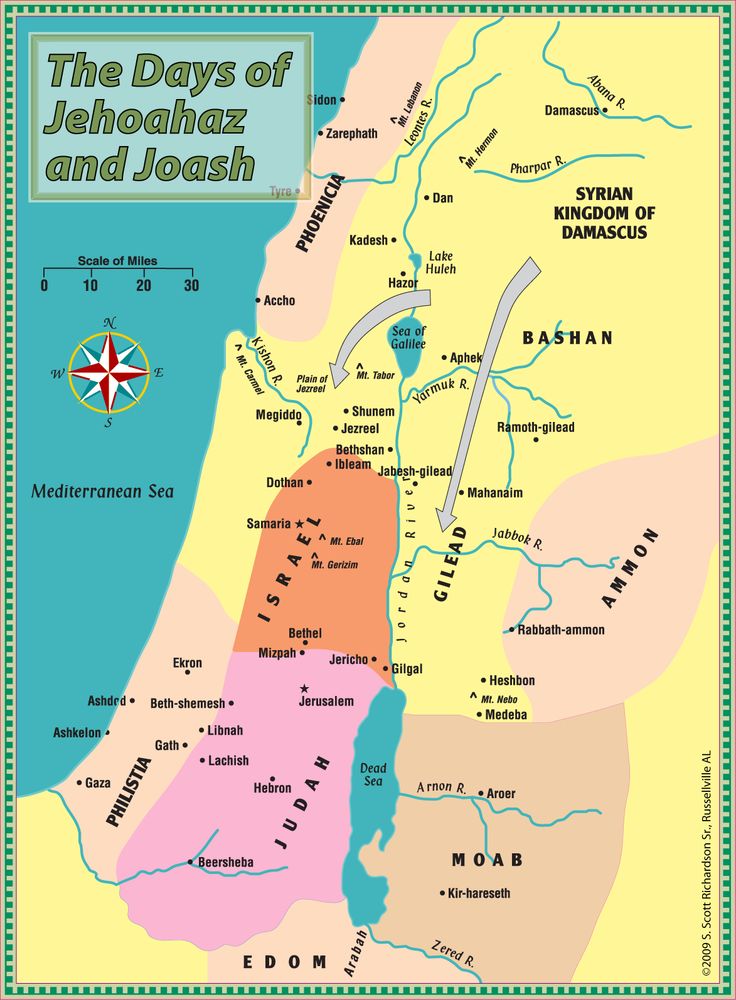
The Well-Deserved Death of Ahab

29 So the king of Israel and Jehoshaphat the king of Judah went up to Ramoth-gilead. 30 And the king of Israel said to Jehoshaphat, “I will disguise myself and go into battle, but you wear your robes.” And the king of Israel disguised himself and went into battle. 31 Now the king of Syria had commanded the thirty-two captains of his chariots, “Fight with neither small nor great, but only with the king of Israel.” 32 And when the captains of the chariots saw Jehoshaphat, they said, “It is surely the king of Israel.” So they turned to fight against him. And Jehoshaphat cried out. 33 And when the captains of the chariots saw that it was not the king of Israel, they turned back from pursuing him. 34 But a certain man drew his bow at random and struck the king of Israel between the scale armor and the breastplate. Therefore he said to the driver of his chariot, “Turn around and carry me out of the battle, for I am wounded.” 35 And the battle continued that day, and the king was propped up in his chariot facing the Syrians, until at evening he died. And the blood of the wound flowed into the bottom of the chariot. 36 And about sunset a cry went through the army, “Every man to his city, and every man to his country!”

37 So the king died, and was brought to Samaria. And they buried the king in Samaria. 38 And they washed the chariot by the pool of Samaria, and the dogs licked up his blood, and the prostitutes washed themselves in it, according to the word of the LORD that he had spoken. 39 Now the rest of the acts of Ahab and all that he did, and the ivory house that he built and all the cities that he built, are they not written in the Book of the Chronicles of the Kings of Israel? 40 So Ahab slept with his fathers, and Ahaziah his son reigned in his place. 1 Kings 22:29-40 ESV

Despite being warned by the prophet Micaiah that his attack on Ramoth-gilead would end in disaster and his own death, Ahab went ahead with his ill-fated plan. But in an attempt to thwart the will of God, Ahab came up with the brilliant idea to wear a disguise that would prevent the Syrians from recognizing him as the king. He knew he would be a target of Ben-Hadad’s wrath because his attack on Ramoth-gilead was in violation of their long-standing peace agreement. And he was right to be worried because Ben-hadad had commanded his troops to focus their attention on Ahab.

Now the king of Syria had commanded the thirty-two captains of his chariots, “Fight with neither small nor great, but only with the king of Israel.” – 1 Kings 22:31 ESV

Ahab’s decision to go through with the battle despite Micaiah’s warning clearly indicates the rebellious nature of his heart and his blatant disregard for the will of Yahweh. He truly believed he could devise a plan that would allow him to escape God’s wrath and accomplish his own will at the same time. Ahab was conniving and manipulative, and evidently quite persuasive, as he was able to convince King Jehoshaphat of Judah to go into battle wearing his royal armor while he wore a disguise. He hoped that, in the heat of battle, the Syrians would mistake Jehoshaphat as the king of Israel and focus all their attention on him. Somehow, he convinced the king of Judah to go along with this blatant display of brazen self-preservation.

And his plan almost worked. As the battle began, the Syrians spotted Jehoshaphat and gave chase, but they soon realized they were pursuing the wrong man. Ahab had managed to fool the Syrians, but he would not be able to hide his identity from God Almighty. His clever plan would not protect him from the judgment that God had decreed against him.

As the battle raged, one of the Syrian archers loosed an arrow that flew through the air and struck Ahab “between the scale armor and the breastplate” (1 Kings 22:34 ESV). The text describes this unnamed individual as “a certain man,” who “drew his bow at random” (1 Kings 22:34 ESV). His name is not provided, and the target of his arrow is undisclosed. In the heat of the battle, he discharged an arrow in the general direction of the enemy, but without aiming at anyone in particular. But his shot ended up piercing between the scale armor and the breastplate of Ahab’s armor. The king had refused to wear his royal robes, but not his protective armor. He could hide, but he could not get away from the all-seeing eye of Yahweh.

The seemingly lucky shot loosed by an unidentified Syrian soldier was sovereignly ordained and directed by the hand of God. Ahab had tried to avoid God’s will but failed. His disguise didn’t fool Yahweh, and his armor proved to be insufficient protection from the divine judgment leveled against him.

As the battle continued all around him, Ahab slumped in his chariot, his blood pouring from his wound and his life slowly ebbing away. At sunset, he took his last labored breath and died, and the news of his demise quickly spread across the battlefield.

 …as evening arrived he died. Just as the sun was setting, the cry ran through his troops: “We’re done for! Run for your lives!” – 1 Kings 22:35-36 NLT

Micaiah had warned Ahab that his death was inevitable because his actions were in direct violation of God’s will. If he chose to go through with his attack on Ramoth-gilead, Ahab would suffer the divine consequences. When Ahab died, lying in a pool of his own blood on the floor of his chariot, his troops abandoned the battle. The sheep found themselves without a shepherd, so they returned to their homes in peace, just as God had predicted they would.

“I saw all Israel scattered on the mountains, as sheep that have no shepherd. And the Lord said, ‘These have no master; let each return to his home in peace.’” – 1 Kings 22:17 ESV

With Ahab’s death, the battle for Ramoth-gilead came to an abrupt end, and the armies of Syria, Israel, and Judah abandoned the field and returned home. Ahab’s body, still lying in his chariot, was returned to Samaria. Amazingly, this wicked and rebellious king was given the honor of a royal burial. But the author describes a rather macabre scene that stands in stark contrast to the state funeral given to this unrepentant and undeserving king. As Ahab’s body was interred with all the pomp and circumstance of a royal funeral, his servants went about the unpleasant task of cleaning up the grisly scene his death left behind.

…his chariot was washed beside the pool of Samaria, and dogs came and licked his blood at the place where the prostitutes bathed, just as the Lord had promised. – 1 Kings 22:38 NLT

This scene took place in direct fulfillment of the words of the prophet Elijah. He had warned King Ahab that his complicity in the death of Naboth would result in his own demise.

And you shall say to him, ‘Thus says the LORD: “In the place where dogs licked up the blood of Naboth shall dogs lick your own blood.”’” – 1 Kings 21:19 ESV

The place where the servants chose to wash Ahab’s blood from his chariot was the exact spot where the innocent Naboth had been stoned to death. Ahab’s body was buried in a royal tomb, but his life’s blood was unceremoniously poured out in a place recognized for its sin and degradation. It was a site within the walls of Samaria inhabited by those who were considered unclean and immoral. Wild dogs licked up the king’s blood, and the prostitutes of Samaria unknowingly bathed themselves in the blood-stained waters of the pool where Ahab’s blood was spilled.

Ahab’s reign as king of Israel came to an abrupt and violent end. While he would be remembered for his many achievements, he would go down in history as one of the most wicked of all Israel’s kings. His legacy would be marked by apostasy, rebellion, idolatry, and immorality. He proved to be a competent king, but his stubborn refusal to honor God would forever mar his reputation and leave a permanent stain on the northern kingdom of Israel. When the author states that “Ahab slept with his fathers” (1 Kings 22:40 ESV), it is a thinly veiled inference that Ahab died unrepentant and unforgiven, just like his predecessors. While alive, Ahab made no place for God in his kingdom. In death, he would discover that he had no place in God’s heavenly kingdom. In life, he chose to replace Yahweh with false gods, and that decision would prove to have eternal consequences.

English Standard Version (ESV) The Holy Bible, English Standard Version. ESV® Permanent Text Edition® (2016). Copyright © 2001 by Crossway Bibles, a publishing ministry of Good News Publishers.

New Living Translation (NLT) Holy Bible, New Living Translation, copyright © 1996, 2004, 2015 by Tyndale House Foundation. Used by permission of Tyndale House Publishers Inc., Carol Stream, Illinois 60188. All rights reserved.

Conviction Over Compromise

1 For three years Syria and Israel continued without war. But in the third year Jehoshaphat the king of Judah came down to the king of Israel. And the king of Israel said to his servants, “Do you know that Ramoth-gilead belongs to us, and we keep quiet and do not take it out of the hand of the king of Syria?” And he said to Jehoshaphat, “Will you go with me to battle at Ramoth-gilead?” And Jehoshaphat said to the king of Israel, “I am as you are, my people as your people, my horses as your horses.”

And Jehoshaphat said to the king of Israel, “Inquire first for the word of the LORD.” Then the king of Israel gathered the prophets together, about four hundred men, and said to them, “Shall I go to battle against Ramoth-gilead, or shall I refrain?” And they said, “Go up, for the Lord will give it into the hand of the king.” But Jehoshaphat said, “Is there not here another prophet of the LORD of whom we may inquire?” And the king of Israel said to Jehoshaphat, “There is yet one man by whom we may inquire of the LORD, Micaiah the son of Imlah, but I hate him, for he never prophesies good concerning me, but evil.” And Jehoshaphat said, “Let not the king say so.” Then the king of Israel summoned an officer and said, “Bring quickly Micaiah the son of Imlah.” 10 Now the king of Israel and Jehoshaphat the king of Judah were sitting on their thrones, arrayed in their robes, at the threshing floor at the entrance of the gate of Samaria, and all the prophets were prophesying before them. 11 And Zedekiah the son of Chenaanah made for himself horns of iron and said, “Thus says the LORD, ‘With these you shall push the Syrians until they are destroyed.’” 12 And all the prophets prophesied so and said, “Go up to Ramoth-gilead and triumph; the LORD will give it into the hand of the king.”

13 And the messenger who went to summon Micaiah said to him, “Behold, the words of the prophets with one accord are favorable to the king. Let your word be like the word of one of them, and speak favorably.” 14 But Micaiah said, “As the LORD lives, what the LORD says to me, that I will speak.” 1 Kings 22:1-14 ESV

King Ahab had been placed under a curse from God for having spared the life of Ben-hadad, the king of Syria. Rather than obey God’s command to put his enemy to death, Ahab had chosen to sign a peace treaty with him that would allow Israel to profit from Syria’s lucrative trading business. Yet, despite the judgment leveled against him by God, Ahab’s decision seems to have produced positive results.

The treaty that Ahab brokered produced three years of peace and prosperity between the two nations. Israel and Syria became allies and trading partners. According to an inscription on an Assyrian tablet discovered in 1861, Ahab and Ben-hadad were part of a 12-nation confederation that faced Emperor Shalmaneser and the Assyrians in the Battle of Qarqar in 853 BC. So, while God had decreed that Ahab’s dynasty would come to an end with his death, the king of Israel continued to enjoy a small measure of success. His insatiable desire for glory and self-aggrandizement would eventually drive him to jeopardize his peaceful and prosperous relationship with Syria.

During the time Ahab was on the throne of Israel, Jehoshaphat became the king of Judah. He succeeded his father, Asa, and, according to the book of 2 Chronicles, Jehoshaphat proved to be a good king.

The LORD was with Jehoshaphat, because he walked in the earlier ways of his father David. He did not seek the Baals, but sought the God of his father and walked in his commandments, and not according to the practices of Israel. Therefore the LORD established the kingdom in his hand. And all Judah brought tribute to Jehoshaphat, and he had great riches and honor. His heart was courageous in the ways of the LORD. And furthermore, he took the high places and the Asherim out of Judah. – 2 Chronicles 17:3-6 ESV

Because Jehoshaphat chose to remove all the false gods and restore the worship of the one true God, his reign was blessed, and the southern kingdom of Judah became a powerful force in the region. But Jehoshaphat, like his father before him, made the mistake of placing his trust in the Syrians. When King Baasha of Israel began to build a fortified city on the border between Israel and Judah, King Asa sought the help of Ben-hadad and the Syrians. Asa “took silver and gold from the treasures of the house of the LORD and the king’s house and sent them to Ben-hadad king of Syria” (2 Chronicles 16:2 ESV). He used these funds to convince Ben-hadad to break his covenant with Israel and join forces with him. His ploy worked, and Baasha stopped construction on his military outpost. But God condemned Asa for his alliance with Ben-hadad, warning that Judah would face non-stop war during the rest of his reign. Rather than trust God, Asa had placed his hope in a foreign king who worshiped false gods.

And while his son Jehoshaphat would prove to be faithful to God, he would also make an alliance with an ungodly, idol-worshiping king.

Now Jehoshaphat had great riches and honor, and he made a marriage alliance with Ahab. After some years he went down to Ahab in Samaria. And Ahab killed an abundance of sheep and oxen for him and for the people who were with him, and induced him to go up against Ramoth-gilead. – 2 Chronicles 18:1-2 ESV

This marital alliance ultimately put Jehoshaphat in a difficult position. While visiting Israel’s capital city of Samaria, Jehoshaphat was presented with an official request from Ahab for military assistance in recapturing the town of Ramoth-gilead from the Syrians. It galled Ahab that the Syrians had stolen a city that had once belonged to Israel, and nothing had been done about it.

“Do you know that Ramoth-gilead belongs to us, and we keep quiet and do not take it out of the hand of the king of Syria?” – 1 Kings 22:3 ESV

So, he called on Jehoshaphat to help him right this apparent wrong, and Jehoshaphat quickly and readily agreed.

“I am as you are, my people as your people, my horses as your horses.” – 1 Kings 22:4 ESV

But Jehoshaphat, anxious to remain obedient to God, asked Ahab to seek Yahweh’s counsel. It’s important to understand that Jehoshaphat wanted to know what the “LORD” (Yahweh) would have them do. But when Ahab commissioned his 400 prophets to seek the will of the gods, they came back with the answer:

“Go up, for the Lord (ăḏōnāy) will give it into the hand of the king.” – 1 Kings 22:6 ESV

These men did not mention the name of Yahweh, and Jehoshaphat seems to have immediately recognized that these were false prophets who had been seeking the will of their false god. So, he asked Ahab if there were no prophets of the one true God left in Israel. Ahab reluctantly confessed that one prophet of Yahweh remained, a man named Micaiah, whom he hated with a passion.

“He never prophesies anything but trouble for me!” – 1 Kings 22:8 NLT

Micaiah never told Ahab what he wanted to hear, so the king avoided him like the plague. But Jehoshaphat insisted that Micaiah be consulted before any action was taken against the Syrians.  So, Ahab sent someone to fetch his least-favorite prophet. In the meantime, his 400 false prophets bombarded Jehoshaphat with their cheery predictions of success.

“Go up to Ramoth-gilead and triumph; the LORD (Yahweh) will give it into the hand of the king.” – 1 Kings 22:12 ESV

This time, the prophets of Baal changed their tune and mentioned the name of Yahweh. Perhaps they hoped this reference to the God of Israel would convince Jehoshaphat to acquiesce and give his approval for the joint venture against the Syrians.

The text doesn’t reveal how long it took for Micaiah to be located and brought to Samaria. However, during the delay, Jehoshaphat found himself pressured to listen to the false prophets and join forces with Ahab. The temptation to compromise his convictions was great. He could have easily given in and listened to the popular opinions of the crowd, but instead, Jehoshaphat waited to hear a word from Yahweh.

Even Micaiah found himself pressured to follow the party line. The messenger who located him delivered a not-so-subtle warning that there was only one answer King Ahab wanted to hear.

“Look, all the prophets are promising victory for the king. Be sure that you agree with them and promise success.” – 1 Kings 22:13 NLT

But Micaiah would not be bullied into submission. He knew how much Ahab hated him, and he would be risking his life to disobey a direct order from the king. Yet his allegiance to Yahweh was greater than his fear of Ahab. So, he told the messenger, “As surely as the LORD lives, I will say only what the LORD tells me to say” (1 Kings 22:14 NLT).

It must have been a long and awkward trip back to Samaria for the messenger. He probably feared for his own life because he knew the prophet was determined to deliver bad news to the king. Everyone who worked for Ahab and all the people who lived in Israel knew that their king had no love affair with Yahweh. He had spent his entire reign promoting the worship of false gods like Baal and Asherah, and he had done everything he could do to ignore and even eliminate the prophets of God. Ahab knew exactly what Micaiah was going to say when he showed up, and it would not be what he wanted to hear.

Ahab needed Jehoshaphat’s help against the Syrians, and he knew that Jehoshaphat’s God would stand opposed to his ambitious plans to recapture Ramoth-gilead. Ahab didn’t want to hear from God because he was unwilling to do God’s will. Like a petulant child, Ahab was determined to get his way, even if it meant disobeying Yahweh’s will. But the prophet of the LORD was unwilling to succumb to the pressure to compromise his convictions and tell the king what he wanted to hear. He would speak the truth, even if it cost him his life. This obscure and little-known prophet was going to choose character over conformity and stand up to the threats of the wicked and powerful king of Israel.

Micaiah’s commitment to Yahweh was unassailable and non-negotiable. Nothing would convince him to compromise or sell out. He was determined to remain faithful to his God, whatever the cost. His bold determination to stand his ground in the face of intense opposition and even the threat of death is reminiscent of the actions of Shadrach, Meshach, and Abednego, the Hebrew friends of Daniel who found themselves facing a death sentence for refusing to bow to the statue King Nebuchadnezzar had erected.

“I will give you one more chance to bow down and worship the statue I have made when you hear the sound of the musical instruments. But if you refuse, you will be thrown immediately into the blazing furnace. And then what god will be able to rescue you from my power?”

Shadrach, Meshach, and Abednego replied, “O Nebuchadnezzar, we do not need to defend ourselves before you. If we are thrown into the blazing furnace, the God whom we serve is able to save us. He will rescue us from your power, Your Majesty. But even if he doesn’t, we want to make it clear to you, Your Majesty, that we will never serve your gods or worship the gold statue you have set up.” – Daniel 3:15-18 NLT

These three young men were willing to die for their beliefs and gladly faced the fires of the furnace with their commitment to Yahweh uncompromised. And their unwavering faith was rewarded.

So Shadrach, Meshach, and Abednego stepped out of the fire. Then the high officers, officials, governors, and advisers crowded around them and saw that the fire had not touched them. Not a hair on their heads was singed, and their clothing was not scorched. They didn’t even smell of smoke! – Daniel 3:26-27 NLT

The Book of Acts records another story of uncompromising faith in the face of unrelenting pressure. Peter and John had been jailed by the powerful Jewish Sanhedrin for preaching “that through Jesus there is a resurrection of the dead” (Acts 4:2 NLT). The following morning, when the two men were dragged before the council, they were ordered to cease and desist. The high priest commanded them, “never again to speak or teach in the name of Jesus” (Acts 4:18 NLT). 

But Peter and John replied, “Do you think God wants us to obey you rather than him? We cannot stop telling about everything we have seen and heard.” – Acts 4:18-20 NLT

Facing the threat of additional jail time or worse, Peter and John stood their ground and declared their intention to continue preaching the truth concerning Jesus. They could be threatened, but they would not be silenced. And, in doing so, they joined the ranks of other faithful men like Micaiah, Daniel, Shadrach, Meshach, and Abednego.

English Standard Version (ESV) The Holy Bible, English Standard Version. ESV® Permanent Text Edition® (2016). Copyright © 2001 by Crossway Bibles, a publishing ministry of Good News Publishers.

New Living Translation (NLT) Holy Bible, New Living Translation, copyright © 1996, 2004, 2015 by Tyndale House Foundation. Used by permission of Tyndale House Publishers Inc., Carol Stream, Illinois 60188. All rights reserved.

So Shall Your Judgment Be

29 And they encamped opposite one another seven days. Then on the seventh day the battle was joined. And the people of Israel struck down of the Syrians 100,000 foot soldiers in one day. 30 And the rest fled into the city of Aphek, and the wall fell upon 27,000 men who were left.

Ben-hadad also fled and entered an inner chamber in the city. 31 And his servants said to him, “Behold now, we have heard that the kings of the house of Israel are merciful kings. Let us put sackcloth around our waists and ropes on our heads and go out to the king of Israel. Perhaps he will spare your life.” 32 So they tied sackcloth around their waists and put ropes on their heads and went to the king of Israel and said, “Your servant Ben-hadad says, ‘Please, let me live.’” And he said, “Does he still live? He is my brother.” 33 Now the men were watching for a sign, and they quickly took it up from him and said, “Yes, your brother Ben-hadad.” Then he said, “Go and bring him.” Then Ben-hadad came out to him, and he caused him to come up into the chariot. 34 And Ben-hadad said to him, “The cities that my father took from your father I will restore, and you may establish bazaars for yourself in Damascus, as my father did in Samaria.” And Ahab said, “I will let you go on these terms.” So he made a covenant with him and let him go.

35 And a certain man of the sons of the prophets said to his fellow at the command of the LORD, “Strike me, please.” But the man refused to strike him. 36 Then he said to him, “Because you have not obeyed the voice of the LORD, behold, as soon as you have gone from me, a lion shall strike you down.” And as soon as he had departed from him, a lion met him and struck him down. 37 Then he found another man and said, “Strike me, please.” And the man struck him—struck him and wounded him. 38 So the prophet departed and waited for the king by the way, disguising himself with a bandage over his eyes. 39 And as the king passed, he cried to the king and said, “Your servant went out into the midst of the battle, and behold, a soldier turned and brought a man to me and said, ‘Guard this man; if by any means he is missing, your life shall be for his life, or else you shall pay a talent of silver.’ 40 And as your servant was busy here and there, he was gone.” The king of Israel said to him, “So shall your judgment be; you yourself have decided it.” 41 Then he hurried to take the bandage away from his eyes, and the king of Israel recognized him as one of the prophets. 42 And he said to him, “Thus says the LORD, ‘Because you have let go out of your hand the man whom I had devoted to destruction, therefore your life shall be for his life, and your people for his people.’” 43 And the king of Israel went to his house vexed and sullen and came to Samaria. – 1 Kings 20:29-43 ESV

The arrival of spring in Israel was accompanied by the appearance of the revitalized and greatly enlarged Syrian army. King Ben-hadad had led his forces to the Valley of Aphek, carefully avoiding any confrontation with the Israelites in the hill country, where he believed their god wielded unparalleled power. A battle on the level plains of Aphek would give his chariots a distinct advantage and help ensure a victory over the hated Israelites.

For six days, the two armies remained in their respective camps, waiting for the opportune moment to launch the attack. The much smaller Israelite force was led by King Ahab, who had received word from a prophet that God would give them the victory that day.

“Because the Syrians have said, ‘The LORD is a god of the hills but he is not a god of the valleys,’ therefore I will give all this great multitude into your hand, and you shall know that I am the LORD.” – 1 Kings 20:28 ESV

Ben-hadad was operating on misinformation. His advisors had convinced him that the Israelites’ gods were limited in power. They were “gods of the hills” (1 Kings 20:23 ESV) and would be incapable of dictating the outcome of the battle as long as the Syrians fought the Israelites on neutral ground. But Ben-hadad would find that his strategy for success was significantly flawed. He had amassed a large army and chosen the ideal location to eliminate any interference from the gods of his enemy – or so he thought.

On the seventh day, the battle began. And much to Ben-hadad’s shock and dismay, his forces were quickly overwhelmed by Israel’s inferior army. The author summarized the battle by stating, “the people of Israel struck down of the Syrians 100,000 foot soldiers in one day. And the rest fled into the city of Aphek, and the wall fell upon 27,000 men who were left” (1 Kings 20:29-30 ESV).

We’re not told the size of Ben-hadad’s army, but these numbers reflect staggering losses that would have proved devastating to the Syrians. In one day, in a single battle, they lost 127,000 men. The mention of the 27,000 who were crushed by the walls of the city is intended to reveal the hand of God in this victory. It is a subtle yet unmistakable reference to Israel’s victory over the city of Jericho when they first entered the land of promise. For six days, the Israelites had marched around the walls of Jericho. But on the seventh day, following God’s instructions, they circled the walls seven times and then blew their trumpets.

So the people shouted, and the trumpets were blown. As soon as the people heard the sound of the trumpet, the people shouted a great shout, and the wall fell down flat, so that the people went up into the city, every man straight before him, and they captured the city. – Joshua 6:20 ESV

What the Israelites did next is essential. Following God’s commands, they devoted everything in the city to destruction.

…they burned the city with fire, and everything in it. Only the silver and gold, and the vessels of bronze and of iron, they put into the treasury of the house of the LORD. – Joshua 6:24 ESV

With this as a backdrop, Ahab’s actions and the reaction of God make much more sense. Having escaped the battlefield and successfully avoided the falling wall, Ben-hadad sought refuge inside the city. He was trapped and at the mercy of King Ahab. So, his advisors counseled him to surrender and appeal for clemency. After all, they advised him, “the kings of the house of Israel are merciful kings” (1 Kings 20:30 ESV).

The always shrewd and self-aggrandizing Ahab probably saw this as an opportunity to ingratiate the defeated Syrian king and secure a beneficial treaty between their two nations. By allowing Ben-hadad to live, Ahab hoped to open up new trading opportunities that would further enhance his power and wealth. But at no point does the passage show Ahab seeking the will of God in this matter. God had given him the victory, but Ahab was taking the credit by determining the fate of the defeated Syrian king.

God had promised to give the Syrians into Ahab’s hand, and He had kept His word. The unexpected victory was intended to reveal to the Israelites that Yahweh was LORD. With his decision to spare Ben-hadad, Ahab essentially declared himself to be lord. He was in control. As the sovereign over his kingdom, he believed he had the right to decide what was best for Israel.

Ahab struck a deal with Ben-hadad, agreeing to return land that had once belonged to the Syrians on the condition that they set up trading posts. Ahab was in it for what he could get out of it. This arrangement with the Syrians made strategic and fiscal sense in his mind. By securing a treaty with the Syrians, he could create a buffer on his northern border, providing protection from the growing threat of the Assyrians. But he also knew he could benefit financially by gaining access to the Syrian’s lucrative trading business. In Ahab’s mind, this was a win-win scenario.

But God had other plans. He commissioned yet another prophet, sending him with a word of warning to Ahab. But to carry out his assignment, the unnamed prophet was required to sustain an injury that would allow him to gain access to the king. When this prophet asked one of his colleagues to assist him, his request was denied. His fellow prophet refused to take part in this bizarre plan, and it ended up costing him his life.

“Because you have not obeyed the voice of the LORD, a lion will kill you as soon as you leave me.” And when he had gone, a lion did attack and kill him. – 1 Kings 20:36 ESV

This man’s refusal to do what the prophet of God said was essentially a rejection of God’s will, and he was condemned for his disobedience. As strange and challenging to understand as it may be, this incident is meant to illustrate the importance of following the will of God. Like Ahab, this unnamed prophet had decided to operate according to his own will. And just as God had held his reluctant and disobedient prophet culpable for his actions, He would also hold Ahab accountable for his decision to spare the life of Ben-hadad.

The prophet finally found someone to strike him in the face, creating a convincing injury that would allow him to disguise himself as a wounded soldier. His face covered in a bandage, the prophet sat beside the road, waiting for King Ahab to pass by. When the king arrived, the man explained that he had been in the battle that day. At some point, he had been given the responsibility to watch over a prisoner. He was warned that he would be killed or forced to pay a substantial fine if he allowed the prisoner to escape. But while the man was distracted, the prisoner escaped, or so his fabricated story went.

Ahab, who had just extended undeserved mercy to the king of Syria, refused to show a fellow Israelite any compassion or empathy. He simply stated, “So shall your judgment be; you yourself have decided it” (1 Kings 20:40 ESV). With those callous words, Ahab unwittingly condemned himself. As soon as the prophet removed the bandage that covered his face, Ahab recognized him as one of the prophets of Yahweh. And what Ahab heard next left him “vexed and sullen” (1 Kings 20:43 ESV).

“This is what the LORD says: Because you have spared the man I said must be destroyed, now you must die in his place, and your people will die instead of his people.” – 1 Kings 20:42 NLT

Ahab had stubbornly refused to acknowledge Yahweh as LORD, and continued to view himself as the true sovereign over Israel. But because he chose to reject God as King, Ahab and his people would suffer the fate intended for Ben-hadad and the people of Syria. Ahab’s self-centered and self-promoting actions would bring the judgment of Yahweh and turn a divinely ordained victory into death and defeat. One way or another, Ahab and the people of Israel were going to know that God is LORD.

English Standard Version (ESV) The Holy Bible, English Standard Version. ESV® Permanent Text Edition® (2016). Copyright © 2001 by Crossway Bibles, a publishing ministry of Good News Publishers.

New Living Translation (NLT) Holy Bible, New Living Translation, copyright © 1996, 2004, 2015 by Tyndale House Foundation. Used by permission of Tyndale House Publishers Inc., Carol Stream, Illinois 60188. All rights reserved.