Safe in the Hands of God

1 And the Lord said to Job:

“Shall a faultfinder contend with the Almighty?
    He who argues with God, let him answer it.”

Then Job answered the Lord and said:

“Behold, I am of small account; what shall I answer you?
    I lay my hand on my mouth.
I have spoken once, and I will not answer;
    twice, but I will proceed no further.”

Then the Lord answered Job out of the whirlwind and said:

“Dress for action like a man;
    I will question you, and you make it known to me.
Will you even put me in the wrong?
    Will you condemn me that you may be in the right?
Have you an arm like God,
    and can you thunder with a voice like his?

10 “Adorn yourself with majesty and dignity;
    clothe yourself with glory and splendor.
11 Pour out the overflowings of your anger,
    and look on everyone who is proud and abase him.
12 Look on everyone who is proud and bring him low
    and tread down the wicked where they stand.
13 Hide them all in the dust together;
    bind their faces in the world below.
14 Then will I also acknowledge to you
    that your own right hand can save you.

15 “Behold, Behemoth,
    which I made as I made you;
    he eats grass like an ox.
16 Behold, his strength in his loins,
    and his power in the muscles of his belly.
17 He makes his tail stiff like a cedar;
    the sinews of his thighs are knit together.
18 His bones are tubes of bronze,
    his limbs like bars of iron.

19 “He is the first of the works of God;
    let him who made him bring near his sword!
20 For the mountains yield food for him
    where all the wild beasts play.
21 Under the lotus plants he lies,
    in the shelter of the reeds and in the marsh.
22 For his shade the lotus trees cover him;
    the willows of the brook surround him.
23 Behold, if the river is turbulent he is not frightened;
    he is confident though Jordan rushes against his mouth.
24 Can one take him by his eyes,
    or pierce his nose with a snare?– Job 40:1-24 ESV

God takes a brief pause in His rhetorical interrogation to give Job a chance to respond. God demands that this “contender” or “complainer” explain himself. Since Job seems to enjoy arguing with God and questioning His ways, then he must have a lot to say. This is the moment for which Job has been waiting. He has an audience with the Almighty and  the opportunity to defend himself but Job finds himself at a loss for words. Suddenly, when faced with the overwhelming sense of God’s presence and power, Job is speechless.

“I am nothing—how could I ever find the answers?
    I will cover my mouth with my hand.
I have said too much already.
    I have nothing more to say.” – Job 40:4-5 NLT

Wiser words have never been spoken. Job didn’t say much and yet, he spoke volumes. He acknowledges his own ignorance and inadequacy when standing before the God of the universe. He recognizes that he has spoken too freely and flippantly. In his pain and despair, Job allowed himself to vent his frustration to God but in doing so, he had spoken out of turn and failed to show God the reverence and honor He deserved.

But while Job’s reticence to speak was a wise decision, it did not defuse God’s anger or absolve Job from a further tongue-lashing. In fact, God informs Job that silence is not an option. The one who was so quick to criticize the ways of God must answer the questions of God.

“Brace yourself like a man,
    because I have some questions for you,
    and you must answer them. – Job 40:7 NLT

God seems to be accusing Job of doing the same thing his friends had done to him. In his effort to defend his innocence, Job had overextended his understanding of what his suffering was all about. He was convinced that it wasn’t the result of some sin he had committed, so that led him to make false assumptions about the justice of God. He questioned God’s goodness and righteousness. Job’s perception was limited and his understanding was incomplete. He was unaware of all that was going on behind the scenes so that left him with no other option than to base his conclusions on circumstantial evidence, just as his friends had done.

In his zeal to defend himself and prove his own innocence, Job had falsely accused God. He was so determined to prove himself right that he was willing to accuse God of doing wrong, and God was not happy.

“Will you discredit my justice
    and condemn me just to prove you are right? – Job 40:8 NLT

This led God to sarcastically suggest that Job reveal his own glory. After all, if he was righteous and morally blameless, then he must be nothing less than a god.

“All right, put on your glory and splendor,
    your honor and majesty.
Give vent to your anger.
    Let it overflow against the proud.
Humiliate the proud with a glance;
    walk on the wicked where they stand.
Bury them in the dust.
    Imprison them in the world of the dead.
Then even I would praise you,
    for your own strength would save you. – Job 40:10-14 NLT

God demands that Job display his glory and power by pouring out his judgment on the wicked and prideful. He challenges Job to demonstrate his wisdom and righteousness by judging justly and rightly. In a sense, God is demanding that Job prove that he knows what is best and can effectively determine the fate of all those who live on this planet.

But Job is not a god; he is just a man, and that seems to be God’s main point. In all of God’s verbal reprimands of Job, He never specifies a single sin that Job has committed. God never questions Job’s assertion of innocence. The Lord’s primary complaint with Job is his suggestion that God was somehow unfair or unjust. Job didn’t like the state of affairs surrounding his life and he had demanded that God explain Himself. Job knew that God was sovereign over all things so God was somehow responsible for his losses. And since Job had done nothing wrong, God must be the one who was at fault. Job never said those words directly but he inferred them, and God found them offensive and worthy of a stern response.

At the heart of Job’s complaint was his suggestion that God was somehow failing to do His job properly. Job had certain expectations of God that he felt had not been met. In his estimation, the most recent history of his life was out of step with his understanding of God’s character. So, God must course correct and fix the problem. But God found Job’s assertion that He was somehow in the wrong or guilty of mismanagement offensive. There was no basis for that conclusion. That’s why God launched into yet another illustration from nature that proved His impeccable credentials as the overseer of all creation.

God draws Job’s attention to the “Behemoth,” a creature of almost mythical proportions that is the byproduct of God’s imagination and creative power.

“Take a look at Behemoth,
    which I made, just as I made you.
    It eats grass like an ox.
See its powerful loins
    and the muscles of its belly.
Its tail is as strong as a cedar.
    The sinews of its thighs are knit tightly together.
Its bones are tubes of bronze.
    Its limbs are bars of iron. – Job 40:15-18 NLT

We have no idea what animal God is talking about. Some believe this to be a reference to a mythical creature that never existed, but God seems to contradict that conclusion when He states, “It is a prime example of God’s handiwork, and only its Creator can threaten it” (Job 40:19 NLT). No, this is no make-believe creature formulated in the minds of men; it is an actual flesh-and-blood animal that God brought to life and over which He holds complete control. This beast was so large that it had no equal and faced no threat from predators. Its only adversary was God Himself.

God asserts that “No one can catch it off guard or put a ring in its nose and lead it away” (Job 40:24 NLT). The point? This animal was completely cared for by God. It owed its existence and ongoing sustenance to God. Only God could protect it or threaten it. Its life was in the hands of the Almighty and so was Job’s. No one could harm Job unless God allowed it. No one could threaten his life without God’s permission. Which brings us back to the opening chapters of this book.

They describe an interaction between God and Satan, man’s primary and powerful adversary. In response to God’s declaration of Job’s righteousness, Satan replied:

“Yes, but Job has good reason to fear God. You have always put a wall of protection around him and his home and his property. You have made him prosper in everything he does. Look how rich he is! But reach out and take away everything he has, and he will surely curse you to your face!” – Job 1:9-11 NLT

Satan admits that God cared for and protected Job but he argues that Job would respond differently to God if that protection was removed. God had a different opinion of Job and provided Satan with limited access to test his theory.

“All right, you may test him,” the Lord said to Satan. “Do whatever you want with everything he possesses, but don’t harm him physically.” – Job 1:12 NLT

God gave Satan permission but he didn’t give him carte blanch. Satan was not free to do whatever he wanted to do. His actions were limited. God was still in control.

When Satan’s plan failed and Job refused to curse God, he came up with a second challenge. He asked God for permission to attack Job’s physical well-being. He believed that was the source of Job’s faithfulness and so he sought to take away Job’s health and cause him to curse God. And, once again, God permitted Satan to take his best shot.

“All right, do with him as you please,” the Lord said to Satan. “But spare his life.” – Job 2:6 NLT

God never relinquished control. At no point was He impotent or incapable of protecting Job’s life. And at no time, was God’s assessment of Job’s righteousness threatened or in question. He knew how Job would respond. He knew that Job would survive. God stated that Behemoth is “not disturbed by the raging river, not concerned when the swelling Jordan rushes around it” (Job 40:23 NLT), and that was what he expected from Job. The great beast that God created was capable of enjoying the peaceful respite provided by the shade of the Lotus plant, but it also accepted the storms that occasionally accompanied life. How much more so should Job trust in the goodness and graciousness of God? He had enjoyed great blessings for the vast majority of his life and now, when trials had come, he had lost his faith in God. But now was the time when he needed to know and understand that he too was “a prime example of God’s handiwork, and only its Creator can threaten it” (Job 40:19 NLT).

English Standard Version (ESV) The Holy Bible, English Standard Version. ESV® Permanent Text Edition® (2016). Copyright © 2001

New Living Translation (NLT) Holy Bible, New Living Translation, copyright © 1996, 2004, 2015 by Tyndale House Foundation. Used by permission of Tyndale House Publishers Inc., Carol Stream, Illinois 60188. All rights reserved.

Our Indescribable and Inexplicable God

15 Now as I looked at the living creatures, I saw a wheel on the earth beside the living creatures, one for each of the four of them. 16 As for the appearance of the wheels and their construction: their appearance was like the gleaming of beryl. And the four had the same likeness, their appearance and construction being as it were a wheel within a wheel. 17 When they went, they went in any of their four directions without turning as they went. 18 And their rims were tall and awesome, and the rims of all four were full of eyes all around. 19 And when the living creatures went, the wheels went beside them; and when the living creatures rose from the earth, the wheels rose. 20 Wherever the spirit wanted to go, they went, and the wheels rose along with them, for the spirit of the living creatures was in the wheels. 21 When those went, these went; and when those stood, these stood; and when those rose from the earth, the wheels rose along with them, for the spirit of the living creatures was in the wheels.

22 Over the heads of the living creatures there was the likeness of an expanse, shining like awe-inspiring crystal, spread out above their heads. 23 And under the expanse their wings were stretched out straight, one toward another. And each creature had two wings covering its body. 24 And when they went, I heard the sound of their wings like the sound of many waters, like the sound of the Almighty, a sound of tumult like the sound of an army. When they stood still, they let down their wings. 25 And there came a voice from above the expanse over their heads. When they stood still, they let down their wings.

26 And above the expanse over their heads there was the likeness of a throne, in appearance like sapphire; and seated above the likeness of a throne was a likeness with a human appearance. 27 And upward from what had the appearance of his waist I saw as it were gleaming metal, like the appearance of fire enclosed all around. And downward from what had the appearance of his waist I saw as it were the appearance of fire, and there was brightness around him. 28 Like the appearance of the bow that is in the cloud on the day of rain, so was the appearance of the brightness all around.

Such was the appearance of the likeness of the glory of the Lord. And when I saw it, I fell on my face, and I heard the voice of one speaking. – Ezekiel 1:15-28 ESV

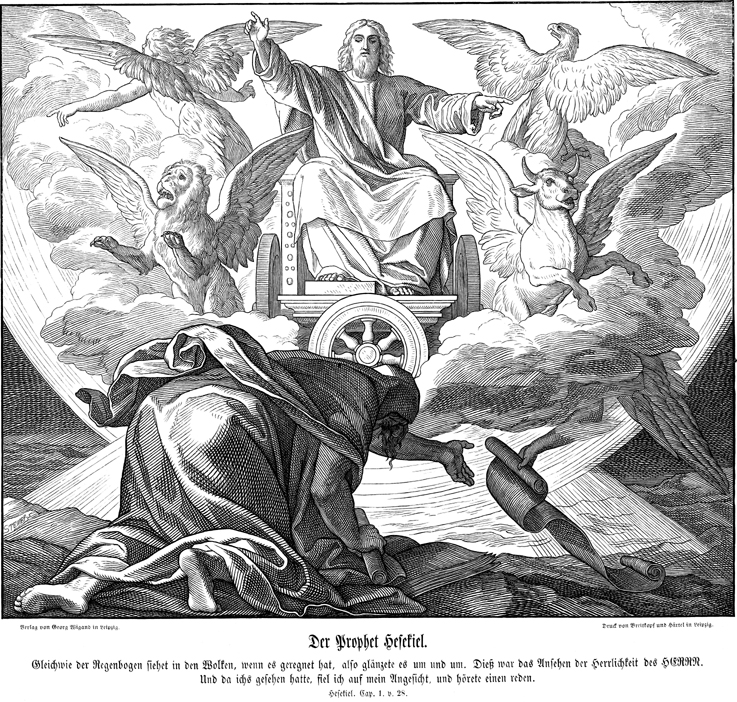
For centuries, artists have attempted to recreate the fantastic scene described in Ezekiel’s vision, and their efforts have resulted in a host of ethereal, otherworldly depictions that almost defy the range of man’s imagination. Their depictions border on the surreal and illustrate man’s incapacity to understand or explain the glory of God. But in their defense, each of them based their artwork on the words of Ezekiel. They simply illustrated what Ezekiel attempted to elucidate. But this young priest was at a great disadvantage because he was trying to describe the indescribable and explain the inexplicable. Hampered by a finite human mind and a limited vocabulary, Ezekiel did his best to recreate his vision with words. But his efforts would prove futile because he was attempting to describe “the appearance of the likeness of the glory of the Lord” (Ezekiel 1:28 ESV).

While Ezekiel appears to be describing a series of different individuals and objects, the scene is meant to illustrate the glory of the Lord. This entire chapter should be viewed as a depiction of the majesty and magnificence of Jehovah, the Creator-God who rules and reigns over all. The all-mighty, transcendent God of the universe was providing Ezekiel with a composite picture of His essence that was intended to engender a response of awe and reverential fear. And it worked, because Ezekiel claims, “When I saw it, I fell face down on the ground” (Ezekiel 1:28 NLT).

Ezekiel got the big picture. He correctly viewed the entire scene as a divine depiction of his God. And, as a priest, Ezekiel would have known that it was impossible for any human being to see God and live to tell about it. He would have been well versed in the words that God spoke to Moses in the wilderness of Sinai. The man whom God had chosen to liberate His people from their captivity in Egypt had expressed his desire to see God’s glory. Moses had seen God’s glory displayed in the burning bush and had repeatedly spoken with Him, but he longed for something greater.

Moses said, “Please show me your glory.” – Exodus 33:18 ESV

But God let Moses that his request was not only impossible, but it would also be suicidal. So, He provided Moses with a viable alternative.

…and he said, “I will make all my goodness pass before you and will proclaim before you my name ‘The Lord.’ And I will be gracious to whom I will be gracious, and will show mercy on whom I will show mercy. But,” he said, “you cannot see my face, for man shall not see me and live.” – Ezekiel 33:19-20 ESV

Like Moses, Ezekiel would see God’s glory and live to tell about it. He would see indescribable things and attempt to explain them with words that could never do them justice. The four living creatures, the wheels within wheels, the crystal expanse, and the sapphire thrown were all intended to depict God’s glory. Ezekiel was being given a rare opportunity to see the Almighty but in a way that produced awe and wonder instead of death.

It was the apostle Paul who described Yahweh as “the blessed and only almighty God, the King of all kings and Lord of all lords” (1 Timothy 6:15 NLT). And he went on to explain God’s transcendent, unapproachable nature.

He alone can never die, and he lives in light so brilliant that no human can approach him. No human eye has ever seen him, nor ever will. All honor and power to him forever! – 1 Timothy 6:16 NLT

It is impossible to know exactly what Ezekiel saw but that has not stopped artists from trying to depict it. But no painting, engraving, or illustration will ever be able to capture the glory of God.

Every aspect of Ezekiel’s vision was meant to reinforce the greatness and glory of God. The four different faces of the four living creatures reveal that God is sovereign over all creation. He rules over humanity, the wild beasts, domesticated animals, and the birds of the air – because He made them all. And the wheels within wheels were intended to depict God’s omnipresence; completely unhindered by time or space. According to Ezekiel, the wheels “went in any of their four directions without turning as they went” ( Ezekiel 1:17 ESV). The rims of the wheels were covered with eyes, illustrating the omniscience of God. He knows all because He sees all.

And He accomplishes all this while sitting on His throne above the great expanse. Ezekiel’s focus becomes fixed upon “a figure whose appearance resembled a man” (Ezekiel 1:26 NLT). But He is far from human in nature.

From what appeared to be his waist up, he looked like gleaming amber, flickering like a fire. And from his waist down, he looked like a burning flame, shining with splendor. All around him was a glowing halo, like a rainbow shining in the clouds on a rainy day. – Ezekiel 1:27-28 NLT

This is no ordinary king seated on a man-made throne. It is the King of kings and Lord of lords. Ezekiel is being given a glimpse of God Almighty, but it is a representation and not the real thing.

“It was a deeply-held tenet of Israelite religion from Moses onwards that God could not be visibly expressed, and for that very reason idolatry was out. But given the possibility of a theophany, no form but the human form could conceivably have been used to represent the Deity. It was, however, no mere human that Ezekiel saw: His radiance was surrounded by the glory of a rainbow, and the prophet could show his awe in no other way than by falling on his face in the dust before his God.” – L. E. Cooper Sr., Ezekiel

It is interesting to note that Ezekiel does not attempt to describe God’s face or countenance. All he writes about is the appearance of gleaming metal, fire, and brightness. According to Paul, God “dwells in unapproachable light” (1 Timothy 6:16 ESV). The psalmist states that God “wraps Himself in light as with a garment” (Psalm 104:2 BSB). The prophet Daniel was also given a vision of God and he described it in similar terms.

…the Ancient of Days took his seat; his clothing was white as snow, and the hair of his head like pure wool; his throne was fiery flames; its wheels were burning fire. – Daniel 7:9 ESV

Both Daniel and Ezekiel were given the privilege of seeing God’s glory, and both found it nearly impossible to put it into words. They were struck by the brightness of His very presence. He emanated light so bright that it could only be described as burning fire. It was intense and virtually unapproachable. This imagery reflects the holiness and purity of God. It was the apostle John who wrote, “God is light, and in him is no darkness at all” (1 John 1:5 ESV).

This majestic, all-knowing, holy, omnipresent God of the universe was reminding Ezekiel that He was still on His throne and well aware of the fate of the people of Judah. He had not turned His back on them. His power had not diminished and His love for them had not faded. The all-powerful, ever-loving, always-faithful God of Abraham, Isaac, and Jacob was about to deliver a message to His chosen people and He had chosen Ezekiel as His messenger. God had gotten Ezekiel’s attention, and now Ezekiel was ready to listen to what his glorious God had to say.

Such was the appearance of the likeness of the glory of the Lord. And when I saw it, I fell on my face, and I heard the voice of one speaking. – Ezekiel 1:28 ESV

English Standard Version (ESV) The Holy Bible, English Standard Version. ESV® Permanent Text Edition® (2016). Copyright © 2001

New Living Translation (NLT) Holy Bible, New Living Translation, copyright © 1996, 2004, 2015 by Tyndale House Foundation. Used by permission of Tyndale House Publishers Inc., Carol Stream, Illinois 60188. All rights reserved.
What Have I Done To You?

1 Hear what the Lord says:
Arise, plead your case before the mountains,
    and let the hills hear your voice.
Hear, you mountains, the indictment of the Lord,
    and you enduring foundations of the earth,
for the Lord has an indictment against his people,
    and he will contend with Israel.

“O my people, what have I done to you?
    How have I wearied you? Answer me!
For I brought you up from the land of Egypt
    and redeemed you from the house of slavery,
and I sent before you Moses,
    Aaron, and Miriam.
O my people, remember what Balak king of Moab devised,
    and what Balaam the son of Beor answered him,
and what happened from Shittim to Gilgal,
    that you may know the righteous acts of the Lord.”

“With what shall I come before the Lord,
    and bow myself before God on high?
Shall I come before him with burnt offerings,
    with calves a year old?
Will the Lord be pleased with thousands of rams,
    with ten thousands of rivers of oil?
Shall I give my firstborn for my transgression,
    the fruit of my body for the sin of my soul?”
He has told you, O man, what is good;
    and what does the Lord require of you
but to do justice, and to love kindness,
    and to walk humbly with your God? Micah 6:1-8 ESV

Micah now shifts the focus of his message from the future to the present day, addressing the people of Israel with a personal plea from God Himself. He employs judicial terminology, deliberately speaking his audience as if they were on trial, with God standing before them as their judge.

In the first two verses, Micah uses the Hebrew Word riyb three times, which can be translated “dispute, contend, or plead.” In essence, God is demanding that the Israelites defend themselves and present their case against Him. And He calls the hills and mountains to act as the impartial jury, hearing the evidence from both parties in this epic legal proceeding.

God is going to bring His riyb, or indictment against His chosen people. He will provide evidence in the lawsuit and allow the “enduring foundations of the earth” to settle the case. The mountains, hills, and foundations of the earth are meant to suggest the creative order that has witnessed the unethical and immoral actions of God’s chosen people since the beginning of time. If the mountains, hills, and foundations of the earth could speak, they could give damning testimony to support Israel’s guilt and justify God’s judgment.

Now, God turns His attention to the people of Israel, the defendants in this divine court action. He wants to hear their explanation for their treatment of Him.

“O my people, what have I done to you?
    What have I done to make you tired of me?
    Answer me!” – Micah 6:3 NLT

Like a lawyer cross-examining the defendant, God gives Israel the opportunity to present their case against Him. What evidence do they have that would indict Him as the guilty party and excuse their treatment of Him? This is their chance to provide proof that their behavior was warranted because of something God had done. If the mountains, hills, and foundations of the earth could speak up, they would echo the words of the psalmist, defending the integrity of the Almighty.

The Lord is righteous in everything he does;
    he is filled with kindness. – Psalm 145:17 NLT

This God—his way is perfect; the word of the LORD proves true; he is a shield for all those who take refuge in him. – Psalm 18:30 ESV

And if Moses, the great deliverer of Israel, could appear as a witness in this trial, he too would give evidence of God’s undeniable innocence and unwavering righteousness.

“He is the Rock; his deeds are perfect. Everything he does is just and fair. He is a faithful God who does no wrong; how just and upright he is!” – Deuteronomy 32:4 NLT

And Moses would have been intimately familiar with the guilt of Israel, having spent 40 years leading them through the wilderness on their way to the land of promise. He had watched God redeem and rescue them from slavery in Egypt and then listened to their constant complaints as God led them and provided for them. And their dissatisfaction with God had begun just days after they had crossed the Red Sea on dry ground

Then Moses led the people of Israel away from the Red Sea, and they moved out into the desert of Shur. They traveled in this desert for three days without finding any water. When they came to the oasis of Marah, the water was too bitter to drink. So they called the place Marah (which means “bitter”).

Then the people complained and turned against Moses. “What are we going to drink?” they demanded. – Exodus 15:22-24 NLT

And days later, these same ungrateful people would find another excuse to turn their wrath against God’s appointed leader, demanding that he explain why he had brought them into the wilderness to die.

And the whole congregation of the people of Israel grumbled against Moses and Aaron in the wilderness, and the people of Israel said to them, “Would that we had died by the hand of the Lord in the land of Egypt, when we sat by the meat pots and ate bread to the full, for you have brought us out into this wilderness to kill this whole assembly with hunger.” – Exodus 16:2-3 ESV

And Moses would announce God’s intention to graciously provide for their need, but he would also reveal that their grumbling and complaining had been against the Almighty. Their ingratitude had been directed at their redeemer.

“When the Lord gives you in the evening meat to eat and in the morning bread to the full, because the Lord has heard your grumbling that you grumble against him—what are we? Your grumbling is not against us but against the Lord.” – Exodus 16:8 ESV

The Israelites had an abysmal track record when it came to their relationship with Yahweh. And it lasted long after they got to Canaan and inherited the land promised to them by God. Their dissatisfaction with and disrespect for God continued for generations. It showed up in their failure to keep His commands. It was evident in their constant spiritual infidelity that showed up in their addiction to idolatry.

And God calls on the people of Israel to remember all that He had done for them. He demands that they contemplate and compare His actions to their own.

“I brought you out of Egypt
    and redeemed you from slavery.
    I sent Moses, Aaron, and Miriam to help you. – Micah 6:4 NLT

And God gets specific, providing them with further evidence of His goodness, grace, and mercy.

“Don’t you remember, my people,
    how King Balak of Moab tried to have you cursed
    and how Balaam son of Beor blessed you instead?
And remember your journey from Acacia Grove to Gilgal,
    when I, the Lord, did everything I could
    to teach you about my faithfulness.” – Micah 6:5 NLT

They had no right to point their finger at God, accusing Him of injustice or ill-treatment. He had done nothing but show them kindness and shower them with His gracious love. When their enemies had tried to curse them, God had intervened, turning the evil-intentions of King Balak into a divine blessing. And when the people had arrived at the Jordan River, God had provided them with yet another miracle, making it possible for them to cross over the rain-swollen river on dry ground.

So the people left their camp to cross the Jordan, and the priests who were carrying the Ark of the Covenant went ahead of them. It was the harvest season, and the Jordan was overflowing its banks. But as soon as the feet of the priests who were carrying the Ark touched the water at the river’s edge, the water above that point began backing up a great distance away at a town called Adam, which is near Zarethan. And the water below that point flowed on to the Dead Sea until the riverbed was dry. Then all the people crossed over near the town of Jericho.

Meanwhile, the priests who were carrying the Ark of the Lord’s Covenant stood on dry ground in the middle of the riverbed as the people passed by. They waited there until the whole nation of Israel had crossed the Jordan on dry ground. – Joshua 3:14-17 NLT

In all of this, God had been teaching Israel about His faithfulness. He could be depended upon. He could be trusted. He was righteous in all His ways. But the same could not be said about the people of Israel. And, at this point in the proceedings, Micah intervenes, addressing his fellow Israelites with a series of rhetorical questions meant to reinforce their guilt and remind them of what was missing in their relationship with Yahweh.

What can we bring to the Lord?
    Should we bring him burnt offerings?
Should we bow before God Most High
    with offerings of yearling calves?
Should we offer him thousands of rams
    and ten thousand rivers of olive oil?
Should we sacrifice our firstborn children
to pay for our sins? – Micah 6:6-7 NLT

God had made it perfectly clear what He expected from His people.

“And now, Israel, what does the Lord your God require of you? He requires only that you fear the Lord your God, and live in a way that pleases him, and love him and serve him with all your heart and soul.” – Deuteronomy 10:12 NLT

He desired faithfulness on the part of His people. He wasn’t interested in lip-service and some kind of mechanical observance of rituals and rules. And the prophet Isaiah recorded God’s assessment of His peoples’ relationship with Him.

“These people say they are mine. They honor me with their lips, but their hearts are far from me. And their worship of me is nothing but man-made rules learned by rote.” – Isaiah 29:13 NLT

And Micah, acting as a witness against his fellow Israelites, reminds them of what God had always desired of them.

No, O people, the Lord has told you what is good,
    and this is what he requires of you:
to do what is right, to love mercy,
    and to walk humbly with your God. – Micah 6:8 NLT

But they had failed. They had refused to do what is good and right. They had chosen to despise God’s mercy by refusing to extend it to one another. And they had decided to display a prideful and arrogant attitude toward their God, rather than walking humbly in His presence, grateful for His ever-present goodness and grace.

God was innocent, but they stood guilty as charged. He had done nothing to deserve their treatment of Him. And as the evidence continued to pile up, their chances of acquittal dried up. And God would be fully justified when He delivered His guilty verdict and pronounced their fate.

English Standard Version (ESV)
The Holy Bible, English Standard Version. ESV® Permanent Text Edition® (2016). Copyright © 2001 by Crossway Bibles, a publishing ministry of Good News Publishers.

New Living Translation (NLT)
Holy Bible, New Living Translation, copyright © 1996, 2004, 2015 by Tyndale House Foundation. Used by permission of Tyndale House Publishers Inc., Carol Stream, Illinois 60188. All rights reserved.

The Message (MSG)Copyright © 1993, 1994, 1995, 1996, 2000, 2001, 2002 by Eugene H. Peterson