14 And the Lord spoke to Moses in the wilderness of Sinai, saying, 15 “List the sons of Levi, by fathers’ houses and by clans; every male from a month old and upward you shall list.” 16 So Moses listed them according to the word of the Lord, as he was commanded. 17 And these were the sons of Levi by their names: Gershon and Kohath and Merari. 18 And these are the names of the sons of Gershon by their clans: Libni and Shimei. 19 And the sons of Kohath by their clans: Amram, Izhar, Hebron, and Uzziel. 20 And the sons of Merari by their clans: Mahli and Mushi. These are the clans of the Levites, by their fathers’ houses.
21 To Gershon belonged the clan of the Libnites and the clan of the Shimeites; these were the clans of the Gershonites. 22 Their listing according to the number of all the males from a month old and upward was 7,500. 23 The clans of the Gershonites were to camp behind the tabernacle on the west, 24 with Eliasaph, the son of Lael as chief of the fathers’ house of the Gershonites. 25 And the guard duty of the sons of Gershon in the tent of meeting involved the tabernacle, the tent with its covering, the screen for the entrance of the tent of meeting, 26 the hangings of the court, the screen for the door of the court that is around the tabernacle and the altar, and its cords—all the service connected with these.
27 To Kohath belonged the clan of the Amramites and the clan of the Izharites and the clan of the Hebronites and the clan of the Uzzielites; these are the clans of the Kohathites. 28 According to the number of all the males, from a month old and upward, there were 8,600, keeping guard over the sanctuary. 29 The clans of the sons of Kohath were to camp on the south side of the tabernacle, 30 with Elizaphan the son of Uzziel as chief of the fathers’ house of the clans of the Kohathites. 31 And their guard duty involved the ark, the table, the lampstand, the altars, the vessels of the sanctuary with which the priests minister, and the screen; all the service connected with these. 32 And Eleazar the son of Aaron the priest was to be chief over the chiefs of the Levites, and to have oversight of those who kept guard over the sanctuary.
33 To Merari belonged the clan of the Mahlites and the clan of the Mushites: these are the clans of Merari. 34 Their listing according to the number of all the males from a month old and upward was 6,200. 35 And the chief of the fathers’ house of the clans of Merari was Zuriel the son of Abihail. They were to camp on the north side of the tabernacle. 36 And the appointed guard duty of the sons of Merari involved the frames of the tabernacle, the bars, the pillars, the bases, and all their accessories; all the service connected with these; 37 also the pillars around the court, with their bases and pegs and cords.
38 Those who were to camp before the tabernacle on the east, before the tent of meeting toward the sunrise, were Moses and Aaron and his sons, guarding the sanctuary itself, to protect the people of Israel. And any outsider who came near was to be put to death. 39 All those listed among the Levites, whom Moses and Aaron listed at the commandment of the Lord, by clans, all the males from a month old and upward, were 22,000. – Numbers 3:14-39 ESV
God ordered Moses to take a census of the tribe of Levi, instructing him to number “every male from a month old and upward” (Numbers 3:15 ESV). Levi had three sons and eight grandsons who represented eight different clans which contained 22,000 descendants of Levi. The two Gershonite clans were represented by 7,500 males one-month-old or older. The four Kohathite clans were comprised of 8,600 males one-month-old or older. The two Merarite clans numbered just 6,200 males one-month-old or older.
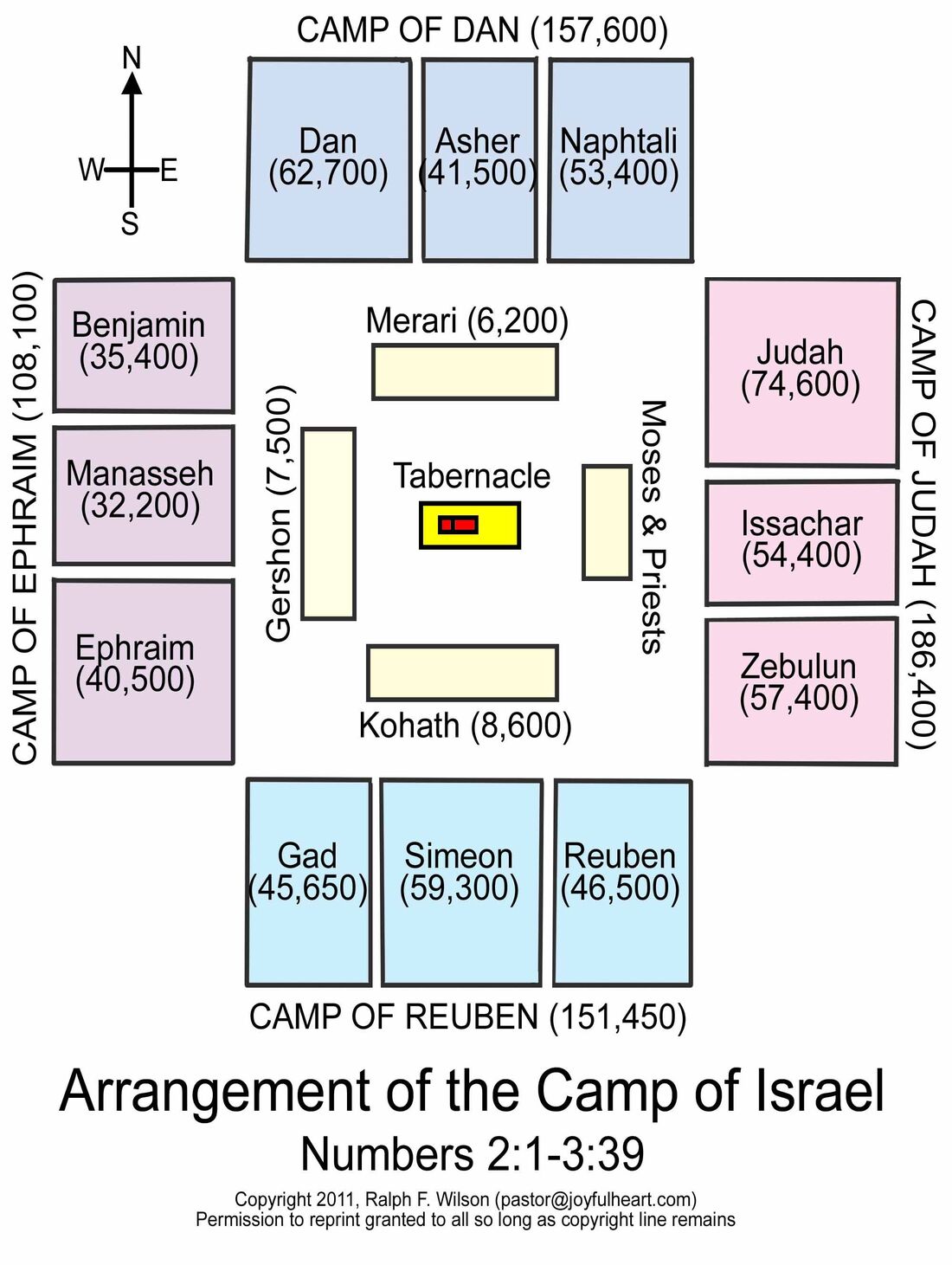 This numerical assessment of each of the Levite clans was for the purpose of assigning their God-ordained responsibilities. Each of the clans was to carry out tasks related to the maintenance of the Tabernacle. They were also assigned a particular region within the Israelite camp to occupy and oversee. The Gershonites were to camp on the west side of the Tabernacle, while the Kohathites occupied the south side and the Merarites were assigned to the north side. The east side of the Tabernacle, located nearest the entrance to the holy compound, “was reserved for the tents of Moses and of Aaron and his sons, who had the final responsibility for the sanctuary on behalf of the people of Israel” (Numbers 3:38 NLT).
With the Levites strategically placed around the perimeter of the Tabernacle, the Israelites would enjoy the constant presence and influence of God’s ministers and servants. These various Levitical clans were assigned a specific set of responsibilities related to the Tabernacle. The Gershonites “were responsible to care for the Tabernacle, including the sacred tent with its layers of coverings, the curtain at its entrance, the curtains of the courtyard that surrounded the Tabernacle and altar, the curtain at the courtyard entrance, the ropes, and all the equipment related to their use” (Numbers 3:25-26 NLT).
The Kohathites “were responsible for the care of the Ark, the table, the lampstand, the altars, the various articles used in the sanctuary, the inner curtain, and all the equipment related to their use” (Numbers 3:31 NLT).
Finally, the Merarites “were responsible for the care of the frames supporting the Tabernacle, the crossbars, the pillars, the bases, and all the equipment related to their use. They were also responsible for the posts of the courtyard and all their bases, pegs, and ropes” (Numbers 3:36-37 NLT).
The Tabernacle was the house of God and was to be treated with reverence and respect. The various elements that comprised this one-of-a-kind structure had been designed by God and were painstakingly crafted by men who had been supernaturally endowed with the skills necessary to carry out God’s plan. This was no ordinary tent, and it was to be treated with great care because every part of it had been set apart by God for His use. Even the disassembly and transport of its various elements required careful attention to God’s instructions. The holy objects associated with the Holy Place and the Holy of Holies could not be touched by human hands. That is why God designed them with poles to assist in their transport from one place to another.
God had given Moses very specific orders concerning the care and maintenance of the Tabernacle. Only the priestly class of the Levites were allowed to interact with the Tabernacle when it was in its completed state. The rest of the clans were restricted from entering the Tabernacle until it was time to relocate it for transport to another location. And, on those occasions, the Gershonites, Kohathites, and Merarites had to wait until the holy furniture was properly prepared and covered before they could fulfill their duties. God had given Aaron strict instructions regarding this matter.
“You, your sons, and your relatives from the tribe of Levi will be held responsible for any offenses related to the sanctuary. But you and your sons alone will be held responsible for violations connected with the priesthood.
“Bring your relatives of the tribe of Levi—your ancestral tribe—to assist you and your sons as you perform the sacred duties in front of the Tabernacle of the Covenant. But as the Levites go about all their assigned duties at the Tabernacle, they must be careful not to go near any of the sacred objects or the altar. If they do, both you and they will die. The Levites must join you in fulfilling their responsibilities for the care and maintenance of the Tabernacle, but no unauthorized person may assist you.” – Numbers 18:1-4 NLT
The tribe of Levi had been set apart by God and given the responsibility of caring for His sacred house. “Anyone other than a priest or Levite who went too near the sanctuary was to be put to death” (Numbers 3:38 NLT). By placing the various clans of Levi around the perimeter of the Tabernacle, God created a buffer zone that was designed to protect the people of Israel from possible death for violating His ban on coming too close to the holy place. While God had moved His presence from the top of Mount Sinai to the Holy of Holies in the Tabernacle, He was still to be treated with proper reverence and respect. He had come to dwell among them and was closer than ever before, but they were not to treat His divine presence with contempt or complacency. His nearness did not make Him any less holy. His immanence did not diminish His transcendence. Just because God had taken up residence among them and had placed His glory in the midst of their camp did not give them the right to treat Him with a disrespectful kind of over-familiarity.
The Levites were to act as mediators between God and the rest of the Israelites. The members of the priestly caste were to serve as God’s intercessors, offering sacrifices on behalf of the people and assisting them in maintaining a right standing with Him. The rest of the Levites were to care for the dwelling place of God, ensuring that it was properly maintained and its holiness was protected at all costs. If the house of God became defiled, it would no longer be an appropriate place for God’s presence, and without God’s presence, the Israelites would lose the one thing that set them apart from all the other nations on earth. Moses revealed his understanding of this vital relationship between God’s presence and the Israelites’ unique status among the nations when he said to God, “If you don’t personally go with us, don’t make us leave this place. How will anyone know that you look favorably on me—on me and on your people—if you don’t go with us? For your presence among us sets your people and me apart from all other people on the earth” (Exodus 33:15-16 NLT).
Moses knew that the only thing that set the Israelites apart was the presence of God, and God made it clear that His presence was directly tied to the sanctity of the Tabernacle. That’s why He placed so much emphasis on the Levites and their role as the caretakers of His earthly house. The Tabernacle was the key to their survival and success as they made their way to the Promised Land. God had left Mount Sinai and taken up residence among them in the portable sanctuary He had designed and they had built. As long as they maintained the holiness of God’s house, He would remain among them, and He assigned the Levites with the weighty responsibility of protecting the sanctity of His sanctuary.
English Standard Version (ESV) The Holy Bible, English Standard Version. ESV® Permanent Text Edition® (2016). Copyright © 2001
New Living Translation (NLT) Holy Bible, New Living Translation, copyright © 1996, 2004, 2015 by Tyndale House Foundation. Used by permission of Tyndale House Publishers Inc., Carol Stream, Illinois 60188. All rights reserved.