The Truth About Falsehood

I robbed other churches by accepting support from them in order to serve you. And when I was with you and was in need, I did not burden anyone, for the brothers who came from Macedonia supplied my need. So I refrained and will refrain from burdening you in any way. 10 As the truth of Christ is in me, this boasting of mine will not be silenced in the regions of Achaia. 11 And why? Because I do not love you? God knows I do!

12 And what I am doing I will continue to do, in order to undermine the claim of those who would like to claim that in their boasted mission they work on the same terms as we do. 13 For such men are false apostles, deceitful workmen, disguising themselves as apostles of Christ. 14 And no wonder, for even Satan disguises himself as an angel of light. 15 So it is no surprise if his servants, also, disguise themselves as servants of righteousness. Their end will correspond to their deeds. – 2 Corinthians 11:8-15 ESV

In his first letter to the Corinthians, Paul had been forced to argue in defense of his apostleship. He had once again found himself under attack by individuals who questioned the validity of his claim to be an apostle of Jesus, and he strongly defended himself.

Am I not an apostle? Have I not seen Jesus our Lord? Are not you my workmanship in the Lord? If to others I am not an apostle, at least I am to you, for you are the seal of my apostleship in the Lord. – 1 Corinthians 9:1-2 ESV

The believers in Corinth were all the evidence he needed to prove he had been sent by the Lord. He was an authentic messenger of Jesus Christ, and yet, while living among the Corinthians, Paul chose not to exercise the rights of an apostle. He reminded them, “the Lord commanded that those who proclaim the gospel should get their living by the gospel” (1 Corinthians 9:14 ESV). However, he had not asked them to fund his stay or help him in any way financially. But he insisted on his right to do so. 

This is my answer to those who question my authority. Don’t we have the right to live in your homes and share your meals? Don’t we have the right to bring a believing wife with us as the other apostles and the Lord’s brothers do, and as Peter does? Or is it only Barnabas and I who have to work to support ourselves?

What soldier has to pay his own expenses? What farmer plants a vineyard and doesn’t have the right to eat some of its fruit? What shepherd cares for a flock of sheep and isn’t allowed to drink some of the milk? – 1 Corinthians 9:3-7 NLT

In the book of Acts, Luke records how Paul sustained himself while living in Corinth.

Then Paul left Athens and went to Corinth. There he became acquainted with a Jew named Aquila, born in Pontus, who had recently arrived from Italy with his wife, Priscilla. They had left Italy when Claudius Caesar deported all Jews from Rome. Paul lived and worked with them, for they were tentmakers just as he was. – Acts 18:1-3 NLT

Paul had paid his own way and had been aided by others who willingly chose to fund his work in Corinth. He had not burdened the Corinthians by asking them to provide for any of his ministry among them. Which is what led Paul to make the following dramatic claim:

I “robbed” other churches by accepting their contributions so I could serve you at no cost. And when I was with you and didn’t have enough to live on, I did not become a financial burden to anyone. For the brothers who came from Macedonia brought me all that I needed. I have never been a burden to you, and I never will be. – 2 Corinthians 11:8-9 NLT

Paul’s claim to have “robbed” the other churches by taking their aid was based on his not having ministered to them in return. He took their money but used it to fund his ministry elsewhere, something they perfectly understood and approved. But it obviously bothered Paul. He felt an obligation to return their generosity by ministering to them as well. However, he was grateful that their gift had allowed him to stop working and concentrate all his efforts on sharing the gospel while in Corinth.

It seems that Paul’s critics were accusing him of duplicity. He had at one time refused to accept support, but then had accepted the gift from the Macedonians. They saw this as a sign of Paul’s hypocrisy. And yet, these false teachers had evidently been accepting support for themselves.

Paul was not going to apologize for his actions. In fact, he said, “what I am doing I will continue to do, in order to undermine the claim of those who would like to claim that in their boasted mission they work on the same terms as we do” (2 Corinthians 11:12 ESV). He would not stoop to their level, and he would not allow them to compare themselves to him. He had already accused them of preaching a different gospel and a different Jesus. So, Paul pulled no punches, accusing these men of being “false apostles, deceitful workmen, disguising themselves as apostles of Christ” (2 Corinthians 11:13 ESV).

Paul had taken the gloves off, claiming these men to be in league with Satan himself. This was not a gentlemanly debate, but all-out war. Paul was not just defending his ministry, but the integrity of the gospel itself. And like a shepherd, he was protecting his flock by fending off the attacks of dangerous predators. What made these men particularly deadly was that they were like sheep in wolves’ clothing. They were cunningly deceptive and had won the confidence of the Corinthians by appearing as something other than what they really were. Jesus had warned about these kinds of men.

Beware of false prophets who come disguised as harmless sheep but are really vicious wolves. You can identify them by their fruit, that is, by the way they act. Can you pick grapes from thornbushes, or figs from thistles? A good tree produces good fruit, and a bad tree produces bad fruit. A good tree can’t produce bad fruit, and a bad tree can’t produce good fruit. So every tree that does not produce good fruit is chopped down and thrown into the fire. Yes, just as you can identify a tree by its fruit, so you can identify people by their actions. – Matthew 7:15-20 NLT

These men had disguised themselves as “servants of righteousness,” but they intended to harm God’s people. Their messages sounded safe and in line with what Paul had taught, but there were dangerously subtle differences based on a carefully crafted mixture of truth and falsehood. They were teaching Jesus, but it was a slightly variant version. They were teaching grace alone, but with a dose of good deeds mixed in.

There will always be those who infiltrate the church, disguising themselves as servants of righteousness, but who are actually servants of Satan. Their words are deceptive, and their outward appearance is convincing, but their fruit is deadly. The book of Jude describes them in stark, but realistic terms.

…they are like dangerous reefs that can shipwreck you. They are like shameless shepherds who care only for themselves. They are like clouds blowing over the land without giving any rain. They are like trees in autumn that are doubly dead, for they bear no fruit and have been pulled up by the roots. They are like wild waves of the sea, churning up the foam of their shameful deeds. They are like wandering stars, doomed forever to blackest darkness. – Jude 1:12-13 NLT

Be on the alert for them and don’t be deceived by their subtle lies masquerading as truth. Have nothing to do with them because their deeds are deadly.

Father, our enemy is dangerous because he operates as an “angel of light,” disguising and delivering his message in subtle ways that make it difficult to discern where the lie stops and the truth begins. As he did with Eve in the garden, he always mixes just enough truth with his falsehoods to make it sound palatable and acceptable. Yet, he remains the father of lies and the great deceiver. However, You have given us Your Word and the indwelling Holy Spirit to make sure we can recognize the real thing from the counterfeit. But it is easy to get lulled into a sense of overconfidence and complacency and forget that our enemy “prowls around like a roaring lion, looking for someone to devour ” (1 Peter 5:8 NLT). Keep us on the alert and ever vigilant so that we are never caught by surprise. Help us to stand strong against him and firm in our faith because, as John wrote, “greater is He who is in you than he who is in the world” (1 John 4:4 BSB).
 Amen

English Standard Version (ESV) The Holy Bible, English Standard Version. ESV® Permanent Text Edition® (2016). Copyright © 2001 by Crossway Bibles, a publishing ministry of Good News Publishers.

New Living Translation (NLT) Holy Bible, New Living Translation, copyright © 1996, 2004, 2015 by Tyndale House Foundation. Used by permission of Tyndale House Publishers Inc., Carol Stream, Illinois 60188. All rights reserved.
Be Careful Who You Judge

I wrote to you in my letter not to associate with sexually immoral people— 10 not at all meaning the sexually immoral of this world, or the greedy and swindlers, or idolaters, since then you would need to go out of the world. 11 But now I am writing to you not to associate with anyone who bears the name of brother if he is guilty of sexual immorality or greed, or is an idolater, reviler, drunkard, or swindler—not even to eat with such a one. 12 For what have I to do with judging outsiders? Is it not those inside the church whom you are to judge? 13 God judges those outside. “Purge the evil person from among you.” 1 Corinthians 5:9-13 ESV

Evidently, Paul had sent another letter to the church in Corinth before this one. In it, he had warned them, “not to associate with sexually immoral people” (1 Corinthians 5:9 ESV). Yet, they had evidently not taken his advice. That one command makes their toleration of the sin within their midst all the more egregious. They had turned a blind eye to the individual in their fellowship who was having an incestuous affair with his stepmother. Rather than confront this man about his sin, they were willingly ignoring it and even bragging about their tolerance of it. And yet, according to these verses, the believers in Corinth were isolating themselves from the unbelievers in their city. They were practicing a form of isolationism, refusing to have anything to do with the lost, probably out of a sense of moral superiority.

But Paul wants to make himself perfectly clear. In his previous letter, he was in no way promoting a brand of monasticism or spiritual isolationism. To attempt to eliminate all contact with unbelieving sinners would require them to leave the world. It would be impossible for a believer to disassociate himself from all contact with the lost. In fact, to attempt to do so would go against Jesus’ call that we be salt and light in a world filled with moral decay and spiritual darkness. Jesus Himself was accused of associating with sinners. In fact, he went out of His way to spend time with those who, in His day, were deemed the worst of sinners.

If we adopt a policy of spiritual isolationism, it will be difficult to obey His command to “go into all the world and preach the Good News to everyone” (Mark 6:15 NLT). Had Paul determined to have nothing to do with the immoral, greedy, swindlers, and idolaters, no one in Corinth would have ever come to know Jesus Christ as their Savior. In the very next chapter, Paul reminds his audience of their former status as spiritual outcasts and moral misfits.

Don’t fool yourselves. Those who indulge in sexual sin, or who worship idols, or commit adultery, or are male prostitutes, or practice homosexuality, or are thieves, or greedy people, or drunkards, or are abusive, or cheat people — none of these will inherit the Kingdom of God. Some of you were once like that. But you were cleansed; you were made holy; you were made right with God by calling on the name of the Lord Jesus Christ and by the Spirit of our God. – 1 Corinthians 6:9-11 NLT

As Christians, it is so easy to judge the world and to view ourselves as morally superior because of our faith in Christ. But we should never forget that, before receiving God’s marvelous gift of grace, we were sinners, condemned, and unclean. We “lived in this world without God and without hope” (Ephesians 2:12 NLT). But God showed us mercy and graciously revealed to us the message of hope found in the death, burial, and resurrection of His Son. We were lost, but God sought us out and made us the undeserving sheep of His fold (Luke 15:1-7). We were spiritually blind, but God gave us sight. We were dead in our trespasses and sins, but God gave us new life through Christ.

We have no right to judge the lost of this world. We are not their moral superiors, and God did not choose us because we were somehow more deserving or had earned His favor. Before coming to faith in Christ, we were just as sinful and condemned.

It seems the Corinthians were quick to judge those outside their fellowship as moral misfits who were undeserving of their love and attention. But Paul clarifies that when he told them “not to associate with people who indulge in sexual sin” (1 Corinthians 5:9 NLT), he wasn’t talking about unbelievers. 

I meant that you are not to associate with anyone who claims to be a believer yet indulges in sexual sin, or is greedy, or worships idols, or is abusive, or is a drunkard, or cheats people. – 1 Corinthians 5:11 NLT 

Paul wanted them to turn their attention inward and focus on the moral condition of their own flock. He wanted them to know that they had a God-given responsibility to judge one another as believers. The Greek word Paul uses is κρίνω (krinō), and it carries a range of meanings. It can mean “to pronounce an opinion concerning right and wrong,” but it can also mean, “to pronounce judgment, to subject to censure” (“G2919 – krinō – Strong’s Greek Lexicon (KJV).” Blue Letter Bible).

There is a sense in which believers are to judge one another’s actions, but that judgment is not to be arbitrary or subjective. It is not left up to our own opinions or personal preferences. With the assistance of the Spirit of God, we are to use the Word of God to determine whether the behavior of a brother or sister in Christ is in keeping with the will of God. If we find that their behavior is out of step with God’s will, our first goal should be restoration. Paul told the Galatians, “Dear brothers and sisters, if another believer is overcome by some sin, you who are godly should gently and humbly help that person back onto the right path. And be careful not to fall into the same temptation yourself” (Galatians 6:1 NLT). James wrote something very similar.

My dear brothers and sisters, if someone among you wanders away from the truth and is brought back, you can be sure that whoever brings the sinner back will save that person from death and bring about the forgiveness of many sins. – James 5:19-20 NLT

If we “judge” or determine that a fellow believer is behaving sinfully, we have an obligation to lovingly confront them, but our goal is their repentance and restoration. In those cases where they refuse to repent, we have a responsibility to practice a form of tough love, out of concern for the well-being of the body of Christ. We have an obligation to remove the unrepentant from our fellowship so that their behavior does not become infectious and destroy the spiritual health of the flock. Paul warned the Corinthians, “not to associate with anyone who claims to be a believer yet indulges in sexual sin, or is greedy, or worships idols, or is abusive, or is a drunkard, or cheats people. Don’t even eat with such people” (1 Corinthians 5:11 NLT). Their lifestyle choices did not match their professed belief in Jesus. By their actions, they were bringing shame and dishonor to the name of God. They were a cancerous threat to the body of Christ, and the Corinthians’ refusal to remove them was allowing their sinful, disobedient mindset to infect others.

It is our willful tolerance of sin in the camp that causes the body of Christ to be weak and anemic. We are more than willing to judge unbelievers, pointing our fingers at their sinfulness and pridefully claiming the moral high ground. But when it comes to the blatant sins of those who claim to be Christ followers, we are more than willing to turn a blind eye and act as if nothing is wrong. That is exactly what the Corinthians had done. There was sin in their midst, and they had chosen to ignore it. Like so many of us today, they were probably saying, “Who am I to judge?” Or they defended their lack of judgment by using the words of Jesus.

Do not judge others, and you will not be judged. For you will be treated as you treat others. The standard you use in judging is the standard by which you will be judged. And why worry about a speck in your friend’s eye when you have a log in your own? – Matthew 7:1-3 NLT

But Jesus meant that we were not to pass judgment on those whom we have no authority to do so. The context of Jesus’ statement is hypocrisy — judging someone else when you have not effectively dealt with your own sin. He was referring to judging and condemning the “speck” of sin in someone else’s life while ignoring the “log” of sin in your own.

Judgment is appropriate and right when done with the spiritual well-being of the body of Christ in mind. We have a responsibility to protect the integrity of God’s household, removing those who reject our calls to repentance. The fact is, we all sin, but we are called to confess our sins and turn from them. When we do, God is faithful to forgive our sins and to cleanse us from all unrighteousness (1 John 1:9). But if we choose to remain unrepentant, our brothers and sisters in Christ have an obligation to step in and call us out.

As Paul so clearly states, “It isn’t my responsibility to judge outsiders, but it certainly is your responsibility to judge those inside the church who are sinning” (1 Corinthians 5:12 NLT). And the apostle Peter echoes Paul’s words when he writes, “For the time has come for judgment, and it must begin with God’s household” (1 Peter 4:17 NLT).

Father, this is a difficult passage because it not only sounds impossible to pull off, but it isn’t very appealing. Judging unbelievers is easy because their sins are so apparent, and when I find fault in them, it makes me feel better about myself. But You are far more concerned about the sin in my life and the sins I so easily tolerate within the body of Christ. Of all people, we have no excuse for our sinfulness because we have been forgiven, redeemed, and filled with the Holy Spirit. As Peter states, You have “given us everything we need for life and godliness” (1 Peter 1:3). Yet, we keep on sinning and then try to justify our actions as somehow normal and acceptable. We not only tolerate the sin in our own lives, but we turn a blind eye to the sins of others who claim to be Christ followers. Give us a growing distaste and dissatisfaction for the sin that so easily entangles us (Hebrews 12:1). Increase our desire to live set apart lives and to remove the sin from our camp so that we reflect the character of Christ to a lost and dying world. Amen

English Standard Version (ESV) The Holy Bible, English Standard Version. ESV® Permanent Text Edition® (2016). Copyright © 2001 by Crossway Bibles, a publishing ministry of Good News Publishers.

New Living Translation (NLT) Holy Bible, New Living Translation, copyright © 1996, 2004, 2015 by Tyndale House Foundation. Used by permission of Tyndale House Publishers Inc., Carol Stream, Illinois 60188. All rights reserved.

Bad News and Good News

1 Open your doors, O Lebanon,
    that the fire may devour your cedars!
Wail, O cypress, for the cedar has fallen,
    for the glorious trees are ruined!
Wail, oaks of Bashan,
    for the thick forest has been felled!
The sound of the wail of the shepherds,
    for their glory is ruined!
The sound of the roar of the lions,
    for the thicket of the Jordan is ruined!

Thus said the LORD my God: “Become shepherd of the flock doomed to slaughter. Those who buy them slaughter them and go unpunished, and those who sell them say, ‘Blessed be the LORD, I have become rich,’ and their own shepherds have no pity on them. For I will no longer have pity on the inhabitants of this land, declares the LORD. Behold, I will cause each of them to fall into the hand of his neighbor, and each into the hand of his king, and they shall crush the land, and I will deliver none from their hand.” – Zechariah 11:1-6 ESV

In these verses, Yahweh seems to be warning His people that they are doomed to repeat the sins of their forefathers. Despite their recent return to the land and their ongoing efforts to rebuild the Temple, they will continue to display the same proclivity for apostasy and idolatry. Yahweh wants to bless them and fully intends to restore their fortunes but He knows that their long-term future is bleak because of their hearts are far from Him.

All of the future hope He has outlined for them will come with the arrival of the Messiah at the end of the age. Until then, Israel’s prospects will include continued apostasy, no king, constant oppression from outside forces, and a longing for a return to their former days of glory. Under Zechariah’s leadership, the people of Judah would complete the construction of the new Temple, but its presence would do little to transform their hearts or alter their behavior.

The Temple was finished in 516 B.C. and then refurbished and expanded by Herod the Great about 18 B.C. This “second” Temple was still standing when Jesus began His earthly ministry. But the Romans destroyed that beautiful structure nearly 90 years later. Jesus predicted this devastating event when discussing the beauty of Herod’s renovated Temple with His disciples.

As Jesus was leaving the Temple that day, one of his disciples said, “Teacher, look at these magnificent buildings! Look at the impressive stones in the walls.”

Jesus replied, “Yes, look at these great buildings. But they will be completely demolished. Not one stone will be left on top of another!” – Mark 13:1-2 NLT

The disciples were obviously disturbed by what Jesus said but He had far more to say about the matter that would leave them disheartened and confused. First, He warned them not to be fooled by the appearance of false Messiahs, offering deliverance from the wars, famines, and earthquakes that would come. But His premonitions concerning their own fate must have hit the hardest.

“You will be handed over to the local councils and beaten in the synagogues. You will stand trial before governors and kings because you are my followers. But this will be your opportunity to tell them about me. For the Good News must first be preached to all nations.” – Mark 13:9-10 NLT

The future would be difficult and feature a disintegration of the social fabric.

“A brother will betray his brother to death, a father will betray his own child, and children will rebel against their parents and cause them to be killed. And everyone will hate you because you are my followers. But the one who endures to the end will be saved. – Mark 13:12-13 NLT

Jesus’ next words must have left His disciples staggering in disbelief. He described a period of great tribulation and turmoil – like nothing the world has ever seen.

“For there will be greater anguish in those days than at any time since God created the world. And it will never be so great again. In fact, unless the Lord shortens that time of calamity, not a single person will survive. But for the sake of his chosen ones he has shortened those days.” – Mark 13:19-20 NLT

However, the disciples failed to understand that many of these things would not occur until long after they were gone. After His ascension, they would suffer persecution, being arrested, tried, beaten, and even martyred for their proclamation of the Good News. But they would not live to see the full extent of the prophecy He outlined.

Jesus was speaking of His second coming, the future day when He would return to complete God’s plan for the redemption of Israel and the establishment of His Kingdom on earth.

“Then everyone will see the Son of Man coming on the clouds with great power and glory. And he will send out his angels to gather his chosen ones from all over the world—from the farthest ends of the earth and heaven. – Mark 13:26-27 NLT

But what does all this have to do with Zechariah 10:1-4? Everything. In these verses, the prophet delivers Yahweh’s message concerning the destruction of the Temple. Zechariah must have found these words difficult to write down because He was still trying to finish the construction of the Temple. It would have been highly demotivating and demoralizing to hear that their work would be in vain. He had no idea that 576 years would pass before the Romans destroyed the Temple.

While Yahweh used poetic language to describe the future fate of the Temple, His message would have been clear to Zechariah. Verse one describes the Temple in a rather strange way but one that Zechariah and the people of Judah would have understood.

Open your doors, O Lebanon,
    that the fire may devour your cedars! – Zechariah 11:1 ESV

When Solomon prepared to build the original Temple, he procured wood for its construction from the forests of Lebanon. He sent a message to the King of Tyre requesting all the lumber necessary to complete his plans for God’s house.

“Now therefore command that cedars of Lebanon be cut for me. And my servants will join your servants, and I will pay you for your servants such wages as you set, for you know that there is no one among us who knows how to cut timber like the Sidonians.” – 1 Kings 5:6 ESV

The text goes on to reveal that Hiram honored Solomon’s request and provided all the timber necessary for the Temple project.

So Hiram supplied Solomon with all the timber of cedar and cypress that he desired. – 1 Kings 5:10 ESV

Wood featured prominently in the design of the Temple.

So Solomon built the house and finished it. He lined the walls of the house on the inside with boards of cedar. From the floor of the house to the walls of the ceiling, he covered them on the inside with wood, and he covered the floor of the house with boards of cypress. He built twenty cubits of the rear of the house with boards of cedar from the floor to the walls, and he built this within as an inner sanctuary, as the Most Holy Place. The house, that is, the nave in front of the inner sanctuary, was forty cubits long. The cedar within the house was carved in the form of gourds and open flowers. All was cedar; no stone was seen. – 1 Kings 6:14-18 ESV

Because of the sheer quantity of lumber from Lebanon used in the Temple’s construction, According to the Talmud, God’s house was affectionately nicknamed, “Lebanon.” When Solomon finished his palace, he called it “the House of the Forest of Lebanon” (1 Kings 7:2 ESV).

So, verse 1 contains a thinly veiled reference to the destruction of the Temple. But Yahweh describes other “glorious trees” like cypress and oak that will also face destruction.

Wail, O cypress, for the cedar has fallen,
    for the glorious trees are ruined!
Wail, oaks of Bashan,
    for the thick forest has been felled! – Zechariah 11:2 ESV

Some scholars believe these are references to the people of Israel but, given the context, it makes more sense to see this as a further description of the Temple’s ultimate destruction. All the wood used to frame and decorate the Temple would be burned in the fire started by the Roman soldiers. For the second time, the glorious House of God was destroyed by the enemies of Israel. As a result of this devastation, the priests (shepherds) wail as they witness the destruction of their place of the LORD’s house and their place of employment.

The sound of the wail of the shepherds,
    for their glory is ruined! – Zechariah 11:3 ESV

But it would seem that these verses foreshadow something far greater than the fall of Jerusalem in 70 A.D. In the rest of the chapter, Yahweh expands the scope of His prophecy, describing a much greater devastation than that which took place in the 1st Century A.D. Once again, He provides a stark vision of the future that must have disturbed Zechariah but came without explanation or interpretation. Like Jesus’ disciples, the prophet had no way of knowing when these things might occur. But Yahweh gives a command that provides a vital clue to understanding what He is talking about.

“Become shepherd of the flock doomed to slaughter. – Zechariah 11:4 ESV

This can be taken as a reference to Zechariah but it also has future implications. In chapter 10, Yahweh described the arrival of a new shepherd who would care for His forsaken flock.

“…the Lord of Heaven’s Armies has arrived
    to look after Judah, his flock.
He will make them strong and glorious,
    like a proud warhorse in battle. – Zechariah 10:3 ESV

That shepherd would be the Good Shepherd, Jesus, who came to lay down His life for the sheep (John 10:11). God intended to send His Son as the ultimate Shepherd who would lovingly care for His neglected and mistreated flock.

“So I will rescue my flock, and they will no longer be abused. I will judge between one animal of the flock and another. And I will set over them one shepherd, my servant David. He will feed them and be a shepherd to them.” – Ezekiel 34:23-24 NLT

Matthew records that when Jesus came He saw the people of Israel with the eyes of a shepherd.

He saw the crowds, He was moved with compassion for them, because they were harassed and helpless, like sheep without a shepherd. – Matthew 9:36 BSB

But John records, “He came to his own people, and even they rejected him” (John 1:11 NLT). Jesus came to be the Great Shepherd, but the sheep of Israel refused to hear His voice. In fact, according to the apostle Peter, they played a significant role in His death.

“This is the same Jesus whom you handed over and rejected before Pilate, despite Pilate’s decision to release him. You rejected this holy, righteous one and instead demanded the release of a murderer. You killed the author of life, but God raised him from the dead. And we are witnesses of this fact! – Acts3:13-15 NLT

In some sense, verses 4-6 of Zechariah 11 refer to God’s prophet. He was the “shepherd of the flock doomed to slaughter” (Zechariah 11:4 ESV). But, in this, he served as a type of foreshadowing of the greater shepherd to come. The author of Hebrews describes Jesus as “the great Shepherd of the sheep” (Hebrews 13:20 NLT). Jesus came to serve as the one true Shepherd, but His own flock refused to listen to His voice or accept His offer of care and compassion. But one day, Jesus will return again to gather up the scattered flock of God and restore them to His Father’s fold.

“I am the good shepherd; I know my own sheep, and they know me, just as my Father knows me and I know the Father. So I sacrifice my life for the sheep. I have other sheep, too, that are not in this sheepfold. I must bring them also. They will listen to my voice, and there will be one flock with one shepherd.” – John 10:14-16 NLT

But long before that event takes place, there will be a period of prolonged suffering and separation for the unfaithful flock of God. That is what God describes for His prophet Zechariah.

“For I will no longer have pity on the inhabitants of this land, declares the Lord. Behold, I will cause each of them to fall into the hand of his neighbor, and each into the hand of his king, and they shall crush the land, and I will deliver none from their hand.” – Zechariah 11:6 ESV

For Zechariah, those events lay in the distant future and he would not live to see them. But God was revealing the details of Israel’s destiny and assuring His prophet that there was a complete and fully reliable plan in place for their future well-being.

English Standard Version (ESV)
The Holy Bible, English Standard Version. ESV® Permanent Text Edition® (2016). Copyright © 2001 by Crossway Bibles, a publishing ministry of Good News Publishers.

New Living Translation (NLT)
Holy Bible, New Living Translation, copyright © 1996, 2004, 2015 by Tyndale House Foundation. Used by permission of Tyndale House Publishers Inc., Carol Stream, Illinois 60188. All rights reserved.

Scattered Sheep and Shoddy Shepherds

1 The word of the Lord came to me: “Son of man, prophesy against the shepherds of Israel; prophesy, and say to them, even to the shepherds, Thus says the Lord God: Ah, shepherds of Israel who have been feeding yourselves! Should not shepherds feed the sheep? You eat the fat, you clothe yourselves with the wool, you slaughter the fat ones, but you do not feed the sheep. The weak you have not strengthened, the sick you have not healed, the injured you have not bound up, the strayed you have not brought back, the lost you have not sought, and with force and harshness you have ruled them. So they were scattered, because there was no shepherd, and they became food for all the wild beasts. My sheep were scattered; they wandered over all the mountains and on every high hill. My sheep were scattered over all the face of the earth, with none to search or seek for them.

“Therefore, you shepherds, hear the word of the Lord: As I live, declares the Lord God, surely because my sheep have become a prey, and my sheep have become food for all the wild beasts, since there was no shepherd, and because my shepherds have not searched for my sheep, but the shepherds have fed themselves, and have not fed my sheep, therefore, you shepherds, hear the word of the Lord: 10 Thus says the Lord God, Behold, I am against the shepherds, and I will require my sheep at their hand and put a stop to their feeding the sheep. No longer shall the shepherds feed themselves. I will rescue my sheep from their mouths, that they may not be food for them. Ezekiel 34:1-10 ESV

While every Israelite was personally responsible for their own sin, God placed blame on the nation’s leadership and held them culpable for the sorry spiritual state of the His chosen people. The civic and religious leaders of Judah had played an undeniable role in the nation’s demise. According to God, these powerful and influential men were guilty of using their positions of authority to mislead and abuse those under their care. Rather than serving as loving shepherds for God’s flock, they had used their God-given authority for personal gain.

Yahweh, the Good Shepherd, accused these men of fleecing His flock. When they should have been protecting God’s people, they had chosen to use their roles for personal profit and self-promotion. And God warns them that He will hold them responsible for their abuse of power.

What sorrow awaits you shepherds who feed yourselves instead of your flocks. Shouldn’t shepherds feed their sheep? – Ezekiel 34:2 NLT

God is unsparing in His assessment of their crimes. Using the shepherding metaphor to full advantage, God accuses them of neglect, abuse, cruelty, and dereliction of duty.

“You drink the milk, wear the wool, and butcher the best animals, but you let your flocks starve. You have not taken care of the weak. You have not tended the sick or bound up the injured. You have not gone looking for those who have wandered away and are lost. Instead, you have ruled them with harshness and cruelty.” – Ezekiel 34:4 NLT

But who are these shiftless shepherds? Throughout the Old Testament, the term “shepherd” is used to refer to kings, governors, priests, and even prophets. Since God is addressing His chosen people, His reference to shepherds would include the king and his royal court, as well as all the civic and religious leaders of Israel. Anyone in a position of authority would have been included in God’s indictment.

Earlier in his book, Ezekiel recorded God’s displeasure with the self-proclaimed prophets of Judah who were purporting to speak for God but were actually propagating false messages that contradicted the words of Ezekiel.

“…these prophets of yours are like jackals digging in the ruins. They have done nothing to repair the breaks in the walls around the nation. They have not helped it to stand firm in battle on the day of the Lord. Instead, they have told lies and made false predictions.” – Ezekiel 13:4-6 NLT

The people viewed these men as spiritual leaders and took their words as having come from God. But their messages were nothing but lies, intended to deceive and designed to provide false hope. They were nothing more than snake-oil salesmen promoting a self-concocted product offering beguiling but completely bogus benefits.

But the prophets weren’t the only ones whom God held responsible. The priests also played a role in the nation’s spiritual freefall. The very ones who should have been promoting obedience and modeling faithfulness were guilty of gross misconduct and failure to fulfill their God-given role. The prophet Hosea recorded God’s stinging rebuke of the priestly order and His intention to punish them for their catastrophic abuse of power.

“My people are being destroyed
    because they don’t know me.
Since you priests refuse to know me,
    I refuse to recognize you as my priests.
Since you have forgotten the laws of your God,
    I will forget to bless your children.
The more priests there are,
    the more they sin against me.
They have exchanged the glory of God
    for the shame of idols.

“When the people bring their sin offerings, the priests get fed.
    So the priests are glad when the people sin!
‘And what the priests do, the people also do.’
    So now I will punish both priests and people
    for their wicked deeds.” – Hosea 4:6-9 NLT

The prophet Malachi provides God’s clear explanation of the priestly role and His blunt assessment of those responsible for carrying it out.

“The words of a priest’s lips should preserve knowledge of God, and people should go to him for instruction, for the priest is the messenger of the Lord of Heaven’s Armies. But you priests have left God’s paths. Your instructions have caused many to stumble into sin. You have corrupted the covenant I made with the Levites…” – Malachi 2:7-8 NLT

As the spiritual leaders of His people, God held the priests and prophets responsible for the well-being of the flock. They were the teachers and truth-tellers, the guides responsible for leading and feeding the sheep of God’s flock. But they had dropped the ball. Rather than model righteousness and promote holiness, they had led the way in wickedness and unfaithfulness. When God had made His covenant with the tribe of Levi, setting them apart for their role as the priestly order, He declared, “they did not lie or cheat; they walked with me, living good and righteous lives, and they turned many from lives of sin” (Malachi 2:6 NLT). But all that had changed. Over time, the priests had become corrupt and used their God-ordained roles to promote sin rather than sanctification, and God would hold them accountable.

But there’s one more group of shepherds whom God must expose and excoriate. At the top of the leadership pyramid sat the king and all his royal counselors. As the designated head of state, the king was ultimately responsible for the well-being of the nation. His position as supreme ruler meant that the buck stopped with him. His role as God’s vice-regent provided him with great authority but it came with significant responsibility. The king was to serve as the primary example of submission to God. His power and authority had been delegated to him by God and it was to be used to provide protection and promote godliness. Yet, all throughout the history of the kings of Israel and Judah, there appears a recurring theme. The vast majority of the kings “did what was evil in the Lord’s sight” (2 Kings 15:9 NLT). They promoted idolatry, encouraged wickedness, and modeled unfaithfulness.

King David had encouraged Solomon, his son and heir to the throne, to remain faithful to God. His ascension to the kingship would require obedience to God.

“Observe the requirements of the LORD your God, and follow all his ways. Keep the decrees, commands, regulations, and laws written in the Law of Moses so that you will be successful in all you do and wherever you go. If you do this, then the LORD will keep the promise he made to me. He told me, ‘If your descendants live as they should and follow me faithfully with all their heart and soul, one of them will always sit on the throne of Israel.’” – 1 Kings 2:3-4 NLT

Yet, Solomon had proved to be far from faithful. While he started out well, he ended his reign by promoting idolatry and causing the people to sin against God. As a result, God divided his kingdom in half, creating the northern kingdom of Israel and the southern kingdom of Judah. And both kingdoms demonstrated a propensity for unfaithfulness. The sins of the kings resulted in God’s judgment of the people and their scattering among the nations.

“…my sheep have been scattered without a shepherd, and they are easy prey for any wild animal. They have wandered through all the mountains and all the hills, across the face of the earth, yet no one has gone to search for them. – Ezekiel 34:5-6 NLT

God accuses His shepherds of abandonment. Not only had they been the cause of their sin, but they had also done nothing to restore them to God’s fold when they had become scattered. And God declares His intention to hold these men responsible for their actions. And, more than that, He promises to step in and do what they should have done all along.

“I now consider these shepherds my enemies, and I will hold them responsible for what has happened to my flock. I will take away their right to feed the flock, and I will stop them from feeding themselves. I will rescue my flock from their mouths; the sheep will no longer be their prey.” – Ezekiel 34:10 NLT

English Standard Version (ESV) The Holy Bible, English Standard Version. ESV® Permanent Text Edition® (2016). Copyright © 2001

New Living Translation (NLT) Holy Bible, New Living Translation, copyright © 1996, 2004, 2015 by Tyndale House Foundation. Used by permission of Tyndale House Publishers Inc., Carol Stream, Illinois 60188. All rights reserved.

Shepherding Has Its Rewards

1 So I exhort the elders among you, as a fellow elder and a witness of the sufferings of Christ, as well as a partaker in the glory that is going to be revealed: shepherd the flock of God that is among you, exercising oversight, not under compulsion, but willingly, as God would have you; not for shameful gain, but eagerly; not domineering over those in your charge, but being examples to the flock. And when the chief Shepherd appears, you will receive the unfading crown of glory. 1 Peter 5:1-4 ESV

At the end of the day, Peter was a highly practical man who knew that theology alone was not enough to help his readers navigate the uncertain cultural waters in which they found themselves. They were drowning in a sea of competing ideologies that stood diametrically opposed to the gospel of Jesus Christ. And their status as followers of Christ made them a tempting target for all those who viewed them as a threat to the prevailing status quo. So, Peter went out of his way to apply the promises contained in the Scriptures with the theological lessons found in the life and ministry of Jesus. Peter was a faithful shepherd who cared deeply about the everyday needs of his flock and was determined to help them apply the hope of their future inheritance to their present circumstances.

At this point in his letter, Peter focused his attention on the elders whom God had appointed to shepherd the local fellowships to whom Peter had addressed his letter. All throughout Pontus, Galatia, Cappadocia, Asia, and Bithynia, there were individual gatherings of believers that were being shepherded by faithful men. These men played a vital role in guiding and protecting the men and women who were being “grieved by various trials” 1 Peter 1:6 ESV). Since many of these believers were still relative infants in Christ, they were not yet spiritually mature enough to understand and endure the difficulties they were encountering. And that’s why the elders were so vital to the health and overall well-being of each local church.

This rather brief parenthetical statement was aimed at those men who shared Peter’s role as a God-appointed elder in the church of Jesus Christ. He had even opened his letter with the salutation: “Peter, an apostle of Jesus Christ…” (1 Peter 1:1 ESV). He presented himself “as a fellow elder and a witness of the sufferings of Christ” (1 Peter 5:1 ESV.  Along with sharing their distinctive role as an elder, he brought the added weight of having been a personal eye-witness to the suffering and death of Jesus. In a sense, he was establishing his official status as an apostle of Jesus.

He had been there the day that Jesus had been crucified and killed. But, not only that, Peter had plenty of first-hand experience when it came to the topic of suffering. Ever since the Holy Spirit had come on the day of Pentecost, Peter had faithfully preached the gospel of the kingdom and been rewarded with arrest, imprisonment, interrogation, and even disciplinary beatings. He knew what it was like to suffer for the sake of righteousness. And he was calling the local elders to step up their game and lead by example. They too would one day be partakers “in the glory that is going to be revealed” (1 Peter 5:1 ESV). Any suffering they had to endure in this life would be well worth it once Jesus appeared in all His glory at the end of the age.

So, with that hope ringing in the ears, Peter challenges his fellow elders to shepherd well.

Care for the flock that God has entrusted to you. Watch over it willingly, not grudgingly—not for what you will get out of it, but because you are eager to serve God. – 1 Peter 5:2 NLT

Like any good shepherd, they were to do their job willingly and not out of some sense of heartless duty. Shepherding was to be viewed as a privilege and not a job. They were to care for the flock of Jesus Christ with compassion and love, not out of greed or for personal gain.

It was Jesus who used Himself as an example of the “good shepherd.” He was a caring and completely selfless shepherd who put the needs of the flock ahead of His own – even to the point of laying down His life for the sheep.

“I am the good shepherd. The good shepherd sacrifices his life for the sheep. A hired hand will run when he sees a wolf coming. He will abandon the sheep because they don’t belong to him and he isn’t their shepherd. And so the wolf attacks them and scatters the flock. The hired hand runs away because he’s working only for the money and doesn’t really care about the sheep. – John 10:11-13 NLT

And Peter wanted these local shepherds to remain at their posts, refusing to run at the first sign of trouble. Their ministry as shepherds was to be marked by a deep desire to serve God, and it was to manifest itself in a determination to stand beside the flock even in the face of life-threatening circumstances. They must be willing to lay down their lives just as Jesus had done for them. By following His example, they would become examples to their flock. And Peter reminded them that there would be a reward for their faithful service.

…when the chief Shepherd appears, you will receive the unfading crown of glory. – 1 Peter 5:4 ESV

All of this discussion of sheep and shepherds was near and dear to Peter’s heart because he couldn’t help but view it through the lens of his own experience. Even as he wrote these words, he must have had a fateful scene from his past in mind. It was after the resurrection of Jesus from the dead when Peter had a face-to-face encounter with the one whom he had earlier denied even knowing.

After breakfast Jesus asked Simon Peter, “Simon son of John, do you love me more than these?”

“Yes, Lord,” Peter replied, “you know I love you.”

“Then feed my lambs,” Jesus told him.

Jesus repeated the question: “Simon son of John, do you love me?”

“Yes, Lord,” Peter said, “you know I love you.”

“Then take care of my sheep,” Jesus said.

 A third time he asked him, “Simon son of John, do you love me?”

Peter was hurt that Jesus asked the question a third time. He said, “Lord, you know everything. You know that I love you.”

Jesus said, “Then feed my sheep.” – John 21:15-17 NLT

Jesus had handed over to Peter the responsibility of caring for His sheep. And that was not something Peter took lightly or for granted. Peter had denied Jesus three separate times, but now Jesus had pressed him to confirm his love three times. And Jesus explained that the way for Peter to prove His love for Him would be by loving and caring for His sheep.  And that is exactly what Peter charged these elders to do.

Peter’s mention of the  “unfading crown of glory” seems to be for motivation. It is intended as an incentive to do their jobs well in this life because there is a reward to come in the next life. But it unlikely that Peter is referring to a literal crown. He is talking about the eschatological reward of eternal life in the Kingdom of God. It is the same reward he mentioned in the opening chapter of his letter.

an inheritance that is imperishable, undefiled, and unfading, kept in heaven for you. – 1 Peter 1:4 ESV

The greatest “crowning” achievement of these men will be their faithful carrying out of their role as God’s humble and obedient shepherds. And their reward will be the joy of living in the Kingdom of God – for eternity.

Even if their reward ends up being a literal crown, the book of Revelation reveals that, in the coming Kingdom, no one will stand before God glorying in their own achievements. Instead, they will recognize that all glory and honor goes to God alone.

Whenever the living beings give glory and honor and thanks to the one sitting on the throne (the one who lives forever and ever), the twenty-four elders fall down and worship the one sitting on the throne (the one who lives forever and ever). And they lay their crowns before the throne and say,

“You are worthy, O Lord our God,
    to receive glory and honor and power.
For you created all things,
    and they exist because you created what you pleased.” – Revelation 4:9-11 NLT

The greatest reward any of us can receive is to live in the presence of God forever. Anything else will pale in comparison.

English Standard Version (ESV) The Holy Bible, English Standard Version. ESV® Permanent Text Edition® (2016). Copyright © 2001 by Crossway Bibles, a publishing ministry of Good News Publishers.

New Living Translation (NLT) Holy Bible, New Living Translation, copyright © 1996, 2004, 2015 by Tyndale House Foundation. Used by permission of Tyndale House Publishers Inc., Carol Stream, Illinois 60188. All rights reserved.

New English Translation (NET)NET Bible® copyright ©1996-2017 by Biblical Studies Press, L.L.C. http://netbible.com All rights reserved.


Sheep Without a Shepherd

15 And when he had come to the king, the king said to him, “Micaiah, shall we go to Ramoth-gilead to battle, or shall we refrain?” And he answered him, “Go up and triumph; the Lord will give it into the hand of the king.” 16 But the king said to him, “How many times shall I make you swear that you speak to me nothing but the truth in the name of the Lord?” 17 And he said, “I saw all Israel scattered on the mountains, as sheep that have no shepherd. And the Lord said, ‘These have no master; let each return to his home in peace.’” 18 And the king of Israel said to Jehoshaphat, “Did I not tell you that he would not prophesy good concerning me, but evil?” 19 And Micaiah said, “Therefore hear the word of the Lord: I saw the Lord sitting on his throne, and all the host of heaven standing beside him on his right hand and on his left; 20 and the Lord said, ‘Who will entice Ahab, that he may go up and fall at Ramoth-gilead?’ And one said one thing, and another said another. 21 Then a spirit came forward and stood before the Lord, saying, ‘I will entice him.’ 22 And the Lord said to him, ‘By what means?’ And he said, ‘I will go out, and will be a lying spirit in the mouth of all his prophets.’ And he said, ‘You are to entice him, and you shall succeed; go out and do so.’ 23 Now therefore behold, the Lord has put a lying spirit in the mouth of all these your prophets; the Lord has declared disaster for you.”

24 Then Zedekiah the son of Chenaanah came near and struck Micaiah on the cheek and said, “How did the Spirit of the Lord go from me to speak to you?” 25 And Micaiah said, “Behold, you shall see on that day when you go into an inner chamber to hide yourself.” 26 And the king of Israel said, “Seize Micaiah, and take him back to Amon the governor of the city and to Joash the king’s son, 27 and say, ‘Thus says the king, “Put this fellow in prison and feed him meager rations of bread and water, until I come in peace.”’” 28 And Micaiah said, “If you return in peace, the Lord has not spoken by me.” And he said, “Hear, all you peoples!” 1 Kings 22:15-28 ESV

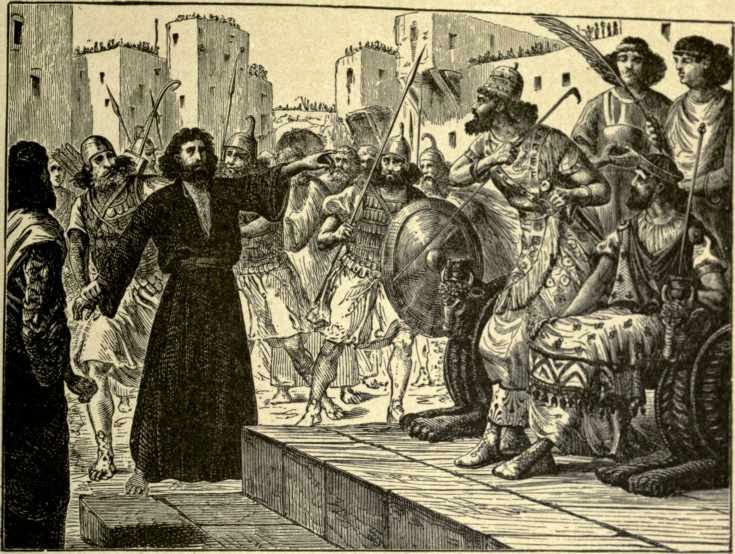
Imagine the scene. Micaiah, the prophet, has been forcibly dragged before King Ahab, who is seated on the dais with his guest, King Jehoshaphat of Judah. Surrounding the two potentates are 400 prophets of Baal, each taking turns declaring their version of the truth. For hours, they have been telling King Ahab exactly what he wants to hear: “Go up to Ramoth-gilead and triumph; the Lord will give it into the hand of the king” (1 Kings 22:12 ESV). One of them, a man named Zedekiah, had even crafted a pair of iron horns and used them as a prop to support his message to the king: “Thus says the Lord, ‘With these you shall push the Syrians until they are destroyed’” (1 Kings 22:11 ESV).

Then Micaiah shows up. Unlike the 400 yes-men who have been masquerading as spokesmen for the false god, Baal, Micaiah was a prophet of Yahweh. And, as such, he was obligated to speak only those words given to him by God. Which is exactly what Micaiah had told the man who had come to fetch him.

As the Lord lives, what the Lord says to me, that I will speak.” – 1 Kings 22:14 ESV

Yet, when King Ahab asked Micaiah to reveal what his God thought about the planned attack of Ramoth-gilead, Micaiah simply repeated the words of the false prophets. He basically told the king, “Go for it!” But Ahab sensed the thinly veiled sarcasm behind Micaiah’s answer and demanded that he tell him the truth. Ahab knew from past experience that Micaiah and his God were going to oppose his plans. He had even revealed to King Jehoshaphat just how much he loathed Micaiah, telling him, “He never prophesies anything but trouble for me!” (1 Kings 22:8 NLT).

Micaiah knew that it really didn’t matter what he told Ahab because the king would do what he wanted to do. Ahab’s stubbornness and arrogance would prevent him from hearing and heeding the message of Yahweh. But Micaiah shared it anyway.

“In a vision I saw all Israel scattered on the mountains, like sheep without a shepherd. And the Lord said, ‘Their master has been killed. Send them home in peace.’” – 1 Kings 22:17 NLT

Ahab was infuriated because Micaiah had just predicted Israel’s defeat and the king’s own death. But this less-than-encouraging message was just what Ahab had expected from the prophet of Yahweh. Just like Elijah, Micaiah proved to be a messenger of doom and gloom, bent on delivering nothing but bad news concerning Ahab’s kingly aspirations.

But Micaiah was not done. He next revealed how God had chosen to implement His plan for Ahab’s demise.

“Listen to what the Lord says! I saw the Lord sitting on his throne with all the armies of heaven around him, on his right and on his left. And the Lord said, ‘Who can entice Ahab to go into battle against Ramoth-gilead so he can be killed?’

“There were many suggestions, and finally a spirit approached the Lord and said, ‘I can do it!’

“‘How will you do this?’ the Lord asked.

“And the spirit replied, ‘I will go out and inspire all of Ahab’s prophets to speak lies.’

“‘You will succeed,’ said the Lord. ‘Go ahead and do it.’” – 1 Kings 22:19-22 NLT

Micaiah had been given a vision of a conversation that had taken place in the throne room of God Almighty. In the vision, Yahweh is portrayed as a king surrounded by his advisors and his army. He is soliciting input from the heavenly host, asking for their counsel on the best way to get Ahab to proceed with his attack on Ramoth-gilead, which will result in his death. A spirit speaks up and offers to deceive the prophets of Baal by giving them a false message of victory. God approves the plan and sends the spirit on his way. Then Micaiah informs Ahab that this is exactly what has happened.

“So you see, the Lord has put a lying spirit in the mouths of all your prophets. For the Lord has pronounced your doom.” – 1 Kings 22:23 NLT

Amazingly, Micaiah tells Ahab the stark reality of all that had just transpired. The 400 prophets had been unwittingly declaring a lie, enticing Ahab to go through with his plan to attack Ramoth-gilead and, inadvertently, bringing about his death.

Yet, even when faced with the truth, Ahab stubbornly refused to give up his plan. He ordered Micaiah’s arrest and imprisonment and commanded that he be given nothing but bread and water until he had returned safely from his battle for Ramoth-gilead. But before being hauled off to prison, Micaiah made one final pronouncement to the king and all those who stood within earshot.

“If you return safely, it will mean that the Lord has not spoken through me!” Then he added to those standing around, “Everyone mark my words!” – 1 Kings 22:28 NLT

The problem with Ahab was not just his stubbornness and idolatry. It was his refusal to shepherd the people of Israel. All his self-centered acts of self-promotion had done irreparable damage to the nation of Israel. He had led the people into apostasy and idolatry. And, as a king over God’s chosen people, he would be held responsible for his failure to care for Yahweh’s flock. Hundreds of years later, the prophet Ezekiel would declare a foreboding message from God concerning all those kings who, like Ahab, had left the people of God like sheep without a shepherd.

Then this message came to me from the LORD: “Son of man, prophesy against the shepherds, the leaders of Israel. Give them this message from the Sovereign LORD: What sorrow awaits you shepherds who feed yourselves instead of your flocks. Shouldn’t shepherds feed their sheep? You drink the milk, wear the wool, and butcher the best animals, but you let your flocks starve. You have not taken care of the weak. You have not tended the sick or bound up the injured. You have not gone looking for those who have wandered away and are lost. Instead, you have ruled them with harshness and cruelty. So my sheep have been scattered without a shepherd, and they are easy prey for any wild animal. They have wandered through all the mountains and all the hills, across the face of the earth, yet no one has gone to search for them.” – Ezekiel 34:1-6 NLT

This motif of shepherdless sheep goes all the way back to the days of Moses. When the great deliverer of Israel was nearing the end of his life, he had appealed to God, asking Him to provide the people of Israel with a new shepherd.

Then Moses said to the LORD, “O LORD, you are the God who gives breath to all creatures. Please appoint a new man as leader for the community. Give them someone who will guide them wherever they go and will lead them into battle, so the community of the LORD will not be like sheep without a shepherd.” – Numbers 27:15-17 NLT

And centuries later, long after Ahab had died, Jesus would appear on the scene, offering His own assessment of the spiritual state of the people of Israel.

Jesus traveled through all the towns and villages of that area, teaching in the synagogues and announcing the Good News about the Kingdom. And he healed every kind of disease and illness. When he saw the crowds, he had compassion on them because they were confused and helpless, like sheep without a shepherd. – Matthew 9:35-36 NLT

The Good Shepherd couldn’t help but look at His own people and see them as shepherdless sheep, wandering about confused and helpless. For centuries, they had been misled and mistreated. Their political and spiritual leaders had used and abused them. Those who should have been feeding and caring for them had ended up taking advantage of them. They had followed the example of Ahab. But Jesus had arrived on the scene as the Son of David, emulating the example of the man after God’s own heart. Jesus was the quintessential shepherd, the Good Shepherd, who would lay down His life for the sheep. And like His forefather, Jesus would shepherd the flock of God with care and compassion.

He chose David his servant
    and took him from the sheepfolds;
from following the nursing ewes he brought him
    to shepherd Jacob his people,
    Israel his inheritance.
With upright heart he shepherded them
    and guided them with his skillful hand. – Psalm 78:70-72 ESV

At the end of the day, Ahab’s greatest problem was that he was a lousy shepherd. His chief sin was that he had failed to care for God’s flock. He had made his own needs a higher priority than the needs of the people. Like most of the kings of Israel and Judah, Ahab had abused his divinely ordained power and position. And he would have to answer to the Great Shepherd of Israel.

He will feed his flock like a shepherd. He will carry the lambs in his arms, holding them close to his heart. He will gently lead the mother sheep with their young. – Isaiah 40:11 NLT

English Standard Version (ESV) The Holy Bible, English Standard Version. ESV® Permanent Text Edition® (2016). Copyright © 2001 by Crossway Bibles, a publishing ministry of Good News Publishers.

New Living Translation (NLT) Holy Bible, New Living Translation, copyright © 1996, 2004, 2015 by Tyndale House Foundation. Used by permission of Tyndale House Publishers Inc., Carol Stream, Illinois 60188. All rights reserved.

The Message (MSG)Copyright © 1993, 1994, 1995, 1996, 2000, 2001, 2002 by Eugene H. Peterson

The Tables Will Turn

14 Shepherd your people with your staff,
    the flock of your inheritance,
who dwell alone in a forest
    in the midst of a garden land;
let them graze in Bashan and Gilead
    as in the days of old.
15 As in the days when you came out of the land of Egypt,
    I will show them marvelous things.
16 The nations shall see and be ashamed of all their might;
they shall lay their hands on their mouths;
    their ears shall be deaf;
17 they shall lick the dust like a serpent,
    like the crawling things of the earth;
they shall come trembling out of their strongholds;
    they shall turn in dread to the Lord our God,
    and they shall be in fear of you. – Micah 7:14-17 ESV

In verse 14, Micah petitions God on behalf of the nation of Judah. Even with knowledge of all the future blessings God has in store for HIs chosen people, Micah asks that God would continue to shepherd them in the present. He refers to the shepherd’s rod or staff. The Hebrew word is shebet, and it can also mean “scepter,” a symbol of kingly rule. It is the same word used by Jacob in the blessing he gave to his son, Judah.

“The scepter [shebet] will not depart from Judah,
    nor the ruler’s staff from his descendants,
until the coming of the one to whom it belongs,
    the one whom all nations will honor.” – Genesis 49:10 NLT

The Old Testament promise concerning the coming Messiah will be fully realized with the second coming of Christ. But at the time Micah penned the words of his prayer, he and the people of Judah were still waiting for their long-awaited Messiah. They were longing to see the coming of the promised one who would reign as David had.

He chose his servant David,
    calling him from the sheep pens.
He took David from tending the ewes and lambs
    and made him the shepherd of Jacob’s descendants—
    God’s own people, Israel.
He cared for them with a true heart
    and led them with skillful hands. – Psalm 78:70-72 NLT

Micah is far from subtle when he reminds God that Judah is the “flock of your inheritance” (Micah 7:14 ESV). They were His chosen possession, His prized and precious sheep.

For he is our God, and we are the people of his pasture, and the sheep of his hand. – Psalm 95:7 ESV

Know that the LORD, he is God! It is he who made us, and we are his; we are his people, and the sheep of his pasture. – Psalm 100:3 ESV

Micah longed for the day when Judah would have a king who would guide and protect them as David had. He knew that the key to their well-being was a godly leader who feared and was faithful to God. Due to a long line of godless kings who had ruled over them, the people of Judah were like sheep that lived in garden-like land but had wandered and gotten lost in the forest. The prophet Jeremiah provides God’s bleak assessment of His flock.

“My people have been lost sheep.
    Their shepherds have led them astray
    and turned them loose in the mountains.
They have lost their way
    and can’t remember how to get back to the sheepfold. – Jeremiah 50:6 NLT

So, Micah begs God to restore His lost and wandering flock, allowing them to “graze in Bashan and Gilead as in the days of old” (Micah 7:14 ESV). The two regions that Micah mentions were well-known for their rich and fertile grazing land. He is essentially asking God to restore things to the way they used to be. He is longing for the ethereal and non-existent “good old days.” But those days never really existed. Even during the reigns of David and Solomon, the people of Israel had been marked by immorality, idolatry, and spiritual adultery. There was no time in Israel’s past when they had grazed contentedly in God’s pastures, fully satisfied with Him as their shepherd.

But God graciously answers Micah’s prayer, telling him “As in the days when you came out of the land of Egypt, I will show them marvelous things” (Micah 7:15 ESV). God had rescued His lost and wandering sheep once before and He would do it again. Their 400-year stint in the land of Egypt had been marked by persecution, enslavement, and misery. They had been like sheep lost in the forest. But God had performed a series of unprecedented miracles that resulted in their freedom and had restored them to His care. He had rescued them and then led them – all the way to the promised land – a land flowing with milk and honey.

And God wants Micah to know that the day will come when He repeats His miraculous rescue of His chosen people. The shepherd of king Micah longs for will appear and he will redeem the lost and wandering flock of God, scattered among the nations,and return them to the land of Israel once again. And this time, their occupation of the land will be permanent.

the Lord your God will restore your fortunes and have mercy on you, and he will gather you again from all the peoples where the Lord your God has scattered you. – Deuteronomy 30:3 ESV

“Fear not, for I am with you;
    I will bring your offspring from the east,
    and from the west I will gather you.
I will say to the north, Give up,
    and to the south, Do not withhold;
bring my sons from afar
    and my daughters from the end of the earth,
everyone who is called by my name,
    whom I created for my glory,
    whom I formed and made.” – Isaiah 43:5-7 ESV

“Behold, I, I myself will search for my sheep and will seek them out. As a shepherd seeks out his flock when he is among his sheep that have been scattered, so will I seek out my sheep, and I will rescue them from all places where they have been scattered on a day of clouds and thick darkness. And I will bring them out from the peoples and gather them from the countries, and will bring them into their own land.” – Ezekiel 34:11-13 ESV

Ezekiel goes on to record God’s promise to restore His sheep to the rich and fertile land of promise, fulfilling the request that Micah has expressed.

“I myself will be the shepherd of my sheep, and I myself will make them lie down, declares the Lord God. I will seek the lost, and I will bring back the strayed, and I will bind up the injured, and I will strengthen the weak, and the fat and the strong I will destroy. I will feed them in justice.” – Ezekiel 34:15-16 ESV

But the day of Israel’s restoration lies in the distant future. What Ezekiel is describing will not take place until the Millennial Kingdom, the thousand-year reign of Christ which will take place upon His return at the end of the Great Tribulation. At that time, God will restore the fortunes of Israel, regathering His scattered flock from among the nations and reestablishing them in the land He had given them as an inheritance. And all the nations that had persecuted them over the centuries and during the seven years of the Tribulation will receive the just and righteous sentence of God for their efforts.

God gives Micah a little preview of what that day will look like for all the enemies of Israel.

“All the nations of the world will stand amazed
    at what the Lord will do for you.
They will be embarrassed
    at their feeble power.
They will cover their mouths in silent awe,
    deaf to everything around them.” – Micah 7:16 NLT

God describes the nations as snakes crawling on their bellies, licking the dust with their tongues. This is an image of abject subjugation and humiliation. It is the same imagery used by God in His message to the prophet Isaiah.

This is what the Sovereign Lord says:
    “See, I will give a signal to the godless nations.
They will carry your little sons back to you in their arms;
    they will bring your daughters on their shoulders.
Kings and queens will serve you
    and care for all your needs.
They will bow to the earth before you
    and lick the dust from your feet.
Then you will know that I am the Lord.
    Those who trust in me will never be put to shame.” – Isaiah 49:22-23 NLT

God will bring about a seismic shift in fortunes. The once-humiliated and persecuted people of Israel will be restored to glory, while the nations of the earth grovel before them. And, once and for all, everyone on earth will know that God alone is Lord. And God promises that, on that day, the people of Israel and Judah will once again be His chosen ones, sharing in His glory and basking in the greatness of His power. All the nations of the earth will bow down before the God of Israel.

they shall come trembling out of their strongholds;
    they shall turn in dread to the Lord our God,
    and they shall be in fear of you.
 
– Micah 7:17 ESV

English Standard Version (ESV) The Holy Bible, English Standard Version. ESV® Permanent Text Edition® (2016). Copyright © 2001 by Crossway Bibles, a publishing ministry of Good News Publishers.

New Living Translation (NLT)
Holy Bible, New Living Translation, copyright © 1996, 2004, 2015 by Tyndale House Foundation. Used by permission of Tyndale House Publishers Inc., Carol Stream, Illinois 60188. All rights reserved.

The Message (MSG)Copyright © 1993, 1994, 1995, 1996, 2000, 2001, 2002 by Eugene H. Peterson

Fleecing the Flock

Hear this, you heads of the house of Jacob
    and rulers of the house of Israel,
who detest justice
    and make crooked all that is straight,
10 who build Zion with blood
    and Jerusalem with iniquity.
11 Its heads give judgment for a bribe;
    its priests teach for a price;
    its prophets practice divination for money;
yet they lean on the Lord and say,
    “Is not the Lord in the midst of us?
    No disaster shall come upon us.”
12 Therefore because of you
    Zion shall be plowed as a field;
Jerusalem shall become a heap of ruins,
    and the mountain of the house a wooded height. – Micah 3:9-12 ESV

Micah’s indictment is aimed at all the leaders of Israel, including those in both the northern and southern kingdoms. The problem he was addressing was not an isolated or recent one. Poor leadership had been an issue for the nation of Israel all the way back to the days of King Solomon.

So Solomon did what was evil in the sight of the Lord and did not wholly follow the Lord, as David his father had done. Then Solomon built a high place for Chemosh the abomination of Moab, and for Molech the abomination of the Ammonites, on the mountain east of Jerusalem. And so he did for all his foreign wives, who made offerings and sacrificed to their gods. – 1 Kings 11:6-8 ESV

It was Solomon’s failure to remain faithful to God that had led to the split of the kingdom. And the kings who eventually reigned over Israel and Judah proved to be, for the most part, just as unfaithful as Solomon had been. But the nation of Israel had always been governed by a triumvirate that included prophets, priests, and the king. So, Micah’s words are directed at all three.

But since Jerusalem had been the original capital of the united kingdom under David and Solomon, he gives it special emphasis. From the palace to the courtroom, the leaders of God’s people were guilty of ruling unjustly and unethically. The prophets, who were supposed to be speaking for God, were busy telling the people what they wanted to hear and charging them for it. The judges, the God-appointed arbiters of justice, were guilty of settling cases based on bribery and extortion. The priests, who were supposed to be serving as God’s undershepherds, were guilty of fleecing the flock, using their position to line their own pockets.

Micah accuses them all of hating justice. Their actions gave evidence of their disdain for God’s ways. Even David, the man after God’s own heart, recognized the presence of unjust leaders in his own day.

Justice—do you rulers know the meaning of the word?
    Do you judge the people fairly?
No! You plot injustice in your hearts.
    You spread violence throughout the land.
These wicked people are born sinners;
    even from birth they have lied and gone their own way. – Psalm 58:1-3 NLT

As far as Micah was concerned, the actions of these men were antithetical to the ways of God. The prophets, priests, and kings were actually working against God, rather than for Him. Micah flatly accuses them of detesting justice and making crooked all that is straight. It wasn’t that they practiced injustice, it was that they actually hated the justice of God. And they were going out of their way to pervert and twist the ways of God, making that which was straight or right, crooked. Their efforts were not inadvertent or innocent. They were deliberately working against God, and the prophet Isaiah points out that, one day, God will step in and straighten the mess they have made.

Clear the way through the wilderness
    for the Lord!
Make a straight highway through the wasteland
    for our God!
Fill in the valleys,
    and level the mountains and hills.
Straighten the curves,
    and smooth out the rough places.
Then the glory of the Lord will be revealed,
    and all people will see it together.
    The Lord has spoken!” – Isaiah 40:3-5 NLT

The problem Micah is addressing in this passage would persist for a long time. In fact, more than a century later, the prophet, Jeremiah, would reference these verses when warning the people of Judah that God’s judgment, while delayed, was still inevitable. He quoted the words of Micah, attributing them to God.

“Micah of Moresheth prophesied in the days of Hezekiah king of Judah, and said to all the people of Judah: ‘Thus says the Lord of hosts,

“‘Zion shall be plowed as a field;
    Jerusalem shall become a heap of ruins,
    and the mountain of the house a wooded height.’ – Jeremiah 26:18 ESV

God would not put up with this problem forever. These men could continue to abuse their God-given authority, but the day was coming when He would deal with them once and for all. Sadly, these very same men were guilty of claiming to have God on their side. While they were busy misleading and abusing the people of God, they were claiming to have the full power and protection of God.

“No harm can come to us,” you say,
    “for the Lord is here among us.” – Micah 3:11 NLT

One of the reasons Micah emphasizes Zion or Jerusalem was because of the misguided perception the leaders held regarding the sacred city that was home to God’s temple. They viewed the temple as the dwelling place of God and as long as the temple stood, they believed the presence and protection of God were guaranteed. And as long as they continued to offer the requisite sacrifices and keep all the sacred feasts and festivals, they would be immune to disaster and defeat.

And their leaders were guilty of perpetuating this false narrative. In fact, the prophet Jeremiah would attack this dangerous misperception, delivering a stinging indictment from God Himself.

“‘Even now, if you quit your evil ways, I will let you stay in your own land. But don’t be fooled by those who promise you safety simply because the Lord’s Temple is here. They chant, “The Lord’s Temple is here! The Lord’s Temple is here!” But I will be merciful only if you stop your evil thoughts and deeds and start treating each other with justice; only if you stop exploiting foreigners, orphans, and widows; only if you stop your murdering; and only if you stop harming yourselves by worshiping idols. Then I will let you stay in this land that I gave to your ancestors to keep forever.

“‘Don’t be fooled into thinking that you will never suffer because the Temple is here. It’s a lie! Do you really think you can steal, murder, commit adultery, lie, and burn incense to Baal and all those other new gods of yours, and then come here and stand before me in my Temple and chant, “We are safe!”—only to go right back to all those evils again?’” – Jeremiah 7:3-10 NLT

And the prophet, Isaiah, a contemporary of Micah’s, would level a similar charge from God against the people of Judah.

“These people say they are mine. They honor me with their lips, but their hearts are far from me. And their worship of me is nothing but man-made rules learned by rote.” – Isaiah 29:13 NLT

They were guilty of going through the motions. They were doing all the right things, keeping all the prescribed feasts and festivals and offering the sacrifices just as God had commanded, but their hearts were not in it. They were not doing any of it out of a love for God. They had become nothing more than religious rule-keepers, adhering to a perfunctory list of regulations but without any heart for the Rule-Giver.

And Micah points out that there will be consequences for their actions.

Therefore because of you
    Zion shall be plowed as a field;
Jerusalem shall become a heap of ruins,
    and the mountain of the house a wooded height. – Micah 3:12 ESV

Lousy leaders produce flawed followers. And the nation of Israel had experienced a long line of poor-quality prophets, priests, and kings, who had spawned generations of disobedient, unfaithful sheep who were no longer capable of hearing the voice of their Shepherd. Faithless leaders produce faithless followers. Leading the flock of God is a high calling that comes with grave responsibilities and serious consequences for those who use their authority selfishly or unjustly. God cares for His own and He holds His shepherds to a high standard when it comes to the care of His flock.

English Standard Version (ESV)
The Holy Bible, English Standard Version. ESV® Permanent Text Edition® (2016). Copyright © 2001 by Crossway Bibles, a publishing ministry of Good News Publishers.

New Living Translation (NLT)
Holy Bible, New Living Translation, copyright © 1996, 2004, 2015 by Tyndale House Foundation. Used by permission of Tyndale House Publishers Inc., Carol Stream, Illinois 60188. All rights reserved.

The Message (MSG)Copyright © 1993, 1994, 1995, 1996, 2000, 2001, 2002 by Eugene H. Peterson

Truth-Tellers Vs Ear-Ticklers

Thus says the Lord concerning the prophets
    who lead my people astray,
who cry “Peace”
    when they have something to eat,
but declare war against him
    who puts nothing into their mouths.
Therefore it shall be night to you, without vision,
    and darkness to you, without divination.
The sun shall go down on the prophets,
    and the day shall be black over them;
the seers shall be disgraced,
    and the diviners put to shame;
they shall all cover their lips,
    for there is no answer from God.
But as for me, I am filled with power,
    with the Spirit of the Lord,
    and with justice and might,
to declare to Jacob his transgression
    and to Israel his sin. – Micah 3:5-8 ESV

In these verses, you can almost sense Micah’s anger as he addresses his adversaries – those individuals who had chosen to deliver a different message to the people of Judah. Micah’s job was hard enough without having to deal with the constant presence of those who contradicted his words by offering the people false promises of hope. These men were responsible for the attitude of arrogant pride that pervaded the nation of Judah. They were willing to tell the people what they wanted to hear– in return for personal gain and popularity. But their attempts to paint a rosy picture of the future was in direct conflict with the message God had given Micah, Isaiah, and the other prophets.

And while their message that all would be well in Judah won them plenty of friends and made Micah persona non grata in the community, they were not speaking for God.

Your prophets have said
    so many foolish things, false to the core.
They did not save you from exile
    by pointing out your sins.
Instead, they painted false pictures,
    filling you with false hope. – Lamentations 2:14 NLT

“From the least to the greatest,
    their lives are ruled by greed.
From prophets to priests,
    they are all frauds.
14 They offer superficial treatments
    for my people’s mortal wound.
They give assurances of peace
    when there is no peace. – Jeremiah 6:13-14 NLT

These men were using their perceived position as prophets of God for personal gain. Micah accuses them of telling people what they wanted to hear as long as they got something in return.

You promise peace for those who give you food,
    but you declare war on those who refuse to feed you. – Micah 3:5 NLT

They didn’t care about the well-being of the people and they didn’t speak for God. They were fabricating tales designed to make people feel good. Rather than calling the people to repentance, they were encouraging them to continue doing the very things that God had promised to judge. And the people were drawn to these false prophets with their pleasant-sounding, ear-tickling lies disguised as messages from God.

The apostle Paul warned Timothy to expect this same kind of behavior in his day. Wherever and whenever the people of God gather, they will attract charlatans and frauds posing as pastors, teachers, and prophets of God.

For a time is coming when people will no longer listen to sound and wholesome teaching. They will follow their own desires and will look for teachers who will tell them whatever their itching ears want to hear. They will reject the truth and chase after myths. – 2 Timothy 4:3-4 NLT

And the primary danger of these posers and fakers is that their message is always designed to appeal to the sinful nature of men. Rather than convict of sin, they will encourage compromise with the world. Instead of calling God’s people to repentance, they will lead them into further sin, by promoting and condoning behavior that is not in keeping with God’s will.

But while these false prophets will always find a ready and willing audience, they will also discover that God stands opposed to all that they do. Deeming themselves to be shepherds of God’s sheep, the Great Shepherd was going to repay them for the damage they had done to His flock.

“What sorrow awaits the leaders of my people—the shepherds of my sheep—for they have destroyed and scattered the very ones they were expected to care for,” says the LORD.

Therefore, this is what the LORD, the God of Israel, says to these shepherds: “Instead of caring for my flock and leading them to safety, you have deserted them and driven them to destruction. Now I will pour out judgment on you for the evil you have done to them.” – Jeremiah 23:1-12 NLT

Therefore, you shepherds, hear the word of the LORD. This is what the Sovereign LORD says: I now consider these shepherds my enemies, and I will hold them responsible for what has happened to my flock. I will take away their right to feed the flock, and I will stop them from feeding themselves. I will rescue my flock from their mouths; the sheep will no longer be their prey. – Ezekiel 34:9-10 NLT

Micah has strong words for those who were misleading the sheep of Judah. And, addressing their claim to be speaking on behalf of God, he warns that their days of prophecy and divination were coming to an end. Micah knew that he was speaking for God and that all the judgments he had been warning about were going to take place. When they did, these false prophets would themselves plunged into the darkness of ignorance, unable to explain away the suffering and sorrow taking place all around them.

When the destruction of Judah and Jerusalem finally came, these false prophets would be exposed for what they really were: Liars. Their 15-minutes of fame would come to an abrupt and painful end. It will be difficult to sell a message of “peace” and “all will be well” when the Babylonians are destroying your city and taking your friends and neighbors captive.

Anyone can claim to speak for God but, ultimately, they will have to answer to Him for all that they have said on His behalf and in His name. No matter how attractive their message may have been and despite the number of people it may have fooled, God will be the one who repays them for the lies they have spread in His name.

The sun will set for you prophets,
    and your day will come to an end.
Then you seers will be put to shame,
    and you fortune-tellers will be disgraced.
And you will cover your faces
    because there is no answer from God. – Micah 3:6-7 NLT

But Micah boldly proclaims his confidence in who he is and in all that he has said.

But as for me, I am filled with power—
    with the Spirit of the Lord.
I am filled with justice and strength
    to boldly declare Israel’s sin and rebellion. – Micah 3:8 NLT

As a messenger of God, Micah had the full backing and support of the Spirit God. His message, while unappealing and unpopular, was true. When Micah spoke, he did so with God’s blessing. His message was just and right because it came from the lips of God Himself. He could speak confidently and powerfully, boldly declaring the sins of the people of Judah, even when they rejected his words and resisted his efforts.

They didn’t have to listen to him, but it would be in their best interest if they did. They could continue to pay the false prophets to tell them what they wanted to hear, but it would prove to be a poor investment. They could deny the warnings of Micah and refuse to believe that judgment was coming, but it wouldn’t change a thing. The truth of God is not always easy to hear. His condemnation of our sin and His call to repentance is intended to bring about conviction and to promote confession. But our sin natures inflate our pride by encouraging a belief in our own self-righteousness. We refuse to believe we’re as bad as God says we are. And so, we seek out teachers, preachers, authors, and speakers who will promote and encourage our sense of self-worth and assuage any feelings of guilt or conviction we may be feeling.

But self-deceit and false teaching will never produce fruit in keeping with true repentance (Matthew 3:8). Trying to convince yourself that you’re inherently good and surrounding yourself with those who will support that conclusion will only lead to disappointment. That’s why the people of God need to seek out those who will speak the truth of God boldly and unapologetically – men and women who share the conviction of Micah and who stand side-by-side with the apostle Paul in his conviction to preach the gospel faithfully, regardless of the cost.

Yet our God gave us the courage to declare his Good News to you boldly, in spite of great opposition. So you can see we were not preaching with any deceit or impure motives or trickery.

For we speak as messengers approved by God to be entrusted with the Good News. Our purpose is to please God, not people. He alone examines the motives of our hearts. Never once did we try to win you with flattery, as you well know. And God is our witness that we were not pretending to be your friends just to get your money! As for human praise, we have never sought it from you or anyone else. – 1 Thessalonians 2:2-6 NLT

English Standard Version (ESV)
The Holy Bible, English Standard Version. ESV® Permanent Text Edition® (2016). Copyright © 2001 by Crossway Bibles, a publishing ministry of Good News Publishers.

New Living Translation (NLT)
Holy Bible, New Living Translation, copyright © 1996, 2004, 2015 by Tyndale House Foundation. Used by permission of Tyndale House Publishers Inc., Carol Stream, Illinois 60188. All rights reserved.

The Message (MSG)Copyright © 1993, 1994, 1995, 1996, 2000, 2001, 2002 by Eugene H. Peterson

Godly Men.

This is why I left you in Crete, so that you might put what remained into order, and appoint elders in every town as I directed you — if anyone is above reproach, the husband of one wife, and his children are believers and not open to the charge of debauchery or insubordination. For an overseer, as God’s steward, must be above reproach. He must not be arrogant or quick-tempered or a drunkard or violent or greedy for gain, but hospitable, a lover of good, self-controlled, upright, holy, and disciplined. He must hold firm to the trustworthy word as taught, so that he may be able to give instruction in sound doctrine and also to rebuke those who contradict it. – Titus 1:5-9 ESV

One of the first things Titus was to concentrate on was the appointment of elders for the local churches on Crete. As Paul’s letter will shortly disclose, there was a problem with disorder and doctrinal disruption within the church on Crete. Paul will describe these individuals as “insubordinate, empty talkers and deceivers” (Titus 1:10 ESV).  He will accuse them of “upsetting whole families by teaching for shameful gain what they ought not to teach” (Titus 1:11 ESV). That’s why Paul tells Titus that he has been left in Crete with the specific task to “put what remained into order, and appoint elders in every town as I directed you” (Titus 1:5 ESV). Paul gave Titus a two-part commission. The first was to put in order or to complete what was lacking or left undone. There were some issues within the church there that needed to be taken care of and Paul will spend a good portion of his letter explaining exactly what the issues were. But the second part of Titus’ commission was to appoint elders. He was going to need help. A big reason for the lack of order was based on a void of qualified leadership. Within any organization, if there is not adequate, qualified leadership, the void will end up being filled by someone. There will always be those who step into the leadership vacuum and attempt to use their power and influence to take charge. And evidently, that is exactly what was happening on Crete. So, Paul told Titus to take care of the problem by appointing men to help him lead the local body of believers. The responsibilities were too great for one man to handle on his own. But these couldn’t be just any kind of men. They were going to have to meet certain qualifications in order to be considered.

But it’s important to notice that Paul’s description of the qualifications has everything to do with character and says little about Scripture knowledge, academic aptitude, business savvy, or even leadership skills. Instead, Paul mentions qualities and characteristics that would have been visible to all those who knew these men. Titus was to look for the outward evidence of an inward transformation that had taken place in the lives of these men due to their relationship with Christ and their knowledge of the Word of God. Each of them were to “hold firm to the trustworthy word as taught, so that he may be able to give instruction in sound doctrine and also to rebuke those who contradict it” (Titus 1:9 NLT). In other words, they had to know the truth of the Gospel and the realities regarding God and His redemptive plan for man, if they were going to be able to refute falsehood and defend the Good News from attack.

But the real point Paul seems to be making is the contrast of character between these future leaders and those who were doing harm to the church. Those who would lead the church had to be men who were above reproach or blameless. This didn’t mean that they had to be perfect or sinless. The Greek word Paul used referred to the fact that these men were to have no glaring character flaws. They were not to be guilty of living their lives in such a way that it would cause people to point their fingers in criticism, resulting in harm to the reputation of the church. They were to be loving husbands who didn’t have reputations for unfaithfulness. They were to be fathers who had proven themselves capable leaders at home, having children who had come to faith in Christ and who were modeling lives of moral integrity and obedience. This would seem to suggest that Paul was recommending men who were older, with children old enough to have come to faith in Christ and to have exhibited godly character. Paul went on to say that an elder candidate “must not be arrogant or quick-tempered or a drunkard or violent or greedy for gain” (Titus 1:7 NLT). Instead, he was to be “hospitable, a lover of good, self-controlled, upright, holy, and disciplined” (Titus 1:8 NLT). It’s interesting to note that Paul had to be so specific in his list of qualifying character traits. He went out of his way to list disqualifying characteristics as well. Arrogance, anger, greed, violence and a problem with alcohol would all be huge detriments to godly leadership. They are outward signs of someone who is under the control of the flesh and not the Spirit. In fact, in his letter to the Galatians, Paul provides an even more details list of those characteristics that mark someone who is living according to their sin nature: “sexual immorality, impurity, lustful pleasures, idolatry, sorcery, hostility, quarreling, jealousy, outbursts of anger, selfish ambition, dissension, division,  envy, drunkenness, wild parties, and other sins like these” (Galatians 5:19-21 NLT). A man who was controlled by his own flesh was going to make a lousy leader. He would be disruptive and potentially destructive. And it’s obvious that the church on Crete already had enough negative influences impacting it. Titus was going to need godly men who exhibited lives that were under the control of the Spirit of God.

Titus was going to need help in dealing with the disorder and negative moral influences within the churches on Crete. He couldn’t handle it on his own. So Paul emphasized the need for him to find the right kind of men to lovingly lead the flock of God, providing much-needed discipline and modeling the character of Christ to all those around them. One of the main qualifications these men were to have was a love for the gospel. Paul tells Titus that each of them “must have a strong belief in the trustworthy message he was taught” (Titus 1:9 NLT). In other words, they must remain committed to the gospel message by which they came to faith in Christ. One of the problems going on there was the influence of false gospels. There were those who were preaching something other than salvation by faith alone in Christ alone. They were adding to the gospel. Paul will remind Titus that people were “listening to Jewish myths and the commands of people who have turned away from the truth” (Titus 1:14 NLT). So, the men Titus chose to help him lead the church were going to have to be men who were committed to the gospel message. They would not accept alternative versions of the truth. They would not tolerate false gospels or destructive heresies.

These men were not to function as a board of directors. They were not to be figure heads or to function as nothing more than an advisory board for Titus. They were to be overseers, shepherds and pastors to the flock. They were to be godly in character and bold in their witness. Paul had a strong view of eldership. He knew these men were indispensable to the spiritual well-being of the church. Which is why he told the elders in Ephesus: “So guard yourselves and God’s people. Feed and shepherd God’s flock—his church, purchased with his own blood—over which the Holy Spirit has appointed you as leaders” (Acts 20:28 NLT).

We live in the midst of an ungodly world and there is an ongoing need for godly men who will step forward and provide leadership and protection for the flock of God. The church needs men of character who are led by the Spirit of God and committed to the Word of God. Disorder and disruption are all around us. That’s why qualified men are in great need, even today.

English Standard Version (ESV)
The Holy Bible, English Standard Version. ESV® Permanent Text Edition® (2016). Copyright © 2001 by Crossway Bibles, a publishing ministry of Good News Publishers.

New Living Translation (NLT)
Holy Bible, New Living Translation, copyright © 1996, 2004, 2015 by Tyndale House Foundation. Used by permission of Tyndale House Publishers Inc., Carol Stream, Illinois 60188. All rights reserved.

The Message (MSG)Copyright © 1993, 1994, 1995, 1996, 2000, 2001, 2002 by Eugene H. Peterson