16 And they went out at noon, while Ben-hadad was drinking himself drunk in the booths, he and the thirty-two kings who helped him. 17 The servants of the governors of the districts went out first. And Ben-hadad sent out scouts, and they reported to him, “Men are coming out from Samaria.” 18 He said, “If they have come out for peace, take them alive. Or if they have come out for war, take them alive.”
19 So these went out of the city, the servants of the governors of the districts and the army that followed them. 20 And each struck down his man. The Syrians fled, and Israel pursued them, but Ben-hadad king of Syria escaped on a horse with horsemen. 21 And the king of Israel went out and struck the horses and chariots, and struck the Syrians with a great blow.
22 Then the prophet came near to the king of Israel and said to him, “Come, strengthen yourself, and consider well what you have to do, for in the spring the king of Syria will come up against you.”
23 And the servants of the king of Syria said to him, “Their gods are gods of the hills, and so they were stronger than we. But let us fight against them in the plain, and surely we shall be stronger than they. 24 And do this: remove the kings, each from his post, and put commanders in their places, 25 and muster an army like the army that you have lost, horse for horse, and chariot for chariot. Then we will fight against them in the plain, and surely we shall be stronger than they.” And he listened to their voice and did so.
26 In the spring, Ben-hadad mustered the Syrians and went up to Aphek to fight against Israel. 27 And the people of Israel were mustered and were provisioned and went against them. The people of Israel encamped before them like two little flocks of goats, but the Syrians filled the country.
28 And a man of God came near and said to the king of Israel, “Thus says the LORD, ‘Because the Syrians have said, “The LORD is a god of the hills but he is not a god of the valleys,” therefore I will give all this great multitude into your hand, and you shall know that I am the LORD.’” – 1 Kings 20:16-28 ESV
King Ahab found himself in a strange predicament. His capital city, Samaria, was under attack by a confederation of 32 kings, led by King Ben-hadad of Syria. But much to Ahab’s surprise, a prophet of Yahweh appeared with a plan for Israel’s deliverance.
“Thus says the LORD, Have you seen all this great multitude? Behold, I will give it into your hand this day, and you shall know that I am the LORD.” – 1 Kings 20:13 ESV
The very God whom Ahab and Jezebel had attempted to replace with their false gods announced that He was going to rescue His disobedient and unfaithful people. And Yahweh had told Ahab exactly how the victory would take place.
“By the servants of the governors of the districts.” – 1 Kings 20:14 ESV
God was not going to utilize Ahab’s army to fight the Syrians. This is significant because Ahab, like all his predecessors, had assembled a large military force. Evidence of that fact has been found on an ancient Assyrian stone tablet that bears an inscription describing the battle of Qarqar between Ahab and his enemy, King Shalmaneser III of Assyria. The tablet records the size of the army that assembled to do battle that day as consisting of “2,000 chariots and 10,000 men of Ahab king of Israel.”
But on this occasion, Yahweh chose to place Ahab’s formidable resources in a secondary position, choosing instead to use “servants” – a group of ordinary people who, when assembled, amounted to only 7,000 in number.
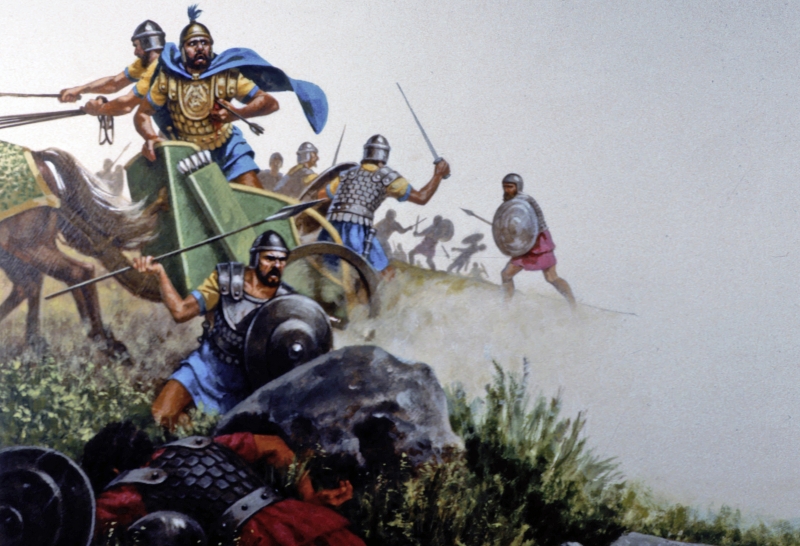 Confident that he would defeat the Israelites, Ben-hadad and his vassal kings were drinking themselves drunk in a pre-victory celebration. So, when scouts arrived with a report that Israelite forces had been seen leaving the city, Beh-hadad assumed they were bringing news of Israel’s surrender or their decision to continue the battle. While he and his military commanders continued to toast their inevitable victory, the 7,000 servants made their way to the Syrian camp, followed by Ahab and his army.
This surprise attack caught the Syrian forces completely unawares and unable to respond. Led by the 7,000 servants, Ahab’s army quickly routed the Syrians, forcing them to abandon camp and run for their lives. Quickly sobered by this unexpected reversal of fortunes, Beh-hadad managed to escape, but the rest of his forces didn’t fare as well.
And the king of Israel went out and struck the horses and chariots, and struck the Syrians with a great blow. – 1 Kings 20:21 ESV
Notice that the author conveniently eliminates any mention of Ahab’s name. He simply refers to him as “the king of Israel.” He repeats this obvious slight in the very next verse, refusing to give Ahab any credit for the victory. He simply warns him that the battle may be done, but the war is far from over.
“Come, strengthen yourself, and consider well what you have to do, for in the spring the king of Syria will come up against you.” – 1 Kings 20:22 ESV
Ben-hadad would be back. He had suffered a devastating defeat, but once he had time to assess what had happened that day, the Syrian king would return, more determined than ever to avenge his loss by destroying the Israelites. Ben-hadad’s advisors encouraged his plans by suggesting that his loss had been divinely ordained. In their pagan way of thinking, the only thing that could explain a loss of this magnitude was the intervention of the gods. They rationalized away their defeat by concluding that they had chosen the wrong place to do battle. They absolved Beh-hadad of any responsibility for the loss by assuring him, “Their gods are gods of the hills, and so they were stronger than we. But let us fight against them in the plain, and surely we shall be stronger than they” (1 Kings 20:23 ESV).
Little did they know how right they were. Their defeat had been the result of divine intervention, but geographic location had played no role in it. Yahweh was the God of the hills and the valleys; He was sovereign over all the earth. Unlike their false gods, Yahweh was unbound by time and space. The extent of His power was limitless. To the God of Israel, the battle location and the size of the opposing army made no difference. And so, when Ben-hadad’s advisors counseled him to rebuild his army and restructure his military command, it would prove to be futile advice. They had no idea what they were dealing with, and their ignorance led them to make some hazardous assumptions.
First, they assumed that the God of Israel was similar to their own gods – limited in power and vulnerable to defeat. Their “theology” relegated the gods to various regions or geographic jurisdictions. In their simplistic way of thinking, some gods ruled over the valleys while other gods had dominion over the hills. Their god had failed to deliver them a victory because they had chosen the wrong location for their battle. So, if they could lure the Israelites into the valley, they would expose Yahweh’s weak spot, and the battle would go their way.
Eager to avenge his loss, Ben-hadad took their advice and spent the winter rebuilding his army. He replaced the 32 kings with seasoned military commanders and ordered the construction of new chariots. He also made plans to take the fight to the valley, where the God of Israel would have no power and play no role in the outcome of the battle.
It is fascinating to consider that all of this was according to the sovereign will of God. He had orchestrated all the details concerning the original battle, including Ben-hadad’s escape. God had even told Ahab that the Syrians would return. Ben-hadad’s rebuilding and reconfiguring of his army had been part of God’s plan. The original battle had been intended to restore the Israelites’ belief in God. Prior to their victory, God had told them, “I will give it into your hand this day, and you shall know that I am the LORD” (1 Kings 20:13 ESV).
But Yahweh knew that little had changed in Israel. Even after their miraculous defeat of the Syrians, the people remained unconvinced of Yahweh’s status as the one true God. When spring rolled around, they found themselves facing their former foe again. This time, Beh-hadad showed up with a much larger and better-equipped army than before, and rather than laying siege to the city, his troops gathered in the Valley of Aphek. Ben-hadad had brought a bigger, better army and had chosen a battleground that was outside the reach of Yahweh’s power. Or so he thought.
The stage was set. The enemy of Israel had returned. And the author paints a rather bleak and foreboding picture of the situation.
Israel then mustered its army, set up supply lines, and marched out for battle. But the Israelite army looked like two little flocks of goats in comparison to the vast Aramean forces that filled the countryside! – 1 Kings 20:27 NLT
Here was Israel, outnumbered and underequipped yet again. They were no match for the Syrians. And this time, they would not have the walls of the city to protect them. They would be fighting on open terrain, facing an army equipped with chariots and horses and motivated by revenge.
But God sent another prophet with a promise of His presence and power.
“Thus says the LORD, ‘Because the Syrians have said, “The LORD is a god of the hills but he is not a god of the valleys,” therefore I will give all this great multitude into your hand, and you shall know that I am the LORD.’” – 1 Kings 20:28 ESV
Despite the overwhelming odds, God would provide another victory over their enemy. By the time this day was over, they would know that He was the one true God. But in verse 28, the author leaves out Ahab’s name again, simply referring to him as “the king of Israel.” God was going to deliver this victory despite Ahab, not because of him. Not only did Ahab deserve to lose this battle, but he also deserved to die for his idolatry and apostasy. But Yahweh was acting on behalf of His covenant people and protecting the integrity and honor of His name. He had made covenant promises to Abraham, Isaac, and Jacob, and given His word to Moses and David. And while Ahab had failed to use his position as the shepherd of Israel to lead them in faithful obedience, Yahweh would prove Himself true to His word and committed to His covenant promises.
English Standard Version (ESV) The Holy Bible, English Standard Version. ESV® Permanent Text Edition® (2016). Copyright © 2001 by Crossway Bibles, a publishing ministry of Good News Publishers.
New Living Translation (NLT) Holy Bible, New Living Translation, copyright © 1996, 2004, 2015 by Tyndale House Foundation. Used by permission of Tyndale House Publishers Inc., Carol Stream, Illinois 60188. All rights reserved.
