Sheep In Need of a Shepherd

1 Ask rain from the Lord
    in the season of the spring rain,
from the Lord who makes the storm clouds,
    and he will give them showers of rain,
    to everyone the vegetation in the field.
2 For the household gods utter nonsense,
    and the diviners see lies;
they tell false dreams
    and give empty consolation.
Therefore the people wander like sheep;
    they are afflicted for lack of a shepherd.

3 “My anger is hot against the shepherds,
    and I will punish the leaders;
for the Lord of hosts cares for his flock, the house of Judah,
    and will make them like his majestic steed in battle.
4 From him shall come the cornerstone,
    from him the tent peg,
from him the battle bow,
    from him every ruler—all of them together.
5 They shall be like mighty men in battle,
    trampling the foe in the mud of the streets;
they shall fight because the Lord is with them,
    and they shall put to shame the riders on horses.

6 “I will strengthen the house of Judah,
    and I will save the house of Joseph.
I will bring them back because I have compassion on them,
    and they shall be as though I had not rejected them,
    for I am the Lord their God and I will answer them.
7 Then Ephraim shall become like a mighty warrior,
    and their hearts shall be glad as with wine.
Their children shall see it and be glad;
    their hearts shall rejoice in the Lord.

8 “I will whistle for them and gather them in,
    for I have redeemed them,
    and they shall be as many as they were before.
9 Though I scattered them among the nations,
    yet in far countries they shall remember me,
    and with their children they shall live and return.
10 I will bring them home from the land of Egypt,
    and gather them from Assyria,
and I will bring them to the land of Gilead and to Lebanon,
    till there is no room for them.
11 He shall pass through the sea of troubles
    and strike down the waves of the sea,
    and all the depths of the Nile shall be dried up.
The pride of Assyria shall be laid low,
    and the scepter of Egypt shall depart.
12 I will make them strong in the Lord,
    and they shall walk in his name,”
declares the Lord. – Zechariah 10:1-12 ESV

Chapter 9 prophesied the coming of the King who would reunite Israel and Judah under His rule and re-establish the Jewish people as Yahweh’s treasured possession. This prophecy was partially fulfilled during the kingship of Judas Maccabeus, a Jewish priest who led a rebellion against  Antiochus IV,  king of the Seleucid Empire. In 164 B.C., Judas Macabeus and his ragtag army of insurrectionists regained control of Jerusalem and rededicated the Temple. Despite his successful retaking of Jerusalem, Judas Macabeus ruled for just three years and was succeeded by his son Jonathan. Their dynasty was short-lived and remained under Seleucid control the entire time. While peace was made with the Seleucids, the Jews never enjoyed the prominence and power described in chapter 9. That is reserved for the time of the Messiah’s coming when He will return and set up His earthly Kingdom.

Chapter 10 picks up the prophecy by focusing on the people of Israel and their relationship with Yahweh in the coming Kingdom of His Son. Because Christ’s Kingdom will be an earthly one, life will go on as usual. Crops will need to be planted and cared for. Rain will be necessary for proper plant growth. So, the future people of Israel will do as they have always done and ask Yahweh to send rain at the proper time so their crops will thrive. This verse also served as a much-needed reminder to Zechariah and his fellow Judahites that God was sovereign over all things, including the storm clouds. He was the giver of all good gifts (James 1:17) who “sends rain on the just and the unjust alike” (Matthew 5:35 NLT). And the same God who provides rain in season can shower His covenant people with spiritual blessings beyond their wildest imaginations. All of this is in keeping with the promise from God that Moses delivered to the people of Israel in the wilderness.

“If you fully obey the Lord your God and carefully keep all his commands that I am giving you today, the Lord your God will set you high above all the nations of the world. You will experience all these blessings if you obey the Lord your God:

“Your towns and your fields
    will be blessed.
Your children and your crops
    will be blessed.
The offspring of your herds and flocks
    will be blessed.
Your fruit baskets and breadboards
    will be blessed.
Wherever you go and whatever you do,
    you will be blessed.” – Deuteronomy 28:1-6 NLT

Verse 2 brings the focus back to the remnant of God’s people living in the land of Judah during the time of Zechariah. God alludes to the fact that, despite His gracious provision of their return to Judah, they remained idolatrous. During their lengthy stay in Babylonian captivity, they had compromised their convictions and embraced the false gods of their captors. Many who returned to Judah with Zerubbabel likely brought their household idols along. Not only that, they returned with a predilection for the occult, including sorcery, magic, and fortune-telling. But Yahweh leaves little doubt about His opinion on the matter.

“Household gods give worthless advice,
    fortune-tellers predict only lies,
and interpreters of dreams pronounce
    falsehoods that give no comfort.” – Zechariah 10:2 NLT

The prophet Habakkuk recorded a similar assessment from God concerning the futility of idolatry.

“What good is an idol carved by man,
    or a cast image that deceives you?
How foolish to trust in your own creation—
    a god that can’t even talk!
What sorrow awaits you who say to wooden idols,
    ‘Wake up and save us!’
To speechless stone images you say,
    ‘Rise up and teach us!’
    Can an idol tell you what to do?
They may be overlaid with gold and silver,
    but they are lifeless inside.” – Habakkuk 2:18-19 NLT

It was idolatry and spiritual infidelity that had led to Judah’s fall in the first place. Their destruction at the hands of the Babylonians had been due to their unfaithfulness to Yahweh. False prophets had dared to provide them with false hope. Impious priests had turned a blind eye to their spiritual adultery. Self-centered kings had sold their souls to false gods and made alliances with pagan nations in an attempt to protect and prolong their reigns. As a result, the people had become like shepherdless sheep.

“So my people are wandering like lost sheep;
    they are attacked because they have no shepherd.” – Zechariah 10:2 NLT

Idols are an unreliable source of guidance because they are non-existent. They are the figments of men’s imaginations. Those who attempt to lead based on input from a lifeless idol will be unreliable shepherds. Their leadership will be damaging and detrimental to the flock that Yahweh has placed under their care, and He had strong words for these sheep-destroying shepherds.

“Son of man, prophesy against the shepherds, the leaders of Israel. Give them this message from the Sovereign Lord: What sorrow awaits you shepherds who feed yourselves instead of your flocks. Shouldn’t shepherds feed their sheep? You drink the milk, wear the wool, and butcher the best animals, but you let your flocks starve. You have not taken care of the weak. You have not tended the sick or bound up the injured. You have not gone looking for those who have wandered away and are lost. Instead, you have ruled them with harshness and cruelty. So my sheep have been scattered without a shepherd, and they are easy prey for any wild animal. They have wandered through all the mountains and all the hills, across the face of the earth, yet no one has gone to search for them.” – Ezekiel 34:2-6 NLT

“My people have been lost sheep.
    Their shepherds have led them astray
    and turned them loose in the mountains.
They have lost their way
    and can’t remember how to get back to the sheepfold.” – Jeremiah 50:6 NLT

“Instead of caring for my flock and leading them to safety, you have deserted them and driven them to destruction. Now I will pour out judgment on you for the evil you have done to them. But I will gather together the remnant of my flock from the countries where I have driven them. I will bring them back to their own sheepfold, and they will be fruitful and increase in number.” – Jeremiah 23:2-3 NLT

But in that same passage in Jeremiah 23, God goes on to promise to rectify the problem created by these uncaring and disobedient shepherds.

“For the time is coming,”
    says the Lord,
“when I will raise up a righteous descendant
    from King David’s line.
He will be a King who rules with wisdom.
    He will do what is just and right throughout the land.
And this will be his name:
    ‘The Lord Is Our Righteousness.’
In that day Judah will be saved,
    and Israel will live in safety.” – Jeremiah 23:5-6 NLT

This prophecy ties back into chapter 9. Despite the lack of godly leadership and the ongoing problem of shepherdless sheep, Yahweh has plans to step in and resolve the issue.

“My anger burns against your shepherds,
    and I will punish these leaders.
For the Lord of Heaven’s Armies has arrived
    to look after Judah, his flock.
He will make them strong and glorious,
    like a proud warhorse in battle.” – Zechariah 10:3 NLT

God would send His Son to serve as the consummate Shepherd who would willingly lay down His life for the sheep of God’s fold.

“I am the good shepherd. The good shepherd sacrifices his life for the sheep. A hired hand will run when he sees a wolf coming. He will abandon the sheep because they don’t belong to him and he isn’t their shepherd. And so the wolf attacks them and scatters the flock. The hired hand runs away because he’s working only for the money and doesn’t really care about the sheep.

“I am the good shepherd; I know my own sheep, and they know me, just as my Father knows me and I know the Father. So I sacrifice my life for the sheep.” – John 10:11-14 NLT

But there is a time when God will send the Good Shepherd again. He will return to earth to seek out and restore the lost sheep of Israel.

“I myself will search and find my sheep. I will be like a shepherd looking for his scattered flock. I will find my sheep and rescue them from all the places where they were scattered on that dark and cloudy day. I will bring them back home to their own land of Israel from among the peoples and nations. I will feed them on the mountains of Israel and by the rivers and in all the places where people live. Yes, I will give them good pastureland on the high hills of Israel. There they will lie down in pleasant places and feed in the lush pastures of the hills. I myself will tend my sheep and give them a place to lie down in peace, says the Sovereign Lord.” – Ezekiel 34:11-15 NLT

And God makes it clear that this regathering of His lost sheep will be the work of the Great Shepherd (Hebrews 13:20-21).

“I will set over them one shepherd, my servant David. He will feed them and be a shepherd to them. And I, the Lord, will be their God, and my servant David will be a prince among my people. I, the Lord, have spoken!” – Ezekiel 34:23-24 NLT

Under the leadership of this future Son of David, the people of Israel will prosper as never before. The lost sheep will be restored and transformed into mighty warriors. Their relationship with Yahweh will be restored and it will be as if they never strayed at all. The Great Shepherd will call His sheep and they will respond (John 10:27). Their days of apostasy and spiritual infidelity will be over because Yahweh will remove their propensity for unfaithfulness by transforming their disposition through the power of His Spirit.

”I will gather you up from all the nations and bring you home again to your land.

 “Then I will sprinkle clean water on you, and you will be clean. Your filth will be washed away, and you will no longer worship idols. And I will give you a new heart, and I will put a new spirit in you. I will take out your stony, stubborn heart and give you a tender, responsive heart. And I will put my Spirit in you so that you will follow my decrees and be careful to obey my regulations.” – Ezekiel 36:23-27 NLT

Yahweh wanted Zechariah to know that Israel’s best days were ahead of them. Despite the circumstances surrounding them, they could rest assured that His plans for them were “plans for good and not for disaster, to give you a future and a hope” (Jeremiah 29:11 NLT).

English Standard Version (ESV)
The Holy Bible, English Standard Version. ESV® Permanent Text Edition® (2016). Copyright © 2001 by Crossway Bibles, a publishing ministry of Good News Publishers.

New Living Translation (NLT)
Holy Bible, New Living Translation, copyright © 1996, 2004, 2015 by Tyndale House Foundation. Used by permission of Tyndale House Publishers Inc., Carol Stream, Illinois 60188. All rights reserved.
Jehovah-Rohi

1 The Lord is my shepherd; I shall not want.
2  He makes me lie down in green pastures.
He leads me beside still waters.
3     He restores my soul.
He leads me in paths of righteousness
    for his name’s sake.

4 Even though I walk through the valley of the shadow of death,
    I will fear no evil,
for you are with me;
    your rod and your staff,
    they comfort me.

5 You prepare a table before me
    in the presence of my enemies;
you anoint my head with oil;
    my cup overflows.
6 Surely goodness and mercy shall follow me
    all the days of my life,
and I shall dwell in the house of the Lord
    forever. – Psalm 23:1-6 ESV

YHWH–Rohi – “The LORD My Shepherd.” This is the only occurrence of this name in the Bible, but the concept of God as a shepherd is a recurring theme. David’s use of this designation for God makes sense when considering his rural upbringing and his former role as a caretaker of his father’s flocks. When David was a young boy, he and his older brothers lived with their father Jesse in the town of Bethlehem. One day, they were visited by the prophet Samuel who had been sent by God to find the man He had chosen to be the next king of Israel. As Jesse paraded each of his sons before the prophet, God rejected each of them. When Samuel asked whether there were any other sons, Jesse replied, “There is still the youngest. But he’s out in the fields watching the sheep and goats” (1 Samuel 16:11 NLT).

David was sent for and when he arrived, God told Samuel, “This is the one; anoint him” (1 Samuel 16:12 NLT). It would be years before David was crowned king, but once he ascended to the throne, God commemorated his rise to prominence with a reminder. of his humble beginnings.

“This is what the Lord of Heaven’s Armies has declared: I took you from tending sheep in the pasture and selected you to be the leader of my people Israel.” – 2 Samuel 7:8 NLT

Psalm 78 provides a more poetic description of David’s transformation from a shepherd of sheep to a shepherd of God’s people.

He chose his servant David,
    calling him from the sheep pens.
He took David from tending the ewes and lambs
    and made him the shepherd of Jacob’s descendants—
    God’s own people, Israel.
He cared for them with a true heart
    and led them with skillful hands. – Psalm 78:70-72 NLT

So, it’s no surprise that David used this familiar imagery to describe Yahweh. Psalm 23 is his recollection of God’s lifelong display of compassion, care, and tireless provision of protection and leadership. Yet, David was not the first to refer to God as his shepherd; that distinction goes to Jacob. During the final days of his life, Jacob pronounced blessings on his sons and included his two grandsons, Manasseh and Ephraim, who were the sons of Joseph.

“May the God before whom my grandfather Abraham
and my father, Isaac, walked—
the God who has been my shepherd
all my life, to this very day,
the Angel who has redeemed me from all harm—
may he bless these boys.
May they preserve my name
and the names of Abraham and Isaac.
And may their descendants multiply greatly
throughout the earth.” – Genesis 48:15-16 NLT

Jacob longed to see his grandsons experience the tender care and providential provision of the good and gracious shepherd who had guided him throughout his life. During his younger days, Jacob had shepherded the sheep of his father-in-law Laban. He too was well acquainted with the metaphorical nature of this description and could relate to God’s role as his divine protector and provider.

One of the greatest examples of God’s role as shepherd is found in the Book of Exodus, where He delivers the descendants of Jacob from their captivity in Egypt. He appeared to Moses, another shepherd who would become a divinely appointed leader, and announced His plans to set His people free.

“I have certainly seen the oppression of my people in Egypt. I have heard their cries of distress because of their harsh slave drivers. Yes, I am aware of their suffering. So I have come down to rescue them from the power of the Egyptians and lead them out of Egypt into their own fertile and spacious land. It is a land flowing with milk and honey…” – Exodus 3:7-8 NLT

Jehovah–Rohi, the Shepherd-Redeeme,r would deliver His suffering sheep from the clutches of their Egyptian overlords and lead them to the verdant pasture lands of Canaan. Moses and his brother, Aaron, would serve as God’s under-shepherds, equipped with their shepherd staff’s and buoyed by the promise of God’s presence and power.

“ I will be with you,…” – Exodus 3:12 ESV

With God’s help, Moses eventually led the people of Israel to the borders of Canaan, but it would be Joshua who orchestrated their conquest and occupation of their inheritance. Over the centuries, God shepherded His people well, providing for all their needs and giving them victories over all their enemies. In time, God provided them with a series of judges who served as temporary deliverers from their own apostasy and His divine judgment. Then the day came when God allowed them to experience the rule of human kings who were to serve as His undershepherds. This led to a long line of monarchs, many of whom failed to live up to their calling as shepherds. Throughout the centuries, some of these men would prove to be unfaithful and unreliable leaders who did more harm than good. Eventually, God leveled a stinging indictment against these less-than-ideal leaders, accusing them of malfeasance and abuse of power.

Then this message came to me from the Lord: “Son of man, prophesy against the shepherds, the leaders of Israel. Give them this message from the Sovereign Lord: What sorrow awaits you shepherds who feed yourselves instead of your flocks. Shouldn’t shepherds feed their sheep? You drink the milk, wear the wool, and butcher the best animals, but you let your flocks starve. You have not taken care of the weak. You have not tended the sick or bound up the injured. You have not gone looking for those who have wandered away and are lost. Instead, you have ruled them with harshness and cruelty. So my sheep have been scattered without a shepherd, and they are easy prey for any wild animal. They have wandered through all the mountains and all the hills, across the face of the earth, yet no one has gone to search for them.” – Ezekiel 34:1-6 NLT

This blunt assessment was not just for the kings of Israel but was meant to address all those in leadership, including the priestly caste. Everyone was held accountable for the spiritual malnourishment of God’s flock. Jeremiah delivered a similar unflattering appraisal of the shepherds of Israel.

“The shepherds of my people have lost their senses. They no longer seek wisdom from the LORD. Therefore, they fail completely, and their flocks are scattered.” – Jeremiah 10:21 NLT

Eventually, God brought judgment against His shepherds but the sheep had to suffer as well. A lack of godly leadership had resulted in a wholesale rebellion on the part of the people. Without proper care and feeding, the sheep wandered into other pastures seeking sustenance and safety. They abandoned God and suffered the consequences.

Yet, Jehovah-Rohi never gave up on them. He disciplined them for their unfaithfulness but never reneged on His covenant promises. He remained the Good Shepherd and, through the prophets, reminded His unfaithful flock that He would one day restore them.

Yes, the Sovereign Lord is coming in power.
    He will rule with a powerful arm.
    See, he brings his reward with him as he comes.
He will feed his flock like a shepherd.
    He will carry the lambs in his arms,
holding them close to his heart.
    He will gently lead the mother sheep with their young. – Isaiah 40:10-11 NLT

God did care for His flock and returned them to the land of Canaan under the leadership of Ezra and Nehemiah. While they had to suffer 70 years of exile in the land of Babylon, Jehovah-Rohi never lost sight of them and never gave up on them.

Yet, their return to the land of promise was not the end of God’s shepherding role. Eventually, He sent His Son to be the Good Shepherd. The gospel of John records the insightful words of Jesus as He declared Himself to be the consummate shepherd who models what true godly leadership looks like.

“I tell you the truth, I am the gate for the sheep. All who came before me were thieves and robbers. But the true sheep did not listen to them. Yes, I am the gate. Those who come in through me will be saved. They will come and go freely and will find good pastures. The thief’s purpose is to steal and kill and destroy. My purpose is to give them a rich and satisfying life.

“I am the good shepherd. The good shepherd sacrifices his life for the sheep. A hired hand will run when he sees a wolf coming. He will abandon the sheep because they don’t belong to him and he isn’t their shepherd. And so the wolf attacks them and scatters the flock. The hired hand runs away because he’s working only for the money and doesn’t really care about the sheep.

“I am the good shepherd; I know my own sheep, and they know me, just as my Father knows me and I know the Father. So I sacrifice my life for the sheep. I have other sheep, too, that are not in this sheepfold. I must bring them also. They will listen to my voice, and there will be one flock with one shepherd.” – John 10:7-16 NLT

When Jesus appeared on the scene, He provided His own assessment of the spiritual state of His Father’s flock.

Jesus traveled through all the towns and villages of that area, teaching in the synagogues and announcing the Good News about the Kingdom. And he healed every kind of disease and illness. When he saw the crowds, he had compassion on them because they were confused and helpless, like sheep without a shepherd. – Matthew 9:35-36 NLT

The Good Shepherd couldn’t help but look at His own people and see them as shepherdless sheep, wandering about confused and helpless. For centuries, they had been misled and mistreated. Their political and spiritual leaders had used and abused them. Those who should have been feeding and caring for them had ended up taking advantage of them. But Jesus, the Son of David, emulated the example of the man after God’s own heart. He was the quintessential shepherd, the Good Shepherd, who would lay down His life for the sheep. And like His forefather, Jesus would shepherd the flock of God with care and compassion.

But Jesus would do more than simply lead and feed. He would provide protection against the enemy who seeks to steal, kill, and destroy (John 10:10). As the Good Shepherd, Jesus would lay down His life on behalf of His Father’s sheep. Just as John the Baptist had declared. Jesus became the Lamb of God who sacrificed His life so that the sheep of God might have access to God’s heavenly sheepfold.

Jesus makes it quite clear. “I am the door. If anyone enters by me, he will be saved and will go in and out and find pasture” (John 10:9 ESV). He is the exclusive access point to the Father and he later reiterated this bold claim to Thomas.

“I am the way, and the truth, and the life. No one comes to the Father except through me.” – John 14:6 ESV

But Jesus didn’t sugarcoat how the sheep find access to the Father.

“I am the good shepherd. The good shepherd lays down his life for the sheep.” – John 10:11 ESV

The religious leaders were not about to sacrifice their lives for anyone. They weren’t even willing to bow the knee before the Son of God. They refused to submit their wills to the Father. And when the Good Shepherd appeared in their midst, they were unable to hear His voice. But there were those who heard Jesus ask, “Do you believe in the Son of Man?” and responded, “Lord, I believe” (John 9:35, 38 ESV).

And Jesus revealed that there would be others.

“I have other sheep that are not of this fold. I must bring them also, and they will listen to my voice. So there will be one flock, one shepherd.” – John 10:16 ESV

This is His veiled reference to the Gentiles, who will also become part of God’s flock. Like the Samaritan woman, they too will hear the voice of the Good Shepherd and respond in belief. They will recognize the call of God, coming from the lips of the Son of God, offering them living water, the bread of life, and the promise of an eternity marked by peace, contentment, joy, and righteousness.

English Standard Version (ESV) The Holy Bible, English Standard Version. ESV® Permanent Text Edition® (2016). Copyright © 2001 by Crossway Bibles, a publishing ministry of Good News Publishers.

New Living Translation (NLT) Holy Bible, New Living Translation, copyright © 1996, 2004, 2015 by Tyndale House Foundation. Used by permission of Tyndale House Publishers Inc., Carol Stream, Illinois 60188. All rights reserved.

New English Translation (NET)NET Bible® copyright ©1996-2017 by Biblical Studies Press, L.L.C. http://netbible.com All rights reserved.

Sheep Without a Shepherd

15 And when he had come to the king, the king said to him, “Micaiah, shall we go to Ramoth-gilead to battle, or shall we refrain?” And he answered him, “Go up and triumph; the Lord will give it into the hand of the king.” 16 But the king said to him, “How many times shall I make you swear that you speak to me nothing but the truth in the name of the Lord?” 17 And he said, “I saw all Israel scattered on the mountains, as sheep that have no shepherd. And the Lord said, ‘These have no master; let each return to his home in peace.’” 18 And the king of Israel said to Jehoshaphat, “Did I not tell you that he would not prophesy good concerning me, but evil?” 19 And Micaiah said, “Therefore hear the word of the Lord: I saw the Lord sitting on his throne, and all the host of heaven standing beside him on his right hand and on his left; 20 and the Lord said, ‘Who will entice Ahab, that he may go up and fall at Ramoth-gilead?’ And one said one thing, and another said another. 21 Then a spirit came forward and stood before the Lord, saying, ‘I will entice him.’ 22 And the Lord said to him, ‘By what means?’ And he said, ‘I will go out, and will be a lying spirit in the mouth of all his prophets.’ And he said, ‘You are to entice him, and you shall succeed; go out and do so.’ 23 Now therefore behold, the Lord has put a lying spirit in the mouth of all these your prophets; the Lord has declared disaster for you.”

24 Then Zedekiah the son of Chenaanah came near and struck Micaiah on the cheek and said, “How did the Spirit of the Lord go from me to speak to you?” 25 And Micaiah said, “Behold, you shall see on that day when you go into an inner chamber to hide yourself.” 26 And the king of Israel said, “Seize Micaiah, and take him back to Amon the governor of the city and to Joash the king’s son, 27 and say, ‘Thus says the king, “Put this fellow in prison and feed him meager rations of bread and water, until I come in peace.”’” 28 And Micaiah said, “If you return in peace, the Lord has not spoken by me.” And he said, “Hear, all you peoples!” – 1 Kings 22:15-28 ESV

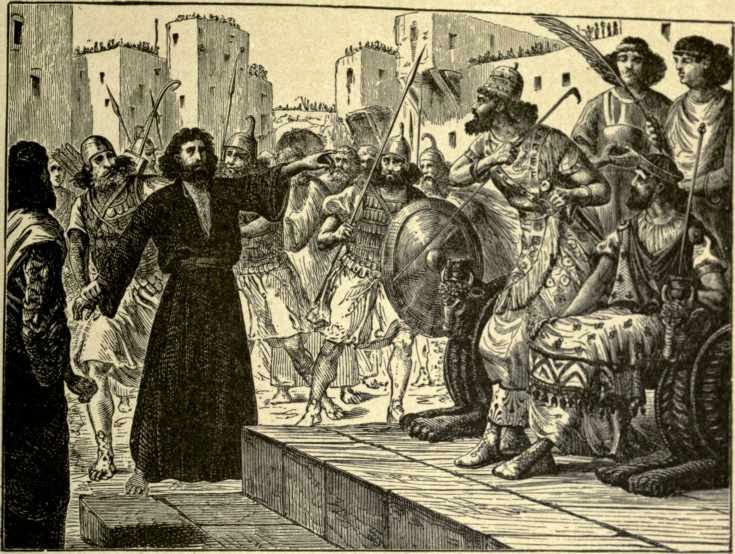
Imagine the scene. Micaiah, the prophet, has been forcibly dragged before King Ahab, who is seated on the dais with his guest, King Jehoshaphat of Judah. Surrounding the two potentates are 400 prophets of Baal, each taking turns declaring their version of the truth. For hours, they have been telling King Ahab exactly what he wants to hear: “Go up to Ramoth-gilead and triumph; the Lord will give it into the hand of the king” (1 Kings 22:12 ESV). One of them, a man named Zedekiah, had even crafted a pair of iron horns and used them as a prop to support his message to the king: “Thus says the Lord, ‘With these you shall push the Syrians until they are destroyed’” (1 Kings 22:11 ESV).

Then Micaiah shows up. Unlike the 400 yes-men who have been masquerading as spokesmen for the false god, Baal, Micaiah was a prophet of Yahweh. And, as such, he was obligated to speak only those words given to him by God. Which is exactly what Micaiah had told the man who had come to fetch him.

“As the Lord lives, what the Lord says to me, that I will speak.” – 1 Kings 22:14 ESV

Yet, when King Ahab asked Micaiah to reveal what his God thought about the planned attack of Ramoth-gilead, Micaiah simply repeated the words of the false prophets. He basically told the king, “Go for it!” But Ahab sensed the thinly veiled sarcasm behind Micaiah’s answer and demanded that he tell him the truth. Ahab knew from past experience that Micaiah and his God were going to oppose his plans. He had even revealed to King Jehoshaphat just how much he loathed Micaiah, telling him, “He never prophesies anything but trouble for me!” (1 Kings 22:8 NLT).

Micaiah knew that it really didn’t matter what he told Ahab because the king would do what he wanted to do. Ahab’s stubbornness and arrogance would prevent him from hearing and heeding the message of Yahweh. But Micaiah shared it anyway.

“In a vision I saw all Israel scattered on the mountains, like sheep without a shepherd. And the Lord said, ‘Their master has been killed. Send them home in peace.’” – 1 Kings 22:17 NLT

Ahab was infuriated because Micaiah had just predicted Israel’s defeat and the king’s own death. But this less-than-encouraging message was just what Ahab had expected from the prophet of Yahweh. Just like Elijah, Micaiah proved to be a messenger of doom and gloom, bent on delivering nothing but bad news concerning Ahab’s kingly aspirations.

But Micaiah was not done. He next revealed how God had chosen to implement His plan for Ahab’s demise.

“Listen to what the Lord says! I saw the Lord sitting on his throne with all the armies of heaven around him, on his right and on his left. And the Lord said, ‘Who can entice Ahab to go into battle against Ramoth-gilead so he can be killed?’

“There were many suggestions, and finally a spirit approached the Lord and said, ‘I can do it!’

“‘How will you do this?’ the Lord asked.

“And the spirit replied, ‘I will go out and inspire all of Ahab’s prophets to speak lies.’

“‘You will succeed,’ said the Lord. ‘Go ahead and do it.’” – 1 Kings 22:19-22 NLT

Micaiah had been given a vision of a conversation that had taken place in the throne room of God Almighty. In the vision, Yahweh is portrayed as a king surrounded by his advisors and his army. He is soliciting input from the heavenly host, asking for their counsel on the best way to get Ahab to proceed with his attack on Ramoth-gilead, which will result in his death. A spirit speaks up and offers to deceive the prophets of Baal by giving them a false message of victory. God approves the plan and sends the spirit on his way. Then Micaiah informs Ahab that this is exactly what has happened.

“So you see, the Lord has put a lying spirit in the mouths of all your prophets. For the Lord has pronounced your doom.” – 1 Kings 22:23 NLT

Amazingly, Micaiah tells Ahab the stark reality of all that had just transpired. The 400 prophets had been unwittingly declaring a lie, enticing Ahab to go through with his plan to attack Ramoth-gilead and, inadvertently, bringing about his death.

Yet, even when faced with the truth, Ahab stubbornly refused to give up his plan. He ordered Micaiah’s arrest and imprisonment and commanded that he be given nothing but bread and water until he had returned safely from his battle for Ramoth-gilead. But before being hauled off to prison, Micaiah made one final pronouncement to the king and all those who stood within earshot.

“If you return safely, it will mean that the Lord has not spoken through me!” Then he added to those standing around, “Everyone mark my words!” – 1 Kings 22:28 NLT

The problem with Ahab was not just his stubbornness and idolatry. It was his refusal to shepherd the people of Israel. All his self-centered acts of self-promotion had done irreparable damage to the nation of Israel. He had led the people into apostasy and idolatry. And, as a king over God’s chosen people, he would be held responsible for his failure to care for Yahweh’s flock. Hundreds of years later, the prophet Ezekiel would declare a foreboding message from God concerning all those kings who, like Ahab, had left the people of God like sheep without a shepherd.

Then this message came to me from the LORD: “Son of man, prophesy against the shepherds, the leaders of Israel. Give them this message from the Sovereign LORD: What sorrow awaits you shepherds who feed yourselves instead of your flocks. Shouldn’t shepherds feed their sheep? You drink the milk, wear the wool, and butcher the best animals, but you let your flocks starve. You have not taken care of the weak. You have not tended the sick or bound up the injured. You have not gone looking for those who have wandered away and are lost. Instead, you have ruled them with harshness and cruelty. So my sheep have been scattered without a shepherd, and they are easy prey for any wild animal. They have wandered through all the mountains and all the hills, across the face of the earth, yet no one has gone to search for them.” – Ezekiel 34:1-6 NLT

This motif of shepherdless sheep goes all the way back to the days of Moses. When the great deliverer of Israel was nearing the end of his life, he had appealed to God, asking Him to provide the people of Israel with a new shepherd.

Then Moses said to the LORD, “O LORD, you are the God who gives breath to all creatures. Please appoint a new man as leader for the community. Give them someone who will guide them wherever they go and will lead them into battle, so the community of the LORD will not be like sheep without a shepherd.” – Numbers 27:15-17 NLT

And centuries later, long after Ahab had died, Jesus would appear on the scene, offering His own assessment of the spiritual state of the people of Israel.

Jesus traveled through all the towns and villages of that area, teaching in the synagogues and announcing the Good News about the Kingdom. And he healed every kind of disease and illness. When he saw the crowds, he had compassion on them because they were confused and helpless, like sheep without a shepherd. – Matthew 9:35-36 NLT

The Good Shepherd couldn’t help but look at His own people and see them as shepherdless sheep, wandering about confused and helpless. For centuries, they had been misled and mistreated. Their political and spiritual leaders had used and abused them. Those who should have been feeding and caring for them had ended up taking advantage of them. They had followed the example of Ahab. But Jesus had arrived on the scene as the Son of David, emulating the example of the man after God’s own heart. Jesus was the quintessential shepherd, the Good Shepherd, who would lay down His life for the sheep. And like His forefather, Jesus would shepherd the flock of God with care and compassion.

He chose David his servant
    and took him from the sheepfolds;
from following the nursing ewes he brought him
    to shepherd Jacob his people,
    Israel his inheritance.
With upright heart he shepherded them
    and guided them with his skillful hand. – Psalm 78:70-72 ESV

At the end of the day, Ahab’s greatest problem was that he was a lousy shepherd. His chief sin was that he had failed to care for God’s flock. He had made his own needs a higher priority than the needs of the people. Like most of the kings of Israel and Judah, Ahab had abused his divinely ordained power and position. And he would have to answer to the Great Shepherd of Israel.

He will feed his flock like a shepherd. He will carry the lambs in his arms, holding them close to his heart. He will gently lead the mother sheep with their young. – Isaiah 40:11 NLT

English Standard Version (ESV) The Holy Bible, English Standard Version. ESV® Permanent Text Edition® (2016). Copyright © 2001 by Crossway Bibles, a publishing ministry of Good News Publishers.

New Living Translation (NLT) Holy Bible, New Living Translation, copyright © 1996, 2004, 2015 by Tyndale House Foundation. Used by permission of Tyndale House Publishers Inc., Carol Stream, Illinois 60188. All rights reserved.

The Message (MSG)Copyright © 1993, 1994, 1995, 1996, 2000, 2001, 2002 by Eugene H. Peterson

A Dreaded and Difficult Conversation

15 When they had finished breakfast, Jesus said to Simon Peter, “Simon, son of John, do you love me more than these?” He said to him, “Yes, Lord; you know that I love you.” He said to him, “Feed my lambs.” 16 He said to him a second time, “Simon, son of John, do you love me?” He said to him, “Yes, Lord; you know that I love you.” He said to him, “Tend my sheep.” 17 He said to him the third time, “Simon, son of John, do you love me?” Peter was grieved because he said to him the third time, “Do you love me?” and he said to him, “Lord, you know everything; you know that I love you.” Jesus said to him, “Feed my sheep. 18 Truly, truly, I say to you, when you were young, you used to dress yourself and walk wherever you wanted, but when you are old, you will stretch out your hands, and another will dress you and carry you where you do not want to go.” 19 (This he said to show by what kind of death he was to glorify God.) And after saying this he said to him, “Follow me.” – John 21:15-19 ESV

The moment Peter had been dreading finally arrived. Ever since he had peered into the empty tomb, he must have experienced a growing sense of irrepressible joy at the thought that Jesus was alive and he might get see Him again. But his excitement was tempered by a nagging sense of guilt over his public denials of Jesus. On that night in the upper room, when Jesus had announced that one of the 12 would betray Him, Peter had boldly proclaimed, “I will lay down my life for you!” (John 13:37 ESV). But Jesus had responded with an equally bold statement of His own:

“Will you lay down your life for me? Truly, truly, I say to you, the rooster will not crow till you have denied me three times.” – John 13:38 ESV

And that very same night, as Jesus was being interrogated by the high priest and the members of Sanhedrin, Peter fulfilled Jesus’ prophecy.

The servant girl at the door said to Peter, “You also are not one of this man’s disciples, are you?” He said, “I am not.”  – John 18:17 ESV

Now Simon Peter was standing and warming himself. So they said to him, “You also are not one of his disciples, are you?” He denied it and said, “I am not.” – John 18:25 ESV

One of the servants of the high priest, a relative of the man whose ear Peter had cut off, asked, “Did I not see you in the garden with him?” Peter again denied it, and at once a rooster crowed.  – John 18:26-27 ESV

Three separate times, Peter had been asked about his personal relationship with Jesus. Three different individuals asked him to confirm his identity as a disciple or follower of Jesus, and three times he vehemently denied any knowledge of or relationship with Jesus.

Now, standing on the shore of the sea of Galilee, Peter’s worst fear was realized. He found himself alone with Jesus. Peter had been avoiding the inevitable. The weight of his guilty conscience must have become unbearable, preventing him from fully experiencing the joy of being with Jesus. Every time Peter looked at Jesus’ face or caught a fleeting glimpse of the nail prints in His hands and feet, a sense of shame and self-loathing must have welled up within him. It is difficult to imagine just how tortured Peter must have felt each time he looked on his resurrected Master and friend.

And now, Jesus approached him one on one. There is no way of knowing what was going through Peter’s mind at that moment, but one would expect that Peter had been rehearsing the apology he would need for just such a moment. Yet, mercifully, Jesus broke the awkward silence by speaking first. And what Jesus had to say to Peter speaks volumes. One might have expected Jesus to say something like, “I told you so” or “Well, what have you got to say for yourself?” But instead, Jesus asked Peter a series of three questions.

“Simon, son of John, do you love me more than these?” – John 21:15 ESV

“Simon, son of John, do you love me?” – John 21:16 ESV

“Simon, son of John, do you love me?” – John 21:17 ESV

Actually, it was one question asked three different times. That night in the garden, Peter’s inquisitors wanted him to confirm his relationship with Jesus, and three times he had denied having one. But now, Peter is being asked to publicly confess and confirm his love for Jesus. And this time, the one asking the questions is the very one Peter had denied.

Peter’s brash and impulsive nature had finally caught up with him. Over the years he had been with Jesus, he had made a habit of speaking his mind and trying to set himself apart from the rest of the disciples. He was naturally competitive and driven to do whatever it took to stand out from the crowd. All three of the Synoptic gospels record his pride-filled response when Jesus had declared, “You will all fall away because of me this night” (Matthew 26:31 ESV). Peter had boldly proclaimed, “Though they all fall away because of you, I will never fall away” (John 26:33 ESV). He was declaring himself to be better than the rest. He was made of better stuff. But little did Peter know that his bold claim was going to be put to the test and he would end up failing miserably.

But at the heart of Jesus’ questions is the issue of love. The very first iteration of Jesus’ question compared Peter’s love with that of the other disciples. When Jesus asked, “do you love me more than these?,” He was not asking if Peter’s love for the other disciples was greater than his love for Him. This was a question designed to expose whether Peter still harbored feelings of superiority, and considered himself to be more committed to Jesus than his fellow disciples.

Remember, Peter had accused the rest of the disciples of a lack of commitment. He had predicted that they would all fall away at the first hint of trouble. But he was different. He would stay the course and remain by Jesus’ side through thick or thin. Or so he had thought.

But standing face to face with Jesus, all Peter could say was “Lord; you know that I love you” (John 21:15 ESV). No comparison. No competition. He was not willing to speak for or compare himself with the other disciples. All he could do was confirm his own love for his friend.

Over the years, much emphasis has been placed on the two Greek words for “love” that appear in this passage. One is the word agapaō and the other is phileō. The first is said to be a description of divine love – a selfless, sacrificial love expressed by God to men. While the latter was more commonly used to refer to a lower, earthly form of love – the love between two human beings. And while there is some truth to this distinction, it is also true that these two words were often used interchangeably in the Greek language. Yet, John seems to establish a clear pattern in this passage. He records that Jesus repeatedly used the word agapaō, while Peter responded by using the word phileō. There is a subtle, yet important, point of clarification being made as Jesus discusses the nature of Peter’s love. Does Peter love Jesus in the same way that Jesus loved him?

Jesus had laid down His life for Peter. He had personally demonstrated the very definition of love He had given to the disciples.

“Greater love has no one than this, that someone lay down his life for his friends.” – John 15:13 ESV

Jesus had faithfully fulfilled His role as the Good Shepherd.

“The good shepherd lays down his life for the sheep. He who is a hired hand and not a shepherd, who does not own the sheep, sees the wolf coming and leaves the sheep and flees, and the wolf snatches them and scatters them.” – John 10:11-12 ESV

By his actions that night in the courtyard, Peter had proven himself to be a hired hand. The wolf had come and he had fled. But now, Jesus was offering Peter an opportunity to prove his love. With each successive query, Jesus responded to Peter’s answer with a directive.

“Feed my lambs.” – John 21:15 ESV

“Tend my sheep.” – John 21:16 ESV

“Feed my sheep.” – John 21:17 ESV

In essence, Jesus is demanding that Peter prove his love for Him by loving those for whom He died. Jesus had told the disciples, “I have other sheep that are not of this fold. I must bring them also, and they will listen to my voice. So there will be one flock, one shepherd” (John 10:16 ESV). And now, Jesus was turning the care and feeding of the flock over to Peter and his companions. If Peter wanted to prove his love for Jesus, he was going to love and care for those whom Jesus gave His life.

In His teaching on the Good Shepherd, Jesus had stated, “he who enters by the door is the shepherd of the sheep. To him the gatekeeper opens. The sheep hear his voice, and he calls his own sheep by name and leads them out. When he has brought out all his own, he goes before them, and the sheep follow him, for they know his voice” (John 10:4 ESV). In a sense, Jesus was turning over to Peter the responsibility for shepherding and leading His flock. Peter and the other disciples would become under-shepherds, commissioned by the Good Shepherd to feed and tend His sheep. These men could express no greater love for Jesus than to care for His sheep. Jesus was leaving and He was going to turn over the care and protection of His flock to His disciples.

And then Jesus reveals to Peter that his shepherding of the sheep will be costly. Peter too will end up laying down his life for the sheep. This impulsive, self-assertive man will one day find himself being led by others. But as a sheep to the slaughter. This somewhat poetic-sounding prophecy by Jesus was meant to reveal to Peter “by what kind of death he was to glorify God” (John 21:19 ESV).

“I tell you the truth, when you were young, you were able to do as you liked; you dressed yourself and went wherever you wanted to go. But when you are old, you will stretch out your hands, and others will dress you and take you where you don’t want to go.” – John 21:18 NLT

Peter’s life was going to be dramatically different from this point forward. No longer would he live the self-willed, ego-driven life he had known up until that day. He will live a long life, but one that will be dedicated the the flock of Jesus Christ and end in him laying down his own life for the sheep – just as Jesus did. And according to the early church father, Eusubius, Peter was crucified in the midsixties A.D. during the purges of the Roman emperor, Nero.

But when Jesus had completed His one-on-one conversation with Peter, He ended it the same words He had used when they first met: “Follow me.” But this time, Jesus wasn’t asking Peter to become His disciples. He was inviting Peter to follow His example of selfless, sacrificial love for the sheep. And one day, when Peter had fully followed Jesus’ example, he would follow Jesus to heaven.

“When everything is ready, I will come and get you, so that you will always be with me where I am.” – John 14:3 NLT

English Standard Version (ESV) The Holy Bible, English Standard Version. ESV® Permanent Text Edition® (2016). Copyright © 2001 by Crossway Bibles, a publishing ministry of Good News Publishers.

New Living Translation (NLT) Holy Bible, New Living Translation, copyright © 1996, 2004, 2015 by Tyndale House Foundation. Used by permission of Tyndale House Publishers Inc., Carol Stream, Illinois 60188. All rights reserved.

The Message (MSG)Copyright © 1993, 1994, 1995, 1996, 2000, 2001, 2002 by Eugene H. Peterson

Only By God’s Grace.

So that you also may know how I am and what I am doing, Tychicus the beloved brother and faithful minister in the Lord will tell you everything. I have sent him to you for this very purpose, that you may know how we are, and that he may encourage your hearts.

Peace be to the brothers, and love with faith, from God the Father and the Lord Jesus Christ. Grace be with all who love our Lord Jesus Christ with love incorruptible. – Ephesians 6:21-23 ESV

For the first time in his letter, Paul turned his attention to himself. He had written the letter while under house arrest in Rome, awaiting trial. He had been arrested in Jerusalem having been accused by the Jews of defiling the temple by bringing Gentiles into it (Acts 21:28-30). The Jews had been so incensed at Paul that they were going to kill him, but he had been rescued by Roman soldiers. Paul ended up defending himself before the Sanhedrin, the Roman governor, King Agrippa, and eventually was shipped off to Rome because, as a Roman citizen, he had appealed for a trial before Caesar. So while under house arrest, he had written this letter to the Ephesians. In fact, Paul wrote many of his letters while physically detained in Rome. He made very good use of his time and continued to minister to the churches he had helped to plant.

Paul had a special place in his heart for the believers in each of the cities to which he wrote. He saw them as his spiritual children. He had a pastor’s heart for them, worrying about their spiritual well-being and knowing that they were all under spiritual attack from the enemy. That is why he wrote his many letters. He wanted to educate, encourage and instruct them in the faith. He desired to see them grow in Christ-likeness and continue to spread the good news of Jesus Christ around the world.

Paul knew that the churches to which he had ministered so faithfully worried about him. They were concerned with his well-being. They each felt a certain sense of dependency upon him as their spiritual mentor and father in the faith. So Paul regularly kept them updated as to his condition. With everything else going on, he did not want them to have to worry about him. So he told them he would send Tychicus, “the beloved brother and faithful minister in the Lord” to bring them up to speed. It seems that Paul used Tychicus in this way quite often (Acts 20:4; Colossians 4:7; Titus 3:12; 2 Tiomothy 4:12). He was one of Paul’s constant companions and was able to travel to these various cities and keep the believers there informed as to the current status of Paul’s imprisonment and trial. Paul’s main purpose in sending Tychicus was that they might be encouraged. He did not want them worrying about him. He knew that they did not need any more distractions or discouragement than they already had.

Paul loved others. He cared deeply about them and was willing to do whatever it took to see that they grew in faith. He could be hard on them, pointing out their weaknesses and flaws. He could also be passionately compassionate, encouraging them in their weakness and calling them to not lose faith. Like a loving parent, Paul wanted what was best for his children, and he was willing to sacrifice his own life to see that the flock of God was healthy and whole. Paul was the consummate shepherd. Paul shared the heart of Jesus, who said, “I am the good shepherd. The good shepherd lays down his life for the sheep” (John 10:11 ESV). As a matter of fact, prior to heading to Rome to await his trial before Caesar, Paul had called for the elders from Ephesus and told them, “So guard yourselves and God’s people. Feed and shepherd God’s flock – his church, purchased with his own blood – over which the Holy Spirit has appointed you as elders” (Acts 20:28 NLT). And Paul had lived out that admonition in his own life – all the way from Rome. Paul had lived out the calling for elders penned by the apostle Peter.

Care for the flock that God has entrusted to you. Watch over it willingly, not grudgingly – not for what you will get out of it, but because you are eager to serve God. – 1 Peter 5:2 NLT

And in keeping with his role as a shepherd, Paul closed out his letter with a prayer for his flock in Ephesus. He prayed for three things: peace, love and faith. Peace is not an absence of trouble, but an awareness of God’s presence in the midst of trying times. Peace also can mean harmony between individuals. Paul knew that there would be plenty of potential for turmoil in the churches of Ephesus, because churches are comprised of people. And he knew that peace was going to be necessary if they were going to grow together and experience the unity that God desired for them. But peace is only possible when love is present. Mutual love is what brings about peace. The sacrificial, selfless love Paul for which Paul was praying is unifying, not dividing. It is healing, not hurtful. It is other-oriented, not self-centered. But the kind of love Paul is talking about is only possible through faith in Christ. It is not a self-manufactured kind of love, but is a natural expression of the love that God has for us by sending His own Son to die on our behalf. “We love each other because he loved us first” (1 John 4:19 NLT). In fact, all three of these attributes – peace, love and faith – come from God the Father and the Lord Jesus Christ. They are divine gifts to the church and they are to be used for the mutual edification of one another.

Paul closed his letter the same way he opened it, with an emphasis on the grace of God. “Grace be with all who love our Lord Jesus Christ with love incorruptible” (Ephesians 6:24 ESV). The grace of God, His undeserved favor, is the most remarkable thing any of us have ever received. But it is easy to lose sight of His grace and mistakenly assume that we somehow deserve His love. We can end up thinking that we are worthy of His forgiveness and capable of living the Christian life in our own strength. But Paul would have us remember that it is the grace of God that made our salvation possible. It is the grace of God that makes our sanctification achievable. It is the grace of God that makes loving He and His Son feasible. All that we are and all that we do is made possible by the grace of God.

Marvelous grace of our loving Lord,
grace that exceeds our sin and our guilt!
Yonder on Calvary’s mount outpoured,
there where the blood of the Lamb was spilt.
Grace, grace, God’s grace,
grace that will pardon and cleanse within;
grace, grace, God’s grace,
grace that is greater than all our sin!

Numbers 27-28, John 5

A Shepherd For The Sheep.

Numbers 27-28, John 5

Let the Lord, the God of the spirits of all flesh, appoint a man over the congregation who shall go out before them and come in before them, who shall lead them out and bring them in, that the congregation of the Lord may not be as sheep that have no shepherd. – Numbers 27:16-17 ESV

I always find it fascinating how many times God chooses to use the metaphor of sheep when referring to His people. While that idea may conjure up an idyllic image of lush pastures filled with fluffy white sheep peacefully eating their fill of green grass, the real message behind the metaphor seems a bit less flattering. Sheep are not the brightest of animals. In fact, they are quite dumb, requiring someone to lead them and protect them. Sheep are herd animals with no built-in protection mechanism, other than flight. They are driven by their appetites. There are stories about flocks of sheep so intent on grazing that they literally walked off the side of a cliff one by one, so focused on feeding that they were oblivious to the danger. Sheep are easily led astray. Sheep are easy prey to predators. They spook easily and are prone to both disease and injury. And even a cursory reading of the Scriptures will reveal that so many of the characteristics of sheep really do apply to the people of God, including those in Moses’ day all the way to the Christians living during the days of Paul’s ministry. When Moses was informed by God that he would not be allowed to enter the Promised Land because of his actions at Meribah, he asked God to appoint a successor. “Let the Lord, the God of the spirits of all flesh, appoint a man over the congregation who shall go out before them and come in before them, who shall lead them out and bring them in, that the congregation of the Lord may not be as sheep that have no shepherd” (Numbers 27:16-17 ESV). HIs concern was that the people not be “as sheep that have no shepherd.” Moses knew from personal experience that the people of Israel would be helpless and hopeless without someone to lead them. They had proven themselves to be driven by their passions, prone to wander, easily spooked, and susceptible to a herd mentality. They needed a strong leader who could help guide them and, when necessary, discipline them.

What does this passage reveal about God?

God’s people have always needed strong leadership, and all along the way, God had provided men like Abraham, Joseph, Moses, Aaron, David, Samuel, and Paul. Left to our own devices, and without strong godly leadership, we are always prone to trouble. Even Jesus saw the plight of the people of God in His day. “And Jesus went throughout all the cities and villages, teaching in their synagogues and proclaiming the gospel of the kingdom and healing every disease and every affliction. When he saw the crowds, he had compassion for them, because they were harassed and helpless, like sheep without a shepherd” (Matthew 9:35-36 ESV). God’s people, His sheep, were in a sorry state. They were shepherdless and helpless. They needed someone to lead them. They needed a shepherd. And while they had no shortage of religious leaders, Jesus saw them as harassed and helpless. The Pharisees, priests, Scribes, and other so-called leaders of Jesus’ day were guilty of the same sin as the “shepherds” in Ezekiel’s day. Read what God had to say about those who were responsible for the care and leadership of the people of God during the prophetic ministry of Ezekiel. “The weak you have not strengthened, the sick you have not healed, the injured you have not bound up, the strayed you have not brought back, the lost you have not sought, and with force and harshness you have ruled them. So they were scattered, because there was no shepherd, and they became food for all the wild beasts. My sheep were scattered; they wandered over all the mountains and on every high hill. My sheep were scattered over all the face of the earth, with none to search or seek for them” (Ezekiel 34:4-6 ESV).

God was not happy. His sheep were being neglected and even abused. He expected those men who had been given the responsibility of leading His people to take their role seriously and to lead according to His terms, not their own. God cared for His sheep and He expected those whom He had appointed as shepherds to act as His undershepherds, providing the same level of care and concern as He would.

What does this passage reveal about man?

Just as sheep are prone to wander, shepherds are prone to walk away from their God-given responsibilities. It is so easy for a shepherd of God’s people to allow selfishness and self-centeredness to distract him from what God has called him to do. Far too often, the leaders appointed by God to shepherd His flock, ended up abusing their roles and neglecting those under their care. God puts a high value on good shepherding. It was written of David, “He chose David his servant and took him from the sheepfolds;from following the nursing ewes he brought him to shepherd Jacob his people, Israel his inheritance.With upright heart he shepherded them and guided them with his skillful hand” (Psalm 78:70-72 ESV). David was the kind of shepherd God was looking for. He had a heart like God’s. He cared for God’s people with the same passion that God had. He was far from perfect, but he was “a man after God’s own heart” (1 Samuel 13:14 ESV). When it came to the people under his care, he was ready to do the will of Go. He understood that God’s people needed to follow God’s will regarding their lives. They needed strong direction and steady leadership. Without it, they would find themselves in trouble. And in time, after the death of David and the demise of the kingdom of his son, Solomon, the people would suffer under a long line of insufferably poor shepherds. So that by the time Jesus showed up on the scene, He would encounter a people who were shepherdless, helpless and hopeless. Even Peter would say of those who had come to Christ in his day, “Once you were like sheep who wandered away. But now you have turned to your Shepherd, the Guardian of your souls” (1 Peter 2:25 ESV). Ultimately, God was going to have to send His Son, as the one true Shepherd, to rescue His sheep. Jesus said of Himself, “I am the good shepherd. The good shepherd lays down his life for the sheep. I am the good shepherd. I know my own and my own know me, just as the Father knows me and I know the Father; and I lay down my life for the sheep” (John 10:11, 14 ESV). Mankind has always been in need of a shepherd and God eventually sent the only one who could rescue them. Isaiah reminds us, “All we like sheep have gone astray; we have turned—every one—to his own way; and the LORD has laid on him the iniquity of us all” (Isaiah 53:6 ESV).

How would I apply what I’ve read to my own life?

Jesus was the true Shepherd, the Good Shepherd, who laid down His own life for the sake of His sheep. He sacrificed Himself so that His sheep might be safe and sound. There was a selflessness and humility about Jesus that should be reflected in my own life. His life is the ultimate model of what it means to be a shepherd. Paul tells us, “You must have the same attitude that Christ Jesus had.Though he was God, he did not think of equality with God as something to cling to.Instead, he gave up his divine privileges; he took the humble position of a slave and was born as a human being. When he appeared in human form, he humbled himself in obedience to God and died a criminal’s death on a cross” (Philippians 2:5-8 NLT). Humility. Sacrifice. Submission. Obedience. Those are the characteristics of a shepherd of God. May I learn to shepherd as He did. May I be willing to lead by following His example.

Father, make a shepherd like Your Son. Give me the heart of David and the passion to feed and care for Your sheep, even if it requires the ultimate sacrifice of my life. Don’t let me become selfish and driven by my own desires. Constantly remind me that I am Your shepherd and have been given the responsibility of caring for Your sheep. Amen

Ken Miller
Grow Pastor & Minister to Men
kenm@christchapelbc.org