I Am the LORD

16 And they went out at noon, while Ben-hadad was drinking himself drunk in the booths, he and the thirty-two kings who helped him. 17 The servants of the governors of the districts went out first. And Ben-hadad sent out scouts, and they reported to him, “Men are coming out from Samaria.” 18 He said, “If they have come out for peace, take them alive. Or if they have come out for war, take them alive.”

19 So these went out of the city, the servants of the governors of the districts and the army that followed them. 20 And each struck down his man. The Syrians fled, and Israel pursued them, but Ben-hadad king of Syria escaped on a horse with horsemen. 21 And the king of Israel went out and struck the horses and chariots, and struck the Syrians with a great blow.

22 Then the prophet came near to the king of Israel and said to him, “Come, strengthen yourself, and consider well what you have to do, for in the spring the king of Syria will come up against you.”

23 And the servants of the king of Syria said to him, “Their gods are gods of the hills, and so they were stronger than we. But let us fight against them in the plain, and surely we shall be stronger than they. 24 And do this: remove the kings, each from his post, and put commanders in their places, 25 and muster an army like the army that you have lost, horse for horse, and chariot for chariot. Then we will fight against them in the plain, and surely we shall be stronger than they.” And he listened to their voice and did so. 

26 In the spring, Ben-hadad mustered the Syrians and went up to Aphek to fight against Israel. 27 And the people of Israel were mustered and were provisioned and went against them. The people of Israel encamped before them like two little flocks of goats, but the Syrians filled the country.

28 And a man of God came near and said to the king of Israel, “Thus says the LORD, ‘Because the Syrians have said, “The LORD is a god of the hills but he is not a god of the valleys,” therefore I will give all this great multitude into your hand, and you shall know that I am the LORD.’” – 1 Kings 20:16-28 ESV

King Ahab found himself in a strange predicament. His capital city, Samaria, was under attack by a confederation of 32 kings, led by King Ben-hadad of Syria. But much to Ahab’s surprise, a prophet of Yahweh appeared with a plan for Israel’s deliverance.

“Thus says the LORD, Have you seen all this great multitude? Behold, I will give it into your hand this day, and you shall know that I am the LORD.” – 1 Kings 20:13 ESV

The very God whom Ahab and Jezebel had attempted to replace with their false gods announced that He was going to rescue His disobedient and unfaithful people. And Yahweh had told Ahab exactly how the victory would take place.

“By the servants of the governors of the districts.” – 1 Kings 20:14 ESV

God was not going to utilize Ahab’s army to fight the Syrians. This is significant because Ahab, like all his predecessors, had assembled a large military force. Evidence of that fact has been found on an ancient Assyrian stone tablet that bears an inscription describing the battle of Qarqar between Ahab and his enemy, King Shalmaneser III of Assyria. The tablet records the size of the army that assembled to do battle that day as consisting of “2,000 chariots and 10,000 men of Ahab king of Israel.”

But on this occasion, Yahweh chose to place Ahab’s formidable resources in a secondary position, choosing instead to use “servants” – a group of ordinary people who, when assembled, amounted to only 7,000 in number.
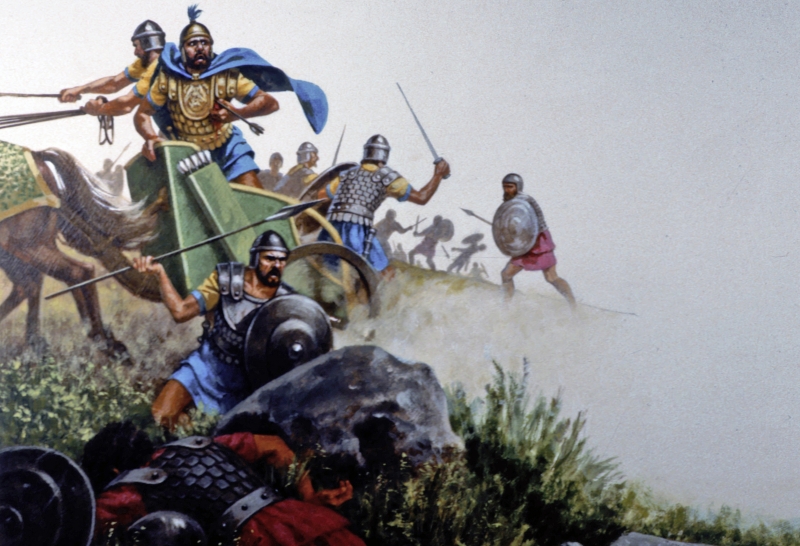
Confident that he would defeat the Israelites, Ben-hadad and his vassal kings were drinking themselves drunk in a pre-victory celebration. So, when scouts arrived with a report that Israelite forces had been seen leaving the city, Beh-hadad assumed they were bringing news of Israel’s surrender or their decision to continue the battle. While he and his military commanders continued to toast their inevitable victory, the 7,000 servants made their way to the Syrian camp, followed by Ahab and his army.

This surprise attack caught the Syrian forces completely unawares and unable to respond. Led by the 7,000 servants, Ahab’s army quickly routed the Syrians, forcing them to abandon camp and run for their lives. Quickly sobered by this unexpected reversal of fortunes, Beh-hadad managed to escape, but the rest of his forces didn’t fare as well.

And the king of Israel went out and struck the horses and chariots, and struck the Syrians with a great blow. – 1 Kings 20:21 ESV

Notice that the author conveniently eliminates any mention of Ahab’s name. He simply refers to him as “the king of Israel.” He repeats this obvious slight in the very next verse, refusing to give Ahab any credit for the victory. He simply warns him that the battle may be done, but the war is far from over.

“Come, strengthen yourself, and consider well what you have to do, for in the spring the king of Syria will come up against you.” – 1 Kings 20:22 ESV

Ben-hadad would be back. He had suffered a devastating defeat, but once he had time to assess what had happened that day, the Syrian king would return, more determined than ever to avenge his loss by destroying the Israelites. Ben-hadad’s advisors encouraged his plans by suggesting that his loss had been divinely ordained. In their pagan way of thinking, the only thing that could explain a loss of this magnitude was the intervention of the gods. They rationalized away their defeat by concluding that they had chosen the wrong place to do battle.  They absolved Beh-hadad of any responsibility for the loss by assuring him, “Their gods are gods of the hills, and so they were stronger than we. But let us fight against them in the plain, and surely we shall be stronger than they” (1 Kings 20:23 ESV).

Little did they know how right they were. Their defeat had been the result of divine intervention, but geographic location had played no role in it. Yahweh was the God of the hills and the valleys; He was sovereign over all the earth. Unlike their false gods, Yahweh was unbound by time and space. The extent of His power was limitless. To the God of Israel, the battle location and the size of the opposing army made no difference. And so, when Ben-hadad’s advisors counseled him to rebuild his army and restructure his military command, it would prove to be futile advice. They had no idea what they were dealing with, and their ignorance led them to make some hazardous assumptions.

First, they assumed that the God of Israel was similar to their own gods – limited in power and vulnerable to defeat. Their “theology” relegated the gods to various regions or geographic jurisdictions. In their simplistic way of thinking, some gods ruled over the valleys while other gods had dominion over the hills. Their god had failed to deliver them a victory because they had chosen the wrong location for their battle. So, if they could lure the Israelites into the valley, they would expose Yahweh’s weak spot, and the battle would go their way.

Eager to avenge his loss, Ben-hadad took their advice and spent the winter rebuilding his army. He replaced the 32 kings with seasoned military commanders and ordered the construction of new chariots. He also made plans to take the fight to the valley, where the God of Israel would have no power and play no role in the outcome of the battle.

It is fascinating to consider that all of this was according to the sovereign will of God. He had orchestrated all the details concerning the original battle, including Ben-hadad’s escape. God had even told Ahab that the Syrians would return. Ben-hadad’s rebuilding and reconfiguring of his army had been part of God’s plan. The original battle had been intended to restore the Israelites’ belief in God. Prior to their victory, God had told them, “I will give it into your hand this day, and you shall know that I am the LORD” (1 Kings 20:13 ESV).

But Yahweh knew that little had changed in Israel. Even after their miraculous defeat of the Syrians, the people remained unconvinced of Yahweh’s status as the one true God. When spring rolled around, they found themselves facing their former foe again. This time, Beh-hadad showed up with a much larger and better-equipped army than before, and rather than laying siege to the city, his troops gathered in the Valley of Aphek. Ben-hadad had brought a bigger, better army and had chosen a battleground that was outside the reach of Yahweh’s power. Or so he thought.

The stage was set. The enemy of Israel had returned. And the author paints a rather bleak and foreboding picture of the situation.

Israel then mustered its army, set up supply lines, and marched out for battle. But the Israelite army looked like two little flocks of goats in comparison to the vast Aramean forces that filled the countryside! – 1 Kings 20:27 NLT

Here was Israel, outnumbered and underequipped yet again. They were no match for the Syrians. And this time, they would not have the walls of the city to protect them. They would be fighting on open terrain, facing an army equipped with chariots and horses and motivated by revenge.

But God sent another prophet with a promise of His presence and power.

“Thus says the LORD, ‘Because the Syrians have said, “The LORD is a god of the hills but he is not a god of the valleys,” therefore I will give all this great multitude into your hand, and you shall know that I am the LORD.’” – 1 Kings 20:28 ESV

Despite the overwhelming odds, God would provide another victory over their enemy. By the time this day was over, they would know that He was the one true God. But in verse 28, the author leaves out Ahab’s name again, simply referring to him as “the king of Israel.” God was going to deliver this victory despite Ahab, not because of him. Not only did Ahab deserve to lose this battle, but he also deserved to die for his idolatry and apostasy. But Yahweh was acting on behalf of His covenant people and protecting the integrity and honor of His name. He had made covenant promises to Abraham, Isaac, and Jacob, and given His word to Moses and David. And while Ahab had failed to use his position as the shepherd of Israel to lead them in faithful obedience, Yahweh would prove Himself true to His word and committed to His covenant promises.

English Standard Version (ESV) The Holy Bible, English Standard Version. ESV® Permanent Text Edition® (2016). Copyright © 2001 by Crossway Bibles, a publishing ministry of Good News Publishers.

New Living Translation (NLT) Holy Bible, New Living Translation, copyright © 1996, 2004, 2015 by Tyndale House Foundation. Used by permission of Tyndale House Publishers Inc., Carol Stream, Illinois 60188. All rights reserved.

Jehovah-Elyon

1 The LORD reigns, let the earth rejoice;
    let the many coastlands be glad!
2 Clouds and thick darkness are all around him;
    righteousness and justice are the foundation of his throne.
3 Fire goes before him
    and burns up his adversaries all around.
4 His lightnings light up the world;
    the earth sees and trembles.
5 The mountains melt like wax before the LORD,
    before the LORD of all the earth.

6 The heavens proclaim his righteousness,
    and all the peoples see his glory.
7 All worshipers of images are put to shame,
    who make their boast in worthless idols;
    worship him, all you gods!

8 Zion hears and is glad,
    and the daughters of Judah rejoice,
    because of your judgments, O LORD.
9 For you, O LORD, are most high over all the earth;
    you are exalted far above all gods. – Psalm 97:1-9 ESV

YHWH–ʿelyôn – “The LORD Most High.” Here, the Psalmist combines two names for God designed to set Him apart from all the other “gods” (‘ĕlōhîm). This is not an admission of the existence of other gods, but a declaration that there is only one true God. All other gods are imposters, the fabrication of men’s fertile imaginations.

The ancient Hebrews used one word, ‘ĕlōhîm,  to refer to all gods, but they also used it to refer to their own deity, the God of Abraham, Isaac, and Jacob. The ubiquitous nature of this name could make things confusing because the different variations of the word ‘ĕlōhîm were widely used to refer to any and all gods. The name ‘ĕlōhîm is the plural form of ‘ĕlôha, which was commonly abbreviated to ‘ēl. Each of these names originates from the Hebrew root ‘ālā, which can be translated as “exalted one.” Two of these words are used in verse 9 alongside the personal name of Israel’s God, Yahweh or Jehovah. There is one other designation for God in this verse; elyôn or “the most high.”

For you, O LORD (Yahweh), are most high (ʿelyôn) over all the earth;
    you are exalted (‘ālā) far above all gods (‘ĕlōhîm). – Psalm 97:9 ESV

The first use of this name for God is found in Genesis 14, where Abram encounters  Melchizedek, the king of Salem. The text refers to him as a “priest of God (‘ēl) Most High (ʿelyôn). This priest-king ended up pronouncing a blessing on Abram in the name of ‘ēl ʿelyôn – God Most High.

“Blessed be Abram by God Most High,
    Possessor of heaven and earth;
and blessed be God Most High,
    who has delivered your enemies into your hand!” – Genesis 14:19-20 ESV

Melchizedek was affirming the superiority of the God who had called Abram out of Ur and led him to the land of Canaan. Prior to Abram’s first encounter with this ‘ĕlōhîm, he had worshiped other ‘ĕlōhîm. Now, Melchizedek was letting Abram know that this deity was ʿelyôn – the supreme ‘ĕlōhîm who had no equal and was worthy of Abram’s worship. According to Melchizedek, it was ‘ēl elyôn who had given Abram the victory over Chedorlaomer king of Elam, Tidal king of Goiim, Amraphel king of Shinar, and Arioch king of Ellasar. In a sense, Melchizedek was declaring that ‘ēl elyôn had defeated the ‘ĕlōhîm of these pagan kings. Their gods had been no match for God Most High.

The Psalmist picks up on this name for God but adds another important distinction. He adds the name Yahweh. Five times in nine verses, he uses the personal name of Israel’s God, the name God used to refer to Himself when He spoke to Moses from the burning bush. On this momentous occasion, Moses received a commission from God, commanding him to return to Egypt and deliver the Israelites from their captivity and lead them to the land of Canaan. Upon hearing the details of this assignment, Moses replied, “If I come to the people of Israel and say to them, ‘The God of your fathers has sent me to you,’ and they ask me, ‘What is his name?’ what shall I say to them?” (Exodus 3:13 ESV). Moses knew that the Israelites had long ago turned their backs on the ‘ĕlōhîm of Abraham, Isaac, and Jacob. They had been in Egypt for four centuries and had gradually adopted the ‘ĕlōhîm of their masters. Now, Moses was expected to show up and inform the Israelites that the ‘ĕlōhîm of their fathers expected him to lead them out of Egypt and back to Canaan. So, he asked God for a name. If he simply used the term, ‘ĕlōhîm, the Israelites might become confused and assume that he is talking about one of the many Egyptian gods they worshiped.

God’s response was simple but not exactly clear. He told Moses, “I am who I am” (Exodus 3:14 ESV). In Hebrew it reads, hāyâ ‘ăšer hāyâ. The word, “hāyâ” is where the name Yahweh comes from. The Hebrews did not include vowels when putting their language in writing. So, the name Yahweh became YHWH. The Latinized version became JHVH, from which the name Jehovah is derived.

When God called Himself, “I am,” He spoke of the nature of His being or existence. He is the “existing one,” which refers to His eternal, non-created state. God is, was, and ever shall be. He is self-existent, having no predecessor or creator. He is self-sufficient and dependent upon no one.

To further clarify His identity, God told Moses to inform the people of Israel, “The LORD (Yᵊhōvâ), the God (‘ĕlōhîm) of your fathers, the God (‘ĕlōhîm) of Abraham, the God (‘ĕlōhîm) of Isaac, and the God (‘ĕlōhîm) of Jacob, has sent me to you” (Exodus 3:15 ESV). In other words, this wasn’t just any ‘ĕlōhîm, it was Jehovah-God, the one true God of Abraham, Isaac, and Jacob. He was the intimate and personal God who had heard their cries and responded to their suffering by providing a means of deliverance.

This was the same God the Psalmist wrote about and each time He mentioned this God, he used the name Yᵊhōvâ or Yahweh.

The LORD (Yᵊhōvâ) reigns – vs 1

The mountains melt like wax before the LORD (Yᵊhōvâ),
    before the LORD (Yᵊhōvâ) of all the earth. – vs 5

Zion hears and is glad,
    and the daughters of Judah rejoice,
    because of your judgments, O LORD (Yᵊhōvâ).
For you, O LORD (Yᵊhōvâ), are most high over all the earth;
    you are exalted far above all gods. – vs 8-9

Yahweh is superior and supreme. He rules over all, and He does so with righteousness and justice (vs 2). The very heavens which He created declare His righteousness (vs 6). Yahweh is elevated high above all the gods (‘ĕlōhîm) of the earth. These man-made gods are impotent and no match for YHWH–ʿelyôn – The LORD Most High. They stand no chance against the God of Israel, the ‘ĕlōhîm of Abraham, Isaac, and Jacob. Therefore, they are unworthy of man’s adoration and attention. That’s why the Psalmist closes with a call to worship.

O you who love the LORD, hate evil!
    He preserves the lives of his saints;
    he delivers them from the hand of the wicked.
Light is sown for the righteous,
    and joy for the upright in heart.
Rejoice in the LORD, O you righteous,
    and give thanks to his holy name! – Psalm 97:10-11 ESV

He is exalted. He is high and lifted up. He is superior and without equal. And He is worthy of honor, reverence, and worship.

In his gospel account, the apostle John records a heated exchange between Jesus and the Jewish religious leaders. It began with a simple statement that Jesus delivered to a group of Jews who had “believed in Him” (John 8:30 ESV).

“If you abide in my word, you are truly my disciples, and you will know the truth, and the truth will set you free.” – John 8:31-32 ESV

This led them to respond, “We are offspring of Abraham and have never been enslaved to anyone. How is it that you say, ‘You will become free’?” (John 8:33 ESV). Jesus, knowing that the Jewish religious leaders were in the crowd and sensing their growing animosity, responded, “I know that you are offspring of Abraham; yet you seek to kill me because my word finds no place in you. I speak of what I have seen with my Father, and you do what you have heard from your father” (John 8:37-38 ESV).

His words hit their mark, incensing His adversaries and sparking a heated interchange. What they didn’t know was that Jesus’ use of the term “father” was a reference to Satan. He was accusing them of being in league with the enemy and not with Yahweh. Unaware of His slight, they declared their status as the sons of Abraham; he was their “father.” By declaring their descendence from Abraham, they claimed their status as heirs to the promises God made to Abraham’s seed. But that’s when Jesus dropped the bombshell that left them reeling and enraged.

“You are of your father the devil, and your will is to do your father’s desires. He was a murderer from the beginning, and does not stand in the truth, because there is no truth in him. When he lies, he speaks out of his own character, for he is a liar and the father of lies. But because I tell the truth, you do not believe me.” – John 8:44-45 ESV

Angered by His words, the religious leaders declared him to be demon-possessed. In doing so, they not only rejected His words but defamed His ministry. Yet Jesus calmly replied, “Your father Abraham rejoiced that he would see my day. He saw it and was glad” (John 8:56 ESV). This made no sense to them. Jesus was a young man and had not lived long enough to see or be seen by Abraham, who was long dead. 

This is when Jesus shocked them by making a claim that they would view as blasphemy and worthy of death.

Jesus said to them, “Truly, truly, I say to you, before Abraham was, I am.” – John 8:58 ESV

It’s clear how angry this statement made them because they immediately attempted to stone Him to death. But what did Jesus say that escalated their anger to such a high degree? Why were they intent on killing Him? The answer is found in those two simple words: “I am.”

They knew exactly what Jesus was saying and claiming. He used the very words that God spoke to Moses at the burning bush. He claimed to be Yahweh and, in so doing, set Himself up as YHWH–ʿelyôn – The LORD Most High. He wasn’t just a man, an itinerant rabbi from the backwater village of Nazareth. He was Jehovah God, the self-existent one and the most high (‘ĕlōhîm) of all.

Just minutes earlier, Jesus had made the claim, “If I glorify myself, my glory is nothing. It is my Father who glorifies me, of whom you say, ‘He is our God’” (John 8:54 ESV). With this statement, Jesus claimed His divine sonship and declared that God considered Him glorious and worthy of worship, honor, and obedience.

Everything the Psalmist said about Jehovah was true of Jesus.

…you, O LORD, are most high over all the earth;
    you are exalted far above all gods. – Psalm 97:9 ESV

When John the Baptist was preparing the Israelites for the coming of Jesus, he told them, “I am the voice of one crying out in the wilderness, ‘Make straight the way of the LORD,’ as the prophet Isaiah said” (John 1:23 ESV). He claimed to be fulfilling the prophecy of Isaiah recorded in Isaiah 40:3-5.

A voice cries:
“In the wilderness prepare the way of the LORD (Yᵊhōvâ);
    make straight in the desert a highway for our God (‘ĕlōhîm).
Every valley shall be lifted up,
    and every mountain and hill be made low;
the uneven ground shall become level,
    and the rough places a plain.
And the glory of the LORD (Yᵊhōvâ) shall be revealed,
    and all flesh shall see it together,
    for the mouth of the LORD (Yᵊhōvâ) has spoken.” – Isaiah 40:3-5 ESV

Jesus was the Son of God and the Lord Most High, and after His death, burial, resurrection, and ascension, He returned to His Father’s side where He sits enthroned and awaits His return. The Book of Revelation contains a vivid description of that day when Jesus, the LORD Most High, will make His appearance and set up His Kingdom on earth.

Then I saw heaven opened, and behold, a white horse! The one sitting on it is called Faithful and True, and in righteousness he judges and makes war. His eyes are like a flame of fire, and on his head are many diadems, and he has a name written that no one knows but himself. He is clothed in a robe dipped in blood, and the name by which he is called is The Word of God. And the armies of heaven, arrayed in fine linen, white and pure, were following him on white horses. From his mouth comes a sharp sword with which to strike down the nations, and he will rule them with a rod of iron. He will tread the winepress of the fury of the wrath of God the Almighty. On his robe and on his thigh he has a name written, King of kings and Lord of lords. – Revelation 19:11-16 ESV

English Standard Version (ESV) The Holy Bible, English Standard Version. ESV® Permanent Text Edition® (2016). Copyright © 2001 by Crossway Bibles, a publishing ministry of Good News Publishers.

New Living Translation (NLT) Holy Bible, New Living Translation, copyright © 1996, 2004, 2015 by Tyndale House Foundation. Used by permission of Tyndale House Publishers Inc., Carol Stream, Illinois 60188. All rights reserved.

New English Translation (NET)NET Bible® copyright ©1996-2017 by Biblical Studies Press, L.L.C. http://netbible.com All rights reserved.

I Am, Are You?

13 Then Moses said to God, “If I come to the people of Israel and say to them, ‘The God of your fathers has sent me to you,’ and they ask me, ‘What is his name?’ what shall I say to them?” 14 God said to Moses, “I am who I am.” And he said, “Say this to the people of Israel: ‘I am has sent me to you.’” 15 God also said to Moses, “Say this to the people of Israel: ‘The Lord, the God of your fathers, the God of Abraham, the God of Isaac, and the God of Jacob, has sent me to you.’ This is my name forever, and thus I am to be remembered throughout all generations. 16 Go and gather the elders of Israel together and say to them, ‘The Lord, the God of your fathers, the God of Abraham, of Isaac, and of Jacob, has appeared to me, saying, “I have observed you and what has been done to you in Egypt, 17 and I promise that I will bring you up out of the affliction of Egypt to the land of the Canaanites, the Hittites, the Amorites, the Perizzites, the Hivites, and the Jebusites, a land flowing with milk and honey.”’ 18 And they will listen to your voice, and you and the elders of Israel shall go to the king of Egypt and say to him, ‘The Lord, the God of the Hebrews, has met with us; and now, please let us go a three days’ journey into the wilderness, that we may sacrifice to the Lord our God.’ 19 But I know that the king of Egypt will not let you go unless compelled by a mighty hand. 20 So I will stretch out my hand and strike Egypt with all the wonders that I will do in it; after that he will let you go. 21 And I will give this people favor in the sight of the Egyptians; and when you go, you shall not go empty, 22 but each woman shall ask of her neighbor, and any woman who lives in her house, for silver and gold jewelry, and for clothing. You shall put them on your sons and on your daughters. So you shall plunder the Egyptians.” – Exodus 3:13-22 ESV

While shepherding his father-in-law’s flocks in the wilderness of Sinai, Moses had an unexpected visit from God. This divine manifestation took the form of a burning bush from which the voice of God declared His plan to deliver the people of Israel from their bondage in Egypt. But for Moses, the most shocking thing about this encounter was the part in which God revealed him to be the chosen deliverer.

“Come, I will send you to Pharaoh that you may bring my people, the children of Israel, out of Egypt.” – Exodus 3:10 ESV

His immediate reaction was to disqualify himself from service.

“Who am I that I should go to Pharaoh and bring the children of Israel out of Egypt?” – Exodus 3:11 ESV

The thought of going home to Egypt, where he was a convicted murderer with his name on Pharaoh’s most-wanted list, must have scared Moses to death. Despite being Pharaoh’s adopted grandson, he would no longer have any negotiating capital with the Egyptian monarch. He was persona non grata back home. Even his fellow Israelites would refuse to listen to this former member of the royal family, who was more Egyptian than Hebrew.

But God was not buying what Moses was selling. The Almighty refused to listen to his excuses. Instead, God assured Moses that he had no reason to fear because he would not be alone. God would be with him every step of the way. And God provided Moses with an ironclad guarantee that he and the emancipated Israelites would one day return to Mount Horeb (Sinai) and worship Him. And the miraculous burning bush was to be “the sign” that confirmed the veracity of God’s words. Moses could trust God.

God is not a man, so he does not lie. He is not human, so he does not change his mind. Has he ever spoken and failed to act? Has he ever promised and not carried it through? – Deuteronomy 23:19 NLT

But Moses was still reluctant to accept God’s commission. He was not yet convinced that he was the right man for the assignment, so he asked, “If I go to the Israelites and tell them, ‘The God of your fathers has sent me to you,’ and they ask me, ‘What is his name?’—what should I say to them?” (Exodus 3:13 NLT). 

Moses knew that his people had long ago lost interest in Jehovah, the God of Abraham, Isaac, and Jacob. During their 400-year stint in Egypt, they had acclimated to the ways of their Egyptian hosts. In time, they had assimilated into the surrounding culture, adapting themselves to the local customs and even adopting the Egyptian gods as their own.

In the book of Ezekiel, God confirms that during their stay in Egypt, the Israelites had developed an unhealthy attachment to the false gods of Egypt.

“When I chose Israel—when I revealed myself to the descendants of Jacob in Egypt—I took a solemn oath that I, the Lord, would be their God. I took a solemn oath that day that I would bring them out of Egypt to a land I had discovered and explored for them—a good land, a land flowing with milk and honey, the best of all lands anywhere. Then I said to them, ‘Each of you, get rid of the vile images you are so obsessed with. Do not defile yourselves with the idols of Egypt, for I am the Lord your God.’” – Ezekiel 20:5-7 NLT

Having lived in Egypt most of his adult life, Moses was well aware of this problem and knew the people of Israel would be reluctant to obey the commands of a God they didn’t know. It didn’t help that there had been a 400-year period when God had seemed to go silent. Their increasing apostasy had led Him to cut off all communication with His people. But with His appearance at the burning bush, God broke that silence. Now, Moses was wanting to know how he was supposed to reintroduce this long-forgotten God to the people of Israel.

At this point, even Moses is unsure of his visitor’s identity. While he seems to know that he is conversing with a deity, he has no way of knowing that it is Jehovah, the God of his forefathers. So, he seeks a name, an appellation by which to identify the God to whom he is speaking. And God responds:

“I AM that I AM.” And he said, “You must say this to the Israelites, ‘I AM has sent me to you.’” – Exodus 3:14 NLT

The answer Moses receives is not so much a name as it is a declaration of authority. God is declaring that He is the “existing one,” the eternal, all-powerful creator of heaven and earth. He is uncreated and has always existed. Unlike the gods of the Egyptians, God is not the byproduct of man’s imagination.

“I AM is the ultimate statement of self-sufficiency, self-existence, and immediate presence. God’s existence is not contingent upon anyone else. His plans are not contingent upon any circumstances. He promises that He will be what He will be; that is, He will be the eternally constant God. He stands, ever-present and unchangeable, completely sufficient in Himself to do what He wills to do and to accomplish what He wills to accomplish.” – https://www.gotquestions.org/I-AM-WHO-I-AM-Exodus-3-14

Moses is being sent by the one true God. And to ensure that Moses fully comprehends who it is that is speaking to him, God adds:

“You must say this to the Israelites, ‘The Lord—the God of your fathers, the God of Abraham, the God of Isaac, and the God of Jacob—has sent me to you. This is my name forever, and this is my memorial from generation to generation.’” – Exodus 3:15 NLT

Moses is communicating with the very same God that his forefathers worshiped. The man who asked, “Who am I?” has been talking to the great “I am.” This self-doubting prince turned murderer turned shepherd had questioned his own identity and qualifications for service. But God provided Moses with the assurance that there was no reason to doubt His identity and qualifications. He was Jehovah God.

And with His identity fully disclosed, God instructs Moses to return to Egypt, gather the elders of Israel, and let them in on the news.

“Go and bring together the elders of Israel and tell them, ‘The Lord, the God of your fathers, appeared to me—the God of Abraham, Isaac, and Jacob—saying, “I have attended carefully to you and to what has been done to you in Egypt, and I have promised that I will bring you up out of the affliction of Egypt to the land of the Canaanites, Hittites, Amorites, Perizzites, Hivites, and Jebusites, to a land flowing with milk and honey.”’” – Exodus 3:16-17 NLT

This was great news, but it would have been difficult for Moses to comprehend. After four centuries of life in Egypt, would the people of Israel want to pack up and leave? Yes, things were difficult and they had been crying out because of their suffering and pain. But was a relocation what they had in mind? And how was Moses supposed to carry off this impossible mission? All of these thoughts must have rifled through the mind of Moses as he listened to God’s instructions.

But as Moses wrestled with doubts, God assured him that the elders would eventually listen to what he had to say. Then, having convinced the Israelites, Moses would need to turn his attention to Pharaoh, who would prove to be a challenge. God discloses that the Egyptian king will not allow the people of Israel to leave.

“I know that the king of Egypt will not let you go, not even under force.” – Exodus 3:19 NLT

Moses was going to face strong opposition from his former adoptive grandfather. But God reveals that Pharaoh’s resistance is part of the plan. His refusal to cooperate will bring about God’s judgment.

“I will extend my hand and strike Egypt with all my wonders that I will do among them, and after that he will release you.” – Exodus 3:20 NLT

God was letting Moses know ahead of time that his assignment would not be easy, but it would eventually prove successful. So much so, that God assured Moses that not only will the Israelites leave Egypt, but they will do so with great wealth.

“I will grant this people favor with the Egyptians, so that when you depart you will not leave empty-handed. Every woman will ask her neighbor and the one who happens to be staying in her house for items of silver and gold and for clothing. You will put these articles on your sons and daughters—thus you will plunder Egypt!” – Exodus 3:21-22 NLT

Surrounded by bleating sheep and still staring at the burning bush, Moses’ head must have been spinning as he considered the words of Jehovah. It was all too good to be true. Not only that, it was all too impossible to even consider. He had grown up in Egypt. He had been raised in the royal court and knew what he was up against. The Egyptians were a powerful and proud people. They were not about to let millions of slaves walk away scot-free and loaded down with the riches of Egypt.

But God patiently endured Moses’ questions of concern and expressions of doubt. He wanted His deliverer to be fully on board with the plan and fully convinced of its ultimate success. So, that when the great “I Am” finally asked Moses if was ready, he would be able to say, “I am.”

English Standard Version (ESV) The Holy Bible, English Standard Version. ESV® Permanent Text Edition® (2016). Copyright © 2001

New Living Translation (NLT) Holy Bible, New Living Translation, copyright © 1996, 2004, 2015 by Tyndale House Foundation. Used by permission of Tyndale House Publishers Inc., Carol Stream, Illinois 60188. All rights reserved.

Exodus 5-6, Matthew 28

I Am and I Will.

Exodus 5-6, Matthew 28

“I am the Lord, and I will bring you out from under the burdens of the Egyptians, and I will deliver you from slavery to them, and I will redeem you with an outstretched arm and with great acts of judgment.I will take you to be my people, and I will be your God, and you shall know that I am the Lord your God, who has brought you out from under the burdens of the Egyptians.I will bring you into the land that I swore to give to Abraham, to Isaac, and to Jacob. I will give it to you for a possession. I am the Lord.” – Exodus 6:6-8 ESV

There are two primary problems that all men share when it comes to God. First, is His very existence. Men struggle with knowing whether God actually exists or not. They doubt and debate it. Many simply deny it. But for those who come to the realization that God is real, the next problem becomes whether or not He is actually at work in our world. They believe in God, but doubt His promises and question His ability to intervene in the everyday affairs of their lives. This section of God’s story, found in the book of Exodus, reveals God attempting to convince men of both His existence and His power to do what He says He will do. The Israelites had been living in Egypt for over 400 years. They had been “Egyptianized.” They had grown comfortable with and close to all the gods of the land of Egypt. They had little or no relationship with the God of their ancestor, Abraham. Much of what happens in the book of Exodus is about God trying to convince His own people of His presence and power. They had to be convinced that He was the one true God and that He had the power to fulfill the promises He had made to Abraham, Isaac, and Jacob.

What does this passage reveal about God?

He is the great “I Am.” He is Yahweh, the singular and solitary God of the universe. There are no other gods beside Him. He alone is God. He is all-powerful and all-knowing. He is not only the creator of the universe and all it contains, He maintains complete control over everything in it. But the Israelites didn’t know all of this at the time. They viewed God as just another diety in a long line of gods. Pharaoah had no concept of Moses’ God and stated, “Who is the Lord, that I should obey his voice and let Israel go? I do not know the Lord, and moreover, I will not let Israel go” (Exodus 5:2 ESV). He refused to listen to Moses and Aaron, and instead, upped the pressure on the people of Israel, increasing their labor even more. Pharaoh had his gods and had no use for or fear of the god of the Jews. Even Moses had second thoughts about God. He knew He existed because he had had a personal encounter with Him at the burning bush. But after being confronted by his own people and blamed for their worsening circumstances, Moses began to question God’s plan and doubt His power. “O Lord, why have you done evil to this people? Why did you ever send me?  For since I came to Pharaoh to speak in your name, he has done evil to this people, and you have not delivered your people at all” (Exodus 5:22-23 ESV).

But God had a purpose behind all of this. He knew what He was doing. He told Moses, “I Am and I will.” He wanted Moses and the people to be certain of His presence and fully aware of His power. And He was going to choose to do it through His dealings with the Egyptians. And His objective? “…you shall know that I am the Lord your God!” All throughout the book of Exodus, you will see this phrase repeated. When all was said and done, the Israelites AND the Egyptians were going to know that God is God. He is the only true God. He not only IS, He DOES. He not only exists, He is the self-existent one. He has no beginning or end. He is not limited by space or time. He is everywhere at once, and is able to see all that is going on in all places at all times. Our greatest need is to recognize His presence and to trust in His power. He is still the great I Am and He will do what He has promised to do in our lives just as He did for Moses and the people of Israel.

What does this passage reveal about man?

Man is prone to doubt God’s existence. Even when we believe He exists, we tend to doubt His presence in and around our lives. Our inability to see Him makes us question His reality. The presence of problems in our lives makes us doubt His power over our lives. Moses had had a personal encounter with God. He had spoken directly with Him. And yet, when things God tough, he began to doubt and question God. The people of Israel found themselves facing mounting pressure and personal discomfort at the hands of the Egyptians, so they reacted in anger and distrust. They blamed Moses and doubted God. “…they did not listen to Moses, because of their broken spirit and harsh slavery” (Exodus 6:9 ESV). Their view of God was limited by their circumstances. They allowed the size of their God to be limited by the size of their problem. But God said, “I Am and I will.” Their doubt did not diminish God’s capacity to perform. Their doubt did not make God any less powerful or capable. He was God and He would act. He had promised and He would fulfill that promise. He had seen and heard and He would respond. And while to Moses it may have appeared that God had been inactive, he would find that nothing could have been further from the truth.

How would I apply what I’ve read to my own life?

I rarely doubt God’s existence. I simply doubt His presence. I know He’s there. I just sometimes wonder if He is here. That God is in heaven, sitting on His throne is a comfortable concept for me. But to recognize that He is present in the everyday affairs of my life is a bit harder for me to comprehend and believe. I tend to judge the presence of God based on my circumstances. When all is going well, He is obviously there. But let anything go wrong in my life, and I can begin to question His existence or at least His willingness to intervene. I need to see God as the great I Am, who will. He is real and He is intimately aware of my circumstance and fully capable of doing all that He has promised to do in my life – regardless of what I may see going on around me. His apparent inaction is nothing more than my inability to see Him at work behind the scenes. Moses did not know the intimate details of God’s plan, neither do I. I can’t see what He is doing behind the scenes. So I must take God at His word and trust His character more than I trust what my eyes can see.

In the closing chapter of the book of Matthew, we see the disciples grieving over the loss of their Messiah. He is dead. Their hopes are shattered. Their dreams have been dashed. The women went to the tomb to anoint His body, but encountered an angel who told them, “Do not be afraid, for I know that you seek Jesus who was crucified.He is not here, for he has risen, as he said. Come, see the place where helay” (Matthew 28:5-6 ESV). Once again, God had done what He had said He would do. Jesus had told His disciples that He would have to suffer and die, but that He would rise again on the third day. And He had.

“I AM and I will.”

God had done the improbably and the impossible. He had provided salvation for man through the death of His own Son. He had satisfied His own just requirement for the payment of mankind’s sins with the life of His own Son. Jesus Himself had claimed to be the great I Am. He had said He was going to die, but also promised to rise again. And He did. He was the Son of God and He did what He said He would do. Our greatest need is to recognize God’s existence in our lives and His power to do all that He has promised to do. He is STILL the great I AM and He WILL do what He has said He will do.

Father, forgive me for doubting You. Forgive me for not seeing Your handiwork all around my life all throughout the years of my life. You have been there. You have been acting behind the scenes in so many ways. You have been there time and time again, but I still tend to doubt. I still tend to question Your presence and Your power. Give me the ability to trust You more. Help me to focus on the reality of You rather than the circumstances that surround me. Amen.

Ken Miller
Grow Pastor & Minister to Men
kenm@christchapelbc.org