The Failure to Give God Glory

12 At that time Merodach-baladan the son of Baladan, king of Babylon, sent envoys with letters and a present to Hezekiah, for he heard that Hezekiah had been sick. 13 And Hezekiah welcomed them, and he showed them all his treasure house, the silver, the gold, the spices, the precious oil, his armory, all that was found in his storehouses. There was nothing in his house or in all his realm that Hezekiah did not show them. 14 Then Isaiah the prophet came to King Hezekiah, and said to him, “What did these men say? And from where did they come to you?” And Hezekiah said, “They have come from a far country, from Babylon.” 15 He said, “What have they seen in your house?” And Hezekiah answered, “They have seen all that is in my house; there is nothing in my storehouses that I did not show them.”

16 Then Isaiah said to Hezekiah, “Hear the word of the LORD: 17 Behold, the days are coming, when all that is in your house, and that which your fathers have stored up till this day, shall be carried to Babylon. Nothing shall be left, says the LORD. 18 And some of your own sons, who will come from you, whom you will father, shall be taken away, and they shall be eunuchs in the palace of the king of Babylon.” 19 Then Hezekiah said to Isaiah, “The word of the LORD that you have spoken is good.” For he thought, “Why not, if there will be peace and security in my days?”

20 The rest of the deeds of Hezekiah and all his might and how he made the pool and the conduit and brought water into the city, are they not written in the Book of the Chronicles of the Kings of Judah? 21 And Hezekiah slept with his fathers, and Manasseh his son reigned in his place. 2 Kings 20:12-21 ESV

Hezekiah shows the Babylonian messengers his treasures (2 Kings 20, 13). Wood engraving, published in 1886.

For whatever reason, the author of 2 Kings provides no details concerning Hezekiah’s reaction to his miraculous healing or to God’s gracious gift of 15 more years of life. This man had been near death and had been informed by the prophet of God that his days were numbered. He was deathly sick and helpless to do anything about his situation, so he cried out to Yahweh, and Yahweh responded by restoring his health and promising to extend his life and reign an additional 15 years. Yet, the author simply skips to the next story without providing any insight into Hezekiah’s response to this wonderful gift from God. However, the Book of 2 Chronicles reveals that the newly healed king responded with pride rather than humble gratitude.

Hezekiah did not respond appropriately to the kindness shown him, and he became proud. So the LORD’s anger came against him and against Judah and Jerusalem. – 2 Chronicles 32:25 NLT

Perhaps Hezekiah’s new lease on life went to his head. He had narrowly escaped the clutches of death and was back to full health. On top of that, the Assyrian menace had all but disappeared, his kingdom was secure, and he was enjoying an unprecedented period of peace and prosperity. But he failed to remember the one who had made it all possible, even neglecting to offer any form of sacrifice to express his thanks to Yahweh. This arrogant display of ingratitude brought God’s anger against the king, his capital, and the nation of Judah.

Once again, we’re the author provides little in the way of details. But while he fails to tell us what form God’s judgment took, he reveals that it had its intended effect.

Hezekiah humbled himself and repented of his pride, as did the people of Jerusalem. So the LORD’s anger did not fall on them during Hezekiah’s lifetime. – 2 Chronicles 32:26 NLT

God’s wrath was abated, but it seems that Hezekiah’s pride was not. News of Hezekiah’s illness had reached the palace of Merodach-baladan, the king of Babylon, who sent emissaries to visit him. By the time these men made the long trek from Babylon to Jerusalem, Hezekiah had been restored to health. Not only that, he took advantage of his new lease on life by ordering an extensive expansion of his personal portfolio.

Hezekiah was very wealthy and highly honored. He built special treasury buildings for his silver, gold, precious stones, and spices, and for his shields and other valuable items. He also constructed many storehouses for his grain, new wine, and olive oil; and he made many stalls for his cattle and pens for his flocks of sheep and goats. He built many towns and acquired vast flocks and herds, for God had given him great wealth. – 2 Chronicles 32:27-29 NLT

By the time the Babylonian emissaries arrived, Hezekiah was in fine form and his pride was on full display. Eager to impress his visitors with the extent of his wealth, he gave them a grand tour of the royal capital.

Hezekiah received the Babylonian envoys and showed them everything in his treasure-houses—the silver, the gold, the spices, and the aromatic oils. He also took them to see his armory and showed them everything in his royal treasuries! There was nothing in his palace or kingdom that Hezekiah did not show them. – 2 Kings 20:13 NLT

But to better understand what is going on here, we need to turn back to 2 Chronicles 32 for context. It would appear that King Hezekiah was not only enjoying renewed health but a revitalized kingdom with a reinvigorated economy. Things were booming in Judah.

Hezekiah had it all: health, wealth, and prosperity, and he was more than happy to display the full extent of his power and possessions to his foreign guests. But the author of 2 Chronicles reveals an important detail that must not be overlooked. The visiting Babylonian emissaries wanted to know “about the sign that had been done in the land” (2 Chronicles 32:31 ESV). Evidently, upon their arrival, they had been told how the king had been healed by God. Someone had likely shared with them about the miracle of the shadow reversing itself on the steps of Ahaz, and they were intrigued and eager to hear more. In other words, Hezekiah was being given a chance to brag about the power of Yahweh.

But the passage reveals that Yahweh knew what was in Hezekiah’s heart and left the pride-filled king to learn another painful lesson.

However, when ambassadors arrived from Babylon to ask about the remarkable events that had taken place in the land, God withdrew from Hezekiah in order to test him and to see what was really in his heart.2 Chronicles 32:31 NLT

God stood back and watched to see how Hezekiah would respond to this opportunity. Since Yahweh is all-knowing, the test was not for His benefit; He knew exactly what Hezekiah was going to do. The test was for Hezekiah’s benefit, and he would fail miserably.

Rather than declare the glory and goodness of Yahweh to his pagan guests, Hezekiah bragged about himself. He said nothing about his miraculous healing or of God’s promise to extend his reign an additional 15 years. He even fails to mention the miraculous sign. His entire exchange with these men was centered upon himself. Look closely at how the author describes Hezekiah’s actions:

…he showed them all his treasure house, the silver, the gold, the spices, the precious oil, his armory, all that was found in his storehouses. There was nothing in his house or in all his realm that Hezekiah did not show them. – 2 Kings 20:13 ESV

It was all about him. And when Isaiah the prophet confronts Hezekiah, the self-obsessed king doesn’t try to hide his ego-driven display of self-adulation.

“They have seen all that is in my house; there is nothing in my storehouses that I did not show them.” – 2 Kings 20:15 ESV

Not once does Hezekiah mention Yahweh. He doesn’t even acknowledge God as the source behind all his possessions or his recently extended life. With this incredible demonstration of self-worship, Hezekiah fails the test and reveals exactly what is in his heart. So, Isaiah delivered what should have been a devastating bit of bad news:

“Behold, the days are coming, when all that is in your house, and that which your fathers have stored up till this day, shall be carried to Babylon. Nothing shall be left, says the LORD.” – 2 Kings 20:17 ESV

And, as if that was not bad enough, Isaiah adds another element to God’s divine judgment against Hezekiah and Judah.

“…some of your own sons, who will come from you, whom you will father, shall be taken away, and they shall be eunuchs in the palace of the king of Babylon.” – 2 Kings 20:18 ESV

Shockingly, Hezekiah responds favorably to the prophet’s words. He isn’t even fazed by the news that his sons will be taken as captives and forced to become eunuchs in the court of the Babylonian king. He receives the news of Yahweh’s judgment as good news. But why? Because all Hezekiah really cared about was himself. Look closely at his response to Isaiah.

“At least there will be peace and security during my lifetime.” – 2 Kings 20:19 NLT

According to 2 Chronicles 32:27, “Hezekiah was very wealthy and highly honored.” He enjoyed great prestige, power, and a time of unprecedented peace, and as long as he was able to keep what he had, he was willing to sacrifice the future, even if it meant that his sons would suffer so that he could prosper.

What makes this story even more disheartening is the fact that, at one time, Hezekiah had penned a poem to Yahweh, expressing his gratitude for his healing. Immediately after receiving the news that God would graciously deliver him from death, Hezekiah took the time to put his thoughts in writing. Look closely at what he said:

LORD, your discipline is good,
    for it leads to life and health.
You restore my health
    and allow me to live!
Yes, this anguish was good for me,
    for you have rescued me from death
    and forgiven all my sins.
For the dead cannot praise you;
    they cannot raise their voices in praise.
Those who go down to the grave
    can no longer hope in your faithfulness.
Only the living can praise you as I do today.
    Each generation tells of your faithfulness to the next.
Think of it—the LORD is ready to heal me!
    I will sing his praises with instruments
every day of my life
    in the Temple of the LORD. – Isaiah 38:16-20 NLT

They say time heals all wounds. But in Hezekiah’s case, time became his enemy. The further he got away from his near-death experience and his miraculous healing by Yahweh, the more forgetful and ungrateful he became. His focus shifted from the goodness and greatness of God to his own power and possessions. He became self-obsessed and myopic in his outlook and, as a result, he lost sight of Yahweh’s glory and grandeur. And it would be the prophet Isaiah who would write his own poem concerning Yahweh, which should have served as a wake-up call to the pride-filled and self-possessed king of Judah.

The LORD is the everlasting God,
    the Creator of all the earth.
He never grows weak or weary.
    No one can measure the depths of his understanding.
He gives power to the weak
    and strength to the powerless.
Even youths will become weak and tired,
    and young men will fall in exhaustion.
But those who trust in the LORD will find new strength.
    They will soar high on wings like eagles.
They will run and not grow weary.
    They will walk and not faint. – Isaiah 40:28-31 NLT

Hezekiah failed the test. The God who extended his life removed His glorious presence and allowed the pompous, prideful king to revel in his own glory and set the stage for the nation’s demise.

English Standard Version (ESV) The Holy Bible, English Standard Version. ESV® Permanent Text Edition® (2016). Copyright © 2001 by Crossway Bibles, a publishing ministry of Good News Publishers.

New Living Translation (NLT) Holy Bible, New Living Translation, copyright © 1996, 2004, 2015 by Tyndale House Foundation. Used by permission of Tyndale House Publishers Inc., Carol Stream, Illinois 60188. All rights reserved.

One Last Thing

12 Then Solomon said, “The LORD has said that he would dwell in thick darkness. 13 I have indeed built you an exalted house, a place for you to dwell in forever.” 14 Then the king turned around and blessed all the assembly of Israel, while all the assembly of Israel stood. 15 And he said, “Blessed be the LORD, the God of Israel, who with his hand has fulfilled what he promised with his mouth to David my father, saying, 16 ‘Since the day that I brought my people Israel out of Egypt, I chose no city out of all the tribes of Israel in which to build a house, that my name might be there. But I chose David to be over my people Israel.’ 17 Now it was in the heart of David my father to build a house for the name of the LORD, the God of Israel. 18 But the LORD said to David my father, ‘Whereas it was in your heart to build a house for my name, you did well that it was in your heart. 19 Nevertheless, you shall not build the house, but your son who shall be born to you shall build the house for my name.’ 20 Now the LORD has fulfilled his promise that he made. For I have risen in the place of David my father, and sit on the throne of Israel, as the LORD promised, and I have built the house for the name of the LORD, the God of Israel. 21 And there I have provided a place for the ark, in which is the covenant of the LORD that he made with our fathers, when he brought them out of the land of Egypt.” 1 Kings 8:12-21 ESV

Having completed construction of the Temple and safely secured the Ark of the Covenant within the Holy of Holies, Solomon was ready to formally dedicate the new structure. This was a momentous occasion for the entire nation of Israel, and a large number of them had assembled to witness the official arrival of the Ark, the symbol of God’s presence, power, and mercy. The people of Israel had a vested interest in the new Temple, having witnessed and participated in its construction for more than seven years. By the order of Solomon, tens of thousands of Israelites had been conscripted to serve as laborers, carpenters, masons, cooks, and foremen on this massive project. David had come up with the idea of building a house for God, and Solomon had made it a reality, but the people had supplied the blood, sweat, and tears. It had become a community project for which they took great pride.

Standing before the temple, with the citizens of Israel spread out behind him, Solomon summarized the fruit of their labor.

“O LORD, you have said that you would live in a thick cloud of darkness. Now I have built a glorious Temple for you, a place where you can live forever! – 1 Kings 8:12-13 NLT

Speaking directly to Yahweh, Solomon affirmed the LORD’s holy and transcendent nature. He paraphrased the words that God had spoken to Moses on Mount Sinai after He had delivered the people of Israel from their captivity in Egypt.

And the LORD said to Moses, “Behold, I am coming to you in a thick cloud, that the people may hear when I speak with you, and may also believe you forever.” – Exodus 19:9 NLT

Moses was told to assemble the people of Israel and prepare them for an encounter with God. Three days later, they gathered at the base of Mount Sinai.

On the morning of the third day there were thunders and lightnings and a thick cloud on the mountain and a very loud trumpet blast, so that all the people in the camp trembled. Then Moses brought the people out of the camp to meet God, and they took their stand at the foot of the mountain. Now Mount Sinai was wrapped in smoke because the LORD had descended on it in fire. The smoke of it went up like the smoke of a kiln, and the whole mountain trembled greatly. – Exodus 19:16-18 ESV

God made Himself visible to the people of Israel, manifesting His presence in the form of a thick, dark cloud that resembled smoke belching from a kiln. This tangible representation of the Almighty was accompanied by a frightening pyrotechnic show that further enhanced His greatness and instilled fear in the people.

Now when all the people saw the thunder and the flashes of lightning and the sound of the trumpet and the mountain smoking, the people were afraid and trembled, and they stood far off and said to Moses, “You speak to us, and we will listen; but do not let God speak to us, lest we die.” Moses said to the people, “Do not fear, for God has come to test you, that the fear of him may be before you, that you may not sin.” The people stood far off, while Moses drew near to the thick darkness where God was. – Exodus 20:18-21 ESV

Forty years later, on the banks of the Jordan River, Moses addressed a new generation of Israelites who were preparing to enter the land of Canaan. He reminded them of that fateful day when God appeared to their fathers and mothers at Mount Sinai.

“You came near and stood at the foot of the mountain, while flames from the mountain shot into the sky. The mountain was shrouded in black clouds and deep darkness. And the LORD spoke to you from the heart of the fire. You heard the sound of his words but didn’t see his form; there was only a voice.” – Deuteronomy 4:11-12 NLT

God had chosen to reveal Himself to His people. Ever since the day they left Egypt, He had traveled before them in the form of a pillar of fire by night and a pillar of cloud by day (Exodus 40:34-38). When God gave Moses instructions to build the Tabernacle, He had also promised to make His presence known by appearing in the form of a cloud over the mercy seat, which sat on top of the Ark, located within the Holy of Holies.

“Tell Aaron your brother not to come at any time into the Holy Place inside the veil, before the mercy seat that is on the ark, so that he may not die. For I will appear in the cloud over the mercy seat. – Leviticus 16:2 ESV

With the transfer of the Ark of the Covenant into the newly constructed Temple, Solomon was welcoming God into His new home. It was “a glorious Temple” (1 Kings 8:13 NLT), where God would dwell permanently. This was no tent, designed to be erected, taken down, and then transported from one place to another. It was a massive stone structure built to last forever, providing Yahweh with an everlasting dwelling place on earth. And Solomon rejoiced over having been able to play a part in this great endeavor.

“I have indeed built you an exalted house, a place for you to dwell in forever.” – 1 Kings 8:13 ESV

This was not an expression of pride or arrogance on Solomon’s part. He was simply expressing his amazement at having been used by God to make his father’s dream a reality. Turning and addressing the people, Solomon gave them a brief history lesson, outlining the events that had led up to this great day.

While David had conceived the idea of building a permanent house for God, he was not given the privilege of making it a reality. Instead, God would build David’s kingdom, using David’s military prowess to ensure that the nation of Israel had secured all the land that God had promised as their inheritance. David proved successful at his God-given task. He fought many battles, conquered the enemies of Israel, and established the nation as a formidable force in the region. But it was because of David’s bloody conquests that he would be denied the privilege of building a house for God.

“You have killed many men in the battles you have fought. And since you have shed so much blood in my sight, you will not be the one to build a Temple to honor my name. But you will have a son who will be a man of peace. I will give him peace with his enemies in all the surrounding lands. His name will be Solomon, and I will give peace and quiet to Israel during his reign.” – 1 Chronicles 22:8-9 NLT

Solomon reminds the people that, while David’s intentions had been admirable, God had declared that the honor of building the temple would fall to his son. Solomon had been divinely ordained to carry out the wishes of his father.

“You wanted to build the Temple to honor my name. Your intention is good, but you are not the one to do it. One of your own sons will build the Temple to honor me.” – 1 Kings 8:18-19 NLT

Solomon wanted the people to understand that the Temple was not to be a monument to his own greatness. It had been built to honor the name of God and existed for His glory alone. Solomon realized that he sat on the throne of Israel solely at God’s discretion.

“…now the LORD has fulfilled the promise he made, for I have become king in my father’s place, and now I sit on the throne of Israel, just as the LORD promised. – 1 Kings 8:20 NLT

Solomon makes it clear that his ascendancy to the throne had been ordained and orchestrated by God so that he might build a house for God.

“I have built this Temple to honor the name of the LORD, the God of Israel.” – 1 Kings 8:20 NLT

He had successfully completed the task assigned to him by God. His nearly eight-year-long commitment to this project had come to an end, and now he could rest in the knowledge that the LORD had taken up residence in His new home, assuring Israel of His permanent presence in their midst.

Yet, as will be revealed in Solomon’s prayer of dedication, he knew that God would not actually dwell in the Temple. Yahweh was too great to be confined to a building built by human hands. But Solomon understood that the Temple, in all its glory, would be a constant reminder to the people of Israel of both God’s greatness and nearness. He would go on to ask the God who dwells in heaven to honor His Temple on earth by hearing and answering the prayers offered up in its courts.

“May you watch over this Temple night and day, this place where you have said, ‘My name will be there.’ May you always hear the prayers I make toward this place. May you hear the humble and earnest requests from me and your people Israel when we pray toward this place. Yes, hear us from heaven where you live, and when you hear, forgive.” – 1 Kings 8:29-30 NLT

As Solomon stood gazing at the massive structure he had helped to create, his heart must have swelled with pride. He had spent seven decades and a good portion of the royal treasury to make his father’s dream a reality. But despite the Temple’s impressive facade and its no-expenses-spared interior, he knew the Temple was nothing more than a building built by human hands. Without Yahweh’s presence, it would be a hollow shell, devoid of significance and powerless to provide and protect those who worshiped within its walls. The Temple was always meant to be a means to an end. It was to a meeting place, where the God of heaven would make Himself visible and accessible to those who honored and revered His name.

Years later, Solomon would pen the following words in the only Psalm attributed to him.

Unless the LORD builds a house,
    the work of the builders is wasted.
Unless the LORD protects a city,
    guarding it with sentries will do no good.
It is useless for you to work so hard
    from early morning until late at night,
anxiously working for food to eat;
    for God gives rest to his loved ones. – Psalm 127:1-2 NLT

As proud as he was of his awe-inspiring Temple, Solomon knew his hope was in the LORD. Unless Yahweh showed up, the Holy of Holies would remain empty, and the fate of his kingdom would be in question. Solomon must have recalled the words that Moses spoke to Yahweh in the wilderness of Sinai. While the people of Israel had encamped at the base of Mount Sinai, Moses had grown accustomed to having regular encounters with Yahweh in the tent of meeting. But God had informed Moses it was time to leave Sinai and lead the people to the land of promise. To which Moses responded:

“If you don’t personally go with us, don’t make us leave this place. How will anyone know that you look favorably on me—on me and on your people—if you don’t go with us? For your presence among us sets your people and me apart from all other people on the earth.” – Exodus 33:15-16 NLT

Moses knew that it was Yahweh’s presence that set the people of Israel apart. Without it, they were no different from any other nation. Solomon understood that reality as well. He knew that without Yahweh’s presence, the Temple would mean nothing and his kingdom would amount to nothing. His hope for the future was dependent upon Yahweh showing up and setting His people apart with His presence, power, and provision.

English Standard Version (ESV) The Holy Bible, English Standard Version. ESV® Permanent Text Edition® (2016). Copyright © 2001 by Crossway Bibles, a publishing ministry of Good News Publishers.

New Living Translation (NLT) Holy Bible, New Living Translation, copyright © 1996, 2004, 2015 by Tyndale House Foundation. Used by permission of Tyndale House Publishers Inc., Carol Stream, Illinois 60188. All rights reserved.

No Detail Too Small

13 And King Solomon sent and brought Hiram from Tyre. 14 He was the son of a widow of the tribe of Naphtali, and his father was a man of Tyre, a worker in bronze. And he was full of wisdom, understanding, and skill for making any work in bronze. He came to King Solomon and did all his work.

15 He cast two pillars of bronze. Eighteen cubits was the height of one pillar, and a line of twelve cubits measured its circumference. It was hollow, and its thickness was four fingers. The second pillar was the same. 16 He also made two capitals of cast bronze to set on the tops of the pillars. The height of the one capital was five cubits, and the height of the other capital was five cubits. 17 There were lattices of checker work with wreaths of chain work for the capitals on the tops of the pillars, a lattice for the one capital and a lattice for the other capital. 18 Likewise he made pomegranates in two rows around the one latticework to cover the capital that was on the top of the pillar, and he did the same with the other capital. 19 Now the capitals that were on the tops of the pillars in the vestibule were of lily-work, four cubits. 20 The capitals were on the two pillars and also above the rounded projection which was beside the latticework. There were two hundred pomegranates in two rows all around, and so with the other capital. 21 He set up the pillars at the vestibule of the Temple. He set up the pillar on the south and called its name Jachin, and he set up the pillar on the north and called its name Boaz. 22 And on the tops of the pillars was lily-work. Thus the work of the pillars was finished.

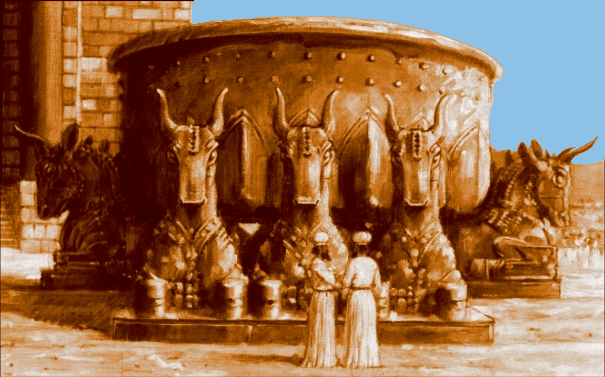
23 Then he made the sea of cast metal. It was round, ten cubits from brim to brim, and five cubits high, and a line of thirty cubits measured its circumference. 24 Under its brim were gourds, for ten cubits, compassing the sea all around. The gourds were in two rows, cast with it when it was cast. 25 It stood on twelve oxen, three facing north, three facing west, three facing south, and three facing east. The sea was set on them, and all their rear parts were inward. 26 Its thickness was a handbreadth, and its brim was made like the brim of a cup, like the flower of a lily. It held two thousand baths.

27 He also made the ten stands of bronze. Each stand was four cubits long, four cubits wide, and three cubits high. 28 This was the construction of the stands: they had panels, and the panels were set in the frames, 29 and on the panels that were set in the frames were lions, oxen, and cherubim. On the frames, both above and below the lions and oxen, there were wreaths of beveled work. 30 Moreover, each stand had four bronze wheels and axles of bronze, and at the four corners were supports for a basin. The supports were cast with wreaths at the side of each. 31 Its opening was within a crown that projected upward one cubit. Its opening was round, as a pedestal is made, a cubit and a half deep. At its opening there were carvings, and its panels were square, not round. 32 And the four wheels were underneath the panels. The axles of the wheels were of one piece with the stands, and the height of a wheel was a cubit and a half. 33 The wheels were made like a chariot wheel; their axles, their rims, their spokes, and their hubs were all cast. 34 There were four supports at the four corners of each stand. The supports were of one piece with the stands. 35 And on the top of the stand there was a round band half a cubit high; and on the top of the stand its stays and its panels were of one piece with it. 36 And on the surfaces of its stays and on its panels, he carved cherubim, lions, and palm trees, according to the space of each, with wreaths all around. 37 After this manner he made the ten stands. All of them were cast alike, of the same measure and the same form.

38 And he made ten basins of bronze. Each basin held forty baths, each basin measured four cubits, and there was a basin for each of the ten stands. 39 And he set the stands, five on the south side of the house, and five on the north side of the house. And he set the sea at the southeast corner of the house. 1 Kings 7:13-39 ESV

The first question that comes to mind when reading this section of Chapter Seven is why the author took such great pains to describe each and every item in such precise detail. The amount of information is almost overwhelming, and even with all the helpful descriptions, it’s virtually impossible to determine what each item actually looked like.  So, why dedicate so much time and space to their description?

In a sense, the author is telling his readers that Solomon was a man who took a keen interest in every phase of the massive construction project he had commissioned. His father had left him with the overwhelming responsibility to create a house worthy of the God of Israel, and that was not something he took lightly. Solomon was a hands-on construction manager who cared deeply about every detail concerning this once-in-a-lifetime undertaking. While he delegated much of the work, there was never a moment when Solomon was not intimately and personally involved in it. He cared deeply about this project and wanted to ensure that the finished product was both beautiful and functional. When completed, the Temple would become the focal point of Israel’s worship of Yahweh. So, Solomon intended for every item associated with its construction and its ultimate operation to be of the finest craftsmanship.

From the quarrying of the massive stones used to build the temple to the carving of the intricate reliefs that adorned the bronze stands, Solomon oversaw everything. To ensure that the workmanship was of the highest quality, Solomon hired the finest craftsman money could buy.

Verse 13 states that Solomon sought out the services of a skilled craftsman from the city of Tyre, a gifted worker in bronze. But notice the additional details concerning Hiram’s qualifications:

And he was full of wisdom, understanding, and skill for making any work in bronze. – 1 Kings 7:1 ESV

This brings to mind a passage from the book of Exodus where God provided Moses with the identity of another man who would assist in the construction of the Tabernacle.

The LORD said to Moses, “See, I have called by name Bezalel the son of Uri, son of Hur, of the tribe of Judah, and I have filled him with the Spirit of God, with ability and intelligence, with knowledge and all craftsmanship, to devise artistic designs, to work in gold, silver, and bronze, in cutting stones for setting, and in carving wood, to work in every craft.” – Exodus 31:1-5 ESV

As was the case with Moses, it seems that Solomon was receiving divine assistance in procuring the services of the right people to help him complete this one-of-a-kind project. Hiram came highly recommended and divinely gifted for the job.

Once he arrived in Jerusalem, Hiram set to work casting the two bronze pillars that would grace the entrance to the Temple. At 27 feet in height, these two immense pillars were likely more decorative than functional. Since they were cast from a relatively soft metal like bronze and featured hollow interiors, they would have been incapable of providing support to the Temple’s roof.

These pillars were intended to frame the entrance to the Temple and provide symbolic significance to the One who dwelt within. Each pillar had a name. One was called Boaz, which means “In Him is strength.” The other was named Jachin, which means “He shall establish.” Both names were explicit references to the God of Israel. Every detail that adorned these pillars, from the water lilies to the pomegranates, was intended to illustrate the goodness and greatness of God. The Israelites served a God who provided them with everything they needed, including fertility and fruitfulness.

Next, Hiram crafted “the sea,” a large bronze basin that would sit outside the Temple’s entrance. This massive bowl was designed to replace the bronze laver that God had prescribed for the Tabernacle, while serving the same function as the original. According to Exodus 30, the first laver was used by the priests to purify themselves before offering sacrifices to God.

“You shall also make a basin of bronze, with its stand of bronze, for washing. You shall put it between the tent of meeting and the altar, and you shall put water in it, with which Aaron and his sons shall wash their hands and their feet. When they go into the tent of meeting, or when they come near the altar to minister, to burn a food offering to the Lord, they shall wash with water, so that they may not die. They shall wash their hands and their feet, so that they may not die. It shall be a statute forever to them, even to him and to his offspring throughout their generations.” – Exodus 30:18-21 ESV

The new basin was 15 feet in diameter, 47 feet in circumference, with a depth of 7.5 feet. It could hold up to 18,000 gallons of water, and its large size appears to have been designed to allow priests to completely immerse themselves, rather than just washing their hands and feet. It rested on the backs of 12 bronze oxen, arranged in groups of three, with each group facing a different direction on the compass. These bronze bulls may have been intended to represent the 12 tribes of Israel. But regardless, they were clearly symbols of strength.

Hiram then crafted ten mobile carts, each equipped with a large bronze basin. They featured wheels that allowed them to be moved about the Temple courtyard.

He also made ten basins in which to wash, and set five on the south side, and five on the north side. In these they were to rinse off what was used for the burnt offering, and the sea was for the priests to wash in. – 2 Chronicles 4:6 ESV

Each cart was six feet square and five and one-half feet high, and it held a bronze basin that could hold up to 240 gallons of water. As the Chronicles passage indicates, they were strategically located around the Temple courtyard and used by the priests to cleanse the blood from the sacrificial animals before they were offered to God.

You can almost sense that Solomon was attempting to improve on every item used in the original Tabernacle. He was making significant upgrades. Every item Hiram created was bigger and better than the original. Solomon was obsessed with making the house of God a grand and glorious structure, with every detail reflecting the majesty of its divine occupant. He could have saved himself a lot of time and money by reusing the original items, but Solomon would not settle for anything less than the best. So, he poured countless hours and resources into creating a Temple worthy of his great God, down to the last detail.

Solomon was following the instructions Yahweh gave to Moses from Mount Sinai when He ordered the creation of the original Tabernacle.

“Have the people of Israel build me a holy sanctuary so I can live among them. You must build this Tabernacle and its furnishings exactly according to the pattern I will show you.” – Exodus 25:8-9 NLT

Moses received detailed plans for the construction of the LORD’s house, with nothing left to the imagination. God was explicit in describing every facet of the Tabernacle’s design, and ordered Moses, “Be sure that you make everything according to the pattern I have shown you here on the mountain” (Exodus 25:40 NLT). Evidently, Moses received a vision of what the completed Tabernacle should look like, and he was to ensure that the finished product was an accurate facsimile. He was not to cut corners, leave out any detail, or make alterations to its design. No expense was to be spared, no shortcuts taken, and no cost-cutting measures considered because this was to be the house of Yahweh. The God of the universe deserved nothing but the best. If the people of Israel expected Him to dwell among them, they would need to build a house worthy of housing His presence. 

“I will meet the people of Israel there, in the place made holy by my glorious presence. Yes, I will consecrate the Tabernacle and the altar, and I will consecrate Aaron and his sons to serve me as priests. Then I will live among the people of Israel and be their God, and they will know that I am the LORD their God. I am the one who brought them out of the land of Egypt so that I could live among them. I am the LORD their God. – Exodus 29:43-46 NLT

Solomon shared Moses’ commitment to build a house that Yahweh would deem worthy of bearing His name and containing His glory. So, he went out of his way to ensure that this house met Yahweh’s exacting standards, because he longed for the assurance of Yahweh’s presence and power.

English Standard Version (ESV) The Holy Bible, English Standard Version. ESV® Permanent Text Edition® (2016). Copyright © 2001 by Crossway Bibles, a publishing ministry of Good News Publishers.

New Living Translation (NLT) Holy Bible, New Living Translation, copyright © 1996, 2004, 2015 by Tyndale House Foundation. Used by permission of Tyndale House Publishers Inc., Carol Stream, Illinois 60188. All rights reserved.

The Heart Is God’s Home

In the four hundred and eightieth year after the people of Israel came out of the land of Egypt, in the fourth year of Solomon’s reign over Israel, in the month of Ziv, which is the second month, he began to build the house of the LORD. The house that King Solomon built for the LORD was sixty cubits long, twenty cubits wide, and thirty cubits high. The vestibule in front of the nave of the house was twenty cubits long, equal to the width of the house, and ten cubits deep in front of the house. And he made for the house windows with recessed frames. He also built a structure against the wall of the house, running around the walls of the house, both the nave and the inner sanctuary. And he made side chambers all around. The lowest story was five cubits broad, the middle one was six cubits broad, and the third was seven cubits broad. For around the outside of the house he made offsets on the wall in order that the supporting beams should not be inserted into the walls of the house.

When the house was built, it was with stone prepared at the quarry, so that neither hammer nor axe nor any tool of iron was heard in the house while it was being built.

The entrance for the lowest story was on the south side of the house, and one went up by stairs to the middle story, and from the middle story to the third. So he built the house and finished it, and he made the ceiling of the house of beams and planks of cedar. 10 He built the structure against the whole house, five cubits high, and it was joined to the house with timbers of cedar.

11 Now the word of the LORD came to Solomon, 12 “Concerning this house that you are building, if you will walk in my statutes and obey my rules and keep all my commandments and walk in them, then I will establish my word with you, which I spoke to David your father. 13 And I will dwell among the children of Israel and will not forsake my people Israel.” 1 Kings 6:1-13 ESV

David had begun the preparations for the construction of the Temple long before he died. It had been his idea to build a “house” for God, but he had been denied the honor of overseeing its actual construction. That task fell to his son and successor, Solomon. Even though David had given Solomon the plans and provided a vast amount of the building materials necessary to start the project, it would be four years into Solomon’s reign before construction began. The sheer size and scope of the project required careful planning and the time to amass and transport all the materials that David’s ambitious plans required.

Massive stones had to be quarried and moved to the building site. Lumber from Lebanon had to be cut and transported by ships from Tyre to the coastline of Israel, then carried inland to the city of Jerusalem. The site itself, located on the summit of Mount Zion, had to be leveled and prepared for the actual construction to begin. Four years after taking the throne, after all the preparations were complete, Solomon officially launched the construction phase of the project. The author points out that it was 480 years after the people of Israel had been released by God from their captivity in Egypt. This link back to Israel’s exodus from Egypt is significant because it provides a vivid contrast between the nation’s past and present circumstances. The Temple was being built to honor the God of Israel, the same God who, nearly half a millennium earlier, rescued their ancestors from their dire conditions in a foreign land. He had freed them from captivity and given them the land of Canaan as their inheritance – all in keeping with the promise He had made to Abraham.

“I will make you exceedingly fruitful, and I will make you into nations, and kings shall come from you. And I will establish my covenant between me and you and your offspring after you throughout their generations for an everlasting covenant, to be God to you and to your offspring after you. And I will give to you and to your offspring after you the land of your sojournings, all the land of Canaan, for an everlasting possession, and I will be their God.” – Genesis 17:6-8 ESV

God had kept His promise to Abraham, and provided the people of Israel with the land of Canaan as their inheritance. Now, Solomon, the son of David, was honoring his father’s wishes by building a Temple worthy of such a great and gracious God.

While the author provides detailed descriptions of the Temple’s layout and dimensions, there is insufficient information to determine precisely what the Temple looked like when it was completed. It was roughly twice the size of the Mosaic Tabernacle and built of massive hand-carved limestone blocks and lumber made from cedar from the forests of Lebanon. The completed structure was ornamented with gold. Solomon spared no expense in the construction of God’s house because it was to be a showplace, a one-of-a-kind structure meant to honor the God of Abraham, Isaac, and Jacob. Even with tens of thousands of conscripted laborers working around the clock, it would take nearly eight years to complete the project.

Sometime during construction, Solomon received a message from God. Amid his ongoing efforts to build a house for Yahweh, he was reminded that a beautiful building would not ensure the presence of God.

“Concerning this Temple you are building, if you keep all my decrees and regulations and obey all my commands, I will fulfill through you the promise I made to your father, David. I will live among the Israelites and will never abandon my people Israel.” – 1 Kings 6:12 NLT

God had made a commitment to David, promising to place one of his sons on the throne after him. This son would fulfill David’s dream of building a Temple for the LORD. But, more importantly, the LORD would place His protective hand over David’s son.

“…when you die and join your ancestors, I will raise up one of your descendants, one of your sons, and I will make his kingdom strong. He is the one who will build a house—a temple—for me. And I will secure his throne forever. I will be his father, and he will be my son. I will never take my favor from him as I took it from the one who ruled before you. I will confirm him as king over my house and my kingdom for all time, and his throne will be secure forever.’” – 1 Chronicles 17:11-14 NLT

But even David knew that this promise from God came with conditions. He believed God would fulfill His part of the covenant, but he also knew that his son would need to remain faithful to God. Just before his death, David warned Solomon that faithfulness would be essential if he wanted to experience God’s fruitfulness.

“I am going where everyone on earth must someday go. Take courage and be a man. Observe the requirements of the LORD your God, and follow all his ways. Keep the decrees, commands, regulations, and laws written in the Law of Moses so that you will be successful in all you do and wherever you go. If you do this, then the LORD will keep the promise he made to me. He told me, ‘If your descendants live as they should and follow me faithfully with all their heart and soul, one of them will always sit on the throne of Israel.’” – 1 Kings 2:2-4 NLT

Building God a house in which to dwell was not going to guarantee His presence, power, and provision. God didn’t require an earthly dwelling place, a point He made clear when David conceived the idea.

“This is what the LORD has declared: Are you the one to build a house for me to live in? I have never lived in a house, from the day I brought the Israelites out of Egypt until this very day. I have always moved from one place to another with a tent and a Tabernacle as my dwelling. Yet no matter where I have gone with the Israelites, I have never once complained to Israel’s tribal leaders, the shepherds of my people Israel. I have never asked them, ‘Why haven’t you built me a beautiful cedar house?’” – 2 Samuel 7:5-7 NLT

In the Book of Acts, Luke records a powerful sermon given by Stephen to a crowd of Jews who would eventually stone him to death. In that sermon, Stephen reminded them that the Temple was never meant to be a sign of God’s presence.

“David found favor with God and asked for the privilege of building a permanent Temple for the God of Jacob. But it was Solomon who actually built it. However, the Most High doesn’t live in temples made by human hands. As the prophet says,

‘Heaven is my throne,
    and the earth is my footstool.
Could you build me a temple as good as that?’
    asks the Lord.
‘Could you build me such a resting place?
  Didn’t my hands make both heaven and earth?’” – Acts 7:46-50 NLT

Luke also records the words of the apostle Paul, spoken to a crowd of Greeks in the middle of the city of Athens.

“He is the God who made the world and everything in it. Since he is Lord of heaven and earth, he doesn’t live in man-made temples, and human hands can’t serve his needs—for he has no needs. He himself gives life and breath to everything, and he satisfies every need.” – Acts 17:24-25 NLT

God wasn’t standing around in heaven, waiting for Solomon to complete the Temple so He could take up residence. God did not need Solomon’s Temple. God had made the stones and the trees used in its construction. He had created and breathed life into the men who labored to build it. He had placed Solomon on the throne and given him the privilege of carrying out his father’s wishes. The Temple was less a residence for Yahweh than it was a reminder of His holiness and greatness. Like the Tabernacle in the wilderness, the Temple was to serve as a symbol of Yahweh’s glorious presence among His chosen people. In a sense, the invisible God of the universe would become visible as the people gazed on the grandeur of His glorious house. The decorative gold, massive stones, and beams of aromatic cedar would create a jaw-dropping and awe-inspiring sight designed to convey the greatness of Yahweh.

But what God really wanted from Solomon was obedience. He desired a king who would live in faithful adherence to His laws and display a commitment to all His commands. Solomon’s own father understood that God was far more interested in the condition of a man’s heart than the accomplishments of his hands. After his illicit affair with Bathsheba, David penned the following penitential words.

You do not desire a sacrifice, or I would offer one.
    You do not want a burnt offering.
The sacrifice you desire is a broken spirit.
    You will not reject a broken and repentant heart, O God. – Psalm 51:16-17 NLT

As the Temple neared completion, Solomon was given a powerful reminder that the key to his success would not be found in a building, but in his commitment to the will and the ways of God. The Temple would be nothing more than a symbol of God’s presence. It would provide a daily reminder of His majesty and glory, but should never be seen as a guarantee of His pleasure with or approval of His people. As the grand edifice of the Temple neared completion, it rose from the heights of Mount Zion, becoming the pride of the people of Israel. But, if they weren’t careful, they would end up being more impressed with the work of their hands and worshiping their creation, than obeying and revering the Creator God.

Solomon could build a house for God, but God was more interested in inhabiting Solomon’s heart. Not long before Jesus made His way to Calvary to sacrifice His life on behalf of sinful humanity, He gave His disciples a message meant to encourage them. He was going to die, but He would rise again, and that miraculous event would usher in a new and life-altering relationship between Him and His followers.

“When I am raised to life again, you will know that I am in my Father, and you are in me, and I am in you. Those who accept my commandments and obey them are the ones who love me. And because they love me, my Father will love them. And I will love them and reveal myself to each of them.”

“All who love me will do what I say. My Father will love them, and we will come and make our home with each of them.” – John 14:20-21, 23 NLT

The apostle Paul would later expand on this idea, reminding the believers in Corinth that they were the dwelling place of God on earth.

Don’t you realize that all of you together are the temple of God and that the Spirit of God lives in you? …For God’s temple is holy, and you are that temple. – 1 Corinthians 3:16, 17 NLT

God lives in hearts, not houses. He takes up residence in His people, not a structure made from wood and stone.

For we are the temple of the living God. As God has said: “I will dwell with them and walk among them, and I will be their God, and they will be My people.” – 2 Corinthians 6:16 BSB

In Him the whole building is fitted together and grows into a holy temple in the Lord. And in Him you too are being built together into a dwelling place for God in His Spirit. – Ephesians 2:21-22 NLT

English Standard Version (ESV) The Holy Bible, English Standard Version. ESV® Permanent Text Edition® (2016). Copyright © 2001 by Crossway Bibles, a publishing ministry of Good News Publishers.

New Living Translation (NLT) Holy Bible, New Living Translation, copyright © 1996, 2004, 2015 by Tyndale House Foundation. Used by permission of Tyndale House Publishers Inc., Carol Stream, Illinois 60188. All rights reserved.

A Question Worth Considering

A Song of Ascents. Of David.

1 If it had not been the LORD who was on our side—
    let Israel now say—
if it had not been the LORD who was on our side
    when people rose up against us,
then they would have swallowed us up alive,
    when their anger was kindled against us;
then the flood would have swept us away,
    the torrent would have gone over us;
then over us would have gone
    the raging waters.

Blessed be the LORD,
    who has not given us
    as prey to their teeth!
We have escaped like a bird
    from the snare of the fowlers;
the snare is broken,
    and we have escaped!

Our help is in the name of the LORD,
    who made heaven and earth. Psalm 124:1-8 ESV

It was the apostle Paul who wrote, “If God is for us, who can ever be against us?” (Romans 8:31 NLT). His words echo the words of David and those of God Himself, recorded by the prophet Isaiah.

“Don’t be afraid, for I am with you. Don’t be discouraged, for I am your God. I will strengthen you and help you. I will hold you up with my victorious right hand. – Isaiah 41:10 NLT

Moses expressed the same sentiment to the Israelites before they entered the land of Canaan.

“So be strong and courageous! Do not be afraid and do not panic before them. For the LORD your God will personally go ahead of you. He will neither fail you nor abandon you.” – Deuteronomy 31:6 NLT

Then, as Joshua prepared to lead the Israelites in their conquest of the land of promise, Yahweh reiterated the promise of His presence and power. 

“Be strong and courageous, for you are the one who will lead these people to possess all the land I swore to their ancestors I would give them. Be strong and very courageous…This is my command—be strong and courageous! Do not be afraid or discouraged. For the LORD your God is with you wherever you go.” – Joshua 1:6-7, 9 NLT

But in Psalm 124, David asks the rhetorical question, “What if the Lord had not been on our side?” And he provides the self-evident answer to his own question.

They would have swallowed us alive
in their burning anger.
The waters would have engulfed us;
a torrent would have overwhelmed us.
Yes, the raging waters of their fury
would have overwhelmed our very lives.– Psalm 124:3-5 NLT

It would have been a disaster. If Yahweh had not answered their prayers and rescued them from their enemies, the outcome would have been devastating. Without Yahweh’s presence and power, defeat would have been inevitable and unavoidable. That’s why David reminds his people to respond appropriately to Yahweh’s gracious intervention in their lives.

Praise the LORD,
who did not let their teeth tear us apart! – Psalm 124:6 NLT

Every victory David had experienced as a shepherd, warrior, and king had been the work of Yahweh. As he prepared to face the Philistine champion, Goliath, David assured King Saul that he was up to the challenge because he had Yahweh on his side.

“When a lion or a bear comes to steal a lamb from the flock, I go after it with a club and rescue the lamb from its mouth. If the animal turns on me, I catch it by the jaw and club it to death. I have done this to both lions and bears, and I’ll do it to this pagan Philistine, too, for he has defied the armies of the living God! The LORD who rescued me from the claws of the lion and the bear will rescue me from this Philistine!” – 1 Samuel 17:34-37 NLT

When Saul commissioned David to lead a contingent of 1,000 soldiers, he proved successful again, because Yahweh was with him.

Saul was then afraid of David, for the LORD was with David and had turned away from Saul. Finally, Saul sent him away and appointed him commander over 1,000 men, and David faithfully led his troops into battle.

David continued to succeed in everything he did, for the LORD was with him. – 1 Samuel 18:12-14 NLT

Yahweh’s abiding presence remained with David throughout his life, even during his years as the king of Israel. Toward the end of his reign, David received Yahweh’s confirmation that his success had been divinely ordained. The LORD had been with David from the moment he was anointed to be the next king of Israel.

“This is what the Lord of Heaven’s Armies has declared: I took you from tending sheep in the pasture and selected you to be the leader of my people Israel. I have been with you wherever you have gone, and I have destroyed all your enemies before your eyes. Now I will make your name as famous as anyone who has ever lived on the earth!” – 2 Samuel 7:8-9 NLT

So, as David penned the words of this psalm, he did so from personal experience. Yahweh had been with him throughout the years and had delivered the enemies of Israel into his hands. His victories had been Yahweh’s doing and not his own. His defeat of Goliath had been the work of God. His battles against the Philistines had turned in his favor because Yahweh was with him. And he knew that, without God’s help, the outcomes would have been dramatically different.

In this psalm, he raises the thought-provoking question, “What if the LORD had not been on our side?” His intention was not to raise doubt about Yahweh’s faithfulness, but to prevent the Israelites from taking the LORD’s power and presence for granted. 

His sobering question wasn’t intended to raise doubts about God’s reliability. He wasn’t asking them to consider the consequences if God ever failed to come through, but the reality that He always does. David’s point is that Yahweh is always faithful and true. He consistently comes through. There may be times when it appears as if He has forsaken us, but His very character assures us that He is on our side at all times.

This psalm is one of the songs of ascent that were sung by Jewish pilgrims making their annual journey to Jerusalem for Pentecost and the Feast of Tabernacles, both celebrations associated with the Passover. These songs were sung along the way, reminding the travelers of their destination and the One for whom they were making this long arduous journey to worship. They were going to Jerusalem “to give thanks to the name of the Lord, as the law requires of Israel” (Psalm 122:4b NLT). The name of the Lord was synonymous with His reputation. He was El Shaddai (LORD God Almighty), El Elyon (The Most High God), Adonai (Lord, Master), Jehovah Nissi (The LORD My Banner), Jehovah-Raah (The LORD My Shephard), Jehovah Rapha (The LORD That Heals), Jehovah Shammah (The LORD Is There), Jehovah Tsidkenu (The LORD Our Righteousness), Jehovah Mekoddishkem (The LORD Who Sanctifies You), El Olam (The Everlasting God), Jehovah Jireh (The LORD Will Provide), Jehovah Shalom (The LORD Is Peace), and Jehovah Sabaoth (The LORD Of Hosts).

God’s names are a picture of who He is and remind His people of all that He has done for them. So, as the people made their way to Jerusalem, they celebrated His activity in the life of their nation through song.

But as they sang, David wanted them to consider the sobering reality that, without God, they would have no hope. Had God not been on their side, “The waters would have engulfed us; a torrent would have overwhelmed us” (Psalm 124:4 NLT). He wanted them to recognize that life without Yahweh would be no life at all. They understood that their help was from the LORD, the same Creator God who had made heaven and earth (Psalm 121:2). This all-powerful God had chosen to have a personal relationship with them and provide them with His protection, provision, and ongoing presence. But rather than take this fact for granted, the people of Israel were to remind themselves what life would be like if Yahweh were not on their side.

So, as they made their way to Jerusalem to worship Yahweh, they asked one another, “What if the LORD had not been on our side?” Their thoughtful consideration of this question was meant to reinforce their faith in Yahweh and reenergize their worship of Him.

As New Testament believers, we may want to ask ourselves the same question. As the apostle Paul stated, “If God is for us, who can ever be against us?” Yahweh has chosen to make us His own through faith in His Son Jesus Christ. That is the point Paul was trying make in chapter 8 of his letter to the Roman believers. 

What shall we say about such wonderful things as these? If God is for us, who can ever be against us? Since he did not spare even his own Son but gave him up for us all, won’t he also give us everything else? Who dares accuse us whom God has chosen for his own? No one—for God himself has given us right standing with himself. Who then will condemn us? No one—for Christ Jesus died for us and was raised to life for us, and he is sitting in the place of honor at God’s right hand, pleading for us. – Romans 8:31-34 NLT

Because of God’s faithfulness and the saving work of Jesus Christ, “overwhelming victory is ours” (Romans 8:37 NLT). Yes, there will be days filled with difficulty and we will face trials in this life but, as Paul asks, “Does it mean he no longer loves us if we have trouble or calamity, or are persecuted, or hungry, or destitute, or in danger, or threatened with death?” (Romans 8:35 NLT). And, like David, he answers his own rhetorical question. 

No, despite all these things, overwhelming victory is ours through Christ, who loved us. – Romans 8:37 NLT

Father, my life is nothing without You. My future would be hopeless without You. My life would have no meaning without You. But because of who You are, I know I have help, hope, and healing at my disposal. I have a relationship with the God of the universe because of the gracious gift of Your Son. He has provided me with His righteousness and assures me of Your acceptance and love. And for that, I am eternally grateful. Thank You. Amen

English Standard Version (ESV) The Holy Bible, English Standard Version. ESV® Permanent Text Edition® (2016). Copyright © 2001 by Crossway Bibles, a publishing ministry of Good News Publishers.

New Living Translation (NLT) Holy Bible, New Living Translation, copyright © 1996, 2004, 2015 by Tyndale House Foundation. Used by permission of Tyndale House Publishers Inc., Carol Stream, Illinois 60188. All rights reserved.

The Peace of God’s Presence

A Song of Ascents. Of David.

1 I was glad when they said to me,
    “Let us go to the house of the LORD!”
Our feet have been standing
    within your gates, O Jerusalem!

Jerusalem—built as a city
    that is bound firmly together,
to which the tribes go up,
    the tribes of the LORD,
as was decreed for Israel,
    to give thanks to the name of the LORD.
There thrones for judgment were set,
    the thrones of the house of David.

Pray for the peace of Jerusalem!
    “May they be secure who love you!
Peace be within your walls
    and security within your towers!”
For my brothers and companions’ sake
    I will say, “Peace be within you!”
For the sake of the house of the LORD our God,
    I will seek your good.  Psalm 122:1-9 ESV

This song of ascent is attributed to David and features his impassioned reflections about the holy city of Jerusalem. This site held special significance to David because he had conquered and captured the city when he first became king of Israel.

David was thirty years old when he began to reign, and he reigned forty years in all. He had reigned over Judah from Hebron for seven years and six months, and from Jerusalem he reigned over all Israel and Judah for thirty-three years. – 2 Samuel 5:4-5 NLT

The city of Jebus was occupied by a Canaanite tribe known as the Jebusites. They taunted the new king of Israel, saying, “You’ll never get in here! Even the blind and lame could keep you out!” (2 Samuel 5:6 NLT). But David easily defeated them and captured the fortress of Zion. 

So David made the fortress his home, and he called it the City of David. He extended the city, starting at the supporting terraces and working inward. And David became more and more powerful, because the Lord God of Heaven’s Armies was with him. – 2 Samuel 5:9-10 NLT

David moved from Hebron to Jerusalem, effectively making the city his royal capital. He quickly expanded its size, fortified its walls, and, with the help of the king of Tyre, built himself an opulent palace. Later in his reign, David developed plans for building a Temple in Jerusalem for Yahweh, but was denied the honor of doing so.

“It was my desire to build a Temple where the Ark of the LORD’s Covenant, God’s footstool, could rest permanently. I made the necessary preparations for building it, but God said to me, ‘You must not build a Temple to honor my name, for you are a warrior and have shed much blood.’” – 1 Chronicles 28:2-3 NLT

After his death, Solomon would eventually carry out the massive construction project, a feat that took seven years to complete. At the time Psalm 122 was written, the Temple did not yet exist, but the city itself held special significance for David. It was a symbol of his reign and a reminder of God’s sovereign plan to make him the king of Israel.

“This is what the LORD has declared: Are you the one to build a house for me to live in? I have never lived in a house, from the day I brought the Israelites out of Egypt until this very day. I have always moved from one place to another with a tent and a Tabernacle as my dwelling. Yet no matter where I have gone with the Israelites, I have never once complained to Israel’s tribal leaders, the shepherds of my people Israel. I have never asked them, ‘Why haven’t you built me a beautiful cedar house?’

“Now go and say to my servant David, ‘This is what the LORD of Heaven’s Armies has declared: I took you from tending sheep in the pasture and selected you to be the leader of my people Israel. I have been with you wherever you have gone, and I have destroyed all your enemies before your eyes. Now I will make your name as famous as anyone who has ever lived on the earth!’” – 2 Samuel 7:5-9 NLT

That is what led David to write, “I was glad when they said to me, ‘Let us go to the house of the Lord.’ And now here we are, standing inside your gates, O Jerusalem” (Psalm 122:1-2 NLT). For David, the entire city of Jerusalem was Yahweh’s dwelling place. Early in his reign, David arranged to have the Ark of the Covenant relocated from Kiriath-jearim to Jerusalem. The motivation behind this plan was to ensure God’s presence within the walls of Jerusalem.

Then David again gathered all the elite troops in Israel, 30,000 in all. He led them to Baalah of Judah (Kiriath-jearim) to bring back the Ark of God, which bears the name of the LORD of Heaven’s Armies, who is enthroned between the cherubim. – 2 Samuel 6:1-2 NLT

Having the Ark of the Covenant within the walls of his capital city provided David with confidence. God’s presence was said to dwell above the Mercy Seat, which served as the lid for the gold-encrusted Ark. The Ark contained the staff of Aaron, the stone tablets containing the Ten Commandments, and a jar filled with manna. The Ark was central to the sacrificial system of Israel and was where the blood of the sacrificial lamb was sprinkled each year on the Day of Atonement. God’s abiding presence and gracious provision of atonement for the sins of His people provided David peace of mind and confidence in the future. His God was with him and the city of Jerusalem was a reminder of Yahweh’s presence, protection and provision.

Jerusalem is a well-built city;
    its seamless walls cannot be breached.
All the tribes of Israel—the LORD’s people—
    make their pilgrimage here.
They come to give thanks to the name of the LORD,
    as the law requires of Israel. – Psalm 122:3-4 NLT

Three times a year, on the prescribed feast days, the people of Israel would ascend Mount Zion to worship Yahweh in the city of Jerusalem. This psalm was one of the songs they would sing as they made their way up the sloping hills to the city. In his psalm, David calls for the people to pray for the peace of Jerusalem.

Pray for peace in Jerusalem.
    May all who love this city prosper.
O Jerusalem, may there be peace within your walls
    and prosperity in your palaces. – Psalm 122:6-7 NLT

While he was the warrior-king who had won many battles against Israel’s enemies, he desired for his royal city to escape bloodshed and enjoy an extended period of peace and prosperity. During his reign, he expanded Israel’s borders and fought to secure its future in the region. But he knew that Israel’s continued success and Jerusalem’s tranquility were tied to the sovereign will of Yahweh. Without His help, the nation was hopeless, and the city would cease to exist.

David may have conquered Jebus, expelled its occupants, and transformed Jerusalem into his capital city, but he could not have done so without Yahweh’s assistance. That is why David made the peace of Jerusalem his highest priority.

For the sake of my family and friends, I will say,
    “May you have peace.”
For the sake of the house of the LORD our God,
    I will seek what is best for you, O Jerusalem. – Psalm122:8-9 NLT

In one of David’s most familiar and revered psalms, he wrote, “Surely your goodness and unfailing love will pursue me all the days of my life, and I will live in the house of the LORD forever” (Psalm 23:6 NLT). David could not have been referring to the Temple because it had not yet been built. So, what did he mean? The term “house of the LORD” could also refer to Yahweh’s presence. It referred to His dwelling place among men. In Leviticus 26:11-12, God promised the Israelites, “I will live among you, and I will not despise you. I will walk among you; I will be your God, and you will be my people.”

David knew Yahweh’s abiding presence was the key to Israel’s success and prosperity.  Without Him, they were helpless and hopeless. For David, peace was not an absence of conflict, but the presence of God. As long as He was with them, they could rest in the assurance of His presence and power. That is what led David to write, “Even when I walk through the darkest valley, I will not be afraid, for you are close beside me” (Psalm 23:4 NLT).

What set David’s reign apart from that of Saul’s was the abiding presence of God. David knew Yahweh had been with him all along, from the moment of his anointing by Samuel, all the way to his coronation as the king of Israel. Yahweh had promised to be with David, and He had never failed to keep that commitment.

“I have been with you wherever you have gone, and I have destroyed all your enemies before your eyes. Now I will make your name as famous as anyone who has ever lived on the earth! And I will provide a homeland for my people Israel, planting them in a secure place where they will never be disturbed. Evil nations won’t oppress them as they’ve done in the past, starting from the time I appointed judges to rule my people Israel. And I will give you rest from all your enemies.” – 2 Samuel 7:9-11 NLT

Jerusalem was where David communed with God. He could look around the city and see evidence of Yahweh’s hand. The City of David was really the City of Yahweh, because He was the one who gave David the victory over the Jebusites. It was Yahweh who placed David on the throne of Israel. And it would be Yahweh who maintained the peace of Jerusalem and the future of the Davidic dynasty. David rested in the promise God had made to him.

“Your house and your kingdom will continue before me for all time, and your throne will be secure forever.” – 2 Samuel 7:16 NLT

So, as he walked the streets of Jerusalem, David was reminded of God’s promise, secure in God’s presence, and confident in God’s power to protect and provide for all their needs.

Here stand the thrones where judgment is given,
    the thrones of the dynasty of David. – Psalm 122:5 NLT

Father, You are the promise-keeping God. And one of the most amazing promises You have made is to never leave or forsake Your chosen people. Despite out many shortcomings and long track record of disobedience, You have remained faithful and committed to keeping Your word. You said You would dwell among us and You do. Your presence is guaranteed and Your power is always available. You are always near, no matter the circumstance. Even if I tried, I could not escape Your presence. As David wrote, “I can never escape from your Spirit! I can never get away from your presence!” (Psalm 139:7 NLT). Thank You for that timely and much-needed remind. Amen

English Standard Version (ESV) The Holy Bible, English Standard Version. ESV® Permanent Text Edition® (2016). Copyright © 2001 by Crossway Bibles, a publishing ministry of Good News Publishers.

New Living Translation (NLT) Holy Bible, New Living Translation, copyright © 1996, 2004, 2015 by Tyndale House Foundation. Used by permission of Tyndale House Publishers Inc., Carol Stream, Illinois 60188. All rights reserved.

The Peace of God

A Song of Ascents.

1 In my distress I called to the LORD,
    and he answered me.
Deliver me, O LORD,
    from lying lips,
    from a deceitful tongue.

What shall be given to you,
    and what more shall be done to you,
    you deceitful tongue?
A warrior’s sharp arrows,
    with glowing coals of the broom tree!

Woe to me, that I sojourn in Meshech,
    that I dwell among the tents of Kedar!
Too long have I had my dwelling
    among those who hate peace.
I am for peace,
    but when I speak, they are for war! Psalm 120:1-7 ESV

Psalm 120 begins a section of the psalter known as the “songs of ascent. They are Hallel psalms or songs of praise that were sung by the people of Israel as they made their way to Jerusalem for one of the three annual feasts. Because Jerusalem sits on Mount Zion, its higher elevation required all travelers to “ascend” as they entered its gates. Four of these fifteen psalms (120-134) are attributed to David, one was composed by his son Solomon, and the remainder are anonymous.

Each of these psalms focuses on some attribute or characteristic of Yahweh, meant to remind the reader of His presence and power. In this case, the psalmist finds himself in a distant land called Meshech. The exact location of Meshech is unknown, but the psalmist laments having to “sojourn” in such a distant place. He also mentions Kedar, another unidentified location that required the psalmist to spend time away from home. It would seem that the author was a king, commander, or soldier who was required to spend long periods of time on deployment to far-distant battlefronts.

He flatly states, “I am tired of living among people who hate peace” (Psalm 120:6 NLT). As a soldier, he is surrounded by those whose job is to do battle with the enemy. Their livelihoods depend on war, so they despise peace. If all the wars ended, they would have to find other employment. But the psalmist describes himself as a pacifist.

I search for peace;
    but when I speak of peace, they want war! – Psalm 120:7 NLT

It seems that this individual is not just an ordinary soldier, but a person of power and influence. He isn’t a low-level private on the front lines who has to fight whether he wants to or not. This man is likely a king who holds the lives of his soldiers and the fate of his nation in his hands. He didn’t take lightly the decision to declare war and order his troops to the front lines. While military conflict was always a possibility, it was not something he took lightly or entered into flippantly. But there were always those who viewed battle as the best and most viable option. These war hawks were always eager to recommend armed conflict as the solution to any problem. They could be persuasive in their arguments and unrelenting in their desire to fight their way out of any predicament.

But the psalmist expresses his frustration with the constant clamour for war. Everywhere he turns, he hears his commanders and military advisors recommending a declaration of war as the only solution. But he believes their advice to be self-serving and not entirely honest.

He begins his psalm with a prayer for Yahweh’s help.

Rescue me, O Lord, from liars
    and from all deceitful people. – Psalm 120:2 NLT

To get what they want, this pro-war faction uses deceptive means to sway the king’s decision. They lie and deceive, presenting opinions as fact and promoting their plans using less-than-honest assessments. But the psalmist saw through their lies, so he called on the LORD for help. He needed discernment. If he simply refused their advice, he ran the risk of losing their support. If he went against his better judgment and gave in to their counsel, lives could be lost and the safety of the kingdom could be put in jeopardy.

The psalmist seems to know that if his deceitful advisors get their wish, the outcome will be less than satisfactory. Everyone will lose, including them.

O deceptive tongue, what will God do to you?
    How will he increase your punishment?
You will be pierced with sharp arrows
    and burned with glowing coals. – Psalm 120:3-4 NLT

There is an old saying that states, “Those who live by the sword will die by the sword.” These proverbial statement actually comes from the lips of Jesus. On the night he was betrayed, armed guards sent by the Sanhedrin arrived at the Garden of Gethsemane to arrest Him. In an attempt to defend his Rabbi, one of the disciples drew his sword and cut off the ear of the high priest’s slave. At this act of violence, Jesus said, “Put away your sword, those who use the sword will die by the sword” (Matthew 26:52 NLT). Jesus knew that the impulsive actions of his well-meaning disciple would only produce further bloodshed. God had other plans for that evening that did not include a sword fight with the Sanhedrin security forces.

The psalmist seemed to know that war wasn’t always the answer. Perhaps he had seen the bloody aftermath of battles entered into rashly. He seemed to understand that war should always be a last resort, not the first one. Men who make armed conflict their go-to option in all cases will always end up regretting their decision.

This can be seen in the life of Abner, the military commander for King Saul. This seasoned warrior had lived his entire life by the sword. He was a fighter who viewed warfare as inevitable and, sometimes, preferable to any other option. When the forces of David began to grow in strength and threaten the reign of King Saul, Abner decided to take matters into his own hands. He made a fateful decision to sleep with one of the concubines of Saul’s son, Ishbosheth. When Ishbosheth confronted Abner for this gross indiscretion, the commander responded in anger.

“After all I have done for your father, Saul, and his family and friends by not handing you over to David, is this my reward—that you find fault with me about this woman? May God strike me and even kill me if I don’t do everything I can to help David get what the Lord has promised him! I’m going to take Saul’s kingdom and give it to David.” – 2 Samuel 3:8-10 NLT

Offended by Ishbosheth’s accusation, Abner chose to switch sides and align himself with David. He was a fighter and had determined that David had the upper hand in this conflict, so he pledged his allegiance to the opposing team.

Then Abner said to David, “Let me go and call an assembly of all Israel to support my lord the king. They will make a covenant with you to make you their king, and you will rule over everything your heart desires.” So David sent Abner safely on his way. – 2 Samuel 3:21 NLT

Everything seemed to be going well for Abner. He had convinced David of his allegiance and would soon be wielding his sword for a new king. But he had forgotten about Joab, the brother of a man he had murdered. Joab was the commander of David’s forces and also a seasoned warrior. When he heard that David had made an alliance with Abner, he was incensed.

“What have you done? What do you mean by letting Abner get away? You know perfectly well that he came to spy on you and find out everything you’re doing!” – 2 Samuel 3:24-25 NLT

Joab saw Abner’s overtures of peace as a poorly disguised ploy to seek David’s downfall. Enflamed by the memories of his brother’s murder, Joab sought out Abner and put him to death.

Joab took him aside at the gateway as if to speak with him privately. But then he stabbed Abner in the stomach and killed him in revenge for killing his brother Asahel. – 2 Samuel 3:27 NLT

Abner had lived by the sword, and he died by the sword. He was a man of bloodshed who was used to getting his own way. His affair with Ishbosheth’s concubine was a blatant attempt to assert his power and authority. His abandonment of Saul was his way of saying he was in control. But his penchant for power and reliance upon the sword to solve all his problems returned to haunt him.

The psalmist writes like a man weary of war and worn out by the constant clamoring of those who preferred conflict to peace. Perhaps David was the author of this psalm. He was a man well-acquainted with war and had spent most of his life living by the sword. In fact, it was his track record of violence that kept him from building a Temple for Yahweh.

God said to me, “You must not build a Temple to honor my name, for you are a warrior and have shed much blood.” – 1 Chronicles 28:3 NLT

Yet David longed for peace and desired to see the wars end and the nation of Israel experience tranquility and prosperity. That day would come, but not in David’s lifetime. Yet, it did not keep him from asking Yahweh to hear his call and answer. In Psalm 4, David shares his deep desire to experience the peace of God. His life had not been easy. Difficulties and difficult people had been a constant part of his life. But he also expresses his appreciation for all the good things God had done.

Answer me when I call to you,
    O God who declares me innocent.
Free me from my troubles.
    Have mercy on me and hear my prayer.

How long will you people ruin my reputation?
    How long will you make groundless accusations?
    How long will you continue your lies? Interlude
You can be sure of this:
    The LORD set apart the godly for himself.
    The LORD will answer when I call to him.

Don’t sin by letting anger control you.
    Think about it overnight and remain silent. Interlude
Offer sacrifices in the right spirit,
    and trust the LORD.

Many people say, “Who will show us better times?”
    Let your face smile on us, LORD.
You have given me greater joy
    than those who have abundant harvests of grain and new wine.
In peace I will lie down and sleep,
    for you alone, O LORD, will keep me safe. – Psalm 4:1-8 NLT

Who will show us better times? For David, the answer was Yahweh. He was grateful for the goodness of God in this life and was confident he would experience it in the life to come. He desired perfect peace, but he knew only Yahweh could bring it about, so he prayed and willingly waited for it.

Father, we all long for peace in this life but it doesn’t always come. Conflict seems to be a regular part of life in this fallen world. Some of it we create ourselves, while at other times we suffer innocently and unjustly. But You can bring peace even in the midst of the storms of life. Your very presence should create a tranquility and calmness in our lives because You are always in control at all times. The conflicts of life will remain, but Your presence and power will always be available to us. And we thank You for that assurance.. Amen

English Standard Version (ESV) The Holy Bible, English Standard Version. ESV® Permanent Text Edition® (2016). Copyright © 2001 by Crossway Bibles, a publishing ministry of Good News Publishers.

New Living Translation (NLT) Holy Bible, New Living Translation, copyright © 1996, 2004, 2015 by Tyndale House Foundation. Used by permission of Tyndale House Publishers Inc., Carol Stream, Illinois 60188. All rights reserved.

A Light to Our Path

Mem

97 Oh how I love your law!
    It is my meditation all the day.
98 Your commandment makes me wiser than my enemies,
    for it is ever with me.
99 I have more understanding than all my teachers,
    for your testimonies are my meditation.
100 I understand more than the aged,
    for I keep your precepts.
101 I hold back my feet from every evil way,
    in order to keep your word.
102 I do not turn aside from your rules,
    for you have taught me.
103 How sweet are your words to my taste,
    sweeter than honey to my mouth!
104 Through your precepts I get understanding;
    therefore I hate every false way.

Nun

105 Your word is a lamp to my feet
    and a light to my path.
106 I have sworn an oath and confirmed it,
    to keep your righteous rules.
107 I am severely afflicted;
    give me life, O LORD, according to your word!
108 Accept my freewill offerings of praise, O LORD,
    and teach me your rules.
109 I hold my life in my hand continually,
    but I do not forget your law.
110 The wicked have laid a snare for me,
    but I do not stray from your precepts.
111 Your testimonies are my heritage forever,
    for they are the joy of my heart.
112 I incline my heart to perform your statutes
    forever, to the end.

Samekh

113 I hate the double-minded,
    but I love your law.
114 You are my hiding place and my shield;
    I hope in your word.
115 Depart from me, you evildoers,
    that I may keep the commandments of my God.
116 Uphold me according to your promise, that I may live,
    and let me not be put to shame in my hope!
117 Hold me up, that I may be safe
    and have regard for your statutes continually!
118 You spurn all who go astray from your statutes,
    for their cunning is in vain.
119 All the wicked of the earth you discard like dross,
    therefore I love your testimonies.
120 My flesh trembles for fear of you,
    and I am afraid of your judgments. Psalm 119:97-120 ESV

The psalmist isn’t adept at concealing his emotions. You might say he wears them on his sleeve, and they flow freely from his mouth. Whether he is discussing his suffering or declaring his affection for his sovereign LORD, he is blunt, bold, and unapologetic.

Oh how I love your law! – vs 97

How sweet are your words to my taste,
    sweeter than honey to my mouth! – vs 103

I am severely afflicted. – vs 107

The wicked have laid a snare for me. – vs 110

Your testimonies…are the joy of my heart. – vs 111

I love your law. – vs 113

I love your testimonies. – vs 119

This is a man of deep emotions who has found his relationship with Yahweh to be a roller-coaster existence full of ups and downs and twists and turns. Things haven’t always turned out how he expected, and his life has not always been easy or explicable. Yet, he has found Yahweh to be a consistent presence and a constant source of hope and help in the good and bad times. Yahweh has always been there because He is faithful, trustworthy, and a covenant-keeping God who keeps His word and fulfills all His promises.

When the psalmist considers all of Yahweh’s revealed word as revealed in the Hebrew Scriptures, he is encouraged and energized by the wisdom and insight they contain. Through his study and application of God’s law, he discovered it to be not just a codified list of moral and ethical rules of conduct, but an expression of Yahweh’s character and life-transformative power.

When he took the time to meditate on God’s commands, he became wiser than his enemies. He gained an advantage over his adversaries by deeply reflecting on the insights found in God’s commands rather than simply obeying them. The wisdom permeating God’s law gave him a new perspective and a greater understanding of God’s will. In time, his knowledge of God’s revealed will and ways surpassed that of his teachers. This is not a prideful boast on his part, but a testimony to the life-transforming power of God’s word.

The psalmist confessed, “Your commandments give me understanding” (Psalm 119:104 NLT), and that understanding produced life change.

I have refused to walk on any evil path,
    so that I may remain obedient to your word. – Psalm 119:101 NLT

Your commandments give me understanding;
    no wonder I hate every false way of life. – Psalm 119:104 NLT

No wonder I love to obey your laws! – Psalm 119:119 NLT

He hadn’t just committed God’s laws to memory and attempted to keep them; he had been transformed by them. Once he understood God’s heart behind them, they became a source of hope (vs 114), his treasure and delight (vs 111), and sweeter than honey (vs 103). They were pleasant rather than onerous because they became more than rules to keep; they were expressions of God’s manifold wisdom.

When the psalmist states, “Your word is a lamp to guide my feet and a light for my path” (Psalm 119:105 NLT), he confessed the power of God’s word to change the trajectory of his life. In a world marred by spiritual darkness and an age before the advent of electricity, light was more than a luxury; it was a necessity. For the psalmist, the illuminating power of God’s word was just as vital as an oil lamp to light one’s path in the darkness. He had discovered that the Scriptures, including the Mosaic Law, the writings of the prophets, and the historical books, were indispensable for navigating life. These Spirit-inspired works were the revelation of God and provided invaluable insight into His character and His redemptive plan for sinful humanity. 

When the psalmist read God’s word, it dispelled the darkness around him because “God is light, and there is no darkness in him at all” (1 John 1:5 NLT). He discovered the truth found in Psalm 27:1: “The Lord is my light and my salvation—so why should I be afraid?” He understood what Isaiah the prophet meant when he wrote: “The LORD your God will be your everlasting light, and your God will be your glory” (Isaiah 60:19 NLT) and “Let us walk in the light of the LORD” (Isaiah 2:5 NLT).

God’s word could not only reveal the right path to take, but also illuminate the way. In keeping God’s commands, the psalmist understood he was walking with the LORD. The light of God’s word was pointing the way and guiding his steps. The Scriptures are a form of God’s presence. In His word, He has revealed Himself to mankind. As we study and meditate on His revealed word, we see more of Him. We get a glimpse into His nature and insights into His divine character. The stories of the Bible reveal His glory, power, and holiness, as well as His grace, mercy, compassion, and forgiveness. 

It is interesting to note that when God gave Moses the instructions for making the Ark of the Covenant, He also commanded what was to go inside it. According to the Book of Hebrews, “This ark contained the gold jar of manna, Aaron’s staff that had budded, and the stone tablets of the covenant” (Hebrews 9:4 NLT). The manna served as a constant reminder of God’s power to provide for all their needs. Aaron’s staff symbolized God’s power to deliver because it was used to part the waters of the Red Sea. It also served as a sign of God’s blessing on the Levitical priesthood. The stone tablets were engraved with the Ten Commandments, a black and white testimony to God’s irrefutable requirement of holiness among His people. 

You shall be holy, for I the Lord your God am holy.” – Leviticus 19:2 ESV 

It was over the Ark of the Covenant that the glory of God was said to dwell. His Shekinah glory, in the form of a pillar of cloud and a pillar of fire, hovered over the Mercy Seat that served as the lid of the Ark of the Covenant. It was that glorious presence of God that led the people of Israel during their years wandering through the wilderness.

The LORD went ahead of them. He guided them during the day with a pillar of cloud, and he provided light at night with a pillar of fire. This allowed them to travel by day or by night. And the LORD did not remove the pillar of cloud or pillar of fire from its place in front of the people. – Exodus 13:21-22 NLT

In the same way, God’s word guides and directs His people today, just as it did the psalmist. His word reveals His will, displays His character, demonstrates His power, and gives evidence of His gracious provision. The psalmist had learned to trust in God’s word and rely upon His unchanging character. It directed and sustained him, encouraged and enlightened him, and convicted and comforted him. That is why he could say, “You are my refuge and my shield; your word is my source of hope” (Psalm 119:114 NLT).

Father, Your word is far more than an ancient book filled with stories from the past. It is a revelation of who You are and how You interface with those You have made in Your likeness. It is a constant reminder of Your power, holiness, and greatness. It provides insight into humanity’s sinfulness and declares its well-deserved declaration of judgment. But Your word also reveals Your plan of redemption. It displays Your patience, compassion, and longsuffering nature. In Your word, we see your holy expectations of mankind as well as Your gracious provision of a sacrificial system and, ultimately, the unblemished Lamb of God who takes away the sins of the world (John 1:29). I want to love Your word because it reveals Your love for us. I want to obey Your word because it expresses Your righteous will for us. Like the pillar of cloud and the pillar of fire, Your word guides, directs, illuminates, and illustrates Your presence among us. Help me keep my eyes fixed on Your word because it reveals who You are and all that You are doing. Amen.

English Standard Version (ESV) The Holy Bible, English Standard Version. ESV® Permanent Text Edition® (2016). Copyright © 2001 by Crossway Bibles, a publishing ministry of Good News Publishers.

New Living Translation (NLT) Holy Bible, New Living Translation, copyright © 1996, 2004, 2015 by Tyndale House Foundation. Used by permission of Tyndale House Publishers Inc., Carol Stream, Illinois 60188. All rights reserved.

Enter His Courts With Thanksgiving

To the choirmaster: according to The Gittith. A Psalm of the Sons of Korah.

1 How lovely is your dwelling place,
    O LORD of hosts!
My soul longs, yes, faints
    for the courts of the LORD;
my heart and flesh sing for joy
    to the living God.

Even the sparrow finds a home,
    and the swallow a nest for herself,
    where she may lay her young,
at your altars, O LORD of hosts,
    my King and my God.
Blessed are those who dwell in your house,
    ever singing your praise! Selah

Blessed are those whose strength is in you,
    in whose heart are the highways to Zion.
As they go through the Valley of Baca
    they make it a place of springs;
    the early rain also covers it with pools.
They go from strength to strength;
    each one appears before God in Zion.

O LORD God of hosts, hear my prayer;
    give ear, O God of Jacob! Selah
Behold our shield, O God;
    look on the face of your anointed!

10 For a day in your courts is better
    than a thousand elsewhere.
I would rather be a doorkeeper in the house of my God
    than dwell in the tents of wickedness.
11 For the LORD God is a sun and shield;
    the LORD bestows favor and honor.
No good thing does he withhold
    from those who walk uprightly.
12 O LORD of hosts,
    blessed is the one who trusts in you! Psalm 84:1-12 ESV

This psalm was written by the sons of Korah. The significance of this fact will mean little to the contemporary reader without further investigation into Korah’s dark history. The Book of Numbers records the sordid details surrounding his role in an uprising against the leadership of Moses and Aaron during Israel’s journey from Egypt to Canaan.

One day Korah son of Izhar, a descendant of Kohath son of Levi, conspired with Dathan and Abiram, the sons of Eliab, and On son of Peleth, from the tribe of Reuben. They incited a rebellion against Moses, along with 250 other leaders of the community, all prominent members of the assembly. They united against Moses and Aaron and said, “You have gone too far! The whole community of Israel has been set apart by the Lord, and he is with all of us. What right do you have to act as though you are greater than the rest of the Lord’s people?” – Deuteronomy 16:1-3 NLT

Korah was a grandson of Kohath, one of the three sons of Levi. God had appointed the tribe of Levi to serve as assistants to the priestly line of Aaron.

“Call forward the tribe of Levi, and present them to Aaron the priest to serve as his assistants. They will serve Aaron and the whole community, performing their sacred duties in and around the Tabernacle. They will also maintain all the furnishings of the sacred tent, serving in the Tabernacle on behalf of all the Israelites. Assign the Levites to Aaron and his sons. They have been given from among all the people of Israel to serve as their assistants. Appoint Aaron and his sons to carry out the duties of the priesthood. But any unauthorized person who goes too near the sanctuary must be put to death.” – Numbers 3:6-10 NLT

According to the Book of Numbers, the Kohathites were responsible for transporting the various pieces of the Tabernacle whenever the Israelites broke camp.

“The Kohathites will come and carry these things to the next destination. But they must not touch the sacred objects, or they will die. So these are the things from the Tabernacle that the Kohathites must carry.” – Numbers 4:15 NLT

God gave further instructions to Moses and Aaron to ensure that the Kohathites carried out their responsibilities faithfully and in keeping with His commands.

“Do not let the Kohathite clans be destroyed from among the Levites! This is what you must do so they will live and not die when they approach the most sacred objects. Aaron and his sons must always go in with them and assign a specific duty or load to each person. The Kohathites must never enter the sanctuary to look at the sacred objects for even a moment, or they will die.” – Numbers 4:18-20 NLT

But somewhere along the way, Korah became disenchanted with what he believed to be the subservient role assigned to his clan. Because they were not sons of Aaron, they were forbidden from serving as priests. They weren’t even allowed to enter the Tabernacle or look at the holy objects. Their sole responsibility was to transport the ark, the table of showbread, the golden lamp stand, the altars, and the curtains from one location to another. But Korah suffered from delusions of grandeur and became jealous of the more prominent roles of Moses, Aaron, and his sons. Having aligned himself with a group of malcontents, Korah grew increasingly more frustrated and eventually led a coup to disrupt the leadership model God had given the people of Israel. Moses was forced to confront Korah for his actions.

“Korah, he [God] has already given this special ministry to you and your fellow Levites. Are you now demanding the priesthood as well? The Lord is the one you and your followers are really revolting against! For who is Aaron that you are complaining about him?” – Numbers 16:10-11 NLT

But Korah and his 250 companions were unwilling to listen to Moses’ call for repentance. Instead, they stood their ground and forced God to step in and pass judgment on their actions.

The earth opened its mouth and swallowed the men, along with their households and all their followers who were standing with them, and everything they owned. So they went down alive into the grave, along with all their belongings. The earth closed over them, and they all vanished from among the people of Israel. – Numbers 16:32-33 NLT

God punished Korah and his companions for their rebellion,  but the Book of Numbers reveals that God graciously spared some of the sons of Korah.

This Dathan and Abiram are the same community leaders who conspired with Korah against Moses and Aaron, rebelling against the Lord. But the earth opened up its mouth and swallowed them with Korah, and fire devoured 250 of their followers. This served as a warning to the entire nation of Israel. However, the sons of Korah did not die that day. – Numbers 26:9-11 NLT

This is what makes the content of Psalm 84 so significant. These undeserving survivors of God’s judgment are expressing gratitude for the privilege of being able to enter the courtyard of God’s sanctuary. They are no longer complaining about their diminished role or inability to serve as priests. In fact, because the Tabernacle had been replaced by the Temple, they no longer had the responsibility of carrying its sacred items from one location to another. The Temple was a permanent structure, and so their role had been changed to that of doorkeepers and musicians.

This psalm reflects a remarkable change in attitude among the sons of Korah. Unlike their disgruntled ancestor, they are fully content with being able to enter the courtyard of the Sanctuary. The restrictions on their entering the holy places were still intact, yet they were satisfied with being able to worship Yahweh from the courtyard.

How lovely is your dwelling place,
    O Lord of Heaven’s Armies.
I long, yes, I faint with longing
    to enter the courts of the Lord.
With my whole being, body and soul,
    I will shout joyfully to the living God. – Psalm 84:1-2 NLT

The author marvels that sparrows can build nests in the courtyard’s recesses and enjoy God’s presence and protection. These common birds were welcome in God’s house and need not fear rejection. The psalmist expresses his deep joy at being accepted into God’s presence.

Blessed are those who dwell in your house,
    ever singing your praise! Selah

Blessed are those whose strength is in you,
    in whose heart are the highways to Zion. – Psalm 84:4-5 NLT

O LORD of hosts,
    blessed is the one who trusts in you! – Psalm 84:12 NLT

There is no hint of jealousy or dissatisfaction in his words. He is content to serve in whatever capacity God ordains, as long as he can enter the courtyard and enjoy the abiding presence of Yahweh. Overwhelmed by the grace and mercy of God, he pens one of the most well-known phrases in all of Scripture.

For a day in your courts is better
    than a thousand elsewhere.
I would rather be a doorkeeper in the house of my God
    than dwell in the tents of wickedness. – Psalm 84:10 ESV

What a remarkable contrast to the words spoken by his disgruntled ancestor. This son of Korah is no longer wrestling with dissatisfaction and jealousy. He isn’t battling discontentment or disillusionment with his lot in life. Instead, he is rejoicing in his undeserved privilege of entering God’s house and enjoying all the blessings it affords.

The psalmist even considers the annual pilgrimages the Israelites were required to make to the Temple in Jerusalem. These could have been long and arduous journeys that required sacrifice and suffering on the part of the pilgrims. But the psalmist paints a more positive picture by reminding his readers that the destiny will be well worth the journey.

What joy for those whose strength comes from the Lord,
    who have set their minds on a pilgrimage to Jerusalem.
When they walk through the Valley of Weeping,
    it will become a place of refreshing springs.
    The autumn rains will clothe it with blessings.
They will continue to grow stronger,
    and each of them will appear before God in Jerusalem. – Psalm 84:5-7 NLT

Korah had grown discontented and dissatisfied with his God-ordained role. Rather than rejoice in the privilege provided to him by God, Korah allowed jealousy and envy to infect his heart and influence his decision-making. He coveted Moses’ leadership role. He saw the priesthood as a more enviable and prestigious position that would garner him praise and equip him with power. But he completely overlooked the joy of serving God in humility and gladness. As a result, he suffered an ignominious death and had his rebellion recorded in God’s Word as a powerful warning to others.

At least one of his sons learned a valuable lesson from Korah’s mistake. His gratitude for God’s grace and mercy has been recorded for posterity, providing a powerful reminder that the pursuit of personal glory is no match for recognizing the blessing of living in God’s presence.

Father, the history of Korah is painful to read, but it makes this psalm make sense. Korah’s actions were based on jealousy and dissatisfaction. He wasn’t content with serving You. He wanted more. His focus on himself and his frustration stemmed from a relentless need to feel more important and recognized for his accomplishments. How easy it is to let dissatisfaction infect my life and think that I am not getting all I deserve. Lke Korah’s son, I want to find joy in the privilege of entering Your presence. I am welcome in Your House, not because of who I am and anything I have done, but simply because of the finished work of Christ. May I always be satisfied with the marvelous reality that I can enter Your presence at any time, not based on my title or accomplishments but because of Christ. Amen

English Standard Version (ESV) The Holy Bible, English Standard Version. ESV® Permanent Text Edition® (2016). Copyright © 2001 by Crossway Bibles, a publishing ministry of Good News Publishers.

New Living Translation (NLT) Holy Bible, New Living Translation, copyright © 1996, 2004, 2015 by Tyndale House Foundation. Used by permission of Tyndale House Publishers Inc., Carol Stream, Illinois 60188. All rights reserved.

Down But Never Out

To the choirmaster. A Psalm of David.

1 Hear my voice, O God, in my complaint;
    preserve my life from dread of the enemy.
Hide me from the secret plots of the wicked,
    from the throng of evildoers,
who whet their tongues like swords,
    who aim bitter words like arrows,
shooting from ambush at the blameless,
    shooting at him suddenly and without fear.
They hold fast to their evil purpose;
    they talk of laying snares secretly,
thinking, “Who can see them?”
    They search out injustice,
saying, “We have accomplished a diligent search.”
    For the inward mind and heart of a man are deep.

But God shoots his arrow at them;
    they are wounded suddenly.
They are brought to ruin, with their own tongues turned against them;
    all who see them will wag their heads.
Then all mankind fears;
    they tell what God has brought about
    and ponder what he has done.

10 Let the righteous one rejoice in the Lord
    and take refuge in him!
Let all the upright in heart exult! Psalm 64:1-10 ESV

When reading the Psalms of David, one could easily conclude that he regularly suffered from depression and debilitating states of melancholy. They feature recurring themes of suffering, heartache, loneliness, and the fear of personal assault and verbal attack. He can almost come across as paranoid and more than a bit pessimistic. Yet, a survey of his life as recorded in the Scriptures reveals that David lived much of his life with a target on his back. As a young man, he received the anointing of God’s prophet to serve as the next king of Israel. But for the next 13 years, he was forced to live as an exile because King Saul, the man he was supposed to replace, had placed a bounty on his head. David became accustomed to a life on the run, living in caves and trying to stay one step ahead of his pursuers. During those years, he was hounded, betrayed, defamed, and plagued by doubts about his anointing, God’s promises, and his own future.

Even after becoming king and leading the nation of Israel to a period of prosperity and relative peace, David continued to endure personal attacks from both within and without. He was the warrior king who had to fend off Israel’s enemies and secure the land God had promised as their inheritance. Neighboring nations like the Philistines, Moabites, and Edomites were a constant source of conflict and concern. His entire reign was marked by internecine wars with the nations of Canaan.

According to 2 Samuel 8 and 1 Chronicles 18, David was highly successful in his military exploits because “the Lord made David victorious wherever he went” (2 Samuel 8:6 NLT). However, David’s blood-soaked hands disqualified him from fulfilling his dream of building a temple for God.

“My brothers and my people! It was my desire to build a Temple where the Ark of the Lord’s Covenant, God’s footstool, could rest permanently. I made the necessary preparations for building it, but God said to me, ‘You must not build a Temple to honor my name, for you are a warrior and have shed much blood.’ – 1 Chronicles 28:2-3 NLT

However, for David, the conflicts were not just external; they emanated from within his own household. After his illicit affair with Bathsheba, the prophet Nathan confronted David and gave him a divine declaration of the punishment for his sin.

“From this time on, your family will live by the sword because you have despised me by taking Uriah’s wife to be your own.

“This is what the Lord says: Because of what you have done, I will cause your own household to rebel against you. I will give your wives to another man before your very eyes, and he will go to bed with them in public view. You did it secretly, but I will make this happen to you openly in the sight of all Israel.” – 2 Samuel 12:10-12 NLT

David’s family would become the epitome of dysfunction and disunity. His many wives produced a host of children and a perfect environment for jealousy, conflict, and sibling rivalries to thrive. His son Amnon ended up raping his half-sister Tamar. Because David failed to intervene and punish his son for his actions, Tamar’s brother Absalom took matters into his own hands and plotted Amnon’s death. Rather than arrest his son for murder, David allowed Absalom to escape. Years later, Absalom returned to Jerusalem, only to plan a coup to replace his father as king. Embittered by his father’s failure to mete out justice on Amnon and frustrated by his own exile for doing the right thing, Absalom displaced David as king and fulfilled the prophecy that Nathan delivered.

Ahithophel told him, “Go and sleep with your father’s concubines, for he has left them here to look after the palace. Then all Israel will know that you have insulted your father beyond hope of reconciliation, and they will throw their support to you.” So they set up a tent on the palace roof where everyone could see it, and Absalom went in and had sex with his father’s concubines. – 2 Samuel 16:21-22 NLT

As these historical events suggest, David’s life was anything but easy. While much of it was self-inflicted, some of the conflict he experienced was not his fault. He did nothing to incur Saul’s wrath. He was not responsible for Israel settling in a land filled with hostile nations that opposed their presence and were obsessed with their annihilation. Even the discord within his own family was not something David purposefully planned. It was the result of his poor parenting and bad personal choices.

David lived a complex life that was fraught with difficulties and filled with constant pressure. He was a husband with more wives than he could handle. He was a father with a large mixed family that required more attention than he was prepared to give. He was king over a nation with more enemies than allies. In short, he was a man well acquainted with stress and more than familiar with worry, doubt, and fear.

That is why he starts this psalm out like so many others.

O God, listen to my complaint.
    Protect my life from my enemies’ threats. – Psalm 64:1 NLT

The context is less important than the content of his prayer and the One to whom it is addressed. David always took his problems to God. He doesn’t list his enemies or provide the details of his complaint because he knows he doesn’t need to. God already knows.

He simply describes them as an evil mob and a gang of wrongdoers with tongues like swords and a penchant for his destruction. Their threats appear to be more verbal than physical. They threaten, plot, spread rumors, discredit, and devise plans to do David harm. But rather than take matters into his own hands, David takes his problem to the LORD.  He calls on the Almighty to defend and avenge him against his enemies, and expresses his belief that God will act on his behalf.

But God himself will shoot them with his arrows,
    suddenly striking them down.
Their own tongues will ruin them,
    and all who see them will shake their heads in scorn. – Psalm 64:7-8 NLT

David exhibits a strange mix of consternation and confidence. He was perplexed and frustrated by his circumstances, but fully confident that God was aware and capable of taking care of the problem. David thought like a warrior, using imagery reflecting his battlefield experience. He envisions God’s actions as arrows flying through the air to pierce through the enemy’s armor. When the time is right, the Almighty will unleash a deadly barrage of divine vengeance against David’s oppressors and eliminate the problem.

Then everyone will be afraid;
    they will proclaim the mighty acts of God
    and realize all the amazing things he does.
The godly will rejoice in the LORD
    and find shelter in him.
And those who do what is right
    will praise him. – Psalm 64:9-10 NLT

For David, the presence of problems was an opportunity to see God’s power on display. He firmly believed that God would intervene and, when the dust settled, all would know that a miracle had occurred. The wicked would get what they deserved, and the righteous would know that God was in control and on their side. God’s intervention would produce fear in the lives of the wicked and righteous alike. When all was said and done, everyone would know that God had shown up. His power would be evident, and His right to be praised would be obvious.

David was well acquainted with difficulties, but he was also well-versed in the faithfulness and power of God. Nothing he had experienced in life was too big for God to handle. No enemy was too strong. No family problem was too complex. No battle was too lopsided. No gossip was too damaging. David believed that “the godly WILL rejoice in the LORD.” If they take their needs to Him, they will never be disappointed. If they seek shelter and safety in His presence, they will never be rejected.

David believed in the fallenness of man and the faithfulness of God. He was able to hold those two contradictory ideas in tension because he believed that God’s love ifor the righteous always wins out.

The Lord directs the steps of the godly.
    He delights in every detail of their lives.
Though they stumble, they will never fall,
    for the Lord holds them by the hand.

Once I was young, and now I am old.
    Yet I have never seen the godly abandoned
    or their children begging for bread. – Psalm 37:23-25 NLT

Father, I needed to hear this today. It is so easy to let my circumstances dictate my outlook on life and determine my concept of who You are. Like David, I am not immune from difficulties and I am certainly not free from sin. I cause a lot of my own problems by my own actions. Yet, You invite me to come to you with all my worries and cares and You promise to give me peace as You display Your power on my behalf. You have proven Yourself faithful time and time again in my life. Yet, with each successive problem that shows up, I keep doubting and fearing. Give me the strength to turn to You even when things don’t turn out the way I expect them to. I want to see the trials of life as opportunities to see Your power on display, just as David did. Amen

English Standard Version (ESV) The Holy Bible, English Standard Version. ESV® Permanent Text Edition® (2016). Copyright © 2001 by Crossway Bibles, a publishing ministry of Good News Publishers.

New Living Translation (NLT) Holy Bible, New Living Translation, copyright © 1996, 2004, 2015 by Tyndale House Foundation. Used by permission of Tyndale House Publishers Inc., Carol Stream, Illinois 60188. All rights reserved.