Nothing Is Too Difficult for God

1 Now the sons of the prophets said to Elisha, “See, the place where we dwell under your charge is too small for us. Let us go to the Jordan and each of us get there a log, and let us make a place for us to dwell there.” And he answered, “Go.” Then one of them said, “Be pleased to go with your servants.” And he answered, “I will go.” So he went with them. And when they came to the Jordan, they cut down trees. But as one was felling a log, his axe head fell into the water, and he cried out, “Alas, my master! It was borrowed.” Then the man of God said, “Where did it fall?” When he showed him the place, he cut off a stick and threw it in there and made the iron float. And he said, “Take it up.” So he reached out his hand and took it. 

Once when the king of Syria was warring against Israel, he took counsel with his servants, saying, “At such and such a place shall be my camp.” But the man of God sent word to the king of Israel, “Beware that you do not pass this place, for the Syrians are going down there.” 10 And the king of Israel sent to the place about which the man of God told him. Thus he used to warn him, so that he saved himself there more than once or twice.

11 And the mind of the king of Syria was greatly troubled because of this thing, and he called his servants and said to them, “Will you not show me who of us is for the king of Israel?” 12 And one of his servants said, “None, my lord, O king; but Elisha, the prophet who is in Israel, tells the king of Israel the words that you speak in your bedroom.” 13 And he said, “Go and see where he is, that I may send and seize him.” It was told him, “Behold, he is in Dothan.” 14 So he sent there horses and chariots and a great army, and they came by night and surrounded the city.

15 When the servant of the man of God rose early in the morning and went out, behold, an army with horses and chariots was all around the city. And the servant said, “Alas, my master! What shall we do?” 16 He said, “Do not be afraid, for those who are with us are more than those who are with them.” 17 Then Elisha prayed and said, “O LORD, please open his eyes that he may see.” So the LORD opened the eyes of the young man, and he saw, and behold, the mountain was full of horses and chariots of fire all around Elisha. 18 And when the Syrians came down against him, Elisha prayed to the LORD and said, “Please strike this people with blindness.” So he struck them with blindness in accordance with the prayer of Elisha. 19 And Elisha said to them, “This is not the way, and this is not the city. Follow me, and I will bring you to the man whom you seek.” And he led them to Samaria.

20 As soon as they entered Samaria, Elisha said, “O LORD, open the eyes of these men, that they may see.” So the LORD opened their eyes and they saw, and behold, they were in the midst of Samaria. 21 As soon as the king of Israel saw them, he said to Elisha, “My father, shall I strike them down? Shall I strike them down?” 22 He answered, “You shall not strike them down. Would you strike down those whom you have taken captive with your sword and with your bow? Set bread and water before them, that they may eat and drink and go to their master.” 23 So he prepared for them a great feast, and when they had eaten and drunk, he sent them away, and they went to their master. And the Syrians did not come again on raids into the land of Israel. 2 Kings 6:1-23 ESV

Let’s face it, even for a prophet of God, Elisha had some rather strange experiences. And the two that are recorded in the opening verses of this chapter are among the most bizarre. At first glance, the only thing they appear to have in common is Elisha himself. But upon further examination, one can see that both stories are meant to accentuate the power of God’s prophet. The first is short and to the point, but displays the supernatural, yet highly practical nature of Elisha’s divine enablement. This man was God’s representative and, as such, he displayed the caring concern that Yahweh had for His children.

Elisha’s fellow prophets approached him, seeking his approval to build a larger complex in which to house their growing number. They had chosen a spot near the Jordan River and intended to work as a team on the construction of their new home. Elisha gave them his blessing to begin the project, but they asked him to accompany them, which he did. But as they were going through the laborious process of cutting down the trees to make logs for their new headquarters, one of the men lost the head to his ax. It flew off the handle and landed in the river, disappearing from sight. To our minds, this doesn’t appear to be a life-and-death situation. Obviously, they had more than one ax, but the author reveals that this particular ax had been borrowed, and iron was a costly commodity in those days. So, the one who had borrowed the ax was deeply concerned over his bit of bad luck. He would have been required to replace the lost ax head and, on a prophet’s salary, that would have been difficult.

It’s difficult to read this story without thinking about the words that Solomon recorded in the book of Ecclesiastes.

One who digs a pit may fall into it,
and one who breaks through a wall may be bitten by a snake.
One who quarries stones may be injured by them;
one who splits logs may be endangered by them.
If an iron axhead is blunt and a workman does not sharpen its edge,
he must exert a great deal of effort;
so wisdom has the advantage of giving success. – Ecclesiastes 10:8-10 NET

Chopping wood with a loose ax head would have certainly fit into this category of unwise decisions. But rather than embarrass this poor man for his lack of forethought, Elisha simply asked him for a general idea of where the ax head entered the water. Then Elisha did something completely unexpected but practical. He “cut a stick and threw it into the water at that spot. Then the ax head floated to the surface” (2 Kings 6:6 NLT). Miraculously, the heavy iron ax head rose to the surface, where the man easily and eagerly retrieved it. His problem was solved, thanks to Elisha’s quick thinking and practical application of the divine resources at his disposal.

The second story is a bit more complex and far more in line with what we would expect of a prophet of God. Rather than the prophets of Yahweh constructing a new dwelling place, we have the Syrian king and his officers plotting an invasion of Israel. But before they could implement their strategy, Elisha received divine insight into their plans and warned the king of Israel. And much to King Ben-hadad’s frustration, this happened repeatedly.

This led the Syrian king to assume that a traitor was in his camp; someone was passing on their top-secret plans to the Israelites.  But his officers assured him that the problem was far worse than he thought. Yahweh, the God of Israel, had been listening in on all their secret strategy sessions and then passing the information on to Elisha, who warned the king of Israel.

Determined to put a stop to this leak in his communications network, Ben-hadad sent a large contingent of troops and chariots to capture Elisha. When Elisha’s servant woke up the next morning, he saw Syrian troops as far as the eye could see, and he cried out, “Oh, sir, what will we do now?” (2 Kings 6:15 NLT). But the prophet handled the news with the same degree of calmness he had exhibited when he heard about the lost ax head. He simply stated, “Don’t be afraid! For there are more on our side than on theirs!” (2 Kings 6:16 NLT). 

The petrified servant must have questioned his master’s sanity. How in the world could the prophet think that they had the Syrians outnumbered? But Elisha had every confidence that the same God who raised the ax head from the bottom of the Jordan could raise an army to defeat the Syrians. But Elisha knew his servant lacked the faith to believe in Yahweh’s intervention, so he confidently called on the power of Yahweh.

Then Elisha prayed, “O LORD, open his eyes and let him see!” The LORD opened the young man’s eyes, and when he looked up, he saw that the hillside around Elisha was filled with horses and chariots of fire. – 2 Kings 6:17 NLT

This “heavenly host” was intended to bolster the faith of Elisha’s servant. But, interestingly enough, the horses and chariots of fire did not engage the Syrians in battle. They served to provide a tangible visual representation of God’s power. It’s similar to what happened when Elisha witnessed God take Elijah to be with Him.

As they were walking along and talking, suddenly a fiery chariot pulled by fiery horses appeared. They went between Elijah and Elisha, and Elijah went up to heaven in a windstorm. – 2 Kings 2:11 NLT

God didn’t use the fiery chariots to transport Elisha, and the angelic host wasn’t there to save Elisha or the city of Dothan. Defeating the Syrians would not require a battle; it would simply require blindness. Elisha asked God to incapacitate the Syrian soldiers by removing their sight. Then the prophet led the confused, completely helpless Syrian army to the capital city of Samaria. When they arrived, “the LORD opened their eyes, and they discovered that they were in the middle of Samaria” (2 Kings 6:20 NLT).

Upon seeing the blind and helpless Syrian mercenaries in his capital city, King Jehoram determined to slaughter them on the spot. But Elisha instructed King Jehoram: “Give them food and drink and send them home again to their master” (2 Kings 6:22 NLT). So, Jehoram threw a great feast and then sent the Syrians home. News of this incredible Israelite victory reached the palace of Ben-hadad, informing him that the God of Israel was greater than the gods of the Syrians. Yahweh had protected His prophet and had provided the innocent people of Dothan with a gracious and merciful rescue from certain destruction.

The same God who cared enough to return a lost ax head was willing to display His supernatural power over the enemies of Israel. There was no water too deep, no enemy too powerful, and no problem too difficult for God.

“O Sovereign LORD! You made the heavens and earth by your strong hand and powerful arm. Nothing is too hard for you!” – Jeremiah 32:17 NLT

English Standard Version (ESV) The Holy Bible, English Standard Version. ESV® Permanent Text Edition® (2016). Copyright © 2001 by Crossway Bibles, a publishing ministry of Good News Publishers.

New Living Translation (NLT) Holy Bible, New Living Translation, copyright © 1996, 2004, 2015 by Tyndale House Foundation. Used by permission of Tyndale House Publishers Inc., Carol Stream, Illinois 60188. All rights reserved.

The Well-Deserved Death of Ahab

29 So the king of Israel and Jehoshaphat the king of Judah went up to Ramoth-gilead. 30 And the king of Israel said to Jehoshaphat, “I will disguise myself and go into battle, but you wear your robes.” And the king of Israel disguised himself and went into battle. 31 Now the king of Syria had commanded the thirty-two captains of his chariots, “Fight with neither small nor great, but only with the king of Israel.” 32 And when the captains of the chariots saw Jehoshaphat, they said, “It is surely the king of Israel.” So they turned to fight against him. And Jehoshaphat cried out. 33 And when the captains of the chariots saw that it was not the king of Israel, they turned back from pursuing him. 34 But a certain man drew his bow at random and struck the king of Israel between the scale armor and the breastplate. Therefore he said to the driver of his chariot, “Turn around and carry me out of the battle, for I am wounded.” 35 And the battle continued that day, and the king was propped up in his chariot facing the Syrians, until at evening he died. And the blood of the wound flowed into the bottom of the chariot. 36 And about sunset a cry went through the army, “Every man to his city, and every man to his country!”

37 So the king died, and was brought to Samaria. And they buried the king in Samaria. 38 And they washed the chariot by the pool of Samaria, and the dogs licked up his blood, and the prostitutes washed themselves in it, according to the word of the LORD that he had spoken. 39 Now the rest of the acts of Ahab and all that he did, and the ivory house that he built and all the cities that he built, are they not written in the Book of the Chronicles of the Kings of Israel? 40 So Ahab slept with his fathers, and Ahaziah his son reigned in his place. 1 Kings 22:29-40 ESV

Despite being warned by the prophet Micaiah that his attack on Ramoth-gilead would end in disaster and his own death, Ahab went ahead with his ill-fated plan. But in an attempt to thwart the will of God, Ahab came up with the brilliant idea to wear a disguise that would prevent the Syrians from recognizing him as the king. He knew he would be a target of Ben-Hadad’s wrath because his attack on Ramoth-gilead was in violation of their long-standing peace agreement. And he was right to be worried because Ben-hadad had commanded his troops to focus their attention on Ahab.

Now the king of Syria had commanded the thirty-two captains of his chariots, “Fight with neither small nor great, but only with the king of Israel.” – 1 Kings 22:31 ESV

Ahab’s decision to go through with the battle despite Micaiah’s warning clearly indicates the rebellious nature of his heart and his blatant disregard for the will of Yahweh. He truly believed he could devise a plan that would allow him to escape God’s wrath and accomplish his own will at the same time. Ahab was conniving and manipulative, and evidently quite persuasive, as he was able to convince King Jehoshaphat of Judah to go into battle wearing his royal armor while he wore a disguise. He hoped that, in the heat of battle, the Syrians would mistake Jehoshaphat as the king of Israel and focus all their attention on him. Somehow, he convinced the king of Judah to go along with this blatant display of brazen self-preservation.

And his plan almost worked. As the battle began, the Syrians spotted Jehoshaphat and gave chase, but they soon realized they were pursuing the wrong man. Ahab had managed to fool the Syrians, but he would not be able to hide his identity from God Almighty. His clever plan would not protect him from the judgment that God had decreed against him.

As the battle raged, one of the Syrian archers loosed an arrow that flew through the air and struck Ahab “between the scale armor and the breastplate” (1 Kings 22:34 ESV). The text describes this unnamed individual as “a certain man,” who “drew his bow at random” (1 Kings 22:34 ESV). His name is not provided, and the target of his arrow is undisclosed. In the heat of the battle, he discharged an arrow in the general direction of the enemy, but without aiming at anyone in particular. But his shot ended up piercing between the scale armor and the breastplate of Ahab’s armor. The king had refused to wear his royal robes, but not his protective armor. He could hide, but he could not get away from the all-seeing eye of Yahweh.

The seemingly lucky shot loosed by an unidentified Syrian soldier was sovereignly ordained and directed by the hand of God. Ahab had tried to avoid God’s will but failed. His disguise didn’t fool Yahweh, and his armor proved to be insufficient protection from the divine judgment leveled against him.

As the battle continued all around him, Ahab slumped in his chariot, his blood pouring from his wound and his life slowly ebbing away. At sunset, he took his last labored breath and died, and the news of his demise quickly spread across the battlefield.

 …as evening arrived he died. Just as the sun was setting, the cry ran through his troops: “We’re done for! Run for your lives!” – 1 Kings 22:35-36 NLT

Micaiah had warned Ahab that his death was inevitable because his actions were in direct violation of God’s will. If he chose to go through with his attack on Ramoth-gilead, Ahab would suffer the divine consequences. When Ahab died, lying in a pool of his own blood on the floor of his chariot, his troops abandoned the battle. The sheep found themselves without a shepherd, so they returned to their homes in peace, just as God had predicted they would.

“I saw all Israel scattered on the mountains, as sheep that have no shepherd. And the Lord said, ‘These have no master; let each return to his home in peace.’” – 1 Kings 22:17 ESV

With Ahab’s death, the battle for Ramoth-gilead came to an abrupt end, and the armies of Syria, Israel, and Judah abandoned the field and returned home. Ahab’s body, still lying in his chariot, was returned to Samaria. Amazingly, this wicked and rebellious king was given the honor of a royal burial. But the author describes a rather macabre scene that stands in stark contrast to the state funeral given to this unrepentant and undeserving king. As Ahab’s body was interred with all the pomp and circumstance of a royal funeral, his servants went about the unpleasant task of cleaning up the grisly scene his death left behind.

…his chariot was washed beside the pool of Samaria, and dogs came and licked his blood at the place where the prostitutes bathed, just as the Lord had promised. – 1 Kings 22:38 NLT

This scene took place in direct fulfillment of the words of the prophet Elijah. He had warned King Ahab that his complicity in the death of Naboth would result in his own demise.

And you shall say to him, ‘Thus says the LORD: “In the place where dogs licked up the blood of Naboth shall dogs lick your own blood.”’” – 1 Kings 21:19 ESV

The place where the servants chose to wash Ahab’s blood from his chariot was the exact spot where the innocent Naboth had been stoned to death. Ahab’s body was buried in a royal tomb, but his life’s blood was unceremoniously poured out in a place recognized for its sin and degradation. It was a site within the walls of Samaria inhabited by those who were considered unclean and immoral. Wild dogs licked up the king’s blood, and the prostitutes of Samaria unknowingly bathed themselves in the blood-stained waters of the pool where Ahab’s blood was spilled.

Ahab’s reign as king of Israel came to an abrupt and violent end. While he would be remembered for his many achievements, he would go down in history as one of the most wicked of all Israel’s kings. His legacy would be marked by apostasy, rebellion, idolatry, and immorality. He proved to be a competent king, but his stubborn refusal to honor God would forever mar his reputation and leave a permanent stain on the northern kingdom of Israel. When the author states that “Ahab slept with his fathers” (1 Kings 22:40 ESV), it is a thinly veiled inference that Ahab died unrepentant and unforgiven, just like his predecessors. While alive, Ahab made no place for God in his kingdom. In death, he would discover that he had no place in God’s heavenly kingdom. In life, he chose to replace Yahweh with false gods, and that decision would prove to have eternal consequences.

English Standard Version (ESV) The Holy Bible, English Standard Version. ESV® Permanent Text Edition® (2016). Copyright © 2001 by Crossway Bibles, a publishing ministry of Good News Publishers.

New Living Translation (NLT) Holy Bible, New Living Translation, copyright © 1996, 2004, 2015 by Tyndale House Foundation. Used by permission of Tyndale House Publishers Inc., Carol Stream, Illinois 60188. All rights reserved.

Sovereign Over All

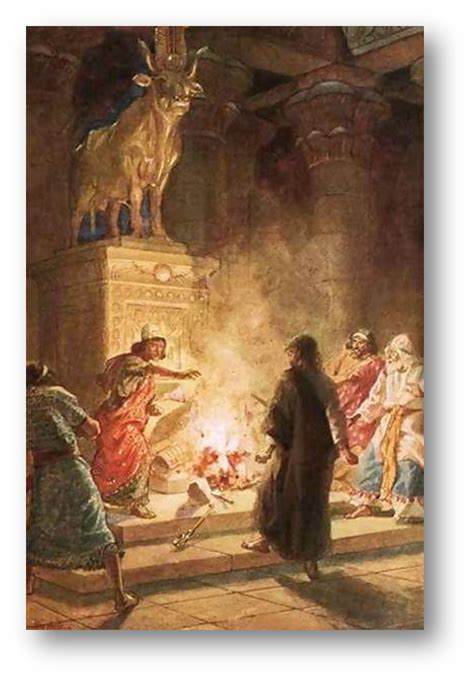
1 And behold, a man of God came out of Judah by the word of the LORD to Bethel. Jeroboam was standing by the altar to make offerings. And the man cried against the altar by the word of the LORD and said, “O altar, altar, thus says the LORD: ‘Behold, a son shall be born to the house of David, Josiah by name, and he shall sacrifice on you the priests of the high places who make offerings on you, and human bones shall be burned on you.’” And he gave a sign the same day, saying, “This is the sign that the LORD spoken: ‘Behold, the altar shall be torn down, and the ashes that are on it shall be poured out.’” And when the king heard the saying of the man of God, which he cried against the altar at Bethel, Jeroboam stretched out his hand from the altar, saying, “Seize him.” And his hand, which he stretched out against him, dried up, so that he could not draw it back to himself. The altar also was torn down, and the ashes poured out from the altar, according to the sign that the man of God had given by the word of the LORD. And the king said to the man of God, “Entreat now the favor of the LORD your God, and pray for me, that my hand may be restored to me.” And the man of God entreated the LORD, and the king’s hand was restored to him and became as it was before. And the king said to the man of God, “Come home with me, and refresh yourself, and I will give you a reward.” And the man of God said to the king, “If you give me half your house, I will not go in with you. And I will not eat bread or drink water in this place, for so was it commanded me by the word of the LORD, saying, ‘You shall neither eat bread nor drink water nor return by the way that you came.’” 10 So he went another way and did not return by the way that he came to Bethel. 1 Kings 13:1-10 ESV

In an effort to preserve the kingdom given to him by God, Jeroboam made a boneheaded decision that ended up offending God. He knew that the members of the ten northern tribes were religious people and feared that they would continue to travel to Judah to offer sacrifices at the Temple Solomon had built in Jerusalem. This continued spiritual connection to the holy city might influence them to restore their relationship with Rehoboam and the people of Judah. So, to prevent this from happening, Jeroboam made the fateful decision to create an alternate religion for the ten tribes of Israel, complete with priests and golden idols made to look like calves, which he had placed in the cities of Dan and Bethel. Then he convinced the people to turn their backs on Yahweh by offering their sacrifices to the two golden calves.

“It is too much trouble for you to worship in Jerusalem. Look, Israel, these are the gods who brought you out of Egypt!”

He placed these calf idols in Bethel and in Dan—at either end of his kingdom. But this became a great sin, for the people worshiped the idols, traveling as far north as Dan to worship the one there. – 1 Kings 12:28-30 NLT

In following Jeroboam’s lead, the people no longer sought forgiveness, cleansing, and blessing from God Almighty, but placed their hopes in lifeless statues made by human hands. Years later, the prophet Isaiah would describe the futility of worshiping false gods.

How foolish are those who manufacture idols.
    These prized objects are really worthless.
The people who worship idols don’t know this,
    so they are all put to shame.
Who but a fool would make his own god—
    an idol that cannot help him one bit?
All who worship idols will be disgraced
    along with all these craftsmen—mere humans—
    who claim they can make a god.
They may all stand together,
    but they will stand in terror and shame. – Isaiah 44:9-11 NLT

But to Jeroboam, his decision made all the sense in the world. He was a pragmatist who was more interested in preserving his newfound status as king than in promoting the ongoing worship of the one who had made him king. And his decision, while initially successful, was about to prove seriously flawed.

Jeroboam had traveled to Bethel to offer sacrifices to one of his false gods. But while there, he received a visit from a prophet of the one true God. This unnamed man had come from Judah with a message from Yahweh. So, as Jeroboam was about to offer sacrifices to his visible, but lifeless god, he was given a word from the invisible, yet all-powerful God of Israel. And the prophet, seemingly ignoring Jeroboam, directed his message at the altar the king had constructed. In a sense, this was one deity speaking to another. Yahweh was challenging the false god of Jeroboam by delivering a prophecy concerning its coming destruction.

O altar, altar! This is what the LORD says: A child named Josiah will be born into the dynasty of David. On you he will sacrifice the priests from the pagan shrines who come here to burn incense, and human bones will be burned on you.” – 1 Kings 13:2 NLT

Jeroboam’s god was going to meet an untimely end. When faced with the power of God Almighty, Jeroboam’s false god proved incapable of defending itself. It remained speechless because it was lifeless. And the warning delivered by the prophet of God carried long-term ramifications. It would be 290 years later before God fulfilled His word, and all during that time, the nation of Israel would continue to worship their false gods. But eventually, God would raise up a king over the southern kingdom of Judah named Josiah, and he would institute a series of religious reforms in both Judah and Israel. In doing so, he would fulfill God’s prophecy against the altar of Jeroboam’s false god.

The king also tore down the altar at Bethel—the pagan shrine that Jeroboam son of Nebat had made when he caused Israel to sin. He burned down the shrine and ground it to dust, and he burned the Asherah pole. Then Josiah turned around and noticed several tombs in the side of the hill. He ordered that the bones be brought out, and he burned them on the altar at Bethel to desecrate it. (This happened just as the LORD had promised through the man of God when Jeroboam stood beside the altar at the festival.) – 2 Kings 23:15-16 NLT

The very fact that this altar was still in existence and in use nearly 300 years later reveals the level of apostasy in Israel. Jeroboam’s decision to replace Yahweh with false gods was going to have long-lasting consequences. In an effort to preserve his kingdom, Jeroboam had been willing to sacrifice the spiritual well-being of his own people.

And to demonstrate that the words he had spoken were true, “the man of God gave a sign to prove his message” (1 Kings 13:3 NLT).

He said, “The LORD has promised to give this sign: This altar will split apart, and its ashes will be poured out on the ground.” – 1 Kings 13:3 NLT

God was going to validate His word with a powerful sign. There would be an immediate judgment on Jeroboam’s apostasy. His shrine and the golden calf it contained would be destroyed. But, once again, Jeroboam attempted to preserve his kingdom by rejecting the will of God. After the prophet had spoken his word of warning, Jeroboam commanded that he be arrested. He wrongly assumed that he could thwart the will of God by binding the messenger of God. In doing so, Jeroboam would establish a precedent that would carry over for generations. His successors to the throne of Israel would continue to reject the will of God by resisting and refusing the messengers of God. Rather than repent and return in humble submission to Yahweh, they would each cling stubbornly to their false gods, dooming their people to the judgment of God.

But Jeroboam’s attempt to stop God’s prophet proved ineffective and injurious. He still ended up with a shattered altar and a paralyzed hand. Suddenly convinced of the prophet’s position as God’s spokesman, Jeroboam begged him to intercede with Yahweh on his behalf.

“Entreat now the favor of the LORD your God, and pray for me, that my hand may be restored to me.” – 1 Kings 13:6 ESV

The prophet prayed and God responded, restoring full mobility to Jeroboam’s paralyzed hand. But Jeroboam’s response to this miracle is revealing. Having just witnessed the miraculous destruction of the altar to his false god and having had his hand paralyzed by God, you would think that Jeroboam would have begged for forgiveness. But instead, he tries to win over the favor of the prophet by inviting him to dinner and offering him a reward. Perhaps Jeroboam feared that the prophet might turn his attention to Dan and destroy the altar there. So, in another attempt to preserve his kingdom, he tried to bribe the prophet of God.

But God, knowing the true nature of Jeroboam’s heart, had warned the prophet not to accept any invitation from this conniving and calculating king.

“Even if you gave me half of everything you own, I would not go with you. I would not eat or drink anything in this place. For the Lord gave me this command: ‘You must not eat or drink anything while you are there, and do not return to Judah by the same way you came.’” – 1 Kings 13:8-9 NLT

Jeroboam was a man who, for the sake of his kingdom, had been willing to compromise his faith in God. And he assumed that this unnamed prophet would be just as willing to make concessions in exchange for monetary gain. But he was wrong. This unnamed prophet of Yahweh refused to compromise his convictions for personal gain. Even when faced with Jeroboam’s offer of a reward, this faithful servant remained uncompromising in his commitment to the will of God. He recognized Yahweh as the one true God and refused to be tempted by Jeroboam’s thinly veiled offer of monetary gain in exchange for spiritual infidelity. His actions reflect his firm and unwavering belief in his God, and echo the words Yahweh spoke through the prophet Isaiah.

This is what the LORD says—
    your Redeemer and Creator:
“I am the LORD, who made all things.
    I alone stretched out the heavens.
Who was with me
    when I made the earth?
I expose the false prophets as liars
    and make fools of fortune-tellers.
I cause the wise to give bad advice,
    thus proving them to be fools.
But I carry out the predictions of my prophets!” – Isaiah 44:24-26 NLT

Jeroboam’s reign over the ten northern tribes had been the work of God, not the result of his own ambition and ingenuity. Yahweh had ordained his rise to power as part of a judgment against Solomon for his spiritual infidelity that resulted in the proliferation of false gods in Israel. But rather than honor Yahweh for His providential role in his rise to power, Jeroboam had created his own religion, complete with its own gods, priestly caste, and sacrificial system. In a vain attempt to solidify his kingdom, Jeroboam led the ten northern tribes to abandon Yahweh and place their hope in the golden calves he had made.

Despite Jeroboam’s actions, the young prophet’s appearance serves as a sign that Yahweh was still in control. Jeroboam could create his own gods and erect shrines in their honor, but he could not escape the sovereign will of Yahweh. According to the word of the prophet, Jeroboam’s altar was destroyed and the ashes poured out. His god proved to be powerless before the one true God, and Jeroboam’s attempt to have the prophet arrested proved futile. As he pointed his finger at the prophet and ordered his arrest, Yahweh intervened, paralyzing Jeroboam’s arm and forcing him to watch as his precious altar was destroyed. Ironically, the rebellious Jeroboam was forced to beg the prophet to call on Yahweh for healing. Rather than appeal to his own self-manufactured god, Jeroboam knew that Yahweh was his only hope.

The prophet prayed, and the LORD answered. Despite his track record of unfaithfulness, Jeroboam received grace and mercy from Yahweh. The recalcitrant king’s hand was restored, and his kingdom was preserved because Yahweh had a much larger plan in place that Jeroboam or any other king could not oppose.

English Standard Version (ESV) The Holy Bible, English Standard Version. ESV® Permanent Text Edition® (2016). Copyright © 2001 by Crossway Bibles, a publishing ministry of Good News Publishers.

New Living Translation (NLT) Holy Bible, New Living Translation, copyright © 1996, 2004, 2015 by Tyndale House Foundation. Used by permission of Tyndale House Publishers Inc., Carol Stream, Illinois 60188. All rights reserved.
The Pressure to Compromise Your Convictions

1 For three years Syria and Israel continued without war. But in the third year Jehoshaphat the king of Judah came down to the king of Israel. And the king of Israel said to his servants, “Do you know that Ramoth-gilead belongs to us, and we keep quiet and do not take it out of the hand of the king of Syria?” And he said to Jehoshaphat, “Will you go with me to battle at Ramoth-gilead?” And Jehoshaphat said to the king of Israel, “I am as you are, my people as your people, my horses as your horses.”

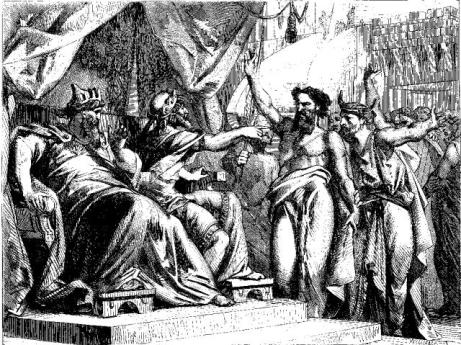
And Jehoshaphat said to the king of Israel, “Inquire first for the word of the Lord.” Then the king of Israel gathered the prophets together, about four hundred men, and said to them, “Shall I go to battle against Ramoth-gilead, or shall I refrain?” And they said, “Go up, for the Lord will give it into the hand of the king.” But Jehoshaphat said, “Is there not here another prophet of the Lord of whom we may inquire?” And the king of Israel said to Jehoshaphat, “There is yet one man by whom we may inquire of the Lord, Micaiah the son of Imlah, but I hate him, for he never prophesies good concerning me, but evil.” And Jehoshaphat said, “Let not the king say so.” Then the king of Israel summoned an officer and said, “Bring quickly Micaiah the son of Imlah.” 10 Now the king of Israel and Jehoshaphat the king of Judah were sitting on their thrones, arrayed in their robes, at the threshing floor at the entrance of the gate of Samaria, and all the prophets were prophesying before them. 11 And Zedekiah the son of Chenaanah made for himself horns of iron and said, “Thus says the Lord, ‘With these you shall push the Syrians until they are destroyed.’” 12 And all the prophets prophesied so and said, “Go up to Ramoth-gilead and triumph; the Lord will give it into the hand of the king.”

13 And the messenger who went to summon Micaiah said to him, “Behold, the words of the prophets with one accord are favorable to the king. Let your word be like the word of one of them, and speak favorably.” 14 But Micaiah said, “As the Lord lives, what the Lord says to me, that I will speak.” 1 Kings 22:1-14 ESV

King Ahab had been placed under a curse from God for having spared the life of Ben-hadad, the king of Syria. Rather than obey God’s command to put his enemy to death, Ahab had chosen to sign a peace treaty with him that would allow Israel to profit from Syria’s lucrative trading business. Yet, despite the judgment leveled against him by God, Ahab’s decision seems to have produced positive results.

The treaty that Ahab had brokered produced three years of peace and prosperity between the two nations. Israel and Syria had become allies and trading partners. According to an inscription on an Assyrian tablet discovered in 1861, Ahab and Ben-hadad had been part of a 12-nation confederation that faced Emperor Shalmaneser and the Assyrians in the battle of Qarqar in 853 BC. So, while God had decreed that Ahab’s dynasty would come to an end with his death, the king of Israel continued to enjoy a small measure of success. And his insatiable desire for glory and self-aggrandizement would eventually drive him to jeopardize his peaceful and prosperous relationship with Syria.

During the time in which Ahab had been on the throne of Israel, Jehoshaphat had become the king of Judah. He had succeeded his father, Asa. And according to the book of 2 Chronicles, Jehoshaphat had proven to be a good king.

The Lord was with Jehoshaphat, because he walked in the earlier ways of his father David. He did not seek the Baals, but sought the God of his father and walked in his commandments, and not according to the practices of Israel. Therefore the Lord established the kingdom in his hand. And all Judah brought tribute to Jehoshaphat, and he had great riches and honor. His heart was courageous in the ways of the Lord. And furthermore, he took the high places and the Asherim out of Judah. – 2 Chronicles 17:3-6 ESV

Because Jehoshaphat chose to remove all the false gods and restore the worship of the one true God, his reign was blessed, and the southern kingdom of Judah became a powerful force in the region. But Jehoshaphat, like his father before him, made the mistake of placing his trust in the Syrians. When King Baasha of Israel had begun to build a fortified city on the border between Israel and Judah, King Asa had sought the help of Ben-hadad and the Syrians. Asa “took silver and gold from the treasures of the house of the Lord and the king’s house and sent them to Ben-hadad king of Syria” (2 Chronicles 16:2 ESV). He used these funds to convince Ben-hadad to break his covenant with Israel and join forces with him. His ploy worked, and Baasha stopped construction on his military outpost. But God condemned Asa for his alliance with Ben-hadad, warning that Judah would face non-stop war during the rest of his reign. Rather than trust God, Asa had placed his hope in a foreign king who worshiped false gods.

And while his son Jehoshaphat would prove to be faithful to God, he would also make an alliance with an ungodly, idol-worshiping king.

Now Jehoshaphat had great riches and honor, and he made a marriage alliance with Ahab. After some years he went down to Ahab in Samaria. And Ahab killed an abundance of sheep and oxen for him and for the people who were with him, and induced him to go up against Ramoth-gilead. – 2 Chronicles 18:1-2 ESV

This marital alliance ended up putting Jehoshaphat in an awkward situation. While visiting Israel’s capital city of Samaria, Jehoshaphat was presented with an official request from Ahab for military assistance in recapturing the city of Ramoth-gilead from the Syrians. It galled Ahab that the Syrians had stolen a city that had once belonged to Israel, and nothing had been done about it.

“Do you know that Ramoth-gilead belongs to us, and we keep quiet and do not take it out of the hand of the king of Syria?” – 1 Kings 22:3 ESV

So, he called on Jehoshaphat to help him right this apparent wrong. And Jehoshaphat quickly and readily agreed.

“I am as you are, my people as your people, my horses as your horses.” – 1 Kings 22:4 ESV

But Jehoshaphat, anxious to remain obedient to God, asked Ahab to seek the Lord’s counsel. And it’s important to understand that Jehoshaphat wanted to know what the “Lord” (Yahweh) would have them do. But when Ahab commissioned his 400 prophets to seek the will of the gods, they came back with the answer:

“Go up, for the Lord (ăḏōnāy) will give it into the hand of the king.” – 1 Kings 22:6 ESV

These men do not mention the name of Yahweh, and Jehoshaphat seems to have immediately recognized that these were false prophets who had been seeking the will of their false god. So, he asked Ahab if there were no prophets of the one true God left in Israel. And Ahab confessed that there was one, a man named Micaiah, who he hated with a passion.

“He never prophesies anything but trouble for me!” – 1 Kings 22:8 NLT

Micaiah never told Ahab what he wanted to hear, so the king avoided him like the plague. But Jehoshaphat insisted that Micaiah be consulted before any action was taken against the Syrians.  So, reluctantly, Ahab sent someone to fetch his least-favorite prophet. In the meantime, his 400 false prophets bombarded Jehoshaphat with their cheery predictions of success.

“Go up to Ramoth-gilead and triumph; the Lord will give it into the hand of the king.” – 1 Kings 22:12 ESV

We’re not told how long it took for Micaiah to be located and brought to Samaria. But during the delay, Jehoshaphat found himself pressured to listen to the false prophets and throw in his lot with Ahab. The temptation to compromise his convictions was great. He could have easily given in and listened to the popular opinions of the crowd, but instead, Jehoshaphat waited to hear a word from Yahweh.

Even Micaiah found himself pressured to follow the party line. The messenger who located him delivered a not-so-subtle warning that there was only one answer King Ahab wanted to hear.

“Look, all the prophets are promising victory for the king. Be sure that you agree with them and promise success.” – 1 Kings 22: 13 NLT

But Micaiah would not be bullied into submission. He knew how much Ahab hated him, and he would be risking his life to disobey a direct order from the king. But his allegiance to Yahweh was greater than his fear of Ahab. So, he told the messenger, “As surely as the Lord lives, I will say only what the Lord tells me to say” (1 Kings 22:14 NLT).

That must have been a long and awkward trip back to Samaria for the messenger. He probably feared for his own life because he knew the prophet would give the king bad news. Everyone who worked for Ahab and all the people who lived in Israel knew that their king had no love affair with Yahweh. He had spent his entire reign promoting the worship of false gods like Baal and Asherah. And he had done everything he could do to ignore and even eliminate the prophets of God. Ahab knew exactly what Micaiah was going to say when he showed up, and it would not be what he wanted to hear. Ahab needed Jehoshaphat’s help, and he knew that Jehoshaphat’s God would stand opposed to his ambitious plans to recapture Ramoth-gilead. Ahab didn’t want to hear from God because he was not willing to do the will of God.

English Standard Version (ESV) The Holy Bible, English Standard Version. ESV® Permanent Text Edition® (2016). Copyright © 2001 by Crossway Bibles, a publishing ministry of Good News Publishers.

New Living Translation (NLT) Holy Bible, New Living Translation, copyright © 1996, 2004, 2015 by Tyndale House Foundation. Used by permission of Tyndale House Publishers Inc., Carol Stream, Illinois 60188. All rights reserved.
The Message (MSG)Copyright © 1993, 1994, 1995, 1996, 2000, 2001, 2002 by Eugene H. Peterson