The LORD Reigns Over All

20 Then Isaiah the son of Amoz sent to Hezekiah, saying, “Thus says the LORD, the God of Israel: Your prayer to me about Sennacherib king of Assyria I have heard. 21 This is the word that the LORD has spoken concerning him:

“She despises you, she scorns you—
    the virgin daughter of Zion;
she wags her head behind you—
    the daughter of Jerusalem.

22 “Whom have you mocked and reviled?
    Against whom have you raised your voice
and lifted your eyes to the heights?
    Against the Holy One of Israel!
23 By your messengers you have mocked the LORD,
    and you have said, ‘With my many chariots
I have gone up the heights of the mountains,
    to the far recesses of Lebanon;
I felled its tallest cedars,
    its choicest cypresses;
I entered its farthest lodging place,
    its most fruitful forest.
24 I dug wells
    and drank foreign waters,
and I dried up with the sole of my foot
    all the streams of Egypt.’

25 “Have you not heard
    that I determined it long ago?
I planned from days of old
    what now I bring to pass,
that you should turn fortified cities
    into heaps of ruins,
26 while their inhabitants, shorn of strength,
    are dismayed and confounded,
and have become like plants of the field
    and like tender grass,
like grass on the housetops,
    blighted before it is grown.

27 “But I know your sitting down
    and your going out and coming in,
    and your raging against me.
28 Because you have raged against me
    and your complacency has come into my ears,
I will put my hook in your nose
    and my bit in your mouth,
and I will turn you back on the way
    by which you came.

29 “And this shall be the sign for you: this year eat what grows of itself, and in the second year what springs of the same. Then in the third year sow and reap and plant vineyards, and eat their fruit. 30 And the surviving remnant of the house of Judah shall again take root downward and bear fruit upward. 31 For out of Jerusalem shall go a remnant, and out of Mount Zion a band of survivors. The zeal of the LORD will do this.

32 “Therefore thus says the LORD concerning the king of Assyria: He shall not come into this city or shoot an arrow there, or come before it with a shield or cast up a siege mound against it. 33 By the way that he came, by the same he shall return, and he shall not come into this city, declares the LORD. 34 For I will defend this city to save it, for my own sake and for the sake of my servant David.”

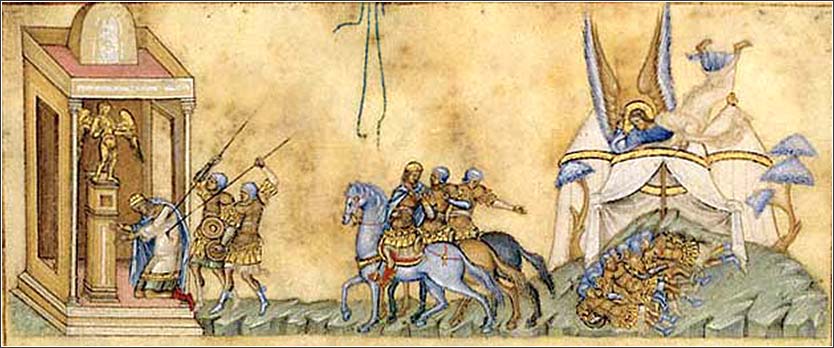
35 And that night the angel of the LORD went out and struck down 185,000 in the camp of the Assyrians. And when people arose early in the morning, behold, these were all dead bodies. 36 Then Sennacherib king of Assyria departed and went home and lived at Nineveh. 37 And as he was worshiping in the house of Nisroch his god, Adrammelech and Sharezer, his sons, struck him down with the sword and escaped into the land of Ararat. And Esarhaddon his son reigned in his place. 2 Kings 19:20-37 ESV

This is essentially the story of three kings. First, there is King Sennacherib, the sovereign ruler over the rapidly expanding Assyrian empire. He is the commander-in-chief of one of the most powerful armies on earth, and his ambitious plans for global conquest have met with little to no resistance. Kingdom after kingdom has fallen before his army, and now he has his sights set on the nation of Judah, where Hezekiah, the second king in our story, rules from his throne in Jerusalem. But King Hezekiah finds himself in the unenviable position of ruling over a city under siege. His capital city is surrounded by the Assyrian army, and he has been given an ultimatum to surrender or face annihilation.

Two kings. One is dressed in his royal robes and reveling in the indisputable reality of his own success. The other has discarded his regal attire for sackcloth and ashes, the garments of mourning. Sennacherib is a confident and self-assured king who sees no end to his plans for global conquest and domination. He is unstoppable, and it would appear that Hezekiah agrees with that assessment because he has turned to Yahweh for help. With his city completely surrounded and his allies nowhere to be seen, Hezekiah has called on the God of Judah to come to their aid.

“O LORD, God of Israel, you are enthroned between the mighty cherubim! You alone are God of all the kingdoms of the earth. You alone created the heavens and the earth. Bend down, O LORD, and listen! Open your eyes, O LORD, and see! Listen to Sennacherib’s words of defiance against the living God.” – 2 Kings 19:15-16 NLT

This penitent petition engages the attention of the third king in our story.  From His royal throne room in heaven, Yahweh heard the humble and contrite prayer of the king of Judah and immediately responded with an answer. The sovereign King of kings, who rules over all the kingdoms of the earth, sent a message to Hezekiah through His prophet Isaiah.

But this message, while delivered to King Hezekiah, was really directed at Sennacherib. Yahweh, the indisputable King of the universe, had a few choice words for the pompous and prideful potentate of Assyria. He warns the over-confident, land-grabbing king that his plans for Judah’s conquest will fail.

“The virgin daughter of Zion
    despises you and laughs at you.
The daughter of Jerusalem
    shakes her head in derision as you flee. – 2 Kings 19:21 NLT

Despite Sennacherib’s boastful claims, Jerusalem will remain pure and undefiled, her walls unbreached, and her population spared the indignities of conquest or capture. Yahweh wanted Sennacherib to know that the day was coming when the citizens of Jerusalem would rejoice and celebrate as the Assyrians abandoned their siege and disappeared over the horizon.

Sennacherib had made the fateful mistake of mocking the wrong deity, and Yahweh let him know that his derisive and disrespectful words were going to cost him. He had offended the Holy One of Israel and would soon suffer the consequences for his error. But first, God points out Sennacherib’s primary problem: His pride.

“By your messengers you have defied the LORD.
    You have said, ‘With my many chariots
I have conquered the highest mountains—
    yes, the remotest peaks of Lebanon.
I have cut down its tallest cedars
    and its finest cypress trees.
I have reached its farthest corners
    and explored its deepest forests.
I have dug wells in many foreign lands
    and refreshed myself with their water.
With the sole of my foot
    I stopped up all the rivers of Egypt!’” – 2 Kings 19:23-24 NLT

Sennacherib suffered from a terminal “I” condition. His unbridled success had gone to his head, and he had begun to believe that he was invincible and, in a sense, divine. By his own boastful admission, Sennacherib claimed that the kings of Assyria had defeated the gods of all their enemies.

“Have the gods of other nations rescued them—such nations as Gozan, Haran, Rezeph, and the people of Eden who were in Tel-assar? My predecessors destroyed them all! What happened to the king of Hamath and the king of Arpad? What happened to the kings of Sepharvaim, Hena, and Ivvah?” – 2 Kings 19:12-13 NLT

And he was convinced that Yahweh, the God of Judah, would fare no better than any of the other gods. But Sennacherib failed to understand that Yahweh was the sovereign ruler over all the nations of the world. The Assyrians’ rise to global dominance had been a part of God’s preordained plan. They were nothing more than instruments in His hands and actors in His divine drama that will one day culminate with the redemption and restoration of all creation.

Yahweh let Sennacherib know that he had no right to boast or brag; he could take no credit for any of his success. It had all been according to the sovereign will of the King of the universe. Although Sennacherib was a pagan and not a citizen of the chosen nation of Israel, God was sovereignly directing this unbeliever’s life to accomplish His divine will.

“I decided this long ago.
Long ago I planned it,
    and now I am making it happen.
I planned for you to crush fortified cities
    into heaps of rubble.
That is why their people have so little power
    and are so frightened and confused.
They are as weak as grass,
    as easily trampled as tender green shoots.
They are like grass sprouting on a housetop,
    scorched before it can grow lush and tall.” – 2 Kings 19:25-26 NLT

This message, while directed at Sennacherib, was meant to encourage Hezekiah. It was intended as a well-timed reminder to the king of Judah that his God was sovereign over all things. Regardless of the circumstances of life, the people of God could and should rest in the fact that their God reigns. Centuries later, when the nation of Judah fell to the Babylonians and a remnant of the people found themselves living in exile, the prophet Daniel expressed his firm belief in Yahweh’s sovereignty over all the affairs of human life.

“…the Most High rules over the kingdoms of the world. He gives them to anyone he chooses— even to the lowliest of people.” – Daniel 4:17 NLT

The psalmists shared Daniel’s optimistic and faith-filled perspective.

The LORD has established his throne in the heavens, and his kingdom rules over all.
 – Psalm 103:19 ESV

For the LORD Most High is awesome. He is the great King of all the earth. – Psalm 47:2 NLT

God reigns above the nations, sitting on his holy throne. – Psalm 47:8 NLT

For all the kings of the earth belong to God. – Psalm 47:9 NLT

The LORD reigns, let the earth rejoice; let the many coastlands be glad! – Psalm 97:1 ESV

The LORD reigns; let the peoples tremble! He sits enthroned upon the cherubim; let the earth quake! – Psalm 99:1 ESV

Yahweh wanted Hezekiah and Sennacherib to understand that they had nothing to do with their positions or power. Their very existence was God-ordained and orchestrated down to the last detail. Their kingdoms and crowns were fully attributable to God, and He had the divine right to remove them from power should He so choose, which is exactly what He warned Sennacherib was going to happen.

“I will put my hook in your nose
    and my bit in your mouth.
I will make you return
    by the same road on which you came.” – 2 Kings 19:28 NLT

Man’s plans must always give way to God’s sovereign will.

Many are the plans in the mind of a man, but it is the purpose of the LORD that will stand. – Proverbs 19:21 ESV

Sennacherib had ambitious plans for global dominance, but he would soon find that God’s plan superseded his own. And the King of the universe assured Hezekiah that He would protect Jerusalem and continue to provide for all their needs. Sennacherib and his forces would remain a threat for three more years, but God made it clear that “his armies will not enter Jerusalem. They will not even shoot an arrow at it” (2 Kings 19:32 NLT).

As a sign that He was in full control of the situation, God sent an angel who slaughtered 185,000 Assyrian soldiers in a single night. The next morning, the citizens of Jerusalem woke up to find the land outside the walls covered in corpses, but the rest of the Assyrian army was nowhere to be seen. The King of kings had displayed His sovereign power by sending a single angel to wreak havoc among the Assyrians.

When Sennacherib returned home, his days of glory and conquest came to an abrupt and ignominious end; he was assassinated by two of his own sons. As a further sign of Yahweh’s sovereignty and singularity as the King of kings, Sennacherib’s less-than-glorious death took place in the temple of his god.

The circumstances surrounding Sennacherib’s demise should not go unnoticed. As the vainglorious king of Assyria was safely ensconced in his capital and worshiping in the temple of his false god, the one true King chose to demonstrate His sovereign power over all the kingdoms of the earth. The Holy One of Israel proved yet again that He is “the great King of all the earth” (Psalm 47:2 NLT).

English Standard Version (ESV) The Holy Bible, English Standard Version. ESV® Permanent Text Edition® (2016). Copyright © 2001 by Crossway Bibles, a publishing ministry of Good News Publishers.

New Living Translation (NLT) Holy Bible, New Living Translation, copyright © 1996, 2004, 2015 by Tyndale House Foundation. Used by permission of Tyndale House Publishers Inc., Carol Stream, Illinois 60188. All rights reserved.

Anyone Can Play God

26 Then Eliakim the son of Hilkiah, and Shebnah, and Joah, said to the Rabshakeh, “Please speak to your servants in Aramaic, for we understand it. Do not speak to us in the language of Judah within the hearing of the people who are on the wall.” 27 But the Rabshakeh said to them, “Has my master sent me to speak these words to your master and to you, and not to the men sitting on the wall, who are doomed with you to eat their own dung and to drink their own urine?”

28 Then the Rabshakeh stood and called out in a loud voice in the language of Judah: “Hear the word of the great king, the king of Assyria! 29 Thus says the king: ‘Do not let Hezekiah deceive you, for he will not be able to deliver you out of my hand. 30 Do not let Hezekiah make you trust in the LORD by saying, The LORD will surely deliver us, and this city will not be given into the hand of the king of Assyria.’ 31 Do not listen to Hezekiah, for thus says the king of Assyria: ‘Make your peace with me and come out to me. Then each one of you will eat of his own vine, and each one of his own fig tree, and each one of you will drink the water of his own cistern, 32 until I come and take you away to a land like your own land, a land of grain and wine, a land of bread and vineyards, a land of olive trees and honey, that you may live, and not die. And do not listen to Hezekiah when he misleads you by saying, “The LORD will deliver us.” 33 Has any of the gods of the nations ever delivered his land out of the hand of the king of Assyria? 34 Where are the gods of Hamath and Arpad? Where are the gods of Sepharvaim, Hena, and Ivvah? Have they delivered Samaria out of my hand? 35 Who among all the gods of the lands have delivered their lands out of my hand, that the LORD should deliver Jerusalem out of my hand?’”

36 But the people were silent and answered him not a word, for the king’s command was, “Do not answer him.” 37 Then Eliakim the son of Hilkiah, who was over the household, and Shebna the secretary, and Joah the son of Asaph, the recorder, came to Hezekiah with their clothes torn and told him the words of the Rabshakeh. 2 Kings 18:26-37 ESV

This entire scene is filled with a sense of nervous anticipation. The people of Judah are lining the eastern walls of the city, overlooking the Kidron Valley, where the Assyrian army lies spread out before them in numbers too great to count. But their eyes are locked on the three emissaries whom King Hezekiah commissioned to discuss the terms of peace with the Assyrians. Eliakim, Shebnah, and Joah hold the fate of the nation in their hands, and the people know that the negotiating skills of these three men will determine whether Judah stands or falls. So, all eyes are fixed on the momentous scene taking place at the base of the walls of the city.

But the Rabshakeh, or supreme commander of the Assyrian army, is not interested in peace negotiations; he has come to demand the unconditional surrender of the city and its inhabitants. He and his troops have repeatedly proven their superior strength, and he is confident that the city of Jerusalem will be one more domino to fall as they continue their conquest of Palestine. Speaking on behalf of his commander-in-chief, the Rabshakeh declares Hezekiah’s rebellion to be ill-conceived and ill-fated.

“This is what the great king of Assyria says: What are you trusting in that makes you so confident? Do you think that mere words can substitute for military skill and strength? Who are you counting on, that you have rebelled against me? – 2 Kings 18:19-20 NLT

With the citizens of Jerusalem looking on and listening in, this arrogant military commander summarily dismisses any likelihood that the Egyptians will come to the aid of the city. The last-minute military alliance that King Hezekiah made with Pharaoh will prove disappointingly insufficient. The Rabshakeh sarcastically compares Pharaoh to a cane or walking stick made from a reed. It may appear to give support, but it will shatter as soon as any weight is placed upon it.

Then the overly confident Assyrian commander informs the Jewish emissaries that if they are holding out hope that Yahweh will come to their rescue, they will be sorely disappointed. Their deity will join a long list of other gods who proved unsuccessful in stopping the Assyrian juggernaut. And, hoping to further undermine their faith in divine rescue, the Rabshakeh announces to the people of Judah that Yahweh had ordered their destruction.

“What’s more, do you think we have invaded your land without the LORD’s direction? The LORD himself told us, ‘Attack this land and destroy it!’”  2 Kings 18:25 NLT

Eliakim, Shebna, and Joah could sense that all this boastful rhetoric was having its intended effect. The Rabshakeh had purposefully delivered his message in Hebrew so that all the people on the wall could hear what he had to say, and they were growing increasingly more concerned. When the king’s three emissaries asked that the conversation be switched to Aramaic, the Rabshakeh refused and called out in a loud voice, “Do you think my master sent this message only to you and your master? He wants all the people to hear it, for when we put this city under siege, they will suffer along with you. They will be so hungry and thirsty that they will eat their own dung and drink their own urine” (2 Kings 18:27 NLT).

At this point, the Rabshakeh turns his attention to the people on the walls of the city. He begins to sow seeds of doubt and suspicion by raising questions concerning King Hezekiah’s intentions and trustworthiness. By addressing the people directly, the Rabshakeh hopes to foment an uprising within the walls of the city, inciting the citizens to turn on their king and demand that he spare their lives by surrendering to the Assyrians. And to help sweeten the pot, the Rabshakeh offers them tempting promises of peace and prosperity.

“Don’t listen to Hezekiah! These are the terms the king of Assyria is offering: Make peace with me—open the gates and come out. Then each of you can continue eating from your own grapevine and fig tree and drinking from your own well. Then I will arrange to take you to another land like this one—a land of grain and new wine, bread and vineyards, olive groves and honey. Choose life instead of death! – 2 Kings 18:31-32 NLT

Look closely at what the Assyrian king is offering the people of Judah. Essentially, this pagan king is putting himself in the place of Yahweh, promising to provide for all their needs. If they will only surrender, he will end the siege and supply them with ample food and drink. He offers them fresh water and offers to take them to “a land of grain and new wine, bread and vineyards, olive groves and honey.” That should sound familiar. When God had commissioned Moses to rescue the people of Israel from their captivity in Egypt, He promised to lead them to a “fertile and spacious land…a land flowing with milk and honey” (Exodus 3:8 NLT). And after God had successfully freed them from their captivity and led them to the land of Canaan, He reminded them again of His promise to give them “a good land of flowing streams and pools of water, with fountains and springs that gush out in the valleys and hills. It is a land of wheat and barley; of grapevines, fig trees, and pomegranates; of olive oil and honey. It is a land where food is plentiful and nothing is lacking” (Deuteronomy 8:7-9 NLT).

Now, centuries later, the pagan king of Assyria offers to replicate what God had done for His chosen people. If they would only turn their backs on Yahweh and trust in King Sennacherib, he would provide for all their needs and take them to a new “promised land.”

Sennacherib was placing himself in the role of Yahweh, declaring himself to be the source of life and death. By placing their trust in him, they would be assured of peace, prosperity, and life. But centuries earlier, Moses had delivered a much different message to the people of Israel. As they stood on the banks of the Jordan River, preparing to enter the land of promise for the very first time, he  warned them:

“Today I have given you the choice between life and death, between blessings and curses. Now I call on heaven and earth to witness the choice you make. Oh, that you would choose life, so that you and your descendants might live! You can make this choice by loving the LORD your God, obeying him, and committing yourself firmly to him. This is the key to your life. And if you love and obey the LORD, you will live long in the land the LORD swore to give your ancestors Abraham, Isaac, and Jacob.” – Deuteronomy 30:19-20 NLT

Sennacherib was playing god. This over-confident king with an overactive ego dared to place himself on equal standing with God Almighty. With his promise-filled rhetoric, he hoped to persuade the people of Judah to abandon their hope and trust in Yahweh by offering them a “better” promised land.

This scene is reminiscent of one that took place in the wilderness centuries later. After being baptized by John in the Jordan River, “Jesus was led by the Spirit into the wilderness to be tempted there by the devil. For forty days and forty nights he fasted and became very hungry” (Matthew 4:1-2 NLT). In his famished state, Jesus found Himself accosted by the enemy, who repeatedly tried to persuade Him to turn His back on God.

“If you are the Son of God, tell these stones to become loaves of bread.” – Matthew 4:3 NLT

Satan tempted Jesus to satiate His hunger by rejecting the will of His Heavenly Father and displaying His divine powers for purely selfish reasons. But Jesus refused to allow His temporary physical needs to distract Him from doing His Father’s will. He would later tell His disciples, “My nourishment comes from doing the will of God, who sent me, and from finishing his work” (John 4:34 NLT).

Next, Satan took Jesus “to the highest point of the Temple, and said, ‘If you are the Son of God, jump off! For the Scriptures say, “He will order his angels to protect you. And they will hold you up with their hands so you won’t even hurt your foot on a stone.”’” (Matthew 4:5-6 NLT). Once again, Satan tempted Jesus to circumvent His Father’s will for His life. Jesus had not taken on human flesh so He could put on a dramatic display of His Father’s power and His own self-importance. As He later told His disciples, “the Son of Man came not to be served but to serve others and to give his life as a ransom for many” (Matthew 20:28 NLT). Satan was offering Jesus a substitute source of self-glorification that God had not sanctioned, which led Jesus to respond, “You must not test the Lord your God” (Matthew 4:7 NLT).

Finally, Satan reached into his demonic bag of tricks and pulled out one final temptation. This one was in the form of a promise, much like the one that Sennacherib made to the people of Judah. Having taken Jesus to the peak of a nearby mountain, Satan “showed him all the kingdoms of the world and their glory” (Matthew 4:8 NLT). Then Satan made an offer that he believed Jesus would find impossible to turn down.

“I will give it all to you,” he said, “if you will kneel down and worship me.” – Matthew 4:9 NLT

Satan promised Jesus all the kingdoms of the world in exchange for His worship. But Satan failed to understand that those nations were not his to give because they already belonged to Jesus. The apostle Paul declared Jesus’ right of ownership based on His role as the Creator God.

…for through him God created everything in the heavenly realms and on earth. He made the things we can see and the things we can’t see— such as thrones, kingdoms, rulers, and authorities in the unseen world. Everything was created through him and for him. – Colossians 1:16 NLT

Satan was making promises he couldn’t keep and offering gifts that were not his to give, much like Sennacherib. This egotistical monarch boldly declared his god-like capacity to supply all their needs in exchange for their subjugation and obeisance.

But while the people on the wall were disturbed by what they heard, they obeyed King Hezekiah’s command and remained silent. The three emissaries, their clothes torn as a sign of mourning, returned to the king and reported all that they had heard. It was a dark day in Judah. The enemy was at the gate, and the allies of Judah were nowhere to be found. But despite the boasts of the Rabshakeh, the God of Judah was still on His throne and in complete control of all that was happening. He alone held the power of life and death in His hands, and King Sennacherib and his overconfident military commander were about to discover that they were no match for the all-powerful God of Judah.

English Standard Version (ESV) The Holy Bible, English Standard Version. ESV® Permanent Text Edition® (2016). Copyright © 2001 by Crossway Bibles, a publishing ministry of Good News Publishers.

New Living Translation (NLT) Holy Bible, New Living Translation, copyright © 1996, 2004, 2015 by Tyndale House Foundation. Used by permission of Tyndale House Publishers Inc., Carol Stream, Illinois 60188. All rights reserved.

Stubborn to the End

Now the rest of the deeds of Jehoiakim and all that he did, are they not written in the Book of the Chronicles of the Kings of Judah? So Jehoiakim slept with his fathers, and Jehoiachin his son reigned in his place. And the king of Egypt did not come again out of his land, for the king of Babylon had taken all that belonged to the king of Egypt from the Brook of Egypt to the river Euphrates.

Jehoiachin was eighteen years old when he became king, and he reigned three months in Jerusalem. His mother’s name was Nehushta the daughter of Elnathan of Jerusalem. And he did what was evil in the sight of the Lord, according to all that his father had done.

10 At that time the servants of Nebuchadnezzar king of Babylon came up to Jerusalem, and the city was besieged. 11 And Nebuchadnezzar king of Babylon came to the city while his servants were besieging it, 12 and Jehoiachin the king of Judah gave himself up to the king of Babylon, himself and his mother and his servants and his officials and his palace officials. The king of Babylon took him prisoner in the eighth year of his reign 13 and carried off all the treasures of the house of the Lord and the treasures of the king’s house, and cut in pieces all the vessels of gold in the temple of the Lord, which Solomon king of Israel had made, as the Lord had foretold. 14 He carried away all Jerusalem and all the officials and all the mighty men of valor, 10,000 captives, and all the craftsmen and the smiths. None remained, except the poorest people of the land. 15 And he carried away Jehoiachin to Babylon. The king’s mother, the king’s wives, his officials, and the chief men of the land he took into captivity from Jerusalem to Babylon. 16 And the king of Babylon brought captive to Babylon all the men of valor, 7,000, and the craftsmen and the metal workers, 1,000, all of them strong and fit for war. 17 And the king of Babylon made Mattaniah, Jehoiachin’s uncle, king in his place, and changed his name to Zedekiah.

18 Zedekiah was twenty-one years old when he became king, and he reigned eleven years in Jerusalem. His mother’s name was Hamutal the daughter of Jeremiah of Libnah. 19 And he did what was evil in the sight of the Lord, according to all that Jehoiakim had done. 20 For because of the anger of the Lord it came to the point in Jerusalem and Judah that he cast them out from his presence.

And Zedekiah rebelled against the king of Babylon. – 2 Kings 24:5-20 ESV

Eliakim was the second son of Joash to sit on the throne of Judah. The reign of his younger brother, Jehoahaz, had only lasted three months before he was deposed and taken captive by Neco, the king of Egypt. He became the puppet-king of the Egyptians, forced to pay an exorbitant annual tribute to secure his throne. He even faced the indignity of having his name changed to Jehoiakim. But the time came when his Egyptian overlords were displaced by the new kid on the block – the Babylonians. The army of King Nebuchadnezzar defeated the combined forces of the Assyrians and Egyptians at the Battle of Carchemish in 605 BC. This decisive victory dramatically altered the political landscape of the Middle East and set the stage for Judah’s eventual fall.

The fall of the Egyptians provided Jehoiakim with a brief reprieve, but it was not long before he found himself facing yet another Gentile superpower with aspirations of global dominance. Nebuchadnezzar eventually set his sights on Judah and for three years he forced Jehoiakim back into his familiar, yet unpleasant, role as a vassal. For eight years of his 11-year reign, Jehoiakim had served as the virtual slave of the Pharaoh. Now, after three more years of Babylonian oppression and control, he decided enough was enough and rebelled against King Nebuchadnezzar. But Jehoiakim failed to realize that this entire scenario was the handwork of God Almighty. Yahweh had sovereignly appointed the Babylonians to be His agents of judgment against the rebellious nation of Judah. So, when Jehoiakim rebelled against Nebuchadnezzar, he was really attempting to resist the will of God.

Then the Lord sent bands of Babylonian, Aramean, Moabite, and Ammonite raiders against Judah to destroy it, just as the Lord had promised through his prophets. These disasters happened to Judah because of the Lord’s command. He had decided to banish Judah from his presence because of the many sins of Manasseh… – 2 Kings 24:2-3 NLT

The fall of Judah was inevitable because God had ordained it, and there was nothing Jehoiakim could do to avoid or escape it. And eventually, God repaid Jehoiakim for his stubborn resistance to His will by allowing the Babylonians to capture the capital city of Jerusalem.

Then King Nebuchadnezzar of Babylon came to Jerusalem and captured it, and he bound Jehoiakim in bronze chains and led him away to Babylon. Nebuchadnezzar also took some of the treasures from the Temple of the Lord, and he placed them in his palace in Babylon. – 2 Chronicles 36:6-7 NLT

Jehoiakim, dethroned and disgraced, was replaced by his 18-year-old son, Jehoiachin. And just like his father and his uncle before him, “Jehoiachin did what was evil in the Lord’s sight” (2 Kings 24:9 NLT). Not only did Jehoiachin offend God by encouraging idolatry and apostasy, but he also attempted to resist the will of God by rebelling against the Babylonians whom God had sent. This forced Nebuchadnezzar to lay siege to the city of Jerusalem, which he eventually captured. With Jerusalem’s fall, Jehoiachin found himself without a capital city or a throne. He and the royal family were taken captive and deported to Babylon.

Then King Jehoiachin, along with the queen mother, his advisers, his commanders, and his officials, surrendered to the Babylonians. – 2 Kings 24:12 NLT

And none of this should have come as a shock to King Jehoiachin because God had warned that it would happen. He had repeatedly sent His prophets to deliver His message of pending destruction. But they would not listen. The prophet Jeremiah had given Jehoiachin’s father, Jehoiakim, a stark description of what God had planned for the nation of Judah.

“You made me furious by worshiping idols you made with your own hands, bringing on yourselves all the disasters you now suffer. And now the Lord of Heaven’s Armies says: Because you have not listened to me, I will gather together all the armies of the north under King Nebuchadnezzar of Babylon, whom I have appointed as my deputy. I will bring them all against this land and its people and against the surrounding nations. I will completely destroy you and make you an object of horror and contempt and a ruin forever. I will take away your happy singing and laughter. The joyful voices of bridegrooms and brides will no longer be heard. Your millstones will fall silent, and the lights in your homes will go out. This entire land will become a desolate wasteland. Israel and her neighboring lands will serve the king of Babylon for seventy years. – Jeremiah 25:7-11 NLT

And in the eighth year of Nebuchadnezzar’s reign, the prophecy of Jeremiah was fulfilled.

King Nebuchadnezzar took all of Jerusalem captive, including all the commanders and the best of the soldiers, craftsmen, and artisans—10,000 in all. Only the poorest people were left in the land. – 2 Kings 24:14 NLT

But this would prove to be just the beginning of the end. Over time, there would be far more people deported from the land of Judah to Babylon. Despite the fall of Jerusalem, the stubbornness of the people of Judah was not yet abated. Those who remained in the land still refused to bow their knees to Yahweh. And when Nebuchadnezzar placed Jehoiachin’s uncle, Mattaniah, on the throne, they seemed to assume that life would go on as usual. But when Nebuchadnezzar changed Mattaniah’s name to Zedekiah, the people should have realized that they were far from an independent nation. They were little more than slaves of a foreign power and, in time, many of them would find themselves joining their exiled brothers and sisters in Babylon.

The people had a new king and that king had a new name, but little else changed in the nation of Judah. They continued in their old rebellious ways, and Zedekiah proved to be just as evil as all those kings who had occupied the throne before him. And the author of 2 Kings makes it painfully clear that their persistent and pervasive rebellion had finally brought upon them the righteous wrath of God.

These things happened because of the Lord’s anger against the people of Jerusalem and Judah, until he finally banished them from his presence and sent them into exile. – 2 Kings 24:20 NLT

But even the judgment of God failed to get the attention of the king and his people. They remained stubbornly unrepentant and persistently unfaithful, right to the bitter end.

Zedekiah was a hard and stubborn man, refusing to turn to the Lord, the God of Israel. Likewise, all the leaders of the priests and the people became more and more unfaithful. They followed all the pagan practices of the surrounding nations, desecrating the Temple of the Lord that had been consecrated in Jerusalem. – 2 Chronicles 36:13-14 NLT

Zedekiah had been given ample warning but he had refused to listen. The prophet Jeremiah had specifically told him, “you must submit to Babylon’s king and serve him; put your neck under Babylon’s yoke! I will punish any nation that refuses to be his slave, says the Lord. I will send war, famine, and disease upon that nation until Babylon has conquered it” (Jeremiah 27:9 NLT). And then he had advised the king to submit to King Nebuchadnezzar as an agent of God Almighty.

“If you want to live, submit to the yoke of the king of Babylon and his people. Why do you insist on dying—you and your people? Why should you choose war, famine, and disease, which the Lord will bring against every nation that refuses to submit to Babylon’s king? Do not listen to the false prophets who keep telling you, ‘The king of Babylon will not conquer you.’ They are liars. This is what the Lord says: ‘I have not sent these prophets! They are telling you lies in my name, so I will drive you from this land. You will all die—you and all these prophets, too.’” – Jeremiah 27:12-15 NLT

But Zedekiah refused to heed the words of the prophet. And in the ninth year of his reign, the stubborn king of Judah would learn the painful lesson that resistance to the will of God never ends well.

English Standard Version (ESV) The Holy Bible, English Standard Version. ESV® Permanent Text Edition® (2016). Copyright © 2001 by Crossway Bibles, a publishing ministry of Good News Publishers.

New Living Translation (NLT) Holy Bible, New Living Translation, copyright © 1996, 2004, 2015 by Tyndale House Foundation. Used by permission of Tyndale House Publishers Inc., Carol Stream, Illinois 60188. All rights reserved.

The Message (MSG)Copyright © 1993, 1994, 1995, 1996, 2000, 2001, 2002 by Eugene H. Peterson