Don’t Worry About the Wicked

A psalm of David.

1 Fret not yourself because of evildoers;
    be not envious of wrongdoers!
For they will soon fade like the grass
    and wither like the green herb.

Trust in the LORD, and do good;
    dwell in the land and befriend faithfulness.
Delight yourself in the LORD,
    and he will give you the desires of your heart.

Commit your way to the LORD;
    trust in him, and he will act.
He will bring forth your righteousness as the light,
    and your justice as the noonday.

Be still before the LORD and wait patiently for him;
    fret not yourself over the one who prospers in his way,
    over the man who carries out evil devices!

Refrain from anger, and forsake wrath!
    Fret not yourself; it tends only to evil.
For the evildoers shall be cut off,
    but those who wait for the LORD shall inherit the land.

10 In just a little while, the wicked will be no more;
    though you look carefully at his place, he will not be there.
11 But the meek shall inherit the land
    and delight themselves in abundant peace.

12 The wicked plots against the righteous
    and gnashes his teeth at him,
13 but the LORD laughs at the wicked,
    for he sees that his day is coming.

14 The wicked draw the sword and bend their bows
    to bring down the poor and needy,
    to slay those whose way is upright;
15 their sword shall enter their own heart,
    and their bows shall be broken.

16 Better is the little that the righteous has
    than the abundance of many wicked.
17 For the arms of the wicked shall be broken,
    but the LORD upholds the righteous.

18 The LORD knows the days of the blameless,
    and their heritage will remain forever;
19 they are not put to shame in evil times;
    in the days of famine they have abundance.

20 But the wicked will perish;
    the enemies of the LORD are like the glory of the pastures;
    they vanish—like smoke they vanish away.

21 The wicked borrows but does not pay back,
    but the righteous is generous and gives;
22 for those blessed by the LORD shall inherit the land,
    but those cursed by him shall be cut off.

23 The steps of a man are established by the LORD,
    when he delights in his way;
24 though he fall, he shall not be cast headlong,
    for the LORD upholds his hand.

25 I have been young, and now am old,
    yet I have not seen the righteous forsaken
    or his children begging for bread.
26 He is ever lending generously,
    and his children become a blessing.

27 Turn away from evil and do good;
    so shall you dwell forever.
28 For the LORD loves justice;
    he will not forsake his saints.
They are preserved forever,
    but the children of the wicked shall be cut off.
29 The righteous shall inherit the land
    and dwell upon it forever.

30 The mouth of the righteous utters wisdom,
    and his tongue speaks justice.
31 The law of his God is in his heart;
    his steps do not slip.

32 The wicked watches for the righteous
    and seeks to put him to death.
33 The LORD will not abandon him to his power
    or let him be condemned when he is brought to trial.

34 Wait for the LORD and keep his way,
    and he will exalt you to inherit the land;
    you will look on when the wicked are cut off.

35 I have seen a wicked, ruthless man,
    spreading himself like a green laurel tree.
36 But he passed away, and behold, he was no more;
    though I sought him, he could not be found.

37 Mark the blameless and behold the upright,
    for there is a future for the man of peace.
38 But transgressors shall be altogether destroyed;
    the future of the wicked shall be cut off.

39 The salvation of the righteous is from the LORD;
    he is their stronghold in the time of trouble.
40 The LORD helps them and delivers them;
    he delivers them from the wicked and saves them,
    because they take refuge in him. Psalm 37:1-40 ESV

It’s hard not to worry about the wicked. They’re all around us. Many of them are in positions of power and influence in our country. Others are considered celebrities and stars. They write books, have their own TV shows, create music and art, and define what is in when it comes to everything from clothing to hairstyles. The wicked come in all shapes and sizes, and their wickedness is not always readily apparent or easily recognized. They seem to live lives marked by success, happiness, affluence, and popularity. So it’s sometimes easy to envy or desire to be like them. But David tells us not to worry about the wicked or to covent their lifestyles, because their days are numbered. Yet, we often find ourselves getting angry over the apparent lack of justice in a world where the wicked prosper while the righteous suffer.

Some of these people prosper despite lifestyles marked more by sin than anything else. David reminds us that “it is better to be godly and have little than to be evil and rich” (Psalm 37:16 NLT). To drive the point home, David provides a running contrast between the wicked and the godly. He paints a clear and memorable picture of the stark difference between these two lifestyles.

The wicked will soon fade.
But the godly will find shelter in Him
.

This life is temporal, and its rewards are fleeting and ephemeral. While the wicked may appear to enjoy the good life in this life, they face a future judgment. The righteous may suffer in this life, but they have the assurance of God’s presence, protection, and provision — right here, right now.

The wicked will soon wither.
But the godly will never slip from His path.

Things are not always what they seem. What appears to be prosperity and unbridled success is often accompanied by discontentment and dissatisfaction. Wealth and fame cannot immunize anyone from disease, disappointment, or death. The wicked can hide behind the temporal trappings of worldly success, but their sins will find them out (Numbers 32:33). Yet, the righteous will find security and safety in this life by faithfully following the ways of God.

The wicked will be destroyed.
But the godly will be rescued by God.

The wicked stand opposed to God, and He has a way of holding them accountable for their actions. Their present prosperity and seeming immunity from justice will not last. God will have the last word when it comes to their eternal judgment. In the meantime, the righteous must maintain their confidence in God and trust that His eternal reward is far greater than any temporal treasure or pleasure a life of wickedness may offer.

The wicked will disappear.
But the godly will trust in the Lord and do good.

Leave the fate of the wicked up to God. He knows what He is doing and is not fooled by the deceitful ways of those who ignore His will and reject His sovereignty. Their cleverness and covertness make them feel invincible, but their fate is sealed. Nothing is hidden from the eyes of God and no sin goes unpunished. So, rather than worry about the wicked, the righteous need to spend their time doing what pleases God.

The wicked will be gone.
But the godly will never fall.

The righteous must maintain an eternal perspective. This life is not all there is. We are eternal creatures who have a long future ahead of us. This present life is just a blink of the eye in God’s plan for His children’s prosperity. While there will be trials and tribulations in this life, the one to come will be free from sin, suffering, sorrow, and loss.

The wicked plot against the godly.
But God will take care of the godly because they are innocent.

This world is not always fair, and things don’t always turn out how we think they should. But God is in control at all times, and His ways are always just and righteous — even when circumstances paint a very different picture. Because we are finite creatures living in a temporal world, we can’t see the big picture. Present pain has a way of clouding our future perspective. But we must rest in knowing that God sees all and knows all. He has a firm grasp on what is going on in His world and has a flawless plan to mete out justice and reward the righteous — in His time.

The wicked snarl at them in defiance.
But God will expose the justice of the cause of the godly.

The prosperity of the wicked won’t last forever. It may appear that they get away with murder and escape any form of justice, but God is not done yet. We can’t see what He is doing behind the scenes, but we can know that He will leave no sin unpunished and no wicked individual free from His judgment.

The wicked draw their swords and string their bows.
But God is the fortress of the godly.

The wicked may appear to be powerful and unstoppable. Their string of victories over the righteous seems endless, but they are no match for Jehovah-Sabaoth, the LORD of Hosts. They may win their fair share of battles, but the war between the righteous and the wicked has already been decided.

The wicked kill the poor and oppressed.
But the godly live in peace and prosperity.

Despite all the injustice and inequities in this world, those who place their hope and faith in God can rest assured that He is with them and fights on their behalf. They are not alone and far from defenseless. Yes, evil exists, and atrocities happen, but that does not mean God is powerless or impotent. His ways are not our ways. His methodologies may confuse and confound us, but we must trust that He always knows what He is doing and His ways are always just, righteous, and good.

The wicked slaughter those who do right.
But the Lord directs the steps of the godly.

There are two opposing forces at work in the world. Satan, the prince of this world, has aligned himself against all that is good, righteous, and godly. He and his demonic minions stand in opposition to God and pour out their hatred on His children. The wicked of this world are in Satan’s grip and do his bidding, but their actions are limited by the sovereign power of God. As they do their worst, God is directing the steps of His people, guiding, protecting, and blessing them even as the enemy attempts to destroy them.

The strength of the wicked will be shattered.
But the godly will be taken care of by God.

Give God time. Let Him finish what He began and complete the plan of redemption He put in place before He laid the foundations of the world. Our victory is assured. The future is secure. God’s plan has an end, and the outcome has never been in question.

David continues his comparison between the wicked and the godly, pointing out the glaring differences between the two.

The wicked will die.
But the godly will possess the land.

The wicked will disappear like smoke.
But the godly will never be abandoned.

The wicked borrow and never repay.
But the godly give generous loans to others.

The children of the wicked will die.
But the children of the godly are a blessing.

The wicked wait in ambush for the godly.
But God will honor the godly by giving them the land.

The wicked look for an excuse to kill the godly.
But God teaches the godly right from wrong.

The wicked will not succeed.
But the godly will live safely in the land and prosper.

The wicked will be destroyed.
But a wonderful future awaits the godly.

The wicked will appear to flourish, then are gone.
But the godly will not be disgraced in hard times.

The wicked have no future.
But a wonderful future awaits the godly.

David wasn’t a glass-half-full, perpetual optimist who refused to acknowledge the disparities and difficulties of life. He was painfully aware of the presence of the wicked. He struggled with their apparent success and seeming immunity from judgment. But he trusted God and knew that justice would be served. The wicked would get what they deserved and the godly would be blessed — in time and according to God’s perfect plan.

As believers, we are to put our hope in God. We are to confidently and faithfully trust the path He has chosen for us to follow and not worry about what might appear to be the unfair advantages of the ungodly. God is just, and He will deal with them in His own way and time. I can leave them in God’s hands and concentrate on honoring Him with my life and trusting Him with my future. He will not let the wicked succeed or the godly be condemned. He has it all under control. So don’t worry.

Father, thanks for this timely reminder from the pen of David. The wicked have always been around and they have always given Your people cause for consternation and concern. They appear so happy and so together. They seem to be getting away with their lifestyle of open rebellion to You, but You are not done yet. You are a just and righteous God who will make sure that all things are taken care of rightly and justly. They will not escape Your notice or Your judgment. I can leave them in Your hands and rest in the knowledge that You have me securely in Your loving grasp as well. Amen

English Standard Version (ESV) The Holy Bible, English Standard Version. ESV® Permanent Text Edition® (2016). Copyright © 2001 by Crossway Bibles, a publishing ministry of Good News Publishers.

New Living Translation (NLT) Holy Bible, New Living Translation, copyright © 1996, 2004, 2015 by Tyndale House Foundation. Used by permission of Tyndale House Publishers Inc., Carol Stream, Illinois 60188. All rights reserved.
Wait, But Don’t Worry

1 Why, O Lord, do you stand far away?
    Why do you hide yourself in times of trouble?

In arrogance the wicked hotly pursue the poor;
    let them be caught in the schemes that they have devised.
For the wicked boasts of the desires of his soul,
    and the one greedy for gain curses and renounces the Lord.
In the pride of his face the wicked does not seek him;
    all his thoughts are, “There is no God.”
His ways prosper at all times;
    your judgments are on high, out of his sight;
    as for all his foes, he puffs at them.
He says in his heart, “I shall not be moved;
    throughout all generations I shall not meet adversity.”
His mouth is filled with cursing and deceit and oppression;
    under his tongue are mischief and iniquity.
He sits in ambush in the villages;
    in hiding places he murders the innocent.
His eyes stealthily watch for the helpless;
    he lurks in ambush like a lion in his thicket;
he lurks that he may seize the poor;
    he seizes the poor when he draws him into his net.
10 The helpless are crushed, sink down,
    and fall by his might.
11 He says in his heart, “God has forgotten,
    he has hidden his face, he will never see it.”

12 Arise, O Lord; O God, lift up your hand;
    forget not the afflicted.
13 Why does the wicked renounce God
    and say in his heart, “You will not call to account”?
14 But you do see, for you note mischief and vexation,
    that you may take it into your hands;
to you the helpless commits himself;
    you have been the helper of the fatherless.
15 Break the arm of the wicked and evildoer;
    call his wickedness to account till you find none.

16 The Lord is king forever and ever;
    the nations perish from his land.
17 O Lord, you hear the desire of the afflicted;
    you will strengthen their heart; you will incline your ear
18 to do justice to the fatherless and the oppressed,
    so that man who is of the earth may strike terror no more. Psalm 10:1-18 ESV

The unnamed author of this Psalm doesn’t begin by praising God but, instead, delivers an eloquent and heartfelt plea for justice. In a world filled with wickedness, it can sometimes appear that God is distant or disinterested in the plight of His children. This Psalm deals with the age-old issue of theodicy: If God is all-powerful and loving, why does He allow evil to exist? Theodicy questions God’s goodness and omnipotence in light of the existence of evil. In every generation, faithful followers of God have found themselves surrounded by unjust and ungodly individuals who seem to prosper and thrive while the godly suffer.  The world that God created is filled with injustice and inequities. Obedience to God’s laws is often met with fierce opposition. Remaining faithful to Yahweh in a sin-filled world is difficult enough, but the constant assaults of the wicked can make it feel impossible and raises questions about God’s goodness and justice.

The Psalmist begins with his own questions for God.

O Lord, why do you stand so far away?
    Why do you hide when I am in trouble? – Psalm 10:1 NLT

From his perspective, God appears nowhere to be found. Without providing any details surrounding his circumstances, the confused and troubled Psalmist wants to know why Yahweh has not intervened and done something about his predicament. Frustrated by his ongoing plight, he tries to bring God up to speed on the situation and, at the same time, give the Almighty some helpful advice on what to do about it.

The wicked arrogantly hunt down the poor.
    Let them be caught in the evil they plan for others.
For they brag about their evil desires;
    they praise the greedy and curse the Lord. – Psalm 10:2-3 NLT

His view of the wicked is far from flattering. He describes them as greedy, boastful, arrogant, and unabashedly opposed to God. These evil individuals are hostile to God’s people because they reject God’s presence and power. “They seem to think that God is dead” (Psalm 10:4 NLT). They share the viewpoint attributed to the fool in Psalm 14:1.

The fool says in his heart, “There is no God.” They are corrupt, they do abominable deeds; there is none who does good.

They live as if God doesn’t exist or simply doesn’t care.

The wicked think, “God isn’t watching us!
    He has closed his eyes and won’t even see what we do!” – Psalm 10:11 NLT

Yet, they prosper. This is the part that drives the Psalmist crazy. He can’t understand why God allows the wicked to get away with their blatant disobedience of His laws and arrogant dismissal of His power and justice. They treat God with flippant disregard and no fear of repercussions. David described these individuals in another Psalm.

Sin whispers to the wicked, deep within their hearts.
    They have no fear of God at all.
In their blind conceit,
    they cannot see how wicked they really are.
Everything they say is crooked and deceitful.
    They refuse to act wisely or do good.
They lie awake at night, hatching sinful plots.
    Their actions are never good.
    They make no attempt to turn from evil. – Psalm 34:1-4 NLT

Every child of God has had to wrestle with what appears to be the silence or apathy of God when it comes to wickedness. The ungodly get away with murder – literally. They sin against God and never seem to face any consequences for their actions. In fact, they seem to prosper in the process. From a human perspective, justice appears to go unserved. This raises another question: “Why do the wicked get away with despising God?” (Psalm 10:13 NLT).

If God is just, righteous, and all-powerful, why doesn’t He mete out justice in a more timely and equitable manner? His apparent delay in delivering well-deserved judgment to the wicked allows them to boast, “Nothing bad will ever happen to us! We will be free of trouble forever!” (Psalm 10:6 NLT). The lack of consequences fuels their conduct and gives them a sense of invincibility. Unscathed by their actions, they begin to view God as either indifferent or impotent.

“God isn’t watching us!
    He has closed his eyes and won’t even see what we do!” – Psalm 10:11 NLT

This mocking statement is meant to minimize God’s omnipotence and sovereignty. It is demeaning and dismissive, and portrays God as a doddering old man who lacks the power or interest to intervene in the affairs of men. That is what causes the Psalmist to cry out, “Arise, O Lord! Punish the wicked, O God! Do not ignore the helpless! (Psalm 10:12 NLT). Like an obnoxious-sounding alarm clock, the Psalmist issues a wake-up call to the Almighty, demanding His immediate intervention and remediation.

It’s clear that the Psalmist has confidence in God’s awareness of the problem and His ability to deal with it. He asserts, “You see the trouble and grief they cause. You take note of it and punish them. The helpless put their trust in you. You defend the orphans” (Psalm 10:14 NLT). It’s the delay that has him confused. His God is capable but, for some reason, has chosen not to act. So, he demands immediate and decisive actions.

Break the arms of these wicked, evil people!
    Go after them until the last one is destroyed. – Psalm 10:16 NLT

The Psalmist closes out his song by expressing his confidence in God’s justice. As the King, God has the authority and power to deal with the wicked and hold them to account.

…you know the hopes of the helpless.
    Surely you will hear their cries and comfort them.
You will bring justice to the orphans and the oppressed,
    so mere people can no longer terrify them. – Psalm 10:17-18 NLT

But the question remains. When will God bring justice? When will the wicked receive the payback they so richly deserve? The Psalmist wants instant karma that results in the immediate elimination of the wicked and the well-deserved vindication of the righteous. However, David provided a different perspective that requires patience and perseverance. It suggests taking a long-term approach to our short-term difficulties.

Don’t worry about the wicked
    or envy those who do wrong.
For like grass, they soon fade away.
    Like spring flowers, they soon wither.

Trust in the Lord and do good.
    Then you will live safely in the land and prosper.
Take delight in the Lord,
    and he will give you your heart’s desires.

Commit everything you do to the Lord.
    Trust him, and he will help you.
He will make your innocence radiate like the dawn,
    and the justice of your cause will shine like the noonday sun.

Be still in the presence of the Lord,
    and wait patiently for him to act.
Don’t worry about evil people who prosper
    or fret about their wicked schemes. – Psalm 37:1-7 NLT

God is in it for the long-haul. Unhindered by the confines of time or space, God knows how the story ends and remains unwavering in His confidence that justice will be served.

For the Lord loves justice,
    and he will never abandon the godly.

He will keep them safe forever,
    but the children of the wicked will die. – Psalm 37:8 NLT

It’s not a matter of if, but when. So, while we wait, we are to trust that justice will prevail — in God’s way and according to His impeccable timing.

Put your hope in the Lord.
    Travel steadily along his path.
He will honor you by giving you the land.
    You will see the wicked destroyed. – Psalm 10:34 NLT

English Standard Version (ESV) The Holy Bible, English Standard Version. ESV® Permanent Text Edition® (2016). Copyright © 2001 by Crossway Bibles, a publishing ministry of Good News Publishers.

New Living Translation (NLT) Holy Bible, New Living Translation, copyright © 1996, 2004, 2015 by Tyndale House Foundation. Used by permission of Tyndale House Publishers Inc., Carol Stream, Illinois 60188. All rights reserved.

Choose Your Way Wisely

1 Blessed is the man
    who walks not in the counsel of the wicked,
nor stands in the way of sinners,
    nor sits in the seat of scoffers;
but his delight is in the law of the Lord,
    and on his law he meditates day and night.

He is like a tree
    planted by streams of water
that yields its fruit in its season,
    and its leaf does not wither.
In all that he does, he prospers.
The wicked are not so,
    but are like chaff that the wind drives away.

Therefore the wicked will not stand in the judgment,
    nor sinners in the congregation of the righteous;
for the Lord knows the way of the righteous,
    but the way of the wicked will perish. Psalm 1:1-6 ESV

The Psalms are a collection of lyrical poems intended to be accompanied by stringed instruments when read. Written over a period of 1,000 years by a variety of different authors, the Psalms reflect Israel’s rich history and provide a backdrop to their relationship with God. The Psalms come in a range of styles, from laments to hymns of praise. Some are songs of thanksgiving, offering gratitude to God for His protection and provision. Others are “songs of ascent” to be sung by faithful Israelites as they made their way to Jerusalem for one of the three annual festivals prescribed in the Law of Moses. There are also psalms of wisdom, victory psalms, royal psalms praising Israel’s Messiah, and songs of Zion

The authors include well-known characters such as Moses, David, and Solomon, as well as lesser-known individuals like Asaph, Heman, and Ethan. In the Hebrew Bible, this book is called Tehillim, which means “praise songs.” When the Hebrew Bible was translated into Greek (Septuagint), the translators used the Greek word psalmos, which means “song sung to a harp. The English title of the Book of Psalms comes from the Greek title Psalmoi.

This first of the 150 Psalms is a mere six verses long but serves as a powerful preface for the rest of the book. The author’s name is unknown, but many have speculated that it may be one of the 70-plus Psalms penned by King David. Regardless of who wrote the Psalm, its content is simple and straightforward, providing a stark contrast between the way of the righteous and that of the wicked. The former delights in the law of the LORD, while the latter faces judgment from God for their godless behavior.

The blessed man is the one who refuses to emulate the ways of the wicked, choosing instead to focus his attention on pleasing God by faithfully meditating on and adhering to His law. The imagery contained in this Psalm is important because it portrays the godly life as a journey. Verse one states, “Blessed is the man who walks not in the counsel of the wicked…” (Psalm 1:1 ESV). The Hebrew word for “walk” is hālaḵ which means “to go.” It can be used literally or figuratively to convey the idea of motion or progress. A blessed man does not conduct his life based on ungodly counsel or advice. His actions are not influenced by input from the wicked. Verse 1 describes three kinds of potentially distractive and destructive characters. The first is the wicked (rāšāʿ). The second is sinners (ḥaṭṭā’).  Finally, there are the scornful (lûṣ). Each word is designed to provide a different shade of color or hue intended to paint the least-attractive portrait of the prevailing cultural norm. The wicked are the godless masses who operate according to secular philosophies and humanistic values. Their worldview is man-centered and focused on standards of morality that promote personal pleasure over sacrifice and compromise and convenience over conviction and commitment. These individuals live their lives in an atmosphere of self-deluded autonomy and personal preference.

The term “sinners” was often used of criminals or lawbreakers. These were the kind of people who violated the commands of God either knowingly or unintentionally. Their lifestyle was marked by godless behavior that stood in direct opposition to His rules for righteous conduct. A blessed man refuses to associate with such people. To stand among them is to make a conscious decision to consider their godless behavior as not only acceptable but worthy of imitation.

The scornful refers to the arrogant and prideful who refuse to view their behavior through the lens of God’s righteousness. Rather than exhibiting shame for their actions, they mock their detractors and boast about their spiritual superiority.

The author seems to be addressing the issue of guilt by association. Godly people choose to surround themselves with people who share their values and encourage God-honoring behavior. It is no small matter that the author emphasizes “delight in the law of the LORD” (Psalm 1:2 NLT). This isn’t about rule-keeping or forcing oneself to obey a set of onerous and unpleasant regulations. It’s about delight (ḥēp̄eṣ) – a pleasurable and pleasing determination to do what God prefers rather than obeying the desires of the flesh.

Godly people choose to be godly because they know it results in blessedness. It is preferable because it is profitable. It not only brings joy to God, but it results in blessings on all those who choose to live in obedience to His will. The psalmist described the benefits of such a life.

They are like trees planted along the riverbank,
    bearing fruit each season.
Their leaves never wither,
    and they prosper in all they do. – Psalm 1:3 NLT

The prophet Jeremiah picked up on this idea.

“But blessed are those who trust in the Lord
    and have made the Lord their hope and confidence.
They are like trees planted along a riverbank,
    with roots that reach deep into the water.
Such trees are not bothered by the heat
    or worried by long months of drought.
Their leaves stay green,
    and they never stop producing fruit.” – Jeremiah 17:7-8 NLT

The fruitfulness is not a reward for good behavior; it is the outcome of a of a deeply rooted, God-centered lifestyle. His emphasis is not on the actions done but on the fruit produced, which only God can make happen. Jesus taught this concept when He said, “I am the vine and you are the branches. The one who remains in Me, and I in him, will bear much fruit. For apart from Me you can do nothing” (John 15:5 BSB). Fruitfulness is the byproduct of faithfulness, not hard work.

But the psalmist uses the wicked as a counterpoint. Their lifestyle produces nothing of lasting value. Their “fruit” is worthless and of no benefit to anyone. He compares them to “worthless chaff” (Psalm 1:4 NLT). Chaff was the part of the grain that was separated during the threshing process and discarded because of its non-nutritive value. The apostle Paul described these fruits as “the works of the flesh” and he goes on to describe them in graphic detail.

When you follow the desires of your sinful nature, the results are very clear: sexual immorality, impurity, lustful pleasures,  idolatry, sorcery, hostility, quarreling, jealousy, outbursts of anger, selfish ambition, dissension, division, envy, drunkenness, wild parties, and other sins like these.Galatians 5:19-21 NLT

It’s not that the godless are fruitless, but that their fruit is devoid of quality and value. It is damaging rather than life-giving. It kills rather than fills. It tears down but can’t build up. The path of the godless is a lteral dead-end that results in judgment and condemnation.

They will be condemned at the time of judgment.
    Sinners will have no place among the godly. – Psalm 1:5 NLT

The Psalms could not have started in a more in-your-face, attention-getting manner. From the very beginning, this collection of worship songs established the stark contrast between two lifestyles that result in two distinctly different outcomes. The way of the wicked results in judgment and not just death, but eternal separation from God the Father and those who chose the path of righteousness.  The psalmist couldn’t have made the contrast any more vivid and threatening.

For the Lord watches over the path of the godly,
    but the path of the wicked leads to destruction. – Psalm 1:6 NLT

Those who choose the narrow path of righteousness will one day reap a reward; not for their behavior but for their faithfulness to trust God’s will and obey His Word. But those who choose the broader and more appealing path of personal gain and unbridled pleasure will find themselves headed to a dark and deadly destination.

There are only two paths to choose in this life. One leads to eternal life and the other to death and destruction. Once again, the apostle Paul preached the reality of this two-path choice that every person faces in this life.

For I have told you often before, and I say it again with tears in my eyes, that there are many whose conduct shows they are really enemies of the cross of Christ. They are headed for destruction. Their god is their appetite, they brag about shameful things, and they think only about this life here on earth. But we are citizens of heaven, where the Lord Jesus Christ lives. And we are eagerly waiting for him to return as our Savior. He will take our weak mortal bodies and change them into glorious bodies like his own, using the same power with which he will bring everything under his control. – Philippians 3:18-21 NLT

But Paul was not alone in his assessment of the two paths. The apostle Peter concurred and painted a rather dark picture of those who claimed to be Christ followers but who were misleading the faithful with their pious-sounding lies and lives that produced death rather than life.

These false teachers are like unthinking animals, creatures of instinct, born to be caught and destroyed. They scoff at things they do not understand, and like animals, they will be destroyed. Their destruction is their reward for the harm they have done. They love to indulge in evil pleasures in broad daylight. They are a disgrace and a stain among you. They delight in deception even as they eat with you in your fellowship meals. They commit adultery with their eyes, and their desire for sin is never satisfied. They lure unstable people into sin, and they are well trained in greed. They live under God’s curse. They have wandered off the right road and followed the footsteps of Balaam son of Beor, who loved to earn money by doing wrong. – 2 Peter 2:12-15 NLT

The Proverbs speak to this matter of paths and choices, and warns that the decision one makes has eternal ramifications. So choose carefully and wisely.

The house of the wicked will be destroyed,
    but the tent of the godly will flourish.

There is a path before each person that seems right,
    but it ends in death. – Proverbs 14:11-12 NLT

English Standard Version (ESV) The Holy Bible, English Standard Version. ESV® Permanent Text Edition® (2016). Copyright © 2001 by Crossway Bibles, a publishing ministry of Good News Publishers.

New Living Translation (NLT) Holy Bible, New Living Translation, copyright © 1996, 2004, 2015 by Tyndale House Foundation. Used by permission of Tyndale House Publishers Inc., Carol Stream, Illinois 60188. All rights reserved.

Well-Rounded Wisdom

1  Whoever loves discipline loves knowledge,
    but he who hates reproof is stupid.
A good man obtains favor from the Lord,
    but a man of evil devices he condemns.
No one is established by wickedness,
    but the root of the righteous will never be moved.
An excellent wife is the crown of her husband,
    but she who brings shame is like rottenness in his bones.
The thoughts of the righteous are just;
    the counsels of the wicked are deceitful.
The words of the wicked lie in wait for blood,
    but the mouth of the upright delivers them.
The wicked are overthrown and are no more,
    but the house of the righteous will stand.
A man is commended according to his good sense,
    but one of twisted mind is despised.
Better to be lowly and have a servant
    than to play the great man and lack bread.
10 Whoever is righteous has regard for the life of his beast,
    but the mercy of the wicked is cruel.
11 Whoever works his land will have plenty of bread,
    but he who follows worthless pursuits lacks sense.
12 Whoever is wicked covets the spoil of evildoers,
    but the root of the righteous bears fruit.
13 An evil man is ensnared by the transgression of his lips,
    but the righteous escapes from trouble.
14 From the fruit of his mouth a man is satisfied with good,
    and the work of a man’s hand comes back to him.
15 The way of a fool is right in his own eyes,
    but a wise man listens to advice.
16 The vexation of a fool is known at once,
    but the prudent ignores an insult.
17 Whoever speaks the truth gives honest evidence,
    but a false witness utters deceit.
18 There is one whose rash words are like sword thrusts,
    but the tongue of the wise brings healing.
19 Truthful lips endure forever,
    but a lying tongue is but for a moment.
20 Deceit is in the heart of those who devise evil,
    but those who plan peace have joy.
21 No ill befalls the righteous,
    but the wicked are filled with trouble.
22 Lying lips are an abomination to the Lord,
    but those who act faithfully are his delight.
23 A prudent man conceals knowledge,
    but the heart of fools proclaims folly.
24 The hand of the diligent will rule,
    while the slothful will be put to forced labor.
25 Anxiety in a man’s heart weighs him down,
    but a good word makes him glad.
26 One who is righteous is a guide to his neighbor,
    but the way of the wicked leads them astray.
27 Whoever is slothful will not roast his game,
    but the diligent man will get precious wealth.
28 In the path of righteousness is life,
    and in its pathway there is no death.
– Proverbs 12:1-28 ESV

Wisdom isn’t just an intellectual asset that comes in handy when having to make difficult decisions. It is a way of life – the godly life. And it encompasses everything from our inner thoughts and cognitive capabilities to our spoken words and the way we conduct ourselves in daily life. In other words, wisdom influences our thoughts, words, and deeds. And this Proverb makes that point quite clear.

It all begins on the inside, in the heart and mind of the one who desires the wisdom that God offers. Wise living can only come from one who has gained the capacity for wise thinking. It’s interesting to note that when God made the fateful decision to destroy mankind through a devastating flood, it was based on the following assessment:

The LORD saw that the wickedness of man was great in the earth, and that every intention of the thoughts of his heart was only evil continually. – Genesis 6:5 ESV

Yes, their behavior had become abhorrent to God, but it had all begun in their hearts. Ever since the fall, mankind had been on a trajectory away from God. After disobeying God and eating the forbidden fruit of the tree of the knowledge of good and evil, Adam and Eve had been ejected from the Garden. They eventually settled to the east of Eden. And their future descendants would continue to move increasingly further from God’s presence, both physically and spiritually. Their migration away from Eden left them increasingly alienated from and ignorant of God. In fact, in one of his psalms, Solomon’s father, David describes the plight of all those who lose touch with God and find themselves displaying the characteristics of the fool.

The fool says in his heart, “There is no God.”
    They are corrupt, they do abominable deeds;
    there is none who does good. – Psalm 14:1 ESV

Solomon states, “The thoughts of the righteous are just…” (Proverbs 12:5 ESV). It all begins in the heart and mind. And this idea is consistent with Solomon’s earlier admonition:

Guard your heart above all else, for it determines the course of your life. – Proverbs 4:23 NLT

And Jesus Himself warned that the heart was the repository of all man’s thoughts and actions.

“But the words you speak come from the heart—that’s what defiles you. For from the heart come evil thoughts, murder, adultery, all sexual immorality, theft, lying, and slander. These are what defile you.” – Matthew 15:18-20 NLT

Notice how many times Solomon refers to the importance of our inner thoughts.

A man is commended according to his good sense,
    but one of twisted mind is despised. – Proverbs 12:8 ESV

Fools think their own way is right,
    but the wise listen to others. – Proverbs 12:15 NLT

Deceit fills hearts that are plotting evil;
    joy fills hearts that are planning peace! – Proverbs 12:20 NLT

Anxiety in a man’s heart weighs him down – Proverbs 12:25 ESV

God’s brand of wisdom is meant to influence man’s heart because a heart devoid of God will result in a life devoid of godliness. The individual who has lost touch with God will display a lifestyle that is out of step with His will and in violation of His commands.

Near the end of the book of Judges, God provides an assessment of the spiritual state of His chosen people, the nation of Israel.

In those days there was no king in Israel. Everyone did what was right in his own eyes. – Judges 25:21 ESV

Throughout the book of Judges, the Israelites are shown to have a stubborn propensity for turning their backs on God. Their real problem was not that they lacked a human king, but that they refused to honor God as their sovereign Lord. In Judges 2, we are given a synopsis of the problem that plagued the Israelites.

And all that generation also were gathered to their fathers. And there arose another generation after them who did not know the Lord or the work that he had done for Israel.

And the people of Israel did what was evil in the sight of the Lord and served the Baals. And they abandoned the Lord, the God of their fathers, who had brought them out of the land of Egypt. They went after other gods, from among the gods of the peoples who were around them, and bowed down to them. And they provoked the Lord to anger. – Judges 2:10-12 ESV

And before long, the Israelites began to act like fools, displaying behavior that was out of character for God’s chosen people and out of touch with His revealed will for them. So, God was forced to discipline them for their sinful behavior. They were destined to suffer the consequences of their unwise choices and learn the painful lessons that disobedience brings. And Solomon points out man’s need to love the discipline of God.

Whoever loves discipline loves knowledge,
    but he who hates reproof is stupid. – Proverbs 12:1 ESV

When we step out of line with God, He lovingly reproves and corrects us. His discipline is never arbitrary or unwarranted, but it is always lovingly and justly administered. Solomon pointed out in an earlier proverb, “My son, do not despise the Lord‘s discipline or be weary of his reproof, for the Lord reproves him whom he loves, as a father the son in whom he delights” (Proverbs 3:11-12 ESV).

Ultimately, God’s discipline is intended to produce godly behavior. And that seems to be the point of Solomon’s proverb. God wants to pour out His favor upon His people. He longs to bless them by rewarding their obedience to His will.

A good man obtains favor from the Lord,
    but a man of evil devices he condemns. – Proverbs 12:2 ESV

And as God redeems and restores an individual’s heart, that inner transformation begins to show up in their words.

The words of the wicked lie in wait for blood,
    but the mouth of the upright delivers them. – Proverbs 12:6 ESV

The wicked are trapped by their own words,
    but the godly escape such trouble. – Proverbs 12:13 NLT

Whoever speaks the truth gives honest evidence,
    but a false witness utters deceit. – Proverbs 12:17 ESV

Truthful words stand the test of time,
    but lies are soon exposed. – Proverbs 12:19 NLT

But God’s reformation of the heart also produces transformed actions.

Whoever works his land will have plenty of bread,
    but he who follows worthless pursuits lacks sense. – Proverbs 12:11 ESV

the work of a man’s hand comes back to him. – Proverbs 12:14 ESV

Work hard and become a leader;
    be lazy and become a slave. – Proverbs 12:24 NLT

Lazy people don’t even cook the game they catch,
    but the diligent make use of everything they find. – Proverbs 12:27 NLT

The godly tend to be well-rounded people whose lives display an inner strength that flows out in both words and deeds. Their hearts and minds produce attitudes and actions that convey their reverence for God. They are not duplicitous or hypocritical. God does not say of them what He said about the people of Israel.

“These people say they are mine. They honor me with their lips, but their hearts are far from me.” – Isaiah 29:13 NLT

But instead, God recognizes their desire to obey His will and rewards them accordingly.

The way of the godly leads to life;
    that path does not lead to death. – Proverbs 12:28 NLT

It is interesting to note than when Jesus was asked by the Jewish religious leaders which was the greatest of all of God’s commandments, He stated:

“The most important commandment is this: ‘Listen, O Israel! The Lord our God is the one and only Lord. And you must love the Lord your God with all your heart, all your soul, all your mind, and all your strength.’ – Mark 12:29-30 NLT

Heart, soul, mind, and strength. God’s intention is to transform man from the inside out, and it is His desire that every area of a man’s life is renewed and radically altered to reflect his identity as a child of God.

English Standard Version (ESV) The Holy Bible, English Standard Version. ESV® Permanent Text Edition® (2016). Copyright © 2001 by Crossway Bibles, a publishing ministry of Good News Publishers.

New Living Translation (NLT) Holy Bible, New Living Translation, copyright © 1996, 2004, 2015 by Tyndale House Foundation. Used by permission of Tyndale House Publishers Inc., Carol Stream, Illinois 60188. All rights reserved.

New English Translation (NET)NET Bible® copyright ©1996-2017 by Biblical Studies Press, L.L.C. http://netbible.com All rights reserved.


A Study in Contrasts

The proverbs of Solomon.

A wise son makes a glad father,
    but a foolish son is a sorrow to his mother.
Treasures gained by wickedness do not profit,
    but righteousness delivers from death.
The Lord does not let the righteous go hungry,
    but he thwarts the craving of the wicked.
A slack hand causes poverty,
    but the hand of the diligent makes rich.
He who gathers in summer is a prudent son,
    but he who sleeps in harvest is a son who brings shame.
Blessings are on the head of the righteous,
    but the mouth of the wicked conceals violence.
The memory of the righteous is a blessing,
    but the name of the wicked will rot.
The wise of heart will receive commandments,
    but a babbling fool will come to ruin.
Whoever walks in integrity walks securely,
    but he who makes his ways crooked will be found out.
10 Whoever winks the eye causes trouble,
    and a babbling fool will come to ruin.
11 The mouth of the righteous is a fountain of life,
    but the mouth of the wicked conceals violence.
12 Hatred stirs up strife,
    but love covers all offenses.
13 On the lips of him who has understanding, wisdom is found,
    but a rod is for the back of him who lacks sense.
14 The wise lay up knowledge,
    but the mouth of a fool brings ruin near.
15 A rich man’s wealth is his strong city;
    the poverty of the poor is their ruin.
16 The wage of the righteous leads to life,
    the gain of the wicked to sin.
17 Whoever heeds instruction is on the path to life,
    but he who rejects reproof leads others astray.
18 The one who conceals hatred has lying lips,
    and whoever utters slander is a fool.
19 When words are many, transgression is not lacking,
    but whoever restrains his lips is prudent.
20 The tongue of the righteous is choice silver;
    the heart of the wicked is of little worth.
21 The lips of the righteous feed many,
    but fools die for lack of sense.
22 The blessing of the Lord makes rich,
    and he adds no sorrow with it.
23 Doing wrong is like a joke to a fool,
    but wisdom is pleasure to a man of understanding.
24 What the wicked dreads will come upon him,
    but the desire of the righteous will be granted.
25 When the tempest passes, the wicked is no more,
    but the righteous is established forever.
26 Like vinegar to the teeth and smoke to the eyes,
    so is the sluggard to those who send him.
27 The fear of the Lord prolongs life,
    but the years of the wicked will be short.
28 The hope of the righteous brings joy,
    but the expectation of the wicked will perish.
29 The way of the Lord is a stronghold to the blameless,
    but destruction to evildoers.
30 The righteous will never be removed,
    but the wicked will not dwell in the land.
31 The mouth of the righteous brings forth wisdom,
    but the perverse tongue will be cut off.
32 The lips of the righteous know what is acceptable,
    but the mouth of the wicked, what is perverse. – Proverbs 10:1-32 ESV

In this chapter, Solomon introduces the writing style that we most commonly associate with the book of Proverbs. In it, he utilizes a series of contrasting couplets that juxtapose the righteous and the wicked. For nine chapters, Solomon has emphasized the need for wisdom and the preferred lifestyle that the way of wisdom provides to all who avail themselves of it.

Now, he begins to differentiate between God’s way and that of the world. He refers to the righteous 13 times and he mentions the wicked 11 times, and he goes out of his way to differentiate between the two. To Solomon, wisdom was far more than an intellectual commodity that one acquired over time. It was a way of life. And it stood in stark contrast to the more prevalent and popular way of the godless and worldly.

“Most of the proverbs in this section are one verse long and contain two lines each; they are couplets. The second line contrasts, compares, or completes the idea expressed in the first line. This is Hebrew parallelism.” – Thomas L. Constable, Notes on Proverbs

Solomon starts off this Proverb by declaring his desire for his son to choose the way of wisdom. That would be the preference of any loving father. No parent wants to raise a fool. No father or mother finds joy in discovering that their son or daughter has chosen the path of wickedness and unrighteousness. But unless those parents make the determination to promote and model a lifestyle of wisdom, they may very well end up experiencing the sorrow of raising a wayward and foolish adult child.

A wise child brings joy to a father;
    a foolish child brings grief to a mother. – Proverbs 10:1 NLT

Parenting is hard work. It is not for the faint of heart or the weak-willed. It requires incredible energy and fortitude, limitless endurance, boundless courage, and a certain degree of blind faith. Raising children is a huge responsibility that can intimidate the bravest of souls. It can make the strong weak in the knees and turn the most confident of men into sniveling, teary-eyed basketcases.

But all the same, there is nothing more gratifying than to watch your children grow and mature, making the most of the gifts and abilities God has given them. It is a blessing to pour into their lives and see God use you in His grand scheme to mold them into the likeness of His Son. It does not always go well or even quite like you had imagined or expected. There are setbacks and heartaches along the way. Children have a mind and a will of their own, and their not afraid to use either one. They can be loving and frustrating. They can warm our hearts and try our patience. They can bring a smile to our faces and a tear to our eye – all within just a few minutes’ time span.

It seems that Solomon knew well the joys and sorrows of parenting. He talked about it a lot. And he dealt regularly with the topic of the foolish child. Here in verse one of Proverbs 10, he describes two different children. One is wise and the other is foolish. He says the wise child brings joy to his father. He makes him proud. But a foolish child makes his mother sad. He brings her to her knees in prayer and despair. The specific Hebrew word Solomon uses for fool is kecîyl and it means “fool, stupid fellow or dullard.”

This is a very specific kind of fool. He is not talking about the simple fool, that child-like fool who, because of his young age, doesn’t know how to make good choices and lacks good judgment. No, Solomon is describing an individual who is stubborn, arrogant, and set in his or her ways. They reject the discipline of their parents and all authorities in their lives. They seem determined to make wrong choices. They are sensual fools, driven by their passions and obsessed with immediate gratification. They refuse to deny themselves anything and lack the common sense to know better. These kinds of children don’t just happen; they get this way over time. They are that innocent, young boy who one day turns out to be that insolent, rebellious teenager whose parents barely recognize him. He is lazy, unreliable, unteachable, and will ultimately be destroyed for his lack of common sense.

The words of the godly encourage many,
    but fools are destroyed by their lack of common sense. – Proverbs 10:21 NLT

They actually enjoy doing wrong.

Doing wrong is fun for a fool,
    but living wisely brings pleasure to the sensible. – Proverbs 10:23 NLT

And they made a habit of making light of sin.

People who wink at wrong cause trouble,
    but a bold reproof promotes peace. – Proverbs 10:10 NLT

What mother wouldn’t cry over a child like that?

So, how do we keep our children from becoming sensual fools? The easy answer is that we expose them to the wisdom of God. We teach them the truth of God’s Word. We model what it means to fear God and honor Him with our actions. But in the end, there is no guarantee that our children will turn out either wise or godly. Proverb 22:6 says, “Direct your children onto the right path, and when they are older, they will not leave it.”

But that’s not a promise. Solomon is stating a proverb or maxim that contains a time-tested truth. It’s not a guarantee from God that our children will turn out well if we do our part. There are far too many examples that prove otherwise. Too many children raised by well-meaning parents have ended up turning their backs on wisdom and taking the way that leads to destruction (Matthew 7:13).

Throughout this Proverb, Solomon paints a stark, black-and-white picture that clearly distinguishes the way of the wise from the far-less-flattering way of the fool. And the descriptions he uses to differentiate the fool from the wise person are intended to make that lifestyle unappealing and unacceptable.

Lazy people are soon poor… – Proverbs 10:4 NLT

one who sleeps during harvest is a disgrace. – Proverbs 10:5 NLT

the words of the wicked conceal violent intentions. – Proverbs 10:6 NLT

the name of a wicked person rots away. – Proverbs 10:7 NLT

babbling fools fall flat on their faces. – Proverbs 10:8 NLT

those who follow crooked paths will be exposed. – Proverbs 10:9 NLT

People who wink at wrong cause trouble – Proverbs 10:10 NLT

And on and on it goes. Those who refuse the wisdom God offers and godly parents promote will likely end up with train-wrecked lives.

But God still calls on parents to do their part.  They have a God-given responsibility to teach their children well, to point them to Christ, and model Christlikeness in front of them. But when all said and done, every child has a will of their own. They each have to develop a faith of their own. They may make wrong choices. They may prefer to take a different path. They may become sensual fools and bring tears to the eyes of their mothers.

We can’t make godly children. Only God can do that. So, with all our effort at parenting, we must never forget that we need God’s help and our children will need His abundant mercy and grace. He alone can make our children wise. He alone can keep them on the right path. It is their relationship with God through Jesus Christ that will make them wise, not us. We have a part to play, but it is ultimately up to Him. So, we must turn them over to Him early in their lives. We must place them in His hands for safe keeping. We can do our job. We can love them, teach them, discipline them, and entrust them to God for their future well-being. We can point them to wisdom and provide them with godly counsel.

The mouth of the godly person gives wise advice – Proverbs 10:31 NLT

The lips of the godly speak helpful words – Proverbs 10:32 NLT

 But, ultimately, our children belong to the Lord and we must trust Him to do what needs to be done so that they might fear Him live in the wisdom that He alone provides.

English Standard Version (ESV) The Holy Bible, English Standard Version. ESV® Permanent Text Edition® (2016). Copyright © 2001 by Crossway Bibles, a publishing ministry of Good News Publishers.

New Living Translation (NLT) Holy Bible, New Living Translation, copyright © 1996, 2004, 2015 by Tyndale House Foundation. Used by permission of Tyndale House Publishers Inc., Carol Stream, Illinois 60188. All rights reserved.

New English Translation (NET)NET Bible® copyright ©1996-2017 by Biblical Studies Press, L.L.C. http://netbible.com All rights reserved.


Make the Most of the Time You Have

14 Therefore, beloved, since you are waiting for these, be diligent to be found by him without spot or blemish, and at peace. 15 And count the patience of our Lord as salvation, just as our beloved brother Paul also wrote to you according to the wisdom given him, 16 as he does in all his letters when he speaks in them of these matters. There are some things in them that are hard to understand, which the ignorant and unstable twist to their own destruction, as they do the other Scriptures. 17 You therefore, beloved, knowing this beforehand, take care that you are not carried away with the error of lawless people and lose your own stability. 18 But grow in the grace and knowledge of our Lord and Savior Jesus Christ. To him be the glory both now and to the day of eternity. Amen. 2 Peter 3:14-18 ESV

Peter has reminded his readers that they are “waiting for and hastening the coming of the day of God” (2 Peter 3:12 ESV) – a day when “the heavens will be set on fire and dissolved, and the heavenly bodies will melt as they burn” (2 Peter 2:12 ESV). But that future day of divine destruction will be followed by God’s recreation of all things. And concerning that promise, Peter states, “we are waiting for new heavens and a new earth in which righteousness dwell” (2 Peter 3:13 ESV).

The apostle John was given a vision of that momentous day which he recorded for posterity in the book of Revelation.

Then I saw a new heaven and a new earth, for the first heaven and the first earth had passed away, and the sea was no more. And I saw the holy city, new Jerusalem, coming down out of heaven from God, prepared as a bride adorned for her husband. And I heard a loud voice from the throne saying, “Behold, the dwelling place of God is with man. He will dwell with them, and they will be his people, and God himself will be with them as their God.” – Revelation 21:1-3 ESV

It is to this day that Peter seems to be when he writes, “Therefore, beloved, since you are waiting for these, be diligent to be found by him without spot or blemish, and at peace” (2 Peter 3:14 ESV). As his readers suffer through the trials and difficulties of this life, Peter reminds them of the divine promises that lie ahead. He wanted them to focus their attention on all that God had in store for them. As they waited, they were live godly lives marked by purity, perseverance, and peace. Their faith in God’s future promises should influence their present behavior.

That is why Peter encouraged them to emulate the life of Christ through their own “lives of holiness and godliness” (2 Peter 3:11 ESV) as they wait for the coming day of the Lord. Peter understood that the delay in Christ’s return was difficult to comprehend and had caused some to begin to doubt whether it was really going to happen. He also knew that living a godly life was not easy. And he knew how frustrating it could be to stand back and watch as the wicked sinned, and not only got away with it, but thoroughly enjoyed it. In every generation, Christ-followers must wrestle with the seeming inequities that exist between the children of God and the wicked. The psalmist put it in words to which we all can relate.

O Lord, why do you stand so far away?
    Why do you hide when I am in trouble?
The wicked arrogantly hunt down the poor.
    Let them be caught in the evil they plan for others.
For they brag about their evil desires;
    they praise the greedy and curse the Lord.

The wicked are too proud to seek God.
    They seem to think that God is dead.
Yet they succeed in everything they do.
    They do not see your punishment awaiting them.
    They sneer at all their enemies.
They think, “Nothing bad will ever happen to us!
    We will be free of trouble forever!” – Psalm 10:1-6 NLT

But despite the apparent disparities they might encounter in this life, Peter wanted his readers to stay committed and to continue to “grow in the grace and knowledge of our Lord and Savior Jesus Christ” (2 Peter 3:18 ESV). As Peter has already stated, God’s seeming delay in sending back His Son was purposeful. He had a reason and His timing was perfect. Peter reminds them to “count the patience of our Lord as salvation” (2 Peter 3:15 ESV). In other words, rather than embrace the lies of the false teachers and mistakenly conclude that there would be no future judgment, the believers were to view God’s delay from a different perspective. The longer God waited, the more time there was for people to come to faith in Christ. Not only that, it provided believers with additional time to grow in the grace and knowledge of their Lord and Savior. It provided ample time for the divine process of sanctification to take place. It had not been God’s plan to remove every believer as soon as they placed their faith in Christ. Jesus left His own disciples behind and had commissioned them to carry on His ministry of preaching the gospel of the Kingdom. They were to remain behind, acting as His ambassadors and emissaries. And the believers to whom Peter wrote had inherited this same divine mandate. Like Peter and the other disciples, their salvation was to be followed by their ongoing sanctification or growth into Christ-likeness. And for that to happen, Jesus had sent the Holy Spirit, which is why Peter could say that God had granted them “all things that pertain to life and godliness” (2 Peter 1:3 ESV). They had all the power they needed to live godly lives in the present as they waited for the future.

When Peter told his readers to “count the patience of our Lord as salvation,” he was echoing the words of Paul. He even admitted so. In his letter to the Romans, Paul warned his audience, “Don’t you see how wonderfully kind, tolerant, and patient God is with you? Does this mean nothing to you? Can’t you see that his kindness is intended to turn you from your sin?” (Romans 2:4 NLT). Paul was writing to Gentile believers. He wanted them to understand just how patient and gracious God was being with them as He provided with time to continue the process of salvation. Part of what God was accomplishing, through the work of the Holy Spirit, was exposing those areas of sin in their lives that need to be confessed. He was constantly saving them from themselves and redeeming them from the vestiges of the sin-filled lives they had once lived. He was in the process of transforming them into the likeness of His Son.

And the messages of Peter and Paul apply to us today. God has already justified us, declaring us positionally righteous in His sight. But now He is sanctifying us, making us practically righteous, by removing our old nature and replacing it with a new one. Paul puts it this way: “And we all, with unveiled face, beholding the glory of the Lord, are being transformed into the same image from one degree of glory to another” (2 Corinthians 3:18 ESV).

So Peter reminded his readers to “be diligent to be found by him without spot or blemish, and at peace” (2 Peter 3:14 ESV). He wanted them to know that, contrary to popular opinion and the teaching of “the ignorant and unstable,” Christ was coming again. The false teachers twisted the Scriptures to make them say what they wanted to hear. But Peter warned that God was faithful and His Word was reliable. So they were to live their lives without spot or blemish, unlike the false teachers who he describes as being “blots and blemishes, reveling in their deceptions” (2 Peter 2:13 ESV). Peter didn’t want to see believers carried away by the tempting promises and slick sounding words of the false teachers. He wanted to prevent them from being “carried away with the error of lawless people” (2 Peter 3:17 ESV). And the antidote for spiritual error was spiritual growth. That is why he told them to “grow in the grace and knowledge of our Lord and Savior Jesus Christ.”

When we first come to know Christ, our understanding of Him is minimal at best. We accept Him as our Savior, but there is little else that we know about Him. We do not fully understand the magnitude of what He has done. We have a minimal understanding of and appreciation for grace. Our knowledge and awareness of all that He accomplished for us on the cross are limited. That’s why Paul told the Colossian believers:

…we have not ceased to pray for you, asking that you may be filled with the knowledge of his will in all spiritual wisdom and understanding, so as to walk in a manner worthy of the Lord, fully pleasing to him, bearing fruit in every good work and increasing in the knowledge of God. – Colossians 1:9-10 ESV

We are to grow up in our salvation. We are to increase in our understanding of who Christ is and what He has done. We are to constantly expand our understanding of God’s will for us as we read His Word and listen to the inner promptings of His Holy Spirit within us. Spiritual growth is non-optional for believers. We find admonitions to grow all throughout the New Testament.

I fed you with milk, not solid food, for you were not ready for it. And even now you are not yet ready, for you are still of the flesh. – 1 Corinthians 3:2-3 ESV

You have been believers so long now that you ought to be teaching others. Instead, you need someone to teach you again the basic things about God’s word. You are like babies who need milk and cannot eat solid food. – Hebrew 5:12 NLT

So let us stop going over the basic teachings about Christ again and again. Let us go on instead and become mature in our understanding. Surely we don’t need to start again with the fundamental importance of repenting from evil deeds and placing our faith in God. – Hebrews 6:1 NLT

Dear brothers and sisters, don’t be childish in your understanding of these things. Be innocent as babies when it comes to evil, but be mature in understanding matters of this kind. – 1 Corinthians 14:20 NLT

We must stay the course. We must run the race to win. We must complete the task set before us. We must finish strong. As Peter stated earlier in this same letter, “By his divine power, God has given us everything we need for living a godly life” (2 Peter 1:3 ESV). We can live godly lives in the midst of ungodliness. We can live righteous lives while surrounded by unrighteousness. We can live Christ-like lives among those who deny Him. But it requires growth. It requires constant dependence upon the One who saved us and a trust that He is continually sanctifying us.

English Standard Version (ESV) The Holy Bible, English Standard Version. ESV® Permanent Text Edition® (2016). Copyright © 2001 by Crossway Bibles, a publishing ministry of Good News Publishers.

New Living Translation (NLT) Holy Bible, New Living Translation, copyright © 1996, 2004, 2015 by Tyndale House Foundation. Used by permission of Tyndale House Publishers Inc., Carol Stream, Illinois 60188. All rights reserved.

New English Translation (NET)NET Bible® copyright ©1996-2017 by Biblical Studies Press, L.L.C. http://netbible.com All rights reserved.

The Righteous Judge and King.

1 Send the lamb to the ruler of the land,
from Sela, by way of the desert,
    to the mount of the daughter of Zion.
Like fleeing birds,
    like a scattered nest,
so are the daughters of Moab
    at the fords of the Arnon.

“Give counsel;
    grant justice;
make your shade like night
    at the height of noon;
shelter the outcasts;
    do not reveal the fugitive;
let the outcasts of Moab
    sojourn among you;
be a shelter to them
    from the destroyer.
When the oppressor is no more,
    and destruction has ceased,
and he who tramples underfoot has vanished from the land,
then a throne will be established in steadfast love,
    and on it will sit in faithfulness
    in the tent of David
one who judges and seeks justice
    and is swift to do righteousness.”

We have heard of the pride of Moab—
    how proud he is!—
of his arrogance, his pride, and his insolence;
    in his idle boasting he is not right.
Therefore let Moab wail for Moab,
    let everyone wail.
Mourn, utterly stricken,
    for the raisin cakes of Kir-hareseth.

For the fields of Heshbon languish,
    and the vine of Sibmah;
the lords of the nations
    have struck down its branches,
which reached to Jazer
    and strayed to the desert;
its shoots spread abroad
    and passed over the sea.
Therefore I weep with the weeping of Jazer
    for the vine of Sibmah;
I drench you with my tears,
    O Heshbon and Elealeh;
for over your summer fruit and your harvest
    the shout has ceased.
10 And joy and gladness are taken away from the fruitful field,
and in the vineyards no songs are sung,
    no cheers are raised;
no treader treads out wine in the presses;
    I have put an end to the shouting.
11 Therefore my inner parts moan like a lyre for Moab,
    and my inmost self for Kir-hareseth.

12 And when Moab presents himself, when he wearies himself on the high place, when he comes to his sanctuary to pray, he will not prevail.

13 This is the word that the Lord spoke concerning Moab in the past. 14 But now the Lord has spoken, saying, “In three years, like the years of a hired worker, the glory of Moab will be brought into contempt, in spite of all his great multitude, and those who remain will be very few and feeble.” – Isaiah 16:1-14 ESV

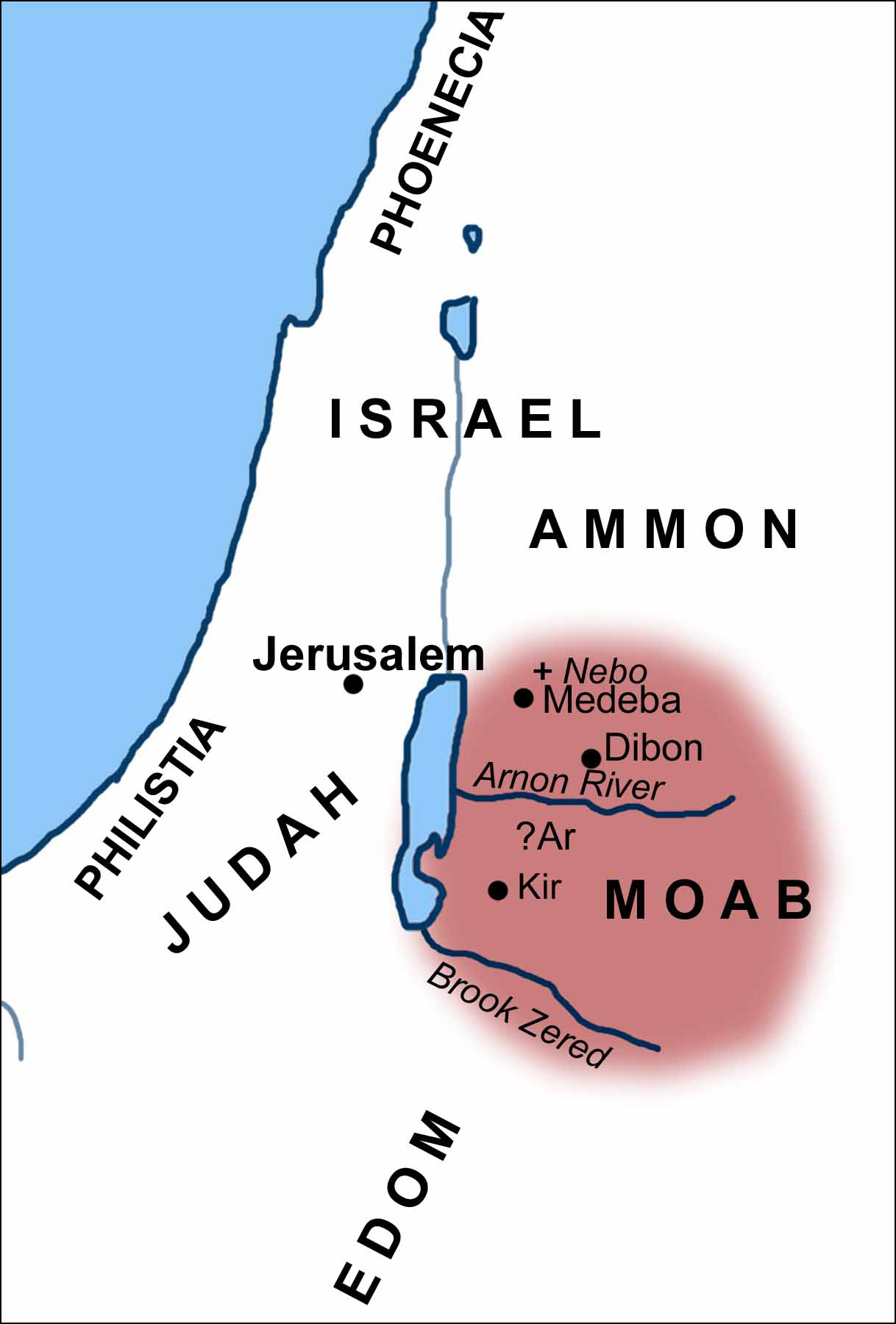
moabChapter 16 continues God’s oracle concerning the Moabite kingdom. And, in reading this section of the oracle, it is important to consider how much, if any, of God’s words, have been fulfilled or remain to be fulfilled. It is clear that God has already warned them of a day when they would suffer a humiliating defeat at the hands of some outside force. The cities of Ar and Kir would be laid waste in a single night. The temple to their false god, located in Dibon, would be destroyed, and the people would be left in a state of mourning.

But now, God speaks of a day when the Moabites will send tribute to the king of Judah, in the form of a lamb. The refugees from Moab, shaking with fear and desperate for aid, will beg the king of Judah to provide them with shelter.

“Give counsel;
    grant justice;
make your shade like night
    at the height of noon;
shelter the outcasts;
    do not reveal the fugitive;
let the outcasts of Moab
    sojourn among you;
be a shelter to them
    from the destroyer.” – Isaiah 16:3-4 ESV

The oracle speaks of a time “When the oppressor is no more, and destruction has ceased, and he who tramples underfoot has vanished from the land” (Isaiah 16:4 ESV). While that aspect of the prophecy could have been fulfilled sometime in the past, the next verse suggests that it remains yet to be fulfilled. The oracle speaks of a king and a throne.

…then a throne will be established in steadfast love,
    and on it will sit in faithfulness
    in the tent of David
one who judges and seeks justice
    and is swift to do righteousness. – Isaiah 16:5 ESV

This prophetic promise speaks of a very specific king, one who will be a descendant of David and rule with love, faithfulness, justice, and righteousness. This ties into an earlier promise revealed in chapter nine.

But there will be no gloom for her who was in anguish. In the former time he brought into contempt the land of Zebulun and the land of Naphtali, but in the latter time he has made glorious the way of the sea, the land beyond the Jordan, Galilee of the nations.

The people who walked in darkness
    have seen a great light;
those who dwelt in a land of deep darkness,
    on them has light shone.
You have multiplied the nation;
    you have increased its joy;
they rejoice before you
    as with joy at the harvest,
    as they are glad when they divide the spoil.
For the yoke of his burden,
    and the staff for his shoulder,
    the rod of his oppressor,
    you have broken as on the day of Midian.
For every boot of the tramping warrior in battle tumult
    and every garment rolled in blood
    will be burned as fuel for the fire.
For to us a child is born,
    to us a son is given;
and the government shall be upon his shoulder,
    and his name shall be called
Wonderful Counselor, Mighty God,
    Everlasting Father, Prince of Peace.
Of the increase of his government and of peace
    there will be no end,
on the throne of David and over his kingdom,
    to establish it and to uphold it
with justice and with righteousness
    from this time forth and forevermore.
The zeal of the Lord of hosts will do this. – Isaiah 9:1-7 ESV

This passage speaks of the millennial kingdom of Jesus Christ when He will rule from the throne of David in the city of Jerusalem for a period of 1,000 years. This will not take place until the end of the seven-year period of Tribulation when God will bring His judgments upon the earth. But when the time of the Great Tribulation is complete, Jesus will return and establish His kingdom on earth. That can be the only fulfillment of the oracle found in chapter 16 of Isaiah. And Isaiah spoke of that day all the way back in chapter two.

It shall come to pass in the latter days
    that the mountain of the house of the Lord
shall be established as the highest of the mountains,
    and shall be lifted up above the hills;
and all the nations shall flow to it,
    and many peoples shall come, and say:
“Come, let us go up to the mountain of the Lord,
    to the house of the God of Jacob,
that he may teach us his ways
    and that we may walk in his paths.”
For out of Zion shall go forth the law,
    and the word of the Lord from Jerusalem.
He shall judge between the nations,
    and shall decide disputes for many peoples;
and they shall beat their swords into plowshares,
    and their spears into pruning hooks;
nation shall not lift up sword against nation,
    neither shall they learn war anymore. – Isaiah 2:2-4 ESV

Moab will be among the nations in that day, that flock to the land of Israel, seeking to worship Jesus Christ and God Almighty. But long before that day takes place, God warns the Moabites that their coming destruction will be due to their excessive pride.

We have heard about Moab’s pride,
their great arrogance,
their boasting, pride, and excess.
But their boastful claims are empty! – Isaiah 16:6 NET

The oracle pictures utter devastation. Their pride would be replaced with humiliation and their joy with sorrow. All that they had put their trust in will have been destroyed. Their fields will lay barren. Their vines will no longer produce grapes. And, in their devastated state, the Moabites will continue to seek the aid of their false gods.

The people of Moab will worship at their pagan shrines,
    but it will do them no good.
They will cry to the gods in their temples,
    but no one will be able to save them. – Isaiah 16:12 NLT

Their idols will prove no match for God Almighty. But in the midst of all the judgment, God will reveal His heart for the people of Moab.

My heart’s cry for Moab is like a lament on a harp.
    I am filled with anguish for Kir-hareseth. – Isaiah 16:11 NLT

God does not find some kind of perverse joy in His judgment of the wicked. The prophet, Ezekiel, records God’s sentiments in His own words.

“Do you think that I like to see wicked people die? says the Sovereign LORD. Of course not! I want them to turn from their wicked ways and live.” – Ezekiel 18:23 ESV

But, because He is righteous and holy, He must punish those who reject Him as God. He cannot turn a blind eye to sin. He cannot simply tolerate the rebellion of His own creation. And, much of what God does to the nations by way of judgment was intended to wake up His own chosen people, Israel. He wanted them to know that they to would suffer a similar fate, if they did not repent and return to Him.

“As surely as I live, says the Sovereign LORD, I take no pleasure in the death of wicked people. I only want them to turn from their wicked ways so they can live. Turn! Turn from your wickedness, O people of Israel! Why should you die?” – Ezekiel 33:11 NLT

The judgment of God was coming. In fact, within three years time, the Moabites would be overwhelmed and destroyed. And their fall should have been a wakeup call to the nation of Judah. There was no reason to hope and trust in nations because they would fail and fall. There was no sense in continuing to rebel against God because His judgment was inevitable and inescapable.

But God, in His grace and mercy, reveals that a remnant of the Moabites would remain. And it will be the future descendants of those survivors of God’s judgment who one day will flock to the city of Jerusalem and worship the right King of Israel, Jesus Christ, the Messiah.

English Standard Version (ESV)
The Holy Bible, English Standard Version. ESV® Permanent Text Edition® (2016). Copyright © 2001 by Crossway Bibles, a publishing ministry of Good News Publishers.

New Living Translation (NLT)
Holy Bible, New Living Translation, copyright © 1996, 2004, 2015 by Tyndale House Foundation. Used by permission of Tyndale House Publishers Inc., Carol Stream, Illinois 60188. All rights reserved.

The Message (MSG)
Copyright © 1993, 1994, 1995, 1996, 2000, 2001, 2002 by Eugene H. Peterson