Given By the LORD

1 Now when Athaliah the mother of Ahaziah saw that her son was dead, she arose and destroyed all the royal family. But Jehosheba, the daughter of King Joram, sister of Ahaziah, took Joash the son of Ahaziah and stole him away from among the king’s sons who were being put to death, and she put him and his nurse in a bedroom. Thus they hid him from Athaliah, so that he was not put to death. And he remained with her six years, hidden in the house of the LORD, while Athaliah reigned over the land.

But in the seventh year Jehoiada sent and brought the captains of the Carites and of the guards, and had them come to him in the house of the LORD. And he made a covenant with them and put them under oath in the house of the LORD, and he showed them the king’s son. And he commanded them, “This is the thing that you shall do: one third of you, those who come off duty on the Sabbath and guard the king’s house (another third being at the gate Sur and a third at the gate behind the guards) shall guard the palace. And the two divisions of you, which come on duty in force on the Sabbath and guard the house of the LORD on behalf of the king, shall surround the king, each with his weapons in his hand. And whoever approaches the ranks is to be put to death. Be with the king when he goes out and when he comes in.”

The captains did according to all that Jehoiada the priest commanded, and they each brought his men who were to go off duty on the Sabbath, with those who were to come on duty on the Sabbath, and came to Jehoiada the priest. 10 And the priest gave to the captains the spears and shields that had been King David’s, which were in the house of the LORD. 11 And the guards stood, every man with his weapons in his hand, from the south side of the house to the north side of the house, around the altar and the house on behalf of the king. 12 Then he brought out the king’s son and put the crown on him and gave him the testimony. And they proclaimed him king and anointed him, and they clapped their hands and said, “Long live the king!” 2 Kings 11:1-12 ESV

Meanwhile, back in Judah. Once again, the author shifts the focus of his narrative back to the southern kingdom. While Jehu had been systematically and brutally eliminating the legacy of Ahab from Israel, a regime change had taken place in Judah as well. While the two nations operated independently of one another, they had developed close ties through intermarriage and military alliances. Ahab and Jezebel had a daughter, Athaliah, who had married King Jehoram of Israel. Her influence over him is readily apparent when you read how God assessed his reign and disclosed the nature of his death.

“…you have been as evil as the kings of Israel. You have led the people of Jerusalem and Judah to worship idols, just as King Ahab did in Israel. And you have even killed your own brothers, men who were better than you. So now the LORD is about to strike you, your people, your children, your wives, and all that is yours with a heavy blow. You yourself will suffer with a severe intestinal disease that will get worse each day until your bowels come out.” – 2 Chronicles 21:13-15 NLT

When Jehoram ended up dying just as God had predicted, he was replaced by Ahaziah, the son he shared with Athaliah. During his reign, Ahaziah maintained a close relationship with his family back in Israel, even making a trip to visit his uncle, King Jehoram, who was recuperating from battle injuries at his summer palace in Jezreel. But the timing of his trip proved both ill-planned and ill-fated. He arrived in Jezreel at the exact moment when Jehu was launching a coup against the house of Ahab. Ahaziah’s decision to be in Israel at that precise moment proved deadly.

When King Ahaziah of Judah saw what was happening, he fled along the road to Beth-haggan. Jehu rode after him, shouting, “Shoot him, too!” So they shot Ahaziah in his chariot at the Ascent of Gur, near Ibleam. He was able to go on as far as Megiddo, but he died there. His servants took him by chariot to Jerusalem, where they buried him with his ancestors in the City of David. – 2 Kings 9:27-28 NLT

In a single day, Jehu had managed to kill the kings of Israel and Judah, creating an immediate power vacuum in both nations. He would end up filling the void left by King Jehoram in Israel, but the battle for control of Ahaziah’s vacant throne would prove more complicated and deadly.

As soon as Athaliah received the news that her son had been murdered by Jehu, she launched a brutal campaign to secure the crown for herself. Rather than mourn the death of her son, “she arose and destroyed all the royal family” (2 Kings 11:1 ESV). She callously eliminated any and all competition, and, thanks to her husband’s sins against Yahweh, her work had been made much easier. As punishment for Jehoram’s ungodly leadership, God had brought judgment against Judah in the form of enemy raiding parties.

Then the LORD stirred up the Philistines and the Arabs, who lived near the Ethiopians, to attack Jehoram. They marched against Judah, broke down its defenses, and carried away everything of value in the royal palace, including the king’s sons and his wives. Only his youngest son, Ahaziah, was spared. – 2 Chronicles 21:16-17 NLT

Now, with Ahaziah out of the picture, Athaliah had few competitors for the throne. Nevertheless, she still went out of her way to eliminate anyone who might jeopardize her plan to rule over Judah. In doing so, Athaliah went against the revealed will of God. He had made a covenant commitment to David that one of his descendants would sit on his throne forever.

“When your days are fulfilled and you lie down with your fathers, I will raise up your offspring after you, who shall come from your body, and I will establish his kingdom. He shall build a house for my name, and I will establish the throne of his kingdom forever.

“And your house and your kingdom shall be made sure forever before me. Your throne shall be established forever.” – 2 Samuel 7:12-13, 16 ESV

Athaliah was not a descendant of David, but she was not about to let that minor detail stand in her way. So, she set out to clear her path to power by systematically wiping out anyone who might claim to be the rightful heir to David’s throne. 

Having successfully eliminated the competition, Athaliah became the self-appointed queen of Judah, and she would hold that title for the next six years. But little did she know that all the while she sat on the throne, the true king of Judah was being protected in the house of God. During her ambitious and murderous power-grab, she had inadvertently overlooked one minor detail: A young boy named Joash. He was the son of King Ahaziah and, therefore, the rightful heir to the throne.

When Athaliah began her murderous spree, her step-daughter, Jehosheba, had risked her life to protect Joash, the infant son of Ahaziah. The book of 2 Chronicles provides a detailed description of her brave rescue attempt.

Ahaziah’s sister Jehosheba, the daughter of King Jehoram, took Ahaziah’s infant son, Joash, and stole him away from among the rest of the king’s children, who were about to be killed. She put Joash and his nurse in a bedroom. In this way, Jehosheba, wife of Jehoiada the priest and sister of Ahaziah, hid the child so that Athaliah could not murder him. – 2 Chronicles 22:11 NLT

Don’t overlook the sovereign hand of God in all of this. It just so happened that Jehosheba was not only the daughter of the king and, therefore, the half-sister of Joash, but she was also the wife of Jehoiada the priest. These relationships were God-ordained and providentially established to not only keep Joash alive but to preserve the promise that God had made to David years earlier.

After initially hiding Joash in a room within the palace, Jehosheba and her husband, Jehoiada, moved him to the Temple compound, where, for the next six years, the young boy would find protection. Yahweh, the God of David, was preserving the seed of David so that He might fulfill the covenant promise He had made. What makes this so significant is that God was preserving David’s seed so that He might one day send His own Son as the ultimate fulfillment of the Davidic Covenant. The psalmist writes, “The LORD swore to David a sure oath from which he will not turn back: ‘One of the sons of your body I will set on your throne’” ( Psalm 132:11 ESV). And the apostle Paul reminds us that Jesus was the Son whom God had in mind when He made that promise to David.

God promised this Good News long ago through his prophets in the holy Scriptures. The Good News is about his Son. In his earthly life he was born into King David’s family line, and he was shown to be the Son of God when he was raised from the dead by the power of the Holy Spirit. He is Jesus Christ our Lord. – Romans 1:2-4 NLT

This same message had been communicated to Mary, a young virgin girl, whom God had chosen to be the one through whom this future descendant of David would be born.

“You will conceive and give birth to a son, and you will name him Jesus. He will be very great and will be called the Son of the Most High. The Lord God will give him the throne of his ancestor David. And he will reign over Israel forever; his Kingdom will never end!” – Luke 1:31-33 NLT

But had Jehosheba not been there to preserve the life of her brother, the line of David would have come to an abrupt end. Had her husband not been Jehoiada the priest, the young boy would not have been given sanctuary in the Temple of God. All of this was the handiwork of God Almighty, who was operating behind the scenes to preserve and protect His covenant promise. Nothing was going to stand in the way of God’s long-term redemptive plan for the people of Israel and the nations of the world – including Athaliah.

In time, Athaliah’s 15 minutes of fame came to an end. When Joash reached the age of seven, Jehoiada the priest called for the captains of the Carites, who served as royal bodyguards. He brought them into the Temple and introduced them to Joash, the rightful heir to the throne. This would have been shocking news to these men. None of them would have had any idea that Joash was alive. Jehoiada’s decision to use the Temple as the venue for revealing this exciting news was intended to remind these men that God was at work. He had them swear an oath before Yahweh that they would protect the new king at all costs, and they agreed. Then, as if to solidify their commitment, he equipped these men with “spears and shields that had been King David’s, which were in the house of the LORD” ( 2 Kings 11:10 ESV). This was intended as a not-so-subtle reminder that Joash was a descendant of the great king, David, and the rightful heir to the throne of Judah.

Having instigated plans to provide protection for Joash, Jehoiada took the next steps to inaugurate the new king of Judah.

Then he brought out the king’s son and put the crown on him and gave him the testimony. And they proclaimed him king and anointed him, and they clapped their hands and said, “Long live the king!” – 2 Kings 11:12 ESV

After six years under the reign of Athaliah, the fate of Judah was about to take a dramatic turn. From the holy Temple of God, a cry would go out, declaring that Judah had a new king. The sovereign plan of God was alive and well, and it was about to be revealed in the life of a seven-year-old boy named Joash. It’s interesting to note that Joash’s name means, “given by the LORD.” This young boy would be a gracious gift from God Almighty, providing immediate hope for the people of Judah and a link to the future promise of the Messiah.

English Standard Version (ESV) The Holy Bible, English Standard Version. ESV® Permanent Text Edition® (2016). Copyright © 2001 by Crossway Bibles, a publishing ministry of Good News Publishers.

New Living Translation (NLT) Holy Bible, New Living Translation, copyright © 1996, 2004, 2015 by Tyndale House Foundation. Used by permission of Tyndale House Publishers Inc., Carol Stream, Illinois 60188. All rights reserved.

When Zealousness Becomes Dangerous

1 Now Ahab had seventy sons in Samaria. So Jehu wrote letters and sent them to Samaria, to the rulers of the city, to the elders, and to the guardians of the sons of Ahab, saying, “Now then, as soon as this letter comes to you, seeing your master’s sons are with you, and there are with you chariots and horses, fortified cities also, and weapons, select the best and fittest of your master’s sons and set him on his father’s throne and fight for your master’s house.” But they were exceedingly afraid and said, “Behold, the two kings could not stand before him. How then can we stand?” So he who was over the palace, and he who was over the city, together with the elders and the guardians, sent to Jehu, saying, “We are your servants, and we will do all that you tell us. We will not make anyone king. Do whatever is good in your eyes.” Then he wrote to them a second letter, saying, “If you are on my side, and if you are ready to obey me, take the heads of your master’s sons and come to me at Jezreel tomorrow at this time.” Now the king’s sons, seventy persons, were with the great men of the city, who were bringing them up. And as soon as the letter came to them, they took the king’s sons and slaughtered them, seventy persons, and put their heads in baskets and sent them to him at Jezreel. When the messenger came and told him, “They have brought the heads of the king’s sons,” he said, “Lay them in two heaps at the entrance of the gate until the morning.” Then in the morning, when he went out, he stood and said to all the people, “You are innocent. It was I who conspired against my master and killed him, but who struck down all these? 10 Know then that there shall fall to the earth nothing of the word of the LORD, which the LORD spoke concerning the house of Ahab, for the LORD has done what he said by his servant Elijah.” 11 So Jehu struck down all who remained of the house of Ahab in Jezreel, all his great men and his close friends and his priests, until he left him none remaining.

12 Then he set out and went to Samaria. On the way, when he was at Beth-eked of the Shepherds, 13 Jehu met the relatives of Ahaziah king of Judah, and he said, “Who are you?” And they answered, “We are the relatives of Ahaziah, and we came down to visit the royal princes and the sons of the queen mother.” 14 He said, “Take them alive.” And they took them alive and slaughtered them at the pit of Beth-eked, forty-two persons, and he spared none of them.

15 And when he departed from there, he met Jehonadab the son of Rechab coming to meet him. And he greeted him and said to him, “Is your heart true to my heart as mine is to yours?” And Jehonadab answered, “It is.” Jehu said, “If it is, give me your hand.” So he gave him his hand. And Jehu took him up with him into the chariot. 16 And he said, “Come with me, and see my zeal for the LORD.” So he had him ride in his chariot. 17 And when he came to Samaria, he struck down all who remained to Ahab in Samaria, till he had wiped them out, according to the word of the LORD that he spoke to Elijah. 2 Kings 10:1-17 ESV

Jehu was methodical and ruthless in carrying out God’s judgment against the house of Ahab. After killing King Jehoram and ordering the execution of the queen-mother, Jezebel, he turned his attention to Ahab’s 70 male descendants. Jehu knew that as long as any of them remained alive, his hopes of consolidating the kingdom under his rule would be in jeopardy. These boys and young men were under the care and protection of royal guardians who served in Ahab’s administration. More than likely, these protectors of the royal protégés answered to Jezebel. But now that she was out of the picture, Jehu issued a challenge to these custodians of Ahab’s dynasty.

“…select the best qualified of your master’s sons to be your king, and prepare to fight for Ahab’s dynasty.” – 2 Kings 10:3 NLT

Jehu proposed that they do battle for control of the kingdom. He and his allies would go up against Ahab’s chosen heir and the forces of Israel, and whoever was left standing would become the next king of the northern kingdom. But his offer was quickly rejected. The elders and officials of Samaria recognized that Jehu had the upper hand and any attempt to defeat him in battle would be ill-advised and ill-fated.

So, these men informed Jehu that they had no intentions of protecting or promoting the heirs of Ahab. So, he demanded that they prove their loyalty by beheading all 70 of Ahab’s sons. The next day, the elders and officials of Samaria showed up in Jezreel and presented to Jehu their rather macabre coronation gift. He ordered that the 70 heads be placed in two piles beside the city gate, as a gruesome reminder of God’s divine judgment against the house of Ahab. No one who entered or exited the city of Jezreel could miss the message this hideous sight was meant to convey.

But the next morning, Jehu called the nervous citizens of Jezreel together. These people were caught in the middle of a violent, deadly transition of power. For more than 30 years, they had lived under the rule of Ahab and Jezebel, but almost overnight, their way of life had come to an abrupt end. They had witnessed the assassination of their king, the violent death of his mother, and the annihilation of every living male heir to the throne. They had no way of knowing what kind of king Jehu would be. So, in an effort to assuage their fear and apprehension, Jehu took full responsibility for the death of King Jehoram but then vowed that he would avenge the deaths of Ahab’s sons. This somewhat disingenuous display of righteous indignation was intended to win over the hearts of the people. But he failed to admit that he had been the one who ordered their executions. In his zeal to carry out God’s command, Jehu overstepped his authority. Rather than simply punishing the house of Ahab as God had ordered, Jehu used his newfound power to enact a bloody purging that spread far beyond his original assignment.

Jehu killed all who were left of Ahab’s relatives living in Jezreel and all his important officials, his personal friends, and his priests. So Ahab was left without a single survivor. – 2 Kings 10:11 NLT

We are not told the motivation behind Jehu’s actions, but we are given God’s response. In the book of Hosea, God provides a glimpse into His displeasure with Jehu’s overzealous and bloody purge. In the book’s opening verses, the prophet Hosea has just discovered that he is a new father. His wife, Gomer, a former prostitute, has given birth to a son. And God tells Hosea to name the boy Jezreel.

And the LORD said, “Name the child Jezreel, for I am about to punish King Jehu’s dynasty to avenge the murders he committed at Jezreel. In fact, I will bring an end to Israel’s independence. I will break its military power in the Jezreel Valley.” – Hosea 1:4-5 NLT

The entire book of Hosea is meant to display Israel’s unfaithfulness through the relationship between the prophet and his unfaithful wife. The name given to their son was meant to be a permanent reminder of Jehu’s ungodly actions that day in Jezreel. He had decided to do God’s will his way. By taking the lives of the elders and officials of Samaria, Jehu had overstepped his God-given authority. He had exceeded his role as an instrument of God’s judgment against the house of Ahab. As a result, innocent people died unnecessarily, and he would pay for his costly mistake.

In a sense, Jehu was obedient to God’s command. He had been anointed by the prophet of God and given the task of eliminating the house of Ahab, and he did as he had been told. He killed King Jehoram. He ordered the death of Jezebel. He orchestrated the executions of all of Ahab’s heirs. He had even taken it upon himself to kill King Ahaziah of Judah because he was the grandson of Jezebel. The tentacles of Jezebel’s influence had reached all the way into the southern kingdom, infecting Judah and its people.

At one point, Jehu had an unexpected encounter with some of Jezebel’s royal relatives from Judah. Unaware of all that had transpired in Israel, they were on their way to visit the queen-mother. But when Jehu discovered their identity, he ordered their immediate executions.

“We are relatives of King Ahaziah. We are going to visit the sons of King Ahab and the sons of the queen mother.”

“Take them alive!” Jehu shouted to his men. And they captured all forty-two of them and killed them at the well of Beth-eked. None of them escaped. – 2 Kings 10:14 NLT

His determination to eliminate every last vestige of Ahab’s influence was comprehensive and commendable; he left no stone unturned. This dedicated servant of God did what he had been anointed to do.

…he struck down all who remained to Ahab in Samaria, till he had wiped them out, according to the word of the LORD that he spoke to Elijah. – 2 Kings 10:17 ESV

But in carrying out God’s will, he had gone above and beyond his official commission, ordering the deaths of the innocent. While Jehu could justify his actions by claiming that the elders and officials had murdered the sons of Ahab, they had only done so because he had given them no other choice. Jehu had delegated to these men a responsibility that had been given to him alone. It was he who should have taken the lives of the 70 sons of Ahab. It had been his job to execute Jezebel. But he had ordered her death by commanding her servants to throw her down from the window of the palace. Jehu had used his newfound power and authority in ways God had not ordered or ordained, choosing to accomplish God’s will in his own way. And no amount of zeal, enthusiasm, or good intentions can justify disobedience.

Hundreds of years later, the apostle Paul would commend the nation of Israel for its enthusiasm toward the things of God. But he would also point out that their zeal was misplaced and misdirected. In their energetic effort to please God, they were actually living in disobedience to His will and in violation of His ways.

I know what enthusiasm they have for God, but it is misdirected zeal. For they don’t understand God’s way of making people right with himself. Refusing to accept God’s way, they cling to their own way of getting right with God by trying to keep the law. – Romans 10:2-3 NLT

Zeal is never an excuse for disobedience, and zealousness can become dangerous when carried out in opposition to God’s will. Doing the right thing in the wrong way or with the wrong motivation will never produce godly results. In his overzealous desire to establish and protect his fledgling reign, Jehu had gone too far. The newly crowned king’s misdirected zeal damaged Yahweh’s reputation, painting Him as a capricious and callous deity who approved of the slaughter of innocents. Jehu’s self-promoting additions to God’s original assignment were unwarranted and unnecessary. But his newfound power had gone to his head, causing him to overstep his God-ordained commission; to the detriment of Yahweh’s reputation and the well-being of the people of Israel.

English Standard Version (ESV) The Holy Bible, English Standard Version. ESV® Permanent Text Edition® (2016). Copyright © 2001 by Crossway Bibles, a publishing ministry of Good News Publishers.

New Living Translation (NLT) Holy Bible, New Living Translation, copyright © 1996, 2004, 2015 by Tyndale House Foundation. Used by permission of Tyndale House Publishers Inc., Carol Stream, Illinois 60188. All rights reserved.

Out With the Old

14 Thus Jehu the son of Jehoshaphat the son of Nimshi conspired against Joram. (Now Joram with all Israel had been on guard at Ramoth-gilead against Hazael king of Syria, 15 but King Joram had returned to be healed in Jezreel of the wounds that the Syrians had given him, when he fought with Hazael king of Syria.) So Jehu said, “If this is your decision, then let no one slip out of the city to go and tell the news in Jezreel.” 16 Then Jehu mounted his chariot and went to Jezreel, for Joram lay there. And Ahaziah king of Judah had come down to visit Joram.

17 Now the watchman was standing on the tower in Jezreel, and he saw the company of Jehu as he came and said, “I see a company.” And Joram said, “Take a horseman and send to meet them, and let him say, ‘Is it peace?’” 18 So a man on horseback went to meet him and said, “Thus says the king, ‘Is it peace?’” And Jehu said, “What do you have to do with peace? Turn around and ride behind me.” And the watchman reported, saying, “The messenger reached them, but he is not coming back.” 19 Then he sent out a second horseman, who came to them and said, “Thus the king has said, ‘Is it peace?’” And Jehu answered, “What do you have to do with peace? Turn around and ride behind me.” 20 Again the watchman reported, “He reached them, but he is not coming back. And the driving is like the driving of Jehu the son of Nimshi, for he drives furiously.”

21 Joram said, “Make ready.” And they made ready his chariot. Then Joram king of Israel and Ahaziah king of Judah set out, each in his chariot, and went to meet Jehu, and met him at the property of Naboth the Jezreelite. 22 And when Joram saw Jehu, he said, “Is it peace, Jehu?” He answered, “What peace can there be, so long as the whorings and the sorceries of your mother Jezebel are so many?” 23 Then Joram reined about and fled, saying to Ahaziah, “Treachery, O Ahaziah!” 24 And Jehu drew his bow with his full strength, and shot Joram between the shoulders, so that the arrow pierced his heart, and he sank in his chariot. 25 Jehu said to Bidkar his aide, “Take him up and throw him on the plot of ground belonging to Naboth the Jezreelite. For remember, when you and I rode side by side behind Ahab his father, how the LORD made this pronouncement against him: 26 ‘As surely as I saw yesterday the blood of Naboth and the blood of his sons—declares the LORD—I will repay you on this plot of ground.’ Now therefore take him up and throw him on the plot of ground, in accordance with the word of the LORD.”

27 When Ahaziah the king of Judah saw this, he fled in the direction of Beth-haggan. And Jehu pursued him and said, “Shoot him also.” And they shot him in the chariot at the ascent of Gur, which is by Ibleam. And he fled to Megiddo and died there. 28 His servants carried him in a chariot to Jerusalem, and buried him in his tomb with his fathers in the city of David.

29 In the eleventh year of Joram the son of Ahab, Ahaziah began to reign over Judah. 2 Kings 9:14-29 ESV

Once Jehu received the news that he was to be the next king of Israel, he wasted no time. Immediately after his anointing by the prophet of God, he departed Ramoth-gilead. He headed straight to the winter palace in Jezreel, where King Jehoram was recovering from the injuries he had suffered in his battle against the Syrians.

Jehu had the full support of his fellow generals, so he ordered them to secure the city of Ramoth-gilead and prevent anyone from escaping and leaking his plans to King Jehoram. Jehu mounted his chariot and, accompanied by a contingent of loyal troops, he made his way to Jezreel. Guards posted at the city’s watchtower spotted them at a distance and notified King Jehoram. Assuming it was his own troops returning from the battle against the Syrians, he sent out a messenger to meet them, anxious to know the outcome of the conflict. When the messenger rode out to greet the returning soldiers, he asked, “Is it peace?” But Jehu gave him a somewhat cryptic answer and commanded him to ride along with him to the city.

After sending out a second messenger who failed to return, Jehoram became even more anxious to know what had happened. So, despite his wounds, he ordered his chariot and rode out to meet the returning troops. He was accompanied by King Ahaziah of Judah, who had come to visit him as he recuperated in Jezreel. When the two kings intercepted Jehu, Jehoram asked him, “Is it peace?” But Jehu’s response was not what he had been expecting.

“How can there be peace as long as the idolatry and witchcraft of your mother, Jezebel, are all around us?” – 2 Kings 9:22 NLT

Jehu called out King Jehoram, accusing him of allowing his mother, Jezebel, to lead the nation of Israel into apostasy with her idolatry and witchcraft. Though Ahab was long gone, Jezebel still continued to wield a powerful and deadly influence over Israel. Not only had she promoted the worship of false gods, but she had also introduced occult practices that included the use of sorcery and incantations. And God had declared these things to be off-limits for the people of Israel.

“There shall not be found among you anyone who burns his son or his daughter as an offering, anyone who practices divination or tells fortunes or interprets omens, or a sorcerer or a charmer or a medium or a necromancer or one who inquires of the dead, for whoever does these things is an abomination to the LORD.” – Deuteronomy 18:10-12 ESV

Jehu’s mention of Jezebel indicates that he understood just how decisive her role had been in leading the nation away from Yahweh. Any attempt he made to eradicate the evil influence of Ahab and his descendants would have to include her. As long as Jezebel remained alive, the nation would never recover from its state of spiritual apathy and apostasy.

Suddenly, aware that his life was in danger, King Jehoram ordered his chariot driver to make a hasty retreat to the safety of the city. But they never made it. Jehu killed the escaping king with a well-placed arrow in his back. Then he ordered that Jehoram’s body be dumped on the land that used to belong to Naboth. This brings the story full circle, linking the sins of Ahab with those of his son, Jehoram. In 1 Kings 21, Jezebel had arranged to illegally confiscate Naboth’s vineyard so she could give it to Ahab. She had Naboth falsely accused and convicted of cursing God and the king. The result was that the innocent man was stoned to death on his very own land. Yahweh warned King Ahab, “In the place where dogs licked up the blood of Naboth shall dogs lick your own blood” (1 Kings 21:20 ESV). And he had pronounced a similar fate for Jezebel because of her role in the affair.

“The dogs shall eat Jezebel within the walls of Jezreel.” – 1 Kings 21:23 ESV

But Ahab had eventually repented of his role in Naboth’s death and, as a result, God chose to spare him.

“Because he has humbled himself before me, I will not bring the disaster in his days; but in his son’s days I will bring the disaster upon his house.” – 1 Kings 21:29 ESV

Now, years later, God was fulfilling His promise to bring disaster upon the house of Ahab. The blood of Jehoram, the son of Ahab and Jezebel, would be poured out on the very same spot where Naboth had been stoned to death. Jehu, who had served as one of King Ahab’s generals, was familiar with the whole sordid affair concerning Naboth. He had even been present when God issued His divine judgment against Ahab through the prophet Elijah.

“Take him up and throw him on the plot of ground belonging to Naboth the Jezreelite. For remember, when you and I rode side by side behind Ahab his father, how the LORD made this pronouncement against him: ‘As surely as I saw yesterday the blood of Naboth and the blood of his sons—declares the LORD—I will repay you on this plot of ground.’ Now therefore take him up and throw him on the plot of ground, in accordance with the word of the LORD.” – 2 Kings 9:25-26 ESV

In all of this, Jehu was acting as God’s hand of judgment against the house of Ahab. He had been anointed by God to deliver divine justice and cleanse the nation of Israel from the pervasive and pernicious influence of Ahab and Jezebel. God had had enough. The time had come to fulfill His pronouncement of judgment against the house of Ahab.

“Behold, I will bring disaster upon you. I will utterly burn you up, and will cut off from Ahab every male, bond or free, in Israel. And I will make your house like the house of Jeroboam the son of Nebat, and like the house of Baasha the son of Ahijah, for the anger to which you have provoked me, and because you have made Israel to sin.” – 1 Kings 21:21-22 ESV

The purge had begun. God was cleaning house. And even King Ahaziah of Judah would not escape the purifying judgment of the Almighty. As he attempted to escape, he was struck by an arrow and only made it as far as Megiddo before he died from his wound. Ahaziah had close familial ties to the house of Ahab. His mother, Athaliah, was the granddaughter of King Omri of Israel, and Ahaziah had married one of Ahab’s daughters.

He also walked in the way of the house of Ahab and did what was evil in the sight of the Lord, as the house of Ahab had done, for he was son-in-law to the house of Ahab. – 2 Kings 8:27 ESV

He was an unwise and wicked king who had aligned himself with one of the most infamous royal families in Israel’s sordid history, and he paid for his mistake with his life.

Because of Solomon’s disobedience, God divided Israel into two kingdoms. This had been His prescribed punishment for Solomon’s foray into idolatry during the latter years of his life and reign. But the kings of Israel and Judah had decided to take matters into their own hands, attempting to realign the two nations through treaties and marital alliances. But they had neglected to fix the primary problem that had caused God to divide them in the first place: Idolatry.

God was not interested in a reunited nation that remained spiritually rebellious. So, He sent Jehu to bring an abrupt end to the man-made alliance between Israel and Judah by killing their two kings. It was time to start over. But as we will see, Jehu had one last piece of unfinished business.

English Standard Version (ESV) The Holy Bible, English Standard Version. ESV® Permanent Text Edition® (2016). Copyright © 2001 by Crossway Bibles, a publishing ministry of Good News Publishers.

New Living Translation (NLT) Holy Bible, New Living Translation, copyright © 1996, 2004, 2015 by Tyndale House Foundation. Used by permission of Tyndale House Publishers Inc., Carol Stream, Illinois 60188. All rights reserved.
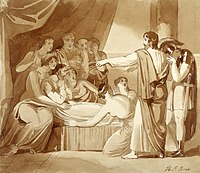
Anointed to Annihilate

1 Then Elisha the prophet called one of the sons of the prophets and said to him, “Tie up your garments, and take this flask of oil in your hand, and go to Ramoth-gilead. And when you arrive, look there for Jehu the son of Jehoshaphat, son of Nimshi. And go in and have him rise from among his fellows, and lead him to an inner chamber. Then take the flask of oil and pour it on his head and say, ‘Thus says the LORD, I anoint you king over Israel.’ Then open the door and flee; do not linger.”

So the young man, the servant of the prophet, went to Ramoth-gilead. And when he came, behold, the commanders of the army were in council. And he said, “I have a word for you, O commander.” And Jehu said, “To which of us all?” And he said, “To you, O commander.” So he arose and went into the house. And the young man poured the oil on his head, saying to him, “Thus says the LORD, the God of Israel, I anoint you king over the people of the LORD, over Israel. And you shall strike down the house of Ahab your master, so that I may avenge on Jezebel the blood of my servants the prophets, and the blood of all the servants of the LORD. For the whole house of Ahab shall perish, and I will cut off from Ahab every male, bond or free, in Israel. And I will make the house of Ahab like the house of Jeroboam the son of Nebat, and like the house of Baasha the son of Ahijah. 10 And the dogs shall eat Jezebel in the territory of Jezreel, and none shall bury her.” Then he opened the door and fled.

11 When Jehu came out to the servants of his master, they said to him, “Is all well? Why did this mad fellow come to you?” And he said to them, “You know the fellow and his talk.” 12 And they said, “That is not true; tell us now.” And he said, “Thus and so he spoke to me, saying, ‘Thus says the LORD, I anoint you king over Israel.’” 13 Then in haste every man of them took his garment and put it under him on the bare steps, and they blew the trumpet and proclaimed, “Jehu is king.” 2 Kings 9:1-13 ESV

In 1 Kings 19:15-16, we have the record of God’s final commission to Elijah, in which He gave the prophet three tasks. One of them was to anoint Hazael to be the next king of Syria. A second was to anoint Jehu as king of Israel. The third was to anoint Elisha as his own successor.

Elijah followed God’s instructions regarding Elisha, and, at this point in the story, the new prophet has thoroughly established himself as Elijah’s God-ordained replacement. It would also appear that Elijah kept God’s command concerning the anointing of Hazael. In 2 Kings 8, the author revealed the morbid details concerning Hazael’s ascension to the throne of Syria. While King Ben-hadad was weak and recovering from a recent illness, Hazael murdered him by suffocating him to death with a wet sheet. And the prophet Elisha had wept when he realized the deadly consequences for Israel that would accompany this man’s rise to power.

“Because I know the evil that you will do to the people of Israel. You will set on fire their fortresses, and you will kill their young men with the sword and dash in pieces their little ones and rip open their pregnant women.” – 2 Kings 8:12 ESV

But as 2 Kings 9 opens, it becomes apparent that there was one aspect of Elijah’s assignment he had neglected to complete. Either that, or he had chosen to pass on the responsibility to his successor. Jehu had not yet been anointed King of Israel. Jehoram, the son of Ahab and Jezebel, still occupied the throne and was continuing his parents’ legacy of apostasy and unfaithfulness. But the time had come for God’s prophecy concerning Ahab and his descendants to be fulfilled. He had warned Ahab that his stubborn determination to lead the people of Israel into idolatry would not go unpunished.

“So now the LORD says, ‘I will bring disaster on you and consume you. I will destroy every one of your male descendants, slave and free alike, anywhere in Israel! I am going to destroy your family as I did the family of Jeroboam son of Nebat and the family of Baasha son of Ahijah, for you have made me very angry and have led Israel into sin.’” – 1 Kings 21:21-22 NLT

God had used the prophet Elijah to deliver this message of impending destruction. He was not going to allow Ahab and Jezebel to go unpunished for their blatant disregard for His law or their arrogant dismissal of His sovereignty over Israel. God would do to them what He had done to Jeroboam and Baasha by completely wiping out their hopes for establishing a dynasty by destroying all their male descendants.  When considering the curse God leveled against Ahab, it is essential to compare it with the promise God made to King David.

“When your days are fulfilled and you lie down with your fathers, I will raise up your offspring after you, who shall come from your body, and I will establish his kingdom. He shall build a house for my name, and I will establish the throne of his kingdom forever. I will be to him a father, and he shall be to me a son. When he commits iniquity, I will discipline him with the rod of men, with the stripes of the sons of men, but my steadfast love will not depart from him, as I took it from Saul, whom I put away from before you. And your house and your kingdom shall be made sure forever before me. Your throne shall be established forever.’” – 2 Samuel 7:12-16 ESV

While Ahab, Jeroboam, and Baasha would see their dreams of establishing long-lasting dynasties come to an end, God promised David that his house and throne would endure forever. And God would fulfill this promise through the southern kingdom of Judah. Even though most of the kings who eventually ruled over Judah proved to be just as godless and wicked as the northern kings, God would keep His promise to secure the Davidic dynasty. And, as the New Testament reveals, He would do so through Jesus Christ, a descendant of David and the Messiah of Israel.

But God had something far less glorious in store for King Jehoram of Israel. As he sat in his summer palace in Jezreel, he had no idea that God was about to remove him from power and bring his father’s wicked legacy to an abrupt and permanent end.

Once again, it appears that Elijah never completed his assignment to anoint Jehu as the next king of Israel. So, Elisha was left with the responsibility of finalizing God’s three-part anointing plan. But even Elisha seems to have delegated this final job to an underling. He selected one of the prophets and gave him precise instructions: “Take this flask of olive oil with you. Go to Ramoth-gilead, and find Jehu son of Jehoshaphat, son of Nimshi. Call him into a private room away from his friends, and pour the oil over his head. Say to him, ‘This is what the LORD says: I anoint you to be the king over Israel.’ Then open the door and run for your life!” (2 Kings 9:1-3 NLT). That last sentence could not have left the young prophet feeling confident and encouraged as he made his way to Ramoth-gilead.

But even though Elijah passed the buck to Elisha, who in turn reassigned the responsibility to someone else, God’s will would be done. This young prophet, flask in hand, would be used to anoint Jehu as the divine instrument of God’s wrath against Ahab and his descendants.

When the prophet arrived in Ramoth-gilead, he found Jehu in a meeting with his fellow generals. He summoned Jehu into a private room, where he poured the oil on his head and informed the surprised general of his new position and commission.

“This is what the LORD, the God of Israel, says: I anoint you king over the LORD’s people, Israel. You are to destroy the family of Ahab, your master. In this way, I will avenge the murder of my prophets and all the LORD’s servants who were killed by Jezebel. The entire family of Ahab must be wiped out. I will destroy every one of his male descendants, slave and free alike, anywhere in Israel.” – 2 Kings 9:6-8 NLT

All of this was unexpected news to Jehu. There is no indication that he had been plotting Jehoram’s death and his own ascension to the throne. But the shocking news of his kingship had to have been overshadowed by the clear conditions associated with it. He was to completely wipe out every last male descendant of Ahab. Not only that, he was to see to it that Jezebel met her end as well.

Dogs will eat Ahab’s wife Jezebel at the plot of land in Jezreel, and no one will bury her.” – 2 Kings 9:10 NLT

God was commanding Jehu to launch an insurrection against the king and his family. As Jehu sat with oil running down his head and the prophet’s words racing through his brain, the king’s generals waited with curiosity on the other side of the door. Having completed his assignment, the prophet fled for his life, leaving Jehu to rejoin his fellow generals and face their questions about what had just happened. Despite the oil dripping from his head, he attempted to downplay his encounter with the prophet. But they sensed he was hiding something and pressed him for details.

Wisely choosing not to divulge all the specifics of his conversation with the prophet, Jehu simply stated, “He said to me, ‘This is what the LORD says: I have anointed you to be king over Israel’” (2 Kings 9:12 NLT). And, much to his relief and surprise, the reaction he received from his peers was positive and encouraging. 

Then they quickly spread out their cloaks on the bare steps and blew the ram’s horn, shouting, “Jehu is king!” – 2 Kings 9:13 NLT

His fellow generals declared their overwhelming support of his anointing as the next king of Israel. Of course, they weren’t aware of the second half of the prophet’s message concerning the complete annihilation of Ahab’s family. But at this point, they were entirely on board with Jehoram’s removal and Jehu’s rise to power. Some of their enthusiasm could have been the result of the king’s recent defeat against the Syrians at Ramoth-gilead. Jehoram had been wounded in the battle and was recuperating at Jezreel. These generals may have lost confidence in Jehoram’s leadership and welcomed the idea of a king with a military background. The Syrians remained a threat to the nation, and Jehoram had proven himself to be a less-than-reliable commander-in-chief.

But, as always, this was the sovereign hand of God orchestrating every single detail of the storyline so that His divine will might be accomplished. He had pledged to destroy Ahab’s dynasty, and now He was about to implement His plan to bring it about. And that plan would include Jehu, who found himself in the unexpected but vital role of the LORD’s anointed. Jehu had not earned the right to be the next king of Israel; God had sovereignly chosen him to be an instrument of judgment against the descendants of Ahab.

It is interesting to note that Jehu’s name means “Yahweh is He.” This obscure general had no track record of faithfulness to Yahweh, but as the prophet Samuel learned when he was looking for God’s replacement for King Saul, “The LORD doesn’t see things the way you see them. People judge by outward appearance, but the LORD looks at the heart” (1 Samuel 16:7 NLT). Yahweh was intimately aware of Jehu’s heart and knew he was the perfect man to carry out His plan of judgment against Ahab, Jezebel, and their descendants. As the next chapter will reveal, Jehu proved to be the right choice for the job because he carried out Yahweh’s will and set in motion a series of aggressive efforts to eradicate Baal worship from the land of Israel. 

Jehu destroyed every trace of Baal worship from Israel.2 Kings 10:28 NLT

Yahweh would use Jehu to remove the wicked influence of Jezebel and her false god, but his reformation efforts would be insufficient. As the next chapter reveals, “He did not, however, destroy the gold calves at Bethel and Dan, with which Jeroboam son of Nebat had caused Israel to sin” (2 Kings 10:29 NLT). Despite his radical reforms, the nation of Israel would remain apostate and idolatrous. But Yahweh would use this flawed and far-from-faithful man to accomplish His sovereign vow to repay Ahab for his wickedness.

English Standard Version (ESV) The Holy Bible, English Standard Version. ESV® Permanent Text Edition® (2016). Copyright © 2001 by Crossway Bibles, a publishing ministry of Good News Publishers.

New Living Translation (NLT) Holy Bible, New Living Translation, copyright © 1996, 2004, 2015 by Tyndale House Foundation. Used by permission of Tyndale House Publishers Inc., Carol Stream, Illinois 60188. All rights reserved.
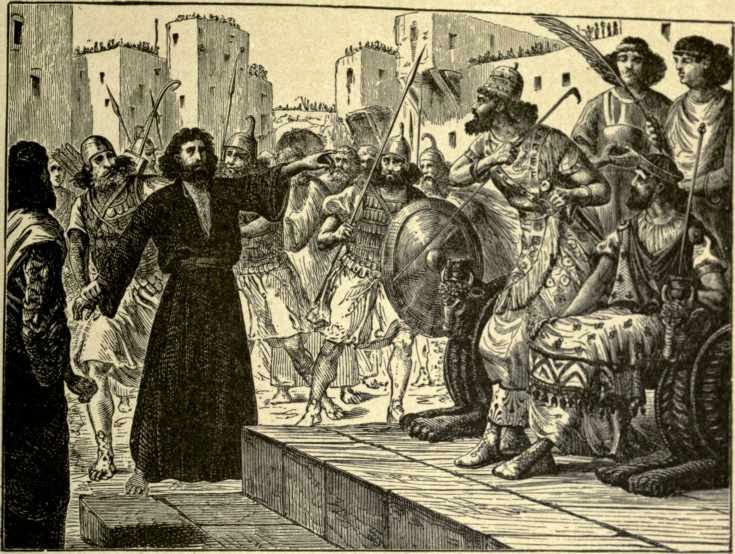
Yahweh Reigns

16 In the fifth year of Joram the son of Ahab, king of Israel, when Jehoshaphat was king of Judah, Jehoram the son of Jehoshaphat, king of Judah, began to reign. 17 He was thirty-two years old when he became king, and he reigned eight years in Jerusalem. 18 And he walked in the way of the kings of Israel, as the house of Ahab had done, for the daughter of Ahab was his wife. And he did what was evil in the sight of the LORD. 19 Yet the LORD was not willing to destroy Judah, for the sake of David his servant, since he promised to give a lamp to him and to his sons forever.

20 In his days Edom revolted from the rule of Judah and set up a king of their own. 21 Then Joram passed over to Zair with all his chariots and rose by night, and he and his chariot commanders struck the Edomites who had surrounded him, but his army fled home. 22 So Edom revolted from the rule of Judah to this day. Then Libnah revolted at the same time. 23 Now the rest of the acts of Joram, and all that he did, are they not written in the Book of the Chronicles of the Kings of Judah? 24 So Joram slept with his fathers and was buried with his fathers in the city of David, and Ahaziah his son reigned in his place.

25 In the twelfth year of Joram the son of Ahab, king of Israel, Ahaziah the son of Jehoram, king of Judah, began to reign. 26 Ahaziah was twenty-two years old when he began to reign, and he reigned one year in Jerusalem. His mother’s name was Athaliah; she was a granddaughter of Omri king of Israel. 27 He also walked in the way of the house of Ahab and did what was evil in the sight of the LORD, as the house of Ahab had done, for he was son-in-law to the house of Ahab.

28 He went with Joram the son of Ahab to make war against Hazael king of Syria at Ramoth-gilead, and the Syrians wounded Joram. 29 And King Joram returned to be healed in Jezreel of the wounds that the Syrians had given him at Ramah, when he fought against Hazael king of Syria. And Ahaziah the son of Jehoram king of Judah went down to see Joram the son of Ahab in Jezreel, because he was sick. 2 Kings 8:16-29 ESV

At this point in the narrative, the author provides a brief summary of the dynastic legacies of the two divided kingdoms. While much of his time has been spent on the interactions between the two prophets of God and the kings of Israel, he now provides an overview of the most recent lines of succession in both kingdoms.

Given the extended emphasis he has placed on the northern kingdom of Israel, the author seems compelled to step back and revisit the complex, overlapping nature of the two kingly lines. In 1 Kings 15, Jehoshaphat, the king of Judah, was first introduced. He had succeeded his father, Asa, to the throne. But from 1 Kings 16 to 2 Kings 8, the vast majority of the content focuses on the northern kingdom of Israel, detailing King Ahab’s rise to power, his wicked reign, and the long line of kings who followed him. However, the author wants his readers to know that things had not fared any better in the southern kingdom. While Jehoram ruled in Israel, a young man with the same name reigned in Judah. He was the son of Jehoshaphat, and he served for five years as his father’s coregent. He would rule for an additional eight years once the crown was his alone, but his reign would be marked by apostasy, just like the wicked kings of Israel.

Jehoram followed the example of the kings of Israel and was as wicked as King Ahab, for he had married one of Ahab’s daughters. So Jehoram did what was evil in the Lord’s sight. – 2 Kings 8:18 NLT

Jehoram had married into the ungodly and wicked family of King Ahab, taking as his wife Athaliah, a young woman who would prove to be just as evil as her mother, Jezebel. In fact, 2 Kings 11 will chronicle how she rose to power, crowning herself queen of Judah after slaughtering all her sons, who were legitimate heirs to the throne.

This woman had a powerful influence over Jehoram. His less-than-stellar choice of a marriage partner contributed to the downward spiral of his reign. Yet the author reminds his readers that a greater power was at work behind the scenes. Despite Jehoram’s wickedness and his stubborn refusal to honor the God of Abraham, Isaac, and Jacob, Yahweh was keeping the promise He had made to King David.

Yet the LORD was not willing to destroy Judah, for the sake of David his servant, since he promised to give a lamp to him and to his sons forever. – 2 Kings 8:19 ESV

Yahweh was faithfully preserving the line of David, not because they deserved it, but because He had a much longer-term plan to fulfill. That is what He had told David long before Solomon succeeded him to the throne.

“When your days are fulfilled and you lie down with your fathers, I will raise up your offspring after you, who shall come from your body, and I will establish his kingdom. He shall build a house for my name, and I will establish the throne of his kingdom forever. I will be to him a father, and he shall be to me a son. When he commits iniquity, I will discipline him with the rod of men, with the stripes of the sons of men, but my steadfast love will not depart from him, as I took it from Saul, whom I put away from before you. And your house and your kingdom shall be made sure forever before me. Your throne shall be established forever.” – 2 Samuel 7:12-16 ESV

This promise was partially fulfilled in Solomon, who would later build the temple of God in Jerusalem. But while he was blessed by God with great wisdom and wealth, in his later years, he proved to be unfaithful, succumbing to the influence of his many pagan wives and their false gods. It was because of his apostasy that God eventually split his kingdom in two, creating the northern kingdom of Israel and leaving Solomon’s son, Rehoboam, as king over the southern kingdom of Judah.

With each successive king of Judah, the problem seemed to worsen. Now Jehoram was king over Judah, and his apostasy deserved God’s divine judgment. But rather than destroy Jehoram, God graciously disciplined him by causing the neighboring nations of Edom and Libnah to revolt. His entire reign would be marked by warfare.

And the LORD stirred up against Jehoram the anger of the Philistines and of the Arabians who are near the Ethiopians. And they came up against Judah and invaded it and carried away all the possessions they found that belonged to the king’s house, and also his sons and his wives, so that no son was left to him except Jehoahaz, his youngest son. – 2 Chronicles 21:16-17 ESV

His final days in office would be excruciatingly painful due to a divinely ordained disease that eventually took his life.

…after all this the LORD struck him in his bowels with an incurable disease. In the course of time, at the end of two years, his bowels came out because of the disease, and he died in great agony. – 2 Chronicles 21:18-19 ESV

Upon his death, his son, Ahaziah, ascended to the throne. This 21-year-old king proved to be just as wicked as his father. “He also walked in the way of the house of Ahab and did what was evil in the sight of the Lord, as the house of Ahab had done” (2 Kings 8:27 ESV). But this should come as no surprise because he was the grandson of Ahab. Wickedness was in his DNA. The fact that his mother was Ahab’s daughter ensured that Ahaziah maintained a close, and ultimately deadly, relationship with the northern kingdom. He would join King Jehoram of Israel in an ill-fated attack on the Syrian stronghold of Ramoth-gilead. King Jehoram was eventually wounded in that battle and forced to return to Jezreel to recuperate. King Ahaziah would make a fateful decision to visit his uncle, but little did he know that this was part of God’s providential plan to bring an end to his wicked reign.

But it was ordained by God that the downfall of Ahaziah should come about through his going to visit Joram. – 2 Chronicles 22:7 ESV

God was in control. The kings of Israel and Judah could sit on their royal thrones, issue decrees, flaunt their power, and revel in their sovereign authority, but they were no match for Yahweh. Ultimately, their wickedness would come head-to-head with His holiness. Their rebellion would result in His judgment, because the sovereign will of Yahweh cannot be avoided or thwarted.

English Standard Version (ESV) The Holy Bible, English Standard Version. ESV® Permanent Text Edition® (2016). Copyright © 2001 by Crossway Bibles, a publishing ministry of Good News Publishers.

New Living Translation (NLT) Holy Bible, New Living Translation, copyright © 1996, 2004, 2015 by Tyndale House Foundation. Used by permission of Tyndale House Publishers Inc., Carol Stream, Illinois 60188. All rights reserved.
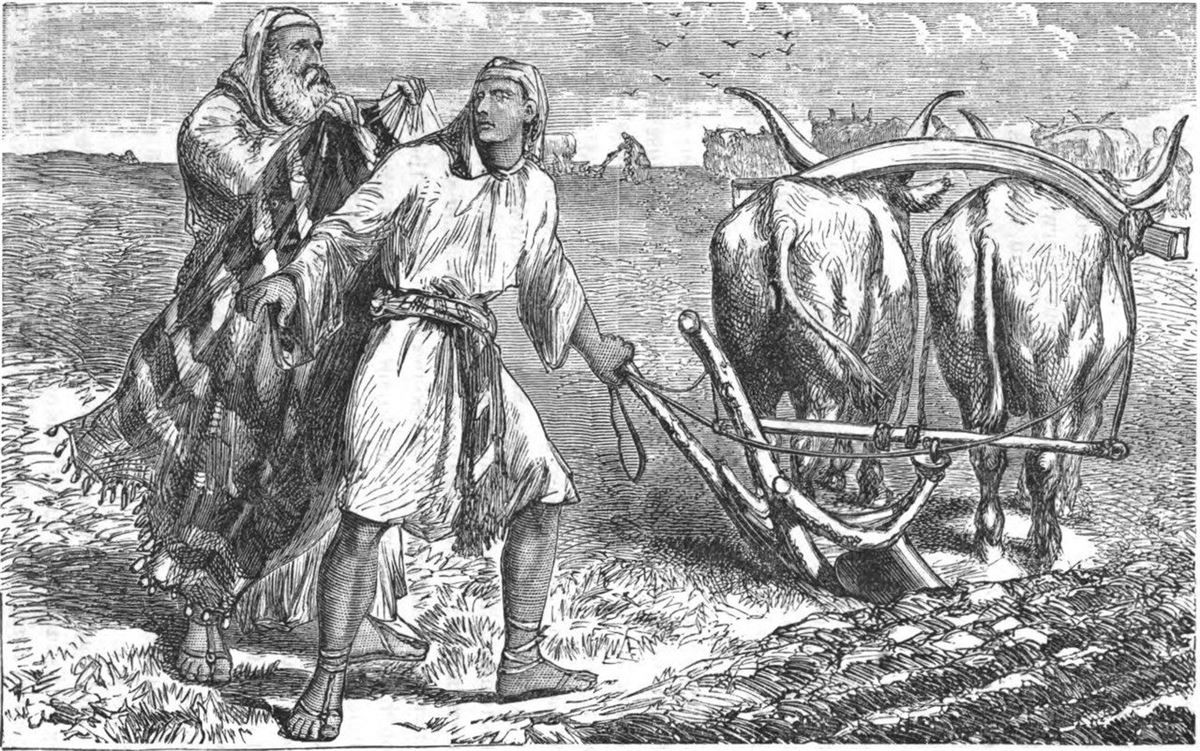
The Sovereign Will of God

1 Now Elisha had said to the woman whose son he had restored to life, “Arise, and depart with your household, and sojourn wherever you can, for the LORD has called for a famine, and it will come upon the land for seven years.” So the woman arose and did according to the word of the man of God. She went with her household and sojourned in the land of the Philistines seven years. And at the end of the seven years, when the woman returned from the land of the Philistines, she went to appeal to the king for her house and her land. Now the king was talking with Gehazi the servant of the man of God, saying, “Tell me all the great things that Elisha has done.” And while he was telling the king how Elisha had restored the dead to life, behold, the woman whose son he had restored to life appealed to the king for her house and her land. And Gehazi said, “My lord, O king, here is the woman, and here is her son whom Elisha restored to life.” And when the king asked the woman, she told him. So the king appointed an official for her, saying, “Restore all that was hers, together with all the produce of the fields from the day that she left the land until now.”

Now Elisha came to Damascus. Ben-hadad the king of Syria was sick. And when it was told him, “The man of God has come here,” the king said to Hazael, “Take a present with you and go to meet the man of God, and inquire of the LORD through him, saying, ‘Shall I recover from this sickness?’” So Hazael went to meet him, and took a present with him, all kinds of goods of Damascus, forty camels’ loads. When he came and stood before him, he said, “Your son Ben-hadad king of Syria has sent me to you, saying, ‘Shall I recover from this sickness?’” 10 And Elisha said to him, “Go, say to him, ‘You shall certainly recover,’ but the LORD has shown me that he shall certainly die.” 11 And he fixed his gaze and stared at him, until he was embarrassed. And the man of God wept. 12 And Hazael said, “Why does my lord weep?” He answered, “Because I know the evil that you will do to the people of Israel. You will set on fire their fortresses, and you will kill their young men with the sword and dash in pieces their little ones and rip open their pregnant women.” 13 And Hazael said, “What is your servant, who is but a dog, that he should do this great thing?” Elisha answered, “The LORD has shown me that you are to be king over Syria.” 14 Then he departed from Elisha and came to his master, who said to him, “What did Elisha say to you?” And he answered, “He told me that you would certainly recover.” 15 But the next day he took the bed cloth and dipped it in water and spread it over his face, till he died. And Hazael became king in his place. 2 Kings 8:1-15 ESV

Hazael meets prophet Elisha and asks for healing for his master, King Ben Hadad of Syria (2 Kings 8). Wood engraving, published in 1886.

It’s challenging to determine precisely when the two stories that open up Chapter 8 took place. But the author’s decision to include them at this point in his narrative doesn’t appear to have been based on a desire for chronological accuracy. He was trying to make a point about the spiritual conditions in and around Israel, and so he used the stories of two very different characters as illustrations. One has appeared before. The Shunammite woman was first introduced in Chapter 4. She was a faithful follower of Yahweh who had shown gracious hospitality to Elisha and his servant, providing them with shelter and food every time they passed through her town. Yahweh rewarded her generosity to His servant by allowing her to conceive and bear a son, something she had never been able to do. But sometime in his early childhood, her son became ill and died, and her joy turned to sorrow. But the prophet of God intervened and restored the child to life. Now, in Chapter 8, the author picks up the story where he left off.

Now Elisha had said to the woman whose son he had restored to life, “Arise, and depart with your household, and sojourn wherever you can, for the LORD has called for a famine, and it will come upon the land for seven years.” – 2 Kings 8:1 ESV

The prophet informed the Shunammite woman about a famine that God was about to bring upon the land because of Israel’s ongoing apostasy. He allowed this faithful servant of Yahweh to escape and find shelter until the seven years of famine had passed. She took the prophet’s advice and fled with her family to the land of the Philistines. But seven years later, when the famine was over and she returned to Shunem, she was homeless and landless. It could be that she was forced to sell her husband’s inheritance before she left seven years earlier. But there is also the possibility that the government had confiscated her land in her absence. In either case, the Mosaic law required that she be given the right to reclaim her land at any time (Leviticus 25:23-28). It would have been part of her husband’s inheritance and protected by law.

So, upon her return, she headed straight to the palace to make an appeal to the king. It seems likely that her husband is deceased, as Chapter 4 indicates he was more advanced in years (2 Kings 4:14). Yet, he may have been alive but physically unable to present his case before the king, so his wife acted on his behalf.

This is where the story gets interesting. In a display of divinely inspired timing, the woman arrived at the palace at the exact moment when Gehazi, Elisha’s servant, was speaking with King Jehoram. The fact that Gehazi was standing before the king indicates that this story took place before he was stricken with leprosy (2 Kings 5:20-27). The author doesn’t reveal the purpose behind Gehazi’s appointment with the king, but he does let us know what they discussed.

Now the king was talking with Gehazi the servant of the man of God, saying, “Tell me all the great things that Elisha has done.” – 2 Kings 8:4 ESV

Jehoram’s relationship with Elisha had been anything but cordial. Like all the kings of Israel, he had a love-hate relationship with God’s prophet. Jehoram was the son of Jezebel, and, like his wicked mother, he had continued to lead the people of Israel in the practice of idolatry. So, it seems a bit out of character for him to ask Gehazi to recount all the exploits of the prophet of God. But, once again, this reveals the divine timing and providential planning behind all that is taking place in the story. God was orchestrating everything, down to the last detail.

It just so happened that as Gehazi was telling Jehoram how Elisha had restored the woman’s son to life, she walked in the door. Gehazi, shocked at seeing the woman appear at just that moment, exclaimed, “My lord, O king, here is the woman, and here is her son whom Elisha restored to life” (2 Kings 8:5 ESV). This wasn’t a case of kismet, karma, fate, or good luck. It was the sovereign will of God Almighty on display. He had pre-ordained and orchestrated it all. The result was that the king ordered the immediate restoration of the woman’s land, “including the value of any crops that had been harvested during her absence” (2 Kings 8:6 NLT). He richly rewarded her for her faithfulness.

This sets up the second story. In this one, the location shifts from Samaria, the capital city of Israel, to Damascus, the capital city of Syria. In verses 1-6, the author presented the story of a faithful servant and a curious king. But in verses 7-15, he tells a strikingly different story about an unfaithful servant and a critically ill king. These stories are arranged as they are for a reason, and are meant to stand in stark contrast to one another. But they are also intended to demonstrate God’s sovereign hand over everything. From the palace of the king of Israel to the royal court of the pagan king of Syria, God is in complete control of all things. There is nothing that escapes His notice or falls outside His divine jurisdiction.

In another display of divine timing, Elisha has arrived in Damascus just as Ben-hadad, the king of Syria, has become ill. Upon hearing of Elisha’s presence in his capital, Ben-hadad determines to take advantage of this fortunate opportunity. He sends Hazael, the governor of Damascus, to ask Elisha whether he will recover from his illness, and, in a not-so-subtle attempt to garner a favorable response from the prophet, Ben-hadad includes a lucrative welcome gift. When Hazael delivers the king’s gift and message to Elisha, the prophet responds with a somewhat cryptic answer.

“Go and tell him, ‘You will surely recover.’ But actually the LORD has shown me that he will surely die!” – 2 Kings 8:10 NLT

Elisha had good news and bad news for the king. The good news was that Ben-hadad would recover from his illness. But the bad news was that he was destined to die. What followed this exchange was a long and awkward staredown between Elisha and Hazael. The prophet knew precisely what was going on in Hazael’s heart. God had revealed to Elisha what the governor was planning to do. So, he locked eyes with Hazael, perhaps hoping that the awkward silence would lead the governor to have second thoughts about his evil plan. But there was no confession from Hazael. Instead, Elisha began to weep. He knew what was going to happen and grieved over the long-term ramifications for the people of Israel.

“I know the terrible things you will do to the people of Israel. You will burn their fortified cities, kill their young men with the sword, dash their little children to the ground, and rip open their pregnant women!” – 2 Kings 8:12 NLT

God had given Elisha a glimpse into all that was going to take place. Ben-hadad would recover from his illness but would die at the hands of Hazael. When Hazael ascended to the throne of Syria, he would wreak havoc and destruction upon the nation of Israel. But, in actuality, he would become God’s chosen instrument of judgment upon His unfaithful people. This had always been part of God’s sovereign plan.

Chapter 19 of 1 Kings contains the story of Elijah running from the threat of Jezebel’s revenge. He escaped to the wilderness, where he sought shelter in a cave. But while there, he received a visit and a message from God.

And the LORD said to him, “Go, return on your way to the wilderness of Damascus. And when you arrive, you shall anoint Hazael to be king over Syria. And Jehu the son of Nimshi you shall anoint to be king over Israel, and Elisha the son of Shaphat of Abel-meholah you shall anoint to be prophet in your place.” – 1 Kings 19:15-16 ESV

Don’t miss the significance of what is going on here. Years earlier, God had commanded Elijah to anoint Hazael as the next king of Syria, and Elijah had obeyed. This means that long before Elisha showed up in Damascus and had his face-to-face encounter with Hazael, this man already had God’s divine seal of approval to be the next king of Syria. He had already been anointed by Elijah but had not yet assumed the throne. But it was just a matter of time. It was inevitable and unavoidable because it had been ordained by God. And God had made it clear to Elijah that He would one day use Hazael as His instrument of judgment upon the rebellious people of Israel.

And the one who escapes from the sword of Hazael shall Jehu put to death, and the one who escapes from the sword of Jehu shall Elisha put to death. Yet I will leave seven thousand in Israel, all the knees that have not bowed to Baal, and every mouth that has not kissed him.” – 1 Kings 19:17-18 ESV

Now, that prophecy was about to be fulfilled. God had shown Elisha what was about to happen, and the thought of it brought him to tears.

“The LORD has shown me that you are to be king over Syria.” – 2 Kings 8:13 ESV

The judgment of God was about to come upon the people of Israel. While Yahweh had rewarded the Shunammite woman for her faithfulness, He was about to bring death and destruction upon unfaithful Israel. The author closes his story with the fateful words: “the next day he [Hazael] took the bed cloth and dipped it in water and spread it over his face, till he died. And Hazael became king in his place” (2 Kings 8:15 ESV).

The man whom God had ordered Elijah to anoint years earlier was now the king. The sovereign will of God had been fulfilled, and the next phase of His plan for the rebellious people of Israel was about to begin.

English Standard Version (ESV) The Holy Bible, English Standard Version. ESV® Permanent Text Edition® (2016). Copyright © 2001 by Crossway Bibles, a publishing ministry of Good News Publishers.

New Living Translation (NLT) Holy Bible, New Living Translation, copyright © 1996, 2004, 2015 by Tyndale House Foundation. Used by permission of Tyndale House Publishers Inc., Carol Stream, Illinois 60188. All rights reserved.
You Can Run, But You Can’t Hide

1 After the death of Ahab, Moab rebelled against Israel.

Now Ahaziah fell through the lattice in his upper chamber in Samaria, and lay sick; so he sent messengers, telling them, “Go, inquire of Baal-zebub, the god of Ekron, whether I shall recover from this sickness.” But the angel of the LORD said to Elijah the Tishbite, “Arise, go up to meet the messengers of the king of Samaria, and say to them, ‘Is it because there is no God in Israel that you are going to inquire of Baal-zebub, the god of Ekron? Now therefore thus says the LORD, You shall not come down from the bed to which you have gone up, but you shall surely die.’” So Elijah went.

The messengers returned to the king, and he said to them, “Why have you returned?” And they said to him, “There came a man to meet us, and said to us, ‘Go back to the king who sent you, and say to him, Thus says the LORD, Is it because there is no God in Israel that you are sending to inquire of Baal-zebub, the god of Ekron? Therefore you shall not come down from the bed to which you have gone up, but you shall surely die.’” He said to them, “What kind of man was he who came to meet you and told you these things?” They answered him, “He wore a garment of hair, with a belt of leather about his waist.” And he said, “It is Elijah the Tishbite.”

Then the king sent to him a captain of fifty men with his fifty. He went up to Elijah, who was sitting on the top of a hill, and said to him, “O man of God, the king says, ‘Come down.’” 10 But Elijah answered the captain of fifty, “If I am a man of God, let fire come down from heaven and consume you and your fifty.” Then fire came down from heaven and consumed him and his fifty.

11 Again the king sent to him another captain of fifty men with his fifty. And he answered and said to him, “O man of God, this is the king’s order, ‘Come down quickly!’” 12 But Elijah answered them, “If I am a man of God, let fire come down from heaven and consume you and your fifty.” Then the fire of God came down from heaven and consumed him and his fifty.

13 Again the king sent the captain of a third fifty with his fifty. And the third captain of fifty went up and came and fell on his knees before Elijah and entreated him, “O man of God, please let my life, and the life of these fifty servants of yours, be precious in your sight. 14 Behold, fire came down from heaven and consumed the two former captains of fifty men with their fifties, but now let my life be precious in your sight.” 15 Then the angel of the LORD said to Elijah, “Go down with him; do not be afraid of him.” So he arose and went down with him to the king 16 and said to him, “Thus says the LORD, ‘Because you have sent messengers to inquire of Baal-zebub, the god of Ekron—is it because there is no God in Israel to inquire of his word?—therefore you shall not come down from the bed to which you have gone up, but you shall surely die.’”

17 So he died according to the word of the LORD that Elijah had spoken. Jehoram became king in his place in the second year of Jehoram the son of Jehoshaphat, king of Judah, because Ahaziah had no son. 18 Now the rest of the acts of Ahaziah that he did, are they not written in the Book of the Chronicles of the Kings of Israel? 2 Kings 1:1-18 ESV

The Book of 2 Kings continues the chronicle of the kings of Judah and Israel. With Ahab’s death, his son Ahaziah ascended to the throne, and he proved to be cut from the same cloth. “He did what was evil in the sight of the Lord and walked in the way of his father and in the way of his mother…” (1 Kings 22:52 ESV). In other words, he was just as immoral and spiritually bankrupt as every other king who had ruled over the northern kingdom. He not only inherited his father’s kingdom but also his predilection for false gods.  “He served Baal and worshiped him and provoked the LORD, the God of Israel, to anger in every way that his father had done” (1 Kings 22:53 ESV). And, as the opening chapter of 2 Kings reveals, his penchant for idolatry would prove to be his undoing.

But before the author reveals the fate of Ahaziah, he opens the second half of his history of the kings of Israel and Judah with a somewhat parenthetical statement: “After the death of Ahab, Moab rebelled against Israel” (2 Kings 1:1 ESV). It seems that Ahab had been extracting a sizeable annual tribute from the Moabites, literally fleecing his smaller neighbor to the east. But upon Ahab’s death, King Mesha put an end to these debilitating payments. 

Now Mesha king of Moab was a sheep breeder, and he had to deliver to the king of Israel 100,000 lambs and the wool of 100,000 rams. But when Ahab died, the king of Moab rebelled against the king of Israel. – 2 Kings 3:4-5 ESV

Before the very outset of his reign, Ahaziah would find himself having to deal with the sins of his father. Ahab had been a harsh and uncaring king who made a lot of enemies along the way, and Ahaziah would have his hands full trying to manage the royal mess his father had left him.

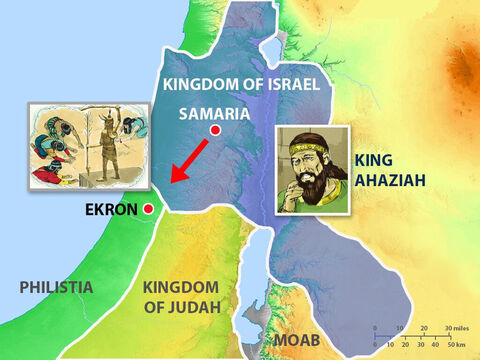
But before Ahaziah had a chance to deal with the rebellious Moabites, he suffered a life-threatening fall that left him confined to his bed in the royal palace in Samaria. His injuries were severe enough that he was concerned about whether he would fully recover. So, he sent messengers to the temple of Baal-zebub, the god of Ekron, seeking a divine prediction concerning his fate. It had been Ahaziah’s parents who had introduced Baal worship to Israel, and he proved to be a faithful adherent to their false religion. In his time of suffering, he sought the counsel of Baal rather than Yahweh, the covenant God of Israel. While Baal worship was rampant throughout the northern kingdom, Ahaziah sent his messengers to Ekron, which was located on Israel’s eastern border with Philistia. Ekron was a renowned occult center, and it was far enough away from Samaria that the news of the king’s injuries might be kept a secret.

However, Ahaziah’s messengers never reached Ekron. They were met along the way by Elijah, the prophet of Yahweh. Ahab’s old nemesis appears on the scene once again, but this time, he has bad news for Ahab’s son. Elijah had received instructions from Yahweh, commanding him to intercept the king’s messengers and inform them of their master’s fate. Ahaziah was hoping to hear a positive word from Baal, but instead, he would receive bad news from the God of Israel.

“Is there no God in Israel? Why are you going to Baal-zebub, the god of Ekron, to ask whether the king will recover? Now, therefore, this is what the LORD says: You will never leave the bed you are lying on; you will surely die.” – 2 Kings 1:3-4 NLT

There is a hint of sarcasm in this message. Yahweh is chiding Ahaziah for sending his messengers all the way to Ekron to seek a word from his false god. Baal worship was rampant within the nation of Israel. There were shrines and high places dedicated to Baal and Asherah all over the northern kingdom. In fact, Ahaziah had access to a Baal temple that his father had built in the capital city of Samaria.

He [Ahab] erected an altar for Baal in the house of Baal, which he built in Samaria. – 1 Kings 15:32 ESV

And there were literally hundreds of priests and prophets who served on behalf of Baal. Yet, Ahaziah had sent his messengers on a field trip all the way to Ekron in hopes of hearing something from his god. Perhaps he had started his search for an answer at the local temple, but had come up empty-handed. This could have led him to his “long-distance-call” to Ekron.

When Ahaziah heard the less-than-positive pronouncement his messengers delivered, he grew suspicious. This was not the news he had been expecting. So, he asked for a description of the man who had predicted his pending death. As soon as he heard what the man looked like, his suspicions were confirmed; it was Elijah the Tishbite. As the son of Ahab and Jezebel, Ahaziah would have grown up hearing the stories of Elijah and his defeat of the prophets of Baal on Mount Carmel. He would have been very familiar with his mother’s intense hatred for this prophet of Yahweh. The ongoing battle of words and will between his father and Elijah would have taken place right in front of him. So, when he discovered that Elijah had once again interjected himself into Israel’s affairs, he sent guards to arrest him. But, just like the messengers he had sent to Ekron, the guards never made it to their destination.

As visible proof of his role as a spokesman for Yahweh, Elijah called down fire from heaven that wiped out all 50 men, including their captain. But this display of power made no impression on the stubborn and unrepentant Ahaziah. He simply sent another 50 guards who suffered the very same fate. The third commander recognized the divine nature of Elijah’s role and wisely chose to beg for mercy.

“O man of God, please spare my life and the lives of these, your fifty servants. See how the fire from heaven came down and destroyed the first two groups. But now please spare my life!” – 2 Kings 1:13-14 NLT

The angel of God intervened, instructing Elijah to spare the lives of these men and accompany them back to Samaria. When he arrived in the capital city, Elijah reiterated his earlier message, but this time, directly to Ahaziah. He confirmed that the king would not recover from his injuries. Ahaziah’s stubborn refusal to seek God even in his time of greatest need would come with a death sentence. His unjustified yet unwavering allegiance to Baal had sealed his fate. As always, the words of Elijah proved to be true.

So Ahaziah died, just as the LORD had promised through Elijah. – 2 Kings 1:17 NLT

Yet another king of Israel met an untimely but well-deserved end. The legacy of unfaithfulness, begun by Jeroboam, had been passed down from generation to generation, infecting each successive king and bringing the just and righteous judgment of God upon them. And because Ahaziah had no male heir to whom he could leave the throne, his brother Jehoram became king of Israel.

Ahaziah, like his predecessors, failed to recognize Yahweh as the one true God. He acted as if Yahweh no longer existed in Israel. But he had been proven wrong. Yahweh was still alive and well, and His power was undiminished. While Ahaziah refused to seek Yahweh’s face, he could not escape Yahweh’s sovereign will. The God of Israel could be ignored, but He would not go away.

Ahaziah had made the fateful mistake of rejecting the one true God. Like his father, Ahaziah had stubbornly refused to acknowledge the supremacy of Yahweh, choosing instead to act as if the God of Israel was non-existent and powerless. But as King David declared in one of his psalms, only a fool would dare deny Yahweh’s existence.

Only fools say in their hearts,
    “There is no God.”
They are corrupt, and their actions are evil;
    not one of them does good!

The LORD looks down from heaven
    on the entire human race;
he looks to see if anyone is truly wise,
    if anyone seeks God.
But no, all have turned away;
    all have become corrupt.
No one does good,
    not a single one!

Will those who do evil never learn?
    They eat up my people like bread
    and wouldn’t think of praying to the Lord.
Terror will grip them,
    for God is with those who obey him.
The wicked frustrate the plans of the oppressed,
    but the LORD will protect his people. – Psalm 14:1-6 NLT

Ahaziah tried to pretend that Yahweh didn’t exist, but he paid for his folly with his life.

English Standard Version (ESV) The Holy Bible, English Standard Version. ESV® Permanent Text Edition® (2016). Copyright © 2001 by Crossway Bibles, a publishing ministry of Good News Publishers.

New Living Translation (NLT) Holy Bible, New Living Translation, copyright © 1996, 2004, 2015 by Tyndale House Foundation. Used by permission of Tyndale House Publishers Inc., Carol Stream, Illinois 60188. All rights reserved.

Failure to Feed the Flock of God

15 And when he had come to the king, the king said to him, “Micaiah, shall we go to Ramoth-gilead to battle, or shall we refrain?” And he answered him, “Go up and triumph; the LORD will give it into the hand of the king.” 16 But the king said to him, “How many times shall I make you swear that you speak to me nothing but the truth in the name of the LORD?” 17 And he said, “I saw all Israel scattered on the mountains, as sheep that have no shepherd. And the LORD said, ‘These have no master; let each return to his home in peace.’” 18 And the king of Israel said to Jehoshaphat, “Did I not tell you that he would not prophesy good concerning me, but evil?” 19 And Micaiah said, “Therefore hear the word of the LORD: I saw the LORD sitting on his throne, and all the host of heaven standing beside him on his right hand and on his left; 20 and the LORD said, ‘Who will entice Ahab, that he may go up and fall at Ramoth-gilead?’ And one said one thing, and another said another. 21 Then a spirit came forward and stood before the LORD, saying, ‘I will entice him.’ 22 And the LORD said to him, ‘By what means?’ And he said, ‘I will go out, and will be a lying spirit in the mouth of all his prophets.’ And he said, ‘You are to entice him, and you shall succeed; go out and do so.’ 23 Now therefore behold, the LORD has put a lying spirit in the mouth of all these your prophets; the LORD has declared disaster for you.”

24 Then Zedekiah the son of Chenaanah came near and struck Micaiah on the cheek and said, “How did the Spirit of the LORD go from me to speak to you?” 25 And Micaiah said, “Behold, you shall see on that day when you go into an inner chamber to hide yourself.” 26 And the king of Israel said, “Seize Micaiah, and take him back to Amon the governor of the city and to Joash the king’s son, 27 and say, ‘Thus says the king, “Put this fellow in prison and feed him meager rations of bread and water, until I come in peace.”’” 28 And Micaiah said, “If you return in peace, the LORD has not spoken by me.” And he said, “Hear, all you peoples!” 1 Kings 22:15-28 ESV

Imagine the scene. Micaiah, the prophet, has been forcibly dragged before King Ahab, who is seated on the dais with his guest, King Jehoshaphat of Judah. Surrounding the two potentates are 400 prophets of Baal, each taking turns declaring their version of the truth. For hours, they have been telling King Ahab exactly what he wants to hear: “Go up to Ramoth-gilead and triumph; the LORD will give it into the hand of the king” (1 Kings 22:12 ESV). One of them, a man named Zedekiah, had even crafted a pair of iron horns and used them as a prop to support his message to the king: “Thus says the LORD, ‘With these you shall push the Syrians until they are destroyed’” (1 Kings 22:11 ESV).

Then Micaiah shows up. Unlike the 400 yes-men who have been masquerading as spokesmen for the false god, Baal, Micaiah was a prophet of Yahweh. As such, he was obligated to speak only those words given to him by God. Which is precisely what Micaiah told the man who had come to fetch him.

As the LORD lives, what the LORD says to me, that I will speak.” – 1 Kings 22:14 ESV

Yet, when King Ahab asked Micaiah to reveal what his God thought about the planned attack of Ramoth-gilead, Micaiah simply repeated the words of the false prophets. He basically told the king, “Go for it!” But Ahab sensed the thinly veiled sarcasm behind Micaiah’s answer and demanded that he tell him the truth. Ahab knew from past experience that Micaiah and his God would oppose his plans. He had even revealed to King Jehoshaphat just how much he loathed Micaiah, telling him, “He never prophesies anything but trouble for me!” (1 Kings 22:8 NLT).

Micaiah knew that it really didn’t matter what he told Ahab, because the king would do as he wanted. Ahab’s stubbornness and arrogance would prevent him from hearing and heeding the message of Yahweh. But Micaiah shared it anyway.

“In a vision I saw all Israel scattered on the mountains, like sheep without a shepherd. And the LORD said, ‘Their master has been killed. Send them home in peace.’” – 1 Kings 22:17 NLT

Ahab was infuriated because Micaiah had just predicted Israel’s defeat and the king’s own death. But this less-than-encouraging message was just what Ahab had expected from the prophet of Yahweh. Just like Elijah, Micaiah proved to be a messenger of doom and gloom, bent on delivering nothing but bad news concerning Ahab’s kingly aspirations.

But Micaiah was not done. He next revealed how God had chosen to implement His plan for Ahab’s demise.

“Listen to what the LORD says! I saw the LORD sitting on his throne with all the armies of heaven around him, on his right and on his left. And the LORD said, ‘Who can entice Ahab to go into battle against Ramoth-gilead so he can be killed?’

“There were many suggestions, and finally a spirit approached the LORD and said, ‘I can do it!’

“‘How will you do this?’ the LORD asked.

“And the spirit replied, ‘I will go out and inspire all of Ahab’s prophets to speak lies.’

“‘You will succeed,’ said the LORD. ‘Go ahead and do it.’” – 1 Kings 22:19-22 NLT

Micaiah was given a vision of a conversation that took place in the throne room of God Almighty. In the vision, Yahweh is portrayed as a king surrounded by his advisors and his army. He is soliciting input from the heavenly host, asking for their counsel on the best way to get Ahab to proceed with his attack on Ramoth-gilead, which will result in his death. A spirit speaks up and offers to deceive the prophets of Baal by giving them a false message of victory. God approves the plan and sends the spirit on its way. Then Micaiah informs Ahab that this is precisely what has happened.

“So you see, the LORD has put a lying spirit in the mouths of all your prophets. For the LORD has pronounced your doom.” – 1 Kings 22:23 NLT

Amazingly, Micaiah tells Ahab the stark reality of all that had just transpired. The 400 prophets had unwittingly declared a lie, enticing Ahab to proceed with his plan to attack Ramoth-gilead and, inadvertently, bringing about his own demise. The identity of this “lying spirit” is unclear. Some view this as an angelic being who visited the king’s prophets and gave them a false message to deliver to the king. Others have determined this to have been a demonic spirit or Satan himself. But the text only indicates that this spirit was authorized by Yahweh to deceive the pseudo-prophets with a false message that would entice Ahab to attack Ramoth-gilead. Their answer, influenced by the spirit sent by Yahweh, was consistent and convincing.

“Yes, go right ahead! The LORD will give the king victory.” – 1 Kings 22:6 NLT 

Yet, even when Micaiah disclosed the truth to Ahab, the king stubbornly refused to give up his plan. He ordered Micaiah’s arrest and imprisonment and commanded that he be given nothing but bread and water until he had returned safely from his battle for Ramoth-gilead. But before being hauled off to prison, Micaiah made one final pronouncement to the king and all those who stood within earshot.

“If you return safely, it will mean that the LORD has not spoken through me!” Then he added to those standing around, “Everyone mark my words!” – 1 Kings 22:28 NLT

The problem with Ahab was not just his stubbornness and idolatry; it was his refusal to shepherd the people of Israel. All his self-centered acts of self-promotion had done irreparable damage to the nation of Israel. He had led the people into apostasy and idolatry, and, as a king over God’s chosen people, he would be held responsible for his failure to care for Yahweh’s flock. Hundreds of years later, the prophet Ezekiel would declare a foreboding message from God concerning all those kings who, like Ahab, had left the people of God like sheep without a shepherd.

Then this message came to me from the LORD: “Son of man, prophesy against the shepherds, the leaders of Israel. Give them this message from the Sovereign LORD: What sorrow awaits you shepherds who feed yourselves instead of your flocks. Shouldn’t shepherds feed their sheep? You drink the milk, wear the wool, and butcher the best animals, but you let your flocks starve. You have not taken care of the weak. You have not tended the sick or bound up the injured. You have not gone looking for those who have wandered away and are lost. Instead, you have ruled them with harshness and cruelty. So my sheep have been scattered without a shepherd, and they are easy prey for any wild animal. They have wandered through all the mountains and all the hills, across the face of the earth, yet no one has gone to search for them.” – Ezekiel 34:1-6 NLT

This motif of shepherdless sheep dates back to the time of Moses. When the great deliverer of Israel was nearing the end of his life, he appealed to God, asking Him to provide the people of Israel with a new shepherd.

Then Moses said to the LORD, “O LORD, you are the God who gives breath to all creatures. Please appoint a new man as leader for the community. Give them someone who will guide them wherever they go and will lead them into battle, so the community of the LORD will not be like sheep without a shepherd.” – Numbers 27:15-17 NLT

Centuries later, long after Ahab had died, Jesus appeared on the scene, offering His own assessment of the spiritual state of the people of Israel.

Jesus traveled through all the towns and villages of that area, teaching in the synagogues and announcing the Good News about the Kingdom. And he healed every kind of disease and illness. When he saw the crowds, he had compassion on them because they were confused and helpless, like sheep without a shepherd. – Matthew 9:35-36 NLT

The Good Shepherd couldn’t help but look at His own people and see them as shepherdless sheep, wandering about confused and helpless. For centuries, they had been misled and mistreated. Their political and spiritual leaders had used and abused them. Those who should have been feeding and caring for them had ended up taking advantage of them, following the example of Ahab. But Jesus arrived on the scene as the Son of David, emulating the example of the man after God’s own heart. Jesus was the quintessential shepherd, the Good Shepherd, who would lay down His life for the sheep. Jesus would shepherd the flock of God with care and compassion, just as His forefather did.

He [Gpd] chose David his servant
    and took him from the sheepfolds;
from following the nursing ewes he brought him
    to shepherd Jacob his people,
    Israel his inheritance.
With upright heart he shepherded them
    and guided them with his skillful hand. – Psalm 78:70-72 ESV

At the end of the day, Ahab’s most significant problem was that he was a lousy shepherd. His chief sin was that he had failed to care for God’s flock and had made his own needs a higher priority than the needs of the people. Like most of the kings of Israel and Judah, Ahab had abused his divinely ordained power and position, and he would have to answer to the Great Shepherd of Israel. But despite Ahab’s egocentric ambitions and his physical and spiritual mistreatment of those whom God had placed under his care, Yahweh would personally ensure that His chosen people received the care and compassion He had promised them.

He will feed his flock like a shepherd. He will carry the lambs in his arms, holding them close to his heart. He will gently lead the mother sheep with their young. – Isaiah 40:11 NLT

English Standard Version (ESV) The Holy Bible, English Standard Version. ESV® Permanent Text Edition® (2016). Copyright © 2001 by Crossway Bibles, a publishing ministry of Good News Publishers.

New Living Translation (NLT) Holy Bible, New Living Translation, copyright © 1996, 2004, 2015 by Tyndale House Foundation. Used by permission of Tyndale House Publishers Inc., Carol Stream, Illinois 60188. All rights reserved.

Yahweh’s Divine Tag Team

15 And the LORD said to him, “Go, return on your way to the wilderness of Damascus. And when you arrive, you shall anoint Hazael to be king over Syria. 16 And Jehu the son of Nimshi you shall anoint to be king over Israel, and Elisha the son of Shaphat of Abel-meholah you shall anoint to be prophet in your place. 17 And the one who escapes from the sword of Hazael shall Jehu put to death, and the one who escapes from the sword of Jehu shall Elisha put to death. 18 Yet I will leave seven thousand in Israel, all the knees that have not bowed to Baal, and every mouth that has not kissed him.”

19 So he departed from there and found Elisha the son of Shaphat, who was plowing with twelve yoke of oxen in front of him, and he was with the twelfth. Elijah passed by him and cast his cloak upon him. 20 And he left the oxen and ran after Elijah and said, “Let me kiss my father and my mother, and then I will follow you.” And he said to him, “Go back again, for what have I done to you?” 21 And he returned from following him and took the yoke of oxen and sacrificed them and boiled their flesh with the yokes of the oxen and gave it to the people, and they ate. Then he arose and went after Elijah and assisted him. 1 Kings 19:15-21 ESV

The last three and a half years had taken their toll on Elijah. He had been living in a God-ordained exile in a remote village in the region of Sidon. While God had miraculously cared for him during that time, he had to live with the knowledge that there was a bounty on his head. King Ahab and his queen, Jezebel, had never forgiven him for the drought he had placed on the land of Israel. Elijah must have woken up every morning wondering if that would be the day God called him to confront Ahab and Jezebel one more time.

When that day finally came, Elijah obeyed God and made his way to Mount Carmel, where he challenged King Ahab to pit his 450 prophets of Baal against Yahweh, the one true God. That battle ended up being a lopsided affair, with Elijah’s God as the clear victor and the false god of Ahab and Jezebel exposed as a fraud and a failure. The dead bodies of his 450 prophets, strewn across the Jezreel Valley, were evidence of his decisive defeat.

But Elijah’s hope for revival in the land was soon replaced by fear for his own life. Jezebel had vowed to kill Elijah for his slaughter of the 450 prophets of Baal. And he responded to this news by running away. The prophet of God seemed to have lost all faith in God. Yet, even in his deep state of depression and despondency, Elijah was ministered to by God. Yahweh met Elijah right where he was, in the midst of his doubt and despair, and graciously provided him with a visual demonstration of His power. However, the wind, earthquake, and fire only frightened Elijah, causing him to take refuge in a cave. But it was the quiet whisper of God that drew him out, and the gentle voice of God asked Elijah to explain his presence there. What was the prophet doing so far from the scene of the recent victory over Baal? Why was he hiding? Elijah’s answer revealed his struggle with a lack of faith and a sense of failure.

I have been very jealous for the LORD, the God of hosts. For the people of Israel have forsaken your covenant, thrown down your altars, and killed your prophets with the sword, and I, even I only, am left, and they seek my life, to take it away.” – 1 Kings 19:14 ESV

Elijah described himself as alone and afraid. He had convinced himself that he was the last man standing, with no one to do battle at his side. In the heat of the moment, he had conveniently forgotten about the 100 prophets that God had used Obadiah to protect and preserve (1 Kings 18:13). Elijah felt alienated and alone, but his feelings were not based on reality. God even informed Elijah that He had preserved a remnant of “7,000 others in Israel who have never bowed down to Baal or kissed him!” (1 Kings 19:18 NLT). Elijah was far from alone, and God was far from finished with Elijah. But rather than rebuke His wavering prophet, God gave him his next assignment.

“Go back the same way you came, and travel to the wilderness of Damascus. When you arrive there, anoint Hazael to be king of Aram. Then anoint Jehu grandson of Nimshi to be king of Israel, and anoint Elisha son of Shaphat from the town of Abel-meholah to replace you as my prophet.” – 1 Kings 19:15 ESV

Despite his recent display of faithlessness and fear, Elijah would play a significant role in the next phase of God’s plans for Israel. God gave Elijah three assignments: First, he was to anoint a new king over the Syrians or Arameans. Then, he was to anoint a new king over Israel’s northern kingdom. Finally, he was to anoint his own successor. God provided Elijah little in the way of details. Other than the names of the men he was to anoint, Elijah had no way of knowing what any of this meant or how it would all turn out. But God was letting Elijah know that there were plans in the works of which he was unaware. Whether Elijah realized it or not, Ahab’s days were numbered, and the Syrians would end up playing a part in his eventual demise. There would be a new king in Israel one day. God had defeated the false god, Baal, and now He was going to mete out final judgment on the man responsible for Baal’s presence in Israel.

As if to further convince Elijah that he was not alone and that his mission was far from over, God revealed that the three men Elijah was to anoint would carry on the work that he had started at Mount Carmel. Elijah had killed the 450 prophets of Baal, but there were far more who needed to face the judgment of God for their apostasy and rebellion.

“Anyone who escapes from Hazael will be killed by Jehu, and those who escape Jehu will be killed by Elisha! – 1 Kings 19:17 NLT

Judgment was coming. Yahweh was preparing to purge Israel of all those who had bowed the knee to Baal, and He would start at the top with Ahab and Jezebel. But this divine plan to cleanse Israel would not happen overnight. In fact, it would last long after Elijah was gone. That’s why God informed Elijah that he was to anoint his successor.

“…anoint Elisha son of Shaphat from the town of Abel-meholah to replace you as my prophet. – 1 Kings 19:16 NLT

God already had Elijah’s replacement identified and a strategy in place to carry on His divine plan for Ahab’s punishment and Israel’s purification. A big reason for Elijah’s dejection was that the revival that started at Mount Carmel had stalled. When he had heard the people cry out, “The LORD, he is God; the LORD, he is God” (1 Kings 18:39 ESV), he genuinely believed that God had turned back the hearts of the people, and he expected to see an amazing renewal take place. He may have even thought that Ahab and Jezebel might repent and accept Yahweh as the one true God. But instead, the ever-defiant queen had threatened him with death.

But while Jezebel remained unwavering in her commitment to Baal, Elijah needed to understand that God was unfazed by her actions. As the sovereign, omniscient God of the universe, He had a plan in place to deal with Jezebel, Ahab, and all those who had bent the knee to Baal. And while Elijah might not live to see the final phase of that plan, he would play a decisive role in its implementation.

Revived and encouraged by Yahweh’s news, Elijah made his way to Abel-meholah, located in the Jordan Valley. While God clearly told Elijah to travel to the wilderness of Damascus and anoint Hazael to be king of Aram (1 Kings 19:15), it would appear that this was meant to be his final destination. On his way from Mount Sinai, he had to pass through the Jordan Valley, so it only made sense to stop there first and find the man who would be his replacement. He found Elisha plowing with 12 pairs of oxen in a field. This agrarian scene is significant for several reasons. First, it conveys an image of hope and expectation. After three-and-a-half years of drought, the rain had come, and now Elisha was preparing his formerly sun-baked fields for planting. He was anticipating a fruitful harvest sometime in the future. But Elisha’s presence in the field also reveals that he was a man of the land. He was not an influential figure with great wealth and prominence. He was a nondescript nobody whose only credentials were his calling by Yahweh.

What happens next appears strange to our modern sensibilities. Elijah walked up to this man, placed his cloak across his shoulders, and then simply walked away. What kind of bizarre ritual did this represent? How could Elisha have taken this unexpected action from this unknown stranger? Amazingly, it seems as if Elisha fully understood the significance of Elijah’s symbolic act. The text states that he “left the oxen standing there, ran after Elijah, and said to him, ‘First let me go and kiss my father and mother good-bye, and then I will go with you!’” (1 Kings 19:20 NLT). Perhaps God had already prepared Elisha for this moment, having revealed His plan through a dream or vision. He could have sent an angelic messenger to prepare Elisha for the prophet’s arrival. But whatever the case, Elisha seems to have been unfazed by what transpired and fully aware of what it meant. He immediately stopped his plowing and followed the man of God. His words and actions reveal that he knew who Elijah was and what he was asking him to do. His only request was that he be allowed to say goodbye to his family.

Elijah’s response to his request comes across as rather flippant.

Go back again, for what have I done to you?” – 1 Kings 19:20 ESV

In a sense, Elijah was simply emphasizing that this had all been God’s doing, not his. He was merely the messenger. Elisha was free to do as he pleased, and the young farmer-turned-prophet demonstrated his commitment to accept the call of God. He took the plow, the symbol of his former occupation, and used the wood to build an altar. Then, on that altar, he offered up the oxen with which he had been plowing. Elisha burned every bridge to his former life. He bid his parents and his past goodbye and “arose and went after Elijah and assisted him” (1 Kings 19:21 ESV).

As Elijah and Elisha made their way from the Jordan Valley, the first phase of the second half of God’s plan began. The revival Elijah had longed for and given up on was coming. Yahweh was not yet done. Elijah had been a key player in God’s renewal plans for Israel, but his part was coming to an end. The LORD had another man ready to take the baton and finish the race. God would use this divine tag team to accomplish His will concerning Israel and usher in a period of much-needed spiritual renewal among His covenant people. The apostle Paul would later explain his understanding of how God uses a team approach to accomplish His divine will.

What then is Apollos? What is Paul? Servants through whom you believed, as the Lord assigned to each. I planted, Apollos watered, but God gave the growth. So neither he who plants nor he who waters is anything, but only God who gives the growth. He who plants and he who waters are one, and each will receive his wages according to his labor. For we are God’s fellow workers. You are God’s field, God’s building. – 1 Corinthians 3:5-9 ESV

Elijah had planted; now it was Elisha’s turn to water. But the harvest would be the LORD’s.

English Standard Version (ESV) The Holy Bible, English Standard Version. ESV® Permanent Text Edition® (2016). Copyright © 2001 by Crossway Bibles, a publishing ministry of Good News Publishers.

New Living Translation (NLT) Holy Bible, New Living Translation, copyright © 1996, 2004, 2015 by Tyndale House Foundation. Used by permission of Tyndale House Publishers Inc., Carol Stream, Illinois 60188. All rights reserved.

Limping Between Two Spiritual Opinions

1 After many days the word of the LORD came to Elijah, in the third year, saying, “Go, show yourself to Ahab, and I will send rain upon the earth.” So Elijah went to show himself to Ahab. Now the famine was severe in Samaria. And Ahab called Obadiah, who was over the household. (Now Obadiah feared the LORD greatly, and when Jezebel cut off the prophets of the LORD, Obadiah took a hundred prophets and hid them by fifties in a cave and fed them with bread and water.) And Ahab said to Obadiah, “Go through the land to all the springs of water and to all the valleys. Perhaps we may find grass and save the horses and mules alive, and not lose some of the animals.” So they divided the land between them to pass through it. Ahab went in one direction by himself, and Obadiah went in another direction by himself.

And as Obadiah was on the way, behold, Elijah met him. And Obadiah recognized him and fell on his face and said, “Is it you, my lord Elijah?” And he answered him, “It is I. Go, tell your lord, ‘Behold, Elijah is here.’” And he said, “How have I sinned, that you would give your servant into the hand of Ahab, to kill me? 10 As the LORD your God lives, there is no nation or kingdom where my lord has not sent to seek you. And when they would say, ‘He is not here,’ he would take an oath of the kingdom or nation, that they had not found you. 11 And now you say, ‘Go, tell your lord, “Behold, Elijah is here.”’ 12 And as soon as I have gone from you, the Spirit of the LORD will carry you I know not where. And so, when I come and tell Ahab and he cannot find you, he will kill me, although I your servant have feared the LORD from my youth. 13 Has it not been told my lord what I did when Jezebel killed the prophets of the Lord, how I hid a hundred men of the Lord’s prophets by fifties in a cave and fed them with bread and water? 14 And now you say, ‘Go, tell your lord, “Behold, Elijah is here”’; and he will kill me.” 15 And Elijah said, “As the LORD of hosts lives, before whom I stand, I will surely show myself to him today.” 16 So Obadiah went to meet Ahab, and told him. And Ahab went to meet Elijah.

17 When Ahab saw Elijah, Ahab said to him, “Is it you, you troubler of Israel?” 18 And he answered, “I have not troubled Israel, but you have, and your father’s house, because you have abandoned the commandments of the LORD and followed the Baals. 19 Now therefore send and gather all Israel to me at Mount Carmel, and the 450 prophets of Baal and the 400 prophets of Asherah, who eat at Jezebel’s table.”

20 So Ahab sent to all the people of Israel and gathered the prophets together at Mount Carmel. 21 And Elijah came near to all the people and said, “How long will you go limping between two different opinions? If the LORD is God, follow him; but if Baal, then follow him.” And the people did not answer him a word. 1 Kings 18:1-22 ESV

For nearly three years, Elijah has been living in exile among the Sidonians. God had sent him there to protect and preserve him for the next phase of his mission. Three years earlier, Elijah had delivered God’s message of judgment to King Ahab and his pagan queen, Jezebel. Their joint decision to use their royal power to legislate the worship of Baal had brought down the anger of Yahweh in the form of a devastating famine. Knowing this godless couple would seek to kill His messenger, God sent Elijah away so that he could live to fight another day, and that day had finally come.

In his original encounter with Ahab, Elijah had boldly declared that the famine would last until God ordered him to bring it to an end.

“As surely as the LORD, the God of Israel, lives—the God I serve—there will be no dew or rain during the next few years until I give the word!” – 1 Kings 17:1 NLT

Now, three years later, Elijah had received his marching orders from God.

“Go, show yourself to Ahab, and I will send rain upon the earth.” – 1 Kings 18:1 ESV

God had allowed the drought to take its toll. Three years without rain had resulted in a widespread famine that had even impacted the capital city of Samaria. It was there that Ahab had ordered the construction of a temple to Baal, the Phoenician fertility god.

He erected an altar for Baal in the house of Baal, which he built in Samaria. And Ahab made an Asherah. Ahab did more to provoke the LORD, the God of Israel, to anger than all the kings of Israel who were before him. – 1 Kings 16:32-33 ESV

But Baal’s presence had not spared the royal city. Whatever power the people believed their beloved fertility god possessed had failed to stem the ravaging effects of the drought and the life-threatening nature of the resulting famine. Things had gotten so bad that Ahab ordered a search for any land where there might be grass to feed his horses and mules. As king, he was more concerned about the fate of his livestock than he was about the well-being of the people under his care. So, he sent his household manager on a desperate, but futile search for green grass in the midst of a famine. But what Obadiah ended up finding was something neither he nor the king ever expected.

As Obadiah was walking along, he suddenly saw Elijah coming toward him. Obadiah recognized him at once and bowed low to the ground before him. “Is it really you, my lord Elijah?” he asked. – 1 Kings 18:7 NLT

Obadiah was shocked to run into Elijah. After three years, he had probably assumed that the prophet had met an untimely end. But out of reverence and honor, he bowed before Elijah. This man, who served as a royal official in the court of King Ahab, was still a faithful follower of Yahweh, and the author provides an essential parenthetical description that lets the reader know that Obadiah can be trusted.

Obadiah was a devoted follower of the LORD. Once when Jezebel had tried to kill all the LORD’s prophets, Obadiah had hidden 100 of them in two caves. He put fifty prophets in each cave and supplied them with food and water. – 1 Kings 18:3-4 NLT

This little detail concerning Obadiah will prove to be important as the narrative unfolds. First, it lets the reader know that after Elijah had delivered God’s message concerning the drought, Jezebel had launched a campaign to liquidate any and all of God’s prophets from the land of Israel. It seems reasonable to believe that her goal had been to catch and eliminate Elijah. Still, she was willing to execute any prophet of Yahweh who might stand in opposition to her will and the worship of her false god.

But the author’s little aside provides a second detail that will prove crucial. Jezebel’s death squads had failed to find and kill 100 prophets of Yahweh because they had been protected by Obadiah. At significant risk to his own life, this royal official had willfully violated the queen’s command by aiding and abetting those whose executions she had ordered. God had chosen to use ravens to deliver food for Elijah. But in the case of the 100 prophets, He had selected a member of Ahab’s royal court. Once again, God had used an unlikely and unexpected source to preserve His messengers. The fact that these 100 prophets exist will become more important as the story unfolds.

Recognizing Obadiah as a member of the royal court, Elijah instructed him to return to the palace with a message for the king.

“Go, tell your lord, ‘Behold, Elijah is here.’” – 1 Kings 18:8 ESV

Obadiah, while a faithful follower of Yahweh, was not thrilled at the prospect of sharing this news with King Ahab. He knew that Elijah was a wanted man with a bounty on his head, and Ahab had gone to great lengths to locate and eliminate this proverbial thorn in his side.

“I swear by the Lord your God that the king has searched every nation and kingdom on earth from end to end to find you” – 1 Kings 18:10 NLT

After three years, Ahab’s quest to find Elijah had proven unsuccessful, and his frustration would have been at an all-time high. Obadiah was afraid that if he delivered Elijah’s message and then the prophet disappeared again, the king would take out his anger on him. In an attempt to let Elijah know that he had already risked his life in the cause of Yahweh, Obadiah shared the story of his rescue of the 100 prophets. Hadn’t that been enough? Was God now requiring him to put his life on the line again just so he could deliver Elijah’s message to the king?

But Elijah promised his reluctant friend that he would not put his life in jeopardy; he would not be going anywhere because he had a job to do. In fact, he assured Obadiah that he would appear before the king that very day. So, Obadiah did as the prophet commanded and rode to find the king, who was also conducting a futile search for green grass.

When Ahab heard the news, he dropped everything and rode to meet Elijah. Upon seeing the man he loathed and despised, the king sarcastically asked, “Is it you, you troubler of Israel?” (1 Kings 18:17 ESV). This arrogant and apostate king tried to blame Elijah for the nation’s woes. He knew that Elijah had spoken the drought into existence, and he held him personally responsible for all the pain and suffering it had caused. His stubborn and unrepentant heart would not allow him to admit his own culpability for what had happened. It was the sin of Ahab and his wife that had brought down the judgment of God. Elijah had just been the messenger, and he immediately placed the blame for Israel’s woes right where it belonged.

“I have made no trouble for Israel,” Elijah replied. “You and your family are the troublemakers, for you have refused to obey the commands of the LORD and have worshiped the images of Baal instead. – 1 Kings 18:18 NLT

Ahab and his father Omri had led the people of Israel into apostasy by promoting the worship of false gods. They had turned their backs on Yahweh, causing God’s chosen people to commit spiritual adultery by giving their allegiance and affections to the gods of the Canaanites. They were to blame for the drought and the famine it caused.

But it’s important to recall that God had told Elijah to deliver a message to Ahab that would have sounded like good news: “Tell him that I will soon send rain!” (1 Kings 18:1 NLT). Yet, while the drought was about to end, the judgment was far from over. God was about to deliver a devastating blow to the royal couple that would reveal the impotence of their false god and the futility of abandoning the one true God.

Elijah threw down the gauntlet, challenging the king to a public showdown that would pit Baal against Yahweh.

“Now summon all Israel to join me at Mount Carmel, along with the 450 prophets of Baal and the 400 prophets of Asherah who are supported by Jezebel.” – 1 Kings 18:19 NLT

Driven by pride, the king took the challenge and called for an assembly of all the people of Israel. He ordered all the prophets of his false gods to gather together to do battle with Elijah and his God. Just consider the arrogance required to do what Ahab did. He was willingly and deliberately going to war with God Almighty, and he legitimately thought he could win, but his ego was in for a rude awakening. His gods were about to be exposed for what they were: Figments of man’s fertile and futile imagination that would be proven lifeless and powerless before the God of the universe.

In an epic showdown, Elijah was going to take on the god of Ahab and Jezebel, and challenge the people of Israel to end their vacillating indecision about which God they would serve. In a sense, Elijah was following the lead of Joshua, who, centuries earlier, had issued a similar challenge to the indecisive and unfaithful Israelites of his day.

“…choose today whom you will serve. Would you prefer the gods your ancestors served beyond the Euphrates? Or will it be the gods of the Amorites in whose land you now live? But as for me and my family, we will serve the LORD.” – Joshua 24:15 NLT

English Standard Version (ESV) The Holy Bible, English Standard Version. ESV® Permanent Text Edition® (2016). Copyright © 2001 by Crossway Bibles, a publishing ministry of Good News Publishers.

New Living Translation (NLT) Holy Bible, New Living Translation, copyright © 1996, 2004, 2015 by Tyndale House Foundation. Used by permission of Tyndale House Publishers Inc., Carol Stream, Illinois 60188. All rights reserved.