Not What They Expected

27 Just then his disciples came back. They marveled that he was talking with a woman, but no one said, “What do you seek?” or, “Why are you talking with her?” 28 So the woman left her water jar and went away into town and said to the people, 29 “Come, see a man who told me all that I ever did. Can this be the Christ?” 30 They went out of the town and were coming to him.

31 Meanwhile the disciples were urging him, saying, “Rabbi, eat.” 32 But he said to them, “I have food to eat that you do not know about.” 33 So the disciples said to one another, “Has anyone brought him something to eat?” 34 Jesus said to them, “My food is to do the will of him who sent me and to accomplish his work. 35 Do you not say, ‘There are yet four months, then comes the harvest’? Look, I tell you, lift up your eyes, and see that the fields are white for harvest. 36 Already the one who reaps is receiving wages and gathering fruit for eternal life, so that sower and reaper may rejoice together. 37 For here the saying holds true, ‘One sows and another reaps.’ 38 I sent you to reap that for which you did not labor. Others have labored, and you have entered into their labor.” – John 4:27-38 ESV

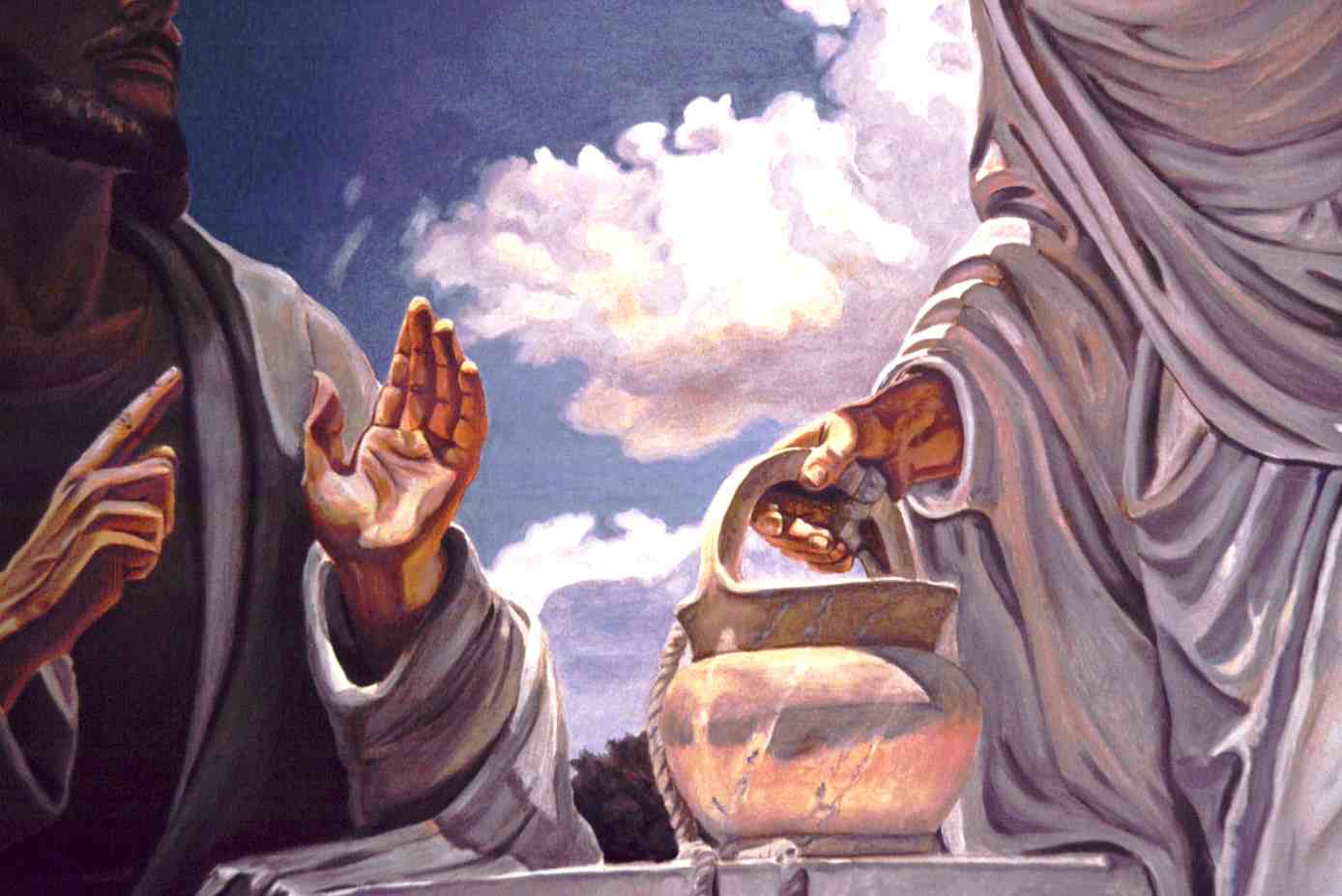
The Samaritan woman had come to the well to draw water. The disciples had gone to a nearby town to find food. John’s emphasis on the contrast between the physical and the spiritual is all over this section of his gospel. With his depiction of Jesus’ encounter with the Samaritan woman, John accentuates the stark contrast between earthly and the heavenly, the temporal and the eternal. The woman’s life depicts mankind’s obsession with meeting physical needs. The water was a symbol of her insatiable need to satisfy her earthly desires. Jesus’ revelation concerning her five failed marriages speaks volumes about her neediness, insecurity, and susceptibility to her own passions and desires. That she was living with yet another man, outside the bonds of marriage, reveals her deep-seated desire for acceptance and love. She had tremendous physical, emotional, and psychological needs. Yet, she was blind to the fact that her greatest need was spiritual in nature.

All the while Jesus had been attempting to quench this woman’s spiritual thirst, His disciples had been in search for food. And John points out their shock when they returned to find Jesus speaking to a woman, and a Samaritan woman at that. This was unacceptable behavior for someone like Jesus. The disciples, as Jews, would have been appalled that their teacher had been willing to risk becoming ceremonially unclean through interaction with a Samaritan. And while they were dying to know what had prompted Jesus’ actions, they kept their questions to themselves.

Meanwhile, the woman had made her way back into town, anxious to share the exciting news of her unexpected encounter with Jesus.

The woman left her water jar beside the well and ran back to the village, telling everyone, “Come and see a man who told me everything I ever did! Could he possibly be the Messiah?” – John 4:28-29 NLT

John’s mention of the water jar is an important part of the story that can be easily overlooked. That jar was an essential part of her daily routine. It was the key to her drawing water from the well, which, as she had told Jesus, was deep. Without the jar, she would have no means of satisfying her thirst. But her willingness to leave it behind is a subtle statement by John that she had found something far more important and significant. It is reminiscent of the words of Jesus, spoken during His sermon on the mount.

“So don’t worry about these things, saying, ‘What will we eat? What will we drink? What will we wear?’ These things dominate the thoughts of unbelievers, but your heavenly Father already knows all your needs. Seek the Kingdom of God above all else, and live righteously, and he will give you everything you need.” – Matthew 6:31-33 NLT

Jesus would later reiterate this same thought to His disciples, telling them, “That is why I tell you not to worry about everyday life—whether you have enough food to eat or enough clothes to wear. For life is more than food, and your body more than clothing.” (Luke 12:22-23 NLT). And He would add a further note of instruction:

“Seek the Kingdom of God above all else, and he will give you everything you need. So don’t be afraid, little flock. For it gives your Father great happiness to give you the Kingdom.” – Luke 12:31-32 NLT

By leaving her water jar behind, the Samaritan woman was putting the teaching of Jesus into action. She was illustrating what it means to seek the Kingdom of God above all else. Suddenly, the earthly things that had meant so much to her, lost their value and appeal. She had discovered something of far greater worth.

“Come and see a man who told me everything I ever did! Could he possibly be the Messiah?” – John 4:29 NLT

Her interest was piqued. She was curiously intrigued by all Jesus had said to her. And her excitement was contagious because she eventually returned with a crowd of her fellow townspeople in tow.

But John returns our attention to the contrast between the physical and the spiritual by describing the disciples’ attempt to get Jesus to eat. They had gone out of their way to get food, even risking their own purity by entering into a Samaritan town to purchase it, and now they expected Jesus to satisfy His physical hunger with it. But Jesus refused their offer, informing them instead that He had “food to eat that you do not know about” (John 4:32 ESV). This admission confused them because they could not imagine where Jesus had found anything to eat. And what Jesus said next did little to clear up their confusion.

“My food is to do the will of him who sent me and to accomplish his work.” – John 4:34 ESV

And just a few chapters later, John records the words of Jesus as He declares His resolute determination to accomplish His Father’s will.

“For I have come down from heaven to do the will of God who sent me, not to do my own will. And this is the will of God, that I should not lose even one of all those he has given me, but that I should raise them up at the last day. For it is my Father’s will that all who see his Son and believe in him should have eternal life. I will raise them up at the last day.” – John 6:38-40 NLT

The disciples were focused on the physical, while Jesus had His eyes set on accomplishing the spiritual and eternal will of His Heavenly Father. And, interestingly enough, just before Jesus made that statement to His disciples, He had told them:

“I am the bread of life. Whoever comes to me will never be hungry again. Whoever believes in me will never be thirsty. But you haven’t believed in me even though you have seen me. However, those the Father has given me will come to me, and I will never reject them.” – John 6:35-37 NLT

Hunger and thirst. Jesus had come to meet a need the disciples didn’t yet know they had. They were more concerned about a physical meal and the coming of the Messiah’s physical kingdom. But Jesus was on a mission from God to satisfy man’s spiritual hunger and provide a means by which sinners could gain access to the kingdom of God.

This entire exchange between Jesus and His disciples was meant to refocus their attention. They were obsessed with physical and temporal matters. Their attention was focused on their own needs and their own self-centered understanding of the kingdom. Here they were, standing in the middle of Samaria, surrounded by people they believed to be unclean and unworthy of God’s attention. And yet, Jesus said to them:

“You know the saying, ‘Four months between planting and harvest.’ But I say, wake up and look around. The fields are already ripe for harvest. The harvesters are paid good wages, and the fruit they harvest is people brought to eternal life. What joy awaits both the planter and the harvester alike!” – John 4:35-36 NLT

It seems likely that, as Jesus spoke these words, the Samaritan woman and the townspeople had come into sight. And His mention of eternal life in conjunction with a crowd of Samaritans would have shocked His disciples. But He wants them to wake up and understand the unique nature of the moment. They were standing in the presence of the Messiah, the Son of God, who had come to do the will of His Father. And the need He had come to meet was spiritual in nature, not physical. Even the physical differences between the Jews and the Samaritans were insignificant in light of God’s plan to bring redemption to all mankind through His Son’s death and resurrection.

And Jesus wants His reluctant disciples to understand that they are going to play a significant part in the coming harvest of souls.

“You know the saying, ‘One plants and another harvests.’ And it’s true. I sent you to harvest where you didn’t plant; others had already done the work, and now you will get to gather the harvest.” – John 4:37-38 NLT

Jesus had come sowing the good news of salvation that He had come to offer. He would plant the seeds, but the disciples would reap the harvest. But they would have to be willing to reap wherever the seeds had been sown – even if that meant returning to the “fields” of Samaria.

This was a head-scratching, paradigm-shifting scene for the disciples. And while John does not give us their response to Jesus’ words, it doesn’t take much imagination to think of them staring at one another in equal parts confusion and consternation. Everything about this scenario was distasteful to them. They were in a place they didn’t want to be. They were soon to be surrounded by Samaritans whom they considered unclean and unworthy of God’s mercy and grace. And yet, their Rabbi and teacher was inferring that these very same people would be included in the kingdom of God.

Whether they realized it or not, the disciples were slowly discovering that God’s will stood in stark contrast to their own. His plans for the world looked nothing like what they were expecting or hoping. And this would be just the first in a series of eye-opening, expectation-shattering lessons they would receive from the lips of Jesus.

English Standard Version (ESV) The Holy Bible, English Standard Version. ESV® Permanent Text Edition® (2016). Copyright © 2001 by Crossway Bibles, a publishing ministry of Good News Publishers.

New Living Translation (NLT)
Holy Bible, New Living Translation, copyright © 1996, 2004, 2015 by Tyndale House Foundation. Used by permission of Tyndale House Publishers Inc., Carol Stream, Illinois 60188. All rights reserved.

The Message (MSG)Copyright © 1993, 1994, 1995, 1996, 2000, 2001, 2002 by Eugene H. Peterson
In Spirit and Truth

16 Jesus said to her, “Go, call your husband, and come here.” 17 The woman answered him, “I have no husband.” Jesus said to her, “You are right in saying, ‘I have no husband’; 18 for you have had five husbands, and the one you now have is not your husband. What you have said is true.” 19 The woman said to him, “Sir, I perceive that you are a prophet. 20 Our fathers worshiped on this mountain, but you say that in Jerusalem is the place where people ought to worship.” 21 Jesus said to her, “Woman, believe me, the hour is coming when neither on this mountain nor in Jerusalem will you worship the Father. 22 You worship what you do not know; we worship what we know, for salvation is from the Jews. 23 But the hour is coming, and is now here, when the true worshipers will worship the Father in spirit and truth, for the Father is seeking such people to worship him. 24 God is spirit, and those who worship him must worship in spirit and truth.” 25 The woman said to him, “I know that Messiah is coming (he who is called Christ). When he comes, he will tell us all things.” 26 Jesus said to her, “I who speak to you am he.” – John 4:16-26 ESV

The woman wanted what Jesus had to offer. The thought of a source of freely flowing water that would eliminate her constant need to draw water from the well of Jacob was more than appealing to her. But, like Nicodemus, she was missing the point of Jesus’ words. She had come to the well to meet a physical need. Her mission had been to draw water from the well for use in drinking, bathing, and cleaning. Water was a daily necessity that made living in that arid region possible. Without it, life would be impossible.

But even water has its limitations. It can be consumed to quench thirst, but in time, the thirst will return. Water can be used to wash away the dirt and grime of life, but it can’t prevent one from becoming filthy again. That’s why the woman was forced to return to the well on a daily basis. Her need for water was insatiable.

Yet Jesus had piqued the woman’s interest with His mention of  “living water.” But don’t miss how He had opened His conversation with her.

“If you knew the gift of God, and who it is that is saying to you, ‘Give me a drink,’ you would have asked him, and he would have given you living water.” – John 4:10 ESV

The woman was clueless as to Jesus’ identity. When she had arrived at the well, she was surprised to find an unknown Jewish man waiting there. And her surprise turned to shock when this stranger dared to speak to her – “For Jews have no dealings with Samaritans” (John 4:9 ESV). Yet Jesus assured her that, had she known who He was and the nature of the gift He had to offer, she would have been the first to speak that day.

Jesus, in need of water to satisfy His thirst, had stopped at the well. But as the woman pointed out, He had “nothing to draw water with” (John 4:11 ESV). So He had asked her for help because she was the only one who had the means by which to satisfy His need. Yet, the inference behind the story is that the woman had a need for something far greater than water. And if she had only known the true identity of the stranger at the well and what He was capable of offering her, she would have been begging Him for the gift of God. 

It is easy to overlook the fact that both Nicodemus and this woman were worshipers of Yahweh. He was an orthodox member of the sect of the Pharisees. She was a Samaritan. He worshiped the God of Abraham at the temple in Jerusalem. Her people chose to worship Him at Mount Gerizim. Nicodemus prided Himself on his identity as a purebred Jew and a strict adherent to the Mosaic Law. The Samaritan woman, though viewed as a half-breed by the Jews, believed that her people were worshiping Yahweh in the manner prescribed by Moses. But what both failed to take into account was their need for a Savior. While the Jews and the Samaritans believed in the prophecies concerning the coming Messiah, they were clueless as to His real mission. 

The primary message found in chapters 3 and 4 is that of need, and Nicodemus and the Samaritan woman had the same need in common. The need for eternal life. But in order to have eternal life, they would have to experience cleansing from their sin. Jesus had described it to Nicodemus as birth from above. He described it to the woman at the well as living water. Both of these individuals, despite their obvious differences, would be denied access into God’s kingdom for the very same reason: Sin.

Nicodemus, while outwardly righteous in appearance, was guilty of hypocrisy, just like the rest of his fellow members of the Pharisees. Jesus would have some harsh words of indictment against these well-respected members of Israel’s religious elite.

“What sorrow awaits you teachers of religious law and you Pharisees. Hypocrites! For you are so careful to clean the outside of the cup and the dish, but inside you are filthy—full of greed and self-indulgence!” – Matthew 23:25 NLT

“What sorrow awaits you teachers of religious law and you Pharisees. Hypocrites! For you are like whitewashed tombs—beautiful on the outside but filled on the inside with dead people’s bones and all sorts of impurity.” – Matthew 23:27 NLT

But the woman at the well had her own set of issues. Not only was she a Samaritan and, therefore, guilty of practicing idolatry, but she was also guilty of violating the law of God. As Jesus was about to point out, she was an adulteress. When he asked her to go get her husband, she confessed that she was unmarried. But Jesus knew more about her than she could have ever imagined, and He revealed to her the true nature of her need.

“You are right in saying, ‘I have no husband’; for you have had five husbands, and the one you now have is not your husband. What you have said is true.” – John 4:17-18 ESV

Suddenly, Jesus shifted the topic of conversation away from water to sin. He made it painfully personal. And while the woman’s statement had been anything but a confession, Jesus declared that what she had said was more true than she realized. She had no husband because she was in an adulterous relationship. She was guilty of sin.

But in a somewhat awkward attempt to change the subject, the woman declared, “Sir, I perceive that you are a prophet” (John 4:19 ESV). She desperately wanted to talk about something other than her five failed marriages and her current live-in relationship. So, sensing that Jesus had some kind of prophetic powers, she decided to ask Him about an important point of controversy between the Jews and the Samaritans.

“Our fathers worshiped on this mountain, but you say that in Jerusalem is the place where people ought to worship.” – John 4:20 ESV

By refocusing the topic of conversation, she was hoping to divert attention away from her own personal problems. But Jesus was not going to allow that to happen. He addressed her question, but in a way that brought the focus right back on her. In essence, Jesus let her know that the issue had less to do about where God should be worshiped, but the motive behind the worship. The Jews and Samaritans were busy debating about location, but Jesus was far more interested in motivation. Why were they worshiping God?

And Jesus dropped a bombshell on her that must have left her reeling.

“Woman, believe me, the hour is coming when neither on this mountain nor in Jerusalem will you worship the Father.” – John 4:21 ESV

The worship of God wasn’t about a temple in Jerusalem or a shrine on Mount Gerizim. It was a matter of the heart. While the Jews had a more accurate understanding of God, they were guilty of worshiping Him falsely. Jesus would later declare of the Jews, “These people honor me with their lips, but their hearts are far from me. Their worship is a farce, for they teach man-made ideas as commands from God” (Matthew 15:8-9 NLT).

And He told the Samaritan woman, “You worship what you do not know” (John 4:22 ESV). The Samaritans practiced a form of syncretism that blended the worship of Yahweh with that of false gods. Their doctrine was polluted and filled with pagan ideas that rendered Yahweh virtually unrecognizable.

Jesus fast-forwarded the conversation to the future, revealing that a day would come when “when the true worshipers will worship the Father in spirit and truth, for the Father is seeking such people to worship him” (John 4:23 ESV). Worship will no longer be about location and the ritual observation of rules and regulations. It will be about a relationship with God based on spirit and truth. And Jesus informed the woman that the future hour to which He referred was actually “now here.” It had arrived. And He had been the one to usher it in.

But what did He mean by “spirit and truth?” And how had His arrival changed the nature of man’s worship of God? The two terms “spirit and truth” are actually meant to convey one idea. Jesus is attempting to define worship that which is “truly spiritual.” In other words, it is not some physical activity practiced in a particular place and according to some man-made set of governing rules. It is a matter of the heart, not the head. It is spiritual in nature and not physical. Going through the religious motions either in Jerusalem or on Mount Gerizim was not going to cut it. Both the Jews and the Samaritans had been guilty of worshiping the one true God falsely and unfaithfully.

But Jesus had come to make the true worship of God possible, by restoring sinful men and women to a right relationship with Him. To do so, they would have to be born of the Spirit, just as He had told Nicodemus. They would have to have their spiritual thirst quenched by the living water Jesus would provide. And just a few chapters later, John will describe Jesus standing in the temple courtyard, shouting:

“Anyone who is thirsty may come to me! Anyone who believes in me may come and drink! For the Scriptures declare, ‘Rivers of living water will flow from his heart.’”(When he said “living water,” he was speaking of the Spirit, who would be given to everyone believing in him. But the Spirit had not yet been given because Jesus had not yet entered into his glory.).” – John 7:38-39 NLT

The true worship of God would be made possible by the presence of the indwelling Spirit of God. And to receive the Spirit, one would have to accept the gracious gift of salvation made possible through the sacrifice of God’s own Son.

These words left the woman in a state of confusion. She was having a difficult time following what Jesus had to say. But she proclaimed her belief in the coming of the Messiah and her hope that He would clear up all the confusion regarding where to worship God. And that’s when Jesus boldly proclaimed to her, “I who speak to you am he” (John 4:26 ESV). The not-yet had become the now. The long-awaited Messiah had shown up and He was talking to her. The answer to her question regarding the true worship of God was standing right in front of her.

English Standard Version (ESV) The Holy Bible, English Standard Version. ESV® Permanent Text Edition® (2016). Copyright © 2001 by Crossway Bibles, a publishing ministry of Good News Publishers.

New Living Translation (NLT)
Holy Bible, New Living Translation, copyright © 1996, 2004, 2015 by Tyndale House Foundation. Used by permission of Tyndale House Publishers Inc., Carol Stream, Illinois 60188. All rights reserved.

The Message (MSG)Copyright © 1993, 1994, 1995, 1996, 2000, 2001, 2002 by Eugene H. Peterson

The Gift of God

7 A woman from Samaria came to draw water. Jesus said to her, “Give me a drink.” 8 (For his disciples had gone away into the city to buy food.) 9 The Samaritan woman said to him, “How is it that you, a Jew, ask for a drink from me, a woman of Samaria?” (For Jews have no dealings with Samaritans.) 10 Jesus answered her, “If you knew the gift of God, and who it is that is saying to you, ‘Give me a drink,’ you would have asked him, and he would have given you living water.” 11 The woman said to him, “Sir, you have nothing to draw water with, and the well is deep. Where do you get that living water? 12 Are you greater than our father Jacob? He gave us the well and drank from it himself, as did his sons and his livestock.” 13 Jesus said to her, “Everyone who drinks of this water will be thirsty again, 14 but whoever drinks of the water that I will give him will never be thirsty again. The water that I will give him will become in him a spring of water welling up to eternal life.” 15 The woman said to him, “Sir, give me this water, so that I will not be thirsty or have to come here to draw water.” – John 4:7-15 ESV

It is interesting that John makes special note that Jesus stopped in “a town of Samaria called Sychar, near the field that Jacob had given to his son Joseph” (John 4:5 ESV). This reference to Joseph has special significance because of the role he played as Israel’s “savior” hundreds of years earlier. Joseph had been sold into slavery by his jealous brothers, and he ended up in Egypt. But through a series of divinely orchestrated events, Joseph eventually became the second-highest-ranking official in all of Egypt. Years later, when a famine struck the land of Canaan, Jacob sent his remaining sons to Egypt to seek food. But what they discovered was their long-lost brother. And to their surprise, rather than use his position and power to punish them for their past treatment of him, Joseph showed them mercy and grace. He provided them with forgiveness for their sins against him as well as well-watered land for their flocks. So the Israelites, just 70 members strong at that time, settled in Egypt. And, in response to his brothers’ concern that he might seek to harm them, Joseph told them:

“Do not fear, for am I in the place of God? As for you, you meant evil against me, but God meant it for good, to bring it about that many people should be kept alive, as they are today.” – Genesis 50:20 ESV

Jacob and Joseph would both die in Egypt. But, years later, when the sons Jacob returned to the land of Canaan, they brought the bones of Joseph and buried them in Shechem (Sychar), near the spot where Jesus had chosen to take His midday rest stop.

John mentions, almost in passing, that Jesus was weary from His journey. This rather oblique reference is intended to remind the reader that Jesus, while fully God, was also fully human. And in His humanity, Jesus experienced the same physical attributes as any other man, including hunger, thirst, fatigue, and pain. In this little scenario, Jesus would have looked like any other travel-worn Jew making his way through the region of Samaria. So, when the Samaritan woman appeared on the scene, she would have taken very little interest in this unknown Jewish man – until He spoke to her.

John indicates that Jesus was the first to speak, saying to the woman, “Give me a drink” (John 4:7 ESV). While this scene may appear somewhat innocuous to us, for the original readers of John’s gospel, this encounter between Jesus and the Samaritan woman would have been shocking. Here was Jesus, a Jewish male, daring to strike up a conversation with a Samaritan woman. This kind of thing wasn’t done in Israel. First of all, Jesus broke social protocol by speaking to a woman in public. And to make matters worse, the woman to whom He spoke was a lowly Samaritan. She would have been considered idolatrous and, therefore, unclean. Yet, shockingly, Jesus chose to speak to her. 

Even the woman reveals her surprise that this Jewish man would dare to address her.

“How is it that you, a Jew, ask for a drink from me, a woman of Samaria?” – John 4:9 ESV

Just so his audience understands the gravity of the moment, John adds an important aside: “For Jews have no dealings with Samaritans” (John 4:9 ESV). This entire encounter was out of bounds and unexpected. Jesus, the Jewish Messiah, was smack-dab in the middle of Samaria, in the middle of the day, and speaking to an unclean Samaritan woman. Not only that, but He was also asking her to serve Him water from the vessel she used to draw from the well. What Jesus was about to do would render Him ceremonially unclean and in need of purification.

But Jesus shows no concern for His own spiritual well-being. Instead, He seems focused on the plight of the woman and replies to her, “If you knew the gift of God, and who it is that is saying to you, ‘Give me a drink,’ you would have asked him, and he would have given you living water” (John 4:10 ESV). 

In a sense, Jesus was informing the woman of His true identity. He was much more than an unidentified Jewish man asking for a drink of water. He was someone who had the power and authority to offer her “the gift of God,” a source of “living water.”

Confused by Jesus’ words, the woman responded, “Sir, you have nothing to draw water with, and the well is deep. Where do you get that living water?” (John 4:11 ESV). At this point in the exchange, the reader should recall the earlier conversation between Jesus and Nicodemus, the highly orthodox member of the Pharisees. He too had been perplexed by the words of Jesus concerning the new birth from above and had quizzically replied, “How can a man be born when he is old? Can he enter a second time into his mother’s womb and be born?” (John 3:4 ESV). 

Don’t miss the contrast: A well-educated Jewish Pharisee and an idolatrous Samaritan woman. Both found themselves in a conversation with Jesus, the Son of God. But their minds were stuck on a horizontal plane, and incapable of understanding the spiritual nature of Jesus’ words. The woman, well-acquainted with the task of drawing her daily water from the well, could not understand what Jesus meant by His reference to “living water.” In her mind, Jesus was offering her a source of free-flowing water, like that found in a mountain stream. It stood in stark contrast to the well water to which she was accustomed. Access to water from a stream would mean she would no longer have to go through the arduous task of drawing stagnant water from a well. But as far as she could see, Jesus had no means of providing the “the gift” of which He spoke.

The woman not only found Jesus’ words confusing, but also a bit off-putting. Who was He to denigrate the water from Jacob’s well? Was it not good enough for Him? It had served to meet the needs of Jacob, so it was good enough for her. But Jesus pointed out the limitations inherent in Jacob’s well and the water it provided.

“Everyone who drinks of this water will be thirsty again…” – John 4:13 ESV

Remember what Jesus said to Nicodemus: “That which is born of the flesh is flesh, and that which is born of the Spirit is spirit” (John 3:6 ESV). Jesus was trying to get Nicodemus to understand that there was a physical and a spiritual dimension to life. Being born into the family of Israel was not going to be enough to earn Nicodemus entrance into the kingdom of God. And drinking water from the well of Jacob was not going to satisfy the Samaritan woman’s spiritual thirst. Both of these individuals had a need that could only be met through Jesus. He was the light of life and the source of living water.

And Jesus informed the woman that the gift He was offering her was far greater than any water she might draw from a well.

“…whoever drinks of the water that I will give him will never be thirsty again. The water that I will give him will become in him a spring of water welling up to eternal life.” – John 4:14 ESV

At this point in the story, we know nothing about this woman, other than her status as a Samaritan. Her very presence at the well reveals her need for and dependence upon water in order to survive. But Jesus knew there was a much greater need in this woman’s life. Her thirst was far more than physical. Just as Nicodemus was going to need a different kind of birth if he wanted to enter God’s kingdom, the Samaritan woman was going to need a different kind of water if she ever wanted to have her deep spiritual thirst satisfied. But the woman’s response to Jesus reveals just how blind she was to her own neediness.

“Sir, give me this water, so that I will not be thirsty or have to come here to draw water.” – John 4:15 ESV

She was intrigued by the thought of a source of free-flowing water. And if this unknown Jewish man could tell her where to find it, she was all ears. The thought of never having to draw water from the well again was appealing to her. But like Nicodemus, she was missing the point. She was neglecting to see her real need. Nicodemus had seen himself as fully righteous and fully deserving of entrance into God’s kingdom. But he had been wrong. Just like everyone else, he required a birth from above. And this woman was never going to satisfy her real spiritual need with water from a well. Her sins, like those of Nicodemus, were great. Yes, they may have been of a different sort, but they were sins nonetheless. And she, like Nicodemus, stood before the Son of God, condemned by her sin and in need of a Savior.

Which brings us back to the story of Joseph and his brothers. The day came when they found themselves standing in front of the brother they had sold into slavery and left for dead. They were guilty and deserving of judgment. But Joseph showed them mercy. He extended grace. He used his power and authority to reward rather than punish them.

And like the brother’s of Joseph, this unidentified woman was going to discover the joy of having her sins forgiven. Jesus was about to let her know that God “brought me to this position so I could save the lives of many people” (Genesis 50:20 NLT). And she would be graciously and unexpectedly included among the saved.

English Standard Version (ESV) The Holy Bible, English Standard Version. ESV® Permanent Text Edition® (2016). Copyright © 2001 by Crossway Bibles, a publishing ministry of Good News Publishers.

New Living Translation (NLT)
Holy Bible, New Living Translation, copyright © 1996, 2004, 2015 by Tyndale House Foundation. Used by permission of Tyndale House Publishers Inc., Carol Stream, Illinois 60188. All rights reserved.

The Message (MSG)Copyright © 1993, 1994, 1995, 1996, 2000, 2001, 2002 by Eugene H. Peterson

Living Water.

On the last day of the feast, the great day, Jesus stood up and cried out, “If anyone thirsts, let him come to me and drink. Whoever believes in me, as the Scripture has said, ‘Out of his heart will flow rivers of living water.’” Now this he said about the Spirit, whom those who believed in him were to receive, for as yet the Spirit had not been given, because Jesus was not yet glorified. – John 7:37-39 ESV

Every year, in the fall, the Jews would celebrate the Sukkot (the Feast of Tabernacles or Booths), a commemoration of the 40 years their ancestors had spent living in the wilderness on their way to the promised land. On the seventh day of the feast, the people would carry lit torches in a procession around the temple. The priests would draw water from the well of Siloam and pour it into a silver basin beside the altar, calling on the Lord to provide heavenly water in the form of rain for their crops. During the drawing of the water, the people would recite Isaiah 55:1 and 12:3. “Come, everyone who thirsts, come to the waters. With joy you will draw water from the wells of salvation.” 

The eighth and final day of Sukkot, called Shmeni Atzeret, was a day when a prayer for rain was recited. It was during this feast and on the last day that Jesus uttered the words found in the verses above. He offered all those within His hearing access to a different kind of water – living water. He offered them water from the wells of salvation. But John makes it clear that Jesus was speaking of the Holy Spirit who would be given to all those who believed in Him as the Messiah, the Savior of the world. This invitation from Jesus fell on deaf ears. While there were those who were hoping that Jesus might be the long-awaited Messiah, they were looking for a different kind of Savior and a salvation that was physical in nature, not spiritual. They wanted release from the oppression of Roman rule. They longed for a return to the glory days of King David and Solomon, when the Jewish people were powerful, well-respected and independent.

But Jesus was offering them something far more significant. He was inviting them to experience a form of spiritual refreshment that was unlike anything they had ever known. He was inviting them to believe in Him as their Savior or Messiah, and to enjoy the indwelling presence of God’s Spirit within their lives. Rather than having to seek for external sources of refreshment, they would have the Spirit of God within them producing a quenching of their spiritual thirst as well as fruitfulness. When Jesus had His encounter with the Samaritan woman at the well, He told her, “If you knew the gift of God and who it is that asks you for a drink, you would have asked him and he would have given you living water” (John 4:10 ESV). The woman was confused by Jesus statement and asked Him how He intended to draw water from the well without any means to do so. And Jesus responded, “Everyone who drinks this water will be thirsty again, but whoever drinks the water I give them will never thirst. Indeed, the water I give them will become in them a spring of water welling up to eternal life” (John 4:13-14 ESV). She remained stuck on a physical plane, finding it difficult to understand the spiritual nature of Jesus’ offer. She asked for some of this “living water,” but failed to recognize that what Jesus was offering was not available from any well or spring. It was of divine origin.

Sometimes we fail to recognize the significance of what we have received from God as a result of our faith in Jesus. Not only have we been extended forgiveness for all our sins – past, present and future – we have been given the righteousness of Christ. We have also received an unwavering assurance of our future glorification. On top of that, we have been given the gift of God’s Spirit, to live in us, guide us and empower us. Paul described the Spirit as a kind of down-payment or security deposit, assuring us that what God has promised regarding the future is true.  “And it is God who establishes us with you in Christ, and has anointed us, and who has also put his seal on us and given us his Spirit in our hearts as a guarantee” (2 Corinthians 1:21-22 ESV).

The Holy Spirit is a source of refreshment, nourishment, and spiritual empowerment. He lives with us, but should also flow out of us. It is the Spirit who produces fruit in us. In Galatians 5, Paul lists the “fruit” of the Spirit. They include love, joy, peace, patience, kindness, goodness, faithfulness, gentleness, and self-control. These are not self-manufactured, but Spirit-produced. It is the Spirit within us that allows fruit to flow from us. And it begins with a change in our heart. He renews us from within. And it is from this divinely renewed heart that our fruitfulness flows. The Spirit within us flows from us, impacting the lives of those around us.

But too often we fail to experience the soul-satisfying, thirst-quenching power of the Spirit who lives within us. We continue to try and produce fruit in our own power. We keep trying to satisfy our spiritual thirst through other sources. But our satisfaction and fruitfulness must flow from the Spirit, who Jesus sent to live in us and remain with us to the end. Out of our hearts should flow rivers of living water. Our lives should be living proof of the Spirit’s presence within us. Jesus promised that the Holy Spirit would be “a spring of water welling up to eternal life.” He will guide us and empower us all the days of our life on this earth and see to it that we make it to our final destination.

Prayerful Leadership.

But we will devote ourselves to prayer and to the ministry of the word. – Acts 6:4 ESV

As the early church continued to grow in size, there were inevitable problems that came up. Acts chapter four describes a situation that arose between two different groups within the rapidly expanding church in Jerusalem. As a result of the events surrounding the coming of the Holy Spirit, Jews who had come from all over the known world to celebrate the Feast of Pentecost had come to accept Jesus Christ as their Messiah and Savior. There were native Hebrews who spoke primarily Aramaic and were from the region of Palestine. But there were also Hellenistic Jews who were primarily Greek-speaking and from outside the land of Palestine. One group used the Hebrew Scriptures, while the other used the Greek translation, called the Septuagint. It seems that their main issue was a linguistic one that translated into a cultural conflict and ended up making its way into the early church. Even in those early days Satan was attempting to use division and dissension as a means to create disunity within the body of Christ.

While Hellenistic Jews and Hebraic Jews had their own synagogues in Jerusalem, when they became believers in Christ, they ended up worshiping side by side. This inevitably led to some tension. Luke records that a dispute arose over the distribution of food to the widows within the church. The Hellenistic Jews were claiming that their widows were being neglected. This dispute led the twelve apostles, who made up the leadership of the local church, to appoint men to oversee the distribution of the food to ensure it was done fairly and equitably. Their reasoning for this decision was simple. “It is not right that we should give up preaching the word of God to serve tables” (Acts 6:2 ESV). They were not diminishing the importance of the issue or demeaning the role of service, but were simply establishing priorities. In their minds, it was essential that they continue to spread the good news regarding Jesus Christ. That was the mandate given to them by Jesus Himself before He ascended back into heaven. So they chose “ seven men of good repute, full of the Spirit and of wisdom” (Acts 6:3 ESV) to handle the issue of the distribution of food to the widows. This decision left them free to devote themselves to prayer and the ministry of the word.

It is interesting to note that the apostles saw their responsibility as two-fold. Jesus had made His instructions clear: “Therefore go and make disciples of all nations, baptizing them in the name of the Father and of the Son and of the Holy Spirit, and teaching them to obey everything I have commanded you” (Matthew 28:19-20 ESV). But Jesus had also taught them how to pray. He had modeled for them in His earthly life the importance of prayer. His ministry had been marked by a careful balance between preaching and prayer. The apostles knew from watching His life, that Jesus lived a life of dependence upon the Father. As impressive as His miracles had been, the disciples didn’t ask Jesus to teach them to heal, they asked Him to teach them how to pray. They had been amazed at the intimacy of His prayer life with the Father. They were taken by His need for time alone with God and the power and guidance He seemed to receive from those moments alone in prayer. They had lived with Jesus for more than three years. They knew how hard He worked, how tired He became at the end of a long day. And they had seen Him spend entire nights in prayer, skipping the evening meal and missing out on much-needed sleep. Yet He met the new day with a renewed sense of commitment and a supernatural energy that they couldn’t explain. When Jesus had his encounter with the woman at the well, the disciples had returned with food and offered some to Him. But He said, “I have food to eat that you know nothing about” (John 4:32 ESV). They were confused by His statement, wondering where He had gotten food to eat. But Jesus replied, “My food is to do the will of him who sent me and to finish his work” (John 4:34 ESV). That statement of Jesus probably came to the minds of the disciples as they considered their responsibilities within the growing church. They had a job to do. They had been given a task to accomplish by Jesus and in order to do it, they were going to need to rely on prayer just as Jesus had done. Their accomplishments for God would be directly tied to the time they spent alone with Him. It is interesting to note that when the disciples went to Jerusalem after the ascension of Jesus, “they went up to the upper room, where they were staying” (Acts 1:13 ESV). And Luke tells us, “All these with one accord were devoting themselves to prayer” (Acts 1:14 ESV). It was in that context that the Holy Spirit came.

Prayer must be an essential part of the ministry. Activity alone is not enough. Prayer is an act of reliance upon God. It conveys our need for Him. It communicates our dependence upon His power and our need for His direction. God doesn’t need us to do things for Him. He wants to do things for us and through us. He wants to unleash His power in our lives. But sometimes we get too busy to pray. Our self-confidence can turn into self-reliance, which can end up being self-destructive. Prayer reminds us that we need God to accomplish our God-given responsibilities. Jesus needed God. Jesus depended upon the Father. So why don’t we? The apostles devoted themselves to prayer and the ministry of the word. They knew that one was not more important than the other. But they also knew that one was impossible without the other.

Day 15 – Matthew 4:12; Mark 1:14; Luke 4:14; John 4:1-42

The Spread of the Good News.

Matthew 4:12; Mark 1:14; Luke 4:14; John 4:1-42

“After John was put in prison, Jesus went into Galilee, proclaiming the good news of God.” – Mark 1:14 NIV

Things were already beginning to heat up around Jesus. His arrival on the scene hear Jerusalem had not been without controversy. His cleansing of the Temple had not earned Him any friends among the religious leadership of the day. When news of John’s arrest reached Jesus, He took His disciples and left the region around Jerusalem and headed toward Galilee in the north. He would end up in Capernaum, near the Sea of Galilee. But His journey would also take Him through Samaria, a region most Jews usually avoided at all costs due to their hatred for the Samaritan people. Jews considered Samaritans half-breeds. They were Hebrews who had intermarried with foreigners after the fall of the northern kingdom of Israel and its capital, Samaria. To Jews in Jesus’ day, Samaritans were a mixed race, and therefore impure. During the time of the split between the southern and northern kingdoms of Israel, the people in the north had set up their own center of worship on Mount Gerizim. They developed their own priesthood and no longer traveled to Jerusalem to make sacrifices to Yahweh. All of these historical facts had created a deep hatred between Jews and Samaritans that still existed in Jesus’ day. And yet, Jesus plans His trip right through this very region. Yes, it was a shortcut, but I think there was more to Jesus’ decision than merely cutting a few days off His travel plans.

Jesus’ and His disciples stop at the well of Jacob, now the sight of a Samaritan village. Here Jesus encounters a Samaritan woman who is drawing water in the heat of the middle of the day, not the normal time this kind of work was done. Jesus’ disciples had gone into town to buy food, so Jesus and this woman are the only ones at the well. To her surprise, there is someone at the well when she arrives, and not only that, it is a Jewish man. Then Jesus shocks her even further by speaking to her – an uncommon practice in those days. The ensuing conversation is enlightening. Jesus reveals a level of awareness about this woman that catches her off guard. He knows things about her that she would rather not be known. And yet, with what He knows about her, Jesus is not only willing to talk to her, He offers her something of infinite value. “If only you know the gift God has for you and who you are speaking to, you would ask me, and I would give you living water” (John 4:10 NLT). Here is this woman, an outcast from the standpoint of the Jews and a moral reject from the perspective of her own people, being offered a gift from God. In this exchange, very early on in His ministry, Jesus reveals that the good news of God He is bringing is for all mankind, not just the Jews. It is for all people, not just the seemingly righteous. Jesus offers this woman what she really needs, release from her spiritual thirstiness. He offers to quench and satisfy her thirst for acceptance, love, forgiveness, and worthiness. And while initially she does not comprehend what Jesus is offering, eventually the reality of His words sink in and she runs back to her village shouting, “Come and see a man who told me everything I ever did! Could he possibly be the Messiah?” (John 4:29 NLT). As a result of Jesus’ conversation with this woman and His offer of the gift of God, “Many Samaritans from the village believed in Jesus” (John 4:39 NLT).

Much to the chagrin of the disciples, Jesus would remain several more days in this Samaritan village sharing the good news of God. Many more would come to believe in Jesus and reach the conclusion that He was the Savior of the world. While the religious leaders in Jerusalem were rejecting Jesus and His message, an entire village of Samaritans were eagerly embracing it. The Messiah had come. Salvation from God had arrived in the form of this seemingly ordinary Jewish man. But He was more than He appeared to be. He had a job to do and He was well aware of what it was that God had sent Him to accomplish. “My nourishment comes from doing the will of God, who sent me, and from finishing his work” (John 4:34 NLT). The Good News was off to a great start.

Father, I am so grateful that the Good News was available to all, including me. Thank You for sending Your Son to all mankind and making His offer of salvation available to anyone who would believe, regardless of their background, ethnicity, economic status, or moral goodness. Thank You Jesus for willingly and obediently doing the will of Your Father and accomplishing His redemptive work, in spite of the cost to Yourself. Amen.

Ken Miller

Grow Pastor & Minister to Men
kenm@christchapelbc.org