All According to Plan

When he turned his back to leave Samuel, God gave him another heart. And all these signs came to pass that day. 10 When they came to Gibeah, behold, a group of prophets met him, and the Spirit of God rushed upon him, and he prophesied among them. 11 And when all who knew him previously saw how he prophesied with the prophets, the people said to one another, “What has come over the son of Kish? Is Saul also among the prophets?” 12 And a man of the place answered, “And who is their father?” Therefore it became a proverb, “Is Saul also among the prophets?” 13 When he had finished prophesying, he came to the high place.

14 Saul’s uncle said to him and to his servant, “Where did you go?” And he said, “To seek the donkeys. And when we saw they were not to be found, we went to Samuel.” 15 And Saul’s uncle said, “Please tell me what Samuel said to you.” 16 And Saul said to his uncle, “He told us plainly that the donkeys had been found.” But about the matter of the kingdom, of which Samuel had spoken, he did not tell him anything. – 1 Samuel 10:9-16 ESV

It’s difficult to discern exactly what is meant by the phrase, “God gave him another heart”(1 Samuel 10:9 ESV). Over the centuries, there has been a lot of speculation and debate about what happened to Saul in that moment. Some have tied his heart change to the filling of the Spirit of God. But it seems that his inner transformation, whatever it may have been, took place the moment “he turned his back to leave Samuel” (1 Samuel 10:9 ESV).

From the overall context, it would appear that Saul walked away with a new perspective. His attitude had been transformed by his encounter with Samuel and the news that God had anointed him to be Israel’s king. When Saul first met Samuel, the prophet told him, “I am here to tell you that you and your family are the focus of all Israel’s hopes” (1 Samuel 9:20 NLT). But this cryptic message left Saul uncomfortable and confused, prompting him to respond, “But I’m only from the tribe of Benjamin, the smallest tribe in Israel, and my family is the least important of all the families of that tribe! Why are you talking like this to me?” (1 Samuel 9:21 NLT).

Saul had no idea what Samuel was talking about and as the rest of the day unfolded, he became even more unsettled and uncertain. Things were happening so fast and it was almost impossible for him to take it all in. But the moment when Samuel anointed Saul with oil proved to be a game changer. That experience, coupled with the prophetic words spoken by the prophet, left Saul a different man. God transformed his reluctance into belief, empowering Saul to step out in faith and do what Samuel had told him to do. He obeyed the will of God and, as a result, “all Samuel’s signs were fulfilled that day” (1 Samuel 10:9 NLT). Had Saul refused to believe and act on Samuel’s words, the story would have ended there; none of Samuel’s predictions would have come to fruition. But the all-powerful, invisible God of Israel was operating behind the scenes, softening Saul’s heart and prompting his obedience.

As Saul and his servant entered the town of Gibeah, they encountered a group of prophets, just as Samuel had predicted. What happened next must have caught Saul by surprise and left his unwitting servant in disbelief.

Then the Spirit of God came powerfully upon Saul, and he, too, began to prophesy. – 1 Samuel 10:10 NLT

Samuel had told Saul that this would happen (1 Samuel 10:6) but experiencing it was another matter altogether. In a matter of seconds, Saul was filled with the Holy Spirit and began to prophesy. The inference is that Saul came under the power of the Holy Spirit and was no longer in control of his actions. He became an instrument in the hands of God. There is no explanation given as to how or what Saul prophesied. When Samuel predicted this encounter, he provided an important detail: “…you will meet a band of prophets coming down from the place of worship. They will be playing a harp, a tambourine, a flute, and a lyre, and they will be prophesying” (1 Samuel 10:5 NLT). These men were musicians who may have been connected to the Tabernacle and assisted in the worship of Yahweh. If this is true, they would have been Levites. Their presence in Gibeah is unexplained and the exact nature of their prophesying is unclear. But it seems that they were singing God’s praises under the Holy Spirit’s influence. And before he could take it all in, Saul joined in. This young man from the tribe of Benjamin suddenly broke out in song and joined the procession of prophets as they proclaimed the glories of God.

 This strange scene didn’t go unnoticed. The bystanders who took it all in began to question what they were seeing. Here was Saul, the son of Kish, dancing and singing along with the prophets of God. This unexpected and unprecedented behavior by this young man caused them to ask, “Can anyone become a prophet, no matter who his father is?” (1 Samuel 10:12 NLT). It reminds me of the lyrics from an old Sesame Street song.

One of these sounds is not like the others
One of these sounds doesn’t belong
Can you tell which sound is not like the other
By the time I finish my song?

Saul didn’t belong in the band of prophets. As a member of the tribe of Benjamin, he had no right to take part in their God-appointed duties. But there he was, big as life, and clearly exhibiting the evidence of being Spirit-empowered, which left the people asking, “How did the son of Kish become a prophet?” (1 Samuel 10:11 NLT).

But Saul’s moment in the spotlight came to an end and he went on his way. When his uncle demanded to know where he had been, Saul chose to present a truncated and sanitized version of his experience.

“We were looking for the donkeys,” Saul replied, “but we couldn’t find them. So we went to Samuel to ask him where they were.” – 1 Samuel 10:14 NLT

This wasn’t a lie but it wasn’t exactly the truth either. For whatever reason, Saul decided to withhold some of the pertinent information regarding his encounter with Samuel. He fails to mention the banquet, his anointing with oil, or Samuel’s prophesy concerning his call to be Israel’s king. Perhaps Saul was concerned about how his family would receive this news and he wanted to be the one to tell his father and mother all that had happened. Had he told his uncle the full story, the news could have spread quickly, creating an even greater uproar than his short-term role as a prophet had caused. So, “Saul didn’t tell his uncle what Samuel said about the kingdom” (1 Samuel 10:16 NLT).

Saul’s reticence to divulge the full story was in keeping with the words of Samuel. The prophet had given him clear instructions.

“…go down to Gilgal ahead of me. I will join you there to sacrifice burnt offerings and peace offerings. You must wait for seven days until I arrive and give you further instructions.” – 1 Samuel 10:8 NLT

Saul had not been told to make the news of his anointing known to anyone, including his own family. He was instructed to go to Gilgal and wait for the prophet, and that is what he did.

This entire plan had a God-ordained schedule associated with it. Everything had to happen according to God’s well-timed and predetermined schedule. The seminal event in Israel’s storied history was not going to happen by chance or according to the whims or wishes of men. God was implementing His divine plan and nothing could stand in His way.

English Standard Version (ESV) The Holy Bible, English Standard Version. ESV® Permanent Text Edition® (2016). Copyright © 2001 by Crossway Bibles, a publishing ministry of Good News Publishers.

New Living Translation (NLT) Holy Bible, New Living Translation, copyright © 1996, 2004, 2015 by Tyndale House Foundation. Used by permission of Tyndale House Publishers Inc., Carol Stream, Illinois 60188. All rights reserved.
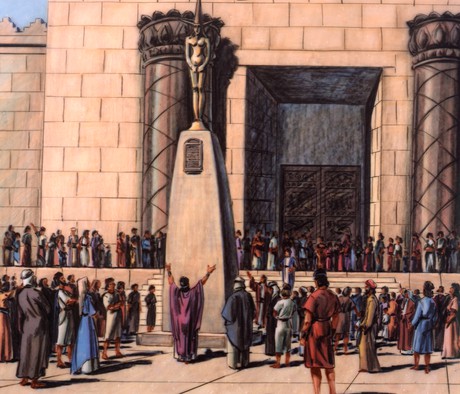
A Land of Their Own

20 “Behold, I send an angel before you to guard you on the way and to bring you to the place that I have prepared. 21 Pay careful attention to him and obey his voice; do not rebel against him, for he will not pardon your transgression, for my name is in him.

22 “But if you carefully obey his voice and do all that I say, then I will be an enemy to your enemies and an adversary to your adversaries.

23 “When my angel goes before you and brings you to the Amorites and the Hittites and the Perizzites and the Canaanites, the Hivites and the Jebusites, and I blot them out, 24 you shall not bow down to their gods nor serve them, nor do as they do, but you shall utterly overthrow them and break their pillars in pieces. 25 You shall serve the Lord your God, and he will bless your bread and your water, and I will take sickness away from among you. 26 None shall miscarry or be barren in your land; I will fulfill the number of your days. 27 I will send my terror before you and will throw into confusion all the people against whom you shall come, and I will make all your enemies turn their backs to you. 28 And I will send hornets before you, which shall drive out the Hivites, the Canaanites, and the Hittites from before you. 29 I will not drive them out from before you in one year, lest the land become desolate and the wild beasts multiply against you. 30 Little by little I will drive them out from before you, until you have increased and possess the land. 31 And I will set your border from the Red Sea to the Sea of the Philistines, and from the wilderness to the Euphrates, for I will give the inhabitants of the land into your hand, and you shall drive them out before you. 32 You shall make no covenant with them and their gods. 33 They shall not dwell in your land, lest they make you sin against me; for if you serve their gods, it will surely be a snare to you.” – Exodus 23:20-33 ESV

After giving Moses the content of the Book of the Covenant, God assured His chosen leader that he would not be alone. The task of leading the Israelites would not be an easy one and the added responsibility of administering the law of God was going to make Moses’ job even more difficult. So, God informed Moses that he would have divine assistance.

“I am sending an angel before you to protect you on your journey and lead you safely to the place I have prepared for you.” – Exodus 23:20 NLT

The Hebrew word for angel is מַלְאָךְ (malʾakh) which means “messenger” or “angel.” This was not the first time that God had employed an angel to serve as protection for His people. When the Israelites first departed Egypt, they were confronted by Pharaoh and his army at the western shore of the Red Sea. With their backs against the unpassable sea and their eyes looking at the 600 chariots of Pharaoh bearing down on them, the people panicked and began to complain to Moses about their dire predicament. But God responded by placing His angel between the Israelites and the Egyptians.

Then the angel of God who was going before the host of Israel moved and went behind them, and the pillar of cloud moved from before them and stood behind them, coming between the host of Egypt and the host of Israel. And there was the cloud and the darkness. And it lit up the night without one coming near the other all night. – Exodus 14:19-20 ESV

We are not told whether the angel was visible to the human eye, but his presence held off the Egyptian forces all during the night, giving the Israelites time to cross the parted Red Sea. And in the morning, when the Egyptians attempted to pursue their prey, ‘the waters returned and covered all the chariots and charioteers—the entire army of Pharaoh. Of all the Egyptians who had chased the Israelites into the sea, not a single one survived” (Exodus 14:28 NLT). And the remaining Egyptians who had not pursued the Israelites watched in horror as their comrades drowned in the waters of the Red Sea, and they responded in fear.

“Let us flee from before Israel, for the Lord fights for them against the Egyptians.” – Exodus 14:25 ESV

There are those who believe that this angel was actually the Lord Himself. Moses describes the defeat of the Egyptians as having been the work of Yahweh.

…just before dawn the Lord looked down on the Egyptian army from the pillar of fire and cloud, and he threw their forces into total confusion. He twisted their chariot wheels, making their chariots difficult to drive. – Exodus 14:24-25 NLT

In the book of Joshua, there is another incident involving a divine being. On this occasion, Joshua encounters what appears to be an armed soldier.

When Joshua was by Jericho, he lifted up his eyes and looked, and behold, a man was standing before him with his drawn sword in his hand. And Joshua went to him and said to him, “Are you for us, or for our adversaries?” And he said, “No; but I am the commander of the army of the Lord. Now I have come.” And Joshua fell on his face to the earth and worshiped and said to him, “What does my lord say to his servant?” And the commander of the Lord‘s army said to Joshua, “Take off your sandals from your feet, for the place where you are standing is holy.” And Joshua did so. – Joshua 5:13-15 ESV

Whether these appearances are divine manifestations of God Himself or references to angelic beings is impossible to tell. But God is clearly telling Moses that he will have divine assistance and guidance along the way. He will not be alone in his administration of the law and his leadership of the people of Israel. But this “angel of the Lord” must be obeyed.

Pay careful attention to him and obey his voice; do not rebel against him, for he will not pardon your transgression, for my name is in him. – Exodus 23:21 ESV

This angel would serve and act on behalf of God, bearing the full weight of Yahweh’s name. So, Moses and the people were expected to obey the angel as they would the Lord. And if they did, they would enjoy God’s blessings.

“…if you are careful to obey him, following all my instructions, then I will be an enemy to your enemies, and I will oppose those who oppose you. – Exodus 23:22 NLT

The angel would lead the people to Canaan, then provide them with victory over the nations that occupied the land. But God expected His people to completely annihilate the Amorites, Hittites, Perizzites, Canaanites, Hivites, and Jebusites. They were to clean house, purging the land of all its former occupants. There was to be no compromise or concessions made. And God gave His reasons for demanding the total extermination of the Canaanite population.  

“You must not worship the gods of these nations or serve them in any way or imitate their evil practices. Instead, you must utterly destroy them and smash their sacred pillars.” – Exodus 23:24 NLT

God knew that if the Canaanites were allowed to live, they would lead the Israelites astray. Their pagan practices would become a temptation to God’s people, causing them to stray from their covenant commitment to Him. God would later reiterate this command as the people prepared to enter the land of Canaan.

“When the LORD your God hands these nations over to you and you conquer them, you must completely destroy them. Make no treaties with them and show them no mercy. You must not intermarry with them. Do not let your daughters and sons marry their sons and daughters, for they will lead your children away from me to worship other gods. Then the anger of the LORD will burn against you, and he will quickly destroy you. This is what you must do. You must break down their pagan altars and shatter their sacred pillars. Cut down their Asherah poles and burn their idols. For you are a holy people, who belong to the LORD your God. Of all the people on earth, the LORD your God has chosen you to be his own special treasure.” – Deuteronomy 7:22-26 NLT

God demanded undivided allegiance from His people. In return for their faithfulness, He would bless them beyond belief. He would make them fruitful and prosperous in the land.

I will bless you with food and water, and I will protect you from illness. There will be no miscarriages or infertility in your land, and I will give you long, full lives. – Exodus 23:25-26 NLT

And He promised to drive all the inhabitants from the land. Despite their military superiority, the nations of Canaan would prove no match for the Israelites. But God would not eliminate them all at once. The process of conquering and occupying the land would take years. That would prevent the land from becoming desolate and overrun by wild animals. It would take time for the Israelites to acclimate to their new surroundings, so God provided a strategy that would allow their occupation of the land to take place over time.

“I will drive them out a little at a time until your population has increased enough to take possession of the land.” – Exodus 23:30 NLT

But in time, the Israelites would find themselves the proud possessors of the land of promise. God would give them the entire land of Canaan, “from the Red Sea to the Mediterranean Sea, and from the eastern wilderness to the Euphrates River” (Exodus 23:31 NLT). But within this vast and fertile territory, God expected His people to serve Him alone. There would be no place for unfaithfulness and no room for the false gods of the Canaanites.

“Make no treaties with them or their gods. They must not live in your land, or they will cause you to sin against me. If you serve their gods, you will be caught in the trap of idolatry.” – Exodus 23:32-33 NLT

God promised victory but demanded obedience. He offered to bless His chosen people but they were obligated to remain faithful to Him alone. And since the eradication of the Canaanites would take time, God knew that His people would face a constant temptation to compromise their convictions by assimilating the false gods of their pagan neighbors. Intermarriage with the occupants of the land would sound appealing and profitable. Adopting the ways of the Canaanites would make good sense. And peace treaties would always be more attractive than the prospects of war.  So God laid down the law. He completely prohibited any thought of compromise on the part of His people. They were His chosen people and they were expected to live distinctively different lives from the rest of the nations of the world.

“…you are a holy people, who belong to the LORD your God. Of all the people on earth, the LORD your God has chosen you to be his own special treasure.” – Deuteronomy 7:26 NLT

English Standard Version (ESV) The Holy Bible, English Standard Version. ESV® Permanent Text Edition® (2016). Copyright © 2001

New Living Translation (NLT) Holy Bible, New Living Translation, copyright © 1996, 2004, 2015 by Tyndale House Foundation. Used by permission of Tyndale House Publishers Inc., Carol Stream, Illinois 60188. All rights reserved.

We Can Do This the Hard Way

1 The word of the Lord came to me: “Son of man, set your face toward the mountains of Israel, and prophesy against them, and say, You mountains of Israel, hear the word of the Lord God! Thus says the Lord God to the mountains and the hills, to the ravines and the valleys: Behold, I, even I, will bring a sword upon you, and I will destroy your high places. Your altars shall become desolate, and your incense altars shall be broken, and I will cast down your slain before your idols. And I will lay the dead bodies of the people of Israel before their idols, and I will scatter your bones around your altars. Wherever you dwell, the cities shall be waste and the high places ruined, so that your altars will be waste and ruined, your idols broken and destroyed, your incense altars cut down, and your works wiped out. And the slain shall fall in your midst, and you shall know that I am the Lord.

“Yet I will leave some of you alive. When you have among the nations some who escape the sword, and when you are scattered through the countries, then those of you who escape will remember me among the nations where they are carried captive, how I have been broken over their whoring heart that has departed from me and over their eyes that go whoring after their idols. And they will be loathsome in their own sight for the evils that they have committed, for all their abominations. 10 And they shall know that I am the Lord. I have not said in vain that I would do this evil to them.”

11 Thus says the Lord God: “Clap your hands and stamp your foot and say, Alas, because of all the evil abominations of the house of Israel, for they shall fall by the sword, by famine, and by pestilence. 12 He who is far off shall die of pestilence, and he who is near shall fall by the sword, and he who is left and is preserved shall die of famine. Thus I will spend my fury upon them. 13 And you shall know that I am the Lord, when their slain lie among their idols around their altars, on every high hill, on all the mountaintops, under every green tree, and under every leafy oak, wherever they offered pleasing aroma to all their idols. 14 And I will stretch out my hand against them and make the land desolate and waste, in all their dwelling places, from the wilderness to Riblah. Then they will know that I am the Lord.” – Ezekiel 6:1-14 ESV

Four separate times in 14 verses, God insists that when He is done, the rebellious people of Israel “will know that I am the Lord.” God is a relational being and He had chosen the nation of Israel to enjoy a unique relationship with Him. He had set them apart as His own prized possession with the intent of revealing to them His glory and goodness. Even all the way back in Egypt, long before Moses had delivered them from their captivity, God had promised to reveal Himself to them in powerful and highly tangible ways.

I am the Lord, and I will bring you out from under the burdens of the Egyptians, and I will deliver you from slavery to them, and I will redeem you with an outstretched arm and with great acts of judgment. I will take you to be my people, and I will be your God, and you shall know that I am the Lord your God, who has brought you out from under the burdens of the Egyptians. I will bring you into the land that I swore to give to Abraham, to Isaac, and to Jacob. I will give it to you for a possession. I am the Lord.” – Exodus 6:6-8 ESV

Their miraculous deliverance was intended to demonstrate the power, majesty, and sovereignty of God. He was greater than the Egyptians and their plethora of false gods. He was the covenant-keeping God who could be trusted to keep every promise He had made to Abraham, whose descendants would eventually escape captivity in Egypt and find themselves safely ensconced in the promised land of Canaan.

All along their journey from captivity to Canaan, God revealed Himself to His people. After miraculously delivering them across the Red Sea on dry ground and defeating the forces of Egypt, He had led them by a pillar of cloud by day and a pillar of fire by night. He had sustained them with manna from heaven and water from a rock. And during their four-decade-long journey through the wilderness of Sinai, He had even kept their clothes from wearing out. He had given them His law to reveal His holy expectations of them and regulate their behavior. And knowing that they would fail to keep His law perfectly, He provided them with the sacrificial system to atone for the sins they would commit so that they might be able to restore their broken relationship with Him.

God had repeatedly proven His greatness, and they should have known that He alone was the one true God. He had no equals. In His deliverance of the Israelites, He had exposed the gods of the Egyptians as frauds and nothing more than the figments of the imaginations of men. And when they began their conquest of the land of Canaan, God was with them, providing them with victories over much larger armies. The Canaanites and their gods proved to be powerless before Yahweh, the God of Abraham, Isaac, and Jacob.

And even before their conquest of the land had begun, God had warned them about adopting the religious practices of the Canaanites. They were not to emulate their pagan ways or worship their gods.

“When the Lord your God goes ahead of you and destroys the nations and you drive them out and live in their land, do not fall into the trap of following their customs and worshiping their gods. Do not inquire about their gods, saying, ‘How do these nations worship their gods? I want to follow their example.’ You must not worship the Lord your God the way the other nations worship their gods, for they perform for their gods every detestable act that the Lord hates. They even burn their sons and daughters as sacrifices to their gods.” – Deuteronomy 12:29-31 NLT

But the people of Israel would fail to keep God’s commands. Over the centuries, they developed an unhealthy love affair with the false gods of the Canaanites. The kings of Israel had a track record of adopting the false gods of their enemies and adulterating their worship of Yahweh with unacceptable practices that He found deplorable.

And all along the way, God had warned His people about the dangers of their rebellious ways. He was a jealous God who would not tolerate their unfaithfulness and spiritual infidelity. By this time, they should have known that He alone was God. But they were still prone to seek the help and favor of any pagan god who might be able to give them a leg up on their enemies. They had become equal-opportunity idolators, willing to cozy up to any god who might provide them with an advantage or satisfy their insatiable lust for power, possessions, and pleasure. For them, Yahweh was not enough. They wanted more. And they were willing to prostitute themselves before the false gods of the Canaanites in order to satisfy what the apostle John described as “a craving for physical pleasure, a craving for everything we see, and pride in our achievements and possessions” (1 John 2:16 NLT).

Their blatant unfaithfulness had resulted in the Babylonian invasion of Judah. God informed the prophet, Jeremiah, that King Nebuchadnezzar had been handpicked by God to serve as His agent of judgment against His rebellious people.

“I will send for all the tribes of the north, declares the Lord, and for Nebuchadnezzar the king of Babylon, my servant, and I will bring them against this land and its inhabitants, and against all these surrounding nations. I will devote them to destruction, and make them a horror, a hissing, and an everlasting desolation.” – Jeremiah 25:9 ESV

And by the time Ezekiel penned his book, King Nebuchadnezzar had already defeated Judah and taken thousands of its citizens captive. But God was not done. The people of Judah remained unrepentant and unwilling to give up their love affair with false gods. That is why God gave Ezekiel a message for the people living back in Judah. He was to declare God’s pending judgment against the “mountains of Israel” (Ezekiel 6:3). This reference most certainly included the most prominent and important mountain range in all of Israel: Mount Moriah. This mountain range included Mount Zion on which Jerusalem sat and within whose walls the temple of God was located.

But God made it clear that His holy mountain was surrounded by altars and shrines to false gods. The land of Judah was literally filled with sacred worship sights dedicated to the gods of the Canaanites, and God was not pleased.

“I am about to bring war upon you, and I will smash your pagan shrines. All your altars will be demolished, and your places of worship will be destroyed. I will kill your people in front of your idols. I will lay your corpses in front of your idols and scatter your bones around your altars. Wherever you live there will be desolation, and I will destroy your pagan shrines. Your altars will be demolished, your idols will be smashed, your places of worship will be torn down, and all the religious objects you have made will be destroyed. The place will be littered with corpses, and you will know that I alone am the Lord.” – Ezekiel 6:3-7 NLT

It’s as if God is saying, “We can do this the hard way or we can do this the easy way.” God is a relational God. He chose the people of Israel to have a relationship with Him and to get to know Him – intimately and personally. He chose to dwell among them. He gave them His law to follow. He led them, directed them, protected them, and even spoke to them. He revealed Himself to them through miracles and divine intervention. He won battles for them. He rescued and rewarded them. All so that they might know Him. But the people of Israel decided to reject this personal God for a litany of impersonal, impotent, man-made gods.

Instead of recognizing and appreciating the power and presence of Yahweh, they turned their attention and affections elsewhere. So, God decided to reveal Himself differently. They were going to get to know Him the hard way. They would experience the power of God moving in their midst, but it would bring destruction, not blessing. He was going to smash their pagan shrines, demolish their altars, and destroy the places of worship where they pursued other gods.

When all the dust had settled, they were going to know that God had been in their midst. They were going to know that He had spoken and He always does what he says He will do. They were going to know that God was powerful and deadly serious about His people living lives that were set apart and distinctive from those of the other nations.

“You people have behaved worse than your neighbors and have refused to obey my decrees and regulations. You have not even lived up to the standards of the nations around you.” – Ezekiel 5:7 NLT

One way or the other, the people of God were going to get to know their God. But they were choosing the hard way. They were making it difficult on themselves. God had wanted to reveal Himself through blessing and abundance. He had wanted to have an intimate relationship with them that was characterized by care and compassion. In His grace and mercy, He had chosen them from among all the nations, not because they deserved it, but because He wanted to reveal Himself in a special way to a very specific people. He had intended to use them to showcase His love. They were to be His living illustration to the world.

But they refused to accept His love and obey His commands. He pursued them, but they rejected Him. So now they were going to get to know God the hard way.

But this chapter provides a powerful lesson for every child of God. Why do we make it so hard on ourselves? Why do we force God to reveal Himself through discipline and prove Himself to us by rebuking us? God has given us His Son. He has chosen us for a personal, intimate relationship with Him. He wants us to know Him closely and deeply. But far too often, we choose the hard way over the easy way.

English Standard Version (ESV) The Holy Bible, English Standard Version. ESV® Permanent Text Edition® (2016). Copyright © 2001

New Living Translation (NLT) Holy Bible, New Living Translation, copyright © 1996, 2004, 2015 by Tyndale House Foundation. Used by permission of Tyndale House Publishers Inc., Carol Stream, Illinois 60188. All rights reserved.

Just Do It

Guard your steps when you go to the house of God. To draw near to listen is better than to offer the sacrifice of fools, for they do not know that they are doing evil. 2 Be not rash with your mouth, nor let your heart be hasty to utter a word before God, for God is in heaven and you are on earth. Therefore let your words be few. For a dream comes with much business, and a fool’s voice with many words.

When you vow a vow to God, do not delay paying it, for he has no pleasure in fools. Pay what you vow. It is better that you should not vow than that you should vow and not pay. Let not your mouth lead you into sin, and do not say before the messenger that it was a mistake. Why should God be angry at your voice and destroy the work of your hands? For when dreams increase and words grow many, there is vanity; but God is the one you must fear. Ecclesiastes 5:1-7 ESV

Up to this point, Solomon has provided us with a somewhat autobiographical and deeply personal look at life. He has revealed a perspective on life as seen from his unique vantage point as an aging monarch whose reflections are filled with regret and remorse. Yet, he sees himself as a preacher or teacher, whose responsibility as a leader of his people is to share his mistakes and the insights he has gleaned from them.

In this section, Solomon’s writing style becomes less autobiographical and more proverbial, similar to that of the book of Proverbs, which he wrote and edited. Proverbs are succinct, simple statements designed to teach powerful truths using few words, but in a memorable and impactful manner. Typically, proverbs are gathered in collections, with what appears to be little or no rhyme or reason as to their order or flow. They appear as isolated and seemingly unrelated thoughts, with each operating as a stand-alone truth claim.

In chapter five, we have a series of these proverbs, and the first few all have something to do with making vows before God. As has been the case before, Solomon appears to be writing from personal experience. These are not simply words of wisdom he has run across and deemed worthy of inclusion in his book. They are practical life lessons that he has experienced firsthand. And the very first one he shares has to do with the attitudes one should bring into the house of God. They concern one’s worship of God.

When entering into the presence of God, attitude and actions should not be separated. He warns against offering sacrifices to God in a flippant and disrespectful manner. For Solomon, it was a dangerous thing to go through the motions of worship while showing no reverence or fear for God. He describes a form of worship that is self-motivated and manipulative, offering sacrifices and making rash vows to God in order to get something from Him. He recommends listening over sacrificing.

Guard your steps when you go to the house of God. To draw near to listen is better than to offer the sacrifice of fools, for they do not know that they are doing evil. – Ecclesiastes 5:1 ESV

The Hebrew word translated as “listening” is shama` and it carries with it the ideas of hearing and obeying. Solomon knew that there was a real risk of showing up at the temple to offer the required sacrifices and failing to hear what God might be trying to say. You could end up going through the motions of worship while ignoring the very one to whom you were offering the sacrifice. There is little doubt that Solomon was very familiar with the words that the prophet Samuel spoke to Saul, the first king of Israel.

“What is more pleasing to the LORD: your burnt offerings and sacrifices or your obedience to his voice? Listen! Obedience is better than sacrifice, and submission is better than offering the fat of rams.” – 1 Samuel 15:22 NLT

Solomon’s own father, David, had discovered this same truth.

“You take no delight in sacrifices or offerings.
    Now that you have made me listen, I finally understand—
    you don’t require burnt offerings or sin offerings.
Then I said, “Look, I have come.
    As is written about me in the Scriptures:
I take joy in doing your will, my God,
    for your instructions are written on my heart.” – Psalm 40:6-8 NLT

And after the Pharisees accused the disciples of breaking the law by harvesting grain on the sabbath, Jesus responded, “I want you to show mercy, not offer sacrifices” (Matthew 12:7 NLT).

Jesus was condemning these men for placing a higher priority on the sacrificial system than on the God to whom the sacrifices were being offered. And Solomon warns his readers: “Don’t make rash promises, and don’t be hasty in bringing matters before God. After all, God is in heaven, and you are here on earth. So let your words be few.” (Ecclesiastes 5:3 NLT).

Solomon is not simply spouting a clever-sounding maxim, but revealing a painful, yet valuable lesson learned from real life. He reminds us that God is transcendent. He is in heaven and we are on earth, and there is a great gulf that separates us, both literally and figuratively. God is holy and we are not. God is sinless and completely righteous in all He does. We are just the opposite. And we cannot afford to enter into His presence with a sense of dishonor or disrespect.

And one of the areas in which we can get ourselves into trouble with God is through the making of vows or commitments to Him. Vows were commonplace in Solomon’s day. They were verbal commitments made to God. A vow was a solemn promise to do something for God or to offer a sacrifice to God in the hopes of receiving blessings from Him in return. And Solomon warns, “When you vow a vow to God, do not delay paying it, for he has no pleasure in fools. Pay what you vow” (Ecclesiastes 5:4 ESV).

There is little doubt that Solomon had made many rash vows to God, promising to do something for God in return for His blessings. But Solomon knew the truth. He had failed to keep his side of the bargain, and he had learned the valuable lesson that God does not suffer fools lightly. The kind of vows to which Solomon refers could have been free-will offerings that were not part of the normal sacrificial requirements. When going through a time of difficulty or trial, it would be easy to promise to offer God a free-will offering in return for His rescue or relief. But it’s nothing more than a form of bargaining with God., and the book of Judges records just such a rash vow.

And Jephthah made a vow to the Lord and said, “If you will give the Ammonites into my hand, then whatever comes out from the doors of my house to meet me when I return in peace from the Ammonites shall be the Lord‘s, and I will offer it up for a burnt offering.” – Judges 11:30-31 ESV

And the story goes on to record that God gave Jephthah victory over the Ammonites, but it also reveals the tragic outcome of Jephthah’s rash vow.

Then Jephthah came to his home at Mizpah. And behold, his daughter came out to meet him with tambourines and with dances. She was his only child; besides her he had neither son nor daughter. And as soon as he saw her, he tore his clothes and said, “Alas, my daughter! You have brought me very low, and you have become the cause of great trouble to me. For I have opened my mouth to the Lord, and I cannot take back my vow.” – Judges 11:34-35 ESV

Solomon wants his readers to know that God takes vows seriously, which is why he states, “It is better to say nothing than to make a promise and not keep it” (Ecclesiastes 5:5 NLT). Keep your mouth shut. Don’t be hasty. Treat God as holy and don’t be too quick to make promises you have no intention of keeping. Because God will hold you to your word. Again, Solomon seems to speak from experience when he writes:

Don’t let your mouth make you sin. And don’t defend yourself by telling the Temple messenger that the promise you made was a mistake. That would make God angry, and he might wipe out everything you have achieved. – Ecclesiastes 5:6 NLT

And it would seem from this verse, that Solomon has widened the application to include vows or promises made to other individuals. If you make a commitment to someone, keep it. You can’t get out of it by stating your original promise was a mistake.

In His Sermon on the Mount, Jesus had some serious things to say about the matter of vows.

“You have also heard that our ancestors were told, ‘You must not break your vows; you must carry out the vows you make to the Lord.’ But I say, do not make any vows! Do not say, ‘By heaven!’ because heaven is God’s throne. And do not say, ‘By the earth!’ because the earth is his footstool. And do not say, ‘By Jerusalem!’ for Jerusalem is the city of the great King. Do not even say, ‘By my head!’ for you can’t turn one hair white or black. Just say a simple, ‘Yes, I will,’ or ‘No, I won’t.’ Anything beyond this is from the evil one.” – Matthew 5:33-36 NLT

Don’t miss what Jesus is saying. The prevalent perspective in His day was to keep any and all vows made to God. But Jesus warns not to make any vows at all. His reason for this was that the Jewish religious leaders had developed a variety of loopholes and workarounds that would allow people to make vows without having to keep them. And Jesus lists just a few. They had developed a system by which you could make a vow that was legally breakable because you made it based on something that was non-binding. Through clever use of words, you could make a vow that sounded binding but wasn’t. It gave the impression that you would follow through on your commitment, but with no intention to do so. These kinds of vows were little more than lies, and Jesus warned His followers not to make them. Instead, they were to say “Yes, I will!” or “No, I won’t!”

Solomon wraps up this short section with a somewhat enigmatic verse.

For when dreams increase and words grow many, there is vanity; but God is the one you must fear. – Ecclesiastes 5:7 ESV

The New Living Translation sheds some light on what Solomon may have been trying to say. “Talk is cheap, like daydreams and other useless activities. Fear God instead.” Someone who experiences an abundance of dreams ends up struggling with whether what they have dreamed has true significance or meaning. What are they to believe? The same is true when we use too many words and make too many vows. No one knows whether what we are saying is true or to be believed. Dreams mean nothing unless they are put into action. And words are of little value if they are not accompanied by follow-through. Remember what Solomon said: Let your words be few. Verbosity is no substitute for integrity. Why waste your time making promises? Just do it.

English Standard Version (ESV) The Holy Bible, English Standard Version. ESV® Permanent Text Edition® (2016). Copyright © 2001

New Living Translation (NLT) Holy Bible, New Living Translation, copyright © 1996, 2004, 2015 by Tyndale House Foundation. Used by permission of Tyndale House Publishers Inc., Carol Stream, Illinois 60188. All rights reserved.

A Spirit of Spiritual Syncretism

29 But every nation still made gods of its own and put them in the shrines of the high places that the Samaritans had made, every nation in the cities in which they lived. 30 The men of Babylon made Succoth-benoth, the men of Cuth made Nergal, the men of Hamath made Ashima, 31 and the Avvites made Nibhaz and Tartak; and the Sepharvites burned their children in the fire to Adrammelech and Anammelech, the gods of Sepharvaim. 32 They also feared the Lord and appointed from among themselves all sorts of people as priests of the high places, who sacrificed for them in the shrines of the high places. 33 So they feared the Lord but also served their own gods, after the manner of the nations from among whom they had been carried away.

34 To this day they do according to the former manner. They do not fear the Lord, and they do not follow the statutes or the rules or the law or the commandment that the Lord commanded the children of Jacob, whom he named Israel. 35 The Lord made a covenant with them and commanded them, “You shall not fear other gods or bow yourselves to them or serve them or sacrifice to them, 36 but you shall fear the Lord, who brought you out of the land of Egypt with great power and with an outstretched arm. You shall bow yourselves to him, and to him you shall sacrifice. 37 And the statutes and the rules and the law and the commandment that he wrote for you, you shall always be careful to do. You shall not fear other gods, 38 and you shall not forget the covenant that I have made with you. You shall not fear other gods, 39 but you shall fear the Lord your God, and he will deliver you out of the hand of all your enemies.” 40 However, they would not listen, but they did according to their former manner.

41 So these nations feared the Lord and also served their carved images. Their children did likewise, and their children’s children—as their fathers did, so they do to this day. 2 Kings 17:29-41 ESV

So they feared the Lord but also served their own gods.”

That phrase appears twice in the closing verses of chapter 17, and it aptly summarizes the spiritual state of the nation of Israel after its fall to the Assyrians. Many of its citizens had been captured and exiled to various locations in Assyria. Their vacancies were filled by people from other conquered nations who were forced to relocate to Israel and start new lives. This sudden influx of refugees from foreign countries turned Israel into a veritable melting pot and, ultimately, resulted in intermarriage between the Jews and their new neighbors.

These newly transplanted inhabitants found themselves living in a foreign land where they didn’t understand the language or customs. They were strangers living in a strange land, but they found some comfort in the fact that many of their gods already had shrines dedicated to them in Israel. The ten northern tribes had been assimilating the gods of other nations for years. Under Jeroboam’s leadership, they had created their own gods, complete with temples and priesthood. Under Ahab and Jezebel, they had adopted and promoted the worship of Baal and Asherah. And along the way, other kings of Israel had been embracing the false gods of their foreign allies. So, the new arrivals to Israel found an atmosphere of religious tolerance and ecumenism.

If you recall, immediately after these foreign refugees had arrived in Israel and taken up residence in the abandoned cities of Samaria, they began worshiping their false gods. The land on which they lived belonged to Yahwah, and He took offense at their actions. They were living on land that He had set apart as holy and given to the descendants of Abraham as their inheritance. It was to have been a place where they lived in obedience to His will and where they worshiped Him alone. Their failure to do so had resulted in their defeat and deportation. But their departure had not changed the sanctity of the land or voided the covenant commitment God had made with His people. There was still a remnant of Jews living in the land of Israel and He expected them to keep their end of the agreement they had made with Him.

So, when these foreigners began to worship their false gods on land that belonged to the one true God, they found themselves experiencing divine judgment.

But since these foreign settlers did not worship the Lord when they first arrived, the Lord sent lions among them, which killed some of them. – 2 Kings 17:25 NLT

As a result, the king of Assyria ordered that one of the exiled Israelite priests be sent back so that he might instruct the immigrants in the proper worship of Yahweh.

So one of the priests who had been exiled from Samaria returned to Bethel and taught the new residents how to worship the Lord. – 2 Kings 17:28 NLT

This highly pragmatic plan implemented by the king of Assyria was evidently successful. But while many of the new arrivals eagerly adopted Yahweh as their God, they simply added Him to their growing list of deities. He became just one more god to whom they offered their sacrifices in order to win favor and good fortune.

These new residents worshiped the Lord, but they also appointed from among themselves all sorts of people as priests to offer sacrifices at their places of worship. And though they worshiped the Lord, they continued to follow their own gods according to the religious customs of the nations from which they came. – 2 Kings 17:32-33 NLT

With the sudden arrival of these various people groups, the religious landscape of Israel became ever more crowded and confused. Almost overnight, the idolatrous state of Israel exploded with new options and opportunities as the number of false gods continued to increase. The already tolerant and easily tempted Israelites found themselves surrounded by a virtual sea of new gods from which to chose.

Those from Babylon worshiped idols of their god Succoth-benoth. Those from Cuthah worshiped their god Nergal. And those from Hamath worshiped Ashima. The Avvites worshiped their gods Nibhaz and Tartak. And the people from Sepharvaim even burned their own children as sacrifices to their gods Adrammelech and Anammelech. – 2 Kings 17:30-31 ESV

The worship of Yahweh became increasingly more diluted and defused as a spirit of syncretism and religious pluralism spread over the land. The fall of Israel did not result in a spirit of repentance and religious reform among God’s people. His judgment of them was met by indifference and continued apostasy.

They continue to follow their former practices instead of truly worshiping the Lord and obeying the decrees, regulations, instructions, and commands he gave the descendants of Jacob, whose name he changed to Israel. – 2 Kings 17:34 NLT

There appears to be no remorse or repentance on the part of God’s people. Their neighbors had been taken captive and exiled to Assyria, but they remain just as committed to living in disobedience to God’s laws. And it seems that those who found themselves living as captives in Assyria were no less stubborn and unwilling to return to Yahweh. And yet, when King Solomon had dedicated the newly constructed temple, he had asked God to show mercy on His disobedient people, should they find themselves in exile and call out for help.

“If your people Israel are defeated by their enemies because they have sinned against you, and if they turn to you and acknowledge your name and pray to you here in this Temple, then hear from heaven and forgive the sin of your people Israel and return them to this land you gave their ancestors.” – 1 Kings 8:33-34 NLT

But they hadn’t turned and acknowledged God’s name. They had not prayed and asked for God’s forgiveness. Both those in exile and those living in the land of Israel had continued to disobey God’s commands and violate His covenant agreement. And the author makes it clear that God was serious about His commands and His covenant.

For the Lord had made a covenant with the descendants of Jacob and commanded them: “Do not worship any other gods or bow before them or serve them or offer sacrifices to them. But worship only the Lord, who brought you out of Egypt with great strength and a powerful arm. Bow down to him alone, and offer sacrifices only to him. Be careful at all times to obey the decrees, regulations, instructions, and commands that he wrote for you. You must not worship other gods. Do not forget the covenant I made with you, and do not worship other gods. You must worship only the Lord your God. He is the one who will rescue you from all your enemies.” – 2 Kings 17:35-39 NLT

They had no excuse. The remnant of Israelites still living in the land knew exactly what God expected of them, but they continued to reject His word and refused to repent. And while the new residents were given instruction in the proper worship of Yahweh, they simply added Him to their long and growing list of god options.

So while these new residents worshiped the Lord, they also worshiped their idols. And to this day their descendants do the same. – 2 Kings 17:41 NLT

This last verse is meant to convey a sense of inevitability and determinism. Nothing was going to change. They were fully committed to doing things their way, regardless of the circumstances or consequences. And we know that by the time Jesus appeared on the scene, the long-term implications of this syncretistic and overly tolerant religious mindset had resulted in the division between the Jews and the Samaritans. The foreigners who were transplanted into Israel by the king of Assyria, ended up intermarrying with the remaining Jewish population. These mixed marriages brought about an assimilation of cultures and religions that produced a population that became known as the Samaritans. The Samaritans were considered to be half-breeds by the Jews of Jesus’ day and were treated as second-class citizens. They practiced a religion that combined the worship of Yahweh with aspects of paganism and idolatry. As the Samaritan confessed to Jesus, they even had their own place of worship, outside the confines of Jerusalem (John 4:20).

Chapter 17 of 2 Kings brings the story of the northern kingdom to a dramatic and somber close. Part of the nation is living in exile in Assyria. The rest remain in the land but are marked by a spirit of spiritual syncretism and moral compromise. There will be no more kings to rule over the ten tribes. They will remain under God’s judgment and experience the curses He had warned would come should they choose to disobey. But now, the author turns his attention back to the southern kingdom Judah. As of now, they remain free to follow the commands of God. But will they? The author provides a not-so-subtle hint as to what lies in store of the people of Judah.

Because the Lord was very angry with Israel, he swept them away from his presence. Only the tribe of Judah remained in the land. But even the people of Judah refused to obey the commands of the Lord their God, for they followed the evil practices that Israel had introduced. – 2 Kings 17:18-19 NLT

English Standard Version (ESV) The Holy Bible, English Standard Version. ESV® Permanent Text Edition® (2016). Copyright © 2001 by Crossway Bibles, a publishing ministry of Good News Publishers.

New Living Translation (NLT) Holy Bible, New Living Translation, copyright © 1996, 2004, 2015 by Tyndale House Foundation. Used by permission of Tyndale House Publishers Inc., Carol Stream, Illinois 60188. All rights reserved.

The Message (MSG)Copyright © 1993, 1994, 1995, 1996, 2000, 2001, 2002 by Eugene H. Peterson


A Priceless but Poor Substitute for God

40 Hiram also made the pots, the shovels, and the basins. So Hiram finished all the work that he did for King Solomon on the house of the Lord: 41 the two pillars, the two bowls of the capitals that were on the tops of the pillars, and the two latticeworks to cover the two bowls of the capitals that were on the tops of the pillars; 42 and the four hundred pomegranates for the two latticeworks, two rows of pomegranates for each latticework, to cover the two bowls of the capitals that were on the pillars; 43 the ten stands, and the ten basins on the stands; 44 and the one sea, and the twelve oxen underneath the sea.

45 Now the pots, the shovels, and the basins, all these vessels in the house of the Lord, which Hiram made for King Solomon, were of burnished bronze. 46 In the plain of the Jordan the king cast them, in the clay ground between Succoth and Zarethan. 47 And Solomon left all the vessels unweighed, because there were so many of them; the weight of the bronze was not ascertained.

48 So Solomon made all the vessels that were in the house of the Lord: the golden altar, the golden table for the bread of the Presence, 49 the lampstands of pure gold, five on the south side and five on the north, before the inner sanctuary; the flowers, the lamps, and the tongs, of gold; 50 the cups, snuffers, basins, dishes for incense, and fire pans, of pure gold; and the sockets of gold, for the doors of the innermost part of the house, the Most Holy Place, and for the doors of the nave of the temple.

51 Thus all the work that King Solomon did on the house of the Lord was finished. And Solomon brought in the things that David his father had dedicated, the silver, the gold, and the vessels, and stored them in the treasuries of the house of the Lord. 1 Kings 7:40-51 ESV

Hiram was a busy man. The list of items he hand-crafted for use in Solomon’s temple seems endless. From large basins cast from bronze to smaller shovels and pots, Hiram was responsible for the creation of each and every vessel that would be used in the worship of Yahweh. And they were all adorned with fine detailing and intricate designs worthy of the God of the universe. Once placed in the temple, they would be consecrated to God, set apart for Him alone, and dedicated to one purpose alone: To bring Him glory.

Each of these items would have been made according to the specifications provided by God to Moses when He ordered the creation of their original counterparts. These detailed instructions can be found in Exodus 25-30. It seems that the only article of furniture that Solomon did not have recreated was the Ark of the Covenant. According to 1 Kings 8, when the temple was completed, Solomon had the Ark transported from the old city of David and moved into the new temple. For years, the Ark had been kept in a special tent located in a lower section of Jerusalem, called the City of David. The book of 2 Samuel describes how David supervised its relocation after he had prepared a proper place for its keeping.

So David went and brought up the ark of God from the house of Obed-edom to the city of David with rejoicing. And when those who bore the ark of the Lord had gone six steps, he sacrificed an ox and a fattened animal. And David danced before the Lord with all his might. And David was wearing a linen ephod. So David and all the house of Israel brought up the ark of the Lord with shouting and with the sound of the horn.… And they brought in the ark of the Lord and set it in its place, inside the tent that David had pitched for it. – 2 Samuel 6:12-15, 17 ESV

The Ark was considered the throne of God because it was topped by the mercy seat. In the original tabernacle, the cloud of God’s glory would hover over the mercy seat, signifying His presence and power among the people of Israel. After having given Moses the specifications for constructing the Ark and the mercy seat, God had promised him, “There I will meet with you, and from above the mercy seat, from between the two cherubim that are on the ark of the testimony, I will speak with you about all that I will give you in commandment for the people of Israel” (Exodus 25:22 ESV).

But besides the Ark of the Covenant, everything else Hiram made was new and improved. And the author reveals that so much bronze was used to cast all these items that it was impossible to measure the quantity of metal required to complete them. This fact was intended to emphasize the sheer scope of the project and the great cost incurred by Solomon to ensure that the temple to Yahweh was of the highest quality.

Precious metals, expensive lumber made from cypress, olivewood, and cedar, and painstaking craftsmanship went into the making of these holy objects. And the closer their proximity to the Holy of Holies, the more costly they became. The Holy of Holies was the innermost area within the temple, where the Ark of the Covenant was kept. It was off-limits to everyone but the high priest, who was allowed to enter only one day of the year, on the Day of Atonement. It was in this place that God had promised to reveal His presence.

“Tell Aaron your brother not to come at any time into the Holy Place inside the veil, before the mercy seat that is on the ark, so that he may not die. For I will appear in the cloud over the mercy seat. – Leviticus 16:2 ESV

So, any items that were located in close proximity to the Holy of Holies were made of pure gold.

So Solomon made all the vessels that were in the house of the Lord: the golden altar, the golden table for the bread of the Presence, the lampstands of pure gold, five on the south side and five on the north, before the inner sanctuary; the flowers, the lamps, and the tongs, of gold; the cups, snuffers, basins, dishes for incense, and fire pans, of pure gold; and the sockets of gold, for the doors of the innermost part of the house, the Most Holy Place, and for the doors of the nave of the temple. – 1 Kings 7:48-50 ESV

What’s important to consider is that most of these items would never be seen by the average Israelite. Because of their locations in the restricted areas of the temple, they would have remained unseen by everyone but the priests. And yet, Solomon spared no expense in their making. He cut no corners. While they would remain out of sight and out of mind to most Jews, He knew that God would see them. He was not willing to do anything that might diminish the glory of the temple or bring dishonor to his God. Solomon dedicated more than seven years of his life and a large portion of his royal treasury to the construction of the temple.

For Solomon, the temple was intended to represent the glory of God. Sitting atop Mount Zion, it would become a permanent symbol of His unsurpassed greatness. But as significant as this structure would become in the lives of the people of Israel, it would also become a distraction. In time, the people would begin to put more trust in the temple than they did in Yahweh. Rather than viewing this building as a symbol for God, they would make it a substitute for Him. And the prophet Jeremiah would have strong words to say regarding their misplaced trust in a building.

The Lord gave another message to Jeremiah. He said, “Go to the entrance of the Lord’s Temple, and give this message to the people: ‘O Judah, listen to this message from the Lord! Listen to it, all of you who worship here! This is what the Lord of Heaven’s Armies, the God of Israel, says:

“‘Even now, if you quit your evil ways, I will let you stay in your own land. But don’t be fooled by those who promise you safety simply because the Lord’s Temple is here. They chant, “The Lord’s Temple is here! The Lord’s Temple is here!” But I will be merciful only if you stop your evil thoughts and deeds and start treating each other with justice; only if you stop exploiting foreigners, orphans, and widows; only if you stop your murdering; and only if you stop harming yourselves by worshiping idols. Then I will let you stay in this land that I gave to your ancestors to keep forever.

“‘Don’t be fooled into thinking that you will never suffer because the Temple is here. It’s a lie!’” – Jeremiah 7:1-8 NLT

The temple was meant to be a priceless tribute to a holy and glorious God. But it was never intended to become His substitute. Yet how easy it is for human beings to place their hope and trust in what they can see. Because God is invisible, they look for something or someone on which to set their eyes and place their hope. Sadly, it would not be long before the nation of Israel made the temple a poor substitute for the sovereign God of the universe. And Jeremiah would have to bring them the sobering message of God’s displeasure that would result in the temple’s destruction and their own banishment from the land of promise.So just as I destroyed Shiloh, I will now destroy this Temple that bears my name, this Temple that you trust in for help, this place that I gave to you and your ancestors. And I will send you out of my sight into exile, just as I did your relatives, the people of Israel.” – Jeremiah 7:14-15 NLT

English Standard Version (ESV) The Holy Bible, English Standard Version. ESV® Permanent Text Edition® (2016). Copyright © 2001 by Crossway Bibles, a publishing ministry of Good News Publishers.

New Living Translation (NLT) Holy Bible, New Living Translation, copyright © 1996, 2004, 2015 by Tyndale House Foundation. Used by permission of Tyndale House Publishers Inc., Carol Stream, Illinois 60188. All rights reserved.

The Message (MSG)Copyright © 1993, 1994, 1995, 1996, 2000, 2001, 2002 by Eugene H. Peterson

Edifice Complex

In the four hundred and eightieth year after the people of Israel came out of the land of Egypt, in the fourth year of Solomon’s reign over Israel, in the month of Ziv, which is the second month, he began to build the house of the Lord. The house that King Solomon built for the Lord was sixty cubits long, twenty cubits wide, and thirty cubits high. The vestibule in front of the nave of the house was twenty cubits long, equal to the width of the house, and ten cubits deep in front of the house. And he made for the house windows with recessed frames. He also built a structure against the wall of the house, running around the walls of the house, both the nave and the inner sanctuary. And he made side chambers all around. The lowest story was five cubits broad, the middle one was six cubits broad, and the third was seven cubits broad. For around the outside of the house he made offsets on the wall in order that the supporting beams should not be inserted into the walls of the house.

When the house was built, it was with stone prepared at the quarry, so that neither hammer nor axe nor any tool of iron was heard in the house while it was being built.

The entrance for the lowest story was on the south side of the house, and one went up by stairs to the middle story, and from the middle story to the third. So he built the house and finished it, and he made the ceiling of the house of beams and planks of cedar. 10 He built the structure against the whole house, five cubits high, and it was joined to the house with timbers of cedar.

11 Now the word of the Lord came to Solomon, 12 “Concerning this house that you are building, if you will walk in my statutes and obey my rules and keep all my commandments and walk in them, then I will establish my word with you, which I spoke to David your father. 13 And I will dwell among the children of Israel and will not forsake my people Israel.” 1 Kings 6:1-13 ESV

David had begun the preparations for the construction of the temple long before he died. It had been his idea to build a “house” for God, but he had been denied David the honor of overseeing its actual construction. That task fell to his son and successor, Solomon. And even though David had given Solomon the plans and provided a vast amount of the building supplies necessary to start the project, it would be four years into Solomon’s reign before construction began. The sheer size and scope of the project required careful planning and the time to amass and transport all the materials David’s ambitious plans required.

Massive stones had to be quarried and moved to the building site. Lumber from Lebanon had to be cut and transported by ships from Tyre to the coastline of Israel, then carried inland to the city of Jerusalem. The site itself, located on the summit of Mount Zion, had to be leveled and prepared for the actual construction to begin. So, four years after taking the throne, after all the preparations were complete, Solomon officially launched the construction phase of the project, and the author points out that it was 480 years after the people of Israel had been released by God from their captivity in Egypt. This link back to the Exodus of Israel from Egypt is significant because it provides a vivid contrast between the nation’s past and present circumstances. This temple was being built to honor the God of Israel, the same God who, nearly half a millennium earlier, had rescued their ancestors from their dire conditions in a foreign land and had given them the land of Canaan as their inheritance – all in keeping with the promise He had made to Abraham.

“I will make you exceedingly fruitful, and I will make you into nations, and kings shall come from you. And I will establish my covenant between me and you and your offspring after you throughout their generations for an everlasting covenant, to be God to you and to your offspring after you. And I will give to you and to your offspring after you the land of your sojournings, all the land of Canaan, for an everlasting possession, and I will be their God.” – Genesis 17:6-8 ESV

God had kept His promise to Abraham. He had provided the people of Israel with the land of Canaan as their inheritance, and now Solomon, the son of David, was honoring his father’s wishes by building a temple worthy of such a great and gracious God.

While the author provides detailed descriptions of the temple’s size and dimensions, there is not enough information to know exactly what the temple looked like when completed. It was roughly twice the size of the Mosaic tabernacle and built of massive hand-carved limestone blocks and lumber made from cedar from the forests of Lebanon. And the completed structure was ornamented with gold. Solomon spared no expense in the construction of God’s house. It was to be a showplace, a one-of-a-kind structure meant to honor the God of Abraham, Isaac, and Jacob. And even with tens of thousands of conscripted laborers working around the clock, it would take nearly eight years to complete the project.

Sometime during the course of construction, Solomon received a message from God. In the midst of his ongoing efforts to build a house for God, he was reminded that a beautiful building would not ensure the presence of God.

“Concerning this Temple you are building, if you keep all my decrees and regulations and obey all my commands, I will fulfill through you the promise I made to your father, David. I will live among the Israelites and will never abandon my people Israel.” – 1 Kings 6:12 NLT

God had made a commitment to David, promising to place one of his sons on the throne after him. And this son would fulfill David’s dream of building a temple for the Lord. But, more importantly, the Lord would place His protective hand over David’s son.

“…when you die and join your ancestors, I will raise up one of your descendants, one of your sons, and I will make his kingdom strong. He is the one who will build a house—a temple—for me. And I will secure his throne forever. I will be his father, and he will be my son. I will never take my favor from him as I took it from the one who ruled before you. I will confirm him as king over my house and my kingdom for all time, and his throne will be secure forever.’” – 1 Chronicles 17:11-14 NLT

But even David knew that this promise from God came with certain conditions. He believed God would fulfill His part of the covenant, but he also knew that his son would need to remain faithful to God. Just prior to his death, David had even warned Solomon that faithfulness would be essential if he wanted to experience God’s fruitfulness.

“I am going where everyone on earth must someday go. Take courage and be a man. Observe the requirements of the Lord your God, and follow all his ways. Keep the decrees, commands, regulations, and laws written in the Law of Moses so that you will be successful in all you do and wherever you go. If you do this, then the Lord will keep the promise he made to me. He told me, ‘If your descendants live as they should and follow me faithfully with all their heart and soul, one of them will always sit on the throne of Israel.’” – 1 Kings 2:2-4 NLT

Building God a house in which to dwell was not going to guarantee His presence, power, and provision. In fact, God didn’t require a dwelling place. And in the book of Acts, Luke records a powerful sermon given by Stephen to a crowd of Jews who would eventually stone him to death. In that sermon, Stephen reminded them that the temple was never meant to be a sign of God’s presence.

“David found favor with God and asked for the privilege of building a permanent Temple for the God of Jacob. But it was Solomon who actually built it. However, the Most High doesn’t live in temples made by human hands. As the prophet says,

‘Heaven is my throne,
    and the earth is my footstool.
Could you build me a temple as good as that?’
    asks the Lord.
‘Could you build me such a resting place?
  Didn’t my hands make both heaven and earth?’” – Acts 7:46-50 NLT

And Luke also records the words of the apostle Paul, spoken to a crowd of Greeks in the middle of the city of Athens.

“He is the God who made the world and everything in it. Since he is Lord of heaven and earth, he doesn’t live in man-made temples, and human hands can’t serve his needs—for he has no needs. He himself gives life and breath to everything, and he satisfies every need.” – Acts 17:24-25 NLT

God wasn’t standing around in heaven, waiting for Solomon to complete the temple, so He could take up occupancy. God did not need Solomon’s temple. God had made the stones and the trees used in the construction of the temple. He had created and breathed life into the men who labored to build it. And He had placed Solomon on the throne and given him the privilege of making it all happen.

But what God really wanted from Solomon was obedience. He desired a king who would live in faithful adherence to His laws and display a commitment to all His commands. Solomon’s own father understood that God was far more interested in the condition of a man’s heart than the accomplishments of his hands.

You do not desire a sacrifice, or I would offer one.
    You do not want a burnt offering.
The sacrifice you desire is a broken spirit.
    You will not reject a broken and repentant heart, O God. – Psalm 51:16-17 NLT

As the temple neared completion, Solomon was given a powerful reminder that the key to his success would not be found in a building, but in his commitment to the will and the ways of God. The temple would be nothing more than a symbol of God’s presence. It would provide a daily reminder of His majesty and glory, but should never be seen as a guarantee of His pleasure with or approval of His people. As the grand edifice of the temple neared completion, it rose from the heights of Mount Zion and became the pride of the people of Israel. But, if they weren’t careful, they would end up being more impressed with the work of their hands and worshiping their creation, than obeying and revering the Creator God.

English Standard Version (ESV) The Holy Bible, English Standard Version. ESV® Permanent Text Edition® (2016). Copyright © 2001 by Crossway Bibles, a publishing ministry of Good News Publishers.

New Living Translation (NLT) Holy Bible, New Living Translation, copyright © 1996, 2004, 2015 by Tyndale House Foundation. Used by permission of Tyndale House Publishers Inc., Carol Stream, Illinois 60188. All rights reserved.

The Message (MSG)Copyright © 1993, 1994, 1995, 1996, 2000, 2001, 2002 by Eugene H. Peterson

An Unscheduled and Ill-Advised Rest Stop

1 Now when Jesus learned that the Pharisees had heard that Jesus was making and baptizing more disciples than John (although Jesus himself did not baptize, but only his disciples), he left Judea and departed again for Galilee. And he had to pass through Samaria. So he came to a town of Samaria called Sychar, near the field that Jacob had given to his son Joseph. Jacob’s well was there; so Jesus, wearied as he was from his journey, was sitting beside the well. It was about the sixth hour.  – John 4:1-6 ESV

Chapter 3 featured Jesus’ encounter with Nicodemus, who was a well-respected member of the Pharisees, an extremely orthodox sect of Judaism. This learned man, who also happened to be a member of the Jewish ruling council called the Sanhedrin, was well-versed in the Hebrew Scriptures, with special knowledge of the Mosaic Law. Yet, with all his knowledge and wisdom, he had been unable to comprehend the words of Jesus. In fact, Jesus exposed Nicodemus’ surprising lack of understanding when He somewhat sarcastically asked, “Are you the teacher of Israel and yet you do not understand these things?” (John 3:10 ESV).

Nicodemus prided himself in his knowledge of both the written and oral traditions of Israel. But he had been unable to understand what Jesus meant when He said, “unless one is born of water and the Spirit, he cannot enter the kingdom of God” (John 3:5 ESV). Nicodemus’ wisdom had proved insufficient because his mind was stuck on a horizontal plane, and incapable of comprehending the spiritual nature of Jesus’ words.

Now, John shifts the scene of the story as he describes Jesus’ departure from Judea to the northern region of Galilee. Jesus is vacating the confines of Jerusalem because the Pharisees have gotten wind of His growing popularity.

…when Jesus learned that the Pharisees had heard that Jesus was making and baptizing more disciples than John (although Jesus himself did not baptize, but only his disciples), he left Judea and departed again for Galilee. – John 4:1-3 ESV

Jesus had come to Jerusalem in order to celebrate the Passover, but He had found the temple of His Father being desecrated and profaned by those who were supposed to be the spiritual leaders of the nation. Rather than encouraging the people to “worship the Father in spirit and truth” (John 4:23 ESV), they had turned the house of God into “a house of trade” (John 2:16 ESV). They were using the God-ordained sacrificial system as a means for making money, rather than making atonement for the sins of the people.

So, John describes Jesus, the Messiah of Israel, as turning His back on the city of Jerusalem and heading for Galilee. But to get there, Jesus was going to have to journey through the region of Samaria. And this seemingly insignificant geographic detail is far more important that one might realize.

The seismic nature of the shift in location is easily overlooked by modern readers. But John’s original audience would have recognized the fascinating juxtaposition between chapters 3 and 4 that John was creating. To understand what is going on, you have to know the historic significance of Samaria and its inhabitants. The land of Samaria had originally belonged to the tribe of Ephraim and the half-tribe of Manasseh. It had been part of the land of Canaan that God had promised as an inheritance to the nation of Israel. After God had divided the nation in two, due to the sins of Solomon, Samaria had become part of the northern kingdom of Israel. But when the people of Israel had continued to rebel against God and had refused His repeated calls to repent, He had brought the Assyrians against them as punishment for their sin. The book of 2 Kings describes what happened as a result.

The king of Assyria transported groups of people from Babylon, Cuthah, Avva, Hamath, and Sepharvaim and resettled them in the towns of Samaria, replacing the people of Israel. They took possession of Samaria and lived in its towns. But since these foreign settlers did not worship the Lord when they first arrived, the Lord sent lions among them, which killed some of them.

So a message was sent to the king of Assyria: “The people you have sent to live in the towns of Samaria do not know the religious customs of the God of the land. He has sent lions among them to destroy them because they have not worshiped him correctly.”

The king of Assyria then commanded, “Send one of the exiled priests back to Samaria. Let him live there and teach the new residents the religious customs of the God of the land.” So one of the priests who had been exiled from Samaria returned to Bethel and taught the new residents how to worship the Lord.

But these various groups of foreigners also continued to worship their own gods. In town after town where they lived, they placed their idols at the pagan shrines that the people of Samaria had built. – 2 Kings 17:24-29 NLT

These foreigners ended up intermarrying with the Jews who had been left in the land. And 2 Kings describes how these “Samaritans” practiced a syncretistic brand of religion that combined the worship of Yahweh with the worship of false gods.

These new residents worshiped the Lord, but they also appointed from among themselves all sorts of people as priests to offer sacrifices at their places of worship. And though they worshiped the Lord, they continued to follow their own gods according to the religious customs of the nations from which they came. – 2 Kings 17:32-33 NLT

To the Pharisees and other orthodox religious groups in Israel, the Samaritans were considered “half-breeds” who had refused to maintain the purity of the nation’s bloodline. Not only that, but they were also guilty of idolatry and, therefore, in violation of the Mosaic Law. And to make matters worse, they had established their own place of worship on Mount Gerazim, refusing to recognize the temple in Jerusalem as the dwelling place of God. And much to the chagrin of the Pharisees, the Samaritans rejected all the writings of the prophets and the Jewish oral traditions, which the Pharisees held near and dear.

So, when John describes Jesus as having “to pass through Samaria,” there is an intentional tension in his words. It was impossible for Jesus to travel from Judea to Galilee without having to make his way through this land occupied by “half-breeds” and heretics. And any self-respecting, God-honoring Jew would pass through this region as quickly as possible, making certain to avoid any interaction with the inhabitants. To the Jews, the Samaritans were considered unclean and of no more value than a dog. They were to be avoided at all costs.

All of these details are essential if one is to understand the significance of all that John is about to describe. Jesus’ transition from Jerusalem to Galilee takes on a special significance because He must pass through the region of Samaria. And the intense animosity between the Jews and Samaritans would have been well-documents and fully understood in John’s day. A contemporary reader of John’s gospel would have expected Jesus and His entourage to expedite their passage through Samaria, spending as little time in the region as was physically possible.

But John describes Jesus as arriving at the town of Sychar, located in the heart of Samaria, at about Noon. The inference is that Jesus has only a few hours left before darkness falls, so He should have been in a hurry to complete His journey to Galilee. But instead, He decides to take an unscheduled and highly unrecommended rest stop at the base of Mount Gerazim, where the Samaritans practiced their syncretistic brand of religion.

Again, the details are critical to understanding what follows. Sychar, also known as Shechem, was located in the valley between Mount Gerazim and Mount Ebal, and this spot held a special significance for the Jewish people. It was there, during the initial conquest of the land of Canann, that Joshua had instructed the people to build an altar to the Lord, to recommit themselves to the covenant, and to give thanks for their recent victories over Jericho and Ai.

Then Joshua built an altar to the Lord, the God of Israel, on Mount Ebal. He followed the commands that Moses the Lord’s servant had written in the Book of Instruction: “Make me an altar from stones that are uncut and have not been shaped with iron tools.” Then on the altar they presented burnt offerings and peace offerings to the Lord. And as the Israelites watched, Joshua copied onto the stones of the altar the instructions Moses had given them.

Then all the Israelites—foreigners and native-born alike—along with the elders, officers, and judges, were divided into two groups. One group stood in front of Mount Gerizim, the other in front of Mount Ebal. Each group faced the other, and between them stood the Levitical priests carrying the Ark of the Lord’s Covenant. This was all done according to the commands that Moses, the servant of the Lord, had previously given for blessing the people of Israel.

Joshua then read to them all the blessings and curses Moses had written in the Book of Instruction. – Joshua 8:30-34 NLT

Notice the reference to “all the Israelites – foreigners and native-born alike.” Here, centuries later, the Messiah of Israel was making His way to this very same spot, accompanied by native-born Jews, and He would encounter a woman who was considered a foreigner and a violator of the covenant of Israel. But the message Jesus had to share with her would be similar to that which He had shared with Nicodemus, a native-born Jew, a Pharisee, and a so-called keeper of the law.

English Standard Version (ESV) The Holy Bible, English Standard Version. ESV® Permanent Text Edition® (2016). Copyright © 2001 by Crossway Bibles, a publishing ministry of Good News Publishers.

New Living Translation (NLT)
Holy Bible, New Living Translation, copyright © 1996, 2004, 2015 by Tyndale House Foundation. Used by permission of Tyndale House Publishers Inc., Carol Stream, Illinois 60188. All rights reserved.

The Message (MSG)Copyright © 1993, 1994, 1995, 1996, 2000, 2001, 2002 by Eugene H. Peterson

The Worthiness of Worship

1 “No one whose testicles are crushed or whose male organ is cut off shall enter the assembly of the Lord.

“No one born of a forbidden union may enter the assembly of the Lord. Even to the tenth generation, none of his descendants may enter the assembly of the Lord.

“No Ammonite or Moabite may enter the assembly of the Lord. Even to the tenth generation, none of them may enter the assembly of the Lord forever, because they did not meet you with bread and with water on the way, when you came out of Egypt, and because they hired against you Balaam the son of Beor from Pethor of Mesopotamia, to curse you. But the Lord your God would not listen to Balaam; instead the Lord your God turned the curse into a blessing for you, because the Lord your God loved you. You shall not seek their peace or their prosperity all your days forever.

“You shall not abhor an Edomite, for he is your brother. You shall not abhor an Egyptian, because you were a sojourner in his land. Children born to them in the third generation may enter the assembly of the Lord. – Deuteronomy 23:1-8 ESV

Moses now shifts his focus from marriage to the wider corporate context of Israel. More specifically, he addresses the topic of worship or the corporate assembly of the covenant community. Six times in eight verses, he will discuss those who are forbidden to “enter into the assembly of the Lord.” This is a reference to the gathering of the people of Israel for all God-ordained feasts and festivals, or other prescribed occasions where the people were to gather for public worship.

Those times at which the corporate community gathered together before the Lord were to be seen as sacred. Those events were to be attended only by those who could be deemed legitimate members of the covenant community of Israel. God had made His covenant with Abraham and his descendants. They were considered by God to be holy because He had set them apart from all the other nations. So, there were restrictions concerning who could take part in these sacred assemblies.

First of all, Moses prohibits the inclusion of any males who suffered from any form of emasculation. This would include those suffering from any form of birth defect concerning the male genitals or those who had accidentally or deliberately been emasculated. This regulation, while seemingly unfair and exclusionary, had a purpose behind it. Any emasculated man would have been considered physically incomplete or lacking in wholeness. Wholeness and holiness were closely linked in the Hebrew way of thinking. And emasculation would have left the individual incapable of procreation because of their inability to produce the seed necessary for conception. These people were not to be treated as second-class citizens, but they were restricted from joining in the corporate worship of God. Again, this had to do with wholeness and holiness.

The second restriction has to do with anyone born of a “forbidden union” or illegitimate birth. This most likely included anyone whose parents were of mixed ethnic backgrounds, particularly referring to a Hebrew and a pagan. But it is thought to have included children born out of incest, rape, or some other unholy union between a man and a woman. Once again, it is not that these people were to be considered as non-members of the Jewish community, but that their participation in the corporate worship of the nation was restricted. The issue was that of holiness or wholeness.

Anyone of Moabite and Ammonite descent was also restricted from participation in the corporate worship of Israel. The mention of these two people groups indicated that Moabites and Ammonites could convert to Judaism, but they could not join in the national assemblies reserved for the worship of Yahweh. There are several factors behind this prohibition. The first is that these two people groups were the descendants of the two sons born to Lot as a result of his incestuous relationships with his own daughters (Genesis 19:30-38). But they were also guilty of having treated the Israelites harshly during their journey to the land of Canaan. The king of Moab had attempted to use a prophet to curse the people of Israel, but his efforts were derailed by God. This snub of God’s chosen people had long-term ramifications, restricting any Ammonites and Moabites who converted to Judaism from participating in corporate worship with the nation of Israel.

But any Edomites who had converted to Judaism were not to be restricted from the corporate assemblies of Israel. The Edomites were the descendants of Esau, the brother of Jacob. And the Israelites were commanded to treat them as brothers.

Finally, anyone of Egyptian descent who had become part of the Hebrew nation was also to be treated fairly and allowed to participate in the worship of Yahweh. This inclusion of the Egyptians seems odd when you consider that the people of Israel spent more than 400 years as their slaves. But the nation of Egypt had been used by God to foster the growth of the nation of Israel. When Jacob and his family had first arrived in Egypt, they number just over 70 people, but by the time they left four centuries later, they numbered in the millions. And it had been the people of Egypt who had blessed the Israelites by providing them with gifts and treasures when they departed.

The people of Israel had also done as Moses told them, for they had asked the Egyptians for silver and gold jewelry and for clothing. And the Lord had given the people favor in the sight of the Egyptians, so that they let them have what they asked. Thus they plundered the Egyptians. – Exodus 12:35-36 ESV

So, God commanded that the Israelites treat any Egyptians in their midst who worshiped Him to be treated as equals, allowing them to join in their corporate assemblies.

The coming together of the people of God for times of corporate worship was meant to reflect their status as His chosen people. We have seen how God commanded the purging of evil from their midst. This was particularly important when it came to times of worship. The presence of the wicked or evil would pollute their corporate holiness. God was to be treated with reverence, and as worthy of the greatest honor they could bring. These assemblies of the Lord were not to be taken lightly or flippantly. God was to be honored as holy and deserving of the greatest respect. So, these prohibitions have much more to say about the perfection of God than they do about the imperfections or unworthiness of the individuals mentioned. The worship of God was to be taken seriously, and by providing clear directions and restrictions regarding proper worship, Moses was reminding the people of Israel just how worthy of worship their God was.

English Standard Version (ESV) The Holy Bible, English Standard Version. ESV® Permanent Text Edition® (2016). Copyright © 2001 by Crossway Bibles, a publishing ministry of Good News Publishers.

New Living Translation (NLT) Holy Bible, New Living Translation, copyright © 1996, 2004, 2015 by Tyndale House Foundation. Used by permission of Tyndale House Publishers Inc., Carol Stream, Illinois 60188. All rights reserved.

The Message (MSG) Copyright © 1993, 1994, 1995, 1996, 2000, 2001, 2002 by Eugene H. Peterson

A People Holy to the Lord

1 “You are the sons of the Lord your God. You shall not cut yourselves or make any baldness on your foreheads for the dead. For you are a people holy to the Lord your God, and the Lord has chosen you to be a people for his treasured possession, out of all the peoples who are on the face of the earth.

“You shall not eat any abomination. These are the animals you may eat: the ox, the sheep, the goat, the deer, the gazelle, the roebuck, the wild goat, the ibex, the antelope, and the mountain sheep. Every animal that parts the hoof and has the hoof cloven in two and chews the cud, among the animals, you may eat. Yet of those that chew the cud or have the hoof cloven you shall not eat these: the camel, the hare, and the rock badger, because they chew the cud but do not part the hoof, are unclean for you. And the pig, because it parts the hoof but does not chew the cud, is unclean for you. Their flesh you shall not eat, and their carcasses you shall not touch.

“Of all that are in the waters you may eat these: whatever has fins and scales you may eat. 10 And whatever does not have fins and scales you shall not eat; it is unclean for you.

11 “You may eat all clean birds. 12 But these are the ones that you shall not eat: the eagle, the bearded vulture, the black vulture, 13 the kite, the falcon of any kind; 14 every raven of any kind; 15 the ostrich, the nighthawk, the sea gull, the hawk of any kind; 16 the little owl and the short-eared owl, the barn owl 17 and the tawny owl, the carrion vulture and the cormorant, 18 the stork, the heron of any kind; the hoopoe and the bat. 19 And all winged insects are unclean for you; they shall not be eaten. 20 All clean winged things you may eat.

21 “You shall not eat anything that has died naturally. You may give it to the sojourner who is within your towns, that he may eat it, or you may sell it to a foreigner. For you are a people holy to the Lord your God.

“You shall not boil a young goat in its mother’s milk. – Deuteronomy 14:1-21 ESV

The people of Israel had been set apart by God. They had been created as a nation by His divine will and, by virtue of that fact, they belonged to Him. As His chosen possession, they were to reflect His character and glorify His name through their lives. They were expected to return His love for them by obeying His commands and willingly submitting to His plans for them. God had set them apart from all the other nations of the earth and had given them His law as a clear indication of just how separate and distinctive their lives were to be.

Upon entering the promised land, the Israelites had a God-ordained obligation to completely eradicate the Canaanites, the collective name used to describe the land’s current occupants. This divine dictate, while seemingly harsh, was necessary because God knew the people of Israel would be highly susceptible to the sin of compromise and prone to take the easy road of assimilation. But He had called them to live separate and distinctive lives. They were to have nothing to do with the Canaanites or their pagan practices. Every command God had given the Israelites was intended to set the Israelites apart, creating a glaring contrast between themselves and the rest of the nations.

In this chapter, Moses outlines a series of prohibitions, each of which is tied to the subject of food consumption. Even the diet of the Israelites was intended to separate them from the rest of the world. God required them to be holy, not unholy and clean rather than unclean. Everything about their lives was to reflect their set-apart status, from the way they dressed to the food they ate, from the manner in which they worshiped to the way they treated their own bodies. Which is why Moses starts out this portion of his message by warning them:

Since you are the people of the Lord your God, never cut yourselves or shave the hair above your foreheads in mourning for the dead. You have been set apart as holy to the Lord your God, and he has chosen you from all the nations of the earth to be his own special treasure.” – Deuteronomy 14:1-2 NLT

Don’t do as the Canaanites do. That’s the basic message Moses was trying to get across. They were not to adapt or adopt the ways of the Canaanites. And yet, cultural assimilation is not only easy, it’s also preferable. Standing out from the crowd can be difficult while blending in can make one’s life much simpler and less complicated. But God was not interested in a people who were indistinguishable and unremarkable. He had chosen the Israelites as His own special treasure and expected them to shine as lights in the darkness.

Even the food they consumed was intended to distinguish them from the pagan nations of the earth. Every single command regarding their diet was meant to identify them as God’s people. And while the commands found in these verses are all tied to food-consumption, they are really associates with the third commandment.

“You shall not take the name of the Lord your God in vain, for the Lord will not hold him guiltless who takes his name in vain.” – Deuteronomy 5:11 ESV

We tend to associate this command with the sin of cursing or using God’s name flippantly or disrespectfully. And while these actions can and should be avoided, the real point behind this command is that of behavior that contradicts our expressed belief in God. When the command states, “you shall not take…”, it is really communicating the idea of bearing something. The Hebrew word is nasa’, and it can be translated “to bear” or “to carry.”

It seems that God was telling the Israelites not to bear or, to put it another way, to wear God’s name in a vain or false manner. As His chosen possession, they bore His name. They were His special treasure. And they were to treat their designation as His people with property dignity and respect. They bore His name. They were His earthly representatives. But if they were not careful, the manner in which they lived their lives could end up giving a false perception of who He was. Their actions and behaviors could end up casting a negative reflection upon God’s character.

Even the food they consumed could end up painting a false view of God. While bearing His name, they could do damage to His reputation by defiling their bodies by eating food He had deemed as unclean and unacceptable. And it is important that we note that all the food items that God had declared as off-limits to the Jews were fully acceptable to the Canaanites.

God’s rules regarding diet were not intended to be about the denial of certain foods, but the distinctiveness of the Israelites. The primary issue was not to be, “you shall not…” but “you shall be…” God wanted the Israelites to be holy, distinctive, different, set apart – even when it came to the kinds of food they could eat. And He was very specific. Why? He gave them the answer: “For you are a people holy to the Lord your God” (Deuteronomy 14:21 ESV).

The Hebrew word translated as “holy” is qadowsh, and it simply means “sacred” or “set apart.” They belonged to Him and their lives were to reflect their unique status as His people. They were not to be anything like the nations around them. Their lifestyle was to be markedly different, from the food they ate to the way they worshiped. Everything about them was to be distinctive, setting them apart as belonging to God. They bore His name, and they were not to do anything that would reflect negatively on His character.

If an Israelite disobeyed God’s commands concerning dietary restrictions, he or she would end up bearing God’s name in vain. They would display a false idea of what it means to be a child of God. By eating like the Canaanites, they would dilute the differences between them. In a sense, accommodation would be a form of abomination. For someone bearing the name of God to attempt to blend in with the prevailing culture would reflect falsely on the character of God. Their distinctiveness would be lost. Their uniqueness would be compromised and the integrity of God’s character would be jeopardized.

All of this had less to do with food than about faithfulness. At the end of the day, these commands were aimed at the heart. Were the people of Israel willing to love and trust God, accepting His commands as being just and right? Would they do what He said out of love for who He was?

While these dietary laws come across as restrictive and even a bit arbitrary to our modern sensibilities, they were designed to reveal the true nature of the heart. Hundreds of years later, Jesus would declare that the problem with man stems not from what goes into the mouth, but what flows from the heart.

“It’s not what goes into your body that defiles you; you are defiled by what comes from your heart.”  – Mark 7:15 NLT

And when His Jewish disciples shared their confusion over His statement, He added provided them with clarification.

“Don’t you understand either? … Can’t you see that the food you put into your body cannot defile you? Food doesn’t go into your heart, but only passes through the stomach and then goes into the sewer.” (By saying this, he declared that every kind of food is acceptable in God’s eyes). – Mark 7:18-20 NLT

The willingness of the Israelites to obey God’s command would reflect the true condition of their hearts. They bore His name, but would they willingly bear the call to obey His commands?

English Standard Version (ESV) The Holy Bible, English Standard Version. ESV® Permanent Text Edition® (2016). Copyright © 2001 by Crossway Bibles, a publishing ministry of Good News Publishers.

New Living Translation (NLT) Holy Bible, New Living Translation, copyright © 1996, 2004, 2015 by Tyndale House Foundation. Used by permission of Tyndale House Publishers Inc., Carol Stream, Illinois 60188. All rights reserved.

The Message (MSG) Copyright © 1993, 1994, 1995, 1996, 2000, 2001, 2002 by Eugene H. Peterson