God is Greatly to Be Feared and Praised

To the choirmaster: according to Do Not Destroy. A Psalm of Asaph. A Song.

1 We give thanks to you, O God;
    we give thanks, for your name is near.
We recount your wondrous deeds.

2 “At the set time that I appoint
    I will judge with equity.
3 When the earth totters, and all its inhabitants,
    it is I who keep steady its pillars. Selah
4 I say to the boastful, ‘Do not boast,’
    and to the wicked, ‘Do not lift up your horn;
5 do not lift up your horn on high,
    or speak with haughty neck.’”

6 For not from the east or from the west
    and not from the wilderness comes lifting up,
7 but it is God who executes judgment,
    putting down one and lifting up another.
8 For in the hand of the LORD there is a cup
    with foaming wine, well mixed,
and he pours out from it,
    and all the wicked of the earth
    shall drain it down to the dregs.

9 But I will declare it forever;
    I will sing praises to the God of Jacob.
10 All the horns of the wicked I will cut off,
    but the horns of the righteous shall be lifted up. – Psalm 75:1-10 ESV

In this psalm of thanksgiving, Asaph speaks on behalf of the people of God, expressing their gratitude for His presence and power to deliver them. Asaph infers explicitly that God’s name is near, a fact that was intended to provide comfort and confidence to His people. For centuries, the Israelites had known God as Yahweh, the name Moses was instructed to use when he gave them God’s message of deliverance in Egypt.

God also said to Moses, “Say this to the people of Israel: ‘The LORD [Yahweh], the God of your fathers, the God of Abraham, the God of Isaac, and the God of Jacob, has sent me to you.’ This is my name forever, and thus I am to be remembered throughout all generations.” – Exodus 3:15 ESV

That name was tied to God’s presence. He is the great “I Am,” the one who was, is, and always will be. He is ever-present and always near, no matter the circumstances. During their 400 years of captivity in Egypt, God had been aware of their less-than-ideal conditions and He had heard their cries of despair.

“I have certainly seen the oppression of my people in Egypt. I have heard their cries of distress because of their harsh slave drivers. Yes, I am aware of their suffering. So I have come down to rescue them from the power of the Egyptians and lead them out of Egypt into their own fertile and spacious land. It is a land flowing with milk and honey—the land where the Canaanites, Hittites, Amorites, Perizzites, Hivites, and Jebusites now live. Look! The cry of the people of Israel has reached me, and I have seen how harshly the Egyptians abuse them. Now go, for I am sending you to Pharaoh. You must lead my people Israel out of Egypt.” – Exodus 3:7-10 NLT

Yahweh had always been with them, even in their darkest moments. It was Yahweh who had heard and delivered them from their bondage in Egypt. He had led them across the Red Sea on dry land. He guided them across the wilderness, providing them with food and water along the way. He went before them and gave them victories over their enemies as they occupied the land of promise.

The name Yahweh was near and dear to the Israelites’ hearts because it represented their unique relationship with Him. It was the name by which they knew Him as their personal and intimate God. He was always near and constantly interceding on their behalf. No other nation enjoyed that kind of relationship with Him. In fact, Moses reminded the people of Israel that the Law had been given to them by God to set them apart as His chosen people.

“Look, I now teach you these decrees and regulations just as the Lord my God commanded me, so that you may obey them in the land you are about to enter and occupy. Obey them completely, and you will display your wisdom and intelligence among the surrounding nations. When they hear all these decrees, they will exclaim, ‘How wise and prudent are the people of this great nation!’ For what great nation has a god as near to them as the Lord our God is near to us whenever we call on him? And what great nation has decrees and regulations as righteous and fair as this body of instructions that I am giving you today?” – Deuteronomy 4:5-8 NLT

God was near and always ready to assist His people, but He demanded obedience and faithfulness. Their relationship with God was reciprocal, requiring them to keep their part of the covenant by worshiping Him alone.

“Now if you will obey me and keep my covenant, you will be my own special treasure from among all the peoples on earth; for all the earth belongs to me. And you will be my kingdom of priests, my holy nation.’ This is the message you must give to the people of Israel.” – Exodus 19:5-6 NLT

In his psalm, Asaph provides a short but powerful monologue spoken by Yahweh.

“At the time I have planned,
    I will bring justice against the wicked.
When the earth quakes and its people live in turmoil,
    I am the one who keeps its foundations firm. 

“I warned the proud, ‘Stop your boasting!’
    I told the wicked, ‘Don’t raise your fists!
Don’t raise your fists in defiance at the heavens
    or speak with such arrogance.’” – Psalm 75:2-5 NLT

This divine speech is intended to remind the Israelites of Yahweh’s sovereignty and to call the wicked to repentance. He is a God of justice who deals with the boastful and defiant. He can rescue, but also pour out His wrath on the unrighteous. They were not to take His nearness for granted or to treat His mercy with disdain. Yahweh was holy and expected those who bore His name to reflect His character.

“Give the following instructions to the entire community of Israel. You must be holy because I, the LORD [Yahweh] your God, am holy.” – Leviticus 19:2 NLT

“So set yourselves apart to be holy, for I am the LORD [Yahweh] your God. Keep all my decrees by putting them into practice, for I am the LORD [Yahweh] who makes you holy.” – Leviticus 20:7-8 NLT

“You must be holy because I, the LORD [Yahweh], am holy. I have set you apart from all other people to be my very own.” – Leviticus 20:26 NLT

Through the medium of song, Asaph reminds his audience that it is Yahweh “alone who judges; he decides who will rise and who will fall” (Psalm 75:7 NLT). While expressing gratitude to Yahweh for His goodness and grace, Asaph also wants to stress the painful reality of God’s judgment against the prideful, disobedient, and wicked. He describes Yahweh as pouring out a cup of judgment designed to leave all those who drink it staggering from its effects. This imagery of God’s judgment as intoxicating wine is found throughout the Scriptures.

Wake up, wake up, O Jerusalem!
    You have drunk the cup of the LORD’s [Yahweh] fury.
You have drunk the cup of terror,
    tipping out its last drops. – Isaiah 51:17 NLT

You have rejected us, O God, and broken our defenses.
    You have been angry with us; now restore us to your favor.
You have shaken our land and split it open.
    Seal the cracks, for the land trembles.
You have been very hard on us,
    making us drink wine that sent us reeling. – Psalm 60:1-3 NLT

Asaph wants his fellow Israelites to remember that their gracious, loving God is also jealous and holy and demands fidelity and faithfulness from His people. Picking up on the cup of wrath imagery, Asaph warns, “He pours out the wine in judgment, and all the wicked must drink it, draining it to the dregs” (Psalm 75:8 NLT). Yahweh’s love is worth celebrating, but His penchant for pouring out His judgment on the unrighteous also deserves remembering.

But Asaph closes his psalm on a positive note by expressing His trust in Yahweh’s sovereignty and justice.

But as for me, I will always proclaim what God has done;
    I will sing praises to the God of Jacob.
For God says, “I will break the strength of the wicked,
    but I will increase the power of the godly.” – Psalm 75:9-10 NLT

He knows that as long as he lives obediently, he will have nothing to fear. Yahweh knows and sees all, and He will always reward the righteous and punish the wicked. Asaph will always have ample reason to praise Yahweh because he intends to obey Yahweh’s commands.

Father, You are a gracious and good God who pours out blessings on Your people. But You are also a holy and righteous God who hates sin and demands that Your people live in keeping with their identity as Your children. You are holy and You expect those who bear Your name to reflect Your character. But You don’t expect us to do it in our own strength. You have given us the Holy Spirit, Your Word, and the Body of Christ to make our holiness possible. As Peter put it, You have “given us everything we need for living a godly life” (2 Peter 1:3 NLT). We don’t have to manufacture holiness in our own strength because You have clothed us in the righteousness of Christ. That is why we owe You our praise and thanksgiving. With Asaph, I say, “I will always proclaim what God has done; I will sing praises to the God of Jacob.” Amen

English Standard Version (ESV) The Holy Bible, English Standard Version. ESV® Permanent Text Edition® (2016). Copyright © 2001 by Crossway Bibles, a publishing ministry of Good News Publishers.

New Living Translation (NLT) Holy Bible, New Living Translation, copyright © 1996, 2004, 2015 by Tyndale House Foundation. Used by permission of Tyndale House Publishers Inc., Carol Stream, Illinois 60188. All rights reserved.
God of the Impossible

1 The oracle of the word of the LORD is against the land of Hadrach
    and Damascus is its resting place.
For the Lord has an eye on mankind
    and on all the tribes of Israel,
2 and on Hamath also, which borders on it,
    Tyre and Sidon, though they are very wise.
3 Tyre has built herself a rampart
    and heaped up silver like dust,
    and fine gold like the mud of the streets.
4 But behold, the Lord will strip her of her possessions
    and strike down her power on the sea,
    and she shall be devoured by fire.

5 Ashkelon shall see it, and be afraid;
    Gaza too, and shall writhe in anguish;
    Ekron also, because its hopes are confounded.
The king shall perish from Gaza;
    Ashkelon shall be uninhabited;
6 a mixed people shall dwell in Ashdod,
    and I will cut off the pride of Philistia.
7 I will take away its blood from its mouth,
    and its abominations from between its teeth;
it too shall be a remnant for our God;
    it shall be like a clan in Judah,
    and Ekron shall be like the Jebusites.
8 Then I will encamp at my house as a guard,
    so that none shall march to and fro;
no oppressor shall again march over them,
    for now I see with my own eyes. – Zechariah 9:1-8 ESV

Yahweh now delivers an oracle to Zechariah. The Hebrew word translated as “oracle” is maśśā’, which means “to lift up” or “to bear up.” Figuratively, it could refer to a pronouncement or prophecy that had a “burden” or “weight” associated with it. In this case, Yahweh is predicting the coming destruction of Israel’s many enemies. At the same time, He is announcing the coming of Israel’s long-awaited King and Messiah. The first eight verses paint a bleak and inescapable future for the nations that have stood opposed to Israel’s well-being for centuries. Zechariah is informed that each of these pagan nations will suffer the consequences for their treatment of God’s chosen people.

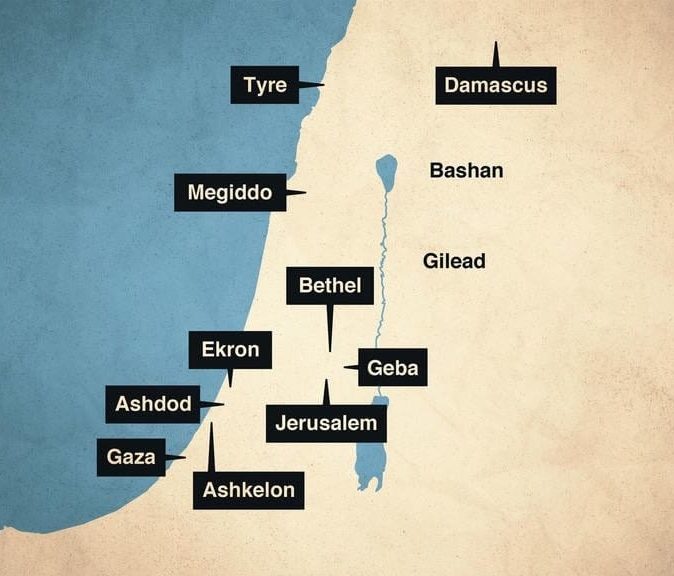
Yahweh lists a variety of cities surrounding Jerusalem, from Damascus in the north to Ashkelon in the south. He begins His list in the north in the region known as Hadrach, but He focuses His oracle on the city of Damascus. From there, Yahweh moves south, listing the names of additional doomed cities as He makes His way to Ashdod, Ashkelon, and Gaza. This north-to-south route is significant because it mirrors the path the Assyrians and Babylonians took when they conquered Israel and Judah. Earlier prophets had predicted the coming destruction of the northern and southern kingdoms by these two nations, a fate ordained by God for His people’s continued rebellion against Him.

“But I have stirred up a leader who will approach from the north.
From the east he will call on my name.
I will give him victory over kings and princes.
He will trample them as a potter treads on clay.” – Isaiah 41:25 NLT

“Yes,” the Lord said, “for terror from the north will boil out on the people of this land. Listen! I am calling the armies of the kingdoms of the north to come to Jerusalem. I, the Lord, have spoken!

“They will set their thrones
at the gates of the city.
They will attack its walls
and all the other towns of Judah.
I will pronounce judgment
on my people for all their evil—
for deserting me and burning incense to other gods.
Yes, they worship idols made with their own hands!” – Jeremiah 1:14-16 NLT

“This is what the Sovereign Lord says: From the north I will bring King Nebuchadnezzar of Babylon against Tyre. He is king of kings and brings his horses, chariots, charioteers, and great army. First he will destroy your mainland villages. Then he will attack you by building a siege wall, constructing a ramp, and raising a roof of shields against you.He will pound your walls with battering rams and demolish your towers with sledgehammers. The hooves of his horses will choke the city with dust, and the noise of the charioteers and chariot wheels will shake your walls as they storm through your broken gates. His horsemen will trample through every street in the city. They will butcher your people, and your strong pillars will topple.” – Ezekiel 7:7-11 NLT

Yahweh is announcing His intention to take the same path of destruction to mete out judgment upon the enemies of His people. He will begin in the north with Damascus and work His way down the coast to the land of the Philistines.

This prophecy was partially fulfilled in 333 B.C. when Alexander the Great passed through the region on his way to Egypt. He focused his attention on the coastal cities, destroying all ports used by the Achaemenid Empire but leaving the Jews relatively undisturbed. Alexander’s march to the south left many of these same cities destroyed but they would eventually rise from the ashes and continue their mistreatment of the people of Israel. What Yahweh has in store for them will be far more destructive and permanent than anything they suffered at the hands of the Greeks.

The English Standard Version translates verse 1 as “the LORD has an eye on mankind and on all the tribes of Israel.” While it is obvious that the all-knowing, all-seeing Yahweh is always watching over the affairs of men, most translators render this verse differently.

…the eyes of humanity, including all the tribes of Israel, are on the LORD. – NLT

…the eyes of men and of all the tribes of Israel are upon the LORD. – BSB

…for the eyes of mankind, especially of all the tribes of Israel, are toward the LORD. – NASB

This human-based perspective is important because it indicates that all will know and understand that this future judgment is the work of Yahweh. Everyone will comprehend the divine nature of the destruction. This won’t be the work of some world super-power, it will be the hand of Adonai, the LORD of Hosts.

…the Lord will strip away Tyre’s possessions
and hurl its fortifications into the sea,
and it will be burned to the ground.– Zechariah 9:4 NLT

The city of Ashkelon will see Tyre fall
and will be filled with fear.
Gaza will shake with terror,
as will Ekron, for their hopes will be dashed.
Gaza’s king will be killed,
and Ashkelon will be deserted.– Zechariah 9:4 NLT

These powerful, wealthy, and influential cities will suffer fear, humiliation, and elimination at the hands of Israel’s God. Their wealth will do them no good. Their armies will be impotent and unable to defend them. The once-great Philistine empire that had plagued the people of Israel for centuries would fall, never to rise again. The oracle even predicts the conversion of any Philistines who manage to make it out alive.

Then the surviving Philistines will worship our God
    and become like a clan in Judah.
The Philistines of Ekron will join my people,
    as the ancient Jebusites once did. – Zechariah 9:7 NLT

The content of this oracle must have been difficult for Zechariah to get his head around. It was good news but it all sounded so far-fetched and impossible. It didn’t get any more believable when God claimed, “I will guard my Temple and protect it from invading armies. I am watching closely to ensure that no more foreign oppressors overrun my people’s land” (Zechariah 9:8 NLT).

God was telling Zechariah incredible news regarding Israel’s future. Not only will Israel be restored, Jerusalem rebuilt, and the Temple completed, but the people of Israel will prosper, filling the land, and serving Him faithfully. Things were going to be radically different. Instead of punishing His people as He had done in the past, God was going to bless them abundantly and restore them to favor. This news had to be difficult for Zechariah to comprehend as he looked around at a partially completed foundation on the Temple, the broken-down walls, and the demoralized remnant who struggled to fulfill the task God had given them due to the scope of the project and the presence of opposition. Yet, Yahweh had assured Zechariah that He was the God of the impossible.

“This is what the Lord of Heaven’s Armies says: All this may seem impossible to you now, a small remnant of God’s people. But is it impossible for me? says the Lord of Heaven’s Armies.” – Zechariah 8:6 NLT

It’s as if God said, “I know this doesn’t look so good right now, but don’t judge Me based on what you see.” Yahweh wanted Zechariah to focus on His promises, not the pressing problems that seemed to never go away.

Yahweh knew that Zechariah and the beleaguered people of Judah were struggling to keep the faith. They were growing weary and questioning whether all their hard work would be worth it. So, God pointed them to the future. He predicted a brighter tomorrow that was beyond their powers of comprehension. But He had proven Himself faithful in the past and could be trusted to fulfill His plans for the future.

Yet, God’s people have always struggled with doubt and the inability to take God at His word. Even today, those who claim to believe in an all-powerful, promise-keeping God, find themselves wondering where He is and what He is doing. They take a look at their current circumstances and make sweeping judgments regarding everything from God’s faithfulness and presence to His love and power. When things don’t go well, God’s people automatically assume that He is either angry or oblivious to their needs. He is upset and punishing them. He is out of touch and ignorant of them. Their prayers don’t get answered, so they conclude He does not hear or does not care.

In time, their view of life begins to influence their view of God. In a sense, Yahweh tells Zechariah, “I know this all seems impossible to you right now. After all, there’s just a handful of you and the job is far from complete. BUT THIS ISN’T ABOUT YOU!”

The point of it all was that God could do the impossible. He knew what was going on and was well aware of the situation taking place in Jerusalem. He had a full grasp of the facts regarding the status of the Temple, the presence of opposition, the size of the workforce, and the condition of their hearts. Which explains the depth and detail of His message to Zechariah.

He told Zechariah, “Be strong and finish the task!” (Zechariah 8:9 NLT) and “Don’t be afraid. Be strong, and get on with rebuilding the Temple” (Zechariah 8:13 NLT). It wasn’t about their strength and ability to get things done, it was about their faith and trust in a God who could do ANYTHING. They just needed to do what He had called them to do and leave the rest up to Him. God had returned them to the promised land, provided a royal edict to secure their work, and secured the funds to pay for the entire restoration project. He had done His part but they had failed to complete theirs. It was far too easy for them to look at their relative lack of success and the overwhelming size of the task and become disillusioned.

The same thing can be true of us. We get overwhelmed by circumstances and begin to feel we are in over our heads. We start to wonder if God is with us at all. But whenever we think it’s all up to us, we miss the point. Nothing is impossible for God. There is nothing He can’t handle. There is nothing we face that is outside of His sovereign control and divine will. Like Zechariah and the people of Judah, we must constantly remind ourselves that nothing is impossible for God. That’s the message we need to hear. There is nothing that He can’t do. There is not a single circumstance that is out of His ability or power to handle. And not only that, but nothing is impossible for God. That’s the message of the Bible. It is all about God, not us. It is about His power, His will, His promises, His faithfulness, His salvation, His Kingdom, and His ability to finish what He has begun and restore what is broken. Nothing is impossible for Him.

English Standard Version (ESV)
The Holy Bible, English Standard Version. ESV® Permanent Text Edition® (2016). Copyright © 2001 by Crossway Bibles, a publishing ministry of Good News Publishers.

New Living Translation (NLT)
Holy Bible, New Living Translation, copyright © 1996, 2004, 2015 by Tyndale House Foundation. Used by permission of Tyndale House Publishers Inc., Carol Stream, Illinois 60188. All rights reserved.

Our Faithful God

1 And the word of the LORD of hosts came, saying, 2 “Thus says the LORD of hosts: I am jealous for Zion with great jealousy, and I am jealous for her with great wrath. 3 Thus says the LORD: I have returned to Zion and will dwell in the midst of Jerusalem, and Jerusalem shall be called the faithful city, and the mountain of the LORD of hosts, the holy mountain. 4 Thus says the LORD of hosts: Old men and old women shall again sit in the streets of Jerusalem, each with staff in hand because of great age. 5 And the streets of the city shall be full of boys and girls playing in its streets. 6 Thus says the Lord of hosts: If it is marvelous in the sight of the remnant of this people in those days, should it also be marvelous in my sight, declares the LORD of hosts? 7 Thus says the LORD of hosts: Behold, I will save my people from the east country and from the west country, 8 and I will bring them to dwell in the midst of Jerusalem. And they shall be my people, and I will be their God, in faithfulness and in righteousness.”

9 Thus says the they shall be my people, and I will be their God of hosts: “Let your hands be strong, you who in these days have been hearing these words from the mouth of the prophets who were present on the day that the foundation of the house of the LORD of hosts was laid, that the temple might be built. 10 For before those days there was no wage for man or any wage for beast, neither was there any safety from the foe for him who went out or came in, for I set every man against his neighbor. 11 But now I will not deal with the remnant of this people as in the former days, declares the LORD of hosts. 12 For there shall be a sowing of peace. The vine shall give its fruit, and the ground shall give its produce, and the heavens shall give their dew. And I will cause the remnant of this people to possess all these things. 13 And as you have been a byword of cursing among the nations, O house of Judah and house of Israel, so will I save you, and you shall be a blessing. Fear not, but let your hands be strong.”

14 For thus says the LORD of hosts: “As I purposed to bring disaster to you when your fathers provoked me to wrath, and I did not relent, says the LORD of hosts, 15 so again have I purposed in these days to bring good to Jerusalem and to the house of Judah; fear not. 16 These are the things that you shall do: Speak the truth to one another; render in your gates judgments that are true and make for peace; 17 do not devise evil in your hearts against one another, and love no false oath, for all these things I hate, declares the LORD.” – Zechariah 8:1-17 NLT

Yahweh continues to provide Zechariah with words of encouragement to deliver to the people of Judah. Their work on the Temple was not yet complete and they must diligently carry out His command to rebuild His house, restore the city of Jerusalem, and rekindle their covenant commitments to Him. Yahweh wasn’t interested in religious ritualism and heartless adherence to a set of rules. He wanted them to live holy lives that reflected their status as His set-apart people. When Moses delivered them out of captivity in Egypt and led them through the wilderness to the promised land, God made the following promise to the people of Israel.

“…if you will indeed obey my voice and keep my covenant, you shall be my treasured possession among all peoples, for all the earth is mine; and you shall be to me a kingdom of priests and a holy nation.” – Exodus 19:5-6 ESV

As His treasured possession, the people of Israel were expected to carry themselves in a way that set them apart from all the other nations on earth. But rather than stand out, they had chosen to blend in, mirroring the attitudes and actions of their pagan neighbors. It was their propensity for godless behavior that led to their eventual fall to the Babylonians and their seven decades of exile in a foreign land. But Yahweh had graciously restored them and given them a second chance to make a good first impression.

In the last chapter, Zechariah was given a non-negotiable mandate from the LORD that clearly articulated His expectations regarding their behavior.

“Render true judgments, show kindness and mercy to one another, do not oppress the widow, the fatherless, the sojourner, or the poor, and let none of you devise evil against another in your heart.” – Zechariah 7:9-10 ESV

And Yahweh reiterates these words in His latest message to Zechariah.

“Speak the truth to one another; render in your gates judgments that are true and make for peace; do not devise evil in your hearts against one another, and love no false oath, for all these things I hate, declares the Lord.” – Zechariah 8:16-17 ESV

But sandwiched in-between these two passages is a powerful statement regarding what God intends to do for His chosen people. He will not be sitting idly by as His people build the Temple and work on their interpersonal relationships. Yahweh wants them to know that He too will be busy as He carries out His divine plan for their future. He declares His unwavering love for the city that bears His name.

“My love for Mount Zion is passionate and strong; I am consumed with passion for Jerusalem!” – Zechariah 8:2 NLT

He declares His intentions to once again dwell among His people and bless them with His presence. He informs them that the former glory of Jerusalem will be restored and it “shall be called the faithful city, and the mountain of the LORD of hosts, the holy mountain” (Zechariah 8:3 ESV). Then He adds some color commentary to describe what this renewal and revitalization of Jerusalem will look like.

“Once again old men and women will walk Jerusalem’s streets with their canes and will sit together in the city squares. And the streets of the city will be filled with boys and girls at play.” – Zechariah 8:4-5 NLT

When this message was delivered, few elderly people would have been living in Jerusalem. Their advanced age would have prevented them from making the arduous trip from Babylon to Judah. So, what God describes to Zechariah is a scene from Jerusalem’s future. This is a prophecy of good things to come. But knowing that this message would sound too good to be true to the rag-tag former exiles, Yahweh provides them with an important reminder of His omnipotence.

“All this may seem impossible to you now, a small remnant of God’s people. But is it impossible for me? says the Lord of Heaven’s Armies.” – Zechariah 8:6 NLT

They were having difficulty imagining a day when their work on the Temple would be complete, let alone a time when the old and young alike lived in peace and security within the walls of Jerusalem. They were surrounded by devastation and destruction. The stones of the walls still lay in heaps of rubble. The homes inside the city walls remained unrestored and unoccupied. Enemies surrounded them and constantly taunted them. The Persians still ruled over them. But Yahweh wanted them to know that He was not done. His work was not yet complete.

“You can be sure that I will rescue my people from the east and from the west. I will bring them home again to live safely in Jerusalem. They will be my people, and I will be faithful and just toward them as their God.” – Zechariah 8:7-8 NLT

Once again, Yahweh is speaking of the future and letting them know that His plans for them include blessings beyond their wildest imaginations that will take place long after the Temple is complete and their time on earth is up. So, they were to do their part and finish the assignment given to them by God.

“Be strong and finish the task! Ever since the laying of the foundation of the Temple of the Lord of Heaven’s Armies, you have heard what the prophets have been saying about completing the building.” – Zechariah 8:9 NLT

Haggai, Zechariah, and Ezra were just a few of the prophets God used to communicate His command to rebuild the Temple. But there had been constant delays and setbacks. Despite repeated calls to complete their mission, the people of Judah had been unsuccessful. So, Yahweh reiterates His demand that they complete what they started. He also reminds them that He had been faithful to improve their living conditions since they returned to the land.

“Before the work on the Temple began, there were no jobs and no money to hire people or animals. No traveler was safe from the enemy, for there were enemies on all sides. I had turned everyone against each other.” – Zechariah 8:10 NLT

Yahweh urges them to get on with the plan, stating, “Don’t be afraid. Be strong, and get on with rebuilding the Temple!” (Zechariah 8:13 NLT). But knowing that they require incentive, He provides them with a glimpse of the future that is meant to instill hope and remind them of His faithfulness.

“I am planting seeds of peace and prosperity among you. The grapevines will be heavy with fruit. The earth will produce its crops, and the heavens will release the dew. Once more I will cause the remnant in Judah and Israel to inherit these blessings.” – Zechariah 8:12 NLT

While Israel and Judah had become the symbols of divine wrath and judgment, Yahweh assures them that they will one day be “a symbol and a source of blessing” ( Zechariah 8:13 NLT). Their past actions had resulted in the outpouring of God’s judgment but He promises that His future treatment will be far different.

“…now I am determined to bless Jerusalem and the people of Judah. So don’t be afraid.” – Zechariah 8:15 NLT

The rebuilding of the Temple will just be the beginning. If they will faithfully do their part, God will fulfill all His promises to bless them as a nation. Verse 8 records an important part of God’s covenant promise to the people of Judah.

“I will bring them to dwell in the midst of Jerusalem. And they shall be my people, and I will be their God, in faithfulness and in righteousness.” – Zechariah 8:8 ESV

God is reiterating a promise that He has made for generations. He wants them to know that His goal for them has never changed, despite all their disobedience and unfaithfulness. He has always viewed them as His treasured possession and chosen people, and that has not changed. Over the centuries, God had repeatedly stated His commitment to be their God.

“I will certainly bring my people back again from all the countries where I will scatter them in my fury. I will bring them back to this very city and let them live in peace and safety. They will be my people, and I will be their God. And I will give them one heart and one purpose: to worship me forever, for their own good and for the good of all their descendants.” – Jeremiah 32:37-39 NLT

“When the people return to their homeland, they will remove every trace of their vile images and detestable idols. And I will give them singleness of heart and put a new spirit within them. I will take away their stony, stubborn heart and give them a tender, responsive heart, so they will obey my decrees and regulations. Then they will truly be my people, and I will be their God.” – Ezekiel 11:18-20 NLT

“I will make a covenant of peace with them. It shall be an everlasting covenant with them. And I will set them in their land and multiply them, and will set my sanctuary in their midst forevermore. My dwelling place shall be with them, and I will be their God, and they shall be my people. Then the nations will know that I am the Lord who sanctifies Israel, when my sanctuary is in their midst forevermore.” – Ezekiel 37:26-28 ESV

“I will look favorably upon you, making you fertile and multiplying your people. And I will fulfill my covenant with you. You will have such a surplus of crops that you will need to clear out the old grain to make room for the new harvest! I will live among you, and I will not despise you. I will walk among you; I will be your God, and you will be my people.” – Leviticus 26:9-12 NLT

God’s will for His covenant people has never changed. But they had a bad track record when it came to keeping with His law and living in faithfulness to their covenant commitments to Him. Yet, God was assuring Zechariah that He would keep His end of the agreement. He would not turn His back on His chosen people – despite all they had done and all they had yet to do.

Centuries later, God would send His Son to earth as the long-awaited Messiah of Israel, but “his own people did not receive him” (John 1:11 NLT). Instead, they chose to turn down His offer of salvation and turn Him over to the Roman authorities for crucifixion. In his address to the Jews on the day of Pentecost, Peter clearly indicted them for their role in the death of Jesus, their promised Messiah.

“People of Israel, listen! God publicly endorsed Jesus the Nazarene by doing powerful miracles, wonders, and signs through him, as you well know. But God knew what would happen, and his prearranged plan was carried out when Jesus was betrayed. With the help of lawless Gentiles, you nailed him to a cross and killed him. But God released him from the horrors of death and raised him back to life, for death could not keep him in its grip.” – Acts 2:22-24 NLT

Yet, despite their rejection of Jesus, “God has not rejected his own people, whom he chose from the very beginning” (Romans 11:2 NLT). The apostle Paul points out that God remains firmly committed to His covenant people.

Did God’s people stumble and fall beyond recovery? Of course not! They were disobedient, so God made salvation available to the Gentiles. But he wanted his own people to become jealous and claim it for themselves. Now if the Gentiles were enriched because the people of Israel turned down God’s offer of salvation, think how much greater a blessing the world will share when they finally accept it. – Romans 11:11-12 NLT

The prophet Ezekiel wrote of a future day when God will

“I will gather you up from all the nations and bring you home again to your land. Then I will sprinkle clean water on you, and you will be clean. Your filth will be washed away, and you will no longer worship idols. And I will give you a new heart, and I will put a new spirit in you. I will take out your stony, stubborn heart and give you a tender, responsive heart. And I will put my Spirit in you so that you will follow my decrees and be careful to obey my regulations.” – Ezekiel 36:24-26 NLT

God will do for the people of Israel would they could never do on their own. And, one day, He will restore them and all His faithful followers to a right relationship with Himself in His eternal Kingdom.

Then I saw a new heaven and a new earth, for the old heaven and the old earth had disappeared. And the sea was also gone. And I saw the holy city, the new Jerusalem, coming down from God out of heaven like a bride beautifully dressed for her husband.

I heard a loud shout from the throne, saying, “Look, God’s home is now among his people! He will live with them, and they will be his people. God himself will be with them. He will wipe every tear from their eyes, and there will be no more death or sorrow or crying or pain. All these things are gone forever.” – Revelation 21:1-4 NLT

English Standard Version (ESV)
The Holy Bible, English Standard Version. ESV® Permanent Text Edition® (2016). Copyright © 2001 by Crossway Bibles, a publishing ministry of Good News Publishers.

New Living Translation (NLT)
Holy Bible, New Living Translation, copyright © 1996, 2004, 2015 by Tyndale House Foundation. Used by permission of Tyndale House Publishers Inc., Carol Stream, Illinois 60188. All rights reserved.

Our Multidimensional and Merciful God

20 The word of the Lord came to me: 21 “Son of man, set your face toward Sidon, and prophesy against her 22 and say, Thus says the Lord God:

“Behold, I am against you, O Sidon,
    and I will manifest my glory in your midst.
And they shall know that I am the Lord
    when I execute judgments in her
    and manifest my holiness in her;
23 for I will send pestilence into her,
    and blood into her streets;
and the slain shall fall in her midst,
    by the sword that is against her on every side.
Then they will know that I am the Lord.

24 “And for the house of Israel there shall be no more a brier to prick or a thorn to hurt them among all their neighbors who have treated them with contempt. Then they will know that I am the Lord God.

25 “Thus says the Lord God: When I gather the house of Israel from the peoples among whom they are scattered, and manifest my holiness in them in the sight of the nations, then they shall dwell in their own land that I gave to my servant Jacob. 26 And they shall dwell securely in it, and they shall build houses and plant vineyards. They shall dwell securely, when I execute judgments upon all their neighbors who have treated them with contempt. Then they will know that I am the Lord their God.” – Ezekiel 28:20-26 ESV

We tend to struggle with a lot of the imagery and words used in a book like Ezekiel. In it, we get a glimpse of God that tends to make us a little bit uncomfortable. He appears angry, vindictive, and violent, using His power like a neighborhood bully.

After a steady diet of the more attractive version of God depicted in the New Testament, the wrathful, vindictive image found in the Old Testament can come across as a bit disconcerting. It can be difficult to reconcile the God found in Ezekiel with the loving, forgiving, merciful, and grace-giving God we have come to know and love.

But the Bible gives us a complete and holistic view of God. Yes, He is at times angry and wrathful. Yet He is also patient and forgiving. He punishes, but He also protects. He destroys, but He also restores. And in each and every case, all that He does is so that the world might know that He alone is God. Every action God takes is aimed at revealing who He is.

Two times in the closing verses of chapter 28, God declares that what He is about to do will result in a greater knowledge of Him.

“Then they will know that I am the Lord God.” – Ezekiel 28:24 ESV

“Then they will know that I am the Lord their God.” – Ezekiel 28:26 ESV

Throughout the Bible, we see evidence of God displaying His power. From the creation account in the opening chapters of Genesis to the cataclysmic events recorded in the book of Revelation, the immense and unmatchable power of God is evidenced for all to see. But at the same time, He also reveals His holiness. Not only is He all-powerful, but He is also completely righteous in all that He does.

The LORD is righteous in all his ways and kind in all his works. – Psalm 145:17 ESV

He is the Rock; his deeds are perfect. Everything he does is just and fair. He is a faithful God who does no wrong; how just and upright he is! – Deuteronomy 32:4 NLT

He makes this clear in His message to the Sidonians.

“Give the people of Sidon this message from the Sovereign Lord: ‘I am your enemy, O Sidon, and I will reveal my glory by what I do to you. When I bring judgment against you and reveal my holiness among you, everyone watching will know that I am the Lord.’” – Ezekiel 28:22 NLT

God’s judgment of the people of Sidon and His eventual destruction of them would reveal His holiness. But how? In its simplest form, God’s holiness refers to His set-apartness, His transcendence. He alone is God. There is no one and nothing else like Him. He is distinct and unmatched in all His attributes. He is not a God among gods. He is the only true God. And when God acts against evil and punishes sin, He reveals His distinctive nature. He displays His holiness.

Yet God also reveals His holiness through His kind, gracious, and undeserving treatment of His people. In the same chapter where God warns of His holy judgment against the Sidonians, He promises the restoration of His rebellious people.

“This is what the Sovereign Lord says: The people of Israel will again live in their own land, the land I gave my servant Jacob. For I will gather them from the distant lands where I have scattered them. I will reveal to the nations of the world my holiness among my people.” – Ezekiel 28:25 NLT

God declares that He is going to reveal His holiness, distinctiveness, and set-apartness by returning His people to their land and restoring them to a right relationship with Himself. He is a promise-keeping God, and while He must punish His people for their sins, He will never fully abandon them. His holiness required Him to punish them for their sins, but He would also forgive and restore them.

“They will live safely in Israel and build homes and plant vineyards. And when I punish the neighboring nations that treated them with contempt, they will know that I am the Lord their God.” – Ezekiel 28:26 NLT

God reveals His holiness; His unmatched, unparalleled, distinctiveness in all that He does. Both His wrath and restoration reveal His one-of-a-kind nature. There is no other god like Him. There is no other god BUT Him. The Sidonians, neighbors and close allies to the residents of Tyre, were going to experience God’s judgment because of their unfair treatment of the people of Judah. And their false gods would prove to be no match for Yahweh. He declares Himself their enemy and vows to bring judgment against them. And for the third time, God announces, “Then everyone will know that I am the Lord” (Ezekiel 28:23 ESV).

The people of Sidon will know beyond a shadow of a doubt that Yahweh, the God of Judah, is the one true God. They will have experienced His power and irrefutable presence in the form of their own destruction. While the citizens of Tyre and Sidon gloated over Judah’s demise, they had no idea that a far worse fate awaited them. When they had chosen to align themselves against God’s people, they had unknowingly declared war against Him. They had made God Almighty their sworn enemy. But when the dust settled and the realization of their defeat had sunk in, they would know that He alone is the Lord.

The God of judgment and the God of love and mercy are one and the same God. His holiness requires that He judge sin justly and completely. He cannot turn a blind eye to it. That is why He had to punish the sins of Israel and Judah. Even though they were His chosen people, He could not ignore or overlook their rebellion against Him. But God’s judgment of them was always to be temporary and followed by a remarkable display of His unfailing love and covenant faithfulness, and the author of Hebrews reveals just how compassionate and forgiving God can be.

But when God found fault with the people, he said:

“The day is coming, says the Lord,
    when I will make a new covenant
    with the people of Israel and Judah.
This covenant will not be like the one
    I made with their ancestors
when I took them by the hand
    and led them out of the land of Egypt.
They did not remain faithful to my covenant,
    so I turned my back on them, says the Lord.
But this is the new covenant I will make
    with the people of Israel on that day, says the Lord:
I will put my laws in their minds,
    and I will write them on their hearts.
I will be their God,
    and they will be my people.
And they will not need to teach their neighbors,
    nor will they need to teach their relatives,
    saying, ‘You should know the Lord.’
For everyone, from the least to the greatest,
    will know me already.
And I will forgive their wickedness,
and I will never again remember their sins.” – Hebrews 8:8-12 NLT

And centuries earlier, God spoke of this very same covenant to Ezekiel.

“And I will make a covenant of peace with them, an everlasting covenant. I will give them their land and increase their numbers, and I will put my Temple among them forever. I will make my home among them. I will be their God, and they will be my people. And when my Temple is among them forever, the nations will know that I am the LORD, who makes Israel holy.” – Ezekiel 37:26-28 NLT

And when God restores His people, rebuilds His temple, and takes up residence among them once again, the nations will know that He alone is Lord.

English Standard Version (ESV) The Holy Bible, English Standard Version. ESV® Permanent Text Edition® (2016). Copyright © 2001

New Living Translation (NLT) Holy Bible, New Living Translation, copyright © 1996, 2004, 2015 by Tyndale House Foundation. Used by permission of Tyndale House Publishers Inc., Carol Stream, Illinois 60188. All rights reserved.

The Performance of a Lifetime

1 “And you, son of man, take a brick and lay it before you, and engrave on it a city, even Jerusalem. 2 And put siegeworks against it, and build a siege wall against it, and cast up a mound against it. Set camps also against it, and plant battering rams against it all around. 3 And you, take an iron griddle, and place it as an iron wall between you and the city; and set your face toward it, and let it be in a state of siege, and press the siege against it. This is a sign for the house of Israel.

4 “Then lie on your left side, and place the punishment of the house of Israel upon it. For the number of the days that you lie on it, you shall bear their punishment. 5 For I assign to you a number of days, 390 days, equal to the number of the years of their punishment. So long shall you bear the punishment of the house of Israel. 6 And when you have completed these, you shall lie down a second time, but on your right side, and bear the punishment of the house of Judah. Forty days I assign you, a day for each year. 7 And you shall set your face toward the siege of Jerusalem, with your arm bared, and you shall prophesy against the city. 8 And behold, I will place cords upon you, so that you cannot turn from one side to the other, till you have completed the days of your siege. – Ezekiel 4:1-8 ESV

Ezekiel was a priest who had been commissioned by God to be His prophet, but then God made him a prisoner in his own home. And with the opening verses of chapter four, Ezekiel receives yet one more role – that of a performance artist. Not only would he be required to speak on God’s behalf, delivering His messages of judgment to the people, but he was going to have to act out those messages in a series of strange one-man plays.

Evidently, Ezekiel was given a reprieve from his God-ordained house arrest, long enough to carry out the first of God’s bizarre parables in 3-D. These performances were intended to visually demonstrate God’s pending judgment upon the nation of Judah. Without speaking a word, Ezekiel was to stage a one-act, outdoor theater production complete with props and a plot line.

“…son of man, take a brick and lay it before you, and engrave on it a city, even Jerusalem. And put siegeworks against it, and build a siege wall against it, and cast up a mound against it. Set camps also against it, and plant battering rams against it all around. And you, take an iron griddle, and place it as an iron wall between you and the city; and set your face toward it, and let it be in a state of siege, and press the siege against it. This is a sign for the house of Israel.” – Ezekiel 4:1-3 NLT

One can only imagine the look on Ezekiel’s face when he received this command from the Almighty. There is no way of knowing whether Ezekiel was an introvert or an extrovert, but it is safe to say that neither temperament would have made this command easy to obey. After all, God was asking His prophet to make a fool of himself – in public. Ezekiel was going to have to put on a performance as “a sign for the house of Israel.” He couldn’t do it in the privacy of his own home but would be forced to take his show on the road, acting it out in the streets for all to see.

The thought must have run through Ezekiel’s head that this little parable in a play was going to get less-than-stellar reviews. He must have considered the stinging ridicule he would have to endure as he carried out God’s command. But the text contains no record of Ezekiel’s thoughts. We are provided with no insights into his state of mind as he received the divine script for his first performance. Like a mime, Ezekiel was to act out this drama without any words. God provided him with a detailed list of the props he was to use along with the state directions he was to follow.

God commanded him to take a common clay brick and draw on it the image of the city of Jerusalem. He was to place the brick outside his house, in full view of the people, then build siege walls, ramps, and an enemy camp around it. Like a little boy playing with toy soldiers, Ezekiel was to construct a model of the siege of Jerusalem. But that’s not all. It gets worse. God commanded Ezekiel to erect an iron plate, then to lie down on his left side for a period of 390 days with the iron plate between himself and the “city” of Jerusalem. When the 390 days were up, he was to turn over and lie on his right side for another 40 days.

There has been much debate over the years as to what all this was intended to mean. It seems obvious that God was commanding Ezekiel to act out the siege and eventual fall of Jerusalem to the Babylonians. But why would God have Ezekiel act out an event that had already occurred? After all, the people of Judah to whom Ezekiel was prophesying were in Babylon because of the fall of Jerusalem. They have lived through these events. But there is some speculation that Ezekiel was acting out two different sieges of Jerusalem. The first took place in 597 BC and is recorded in 2 Kings 24:10-17. At that time, Nebuchadnezzar’s troops entered Jerusalem and “carried off all the treasures of the house of the Lord and the treasures of the king’s house, and cut in pieces all the vessels of gold in the temple of the Lord, which Solomon king of Israel had made, as the Lord had foretold” (2 Kings 24:13 ESV). The Babylonians took 10,000 people captive and it is likely that Ezekiel was among them.

But 11 years later, the Babylonians would return and lay siege to the city again. This time, they bring about its complete destruction.

…Nebuzaradan, the captain of the bodyguard, a servant of the king of Babylon, came to Jerusalem. And he burned the house of the Lord and the king’s house and all the houses of Jerusalem; every great house he burned down. And all the army of the Chaldeans, who were with the captain of the guard, broke down the walls around Jerusalem. – 2 Kings 25:8-10 ESV

It seems likely that Ezekiel was acting out the second siege of Jerusalem which had not yet taken place. While his audience would have experienced the terrors associated with the first siege of 597 BC, God was letting them know that there was more judgment to come.

There were those among the exiles who were declaring that their stay in Babylon was coming to an end and God was going to return them to Judah. The rumors had been circulating that their predicament was temporary in nature. God was going to spare them and allow them to return home. But they were not living in obedience to God’s law and had never repented of the sins that had led to their captivity in the first place.

Hundreds of years earlier, God had warned the people of Israel what would happen if they failed to remain faithful to Him. Through His prophet, Moses, God had conveyed the curses that would come upon them if they refused to keep His commands.

“They will attack your cities until all the fortified walls in your land—the walls you trusted to protect you—are knocked down. They will attack all the towns in the land the Lord your God has given you.

“The siege and terrible distress of the enemy’s attack will be so severe that you will eat the flesh of your own sons and daughters, whom the Lord your God has given you.” – Deuteronomy 28:52-53 NLT

Now, centuries later, God was having Ezekiel act out the ramifications of their continued rebellion. Even though they had personally endured the first siege and ended up as captives in the land of Babylon, they had never repented of their sins. Some commentators believe the iron plate was represent the barrier between God and His chosen people. Because of their ongoing stubbornness and continuing unfaithfulness, the remaining inhabitants of Jerusalem would find their prayers unanswered and God’s help unavailable. He would not rescue them from their coming trial.

And the exiles watching Ezekiel’s performance would discover that any hopes they had of returning to Jerusalem were nothing but wishful thinking. God gave Ezekiel firm instructions that were to communicate a clear message.

“…set your face toward the siege of Jerusalem, with your arm bared, and you shall prophesy against the city.” – Ezekiel 4:7 ESV

Ezekiel was to play that part of God in this divine drama. His bare arm was a symbol of God’s all-powerful and inescapable judgment. The Almighty would be behind the second siege of Jerusalem and would bring about its utter destruction.

There has been much debate regarding the meaning behind the length of days that Ezekiel was required to lie on his side. God makes it clear that the days represent years.

“I assign to you a number of days, 390 days, equal to the number of the years of their punishment. So long shall you bear the punishment of the house of Israel.” – Ezekiel 4:5 ESV

And if you add the 40 days to the 390, you get 430 total days or years. But what do they represent? It is interesting to note that this was the same number of years the Israelites were captives in the land of Egypt before God delivered them through Moses. Perhaps there was a not-so-subtle message concerning God’s future deliverance of His rebellious people when He eventually allowed a remnant of them to return to the land of Judah under Nehemiah.

But while we cannot ascertain the exact meaning behind the 430 years, God wanted Ezekiel to spend more than a year of his life acting out this drama. And to help him do so, God divinely restrained him with ropes.

“I will place cords upon you, so that you cannot turn from one side to the other, till you have completed the days of your siege.” – Ezekiel 4:8 ESV

God knew this was going to be a difficult assignment and, along the way, Ezekiel would face plenty of temptations to quit. God had already told him his audience would prove disinterested and unwilling to hear what he had to say. So, day after day, month after month, Ezekiel would act out his drama to an unresponsive and unappreciative audience. But he was to complete the task assigned to him, and God made sure that he did so.

Yet, as distasteful as this assignment was, God was going to make it even more difficult, all in order to dramatize the devastation awaiting His rebellious and unrepentant people.

English Standard Version (ESV) The Holy Bible, English Standard Version. ESV® Permanent Text Edition® (2016). Copyright © 2001

New Living Translation (NLT) Holy Bible, New Living Translation, copyright © 1996, 2004, 2015 by Tyndale House Foundation. Used by permission of Tyndale House Publishers Inc., Carol Stream, Illinois 60188. All rights reserved.

The Plumb Line of the Lord

1 This is what the Lord God showed me: behold, he was forming locusts when the latter growth was just beginning to sprout, and behold, it was the latter growth after the king’s mowings. 2 When they had finished eating the grass of the land, I said,

“O Lord God, please forgive!
    How can Jacob stand?
    He is so small!”
3 The Lord relented concerning this:
    “It shall not be,” said the Lord.

4 This is what the Lord God showed me: behold, the Lord God was calling for a judgment by fire, and it devoured the great deep and was eating up the land. 5 Then I said,

“O Lord God, please cease!
    How can Jacob stand?
    He is so small!”
6 The Lord relented concerning this:
    “This also shall not be,” said the Lord God.

7 This is what he showed me: behold, the Lord was standing beside a wall built with a plumb line, with a plumb line in his hand. 8 And the Lord said to me, “Amos, what do you see?” And I said, “A plumb line.” Then the Lord said,

“Behold, I am setting a plumb line
    in the midst of my people Israel;
    I will never again pass by them;
9 the high places of Isaac shall be made desolate,
    and the sanctuaries of Israel shall be laid waste,
    and I will rise against the house of Jeroboam with the sword.” – Amos 7:1-9 ESV

After calling out the well-to-do and powerful upper class of Israel for their injustice, pride, and arrogance, God provides Amos with three disturbing visions. Each is designed to illustrate the devastating nature of His coming judgment. His anger against His covenant people will manifest itself in tangible ways that impact every level of Israelite society – from the richest dignitary to the poorest peasant. They all stand before Him equally condemned and worthy of His righteous indignation because they have all proven themselves to be unfaithful and unwilling to repent.

Amos opens this section by referring to God as Yᵊhōvâ ‘ăḏōnāy, or the “Lord God.”  Adonai, which means, “Lord” is more a title than a name.  Yᵊhōvâ, sometimes translated as Jehovah or Yahweh, is one of the many names for God found in the Old Testament scriptures. When the two words are used together, it is meant to refer to God’s sovereign power over the entire universe. In fact, the NET Bible translates the opening line of verse 1 as follows: “The Sovereign Lord showed me this….”

Amos appears to be stressing the fact that Yahweh is Lord over all. He is the Lord and Master over the people of Israel, but also over all of creation. He controls the natural elements as well as all the creatures of the earth. He is sovereign over the nations, including the ten tribes who comprise the northern kingdom of Israel.

But this sovereign, all-powerful God has turned His focus and the full force of His fury on His covenant people. He provides Amos with a vision of coming destruction that will take the form of a plague of locusts.

I saw him preparing to send a vast swarm of locusts over the land. This was after the king’s share had been harvested from the fields and as the main crop was coming up. In my vision the locusts ate every green plant in sight. – Amos 7:1-2 NLT

According to Amos, the timing of this devastating pestilence could not have been worse. It seems to have come between the first and second harvests, and because the locusts ate everything in sight, the results were a devastating famine in the land. Just when the king’s crops were beginning to sprout and grow, the locusts showed up and eliminated any hope of a second and much-needed harvest. The locusts were equal-opportunity destroyers, consuming the crops of the powerful and the poor. Even the fields, orchards, and vineyards of King Jeroboam II were not spared. Everyone suffered.

When Amos saw the destruction caused by this divine judgment, he called out to God.

“O Lord God, please forgive!
    How can Jacob stand?
    He is so small!” – Amos 7:2 ESV

Amos purposefully uses the name “Jacob” when referring to Israel. Jacob was the son of Isaac and the grandson of Abraham. As a representative of the third generation, he was the recipient of the covenant promise God had made to Abraham.

“The ground you are lying on belongs to you. I am giving it to you and your descendants. Your descendants will be as numerous as the dust of the earth! They will spread out in all directions—to the west and the east, to the north and the south. And all the families of the earth will be blessed through you and your descendants. What’s more, I am with you, and I will protect you wherever you go. One day I will bring you back to this land. I will not leave you until I have finished giving you everything I have promised you.”  – Genesis 28:13-15 NLT

Not long after making this promise to Jacob, God changed his name to Israel, which means “God prevails.” Jacob had lived a life marked by deception, dishonesty, and disobedience to God. Yet God had not left nor forsaken him. The God who had promised to make of Abraham a great nation, had reiterated that promise to his grandson, confirming that His will would prevail.

And yet, rather than calling the ten northern tribes by their proper name, Amos chooses to refer to them by their patriarch’s former name: Jacob. In doing so, he seems to be stressing their affinity with Jacob’s former lifestyle of deception and deceit. Amos begs God to forgive “Jacob” for their disobedience because they are small and helpless. This seems to contradict the successful expansionist efforts of Jeroboam II. He had greatly expanded Israel’s borders and the wealthy saw their newfound territory as a symbol of their growing strength. But Amos seems to know that they are actually helpless in the face of God’s pending judgment. They are no match for the wrath of God. And, surprisingly, God listens to Amos’ plea and spares His wicked people.

But the first vision is followed by a second and equally devastating one.

Then the Sovereign Lord showed me another vision. I saw him preparing to punish his people with a great fire. The fire had burned up the depths of the sea and was devouring the entire land. – Amos 7:4 NLT

This time, rather than locusts, God sends a great fire. This vision may be meant to represent a severe drought that plunged the nation into a severe famine. Under the intense heat of the sun, the available water sources dried up and the land was left dry and totally unproductive. With no water, no crops could grow, and every Israelite would suffer equally, regardless of their social or financial status.

But, once again, Amos begs God to show mercy and relent from His judgment, and God agrees. Despite Israel’s ongoing rebellion and refusal to repent, He agrees to spare them.

Then God shows Amos a third and distinctively different vision.

I saw the Lord standing beside a wall that had been built using a plumb line. He was using a plumb line to see if it was still straight. – Amos 7:7 NLT

This time, Amos sees God Almighty standing next to a wall, holding a plumb line in His hand. In Amos’ day, a plumb line was a common construction tool used to establish a vertical axis that was perpendicular to the ground. It consisted of a metal or wooden “bob” tied to a string. By holding the end of the string and allowing gravity to pull on the weighted bob, a builder could establish a true vertical plane for constructing a wall.  When held alongside a wall that was under construction, it was easy to determine whether it was “plumb” or straight. A plumb line, when used correctly, would ensure that a wall was in line and free from structural deviations. In other words, the wall was not leaning.

So, Amos is given a vision of God holding a plumb line in His hand. But Jehovah makes it clear that He is not assessing the vertical axis of a wall, He is measuring the spiritual integrity of His people.

“I will test my people with this plumb line. I will no longer ignore all their sins.” – Amos 7:8 NLT

The point of this vision is clear. The people of Israel were out of alignment. They did not measure up to God’s righteous expectations. He had given them His law, but they had failed to keep it. And their disobedience had left them “leaning” in the wrong direction. They were like a wall that was out of plumb, and now they were about to fall. The people of God were guilty of the very thing the apostle Paul pointed out to the believers in Rome.

For everyone has sinned; we all fall short of God’s glorious standard. – Romans 3:23 NLT

God was holding His divine plumb line next to the wall of Israel and it revealed that His people were leaning dangerously in the wrong direction. Centuries of rebellion had resulted in a poorly constructed wall that was out of line and in danger of collapse. So, God reveals that He will bring it all to an abrupt but necessary end.

“The pagan shrines of your ancestors will be ruined, and the temples of Israel will be destroyed; I will bring the dynasty of King Jeroboam to a sudden end.” – Amos 7:9 NLT

The plumb line was His law. The wall represented the results of their sinful behavior, conducted in direct violation of His clear guidelines. They had disobeyed and were found to be out of line with His will for them. They had turned out just as Moses had feared they would.

He is the Rock; his deeds are perfect.
    Everything he does is just and fair.
He is a faithful God who does no wrong;
    how just and upright he is!

“But they have acted corruptly toward him;
    when they act so perversely,
are they really his children?
    They are a deceitful and twisted generation.” – Deuteronomy 32:4-5 NLT

English Standard Version (ESV) The Holy Bible, English Standard Version. ESV® Permanent Text Edition® (2016). Copyright © 2001 by Crossway Bibles, a publishing ministry of Good News Publishers.

New Living Translation (NLT) Holy Bible, New Living Translation, copyright © 1996, 2004, 2015 by Tyndale House Foundation. Used by permission of Tyndale House Publishers Inc., Carol Stream, Illinois 60188. All rights reserved.

The Message (MSG)Copyright © 1993, 1994, 1995, 1996, 2000, 2001, 2002 by Eugene H. Peterson

Much Will Be Required

1 Hear this word that the Lord has spoken against you, O people of Israel, against the whole family that I brought up out of the land of Egypt:

2 “You only have I known
    of all the families of the earth;
therefore I will punish you
    for all your iniquities.” – Amos 3:1-2 ESV

God has decreed his pending judgment upon Israel’s Gentile neighbors. He has called out the Syrians, Philistines, Phoenicians,  Edomites, Ammonites, and Moabites for their many transgressions. But He has also leveled serious charges against the southern kingdom of Judah. Yet He seems to have reserved His harshest words for the northern kingdom of Israel.  The ten tribes that comprised the northern kingdom bore the name, Israel, which in Hebrew means “God prevails.” They were named after their patriarch, whose name God had changed from Jacob to Israel (Genesis 32:28). Jacob was the grandson of Abraham, the father of the Hebrew people. Jacob’s mother, Rebekah, had suffered with infertility and never been able to give her husband, Isaac, any children. But one day God informed her that she would give birth to twin sons. And He added that there would be something unique about these two boys.

“The sons in your womb will become two nations. From the very beginning, the two nations will be rivals. One nation will be stronger than the other; and your older son will serve your younger son.” – Genesis 25:23 NLT

When they were born, she named the first son, Esau, and the second one, Jacob, which means, “he deceives.” And Jacob lived up to his name, eventually managing to bargain his way into obtaining his brother’s birthright and deceiving his own father so that he might receive the blessing reserved for the firstborn son. Yet, despite all these things, the descendants of Jacob (Israel) became the chosen people of God. Through them, Yahweh would partially fulfill the promise that He had made to Abraham, hundreds of years earlier.

The Lord had said to Abram, “Leave your native country, your relatives, and your father’s family, and go to the land that I will show you. I will make you into a great nation. I will bless you and make you famous, and you will be a blessing to others. I will bless those who bless you and curse those who treat you with contempt. All the families on earth will be blessed through you.” – Genesis 12:1-3 NLT

God would take the descendants of Jacob and make of them a great nation, and he would do so in a particularly remarkable way. In the book of Genesis we have the account of a severe famine that struck the entire Middle East, eventually devastating the land of Canaan where Jacob lived with his sons and their families. In an effort to find grain to feed his family and flocks, Jacob sent his sons on a lengthy expedition to  Egypt because he had received news that they had grain available for purchase.

When Jacob heard that grain was available in Egypt, he said to his sons, “Why are you standing around looking at one another? I have heard there is grain in Egypt. Go down there, and buy enough grain to keep us alive. Otherwise we’ll die.” – Genesis 42:1-2 NLT

Little did Jacob know that one of his sons, whom he had believed to be dead, was actually alive and well and living in Egypt. Years earlier, Joseph had been sold into slavery by his own brothers. And by the sovereign and providential hand of God, he had ended up as one of the powerful rulers in all of Egypt, second only to Pharaoh. Joseph wisely used his position and influence to create a famine-relief program that assured the Egyptians would have enough grain to survive the coming drought.  And when the famine struck, Egypt was the only nation that had a surplus of grain. As a result, “…people from all around came to Egypt to buy grain from Joseph because the famine was severe throughout the world” (Genesis 41:57 NLT).

When the sons of Jacob arrived in Egypt, they soon discovered that the brother whom they had sold into slavery was the second-most-powerful ruler in Egypt. But rather than seek revenge on his brothers, Joseph offered them prime real estate in Egypt on which to feed their flocks and raise their families. In time, Jacob (Israel) was reunited with his long-lost son,  But when he entered the land of Egypt, the size of Jacob’s family was small.

The total number of Jacob’s direct descendants who went with him to Egypt, not counting his sons’ wives, was sixty-six. In addition, Joseph had two sons who were born in Egypt. So altogether, there were seventy members of Jacob’s family in the land of Egypt. – Genesis 46:26-27 NLT

Yet, some 400 years later, when the Israelites departed Egypt for Canaan, they probably numbered in the millions. They had expanded to such a degree that their very presence in the land of Egypt created fear and anxiety in the heart of Pharaoh. He saw the people of Israel as a growing threat.

“Look, the people of Israel now outnumber us and are stronger than we are. We must make a plan to keep them from growing even more. If we don’t, and if war breaks out, they will join our enemies and fight against us. Then they will escape from the country.” – Exodus 1:9-10 NLT

And, in an effort to demoralize the Israelites and diminish any potential threat they might pose, he began to brutally mistreat them.

So the Egyptians made the Israelites their slaves. They appointed brutal slave drivers over them, hoping to wear them down with crushing labosetting them apart as His own and declaring them to be His chosen possession and the instrument through which He would bring a blessing to the nations of the earth. – Exodus 1:11 NLT

The descendants of Jacob suffered greatly, but God heard their cries and responded to their plight. He sent Moses to be their deliverer. And eventually, Moses would orchestrate the release of the people of Israel from their slavery in Egypt and lead them to the land that God had promised to Abraham centuries earlier. And just prior to their entrance into the land of promise, Moses would remind them of their unique and undeserved status as God’s chosen people.

“For you are a holy people, who belong to the LORD your God. Of all the people on earth, the LORD your God has chosen you to be his own special treasure.

“The LORD did not set his heart on you and choose you because you were more numerous than other nations, for you were the smallest of all nations! Rather, it was simply that the LORD loves you, and he was keeping the oath he had sworn to your ancestors. That is why the LORD rescued you with such a strong hand from your slavery and from the oppressive hand of Pharaoh, king of Egypt.” – Deuteronomy 7:6-8 NLT

Now, hundreds of years after conquering and occupying the land of Canaan, the descendants of Jacob are receiving a powerful word of warning from the prophet Amos. He boldly and unapologetically relays God’s dissatisfaction with His chosen people. But he prefaces it with a reminder that they had enjoyed a truly unique status among all the nations of the earth. Unlike the Syrians, Philistines, Phoenicians,  Edomites, Ammonites, and Moabites, the Israelites had been allowed to have an intimate relationship with the God of the universe.

“You only have I known
    of all the families of the earth…” – Amos 3:2 ESV

And they were about to discover that the privilege of being God’s chosen people came with serious consequences. They were going to be held to a higher standard because they been allowed to have an intimate and undeserved relationship with the God of the universe.

Centuries later, Jesus would make the statement: “When someone has been given much, much will be required in return; and when someone has been entrusted with much, even more will be required” (Luke 12:48 NLT). And that sentiment reflects the words of the prophet Micah.

O people, the Lord has told you what is good,
    and this is what he requires of you:
to do what is right, to love mercy,
    and to walk humbly with your God. – Micah 6:8 NLT

The Israelites had treated their privileged position as God’s chosen people with disdain, and now they were going to pay for it.

“…therefore I will punish you
    for all your iniquities.” – Amos 3:2 ESV

The one who had brought them up out of the land of Egypt was going to bring them down. He would no longer allow them to drag His holy name through the mud. He would no longer tolerate their rebellion and repeated refusals to repent. The people of God were going to experience the full wrath of God. And as God will make perfectly and painfully clear in the chapters ahead, He was intimately aware of every one of their sins.

“For I know the vast number of your sins
    and the depth of your rebellions.” – Amos 5:12 NLT

English Standard Version (ESV) The Holy Bible, English Standard Version. ESV® Permanent Text Edition® (2016). Copyright © 2001 by Crossway Bibles, a publishing ministry of Good News Publishers.

New Living Translation (NLT) Holy Bible, New Living Translation, copyright © 1996, 2004, 2015 by Tyndale House Foundation. Used by permission of Tyndale House Publishers Inc., Carol Stream, Illinois 60188. All rights reserved.

The Message (MSG)Copyright © 1993, 1994, 1995, 1996, 2000, 2001, 2002 by Eugene H. Peterson

Nothing to Fear

1 Now concerning the times and the seasons, brothers, you have no need to have anything written to you. 2 For you yourselves are fully aware that the day of the Lord will come like a thief in the night. 3 While people are saying, “There is peace and security,” then sudden destruction will come upon them as labor pains come upon a pregnant woman, and they will not escape. 4 But you are not in darkness, brothers, for that day to surprise you like a thief. 5 For you are all children of light, children of the day. We are not of the night or of the darkness. 6 So then let us not sleep, as others do, but let us keep awake and be sober. 7 For those who sleep, sleep at night, and those who get drunk, are drunk at night. 8 But since we belong to the day, let us be sober, having put on the breastplate of faith and love, and for a helmet the hope of salvation. 9 For God has not destined us for wrath, but to obtain salvation through our Lord Jesus Christ, 10 who died for us so that whether we are awake or asleep we might live with him. 11 Therefore encourage one another and build one another up, just as you are doing. – 1 Thessalonians 5:1-11 ESV

As chapter five opens, Paul shifts his focus from the Rapture, the end-times event when the church is “caught up” to meet the Lord in the air, to the “day of the Lord.” Though closely related and timed to happen in sequence, these are two separate events, and Paul treats them as such. The Rapture of the church will usher in the Tribulation, a literal seven-year period of intense judgment from God upon the earth. With the church removed, He will turn His attention to the lost who will make up the entire population of the planet, including His original chosen people, the nation of Israel. Prophetically, the “day of the Lord” begins with the Tribulation, includes Christ’s Second Coming at the end of the seven years, and concludes with the Millennium, the 1,000-year reign of Christ on earth.

Having encouraged the Thessalonians regarding the fate of their deceased brothers and sisters in Christ, Paul begins to address the living rather than the dead. He wants them to have a well-developed understanding of the sequence of events that will make up the end times. He has already addressed the Rapture, and with that reality firmly fixed in their minds, the Thessalonians have nothing to fear regarding the day of the Lord. Yes, it “will come like a thief in the night” (1 Thessalonians 5:2 ESV), unexpectedly and surprisingly.

Jesus also warned His disciples about the sudden and unexpected nature of this end-times event.

“But watch yourselves lest your hearts be weighed down with dissipation and drunkenness and cares of this life, and that day come upon you suddenly like a trap. For it will come upon all who dwell on the face of the whole earth. But stay awake at all times, praying that you may have strength to escape all these things that are going to take place, and to stand before the Son of Man.” – Luke 21:34-36 ESV

Jesus was not suggesting that His disciples would live to see that day. Obviously, none of them did. He was also not teaching that believers would experience the day of the Lord. But notice that He does suggest that they pray for “strength to escape all these things” so that they might “stand before the Son of Man” (Luke 21:36 ESV). Jesus was encouraging His disciples and all true believers to live their lives with a sense of soberness and alertness, eagerly anticipating His return for them. He assures them that those who remain in Him will “escape all these things that are going to take place.”

But Paul describes a drastically different fate for all those who are alive when the day of the Lord begins: “sudden destruction will come upon them as labor pains come upon a pregnant woman, and they will not escape” (1 Thessalonians 5:3 ESV). Living with a false sense of peace and security, they will be caught completely by surprise at the sudden and unexpected nature of God’s judgment. And the prophets provide sobering details regarding the extent of the wrath God will pour out on sinful mankind in those days.

For see, the day of the Lord is coming—
    the terrible day of his fury and fierce anger.
The land will be made desolate,
    and all the sinners destroyed with it.
The heavens will be black above them;
    the stars will give no light.
The sun will be dark when it rises,
    and the moon will provide no light.

“I, the Lord, will punish the world for its evil
    and the wicked for their sin.
I will crush the arrogance of the proud
    and humble the pride of the mighty.” – Isaiah 13:0-11 NLT

“That terrible day of the Lord is near.
    Swiftly it comes—
a day of bitter tears,
    a day when even strong men will cry out.
It will be a day when the Lord’s anger is poured out—
    a day of terrible distress and anguish,
a day of ruin and desolation,
    a day of darkness and gloom,
a day of clouds and blackness,
    a day of trumpet calls and battle cries.” – Zephaniah 1:14-16 NLT

Even Jesus described the devastating nature of God’s judgment.

“For then there will be great tribulation, such as has not been from the beginning of the world until now, no, and never will be.” – Matthew 24:21 ESV

But Paul is informing the Thessalonians that they have no reason to fear those dark days. Not because they will die long before the events take place but because, as followers of Christ, they will be protected and preserved from judgment.

For God has not destined us for wrath, but to obtain salvation through our Lord Jesus Christ… – 1 Thessalonians 5:9 ESV

The period of the Tribulation is intended as a divine judgment against sinful mankind. With the church removed at the Rapture, the remaining population of the earth will be made up solely of unbelievers. And as Jesus indicated, the divine judgment that God will bring upon them will be like nothing anyone has ever seen before. The book of Revelation outlines the nature of these catastrophic judgments.

…hail and fire mixed with blood were thrown down on the earth. One-third of the earth was set on fire, one-third of the trees were burned, and all the green grass was burned. – Revelation 8:7 NLT

…a great mountain of fire was thrown into the sea. One-third of the water in the sea became blood, one-third of all things living in the sea died, and one-third of all the ships on the sea were destroyed. – Revelation 8:8-9 NLT

…a great star fell from the sky, burning like a torch. It fell on one-third of the rivers and on the springs of water. The name of the star was Bitterness. It made one-third of the water bitter, and many people died from drinking the bitter water. – Revelation 8:10-11 NLT

…and one-third of the sun was struck, and one-third of the moon, and one-third of the stars, and they became dark. And one-third of the day was dark, and also one-third of the night. – Revelation 8:12-13 NLT

In the chronicle of his divinely inspired vision, John goes on to describe days marked by darkness, disease, intense suffering, unprecedented meteorological events, devastating natural disasters, and demonic activity. John leaves no doubt as to the intensity of these judgments and their impact on the inhabitants of the world.

In those days people will seek death but will not find it. They will long to die, but death will flee from them! – Revelation 9:6 NLT

They will be days of darkness, literally and figuratively. But Paul reminds his readers:

But you are not in darkness, brothers, for that day to surprise you like a thief. For you are all children of light, children of the day. We are not of the night or of the darkness. – 1 Thessalonians 5:4-5 ESV

The judgments of the Tribulation are not for Christ-followers. They are reserved for all those who have rejected God’s offer of salvation through faith alone in Christ alone. And yet, God in His mercy will make His offer of salvation available to those living during the Tribulation. John describes 144,000 Jews who will come to faith in Christ and become witnesses during the days of the Tribulation (Revelation 7:1-8). And, as a result of their evangelistic efforts, many will turn to Christ, even in the midst of all the pain and suffering. John describes seeing “a great multitude that no one could number, from every nation, from all tribes and peoples and languages, standing before the throne and before the Lamb, clothed in white robes, with palm branches in their hands, and crying out with a loud voice, ‘Salvation belongs to our God who sits on the throne, and to the Lamb!’” (Revelation 7:9-10 ESV). And when he inquires who these people are, he is told, “These are the ones coming out of the great tribulation. They have washed their robes and made them white in the blood of the Lamb” (Revelation 7:14 ESV).

Even while pouring out His wrath on rebellious mankind, God will extend mercy to those who accept His gracious offer of salvation.

But for believers this side of the Rapture, there is no need to fear the coming wrath of God. But at the same time, Paul warns that we are not to live with a sense of misplaced confidence. He warns the Thessalonians, “let us not sleep, as others do, but let us keep awake and be sober” (1 Thessalonians 5:6 ESV). They were to live with a sense of keen awareness and sober-minded seriousness regarding their new life in Christ. Paul reminds them, “you are all children of light, children of the day. We are not of the night or of the darkness” (1 Thessalonians 5:5 ESV).

This is the same message Paul gave to the church in Colossae.

For he has rescued us from the kingdom of darkness and transferred us into the Kingdom of his dear Son, who purchased our freedom and forgave our sins. – Colossians 1:13-14 NLT

And the Ephesian believers were not left out.

Carefully determine what pleases the Lord. Take no part in the worthless deeds of evil and darkness; instead, expose them. It is shameful even to talk about the things that ungodly people do in secret. But their evil intentions will be exposed when the light shines on them, for the light makes everything visible. This is why it is said,

“Awake, O sleeper, rise up from the dead, and Christ will give you light.” – Ephesians 5:10-14 NLT

As children of light and those who have been transferred into the Kingdom of Christ and, as a result, “we belong to the day, let us be sober, having put on the breastplate of faith and love, and for a helmet the hope of salvation” (1 Thessalonians 5:8 ESV). We have the resources necessary for living godly lives. And we have the assurance of our future glorification. We have no reason to fear death or to worry about ever having to face God’s judgment.

Christ died for us so that, whether we are dead or alive when he returns, we can live with him forever. So encourage each other and build each other up, just as you are already doing. – 1 Thessalonians 5:10-11 NLT


English Standard Version (ESV)
The Holy Bible, English Standard Version. ESV® Permanent Text Edition® (2016). Copyright © 2001 by Crossway Bibles, a publishing ministry of Good News Publishers.

New Living Translation (NLT)
Holy Bible, New Living Translation, copyright © 1996, 2004, 2015 by Tyndale House Foundation. Used by permission of Tyndale House Publishers Inc., Carol Stream, Illinois 60188. All rights reserved.

The Message (MSG)Copyright © 1993, 1994, 1995, 1996, 2000, 2001, 2002 by Eugene H. Peterson

Our Righteously Wrathful God – Part II

8 For the Lord holds a cup in his hand
    that is full of foaming wine mixed with spices.
He pours out the wine in judgment,
    and all the wicked must drink it,
    draining it to the dregs.
 
– Psalm 75:8 NLT

28 “Don’t be afraid of those who want to kill your body; they cannot touch your soul. Fear only God, who can destroy both soul and body in hell.” – Matthew 10:28 NLT

5 “But I’ll tell you whom to fear. Fear God, who has the power to kill you and then throw you into hell. Yes, he’s the one to fear.” – Luke 12:5 NLT

9 So you see, the Lord knows how to rescue godly people from their trials, even while keeping the wicked under punishment until the day of final judgment. – 2 Peter 2:9 NLT

Discussing the wrath of God can come across as if we are dealing with a flaw in the divine character. It seems out of step with His love, grace, and mercy. But the wrath of God is never displayed in an arbitrary manner. He need never apologize for it or be embarrassed because of it. And His never unleashes His wrath undeservedly or unjustly. Unlike us, God never loses His temper. He never flies off the handle or suffers from a lack of self-control. He is always purposeful when displaying His wrath against sinful mankind. When doing so, He is displaying who He is, displaying His divine nature and bringing glory to Himself. In fact, God’s wrath is inseparably linked with His glory. When He exercises His wrath, He is revealing the fulness of His glory.

The book of Exodus records the encounter that Moses had with God on Mount Sinai. Moses, the deliverer God had chosen to lead His people out of slavery in Egypt, made a bold request of God. He asked the Almighty, “Please show me your glory” (Exodus 33:18 ESV). God agreed to do so, but with one condition.

“I will make all my goodness pass before you and will proclaim before you my name ‘The Lord’…But,” he said, “you cannot see my face, for man shall not see me and live.” – Exodus 33:19, 20 ESV

God warned Moses that viewing His face would prove deadly. Why? Because of Moses’ sinfulness. No man can behold the full, unveiled glory of God while in his sinful state. Moses wanted to see God’s glory, but to do so without God’s protection would result in Moses’ destruction. Because the wrath of God goes hand-in-hand with the glory of God.

God kept His word, but in a display of His goodness and mercy, He prevented Moses from seeing Him in all His glory.

“I will cover you with my hand until I have passed by. Then I will take away my hand, and you shall see my back, but my face shall not be seen.” – Exodus 33:22-23 ESV

Moses, as a fallen human being, deserved to come under the wrath of God but, instead, he experienced God’s grace and mercy. Remember what God had said to Moses immediately after making his request:

“I will be gracious to whom I will be gracious, and will show mercy on whom I will show mercy.” – Exodus 33:19 ESV

God, because of His righteousness and holiness, is obligated to punish sin. He cannot overlook or ignore it. But He can make provision for it. And, in this case, that is what He did.

The Lord passed before him and proclaimed, “The Lord, the Lord, a God merciful and gracious, slow to anger, and abounding in steadfast love and faithfulness, keeping steadfast love for thousands, forgiving iniquity and transgression and sin, but who will by no means clear the guilty, visiting the iniquity of the fathers on the children and the children’s children, to the third and the fourth generation.” – Exodus 34:6-7 ESV

As God passed, with His hand placed protectively over His servant, He proclaimed His mercy and grace, His patience and steadfast love, His faithfulness, and forgiveness. In other words, He declared His divine attributes. But don’t miss this part. While God declared that He is willing to forgive iniquity, transgression, and sin, He will NOT clear the guilty. The Hebrew word translated as “clear” is naqah and it means to “acquit” or ”to leave unpunished.” The guilty must be held to account. They must pay for their sins. God cannot simply whitewash over them.

Just before Moses had been given this once-in-a-lifetime opportunity to see the glory of God, he had been given the law of God – the Ten Commandments – on tablets of stone. And Moses had returned from the mountaintop, tablets in hand, only to find the people worshiping false gods down in the valley. In his shock and anger, Moses had destroyed the tablets containing God’s law. And God, in His wrath, brought a plague on the people, punishing them for their rejection of Him and their rebellion against Him.

…the Lord said to Moses, “Whoever has sinned against me, I will blot out of my book. But now go, lead the people to the place about which I have spoken to you; behold, my angel shall go before you. Nevertheless, in the day when I visit, I will visit their sin upon them.”

Then the Lord sent a plague on the people, because they made the calf, the one that Aaron made. – Exodus 32:33-35 ESV

God punished the guilty. He could not and would not allow them to get away with their sin. The entire law, as prescribed by God on Mount Sinai, was based on the premise “without the shedding of blood, there is no forgiveness” (Hebrews 9:22 NLT). There were those who would die by the plague that God had sent. Their deaths would assuage or propitiate God’s wrath. He had to punish the guilty. He could not simply clear or acquit them.

God gave Moses a second set of tablets, containing His code of conduct for the people of Israel. His laws were intended to set them apart as His chosen people. In them were contained all they needed to know about living life as His children. He left nothing up to their imaginations. They would not be free to live on their own terms or to follow the examples of the other nations around them. But Moses, knowing the hearts of his people, made yet another request of God.

“If now I have found favor in your sight, O Lord, please let the Lord go in the midst of us, for it is a stiff-necked people, and pardon our iniquity and our sin, and take us for your inheritance.” – Exodus 34:9 ESV

Moses knew that, without God’s grace and mercy, the people of Israel would find themselves the fully deserving recipients of God’s wrath, once again. So, God renewed His covenant commitment with the people of Israel, but He warned them:

“…for you shall worship no other god, for the Lord, whose name is Jealous, is a jealous God.” – Exodus 34:14 ESV

God will not tolerate unfaithfulness. He will not put up with His creation turning their backs on Him by worshiping something or someone other than Him. But it is not because He is overly sensitive or wears His feelings on His sleeve. It is because He is God and worthy of all glory, honor, and praise.

In the book of Revelation, John records his vision of the throne room of God in heaven. He describes the four living creatures, standing around the throne of God:

Day after day and night after night they keep on saying,

“Holy, holy, holy is the Lord God, the Almighty—
    the one who always was, who is, and who is still to come.” – Revelation 4:8 NLT

And they are joined by the 24 elders, who lay their crowns before God’s throne and say:

“You are worthy, O Lord our God, to receive glory and honor and power. For you created all things, and they exist because you created what you pleased.” – Revelation 4:11

God is worthy of our praise. He deserves our worship. He created us. We exist for His glory. And when we refuse to give Him the glory He deserves, we sin against Him. Sin is not so much the action we commit, as it is the heart behind the action. What we do is an outward display of the state of our hearts. Jesus said that “from the heart come evil thoughts, murder, adultery, all sexual immorality, theft, lying, and slander” (Matthew 15:19 NLT). Then He added, “These are what defile you” (Matthew 15:20 NLT). The Greek word for “defile” is koinoō and it means “to make common or unclean.”

Our actions, which stem from our hearts, end up making us unacceptable to God. They display our love for something other than Him. When we sin, we are giving evidence that our hearts do not belong to God. We love something other than God. Such as pleasure, sensuality, self, success, power, position, prominence, or happiness. Those things become idols or substitutes for God. And our sin is an expression of our love affair with these false gods.

But God’s holiness demands justice. And His justice requires that He display His wrath “against all sinful, wicked people who suppress the truth by their wickedness” (Romans 1:18 NLT). Yet, in His mercy and grace, God came up with a way to satisfy His wrath and display His goodness at the same time. Without the shedding of blood, there is no remission or forgiveness of sin. And since all men have sinned, all men deserve to fall under the wrath of God. But Paul reminds us of the amazing grace of God as displayed through the gift of His Son.

For everyone has sinned; we all fall short of God’s glorious standard. Yet God, in his grace, freely makes us right in his sight. He did this through Christ Jesus when he freed us from the penalty for our sins. For God presented Jesus as the sacrifice for sin. People are made right with God when they believe that Jesus sacrificed his life, shedding his blood. This sacrifice shows that God was being fair when he held back and did not punish those who sinned in times past, for he was looking ahead and including them in what he would do in this present time. God did this to demonstrate his righteousness, for he himself is fair and just, and he makes sinners right in his sight when they believe in Jesus. – Romans 3:23-26 NLT

God satisfied His own wrath by sending His own Son as the payment for mankind’s sin debt. He gave His sinless Son as the atonement for sinful men.

God made Christ, who never sinned, to be the offering for our sin, so that we could be made right with God through Christ. – 2 Corinthians 5:21 NLT

He was handed over to die because of our sins, and he was raised to life to make us right with God. – Romans 4:25 NLT

But to escape the wrath of God, sinful men and women must accept the free gift of God’s sacrifice on their behalf. They must acknowledge their sin and their need for a Savior. The payment has been made. The gift has been offered. But it must be accepted. Paul goes on to state: “We are made right with God by placing our faith in Jesus Christ” (Romans 3:22 NLT). And a few chapters later, he adds: “For the wages of sin is death, but the free gift of God is eternal life through Christ Jesus our Lord” (Romans 6:23 NLT).

The wrath of God is real. But so is His grace and mercy. God is a just God who must punish sin. But He is also a gracious God who has provided a way that He might justify the ungodly. All for our good and His glory.

English Standard Version (ESV)
The Holy Bible, English Standard Version. ESV® Permanent Text Edition® (2016). Copyright © 2001 by Crossway Bibles, a publishing ministry of Good News Publishers.

New Living Translation (NLT)
Holy Bible, New Living Translation, copyright © 1996, 2004, 2015 by Tyndale House Foundation. Used by permission of Tyndale House Publishers Inc., Carol Stream, Illinois 60188. All rights reserved.

The Message (MSG)Copyright © 1993, 1994, 1995, 1996, 2000, 2001, 2002 by Eugene H. Peterson

Our Righteously Wrathful God

39 Look now; I myself am he!
    There is no other god but me!
I am the one who kills and gives life;
    I am the one who wounds and heals;
    no one can be rescued from my powerful hand!
40 Now I raise my hand to heaven
    and declare, “As surely as I live,
41 when I sharpen my flashing sword
    and begin to carry out justice,
I will take revenge on my enemies
    and repay those who reject me.
 
– Deuteronomy 32:39-41 NLT

36 Whoever believes in the Son has eternal life; whoever does not obey the Son shall not see life, but the wrath of God remains on him. – John 3:36 ESV

18 For the wrath of God is revealed from heaven against all ungodliness and unrighteousness of men, who by their unrighteousness suppress the truth. – Romans 1:18 ESV

The wrath of God seems to be a forbidden topic among many Christians. We’re almost embarrassed to bring it up in polite conversation. We treat it as if it’s some kind of flaw in the character of God that no one wants to admit or talk about. Like that drinking problem that your favorite uncle has struggled with for years. Everybody knows about it, but it’s just easier to treat it as if it doesn’t exist.

But it’s difficult to ignore the wrath of God. It’s an unpleasant yet unavoidable reality that shows up throughout the Scriptures. And it’s can’t be relegated to the pages of the Old Testament.  Many believe that the God described in the gospels is far more loving, gracious, and kind than the God who commanded Abraham to sacrifice His Son, told the Israelites to massacre entire communities, and decreed the stoning of rebellious sons . And yet, Jesus Himself said, “anyone who believes in God’s Son has eternal life. Anyone who doesn’t obey the Son will never experience eternal life but remains under God’s angry judgment” (John 3:36 NLT).

The prophet Nahum provided a stark warning regarding the pagan people of Nineveh:

The Lord is a jealous and avenging God; the Lord is avenging and wrathful; the Lord takes vengeance on his adversaries and keeps wrath for his enemies. – Nahum 1:2 ESV

Ezekiel delivered God’s warning regarding the Philistines, the enemies of Israel:

“I will execute great vengeance on them with wrathful rebukes. Then they will know that I am the Lord, when I lay my vengeance upon them.” – Ezekiel 25:17 ESV

Isaiah prophesied of a future day when God’s wrath would come on all mankind:

Look! The Lord is coming from heaven to punish the people of the earth for their sins. – Isaiah 26:21 ESV

And if you fast-forward all the way to the end of the final book of the Canon of Scripture, you find the wrath of God revealed yet again.

Then I saw heaven opened, and behold, a white horse! The one sitting on it is called Faithful and True, and in righteousness he judges and makes war. His eyes are like a flame of fire, and on his head are many diadems, and he has a name written that no one knows but himself. He is clothed in a robe dipped in blood, and the name by which he is called is The Word of God. And the armies of heaven, arrayed in fine linen, white and pure, were following him on white horses. From his mouth comes a sharp sword with which to strike down the nations, and he will rule them with a rod of iron. He will tread the winepress of the fury of the wrath of God the Almighty. On his robe and on his thigh he has a name written, King of kings and Lord of lords. – Revelation 19:11-16 ESV

So, what are we supposed to do with this uncomfortable aspect of God’s nature? Do we simply ignore it, rationalize it away, or reject it out of hand? A. W. Pink provides us with a powerful response to those questions.

It is sad to find so many professing Christians who appear to regard the wrath of God as something for which they need to make an apology, or at least they wish there were no such thing. While some would not go so far as to openly admit that they consider it a blemish on the Divine character, yet they are far from regarding it with delight; they like not to think about it, and they rarely hear it mentioned without a secret resentment rising up in their hearts against it. Even with those who are more sober in their judgment, not a few seem to imagine that there is a severity about the Divine wrath which is too terrifying to form a theme for profitable contemplation. Others harbor the delusion that God’s wrath is not consistent with His goodness, and so seek to banish it from their thoughts.

Yes, many there are who turn away from a vision of God’s wrath as though they were called to look upon some blotch in the Divine character, or some blot upon the Divine government. But what saith the Scriptures? As we turn to them we find that God has made no attempt to conceal the fact of His wrath. He is not ashamed to make it known that vengeance and fury belong unto Him. – A. W. Pink, The Attributes of God

At some point, we have to ask the question: What is the source of God’s anger or wrath? We inherently know that God does not have an anger “problem.” He’s not an angry individual who lacks self-control and is unable to manage His emotions. It is far too easy to view God through a lens that is heavily distorted by our own human flaws and frailties. We struggle with anger, so we assume that God’s anger manifests itself in the same way. In our minds, anger is a liability, not an asset. It is negative, not positive. But because we are talking about the holy, righteous, perfectly sinless God of the universe, we can’t attribute His anger to some flaw in His character. His anger, like every other one of His character qualities, is fully justified and holy.

So, why would anger be an attribute of God? It is because He is holy. The apostle John wrote, “God is light, and there is no darkness in him at all” (1 John 1:5 NLT). Darkness is a metaphor for evil or wickedness. It stands in stark contrast to the “light” or righteousness of God. That’s why Paul wrote, “the wrath of God is revealed from heaven against all ungodliness and unrighteousness of men, who by their unrighteousness suppress the truth” (Romans 1:18 ESV). What truth? The truth of God’s existence as revealed in His creation.

For what can be known about God is plain to them, because God has shown it to them. For his invisible attributes, namely, his eternal power and divine nature, have been clearly perceived, ever since the creation of the world, in the things that have been made. – Romans 1:19-20 ESV

But Paul goes on to point out that, despite God’s revelation of Himself in creation, mankind “became futile in their thinking, and their foolish hearts were darkened” (Romans 1:21 ESV). And “they exchanged the truth about God for a lie and worshiped and served the creature rather than the Creator” (Romans 1:25 ESV). As a result, God’s wrath was revealed from heaven against all ungodliness and unrighteousness of men.

But what is the nature of God’s wrath? Is it some kind of out-of-control, vengeance-laced tirade against those who don’t agree with Him? Is God some petty tyrant who uses His power to punish those who refuse to do what He wants? To understand God’s wrath, we have to see things from His perspective, not ours. Again, A. W. Pink provides some helpful insights into this matter.

The wrath of God is His eternal detestation of all unrighteousness. It is the displeasure and indignation of Divine equity against evil. It is the holiness of God stirred into activity against sin. It is the moving cause of that just sentence which He passes upon evil-doers. God is angry against sin because it is a rebelling against His authority, a wrong done to His inviolable sovereignty. Insurrectionists against God’s government shall be made to know that God is the Lord. They shall be made to feel how great that Majesty is which they despise, and how dreadful is that threatened wrath which they so little regarded. Not that God’s anger is a malignant and malicious retaliation, inflicting injury for the sake of it, or in return for injury received. No; while God will vindicate His dominion as Governor of the universe, He will not be vindictive. – A. W. Pink, The Attributes of God

To add further clarity to this topic, J. I. Packer gives us a much-needed word study on the meaning behind “wrath” and “anger.”

“Wrath” is an old English word defined in my dictionary as “deep, intense anger and indignation.” “Anger” is defined as “stirring of resentful displeasure and strong antagonism, by a sense of injury or insult;” “indignation” as “righteous anger aroused by injustice and baseness.” Such is wrath. And wrath, the Bible tells us, is an attribute of God. – J. I. Packer, Knowing God

A sense of injury or insult. About what? Deep, intense anger and indignation. Against what? Against the ungodliness and unrighteousness of men. Or to put it in more simplistic terms, against sin. Sin is an affront to a holy, righteous God. Mankind was created by God. Mankind exists because of God. And when men reject Him as their God or rebel against His divine sovereignty as their creator, provider, and sustainer, God is rightfully offended.

Robert L. Deffinbaugh describes divine wrath as “God’s righteous anger and punishment, provoked by sin.” It is never arbitrary or unwarranted. God’s wrath is never unjustified or undeserved.

The wrath of God is His eternal detestation of all unrighteousness. It is the displeasure and indignation of divine equity against evil. It is the holiness of God stirred into activity against sin. It is the moving cause of that just sentence which he passes upon evildoers. God is angry against sin because it is a rebelling against His authority, a wrong done to His inviolable sovereignty. – A. W. Pink, The Attributes of God

The God of the universe is the ultimate master of the domain which He created and over which He rules. And He will vindicate His sovereign rule, but He will never do so vindictively.

One of the things we overlook when discussing the wrath of God is how it demonstrates God’s hatred for sin. We tend to tolerate sin and view it as little more than a flaw in the human character. But God sees sin as rebellion. It is a rejection of His Word, His ways, and His divine will for mankind. That is why Paul describes it as ungodliness and unrighteousness. Sin is ultimately anti-God and anti-righteousness. It is the anthesis of all things having to do with God. It stands in direct opposition to the very essence of God.

Paul paints a bleak picture of man’s rebellious condition, revealing that sin has serious consequences.

…since they did not see fit to acknowledge God, God gave them up to a debased mind to do what ought not to be done. They were filled with all manner of unrighteousness, evil, covetousness, malice. They are full of envy, murder, strife, deceit, maliciousness. They are gossips, slanderers, haters of God, insolent, haughty, boastful, inventors of evil, disobedient to parents, foolish, faithless, heartless, ruthless. Though they know God’s righteous decree that those who practice such things deserve to die, they not only do them but give approval to those who practice them. – Romans 1:28-32 ESV

Notice those three simple words in the middle of the preceding paragraph: Haters of God. Ultimately, sin is an expression of hate for the Almighty. And that hatred results in godless actions and attitudes, each of which is a proof of man’s rejection of God. These outward displays are God-directed, but also self-destructive. Sin does irreparable damage to the individual, a family, a community, the nation, and the world. And that is not something a holy God can or will tolerate. But more on this in tomorrow’s post.

English Standard Version (ESV)
The Holy Bible, English Standard Version. ESV® Permanent Text Edition® (2016). Copyright © 2001 by Crossway Bibles, a publishing ministry of Good News Publishers.

New Living Translation (NLT)
Holy Bible, New Living Translation, copyright © 1996, 2004, 2015 by Tyndale House Foundation. Used by permission of Tyndale House Publishers Inc., Carol Stream, Illinois 60188. All rights reserved.

The Message (MSG)Copyright © 1993, 1994, 1995, 1996, 2000, 2001, 2002 by Eugene H. Peterson