A Divine Eviction Notice

1 And in the ninth year of his reign, in the tenth month, on the tenth day of the month, Nebuchadnezzar king of Babylon came with all his army against Jerusalem and laid siege to it. And they built siegeworks all around it. So the city was besieged till the eleventh year of King Zedekiah. On the ninth day of the fourth month the famine was so severe in the city that there was no food for the people of the land. Then a breach was made in the city, and all the men of war fled by night by the way of the gate between the two walls, by the king’s garden, and the Chaldeans were around the city. And they went in the direction of the Arabah. But the army of the Chaldeans pursued the king and overtook him in the plains of Jericho, and all his army was scattered from him. Then they captured the king and brought him up to the king of Babylon at Riblah, and they passed sentence on him. They slaughtered the sons of Zedekiah before his eyes, and put out the eyes of Zedekiah and bound him in chains and took him to Babylon.

In the fifth month, on the seventh day of the month—that was the nineteenth year of King Nebuchadnezzar, king of Babylon—Nebuzaradan, the captain of the bodyguard, a servant of the king of Babylon, came to Jerusalem. And he burned the house of the LORD and the king’s house and all the houses of Jerusalem; every great house he burned down. 10 And all the army of the Chaldeans, who were with the captain of the guard, broke down the walls around Jerusalem. 11 And the rest of the people who were left in the city and the deserters who had deserted to the king of Babylon, together with the rest of the multitude, Nebuzaradan the captain of the guard carried into exile. 12 But the captain of the guard left some of the poorest of the land to be vinedressers and plowmen.

13 And the pillars of bronze that were in the house of the LORD, and the stands and the bronze sea that were in the house of the LORD, the Chaldeans broke in pieces and carried the bronze to Babylon. 14 And they took away the pots and the shovels and the snuffers and the dishes for incense and all the vessels of bronze used in the temple service, 15 the fire pans also and the bowls. What was of gold the captain of the guard took away as gold, and what was of silver, as silver. 16 As for the two pillars, the one sea, and the stands that Solomon had made for the house of the LORD, the bronze of all these vessels was beyond weight. 17 The height of the one pillar was eighteen cubits, and on it was a capital of bronze. The height of the capital was three cubits. A latticework and pomegranates, all of bronze, were all around the capital. And the second pillar had the same, with the latticework.

18 And the captain of the guard took Seraiah the chief priest and Zephaniah the second priest and the three keepers of the threshold; 19 and from the city he took an officer who had been in command of the men of war, and five men of the king’s council who were found in the city; and the secretary of the commander of the army, who mustered the people of the land; and sixty men of the people of the land, who were found in the city. 20 And Nebuzaradan the captain of the guard took them and brought them to the king of Babylon at Riblah. 21 And the king of Babylon struck them down and put them to death at Riblah in the land of Hamath. So Judah was taken into exile out of its land. – 2 Kings 25:1-21 ESV

Zedekiah, formerly known as Mattaniah, received his new name and his right to rule over Judah from King Nebuchadnezzar of Babylon. He replaced his nephew, Jehoiachin, who had surrendered to the Babylonians to end the siege of Jerusalem. Rather than allowing Jehoiachin’s son, Coniah, to become king, Nebuchadnezzar chose Mattaniah, who became a vassal of the Babylonian state. But Mattaniah’s new role and newly acquired Babylonian name did not make him amenable to Nebuchadnezzar’s plans for Judah. So, he decided to rebel against the Babylonians. But in doing so, Zedekiah was actually rebelling against the will of Yahweh. The prophet Jeremiah had warned Zedekiah to submit to the Babylonians as divinely ordained agents of judgment.

“This is what the LORD of Heaven’s Armies, the God of Israel, says: With my great strength and powerful arm I made the earth and all its people and every animal. I can give these things of mine to anyone I choose. Now I will give your countries to King Nebuchadnezzar of Babylon, who is my servant. I have put everything, even the wild animals, under his control. All the nations will serve him, his son, and his grandson until his time is up. Then many nations and great kings will conquer and rule over Babylon. So you must submit to Babylon’s king and serve him; put your neck under Babylon’s yoke! I will punish any nation that refuses to be his slave, says the LORD. I will send war, famine, and disease upon that nation until Babylon has conquered it.” – Jeremiah 27:4-8 NLT

But King Zedekiah received bad advice from false prophets who told him, “The king of Babylon will not conquer you” ( Jeremiah 27:14 NLT). Yet Jeremiah warned the king not to listen to these men.

“This is what the LORD says: ‘I have not sent these prophets! They are telling you lies in my name, so I will drive you from this land. You will all die—you and all these prophets, too.’” – Jeremiah 27:15 NLT

These charlatans had even prophesied that all the golden articles plundered from the temple would soon be returned. They assured the king that everything was going to be okay. But Jeremiah delivered the painful truth to Zedekiah, informing him that it was actually going to get much worse.

“For the LORD of Heaven’s Armies has spoken about the pillars in front of the Temple, the great bronze basin called the Sea, the water carts, and all the other ceremonial articles. King Nebuchadnezzar of Babylon left them here when he exiled Jehoiachin son of Jehoiakim, king of Judah, to Babylon, along with all the other nobles of Judah and Jerusalem. Yes, this is what the LORD of Heaven’s Armies, the God of Israel, says about the precious things still in the Temple, in the palace of Judah’s king, and in Jerusalem: ‘They will all be carried away to Babylon and will stay there until I send for them,’ says the LORD. ‘Then I will bring them back to Jerusalem again.’” – Jeremiah 27:19-22 NLT

But all these warnings fell on deaf ears; Zedekiah and his royal administrators refused to heed the prophet’s counsel.

“…neither King Zedekiah nor his attendants nor the people who were left in the land listened to what the LORD said through Jeremiah.” – Jeremiah 37:2 NLT

Yet, Zedekiah would have the audacity to beg Jeremiah to pray for God to reverse His plans to destroy the city. The sudden arrival of the Egyptian army had encouraged and emboldened him. It seems that their unexpected appearance caused the Babylonians to call off their siege of Jerusalem, and Zedekiah saw this as a good sign and proof that the false prophets had been right all along. So, he asked Jeremiah to seek confirmation from Yahweh that the city of Jerusalem had been spared. But Jeremiah refused to tell Zedekiah what he was hoping to hear.

“This is what the LORD says: Do not fool yourselves into thinking that the Babylonians are gone for good. They aren’t! Even if you were to destroy the entire Babylonian army, leaving only a handful of wounded survivors, they would still stagger from their tents and burn this city to the ground!” – Jeremiah 37:9-10 NLT

Infuriated by the prophet’s message, Zedekiah eventually had the prophet flogged and imprisoned, falsely accusing him of treason. But undeterred by this treatment, Jeremiah later gave the king another ultimatum.

“This is what the LORD God of Heaven’s Armies, the God of Israel, says: ‘If you surrender to the Babylonian officers, you and your family will live, and the city will not be burned down. But if you refuse to surrender, you will not escape! This city will be handed over to the Babylonians, and they will burn it to the ground.’” – Jeremiah 37:17-18 NLT

In the ninth year of Zedekiah’s reign, his worst fears were realized; the Babylonians returned. For two long years, they laid siege to the capital. In time, conditions inside the walls of Jerusalem became so bad that the people began to starve to death. When the Babylonians eventually breached the walls of the city, King Zedekiah and some of his troops attempted a nighttime escape. But as soon as they got outside the walls of Jerusalem, Zedekiah’s men abandoned him, leaving him completely defenseless and an easy target for the Babylonians.

They captured the king and took him to the king of Babylon at Riblah, where they pronounced judgment upon Zedekiah. They made Zedekiah watch as they slaughtered his sons. Then they gouged out Zedekiah’s eyes, bound him in bronze chains, and led him away to Babylon. – 2 Kings 25:6 NLT

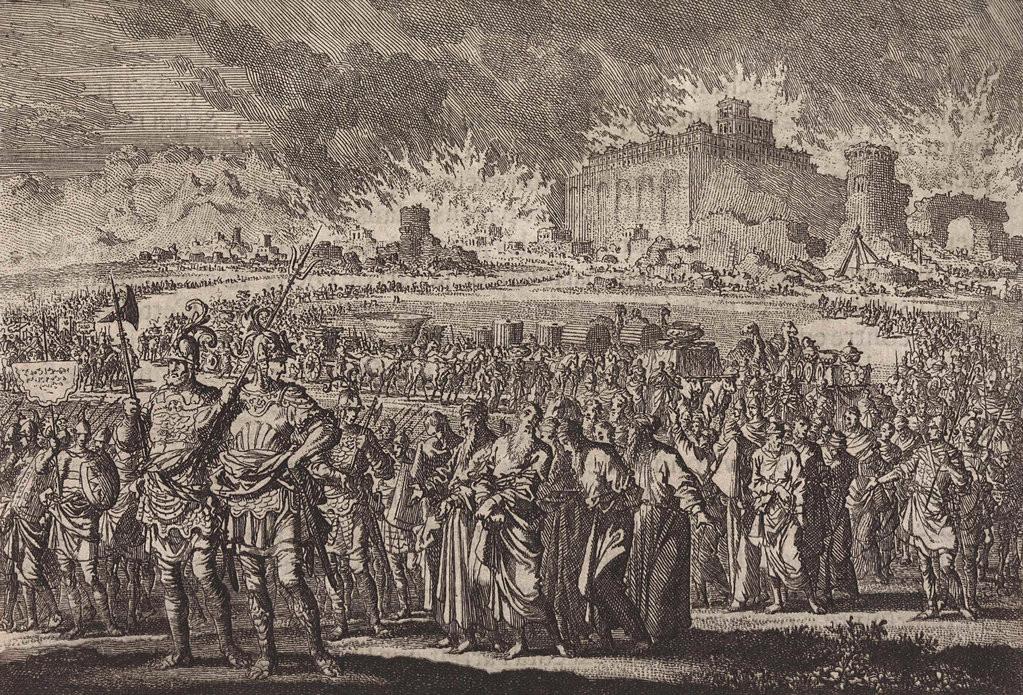
Zedekiah suffered a fate worse than death. He was forced to watch the execution of his own sons, then was blinded and led away in captivity, never to see the city of Jerusalem again. But had he been able to look upon the devastating scene taking place on Mount Zion, he would have been appalled. The great city of David was aflame, and in every quarter of the capital, the Babylonians were enacting a reign of terror. Those who were not killed were taken captive, soon to be transported as slaves to Babylon. And King Nebuchadnezzar ordered the systematic destruction of all the city’s infrastructure. The walls were torn down, and the royal palace and all the administrative buildings were destroyed. There wasn’t a single house left standing, including the house of God. The Babylonians plundered every last item of value from the Temple, just as the prophet Jeremiah had said they would.

The Babylonians broke up the bronze pillars in front of the LORD’s Temple, the bronze water carts, and the great bronze basin called the Sea, and they carried all the bronze away to Babylon. They also took all the ash buckets, shovels, lamp snuffers, ladles, and all the other bronze articles used for making sacrifices at the Temple. The captain of the guard also took the incense burners and basins, and all the other articles made of pure gold or silver. – 2 Kings 25:13-15 NLT

Then they burned the Temple to the ground. For the Jews, this scene would have been incomprehensible. For generations, the Temple had stood as the symbol of Yahweh’s power and presence. To watch it be plundered and then go up in flames would have been inconceivable. But Yahweh had warned them that this would happen.

“‘Don’t be fooled into thinking that you will never suffer because the Temple is here. It’s a lie! Do you really think you can steal, murder, commit adultery, lie, and burn incense to Baal and all those other new gods of yours, and then come here and stand before me in my Temple and chant, ‘We are safe!’—only to go right back to all those evils again? Don’t you yourselves admit that this Temple, which bears my name, has become a den of thieves? Surely I see all the evil going on there. I, the Lord, have spoken!’” – Jeremiah 7:9-11 NLT

They had placed their hope in a building rather than in the one for whom it was built. Yahweh had warned them that He would destroy the Temple because they had turned it into an idol or a replacement for Him.

“I will now destroy this Temple that bears my name, this Temple that you trust in for help, this place that I gave to you and your ancestors. – Jeremiah 7:14 NLT

Not only did God commission Nebuchadnezzar to destroy the Temple, but He also ordained the execution of those men who had been responsible for its care and for the spiritual well-being of the people. Yahweh had cleaned house, purging the land of its idolatry and apostasy, and with the smoke of the city rising up behind them, the disheveled and demoralized citizens of Judah began their long march to Babylon and back into captivity. Their ancestors had originally entered the land of Canaan as freed men, having been delivered from their captivity in Egypt by Yahweh. Now, generations later, the people of Judah found themselves enslaved once again, all because they refused to remain faithful to the one who had set them apart as His treasured possession.

English Standard Version (ESV) The Holy Bible, English Standard Version. ESV® Permanent Text Edition® (2016). Copyright © 2001 by Crossway Bibles, a publishing ministry of Good News Publishers.

New Living Translation (NLT) Holy Bible, New Living Translation, copyright © 1996, 2004, 2015 by Tyndale House Foundation. Used by permission of Tyndale House Publishers Inc., Carol Stream, Illinois 60188. All rights reserved.

Blind Man’s Bluff

Now the rest of the deeds of Jehoiakim and all that he did, are they not written in the Book of the Chronicles of the Kings of Judah? So Jehoiakim slept with his fathers, and Jehoiachin his son reigned in his place. And the king of Egypt did not come again out of his land, for the king of Babylon had taken all that belonged to the king of Egypt from the Brook of Egypt to the river Euphrates.

Jehoiachin was eighteen years old when he became king, and he reigned three months in Jerusalem. His mother’s name was Nehushta the daughter of Elnathan of Jerusalem. And he did what was evil in the sight of the LORD, according to all that his father had done.

10 At that time the servants of Nebuchadnezzar king of Babylon came up to Jerusalem, and the city was besieged. 11 And Nebuchadnezzar king of Babylon came to the city while his servants were besieging it, 12 and Jehoiachin the king of Judah gave himself up to the king of Babylon, himself and his mother and his servants and his officials and his palace officials. The king of Babylon took him prisoner in the eighth year of his reign 13 and carried off all the treasures of the house of the LORD and the treasures of the king’s house, and cut in pieces all the vessels of gold in the Temple of the LORD, which Solomon king of Israel had made, as the LORD had foretold. 14 He carried away all Jerusalem and all the officials and all the mighty men of valor, 10,000 captives, and all the craftsmen and the smiths. None remained, except the poorest people of the land. 15 And he carried away Jehoiachin to Babylon. The king’s mother, the king’s wives, his officials, and the chief men of the land he took into captivity from Jerusalem to Babylon. 16 And the king of Babylon brought captive to Babylon all the men of valor, 7,000, and the craftsmen and the metal workers, 1,000, all of them strong and fit for war. 17 And the king of Babylon made Mattaniah, Jehoiachin’s uncle, king in his place, and changed his name to Zedekiah.

18 Zedekiah was twenty-one years old when he became king, and he reigned eleven years in Jerusalem. His mother’s name was Hamutal the daughter of Jeremiah of Libnah. 19 And he did what was evil in the sight of the LORD, according to all that Jehoiakim had done. 20 For because of the anger of the LORD it came to the point in Jerusalem and Judah that he cast them out from his presence.

And Zedekiah rebelled against the king of Babylon. – 2 Kings 24:5-20 ESV

Eliakim was the second son of Joash to sit on the throne of Judah. The reign of his younger brother, Jehoahaz, had only lasted three months before he was deposed and taken captive by Neco, the king of Egypt. He became the puppet-king of the Egyptians and was forced to pay an exorbitant annual tribute to secure his throne. He even faced the indignity of having his name changed to Jehoiakim. But the time came when his Egyptian overlords were displaced by the new bully on the block, the Babylonians. The army of King Nebuchadnezzar defeated the combined forces of the Assyrians and Egyptians at the Battle of Carchemish in 605 BC. This decisive victory dramatically altered the political landscape of the Middle East and set the stage for Judah’s eventual fall.

The Babylonians’ defeat of the Egyptians provided Jehoiakim with a brief reprieve, but it was not long before he found himself facing yet another Gentile superpower with aspirations of global dominance. Nebuchadnezzar eventually set his sights on Judah, and for three years, he forced Jehoiakim back into his familiar and just as unpleasant role as a vassal. For eight years of his 11-year reign, Jehoiakim had served as Pharaoh’s virtual slave. Now, after three more years of Babylonian oppression and control, he decided enough was enough and rebelled against King Nebuchadnezzar. But Jehoiakim failed to realize that this entire scenario was the handiwork of God Almighty. Yahweh had sovereignly appointed the Babylonians to be His agents of judgment against the rebellious nation of Judah. So, when Jehoiakim rebelled against Nebuchadnezzar, he was really attempting to resist the will of God.

Yahweh had repeatedly warned His rebellious people that their fate would be far from pleasant if they continued to reject His calls for repentance.

“Go back to King Zedekiah and tell him, ‘This is what the Lord, the God of Israel, says: I will make your weapons useless against the king of Babylon and the Babylonians who are outside your walls attacking you. In fact, I will bring your enemies right into the heart of this city. I myself will fight against you with a strong hand and a powerful arm, for I am very angry. You have made me furious! I will send a terrible plague upon this city, and both people and animals will die. And after all that, says the Lord, I will hand over King Zedekiah, his staff, and everyone else in the city who survives the disease, war, and famine. I will hand them over to King Nebuchadnezzar of Babylon and to their other enemies. He will slaughter them and show them no mercy, pity, or compassion.’ – Jeremiah 21:3-7 NLT

But despite Jeremiah’s dire predictions of Judah’s fall, the people of Judah remained unrepentant, and their leaders continued to doubt the reality of Yahweh’s sovereignty, until it was too late.

Then the LORD sent bands of Babylonian, Aramean, Moabite, and Ammonite raiders against Judah to destroy it, just as the LORD had promised through his prophets. These disasters happened to Judah because of the LORD’s command. He had decided to banish Judah from his presence because of the many sins of Manasseh… – 2 Kings 24:2-3 NLT

The fall of Judah was inevitable because God had ordained it, and there was nothing Jehoiakim could do to avoid or escape it. And eventually, God repaid Jehoiakim for his stubborn resistance to His will by allowing the Babylonians to capture the capital city of Jerusalem.

Then King Nebuchadnezzar of Babylon came to Jerusalem and captured it, and he bound Jehoiakim in bronze chains and led him away to Babylon. Nebuchadnezzar also took some of the treasures from the Temple of the Lord, and he placed them in his palace in Babylon. – 2 Chronicles 36:6-7 NLT

Jehoiakim, dethroned and disgraced, was replaced by his 18-year-old son, Jehoiachin. And just like his father and his uncle before him, “Jehoiachin did what was evil in the LORD’s sight” (2 Kings 24:9 NLT). Not only did Jehoiachin offend God by encouraging idolatry and apostasy, but he also attempted to resist God’s will by rebelling against the Babylonians whom God had sent. This forced Nebuchadnezzar to lay siege to the city of Jerusalem, which he eventually captured. With Jerusalem’s fall, Jehoiachin found himself without a capital city or a throne. He and the royal family were taken captive and deported to Babylon.

Then King Jehoiachin, along with the queen mother, his advisers, his commanders, and his officials, surrendered to the Babylonians. – 2 Kings 24:12 NLT

And none of this should have come as a shock to King Jehoiachin because God had warned that it would happen. He had repeatedly sent His prophets to deliver His message of impending destruction, but they would not listen. The prophet Jeremiah had given Jehoiachin’s father, Jehoiakim, a stark description of what God had planned for the nation of Judah.

“You made me furious by worshiping idols you made with your own hands, bringing on yourselves all the disasters you now suffer. And now the LORD of Heaven’s Armies says: Because you have not listened to me, I will gather together all the armies of the north under King Nebuchadnezzar of Babylon, whom I have appointed as my deputy. I will bring them all against this land and its people and against the surrounding nations. I will completely destroy you and make you an object of horror and contempt and a ruin forever. I will take away your happy singing and laughter. The joyful voices of bridegrooms and brides will no longer be heard. Your millstones will fall silent, and the lights in your homes will go out. This entire land will become a desolate wasteland. Israel and her neighboring lands will serve the king of Babylon for seventy years. – Jeremiah 25:7-11 NLT

And in the eighth year of Nebuchadnezzar’s reign, the prophecy of Jeremiah was fulfilled.

King Nebuchadnezzar took all of Jerusalem captive, including all the commanders and the best of the soldiers, craftsmen, and artisans—10,000 in all. Only the poorest people were left in the land. – 2 Kings 24:14 NLT

But this would prove to be just the beginning of the end. Over time, there would be far more people deported from the land of Judah to Babylon. Despite the fall of Jerusalem, the stubbornness of the people of Judah was not yet abated. Those who remained in the land still refused to bow their knees to Yahweh. And when Nebuchadnezzar placed Jehoiachin’s uncle, Mattaniah, on the throne, they seemed to assume that life would go on as usual. But when Nebuchadnezzar changed Mattaniah’s name to Zedekiah, the people should have realized that they were far from an independent nation. They were little more than slaves of a foreign power, and, in time, many of them would find themselves joining their exiled brothers and sisters in Babylon.

The people had a new king, and that king had a new name, but little else changed in the nation of Judah. They continued in their old rebellious ways, and Zedekiah proved to be just as evil as all those kings who had occupied the throne before him. The author of 2 Kings makes it painfully clear that their persistent and pervasive rebellion had finally brought upon them the righteous wrath of God.

These things happened because of the LORD’s anger against the people of Jerusalem and Judah, until he finally banished them from his presence and sent them into exile. – 2 Kings 24:20 NLT

But even Yahweh’s judgment failed to get the attention of the king and his people; they remained stubbornly unrepentant and persistently unfaithful, right to the bitter end.

Zedekiah was a hard and stubborn man, refusing to turn to the LORD, the God of Israel. Likewise, all the leaders of the priests and the people became more and more unfaithful. They followed all the pagan practices of the surrounding nations, desecrating the Temple of the LORD that had been consecrated in Jerusalem. – 2 Chronicles 36:13-14 NLT

Zedekiah had been given ample warning, but he refused to listen. The prophet Jeremiah had delivered to Zedekiah Yahweh’s very clear warnings.

“…you must submit to Babylon’s king and serve him; put your neck under Babylon’s yoke! I will punish any nation that refuses to be his slave, says the LORD. I will send war, famine, and disease upon that nation until Babylon has conquered it.” – Jeremiah 27:9 NLT

Jeremiah had even advised the king to submit to King Nebuchadnezzar as an agent of God Almighty.

“If you want to live, submit to the yoke of the king of Babylon and his people. Why do you insist on dying—you and your people? Why should you choose war, famine, and disease, which the LORD will bring against every nation that refuses to submit to Babylon’s king? Do not listen to the false prophets who keep telling you, ‘The king of Babylon will not conquer you.’ They are liars. This is what the LORD says: ‘I have not sent these prophets! They are telling you lies in my name, so I will drive you from this land. You will all die—you and all these prophets, too.’” – Jeremiah 27:12-15 NLT

But Zedekiah refused to heed the words of Yahweh’s prophet, and in the ninth year of his reign, the stubborn king of Judah would learn the painful lesson that resistance to the will of God never ends well.

English Standard Version (ESV) The Holy Bible, English Standard Version. ESV® Permanent Text Edition® (2016). Copyright © 2001 by Crossway Bibles, a publishing ministry of Good News Publishers.

New Living Translation (NLT) Holy Bible, New Living Translation, copyright © 1996, 2004, 2015 by Tyndale House Foundation. Used by permission of Tyndale House Publishers Inc., Carol Stream, Illinois 60188. All rights reserved.
Failure to Feed the Flock of God

15 And when he had come to the king, the king said to him, “Micaiah, shall we go to Ramoth-gilead to battle, or shall we refrain?” And he answered him, “Go up and triumph; the LORD will give it into the hand of the king.” 16 But the king said to him, “How many times shall I make you swear that you speak to me nothing but the truth in the name of the LORD?” 17 And he said, “I saw all Israel scattered on the mountains, as sheep that have no shepherd. And the LORD said, ‘These have no master; let each return to his home in peace.’” 18 And the king of Israel said to Jehoshaphat, “Did I not tell you that he would not prophesy good concerning me, but evil?” 19 And Micaiah said, “Therefore hear the word of the LORD: I saw the LORD sitting on his throne, and all the host of heaven standing beside him on his right hand and on his left; 20 and the LORD said, ‘Who will entice Ahab, that he may go up and fall at Ramoth-gilead?’ And one said one thing, and another said another. 21 Then a spirit came forward and stood before the LORD, saying, ‘I will entice him.’ 22 And the LORD said to him, ‘By what means?’ And he said, ‘I will go out, and will be a lying spirit in the mouth of all his prophets.’ And he said, ‘You are to entice him, and you shall succeed; go out and do so.’ 23 Now therefore behold, the LORD has put a lying spirit in the mouth of all these your prophets; the LORD has declared disaster for you.”

24 Then Zedekiah the son of Chenaanah came near and struck Micaiah on the cheek and said, “How did the Spirit of the LORD go from me to speak to you?” 25 And Micaiah said, “Behold, you shall see on that day when you go into an inner chamber to hide yourself.” 26 And the king of Israel said, “Seize Micaiah, and take him back to Amon the governor of the city and to Joash the king’s son, 27 and say, ‘Thus says the king, “Put this fellow in prison and feed him meager rations of bread and water, until I come in peace.”’” 28 And Micaiah said, “If you return in peace, the LORD has not spoken by me.” And he said, “Hear, all you peoples!” 1 Kings 22:15-28 ESV

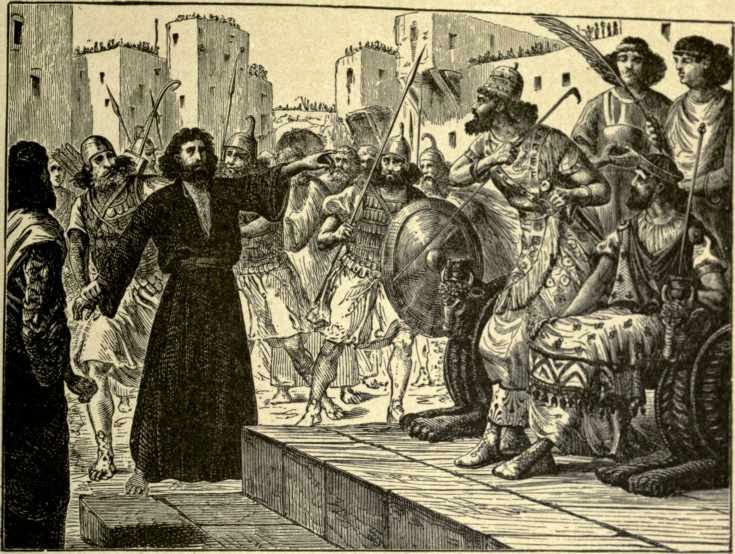
Imagine the scene. Micaiah, the prophet, has been forcibly dragged before King Ahab, who is seated on the dais with his guest, King Jehoshaphat of Judah. Surrounding the two potentates are 400 prophets of Baal, each taking turns declaring their version of the truth. For hours, they have been telling King Ahab exactly what he wants to hear: “Go up to Ramoth-gilead and triumph; the LORD will give it into the hand of the king” (1 Kings 22:12 ESV). One of them, a man named Zedekiah, had even crafted a pair of iron horns and used them as a prop to support his message to the king: “Thus says the LORD, ‘With these you shall push the Syrians until they are destroyed’” (1 Kings 22:11 ESV).

Then Micaiah shows up. Unlike the 400 yes-men who have been masquerading as spokesmen for the false god, Baal, Micaiah was a prophet of Yahweh. As such, he was obligated to speak only those words given to him by God. Which is precisely what Micaiah told the man who had come to fetch him.

As the LORD lives, what the LORD says to me, that I will speak.” – 1 Kings 22:14 ESV

Yet, when King Ahab asked Micaiah to reveal what his God thought about the planned attack of Ramoth-gilead, Micaiah simply repeated the words of the false prophets. He basically told the king, “Go for it!” But Ahab sensed the thinly veiled sarcasm behind Micaiah’s answer and demanded that he tell him the truth. Ahab knew from past experience that Micaiah and his God would oppose his plans. He had even revealed to King Jehoshaphat just how much he loathed Micaiah, telling him, “He never prophesies anything but trouble for me!” (1 Kings 22:8 NLT).

Micaiah knew that it really didn’t matter what he told Ahab, because the king would do as he wanted. Ahab’s stubbornness and arrogance would prevent him from hearing and heeding the message of Yahweh. But Micaiah shared it anyway.

“In a vision I saw all Israel scattered on the mountains, like sheep without a shepherd. And the LORD said, ‘Their master has been killed. Send them home in peace.’” – 1 Kings 22:17 NLT

Ahab was infuriated because Micaiah had just predicted Israel’s defeat and the king’s own death. But this less-than-encouraging message was just what Ahab had expected from the prophet of Yahweh. Just like Elijah, Micaiah proved to be a messenger of doom and gloom, bent on delivering nothing but bad news concerning Ahab’s kingly aspirations.

But Micaiah was not done. He next revealed how God had chosen to implement His plan for Ahab’s demise.

“Listen to what the LORD says! I saw the LORD sitting on his throne with all the armies of heaven around him, on his right and on his left. And the LORD said, ‘Who can entice Ahab to go into battle against Ramoth-gilead so he can be killed?’

“There were many suggestions, and finally a spirit approached the LORD and said, ‘I can do it!’

“‘How will you do this?’ the LORD asked.

“And the spirit replied, ‘I will go out and inspire all of Ahab’s prophets to speak lies.’

“‘You will succeed,’ said the LORD. ‘Go ahead and do it.’” – 1 Kings 22:19-22 NLT

Micaiah was given a vision of a conversation that took place in the throne room of God Almighty. In the vision, Yahweh is portrayed as a king surrounded by his advisors and his army. He is soliciting input from the heavenly host, asking for their counsel on the best way to get Ahab to proceed with his attack on Ramoth-gilead, which will result in his death. A spirit speaks up and offers to deceive the prophets of Baal by giving them a false message of victory. God approves the plan and sends the spirit on its way. Then Micaiah informs Ahab that this is precisely what has happened.

“So you see, the LORD has put a lying spirit in the mouths of all your prophets. For the LORD has pronounced your doom.” – 1 Kings 22:23 NLT

Amazingly, Micaiah tells Ahab the stark reality of all that had just transpired. The 400 prophets had unwittingly declared a lie, enticing Ahab to proceed with his plan to attack Ramoth-gilead and, inadvertently, bringing about his own demise. The identity of this “lying spirit” is unclear. Some view this as an angelic being who visited the king’s prophets and gave them a false message to deliver to the king. Others have determined this to have been a demonic spirit or Satan himself. But the text only indicates that this spirit was authorized by Yahweh to deceive the pseudo-prophets with a false message that would entice Ahab to attack Ramoth-gilead. Their answer, influenced by the spirit sent by Yahweh, was consistent and convincing.

“Yes, go right ahead! The LORD will give the king victory.” – 1 Kings 22:6 NLT 

Yet, even when Micaiah disclosed the truth to Ahab, the king stubbornly refused to give up his plan. He ordered Micaiah’s arrest and imprisonment and commanded that he be given nothing but bread and water until he had returned safely from his battle for Ramoth-gilead. But before being hauled off to prison, Micaiah made one final pronouncement to the king and all those who stood within earshot.

“If you return safely, it will mean that the LORD has not spoken through me!” Then he added to those standing around, “Everyone mark my words!” – 1 Kings 22:28 NLT

The problem with Ahab was not just his stubbornness and idolatry; it was his refusal to shepherd the people of Israel. All his self-centered acts of self-promotion had done irreparable damage to the nation of Israel. He had led the people into apostasy and idolatry, and, as a king over God’s chosen people, he would be held responsible for his failure to care for Yahweh’s flock. Hundreds of years later, the prophet Ezekiel would declare a foreboding message from God concerning all those kings who, like Ahab, had left the people of God like sheep without a shepherd.

Then this message came to me from the LORD: “Son of man, prophesy against the shepherds, the leaders of Israel. Give them this message from the Sovereign LORD: What sorrow awaits you shepherds who feed yourselves instead of your flocks. Shouldn’t shepherds feed their sheep? You drink the milk, wear the wool, and butcher the best animals, but you let your flocks starve. You have not taken care of the weak. You have not tended the sick or bound up the injured. You have not gone looking for those who have wandered away and are lost. Instead, you have ruled them with harshness and cruelty. So my sheep have been scattered without a shepherd, and they are easy prey for any wild animal. They have wandered through all the mountains and all the hills, across the face of the earth, yet no one has gone to search for them.” – Ezekiel 34:1-6 NLT

This motif of shepherdless sheep dates back to the time of Moses. When the great deliverer of Israel was nearing the end of his life, he appealed to God, asking Him to provide the people of Israel with a new shepherd.

Then Moses said to the LORD, “O LORD, you are the God who gives breath to all creatures. Please appoint a new man as leader for the community. Give them someone who will guide them wherever they go and will lead them into battle, so the community of the LORD will not be like sheep without a shepherd.” – Numbers 27:15-17 NLT

Centuries later, long after Ahab had died, Jesus appeared on the scene, offering His own assessment of the spiritual state of the people of Israel.

Jesus traveled through all the towns and villages of that area, teaching in the synagogues and announcing the Good News about the Kingdom. And he healed every kind of disease and illness. When he saw the crowds, he had compassion on them because they were confused and helpless, like sheep without a shepherd. – Matthew 9:35-36 NLT

The Good Shepherd couldn’t help but look at His own people and see them as shepherdless sheep, wandering about confused and helpless. For centuries, they had been misled and mistreated. Their political and spiritual leaders had used and abused them. Those who should have been feeding and caring for them had ended up taking advantage of them, following the example of Ahab. But Jesus arrived on the scene as the Son of David, emulating the example of the man after God’s own heart. Jesus was the quintessential shepherd, the Good Shepherd, who would lay down His life for the sheep. Jesus would shepherd the flock of God with care and compassion, just as His forefather did.

He [Gpd] chose David his servant
    and took him from the sheepfolds;
from following the nursing ewes he brought him
    to shepherd Jacob his people,
    Israel his inheritance.
With upright heart he shepherded them
    and guided them with his skillful hand. – Psalm 78:70-72 ESV

At the end of the day, Ahab’s most significant problem was that he was a lousy shepherd. His chief sin was that he had failed to care for God’s flock and had made his own needs a higher priority than the needs of the people. Like most of the kings of Israel and Judah, Ahab had abused his divinely ordained power and position, and he would have to answer to the Great Shepherd of Israel. But despite Ahab’s egocentric ambitions and his physical and spiritual mistreatment of those whom God had placed under his care, Yahweh would personally ensure that His chosen people received the care and compassion He had promised them.

He will feed his flock like a shepherd. He will carry the lambs in his arms, holding them close to his heart. He will gently lead the mother sheep with their young. – Isaiah 40:11 NLT

English Standard Version (ESV) The Holy Bible, English Standard Version. ESV® Permanent Text Edition® (2016). Copyright © 2001 by Crossway Bibles, a publishing ministry of Good News Publishers.

New Living Translation (NLT) Holy Bible, New Living Translation, copyright © 1996, 2004, 2015 by Tyndale House Foundation. Used by permission of Tyndale House Publishers Inc., Carol Stream, Illinois 60188. All rights reserved.
The Scepter and the Sword

And the word of the Lord came to me: “Son of man, prophesy and say, Thus says the Lord, say:

“A sword, a sword is sharpened
    and also polished,
10 sharpened for slaughter,
    polished to flash like lightning!

(Or shall we rejoice? You have despised the rod, my son, with everything of wood.) 11 So the sword is given to be polished, that it may be grasped in the hand. It is sharpened and polished to be given into the hand of the slayer. 12 Cry out and wail, son of man, for it is against my people. It is against all the princes of Israel. They are delivered over to the sword with my people. Strike therefore upon your thigh. 13 For it will not be a testing—what could it do if you despise the rod?” declares the Lord God.

14 “As for you, son of man, prophesy. Clap your hands and let the sword come down twice, yes, three times, the sword for those to be slain. It is the sword for the great slaughter, which surrounds them, 15 that their hearts may melt, and many stumble. At all their gates I have given the glittering sword. Ah, it is made like lightning; it is taken up for slaughter. 16 Cut sharply to the right; set yourself to the left, wherever your face is directed. 17 I also will clap my hands, and I will satisfy my fury; I the Lord have spoken.” – Ezekiel 21:8-17 NLT

In this rather poetic-sounding passage, God refers to the rod and the sword, two symbols of kingly authority. The rod (šēḇeṭ) refers to the royal scepter of the king. It is the same word used in Jacob’s death-bed blessing of his son, Judah.

The scepter will not depart from Judah,
nor the ruler’s staff from his descendants,
until the coming of the one to whom it belongs,
the one whom all nations will honor.– Genesis 49:10 NLT

Ezekiel’s audience would have been familiar with this passage and would have understood it as a guarantee of the unbroken line of kings to rule over the tribe of Judah. They couldn’t fathom the idea of an end to the royal lineage of King David.

The other imagery used in this passage is that of the sword, another symbol of kingly authority and power. With his sword, the king ruled over the people, providing them with peace and security as he defended them against all those who would bring them harm. The psalmist records the words of a song that celebrates the king and his sword of righteousness and justice.

I will recite a lovely poem about the king,
for my tongue is like the pen of a skillful poet.

You are the most handsome of all.
Gracious words stream from your lips.
God himself has blessed you forever.
Put on your sword, O mighty warrior!
You are so glorious, so majestic!
In your majesty, ride out to victory,
defending truth, humility, and justice.
Go forth to perform awe-inspiring deeds!– Psalm 45:1-4 NLT

The scepter and the sword. These two symbols of royal power and authority would have conjured up images of hope in the minds of the exiled Jews to whom Ezekiel was speaking. They longed for the day when King Zedekiah of Judah would put on his sword and ride out to victory against the Babylonians. They desperately longed for a king who would defend truth, humility, and justice. But from their vantage point in Babylon, they had yet to see anyone step up and wield the sword and the scepter in defense of Judah.

But God wanted them to know that the sword they longed for would not come in the hand of their kingly deliverer, but it would be clutched by their enemy and used to wreak havoc and destruction on His rebellious people.

“Son of man, give the people this message from the Lord:

“A sword, a sword
is being sharpened and polished.
It is sharpened for terrible slaughter
and polished to flash like lightning! – Ezekiel 21:9-10 NLT

God will leave no doubt as to who will be bringing this sword of destruction against the people of Judah. In verse 19, He refers to it as “the sword of the king of Babylon to come” (Ezekiel 21:19 ESV). This sword will be wielded by a king but not a king from the line of David. No, this king will be a foreigner whom God has chosen to be His royal executioner.

“Now will you laugh?
Those far stronger than you have fallen beneath its power!
Yes, the sword is now being sharpened and polished;
it is being prepared for the executioner.” – Ezekiel 21:10-11 NLT

God wanted His people to understand that this coming destruction was His doing. Nebuchadnezzar and the Babylonians were His chosen instruments to carry out His just and righteous judgment upon His unrepentant people. In Jeremiah 45:10, God refers to Nebuchadnezzar as “my servant.”

Later in the book of Ezekiel, God will refer to Nebuchadnezzar as His employee.

“I have given him the land of Egypt as a reward for his work, says the Sovereign Lord, because he was working for me when he destroyed Tyre.” – Ezekiel 29:20 NLT

God was going to use this pagan king and his seemingly invincible army to carry out divine justice upon the recalcitrant people of Judah. Nebuchadnezzar and his forces would serve as God’s instruments of wrath, and He flatly states, “that sword will slaughter my people and their leaders—everyone will die!” (Ezekiel 21:12 NLT).

God is emphatic that this destruction will be all-encompassing and indiscriminate. All will die, including the king. And the historical record asserts that King Zedekiah was not spared the wrath of God. His royal position did not immunize him from God’s righteous reckoning.

But the Babylonian troops chased King Zedekiah and overtook him on the plains of Jericho, for his men had all deserted him and scattered. They captured the king and took him to the king of Babylon at Riblah in the land of Hamath. There the king of Babylon pronounced judgment upon Zedekiah. The king of Babylon made Zedekiah watch as he slaughtered his sons. He also slaughtered all the officials of Judah at Riblah. Then he gouged out Zedekiah’s eyes and bound him in bronze chains, and the king of Babylon led him away to Babylon. Zedekiah remained there in prison until the day of his death. – Jeremiah 52:8-11 NLT

God wanted His people to know that the royal scepter, while a symbol of kingly authority, would not provide Zedekiah with any protection. The sword of Nebuchadnezzar would show no favorites and extend no courtesies.

“For testing will come, and what will happen when the scepter, which the sword despises, is no more? declares the Sovereign Lord.” – Ezekiel 21:14 NET

God was going to remove Zedekiah from the throne, in keeping with the prophecy He earlier gave to Ezekiel.

“…he will die in Babylon, in the land of the king who enthroned him, whose oath he despised and whose covenant he broke.” – Ezekiel 17:16 NLT

Zedekiah would be the last king to sit on the throne of David. According to the book of 2 Kings, “Nebuchadnezzar appointed Gedaliah son of Ahikam and grandson of Shaphan as governor over the people he had left in Judah” (2 Kings 25:22 NLT). This abrupt end to the Davidic line left the people in a state of despair, prompting many of them to flee to Egypt for protection from the Babylonian occupiers.

It seems that a vital part of Ezekiel’s delivery of this less-than-pleasant message was his acting out of the coming destruction. God instructs his prophet to take an actual sword and swing it before the faces of his stunned audience.

“…take the sword and brandish it twice,
even three times,
to symbolize the great massacre,
the great massacre facing them on every side. – Ezekiel 21:14 NLT

The sight of this prophet wildly swinging an unsheathed sword while describing the wholesale slaughter of Jerusalem’s inhabitants would have been unsettling. He was to accompany this disturbing display with loud shouts and the clapping of hands, all intended to create an atmosphere of fear and foreboding.

“Let their hearts melt with terror,
for the sword glitters at every gate.
It flashes like lightning
and is polished for slaughter!” – Ezekiel 21:15 NLT

God declares His intentions to guide the hands of His “servant” Nebuchadnezzar as he delivers each deadly blow with the sword of His fury.

“O sword, slash to the right,
then slash to the left,
wherever you will,
wherever you want.
I, too, will clap my hands,
and I will satisfy my fury.
I, the Lord, have spoken!”– Ezekiel 21:16-17 NLT

All of this disturbing imagery would have left Ezekiel’s audience confused and clamoring for answers. How could a good God pour out such devastating judgment upon His chosen people? For centuries, they had relied upon the enduring patience of God. In fact, they had grown accustomed to abusing His patience, assuring themselves that He would always forgive them of any indiscretions they may have committed.

“At least some of the problem that Ezekiel’s audience had in accepting such a gloomy picture of the future can be traced to the natural religious tendency to think of God as kindly and thus not really capable of punishing people decisively. Why would God destroy His own beloved people in whom He had invested such time and effort since He brought them out of Egypt centuries before? Some of the problem lay also in people’s natural, routine optimism. It is hard to imagine the country in which one grew up and enjoyed life in the past actually coming to an end, never again to be an independent nation, never again to have its own government and laws and economy and stable traditions.” – Douglas Stuart, Ezekiel

But they were in for a rude awakening. The patience of God had finally expired and the sword was coming. There would be no escape and no second chances. While they had long relished the idea of an all-loving, all-forgiving God, they had long ago abandoned any concept of His holiness and righteousness. And their actions had proven that they had no intentions of keeping His command:

You must be holy because I, the Lord your God, am holy. – Leviticus 19:2 NLT

English Standard Version (ESV) The Holy Bible, English Standard Version. ESV® Permanent Text Edition® (2016). Copyright © 2001

New Living Translation (NLT) Holy Bible, New Living Translation, copyright © 1996, 2004, 2015 by Tyndale House Foundation. Used by permission of Tyndale House Publishers Inc., Carol Stream, Illinois 60188. All rights reserved.

Turning Sorrow Into Gladness

1 And you, take up a lamentation for the princes of Israel, and say:

What was your mother? A lioness!
    Among lions she crouched;
in the midst of young lions
    she reared her cubs.
And she brought up one of her cubs;
    he became a young lion,
and he learned to catch prey;
    he devoured men.
The nations heard about him;
    he was caught in their pit,
and they brought him with hooks
    to the land of Egypt.
When she saw that she waited in vain,
    that her hope was lost,
she took another of her cubs
    and made him a young lion.
He prowled among the lions;
    he became a young lion,
and he learned to catch prey;
    he devoured men,
and seized their widows.
    He laid waste their cities,
and the land was appalled and all who were in it
    at the sound of his roaring.
Then the nations set against him
    from provinces on every side;
they spread their net over him;
    he was taken in their pit.
With hooks they put him in a cage
    and brought him to the king of Babylon;
    they brought him into custody,
that his voice should no more be heard
    on the mountains of Israel.

10 Your mother was like a vine in a vineyard
    planted by the water,
fruitful and full of branches
    by reason of abundant water.
11 Its strong stems became
    rulers’ scepters;
it towered aloft
    among the thick boughs;
it was seen in its height
    with the mass of its branches.
12 But the vine was plucked up in fury,
    cast down to the ground;
the east wind dried up its fruit;
    they were stripped off and withered.
As for its strong stem,
    fire consumed it.
13 Now it is planted in the wilderness,
    in a dry and thirsty land.
14 And fire has gone out from the stem of its shoots,
    has consumed its fruit,
so that there remains in it no strong stem,
    no scepter for ruling.

This is a lamentation and has become a lamentation. – Ezekiel 19:1-14 NLT

The people of Judah still held out hope that things would change. Even as they lived in forced exile in the land of Babylon, they kept dreaming that someone from the line of David would step up and deliver them from their oppression and restore the glory of Judah. In spite of all the warnings and prophecies of Ezekiel, Jeremiah, and others, they kept believing that things were going to turn around any minute. But God wanted them to know that their destruction was unavoidable and their restoration impossible – without His help.

So, He provided Ezekiel with the lyrics to a funeral dirge – a song of lament describing the final days of the once great nation of Judah. Ezekiel was to sing this sorrowful tune to mourn the final days of Judah. From God’s perspective, Judah was already as good as dead. There was little to no life left in them. There was no king waiting in the wings, ready to step up and deliver the nation from the hands of the Babylonians. Her kings had all been killed or taken captive. Zedekiah would prove to be the final monarch to sit on the throne of David and rule over the once-formidable nation. Their glory days were behind them because they had refused to honor God by honoring His right to rule over them as the sovereign King of the universe.

Israel had once been a powerful force in the region. Like a fierce lioness, she had prowled the land of Palestine surrounded by other powerful lions. She was “a lioness among lions” (Ezekiel 19:2 NLT).  She prospered in the midst of a hostile environment and even bore cubs, one of whom became a strong young lion who “learned to hunt and devour prey, and he became a man-eater” (Ezekiel 19:3 NLT). But that “lion” was captured and taken captive to the land of Egypt.

This is a clear reference to King Jehoahaz, the son of Josiah, the last righteous king of Judah. As king, Josiah did not share his father’s love for God. Instead, he led the nation back into its former pattern of idolatry and immorality, which led God to forcibly remove him from the throne.

Jehoahaz was twenty-three years old when he became king, and he reigned in Jerusalem three months. His mother was Hamutal, the daughter of Jeremiah from Libnah. He did what was evil in the Lord’s sight, just as his ancestors had done.

Pharaoh Neco put Jehoahaz in prison at Riblah in the land of Hamath to prevent him from ruling in Jerusalem. – 2 Kings 23:31-33 NLT

There were plenty of people in Judah and even some of the exiles in Babylon who held out hope that God would restore Jehoahaz to the throne. But the prophet Jeremiah put that rumor to rest.

For this is what the Lord says about Jehoahaz, who succeeded his father, King Josiah, and was taken away as a captive: “He will never return. He will die in a distant land and will never again see his own country.” – Jeremiah 22:11-12 NLT

Judah, the lioness, bore other cubs to replace the one she lost. Jehoahaz was replaced by his brother Eliakim, who reigned for 11 years in Judah, thanks to the aid of the Egyptian monarch who had deposed his brother.

Pharaoh Neco then installed Eliakim, another of Josiah’s sons, to reign in place of his father, and he changed Eliakim’s name to Jehoiakim. Jehoahaz was taken to Egypt as a prisoner, where he died. – 2 Kings 23:24 NLT

Jehoiakim’s reign was also marked by idolatry and fraught with problems.

During Jehoiakim’s reign, King Nebuchadnezzar of Babylon invaded the land of Judah. Jehoiakim surrendered and paid him tribute for three years but then rebelled. Then the Lord sent bands of Babylonian, Aramean, Moabite, and Ammonite raiders against Judah to destroy it, just as the Lord had promised through his prophets. – 2 Kings 24:1-2 NLT

This “cub” eventually died and was replaced by his son, Jehoiachin. Ezekiel’s dirge picks up the story with Jehoiachin’s ascension to the throne.

“When the lioness saw
    that her hopes for him were gone,
she took another of her cubs
    and taught him to be a strong young lion. – Ezekiel 19:5 NLT

Like his brothers before him, Jehoiachin proved to be a royal disaster, and he suffered the same fate as his brother, Jehoahaz.

With hooks, they dragged him into a cage
    and brought him before the king of Babylon.
They held him in captivity,
    so his voice could never again be heard
    on the mountains of Israel. – Ezekiel 19:9 NLT

But instead of exile in Egypt, Jehoiachin was banished to the land of Babylon, where he would die an ignoble death.

Nebuchadnezzar led King Jehoiachin away as a captive to Babylon, along with the queen mother, his wives and officials, and all Jerusalem’s elite. He also exiled 7,000 of the best troops and 1,000 craftsmen and artisans, all of whom were strong and fit for war. Then the king of Babylon installed Mattaniah, Jehoiachin’s uncle, as the next king, and he changed Mattaniah’s name to Zedekiah. – 2 Kings 24:15-17 NLT

As Ezekiel sang the lyrics to his divinely inspired dirge, Zedekiah sat on the throne of David in Jerusalem., but he was little more than a vassal to King Nebuchadnezzar. Yet, there were still those who hoped this powerless and godless monarch would somehow rescue them from their Babylonian oppressors.

But this is where God begins to mix His metaphors and begins to refer to Judah as a fruitful vine.

“Your mother was like a vine
    planted by the water’s edge.
It had lush, green foliage
    because of the abundant water.
Its branches became strong—
    strong enough to be a ruler’s scepter.
It grew very tall,
    towering above all others.
It stood out because of its height
    and its many lush branches.” – Ezekiel 19:10-11 NLT

Despite the nation’s track record of infidelity, God had allowed it to prosper and grow. But that was about to change. With unmistakable clarity, God predicts the coming fall of Judah.

“…the vine was uprooted in fury
    and thrown down to the ground.
The desert wind dried up its fruit
    and tore off its strong branches,
so that it withered
    and was destroyed by fire.” – Ezekiel 19:12 NLT

The funeral song was a bit premature but not inaccurate. God knew the fate of Jerusalem and was letting Ezekiel in on the secret. And the book of 2 Kings describes exactly what happened when God finally destroyed the vine and its branches.

So on January 15, during the ninth year of Zedekiah’s reign, King Nebuchadnezzar of Babylon led his entire army against Jerusalem. They surrounded the city and built siege ramps against its walls. Jerusalem was kept under siege until the eleventh year of King Zedekiah’s reign. – 2 Kings 25:1-2 NLT

They captured the king and took him to the king of Babylon at Riblah, where they pronounced judgment upon Zedekiah. They made Zedekiah watch as they slaughtered his sons. Then they gouged out Zedekiah’s eyes, bound him in bronze chains, and led him away to Babylon. – 2 Kings 25:6-7 NLT

The forces of Nebuchadnezzar showed no mercy. They completely ransacked the city, plundering everything of value and destroying all that they could not take with them to Babylon.

Nebuzaradan, the captain of the guard and an official of the Babylonian king, arrived in Jerusalem. He burned down the Temple of the Lord, the royal palace, and all the houses of Jerusalem. He destroyed all the important buildings in the city. Then he supervised the entire Babylonian army as they tore down the walls of Jerusalem on every side. – 2 Kings 25:8-10 NLT

With the eventual destruction of Jerusalem, the fall of Judah would be complete. Ezekiel and his fellow exiles would be joined by tens of thousands of other displaced Judahites.

“…the vine is transplanted to the wilderness,
    where the ground is hard and dry.
A fire has burst out from its branches
    and devoured its fruit.
Its remaining limbs are not
    strong enough to be a ruler’s scepter.” – Ezekiel 19:13-14 NLT

With the deportation of Zedekiah, there would be no king to sit on the throne of David. The fortunes of the once-great kingdom of Israel would reach an all-time low. And that would be ample reason for the people of Judah to mourn the loss of their former glory and status as God’s chosen people.

But when all else looks bleak and hopeless, there is always God. Even after their fall from grace, God would be there and completely aware of their weak and helpless condition. He knew that there was no one king left in the line of David to deliver them. But God would do what men could not do. He would eventually restore them to the land from which He had banished them. He would return a remnant to Judah to rebuild the walls of Jerusalem. Ezra and Nehemiah would help lead a small group of captives to the land where they would labor to restore the nation. And God would be the one to make it all possible.

In spite of all their sin and rebellion, God would one day show them mercy and grace, returning them to the land and restoring them as a nation. And while there would be no king to rule when they returned, God had plans for a King in waiting – His very own Son – who sits at His right hand in heaven and will one day return to the earth to set up His kingdom in Jerusalem where He will reign in righteousness.

This song has a happy ending because God is faithful. All the sadness will be turned to joy. The darkness will be replaced by light. The hopelessness will be replaced with hope. The song of sadness will be replaced with shouts of joy.

Come, let us sing to the Lord! Let us shout joyfully to the Rock of our salvation. Let us come to him with thanksgiving. Let us sing psalms of praise to him. For the Lord is a great God, a great King above all gods. – Psalm 95:1-3 NLT

English Standard Version (ESV) The Holy Bible, English Standard Version. ESV® Permanent Text Edition® (2016). Copyright © 2001

New Living Translation (NLT) Holy Bible, New Living Translation, copyright © 1996, 2004, 2015 by Tyndale House Foundation. Used by permission of Tyndale House Publishers Inc., Carol Stream, Illinois 60188. All rights reserved.

The Soul Who Sins Shall Die

1 The word of the Lord came to me: “What do you mean by repeating this proverb concerning the land of Israel, ‘The fathers have eaten sour grapes, and the children’s teeth are set on edge’? As I live, declares the Lord God, this proverb shall no more be used by you in Israel. Behold, all souls are mine; the soul of the father as well as the soul of the son is mine: the soul who sins shall die.

“If a man is righteous and does what is just and right— if he does not eat upon the mountains or lift up his eyes to the idols of the house of Israel, does not defile his neighbor’s wife or approach a woman in her time of menstrual impurity, does not oppress anyone, but restores to the debtor his pledge, commits no robbery, gives his bread to the hungry and covers the naked with a garment, does not lend at interest or take any profit, withholds his hand from injustice, executes true justice between man and man, walks in my statutes, and keeps my rules by acting faithfully—he is righteous; he shall surely live, declares the Lord God.

10 “If he fathers a son who is violent, a shedder of blood, who does any of these things 11 (though he himself did none of these things), who even eats upon the mountains, defiles his neighbor’s wife, 12 oppresses the poor and needy, commits robbery, does not restore the pledge, lifts up his eyes to the idols, commits abomination, 13 lends at interest, and takes profit; shall he then live? He shall not live. He has done all these abominations; he shall surely die; his blood shall be upon himself.

14 “Now suppose this man fathers a son who sees all the sins that his father has done; he sees, and does not do likewise: 15 he does not eat upon the mountains or lift up his eyes to the idols of the house of Israel, does not defile his neighbor’s wife, 16 does not oppress anyone, exacts no pledge, commits no robbery, but gives his bread to the hungry and covers the naked with a garment, 17 withholds his hand from iniquity, takes no interest or profit, obeys my rules, and walks in my statutes; he shall not die for his father’s iniquity; he shall surely live. 18 As for his father, because he practiced extortion, robbed his brother, and did what is not good among his people, behold, he shall die for his iniquity. Ezekiel 18:1-18 ESV

There was a common proverb among the Israelites in Ezekiel’s day that promoted the idea of transgenerational culpability for sin. It went something like this: “The parents have eaten sour grapes, but their children’s mouths pucker at the taste”(Ezekiel 18:2 NLT).

It was a subtle form of the blame game. Rather than accept responsibility for their own sins and the subsequent consequences, Ezekiel’s peers preferred to blame their problems on their ancestors. In a sense, they had a point. Their forefathers had been guilty of committing egregious sins against God. The previous generations had failed to live their lives in faithful obedience to Him. But He was not going to allow the present generation to blame their current condition on others. They were just as guilty and just as deserving of punishment as their grandparents and parents had been.

God was clearing up a common misunderstanding in their day and letting them know that each and every individual was responsible for their own behavior. And both Ezekiel and Jeremiah were given clear instructions by God to dispel any lingering suspicions among the people of Israel that they were unjustly suffering for the sins of others. And God had Jeremiah predict a future day when everyone will know, beyond a shadow of a doubt, that God’s punishment for sin is just and never capricious or misapplied.

“Behold, the days are coming, declares the Lord, when I will sow the house of Israel and the house of Judah with the seed of man and the seed of beast. And it shall come to pass that as I have watched over them to pluck up and break down, to overthrow, destroy, and bring harm, so I will watch over them to build and to plant, declares the Lord. In those days they shall no longer say:

“‘The fathers have eaten sour grapes,
    and the children’s teeth are set on edge.’

But everyone shall die for his own iniquity. Each man who eats sour grapes, his teeth shall be set on edge.” – Jeremiah 31:27-30 ESV

There is little debate that the sins of one generation can negatively influence the lives of the next. A sinful father can bring great sorrow to his own wife and innocent children. They can end up suffering greatly for his selfish decision to live in disobedience to the will of God. But God wants Ezekiel to understand that God never enacts His justice unfairly or applies His divine judgment inequitably.

God has already gone out of His way to prove the guilt of the current generation of Judahites. He transported Ezekiel to the temple in Jerusalem and revealed the gross sins being committed in the temple. The prophet was exposed to the hidden sins of the priests and civic leaders as they secretly offered sacrifices to their false gods in the inner recesses of God’s house.

By the time Ezekiel was penning the words of his prophecy, Zedekiah had ascended to the throne of Judah and, like the generations before him, he “did what was evil in the LORD’s sight” (2 Kings 24:19 NLT). He may have inherited a lot of his wicked traits from his father and forefathers, but he had made his own bed and would now have to suffer the consequences of having to sleep in it. The prophet Jeremiah warned Zedekiah of the fate that awaited him and his royal officials.

“But thus says the Lord: Like the bad figs that are so bad they cannot be eaten, so will I treat Zedekiah the king of Judah, his officials, the remnant of Jerusalem who remain in this land, and those who dwell in the land of Egypt. I will make them a horror to all the kingdoms of the earth, to be a reproach, a byword, a taunt, and a curse in all the places where I shall drive them. And I will send sword, famine, and pestilence upon them, until they shall be utterly destroyed from the land that I gave to them and their fathers.” – Jeremiah 24:8-10 ESV

And at the end of his book, Jeremiah describes the actual details concerning Zedekiah’s fall.

But Zedekiah did what was evil in the LORD’s sight, just as Jehoiakim had done. These things happened because of the LORD’s anger against the people of Jerusalem and Judah, until he finally banished them from his presence and sent them into exile.

Zedekiah rebelled against the king of Babylon. So on January 15, during the ninth year of Zedekiah’s reign, King Nebuchadnezzar of Babylon led his entire army against Jerusalem. They surrounded the city and built siege ramps against its walls. Jerusalem was kept under siege until the eleventh year of King Zedekiah’s reign.

By July 18 in the eleventh year of Zedekiah’s reign, the famine in the city had become very severe, and the last of the food was entirely gone. Then a section of the city wall was broken down, and all the soldiers fled. Since the city was surrounded by the Babylonians, they waited for nightfall. Then they slipped through the gate between the two walls behind the king’s garden and headed toward the Jordan Valley.

But the Babylonian troops chased King Zedekiah and overtook him on the plains of Jericho, for his men had all deserted him and scattered. They captured the king and took him to the king of Babylon at Riblah in the land of Hamath. There the king of Babylon pronounced judgment upon Zedekiah. The king of Babylon made Zedekiah watch as he slaughtered his sons. He also slaughtered all the officials of Judah at Riblah. Then he gouged out Zedekiah’s eyes and bound him in bronze chains, and the king of Babylon led him away to Babylon. Zedekiah remained there in prison until the day of his death. – Jeremiah 52:2-11 NLT

Zedekiah was not punished unjustly. He got exactly what he deserved for his rebellion against God. The prophet Jeremiah had warned him repeatedly about the consequences that awaited him if he refused to repent, and God did exactly what He said He would do.

God wanted His people to understand that He took sin seriously and that He always dealt with sin personally. That is what He meant when He said, “the soul who sins shall die” (Ezekiel 18:4 ESV). Each individual must pay for his own sins. But God assures Ezekiel and his audience that anyone who chooses to live righteously will be exempt from His judgment.  Basically, God provides Ezekiel with a brief synopsis of what it means to live righteously by detailing some of the laws contained in His covenant agreement with the nation of Israel. A just and righteous individual…

…does not feast in the mountains before Israel’s idols or worship them. – vs 6

…does not commit adultery or have intercourse with a woman during her menstrual period. – vs 6

…is a merciful creditor, not keeping the items given as security by poor debtors. – vs 7

…does not rob the poor but instead gives food to the hungry and provides clothes for the needy. – vs 7

…grants loans without interest, stays away from injustice, is honest and fair when judging others… vs 8

…and faithfully obeys my decrees and regulations. – vs 8

The problem was not that God meted out His justice unjustly, but that sin had become a pervasive and permanent fixture among His chosen people. Its influence was widespread and there was plenty of guilt to go around. The prophet Isaiah succinctly summed up the sorry spiritual state of the people of Israel.

You welcome those who gladly do good,
    who follow godly ways.
But you have been very angry with us,
    for we are not godly.
We are constant sinners;
    how can people like us be saved?
We are all infected and impure with sin.
    When we display our righteous deeds,
    they are nothing but filthy rags.
Like autumn leaves, we wither and fall,
    and our sins sweep us away like the wind. – Isaiah 64:5-6 NLT

And to make matters worse, Isaiah points out that “no one calls on your name or pleads with you for mercy. Therefore, you have turned away from us and turned us over to our sins” (Isaiah 64:7 NLT).

God was not acting unjustly and He was not punishing unfairly. The all-knowing, all-seeing God of the universe knew exactly what was going on among His people, and He was judging each of them fairly and appropriately, according to their sins.

God is the just judge of the universe who always administers justice righteously. If a righteous man bears a son who decides to live an unrighteous life, it will be the son who will face the judgment of God, not the father. And if that unrighteous son grows up to be the father of a son who rejects his sinful ways, that righteous son “will not die because of his father’s sins; he will surely live” (Ezekiel 18:17 NLT).

Zedekiah, the current king of Judah, did not have to follow in the footsteps of his predecessors. He had every chance to reject the sins of his fathers and return to God in humble obedience. Jeremiah had repeatedly warned Him.

“Be fair-minded and just. Do what is right! Help those who have been robbed; rescue them from their oppressors. Quit your evil deeds! Do not mistreat foreigners, orphans, and widows. Stop murdering the innocent! If you obey me, there will always be a descendant of David sitting on the throne here in Jerusalem. The king will ride through the palace gates in chariots and on horses, with his parade of attendants and subjects. But if you refuse to pay attention to this warning, I swear by my own name, says the Lord, that this palace will become a pile of rubble.’” – Jeremiah 22:3-5 NLT

But Zedekiah remained obstinate and unwilling to pursue a life of righteousness. So, he would eventually suffer a just and equitable punishment for his sin. And he would have no one to blame but himself.

English Standard Version (ESV) The Holy Bible, English Standard Version. ESV® Permanent Text Edition® (2016). Copyright © 2001

New Living Translation (NLT) Holy Bible, New Living Translation, copyright © 1996, 2004, 2015 by Tyndale House Foundation. Used by permission of Tyndale House Publishers Inc., Carol Stream, Illinois 60188. All rights reserved.

A Method to His Seeming Madness

11 Then the word of the Lord came to me: 12 “Say now to the rebellious house, Do you not know what these things mean? Tell them, behold, the king of Babylon came to Jerusalem, and took her king and her princes and brought them to him to Babylon. 13 And he took one of the royal offspring and made a covenant with him, putting him under oath (the chief men of the land he had taken away), 14 that the kingdom might be humble and not lift itself up, and keep his covenant that it might stand. 15 But he rebelled against him by sending his ambassadors to Egypt, that they might give him horses and a large army. Will he thrive? Can one escape who does such things? Can he break the covenant and yet escape?

16 “As I live, declares the Lord God, surely in the place where the king dwells who made him king, whose oath he despised, and whose covenant with him he broke, in Babylon he shall die. 17 Pharaoh with his mighty army and great company will not help him in war, when mounds are cast up and siege walls built to cut off many lives. 18 He despised the oath in breaking the covenant, and behold, he gave his hand and did all these things; he shall not escape. 19 Therefore thus says the Lord God: As I live, surely it is my oath that he despised, and my covenant that he broke. I will return it upon his head. 20 I will spread my net over him, and he shall be taken in my snare, and I will bring him to Babylon and enter into judgment with him there for the treachery he has committed against me. 21 And all the pick of his troops shall fall by the sword, and the survivors shall be scattered to every wind, and you shall know that I am the Lord; I have spoken.”

22 Thus says the Lord God: “I myself will take a sprig from the lofty top of the cedar and will set it out. I will break off from the topmost of its young twigs a tender one, and I myself will plant it on a high and lofty mountain. 23 On the mountain height of Israel will I plant it, that it may bear branches and produce fruit and become a noble cedar. And under it will dwell every kind of bird; in the shade of its branches birds of every sort will nest. 24 And all the trees of the field shall know that I am the Lord; I bring low the high tree, and make high the low tree, dry up the green tree, and make the dry tree flourish. I am the Lord; I have spoken, and I will do it.”  Ezekiel 17:11-24 ESV

I’m not particularly fond of riddles. I don’t like puzzles either, and guessing games drive me crazy. I prefer answers over questions and clarity over confusion. So, when God speaks in riddles and parables, I find myself getting a bit uncomfortable and, when this chapter started off with a riddle, I was less than excited. But fortunately, this is one of those cases where God doesn’t leave us guessing as to the meaning. He graciously provides an explanation so there’s absolutely no confusion as to what He is trying to say.

Yet God insinuates that the people of Judah should have been able to pick up on the meaning of the riddle. Why? Because they were living it out in real-time. As they listened to the words of the prophet, they were standing somewhere along the banks of the Kebar River deep in the heart of Babylon. They had actually experienced something very similar to what the prophet was describing.

In the first part of his message, God describes a giant eagle swooping down and plucking off the top of a cedar tree, which he carries to a distant city. The eagle also took a seedling and planted it by a river where it grew into a vine with deep roots and strong branches. Then this healthy, growing vine, turned its attention to another eagle. Despite its prosperous and fruitful condition, it looked to the second eagle as a source of sustenance. It had plenty of good soil and water right where it was, but was dissatisfied. So, God indicated this vine would be uprooted, its fruit cut off, and left it to wither and die in the very soil where it had experienced fruitfulness.

But Ezekiel’s audience must have missed the message. They were struggling with the meaning behind this bizarre-sounding story of the eagle and the vine. So, God carefully explains the point He is trying to make.

“The king of Babylon came to Jerusalem, took away her king and princes, and brought them to Babylon.” – Ezekiel 17:11 NLT

At this point, the light should have gone on. They would have immediately made the connection that their very presence in Babylon was the immediate result of that fateful historical event. They could recall the moment when the Babylonian forces invaded the city of Jerusalem and took their king captive.

Then King Nebuchadnezzar of Babylon came to Jerusalem and captured it, and he bound Jehoiakim in bronze chains and led him away to Babylon. – 2 Chronicles 36:6 NLT

The memory of the temple being ransacked by foreign soldiers was still fresh in their minds.

Nebuchadnezzar also took some of the treasures from the Temple of the Lord, and he placed them in his palace in Babylon. – 2 Chronicles 36:7 NLT

The Babylonians had allowed the people of Judah to keep their monarchy in place, but the kings served as pawns of King Nebuchadnezzar, paying him large annual fees as a form of tribute and a sign of Judah’s subservience to Babylon. Eventually, Jehoiakim was replaced by his son, Jehoiachin, but his reign lasted only three months before he too was deported to Babylon.

Many treasures from the Temple of the Lord were also taken to Babylon at that time. And Nebuchadnezzar installed Jehoiachin’s uncle, Zedekiah, as the next king in Judah and Jerusalem. – 2 Chronicles 36:10 NLT

The first eagle represents Nebuchadnezzar, the king of Babylon. He “swooped” down with his troops, invaded Jerusalem, and took Jehoiachin, king of Judah as his prisoner back to Babylon. He then set up another puppet king named Zedekiah (the seedling) on the throne of Jerusalem.

This is where the story begins to take on a whole different meaning. Zedekiah was still on the throne when God delivered this riddle to the people of Judah living in Babylon. From their perspective, Zedekiah was firmly entrenched as the sovereign king over their homeland. He had actually made a covenant agreement with Nebuchadnezzar – an oath of loyalty. As long as he kept that oath, the nation prospered. But what the people didn’t know was that their king was wicked and rebellious. He never intended to keep his agreement with Nebuchadnezzar.

But Zedekiah did what was evil in the sight of the Lord his God, and he refused to humble himself when the prophet Jeremiah spoke to him directly from the Lord. He also rebelled against King Nebuchadnezzar, even though he had taken an oath of loyalty in God’s name. Zedekiah was a hard and stubborn man, refusing to turn to the Lord, the God of Israel. – 2 Chronicles 36:12-13 NLT

God was revealing the next phase of His judgment upon His unfaithful people. The day was fast approaching when Zedekiah would decide to rebel against the Babylonians by turning to Egypt for assistance.

What is interesting to note is that the prophet, Jeremiah, who was ministering to the people still living in Jerusalem, had been led by God to send a letter to the exiles living in Babylon. In it, he provided them with a word of encouragement regarding their less-than-appealing conditions.

“This is what the Lord of Heaven’s Armies, the God of Israel, says to all the captives he has exiled to Babylon from Jerusalem: “Build homes, and plan to stay. Plant gardens, and eat the food they produce. Marry and have children. Then find spouses for them so that you may have many grandchildren. Multiply! Do not dwindle away! And work for the peace and prosperity of the city where I sent you into exile. Pray to the Lord for it, for its welfare will determine your welfare.” – Jeremiah 29:4-7 NLT

And Jeremiah had also provided Zedekiah and the people living in Judah with a word of warning concerning their response to the Babylonian occupation of their land.

“So you must submit to Babylon’s king and serve him; put your neck under Babylon’s yoke! I will punish any nation that refuses to be his slave, says the Lord. I will send war, famine, and disease upon that nation until Babylon has conquered it. Do not listen to your false prophets, fortune-tellers, interpreters of dreams, mediums, and sorcerers who say, ‘The king of Babylon will not conquer you.’ They are all liars, and their lies will lead to your being driven out of your land. I will drive you out and send you far away to die. But the people of any nation that submits to the king of Babylon will be allowed to stay in their own country to farm the land as usual. I, the Lord, have spoken!’”– Jeremiah 27:8-11 NLT

But Zedekiah would end up violating his contract with Nebuchadnezzar. As a result, Jerusalem would be invaded again, the city would be leveled, and the temple destroyed. Zedekiah would be forced to witness the execution of all his sons, then have his eyes gouged out and be taken captive to Babylon. God made it painfully clear that “the king of Israel disregarded his treaty and broke it after swearing to obey; therefore, he will not escape” (Ezekiel 17:18 NLT). The entire Babylonian occupation had been God’s will and He expected His people to submit to it. They would not escape His divine judgment.

But God was not finished with His explanation. At the very end, He provides a glimmer of hope in the midst of all the gloom and doom. He reveals yet another “eagle” that will take another branch from the top of the cedar tree and plant it on Israel’s highest mountain.

“It will become a majestic cedar, sending forth its branches and producing seed. Birds of every sort will nest in it, finding shelter in the shade of its branches.” – Ezekiel 17:33 NLT

God is predicting the future renewal and restoration of His chosen people. But the branch to which He refers is not just another human king who will help to reestablish the fortunes of Israel. This branch will be someone of great importance and renown. He will be a king like no other.

“Behold, the days are coming, declares the Lord, when I will raise up for David a righteous Branch, and he shall reign as king and deal wisely, and shall execute justice and righteousness in the land. In his days Judah will be saved, and Israel will dwell securely. And this is the name by which he will be called: ‘The Lord is our righteousness.’” – Jeremiah 23:5-6 ESV

This branch is Jesus, the Messiah. God is predicting the day when He will send His Son back to earth to set up His kingdom in Jerusalem, where He will reign for 1,000 years. Israel will be restored to greatness. The throne of David, long-vacant because of the nation’s rebellion, will once again be occupied by a descendant of the great king. And God assures that all the other nations of the earth will recognize the greatness and glory of God when this happens.

“And all the trees will know that it is I, the Lord, who cuts the tall tree down and makes the short tree grow tall. It is I who makes the green tree wither and gives the dead tree new life. I, the Lord, have spoken, and I will do what I said!” – Ezekiel 17:24 NLT

Babylon, Egypt, the United States, Russia, China, Great Britain, and all the other nations of the earth are no match for the plan of God. Babylon was a tool in the hands of God to accomplish His divine will, and He had a greater plan in place. He was out to accomplish His will in His way and according to His divine timetable. When God completes His plan all people will know that He has been in control all along, cutting down the tall trees and making the short tree grow, withering the green tree, and giving new life to the dead one.

God is sovereign and in complete control. In fact, that point is how He began the  chapter.

“Son of man, give this riddle, and tell this story to the people of Israel. Give them this message from the Sovereign Lord. – Ezekiel 17:2 NLT

He knows what He is doing and there is a method to His seeming madness. We may understand or even like His ways, but we can rest assured that He always does what is just and right. His plan is perfect and His timing is impeccable.

English Standard Version (ESV) The Holy Bible, English Standard Version. ESV® Permanent Text Edition® (2016). Copyright © 2001

New Living Translation (NLT) Holy Bible, New Living Translation, copyright © 1996, 2004, 2015 by Tyndale House Foundation. Used by permission of Tyndale House Publishers Inc., Carol Stream, Illinois 60188. All rights reserved.

A Perplexing Parable with a Happy Ending

1 The word of the Lord came to me: “Son of man, propound a riddle, and speak a parable to the house of Israel; say, Thus says the Lord God: A great eagle with great wings and long pinions, rich in plumage of many colors, came to Lebanon and took the top of the cedar. He broke off the topmost of its young twigs and carried it to a land of trade and set it in a city of merchants. Then he took of the seed of the land and planted it in fertile soil. He placed it beside abundant waters. He set it like a willow twig, and it sprouted and became a low spreading vine, and its branches turned toward him, and its roots remained where it stood. So it became a vine and produced branches and put out boughs.

“And there was another great eagle with great wings and much plumage, and behold, this vine bent its roots toward him and shot forth its branches toward him from the bed where it was planted, that he might water it. It had been planted on good soil by abundant waters, that it might produce branches and bear fruit and become a noble vine.

“Say, Thus says the Lord God: Will it thrive? Will he not pull up its roots and cut off its fruit, so that it withers, so that all its fresh sprouting leaves wither? It will not take a strong arm or many people to pull it from its roots. 10 Behold, it is planted; will it thrive? Will it not utterly wither when the east wind strikes it—wither away on the bed where it sprouted?” Ezekiel 17:1-10 ESV

God has commanded Ezekiel to do some rather strange things, such as perform a one-man play dramatizing the siege and fall of Jerusalem. At one point, the prophet was told to pack all his belongings and then dig a hole in the wall of his home and crawl through it, all in order to illustrate how the citizens of Jerusalem would attempt to flee from the marauding Babylonians.

Now, God demands that His prophet “propound a riddle and speak a parable” to the Jews living in exile in Babylon. This two-punch combination of an enigmatic saying and a pithy maxim was intended to provide further illustration of and justification for Judah’s coming fall. God knew there were still those among the Jews in Jerusalem and those living as exiles in Babylon that didn’t think they deserved God’s judgment. They felt as if God was being unjust by holding them responsible for the sins of their forefathers. Yet, the Almighty took issue with their claims of innocence and He provided Ezekiel with a riddle and a parable to provide the proof.

Though God will provide the meaning behind these somewhat ambiguous illustrations, it is helpful to understand the historical context they entail. For the people of Judah to claim the moral high ground was ludicrous because they had no facts to support their claim. Judah’s track record of idolatry and apostasy was not a thing of the past but was recent as the reigns of their past few kings.

At one point, Josiah, one of their few good kings, had been replaced by his son, Jehoahaz. Only 23 years old when he ascended to the throne, Jehoahaz’s reign lasted a mere three months before he was deposed by King Neco of Egypt and replaced by his brother, Jehoiakim. This 25-year-old sovereign ruled for 11 years but as a puppet king to the Egyptians. And sadly, he proved to be a powerless and impotent king who was also godless.

He did what was evil in the sight of the Lord his God. – 2 Chronicles 36:5 NLT

When the Babylonians invaded the region and captured Jerusalem, Jehoiakim was taken captive and replaced by his brother, Jehoiachin. He too became a puppet king but to the Babylonians. And he also “did what was evil in the Lord’s sight” (2 Chronicles 36:9 NLT). His reign lasted only three months before he too was deposed and replaced by his 21-one-year-old uncle, Zedekiah. And the book of 2 Chronicles provides a less-than-flattering assessment of his reign and the adverse impact he had on the nation.

Zedekiah did what was evil in the sight of the Lord his God, and he refused to humble himself when the prophet Jeremiah spoke to him directly from the Lord. He also rebelled against King Nebuchadnezzar, even though he had taken an oath of loyalty in God’s name. Zedekiah was a hard and stubborn man, refusing to turn to the Lord, the God of Israel.

Likewise, all the leaders of the priests and the people became more and more unfaithful. They followed all the pagan practices of the surrounding nations, desecrating the Temple of the Lord that had been consecrated in Jerusalem. – 2 Chronicles 36:12-14 NLT

All of these events had taken place just before and immediately after Ezekiel and his fellow exiles had been taken to Babylon. They had lived through Nebuchadnezzar’s capture of Jerusalem and had experienced the terror of deportation to a foreign land. And all, the while they had been in Babylon, they had received regular reports of the royal game of musical chairs going on back home.

They had no support for their claims of innocence. The last four kings to reign over Judah had been abysmal spiritual failures. They had led the nation into increasing wickedness and rebellion, and both the riddle and parable Ezekiel was required to share would support that fact.

Verses 3-6 contain the riddle, so labeled because its meaning requires explanation. God describes a large, majestic eagle swooping down from the sky and plucking the top branch off of a cedar tree. The location of this tree is described as Lebanon, a common Old Testament metonym for the land of Canaan. Lebanon was known for its giant cedar trees and is used as a substitute for the land of Israel for this reason.

The eagle transported the branch “to a city filled with merchants” and “planted it in a city of traders” (Ezekiel 17:4 NLT). Then it “took a seedling from the land and planted it in fertile soil. He placed it beside a broad river, where it could grow like a willow tree” (Ezekiel 17:5 NLT). In this riddle, God is describing the uprooting of something of value and its relocation to a new and distant location.

God seems to mix up His metaphors, describing the seedling as sprouting like a willow tree but eventually taking root and producing “a low, spreading vine” (Ezekiel 17:6 NLT). Despite being transplanted, this vine grew and prospered, having been placed in fertile soil and provided with ample water. Yet, when another eagle shows up on the scene, “the vine now sent its roots and branches toward him for water” (Ezekiel 17:7 NLT). It displays dissatisfaction with its current circumstances and seeks the aid and support of another benefactor.

So, God ends His riddle with a series of rhetorical questions and answers:

“Will this vine grow and prosper?
    No! I will pull it up, roots and all!
I will cut off its fruit
    and let its leaves wither and die.
I will pull it up easily
    without a strong arm or a large army.” – Ezekiel 17:9 NLT

But when the vine is transplanted,
    will it thrive?
No, it will wither away
    when the east wind blows against it.
It will die in the same good soil
    where it had grown so well.” – Ezekiel 17:10 NLT

Before exploring God’s explanation for this confounding puzzle, it would pay to recall the historical context of Judah’s immediate past. After just three months on the throne, Jehoahaz had been taken to Egypt as a prisoner. His brother, Jehoiakim enjoyed a much longer reign, but it still ended with him being led away in chains to Babylon. His replacement, Jehoiachin, also served a 3-month-long reign and then ended up as a prisoner in Babylon. And his uncle who succeeded him would serve as a powerless puppet king under the iron-fisted rule of Nebuchadnezzar and the mighty Babylonian empire. 

All of these facts would have been known to Ezekiel’s audience. They would have been well aware of all the soap opera-like events that had taken place back home in their absence. And they probably understood that they represented the seedling that had been transplanted by a broad river. The book of Ezekiel began with the following statement from the prophet Ezekiel:

“I was with the Judean exiles beside the Kebar River in Babylon.” – Ezekiel 1:1 NLT

While the riddle probably left them with more questions than answers, they were not so obtuse that they couldn’t understand it was all about them. After all, if God was delivering this message through His prophet, it must have application for them. And God ends His verbal conundrum with a jarring question concerning the transplanted vine: “Will it thrive?

And He answers that disconcerting question with unequivocal accuracy that must have left Ezekiel’s audience shaking in their sandals.

“Will he not pull up its roots and cut off its fruit, so that it withers, so that all its fresh sprouting leaves wither?” – Ezekiel 17:9 ESV

“Will it not utterly wither when the east wind strikes it—wither away on the bed where it sprouted?” – Ezekiel 17:10 ESV

But little do they know that this puzzling and perplexing parable has a happy ending. Despite Judah’s abysmal track record of apostasy and unfaithfulness, God has something truly incredible planned for them. He will punish them for their sins but there is also a day coming when he will restore them – all in keeping with His covenant promises.

“…all the trees of the field shall know that I am the Lord; I bring low the high tree, and make high the low tree, dry up the green tree, and make the dry tree flourish. I am the Lord; I have spoken, and I will do it.” – Ezekiel 17:24 ESV

English Standard Version (ESV) The Holy Bible, English Standard Version. ESV® Permanent Text Edition® (2016). Copyright © 2001

New Living Translation (NLT) Holy Bible, New Living Translation, copyright © 1996, 2004, 2015 by Tyndale House Foundation. Used by permission of Tyndale House Publishers Inc., Carol Stream, Illinois 60188. All rights reserved.

Disobedience Always Brings Discipline

1 The word of the Lord came to me: “Son of man, you dwell in the midst of a rebellious house, who have eyes to see, but see not, who have ears to hear, but hear not, for they are a rebellious house. As for you, son of man, prepare for yourself an exile’s baggage, and go into exile by day in their sight. You shall go like an exile from your place to another place in their sight. Perhaps they will understand, though they are a rebellious house. You shall bring out your baggage by day in their sight, as baggage for exile, and you shall go out yourself at evening in their sight, as those do who must go into exile. In their sight dig through the wall, and bring your baggage out through it. In their sight you shall lift the baggage upon your shoulder and carry it out at dusk. You shall cover your face that you may not see the land, for I have made you a sign for the house of Israel.”

And I did as I was commanded. I brought out my baggage by day, as baggage for exile, and in the evening I dug through the wall with my own hands. I brought out my baggage at dusk, carrying it on my shoulder in their sight.

In the morning the word of the Lord came to me: “Son of man, has not the house of Israel, the rebellious house, said to you, ‘What are you doing?’ 10 Say to them, ‘Thus says the Lord God: This oracle concerns the prince in Jerusalem and all the house of Israel who are in it.’ 11 Say, ‘I am a sign for you: as I have done, so shall it be done to them. They shall go into exile, into captivity.’ 12 And the prince who is among them shall lift his baggage upon his shoulder at dusk, and shall go out. They shall dig through the wall to bring him out through it. He shall cover his face, that he may not see the land with his eyes. 13 And I will spread my net over him, and he shall be taken in my snare. And I will bring him to Babylon, the land of the Chaldeans, yet he shall not see it, and he shall die there. 14 And I will scatter toward every wind all who are around him, his helpers and all his troops, and I will unsheathe the sword after them. 15 And they shall know that I am the Lord, when I disperse them among the nations and scatter them among the countries. 16 But I will let a few of them escape from the sword, from famine and pestilence, that they may declare all their abominations among the nations where they go, and may know that I am the Lord.”

17 And the word of the Lord came to me: 18 “Son of man, eat your bread with quaking, and drink water with trembling and with anxiety. 19 And say to the people of the land, Thus says the Lord God concerning the inhabitants of Jerusalem in the land of Israel: They shall eat their bread with anxiety, and drink water in dismay. In this way her land will be stripped of all it contains, on account of the violence of all those who dwell in it. 20 And the inhabited cities shall be laid waste, and the land shall become a desolation; and you shall know that I am the Lord.” Ezekiel 12:1-20 ESV

While God had given Ezekiel assurances that a remnant of the people would one day return to the land of Judah, He was not overly optimistic about the spiritual condition of the prophet’s fellow exiles. The Lord described them as “a rebellious house, who have eyes to see, but see not, who have ears to hear, but hear not” (Ezekiel 12:2 ESV). Even though they had experienced God’s judgment and were living as prisoners in the land of Babylon, their less-than-ideal circumstances had failed to cause their repentance. They remained stubbornly committed to their idolatrous ways. And they maintained their misguided belief in Jerusalem’s invincibility because of the presence of the temple. They firmly believed that God would never allow His house to fall into the hands of pagan hordes. Their deportation was a fluke; nothing more than an aberration that would never happen again – or so they thought.

To expose the error behind their thinking, God gave Ezekiel yet another parable-in-a-play to enact. This time he was to dramatize the next siege of Jerusalem and the subsequent events that were to follow. God instructed Ezekiel to hastily pack a bag as if he were attempting to escape for his life. Then he was to dig a hole in the wall of his house or the surrounding garden wall and carry his belongings to the other side. And he was to do all of this in broad daylight, in full view of his fellow exiles.

Do this right in front of the people so they can see you. For perhaps they will pay attention to this, even though they are such rebels. – Ezekiel 12:3 NLT

This little demonstration was intended as a wake-up call to the Jews living in Babylon. It was God’s way of informing them about the devastating future in store for their beloved city and its inhabitants. Each day, Ezekiel would stage a small drama intended to dispel any hopes that Jerusalem would be spared. God’s instructions to Ezekiel were quite clear.

Dig a hole through the wall while they are watching and go out through it. As they watch, lift your pack to your shoulders and walk away into the night. Cover your face so you cannot see the land you are leaving. For I have made you a sign for the people of Israel.” – Ezekiel 12:5-6 NLT

Ezekiel was assigned the role of the rebellious Israelite, suffering within the walls of the besieged city of Jerusalem. His daily dramatic performances were intended to bring to life God’s words of warning. And his actions would have served as a painful reminder to his audience of their own hasty departure from Jerusalem years earlier.

But God’s stage directions to Ezekiel contained important details that probably escaped his stunned onlookers. God’s command for Ezekiel to cover his eyes as he crawled through the hole he dug provided a vital hint concerning the fall of Jerusalem. The author of 2 Kings provides a more detailed description of what actually happened when Nebuchadnezzar’s forces broke through the city’s defenses.

By July 18 in the eleventh year of Zedekiah’s reign, the famine in the city had become very severe, and the last of the food was entirely gone. Then a section of the city wall was broken down. Since the city was surrounded by the Babylonians, the soldiers waited for nightfall and escaped through the gate between the two walls behind the king’s garden. Then they headed toward the Jordan Valley.

But the Babylonian troops chased the king and overtook him on the plains of Jericho, for his men had all deserted him and scattered. They captured the king and took him to the king of Babylon at Riblah, where they pronounced judgment upon Zedekiah. They made Zedekiah watch as they slaughtered his sons. Then they gouged out Zedekiah’s eyes, bound him in bronze chains, and led him away to Babylon. – 2 Kings 25:3-7 NLT

Ezekiel’s little dramatic presentation was prophetic in nature. He was revealing the fate of Zedekiah, the king of Judah. After 11 years on the throne, this godless king would be forced to attempt a nocturnal escape through a hole in the wall of the city. But he would be captured and forced to watch the execution of his own sons. Then before he was dragged away to Babylon, his eyes would be gouged out. The last thing he would remember seeing was the gruesome deaths of his boys.

God knew that Ezekiel’s actions would raise questions among the exiles. So, He provided His prophet with a scripted response.

“Say to them, ‘This is what the Sovereign Lord says: These actions contain a message for King Zedekiah in Jerusalem and for all the people of Israel.’ Explain that your actions are a sign to show what will soon happen to them, for they will be driven into exile as captives.” – Ezekiel 12:10-11 NLT

Without giving all the gruesome details, God predicts Zedekiah’s fateful end.

“Zedekiah will leave Jerusalem at night through a hole in the wall, taking only what he can carry with him. He will cover his face, and his eyes will not see the land he is leaving. Then I will throw my net over him and capture him in my snare. I will bring him to Babylon, the land of the Babylonians, though he will never see it, and he will die there.” – Ezekiel 12:12-13 NLT

Ezekiel was playing the part of the defeated king trying to flee his fallen city. But rather than escape with his life, Zedekiah would be blinded, bound, and carted off as a prisoner to Babylon, where he would join Ezekiel and the rest of the exiles.

And God predicts that some within the walls of Jerusalem will manage to get away, fleeing to other countries in an attempt to preserve their lives. And the author of 2 Kings records the fulfillment of this prophecy.

Then all the people of Judah, from the least to the greatest, as well as the army commanders, fled in panic to Egypt, for they were afraid of what the Babylonians would do to them. – 2 Kings 25:26 NLT

The fall of Jerusalem was inevitable and unavoidable. God would completely destroy the city and its grand temple. Many of its inhabitants would die from disease and starvation during the lengthy siege. Many more would die by the sword when the Babylonians broke through the walls. Some would escape to other countries, while others would become captives in Babylon. And God told Ezekiel that the few who remained alive would be spared for a reason.

I will spare a few of them from death by war, famine, or disease, so they can confess all their detestable sins to their captors. Then they will know that I am the Lord.” – Ezekiel 12:16 NLT

When the fall of Jerusalem finally happened, there would be no doubt as to its cause. Its demise would be due to the sins of the people. They would pay dearly for their failure to obey God. And all those living as exiles in Babylon would learn the painful lesson that disobedience always brings God’s discipline.

English Standard Version (ESV) The Holy Bible, English Standard Version. ESV® Permanent Text Edition® (2016). Copyright © 2001

New Living Translation (NLT) Holy Bible, New Living Translation, copyright © 1996, 2004, 2015 by Tyndale House Foundation. Used by permission of Tyndale House Publishers Inc., Carol Stream, Illinois 60188. All rights reserved.

The Light On the Horizon

22 And over the people who remained in the land of Judah, whom Nebuchadnezzar king of Babylon had left, he appointed Gedaliah the son of Ahikam, son of Shaphan, governor. 23 Now when all the captains and their men heard that the king of Babylon had appointed Gedaliah governor, they came with their men to Gedaliah at Mizpah, namely, Ishmael the son of Nethaniah, and Johanan the son of Kareah, and Seraiah the son of Tanhumeth the Netophathite, and Jaazaniah the son of the Maacathite. 24 And Gedaliah swore to them and their men, saying, “Do not be afraid because of the Chaldean officials. Live in the land and serve the king of Babylon, and it shall be well with you.” 25 But in the seventh month, Ishmael the son of Nethaniah, son of Elishama, of the royal family, came with ten men and struck down Gedaliah and put him to death along with the Jews and the Chaldeans who were with him at Mizpah. 26 Then all the people, both small and great, and the captains of the forces arose and went to Egypt, for they were afraid of the Chaldeans.

27 And in the thirty-seventh year of the exile of Jehoiachin king of Judah, in the twelfth month, on the twenty-seventh day of the month, Evil-merodach king of Babylon, in the year that he began to reign, graciously freed Jehoiachin king of Judah from prison. 28 And he spoke kindly to him and gave him a seat above the seats of the kings who were with him in Babylon. 29 So Jehoiachin put off his prison garments. And every day of his life he dined regularly at the king’s table, 30 and for his allowance, a regular allowance was given him by the king, according to his daily needs, as long as he lived. – 2 Kings 25:22-30 ESV

The scene in Jerusalem was one of utter destruction and devastation. The once-formidable walls of the city had been reduced to rubble. The massive doors that stood at the gates into Jerusalem had been torn from their hinges and burned. The homes of both the rich and the poor had been destroyed, leaving the city virtually uninhabitable. Even the king’s royal palace had been ransacked and turned into a smoldering ruin. And the Babylonians had not spared the house of God either. It had become a place of refuge for many trying to flee from the bloodthirsty Babylonians, but they found no help or hope within the walls of the temple they had long neglected.

The Babylonians killed Judah’s young men, even chasing after them into the Temple. They had no pity on the people, killing both young men and young women, the old and the infirm. – 2 Chronicles 36:17 NLT

The grand house that Solomon had constructed, the long-standing symbol of God’s presence and power among His people, was desecrated and then destroyed.

The king took home to Babylon all the articles, large and small, used in the Temple of God, and the treasures from both the Lord’s Temple and from the palace of the king and his officials. Then his army burned the Temple of God… – 2 Chronicles 36:18 NLT

And none of this should have come as a surprise to the people of Judah. On the very day that Solomon had consecrated the newly opened temple, God had warned him:

“I have answered your prayer and your request for help that you made to me. I have consecrated this temple you built by making it my permanent home; I will be constantly present there. You must serve me with integrity and sincerity, just as your father David did. Do everything I commanded and obey my rules and regulations. Then I will allow your dynasty to rule over Israel permanently, just as I promised your father David, ‘You will not fail to have a successor on the throne of Israel.’

“But if you or your sons ever turn away from me, fail to obey the regulations and rules I instructed you to keep, and decide to serve and worship other gods, then I will remove Israel from the land I have given them, I will abandon this temple I have consecrated with my presence, and Israel will be mocked and ridiculed among all the nations. This temple will become a heap of ruins; everyone who passes by it will be shocked and will hiss out their scorn, saying, ‘Why did the Lord do this to this land and this temple?’ Others will then answer, ‘Because they abandoned the Lord their God, who led their ancestors out of Egypt. They embraced other gods whom they worshiped and served. That is why the Lord has brought all this disaster down on them.’” – 2 Kings 9:3-9 NLT

More than three-and-a-half centuries had passed since God had issued that warning to King Solomon. And during that time, the majority of the kings of Judah had chosen to abandon Yahweh for the false gods of the nations around them. They had led the nation into idolatry and apostasy and now, as the people of Judah made their way in chains to Babylon, they could look over their shoulders and see the fiery fulfillment of God’s words to Solomon.

As Nebuchadnezzar and his forces departed Judah, they left a destroyed city and decimated populace behind.

King Nebuchadnezzar took all of Jerusalem captive, including all the commanders and the best of the soldiers, craftsmen, and artisans—10,000 in all. Only the poorest people were left in the land. – 2 Kings 24:14 NLT

And he appointed a man named Gedaliah as governor over the greatly diminished and demoralized citizenry of Jerusalem. There would no longer be a king to rule over Judah. Gedaliah was a Jew, but not a descendant of Solomon. He had no royal blood and would wield no kingly authority. He served at the behest of Nebuchadnezzar and was under the watchful eye of the ever-present Babylonian garrison. His was a thankless job that was more managerial than magisterial. And in time, he would come to be seen as nothing more than a puppet of the occupying Babylonian forces.

The commanders of Judah’s army who had fled from the city of Jerusalem when the walls were breached, returned when they heard that Gedaliah had been appointed governor. But they didn’t like the pro-Babylonian rhetoric that Gedaliah was spouting.

Gedaliah vowed to them that the Babylonian officials meant them no harm. “Don’t be afraid of them. Live in the land and serve the king of Babylon, and all will go well for you,” he promised. – 2 Kings 25:24 NLT

This compromising stance would ultimately cost Gedaliah his life. One of the former military commanders, a man named Ishmael, orchestrated the assassination of Gedaliah. It’s not exactly clear what Ishmael had hoped to accomplish by the murder of the Babylonian-appointed governor. But it seems obvious that this was an act of rebellion against the occupying forces. Along with Gedaliah and his Jewish officials, Ishmael murdered members of the Babylonian garrison, and this resulted in a swift reprisal from Nebuchadnezzar. Ishmael’s attempt to drive the Babylonians out of Judah backfired on him. Instead, “all the people of Judah, from the least to the greatest, as well as the army commanders, fled in panic to Egypt, for they were afraid of what the Babylonians would do to them” (2 Kings 25:26 NLT).

This scene is intended to convey a strong sense of irony. The disobedient people of God were returning to the very place from which He had free them centuries earlier. While some of their friends and family members had been deported to Babylon as slaves, this remnant of God’s chosen people would seek refuge in the land where their forefathers had been captives for more than 400 years.

Once again, all of this had been predicted by God. Centuries earlier, as the people of Israel stood on the shore of the River Jordan, preparing to enter the land of promise, God had given them a word of warning through Moses. He had told them that if they would faithfully obey Him, they would experience His blessings. But if they chose to disobey God, Moses warned them that they would experience “long-lasting afflictions and severe, enduring illnesses. He will infect you with all the diseases of Egypt that you dreaded, and they will persistently afflict you. Moreover, the Lord will bring upon you every kind of sickness and plague not mentioned in this scroll of commandments, until you have perished” (Deuteronomy 28:59-61 NLT).

And Moses had been very specific when outlining the devastating nature of the curses they would encounter should they failed to “fear this glorious and awesome name, the Lord your God” (Deuteronomy 28:58 NLT).

The Lord will scatter you among all nations, from one end of the earth to the other. There you will worship other gods that neither you nor your ancestors have known, gods of wood and stone. Among those nations you will have no rest, nor will there be a place of peaceful rest for the soles of your feet, for there the Lord will give you an anxious heart, failing eyesight, and a spirit of despair. Your life will hang in doubt before you; you will be terrified by night and day and will have no certainty of surviving from one day to the next. In the morning you will say, ‘If only it were evening!’ And in the evening you will say, ‘I wish it were morning!’ because of the things you will fear and the things you will see. Then the Lord will make you return to Egypt by ship, over a route I said to you that you would never see again. There you will sell yourselves to your enemies as male and female slaves, but no one will buy you.” – Deuteronomy 28:64-68 NLT

Some 850 years after God had redeemed the people of Israel from their captivity in Egypt, a remnant of their still rebellious descendants would return. But it’s interesting to note that these poor disheveled exiles will find no hope in Egypt. They won’t even be able to sell themselves as slaves. They will become paupers and aliens living outside the land of promise and under the curse of the God they had chosen to reject.

But despite all the dire imagery portrayed in this closing chapter of the book of 2 Kings, there is a silver lining on the dark cloud of Judah’s history. The author ends his book with a new king ascending to the throne of Babylon. These closing verses seem to be a mirror image of the scene found in the book of Genesis that preceded Israel’s 400-year enslavement in Egypt. Exodus 1:8 records, “Now there arose a new king over Egypt, who did not know Joseph.” This new Pharaoh came to power and, having no first-hand knowledge of Joseph and the people of Israel, decided that they were a threat to his administration. So, he launched a campaign to afflict and enslave them. This would lead to four centuries worth of unprecedented misery and maltreatment.

But when Evil-merodach replaced Nebuchadnezzar as the ruler over the Babylonian empire, he made a decision to release King Jehoiachin of Judah from his enslavement. He released him from prison and “spoke kindly to Jehoiachin and gave him a higher place than all the other exiled kings in Babylon” (2 Kings 25:28 NLT). For the remainder of his life in Babylonian, Jehoiachin lived like a king. He was given royal robes to wear and allowed to dine at Evil-merodach’s table.

But why is this important? Because it foreshadows something highly significant. Back in the book that bears his name, the prophet Jeremiah pronounced a curse on Jehoiachin, who was also known as Coniah.

“Why is this man Jehoiachin like a discarded, broken jar?
    Why are he and his children to be exiled to a foreign land?
O earth, earth, earth!
    Listen to this message from the Lord!
This is what the Lord says:
‘Let the record show that this man Jehoiachin was childless.
    He is a failure,
for none of his children will succeed him on the throne of David
    to rule over Judah.’”– Jeremiah 22:28-30 NLT

And yet, if we fast-forward to the gospel of Matthew, we find the following words in his genealogy of Jesus.

Josiah was the father of Jehoiachin and his brothers (born at the time of the exile to Babylon).
After the Babylonian exile:
Jehoiachin was the father of Shealtiel.
Shealtiel was the father of Zerubbabel.
Zerubbabel was the father of Abiud.
Abiud was the father of Eliakim.
Eliakim was the father of Azor.
Azor was the father of Zadok.
Zadok was the father of Akim.
Akim was the father of Eliud.
Eliud was the father of Eleazar.
Eleazar was the father of Matthan.
Matthan was the father of Jacob.
Jacob was the father of Joseph, the husband of Mary.
Mary gave birth to Jesus, who is called the Messiah. – Matthew 1:11-16 NLT

Here, in the genealogy of Jesus, we find the name of the Jehoiachin. The very man who was told that none of his children would succeed him as king is listed as a progenitor of the King of kings. Of Jehoiachin’s seven sons, not one of them would ascend to the throne of David. But Jesus would. God would graciously reverse the curse, producing a royal heir who would reign in righteousness and deliver His people from their enslavement to sin and death.

Notice one more name in the lineage of Jesus: Zerubbabel. This descendant of Jehoiachin would later become the governor of Judea when the exiles returned from their captivity in Babylon. And the prophet Haggai would pronounce a blessing on Zerubbabel that foreshadowed a great reversal of fortunes for the people of God.

“Speak to Zerubbabel, governor of Judah, saying, I am about to shake the heavens and the earth, and to overthrow the throne of kingdoms. I am about to destroy the strength of the kingdoms of the nations, and overthrow the chariots and their riders. And the horses and their riders shall go down, every one by the sword of his brother. On that day, declares the Lord of hosts, I will take you, O Zerubbabel my servant, the son of Shealtiel, declares the Lord, and make you like a signet ring, for I have chosen you, declares the Lord of hosts.” – Haggai 2:21-23 NLT

The book of 2 Kings ends on a positive note because God’s will concerning the people of Israel was far from done. The story of the redemption of His chosen people and the restoration of the world He created was not yet over. The Messiah, the Savior of the world, would one day come. And His arrival would usher in a new day and a new hope for the people of God and the nations of the world.

English Standard Version (ESV) The Holy Bible, English Standard Version. ESV® Permanent Text Edition® (2016). Copyright © 2001 by Crossway Bibles, a publishing ministry of Good News Publishers.

New Living Translation (NLT) Holy Bible, New Living Translation, copyright © 1996, 2004, 2015 by Tyndale House Foundation. Used by permission of Tyndale House Publishers Inc., Carol Stream, Illinois 60188. All rights reserved.

The Message (MSG)Copyright © 1993, 1994, 1995, 1996, 2000, 2001, 2002 by Eugene H. Peterson