God of the Impossible

1 The oracle of the word of the LORD is against the land of Hadrach
    and Damascus is its resting place.
For the Lord has an eye on mankind
    and on all the tribes of Israel,
and on Hamath also, which borders on it,
    Tyre and Sidon, though they are very wise.
Tyre has built herself a rampart
    and heaped up silver like dust,
    and fine gold like the mud of the streets.
But behold, the Lord will strip her of her possessions
    and strike down her power on the sea,
    and she shall be devoured by fire.

Ashkelon shall see it, and be afraid;
    Gaza too, and shall writhe in anguish;
    Ekron also, because its hopes are confounded.
The king shall perish from Gaza;
    Ashkelon shall be uninhabited;
a mixed people shall dwell in Ashdod,
    and I will cut off the pride of Philistia.
I will take away its blood from its mouth,
    and its abominations from between its teeth;
it too shall be a remnant for our God;
    it shall be like a clan in Judah,
    and Ekron shall be like the Jebusites.
Then I will encamp at my house as a guard,
    so that none shall march to and fro;
no oppressor shall again march over them,
    for now I see with my own eyes. – Zechariah 9:1-8 ESV

Yahweh now delivers an oracle to Zechariah. The Hebrew word translated as “oracle” is maśśā’, which means “to lift up” or “to bear up.” Figuratively, it could refer to a pronouncement or prophecy that had a “burden” or “weight” associated with it. In this case, Yahweh is predicting the coming destruction of Israel’s many enemies. At the same time, He is announcing the coming of Israel’s long-awaited King and Messiah. The first eight verses paint a bleak and inescapable future for the nations that have stood opposed to Israel’s well-being for centuries. Zechariah is informed that each of these pagan nations will suffer the consequences for their treatment of God’s chosen people.
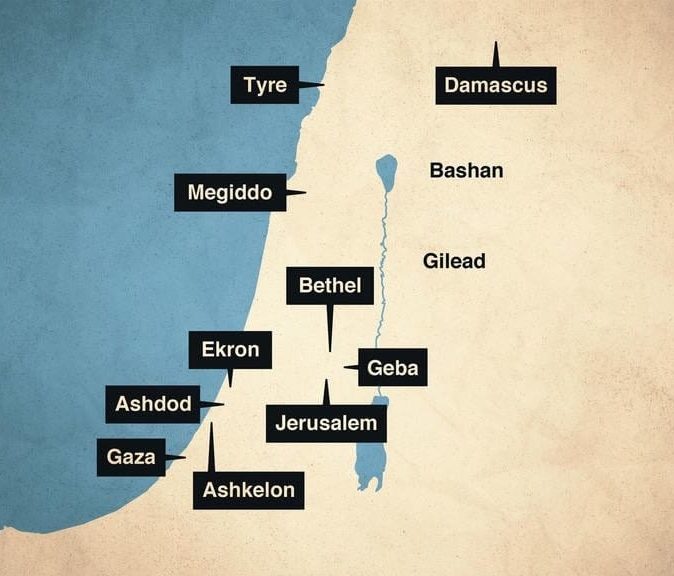
Yahweh lists a variety of cities surrounding Jerusalem, from Damascus in the north to Ashkelon in the south. He begins His list in the north in the region known as Hadrach, but He focuses His oracle on the city of Damascus. From there, Yahweh moves south, listing the names of additional doomed cities as He makes His way to Ashdod, Ashkelon, and Gaza. This north-to-south route is significant because it mirrors the path the Assyrians and Babylonians took when they conquered Israel and Judah. Earlier prophets had predicted the coming destruction of the northern and southern kingdoms by these two nations, a fate ordained by God for His people’s continued rebellion against Him.

“But I have stirred up a leader who will approach from the north.
From the east he will call on my name.
I will give him victory over kings and princes.
He will trample them as a potter treads on clay. – Isaiah 41:25 NLT

“Yes,” the Lord said, “for terror from the north will boil out on the people of this land. Listen! I am calling the armies of the kingdoms of the north to come to Jerusalem. I, the Lord, have spoken!

“They will set their thrones
at the gates of the city.
They will attack its walls
and all the other towns of Judah.
I will pronounce judgment
on my people for all their evil—
for deserting me and burning incense to other gods.
Yes, they worship idols made with their own hands! – Jeremiah 1:14-16 NLT

“This is what the Sovereign Lord says: From the north I will bring King Nebuchadnezzar of Babylon against Tyre. He is king of kings and brings his horses, chariots, charioteers, and great army. First he will destroy your mainland villages. Then he will attack you by building a siege wall, constructing a ramp, and raising a roof of shields against you.He will pound your walls with battering rams and demolish your towers with sledgehammers. The hooves of his horses will choke the city with dust, and the noise of the charioteers and chariot wheels will shake your walls as they storm through your broken gates. His horsemen will trample through every street in the city. They will butcher your people, and your strong pillars will topple. – Ezekiel 7:7-11 NLT

Yahweh is announcing His intention to take the same path of destruction to mete out judgment upon the enemies of His people. He will begin in the north with Damascus and work His way down the coast to the land of the Philistines.

This prophecy was partially fulfilled in 333 B.C. when Alexander the Great passed through the region on his way to Egypt. He focused his attention on the coastal cities, destroying all ports used by the Achaemenid Empire but leaving the Jews relatively undisturbed. Alexander’s march to the south left many of these same cities destroyed but they would eventually rise from the ashes and continue their mistreatment of the people of Israel. What Yahweh has in store for them will be far more destructive and permanent than anything they suffered at the hands of the Greeks.

The English Standard Version translates verse 1 as “the LORD has an eye on mankind and on all the tribes of Israel.” While it is obvious that the all-knowing, all-seeing Yahweh is always watching over the affairs of men, most translators render this verse differently.

…the eyes of humanity, including all the tribes of Israel, are on the LORD. – NLT

…the eyes of men and of all the tribes of Israel are upon the LORD. – BSB

…for the eyes of mankind, especially of all the tribes of Israel, are toward the LORD. – NASB

This human-based perspective is important because it indicates that all will know and understand that this future judgment is the work of Yahweh. Everyone will comprehend the divine nature of the destruction. This won’t be the work of some world super-power, it will be the hand of Adonai, the LORD of Hosts.

the Lord will strip away Tyre’s possessions
and hurl its fortifications into the sea,
and it will be burned to the ground.– Zechariah 9:4 NLT

The city of Ashkelon will see Tyre fall
and will be filled with fear.
Gaza will shake with terror,
as will Ekron, for their hopes will be dashed.
Gaza’s king will be killed,
and Ashkelon will be deserted.– Zechariah 9:4 NLT

These powerful, wealthy, and influential cities will suffer fear, humiliation, and elimination at the hands of Israel’s God. Their wealth will do them no good. Their armies will be impotent and unable to defend them. The once-great Philistine empire that had plagued the people of Israel for centuries would fall, never to rise again. The oracle even predicts the conversion of any Philistines who manage to make it out alive.

Then the surviving Philistines will worship our God
    and become like a clan in Judah.
The Philistines of Ekron will join my people,
    as the ancient Jebusites once did. – Zechariah 9:7 NLT

The content of this oracle must have been difficult for Zechariah to get his head around. It was good news but it all sounded so far-fetched and impossible. It didn’t get any more believable when God claimed, “I will guard my Temple and protect it from invading armies. I am watching closely to ensure that no more foreign oppressors overrun my people’s land” (Zechariah 9:8 NLT).

God was telling Zechariah incredible news regarding Israel’s future. Not only will Israel be restored, Jerusalem rebuilt, and the Temple completed, but the people of Israel will prosper, filling the land, and serving Him faithfully. Things were going to be radically different. Instead of punishing His people as He had done in the past, God was going to bless them abundantly and restore them to favor. This news had to be difficult for Zechariah to comprehend as he looked around at a partially completed foundation on the Temple, the broken-down walls, and the demoralized remnant who struggled to fulfill the task God had given them due to the scope of the project and the presence of opposition. Yet, Yahweh had assured Zechariah that He was the God of the impossible.

“This is what the Lord of Heaven’s Armies says: All this may seem impossible to you now, a small remnant of God’s people. But is it impossible for me? says the Lord of Heaven’s Armies.” – Zechariah 8:6 NLT

It’s as if God said, “I know this doesn’t look so good right now, but don’t judge Me based on what you see.” Yahweh wanted Zechariah to focus on His promises, not the pressing problems that seemed to never go away.

Yahweh knew that Zechariah and the beleaguered people of Judah were struggling to keep the faith. They were growing weary and questioning whether all their hard work would be worth it. So, God pointed them to the future. He predicted a brighter tomorrow that was beyond their powers of comprehension. But He had proven Himself faithful in the past and could be trusted to fulfill His plans for the future.

Yet, God’s people have always struggled with doubt and the inability to take God at His word. Even today, those who claim to believe in an all-powerful, promise-keeping God, find themselves wondering where He is and what He is doing. They take a look at their current circumstances and make sweeping judgments regarding everything from God’s faithfulness and presence to His love and power. When things don’t go well, God’s people automatically assume that He is either angry or oblivious to their needs. He is upset and punishing them. He is out of touch and ignorant of them. Their prayers don’t get answered, so they conclude He does not hear or does not care.

In time, their view of life begins to influence their view of God. In a sense, Yahweh tells Zechariah, “I know this all seems impossible to you right now. After all, there’s just a handful of you and the job is far from complete. BUT THIS ISN’T ABOUT YOU!”

The point of it all was that God could do the impossible. He knew what was going on and was well aware of the situation taking place in Jerusalem. He had a full grasp of the facts regarding the status of the Temple, the presence of opposition, the size of the workforce, and the condition of their hearts. Which explains the depth and detail of His message to Zechariah.

He told Zechariah, “Be strong and finish the task!” (Zechariah 8:9 NLT) and “Don’t be afraid. Be strong, and get on with rebuilding the Temple” (Zechariah 8:13 NLT). It wasn’t about their strength and ability to get things done, it was about their faith and trust in a God who could do ANYTHING. They just needed to do what He had called them to do and leave the rest up to Him. God had returned them to the promised land, provided a royal edict to secure their work, and secured the funds to pay for the entire restoration project. He had done His part but they had failed to complete theirs. It was far too easy for them to look at their relative lack of success and the overwhelming size of the task and become disillusioned.

The same thing can be true of us. We get overwhelmed by circumstances and begin to feel we are in over our heads. We start to wonder if God is with us at all. But whenever we think it’s all up to us, we miss the point. Nothing is impossible for God. There is nothing He can’t handle. There is nothing we face that is outside of His sovereign control and divine will. Like Zechariah and the people of Judah, we must constantly remind ourselves that nothing is impossible for God. That’s the message we need to hear. There is nothing that He can’t do. There is not a single circumstance that is out of His ability or power to handle. And not only that, but nothing is impossible for God. That’s the message of the Bible. It is all about God, not us. It is about His power, His will, His promises, His faithfulness, His salvation, His Kingdom, and His ability to finish what He has begun and restore what is broken. Nothing is impossible for Him.

English Standard Version (ESV)
The Holy Bible, English Standard Version. ESV® Permanent Text Edition® (2016). Copyright © 2001 by Crossway Bibles, a publishing ministry of Good News Publishers.

New Living Translation (NLT)
Holy Bible, New Living Translation, copyright © 1996, 2004, 2015 by Tyndale House Foundation. Used by permission of Tyndale House Publishers Inc., Carol Stream, Illinois 60188. All rights reserved.

Present Faith In Future Promises

18 And the word of the Lord of hosts came to me, saying, 19 “Thus says the Lord of hosts: The fast of the fourth month and the fast of the fifth and the fast of the seventh and the fast of the tenth shall be to the house of Judah seasons of joy and gladness and cheerful feasts. Therefore love truth and peace.

20 “Thus says the Lord of hosts: Peoples shall yet come, even the inhabitants of many cities. 21 The inhabitants of one city shall go to another, saying, ‘Let us go at once to entreat the favor of the Lord and to seek the Lord of hosts; I myself am going.’ 22 Many peoples and strong nations shall come to seek the Lord of hosts in Jerusalem and to entreat the favor of the Lord. 23 Thus says the Lord of hosts: In those days ten men from the nations of every tongue shall take hold of the robe of a Jew, saying, ‘Let us go with you, for we have heard that God is with you.’” – Zechariah 8:18-23 NLT

Chapter 7 began with a question about fasting. Now, Yahweh points to a future day when it will no longer be necessary to fast. Leviticus 16 records Yahweh’s command concerning fasting. ʿ

“And it shall be a statute to you forever that in the seventh month, on the tenth day of the month, you shall afflict yourselves and shall do no work, either the native or the stranger who sojourns among you. – Leviticus 16:29 ESV

The Hebrew word translated as “afflict” is ānâ and it carries the idea of humbling oneself, to be afflicted, or bowed down. It was commonly associated with fasting because fasting was intended as a sign of repentance and mourning over sins. The Book of Isaiah records Yahweh’s displeasure with the false fasting of the people of Israel.

“Is such the fast that I choose,
a day for a person to humble(ānâ) himself?
Is it to bow down his head like a reed,
and to spread sackcloth and ashes under him?
Will you call this a fast,
and a day acceptable to the Lord?” – Isaiah 58:5 ESV

He accused His people of going through the motions of fasting without the requisite heart change that was required. The people couldn’t understand why their outward displays of self-denial were getting them nowhere with Yahweh.

Why have we fasted, and you see it not?
    Why have we humbled ourselves, and you take no knowledge of it?” – Isaiah 58:3 ESV

But Yahweh explained His disinterest and unwillingness to take their fasts seriously.

Behold, in the day of your fast you seek your own pleasure,
    and oppress all your workers.
Behold, you fast only to quarrel and to fight
    and to hit with a wicked fist.
Fasting like yours this day
    will not make your voice to be heard on high.” – Isaiah 58:3-4 ESV

Fasting was intended to display a repentant heart and a willingness to alter one’s behavior. It was an act of self-denial and public humiliation that demonstrated a recognition of one’s sin and a need for atonement.

But in this chapter, Yahweh describes a future in which fasting will be replaced by “seasons of joy and gladness and cheerful feasts” (Zechariah 8:19 ESV). The fasts associated with the fall of Jerusalem, the destruction of the Temple, and the exile of God’s people will no longer be necessary. Yahweh is pointing to a day when joy will replace mourning and celebrations commemorating His goodness will eliminate all memories of past sins and divine judgment.

The Temple, once completed, would fully restore the sacrificial system, not eliminate it. The need for atonement would continue to require the blood of bulls, goats, sheep, and rams. The immediate future of the people of Judah would require a fully functioning priesthood, a completed Temple, and the sacrifice of countless animals to serve as sin substitutes for the guilty. The Day of Atonement would still require fasting on the part of the people before they could be cleansed from sin.

The author of Hebrews explains the necessity of the sacrificial system but also identifies its shortcomings.

For since the law has but a shadow of the good things to come instead of the true form of these realities, it can never, by the same sacrifices that are continually offered every year, make perfect those who draw near. Otherwise, would they not have ceased to be offered, since the worshipers, having once been cleansed, would no longer have any consciousness of sins? But in these sacrifices there is a reminder of sins every year. For it is impossible for the blood of bulls and goats to take away sins. – Hebrews 10:1-4 ESV

So, when Yahweh speaks of “seasons of joy and gladness and cheerful feasts,” He is talking about a future day when full and permanent atonement will be attained for His people. This message from Yahweh includes His promise of the future restoration and spiritual transformation of His chosen people. It coincides with the message He delivered through the prophet Ezekiel.

“Therefore, give the people of Israel this message from the Sovereign Lord: I am bringing you back, but not because you deserve it. I am doing it to protect my holy name, on which you brought shame while you were scattered among the nations. I will show how holy my great name is—the name on which you brought shame among the nations. And when I reveal my holiness through you before their very eyes, says the Sovereign Lord, then the nations will know that I am the Lord. For I will gather you up from all the nations and bring you home again to your land.

“Then I will sprinkle clean water on you, and you will be clean. Your filth will be washed away, and you will no longer worship idols. And I will give you a new heart, and I will put a new spirit in you. I will take out your stony, stubborn heart and give you a tender, responsive heart. And I will put my Spirit in you so that you will follow my decrees and be careful to obey my regulations. – Ezekiel 36:22-27 NLT

All of these promises will take place when Christ returns to set up His earthly Kingdom. Daniel was given a vision of the end times, including the period known as the Great Tribulation. During those days, God will bring judgment upon the earth and His people, both Jews and Christians, will suffer persecution at the hands of the Antichrist. But God will only allow this wicked world ruler to carry out his genocidal pogrom for three and a half years.

“He will defy the Most High and oppress the holy people of the Most High. He will try to change their sacred festivals and laws, and they will be placed under his control for a time, times, and half a time.

“But then the court will pass judgment, and all his power will be taken away and completely destroyed. Then the sovereignty, power, and greatness of all the kingdoms under heaven will be given to the holy people of the Most High. His kingdom will last forever, and all rulers will serve and obey him.” – Daniel 7:25-27 NLT

This future kingdom will include believing Jews and Gentiles who will reign alongside Christ for 1,000 years.

“The manifestation of the kingdom will be attended by such a fulness of salvation that Judah will forget to commemorate the former mournful events and will only have occasion to rejoice in the benefits of grace bestowed by God.” –  Merrill F.  Unger, Zechariah

Yahweh wants Zechariah to know that the rebuilding of the Temple was just the beginning of His plans for the people of Judah. There is far more in store for His chosen people than they realize. They will accomplish their mission and complete the construction of God’s house. They will also rebuild the walls and hang the gates. The city will be repopulated and the nation will once again enjoy the blessings of Yahweh. But their greatest days lie in the distant future when God will redeem them fully and restore them to a right relationship with Himself that will last for eternity. The apostle Paul described this future day as a mystery. 

I want you to understand this mystery, dear brothers and sisters, so that you will not feel proud about yourselves. Some of the people of Israel have hard hearts, but this will last only until the full number of Gentiles comes to Christ. And so all Israel will be saved. As the Scriptures say,

“The one who rescues will come from Jerusalem,
    and he will turn Israel away from ungodliness.
And this is my covenant with them,
    that I will take away their sins.” – Romans 11:25-27 NLT

As Zechariah listens to these amazing pronouncements from Yahweh, he can’t help but consider the less-than-ideal circumstances surrounding him and the far-from-perfect spiritual state of his fellow Judahites. But God is promising Him a future free from godlessness and sin. Not only that, the formerly destroyed city of Jerusalem will become a light shining on a hill attracting people from all over the world. Countless individuals from distant nations will declare their intention to visit the glorious city of Jerusalem.

“Let us go at once to entreat the favor of the Lord and to seek the Lord of hosts; I myself am going.” – Zechariah 8:21 ESV

Three other prophets recorded this same scene, further certifying its validity and future certainty.

In the last days, the mountain of the Lord’s house
    will be the highest of all—
    the most important place on earth.
It will be raised above the other hills,
    and people from all over the world will stream there to worship.
People from many nations will come and say,
“Come, let us go up to the mountain of the Lord,
    to the house of Jacob’s God.
There he will teach us his ways,
    and we will walk in his paths.”
For the Lord’s teaching will go out from Zion;
    his word will go out from Jerusalem. – Isaiah 2:2-3 NLT

In the last days, the mountain of the Lord’s house
    will be the highest of all—
    the most important place on earth.
It will be raised above the other hills,
    and people from all over the world will stream there to worship.
People from many nations will come and say,
“Come, let us go up to the mountain of the Lord,
    to the house of Jacob’s God.
There he will teach us his ways,
    and we will walk in his paths.”
For the Lord’s teaching will go out from Zion;
    his word will go out from Jerusalem. – Micah 4:1-2 NLT

Long ago the Lord said to Israel:
“I have loved you, my people, with an everlasting love.
    With unfailing love I have drawn you to myself.
I will rebuild you, my virgin Israel.
    You will again be happy
    and dance merrily with your tambourines.
Again you will plant your vineyards on the mountains of Samaria
    and eat from your own gardens there.
The day will come when watchmen will shout
    from the hill country of Ephraim,
‘Come, let us go up to Jerusalem
    to worship the Lord our God.’” – Jeremiah 31:3-6 NLT

Yahweh reiterates His future intentions for His chosen people to Zechariah, stating, “In those days ten men from the nations of every tongue shall take hold of the robe of a Jew, saying, ‘Let us go with you, for we have heard that God is with you’” (Zechariah 8:23 ESV). These promises concerning Judah’s future were meant to encourage Zechariah and motivate the people to carry out their work with enthusiasm and faith. They served a good and gracious God who loved them and had great plans for them.

But Yahweh didn’t want His people to live with their eyes focused on the future. They weren’t to live with their eye set on the preferred future God had in store for them. His promises of future redemption and restoration would take place long after they were gone so, in the meantime, they were to “love truth and peace” (Zechariah 8:19 ESV). In other words, they were to love what God loved. They were to live in keeping with His will, treating one another with love, dignity, respect, and honor. With all His future promises in mind, they were to dedicate themselves to living in a way that honored Him in the here and now.

“Speak the truth to one another; render in your gates judgments that are true and make for peace; do not devise evil in your hearts against one another, and love no false oath, for all these things I hate…” – Zechariah 8:16-17 ESV

The apostle Peter gave the same admonition to the believers who received his second epistle.

By his divine power, God has given us everything we need for living a godly life. We have received all of this by coming to know him, the one who called us to himself by means of his marvelous glory and excellence. And because of his glory and excellence, he has given us great and precious promises. These are the promises that enable you to share his divine nature and escape the world’s corruption caused by human desires.

In view of all this, make every effort to respond to God’s promises. Supplement your faith with a generous provision of moral excellence, and moral excellence with knowledge, and knowledge with self-control, and self-control with patient endurance, and patient endurance with godliness, and godliness with brotherly affection, and brotherly affection with love for everyone.

The more you grow like this, the more productive and useful you will be in your knowledge of our Lord Jesus Christ. – 2 Peter 1:3-8 NLT

The people of Judah were to live with the end in mind, but they were never to lose sight of Yahweh’s call to live godly lives. God’s future faithfulness was meant to inspire present obedience in His covenant people. No matter how difficult the days ahead might be, they could rest in the promise of Yahweh’s unwavering love and long-term commitment to their well-being.

English Standard Version (ESV)
The Holy Bible, English Standard Version. ESV® Permanent Text Edition® (2016). Copyright © 2001 by Crossway Bibles, a publishing ministry of Good News Publishers.

New Living Translation (NLT)
Holy Bible, New Living Translation, copyright © 1996, 2004, 2015 by Tyndale House Foundation. Used by permission of Tyndale House Publishers Inc., Carol Stream, Illinois 60188. All rights reserved.

Our Faithful God

1 And the word of the LORD of hosts came, saying, “Thus says the LORD of hosts: I am jealous for Zion with great jealousy, and I am jealous for her with great wrath. Thus says the LORD: I have returned to Zion and will dwell in the midst of Jerusalem, and Jerusalem shall be called the faithful city, and the mountain of the LORD of hosts, the holy mountain. Thus says the LORD of hosts: Old men and old women shall again sit in the streets of Jerusalem, each with staff in hand because of great age. And the streets of the city shall be full of boys and girls playing in its streets. Thus says the Lord of hosts: If it is marvelous in the sight of the remnant of this people in those days, should it also be marvelous in my sight, declares the LORD of hosts? Thus says the LORD of hosts: Behold, I will save my people from the east country and from the west country, and I will bring them to dwell in the midst of Jerusalem. And they shall be my people, and I will be their God, in faithfulness and in righteousness.”

Thus says the they shall be my people, and I will be their God of hosts: “Let your hands be strong, you who in these days have been hearing these words from the mouth of the prophets who were present on the day that the foundation of the house of the LORD of hosts was laid, that the temple might be built. 10 For before those days there was no wage for man or any wage for beast, neither was there any safety from the foe for him who went out or came in, for I set every man against his neighbor. 11 But now I will not deal with the remnant of this people as in the former days, declares the LORD of hosts. 12 For there shall be a sowing of peace. The vine shall give its fruit, and the ground shall give its produce, and the heavens shall give their dew. And I will cause the remnant of this people to possess all these things. 13 And as you have been a byword of cursing among the nations, O house of Judah and house of Israel, so will I save you, and you shall be a blessing. Fear not, but let your hands be strong.”

14 For thus says the LORD of hosts: “As I purposed to bring disaster to you when your fathers provoked me to wrath, and I did not relent, says the LORD of hosts, 15 so again have I purposed in these days to bring good to Jerusalem and to the house of Judah; fear not. 16 These are the things that you shall do: Speak the truth to one another; render in your gates judgments that are true and make for peace; 17 do not devise evil in your hearts against one another, and love no false oath, for all these things I hate, declares the LORD.” – Zechariah 8:1-17 NLT

Yahweh continues to provide Zechariah with words of encouragement to deliver to the people of Judah. Their work on the Temple was not yet complete and they must diligently carry out His command to rebuild His house, restore the city of Jerusalem, and rekindle their covenant commitments to Him. Yahweh wasn’t interested in religious ritualism and heartless adherence to a set of rules. He wanted them to live holy lives that reflected their status as His set-apart people. When Moses delivered them out of captivity in Egypt and led them through the wilderness to the promised land, God made the following promise to the people of Israel.

“…if you will indeed obey my voice and keep my covenant, you shall be my treasured possession among all peoples, for all the earth is mine; and you shall be to me a kingdom of priests and a holy nation.” – Exodus 19:5-6 ESV

As His treasured possession, the people of Israel were expected to carry themselves in a way that set them apart from all the other nations on earth. But rather than stand out, they had chosen to blend in, mirroring the attitudes and actions of their pagan neighbors. It was their propensity for godless behavior that led to their eventual fall to the Babylonians and their seven decades of exile in a foreign land. But Yahweh had graciously restored them and given them a second chance to make a good first impression.

In the last chapter, Zechariah was given a non-negotiable mandate from the LORD that clearly articulated His expectations regarding their behavior.

“Render true judgments, show kindness and mercy to one another, do not oppress the widow, the fatherless, the sojourner, or the poor, and let none of you devise evil against another in your heart.” – Zechariah 7:9-10 ESV

And Yahweh reiterates these words in His latest message to Zechariah.

“Speak the truth to one another; render in your gates judgments that are true and make for peace; do not devise evil in your hearts against one another, and love no false oath, for all these things I hate, declares the Lord.” – Zechariah 8:16-17 ESV

But sandwiched in-between these two passages is a powerful statement regarding what God intends to do for His chosen people. He will not be sitting idly by as His people build the Temple and work on their interpersonal relationships. Yahweh wants them to know that He too will be busy as He carries out His divine plan for their future. He declares His unwavering love for the city that bears His name.

“My love for Mount Zion is passionate and strong; I am consumed with passion for Jerusalem!” – Zechariah 8:2 NLT

He declares His intentions to once again dwell among His people and bless them with His presence. He informs them that the former glory of Jerusalem will be restored and it “shall be called the faithful city, and the mountain of the LORD of hosts, the holy mountain” (Zechariah 8:3 ESV). Then He adds some color commentary to describe what this renewal and revitalization of Jerusalem will look like.

“Once again old men and women will walk Jerusalem’s streets with their canes and will sit together in the city squares. And the streets of the city will be filled with boys and girls at play. – Zechariah 8:4-5 NLT

When this message was delivered, few elderly people would have been living in Jerusalem. Their advanced age would have prevented them from making the arduous trip from Babylon to Judah. So, what God describes to Zechariah is a scene from Jerusalem’s future. This is a prophecy of good things to come. But knowing that this message would sound too good to be true to the rag-tag former exiles, Yahweh provides them with an important reminder of His omnipotence.

“All this may seem impossible to you now, a small remnant of God’s people. But is it impossible for me? says the Lord of Heaven’s Armies.” – Zechariah 8:6 NLT

They were having difficulty imagining a day when their work on the Temple would be complete, let alone a time when the old and young alike lived in peace and security within the walls of Jerusalem. They were surrounded by devastation and destruction. The stones of the walls still lay in heaps of rubble. The homes inside the city walls remained unrestored and unoccupied. Enemies surrounded them and constantly taunted them. The Persians still ruled over them. But Yahweh wanted them to know that He was not done. His work was not yet complete.

“You can be sure that I will rescue my people from the east and from the west. I will bring them home again to live safely in Jerusalem. They will be my people, and I will be faithful and just toward them as their God.” – Zechariah 8:7-8 NLT

Once again, Yahweh is speaking of the future and letting them know that His plans for them include blessings beyond their wildest imaginations that will take place long after the Temple is complete and their time on earth is up. So, they were to do their part and finish the assignment given to them by God.

“Be strong and finish the task! Ever since the laying of the foundation of the Temple of the Lord of Heaven’s Armies, you have heard what the prophets have been saying about completing the building.” – Zechariah 8:9 NLT

Haggai, Zechariah, and Ezra were just a few of the prophets God used to communicate His command to rebuild the Temple. But there had been constant delays and setbacks. Despite repeated calls to complete their mission, the people of Judah had been unsuccessful. So, Yahweh reiterates His demand that they complete what they started. He also reminds them that He had been faithful to improve their living conditions since they returned to the land.

Before the work on the Temple began, there were no jobs and no money to hire people or animals. No traveler was safe from the enemy, for there were enemies on all sides. I had turned everyone against each other. – Zechariah 8:10 NLT

Yahweh urges them to get on with the plan, stating, “Don’t be afraid. Be strong, and get on with rebuilding the Temple!” (Zechariah 8:13 NLT). But knowing that they require incentive, He provides them with a glimpse of the future that is meant to instill hope and remind them of His faithfulness.

“I am planting seeds of peace and prosperity among you. The grapevines will be heavy with fruit. The earth will produce its crops, and the heavens will release the dew. Once more I will cause the remnant in Judah and Israel to inherit these blessings.” – Zechariah 8:12 NLT

While Israel and Judah had become the symbols of divine wrath and judgment, Yahweh assures them that they will one day be “a symbol and a source of blessing” ( Zechariah 8:13 NLT). Their past actions had resulted in the outpouring of God’s judgment but He promises that His future treatment will be far different.

“…now I am determined to bless Jerusalem and the people of Judah. So don’t be afraid.” – Zechariah 8:15 NLT

The rebuilding of the Temple will just be the beginning. If they will faithfully do their part, God will fulfill all His promises to bless them as a nation. Verse 8 records an important part of God’s covenant promise to the people of Judah.

“I will bring them to dwell in the midst of Jerusalem. And they shall be my people, and I will be their God, in faithfulness and in righteousness.” – Zechariah 8:8 ESV

God is reiterating a promise that He has made for generations. He wants them to know that His goal for them has never changed, despite all their disobedience and unfaithfulness. He has always viewed them as His treasured possession and chosen people, and that has not changed. Over the centuries, God had repeatedly stated His commitment to be their God.

“I will certainly bring my people back again from all the countries where I will scatter them in my fury. I will bring them back to this very city and let them live in peace and safety. They will be my people, and I will be their God. And I will give them one heart and one purpose: to worship me forever, for their own good and for the good of all their descendants. – Jeremiah 32:37-39 NLT

“When the people return to their homeland, they will remove every trace of their vile images and detestable idols. And I will give them singleness of heart and put a new spirit within them. I will take away their stony, stubborn heart and give them a tender, responsive heart, so they will obey my decrees and regulations. Then they will truly be my people, and I will be their God.” – Ezekiel 11:18-20 NLT

I will make a covenant of peace with them. It shall be an everlasting covenant with them. And I will set them in their land and multiply them, and will set my sanctuary in their midst forevermore. My dwelling place shall be with them, and I will be their God, and they shall be my people. Then the nations will know that I am the Lord who sanctifies Israel, when my sanctuary is in their midst forevermore.” – Ezekiel 37:26-28 ESV

“I will look favorably upon you, making you fertile and multiplying your people. And I will fulfill my covenant with you. You will have such a surplus of crops that you will need to clear out the old grain to make room for the new harvest! I will live among you, and I will not despise you. I will walk among you; I will be your God, and you will be my people.” – Leviticus 26:9-12 NLT

God’s will for His covenant people has never changed. But they had a bad track record when it came to keeping with His law and living in faithfulness to their covenant commitments to Him. Yet, God was assuring Zechariah that He would keep His end of the agreement. He would not turn His back on His chosen people – despite all they had done and all they had yet to do.

Centuries later, God would send His Son to earth as the long-awaited Messiah of Israel, but “his own people did not receive him” (John 1:11 NLT). Instead, they chose to turn down His offer of salvation and turn Him over to the Roman authorities for crucifixion. In his address to the Jews on the day of Pentecost, Peter clearly indicted them for their role in the death of Jesus, their promised Messiah.

“People of Israel, listen! God publicly endorsed Jesus the Nazarene by doing powerful miracles, wonders, and signs through him, as you well know. But God knew what would happen, and his prearranged plan was carried out when Jesus was betrayed. With the help of lawless Gentiles, you nailed him to a cross and killed him. But God released him from the horrors of death and raised him back to life, for death could not keep him in its grip. – Acts 2:22-24 NLT

Yet, despite their rejection of Jesus, “God has not rejected his own people, whom he chose from the very beginning” (Romans 11:2 NLT). The apostle Paul points out that God remains firmly committed to His covenant people.

Did God’s people stumble and fall beyond recovery? Of course not! They were disobedient, so God made salvation available to the Gentiles. But he wanted his own people to become jealous and claim it for themselves. Now if the Gentiles were enriched because the people of Israel turned down God’s offer of salvation, think how much greater a blessing the world will share when they finally accept it. – Romans 11:11-12 NLT

The prophet Ezekiel wrote of a future day when God will

“I will gather you up from all the nations and bring you home again to your land. Then I will sprinkle clean water on you, and you will be clean. Your filth will be washed away, and you will no longer worship idols. And I will give you a new heart, and I will put a new spirit in you. I will take out your stony, stubborn heart and give you a tender, responsive heart. And I will put my Spirit in you so that you will follow my decrees and be careful to obey my regulations.” – Ezekiel 36:24-26 NLT

God will do for the people of Israel would they could never do on their own. And, one day, He will restore them and all His faithful followers to a right relationship with Himself in His eternal Kingdom.

Then I saw a new heaven and a new earth, for the old heaven and the old earth had disappeared. And the sea was also gone. And I saw the holy city, the new Jerusalem, coming down from God out of heaven like a bride beautifully dressed for her husband.

I heard a loud shout from the throne, saying, “Look, God’s home is now among his people! He will live with them, and they will be his people. God himself will be with them. He will wipe every tear from their eyes, and there will be no more death or sorrow or crying or pain. All these things are gone forever.” – Revelation 21:1-4 NLT

English Standard Version (ESV)
The Holy Bible, English Standard Version. ESV® Permanent Text Edition® (2016). Copyright © 2001 by Crossway Bibles, a publishing ministry of Good News Publishers.

New Living Translation (NLT)
Holy Bible, New Living Translation, copyright © 1996, 2004, 2015 by Tyndale House Foundation. Used by permission of Tyndale House Publishers Inc., Carol Stream, Illinois 60188. All rights reserved.

Going Through the Motions

1 In the fourth year of King Darius, the word of the LORD came to Zechariah on the fourth day of the ninth month, which is Chislev. Now the people of Bethel had sent Sharezer and Regem-melech and their men to entreat the favor of the LORD, saying to the priests of the house of the LORD of hosts and the prophets, “Should I weep and abstain in the fifth month, as I have done for so many years?”

Then the word of the LORD of hosts came to me: “Say to all the people of the land and the priests, ‘When you fasted and mourned in the fifth month and in the seventh, for these seventy years, was it for me that you fasted? And when you eat and when you drink, do you not eat for yourselves and drink for yourselves? Were not these the words that the LORD proclaimed by the former prophets, when Jerusalem was inhabited and prosperous, with her cities around her, and the South and the lowland were inhabited?’”

And the word of the LORD came to Zechariah, saying, “Thus says the LORD of hosts, Render true judgments, show kindness and mercy to one another, 10 do not oppress the widow, the fatherless, the sojourner, or the poor, and let none of you devise evil against another in your heart.” 11 But they refused to pay attention and turned a stubborn shoulder and stopped their ears that they might not hear. 12 They made their hearts diamond-hard lest they should hear the law and the words that the Lord of hosts had sent by his Spirit through the former prophets. Therefore great anger came from the Lord of hosts. 13 “As I called, and they would not hear, so they called, and I would not hear,” says the Lord of hosts, 14 “and I scattered them with a whirlwind among all the nations that they had not known. Thus the land they left was desolate, so that no one went to and fro, and the pleasant land was made desolate.” Zechariah 7:1-14 ESV

Two years after the night visions ended, Zechariah received another message from Yahweh. The construction of the Temple had begun again, and progress was being made, but it seemed that the people were still lagging in their spiritual devotion to God. Two years earlier, God had informed Zechariah of His anger against the people of Judah for the centuries of disobedience and unfaithfulness toward Him.

“I, the LORD, was very angry with your ancestors. Therefore, say to the people, ‘This is what the LORD of Heaven’s Armies says: Return to me, and I will return to you, says the LORD of Heaven’s Armies.’ Don’t be like your ancestors who would not listen or pay attention when the earlier prophets said to them, ‘This is what the LORD of Heaven’s Armies says: Turn from your evil ways, and stop all your evil practices.’

“Where are your ancestors now? They and the prophets are long dead. But everything I said through my servants the prophets happened to your ancestors, just as I said. As a result, they repented and said, ‘We have received what we deserved from the LORD of Heaven’s Armies. He has done what he said he would do.’” – Zechariah 1:2-6 NLT

Yet, despite God’s repeated outpourings of grace and mercy, the people remained less than enthusiastic about their commitments to Him. Many simply went through the motions, carrying out their devotions to God out of a sense of duty rather than delight. This had been a common problem among the Israelites for generations; something God had pointed out through the prophet Isaiah.

“These people say they are mine.
They honor me with their lips,
    but their hearts are far from me.
And their worship of me
    is nothing but man-made rules learned by rote. – Isaiah 29:13 NLT

Sadly, not much had changed. While Zechariah was overseeing the work on the Temple, a contingent of Jews from the nearby town of Bethel arrived in Jerusalem seeking spiritual advice from “the priests of the house of the Lord of hosts and the prophets” (Zechariah 7:3 NLT). These men, led by Sharezer and Regem-melech, were looking for an answer to a question regarding fasting.

“Should I weep and abstain in the fifth month, as I have done for so many years?” – Zechariah 7:3 NLT

The identities of Sharezer and Regem-melech are unclear, but their names are of Babylonian origin, which suggests that they were Jews who had been born during the Babylonian exile. Their names suggest that their families held a certain affinity for Darius the King and enjoyed a degree of comfort during their exile in Babylon. Sharezer means “protect the king” and Regem-melech means “king’s friend.” But now they were living in Bethel and had come to Jerusalem seeking godly counsel about a certain religious rite they had practiced. It seems that they were seeking permission to end this ritual.

But God had only decreed one day of fasting for the people of Israel, as outlined in the Book of Leviticus.

“On the tenth day of the appointed month in early autumn, you must deny yourselves. Neither native-born Israelites nor foreigners living among you may do any kind of work. This is a permanent law for you. On that day offerings of purification will be made for you, and you will be purified in the LORD’s presence from all your sins. It will be a Sabbath day of complete rest for you, and you must deny yourselves. This is a permanent law for you. – Leviticus 16:29-31 NLT

During their 70 years in exile, the people of Judah had taken it upon themselves to institute four additional fasts that God had not required. Yahweh mentions them in a subsequent message to Zechariah.

“Thus says the LORD of hosts: The fast of the fourth month and the fast of the fifth and the fast of the seventh and the fast of the tenth shall be to the house of Judah seasons of joy and gladness and cheerful feasts. Therefore love truth and peace. – Zechariah 8:19 ESV

These fasts were intended to be annual reminders to the people of Judah of the events surrounding the fall of Jerusalem. But now that the exiles had returned, Jerusalem was being rebuilt, and the Temple was under construction, these men from Bethel wanted to know if these fasts were still necessary. It was a legitimate question but exposed the hypocrisy of those who posed it.

“What may have appeared to be an innocent question about the propriety of fasting was instead a question fraught with hypocrisy, as YHWH’s response puts beyond any doubt. It therefore appears that the query to Zechariah by the Bethelites may not have been so much a matter of piety as it was of posturing. May it not be that the delegation was trying more to impress the prophet than to gain instruction from him?” – Eugene H. Merrill,  An Exegetical Commentary: Haggai, Zechariah, Malachi

Yahweh did not allow Zechariah to be fooled by their carefully crafted question. Instead, He exposed the true spirit behind their request.

“During these seventy years of exile, when you fasted and mourned in the summer and in early autumn, was it really for me that you were fasting?” – Zechariah 7:5 NLT

Had their sorrow emanated from the loss of their relationship with Yahweh or was it merely a display of self-centered pity over their adverse conditions in Babylon? According to God, the four annual fasts were void of remorse or repentance. They had become little more than religious rituals and posturing displays of self-righteousness.

God had warned the prophet Ezekiel about the duplicitous nature of the people of Judah. The very people to whom Ezekiel was commissioned to deliver God’s message of pending judgment would display a hypocritical and half-hearted response to his calls for repentance and reform.

“Son of man, your people talk about you in their houses and whisper about you at the doors. They say to each other, ‘Come on, let’s go hear the prophet tell us what the Lord is saying!’ So my people come pretending to be sincere and sit before you. They listen to your words, but they have no intention of doing what you say. Their mouths are full of lustful words, and their hearts seek only after money. You are very entertaining to them, like someone who sings love songs with a beautiful voice or plays fine music on an instrument. They hear what you say, but they don’t act on it! – Ezekiel 33:30-32 NLT

As far as God was concerned, nothing had changed. Even after their release from captivity in Babylon and return to the land of Judah, the people remained just as insincere and deceptive.

“…even now in your holy festivals, aren’t you eating and drinking just to please yourselves? Isn’t this the same message the Lord proclaimed through the prophets in years past when Jerusalem and the towns of Judah were bustling with people, and the Negev and the foothills of Judah were well populated?’” – Zechariah 7:6-7 NLT

Their nearly 70 years in captivity had done little to reform their hearts. And while God had been gracious to extend mercy and allow them to return to the land of promise, they were still reticent to keep their covenant commitments to Him.

So, God gave Zechariah a message to deliver to Sharezer, Regem-melech, and the rest of the people of Judah. While they had come asking questions about fasting, God delivered a reminder about His oft-repeated expectations of righteous behavior.

“This is what the LORD of Heaven’s Armies says: Judge fairly, and show mercy and kindness to one another. Do not oppress widows, orphans, foreigners, and the poor. And do not scheme against each other.” – Zechariah 7:9-10 NLT

This was not new information. God had been sending His prophets with the same message for hundreds of years.

No, O people, the LORD has told you what is good, and this is what he requires of you: to do what is right, to love mercy, and to walk humbly with your God. – Micah 6:8 NLT

“This is what the LORD says: Be fair-minded and just. Do what is right! Help those who have been robbed; rescue them from their oppressors. Quit your evil deeds! Do not mistreat foreigners, orphans, and widows. Stop murdering the innocent!” – Jeremiah 22:3 NLT

Those who are honest and fair,
    who refuse to profit by fraud,
    who stay far away from bribes,
who refuse to listen to those who plot murder,
    who shut their eyes to all enticement to do wrong—
these are the ones who will dwell on high.
    The rocks of the mountains will be their fortress.
Food will be supplied to them,
    and they will have water in abundance. – Isaiah 33:15-16 NLT

Yet, God points out that His people had refused to hear and heed the words of His prophets.

“Your ancestors refused to listen to this message. They stubbornly turned away and put their fingers in their ears to keep from hearing. They made their hearts as hard as stone, so they could not hear the instructions or the messages that the Lord of Heaven’s Armies had sent them by his Spirit through the earlier prophets. That is why the Lord of Heaven’s Armies was so angry with them.” – Zechariah 7:11-12 NLT

As a result, He “scattered them among the distant nations, where they lived as strangers. Their land became so desolate that no one even traveled through it. They turned their pleasant land into a desert” (Zechariah 7:14 NLT).

None of this was late-breaking news to Sharezer, Regem-melech, and their companions. They were well aware of Judah’s sordid past and the 70 years their ancestors spent in exile. But God wanted this message to sink in. What He had done once before, He could do again. His expectations for righteous behavior had not diminished in any way. He still demanded that His people judge fairly, show mercy, and extend kindness to one another. They were to care for the downtrodden and disenfranchised among them. They were to do what was right in the eyes of God.

This wasn’t about fasting and feasting or sacrifices and sacred rites. It was about obedience and faithfulness. God demanded heart change, not rule-keeping. He expected behavior that flowed from a belief in His goodness and greatness. He wanted His people to love as they had been loved. Anything less was unacceptable – even their sacrifices, offerings, celebrations, and worship.

“I am sick of your burnt offerings of rams
    and the fat of fattened cattle.
I get no pleasure from the blood
    of bulls and lambs and goats.
When you come to worship me,
    who asked you to parade through my courts with all your ceremony?
Stop bringing me your meaningless gifts;
    the incense of your offerings disgusts me!
As for your celebrations of the new moon and the Sabbath
    and your special days for fasting—
they are all sinful and false.
    I want no more of your pious meetings.
I hate your new moon celebrations and your annual festivals.
    They are a burden to me. I cannot stand them!
When you lift up your hands in prayer, I will not look.
    Though you offer many prayers, I will not listen,
    for your hands are covered with the blood of innocent victims.
Wash yourselves and be clean!
    Get your sins out of my sight.
    Give up your evil ways.
Learn to do good.
    Seek justice.
Help the oppressed.
    Defend the cause of orphans.
    Fight for the rights of widows.” – Isaiah 1:11-17 NLT

Going through the motions would never satisfy the expectations of God. Half-hearted obedience could never please the One who ldemanded whole-hearted commitment to His will.

English Standard Version (ESV)
The Holy Bible, English Standard Version. ESV® Permanent Text Edition® (2016). Copyright © 2001 by Crossway Bibles, a publishing ministry of Good News Publishers.

New Living Translation (NLT)
Holy Bible, New Living Translation, copyright © 1996, 2004, 2015 by Tyndale House Foundation. Used by permission of Tyndale House Publishers Inc., Carol Stream, Illinois 60188. All rights reserved.

The Coming King and Priest

And the word of the Lord came to me: 10 “Take from the exiles Heldai, Tobijah, and Jedaiah, who have arrived from Babylon, and go the same day to the house of Josiah, the son of Zephaniah. 11 Take from them silver and gold, and make a crown, and set it on the head of Joshua, the son of Jehozadak, the high priest. 12 And say to him, ‘Thus says the Lord of hosts, “Behold, the man whose name is the Branch: for he shall branch out from his place, and he shall build the temple of the Lord. 13 It is he who shall build the temple of the Lord and shall bear royal honor, and shall sit and rule on his throne. And there shall be a priest on his throne, and the counsel of peace shall be between them both.”’ 14 And the crown shall be in the temple of the Lord as a reminder to Helem, Tobijah, Jedaiah, and Hen the son of Zephaniah.

15 “And those who are far off shall come and help to build the temple of the Lord. And you shall know that the Lord of hosts has sent me to you. And this shall come to pass, if you will diligently obey the voice of the Lord your God.” Zechariah 6:9-15 ESV

With the eight visions completed, Zechariah received an oracle from the LORD instructing him to perform a symbolic coronation. Much of what Zechariah was shown in the visions had to do with Israel’s distant future, including the judgment of her enemies (Zechariah 6:1-8). Chapter 3 revealed the purification of Joshua the high priest, symbolizing the renewal of the priestly ministry.

“This is what the Lord of Heaven’s Armies says: If you follow my ways and carefully serve me, then you will be given authority over my Temple and its courtyards. I will let you walk among these others standing here. – Zechariah 3:7 NLT

God was foreshadowing a future day when the priesthood of Israel would play a significant role in the spiritual restoration of the nation.

“I will remove the sins of this land in a single day. And on that day, says the Lord of Heaven’s Armies, each of you will invite your neighbor to sit with you peacefully under your own grapevine and fig tree.” – Zechariah 3:10 NLT

In chapter 4, Yahweh emphasized the role of Zerubbabel, the civil administrator of the nation of Judah. In a sense, he served as the de facto king of Judah, overseeing the physical well-being of the people as they struggled to restore Jerusalem and rebuild their lives in the promised land. Zechariah was given a vision of the golden lampstand and the two olive trees. When Zechariah inquired about the trees, he was told, “They represent the two anointed ones who stand in the court of the LORD of all the earth” (Zechariah 4:14 NLT). This rather cryptic response emphasizes the two offices of priest and king and their unified nature in the future kingdom.

With the visions completed, Yahweh provides Zechariah with a rather strange assignment.

“Heldai, Tobijah, and Jedaiah will bring gifts of silver and gold from the Jews exiled in Babylon. As soon as they arrive, meet them at the home of Josiah son of Zephaniah. – Zechariah 6:10 NLT

These three men had recently arrived from Babylon bearing expensive gifts that were likely intended to finance the construction of the Temple. But Zechariah is ordered to take the men and their tribute to the home of Josiah the high priest. A lot is going on in this passage that bears a closer look. While no details are given as to the identities of these three men, their names are significant. Heldai means “The Enduring One.” Tobijah can be translated as “The LORD is good” and Jedaiah means “God cares.” Each of their names points to a distinguishing characteristic of Yahweh.

Secondly, they had recently arrived from Bethlehem bearing gifts. This brings to mind the story of the “wise men from the east” found in the Gospel of Matthew.

Now after Jesus was born in Bethlehem of Judea in the days of Herod the king, behold, wise men from the east came to Jerusalem, saying, “Where is he who has been born king of the Jews? For we saw his star when it rose and have come to worship him.” – Matthew 2:1-2 ESV

The Greek word translated as “wise men” is magi which the Babylonians and Persians used to describe their astrologers, seers, interpreters of dreams, soothsayers, magicians, and sorcerers. It is doubtful that Heldai, Tobijah, and Jedaiah practiced the occult arts, but their recent arrival from Babylon bearing gifts foreshadows the future coming of the wise men. They too would bring expensive gifts of gold, frankincense, and myrrh (Matthew 2:11).

The magi, having seen a sign in the sky that seemed to portend an important event, conducted a search of the ancient religious texts and found the words written by the prophet Micah.

But you, O Bethlehem Ephrathah,
    are only a small village among all the people of Judah.
Yet a ruler of Israel,
    whose origins are in the distant past,
    will come from you on my behalf.
The people of Israel will be abandoned to their enemies
    until the woman in labor gives birth.
Then at last his fellow countrymen
    will return from exile to their own land.
And he will stand to lead his flock with the Lord’s strength,
    in the majesty of the name of the Lord his God.
Then his people will live there undisturbed,
    for he will be highly honored around the world.
   And he will be the source of peace. – Micah 5:2-5 NLT

This discovery fueled their curiosity and motivated their journey. But little did Heldai, Tobijah, and Jedaiah know that their gifts would be used for something other than the Temple.

With the three recent arrivals in tow, Zechariah went to Joshua’s house where he took the gold and silver and crafted a crown. He then placed the crown on the head of Joshua the high priest and pronounced the following blessing.

Thus says the LORD of hosts, “Behold, the man whose name is the Branch: for he shall branch out from his place, and he shall build the temple of the LORD. It is he who shall build the temple of the LORD and shall bear royal honor, and shall sit and rule on his throne. And there shall be a priest on his throne, and the counsel of peace shall be between them both.” – Zechariah 6:12-13 ESV

Again, there are a lot of details in this passage that could easily be overlooked. First, the oracle mentions “the Branch,” which God foreshadowed in chapter 3.

“Hear now, O Joshua the high priest, you and your friends who sit before you, for they are men who are a sign: behold, I will bring my servant the Branch. – Zechariah 3:8 ESV

The prophet Jeremiah used this same designation when referring to a future descendant of King David who would rule and reign upon his throne.

“Behold, the days are coming, declares the Lord, when I will raise up for David a righteous Branch, and he shall reign as king and deal wisely, and shall execute justice and righteousness in the land. In his days Judah will be saved, and Israel will dwell securely. And this is the name by which he will be called: ‘The Lord is our righteousness.’” – Jeremiah 23:5-6 ESV

“In those days and at that time I will cause a righteous Branch to spring up for David, and he shall execute justice and righteousness in the land.  In those days Judah will be saved, and Jerusalem will dwell securely. And this is the name by which it will be called: ‘The Lord is our righteousness.’’ – Jeremiah 33:15-16 ESV

This was all in keeping with the promise God gave to David concerning an heir who would one day sit on his throne and rule over an everlasting kingdom.

“I will raise up your offspring after you, who shall come from your body, and I will establish his kingdom. He shall build a house for my name, and I will establish the throne of his kingdom forever. – 2 Samuel 7:12-13 ESV

Jesus was that descendant, having been born of the tribe of Judah and through the line of David (Matthew 1; Luke 3). The apostle Paul referred to Jesus as God’s Son, “who was descended from David according to the flesh and was declared to be the Son of God in power according to the Spirit of holiness by his resurrection from the dead” (Romans 1:3-4 ESV). In the Book of Revelation, Jesus refers to Himself as “the root and the descendant of David, the bright morning star” (Revelation 22:16 ESV).

Jesus was the Branch who “sprouted” from the tree of David and the prophet Ezekiel was given a vision of the majestic glory of this future branch.

“This is what the Sovereign LORD says: I will take a branch from the top of a tall cedar, and I will plant it on the top of Israel’s highest mountain. It will become a majestic cedar, sending forth its branches and producing seed. Birds of every sort will nest in it, finding shelter in the shade of its branches.” – Ezekiel 17:22-23 NLT

So, as Zechariah crafts a crown of silver and gold and places it on the head of Joshua the high priest, there is far more going on than he even realizes. This symbolic act of crowning the high priest is weighted with meaning. As Zechariah crowns Joshua he boldly proclaims, “Thus says the Lord of hosts, ‘Behold, the man whose name is the Branch: for he shall branch out from his place, and he shall build the temple of the Lord. It is he who shall build the temple of the Lord and shall bear royal honor, and shall sit and rule on his throne. And there shall be a priest on his throne, and the counsel of peace shall be between them both’” (Zechariah 6:12-13 ESV).

Even Joshua must have been at a loss as to what was taking place. It was Zerubbabel’s job to oversee the construction of the Temple, not his. Why was Zechariah placing that responsibility on his shoulders?

But Joshua was merely a stand-in for the greater high priest to come. This ceremony of crowning the high priest as king was meant to foreshadow the coming of the Messiah, who would be the priest-king. The Book of Hebrews provides an explanation for Jesus’ designation as this hybrid ruler over the people of God. The author of Hebrews uses a story from the Book of Genesis to introduce a rather obscure character named Melchizedek, who is described as the king of the city of Salem and also a priest of God Most High” (Hebrews 7:1; Genesis 14:18).

According to the author of Hebrews, “The name Melchizedek means ‘king of justice,’ and king of Salem means ‘king of peace’ (Hebrews 7:2 NLT). Melchizedek was the king of what would later become Jerusalem. He was also a priest of Yahweh but not a descendant of Levi. He was a priest of a different order and Jesus was to follow in his footsteps.

Jesus became a priest, not by meeting the physical requirement of belonging to the tribe of Levi, but by the power of a life that cannot be destroyed. And the psalmist pointed this out when he prophesied,

“You are a priest forever in the order of Melchizedek.”

Yes, the old requirement about the priesthood was set aside because it was weak and useless. For the law never made anything perfect. But now we have confidence in a better hope, through which we draw near to God. – Hebrews 7:16-19 NLT

Jesus would combine the offices of priest and king, serving as the perfect and complete leader for the people of God. With His death and in His role as the high priest, Jesus offered the only sacrifice acceptable to God for the sins of mankind.

Unlike those other high priests, he does not need to offer sacrifices every day. They did this for their own sins first and then for the sins of the people. But Jesus did this once for all when he offered himself as the sacrifice for the people’s sins. – Hebrews 7:27 NLT

And because God accepted Jesus’ sacrifice and raised Him back to life, Jesus lives forever and “his priesthood lasts forever. Therefore he is able, once and forever, to save those who come to God through him. He lives forever to intercede with God on their behalf” (Hebrews 7:24-25 NLT).

He is the kind of high priest we need because he is holy and blameless, unstained by sin. He has been set apart from sinners and has been given the highest place of honor in heaven. – Hebrews 7:26 NLT

Zechariah is told that the Branch “shall build the temple of the Lord and shall bear royal honor, and shall sit and rule on his throne” (Zechariah 6:13 ESV). Once again, God is foreshadowing future events concerning the coming Messiah. In his gospel account, John records Jesus making the following statement to the Jewish religious leaders:

“Destroy this temple, and in three days I will raise it up.” – John 2:19 NLT

They understood Him to be speaking of the literal Temple, but John points out, “when Jesus said ‘this temple,’ he meant his own body” (John 2:21 NLT). Jesus was the Temple of God. He was God in human flesh. Jesus would later tell the woman at the well, “the time is coming when it will no longer matter whether you worship the Father on this mountain or in Jerusalem…indeed it’s here now—when true worshipers will worship the Father in spirit and in truth” (John 4:21, 23 NLT).

The oracle ends with the following words:

“…those who are far off shall come and help to build the temple of the Lord. And you shall know that the Lord of hosts has sent me to you. And this shall come to pass, if you will diligently obey the voice of the Lord your God.” – Zechariah 6:15 ESV

This promise carries a now-not-yet aspect to it. Zerubbabel and the people of Judah would complete the physical Temple. But God had something far greater in mind. He is predicting the coming of the Church, the true temple of God; a fact that the apostle Paul makes clear.

So now you Gentiles are no longer strangers and foreigners. You are citizens along with all of God’s holy people. You are members of God’s family. Together, we are his house, built on the foundation of the apostles and the prophets. And the cornerstone is Christ Jesus himself. We are carefully joined together in him, becoming a holy temple for the Lord. Through him you Gentiles are also being made part of this dwelling where God lives by his Spirit. – Ephesians 2:19-22 NLT

English Standard Version (ESV)
The Holy Bible, English Standard Version. ESV® Permanent Text Edition® (2016). Copyright © 2001 by Crossway Bibles, a publishing ministry of Good News Publishers.

New Living Translation (NLT)
Holy Bible, New Living Translation, copyright © 1996, 2004, 2015 by Tyndale House Foundation. Used by permission of Tyndale House Publishers Inc., Carol Stream, Illinois 60188. All rights reserved.

You Can Count On God

1 Again I lifted my eyes and saw, and behold, four chariots came out from between two mountains. And the mountains were mountains of bronze. The first chariot had red horses, the second black horses, the third white horses, and the fourth chariot dappled horses—all of them strong. Then I answered and said to the angel who talked with me, “What are these, my lord?” And the angel answered and said to me, “These are going out to the four winds of heaven, after presenting themselves before the Lord of all the earth. The chariot with the black horses goes toward the north country, the white ones go after them, and the dappled ones go toward the south country.” When the strong horses came out, they were impatient to go and patrol the earth. And he said, “Go, patrol the earth.” So they patrolled the earth. Then he cried to me, “Behold, those who go toward the north country have set my Spirit at rest in the north country.” Zechariah 6:1-8 ESV

In this final vision, Zechariah is shown what appears to be four chariots pulled by teams of red, black, white, and dappled horses. As Zechariah looks on, these instruments of war pass between two bronze mountains without the aid of any charioteers. They appear to be driverless but are not without a sense of direction or purpose. In fact, the angel asserts that they have come from the presence of the LORD and are on a mission. There are obvious similarities between this last vision and the first one Zechariah was shown. Both include horses of different colors.

“I saw in the night, and behold, a man riding on a red horse! He was standing among the myrtle trees in the glen, and behind him were red, sorrel, and white horses.” – Zechariah 1:8 ESV

In this opening vision, Zechariah was shown a heavenly messenger sent by Yahweh “to patrol the earth” (Zechariah 1:10 ESV). The mission had been completed because Zechariah heard the announcement, “We have patrolled the earth, and behold, all the earth remains at rest” (Zecharaiah 1:11 ESV). Their work was done and they rested in a grove of myrtle trees. But in the last of the eight visions, the horses have left the presence of Yahweh and just beginning their mission.

“These are the four spirits of heaven going out after presenting themselves before the Lord of all the earth.” – Zechariah 6:10 NET

They are described as rûaḥ, a Hebrew word that can be translated as “winds” or “spirits.” Given the context, it makes sense to view these chariots as divine emanations from God. They have been sent by Yahweh and commanded to “Go, patrol the earth” (Zechariah 6:7 ESV). As Zechariah looks on, the chariots head north and south. The chariots pulled by the black and white horses head to the north country, while the chariot pulled by the team of dappled horses makes its way to the south country.

The nation of Israel occupied a narrow sliver of land between the Mediterranean Sea on the west and the Arabian Desert on the east. Over the centuries, Israel’s enemies had invaded its borders from one of these two directions. So, the chariots were sent to the north and south but were expected to extend their mission beyond Israel’s borders. Their “patrol” would eventually take them to Egypt, Babylon, and Assyria, all sworn enemies of Israel. The mission of the horseman in Chapter 1 resulted in a pronouncement of peace. All was well in the land of Judah. But the chariots of the eighth vision appear to be on a mission of a different sort. They will bring peace but only after divine judgment is carried.

The angel describes the horses as strong and “impatient to go and patrol the earth” (Zechariah 1:7 ESV). They are literally chomping at the bit. In antiquity, the horse was revered for its power and ferocity in battle. These beautiful creatures could transform into devastating weapons of mass destruction, wreaking havoc against enemy infantry. Harnessed to a chariot, horses were the equivalent of a tank in modern warfare. 

The Book of Job records God’s eloquent description of the horse’s unique affinity and disposition for combat.

“Have you given the horse its strength
    or clothed its neck with a flowing mane?
Did you give it the ability to leap like a locust?
    Its majestic snorting is terrifying!
It paws the earth and rejoices in its strength
    when it charges out to battle.
It laughs at fear and is unafraid.
    It does not run from the sword.
The arrows rattle against it,
    and the spear and javelin flash.
It paws the ground fiercely
    and rushes forward into battle when the ram’s horn blows.
It snorts at the sound of the horn.
    It senses the battle in the distance.
    It quivers at the captain’s commands and the noise of battle. – Job 39:19-25 NLT

That these horses and their chariots were intended to carry out God’s judgment is made clear by verse 8.

“Look, those who went north have vented the anger of my Spirit there in the land of the north.” – Zechariah 6:8 NLT

Twenty years earlier, in 539 B.C., the Babylonians had fallen to the Persians. God had already meted out His wrath against the nation that had invaded and destroyed Judah. But His judgment was not yet complete. The Egyptians and Medo-Persians would also have to pay for their constant harassment of God’s people.

It’s interesting to note that the black, white, and dappled horses convey their chariots on their assigned routes but the chariot pulled by the red horses is not mentioned. The angel doesn’t announce its destination. There has been much speculation as to the meaning of the horses’ colors. Some have suggested that the red horses stand for war and bloodshed, while the black horses symbolize death. The white horses represent victory and the dappled horses stand for plague and disease. Together, these horses and their chariots display the multifaceted and devastating nature of God’s pending judgment against the nations.

As Zechariah looks on, the chariots and their horses are just beginning their assignments. They have passed between the two bronze mountains on their way to their final destinations. Some have speculated that these mountains represent Mount Zion and the Mount of Olives. But the more logical explanation is found in chapter 14 of Zechariah’s prophecy.

Watch, for the day of the Lord is coming when your possessions will be plundered right in front of you! I will gather all the nations to fight against Jerusalem. The city will be taken, the houses looted, and the women raped. Half the population will be taken into captivity, and the rest will be left among the ruins of the city.

Then the Lord will go out to fight against those nations, as he has fought in times past. On that day his feet will stand on the Mount of Olives, east of Jerusalem. And the Mount of Olives will split apart, making a wide valley running from east to west. Half the mountain will move toward the north and half toward the south. You will flee through this valley, for it will reach across to Azal. Yes, you will flee as you did from the earthquake in the days of King Uzziah of Judah. Then the Lord my God will come, and all his holy ones with him. – Zechariah 14:1-7 NLT

The Mount of Olives was where Jesus ascended back into heaven after His final post-resurrection appearance to His disciples (Acts 1:9-12). The angels assured the disciples that Jesus would one day return to that very same spot and complete the mission He had been given by His Heavenly Father. While His departure from earth had been in relative obscurity with only His disciples as witnesses, His return will be so impactful that the Mount of Olives will split in two. His second coming will bring judgment to the earth as God’s heavenly army dispenses divine wrath on all those who rejected His Son’s offer of salvation and opposed His right to rule and reign.

Zechariah was given a glimpse into the distant future when God will send His Son to earth a second time. On this occasion, Jesus will not come as an innocent baby in a manger, but as a conquering King riding a white horse and meting out judgment against the enemies of God. Centuries later, the apostle John was given a vision of this end times event.

Then I saw heaven opened, and a white horse was standing there. Its rider was named Faithful and True, for he judges fairly and wages a righteous war. His eyes were like flames of fire, and on his head were many crowns. A name was written on him that no one understood except himself. He wore a robe dipped in blood, and his title was the Word of God. The armies of heaven, dressed in the finest of pure white linen, followed him on white horses. From his mouth came a sharp sword to strike down the nations. He will rule them with an iron rod. He will release the fierce wrath of God, the Almighty, like juice flowing from a winepress. On his robe at his thigh was written this title: King of all kings and Lord of all lords. – Revelation 19:11-16 NLT

Zechariah was not privileged to know all the details concerning God’s coming judgment. The explanations he received from the angel were cryptic and incomplete but he could rest assured that God had a plan in place that would be fulfilled in a timely manner. Later in this book, Zechariah will receive and record a powerful promise from God concerning the nation of Israel and the city of Jerusalem.

And the Lord will be king over all the earth. On that day there will be one Lord—his name alone will be worshiped.

All the land from Geba, north of Judah, to Rimmon, south of Jerusalem, will become one vast plain. But Jerusalem will be raised up in its original place and will be inhabited all the way from the Benjamin Gate over to the site of the old gate, then to the Corner Gate, and from the Tower of Hananel to the king’s winepresses. And Jerusalem will be filled, safe at last, never again to be cursed and destroyed. – Zechariah 14:9-11 NLT

The Temple still needed to be completed. The land of Judah remained under foreign control. Jerusalem was still a relative ghost town with a small population and no protective walls. Yet, God was at work because He had plans for His people.

“I know the plans I have for you,” says the Lord. “They are plans for good and not for disaster, to give you a future and a hope. In those days when you pray, I will listen. If you look for me wholeheartedly, you will find me. I will be found by you,” says the Lord. “I will end your captivity and restore your fortunes. I will gather you out of the nations where I sent you and will bring you home again to your own land.” – Jeremiah 29:11-14 NLT

They were back in the land but God had far more in store for them than they could ever have imagined. The days ahead would be fraught with difficulty but God wanted Zechariah to know that the future was bright because His will would be done. His plan promises would be fulfilled and His plans for the people of God would be carried out just as He had said.

English Standard Version (ESV)
The Holy Bible, English Standard Version. ESV® Permanent Text Edition® (2016). Copyright © 2001 by Crossway Bibles, a publishing ministry of Good News Publishers.

New Living Translation (NLT)
Holy Bible, New Living Translation, copyright © 1996, 2004, 2015 by Tyndale House Foundation. Used by permission of Tyndale House Publishers Inc., Carol Stream, Illinois 60188. All rights reserved.

God’s Ultimate Victory Over Wickedness

Then the angel who talked with me came forward and said to me, “Lift your eyes and see what this is that is going out.” And I said, “What is it?” He said, “This is the basket that is going out.” And he said, “This is their iniquity in all the land.” And behold, the leaden cover was lifted, and there was a woman sitting in the basket! And he said, “This is Wickedness.” And he thrust her back into the basket, and thrust down the leaden weight on its opening.

Then I lifted my eyes and saw, and behold, two women coming forward! The wind was in their wings. They had wings like the wings of a stork, and they lifted up the basket between earth and heaven. 10 Then I said to the angel who talked with me, “Where are they taking the basket?” 11 He said to me, “To the land of Shinar, to build a house for it. And when this is prepared, they will set the basket down there on its base.” Zechariah 5:5-11 ESV

In the previous vision, Zechariah was shown a super-sized scroll containing the names of all those guilty of theft and swearing. Due to its enormous dimensions and subject matter, this scroll likely contained the names of every person living in Judah, including Zechariah, Zerubbabel, and Joshua. In a real sense, the entire nation stood condemned before Yahweh, because each of them was guilty of robbing Him of glory and failing to keep the oath they had sworn to obey His commands. Zerubbabel had led a small contingent of Judahites back to Judah for the express purpose of rebuilding the Temple and yet, the Temple remained unfinished. So God sent a message to Zerubbabel through Haggai the prophet.

“Why are you living in luxurious houses while my house lies in ruins?” – Haggai 1:4 NLT

They had failed to keep their word. The whole reason for their return was to build a house for God, but they had stolen from Yahweh by using their time and resources to build homes for themselves. So, God warned them to change their ways or suffer the consequences. He demanded heart change that results in transformed actions. Failure to do so would bring judgment and removal.

But Zechariah’s visions were far from over. With the image of the scroll still in his mind, Zechariah looks up and sees a large basket. The Hebrew word is ‘êp̄â or ephah, which was a unit of measurement. This basket or receptacle was a common tool of commerce used to measure goods for sale. It served as an ancient Hebrew unit of dry measure, roughly equivalent to a bushel, or approximately 5.8 gallons. Like the scroll, the basket was probably oversized and unrecognizable to Zechariah because it didn’t have the dimensions of a normal ephah. In fact, this ephah was large enough to contain “the sins of everyone throughout the land” (Zechariah 5:6 NLT).

But as Zechariah looked on, the angel ordered the leaden lid of the basket to be lifted.  Inside was a woman who the angel describes as “Wickedness.” She is meant to symbolize the iniquity of the people and represents the allure of evil that draws them away from God. Proverbs 6 contains the words of a father encouraging his son to listen to his instructions. He is attempting to prepare his son to face the temptations of the world, which he compares to an evil, adulterous woman.

For the commandment is a lamp and the teaching a light,
    and the reproofs of discipline are the way of life,
to preserve you from the evil woman,
    from the smooth tongue of the adulteress.
Do not desire her beauty in your heart,
    and do not let her capture you with her eyelashes. – Proverbs 6:23-25 ESV

The previous Proverbs contains an equally negative description of this “wicked” woman.

For the lips of a forbidden woman drip honey,
    and her speech is smoother than oil,
but in the end she is bitter as wormwood,
    sharp as a two-edged sword.
Her feet go down to death;
    her steps follow the path to Sheol;
she does not ponder the path of life;
    her ways wander, and she does not know it. – Proverbs 5:3-6 ESV

This image of the seductive and sin-tempting woman is found throughout Scripture. In the Book of Deuteronomy, God warns the Israelites not to give their sons in marriage to the daughters of the Canaanites, because, “they will turn your sons away from following Me to serve other gods. Then the anger of the LORD will burn against you, and He will swiftly destroy you” (Deuteronomy 7:4 BSB).

The Book of Ecclesiastes also paints a less-than-flattering picture of this female icon of sexual promiscuity and moral degradation.

I discovered that a seductive woman is a trap more bitter than death. Her passion is a snare, and her soft hands are chains. Those who are pleasing to God will escape her, but sinners will be caught in her snare. – Ecclesiastes 7:26 NLT

It should not be overlooked that both Ecclesiastes and Proverbs were authored by Solomon, the great king of Israel. As the son of David, Solomon succeeded his father to the throne of Israel and was blessed by God with great wealth and wisdom. But he had an Achilles Heel: His love for women. God had prohibited the kings of Israel from acquiring many wives for themselves because these women would end up distracting the king from his commitment to God and his concerns for the kingdom (Deuteronomy 17:17 ESV).

The Book of 1 Kings describes what happened to Solomon.

The Lord had clearly instructed the people of Israel, “You must not marry them, because they will turn your hearts to their gods.” Yet Solomon insisted on loving them anyway. He had 700 wives of royal birth and 300 concubines. And in fact, they did turn his heart away from the Lord. – 1 Kings 11:2-3 NLT

So when Solomon warned about the allure of the “seductive woman,” he did so from personal experience.

The Book of Revelation also provides a final, climactic warning about the allure of “wickedness.” In chapter 17, the apostle John describes a vision he was given of “the judgment that is going to come on the great prostitute, who rules over many waters” (Revelation 17:1 NLT). John is told that this “woman,” who is obviously symbolic, has negatively impacted on the world.

“The kings of the world have committed adultery with her, and the people who belong to this world have been made drunk by the wine of her immorality.” – Revelation 17:2 NLT

John is then given a vision of another woman, “sitting on a scarlet beast that had seven heads and ten horns, and blasphemies against God were written all over it” (Revelation 17:3 NLT).

The woman wore purple and scarlet clothing and beautiful jewelry made of gold and precious gems and pearls. In her hand she held a gold goblet full of obscenities and the impurities of her immorality. A mysterious name was written on her forehead: “Babylon the Great, Mother of All Prostitutes and Obscenities in the World.” I could see that she was drunk—drunk with the blood of God’s holy people who were witnesses for Jesus. I stared at her in complete amazement. – Revelation 17:4-5 NLT

From the days of Solomon to the end times, the “wickedness” that allures and entices the godly will continue to spread and grow. Even before the second coming of Christ, the seductive woman will attempt to seduce and destroy all those who believe in Him.

Yet, in his vision, Zechariah watched as two divine beings flew into view, picking up the basket and carrying it away. “Wickedness,” which symbolized the iniquity of the people, was being removed, but Zechariah was curious about its destination. The angel informed him that the basket and its evil content were being taken “To the land of Shinar, to build a house for it. And when this is prepared, they will set the basket down there on its base” (Zechariah 17:11 NLT). 

The land of Shinar was where Babylon was located. This imagery of the stork-like beings taking the sin-filled basket to Babylon was meant to remind Zechariah that God had punished the people of Judah for their sins by sending them into exile in Babylon. But they had returned. Their sins had been forgiven and God was giving them a second chance. But there is another sense in which this vision points to the future. Zechariah is being told that the rise of wickedness will ultimately culminate in the land of Shinar. In the end times, during the Great Tribulation, wickedness will grow rampant on the earth, and, under the reign of the Antichrist, the people of God will suffer great persecution.

In Zechariah’s day, wickedness would continue to be an ever-present problem. But God would not pour out His wrath as He did before. He would remove the penalty for wickedness, delaying its execution for a later date. Once again, John was given insight into these last-day events. God has a plan to deal with “wickedness” once and for all.

“Babylon is fallen—that great city is fallen!
    She has become a home for demons.
She is a hideout for every foul spirit,
    a hideout for every foul vulture
    and every foul and dreadful animal.
For all the nations have fallen
    because of the wine of her passionate immorality.
The kings of the world
    have committed adultery with her.
Because of her desires for extravagant luxury,
    the merchants of the world have grown rich.” – Revelation 18:2-3 NLT

And the kings of the world who committed adultery with her and enjoyed her great luxury will mourn for her as they see the smoke rising from her charred remains. They will stand at a distance, terrified by her great torment. They will cry out,

“How terrible, how terrible for you,
    O Babylon, you great city!
In a single moment
    God’s judgment came on you.” – Revelation 18:9-10 NLT

Zechariah was given a vision of God’s grand plan for the sins of the world. He had no idea what it all meant but he could have confidence that God knew what He was doing. The future was secure. All Zechariah needed to do was convey God’s message to the people and ensure they kept their commitment to rebuilding the Temple. God would take care of the rest.

English Standard Version (ESV)
The Holy Bible, English Standard Version. ESV® Permanent Text Edition® (2016). Copyright © 2001 by Crossway Bibles, a publishing ministry of Good News Publishers.

New Living Translation (NLT)
Holy Bible, New Living Translation, copyright © 1996, 2004, 2015 by Tyndale House Foundation. Used by permission of Tyndale House Publishers Inc., Carol Stream, Illinois 60188. All rights reserved.

Robbing God of Glory

1 Again I lifted my eyes and saw, and behold, a flying scroll! And he said to me, “What do you see?” I answered, “I see a flying scroll. Its length is twenty cubits, and its width ten cubits.” Then he said to me, “This is the curse that goes out over the face of the whole land. For everyone who steals shall be cleaned out according to what is on one side, and everyone who swears falsely shall be cleaned out according to what is on the other side. I will send it out, declares the Lord of hosts, and it shall enter the house of the thief, and the house of him who swears falsely by my name. And it shall remain in his house and consume it, both timber and stones. Zechariah 5:1-4 ESV

In God’s economy, the roles of king and priest were essential for maintaining the civil and moral order of the nation. Together, Zerubbabel and Joshua were responsible for rebuilding the Temple and reinstituting the sacrificial system of Israel. But Yahweh knew that the Temple could not guarantee an obedient people and the sacrifices could devolve into repetitious rituals that held no meaning and made no difference in the people’s behavior.

The reason the people of Judah had spent 70 years exiled in Babylon was because of their sinfulness and disobedience. Jeremiah the prophet had warned them that the Temple could not save them from God’s righteous wrath.

“Even now, if you quit your evil ways, I will let you stay in your own land. But don’t be fooled by those who promise you safety simply because the LORD’s Temple is here. They chant, ‘The LORD’s Temple is here! The LORD’s Temple is here!’ But I will be merciful only if you stop your evil thoughts and deeds and start treating each other with justice; only if you stop exploiting foreigners, orphans, and widows; only if you stop your murdering; and only if you stop harming yourselves by worshiping idols. Then I will let you stay in this land that I gave to your ancestors to keep forever.” – Jeremiah 7:4-7 NLT

The prophet Isaiah delivered a stinging indictment against God’s chosen people for their faux-faithfulness and hypocritical display of ritualistic and heartless worship.

the Lord says,
    “These people say they are mine.
They honor me with their lips,
    but their hearts are far from me.
And their worship of me
    is nothing but man-made rules learned by rote.” – Isaiah 29:13 NLT

God had warned them of the consequences of their disingenuous displays of adoration and rule-keeping.

“…I will bring disaster upon you,
    and there will be much weeping and sorrow.…

“I will be your enemy,
    surrounding Jerusalem and attacking its walls.
I will build siege towers
    and destroy it.” – Isaiah 29:2-3 NLT

God expected both heart transformation and behavior modification. His Law was intended to be a road map for righteous living. The sacrificial system was graciously provided as a means for maintaining a right standing with Him when the sins were inevitably committed.

In his role as governor, Zerubbabel was expected to deal with matters related to law and order. He was responsible for policing and enforcement of all civil laws designed to ensure the community’s safety and well-being.

When there is moral rot within a nation, its government topples easily.
    But wise and knowledgeable leaders bring stability. – Proverbs 28:2 NLT

As the high priest, Joshua was responsible for fostering the spiritual well-being of the nation. He and his fellow priests, along with the Levites, were to care for the Temple and orchestrate the sacrifices and feasts prescribed by God. But they were also to serve as judges, providing legal counsel and judicial decisions on difficult cases.

“Suppose a case arises in a local court that is too hard for you to decide—for instance, whether someone is guilty of murder or only of manslaughter, or a difficult lawsuit, or a case involving different kinds of assault. Take such legal cases to the place the Lord your God will choose, and present them to the Levitical priests or the judge on duty at that time. They will hear the case and declare the verdict. You must carry out the verdict they announce and the sentence they prescribe at the place the Lord chooses. You must do exactly what they say.” – Deuteronomy 17:8-10 NLT

Zerubbabel and Joshua represent the religious and civil leadership of the nation. As God’s appointed caretakers, they were expected to shepherd His flock. This would require equal amounts of love and discipline, something their predecessors failed to provide.

“What sorrow awaits the leaders of my people—the shepherds of my sheep—for they have destroyed and scattered the very ones they were expected to care for,” says the LORD. – Jeremiah 23:1 NLT

All of these factors provide important background to what takes place in chapter 5. In his sixth vision, Zechariah is shown a giant scroll, measuring 30 feet in length and 15 feet in height. On one side of this massive parchment is a list of all those who have committed theft. The other side contains the names of all who are guilty of swearing. This massive scroll contains only the names of thieves and those who pledge false oaths. But why did God focus on these two transgressions? Aren’t there far worse crimes that deserve God’s attention and judgment?

It seems that these two categories of sin both deal with taking what something that belongs to another. The seventh commandment clearly forbade stealing, and God but in the Book of Leviticus God expands His list of prohibitions.

“Do not steal. Do not deceive or cheat one another. Do not bring shame on the name of your God by using it to swear falsely. I am the Lord. Do not defraud or rob your neighbor. Do not make your hired workers wait until the next day to receive their pay. Do not insult the deaf or cause the blind to stumble. You must fear your God; I am the Lord. Do not twist justice in legal matters by favoring the poor or being partial to the rich and powerful. Always judge people fairly. Do not spread slanderous gossip among your people.” – Leviticus 19:11-16 NLT

Stealing and swearing seem to serve as broad categories that encompass all sins of speech and action. There are a lot of ways to steal from someone else. You can take their property and possessions but you can also rob them of their reputation. An employer can commit theft by failing to pay his workers a decent wage or by withholding payment for purely selfish reasons. However, as the Leviticus passage makes clear, our words can also rob others of their joy, honor, dignity, and self-worth.

Later in this same book, God will expand on this topic of theft and swearing.

“I am determined to bless Jerusalem and the people of Judah. So don’t be afraid. 16 But this is what you must do: Tell the truth to each other. Render verdicts in your courts that are just and that lead to peace. Don’t scheme against each other. Stop your love of telling lies that you swear are the truth. I hate all these things, says the Lord.” – Zechariah 8:15-17 NLT

But there appears to be more here than meets the eye. This scroll and the names of the guilty it contains are meant to get Zechariah’s attention. Its sheer size conveys the number of names that Zechariah saw, and he must have recognized many of them. Perhaps he saw his own name in the list. It seems likely that everyone living in Judah at the time would have found their name written on both sides of the scroll.

In the Book of Malachi, God issues a stern warning to the descendants of Jacob, calling them to change their behavior. He accuses them of stealing from Him and they seem shocked by His words.

“For I the LORD do not change; therefore you, O children of Jacob, are not consumed. From the days of your fathers you have turned aside from my statutes and have not kept them. Return to me, and I will return to you, says the LORD of hosts. But you say, ‘How shall we return?’ Will man rob God? Yet you are robbing me. But you say, ‘How have we robbed you?’ In your tithes and contributions. You are cursed with a curse, for you are robbing me, the whole nation of you. – Malachi 3:6-9 ESV

The people were guilty of short-changing God. They had repeatedly failed to give the required tithes and offerings, leaving the storehouses of the Temple empty. And God declares the entire nation to be guilty of this crime.

But that wasn’t the only transgression God’s people had committed. According to the Book of Numbers, God outlawed the making of false or fraudulent pledges to Him.

“This is what the Lord has commanded: A man who makes a vow to the Lord or makes a pledge under oath must never break it. He must do exactly what he said he would do. – Numbers 30:1-2 NLT

The Book of Numbers reiterates this command.

“When you make a vow to the Lord your God, be prompt in fulfilling whatever you promised him. For the Lord your God demands that you promptly fulfill all your vows, or you will be guilty of sin. – Deuteronomy 23:21-21 NLT

Swearing an oath to God and failing to honor it was a form of stealing. It was to rob God of what was rightfully His. Jesus picked up on this theme of vows and swearing in His Sermon on the Mount. As with all His other saying in this famous sermon, Jesus took the Old Testament teachings on vows, swearing, and oaths and made them even more practical.

“You have also heard that our ancestors were told, ‘You must not break your vows; you must carry out the vows you make to the LORD.’ But I say, do not make any vows! Do not say, ‘By heaven!’ because heaven is God’s throne. And do not say, ‘By the earth!’ because the earth is his footstool. And do not say, ‘By Jerusalem!’ for Jerusalem is the city of the great King. Do not even say, ‘By my head!’ for you can’t turn one hair white or black. Just say a simple, ‘Yes, I will,’ or ‘No, I won’t.’ Anything beyond this is from the evil one.” – Matthew 5:33-37 NLT

Stealing and swearing were common practices among the people of God in Zechariah’s day, and Zerubbabel and Joshua were far from guiltless. All stood before God condemned of robbing Him of glory, cheating Him of what was rightfully His, and offering false assurances of adoration and praise to cover up for their transgressions. But God wanted His people to know that He took their sins seriously and would deal with them harshly.

“…my curse will remain in that house and completely destroy it—even its timbers and stones.” – Zechariah 5:4 NLT

Yahweh wanted true heart change. He would not be satisfied with false piety, faux faithfulness, or fraudulent forms of worship. And God’s expectations remain just as high today. The apostle Paul reminded the believers in Thessalonica that God demanded words and actions that reflected true devotion and a commitment to holiness. Their behavior was to reflect their beliefs.

God’s will is for you to be holy, so stay away from all sexual sin. Then each of you will control his own body and live in holiness and honor—not in lustful passion like the pagans who do not know God and his ways. Never harm or cheat a fellow believer in this matter by violating his wife, for the Lord avenges all such sins, as we have solemnly warned you before. God has called us to live holy lives, not impure lives. Therefore, anyone who refuses to live by these rules is not disobeying human teaching but is rejecting God, who gives his Holy Spirit to you. – 1 Thessalonians 4:3-8 NLT

English Standard Version (ESV)
The Holy Bible, English Standard Version. ESV® Permanent Text Edition® (2016). Copyright © 2001 by Crossway Bibles, a publishing ministry of Good News Publishers.

New Living Translation (NLT)
Holy Bible, New Living Translation, copyright © 1996, 2004, 2015 by Tyndale House Foundation. Used by permission of Tyndale House Publishers Inc., Carol Stream, Illinois 60188. All rights reserved.

Little Is Much When God Is In It

Then the word of the Lord came to me, saying, “The hands of Zerubbabel have laid the foundation of this house; his hands shall also complete it. Then you will know that the Lord of hosts has sent me to you. 10 For whoever has despised the day of small things shall rejoice, and shall see the plumb line in the hand of Zerubbabel.

“These seven are the eyes of the Lord, which range through the whole earth.” 11 Then I said to him, “What are these two olive trees on the right and the left of the lampstand?” 12 And a second time I answered and said to him, “What are these two branches of the olive trees, which are beside the two golden pipes from which the golden oil is poured out?” 13 He said to me, “Do you not know what these are?” I said, “No, my lord.” 14 Then he said, “These are the two anointed ones who stand by the Lord of the whole earth.” Zechariah 4:8-14 ESV

In 538 B.C., Zerubbabel and Joshua the high priest had led the first wave of exiles who returned to Judah from Babylon. Their primary responsibility was to rebuild the Temple that had been destroyed by Nebuchadnezzar’s forces when Jerusalem had fallen. The Persian king, Cyrus, had issued a decree ordering the Temple’s

“The Lord, the God of heaven, has given me all the kingdoms of the earth. He has appointed me to build him a Temple at Jerusalem, which is in Judah.Any of you who are his people may go to Jerusalem in Judah to rebuild this Temple of the Lord, the God of Israel, who lives in Jerusalem. And may your God be with you! Wherever this Jewish remnant is found, let their neighbors contribute toward their expenses by giving them silver and gold, supplies for the journey, and livestock, as well as a voluntary offering for the Temple of God in Jerusalem. – Ezra 1:2-4 NLT

However, after arriving in Judah, they made little progress on the Temple. It took two years just to lay the foundation and then opposition from the Samaritans led to another delay (Ezra 4:1-4). So, 18 years after Cyrus issued his decree, Zerubbabel received a message from Yahweh declaring His dissatisfaction with the unfinished state of the House of God.

“This is what the LORD of Heaven’s Armies says: Look at what’s happening to you! Now go up into the hills, bring down timber, and rebuild my house. Then I will take pleasure in it and be honored, says the Lord. You hoped for rich harvests, but they were poor. And when you brought your harvest home, I blew it away. Why? Because my house lies in ruins, says the LORD of Heaven’s Armies, while all of you are busy building your own fine houses. It’s because of you that the heavens withhold the dew and the earth produces no crops. I have called for a drought on your fields and hills—a drought to wither the grain and grapes and olive trees and all your other crops, a drought to starve you and your livestock and to ruin everything you have worked so hard to get.”– Haggai 1:7-11 NLT

During that same time, Yahweh provided Zechariah with a more positive message to deliver to Zerubbabel.

“Zerubbabel is the one who laid the foundation of this Temple, and he will complete it. Then you will know that the LORD of Heaven’s Armies has sent me. – Zechariah 4:9 NLT

Yahweh wanted Zerubbabel to know that his efforts would produce positive results. The “mountainous” task of rebuilding the Temple would be accomplished with the LORD’s help. Zerubbabel, who had laid the cornerstone of the Temple, would also lay the capstone. At that momentous occasion, the people would recognize the sovereign hand of God and shout, “Grace, grace to it!” (Zechariah 4:7 ESV). The grace of God would make the Temple’s construction possible and from this House of God, more grace would flow for generations to come.

Yahweh reminded Zerubbabel not to “despise these small beginnings” (Zechariah 4:10 NLT). Yes, the work would be difficult and the Samaritan resistance would continue, but if the people of God remained faithful and completed their task, they would one day rejoice.

For whoever has despised the day of small things shall rejoice, and shall see the plumb line in the hand of Zerubbabel. – Zechariah 4:10 NLT

The Hebrew word translated as “plumbline” could also refer to a “large stone.” The people will have the privilege and joy of seeing Zerubbabel lay the final capstone for the completed project. Four years later, the people got to experience what God predicted.

The Temple of God was then dedicated with great joy by the people of Israel, the priests, the Levites, and the rest of the people who had returned from exile. During the dedication ceremony for the Temple of God, 100 young bulls, 200 rams, and 400 male lambs were sacrificed. And 12 male goats were presented as a sin offering for the twelve tribes of Israel. Then the priests and Levites were divided into their various divisions to serve at the Temple of God in Jerusalem, as prescribed in the Book of Moses. – Ezra 6:16-18 NLT

As Zechariah listened to God’s encouraging message of future success, the angel provided a rather out-of-place explanation for the earlier vision. He states, “These seven are the eyes of the Lord, which range through the whole earth” (Zechariah 4:10 ESV). This refers to the seven lamps surrounding the bowl on the top of the golden lampstand. Zechariah had wanted to know what the vision meant, and now the angel explains that the lamps symbolize God’s insight into all things. Seven is the number of perfection and God knows and sees all perfectly and clearly. He can see the past and the future simultaneously. Nothing is hidden from His sight, so He can assure Zechariah that the Temple will be completed.

But now, Zechariah’s curiosity has peaked. He wants to know more, so he peppers the angel with questions.

“What are these two olive trees on each side of the lampstand, and what are the two olive branches that pour out golden oil through two gold tubes?”– Zechariah 4:11-12 NLT

The angel expresses surprise at Zechariah’s line of questioning, asking, “Do you not know what these are?” (Zechariah 4:13 ESV). The angel considers the meaning to be so obvious that he is shocked at Zechariah’s confusion. But he refuses to make it easy for the perplexed prophet.

“These are the two anointed ones who stand by the LORD of the whole earth.” – Zechariah 4:14 ESV

It’s almost as if the angel is waiting for the lightbulb to illuminate over Zechariah’s head. In effect, the angel doesn’t answer Zechariah’s question directly. He describes the two trees as “the two anointed ones,” but this answer doesn’t provide Zechariah with much clarity. It simply begs another question: Who are the two anointed ones? But the angel believes Zechariah should be able to discern the answer to his own question. He and Joshua are the two olive trees that stand on either side of the golden lampstand. Zechariah is the God-appointed governor of Judah, while Joshua serves as the God-anointed high priest. Together they represent the offices of priest and king. In a sense, these two men are branches in their respective trees, pouring out the oil of the Spirit of God into the bowl on top of the lampstand of God. These two men had been divinely ordained to serve the people of God by carrying out His will.

Zerubbabel and Joshua serve as representatives of the kingly and priestly roles that will one day be combined in the reign of Christ. In chapter 3, God told Joshua that he and his fellow priests were signs of a greater priest to come.

“Hear now, O Joshua the high priest, you and your friends who sit before you, for they are men who are a sign: behold, I will bring my servant the Branch. – Zechariah 3:8 ESV

The author of Hebrews revealed Jesus to be the fulfillment of this promise.

…we have a great High Priest who has entered heaven, Jesus the Son of God, let us hold firmly to what we believe. This High Priest of ours understands our weaknesses, for he faced all of the same testings we do, yet he did not sin. So let us come boldly to the throne of our gracious God. There we will receive his mercy, and we will find grace to help us when we need it most. – Hebrews 4:14-16 NLT

According to the message the angel Gabriel delivered to Mary, Jesus would also become a king in the line of David.

“He will be great and will be called the Son of the Most High. And the Lord God will give to him the throne of his father David, and he will reign over the house of Jacob forever, and of his kingdom there will be no end.”– Luke 1:32-33 ESV

Zerubbabel and Joshua represented the King-Priest who was to come. In their respective roles, they foreshadowed the coming of Messiah. The Book of Hebrews points to Jesus’ role as the priest-king when it compares Him to the Old Testament character, Melchizedek, who was “king of the city of Salem and also a priest of God Most High” (Hebrews 7:1 NLT). The author describes Jesus as “a different priest, who is like Melchizedek” (Hebrews 7:15 NLT). With His appearance, “Jesus became a priest, not by meeting the physical requirement of belonging to the tribe of Levi, but by the power of a life that cannot be destroyed” (Hebrews 7:16 NLT).

Jesus combined the offices of priest and king so that He might provide atonement for the sins of humanity and rule over them in righteousness and, “because Jesus lives forever, his priesthood lasts forever. Therefore he is able, once and forever, to save those who come to God through him. He lives forever to intercede with God on their behalf” (Hebrews 7:24-25 NLT).

He is the kind of high priest we need because he is holy and blameless, unstained by sin. He has been set apart from sinners and has been given the highest place of honor in heaven. – Hebrews 7:26 NLT

In this place of honor, Jesus is also recognized as the King of kings and Lord of lords. He is the perfect High Priest and all-powerful King.

Therefore, God elevated him to the place of highest honor
    and gave him the name above all other names,
that at the name of Jesus every knee should bow,
    in heaven and on earth and under the earth,
and every tongue declare that Jesus Christ is Lord,
    to the glory of God the Father. – Philippians 2:9-11 NLT

Through their obedience to God, Zechariah and Joshua foreshadowed the Branch to come, who would pour out the oil of God’s grace and mercy on undeserving sinners. Zechariah did not grasp the full significance of what he had seen and heard. The angel’s explanation must have seemed cryptic and obscure to the curious and confused prophet. But this message points to the future when God will fulfill all His promises through Jesus Christ, the Prophet, Priest, and King.

Zechariah was not to despise “the day of small things” (Zechariah 4:10 ESV). He and Joshua were to fulfill their respective roles with faithfulness and diligence, and not according to their own strength. If they were obedient and carried out their divine commissions, God would do His part and carry out His will for the people of Israel and the nations of the world. One day, He would send His Son to complete His grand plan of redemption and set up His Kingdom on earth – all in keeping with God’s promises.

“The kingdom of the world has become the kingdom of our Lord and of his Christ, and he shall reign forever and ever.” – Revelation 11:15 ESV

English Standard Version (ESV)
The Holy Bible, English Standard Version. ESV® Permanent Text Edition® (2016). Copyright © 2001 by Crossway Bibles, a publishing ministry of Good News Publishers.

New Living Translation (NLT)
Holy Bible, New Living Translation, copyright © 1996, 2004, 2015 by Tyndale House Foundation. Used by permission of Tyndale House Publishers Inc., Carol Stream, Illinois 60188. All rights reserved.

A Light in the Darkness

1 And the angel who talked with me came again and woke me, like a man who is awakened out of his sleep. And he said to me, “What do you see?” I said, “I see, and behold, a lampstand all of gold, with a bowl on the top of it, and seven lamps on it, with seven lips on each of the lamps that are on the top of it. And there are two olive trees by it, one on the right of the bowl and the other on its left.” And I said to the angel who talked with me, “What are these, my lord?” Then the angel who talked with me answered and said to me, “Do you not know what these are?” I said, “No, my lord.” Then he said to me, “This is the word of the LORD to Zerubbabel: Not by might, nor by power, but by my Spirit, says the LORD of hosts. Who are you, O great mountain? Before Zerubbabel you shall become a plain. And he shall bring forward the top stone amid shouts of ‘Grace, grace to it!’” Zechariah 4:1-7 ESV

The vision in chapter 3 centered around Joshua the high priest. In this chapter, the fifth vision features Zerubabbel, the governor of Judah. These two men served as the leaders of the remnant community that had returned to the land. They were also responsible for overseeing the construction of the Temple that King Cyrus had authorized and funded (Ezra 1:1-4).

The former vision accentuated the need for cleansing. As Judah’s top religious leader, Joshua stood as a symbol for the entire nation. The description of his filthy clothes in chapter 3 was meant to symbolize the spiritual state of the people. They had been chosen by God and were expected to live distinctively different lives that set them apart from all the other nations on earth.

“…you shall be my treasured possession among all peoples, for all the earth is mine; and you shall be to me a kingdom of priests and a holy nation.” – Exodus 19:5-6 ESV

But they had failed to keep the covenant they made with God. Generations of Israelites had violated their covenant commitment and proven their unwillingness to remain faithful to God. As a result, He punished them by sending the Babylonians to conquer their land, destroy their capital city, demolish the Temple, and take them into captivity. After 70 years of exile in Babylon, God had allowed a remnant to return. Joshua and Zerubabbel had led the small band of Judahites that returned to the land of promise with intentions to rebuild the Temple. But when Zechariah had these visions, the Temple was only halfway complete.

God’s cleansing of Joshua was a sign that He was willing to forgive the people for their many transgressions against Him. But having been cleansed, they would still need to obey His Law and carry out His command to rebuild the Temple. That is where Zerubbabel came in. As the governor of Judah, he represented the civil authority and was expected to provide the people with godly leadership.

At the end of the previous vision, Zechariah fell into an unconscious state and had to be “awakened” by the angel. The first thing he saw was a golden lampstand with a bowl on top surrounded by seven lamps. On either side of the lampstand stood two olive trees. Since olive oil was the primary source of fuel for lamps, it makes sense that this elaborate golden lampstand was bookended by these trees.

In Zechariah’s world, there was no electricity, so light was difficult to come by. Lamps were the primary source of light and required oil and constant upkeep. In antiquity, darkness symbolized evil while light represented righteousness and goodness. Light dispelled the darkness, providing illumination and freedom from fear. The prophet Isaiah describes a future day when the darkness of the world will be illuminated by a great light.

The people who walk in darkness
    will see a great light.
For those who live in a land of deep darkness,
    a light will shine.
You will enlarge the nation of Israel,
    and its people will rejoice.
They will rejoice before you
    as people rejoice at the harvest
    and like warriors dividing the plunder. – Isaiah 9:2-3 NLT

That same chapter goes on to describe the source of that penetrating and joy-producing light.

For a child is born to us,
    a son is given to us.
The government will rest on his shoulders.
    And he will be called:
Wonderful Counselor, Mighty God,
    Everlasting Father, Prince of Peace.
His government and its peace
    will never end.
He will rule with fairness and justice from the throne of his ancestor David
    for all eternity.
The passionate commitment of the Lord of Heaven’s Armies
    will make this happen! – Isaiah 9:6-7 NLT

This prophetic passage speaks of the coming of the Messiah. In his gospel, the apostle John picked up on this when he identified Jesus as the light that shines in the darkness.

In the beginning the Word already existed.
    The Word was with God,
    and the Word was God.
He existed in the beginning with God.
God created everything through him,
    and nothing was created except through him.
The Word gave life to everything that was created,
    and his life brought light to everyone.
The light shines in the darkness,
    and the darkness can never extinguish it. – John 1:1-5 NLT

According to John, Jesus was “the true light, who gives light to everyone” (John 1:9 NLT). He was the fulfillment of all the prophetic promises recorded by men like Isaiah. One of the repeated themes surrounding this coming Messiah was that of darkness and light. In Isaiah 42, the prophet writes about God’s chosen servant in whom His heart delights (Isaiah 42:1). Later in that same chapter, God declares that this servant will display His righteousness, be a symbol of His covenant, and a light to guide the nations (Isaiah 42:6). Then God provides a job description for His chosen servant.

Thus says God, the Lord,
    who created the heavens and stretched them out,
    who spread out the earth and what comes from it,
who gives breath to the people on it
    and spirit to those who walk in it:
“I am the Lord; I have called you in righteousness;
    I will take you by the hand and keep you;
I will give you as a covenant for the people,
    a light for the nations,
    to open the eyes that are blind,
to bring out the prisoners from the dungeon,
    from the prison those who sit in darkness.
I am the Lord; that is my name;
    my glory I give to no other,
    nor my praise to carved idols. – Isaiah 42:5-8 ESV

Ultimately, Jesus fulfilled this prophetic promises. He became the light to the world. So, ultimately, the light featured in Zechariah’s vision points to Him. But Jesus was a Jew, a descendant of Abraham, a member of the tribe of Judah, and the rightful heir to David’s throne.

The nation of Israel had been expected to be a light to the world, but they loved the darkness rather than the light. They even rejected “the light of the world” by demanding His crucifixion. But at the time of Zechariah’s vision, God was calling them to repent and return to Him. They needed to complete their job assignment to reclaim possession of the promised land and rebuild the Temple of God. For Jesus to come into the world, the Jewish state needed to exist. For Him to become the light that shines in the darkness, the nation of Israel had to be restored, the city of Jerusalem repopulated, and the Temple rebuilt. Jesus was born a Jew in the small Jewish community of Bethlehem. His entire earthly ministry was dependent upon His Hebrew roots and His access to Jerusalem, the Temple, and the chosen people of God.

By the time He appeared on the scene, the nation of Israel was back on the map but, once again, under the domination of a foreign power. The Temple had been expanded by their pseudo-king, Herod. The sacrificial system was in operation and the people were observing all the feasts, festivals, and required offerings. But when Jesus appeared, He entered into a time of great spiritual darkness and moral depravity. Yet, He described Himself as the light of the world.

“I am the light of the world. If you follow me, you won’t have to walk in darkness, because you will have the light that leads to life.” – John 8:12 NLT

This vision in Zechariah 4 is difficult to understand and it left the prophet scratching his head in confusion. He asked, “What are these, my lord?” (Zechariah 4:4 ESV). To which the angel responded with surprise, “Do you not know what these are?” (Zechariah 4:5 ESV). Even as a prophet of God, Zechariah had no way of knowing what any of this meant. He was operating at a deficit and had no idea what the lampstand, bowl, lamps, and olive trees symbolized. But the meaning would be made clear in time. For now, the angel simply said, “This is the word of the LORD to Zerubbabel: Not by might, nor by power, but by my Spirit, says the LORD of hosts” (Zechariah 4:6 ESV).

Zechariah was given a message to share with Zerubbabel. The task of completing the Temple was formidable and stood before the people of Judah like an insurmountable mountain. They had completed half the work but ran out of steam. The building remained in an unfinished state but God wanted them to know that its completion was not up to them. It would be done by His power. He alone could provide the resources and strength needed to finish the project. God was with them and wanted them to know that He would assist them in their work.

To Zerubbabel and the people, the temple rebuilding project was impossible. It loomed over them like a mountain but God promised to transform that mountain into a plain. As the prophet Jeremiah so aptly put it, “O Sovereign LORD! You made the heavens and earth by your strong hand and powerful arm. Nothing is too hard for you!” (Jeremiah 32:17 NLT).

The Temple would be rebuilt. The walls of the city would be restored. Jerusalem would be repopulated. The centuries would pass and Mary would become betrothed to Joseph. She would bear a son who would become Immanuel, God with us. The light would shine in the darkness and the hope of the world would make Himself known.

“If you trust me, you are trusting not only me, but also God who sent me. For when you see me, you are seeing the one who sent me. I have come as a light to shine in this dark world, so that all who put their trust in me will no longer remain in the dark” – John 12:44-46 NLT

English Standard Version (ESV)
The Holy Bible, English Standard Version. ESV® Permanent Text Edition® (2016). Copyright © 2001 by Crossway Bibles, a publishing ministry of Good News Publishers.

New Living Translation (NLT)
Holy Bible, New Living Translation, copyright © 1996, 2004, 2015 by Tyndale House Foundation. Used by permission of Tyndale House Publishers Inc., Carol Stream, Illinois 60188. All rights reserved.