Sovereign Over All

Thus says the Lord:

“For three transgressions of Gaza,
    and for four, I will not revoke the punishment,
because they carried into exile a whole people
    to deliver them up to Edom.
So I will send a fire upon the wall of Gaza,
    and it shall devour her strongholds.
I will cut off the inhabitants from Ashdod,
    and him who holds the scepter from Ashkelon;
I will turn my hand against Ekron,
    and the remnant of the Philistines shall perish,”
says the Lord God. Amos 1:6-8 ESV

The focus of God’s judgment now moves geographically south, to the nation of Philistia and Gaza, one of its major cities. Philistia was located on Israel’s southwestern border and had long been a source of conflict for the people of God. It is believed that the Philistines were originally a seagoing people who originated from region of Aegean, near the island of Crete. The name “Philistine” is derived from the Hebrew word Philistia. In Greek, the name is rendered as palaistinei, from which we get the modern name of “Palestine.” The Bible indicates that during the days of the prophet, Samuel, and the judge, Samson, the Philistines migrated from the Mediterranean coastline and settled five cities that operated as autonomous and independent kingdoms each having their own king or lord. These five cities comprised a loose confederation that called for joint military operations when facing their mutual enemies. And for nearly 200 years, the Philistines focused much of their attention and aggression on the people of God. Their use of iron weapons made them a formidable adversary, and it would not be until the reign of King David, that the Israelites had any real success in eliminating the Philistines as a threat.

In keeping with the pattern He established with Syria, God mentions four transgressions for which the Philistines are guilty. But, as before, He only elaborates on one of them. The truth is, God could have chosen from a long list of sins that the Philistines had committed against His people. But it’s important to remember that He had often used these very same people to punish the rebellious Israelites. The book of Judges reveals one such occasion.

And the people of Israel again did what was evil in the sight of the Lord, so the Lord gave them into the hand of the Philistines for forty years. – Judges 13:1 ESV

The prophet Samuel would later remind the people of Israel that God had allowed their enemies to defeat their ancestors because they had failed to remain faithful to Him.

“But they forgot the Lord their God. And he sold them into the hand of Sisera, commander of the army of Hazor, and into the hand of the Philistines, and into the hand of the king of Moab. And they fought against them.” – 1 Samuel 12:9 ESV

Yet, God warns the Philistines that He will hold them accountable for their actions. They were guilty of having raided Israelite settlements and selling off the inhabitants as slaves to the Edomites. The prophet Joel elaborates on the egregious actions of the Philistines and other nations, warning that God would repay them for their mistreatment of the people of God.

“What do you have against me, Tyre and Sidon and you cities of Philistia? Are you trying to take revenge on me? If you are, then watch out! I will strike swiftly and pay you back for everything you have done. You have taken my silver and gold and all my precious treasures, and have carried them off to your pagan temples. You have sold the people of Judah and Jerusalem to the Greeks, so they could take them far from their homeland.” – Joel 3:4-6 NLT

During the reign of King Jehoram, God had sent the Philistines and Arabs against the southern kingdom of Judah, allowing them to plunder the temple, deport the royal household, and take many of the citizens of Jerusalem as captives, later selling them as slaves.

And the Lord stirred up against Jehoram the anger of the Philistines and of the Arabians who are near the Ethiopians. And they came up against Judah and invaded it and carried away all the possessions they found that belonged to the king’s house, and also his sons and his wives, so that no son was left to him except Jehoahaz, his youngest son. – 2 Chronicles 21:16-17 ESV

God’s problem with the Philistines was not that they harrassed and attacked the people of Israel. It was that they treated them them as little more than property to be sold. They showed God’s people no respect, devaluing them as persons, and using them as a means to line their own pockets. What the Philistines failed to recognize was that the Israelites were God’s chosen people. He had set them apart as His own chosen possession, and they were of great value and worth to Him. By mistreating and devaluing the people of Israel, the Philistines were guilty of dishonoring God. And they would pay dearly for their mistake.

Amos mentions four of the five Philistine cities, describing the judgment they would face for their crimes against God and His people.

“So I will send down fire on the walls of Gaza,
    and all its fortresses will be destroyed.
I will slaughter the people of Ashdod
    and destroy the king of Ashkelon.
Then I will turn to attack Ekron,
    and the few Philistines still left will be killed.” – Amos 1:7-8 NLT

God vows to avenge the treatment of His people. The fire that destroys the walls of Gaza will come from His hands. The slaughter of the people of Ashdod will be His doing. He will personally destroy the king of Ashkelon and attack the city of Ekron. In other words, God has taken the actions of the Philistines personally and, as a result, He will get personally involved in their destruction.

We know from the book of 2 Chronicles, that King Uzziah of Judah would partially fulfill this prophetic word from God.

Uzziah declared war on the Philistines and broke down the walls of Gath, Jabneh, and Ashdod. Then he built new towns in the Ashdod area and in other parts of Philistia. God helped him in his wars against the Philistines, his battles with the Arabs of Gur, and his wars with the Meunites. – 2 Chronicles 26:6-7 NLT

Eventually, the Philistines would be completely wiped out by God. They would suffer humiliating losses to the Egyptians and later, to the Assyrians and Babylonians. Those who were not defeated or deported as slaves would simply be assimilated into the surrounding Canaanite culture. The prophet Jeremiah would later describe the utter annihilation of the Philistines by the sovereign hand of God Almighty.

“The time has come for the Philistines to be destroyed,
    along with their allies from Tyre and Sidon.
Yes, the Lord is destroying the remnant of the Philistines,
    those colonists from the island of Crete.
Gaza will be humiliated, its head shaved bald;
    Ashkelon will lie silent.
You remnant from the Mediterranean coast,
    how long will you cut yourselves in mourning?

“Now, O sword of the Lord,
    when will you be at rest again?
Go back into your sheath;
    rest and be still.

“But how can it be still
    when the Lord has sent it on a mission?
For the city of Ashkelon
    and the people living along the sea
    must be destroyed.” – Jeremiah 47:4-7 NLT

As Amos continues through his list of judgments against Israel’s enemies, it’s important to remember that the focus of his book is on the people of God. He will ultimately turn his attention to Judah, then Israel. But by beginning with the pagan nations that surrounded God’s chosen people, Amos is highlighting the sovereign power of God. All nations stand before Him as guilty and convicted, and none will go unpunished. Yahweh is the one true King who rules over the entire universe that He created.

The psalmist points out the real problem to which Amos is referring.

Why are the nations so angry?
    Why do they waste their time with futile plans?
The kings of the earth prepare for battle;
    the rulers plot together
against the Lord
    and against his anointed one.
“Let us break their chains,” they cry,
    “and free ourselves from slavery to God.” – Psalm 2:1-3 NLT

Ultimately, the Syrians and the Philistines were guilty of plotting against God. Their attacks on the people of God were nothing more than a veiled attempt to thwart the plan of God. And the psalmist goes on to describe how foolish and futile it is to oppose the will of God.

But the one who rules in heaven laughs.
    The Lord scoffs at them.
Then in anger he rebukes them,
    terrifying them with his fierce fury.
For the Lord declares, “I have placed my chosen king on the throne
    in Jerusalem, on my holy mountain.” – Psalm 2:4-6 NLT

Nations will come and go. Kingdoms will rise and fall. But the sovereign will of God remains unchanged. The Syrians, Philistines, Phoenicians, Edomites, Ammonites, and Moabites were no match for God Almighty. Their 15 minute of fame would come and go. But the Lord’s plans stand forever. He remains sovereign over all.

The Lord frustrates the plans of the nations
    and thwarts all their schemes.
But the Lord’s plans stand firm forever;
    his intentions can never be shaken. – Psalm 33:10-11 NLT

English Standard Version (ESV) The Holy Bible, English Standard Version. ESV® Permanent Text Edition® (2016). Copyright © 2001 by Crossway Bibles, a publishing ministry of Good News Publishers.

New Living Translation (NLT) Holy Bible, New Living Translation, copyright © 1996, 2004, 2015 by Tyndale House Foundation. Used by permission of Tyndale House Publishers Inc., Carol Stream, Illinois 60188. All rights reserved.

The Message (MSG)Copyright © 1993, 1994, 1995, 1996, 2000, 2001, 2002 by Eugene H. Peterson

God of the Nations

And he said:

“The Lord roars from Zion
    and utters his voice from Jerusalem;
the pastures of the shepherds mourn,
    and the top of Carmel withers.”

Thus says the Lord:

“For three transgressions of Damascus,
    and for four, I will not revoke the punishment,
because they have threshed Gilead
    with threshing sledges of iron.
So I will send a fire upon the house of Hazael,
    and it shall devour the strongholds of Ben-hadad.
I will break the gate-bar of Damascus,
    and cut off the inhabitants from the Valley of Aven,
and him who holds the scepter from Beth-eden;
    and the people of Syria shall go into exile to Kir,”
says the Lord. Amos 1:2-5 ESV

Amos received his commission from God at a time when the kingdoms of Israel and Judah were both enjoying remarkable peace and prosperity. In the south, King Uzziah had led the nation of Judah in a series of successful battles against the Philistines, their neighbor to the west. These military victories allowed him to expand Judah’s borders into former Philistine territory. His greatly expanded army even made against the Egyptians and Arabians, earning Judah a growing reputation as a force to be reckoned with in the region. According to 2 Chronicles 26:8, “his fame spread even to the border of Egypt, for he became very strong.” The Ammonites, located for to the east, recognized Judah’s growing influence and formed an alliance with them, paying a yearly tribute to King Uzziah.

To the north, Israel was also enjoying a period of expansion, under the leadership of King Jeroboam II. He proved to be a particularly evil king who continued the track record of idolatrous behavior that his predecessors established. In fact, he was named after Jeroboam, the man whom God had made the first king of Israel after He divided Solomon’s kingdom. Jeroboam had been the one to inaugurate Israel’s period of idolatry and apostasy by establishing his own religion, complete with false gods and its own priesthood. His namesake would follow in his footsteps, further enhancing Israel’s reputation for rebellion and unfaithfulness. Yet, despite all this, God allowed Jeroboam II to greatly expand Israel’s borders.

He restored the border of Israel from Lebo-hamath as far as the Sea of the Arabah, according to the word of the Lord, the God of Israel – 2 Kings 14:25 ESV

Unwilling to allow Israel to be destroyed, God sent the prophet Jonah to guide its wicked and rebellious king. With the help of Jonah’s prophetic counsel, Jeroboam II was able to secure victories over Israel’s enemies and restore its borders to where they had been during the glory days of King Solomon. This godless king became an instrument in Yahweh’s hand to accomplish His sovereign will for the nation of Israel.

…the Lord had not said that he would blot out the name of Israel from under heaven, so he saved them by the hand of Jeroboam the son of Joash. – 2 Kings 14:27 ESV

With all this as a backdrop, we can begin to look at the opening lines of Amos’ divinely inspired oracle. In verse 2 he clearly states that his message is from God.

“The Lord roars from Zion
    and utters his voice from Jerusalem;
the pastures of the shepherds mourn,
    and the top of Carmel withers.” – Amos 1:2 ESV

In the midst of all the success taking place in Israel, God is about to deliver a much-needed message of judgment against His covenant people. And this shepherd from Tekoa wants his audience to understand that what he is about to tell them is the word of God. He is speaking on behalf of Yahweh. And the tone of God’s message will be ferocious and fearful. The prophet Jeremiah also picked up on this imagery of God as a roaring lion, preparing to devour His helpless prey.

“The Lord will roar from on high,
    and from his holy habitation utter his voice;
he will roar mightily against his fold…” – Jeremiah 25:30 ESV

Even Hosea, a contemporary of Amos, provided a similar description of Yahweh as an apex predator, ready to destroy its unsuspecting victim.

“So now I will attack you like a lion,
    like a leopard that lurks along the road.
Like a bear whose cubs have been taken away,
    I will tear out your heart.
I will devour you like a hungry lioness
    and mangle you like a wild animal.” – Hosea 13:7-8 NLT

Amos describes the sound of God’s voice as emanating from Mount Zion in Jerusalem. It was there that Solomon had built his grand temple and dedicated it to Yahweh, the God of Israel. But when Solomon’s kingdom was divided in two, the ten tribes to the north decided to build their own temples in Dan and Bethel, where they erected altars to the golden calves that Jeroboam had constructed. And at that time, he had instructed the people, “You have gone up to Jerusalem long enough. Behold your gods, O Israel, who brought you up out of the land of Egypt” (1 Kings 12:28 ESV).

Now, from the top of Mount Zion, where the temple was located, came the roar of God’s voice, declaring His judgment upon not only Israel and Judah but also the nations of the earth.

Beginning with Syrian, Amos delivers a series of stinging oracles against those nations that surround His covenant people. He will include Gaza, Tyre, Edom, Ammon, and Moab.  His list begins with Syria, a foreign power that had played a significant role in Israel’s history. From there, Amos begins to list out the nations that encircle the covenant people of God. From Gaza in the land of the Philistines to the Phoenician city of Tyre, Amos provides a concentric circle of kingdoms that have interacted with God’s people over the centuries. And for each one of them, Amos has a specific message from Yahweh.

“The prophet began with the distant city of Damascus and, like a hawk circling its prey, moved in ever-tightening circles, from one country to another, till at last he pounced on Israel. One can imagine Amos’s hearers approving the denunciation of these heathen nations. They could even applaud God’s denunciation of Judah because of the deep-seated hostility between the two kingdoms that went as far back as the dissolution of the united kingdom after Solomon. But Amos played no favorites; he swooped down on the unsuspecting Israelites as well in the severest language and condemned them for their crimes.” – McComiskey, Thomas Edward. “Amos.” In Daniel-Minor Prophets. Vol. 7 of The Expositor’s Bible Commentary. 12 vols. Edited by Frank E. Gaebelein and Richard P. Polcyn. Grand Rapids: Zondervan Publishing House, 1985.

Ultimately, Amos will spend the majority of his book addressing the rebellious people of Israel. But, in order to establish God’s sovereignty over all nations, Amos begins with Syria. And he opens up with what will become his favorite phrase:

For three transgressions of Damascus,
    and for four, I will not revoke the punishment…” – Amos 1:3 ESV

He will repeat this phrase eight different times, inserting the name of a different nation with each occurrence. And in each case, Amos provides no details concerning the nature of the four transgressions. His point seems to be that each of these nations stands before God as guilty and worthy of His condemnation and judgment. The mention of three transgressions is compounded by the addition of one more.

Amos originally penned his book for a Jewish audience and they would have recognized a pattern established in the book of Proverbs. On four separate occasions in the chapter 30, Solomon utilizes a similar “three-plus-four” pattern.

Three things are never satisfied;
    four never say, “Enough”:
Sheol, the barren womb,
    the land never satisfied with water,
    and the fire that never says, “Enough.”  – Proverbs 30:15-16 ESV

Three things are too wonderful for me;
    four I do not understand:
the way of an eagle in the sky,
    the way of a serpent on a rock,
the way of a ship on the high seas,
    and the way of a man with a virgin. – Proverbs 30:18-19 ESV

Under three things the earth trembles;
    under four it cannot bear up:
a slave when he becomes king,
    and a fool when he is filled with food;
an unloved woman when she gets a husband,
    and a maidservant when she displaces her mistress. – Proverbs 30:21-23 ESV

Three things are stately in their tread;
    four are stately in their stride:
the lion, which is mightiest among beasts
    and does not turn back before any;
the strutting rooster, the he-goat,
    and a king whose army is with him. – Proverbs 30:29-31 ESV

Based on this repetitive model, Amos’ Hebrew audience would have probably expected him to list the four transgressions. But he fails to do so. Instead, he provides rather generic descriptions of their crimes, focusing on what they had done to the people of Israel.

…they have threshed Gilead
    with threshing sledges of iron… – Amos 1:3 ESV

Syria, also known as Aram, had constantly invaded the region of Gilead to the east of the Jordan River. This area, also known as the Transjordan, had been settled by the tribes of Reuben, Gad, and Manasseh. These three tribes, located outside the actual land of promise, were subject to regular raids by Syrian forces. Amos compares these unprovoked attacks to iron farming implements ripping through the land, leaving devastation in their wake. During the time when Jehu was king of Israel, God had used the Syrians to punish his disobedient people.

In those days the Lord began to cut off parts of Israel. Hazael defeated them throughout the territory of Israel: from the Jordan eastward, all the land of Gilead, the Gadites, and the Reubenites, and the Manassites, from Aroer, which is by the Valley of the Arnon, that is, Gilead and Bashan. – 2 Kings 10:32-33 ESV

But even though God had sovereignly ordained Hazael’s successful forays into Israelite territory, He would also hold Hazael responsible.

I will send a fire upon the house of Hazael,
    and it shall devour the strongholds of Ben-hadad. – Amos 1:4 ESV

Throughout these eight oracles, Amos will accentuate God’s sovereign control over the nations. But he will also emphasize their collective guilt. They are not innocent parties or lifeless puppets animated by the hand of God. Each of these nations is responsible for its actions. God was not forcing them to act against their will but was simply directing their natural dispositions to accomplish His sovereign plan. As Solomon records in the book of Proverbs: “Many are the plans in the mind of a man, but it is the purpose of the LORD that will stand” (Proverbs 19:21 ESV). Hazael had plans to invade and conquer the Transjordan territories of Israel, but God used this pagan king’s selfish aspirations to accomplish His greater purpose. And Amos wanted the people of Israel to know that God would hold each and every nation accountable for their individual transgressions.

And, as far as Syria was concerned, God had plans in store for them that would fully repay them for their crimes.

“I will break the gate-bar of Damascus,
    and cut off the inhabitants from the Valley of Aven,
and him who holds the scepter from Beth-eden;
    and the people of Syria shall go into exile to Kir…” – Amos 1:5 ESV

Amos was trying to assure his Hebrew audience that Yahweh, whom they had forsaken, was still in full control. He was still on His throne and was ruler over all the nations of the earth. And if God was ready, willing, and able to hold the Syrians accountable for their sins, He was more than prepared to judge the Israelites for their many transgressions.

These oracles of Amos were not just hyperbole. He was not spouting spiritual-sounding rhetoric that was all bark and no bite. What he decreed would actually take place. And, in the case of Syria, his predictions were ultimately fulfilled.

So Ahaz sent messengers to Tiglath-pileser king of Assyria, saying, “I am your servant and your son. Come up and rescue me from the hand of the king of Syria and from the hand of the king of Israel, who are attacking me.” Ahaz also took the silver and gold that was found in the house of the Lord and in the treasures of the king’s house and sent a present to the king of Assyria. And the king of Assyria listened to him. The king of Assyria marched up against Damascus and took it, carrying its people captive to Kir, and he killed Rezin. – 2 Kings 17:7-89 ESV

English Standard Version (ESV) The Holy Bible, English Standard Version. ESV® Permanent Text Edition® (2016). Copyright © 2001 by Crossway Bibles, a publishing ministry of Good News Publishers.

New Living Translation (NLT) Holy Bible, New Living Translation, copyright © 1996, 2004, 2015 by Tyndale House Foundation. Used by permission of Tyndale House Publishers Inc., Carol Stream, Illinois 60188. All rights reserved.

The Message (MSG)Copyright © 1993, 1994, 1995, 1996, 2000, 2001, 2002 by Eugene H. Peterson

Not An Easy Job

1 The words of Amos, who was among the shepherds of Tekoa, which he saw concerning Israel in the days of Uzziah king of Judah and in the days of Jeroboam the son of Joash, king of Israel, two years before the earthquake.Amos 1:1 ESV

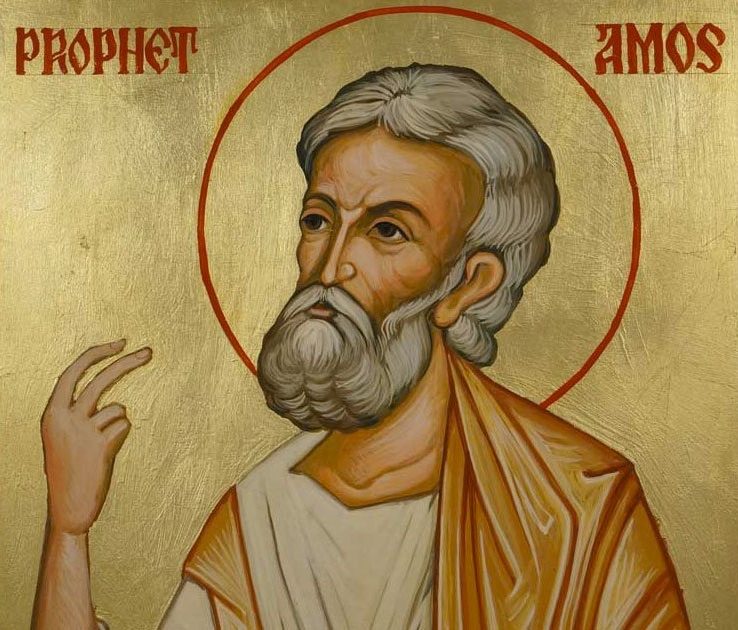
Amos describes himself as a shepherd from Tekoa, a city located 10 miles south of Jerusalem in the southern kingdom of Judah. And later on in his book, he elaborates on his background by adding a few additional facts: “I was no prophet, nor a prophet’s son, but I was a herdsman and a dresser of sycamore figs. But the Lord took me from following the flock, and the Lord said to me, ‘Go, prophesy to my people Israel.’” (Amos 7:14-15 ESV). Amos’ somewhat adamant-sounding statement, “I was no prophet” may seem strange, considering the fact that he admits that he was called by God to prophesy to the northern kingdom of Israel.

But Amos was only trying to make the point that he had not always been a prophet. For most of his adult life, Amos had been a herdsman (bôqēr), a Hebrew term that was often translated as “shepherd.” Over the centuries, biblical scholars have speculated that Amos was actually far more than a lowly shepherd. In the opening verse of his book, he refers to himself as a being “among the shepherds of Tekoa.” The term he uses there is nōqēḏ, which can be translated as sheep-raiser or sheep-dealer. It is the same term used in 2 Kings to describe the king of Moab.

Now Mesha king of Moab was a sheep breeder (nōqēḏ), and he had to deliver to the king of Israel 100,000 lambs and the wool of 100,000 rams. – 2 Kings 3:4 ESV

Either Amos worked as a shepherd-for-hire, contracting himself out to the sheep breeders of Tekoa, or he was one of them. When he refers to himself as a “dresser of sycamore figs,” he seems to be describing the process of “gathering” (bālas) the fruit of the tree. This involved the scoring or cutting of the skin of the fruit so that it would ripen. So, it could be that Amos was nothing more than a seasonal day-laborer, who made his living by hiring himself out as a shepherd or field hand.

But regardless of whether Amos was a wealthy sheep breeder or a lowly sheepherder, he found himself going through a mid-life career change that was divinely ordained. Amos was called by God to leave behind the figs and flocks and begin his new life as a prophet. And whether Amos was rich or poor, highly successful or barely making ends meet, this would have been a significant change in his career trajectory.

A prophet (nāḇî’) was considered to be an “inspired man” – a divinely commissioned spokesman who operated under the influence of the Spirit. The Hebrew word actually means “to bubble forth, as from a fountain.” A prophet of God was divinely inspired to speak on behalf of God. And that is exactly what God had commissioned Amos to do.

“Go, prophesy to my people Israel…” – Amos 7:15 ESV

What is interesting is that Amos, a citizen of the southern kingdom of Judah, was being called to go as a prophet to the northern kingdom of Israel. Ever since the end of King Solomon’s reign, the nation of Israel had been divided into two kingdoms. The northern kingdom was comprised of ten of the original 12 tribes of Israel. Samaria was its capital and Jeroboam II was its king at the time Amos was called. The southern kingdom was made up of the tribes of Judah and Benjamin, and their king was Uzziah, who ruled from the throne of David in Jerusalem.

It is important to note that this division of the kingdom of Israel had come about because of Solomon’s disobedience and unfaithfulness. As the son of David, Solomon had inherited a powerful kingdom that was marked by peace and prosperity. And while Solomon had been gifted by God with great wisdom, he ended up amassing a harem of 700 wives and 300 concubines. And the author of the book of 1 Kings makes it clear that Solomon’s actions were far from acceptable to God.

King Solomon loved many foreign women, along with the daughter of Pharaoh: Moabite, Ammonite, Edomite, Sidonian, and Hittite women, from the nations concerning which the Lord had said to the people of Israel, “You shall not enter into marriage with them, neither shall they with you, for surely they will turn away your heart after their gods.” – 1 Kings 11:1-2 ESV

Solomon allowed his love of women to diminish his love for God. In order to appease his many foreign wives, he allowed them to worship their foreign gods. But eventually, he became influenced by their idolatry and began to promote the worship of false gods within the land of Israel.

…when Solomon was old his wives turned away his heart after other gods, and his heart was not wholly true to the Lord his God, as was the heart of David his father. For Solomon went after Ashtoreth the goddess of the Sidonians, and after Milcom the abomination of the Ammonites. So Solomon did what was evil in the sight of the Lord and did not wholly follow the Lord, as David his father had done. – 1 Kings 11:4-6 ESV

As a result, God determined to punish Solomon for his unfaithfulness by splitting his kingdom in half. Solomon would be allowed to finish out his reign, but his son would inherit a kingdom much diminished in power, size, and influence.

“Since this has been your practice and you have not kept my covenant and my statutes that I have commanded you, I will surely tear the kingdom from you and will give it to your servant.” – 1 Kings 11:11 ESV

By the time Amos comes along, the two kingdoms have co-existed for hundreds of years, but their relationship was strained and marked by constant conflict. From its inception, the northern kingdom of Israel had been plagued by idolatry and apostasy. Its very first king, Jeroboam I, had commissioned the creation of two golden calf idols, placing one in Dan and the other in Bethel. Then he instructed the people of Israel:

“You have gone up to Jerusalem long enough. Behold your gods, O Israel, who brought you up out of the land of Egypt.” – 1 Kings 12:28 ESV

From that point forward, the people of the northern kingdom of Israel were effectively “paganized.” They no longer kept the Law of God or made the annual pilgrimages to Jerusalem to celebrate the prescribed feasts and festivals. Instead, they made their way to their own sacred sites to worship their own man-made gods. And Amos will declare God’s dissatisfaction with them.

“Come to Bethel, and transgress;
    to Gilgal, and multiply transgression;
bring your sacrifices every morning,
    your tithes every three days;
offer a sacrifice of thanksgiving of that which is leavened,
    and proclaim freewill offerings, publish them;
    for so you love to do, O people of Israel!”
declares the Lord God. – Amos 4:4-5 ESV

And God will use Amos to call the rebellious people of Israel to repent.

For thus says the Lord to the house of Israel:

“Seek me and live;
   but do not seek Bethel,
and do not enter into Gilgal
    or cross over to Beersheba;
for Gilgal shall surely go into exile,
    and Bethel shall come to nothing.” – Amos 5:4-5 ESV

And Amos, the newly appointed prophet, will begin his career by calling his northern neighbors to give up their idolatrous ways and return to the worship of Yahweh.

Seek good, and not evil,
    that you may live;
and so the Lord, the God of hosts, will be with you,
    as you have said.
Hate evil, and love good,
    and establish justice in the gate;
it may be that the Lord, the God of hosts,
   will be gracious to the remnant of Joseph. – Amos 5:14-15 ESV

But Amos will find his new job to be much more difficult than tending sheep or dressing figs. He will quickly discover the obstinance of the people of Israel and, eventually, he will be required to deliver a sobering message to their king, Jeroboam II.

“‘Jeroboam shall die by the sword,
    and Israel must go into exile
    away from his land.’” – Amos 7:11 ESV

Just imagine the change that took place in Amos’ life as a result of God’s call. His world was turned upside down. He went from herding sheep to haranguing kings. Rather than scoring figs so that they might ripen, he was now excoriating the faithless so they might repent. Amos would quickly learn that being a prophet was a far-from-glamorous job that required great commitment and total reliance upon God. Despite the divine origin of his message, he would find his audience unreceptive and his presence unwelcome. He spoke on behalf of God but was treated as a pariah by the people of God. They didn’t want what he was selling, and they will repeatedly reject the God he was representing.

English Standard Version (ESV) The Holy Bible, English Standard Version. ESV® Permanent Text Edition® (2016). Copyright © 2001 by Crossway Bibles, a publishing ministry of Good News Publishers.

New Living Translation (NLT) Holy Bible, New Living Translation, copyright © 1996, 2004, 2015 by Tyndale House Foundation. Used by permission of Tyndale House Publishers Inc., Carol Stream, Illinois 60188. All rights reserved.

The Message (MSG)Copyright © 1993, 1994, 1995, 1996, 2000, 2001, 2002 by Eugene H. Peterson