I Am the LORD

16 And they went out at noon, while Ben-hadad was drinking himself drunk in the booths, he and the thirty-two kings who helped him. 17 The servants of the governors of the districts went out first. And Ben-hadad sent out scouts, and they reported to him, “Men are coming out from Samaria.” 18 He said, “If they have come out for peace, take them alive. Or if they have come out for war, take them alive.”

19 So these went out of the city, the servants of the governors of the districts and the army that followed them. 20 And each struck down his man. The Syrians fled, and Israel pursued them, but Ben-hadad king of Syria escaped on a horse with horsemen. 21 And the king of Israel went out and struck the horses and chariots, and struck the Syrians with a great blow.

22 Then the prophet came near to the king of Israel and said to him, “Come, strengthen yourself, and consider well what you have to do, for in the spring the king of Syria will come up against you.”

23 And the servants of the king of Syria said to him, “Their gods are gods of the hills, and so they were stronger than we. But let us fight against them in the plain, and surely we shall be stronger than they. 24 And do this: remove the kings, each from his post, and put commanders in their places, 25 and muster an army like the army that you have lost, horse for horse, and chariot for chariot. Then we will fight against them in the plain, and surely we shall be stronger than they.” And he listened to their voice and did so. 

26 In the spring, Ben-hadad mustered the Syrians and went up to Aphek to fight against Israel. 27 And the people of Israel were mustered and were provisioned and went against them. The people of Israel encamped before them like two little flocks of goats, but the Syrians filled the country.

28 And a man of God came near and said to the king of Israel, “Thus says the LORD, ‘Because the Syrians have said, “The LORD is a god of the hills but he is not a god of the valleys,” therefore I will give all this great multitude into your hand, and you shall know that I am the LORD.’”1 Kings 20:16-28 ESV

King Ahab found himself in a strange predicament. His capital city, Samaria, was under attack by a confederation of 32 kings, led by King Ben-hadad of Syria. But much to Ahab’s surprise, a prophet of Yahweh appeared with a plan for Israel’s deliverance.

“Thus says the LORD, Have you seen all this great multitude? Behold, I will give it into your hand this day, and you shall know that I am the LORD.” – 1 Kings 20:13 ESV

The very God whom Ahab and Jezebel had attempted to replace with their false gods announced that He was going to rescue His disobedient and unfaithful people. And Yahweh had told Ahab exactly how the victory would take place.

By the servants of the governors of the districts.” – 1 Kings 20:14 ESV

God was not going to utilize Ahab’s army to fight the Syrians. This is significant because Ahab, like all his predecessors, had assembled a large military force. Evidence of that fact has been found on an ancient Assyrian stone tablet that bears an inscription describing the battle of Qarqar between Ahab and his enemy, King Shalmaneser III of Assyria. The tablet records the size of the army that assembled to do battle that day as consisting of “2,000 chariots and 10,000 men of Ahab king of Israel.”

But on this occasion, Yahweh chose to place Ahab’s formidable resources in a secondary position, choosing instead to use “servants” – a group of ordinary people who, when assembled, amounted to only 7,000 in number.
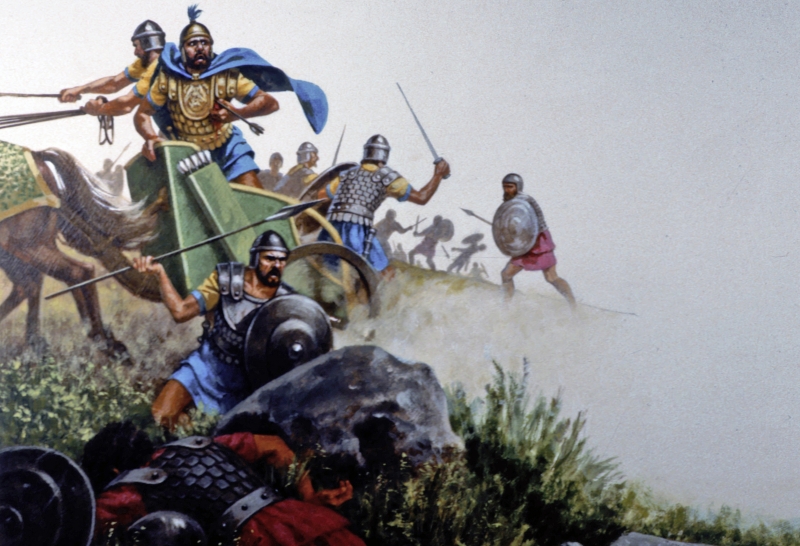
Confident that he would defeat the Israelites, Ben-hadad and his vassal kings were drinking themselves drunk in a pre-victory celebration. So, when scouts arrived with a report that Israelite forces had been seen leaving the city, Beh-hadad assumed they were bringing news of Israel’s surrender or their decision to continue the battle. While he and his military commanders continued to toast their inevitable victory, the 7,000 servants made their way to the Syrian camp, followed by Ahab and his army.

This surprise attack caught the Syrian forces completely unawares and unable to respond. Led by the 7,000 servants, Ahab’s army quickly routed the Syrians, forcing them to abandon camp and run for their lives. Quickly sobered by this unexpected reversal of fortunes, Beh-hadad managed to escape, but the rest of his forces didn’t fare as well.

And the king of Israel went out and struck the horses and chariots, and struck the Syrians with a great blow. – 1 Kings 20:21 ESV

Notice that the author conveniently eliminates any mention of Ahab’s name. He simply refers to him as “the king of Israel.” He repeats this obvious slight in the very next verse, refusing to give Ahab any credit for the victory. He simply warns him that the battle may be done, but the war is far from over.

“Come, strengthen yourself, and consider well what you have to do, for in the spring the king of Syria will come up against you.” – 1 Kings 20:22 ESV

Ben-hadad would be back. He had suffered a devastating defeat, but once he had time to assess what had happened that day, the Syrian king would return, more determined than ever to avenge his loss by destroying the Israelites. Ben-hadad’s advisors encouraged his plans by suggesting that his loss had been divinely ordained. In their pagan way of thinking, the only thing that could explain a loss of this magnitude was the intervention of the gods. They rationalized away their defeat by concluding that they had chosen the wrong place to do battle.  They absolved Beh-hadad of any responsibility for the loss by assuring him, “Their gods are gods of the hills, and so they were stronger than we. But let us fight against them in the plain, and surely we shall be stronger than they” (1 Kings 20:23 ESV).

Little did they know how right they were. Their defeat had been the result of divine intervention, but geographic location had played no role in it. Yahweh was the God of the hills and the valleys; He was sovereign over all the earth. Unlike their false gods, Yahweh was unbound by time and space. The extent of His power was limitless. To the God of Israel, the battle location and the size of the opposing army made no difference. And so, when Ben-hadad’s advisors counseled him to rebuild his army and restructure his military command, it would prove to be futile advice. They had no idea what they were dealing with, and their ignorance led them to make some hazardous assumptions.

First, they assumed that the God of Israel was similar to their own gods – limited in power and vulnerable to defeat. Their “theology” relegated the gods to various regions or geographic jurisdictions. In their simplistic way of thinking, some gods ruled over the valleys while other gods had dominion over the hills. Their god had failed to deliver them a victory because they had chosen the wrong location for their battle. So, if they could lure the Israelites into the valley, they would expose Yahweh’s weak spot, and the battle would go their way.

Eager to avenge his loss, Ben-hadad took their advice and spent the winter rebuilding his army. He replaced the 32 kings with seasoned military commanders and ordered the construction of new chariots. He also made plans to take the fight to the valley, where the God of Israel would have no power and play no role in the outcome of the battle.

It is fascinating to consider that all of this was according to the sovereign will of God. He had orchestrated all the details concerning the original battle, including Ben-hadad’s escape. God had even told Ahab that the Syrians would return. Ben-hadad’s rebuilding and reconfiguring of his army had been part of God’s plan. The original battle had been intended to restore the Israelites’ belief in God. Prior to their victory, God had told them, “I will give it into your hand this day, and you shall know that I am the LORD” (1 Kings 20:13 ESV).

But Yahweh knew that little had changed in Israel. Even after their miraculous defeat of the Syrians, the people remained unconvinced of Yahweh’s status as the one true God. When spring rolled around, they found themselves facing their former foe again. This time, Beh-hadad showed up with a much larger and better-equipped army than before, and rather than laying siege to the city, his troops gathered in the Valley of Aphek. Ben-hadad had brought a bigger, better army and had chosen a battleground that was outside the reach of Yahweh’s power. Or so he thought.

The stage was set. The enemy of Israel had returned. And the author paints a rather bleak and foreboding picture of the situation.

Israel then mustered its army, set up supply lines, and marched out for battle. But the Israelite army looked like two little flocks of goats in comparison to the vast Aramean forces that filled the countryside! – 1 Kings 20:27 NLT

Here was Israel, outnumbered and underequipped yet again. They were no match for the Syrians. And this time, they would not have the walls of the city to protect them. They would be fighting on open terrain, facing an army equipped with chariots and horses and motivated by revenge.

But God sent another prophet with a promise of His presence and power.

“Thus says the LORD, ‘Because the Syrians have said, “The LORD is a god of the hills but he is not a god of the valleys,” therefore I will give all this great multitude into your hand, and you shall know that I am the LORD.’” – 1 Kings 20:28 ESV

Despite the overwhelming odds, God would provide another victory over their enemy. By the time this day was over, they would know that He was the one true God. But in verse 28, the author leaves out Ahab’s name again, simply referring to him as “the king of Israel.” God was going to deliver this victory despite Ahab, not because of him. Not only did Ahab deserve to lose this battle, but he also deserved to die for his idolatry and apostasy. But Yahweh was acting on behalf of His covenant people and protecting the integrity and honor of His name. He had made covenant promises to Abraham, Isaac, and Jacob, and given His word to Moses and David. And while Ahab had failed to use his position as the shepherd of Israel to lead them in faithful obedience, Yahweh would prove Himself true to His word and committed to His covenant promises.

English Standard Version (ESV) The Holy Bible, English Standard Version. ESV® Permanent Text Edition® (2016). Copyright © 2001 by Crossway Bibles, a publishing ministry of Good News Publishers.

New Living Translation (NLT) Holy Bible, New Living Translation, copyright © 1996, 2004, 2015 by Tyndale House Foundation. Used by permission of Tyndale House Publishers Inc., Carol Stream, Illinois 60188. All rights reserved.

Praise the LORD!

1 Praise the LORD!
Praise the LORD, O my soul!
I will praise the LORD as long as I live;
    I will sing praises to my God while I have my being.

Put not your trust in princes,
    in a son of man, in whom there is no salvation.
When his breath departs, he returns to the earth;
    on that very day his plans perish.

Blessed is he whose help is the God of Jacob,
    whose hope is in the LORD his God,
who made heaven and earth,
    the sea, and all that is in them,
who keeps faith forever;
    who executes justice for the oppressed,
    who gives food to the hungry.

The LORD sets the prisoners free;
    the LORD opens the eyes of the blind.
The LORD lifts up those who are bowed down;
    the LORD loves the righteous.
The LORD watches over the sojourners;
    he upholds the widow and the fatherless,
    but the way of the wicked he brings to ruin.

10 The LORD will reign forever,
    your God, O Zion, to all generations.
Praise the LORD! – Psalm 146:1-10 ESV

The last five psalms are anonymous and form the final Hallel (praise) section of the Psalter. Due to the similarity of their content, they were likely written by the same author. Each begins with the same call to action: “Praise the LORD.” This imperative statement is not intended as a suggestion, but as a command to give Yahweh all the dignity, honor, worship, and praise He rightly deserves. The psalmist calls for wholehearted worship on the part of the people of God, and he sets the tone by declaring his sold-out allegiance to the Almighty.

I will praise the LORD as long as I live;
    I will sing praises to my God while I have my being. – Psalm 146:2 ESV

His statement of devotion to Yahweh is reminiscent of the address Joshua gave to the Israelites near the end of his life. Ever since the death of Moses, Joshua had served as the God-appointed leader of the Israelites, helping them cross the Jordan River and begin their conquest of the land of Canaan. Over the years, Joshua led the Israelites in their effort to conquer the inhabitants of the land so they could take possession of the inheritance promised to them by Yahweh. They had fought and won many battles, and successfully occupied a large portion of Canaan, but Yahweh reminded them that He had been behind it all.

“It was not your swords or bows that brought you victory. I gave you land you had not worked on, and I gave you towns you did not build—the towns where you are now living. I gave you vineyards and olive groves for food, though you did not plant them.” – Joshua 24:12-13 NLT

Despite his leadership role, Joshua knew that he had been little more than an instrument in Yahweh’s hands. He had led the people into battle, but the victories had been the LORD’s doing. So, Joshua commanded the Israelites to show their gratitude to Yahweh by treating Him with honor and unadulterated reverence.

“So fear the LORD and serve him wholeheartedly. Put away forever the idols your ancestors worshiped when they lived beyond the Euphrates River and in Egypt. Serve the LORD alone. But if you refuse to serve the LORD, then choose today whom you will serve. Would you prefer the gods your ancestors served beyond the Euphrates? Or will it be the gods of the Amorites in whose land you now live? But as for me and my family, we will serve the LORD.” – Joshua 24:14-15 NLT

Like the psalmist, Joshua tried to spur the people’s obedience by using himself as an example. He declared his intention to live out his final days in total submission to and reliance upon Yahweh, and he committed his family to follow his lead.

Joshua warned the Israelites about the dangers of idolatry because he knew their history of spiritual infidelity. He had been there when Aaron made the golden calf in the wilderness, and he had witnessed the people’s response to this false god they had crafted from the plunder taken from the Egyptians.

The people got up early the next morning to sacrifice burnt offerings and peace offerings. After this, they celebrated with feasting and drinking, and they indulged in pagan revelry. – Exodus 34:6 NLT

Yahweh had delivered them from slavery in Egypt and given them victory over their enemies, but they gave their allegiance to a nonexistent god they had made with their own hands.

The psalmist stressed a different problem facing his peers. He was less concerned about idolatry and the worship of false gods than their tendency to worship men.

Don’t put your confidence in powerful people;
    there is no help for you there.
When they breathe their last, they return to the earth,
    and all their plans die with them. – Psalm 146:3-4 NLT

While idolatry continued to be a problem for the Israelites throughout their existence as a nation, their real struggle was the worship of men. Ever since the day they rejected Samuel’s leadership and demanded, “Give us a king to judge us like all the other nations have” (1 Samuel 8:5 NLT), the people of Israel had exhibited a preference for human kings over the King of kings. Yahweh would repeatedly warn them about their tendency to replace His authority with that of mere men.

This is what the Lord says:
“Cursed are those who put their trust in mere humans,
    who rely on human strength
    and turn their hearts away from the Lord.
They are like stunted shrubs in the desert,
    with no hope for the future.
They will live in the barren wilderness,
    in an uninhabited salty land.” – Jeremiah 17:5-6 NLT

The psalmist knew his people well and wanted them to think twice about putting their trust in powerful men who could never measure up to Yahweh’s standards. As far as the psalmist was concerned, there was no comparison between mortal men and the infinite, all-powerful God of the universe.

He made heaven and earth,
    the sea, and everything in them.
    He keeps every promise forever.
He gives justice to the oppressed
    and food to the hungry.
The LORD frees the prisoners.
   The LORD opens the eyes of the blind.
The LORD lifts up those who are weighed down.
    The LORD loves the godly.
The LORD protects the foreigners among us.
    He cares for the orphans and widows,
    but he frustrates the plans of the wicked. – Psalm 146:6-9 NLT

No man could ever hope to compete with Yahweh. No king who ever lived could claim to hold a candle to Yahweh’s glory and greatness. The anonymous author of Psalm 2 exposed the futility of earthly kings trying to oppose the one true King.

Why are the nations so angry?
    Why do they waste their time with futile plans?
The kings of the earth prepare for battle;
    the rulers plot together
against the LORD
    and against his anointed one.
“Let us break their chains,” they cry,
    “and free ourselves from slavery to God.”

But the one who rules in heaven laughs.
    The LORD scoffs at them.
Then in anger he rebukes them,
    terrifying them with his fierce fury. – Psalm 2:1-5 NLT

The prophet Isaiah declared Yahweh’s superiority and supremacy over all mankind.

God sits above the circle of the earth.
    The people below seem like grasshoppers to him!
He spreads out the heavens like a curtain
    and makes his tent from them.
He judges the great people of the world
    and brings them all to nothing. – Isaiah 40:22-23 NLT

In Isaiah’s estimation, the worship of men was unwarranted and a waste of time. They would always be poor substitutes for Yahweh because they couldn’t measure up to His glorious standards. Even Yahweh declared Himself to be incomparable and irreplaceable.

“To whom will you compare me?
    Who is my equal?” asks the Holy One. – Isaiah 40:25 NLT

The psalmist understood that Yahweh’s immensity and eternality set Him apart from all false gods and every man with god-like aspirations. He deserved man’s praise because He was praiseworthy. Yahweh wasn’t a figment of man’s fertile imagination and had not been formed by human hands. He was the maker of “heaven and earth, the sea, and everything in them” (Psalm 146:6 NLT). Yahweh is the uncreated Creator of the universe who has no beginning and end. He is eternal and all-powerful. He is holy and wholly righteous. He is “the same yesterday and today and forever” (Hebrews 13:8 ESV). With those thoughts in mind, the psalmist closes his song in the same way he opened it, with a call to praise the eternal, always-present, forever faithful God.

The LORD will reign forever.
    He will be your God, O Jerusalem, throughout the generations.

Praise the Lord! – Psalm 146:10 NLT

Father, I must confess that I do not always recognize and honor Your greatness. I say I believe in it but, far too often, my actions and attitudes reflect something altogether different. I don’t praise You enough. I fail to trust You fully. I tend to put my hope in men, even in myself, rather than trusting in Your proven track record of greatness and goodness. While I could easily deny any worship of false gods, I know it would be a lie. My idols are far more subtle than those of the Israelites, but they are idols all the same. Anything I turn to instead of You is a false god that will always provide false hope. No man or human institution can replace you. No idealogy, political party, or human leader can replace You or hope to compete with You. Yet, it is so easy to put my trust in those things that will always prove untrustworthy. Help me to heed the psalmist’s call and learn to praise You for who You are and all that You have done. Amen

English Standard Version (ESV) The Holy Bible, English Standard Version. ESV® Permanent Text Edition® (2016). Copyright © 2001 by Crossway Bibles, a publishing ministry of Good News Publishers.

New Living Translation (NLT) Holy Bible, New Living Translation, copyright © 1996, 2004, 2015 by Tyndale House Foundation. Used by permission of Tyndale House Publishers Inc., Carol Stream, Illinois 60188. All rights reserved.

All-Powerful, All the Time

In the Book of Revelation, John records a vision he was given of the heavenly throne room.

Then I heard again what sounded like the shout of a vast crowd or the roar of mighty ocean waves or the crash of loud thunder:

“Praise the Lord!
    For the Lord our God, the Almighty, reigns.
Let us be glad and rejoice,
    and let us give honor to him.” – Revelation 19:6-7 NLT

The Greek word used to describe God in this passage is pantokratōr which is formed from two other Greek words: pas and kratos, which mean “all” and “powerful.” God is the all-powerful one, “he who holds sway over all things; the ruler of all” (Thayer’s Greek Lexicon). This idea of God’s supreme and unparalleled power is found throughout the Scriptures.

Then Job replied to the Lord:

“I know that you can do anything,
    and no one can stop you. ” – Job 42:1-2 NLT

The Lord merely spoke,
    and the heavens were created.
He breathed the word,
    and all the stars were born.
He assigned the sea its boundaries
    and locked the oceans in vast reservoirs.
Let the whole world fear the Lord,
    and let everyone stand in awe of him.
For when he spoke, the world began!
    It appeared at his command. Psalm 33:6-9 NLT

“And behold, your relative Elizabeth in her old age has also conceived a son, and this is the sixth month with her who was called barren. For nothing will be impossible with God.” – Luke 1:36-37 ESV

When we, as humans, attempt to discuss the power of God, we are at a distinct disadvantage. As finite creatures, we are well acquainted with personal limitations. We find it difficult to consider something to be all-anything. That little three-letter word “all” conveys the idea of wholeness or completeness and in our fallen world, little, if anything, is ever fully whole or complete. While we might say that a glass or bowl is all full, we know it will not remain that way permanently. Upon completing a task, we might proclaim, “All done.” But we fully know the finished task will likely need to be repeated at some point in the future.

Someone who claims to be all-in regarding a project or endeavor will have his commitment tested somewhere along the way. His assurance of whole-hearted engagement will likely waver, given enough time or the failure of his expectations being met.

We live in a world full of limitations. No one is truly all-knowing. They may know a great deal, but their knowledge is never complete. Someone may appear to have “all the money in the world,” but logic precludes the veracity of that statement. No one can literally possess all the world’s financial resources. And while someone might wield great power, no one is truly all-powerful. Even the world’s most powerful people experience limitations to their control and influence. In this competitive and highly contentious world, no one can ever gain all the power. And the same can be said of fame, money, or time.

Which brings us back to our all-powerful-all-the-time God. Theologians refer to this as God’s omnipotence. The word omnipotent comes from omni- meaning “all” and potent meaning “power.” When used of God’s power, the word “all” is meant to convey the complete and wholly undiminished nature of that power; it is without limits. It never diminishes in intensity. God does not grow tired. In fact, the psalmist states, “he who watches over Israel never slumbers or sleeps” (Psalm 121:4 NLT).

God isn’t just more powerful, extremely powerful, or simply powerful. He is all-powerful.

“The power of God is that ability and strength whereby He can bring to pass whatsoever He pleases, whatsoever His infinite wisdom may direct, and whatsoever the infinite purity of His will may resolve…”  – Stephen Charnock, Discourses Upon the Existence and Attributes of God, Volumes 1-2

Notice what Charnock says. God can bring to pass whatever He pleases. God’s power is directly tied to His will. Unlike man, God’s will is limited to wishful thinking. There is never a case when God desires something, but finds Himself lacking the power to make it happen. God has never had to say, “If I only I could….” There has never been an occasion when God was forced to sit back and watch His will go unfulfilled because of a lack of strength.

A. W. Pink states, “He who cannot do what he will and perform all his pleasure cannot be God. As God hath a will to resolve what He deems good, so has He power to execute His will” (A. W. Pink, The Attributes of God).

This idea of God’s unlimited power is essential for understanding and fully appreciating His transcendent nature. God is not a slightly improved or more powerful version of man. He is not a human on steroids but is the infinite Almighty God who spoke the universe into existence.

God’s power was not acquired, developed over time, and is not running out. C. H. Spurgeon put it this way: “God’s power is like Himself, self-existent, self-sustained. The mightiest of men cannot add so much as a shadow of increased power to the Omnipotent One.” The greatest earthly examples of power we can think of are all limited. Niagara Falls, while impressive, is not self-existent or self-sustaining; it has a source, or it would not exist. One day, it will cease to exist. Simply divert the headwaters that provide the source of its power, and the falls will become nothing more than exposed rocks and a dry river bed.

But because God’s power is self-existent, it cannot be diminished or diverted in any way. His power is unmatched in its intensity and irrepressible in its intent.

All the people of the earth are nothing compared to him. He does as he pleases among the angels of heaven and among the people of the earth. No one can stop him or say to him, “What do you mean by doing these things?” – Daniel 4:35 NLT

The LORD does whatever pleases him throughout all heaven and earth… – Psalm 135:5 NLT

It was Job who confessed to God, “I know that you can do anything, and no one can stop you” (Job 42:2 NLT). And Job argued with his well-meaning, but misinformed friends, “who can turn him back? Who will say to him, ‘What are you doing?’” (Job 9:12 ESV).

It was Lord Acton who wrote the oft-quoted line, “Power tends to corrupt, and absolute power corrupts absolutely. Great men are almost always bad men.” But that truism does not apply to God. Because He is holy, just, and righteous in all He does, God’s power cannot be corrupted – even though it is absolute. God is divine and not human, therefore, He is nothing like us, and cannot be measured according to our standards or evaluated based on our limited and sin-influenced perspective.

God is not a man, so he does not lie. He is not human, so he does not change his mind. Has he ever spoken and failed to act? Has he ever promised and not carried it through?
 – Numbers 23:19 NLT

God’s undiminished and non-constrainable power always accomplishes what He intends. God Himself stated, “My word that proceeds from My mouth will not return to Me empty, but it will accomplish what I please, and it will prosper where I send it” (Isaiah 55:11 BSB).

While we may not fully comprehend or appreciate the extent of God’s power, we all call upon it in our times of greatest need. We love the thought of the all-powerful God putting His unlimited resources at our beck and call. But while God makes His power accessible to us, it does not exist for our good pleasure. He is not our cosmic Genie-in-a-bottle or personal valet. God’s power exists to accomplish His will, not ours. When it comes to our reaction to and relationship with God’s power, A. W. Pink would have us maintain a delicate balance.

“Well may all tremble before such a God! To treat with impudence One who can crush us more easily than we can a moth, is a suicidal policy. To openly defy Him who is clothed with omnipotence, who can rend us in pieces or cast us into Hell any moment He pleases, is the very height of insanity.

“Well may the enlightened soul adore such a God! The wondrous and infinite perfections of such a Being call for fervent worship. If men of might and renown claim the admiration of the world, how much more should the power of the Almighty fill us with wonderment and homage.” – A. W. Pink, The Attributes of God

God’s sovereignty and power go hand in hand; they are inseparably linked and cannot exist independently. “To reign, God must have power, and to reign sovereignty, He must have all power” (A. W. Tozer, The Knowledge of the Holy). This all-mighty King rules over all He has made with perfect, undiminished power and while He can be opposed or resisted, He cannot be prevented from accomplishing His divine will.

This aspect of God’s nature should bring us comfort and cause us to rejoice. Our holy, righteous, just, and merciful God is fully capable of accomplishing His will for our lives. He is not limited in any way and cannot be deterred from carrying out His divine plans for His creation or His creatures. As the old song goes, “He’s got the whole world in His hands.”

“Let us affirm what the Bible declares. God is presently on His throne, ruling and reigning as He pleases, absolutely sovereign in His administration over all the works of creation. In no way relieving man of his responsibility to live by faith and obey the Word, God nevertheless remains the one and only true sovereign over heaven and earth.” – Steven J. Lawson, Made In Our Image

English Standard Version (ESV)
The Holy Bible, English Standard Version. ESV® Permanent Text Edition® (2016). Copyright © 2001 by Crossway Bibles, a publishing ministry of Good News Publishers.

New Living Translation (NLT)
Holy Bible, New Living Translation, copyright © 1996, 2004, 2015 by Tyndale House Foundation. Used by permission of Tyndale House Publishers Inc., Carol Stream, Illinois 60188. All rights reserved.

Sovereign Over All

God rules the universe and all it contains with absolute power and authority. That is the essence of the doctrine of God’s sovereignty. He is not only all-knowing (omniscient) but all-powerful (omnipotent), and because God is spirit, His presence is all-pervasive (omnipresent). In the Book of Isaiah, the prophet records God’s words concerning His sovereignty.

“Only I can tell you the future
    before it even happens.
Everything I plan will come to pass,
    for I do whatever I wish.”
Isaiah 46:10 NLT

The prophet Daniel provides further insight into the incomparable power and authority that marks God’s sovereign reign over all He has made.

His rule is everlasting,
    and his kingdom is eternal.
All the people of the earth
    are nothing compared to him.
He does as he pleases
    among the angels of heaven
    and among the people of the earth.
No one can stop him or say to him,
    “What do you mean by doing these things?” – Daniel 4:34-35 NLT

According to Dictionary.com, sovereignty is “the quality or state of being sovereign, or of having supreme power or authority.” A “sovereign” is “a person who has supreme power or authority.” So, when we talk about the sovereignty of God, we’re referring to His absolute rule, control, and authority over everything He has created, including the affairs of men. A. W. Pink describes it as “the exercise of His supremacy.”

“He is the Most High, Lord of heaven and earth. Subject to none, influence by none, absolutely independent; God does as He pleases, only as He pleases, always as He pleases. None can thwart Him, none can hinder Him.” – A. W. Pink, The Attributes of God

The word “sovereignty” is not commonly used today. When we hear it, we tend to think of kings and queens, those royal personages from ancient history who wielded great power and influence over nation-states and the citizens who comprised them. These privileged individuals, most of whom owed their position to the practice of hereditary succession, enjoyed tremendous influence and reigned over vast kingdoms. Unlike Britain’s modern-day royal family, these ancient heads of state were much more than mere figureheads. They were the supreme rulers over their domains, operating under the political doctrine known as the divine right of kings “which asserted that kings derived their authority from God and could not therefore be held accountable for their actions by any earthly authority” (Britannica, The Editors of Encyclopaedia. “divine right of kings”. Encyclopedia Britannica, 14 Jun. 2024, https://www.britannica.com/topic/divine-right-of-kings. Accessed 2 August 2024).

Under this doctrine, kings and queens wielded absolute power and the authority to demand unwavering allegiance from their subjects. It didn’t matter whether they were a good king or a bad one. Even an evil queen fully expected the citizens of her kingdom to submit to her will and obey her decrees. To fail to do so would be considered a display of insubordination at best or, at worst, an act of outright insurrection.

As the sovereign God of the universe, God does not derive His power or authority from anyone else. He does not operate according to a political doctrine or legal principle derived by men. He does not have a divine cabinet or administrative branch from which He seeks counsel or advice. He is not subject to censure or the threat of removal or replacement. Because God is eternal, His sovereign reign has no beginning or end; it is everlasting in nature.

One of the names for God in the Scriptures is “God Almighty” or El Shaddai in Hebrew. It most likely means “God, the All-powerful One,” and refers to His ultimate power over anything and everything. In other words, He is all-powerful. And yet, that power is not limited to His physical capacity to accomplish great feats of strength. Yes, He can perform acts of unparalleled might, but His sovereignty includes the authority by which He does so. God has the right to use His power and always does so in a just and righteous way.

The Lord is righteous in everything he does… – Psalm 145:17 NLT

As for God, His way is perfect… – Psalm 18:30 BSB

He is the Rock; his deeds are perfect. Everything he does is just and fair. He is a faithful God who does no wrong; how just and upright he is! – Deuteronomy 32:4 NLT

Righteous are You, O LORD, and upright are Your judgments. – Psalm 119:137 NLT

As the sovereign King of the universe, God is in complete control of all things. And that authority has not been granted to Him by some outside or greater force. There is nothing greater than God. In the book of Isaiah, He declares His unchallenged authority in no uncertain terms.

“I am the LORD, and there is no other, besides me there is no God…” – Isaiah 45:5 ESV

As stated earlier, God answers to no one. He has no board of directors or parliament to whom He must report or from whom He must seek permission or approval.

“Divine sovereignty means that God is God in fact, as well as in name, that He is on the Throne of the universe, directing all things, working all things ‘after the counsel of His own will’ (Ephesians 1:11)” – A. W. Pink, The Attributes of God

God does what He pleases. That phrase can either encourage or enrage us. It can create in us a sense of peace and calm as we consider the unstoppable nature of His divine will. Yet, for some, the thought of God’s will going unchallenged creates a sense of fear or infuriation as we consider what we believe to be the loss of our own rights.

“God reigns over all His creation, governing and guiding all things to their divinely appointed end. Although, from a human perspective, it may appear otherwise, He is in charge of the universe, exercising absolute control over all things. As our sovereign Lord, He does always as He pleases, only as He pleases, and all that He pleases.” – Steve, J. Lawson, Made In Our Image: What Shall We Do with a “User-Friendly” God?

For some of us, Steve Lawson’s quote paints a picture of God that we find to be disturbing rather than comforting. And it’s most likely because we want to be the master of our fate and the captain of our soul. We don’t mind God getting His way as long as it doesn’t interfere with our plans.

“The god of American popular culture is an indulgent heavenly spirit who is little threat to our lifestyles and luxuries – a god consistent with a consumer culture and rampant immorality. This god might wish that human beings would behave, but he is powerless when they do not.” – Albert Mohler, Foreward to Made In Our Image: What Shall We Do with a “User-Friendly” God?

We like the idea of God being all-powerful, but only as long as that power is at our disposal to do as we see fit. But that’s not how it works. The apostle Paul wrote to the believers in Corinth, reminding them that we exist for God’s glory, not the other way around. Contrary to popular opinion, God isn’t our personal valet or servant. He created us, not the other way around.

…yet for us there is one God, the Father, from whom are all things and for whom we exist, and one Lord, Jesus Christ, through whom are all things and through whom we exist. – 1 Corinthians 8:6 ESV

We exist because God chose it to be so, and we exist for Him. All of creation was intended to bring glory to God as it evidenced “his invisible attributes, namely, his eternal power and divine nature” (Romans 1:20 ESV). Even fallen humanity brings glory to God as He exercises His sovereign will over their lives. There is nothing that happens outside His purview or without His permission. And that should bring His children a sense of peace, confidence, and security.

“Toward all this God is moving with infinite wisdom and prefect precision of action. No one can dissuade Him from His purposes; nothing turn Him aside from His plans. Since He is omniscient, there can be no unforeseen circumstances, no accidents. As He is sovereign, there can be no countermanded orders, no breakdown in authority; and as He is omnipotent, there can be no want of power to achieve His chosen ends. God is sufficient unto Himself for all these things.” – A. W. Tozer, The Knowledge of the Holy

The sovereignty of God is a deep subject. but its application is quite simple. We have a God who is all-powerful and in full control, no matter how things may appear. Circumstances may give the impression that all is lost, the future is bleak, and there is nothing anyone can do to mitigate the problem. But the apostle Paul would beg to differ. He boldly claimed, “I can do all things through him who strengthens me” (Philippians 4:13 ESV). This was not a pride-filled boast or a case of wishful thinking. Paul prefaced this optimistic statement with a very honest disclosure of his own personal life journey.

I have learned in whatever situation I am to be content. I know how to be brought low, and I know how to abound. In any and every circumstance, I have learned the secret of facing plenty and hunger, abundance and need. – Philippians 4:11-12 ESV

It didn’t matter what Paul faced, he was content because he knew his God was sovereign over every aspect of his life – the good and the bad. That’s why Paul encouraged the believers in Rome to cling to the sovereignty of God, no matter what they encountered in this life.

For I am sure that neither death nor life, nor angels nor rulers, nor things present nor things to come, nor powers, nor height nor depth, nor anything else in all creation, will be able to separate us from the love of God in Christ Jesus our Lord. – Romans 8:38-39 ESV

The sovereignty of God is meant to encourage us. The fact that our God is holy, just, righteous, and true in all that He does is what makes His sovereign will not only acceptable but preferable.

“There is no attribute more comforting to His children than that of God’s sovereignty. Under the most adverse circumstances, in the most severe trials, they believe that sovereignty has ordained their afflictions, that sovereignty overrules them, and that sovereignty will sanctify them all. There is nothing for which the children ought more earnestly to contend than the doctrine of their Master over all creation—the kingship of God over all the works of His own hands—the throne of God and His right to sit upon that throne.” – Charles Haddon Spurgeon, Spurgeon’s Sermons Vol. 2, 1856


English Standard Version (ESV)
The Holy Bible, English Standard Version. ESV® Permanent Text Edition® (2016). Copyright © 2001 by Crossway Bibles, a publishing ministry of Good News Publishers.

New Living Translation (NLT)
Holy Bible, New Living Translation, copyright © 1996, 2004, 2015 by Tyndale House Foundation. Used by permission of Tyndale House Publishers Inc., Carol Stream, Illinois 60188. All rights reserved.

Awe-Struck By God’s Glory

1 And David spoke to the Lord the words of this song on the day when the Lord delivered him from the hand of all his enemies, and from the hand of Saul. He said,

“The Lord is my rock and my fortress and my deliverer,
    my God, my rock, in whom I take refuge,
my shield, and the horn of my salvation,
    my stronghold and my refuge,
    my savior; you save me from violence.
I call upon the Lord, who is worthy to be praised,
    and I am saved from my enemies.

“For the waves of death encompassed me,
    the torrents of destruction assailed me;
the cords of Sheol entangled me;
    the snares of death confronted me.

“In my distress I called upon the Lord;
    to my God I called.
From his temple he heard my voice,
    and my cry came to his ears.

“Then the earth reeled and rocked;
    the foundations of the heavens trembled
    and quaked, because he was angry.
Smoke went up from his nostrils,
    and devouring fire from his mouth;
    glowing coals flamed forth from him.
10 He bowed the heavens and came down;
    thick darkness was under his feet.
11 He rode on a cherub and flew;
    he was seen on the wings of the wind.
12 He made darkness around him his canopy,
    thick clouds, a gathering of water.
13 Out of the brightness before him
    coals of fire flamed forth.
14 The Lord thundered from heaven,
    and the Most High uttered his voice.
15 And he sent out arrows and scattered them;
    lightning, and routed them.
16 Then the channels of the sea were seen;
    the foundations of the world were laid bare,
at the rebuke of the Lord,
    at the blast of the breath of his nostrils. 2 Samuel 22:1-16 ESV

It was A. W. Tozer who wrote, “What comes into our minds when we think about God is the most important thing about us. The history of mankind will probably show that no people has ever risen above its religion, and man’s spiritual history will positively demonstrate that no religion has ever been greater than its idea of God” (A. W. Tozer, The Knowledge of the Holy).

When studying any man’s life, we can easily become obsessed with his accomplishments, failures, actions, and apparent attitudes about everything from life to leadership and family to financial success. David is no exception. In fact, when looking into David’s life, we are provided with so many painfully transparent details that we can assume to know him all too well. But the one thing we can never really know about any man is the true state of his heart. God had to remind the prophet Samuel of this fact when he was searching for the man to replace Saul as the next king of Israel. Seeing that the prophet was using external criteria as a means to determine the right man for the position, God told him: “The LORD doesn’t see things the way you see them. People judge by outward appearance, but the LORD looks at the heart” (1 Samuel 16:7 NLT).

We can’t see into a man’s heart, but in the case of David, we are given a glimpse into his thoughts and feelings at different points in his tumultuous life. The closing chapters of 2 Samuel contain a literary gem from the pen of David that reads like a personal and very private journal. The words it contains are almost a verbatim recounting of Psalm 18, a psalm that bears the following description:

A Psalm of David, the servant of the Lord, who addressed the words of this song to the Lord on the day when the Lord delivered him from the hand of all his enemies, and from the hand of Saul.

It is important to keep in mind that the closing chapters of 2 Samuel serve as a kind of appendix to the entire book. They are not in chronological order, but function as a summation of David’s life, providing the reader with a more holistic image of David as a man, leader, father, husband, and servant of God.

Based on the description that accompanies Psalm 18, it can be assumed that this particular psalm was written early in David’s life. It clearly states that it was written after David had been delivered from the hand of Saul. So it is not a late-in-life exposé written as David lay on his deathbed, looking back in regret or in a fit of nostalgia. These are the words of a young man who found himself in the early days of his God-ordained role as the king of Israel. In those inaugural days of his reign, David faced a litany of difficult circumstances that seemed to contradict both God’s call and the promises He had made to David. And yet, these words, which prefaced the rest of his long and storied life were not negative or filled with complaints and fist-shaking diatribes against God. Yes, they are blunt and highly transparent because David was not one to mince words or attempt to hide his true feelings from God. He is open and transparent but also respectful and reverent in the way he talks with God. He was willing to tell God how he felt, but he didn’t let his feelings influence his thoughts about God. Notice how he starts out:

The Lord is my rock, my fortress, and my savior;
    my God is my rock, in whom I find protection.
He is my shield, the power that saves me,
    and my place of safety.
He is my refuge, my savior,
    the one who saves me from violence. – 2 Samuel 22:2-3 NLT

All throughout this psalm, he speaks to and about God with reverential awe and honor. He sees God for who He really is: His rock, fortress, deliverer, savior, shield, refuge, and the all-powerful, praise-worthy, transcendent God of the universe. David knew from personal experience that his God was almighty and yet all-loving. He was an ever-present God who was fully aware of David’s plights and heard his cries for help. His God was not distant and disinterested in the trials that David faced. His God was not unresponsive or unapproachable, even though His dwelling place was in heaven. David knew he could call out to God and not only be heard but receive help in his time of need. His God rescued and redeemed, and not in some passive way that left him wondering if it had really been Him at all.

David describes God’s actions in terms that appeal to the senses and leave little doubt as to His power and majesty:

…the earth quaked and trembled. The foundations of the heavens shook; they quaked because of his anger… – vs 8

Smoke poured from his nostrils; fierce flames leaped from his mouth. Glowing coals blazed forth from him. – vs 9

The Lord thundered from heaven; the voice of the Most High resounded. – vs 14

David’s descriptions of God are figurative and not meant to be taken literally. They are meant to convey an image of the Almighty that conveys His transcendence and incomparable power. David describes God in otherworldly, supernatural terms that evoke the one-of-a-kind aspect of His divine nature. His God is not only active and alive, but He is also awe-inspiring and fear-inducing. David’s verbal portrait of God is intended to inspire a sense of reverential respect and humble submission in all who read it. God is not to be taken lightly and His gracious involvement in the affairs of daily life should not be dismissed or treated carelessly.

David had never seen God face-to-face or witnessed His providential power firsthand. Yet, he knew that the Almighty’s fingerprints could be found on every aspect of his life. God had delivered Goliath into David’s hands and had repeatedly rescued David from the threats of King Saul. God had orchestrated all of David’s victories over his enemies. David viewed these miraculous and inexplicable acts of salvation as the work of an all-powerful, fire-breathing, earth-shattering, voice-like-thunder God.

In a sense, David is attempting to describe the indescribable. Encumbered with the limits of human language to describe the invisible and incomprehensible God, David turned to the natural world for help. He uses creation to convey the greatness of the Creator. For David, using natural phenomena like thunder, lightning, wind, earthquakes, and fire was the best way to put God’s majesty and might into words. His attempt to somehow make the indescribable God visible and relatable was virtually impossible but he did the best he could do within the limits of human language.

A. W. Tozer describes the challenge faced by all the authors of the Holy Scripture when they attempted to make God known.

“The effort of inspired me to express the ineffable has placed a great strain upon both thought and language in the Holy Scriptures. These being often a revelation of a world above nature, and the minds for which they were written being a part of nature, the writers are compelled to use a great many ‘like’ words to make themselves understood.” – A. W. Tozer, The Knowledge of the Holy

David had never witnessed the parting of the Red Sea or the divine manifestation of God’s presence on Mount Sinai in the form of smoke, fire, thunder, and lightning. But he had heard the stories and he believed that God was still fully capable of revealing Himself in supernatural and inexplicable ways. For David, the lack of visible manifestations of God’s power was not a disappointment or a setback to his faith. He fully believed that his God could still shake mountains, divide the seas, rain down fire from heaven, and deliver His people through unprecedented acts of power and providence.

David had a high regard for God and it was this unique, personal relationship with God Almighty that set David apart from so many of his contemporaries. In reading this passage and so many of the psalms that bear his name, we are left with the inarguable conclusion that David really was a man after God’s own heart. As we work our way through the remainder of chapter 22 of 2 Samuel, we will see that David not only knew and understood who God was, but he was comfortable with who he was in his relationship with God. David had no delusions about his own sinfulness and God’s holiness, but he could say, “he rescued me because he delights in me” (2 Samuel 22:20 NLT).

David was a man at peace with his God but he never took his relationship with the Almighty lightly or treated it flippantly. He remained awe-struck by God’s glory but equally amazed by God’s goodness. David was confident, guiltless, content, joyful, grateful, free from fear, and happy to praise his God for who He was and all that He had done.

English Standard Version (ESV) The Holy Bible, English Standard Version. ESV® Permanent Text Edition® (2016). Copyright © 2001 by Crossway Bibles, a publishing ministry of Good News Publishers.

New Living Translation (NLT) Holy Bible, New Living Translation, copyright © 1996, 2004, 2015 by Tyndale House Foundation. Used by permission of Tyndale House Publishers Inc., Carol Stream, Illinois 60188. All rights reserved.

Give God Glory Rather Than Advice

19 “Where is the way to the dwelling of light,
    and where is the place of darkness,
20 that you may take it to its territory
    and that you may discern the paths to its home?
21 You know, for you were born then,
    and the number of your days is great!

22 “Have you entered the storehouses of the snow,
    or have you seen the storehouses of the hail,
23 which I have reserved for the time of trouble,
    for the day of battle and war?
24 What is the way to the place where the light is distributed,
    or where the east wind is scattered upon the earth?

25 “Who has cleft a channel for the torrents of rain
    and a way for the thunderbolt,
26 to bring rain on a land where no man is,
    on the desert in which there is no man,
27 to satisfy the waste and desolate land,
    and to make the ground sprout with grass?

28 “Has the rain a father,
    or who has begotten the drops of dew?
29 From whose womb did the ice come forth,
    and who has given birth to the frost of heaven?
30 The waters become hard like stone,
    and the face of the deep is frozen.

31 “Can you bind the chains of the Pleiades
    or loose the cords of Orion?
32 Can you lead forth the Mazzaroth in their season,
    or can you guide the Bear with its children?
33 Do you know the ordinances of the heavens?
    Can you establish their rule on the earth?

34 “Can you lift up your voice to the clouds,
    that a flood of waters may cover you?
35 Can you send forth lightnings, that they may go
    and say to you, ‘Here we are’?
36 Who has put wisdom in the inward parts
    or given understanding to the mind?
37 Who can number the clouds by wisdom?
    Or who can tilt the waterskins of the heavens,
38 when the dust runs into a mass
    and the clods stick fast together?

39 “Can you hunt the prey for the lion,
    or satisfy the appetite of the young lions,
40 when they crouch in their dens
    or lie in wait in their thicket?
41 Who provides for the raven its prey,
    when its young ones cry to God for help,
    and wander about for lack of food?– Job 38:19-41 ESV

God finally speaks. Job has heard from his three friends and Elihu, the young, arrogant upstart. But now he hears from the only one who matters; God Himself. And God’s response is full of not-so-subtle sarcasm as He peppers Job with rhetorical questions designed to accentuate His divine nature. He starts out His response to Job by saying, “Brace yourself, because I have some questions for you, and you must answer them” (Job 38:3 NLT). God tells Job to brace himself like a man because He has a few questions for him. “Who are you…?” “Where were you when…” “Have you ever…?” “Can you…?” “Do you know…?”

At one point, God’s sarcasm becomes painfully clear and pointed. He sardonically states, “But of course you know all this! For you were born before it was all created, and you are so very experienced!” (Job 38:21 NLT).

God is questioning Job’s right to question Him. Who is Job, a mere man, to question the intentions and integrity of the holy, righteous, all-powerful, God of the universe? Every one of His questions is a statement of His sovereignty and superiority. He is providing Job and his four friends with a much-needed reminder of His surpassing greatness. God’s emphasis on nature is intended to get Job’s focus off of himself. His myopic and rather morbid perspective has tainted his view of God, and produced faulty reasoning and a fragile faith.

“The function of the questions needs to be properly understood. As a rhetorical device, a question can be another way of making a pronouncement, much favoured by orators. For Job, the questions in the Lord’s speeches are not such roundabout statements of fact; they are invitations, suggestions about discoveries he will make as he tries to find his own answers. They are not catechetical, as if Job’s knowledge is being tested. They are educative, in the true and original meaning of that term. Job is led out into the world. The questions are rhetorical only in the sense that none of them has any answer ventured by Job. But this is not because the questions have no answers. Their initial effect of driving home to Job his ignorance is not intended to humiliate him. On the contrary the highest nobility of every person is to be thus enrolled by God Himself in His school of Wisdom. And the schoolroom is the world! For Job the exciting discoveries to which God leads him bring a giant advance in knowledge, knowledge of himself and of God, for the two always go together in the Bible.” – Francis I. Andersen,
Job

By drawing Job’s attention to the wonders of creation, God is showcasing His power and providential care. There are wonders surrounding Job that reveal just how great and good God really is. The presence of light and dark are the handiwork of God. From the human perspective, these elements simply appear in the sky and little thought is given as to their source. But God demands that Job explain where light comes from and where the darkness goes in the morning. Then He sarcastically adds, “But of course you know all this! For you were born before it was all created, and you are so very experienced!” (Job 38:21 NLT).

God is not being mean; He is simply driving home the extents of the vast gulf between His own reality and man’s infallibility. He wants Job to contemplate the inconceivable greatness of the One who controls the entire universe and all it contains, including Job.

Job wants answer from God. He demands to know the source of his own pain and suffering, but God asks him, “Where is the path to the source of light? Where is the home of the east wind?” (Job 38:24 NLT). God is letting Job know that there are greater questions to consider other than the ones he keeps asking. If Job wants to understand the nature of his circumstances he needs to know his God, and a quick look at the creative order would provide Job a masters-level course in theology.

King David had graduated with honors from God’s divine school of wisdom, having learned the lessons of God’s greatness found in the world around him.

The heavens proclaim the glory of God.
    The skies display his craftsmanship.
Day after day they continue to speak;
    night after night they make him known.
They speak without a sound or word;
    their voice is never heard.
Yet their message has gone throughout the earth,
    and their words to all the world. – Psalm 19:1 NLT

And it was Jesus who used nature to teach His disciples the wonder of God’s providential care so that they might understand His unwavering faithfulness and their need for enduring faith.

“That is why I tell you not to worry about everyday life—whether you have enough food and drink, or enough clothes to wear. Isn’t life more than food, and your body more than clothing? Look at the birds. They don’t plant or harvest or store food in barns, for your heavenly Father feeds them. And aren’t you far more valuable to him than they are? Can all your worries add a single moment to your life?

“And why worry about your clothing? Look at the lilies of the field and how they grow. They don’t work or make their clothing, yet Solomon in all his glory was not dressed as beautifully as they are. And if God cares so wonderfully for wildflowers that are here today and thrown into the fire tomorrow, he will certainly care for you. Why do you have so little faith? – Matthew 6:25-30 NLT

God turns Job’s attention to the clouds that produce rain, ice, hail, thunder, and lightning. These everyday, commonplace meteorological events are not the result of chance but are the handiwork of God. The very presence of rain is a reminder of God’s faithfulness. Without it, nothing on earth would survive. Yet, God can turn life-giving rain into crop-destroying hail. He can transform a gentle rain into a torrential, flood-producing downpour that takes away life and livelihood. These kinds of occurrences are an inexplicable yet inescapable part of life on this planet, and so is human suffering.

God’s point seems to be that there are some things men will never fully comprehend. Despite our modern scientific capabilities and our incessant obsession with solving the riddle of the universe’s creation, there are certain aspects of God’s creative order that will remain a mystery to us. Job was earth-bound and suffered from a limited understanding of the heavens. He could see the stars and even know some of them by name, but he could not explain their existence or comprehend the magnitude of their number.

In a sense, Job had been trying to give God directions concerning the future of his own life. He wanted to provide the God of the universe with some helpful guidance regarding his future state. But God asks Job if he has any insight into the “the movement of the stars” (Job 38:31 NLT). If Job knows that is best for himself, can he also “direct the constellations through the seasons?” (Job 38:32 NLT). And the answer is clearly, “No!”

Job has no business giving God advice. He is in no place to tell God what to do. And to ensure that Job understands that point, God asks, “Do you know the laws of the universe? Can you use them to regulate the earth?” (Job 38:33 NLT). If the answer is no, then why does Job seem to believe he knows the laws concerning his own universe and how they should be used to regulate the affairs of his life?

Sometimes, a simple upward glance will help take our eyes off of the worries and concerns we face in this world. The prophet Isaiah echoes the words of God and provides a much-needed reminder to reminder to acknowledge the greatness of God rather than attempt to advise Him.

Who else has held the oceans in his hand?
    Who has measured off the heavens with his fingers?
Who else knows the weight of the earth
    or has weighed the mountains and hills on a scale?
Who is able to advise the Spirit of the Lord?
    Who knows enough to give him advice or teach him?
Has the Lord ever needed anyone’s advice?
    Does he need instruction about what is good?
Did someone teach him what is right
    or show him the path of justice? – Isaiah 40:12-14 NLT

And Isaiah recommends that we consider a bit of star-gazing before we resort to advice-giving. God doesn’t need our recommendations, but He is worthy of our veneration.

Look up into the heavens.
    Who created all the stars?
He brings them out like an army, one after another,
    calling each by its name.
Because of his great power and incomparable strength,
    not a single one is missing. – Isaiah 40:33 NLT

English Standard Version (ESV) The Holy Bible, English Standard Version. ESV® Permanent Text Edition® (2016). Copyright © 2001

New Living Translation (NLT) Holy Bible, New Living Translation, copyright © 1996, 2004, 2015 by Tyndale House Foundation. Used by permission of Tyndale House Publishers Inc., Carol Stream, Illinois 60188. All rights reserved.

God’s Unlikely Spokesman

1 And Balaam said to Balak, “Build for me here seven altars, and prepare for me here seven bulls and seven rams.” Balak did as Balaam had said. And Balak and Balaam offered on each altar a bull and a ram. And Balaam said to Balak, “Stand beside your burnt offering, and I will go. Perhaps the Lord will come to meet me, and whatever he shows me I will tell you.” And he went to a bare height, and God met Balaam. And Balaam said to him, “I have arranged the seven altars and I have offered on each altar a bull and a ram.” And the Lord put a word in Balaam’s mouth and said, “Return to Balak, and thus you shall speak.” And he returned to him, and behold, he and all the princes of Moab were standing beside his burnt offering. And Balaam took up his discourse and said,

“From Aram Balak has brought me,
    the king of Moab from the eastern mountains:
‘Come, curse Jacob for me,
    and come, denounce Israel!’
How can I curse whom God has not cursed?
    How can I denounce whom the Lord has not denounced?
For from the top of the crags I see him,
    from the hills I behold him;
behold, a people dwelling alone,
    and not counting itself among the nations!
10 Who can count the dust of Jacob
    or number the fourth part of Israel?
Let me die the death of the upright,
    and let my end be like his!”

11 And Balak said to Balaam, “What have you done to me? I took you to curse my enemies, and behold, you have done nothing but bless them.” 12 And he answered and said, “Must I not take care to speak what the Lord puts in my mouth?” Numbers 23:1-12 ESV

In the following two chapters, Moses will reveal a series of oracles or divine pronouncements from Jehovah but delivered through Balaam, a pagan and profit-hungry diviner. For whatever reason, God had chosen to use this unworthy vessel to deliver a series of blessings upon His chosen people, the nation of Israel. And this unexpected turn of events would leave King Balak in a state of confusion and rage. After all, he had offered Balaam a sizeable reward to pronounce a curse upon the unwelcome Israelites who had invaded his realm.

This story, recorded by Moses for the benefit of the people of Israel, was meant to accentuate the sovereign will of God and provide encouragement to the Israelites. In it, God reveals His unparalleled power over any and all forces that might attempt to stand against His chosen people. Jehovah could utilize any and all resources to accomplish His divine will, including a pagan diviner who had hoped to score a big payday from King Balak by issuing a curse on the Israelites.

Neither Balak nor Balaam were a threat to the people of God. They were both nothing more than pawns in the hand of the all-powerful, all-knowing Jehovah. No curse uttered by this pseudo-prophet would have made any impact on God’s people. Yet, much to Balaam’s surprise and Balak’s chagrin, God would use this imposter to deliver a series of powerful and irreversible blessings on the descendants of Abraham.

“The most arresting element of the introductory section is in the words ‘God met with him’ (v. 4) and ‘the LORD put a message in Balaam’s mouth’ (v. 5). Despite the pagan and unsavory actions of this ungodly man, the Lord deigns to meet with him and to speak through him. This is utterly remarkable. We often say that God will never use an unclean vessel. This is not quite accurate. God may use whatever vessel he wishes; the issue concerns what happens to an unclean vessel when God has finished using it for his purposes.” – Ronald B. Allen, “Numbers.” In Genesis—Numbers. Vol. 2 of The Expositor’s Bible Commentary

It is no coincidence that, earlier in the story, God spoke to Balaam through a donkey. When the revered soothsayer had been unable to see the angel of God standing in his path with a drawn sword, Balaam’s donkey had seen the danger and veered away from the danger. This prompted Balaam to beat the donkey severely and, much to his surprise, the donkey responded by questioning Balaam’s unjust treatment. Much to Balaam’s surprise, the donkey spoke to him. This “dumb” beast held a reasoned and well-articulated conversation with a man who was renowned for his ability to “speak” with the gods.

And now, Jehovah would use Balaam to deliver His divinely ordained words of blessings on Israel. Through the lips of this pagan oracle from Aram, God would issue a series of powerful messages concerning the fate of His chosen people. And each time Balaam opened his mouth, his hopes of making a profit diminished and Balak’s anger increased exponentially.

The whole scene has a somewhat theatrical flavor to it. One can almost sense Balaam’s desire to buy himself time. He is still harboring some hope of turning this entire affair in his favor. He has not given up on the idea of issuing a curse and gaining his reward. So, he buys himself time by having Balak set up an elaborate altar complex.

“Build me seven altars here, and prepare seven young bulls and seven rams for me to sacrifice.” – Numbers 23:1 NLT

This bit of showmanship was probably intended to impress Balak. It had all the trappings of a cultic sacrificial ceremony and would have given Balak the impression that Balaam was preparing to call down the wrath of the gods upon the unsuspecting Israelites. Balaam encouraged Balak’s hopes by offering a series of blood sacrifices on the altars, signifying his attempt to call on divine aid. But nothing happened.

By this time, Balaam knew that he was dealing with the one true God and he would have to seek His will. So, he left Balak standing by his blood-soaked altars and went to the top of a nearby hill to see if Jehovah had a word for him.

“Stand here by your burnt offerings, and I will go to see if the Lord will respond to me. Then I will tell you whatever he reveals to me.” – Numbers 23:3 NLT

And Jehovah didn’t disappoint. Moses states that “God met Balaam” (Numbers 23:4 ESV) and the Almighty gave him a message to deliver to Balak. And Balaam must have felt a sense of panic and fear as he heard the words he was to repeat to the king. This was not going to go well. But Balaam, motivated by his earlier vision of the well-armed angel, wisely obeyed God’s command and delivered the message he had been given.

God had Balaam begin by recounting the nature of Balak’s request.

“Balak summoned me to come from Aram;
    the king of Moab brought me from the eastern hills.
‘Come,’ he said, ‘curse Jacob for me!
    Come and announce Israel’s doom.’ – Numbers 23:7 NLT

Then, he dropped the bombshell.

“But how can I curse those
    whom God has not cursed?
How can I condemn those
    whom the Lord has not condemned?” – Numbers 23:8 NLT

This was not what Balak wanted to hear. And it was going to get worse. What Balaam said next would leave the king in a rage. Rather than hearing a pronouncement of doom, Balak would have to listen to Balaam wax eloquent about Israel’s numbers and seemingly charmed status as a nation. They were blessed by God.

I see them from the cliff tops;
    I watch them from the hills.
I see a people who live by themselves,
    set apart from other nations.
Who can count Jacob’s descendants, as numerous as dust?
    Who can count even a fourth of Israel’s people?” – Numbers 23:9-10 NLT

This rather cryptic-sounding message was crystal clear to Balak. The Israelites were uniquely gifted people who enjoyed the favor of their God. Their extensive numbers were evidence that Jehovah’s hand was upon them and no one would be able to stand against them. And Balaam makes things even worse when he states his own jealousy of their status as God’s chosen people.

“Let me die like the righteous;
    let my life end like theirs.” – Numbers 23:10 NLT

What Balaam didn’t realize was that the words God had given him to speak were intended to reflect the words of the promise God had given to Abraham centuries earlier.

“Leave your native country, your relatives, and your father’s family, and go to the land that I will show you. I will make you into a great nation. I will bless you and make you famous, and you will be a blessing to others.  I will bless those who bless you and curse those who treat you with contempt. All the families on earth will be blessed through you.” – Genesis 12:1-3 NLT

God had Balaam express his own desire to be blessed rather than cursed. To stand against the people of God was a death sentence. Anyone who chose to resist them would face the judgment of God. And Balaam was learning the painful lesson that any attempt on his part to curse God’s people would end in futility and failure.

But Balak was incensed. He felt that Balaam had deceived him.

“What have you done to me? I brought you to curse my enemies. Instead, you have blessed them!” – Numbers 23:11 NLT

And yet, Balaam admitted that he was powerless to resist the sovereign will of Jehovah. He was dealing with a force that was unlike anything he had ever encountered before. And he confessed that he was unwilling to the will of God.

“I will speak only the message that the Lord puts in my mouth.” – Numbers 23:12 NLT

This so-called “wise” man was increasing in wisdom with each passing minute. And while it is doubtful that his original intention had been to call on the name of Jehovah, he had now discovered that the God of Israel and His chosen people were not to be trifled with.

English Standard Version (ESV) The Holy Bible, English Standard Version. ESV® Permanent Text Edition® (2016). Copyright © 2001

New Living Translation (NLT) Holy Bible, New Living Translation, copyright © 1996, 2004, 2015 by Tyndale House Foundation. Used by permission of Tyndale House Publishers Inc., Carol Stream, Illinois 60188. All rights reserved.

Our All-Powerful-All-the-Time God

1 Then Job replied to the Lord:

“I know that you can do anything,
    and no one can stop you. ” – Job 42:1-2 NLT

The Lord merely spoke,
    and the heavens were created.
He breathed the word,
    and all the stars were born.
He assigned the sea its boundaries
    and locked the oceans in vast reservoirs.
Let the whole world fear the Lord,
    and let everyone stand in awe of him.
For when he spoke, the world began!
    It appeared at his command. Psalm 33:6-9 NLT

36 And behold, your relative Elizabeth in her old age has also conceived a son, and this is the sixth month with her who was called barren. 37 For nothing will be impossible with God.” – Luke 1:36-37 ESV

When we, as humans, attempt to discuss the power of God, we are at a distinct disadvantage. We are finite creatures who are well acquainted with personal limitations. It is impossible for us to consider something being all-anything. That little three-letter word “all” conveys the idea of wholeness or completeness. And while we might say that a glass or bowl is all full, we know that it will not remain full permanently. Upon completion of a task, we might proclaim, “All done.” But we will do so knowing that the finished task will likely need to be repeated at some point.

Someone who claims to be all-in regarding a project or endeavor will likely have his commitment tested somewhere along the way. His assurance of whole-hearted engagement will likely waver, given enough time or the lack of his expectations being met.

We live in a world full of limitations. No one is truly all-knowing. They may know a lot, but there will always be more to know. Someone may appear to have “all the money in the world,” but logic precludes the veracity of that statement. No one can literally have all the money. And while someone might wield a great deal of power, there is no one who is truly all-powerful. Even the world’s most powerful people experience limitations to that power. And the sad reality of life is that no one can ever seem to get enough power. And the same can be said of fame, money, or time.

Which brings us back to our all-powerful-all-the-time God. Theologians refer to this as God’s omnipotence. The word omnipotent comes from omni- meaning “all” and potent meaning “power.” And when used of God’s power, that word “all” is meant to convey the complete and wholly undiminished nature of that power. His power is without limits. It never diminishes in intensity. God does not grow tired. In fact, the psalmist states, “he who watches over Israel never slumbers or sleeps” (Psalm 121:4 NLT).

God isn’t just more powerful, extremely powerful, or simply powerful. He is all-powerful.

The power of God is that ability and strength whereby He can bring to pass whatsoever He pleases, whatsoever His infinite wisdom may direct, and whatsoever the infinite purity of His will may resolve…  – Stephen Charnock, Discourses Upon the Existence and Attributes of God, Volumes 1-2

Notice what Charnock says. God can bring to pass whatever He pleases. God’s power is directly tied to His will. Unlike man, God’s will is never a case of wishful thinking. There is never a case when God desires something, but finds Himself lacking the power to make it happen. God has never had to say, “If I only I could….” He has never had to sit back and watch His will go unfulfilled because of a lack of strength.

A. W. Pink states, “He who cannot do what he will and perform all his pleasure cannot be God. As God hath a will to resolve what He deems good, so has He power to execute His will” (A. W. Pink, The Attributes of God). This is essential if we are to understand and fully appreciate the transcendent nature of God. He is not a slightly improved version of man. He is not a human on steroids, but He is the infinite Almighty God who spoke the universe into existence.

And God’s power was not acquired, developed over time, and is not running out. C. H. Spurgeon put it this way: “God’s power is like Himself, self-existent, self-sustained. The mightiest of men cannot add so much as a shadow of increased power to the Omnipotent One.” The greatest earthly examples of power we can think of are all limited. Niagara Falls, while impressive, is not self-existent or self-sustaining. It has a source, or it would not exist. And it will one day cease to exist. Simply divert the headwater that provides the source of its power, and the falls will become nothing more than exposed rocks and a dry river bed.

But because God’s power is self-existent, it cannot be diminished or diverted in any way. His power is unmatched in its intensity and irrepressible in its intent.

All the people of the earth are nothing compared to him. He does as he pleases among the angels of heaven and among the people of the earth. No one can stop him or say to him, “What do you mean by doing these things?” – Daniel 4:35 NLT

The LORD does whatever pleases him throughout all heaven and earth… – Psalm 135:5 NLT

It was Job who confessed to God, “I know that you can do anything, and no one can stop you” (Job 42:2 NLT). And Job argued with his well-meaning, but misinformed friends, “who can turn him back? Who will say to him, ‘What are you doing?’” (Job 9:12 ESV).

It was Lord Acton who wrote the oft-quoted line, “Power tends to corrupt, and absolute power corrupts absolutely. Great men are almost always bad men.” But that truism does not apply to God. Because He is holy, just, and righteous in all He does, God’s power cannot be corrupted – even though it is absolute. God is deity, not humanity. He is nothing like us, and cannot be measured according to our standards or evaluated based on our limited and sin-influenced perspective.

God is not a man, so he does not lie. He is not human, so he does not change his mind. Has he ever spoken and failed to act? Has he ever promised and not carried it through?
 – Numbers 23:19 NLT

God’s undiminished and non-constrainable power always accomplishes what He intends. God, Himself stated, “My word that proceeds from My mouth will not return to Me empty, but it will accomplish what I please, and it will prosper where I send it” (Isaiah 55:11 BSB).

While we may not fully comprehend or appreciate the extent of God’s power, we all relish the idea that it might be at our disposal when needed. We love the thought of the all-powerful God putting all that power at our beck and call. But God’s power, while accessible by us, is not answerable to us. He is not our cosmic Genie-in-a-bottle or personal valet. God’s power exists to accomplish God’s will, not ours. And A. W. Pink would have us maintain a delicate balance when it comes to our reaction to and relationship with God’s power.

Well may all tremble before such a God! To treat with impudence One who can crush us more easily than we can a moth, is a suicidal policy. To openly defy Him who is clothed with omnipotence, who can rend us in pieces or cast us into Hell any moment He pleases, is the very height of insanity.

Well may the enlightened soul adore such a God! The wondrous and infinite perfections of such a Being call for fervent worship. If men of might and renown claim the admiration of the world, how much more should the power of the Almighty fill us with wonderment and homage. – A. W. Pink, The Attributes of God

English Standard Version (ESV)
The Holy Bible, English Standard Version. ESV® Permanent Text Edition® (2016). Copyright © 2001 by Crossway Bibles, a publishing ministry of Good News Publishers.

New Living Translation (NLT)
Holy Bible, New Living Translation, copyright © 1996, 2004, 2015 by Tyndale House Foundation. Used by permission of Tyndale House Publishers Inc., Carol Stream, Illinois 60188. All rights reserved.

The Message (MSG)Copyright © 1993, 1994, 1995, 1996, 2000, 2001, 2002 by Eugene H. Peterson

Our Supremely Sovereign God

10 “Only I can tell you the future
    before it even happens.
Everything I plan will come to pass,
    for I do whatever I wish.”
Isaiah 46:10 NLT

34 His rule is everlasting,
    and his kingdom is eternal.
35 All the people of the earth
    are nothing compared to him.
He does as he pleases
    among the angels of heaven
    and among the people of the earth.
No one can stop him or say to him,
    “What do you mean by doing these things?” – Daniel 4:34-35 NLT

According to Dictionary.com, sovereignty is “the quality or state of being sovereign, or of having supreme power or authority.” And a “sovereign” is “a person who has supreme power or authority.” So, when we talk about the sovereignty of God, we’re referring to His absolute rule, control, and authority over everything He has created, including the affairs of men. A. W. Pink describes it as “the exercise of His supremacy.”

He is the Most High, Lord of heaven and earth. Subject to none, influence by none, absolutely independent; God does as He pleases, only as He pleases, always as He pleases. None can thwart Him, none can hinder Him. – A. W. Pink, The Attributes of God

The word “sovereignty” is not commonly used today. But when we hear it, we tend to think of kings and queens, those royal personages from ancient history who wielded great power and influence over nation-states and the citizens who comprised them. These privileged potentates enjoyed tremendous influence, reigning over vast kingdoms. Unlike Britain’s modern-day royal family, these ancient heads of state were much more than mere figureheads. They were the supreme rulers over their domains, with the authority to demand unwavering allegiance from their subjects. And it didn’t matter whether they were a good king or a bad one. Even an evil queen fully expected the citizens of her kingdom to submit to her will and obey her decrees. To fail to do so would be considered a display of insubordination at best or, at worst, an act of outright insurrection.

One of the things we must understand when considering the character of God is His sovereignty. The Scriptures often refer to Him as “God Almighty” or El Shaddai in Hebrew. It most likely means “God, the All-powerful One,” and refers to His ultimate power over anything and everything. In other words, He is all-powerful. And yet, that power is not limited to His physical capacity to accomplish great feats of strength. Yes, He is able to perform acts of unparalleled might, but His sovereignty includes the authority by which He does what He does.

As the sovereign King of the universe, God is in complete control of all things. And that authority has not been granted to Him by some outside or greater force. There is nothing greater than God. In the book of Isaiah, He declares His unchallenged authority in no uncertain terms.

“I am the LORD, and there is no other, besides me there is no God…” – Isaiah 45:5 ESV

God answers to no one. He has no board of directors or parliament to whom He must report or from whom He must seek permission or approval. “Divine sovereignty means that God is God in fact, as well as in name, that He is on the Throne of the universe, directing all things, working all things ‘after the counsel of His own will’ (Ephesians 1:11)” (A. W. Pink, The Attributes of God).

…we proclaim an enthroned God, and His right to do as He wills with His own, to dispose of His creatures as He thinks well, without consulting them in the matter; then it is that we are hissed and execrated, and then it is that men turn a deaf ear to us, for God on His throne is not the God they love. But it is God upon the throne that we love to preach. It is God upon His throne whom we trust. – Charles Haddon Spurgeon, Spurgeon’s Sermons Vol. 2, 1856

God does what He pleases. That phrase can either encourage or enrage us. It can create in us a sense of peace and calm as we consider the unstoppable nature of His divine will. Yet, for some, the thought of God’s will going unchallenged creates a sense of fear or infuriation as we consider what we believe to be the loss of our own rights. As Tony Evans puts it: “The sovereignty of God means that He exercises His prerogative to do whatever He pleases with His creation. Why? Because, ‘The earth is the Lord’s, and all it contains, the world, and those who dwell in it’ (Psalm 24:1)” (Tony Evans, Theology You Can Count On).

For some of us, that last line by Tony Evans paints a picture of God that we find to be disturbing rather than comforting. And it’s most likely because we want to be the master of our own fate and the captain of our soul. We don’t mind God getting His way as long as it doesn’t interfere with our own. We like the idea of God being all-powerful, but only as long as that power is at our disposal to do as we see fit. But that’s not how it works. The apostle Paul wrote the believers in Corinth, reminding them that we exist for God’s glory, not the other way around. Contrary to popular opinion, God isn’t our personal valet or servant. He made us. But sometimes we act as if we made Him.

…yet for us there is one God, the Father, from whom are all things and for whom we exist, and one Lord, Jesus Christ, through whom are all things and through whom we exist. – 1 Corinthians 8:6 ESV

We exist because God chose it to be so. And we exist for Him. All of creation was intended to bring glory to God as it evidenced “his invisible attributes, namely, his eternal power and divine nature” (Romans 1:20 ESV). Even fallen humanity brings glory to God as He exercises His sovereign will over their lives. There is nothing that happens outside His purview or without His permission. And that should bring His children a sense of peace, confidence, and security.

…when you have a sovereign God, it means that the negative and the positive do not come by chance. The flat tire that made you miss the interview you were banking on to get that job was part of God’s sovereign plan. The situation you thought was going to work out a certain way, the job you were sure was yours which was given to someone else, was all a part of God’ sovereign plan. – Tony Evans, Theology You Can Count On

The sovereignty of God is a very deep subject. But its application is quite simple. We have a God who is all-powerful and in full control, no matter how things may appear. Circumstances may give the appearance that all is lost, the future is bleak, there is no hope, and there is nothing you can do. But the apostle Paul would beg to differ. He once wrote, “I can do all things through him who strengthens me” (Philippians 4:13 ESV). And right before Paul wrote these words, he prefaced them with the very real nature of his life on this planet.

I have learned in whatever situation I am to be content. I know how to be brought low, and I know how to abound. In any and every circumstance, I have learned the secret of facing plenty and hunger, abundance and need. – Philippians 4:11-12 ESV

It didn’t matter what Paul faced, he was content because he knew his God was sovereign over all. And Paul encouraged the believers in Rome to hang onto the sovereignty of God, no matter what they encountered in this life.

For I am sure that neither death nor life, nor angels nor rulers, nor things present nor things to come, nor powers, nor height nor depth, nor anything else in all creation, will be able to separate us from the love of God in Christ Jesus our Lord. – Romans 8:38-39 ESV

The sovereignty of God is meant to encourage us. And the fact that our God is holy, just, righteous, and true in all that He does is what makes His sovereign will not only acceptable but preferable.

There is no attribute more comforting to His children than that of God’s sovereignty. Under the most adverse circumstances, in the most severe trials, they believe that sovereignty has ordained their afflictions, that sovereignty overrules them, and that sovereignty will sanctify them all. There is nothing for which the children ought more earnestly to contend than the doctrine of their Master over all creation—the kingship of God over all the works of His own hands—the throne of God and His right to sit upon that throne. – Charles Haddon Spurgeon, Spurgeon’s Sermons Vol. 2, 1856

English Standard Version (ESV)
The Holy Bible, English Standard Version. ESV® Permanent Text Edition® (2016). Copyright © 2001 by Crossway Bibles, a publishing ministry of Good News Publishers.

New Living Translation (NLT)
Holy Bible, New Living Translation, copyright © 1996, 2004, 2015 by Tyndale House Foundation. Used by permission of Tyndale House Publishers Inc., Carol Stream, Illinois 60188. All rights reserved.

The Message (MSG)Copyright © 1993, 1994, 1995, 1996, 2000, 2001, 2002 by Eugene H. Peterson

Getting to Know God

18 To whom then will you liken God,
    or what likeness compare with him? Isaiah 40:18 ESV

5 “To whom will you liken me and make me equal, and compare me, that we may be alike?” – Isaiah 46:5 ESV

11 Who is like you, O LORD, among the gods? Who is like you, majestic in holiness, awesome in glorious deeds, doing wonders? – Exodus 15:11 ESV

18 Who is a God like you, pardoning iniquity and passing over transgression for the remnant of his inheritance? – Micah 7:18 ESV

For those of us who claim to know God, there is a great deal of information concerning Him about which we are ignorant and even indifferent. Some of us have known Him for decades but, if put to the test, there would be little we could share that could give evidence that we knew Him intimately. So much of what we know about God is academic, a compilation of disconnected bits of information that bear little resemblance to the one true God.

If I asked you if you knew the president of the United States, you would probably respond by telling me his name. If pressed, you could probably tell me the year he was elected, his political party affiliation, the name of his wife, and your personal assessment of his administration’s policies and programs. But the truth would be that you do not know him at all. Your knowledge of him would have been gleaned from news reports, the op-ed section of the local paper, and from the opinions of others.

Sadly, the average Christian probably has more familiarity with the president of the United States than they do with God. Some of us spend far more time keeping up with the Kardashians than we do with the Creator God. We live in the information age, a time when access to knowledge about virtually any topic or individual is at our fingertips. And yet, we suffer from a lack of intimacy with and intelligence about God.

The goal of this series of blog posts is to help us get to know our God better. To do so, we will be exploring the attributes that God alone possesses. As the verses above so clearly state, our God is without equal. He is incomparable. He is not one among many, but He stands as the solitary and sovereign God of the universe whose power, knowledge, and all-pervading presence is unparalleled and non-reproducible. God can be mimicked, but never matched. He is, to put it mildly, one of a kind. And yet, how easy it is to treat Him with a familiarity that borders on contempt.

To know God. That was the divinely-ordained objective when God created Adam and Eve. They were made so that they might enjoy unbroken fellowship and undiminished intimacy with Him. But sin changed all that. Because the first man and woman chose to disobey God, they were banned from His presence. They found themselves cast from the garden and operating in isolation from the one who had made them. And with each succeeding generation, humanity moved further and further away from the garden and, at the same time, far from the presence of God.

But God still desires for men to know Him, and not just cognitively. He longs that mankind might know Him intimately and personally. And, as the apostle Paul points out, God has revealed Himself in the universe He created. He has placed signs of His presence and proofs of His character all around us. And yet, most of humanity has remained blind to the evidence and oblivious concerning the God to whom it points.

They know the truth about God because he has made it obvious to them. For ever since the world was created, people have seen the earth and sky. Through everything God made, they can clearly see his invisible qualities—his eternal power and divine nature. So they have no excuse for not knowing God.

Yes, they knew God, but they wouldn’t worship him as God or even give him thanks. And they began to think up foolish ideas of what God was like. As a result, their minds became dark and confused. Claiming to be wise, they instead became utter fools. And instead of worshiping the glorious, ever-living God, they worshiped idols made to look like mere people and birds and animals and reptiles. – Romans 1:19-23 NLT

Yet, as the prophet Jeremiah points out, God still longs for mankind to know Him. And He intimates that it is not only possible but preferable.

This is what the Lord says:
“Don’t let the wise boast in their wisdom,
    or the powerful boast in their power,
    or the rich boast in their riches.
But those who wish to boast
    should boast in this alone:
that they truly know me and understand that I am the Lord
    who demonstrates unfailing love
    and who brings justice and righteousness to the earth,
and that I delight in these things.
    I, the Lord, have spoken!” – Jeremiah 9:23-24 NLT

God is knowable. But He is also irreplicable. There is nothing in all creation that remotely resembles God Almighty. Even in His thought processes, God remains distinctly different from humanity.

“My thoughts are nothing like your thoughts,” says the Lord.
    “And my ways are far beyond anything you could imagine.
For just as the heavens are higher than the earth,
    so my ways are higher than your ways
    and my thoughts higher than your thoughts.” – Isaiah 55:8-9 NLT

Yet, we tend to view God as little more than a more powerful version of ourselves. The psalmist alludes to this common misconception when he quotes God as saying, “you thought that I was one like yourself” (Psalm 50:21 ESV). The French agnostic Voltaire said, “God created man in His own image, and man returned the favor.”

Psalm 97:9 describes God as “most high over all the earth” and as “exalted far above all gods.” He is transcendent. That simply means that He is totally distinct from all that He has made. He cannot be reproduced and there is nothing that remotely mirrors His likeness. Psalm 99:2 adds that God “is exalted over all the peoples.” Men are not mini-gods. Being made in His image does not infer that we resemble God. That is why Isaiah 40:18 asks the rhetorical question: “To whom then will you liken God, or what likeness compare with him?” The answer is “No one and nothing!” God alone is God.

And God is in need of nothing. He has no lack or insufficiencies. He requires no complement or counterpart to complete Himself. He did not create humanity because He was lonely or in need of fellowship. There is nothing missing in God’s character. His being is whole and holy. The apostle John would have us remember that “God is light, and in him is no darkness at all” (1 John 1:5 ESV). Timothy adds, “He alone is immortal and dwells in unapproachable light” (1 Timothy 6:16 BSB).

And yet, God has made Himself known to men. He has displayed His divine attributes through the universe He has made. All around us, we have evidence of His power, glory, wisdom, creativity, grace, mercy, and love. Our very existence is proof that He exists. Despite man’s wisdom, no one has been able to come up with an explanation for the existence of the universe. Our most educated and well-reasoned theories are little more than shots in the dark.

In the book of Job, we have recorded the words of God as He confronts the arrogance and audacity of mere humans who question His will and His work.

“Who is this that questions my wisdom
    with such ignorant words?
Brace yourself like a man,
    because I have some questions for you,
    and you must answer them.

“Where were you when I laid the foundations of the earth?
    Tell me, if you know so much.
Who determined its dimensions
    and stretched out the surveying line?
What supports its foundations,
    and who laid its cornerstone
as the morning stars sang together
    and all the angels shouted for joy?

“Who kept the sea inside its boundaries
    as it burst from the womb,
and as I clothed it with clouds
    and wrapped it in thick darkness?
For I locked it behind barred gates,
    limiting its shores.
I said, ‘This far and no farther will you come.
    Here your proud waves must stop!’” – Job 38:2-11 NLT

Man has no business questioning God or trying to explain the existence of the universe apart from God. All that exists, does so by the expressed will of God. He spoke and it came into being. And within all that He made God has revealed Himself. But that is the most important point regarding the solitary nature of God. He must reveal Himself to man in order to be known by man. Man cannot find God on His own. In fact, according to the apostle Paul, “no one seeks for God” (Romans 3:11 ESV). And Paul was simply echoing the sentiments of David.

God looks down from heaven
    on the entire human race;
he looks to see if anyone is truly wise,
    if anyone seeks God.
But no, all have turned away;
    all have become corrupt. – Psalm 53:2-3 NLT

Amazingly enough, this transcendent, invisible, and unfathomable God has chosen to reveal Himself to man. And we will see more of His divine attributes on display as we continue our quest to know God better.

English Standard Version (ESV)
The Holy Bible, English Standard Version. ESV® Permanent Text Edition® (2016). Copyright © 2001 by Crossway Bibles, a publishing ministry of Good News Publishers.

New Living Translation (NLT)
Holy Bible, New Living Translation, copyright © 1996, 2004, 2015 by Tyndale House Foundation. Used by permission of Tyndale House Publishers Inc., Carol Stream, Illinois 60188. All rights reserved.

The Message (MSG)Copyright © 1993, 1994, 1995, 1996, 2000, 2001, 2002 by Eugene H. Peterson