Robbing God Is Risky

17 At that time Hazael king of Syria went up and fought against Gath and took it. But when Hazael set his face to go up against Jerusalem, 18 Jehoash king of Judah took all the sacred gifts that Jehoshaphat and Jehoram and Ahaziah his fathers, the kings of Judah, had dedicated, and his own sacred gifts, and all the gold that was found in the treasuries of the house of the LORD and of the king’s house, and sent these to Hazael king of Syria. Then Hazael went away from Jerusalem.

19 Now the rest of the acts of Joash and all that he did, are they not written in the Book of the Chronicles of the Kings of Judah? 20 His servants arose and made a conspiracy and struck down Joash in the house of Millo, on the way that goes down to Silla. 21 It was Jozacar the son of Shimeath and Jehozabad the son of Shomer, his servants, who struck him down, so that he died. And they buried him with his fathers in the city of David, and Amaziah his son reigned in his place. – 2 Kings 12:17-21 ESV

With the death of Jehoiada the priest, King Jehoash became like a ship without a rudder. His former mentor and father figure had been a stabilizing factor in his life, and his departure left the king directionless and vulnerable to the influence of others. The book of 2 Chronicles reveals that not long after Jehoiada’s death, “the leaders of Judah came and bowed before King Joash and persuaded him to listen to their advice. They decided to abandon the Temple of the Lord, the God of their ancestors, and they worshiped Asherah poles and idols instead! Because of this sin, divine anger fell on Judah and Jerusalem” (2 Chronicles 24:17-18 NLT). Though God sent prophets who called the nation to repentance, the people refused to listen, and King Jehoash led the way in rejecting the messengers of Yahweh.

God placed His Spirit upon Zechariah, the son of Jehoiada, who delivered a stinging indictment against the nation.

“This is what God says: Why do you disobey the LORD’s commands and keep yourselves from prospering? You have abandoned the LORD, and now he has abandoned you!” – 2 Chronicles 24:20 NLT

But his words fell on deaf ears and hard hearts. Rather than call the people to repentance, King Jehoash repaid his former mentor, Jehoiada, by having his son stoned to death in the Temple courtyard. As Zechariah died, he cried out, “May the LORD see what they are doing and avenge my death!” (2 Chronicles 24:22 NLT).

This curse from the lips of God’s dying prophet would come to fruition. God would avenge the death of Zechariah, and He would use the pagan nation of Syria to do it. For years, the Syrians had been harassing the northern kingdom of Israel. All the while Jehoash had been king in Judah, his counterpart in Israel had been waging an ongoing war against the Syrians. King Jehoahaz had ascended to the throne of his father, Jehu, and had picked up where his father had left off, doing “what was evil in the sight of the LORD and followed the sins of Jeroboam the son of Nebat” (2 Kings 13:2 ESV). As a result, God “gave them continually into the hand of Hazael king of Syria and into the hand of Ben-hadad the son of Hazael” (2 Kings 13:3 ESV). This continued throughout the reign of King Jehoahaz.
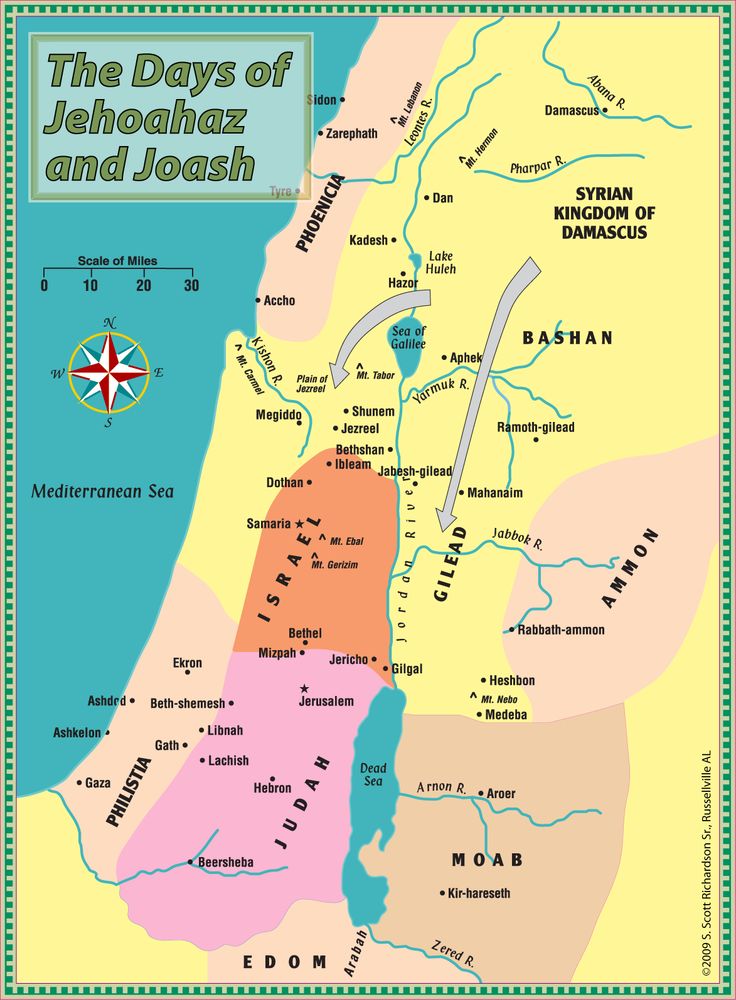
But now, God was going to use the Syrians to punish the rebellious and unrepentant nation of Judah. King Hazael took his campaign of terror further south, moving along the coast of the Mediterranean, and eventually capturing the city of Gath, deep within Judean territory. Then he set his sights on Jerusalem. In the spring of the year, Hazael and his army attacked the capital city, “and destroyed all the princes of the people from among the people and sent all their spoil to the king of Damascus” (2 Chronicles 24:23 ESV). The chronicler goes on to reveal that this victory was God-ordained.

Though the army of the Syrians had come with few men, the LORD delivered into their hand a very great army, because Judah had forsaken the LORD, the God of their fathers. Thus they executed judgment on Joash. – 2 Chronicles 24:24 ESV

The attack left Jehoash wounded, and, in desperation, the king decided to do whatever he had to do to keep Hazael from capturing the city. So, he stripped bare the Temple treasury, sending all the sacred items and the gold to Hazael as a form of ransom.

Jehoash king of Judah took all the sacred gifts that Jehoshaphat and Jehoram and Ahaziah his fathers, the kings of Judah, had dedicated, and his own sacred gifts, and all the gold that was found in the treasuries of the house of the LORD and of the king’s house, and sent these to Hazael king of Syria. Then Hazael went away from Jerusalem. – 2 Kings 12:18 ESV

This king, who had been raised by the priest of God in the house of God, sold out Yahweh. In the face of the Syrian assault, Jehoash resorted to paying off his attackers, stripping the Temple of all its holy treasures and priceless valuables. Rather than turning to Yahweh for help, Jehoash took what had been consecrated to God and used it to buy off the enemy, and his plan seemed to work.

Hazael took the treasure and left, but Jehoash’s troubles were far from over. Still suffering from the wounds he had received in the attack on Jerusalem, Jehoash was in a vulnerable state. His treasury was bankrupt, and he was a physically broken man. It seems that some of his officials recognized that Judah’s recent defeat at the hands of the Syrians had something to do with Jehoash’s decision to kill Zechariah. The curse uttered by the dying prophet had come true. So, they decided to eliminate the cause of all their troubles.

…his own officials plotted to kill him for murdering the son of Jehoiada the priest. They assassinated him as he lay in bed. – 2 Chronicles 24:25 NLT

The author of 2 Kings even provides the names of the two conspirators.

The assassins were Jozacar son of Shimeath and Jehozabad son of Shomer—both trusted advisers. – 2 Kings 12:21 NLT

These men would have had easy access to the king because he trusted them. They had become replacements for Jehoiada, providing the king with counsel and acting as his mentors. But unlike the former priest, these men had no love for Jehoash. They viewed him as a plague upon the nation and determined that his removal might placate God and prevent further judgment. Yet, it’s important to understand that their actions were ordained by God. It’s interesting to note that these two men were actually foreigners. One was the son of an Ammonite woman, and the other was the son of a Moabite woman. This reference to their birth mothers is significant because it links the events in this chapter all the way back to the Book of Genesis.

Genesis 19 contains the account of God’s rescue of Lot and his daughters from the wicked city of Sodom. Lot, the nephew of Abraham, had decided to settle in the fertile valleys of the Jordan, but it wasn’t long before he “moved his tent as far as Sodom” (Genesis 13:12 ESV). This proved to be a poor decision, because “the men of Sodom were wicked, great sinners against the LORD” (Genesis 13:12 ESV). Eventually, Lot relocated his family inside the walls of the city of Sodom. When God determined to destroy Sodom and its neighboring city of Gomorrah for the wickedness of their inhabitants, Abraham convinced God to spare Lot and his daughters. But once they were rescued by the angels of God, Lot’s daughters displayed the negative influence of their time spent in Sodom. Fearful that they would never find husbands, they came up with a plan to get their father drunk and commit incest with him, all under the guise of prolonging their father’s lineage. Their mother was dead, and their father had no sons. So, in their minds, this was the only way of preserving the family line. But their sinful decision produced a less-than-ideal outcome.

…both of Lot’s daughters became pregnant by their own father. When the older daughter gave birth to a son, she named him Moab. He became the ancestor of the nation now known as the Moabites. When the younger daughter gave birth to a son, she named him Ben-ammi. He became the ancestor of the nation now known as the Ammonites. – Genesis 19:36 NLT

The descendants of these two young ladies became the Ammonites and Moabites. These distant relatives of the Israelites were pagan nations that worshiped false gods. It’s no coincidence that the men who plotted and carried out the assassination of Jehoash had ties to these two nations. God had used the Syrians to inflict judgment upon Judah. Now, He used an Ammonite and a Moabite to bring death to the rebellious and unrepentant Jehoash.

God had preserved and protected Jehoash, allowing him to find sanctuary in the Temple and receive instruction from Jehoiada the priest. But when his godly mentor died, Jehoash was exposed for what he really was — just another king who refused to acknowledge Yahweh as the one true Sovereign. Jehoash had started out so well but ended poorly, choosing to forsake God and listen to the advice of men. Rather than heed the warnings of God’s prophet, Jehoash put him to death. Instead of placing his trust in Yahweh, Jehoash attempted to buy his way out of trouble, using the treasury of God in a failed attempt to escape the judgment of God. And he died trying.

Joash was buried with his ancestors in the City of David. Then his son Amaziah became the next king. – 2 Kings 12:21 NLT

Another king had come to power and disappeared from the scene because he refused to honor the One who had placed him on the throne to begin with. Yahweh had graciously preserved the nation of Judah, providing ample evidence of His patience and love. He would later juxtapose His faithfulness against the backdrop of Judah’s ongoing apostasy, and, interestingly enough, He would accuse them of having robbed Him.

“For I the LORD do not change; therefore you, O children of Jacob, are not consumed. From the days of your fathers you have turned aside from my statutes and have not kept them. Return to me, and I will return to you, says the LORD of hosts. But you say, ‘How shall we return?’ Will man rob God? Yet you are robbing me. But you say, ‘How have we robbed you?’ In your tithes and contributions. You are cursed with a curse, for you are robbing me, the whole nation of you. Bring the full tithe into the storehouse, that there may be food in my house. And thereby put me to the test, says the LORD of hosts, if I will not open the windows of heaven for you and pour down for you a blessing until there is no more need. I will rebuke the devourer for you, so that it will not destroy the fruits of your soil, and your vine in the field shall not fail to bear, says the LORD of hosts. Then all nations will call you blessed, for you will be a land of delight, says the LORD of hosts. – Malachi 3:6-12 NLT

The people of Judah had robbed God of what was rightfully His: their divinely ordained contributions and tithes, which were intended to be expressions of their love for and dependence upon Him. What little they had given was consecrated to Yahweh and was to be used as He prescribed. But Jehoash had taken these dedicated gifts and handed them over to the king of a pagan nation in a vain attempt to protect his kingdom from the judgment of Yahweh. In doing so, Jehoash sealed his own fate. Had he turned to God rather than stealing from God, Jehoash would have enjoyed an outpouring of blessings. But instead, Jehoash died a violent death at the hands of an Ammonite and Moabite and was buried “with his fathers in the city of David” (2 Kings 12:21 ESV).

English Standard Version (ESV) The Holy Bible, English Standard Version. ESV® Permanent Text Edition® (2016). Copyright © 2001 by Crossway Bibles, a publishing ministry of Good News Publishers.

New Living Translation (NLT) Holy Bible, New Living Translation, copyright © 1996, 2004, 2015 by Tyndale House Foundation. Used by permission of Tyndale House Publishers Inc., Carol Stream, Illinois 60188. All rights reserved.

The Miracle-Producing Power of One Man’s Faith

15 “But now bring me a musician.” And when the musician played, the hand of the LORD came upon him. 16 And he said, “Thus says the LORD, ‘I will make this dry streambed full of pools.’ 17 For thus says the LORD, ‘You shall not see wind or rain, but that streambed shall be filled with water, so that you shall drink, you, your livestock, and your animals.’ 18 This is a light thing in the sight of the LORD. He will also give the Moabites into your hand, 19 and you shall attack every fortified city and every choice city, and shall fell every good tree and stop up all springs of water and ruin every good piece of land with stones.” 20 The next morning, about the time of offering the sacrifice, behold, water came from the direction of Edom, till the country was filled with water.

21 When all the Moabites heard that the kings had come up to fight against them, all who were able to put on armor, from the youngest to the oldest, were called out and were drawn up at the border. 22 And when they rose early in the morning and the sun shone on the water, the Moabites saw the water opposite them as red as blood. 23 And they said, “This is blood; the kings have surely fought together and struck one another down. Now then, Moab, to the spoil!” 24 But when they came to the camp of Israel, the Israelites rose and struck the Moabites, till they fled before them. And they went forward, striking the Moabites as they went.  25 And they overthrew the cities, and on every good piece of land every man threw a stone until it was covered. They stopped every spring of water and felled all the good trees, till only its stones were left in Kir-hareseth, and the slingers surrounded and attacked it. 26 When the king of Moab saw that the battle was going against him, he took with him 700 swordsmen to break through, opposite the king of Edom, but they could not. 27 Then he took his oldest son who was to reign in his place and offered him for a burnt offering on the wall. And there came great wrath against Israel. And they withdrew from him and returned to their own land.  – 2 Kings 3:15-27 ESV

Verse 15 opens with the combined armies of Israel and Judah bogged down in the wilderness of Edom. Jehoram and Jehoshaphat had joined forces to attack the kingdom of Moab, but somewhere along the way, their campaign had come to an abrupt halt due to a lack of water. There, in the desert-like conditions just south of the Dead Sea, they were forced to seek the aid of Elisha, the prophet of God. While Elisha was reluctant to assist the apostate king of Israel, he agreed to help due to his respect for Jehoshaphat. When Jehoram had taken stock of their precarious circumstance, he had panicked, declaring that Yahweh was out to destroy them. But rather than assuming the worst, Jehoshaphat, the king of Judah, recommended that they seek counsel from the prophet of God.

After having agreed to come to their aid, the first thing Elisha did was call for a musician. No explanation is given for this request, but it seems evident that the music was intended to create a soothing atmosphere, conducive to hearing from God. Much to Jehoram’s surprise, the message Elisha received from Yahweh was positive, not negative.

“This is what the LORD says: This dry valley will be filled with pools of water! You will see neither wind nor rain, says the LORD, but this valley will be filled with water. You will have plenty for yourselves and your cattle and other animals.” – 2 Kings 3:16-17 NLT

God was going to do a miracle. Elisha announced that God would fill the dry valley with water, but they would never see a cloud or watch a single raindrop fall from the sky. Where once there had been nothing but sand as far as the eye could see, there would be refreshing pools of water – enough to satisfy the thirst of every soldier, horse, and pack animal. But, according to Elisha, that would be nothing compared to the real miracle God was about to perform.

“But this is only a simple thing for the LORD, for he will make you victorious over the army of Moab! You will conquer the best of their towns, even the fortified ones. You will cut down all their good trees, stop up all their springs, and ruin all their good land with stones.” – 2 Kings 3:18-19 NLT

Turning a desert into a refreshing oasis filled with fresh drinking water was nothing for God. His capacity to do the impossible is well-documented throughout Scripture, and His assertion of His

“I am the LORD, the God of all the peoples of the world. Is anything too hard for me?” – Jeremiah 32:27 NLT

“From eternity to eternity I am God.
    No one can snatch anyone out of my hand.
    No one can undo what I have done.” – Isaiah 43:13 NLT

“Is anything too difficult for the LORD?“ – Genesis 18:13 NLT

During the days of Moses, when the Israelites ran out of water in the wilderness, God produced water from a rock. Here, in the desert-like conditions of the Dead Sea, He would produce water without clouds or rain. But the real miracle would come in the form of His gracious intervention in the battle against the Moabites. He was going to turn their apparent failure into victory.

Yahweh had no love affair with the Moabites; they had been a constant problem for the people of Israel for centuries. It had all begun when the Israelites were preparing to enter the land of Canaan under the leadership of Moses. The king of Moab had watched as the Israelites easily defeated the Ammonites, and he was afraid that they would face the same fate. So, he hired the services of Balaam, a local seer, instructing him to curse the Israelites.

“Look, a vast horde of people has arrived from Egypt. They cover the face of the earth and are threatening me. Please come and curse these people for me because they are too powerful for me. Then perhaps I will be able to conquer them and drive them from the land. I know that blessings fall on any people you bless, and curses fall on people you curse.” – Numbers 22:5-6 NLT

But God repeatedly thwarted Balaam’s efforts to curse the people of Israel. So, Balaam ultimately came up with an alternative solution. He advised Balak, the king of Moab, to encourage his women to seduce the men of Israel. His ploy was to use intermarriage between the two nations to promote an alliance, and his strategy was effective.

While the Israelites were camped at Acacia Grove, some of the men defiled themselves by having sexual relations with local Moabite women. These women invited them to attend sacrifices to their gods, so the Israelites feasted with them and worshiped the gods of Moab. In this way, Israel joined in the worship of Baal of Peor, causing the LORD’s anger to blaze against his people. – Numbers 25:1-3 NLT

God ended up judging those Israelites who violated His prohibition against intermarrying with the pagan nations in Canaan, and He placed a permanent curse on the Ammonites and Moabites.

“No Ammonite or Moabite or any of their descendants for ten generations may be admitted to the assembly of the LORD.… As long as you live, you must never promote the welfare and prosperity of the Ammonites or Moabites.” – Deuteronomy 23:3, 6 NLT

Despite Jehoram’s apostasy and Jehoshaphat’s unwise alliance with the idolatrous Israelite king, God would provide them with a miraculous and decisive victory over the Moabites. He would snatch victory out of the hands of defeat and, in doing so, allow these two prideful and self-possessed kings to reap a reward they didn’t deserve.

The next morning, water began to flow into the camp. Somewhere, out of sight, rain must have fallen that turned into rivers of water that flowed all the way to the wilderness of Edom. The armies of Israel and Judah woke up to the sight of pools of freshwater as far as the eye could see. But the Moabites, who were encamped along their southern border, woke up to see what they believed to be pools of blood. The rising sun reflected off the water, appearing blood red, and they immediately assumed that the armies of Israel, Judah, and Edom had turned on one another, and a bloodbath had ensued. But when they went to investigate what had happened, rather than dead bodies, they encountered a well-rested and fully rejuvenated army.

The battle quickly turned into a rout, with the armies of Israel, Judah, and Edom chasing “them into the land of Moab, destroying everything as they went. They destroyed the towns, covered their good land with stones, stopped up all the springs, and cut down all the good trees” (2 Kings 3:24-25 NLT).

In a last desperate attempt to turn the tide of the battle, the king of Moab took his son, the heir to his throne, and offered him up as a living sacrifice to his false god. His costly offering seemed to have had its intended effect, providing the demoralized Moabite troops with the inspiration they needed to hold off the Israelites and their allies. The author simply states, “there came great wrath against Israel” (2 Kings 3:27 ESV). Evidently, the Moabites rallied behind their king and were able to drive off the invaders.

God had put the Moabites in their place. What King Mesha had failed to realize was that, when he had dared to stand opposed to Jehoram, he had actually been picking a fight with Yahweh. While the Lord did not approve of Jehoram’s lifestyle or leadership as the king of Israel, God was going to defend His covenant people. This victory clearly demonstrated God’s faithfulness and His unwavering commitment to protect His people, whether they deserved it or not. The drought-like conditions of the Dead Sea proved to be no problem for God. Even the spiritual drought of His own chosen people could not prevent Him from keeping His covenant promises. He poured out a victory on His undeserving people, graciously preventing them from experiencing the defeat at the hands of their enemy.

This unlikely victory began when Jehoshaphat, the king of Judah, recommended that they seek the counsel of a prophet of Yahweh.

King Jehoshaphat of Judah asked, “Is there no prophet of the LORD with us? If there is, we can ask the LORD what to do through him.”

One of King Joram’s officers replied, “Elisha son of Shaphat is here. He used to be Elijah’s personal assistant.”

Jehoshaphat said, “Yes, the LORD speaks through him.” So the king of Israel, King Jehoshaphat of Judah, and the king of Edom went to consult with Elisha. – 2 Kings 3:11-12 NLT

One man’s faithfulness resulted in two acts of deliverance from the hands of Yahweh. He believed in the Lord, and his trust was not disappointed.

English Standard Version (ESV) The Holy Bible, English Standard Version. ESV® Permanent Text Edition® (2016). Copyright © 2001 by Crossway Bibles, a publishing ministry of Good News Publishers.

New Living Translation (NLT) Holy Bible, New Living Translation, copyright © 1996, 2004, 2015 by Tyndale House Foundation. Used by permission of Tyndale House Publishers Inc., Carol Stream, Illinois 60188. All rights reserved.

God of the Impossible

9 Then I came to the governors of the province Beyond the River and gave them the king’s letters. Now the king had sent with me officers of the army and horsemen. 10 But when Sanballat the Horonite and Tobiah the Ammonite servant heard this, it displeased them greatly that someone had come to seek the welfare of the people of Israel.

11 So I went to Jerusalem and was there three days. 12 Then I arose in the night, I and a few men with me. And I told no one what my God had put into my heart to do for Jerusalem. There was no animal with me but the one on which I rode. 13 I went out by night by the Valley Gate to the Dragon Spring and to the Dung Gate, and I inspected the walls of Jerusalem that were broken down and its gates that had been destroyed by fire. 14 Then I went on to the Fountain Gate and to the King’s Pool, but there was no room for the animal that was under me to pass. 15 Then I went up in the night by the valley and inspected the wall, and I turned back and entered by the Valley Gate, and so returned. 16 And the officials did not know where I had gone or what I was doing, and I had not yet told the Jews, the priests, the nobles, the officials, and the rest who were to do the work.

17 Then I said to them, “You see the trouble we are in, how Jerusalem lies in ruins with its gates burned. Come, let us build the wall of Jerusalem, that we may no longer suffer derision.” 18 And I told them of the hand of my God that had been upon me for good, and also of the words that the king had spoken to me. And they said, “Let us rise up and build.” So they strengthened their hands for the good work. 19 But when Sanballat the Horonite and Tobiah the Ammonite servant and Geshem the Arab heard of it, they jeered at us and despised us and said, “What is this thing that you are doing? Are you rebelling against the king?” 20 Then I replied to them, “The God of heaven will make us prosper, and we his servants will arise and build, but you have no portion or right or claim in Jerusalem.” – Nehemiah 2:9-20 ESV

The time came for Nehemiah to leave behind his comfortable life in Persia and begin the 800-mile journey to Jerusalem. Nehemiah was accompanied by a contingent of royal guards who provided protection for the traveling party, which appears to have been small in number. Once they crossed the Euphrates River and entered “the province Beyond the River” (Nehemiah 2:7), Nehemiah presented the governors of the region with the letters of safe passage Artaxerxes provided.

Once Nehemiah arrived in Jerusalem, two local officials, Sanballat the Horonite and Tobiah the Ammonite, disclosed their displeasure.

…they were very displeased that someone had come to help the people of Israel. – Nehemiah 2:10 NLT

When these two men became aware of Nehemiah’s intentions to rebuild the walls of Jerusalem, they couldn’t hide their anger. As Nehemiah’s building plans progressed, they would be joined by a third governor, Geshem the Arab, who assisted them in mocking the Jews.

But when Sanballat, Tobiah, and Geshem the Arab heard of our plan, they scoffed contemptuously. “What are you doing? Are you rebelling against the king?” they asked. – Nehemiah 2:19 NLT

These disgruntled governors were hoping to demoralize the Jews by accusing them of insurrection. They were hoping to turn the local Jewish population against Nehemiah by questioning the wisdom of his actions. If they could raise doubt concerning the viability of Nehemiah’s plans, he would lose his labor force. This intense pressure to intimidate and discourage the Jews was relentless. Chapter Four reveals that Sanballat and his fellow governors continued to ridicule Nehemiah and his grandiose plans.

Sanballat was very angry when he learned that we were rebuilding the wall. He flew into a rage and mocked the Jews, saying in front of his friends and the Samarian army officers, “What does this bunch of poor, feeble Jews think they’re doing? Do they think they can build the wall in a single day by just offering a few sacrifices? Do they actually think they can make something of stones from a rubbish heap—and charred ones at that?” – Nehemiah 4:1-2 NLT

Tobiah joined in the sarcasm-laced rhetoric, stating, “That stone wall would collapse if even a fox walked along the top of it!” (Nehemiah 4:3 NLT). When their words failed to dissuade the Jews, they would begin to consider violence as their only other option.

…when Sanballat and Tobiah and the Arabs, Ammonites, and Ashdodites heard that the work was going ahead and that the gaps in the wall of Jerusalem were being repaired, they were furious. They all made plans to come and fight against Jerusalem and throw us into confusion. – Nehemiah 4:7-8 NLT

But just three days after his arrival, Nehemiah and a few companions made a late-night inspection tour of the city’s walls. He had not yet disclosed his plans to anyone, including the local Jewish leaders, so this excursion was a fact-finding mission designed to determine the scope of the project. As he carefully navigated the rubble-strewn passage around the long-fallen walls, he could have become discouraged at the extent of the damage. At one point, the debris field was so dense that his donkey was unable to pass through. But despite the abysmal condition of the walls, Nehemiah did not lose heart. Upon completing his inspection, he gathered “the priests, the nobles, the officials, or anyone else in the administration” (Nehemiah 2:16 NLT) and presented them with an unexpected and unprecedented challenge.

“You know very well what trouble we are in. Jerusalem lies in ruins, and its gates have been destroyed by fire. Let us rebuild the wall of Jerusalem and end this disgrace!” – Nehemiah 2:17 NLT

For these men, Nehemiah’s words must have sounded like madness. What Nehemiah was suggesting was impossible. Had the darkness prevented him from seeing the full extent of the situation? Did he really believe he could do what no one else had done for nearly 150 years? The walls of Jerusalem had lain in ruins since 586 B.C. when Nebuchadnezzar’s forces leveled them as part of their long-standing siege and eventual takeover of the city.

…on January 15, during the ninth year of Zedekiah’s reign, King Nebuchadnezzar of Babylon led his entire army against Jerusalem. They surrounded the city and built siege ramps against its walls. Jerusalem was kept under siege until the eleventh year of King Zedekiah’s reign. – 2 Kings 25:1-2 NLT

On August 14 of that year, which was the nineteenth year of King Nebuchadnezzar’s reign, Nebuzaradan, the captain of the guard and an official of the Babylonian king, arrived in Jerusalem. He burned down the Temple of the Lord, the royal palace, and all the houses of Jerusalem. He destroyed all the important buildings in the city. Then he supervised the entire Babylonian army as they tore down the walls of Jerusalem on every side. – 2 Kings 25:8-10 NLT

It had been 142 years since the walls fell and during that time, no attempt had been made to rebuild them. It was a project of such epic proportions that no one ever dared to take it on – until Nehemiah showed up on the scene.

This newcomer brought with him a renewed sense of hope and expectation. He told the people about his plans but made sure to disclose God’s role in it all. He wanted them to know that he was on a mission sanctioned by Yahweh Himself. The sovereign LORD had even moved the heart of King Artaxerxes to put the full weight of his royal authority behind the project. Nehemiah’s words had an immediate impact on his audience, causing them to declare, “Let us rise up and build” (Nehemiah 2:18 ESV). They were pumped and ready to begin. Nehemiah’s pep talk had left them so enthused that they conveniently overlooked the sheer size of the project and the relentless determination of their enemies.

But as verse 19 reveals, the enthusiastic Jews were soon reminded that their efforts would not come without opposition. Sanballat, Tobiah, and Geshem launched an immediate public relationship campaign designed to discourage and dissuade the Jews from accomplishing their God-ordained task. Yet, Nehemiah countered their attacks with a reminder of God’s presence and power.

“The God of heaven will help us succeed. We, his servants, will start rebuilding this wall. But you have no share, legal right, or historic claim in Jerusalem.” – Nehemiah 2:20 NLT

Nehemiah saw Sanballat, Tobiah, and Geshem as what they were – enemies of God who had no right to question God’s people and no claim on the land that He had given to the Israelites as their inheritance. These men weren’t just opposing the efforts of Nehemiah and his fellow Jews, they were directly violating the will of God Almighty.

Sanballat was probably a Moabite from Horonaim, a city of Moab. Tobiah was an Ammonite. Geshem was an Arab who governed over the region south of Judah. It is interesting to note that these three men represent three distinct people groups that had a love-hate relationship with Israel. The Moabites were descendants of Moab, the son born to Lot as a result of his incestuous relationship with his eldest daughter (Genesis 19:37). The Ammonites were descendants of Ben-ammi, the son born to Lot through his incestuous relationship with his younger daughter (Genesis 19:38). The “Arabs” mentioned in this passage is likely a reference to the Edomites who controlled an area east of the Arabah, from the Zered to the Gulf of Aqaba. They were the descendants of Esau, the twin brother of Jacob. So each of these nations was made up of people who were blood relatives of the Jews but they were not heirs of the promise God made to Abraham, Isaac, and Jacob.

As Nehemiah makes clear, they had “no portion or right or claim in Jerusalem” (Nehemiah 2:20 ESV). These nations had long ago compromised their spiritual standards and comingled with the pagan nations that lived in and around Canaan. They were idolatrous and polytheistic. During Israel’s 70-year exile in Babylon, each of these groups had taken advantage of the situation by claiming Israelite land as their own, and for the last 142 years, they had done everything in their power to oppose the Israelite’s repatriation of the land.

But Nehemiah had come to set things straight. The walls would be rebuilt and the security of Jerusalem would be restored. Despite the odds, Nehemiah knew they had Yahweh on their side.

“The God of heaven will make us prosper, and we his servants will arise and build…” – Nememiah 2:20 ESV

English Standard Version (ESV)
The Holy Bible, English Standard Version. ESV® Permanent Text Edition® (2016). Copyright © 2001 by Crossway Bibles, a publishing ministry of Good News Publishers.

New Living Translation (NLT)
Holy Bible, New Living Translation, copyright © 1996, 2004, 2015 by Tyndale House Foundation. Used by permission of Tyndale House Publishers Inc., Carol Stream, Illinois 60188. All rights reserved.

The Message (MSG)Copyright © 1993, 1994, 1995, 1996, 2000, 2001, 2002 by Eugene H. Peterson

Distracted by Earthly Things

1 In the spring of the year, the time when kings go out to battle, Joab led out the army and ravaged the country of the Ammonites and came and besieged Rabbah. But David remained at Jerusalem. And Joab struck down Rabbah and overthrew it. 2 And David took the crown of their king from his head. He found that it weighed a talent of gold, and in it was a precious stone. And it was placed on David’s head. And he brought out the spoil of the city, a very great amount. 3 And he brought out the people who were in it and set them to labor with saws and iron picks and axes. And thus David did to all the cities of the Ammonites. Then David and all the people returned to Jerusalem.

4 And after this there arose war with the Philistines at Gezer. Then Sibbecai the Hushathite struck down Sippai, who was one of the descendants of the giants, and the Philistines were subdued. 5 And there was again war with the Philistines, and Elhanan the son of Jair struck down Lahmi the brother of Goliath the Gittite, the shaft of whose spear was like a weaver’s beam. 6 And there was again war at Gath, where there was a man of great stature, who had six fingers on each hand and six toes on each foot, twenty-four in number, and he also was descended from the giants. 7 And when he taunted Israel, Jonathan the son of Shimea, David’s brother, struck him down. 8 These were descended from the giants in Gath, and they fell by the hand of David and by the hand of his servants. – 1 Chronicles 20:1-8 ESV

First Chronicles 20 parallels 2 Samuel 11, where the story of David’s sin with Bathsheba is recorded in great detail. Interestingly, both chapters start out the same way, “The following spring, the time of year when kings go to war…,” but then they each take a slightly different path. The 2 Samuel passage goes on to say, “…David sent Joab and the Israelite army to destroy the Ammonites. In the process they laid siege to the city of Rabbah. But David stayed behind in Jerusalem” (2 Samuel 11:1 ESV).

Chapter 20 of 1 Chronicles states that “…Joab led the Israelite army in successful attacks against the towns and villages of the Ammonites.” But in both cases, the authors clarify that David didn’t go into battle, but remained in Jerusalem. At a time of the year when kings would normally be waging war, David chose to send his troops into battle while he stayed safely ensconced in his capital city. He sent Joab to do his dirty business, while he stayed behind in Jerusalem. This decision led to his sin with Bathsheba and, ultimately, his murder of her husband Uriah.

But in 1 Chronicles, the author leaves out what happened while David was back in the capital and concentrates his attention on the victory over the Ammonites. If you just read this chapter alone, and not in association with chapter 11 of Second Samuel, you would be led to believe that this was just business as usual for David. He was sending out his troops and then going to meet them after the battle was over like all good kings do. But when you know what David was up to while Joab and his men were busy fighting for David and the kingdom, this story takes on a whole new light. And when you read that “David and his army returned to Jerusalem,” it should kind of turn your stomach a little bit. Here is David, who has just committed adultery with Bathsheba, attempted to cover it up, and in desperation, had her husband killed by abandoning him in battle, leading his troops triumphantly back into town to the cheers of the people, as if he had been there all along. He is enjoying the accolades and attention that come with victory when his life was actually marred by his moral lapse with Bathsheba. It is the height of hypocrisy.

What stands out in this passage if that there is no mention of David fighting the enemy. Joab, Sibbecai, Elhannon, and Jonathan are all listed as men who led, fought, and gained victory over the Ammonites. But David seems to take all the credit and more. “Then David went to Rabbah and removed the crown from the king’s head, and it was placed on his own head. The crown was made of gold and set with gems, and he found that it weighed seventy-five pounds” (1 Chronicles, 20:2 NLT). When taken in conjunction with 2 Samuel 11, this paints an even grimmer picture of David. Not only has he committed adultery and murder, but he comes across as someone desperate for attention. He wants to stay at home in the safety and luxury of his palace in Jerusalem, but bask in the glory of the victory that others have brought about. He covets the benefits and blessings of victory without the risk.

In the second half of chapter 20, the chronicler goes on to describe the Israelite victory over the Philistines, but David is noticeably absent from the story until the closing verse.

…they fell by the hand of David and by the hand of his servants. – 1 Chronicles 20:8 ESV

David gets the glory without doing any of the work. But why does the Chronicler seem to stress David’s victories but leave out the entire story about David and his illicit affair with Bathsheba? It’s unlikely that the chronicler was attempting to cover up David’s infamous sin because it would have been well-known to all of his readers. More than likely, he omitted the details of this less-than-flattering event in David’s life because his purpose for the chapter was to highlight David’s victories over his enemies at the beginning of his reign. But that one phrase, “In the spring of the year, the time when kings go out to battle” stands out. It tells us that Joab, the commander of David’s army, led the troops into battle while “David remained at Jerusalem” (1 Chronicles 20:1 ESV). While David should have been busy defeating the enemies of God, he was falling victim to “sexual immorality, impurity, passion, evil desire, and covetousness” (Colossians 3:5 ESV). David had been God-ordained to be the king of Israel and lead the people of Israel.

“You shall be shepherd of my people Israel, and you shall be prince over Israel.” – 2 Samuel 5:2 ESV

But in the story of his affair with Bathsheba, we have a case of David losing sight of his real objective. He became distracted from God’s intended purpose for his life. While David would experience great victories in the years ahead, he would also suffer tremendous losses within his own household as a consequence of his sin.

The chronicler obviously knew well the sin of David with Bathsheba, but his real objective was to write of God’s activity among His people through the kingship of David. Despite David, God was still at work, providing the nation of Israel with victories over their enemies. He was still giving them His divine assistance in conquering the nations that occupied the land of Canaan. His efforts would be so effective that by the time David’s son Solomon took over the throne, his kingdom would experience a time of unparalleled peace and prosperity. But even with all his wisdom, riches, and obvious blessings from God, Solomon would prove to be unfaithful, allowing his love of women to lead to his worship of false gods. He would lose sight of the fact that God had given him wisdom so that he might lead the nation of Israel wisely. God blessed him with abundant resources that he might provide for the people of God.

Both of these men had been chosen by God to lead His people and they were not to be like all the other kings of the world. They were never to forget that they had the God of the universe on their side and that their actions and attitudes were to reflect their unique relationship with Him. God wanted to bless their reigns and provide them with victories over their enemies and peace and prosperity for their people. God would provide both men with the assurance of His abiding presence and power.

David and Solomon both illustrate man’s unique capacity to focus on that which is earthly and temporal. In Colossians 3, Paul provides a short, but relatively comprehensive list of what constitutes an earthly, rather than a heavenly mindset: “sexual immorality, impurity, passion, evil desire, and covetousness” (Colossians 3:5 ESV).

In his letter to the Galatians, Paul provided an even longer list of what he calls the “works of the flesh”: sexual immorality, impurity, sensuality, idolatry, sorcery, enmity, strife, jealousy, fits of anger, rivalries, dissensions, division, envy, drunkenness, orgies, and things like these (Galatians 5:19-21 ESV).

Together, these two lists serve as a compendium of a life lived with an earthly, rather than a heavenly focus. Paul goes on to tell his readers to put to death what is earthly in them. These are internal issues that emanate from within. Jesus Himself said, “For out of the heart come evil thoughts, murder, adultery, sexual immorality, theft, false witness, slander” (Matthew 15:19 ESV).

David’s sin with Bathsheba was an outflow of an internal problem in David’s heart. Solomon’s idolatry and unfaithfulness were the direct result of his own heart condition. James points out the danger of this internal source of temptation and distraction.

But each person is tempted when he is lured and enticed by his own desire. – James 1:14 ESV

But Paul gives the antidote to the problem. 

…set your sights on the realities of heaven, where Christ sits in the place of honor at God’s right hand. Think about the things of heaven, not the things of earth. – Colossians 3:1 NLT

Our focus, interest, and primary concern is to be on eternal, rather than temporal things. We are to desire the things of God instead of the things of this world. Paul reminds us that, because of our relationship with Jesus Christ, we are equipped to live differently and distinctively.

…you have stripped off your old sinful nature and all its wicked deeds. Put on your new nature, and be renewed as you learn to know your Creator and become like him. – Colossians 3:9 NLT

The tense he uses in this sentence suggests that this is a past event; it has already taken place. We have been given a new life in Christ. We are new creations.

Therefore, if anyone is in Christ, he is a new creation. The old has passed away; behold, the new has come. – 2 Corinthians 5:17 ESV

Paul’s emphasis seems to be that we are to recognize our new identity as redeemed, renewed creations and live accordingly. In other words, our conduct should begin to reflect our new status as children of God. We are “being renewed” daily – an ongoing process by which we are being transformed into the likeness of Christ. Paul would have us remember that our job is to live in keeping with who we are in Christ.

Put on then, as God’s chosen ones, holy and beloved, compassionate hearts, kindness, humility, meekness, and patience, bearing with one another and, if anyone has a complaint against another, forgiving each other. – Colossians 3:12-13 ESV

My relationship with Christ should transform every area of my life.

In whatever you do, in word or deed, do everything in the name of the Lord Jesus. – Colossians 3:17 ESV

I am to live with a heavenly mindset, not an earthly one. I am to live a life that reflects my new identity in Christ and my new Spirit-empowered capacity to reflect His holiness and righteousness. I don’t have to live according to my old sinful nature. Yes, it is still there and is alive and well but God has given me a new nature that can effectively counteract my old nature. Paul puts it this way:

…walk by the Spirit, and you will not gratify the desires of the flesh. – Galatians 5:16 ESV

I can live by the Spirit and walk by the Spirit. I can bear the fruit of the Spirit. But I must set my mind on the things above. I must seek God’s will and saturate my mind with His Word. I cannot live like Christ if I attempt to exist on a steady diet of earthly things. If I fill my mind with the things of this world, I will bear the fruit of this world. So Paul encourages us to “let the word of Christ dwell in you richly, teaching and admonishing one another in all wisdom, singing psalms and hymns and spiritual songs, with thankfulness in your hearts to God” (Colossians 3:16 ESV).

English Standard Version (ESV)
The Holy Bible, English Standard Version. ESV® Permanent Text Edition® (2016). Copyright © 2001 by Crossway Bibles, a publishing ministry of Good News Publishers.

New Living Translation (NLT)
Holy Bible, New Living Translation, copyright © 1996, 2004, 2015 by Tyndale House Foundation. Used by permission of Tyndale House Publishers Inc., Carol Stream, Illinois 60188. All rights reserved.

The Danger of Distraction from Duty

1 Now after this Nahash the king of the Ammonites died, and his son reigned in his place. 2 And David said, “I will deal kindly with Hanun the son of Nahash, for his father dealt kindly with me.” So David sent messengers to console him concerning his father. And David’s servants came to the land of the Ammonites to Hanun to console him. 3 But the princes of the Ammonites said to Hanun, “Do you think, because David has sent comforters to you, that he is honoring your father? Have not his servants come to you to search and to overthrow and to spy out the land?” 4 So Hanun took David’s servants and shaved them and cut off their garments in the middle, at their hips, and sent them away; 5 and they departed. When David was told concerning the men, he sent messengers to meet them, for the men were greatly ashamed. And the king said, “Remain at Jericho until your beards have grown and then return.”

6 When the Ammonites saw that they had become a stench to David, Hanun and the Ammonites sent 1,000 talents of silver to hire chariots and horsemen from Mesopotamia, from Aram-maacah, and from Zobah. 7 They hired 32,000 chariots and the king of Maacah with his army, who came and encamped before Medeba. And the Ammonites were mustered from their cities and came to battle. 8 When David heard of it, he sent Joab and all the army of the mighty men. 9 And the Ammonites came out and drew up in battle array at the entrance of the city, and the kings who had come were by themselves in the open country.

10 When Joab saw that the battle was set against him both in front and in the rear, he chose some of the best men of Israel and arrayed them against the Syrians. 11 The rest of his men he put in the charge of Abishai his brother, and they were arrayed against the Ammonites. 12 And he said, “If the Syrians are too strong for me, then you shall help me, but if the Ammonites are too strong for you, then I will help you. 13 Be strong, and let us use our strength for our people and for the cities of our God, and may the Lord do what seems good to him.” 14 So Joab and the people who were with him drew near before the Syrians for battle, and they fled before him. 15 And when the Ammonites saw that the Syrians fled, they likewise fled before Abishai, Joab’s brother, and entered the city. Then Joab came to Jerusalem.

16 But when the Syrians saw that they had been defeated by Israel, they sent messengers and brought out the Syrians who were beyond the Euphrates, with Shophach the commander of the army of Hadadezer at their head. 17 And when it was told to David, he gathered all Israel together and crossed the Jordan and came to them and drew up his forces against them. And when David set the battle in array against the Syrians, they fought with him. 18 And the Syrians fled before Israel, and David killed of the Syrians the men of 7,000 chariots and 40,000 foot soldiers, and put to death also Shophach the commander of their army. 19 And when the servants of Hadadezer saw that they had been defeated by Israel, they made peace with David and became subject to him. So the Syrians were not willing to save the Ammonites anymore. – 1 Chronicles 19:1-19 ESV

Chapter 19 provides a glimpse into King David’s role as the defender and protector of his kingdom. One of his primary responsibilities as king was to finish what Joshua and the people of Israel had begun when they first entered the Land of Promise. God had given David victories against the Philistines, Moabites, Amalekites, Edomites, Ammonites, and Syrians. But chapter 19 describes David as having to go to war yet again because the newly crowned king of the Ammonites chose to reject David’s offer of peace.

David sent emissaries to Hanun, the new king of the Ammonites, offering his condolences over the death of Hanun’s father. But Hanun’s princes and advisors suspected that David’s representatives were spies who had been sent to gather intel about the city’s defenses. Having listened to the counsel of his skeptical advisors, Hanun chose to send King David a very different message. He ordered that the men be arrested and publicly humiliated.

So Hanun seized David’s ambassadors and shaved them, cut off their robes at the buttocks, and sent them back to David in shame. – 1 Chronicles 19:4 NLT

Upon discovering the fate of his loyal servants, David was infuriated and declared war on the Amonites. In response, Hanun sought out the services of Syrian mercenaries to assist them in their coming battle with Israel.

What is noteworthy about this entire scenario is what it reveals about David’s actions as commander-in-chief of Israel’s military forces. Most likely, this event took place early on in David’s reign. He spent the formative years of his rule dealing with the enemies that surrounded Israel and found himself constantly having to go to battle with one nation or another. David was a warrior-king who recognized that military conflict was a big part of his job description. He took to it naturally and managed Israel’s forces successfully.

But in this case, David set a dangerous precedent. In response to Hanun’s treatment of his men, David chose to send Joab to do battle with the Ammonites, while he remained behind. It is also notable that David did not seem to seek the counsel of God before implementing his payback strategy. It appears that he took Hanun’s debasing treatment of his men as a personal affront and determined to protect his own personal honor by declaring war. David did not seek the counsel of his advisors or turn to God for divine guidance. Instead, he ordered Joab to lead the Israelite forces into battle against the combined armies of the Ammonites and Syrians.

Upon his arrival on the battlefield, Job discovered that he was not only out-manned but facing a battle on two fronts. It would only be through his skillful leadership that the enemy was defeated. But even Joab recognized that any hopes of victory were up to God. Just before the battle, he told his men, “Be courageous! Let us fight bravely for our people and the cities of our God. May the Lord’s will be done. (1 Chronicles 19:13 NLT).

Joab faithfully followed David’s order and led his men into battle, but he displayed a remarkable awareness that their success was completely dependent upon God. Amazingly, all during this intense confrontation between Israel and the Ammonites, David remained safely ensconced in his royal palace in Jerusalem. He would only enter the fight after the Ammonites and Syrians were routed by Joab and the forces of Israel. When he received word that the Syrians had mustered their own army against Israel, he personally led his troops into battle, ultimately defeating the Syrians.

What is the significance of this particular military campaign? Why is it even recorded in the Scriptures? To discover the answer, one must turn to 2 Samuel 10-11. In these two chapters, the very same story about David and the Ammonites is recorded. But in chapter 11, Samuel adds the infamous story of David’s affair with Bathsheba. For some undisclosed reason, the chronicler chose not to include that dark day in David’s life. But for Samuel, the story of David and the Ammonites served as a fitting preface for the sordid tale of David and Bathsheba. According to 2 Samuel 11, David, the warrior-kin once again found himself facing armed conflict with one of Israel’s many enemies, but rather than leading his troops into battle, he chose to stay behind in Jerusalem. It seems that after his successful routing of the Ammonites and Syrians, David established a very unwise habit.

Chapter 11 will open with the seemingly innocuous words, “In the spring of the year, the time when kings go out to battle, David sent Joab, and his servants with him, and all Israel. And they ravaged the Ammonites and besieged Rabbah. But David remained at Jerusalem” (2 Samuel 11:1 ESV). Yet again, David will send Joab and his troops into battle while he remains safe behind in Jerusalem. Due to favorable weather conditions, Spring was the prime season of the year for military operations. It was in the Spring that kings led their troops into battle – but not David. He would stay behind and delegate his duties to Joab.

David’s primary responsibility as king was to secure the land and eradicate the threat posed by the pagan nations that surrounded Israel. As God’s designated sovereign, David was charged with the duty to carry out the command given to Moses and then passed on to Joshua.

“…but you shall devote them to complete destruction, the Hittites and the Amorites, the Canaanites and the Perizzites, the Hivites and the Jebusites, as the Lord your God has commanded, that they may not teach you to do according to all their abominable practices that they have done for their gods, and so you sin against the Lord your God.” – Deuteronomy 20:17-18 ESV

As long as nations were threatening the physical and spiritual well-being of Israel, David had one job to do. He was to lead Israel’s armies into battle against the enemies of God and he wasn’t to delegate that responsibility to anyone else. But David appears to have had a problem with shirking responsibility, and not just when it came to military matters. You can see it in his role as a father. Time and time again, David failed to lead his growing family well. His obsession with women had resulted in a growing household filled with countless sons and daughters. But it is one thing to bring children into the world and another thing to father and lead them well. David appears to have delegated the upbringing of his children to his many wives. But this abdication of his God-given responsibility as the head of his home would come back to haunt him.

David enjoyed victories over the Ammonites and the Syrians, in large part due to the leadership and faith of Joab. But David’s decision to remain at home while his armies went into battle was going to prove to be a bad habit that produced even worse results. When we fail to do what God has called us to do because we are distracted by the cares of this world, we may experience success in life, but the time will come when our victories turn into defeats.

In his letter to the Ephesians, Paul reminds them that their salvation had been for a purpose. They had been saved by God, not because they were good people who deserved to be saved, but because God had something for them to do.

God saved you by his grace when you believed. And you can’t take credit for this; it is a gift from God. Salvation is not a reward for the good things we have done, so none of us can boast about it. For we are God’s masterpiece. He has created us anew in Christ Jesus, so we can do the good things he planned for us long ago. – Ephesians 2:8-10 NLT

David had been hand-selected by God and given a one-of-a-kind opportunity to serve as His appointed representative. David was to be a unifier of the 12 tribes and the undisputed champion of Israel’s future success.

“I took you from the pasture, from following the sheep, to be ruler over My people Israel. I have been with you wherever you have gone and have cut off all your enemies from before you; and I will make you a great name, like the names of the great men who are on the earth.” – 2 Samuel 7:8-9 NLT

But somewhere along the way, David had become distracted with the cares of this world. He had lost sight of his priorities and allowed other, more pressing matters to interfere with his primary responsibilities.

As followers of Christ, we can be guilty of the same thing. Like David, we are here for a reason. We have a God-given job to do, and we can’t afford to shirk our responsibilities or decide to delegate our job to someone else. When we fail to do what God has called us to do, we risk His discipline. He won’t fall out of love with us, but He will allow us to experience the painful lessons that come with disobedience. The author of Hebrews reminds us to “strip off every weight that slows us down, especially the sin that so easily trips us up. And let us run with endurance the race God has set before us” (Hebrews 12:1 NLT).

We have a mission to accomplish. We have a race to run. And the author of Hebrews would have us remember that any attempt to avoid our calling with result in the loving discipline of God; a lesson that David would eventually have to learn.

…don’t make light of the LORD’s discipline, and don’t give up when he corrects you. For the LORD disciplines those he loves, and he punishes each one he accepts as his child. As you endure this divine discipline, remember that God is treating you as his own children. – Hebrews 12:5-7 NLT

The apostle Paul understood the need for believers to embrace their God-given commission. He knew that salvation was a calling to something far greater than an escape from sin and condemnation. It was a divine enlistment into the Host of Heaven and a lifelong commitment to the cause of Christ.

Endure suffering along with me, as a good soldier of Christ Jesus. Soldiers don’t get tied up in the affairs of civilian life, for then they cannot please the officer who enlisted them. And athletes cannot win the prize unless they follow the rules. And hardworking farmers should be the first to enjoy the fruit of their labor. – 2 Timothy 2:3-6 NLT

English Standard Version (ESV)
The Holy Bible, English Standard Version. ESV® Permanent Text Edition® (2016). Copyright © 2001 by Crossway Bibles, a publishing ministry of Good News Publishers.

New Living Translation (NLT)
Holy Bible, New Living Translation, copyright © 1996, 2004, 2015 by Tyndale House Foundation. Used by permission of Tyndale House Publishers Inc., Carol Stream, Illinois 60188. All rights reserved.

Fallen, Yet Forgiven

24 Then David comforted his wife, Bathsheba, and went in to her and lay with her, and she bore a son, and he called his name Solomon. And the Lord loved him 25 and sent a message by Nathan the prophet. So he called his name Jedidiah, because of the Lord.

26 Now Joab fought against Rabbah of the Ammonites and took the royal city. 27 And Joab sent messengers to David and said, “I have fought against Rabbah; moreover, I have taken the city of waters. 28 Now then gather the rest of the people together and encamp against the city and take it, lest I take the city and it be called by my name.” 29 So David gathered all the people together and went to Rabbah and fought against it and took it. 30 And he took the crown of their king from his head. The weight of it was a talent of gold, and in it was a precious stone, and it was placed on David’s head. And he brought out the spoil of the city, a very great amount. 31 And he brought out the people who were in it and set them to labor with saws and iron picks and iron axes and made them toil at the brick kilns. And thus he did to all the cities of the Ammonites. Then David and all the people returned to Jerusalem. – 2 Samuel 12:24-31 ESV

Because of his sin, David lost a son. Because of his repentance, David was given a son, and he named him Solomon (Shĕlomoh). The name David gave this second son born to him and Bathsheba is a derivative of the Hebrew word for peace – shalowm. There is little doubt that, after having received his punishment from God, David was grateful to have been restored back to a right relationship with God.

Psalm 51, written by David as a result of his sin with Bathsheba and the forgiveness he received from God, reflects his heart at this most difficult period of his life. First of all, he knew his sin.

Behold, I was brought forth in iniquity,
    and in sin did my mother conceive me.
Behold, you delight in truth in the inward being,
    and you teach me wisdom in the secret heart. – Psalm 51:5-6 ESV

But he also desired to be made right with God. He wanted to enjoy God’s presence and pleasure again.

Create in me a clean heart, O God,
    and renew a right spirit within me.
Cast me not away from your presence,
    and take not your Holy Spirit from me.
Restore to me the joy of your salvation,
    and uphold me with a willing spirit. – Psalm 51:10-12 ESV

And David pledged that if God would restore him fully, he would praise Him.

Deliver me from bloodguiltiness, O God,
    O God of my salvation,
    and my tongue will sing aloud of your righteousness.
O Lord, open my lips,
    and my mouth will declare your praise. – Psalm 51:14-15 ESV

So, with the birth of Solomon, David’s sense of restored peace with God most likely explains the name he gave to his newborn son. But he also gave his son another name, Jedidiah, which means “loved by the Lord.” Despite his earlier sins, David received a word from Nathan the prophet that assured him of God’s love for him. The name was meant to be a message from God intended to remind David that God’s love outweighed the guilt of his sin. While he had been punished for his sins, he had also been forgiven and fully restored.

David had been broken by God. He had been disciplined for his sins and brought to a point of repentance, which resulted in his restoration, and he had learned a valuable lesson that would live with him for the rest of his life.

The sacrifices of God are a broken spirit;
    a broken and contrite heart, O God, you will not despise. – Psalm 51:17 ESV

David had experienced the truth found in 1 John 1:9: “If we confess our sins, he is faithful and just to forgive us our sins and to cleanse us from all unrighteousness.”

In another one of his psalms, David penned these encouraging words:

Finally, I confessed all my sins to you
    and stopped trying to hide my guilt.
I said to myself, “I will confess my rebellion to the Lord.”
    And you forgave me! All my guilt is gone. – Psalm 32:5 NLT

The apostle Paul reminds us: “Don’t you see how wonderfully kind, tolerant, and patient God is with you? Does this mean nothing to you? Can’t you see that his kindness is intended to turn you from your sin?” (Romans 2:4 NLT). He wrote something similar to the believers in Corinth: “For the kind of sorrow God wants us to experience leads us away from sin and results in salvation. There’s no regret for that kind of sorrow. But worldly sorrow, which lacks repentance, results in spiritual death” (2 Corinthians 7:10 NLT).

God loved David so much that He was not willing to allow David to remain in his sin. He disciplined him because He loved him. He sent Nathan the prophet to confront him. He brought David to a point of brokenness because He loved him. When David confessed, God restored him. Despite all he had done, David once again enjoyed peace with God and knew that he was loved by God.

David was given a second chance. He was provided with a second son, whose name was Solomon. It should not escape our attention that the very same woman whom David wed through sinful and deceptive means was used by God to provide David with another son and the eventual heir to his throne. This son would grow up to enjoy the pleasure of God and know what it means to have the hand of God on his life.

But Bathsheba’s role in David’s life would extend well beyond the birth of Solomon. In his gospel account, Matthew records the lineage of Jesus and, in it, he includes a mention of Bathsheba.

…and Salmon the father of Boaz by Rahab, and Boaz the father of Obed by Ruth, and Obed the father of Jesse, and Jesse the father of David the king.

And David was the father of Solomon by the wife of Uriah, and Solomon the father of Rehoboam, and Rehoboam the father of Abijah… – Matthew 1:5-7 ESV

There are three women mentioned in this outline of Jesus’ family tree. Rahab, who had been a prostitute; Ruth, a pagan Moabitess; and Bathsheba, the adulterous wife of Uriah. Their inclusion in the list is intentional. God used these seemingly unfit and unqualified women to bring about the birth of His Son. Despite her immoral background, Rahab expressed belief in the God of Israel and assisted the spies who had come to examine the defenses of her hometown of Jericho. As a result, she and her family were spared when the city was destroyed. She later went on to marry an Israelite man named  Salmon to whom she bore a son named Boaz.

Boaz would go on to marry a woman named Ruth who was a Moabitess. She was a non-Hebrew who married the son of an Israelite family. In a series of unfortunate events, Ruth lost her husband, father-in-law, and brother-in-law. Their deaths left Ruth and her mother-in-law, Naomi alone and hopeless, living in the land of Moab. When Naomi shared her plans to return to the land of Israel, she encouraged her two widowed daughters-in-law to remain behind and remarry. But Ruth expressed her intention to stay by Naomi’s side and remain a faithful follower of Yahweh.

“Wherever you go, I will go; wherever you live, I will live. Your people will be my people, and your God will be my God. Wherever you die, I will die, and there I will be buried. May the Lord punish me severely if I allow anything but death to separate us!” – Ruth 1:16-17 NLT

Ruth would eventually meet and marry an Israelite named Boaz, to whom she would bear a son named Obed. He would become the father of Jesse and Jesse would eventually become the father of David. It would be through David and “the wife of Uriah” that God would provide a son named Solomon. As Matthew continued to trace the line forward, he revealed that through Solomon’s descendants would come the future King of Israel, Jesus Christ, the Son of God.

…and Jacob the father of Joseph the husband of Mary, of whom Jesus was born, who is called Christ. – Matthew 1:16 ESV

What a timely reminder that our sins cannot derail God’s plans. His providence can overcome our proclivity to sin. Even our greatest periods of unfaithfulness are always met by His faithfulness.

The rest of the chapter reflects this fact. Despite all David had done, God continued to bless David by giving him victories over his enemies. But David had learned a valuable lesson from his most recent experience. The closing verses of chapter 12 reveal that Joab was once again leading the armies of Israel in battle against their enemies, but this time David took part. When Joab had successfully besieged the capital city of the Ammonites, he sent word to David encouraging him to lead the troops in their final assault of the city. This time, David left the comfort of Jerusalem and did what kings were supposed to do, lead his troops into battle.

Joab had effectively captured the Ammonite city of Rabbah but called for David to bring the rest of the troops so that he might receive the glory of taking the city. He jokingly chided David, saying, “I have fought against Rabbah and captured its water supply. Now bring the rest of the army and capture the city. Otherwise, I will capture it and get credit for the victory” (2 Samuel 12:27-28 NLT).

David took the city and captured the king, his crown, and all the people. The text tells us, “thus he did to all the cities of the Ammonites” (2 Samuel 12:31 ESV). David had returned to his primary role as the warrior-king of Israel. He went back to doing what God had chosen him to do, and God gave him success.

David sinned and God brought discipline. As a result, David repented and God restored him. This amazing reality didn’t escape David. He would later write a psalm that reflects his understanding of and appreciation for God’s love and forgiveness:

The Lord is merciful and gracious,
    slow to anger and abounding in steadfast love.
He will not always chide,
    nor will he keep his anger forever.
He does not deal with us according to our sins,
    nor repay us according to our iniquities.
For as high as the heavens are above the earth,
    so great is his steadfast love toward those who fear him;
as far as the east is from the west,
    so far does he remove our transgressions from us. – Psalm 103:8-12 ESV

Nothing can separate us from the love of God. Even our greatest sins, when confessed and repented of, bring God’s forgiveness and complete restoration. Rabbah fell. The Ammonites were defeated. The crown was captured. The kingdom expanded. The plan of God continued undeterred. And David learned the invaluable lesson of resting in the love and faithfulness of God.

English Standard Version (ESV) The Holy Bible, English Standard Version. ESV® Permanent Text Edition® (2016). Copyright © 2001 by Crossway Bibles, a publishing ministry of Good News Publishers.

New Living Translation (NLT) Holy Bible, New Living Translation, copyright © 1996, 2004, 2015 by Tyndale House Foundation. Used by permission of Tyndale House Publishers Inc., Carol Stream, Illinois 60188. All rights reserved.

When God’s People Lose Sight of God’s Calling

1 After this the king of the Ammonites died, and Hanun his son reigned in his place. 2 And David said, “I will deal loyally with Hanun the son of Nahash, as his father dealt loyally with me.” So David sent by his servants to console him concerning his father. And David’s servants came into the land of the Ammonites.’ 3 But the princes of the Ammonites said to Hanun their lord, “Do you think, because David has sent comforters to you, that he is honoring your father? Has not David sent his servants to you to search the city and to spy it out and to overthrow it?” 4 So Hanun took David’s servants and shaved off half the beard of each and cut off their garments in the middle, at their hips, and sent them away. 5 When it was told David, he sent to meet them, for the men were greatly ashamed. And the king said, “Remain at Jericho until your beards have grown and then return.”

6 When the Ammonites saw that they had become a stench to David, the Ammonites sent and hired the Syrians of Beth-rehob, and the Syrians of Zobah, 20,000 foot soldiers, and the king of Maacah with 1,000 men, and the men of Tob, 12,000 men. 7 And when David heard of it, he sent Joab and all the host of the mighty men. 8 And the Ammonites came out and drew up in battle array at the entrance of the gate, and the Syrians of Zobah and of Rehob and the men of Tob and Maacah were by themselves in the open country.

9 When Joab saw that the battle was set against him both in front and in the rear, he chose some of the best men of Israel and arrayed them against the Syrians. 10 The rest of his men he put in the charge of Abishai his brother, and he arrayed them against the Ammonites. 11 And he said, “If the Syrians are too strong for me, then you shall help me, but if the Ammonites are too strong for you, then I will come and help you. 12 Be of good courage, and let us be courageous for our people, and for the cities of our God, and may the Lord do what seems good to him.” 13 So Joab and the people who were with him drew near to battle against the Syrians, and they fled before him. 14 And when the Ammonites saw that the Syrians fled, they likewise fled before Abishai and entered the city. Then Joab returned from fighting against the Ammonites and came to Jerusalem.

15 But when the Syrians saw that they had been defeated by Israel, they gathered themselves together. 16 And Hadadezer sent and brought out the Syrians who were beyond the Euphrates. They came to Helam, with Shobach the commander of the army of Hadadezer at their head. 17 And when it was told David, he gathered all Israel together and crossed the Jordan and came to Helam. The Syrians arrayed themselves against David and fought with him. 18 And the Syrians fled before Israel, and David killed of the Syrians the men of 700 chariots, and 40,000 horsemen, and wounded Shobach the commander of their army, so that he died there. 19 And when all the kings who were servants of Hadadezer saw that they had been defeated by Israel, they made peace with Israel and became subject to them. So the Syrians were afraid to save the Ammonites anymore. – 2 Samuel 10:1-19 ESV

Chapter 10 provides a glimpse into King David’s role as the defender and protector of his kingdom. One of his primary responsibilities as king was to finish what Joshua and the people of Israel had begun when they first entered the Land of Promise. Chapter 8 chronicled David’s victories against the Philistines, Moabites, Amalekites, Edomites, Ammonites, and Syrians. But chapter 10 describes David as having to go to war yet again because the newly crowned king of the Ammonites chose to reject David’s offer of peace.

David sent emissaries to Hanun, the new king of the Ammonites, offering his condolences over the death of Hanun’s father. But Hanun’s princes and advisors suspected that David’s representatives were spies who had been sent to gather intel about the city’s defenses. Having listened to the counsel of his skeptical advisors, Hanun chose to send King David a very different message. He ordered that the men be arrested and publicly humiliated.

So Hanun seized David’s ambassadors and shaved off half of each man’s beard, cut off their robes at the buttocks, and sent them back to David in shame. – 2 Samuel 10:4 NLT

Upon discovering the fate of his loyal servants, David was infuriated and declared war on the Amonites. In response, Hanun sought out the services of Syrian mercenaries to assist them in their coming battle with Israel.

What is noteworthy about this entire scenario is what it reveals about David’s actions as commander-in-chief of Israel’s military forces. Most likely, this event took place early on in David’s reign. He spent the formative years of his rule dealing with the enemies that surrounded Israel and found himself constantly having to go to battle with one nation or another. David was a warrior-king who recognized that military conflict was a big part of his job description. He took to it naturally and managed Israel’s forces successfully.

But in this case, David set a dangerous precedent. In response to Hanun’s treatment of his men, David chose to send Joab to do battle with the Ammonites, while he remained behind. It is also notable that David did not seem to seek the counsel of God before implementing his payback strategy. It appears that he took Hanun’s debasing treatment of his men as a personal affront and determined to protect his own personal honor by declaring war. David did not seek the counsel of his advisors or turn to God for divine guidance. Instead, he ordered Joab to lead the Israelite forces into battle against the combined armies of the Ammonites and Syrians.

Upon his arrival on the battlefield, Job discovered that he was not only out-manned but facing a battle on two fronts. It would only be through his skillful leadership that the enemy was defeated. But even Joab recognized that any hopes of victory were up to God. Just before the battle, he told his men, “Be courageous! Let us fight bravely for our people and the cities of our God. May the Lord’s will be done” (2 Samuel 10:12 NLT).

Joab had faithfully followed David’s order and led his men into battle, but he displayed a remarkable awareness that their success was completely dependent upon God. Amazingly, all during this intense confrontation between Israel and the Ammonites, David remained safely ensconced in his royal palace in Jerusalem. He would only enter the fight after the Ammonites and Syrians were routed by Joab and the forces of Israel. When he received word that the Syrians had mustered their own army against Israel, he personally led his troops into battle, ultimately defeating the Syrians.

What is the significance of this particular military campaign? What is it even recorded in the Scriptures? The easy answer is that it serves as a fitting preface for the infamous events recorded in chapter 11. Once again, David, the warrior-king, will find himself facing armed conflict with one of Israel’s many enemies, but rather than leading his troops into battle, he will choose to stay behind in Jerusalem. It seems that after his successful routing of the Ammonites and Syrians, David established a very unwise habit.

Chapter 11 will open with the seemingly innocuous words, “In the spring of the year, the time when kings go out to battle, David sent Joab, and his servants with him, and all Israel. And they ravaged the Ammonites and besieged Rabbah. But David remained at Jerusalem” (2 Samuel 11:1 ESV). Yet again, David will send Joab and his troops into battle while he remains safe behind in Jerusalem. Due to favorable weather conditions, Spring was the prime season of the year for military operations. It was in the Spring that kings led their troops into battle – but not David. He would stay behind and delegate his duties to Joab.

David’s primary responsibility as king was to secure the land and eradicate the threat posed by the pagan nations that surrounded Israel. As God’s designated sovereign, David was charged with the duty to carry out the command given to Moses and then passed on to Joshua.

“…but you shall devote them to complete destruction, the Hittites and the Amorites, the Canaanites and the Perizzites, the Hivites and the Jebusites, as the Lord your God has commanded, that they may not teach you to do according to all their abominable practices that they have done for their gods, and so you sin against the Lord your God.” – Deuteronomy 20:17-18 ESV

As long as nations were threatening the physical and spiritual well-being of Israel, David had one job to do. He was to lead Israel’s armies into battle against the enemies of God and he wasn’t to delegate that responsibility to anyone else. But David appears to have had a problem with shirking responsibility, and not just when it came to military matters. You can see it in his role as a father. Time and time again, David failed to lead his growing family well. His obsession with women had resulted in a growing household filled with countless sons and daughters. But it is one thing to bring children into the world and another thing to father and lead them well. David appears to have delegated the upbringing of his children to his many wives. But this abdication of his God-given responsibility as the head of his home would come back to haunt him.

David enjoyed victories over the Ammonites and the Syrians, in large part due to the leadership and faith of Joab. But David’s decision to remain at home while his armies went into battle was going to prove to be a bad habit that produced even worse results. When we fail to do what God has called us to do because we are distracted by the cares of this world, we may experience success in life, but the time will come when our victories turn into defeats.

In his letter to the Ephesians, Paul reminds them that their salvation had been for a purpose. They had been saved by God, not because they were good people who deserved to be saved, but because God had something for them to do.

God saved you by his grace when you believed. And you can’t take credit for this; it is a gift from God. Salvation is not a reward for the good things we have done, so none of us can boast about it. For we are God’s masterpiece. He has created us anew in Christ Jesus, so we can do the good things he planned for us long ago. – Ephesians 2:8-10 NLT

David had been hand-selected by God and given a one-of-a-kind opportunity to serve as His appointed representative. David was to be a unifier of the 12 tribes and the undisputed champion of Israel’s future success.

“I took you from the pasture, from following the sheep, to be ruler over My people Israel. I have been with you wherever you have gone and have cut off all your enemies from before you; and I will make you a great name, like the names of the great men who are on the earth.” – 2 Samuel 7:8-9 NLT

But somewhere along the way, David had become distracted with the cares of this world. He had lost sight of his priorities and allowed other, more pressing matters to interfere with his primary responsibilities.

As followers of Christ, we can be guilty of the same thing. Like David, we are here for a reason. We have a God-given job to do, and we can’t afford to shirk our responsibilities or decide to delegate our job to someone else. When we fail to do what God has called us to do, we risk His discipline. He won’t fall out of love with us, but He will allow us to experience the painful lessons that come with disobedience. The author of Hebrews reminds us to “strip off every weight that slows us down, especially the sin that so easily trips us up. And let us run with endurance the race God has set before us” (Hebrews 12:1 NLT).

We have a mission to accomplish. We have a race to run. And the author of Hebrews would have us remember that any attempt to avoid our calling with result in the loving discipline of God; a lesson that David would eventually have to learn.

…don’t make light of the LORD’s discipline, and don’t give up when he corrects you. For the LORD disciplines those he loves, and he punishes each one he accepts as his child. As you endure this divine discipline, remember that God is treating you as his own children. – Hebrews 12:5-7 NLT

The apostle Paul understood the need for believers to embrace their God-given commission. He knew that salvation was a calling to something far greater than an escape from sin and condemnation. It was a divine enlistment into the Host of Heaven and a lifelong commitment to the cause of Christ.

Endure suffering along with me, as a good soldier of Christ Jesus. Soldiers don’t get tied up in the affairs of civilian life, for then they cannot please the officer who enlisted them. And athletes cannot win the prize unless they follow the rules. And hardworking farmers should be the first to enjoy the fruit of their labor. – 2 Timothy 2:3-6 NLT

English Standard Version (ESV) The Holy Bible, English Standard Version. ESV® Permanent Text Edition® (2016). Copyright © 2001 by Crossway Bibles, a publishing ministry of Good News Publishers.

New Living Translation (NLT) Holy Bible, New Living Translation, copyright © 1996, 2004, 2015 by Tyndale House Foundation. Used by permission of Tyndale House Publishers Inc., Carol Stream, Illinois 60188. All rights reserved.

You and Your King

14 ”If you will fear the Lord and serve him and obey his voice and not rebel against the commandment of the Lord, and if both you and the king who reigns over you will follow the Lord your God, it will be well. 15 But if you will not obey the voice of the Lord, but rebel against the commandment of the Lord, then the hand of the Lord will be against you and your king. 16 Now therefore stand still and see this great thing that the Lord will do before your eyes. 17 Is it not wheat harvest today? I will call upon the Lord, that he may send thunder and rain. And you shall know and see that your wickedness is great, which you have done in the sight of the Lord, in asking for yourselves a king.” 18 So Samuel called upon the Lord, and the Lord sent thunder and rain that day, and all the people greatly feared the Lord and Samuel.

19 And all the people said to Samuel, “Pray for your servants to the Lord your God, that we may not die, for we have added to all our sins this evil, to ask for ourselves a king.” 20 And Samuel said to the people, “Do not be afraid; you have done all this evil. Yet do not turn aside from following the Lord, but serve the Lord with all your heart. 21 And do not turn aside after empty things that cannot profit or deliver, for they are empty. 22 For the Lord will not forsake his people, for his great name’s sake, because it has pleased the Lord to make you a people for himself. 23 Moreover, as for me, far be it from me that I should sin against the Lord by ceasing to pray for you, and I will instruct you in the good and the right way. 24 Only fear the Lord and serve him faithfully with all your heart. For consider what great things he has done for you. 25 But if you still do wickedly, you shall be swept away, both you and your king.” – 1 Samuel 12:14-25 ESV

While the people of Israel played no part in the selection of Saul as their king, Samuel seems intent on blaming them for the whole affair. When introducing Saul to the people for the first time, Samuel added the disclaimer, “…behold the king whom you have chosen” (1 Samuel 12:13 ESV). Throughout the remainder of his speech, Samuel never mentions Saul as God’s choice for king. Samuel obviously recognized God’s sovereign hand in the whole affair, but he refuses to describe Saul as the king of God’s choosing. Instead, he portrays Saul as the people’s choice.

“…here is the king you have chosen.” – 1 Samuel 12:13 NLT

“…you and your king…” – 1 Samuel 12:14 NLT

“…if you continue to sin, you and your king will be swept away.” – 1 Samuel 12:25 NLT

God had orchestrated every aspect of Saul’s selection process, but Samuel is disclosing that the man God chose was in keeping with the people’s original demand.

“…Give us a king to judge us like all the other nations have.” – 1 Samuel 8:5 NLT

They didn’t ask for a godly king; they specifically requested a king who would resemble the powerful potentates that ruled over their adversaries. It wasn’t that the Israelites were opposed to having a wise and righteous king, it’s that they were more interested in his military capabilities than his character character. Surrounded by countless nations equipped with powerful armies and led by ruthlessly aggressive kings, the Israelites were looking for a leader who could help them compete on the world stage. During the period of the judges, the Israelites endured a repetitive cycle of raids, wars, and demoralizing defeats at the hands of their enemies. While God used His hand-picked judges to deliver Israel from these very same enemies, there never seemed to be an end to the suffering and degradation. The bullies ruled the playground and the Israelites were sick of always being on the losing end. So, they decided a king was the solution to their problem.

But what they failed to realize was that their suffering was their own fault. God had warned them that their disobedience would bring His discipline and the book of Judges explains the divine purpose behind it all.

Now these are the nations that the Lord left, to test Israel by them, that is, all in Israel who had not experienced all the wars in Canaan. It was only in order that the generations of the people of Israel might know war, to teach war to those who had not known it before. These are the nations: the five lords of the Philistines and all the Canaanites and the Sidonians and the Hivites who lived on Mount Lebanon, from Mount Baal-hermon as far as Lebo-hamath. They were for the testing of Israel, to know whether Israel would obey the commandments of the Lord. – Judges 3:1-4 ESV

God had used those nations to test the faithfulness of His people. The original test was to see if the Israelites would remain set apart from the surrounding nations. Would they stay faithful to their covenant commitment and refrain from intermarrying with the pagan nations and worshiping their false gods? But sadly, Israel couldn’t keep from compromising their convictions and turning their backs on God.

They abandoned the Lord and served the Baals and the Ashtaroth. So the anger of the Lord was kindled against Israel, and he gave them over to plunderers, who plundered them. And he sold them into the hand of their surrounding enemies, so that they could no longer withstand their enemies. Whenever they marched out, the hand of the Lord was against them for harm, as the Lord had warned, and as the Lord had sworn to them. And they were in terrible distress. – Judges 2:13-15 ESV

Their problem wasn’t that they lacked a king, it was that they were devoid of faithfulness. They just couldn’t bring themselves to remain solely dedicated to the God of Abraham, Isaac, and Jacob. Their spiritual fidelity had proven to be suspect and they suffered as a result. The whole reason God allowed the Israelites to be plundered and persecuted was so that they might recognize their sin, repent, and return to Him. But any change of heart the Israelites displayed was always short-lived and followed by another round of unfaithfulness and idolatry.

That’s why Samuel warns the Israelites that their new king will do them no good if they fail to remain faithful to God.

“Now if you fear and worship the Lord and listen to his voice, and if you do not rebel against the Lord’s commands, then both you and your king will show that you recognize the Lord as your God. But if you rebel against the Lord’s commands and refuse to listen to him, then his hand will be as heavy upon you as it was upon your ancestors.” – 1 Samuel 12:14-15 NLT

They had their human king, but unless they began to treat God with the dignity and honor He deserved, they would find themselves suffering the same fate as their ancestors. Having an earthly king was not going to solve their problem. He could lead them into battle, but unless he led them to worship God alone, victory would be fleeting and the future would be bleak.

To back up Samuel’s words of warning, God provided a sign. The annual wheat harvest in Israel took place at a time when rain was scarce, allowing the farmers to gather their crops uninterrupted by seasonal storms. But on this occasion, God flipped the script and orchestrated an unexpected deluge of rain that halted the harvest and highlighted the weight of their sin.

“You know that it does not rain at this time of the year during the wheat harvest. I will ask the Lord to send thunder and rain today. Then you will realize how wicked you have been in asking the Lord for a king!” – 1 Samuel 12:17 NLT

The sign had its intended effect, leaving the people in an abject state of fear and causing them to cry out, “Pray to the Lord your God for us, or we will die…For now we have added to our sins by asking for a king!” (1 Samuel 12:19 NLT).

Having got their attention, Samuel affirms their guilt but assuages their fears, telling them, “You have certainly done wrong, but make sure now that you worship the Lord with all your heart, and don’t turn your back on him. Don’t go back to worshiping worthless idols that cannot help or rescue you—they are totally useless!” (1 Samuel 12:20-21 NLT).

They thought a king was the solution to their problem but they were wrong. God had always been their King, but they refused to submit to His reign over their lives. Their problem was spiritual, not political. It had always been about idolatry and infidelity, not aristocracy and royalty.

With Saul’s inauguration, a new era had begun, but the Israelites faced the same old fate if they refused to acknowledge God as their King. The people of Israel feared their enemies more than they feared God. They had yet to understand that they had been the cause of their own suffering. The Ammonites and Philistines had never been the problem; they were nothing more than a test to see if the Israelites would remain faithful to God. The real danger these nations posed was not of a military nature but of a spiritual one. The primary weapons of mass destruction they wielded were their false gods and the Israelites had been devastated by their influence.

So, in a state of compassion and with the heart of a true shepherd, Samuel promises to keep the people of Israel in his prayers and to continue to serve as their spiritual advisor in the days ahead.

“As for me, I will certainly not sin against the Lord by ending my prayers for you. And I will continue to teach you what is good and right. But be sure to fear the Lord and faithfully serve him. Think of all the wonderful things he has done for you. But if you continue to sin, you and your king will be swept away.” – 1 Samuel 12:23-25 NLT

The success of Saul’s reign was directly tied to their faithfulness. As long as he and the people remained committed to obeying the will of God, they would find success. Their future would be secure as long as they remembered who was really in charge. Samuel’s charge to the people echoes the words that Joshua spoke the the nation of Israel right before his death.

“And if it is evil in your eyes to serve the Lord, choose this day whom you will serve, whether the gods your fathers served in the region beyond the River, or the gods of the Amorites in whose land you dwell. But as for me and my house, we will serve the Lord.” – Joshua 24:15 ESV

English Standard Version (ESV) The Holy Bible, English Standard Version. ESV® Permanent Text Edition® (2016). Copyright © 2001 by Crossway Bibles, a publishing ministry of Good News Publishers.

New Living Translation (NLT) Holy Bible, New Living Translation, copyright © 1996, 2004, 2015 by Tyndale House Foundation. Used by permission of Tyndale House Publishers Inc., Carol Stream, Illinois 60188. All rights reserved.

Rejection Notice

1 And Samuel said to all Israel, “Behold, I have obeyed your voice in all that you have said to me and have made a king over you. 2 And now, behold, the king walks before you, and I am old and gray; and behold, my sons are with you. I have walked before you from my youth until this day. 3 Here I am; testify against me before the Lord and before his anointed. Whose ox have I taken? Or whose donkey have I taken? Or whom have I defrauded? Whom have I oppressed? Or from whose hand have I taken a bribe to blind my eyes with it? Testify against me and I will restore it to you.” 4 They said, “You have not defrauded us or oppressed us or taken anything from any man’s hand.” 5 And he said to them, “The Lord is witness against you, and his anointed is witness this day, that you have not found anything in my hand.” And they said, “He is witness.”

6 And Samuel said to the people, “The Lord is witness, who appointed Moses and Aaron and brought your fathers up out of the land of Egypt. 7 Now therefore stand still that I may plead with you before the Lord concerning all the righteous deeds of the Lord that he performed for you and for your fathers. 8 When Jacob went into Egypt, and the Egyptians oppressed them, then your fathers cried out to the Lord and the Lord sent Moses and Aaron, who brought your fathers out of Egypt and made them dwell in this place. 9 But they forgot the Lord their God. And he sold them into the hand of Sisera, commander of the army of Hazor, and into the hand of the Philistines, and into the hand of the king of Moab. And they fought against them. 10 And they cried out to the Lord and said, ‘We have sinned, because we have forsaken the Lord and have served the Baals and the Ashtaroth. But now deliver us out of the hand of our enemies, that we may serve you.’ 11 And the Lord sent Jerubbaal and Barak and Jephthah and Samuel and delivered you out of the hand of your enemies on every side, and you lived in safety. 12 And when you saw that Nahash the king of the Ammonites came against you, you said to me, ‘No, but a king shall reign over us,’ when the Lord your God was your king. 13 And now behold the king whom you have chosen, for whom you have asked; behold, the Lord has set a king over you. – 1 Samuel 12:1-13 ESV

Samuel had never gotten over his anger at the people’s rejection of him as their judge. While he had faithfully followed God’s directions and anointed Saul as their king, he was still miffed at having been kicked to the curb and discarded like an old, worn-out coat. The Israelites had even rejected his plan to have his two sons succeed him as judge. All in all, Samuel was not a happy camper and he was determined to share his frustration with the ungrateful people of Israel.

With Saul’s resounding defeat of the Ammonites, Samuel knew his days were numbered. Not only was he advanced in years and nearing death, but his influence over the Israelites had just been greatly diminished by Saul’s success. Now that the Israelites had a king, they would have little need for the services of an elderly judge who was the last living vestige of a dying breed and a former era. So, he took this opportunity to state his peace with the people of Israel.

You can sense Samuel’s personal animus at having been passed over by the Israelites. He had been a good and faithful judge for a very long time but when the people demanded a king instead, he complied. Yet, he fails to disclose his initial reaction to their request.

…Samuel was displeased with their request and went to the Lord for guidance. “Do everything they say to you,” the Lord replied, “for they are rejecting me, not you.” – 1 Samuel 8:6-7 NLT

It’s interesting to note that Samuel makes it sound as if he had complied with their demand.

“Behold, I have obeyed your voice in all that you have said to me and have made a king over you.” – 1 Samuel 12:1 ESV

But in actuality, he had been obeying the command of God.

“Obey the voice of the people in all that they say to you…” – 1 Samuel 8:7 ESV

“Now then, obey their voice…” – 1 Samuel 8:9 ESV

Everything Samuel did had been God’s will but he makes it sound as if it had all been his idea. It’s almost as if he’s trying to take some credit for the successful outcome of Saul’s installment as king. In fact, he flatly states, “I…have made a king over you” (1 Samuel 12:1 ESV). This statement oozes with pride and bears a hint of lingering resentment. Samuel is seeking a bit of recognition and gratitude from those who have rejected him. With Saul having successfully defeated the Ammonites, Samuel knows he will soon be a distant memory in the minds of the people. His exploits as a judge will soon be forgotten, so he wants to ensure that he goes down in the history books as the one who gave Israel their first king.

Next, Samuel plays the sympathy card, reminding the people of his old age and long years of service.

“I am old and gray; and behold, my sons are with you. I have walked before you from my youth until this day…” – 1 Samuel 12:2 ESV

Then, in a rather bizarre display of self-aggrandizement, Samuel attempts to tout his own personal integrity.

“Here I am; testify against me before the Lord and before his anointed. Whose ox have I taken? Or whose donkey have I taken? Or whom have I defrauded? Whom have I oppressed? Or from whose hand have I taken a bribe to blind my eyes with it? Testify against me and I will restore it to you.” – 1 Samuel 12:3 ESV

He seems to be demanding an explanation for why they rejected him as their judge. But his words are nothing more than a thinly veiled claim of innocence and a stinging indictment of their poor treatment of him. Samuel was playing the victim card and he got the response for which he was looking. The people validated his claim of innocence.

“You have not defrauded us or oppressed us or taken anything from any man’s hand.” – 1 Samuel 12:4 ESV

But dissatisfied with their response, Samuel makes them swear an oath vindicating his faithful tenure as their judge. He wanted them to admit that he had done nothing to deserve their treatment of him and, once again, he got what he was looking for.

And he said to them, “The Lord is witness against you, and his anointed is witness this day, that you have not found anything in my hand.” And they said, “He is witness.” – 1 Samuel 12:5 ESV

It seems as if Samuel wanted credit for giving them a king, but if this whole experiment were to go south, he wanted to be exonerated from any blame. He was washing his hands from any responsibility if things didn’t turn out as expected.

After belaboring his own significance, Samuel finally directs the people’s attention back to God. He knew the real source of their problem was spiritual infidelity and they came by it honestly. They were merely the byproduct of their unfaithful ancestors, who had also turned their back on God. At this point in his “farewell speech,” Samuel gives his audience a brief history lesson.

“When the Israelites were in Egypt and cried out to the Lord, he sent Moses and Aaron to rescue them from Egypt and to bring them into this land. But the people soon forgot about the Lord their God, so he handed them over to Sisera, the commander of Hazor’s army, and also to the Philistines and to the king of Moab, who fought against them.” – 1 Samuel 12:8-9 NLT

In a very truncated version of the Exodus story, Samuel recounts the Israelite’s rescue from captivity in Egypt, their journey to the promised land, its ultimate conquest, and their subsequent disobedience and discipline by God. He collapses centuries of history to fast-forward to the recent past. Samuel’s goal was to remind the people of Israel about the period of the judges and how he came to power in the first place.

When their ancestors forgot Yahweh and worshiped the false gods of Canaan, He punished them. But when they repented and called out to Him for help, God raised up a judge to deliver them.

“Then they cried to the Lord again and confessed, ‘We have sinned by turning away from the Lord and worshiping the images of Baal and Ashtoreth. But we will worship you and you alone if you will rescue us from our enemies.’ Then the Lord sent Gideon, Bedan, Jephthah, and Samuel to save you, and you lived in safety.” – 1 Samuel 12:10-11 NLT

Notice that Samuel includes his name in the list of God-appointed judges. This not-so-subtle reminder was meant to remind the Israelites that he was a member of a well-respected league of extraordinary men and women. In fact, he was the last living judge of Israel.

But when the current people of Israel found themselves confronted by Nahash and the Ammonites, they didn’t call on God, confessing their sins and asking for deliverance. Instead, they demanded a king and completely jettisoned the idea of Samuel serving as their deliverer. But Samuel makes it clear that, in making this fateful decision, they had actually rejected God. For centuries, God had successfully delivered His people from their enemies. Yet, when the Ammonites showed up at Jabesh-gilead, the Israelites suddenly decided they needed a king, not Yahweh. They wanted a human king, not a divine one. And Samuel reminds them that got exactly what they asked for.

“All right, here is the king you have chosen. You asked for him, and the Lord has granted your request.” – 1 Samuel 12:13 NLT

For better or worse, Saul was their king and, in essence, Samuel was about to tell them, “You made your bed, now sleep in it.” They may have rejected God as their king but God had not abdicated His throne or given up His right to rule and reign over His people. They were still obligated to obey and worship Him. They had gotten their wish but that had done nothing to alter God’s will for them. He was still their God and they remained His chosen people, and that privileged relationship came with non-negotiable obligations.

English Standard Version (ESV) The Holy Bible, English Standard Version. ESV® Permanent Text Edition® (2016). Copyright © 2001 by Crossway Bibles, a publishing ministry of Good News Publishers.

New Living Translation (NLT) Holy Bible, New Living Translation, copyright © 1996, 2004, 2015 by Tyndale House Foundation. Used by permission of Tyndale House Publishers Inc., Carol Stream, Illinois 60188. All rights reserved.

Headed in the Right Direction

1 Then Nahash the Ammonite went up and besieged Jabesh-gilead, and all the men of Jabesh said to Nahash, “Make a treaty with us, and we will serve you.” 2 But Nahash the Ammonite said to them, “On this condition I will make a treaty with you, that I gouge out all your right eyes, and thus bring disgrace on all Israel.” 3 The elders of Jabesh said to him, “Give us seven days’ respite that we may send messengers through all the territory of Israel. Then, if there is no one to save us, we will give ourselves up to you.” 4 When the messengers came to Gibeah of Saul, they reported the matter in the ears of the people, and all the people wept aloud.

5 Now, behold, Saul was coming from the field behind the oxen. And Saul said, “What is wrong with the people, that they are weeping?” So they told him the news of the men of Jabesh. 6 And the Spirit of God rushed upon Saul when he heard these words, and his anger was greatly kindled. 7 He took a yoke of oxen and cut them in pieces and sent them throughout all the territory of Israel by the hand of the messengers, saying, “Whoever does not come out after Saul and Samuel, so shall it be done to his oxen!” Then the dread of the Lord fell upon the people, and they came out as one man. 8 When he mustered them at Bezek, the people of Israel were three hundred thousand, and the men of Judah thirty thousand. 9 And they said to the messengers who had come, “Thus shall you say to the men of Jabesh-gilead: ‘Tomorrow, by the time the sun is hot, you shall have salvation.’” When the messengers came and told the men of Jabesh, they were glad. 10 Therefore the men of Jabesh said, “Tomorrow we will give ourselves up to you, and you may do to us whatever seems good to you.” 11 And the next day Saul put the people in three companies. And they came into the midst of the camp in the morning watch and struck down the Ammonites until the heat of the day. And those who survived were scattered, so that no two of them were left together.

12 Then the people said to Samuel, “Who is it that said, ‘Shall Saul reign over us?’ Bring the men, that we may put them to death.” 13 But Saul said, “Not a man shall be put to death this day, for today the Lord has worked salvation in Israel.” 14 Then Samuel said to the people, “Come, let us go to Gilgal and there renew the kingdom.” 15 So all the people went to Gilgal, and there they made Saul king before the Lord in Gilgal. There they sacrificed peace offerings before the Lord, and there Saul and all the men of Israel rejoiced greatly. – 1 Samuel 11:1-15 ESV

This chapter chronicles Saul’s first official act as king of Israel. After his somewhat disappointing debut at Mizpah, Saul returned home to his former way of life. There was no royal procession or coronation party. He didn’t assemble an administration or draw up plans for constructing his palace. In fact, Saul did none of the things that God said would happen if they got a king.

“The king will draft your sons and assign them to his chariots and his charioteers, making them run before his chariots. Some will be generals and captains in his army, some will be forced to plow in his fields and harvest his crops, and some will make his weapons and chariot equipment. The king will take your daughters from you and force them to cook and bake and make perfumes for him. He will take away the best of your fields and vineyards and olive groves and give them to his own officials. He will take a tenth of your grain and your grape harvest and distribute it among his officers and attendants. He will take your male and female slaves and demand the finest of your cattle and donkeys for his own use. He will demand a tenth of your flocks, and you will be his slaves.” – 1 Samuel 8:11-17 NLT

According to this chapter, rather than conscripting Israelites, collecting taxes, and setting up his kingdom, Saul was back on the family farmstead doing chores. Despite his previous anointing by Samuel and his public presentation as God’s hand-picked king, it was business as usual for Saul. In recent days, this young man had gone through some truly life-changing experiences, but little had really changed. He was still the same man and knew nothing better than to do the same things he had done before. But in a matter of moments, he would find himself thrust into the limelight again; this time in his new role as king.

But while Saul was busy plowing, the enemies of Israel were plotting. This chapter opens up with a rather abrupt introduction to Nahash the Ammonite who, for some reason, picked this particular moment to besiege the town of Jabesh-gilead. It’s impossible to know if Nahash’s actions were motivated by news that Israel had a new king. Perhaps he chose to mobilize his forces before Saul had time to set up his kingdom and consolidate the 12 tribes of Israel. At this point, each tribe was on their own and was forced to defend themselves against enemy attacks. So, Nahash ordered his siege on Jabesh-gilead, located on the eastern side of the Jordan River in the territory of Gad, knowing that his chances of success were high.

Another possible motivating factor behind Nahash’s decision is recorded in the Book of Judges. During the time when Israel was ruled by God-appointed judges, the Ammonites proved to be a persistent problem. This Semitic people group was made up of the descendants of Lot, the nephew of Israelite’s great patriarch, Abraham. The Ammonites, the byproduct of Lot’s incestuous relationship with his younger daughter, had settled in the region around the Jordan River, which served as the western border to the territory of Gad. According to Judges 11, “the Ammonites made war against Israel” (Judges 11:5 ESV). In response to this threat, the elders of Gilead called on Jephthah, a great warrior from the town of Mizpah of Gilead. This son of a prostitute led Israel into battle against their enemies and God gave him a great victory.

So Jephthah crossed over to the Ammonites to fight against them, and the Lord gave them into his hand. And he struck them from Aroer to the neighborhood of Minnith, twenty cities, and as far as Abel-keramim, with a great blow. So the Ammonites were subdued before the people of Israel. – Judges 11:32-33 ESV

Nahash was likely seeking revenge for this earlier Ammonite defeat at the hands of Jephthah the Gileadite. But whatever the reason, Nahash besieged Jabesh-gilead, forcing its inhabitants to negotiate for a peaceful treaty. But the terms of that treaty proved to be unacceptable.

Nahash the Ammonite said to them, “On this condition I will make a treaty with you, that I gouge out all your right eyes, and thus bring disgrace on all Israel.” – 1 Samuel 11:2 ESV

Having successfully negotiated a seven-day cease-fire, the people of Jabesh-gilead sent word to the rest of the tribes of Israel, hoping that reinforcements would arrive to rescue them from their predicament.

When the news reached Saul, he embraced his role as king and summoned the people of Israel to battle. But the text makes it clear that his actions were the result of the Spirit’s empowerment, not his own strength or initiative.

Then the Spirit of God came powerfully upon Saul, and he became very angry. He took two oxen and cut them into pieces and sent the messengers to carry them throughout Israel with this message: “This is what will happen to the oxen of anyone who refuses to follow Saul and Samuel into battle!” – 1 Samuel 11:6-7 NLT

This was a God-ordained opportunity for Saul to demonstrate that his divine commissioning had been real and not a fluke. He was about to make the unlikely transition from farmer to deliverer – all under the power of the Spirit of God.

What Saul does next seems rather strange to our modern sensibilities, but it has precedence. Judges 19 records the story of the rape and murder of a young woman who was the concubine of a Levite. She met her fate in the town of Gibeah, Saul’s hometown. The Levite, who had been passing through Gibeah on his way home, responded to the young woman’s murder by dismembering her body and sending the pieces to the various tribes of Israel. He demanded revenge against the men of Gibeah who had committed this atrocity. The 11 other tribes answered the call, resulting in a brief civil war between the tribe of Benjamin and the rest of the tribes of Israel.

It’s likely that Saul had this story in mind when he slaughtered his own oxen and sent the pieces to the tribes of Israel. He was calling the people to unify and confront the enemy together. With God’s help, his grizzly message had its intended effect.

…the Lord made the people afraid of Saul’s anger, and all of them came out together as one. – 1 Samuel 11: NLT

More than 33,000 Israelite warriors showed up at Jabesh-gilead and their rout of the Ammonites was complete. Nahash and his troops were slaughtered or scattered to the four winds. And the people of Israel took this resounding victory as proof of Saul’s calling. He had led them in battle against the Ammonites and proven himself an effective leader and military strategist. Any lingering doubts about Saul’s calling were gone and the people voiced their unified confidence in their new king.

“Now where are those men who said, ‘Why should Saul rule over us?’ Bring them here, and we will kill them!” – 1 Samuel 11:12 NLT

But rather than seek vengeance on his detractors, Saul called for peace and a commitment to build a kingdom that would unify all the tribes as one.

“Come, let us all go to Gilgal to renew the kingdom.” – 1 Samuel 11:14 NLT

Chapter 11 ends on a decisively upbeat note.

So they all went to Gilgal, and in a solemn ceremony before the Lord they made Saul king. Then they offered peace offerings to the Lord, and Saul and all the Israelites were filled with joy. – 1 Samuel 11:15 NLT

Things were looking up in Israel but, as the next chapter will reveal, this utopia would be short-lived if the people failed to honor God. Having a king was not going to solve all their problems. One man was not going to revitalize the spiritual state of an entire nation. Samuel will make it abundantly clear that if the people of Israel want to see their new kingdom last, they must honor God, not Saul. Future victory would be tied to their faithfulness to Yahweh. If they wanted to see their king succeed and their nation prosper, they would need to live in submission and obedience to the one true King.

English Standard Version (ESV) The Holy Bible, English Standard Version. ESV® Permanent Text Edition® (2016). Copyright © 2001 by Crossway Bibles, a publishing ministry of Good News Publishers.

New Living Translation (NLT) Holy Bible, New Living Translation, copyright © 1996, 2004, 2015 by Tyndale House Foundation. Used by permission of Tyndale House Publishers Inc., Carol Stream, Illinois 60188. All rights reserved.