Staying Power.

So you must remain faithful to what you have been taught from the beginning. If you do, you will remain in fellowship with the Son and with the Father. – 1 John 2:24 NLT

There are always going to be reasons for believers to lose hope and doubt their faith. The enemy is real, his attacks are relentless and the pressure to doubt God is ever-present. John knew that those to whom he wrote were faced with all kinds of questions regarding their beliefs. They were having the very foundation of their faith shaken by those who claimed to be their brothers and sisters in Christ. Their fellowship had been rocked by the recent departure of a group who no longer believed what they believed. They had a different view about Jesus. At first glance, their perspective probably hadn’t sounded all that different, but over time it became clear that they were espousing a radically different doctrine regarding the identity and role of Jesus. Evidently, they had come to believe that Jesus was nothing more than a man. He was not the Son of God. He was not God in human flesh. In other words, they were rejecting the very idea of the incarnation. And it seems clear from John’s letter, that they were even doubting their need for a Savior, because they were denying their own sinfulness. John called this “the spirit of the antichrist” (1 John 4:3 ESV). Their views regarding Jesus were more than just opinions, they were heresy, dangerous and destructive teachings that undermined the very foundation of the faith and denied the Word of God. John called them what they were: liars. “Who is the liar but he who denies that Jesus is the Christ?” (1 John 2:22 ESV). To deny that Jesus was the Christ, the Messiah and Savior of the world, was to deny that He was God. It was to disagree with what God said about Jesus and what Jesus claimed about Himself. It was to reject the teaching of the apostles, like John, who had been eye-witnesses of not only His earthly ministry, but His death and resurrection.

So John gives his struggling flock two ways for staying strong in the face of unrelenting attacks on their faith. The first was that they must remain faithful to what they had been taught. They must consider the source. John wrote, “So you must remain faithful to what you have been taught from the beginning. If you do, you will remain in fellowship with the Son and with the Father” (1 John 2:24 NLT). The Message paraphrase puts it this way: “Stay with what you heard from the beginning, the original message. Let it sink into your life. If what you heard from the beginning lives deeply in you, you will live deeply in both Son and Father.” Where did that original message come from? The apostles. They had been the messengers sent by Jesus to spread the good news regarding the gift of eternal life made possible by His death on the cross. They had brought the message of forgiveness of sins and reconciliation with God that Jesus’ death and resurrection had made possible. And their message hinged on the reality of Jesus being the sinless Son of God. He was NOT just a man who lived a good life and died a martyr’s death. He was God’s own Son, and He had taken on human flesh, lived a sinless life, died a sinner’s death, as a payment to satisfy the just penalty required by a righteous and holy God. That is what the apostles had been taught. That is what they had shared. That is what the recipients of John’s letter had originally believed, and it had radically changed their lives. So John was encouraging them to remain faithful to what they had heard. There would be plenty of other opinions about God. There would be other views regarding Jesus and the way of salvation. But Jesus had said, “I am the way, and the truth, and the life. No one comes to the Father except through me” (John 14:6 ESV). He had boldly claimed, “I am the resurrection and the life. Whoever believes in me, though he die, yet shall he live” (John 11:25 ESV). And John, who had personally seen Jesus in His post-crucifixion, resurrected state, had written, “And the Word became flesh and dwelt among us, and we have seen his glory, glory as of the only Son from the Father, full of grace and truth” (John 1:14 ESV).

But there was one more thing John told his readers to remember. “But you have received the Holy Spirit, and he lives within you” (1 John 2:27 NLT). They had experienced the indwelling presence of the Holy Spirit, just as Jesus had promised. When they had believed what the apostles had taught, it had been confirmed by the filling of the Spirit. John reminded them that because the Spirit of God lived or remained within them, they could know that what they had been taught by the apostles had been true. They didn’t need any “new” teaching. “…so you don’t need anyone to teach you what is true. For the Spirit teaches you everything you need to know, and what he teaches is true—it is not a lie. So just as he has taught you, remain in fellowship with Christ” (1 John 2:27 NLT). This did not mean that they were omniscient or all-knowing. It simply meant that they already knew the truth regarding Jesus and His claim to be the Son of God. The very presence of the Holy Spirit within them was the proof. Just like those to whom John was writing, we have the Word of God and the Spirit of God. We have the testimony of the apostles and the presence of the Spirit. We know the truth. We know Jesus – the way, the truth, and the life. He is who He who claimed to be. The Word of God declares it. The apostles gave their lives to defend it. And the indwelling presence of the Spirit of God makes it impossible to deny it.

When Christians Become Anti-Christ.

They went out from us, but they were not of us; for if they had been of us, they would have continued with us. But they went out, that it might become plain that they all are not of us. – 1 John 2:19 ESV

There was a group of former church members who had recently left the fellowship there in Ephesus. Evidently, they had stirred up a bit of controversy with their beliefs regarding Jesus. For whatever reason, they had either had a change of heart regarding the deity of Jesus, or had never fully believed it from the beginning. These people were denying that Jesus was the Son of God and rejecting His claim to have been the Messiah. In essence, they were refusing to accept Him as Savior. They even denied their own sinfulness. As you can imagine, these beliefs caused quite a bit of trouble for the church there in Ephesus. John even referred to the recently departed ones as antichrists. That’s a pretty serious accusation. But his basis for that charge was sound. They were anti-Christ. They were denying the centrality of Christ as God in human form and as the Savior of the world. They were refusing to admit their own sinfulness and, therefore, their need for salvation. All the while, they were claiming to have a right relationship with God. So John called them out and called them what they were: anti-Christ.

But this incident got me thinking. While those who had left the Ephesian church were probably not believers in Jesus Christ to begin with, I began to wonder if it is possible for Christians to be anti-Christ. Can we stand opposed to Christ even if we still fully accept His deity and rest in His role as our Savior and Lord? And the somewhat surprising and disturbing answer is yes. And it is easier to do than you might think. I am reminded of an exchange between Peter and Jesus recorded in the gospel of Matthew. What is amazing about this story is that Jesus had just recently commended Peter for his answer to Jesus’ question: “What do you say I am?” (Matthew 16:15 NLT). Peter’s response had been, “You are the Messiah, the Son of the living God” (Matthew 16:16 NLT). And Jesus had been extremely pleased with what Peter had said. And yet, not long after this exchange, Jesus began to break the news to His disciples that He was going to be going to Jerusalem where He “would suffer many terrible things at the hands of the elders, the leading priests, and the teachers of religious law. He would be killed, but on the third day he would be raised from the dead” (Matthew 16:21 NLT). But when Peter heard this news, he “took him aside and began to reprimand him for saying such things. ‘Heaven forbid, Lord,’ he said. ‘This will never happen to you!’” (Matthew 16:22 NLT). And amazingly, Jesus lit Peter up, saying, “Get away from me, Satan! You are a dangerous trap to me. You are seeing things merely from a human point of view, not from God’s” (Matthew 16:23 NLT). At that moment, Peter had become anti-Christ. He had chosen to stand opposed to what Jesus had clearly communicated as God’s will and His own intention to follow it. Peter had not liked what he had heard and so he rejected it. He even called on God Himself to forbid it from happening. What struck me in this story is how easy it is for even a believer to become anti-Christ in his or her outlook. Peter’s problem was that he was seeing things merely from a human point of view, not from God’s. He had lacked a divine, eternal perspective. He didn’t like what he was hearing. He didn’t agree with what Jesus was saying. It was disagreeable to his way of thinking, so he disagreed with Jesus. How often to we do the very same thing? We don’t like our circumstances. We don’t agree with God regarding our lot in life. We begin to see everything from our own view point, rather than God’s and, at that moment, we become anti-Christ. We refuse to accept His will for our lives. We refuse to accept His sufficiency for any and all situations. We refuse to accept that “God causes everything to work together for the good of those who love God and are called according to his purpose for them” (Romans 8:28 NLT). Whether we want to admit it or not, we can become anti-Christ, and even anti-Gospel. We can refuse to believe that the gospel, the good news regarding Jesus Christ, also includes our sanctification, our ongoing transformation into His likeness. And sanctification is a process that takes time and is based on faith just as much as our salvation was. When we begin to think that our spiritual maturity is up to us, we become anti-Christ and anti-Gospel. We make it about works and not grace. That does not mean we don’t play a role in the process, but at the end of the day, it is a work of the Spirit, not the flesh. As soon as I think I can make myself more holy, I stand opposed to Jesus’ all-sufficient sacrifice and the Spirit’s indwelling, empowering role in my life. Paul put it this way, “My old self has been crucified with Christ. It is no longer I who live, but Christ lives in me. So I live in this earthly body by trusting in the Son of God, who loved me and gave himself for me” (Galatians 2:20 NLT). He lived by trusting in the Son of God. As soon as I stop doing that, I become anti-Christ. I become self-sufficient rather than Christ-dependent. I begin seeing things from my own perspective rather than God’s. And at that moment, I become an ally of the enemy and opposed to the very one in whom I trusted for my salvation. Any time we become pro-self, we become anti-Christ. Which is why Jesus told His disciples, “If any of you wants to be my follower, you must turn from your selfish ways, take up your cross, and follow me” (Matthew 16:24 NLT).

The Last Hour.

Children, it is the last hour, and as you have heard that antichrist is coming, so now many antichrists have come. Therefore we know that it is the last hour. – 1 John 2;18 ESV

What a foreboding statement. At this point in his letter, John seems to take on a tone of seriousness and soberness. He addresses his audience as children, exposing his pastor’s heart and his feelings of compassion and responsibility for them. He wanted them to know the reality of their circumstances and understand the seriousness of what they saw happening around them. What they were experiencing was NOT to be unexpected or surprising, because of the times in which they were living. It was the last hour. How does John know that? Because “many antichrists have come” (1 John 2:18 ESV). As the gospel advanced, the opposition increased and it continues to this day. And it is not just an opposition to Christians. It is an anti-Christ sentiment. It isn’t even an opposition to God. There are many who, like the individual referred to in chapter one, claim to have fellowship with God. They claim to know Him. But they deny Jesus as Christ. They are anti-Christ, and therefore opposed to the good news as preached by Jesus Himself and carried on by His disciples. Like the original recipients of John’s letter, we are living in the last hour, the last days. This was a common designation for the days that followed Jesus incarnation and resurrection. The writer of Hebrews tells us, “in these last days he has spoken to us by his Son, whom he appointed the heir of all things, through whom also he created the world” (Hebrews 1:2 ESV). Paul warned Timothy, “that in the last days there will come times of difficulty” (2 Timothy 3:1 ESV). Peter tells us, “that scoffers will come in the last days with scoffing, following their own sinful desires” (2 Peter 3:3 ESV). But Peter also knew that the last days would also be accompanied by a great movement of God. He had seen it and experienced it. On the day of Pentecost, he had been part of the small band of disciples who had been dramatically and miraculously transformed by the coming of the Holy Spirit. And he knew that their experience had been promised by God many years earlier through the prophet Joel. “And in the last days it shall be, God declares, that I will pour out my Spirit on all flesh, and your sons and your daughters shall prophesy, and your young men shall see visions, and your old men shall dream dreams” (Acts 2:17 ESV). Peter worked this Old Testament prophesy into the message that he gave to the crowd of people who had gathered as a result of the disciples speaking in languages they didn’t know. It was the last days. God was at work. He had sent His Son. He had died, was raised again and now His disciples were spreading the good news regarding the salvation made available through Him. But there was going to be opposition. There was going to be an anti-Christ sentiment rise up and spread. The world would oppose their message. Satan would stand against the gospel and its offer of a restored relationship with God. We are living in a war zone. Satan, the god of this world, has blinded the eyes of the lost. He wants to keep them in the dark regarding the hope available to them through Jesus Christ. So he offers them alternatives and seemingly viable options. But they are all anti-Christ, other than Christ. They provide options that leave out Christ.

But like the believers to whom John was writing, we have hope and we have help. We have the Holy Spirit. John wrote, “But you have received the Holy Spirit, and he lives within you, so you don’t need anyone to teach you what is true. For the Spirit teaches you everything you need to know, and what he teaches is true—it is not a lie. So just as he has taught you, remain in fellowship with Christ” (1 John 2:27 NLT). What we have to realize is that virtually everything around us is anti-Christ. The world and the things it offers us provide a constant temptation to turn from Christ to something else. Satan wants us to find our hope in the things of this world. He wants us to find our satisfaction from the things of this world. He wants us to seek our joy from the things of this world. He wants us to find our significance from the things of this world. But these things are all lies and illusions. They are poor imitations of the real thing. John reminds us, “And this is the promise that he made to us—eternal life” (1 John 2:25 ESV). That should be our focus. Everything here is temporal, not eternal. It is fading away. But our hope is sure. Our salvation is secure. Our eternal future assured. And we know that the last days will have a last day. There is an ending to this story. There is a final chapter to God’s story of redemption. Jesus Himself told us, “And then at last, the sign that the Son of Man is coming will appear in the heavens, and there will be deep mourning among all the peoples of the earth. And they will see the Son of Man coming on the clouds of heaven with power and great glory.  And he will send out his angels with the mighty blast of a trumpet, and they will gather his chosen ones from all over the world—from the farthest ends of the earth and heaven” (Matthew 24:30-31 NLT). These are difficult days, but we serve a great God. We have His Spirit within us and His promise of eternal life to motivate us. We can not only survive, we can thrive. We have already overcome the evil one because of what Christ has done for us.

Isaiah 45-46, Revelation 6

Our Incomparable God.

Isaiah 45-46, Revelation 6

I have spoken, and I will bring it to pass; I have purposed, and I will do it. – Isaiah 46:11 ESV

Over and over again, God reminded Isaiah and the people of Israel, “I am the Lord, and there is no other” (Isaiah 45:6 ESV). He boldly claimed, “I made the earth and created man on it; it was my hands that stretched out the heavens, and I commanded all their host” (Isaiah 45:12 ESV). God was unrelenting and unapologetic in His claim to be the only true God. “Only in the Lord, it shall be said of me, are righteousness and strength” (Isaiah 45:24 ESV). Idols made with human hands were not only ridiculous substitutes for the all-powerful, all-knowing creator of the universe; they revealed the ignorance and stupidity of the ones who had made them. Idols were powerless to move. They couldn’t hear and they were incapable of speech. And when their makers went into captivity, the idols went right along with them. But men still worship gods of their own making. They continue to come up with substitutes for the almighty, all-powerful God who made them, and who alone can save them. They fail to recognize that it is futile to reject God. It is ridiculous to question God or to attempt to replace Him with something or someone else. God’s sovereignty is not based on man’s acknowledgement of it. Our refusal to confess Him as the one true God does not alter the fact that He is and that all that He speaks is truth and all that He does is right.

What does this passage reveal about God?

That God puts up with mankind is amazing. That He has not wiped out the entire human race is a testimony to His patience and a reminder of His sovereign plan. The ongoing rejection of God by men is no surprise to Him. His entire plan of redemption is based on man’s inability to worship Him in their own strength. No one is capable of worshiping God completely or faithfully. All men eventually fail in their worship of God. Even those who acknowledge Him as God are unable to treat Him with the dignity, honor, reverence and respect He deserves. Even the people of Israel could not remain faithful, in spite of all that He had done for them. And yet God said, “All Israel is saved by the Lord with everlasting salvation; you shall not be put to shame or confounded to all eternity” (Isaiah 45:17 ESV). Yes, Israel would suffer punishment for their sins. They would experience the devastating reality of defeat at the hands of their enemies and the demoralizing impact of exile in a foreign land, but God was not done with them. Their loving God would eventually redeem and restore them. And He would use a pagan king to do so. Their sovereign, all-powerful God would do the impossible and cause Cyrus, the king of Persia to return the people of God to the land of promise. In His message to Isaiah, God refers to Cyrus as his anointed. He lets the people of Israel know that even this pagan, godless king was under His control, and would be used by Him to bring about His divine plan of redemption for His people.

What does this passage reveal about man?

Doubting God is a national pastime for most Americans. Even those who claim to believe in Him spend a great deal of time questioning His power and living their lives as if He didn’t really exist. Those who unapologetically refuse to acknowledge the reality of God spend their lives coming up with ways to replace Him with gods of their own making. Science, materialism and money, pleasure, religion, entertainment, politics, military power, philanthropy, and a host of other “false gods” end up being the focus of man’s attention and the recipients of his worship. It is in these things that men place their hope and from which they seek help. But they will never live up to the expectations we place in them. They will always fall short because they are poor substitutes for the one true God. One of the greatest truths that men must come to grips with is that there is NO OTHER GOD. There is no substitute for God. “I am God, and there is no other; I am God, and there is none like me” (Isaiah 46:9 ESV). Man’s inability to comprehend God does not negate His existence. Man’s unwillingness to acknowledge God does not alter His reality. Man’s propensity to create substitutes for God will always prove futile and fruitless. “My counsel shall stand, and I will accomplish all my purpose” (Isaiah 46:10 ESV).    

How would I apply what I’ve read to my own life?

There are no other gods. There can be no substitute or replacement for God. He alone is God and His divine will is inevitable and unstoppable. He will accomplish what He has planned. He will do all that He has said He will do. I may not always understand it or even like it. I may fail to comprehend what He is doing or attempt to counteract it with my own plan, but His will will be done. His plan will be accomplished. In the book of Revelation, we are given a look into the future, when God will bring His divine plan of redemption to a close. He will bring to an end what He began in Genesis, the book of beginnings. The Lamb who is worthy will be given the scroll and will begin to methodically break the six seals that hold it shut. With each broken seal, God’s judgment will be released on mankind. This future event is the beginning of the end. It is known as the time of the great tribulation. And while there is much debate as to its exact nature, the one non-negotiable fact is that God will be the one who brings it about. He will bring a final judgment on the earth. “For the great day of their wrath has come and who can stand?” (Revelation 6:17 ESV). There will be wars, famines, disease, and death on an unprecedented scale. God’s judgment will come in waves. And while we might want to question the fairness of it all or attempt to rationalize away the reality of it ever happening, we must understand that God’s will is inevitable and always right. How well we should remember the words of God to Isaiah: “What sorrow awaits those who argue with their Creator. Does a clay pot argue with its maker? Does the clay dispute with the one who shapes it, saying, ‘Stop, you’re doing it wrong!’ Does the pot exclaim, ‘How clumsy can you be?’” (Isaiah 45:9 NLT). We must learn to trust God. We must trust Him and rest in the fact that He knows exactly what He is doing – at all times. “Turn to me and be saved, all the ends of the earth! For I am God, and there is no other” (Isaiah 45:22 ESV).

Father, I find it so easy to doubt You. Because I can’t see what You see or understand what You are doing behind the scenes, outside of my perception, I tend to question Your sovereignty and come up with my own plans. But You alone are God. Your will is righteous, holy and always right. Your plan is perfect and You are working it out in perfection. Help me to learn to trust You more. Amen

Ken Miller
Grow Pastor & Minister to Men
kenm@christchapelbc.org

2 Thessalonians 2:1-12

The Man of Lawlessness.

2 Thessalonians 2:1-12

Don’t be fooled by what they say. For that day will not come until there is a great rebellion against God and the man of lawlessness is revealed – the one who brings destruction. – 2 Thessalonians 2:3 NLT

Sometimes we can be fooled into thinking that simpler is better. Especially when it comes to teaching new believers the doctrines of the faith. As a result, we can end up dumbing down our theology to the point that it is virtually useless. Yes, the Gospel message is beautiful in its simplicity, but it is essential that we take new believers from the threshold of their faith and help them “grow up in their salvation,” to use a phrase of Paul’s. In fact, Paul had a passion for teaching new believers deeper truths in order to deepen and strengthen their faith. But he wasn’t the only one. The writer of the letter to the Hebrews, who many believe was Paul himself, wrote, “So let us stop going over the basic teachings about Christ again and again. Let us go on instead and become mature in our understanding. Surely we don’t need to start again with the fundamental importance of repenting from evil deeds and placing our faith in God” (Hebrews 6:1 NLT).

Here in his letter to the Thessalonians believers, who were still relative babies in Christ, Paul is not afraid to deal with the difficult and deeper truths. His audience has had questions regarding the coming of Christ. They have received some erroneous teaching that has left them confused. So Paul takes the time to give them the kind of teaching they will need to not only survive in this world, but to better understand the overall plan of their God. Otherwise, they would continue to misinterpret the events taking place around them. The absence of good theology can lead to all kinds of confusion and faulty views of God. The people to whom Paul was writing were thoroughly confused about the second coming of Christ. They had been led to believe that it was going to happen any day. They had begun their faith with the belief that Jesus had died, but had rose again and was some day going to come again. And in the simplicity of their faith, they just assumed that was going to happen immediately. Essentially, their view of the end times or future events concerning Christ’s return were totally skewed. So Paul taught them the truth. And his letter was not the first time he had talked about these things. He wrote, “Don’t you remember that I told you about all this when I was with you?” (2 Thessalonians 3:5 NLT). When Paul had been with them, he had taken the time to teach these people what some of us would consider to be pretty deep doctrine. But to Paul, it was simply the truth of God. It was all part of God’s redemptive plan, just as much as the birth and death of Christ was. For us to understand God, we must understand His plan for mankind. Knowing that God had sent His Son to die on the cross for our sins must be understood alongside the fact that God is some day going to send His Son back to earth. The first time He came as a baby in a manger. The second time He will come as a conquering King. But it was important that the people understand that there were some key events that had to take place before Christ returned. One of those was the coming of the “man of lawlessness” – a reference to the Antichrist. Paul refers to “a great rebellion against God” that must take place. This whole passage is a reference to the Great Tribulation – a seven year period of time that will take place after Christ removes all the believers from the earth – an event Paul referred to in 1 Thessalonians 4:13-18). One of the things that will happen as a result of the removal of the Church is that the Holy Spirit, who indwells all believers, will be removed as well. Paul refers to that fact in verse 7: “For this lawlessness is already at work secretly, and it will remain secret until the one who is holding it backs steps out of the way.” The Holy Spirit, who acts as a restraining force against evil in the world, will be removed, leaving a spiritual vacuum and the perfect environment in which the Antichrist might thrive. The presence of the Holy Spirit and the influence of the Church are all that holds back evil. When they are both removed, chaos will reign. This is what sets up the Great Tribulation.

Paul wants the Thessalonians to know about all of this – even though they will not live to experience it. He wants them to know how things are going to end, because it speaks volumes about their God. He tells them that this man of lawlessness will come, but that he will also ultimately destroyed by Christ Himself. The Antichrist will be under the power and control of Satan, performing miracles and signs and exhibiting Christ-like powers. He will deceive and manipulate, with a plan to destroy those who are living at that time. And they will believe his lies and enjoy evil rather than the truth, leading to their destruction. And Paul wants the Thessalonians to know all this. He wants them informed and educated regarding these future events. Why? Because it is all part of God’s overall redemptive plan for mankind. It is as important as the virgin birth of Christ and His resurrection from the dead. Jesus’ second coming is as important as His first. With His return, the plan of God would be incomplete. Satan must be defeated. Christ must come as the conquering King, fulfilling all the Old Testament Scriptures that predicted it. He must set up His Kingdom on earth, ruling from Jerusalem, fulfilling God’s promise to David that a descendant of his would sit on a throne, ruling from the city of Jerusalem forever. Every story has an ending. And if we don’t understand it, we will always be confused about what we see taking place around us. God’s redemptive story has an ending and it is essential that every believer understand not only what God has done, but what He is going to do.

Father, You have a plan and You are working it to perfection, but for so many of us don’t have a clue what You are doing Some of us don’t even seem to care. We don’t think it’s important. And it leaves us with an incomplete understanding of what it is You are doing and an unclear view of who You really are. May we never be afraid to teach the deeper, more difficult truths of Your Word. Help us to understand that the end is just as important as the beginning. Help us to teach the entirety of Scripture, revealing Your complete plan so that we might know and understand You better. Amen.

Ken Miller
Grow Pastor & Minister to Men
kenm@christchapelbc.org

Day 108 – Matthew 24

The Coming End.

Matthew 24

“You also must be ready all the time, for the Son of Man will come when least expected.” – Matthew 24:44 NLT

The Heart of Jesus

In one of our earlier readings this week we saw the anger of Jesus leveled against those who would keep people from experiencing the blessing of the Kingdom He had come to offer. But you need to understand His heart, and you see it clearly than in His words spoken in regard to Jerusalem.

“O Jerusalem, Jerusalem, the city that kills the prophets and stones God’s messengers! How often I have wanted to gather your children together as a hen protects her chicks under beneath her wings, but you wouldn’t let me. And now, look, your house is abandoned and desolate. For I tell you this, you will never see me again until you say, ‘Blessings on the one who comes in the name of the Lord.’” ­–  Matthew 23:37-39 NLT

Jerusalem, as the city of God, had a track record of rejecting the message of God. Jesus had come as the King they had long waited for. He had come as the perfect sacrifice that would forever replace their need for making sacrifices. He had come as their perfect High Priest, interceding between them and God. But they would refuse to accept Him. “And now, look, your house is abandoned and desolate.” This is a prophetic judgment. Jesus is leaving – He is going away. He is literally walking away from the Temple and the city, but He is leaving in a much greater sense. This all reminds me of a vision given to the prophet Ezekiel hundreds of years earlier. It also involved the Temple and the city of Jerusalem:

Then the glory of the LORD moved out from the door of the Temple and hovered above the cherubim. And as I watched, the cherubim flew with their wheels to the east gate of the LORD’s Temple. And the glory of the God of Israel hovered above them.… Then the glory of the LORD went up from the city and stopped above the mountain to the east. – Ezekiel 10:18-19; 11:23 NLT

As an illustration of God’s coming judgment, His presence leaves the Temple and the city. God removes Himself from their midst. Now fast forward to this point in Jesus’ life. He is abandoning the Temple and the city. The Son of God is removing His presence from their midst and judgment is coming. Look at how Matthew chapter 24 starts out: “As Jesus was leaving the Temple grounds…” (Matthew 24:1 NLT). Sounds eerily similar to the Ezekiel passage. “Then the glory of the LORD moved out from the door of the Temple…” (Ezekiel 10:18 NLT). As they walk away from the Temple, the disciples remark about them: “Teacher, look at these magnificent buildings! Look at the impressive stones in the walls.” (Mark 13:1 NLT). Jesus gives them a bit of shocking news: “Yes, look at these great buildings. But they will be completely demolished. Not one stone will be left on top of another!” (Mark 13:2 NLT). The disciples immediately want to know WHEN all this is going to happen? “Teacher,” they asked, “when will all this happen? What sign will show us that these things are about to take place?” (Luke 21:7 NLT).  Jesus is going to give a two-part answer. There will be some things that happen in the not-too-distant future, and there will be other things that take place long after the disciples are gone. Some of the things that happen in the more immediate future will serve as patterns of things to come later. For instance, the Temple was going to be destroyed in 70 AD just as Jesus had predicted it would happen (Luke 19:41-44). But this will be a pattern of what is yet to come. The destruction of the Temple by the Romans was NOT going to be the end. It would simply be a foreshadowing of the coming future judgment.

The Olivet Discourse

Jesus and His disciples make their way out of the Temple grounds. They likely would have left through the Eastern gate on their way to the Mount of Olives. “Later, Jesus sat on the Mount of Olives across the valley from the Temple” (Mark 13:3 NLT). Again, eerily similar to what we read before in the book of Ezekiel. “Then the glory of the LORD went up from the city and stopped above the mountain to the east” (Ezekiel 11:23 NLT). Mark tells us that it was Peter, James, John and Andrew who privately question Jesus about the timing of the Temple’s destruction. They’re obviously concerned. They want to know, if the Temple has to be destroyed as part of Jesus Messianic plan – when? So Jesus begins what has come to be known as His Olivet Discourse. He is sitting with His disciples on the Mount of Olives just outside the city walls of Jerusalem. They can see the Temple grounds just beyond the valley and just over the walls

The Signs of Things to Come

What Jesus is about to tell them is highly confusing. It is prophetic in nature and includes both short-term and long-term predictions. It is focused primarily on the Jewish nation. Jesus is going to talk about the end. “Yes, these things must take place, but the end won’t follow immediately” (Matthew 24:6 NLT). Jesus is talking about a future point in time. But before THAT TIME comes, there are some things to look for ­ – some signs

Sign 1: False Messiahs  – Matthew 24:4

Jesus is talking about events after His resurrection and ascension. After He leaves, there will be those who show up claiming to be Him. Basically, they will be claiming that “the time has come!” (Luke 21:8). Don’t believe them.

Sign 2: Wars, threats of wars, and insurrections – Matthew 24:6

These future days will be marked by increasing instability and uncertainty. Things will appear shaky. But Jesus tells them not to panic because all these things are necessary. But the end won’t follow immediately.

Sign 3: Actual global conflict – Matthew 24:7

This will NOT be a time of peace. There will be increasing conflict in the world. Sin will continue to hold sway on mankind. But again, Jesus tells His disciples not to be surprised by all this.

Sign 4: Natural disasters – Matthew 24:7

Creation itself will be in turmoil. These things will increase, not diminish, and will serve as the early signs before the end – like a woman’s contractions during labor before she gives birth. But interestingly, Jesus tells them not to be concerned about these things.

Personal Persecution – Matthew 24:9

Now Jesus shares with the disciples some really disturbing news that involves them directly. He tells them about the upcoming persecution they will suffer after He is gone. It is virtually verbatim what He had told them back in Matthew 10. You’ll be dragged into synagogues, put in prison and tried. Your own families will betray you. Some of you will be killed. Everyone will hate you. And it will all be because you are My followers. This is all going to happen once Jesus returns to heaven. The disciples will go through all of this.

Denial of Christ and Spiritual Apathy – Matthew 24:10-12

Jesus informs the disciples that many who claim to be His followers will desert and betray Him. We know that this took place even before His trial began in Jerusalem. At His arrest, the disciples all fled. At His trial, Peter denied Him and ran away. Judas had already agreed to betray Him. All the people who had shouted “Hosanna!” at His arrival in Jerusalem at the beginning of this week, would turn on Him, shouting, “Crucify Him!” instead. But these events extend beyond the time of the apostles. These things are ongoing, even in our own lifetimes. And they will continue until He returns.

The Perseverance of the Saints and the Spread of the Gospel – Matthew 24:13-14

But in spite of the fact that many will desert Jesus, and deny Him, there will be those who endure and persevere to the end. They will remain faithful, resulting in the spread of the Good News about the Kingdom throughout all the worlds. This includes the period of time from Jesus’ ascension all the way to the END. It will be at that time that Jesus returns.

The End – Matthew 24:15-51

These last verses refer to a time yet to come. These are prophetic words of Jesus describing a series of future events and complex, confusing and controversial. Jesus says these will be difficult days. When these things take place, He says those living in Judea should run for their lives (vs 16). They should not bother packing (vs 17). If they’re away from the house when it happens, they should not go back for any reason (vs 18). It would be best not to have small children when these things take place (vs 19). Those who are alive at that time, should pray that bad weather or the Sabbath won’t prevent them from getting away (vs 20). Why? Because these will be the worst days the world has ever known or ever will know (vs 21). Then He states that unless God intervenes, no one will survive (vs 22). It will look as if it is time for Jesus to return, but no one knows that day (vs 23-28).

But immediately after the tribulation of those days THE SUN WILL BE DARKENED, AND THE MOON WILL NOT GIVE ITS LIGHT, AND THE STARS WILL FALL from the sky, and the powers of the heavens will be shaken. – Matthew 24:29 NASB

This is describing what is known as the Great Tribulation. A literal seven year period of great persecution and evil on the earth. Before this all takes place, the Church will be raptured. Jesus will return to remove all the believers from the earth. Paul encourages us about this in 1 Thessalonians 4:16-18. The removal of believers results in the removal of the Holy Spirit, the One who restrains evil in the world. And the removal of the stabilizing influence of believers and the presence of the Spirit will result in a time of unrestrained evil. It will see the coming of the Antichrist, described by Paul in 2 Thessalonians 2. It will be a time of great persecution of the people of Israel, like nothing they have ever gone through before. But it will end with the second coming of Christ.

The Return of the King!

These difficult days will end with the second coming of Christ.  The tribulation will culminate with the return of Jesus, the King of Kings and Lord of Lords. “And then at last, the sign that the Son of Man is coming will appear in the heavens, and there will be deep mourning among all the people of the earth. And they will see the Son of Man coming on the clouds of heaven with power and great glory.” (Matthew 24:30 NLT). The disciples would not live to see this day. We will not be around to see this day. No one knows when this day will happen. “However, no one knows the day or hour when these things will happen, not even the angels in heaven or the Son himself. Only the Father knows.” (Matthew 24:36 NLT).

Just like in the days of Noah, Jesus’ return will catch people unprepared and off guard. It will come suddenly and unexpectedly. But there will be those who have chosen to follow Christ during those days. “And he [the Son of Man] will send out his angels with the mighty blast of a trumpet, and they will gather his chosen ones from all over the world – from the farthest ends of the earth and heaven.” (Matthew 24:31 NLT). Jesus says that there will be two men will be working the field, one will be taken, the other left. Two women will be grinding flour, one will be taken, the other left. He says that the chosen ones or the elect, will be taken. This indicates that there will be those who come to faith in Christ during the Great Tribulation. The second coming of Christ will see a dividing between believers and non-believers – all those who are alive at that time. This is NOT a rapture passage.

Even though the disciples would not live to see these events, they are to live in readiness. And as we make new disciples, we are to pass on this attitude of preparedness. Don’t allow yourself to be dulled by the world and lulled into complacency.

“Watch out! Don’t let your hearts be dulled by carousing and drunkenness, and by the worries of this life. Don’t let that day catch you unaware, like a trap. For that day will come upon everyone living on the earth. Keep alert at all times. And pray that you might be strong enough to escape these coming horrors and stand before the Son of Man.” – Luke 21:34-36 NLT

What difference should all this make to us today?

Do you find yourself dulled by the worries of this life? Do you live in a state of readiness for the Lord’s return? Do you have a proper understanding of what is to come? Does what you have heard today increase your trust in God? Are you anxious and eager for Christ to return?

Father, these are difficult things to understand. And none of us know for certain what is going to happen. We are unclear as to the exact order of events and we know nothing about their timing. But they should assure us that You are in control and that You have a perfect plan for this world and everyone who lives in it. Nothing happens outside Your control. Nothing can throw off Your plan. We can trust You with our lives and with the future of mankind. Amen.
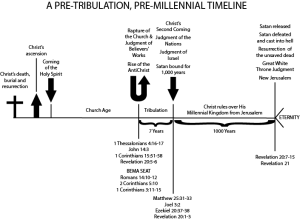
End Times Timeline

Ken Miller
Grow Pastor & Minister to Men
kenm@christchapelbc.org