22 And they came to Bethsaida. And some people brought to him a blind man and begged him to touch him. 23 And he took the blind man by the hand and led him out of the village, and when he had spit on his eyes and laid his hands on him, he asked him, “Do you see anything?” 24 And he looked up and said, “I see people, but they look like trees, walking.” 25 Then Jesus laid his hands on his eyes again; and he opened his eyes, his sight was restored, and he saw everything clearly. 26 And he sent him to his home, saying, “Do not even enter the village.”
27 And Jesus went on with his disciples to the villages of Caesarea Philippi. And on the way he asked his disciples, “Who do people say that I am?” 28 And they told him, “John the Baptist; and others say, Elijah; and others, one of the prophets.” 29 And he asked them, “But who do you say that I am?” Peter answered him, “You are the Christ.” 30 And he strictly charged them to tell no one about him. – Mark 8:22-30 ESV
 In this passage, Mark combines two incidents from Jesus’ life to convey an important truth. In the first, Jesus performs the second miracle that Mark records in his gospel. Chapter 7 records Jesus healing the deaf man who also suffered from a speech impediment. And there will be some similarities between these two miraculous healings.
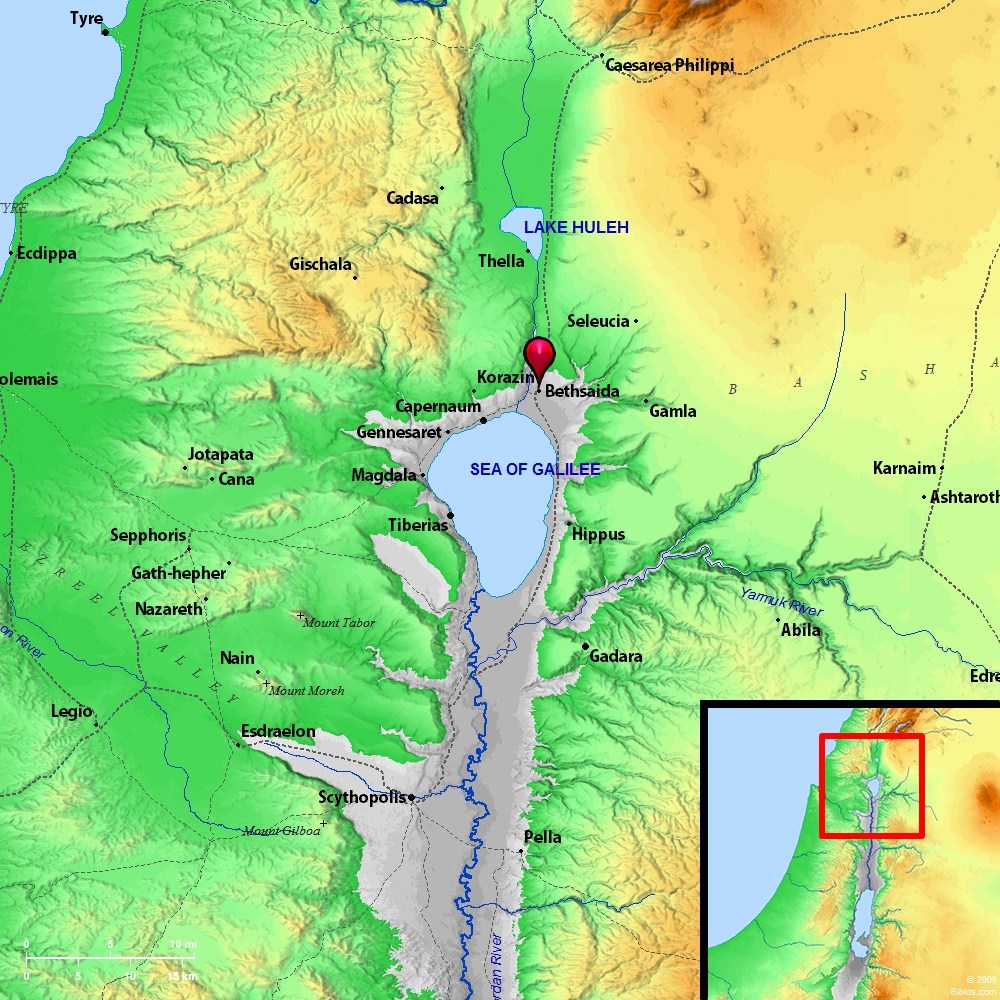
Jesus and His disciples had traveled from the northwestern shore of the Sea of Galilee to the town of Bethsaida, located not far from the sea’s northernmost tip. This was not the first time Jesus had been to Bethsaida. In fact, Matthew reports that Jesus delivered a stinging indictment against the city for its inhabitants’ stubborn refusal to repent.
Then Jesus began to denounce the towns where he had done so many of his miracles, because they hadn’t repented of their sins and turned to God. “What sorrow awaits you, Korazin and Bethsaida! For if the miracles I did in you had been done in wicked Tyre and Sidon, their people would have repented of their sins long ago, clothing themselves in burlap and throwing ashes on their heads to show their remorse.” – Matthew 11:20-21 NLT
This rather harsh statement from Jesus provides insight into the miracle Jesus performed. When Jesus arrived in Bethsaida, a group of people brought a blind friend in need of healing. Mark says that these compassionate friends “begged him to touch the man and heal him” (Mark 8:22 NLT). What Jesus did next was both interesting and insightful.
To fully appreciate Jesus’ actions, one must consider everything that had happened up to this moment. Earlier that same day, Jesus transformed seven loaves of bread and a few fish into a meal that fed thousands. He had followed up that miracle with a warning to His disciples about the “leaven of the Pharisees.” After seeing His miracle of the loaves and fish, the religious leaders demanded a “sign from heaven” to prove His claim to be the Messiah. These prideful, arrogant men were blind to all that Jesus had done, refusing to accept His miracles as proof of identity. So Jesus warned His disciples not to let the Pharisees’ teaching influence them. The unrepentant hearts of these self-righteous men caused them to reject Jesus and encourage others to do the same. Like yeast spreading through a batch of dough, their unbelief was beginning to permeate and influence the people of Israel. But the disciples failed to understand the meaning behind Jesus’ warning, thinking instead that He was upset that they had failed to bring enough bread. So, Jesus addressed their inability to comprehend His words.
“Why are you arguing about having no bread? Don’t you know or understand even yet? Are your hearts too hard to take it in? ‘You have eyes—can’t you see? You have ears—can’t you hear?’ Don’t you remember anything at all?” – Mark 8:17-18 NLT
Notice the last thing Jesus said to His disciples before they left for Bethsaida: “Do you not yet understand?” (Mark 8:21 ESV). All of this sets up what happens next and reveals God’s sovereign hand behind everything Jesus did. It was no coincidence that a blind man was brought to Jesus. His lack of sight symbolized the disciples’ lack of understanding. The way Jesus chose to heal the man was intentional and purposeful. First, He isolated the man from his well-meaning friends by leading him outside the village. Once they were alone, Jesus spit on the man’s eyes and touched him. But why? Couldn’t Jesus have simply commanded the man to see? Did this healing require spit and human contact? The text also seems to show that Jesus’ first attempt to restore the man’s sight failed.
…spitting on the man’s eyes, he laid his hands on him and asked, “Can you see anything now?”
The man looked around. “Yes,” he said, “I see people, but I can’t see them very clearly. They look like trees walking around.” – Mark 8:23-24 NLT
Jesus’ methodology seems odd, and its outcome appears less than successful. But everything Jesus did was intentional. Unable to see what Jesus was doing, the blind man could hear Jesus spit and feel it on his eyes. He could sense Jesus’s hands gently touching his eyes. Yet, when he opened his eyes, his sight was only partially restored. He could see, but not clearly; everything was fuzzy and indistinct. He describes men as looking like trees walking about.
This man had gone from complete blindness to partial sight. His condition, though much improved, was not what he had hoped for. Blurred sight was far better than no sight at all, but it was still not ideal.
Earlier, Jesus had healed a deaf man by restoring his hearing. This time, He restored the sight of a blind man. Both hearing and seeing are metaphors for the human capacity to understand. That is why Jesus had said to His disciples: “You have eyes—can’t you see? You have ears—can’t you hear?” (Mark 8:18 NLT).
They had seen Him heal the deaf man and heard His warnings about the Pharisees. Yet, they still did not fully understand, just as the blind man did not fully see. But Jesus did not intend to leave the man with imperfect sight.
Then Jesus placed his hands on the man’s eyes again, and his eyes were opened. His sight was completely restored, and he could see everything clearly. – Mark 8:25 NLT
Jesus finished what He began. He didn’t leave the man with slightly improved sight; He completely restored his vision so he could see everything clearly. This two-part healing provides an important lesson. It reminds us that Jesus came to restore far more than physical sight or hearing. He came to open the eyes of the spiritually blind so that they might see the glory of His presence. He came to open the ears of the spiritually deaf so they might hear the good news. But what they see and hear must include the full scope of God’s redemptive message.
The disciples thought they understood who Jesus was. They saw Him as their long-awaited Messiah. They had high hopes that He would set up His Kingdom on earth and reward them with places of honor and prominence in His administration. But when they heard Jesus speak, they became increasingly confused by what He said. When He began to talk of His pending death in Jerusalem, they struggled to comprehend and accept His words.
The apostle Paul reminds us that God’s plan is far greater than we can understand. Much of what we experience in this life appears out of step with our understanding of God’s will. We are like men with partially restored sight, viewing everything through distorted lenses that give an imperfect image of reality.
Now we see things imperfectly, like puzzling reflections in a mirror, but then we will see everything with perfect clarity. All that I know now is partial and incomplete, but then I will know everything completely, just as God now knows me completely. – 1 Corinthians 13:12 NLT
The disciples didn’t fully comprehend who Jesus was and what He had come to do. But Jesus was gradually opening their eyes to the truth of His ministry and mission. In time, they would see clearly. But as Paul reminds us, we will not fully understand God’s ways until His plan of redemption is complete.
After telling the newly sighted man to avoid returning to the village, Jesus and His disciples went north to Caesarea Philippi. On the way, Jesus struck up a conversation with His disciples and asked, “Who do people say that I am?” (Mark 8:27 ESV). He wanted the disciples to wrestle with the various rumors concerning His identity. In a sense, Jesus asked them to reveal who people thought He was. When they saw Him perform miracles, what did they conclude? When they heard Him speak, who did they think they were listening to? The disciples revealed that the people had all kinds of opinions.
“Well,” they replied, “some say John the Baptist, some say Elijah, and others say you are one of the other prophets.” – Mark 8:28 NLT
The people were like the man with partially restored sight. They could see, but not clearly. Their view of Jesus was incomplete and inconclusive. Notice that no one mentions Jesus being the Messiah. When the people looked at Jesus, it was like they were viewing Him through distorted lenses; He appeared indistinct and blurry.
This prompted Jesus to turn to His disciples and ask them the same question: “But who do you say that I am?” (Mark 8:29 ESV). Since deciding to follow Jesus, these men had spent their every waking minute with Him. They had witnessed all of His miracles and heard every one of His messages. They enjoyed intimate access to Jesus and the privilege of hearing Him explain some of His more cryptic parables. So, who did they understand Him to be? And the ever-impulsive Peter was the first to respond, “You are the Christ” (Mark 8:29 ESV).
In his gospel account, Mathew records that Peter added the further description: “the Son of the living God” (Matthew 16:16 ESV). Speaking on behalf of all the disciples, Peter acknowledged Jesus as the Messiah and the Son of God. His words revealed a level of understanding and insight that the rest of the people did not share. But Matthew lets us know that Peter did not come to this conclusion on his own.
“Blessed are you, Simon Bar-Jonah! For flesh and blood has not revealed this to you, but my Father who is in heaven.” – Matthew 16:17 ESV
God had revealed this insight to Peter. In that moment, his partially blinded eyes opened, and he saw the truth of who Jesus was. Peter’s statement was like an epiphany. Even as the words came out of his mouth, Peter must have wondered whether he truly believed them. He would later reveal that his understanding of who Jesus was and what He had come to do was still cloudy and indistinct. He would continue to wrestle with the weight of his words and the expectations of his heart. But the time would come when he and his fellow disciples would see everything clearly and distinctly.
It is one thing to proclaim Jesus as the Messiah; it is another to believe it. It will become increasingly vital that the disciples understand the Messiah’s God-given role. Their expectations must take a back seat to God’s will. They envisioned the Messiah as a conquering king who would reestablish the kingdom of Israel. Their hopes were based on a flawed and incomplete understanding of the Messiah’s role. But Jesus did not come to rule and reign; He came to suffer and die. Even at His trial before Pilate, He said, “My Kingdom is not an earthly kingdom. If it were, my followers would fight to keep me from being handed over to the Jewish leaders. But my Kingdom is not of this world” (John 18:36 NLT).
Jesus was the Messiah, and He was also David’s son and heir to his throne. But before He could wear the crown, He had to bear the cross. Which is why He told Pilate, “You say I am a king. Actually, I was born and came into the world to testify to the truth. All who love the truth recognize that what I say is true” (John 18:37 NLT). And Pilate, blind to the reality of Jesus’ identity, calmly replied, “What is the truth?” (John 18:38 NLT).
The answer to that question is simple, yet difficult to understand. The spiritually blind can’t perceive it, and the spiritually deaf can’t hear it. But Jesus clearly articulated it:
“I am the way, the truth, and the life. No one can come to the Father except through me. If you had really known me, you would know who my Father is. From now on, you do know him and have seen him!” – John 14:6-7 NLT
English Standard Version (ESV) The Holy Bible, English Standard Version. ESV® Permanent Text Edition® (2016). Copyright © 2001 by Crossway Bibles, a publishing ministry of Good News Publishers.
New Living Translation (NLT) Holy Bible, New Living Translation, copyright © 1996, 2004, 2015 by Tyndale House Foundation. Used by permission of Tyndale House Publishers Inc., Carol Stream, Illinois 60188. All rights reserved.