Blurred Vision

22 And they came to Bethsaida. And some people brought to him a blind man and begged him to touch him. 23 And he took the blind man by the hand and led him out of the village, and when he had spit on his eyes and laid his hands on him, he asked him, “Do you see anything?” 24 And he looked up and said, “I see people, but they look like trees, walking.” 25 Then Jesus laid his hands on his eyes again; and he opened his eyes, his sight was restored, and he saw everything clearly. 26 And he sent him to his home, saying, “Do not even enter the village.”

27 And Jesus went on with his disciples to the villages of Caesarea Philippi. And on the way he asked his disciples, “Who do people say that I am?” 28 And they told him, “John the Baptist; and others say, Elijah; and others, one of the prophets.” 29 And he asked them, “But who do you say that I am?” Peter answered him, “You are the Christ.” 30 And he strictly charged them to tell no one about him. Mark 8:22-30 ESV

In this passage, Mark combines two different incidents from the life of Jesus in order to convey an important truth. In the first, Jesus performs only the second miracle that Mark records in his gospel. In chapter 7, we have his record of Jesus healing the deaf man who also suffered from a speech impediment. And there will be some similarities between these two miraculous healings.

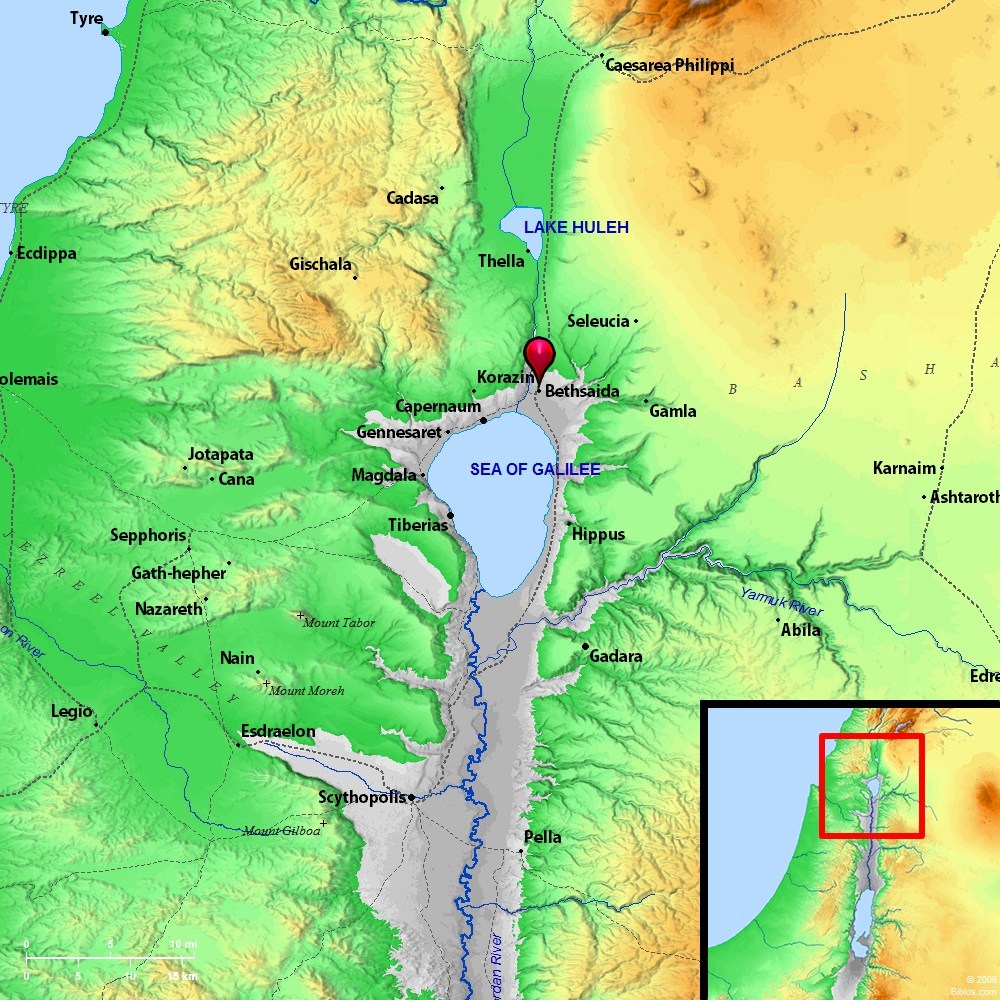
Jesus and His disciples have traveled from the northwestern shore of the Sea of Galilee to the town of Bethsaida, located not far from the sea’s northern-most tip. This was not the first time Jesus had been to Bethsaida. In fact, Matthew reports that Jesus has a stinging indictment against the city for the stubborn refusal of its inhabitants to repent.

Then Jesus began to denounce the towns where he had done so many of his miracles, because they hadn’t repented of their sins and turned to God. “What sorrow awaits you, Korazin and Bethsaida! For if the miracles I did in you had been done in wicked Tyre and Sidon, their people would have repented of their sins long ago, clothing themselves in burlap and throwing ashes on their heads to show their remorse.” – Matthew 11:20-21 NLT

This rather harsh statement from Jesus is important because it provides insight into the miracle Jesus performed. Upon His arrival in Bethsaida, Jesus was met by a group of individuals who were bringing a blind friend in need of healing. Mark says that these compassionate friends “begged him to touch the man and heal him” (Mark 8:22 NLT). And what Jesus does next is both interesting and insightful.

To fully appreciate the actions of Jesus, it is important to consider all that has happened up to this moment. Earlier that same day, Jesus had transformed seven loaves of bread and a few fish into a meal that fed thousands of people. And He had followed up this miracle with a warning to His disciples about the “leaven of the Pharisees.” The religious leaders had come to Jesus demanding that He give them a “sign from heaven” in order to prove His claim to be the Messiah. But these prideful and arrogant men had been blind to all that Jesus had done, refusing to accept His miracles as proof of identity. So, Jesus warned His disciples not to allow the teaching of the Pharisees to influence them. The unrepentant hearts of these self-righteous men were causing them to reject Jesus and encouraging others to do the same. Like yeast spreading through a batch of dough, their unbelief was beginning to permeate and influence the people of Israel. But the disciples failed to understand the meaning behind Jesus’ warning, thinking instead that He was upset that they had failed to bring enough bread. So, Jesus addressed their inability to comprehend His words.

“Why are you arguing about having no bread? Don’t you know or understand even yet? Are your hearts too hard to take it in? You have eyes—can’t you see? You have ears—can’t you hear?’ Don’t you remember anything at all?” – Mark 8:17-18 NLT

Notice the last thing Jesus said to His disciples before they left for Bethsaida.

Do you not yet understand?” – Mark 8:21 ESV

All of this sets up what happens next and reveals the sovereign hand of God behind all that Jesus did. It was no coincidence that a blind man was brought to Jesus. And the manner in which Jesus chose to heal the man was highly intentional and purposeful. First, Jesus isolated the man from his well-meaning friends by leading him outside the village. Once they were alone, Jesus spit on the man’s eyes and touched him. But why? Couldn’t Jesus have simply commanded the man to receive his sight? Was it really necessary that this healing require spit and human contact? And why did Jesus’ first attempt to restore the man’s sight seem to fail?

…spitting on the man’s eyes, he laid his hands on him and asked, “Can you see anything now?”

The man looked around. “Yes,” he said, “I see people, but I can’t see them very clearly. They look like trees walking around.” – Mark 8:23-24 NLT

Jesus’ methodology seems a bit odd. And it’s outcome appears less than successful. But everything Jesus did was intentional. The blind man, unable to see anything that Jesus was doing, was able to hear Jesus spit and could feel the sensation of the spit on his eyes. He could sense the hands of Jesus gently touching his eyes. Yet, when he opened his eyes, his sight was only partially restored. He could see but only as through a haze. Everything was fuzzy and indistinct. Men looked like trees walking about.

This man had gone from complete blindness to partial sight. His condition, while much-improved, was not what he had been hoping for. Blurred sight was far better than no sight at all, but it was still not ideal.

Earlier, Jesus had healed a deaf man by restoring his hearing. Now, he was restoring the sight of a blind man. Both hearing and seeing are metaphors for the human capacity to understand. That is why Jesus had said to His disciples: “You have eyes—can’t you see? You have ears—can’t you hear?

They had seen Him heal the deaf man. And they had heard His warnings about the Pharisees. And yet, they still did not fully understand, just as the blind man did not fully see. But Jesus had no intention of leaving the man with imperfect sight.

Then Jesus placed his hands on the man’s eyes again, and his eyes were opened. His sight was completely restored, and he could see everything clearly. – Mark 8:25 NLT

Jesus finished what He had begun. He didn’t leave the man with slightly improved sight but He completely restored his vision so that he could see everything clearly. This two-part healing provides an important lesson. It reminds us that Jesus came to restore far more than physical sight or hearing. He came to open the eyes of the spiritually blind so that they might see the glory of His presence. He came to open the ears of the spiritually deaf so that they might hear the message of the good news. But what they see and hear must include the full scope of God’s redemptive message.

The disciples thought they understood who Jesus was. They saw Him as their long-awaited Messiah. They had high hopes that He was going to set up His Kingdom on earth and reward them with places of honor and prominence in His administration. But when they heard Jesus speak, they became increasingly confused by what He said. And before long, when He began to talk of His pending death in Jerusalem, they would have difficulty comprehending and accepting His words.

The apostle Paul reminds us that the plan of God is far greater than we can understand. Much of what we experience in this life appears out of step with our understanding of God’s will. We are like men with partially restored sight who view everything through distorted lenses that provide an imperfect image of reality.

Now we see things imperfectly, like puzzling reflections in a mirror, but then we will see everything with perfect clarity. All that I know now is partial and incomplete, but then I will know everything completely, just as God now knows me completely. – 1 Corinthians 13:12 NLT

The disciples did not fully comprehend who Jesus was and what He had come to do. But Jesus was gradually opening their eyes to the truth of His ministry and mission. In time, they would see clearly and fully. But, as Paul reminds us, we will not fully understand the ways of God until His plan of redemption is complete.

After telling the newly sighted man to avoid going back to the village, Jesus and His disciples made their way north to Caesarea Philippi. On their way, Jesus struck up a conversation with His disciples, asking them, “Who do people say that I am?” (Mark 8:27 ESV). His question was intended to get the disciples to wrestle with the various rumors concerning His identity. In a sense, Jesus was asking the disciples to reveal who the people understood Him to be. When they saw Jesus perform miracles, what was their conclusion? When they heard Him speak, who did they think they were listening to? And the disciples reveal that there were all kinds of opinions among the people.

“John the Baptist; and others say, Elijah; and others, one of the prophets.” – Mark 8:28 ESV

The people were like the man with partially restored sight. They could see, but imperfectly. Their view of Jesus was incomplete and inconclusive. Notice that there is no mention of Jesus being the Messiah. When the people looked at Jesus, it was like they were viewing Him through distorted lenses. He appeared indistinct and blurry.

This prompted Jesus to turn to His disciples and ask them the same question: “But who do you say that I am?” (Mark 8:29 ESV). These men had spent their every waking minute with Jesus. They had seen every one of His miracles and had heard every one of His messages. They enjoyed intimate access to Jesus and the privilege of hearing Him explain some of His more cryptic parables. So, who did they understand Him to be?

And the ever-impulsive Peter was the first to respond.

“You are the Christ.” – Mark 8:29 ESV

In his gospel account, Mathew records that Peter added the further description: “the Son of the living God” (Matthew 16:16 ESV). Peter, speaking on behalf of all the disciples, acknowledge Jesus to be the Messiah but also the Son of God. His words revealed a level of understanding and insight that the rest of the people did not share. But Matthew lets us know that Peter did not come to this conclusion on his own.

“Blessed are you, Simon Bar-Jonah! For flesh and blood has not revealed this to you, but my Father who is in heaven. – Matthew 16:17 ESV

God had revealed this insight to Peter. His partially blinded eyes had been opened so that he could see the truth of who Jesus was. This statement from the lips of Peter was like an unexpected epiphany. Even as the words came out of his mouth, Peter must have wondered whether he truly believed them. And He would go on to reveal that his understanding of who Jesus was and what He had come to do was still cloudy and indistinct. He would continue to wrestle with the weight of his own words and the expectations of his own heart. But the time would come when he and his fellow disciples would see everything clearly and distinctly.

English Standard Version (ESV) The Holy Bible, English Standard Version. ESV® Permanent Text Edition® (2016). Copyright © 2001 by Crossway Bibles, a publishing ministry of Good News Publishers.

New Living Translation (NLT) Holy Bible, New Living Translation, copyright © 1996, 2004, 2015 by Tyndale House Foundation. Used by permission of Tyndale House Publishers Inc., Carol Stream, Illinois 60188. All rights reserved.

The Message (MSG)Copyright © 1993, 1994, 1995, 1996, 2000, 2001, 2002 by Eugene H. Peterson

Worthless Things.

Now at Lystra there was a man sitting who could not use his feet. He was crippled from birth and had never walked. He listened to Paul speaking. And Paul, looking intently at him and seeing that he had faith to be made well, 10 said in a loud voice, “Stand upright on your feet.” And he sprang up and began walking. 11 And when the crowds saw what Paul had done, they lifted up their voices, saying in Lycaonian, “The gods have come down to us in the likeness of men!” 12 Barnabas they called Zeus, and Paul, Hermes, because he was the chief speaker. 13 And the priest of Zeus, whose temple was at the entrance to the city, brought oxen and garlands to the gates and wanted to offer sacrifice with the crowds. 14 But when the apostles Barnabas and Paul heard of it, they tore their garments and rushed out into the crowd, crying out, 15 “Men, why are you doing these things? We also are men, of like nature with you, and we bring you good news, that you should turn from these vain things to a living God, who made the heaven and the earth and the sea and all that is in them. 16 In past generations he allowed all the nations to walk in their own ways. 17 Yet he did not leave himself without witness, for he did good by giving you rains from heaven and fruitful seasons, satisfying your hearts with food and gladness.” 18 Even with these words they scarcely restrained the people from offering sacrifice to them. Acts 14:8-18 ESV

acts-pauls-first-missionary-journey

After having to leave Iconium due to the Jews stirring up a mob against them, Paul and Barnabas made their way to Lystra, another Roman colony about 20 miles or a day’s journey away. Upon their arrival in Lystra, Paul and Barnabas had another one of those “chance” encounters that were becoming an everyday part of their lives. They were speaking somewhere in Lystra to a crowd that had gathered. There is no mention of them attending the synagogue, as had become their custom. So, it may be that there were not enough Jews in Lystra to warrant a synagogue. But, as usual, Paul and Barnabas had no problem attracting attention to themselves. They simply began to speak to any who would listen. And, in the crowd that day, there happened to be a man who had been lame since birth.
Luke makes note of the fact that the man was listening to what Paul was saying, and that Paul, spotting the man in the crowd, could tell that the man “had faith to be made well” (Acts 14:9 ESV). Luke provides no insight into how Paul knew this. Most likely, Paul was given a kind of spiritual intuition from the Holy Spirit. He was somehow able to see into the man’s heart and perceive in his eyes that this man had faith that God could heal him. He believed. We are not told what Paul said to the crowd, but whatever it was, it produced in this man a believing faith that the God of whom Paul spoke was powerful enough to restore the use of his limbs. Now, it is important that we consider not only why this event was included by Luke, but why this man was in the crowd. By this time in the story, we should be recognizing that nothing that is taking place is happenstance or the result of fate. This man’s presence in the crowd was according to the sovereign will of God. The very fact that Paul made eye-contact with this man was not a byproduct of chance. God had been the one to orchestrate the entire situation. Either God had directed Paul and Barnabas to the very spot where this man was sitting, or this man was able to find help in being carried to where the two men were speaking. God had preordained that this encounter would take place. But why? Because Paul and Barnabas were now entering the frontier, the furthest edges of the world as they knew it. They were in uncharted territory, speaking to people who were primarily Gentiles and who had no knowledge of Jesus at all. They most likely had heard nothing about the events that had taken place in Jerusalem back during the Feast of Pentecost. These two men, Paul and Barnabas, were strangers to them and, their message about Jesus as the Messiah and Savior, would have been alien and foreign to them. So, God arranged for a way to validate the message of His two messengers. They had been given sign gifts, just as Peter and the other apostles had received. These gifts allowed them to perform signs and miracles, providing their message with credibility and their claim to be speaking for God with visible, tangible proof. This man’s presence was going to prove critical. You can almost sense the building sense of anticipation that precede Luke’s description of what happened next. Luke records that Paul, speaking in a very loud voice, cried out, “Stand upright on your feet.” The crowd had no idea what was about to happen, but we do. We have seen this kind of thing happen before. All the way back in chapter three, we have the story of Peter saying to the lame beggar, “In the name of Jesus Christ of Nazareth, rise up and walk!” (Acts 3:6 ESV). And the man did, leaving the crowds looking on in wonder and amazement. That had happened all the way back in Jerusalem. Now, we find Paul and Barnabas hundreds of miles away, ministering in a far-flung Roman colony, filled with pagans who knew nothing of Yahweh, had no idea who Jesus was or any reason to believe that what these two men had to say was true. And that was where the lame man came in.
His healing by God would validate Paul and Barnabas’ claims to be speaking for God. And not only that, it would go a long way in establishing Paul as a co-equal with Peter, the recognized spiritual leader of the church at that time. Paul had been a late-comer to the party. He had not been one of the original 12 disciples, but had come to faith in Jesus long after Jesus’ death, burial and resurrection, having had a one-on-one encounter with the risen Christ along the road to Damascus. For the rest of his life, Paul would battle with those who would try to question the validity of his apostleship. They would continually attempt to paint him as a charlatan, questioning his authority and raising doubts about his teaching. But here on this occasion, God sovereignly revealed Paul’s impeccable credentials as one of His messengers by providing Paul with the very same powers Peter possessed.
And to say that Paul’s actions got the attention of the crowd would be an understatement. Luke writes that the people cried out, “The gods have come down to us in the likeness of men!” (Acts 14:11 ESV). They knew no better than to attribute what they had just seen to the work of gods – the gods with which they were familiar. They called Barnabas, Zeus, and Paul, Hermes. The Greeks had a pantheon of gods they worshiped, so we can only speculate why they happened to choose these two particular gods as being the ones standing before them. But whatever their reasoning, these people were strong enough in their convictions that they were dealing with deities, that the priest of the local temple, dedicated to Zeus, showed up with oxen and garlands to make a sacrifice. We are left to imagine what this seen must have looked like. Try and picture the confusion and chaos going on as these people shouted out their praises to Paul and Barnabas, bowing in reverence before them. And just imagine what was going through the minds of these two men as they found themselves the mistaken, but unmistakable focus of the crowd’s worship.
We do know that Paul and Barnabas were appalled at what they experienced, because Luke tells us they tore their clothes in a outward display of grief and remorse. They wanted no part of what was going on. And Paul spoke up, saying, “Friends, why are you doing this? We are merely human beings—just like you! We have come to bring you the Good News that you should turn from these worthless things and turn to the living God, who made heaven and earth, the sea, and everything in them” (Acts 14:15 NLT). What Paul said here was dangerous and risky. He was blatantly denying any claim to deity. But more than that, he was attacking their worship of false gods. When he mentioned “worthless things”, he was speaking of Zeus and Hermes. He compared them to the living God, the one true Creator of heaven and earth. Paul was treading on very thin ice. He was surrounded by a crowd of very passionate devotees to the Greek gods. They were excited and convinced that their deities had come to visit them. And Paul was not only shattering any notion that Zeus and Hermes had come to earth, he was describing two of their most revered gods as worthless.
And Paul made it perfectly clear that it was Yahweh, the God of the Jews, who was the source of any and all things they enjoyed in life, not the Greek gods. It was He who  provided them with food, crops, rain and joyful hearts. This would have been unexpected and unwanted news to the people of Lystra. It would have been seen as a case of slander and blasphemy, treating their gods with disdain and disrespect. But, surprisingly, instead of infuriating the crowd, the words of Paul and Barnabas seemed to have the opposite effect. The people tried to worship them all the more.
What we seem to have here is a clear example of the spiritual hunger of lost mankind. These people were spiritually starving to death. They had plenty of gods, but no real proof that their gods actually existed. Like all false gods, theirs were distant and disconnected from everyday life. They never really knew if their gods were engaged with or even interested in their daily lives. Which might explain why they were so excited when they thought that Paul and Barnabas were gods come to earth. They greatly desired an intimate relationship with their gods, but to date, their experience had been the same as every other people group who has set its desires and affections on “worthless things.” Years later, Paul would write to believers living in nearby Galatia, reminding them of their former love affair with false gods: “you were slaves to so-called gods that do not even exist” (Galatians 4:8 NLT). The people in the crowd that day had no idea that their gods were false. They were blind to the fact that their gods were helpless and hopeless to assist them, and could do nothing to save or protect them. In fact, the psalmist eloquently and unapologetically described the true nature of false gods when he wrote:

Their idols are merely things of silver and gold,
    shaped by human hands.
They have mouths but cannot speak,
    and eyes but cannot see.
They have ears but cannot hear,
    and noses but cannot smell.
They have hands but cannot feel,
    and feet but cannot walk,
    and throats but cannot make a sound.
And those who make idols are just like them,
    as are all who trust in them. – Psalm 115:4-8 NLT

Paul and Barnabas had struck a nerve. They had performed a sign among a people who were desperately in search of proof that their religion was relevant and their gods were real. The world, then as now, was cloaked in deep darkness, and filled with spiritually blind people staggering about looking for any glimmer of hope and help. They were deceived. And Paul would later write to the believers in Corinth, clarifying the source of the world’s deception, and the only means of hope.

Satan, who is the god of this world, has blinded the minds of those who don’t believe. They are unable to see the glorious light of the Good News. They don’t understand this message about the glory of Christ, who is the exact likeness of God.

You see, we don’t go around preaching about ourselves. We preach that Jesus Christ is Lord, and we ourselves are your servants for Jesus’ sake. For God, who said, “Let there be light in the darkness,” has made this light shine in our hearts so we could know the glory of God that is seen in the face of Jesus Christ. – 2 Corinthians 4:4-6 NLT

The light was spreading. But as we will see, the darkness was great. The enemy had blinded the spiritual eyes of those living in Lystra, leaving them in a state of perpetual darkness, desperately longing for relief and redemption, but unable to see the truth when it stood right in front of them.


The Holy Bible, English Standard Version. ESV® Permanent Text Edition® (2016). Copyright © 2001

New Living Translation (NLT)
Holy Bible, New Living Translation, copyright © 1996, 2004, 2015 by Tyndale House Foundation. Used by permission of Tyndale House Publishers Inc., Carol Stream, Illinois 60188. All rights reserved.

The Message (MSG)  Copyright © 1993, 1994, 1995, 1996, 2000, 2001, 2002 by Eugene H. Peterson