The Gospel of the God-Man

21 And you, who once were alienated and hostile in mind, doing evil deeds, 22 he has now reconciled in his body of flesh by his death, in order to present you holy and blameless and above reproach before him, 23 if indeed you continue in the faith, stable and steadfast, not shifting from the hope of the gospel that you heard, which has been proclaimed in all creation under heaven, and of which I, Paul, became a minister. – Colossians 1:21-23 ESV

Paul knew it was essential that the Colossian believers fully understand who Jesus was and what He had done for them. Their concept of Jesus had become confused from allowing false ideas about His identity and accomplishments to filter into their beliefs about Him. After Jesus resurrected from the dead and ascended into heaven, growing speculation arose about His true identity and its implications for mankind. In His absence, His disciples continued to spread the news concerning the coming Kingdom of God and the sole means of gaining entrance into it by placing one’s faith in Jesus Christ.

But others had begun formulating their own ideas about Jesus and the implications of His life and death. The disciples had clearly spread the news that Jesus had risen from the dead and had returned to His Father’s side in heaven. Paul had boldly proclaimed the nature of Christ’s death, burial, and resurrection to the believers in Corinth.

I passed on to you what was most important and what had also been passed on to me. Christ died for our sins, just as the Scriptures said. He was buried, and he was raised from the dead on the third day, just as the Scriptures said. He was seen by Peter and then by the Twelve. After that, he was seen by more than 500 of his followers at one time, most of whom are still alive, though some have died. Then he was seen by James and later by all the apostles. Last of all, as though I had been born at the wrong time, I also saw him. – 1 Corinthians 15:3-8 NLT

However, some had begun to refute the disciples’ teaching concerning the resurrection, declaring it improbable and even unnecessary. That’s what led Paul to warn the Corinthians about this dangerous heresy.

…if there is no resurrection of the dead, then Christ has not been raised. And if Christ has not been raised, then your faith is useless and you are still guilty of your sins. In that case, all who have died believing in Christ are lost! And if our hope in Christ is only for this life, we are more to be pitied than anyone in the world. – 1 Corinthians 15:16-19 NLT

Others were spreading the idea that Jesus had not been an actual, flesh-and-blood human. They speculated that He only appeared to take on human form. This teaching was propagated by the Docetists who earned their name from the Greek word dokeĩn, which means “to seem.” They rejected John’s teaching that “the Word became flesh” (John 1:14). Because these people deemed the flesh to be inherently evil, they could not accept the idea of deity taking on humanity. So, they rationalized it away by claiming that Jesus had only appeared to have a human body. So, His “death” was just a fiction. But by voiding the humanity of Jesus, these false teachers were actually eliminating the heart of the gospel message. Without Jesus’ humanity, there was no goodnews. That is why the apostles boldly preached the reality of Jesus’ incarnation.

He personally carried our sins in his body on the cross so that we can be dead to sin and live for what is right. By his wounds you are healed. – 1 Peter 2:24 NLT

The doctrine of the bodily death, burial, and resurrection of Jesus became the litmus test for determining the veracity of those claiming to be teachers.

Dear friends, do not believe everyone who claims to speak by the Spirit. You must test them to see if the spirit they have comes from God. For there are many false prophets in the world. This is how we know if they have the Spirit of God: If a person claiming to be a prophet acknowledges that Jesus Christ came in a real body, that person has the Spirit of God. But if someone claims to be a prophet and does not acknowledge the truth about Jesus, that person is not from God. Such a person has the spirit of the Antichrist, which you heard is coming into the world and indeed is already here. – 1 John 4:1-3 NLT

So, as Paul continued the introduction of his letter to the Colossian believers, he stressed the humanity of Jesus, reminding them that they had been “reconciled in his body of flesh by his death” (Colossians 1:22 ESV). For Paul, that point was essential because it explained how sinful human beings could be made right with a holy and righteous God. He even stressed the nature of their pre-conversion state, describing them as “alienated and hostile in mind, doing evil deeds” (Colossians 1:21 ESV). This concept of alienation and hostility was a common theme for Paul. He repeatedly stressed the former hopeless and helpless condition of those who now enjoyed a right standing with God. He wanted them to consider the almost incomprehensible scope of Christ’s sacrificial death and what it had accomplished on their behalf.

since we have been made right in God’s sight by the blood of Christ, he will certainly save us from God’s condemnation. For since our friendship with God was restored by the death of his Son while we were still his enemies, we will certainly be saved through the life of his Son. So now we can rejoice in our wonderful new relationship with God because our Lord Jesus Christ has made us friends of God. – Romans 5:9-11 NLT

The physical death of Jesus made possible their spiritual transformation from enemies to friends of God. They had been reconciled to a righteous God by the undeserved death of His righteous and sinless Son. Paul reminded the believers in Rome of the remarkable nature of Jesus’ selfless sacrifice of His life.

The law of Moses was unable to save us because of the weakness of our sinful nature. So God did what the law could not do. He sent his own Son in a body like the bodies we sinners have. And in that body God declared an end to sin’s control over us by giving his Son as a sacrifice for our sins. – Romans 8:3 NLT

Paul told the believers in Colossae that because Jesus had died in their place, He had been able to present them to God the Father as “holy and blameless and above reproach” (Colossians 1:22 ESV). Jesus had taken upon Himself the penalty for their sins and, in exchange, had placed upon them His own unblemished righteousness. Paul fully understood the significance of this “great exchange” and boldly proclaimed His appreciation for it and his unwavering dependence upon it.

I no longer count on my own righteousness through obeying the law; rather, I become righteous through faith in Christ. For God’s way of making us right with himself depends on faith. – Philippians 3:9 NLT

For Paul, belief in Jesus’s death, burial, and resurrection was essential for living the Christian life. He called the Colossians to reject any false teaching that might undermine their faith in the gospel of Jesus Christ and urged them to remain committed to the good news just as they had heard it from Epaphras.

…you must continue to believe this truth and stand firmly in it. Don’t drift away from the assurance you received when you heard the Good News. – Colossians 1:23 NLT

Paul knew that false teachers would be a constant problem in the church. Each generation of believers would face a new wave of plausible but unreliable doctrines concerning the saving work of Jesus. He also knew that immature and poorly informed Christians would be easy targets for false teachers and end up “tossed and blown about by every wind of new teaching” and tricked by “lies so clever they sound like the truth” (Ephesians 4:14 NLT). For Paul, the best defense against false teaching was the truth. He declared his firm commitment to continue doing what he had always done: preach the unadulterated gospel of Jesus Christ to any and all who would listen.

The Good News has been preached all over the world, and I, Paul, have been appointed as God’s servant to proclaim it. – Colossians 1:23 NLT

Paul wanted the Colossians to know that they had been reconciled to God through the physical death of Jesus Christ. He had been fully divine and wholly human and died a very real, excruciating death on the cross—in their place. By placing their faith in Jesus’s substitutionary death, they had been restored to a right relationship with God. Formerly enemies of God, they now enjoyed a new status as His sons and heirs, and no false teacher or faulty doctrine could take that away from them.

Paul will continue to drive home his belief in the humanity of Jesus because it was essential to the gospel message. In the second chapter of his letter, he states, “In Christ all the fullness of the Deity lives in bodily form, and in Christ you have been brought to fullness” (Colossians 2:9-10 NLT). For Paul, Jesus’ humanity and deity were inseparable and non-debatable. If Jesus did not become an actual flesh-and-blood human, then His death on the cross was pointless. For Paul, the bodily death and resurrection of Jesus were the key to the gospel message. If Jesus only appeared to be human, then His death was nothing more than a charade. Without an actual body, it would be impossible for Jesus to die, and if Jesus did not die, the resurrection was unnecessary. But in his first letter to the believers in Corinth, Paul debunked this heretical notion.

For if there is no resurrection of the dead, then Christ has not been raised either. And if Christ has not been raised, then all our preaching is useless, and your faith is useless. And we apostles would all be lying about God—for we have said that God raised Christ from the grave. But that can’t be true if there is no resurrection of the dead. And if there is no resurrection of the dead, then Christ has not been raised. And if Christ has not been raised, then your faith is useless and you are still guilty of your sins. In that case, all who have died believing in Christ are lost! And if our hope in Christ is only for this life, we are more to be pitied than anyone in the world. – 1 Corinthians 15:13-19 NLT

Paul was willing to die to protect the integrity of the gospel. He would not tolerate any twisting of the truth or perversion of the message he had received from Jesus because there was too much at stake. The gospel was not up for interpretation or alteration. Yet, Paul constantly had to clean up the mess left behind by false and heretical teachers. He was forced to chastise the believers in Galatia for their lack of discernment and gullibility.

I am astonished that you are so quickly deserting him who called you in the grace of Christ and are turning to a different gospel—not that there is another one, but there are some who trouble you and want to distort the gospel of Christ. But even if we or an angel from heaven should preach to you a gospel contrary to the one we preached to you, let him be accursed. As we have said before, so now I say again: If anyone is preaching to you a gospel contrary to the one you received, let him be accursed. – Galatians 1:6-9 ESV

There was only one gospel, and it was based on Jesus’s life, death, and resurrection. To ensure that his audience understood, Paul unequivocally states, “He has reconciled you to himself through the death of Christ in his physical body. As a result, he has brought you into his own presence, and you are holy and blameless as you stand before him without a single fault” (Colossians 1:22 NLT). 

Father, no man could have come up with the plan You devised for humanity’s redemption. The thought of a deity taking on human flesh is not a novel idea, The Greeks had their pantheon of gods who masqueraded as mere mortals. But Your plan involved Your sinless Son taking on the form of an infant baby and growing up to be a man. As Paul wrote, Jesus, ths Son of God “did not think of equality with God as something to cling to. Instead, he gave up his divine privileges; he took the humble position of a slave and was born as a human being. When he appeared in human form, he humbled himself in obedience to God and died a criminal’s death on a cross.” (Philippians 2:6-8 N:LT). It took a sinless Savior to sacrifice His life on behalf of sinful men. But to do it, He had to become like us. He lived among us, suffered hunger and weariness like us, endured rejection by us, and gave us life for us. All so that we could one day become like Him. That was Your plan and it is perfect down to the last detail. Thank You! Amen

English Standard Version (ESV)
The Holy Bible, English Standard Version. ESV® Permanent Text Edition® (2016). Copyright © 2001 by Crossway Bibles, a publishing ministry of Good News Publishers.

New Living Translation (NLT)
Holy Bible, New Living Translation, copyright © 1996, 2004, 2015 by Tyndale House Foundation. Used by permission of Tyndale House Publishers Inc., Carol Stream, Illinois 60188. All rights reserved.

God Has No Regrets

24 Saul said to Samuel, “I have sinned, for I have transgressed the commandment of the Lord and your words, because I feared the people and obeyed their voice. 25 Now therefore, please pardon my sin and return with me that I may bow before the Lord.” 26 And Samuel said to Saul, “I will not return with you. For you have rejected the word of the Lord, and the Lord has rejected you from being king over Israel.” 27 As Samuel turned to go away, Saul seized the skirt of his robe, and it tore. 28 And Samuel said to him, “The Lord has torn the kingdom of Israel from you this day and has given it to a neighbor of yours, who is better than you. 29 And also the Glory of Israel will not lie or have regret, for he is not a man, that he should have regret.” 30 Then he said, “I have sinned; yet honor me now before the elders of my people and before Israel, and return with me, that I may bow before the Lord your God.” 31 So Samuel turned back after Saul, and Saul bowed before the Lord.

32 Then Samuel said, “Bring here to me Agag the king of the Amalekites.” And Agag came to him cheerfully. Agag said, “Surely the bitterness of death is past.” 33 And Samuel said, “As your sword has made women childless, so shall your mother be childless among women.” And Samuel hacked Agag to pieces before the Lord in Gilgal.

34 Then Samuel went to Ramah, and Saul went up to his house in Gibeah of Saul. 35 And Samuel did not see Saul again until the day of his death, but Samuel grieved over Saul. And the Lord regretted that he had made Saul king over Israel. – 1 Samuel 15:24-35 ESV

This chapter contains an apparent contradiction. Earlier in the chapter, verse 10 records God’s message to Samuel regarding Saul: “I regret that I have made Saul king, for he has turned back from following me and has not performed my commandments” (1 Samuel 15:10 ESV). That same sentiment is expressed at the end of the chapter.

And the Lord regretted that he had made Saul king over Israel. – 1 Samuel 15:35 ESV

Yet, Samuel appears to contradict those two statements when he informs Saul, “…the Glory of Israel will not lie or have regret, for he is not a man, that he should have regret” (1 Samuel 15:29 ESV). So which is it, is God capable of regret or not? The Hebrew word used in all three verses is nāḥam, and it conveys the idea of sorrow or regret but can also be used to speak of repentance or a change of mind. When used of God, it is an anthropomorphism: “an interpretation of what is not human or personal in terms of human or personal characteristics” (“Anthropomorphism.” Merriam-Webster.com Dictionary, Merriam-Webster, https://www.merriam-webster.com/dictionary/anthropomorphism. Accessed 23 Apr. 2024.).

As Samuel states in verse 29, God is not a man. In other words, He is a spirit being and not human, yet we attempt to describe Him by using human terminology that describes human traits. God is an incorporeal being, without hands, feet, brain, or heart. He has no eyes, yet Proverbs states, “The eyes of the Lord are in every place, keeping watch on the evil and the good” (Proverbs 15:3 ESV). According to Proverbs 5, “the Lord sees clearly what a man does” (Proverbs 5:21 NLT).

God’s “sight” is unrestricted and not dependent upon human eyes. His “reach” is not restricted by human arms and hands. God “speaks” without the benefit of a tongue.  He “thinks” and yet has no brain. According to the Genesis account of creation, God “spoke” the universe into existence, and yet He has no vocal chords. Numbers 23:19 states that “God is not man, that he should lie, or a son of man, that he should change his mind,” yet God is not equipped with a human-like mind. His reasoning capacity is not limited by the size of His brain because He does not have one.

So, when Samuel records that God regretted making Saul king, he is trying to express God’s inherent sorrow over an outcome that He had ordained and foresaw. God was not admitting an error or expressing regret for His actions but displaying His sorrow for Saul’s fate. God may not have a heart, but He is far from emotionless. The psalmist writes, “The LORD cares deeply when his loved ones die” (Psalm 116:15 NLT). God is loving, caring, and compassionate. When contemplating the inevitable consequences of His decision to give the Israelites a king like all the other nations, God cared deeply about the pain and suffering that it caused. He was not sorrowful for His actions but He did “regret” that their rebellious demand for a king had to result in some painful lessons for all involved.

But God’s regret did not result in remorse or a change of mind. He had known all along how this scenario was going to turn out and it all happened according to His sovereign plan. He gave the people what they wanted and the result was just as He had predicted. But that doesn’t mean that God gloated over His decision or enjoyed watching His people suffer. At no point did God take delight in watching Saul fail or His people suffer. He took no pleasure in seeing His providential plan played out. God was not surprised by Saul’s stubborn refusal to obey His will but He was saddened by the inevitable outcome. The Lord doesn’t gloat over or relish the fall of the wicked. In fact, He says, “I take no pleasure in the death of wicked people. I only want them to turn from their wicked ways so they can live” (Ezekiel 33:11 NLT).

But God’s sorrow was not going to produce a change of mind. As much as He hated to witness Saul’s demise and the people’s resulting pain and loss, it would not prevent Him from doing what He had planned to do all along. That is what Samuel means when he states, “the Glory of Israel will not lie, nor will he change his mind, for he is not human that he should change his mind!” (1 Samuel 15:29 NLT). Samuel uses a title for God that is found nowhere else in Scripture. He refers to Jehovah as “the Glory of Israel.” The Hebrew word translated as “glory” is neṣaḥ, and it means “everlastingness.” It refers to God’s eminence and eternality; He is consistent and unchanging in all His ways. God is not fickle or controlled by circumstances. The vicissitudes of fallen humanity do not alter God’s plans or cause Him to change His mind. So, when it came to the outcome of Saul’s disobedience, the die was cast and his fate was sealed.

Sensing the seriousness of the situation, Saul finally decided to take ownership for his sin, in the hopes that God might spare him.

“Yes, I have sinned. I have disobeyed your instructions and the Lord’s command, for I was afraid of the people and did what they demanded. But now, please forgive my sin and come back with me so that I may worship the Lord.” – 1 Samuel 15:24-25 NLT

But it was too little, too late. Samuel had been given no permission from God to serve as Saul’s priestly confessor or counselor, so he refused the king’s pitiful plea. In desperation, Saul reached out to prevent Samuel from leaving, tearing the prophet’s robe in the process. Samuel used this as a sign to drive home the serious nature of Saul’s predicament.

“The Lord has torn the kingdom of Israel from you today and has given it to someone else—one who is better than you. – 1 Samuel 15:28 NLT

Self-absorbed and obsessed with his image, Saul begged Samuel to do him one last favor. He pleaded for Samuel to accompany him in a carefully staged worship service held in the presence of the elders of Israel. Saul was all about appearances, hoping that Samuel’s presence would reassure the people of Israel that he was still the king and fully in charge. Saul was less concerned about “the Glory of Israel” than he was about his own stature among the people.

Samuel agreed and took part in Saul’s little charade, but when the service ended, he demanded that Saul bring out Agag, the king of the Amalekites. After having officiated a worship service to Jehovah, Samuel required Saul to bring out the evidence of his own disobedience. How could the king offer up praise to God when he held in his possession the proof of his unwillingness to obey God? Saul had been given strict instructions to put King Agag to death but he had chosen to let him live. Perhaps he had hoped to receive some kind of ransom from the captive king. But regardless of Saul’s motivation, Agag was living proof that Saul remained unrepentant and unremorseful. But Samuel did what Saul had refused to do; he “cut Agag to pieces before the Lord at Gilgal” (1 Samuel 15:33 NLT). The elderly prophet displayed his reverence for God by faithfully carrying out the will of God. As Saul stood back and watched, Samuel fulfilled the duty of the king by carrying out the command of the Glory of Israel.

This proved to be the final interaction between Samuel and Saul. With the death of Agag, the two men parted ways, never to meet again. The chapter ends with a sad note: “And the Lord regretted that he had made Saul king over Israel” (1 Samuel 15:35 ESV). God knew that the days ahead were going to be difficult for Saul and the people of Israel. He had a plan but that plan was going to involve pain and suffering for all involved. God was not surprised by the outcome. God’s rejection of the rebellious Saul was not a knee-jerk reaction; it was all part of His pre-ordained plan. He already had Saul’s replacement picked out and the transfer of power was about to begin.

English Standard Version (ESV) The Holy Bible, English Standard Version. ESV® Permanent Text Edition® (2016). Copyright © 2001 by Crossway Bibles, a publishing ministry of Good News Publishers.

New Living Translation (NLT) Holy Bible, New Living Translation, copyright © 1996, 2004, 2015 by Tyndale House Foundation. Used by permission of Tyndale House Publishers Inc., Carol Stream, Illinois 60188. All rights reserved.
Solidarity, Suffering, and Salvation

10 For it was fitting that he, for whom and by whom all things exist, in bringing many sons to glory, should make the founder of their salvation perfect through suffering. 11 For he who sanctifies and those who are sanctified all have one source. That is why he is not ashamed to call them brothers, 12 saying,

“I will tell of your name to my brothers;
    in the midst of the congregation I will sing your praise.”

13 And again,

“I will put my trust in him.”

And again,

“Behold, I and the children God has given me.”

14 Since therefore the children share in flesh and blood, he himself likewise partook of the same things, that through death he might destroy the one who has the power of death, that is, the devil, 15 and deliver all those who through fear of death were subject to lifelong slavery. 16 For surely it is not angels that he helps, but he helps the offspring of Abraham. 17 Therefore he had to be made like his brothers in every respect, so that he might become a merciful and faithful high priest in the service of God, to make propitiation for the sins of the people. 18 For because he himself has suffered when tempted, he is able to help those who are being tempted. – Hebrews 2:10-18 ESV

God made His Son a man. Through the miracle of conception and the power of the Holy Spirit, Mary gave birth to a baby boy whom she would name Jesus. But He was not just any boy. He was the incarnate Son of God, the second person of the Trinity in human flesh. This is why the writer of Hebrews describes Him as he “who for a little while was made lower than the angels, namely Jesus” (Hebrews 2:9 ESV).

He became our brother in the flesh. In His incarnation, Jesus became like us so that He could live among us and share the earthly experience of living as a human being in a fallen world. And just a few chapters later in this same letter, we read that Jesus “understands our weaknesses, for he faced all of the same testings we do, yet he did not sin” (Hebrews 4:15 NLT).

He didn’t live some kind of charmed, country-club lifestyle because He was the Son of God. His deity didn’t protect Him from harm, weariness, temptation, testing, or trials. In fact, it was His divinity that got Him into trouble. His claims to be the Son of God brought about the greatest degree of suffering. And suffer He did. In fact, the author of Hebrews says that God made Jesus, the founder of our salvation, “perfect through suffering” (Hebrews 2:10 ESV).

Before Jesus could be perfected or glorified by His Father, He had to take the path of suffering. He could only experience glorification by passing through persecution and pain. And it’s interesting to realize that Satan, when he tempted Jesus in the wilderness, attempted to get Jesus to bypass the suffering and go straight to glorification.

Next the devil took him to the peak of a very high mountain and showed him all the kingdoms of the world and their glory. “I will give it all to you,” he said, “if you will kneel down and worship me.” – Matthew 4:8-9 NLT

But God’s path for Jesus took Him through humiliation, rejection, pain, suffering, and death. The apostle Paul reminds us that Jesus took His earthly mission seriously and obeyed His Father’s will completely, even to the point of death.

…being found in human form, he humbled himself by becoming obedient to the point of death, even death on a cross. Therefore God has highly exalted him and bestowed on him the name that is above every name, so that at the name of Jesus every knee should bow, in heaven and on earth and under the earth, and every tongue confess that Jesus Christ is Lord, to the glory of God the Father. – Philippians 2:8-11 ESV

It was only after He had walked that path in faith and obedience, that God raised Him up and glorified Him. The sinless Son of God took on human flesh just like us. He became one of us. Jesus didn’t take on the appearance of a man. Unlike the Greek pantheon of gods, who were believed to appear on earth disguised in human form, Jesus was 100 percent human. He wasn’t masquerading as a man; He was a “Son of Man.” That was one of Jesus’ favorite descriptions of Himself.

“And I tell you, everyone who acknowledges me before men, the Son of Man also will acknowledge before the angels of God. – Luke 12:8 ESV

He was born of a woman, just like every other person who has ever lived. He had to grow from infancy to adulthood and experience all the phases of maturation that every human being goes through. Early in His life, He had to be breastfed, cared for, comforted, and protected. In His adolescent years, He had to do the will of His earthly father and mother. He attended the synagogue. He learned the Torah. He did chores around the family home. He endured ridicule from those who believed Him to be an illegitimate son because Joseph was not His real father.

Without these early phases of Jesus’ life, He would never have left Nazareth and begun His earthly ministry. But those 30-plus years of relative anonymity had to precede the last three years of His life. He didn’t appear on earth in the form of a full-grown man. He grew up.

Jesus increased in wisdom and in stature and in favor with God and man. – Luke 2:52 ESV

Jesus put Himself through all of this so that He could save us. “…that through death he might destroy the one who has the power of death, that is, the devil, and deliver those who through fear of death were subject to lifelong slavery” (Hebrews 2:14-15 ESV).

That was His ultimate mission. Jesus was born to die. But unlike every other human being, Jesus’ death served an eternal purpose. His death was the key to humanity’s deliverance from the power of death. His life became a payment for the sins of mankind.

But not only did Jesus become one of us so that He might die for us, He invites us to become one with Him. He extends an invitation to every man and woman to accept Him as their personal Savior, their redeemer. His suffering and death provided a way for men to be made right with God. Sin separates us from God and we are incapable of bridging the gap because even our best works on our best day are still marred by sin. There is nothing we can do to earn or merit a right standing before God, but when we place our faith in the sacrifice that Jesus made on our behalf, we become one with Him.

We are made His brothers and sisters, His fellow heirs, and sons and daughters of God. But the path to our glorification, like His, includes suffering. When we accept Jesus as our Savior, we become aliens and strangers in this world. We remain in it but are no longer to be part of it. That doesn’t mean we are to isolate ourselves from it, but that we should live in it according to a different set of standards and as if it is no longer our home.

Jesus told His disciples, “Here on earth you will have many trials and sorrows. But take heart, because I have overcome the world” (John 16:33 NLT). The apostle Paul understood that suffering and solidarity with Christ went hand in hand.

In everything we do, we show that we are true ministers of God. We patiently endure troubles and hardships and calamities of every kind. – 2 Corinthians 6:4 NLT

There is a purpose behind our suffering. Paul reminds us, “We can rejoice, too, when we run into problems and trials, for we know that they help us develop endurance. And endurance develops strength of character, and character strengthens our confident hope of salvation. And this hope will not lead to disappointment. For we know how dearly God loves us, because he has given us the Holy Spirit to fill our hearts with his love” (Romans 5:3-5 NLT).

Our suffering on this earth is not pointless. It has a God-ordained purpose behind it. God is perfecting us and producing in us the very character of His Son. Suffering should not produce in us a spirit of resentment but should make us more dependent. Our weakness should remind us of our need for God’s strength and assistance. Our pain should cause us to desire God’s comfort and healing. Our loneliness should drive us to God for His companionship. We have a “merciful and faithful high priest in the service of God” (Hebrews 2:17 ESV) – Jesus Christ, our brother. He has made propitiation for our sins, having satisfied the just demands of a holy God. But He is also making intercession for us, sitting at the right hand of the Father, and reminding Him that our sins are paid in full and our future glorification is guaranteed.

Solidarity, suffering, and salvation. We have each of these in common with Christ because of what He has done. And we can rest assured that one day we will also share in His glorification.

…we are already God’s children, but he has not yet shown us what we will be like when Christ appears. But we do know that we will be like him, for we will see him as he really is. – 1 John 3:2 NLT

English Standard Version (ESV) The Holy Bible, English Standard Version. ESV® Permanent Text Edition® (2016). Copyright © 2001

New Living Translation (NLT) Holy Bible, New Living Translation, copyright © 1996, 2004, 2015 by Tyndale House Foundation. Used by permission of Tyndale House Publishers Inc., Carol Stream, Illinois 60188. All rights reserved.

Jesus is Enough

Long ago, at many times and in many ways, God spoke to our fathers by the prophets, but in these last days he has spoken to us by his Son, whom he appointed the heir of all things, through whom also he created the world. He is the radiance of the glory of God and the exact imprint of his nature, and he upholds the universe by the word of his power. After making purification for sins, he sat down at the right hand of the Majesty on high, having become as much superior to angels as the name he has inherited is more excellent than theirs. – Hebrews 1:1-4 ESV

There is probably no other New Testament book that contains so many Old Testament references, especially those related to the Tabernacle and the entire Levitical system associated with it. For anyone who has read the book of Leviticus, its detailed account of all the laws, rituals, sacrificial rites, and yearly festivals can be difficult to read and even harder to understand. The degree of specificity used when describing the mandatory sacrifices can leave modern readers perplexed and a bit put off by all the gory details involving blood, entrails, and burnt offerings.

“Then he shall kill the bull before the Lord, and Aaron’s sons the priests shall bring the blood and throw the blood against the sides of the altar that is at the entrance of the tent of meeting. Then he shall flay the burnt offering and cut it into pieces, and the sons of Aaron the priest shall put fire on the altar and arrange wood on the fire. And Aaron’s sons the priests shall arrange the pieces, the head, and the fat, on the wood that is on the fire on the altar; but its entrails and its legs he shall wash with water. And the priest shall burn all of it on the altar, as a burnt offering, a food offering with a pleasing aroma to the Lord.” – Leviticus 1:5-9 ESV

To our modern sensibilities, it all sounds so barbaric and cult-like. But the author of Hebrews takes those very same unsettling descriptions and instills them with new meaning so that his more “modern” readers can grasp their significance in light of the gospel of Jesus Christ.

But when Christ appeared as a high priest of the good things that have come, then through the greater and more perfect tent (not made with hands, that is, not of this creation) he entered once for all into the holy places, not by means of the blood of goats and calves but by means of his own blood, thus securing an eternal redemption. For if the blood of goats and bulls, and the sprinkling of defiled persons with the ashes of a heifer, sanctify for the purification of the flesh, how much more will the blood of Christ, who through the eternal Spirit offered himself without blemish to God, purify our conscience from dead works to serve the living God. – Hebrews 9:11-14 ESV

While do not know who the author of the Letter to the Hebrews was, we can almost certainly conclude that his audience was made up primarily of Jewish believers. Throughout the letter, he makes references to facts regarding Judaism, apparently assuming his readers were well-versed in them. He takes little time to explain details regarding the sacrificial system, the office of the high priest, the history of Israel, or the identity of the individuals listed in chapter 11, who were primarily Hebrews.

The fact that the author was also addressing Jews whose faith in Christ might be in question is evidenced by his repeated warnings against drifting away, neglecting so great a salvation, having an unbelieving heart, and failing to enter into the rest God has promised. Even in the opening line of his letter, the author tells his readers that, “in these last days he [God] has spoken to us by His Son” (Hebrews 1:2 ESV). He appears convinced that his audience is very familiar with the words of Jesus and the message of the gospel. Interestingly enough, he does not mention the name of Jesus anywhere in this first chapter but simply refers to Him as God’s Son. That Jesus was inferred and understood by his readers as the one being talked about is quite clear. The original recipients of this letter would have known exactly who was being discussed.

That the writer would delay the mention of Jesus’ name until the ninth verse in chapter two is intriguing. But it would seem that he felt no need to use the name of Jesus, but simply referred to His unique designation as the Son of God. That term would have been very familiar with his Jewish audience and would have brought to mind the very reason for which the Jews had rejected Jesus, to begin with. It was Jesus’ claim to be divine, the very Son of God, that led the Jewish leadership to accuse Him of blasphemy and to seek His death.

At one time Jesus said, “My Father has entrusted everything to me. No one truly knows the Son except the Father, and no one truly knows the Father except the Son and those to whom the Son chooses to reveal him” (Matthew 11:27 NLT). These kinds of statements did not endear Jesus to the Jewish religious authorities of His day. In fact, when He was arrested and brought before them on the night He was betrayed, Caiaphas, the high priest, questioned Jesus asking, “I demand in the name of the living God—tell us if you are the Messiah, the Son of God.” (Matthew 26:63 NLT). Jesus answered, “You have said it. And in the future you will see the Son of Man seated in the place of power at God’s right hand and coming on the clouds of heaven” (Matthew 26:64 NLT). And Caiaphas, in shock and horror, responded, “Blasphemy! Why do we need other witnesses? You have all heard his blasphemy. What is your verdict?” (Matthew 26:65-66 NLT). And his fellow religious leaders shouted out, “Guilty! He deserves to die!” (Matthew 26:66 NLT).

It was Jesus’ claim of divine Sonship that got Him in trouble – not the miracles, signs, and wonders He performed. It was not His teaching that drove the high priest and his cohorts mad with rage, but it was His insistence that He was divine. And the writer of Hebrews eagerly supports Jesus’ bold claim by stating that God had “spoken to us by his Son, whom he appointed heir of all things” (Hebrews 1:2 ESV).

He attributes to Jesus the divine role of creator of the universe. According to the author of Hebrews, Jesus was and still is God. In fact, he boldly claims, “The Son radiates God’s own glory and expresses the very character of God, and he sustains everything by the mighty power of his command” (Hebrews 1:3 NLT).

This man from Nazareth, who was murdered at the hands of the Romans at the insistence of the Jews, was the Son of God. And it was this very fact that made His sacrifice on the cross acceptable to His Heavenly Father. As the Son of God, He was completely sinless, making Him the perfect sacrifice and the only acceptable payment for the sins of mankind. And, the writer of Hebrews reminds his readers, “When he had cleansed us from our sins, he sat down in the place of honor at the right hand of the majestic God in heaven” (Hebrews 1:3 NLT).

Jesus returned to where He had come from, the very throne room of God. The apostle Paul writes about this very reality in his letter to the Philippians.

When he appeared in human form,
he humbled himself in obedience to God
and died a criminal’s death on a cross.

Therefore, God elevated him to the place of highest honor
and gave him the name above all other names,
that at the name of Jesus every knee should bow,
in heaven and on earth and under the earth,
and every tongue declare that Jesus Christ is Lord,
to the glory of God the Father. – Philippians 2:7-11 NLT

Over the next chapters, we will see the author go out of his way to insist on the superiority of Christ. He is superior to angels, Moses, and any earthly high priest or institution. His sacrifice was greater and more effective than anything man could ever hope to accomplish through the sacrifice of bulls and goats. Jesus was and is incomparable. There was nothing in Judaism that could compare. There was no reason for those who had placed their faith in Jesus as their Savior and Messiah, to return to the old covenant of laws and ritualistic rule-keeping. Christ was sufficient. The good news was good enough. There was nothing missing and no man-made requirements necessary to complete or complement what Christ had done on the cross.

Peter reminds us, “By his divine power, God has given us everything we need for living a godly life. We have received all of this by coming to know him, the one who called us to himself by means of his marvelous glory and excellence. And because of his glory and excellence, he has given us great and precious promises. These are the promises that enable you to share his divine nature and escape the world’s corruption caused by human desires” (2 Peter 1:3-4 NLT).

In Christ, we have all we need for salvation, sanctification, and our ultimate glorification. Nothing is missing. Nothing needs to be added. As the old hymn, Rock of Ages, so aptly puts it, “Nothing in my hand I bring, simply to the cross I cling.” Jesus is enough.

English Standard Version (ESV) The Holy Bible, English Standard Version. ESV® Permanent Text Edition® (2016). Copyright © 2001

New Living Translation (NLT) Holy Bible, New Living Translation, copyright © 1996, 2004, 2015 by Tyndale House Foundation. Used by permission of Tyndale House Publishers Inc., Carol Stream, Illinois 60188. All rights reserved.

Our Indescribable and Inexplicable God

15 Now as I looked at the living creatures, I saw a wheel on the earth beside the living creatures, one for each of the four of them. 16 As for the appearance of the wheels and their construction: their appearance was like the gleaming of beryl. And the four had the same likeness, their appearance and construction being as it were a wheel within a wheel. 17 When they went, they went in any of their four directions without turning as they went. 18 And their rims were tall and awesome, and the rims of all four were full of eyes all around. 19 And when the living creatures went, the wheels went beside them; and when the living creatures rose from the earth, the wheels rose. 20 Wherever the spirit wanted to go, they went, and the wheels rose along with them, for the spirit of the living creatures was in the wheels. 21 When those went, these went; and when those stood, these stood; and when those rose from the earth, the wheels rose along with them, for the spirit of the living creatures was in the wheels.

22 Over the heads of the living creatures there was the likeness of an expanse, shining like awe-inspiring crystal, spread out above their heads. 23 And under the expanse their wings were stretched out straight, one toward another. And each creature had two wings covering its body. 24 And when they went, I heard the sound of their wings like the sound of many waters, like the sound of the Almighty, a sound of tumult like the sound of an army. When they stood still, they let down their wings. 25 And there came a voice from above the expanse over their heads. When they stood still, they let down their wings.

26 And above the expanse over their heads there was the likeness of a throne, in appearance like sapphire; and seated above the likeness of a throne was a likeness with a human appearance. 27 And upward from what had the appearance of his waist I saw as it were gleaming metal, like the appearance of fire enclosed all around. And downward from what had the appearance of his waist I saw as it were the appearance of fire, and there was brightness around him. 28 Like the appearance of the bow that is in the cloud on the day of rain, so was the appearance of the brightness all around.

Such was the appearance of the likeness of the glory of the Lord. And when I saw it, I fell on my face, and I heard the voice of one speaking. – Ezekiel 1:15-28 ESV

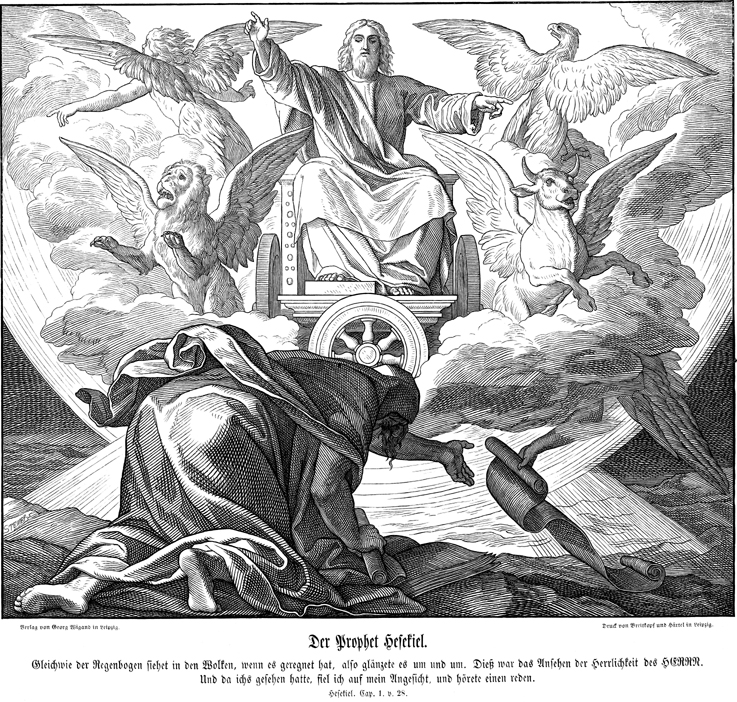
For centuries, artists have attempted to recreate the fantastic scene described in Ezekiel’s vision, and their efforts have resulted in a host of ethereal, otherworldly depictions that almost defy the range of man’s imagination. Their depictions border on the surreal and illustrate man’s incapacity to understand or explain the glory of God. But in their defense, each of them based their artwork on the words of Ezekiel. They simply illustrated what Ezekiel attempted to elucidate. But this young priest was at a great disadvantage because he was trying to describe the indescribable and explain the inexplicable. Hampered by a finite human mind and a limited vocabulary, Ezekiel did his best to recreate his vision with words. But his efforts would prove futile because he was attempting to describe “the appearance of the likeness of the glory of the Lord” (Ezekiel 1:28 ESV).

While Ezekiel appears to be describing a series of different individuals and objects, the scene is meant to illustrate the glory of the Lord. This entire chapter should be viewed as a depiction of the majesty and magnificence of Jehovah, the Creator-God who rules and reigns over all. The all-mighty, transcendent God of the universe was providing Ezekiel with a composite picture of His essence that was intended to engender a response of awe and reverential fear. And it worked, because Ezekiel claims, “When I saw it, I fell face down on the ground” (Ezekiel 1:28 NLT).

Ezekiel got the big picture. He correctly viewed the entire scene as a divine depiction of his God. And, as a priest, Ezekiel would have known that it was impossible for any human being to see God and live to tell about it. He would have been well versed in the words that God spoke to Moses in the wilderness of Sinai. The man whom God had chosen to liberate His people from their captivity in Egypt had expressed his desire to see God’s glory. Moses had seen God’s glory displayed in the burning bush and had repeatedly spoken with Him, but he longed for something greater.

Moses said, “Please show me your glory.” – Exodus 33:18 ESV

But God let Moses that his request was not only impossible, but it would also be suicidal. So, He provided Moses with a viable alternative.

…and he said, “I will make all my goodness pass before you and will proclaim before you my name ‘The Lord.’ And I will be gracious to whom I will be gracious, and will show mercy on whom I will show mercy. But,” he said, “you cannot see my face, for man shall not see me and live.” – Ezekiel 33:19-20 ESV

Like Moses, Ezekiel would see God’s glory and live to tell about it. He would see indescribable things and attempt to explain them with words that could never do them justice. The four living creatures, the wheels within wheels, the crystal expanse, and the sapphire thrown were all intended to depict God’s glory. Ezekiel was being given a rare opportunity to see the Almighty but in a way that produced awe and wonder instead of death.

It was the apostle Paul who described Yahweh as “the blessed and only almighty God, the King of all kings and Lord of all lords” (1 Timothy 6:15 NLT). And he went on to explain God’s transcendent, unapproachable nature.

He alone can never die, and he lives in light so brilliant that no human can approach him. No human eye has ever seen him, nor ever will. All honor and power to him forever! – 1 Timothy 6:16 NLT

It is impossible to know exactly what Ezekiel saw but that has not stopped artists from trying to depict it. But no painting, engraving, or illustration will ever be able to capture the glory of God.

Every aspect of Ezekiel’s vision was meant to reinforce the greatness and glory of God. The four different faces of the four living creatures reveal that God is sovereign over all creation. He rules over humanity, the wild beasts, domesticated animals, and the birds of the air – because He made them all. And the wheels within wheels were intended to depict God’s omnipresence; completely unhindered by time or space. According to Ezekiel, the wheels “went in any of their four directions without turning as they went” ( Ezekiel 1:17 ESV). The rims of the wheels were covered with eyes, illustrating the omniscience of God. He knows all because He sees all.

And He accomplishes all this while sitting on His throne above the great expanse. Ezekiel’s focus becomes fixed upon “a figure whose appearance resembled a man” (Ezekiel 1:26 NLT). But He is far from human in nature.

From what appeared to be his waist up, he looked like gleaming amber, flickering like a fire. And from his waist down, he looked like a burning flame, shining with splendor. All around him was a glowing halo, like a rainbow shining in the clouds on a rainy day. – Ezekiel 1:27-28 NLT

This is no ordinary king seated on a man-made throne. It is the King of kings and Lord of lords. Ezekiel is being given a glimpse of God Almighty, but it is a representation and not the real thing.

“It was a deeply-held tenet of Israelite religion from Moses onwards that God could not be visibly expressed, and for that very reason idolatry was out. But given the possibility of a theophany, no form but the human form could conceivably have been used to represent the Deity. It was, however, no mere human that Ezekiel saw: His radiance was surrounded by the glory of a rainbow, and the prophet could show his awe in no other way than by falling on his face in the dust before his God.” – L. E. Cooper Sr., Ezekiel

It is interesting to note that Ezekiel does not attempt to describe God’s face or countenance. All he writes about is the appearance of gleaming metal, fire, and brightness. According to Paul, God “dwells in unapproachable light” (1 Timothy 6:16 ESV). The psalmist states that God “wraps Himself in light as with a garment” (Psalm 104:2 BSB). The prophet Daniel was also given a vision of God and he described it in similar terms.

…the Ancient of Days took his seat; his clothing was white as snow, and the hair of his head like pure wool; his throne was fiery flames; its wheels were burning fire. – Daniel 7:9 ESV

Both Daniel and Ezekiel were given the privilege of seeing God’s glory, and both found it nearly impossible to put it into words. They were struck by the brightness of His very presence. He emanated light so bright that it could only be described as burning fire. It was intense and virtually unapproachable. This imagery reflects the holiness and purity of God. It was the apostle John who wrote, “God is light, and in him is no darkness at all” (1 John 1:5 ESV).

This majestic, all-knowing, holy, omnipresent God of the universe was reminding Ezekiel that He was still on His throne and well aware of the fate of the people of Judah. He had not turned His back on them. His power had not diminished and His love for them had not faded. The all-powerful, ever-loving, always-faithful God of Abraham, Isaac, and Jacob was about to deliver a message to His chosen people and He had chosen Ezekiel as His messenger. God had gotten Ezekiel’s attention, and now Ezekiel was ready to listen to what his glorious God had to say.

Such was the appearance of the likeness of the glory of the Lord. And when I saw it, I fell on my face, and I heard the voice of one speaking. – Ezekiel 1:28 ESV

English Standard Version (ESV) The Holy Bible, English Standard Version. ESV® Permanent Text Edition® (2016). Copyright © 2001

New Living Translation (NLT) Holy Bible, New Living Translation, copyright © 1996, 2004, 2015 by Tyndale House Foundation. Used by permission of Tyndale House Publishers Inc., Carol Stream, Illinois 60188. All rights reserved.

The Sufficiency of the Gospel

See to it that no one takes you captive by philosophy and empty deceit, according to human tradition, according to the elemental spirits of the world, and not according to Christ. For in him the whole fullness of deity dwells bodily, 10 and you have been filled in him, who is the head of all rule and authority. 11 In him also you were circumcised with a circumcision made without hands, by putting off the body of the flesh, by the circumcision of Christ, 12 having been buried with him in baptism, in which you were also raised with him through faith in the powerful working of God, who raised him from the dead. 13 And you, who were dead in your trespasses and the uncircumcision of your flesh, God made alive together with him, having forgiven us all our trespasses, 14 by canceling the record of debt that stood against us with its legal demands. This he set aside, nailing it to the cross. 15 He disarmed the rulers and authorities and put them to open shame, by triumphing over them in him. Colossians 2:8-15 ESV

Paul now warms to his primary task: warning the Colossian believers about the dangers of the doctrinal heresy threatening their congregation. He has established the preeminence of Christ and emphasized the foundational nature of His divinity and humanity. Now Paul presents a stinging indictment of the false teachers, labeling their rhetoric concerning Jesus as nothing more than a purely human-based philosophy based on tradition and filled with empty deceit. Paul’s use of the term “philosophy” was not meant to refer to an academic or scientific study of thought but the teaching of “certain Jewish Christian ascetics, which busied itself with refined and speculative inquiries into the nature and classes of angels, into the ritual of the Mosaic law and the regulations of Jewish tradition respecting practical life” (The Online Bible: Outline of Biblical Usage).

Paul emphasized that the teaching infiltrating the Colossian church was purely speculative and not based on divine revelation. It was not according to or in keeping with the prophetic pronouncement concerning Christ in the Old Testament. Nor was it in line with Christ’s teachings concerning Himself. No, these men propagated false doctrines based on “the elemental spirits of the world” (Colossians 2:8 ESV). The word translated as “spirits” is στοιχεῖον (stoicheion), which might be better translated as “principles.” Paul seems to be juxtaposing Christ-centered teaching with worldly and man-centered teaching. According to Paul, the elemental or fundamental theories of a non-Christian, fallen world were insufficient to explain or guide the Christian life. The false teachers were attempting to use human reasoning to explain spiritual truths.

Paul addressed this lack of spiritual discernment in his first letter to the churches in Corinth. He informed his audience that the gospel’s message was impossible to discern without assistance from the Holy Spirit.

When we tell you these things, we do not use words that come from human wisdom. Instead, we speak words given to us by the Spirit, using the Spirit’s words to explain spiritual truths. But people who aren’t spiritual can’t receive these truths from God’s Spirit. It all sounds foolish to them and they can’t understand it, for only those who are spiritual can understand what the Spirit means. Those who are spiritual can evaluate all things, but they themselves cannot be evaluated by others. For,

“Who can know the Lord’s thoughts?
    Who knows enough to teach him?”

But we understand these things, for we have the mind of Christ. – 1 Corinthians 2:13-16 NLT

Paul explained that “the word of the cross is folly to those who are perishing, but to us who are being saved it is the power of God” (1 Corinthians 1:18 ESV). He followed up this statement by quoting Isaiah 29:14.

For it is written,

“I will destroy the wisdom of the wise,
and the discernment of the discerning I will thwart.”

Then Paul excoriated the false teachers and religious traditionalists of his day, exposing them as frauds and fools who pridefully rejected the message of the gospel.

Where is the one who is wise? Where is the scribe? Where is the debater of this age? Has not God made foolish the wisdom of the world? For since, in the wisdom of God, the world did not know God through wisdom, it pleased God through the folly of what we preach to save those who believe. For Jews demand signs and Greeks seek wisdom, but we preach Christ crucified, a stumbling block to Jews and folly to Gentiles, but to those who are called, both Jews and Greeks, Christ the power of God and the wisdom of God. For the foolishness of God is wiser than men, and the weakness of God is stronger than men. – 1 Corinthians 1:20-25 ESV

Some found the apostles’ teaching concerning Christ to be illogical and unacceptable. They found the idea that Jesus was the embodiment of divinity and humanity untenable and indefensible. For others, the belief in Jesus’ sacrificial death and resurrection was little more than wishful thinking or a fairy tale. But Paul refers to his teaching concerning Christ as the power and wisdom of God.

Paul considered the false teachers’ denial of Christ’s divinity a particularly egregious sin. That’s why he unapologetically stated, “In Christ lives all the fullness of God in a human body” (Colossians 2:9 ESV). This was a foundational truth concerning the doctrine of salvation, and without it, the validity of Christ’s substitutionary death was rendered impotent. The sinlessness of Christ was based on His divinity. He was the unblemished God-man who was “tempted as we are, yet without sin” (Hebrews 4:15 ESV).

For God made Christ, who never sinned, to be the offering for our sin, so that we could be made right with God through Christ. – 2 Corinthians 5:21 NLT

To deny Jesus’ deity was to invalidate His entire ministry. He was the sinless and fully righteous Son of God who took on human flesh so that He might do what no man had ever been able to do before: Jesus fully obeyed every one of the commands of God found in the Mosaic Law.

For God has done what the law, weakened by the flesh, could not do. By sending his own Son in the likeness of sinful flesh and for sin, he condemned sin in the flesh… – Romans 8:3 ESV

The deity and humanity of Christ were both non-negotiable aspects of His character. Jesus was fully divine and entirely human. He was not a phantom or a god masquerading as a man. Some taught that Jesus only appeared to be human, and this erroneous teaching led to a distorted understanding of Jesus’ death on the cross. If He wasn’t truly human, then His death was little more than theater — a clever form of play-acting that accomplished nothing. It would mean the substitutionary nature of His death was invalid. Not only that, if Jesus didn’t die, then there was no resurrection, and if there was no resurrection, then mankind has no hope.

if Christ has not been raised, then your faith is useless and you are still guilty of your sins. In that case, all who have died believing in Christ are lost! And if our hope in Christ is only for this life, we are more to be pitied than anyone in the world. – 1 Corinthians 15:17-19 NLT

Paul assures the Colossians believers that the resurrection of Jesus was real and that its implications for their lives were substantial.

…you were raised to new life because you trusted the mighty power of God, who raised Christ from the dead. – Colossians 2:12 NLT

He wanted them to understand that they needed nothing more than Christ. Despite the claims of the false teachers, the believers in Colossae did not miss anything from their spiritual experience. They had been filled with the fullness of Christ. The Spirit of Christ indwelled them, making the nature of Christ available to them. The righteousness of Christ had been imputed to them. Unlike the Judaizers, who taught that Gentiles needed to be circumcised to be fully saved, Paul emphasized a spiritual form of circumcision.

When you came to Christ, you were “circumcised,” but not by a physical procedure. Christ performed a spiritual circumcision—the cutting away of your sinful nature. – Colossians 2:11 NLT

This was the same thought Paul had shared with the believers in Rome.

For you are not a true Jew just because you were born of Jewish parents or because you have gone through the ceremony of circumcision. No, a true Jew is one whose heart is right with God. And true circumcision is not merely obeying the letter of the law; rather, it is a change of heart produced by the Spirit. And a person with a changed heart seeks praise from God, not from people. – Romans 2:28-29 NLT

Paul reminded the Colossians that, before encountering Christ, they had been spiritually dead because their “sinful nature was not yet cut away” (Colossians 2:13 NLT). But that problem had been taken care of by God.

God made you alive with Christ, for he forgave all our sins. He canceled the record of the charges against us and took it away by nailing it to the cross. – Colossians 2:13-14 NLT

In doing so, God “disarmed the rulers and authorities” (Colossians 2:15 ESV). This is most likely a reference to “the spiritual forces of evil in the heavenly places” (Ephesians 6:12 ESV). Paul describes them as “the cosmic powers over this present darkness” (Ephesians 6:12 ESV). In conquering sin and death on the cross, God effectively silenced Satan and his minions, voiding the accusations of guilt and shame they level against God’s people. In Revelation 12:10, Satan is described as the accuser of the brethren, “who accuses them day and night before our God.” But, because of the atoning nature of the cross, Satan’s accusations carry no weight. His weapons lack any power against the children of God. But, just as Paul warned the believers in Ephesus, the Colossians were to “Put on the whole armor of God, that you may be able to stand against the schemes of the devil” (Ephesians 6:11 ESV).

The false teachers were attempting to undermine the effectiveness of Christ’s death and resurrection by questioning its validity. These godless men were acting as pawns of the enemy by sowing doubts among the believers in Colossae. But Paul exposed their so-called truths as nothing more than cleverly disguised lies meant to deceive and destroy the faith of God’s people.

For Paul, the gospel was enough. No new teaching was required, and the power of the cross required no additional enhancement or improvement. As Paul told the believers in Corinth, the gospel’s message required no help from human reasoning and cleverly crafted rhetoric.

When I first came to you, dear brothers and sisters, I didn’t use lofty words and impressive wisdom to tell you God’s secret plan. For I decided that while I was with you I would forget everything except Jesus Christ, the one who was crucified.

Rather than using clever and persuasive speeches, I relied only on the power of the Holy Spirit. I did this so you would trust not in human wisdom but in the power of God. – 1 Corinthians 2:1-2, 4-5 NLT

English Standard Version (ESV) The Holy Bible, English Standard Version. ESV® Permanent Text Edition® (2016). Copyright © 2001 by Crossway Bibles, a publishing ministry of Good News Publishers.

New Living Translation (NLT) Holy Bible, New Living Translation, copyright © 1996, 2004, 2015 by Tyndale House Foundation. Used by permission of Tyndale House Publishers Inc., Carol Stream, Illinois 60188. All rights reserved.


English Standard Version (ESV) The Holy Bible, English Standard Version. ESV® Permanent Text Edition® (2016). Copyright © 2001 by Crossway Bibles, a publishing ministry of Good News Publishers.

New Living Translation (NLT) Holy Bible, New Living Translation, copyright © 1996, 2004, 2015 by Tyndale House Foundation. Used by permission of Tyndale House Publishers Inc., Carol Stream, Illinois 60188. All rights reserved.

New English Translation (NET)NET Bible® copyright ©1996-2017 by Biblical Studies Press, L.L.C. http://netbible.com All rights reserved.


Where Is Your Faith?

22 One day he got into a boat with his disciples, and he said to them, “Let us go across to the other side of the lake.” So they set out, 23 and as they sailed he fell asleep. And a windstorm came down on the lake, and they were filling with water and were in danger. 24 And they went and woke him, saying, “Master, Master, we are perishing!” And he awoke and rebuked the wind and the raging waves, and they ceased, and there was a calm. 25 He said to them, “Where is your faith?” And they were afraid, and they marveled, saying to one another, “Who then is this, that he commands even winds and water, and they obey him?” – Luke 8:22-25 ESV

Luke has made it quite clear that by this time in His ministry, Jesus had garnered a large following. There were people coming from all over Galilee and even as far away as Jerusalem to witness the miracles and listen to the preaching of this Rabbi from Nazareth. Jesus had even attracted the attention of the Jewish religious leaders, including the high priest and members of the Sanhedrin. They were watching Him like a hawk, carefully scrutinizing everything He said and did. His growing popularity among the common people had become especially concerning to these powerful men because it threatened their power and control. Until Jesus had appeared on the scene, the Pharisees and other religious sects had enjoyed a kind of religious celebrity status. They were viewed as the spiritual superstars of their day and they had enjoyed the power and prestige that came with their elite standing among the people.

There were others who followed Jesus out of curiosity. They found Him to be intriguing and profoundly interesting, but they weren’t quite sure what to make of Him. His miracles amazed them and His preaching entertained them, but they weren’t quite ready to accept His claim to be the Son of God or the long-awaited Messiah of Israel.

As news of Jesus’ miracles began to spread, the sick, diseased, disabled, and demon-possessed began to flock to Jesus like moths to a flame. They showed up in droves, some requiring the assistance of friends or family members. In Jesus, they saw hope for healing. He became a light that attracted all those who were trapped in the darkness and despair that accompanied their physical condition. They were social outcasts, forced to live in solitude and separation from their community because they were considered unclean and cursed by God. But they had heard that Jesus healed the sick, restored the lame, and even freed those who were under the control of demons – no questions asked. He had even raised the dead back to life. To these people, the debate over whether Jesus was the Messiah took a backseat to their physical and emotional needs. They were far less interested in whether Jesus had come to restore the kingdom of Israel than if He could restore them to health.

Jesus found Himself surrounded by people of all kinds and their interest in Him ran the gamut. Some were simply curious. Others were convinced that He was the Messiah they had long hoped for. Still, others were like rubber-neckers at a car wreck, hoping to witness the next confrontation between Jesus and the religious leaders. To them, Jesus was a rabble-rouser and trouble maker who was upsetting the status quo and irritating the ruling elite, and they loved it.

And in the midst of this mass of different individuals with varying agendas, there were the 12 men whom Jesus had hand-picked to be His disciples. Since choosing to follow the Rabbi from Nazareth, these men had been His constant companions. They had been eyewitnesses to every miracle. They had listened to every word He had spoken, questioned the meaning of every parable He had told, and wondered why He had not yet set up His kingdom on earth. These men were committed but they were also confused. Jesus was an enigma to them. They knew He possessed great power because they had witnessed it firsthand. They were convinced that He was wise and spoke with an authority greater than that of the scribes and Pharisees. And yet, they couldn’t understand why the Messiah was wasting His time up in the rural region of Galilee rather than entering Jerusalem, ousting the Romans, and restoring Israel to power and prominence.

And Jesus was fully aware of His disciples’ confusion and growing consternation. He understood their frustration and knew they were anxious to see Him take His show on the road – all the way to the gates of Jerusalem. But there was much more they needed to understand. Their concept of the Messiah had been skewed by centuries of misguided expectations. They were longing for a political and military leader who would conquer Israel’s enemies and re-establish the Davidic dynasty. But Jesus seemed to be spending all His time in the backwater towns of Galilee, wasting His power on the helpless and the hopeless. When was He going to get serious about His mission to be Israel’s Messiah?

This sets up Luke’s record of Jesus’ calming of the storm. After yet another full day of performing miracles among the “least of these,” Jesus and His disciples got into a boat and began to sail to the eastern shore of the Sea of Galilee. And this little excursion was Jesus’ idea.

“Let us go across to the other side of the lake.” – Luke 8:22 ESV

Mark indicates that they began their journey at the end of the day and were accompanied by other boats. Everywhere Jesus went, the crowds attempted to follow Him. And it would not be long before they realized that following Him was going to prove costly and potentially dangerous.

As the disciples guided the boat along the shore of the sea, Jesus, exhausted by the activities of the day, fell asleep. But while He slept, a storm suddenly appeared as if out of nowhere. In no time at all, the disciples found themselves battling gale-force winds that turned the sea into a boiling cauldron of waves that threatened to sink their small vessel. Luke indicates that “they were filling with water and were in danger” (Luke 8:23 ESV). Despite the fact that at least four of the disciples were experienced fishermen, the severity of the storm caused these men to panic. They were in fear for their lives. So, in desperation, they decided to wake up Jesus and elicit His help.

“Master, Master, we are perishing!” – Luke 8:24 ESV

Mark reveals that they were more than a bit put out with Jesus’ apparent apathy. How could He sleep through such a life-threatening circumstance? They even questioned His concern for their well-being.

“Teacher, do you not care that we are perishing?” – Mark 4:38 ESV

Whether they realized it or not, these men were expressing their doubt in the goodness and compassion of the Son of God. They were accusing the Messiah of complacency and callousness. In the heat of the moment, they allowed their less-than-ideal circumstances to cloud their thinking and dictate their view of Jesus. In the midst of the storm, their faith in the Messiah evaporated and was replaced with incredulity and doubt. Without even realizing it, they had suddenly become the hopeless and the helpless. They found themselves in desperate circumstances and in need of rescue. The storm was more than they could handle and they realized they couldn’t save themselves. But notice that these men didn’t call out to Jesus in faith. Compare their response to that of the Roman centurion: “say the word, and let my servant be healed” (Luke 7:7 ESV). Or consider the statement made by the man who suffered from the incurable disease of leprosy: “Lord, if you will, you can make me clean” (Luke 5:12 ESV).

The disciples express no faith in Jesus. They question His integrity and empathy. But rather than read the disciples the riot act for their faithlessness, Jesus “rebuked the wind and the raging waves, and they ceased, and there was a calm” (Luke 8:24 ESV). Jesus attacked the source of their doubt: The storm. They had allowed the circumstances of life to determine their faith in Jesus. As the storm raged, their faith faltered. For a brief moment, they ceased to believe in Jesus.

But notice that Jesus spoke to the wind and the waves, not the disciples. He addressed the problem. He used His power to alleviate the source of their doubt. But then, He turned to His fearful and faithless disciples and asked, “Where is your faith?” (Luke 8:25 ESV). The presence of the storm had caused an absence of faith. In the face of adversity, the disciples had displayed a lack of fidelity. Trials have a way of testing the quality of our faith. Difficulties put our faith to the test and reveal its efficacy and stability. For the disciples, the sudden storm had exposed the anemic nature of their faith. In the face of adversity, fear had replaced faith. Confronted with what appeared to be a life-threatening scenario, the disciples had displayed a fickle faith that had been blown away by the winds of the storm. 

Luke reports that they were fearful and amazed. For some reason, this episode made a greater impact on them than Jesus raising a dead man back to life. Maybe it was because this particular miracle had a personal touch to it. It was their lives that had been threatened, and the words of Jesus had suddenly turned certain death into life. And this unexpected but highly appreciated miracle left them wrestling with new questions regarding Jesus’ identity.

“Who then is this, that he commands even winds and water, and they obey him?” – Luke 8:25 ESV

These are the same men who believed Jesus to be the Messiah. But His ability to command the wind and the water left them baffled. They believed Him to be their deliverer from the Romans but were blown away to learn that He had the power to control nature. In doing so, Jesus had clearly displayed His divinity. And the disciples were not sure what to make of this powerful demonstration of Jesus’ deity. Jesus had done what only God could do, and the disciples were forced to wrestle with the implications of this mind-blowing experience. Just when they thought they knew who Jesus was, they had to rethink all their presuppositions and could only ask, “Who then is this?”

English Standard Version (ESV) The Holy Bible, English Standard Version. ESV® Permanent Text Edition® (2016). Copyright © 2001 by Crossway Bibles, a publishing ministry of Good News Publishers.

New Living Translation (NLT) Holy Bible, New Living Translation, copyright © 1996, 2004, 2015 by Tyndale House Foundation. Used by permission of Tyndale House Publishers Inc., Carol Stream, Illinois 60188. All rights reserved.

The Message (MSG)Copyright © 1993, 1994, 1995, 1996, 2000, 2001, 2002 by Eugene H. Peterson

Authority & Power

21 And they went into Capernaum, and immediately on the Sabbath he entered the synagogue and was teaching. 22 And they were astonished at his teaching, for he taught them as one who had authority, and not as the scribes. 23 And immediately there was in their synagogue a man with an unclean spirit. And he cried out, 24 “What have you to do with us, Jesus of Nazareth? Have you come to destroy us? I know who you are—the Holy One of God.” 25 But Jesus rebuked him, saying, “Be silent, and come out of him!” 26 And the unclean spirit, convulsing him and crying out with a loud voice, came out of him. 27 And they were all amazed, so that they questioned among themselves, saying, “What is this? A new teaching with authority! He commands even the unclean spirits, and they obey him.” 28 And at once his fame spread everywhere throughout all the surrounding region of Galilee.

29 And immediately he left the synagogue and entered the house of Simon and Andrew, with James and John. 30 Now Simon’s mother-in-law lay ill with a fever, and immediately they told him about her. 31 And he came and took her by the hand and lifted her up, and the fever left her, and she began to serve them.

32 That evening at sundown they brought to him all who were sick or oppressed by demons. 33 And the whole city was gathered together at the door. 34 And he healed many who were sick with various diseases, and cast out many demons. And he would not permit the demons to speak, because they knew him. Mark 1:21-34 ESV

In his gospel account, Luke reports that “Jesus returned to Galilee, filled with the Holy Spirit’s power. Reports about him spread quickly through the whole region. He taught regularly in their synagogues and was praised by everyone” (Luke 4:14-15 ESV). And Mark provides a glimpse into one such occasion.

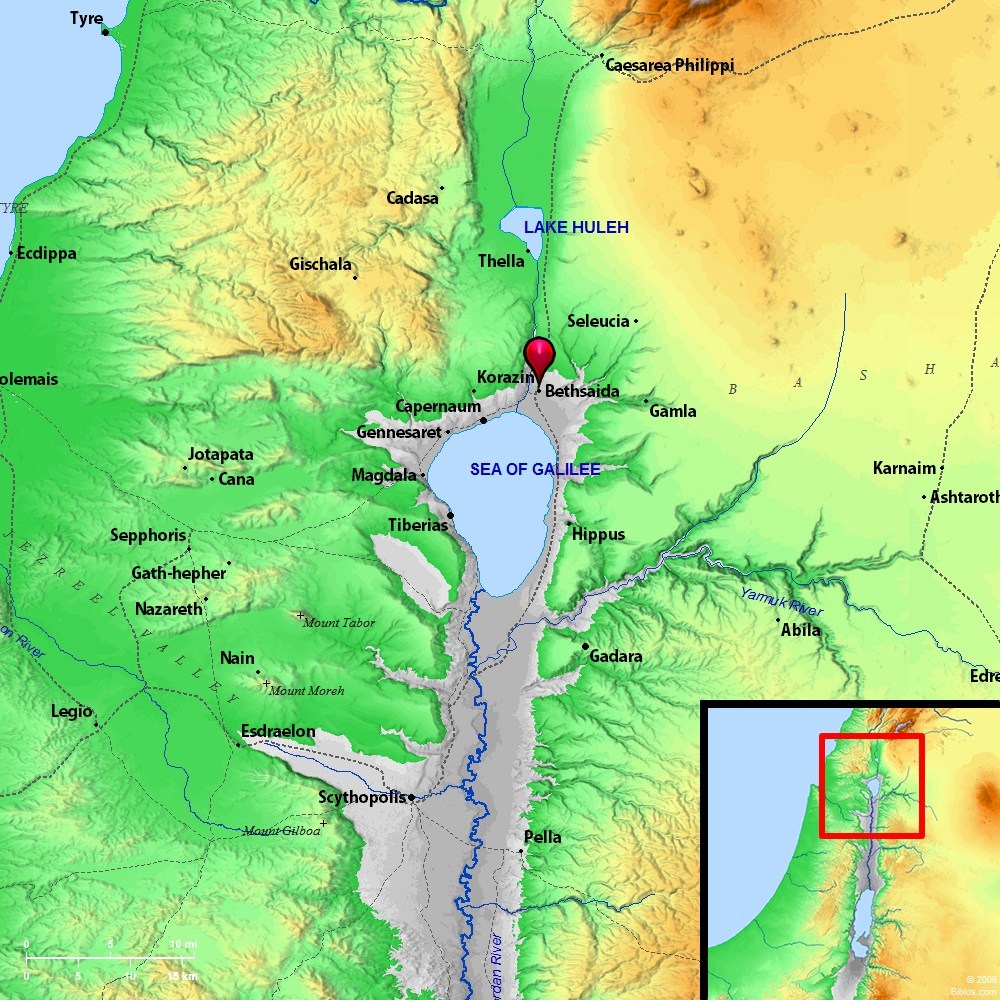
After calling Andrew, Simon, James, and John to be His disciples, Jesus and His new recruits made their way to the town of Capernaum on the northern shore of the Sea of Galilee. On the Sabbath, Jesus and His disciples made their way to the local synagogue. The synagogue was the building in each community where the Jews gathered for worship, prayer, and instruction. The Hebrew word is beit k’nesset (literally, House of Assembly). The Jews typically referred to this building as a synagogue, which is the Greek translation of  beit k’nesset.

The synagogue came into existence during Israel’s Babylonian captivity. After the Babylonians defeated Judah in 597 B.C., they took tens of thousands of Israelites captive and transported them to Babylon. With no access to the temple, the Jews were forced to come up with an alternative place of worship. Even after the Jews returned to Judah and rebuilt the temple which had been destroyed by the Babylonians, they continued to build synagogues in their local communities.

The synagogue was a place of prayer and instruction. And when the Jews gathered on the Sabbath, they would read from the Torah, the five books of Moses (Genesis, Exodus, Leviticus, Numbers, and Deuteronomy). After the reading of the sacred Scriptures, there would be a time of teaching or instruction.

Mark indicates that Jesus was teaching in the synagogue in Capernaum. Because Jesus was recognized as a Rabbi, it would have been quite normal for the leadership of the synagogue to extend Him this honor. But while Mark makes much of the peoples’ reaction to what Jesus’ taught, he provides no details concerning its content. He simply states, “they were astonished at his teaching, for he taught them as one who had authority, and not as the scribes” (Mark 1:22 ESV). The Greek word Mark used conveys the idea that they were “blown away” by the force of Jesus’ words. It seems that they were astonished or amazed, not so much by what Jesus said than by how He said it. He taught with authority (exousia). The people in the synagogue that day had never heard anything like it. In a sense, they felt like Jesus spoke as if He knew what He was talking about.

Mark purposefully contrasts the instruction of Jesus with that of the scribes. These men were considered the experts in the Law of Moses. Their job was to study the Law, transcribe it, and provide written commentaries about it. But Mark infers that these well-educated men lacked the authority and power that Jesus possessed. This will be the first of many contrasts that Mark establishes between Jesus and the religious leaders of Israel.

And, as if to illustrate that Jesus didn’t just have a way with words, Mark describes an encounter between Jesus and a man with an “unclean spirit.” Mark indicates that as soon as Jesus had finished speaking, this demon-possessed man interrupted the service, crying out, “What have you to do with us, Jesus of Nazareth? Have you come to destroy us? I know who you are—the Holy One of God” (Mark 1:24 ESV).

Evidently, this man had been in the room the entire time. But it was Jesus’ authoritative teaching that caused the demon(s) within the man to react in fear and anger. They had literally been struck by the power of Jesus’ words. The demon’s use of the plural pronoun, “us” may indicate that the man had more than one demon or that there were other demons present in the synagogue that day. Whatever the case, the demon had immediately recognized the identity of Jesus, referring to Him as “the Holy One of God.” This demonic being clearly knew who Jesus was and why He had come. He even asked Jesus if He planned to destroy him and his fellow demons right then and there.

With his description of this encounter, Mark establishes yet another point of conflict that will characterize Jesus’ earthly ministry. Not only will Jesus find Himself at odds with the Jewish religious leaders, but He will also be engaged in a battle with what Paul describes as “spiritual forces of evil in the heavenly places” (Ephesians 6:12).

But these spiritual forces were not relegated to the invisible world. They had infiltrated the realm of men and were wreaking havoc among God’s chosen people. This will not be the last of Jesus’ encounters with demons. But these other-worldly invaders were going to prove no match for the Holy One of God.

Jesus refused to answer or even acknowledge the demon’s question, choosing instead to shut the demon up by casting him out. The Greek word translated as “rebuke” can actually mean “to censure or silence.” Rather than verbally castigate the demon, Jesus simply removed his ability to speak by forcing him to vacate the man’s body.

“Be silent, and come out of him!” – Mark 1:25 ESV

With no host to occupy, the demon found itself with no means of communication.

And the unclean spirit, convulsing him and crying out with a loud voice, came out of him. – Mark 1;26 ESV

This strange and disturbing scene left those who had witnessed it even more amazed and astonished than ever. But notice that they connected what they had seen to the teaching of Jesus.

“What sort of new teaching is this?” they asked excitedly. “It has such authority! Even evil spirits obey his orders!” – Mark 1:27 NLT

Jesus’ words carried real power. It could not be said of Jesus that He was “all talk, no action.” Unlike the scribes, who could probably describe what the Scriptures had to say about demons, Jesus could control them. He had power over them. His words had authority. And this distinction did not go unnoticed. Mark indicates that “at once his fame spread everywhere throughout all the surrounding region of Galilee” (Mark 1:28 ESV). And that means that it wasn’t long before news of what Jesus had done made its way to the religious leaders in Jerusalem. As Jesus’ fame spread, so did His infamy. And before long, Jesus would find Himself doing battle on multiple fronts.

But Jesus was not done demonstrating His power. After His exorcism of the demon in the synagogue, Jesus made His way to the home of Andrew and Simon. Mark indicates that Simon’s mother-in-law was ill. It is likely that Simon (Peter) told this story to Mark and that is why it is included in his gospel account. When Jesus was informed of her illness, He simply took her by the hand and she was immediately healed. Without a word being said, she went from suffering to serving. This point should not be overlooked. In the scene that took place in the synagogue, the emphasis was on Jesus’ words. He spoke as one having authority. But on this occasion, Jesus said nothing. He took the woman by the hand and she was immediately healed. It was another case of Jesus demonstrating His power and authority, but this time without words.

This latest episode only increased Jesus’ notoriety and further inflamed the curiosity of the people. Mark reveals that by the end of the day, the crowds had gathered outside the home of Simon and Andrew. News had spread and it wasn’t long before “all who were sick or oppressed by demons” made their way to Jesus. And Mark indicates that “the whole city was gathered together at the door” (Mark 1:33 ESV).

And what did Jesus do? He “healed many people who were sick with various diseases, and he cast out many demons” (Mark 1:34 ESV). He demonstrated His power and authority – over disease and demons. In a sense, Jesus gave proof of what the demon had said. He really was the Holy One of God and the source of His authority and power was divine, not human. He was able to do what He did because of who He was. But the people, while impressed by what they saw, were not yet convinced of His divinity.

English Standard Version (ESV) The Holy Bible, English Standard Version. ESV® Permanent Text Edition® (2016). Copyright © 2001 by Crossway Bibles, a publishing ministry of Good News Publishers.

New Living Translation (NLT) Holy Bible, New Living Translation, copyright © 1996, 2004, 2015 by Tyndale House Foundation. Used by permission of Tyndale House Publishers Inc., Carol Stream, Illinois 60188. All rights reserved.

The Message (MSG)Copyright © 1993, 1994, 1995, 1996, 2000, 2001, 2002 by Eugene H. Peterson

What Is That to You?

20 Peter turned and saw the disciple whom Jesus loved following them, the one who also had leaned back against him during the supper and had said, “Lord, who is it that is going to betray you?” 21 When Peter saw him, he said to Jesus, “Lord, what about this man?” 22 Jesus said to him, “If it is my will that he remain until I come, what is that to you? You follow me!” 23 So the saying spread abroad among the brothers that this disciple was not to die; yet Jesus did not say to him that he was not to die, but, “If it is my will that he remain until I come, what is that to you?”

24 This is the disciple who is bearing witness about these things, and who has written these things, and we know that his testimony is true.

25 Now there are also many other things that Jesus did. Were every one of them to be written, I suppose that the world itself could not contain the books that would be written. John 21:20-25 ESV

Jesus has just called Peter to follow Him. But Peter received this somewhat innocuous invitation immediately after hearing the kind of death he would suffer for feeding and caring for Jesus’ sheep. For Peter, following Jesus was to come with a death sentence. And Peter seems to have understood exactly what Jesus had inferred when He had said, “when you are old, you will stretch out your hands, and another will dress you and carry you where you do not want to go” (John 21:18 ESV).

John even clarifies that Jesus’ words were intended “to show by what kind of death he was to glorify God” (John 21:19 ESV). In the Roman-dominated culture in which they lived, the term “stretch out you hands” had become a euphemistic and more palatable way of referring to crucifixion. It was a word picture that described the victim’s arms being stretched out and tied to the upper beam of the cross (Ernst Haenchen, A Commentary on the Gospel of John, 2:226-27).

Peter’s immediate response to this news reveals that he fully understood the import of what Jesus had said to him. As he and Jesus walked along the shore of the Sea of Galilee, Peter turned and saw John following close behind. And the sight of “the disciple whom Jesus loved” seems to have filled Peter with jealousy. Peter was a natural-born competitor. He was always jockeying for position, trying to establish himself as the lead-dog among the rest of the disciples. Yet, John always seemed to be the teacher’s pet, the obvious favorite of Jesus, and this must have infuriated and frustrated the highly-competitive Peter.

So, like a petulant child, Peter asked Jesus, “Lord, what about this man?” (John 21:21 ESV). Peter’s unbridled and impetuous nature was on full display. He always had a difficult time controlling his impulses and words proved to be a particularly thorny problem. He habitually struggled to get his brain in gear before he put his lips in motion. Thinking before speaking was not a strong suit.

Peter, having heard the less-than-pleasant ending to his own life, wants to know what John’s fate will be.  What does God have in store for “the disciple whom Jesus loved?” Will he have his “hands stretched out?” Is John going to have to suffer death for following Jesus? It seems that Peter felt like he had been singled out. Perhaps he believed the death that Jesus had predicted he would suffer was a form of punishment for his earlier denial. Whatever the case, Peter was not asking out of concern for John. He was trying to determine whether the other disciples were going to end up like him. And the tone of Jesus’ response reveals that He understood the self-centered nature of Peter’s question.

“If it is my will that he remain until I come, what is that to you? – John 21:22 ESV

In a sense, Jesus told Peter, “that’s none of your business.” Jesus had just had a personal and intimate conversation with Peter, yet none of the other disciples were demanding to know what they had discussed. Jesus had plans for each of His disciples, but all Peter needed to know was what Jesus had in store for him. Obviously, Peter was not particularly pleased with how Jesus described the ending to his life’s story. There’s little doubt that Peter had always envisioned some much more positive. But he was discovering the difficult truth that God’s will was not obligated to mirror his own. In time, he would learn to pray as Jesus did in the garden, “Father, if you are willing, please take this cup of suffering away from me. Yet I want your will to be done, not mine” (Luke 22:42 NLT).

But for now, he was struggling with the twin demons of comparison and competition. He was jealous of John and his intimate relationship with Jesus. And his competitive nature made it difficult for him to accept the outcome Jesus had described. Peter didn’t want to die a martyr, despite his earlier claim that he would lay down his life for Jesus (John 13:37). Peter was naturally attracted to glory and gain. He was prone to seek credit for anything that he did. His actions tended to be driven by reward and recognition. But this brings to mend the words spoken by Jesus spoke in His sermon on the mount.

“Beware of practicing your righteousness before other people in order to be seen by them, for then you will have no reward from your Father who is in heaven. –Matthew 6:1 ESV

Peter didn’t need to worry about John. He needed to focus on the mission Jesus had given to him.

“Feed my lambs.” – John 21:15 ESV

“Tend my sheep.” – John 21:16 ESV

“Feed my sheep.” – John 21:17 ESV

If Jesus willed for John to live a long and prosperous life, that was none of Peter’s business. Even if John were divinely destined to live long enough to see the return of Jesus, that should be of no concern to Peter. He had his marching orders. He knew exactly what Jesus required of him. But he was allowing jealousy and envy to blind him from the task at hand. And James warns what happens when believers allow these twin temptations to take over their lives.

But if you are bitterly jealous and there is selfish ambition in your heart, don’t cover up the truth with boasting and lying. For jealousy and selfishness are not God’s kind of wisdom. Such things are earthly, unspiritual, and demonic. For wherever there is jealousy and selfish ambition, there you will find disorder and evil of every kind. – James 3:14-16 NLT

John adds an interesting side note that reveals how easy it is to draw false conclusions from God’s word. It seems that Jesus’ words regarding John had been wrongly interpreted to mean that John would never die. This statement from the lips of Jesus had taken on a life of their own, spreading throughout the early church in the form of a rumor that John would outlive all the disciples, being miraculously kept alive until the return of Jesus.

So the saying spread abroad among the brothers that this disciple was not to die. – John 21:23 ESV

But John put that rumor to rest by restating and clarifying what Jesus had said. The key word in Jesus’ statement had been the first one: “If…” Jesus had been making a propositional statement. It could have gone either way. If John lived until Jesus returned, it would have been God’s will. If he didn’t, that too would have been God’s will. Jesus had not guaranteed one or the other. He had simply been encouraging Peter to keep his mind focused on the revealed will of God for him.

As John prepares to wrap up his gospel account, he restates that he is its author. He has been an eyewitness to all that he has written. While he has constantly referred to himself in the third-person throughout his gospel, John had first-person knowledge of all that he has recorded. And because he is writing near the end of the 1st-Century, years after the events recorded in his gospel had taken place, he can boldly state that his testimony is true. They have been verified by time and the testimonies of others.

And John adds that his gospel was anything but comprehensive. He is not inferring that it is somehow incomplete or inadequate, but only that it would have been impossible to record all that Jesus had said and done during His earthly ministry. Under the inspiration of the Holy Spirit, John had carefully and purposefully chosen which details to include. And they all supported his overall thesis.

these are written so that you may believe that Jesus is the Christ, the Son of God, and that by believing you may have life in his name. – John 20:31 ESV

The lofty goal John had set out for his gospel had been to establish Jesus as the Son of God and the Savior of the world. He began with his claim that Jesus was the Word of God made flesh. He was the second person of the Trinity, the very Son of God who, by becoming a man, made the invisible God visible. Jesus manifested or revealed the Father by demonstrating the Father’s love for mankind. And He did it by willingly taking the form of sinful man and dying as the sinless substitute required to satisfy the just demands of His Heavenly Father. Jesus became “the Lamb of God who takes away the sins of the world” (John 1:29 ESV).

And John painstakingly recorded the words and works of Jesus so that those who came to faith in Him long after His ascension would continue to believe in who He was and what He had come to do. The early church was under attack and believers were constantly being tempted to walk away from the faith. They struggled with doubts about Jesus’ true identity because false teachers were constantly bringing into question either His divinity or His humanity. Some claimed Him to be God, but not a man. Others taught that He was a man, but not God. But John has spent 21 chapters defending the deity of Jesus while, at the same time, strenuously defending His humanity. Jesus was the God-man. And it was that one-of-a-kind nature that allowed Him to do what He came to do: Give His life as a ransom for many.

English Standard Version (ESV) The Holy Bible, English Standard Version. ESV® Permanent Text Edition® (2016). Copyright © 2001 by Crossway Bibles, a publishing ministry of Good News Publishers.

New Living Translation (NLT) Holy Bible, New Living Translation, copyright © 1996, 2004, 2015 by Tyndale House Foundation. Used by permission of Tyndale House Publishers Inc., Carol Stream, Illinois 60188. All rights reserved.

The Message (MSG)Copyright © 1993, 1994, 1995, 1996, 2000, 2001, 2002 by Eugene H. Peterson

I Am!

51 Truly, truly, I say to you, if anyone keeps my word, he will never see death.” 52 The Jews said to him, “Now we know that you have a demon! Abraham died, as did the prophets, yet you say, ‘If anyone keeps my word, he will never taste death.’ 53 Are you greater than our father Abraham, who died? And the prophets died! Who do you make yourself out to be?” 54 Jesus answered, “If I glorify myself, my glory is nothing. It is my Father who glorifies me, of whom you say, ‘He is our God.’ 55 But you have not known him. I know him. If I were to say that I do not know him, I would be a liar like you, but I do know him and I keep his word. 56 Your father Abraham rejoiced that he would see my day. He saw it and was glad.” 57 So the Jews said to him, “You are not yet fifty years old, and have you seen Abraham?” 58 Jesus said to them, “Truly, truly, I say to you, before Abraham was, I am.” 59 So they picked up stones to throw at him, but Jesus hid himself and went out of the temple. John 8:51-59 ESV

The longer Jesus spoke, it seems that the frustration of the religious only intensified. And their growing anger with Him seems to support His accusations against Him. He has claimed to be the light of the glory of God, but they prefer to remain covered by the darkness of their own pre-established notions of righteousness and holiness. He has offered Himself as the only solution to mankind’s sin problem and the key to eternal life. But they have refused His offer, choosing instead to label Him as a blasphemer and sinner, operating in league with Satan himself. He has declared Himself to be the Son of God, yet they accused Him of being illegitimate, and not even knowing the name of His own earthly father. Jesus had described them as being the children of Satan, and now they return the favor by declaring Him of being demon-possessed.

This entire section of John’s gospel is intended to support Jesus’ claim to be the light of the world. He has been standing in the courtyard of the temple of God, speaking to the people of God, and allowing the glory of God to illuminate what has become one of the darkest places within the nation of Israel: God’s own dwelling place.

The location for this latest conversation between Jesus and the religious leaders is extremely important. He is standing in the temple treasury, where all the voluntary and obligatory financial gifts given to the temple were kept. Earlier, in chapter two of his gospel, John described Jesus cleansing the temple of “those who were selling oxen and sheep and pigeons, and the money-changers sitting there” (John 2:14 ESV). The Son of God had been appalled to find His Father’s house turned into a marketplace. In His anger, He literally cleaned house.

And making a whip of cords, he drove them all out of the temple, with the sheep and oxen. And he poured out the coins of the money-changers and overturned their tables. And he told those who sold the pigeons, “Take these things away; do not make my Father’s house a house of trade.” – John 2:15-16 ESV

The temple was to have been the place where God’s glory dwelled. All the way back at the dedication of the original temple, the glory of God had descended upon the magnificent structure built by King Solomon.

As soon as Solomon finished his prayer, fire came down from heaven and consumed the burnt offering and the sacrifices, and the glory of the Lord filled the temple. And the priests could not enter the house of the Lord, because the glory of the Lord filled the Lord‘s house. When all the people of Israel saw the fire come down and the glory of the Lord on the temple, they bowed down with their faces to the ground on the pavement and worshiped and gave thanks to the Lord, saying, “For he is good, for his steadfast love endures forever.” – 2 Chronicles 7:1-3 ESV

In response to Solomon’s prayer of dedication over the newly constructed temple, God had told him:

“I have heard your prayer and have chosen this place for myself as a house of sacrifice. When I shut up the heavens so that there is no rain, or command the locust to devour the land, or send pestilence among my people, if my people who are called by my name humble themselves, and pray and seek my face and turn from their wicked ways, then I will hear from heaven and will forgive their sin and heal their land. Now my eyes will be open and my ears attentive to the prayer that is made in this place. For now I have chosen and consecrated this house that my name may be there forever.” – 2 Chronicles 7:12-16 ESV

But God’s people had proved to be unfaithful. They failed to remain obedient to His commands and chose to worship false gods, even erecting idols to them within the temple Solomon had dedicated to God. And Solomon had been one of the chief instigators behind the nation’s rebellion against God. In time, God destroyed the temple that bore His name. He used the Babylonian Empire as His agent of judgment against His chosen people, turning the capital city of Jerusalem and the glorious temple into a heap of ruins.

The temple where Jesus spoke was the same one that had been rebuilt by the Jews who had returned to Judah after 70 years of captivity in Babylon. That much smaller and less ornate temple was greatly expanded by King Herod during the 1st-Century AD. And it was on the grounds of this temple where Jesus had His confrontation with the Jewish religious leaders.

In a sense, Jesus was presenting Himself as the replacement for the temple. With His coming, the primary purpose of the temple was being eliminated. It was no longer the dwelling place of God. Jesus had made the invisible God visible. He was God in human flesh, manifesting the glory of God through His miracles and messages. And, in time, He would offer His life as the ultimate and final sacrifice for the sins of mankind. The earthly temple would be replaced by the bodily temple of God’s own Son. That is why Jesus had said, “Destroy this temple, and in three days I will raise it up” (John 2:19 ESV). His death would accomplish what the temple and the sacrificial system could have never done. And the author of Hebrews makes this point perfectly clear.

…those sacrifices actually reminded them of their sins year after year. For it is not possible for the blood of bulls and goats to take away sins. That is why, when Christ came into the world, he said to God, “You did not want animal sacrifices or sin offerings. But you have given me a body to offer. You were not pleased with burnt offerings or other offerings for sin. Then I said, ‘Look, I have come to do your will, O God—as is written about me in the Scriptures.’”

First, Christ said, “You did not want animal sacrifices or sin offerings or burnt offerings or other offerings for sin, nor were you pleased with them” (though they are required by the law of Moses). Then he said, “Look, I have come to do your will.” He cancels the first covenant in order to put the second into effect. For God’s will was for us to be made holy by the sacrifice of the body of Jesus Christ, once for all time. – Hebrews 10:3-10 NLT

One of the things that infuriated the religious leaders was Jesus’ claim that He could offer eternal life. They had been shocked by Jesus’ audacious and ridiculous claim: “if anyone keeps my word, he will never see death” (John 8:51 ESV). His statement was illogical and, therefore, unacceptable. Abraham and all the prophets had died, they reasoned. So, who was He to think that He could offer a life free from death? They even ask Him, “Who do you make yourself out to be?” (John 8:53 ESV). Their question reveals that they know exactly what Jesus was saying. He was claiming to be God. And, almost as if to support their suspicions, Jesus responded, “If I glorify myself, my glory is nothing. It is my Father who glorifies me, of whom you say, ‘He is our God’” (John 8:54 ESV).

Jesus brings the conversation back to the issue of His relationship with God. He was not just another son of God, as they believed themselves to be. He was the actual Son of God, the second member of the Holy Trinity. He was claiming divinity and authority, provided to Him by His Heavenly Father. But, as Jesus pointed out, their failure to recognize and accept Him was due to their ignorance of God. They didn’t know God as their Father, so how would they ever recognize His Son when He showed up?

But Jesus emphasized that Abraham, their great patriarch, had looked forward to the day when the promise of God was finally fulfilled through Jesus. God had told Abraham, “All the families of the earth will be blessed through you and your offspring” (Genesis 12:3 BSB). And the apostle Paul had clarified the meaning of this promise when he wrote, “Now the promises were made to Abraham and to his offspring. It does not say, ‘And to offsprings,’ referring to many, but referring to one, ‘And to your offspring,’ who is Christ” (Galatians 3:16 ESV).

Jesus was the ultimate fulfillment of God’s promise to Abraham, and He claims, “Your father Abraham rejoiced that he would see my day. He saw it and was glad” (John 8:56 ESV). In a sense, Jesus is saying, “If Abraham could ‘see’ and rejoice in my coming, why can’t you?”

And when His detractors scoff at Jesus’ words, He adds fuel to the fire by boldly asserting, “Truly, truly, I say to you, before Abraham was, I am” (John 8:58 ESV). And the magnitude of this statement did not escape them. They knew exactly what He was saying. Jesus was claiming to be God, which is why John states that “they picked up stones to throw at him” (John 8:59 ESV). They distinctly heard Jesus using the self-designation used by Yahweh when He had spoken to Moses at the burning bush.

Then Moses said to God, “If I come to the people of Israel and say to them, ‘The God of your fathers has sent me to you,’ and they ask me, ‘What is his name?’ what shall I say to them?” God said to Moses, “I am who I am.” And he said, “Say this to the people of Israel: ‘I am has sent me to you.’” – Exodus 3:13-14 ESV

At this point in the story, John has presented a turning point in the life and ministry of Jesus. The confrontation between Jesus and His adversaries has entered a new and darker phase. Jesus has clearly stated His identity. No more cryptic answers. No more veiled references to deity. He is the great “I am.” And John ends this scene with a simple sentence that is pregnant with meaning: “but Jesus hid himself and went out of the temple” (John 8:59 ESV). 

The glory of God, in the form of the Son of God, departed the temple. He vacated the premises, leaving the religious leaders still holding the stones in their hands with which they had intended to kill Him. The Lamb of God who takes away the sins of the world, had walked away from the very place where tens of thousands of sacrifices had been offered for hundreds of years. But this Lamb would be offered on a hillside outside the city, providing atonement for the sins of mankind – once for all.

English Standard Version (ESV) The Holy Bible, English Standard Version. ESV® Permanent Text Edition® (2016). Copyright © 2001 by Crossway Bibles, a publishing ministry of Good News Publishers.

New Living Translation (NLT)
Holy Bible, New Living Translation, copyright © 1996, 2004, 2015 by Tyndale House Foundation. Used by permission of Tyndale House Publishers Inc., Carol Stream, Illinois 60188. All rights reserved.

The Message (MSG)Copyright © 1993, 1994, 1995, 1996, 2000, 2001, 2002 by Eugene H. Peterson