Fairweather Followers

60 When many of his disciples heard it, they said, “This is a hard saying; who can listen to it?” 61 But Jesus, knowing in himself that his disciples were grumbling about this, said to them, “Do you take offense at this? 62 Then what if you were to see the Son of Man ascending to where he was before? 63 It is the Spirit who gives life; the flesh is no help at all. The words that I have spoken to you are spirit and life. 64 But there are some of you who do not believe.” (For Jesus knew from the beginning who those were who did not believe, and who it was who would betray him.) 65 And he said, “This is why I told you that no one can come to me unless it is granted him by the Father.” 

After this many of his disciples turned back and no longer walked with him.John 6:60-66 ESV

The message Jesus delivered in the synagogue regarding “the bread that came down from heaven” (John 6:57 ESV) had made an impression on His audience. His bizarre comments about eating His flesh and drinking His blood had not gone unnoticed. His offer of eternal life definitely piqued their interest. But there appears to be no one who heard Jesus speak who grasped the meaning behind all that He said.

When Jesus had attempted to tell Nicodemus about the need for a new birth “from above” in order to enter the kingdom of heaven, the well-educated Pharisee had responded, “How can these things be?” (John 3:9 ESV). And Jesus answered with a question of His own: “If I have told you earthly things and you do not believe, how can you believe if I tell you heavenly things?” (John 3:12 ESV).

Nicodemus had been unable to grasp the spiritual nature of Jesus’ words. His mind was stuck on an earthly plane, limiting his ability to hear the wonderful news that Jesus was conveying in His message. And he had walked away confused, but not converted.

The same was true for those who heard Jesus speak in the synagogue in Capernaum. John has made it clear that a good portion of the audience “grumbled about him, because he said, ‘I am the bread that came down from heaven’” (John 6:41 ESV). They saw Jesus as a man from Nazareth, not some divine being who had descended from the sky. And when they heard Jesus claim that eating His flesh would result in eternal life, they had “disputed among themselves, saying, ‘How can this man give us his flesh to eat?’” (John 6:52 ESV).

If one were to judge the effectiveness of Jesus’ communication skills based on the peoples’ response, the conclusion would have to be that He failed miserably. His sermon appears to have produced no converts. No one asked to receive the bread that He offered. No one came forward eager to drink His blood. Instead, they disputed, grumbled, and struggled to understand what Jesus was talking about. John even indicates that even those who considered themselves followers of Jesus were having a difficult time taking in all that He had said.

These “disciples” as John describes them were made up of those who had traveled all the way from Bethsaida, eager to see Jesus perform another miracle. They had eaten the bread and fish He had multiplied and had shown up in Capernaum hoping to receive more of the same. Others had heard the rumors about His miracles and were anxious to see Him perform a sign with their own eyes. In the gospels, the term “disciple” is used to refer to all those who followed Jesus. It does not necessarily mean that these people were believers. In fact, John will make it clear that many of these disciples or followers of Jesus ended up abandoning Him as a result of His message in the synagogue.

“…many of his disciples turned back and no longer walked with him.” – John 6:66 ESV

They had been attracted by His miraculous works but repulsed by His words. They proved to be fairweather followers who chose to walk away from Jesus when they didn’t get what they wanted from Him.

When Jesus overheard the grumbling among His followers, He responded, “Does this offend you? Then what will you think if you see the Son of Man ascend to heaven again?” (John 6:61-62 NLT). Here Jesus reveals the true nature of their contention. It was not so much that He had offered His body and blood as food, but that He had claimed to be the Son of God sent from heaven.

This is the work of God, that you believe in him whom he has sent.” – John 6:29 ESV

the bread of God is he who comes down from heaven…” –John 6:33 ESV

“For I have come down from heaven, not to do my own will but the will of him who sent me.” – John 6:38 ESV

“I am the bread that came down from heaven.” – John 6:41 ESV

“This is the bread that comes down from heaven, so that one may eat of it and not die. I am the living bread that came down from heaven.” – John 6:50-51 ESV

Jesus reveals that this was the crux of the matter. They just couldn’t bring themselves to believe that He was divine. They could possibly accept the fact that He was a prophet sent from God or even the Messiah. But in either case, He would have been a mere man, and not God in human flesh.

But as difficult as it was to accept that Jesus had come down from heaven, He prophetically reveals that the day will come when He returns. Once again, Jesus was speaking rather cryptically, using language that left His audience scratching their heads in confusion. But there was a small contingent within the crowd who would one day understand the full import of His words. The men who would later become His apostles and the emissaries of His message would be eyewitnesses to His future ascension. 

So then the Lord Jesus, after he had spoken to them, was taken up into heaven and sat down at the right hand of God. And they went out and preached everywhere, while the Lord worked with them and confirmed the message by accompanying signs. – Mark 16:19-20 ESV

But Jesus’ mention of His ascension most likely included a veiled reference to His crucifixion. He had told Nicodemus, And as Moses lifted up the serpent in the wilderness, so must the Son of Man be lifted up, that whoever believes in him may have eternal life” (John 3:14-15 ESV). John also records Jesus restating this claim and adds an important note of clarification.

“And I, when I am lifted up from the earth, will draw all people to myself.” He said this to show by what kind of death he was going to die. – John 12:32-33 ESV

Jesus’ return to heaven would be preceded by His sacrificial death. He had come to die so that others might live. His death had been the sole purpose behind His coming. He had been sent from heaven to offer His life as a ransom for many so that they might be restored to a right relationship with God. His body would be broken and His blood would be poured out for the sins of many. And one day, His true followers would fully comprehend the meaning of His words. Luke records that when His disciples saw Him ascend into heaven, “they worshiped him and returned to Jerusalem with great joy, and were continually in the temple blessing God” (Luke 24:52-53 ESV).

But that day in the synagogue in Capernaum, there was no one who comprehended the meaning behind Jesus’ words. And there were none who rejoiced at what they heard. And Jesus revealed that their inability to understand His words was because they lacked insight from the Spirit of God.

“It is the Spirit who gives life; the flesh is no help at all. The words that I have spoken to you are spirit and life.” – John 6:63 ESV

Not only were they unable to comprehend His words, but they were also incapable of achieving eternal life. Without the Spirit’s help, they would remain blind to the reality of what Jesus was saying. It was just as Jesus had told Nicodemus:

“That which is born of the flesh is flesh, and that which is born of the Spirit is spirit.” – John 3:6 ESV

There were some in Jesus’ audience who would eventually end up understanding the words of Jesus and believing His claim to be the Son of God. But as Jesus revealed, there were others who would not and could not believe. And John adds further proof of Jesus’ deity by stating that He “knew from the beginning who those were who did not believe, and who it was who would betray him” (John 6:64 ESV).

The crowd that followed Jesus was about to grow smaller. And Jesus revealed that following after Him was not the same as coming to Him. Anyone could join the crowds that lined up to see Him work miracles. But only those called by God and empowered by the Spirit of God could become true disciples of the Son of God. And Jesus reiterated His earlier claim.

“no one can come to me unless it is granted him by the Father.” – John 6:65 ESV

Many would follow, but not all would believe. Miracles may attract a crowd, but they don’t transform a sinner into a saint. Only the Spirit of God can do that. he opens the eyes of those blinded by sin so they can see the truth of Gospel:

“For God so loved the world, that he gave his only Son, that whoever believes in him should not perish but have eternal life. – John 3:16 ESV

English Standard Version (ESV) The Holy Bible, English Standard Version. ESV® Permanent Text Edition® (2016). Copyright © 2001 by Crossway Bibles, a publishing ministry of Good News Publishers.

New Living Translation (NLT)
Holy Bible, New Living Translation, copyright © 1996, 2004, 2015 by Tyndale House Foundation. Used by permission of Tyndale House Publishers Inc., Carol Stream, Illinois 60188. All rights reserved.

The Message (MSG)Copyright © 1993, 1994, 1995, 1996, 2000, 2001, 2002 by Eugene H. Peterson

The Man Believed the Word

46 So he came again to Cana in Galilee, where he had made the water wine. And at Capernaum there was an official whose son was ill. 47 When this man heard that Jesus had come from Judea to Galilee, he went to him and asked him to come down and heal his son, for he was at the point of death. 48 So Jesus said to him, “Unless you see signs and wonders you will not believe.” 49 The official said to him, “Sir, come down before my child dies.” 50 Jesus said to him, “Go; your son will live.” The man believed the word that Jesus spoke to him and went on his way. 51 As he was going down, his servants met him and told him that his son was recovering. 52 So he asked them the hour when he began to get better, and they said to him, “Yesterday at the seventh hour the fever left him.” 53 The father knew that was the hour when Jesus had said to him, “Your son will live.” And he himself believed, and all his household. 54 This was now the second sign that Jesus did when he had come from Judea to Galilee. – John 4:46-54 ESV

After their two-day, unplanned stopover in Samaria, Jesus and His disciples left for the northern region of Galilee. He did so, in spite of the popular proverb He had quoted to His disciples: “a prophet has no honor in his own hometown” (John 4:44 ESV). Jesus was returning to Galilee, but He made His way to Cana, rather than His own hometown of Nazareth. He returned to the scene of His first miracle, where He had turned the water into wine.

In verse 45, John indicates that Jesus received a warm welcome in Galilee because many of the people had been eyewitnesses to the signs He had performed in Jerusalem during the Feast of Passover. With this reference to Jesus’ signs, John provides a link back to the miracle performed at the wedding feast in Cana. While the guests at the feast had no idea that Jesus had transformed ordinary water into wine, His disciples were fully aware of what had transpired.

This, the first of his signs, Jesus did at Cana in Galilee, and manifested his glory. And his disciples believed in him. – John 2:11 ESV

And when Jesus had gone on to perform additional signs in Jerusalem during the Passover festival, John records, “many believed in his name when they saw the signs that he was doing” (John 2:23 ESV).

The basis for their belief was the nature of the miraculous signs Jesus performed. And John makes it clear that the warm reception Jesus received in Galilee was due to “all that he had done in Jerusalem” (John 4:45 ESV). They too were attracted to and enamored by the miracles of Jesus. And His reputation as a miracle worker was spreading rapidly throughout all Israel. Which sets up the next encounter Jesus will experience.

While in Cana, Jesus received a visit from an unnamed government official who came seeking healing for his deathly-ill son. While we know little about this man, it is likely that he was a Jew who was in the employment of Herod Antipas, the unofficial “king” of the Jews, appointed by the Romans. This distraught father had made the 13-mile journey from Capernaum to Cana in the hopes that he could convince Jesus to return with him and heal his son.

But this man’s impassioned plea for help was met with what a somewhat caustic response from Jesus.

“Unless you see signs and wonders you will not believe.” – John 4:48 ESV

While it is unclear in our English translation, Jesus used the plural pronoun “you,” indicating that His comment was aimed at the Jewish people. Their belief in Him was fickle and focused solely on His ability to entertain them with His supernatural miracles. They loved the idea of a miracle-working Messiah. But Jesus had made it clear to Nicodemus that the key to eternal life was to believe in Him, not just the miracles He performed.

“Whoever believes in him is not condemned, but whoever does not believe is condemned already, because he has not believed in the name of the only Son of God.” – John 3:18 ESV

They were believing in the miracle-performing reputation of Jesus, but not in the name of Jesus. It was not enough that He came declaring Himself to be the Son of God. They needed proof. They demanded signs. And the apostle Paul would later condemn his own people for their stubborn refusal to acknowledge the greatest sign ever given that proved the deity of Jesus.

Since God in his wisdom saw to it that the world would never know him through human wisdom, he has used our foolish preaching to save those who believe. It is foolish to the Jews, who ask for signs from heaven. And it is foolish to the Greeks, who seek human wisdom. So when we preach that Christ was crucified, the Jews are offended and the Gentiles say it’s all nonsense. – 1 Corinthians 1:21-23 NLT

Undeterred by the seeming slight from Jesus, the desperate father begged Jesus to come to Capernaum and heal his son before it was too late. He was running out of time. His son was at death’s door and they still had a 13-mile journey ahead of them. If only he could get Jesus to agree to accompany him back to Capernaum, there might still be a chance that his son could live.

And Jesus answered the man’s impassioned plea with the simple response, “Go; your son will live” (John 4:50 ESV). On that matter-of-fact statement from the lips of Jesus, the official “believed what Jesus said and started home” (John 4:50 NLT). He didn’t argue. He didn’t continue to plead with Jesus to come with him. He simply turned and began the 13-mile return trip home – believing the words of Jesus. No sign. No miracle. No proof.

The belief this man exhibited was of a different sort that those in Cana who believed because of the signs Jesus had performed in Jerusalem. It stood in stark contrast to the belief of Jesus’ disciples which had been based on His ability to turn water into wine. This man had believed the words of Jesus. And this distinction is significant. It brings to mind the testimony of God Himself, spoken at the baptism of Jesus.

“This is my Son, my Chosen One; listen to him! – Luke 9:35 ESV

The Jews were enamored by the works of Jesus but they refused to listen to His words. As long as He kept performing miracles, they kept believing, but that belief was misplaced. They were so busy seeking a sign, that they missed the Savior.

Later on in his gospel, John records the words of Jesus declaring the divine origin of His message.

“For I have not spoken on my own authority, but the Father who sent me has himself given me a commandment—what to say and what to speak.” – John 12:49 ESV

And this was not the first time Jesus had claimed His words to be divinely inspired and spoken on behalf of His heavenly Father.

“My teaching is not mine, but his who sent me. If anyone’s will is to do God’s will, he will know whether the teaching is from God or whether I am speaking on my own authority. – John 7:16-17 ESV

The people should have been listening to the words of Jesus, but they were too busy focusing their attention on the works of Jesus. And with their obsession over His miracles, they were missing the meat of His message.

“Do you not believe that I am in the Father and the Father is in me? The words that I say to you I do not speak on my own authority, but the Father who dwells in me does his works. Believe me that I am in the Father and the Father is in me, or else believe on account of the works themselves.” –  John 14:10-11 ESV

In a sense, Jesus was stating that there were two sources of belief: His miracles or His message. But the truest form of belief was to receive the words of Jesus as the words of God because He spoke as God. And Jesus went on to assure His disciples that they too would go on to perform miracles and signs.

Truly, truly, I say to you, whoever believes in me will also do the works that I do; and greater works than these will he do, because I am going to the Father. Whatever you ask in my name, this I will do, that the Father may be glorified in the Son. If you ask me anything in my name, I will do it.” – John 14:12-13 ESV

Their ability to perform miracles would be based on their belief in Him and who He claimed to be. He was the Son of God and had the full authority of God to share His power with those who placed their faith in Him.

John’s entire gospel is focused on the divinity of Jesus. He is declaring the divine Sonship of Jesus and providing indisputable proof that this Rabbi from Nazareth was indeed who He claimed to be: The Son of God and the Savior of the world.

And as further evidence of Jesus’ deity, John describes the scene that took place when the father ran into his servants on his way home. They met him alone the way with the good news that “his son was alive and well” (John 4:51 NLT). And when the father asked at what time his son had begun to improve, he was told, “Yesterday afternoon at one o’clock his fever suddenly disappeared!” (John 4:52 NLT). And John closes his account with the following words:

Then the father realized that that was the very time Jesus had told him, “Your son will live.” And he and his entire household believed in Jesus. – John 4:53 NLT

When Jesus had said, “Your son will live,” the man had taken Him at His word and headed home. Now, he received confirmation that His faith had been rewarded. His son was well. Jesus had spoken, the man had believed, and his son had been healed. But notice how John ends this story with the words, “he and his entire household believed in Jesus.”

Their belief was not in the miracle but in the one who had spoken the miracle into existence. They believed in Jesus. Their faith was not focused on the healing of their family member. It was directed at the one who spoke with the authority of God.

English Standard Version (ESV) The Holy Bible, English Standard Version. ESV® Permanent Text Edition® (2016). Copyright © 2001 by Crossway Bibles, a publishing ministry of Good News Publishers.

New Living Translation (NLT)
Holy Bible, New Living Translation, copyright © 1996, 2004, 2015 by Tyndale House Foundation. Used by permission of Tyndale House Publishers Inc., Carol Stream, Illinois 60188. All rights reserved.

The Message (MSG)Copyright © 1993, 1994, 1995, 1996, 2000, 2001, 2002 by Eugene H. Peterson
No Comparison

19 And this is the testimony of John, when the Jews sent priests and Levites from Jerusalem to ask him, “Who are you?” 20 He confessed, and did not deny, but confessed, “I am not the Christ.” 21 And they asked him, “What then? Are you Elijah?” He said, “I am not.” “Are you the Prophet?” And he answered, “No.” 22 So they said to him, “Who are you? We need to give an answer to those who sent us. What do you say about yourself?” 23 He said, “I am the voice of one crying out in the wilderness, ‘Make straight the way of the Lord,’ as the prophet Isaiah said.”

24 (Now they had been sent from the Pharisees.) 25 They asked him, “Then why are you baptizing, if you are neither the Christ, nor Elijah, nor the Prophet?” 26 John answered them, “I baptize with water, but among you stands one you do not know, 27 even he who comes after me, the strap of whose sandal I am not worthy to untie.” 28 These things took place in Bethany across the Jordan, where John was baptizing. – John 1:19-28 ESV

Beginning with verse 19, John provides a more detailed introduction to the life and ministry of John the Baptist. He first alluded to this important character in verses 6-8.

There was a man sent from God, whose name was John. He came as a witness, to bear witness about the light, that all might believe through him. He was not the light, but came to bear witness about the light. – John 1:6-8 ESV

As John continues to establish the unique identity of Jesus as the God-man, he will use John the Baptist as a point of contrast. Like Jesus, John the Baptist was a man sent from God. But unlike Jesus, John the Baptist was just a man. He had been commissioned by God to prepare the way for the Messiah, by testifying to the people of Israel about His imminent arrival. The one for whom they had long waited had arrived. But as the text makes clear, John the Baptist was not the light. And John will confirm the contrast between the light and the witness to the light by using the testimony of the witness himself.

Unlike the three synoptic gospels, John’s gospel provides few details concerning John the Baptist’s ministry. He seems much more interested in using the testimony of John the Baptist concerning Jesus as proof of Jesus’ claim to be the Son of God and the son of man. Yet a bit of background into John the Baptist’s unique ministry and message can be helpful. So, Matthew provides some essential details concerning this rather strange character who had suddenly appeared on the scene in Judea.

In those days John the Baptist came preaching in the wilderness of Judea, “Repent, for the kingdom of heaven is at hand.” For this is he who was spoken of by the prophet Isaiah when he said,

“The voice of one crying in the wilderness:
‘Prepare the way of the Lord;
    make his paths straight.’”

Now John wore a garment of camel’s hair and a leather belt around his waist, and his food was locusts and wild honey. Then Jerusalem and all Judea and all the region about the Jordan were going out to him, and they were baptized by him in the river Jordan, confessing their sins. – Matthew 3:1-6 ESV

Luke records that the appearance of John the Baptist attracted large crowds of people who made their way to the Judean wilderness in order to be baptized by him. But there was tremendous speculation regarding his identity.

Everyone was expecting the Messiah to come soon, and they were eager to know whether John might be the Messiah. – Luke 3:15 NLT

As John the Baptist proclaimed the imminent arrival of the kingdom of heaven, the people couldn’t help but wonder if he was the Messiah. And John records that even the Jewish religious leaders were curious about this strange-looking individual who was proclaiming the arrival of the kingdom.

the Jews sent priests and Levites from Jerusalem to ask him, “Who are you?” – John 1:19 ESV

Notice that John prefaces this exchange between John the Baptist and the religious leaders with the words: “And this is the testimony of John.”  What follows is the clear testimony from John the Baptist that clarifies the identity of the Christ (Greek: Messiah). First and foremost, John the Baptist wanted to squelch any rumors about himself.

He confessed, and did not deny, but confessed, “I am not the Christ.” – John 1:20 ESV

John the Baptist had come to witness, not be worshiped. He had no interest in passing himself off as the long-awaited Messiah. But if he was not the Christ, then who was he? And why had he suddenly appeared on the scene preaching about the coming kingdom? The religious leaders were perplexed and continued their questioning by asking if he was Elijah or the prophet.

Their first inquiry had to do with an Old Testament prophecy found in the book of Malachi.

“Behold, I will send you Elijah the prophet before the great and awesome day of the Lord comes. And he will turn the hearts of fathers to their children and the hearts of children to their fathers, lest I come and strike the land with a decree of utter destruction.” – Malachi 4:5-6 ESV

Based on this passage, the Jews expected the long-dead prophet, Elijah, to reappear and his arrival would signal the imminent arrival of the Messiah. But John the Baptist confession that he was not Elijah led the religious leaders to ask whether he was “the Prophet.”

As students of the Hebrew Scriptures, these men were well-versed in those passages that were associated with the coming Messiah. And they were familiar with the promise that God had made to the people of Israel during their days in the wilderness, prior to the arrival in the land of promise.

“The Lord your God will raise up for you a prophet like me from among you, from your brothers—it is to him you shall listen—just as you desired of the Lord your God at Horeb on the day of the assembly, when you said, ‘Let me not hear again the voice of the Lord my God or see this great fire any more, lest I die.’ And the Lord said to me, ‘They are right in what they have spoken. I will raise up for them a prophet like you from among their brothers. And I will put my words in his mouth, and he shall speak to them all that I command him.” – Deuteronomy 18:15-18 ESV

The Jews had long believed that the arrival of the Messiah would be accompanied by the return of Elijah and the appearance of the Prophet of God. And this threesome would usher in a period of great revival and renewal in Israel. They would lead the people of God and help reestablish the nation to its former glory. But John the Baptist denies being the Prophet.

John the Baptist’s inquisitors were perplexed and knew that they were going to have to give a report to their superiors back in Jerusalem. So, they simply asked John: “Who are you? We need to give an answer to those who sent us. What do you say about yourself?” (John 1:22 ESV). If he was not the Messiah, Elijah, or the Prophet, then who was he? And John the Baptist gives them the only answer he knows.

“I am the voice of one crying out in the wilderness, ‘Make straight the way of the Lord’” – John 1:23 ESV

Knowing that these men were highly knowledgeable of the Hebrew Scriptures, John the Baptist identifies himself by quoting from the writings of Isaiah. In doing so, he affirms that they were right in assuming that his arrival had something to do with the Messiah. He quotes from what the Jews considered to be Messianic passage and applies it to himself.

Comfort, comfort my people, says your God.
Speak tenderly to Jerusalem,
    and cry to her
that her warfare is ended,
    that her iniquity is pardoned,
that she has received from the Lord‘s hand
    double for all her sins.

A voice cries:
“In the wilderness prepare the way of the Lord;
    make straight in the desert a highway for our God.
Every valley shall be lifted up,
    and every mountain and hill be made low;
the uneven ground shall become level,
    and the rough places a plain.
And the glory of the Lord shall be revealed,
    and all flesh shall see it together,
    for the mouth of the Lord has spoken.” – Isaiah 40:1-5 ESV

John the Baptist was nothing more than a voice crying in the wilderness. He was the witness, testifying to the arrival of the glory of the Lord. He was not the Word but was simply the voice. He was not the Messiah but was the one who had been chosen to announce His arrival. And that led the religious leaders to ask the next logical question.

“Then why are you baptizing, if you are neither the Christ, nor Elijah, nor the Prophet?” – John 1:25 ESV

This was a question regarding authority. If John the Baptist was not the Messiah, Elijah, or the Prophet, he had no right or authority to baptize anyone. The Jews understood baptism to be reserved for ritual cleansing. So, why was this unknown and unqualified individual “proclaiming a baptism of repentance for the forgiveness of sins” (Luke 3:3 ESV)? The Jews, because they were God’s chosen people, believed they had no need for repentance. They viewed themselves as already in right standing with God by virtue of their status as descendants of Abraham and as heirs of the promise.

But Luke goes on to record that John the Baptist saw through the over-confident self-righteousness of his audience, and he delivered a stinging indictment against the religious leaders.

“Bear fruits in keeping with repentance. And do not begin to say to yourselves, ‘We have Abraham as our father.’ For I tell you, God is able from these stones to raise up children for Abraham. Even now the axe is laid to the root of the trees. Every tree therefore that does not bear good fruit is cut down and thrown into the fire.” – Luke 3:8-9 ESV

Their heritage was no guarantee of righteousness. And their identity as Jews was not going to preserve them from the coming wrath of God against all those who have sinned against Him. That is why John the Baptist had come on the scene preaching, “Repent, for the kingdom of heaven is at hand” (Matthew 3:2 ESV).

John confesses that his authority to baptize came from a source far superior to himself or the religious leaders of the Jews. And this supreme source was about to make Himself known.

“I baptize with water, but among you stands one you do not know, even he who comes after me, the strap of whose sandal I am not worthy to untie.” – John 1:2-27 ESV

John was just a man who baptized repentant people with physical water. But there was another one who would follow who had the authority to offer true cleansing from sin and the baptism of the Holy Spirit. The messenger was proclaiming the arrival of the Messiah.

“I baptize with water those who repent of their sins and turn to God. But someone is coming soon who is greater than I am—so much greater that I’m not worthy even to be his slave and carry his sandals. He will baptize you with the Holy Spirit and with fire.
” – Matthew 3:11 NLT

English Standard Version (ESV) The Holy Bible, English Standard Version. ESV® Permanent Text Edition® (2016). Copyright © 2001 by Crossway Bibles, a publishing ministry of Good News Publishers.

New Living Translation (NLT)
Holy Bible, New Living Translation, copyright © 1996, 2004, 2015 by Tyndale House Foundation. Used by permission of Tyndale House Publishers Inc., Carol Stream, Illinois 60188. All rights reserved.

The Message (MSG)Copyright © 1993, 1994, 1995, 1996, 2000, 2001, 2002 by Eugene H. Peterson

God In Human Flesh

14 And the Word became flesh and dwelt among us, and we have seen his glory, glory as of the only Son from the Father, full of grace and truth. 15 (John bore witness about him, and cried out, “This was he of whom I said, ‘He who comes after me ranks before me, because he was before me.’”) 16 For from his fullness we have all received, grace upon grace. 17 For the law was given through Moses; grace and truth came through Jesus Christ. 18 No one has ever seen God; the only God, who is at the Father’s side, he has made him known. – John 1:14-18 ESV

In verse 14 John returns to the focal point of his entire gospel: The Word of God. But now, he adds another crucial element to the identity of this one who “was in the beginning with God” (John 1:2 ESV). This life-giving “light” penetrated the darkness of the sin-saturated world.

He was in the world, and the world was made through him, yet the world did not know him. – John 1:10 ESV

And adding an important point of specificity, John states:

He came to his own, and his own people did not receive him. – John 1:11 ESV

But how did He He come? In what form did the Word of God appear? In verse 14, John shares the incredible truth regarding the incarnation – the miraculous moment when God took on human flesh. In this one verse, John brings together the two seemingly opposing doctrines of God’s transcendence and immanence. The holy and wholly righteous God of the universe not only made Himself known to mankind, He became one with them.

…the Word became flesh and dwelt among us… – John 1:14 ESV

God had made Himself known before. He had regularly conversed with Adam and Eve in the garden. He spoke to Noah and Abraham. He appeared to Moses in the form of the burning bush. He revealed Himself to the people of Israel through the pillars of fire and smoke that led them through the wilderness. And God had repeatedly spoken to His prophets, providing them with the words to convey to His rebellious people, warning them of the judgment to come.

But what John is describing here is something different altogether. He is declaring that deity and humanity became one. The God of the universe stepped out of His heavenly palace and took up residence among us. Jesus, the Son of God, left His throne in glory and willingly assumed the nature of an ordinary human being. The apostle Paul describes this remarkable transformation this way:

…though he was in the form of God, did not count equality with God a thing to be grasped, but emptied himself, by taking the form of a servant, being born in the likeness of men. – Philippians 2:6-7 ESV

At the time at which John wrote his gospel, there would have been few who denied the existence of Jesus. His ministry had made Him a celebrity throughout Judea. His miracles and messages had attracted huge crowds which gained Him the attention of the religious and political leaders. Ultimately, Jesus’ growing celebrity status had threatened the powerful Jewish religious leaders, so they had Him crucified. And even that fateful event had been well-attended and well-documented. So, there would have been little debate over the humanity of Jesus.

But the deity of Jesus was a whole other matter. One of the primary reasons Jesus had been crucified was because the Jewish religious leaders had deemed Him guilty of blasphemy, for having claimed to be God. At one point, Jesus had said to a group of Pharisees, “I and the Father are one” (John 10:30 ESV). And their immediate reaction had been to stone Him to death. And they had justified their action by saying, “It is not for a good work that we are going to stone you but for blasphemy, because you, being a man, make yourself God” (John 10:33 ESV).

On another occasion, Jesus had said to the religious leaders: “Truly, truly, I say to you, before Abraham was, I am” (John 8:58 ESV), and again, they responded by picking up stones to kill Him. Why? Because with His seemingly innocuous statement, Jesus had identified Himself as God. He had purposefully used the identifier “I am,” a direct reference to God’s own self-identification spoken to Moses at the burning bush.

God said to Moses, “I am who I am.” And he said, “Say this to the people of Israel: ‘I am has sent me to you.’” – Exodus 3:14 ESV

The religious leaders had picked up on Jesus’ meaning and immediately understood that He was claiming to be divine. But they refused to accept that Jesus was anything but a man. He was nothing more than a non-descript, uneducated rabbi from the backwater town of Nazareth. He may have been a nuisance and a threat, but He was anything but God.

But for John, the deity of Jesus was essential to understanding the humanity of Jesus. God had taken on human flesh and John claims to have been one of many eye-witnesses to the reality of Jesus’ divinity.

…we have seen his glory, glory as of the only Son from the Father, full of grace and truth. – John 1:14 ESV

This is most likely a reference to the transfiguration of Jesus that John, James, and Peter had been privileged to witness. Matthew describes this event in his gospel account.

And after six days Jesus took with him Peter and James, and John his brother, and led them up a high mountain by themselves. And he was transfigured before them, and his face shone like the sun, and his clothes became white as light. And behold, there appeared to them Moses and Elijah, talking with him. – Matthew 17:1-3 ESV

John had been given an eye-witness glimpse of the glory of Jesus. The humanity of Jesus had been transfigured right before John’s eyes, revealing the full divinity and holiness of the one he called master and friend.

John even recalls how John the Baptist had recognized the unique nature of Jesus, describing Him as far more than just another man. When John the Baptist had stated, “He who comes after me ranks before me, because he was before me” (John 1:15 ESV), he was declaring the divinity and eternality of Jesus.

But why is all this so important? Why is John beginning his gospel account by stressing the deity and humanity of Jesus? Because there were those who denied that Jesus had been divine. Just like today, there were many who were willing to admit that Jesus had been a good man, a wise teacher, and a worker of miracles. They would even confess that Jesus had lived a life worth emulating. But they could not bring themselves to believe that He had been God in human flesh. That was outside their capacity to comprehend and accept.

But for John, the deity of Jesus was a non-negotiable aspect of His identity. If Jesus was not God in human flesh, then He was just another man who died a martyr’s death. And that death accomplished nothing of long-lasting value.

Yet, as his gospel will reveal, because Jesus was who He says He was, His death did have value. It was efficacious. There was a reason why God sent His Son to earth to live and die as a human being. The author of Hebrews reminds us, “without the shedding of blood there is no forgiveness of sins” (Hebrews 9:22 ESV). The entire Jewish sacrificial system had been ordained by God as a means for sin-stained men and women to receive atonement and cleansing for their sins. But those sacrifices had always been temporary and imperfect. The blood of the animals sacrificed on behalf of sinful men and women was incapable of providing permanent deliverance from the penalty of sin. They provided temporary cleansing from ceremonial impurity and nothing more. Again, the author of Hebrews provides us with an explanation.

Under the old system, the blood of goats and bulls and the ashes of a heifer could cleanse people’s bodies from ceremonial impurity. Just think how much more the blood of Christ will purify our consciences from sinful deeds so that we can worship the living God. For by the power of the eternal Spirit, Christ offered himself to God as a perfect sacrifice for our sins. – Hebrews 9:13-14 NLT

Jesus, the Word of God, had to become a man so that He could become the ultimate sacrifice for the sins of man. As John will share later on in this same chapter, when John the Baptist first saw Jesus, he described Him as “the Lamb of God, who takes away the sin of the world!” (John 1:29 ESV). Jesus said of Himself, “the Son of Man came not to be served but to serve, and to give his life as a ransom for many” (Mark 10:45 ESV). When the angel appeared to Joseph, letting him know that his fiance was pregnant, he announced, “She will bear a son, and you shall call his name Jesus, for he will save his people from their sins” (Mathew 1:21 ESV).

Jesus took on human flesh so that He could live as a man. But He was born as a Jew so that He would be required to live according to the law given by God to Moses. And because He was divine, He was able to live in perfect obedience to God’s law, making Him the sinless, unblemished, perfect sacrifice to atone for the sins of man.

According to John, Jesus had been “full of grace and truth” (John 1:14 ESV), and that fulness expressed itself in the form of “grace upon grace” (John 1:17 ESV). What John seems to be saying here is that Jesus provided a new measure of God’s grace that was greater than that which had been made available through the law. Rather than temporary forgiveness from sin, God was making available permanent forgiveness and the right sinful men and women to be justified before Him. And it was all made possible through the God-man, Jesus Christ.

Up until the incarnation, the law reigned supreme. It was the only means by which sinful men could receive forgiveness. But as the apostle Paul states, “no one can ever be made right with God by doing what the law commands. The law simply shows us how sinful we are” (Romans 3:20 NLT). He communicated the same idea to the believers in Galatia.

“…no one can be made right with God by trying to keep the law. For the Scriptures say, “It is through faith that a righteous person has life.” – Galatians 3:11 NLT

John states that Moses brought the law, but that Jesus made possible grace and truth. It is only through faith in Jesus, that sinful men can receive the grace of God and be truly freed from the penalty of sin. The law could never save. But Jesus, the God-man can and does save. And He made salvation possible by taking on human flesh and making God known to man. He made the invisible God visible. He made the unapproachable God approachable. Because He was God in human flesh.

“I am the way, the truth, and the life. No one can come to the Father except through me. If you had really known me, you would know who my Father is. From now on, you do know him and have seen him!” – John 14:6-7 NLT

English Standard Version (ESV) The Holy Bible, English Standard Version. ESV® Permanent Text Edition® (2016). Copyright © 2001 by Crossway Bibles, a publishing ministry of Good News Publishers.

New Living Translation (NLT)
Holy Bible, New Living Translation, copyright © 1996, 2004, 2015 by Tyndale House Foundation. Used by permission of Tyndale House Publishers Inc., Carol Stream, Illinois 60188. All rights reserved.

The Message (MSG)Copyright © 1993, 1994, 1995, 1996, 2000, 2001, 2002 by Eugene H. Peterson

The Truth Vs. The Lie

For many deceivers have gone out into the world, people who do not confess Jesus as Christ coming in the flesh. This person is the deceiver and the antichrist! Watch out, so that you do not lose the things we have worked for, but receive a full reward. – 2 John 1:7-8 ESV

John is encouraging his readers to live their lives according to the truth of the Gospel. And at the core of the gospel message can be found the love of God. The “good news” is that God sent His Son to be the payment for mankind’s sin debt. Jesus Christ took on human flesh so that He might do what no other human being has ever been able to do: Obey every single law given by God. And Jesus did so willingly and perfectly.  The apostle Paul points out the necessity for Jesus to become a man so that He might obey God’s commands “in the flesh.”

The law of Moses was unable to save us because of the weakness of our sinful nature. So God did what the law could not do. He sent his own Son in a body like the bodies we sinners have. And in that body God declared an end to sin’s control over us by giving his Son as a sacrifice for our sins. – Romans 8:3 NLT

The author of Hebrews supports Paul’s point, adding that Jesus became like us so that He might become the acceptable substitute for us.

…it was necessary for him to be made in every respect like us, his brothers and sisters, so that he could be our merciful and faithful High Priest before God. Then he could offer a sacrifice that would take away the sins of the people. – Hebrews 2:17 NLT

And Paul expands the scope of God’s actions by pointing out that it was Jesus’ sinlessness or purity that made Him an acceptable sacrifice to God. He paid for our sins with His life and provided a means by which we can be restored to a right relationship with God.

For God made Christ, who never sinned, to be the offering for our sin, so that we could be made right with God through Christ. – 2 Corinthians 5:21 NLT

And all of this was done because God “so loved the world” (John 3:16). The truly amazing thing is that God’s love was despite us, not because of us. He loved us when we were at our worst. As Paul points out in Romans, it was “while we were still sinners, Christ died for us.” (Romans 5:8 ESV). And it is that same kind of selfless, sacrificial love that we are to share with those around us, especially to those within the body of Christ. We are to live our lives according to the truth of the Gospel – in keeping with the love displayed through the Gospel.

But John had some words of warning for the local fellowship to whom he was writing. He wanted them to recognize the very real threat of those who would seek to distort the truth. John had been around long enough to know that the message of the Gospel was under constant attack, from without and from within. There were those outside the church who opposed the truth regarding Jesus Christ. They rejected the claims that He was the Messiah and the Savior of the world. They denied the reality of the resurrection. To them, Christianity was nothing more than just another cult or sect of Judaism. But even the Jews themselves took issue with this movement they labeled “the way.” To them, Christians were, at best, a nuisance and, at worst, a very real threat to their religious system. So, the Jews persecuted Christians wherever and whenever they could.

But the greatest threats to the faith usually come from within. And the agents behind these threats are subtle and sinister, disguising themselves as purveyors of truth and beacons of light. But notice that John describes these people as “deceivers.” They claim to be fellow followers of Christ, yet all the while denying His deity.  John pulls no punches when he states that they “do not confess Jesus as Christ coming in the flesh” (2 John 1:7 ESV). The New Living Translation puts it this way: “They deny that Jesus Christ came in a real body.

The truth regarding the incarnation of Jesus was under constant attack. And there were those who, while claiming to be followers of Jesus, regularly denied the teaching that Jesus took on human flesh. And you can see why this bothered John. If Jesus did not become a man, then the Gospel lost its power. It was the humanity of Jesus that made Him the perfect sacrifice for the sins of man. Yet these deceivers were eliminating the possibility of the incarnation. In fact, John talked about the impact of these false teachers in his first letter.

For there are many false prophets in the world. This is how we know if they have the Spirit of God: If a person claiming to be a prophet acknowledges that Jesus Christ came in a real body, that person has the Spirit of God. – 1 John 4:2 NLT

So, what were these “deceivers” saying about Jesus? Obviously, they denied His humanity. They were claiming that Jesus, the man, had not been born of the Father and was, therefore, not divine. By denying the deity of Jesus, they were contradicting the testimony of God Himself, and John pointed this out in his previous letter.

All who believe in the Son of God know in their hearts that this testimony is true. Those who don’t believe this are actually calling God a liar because they don’t believe what God has testified about his Son. – 1 John 5:10 NLT

These false teachers denied that Jesus was God’s Anointed One who had come in the flesh. And John labels anyone propagating these lies as “the deceiver and the antichrist!” (2 John 1:7 ESV). In essence, John accuses these people of being Satan himself. John remembered how Jesus had described Satan: “He has always hated the truth, because there is no truth in him. When he lies, it is consistent with his character; for he is a liar and the father of lies” (John 8:44 NLT).

In his second letter to the believers in Thessalonica, Paul warned them about a future day when the Antichrist, the man of lawlessness, would appear on the scene.

This man will come to do the work of Satan with counterfeit power and signs and miracles. He will use every kind of evil deception to fool those on their way to destruction, because they refuse to love and accept the truth that would save them. So God will cause them to be greatly deceived, and they will believe these lies. Then they will be condemned for enjoying evil rather than believing the truth. – 2 Thessalonians 2:9-12 NLT

This end-times character will show up on the world scene, exhibiting great power and utilizing deception to turn the world away from the truth of the Gospel. As a pawn of Satan, the Antichrist will convince people to reject the truth that could save them – the truth regarding God’s love as displayed through the incarnation of His Son, and demonstrated by His sacrificial death on the cross as the payment for their sin debt.

And while the Antichrist is not scheduled to appear until the period known as the Great Tribulation, his spirit is alive and well. Even in John’s day, this deceptive influence was making its way through the local church as these false teachers spread around the world, disseminating their half-truths and pious-sounding platitudes about Jesus. That is why John warned his readers to “Watch out, so that you do not lose the things we have worked for, but receive a full reward” (2 John 1:8 ESV). 

But what is John saying here? Is he inferring that the believers to whom he is writing can somehow lose their salvation? John refers to them losing “the things we have worked for.” He and the rest of the apostles had spent their lives spreading the truth of the Gospel all around the known world. They had diligently and faithfully preached the life-transformative power of the gospel to save and sanctify. John had fully believed and taught the words of Jesus: “The thief comes only to steal and kill and destroy. I came that they may have life and have it abundantly” (John 10:10 ESV).

He wanted his fellow Christ-followers to experience all that Jesus had died to deliver to them. He longed for them to experience the abundant life Jesus had promised. But if they bought into the lies of the false teachers and began to question the very deity of Jesus, they would find themselves doubting the very truth of the Gospel and questioning their own salvation.

John is in no way suggesting that Christians can lose their reward. They are at no risk of missing out on eternity. In fact, it seems that John is warning that if you accept the lies of the false teachers, you never really believed the truth of the Gospel to begin with. Your faith was false all along. Which brings us back to love, the topic John covered in the previous verses of his letter. Love is the driving force of the Gospel message, as illustrated in God sending His own Son in the likeness of human flesh. The apostle Paul points out that Jesus…“gave up his divine privileges; he took the humble position of a slave and was born as a human being. When he appeared in human form,
he humbled himself in obedience to God and died a criminal’s death on a cross” (Philippians 2:7-8 NLT).

And He did it out of love. If you fail to believe that, you have failed to experience the love of God. And you will never experience the abundant life Jesus came to offer. And if you deny that Jesus was God in the flesh, you have no hope of ever enjoying the ultimate reward of eternal life.

English Standard Version (ESV)
The Holy Bible, English Standard Version. ESV® Permanent Text Edition® (2016). Copyright © 2001 by Crossway Bibles, a publishing ministry of Good News Publishers.

New Living Translation (NLT)
Holy Bible, New Living Translation, copyright © 1996, 2004, 2015 by Tyndale House Foundation. Used by permission of Tyndale House Publishers Inc., Carol Stream, Illinois 60188. All rights reserved.

The Message (MSG)Copyright © 1993, 1994, 1995, 1996, 2000, 2001, 2002 by Eugene H. Peterson

Your Will Be Done

36 Then Jesus went with them to a place called Gethsemane, and he said to his disciples, “Sit here, while I go over there and pray.” 37 And taking with him Peter and the two sons of Zebedee, he began to be sorrowful and troubled. 38 Then he said to them, “My soul is very sorrowful, even to death; remain here, and watch with me.” 39 And going a little farther he fell on his face and prayed, saying, “My Father, if it be possible, let this cup pass from me; nevertheless, not as I will, but as you will.” 40 And he came to the disciples and found them sleeping. And he said to Peter, “So, could you not watch with me one hour? 41 Watch and pray that you may not enter into temptation. The spirit indeed is willing, but the flesh is weak.” 42 Again, for the second time, he went away and prayed, “My Father, if this cannot pass unless I drink it, your will be done.” 43 And again he came and found them sleeping, for their eyes were heavy. 44 So, leaving them again, he went away and prayed for the third time, saying the same words again. 45 Then he came to the disciples and said to them, “Sleep and take your rest later on. See, the hour is at hand, and the Son of Man is betrayed into the hands of sinners. 46 Rise, let us be going; see, my betrayer is at hand.” – Matthew 26:36-46 ESV

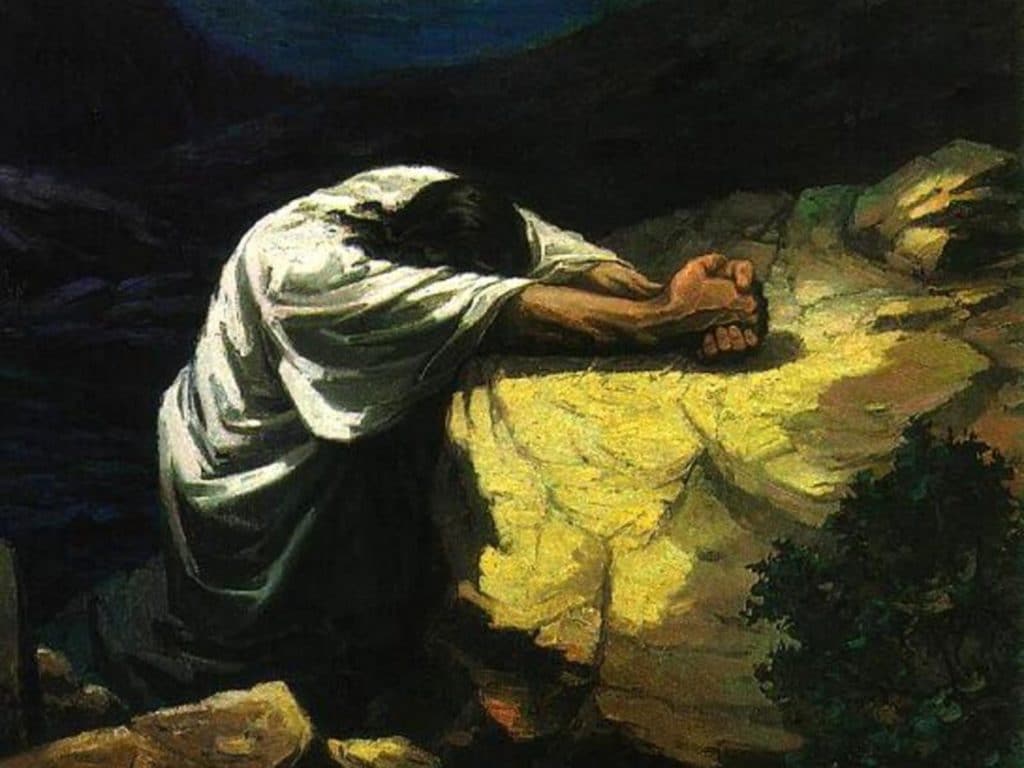
agony-in-the-garden-1-1024x768.jpgHaving completed the Passover meal, Jesus and His disciples made their way through the city of Jerusalem, out the eastern gate, and onto the Mount of Olives. They stopped at a place called Gethsemane, which means “an olive press.” Here, Jesus took three of His disciples, Peter, James and John, and found a secluded place where He could pray. These are the same three men who had accompanied Him and been eyewitnesses to His transfiguration. But on this occasion, rather than seeing Jesus in His glorified state, they would watch as He agonized over His coming trials.

Jesus described to them His state of mind: “My soul is very sorrowful, even to death” (Matthew 26:38 ESV). His emotional state was one of deep and overwhelming sadness over what was about to happen. His sorrow alone was enough to kill Him. But what was it that caused such a drastic state of deep melancholy in Jesus? Was He afraid to die? Did He regret His decision to sacrifice Himself on behalf of sinful mankind? Was He having second thoughts? The text, along with the words and actions of Jesus, provide us with the answers.

Matthew relates that Jesus went off by Himself and immediately fell on His face before His Father in a state of prayer. He pleaded, “My Father, if it be possible, let this cup pass from me” (Matthew 26:39 ESV).

One of the things this passage reveals is the human side of Jesus’ nature. He was 100 percent God, but also 100 percent human – a state often referred to as the hypostatic union. At His incarnation, Jesus, the eternal, second person of the Trinity, became the God-man. His assumption of a human nature was essential to the role He would play as the Savior of mankind. The author of Hebrews explains:

Because God’s children are human beings – made of flesh and blood – the Son also became flesh and blood. For only as a human being could he die, and only by dying could he break the power of the devil, who had the power of death. – Hebrews 2:14 NLT

The apostle Paul would put it this way:

[God] sent his own Son in a body like the bodies we sinners have. And in that body God declared an end to sin’s control over us by giving his Son as a sacrifice for our sins. – Romans 8:3 NLT

Jesus never relinquished any of His divine attributes, but, in becoming a man, He combined His human and divine natures into one person. And as a man, Jesus felt pain, experienced hunger, grew tired, and, as we will see, became susceptible to death.

In His humanity, Jesus knew that what He was about to endure would be excruciatingly painful. He would be scourged mercilessly with a flagellum, a whip featuring multiple leather strands, each weighted with lead balls or pieces of bone. He would be beaten, spit upon, slapped, and degraded. And eventually, He would be nailed to a wooden cross and left to die by exposure and suffocation. Jesus’ human nature was repulsed by the prospect of facing such a painful and gruesome death. He longed for another way, a plan B.

But, in His divinity, He knew that this was all part of His Father’s sovereign will. This is why He stated, “nevertheless, not as I will, but as you will” (Matthew 26:39 ESV).

But there is a second explanation behind Jesus’ intense sorrow and His cry for an alternative plan. He was fully aware that, upon the cross, He would be taking on the sin debt of the entire world. He who never committed a single sin would bear the full brunt of God’s wrath against all the sins of men for all time.

For God made Christ, who never sinned, to be the offering for our sin, so that we could be made right with God through Christ. – 2 Corinthians 5:21 NLT

Sin separates mankind from God. And Jesus knew that when He took on the sin debt of mankind, He would become separated from His Father for the first time in all of eternity. Their fellowship would be broken. And, in His divine nature, that prospect was unfathomable and unthinkable to Jesus. Yet again, He knew it was all part of God’s plan and, therefore, necessary.

Jesus longed for this “cup of wrath” to pass. If you recall, back in chapter 20, Matthew recorded an encounter between Jesus and the mother of James and John, the two brothers who were with Him in Gethsemane that night. She had asked Jesus to allow her two sons to sit on His right and on His left when He established His kingdom on earth. But Jesus had responded to her two sons, “You don’t know what you are asking! Are you able to drink from the bitter cup of suffering I am about to drink?” (Matthew 20:22 NLT).

Only He was worthy to suffer for the sins of mankind. He alone could meet God’s demanding criteria for an acceptable sacrifice – an unblemished, sinless Lamb.

And it’s interesting to note that when Jesus stopped to check on Peter, James, and John, He had found them asleep. While He had been agonizing over His coming death, these three were obviously unconcerned with and unsympathetic to His pain. They slept while Jesus wept. And Jesus made an interesting observation, stating, “The spirit indeed is willing, but the flesh is weak” (Matthew 26:41 ESV). This was most likely aimed at Peter, who had been the one who had vehemently denied Jesus prediction that they would all bail on Him in His time of greatest need.

“Though they all fall away because of you, I will never fall away.” – Matthew 26:33 ESV).

And yet, here was Peter finding it difficult even to stay awake while His master suffered under the weight of His pending death.

Three separate times Jesus expressed His feelings to His heavenly Father, and three times He communicated His willingness to do His Father’s will. He was committed. Every ounce of His humanity longed to escape what was to come, but His divinity provided the strength He needed to do what He had been called to do.

In his commentary on the book of Matthew, D.A. Carson writes:

“In the first garden ‘Not your will but mine’ changed Paradise to desert and brought man from Eden to Gethsemane. Now ‘Not my will but yours’ brings anguish to the man who prays it but transforms the desert into the kingdom and brings man from Gethsemane to the gates of glory.” – D.A. Carson, Matthew, p. 545.

Jesus was willing to face the fate God had planned for Him because He trusted His heavenly Father. He knew there was no other way. Salvation was only possible through His obedient submission to the sovereign will of God the Father. And the hour had come for Him to begin His journey from Gethsemane to Golgotha. Having finished His prayer time with the Father, Jesus turned to His disciples and said, “the hour is at hand, and the Son of Man is betrayed into the hands of sinners” (Matthew 26:45 ESV).

Judas was on his way, bringing with him the guards of the high priest. The darkness of that night was about to deepen as the forces of evil began their ill-fated attempt to snuff out the Light of the world. But as John would later write:

The light shines in the darkness, and the darkness can never extinguish it. – John 1:5 NLT

God’s light came into the world, but people loved the darkness more than the light, for their actions were evil. All who do evil hate the light and refuse to go near it for fear their sins will be exposed. But those who do what is right come to the light so others can see that they are doing what God wants. – John 3:19-21 NLT

Jesus would end up buried in the darkness of a borrowed tomb. His life would be forcefully taken from Him, but as He had predicted, it would be on His terms.

“No one can take my life from me. I sacrifice it voluntarily. For I have the authority to lay it down when I want to and also to take it up again. For this is what my Father has commanded.” – John 10:18 NLT

Jesus lived to do the will of His Father. And He died in obedience to the will of His Father. When Jesus had stated, “I and the Father are one” (John 10:30 ESV), He had meant it. Their wills were united, and their love for sinful mankind was unified around the sole solution to man’s problem: The sacrificial death of the sinless Son of God.

English Standard Version (ESV)
The Holy Bible, English Standard Version. ESV® Permanent Text Edition® (2016). Copyright © 2001 by Crossway Bibles, a publishing ministry of Good News Publishers.

New Living Translation (NLT)
Holy Bible, New Living Translation, copyright © 1996, 2004, 2015 by Tyndale House Foundation. Used by permission of Tyndale House Publishers Inc., Carol Stream, Illinois 60188. All rights reserved.

The Message (MSG)Copyright © 1993, 1994, 1995, 1996, 2000, 2001, 2002 by Eugene H. Peterson

Day 27 – John 5:1-47

The Son of God.

John 5:1-47

“You search the Scriptures because you think they give you eternal life. But the Scriptures point to me!” – John 5:39 NLT

In this passage, Jesus encounters a man who had been sick for 38 years. Every day, this man somehow made his way to the pool of Bethesda, near the wall of the Temple. The waters were thought to hold healing properties and, when they were stirred up, if you could be one of the first to get in the water, you would receive healing. This man’s problem was that, after 38 long years of suffering, he had no hope of ever getting in the water in time. Jesus asked him a question with a very obvious answer. “Would you like to get well?” (John 5:6 NLT). To which the man replied, “I can’t, sir, for I have no one to put me into the pool when the water bubbles up. Someone else always gets there ahead of me” (John 5:7 NLT). In response, Jesus tells the man, “Stand up, pick up your mat, and walk!” (John 5:8 NLT).

And immediately the man is healed and does just as he is told. It was an amazing moment. This man’s life was changed forever. But John reminds of us one small detail in the story. It is the Sabbath. And when the Pharisees see this man “working” on the Sabbath by carrying his mat, they are appalled. And when they find out Jesus told him to do so, they begin to confront Jesus about breaking the Sabbath. But it would be Jesus response to them that would turn their anger into thoughts of murder. Jesus said, “My Father is always working, and so am I” (John 5:17 NLT). Here lies the greatest disconnect between Jesus and the religious leadership of His day. He claimed to be the Son of God, and in so doing, He claimed to be deity. According to their standards, that was blasphemy, a crime punishable by death.

And this is still the disconnect most people have with Jesus today. Most have no problem believing that Jesus lived or that He was a powerful and influential teacher. Many have little or no struggle with the idea of Him doing miracles. But where the problem comes up for most is with the concept of Jesus as the Son of God. This remains a stumbling block for most people today. Even for many church-going, Bible-believing, so-called Christians today. Like the Pharisees, they search the Scriptures, thinking that in them they will find eternal life (John 5:39). In other words, the secret to having a right relationship with God is through discovering His requirement as found in His Word. So they read the Scriptures trying to decipher the rules and requirements God has set out so that they can keep them and make God happy. But Jesus reminds us, “the Scriptures point to me! Yet you refuse to come to me to receive this life” (John 5:39-40 NLT). Jesus’ miracles were simply to act as proof of who He claimed to be. They were evidence of His deity. The power He displayed came from God and so did He. In fact, Jesus makes it clear that God had given Him the power to provide eternal life to any and all who would believe that He was God’s Son. “I tell you the truth, those who listen to my message and believe in God who sent me have eternal life” (John 5:24 NLT). It was essential that they believe that Jesus was sent from God and was the Son of God. And not only has God given Jesus the life-giving power to provide eternal life to those who would believe He came from God, He has given Him the power to judge all men at the end of the age. With a word from Jesus, all the dead will rise and face judgment – some to face eternal life and some  eternal death. The Pharisees saw the miracles of Jesus. They heard the powerful teachings of Jesus. But they could not handle the claims of Jesus to be God. That was beyond their ability to comprehend or consent to. And as a result, they missed the point. They were so busy trying to work their way to eternal life that they missed the very one who could give them eternal life.

Jesus was and is the Son of God. He is the second person of the Trinity. He was God’s means by which the world might be saved and men might be reconciled to a right relationship with Him. But it is essential that men believe Jesus was who He claimed to be. The miracles and messages of Jesus mean nothing if they do not point us to His deity. The words of Scripture will mean nothing if we do not find within them the message that Jesus is the Son of God, sent to save the world from the judgment of God. Jesus was more than just a man. He was more than just a prophet. He was more than just a faith-healer. He was more than just a teacher. He was the Son of God. Yet Jesus can still say to so many, “For I have come to you in my Father’s name, and you have rejected me” (John 5:43 NLT).

Father, it was Jesus’ claim to deity that became the stumbling block for so many. They couldn’t comprehend it, so they simply rejected it. They couldn’t explain it, so they refused to believe it. But to those who believed through a simple act of faith, He gave eternal life, and I am so grateful to have been included in that number. Thank You. Amen.

Ken Miller

Grow Pastor & Minister to Men
kenm@christchapelbc.org