Blinded by Disbelief

13 “Woe to you, Chorazin! Woe to you, Bethsaida! For if the mighty works done in you had been done in Tyre and Sidon, they would have repented long ago, sitting in sackcloth and ashes. 14 But it will be more bearable in the judgment for Tyre and Sidon than for you. 15 And you, Capernaum, will you be exalted to heaven? You shall be brought down to Hades.

16 “The one who hears you hears me, and the one who rejects you rejects me, and the one who rejects me rejects him who sent me.” – Luke 10:13-16 ESV

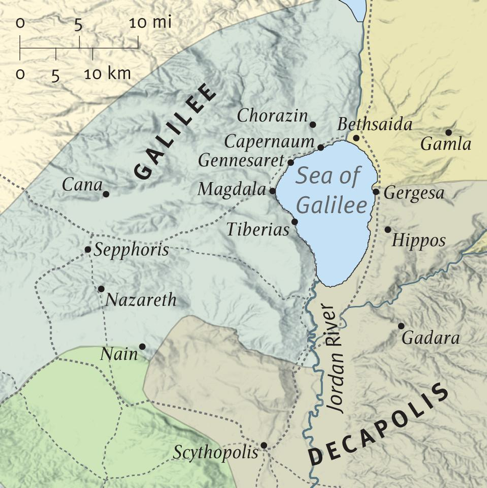
After commissioning and sending the 72 emissaries with instructions to deliver His message concerning the kingdom, Jesus delivered a public indictment against a handful of the cities He had visited during His Galilean ministry. He included the cities of Chorazin, Bethsaida, and Capernaum, each located on the northern shore of the Sea of Galilee. But why did Jesus condemn and curse these particular cities, and why did He choose to do it at this time in His ministry?

Jesus was on His way to Jerusalem and had already entered the region of Samaria, which separated Galilee in the north from Judea in the south. The messengers He had just sent were instructed to visit the villages and towns He would pass through along His way to Jerusalem. So, that would imply that their destinations were all within the regions of Samaria and Judea.

Jesus had just wrapped a  lengthy mission in Galilee, the region in which He was born. In a sense, the Galileans were His people. Bethlehem, His birthplace, was located there, as well as Nazareth, the town in which He was raised. Capernaum had become His unofficial headquarters not long after He began His earthly ministry.

But this still begs the question, why did Jesus choose to level His anger against these three particular cities in Galilee? And this is not the only time Jesus made examples of Chorazin, Bethsaida, and Capernaum. Matthew records another incident when Jesus referred to these same Galilean cities in a less-than-flattering light.

Then he began to denounce the cities where most of his mighty works had been done, because they did not repent. “Woe to you, Chorazin! Woe to you, Bethsaida! For if the mighty works done in you had been done in Tyre and Sidon, they would have repented long ago in sackcloth and ashes.” – Matthew 11:20-21 ESV

On this occasion, Jesus had just responded to the doubts of John the Baptist. Imprisoned by Herod, John had sent word to Jesus, asking whether He really was the one they had been expecting or should they expect another (Matthew 11:3). Sitting in a dank prison cell, John was having second thoughts about Jesus’ identity as the Messiah. Things were not turning out quite the way he had expected. And Jesus had responded to John’s doubts with a message that declared the prophetic nature of His role.

“Go back to John and tell him what you have heard and seen—the blind see, the lame walk, those with leprosy are cured, the deaf hear, the dead are raised to life, and the Good News is being preached to the poor.” And he added, “God blesses those who do not fall away because of me.” – Matthew 11:4-6 NLT

Not long after this exchange with John, “began to denounce the towns where he had done so many of his miracles, because they hadn’t repented of their sins and turned to God” (Matthew 11:20 NLT). With these words, Matthew provides us with a partial answer to the question as to why Jesus indicted these particular cities, and it all had to do with belief.

Jesus had done a great many miracles in the vicinity of these cities, but, despite their personal exposure to Jesus’ power, the residents of these cities had failed to repent. They had been eye-witnesses to the miraculous nature of Jesus’ ministry, and they had heard His message of repentance, but they had refused to accept that call. Instead, they displayed a stubborn resistance to the signs of His Messiahship and His offer of forgiveness for sins. They loved what their eyes had seen, but rejected what their ears had heard.

These verses mark a watershed moment in the life and ministry of Jesus. Up to this point, He has spent most of His time ministering in and around this region of Israel. His base of operations had been located in the city of Capernaum. He had preached His sermon on the mount not far from there. The miracle of the feeding of the 5,000 took place not far from Bethsaida. The people living in and around these three cities had been privileged to witness His works and hear His words but had failed to grasp the truth that Jesus was the Messiah.

Back in chapter 10 of Matthew’s gospel, Jesus had commissioned the 12 for their first missionary journey. And He had given them specific instructions to avoid any Galilean or Samaritan cities.

“Go nowhere among the Gentiles and enter no town of the Samaritans, but go rather to the lost sheep of the house of Israel. And proclaim as you go, saying, ‘The kingdom of heaven is at hand.’ Heal the sick, raise the dead, cleanse lepers, cast out demons.” – Matthew 10:5-8 ESV

Not only had Jesus limited their ministry to the Jews, but He had told them to focus their attention on those who would receive them and their message.

“And whatever town or village you enter, find out who is worthy in it and stay there until you depart. As you enter the house, greet it.  And if the house is worthy, let your peace come upon it, but if it is not worthy, let your peace return to you. And if anyone will not receive you or listen to your words, shake off the dust from your feet when you leave that house or town. Truly, I say to you, it will be more bearable on the day of judgment for the land of Sodom and Gomorrah than for that town.” – Matthew 10:11-15 ESV

Notice what Jesus told His disciples. If the residents of a city or home refused to receive them or listen to their words, they were to “shake off the dust” from their feet.

To shake the dust off represented, on one level, shaking off the uncleanness from one’s feet. At another level, however, it is similar to a prophetic sign, representing the termination of all fellowship with those individuals or localities that have rejected the messengers along with their message of the coming kingdom of heaven. This in essence constitutes a sign of eschatological judgment, as confirmed in the following verse. (NET Bible study notes)

Accepting the miracles performed by the disciples while rejecting their call to repentance would be unacceptable. Physical restoration without spiritual regeneration would not be enough. As Jesus later told the Pharisee, Nicodemus:  “Truly, truly, I say to you, unless one is born again he cannot see the kingdom of God” (John 3:3 ESV).

And Jesus had given these same instructions to the 72.

“But whenever you enter a town and they do not receive you, go into its streets and say, ‘Even the dust of your town that clings to our feet we wipe off against you.’” – Luke 10:10 ESV

Jesus makes it clear that repentance is key to any hope of spiritual regeneration. And this applied to Jews and Gentiles alike. Everyone must change their minds and embrace their need for a Savior. The Jew’s status as God’s chosen people would not be enough to save them. Their confident assumption that their Hebrew heritage was enough was going to have to change. But Jesus knew that wasn’t going to happen. In fact, He asserts that the predominantly Gentile cities of Tyre and Sidon would fare better on the day of judgment than these three Jewish communities. Jesus had gone out of His way to take the message of the kingdom to His own people. He performed the majority of His miracles in their presence. He displayed His power among them and declared the coming of His kingdom to them. But they had refused to listen. And just to make sure His audience understood the severity of His words, Jesus compared them to the infamous city of Sodom. According to Jesus, the wicked inhabitants of Sodom would have repented if they been seen only a fraction of the mighty works of God done among the cities of Chorazin, Bethsaida, and Capernaum.

It’s interesting to note that Mark records that Jesus eventually removed Himself from Galilee and made His way to Tyre and Sidon (see Mark 7:24). He performed miracles there, including casting out a demon from a young Gentile girl whose mother was a Syrophoenician. Mark also records that when the woman begged Jesus to help her, He responded, “Let the children be fed first, for it is not right to take the children’s bread and throw it to the dogs” (Mark 7:27 ESV). But the woman, nonplussed by His response, simply said, “Yes, Lord; yet even the dogs under the table eat the children’s crumbs” (Mark 7:28 ESV).

And, amazed by the woman’s faith, Jesus told her, “For this statement you may go your way; the demon has left your daughter” (Mark 7:29 ESV). The woman believed, and her daughter was healed. She did not defend her status or become offended that Jesus had compared her to a dog. She simply expressed her belief that, in spite of her lowly status as a non-Jew, Jesus would extend mercy and grace to her. And He did.

One of the things that Jesus was looking for from those to whom He ministered was a recognition of their need. That is why He tended to minister to those who came to them with their disabilities, pains, brokenness, and extreme sense of unworthiness. That is why Jesus had said:

“Healthy people don’t need a doctor – sick people do. I have come to call not those who think they are righteous, but those who know they are sinners.” – Mark 2:17 NLT

A major aspect of repentance is the acknowledgment of sin and the need for salvation – a salvation outside of oneself. The people who came to Jesus for physical healing did so because they had either exhausted all other avenues or their ailment was beyond the scope of human help. They were forced to turn to Jesus in the hope that He could do something about their problem. But the same would be true for those who suffered from the disease and destruction caused by sin. That is why Jesus would offer what has become known as the Great Invitation, which we will cover tomorrow,

“Come to me, all of you who are weary and carry heavy burdens, and I will give you rest.” – Matthew 11:28 NLT

The city of Capernaum was filled with God-fearing Jews who believed they were the chosen people of God and so, in no need of a Savior. But Jesus asked them rhetorically, “will you be exalted to heaven?” And, just in case they failed to understand that the question was rhetorical, He clarified the answer for them.

“You will be brought down to Hades. For if the mighty works done in you had been done in Sodom, it would have remained until this day.” – Matthew 11:23 ESV

They would end up rejecting His message and His offer of salvation. And the result would be judgment and eternal punishment. Their refusal to accept Him as Messiah would have dire consequences. They would remain unrepentant and sadly, unforgiven.

As Jesus prepared to make His way to Jerusalem, He knew what awaited Him there. He had already told His disciples that He would face rejection, suffer death, and be raised back to life. The greatest miracle was yet to be performed. Yet, even when Jesus had been crucified, buried, and resurrected, there would still be those who refused to believe. Like the citizens of Chorazin, Bethsaida, and Capernaum, they would reject God’s proof of His Son’s identity as the Messiah. And even the disciples would wrestle with doubt when they heard the news, “he has risen” (Matthew 28:26 ESV).

English Standard Version (ESV) The Holy Bible, English Standard Version. ESV® Permanent Text Edition® (2016). Copyright © 2001 by Crossway Bibles, a publishing ministry of Good News Publishers.

New Living Translation (NLT) Holy Bible, New Living Translation, copyright © 1996, 2004, 2015 by Tyndale House Foundation. Used by permission of Tyndale House Publishers Inc., Carol Stream, Illinois 60188. All rights reserved.

The Message (MSG)Copyright © 1993, 1994, 1995, 1996, 2000, 2001, 2002 by Eugene H. Peterson
Feed My Sheep

Now Herod the tetrarch heard about all that was happening, and he was perplexed, because it was said by some that John had been raised from the dead, by some that Elijah had appeared, and by others that one of the prophets of old had risen. Herod said, “John I beheaded, but who is this about whom I hear such things?” And he sought to see him.

10 On their return the apostles told him all that they had done. And he took them and withdrew apart to a town called Bethsaida. 11 When the crowds learned it, they followed him, and he welcomed them and spoke to them of the kingdom of God and cured those who had need of healing. 12 Now the day began to wear away, and the twelve came and said to him, “Send the crowd away to go into the surrounding villages and countryside to find lodging and get provisions, for we are here in a desolate place.” 13 But he said to them, “You give them something to eat.” They said, “We have no more than five loaves and two fish—unless we are to go and buy food for all these people.” 14 For there were about five thousand men. And he said to his disciples, “Have them sit down in groups of about fifty each.” 15 And they did so, and had them all sit down. 16 And taking the five loaves and the two fish, he looked up to heaven and said a blessing over them. Then he broke the loaves and gave them to the disciples to set before the crowd. 17 And they all ate and were satisfied. And what was left over was picked up, twelve baskets of broken pieces. – Luke 9:7-17 ESV

While the disciples were traveling about Galilee “preaching the gospel and healing everywhere,” news had reached Herod Antipas, the tetrarch over Galilee and Perea, of all that Jesus had been doing within his jurisdiction. Herod was the Roman-appointed ruler over the northern regions of Israel. In his gospel account, Mark refers to Herod as a king, but Herod was not a descendant of David and was not recognized by most Jews as the official king of Israel. He was little more than a puppet king who served at the discretion of the Roman emperor.

Herod was a particularly wicked man who coveted power and would do anything to solidify and maintain his lofty position. He was one of the sons of Herod the Great, who ruled over Israel when Jesus was born. At the death of Herod the Great, Herod Antipas and his brother, Philip, were appointed by the Romans to rule over a portion of their father’s former lands. In a sense, these two brothers became competitors, with each vying for the favor of Caesar and hoping to expand and solidify their power and influence. The Jewish historian, Josephus records how Herod Antipas fell in love with Herodias, his brother’s wife. Herod ended up divorcing his own wife and convinced Herodias to leave Philip and marry him instead. This kind of behavior by a “king” of Israel was unacceptable and John the Baptist had publicly called out Herod for this and other indiscretions.

John also publicly criticized Herod Antipas, the ruler of Galilee, for marrying Herodias, his brother’s wife, and for many other wrongs he had done. So Herod put John in prison, adding this sin to his many others. – Luke 3:19-20 NLT

John the Baptist had publicly accused Herod of violating God’s laws concerning divorce and remarriage.

“It is against God’s law for you to marry her.” – Matthew 14:4 NLT

But his outspoken criticism of this powerful man resulted in his imprisonment. Herod had heard enough from John and decided to have him silenced by locking him away. As a result of John’s public condemnation of her immoral relationship with Herod, Herodias convinced her husband to have John executed. But while Herod gave in to his wife’s wishes and had John the Baptist beheaded, the decision must have haunted him for some time. When he heard all the rumors concerning Jesus, he began to question whether John had returned from the dead.

“John, whom I beheaded, has been raised!” – Mark 6:26 NLT

This statement is filled with fear and foreboding. Herod must have had nightmares about what he had done to John. He had ordered the execution of a man who had simply spoken the truth. Herod had been a convert to Judaism and knew that his marriage to Herodias was unlawful. All that John had said had been true. And yet, due to his own pride and arrogance, Herod had made a rash vow and unintentionally sealed the fate of this innocent man. Now, he was having to live with the consequences.

But Herod’s curiosity concerning Jesus reached an all-time peak. He was intrigued by all the rumors and even stated, “John I beheaded, but who is this about whom I hear such things?” (Luke 9:9 ESV). Who was this man performing miracles and preaching about a kingdom? Could He really be the Messiah of Israel? Had He come to set up His kingdom in Jerusalem? Perhaps Herod had recalled the story of how his father, Herod the Great, had ordered the execution of all the male children under two years of age in the region around Bethlehem. This heinous act by his father had been an ill-fated attempt to kill the one child that had been born “king of the Jews” (Matthew 2:1-18). And now, some three decades later, Herod Antipas was hearing rumors that this baby had grown to be a man and was gaining a reputation and a following in his domain. It could be that Herod feared that if Jesus was the king of the Jews his father tried to have killed, he might seek revenge. But whatever the case, Herod was conflicted, confused, and curious. And little did this pseudo-sovereign know that he would end up playing a significant role in the life of Jesus as the story unfolds.

But while Herod was wrestling over the identity of Jesus, the disciples returned from their short-term mission trip. Jesus had sent them in pairs to preach the gospel of the kingdom, and to validate their message, He had given them the power to perform miracles. Luke provides no hints as to the length of their mission, but simply states, “When the apostles returned, they told Jesus everything they had done.” (Luke 9:10 NLT). 

This rather anticlimactic description of their return leaves a lot to the imagination. There is no sense of excitement. We are told nothing about their exploits. But we can assume that these men must have had stories to tell and were anxious to regale one another with their experiences. So, when the 12 disciples returned from their missionary journey, it is likely that they shared stories about casting out demons and healing the sick. Recognizing that these men were excited yet worn out from their journey, Jesus led them to a remote place where they might get some much-needed rest. But isolation and alone time were difficult commodities to come by for Jesus and His disciples. Everywhere they went, they found themselves encountering and accosted by large crowds. And this time would be no different.

Luke indicates that Jesus led the disciples to the town of Bethsaida, but the crowds followed them there. The weary disciples were probably frustrated by this turn of events. They had just returned from a long and arduous trip and were looking forward to some much-need R&R. But it was not to be. And Mark records that Jesus “welcomed them and spoke to them of the kingdom of God and cured those who had need of healing” (Luke 9:11 ESV). Mark indicates that Jesus saw the crowd and “had compassion on them, because they were like sheep without a shepherd” (Mark 6:34 ESV).

This statement sets up a subtle contrast between Jesus and His disciples that will become more obvious as the story unfolds. Jesus was moved by the helpless and hopeless state of the people. The very fact that they kept following Him revealed their desperate desire for leadership and direction. There were people in the crowd who were hurting emotionally and physically. Others were poor and needy, lacking the resources to meet the basic necessities of life.

It’s interesting to note that Jesus did for these people exactly what He had commanded the disciples to do on their recent missionary excursion. And yet, there is no mention that the disciples participated in the teaching of the people or in doing any acts of healing. It is almost as if they were taking the day off. They had done their part and now it was time to relax. And one can almost sense their eagerness to bring this long day to a close by what they said to Jesus.

“Send the crowd away to go into the surrounding villages and countryside to find lodging and get provisions, for we are here in a desolate place.” – Luke 9:12 ESV

There is not much compassion in those words. The disciples were ready for the crowds to disperse so they could finally get the rest they so richly deserved. Their feigned concern for the well-being of the people was nothing more than a way of getting rid of them. Yet Jesus, always aware of what was going on in the hearts and minds of those around Him, simply stated, “You give them something to eat” (Luke 9:13 ESV).

The ludicrous nature of this command is easy to miss because we have no idea how large the crowd was. It is not until later in the story that Luke reveals the actually size of the crowd. But the disciples could see the problem with their own eyes. As they heard Jesus speak those words, the disciples were staring at literally thousands of men, women, and children. And don’t forget that when Jesus had sent these men on their missionary journey, He had told them “Take nothing for your journey, no staff, nor bag, nor bread, nor money” (Luke 9:3 ESV).

They had just returned and would have had no resources with which to fulfill the command of Jesus. And you can sense their confusion and frustration in their response.

We have no more than five loaves and two fish—unless we are to go and buy food for all these people. – Luke 9:13 ESV

They were tapped out emotionally, physically, and financially. They lacked the resources and the energy to deal with this problem. These same men who had personally experienced the power of God by healing the sick and casting out demons were at a loss as to how to solve this pressing problem

Don’t miss what happened next. As the disciples watched, Jesus instructed the disciples to organize the crowd into groups of 50 or less. And when their work was complete, “Jesus took the five loaves and two fish, looked up toward heaven, and blessed them. Then, breaking the loaves into pieces, he kept giving the bread and fish to the disciples so they could distribute it to the people” (Luke 9:16 NLT).

The disciples played the role of waiters, distributing the food to the various groups of people. And as Jesus broke the bread and the fish, the disciples would return and find yet more food to hand out. And, as if to stress the truly miraculous nature of this scene, Luke reports “there were about five thousand men” (Luke 9:14 ESV).

And even that large number is a bit misleading. It is safe to assume that many of those men were married and their families were made up of at least one or two children. So, it would be safe to assume that the actual number of people fed that day was likely twice what Luke reported. It could have easily been as many as 10,000. And yet, as Luke makes clear, “They all ate as much as they wanted” (Luke 9:17 NLT). No one went hungry. Not a single person went without or failed to receive as much as they desired. And that included the disciples.

But the truly amazing fact is that when the crowd had dispersed, the disciples picked up 12 baskets of leftovers. They had shown up that day with no food, but each man walked away with a basket filled to the brim with bread and fish.

These men, who had lacked compassion for the people, had been given a once-in-a-lifetime lesson on God’s power to provide for the needs of the helpless and hopeless. When Jesus had looked on the crowd, He had seen sheep without a shepherd (Mark 6:34). But the disciples had simply seen a problem for which they had no solution. And sadly, they lacked any desire to come up with one. In spite of their success at casting out demons, healing the sick, and preaching the gospel of the kingdom, these men had failed to learn the most important lesson of all: That with God, all things are possible. The man with whom they had linked their lives was God in human flesh and fully capable of meeting the physical, emotional, and spiritual needs of mankind. Yes, He could provide bread, but He had come to be the bread of life. He could fill stomachs, but He had come to satisfy mankind’s hunger and thirst for righteousness. And as these men walked away with the baskets brimming with bread and fish, their hearts and minds were still lacking a full assurance of who Jesus was and what He had come to do.

English Standard Version (ESV) The Holy Bible, English Standard Version. ESV® Permanent Text Edition® (2016). Copyright © 2001 by Crossway Bibles, a publishing ministry of Good News Publishers.

New Living Translation (NLT) Holy Bible, New Living Translation, copyright © 1996, 2004, 2015 by Tyndale House Foundation. Used by permission of Tyndale House Publishers Inc., Carol Stream, Illinois 60188. All rights reserved.

The Message (MSG)Copyright © 1993, 1994, 1995, 1996, 2000, 2001, 2002 by Eugene H. Peterson

You Had Your Chance

20 Then he began to denounce the cities where most of his mighty works had been done, because they did not repent. 21 “Woe to you, Chorazin! Woe to you, Bethsaida! For if the mighty works done in you had been done in Tyre and Sidon, they would have repented long ago in sackcloth and ashes. 22 But I tell you, it will be more bearable on the day of judgment for Tyre and Sidon than for you. 23 And you, Capernaum, will you be exalted to heaven? You will be brought down to Hades. For if the mighty works done in you had been done in Sodom, it would have remained until this day. 24 But I tell you that it will be more tolerable on the day of judgment for the land of Sodom than for you.” – Matthew 11:20-24 ESV

The cities of Chorazin, Bethsaida, and Capernaum were located on the northern shore of the Sea of Galilee, and they hold the unenviable distinction of having been condemned and cursed by Jesus Himself. But why? What possessed Jesus to issue His stinging statements against these Galilean cities, and why did He choose to do it at this time in His ministry?

Matthew provides a partial answer when he records that these three cities were “where most of his [Jesus] mighty works had been done” (Matthew 11:20 ESV). In other words, Jesus had done a great many miracles in the vicinity of these cities, but, in spite of personally witnessing the power of Jesus on display, the residents of these cities “did not repent” (Matthew 11:20 ESV). They had been eye-witnesses to the miraculous nature of Jesus’ ministry, and they had heard the message of repentance uttered by John the Baptist and Jesus Himself. But they had refused to accept that call, choosing instead to display a stubborn resistance to the message accompanying the miracles of Jesus. They loved what their eyes were seeing, but rejected what their ears were hearing.

These verses mark a watershed moment in the life and ministry of Jesus. Up to this point, He has spent most of His time ministering in and around this region of Israel. His base of operations had been located in the city of Capernaum. He had preached His sermon on the mount not far from there. The miracle of the feeding of the 5,000 took place not far from Bethsaida. The people living in and around these three cities had been privileged to witness His works and hear His words but had failed to grasp the truth that Jesus was the Messiah.

These verses provide a link back to Jesus’ commissioning of the 12 disciples found in chapter 10. Just prior to sending them out on their first missionary journey, Jesus had told them:

“Go nowhere among the Gentiles and enter no town of the Samaritans, but go rather to the lost sheep of the house of Israel. And proclaim as you go, saying, ‘The kingdom of heaven is at hand.’ Heal the sick, raise the dead, cleanse lepers, cast out demons.” – Matthew 10:5-8 ESV

Not only had Jesus limited their ministry to the Jews, but He had told them to focus their attention on those who would receive them and their message.

“And whatever town or village you enter, find out who is worthy in it and stay there until you depart. As you enter the house, greet it.  And if the house is worthy, let your peace come upon it, but if it is not worthy, let your peace return to you. And if anyone will not receive you or listen to your words, shake off the dust from your feet when you leave that house or town. Truly, I say to you, it will be more bearable on the day of judgment for the land of Sodom and Gomorrah than for that town.” – Matthew 10:11-15 ESV

Notice what Jesus told His disciples. If the residents of a city or home refused to receive them or listen to their words, they were to “shake off the dust” from their feet.

To shake the dust off represented, on one level, shaking off the uncleanness from one’s feet. At another level, however, it is similar to a prophetic sign, representing the termination of all fellowship with those individuals or localities that have rejected the messengers along with their message of the coming kingdom of heaven. This in essence constitutes a sign of eschatological judgment, as confirmed in the following verse. (NET Bible study notes)

Accepting the miracles performed by the disciples while rejecting their call to repentance would be unacceptable. Physical restoration without spiritual regeneration would not be enough. As Jesus later told the Pharisee, Nicodemus:  “Truly, truly, I say to you, unless one is born again he cannot see the kingdom of God” (John 3:3 ESV).

Jesus makes it clear that repentance is key to any hope of spiritual regeneration. They must change their minds and embrace their need of a Savior. Their status as God’s chosen people would not be enough to save them. Their confident assumption that their Hebrew heritage was enough was going to have to change. But Jesus knew that wasn’t going to happen. In fact, He asserts that the predominantly Gentile cities of Tyre and Sidon would fare better on the day of judgment than these three Jewish communities. Jesus had gone out of His way to take the message of the kingdom to His own people. He performed the majority of His miracles in their presence. He displayed His power among them and declared the coming of His kingdom to them. But they refused to listen. And just to make sure His audience understood the severity of His words, Jesus compared them to the infamous city of Sodom. According to Jesus, the wicked inhabitants of Sodom would have repented if they been seen only a fraction of the mighty works of God done among the cities of Chorazin, Bethsaida, and Capernaum.

Jesus would eventually remove Himself from Galilee and make His way to Tyre and Sidon (see Mark 7:24). He would perform miracles there, including casting out a demon from a young Gentile girl whose mother was a Syrophoenician. Mark records that when the woman begged Jesus to help her, He responded, “Let the children be fed first, for it is not right to take the children’s bread and throw it to the dogs” (Mark 7:27 ESV). But the woman, nonplussed by His response, simply said, “Yes, Lord; yet even the dogs under the table eat the children’s crumbs” (Mark 7:28 ESV).

And, amazed by the woman’s faith, Jesus told the woman, “For this statement you may go your way; the demon has left your daughter” (Mark 7:29 ESV). The woman believed, and her daughter was healed. She did not defend her status or become offended that Jesus had compared her to a dog. She simply expressed her belief that, in spite of her lowly status as a non-Jew, Jesus would extend mercy and grace to her. And He did.

One of the things that Jesus was looking for from those to whom He ministered was a recognition of their need. That is why He tended to minister to those who came to them with their disabilities, pains, brokenness, and extreme sense of unworthiness. That is why Jesus had said:

“Healthy people don’t need a doctor – sick people do. I have come to call not those who think they are righteous, but those who know they are sinners.” – Mark 2:17 NLT

A major aspect of repentance is the acknowledgment of sin and the need for salvation – a salvation outside of oneself. The people who came to Jesus for physical healing did so because they had either exhausted all other avenues or their ailment was beyond the scope of human help. They were forced to turn to Jesus in the hope that He could do something about their problem. But the same would be true for those who suffered from the disease and destruction caused by sin. That is why Jesus would offer what has become known as the Great Invitation, which we will cover tomorrow,

“Come to me, all of you who are weary and carry heavy burdens, and I will give you rest.” – Matthew 11:28 NLT

The city of Capernaum was filled with God-fearing Jews who believed they were the chosen people of God and so, in no need of a Savior. But Jesus asked them rhetorically, “will you be exalted to heaven?” And, just in case they failed to understand that the question was rhetorical, He clarified the answer for them.

“You will be brought down to Hades. For if the mighty works done in you had been done in Sodom, it would have remained until this day.” – Matthew 11:23 ESV

They would end up rejecting His message and His offer of salvation. And the result would be judgment and eternal punishment. Their refusal to accept Him as Messiah would have dire consequences. They would remain unrepentant and sadly, unforgiven.

And from this moment on, Jesus would begin to take His message to the Gentiles. He had come to His own, but His own had rejected Him (John 1:11). So, now He would expand His ministry and message to those outside the household of Israel.

English Standard Version (ESV) The Holy Bible, English Standard Version. ESV® Permanent Text Edition® (2016). Copyright © 2001 by Crossway Bibles, a publishing ministry of Good News Publishers.

New Living Translation (NLT)
Holy Bible, New Living Translation, copyright © 1996, 2004, 2015 by Tyndale House Foundation. Used by permission of Tyndale House Publishers Inc., Carol Stream, Illinois 60188. All rights reserved.

The Message (MSG)Copyright © 1993, 1994, 1995, 1996, 2000, 2001, 2002 by Eugene H. Peterson

Day 36 – Matthew 11:20-30

Rest For the Weary.

Matthew 11:20-30

“Come to me, all of you who are weary and carry heavy burdens, and I will give you rest. Take my yoke upon you. Let me teach you, because I am humble and gentle at heart, and you will find rest for your souls. For my yoke is easy to bear, and the burden I give you is light.” – Matthew 11:28-30 NLT

These three verses are highly familiar to most of us. But how many of us know the context in which they were given? As is always the case when studying Scripture, context plays a huge role in helping us understand and apply what the Word is trying to communicate to us. Here in Matthew, we have Jesus addressing the question from John the Baptist regarding His Messiahship. He then launches a stinging attack against the cities of Capernaum, Korazin and Bethsaida. These three small cities sit on the north side of the Sea of Galilee and would have been regular stops for Jesus during His ministry there. Capernaum had become His adopted hometown and it was there that He based most of His ministry while He was in the region of Galilee. So the people living in these cities would have had regular glimpses of Jesus and heard His messages repeatedly. Yet Jesus condemns them for their unbelief. In spite of all the miracles He had done right in front of their eyes, they remained non-repentent and unbelieving. Jesus shocks them by comparing them to the cities of Tyre, Sidon and and Sodom, each with a well-known reputation for wickedness and godlessness. Jesus indicates that had He done miracles in these cities, they would have been convicted of their sins, repented, and believed in Him. But the hearts of the people living in Galilee were hardened, stubborn, and representative of the rest of the nation of Israel. Here was Jesus, the Son of God, working miracles in their midst by the power of God, and calling them to repent and return to God, but they refused.

Right in the middle of His stinging discourse, Jesus prays an interesting prayer. He turns to His Father and thanks Him for hiding the truth of His message from those who think they’re wise and clever, but for making it plain to the childlike. Jesus recognizes that this was God’s plan. Regardless of how many miracles Jesus performed, those who arrogantly relied on their own wisdom and knowledge would fail to see Him for who He was. The Pharisees and religious leadership of Jesus’ day are perfect examples of this kind of individual. They were self-righteous and unwilling to recognize their own sinfulness and repent of it. They saw no need for a Savior for their sins, they simply wanted a Messiah to set them free from Roman rule. But Jesus says that God reveals His truth to the childlike, those who are innocent, humble and trusting. It is to those individuals that God chooses to reveal His Son. Those whose lives are marred by sin, sorrow, and a recognition of their own helplessness and hopelessness are the ones who seemed drawn to Jesus and had no trouble believing in Him. The blind, the lame, the diseased, the outcasts, the chronic sinners – these are the ones who believed.

So Jesus offers them His well-known invitation. And it comes in two parts. First, He invites all those who are weary and weighed down to come to Him. His offer is to all who are burdened by sin and weighed down by the requirements of trying to keep the Law in their own energy. They are worn out by trying to carry the heavy yoke of the Law. It never was meant to save them, but to reveal their own sinfulness and incapacity to satisfy the holy demands of a righteous God. Jesus offers them rest. But then there is the second part to Jesus invitation. He invites them to exchange the yoke they are carrying for the one He offers. He describes His as an easy yoke, because in this yoke they will find they have a partner to help them pull the load. Jesus offers to come alongside them, teaching, training, and assisting them. Rather than arrogant and unloving like the religious leadership of the day, Jesus says He is humble and gentle, caring and compassionate. His yoke is easy to bear and the burden He gives is light. Yes, there is still work to do and effort is required, but rather than weariness and heartache, Jesus offers rest, peace and joy.

It seems that those who come to Jesus are the ones who are weary and worn out from trying to live life in their own power. They are beaten down by their own sinfulness and their inability to do anything about it. Like a blind man, they have no problem knowing they have a problem and that they are unable to fix it. Like a man who has a demon and is powerless to get rid of it, they will run to Jesus and beg Him for help. Jesus invites the weary to find rest in Him. But He also invites those same people to get in the yoke with Him, to begin focusing their efforts on accomplishing His will and living for His kingdom causes. He replaces our self-effort with His own power. He exchanges our heavy burden with His light one. He gives us an easy yoke in place of an impossible one. But it all begins with childlike, innocent, trusting faith in Him.

Father, I find that the degree to which I find rest in Jesus is directly related to my willingness to recognize just how weary I am from trying to live the Christian life in my own strength. I can get too wise and clever for my own good, and begin to believe that I can somehow pull this off in my own strength. But it is when I run out of steam that I tend to run to Him. Keep me childlike and dependent. Don’t allow me to become arrogant and self-righteous. Keep me in the yoke with Christ, living in dependence on Him and resting in His love, strength and grace. Amen.

Ken Miller

Grow Pastor & Minister to Men
kenm@christchapelbc.org