A Long and Painful Goodbye

31 When he had gone out, Jesus said, “Now is the Son of Man glorified, and God is glorified in him. 32 If God is glorified in him, God will also glorify him in himself, and glorify him at once. 33 Little children, yet a little while I am with you. You will seek me, and just as I said to the Jews, so now I also say to you, ‘Where I am going you cannot come.’ 34 A new commandment I give to you, that you love one another: just as I have loved you, you also are to love one another. 35 By this all people will know that you are my disciples, if you have love for one another.”

36 Simon Peter said to him, “Lord, where are you going?” Jesus answered him, “Where I am going you cannot follow me now, but you will follow afterward.” 37 Peter said to him, “Lord, why can I not follow you now? I will lay down my life for you.” 38 Jesus answered, “Will you lay down your life for me? Truly, truly, I say to you, the rooster will not crow till you have denied me three times.” John 13:31-38 ESV

After the shocking announcement that one of His own would betray Him, Jesus begins  what has come to be known as His “farewell discourse.” Judas has left the upper room, leaving Jesus alone with His 11 remaining disciples. These men were likely still in a state of bewilderment, trying to assimilate all that Jesus had just said and done.

The fact that no one attempted to hinder Judas from leaving reveals that they had not fully comprehended the gravity of the situation or the meaning behind Jesus’ words. John even alludes to their misunderstanding by revealing what he and the other disciples were thinking when Jesus said to Judas, “What you are going to do, do quickly” (John 13:27 ESV). 

Now no one at the table knew why he said this to him. Some thought that, because Judas had the moneybag, Jesus was telling him, “Buy what we need for the feast,” or that he should give something to the poor. – John 13:28-29 ESV

From their places at the table where they had just celebrated the Passover, the 11 disciples watched as their brother walked into the night. With Judas’ departure, another form of cleansing or separation took place. When Jesus had finished washing the disciples’ feet, He had told them, “you are clean, but not every one of you” (John 13:10 ESV). The inference was that Judas, who had also had his feet washed by Jesus,  remained unclean. He was not one of them. His intention to betray Jesus revealed his true heart and exposed his state of disbelief.

But with Judas gone, the room was occupied only with those whom Jesus had originally chosen to be His followers and who were destined to His future ambassadors. Everything Jesus would say from this point forward would be designed to brace these men for all that was about to happen but also to prepare them for the role they would play once He was gone. He began by telling them:

“The time has come for the Son of Man to enter into his glory, and God will be glorified because of him. And since God receives glory because of the Son, he will give his own glory to the Son, and he will do so at once.” – John 13:31-32 NLT

In the opening verses of his gospel, John testified regarding Jesus: “And the Word became flesh and dwelt among us, and we have seen his glory, glory as of the only Son from the Father, full of grace and truth” (John 1:14 ESV).

As one of those chosen by Jesus, John had been an eye-witness to all that Jesus had said and done. He had been able to see the amazing miracles Jesus had performed. He had sat under the remarkable teaching of this Rabbi from Nazareth. And over the three years he had spent with Jesus, John had become convinced that Jesus really was the Word become flesh. Jesus was the Messiah, and His entire life and ministry revealed the glory of His identity as the Son of God.

Now, Jesus tells John and the other disciples that the time has come for Him to “enter His glory.” He was going to be returning to His Father’s side in heaven, but the path to His glory would pass through the cross. Jesus had already alluded to the fact that His glorification would require His crucifixion. Earlier in the day, Jesus had told His disciples:

“Now the time has come for the Son of Man to enter into his glory. I tell you the truth, unless a kernel of wheat is planted in the soil and dies, it remains alone. But its death will produce many new kernels—a plentiful harvest of new lives.” – John 12:23-24 NLT

In the physical world, life precedes death. But in the spiritual realm, it is the other way around. Death precedes life. All that Jesus had done in His earthly life had given evidence of His glory as God’s own Son. But God would use His Son’s death on the cross as the ultimate proof of His identity by raising Him back to life. The Son of Man would die, but the Son of God would rise again and return to His Father’s side in heaven.

This was not the first time that Jesus had communicated to His disciples the idea of death preceding life. He had told them that they too would be required to sacrifice their temporal earthly lives in order to gain eternal life.

“If any of you wants to be my follower, you must give up your own way, take up your cross, and follow me. If you try to hang on to your life, you will lose it. But if you give up your life for my sake, you will save it.” – Matthew 16:24-25 NLT

What they didn’t understand was that Jesus was about to take up His own cross. He was just hours away from laying down His life for their sake. But with the Father’s help, He would pick it up again. In a split second of time, God would restore to life the beaten, broken, and bloodied body of His Son. And He would see to it that His glorified Son was restored to His rightful place at His side.

The apostle Paul describes this death-to-life transformation in powerful terms, stating that Jesus “humbled himself by becoming obedient to the point of death, even death on a cross. Therefore God has highly exalted him and bestowed on him the name that is above every name,  so that at the name of Jesus every knee should bow, in heaven and on earth and under the earth, and every tongue confess that Jesus Christ is Lord, to the glory of God the Father” Philippians 2:8-11 ESV).

But Jesus informs His disciples that His glorification will result in their isolation from Him. In addition to the news that He will be betrayed by one of His own, Jesus now informs them that He will be leaving them and they will not be able to follow Him.

“Dear children, I will be with you only a little longer. And as I told the Jewish leaders, you will search for me, but you can’t come where I am going.” – John 13:33 NLT

Upon His departure, the disciples would find themselves alone and in need of one another’s companionship and support. Jesus wanted them to understand that they were going to be part of a new and totally unique community, made up of all those who believed in Him and would become members of His body. And one of the requirements for membership in this community would be mutual love for one another.

“So now I am giving you a new commandment: Love each other. Just as I have loved you, you should love each other. Your love for one another will prove to the world that you are my disciples.” – John 13:34-35 NLT

Later on, in this same farewell discourse, Jesus will elaborate on this command to love one another, using His own death as an example of the kind of love He is talking about.

“This is my commandment: Love each other in the same way I have loved you. There is no greater love than to lay down one’s life for one’s friends.” – John 15:12-13 NLT

Jesus had earlier described Himself as the Good Shepherd and had indicated that His love for His sheep would be exhibited by His willingness to die for them.

“I am the good shepherd. The good shepherd sacrifices his life for the sheep.” – John 10:11 NLT

Now, He was telling His disciples that they too would need to be willing to die for one another. The life of a follower of Christ is marked by self-sacrifice and selfless love for others. Again, the apostle Paul used Jesus as the prime example of what this kind of selfless, sacrificial life was to look like.

Don’t be selfish; don’t try to impress others. Be humble, thinking of others as better than yourselves. Don’t look out only for your own interests, but take an interest in others, too. You must have the same attitude that Christ Jesus had. – Philippians 2:3-5 NLT

With His death on the cross, Jesus exhibited an attitude of humility, sacrifice, obedience, and love. He faithfully followed the will of His Father and willingly laid down His life for the good of others. And He expected His disciples to do the same.

But Peter, as the unofficial spokesman for the group, vocalized their confusion by asking, “Lord, where are you going?” (John 13:36 ESV). All the talk about glorification and loving one another went right over their heads. All they had heard was “Where I am going you cannot come” (John 13:33 ESV). In spite of all that Jesus had said, they were oblivious to the reality of the cross. The last thing on their minds was the death of Jesus.

And Jesus, speaking rather cryptically, assured His disciples that while they could not immediately accompany Him to His destination, they would one day join Him. This is probably a veiled reference to both His death and His glorification. He was headed to the cross and, ultimately, to His Father’s side in heaven. And one day, each of the disciples would experience their own physical deaths, most by martyrdom, and then join Jesus in heaven. But for now, they would remain behind because God had work for them to do.

But Peter, impulsive and outspoken as ever, blurted out, “Lord, why can I not follow you now? I will lay down my life for you” (John 13:37 ESV). He boldly proclaimed his love and allegiance to Jesus, declaring that he was willing to face anything, even death, to prove His faithfulness. But little did Peter know that his commitment to Jesus would prove wholly insufficient and, ultimately, insincere. The next words out of Jesus’ mouth must have left Peter devastated and embarrassed. 

“Will you lay down your life for me? Truly, truly, I say to you, the rooster will not crow till you have denied me three times. – John 13:38 ESV

But Jesus knew that Peter, however well-intentioned he might be, lacked the one thing he and the other disciples were going to need if they were going to survive His departure: The Holy Spirit.

English Standard Version (ESV) The Holy Bible, English Standard Version. ESV® Permanent Text Edition® (2016). Copyright © 2001 by Crossway Bibles, a publishing ministry of Good News Publishers.

New Living Translation (NLT) Holy Bible, New Living Translation, copyright © 1996, 2004, 2015 by Tyndale House Foundation. Used by permission of Tyndale House Publishers Inc., Carol Stream, Illinois 60188. All rights reserved.

The Message (MSG)Copyright © 1993, 1994, 1995, 1996, 2000, 2001, 2002 by Eugene H. Peterson

All Part of the Plan

21 After saying these things, Jesus was troubled in his spirit, and testified, “Truly, truly, I say to you, one of you will betray me.” 22 The disciples looked at one another, uncertain of whom he spoke. 23 One of his disciples, whom Jesus loved, was reclining at table at Jesus’ side, 24 so Simon Peter motioned to him to ask Jesus of whom he was speaking. 25 So that disciple, leaning back against Jesus, said to him, “Lord, who is it?” 26 Jesus answered, “It is he to whom I will give this morsel of bread when I have dipped it.” So when he had dipped the morsel, he gave it to Judas, the son of Simon Iscariot. 27 Then after he had taken the morsel, Satan entered into him. Jesus said to him, “What you are going to do, do quickly.” 28 Now no one at the table knew why he said this to him. 29 Some thought that, because Judas had the moneybag, Jesus was telling him, “Buy what we need for the feast,” or that he should give something to the poor. 30 So, after receiving the morsel of bread, he immediately went out. And it was night. John 13:21-30 ESV

What immediately followed Jesus’ washing is His disciples’ feet was His betrayal by Judas. But this shocking and unexpected event did not catch Jesus by surprise because He had always known it was part of His Father’s plan. In fact, all the way back in chapter six, John recorded Jesus’ first allusion to this fateful but necessary event.

Jesus had just finished delivering a very revealing yet confusing message regarding His pending death. He left the audience in the synagogue stunned when He described Himself as the bread of life and told them that their consumption of His body and blood would be the key to eternal life.

“For my flesh is true food, and my blood is true drink. Whoever feeds on my flesh and drinks my blood abides in me, and I in him. As the living Father sent me, and I live because of the Father, so whoever feeds on me, he also will live because of me. This is the bread that came down from heaven, not like the bread the fathers ate, and died. Whoever feeds on this bread will live forever.” – John 6:55-58 ESV

As a result of this rather strange pronouncement, many of Jesus’ followers left Him. And once again, Jesus was not surprised by their reaction. He simply stated, “there are some of you who do not believe” and John added an aside, “For Jesus knew from the beginning who those were who did not believe, and who it was who would betray him” (John 6:64 ESV). Jesus had always been aware that there would be unbelievers, even among His 12 disciples. And He reminded these men that true believers were those who had been called by His Father.

“This is why I told you that no one can come to me unless it is granted him by the Father.” – John 6:65 ESV

Even the ability to believe in Jesus was a gift from God. That is why Jesus had told them, “It is the Spirit who gives life; the flesh is no help at all” (John 6:63 ESV). 

So, as Jesus watched His former “followers” walk away, He asked His disciples if they wanted to leave Him as well. To which Peter responded, “Lord, to whom shall we go? You have the words of eternal life, and we have believed, and have come to know, that you are the Holy One of God” (John 6:68-69 ESV). Peter, speaking on behalf of the 11 other disciples, declared their belief in Jesus as the Son of God. But Jesus knew something Peter did not know. One of the 12 was an imposter and an unbeliever.

Jesus answered them, “Did I not choose you, the twelve? And yet one of you is a devil.” He spoke of Judas the son of Simon Iscariot, for he, one of the twelve, was going to betray him. – John 6:70-71 ESV

This news did not register with Peter or the other disciples. It is even possible that Judas was nonplussed by this announcement because he had yet to make his fateful decision to betray Jesus. But the point Jesus seemed to be making is that He knew exactly what was going to happen because it had always been a part of God’s sovereign plan. Even Jesus’ choosing of Judas had been for his future role as a betrayer, not as a believer. It was all part of the preordained will of God and it had been foretold by the prophets of God. Jesus made this point clear that evening in the upper room.

“I am not speaking of all of you; I know whom I have chosen. But the Scripture will be fulfilled, ‘He who ate my bread has lifted his heel against me.’ – John 13:18 ESV

The role Judas would play had been foreordained by God and would be in fulfillment of the prophecy contained in Psalm 41:9. And Jesus, as the Son of God, was fully aware of this aspect of His Father’s plan and unsurprised by what was about to take place.

Yet John described Jesus as being “troubled in his spirit” (John 13:21 ESV). It seems likely that Jesus’ was visibly moved by the thought of all that was about to take place and His outward demeanor was evident to the disciples. This would be His final meal with His disciples before His betrayal, arrest, trials, and crucifixion. And while Jesus was fully God and completely aware of how things would turn out, He was also fully human and impacted by the thought of all that faced Him in the hours ahead. He was about to be betrayed by one who had spent three years at His side. The rest of His disciples would end up deserting Him. And He would undergo a series of humiliating trials, brutal beatings, and an excruciating death on a Roman cross.

And Jesus, moved in spirit, announced to His disciples, “Truly, truly, I say to you, one of you will betray me” (John 13:21 ESV). As expected, His disciples were shocked by this news and began to speculate who among them would dare to do such a thing. Matthew records in his gospel that the disciples were saddened by this news “and began to say to him one after another, ‘Is it I, Lord?’” (Matthew 26:22 ESV).

And Peter, anxious to know who the guilty party might be, got the attention of John, who was reclining at Jesus’ right side at the table. John, the disciple “whom Jesus loved” (John 13:23 ESV), leaned back against Jesus and asked, “Lord, who is it?” (John 13:25 ESV). To which Jesus responded, “It is he to whom I will give this morsel of bread when I have dipped it” (John 13:26 ESV). This was in direct fulfillment of Psalm 41:9.

There are some scholars who believe that Judas was seated to Jesus’ left hand, a place of honor. So, all Jesus had to do was dip the morsel of unleavened bread into the paschal stew and hand it to His betrayer. And John reports that as soon as Jesus gave the bread to Judas, “Satan entered into him” (John 13:27 ESV).

Metaphorically, Jesus, as the bread of life, personally handed Himself over to His betrayer. In passing the morsel of bread to Judas, Jesus was symbolically offering His life to the very one who would reject His offer of eternal life in exchange for “the deceitfulness of riches and the desires for other things” (Mark 4:19 ESV). Judas was going to sell Jesus out for 30 pieces of silver.

In his first letter, John would warn of the danger of allowing a love of the world to replace our love for God and His Son.

Do not love this world nor the things it offers you, for when you love the world, you do not have the love of the Father in you. – 1 John 2:15 NLT

And he would go on to describe the destructive and unfulfilling nature of this love affair with the world.

For the world offers only a craving for physical pleasure, a craving for everything we see, and pride in our achievements and possessions. These are not from the Father, but are from this world. – 1 John 2:16 NLT

Judas was a sell-out. It seems likely that his decision to follow Jesus had been motivated by what he thought he could get out of it. And when Jesus failed to manifest Himself as the conquering warrior and made no effort to establish His kingdom on earth, Judas lost interest. He was driven by a love of the world and a desire for fame and fortune. And knowing that the religious leaders were anxious to arrest Jesus, Judas had decided to turn his wasted three years into a financial windfall. But Jesus warned that this decision by Judas would have deadly consequences, and not just for Him.

“The Son of Man goes as it is written of him, but woe to that man by whom the Son of Man is betrayed! It would have been better for that man if he had not been born.” – Matthew 26:24 ESV

Both men were fated for death. Jesus would be betrayed by Judas so that He might fulfill the will of His Heavenly Father and suffer for the sins of mankind by His death on a tree. And Judas, after selling out the sinless Lamb of God, would also suffer an ignoble death by hanging himself from a tree. His crime and its punishment would be remembered throughout the centuries.

Jesus, after handing the bread to Judas, whispered to him, “What you are going to do, do quickly” (John 13:27 ESV). His hour had come and it was important that Judas fulfill his role. The betrayal of Jesus by Judas was going to set into motion the final phase of God’s grand redemptive plan. And John simply records: “after receiving the morsel of bread, he immediately went out. And it was night” (John 13:30 ESV).

Darkness descended. The night had come. With the last four words of verse 30, John reminds his readers of the words spoken by Jesus in regards to His pending death.

“My light will shine for you just a little longer. Walk in the light while you can, so the darkness will not overtake you. Those who walk in the darkness cannot see where they are going. Put your trust in the light while there is still time; then you will become children of the light.” – John 12:35-36 NLT

The time had come for the light to be extinquished. The moment for Jesus’ death was fast approaching. But it was all part of the divine plan to bring salvation to sin-darkened world.

English Standard Version (ESV) The Holy Bible, English Standard Version. ESV® Permanent Text Edition® (2016). Copyright © 2001 by Crossway Bibles, a publishing ministry of Good News Publishers.

New Living Translation (NLT) Holy Bible, New Living Translation, copyright © 1996, 2004, 2015 by Tyndale House Foundation. Used by permission of Tyndale House Publishers Inc., Carol Stream, Illinois 60188. All rights reserved.

The Message (MSG)Copyright © 1993, 1994, 1995, 1996, 2000, 2001, 2002 by Eugene H. Peterson

Broken Beyond Repair

1 When morning came, all the chief priests and the elders of the people took counsel against Jesus to put him to death. And they bound him and led him away and delivered him over to Pilate the governor.

Then when Judas, his betrayer, saw that Jesus was condemned, he changed his mind and brought back the thirty pieces of silver to the chief priests and the elders, saying, “I have sinned by betraying innocent blood.” They said, “What is that to us? See to it yourself.” And throwing down the pieces of silver into the temple, he departed, and he went and hanged himself. But the chief priests, taking the pieces of silver, said, “It is not lawful to put them into the treasury, since it is blood money.” So they took counsel and bought with them the potter’s field as a burial place for strangers. Therefore that field has been called the Field of Blood to this day. Then was fulfilled what had been spoken by the prophet Jeremiah, saying, “And they took the thirty pieces of silver, the price of him on whom a price had been set by some of the sons of Israel, 10 and they gave them for the potter’s field, as the Lord directed me.” – Matthew 27:1-10 ESV

509px-judasThe rooster crowed and the sun came up, just as it always does. Yet, this would be anything but just another morning. Jesus, the Son of God, had been betrayed, denied, libeled, mocked, and falsely condemned. Now, He was being dragged before Pilate, the Roman governor, because the Jews were going to demand His death. They were forbidden by Roman law from practicing capital punishment on their own. In John’s gospel, he records the Sanhedrin’s response when Pilate demanded that they judge Jesus according to their own law. He saw this as nothing more than a petty religious squabble. But they made their true intentions known when they demanded, “It is not lawful for us to put anyone to death” (John 18:31 ESV). They weren’t interested in a trial. They were intent on seeing Jesus put to death. These men had already pronounced their judgment against Jesus, when they stated, “He deserves death” (Matthew 26:66 ESV). And with the opening of this chapter, Matthew makes it clear that their plans were aimed at having Jesus crucified, the primary means of capital punishment practiced by the Romans.
…the chief priests and the elders of the people took counsel against Jesus to put him to death. – Matthew 27:1 ESV

But then, Matthew provides a brief detour from the journey of Jesus to the cross. He changes scenes and brings his readers up to speed on the whereabouts of Judas. His last appearance had been in Gethsemane, where he had betrayed Jesus with a kiss. Evidently, Judas had not gone far, having followed the guards who had arrested Jesus and taken Him to Caiaphas, the high priest. There are some who speculate that Judas was the second disciple John refers to in his gospel.

Simon Peter followed Jesus, and so did another disciple. Since that disciple was known to the high priest, he entered with Jesus into the courtyard of the high priest, but Peter stood outside at the door. So the other disciple, who was known to the high priest, went out and spoke to the servant girl who kept watch at the door, and brought Peter in. – John 18:15-16 ESV

Judas would have been known by the high priest. And it might explain why this particular disciple had not received the same treatment as Peter.

But somehow, Judas received the news that Jesus had been condemned, and Matthew states that he had a change of mind. The Greek word is metamelomai, and it is similar to metanoeō, the Greek word for “repent.” Judas had a change of mind. He regretted his decision to betray Jesus. It would appear that the news of Jesus’ death sentence was far more than he had anticipated. It is likely that Judas never expected the Sanhedrin to take things that far. We will never know what was in the heart of Judas when he made his fateful decision to betray Jesus, but Matthew makes it clear that he lived to regret it. But he wouldn’t live long.

Judas, in a state of despair, returned to the high priest and the Sanhedrin, bringing his 30 pieces of silver with him. Attempting to return the blood money, Judas confessed his guilt before these religious leaders: “I have sinned by betraying innocent blood” (Matthew 27:4 ESV). But they showed no compassion and exhibited no remorse of their own. They simply replied, “What is that to us? See to it yourself” (Matthew 27:4 ESV). These so-called religious leaders could have cared less about the emotional or spiritual well-being of Judas. They had one thing on their minds: The death of Jesus. The only semblance of conscience they revealed was their refusal to return the money Judas had returned to the temple treasure.

“It is not lawful to put them into the treasury, since it is blood money.” – Matthew 27:6 ESV

So, when Judas cast the tainted money onto the temple floor, the Sanhedrin took the 30 pieces of silver and purchased “the potter’s field as a burial place for strangers” (Matthew 27:7 ESV). This would have been a field outside the city gates where the potters discarded their broken or marred products. It was a landfill for broken pottery. Matthew reveals that this decision by the religious leaders was in keeping with Old Testament prophecy. He references Jeremiah but then quotes from a passage found in the book of Zechariah.

And they weighed out as my wages thirty pieces of silver. Then the Lord said to me, “Throw it to the potter”—the lordly price at which I was priced by them. So I took the thirty pieces of silver and threw them into the house of the Lord, to the potter. – Zechariah 11:12-13 ESV

But why did Matthew mention Jeremiah? It is probably because he was combining the two prophecies of Zechariah and Jeremiah into one composite prophecy, fulfilled in the actions of the Sanhedrin. In his book, Jeremiah records a message he received from God.

Thus says the Lord, “Go, buy a potter’s earthenware flask, and take some of the elders of the people and some of the elders of the priests, and go out to the Valley of the Son of Hinnom at the entry of the Potsherd Gate, and proclaim there the words that I tell you.”  – Jeremiah 19:1-2 ESV

Jeremiah was to purchase a clay pot and then take it to the Valley of the Son of Hinnom. In Hebrew, this place was called ge-hinnom. The Greek transliteration was gehenna. This valley south of Jerusalem had a sordid history, having been the location where the ancient Israelites “passed children through the fire” (sacrificed their children) to the Canaanite god Molech (2 Chronicles 28:3). Because of its reputation, it became a site dedicated to the disposal of waste. The smoke of the fires used to burn the city’s refuse could be seen rising into the sky, marking this area as unclean. Jesus would later speak of Gehenna when referring to the reality of hell.

This is where God told Jeremiah to take the pot he had purchased. And it was in Gehenna that he was to break the pot “in the sight of the men who go with you” (Jeremiah 19:10 ESV). This was to be a visual illustration of what God was going to do to the people of Judah and Jerusalem for their rejection of Him. And God made the details of their guilt quite plain.

“…the people have forsaken me and have profaned this place by making offerings in it to other gods whom neither they nor their fathers nor the kings of Judah have known; and because they have filled this place with the blood of innocents…” – Jeremiah 19:4 ESV

Matthew saw the parallel. And he describes the actions of the Jewish religious leaders of his day as having fulfilled these two ancient prophecies. The high priest and the members of the Jewish high council were as guilty as their ancestors had been. They had forsaken God, and they had done so by rejecting the Son of God. And they had profaned the temple of God by actually worshiping a god of their own choosing. While they claimed to be faithful to Yahweh, the God of the Jews, Jesus accused them of having no relationship with God at all.

“Since you don’t know who I am, you don’t know who my Father is. If you knew me, you would also know my Father.” – John 8:19 NLT

“…you don’t even know him. I know him. If I said otherwise, I would be as great a liar as you! But I do know him and obey him.” – John 8:55 NLT

These men could not truly know God if they were incapable of recognizing the Son of God. The Messiah, the one they had longed to see, had shown up in their midst, but they had refused to accept Him. All because Jesus did not come as they expected or desired. They were blind to the reality of who He was, and Jesus pointed out their problem.

“You search the Scriptures because you think they give you eternal life. But the Scriptures point to me! Yet you refuse to come to me to receive this life.” – John 5:39-40 NLT

Yet, these men had no regrets. They showed no remorse. And they displayed no repentance. Like their ancestors, they remained stubbornly defiant. And they would end up like broken pots, discarded, and of no use to God. And yet, consider these comforting words written by the apostle Paul. He would pick up the theme of the clay pot and give it a whole new perspective. Having in mind all those who place their faith and hope in Jesus as their Savior, Paul wrote:

We now have this light shining in our hearts, but we ourselves are like fragile clay jars containing this great treasure. This makes it clear that our great power is from God, not from ourselves. – 2 Corinthians 4:7 NLT

Faith in Christ can transform broken clay pots into vessels of honor. When the light of the gospel of Jesus Christ takes up residence in a sinner’s life, the power of God is revealed through the cracks and flaws. Rather than being discarded as useless and of no value, the sinner is redeemed and made acceptable to God by the presence of the righteousness of Christ.

But what about Judas? After three years with Jesus, he would end up a broken man. And, in his desperation, he would take his own life. His time with Jesus had not resulted in the great power of God shining through his life, but with his life snuffed out and his legacy of betrayal sealed for generations to come. Like the religious leaders, Judas had been blind to the reality of who Jesus was. He had spent three years of his life with Jesus but had failed to recognize Him and accept Him as His Messiah and Savior. He would die a broken and shattered man.

But all those who place their faith in Jesus as their Savior will live eternally. Their brokenness is the key to their healing. Their recognition of their own unworthiness is the basis of their hope in Christ. It is through our brokenness and inherent uselessness that God chooses to reveal His great power. By placing our faith in Jesus, we become “a vessel for honorable use, set apart as holy, useful to the master of the house, ready for every good work” (2 Timothy 2:21 ESV).

English Standard Version (ESV)
The Holy Bible, English Standard Version. ESV® Permanent Text Edition® (2016). Copyright © 2001 by Crossway Bibles, a publishing ministry of Good News Publishers.

New Living Translation (NLT)
Holy Bible, New Living Translation, copyright © 1996, 2004, 2015 by Tyndale House Foundation. Used by permission of Tyndale House Publishers Inc., Carol Stream, Illinois 60188. All rights reserved.

The Message (MSG)Copyright © 1993, 1994, 1995, 1996, 2000, 2001, 2002 by Eugene H. Peterson

The End of the Beginning

69 Now Peter was sitting outside in the courtyard. And a servant girl came up to him and said, “You also were with Jesus the Galilean.” 70 But he denied it before them all, saying, “I do not know what you mean.” 71 And when he went out to the entrance, another servant girl saw him, and she said to the bystanders, “This man was with Jesus of Nazareth.” 72 And again he denied it with an oath: “I do not know the man.” 73 After a little while the bystanders came up and said to Peter, “Certainly you too are one of them, for your accent betrays you.” 74 Then he began to invoke a curse on himself and to swear, “I do not know the man.” And immediately the rooster crowed. 75 And Peter remembered the saying of Jesus, “Before the rooster crows, you will deny me three times.” And he went out and wept bitterly. – Matthew 26:69-75 ESV

When Jesus had been dragged before the high priest and the Sanhedrin, two of His disciples had followed close behind. Upon their arrival at the home of Caiaphas, Peter had remained outside the door entering into the courtyard of the house. But in John’s gospel account, he indicates that the second disciple was known by the high priest and was granted access into the inner courtyard. He convinced one of the servants of Caiaphas to let Peter enter as well. So, Peter was not alone that night. It is likely that John was the second disciple to whom he mentions, referring to himself in the third person, as he does so often in his gospel.

But as Jesus was undergoing questioning by the high priest, Peter and John were waiting outside in the courtyard, along with the guards who had arrested Jesus. As they waited, a servant girl approached Peter and, recognizing him as one of the disciples of Jesus, pointed him out to all who were there. But Peter vehemently denied it, saying, “I do not know what you mean” (Matthew 26:70 ESV). A few minutes later, another servant girl pointed out Peter as a follower of Jesus, but this time Peter even denied having any knowledge of Jesus. When another bystander heard Peter’s Galilean accent, he also accused Peter of being one of Jesus’ disciples. A charge Peter strongly denied. “Then he began to invoke a curse on himself and to swear, ‘I do not know the man’” (Matthew 26:74 ESV).

And a rooster crowed.

The sound of a rooster crowing would have been normal and natural to everyone in the courtyard because the morning was fast approaching. But for Peter, it was a horrific sound that reminded him of the words of Jesus.

“Truly, I tell you, this very night, before the rooster crows, you will deny me three times.” – Matthew 26:34 ESV

Peter immediately recognized that he had broken the solemn and boastful oath he had made to Jesus just hours earlier.

“Even if I must die with you, I will not deny you!” – Matthew 26:35 ESV

He had denied his friend, teacher, and Messiah. In the face of intense pressure and possible arrest, Peter had denied even knowing Jesus. It was just as Jesus had warned in the garden: Peter’s spirit had been willing, but his flesh had proven to be weak (Matthew 26:41).

Peter had meant what he said. He had been sincere and well-intentioned. But this night was no ordinary night and the circumstances surrounding it had been completely unexpected and had left Peter confused and scared. His world was crumbling around him. All his hopes and dreams for the future were crashing in on him. The mob mentality that pervaded the courtyard that night had gotten to him. He feared for his life and, before he knew it, he had done the unexpected and unthinkable: He had denied Jesus. And the rooster had crowed.

But Peter had not been alone in His denial of Jesus. In fact, the entire scene is marked by a fierce rejection of Jesus as the Son of God and the Messiah of Israel. Even the servant girl who approached Peter had referred to Jesus as “the Galilean.” To the citizens of Jerusalem, anyone from Galilee was looked down upon as a country bumpkin – a rural, uneducated hick from the sticks. They even had a different accent when they spoke. They were unsophisticated and lacked culture. Even Nathanael, one of the disciples of Jesus, had expressed doubt when he heard that Jesus was from a small town in the region of Galilee.

“Nazareth!” exclaimed Nathanael. “Can anything good come from Nazareth?”– John 1:46 NLT

Nazareth, located in Galilee, had a less-than-stellar reputation among the more sophisticated Jews. And that night, in the courtyard of the high priest, you can see the mounting resentment toward Jesus, this upstart revolutionary from Galilee.

The denial of Jesus is the theme of this entire chapter. If John was the second disciple in the courtyard that night, you don’t hear him speaking up for Jesus. He didn’t come to Peter’s defense. The rest of the disciples were long gone, having fled the Garden of Gethsemane in order to seek refuge somewhere in the city, in hopes of avoiding discovery.

Everyone was denying Jesus. Including Caiaphas and his fellow members of the Sanhedrin. They saw Him as a blasphemer, a radical lunatic who was claiming to be the Son of God. But, in their minds, His claims made Him worthy of death, not devotion. His boasts of being divine had earned Him their resentment, not respect. His miracles had left them unimpressed and convinced that He was in league with the devil himself.

As Jesus stood before the religious high council of the Jews, He was alone. Long gone were the shouts of “Hosanna to the Son of David! Blessed is he who comes in the name of the Lord! Hosanna in the highest!” (Matthew 21:9 ESV). In just a few hours, He would hear the very same people shouting, “Crucify him!” And all of this was in fulfillment of the words of Isaiah, the prophet.

He was despised and rejected—
    a man of sorrows, acquainted with deepest grief.
We turned our backs on him and looked the other way.
    He was despised, and we did not care. – Isaiah 53:3 NLT

John, most likely the second, unnamed disciple in the courtyard that night, would later write:

He came into the very world he created, but the world didn’t recognize him. He came to his own people, and even they rejected him. – John 1:10-11 NLT

And just hours later, as Jesus hung dying on the cross, He would shout, “My God, my God, why have you forsaken me?” (Matthew 27:46 ESV). His words would be a direct quote from a psalm written by David, His ancestor. And later on, in that same psalm we find these words:

But I am a worm and not a man.
    I am scorned and despised by all!
Everyone who sees me mocks me.
    They sneer and shake their heads, saying,
“Is this the one who relies on the Lord?
    Then let the Lord save him!
If the Lord loves him so much,
    let the Lord rescue him!” – Psalm 22:6-8 NLT

“Is this the one?”

That question sums up this entire section of Matthew 26.  Was Jesus the Messiah? Was He the Son of God and the Savior of the world? Was this itinerant rabbi from Nazareth the Lamb of God who takes away the sins of the world?

You can sense the sarcasm and harsh denial in the words. “Is this the one?” Jesus did not fit their expectations. He was not impressive to look at. He was not regal and royal in bearing. Instead of an army, He was surrounded by a ragtag group of hapless disciples. This man could not be the Messiah.

In this passage, we see everyone denying the very one whom God had sent to provide the way of salvation. They were rejecting their Messiah and Savior. Jesus, the hope of the world, was being denied by the world. Jesus, the Messiah of Israel, was spurned by the people of Israel. Jesus, the disciples’ Master and Lord, had been abandoned by them. He was alone. But He was undeterred. He remained committed to His cause and fully willing to follow through on His Father’s plan to bring redemption to a fallen world.

The rooster had crowed. The morning was coming. The end was near. The day of redemption was drawing close. But rejection had to proceed glorification. Crucifixion had to come before the resurrection. Persecution and execution were required so that men might receive absolution and justification before God.

For Peter, the crowing of the rooster was the end of a horrible night. But for God, it was the beginning of a new day that would bring salvation to a lost and dying world. The sun was going to rise on the hill of Golgotha, where the Son of God would hang on a cruel Roman cross. Jesus, the unblemished sacrifice offered by God as payment for the sins of mankind, would fulfill His destiny and secure the hope of eternity for all who would believe in Him rather than deny Him.

It was not the end, but just the beginning.

English Standard Version (ESV)
The Holy Bible, English Standard Version. ESV® Permanent Text Edition® (2016). Copyright © 2001 by Crossway Bibles, a publishing ministry of Good News Publishers.

New Living Translation (NLT)
Holy Bible, New Living Translation, copyright © 1996, 2004, 2015 by Tyndale House Foundation. Used by permission of Tyndale House Publishers Inc., Carol Stream, Illinois 60188. All rights reserved.

The Message (MSG)Copyright © 1993, 1994, 1995, 1996, 2000, 2001, 2002 by Eugene H. Peterson

What Is Your Judgment?

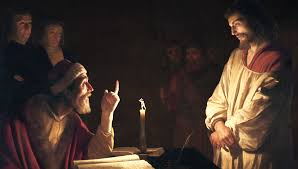
 57 Then those who had seized Jesus led him to Caiaphas the high priest, where the scribes and the elders had gathered. 58 And Peter was following him at a distance, as far as the courtyard of the high priest, and going inside he sat with the guards to see the end. 59 Now the chief priests and the whole council were seeking false testimony against Jesus that they might put him to death, 60 but they found none, though many false witnesses came forward. At last two came forward 61 and said, “This man said, ‘I am able to destroy the temple of God, and to rebuild it in three days.’” 62 And the high priest stood up and said, “Have you no answer to make? What is it that these men testify against you?” 63 But Jesus remained silent. And the high priest said to him, “I adjure you by the living God, tell us if you are the Christ, the Son of God.” 64 Jesus said to him, “You have said so. But I tell you, from now on you will see the Son of Man seated at the right hand of Power and coming on the clouds of heaven.” 65 Then the high priest tore his robes and said, “He has uttered blasphemy. What further witnesses do we need? You have now heard his blasphemy. 66 What is your judgment?” They answered, “He deserves death.” 67 Then they spit in his face and struck him. And some slapped him, 68 saying, “Prophesy to us, you Christ! Who is it that struck you?” – Matthew 26:57-68 ESV

CaiphasJesus had been arrested and His disciples had fled into the night. Even Peter, the one who had earlier boasted, “Though they all fall away because of you, I will never fall away” (Matthew 26:33 ESV). Their fear had gotten the best of them and they had resigned themselves to the fact that it was all over. Matthew even records that Peter, having followed the guards who were taking Jesus to Caiaphas, the high priest, did so, “to see the end” (Matthew 26:58 ESV). It was all over. Their dreams of Jesus being their Messiah and the one who would sit on the throne of David had been dashed. Jesus was as good as a dead man and there was nothing Peter or any of the other disciples could do about it.

While they sought safety and solace in the dark, Jesus was dragged before Annas, the father-in-law of Caiaphas, the high priest. Annas had been the high priest at one time and still held sway over the Sanhedrin, the Jewish high council. It was Annas who questioned Jesus about His disciples and His teaching. And Jesus had responded:

“I have spoken openly to the world. I have always taught in synagogues and in the temple, where all Jews come together. I have said nothing in secret. Why do you ask me? Ask those who have heard me what I said to them; they know what I said.” – John 18:20-21 NLT

Taking Jesus’ statement as a sign of disrespect for Annas, one of the guards struck Him in the face. Then Jesus was hauled before Caiaphas.

It’s important to note that all of these gatherings took place at night and in secret. These men were not conducting a trial, but an inquisition. They had already determined the guilt of Jesus and were simply looking for concrete evidence or proof to justify their predetermined plan to have Him put to death. They had made their fateful decision immediately after Jesus had raised Lazarus from the dead. John records that, as a result of that miraculous event, “Many of the people who were with Mary believed in Jesus” (John 11:45 ESV). And when the Sanhedrin had gotten word of what Jesus had done, they were disturbed by the news, asking, “What are we going to do? This man certainly performs many miraculous signs. If we allow him to go on like this, soon everyone will believe in him. Then the Roman army will come and destroy both our Temple and our nation” (John 11:47-48 NLT). But it had been Caiaphas, the high priest, who had calmly laid out the solution to this vexing problem.

“You don’t know what you’re talking about! You don’t realize that it’s better for you that one man should die for the people than for the whole nation to be destroyed.” – John 11:49-50 NLT

So, by the time Jesus was dragged in front of the Sanhedrin, His fate had been sealed. The so-called trial was a sham. And these religious leaders, in an attempt to find proof against Jesus, resorted to hiring false witnesses. And as Matthew makes perfectly clear, their intent was to put Jesus to death. But because the Jews were forbidden by the Romans of practicing capital punishment, they would need proof that Jesus was a threat to national security and worthy of death. They would have to convince the Romans to do their dirty deed for them.

But the false witnesses proved to be no help at all. They couldn’t get their stories straight. But then, two came forward who remembered the words Jesus had spoken immediately after He had overturned the tables of the money changers in the temple. When Jesus had been asked by the religious leaders who had given Him the authority to do what He had done, He had responded, “Destroy this temple, and in three days I will raise it up” (John 2:19 NLT). And these two witnesses had been there. So, they related this incendiary statement to the high priest and the members of the high council.

Obviously, these two men had missed Jesus’ point. In his gospel account, John clarifies what Jesus had meant. “But when Jesus said ‘this temple,’ he meant his own body” (John 2:21 NLT).

Yet when Jesus was given an opportunity to respond to the testimony of these men, He didn’t clarify His meaning. He didn’t attempt to qualify His original statement. Matthew records that Jesus remained silent. Unlike His encounter with Annas, this time Jesus chose not to respond to Caiaphas. And His actions were in direct fulfillment of the prophecy of Isaiah.

He was oppressed and treated harshly, yet he never said a word. He was led like a lamb to the slaughter. And as a sheep is silent before the shearers, he did not open his mouth. – Isaiah 53:7 ESV

Jesus was not interested in defending Himself – either physically or verbally. This entire evening had been preordained by His heavenly Father, and Jesus was fully committed to doing what His Father had commanded Him to do.

“No one can take my life from me. I sacrifice it voluntarily. For I have the authority to lay it down when I want to and also to take it up again. For this is what my Father has commanded.” – John 10:18 NLT

But Caiaphas was not satisfied. He needed Jesus to commit blasphemy – to claim to be God. That was the evidence the high priest needed to justify the death of Jesus. So, he said to Jesus, “I adjure you by the living God, tell us if you are the Christ, the Son of God” (Matthew 26:63 ESV). This was not a case of Caiaphas expressing hope that Jesus was the Messiah, but a last desperate attempt to get Jesus to blaspheme by claiming to be God’s Son and, therefore, divine.

On an earlier trip to the city of Jerusalem, at the Feast of Dedication, and in the temple courtyard, Jesus had made the bold claim, “I and the Father are one” (John 10:30 ESV). That statement had incensed the Jews and they had taken up rocks to stone Him. But Jesus had expressed confusion, stating that He had performed many good works that proved He was from God. So, He asked, “for which of them are you going to stone me?” (john 10:32 ESV). And the people shouted, “It is not for a good work that we are going to stone you but for blasphemy, because you, being a man, make yourself God” (John 10:33 ESV).

That was what Caiaphas was looking for. He needed Jesus to verbally express His claim to be God. And in response to the high priest’s question, “are the Christ, the Son of God,” Jesus said, “You have said so. But I tell you, from now on you will see the Son of Man seated at the right hand of Power and coming on the clouds of heaven” (Matthew 26:64 ESV). The true meaning of this statement escaped the high priest and the members of the high council. But it was exactly what they had been waiting for. Accusing Jesus of blasphemy, Caiaphas asked the Sanhedrin for their verdict and they wasted no time in declaring their decision: “He deserves death.”

Think about that statement. From their earth-bound, sin-soaked perspective, they saw Jesus as the one deserving of death. And yet, as the Scriptures make perfectly clear, it was mankind that deserved death at the hands of a righteous, holy and just God.

For everyone has sinned; we all fall short of God’s glorious standard. – Romans 3:23 NLT

Surely there is not a righteous man on earth who does good and never sins. – Ecclesiastes 7:20 ESV

No one is righteous–not even one. – Romans 3:10 NLT

Only fools say in their hearts, “There is no God.” They are corrupt, and their actions are evil; not one of them does good! – Psalm 53:1 NLT

And Scripture tells us that the God-ordained penalty for man’s sin and unrighteousness is death.

…the wages of sin is death. – Romans 6:23 ESV

When Adam sinned, sin entered the world. Adam’s sin brought death, so death spread to everyone, for everyone sinned. – Romans 5:12 NLT

Yet, in spite of mankind’s guilt and the looming sentence of death, God chose to provide a way of escape, a plan of redemption that would make acquittal possible and righteousness available. God’s solution? The sacrificial death of His own Son.

…he was pierced for our rebellion, crushed for our sins. He was beaten so we could be whole. He was whipped so we could be healed. – Isaiah 53:5 NLT

…the LORD laid on him the sins of us all. – Isaiah 53:6 NLT

He personally carried our sins in his body on the cross so that we can be dead to sin and live for what is right. – 1 Peter 2:24 NLT

You were dead because of your sins and because your sinful nature was not yet cut away. Then God made you alive with Christ, for he forgave all our sins. He canceled the record of the charges against us and took it away by nailing it to the cross. – Colossians 3:13-14 NLT

Jesus did not deserve to die. We did. As did every man in the room that night. Yet, “God made Christ, who never sinned, to be the offering for our sin, so that we could be made right with God through Christ” (2 Corinthians 5:21 NLT). But rather than seeing Jesus as the Son of God and their Savior from sin, the members of the Sanhedrin spit on Him, slapped Him, and mocked Him. They abused the one who had come to save them. They ridiculed the only righteous man in the room. And it was all part of God’s plan.

English Standard Version (ESV)
The Holy Bible, English Standard Version. ESV® Permanent Text Edition® (2016). Copyright © 2001 by Crossway Bibles, a publishing ministry of Good News Publishers.

New Living Translation (NLT)
Holy Bible, New Living Translation, copyright © 1996, 2004, 2015 by Tyndale House Foundation. Used by permission of Tyndale House Publishers Inc., Carol Stream, Illinois 60188. All rights reserved.

The Message (MSG)Copyright © 1993, 1994, 1995, 1996, 2000, 2001, 2002 by Eugene H. Peterson

The Blessing of Brokenness

26 Now as they were eating, Jesus took bread, and after blessing it broke it and gave it to the disciples, and said, “Take, eat; this is my body.” 27 And he took a cup, and when he had given thanks he gave it to them, saying, “Drink of it, all of you, 28 for this is my blood of the covenant, which is poured out for many for the forgiveness of sins. 29 I tell you I will not drink again of this fruit of the vine until that day when I drink it new with you in my Father’s kingdom.”

30 And when they had sung a hymn, they went out to the Mount of Olives. 31 Then Jesus said to them, “You will all fall away because of me this night. For it is written, ‘I will strike the shepherd, and the sheep of the flock will be scattered.’ 32 But after I am raised up, I will go before you to Galilee.” 33 Peter answered him, “Though they all fall away because of you, I will never fall away.” 34 Jesus said to him, “Truly, I tell you, this very night, before the rooster crows, you will deny me three times.” 35 Peter said to him, “Even if I must die with you, I will not deny you!” And all the disciples said the same. – Matthew 26:26-35 ESV

break-bread-300x178Jesus and His disciples had gathered in the upper room of a borrowed house somewhere in the city of Jerusalem in order to celebrate the Passover together. It was at this gathering that Jesus revealed the one who would betray Him: Judas. One of the original 12 disciples, Judas had already made a deal with the chief priests, agreeing to turn Jesus over to them in return for a bounty of 30 pieces of silver. And, when Jesus exposed Judas as the one who would betray Him, rather than repent and beg for forgiveness, Judas left the room, intent on doing what he had agreed to do.

Jesus shared some serious words of warning regarding Judas.

“…woe to that man by whom the Son of Man is betrayed! It would have been better for that man if he had not been born.” – Matthew 26:24 ESV

Judas’ decision to betray Jesus was part of God’s redemptive plan. Jesus had been well aware of it and knew it was necessary for God’s will to be fulfilled. But Judas had made the willful choice to betray his master and friend. He put his own self-interests ahead of any devotion he may have had for Jesus. And, evidently, Judas had done a masterful job of disguising his true nature from the rest of the disciples, because when Jesus had announced that one of them would betray Him, none of them assumed it would be Judas. Instead, they each wondered if he was speaking of them. But Jesus made it perfectly clear who the betrayer was.

“It is he to whom I will give this morsel of bread when I have dipped it.” So when he had dipped the morsel, he gave it to Judas, the son of Simon Iscariot. Then after he had taken the morsel, Satan entered into him. Jesus said to him, “What you are going to do, do quickly.” Now no one at the table knew why he said this to him. Some thought that, because Judas had the moneybag, Jesus was telling him, “Buy what we need for the feast,” or that he should give something to the poor. So, after receiving the morsel of bread, he immediately went out. And it was night.” – John 13:26-30 ESV

His departure must have left the rest of the disciples in a state of disbelief. It’s interesting to consider that no one among them attempted to stop Judas, not even the normally impulsive Peter. Judas simply left the room, and the meal continued.

What happened next takes on an even more serious tone when we consider that Judas was on his way to meet with the religious leaders in order to set in motion the betrayal and ultimate arrest and crucifixion of Jesus. He was about to initiate a chain of events that would lead to the death of the Son of God. And as Judas made his way through the streets of Jerusalem, with the words of Jesus echoing in his mind, Jesus addressed His remaining disciples.

He took a piece of unleavened bread, prayed over it, then divided it among them. And He announced, “Take, eat; this is my body.” In his gospel account, Luke adds, “which is given for you. Do this in remembrance of me” (Luke 22:19 ESV). It may be that, at this moment, some of the disciples recalled the words of Jesus spoken earlier in His ministry:

“…the bread of God is he who comes down from heaven and gives life to the world.” – John 6:33 ESV

I am the bread of life; whoever comes to me shall not hunger, and whoever believes in me shall never thirst.” – John 6:35 ESV

I am the bread of life. Your fathers ate the manna in the wilderness, and they died. This is the bread that comes down from heaven, so that one may eat of it and not die. I am the living bread that came down from heaven. If anyone eats of this bread, he will live forever. And the bread that I will give for the life of the world is my flesh.” – John 6:48-51 ESV

Jesus was about to lay down His life as a sacrifice for the sins of mankind. His body would be beaten, broken, and bruised. He would have His life brutally taken from Him by those whose very existence was His doing. Yet, for the sake of His disciples, Jesus commemorated what was about to happen, so that they might always remember the source of their salvation. His death would be the means of their eternal life. No amount of good works could earn for them what Jesus was about to provide for them by the sacrifice of His own life.

And then Jesus took one of the cups of wine, prayed over it, and said, “Drink of it, all of you, for this is my blood of the covenant, which is poured out for many for the forgiveness of sins” (Matthew 26:27-28 ESV). Jesus, as if to emphasize what He had just said, pointed the disciples to the sacrificial nature of His pending death. His blood would be poured out, like the lambs used in the temple sacrifices.

On the day that Jesus had appeared at the Jordan River to be baptized, John the Baptist had announced:

“Behold, the Lamb of God, who takes away the sin of the world!” – John 1:29 ESV

Jesus was the consummate paschal lamb, the sinless substitute who would offer up His life as payment for the sin debt of fallen humanity. And the author of Hebrews clarified the necessity of Jesus’ blood sacrifice.

…without the shedding of blood there is no forgiveness of sins. – Hebrews 9:22 ESV

There was no other way. Jesus had to die. His body would be broken, and His blood would be spilled because the just wrath of God against the sins of mankind had to be satisfied or propitiated. And the apostle John would later write, “He is the propitiation for our sins, and not for ours only but also for the sins of the whole world” (1 John 1:29 ESV). And John would go on to describe this sacrificial act of Jesus as an expression of God’s love for sinful mankind.

In this is love, not that we have loved God but that he loved us and sent his Son to be the propitiation for our sins. – 1 John 4:10 ESV

All of this had to have struck the disciples like a lead weight. It was all so unexpected and unbelievable. And none of it lined up with their hopes and dreams concerning the Messiah. With each word Jesus spoke, their world collapsed in on them, and it was about to get even darker as the night progressed.

Jesus informed them that this would be their last meal together, but assured them that they would feast together again at a later date, most likely a reference to the Marriage Supper of the Lamb.

But with the Passover meal completed, they made their way through the dark night, out the eastern gate of the city to the Mount of Olives. And Jesus dropped yet another bomb on His already shell-shocked disciples.

“You will all fall away because of me this night. For it is written, ‘I will strike the shepherd, and the sheep of the flock will be scattered.’ – Matthew 26:31 ESV

Every single one of them would desert Him at His greatest hour of need. Under the coming persecution of the religious leaders, the disciples would scatter and hide. But upon hearing this pronouncement from Jesus, the always impulsive Peter said, “Though they all fall away because of you, I will never fall away” (Matthew 26:33 ESV). Those words would come back to haunt Peter. And Peter would make matters even worse for himself by refuting Jesus’ claim that he would deny the Lord three times.

“Even if I must die with you, I will not deny you!” – Matthew 2:35 ESV

Peter was well-intentioned, and with his bold claim, he spoke for all of the disciples. But none of them knew what was about to happen. They had no idea just how bad things were going to get in the next few hours. But Jesus did. And yet, He gave them a subtle, yet confident bit of news:

“…after I am raised up, I will go before you to Galilee.” – Matthew 26:32 ESV

Jesus knew He was going to die, but He was also confident that He would rise again. That was the Father’s plan. His death was necessary, but so was His resurrection. His death would serve as the payment for the sins of mankind. But His restoration to life would be proof that His death had been sufficient and fully satisfactory to God.

This dark cloud had a silver lining, even though the events of the next few hours would be horrific for the disciples. They would be agonizingly painful for Jesus. But He faced it all with confidence and faith in His Father’s will. And what He was about to do, He did willingly.

“No one can take my life from me. I sacrifice it voluntarily. For I have the authority to lay it down when I want to and also to take it up again. For this is what my Father has commanded.” – John 10:18 NLT

English Standard Version (ESV)
The Holy Bible, English Standard Version. ESV® Permanent Text Edition® (2016). Copyright © 2001 by Crossway Bibles, a publishing ministry of Good News Publishers.

New Living Translation (NLT)
Holy Bible, New Living Translation, copyright © 1996, 2004, 2015 by Tyndale House Foundation. Used by permission of Tyndale House Publishers Inc., Carol Stream, Illinois 60188. All rights reserved.

The Message (MSG)Copyright © 1993, 1994, 1995, 1996, 2000, 2001, 2002 by Eugene H. Peterson

Selling Out the Savior

14 Then one of the twelve, whose name was Judas Iscariot, went to the chief priests 15 and said, “What will you give me if I deliver him over to you?” And they paid him thirty pieces of silver. 16 And from that moment he sought an opportunity to betray him.

17 Now on the first day of Unleavened Bread the disciples came to Jesus, saying, “Where will you have us prepare for you to eat the Passover?” 18 He said, “Go into the city to a certain man and say to him, ‘The Teacher says, My time is at hand. I will keep the Passover at your house with my disciples.’” 19 And the disciples did as Jesus had directed them, and they prepared the Passover.

20 When it was evening, he reclined at table with the twelve. 21 And as they were eating, he said, “Truly, I say to you, one of you will betray me.” 22 And they were very sorrowful and began to say to him one after another, “Is it I, Lord?” 23 He answered, “He who has dipped his hand in the dish with me will betray me. 24 The Son of Man goes as it is written of him, but woe to that man by whom the Son of Man is betrayed! It would have been better for that man if he had not been born.” 25 Judas, who would betray him, answered, “Is it I, Rabbi?” He said to him, “You have said so.” – Matthew 26:14-25 ESV

30 pieces of silver.jpgMary, the sister of Lazarus, the man whom Jesus had raised from the dead, had just anointed the head of Jesus using “an alabaster flask of very expensive ointment” (Matthew 26:7 ESV). In reaction to her exorbitant display of gratitude to Jesus, the disciples became incensed at what they believed to be an unnecessary waste of resources. But, in his gospel, John makes it clear that the disciple who showed the greatest concern over Mary’s actions was Judas. 

But Judas Iscariot, one of his disciples (he who was about to betray him), said, “Why was this ointment not sold for three hundred denarii and given to the poor?” – John 12:4-5 ESV

Judas conveyed his displeasure with what he deemed Mary’s extravagant and wasteful demonstration of gratitude. Jesus rewarded her act with words of commendation and praise, while Judas questioned the spendthrift nature of her actions. But John provides us with some context, explaining that Judas was responsible for the combined financial resources of Jesus and the disciples. At first glance, it might appear that he was simply practicing good stewardship. But John adds a less-than-flattering insight into the character of Judas.

He said this, not because he cared about the poor, but because he was a thief, and having charge of the moneybag he used to help himself to what was put into it. – John 12:6 ESV

Judas saw Mary’s display of worship as nothing more than a waste of money. Had the perfume been sold and the money turned over to him as treasurer, he could have benefited personally. But by pouring the expensive perfume on the head of Jesus, Mary had “robbed” Judas of the opportunity to line his own pockets. Yet, Jesus described what Mary had done as beautiful. He stressed that His time with them was short. His death was imminent, and Mary’s actions had actually anointed His body for His coming burial.

In this scene, we have the conflict between the selfless sacrifice of Mary and the selfish mindset of the disciples, exemplified by the words of Judas. They weren’t thinking about Jesus. They were seemingly unconcerned about His pending death. It’s all reminiscent of another scene involving Mary and Jesus, recorded in Luke’s gospel.

Now as they went on their way, Jesus entered a village. And a woman named Martha welcomed him into her house. And she had a sister called Mary, who sat at the Lord’s feet and listened to his teaching. But Martha was distracted with much serving. And she went up to him and said, “Lord, do you not care that my sister has left me to serve alone? Tell her then to help me.” But the Lord answered her, “Martha, Martha, you are anxious and troubled about many things, but one thing is necessary. Mary has chosen the good portion, which will not be taken away from her.”  – Luke 10:38-42 ESV

On this occasion, Mary had chosen to sit at the feet of Jesus, listening and learning from Him as He taught. In contrast, her sister Martha had busied herself with activities that left her with no time for Jesus. She was so busy doing things for Jesus that she didn’t have time to receive from Jesus. And Jesus informed Martha that Mary had “chosen the good portion” (Luke 10:42 ESV). She had made time for Him.

And in this passage, Matthew reveals that Mary, once again, had chosen the good portion. She had done the right thing. Her focus was on Jesus, not herself. She showed no concern for the cost of her actions. But that was not the case for the disciples. And the actions and attitudes of Judas exemplify and exaggerate the self-centered perspective of these men.

Matthew records that, after the scene at Bethany, Judas made his way to the religious leaders of Israel. Nowhere in the gospels are we given a rationale behind Judas’ actions. We are not told what motivated him to betray Jesus. But as John pointed out, Judas was a thief, and, as a thief, he was driven by a love for money. Like the rest of the disciples, Judas had chosen to follow Jesus because he had hopes that He was their long-awaited Messiah. And, as was true of the other disciples, his association with Jesus was tainted by purely selfish motives. If Jesus truly was the Messiah, Judas hoped to profit personally from his membership in Jesus’ inner circle of followers.

Perhaps, when he began to hear Jesus speak of His coming death, Judas had second thoughts and growing doubts about who Jesus was. He knew he would not benefit from following a dead Messiah. So, he decided to make the best of a bad situation. He came up with a plan to betray Jesus to the religious leaders, asking them, “What will you give me if I deliver him over to you?” (Matthew 26:15 ESV). They offered him the sum of 30 pieces of silver. Not exactly an exorbitant amount. Notice that Judas had estimated the worth of the perfume Mary had used to anoint Jesus as being 300 denarii. A single denarius was the equivalent of a day’s wage for a common laborer. So, Mary had sacrificed 10-months-worth of income to express her love for Jesus.

And if the silver coins Judas was given were denarii, it means he had been willing to betray Jesus for a single month’s income. He put little value in Jesus’ worth and placed his own desires above any display of love or loyalty to his master. The sum of 30 pieces of silver becomes even more important when we consider that it was the exact amount determined by the Mosaic law for the restitution of the lost value of a slave.

If the ox gores a slave, male or female, the owner shall give to their master thirty shekels of silver, and the ox shall be stoned. – Exodus21:32 ESV

Judas had bargained away the life of Jesus for the price of a common slave. Unlike Mary, he had placed little or no value on the life of Jesus. And his actions revealed that he had no true love for Jesus. Judas loved Judas.

One of the incredible aspects of this little vignette in the life of Jesus is its direct correlation to the prophecies of the Old Testament, Over in the book of Zechariah, there is a prophetic passage that tells of the coming Shepherd of God, who was to be the “shepherd of the flock doomed to slaughter” (Zechariah 11:4 ESV).

Zechariah goes on to say that this Shepherd would try to show favor to the doomed sheep, attempting to unify them under His leadership (Zechariah 11:7). But they would detest Him. So, the Shepherd removed his favor and said, “I will not be your shepherd” (Zechariah 11:9).

This is where it gets interesting. The rejected Shepherd demanded his wages.

Then I said to them, “If it seems good to you, give me my wages; but if not, keep them.” And they weighed out as my wages thirty pieces of silver. – Zechariah 11:12 ESV

And then, Zechariah records that God demanded that the Shepherd refuse the payment.

Then the Lord said to me, “Throw it to the potter”—the lordly price at which I was priced by them. So I took the thirty pieces of silver and threw them into the house of the Lord, to the potter. – Zechariah 11:13 ESV

Now, fast-forward to the very next chapter of Matthew, where he reveals what happened to Judas and his ill-gotten gain. After receiving his reward from the religious leaders, Judas had second thoughts about his decision to betray Jesus.

Then when Judas, his betrayer, saw that Jesus was condemned, he changed his mind and brought back the thirty pieces of silver to the chief priests and the elders, saying, “I have sinned by betraying innocent blood.” They said, “What is that to us? See to it yourself.” And throwing down the pieces of silver into the temple, he departed, and he went and hanged himself. But the chief priests, taking the pieces of silver, said, “It is not lawful to put them into the treasury, since it is blood money.” So they took counsel and bought with them the potter’s field as a burial place for strangers. Therefore that field has been called the Field of Blood to this day. – Matthew 27:3-8 ESV

For 30 pieces of silver, Judas had been willing to sell out the Messiah. He had lined his own pocket with blood money, made from his betrayal of the one whom he had followed for three years. Mary had willingly given the best of what she had in an attempt to express her love and appreciation to Jesus. Judas had sold out His master and friend, not to mention his fellow disciples, all in order to make up what he thought were his losses for having followed Jesus. But Judas had missed the point. He had not listened to the words of Jesus when He said:

And everyone who has left houses or brothers or sisters or father or mother or children or lands, for my name’s sake, will receive a hundredfold and will inherit eternal life.
 – Matthew 19:29 ESV

Judas sacrificed the promise of eternal life for temporary gain in this life. Rather than sacrificing everything so that he might enjoy salvation through Christ, Judas sacrificed Christ so that he might have the short-term joy of temporal treasure. He willingly sold out the Savior. And his regret over his actions would have eternal ramifications.

English Standard Version (ESV)
The Holy Bible, English Standard Version. ESV® Permanent Text Edition® (2016). Copyright © 2001 by Crossway Bibles, a publishing ministry of Good News Publishers.

New Living Translation (NLT)
Holy Bible, New Living Translation, copyright © 1996, 2004, 2015 by Tyndale House Foundation. Used by permission of Tyndale House Publishers Inc., Carol Stream, Illinois 60188. All rights reserved.

(MSG)Copyright © 1993, 1994, 1995, 1996, 2000, 2001, 2002 by Eugene H. Peterson

A Broken Man.

1 When morning came, all the chief priests and the elders of the people took counsel against Jesus to put him to death. And they bound him and led him away and delivered him over to Pilate the governor.

Then when Judas, his betrayer, saw that Jesus was condemned, he changed his mind and brought back the thirty pieces of silver to the chief priests and the elders, saying, “I have sinned by betraying innocent blood.” They said, “What is that to us? See to it yourself.” And throwing down the pieces of silver into the temple, he departed, and he went and hanged himself. But the chief priests, taking the pieces of silver, said, “It is not lawful to put them into the treasury, since it is blood money.” So they took counsel and bought with them the potter’s field as a burial place for strangers. Therefore that field has been called the Field of Blood to this day. Then was fulfilled what had been spoken by the prophet Jeremiah, saying, “And they took the thirty pieces of silver, the price of him on whom a price had been set by some of the sons of Israel, 10 and they gave them for the potter’s field, as the Lord directed me.” – Matthew 27:1-10 ESV

509px-judasThe rooster crowed and the sun came up, just as it always does. Yet, this would be anything but just another morning. Jesus, the Son of God, had been betrayed, denied, libeled, mocked, and falsely condemned. Now, He was being dragged before Pilate, the Roman governor, because the Jews were going to demand His death. They were forbidden by Roman law from practicing capital punishment on their own. In John’s gospel, he records the Sanhedrin’s response when Pilate demanded that they judge Jesus according to their own law. He saw this as nothing more than a petty religious squabble. But they made their true intentions known when they demanded, “It is not lawful for us to put anyone to death” (John 18:31 ESV). They weren’t interested in a trial. They were intent on seeing Jesus put to death. These men had already pronounced their judgment against Jesus, when they stated, “He deserves death” (Matthew 26:66 ESV). And with the opening of this chapter, Matthew makes it clear that their plans were aimed at having Jesus crucified, the primary means of capital punishment practiced by the Romans.

…the chief priests and the elders of the people took counsel against Jesus to put him to death. – Matthew 27:1 ESV

But then, Matthew provides a brief detour from the journey of Jesus to the cross. He changes scenes and brings his readers up to speed on the whereabouts of Judas. His last appearance had been in Gethsemane, where he had betrayed Jesus with a kiss. Evidently, Judas had not gone far, having followed the guards who had arrested Jesus and taken Him to Caiaphas, the high priest. There are some who speculate that Judas was the second disciple John refers to in his gospel.

Simon Peter followed Jesus, and so did another disciple. Since that disciple was known to the high priest, he entered with Jesus into the courtyard of the high priest, but Peter stood outside at the door. So the other disciple, who was known to the high priest, went out and spoke to the servant girl who kept watch at the door, and brought Peter in. – John 18:15-16 ESV

Judas would have been known by the high priest. And it might explain why this particular disciple had not received the same treatment as Peter.

But somehow, Judas received the news that Jesus had been condemned, and Matthew states that he had a change of mind. The Greek word is metamelomai, and it is similar to metanoeō, the Greek word for “repent.” Judas had a change of mind. He regretted his decision to betray Jesus. It would appear that the news of Jesus’ death sentence was far more than he had anticipated. It is likely that Judas never expected the Sanhedrin to take things that far. We will never know what was in the heart of Judas when he made his fateful decision to betray Jesus, but Matthew makes it clear that he lived to regret it. But he wouldn’t live long.

Judas, in a state of despair, returned to the high priest and the Sanhedrin, bringing his 30 pieces of silver with him. Attempting to return the blood money, Judas confessed his guilt before these religious leaders: “I have sinned by betraying innocent blood” (Matthew 27:4 ESV). But they showed no compassion and exhibited no remorse of their own. They simply replied, “What is that to us? See to it yourself” (Matthew 27:4 ESV). These so-called religious leaders could have cared less about the emotional or spiritual well-being of Judas. They had one thing on their minds: The death of Jesus. The only semblance of conscience they revealed was their refusal to return the money Judas had returned to the temple treasure.

“It is not lawful to put them into the treasury, since it is blood money.” – Matthew 27:6 ESV

So, when Judas cast the tainted money onto the temple floor, the Sanhedrin took the 30 pieces of silver and purchased “the potter’s field as a burial place for strangers” (Matthew 27:7 ESV). This would have been a field outside the city gates where the potters discarded their broken or marred products. It was a landfill for broken pottery. Matthew reveals that this decision by the religious leaders was in keeping with Old Testament prophecy. He references Jeremiah but then quotes from a passage found in the book of Zechariah.

And they weighed out as my wages thirty pieces of silver. Then the Lord said to me, “Throw it to the potter”—the lordly price at which I was priced by them. So I took the thirty pieces of silver and threw them into the house of the Lord, to the potter. – Zechariah 11:12-13 ESV

But why did Matthew mention Jeremiah? It is probably because he was combining the two prophecies of Zechariah and Jeremiah into one composite prophecy, fulfilled in the actions of the Sanhedrin. In his book, Jeremiah records a message he received from God.

Thus says the Lord, “Go, buy a potter’s earthenware flask, and take some of the elders of the people and some of the elders of the priests, and go out to the Valley of the Son of Hinnom at the entry of the Potsherd Gate, and proclaim there the words that I tell you.”  – Jeremiah 19:1-2 ESV

Jeremiah was to purchase a clay pot and then take it to the Valley of the Son of Hinnom. In Hebrew, this place was called ge-hinnom. The Greek transliteration was  gehenna. This valley south of Jerusalem had a sordid history, having been the location where the ancient Israelites “passed children through the fire” (sacrificed their children) to the Canaanite god Molech (2 Chronicles 28:3). Because of its reputation, it became a site dedicated to the disposal of waste. The smoke of the fires used to burn the city’s refuse could be seen rising into the sky, marking this area as unclean. Jesus would later speak of Gehenna when referring to the reality of hell.

This is where God told Jeremiah to take the pot he had purchased. And it was in Gehenna that he was to break the pot “in the sight of the men who go with you” (Jeremiah 19:10 ESV). This was to be a visual illustration of what God was going to do to the people of Judah and Jerusalem for their rejection of Him. And God made the details of their guilt quite plain.

“…the people have forsaken me and have profaned this place by making offerings in it to other gods whom neither they nor their fathers nor the kings of Judah have known; and because they have filled this place with the blood of innocents…” – Jeremiah 19:4 ESV

Matthew saw the parallel. And he describes the actions of the Jewish religious leaders of his day as having fulfilled these two ancient prophecies. The high priest and the members of the Jewish high council were as guilty as their ancestors had been. They had forsaken God, and they had done so by rejecting the Son of God. And they had profaned the temple of God by actually worshiping a god of their own choosing. While they claimed to be faithful to Yahweh, the God of the Jews, Jesus accused them of having no relationship with God at all.

“Since you don’t know who I am, you don’t know who my Father is. If you knew me, you would also know my Father.” – John 8:19 NLT

“…you don’t even know him. I know him. If I said otherwise, I would be as great a liar as you! But I do know him and obey him.” – John 8:55 NLT

These men could not truly know God if they were incapable of recognizing the Son of God. The Messiah, the one they had longed to see, had shown up in their midst, but they had refused to accept Him. All because Jesus did not come as they expected or desired. They were blind to the reality of who He was, and Jesus pointed out their problem.

“You search the Scriptures because you think they give you eternal life. But the Scriptures point to me! Yet you refuse to come to me to receive this life.” – John 5:39-40 NLT

Yet, these men had no regrets. They showed no remorse. And they displayed no repentance. Like their ancestors, they remained stubbornly defiant. And they would end up like broken pots, discarded, and of no use to God. And yet, consider these comforting words written by the apostle Paul. He would pick up the theme of the clay pot and give it a whole new perspective. Having in mind all those who place their faith and hope in Jesus as their Savior, Paul wrote:

We now have this light shining in our hearts, but we ourselves are like fragile clay jars containing this great treasure. This makes it clear that our great power is from God, not from ourselves. – 2 Corinthians 4:7 NLT

Faith in Christ can transform broken clay pots into vessels of honor. When the light of the gospel of Jesus Christ takes up residence in a sinner’s life, the power of God is revealed through the cracks and flaws. Rather than being discarded as useless and of no value, the sinner is redeemed and made acceptable to God by the presence of the righteousness of Christ.

But what about Judas? After three years with Jesus, he would end up a broken man. And, in his desperation, he would take his own life. His time with Jesus had not resulted in the great power of God shining through his life, but with his life snuffed out and his legacy of betrayal sealed for generations to come. Like the religious leaders, Judas had been blind to the reality of who Jesus was. He had spent three years of his life with Jesus but had failed to recognize Him and accept Him as His Messiah and Savior. He would die a broken and shattered man.

But all those who place their faith in Jesus as their Savior will live eternally. Their brokenness is the key to their healing. Their recognition of their own unworthiness is the basis of their hope in Christ. It is through our brokenness and inherent uselessness that God chooses to reveal His great power. By placing our faith in Jesus, we become “a vessel for honorable use, set apart as holy, useful to the master of the house, ready for every good work” (2 Timothy 2:21 ESV).

English Standard Version (ESV)
The Holy Bible, English Standard Version. ESV® Permanent Text Edition® (2016). Copyright © 2001 by Crossway Bibles, a publishing ministry of Good News Publishers.

New Living Translation (NLT)
Holy Bible, New Living Translation, copyright © 1996, 2004, 2015 by Tyndale House Foundation. Used by permission of Tyndale House Publishers Inc., Carol Stream, Illinois 60188. All rights reserved.

The Message (MSG)Copyright © 1993, 1994, 1995, 1996, 2000, 2001, 2002 by Eugene H. Peterson

It Must Be So!

47 While he was still speaking, Judas came, one of the twelve, and with him a great crowd with swords and clubs, from the chief priests and the elders of the people. 48 Now the betrayer had given them a sign, saying, “The one I will kiss is the man; seize him.” 49 And he came up to Jesus at once and said, “Greetings, Rabbi!” And he kissed him. 50 Jesus said to him, “Friend, do what you came to do.” Then they came up and laid hands on Jesus and seized him. 51 And behold, one of those who were with Jesus stretched out his hand and drew his sword and struck the servant of the high priest and cut off his ear. 52 Then Jesus said to him, “Put your sword back into its place. For all who take the sword will perish by the sword. 53 Do you think that I cannot appeal to my Father, and he will at once send me more than twelve legions of angels? 54 But how then should the Scriptures be fulfilled, that it must be so?” 55 At that hour Jesus said to the crowds, “Have you come out as against a robber, with swords and clubs to capture me? Day after day I sat in the temple teaching, and you did not seize me. 56 But all this has taken place that the Scriptures of the prophets might be fulfilled.” Then all the disciples left him and fled. – Matthew 26:47-56 ESV

BetrayalWhile Jesus had prayed, the disciples had slept. Except for one of them whose night had been filled with plans of betrayal. Judas, after having been exposed by Jesus as the one who would betray Him, had left the upper room and gone straight to the home of the high priest, intent on following through with his plan to profit from his relationship with Jesus. And before long, he arrived on the scene, accompanied by a crowd consisting of Roman soldiers and a contingent of the high priest’s guards.
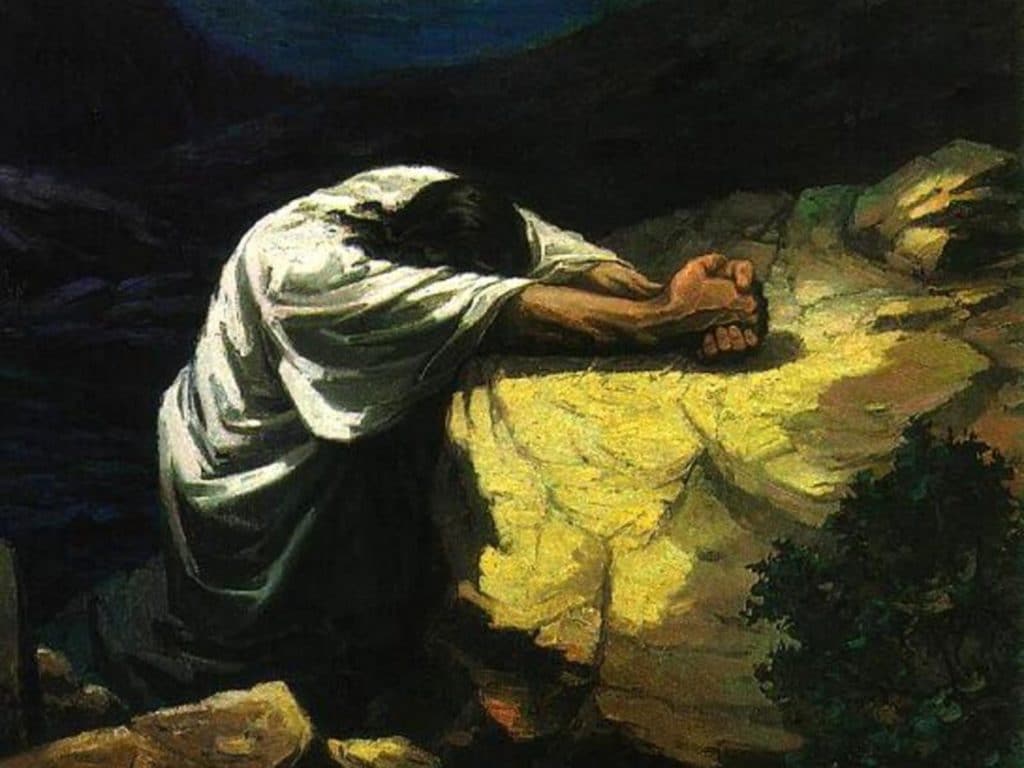
Judas, having been an intimate follower of Jesus, knew that He would likely be on the Mount of Olives that night. John tells us that Jesus “often met there with his disciples” (John 18:2 ESV). And Judas appeared just as Jesus told His disciples:

“See, the hour is at hand, and the Son of Man is betrayed into the hands of sinners. Rise, let us be going; see, my betrayer is at hand.” – Matthew 26:45-46 ESV

This scene is filled with tension and emotion. Jesus, having just poured out His heart to His heavenly Father, had fully committed Himself to accomplish what He had come to do. The disciples, having been awakened from their sleep, suddenly found themselves startled by the arrival of Judas and a large group of armed guards. They were surprised and scared. And Judas had to have been a jumble of raw nerves as he prepared to betray Jesus as well as the rest of the disciples with whom he had spent three years of his life.

The guards, carrying their swords and clubs, would have been on edge, not knowing what they would encounter when they attempted to arrest Jesus. Would His disciples put up a fight? Would there be a large crowd of His followers there, ready to defend Him at all costs?

And in the midst of this chaotic and potentially volatile scene, a strange moment of intimacy took place. Judas stepped forward and kissed Jesus on the cheek. This had been the pre-agreed-upon sign that would mark Jesus as the one they had come to arrest. One has to ask why Judas chose to betray the Lord in this particular way. He could have simply pointed to Jesus. But it’s almost as if Judas wanted to defuse the tension of the moment and to fool the rest of the disciples into thinking he was still a faithful follower of Jesus.

Each of the gospel writers provides their own recollections of what happened next. Matthew tells us that Judas walked up to Jesus and said, “Greetings, Rabbi!” and then kissed Him. Luke records that Jesus responded to this act of betrayal by asking, “Judas, would you betray the Son of Man with a kiss?” (Luke 22:48 ESV). John paints a slightly different picture, saying that “Jesus, knowing all that would happen to him, came forward and said to the soldiers, “Whom do you seek?’” (John 18:4 ESV). These are not discrepancies, but simply the personal recollections of those who witnessed these events firsthand. In the case of Luke, he was recording what he had gleaned from his interviews of the disciples themselves. This scene is far from static but is filled with energy, confusion, and fear. Each of the disciples saw and heard different things. And in the midst of the chaos, the ever-impulsive Peter drew a sword and attacked one of those who had come to arrest Jesus. It was as if Peter was attempting to live up to the rash vow he had made earlier that evening:

“Even if I must die with you, I will not deny you! – Matthew 26:35 ESV

This is the same man who, upon hearing Jesus announce that He was going to die in Jerusalem, had rebuked Him, saying, “Heaven forbid, Lord, this will never happen to you!” (Matthew 16:22 NLT). Peter was trying to prevent the inevitable. More than that, he was trying to frustrate the expressed will of God. This is why Jesus had said to him, “Get away from me, Satan! You are a dangerous trap to me. You are seeing things merely from a human point of view, not from God’s” (Matthew 16:23 ESV).

Peter, like the rest of the disciples, could not believe this was happening. In spite of all Jesus had told them, they could not bring themselves to accept that this was God’s will concerning the Messiah. It was not what they had been taught. It was not the fulfillment of their hopes and dreams.

And the scene provides us with a dramatic dichotomy between the angry, impulsive actions of Peter and the peace-filled, submissive response of Jesus. He turned to Peter and said, “Put your sword back into its place. For all who take the sword will perish by the sword” (Matthew 26:52 ESV). This is an interesting statement and seems to conflict with one Jesus had made earlier in His ministry.

“Don’t imagine that I came to bring peace to the earth! I came not to bring peace, but a sword. – Matthew 16:34 ESV

But on that occasion, Jesus had been talking about the future, after His death, resurrection, and ascension. His act of redemption would put all those who believed in Him at odds with the world around them. Some would express faith in Jesus, while others would reject Him, creating conflict and division even within families.

“I have come to set a man against his father, a daughter against her mother, and a daughter-in-law against her mother-in-law. Your enemies will be right in your own household!” – Matthew 16:35-36 ESV

Jesus had not been advocating armed conflict between Christians and non-Christians. He was simply warning His disciples that following Him would be costly and accompanied by relational conflict.

But the garden of Gethsemane was not the place to stage a revolt against the authorities. Peter’s battle would not be with the armed guards of the Sanhedrin, but “against the rulers, against the authorities, against the cosmic powers over this present darkness, against the spiritual forces of evil in the heavenly places” (Ephesians 6:12 ESV).

On this night, the actions of Judas and the guards who accompanied him were part of the sovereign will of God Almighty. It was all taking place according to the divine plan prescribed by God before the foundation of the world. These events were inevitable, unavoidable, and ordained by God. Jesus let Peter know that if God had not wanted this to happen, He was more than equipped to do something about it. If He deemed necessary, God could have sent 72,000 angels from heaven to defend His Son. But Jesus made it perfectly clear that all of this was necessary.

“But how then should the Scriptures be fulfilled, that it must be so?” – Matthew 26:54 ESV

This was all happening in direct fulfillment of prophecy. Things were taking place just as God had planned. And nothing and no one was going to be able to stand in His way. The will of God would not be delayed, detoured, or derailed. The armed soldiers, equipped with swords and clubs, may have believed that they were in control of the situation, but Jesus knew better. They were simply pawns in the hands of a sovereign God. In fact, John records that when Jesus had asked them, “Whom do you seek?,” they had responded, “Jesus of Nazareth.” And as soon as Jesus had said, “I am he,” John states, “they drew back and fell to the ground” (John 18:6 ESV).

Jesus was in control of the situation, not Peter, the guards, or the soldiers. And Jesus revealed that this entire scene was in fulfillment of God’s prophetic promises.

“…all this has taken place that the Scriptures of the prophets might be fulfilled.” – Matthew 26:56 ESV

And, as if to drive home that point, Matthew records that upon Jesus’ arrest, “all the disciples left him and fled” (Matthew 26:56 ESV). Over in the book of Zechariah, we have a prophetic pronouncement concerning the Messiah that forewarned of this very thing.

“Strike the shepherd, and the sheep will be scattered;
    I will turn my hand against the little ones. – Zechariah 13:7 ESV

Jesus was on His own. The disciples had abandoned Him. Judas had done his dastardly deed and departed the scene. But Jesus, while devoid of any companionship from His followers, was far from alone. His heavenly Father was with Him. He would go through the next hours of suffering knowing that He was doing His Father’s will and was well within the divine grasp of His Father’s love. What Jesus was about to do, He did willingly. Because it had to happen. It was why He had come to earth. His incarnation would be meaningless without His crucifixion. His having taken on human flesh would be pointless if He did not become the sacrifice for the sins of mankind. It must be so. The journey to Calvary had begun and God’s plan for the redemption of man was well on its way.

English Standard Version (ESV)
The Holy Bible, English Standard Version. ESV® Permanent Text Edition® (2016). Copyright © 2001 by Crossway Bibles, a publishing ministry of Good News Publishers.

New Living Translation (NLT)
Holy Bible, New Living Translation, copyright © 1996, 2004, 2015 by Tyndale House Foundation. Used by permission of Tyndale House Publishers Inc., Carol Stream, Illinois 60188. All rights reserved.

The Message (MSG)Copyright © 1993, 1994, 1995, 1996, 2000, 2001, 2002 by Eugene H. Peterson

Faithful In the Face of Death.

36 Then Jesus went with them to a place called Gethsemane, and he said to his disciples, “Sit here, while I go over there and pray.” 37 And taking with him Peter and the two sons of Zebedee, he began to be sorrowful and troubled. 38 Then he said to them, “My soul is very sorrowful, even to death; remain here, and watch with me.” 39 And going a little farther he fell on his face and prayed, saying, “My Father, if it be possible, let this cup pass from me; nevertheless, not as I will, but as you will.” 40 And he came to the disciples and found them sleeping. And he said to Peter, “So, could you not watch with me one hour? 41 Watch and pray that you may not enter into temptation. The spirit indeed is willing, but the flesh is weak.” 42 Again, for the second time, he went away and prayed, “My Father, if this cannot pass unless I drink it, your will be done.” 43 And again he came and found them sleeping, for their eyes were heavy. 44 So, leaving them again, he went away and prayed for the third time, saying the same words again. 45 Then he came to the disciples and said to them, “Sleep and take your rest later on. See, the hour is at hand, and the Son of Man is betrayed into the hands of sinners. 46 Rise, let us be going; see, my betrayer is at hand.” – Matthew 26:36-46 ESV

agony-in-the-garden-1-1024x768.jpgHaving completed the Passover meal, Jesus and His disciples made their way through the city of Jerusalem, out the eastern gate, and onto the Mount of Olives. They stopped at a place called Gethsemane, which means “an olive press.” Here, Jesus took three of His disciples, Peter, James and John, and found a secluded place where He could pray. These are the same three men who had accompanied Him and been eyewitnesses to His transfiguration. But on this occasion, rather than seeing Jesus in His glorified state, they would watch as He agonized over His coming trials.

Jesus described to them His state of mind: “My soul is very sorrowful, even to death” (Matthew 26:38 ESV). His emotional state was one of deep and overwhelming sadness over what was about to happen. His sorrow alone was enough to kill Him. But what was it that caused such a drastic state of deep melancholy in Jesus? Was He afraid to die? Did He regret His decision to sacrifice Himself on behalf of sinful mankind? Was He having second thoughts? The text, along with the words and actions of Jesus, provide us with the answers.

Matthew relates that Jesus went off by Himself and immediately fell on His face before His Father in a state of prayer. He pleaded, “My Father, if it be possible, let this cup pass from me” (Matthew 26:39 ESV).

One of the things this passage reveals is the human side of Jesus’ nature. He was 100 percent God, but also 100 percent human – a state often referred to as the hypostatic union. At His incarnation, Jesus, the eternal, second person of the Trinity, became the God-man. His assumption of a human nature was essential to the role He would play as the Savior of mankind. The author of Hebrews explains:

Because God’s children are human beings – made of flesh and blood – the Son also became flesh and blood. For only as a human being could he die, and only by dying could he break the power of the devil, who had the power of death. – Hebrews 2:14 NLT

The apostle Paul would put it this way:

[God] sent his own Son in a body like the bodies we sinners have. And in that body God declared an end to sin’s control over us by giving his Son as a sacrifice for our sins. – Romans 8:3 NLT

Jesus never relinquished any of His divine attributes, but, in becoming a man, He combined His human and divine natures into one person. And as a man, Jesus felt pain, experienced hunger, grew tired, and, as we will see, became susceptible to death.

In His humanity, Jesus knew that what He was about to endure would be excruciatingly painful. He would be scourged mercilessly with a flagellum, a whip featuring multiple leather strands, each weighted with lead balls or pieces of bone. He would be beaten, spit upon, slapped, and degraded. And eventually, He would be nailed to a wooden cross and left to die by exposure and suffocation. Jesus’ human nature was repulsed by the prospect of facing such a painful and gruesome death. He longed for another way, a plan B.

But, in His divinity, He knew that this was all part of His Father’s sovereign will. This is why He stated, “nevertheless, not as I will, but as you will” (Matthew 26:39 ESV).

But there is a second explanation behind Jesus’ intense sorrow and His cry for an alternative plan. He was fully aware that, upon the cross, He would be taking on the sin debt of the entire world. He who never committed a single sin would bear the full brunt of God’s wrath against all the sins of men for all time.

For God made Christ, who never sinned, to be the offering for our sin, so that we could be made right with God through Christ. – 2 Corinthians 5:21 NLT

Sin separates mankind from God. And Jesus knew that when He took on the sin debt of mankind, He would become separated from His Father for the first time in all of eternity. Their fellowship would be broken. And, in His divine nature, that prospect was unfathomable and unthinkable to Jesus. Yet again, He knew it was all part of God’s plan and, therefore, necessary.

Jesus longed for this “cup of wrath” to pass. If you recall, back in chapter 20, Matthew recorded an encounter between Jesus and the mother of James and John, the two brothers who were with Him in Gethsemane that night. She had asked Jesus to allow her two sons to sit on His right and on His left when He established His kingdom on earth. But Jesus had responded to her two sons, “You don’t know what you are asking! Are you able to drink from the bitter cup of suffering I am about to drink?” (Matthew 20:22 NLT).

Only He was worthy to suffer for the sins of mankind. He alone could meet God’s demanding criteria for an acceptable sacrifice – an unblemished, sinless Lamb.

And it’s interesting to note that when Jesus stopped to check on Peter, James, and John, He had found them asleep. While He had been agonizing over His coming death, these three were obviously unconcerned with and unsympathetic to His pain. They slept while Jesus wept. And Jesus made an interesting observation, stating, “The spirit indeed is willing, but the flesh is weak” (Matthew 26:41 ESV). This was most likely aimed at Peter, who had been the one who had vehemently denied Jesus prediction that they would all bail on Him in His time of greatest need.

“Though they all fall away because of you, I will never fall away.” – Matthew 26:33 ESV).

And yet, here was Peter finding it difficult even to stay awake while His master suffered under the weight of His pending death.

Three separate times Jesus expressed His feelings to His heavenly Father, and three times He communicated His willingness to do His Father’s will. He was committed. Every ounce of His humanity longed to escape what was to come, but His divinity provided the strength He needed to do what He had been called to do.

In his commentary on the book of Matthew, D.A. Carson writes:

“In the first garden ‘Not your will but mine’ changed Paradise to desert and brought man from Eden to Gethsemane. Now ‘Not my will but yours’ brings anguish to the man who prays it but transforms the desert into the kingdom and brings man from Gethsemane to the gates of glory.” – D.A. Carson, Matthew, p. 545.

Jesus was willing to face the fate God had planned for Him because He trusted His heavenly Father. He knew there was no other way. Salvation was only possible through His obedient submission to the sovereign will of God the Father. And the hour had come for Him to begin His journey from Gethsemane to Golgotha. Having finished His prayer time with the Father, Jesus turned to His disciples and said, “the hour is at hand, and the Son of Man is betrayed into the hands of sinners” (Matthew 26:45 ESV).

Judas was on his way, bringing with him the guards of the high priest. The darkness of that night was about to deepen as the forces of evil began their ill-fated attempt to snuff out the Light of the world. But as John would later write:

The light shines in the darkness, and the darkness can never extinguish it. – John 1:5 NLT

God’s light came into the world, but people loved the darkness more than the light, for their actions were evil. All who do evil hate the light and refuse to go near it for fear their sins will be exposed. But those who do what is right come to the light so others can see that they are doing what God wants. – John 3:19-21 NLT

Jesus would end up buried in the darkness of a borrowed tomb. His life would be forcefully taken from Him, but as He had predicted, it would be on His terms.

“No one can take my life from me. I sacrifice it voluntarily. For I have the authority to lay it down when I want to and also to take it up again. For this is what my Father has commanded.” – John 10:18 NLT

Jesus lived to do the will of His Father. And He died in obedience to the will of His Father. When Jesus had stated, “I and the Father are one” (John 10:30 ESV), He had meant it. Their wills were united, and their love for sinful mankind was unified around the sole solution to man’s problem: The sacrificial death of the sinless Son of God.

English Standard Version (ESV)
The Holy Bible, English Standard Version. ESV® Permanent Text Edition® (2016). Copyright © 2001 by Crossway Bibles, a publishing ministry of Good News Publishers.

New Living Translation (NLT)
Holy Bible, New Living Translation, copyright © 1996, 2004, 2015 by Tyndale House Foundation. Used by permission of Tyndale House Publishers Inc., Carol Stream, Illinois 60188. All rights reserved.

The Message (MSG)Copyright © 1993, 1994, 1995, 1996, 2000, 2001, 2002 by Eugene H. Peterson