From Bitter to Better

22 Then Moses made Israel set out from the Red Sea, and they went into the wilderness of Shur. They went three days in the wilderness and found no water. 23 When they came to Marah, they could not drink the water of Marah because it was bitter; therefore it was named Marah. 24 And the people grumbled against Moses, saying, “What shall we drink?” 25 And he cried to the Lord, and the Lord showed him a log, and he threw it into the water, and the water became sweet.

There the Lord made for them a statute and a rule, and there he tested them, 26 saying, “If you will diligently listen to the voice of the Lord your God, and do that which is right in his eyes, and give ear to his commandments and keep all his statutes, I will put none of the diseases on you that I put on the Egyptians, for I am the Lord, your healer.”

27 Then they came to Elim, where there were twelve springs of water and seventy palm trees, and they encamped there by the water. – Exodus 15:22-27 ESV

With their miraculous crossing of the Red Sea, the Israelites were putting a four-century-long season of their life behind them. As the waters of the sea closed behind them, it was as if God closed a lengthy chapter of their existence that had been marked by slavery and persecution. They must have issued a collective sigh of relief as they realized that their days of suffering had finally come to an end. For the first time in centuries, they were a free people and on their way to the land that God had promised as their inheritance. None of them had ever set foot in Canaan before. More than 400 years earlier, their patriarch, Jacob, had entered Egypt of his own free will, bringing along the 70 members of his clan so that they could find refuge from the global famine that had left the land of Canaan a virtual wasteland.

But now, Jacob’s descendants, whose numbers had greatly expanded during their time in Egypt, were returning to the land that he had left. The promise God had made to Abraham was coming true.

“Know for certain that your offspring will be sojourners in a land that is not theirs and will be servants there, and they will be afflicted for four hundred years. But I will bring judgment on the nation that they serve, and afterward they shall come out with great possessions. – Genesis 15:13-14 ESV

And God had reconfirmed that promise to Jacob as he and his family were making their way to Egypt.

“I am God, the God of your father. Do not be afraid to go down to Egypt, for there I will make you into a great nation. I myself will go down with you to Egypt, and I will also bring you up again, and Joseph’s hand shall close your eyes.” – Genesis 46:3-4 ESV

Jacob and his sons all died while living in Egypt. The only time his 12 sons returned to Canaan was in order to bury his body alongside those of Abraham and Isaac. But the brothers were unable to remain in Canaan because the famine had not yet ended. So, they returned to Egypt where they lived out their lifetimes in the land of Goshen.

But now, their numerous descendants were making the long journey home. But after their four-hundred-year stint in Egypt, the Israelites had grown accustomed to their surroundings. They had acclimated to the land and the ways of its people. Over time, they had forgotten the God of their fathers and adopted the Egyptian gods as their own. Canaan had become a distant memory and the promises of Yahweh had long been forgotten as each successive generation became increasingly more “Egyptianized.”
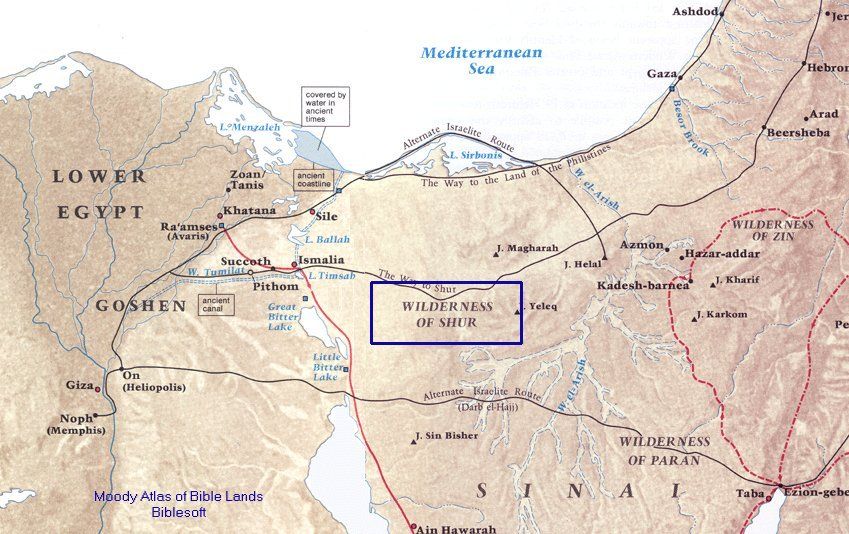
But all that was about to change. Their long-forgotten God had not forgotten them. He had just miraculously delivered them from bondage and was now leading them to their future home in Canaan. And as the scene of their emancipation and the Egyptian army’s annihilation faded into the distance, the people followed the pillar of cloud into the wilderness of Shur. Little did they know that this was going to be the beginning of a new chapter in their collective story. They were entering a new phase of their existence in which they would come to know and understand their “new” God. The ten plagues they had witnessed in Egypt had just been the opening act of His self-revelatory drama.

As they made their way to Canaan, they were going to get a steady dose of divine revelation as God displayed His glory and power. But He would also reveal the expectations He had for His chosen people. He had redeemed them for a reason. They had been set free so that they might live according to His will and display His glory and greatness to the rest of the nations.

The wilderness was to be their classroom, where they learned the painful truth about their own character and discovered the unflinching holiness and unwavering faithfulness of their God. And those lessons began immediately.

Just three days after leaving the Red Sea, they found themselves facing their first test in God’s school of spiritual enlightenment.

They traveled in this desert for three days without finding any water. When they came to the oasis of Marah, the water was too bitter to drink. – Exodus 15:22-23 NLT

Shur was not a desert as much as it was an open expanse of land, and water would have been a constant need for the Israelites. So, during their first three days of travel, the Israelites found no source of potable water. This would have been a serious concern for a group their size. How could they remain alive without water? They knew that their sizeable flocks and herds would quickly diminish if a viable source of water was not found soon.

This unexpected predicament caused the people to turn their anger against Moses. Just as they had done when they found themselves backed up against the sea with the Egyptian army bearing down on them, the people of Israel took out their fear and frustration on God’s appointed leader.

“What are we going to drink?” they demanded. – Exodus 15:24 NLT

And by this time, Moses must have been questioning why he ever agreed to lead this ungrateful and easily disgruntled band of hotheads. As God’s spokesman, he became the target of the people’s wrath. When they became unhappy with their circumstances, they took their complaints to Moses and his brother, Aaron. These two elderly men had shown up in Egypt with lofty promises of emancipation and relocation. They had declared themselves to be the official representatives of Yahweh, the God of Abraham, Isaac, and Jacob, and they had come to lead God’s people out of Egypt and back to the land of promise.

So, when things didn’t go well, the people held Moses and on as responsible. And when Moses felt the heat, he turned to God for help.

So Moses cried out to the Lord for help, and the Lord showed him a piece of wood. Moses threw it into the water, and this made the water good to drink. – Exodus 15:25 NLT

What’s important to note in this story is that there was water, but it was undrinkable. Their problem wasn’t a lack of something, but it was that the solution to their need was “bitter.” It was plentiful but undrinkable. It wasn’t that the water was non-existent but that it was worthless in its current condition. And this non-potable water contained a powerful lesson for the Israelites.

The Hebrew word translated as “bitter” is מַר (mar), which can also be translated as “angry” or “discontented.” Little did the Israelites know that the water was a symbol of their own spiritual condition. Despite all God had done to set them free from their bondage in Egypt, they were a bitter and discontented people. In a sense, they were unusable. Instead of displaying gratitude for all that God had done, they quickly resorted to anger and blame. And their blatant displays of dissatisfaction were evidence that their hearts were bitter and in need of change.

So, God took this opportunity to teach the Israelites a much-needed lesson on how He was going to transform the bitter condition of their hearts. He had Moses take a particular piece of wood and throw it into the bitter water. This act of faith on Moses’ part had an immediate effect, transforming the bitter, worthless water into a refreshing and live-giving source of sustenance for the people of God and all their livestock. The bitterness was removed.

Hundreds of years later, the prophet Ezekiel would record the following promise that God made to His people.

“I will give you a new heart, and I will put a new spirit in you. I will take out your stony, stubborn heart and give you a tender, responsive heart. And I will put my Spirit in you so that you will follow my decrees and be careful to obey my regulations.” – Ezekiel 3626-27 NLT

From the very beginning, God revealed His desire to transform the hearts of His people. Their real problem had never been slavery. They suffered from a heart condition that had left them bitter, angry, and discontented. Their 400-year separation from God had reduced them to a state of spiritual stagnation and impurity. They had become polluted by the culture and robbed of their ability to be a source of life to the nations around them. So, God was going to intervene and, over time, begin His miraculous plan of heart transformation.

One of the things that Moses makes clear is this event at Marah had been a test of their faithfulness. God wanted to know if they were going to trust Him or would they continue to display their distrust through bitter displays of discontentment and dissatisfaction. So, He had Moses give them a warning.

“If you will listen carefully to the voice of the Lord your God and do what is right in his sight, obeying his commands and keeping all his decrees, then I will not make you suffer any of the diseases I sent on the Egyptians; for I am the Lord who heals you.” – Exodus 15:26 NLT

God had used an ordinary piece of wood to transform bitter water into a life-giving source of sustenance. He had just proven, yet again, that He could meet all their needs. And all He was asking in return was that they live in obedience to His commands. If they did, they could expect to see more miraculous evidence of His provision, but they would also experience protection from His judgment. Obedience would bring blessing. Disobedience would result in curses. This would become a recurring theme in their relationship with God. He could both heal and hurt. He could bless and curse. And all He asked of His people was that they could trust and obey so that He could turn them into a life-giving source of sustenance to the nations of the world.

English Standard Version (ESV) The Holy Bible, English Standard Version. ESV® Permanent Text Edition® (2016). Copyright © 2001

New Living Translation (NLT) Holy Bible, New Living Translation, copyright © 1996, 2004, 2015 by Tyndale House Foundation. Used by permission of Tyndale House Publishers Inc., Carol Stream, Illinois 60188. All rights reserved.

Naomi the Negative. Ruth the Resilient.

So the two of them went on until they came to Bethlehem. And when they came to Bethlehem, the whole town was stirred because of them. And the women said, “Is this Naomi?” She said to them, “Do not call me Naomi; call me Mara, for the Almighty has dealt very bitterly with me. I went away full, and the Lord has brought me back empty. Why call me Naomi, when the Lord has testified against me and the Almighty has brought calamity upon me?”

So Naomi returned, and Ruth the Moabite her daughter-in-law with her, who returned from the country of Moab. And they came to Bethlehem at the beginning of barley harvest.

Now Naomi had a relative of her husband’s, a worthy man of the clan of Elimelech, whose name was Boaz. And Ruth the Moabite said to Naomi, “Let me go to the field and glean among the ears of grain after him in whose sight I shall find favor.” And she said to her, “Go, my daughter.” So she set out and went and gleaned in the field after the reapers, and she happened to come to the part of the field belonging to Boaz, who was of the clan of Elimelech. And behold, Boaz came from Bethlehem. And he said to the reapers, “The Lord be with you!” And they answered, “The Lord bless you.” Then Boaz said to his young man who was in charge of the reapers, “Whose young woman is this?” And the servant who was in charge of the reapers answered, “She is the young Moabite woman, who came back with Naomi from the country of Moab. She said, ‘Please let me glean and gather among the sheaves after the reapers.’ So she came, and she has continued from early morning until now, except for a short rest.” – Ruth 1:19-2:7 ESV

These verses are filled with contrasts. The most obvious one is the difference between the two women: Naomi and her daughter-in-law, Ruth. They both arrive in Bethlehem, but with radically different outlooks. Naomi had left during a famine, but arrived back during the barley harvest. Conditions back home had obviously improved. But she is so busy dwelling on all that had happened to her in Moab, that she fails to notice or appreciate the improved conditions in Bethlehem. In fact, she is so despondent over the loss of her husband and two sons, that she informs everyone her name will no longer be Naomi, but Mara. Naomi means, “my pleasantness” and Mara means, “bitterness.” She is so upset with her lot in life that she goes so far as to change her name to reflect her outlook. She is bitter and hold God responsible, claiming,  “I left here full, but the Lord has caused me to return empty-handed” (Ruth 1:27 NLT). In her mind, it was God who had opposed her and the El Shaddai, God Almighty, who had caused her to suffer. Her reference to God using the Hebrew name, Shaddai, reveals her belief in God’s all-powerful, sovereign nature. She rightly understands God’s omnipotence, but fails to grasp His lovingkindness. She views God as an all-powerful and somewhat angry deity who wields His power unfairly and unjustly. She sees no purpose in her losses and can find no silver lining to the dark cloud of her despair. She believes her fate is in the hands of God, but she finds no comfort there.

But Ruth, the Moabitess, seems to have a different perspective. Of the two women, it would seem that she had even more justification to be negative about her new circumstances. She too had lost her husband. She had also left behind her family and friends and moved to a new country with nothing more than her widowed mother-in-law as a companion. She found herself an outsider, a non-Jew living in the land of Israel. And on top of that, she was a woman and a widow, two things that would not be in her favor in the male-dominated society of the ancient Middle East. And yet, Ruth proves to be a beacon of light in the midst of Naomi’s darkened outlook.

With no means of providing for themselves, Naomi and Ruth are left with no other option than to search for grain in the fields after barley harvesters were done. This was called gleaning and it was a God-ordained policy meant to assist the needy. God had commanded the Israelites:

“When you reap the harvest of your land, you shall not reap your field right up to its edge, neither shall you gather the gleanings after your harvest. And you shall not strip your vineyard bare, neither shall you gather the fallen grapes of your vineyard. You shall leave them for the poor and for the sojourner: I am the Lord your God. – Leviticus 19:9-10 ESV

Rather than wallow in self-pity, Ruth determined to do whatever was necessary to provide for she and her mother-in-law. She asked Naomi for permission to do something about their dire circumstances, saying, “Let me go to the fields so I can gather grain behind whoever permits me to do so” (Ruth 2:2 NLT). With Naomi’s permission, she headed into the fields. And this is where the story gets interesting. The author gives us a not-so-subtle clue that there is more going on here than good luck. “Now she just happened to end up in the portion of the field belonging to Boaz, who was from the clan of Elimelech” (Ruth 2:3 NLT). Chapter two began with a brief parenthetical introduction to Boaz, telling us that “Naomi had a relative on her husband’s side of the family named Boaz. He was a wealthy, prominent man from the clan of Elimelech” (Ruth 2:1 NLT). When Ruth went into the fields, she knew nothing of Boaz or his fields. She simply went to glean. Her objective was to find food, not a husband. Her only motivation was survival. But again, the author lets us know that there is something providential going on here. He writes, “And behold, Boaz came from Bethlehem” (Ruth 2:4 ESV). It just so happened that Ruth decided to glean in the field belonging to Boaz. It just so happened that Boaz showed up at the very same time Ruth was gleaning in his field. What a coincidence. What incredible timing.

It would be so easy to read the book of Ruth as a fanciful love story, a kind of screenplay  for a Hebrew Hallmark movie, where the down-and-out country girl meets the well-to-do city boy and their lives end happily ever after. But there is so much more going on here than a cheesy boy-meets-girl scenario with a sappy everything-turns-out-okay ending. This is about the sovereign will of God regarding His covenant promise to Abraham, Isaac and Jacob. Ruth, this widowed, helpless non-Jewish woman is going to become a major player in the divine plan of redemption. In his genealogical record of the birth of Jesus, Matthew writes, “Boaz the father of Obed by Ruth, and Obed the father of Jesse, and Jesse the father of David the king” (Matthew 1:5-6 ESV). Spoiler alert: Ruth and Boaz do end up together. They get married and have a son named Obed, who would become the grandfather of King David. And from King David’s lineage would come Jesus Christ. God would end up making a covenant with David, saying, “And your house and your kingdom shall be made sure forever before me. Your throne shall be established forever” (2 Samuel 7:16 ESV). That promise would be fulfilled in Jesus, whose rule and reign on the throne of David will take place in the millennial kingdom.

Ruth went into the field to find grain. But God sent her into the field to find her purpose in life. She would become a major player in God’s divine plan for the redemption of the world and the eventual birth of the One who will reign as King of kings and Lord of lords. Ruth, like Mary, was going to be a vessel in the hands of God to bring about His divine will and accomplish His sovereign plan of salvation. The message given to Mary by the angel, Gabriel, sums up the real story behind the story of Ruth. God had far more in mind than providing grain or even a husband for Ruth. He was out to provide salvation to a lost and dying the world.

“Don’t be afraid, Mary,” the angel told her, “for you have found favor with God! You will conceive and give birth to a son, and you will name him Jesus. He will be very great and will be called the Son of the Most High. The Lord God will give him the throne of his ancestor David. And he will reign over Israel forever; his Kingdom will never end!” – Luke 1:30-33 NLT


Grit and Grace.

Therefore lift your drooping hands and strengthen your weak knees, and make straight paths for your feet, so that what is lame may not be put out of joint but rather be healed. Strive for peace with everyone, and for the holiness without which no one will see the Lord. See to it that no one fails to obtain the grace of God; that no “root of bitterness” springs up and causes trouble, and by it many become defiled; that no one is sexually immoral or unholy like Esau, who sold his birthright for a single meal. For you know that afterward, when he desired to inherit the blessing, he was rejected, for he found no chance to repent, though he sought it with tears. – Hebrews 12:12-17 ESV

Even with your eyes focused on Jesus, the Christian life can be difficult. As sons and daughters of God we will experience His loving discipline so that we might share in His holiness. And as the author of Hebrews reminded us, “For the moment all discipline seems painful rather than pleasant, but later it yields the peaceful fruit of righteousness to those who have been trained by it” (Hebrews 12:11 ESV). Learning the life of holiness in the midst of a world and culture that is diametrically opposed to it is anything but easy. But holiness is to be our goal, because holiness is God’s will for us. “For this is the will of God, your sanctification…” (1 Thessalonians 4:3 ESV). Sanctification refers to our ongoing transformation into holiness and righteousness. Ultimately, God’s goal for us is our glorification, the day in which we will be completely free from the influence of sin and totally righteous in His eyes, both positionally and morally. Paul puts it this way: “but we ourselves, who have the firstfruits of the Spirit, groan inwardly as we wait eagerly for adoption as sons, the redemption of our bodies. For in this hope we were saved” (Romans 8:23-24 ESV). He told the Galatian believers, “For through the Spirit, by faith, we ourselves eagerly wait for the hope of righteousness” (Galatians 5:5 ESV). Redeemed bodies, free from the effects of sin and a righteousness unhampered by a sin nature – that is to be our hope. That is to be our goal. Yet while it is something promised to us in the hereafter, we are to strive for it in the here and now.

We are to “strive for peace with everyone, and for the holiness without which no one will see the Lord” (Hebrews 12:14 ESV). The Greek word translated “strive” is diōkō and it means “to seek after eagerly, earnestly endeavour to acquire” (Greek Lexicon :: G1377 (KJV). Blue Letter Bible). But it can also mean “to persecute, in any way whatever to harass, trouble, molest one.” In this world where enmity and hostility are the norm, we are to pursue peace with all men. When the world returns our love with hatred, we are to persevere and keep on loving regardless of what happens. And we are to pursue holiness in the same way, persistently and purposefully. It will not be easy. That’s why the author tells us “take a new grip with your tired hands and strengthen your weak knees. Mark out a straight path for your feet so that those who are weak and lame will not fall but become strong” (Hebrews 12:12-13 NLT). Notice that this is not to be an individual journey, but a shared one. “See to it that no one fails to obtain the grace of God; that no ‘root of bitterness’ springs up and causes trouble, and by it many become defiled; that no one is sexually immoral or unholy” (Hebrews 12:15-16 ESV). We have a mutual responsibility to our brothers and sisters in Christ to see that we all strive for holiness. No one is to be left behind. The pursuit of holiness is not a solo event. It is a team sport. We are members of the body of Christ and so, we are in this together.

The author warns us against three things: grace-lessness, bitterness and unholiness. Back in chapter four he wrote, “Let us then with confidence draw near to the throne of grace, that we may receive mercy and find grace to help in time of need” (Hebrews 4:16 ESV). Grace is undeserved favor or “the merciful kindness by which God, exerting his holy influence upon souls, turns them to Christ, keeps, strengthens, increases them in Christian faith” (Greek Lexicon :: G5485 (KJV). Blue Letter Bible). Grace is made available to us by God. But to live grace-lessly is to attempt to live our lives without His help and apart from His strength. Holiness is impossible without God’s help. We cannot make ourselves holy. It is a work of the Holy Spirit within us. But we can become grace-less through prayerlessness. We can fail to enjoy God’s life-giving grace when we refuse to spend time in His Word and the fellowship with His people.

And grace-lessness can lead to bitterness. When we fail to live in God’s grace availing ourselves of His power, we become defeated. Our pursuit of holiness becomes nothing more than a self-fueled effort in futility. We try and fail. We strive, in our own strength, and experience nothing more than disappointment and disillusionment. This “root” can spread unseen through the body of Christ, strangling the life out of the fellowship and damaging its witness. When we see our brothers and sisters in Christ failing to avail themselves of the grace of God, we must be willing to step in and speak up. Grace-lessness is infectious and highly dangerous. It can become like a cancer, spreading unseen through the body of Christ, sapping the life and vitality from the people of God.

And the end result of grace-lessness and bitterness is unholiness. The author describes it as defilement. The Greek word is miainō and it means “to defile, pollute, sully, contaminate, soil” (Greek Lexicon :: G3392 (KJV). Blue Letter Bible). It was a word often used to refer to the dying or staining of a cloth. Grace-lessness can lead to bitterness and bitterness can end up contaminating the body of Christ, leaving it less than holy. The author uses Esau as an example of unholiness. Esau was the brother of Jacob who sold his birthright for a bowl of porridge. He was driven by his passions, his physical appetites, and gave up what was of value for what was temporal and, ultimately, worthless. And while he would live to regret his decision, it was irreversible. Esau was consumed with the here-and-now. And for the fleeting pleasure of a bowl of stew, he sold his future birthright. John Calvin describes someone like Esau as…

…those in whom the love of the world so holds sway and prevails, that they forget heaven as men who are carried away by ambition, addicted to money and riches, given over to gluttony, and entangled with other kinds of pleasures, and give the spiritual kingdom of Christ either no place or the last place in their concerns. – William B. Johnston, trans., Calvin’s Commentaries: The Epistle of Paul the Apostle to the Hebrews and the First and Second Epistles of St. Peter

The walk of faith can be long and arduous, but it is not impossible. Peter would have us remember, “His divine power has granted to us all things that pertain to life and godliness, through the knowledge of him who called us to his own glory and excellence, by which he has granted to us his precious and very great promises, so that through them you may become partakers of the divine nature, having escaped from the corruption that is in the world because of sinful desire” (2 Peter 1:3-4 ESV). Through His grace, we have what we need to strive after holiness. We may experience drooping hands and weak knees, but we have the power of the indwelling Spirit at our disposal. Holiness is not only possible, but inevitable. It is the promise of God. And our pursuit of it in this life reveals our confidence that we will receive it in full in the life to come.

Proverbs 24e

The Intimacy of Honesty.

An honest answer is like a kiss on the lips.” – Proverbs 24:26 NIV

Honesty is in short supply these days. We live in a world mired in half-truths and deception. Oh, we have plenty of people who claim to “tell it like it is.” But this is usually just another way of saying that they have an opinion and aren’t afraid to share it – no matter how many people they hurt along the way. Honesty in the Hebrew scriptures is about much more than bluntness or frankness of speech. It’s not just speaking your mind or getting something off your chest. It has to do with saying the right or equitable thing. There is an aspect of appropriateness and timeliness to honesty. It entails a certain degree of sensitivity and intimacy. Thus, the comparison in the passage to a kiss on the lips. In Solomon’s day, a kiss on the lips carried a lot of meaning. It was not something done lightly or flippantly. It signified love, devotion, sincerity, and commitment. It was a visible expression of what was in the heart. To kiss someone insincerely would have been unacceptable. To kiss someone on the lips would have given them the impression that you cared for them and that your relationship with them was close. But to do so insincerely, but without meaning it, would have been as unacceptable as lying to them.

When we are honest with someone, it is an expression of love. It shows that we care for them. But it is NOT just a willingness to be blunt with them, telling them whatever is on our heart without any regard for their feelings. Honesty involves intimacy. Honesty requires love. We lovingly express what is on our heart because we care and desire the best for them. We think about how best to say what is on our heart, so that those with whom we sharing will receive it well. Our motivation is love. Our desire is that they will benefit from our honesty, not be devastated by it. Sometimes we can attempt to be honest, but our motivation is to hurt, not help. We can say what is on our mind, simply out of anger or in an attempt to teach the other person a lesson. But the honesty Solomon is talking about is always for the good of the other. It has the other person’s best interest at heart, because it comes from the heart. It is honesty that aims at building the other person up, not tearing them down. It is honesty that is selfless, not selfish. We share what we share because we wish to make the other person better, not because we’re out to prove a point or voice our opinion. An honest answer is a loving answer. It is saying what needs to be said because you care for someone deeply.

Father, give us the capacity to be honest with one another because we truly care for one another. Teach us to share intimately and honestly out of love. Reveal to us any selfishness or self-centeredness that may be getting in the way. Help us to see when we our attempts at honesty are nothing more than poorly veiled efforts to hurt the other person. May our honesty always be motivated by love and focused on the well-being of the other person. Amen.

Ken Miller

Grow Pastor & Minister to Men
kenm@christchapelbc.org

Proverbs 17c

Conflict Resolution.

“Love prospers when a fault is forgiven, but dwelling on it separates close friends.” – Proverbs 17:9 NLT

We’ve all seen it happen. Perhaps we’ve even had it happen to us. A close friendship dissolved over an unresolved issue. A disagreement that never was dealt with properly and which resulted in alienation, accusation, and acrimony. It happens to friendships and even the relationships between parents and children, brothers and sisters, and even Christ-followers. Many times these conflicts start with something fairly insignificant and small, but when left unresolved, they fester and grow, like an untreated wound. What began as a small things becomes a big thing because proper steps weren’t taken to begin with. A hurtful word or a painful action causes a crack to develop in a relationship. And when it is not addressed in a godly and timely manner, the enemy takes advantage of the situation and begins to pry and press on that crack in an effort to widen and worsen it. Jesus told us that the enemy comes “to steal, kill and destroy” (John 10:10). He wants to destroy our relationships, kill our friendships, and steal the benefits available to us through community. Satan hates love. It’s that simple. Yet Solomon reminds us that “love prospers when a fault is forgiven” (Proverbs 17:9 NLT). God is love and He desires that we live lives of love for Him and others. But it is impossible to love when we refuse to forgive. We are incapable of love if we demand our rights and hold on to all the bad things done to us. Our harboring of anger, resentment and bitterness to the other person does little to change or convict them, but it can end up destroying us – from the inside out. It produces a toxic blend of bitterness, anger, and resentment that becomes like a cancer in our system, eating us away internally and destroying us spiritually. Paul tells us, “Get rid of all bitterness, rage, anger, harsh words, and slander, as well as all types of evil behavior. Instead, be kind to each other, tenderhearted, forgiving one another, just as God through Christ has forgiven you” (Ephesians 4:31-32 NLT). We are to forgive in the same way we have been forgiven by God. No qualifications. No conditions. No grading on the curve. Just forgive. Is forgiving hard to do? You bet. Especially when someone refuses to admit that they were wrong or that they even hurt us. And even harder than forgiving is forgetting. We may feel like we’ve forgiven that person, but then the next time we see them we are reminded once again of all that they did to us. The memories resurface and the resentment bubbles to the surface once again. It’s normal and natural. But that’s when we need to turn it over to the Lord and ask for His help. Letting go of a wrong done to us is difficult, but no impossible. God would not have commanded us to forgive one another if was impossible. He has provided us with all the power we need to obey through the indwelling presence of His Holy Spirit. But we have to acknowledge our need for help and request His assistance. We have to confess our own anger, bitterness and unforgiving spirit and ask the Holy Spirit for the strength we need to give up and let go – whether the other party ever confesses their wrong or asks for our forgiveness. “Love prospers when a fault is forgiven” (Proverbs 17:9 NLT). It grows within us. It produces life instead of death. It thwarts the enemy’s attempts to drive a wedge between us and others. It reminds us of how much we have been forgiven by God. Life is too short to spend it bitter, angry, and resentful. Listen to these words from The Message paraphrase of 1 Corinthians 13.

Love never gives up.
Love cares more for others than for self.
Love doesn’t want what it doesn’t have.
Love doesn’t strut,
Doesn’t have a swelled head,
Doesn’t force itself on others,
Isn’t always “me first,”
Doesn’t fly off the handle,
Doesn’t keep score of the sins of others,
Doesn’t revel when others grovel,
Takes pleasure in the flowering of truth,
Puts up with anything,
Trusts God always,
Always looks for the best,
Never looks back,
But keeps going to the end.

Father, it is so easy to hold a grudge. It is so easy to get hurt and grow bitter by what others say or do to us. But You have called us to love. You have commanded us to forgive. And You have modeled it perfectly through the life of Your Son, Jesus Christ. Help me learn to let go of my grudges more quickly, forgive more readily, and love more willingly. Amen.

Ken Miller

Grow Pastor & Minister to Men
kenm@christchapelbc.org

Proverbs 27b

The Power of Praise.

“Fire tests the purity of silver and gold. But a person is tested by being praised.” – Proverbs 27:21 NLT

Praise is a powerful commodity. It should be used sparingly and wisely. Too much praise can cause pride. Too little praise can result in resentment and bitterness. Everyone needs to hear words of praise on occasion, but when it is given it must be sincere and well-deserved. False praise is nothing more than lying. Praising someone who has an addiction for praise can be destructive. Failing to praise someone who is deserving of praise is ultimately selfish and like stealing what is rightfully theirs.

The writer of Proverbs 27 knows the power of praise and warns us about it. Like fire, praise can do much good, but it can also be dangerous if treated flippantly or foolishly. He warns us against self-praise, which is basically bragging. Nobody likes to be around a braggart, yet we all do it at times. We want others to know our accomplishments and to be impressed with our exploits. Self-praise can be as simple as hanging all your diplomas on the wall of your office for everyone to see. If it is meant to impress, it is self-praise, and self-praise is never attractive. Self-praise can be as innocent as fishing for compliments by chumming the water with stories of your good deeds. It is manipulative and unattractive to watch. We are warned, “Let someone else praise you, not your own mouth – a stranger, not your own lips” (Proverbs 27:2 NLT). One of the hard realities of life is that the lack of praise we experience may be the result of us having done nothing praise-worthy. But it could also be that any praises we receive are meant for the ears of others. Those praising us may be telling our boss or supervisor. They may be praising us to their friends. We may not hear it, but we benefit from their praise just the same. If we HAVE to hear praise to benefit from it, our motivation needs to be questioned.

How we receive praise reveals much about us. “A person is tested by being praised” (Proverbs 27:21b NLT). In other words, if praise tends to make us proud and puffed up, it is exposing a heart problem. It is showing us that we have a character flaw. We crave praise. We are addicted to praise. We are motivated by praise. If we don’t receive it, we lose our motivation. It is like an actor who loses his love of acting because he fails to receive the applause he thinks he so richly deserves. At that point, he is acting for the applause, not because he loves to act. If we require the praise of others to make us do what God requires of us, we are doing it for the wrong reason. Doing good deeds in exchange for praise turns our efforts into nothing more than a job. Energy expended in exchange for pay. But we are to do good deeds out of the motivation to honor God. Our efforts are for His praise and glory, not our own. Any praise we receive is an extra-added bonus. It is to be like a sacrifice. Those who brought sacrifices to God did not receive applause from the crowd standing around them. Their effort was what was expected of them as servants of God.

But praise is not a sin. It is a vital part of doing life together as human beings. The key is that praise is something that is given. It is not to be sought. It is like a commodity we have that is to be shared with others, sparingly and wisely. Too much praise, like too much honey, can make the other person sick. Praising a child for anything and everything can end up making them proud, arrogant, and addicted to praise. When they grow up and don’t receive it, they will become angry, resentful, and begin to question their own self-worth. Too little praise can be destructive too. Withholding praise is nothing short of cruel. It is like refusing to pay an employee for a job well done. But for some of us words of praise are difficult to say. Maybe it’s because we failed to hear them as children. We are unaccustomed to hearing them. But words of encouragement can be a gift we give to those in need. They can be like water to a thirsty man – refreshing, reinvigorating, and re-energizing. It takes wisdom to know how to use praise effectively. False praise is disingenuous and deceitful. It’s nothing short of flattery designed to benefit the one giving it. False praise is ultimately self-centered.

Praise is powerful. It has the potential for both harm and for doing good. It is to be used wisely can carefully. It is not something to be sought, but to be given. The praises of men should never be our motivation. Seeking to please God is what should drive us, inspire us and motivate us. The praises of men, when given, are to be received humbly, gratefully and with an understanding that the one who really deserves credit for them is God.

Father, only You really deserve praise. Any good deeds I do are the result of Your Spirit within me, motivating and empowering me. Nothing I do that is worthy of praise is the result of my own self-effort. I can do nothing worthwhile without You. Help me to give praise rather than seek it. But help me to give praise sparingly and with a focus on the heart behind the effort. I want to praise others for what is motivating their behavior, not the behavior itself. Give me the capacity to use praise wisely. Amen.

Ken Miller

Grow Pastor & Minister to Men
kenm@christchapelbc.org