26 Now as they were eating, Jesus took bread, and after blessing it broke it and gave it to the disciples, and said, “Take, eat; this is my body.” 27 And he took a cup, and when he had given thanks he gave it to them, saying, “Drink of it, all of you, 28 for this is my blood of the covenant, which is poured out for many for the forgiveness of sins. 29 I tell you I will not drink again of this fruit of the vine until that day when I drink it new with you in my Father’s kingdom.”
30 And when they had sung a hymn, they went out to the Mount of Olives. 31 Then Jesus said to them, “You will all fall away because of me this night. For it is written, ‘I will strike the shepherd, and the sheep of the flock will be scattered.’ 32 But after I am raised up, I will go before you to Galilee.” 33 Peter answered him, “Though they all fall away because of you, I will never fall away.” 34 Jesus said to him, “Truly, I tell you, this very night, before the rooster crows, you will deny me three times.” 35 Peter said to him, “Even if I must die with you, I will not deny you!” And all the disciples said the same. – Matthew 26:26-35 ESV
 Jesus and His disciples had gathered in the upper room of a borrowed house somewhere in the city of Jerusalem in order to celebrate the Passover together. It was at this gathering that Jesus revealed the one who would betray Him: Judas. One of the original 12 disciples, Judas had already made a deal with the chief priests, agreeing to turn Jesus over to them in return for a bounty of 30 pieces of silver. And, when Jesus exposed Judas as the one who would betray Him, rather than repent and beg for forgiveness, Judas left the room, intent on doing what he had agreed to do.
Jesus shared some serious words of warning regarding Judas.
“…woe to that man by whom the Son of Man is betrayed! It would have been better for that man if he had not been born.” – Matthew 26:24 ESV
Judas’ decision to betray Jesus was part of God’s redemptive plan. Jesus had been well aware of it and knew it was necessary for God’s will to be fulfilled. But Judas had made the willful choice to betray his master and friend. He put his own self-interests ahead of any devotion he may have had for Jesus. And, evidently, Judas had done a masterful job of disguising his true nature from the rest of the disciples, because when Jesus had announced that one of them would betray Him, none of them assumed it would be Judas. Instead, they each wondered if he was speaking of them. But Jesus made it perfectly clear who the betrayer was.
“It is he to whom I will give this morsel of bread when I have dipped it.” So when he had dipped the morsel, he gave it to Judas, the son of Simon Iscariot. Then after he had taken the morsel, Satan entered into him. Jesus said to him, “What you are going to do, do quickly.” Now no one at the table knew why he said this to him. Some thought that, because Judas had the moneybag, Jesus was telling him, “Buy what we need for the feast,” or that he should give something to the poor. So, after receiving the morsel of bread, he immediately went out. And it was night.” – John 13:26-30 ESV
His departure must have left the rest of the disciples in a state of disbelief. It’s interesting to consider that no one among them attempted to stop Judas, not even the normally impulsive Peter. Judas simply left the room, and the meal continued.
What happened next takes on an even more serious tone when we consider that Judas was on his way to meet with the religious leaders in order to set in motion the betrayal and ultimate arrest and crucifixion of Jesus. He was about to initiate a chain of events that would lead to the death of the Son of God. And as Judas made his way through the streets of Jerusalem, with the words of Jesus echoing in his mind, Jesus addressed His remaining disciples.
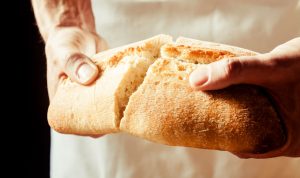
He took a piece of unleavened bread, prayed over it, then divided it among them. And He announced, “Take, eat; this is my body.” In his gospel account, Luke adds, “which is given for you. Do this in remembrance of me” (Luke 22:19 ESV). It may be that, at this moment, some of the disciples recalled the words of Jesus spoken earlier in His ministry:
“…the bread of God is he who comes down from heaven and gives life to the world.” – John 6:33 ESV
“I am the bread of life; whoever comes to me shall not hunger, and whoever believes in me shall never thirst.” – John 6:35 ESV
“I am the bread of life. Your fathers ate the manna in the wilderness, and they died. This is the bread that comes down from heaven, so that one may eat of it and not die. I am the living bread that came down from heaven. If anyone eats of this bread, he will live forever. And the bread that I will give for the life of the world is my flesh.” – John 6:48-51 ESV
Jesus was about to lay down His life as a sacrifice for the sins of mankind. His body would be beaten, broken, and bruised. He would have His life brutally taken from Him by those whose very existence was His doing. Yet, for the sake of His disciples, Jesus commemorated what was about to happen, so that they might always remember the source of their salvation. His death would be the means of their eternal life. No amount of good works could earn for them what Jesus was about to provide for them by the sacrifice of His own life.
And then Jesus took one of the cups of wine, prayed over it, and said, “Drink of it, all of you, for this is my blood of the covenant, which is poured out for many for the forgiveness of sins” (Matthew 26:27-28 ESV). Jesus, as if to emphasize what He had just said, pointed the disciples to the sacrificial nature of His pending death. His blood would be poured out, like the lambs used in the temple sacrifices.
On the day that Jesus had appeared at the Jordan River to be baptized, John the Baptist had announced:
“Behold, the Lamb of God, who takes away the sin of the world!” – John 1:29 ESV
Jesus was the consummate paschal lamb, the sinless substitute who would offer up His life as payment for the sin debt of fallen humanity. And the author of Hebrews clarified the necessity of Jesus’ blood sacrifice.
…without the shedding of blood there is no forgiveness of sins. – Hebrews 9:22 ESV
There was no other way. Jesus had to die. His body would be broken, and His blood would be spilled because the just wrath of God against the sins of mankind had to be satisfied or propitiated. And the apostle John would later write, “He is the propitiation for our sins, and not for ours only but also for the sins of the whole world” (1 John 1:29 ESV). And John would go on to describe this sacrificial act of Jesus as an expression of God’s love for sinful mankind.
In this is love, not that we have loved God but that he loved us and sent his Son to be the propitiation for our sins. – 1 John 4:10 ESV
All of this had to have struck the disciples like a lead weight. It was all so unexpected and unbelievable. And none of it lined up with their hopes and dreams concerning the Messiah. With each word Jesus spoke, their world collapsed in on them, and it was about to get even darker as the night progressed.
Jesus informed them that this would be their last meal together, but assured them that they would feast together again at a later date, most likely a reference to the Marriage Supper of the Lamb.
 But with the Passover meal completed, they made their way through the dark night, out the eastern gate of the city to the Mount of Olives. And Jesus dropped yet another bomb on His already shell-shocked disciples.
“You will all fall away because of me this night. For it is written, ‘I will strike the shepherd, and the sheep of the flock will be scattered.’” – Matthew 26:31 ESV
Every single one of them would desert Him at His greatest hour of need. Under the coming persecution of the religious leaders, the disciples would scatter and hide. But upon hearing this pronouncement from Jesus, the always impulsive Peter said, “Though they all fall away because of you, I will never fall away” (Matthew 26:33 ESV). Those words would come back to haunt Peter. And Peter would make matters even worse for himself by refuting Jesus’ claim that he would deny the Lord three times.
“Even if I must die with you, I will not deny you!” – Matthew 2:35 ESV
Peter was well-intentioned, and with his bold claim, he spoke for all of the disciples. But none of them knew what was about to happen. They had no idea just how bad things were going to get in the next few hours. But Jesus did. And yet, He gave them a subtle, yet confident bit of news:
“…after I am raised up, I will go before you to Galilee.” – Matthew 26:32 ESV
Jesus knew He was going to die, but He was also confident that He would rise again. That was the Father’s plan. His death was necessary, but so was His resurrection. His death would serve as the payment for the sins of mankind. But His restoration to life would be proof that His death had been sufficient and fully satisfactory to God.
This dark cloud had a silver lining, even though the events of the next few hours would be horrific for the disciples. They would be agonizingly painful for Jesus. But He faced it all with confidence and faith in His Father’s will. And what He was about to do, He did willingly.
“No one can take my life from me. I sacrifice it voluntarily. For I have the authority to lay it down when I want to and also to take it up again. For this is what my Father has commanded.” – John 10:18 NLT
English Standard Version (ESV)
The Holy Bible, English Standard Version. ESV® Permanent Text Edition® (2016). Copyright © 2001 by Crossway Bibles, a publishing ministry of Good News Publishers.
New Living Translation (NLT)
Holy Bible, New Living Translation, copyright © 1996, 2004, 2015 by Tyndale House Foundation. Used by permission of Tyndale House Publishers Inc., Carol Stream, Illinois 60188. All rights reserved.