Better That One Man Die

45 Many of the Jews therefore, who had come with Mary and had seen what he did, believed in him, 46 but some of them went to the Pharisees and told them what Jesus had done. 47 So the chief priests and the Pharisees gathered the council and said, “What are we to do? For this man performs many signs. 48 If we let him go on like this, everyone will believe in him, and the Romans will come and take away both our place and our nation.” 49 But one of them, Caiaphas, who was high priest that year, said to them, “You know nothing at all. 50 Nor do you understand that it is better for you that one man should die for the people, not that the whole nation should perish.” 51 He did not say this of his own accord, but being high priest that year he prophesied that Jesus would die for the nation, 52 and not for the nation only, but also to gather into one the children of God who are scattered abroad. 53 So from that day on they made plans to put him to death.

54 Jesus therefore no longer walked openly among the Jews, but went from there to the region near the wilderness, to a town called Ephraim, and there he stayed with the disciples.

55 Now the Passover of the Jews was at hand, and many went up from the country to Jerusalem before the Passover to purify themselves. 56 They were looking for Jesus and saying to one another as they stood in the temple, “What do you think? That he will not come to the feast at all?” 57 Now the chief priests and the Pharisees had given orders that if anyone knew where he was, he should let them know, so that they might arrest him. John 11:45-57 ESV

John gives what appears to be a surprisingly brief summary of the peoples’ response to the raising of Lazarus from the dead. He simply states that many who had been eyewitnesses to the miracle Jesus performed “believed in him” (John 11:45 ESV). But what did they say? How did they react? Did anyone scream in fear as they watched Lazarus come out of the tomb? Were there tears of joy, shouts of praise, and gasps of disbelief and shock? We don’t know because all John tells us is that many believed and others went to the Pharisees to tell them what Jesus had done.

There is little doubt that Jesus’ miracle made a powerful impression on all those who witnessed it. It had been a jaw-dropping display of supernatural power that was impossible to dismiss or ignore. And for many in the crowd, it had been enough to convince them that Jesus was the Messiah. Who else but the Anointed One of God could have raised a dead man back to life?

But John’s lack of detail regarding the peoples’ reaction is because he has a different point of emphasis. In the very next chapter, John will provide a more satisfying glimpse into the peoples’ emotional state as he recalls what happened when they accompanied Jesus into the city of Jerusalem. But for now, John is far more interested in the reaction of the religious leaders. It would appear that these men had Jesus under 24-hour surveillance. They wanted to know His every move and had commissioned spies to report back on everything they saw and heard. And the miracle in Bethany had sent them scurrying back to Jerusalem, eager to tell the Pharisees what they had seen. Upon hearing the first-hand report of what had taken place in Bethany, the Pharisees informed the high priest, who called a special meeting of the Jewish religious council, the Sanhedrin.

This entire scene is strangely similar to one that would take place after Jesus’ own resurrection. John gives a detailed account of it in chapter 20 of his gospel.

Early on Sunday morning, while it was still dark, Mary Magdalene came to the tomb and found that the stone had been rolled away from the entrance. She ran and found Simon Peter and the other disciple, the one whom Jesus loved. She said, “They have taken the Lord’s body out of the tomb, and we don’t know where they have put him!”

Peter and the other disciple started out for the tomb. They were both running, but the other disciple outran Peter and reached the tomb first. He stooped and looked in and saw the linen wrappings lying there, but he didn’t go in. Then Simon Peter arrived and went inside. He also noticed the linen wrappings lying there, while the cloth that had covered Jesus’ head was folded up and lying apart from the other wrappings. Then the disciple who had reached the tomb first also went in, and he saw and believed — for until then they still hadn’t understood the Scriptures that said Jesus must rise from the dead. – John 20:1-9 NLT

Notice the differences. Mary found the tomb of Jesus empty and ran to tell the disciples. Shocked at the news, Peter and John rushed to the scene and discovered the burial wrappings discarded and the tomb empty. And they believed.

The men who witnessed the empty tomb in Bethany had also run to tell others. But the Pharisees had made no effort to verify the facts. Upon hearing the fantastic nature of the news, they didn’t bother to make the two-mile journey to Bethany to see for themselves. They simply reported what they heard to the high priest, who decided it was worthy of an emergency meeting of the council.

The news that a dead man had walked out of a grave was not enough to make these men believe. Their only response was to ask, “What are we to do? For this man performs many signs” (John 11:47 ESV). In a real sense, what they were saying was, “What are we supposed to do now? Our current course of action isn’t working.”

They realized that the longer they delayed, the more powerful and popular Jesus seemed to become. They had tried to discredit Him. They had even threatened to stone Him. But He wouldn’t go away. And now they had a real problem on their hands. He had reportedly raised a dead man back to life and the rumors were flying. Those who had witnessed the miracle were probably spreading the news that Jesus was the Messiah and the religious leaders were fearing the worst.

“If we allow him to go on in this way, everyone will believe in him, and the Romans will come and take away our sanctuary and our nation.” – John 11:48 NLT

They saw Jesus as a threat to their way of life. He was a trouble-making, crowd-inciting thorn in their sides who was fomenting discord and rocking the proverbial boat. Everything had been just fine until this rabble-rouser from Nazareth had shown up on the scene. Now, what were they going to do? Jesus had supposedly raised a dead man back to life. How were they supposed to discredit someone who could do the impossible? And with the celebration of Passover just days away, the crowds were gathering, and the news of His latest miracle was going to spread like wildfire.

But Caiaphas, the high priest, tried to put it all in perspective. He calmly and arrogantly responded, “You know nothing at all! You do not realize that it is more to your advantage to have one man die for the people than for the whole nation to perish” (John 11:49 NLT). He had made up his mind. Jesus had to die. It was the only logical solution to the problem facing them. The sacrifice of one man’s life was necessary if they wanted to preserve the overall well-being of the nation.

Little did Caiaphas know that his words were divinely ordained. He was prophesying and didn’t even know it. John reveals that the high priest’s words were Spirit-inspired.

Now he did not say this on his own, but because he was high priest that year, he prophesied that Jesus was going to die for the Jewish nation, and not for the Jewish nation only, but to gather together into one the children of God who are scattered. – John 11:51-52 NLT

It is interesting to note that the Jewish high priest was appointed by the Romans. He served at their behest and knew his power and position were solely dependent upon their approval of his performance. If he were not careful, this “Jesus problem” could get out of hand and turn into an armed revolt, with the people trying to replace the Romans by crowning their new Messiah as King. This was all unacceptable and if it meant that Jesus had to die, so be it. Better that one man dies than that the Sanhedrin risk the loss of their power and the potential destruction of their temple.

The office of the high priest had originally been a God-ordained role, first held by Aaron, the brother of Moses. And as a God-appointed leader of the nation of Israel, the high priest was intended to be a spokesman for the Almighty. And even in the dark days of the 1st-Century when the spiritual leadership of Israel was in a state of apostasy and populated by men who were self-righteous hypocrites, God still spoke through Caiaphas. And while the high priest thought he was declaring Jesus’ death as the logical means of preserving their way of life, God was announcing the death of His Son as the key to eternal life.

Caiaphas was focused on protecting and preserving Israel. But God had bigger plans in store that would include not only the Jews but the nations of the world. And while Caiaphas didn’t realize it, he was going to be used to bring about the salvation of both Jews and Gentiles by participating in the death of Jesus.

The stage is set. The conflict between darkness and light is intensifying. And the days are drawing near when Jesus will complete His God-given assignment and fulfill the will of His Heavenly Father. But for the time being, Jesus avoided the limelight and removed Himself from public view, content to await the very moment for which He had come. The Passover was coming. And the Lamb of God who takes away the sins of the world was preparing to make His final entrance into Jerusalem

English Standard Version (ESV) The Holy Bible, English Standard Version. ESV® Permanent Text Edition® (2016). Copyright © 2001 by Crossway Bibles, a publishing ministry of Good News Publishers.

New Living Translation (NLT) Holy Bible, New Living Translation, copyright © 1996, 2004, 2015 by Tyndale House Foundation. Used by permission of Tyndale House Publishers Inc., Carol Stream, Illinois 60188. All rights reserved.

The Message (MSG)Copyright © 1993, 1994, 1995, 1996, 2000, 2001, 2002 by Eugene H. Peterson

I Am With You Always

11 While they were going, behold, some of the guard went into the city and told the chief priests all that had taken place. 12 And when they had assembled with the elders and taken counsel, they gave a sufficient sum of money to the soldiers 13 and said, “Tell people, ‘His disciples came by night and stole him away while we were asleep.’ 14 And if this comes to the governor’s ears, we will satisfy him and keep you out of trouble.” 15 So they took the money and did as they were directed. And this story has been spread among the Jews to this day.

16 Now the eleven disciples went to Galilee, to the mountain to which Jesus had directed them. 17 And when they saw him they worshiped him, but some doubted. 18 And Jesus came and said to them, “All authority in heaven and on earth has been given to me. 19 Go therefore and make disciples of all nations, baptizing them in the name of the Father and of the Son and of the Holy Spirit, 20 teaching them to observe all that I have commanded you. And behold, I am with you always, to the end of the age.” – Matthew 28:11-20 ESV

92845787.jpg

Of all the gospel authors, Matthew provides us with the most abbreviated version of the events surrounding Jesus’ last hours on earth. For whatever reason, he chose to leave out all the appearances Jesus made after His resurrection. We know from the accounts penned by John, Luke, and Mark, that Jesus appeared to His followers repeatedly during the hours between His resurrection and His ascension. There was the occasion when He had walked alongside the two distraught disciples on the road to Emmaus as they discussed the recent death of their master (Luke 24:13-32). Initially, they had been unable to recognize Jesus. But when they eventually realized they were talking with the resurrected Lord, they made a beeline to the room where the 10 disciples were gathered together, informing them of their encounter with Jesus.  And as they were sharing the exciting news, Jesus suddenly appeared among them (Luke 24:33-40).

John records that Thomas had not been in the room that day, and when his fellow disciples told him what had happened, he expressed his reservations. So, eight days later, Jesus revealed Himself to Thomas, telling him, “Do not disbelieve but believe” (John 20:27).

The apostle Paul provides a succinct summary of all of Jesus’ post-resurrection appearances.

He was seen by Peter and then by the Twelve. After that, he was seen by more than 500 of his followers at one time, most of whom are still alive, though some have died. Then he was seen by James and later by all the apostles. Last of all, as though I had been born at the wrong time, I also saw him. – 1 Corinthians 15:5-8 NLT

But Matthew chose to leave out all of this. Not only that, He doesn’t even mention the ascension of Jesus. Dr. Stanley Toussaint provides us with a compelling explanation for Matthew’s decision to leave out this seemingly vital part of the narrative.

The reason for Matthew’s diligence in approaching the resurrection in such an apologetic manner is evident since so much is dependent upon the resurrection of the Messiah. It authenticated His person. To the nation of Israel, His resurrection was the sign of the prophet Jonah (Matthew 12:38-49) attesting the fact that Jesus was the Messiah. The reason Matthew says nothing about the ascension is bound up in this point. If Jesus is the Messiah, then an account of the ascension is both unnecessary and self-evident to the Israelite. He would yet come in clouds of glory. What mattered to Matthew was that Jesus was Israel’s Messiah and the resurrection proved that fact; therefore he goes no further. – Toussaint, Stanley D. Behold the King: A Study of Matthew. Portland, Oreg.: Multnomah Press, 1980.

For Matthew, the resurrection said it all. If Jesus had been raised from the dead, which Matthew clearly believed, then His ascension would have been an undisputed fact. Matthew’s primary point was to prove the Messiahship of Jesus. That’s because, as a Jew, Matthew had written his gospel with a Jewish audience in mind. He had been out to prove that Jesus was the Messiah, the Son of God, and the Savior of the world. And, for him, the resurrection was clear evidence and conclusive proof of that claim.

The tomb was empty, and news of that reality had already begun to spread. In fact, the temple guards who had been tasked with protecting the tomb had already delivered their report of the missing body to Caiaphas, the high priest, and his father-in-law. The Jewish high council had placed these guards at the tomb of Jesus in order to prevent the disciples from stealing His body. The members of the Sanhedrin had been informed of Jesus’ bold and blasphemous claim that He would rise from the dead. So, they assumed His fanatical disciples, in a pathetic attempt to keep their little revolution alive, would try to steal the body of Jesus and declare Him to be alive.  Much to their surprise and chagrin, that is essentially what the guards reported. And Matthew records that the guards told the high priest “all that had taken place.” That would have included exactly what Matthew had reported.

…there was a great earthquake, for an angel of the Lord descended from heaven and came and rolled back the stone and sat on it. His appearance was like lightning, and his clothing white as snow. And for fear of him the guards trembled and became like dead men. – Matthew 28:2-4 ESV

These guards would have feared for their lives. They had failed in their assignment. The body they had been instructed to guard was no longer there. If anything, these men could have fabricated a lie that provided them with a plausible alibi. But instead, they told the truth – as crazy as it may have sounded. Not only had they failed to secure the tomb, but they had also fallen asleep on the job. So, they most likely told their bosses exactly what had happened in great detail.

But Matthew records that Caiaphas, after having heard the unwelcome news, assembled the rest of the high council. Amazingly, Caiaphas determined that the best strategy was to pay off the guards and spread the rumor that the disciples had stolen the body – the very thing he had hoped to prevent. It seems evident that he knew something else had taken place, and this decision was nothing more than a poor attempt at a coverup. The last thing he wanted was a rumor of Jesus’ resurrection spreading throughout the city.

And yet, that fact was Matthew’s primary point. Jesus was alive. He had risen from the dead, just as He had promised. He was the Messiah of Israel and the Savior of the world. Matthew had opened up his gospel with the encounter between Joseph and the angel.

“Joseph, son of David, do not fear to take Mary as your wife, for that which is conceived in her is from the Holy Spirit. She will bear a son, and you shall call his name Jesus, for he will save his people from their sins.” – Matthew 1:20-21 ESV

Matthew had followed that story with the one involving the arrival of the wise men, who had come in search of “he who has been born king of the Jews?(Matthew 2:2 ESV).

Next, Matthew recorded Herod’s attempt to eliminate the infant Jesus as a threat by having all the male babies executed. He reported Jesus’ baptism by John the Baptist and the divine pronouncement from God, stating, “This is my beloved Son, with whom I am well pleased” (Matthew 3:17 ESV).

Matthew had been out to prove that Jesus was Immanuel, “God with us” (Matthew 1:23 ESV). And the resurrection of Jesus was the final, conclusive piece of evidence.

Jesus had directed His disciples to meet Him at a mountain in Galilee. We are not told which mountain, but it may have been the very place where Jesus had given His sermon on the mount recorded in Matthew 5-7. But regardless of the exact location of their place of rendezvous, Jesus appeared yet again to His followers. Matthew reports that while all 11 of the disciples worshiped Him, some still harbored doubts. He doesn’t explain what he meant by this. Did they doubt Jesus’ resurrection? That seems hard to imagine, based on the fact that He was standing right in front of them. Did they doubt that He was the Messiah? Perhaps. It could be that they were still harboring hopes that He would reveal Himself to be the King they had long hoped for.

The Greek word translated as “doubted” is edistasan, and it refers to a spirit of hesitation. It is likely that they were uncertain and fearful of all that was going on around them. They probably harbored concerns about the future. They were in unchartered waters. The events of the last few days were not what they had expected, and they had no idea what was going to happen next. What were Jesus’ plans? What would happen to them? The Sanhedrin had already proven just how far they would go to eliminate Jesus as a threat, and they were not going to give up easily.

But Jesus attempted to calm their fears and doubts by telling them, “All authority in heaven and on earth has been given to me” (Matthew 28:18 ESV). This statement was meant to assure His wavering, fear-focused disciples that He was in complete control of the situation. The very fact that He was standing before them, alive and well, was proof that He had authority from God Almighty. He had done what no other man had ever done before – He had conquered death and the grave. And they had no reason to fear.

But they did have work to do. And Jesus, according to His God-given authority, commissioned His followers to continue His work in His absence.

“Go therefore and make disciples of all nations, baptizing them in the name of the Father and of the Son and of the Holy Spirit, teaching them to observe all that I have commanded you. And behold, I am with you always, to the end of the age.” – Matthew 28:19-20 ESV

No more hiding. No more fearing. They were to boldly proclaim the good news of Jesus’ Messiahship. He was the Son of God. He was Immanuel, God with us. He was the King of the Jews and the Savior of the world. And that remarkable news was to be proclaimed throughout the world. While the temple guards and the Sanhedrin were busy spreading lies, the disciples were to spread the truth about the death-defeating, sin-forgiving power of the resurrected Savior.

And Jesus assured His followers that, though He was leaving, He would still be with them. This promise was fulfilled when the Holy Spirit came to dwell in them on the day of Pentecost. The Spirit would be their constant companion and source of divine power. And, while Jesus would soon depart and return to His Father’s side in heaven, the Spirit of God would remain with them all the days of their lives. And He will remain with all those who make up the body of Christ, the Church, until the end of the age.

English Standard Version (ESV)
The Holy Bible, English Standard Version. ESV® Permanent Text Edition® (2016). Copyright © 2001 by Crossway Bibles, a publishing ministry of Good News Publishers.

New Living Translation (NLT)
Holy Bible, New Living Translation, copyright © 1996, 2004, 2015 by Tyndale House Foundation. Used by permission of Tyndale House Publishers Inc., Carol Stream, Illinois 60188. All rights reserved.

The Message (MSG)Copyright © 1993, 1994, 1995, 1996, 2000, 2001, 2002 by Eugene H. Peterson
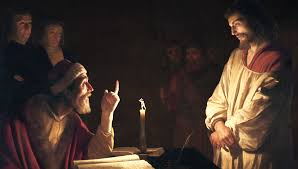
He Deserves Death!

 57 Then those who had seized Jesus led him to Caiaphas the high priest, where the scribes and the elders had gathered. 58 And Peter was following him at a distance, as far as the courtyard of the high priest, and going inside he sat with the guards to see the end. 59 Now the chief priests and the whole council were seeking false testimony against Jesus that they might put him to death, 60 but they found none, though many false witnesses came forward. At last two came forward 61 and said, “This man said, ‘I am able to destroy the temple of God, and to rebuild it in three days.’” 62 And the high priest stood up and said, “Have you no answer to make? What is it that these men testify against you?” 63 But Jesus remained silent. And the high priest said to him, “I adjure you by the living God, tell us if you are the Christ, the Son of God.” 64 Jesus said to him, “You have said so. But I tell you, from now on you will see the Son of Man seated at the right hand of Power and coming on the clouds of heaven.” 65 Then the high priest tore his robes and said, “He has uttered blasphemy. What further witnesses do we need? You have now heard his blasphemy. 66 What is your judgment?” They answered, “He deserves death.” 67 Then they spit in his face and struck him. And some slapped him, 68 saying, “Prophesy to us, you Christ! Who is it that struck you?” – Matthew 26:57-68 ESV

CaiphasJesus had been arrested and His disciples had fled into the night. Even Peter, the one who had earlier boasted, “Though they all fall away because of you, I will never fall away” (Matthew 26:33 ESV). Their fear had gotten the best of them and they had resigned themselves to the fact that it was all over. Matthew even records that Peter, having followed the guards who were taking Jesus to Caiaphas, the high priest, did so, “to see the end” (Matthew 26:58 ESV). It was all over. Their dreams of Jesus being their Messiah and the one who would sit on the throne of David had been dashed. Jesus was as good as a dead man and there was nothing Peter or any of the other disciples could do about it.

While they sought safety and solace in the dark, Jesus was dragged before Annas, the father-in-law of Caiaphas, the high priest. Annas had been the high priest at one time and still held sway over the Sanhedrin, the Jewish high council. It was Annas who questioned Jesus about His disciples and His teaching. And Jesus had responded:

“I have spoken openly to the world. I have always taught in synagogues and in the temple, where all Jews come together. I have said nothing in secret. Why do you ask me? Ask those who have heard me what I said to them; they know what I said.” – John 18:20-21 NLT

Taking Jesus’ statement as a sign of disrespect for Annas, one of the guards struck Him in the face. Then Jesus was hauled before Caiaphas.

It’s important to note that all of these gatherings took place at night and in secret. These men were not conducting a trial, but an inquisition. They had already determined the guilt of Jesus and were simply looking for concrete evidence or proof to justify their predetermined plan to have Him put to death. They had made their fateful decision immediately after Jesus had raised Lazarus from the dead. John records that, as a result of that miraculous event, “Many of the people who were with Mary believed in Jesus” (John 11:45 ESV). And when the Sanhedrin had gotten word of what Jesus had done, they were disturbed by the news, asking, “What are we going to do? This man certainly performs many miraculous signs. If we allow him to go on like this, soon everyone will believe in him. Then the Roman army will come and destroy both our Temple and our nation” (John 11:47-48 NLT). But it had been Caiaphas, the high priest, who had calmly laid out the solution to this vexing problem.

“You don’t know what you’re talking about! You don’t realize that it’s better for you that one man should die for the people than for the whole nation to be destroyed.” – John 11:49-50 NLT

So, by the time Jesus was dragged in front of the Sanhedrin, His fate had been sealed. The so-called trial was a sham. And these religious leaders, in an attempt to find proof against Jesus, resorted to hiring false witnesses. And as Matthew makes perfectly clear, their intent was to put Jesus to death. But because the Jews were forbidden by the Romans of practicing capital punishment, they would need proof that Jesus was a threat to national security and worthy of death. They would have to convince the Romans to do their dirty deed for them.

But the false witnesses proved to be no help at all. They couldn’t get their stories straight. But then, two came forward who remembered the words Jesus had spoken immediately after He had overturned the tables of the money changers in the temple. When Jesus had been asked by the religious leaders who had given Him the authority to do what He had done, He had responded, “Destroy this temple, and in three days I will raise it up” (John 2:19 NLT). And these two witnesses had been there. So, they related this incendiary statement to the high priest and the members of the high council.

Obviously, these two men had missed Jesus’ point. In his gospel account, John clarifies what Jesus had meant. “But when Jesus said ‘this temple,’ he meant his own body” (John 2:21 NLT).

Yet when Jesus was given an opportunity to respond to the testimony of these men, He didn’t clarify His meaning. He didn’t attempt to qualify His original statement. Matthew records that Jesus remained silent. Unlike His encounter with Annas, this time Jesus chose not to respond to Caiaphas. And His actions were in direct fulfillment of the prophecy of Isaiah.

He was oppressed and treated harshly, yet he never said a word. He was led like a lamb to the slaughter. And as a sheep is silent before the shearers, he did not open his mouth. – Isaiah 53:7 ESV

Jesus was not interested in defending Himself – either physically or verbally. This entire evening had been preordained by His heavenly Father, and Jesus was fully committed to doing what His Father had commanded Him to do.

“No one can take my life from me. I sacrifice it voluntarily. For I have the authority to lay it down when I want to and also to take it up again. For this is what my Father has commanded.” – John 10:18 NLT

But Caiaphas was not satisfied. He needed Jesus to commit blasphemy – to claim to be God. That was the evidence the high priest needed to justify the death of Jesus. So, he said to Jesus, “I adjure you by the living God, tell us if you are the Christ, the Son of God” (Matthew 26:63 ESV). This was not a case of Caiaphas expressing hope that Jesus was the Messiah, but a last desperate attempt to get Jesus to blaspheme by claiming to be God’s Son and, therefore, divine.

On an earlier trip to the city of Jerusalem, at the Feast of Dedication, and in the temple courtyard, Jesus had made the bold claim, “I and the Father are one” (John 10:30 ESV). That statement had incensed the Jews and they had taken up rocks to stone Him. But Jesus had expressed confusion, stating that He had performed many good works that proved He was from God. So, He asked, “for which of them are you going to stone me?” (john 10:32 ESV). And the people shouted, “It is not for a good work that we are going to stone you but for blasphemy, because you, being a man, make yourself God” (John 10:33 ESV).

That was what Caiaphas was looking for. He needed Jesus to verbally express His claim to be God. And in response to the high priest’s question, “are the Christ, the Son of God,” Jesus said, “You have said so. But I tell you, from now on you will see the Son of Man seated at the right hand of Power and coming on the clouds of heaven” (Matthew 26:64 ESV). The true meaning of this statement escaped the high priest and the members of the high council. But it was exactly what they had been waiting for. Accusing Jesus of blasphemy, Caiaphas asked the Sanhedrin for their verdict and they wasted no time in declaring their decision: “He deserves death.”

Think about that statement. From their earth-bound, sin-soaked perspective, they saw Jesus as the one deserving of death. And yet, as the Scriptures make perfectly clear, it was mankind that deserved death at the hands of a righteous, holy and just God.

For everyone has sinned; we all fall short of God’s glorious standard. – Romans 3:23 NLT

Surely there is not a righteous man on earth who does good and never sins. – Ecclesiastes 7:20 ESV

No one is righteous–not even one. – Romans 3:10 NLT

Only fools say in their hearts, “There is no God.” They are corrupt, and their actions are evil; not one of them does good! – Psalm 53:1 NLT

And Scripture tells us that the God-ordained penalty for man’s sin and unrighteousness is death.

…the wages of sin is death. – Romans 6:23 ESV

When Adam sinned, sin entered the world. Adam’s sin brought death, so death spread to everyone, for everyone sinned. – Romans 5:12 NLT

Yet, in spite of mankind’s guilt and the looming sentence of death, God chose to provide a way of escape, a plan of redemption that would make acquittal possible and righteousness available. God’s solution? The sacrificial death of His own Son.

…he was pierced for our rebellion, crushed for our sins. He was beaten so we could be whole. He was whipped so we could be healed. – Isaiah 53:5 NLT

…the LORD laid on him the sins of us all. – Isaiah 53:6 NLT

He personally carried our sins in his body on the cross so that we can be dead to sin and live for what is right. – 1 Peter 2:24 NLT

You were dead because of your sins and because your sinful nature was not yet cut away. Then God made you alive with Christ, for he forgave all our sins. He canceled the record of the charges against us and took it away by nailing it to the cross. – Colossians 3:13-14 NLT

Jesus did not deserve to die. We did. As did every man in the room that night. Yet, “God made Christ, who never sinned, to be the offering for our sin, so that we could be made right with God through Christ” (2 Corinthians 5:21 NLT). But rather than seeing Jesus as the Son of God and their Savior from sin, the members of the Sanhedrin spit on Him, slapped Him, and mocked Him. They abused the one who had come to save them. They ridiculed the only righteous man in the room. And it was all part of God’s plan.

English Standard Version (ESV)
The Holy Bible, English Standard Version. ESV® Permanent Text Edition® (2016). Copyright © 2001 by Crossway Bibles, a publishing ministry of Good News Publishers.

New Living Translation (NLT)
Holy Bible, New Living Translation, copyright © 1996, 2004, 2015 by Tyndale House Foundation. Used by permission of Tyndale House Publishers Inc., Carol Stream, Illinois 60188. All rights reserved.

The Message (MSG)Copyright © 1993, 1994, 1995, 1996, 2000, 2001, 2002 by Eugene H. Peterson

Day 131 – John 18:15-18, 25-27

In Front of Witnesses.

John 18:15-18, 25-27

Simon Peter followed Jesus, as did another of the disciple. That other disciple was acquainted with the high priest, so he was allowed to enter the high priest’s courtyard with Jesus. Peter had to stay outside the gate. Then the disciple who knew the high priest spoke to the woman watching at the gate, and she let Peter in. – John 18:15-16 NLT

John’s account of what happened that fateful night when Jesus was arrested and Peter denied Him sheds a whole new light on things. In his usual style, John refers to himself in the third person, saying, “as did the other disciple” and “then the disciple who knew the high priest.” Previously unnoticed by most of us, John was at the scene of Peter’s worst moment and witnessed it all. If you’re like me, you probably pictured Peter as having been alone that night. And if you only read the  three synoptic gospels, you would never have realized that John accompanied Peter and even made it possible for him to gain entry into the inner courtyard of the high priest’s house. Somehow John was acquainted with the high priest and was recognized by the woman who was manning the gate, so he was afforded immediate access into the courtyard. Peter, unknown to the woman, was denied entry. But a word from John made it possible for Peter to join him inside the courtyard. And it was there that Peter’s already devastating night turned into a personal nightmare. His denial of Jesus did not take place in anonymity, but was witnessed by one of his closest friends and fellow disciples. John seems to be gracious in his account, somewhat softening the force of Peter’s three denials. And yet, it was probably he who informed Matthew, Mark and Luke just what was said that night. Or perhaps, some time after Pentecost, Peter himself was the one who shared the exact words he used that night.

But it is painful to think just how embarrassing and humiliating Peter’s actions must have been to him, having been witnessed by his friend John. But John makes to statement or levels no indictment against Peter. He draws no conclusions or reaches no verdict. He simply states what happened in a somewhat matter-of-fact manner. “Again Peter denied it. And immediately the rooster crowed” (John 18:27 NLT). But the weight of what Peter had done drove him to run from the courtyard weeping bitterly. He had denied His Lord and Savior. He had done exactly what Jesus had predicted he would do. And he had done it right in front of one of his own friends. It is one thing to fail alone. It is another thing to fail in front of witnesses. It is quite another thing to fail in front of those you know and whose opinion of you matters. And failure had to have been one of the feelings Peter encountered that evening. He had failed to live up to his own hype. He was the disciple who had sworn that he would die for Jesus before He ever denied Him. Strong words. Weak resolve.

While we are not told what happened next in the courtyard, we can assume that John stayed right where he was as Peter ran away. And John seems to have stayed by the Lord’s side all the way to the cross. He will be the only one mentioned as having been at the cross the day Jesus died. Everyone else, including Peter, had run away. There is not a lot to conclude from all this. There is no real moral lesson at this point. Jesus is under arrest. He has been beaten about the head and face, spit upon and ridiculed. Peter has denied him. John has had to witness it all and must have felt incredibly alone and despondent as he watched his friend slink away in shame and His Master be led away in chains. It was not a good night. And the next day would not get any better. But for those of us who know how the story ends, we know there is a light shining in the darkness. There is hope right around the corner. Peter’s shame will turned to rejoicing. John, all alone for the moment, will once again find himself surrounded by friends and fellow believers. This dark moment was necessary. Peter’s denial had to happen, but he would one day proclaim unashamedly and boldly, “God raised Jesus from the dead, and we are all witnesses of this. Now he is exalted at the place of highest honor in heaven, at God’s right hand” (Acts 2:32-33 NLT). And John would be there to witness his transformation from a denier into a proclaimer.

Father, the story of Peter is the story of us all. We are all capable of denying Your Son at any given moment. We are all guilty of having denied Your Son on numerous occasions over our lifetimes. But You are the God who transforms deniers into proclaimers. You are always using our weakest moments to remind us of our need for You. You even use those who witness our failures to encourage us to remain faithful. You are still writing the next chapter of each of our lives. Because You are faithful, loving and gracious. You were not done with Peter and You are not done with me. Amen.

Ken Miller
Grow Pastor & Minister to Men
kenm@christchapelbc.org

Day 130 – Matthew 26:58, 69-75; Mark 14:54, 66-72; Luke 22:54-62

A Look From the Lord.

Matthew 26:58, 69-75; Mark 14:54, 66-72; Luke 22:54-62

At that moment the Lord turned and looked at Peter. Suddenly, the Lord’s words flushed through Peter’s mind: “Before the rooster crows tomorrow morning, you will deny three times that you even know me.” – Luke 22:61 NLT

When I first ran across the verse above, it hit me like a brick to the forehead. While it was hard enough to imagine what Peter must have felt like after having denied Jesus three times in a row, I could not fathom what went through his mind after having just done so and them making eye contact with Jesus Himself. This all took place in the courtyard of the high priest’s home. It was late in the evening, and the Temple guards had lit a fire in the middle of the courtyard. It seems that Peter was the only disciple who risked following Jesus after He was arrested. Matthew and Mark tell us that he followed at a distance, and then sat in the courtyard among the guards warming himself by the fire. That’s when the trouble began. It may have been dark, but there was enough light from the fire to illuminate Peter’s face and, as a result, he was recognized. A servant girl noticed him and shouted out, “This man was one of Jesus’ followers” (Luke 22:56 NLT). What Peter didn’t seem to realize was that he and the disciples had become celebrities. With Jesus’ growing reputation, they also gained a certain degree of notoriety. And this young servant girl had seen Peter with Jesus. But Peter denied it, exclaiming, “Woman, I don’t even know him” (Luke 22:57 NLT). Which had to beg the question, then was he there? What was he doing in the high priest’ courtyard in the middle of the night? But Peter would go on to deny Jesus two more times. And each time he was confronted, his denials became more intense and strident. He was feeling the heat of the moment. He was scared and all his bluster of a few hours earlier had faded away. While he had at one time swore that he was willing to die for Jesus, on this night he couldn’t even bring himself to acknowledge that he knew Him. Then the rooster crowed. And as if that wasn’t bad enough, Jesus glanced over and caught the eye of Jesus Himself. What a moment. What a scene.

We know from Matthew and Mark’s account, that Jesus was interrogated inside the house. After Jesus acknowledged that He was indeed the Messiah, the Son of the Blessed One, Caiaphas ripped his own robe and accused Jesus of blasphemy. The other priests and religious leaders agreed and they condemned Him to death. Then Jesus was blindfolded, spit on, and slapped and punched repeatedly in the face, while they mocked and teased Him, saying, “Prophesy to us, you Messiah! Who hit you that time?” (Matthew 26:68 NLT). And then He was led away. It was at this point that Jesus, beaten, bruised and bloody, would have had His encounter with Peter. While Peter had been warming himself by the fire and denying the truth about himself, Jesus had been suffering abuse for willingly admitting the truth of who He was. That moment when Peter glanced over and saw Jesus’ eyes had to have been riveting and heart-sinking for him. They magnitude of what he had just done hit him like a freight train. We aren’t told what kind of look Jesus gave Peter. We don’t know if He was sad, angry, disappointed, hurt, or shocked. But that split second of eye contact with Jesus had to have been one of the most difficult moments in Peter’s life. The reality of all that was happening began to sink in. The truth of all that Jesus had been trying to tell the disciples regarding His coming trials and death became all too clear. “And Peter left the courtyard, weeping bitterly” (Luke 22:65 NLT).

When I think about what Peter may have seen when he locked eyes with Jesus, I tend to believe that Jesus showed love and compassion. His was not a look of disappointment or disgust. He did not try to make Peter feel ashamed or humiliate him with a knowing shake of His head. I truly believe that Jesus, bruised and bloody as He may have been, looked on Peter with love. He was the Good Shepherd. He knew Peter’s weaknesses and He had even predicted Peter’s denial of Himself. He was not shocked, surprised, or put out. I believe Jesus looked at Peter and smiled in a loving, gracious, forgiving way. He understood. And He knew that God was not done with Peter yet. Too often, when we fail Jesus or even deny Him in some way, we tend to think that He looks on us with anger, resentment, disappointment, and frustration, shaking His head in disgust at our inability to do even the most simple things well. But that view reflects a poor understanding of the character of Jesus. It reveals a misunderstanding of His love, mercy and grace. Jesus had come to die for just such a person as Peter. He had come to deliver Peter from the control of his own sinful flesh. That’s why Peter could later write, “For you know that God paid a ransom to save you from the empty life you inherited from your ancestors. And the ransom he paid was not mere gold and silver. It was the precious blood of Christ, the sinless, spotless Lamb of God” (1 Peter 1:18-19 NLT). The look Peter received from Jesus was the same look He shows us when we stumble and fall. It is a look of compassion, understanding, empathy, and love. Jesus came to save sinners. He came to help those who have come to understand that they can’t help themselves. Jesus isn’t disappointed when we fail to measure up, as much as He is when we fail to look up to Him for help. A look to the Lord can be life changing. It will be difficult. It may even be humbling and humiliating, but it will always be a look of love. He loved you enough to die for you. He loves you enough to forgive and transform you. Look to Jesus. Even when you’ve denied Him.

Lord, I am so grateful that when You look at me, it is always with love, not disgust. I know I let You down in so many ways, but I also know that Your eyes are always filled with compassion and love for me. You died for me. You love me more than I will ever understand – at least in this lifetime. You suffered on my behalf. You bore my sins. You took my penalty and died the death I deserved. All because You love me. When I stumble and fall, You still love me. You never fall out of love for me. That’s hard for me to understand, but help me grasp the truth of it in my daily life. You never stopped loving Peter, even after what he had done. You love him to the end. And You will love me to the end as well. Thank You. Amen.

Ken Miller
Grow Pastor & Minister to Men
kenm@christchapelbc.org

Day 129 – Matthew 26:57, 59-68; Mark 14:53, 55-65; Luke 22:54, 63-65; John 18:24

Guilty As Charged.

Matthew 26:57, 59-68; Mark 14:53, 55-65; Luke 22:54, 63-65; John 18:24

Jesus replied, “I Am. And you will see the Son of Man seated in the place of power at God’s right hand and coming on the clouds of heaven.” – Mark 14:62 NLT

When Jesus was finally brought before Caiaphas, the high priest, He found Himself in a room crowded with leading priests, elders and teachers of religious law. Even the high council or Sanhedrin was there. They had pulled out all the big guns for this final showdown with Jesus. There is little doubt that they intended this evening to result in the elimination of Jesus as a threat to their authority and way of life. He had been a thorn in their side for far too long, and now they were going to deal with Him. The only problem was that they needed solid accusations for which to bring this matter before the Roman authorities. They were wanting to have Jesus put to death and they did not have the authority to do so. They were going to have to convince the Roman authorities that Jesus had committed a crime worthy of death. So all these well-educated religious leaders were attempting to find any evidence that they could use against Jesus. But even when they couldn’t find any charges worthy of death, they didn’t let that stop them. They had arranged for a variety of individuals to come and give witness against Jesus, but they all ended up contradicting one another. These people were more than willing to accuse Jesus, probably for the hope of financial gain. Finally, some men stood up and claimed that they heard Jesus say that He was going to destroy the Temple. “We heard him say, ‘I will destroy this Temple made with human hands, and in three days I will build another, made without human hands’” (Mark 14:58 NLT). These men were actually twisting what Jesus had actually said. What Jesus had actually said was, “Destroy this temple, and in three days I will raise it up (John 2:19 NLT). Jesus had made this statement early in His ministry. It took place immediately after He had cleansed the Temple for the first time. The Jewish leaders had confronted Him, asking Him what He thought He was doing and who gave Him the authority to do it. Then they asked Him to give them a miraculous sign to prove His authority. That’s when Jesus made His statement regarding the destruction and raising of the “temple.” They obviously didn’t understand that He was talking about His own death and resurrection. They saw Jesus’ statement as ridiculous, exclaiming, “What! It has taken forty-six years to build this Temple, and you can rebuilt it in three days?” (John 2:20 NLT).

So in the minds of those accusing Jesus, His statement came across as the words of an insurrectionist. He had claimed He was going to destroy the Temple – Herod’s Temple. Now they were getting somewhere. This was just the kind of evidence they needed to bring before the Romans. The last thing the Roman authorities would want is someone threatening the peace and security of Jerusalem. But to the obvious disappointment of the religious leaders, even the men who accused Jesus couldn’t get their stories straight. So in frustration, the high priest asked Jesus, “Well, aren’t you going to answer these charges? What do you have to say for yourself?” (Mark 14:60 NLT). But Jesus said nothing. The charges were false and He remained silent. Then the high priest asked Him point blank, “Are you the Messiah, the Son of the Blessed One?” (Mark 14:61 NLT). This was the real issue. When all was said and done, this was the main point of contention between Jesus and the religious leaders. He had claimed to be the Messiah. That was the reason the people followed Him. It was for that reason the people welcomed Him with palm branches and shouts of “Hosanna!” when He had arrived in Jerusalem the previous Sunday. He had set Himself up as having been sent by God. Not only that, He had claimed to be the Son of God. Jesus responded to Caiaphas’ question by saying, “I Am. And you will see the Son of Man seated in the place of power at God’s right hand and coming on the clouds of heaven” (Mark 14:62 NLT). His statement brought an immediate reaction from the crowd because they knew exactly what He was saying. He was claiming to be God. His use of the phrase, “I Am” was intentional. It was the very same way God referred to Himself when He spoke to Moses at the burning bush. Moses had asked God what name He should give when the people ask who it was who sent him. God said to tell them, “I Am who I Am” had sent him. Jesus was clearly associating Himself with God. He was using the same language that God had used in order to refer to Himself. On top of that, Jesus claimed that He was going to be sitting at God’s right hand, a place of honor and power, and that He would be returning some day. That was all they needed. Caiaphas tore his clothes in shock. They no longer needed any witnesses. Jesus had committed the unpardonable sin: blasphemy. He had claimed to be God. In reality, it was Jesus’ words that were the problem. Blasphemy was based on injurious or disrespectful words or speech. In their minds, by saying what He said, Jesus had diminished the holiness of God. He had treated God with disrespect and dishonored His “otherness” or set-apartness. By claiming to be God, Jesus had become an offense to God – at least in their minds.

Their immediate response was violent. They began to spit on Him. They blindfolded him and beat Him with their fists. They mocked Him, telling Him to use His “divine” powers to tell them who it was who was hitting Him. The one piece of evidence they needed, Jesus gave them. And all He did was speak the truth. He acknowledged who He was. To do anything other than that would have truly been blasphemy. If Jesus had denied His deity, He would have been an offense to God. So He spoke the truth, and it set in motion everything that was about to happen. Jesus was guilty as charged. Not of blasphemy, but of being the Son of God and the Savior of the world. His crime was being God. And His punishment would be death. But it was for just that purpose He had come. God had come to die on behalf of sinful men. He had come to sacrifice His own life for the lives of all those who deserved death. It was because Jesus was spotless, sinless, and blameless that He was condemned to die. His worthiness was what led to His demise. He was guilty of being God, and nothing else. And it is for that reason that He made a perfect sacrifice. He was guilty as charged and we are innocent because of it.

Father, Your sinless Son was put to death because He was holy, righteous, and fully God. He was killed because He was who He said He was. He died because He was the only one who was undeserving of death. He was innocent, and we were guilty, but He is the one who died. All so that we might have life. What an amazing turn of events. What an incredible plan.  Amen.

Ken Miller
Grow Pastor & Minister to Men
kenm@christchapelbc.org