The Grass Is Always Greener…

1 Now the people of Reuben and the people of Gad had a very great number of livestock. And they saw the land of Jazer and the land of Gilead, and behold, the place was a place for livestock. 2 So the people of Gad and the people of Reuben came and said to Moses and to Eleazar the priest and to the chiefs of the congregation, 3 “Ataroth, Dibon, Jazer, Nimrah, Heshbon, Elealeh, Sebam, Nebo, and Beon, 4 the land that the Lord struck down before the congregation of Israel, is a land for livestock, and your servants have livestock.” 5 And they said, “If we have found favor in your sight, let this land be given to your servants for a possession. Do not take us across the Jordan.”

6 But Moses said to the people of Gad and to the people of Reuben, “Shall your brothers go to the war while you sit here? 7 Why will you discourage the heart of the people of Israel from going over into the land that the Lord has given them? 8 Your fathers did this, when I sent them from Kadesh-barnea to see the land. 9 For when they went up to the Valley of Eshcol and saw the land, they discouraged the heart of the people of Israel from going into the land that the Lord had given them. 10 And the Lord‘s anger was kindled on that day, and he swore, saying, 11 ‘Surely none of the men who came up out of Egypt, from twenty years old and upward, shall see the land that I swore to give to Abraham, to Isaac, and to Jacob, because they have not wholly followed me, 12 none except Caleb the son of Jephunneh the Kenizzite and Joshua the son of Nun, for they have wholly followed the Lord.’ 13 And the Lord‘s anger was kindled against Israel, and he made them wander in the wilderness forty years, until all the generation that had done evil in the sight of the Lord was gone. 14 And behold, you have risen in your fathers’ place, a brood of sinful men, to increase still more the fierce anger of the Lord against Israel! 15 For if you turn away from following him, he will again abandon them in the wilderness, and you will destroy all this people.”

16 Then they came near to him and said, “We will build sheepfolds here for our livestock, and cities for our little ones, 17 but we will take up arms, ready to go before the people of Israel, until we have brought them to their place. And our little ones shall live in the fortified cities because of the inhabitants of the land. 18 We will not return to our homes until each of the people of Israel has gained his inheritance. 19 For we will not inherit with them on the other side of the Jordan and beyond, because our inheritance has come to us on this side of the Jordan to the east.” 20 So Moses said to them, “If you will do this, if you will take up arms to go before the Lord for the war, 21 and every armed man of you will pass over the Jordan before the Lord, until he has driven out his enemies from before him 22 and the land is subdued before the Lord; then after that you shall return and be free of obligation to the Lord and to Israel, and this land shall be your possession before the Lord. 23 But if you will not do so, behold, you have sinned against the Lord, and be sure your sin will find you out. 24 Build cities for your little ones and folds for your sheep, and do what you have promised.” 25 And the people of Gad and the people of Reuben said to Moses, “Your servants will do as my lord commands. 26 Our little ones, our wives, our livestock, and all our cattle shall remain there in the cities of Gilead, 27 but your servants will pass over, every man who is armed for war, before the Lord to battle, as my lord orders.” – Numbers 32:1-27 ESV

This chapter contains one of those familiar and oft-quoted verses that are often taken out of context and hastily applied to all kinds of situations. Moses’ line, “Be sure your sin will find you out” (verse 23) has become a clichéd catchphrase that has been used as both a threat and a word of encouragement over the centuries, but few who quote it realize its original context or meaning. We’ve all heard before it, but probably never knew where it came from.

“Be sure your sins will find you out!” are words that have flowed from the lips of many a parent and usually in the direction of a disobedient child. But it may surprise you to see these familiar words in their original context. Many of us have forgotten or never known just why Moses spoke them in the first place.

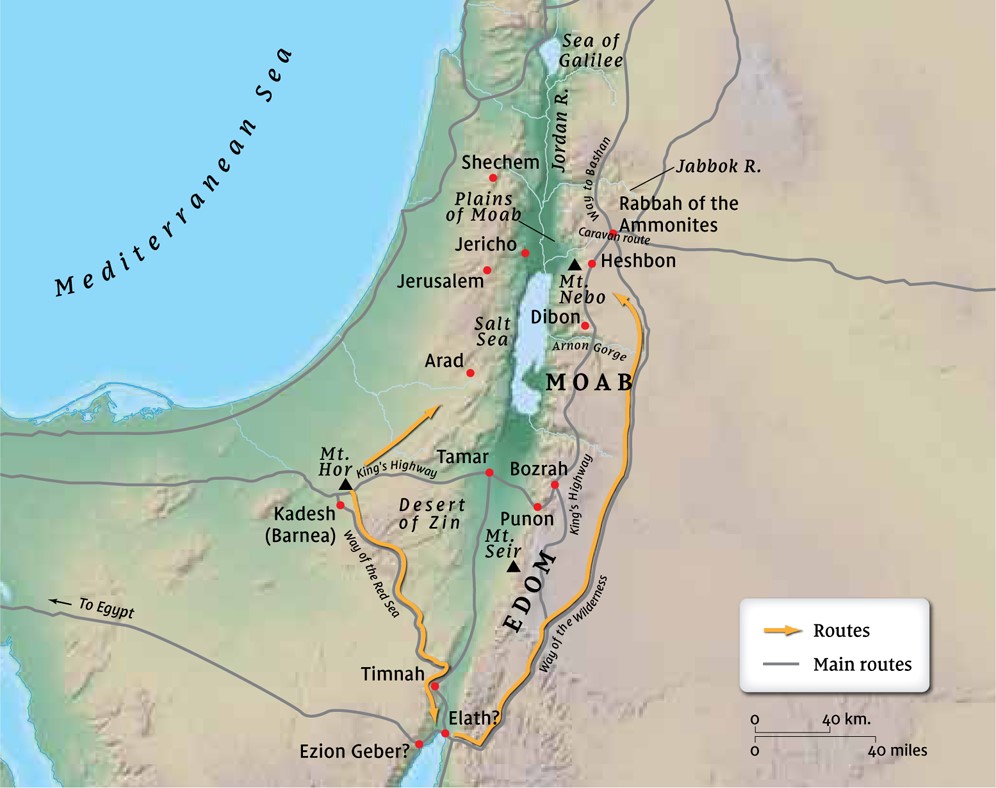
As the people of God prepared to begin their conquest of the land of Canaan, Moses was approached by leaders of the tribes of Reuben and Gad. These two tribes possessed a lot of flocks and had taken note that the land east of the Jordan had abundant pastureland. Having recently defeated the Midianites in battle, this territory was up for grabs, so the tribes of Reuben and Gad asked Moses for permission to settle their tribes on the east side of the river instead of crossing over with everyone else into Canaan.

Moses was dumbstruck by their request and quickly aired his opinion. While four decades had passed since the previous generation of Israelites had refused to enter the land of Canaan, Moses couldn’t help but view this request as another sign of rebellion among the people of God. That earlier event was still a sore spot for Moses because it had resulted in the deaths of an entire generation of Israelites. To dissuade the Reubenites and Gadites from repeating the same mistake, Moses reminded them what had happened 40 years earlier.

“Why do you want to discourage the rest of the people of Israel from going across to the land the Lord has given them? Your ancestors did the same thing when I sent them from Kadesh-barnea to explore the land. After they went up to the valley of Eshcol and explored the land, they discouraged the people of Israel from entering the land the Lord was giving them. Then the Lord was very angry with them…” – Numbers 32:7-10 NLT

On that occasion, Moses had sent spies into the land of Canaan to bring back news of its fruitfulness and the military strength of its occupants. But upon their return, ten of the 12 spies gave a mixed review; the land was rich and plentiful, but its occupants were powerful and unconquerable. This negative news led the people to refuse to enter the land, choosing instead to disobey God and plot a return to Egypt. But that decision resulted in God’s wrath and punishment.

Now, 40 years later, that generation had died off and their descendants stood on the edge of Canaan, preparing to enter the land again. So, when Moses heard the request of the tribes of Reuben and Gad to settle outside the land of promise, he was naturally incensed.

“Are you trying to discourage the rest of the people of Israel from going across to the land the LORD has given them? This is what your ancestors did when I sent them from Kadesh–barnea to explore the land.” – Numbers 32:7-8 NLT

For Moses, this was déjà vu all over again. He saw their request as selfish and short-sighted, and another instance of disobedience. But the Reubenites and Gadites assured Moses that they were not abandoning the people of God or attempting to dissuade them from entering the land; they simply wanted to take advantage of better pastureland on the east side of the river. They expressed their willingness to fight alongside their brothers and assist them in conquering the land of Canaan until every tribe had gained their portion of the inheritance promised to Abraham.

To convince Moses of their intentions, they made a vow not to settle east of the Jordan until the land of Canaan was conquered and the other ten tribes had received their inheritance. This assurance calmed Moses’ fears, but he still issued his familiar, yet stern warning.

“But if you don’t do what you say, you will be sinning against GOD; you can be sure that your sin will track you down.” – Numbers 32:23 MSG

Moses expected them to keep their word and reminded them that if they failed to do so, their sin would be against God, and He would hold them accountable. Jehovah would deal with them severely if they broke their commitment.

The Book of Joshua records that, in the end, these tribes held up their end of the bargain.

The armed warriors from the tribes of Reuben, Gad, and the half-tribe of Manasseh led the Israelites across the Jordan, just as Moses had directed. These armed men—about 40,000 strong—were ready for battle, and the Lord was with them as they crossed over to the plains of Jericho. – Joshua 4:12-13

But despite their willingness to keep their word, their plan was not necessarily what God had in mind. It would appear that they were motivated by greed and self-interest and their decision to settle east of the Jordan overshadowed the promise that God had made to provide them with abundant land on the west side of the Jordan. The vacant Midianite territory was readily available and had everything they were looking for. In other words, it looked good physically and materially. So rather than wait for the land that God had promised them on the other side of the Jordan, they chose what they could see with their eyes. They allowed the temptation of immediate gratification to keep them from waiting on God’s will.

There seems to be an assumption on their part that there might not be any land on the west side of the Jordan useful for raising flocks, so they chose to settle outside the land of “promise.” Their decision, while approved by Moses, would prove to be a problem in the years to come. Physical distance from the other tribes would end up producing a spirit of misunderstanding and disunity (Joshua 22). It would also create a hole in the defensive lines of the Israelites. This region east of the Jordan was often the first to experience invasion, and Israel would lose control of it several times in its later history (2 Kings 15:29).

So what’s the point? First, there is truth to the adage, “Be sure your sins will find you out.” Sin has a way of tracking down the perpetrator and coming back to haunt them. That’s why we need to take our commitments and our sins seriously – because God certainly does. We also need to look closely at the motivation behind our decisions. We must constantly ask ourselves, “Why am I doing what I am about to do?” We must assess whether greed and selfishness lie behind our decisions, and we must determine the long-term ramifications of our decisions if they are wrongly motivated.

Moses was right; our sins will find us out. They will come back to haunt us, but so will those decisions that are motivated by instant gratification and a lack of trust in the will of God. These two tribes had been offered their share of the inheritance promised by God but they had a different plan in mind. They decided that they knew better, and God decided to let them have their way, and both decisions would have long-term ramifications.

English Standard Version (ESV) The Holy Bible, English Standard Version. ESV® Permanent Text Edition® (2016). Copyright © 2001

New Living Translation (NLT) Holy Bible, New Living Translation, copyright © 1996, 2004, 2015 by Tyndale House Foundation. Used by permission of Tyndale House Publishers Inc., Carol Stream, Illinois 60188. All rights reserved.

Give Credit Where Credit Is Due

25 The Lord said to Moses, 26 “Take the count of the plunder that was taken, both of man and of beast, you and Eleazar the priest and the heads of the fathers’ houses of the congregation, 27 and divide the plunder into two parts between the warriors who went out to battle and all the congregation. 28 And levy for the Lord a tribute from the men of war who went out to battle, one out of five hundred, of the people and of the oxen and of the donkeys and of the flocks. 29 Take it from their half and give it to Eleazar the priest as a contribution to the Lord. 30 And from the people of Israel’s half you shall take one drawn out of every fifty, of the people, of the oxen, of the donkeys, and of the flocks, of all the cattle, and give them to the Levites who keep guard over the tabernacle of the Lord.” 31 And Moses and Eleazar the priest did as the Lord commanded Moses.

32 Now the plunder remaining of the spoil that the army took was 675,000 sheep, 33 72,000 cattle, 34 61,000 donkeys, 35 and 32,000 persons in all, women who had not known man by lying with him. 36 And the half, the portion of those who had gone out in the army, numbered 337,500 sheep, 37 and the Lord’s tribute of sheep was 675. 38 The cattle were 36,000, of which the Lord’s tribute was 72. 39 The donkeys were 30,500, of which the Lord’s tribute was 61. 40 The persons were 16,000, of which the Lord’s tribute was 32 persons. 41 And Moses gave the tribute, which was the contribution for the Lord, to Eleazar the priest, as the Lord commanded Moses.

42 From the people of Israel’s half, which Moses separated from that of the men who had served in the army— 43 now the congregation’s half was 337,500 sheep, 44 36,000 cattle, 45 and 30,500 donkeys, 46 and 16,000 persons— 47 from the people of Israel’s half Moses took one of every 50, both of persons and of beasts, and gave them to the Levites who kept guard over the tabernacle of the Lord, as the Lord commanded Moses.

48 Then the officers who were over the thousands of the army, the commanders of thousands and the commanders of hundreds, came near to Moses 49 and said to Moses, “Your servants have counted the men of war who are under our command, and there is not a man missing from us. 50 And we have brought the Lord’s offering, what each man found, articles of gold, armlets and bracelets, signet rings, earrings, and beads, to make atonement for ourselves before the Lord.” 51 And Moses and Eleazar the priest received from them the gold, all crafted articles. 52 And all the gold of the contribution that they presented to the Lord, from the commanders of thousands and the commanders of hundreds, was 16,750 shekels. 53 (The men in the army had each taken plunder for himself.) 54 And Moses and Eleazar the priest received the gold from the commanders of thousands and of hundreds, and brought it into the tent of meeting, as a memorial for the people of Israel before the Lord. – Numbers 31:25-54 ESV

There were 12,000 Israelite soldiers chosen to go into battle against the Midianites; 1,000 men from every tribe. That is a relatively small number when compared with the 601,730 men deemed battle-worthy according to the recent census taken by Moses. This small contingent of soldiers easily defeated their enemy and brought back an abundance of plunder from their raids of the towns and villages of the Midianites. And according to the military leaders, they had not lost a single man in the process.

“We, your servants, have accounted for all the men who went out to battle under our command; not one of us is missing!” – Numbers 31:49 NLT

The mission had been a rousing success, and the bounty they had taken from the Midianites was substantial. But before anyone could enjoy the riches they had plundered, everyone and everything had to be ceremonially purified.

“Anything made of gold, silver, bronze, iron, tin, or lead—that is, all metals that do not burn—must be passed through fire in order to be made ceremonially pure. These metal objects must then be further purified with the water of purification. But everything that burns must be purified by the water alone. On the seventh day you must wash your clothes and be purified. Then you may return to the camp.” – Numbers 31:22-24 NLT

Moses warned the soldiers that they must also go through a purification ritual before they could enter the camp.

“…all of you who have killed anyone or touched a dead body must stay outside the camp for seven days. You must purify yourselves and your captives on the third and seventh days. Purify all your clothing, too, and everything made of leather, goat hair, or wood.” – Numbers 31:19-20 NLT

Contact with the enemy had rendered these men ceremonially impure, so they were required to go through a period of forced isolation and cleansing, along with all those taken captive during the mission. This was the process God had established and communicated to Moses back in chapter 19.

“All those who touch a dead human body will be ceremonially unclean for seven days. They must purify themselves on the third and seventh days with the water of purification; then they will be purified. But if they do not do this on the third and seventh days, they will continue to be unclean even after the seventh day. All those who touch a dead body and do not purify themselves in the proper way defile the Lord’s Tabernacle, and they will be cut off from the community of Israel. Since the water of purification was not sprinkled on them, their defilement continues.” – Numbers 19:11-13 NLT

Once the men and their captives had completed the purification process, the booty was divided. The 12,000 combatants would receive their fair share of the reward, but those who remained behind would not be left out. This pattern of equity among those who went into battle and their brothers who remained behind would become a norm for the nation of Israel.

Centuries later, after a rousing victory over the Amalekites, King David encountered a problem among his soldiers. The ones who had assisted him in the battle were angry at having to share their plunder with those who had remained behind.

“They didn’t go with us, so they can’t have any of the plunder we recovered. Give them their wives and children, and tell them to be gone.” – 1 Samuel 30:22 NLT

These men wanted all the plunder for themselves. But David denied their selfish demands, saying: “No, my brothers! Don’t be selfish with what the Lord has given us. He has kept us safe and helped us defeat the band of raiders that attacked us. Who will listen when you talk like this? We share and share alike—those who go to battle and those who guard the equipment” (1 Samuel 23-24 NLT).

God had Moses establish a similar plan that required him to make a detailed list of all the plunder taken from the Midianites. Once that was done, Moses ordered that half the plunder be divided equally between the 12,000 men who had fought in the battle, while the other half was to be shared between the rest of the Israelites. But a portion of all the plunder was to be dedicated to God. From the soldier’s share 1/500th of all that was taken was to be given to the Lord.

“…one of every 500 of the prisoners and of the cattle, donkeys, sheep, and goats…” – Numbers 31:28 NLT

This share was to be placed under the care of Eleazar, the high priest, as an offering to the Lord, and the numbers are staggering. The Israelites dedicated 675 sheep and goats to God, along with 72 cattle, and 61 donkeys. The text also states that 32 virgin girls, taken as captives, were set aside for the Lord. It is likely that these young women became servants to the Levitical priests and assisted in the maintenance of the Tabernacle. Of the plunder given to the rest of the people, 1/50th of it was given to the Levites.

Moses took one of every fifty prisoners and animals and gave them to the Levites, who maintained the Lord’s Tabernacle. All this was done as the Lord had commanded Moses. – Numbers 31:47 NLT

There was one final offering presented to Yahweh. The military leaders who oversaw the battle came before Moses with an offering of atonement. Out of gratitude for God’s protection of their men, they brought a large number of gold armbands, bracelets, rings, earrings, and necklaces that the soldiers had taken as plunder. This would have been from the portion of the booty that belonged to the 12,000 soldiers. These men willingly gave up part of their reward as an offering to God.

“…we are presenting the items of gold we captured as an offering to the Lord from our share of the plunder—armbands, bracelets, rings, earrings, and necklaces. This will purify our lives before the Lord and make us right with him.” – Numbers 31:50 NLT

In essence, this was a ransom for the lives that God had graciously spared. Not one man had died in this expedition and the generals and captains were expressing their gratitude to God for His mercy and providential care.

This entire scenario paints a picture of how things were to unfold as the Israelites entered the land of Canaan. It served as a practice run in preparation for their future conquest of the promised land. There would be many more battles ahead, and every victory they enjoyed was to be recognized as the result of God’s grace and mercy. He would be going before them and fighting alongside them, and they were never to forget to render their thanksgiving to Him for His protection and provision.

Moses would repeatedly warn the people to take their relationship with God seriously. Without Him, they were nothing. He knew they would always face the temptation to take credit for their own success; a dangerous prospect that was to be avoided at all costs.

“Beware that in your plenty you do not forget the Lord your God and disobey his commands, regulations, and decrees that I am giving you today. For when you have become full and prosperous and have built fine homes to live in, and when your flocks and herds have become very large and your silver and gold have multiplied along with everything else, be careful!” – Deuteronomy 8:11-13 NLT

With every victory would come the temptation to glory in their success and celebrate their newfound wealth. But Moses wanted to remember that faithfulness was far more important than fame or financial success.

“Remember the Lord your God. He is the one who gives you power to be successful, in order to fulfill the covenant he confirmed to your ancestors with an oath.” – Deuteronomy 8:18 NLT

The Israelites had just experienced the providential hand of God. Their success over the Midianites had been His doing, not their own, and this amazing victory without the loss of a single Israelite soldier was the proof. They had learned the invaluable lesson that faith in God results in the presence and power of God. If they would only obey, they would experience even greater victories in the days ahead. But they were also learning that every successful battle was to be followed by a willing acknowledgment of God’s role as expressed by their faithful gifts of gratitude. God was going to go before them, and with each successive victory over their enemies, they would be expected to give credit where credit is due.

English Standard Version (ESV) The Holy Bible, English Standard Version. ESV® Permanent Text Edition® (2016). Copyright © 2001

New Living Translation (NLT) Holy Bible, New Living Translation, copyright © 1996, 2004, 2015 by Tyndale House Foundation. Used by permission of Tyndale House Publishers Inc., Carol Stream, Illinois 60188. All rights reserved.

Gifts of Gratitude to God

1 The Lord spoke to Moses, saying, 2 “Command the people of Israel and say to them, ‘My offering, my food for my food offerings, my pleasing aroma, you shall be careful to offer to me at its appointed time.’ 3 And you shall say to them, This is the food offering that you shall offer to the Lord: two male lambs a year old without blemish, day by day, as a regular offering. 4 The one lamb you shall offer in the morning, and the other lamb you shall offer at twilight; 5 also a tenth of an ephah of fine flour for a grain offering, mixed with a quarter of a hin of beaten oil. 6 It is a regular burnt offering, which was ordained at Mount Sinai for a pleasing aroma, a food offering to the Lord. 7 Its drink offering shall be a quarter of a hin for each lamb. In the Holy Place you shall pour out a drink offering of strong drink to the Lord. 8 The other lamb you shall offer at twilight. Like the grain offering of the morning, and like its drink offering, you shall offer it as a food offering, with a pleasing aroma to the Lord.

9 “On the Sabbath day, two male lambs a year old without blemish, and two tenths of an ephah of fine flour for a grain offering, mixed with oil, and its drink offering: 10 this is the burnt offering of every Sabbath, besides the regular burnt offering and its drink offering.

11 “At the beginnings of your months, you shall offer a burnt offering to the Lord: two bulls from the herd, one ram, seven male lambs a year old without blemish; 12 also three tenths of an ephah of fine flour for a grain offering, mixed with oil, for each bull, and two tenths of fine flour for a grain offering, mixed with oil, for the one ram; 13 and a tenth of fine flour mixed with oil as a grain offering for every lamb; for a burnt offering with a pleasing aroma, a food offering to the Lord. 14 Their drink offerings shall be half a hin of wine for a bull, a third of a hin for a ram, and a quarter of a hin for a lamb. This is the burnt offering of each month throughout the months of the year. 15 Also one male goat for a sin offering to the Lord; it shall be offered besides the regular burnt offering and its drink offering. – Numbers 28:1-15 ESV

In preparing the second generation of Israelites to begin their conquest of the land of Canaan, God had ordered a census to determine the size of Israel’s fighting force and to help establish each tribe’s land apportionment. He also reminded the people that the tribe of Levi would inherit no land in Canaan. For their role as priests and caretakers of the Tabernacle, they would receive cities in which to live and a portion of the tithes and offerings presented by the people. God would be their portion, providing for all their needs in exchange for their service to Him. Finally, God made preparations for new leadership by handpicking Joshua as the replacement for Moses.

All was ready. The time had come for the people to obey the commands of God and begin the conquest of the land He had promised to Abraham centuries earlier.

“I am giving all this land, as far as you can see, to you and your descendants as a permanent possession.” – Genesis 13:15 NLT

God had also told Abraham that his descendants would be as numerous as the stars in the sky. He had given this bit of good news while Abraham and his wife were still childless. Sarah remained barren and unable to conceive, but God had told Abraham, “you will have a son of your own who will be your heir” (Genesis 15:4 NLT). But this revelation was followed by a shocking admission from God.

“You can be sure that your descendants will be strangers in a foreign land, where they will be oppressed as slaves for 400 years. But I will punish the nation that enslaves them, and in the end they will come away with great wealth. (As for you, you will die in peace and be buried at a ripe old age.) After four generations your descendants will return here to this land…” – Genesis 15:13-16 NLT

All the promises God had made to Abraham had been fulfilled. Sarah had given birth to Isaac, and from Isaac had come Jacob. The family of Jacob eventually fled to Egypt because there was a famine in the land of Canaan. While in Egypt, the number of Israelites grew so significantly that the Pharaoh feared an uprising and ordered their enslavement. He even instituted a pogrom designed to eliminate all the male babies born to the Israelites. But true to His promise, God delivered the Israelites from their captivity and led them to the border of Canaan.

Now, He called on them to keep the commands He had given them at Mount Sinai. He had been faithful to do all that He had promised to Abraham, and He fully expected them to show their gratitude by maintaining their relationship with Him.

“Give these instructions to the people of Israel: The offerings you present as special gifts are a pleasing aroma to me; they are my food. See to it that they are brought at the appointed times and offered according to my instructions.” – Numbers 28:2 NLT

The offerings outlined in this chapter were to be mandatory and non-optional. They were annual sacrifices to be offered by the Levites on behalf of the people. As the people entered the land, they would find themselves consumed with warfare and trying to establish lives for themselves in the new land. God knew they would face a strong temptation to forget about Him.

“The real key to successful conquest of Canaan and happy living within its borders was continual fellowship with God. Hence it was that God at this time presented to the new generation by way of Moses a finalized and complete set of regulations for offerings, most of which had already been given at Sinai. Their observance would encourage an intimate worship of God by the people in the land (cf. Exod. 23:14-17; 29:38-42; 31:12-17; Lev. 23; Num. 25:1-12).” – Irving L. Jensen, Numbers: Everyman’s Bible Commentary

God was going to give them victory over their enemies, so their conquest of the land would be successful. But God knew that their success would go to their heads and tempt them to think that they had done it all on their own. That is why Moses provided them with an advance warning about the temptations they would face in the new land.

For the LORD your God is bringing you into a good land, a land of brooks and fountains and springs that flow through the valleys and hills; a land of wheat, barley, vines, fig trees, and pomegranates; a land of olive oil and honey; a land where you will eat food without scarcity, where you will lack nothing; a land whose rocks are iron and whose hills are ready to be mined for copper. When you eat and are satisfied, you are to bless the LORD your God for the good land that He has given you.

Be careful not to forget the LORD your God by failing to keep His commandments and ordinances and statutes, which I am giving you this day. Otherwise, when you eat and are satisfied, when you build fine houses in which to dwell, and when your herds and flocks grow large and your silver and gold increase and all that you have is multiplied, then your heart will become proud, and you will forget the LORD your God who brought you out of the land of Egypt, out of the house of slavery. – Deuteronomy 8:7-14 BSB

God outlined the various offerings the people were required to make and He began with the daily offerings.

“This is the special gift you must present to the Lord as your daily burnt offering. You must offer two one-year-old male lambs with no defects.” – Numbers 28:3 NLT

Then He added the less-frequent but no less mandatory weekly offerings.

“On the Sabbath day, sacrifice two one-year-old male lambs with no defects. They must be accompanied by a grain offering of four quarts of choice flour moistened with olive oil, and a liquid offering. This is the burnt offering to be presented each Sabbath day, in addition to the regular burnt offering and its accompanying liquid offering.” – Numbers 28:9-10 NLT

Finally, God reiterated the monthly offerings.

“On the first day of each month, present an extra burnt offering to the Lord of two young bulls, one ram, and seven one-year-old male lambs, all with no defects.” – Numbers 28:11 NLT

“On the first day of each month, you must also offer one male goat for a sin offering to the Lord.” – Numbers 28:15 NLT

The list is long and includes a large number of different sacrifices, including grain and drink offerings. There were also burnt and sin offerings. Bulls, goats, lambs, and rams were to be slaughtered and their blood spilled so that sins could be atoned for and fellowship with God maintained. Burnt offerings were considered a pleasing aroma to God because they brought Him pleasure.

The Israelites were expected to bookmark each day with the sacrifice of a lamb. These two animals were to be presented as food offerings to the Lord, accompanied by the appropriate grain and drink offerings. These two unblemished lambs were to be sacrificed, and then their bodies were to be consumed with fire on the bronze altar, making them a “burnt offering, a food offering with a pleasing aroma to the Lord” (Leviticus 1:9 ESV).

It wasn’t the scent of the burning flesh that pleased the Lord, but it was the act of worship it represented. The people’s obedience brought pleasure to God. Their twice-daily act of worship demonstrated their willingness to honor Him with the best of their flocks, grain, and wine. To offer these sacrifices two times a day for as long as they existed as a nation would prove to be costly, but it would reveal their reliance upon Yahweh and their willingness to obey His commands.

Ultimately, all of these mandatory sacrifices and offerings were about maintaining a right relationship with God. He would be the key to their victories over their enemies. He would be the source of their strength and their rock and provider. Without Him, they would be just another nation vying for control of the land of Canaan. But as long as they maintained their fellowship with Him through obedience to His commands, they would enjoy His presence, power, and provision. He would go before them, assuring their victory over their enemies and providing them with all the resources they would need to thrive, not just survive. All He asked in return was their allegiance and worship, demonstrated by their daily, weekly, and monthly gifts of gratitude.

English Standard Version (ESV) The Holy Bible, English Standard Version. ESV® Permanent Text Edition® (2016). Copyright © 2001

New Living Translation (NLT) Holy Bible, New Living Translation, copyright © 1996, 2004, 2015 by Tyndale House Foundation. Used by permission of Tyndale House Publishers Inc., Carol Stream, Illinois 60188. All rights reserved.

A New Leader But the Same Old People

12 The Lord said to Moses, “Go up into this mountain of Abarim and see the land that I have given to the people of Israel. 13 When you have seen it, you also shall be gathered to your people, as your brother Aaron was, 14 because you rebelled against my word in the wilderness of Zin when the congregation quarreled, failing to uphold me as holy at the waters before their eyes.” (These are the waters of Meribah of Kadesh in the wilderness of Zin.) 15 Moses spoke to the Lord, saying, 16 “Let the Lord, the God of the spirits of all flesh, appoint a man over the congregation 17 who shall go out before them and come in before them, who shall lead them out and bring them in, that the congregation of the Lord may not be as sheep that have no shepherd.” 18 So the Lord said to Moses, “Take Joshua the son of Nun, a man in whom is the Spirit, and lay your hand on him. 19 Make him stand before Eleazar the priest and all the congregation, and you shall commission him in their sight. 20 You shall invest him with some of your authority, that all the congregation of the people of Israel may obey. 21 And he shall stand before Eleazar the priest, who shall inquire for him by the judgment of the Urim before the Lord. At his word they shall go out, and at his word they shall come in, both he and all the people of Israel with him, the whole congregation.” 22 And Moses did as the Lord commanded him. He took Joshua and made him stand before Eleazar the priest and the whole congregation, 23 and he laid his hands on him and commissioned him as the Lord directed through Moses. – Numbers 27:12-23 ESV

The day Moses had been dreading had finally arrived. He had known for some time that he would not be leading the people of Israel into the land of Canaan. Due to Moses’ uncharacteristic actions in the wilderness of Zin, God had determined to ban his servant from entering the promised land.

“Because you did not trust me enough to demonstrate my holiness to the people of Israel, you will not lead them into the land I am giving them!” – Numbers 20:12 NLT

In a moment of extreme frustration with the constantly whining Israelites, Moses had snapped and disobeyed the command of God.

“You and Aaron must take the staff and assemble the entire community. As the people watch, speak to the rock over there, and it will pour out its water. You will provide enough water from the rock to satisfy the whole community and their livestock.” – Numbers 20:8 NLT

Rather than speaking to the rock as God had ordered him to do, Moses lashed out in anger and repeatedly struck the rock with his staff. His anger and frustration with the people had caused him to disobey and dishonor God in the eyes of the people. It appears that Moses’ real crime was that he attempted to rob God of glory by claiming responsibility for producing the miracle.

“Listen, you rebels!” he shouted. “Must we bring you water from this rock?”– Numbers 20:10 NLT

His attempt to inflate his own identity in the eyes of the people cost him dearly. While his impromptu actions successfully produced water from the rock and probably earned him a bit of respect from the people, his little stunt resulted in his permanent ban from the land of promise; he would never have the pleasure of entering God’s rest. Instead, he would die in the wilderness, just as Miriam and Aaron had.

So, with the Israelites on the verge of entering Canaan, God informed Moses that his days on this earth had come to an end. His debt had come due. But before taking Moses’ life, God gave His servant one more chance to see the land of promise from a distance. God led Moses up a mountain and allowed him to take in the view.

“Climb one of the mountains east of the river, and look out over the land I have given the people of Israel. After you have seen it, you will die like your brother, Aaron, for you both rebelled against my instructions in the wilderness of Zin. When the people of Israel rebelled, you failed to demonstrate my holiness to them at the waters.” – Numbers 27:12-14 NLT

For nearly four decades, this land had been the focus of Moses’ life. Ever since he had led the people out of Egypt, his life’s mission had been to guide them to this very spot. But now, as he looked out over the fertile valley below, he was doing so for the very last time. He would not be going in and it was time to turn over his leadership responsibilities to someone else.

Ever the consummate leader, Moses begged God to appoint the right man for the task. He knew from firsthand experience just how stubborn and headstrong the people could be and they would never make it without strong leadership.

“O Lord, you are the God who gives breath to all creatures. Please appoint a new man as leader for the community. Give them someone who will guide them wherever they go and will lead them into battle, so the community of the Lord will not be like sheep without a shepherd.”– Nmbers 27:16-17 NLT

This request from Moses reveals a great deal about his heart. Despite all the difficulties the people of Israel had caused him over the last forty years, Moses cared deeply for them. He knew that, without strong leadership, they would never make it. As difficult as the last four decades had been, their conquering of the land of Canaan would pose a far greater test of their resolve and faithfulness. The next leader would need to be able to do battle with the rebellion-prone Israelites as well as the occupants of the land.

While Moses had been required to lead the people across the wilderness, his replacement would be tasked with leading them into battle. Their conquest of Canaan would be difficult and fraught with danger, and these people who had made a habit of whining about the lack of water and food would certainly find the thought of military service distasteful. So, they were going to need a man who was equal parts warrior and shepherd. He would have to be both a fighting man and a kind-hearted guide who could lead the people with patience and care.

But Moses’ concerns were unnecessary because God already had a man in mind. He suggested Joshua, one of the two men who had been part of the 12-man contingent of spies who had reconnoitered the land 40 years earlier. Joshua and Caleb had been the voices of reason among the fearful and disheartened men who recommended that the people not enter the land of promise. While the majority of the spies had deemed the land unconquerable and to be avoided at all costs, Joshua and Caleb had provided a dissenting opinion:

Two of the men who had explored the land, Joshua son of Nun and Caleb son of Jephunneh, tore their clothing. They said to all the people of Israel, “The land we traveled through and explored is a wonderful land! And if the Lord is pleased with us, he will bring us safely into that land and give it to us. It is a rich land flowing with milk and honey. Do not rebel against the Lord, and don’t be afraid of the people of the land. They are only helpless prey to us! They have no protection, but the Lord is with us! Don’t be afraid of them!” – Numbers 14:6-9 NLT

While the people eventually rejected the counsel of Joshua and Caleb, these two men had powerfully declared their faith in God and demonstrated their belief in His power and goodness. Despite the odds, they had called the people to trust and obey their sovereign God. Four decades later, God chose Joshua to be Moses’ successor.

“Take Joshua son of Nun, who has the Spirit in him, and lay your hands on him. Present him to Eleazar the priest before the whole community, and publicly commission him to lead the people.” – Numbers 27:18-19 NLT

“This spirit was not something that now came upon Joshua, or was temporary (such as the coming of the spirit on the elders in 11:17, 25-26); it already existed in Joshua and was the basis of God’s choice of him. Deut. 34:9 applies the phrase ‘full of the spirit of Wisdom’ to Joshua, confirming the thought here.” – Timothy R. Ashley, The Book of Numbers.

Joshua was God’s man for the moment. He had been chosen by God long before this day arrived, and the Spirit of God had been preparing him for the next phase of Israel’s journey.

But God’s relationship with Joshua would be different than the one He had with Moses. While God had interacted with Moses face-to-face, Joshua received his instructions through the high priest and the use of “the Urim—one of the sacred lots cast before the Lord” (Numbers 27:21 NLT). This new method of communication would feature built-in safeguards, allowing Eleazar, the high priest, to act as a source of confirmation for all decisions. This would prevent Joshua from acting on his own and risking the wrath of God.

Having received God’s plan for his replacement and knowing that he would soon be breathing his last breath on Earth, Moses descended from the mountain and went about preparing Joshua for his new role.

So Moses did as the Lord commanded. He presented Joshua to Eleazar the priest and the whole community. Moses laid his hands on him and commissioned him to lead the people, just as the Lord had commanded through Moses. – Numbers 27:22-23 NLT

With new leadership called and commissioned, it was time to begin the final phase of the mission. This generation of Israelites was about to do what their mothers and fathers had failed to do: Enter the land of promise. This had been the goal all along. It had always been God’s intention for the wilderness to be a means to this end. From the moment they left Egypt and began their long trek to the Jordan River, the Israelites had been on a journey to the land of promise. Now, their inheritance lay across the river and all they had to do was step out in faith and take it as their own. But as Joshua would soon discover, that would be easier said than done. As Moses’ God-appointed replacement, he had his work cut out for him and his reliance upon God was about to be sorely tested.

English Standard Version (ESV) The Holy Bible, English Standard Version. ESV® Permanent Text Edition® (2016). Copyright © 2001

New Living Translation (NLT) Holy Bible, New Living Translation, copyright © 1996, 2004, 2015 by Tyndale House Foundation. Used by permission of Tyndale House Publishers Inc., Carol Stream, Illinois 60188. All rights reserved.

The God Who Sees

1 Then drew near the daughters of Zelophehad the son of Hepher, son of Gilead, son of Machir, son of Manasseh, from the clans of Manasseh the son of Joseph. The names of his daughters were: Mahlah, Noah, Hoglah, Milcah, and Tirzah. 2 And they stood before Moses and before Eleazar the priest and before the chiefs and all the congregation, at the entrance of the tent of meeting, saying, 3 “Our father died in the wilderness. He was not among the company of those who gathered themselves together against the Lord in the company of Korah, but died for his own sin. And he had no sons. 4 Why should the name of our father be taken away from his clan because he had no son? Give to us a possession among our father’s brothers.”

5 Moses brought their case before the Lord. 6 And the Lord said to Moses, 7 “The daughters of Zelophehad are right. You shall give them possession of an inheritance among their father’s brothers and transfer the inheritance of their father to them. 8 And you shall speak to the people of Israel, saying, ‘If a man dies and has no son, then you shall transfer his inheritance to his daughter. 9 And if he has no daughter, then you shall give his inheritance to his brothers. 10 And if he has no brothers, then you shall give his inheritance to his father’s brothers. 11 And if his father has no brothers, then you shall give his inheritance to the nearest kinsman of his clan, and he shall possess it. And it shall be for the people of Israel a statute and rule, as the Lord commanded Moses.’” – Numbers 27:1-11 ESV

The Israelites were a patriarchal society in which the male was considered the head of the family, clan, and community. The historical context of the biblical narrative covers a lengthy time in which virtually all societies were led exclusively by men. There were occasions when a woman would ascend to the throne as the queen but this was rare and usually only after her husband had died. For the most part, women played subservient roles in society and were relegated to relative obscurity. In most cases, they could not own property, file a lawsuit, testify in court, or hold public office, and because women had few rights and little power, this inequity was rarely challenged.

But the 27th chapter of Numbers presents the surprising case of when a group of Israelite women dared to bring their demands for equal rights before Moses. Sometime after the census was taken and the size of the tribes was determined, the daughters of a man named Zelophehad came forward and presented their grievance to Moses. Their father, a member of the tribe of Manasseh, had died sometime during the last 38 years. Their reference to Korah’s rebellion (Numbers 16) seems to indicate that their father’s death took place around that time, but they stress that he died of natural causes. The phrase, “died for his own sin” simply indicates that his death was not the result of God’s judgment.

The five sisters also inform Moses that their father died without leaving behind a legal heir. They had no brothers, so the women understood the precarious nature of their position; as daughters, they were prohibited from inheriting their father’s goods or property. This posed a difficult dilemma for Mahlah, Noah, Hoglah, Milcah, and Tirzah.

When Israel entered Canaan and began the conquest of the land, each tribe would receive its allotment, which would then be divided among the members of that tribe. Since Zelophehad was deceased and had no sons, he would receive no land. That meant that the five unmarried sisters would be left homeless and impoverished. Unless they quickly found husbands, their prospects for survival would be dim. That is what led them to appeal their case before “Moses, Eleazar the priest, the tribal leaders, and the entire community at the entrance of the Tabernacle” (Numbers 27:2 NLT).

These five sisters knew they had nothing to lose and everything to gain, so they risked ridicule and rejection by bringing their predicament before the all-male leadership of their community. This action took courage and demonstrated the level of their concern. As the day grew closer when the nation would begin its conquest of the land of Canaan, these women knew their time was running out. So, they made their desperate appeal.

“Our father died in the wilderness,” they said. “He was not among Korah’s followers, who rebelled against the Lord; he died because of his own sin. But he had no sons. Why should the name of our father disappear from his clan just because he had no sons? Give us property along with the rest of our relatives.” – Numbers 27:3-4 NLT

They portrayed their father as a relatively good man who had not disqualified himself through acts of rebellion against God. He had simply died and left them with no hope of owning any land in Canaan, and they were appealing for the “court” to make a special dispensation in their case.

It seems likely that there were murmurs of disagreement and shock among the men as they heard the words of the five women. This would have been unprecedented and unthinkable to many of them. To do such a thing, they reasoned, would have been without protocol and would establish a dangerous precedence that could disrupt the social fabric. There were likely some among the leadership of Israel who were ready to deny the women’s request with no further discussion. But Moses wasn’t ready to pass judgment or sentence. Instead, he “brought their case before the Lord” (Numbers 27:5 NLT)

As the God-ordained leader of Israel, Moses could have used his authority to settle the matter without debate. However, the unique nature of this situation required input from the Almighty. Moses was not ready to treat this matter lightly or settle it too quickly.

The text does not reveal how Moses brought the matter before the Lord, but it does state that he received an answer.

“The claim of the daughters of Zelophehad is legitimate. You must give them a grant of land along with their father’s relatives. Assign them the property that would have been given to their father.” – Numbers 27:7 NLT

God spoke and He came down on the side of the five sisters, ordering that they be awarded a portion of land among their father’s relatives. This news must have come as a shock to the rest of the tribunal and left some of them shaking their heads in disagreement. One can only imagine how the male relatives of Zelophehad must have felt when they heard God’s decree; this divine decision was going to cost them. It would result in each of them receiving less land in Canaan. So, while the women rejoiced in God’s good graces and their good fortune, their relatives were probably muttering under their breath.

God Almighty had intervened and provided for these helpless women. He had heard their cry and was determined to care for their needs. But He didn’t stop there. This was not to be an isolated incident but, instead, it was to become a permanent part of Israelite case law with additional clauses that covered other potential circumstances.

“And give the following instructions to the people of Israel: If a man dies and has no son, then give his inheritance to his daughters. And if he has no daughter either, transfer his inheritance to his brothers. If he has no brothers, give his inheritance to his father’s brothers. But if his father has no brothers, give his inheritance to the nearest relative in his clan. This is a legal requirement for the people of Israel, just as the Lord commanded Moses.” – Numbers 27:8-11 NLT

By boldly speaking up, these five women had appealed their case before God and had helped to establish new legal parameters for other women in their community. Up until this moment, no one had bothered to think about what to do in these kinds of scenarios. No one had considered the plight of the countless women whose fathers had died during the nearly 40 years Israel had been in the wilderness. Many of those women remained unmarried and without any hope of survival once they entered the land of Canaan. Yet the determination of Zelophehad’s daughters resulted in a divine decree that corrected an oversight in the system. 

This story is similar to that of Hagar recorded in the book of Genesis. This Egyptian slave girl served as the maidservant to Sarai, the wife of Abram. When Sarai had been unable to provide Abram with a male heir, she gave him Hagar to use as a surrogate. This innocent young woman was treated like property and forced to bear a son for Abram. But when Sarai saw how quickly Hagar had conceived, she abused and cast out the pregnant mother-to-be. Hagar found herself in the wilderness all alone and with no hope for the future. But God saw her plight and made her a promise.

“Return to your mistress, and submit to her authority.” Then he added, “I will give you more descendants than you can count…You are now pregnant and will give birth to a son. You are to name him Ishmael (which means ‘God hears’), for the Lord has heard your cry of distress.” – Genesis 16:9-10, 11 NLT

And, as a result of this divine encounter, Hagar declared, “You are the God who sees me…Here I have seen one who sees me!” (Genesis 16:13 NET).

God had seen her plight and had intervened, and God had seen the plight of the five daughters of Zelophehad and done the same thing. He is the God who sees (‘ēl rŏ’î). Nothing escapes His attention. No one gets overlooked. He is the God who cares for and intercedes for His own. The very fact that these five sisters were emboldened to speak up in a society where women were expected to remain silent appears to indicate the sovereign hand of God working behind the scenes. God was well aware of all the other women in the Israelite camp who found themselves in similar situations. Their plight had not been overlooked by God and He intervened by having these five women do the unthinkable and speak on behalf of all those for whom the land of promise would be anything but promising or fruitful.

For the men who sat on the leadership board that originally heard this case, God’s answer must have surprised them. But His adjudication of their plight was meant to reveal the nature of His character. The Israelites had a God who was just, righteous, and cared deeply for all of His people.  The psalmist would later declare the goodness of Israel’s God and His unwavering care and concern for “the least of these.”

But joyful are those who have the God of Israel as their helper,
    whose hope is in the Lord their God.
He made heaven and earth,
    the sea, and everything in them.
    He keeps every promise forever.
He gives justice to the oppressed
    and food to the hungry.
The Lord frees the prisoners.
    The Lord opens the eyes of the blind.
The Lord lifts up those who are weighed down.
    The Lord loves the godly.
The Lord protects the foreigners among us.
    He cares for the orphans and widows,
    but he frustrates the plans of the wicked. – Psalm 146:5-9 NLT

English Standard Version (ESV) The Holy Bible, English Standard Version. ESV® Permanent Text Edition® (2016). Copyright © 2001

New Living Translation (NLT) Holy Bible, New Living Translation, copyright © 1996, 2004, 2015 by Tyndale House Foundation. Used by permission of Tyndale House Publishers Inc., Carol Stream, Illinois 60188. All rights reserved.


A New Generation and a New Opportunity

52 The Lord spoke to Moses, saying, 53 “Among these the land shall be divided for inheritance according to the number of names. 54 To a large tribe you shall give a large inheritance, and to a small tribe you shall give a small inheritance; every tribe shall be given its inheritance in proportion to its list. 55 But the land shall be divided by lot. According to the names of the tribes of their fathers they shall inherit. 56 Their inheritance shall be divided according to lot between the larger and the smaller.”

57 This was the list of the Levites according to their clans: of Gershon, the clan of the Gershonites; of Kohath, the clan of the Kohathites; of Merari, the clan of the Merarites. 58 These are the clans of Levi: the clan of the Libnites, the clan of the Hebronites, the clan of the Mahlites, the clan of the Mushites, the clan of the Korahites. And Kohath was the father of Amram. 59 The name of Amram’s wife was Jochebed the daughter of Levi, who was born to Levi in Egypt. And she bore to Amram Aaron and Moses and Miriam their sister. 60 And to Aaron were born Nadab, Abihu, Eleazar, and Ithamar. 61 But Nadab and Abihu died when they offered unauthorized fire before the Lord. 62 And those listed were 23,000, every male from a month old and upward. For they were not listed among the people of Israel, because there was no inheritance given to them among the people of Israel.

63 These were those listed by Moses and Eleazar the priest, who listed the people of Israel in the plains of Moab by the Jordan at Jericho. 64 But among these there was not one of those listed by Moses and Aaron the priest, who had listed the people of Israel in the wilderness of Sinai. 65 For the Lord had said of them, “They shall die in the wilderness.” Not one of them was left, except Caleb the son of Jephunneh and Joshua the son of Nun. – Numbers 26:52-65 ESV

The census ordered by Jehovah had more than one purpose. Not only would it determine the number of men eligible for military service, but it would also provide the basis for each tribe’s land allotment once they entered Canaan. Since Moses was ordered to conduct the census tribe by tribe, the final number of each tribe’s combatants would reflect their overall population size and their appropriate share of the inheritance. Knowing that the apportionment of the land could be a potential landmine, God gave Moses strict instructions regarding its division and allotment.

“Divide the land among the tribes, and distribute the grants of land in proportion to the tribes’ populations, as indicated by the number of names on the list. Give the larger tribes more land and the smaller tribes less land, each group receiving a grant in proportion to the size of its population.” – Numbers 26:53-54 NLT

It only made sense that the larger tribes would receive a larger portion of the land. But to prevent the larger tribes from using their influence to grab the best land for themselves, God ordered Moses to use a lottery system to determine how the land was divided and assigned.

“But you must assign the land by lot, and give land to each ancestral tribe according to the number of names on the list. Each grant of land must be assigned by lot among the larger and smaller tribal groups.” – Numbers 26:55-56 NLT

Because of his role as the leader of the nation of Israel, Moses found himself in a delicate and somewhat difficult position. Not only was he responsible for convincing the people to enter the land and begin its conquest, but he would also have to determine the boundaries of each tribe’s land allotment. Even while God had ordered this task to be accomplished through the casting of lots, there was still a good chance that one or more of the tribes might be dissatisfied with the location or physical characteristics of the land they received. It didn’t help that virtually every square inch of Canaan was already occupied by other nations that were not going to give up their land without a fight. So, Moses had his work cut out for him.

But God had sovereignly ordained a strategy that would protect Moses from accusations of self-aggrandizement or using his power to promote his particular tribe. Moses was a member of the tribe of Levi and God had already determined that this tribe would receive no allotment of land in Canaan. They were to serve as priests and the caretakers of the Tabernacle, and God had already made it clear that He would provide for all their needs once they arrived in the land of promise.

“Remember that the Levitical priests—that is, the whole of the tribe of Levi—will receive no allotment of land among the other tribes in Israel. Instead, the priests and Levites will eat from the special gifts given to the Lord, for that is their share. They will have no land of their own among the Israelites. The Lord himself is their special possession, just as he promised them.” – Deuteronomy 18:1-2 NLT

The tribe of Levi would not own any land in Canaan, so no one could accuse Moses of showing favoritism to his own clan. But without land, how would the Levites feed their families, flocks, and herds? God had made provision for that as well.

“You priests will receive no allotment of land or share of property among the people of Israel. I am your share and your allotment. As for the tribe of Levi, your relatives, I will compensate them for their service in the Tabernacle. Instead of an allotment of land, I will give them the tithes from the entire land of Israel.” – Numbers 18:20-21 NLT

God had arranged a way for them to have ample food to eat. Not only that, He had ordained a plan to provide for their living arrangements. While they would receive no allotment of land, they would be given cities located within the other tribes’ territories.

“Command the people of Israel to give to the Levites from their property certain towns to live in, along with the surrounding pasturelands. These towns will be for the Levites to live in, and the surrounding lands will provide pasture for their cattle, flocks, and other livestock. The pastureland assigned to the Levites around these towns will extend 1,500 feet from the town walls in every direction. Measure off 3,000 feet outside the town walls in every direction—east, south, west, north—with the town at the center. This area will serve as the larger pastureland for the towns.” – Numbers 35:2-5 NLT

God had made ample preparations and provisions for the Levites. In doing so, He had ensured that there would be no way for Moses to use his power to reward his own tribe. God had protected him. But while the Levites were exempt from military service, they were still included in the census.

The men from the Levite clans who were one month old or older numbered 23,000. But the Levites were not included in the registration of the rest of the people of Israel because they were not given an allotment of land when it was divided among the Israelites. – Numbers 26:62 NLT

The Levites were numbered but not required to register for military service. They would continue to serve as priests and perform the duties assigned to them as caretakers of the Tabernacle.

But this chapter ends with a rather somber reminder of the previous generation. Nearly 40 years earlier, God had ordered that a census be taken when the people were camped at the base of Mount Sinai. It had been a year since they escaped their enslavement in Egypt and they were well on their way to their final destination – the land of promise. So, God ordered Moses to conduct a census to ascertain their exact number.

A year after Israel’s departure from Egypt, the Lord spoke to Moses in the Tabernacle in the wilderness of Sinai. On the first day of the second month of that year he said, “From the whole community of Israel, record the names of all the warriors by their clans and families. List all the men twenty years old or older who are able to go to war. You and Aaron must register the troops, and you will be assisted by one family leader from each tribe.” – Numbers 1:1-4 NLT

The number came to 603,550, not including the Levites. Nearly 38 years later, the number had not changed dramatically; they could still field 601,730 eligible men for combat duty. God had sustained their numbers all throughout the four decades they had wandered in the wilderness. But Moses points out that while the numbers were relatively the same, the names and faces had changed.

Not one person on this list had been among those listed in the previous registration taken by Moses and Aaron in the wilderness of Sinai. For the Lord had said of them, “They will all die in the wilderness.” Not one of them survived except Caleb son of Jephunneh and Joshua son of Nun. – Numbers 26:64-64 NLT

The previous generation had blown their chance to enter the land of Canaan. Thirty-eight years earlier, they had the opportunity to cross the Jordan River and begin the conquest of the land, but they refused. When the spies reported that there were powerful nations occupying the land, the people made the fateful decision to reject God’s offer of an inheritance and decided to return to Egypt instead. But God would not allow them to return to their former enslavement. As punishment for their disobedience, they were doomed to wander through the wilderness until every last one of them died. The only two members of that generation who would enter the land of Canaan were Caleb and Joshua, the two spies who had tried to convince the people to trust God and obey His command to enter the land. But their words had fallen on deaf ears.

Now, 38 years later, those two men would be the sole survivors of the previous generation who would have the privilege and honor of crossing the Jordan River and occupying the land that had been promised to them by God. They had waited four decades, but now their hopes and dreams would finally be fulfilled. Their faithfulness and resilience would be rewarded by God and both men would play significant roles in Israel’s conquering and occupation of the land of Canaan. The Lord had cleaned house and was ready to fulfill His promise to provide His people with their inheritance, using these two faithful men to lead the way.

English Standard Version (ESV) The Holy Bible, English Standard Version. ESV® Permanent Text Edition® (2016). Copyright © 2001

New Living Translation (NLT) Holy Bible, New Living Translation, copyright © 1996, 2004, 2015 by Tyndale House Foundation. Used by permission of Tyndale House Publishers Inc., Carol Stream, Illinois 60188. All rights reserved.

Zealous for God

1 After the plague, the Lord said to Moses and to Eleazar the son of Aaron, the priest, 2 “Take a census of all the congregation of the people of Israel, from twenty years old and upward, by their fathers’ houses, all in Israel who are able to go to war.” 3 And Moses and Eleazar the priest spoke with them in the plains of Moab by the Jordan at Jericho, saying, 4 “Take a census of the people, from twenty years old and upward,” as the Lord commanded Moses. The people of Israel who came out of the land of Egypt were:

5 Reuben, the firstborn of Israel; the sons of Reuben: of Hanoch, the clan of the Hanochites; of Pallu, the clan of the Palluites; 6 of Hezron, the clan of the Hezronites; of Carmi, the clan of the Carmites. 7 These are the clans of the Reubenites, and those listed were 43,730. 8 And the sons of Pallu: Eliab. 9 The sons of Eliab: Nemuel, Dathan, and Abiram. These are the Dathan and Abiram, chosen from the congregation, who contended against Moses and Aaron in the company of Korah, when they contended against the Lord 10 and the earth opened its mouth and swallowed them up together with Korah, when that company died, when the fire devoured 250 men, and they became a warning. 11 But the sons of Korah did not die.

12 The sons of Simeon according to their clans: of Nemuel, the clan of the Nemuelites; of Jamin, the clan of the Jaminites; of Jachin, the clan of the Jachinites; 13 of Zerah, the clan of the Zerahites; of Shaul, the clan of the Shaulites. 14 These are the clans of the Simeonites, 22,200.

15 The sons of Gad according to their clans: of Zephon, the clan of the Zephonites; of Haggi, the clan of the Haggites; of Shuni, the clan of the Shunites; 16 of Ozni, the clan of the Oznites; of Eri, the clan of the Erites; 17 of Arod, the clan of the Arodites; of Areli, the clan of the Arelites. 18 These are the clans of the sons of Gad as they were listed, 40,500.

19 The sons of Judah were Er and Onan; and Er and Onan died in the land of Canaan. 20 And the sons of Judah according to their clans were: of Shelah, the clan of the Shelanites; of Perez, the clan of the Perezites; of Zerah, the clan of the Zerahites. 21 And the sons of Perez were: of Hezron, the clan of the Hezronites; of Hamul, the clan of the Hamulites. 22 These are the clans of Judah as they were listed, 76,500.

23 The sons of Issachar according to their clans: of Tola, the clan of the Tolaites; of Puvah, the sclan of the Punites; 24 of Jashub, the clan of the Jashubites; of Shimron, the clan of the Shimronites. 25 These are the clans of Issachar as they were listed, 64,300.

26 The sons of Zebulun, according to their clans: of Sered, the clan of the Seredites; of Elon, the clan of the Elonites; of Jahleel, the clan of the Jahleelites. 27 These are the clans of the Zebulunites as they were listed, 60,500.

28 The sons of Joseph according to their clans: Manasseh and Ephraim. 29 The sons of Manasseh: of Machir, the clan of the Machirites; and Machir was the father of Gilead; of Gilead, the clan of the Gileadites. 30 These are the sons of Gilead: of Iezer, the clan of the Iezerites; of Helek, the clan of the Helekites; 31 and of Asriel, the clan of the Asrielites; and of Shechem, the clan of the Shechemites; 32 and of Shemida, the clan of the Shemidaites; and of Hepher, the clan of the Hepherites. 33 Now Zelophehad the son of Hepher had no sons, but daughters. And the names of the daughters of Zelophehad were Mahlah, Noah, Hoglah, Milcah, and Tirzah. 34 These are the clans of Manasseh, and those listed were 52,700.

35 These are the sons of Ephraim according to their clans: of Shuthelah, the clan of the Shuthelahites; of Becher, the clan of the Becherites; of Tahan, the clan of the Tahanites. 36 And these are the sons of Shuthelah: of Eran, the clan of the Eranites. 37 These are the clans of the sons of Ephraim as they were listed, 32,500. These are the sons of Joseph according to their clans.

38 The sons of Benjamin according to their clans: of Bela, the clan of the Belaites; of Ashbel, the clan of the Ashbelites; of Ahiram, the clan of the Ahiramites; 39 of Shephupham, the clan of the Shuphamites; of Hupham, the clan of the Huphamites. 40 And the sons of Bela were Ard and Naaman: of Ard, the clan of the Ardites; of Naaman, the clan of the Naamites. 41 These are the sons of Benjamin according to their clans, and those listed were 45,600.

42 These are the sons of Dan according to their clans: of Shuham, the clan of the Shuhamites. These are the clans of Dan according to their clans. 43 All the clans of the Shuhamites, as they were listed, were 64,400.

44 The sons of Asher according to their clans: of Imnah, the clan of the Imnites; of Ishvi, the clan of the Ishvites; of Beriah, the clan of the Beriites. 45 Of the sons of Beriah: of Heber, the clan of the Heberites; of Malchiel, the clan of the Malchielites. 46 And the name of the daughter of Asher was Serah. 47 These are the clans of the sons of Asher as they were listed, 53,400.

48 The sons of Naphtali according to their clans: of Jahzeel, the clan of the Jahzeelites; of Guni, the clan of the Gunites; 49 of Jezer, the clan of the Jezerites; of Shillem, the clan of the Shillemites. 50 These are the clans of Naphtali according to their clans, and those listed were 45,400.

51 This was the list of the people of Israel, 601,730. – Numbers 26:1-51 ESV

Chapter 25 of the book of Numbers contains a watershed moment. It details a pivotal point in the lives of the Israelites and in their relationship with God. They stood on the brink of the Promised Land, after 40 years of wandering in the wilderness – their punishment for having doubted God and having listened to the negative report of the spies (Numbers 14:26-31). They were poised to enter the land of promise after years of wandering and waiting. God had just ordained a blessing on their behalf out of the mouth of Balaam, who had been hired to curse them Numbers 24). And while all this was happening, the people were busy aligning themselves with the daughters of Moab. The Expositors Bible Commentary has this to say about this important point in time:

The issue is that of apostasy from the Lord by participation in the debased, sexually centered Canaanite religious rites of Baal worship—that which would become the bane of Israel’s experience in the land. This chapter is an end and a beginning. It marks the end of the first generation; it also points to the beginning of a whole new series of wicked acts that will finally lead to Israel’s punishment…

The whole scene is reminiscent of what happened when the Law was given to Moses on Mount Sinai. While God was blessing them with the giving of the Law, the people were busy creating a golden calf that they could worship. In other words, they were turning away from God and choosing to replace Him with a god of their own making.

And Numbers 25 reveals the people of Israel doing the same thing all over again. Verse two makes it clear that this was not just about sex, it was about religion.

It started when the women invited the men to their sex-and-religion worship. They ate together and then worshiped their gods. – Numbers 25:2 NLT

Rather than remain set apart as God had commanded, the people were intimately joining themselves with the people of the land. They were violating the commands of God just so they could enjoy the sensual and sexual pleasures all around them, and the people likely justified their actions.

We’re just trying to fit in!” some probably said. “We’re just being ecumenical!” others claimed. “We don’t want to be judgmental,” a few might have suggested. Rationalization reigned and the people brought dishonor to the name of God. So God brought a plague on them. He ordered the execution of all those who led this rebellion against His authority. But this thing was so out of hand that one of the Israelites had the audacity to bring one of the Midianite women into camp, right in front of Moses and the people as they wept in front of the Tabernacle. He took her straight into his tent. No shame. No remorse. He was totally controlled by his sensual desires.

But one man took action. His name was Phinehas. Spear in hand, Phinehas followed the man into his tent and executed him and his Midianite accomplice. His actions halted the plague that God had sent on the people. And God acknowledges that it was the actions of this one man that spared the lives of the people of Israel. “Phinehas son of Eleazar and grandson of Aaron the priest has turned my anger away from the Israelites by displaying passionate zeal among them on my behalf. So I have stopped destroying all Israel as I had intended to do in my anger” (Numbers 25:11 NLT).

Phinehas was motivated by a passionate zeal for God. He was not going to let the name of God get dragged through the mud. The literal translation is “he was zealous with my zeal.”

The emphasis on zeal is meant to stress his passion. The word “zeal” means a “passionate intensity to protect or preserve divine or social institutions.” Phinehas didn’t just stand by and watch, he acted. He couldn’t contain himself, and the Israelites are fortunate he was unable to restrain his actions because it was his quick response that saved their lives. That one man’s actions made a life-and-death difference for the whole community.

That sets up the events of chapter 26. After the plague eliminated 24,000 of the Israelites, God ordered Moses to take a census of the people.

“From the whole community of Israel, record the names of all the warriors by their families. List all the men twenty years old or older who are able to go to war.” – Numbers 26:2 NLT

God was preparing them to cross the border and begin their conquest of the land of Canaan. But he wanted them to know just how many warriors they had to work with. So, Moses and Eleazar canvassed each tribe to determine the size of Israel’s fighting force and the number came to 601,730 men. And it would appear that, because of the plague, that number was far less than it had been. It’s impossible to know if all 24,000 who died as a result of the plague had been males older than 20 years of age. But it seems likely that a good portion of the deceased would have been eligible for combat.

Yet, despite the disobedience of the people and the devastating results of the plague, God was providing Moses and Eleazar with the assurance they needed to move forward. If God could conquer the enemy of apostasy with the help of one man, He could certainly deliver the land of Canaan into the hands of the Israelites with more than 600,000 men.

But as will become clear, there was more to this census than determining the size of Israel’s army. These numbers would be used to determine the land allotment once the people entered Canaan. God had increased the number of Israelites dramatically since the day, more than 400 years earlier, when Jacob and his 70 family members had fled to Egypt to escape the famine in Canaan. God had kept His promise to Abraham and created a great nation from his son, Isaac. Now, that nation stood poised and prepared to take possession of their inheritance. More than 600,000 strong, they were a formidable force, and, with God’s help, they would conquer and dispossess all those godless nations that had taken up residence in the land of promise. But like Phinehas, they would need to display a zeal for the Lord and a willingness to obey His commands. If they did, nothing would be impossible for them.

English Standard Version (ESV) The Holy Bible, English Standard Version. ESV® Permanent Text Edition® (2016). Copyright © 2001

New Living Translation (NLT) Holy Bible, New Living Translation, copyright © 1996, 2004, 2015 by Tyndale House Foundation. Used by permission of Tyndale House Publishers Inc., Carol Stream, Illinois 60188. All rights reserved.

The Lord of Heaven’s Armies

27 And Balak said to Balaam, “Come now, I will take you to another place. Perhaps it will please God that you may curse them for me from there.” 28 So Balak took Balaam to the top of Peor, which overlooks the desert. 29 And Balaam said to Balak, “Build for me here seven altars and prepare for me here seven bulls and seven rams.” 30 And Balak did as Balaam had said, and offered a bull and a ram on each altar.

1 When Balaam saw that it pleased the Lord to bless Israel, he did not go, as at other times, to look for omens, but set his face toward the wilderness. 2 And Balaam lifted up his eyes and saw Israel camping tribe by tribe. And the Spirit of God came upon him, 3 and he took up his discourse and said,

“The oracle of Balaam the son of Beor,
    the oracle of the man whose eye is opened,
4 the oracle of him who hears the words of God,
    who sees the vision of the Almighty,
    falling down with his eyes uncovered:
5 How lovely are your tents, O Jacob,
    your encampments, O Israel!
6 Like palm groves that stretch afar,
    like gardens beside a river,
like aloes that the Lord has planted,
    like cedar trees beside the waters.
7 Water shall flow from his buckets,
    and his seed shall be in many waters;
his king shall be higher than Agag,
    and his kingdom shall be exalted.
8 God brings him out of Egypt
    and is for him like the horns of the wild ox;
he shall eat up the nations, his adversaries,
    and shall break their bones in pieces
    and pierce them through with his arrows.
9 He crouched, he lay down like a lion
    and like a lioness; who will rouse him up?
Blessed are those who bless you,
    and cursed are those who curse you.”

10 And Balak’s anger was kindled against Balaam, and he struck his hands together. And Balak said to Balaam, “I called you to curse my enemies, and behold, you have blessed them these three times. 11 Therefore now flee to your own place. I said, ‘I will certainly honor you,’ but the Lord has held you back from honor.” 12 And Balaam said to Balak, “Did I not tell your messengers whom you sent to me, 13 ‘If Balak should give me his house full of silver and gold, I would not be able to go beyond the word of the Lord, to do either good or bad of my own will. What the Lord speaks, that will I speak’? 14 And now, behold, I am going to my people. Come, I will let you know what this people will do to your people in the latter days.” – Numbers 23:27-24:14 ESV

The third time would be the charm, or so Balak hoped. In his relentless effort to have Balaam curse the Israelites, Balak suggested that they try their luck at a third location. He still harbored hopes that Balaam might be able to convince Jehovah to change His mind and curse His own people. In a sense, Balak was attempting to treat God as he had Balaam, by trying to buy Him off. Balak seemed to believe that deities were no different than humans and were susceptible to bribes and influence peddling. He had already authorized the construction of 14 altars and the sacrifice of 56 bulls and seven rams in an attempt to sway the mind of Israel’s God, and his obsession with defeating the Israelites drove him to up the ante one more time.

But on this occasion, Balaam refused to seek the will of Jehovah because he already knew what the answer would be. The seer had already determined that nothing would convince the God of Israel to do anything but bless His people. Balak’s sacrifices were an exercise in futility and a waste of time.

Rather than follow Balak to Mount Peor, Balaam headed to the wilderness, where it appears he was given a vision by God. As he lay prostrate on the ground, the Holy Spirit opened his eyes to see the Israelites “camping tribe by tribe” (Numbers 24:2 ESV). In the previous accounts, Balaam had stood on higher ground and seen a portion of the Israelite camp with his own eyes. But this time, he was given a vision that allowed him to see each of the 12 tribes of Israel, and this Spirit-induced dream was accompanied by yet another message from God.

“This is the message of Balaam son of Beor,
    the message of the man whose eyes see clearly,
the message of one who hears the words of God,
    who sees a vision from the Almighty,
    who bows down with eyes wide open…” – Numbers 24:3-4 NLT

Balaam was left without any doubts regarding the countless number of Israelites camped in the plains of Moab. He was given a panoramic vision of the entire nation of Israel and was overwhelmed by what he saw.

“How beautiful are your tents, O Jacob;
    how lovely are your homes, O Israel!
They spread before me like palm groves,
    like gardens by the riverside.
They are like tall trees planted by the Lord,
    like cedars beside the waters…” – Numbers 24:5-6 NLT

In his trance-like state, Balaam envisioned Israel as tall trees planted by the hand of God. They grew tall and strong beside the waters and were cared for by their divine gardener.

“He will pour the water out of his buckets,
and their descendants will be like abundant water;
their king will be greater than Agag,
and their kingdom will be exalted.” – Numbers 24:7 NET

As God had promised to Abraham centuries earlier, He was going to bless His people and transform them into a mighty nation.

“I will make of you a great nation, and I will bless you and make your name great, so that you will be a blessing. I will bless those who bless you, and him who dishonors you I will curse…” – Genesis 12:2-3 ESV

God had delivered them from their captivity in Egypt and led them through the wilderness for the last four decades. But soon, they would no longer be wanderers in the wilderness but citizens of a mighty kingdom ruled over by a powerful king. The promised blessings of Jehovah would be fully realized and there was nothing anyone could do to prevent this predetermined outcome.

“God brought them out of Egypt.
They have, as it were, the strength of a young bull;
they will devour hostile people,
and will break their bones,
and will pierce them through with arrows.” – Numbers 24:8 NET

Once again, Balak was receiving far-from-pleasant news from his hired gun. Rather than pronouncing a curse on Israel, Balaam was singing the praises of their God and warning against any attempts to do them harm. None of this was what Balak wanted to hear. To make matters worse, Balaam describes God as a hungry apex predator, waiting to attack and destroy any who would dare stand against His will. Part of the message God gave to Balaam was a direct quote from His covenant promise to Abraham.

“Blessed are those who bless you,
    and cursed are those who curse you.” – Numbers 24:9 ESV

This reiteration of God’s commitment to curse all those who cursed His people was intended to provide Balak with one final warning to rethink his strategy. Israel was favored by God and there was nothing Balaam or anyone else could do to alter that fact. Their future was in the hands of Jehovah. He had great plans for them and would see to it that the covenant promises He made to Abraham were fully fulfilled.

But Balak refused to accept Balaam’s assessment and angrily fired his disappointing diviner. He reneged on his promise of reward and sent Balaam home empty-handed.

“I called you to curse my enemies! Instead, you have blessed them three times. Now get out of here! Go back home! I promised to reward you richly, but the Lord has kept you from your reward.” – Numbers 24:10-11 NLT

But before he departed, Balaam had one more thing to say to his former employer. He reminded Balak that from the very beginning, he had been open and above board about his inability to curse the Israelites. He had warned Balak that regardless of how much reward he was offered, he “would be powerless to do anything against the will of the Lord” (Numbers 24:13 NLT). While Balaam confessed that he could be easily bought off, Jehovah was not susceptible to bribes. The God of Israel had made promises to His people and He would faithfully fulfill them, despite anyone’s attempts to deter or dissuade Him.

As Balaam prepared to return home, he gave Balak one final series of messages that would leave the over-confident king in a state of despair and disillusionment. Not only would God never curse His own people, but He would use them to pour out curses on the nations of Canaan. This wandering band of former slaves would become a force to be reckoned with, as Jehovah carried out His promise to transform them into a mighty nation and give them the land of Canaan as their home. God would keep every covenant commitment He had made to Abraham, including the promise of many descendants and the gift of a homeland.

“Look as far as you can see in every direction—north and south, east and west. I am giving all this land, as far as you can see, to you and your descendants as a permanent possession. And I will give you so many descendants that, like the dust of the earth, they cannot be counted! Go and walk through the land in every direction, for I am giving it to you.” – Genesis 13:14-17 NLT

More than half a millennium later, God was preparing to fulfill the promise He had made to Abraham, and nothing would stand in his way. King Balak of Moab and his forces would prove to be little more than a speed bump for God Almighty. Like Pharaoh and the army of Egypt, this foreign power would discover the nation of Israel to be a formidable foe backed by an omnipotent God.

On his way out the door, Balaam will deliver one final message to his former client, detailing the fate of the nations of Canaan. Once again, this pagan seer from Aram will become God’s chosen instrument to declare a divine pronouncement on Israel’s future and Moab’s fate. But God will expand the scope of His plans for Israel’s future conquests by including the Kenites and Amalekites. This final message from Jehovah, delivered through this unlikely envoy, will outline an expansive plan for Israel’s destiny that spans thousands of years and will culminate with the second coming of the Messiah and the establishment of His Kingdom on earth.

Balak would soon learn the painful lesson that it doesn’t pay to curse God’s chosen people. The most powerful nations of this earth are no match for Jehovah Sabaoth – the Lord of Heaven’s Armies.

The kings of the earth prepare for battle;
    the rulers plot together
against the Lord
    and against his anointed one.
“Let us break their chains,” they cry,
    “and free ourselves from slavery to God.”

But the one who rules in heaven laughs.
    The Lord scoffs at them.
Then in anger he rebukes them,
    terrifying them with his fierce fury.
For the Lord declares, “I have placed my chosen king on the throne
    in Jerusalem, on my holy mountain.” – Psalm 2:2-6 NLT

English Standard Version (ESV) The Holy Bible, English Standard Version. ESV® Permanent Text Edition® (2016). Copyright © 2001

New Living Translation (NLT) Holy Bible, New Living Translation, copyright © 1996, 2004, 2015 by Tyndale House Foundation. Used by permission of Tyndale House Publishers Inc., Carol Stream, Illinois 60188. All rights reserved.

A Seer With Poor Insight

1 Then the people of Israel set out and camped in the plains of Moab beyond the Jordan at Jericho. 2 And Balak the son of Zippor saw all that Israel had done to the Amorites. 3 And Moab was in great dread of the people, because they were many. Moab was overcome with fear of the people of Israel. 4 And Moab said to the elders of Midian, “This horde will now lick up all that is around us, as the ox licks up the grass of the field.” So Balak the son of Zippor, who was king of Moab at that time, 5 sent messengers to Balaam the son of Beor at Pethor, which is near the River in the land of the people of Amaw, to call him, saying, “Behold, a people has come out of Egypt. They cover the face of the earth, and they are dwelling opposite me. 6 Come now, curse this people for me, since they are too mighty for me. Perhaps I shall be able to defeat them and drive them from the land, for I know that he whom you bless is blessed, and he whom you curse is cursed.”

7 So the elders of Moab and the elders of Midian departed with the fees for divination in their hand. And they came to Balaam and gave him Balak’s message. 8 And he said to them, “Lodge here tonight, and I will bring back word to you, as the Lord speaks to me.” So the princes of Moab stayed with Balaam. 9 And God came to Balaam and said, “Who are these men with you?” 10 And Balaam said to God, “Balak the son of Zippor, king of Moab, has sent to me, saying, 11 ‘Behold, a people has come out of Egypt, and it covers the face of the earth. Now come, curse them for me. Perhaps I shall be able to fight against them and drive them out.’” 12 God said to Balaam, “You shall not go with them. You shall not curse the people, for they are blessed.” 13 So Balaam rose in the morning and said to the princes of Balak, “Go to your own land, for the Lord has refused to let me go with you.” 14 So the princes of Moab rose and went to Balak and said, “Balaam refuses to come with us.”

15 Once again Balak sent princes, more in number and more honorable than these. 16 And they came to Balaam and said to him, “Thus says Balak the son of Zippor: ‘Let nothing hinder you from coming to me, 17 for I will surely do you great honor, and whatever you say to me I will do. Come, curse this people for me.’” 18 But Balaam answered and said to the servants of Balak, “Though Balak were to give me his house full of silver and gold, I could not go beyond the command of the Lord my God to do less or more. 19 So you, too, please stay here tonight, that I may know what more the Lord will say to me.” 20 And God came to Balaam at night and said to him, “If the men have come to call you, rise, go with them; but only do what I tell you.” 21 So Balaam rose in the morning and saddled his donkey and went with the princes of Moab. – Numbers 22:1-21 ESV

God was leading the people of Israel ever closer to the borders of Canaan. The day was drawing nearer when they would be expected to cross over the Jordan River and begin their conquest of the land God promised to them as their rightful inheritance. All the battles in which they had recently been engaged had been meant to prepare them for the confrontations they would face in the conquest of their new homeland. While God had designated Canaan as their future home, it would not come without a fight or apart from faith in His power and providence.

News of the Israelites’ recent victory over the Amorites had begun to spread and the surrounding nations began to grow wary of this new kid on the block. The reputation of the Israelites had begun to change. They were no longer viewed as just a large but seemingly harmless group of former slaves and sheep herders. They had proved themselves to be a formidable fighting force that could easily overwhelm the small nation-states that occupied Canaan and the surrounding lands. With their conquest of the Amorites, the Israelites had become a real and present danger.

The Jordan River formed the eastern border of the land of Canaan, so when the Israelites set up camp on the plains of Moab, they were within “spitting distance” of the promised land. But news of their arrival soon reached the ears of Balak, the king of Moab, and he was not pleased.

Balak son of Zippor, the Moabite king, had seen everything the Israelites did to the Amorites. And when the people of Moab saw how many Israelites there were, they were terrified. The king of Moab said to the elders of Midian, “This mob will devour everything in sight, like an ox devours grass in the field!” – Numbers 22:2-4 NLT

The Israelites had descended upon Moab like a plague of locusts and Balak feared the worst. He realized that a group this large would require a source of food and envisioned them plundering the surrounding farms, orchards, and vineyards to fill their stomachs. Motivated by his growing sense of dread, Balak reached out to the elder of nearby Midian in an attempt to form an alliance against their newfound enemy.

When the Israelites had first appeared within the borders of Moab, the Moabites had extended a degree of tolerance, accepting payment in return for food and water. They probably assumed the Israelites would move on to greener pastures. But when Balak heard that the Israelites had set up camp on the plains, he became more than a bit concerned about the long-term implications of this latest report.

Unwilling to take on the Israelites in a head-to-head battle, he came up with a less risky plan. He sent for a diviner named Balaam. This man was some sort of pagan magician or soothsayer, and he had a reputation for his ability to pronounce curses. This led Balak to send emissaries to Balaam with the following message:

“Please come and curse these people for me because they are too powerful for me. Then perhaps I will be able to conquer them and drive them from the land. I know that blessings fall on any people you bless, and curses fall on people you curse.” – Numbers 22:6 NLT

Nowhere in the text does it indicate that Balaam was a worshiper of Yahweh, the God of the Israelites. However, he was believed to have supernatural abilities that allowed him to pronounce blessings and curses at will. Balak wanted this powerful “wizard” to work his magic and call down a curse upon the host of Israelites camping on his doorstep.

Balak is not specific regarding the nature of the curse he has in mind, but it seems that he was hoping for some kind of spell that might weaken the Israelite forces and make their defeat easier. In a sense, he was looking for a miracle, and he was willing to pay for it. No doubt, Balak believed that Balaam would invoke the assistance of some kind of deity or supernatural power. He seemed to understand that the defeat of the Israelites would require divine intervention.

When the envoys delivered the money and Balak’s message to Balaam, this so-called diviner agreed to consider the king’s proposition. But first, he asked for time to consult “the Lord” (Numbers 22:8 ESV). What’s interesting about this statement, is that Balaam used the proper name of Israel’s God – יְהֹוָה (Yᵊhōvâ). This doesn’t mean that Balaam was a worshiper of Jehovah, but may simply indicate that he knew the name of Israel’s God and was going to begin by seeking that deity’s permission to issue the curse. Rather than pit one god against another, Balaam was going to attempt to turn Israel’s God against them. But Balaam never got a chance to solicit an opinion from Jehovah because God came calling on him.

That night God came to Balaam and asked him, “Who are these men visiting you?” – Numbers 22:9 NLT

God was already aware of the situation but He went ahead and asked Balaam to summarize what was going on, beginning with the identity and mission of the visitors. This nocturnal encounter must have caught Balaam by surprise. There’s even a question of whether Balaam had ever intended to seek a word from Jehovah. It seems much more likely that Balaam would have returned to the messengers with some story he had concocted overnight. But instead, God showed up and provided this self-proclaimed prophet with a message meant solely for him.

“Do not go with them. You are not to curse these people, for they have been blessed!” – Numbers 22:12 NLT

Balaam was to show these men the door, and God made it crystal clear that the last thing Balaam should consider doing was to issue a curse upon the people of Israel. It’s not that God feared Balaam’s curse, but that Balaam needed to know that Israel was under God’s blessing. It was Balaam who needed to be afraid because God had promised to curse anyone who treated Abraham’s descendants with contempt.

“I will bless those who bless you and curse those who treat you with contempt. All the families on earth will be blessed through you.” – Genesis 12:3 NLT

Even a fake curse would be met with God’s vengeance. If Balaam had decided to make a quick buck by going with the men and pronouncing a curse on the Israelites, he would have come to regret it.

Balaam didn’t take this word from Jehovah lightly. He may have been a false prophet but he recognized a real prophecy when He heard one. So, the next morning, he delivered to Balak’s messengers some disappointing news.

“Go on home! The Lord will not let me go with you.” – Numbers 22:13 NLT

But when the envoys returned with the bad news, Balak refused to accept it. Desperate for divine help, he sent an even larger contingent of dignitaries to persuade Balaam, and they were armed with an even greater offer of reward. Yet, Balaam remained adamant and refused to accept their bribe.

“Even if Balak were to give me his palace filled with silver and gold, I would be powerless to do anything against the will of the Lord my God. But stay here one more night, and I will see if the Lord has anything else to say to me.” – Numbers 22:18-19 NLT

At this point, it appears as if Balaam has had a “come-to-Jesus-moment.” He now refers to Jehovah as “my God.” Something has happened. This pagan prognosticator has suddenly realized that Jehovah is the one true God. Unlike all the other times Balaam had sought divine help, on this occasion, he had received an actual answer. Jehovah, the God of Israel had spoken, and Balaam was not about to risk angering an actual, bonified deity.

As before, Balaam invites the men to spend the night and agrees to seek additional insight from Jehovah. During the night, God spoke to Balaam again.

That night God came to Balaam and told him, “Since these men have come for you, get up and go with them. But do only what I tell you to do.” – Numbers 22:20 NLT

And having heard from the Lord, Balaam did just as he was told.

…the next morning Balaam got up, saddled his donkey, and started off with the Moabite officials. – Numbers 22:21 NLT

Yet, as the next verse points out, “God was angry that Balaam was going…” (Numbers 22:22 NLT). This pseudo-prophet was about to learn a painful lesson on the sovereignty and omniscience of Jehovah. The God of the Israelites was not some figment of man’s imagination but the all-powerful, all-knowing God of the universe. He had peered into Balaam’s heart and knew exactly what this pride-filled and profit-hungry man was thinking. Balaam was still hoping to cash in on this opportunity and was already formulating a plan to give Balak what he wanted while lining his own pockets.

English Standard Version (ESV) The Holy Bible, English Standard Version. ESV® Permanent Text Edition® (2016). Copyright © 2001

New Living Translation (NLT) Holy Bible, New Living Translation, copyright © 1996, 2004, 2015 by Tyndale House Foundation. Used by permission of Tyndale House Publishers Inc., Carol Stream, Illinois 60188. All rights reserved.

Divine On-the-Job Training

21 Then Israel sent messengers to Sihon king of the Amorites, saying, 22 “Let me pass through your land. We will not turn aside into field or vineyard. We will not drink the water of a well. We will go by the King’s Highway until we have passed through your territory.” 23 But Sihon would not allow Israel to pass through his territory. He gathered all his people together and went out against Israel to the wilderness and came to Jahaz and fought against Israel. 24 And Israel defeated him with the edge of the sword and took possession of his land from the Arnon to the Jabbok, as far as to the Ammonites, for the border of the Ammonites was strong. 25 And Israel took all these cities, and Israel settled in all the cities of the Amorites, in Heshbon, and in all its villages. 26 For Heshbon was the city of Sihon the king of the Amorites, who had fought against the former king of Moab and taken all his land out of his hand, as far as the Arnon. 27 Therefore the ballad singers say,

“Come to Heshbon, let it be built;
    let the city of Sihon be established.
28 For fire came out from Heshbon,
    flame from the city of Sihon.
It devoured Ar of Moab,
    and swallowed the heights of the Arnon.
29 Woe to you, O Moab!
    You are undone, O people of Chemosh!
He has made his sons fugitives,
    and his daughters captives,
    to an Amorite king, Sihon.
30 So we overthrew them;
    Heshbon, as far as Dibon, perished;
    and we laid waste as far as Nophah;
    fire spread as far as Medeba.”

31 Thus Israel lived in the land of the Amorites. 32 And Moses sent to spy out Jazer, and they captured its villages and dispossessed the Amorites who were there. 33 Then they turned and went up by the way to Bashan. And Og the king of Bashan came out against them, he and all his people, to battle at Edrei. 34 But the Lord said to Moses, “Do not fear him, for I have given him into your hand, and all his people, and his land. And you shall do to him as you did to Sihon king of the Amorites, who lived at Heshbon.” 35 So they defeated him and his sons and all his people, until he had no survivor left. And they possessed his land. – Numbers 21:21-35 ESV

This is the Numbers’ version of the story of Israel’s unfortunate confrontation with the Sihon, the king of the Amorites. It’s also recorded in Deuteronomy 2, but in this rendition, Moses reveals that “Israel settled in all the cities of the Amorites, in Heshbon, and in all its villages” (Numbers 21:25 ESV). Not only did they conquer the Amorites, but they confiscated their cities and villages and moved into them. For the first time since leaving Egypt 39 years earlier, the Israelites found themselves living in real houses and enjoying all the amenities of a semi-settled existence.

On this occasion, they refused to walk away from a fight as they had in Edom because the territory of the Amorites provided the only access point to the land of promise. The Amorites were attempting to block the Israelites’ way to their inheritance, and while Moses tried to reason with Sihon, he soon discovered that brute force would be the only negotiating tool that would get the king’s attention.

God provided the Israelites with a decisive victory over the Amorites, and Moses made it clear that the land Israel conquered and confiscated had originally belonged to the Moabites. This is significant because, according to Deuteronomy 2, God had commanded the Israelites to avoid any conflict with the Moabites and had forbidden them from attempting to occupy any of their land. The territory of the Moabites was off-limits and under a divine ban.

“Do not bother the Moabites, the descendants of Lot, or start a war with them. I have given them Ar as their property, and I will not give you any of their land.” – Deuteronomy 2:9 NLT

But it appears that God provided Moses with a special dispensation regarding these cities and villages because Sihon had stolen them from the Moabites. These lands had transferred hands and, technically, no longer belonged to the Moabites.

Heshbon had been the capital of King Sihon of the Amorites. He had defeated a former Moabite king and seized all his land as far as the Arnon River. – Numbers 21:26 NLT

This transfer of ownership officially rendered the land open for conquest and occupation. But Moses points out that the Israelites went as far as the border of the Ammonites and no further. This is because the Israelites had been forbidden from taking any land belonging to the Ammonites or Moabites. These two people groups were the descendants of the two sons born to Lot through his incestuous relationship with his own daughters (Genesis 19:34-38).

But God had been explicit when issuing His prohibition about Moabite and Ammonite land.

“Do not bother the Moabites, the descendants of Lot, or start a war with them. I have given them Ar as their property, and I will not give you any of their land.” – Deuteronomy 2:9 NLT

“Today you will cross the border of Moab at Ar and enter the land of the Ammonites, the descendants of Lot. But do not bother them or start a war with them. I have given the land of Ammon to them as their property, and I will not give you any of their land.” – Deuteronomy 19:18-19 NLT

The land occupied by the Moabites and Ammonites was not part of the inheritance God had promised to Abraham, so there was really no need for Israel to get comfortable on this side of the river. Their land lay to the west and would be theirs soon enough.

But for the time being, God allowed them to live in the cities and villages they had taken from the Amorites. Moses relates the lyrics of a so-called “Song of Heshbon,” a ballad that had been composed by the Amorites commemorating Sihon’s defeat of the Moabites.

“Come to Heshbon and let it be rebuilt!
    Let the city of Sihon be restored.
A fire flamed forth from Heshbon,
    a blaze from the city of Sihon.
It burned the city of Ar in Moab;
    it destroyed the rulers of the Arnon heights.
What sorrow awaits you, O people of Moab!
    You are finished, O worshipers of Chemosh!
Chemosh has left his sons as refugees,
    his daughters as captives of Sihon, the Amorite king.
We have utterly destroyed them,
    from Heshbon to Dibon.
We have completely wiped them out
    as far away as Nophah and Medeba.” – Numbers 21:27-29 NLT

This little ditty provided justification for Israel’s occupation of the former Moabite cities because they had originally been stolen and occupied by the Amorites. So, technically, Israel had not violated God’s decree. Notice that Moses is very specific with his wording.

“Thus Israel lived in the land of the Amorites.” – Numbers 21:31 ESV

God allowed Israel to continue their conquest of additional Amorite-occupied land, and He also provided them with decisive victories over the kingdom of Bashan.

“So the Lord our God handed King Og and all his people over to us, and we killed them all. Not a single person survived. We conquered all sixty of his towns—the entire Argob region in his kingdom of Bashan. Not a single town escaped our conquest. These towns were all fortified with high walls and barred gates. We also took many unwalled villages at the same time. We completely destroyed the kingdom of Bashan, just as we had destroyed King Sihon of Heshbon. We destroyed all the people in every town we conquered—men, women, and children alike. But we kept all the livestock for ourselves and took plunder from all the towns. – Deuteronomy 3:3-7 NLT

Israel’s wandering days were over, and with these battles, God was giving them on-the-job training, preparing them for the day when they crossed over the Jordan River and began their conquest of the land of Canaan. These victories on the east side of the Jordan were less about land acquisition than they were about providing the Israelites with much-needed military experience. They were learning how to conduct urban warfare as well as developing tactical strategies and honing their skills as warriors. Their access to well-fortified cities provided them with protection from their growing list of enemies. Until God gave them their marching orders to cross the Jordan, they would live on the east side and fine-tune their fighting skills.

English Standard Version (ESV) The Holy Bible, English Standard Version. ESV® Permanent Text Edition® (2016). Copyright © 2001

New Living Translation (NLT) Holy Bible, New Living Translation, copyright © 1996, 2004, 2015 by Tyndale House Foundation. Used by permission of Tyndale House Publishers Inc., Carol Stream, Illinois 60188. All rights reserved.