Faith is the Victory

10 And the people of Israel set out and camped in Oboth. 11 And they set out from Oboth and camped at Iye-abarim, in the wilderness that is opposite Moab, toward the sunrise. 12 From there they set out and camped in the Valley of Zered. 13 From there they set out and camped on the other side of the Arnon, which is in the wilderness that extends from the border of the Amorites, for the Arnon is the border of Moab, between Moab and the Amorites. 14 Therefore it is said in the Book of the Wars of the Lord,

“Waheb in Suphah, and the valleys of the Arnon,
15 and the slope of the valleys
that extends to the seat of Ar,
and leans to the border of Moab.”

16 And from there they continued to Beer; that is the well of which the Lord said to Moses, “Gather the people together, so that I may give them water.” 17 Then Israel sang this song:

“Spring up, O well!—Sing to it!—
18 the well that the princes made,
that the nobles of the people dug,
with the scepter and with their staffs.”

And from the wilderness they went on to Mattanah, 19 and from Mattanah to Nahaliel, and from Nahaliel to Bamoth, 20 and from Bamoth to the valley lying in the region of Moab by the top of Pisgah that looks down on the desert. – Numbers 21:10-20 ESV

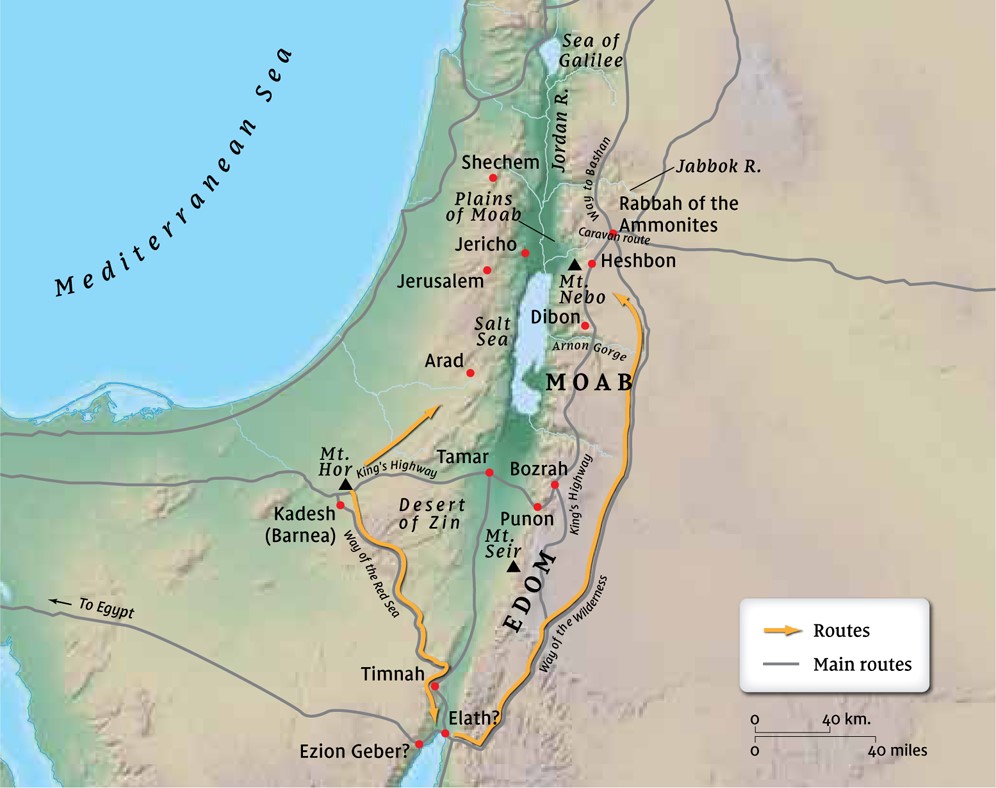
Having been denied safe passage through the land of Edom, the Israelites attempted to make their way through the Negev. However, their efforts were hampered by the Canaanites who occupied that territory. So, they reversed their steps and headed east around the borders of Edom to the western borders of Moab. This would have been a long and circuitous journey that left the Israelites frustrated by their slow progress. It was an unexpected and unwelcome detour that required the people of God to extend their time in the wilderness but there was a reason for this delay. God was waiting for the remainder of the first generation of Israelites who had refused to enter Canaan the first time to die off. In the book of Deuteronomy, Moses recalls the nearly 40-year death march the Israelites were forced to make because of their refusale to obey God’s command.

“Thirty-eight years passed from the time we first left Kadesh-barnea until we finally crossed the Zered Brook! By then, all the men old enough to fight in battle had died in the wilderness, as the Lord had vowed would happen. The Lord struck them down until they had all been eliminated from the community.” – Deuteronomy 2:14-15 NLT

And as that earlier generation slowly died off, the time grew closer to when the next crop of Israelites would face the decision to obey God and enter the land of Canaan. But as they drew closer to Canaan’s border, God warned the people to give the people of Moab a wide berth.

“Do not bother the Moabites, the descendants of Lot, or start a war with them. I have given them Ar as their property, and I will not give you any of their land.” – Deuteronomy 2:9 NLT

When the very last member of the earlier generation died, the Israelites were given permission to cross the border of Moab and enter the land of Ammon,

“Today you will cross the border of Moab at Ar and enter the land of the Ammonites, the descendants of Lot. But do not bother them or start a war with them. I have given the land of Ammon to them as their property, and I will not give you any of their land.’” – Deuteronomy 2:18-19 NLT

As before, the Israelites were to refrain from taking any land from the Ammonites. These people were close relatives of the Israelites and God declared their property to be off limits. God had awarded Lot’s descendants this land and the Israelites had no claim to it.

But the day came when God ordered the Israelites to begin their conquest of the land of Canaan. The older generation was gone and, after a nearly 40-year delay, it was time for God’s people to obey His command and enter the land of promise.

“Then the Lord said, ‘Now get moving! Cross the Arnon Gorge. Look, I will hand over to you Sihon the Amorite, king of Heshbon, and I will give you his land. Attack him and begin to occupy the land. Beginning today I will make people throughout the earth terrified because of you. When they hear reports about you, they will tremble with dread and fear.’” – Deuteronomy 2:24-25 NLT

Moses attempted to negotiate a treaty with Sihon, the king of the Amorites, but he was not interested in peace talks. That’s when God informed Moses to drop the peace overtures and have the people pick up their weapons.

“Look, I have begun to hand King Sihon and his land over to you. Begin now to conquer and occupy his land.” – Deuteronomy 2:31 NLT

The victory was overwhelming. Moses chronicled the event by giving God all the glory:

“…the Lord our God handed him over to us, and we crushed him, his sons, and all his people.  We conquered all his towns and completely destroyed everyone—men, women, and children. Not a single person was spared.” – Deuteronomy 2:33-34 NLT

In this chapter of Numbers, Moses refers to “the Book of the Wars of the Lord” (Numbers 21:14 ESV). This was a record of Israel’s victories recorded in the form of songs. The people were just beginning to witness the overwhelming power of God on their behalf and this victory over the Amorites was to be the first of many. The songs were intended to promote a sense of hope and confidence among the people of God.

After their defeat of the Amorites, the Israelites continued on to Beer, where God quenched the thirst of the people with refreshing water. And the people responded in grateful song.

“Spring up, O well!
    Yes, sing its praises!
Sing of this well,
    which princes dug,
which great leaders hollowed out
    with their scepters and staffs.” – Numbers 21:17-18 NLT

Israel was experiencing a sense of renewed confidence as they witnessed firsthand the power and providence of God. He was graciously preparing them for the days ahead and helping them to understand that anything was possible when they placed their faith in Him.

But while they were getting closer to the land of Canaan, they were not quite ready to take on the challenges that lie across the border. So, God continues to prepare them for the difficult days ahead.

Their enthusiasm, while admirable, would not be enough to bring victory against the nations living in Canaan. What the Israelites really needed was increased confidence in the power of God. Ultimately, the conquest of the land would be up to Him. They were going to need to learn to trust Him implicitly. Cockiness was not an acceptable substitute for confidence in God.

They were learning the timeless lesson recorded in the old hymn, “Faith is the Victory.”

Encamped along the hills of light,
Ye Christian soldiers, rise
And press the battle ere the night
Shall veil the glowing skies.
Against the foe in vales below
Let all our strength be hurled;
Faith is the victory, we know,
That overcomes the world.

Faith is the victory! (Faith is the victory!)
Oh, glorious victory
That overcomes the world.

English Standard Version (ESV) The Holy Bible, English Standard Version. ESV® Permanent Text Edition® (2016). Copyright © 2001

New Living Translation (NLT) Holy Bible, New Living Translation, copyright © 1996, 2004, 2015 by Tyndale House Foundation. Used by permission of Tyndale House Publishers Inc., Carol Stream, Illinois 60188. All rights reserved.
It Pays to Obey

37 The Lord said to Moses, 38 “Speak to the people of Israel, and tell them to make tassels on the corners of their garments throughout their generations, and to put a cord of blue on the tassel of each corner. 39 And it shall be a tassel for you to look at and remember all the commandments of the Lord, to do them, not to follow after your own heart and your own eyes, which you are inclined to whore after. 40 So you shall remember and do all my commandments, and be holy to your God. 41 I am the Lord your God, who brought you out of the land of Egypt to be your God: I am the Lord your God.” – Numbers 15:37-41 ESV

This is a rather strange and seemingly out-of-place passage. Why did God choose to give Moses these odd-sounding instructions at this particular point in time? It’s clear from the book of Deuteronomy that this was not the first or last time that God would issue this command.

“You shall make yourself tassels on the four corners of the garment with which you cover yourself.” – Deuteronomy 22:12 ESV

But what was the purpose behind this non-negotiable piece of fashion advice? As the text points out, these clothing accessories were to serve as a kind of memory enhancer.

“When you see the tassels, you will remember and obey all the commands of the Lord instead of following your own desires and defiling yourselves, as you are prone to do.” – Numbers 15:39 NLT

As the old saying goes, “An ounce of prevention is worth a pound of cure.” The tassels were to be an ever-present visual reminder for them to keep the commandments of God. It would be like someone tying a string on their finger to remind them of something important.

“These tassels were to act as reminders to be totally loyal to the Lord…” – Gordon J. Wenham, Numbers, Tyndale Old Testament Commentaries

It seems that every time an Israelite looked down at his feet, he would see the tassels and be reminded to “walk” according to the will of God. They would recall God’s command to their patriarch, Abraham.

“I am God Almighty; walk before me, and be blameless…” – Genesis 17:1 ESV

The Hebrew word is הָלַךְ (hālaḵ), which can mean “to walk,” but can also refer to the manner in which someone conducts their life. Abraham had been commanded to live his life blamelessly, in full view of God Almighty. There was to be no compartmentalization or hidden areas in his life; no aspect of his life was off-limits to the all-knowing, all-seeing God. This was the same lifestyle that Abraham’s ancestor, Noah, had lived.

Noah was a righteous man, blameless in his generation. Noah walked with God. – Genesis 6:9 ESV

And Noah had followed the example of his ancestor, Enoch, who had also “walked with God” (Genesis 5:22). And when Jacob was blessing his son, Joseph, he spoke of how his father and grandfather had “walked” with God.

“The God before whom my fathers Abraham and Isaac walked, the God who has been my shepherd all my life long to this day…” – Genesis 48:15 ESV

Because the tassels were located on the hem of the garment, they would be in clear sight every time an Israelite looked down to determine his or her next step. When they prepared to ascend a set of stairs, they would see the tassels and be reminded to consider their steps. When they looked down to assess the ground beneath their feet, the tassels would prompt them to take special care of their spiritual footing. They were not to stray from God. They were to remain on the straight-and-narrow.

The prophet, Isaiah, would later warn the people of Israel to watch their step.

Thus says the Lord:
“Stand by the roads, and look,
    and ask for the ancient paths,
where the good way is; and walk in it,
    and find rest for your souls.” – Jeremiah 6:16 ESV

They were to seek directions so that they might not take a wrong turn and end up in the wrong destination. But, sadly, Jeremiah points out that the people of Israel refused his advice.

“But they said, ‘We will not walk in it.’” – Jeremiah 6:16 ESV

They ignored the tassels, forgot to obey God’s commands, and ended up losing their way. And rather than seeking help, they stubbornly persisted in following their own misguided directions. The apostle Paul describes the destiny of all those who take their eyes off the tassels and forget to walk in obedience to God.

They are headed for destruction. Their god is their appetite, they brag about shameful things, and they think only about this life here on earth. – Philippians 3:19 NLT

In the book of Numbers, God warns what happens when His children follow their own desires: They end up defiling themselves. They replace God’s will with their own and step off the path that He has chosen for them. God’s choice of words is strong; He compares their disobedience to adultery or prostitution. The Hebrew word is זָנָה (zānâ), and it means “to be a harlot, act as a harlot, commit fornication.” And this description was meant to stand in stark contrast to their calling as God’s people. He had set them apart as His own, declaring them to be a kingdom of priests and a holy nation.

“Now therefore, if you will indeed obey my voice and keep my covenant, you shall be my treasured possession among all peoples, for all the earth is mine; and you shall be to me a kingdom of priests and a holy nation.” – Exodus 19:5-6 ESV

There is a huge difference between a priest and a prostitute, or there should be. To drive home the concept of priestly status, God commanded that they were to use blue threads to attach the tassels to their garments. Blue was the color of royalty and divinity and its presence on their garments would signify their position as servants of the King. This symbolism would not have escaped them because the ark of the covenant, over which God’s glory rested, was to be covered with a blue cloth every time it was transported (Numbers 4:6). According to God’s instructions, “a veil of blue and purple and scarlet yarns and fine twined linen” was to hang between the Holy Place and the Holy of Holies in the tabernacle (Exodus 26:31, 36). Even the robe of the high priest was to be made of royal blue (Exodus 28:31).

Every Jew was to consider themselves a priest of God and, as such, they were expected to live in obedience to His commands. The tassels were intended to serve as reminders of their status as His chosen people.

“The tassels will help you remember that you must obey all my commands and be holy to your God.” – Numbers 15;40 NLT

Their lives were to match their calling. Set-apart people are expected to live set-apart lives. Unlike the man who willingly violated the Sabbath and was stoned to death, they were to walk according to God’s commands. Each time they prepared to take a step, they would see the tassels on the hem of their garments and be reminded to tread carefully and obediently.

Not long before he died in the wilderness, Moses delivered a lengthy and passionate speech to the people of Israel. Because of his own disobedience, he would not be entering the land of Canaan with them. So, motivated by his own failure to fully obey the Lord, he called the people to “walk” before the Lord all the days of their lives.

“You shall be careful therefore to do as the Lord your God has commanded you. You shall not turn aside to the right hand or to the left. You shall walk in all the way that the Lord your God has commanded you, that you may live, and that it may go well with you, and that you may live long in the land that you shall possess.” – Deuteronomy 5:32-33 ESV

Moses longed for the people of Israel to enjoy all the blessings that God had in store for them. But he knew it would require obedience.

“And if you faithfully obey the voice of the Lord your God, being careful to do all his commandments that I command you today, the Lord your God will set you high above all the nations of the earth. And all these blessings shall come upon you and overtake you, if you obey the voice of the Lord your God.” – Deuteronomy 28:1-2 ESV

“The Lord will establish you as a people holy to himself, as he has sworn to you, if you keep the commandments of the Lord your God and walk in his ways.” – Deuteronomy 28:9 ESV

But Moses also warned them about the consequences of disobedience. Failure to “walk” with God would prove costly, even catastrophic.

“But if you will not obey the voice of the Lord your God or be careful to do all his commandments and his statutes that I command you today, then all these curses shall come upon you and overtake you.” – Deuteronomy 28:15 ESV

“All these curses shall come upon you and pursue you and overtake you till you are destroyed, because you did not obey the voice of the Lord your God, to keep his commandments and his statutes that he commanded you.” – Deuteronomy 28:45 ESV

It pays to obey. Walking the talk has its benefits. God wanted the Israelites to know that conducting one’s life in keeping with God’s commands wasn’t just good advice, it was a matter of life and death. The Israelites received a much-needed reminder to consider the source of the commands they were called to keep.

“I am the Lord your God who brought you out of the land of Egypt that I might be your God. I am the Lord your God!” – Numbers 15:41 NLT

English Standard Version (ESV) The Holy Bible, English Standard Version. ESV® Permanent Text Edition® (2016). Copyright © 2001

New Living Translation (NLT) Holy Bible, New Living Translation, copyright © 1996, 2004, 2015 by Tyndale House Foundation. Used by permission of Tyndale House Publishers Inc., Carol Stream, Illinois 60188. All rights reserved.

A Preview of Coming Attractions

1 The Lord spoke to Moses, saying, 2 “Speak to the people of Israel and say to them, When you come into the land you are to inhabit, which I am giving you, 3 and you offer to the Lord from the herd or from the flock a food offering or a burnt offering or a sacrifice, to fulfill a vow or as a freewill offering or at your appointed feasts, to make a pleasing aroma to the Lord, 4 then he who brings his offering shall offer to the Lord a grain offering of a tenth of an ephah of fine flour, mixed with a quarter of a hin of oil; 5 and you shall offer with the burnt offering, or for the sacrifice, a quarter of a hin of wine for the drink offering for each lamb. 6 Or for a ram, you shall offer for a grain offering two tenths of an ephah of fine flour mixed with a third of a hin of oil. 7 And for the drink offering you shall offer a third of a hin of wine, a pleasing aroma to the Lord. 8 And when you offer a bull as a burnt offering or sacrifice, to fulfill a vow or for peace offerings to the Lord, 9 then one shall offer with the bull a grain offering of three tenths of an ephah of fine flour, mixed with half a hin of oil. 10 And you shall offer for the drink offering half a hin of wine, as a food offering, a pleasing aroma to the Lord.

11 “Thus it shall be done for each bull or ram, or for each lamb or young goat. 12 As many as you offer, so shall you do with each one, as many as there are. 13 Every native Israelite shall do these things in this way, in offering a food offering, with a pleasing aroma to the Lord. 14 And if a stranger is sojourning with you, or anyone is living permanently among you, and he wishes to offer a food offering, with a pleasing aroma to the Lord, he shall do as you do. 15 For the assembly, there shall be one statute for you and for the stranger who sojourns with you, a statute forever throughout your generations. You and the sojourner shall be alike before the Lord. 16 One law and one rule shall be for you and for the stranger who sojourns with you.”

17 The Lord spoke to Moses, saying, 18 “Speak to the people of Israel and say to them, When you come into the land to which I bring you 19 and when you eat of the bread of the land, you shall present a contribution to the Lord. 20 Of the first of your dough you shall present a loaf as a contribution; like a contribution from the threshing floor, so shall you present it. 21 Some of the first of your dough you shall give to the Lord as a contribution throughout your generations. – Numbers 15:1-21 ESV

Even though God had condemned an entire generation of Israelites to wander in the wilderness for 40 years as punishment for their rebellion, He would not abandon them. The Lord would continue to guide them, provide for and protect them, and even give them further instructions regarding their eventual occupation of the land of Canaan. While that generation would never experience the joy of crossing over the Jordan and experiencing God’s rest, their children would. And God used the four-decade-long detour through the wilderness as a training opportunity for the next generation of Israelites, providing them with detailed instructions for their eventual entrance into the land of promise.

Though the adult population had allowed the fear-laden advice of the ten spies to deter them from keeping God’s command to enter and conquer the land of Canaan, God refused to renege on His promise. He remained committed to the covenant He had made with Abraham and assured Moses that the offspring of the rebellious generation would inherit the land.

But God made it perfectly clear that the adults in the room had blown their chance.

“…not one of these people will ever enter that land. They have all seen my glorious presence and the miraculous signs I performed both in Egypt and in the wilderness, but again and again they have tested me by refusing to listen to my voice. They will never even see the land I swore to give their ancestors. None of those who have treated me with contempt will ever see it.” – Numbers 14:22-23 NLT

Yet, despite their blatant display of disobedience, He would not hold the children responsible for the sins of their parents. During the 40-year delay, things would continue just as they had since the Israelites departed Egypt. The tabernacle would remain in the center of the camp with the Shekinah glory of God located above the mercy seat in the Holy of Holies. The sacrificial system would continue just as God had prescribed it on Mount Sinai. Sacrifices would be offered and sins atoned for. Life would go on as it had before. And each year, children would be born into the Israelite community and members of the older generation would die off. There would be a slow but steady changing of the guard as the infants grew into adolescents who eventually became adults.

And God provided Moses with the assurance that a new group of Israelites would eventually enter the land.

“Give the following instructions to the people of Israel. When you finally settle in the land I am giving you, you will offer special gifts as a pleasing aroma to the Lord.” – Numbers 15:2-3 NLT

The faces and names of the people would change, but the covenant would be fulfilled. And this message from God must have been a painful reminder to the older generation that their disobedience had been costly. They would never have the joy of crossing the Jordan River into the land of promise with their children and grandchildren. Their lives would end in death in the wilderness. They were close but yet so far. Canaan was within reach but completely off-limits because they refused to obey God.

This chapter contains additional instructions regarding the sacrificial system and it focuses on the changes God would require once they entered the new land. It is interesting to note that this addendum includes additional sacrifices involving grain, oil, and wine. When the next generation finally enters the land, they will be required to supplement their meat offerings with “a grain offering of two quarts of choice flour mixed with one quart of olive oil” (Numbers 15:4 NLT). And for each lamb offered, they would add “one quart of wine as a liquid offering” (Numbers 15:5 NLT).

This appears to be a reference to the fruitfulness of the land of Canaan. When the spies returned from their expedition within the borders of Canaan, they reported that it was “a land flowing with milk and honey” (Numbers 13:27 NLT). It was so rich and bountiful that the spies produced “a single cluster of grapes so large that it took two of them to carry it on a pole between them! They also brought back samples of the pomegranates and figs” (Numbers 13:23 NLT).

In the book of Deuteronomy, Moses describes just how bountiful the land of promise would be.

“The LORD your God will soon bring you into the land he swore to give you when he made a vow to your ancestors Abraham, Isaac, and Jacob. It is a land with large, prosperous cities that you did not build. The houses will be richly stocked with goods you did not produce. You will draw water from cisterns you did not dig, and you will eat from vineyards and olive trees you did not plant.” – Deuteronomy 6:10-11 NLT

For people who were living in the wilderness, surviving off of manna and quail, this description must have been highly attractive. The prospect of enjoying the comforts of a real house instead of the cramped confines of a tent would have been difficult to imagine. Ever since leaving Egypt, they had eaten no fruit, raised no crops, baked no bread, or enjoyed any of the comforts of “home.” They were nomads wandering through a godforsaken wilderness.

But God assured them that upon entering the land of promise, all that would change. They would have plenty of grain, oil, and wine. So much so, that these bountiful resources would become a part of the sacrificial system. According to the book of Exodus, the Israelites had left Egypt with “great flocks and herds of livestock” (Exodus 12:38 NLT). So, they had no shortage of animals to use for their required sacrifices, even in the wilderness. But they had no access to grain, oil, and wine. The only bread they had to eat was in the form of the manna which God miraculously provided. Since there were few olive trees or vineyards in the wilderness, oil and wine were in short supply. But things would be different in Canaan.

This entire passage is meant to emphasize God’s faithfulness and to assure the Israelites of His unfailing commitment to providing for all their needs. Their response to His faithfulness was to be one of gratitude, expressed through the offering of meat, grain, oil, and wine. These gifts were intended to honor God for His goodness and grace, and together produced “a pleasing aroma to the Lord” (Numbers 15:3). These detailed instructions for the grain and drink offerings were meant to ensure the Israelites that their time in the land would be marked by blessing and abundance. God would care for them and they would be expected to express their thanks through the giving of offerings.

It’s important to remember that these instructions were given before the people entered the land when they had no access to the oil, grain, and wine. But God was assuring them that the day would come when the bounty of the land would become readily available. In fact, He was guaranteeing its availability.

“When you arrive in the land where I am taking you, and you eat the crops that grow there, you must set some aside as a sacred offering to the Lord. Present a cake from the first of the flour you grind, and set it aside as a sacred offering, as you do with the first grain from the threshing floor. Throughout the generations to come, you are to present a sacred offering to the Lord each year from the first of your ground flour.” – Numbers 15:18-21 NLT

To the rebellious generation who had decided that the conquest of Canaan was impossible, this word from God must have been difficult to hear. They must have been filled with regret as they considered the ramifications of their fateful decision to disobey God. Not only would they fail to enter the land, but they would never enjoy its fruit or experience the joy of standing alongside their children and grandchildren as they offered God gifts of gratitude for its bounty.

But God underscores His own faithfulness when He states that these offerings will take place “throughout the generations to come” (Numbers 15:21 NLT). The next generation will conquer and occupy the land. The land will provide for all their needs. And the people will be expected to offer up their thanks to God for His goodness and graciousness – for generations to come.

These instructions were given as the people were about to begin the 40-year sentencing handed down by God. For the next four decades, they would wander in the wilderness as punishment for their refusal to obey God, and they would never get the opportunity to obey any of these sacrificial requirements. So, they would need to pass on these instructions to their children, grandchildren, and all those who would be born over the next 40 years. The guilty and condemned were required to prepare their offspring to respond appropriately to God’s future blessings. While this generation had blown their opportunity to enter God’s rest and experience His blessings, they could help prepare their progeny to respond to God’s blessings with gratefulness and faithfulness.

English Standard Version (ESV) The Holy Bible, English Standard Version. ESV® Permanent Text Edition® (2016). Copyright © 2001

New Living Translation (NLT) Holy Bible, New Living Translation, copyright © 1996, 2004, 2015 by Tyndale House Foundation. Used by permission of Tyndale House Publishers Inc., Carol Stream, Illinois 60188. All rights reserved.

Too Little, Too Late

26 And the Lord spoke to Moses and to Aaron, saying, 27 “How long shall this wicked congregation grumble against me? I have heard the grumblings of the people of Israel, which they grumble against me. 28 Say to them, ‘As I live, declares the Lord, what you have said in my hearing I will do to you: 29 your dead bodies shall fall in this wilderness, and of all your number, listed in the census from twenty years old and upward, who have grumbled against me, 30 not one shall come into the land where I swore that I would make you dwell, except Caleb the son of Jephunneh and Joshua the son of Nun. 31 But your little ones, who you said would become a prey, I will bring in, and they shall know the land that you have rejected. 32 But as for you, your dead bodies shall fall in this wilderness. 33 And your children shall be shepherds in the wilderness forty years and shall suffer for your faithlessness, until the last of your dead bodies lies in the wilderness. 34 According to the number of the days in which you spied out the land, forty days, a year for each day, you shall bear your iniquity forty years, and you shall know my displeasure.’ 35 I, the Lord, have spoken. Surely this will I do to all this wicked congregation who are gathered together against me: in this wilderness they shall come to a full end, and there they shall die.”

36 And the men whom Moses sent to spy out the land, who returned and made all the congregation grumble against him by bringing up a bad report about the land— 37 the men who brought up a bad report of the land—died by plague before the Lord. 38 Of those men who went to spy out the land, only Joshua the son of Nun and Caleb the son of Jephunneh remained alive.

39 When Moses told these words to all the people of Israel, the people mourned greatly. 40 And they rose early in the morning and went up to the heights of the hill country, saying, “Here we are. We will go up to the place that the Lord has promised, for we have sinned.” 41 But Moses said, “Why now are you transgressing the command of the Lord, when that will not succeed? 42 Do not go up, for the Lord is not among you, lest you be struck down before your enemies. 43 For there the Amalekites and the Canaanites are facing you, and you shall fall by the sword. Because you have turned back from following the Lord, the Lord will not be with you.” 44 But they presumed to go up to the heights of the hill country, although neither the ark of the covenant of the Lord nor Moses departed out of the camp. 45 Then the Amalekites and the Canaanites who lived in that hill country came down and defeated them and pursued them, even to Hormah. – Numbers 14:26-45 ESV

God essentially told the Israelites that the worst-case scenario they had conjured up in their minds was going to take place. Their greatest fears were going to become reality. In an attempt to rationalize their rebellion against Moses’ leadership, they had predicted a foreboding future if they stayed where they were.

“Would that we had died in the land of Egypt! Or would that we had died in this wilderness! Why is the Lord bringing us into this land, to fall by the sword? Our wives and our little ones will become a prey.” – Numbers 14:2-3 ESV

And God let them know that their projections of doom and gloom would come true.

“As surely as I live, declares the Lord, I will do to you the very things I heard you say. You will all drop dead in this wilderness! Because you complained against me, every one of you who is twenty years old or older and was included in the registration will die. You will not enter and occupy the land I swore to give you.” – Numbers 14:28-30 NLT

As punishment for their rebellion, God revealed their fate. They would not be returning to Egypt and they would never enter the land of promise. Instead, they would spend the next four decades wandering in the wilderness. During that time, the entire first generation of Israelites would die of natural causes as they wandered just outside the border of Canaan. They wouldn’t have to worry about dying in battle because they would never make it to the promised land. No, their deaths would be from old age as they spent the next 40 years living a nomadic and pointless lifestyle; a year for every day the 12 spies had spent in Canaan.

There would be no supernatural cosmological display of fire and brimstone to consume the wicked. The ground wouldn’t open up and swallow all those who were guilty. In fact, for the next 40 years, God would continue to provide for their physical needs; providing them with manna, quail, and fresh drinking water. Despite their rebellious actions, God was not going to abandon or annihilate them. His presence would remain with them. The Tabernacle would be available to them for worship and sacrifice. They would continue to tend their flocks and herds, raise their children, and live out their days in relative peace and security. But they would never enter the land that God had promised as their inheritance.

“Not one of you from this wicked generation will live to see the good land I swore to give your ancestors.” – Deuteronomy 1:25 NLT

Canaan was to have been their final destination. It was a rich and fertile land, just as the spies had reported, and even before God had brought a single plague against Egypt, He had promised to lead the descendants of Jacob to their new homeland.

“I have promised to rescue you from your oppression in Egypt. I will lead you to a land flowing with milk and honey—the land where the Canaanites, Hittites, Amorites, Perizzites, Hivites, and Jebusites now live.” – Exodus 3:17 NLT

But as a result of their stubborn refusal to trust God, they would spend 40 long years living on the wrong side of the border of Canaan. In time, one by one, they would succumb to old age and die, and their bodies would be buried in the barren wastelands of the wilderness. The stiff punishment for their rebellion led the author of Hebrews to use it as a warning to a new generation of Jews who had been offered another promise of future inheritance by God.

“Today when you hear his voice,
    don’t harden your hearts
as Israel did when they rebelled,
    when they tested me in the wilderness.
There your ancestors tested and tried my patience,
    even though they saw my miracles for forty years.
So I was angry with them, and I said,
‘Their hearts always turn away from me.
    They refuse to do what I tell them.’
So in my anger I took an oath:
    ‘They will never enter my place of rest.’” – Hebrews 3:7-11 NLT

Canaan was to have been their place of rest. That doesn’t mean Canaan was going to be a stress-free environment, devoid of difficulties. The spies had been right; there were enemies in the land and the Israelites would have to do battle with each of them if they wanted to make the land their own. But God had promised them victory. He was going to use the Israelites to purge the land of all the wickedness, immorality, and godlessness that had filled it since their departure more than 430 years earlier.

Yet, rather than obeying God and trusting Him to give them victory over the inhabitants of Canaan, the Israelites ended up making an enemy of God.

“Because your men explored the land for forty days, you must wander in the wilderness for forty years—a year for each day, suffering the consequences of your sins. Then you will discover what it is like to have me for an enemy.” – Numbers 14:34 NLT

What makes this story so painful and impactful is that it involves the people of God. These were His chosen ones whom He had redeemed out of slavery in Egypt. He had graciously offered them freedom and a permanent homeland of their own where they could enjoy His presence, power, and provision. Yet, because the conquest of the land appeared to be a more difficult undertaking than they had imagined, they turned their back on God’s gracious offer. Once again, the author of Hebrews emphasizes the disbelieving nature of God’s chosen people.

And who was it who rebelled against God, even though they heard his voice? Wasn’t it the people Moses led out of Egypt? And who made God angry for forty years? Wasn’t it the people who sinned, whose corpses lay in the wilderness? And to whom was God speaking when he took an oath that they would never enter his rest? Wasn’t it the people who disobeyed him? So we see that because of their unbelief they were not able to enter his rest. – Hebrews 3:16-19 NLT

And he warns his fellow Jews to learn from their ancestors’ mistakes.

Be careful then, dear brothers and sisters. Make sure that your own hearts are not evil and unbelieving, turning you away from the living God.… For if we are faithful to the end, trusting God just as firmly as when we first believed, we will share in all that belongs to Christ. – Hebrews 3:12, 14 NLT

God’s promise of rest required obedience. The land was theirs, but they would have to do battle to take full possession of it. A non-negotiable prerequisite for occupying the land was the cleansing of all its impurities, and that would require hard work and faith. Any effort they put forth would have to be based on their belief that God would go before them and provide them with victory. But for the Israelites, a long march back to Egypt and the promise of certain enslavement were more appealing than the risk of obeying the will of God. As a result, they would never enter His rest.

And, as for the ten spies who convinced the people to rebel against God, they faced a more immediate and unpleasant outcome for their role.

The ten men Moses had sent to explore the land—the ones who incited rebellion against the Lord with their bad report—were struck dead with a plague before the Lord. – Numbers 14:36-37 NLT

God had not changed His mind. His promise to provide an inheritance for the descendants of Abraham, Isaac, and Jacob remained just as firm as ever. But there would be some who would never get to enjoy it; they had forfeited that right.

But when the people heard the news of God’s judgment against them, they were grieved and attempted to change God’s mind by feigning repentance and declaring their rejuvenated willingness to march into Canaan.

“We realize that we have sinned, but now we are ready to enter the land the Lord has promised us.” – Numbers 14:40 NLT

But it was too little, too late. Moses even warned them that they were only making matters worse by attempting to escape God’s judgment through their faux display of faithfulness. After watching the ten spies die from a plague, the people were suddenly motivated to obey God’s command and march into Canaan. They were suggesting immediate entrance into the land, even though that was not what God had ordered. They thought a show of enthusiasm might temper God’s anger. But Moses warned them against making such an ill-fated decision.

“Why are you now disobeying the Lord’s orders to return to the wilderness? It won’t work. Do not go up into the land now. You will only be crushed by your enemies because the Lord is not with you. When you face the Amalekites and Canaanites in battle, you will be slaughtered. The Lord will abandon you because you have abandoned the Lord.” – Numbers 14:41-43 NLT

But stubborn as always, the people rejected Moses’ counsel and attempted to enter Canaan – without God’s approval or help – and they failed miserably. They had forfeited their right to the inheritance. The land would never be theirs and they would never enjoy the rest that God had promised. The apostle Paul provides a powerful application of this story for those who long to enter the eternal rest that comes through faith in Christ.

I don’t want you to forget, dear brothers and sisters, about our ancestors in the wilderness long ago. All of them were guided by a cloud that moved ahead of them, and all of them walked through the sea on dry ground. In the cloud and in the sea, all of them were baptized as followers of Moses. All of them ate the same spiritual food, and all of them drank the same spiritual water. For they drank from the spiritual rock that traveled with them, and that rock was Christ. Yet God was not pleased with most of them, and their bodies were scattered in the wilderness.

These things happened as a warning to us, so that we would not crave evil things as they did, or worship idols as some of them did. – 1 Corinthians 10:1-7 NLT

The Israelites had experienced the power and presence of God. He had defeated their Egyptian overlords and delivered them from captivity. He had led them, fed them, protected them, and provided for them. But when it came time to enter the land, they had rebelled against Him. And when Moses warned them against taking matters into their own hands by entering the land without God’s blessing or presence, they rebelled yet again.

But the people defiantly pushed ahead toward the hill country, even though neither Moses nor the Ark of the Lord’s Covenant left the camp. Then the Amalekites and the Canaanites who lived in those hills came down and attacked them and chased them back as far as Hormah. – Numbers 14:44-45 NLT

They attempted to do God’s will without God’s permission and power, and they failed miserably. They thought they could correct their former act of disobedience with an enthusiastic but unsanctioned assault on the enemies of God. But without His permission and presence, their efforts proved powerless.

English Standard Version (ESV) The Holy Bible, English Standard Version. ESV® Permanent Text Edition® (2016). Copyright © 2001

New Living Translation (NLT) Holy Bible, New Living Translation, copyright © 1996, 2004, 2015 by Tyndale House Foundation. Used by permission of Tyndale House Publishers Inc., Carol Stream, Illinois 60188. All rights reserved.

Fruitfulness and Faithlessness

25 At the end of forty days they returned from spying out the land. 26 And they came to Moses and Aaron and to all the congregation of the people of Israel in the wilderness of Paran, at Kadesh. They brought back word to them and to all the congregation, and showed them the fruit of the land. 27 And they told him, “We came to the land to which you sent us. It flows with milk and honey, and this is its fruit. 28 However, the people who dwell in the land are strong, and the cities are fortified and very large. And besides, we saw the descendants of Anak there. 29 The Amalekites dwell in the land of the Negeb. The Hittites, the Jebusites, and the Amorites dwell in the hill country. And the Canaanites dwell by the sea, and along the Jordan.”

30 But Caleb quieted the people before Moses and said, “Let us go up at once and occupy it, for we are well able to overcome it.” 31 Then the men who had gone up with him said, “We are not able to go up against the people, for they are stronger than we are.” 32 So they brought to the people of Israel a bad report of the land that they had spied out, saying, “The land, through which we have gone to spy it out, is a land that devours its inhabitants, and all the people that we saw in it are of great height. 33 And there we saw the Nephilim (the sons of Anak, who come from the Nephilim), and we seemed to ourselves like grasshoppers, and so we seemed to them.”

Then all the congregation raised a loud cry, and the people wept that night. 2 And all the people of Israel grumbled against Moses and Aaron. The whole congregation said to them, “Would that we had died in the land of Egypt! Or would that we had died in this wilderness! 3 Why is the Lord bringing us into this land, to fall by the sword? Our wives and our little ones will become a prey. Would it not be better for us to go back to Egypt?” 4 And they said to one another, “Let us choose a leader and go back to Egypt.” – Numbers 13:25-14:4 ESV

For 40 days, the people of Israel anxiously awaited the return of the 12 men who had been sent to reconnoiter the land of Canaan, and each passing day must have fueled their growing doubts and concerns. The longer the delay, the more they must have wondered whether the spies had met an untimely demise at the hands of the land’s current occupants. Had they been captured and enslaved? Worse yet, had they been tortured and forced to disclose the location of Israel’s camp in the wilderness of Paran? Was a heavily armed force headed their way with plans to annihilate the rest of the Israelites before they could cross the Jordan River?

But much to the relief of the Israelites, the spies eventually returned, bearing news and “the fruit they had taken from the land” (Numbers 13:26 NLT). Rumors of their return spread quickly through the camp and soon everyone had gathered to hear their long-anticipated report. And as the people stood in breathless silence, they heard the spies deliver their findings.

“We entered the land you sent us to explore, and it is indeed a bountiful country—a land flowing with milk and honey. Here is the kind of fruit it produces.” – Numbers 13:27 NLT

The spies had not returned empty-handed. According to verse 23, they had gathered tangible evidence of the land’s fruitfulness and now used these props as a kind of show-and-tell.

When they came to the valley of Eshcol, they cut down a branch with a single cluster of grapes so large that it took two of them to carry it on a pole between them! They also brought back samples of the pomegranates and figs. – Numbers 13:23 NLT

It was as if the spies knew that their words would not be enough. Any attempts to describe the land’s abundance would fall short and be met with skeptical ears, so they brought proof. And it was like nothing the Israelites had ever seen before. A single cluster of grapes had to be carried on a pole between two men. This land was super-abundant and more than adequate to meet the physical needs of the Israelites. It’s interesting to remember that, just recently, the Israelites had been reminiscing about the wonderful cuisine they had enjoyed in Egypt.

“We remember the fish we used to eat for free in Egypt. And we had all the cucumbers, melons, leeks, onions, and garlic we wanted. But now our appetites are gone. All we ever see is this manna!” – Numbers 11:5-6 NLT

While their memories of the food they enjoyed in Egypt were probably a bit cloudy and far from accurate, they couldn’t argue with the evidence right before their eyes. Canaan was a virtual cornucopia of culinary delights, and it was just across the Jordan River.

But before the Israelites had time to take in the wonderful news about the fruitful land of Canaan, the spies poured a bit of cold water on their enthusiasm. They delivered the bad news.

“But the people living there are powerful, and their towns are large and fortified. We even saw giants there, the descendants of Anak! The Amalekites live in the Negev, and the Hittites, Jebusites, and Amorites live in the hill country. The Canaanites live along the coast of the Mediterranean Sea and along the Jordan Valley.” – Numbers 13:28-29 NLT

If the size of the grapes had been enough to make their mouths water, this news must have made them sick to their stomachs; it was the last thing they wanted to hear. After all, what good was a fruitful and abundant land if it was filled with frightful and formidable enemies?

As soon as the Israelites heard the downside of the spies’ report, they went into a panic. As fear gripped the camp, Caleb, one of the 12 men who had seen the land with his own eyes, tried to calm them down. He didn’t attempt to dismiss or discredit the report of enemies in the land. He didn’t refute their existence or diminish the claims of their superior power. Instead, he simply encouraged the people to do what God had commanded them to do.

“Let’s go at once to take the land,” he said. “We can certainly conquer it!” – Numbers 13:30 NLT

The spies had done exactly what Moses had instructed them to do.

“Go north through the Negev into the hill country. See what the land is like, and find out whether the people living there are strong or weak, few or many. See what kind of land they live in. Is it good or bad? Do their towns have walls, or are they unprotected like open camps? Is the soil fertile or poor? Are there many trees? Do your best to bring back samples of the crops you see.” (It happened to be the season for harvesting the first ripe grapes.) – Numbers 13:18-20 NLT

They had returned with a report and samples. But at no point were their findings intended to play a role in whether or not the Israelites entered the land. Their mission had been a fact-finding one. And when their report turned out to be a combination of good news and bad news, it should have had no bearing on God’s plans for Israel. It provided proof that the land was fruitful but it also provided evidence that the land was already occupied. While the people found the first fact encouraging, they considered the second one to be disheartening and ample reason to call off the conquest of Canaan. But both reports were intended to remind the people that God was their provider. Not only was He giving them a fruitful land for their future inheritance, land, but He was about to give them victory over its more powerful occupants.

But for ten of the spies, the thought of the Israelites defeating the Canaanites was a pipe dream. There was no way a rag-tag army of former shepherds and slaves was going to conquer a land filled with “giants.” The Israelites would find themselves up against Amalekites, Hittites, Jebusites, Amorites, and Canaanites. They would be outnumbered and under-equipped for the task, and the ten spies made their views plainly known.

“We can’t go up against them! They are stronger than we are!” – Numbers 13:31 NLT

These men were more than scared. They were absolutely petrified and determined to convince the people to disobey God’s command to enter the land of Canaan.

“The land we traveled through and explored will devour anyone who goes to live there. All the people we saw were huge. We even saw giants there, the descendants of Anak. Next to them we felt like grasshoppers, and that’s what they thought, too!” – Numbers 13:32-33 NLT

Notice how they conveniently left God out of the picture. It was all “us-versus-them.” It was giants against grasshoppers, the powerful against the weak. The odds were completely lopsided and any hope of victory was wishful thinking. God didn’t factor into their equation, and their words had the desired effect. The people were devastated and demoralized. They wept and mourned. They regretted ever having left Egypt. And any encouragement they may have received from the sight of oversized fruit was crushed by the prospect of annihilation at the hands of their enemies.

Fueled by the disheartening rhetoric of the ten spies, the people railed against Moses and Aaron, questioning why they had ever left the land of Egypt in the first place. It was a familiar theme.

“If only we had died in Egypt, or even here in the wilderness!” they complained. “Why is the Lord taking us to this country only to have us die in battle? Our wives and our little ones will be carried off as plunder! Wouldn’t it be better for us to return to Egypt?” – Numbers 14:2-3 NLT

They had regrets, and they suffered from a severe case of the good-old-days syndrome. When confronted with the less-than-ideal option of entering the land of Canaan, they began to long for their days back in Egypt. They preferred slavery to possible slaughter at the hands of the Canaanites. Their view of the promised land was anything but promising. Filled with pessimism and fueled by fear, they lashed out at Moses and Aaron, and anxious to derail any plans these two men may have had to lead them into Canaan, the people began to plot their overthrow.

“Let’s choose a new leader and go back to Egypt!” – Numbers 14:4 NLT

Little did they know that they were thumbing their noses in the face of God Almighty. They were rejecting the gift of an inheritance that He had promised to Abraham. The land was theirs by right. But now, they were declaring their intention to return to slavery rather than obey the word of their gracious deliverer. They were rejecting the will of the One who had redeemed them from captivity and refusing to believe that He could provide them with victory over their enemies. And they were about to learn just how deadly that decision would be.

English Standard Version (ESV) The Holy Bible, English Standard Version. ESV® Permanent Text Edition® (2016). Copyright © 2001

New Living Translation (NLT) Holy Bible, New Living Translation, copyright © 1996, 2004, 2015 by Tyndale House Foundation. Used by permission of Tyndale House Publishers Inc., Carol Stream, Illinois 60188. All rights reserved.

Fear, Faithfulness, and Fruit

1 The Lord spoke to Moses, saying, 2 “Send men to spy out the land of Canaan, which I am giving to the people of Israel. From each tribe of their fathers you shall send a man, every one a chief among them.” 3 So Moses sent them from the wilderness of Paran, according to the command of the Lord, all of them men who were heads of the people of Israel. 4 And these were their names: From the tribe of Reuben, Shammua the son of Zaccur; 5 from the tribe of Simeon, Shaphat the son of Hori; 6 from the tribe of Judah, Caleb the son of Jephunneh; 7 from the tribe of Issachar, Igal the son of Joseph; 8 from the tribe of Ephraim, Hoshea the son of Nun; 9 from the tribe of Benjamin, Palti the son of Raphu; 10 from the tribe of Zebulun, Gaddiel the son of Sodi; 11 from the tribe of Joseph (that is, from the tribe of Manasseh), Gaddi the son of Susi; 12 from the tribe of Dan, Ammiel the son of Gemalli; 13 from the tribe of Asher, Sethur the son of Michael; 14 from the tribe of Naphtali, Nahbi the son of Vophsi; 15 from the tribe of Gad, Geuel the son of Machi. 16 These were the names of the men whom Moses sent to spy out the land. And Moses called Hoshea the son of Nun Joshua.

17 Moses sent them to spy out the land of Canaan and said to them, “Go up into the Negeb and go up into the hill country, 18 and see what the land is, and whether the people who dwell in it are strong or weak, whether they are few or many, 19 and whether the land that they dwell in is good or bad, and whether the cities that they dwell in are camps or strongholds, 20 and whether the land is rich or poor, and whether there are trees in it or not. Be of good courage and bring some of the fruit of the land.” Now the time was the season of the first ripe grapes.

21 So they went up and spied out the land from the wilderness of Zin to Rehob, near Lebo-hamath. 22 They went up into the Negeb and came to Hebron. Ahiman, Sheshai, and Talmai, the descendants of Anak, were there. (Hebron was built seven years before Zoan in Egypt.) 23 And they came to the Valley of Eshcol and cut down from there a branch with a single cluster of grapes, and they carried it on a pole between two of them; they also brought some pomegranates and figs. 24 That place was called the Valley of Eshcol, because of the cluster that the people of Israel cut down from there. – Numbers 13:1-24 ESV

After a brief seven-day delay in which Miriam was punished for attempting to lead a coup against her own brother, God led the people to Kadesh-Barnea. They were now on the edge of the land of Canaan. This had been their destination all along; the place that God had promised to give them as their inheritance. Now they stood on the banks of the Jordan River, ready to cross over and begin their conquest of the land.

But as a test of their resilience and reliance upon Him, God instructed Moses to select one man from each of the twelve tribes to go on a recognizance mission. These 12 men were to sneak into the land of Canaan to spy out the enemy’s strength and verify the agricultural quality of the land itself.

“Go north through the Negev into the hill country. See what the land is like, and find out whether the people living there are strong or weak, few or many. See what kind of land they live in. Is it good or bad? Do their towns have walls, or are they unprotected like open camps? Is the soil fertile or poor? Are there many trees? Do your best to bring back samples of the crops you see.”  (It happened to be the season for harvesting the first ripe grapes.) – Numbers 13:17-20 NLT

According to Moses’ account of this event, recorded in the book of Deuteronomy, the sending of the spies had actually been the people’s idea.

“But you all came to me and said, ‘First, let’s send out scouts to explore the land for us. They will advise us on the best route to take and which towns we should enter.’

“This seemed like a good idea to me, so I chose twelve scouts, one from each of your tribes. They headed for the hill country and came to the valley of Eshcol and explored it. They picked some of its fruit and brought it back to us. And they reported, ‘The land the Lord our God has given us is indeed a good land.’”  – Deuteronomy 1:22-25 NLT

They petitioned Moses to send in spies and God went along with the plan but it appears that God had a different agenda than that of the people. Their reason for sending in spies was to determine whether there was any hope of defeating the nations that already occupied the land. But God agreed to send in spies so that they might give witness to the truth concerning the abundance and fruitfulness of the land. In other words, as far as God was concerned, this was a fact-finding mission. This was not a specially formed committee to determine or decide whether or not the land was hospitable or conquerable. That was not an option. The conquest of the land was not up for debate and therein lay the test.

So, the spies went and they saw, and when they returned they reported the facts just as they had witnessed them. They even brought back physical evidence of the land’s long-rumored fruitfulness.

When they came to the valley of Eshcol, they cut down a branch with a single cluster of grapes so large that it took two of them to carry it on a pole between them! They also brought back samples of the pomegranates and figs. – Numbers 16:23 NLT

When the 12 men returned to the Israelite camp, they brought good news. They verbally and unanimously affirmed the land’s fruitfulness and provided a jaw-dropping show-and-tell that gave irrefutable proof that the land was bountiful and rich just as God had said it would be. The people’s mouths must have watered at the sight of the giant cluster of grapes that required two men to carry it. And to convince their fellow Israelites that there was more fruit where this came from, they declared that they had named the spot where they found the grapes the “Valley of Clusters.” It was an entire region filled with oversized bunches of sun-ripened grapes.

To a people who had spent a year living at the base of Mount Sinai in the relatively barren Arabian peninsula, this news must have sounded like music to their ears. They could already envision the overflowing vats and the sweet taste of the wine that awaited them in the promised land. For people who had already proven to be driven by their appetites, this news must have been too good to be true. Having just come off their month-long diet of nothing but quail, the thought of quenching their thirst with fine wine must have been irresistible.

Things were looking up. The long journey to the promised land was about to come to an end and the final destination sounded like it was going to be all that they had hoped for. But what the people didn’t realize was that there was going to be bad news mixed with the good news, and that is where the test would come in. The land was fruitful, just as God had told them it would be. But God had also warned that the land would be occupied.

When God initially issued His call for Moses to deliver His people from their captivity in Egypt, He declared, “I have come down to rescue them from the power of the Egyptians and lead them out of Egypt into their own fertile and spacious land. It is a land flowing with milk and honey—the land where the Canaanites, Hittites, Amorites, Perizzites, Hivites, and Jebusites now live” (Exodus 3:8 NLT). He let Moses know that their future inheritance would be filled with good things to eat but that it would also be overflowing with nations that were going to be far from hospitable or accommodating.

He had never told them that conquering the land of Canaan would be easy. In fact, long before they arrived at the border of Canaan, God had told them what would be required of them.

“For my angel will go before you and bring you into the land of the Amorites, Hittites, Perizzites, Canaanites, Hivites, and Jebusites, so you may live there. And I will destroy them completely. You must not worship the gods of these nations or serve them in any way or imitate their evil practices. Instead, you must utterly destroy them and smash their sacred pillars.” – Exodus 23:23-24 NLT

From day one, He had warned them that the land would be filled with other inhabitants. He told them that they would have to remove those inhabitants from the land but He also assured them that His presence would assure them of certain victory.

God never told them that occupying the land would be a cakewalk. But He did assure them of victory – as long as they obeyed Him. So, as they heard the report of the agricultural superiority of the land, they were ready to break camp and head to the Valley of Clusters. But little did they know that the good news was about to take a bad turn. All their dreams of fine wine and blissful days basking in the bounty in Canaan were about to be dashed by the distasteful news of insurmountable foes and impregnable fortresses. So, what would they do? How would they respond? Would they display trust in God and enter the land or allow fear to get the best of them? Would the promise of fruitfulness trump their fear of failure?

English Standard Version (ESV) The Holy Bible, English Standard Version. ESV® Permanent Text Edition® (2016). Copyright © 2001

New Living Translation (NLT) Holy Bible, New Living Translation, copyright © 1996, 2004, 2015 by Tyndale House Foundation. Used by permission of Tyndale House Publishers Inc., Carol Stream, Illinois 60188. All rights reserved.

Follow the Leader

11 In the second year, in the second month, on the twentieth day of the month, the cloud lifted from over the tabernacle of the testimony, 12 and the people of Israel set out by stages from the wilderness of Sinai. And the cloud settled down in the wilderness of Paran. 13 They set out for the first time at the command of the Lord by Moses. 14 The standard of the camp of the people of Judah set out first by their companies, and over their company was Nahshon the son of Amminadab. 15 And over the company of the tribe of the people of Issachar was Nethanel the son of Zuar. 16 And over the company of the tribe of the people of Zebulun was Eliab the son of Helon.

17 And when the tabernacle was taken down, the sons of Gershon and the sons of Merari, who carried the tabernacle, set out. 18 And the standard of the camp of Reuben set out by their companies, and over their company was Elizur the son of Shedeur. 19 And over the company of the tribe of the people of Simeon was Shelumiel the son of Zurishaddai. 20 And over the company of the tribe of the people of Gad was Eliasaph the son of Deuel.

21 Then the Kohathites set out, carrying the holy things, and the tabernacle was set up before their arrival. 22 And the standard of the camp of the people of Ephraim set out by their companies, and over their company was Elishama the son of Ammihud. 23 And over the company of the tribe of the people of Manasseh was Gamaliel the son of Pedahzur. 24 And over the company of the tribe of the people of Benjamin was Abidan the son of Gideoni.

25 Then the standard of the camp of the people of Dan, acting as the rear guard of all the camps, set out by their companies, and over their company was Ahiezer the son of Ammishaddai. 26 And over the company of the tribe of the people of Asher was Pagiel the son of Ochran. 27 And over the company of the tribe of the people of Naphtali was Ahira the son of Enan. 28 This was the order of march of the people of Israel by their companies, when they set out.

29 And Moses said to Hobab the son of Reuel the Midianite, Moses’ father-in-law, “We are setting out for the place of which the Lord said, ‘I will give it to you.’ Come with us, and we will do good to you, for the Lord has promised good to Israel.” 30 But he said to him, “I will not go. I will depart to my own land and to my kindred.” 31 And he said, “Please do not leave us, for you know where we should camp in the wilderness, and you will serve as eyes for us. 32 And if you do go with us, whatever good the Lord will do to us, the same will we do to you.”

33 So they set out from the mount of the Lord three days’ journey. And the ark of the covenant of the Lord went before them three days’ journey, to seek out a resting place for them. 34 And the cloud of the Lord was over them by day, whenever they set out from the camp.

35 And whenever the ark set out, Moses said, “Arise, O Lord, and let your enemies be scattered, and let those who hate you flee before you.” 36 And when it rested, he said, “Return, O Lord, to the ten thousand thousands of Israel.” – Numbers 10:11-36 ESV

The orders had been given. Detailed instructions had been carefully communicated to the people of Israel. They knew exactly what they would need to do when God decided it was time for them to leave Mount Sinai and, now, that time had come. Their encampment at the base of the mountain had been their home for almost a year, but God had never intended this spot in the wilderness to be their final destination. According to Exodus 19:1, they had arrived there two months after leaving Egypt.

Exactly two months after the Israelites left Egypt, they arrived in the wilderness of Sinai. After breaking camp at Rephidim, they came to the wilderness of Sinai and set up camp there at the base of Mount Sinai. – Exodus 19:1-2 NLT

Now, just ten days short of the first anniversary of their arrival in Sinai, they were instructed to pack up and leave.

In the second year after Israel’s departure from Egypt—on the twentieth day of the second month—the cloud lifted from the Tabernacle of the Covenant. So the Israelites set out from the wilderness of Sinai and traveled on from place to place until the cloud stopped in the wilderness of Paran. – Numbers 10:11-12 NLT

In Numbers 10, Moses indicates that the day came when the cloud of God’s presence departed from its place above the Tabernacle and made its way into the wilderness. Following the instructions given to them by God, the Levites began the careful disassembly and packing of the Tabernacle while the people of broke camp. When all was ready, they moved out in an orderly, prearranged manner.

…the people of Israel set out by stages from the wilderness of Sinai. – Numbers 10:12 ESV

Due to the large number of Israelites involved in this mass migration, God provided them with strict instructions regarding their movements. It was not to be a free-for-all, with everyone departing at once and according to their own timeline and agenda. With 12 tribes involved consisting of what has been estimated as more than two million people, this was a major undertaking that required precision and careful planning. Tents must be taken down, herds and flocks must be rounded up, and the Tabernacle must be dismantled and prepared for transport to the next destination. According to Numbers 10, the people went about their duties obediently. Everyone did their part and carefully followed the instructions of the Lord.

When the cloud made its way into the wilderness, the people knew it was time to move. At the sound of the two silver trumpets (Numbers 10:1), they gathered together and saw the sight of the cloud making its way into the wilderness. God had made the decision to relocate their camp and move them closer to their final destination: The land of Canaan.

Under normal circumstances, the trip to Kadesh-Barnea should have taken 11 days (Deuteronomy 1:2), but with the large number of Israelites and livestock involved and the need for an orderly and well-regimented evacuation process, it took them three days to arrive at the wilderness of Paran. The cloud had come to rest in that region, signifying that this was the spot where they were to set up camp. God chose this particular location for a reason.

“The Desert of Paran is a large plateau in the northeastern Sinai, south of what later would be called the Negev of Judah, and west of the Arabah. This forms the southernmost portion of the Promised Land, the presumed staging area for the assault on the land itself. The principal lines of assault on the land of Canaan are from the southwest, following the Way of the Sea from Egypt, and from the northwest, following the Way of the Sea from Phoenicia. Israel’s staging for attack in the Desert of Paran was a brilliant strategy. In this way they would avoid the fortified routes to the west, presumably under the control of Egypt. This unusual line of attack from the south would stun the inhabitants of the land. They would come like a sirocco blast from the desert, and the land would be theirs, under the hand of God.” – Ronald B. Allen, “Numbers.” In Genesis—Numbers. Vol. 2 of The Expositor’s Bible Commentary

Verses 13-28 provide the details concerning the departure of Israel from Mount Sinai. The tribe of Judah led the way, with each of the other tribes moving out according to a prearranged plan. Some of the tribes would have started the process long before the Tabernacle was completely dismantled and ready for transport. The lengthy procession would have stretched out for miles as the Israelites made their way into the wilderness, following the cloud of the Lord.

They marched for three days after leaving the mountain of the Lord, with the Ark of the Lord’s Covenant moving ahead of them to show them where to stop and rest. As they moved on each day, the cloud of the Lord hovered over them. – Numbers 10:33-34 NLT

God was guiding them, just as He had promised to do. He was leading them further away from Egypt and ever closer to their new home in Canaan. The land He had promised to Abraham as an inheritance would soon be theirs. But they would have to continue to follow His leading and trust Him for their provisions along the way. The journey would not be easy but Moses knew that as long as they followed God’s will, they would be blessed. He even tried to convince his wife’s brother to join them.

“We are on our way to the place the Lord promised us, for he said, ‘I will give it to you.’ Come with us and we will treat you well, for the Lord has promised wonderful blessings for Israel!” – Numbers 10:29 NLT

It’s interesting to note that Moses asked his brother-in-law to serve as a scout or guide for the people of Israel.

“You know the places in the wilderness where we should camp. Come, be our guide. If you do, we’ll share with you all the blessings the Lord gives us.” – Numbers 10:31-32 NLT

Perhaps Moses knew that Hobab was familiar with the wilderness terrain and could help them choose the best places to camp. But this seems to contradict the idea that the cloud of God was to serve as their guide. It is unclear whether Moses’ request was out of step with the will of God. But he evidently convinced Hobab to join them. Judges 1:16 indicates that the descendants of Moses’ father-in-law were still traveling with the Israelites long after they made it into the land of Canaan.

When the tribe of Judah left Jericho—the city of palms—the Kenites, who were descendants of Moses’ father-in-law, traveled with them into the wilderness of Judah. They settled among the people there, near the town of Arad in the Negev. – Judges 1:16 NLT

Hobab and his family may have ended up traveling with the Israelites, but his services were not required. God was going to lead His people and He did so through the cloud that rested over the Ark of the Covenant.

They marched for three days after leaving the mountain of the Lord, with the Ark of the Lord’s Covenant moving ahead of them to show them where to stop and rest. As they moved on each day, the cloud of the Lord hovered over them. – Numbers 10:33-34 NLT

The Kohathites set out, carrying the articles for the sanctuary carrying the Ark of the Covenant at the head of the procession and the cloud of the Lord hovered above it as they walked. All the Israelites could see the cloud rising up into the sky and know that they were headed in the right direction, and when the Ark came to rest, the people knew it was time to stop for the night. Each time the Ark and the cloud set out, Moses would utter a prayer or blessing.

“Arise, O Lord, and let your enemies be scattered! Let them flee before you!” – Numbers 10:35 NLT

And when the cloud ceased to move and the priests set down the Ark of the Covenant, Moses would pronounce another blessing.

“Return, O Lord, to the countless thousands of Israel!” – Numbers 10:36 NLT

Moses knew that the people of Israel were completely dependent upon God. Without Him, this entire journey would be a disaster and any hope of conquering the land of Canaan would be lost. Little did he know what awaited them in the wilderness. In his mind, they were on their way to the land of promise and preparing to occupy the inheritance promised to them by God. But this chapter, marked by its description of the peoples’ orderly procession from Mount Sinai, is setting up an unexpected disaster awaiting them in the days ahead.

They left Mount Sinai with confidence and in eager anticipation of the future God had in store for them. After a year’s delay, they were on their way to Canaan, their future home and the rich inheritance God had promised to them, But their enthusiasm would soon be dampened by a series of unfortunate events that would keep them from entering the promised land. God would successfully lead them to the border of their new home but their entrance would be denied. Chapters 11-25 chronicles the almost 40-year hiatus that would come as a result of their disobedience to God’s commands. He would get them to the land but they would fail to do their part and, as a result, they would suffer the consequences.

English Standard Version (ESV) The Holy Bible, English Standard Version. ESV® Permanent Text Edition® (2016). Copyright © 2001

New Living Translation (NLT) Holy Bible, New Living Translation, copyright © 1996, 2004, 2015 by Tyndale House Foundation. Used by permission of Tyndale House Publishers Inc., Carol Stream, Illinois 60188. All rights reserved.

Preserving God’s Presence

1 The Lord spoke to Moses and Aaron, saying, 2 “Take a census of the sons of Kohath from among the sons of Levi, by their clans and their fathers’ houses, 3 from thirty years old up to fifty years old, all who can come on duty, to do the work in the tent of meeting. 4 This is the service of the sons of Kohath in the tent of meeting: the most holy things. 5 When the camp is to set out, Aaron and his sons shall go in and take down the veil of the screen and cover the ark of the testimony with it. 6 Then they shall put on it a covering of goatskin and spread on top of that a cloth all of blue, and shall put in its poles. 7 And over the table of the bread of the Presence they shall spread a cloth of blue and put on it the plates, the dishes for incense, the bowls, and the flagons for the drink offering; the regular showbread also shall be on it. 8 Then they shall spread over them a cloth of scarlet and cover the same with a covering of goatskin, and shall put in its poles. 9 And they shall take a cloth of blue and cover the lampstand for the light, with its lamps, its tongs, its trays, and all the vessels for oil with which it is supplied. 10 And they shall put it with all its utensils in a covering of goatskin and put it on the carrying frame. 11 And over the golden altar they shall spread a cloth of blue and cover it with a covering of goatskin, and shall put in its poles. 12 And they shall take all the vessels of the service that are used in the sanctuary and put them in a cloth of blue and cover them with a covering of goatskin and put them on the carrying frame. 13 And they shall take away the ashes from the altar and spread a purple cloth over it. 14 And they shall put on it all the utensils of the altar, which are used for the service there, the fire pans, the forks, the shovels, and the basins, all the utensils of the altar; and they shall spread on it a covering of goatskin, and shall put in its poles. 15 And when Aaron and his sons have finished covering the sanctuary and all the furnishings of the sanctuary, as the camp sets out, after that the sons of Kohath shall come to carry these, but they must not touch the holy things, lest they die. These are the things of the tent of meeting that the sons of Kohath are to carry.

16 “And Eleazar the son of Aaron the priest shall have charge of the oil for the light, the fragrant incense, the regular grain offering, and the anointing oil, with the oversight of the whole tabernacle and all that is in it, of the sanctuary and its vessels.”

17 The Lord spoke to Moses and Aaron, saying, 18 “Let not the tribe of the clans of the Kohathites be destroyed from among the Levites, 19 but deal thus with them, that they may live and not die when they come near to the most holy things: Aaron and his sons shall go in and appoint them each to his task and to his burden, 20 but they shall not go in to look on the holy things even for a moment, lest they die.” – Numbers 4:1-20 ESV

Now God provides Moses with additional and more detailed instructions outlining each Levitical clan’s responsibilities concerning the Tabernacle. This entails Moses taking yet another census of families and clans of Kohath, Gershon, and Merari, the three sons of Levi. This time, the census was to include only those men who were 30 to 50 years old. God provides Moses with an age range that qualifies the Levites for service in the Tabernacle.

“Take a census of the sons of Kohath from among the sons of Levi, by their clans and their fathers’ houses, from thirty years old up to fifty years old, all who can come on duty, to do the work in the tent of meeting.” – Numbers 4:2-3 ESV

But later in chapter 8, God provides what appears to be contradictory standards for Levitical age qualifications.

“This is the rule the Levites must follow: They must begin serving in the Tabernacle at the age of twenty-five, and they must retire at the age of fifty. After retirement they may assist their fellow Levites by serving as guards at the Tabernacle, but they may not officiate in the service. This is how you must assign duties to the Levites.” – Numbers 8:24-26 NLT

Upon closer examination, it appears that there are two kinds of service being discussed in these two passages. In Numbers 4, God refers to “the work” to be conducted in the tent of meeting or Tabernacle. The Hebrew word is מְלָאכָה (mᵊlā’ḵâ), and it refers to the “business” or “occupation” of these men concerning the Tabernacle. God goes on to describe the actual duties they were instructed to carry out that would require them to enter the inner recesses of the Tabernacle and interface with the holy objects contained within. Their responsibilities would require them to touch “the most holy things” (Numbers 4:4 ESV) to prepare them for transport from one place to another when the Israelites were commanded by God to break camp.

To qualify for this important task, a male Levite had to be at least 30 years of age, and no more than 50. But in the Numbers 8 passage, it appears that God lowers the entry level for service to 25 years of age. Yet, the context is this passage is slightly different. In this case, the men who are 25-29 years old are qualified “to do duty in the service of the tent of meeting” (Numbers 8:24 NLT). The phrase, “to do duty” could be translated “to go forth.” It is a military term that speaks of one’s responsibility to assemble for service. At age 25, young Levite males could begin to serve in a limited capacity. It might be best to view this as a kind of internship or period of apprenticeship. The kind of “service” they could perform appears to be different than that described in Numbers 4. The Hebrew word is עֲבֹדָה (ăḇōḏâ), and it refers to “labor” or “work.” The Numbers 8 passage provides four years of training for young men so that they might be properly prepared for future service within the Tabernacle. Up until the time when they turned 30, these young men would be relegated to performing manual labor and would not have been allowed to enter the Tabernacle itself.

All of the Kohathites from 30 to 50 years old were required to care for “the most holy things” within the Tabernacle. While Kohath was not the eldest son of Levi, he is mentioned first because the role assigned to his family and clan was the most important of all. They were responsible for all of the items located within the Holy Place and the Holy of Holies of the Tabernacle, and these sacred objects required special attention and handling.

Any time that the Israelites were ordered by God to break camp, the first order of business was to disassemble the Tabernacle, but this required careful planning and laser-focused attention to detail. Any failure to follow God’s instructions could be devastating, even deadly. It all began with the removal of the inner curtain that separated the Holy Place from the Holy of Holies. This task was assigned to Aaron, the high priest, and his sons. Only the priests were allowed to enter the sacred spaces and prepare the holy furniture for transport.

The first order of business was to properly cover the ark of the covenant to prevent the Kohathites or any other Israelites from looking upon it. The very veil that served as an entrance into the Holy of Holies was used to cover the ark. Then they were to cover the veil with a goatskin tarp that would protect the ark from the elements. The final layer was a piece of blue-colored fabric. Once the ark was properly covered, Aaron and his sons were to insert the poles that would allow the Kohathites to transport the ark without having to touch it. All of the sacred objects were designed to be carried with poles so that no one would inadvertently touch them and die.

“…when Aaron and his sons have finished covering the sanctuary and all the furnishings of the sanctuary, as the camp sets out, after that the sons of Kohath shall come to carry these, but they must not touch the holy things, lest they die.” – Numbers 4:15 ESV

The Kohathites were also forbidden to look at the holy objects upon pain of death.

“…they shall not go in to look on the holy things even for a moment, lest they die.” – Numbers 4:20 ESV

These men had the privilege of entering the inner sanctuary of the Tabernacle and carrying the sacred furniture, but they were under strict orders to treat these objects with proper awe and reverence.

Every one of the sacred objects was to be treated in the same manner, including the Table of Shewbread, the Golden Lampstand, and the Altar of Incense. God’s instructions were very clear and He expected them to be followed down to the last detail.

“…they shall take all the vessels of the service that are used in the sanctuary and put them in a cloth of blue and cover them with a covering of goatskin and put them on the carrying frame.” – Numbers 4:12 ESV

Once Aaron and his sons had finished the preparatory phase of the operation, the Kohathites could enter the Tabernacle and begin the removal of the sacred objects. The only things they did not transport were the oil for the light, the fragrant incense, the grain offering, and the anointing oil; these items were placed under the care of Eleazar, one of the sons of Aaron. This same young man was responsible for overseeing the entire process of preparing the Tabernacle for transport and ensuring that it made its way to the next destination without incident.

God had designed the Tabernacle to be portable because He knew that it would have to accompany the Israelites all the way from Mount Sinai to Canaan. Because of His omnipotence, He also knew that there would be a 40-year period in which the Israelites wandered through the wilderness because they refused to enter the land the first time they arrived at its borders. For four decades they would be required to transport God’s house from one location to another. His presence was directly tied to the Tabernacle and the maintenance of the Tabernacle’s holiness was essential if He was to remain among His people. So, God provided Moses and the Israelites with strict instructions for protecting the sacredness of His house and preserving the promise of His abiding presence, and the Kohathites would play an integral and irreplaceable role in the entire process.

English Standard Version (ESV) The Holy Bible, English Standard Version. ESV® Permanent Text Edition® (2016). Copyright © 2001

New Living Translation (NLT) Holy Bible, New Living Translation, copyright © 1996, 2004, 2015 by Tyndale House Foundation. Used by permission of Tyndale House Publishers Inc., Carol Stream, Illinois 60188. All rights reserved.

A God of Order

1 The Lord spoke to Moses in the wilderness of Sinai, in the tent of meeting, on the first day of the second month, in the second year after they had come out of the land of Egypt, saying, 2 “Take a census of all the congregation of the people of Israel, by clans, by fathers’ houses, according to the number of names, every male, head by head. 3 From twenty years old and upward, all in Israel who are able to go to war, you and Aaron shall list them, company by company. 4 And there shall be with you a man from each tribe, each man being the head of the house of his fathers. 5 And these are the names of the men who shall assist you. From Reuben, Elizur the son of Shedeur; 6 from Simeon, Shelumiel the son of Zurishaddai; 7 from Judah, Nahshon the son of Amminadab; 8 from Issachar, Nethanel the son of Zuar; 9 from Zebulun, Eliab the son of Helon; 10 from the sons of Joseph, from Ephraim, Elishama the son of Ammihud, and from Manasseh, Gamaliel the son of Pedahzur; 11 from Benjamin, Abidan the son of Gideoni; 12 from Dan, Ahiezer the son of Ammishaddai; 13 from Asher, Pagiel the son of Ochran; 14 from Gad, Eliasaph the son of Deuel; 15 from Naphtali, Ahira the son of Enan.” 16 These were the ones chosen from the congregation, the chiefs of their ancestral tribes, the heads of the clans of Israel.

17 Moses and Aaron took these men who had been named, 18 and on the first day of the second month, they assembled the whole congregation together, who registered themselves by clans, by fathers’ houses, according to the number of names from twenty years old and upward, head by head, 19 as the Lord commanded Moses. So he listed them in the wilderness of Sinai.

20 The people of Reuben, Israel’s firstborn, their generations, by their clans, by their fathers’ houses, according to the number of names, head by head, every male from twenty years old and upward, all who were able to go to war: 21 those listed of the tribe of Reuben were 46,500.

22 Of the people of Simeon, their generations, by their clans, by their fathers’ houses, those of them who were listed, according to the number of names, head by head, every male from twenty years old and upward, all who were able to go to war: 23 those listed of the tribe of Simeon were 59,300.

24 Of the people of Gad, their generations, by their clans, by their fathers’ houses, according to the number of the names, from twenty years old and upward, all who were able to go to war: 25 those listed of the tribe of Gad were 45,650.

26 Of the people of Judah, their generations, by their clans, by their fathers’ houses, according to the number of names, from twenty years old and upward, every man able to go to war: 27 those listed of the tribe of Judah were 74,600.

28 Of the people of Issachar, their generations, by their clans, by their fathers’ houses, according to the number of names, from twenty years old and upward, every man able to go to war: 29 those listed of the tribe of Issachar were 54,400.

30 Of the people of Zebulun, their generations, by their clans, by their fathers’ houses, according to the number of names, from twenty years old and upward, every man able to go to war: 31 those listed of the tribe of Zebulun were 57,400.

32 Of the people of Joseph, namely, of the people of Ephraim, their generations, by their clans, by their fathers’ houses, according to the number of names, from twenty years old and upward, every man able to go to war: 33 those listed of the tribe of Ephraim were 40,500.

34 Of the people of Manasseh, their generations, by their clans, by their fathers’ houses, according to the number of names, from twenty years old and upward, every man able to go to war: 35 those listed of the tribe of Manasseh were 32,200.

36 Of the people of Benjamin, their generations, by their clans, by their fathers’ houses, according to the number of names, from twenty years old and upward, every man able to go to war: 37 those listed of the tribe of Benjamin were 35,400.

38 Of the people of Dan, their generations, by their clans, by their fathers’ houses, according to the number of names, from twenty years old and upward, every man able to go to war: 39 those listed of the tribe of Dan were 62,700.

40 Of the people of Asher, their generations, by their clans, by their fathers’ houses, according to the number of names, from twenty years old and upward, every man able to go to war: 41 those listed of the tribe of Asher were 41,500.

42 Of the people of Naphtali, their generations, by their clans, by their fathers’ houses, according to the number of names, from twenty years old and upward, every man able to go to war: 43 those listed of the tribe of Naphtali were 53,400.

44 These are those who were listed, whom Moses and Aaron listed with the help of the chiefs of Israel, twelve men, each representing his fathers’ house. 45 So all those listed of the people of Israel, by their fathers’ houses, from twenty years old and upward, every man able to go to war in Israel— 46 all those listed were 603,550.

47 But the Levites were not listed along with them by their ancestral tribe. 48 For the Lord spoke to Moses, saying, 49 “Only the tribe of Levi you shall not list, and you shall not take a census of them among the people of Israel. 50 But appoint the Levites over the tabernacle of the testimony, and over all its furnishings, and over all that belongs to it. They are to carry the tabernacle and all its furnishings, and they shall take care of it and shall camp around the tabernacle. 51 When the tabernacle is to set out, the Levites shall take it down, and when the tabernacle is to be pitched, the Levites shall set it up. And if any outsider comes near, he shall be put to death. 52 The people of Israel shall pitch their tents by their companies, each man in his own camp and each man by his own standard. 53 But the Levites shall camp around the tabernacle of the testimony, so that there may be no wrath on the congregation of the people of Israel. And the Levites shall keep guard over the tabernacle of the testimony.” 54 Thus did the people of Israel; they did according to all that the Lord commanded Moses. – Numbers 1:1-54 ESV

Written by Moses, this book was originally part of a five-book known as the Pentateuch, which in Hebrew means “the five scrolls.” The opening chapter of this fourth book of the Pentateuch begins with God commanding Moses to take a census of the people of Israel, who are still encamped at the base of Mount Sinai. A year and a half has passed since God delivered them from their enslavement to the Egyptians and led them to Mount Sinai under the leadership of Moses.

During their stay at Mount Sinai, God revealed Himself to the people of Israel in the form of a storm cloud that encompassed the peak of the mountain and was accompanied by thunder and lightning.

On the morning of the third day there were thunders and lightnings and a thick cloud on the mountain and a very loud trumpet blast, so that all the people in the camp trembled. Then Moses brought the people out of the camp to meet God, and they took their stand at the foot of the mountain. Now Mount Sinai was wrapped in smoke because the Lord had descended on it in fire. The smoke of it went up like the smoke of a kiln, and the whole mountain trembled greatly. – Exodus 18:16-18 ESV

This theophany or visible manifestation of God’s presence was intended to illustrate the glory and greatness of God and instill in the Israelites a reverence for His holiness.

Now the appearance of the glory of the Lord was like a devouring fire on the top of the mountain in the sight of the people of Israel. – Exodus 24:17 ESV

The theophany had its intended effect, creating in the Israelites a reverential awe and a reluctance to draw near the mountain out of fear of death. It was from His temporary abode on the mountaintop that God gave Moses the law and the design for the Tabernacle. A month after having completed the construction of the Tabernacle and the inauguration of the sacrificial system, Moses received a command from God to take a census or a numbering of the people. This divine decree was in preparation for the people to leave Mount Sinai and continue their journey to Canaan, the land God had promised to give them as their inheritance.

According to Moses, the census was taken “on the first day of the second month, in the second year after they had come out of the land of Egypt” (Numbers 1:1 ESV). Twenty days later, the Israelites would break camp and begin the final stage of their journey to the land of Canaan.

In the second year, in the second month, on the twentieth day of the month, the cloud lifted from over the tabernacle of the testimony, and the people of Israel set out by stages from the wilderness of Sinai. – Numbers 10:11-12 ESV

But before they left, God instructed Moses to take a head count of all the males who were 20 years of age or older. He was not to include the mixed multitude that had left Egypt with them but was only to count those men were members of the twelve tribes of Israel. No one who was unfit for military service was to be counted. No women or children were to be included in the final number.

So, Moses had everyone arranged according to their tribe and when the counting was complete, they discovered that there were 603,550 able-bodied men among them. If you add in wives and kids, as well as an estimate of how many foreigners were traveling with them, it isn’t hard to see that the number of people traveling under Moses’ leadership was well over a million and a half. That’s a staggering sum, and the book of Numbers is going to chronicle their nearly 40-year journey through the wilderness.

Their movement from Mount Sinai to Canaan was going to be a logistical miracle. To travel that long and far with that many people would prove to be a feat of epic proportions that would require divine empowerment to succeed.

So why did God have Moses number the people? What could have been His purpose? First of all, it was probably a not-so-subtle reminder that God was keeping the promise He had made to Abraham that He would multiply his seed exceedingly, which was the same promise He had renewed to Jacob.

“Your offspring shall be like the dust of the earth, and you shall spread abroad to the west and to the east and to the north and to the south, and in you and your offspring shall all the families of the earth be blessed.” – Genesis 28:14

When the descendants of Jacob first arrived in Egypt, their entire clan was just over 70 in number. But during their four-century-long stay in Egypt, they experienced a dramatic population increase that could only be explained as a miracle of God. The book of Exodus records that by the time they left Egypt, they were no longer a clan; they were a nation.

And the people of Israel journeyed from Rameses to Succoth, about six hundred thousand men on foot, besides women and children. A mixed multitude also went up with them, and very much livestock, both flocks and herds. – Exodus 12:37-38 ESV

Now, a year and a half later, the census would reveal that their number had not diminished. God had protected and preserved them along the way. And even though He had been forced to mete out judgment on those who had participated in the incident of the golden calf at Mount Sinai (Exodus 32), God had actually increased their number. By the time Moses completed the census, they would know that God had made good on His promise to transform them into a great nation, and they could trust Him to fulfill His promise to give them the land of Canaan as their inheritance.

A second part of God’s command for the census was for Moses to select men from each of the various tribes and clans to assist him. Leadership was going to be critical for this journey, and order would need to be maintained. This divine enlistment of additional leadership was intended to display God’s care and concern for His people. He knew what they would need to survive the journey from Mount Sinai to Canaan, so He had Moses appoint these men as shepherds over the people so that they might care for them.

A good shepherd always knows the exact number of the sheep under his care. As the Shepherd of Israel (Psalms 80:1), God also numbers His flock so that He might properly care for each and every one of them.

Thirdly, God seems to go out of His way to differentiate the Israelites from the host of foreigners traveling with them. We don’t know how many “mixed multitude” left Egypt with them, but it was probably not an insignificant number. So, when God commands the census to be taken, He orders that it not include anyone but the sons of Israel. This differentiation between the Israelites and the mixed multitude illustrates the special relationship between God and His chosen people. God had clearly told the Israelites that they would hold a special place in His heart.

“…you shall be my treasured possession among all peoples, for all the earth is mine; and you shall be to me a kingdom of priests and a holy nation.” – Exodus 19:5-6 ESV

God cares for His own. He knows those that are His (2 Timothy 2:19), and He knows them by name (Philippians 4:3). Even the hairs of their head are numbered (Matthew 10:30).

Finally, God seems to be arranging the people in such a way as to facilitate and improve their orderly travel and the administration of justice. This was not going to be an unruly rabble traveling through the wilderness, but a well-ordered army. God only had Moses number the men who were fit for battle, and then Moses was ordered to arrange them in military rank and file. This was probably meant as a reminder that they were going to have to be prepared to fight when they arrived in the land of promise. Their promised inheritance would not just be handed over to them. So, God was letting them know that would have to learn to follow commands and march in an orderly manner.

Can you imagine what it would have been like for a million and a half people to travel through the wilderness without some kind of plan or orderly system of communication and administration? There would have been thousands of children, hundreds of thousands of animals, and plenty of excuses for chaos and disorder. So, God arranged them in troops and provided them with leaders. God is a god of order, not confusion. He has a plan. He has a purpose. He knows exactly what is needed and when it is needed. And He can always be trusted.

English Standard Version (ESV) The Holy Bible, English Standard Version. ESV® Permanent Text Edition® (2016). Copyright © 2001

New Living Translation (NLT) Holy Bible, New Living Translation, copyright © 1996, 2004, 2015 by Tyndale House Foundation. Used by permission of Tyndale House Publishers Inc., Carol Stream, Illinois 60188. All rights reserved.

Walking in Faith

30 By faith the walls of Jericho fell down after they had been encircled for seven days. – Hebrews 11:30 ESV

Moses was gone. An entire generation of Israelites had died during their forty years of wandering in the wilderness, all because they had refused to believe God and enter the land He had promised them. Their disobedience had brought God’s judgment and that generation would never enter the rest that God had promised to provide for them.

Now, Joshua led a new generation of Israelites into the promised land. They would not just waltz into the land and take over without a fight. The occupants of the land of Canaan were going to have a real problem with the descendants of Abraham showing up and making claims that the land belonged to them because Yahweh, their God, had given it to them. The land and all its provisions were not going to come without a fight. But God would give some important news to Israel’s new leader, Joshua.

When Joshua was by Jericho, he lifted up his eyes and looked, and behold, a man was standing before him with his drawn sword in his hand. And Joshua went to him and said to him, “Are you for us, or for our adversaries?” And he said, “No; but I am the commander of the army of the Lord. Now I have come.” And Joshua fell on his face to the earth and worshiped and said to him, “What does my lord say to his servant?” And the commander of the Lord‘s army said to Joshua, “Take off your sandals from your feet, for the place where you are standing is holy.” And Joshua did so. – Joshua 5:13-15 ESV

This occasion is reminiscent of Moses’ experience at the burning bush. Joshua, like Moses, had a personal and up-close encounter with God Himself in the form of a theophany. Joshua saw what he believed to be a man and this stranger announced himself as the commander of the army of the Lord. The word “commander” can be translated as “prince” or “captain.” Some believe that this “man” was actually the pre-incarnate Christ, and Joshua’s immediate reaction reveals his awareness that he was speaking with more than just a man. He fell on his face and worshiped. The very next chapter records the words that the commander of the army of the Lord shared with Joshua.

Now Jericho was shut up inside and outside because of the people of Israel. None went out, and none came in. And the Lord said to Joshua, “See, I have given Jericho into your hand, with its king and mighty men of valor. You shall march around the city, all the men of war going around the city once. Thus shall you do for six days. Seven priests shall bear seven trumpets of rams’ horns before the ark. On the seventh day you shall march around the city seven times, and the priests shall blow the trumpets. And when they make a long blast with the ram’s horn, when you hear the sound of the trumpet, then all the people shall shout with a great shout, and the wall of the city will fall down flat, and the people shall go up, everyone straight before him.” – Joshua 6:1-5 ESV

These instructions must have sounded strange to Joshua. The city of Jericho was the very first city they encountered after crossing the Jordan River and entering Canaan, it was well-fortified and heavily armed. Yet, the Lord was telling Joshua that He would give the city into their hands. But the conditions for achieving this victory were a bit odd.

The Lord was explicit in His details, leaving nothing to chance or to Joshua’s imagination. For six days, they would make a single circuit around the walls of the city. No arrows would be fired. No spears would be thrown. Imagine the reactions they would have gotten from the people inside the city and the soldiers looking down on this strange spectacle from the tops of the walls. Safely ensconced within their walled fortress,  the citizens of Jericho would have hurled taunts and rained down ridicule on the hapless Israelites as Joshua led them on the bizarre parade around the city walls.

The men of Israel would have struggled with feelings of shame and embarrassment as they marched in a silent column around the city, listening to their enemies question their sanity and manhood. Their swords hung at their side, unused. They were exerting their energy walking in circles rather than fighting their enemy. Under the direction of Joshua, the fighting men of Israel faithfully obeyed the instructions of the commander of the army of the Lord.

The armed men were walking before the priests who were blowing the trumpets, and the rear guard was walking after the ark, while the trumpets blew continually. – Joshua 6:9 ESV

No one said a word. No one fired off a single arrow. And in keeping with the commander’s instructions, no one could respond to the jeers and insults coming from behind the walls of Jericho. But the people of Israel continued to walk day after day for six days. But then the seventh day came.

On the seventh day they rose early, at the dawn of day, and marched around the city in the same manner seven times. It was only on that day that they marched around the city seven times. And at the seventh time, when the priests had blown the trumpets, Joshua said to the people, “Shout, for the Lord has given you the city. And the city and all that is within it shall be devoted to the Lord for destruction.” – Joshua 6:15-17 ESV

This day was going to be different. Six days of seemingly pointless activity were going to be followed by an incredible miracle from God. Just as they had the previous six days, the people marched in silence, but this time they circled the city seven times. And after their final trip around the city, “the people shouted, and the trumpets were blown. As soon as the people heard the sound of the trumpet, the people shouted a great shout, and the wall fell down flat, so that the people went up into the city, every man straight before him, and they captured the city. Then they devoted all in the city to destruction, both men and women, young and old, oxen, sheep, and donkeys, with the edge of the sword” (Joshua 6:20-21 ESV).

For seven days they had walked and waited. For a solid week, they had done as they had been told. They had been faithful and obedient to the Lord’s command. That doesn’t mean they didn’t struggle with doubts or questions regarding the Lord’s plan. There was most likely a fair share of grumbling and grousing around the campfires at night. The people probably wondered if Joshua had really heard from God at all. There was probably a lot of Monday morning quarterbacking going on.

But they walked. For seven days they did as they had been told. Their walking was evidence that they were trusting God. They didn’t know exactly how the walls were going to fall because God had not explained that part of the plan. But they knew the role they were assigned to play. They were to march. They were to obey. And they were to wait on the Lord.

God’s plan required that their pride take a back seat. Their physical abilities had to be used for walking and not fighting. But as the author of Hebrews tells us, “by faith the walls of Jericho fell down.”

It wasn’t their faith that caused the walls to fall. That miraculous accomplishment was God’s doing. But their faith was instrumental in God’s power being unleashed and put on display. Had they stopped walking, the walls would not have fallen. Had they decided to take up their swords and attack the city in their own strength, the outcome would have been radically different.

Their faith was in God. Over a seven-day period, they maintained an “assurance of things hoped for, the conviction of things not seen” (Hebrews 11:1 ESV). They kept walking because they believed God would deliver a victory. They were convinced it would happen, not because they marched but because their God had promised it. Their marching was simply an expression of their faith in God. Sometimes trusting God requires us to step out – in faith – and walk in seemingly meaningless circles. We have to do what appears to be pointless and sometimes even ridiculous so that God can prove His faithfulness.

But if we truly trust God, walking and waiting is well worth the effort. He always comes through – in His way and according to His will. The walls will fall. The victory will come. The enemy will be defeated. And our obedience will further increase our faith in His power, provision, and protection.

English Standard Version (ESV) The Holy Bible, English Standard Version. ESV® Permanent Text Edition® (2016). Copyright © 2001

New Living Translation (NLT) Holy Bible, New Living Translation, copyright © 1996, 2004, 2015 by Tyndale House Foundation. Used by permission of Tyndale House Publishers Inc., Carol Stream, Illinois 60188. All rights reserved.