Drinking the Kool-Aid of Self-Confidence

17 But if you call yourself a Jew and rely on the law and boast in God 18 and know his will and approve what is excellent, because you are instructed from the law; 19 and if you are sure that you yourself are a guide to the blind, a light to those who are in darkness, 20 an instructor of the foolish, a teacher of children, having in the law the embodiment of knowledge and truth— 21 you then who teach others, do you not teach yourself? While you preach against stealing, do you steal? 22 You who say that one must not commit adultery, do you commit adultery? You who abhor idols, do you rob temples? 23 You who boast in the law dishonor God by breaking the law. 24 For, as it is written, “The name of God is blasphemed among the Gentiles because of you.” – Romans 2:17-24 ESV

As a Jew, Paul had no qualms addressing the faults and failures of his Jewish brothers and sisters. As a former Pharisee, he a passionate student of the Hebrew Scriptures. On one occasion, having been arrested in Jerusalem and accused of speaking out against the Jewish people and the Temple, Paul addressed the crowd and said, “I am a Jew, born in Tarsus, a city in Cilicia, and I was brought up and educated here in Jerusalem under Gamaliel. As his student, I was carefully trained in our Jewish laws and customs. I became very zealous to honor God in everything I did, just like all of you today” (Acts 22:3 NLT).

In his letter to the believers in Philippi, Paul gave his bona fides as a card-carrying Hebrew by stating, “I was circumcised when I was eight days old. I am a pure-blooded citizen of Israel and a member of the tribe of Benjamin — a real Hebrew if there ever was one! I was a member of the Pharisees, who demand the strictest obedience to the Jewish law. I was so zealous that I harshly persecuted the church. And as for righteousness, I obeyed the law without fault” (Philippians 3:5-6 NLT).

So Paul knew what he was talking about when he addressed the attitudes and spiritual status of the Jewish people. Which is why he was able to say, “[you] rely on the law and boast in God and know his will and approve what is excellent, because you are instructed from the law” (Romans 2:17-18 ESV).

The Jews had a certain degree of pride in their hearts when it came to their special designation as God’s chosen people. But this pride led to an arrogance and boastful certainty that they were above the fray, free from judgment, and immune to God’s wrath. But Paul has already warned them that, “according to my gospel, God judges the secrets of men by Christ Jesus” (Romans 2:16 ESV)

Yes, they were God’s chosen people. They enjoyed a unique relationship with Him, had been given His law, and had been provided with the sacrificial system. They could even brag about having the Temple, where God’s presence dwelt. But Paul makes it clear that all of that was not enough.

They relied on God, boasted about their relationship with Him, knew His will as revealed in the law, and even taught others to obey it. They saw themselves as guides to the blind, lights to those in darkness, instructors of the foolish, and teachers of children. But the problem was that they were hypocrites who failed to live up to their own standards. They demanded strict adherence to the law they themselves were incapable of keeping.

In the Septuagint, the Greek translation of the Hebrew Scriptures, Isaiah 52:5 reads, “On account of you my name is continually blasphemed among the Gentiles.” Over the centuries, the actions of the Jews revealed their blatant disregard for God and His law. They were guilty of rebellion and unfaithfulness to His will and ways. They boasted in the law, but dishonored God by regularly violating it. So, as Paul said, they were without excuse. Their extensive knowledge of God failed to produce obedience. Centuries earlier, God had accused the people of Israel of their blatant hypocrisy.

“These people say they are mine. They honor me with their lips, but their hearts are far from me. And their worship of me is nothing but man-made rules learned by rote.” – Isaiah 29:13 NLT

Even Jesus quoted this same passage when addressing the Pharisees of His day.

So for the sake of your tradition you have made void the word of God. You hypocrites! Well did Isaiah prophesy of you, when he said:This people honors me with their lips, but their heart is far from me; in vain do they worship me, teaching as doctrines the commandments of men.’” – Matthew 15:6-9 ESV

Knowledge can be a wonderful thing, and the knowledge of God can be life-transformative. Knowing God’s Word can be beneficial to life, but there is a huge difference between knowing and doing. It was James who wrote, “But don’t just listen to God’s word. You must do what it says. Otherwise, you are only fooling yourselves” (James 1:25 NLT).

Knowing the law of God is useless if you fail to keep it. Having an encyclopedic understanding of God is worthless if you choose to ignore His will. The Jews were putting their hope and trust in their pedigree and counting on their ethnic identity as Jews. But Paul wanted them to know that their knowledge of God and their awareness of His law only made them more responsible and culpable. Despite their pedigree as God’s chosen people, they stood before Him guilty of disobedience and spiritual infidelity. They were going to have to relinquish their reliance on their lineage and place their trust in Christ.

During his ministry, John the Baptist confronted the Jewish religious leaders who showed up at the Jordan River requesting that he baptize them, and His response was anything but tactful.

when he saw many of the Pharisees and Sadducees coming to his baptism, he said to them, “You brood of vipers! Who warned you to flee from the wrath to come? Bear fruit in keeping with repentance. And do not presume to say to yourselves, ‘We have Abraham as our father,’ for I tell you, God is able from these stones to raise up children for Abraham.” – Matthew 3:7-9 ESV

Their confidence in their heritage had produced in them a false sense of superiority and a misguided confidence in their relationship with God. But just a few verses later, Paul dismantles their over-inflated sense of self-worth and spiritual superiority.

For you are not a true Jew just because you were born of Jewish parents or because you have gone through the ceremony of circumcision. No, a true Jew is one whose heart is right with God. And true circumcision is not merely obeying the letter of the law; rather, it is a change of heart produced by the Spirit. And a person with a changed heart seeks praise from God, not from people. – Romans 2:28-29 NLT

In his letter to the Philippians, Paul followed up his impressive curriculum vitae with a stark assessment of his former confidence in his Hebrew heritage.

“I once thought these things were valuable, but now I consider them worthless because of what Christ has done. Yes, everything else is worthless when compared with the infinite value of knowing Christ Jesus my Lord. For his sake I have discarded everything else, counting it all as garbage, so that I could gain Christ.” – Philippians 3:7-8 NLT

There is only one thing worth knowing, and that is Jesus Christ as your Savior. It is an awareness of our own sin and our desperate need for a Savior that really counts. Every other form of knowledge is useless and worthless.

Father, in a way, I can sometimes place far too much emphasis on who I am and what I have accomplished. I can look back on my life and see all that I have done for You and begin to think that I have somehow earned my right to be called Your Son. But when pride and self-confidence cloud my thinking, I lose sight of the fact that You adopted me into Your family. I was chosen by You, but not because I deserved it. You made me Your child, despite my sin and rebellion. You graciously gave me a seat at Your table and adorned me with righteousness, purely out of love, and not because of merit. Paul was trying to get his fellow Jews to see that their lineage and heritage meant nothing is they failed to obey God. Their on-again-off-again adherence to Your law was never going to earn Your favor or guarantee their future relationship with You. They were sinners in need of a Savior, but were having a difficult time acknowledging that fact. Enamored with their status as Your chosen people, they failed to understand that, having been set apart by You, their behavior was to set them apart from all the other nations. They were to live distinctively different lives. But confident in their status as Your treasured possession, they compromised their convictions and fell from grace. How easy it is to lose sight of our dependence upon You. Never let me drink the Kool-Aid of self-confidence and forget that “everything else is worthless when compared with the infinite value of knowing Christ Jesus my Lord.” Amen

English Standard Version (ESV) The Holy Bible, English Standard Version. ESV® Permanent Text Edition® (2016). Copyright © 2001 by Crossway Bibles, a publishing ministry of Good News Publishers.

New Living Translation (NLT) Holy Bible, New Living Translation, copyright © 1996, 2004, 2015 by Tyndale House Foundation. Used by permission of Tyndale House Publishers Inc., Carol Stream, Illinois 60188. All rights reserved.22

The Lost Need a Savior, Not a Friend

14 Do not be unequally yoked with unbelievers. For what partnership has righteousness with lawlessness? Or what fellowship has light with darkness? 15 What accord has Christ with Belial? Or what portion does a believer share with an unbeliever? 16 What agreement has the temple of God with idols? For we are the temple of the living God; as God said,

“I will make my dwelling among them and walk among them,
    and I will be their God,
    and they shall be my people.
17 Therefore go out from their midst,
    and be separate from them, says the Lord,
and touch no unclean thing;
    then I will welcome you,
18 and I will be a father to you,
    and you shall be sons and daughters to me,
says the Lord Almighty.” – 2 Corinthians 6:14-18 ESV

There is a huge difference between being a conduit through which God’s redeeming grace can flow to the lost and becoming, as Paul describes it, unequally yoked with them. It was Paul’s desire that the Corinthians be gracious and loving to all, but he feared that they would turn the love of God into tolerance and His graciousness into an inappropriate excuse to associate with the ungodly.

Paul had already witnessed their unacceptable handling of the man in their congregation who was having an affair with his stepmother. Rather than mourning over this man’s immoral behavior, they had arrogantly approved of it, allowing him to remain a part of their fellowship. But Paul read them the riot act, boldly stating, “You have become arrogant and have not mourned instead, so that the one who had done this deed would be removed from your midst.” (1 Corinthians 5:2 NLT).

Paul’s concern was that the Corinthians would interpret his appeal to grace as an invitation to accept anyone and everyone, regardless of their behavior or lifestyle. Paul understood that we must meet people where they are to share the gospel with them, but that the power of the gospel would not allow them to remain in that same state, unchanged. The good news of Jesus Christ is transformative and life-altering.

Associating with the lost is necessary if we want to share with them the hope available to them through faith in Jesus Christ. But Paul differentiates between casual acquaintances and unhealthy associations. His concern is when a believer develops a close, overly accommodating relationship with an unbeliever. This passage often gets applied to the marriage context, and rightfully so. But it has more far-reaching applications, covering everything from business partnerships to close friendships. The imagery Paul uses is that of a yoke, a common farming implement that teams two animals to pull a plow. The idea of being unequally yoked involved putting two different animals with different temperaments in the yoke together, such as an ox and a donkey. These two animals have different physical characteristics and personalities and would not naturally associate with one another. So, if they were yoked together, they would pull at different speeds and actually fight one another, making the work inefficient and unacceptable to the farmer. Their efforts would be wasted, and the farmer’s goal of plowing the field would be thwarted.

This is what Paul has in mind when he tells the Corinthians not to be unequally yoked with unbelievers; such a partnership is unacceptable and antithetical. He compares it to light and darkness or righteousness and lawlessness. Unbelievers, by virtue of their unredeemed state, serve a different master, so why would a follower of Christ willingly align themselves with a child of Satan? Yes, that sounds harsh, but the apostle John reminds us of its reality.

Dear children, don’t let anyone deceive you about this: When people do what is right, it shows that they are righteous, even as Christ is righteous. But when people keep on sinning, it shows that they belong to the devil, who has been sinning since the beginning. But the Son of God came to destroy the works of the devil. Those who have been born into God’s family do not make a practice of sinning, because God’s life is in them. So they can’t keep on sinning, because they are children of God. So now we can tell who are children of God and who are children of the devil. Anyone who does not live righteously and does not love other believers does not belong to God. – 1 John 3:7-10 NLT

Paul is not suggesting that believers avoid all relationships with the lost; that would be impossible. In fact, in his first letter to the Corinthians, he clarified a statement he had made that had been misunderstood and misapplied.

When I wrote to you before, I told you not to associate with people who indulge in sexual sin. But I wasn’t talking about unbelievers who indulge in sexual sin, or are greedy, or cheat people, or worship idols. You would have to leave this world to avoid people like that. I meant that you are not to associate with anyone who claims to be a believer yet indulges in sexual sin, or is greedy, or worships idols, or is abusive, or is a drunkard, or cheats people. Don’t even eat with such people. – 1 Corinthians 5:9-11 NLT

Paul warns them against developing or maintaining unhealthy alliances with the lost. To do so would be counterproductive and put them in a position where their allegiance to Christ would be strained and hampered. Paul reminds the Corinthians that they are the temple of God, and uses a variety of Old Testament texts to drive home his point. Just as God had chosen the people of Israel to be His people, believers have been hand-picked by God to be members of His family. They have been separated by and consecrated to God. So God expects them to disassociate themselves from the other nations that surround them. That is what Paul means when he writes, “Therefore, come out from among unbelievers, and separate yourselves from them, says the Lord” (2 Corinthians 6:17 NLT).

The apostle Peter encourages us to consider ourselves as aliens and strangers on this earth, living as if we don’t belong here, because our real home is in heaven.

Dear friends, I warn you as “temporary residents and foreigners” to keep away from worldly desires that wage war against your very souls. Be careful to live properly among your unbelieving neighbors. Then even if they accuse you of doing wrong, they will see your honorable behavior, and they will give honor to God when he judges the world. – 1 Peter 2:11-12 NLT

We are citizens of a different Kingdom and answer to a different King, and while we are on this earth, we serve as His ambassadors, accomplishing His will by doing His work. That will become increasingly more difficult, if not impossible, if we align ourselves with those who do not share our allegiance to Him. As Paul wrote to the Corinthians in his first letter: “But people who aren’t spiritual can’t receive these truths from God’s Spirit. It all sounds foolish to them, and they can’t understand it, for only those who are spiritual can understand what the Spirit means. Those who are spiritual can evaluate all things, but they themselves cannot be evaluated by others” (1 Corinthians 2:14-15 NLT).

As children of God, we are to constantly submit ourselves to the will of God and serve Him at all times. But if we allow ourselves to become unequally yoked to a non-believer, either through marriage, friendship, or a business partnership, we will find ourselves in constant conflict. We will discover that our “plowing partner” has an agenda that competes with rather than complements our own. Rather than working together, we will fight one another, accomplishing little of God’s Kingdom work.

It is one thing to share the gospel with a lost individual, but it is another thing altogether to do life with them. We should love the lost and be willing to share the hope of Christ with them, but we must never forget that, in their unredeemed state, they are still enemies of God, living in rebellion against Him. Our goal should be their redemption, not a compromised relationship with them. Our purpose in associating with them is that they might know the love of God and be set free from their slavery to sin and death. But ignoring their sin just to enjoy their friendship is dangerous for us and, ultimately, a sign of a serious lack of love for them.

Father, we have to be very careful how we interpret and apply Your Son’s command to love our enemies. He wasn’t calling us to compromise our convictions or excuse their behavior; He was encouraging us to love them enough to tell them the truth about the gospel. That may require that we offend or upset them, and may have to face their wrath or rejection. But if we allow friendship to trump our calling to proclaim the good news, we do them more harm than good. By failing to tell them the truth about sin and their need for a Savior, we condemn rather than befriend them. The proverb is right when it states, “An open rebuke is better than hidden love. Wounds from a sincere friend are better than many kisses from an enemy” (Proverbs 27:5-6 NLT). Give me the boldness to speak truth even when it may result in the loss of a friend. Show me how to love well, never allowing compromise to supersede my commitment to Your Word and my calling to be an ambassador of the gospel. Amen

English Standard Version (ESV) The Holy Bible, English Standard Version. ESV® Permanent Text Edition® (2016). Copyright © 2001 by Crossway Bibles, a publishing ministry of Good News Publishers.

New Living Translation (NLT) Holy Bible, New Living Translation, copyright © 1996, 2004, 2015 by Tyndale House Foundation. Used by permission of Tyndale House Publishers Inc., Carol Stream, Illinois 60188. All rights reserved.

Protection For Our Affections

15 I speak as to sensible people; judge for yourselves what I say. 16 The cup of blessing that we bless, is it not a participation in the blood of Christ? The bread that we break, is it not a participation in the body of Christ? 17 Because there is one bread, we who are many are one body, for we all partake of the one bread. 18 Consider the people of Israel: are not those who eat the sacrifices participants in the altar? 19 What do I imply then? That food offered to idols is anything, or that an idol is anything? 20 No, I imply that what pagans sacrifice they offer to demons and not to God. I do not want you to be participants with demons. 21 You cannot drink the cup of the Lord and the cup of demons. You cannot partake of the table of the Lord and the table of demons. 22 Shall we provoke the Lord to jealousy? Are we stronger than he? 1 Corinthians 10:15-22 ESV

As far as Paul is concerned, this is all about our affections; it is about what we love and choose to prioritize in our lives. As Paul addresses the issue of idols and meat sacrificed to them, he is not implying that the idols actually represent other gods. In fact, he says that when the pagans offer sacrifices to their idols, they are actually sacrificing to demons. The fact that the gods they worshiped were non-existent did not make their activity any less sinful. They were giving their affections to something they believed existed. They were associating themselves with a god who represented an alternative to the one true God, and they were joining with those who shared their beliefs, participating in worship and the offering of sacrifices together. When they held their feasts, they were doing so with those who were of like mind.

Paul uses the Lord’s Table to illustrate what he means. Paul asks the Corinthians to consider that when they take the cup and the bread together as part of communion, “is it not a participation in the body of Christ” (1 Corinthians 10:16 ESV)? The Lord’s Table was a common celebration and commemoration of their shared belief in the death, burial, and resurrection of Christ. When the Israelites made sacrifices to God at the altar in the Tabernacle or Temple, did they not do so with a sense of shared belief in God? And Paul insists that the pagans are doing the very same thing. By participating together in their sacrificial services, feasts, and celebrations, they express their common bond as worshipers of their particular god, whether that god is false or real. And when the Corinthians joined them in their celebrations, they were aligning themselves with the pagan worshipers and their false gods, or, as Paul indicates, demons.

“Paul’s line of reasoning proceeds as follows: Christians who eat the bread at the Lord’s Supper express their solidarity with one another and with Christ. Likewise, Jews who ate the meat of animals offered in the sacrifices of Judaism expressed their solidarity with one another and with the God of Israel. Therefore Christians who eat the meat offered to pagan gods as part of pagan worship express their solidarity with pagans and with the pagan deities.” – Thomas L. Constable, Notes of 1 Corinthians, 2007 Edition

There is a spiritual dimension to virtually everything we do. We are spiritual beings, and there is a spiritual battle taking place all around us, hidden from our view, but as real as the air we breathe. Paul warned the Ephesians about this spiritual war.

For we are not fighting against flesh-and-blood enemies, but against evil rulers and authorities of the unseen world, against mighty powers in this dark world, and against evil spirits in the heavenly places. – Ephesians 6:12 NLT

There is very little in life that is not impacted and influenced by this unseen spiritual conflict. While we may view a particular action or activity as amoral, being neither right nor wrong and not prohibited by God, we need to walk carefully. It is essential that we examine our motives and check our affections. We need to ask ourselves why this activity is so important to us. Would we be unwilling to give it up if the circumstances required it? There were those in the Corinthian church who were eating meat that had been sacrificed to false gods. They were even participating alongside pagan worshipers at the feasts associated with those false gods. But their rationale was that these gods did not exist, so their activity was perfectly acceptable. However, Paul warns them that if their participation caused a brother or sister in Christ to stumble, they were wrong. Not only that, but by joining in the feasts alongside idol worshipers, they were expressing unity with them. To the rest of the world, both pagan and Christian, they appeared to be one with those who worship false gods. And as if that was not bad enough, Paul indicates that they are really associating themselves with demons.

There are many things we are free to do as followers of Jesus Christ. But that does not mean that all of them are things we should do. We are free to read books other than the Bible, but it is imperative that we give thought to the content of the books that we read. As believers, we are free to watch TV and movies, but not every show is one we should expose ourselves to. We need to examine the content and consider the message it sends. There are very few movies that do not have an agenda. The world we live in is heavily influenced by the unseen spiritual battle taking place behind the scenes. Satan will use any resource available to him to influence our affections and diminish our dedication to God.

It always goes back to our affections. When God commanded the Israelites to have no other gods but Him, He was not suggesting that these gods actually existed. He simply knew that He had wired mankind for worship. God’s intention was that humanity share its affections with Him, but men and women are fully capable of giving those affections away.

When the Pharisees asked Jesus to name which was the greatest commandment given by God, He responded, “You shall love the Lord your God with all your heart and with all your soul and with all your mind” (Matthew 22:37 ESV). The most daunting challenge we face as Christians involves our affections. Do we love the Lord our God with all our heart, soul, and mind? The answer is no, because we can’t. We are incapable of doing so. But that does not mean we should not try to make it a high priority in our lives.

The enemy wants to get our minds off of God and to distract our affections from God. He wants our souls to be satisfied by something other than God. There is a spiritual battle taking place all around us, and Satan subtly uses the seemingly innocuous and inconspicuous things of this world to deceive us. Our failure to believe in the demonic realm does not make it non-existent. Just because we don’t see the spiritual warfare taking place all around us doesn’t mean it isn’t there. Because the battle is invisible, we need to arm ourselves with the spiritual weapons God provides. We need spiritual discernment and divine assistance to fight an invisible yet real battle. That is why Paul told the Ephesians, “Therefore, put on every piece of God’s armor so you will be able to resist the enemy in the time of evil. Then after the battle you will still be standing firm” (Ephesians 6:13 NLT).

God offers us protection for our affections and a way of escape from every temptation.

God is faithful. He will not allow the temptation to be more than you can stand. When you are tempted, he will show you a way out so that you can endure. – 1 Corinthians 10:13 NLT

Father, we live under constant siege from the enemy, but sometimes act as if the battle is not even real. Through compromise and complacency, we make alliances with the enemy and allow his subtle lies to dilute our faith and diminish our dependence on You. If we refuse to spend time in Your Word, we will be easy prey for the enemy’s deception. We will find ourselves defenseless and powerless to resist his temptations. He loves to deceive us and cause us to compromise our convictions. He doesn’t waste his time trying to get us to walk away from the faith; he simply tries to make our faith a non-factor in the way we walk. But You have called us to live set-apart lives that reflect Your character and demonstrate the Spirit’s power within us. Don’t allow us to compromise or grow complacent. Keep us alert to the enemy’s lies and more determined than ever to live according to the truth of Your Word. Amen

English Standard Version (ESV) The Holy Bible, English Standard Version. ESV® Permanent Text Edition® (2016). Copyright © 2001 by Crossway Bibles, a publishing ministry of Good News Publishers.

New Living Translation (NLT) Holy Bible, New Living Translation, copyright © 1996, 2004, 2015 by Tyndale House Foundation. Used by permission of Tyndale House Publishers Inc., Carol Stream, Illinois 60188. All rights reserved.

Standing Out Rather Than Blending In

I wish that all were as I myself am. But each has his own gift from God, one of one kind and one of another.

To the unmarried and the widows I say that it is good for them to remain single, as I am. But if they cannot exercise self-control, they should marry. For it is better to marry than to burn with passion.

10 To the married I give this charge (not I, but the Lord): the wife should not separate from her husband 11 (but if she does, she should remain unmarried or else be reconciled to her husband), and the husband should not divorce his wife. 1 Corinthians 7:7-11 ESV

Paul understood well the necessity of marriage. He believed the institution of marriage had been ordained by God and, when treated properly, could provide believers with the full benefits of their sexuality as intended by God. As far as Paul was concerned, marriage was the only appropriate context for sexual expression between a man and a woman, because that was how God had planned it. However, Paul had a personal appreciation for singleness. Evidently, Paul was unmarried at the time this letter was written. It is uncertain whether Paul had ever been married. But when he writes, “I wish that all were as I myself am,” he is stating a personal opinion, not the will of God. He is not declaring singleness as preferable to marriage. He simply understood that marriage demands a great deal of commitment and sacrifice, requiring each person in the relationship to put the needs of the other ahead of their own.

For Paul, being single allowed him the freedom to dedicate all his time and attention to the spread of the gospel and to his ministry to the growing number of churches around the world. He truly believed that his state of singleness was a gift from God, and it was God who had given him the self-control to live as an unmarried man and to not, as he put it, “burn with passion.” He had a supernatural, God-given capacity to resist the temptations associated with singleness. Lust, an ever-present temptation for every single person, was not an issue for Paul.

Even Jesus alluded to the existence of this gift of singleness. One day, He was confronted by the Pharisees and asked whether it was “lawful to divorce one’s wife for any cause” (Matthew 19:3b ESV). Quoting from the Old Testament, Jesus replied, “‘Therefore a man shall leave his father and his mother and hold fast to his wife, and the two shall become one flesh.’ So they are no longer two but one flesh. What therefore God has joined together, let not man separate” (Matthew 19:5-6 ESV). Jesus went on to explain that “whoever divorces his wife and marries someone else commits adultery—unless his wife has been unfaithful” (Matthew 19:9 NLT). Jesus was declaring marriage to be a binding covenant between two individuals. This declaration led one of the disciples to conclude, “If this is the case, it is better not to marry!” (Matthew 19:10 NLT). To His unnamed disciple’s less-than-enthusiastic statement, Jesus replied, “Not everyone can accept this statement. Only those whom God helps. Some are born as eunuchs, some have been made eunuchs by others, and some choose not to marry for the sake of the Kingdom of Heaven. Let anyone accept this who can.” (Matthew 19:11-12 NLT).

Jesus Himself never married, for the sake of the Kingdom of Heaven. He said, “For I have come down from heaven, not to do my own will but the will of him who sent me” (John 6:38 ESV). 

When it comes to ministry, singleness has its advantages, but it is not for everyone. So Paul goes on to address those who are married. He speaks first to the women, reminding them that they should not divorce their husbands. Paul was simply repeating the words of Jesus.

Whoever divorces his wife and marries someone else commits adultery against her. And if a woman divorces her husband and marries someone else, she commits adultery.” – Mark 10:11-12 NLT

Paul knew, as Jesus did, that God’s prohibition of divorce did not prevent it from happening. So they both commanded no remarriage after divorce. To do so was to commit adultery. Paul states that if a woman divorces her husband, “she should remain unmarried or else be reconciled to her husband” (1 Corinthians 7:11a ESV). Then he adds, “and the husband should not divorce his wife” (1 Corinthians 7:11b ESV).

Jesus seems to have given only one exception to His no-divorce mandate. When He stated, “whoever divorces his wife, except for sexual immorality, and marries another, commits adultery” (Matthew 19:9 ESV), He appears to present sexual immorality on the part of one of the married partners as the only grounds for divorce. In the case of sexual immorality, the offending partner has broken the covenant of oneness. However, Paul emphasizes that whoever finds themselves divorced for whatever reason should remain single or be reconciled to their partner.

It is important to remember that Paul is calling the Corinthians believers to live out their faith in the midst of a dark, pagan culture where virtually anything was considered acceptable behavior. Divorce was commonplace, and sexual immorality was rampant. Sexual sins of all kinds were prevalent and regularly practiced. That is why he challenges the Corinthians to live lives worthy of their calling as followers of Christ. Their actions and attitudes were to be distinctly different than those of their unbelieving neighbors and friends. Their approach to life was to be determined by their faith, not their feelings. They were to be driven by a desire to please God, rather than the desire to pursue their own physical pleasures.

It is highly possible that some in the church in Corinth were divorcing their spouses to escape having sexual relations altogether. More than likely, these individuals were influenced by the philosophy of dualism that flourished in Greek culture. This pagan belief taught that anything associated with the body was evil. Divorce allowed them to experience “freedom” from involvement with sex altogether. But that outlook was unbiblical and un-Christian. While the culture around them was distorting God’s views on everything from marriage to human sexuality, Paul was reminding them that they were the church of God, “sanctified in Christ Jesus, called to be saints” (1 Corinthians 1:2 ESV).

Like the Corinthians, we have been called to live lives that are set apart from the world. We are to be holy, different, and distinct. As God’s children, we exist to bring Him glory. As Paul declared to the believers in Ephesus, “we are God’s masterpiece. He has created us anew in Christ Jesus, so we can do the good things he planned for us long ago” (Ephesians 2:10 NLT).

Father, Your Son made it painfully clear when He stated, “The world would love you as one of its own if you belonged to it, but you are no longer part of the world. I chose you to come out of the world, so it hates you” (John 15:9 NLT). Yet, we often live as if we are still part of this world and we convince ourselves that the world is our friend. But Jesus said the world would hate us just as it hated Him. This world is not our home, but we go out of our way to make ourselves comfortable here. We acclimate, accomodate, compromise, and attempt to co-exist with a system that stands opposed to all that we believe. Paul’s call to live distinctively different lives in the midst of a sin-filled, self-absorbed society still holds true today. Open our eyes to the reality of Your non-negotiable expectation that we live lives worthy of Your calling on our lives. Help us to stand out rather than blend in — for our good and Your glory. Amen

English Standard Version (ESV) The Holy Bible, English Standard Version. ESV® Permanent Text Edition® (2016). Copyright © 2001 by Crossway Bibles, a publishing ministry of Good News Publishers.

New Living Translation (NLT) Holy Bible, New Living Translation, copyright © 1996, 2004, 2015 by Tyndale House Foundation. Used by permission of Tyndale House Publishers Inc., Carol Stream, Illinois 60188. All rights reserved.

Be Careful Who You Judge

I wrote to you in my letter not to associate with sexually immoral people— 10 not at all meaning the sexually immoral of this world, or the greedy and swindlers, or idolaters, since then you would need to go out of the world. 11 But now I am writing to you not to associate with anyone who bears the name of brother if he is guilty of sexual immorality or greed, or is an idolater, reviler, drunkard, or swindler—not even to eat with such a one. 12 For what have I to do with judging outsiders? Is it not those inside the church whom you are to judge? 13 God judges those outside. “Purge the evil person from among you.” 1 Corinthians 5:9-13 ESV

Evidently, Paul had sent another letter to the church in Corinth before this one. In it, he had warned them, “not to associate with sexually immoral people” (1 Corinthians 5:9 ESV). Yet, they had evidently not taken his advice. That one command makes their toleration of the sin within their midst all the more egregious. They had turned a blind eye to the individual in their fellowship who was having an incestuous affair with his stepmother. Rather than confront this man about his sin, they were willingly ignoring it and even bragging about their tolerance of it. And yet, according to these verses, the believers in Corinth were isolating themselves from the unbelievers in their city. They were practicing a form of isolationism, refusing to have anything to do with the lost, probably out of a sense of moral superiority.

But Paul wants to make himself perfectly clear. In his previous letter, he was in no way promoting a brand of monasticism or spiritual isolationism. To attempt to eliminate all contact with unbelieving sinners would require them to leave the world. It would be impossible for a believer to disassociate himself from all contact with the lost. In fact, to attempt to do so would go against Jesus’ call that we be salt and light in a world filled with moral decay and spiritual darkness. Jesus Himself was accused of associating with sinners. In fact, he went out of His way to spend time with those who, in His day, were deemed the worst of sinners.

If we adopt a policy of spiritual isolationism, it will be difficult to obey His command to “go into all the world and preach the Good News to everyone” (Mark 6:15 NLT). Had Paul determined to have nothing to do with the immoral, greedy, swindlers, and idolaters, no one in Corinth would have ever come to know Jesus Christ as their Savior. In the very next chapter, Paul reminds his audience of their former status as spiritual outcasts and moral misfits.

Don’t fool yourselves. Those who indulge in sexual sin, or who worship idols, or commit adultery, or are male prostitutes, or practice homosexuality, or are thieves, or greedy people, or drunkards, or are abusive, or cheat people — none of these will inherit the Kingdom of God. Some of you were once like that. But you were cleansed; you were made holy; you were made right with God by calling on the name of the Lord Jesus Christ and by the Spirit of our God. – 1 Corinthians 6:9-11 NLT

As Christians, it is so easy to judge the world and to view ourselves as morally superior because of our faith in Christ. But we should never forget that, before receiving God’s marvelous gift of grace, we were sinners, condemned, and unclean. We “lived in this world without God and without hope” (Ephesians 2:12 NLT). But God showed us mercy and graciously revealed to us the message of hope found in the death, burial, and resurrection of His Son. We were lost, but God sought us out and made us the undeserving sheep of His fold (Luke 15:1-7). We were spiritually blind, but God gave us sight. We were dead in our trespasses and sins, but God gave us new life through Christ.

We have no right to judge the lost of this world. We are not their moral superiors, and God did not choose us because we were somehow more deserving or had earned His favor. Before coming to faith in Christ, we were just as sinful and condemned.

It seems the Corinthians were quick to judge those outside their fellowship as moral misfits who were undeserving of their love and attention. But Paul clarifies that when he told them “not to associate with people who indulge in sexual sin” (1 Corinthians 5:9 NLT), he wasn’t talking about unbelievers. 

I meant that you are not to associate with anyone who claims to be a believer yet indulges in sexual sin, or is greedy, or worships idols, or is abusive, or is a drunkard, or cheats people. – 1 Corinthians 5:11 NLT 

Paul wanted them to turn their attention inward and focus on the moral condition of their own flock. He wanted them to know that they had a God-given responsibility to judge one another as believers. The Greek word Paul uses is κρίνω (krinō), and it carries a range of meanings. It can mean “to pronounce an opinion concerning right and wrong,” but it can also mean, “to pronounce judgment, to subject to censure” (“G2919 – krinō – Strong’s Greek Lexicon (KJV).” Blue Letter Bible).

There is a sense in which believers are to judge one another’s actions, but that judgment is not to be arbitrary or subjective. It is not left up to our own opinions or personal preferences. With the assistance of the Spirit of God, we are to use the Word of God to determine whether the behavior of a brother or sister in Christ is in keeping with the will of God. If we find that their behavior is out of step with God’s will, our first goal should be restoration. Paul told the Galatians, “Dear brothers and sisters, if another believer is overcome by some sin, you who are godly should gently and humbly help that person back onto the right path. And be careful not to fall into the same temptation yourself” (Galatians 6:1 NLT). James wrote something very similar.

My dear brothers and sisters, if someone among you wanders away from the truth and is brought back, you can be sure that whoever brings the sinner back will save that person from death and bring about the forgiveness of many sins. – James 5:19-20 NLT

If we “judge” or determine that a fellow believer is behaving sinfully, we have an obligation to lovingly confront them, but our goal is their repentance and restoration. In those cases where they refuse to repent, we have a responsibility to practice a form of tough love, out of concern for the well-being of the body of Christ. We have an obligation to remove the unrepentant from our fellowship so that their behavior does not become infectious and destroy the spiritual health of the flock. Paul warned the Corinthians, “not to associate with anyone who claims to be a believer yet indulges in sexual sin, or is greedy, or worships idols, or is abusive, or is a drunkard, or cheats people. Don’t even eat with such people” (1 Corinthians 5:11 NLT). Their lifestyle choices did not match their professed belief in Jesus. By their actions, they were bringing shame and dishonor to the name of God. They were a cancerous threat to the body of Christ, and the Corinthians’ refusal to remove them was allowing their sinful, disobedient mindset to infect others.

It is our willful tolerance of sin in the camp that causes the body of Christ to be weak and anemic. We are more than willing to judge unbelievers, pointing our fingers at their sinfulness and pridefully claiming the moral high ground. But when it comes to the blatant sins of those who claim to be Christ followers, we are more than willing to turn a blind eye and act as if nothing is wrong. That is exactly what the Corinthians had done. There was sin in their midst, and they had chosen to ignore it. Like so many of us today, they were probably saying, “Who am I to judge?” Or they defended their lack of judgment by using the words of Jesus.

Do not judge others, and you will not be judged. For you will be treated as you treat others. The standard you use in judging is the standard by which you will be judged. And why worry about a speck in your friend’s eye when you have a log in your own? – Matthew 7:1-3 NLT

But Jesus meant that we were not to pass judgment on those whom we have no authority to do so. The context of Jesus’ statement is hypocrisy — judging someone else when you have not effectively dealt with your own sin. He was referring to judging and condemning the “speck” of sin in someone else’s life while ignoring the “log” of sin in your own.

Judgment is appropriate and right when done with the spiritual well-being of the body of Christ in mind. We have a responsibility to protect the integrity of God’s household, removing those who reject our calls to repentance. The fact is, we all sin, but we are called to confess our sins and turn from them. When we do, God is faithful to forgive our sins and to cleanse us from all unrighteousness (1 John 1:9). But if we choose to remain unrepentant, our brothers and sisters in Christ have an obligation to step in and call us out.

As Paul so clearly states, “It isn’t my responsibility to judge outsiders, but it certainly is your responsibility to judge those inside the church who are sinning” (1 Corinthians 5:12 NLT). And the apostle Peter echoes Paul’s words when he writes, “For the time has come for judgment, and it must begin with God’s household” (1 Peter 4:17 NLT).

Father, this is a difficult passage because it not only sounds impossible to pull off, but it isn’t very appealing. Judging unbelievers is easy because their sins are so apparent, and when I find fault in them, it makes me feel better about myself. But You are far more concerned about the sin in my life and the sins I so easily tolerate within the body of Christ. Of all people, we have no excuse for our sinfulness because we have been forgiven, redeemed, and filled with the Holy Spirit. As Peter states, You have “given us everything we need for life and godliness” (1 Peter 1:3). Yet, we keep on sinning and then try to justify our actions as somehow normal and acceptable. We not only tolerate the sin in our own lives, but we turn a blind eye to the sins of others who claim to be Christ followers. Give us a growing distaste and dissatisfaction for the sin that so easily entangles us (Hebrews 12:1). Increase our desire to live set apart lives and to remove the sin from our camp so that we reflect the character of Christ to a lost and dying world. Amen

English Standard Version (ESV) The Holy Bible, English Standard Version. ESV® Permanent Text Edition® (2016). Copyright © 2001 by Crossway Bibles, a publishing ministry of Good News Publishers.

New Living Translation (NLT) Holy Bible, New Living Translation, copyright © 1996, 2004, 2015 by Tyndale House Foundation. Used by permission of Tyndale House Publishers Inc., Carol Stream, Illinois 60188. All rights reserved.

A Scarceness of Faithfulness

41 Jehoshaphat the son of Asa began to reign over Judah in the fourth year of Ahab king of Israel. 42 Jehoshaphat was thirty-five years old when he began to reign, and he reigned twenty-five years in Jerusalem. His mother’s name was Azubah the daughter of Shilhi. 43 He walked in all the way of Asa his father. He did not turn aside from it, doing what was right in the sight of the LORD. Yet the high places were not taken away, and the people still sacrificed and made offerings on the high places. 44 Jehoshaphat also made peace with the king of Israel.

45 Now the rest of the acts of Jehoshaphat, and his might that he showed, and how he warred, are they not written in the Book of the Chronicles of the Kings of Judah? 46 And from the land he exterminated the remnant of the male cult prostitutes who remained in the days of his father Asa.

47 There was no king in Edom; a deputy was king. 48 Jehoshaphat made ships of Tarshish to go to Ophir for gold, but they did not go, for the ships were wrecked at Ezion-geber. 49 Then Ahaziah the son of Ahab said to Jehoshaphat, “Let my servants go with your servants in the ships,” but Jehoshaphat was not willing. 50 And Jehoshaphat slept with his fathers and was buried with his fathers in the city of David his father, and Jehoram his son reigned in his place.

51 Ahaziah the son of Ahab began to reign over Israel in Samaria in the seventeenth year of Jehoshaphat king of Judah, and he reigned two years over Israel. 52 He did what was evil in the sight of the LORD and walked in the way of his father and in the way of his mother and in the way of Jeroboam the son of Nebat, who made Israel to sin. 53 He served Baal and worshiped him and provoked the LORD, the God of Israel, to anger in every way that his father had done. 1 Kings 22:41-53 ESV

Once again, the author shifts the focus of his narrative from Israel to Judah. With Ahab’s God-ordained demise, the northern kingdom of Israel found itself with a new ruler, Ahaziah, the son of Ahab. But in Judah, Jehoshaphat, who had survived the failed battle against Ramoth-gilead, continued his long reign over the southern kingdom. While Ahab’s exploits clearly portray him as the most wicked of all the kings of Israel, Jehoshaphat provides a refreshingly stark contrast. The author offers a brief, yet positive summary of his reign:  “Jehoshaphat was a good king, following the example of his father, Asa. He did what was pleasing in the LORD’s sight” (1 Kings 22:43 NLT).

Yet, two significant stains marred Jehoshaphat’s 25-year reign. First, while he remained committed to the worship of Yahweh, he failed to remove all the pagan shrines dedicated to the false gods of the Canaanites. As a result, the people continued to practice idolatry in direct violation of God’s command. Secondly, Jehoshaphat had made a treaty with Ahab, the king of Israel. Like his father before him, Jehoshaphat negotiated an alliance with a godless nation rather than placing his full hope and trust in Yahweh. In Asa’s case, he had chosen to align himself with Ben-hadad, the king of the Syrians, hoping he could protect Judah from the ongoing threat of Israelite aggression. But he had been reprimanded for placing his trust in someone other than God.

“Because you relied on the king of Syria, and did not rely on the LORD your God, the army of the king of Syria has escaped you. Were not the Ethiopians and the Libyans a huge army with very many chariots and horsemen? Yet because you relied on the LORD, he gave them into your hand. For the eyes of the LORD run to and fro throughout the whole earth, to give strong support to those whose heart is blameless toward him. You have done foolishly in this, for from now on you will have wars.” – 2 Chronicles 16:7-9 ESV

Now, his son, Jehoshaphat, was guilty of the same sin. In his case, he chose to work hand-in-hand with Ahab, the king of Israel. According to 2 Chronicles 19:1, Jehoshaphat made a marriage alliance with Israel, agreeing for his son, Jehoram, to marry Ahab’s daughter, Athaliah. This decision ultimately placed Jehoshaphat in an awkward position, forcing him to side with Ahab in his ill-fated battle against Ramoth-gilead. While Ahab lost his life in the fight, Jehoshaphat was able to return to the safety of Jerusalem, where he was immediately confronted by the prophet of God over his role in the whole affair.

“Should you help the wicked and love those who hate the LORD? Because of this, wrath has gone out against you from the LORD. Nevertheless, some good is found in you, for you destroyed the Asheroth out of the land, and have set your heart to seek God.” – 2 Chronicles 19:2-3 ESV

Despite these two rather egregious errors, Jehoshaphat was a good king who attempted to encourage the people of Judah to worship God. Early in his reign, he sent a contingent of officials, including Levites and priests, to all the cities of Judah, with instructions to teach the people the Book of the Law (2 Chronicles 17:7-9).

He also appointed judges in the land, instructing them to perform their duties with integrity and honesty, thereby providing the people with just and wise decisions.

“Always think carefully before pronouncing judgment. Remember that you do not judge to please people but to please the LORD. He will be with you when you render the verdict in each case. Fear the LORD and judge with integrity, for the LORD our God does not tolerate perverted justice, partiality, or the taking of bribes.” – 2 Chronicles 19:6-7 NLT

But sadly, the righteous reign of Jehoshaphat did not end well. Once again, he made an unholy and unwise alliance with the king of Israel — this time with Ahaziah, the son of Ahab. A more detailed explanation of this failed agreement is found in the book of 2 Chronicles.

Some time later King Jehoshaphat of Judah made an alliance with King Ahaziah of Israel, who was very wicked. Together they built a fleet of trading ships at the port of Ezion-geber. Then Eliezer son of Dodavahu from Mareshah prophesied against Jehoshaphat. He said, “Because you have allied yourself with King Ahaziah, the LORD will destroy your work.” So the ships met with disaster and never put out to sea. – 2 Chronicles 20:35-37 NLT

What makes Jehoshaphat’s decision so difficult to understand is that it came after God had provided Judah with a stunning victory over the Ammonites and Moabites. The people of Judah had found themselves outnumbered by their enemies, but God had given His assurance that He would fight for them, so they had no reason to fear.

“Listen, all you people of Judah and Jerusalem! Listen, King Jehoshaphat! This is what the LORD says: Do not be afraid! Don’t be discouraged by this mighty army, for the battle is not yours, but God’s. Tomorrow, march out against them. You will find them coming up through the ascent of Ziz at the end of the valley that opens into the wilderness of Jeruel. But you will not even need to fight. Take your positions; then stand still and watch the LORD’s victory. He is with you, O people of Judah and Jerusalem. Do not be afraid or discouraged. Go out against them tomorrow, for the LORD is with you!” – 2 Chronicles 20:15-17 NLT

And God had kept His word. Not only did He destroy their enemies, but he blessed the people of Judah with an abundance of unexpected wealth.

When Jehoshaphat and his people came to take their spoil, they found among them, in great numbers, goods, clothing, and precious things, which they took for themselves until they could carry no more. They were three days in taking the spoil, it was so much. – 2 Chronicles 20:25 ESV

Their God not only protected them, but He also provided for them. They lacked nothing as long as they placed their hope and trust in Yahweh. Yet, for some reason, Jehoshaphat chose to join Ahaziah in the construction of ships to bring back gold from Ophir. But those ships never made it to sea. They were destroyed before they could ever leave the port. Like his father before him, Jehoshaphat placed his trust in someone other than God and paid a high price for his mistake. And his unwise decision left a permanent stain on his legacy.

But as 2 Chronicles 17-19 reveals, there were many positive aspects to Jehoshaphat’s reign. All in all, he was a good king who loved Yahweh and tried to shepherd the people of Judah as his ancestor David had done. Yet, the same thing cannot be said of Ahaziah, the son of Ahab and the king of Israel. The author paints a rather bleak portrait of his short and sin-stained reign.

He did what was evil in the sight of the LORD and walked in the way of his father and in the way of his mother and in the way of Jeroboam the son of Nebat, who made Israel to sin. He served Baal and worshiped him and provoked the LORD, the God of Israel, to anger in every way that his father had done. – 2 Kings 22:52-53 ESV

As the old proverbial statement says, “The apple does not fall far from the tree.” Ahaziah emulated the ways of his father and continued to lead the ten northern tribes away from Yahweh. With the author’s less-than-flattering assessment of Ahaziah’s reign, the book of 1 Kings comes to an abrupt end. The two kingdoms continued the downward spiral that began with Solomon’s reign. While there were brief glimpses of faithfulness, for the most part, the nations of Israel and Judah remained plagued by infidelity and idolatry. Their kings were revealed to be flawed men who tended to use their God-given power to promote themselves and their own agendas rather than lovingly shepherd God’s flock according to His will. And that pattern will continue as the author begins the second half of his history of the divided kingdom.

English Standard Version (ESV) The Holy Bible, English Standard Version. ESV® Permanent Text Edition® (2016). Copyright © 2001 by Crossway Bibles, a publishing ministry of Good News Publishers.

New Living Translation (NLT) Holy Bible, New Living Translation, copyright © 1996, 2004, 2015 by Tyndale House Foundation. Used by permission of Tyndale House Publishers Inc., Carol Stream, Illinois 60188. All rights reserved.

Conviction Over Compromise

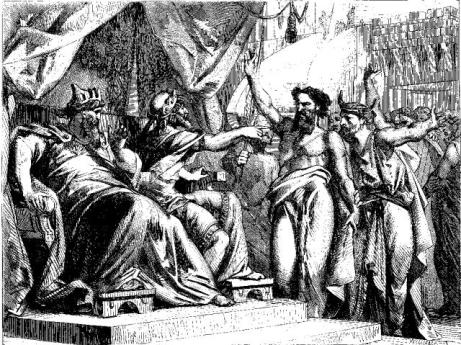
1 For three years Syria and Israel continued without war. But in the third year Jehoshaphat the king of Judah came down to the king of Israel. And the king of Israel said to his servants, “Do you know that Ramoth-gilead belongs to us, and we keep quiet and do not take it out of the hand of the king of Syria?” And he said to Jehoshaphat, “Will you go with me to battle at Ramoth-gilead?” And Jehoshaphat said to the king of Israel, “I am as you are, my people as your people, my horses as your horses.”

And Jehoshaphat said to the king of Israel, “Inquire first for the word of the LORD.” Then the king of Israel gathered the prophets together, about four hundred men, and said to them, “Shall I go to battle against Ramoth-gilead, or shall I refrain?” And they said, “Go up, for the Lord will give it into the hand of the king.” But Jehoshaphat said, “Is there not here another prophet of the LORD of whom we may inquire?” And the king of Israel said to Jehoshaphat, “There is yet one man by whom we may inquire of the LORD, Micaiah the son of Imlah, but I hate him, for he never prophesies good concerning me, but evil.” And Jehoshaphat said, “Let not the king say so.” Then the king of Israel summoned an officer and said, “Bring quickly Micaiah the son of Imlah.” 10 Now the king of Israel and Jehoshaphat the king of Judah were sitting on their thrones, arrayed in their robes, at the threshing floor at the entrance of the gate of Samaria, and all the prophets were prophesying before them. 11 And Zedekiah the son of Chenaanah made for himself horns of iron and said, “Thus says the LORD, ‘With these you shall push the Syrians until they are destroyed.’” 12 And all the prophets prophesied so and said, “Go up to Ramoth-gilead and triumph; the LORD will give it into the hand of the king.”

13 And the messenger who went to summon Micaiah said to him, “Behold, the words of the prophets with one accord are favorable to the king. Let your word be like the word of one of them, and speak favorably.” 14 But Micaiah said, “As the LORD lives, what the LORD says to me, that I will speak.” 1 Kings 22:1-14 ESV

King Ahab had been placed under a curse from God for having spared the life of Ben-hadad, the king of Syria. Rather than obey God’s command to put his enemy to death, Ahab had chosen to sign a peace treaty with him that would allow Israel to profit from Syria’s lucrative trading business. Yet, despite the judgment leveled against him by God, Ahab’s decision seems to have produced positive results.

The treaty that Ahab brokered produced three years of peace and prosperity between the two nations. Israel and Syria became allies and trading partners. According to an inscription on an Assyrian tablet discovered in 1861, Ahab and Ben-hadad were part of a 12-nation confederation that faced Emperor Shalmaneser and the Assyrians in the Battle of Qarqar in 853 BC. So, while God had decreed that Ahab’s dynasty would come to an end with his death, the king of Israel continued to enjoy a small measure of success. His insatiable desire for glory and self-aggrandizement would eventually drive him to jeopardize his peaceful and prosperous relationship with Syria.

During the time Ahab was on the throne of Israel, Jehoshaphat became the king of Judah. He succeeded his father, Asa, and, according to the book of 2 Chronicles, Jehoshaphat proved to be a good king.

The LORD was with Jehoshaphat, because he walked in the earlier ways of his father David. He did not seek the Baals, but sought the God of his father and walked in his commandments, and not according to the practices of Israel. Therefore the LORD established the kingdom in his hand. And all Judah brought tribute to Jehoshaphat, and he had great riches and honor. His heart was courageous in the ways of the LORD. And furthermore, he took the high places and the Asherim out of Judah. – 2 Chronicles 17:3-6 ESV

Because Jehoshaphat chose to remove all the false gods and restore the worship of the one true God, his reign was blessed, and the southern kingdom of Judah became a powerful force in the region. But Jehoshaphat, like his father before him, made the mistake of placing his trust in the Syrians. When King Baasha of Israel began to build a fortified city on the border between Israel and Judah, King Asa sought the help of Ben-hadad and the Syrians. Asa “took silver and gold from the treasures of the house of the LORD and the king’s house and sent them to Ben-hadad king of Syria” (2 Chronicles 16:2 ESV). He used these funds to convince Ben-hadad to break his covenant with Israel and join forces with him. His ploy worked, and Baasha stopped construction on his military outpost. But God condemned Asa for his alliance with Ben-hadad, warning that Judah would face non-stop war during the rest of his reign. Rather than trust God, Asa had placed his hope in a foreign king who worshiped false gods.

And while his son Jehoshaphat would prove to be faithful to God, he would also make an alliance with an ungodly, idol-worshiping king.

Now Jehoshaphat had great riches and honor, and he made a marriage alliance with Ahab. After some years he went down to Ahab in Samaria. And Ahab killed an abundance of sheep and oxen for him and for the people who were with him, and induced him to go up against Ramoth-gilead. – 2 Chronicles 18:1-2 ESV

This marital alliance ultimately put Jehoshaphat in a difficult position. While visiting Israel’s capital city of Samaria, Jehoshaphat was presented with an official request from Ahab for military assistance in recapturing the town of Ramoth-gilead from the Syrians. It galled Ahab that the Syrians had stolen a city that had once belonged to Israel, and nothing had been done about it.

“Do you know that Ramoth-gilead belongs to us, and we keep quiet and do not take it out of the hand of the king of Syria?” – 1 Kings 22:3 ESV

So, he called on Jehoshaphat to help him right this apparent wrong, and Jehoshaphat quickly and readily agreed.

“I am as you are, my people as your people, my horses as your horses.” – 1 Kings 22:4 ESV

But Jehoshaphat, anxious to remain obedient to God, asked Ahab to seek Yahweh’s counsel. It’s important to understand that Jehoshaphat wanted to know what the “LORD” (Yahweh) would have them do. But when Ahab commissioned his 400 prophets to seek the will of the gods, they came back with the answer:

“Go up, for the Lord (ăḏōnāy) will give it into the hand of the king.” – 1 Kings 22:6 ESV

These men did not mention the name of Yahweh, and Jehoshaphat seems to have immediately recognized that these were false prophets who had been seeking the will of their false god. So, he asked Ahab if there were no prophets of the one true God left in Israel. Ahab reluctantly confessed that one prophet of Yahweh remained, a man named Micaiah, whom he hated with a passion.

“He never prophesies anything but trouble for me!” – 1 Kings 22:8 NLT

Micaiah never told Ahab what he wanted to hear, so the king avoided him like the plague. But Jehoshaphat insisted that Micaiah be consulted before any action was taken against the Syrians.  So, Ahab sent someone to fetch his least-favorite prophet. In the meantime, his 400 false prophets bombarded Jehoshaphat with their cheery predictions of success.

“Go up to Ramoth-gilead and triumph; the LORD (Yahweh) will give it into the hand of the king.” – 1 Kings 22:12 ESV

This time, the prophets of Baal changed their tune and mentioned the name of Yahweh. Perhaps they hoped this reference to the God of Israel would convince Jehoshaphat to acquiesce and give his approval for the joint venture against the Syrians.

The text doesn’t reveal how long it took for Micaiah to be located and brought to Samaria. However, during the delay, Jehoshaphat found himself pressured to listen to the false prophets and join forces with Ahab. The temptation to compromise his convictions was great. He could have easily given in and listened to the popular opinions of the crowd, but instead, Jehoshaphat waited to hear a word from Yahweh.

Even Micaiah found himself pressured to follow the party line. The messenger who located him delivered a not-so-subtle warning that there was only one answer King Ahab wanted to hear.

“Look, all the prophets are promising victory for the king. Be sure that you agree with them and promise success.” – 1 Kings 22:13 NLT

But Micaiah would not be bullied into submission. He knew how much Ahab hated him, and he would be risking his life to disobey a direct order from the king. Yet his allegiance to Yahweh was greater than his fear of Ahab. So, he told the messenger, “As surely as the LORD lives, I will say only what the LORD tells me to say” (1 Kings 22:14 NLT).

It must have been a long and awkward trip back to Samaria for the messenger. He probably feared for his own life because he knew the prophet was determined to deliver bad news to the king. Everyone who worked for Ahab and all the people who lived in Israel knew that their king had no love affair with Yahweh. He had spent his entire reign promoting the worship of false gods like Baal and Asherah, and he had done everything he could do to ignore and even eliminate the prophets of God. Ahab knew exactly what Micaiah was going to say when he showed up, and it would not be what he wanted to hear.

Ahab needed Jehoshaphat’s help against the Syrians, and he knew that Jehoshaphat’s God would stand opposed to his ambitious plans to recapture Ramoth-gilead. Ahab didn’t want to hear from God because he was unwilling to do God’s will. Like a petulant child, Ahab was determined to get his way, even if it meant disobeying Yahweh’s will. But the prophet of the LORD was unwilling to succumb to the pressure to compromise his convictions and tell the king what he wanted to hear. He would speak the truth, even if it cost him his life. This obscure and little-known prophet was going to choose character over conformity and stand up to the threats of the wicked and powerful king of Israel.

Micaiah’s commitment to Yahweh was unassailable and non-negotiable. Nothing would convince him to compromise or sell out. He was determined to remain faithful to his God, whatever the cost. His bold determination to stand his ground in the face of intense opposition and even the threat of death is reminiscent of the actions of Shadrach, Meshach, and Abednego, the Hebrew friends of Daniel who found themselves facing a death sentence for refusing to bow to the statue King Nebuchadnezzar had erected.

“I will give you one more chance to bow down and worship the statue I have made when you hear the sound of the musical instruments. But if you refuse, you will be thrown immediately into the blazing furnace. And then what god will be able to rescue you from my power?”

Shadrach, Meshach, and Abednego replied, “O Nebuchadnezzar, we do not need to defend ourselves before you. If we are thrown into the blazing furnace, the God whom we serve is able to save us. He will rescue us from your power, Your Majesty. But even if he doesn’t, we want to make it clear to you, Your Majesty, that we will never serve your gods or worship the gold statue you have set up.” – Daniel 3:15-18 NLT

These three young men were willing to die for their beliefs and gladly faced the fires of the furnace with their commitment to Yahweh uncompromised. And their unwavering faith was rewarded.

So Shadrach, Meshach, and Abednego stepped out of the fire. Then the high officers, officials, governors, and advisers crowded around them and saw that the fire had not touched them. Not a hair on their heads was singed, and their clothing was not scorched. They didn’t even smell of smoke! – Daniel 3:26-27 NLT

The Book of Acts records another story of uncompromising faith in the face of unrelenting pressure. Peter and John had been jailed by the powerful Jewish Sanhedrin for preaching “that through Jesus there is a resurrection of the dead” (Acts 4:2 NLT). The following morning, when the two men were dragged before the council, they were ordered to cease and desist. The high priest commanded them, “never again to speak or teach in the name of Jesus” (Acts 4:18 NLT). 

But Peter and John replied, “Do you think God wants us to obey you rather than him? We cannot stop telling about everything we have seen and heard.” – Acts 4:18-20 NLT

Facing the threat of additional jail time or worse, Peter and John stood their ground and declared their intention to continue preaching the truth concerning Jesus. They could be threatened, but they would not be silenced. And, in doing so, they joined the ranks of other faithful men like Micaiah, Daniel, Shadrach, Meshach, and Abednego.

English Standard Version (ESV) The Holy Bible, English Standard Version. ESV® Permanent Text Edition® (2016). Copyright © 2001 by Crossway Bibles, a publishing ministry of Good News Publishers.

New Living Translation (NLT) Holy Bible, New Living Translation, copyright © 1996, 2004, 2015 by Tyndale House Foundation. Used by permission of Tyndale House Publishers Inc., Carol Stream, Illinois 60188. All rights reserved.

The High Cost of Compromised Convictions

11 Now an old prophet lived in Bethel. And his sons came and told him all that the man of God had done that day in Bethel. They also told to their father the words that he had spoken to the king. 12 And their father said to them, “Which way did he go?” And his sons showed him the way that the man of God who came from Judah had gone. 13 And he said to his sons, “Saddle the donkey for me.” So they saddled the donkey for him and he mounted it. 14 And he went after the man of God and found him sitting under an oak. And he said to him, “Are you the man of God who came from Judah?” And he said, “I am.” 15 Then he said to him, “Come home with me and eat bread.” 16 And he said, “I may not return with you, or go in with you, neither will I eat bread nor drink water with you in this place, 17 for it was said to me by the word of the LORD, ‘You shall neither eat bread nor drink water there, nor return by the way that you came.’” 18 And he said to him, “I also am a prophet as you are, and an angel spoke to me by the word of the LORD, saying, ‘Bring him back with you into your house that he may eat bread and drink water.’” But he lied to him. 19 So he went back with him and ate bread in his house and drank water.

20 And as they sat at the table, the word of the LORD came to the prophet who had brought him back. 21 And he cried to the man of God who came from Judah, “Thus says the LORD, ‘Because you have disobeyed the word of the LORD and have not kept the command that the LORD your God commanded you, 22 but have come back and have eaten bread and drunk water in the place of which he said to you, “Eat no bread and drink no water,” your body shall not come to the tomb of your fathers.’” 23 And after he had eaten bread and drunk, he saddled the donkey for the prophet whom he had brought back. 24 And as he went away a lion met him on the road and killed him. And his body was thrown in the road, and the donkey stood beside it; the lion also stood beside the body. 25 And behold, men passed by and saw the body thrown in the road and the lion standing by the body. And they came and told it in the city where the old prophet lived.

26 And when the prophet who had brought him back from the way heard of it, he said, “It is the man of God who disobeyed the word of the LORD; therefore the LORD has given him to the lion, which has torn him and killed him, according to the word that the LORD spoke to him.” 27 And he said to his sons, “Saddle the donkey for me.” And they saddled it. 28 And he went and found his body thrown in the road, and the donkey and the lion standing beside the body. The lion had not eaten the body or torn the donkey. 29 And the prophet took up the body of the man of God and laid it on the donkey and brought it back to the city to mourn and to bury him. 30 And he laid the body in his own grave. And they mourned over him, saying, “Alas, my brother!” 31 And after he had buried him, he said to his sons, “When I die, bury me in the grave in which the man of God is buried; lay my bones beside his bones. 32 For the saying that he called out by the word of the LORD against the altar in Bethel and against all the houses of the high places that are in the cities of Samaria shall surely come to pass.”

33 After this thing Jeroboam did not turn from his evil way, but made priests for the high places again from among all the people. Any who would, he ordained to be priests of the high places. 34 And this thing became sin to the house of Jeroboam, so as to cut it off and to destroy it from the face of the earth. 1 Kings 13:11-34 ESV

After delivering God’s message of judgment to Jeroboam and having destroyed the altar dedicated to one of Jeroboam’s false gods, the young prophet began his return journey to Judah. He had successfully fulfilled his God-ordained mission and was following Yahweh’s strict instructions to spend no additional time among the northern tribes. He was to accept no forms of hospitality or allow anything to delay his return home. He was even warned to take a different route back to Judah to prevent anyone from interfering with his mission. This young prophet had proved to be obedient to the will of God, even rejecting Jeroboam’s tempting offer of a meal and a reward. Instead, he declared his intentions to remain faithful to every detail of God’s instructions.

“Even if you gave me half of everything you own, I would not go with you. I would not eat or drink anything in this place. For the LORD gave me this command: ‘You must not eat or drink anything while you are there, and do not return to Judah by the same way you came.’” So he left Bethel and went home another way. – 1 Kings 13:8-10 NLT

But as the story continues to unfold and the young prophet makes his way home, he decides to take what appears to be an unsanctioned break under a large tree. Having not yet crossed the border into Judah, he decided to take a much-needed rest. While the text does not tell where the young man began his journey to Judah that day, he had likely spent many hours making the trip to Bethel. If he started his trip from Jerusalem, it would have been a 90-mile trek to Bethel. And now, after having destroyed Jeroboam’s altar to his false god, the prophet had to walk all the way back. So, it makes perfect sense that he was weary from all the activity and excitement of the day. He was tired, hungry, and alone. But he had not yet completed his mission. He had been instructed by God to return to Judah without delay and to avoid all distractions.

Yet, as the young man rested under the tree, he was approached by a stranger — an old prophet who happened to live in Bethel. The author provides few details about this man, except that he was a prophet and a father. His sons, who had witnessed the events at the altar that day, returned home and told him all that the young prophet had said and done. Intrigued by what he heard, the elder prophet commanded his sons to saddle a donkey so that he could seek out his younger peer. It seems likely that he simply wanted to verify the message the younger prophet had delivered. As a prophet himself, this older man would have been interested in whether the message delivered by the young man was actually from Yahweh. If it were, there were dark days ahead for the northern kingdom. What the young prophet declared at the altar earlier that day did not bode well for the ten northern tribes.

“A child named Josiah will be born into the dynasty of David. On you he will sacrifice the priests from the pagan shrines who come here to burn incense, and human bones will be burned on you.” – 1 Kings 13:2 NLT

Those were serious words that implied future judgment against the northern kingdom, and this senior prophet was anxious to verify their veracity. So, he mounted his donkey and began his search for the one who had delivered this foreboding message. Since the young prophet had decided to take his unscheduled rest stop under the tree, the older prophet caught up with him before he had crossed over into Judah. This is where the story gets interesting.

Based on what happens next, it is difficult to understand the motives of the older man. He clearly used deception to convince the younger prophet to return to his home for a meal. His offer was rejected by the young man because it violated the command of God.

“I am not allowed to eat or drink anything here in this place. For the Lord gave me this command: ‘You must not eat or drink anything while you are there, and do not return to Judah by the same way you came.’” – 1 Kings 13:16-17 NLT

They were still within the borders of Israel because the young prophet had not yet made it to the safety of Judah. But, anxious to hear more about the young man’s message from God, the older prophet lied to him. He falsely claimed to have been given a message from an angel commanding him to bring the young man to his home for a meal. Driven by hunger, the young prophet lowered his defenses and accepted the offer. But in doing so, he disobeyed the command of God. He allowed his physical appetites to cloud his thinking and compromise his convictions.

The text indicates that the young prophet violated the divine decree by sharing a meal in the older prophet’s home. As soon as he had eaten the food he had been commanded to avoid, the young man received a stinging rebuke from God delivered by the very man who had just deceived him.

“This is what the LORD says: You have defied the word of the LORD and have disobeyed the command the LORD your God gave you. You came back to this place and ate and drank where he told you not to eat or drink. Because of this, your body will not be buried in the grave of your ancestors.” – 1 Kings 13:21-22 NLT

This time, the older prophet had spoken the truth. His lie had caused the younger prophet to disobey God. Now, he had the unpleasant responsibility of delivering God’s message of judgment against the very man he had deceived and caused to disobey. The rest of the story reads like something out of Grimms’ Fairy Tales. The young man, with a full stomach and a heavy heart, began his journey home. But before he could make it into Judah, he was attacked by a lion. The beast killed the prophet but left the body and the donkey unmolested. Uncharacteristically, the lion stood sentry over the fallen body, protecting it from other predators. Passing travelers saw the strange scene and reported it back in Bethel. Upon hearing the news, the older prophet retrieved the body of the young man and placed it in his own tomb, located in the city of Bethel.

The old man was now fully convinced that what the young prophet had said had been the word of God.

“For the message the LORD told him to proclaim against the altar in Bethel and against the pagan shrines in the towns of Samaria will certainly come true.” – 1 Kings 13:32 NLT

Yahweh had used this young, unnamed prophet to declare His judgment against the ten northern tribes. Their continued apostasy would eventually lead to their destruction. When it came to His chosen people, God was deadly serious about their obedience to Him. Whether they were a fully united confederation of 12 tribes or divided into two rival kingdoms, they remained His prized possession and were obligated to live according to His commands. Obedience would bring the blessings of God, but disobedience would bring His curses.

The young prophet had learned the costly lesson that partial obedience was insufficient and unacceptable to God. He had almost completed his mission but had ultimately failed. He had been sent by God, but he ultimately ended up being punished by God for allowing worldly distractions to divert him from his ultimate goal. Had he crossed the border into Judah, he could have eaten his fill of food. But he compromised and allowed his physical appetites to cloud his thinking and distract him from his God-given assignment, and he paid dearly for his mistake. This young man’s life is a perfect illustration of what the apostle John warned about in his first epistle.

Do not love this world nor the things it offers you, for when you love the world, you do not have the love of the Father in you. For the world offers only a craving for physical pleasure, a craving for everything we see, and pride in our achievements and possessions. These are not from the Father, but are from this world. And this world is fading away, along with everything that people crave. But anyone who does what pleases God will live forever. – 1 John 2:15-17 NLT

The young prophet’s desire for physical pleasure ended up superseding his love for God, and it proved not only disappointing but deadly. The older and supposedly wiser prophet had long ago compromised his convictions by remaining in Israel long after Jeroboam had erected his false gods and created his own religion. He had done nothing to address the apostasy in Israel, and he seemed unbothered by the fact that Jeroboam restricted the people from returning to Jerusalem to celebrate the annual feasts. The fact that Yahweh chose to use a younger and much less experienced prophet to deliver His message of judgment to Jeroboam speaks volumes. Yet, in the end, the older prophet was convicted by his compromise and complacency and did the right thing.

So the prophet laid the body of the man of God on the donkey and took it back to the town to mourn over him and bury him. He laid the body in his own grave, crying out in grief, “Oh, my brother!” – 1 Kings 13:29-30 NLT

English Standard Version (ESV) The Holy Bible, English Standard Version. ESV® Permanent Text Edition® (2016). Copyright © 2001 by Crossway Bibles, a publishing ministry of Good News Publishers.

New Living Translation (NLT) Holy Bible, New Living Translation, copyright © 1996, 2004, 2015 by Tyndale House Foundation. Used by permission of Tyndale House Publishers Inc., Carol Stream, Illinois 60188. All rights reserved.

Rebuilding the Spiritual Walls

1 On that day they read from the Book of Moses in the hearing of the people. And in it was found written that no Ammonite or Moabite should ever enter the assembly of God, for they did not meet the people of Israel with bread and water, but hired Balaam against them to curse them—yet our God turned the curse into a blessing. As soon as the people heard the law, they separated from Israel all those of foreign descent.

Now before this, Eliashib the priest, who was appointed over the chambers of the house of our God, and who was related to Tobiah, prepared for Tobiah a large chamber where they had previously put the grain offering, the frankincense, the vessels, and the tithes of grain, wine, and oil, which were given by commandment to the Levites, singers, and gatekeepers, and the contributions for the priests. While this was taking place, I was not in Jerusalem, for in the thirty-second year of Artaxerxes king of Babylon I went to the king. And after some time I asked leave of the king and came to Jerusalem, and I then discovered the evil that Eliashib had done for Tobiah, preparing for him a chamber in the courts of the house of God. And I was very angry, and I threw all the household furniture of Tobiah out of the chamber. Then I gave orders, and they cleansed the chambers, and I brought back there the vessels of the house of God, with the grain offering and the frankincense.

10 I also found out that the portions of the Levites had not been given to them, so that the Levites and the singers, who did the work, had fled each to his field. 11 So I confronted the officials and said, “Why is the house of God forsaken?” And I gathered them together and set them in their stations. 12 Then all Judah brought the tithe of the grain, wine, and oil into the storehouses. 13 And I appointed as treasurers over the storehouses Shelemiah the priest, Zadok the scribe, and Pedaiah of the Levites, and as their assistant Hanan the son of Zaccur, son of Mattaniah, for they were considered reliable, and their duty was to distribute to their brothers. 14 Remember me, O my God, concerning this, and do not wipe out my good deeds that I have done for the house of my God and for his service.

15 In those days I saw in Judah people treading winepresses on the Sabbath, and bringing in heaps of grain and loading them on donkeys, and also wine, grapes, figs, and all kinds of loads, which they brought into Jerusalem on the Sabbath day. And I warned them on the day when they sold food. 16 Tyrians also, who lived in the city, brought in fish and all kinds of goods and sold them on the Sabbath to the people of Judah, in Jerusalem itself! 17 Then I confronted the nobles of Judah and said to them, “What is this evil thing that you are doing, profaning the Sabbath day? 18 Did not your fathers act in this way, and did not our God bring all this disaster on us and on this city? Now you are bringing more wrath on Israel by profaning the Sabbath.”

19 As soon as it began to grow dark at the gates of Jerusalem before the Sabbath, I commanded that the doors should be shut and gave orders that they should not be opened until after the Sabbath. And I stationed some of my servants at the gates, that no load might be brought in on the Sabbath day. 20 Then the merchants and sellers of all kinds of wares lodged outside Jerusalem once or twice. 21 But I warned them and said to them, “Why do you lodge outside the wall? If you do so again, I will lay hands on you.” From that time on they did not come on the Sabbath. 22 Then I commanded the Levites that they should purify themselves and come and guard the gates, to keep the Sabbath day holy. Remember this also in my favor, O my God, and spare me according to the greatness of your steadfast love.

23 In those days also I saw the Jews who had married women of Ashdod, Ammon, and Moab. 24 And half of their children spoke the language of Ashdod, and they could not speak the language of Judah, but only the language of each people. 25 And I confronted them and cursed them and beat some of them and pulled out their hair. And I made them take an oath in the name of God, saying, “You shall not give your daughters to their sons, or take their daughters for your sons or for yourselves. 26 Did not Solomon king of Israel sin on account of such women? Among the many nations there was no king like him, and he was beloved by his God, and God made him king over all Israel. Nevertheless, foreign women made even him to sin. 27 Shall we then listen to you and do all this great evil and act treacherously against our God by marrying foreign women?”

28 And one of the sons of Jehoiada, the son of Eliashib the high priest, was the son-in-law of Sanballat the Horonite. Therefore I chased him from me. 29 Remember them, O my God, because they have desecrated the priesthood and the covenant of the priesthood and the Levites.

30 Thus I cleansed them from everything foreign, and I established the duties of the priests and Levites, each in his work; 31 and I provided for the wood offering at appointed times, and for the firstfruits.

Remember me, O my God, for good. Nehemiah 13:1-31 ESV

The timing of these events is crucial. The opening line of this book states that Nehemiah received permission from Artaxerxes to return to Jerusalem during the king’s 20th year (445 B.C.). It is estimated that he arrived in Jerusalem sometime in 444 B.C. Because Nehemiah was on the king’s payroll as his cupbearer, he was allowed to go on his journey but was expected to return to report his progress to the king. Nehemiah states, “in the thirty-second year of Artaxerxes king of Babylon I went to the king” (Nehemiah 13:6 ESV). This would have been 12 years after he arrived in Jerusalem. During his absence, things took a turn for the worse in Jerusalem. This brings to mind the old adage, “When the cats away, the mice will play.” While the teacher was out of the room, chaos broke out among the students.

It’s impossible to know how long Nehemiah was gone. He simply states that he returned “after some time” (Nehemiah 13:6 ESV). The gravity of the conditions in Jerusalem would suggest that he was gone for an extended time, perhaps years. Nehemiah likely received regular reports on the conditions in Jerusalem and was aware of the sorry state of affairs in his native land. This prompted him to approach the king and request another leave of absence to return to Jerusalem to deal with the matter.

When he arrived, Nehemiah was appalled by what he saw. Everywhere he looked, he saw signs that the people had violated the covenant they made with Yahweh.

“We promise not to let our daughters marry the pagan people of the land, and not to let our sons marry their daughters.

“We also promise that if the people of the land should bring any merchandise or grain to be sold on the Sabbath or on any other holy day, we will refuse to buy it. Every seventh year we will let our land rest, and we will cancel all debts owed to us.

“In addition, we promise to obey the command to pay the annual Temple tax of one-eighth of an ounce of silver for the care of the Temple of our God. This will provide for the Bread of the Presence; for the regular grain offerings and burnt offerings; for the offerings on the Sabbaths, the new moon celebrations, and the annual festivals; for the holy offerings; and for the sin offerings to make atonement for Israel. It will provide for everything necessary for the work of the Temple of our God.” – Nehemiah 10:30-33 NLT

The opening lines of Chapter 13 reveal that God’s law prohibited the Israelites from having anything to do with the Ammonites and Moabites. These two nations were the descendants of Lot, the nephew of Abraham. They were the result of his incestuous affairs with his daughters and had stood opposed to the Israelites when they were attempting to enter the land of Canaan. God had specifically told Moses, “No Ammonite or Moabite or any of their descendants for ten generations may be admitted to the assembly of the Lord. These nations did not welcome you with food and water when you came out of Egypt. Instead, they hired Balaam son of Beor from Pethor in distant Aram-naharaim to curse you” (Deuteronomy 25:3-4 NLT). 

God made His views clear concerning Israel’s interactions with these two nations.

“As long as you live, you must never promote the welfare and prosperity of the Ammonites or Moabites.”Deuteronomy 25:6 NLT

Yet, when Nehemiah returned to Jerusalem, he found that Tobiah the Ammonite had been given private accommodations in the Temple. This man was not only a pagan and a foreigner, but he had been one of the most vocal opponents of Nehemiah’s efforts to rebuild the walls. It seems that Tobiah was a relative of Eliashib the high priest (Nehemiah 13:28). This servant of God had taken it upon himself to empty out one of the Temple’s storerooms and convert it into an apartment for his Ammonite relative.

The room had previously been used for storing the grain offerings, the frankincense, various articles for the Temple, and the tithes of grain, new wine, and olive oil (which were prescribed for the Levites, the singers, and the gatekeepers), as well as the offerings for the priests. – Nehemiah 13:5 NLT

To make matters worse, one of Eliashib’s grandsons had married a daughter of Sanballat the Horonite, another prominent opponent of the rebuilding effort. The most prominent spiritual leader in Judah was guilty of fraternizing with the enemy and violating the law of God. His actions set an unacceptable precedence for the rest of the nation by promoting compromise and accommodation. God had set this man apart and tasked him with teaching the law to the people. Instead, he demonstrated an open disdain and disregard for God’s commands.

With the spiritual leaders modeling unrighteous behavior, the people followed suit. They became lax in their commitments to God, refusing to bring “their tithes of grain, new wine, and olive oil to the Temple storerooms” (Nehemiah 13:12 NLT). Their neglect of God’s commands had left the Levites and the Temple servants without enough food to survive and forced them to fend for themselves. They returned to farming and shepherding to make ends meet, abandoning their duties at the Temple.

On the first Sabbath after his return, Nehemiah discovered that the people’s vow to keep the seventh day holy had also been abandoned.

I saw men of Judah treading out their winepresses on the Sabbath. They were also bringing in grain, loading it on donkeys, and bringing their wine, grapes, figs, and all sorts of produce to Jerusalem to sell on the Sabbath. So I rebuked them for selling their produce on that day. Some men from Tyre, who lived in Jerusalem, were bringing in fish and all kinds of merchandise. They were selling it on the Sabbath to the people of Judah—and in Jerusalem at that! – Nememiah 13:15-16 NLT

The Sabbath day had become just like any day of the week. Work was being done. Business transactions were taking place. Foreigners were entering the city to trade and sell. It was a free-for-all and in direct violation of God’s command.

“Remember to observe the Sabbath day by keeping it holy.You have six days each week for your ordinary work, but the seventh day is a Sabbath day of rest dedicated to the Lord your God. On that day no one in your household may do any work. This includes you, your sons and daughters, your male and female servants, your livestock, and any foreigners living among you. For in six days the Lord made the heavens, the earth, the sea, and everything in them; but on the seventh day he rested. That is why the Lord blessed the Sabbath day and set it apart as holy. – Exodus 20:8-11 NLT

When Nehemiah had first returned to Jerusalem in 444 B.C., he “inspected the walls of Jerusalem that were broken down and its gates that had been destroyed by fire” (Nehemiah 2:13 ESV). But those dismal conditions were nothing compared to the sorry state of affairs he found this time. Everywhere he looked he found the “spiritual” walls of Jerusalem had fallen. The covenant had been broken and the people were ripe for spiritual attack. The people had even violated God’s ban on marrying foreigners. It was a fiasco of epic proportions but Nehemiah took charge and began to set things right. He threw out Tobiah. He banished Eliashib’s grandson. He demanded that the people pay their delinquent tithes and offerings. He beat and cursed those who had allowed their children to intermarry with outsiders. He restored the Levites and priests to their duties. He locked the city gates on the Sabbath and shut down all business transactions.

In essence, Nehemiah orchestrated a community-wide revival. He single-handedly instituted a spiritual revitalization program that transformed an entire nation virtually overnight. What he accomplished on this occasion was far more important than building the walls of Jerusalem. The physical stones that comprised the wall could not keep out the apathy and moral decay that threatened to destroy the nation of Judah. The gates couldn’t prevent the enemy from infiltrating the hearts of the people and leading them to disobey God and disavow their allegiance to them. It took one man committed to God to rescue a city filled with people who had broken their vow to God. This faithful layman did what the high priest had failed to do.

In the Book of Ezekiel, God describes the real problem that existed in the land of Judah when Nehemiah first returned.

“I looked for someone who might rebuild the wall of righteousness that guards the land. I searched for someone to stand in the gap in the wall so I wouldn’t have to destroy the land, but I found no one. – Ezekiel 22:30 NLT

But Nehemiah proved to be the right man for the job. He not only built a physical wall to protect the city of Jerusalem, but he also built a spiritual wall that restored a fallen people to their former status as “a kingdom of priests and a holy nation” (Exodus 19:6 ESV).

English Standard Version (ESV)
The Holy Bible, English Standard Version. ESV® Permanent Text Edition® (2016). Copyright © 2001 by Crossway Bibles, a publishing ministry of Good News Publishers.

New Living Translation (NLT)
Holy Bible, New Living Translation, copyright © 1996, 2004, 2015 by Tyndale House Foundation. Used by permission of Tyndale House Publishers Inc., Carol Stream, Illinois 60188. All rights reserved.

Drastic Measures Required

1 While Ezra prayed and made confession, weeping and casting himself down before the house of God, a very great assembly of men, women, and children, gathered to him out of Israel, for the people wept bitterly. And Shecaniah the son of Jehiel, of the sons of Elam, addressed Ezra: “We have broken faith with our God and have married foreign women from the peoples of the land, but even now there is hope for Israel in spite of this. Therefore let us make a covenant with our God to put away all these wives and their children, according to the counsel of my lord and of those who tremble at the commandment of our God, and let it be done according to the Law. Arise, for it is your task, and we are with you; be strong and do it.” Then Ezra arose and made the leading priests and Levites and all Israel take an oath that they would do as had been said. So they took the oath.

Then Ezra withdrew from before the house of God and went to the chamber of Jehohanan the son of Eliashib, where he spent the night, neither eating bread nor drinking water, for he was mourning over the faithlessness of the exiles. And a proclamation was made throughout Judah and Jerusalem to all the returned exiles that they should assemble at Jerusalem, and that if anyone did not come within three days, by order of the officials and the elders all his property should be forfeited, and he himself banned from the congregation of the exiles.

Then all the men of Judah and Benjamin assembled at Jerusalem within the three days. It was the ninth month, on the twentieth day of the month. And all the people sat in the open square before the house of God, trembling because of this matter and because of the heavy rain. 10 And Ezra the priest stood up and said to them, “You have broken faith and married foreign women, and so increased the guilt of Israel. 11 Now then make confession to the Lord, the God of your fathers and do his will. Separate yourselves from the peoples of the land and from the foreign wives.” 12 Then all the assembly answered with a loud voice, “It is so; we must do as you have said. 13 But the people are many, and it is a time of heavy rain; we cannot stand in the open. Nor is this a task for one day or for two, for we have greatly transgressed in this matter. 14 Let our officials stand for the whole assembly. Let all in our cities who have taken foreign wives come at appointed times, and with them the elders and judges of every city, until the fierce wrath of our God over this matter is turned away from us.” 15 Only Jonathan the son of Asahel and Jahzeiah the son of Tikvah opposed this, and Meshullam and Shabbethai the Levite supported them.

16 Then the returned exiles did so. Ezra the priest selected men, heads of fathers’ houses, according to their fathers’ houses, each of them designated by name. On the first day of the tenth month they sat down to examine the matter; 17 and by the first day of the first month they had come to the end of all the men who had married foreign women. Ezra 10:1-17 ESV

Shortly after his return to Judah, Ezra discovered that the first wave of returned exiles were guilty of violating God’s law. For the last 80 years, they had been compromising their set-apart status as God’s chosen people by intermarrying with the land’s foreign occupants.

“The people of Israel and the priests and the Levites have not separated themselves from the peoples of the lands with their abominations, from the Canaanites, the Hittites, the Perizzites, the Jebusites, the Ammonites, the Moabites, the Egyptians, and the Amorites. For they have taken some of their daughters to be wives for themselves and for their sons, so that the holy race has mixed itself with the peoples of the lands.” – Ezra 9:1-2 ESV

Ezra was shaken to the core by this disturbing news and driven to his knees before Yahweh. He knew the people’s behavior was deserving of judgment because they had violated God’s long-standing prohibition against marriage with outsiders. As a scribe and an expert in the Mosaic Law, Ezra was highly familiar with the details of this divine decree and recited it back to God as part of his prayer.

“The land you are entering to possess is totally defiled by the detestable practices of the people living there. From one end to the other, the land is filled with corruption. Don’t let your daughters marry their sons! Don’t take their daughters as wives for your sons. Don’t ever promote the peace and prosperity of those nations. – Ezra 9:11-12 NLT

This law was not a statement about interracial marriage but a call to holiness and moral purity. The nations that inhabited the land of Canaan were not followers of Yahweh. They had their own gods and utilized a range of “detestable” rites and rituals to worship these false deities. Chapter 18 of the Book of Leviticus contains a list of practices that were off-limits to the people of God. It includes such sins as incest, child sacrifice, homosexuality, and bestiality. And God made it clear that these sins were

“Do not defile yourselves in any of these ways, for the people I am driving out before you have defiled themselves in all these ways. Because the entire land has become defiled, I am punishing the people who live there.” – Leviticus 18:24-25 NLT

You must not commit any of these detestable sins.” – Leviticus 18:26 NLT

So obey my instructions, and do not defile yourselves by committing any of these detestable practices that were committed by the people who lived in the land before you. I am the Lord your God.” – Leviticus 18:30 NLT

God was not condemning the Canaanites as an inferior race; He was warning against the threat of religious compromise that accompanies cohabitation with non-Yahweh followers. Marriage involves the comingling of the lives of a man and a woman as they become “one flesh.” They share everything in common, including their sexual desires and spiritual beliefs and practices. That is why God warned the people of Israel to abstain from intermarriage.

“You must not intermarry with them. Do not let your daughters and sons marry their sons and daughters, for they will lead your children away from me to worship other gods.” – Deuteronomy 7:3-4 NLT

It was always about spiritual fidelity and faithfulness. That is why Paul provided the believers in Corinth with a powerful warning about the risk of spiritual compromise that happens when believers become “unequally yoked” with unbelievers.

Don’t team up with those who are unbelievers. How can righteousness be a partner with wickedness? How can light live with darkness? What harmony can there be between Christ and the devil? How can a believer be a partner with an unbeliever? And what union can there be between God’s temple and idols? For we are the temple of the living God. – 2 Corinthians 6:14-16 NLT

Ezra was faced with a dilemma. He confessed the people’s guilt but knew that God would be just and right if He decided to pour out His wrath.

“O Lord, the God of Israel, you are just, for we are left a remnant that has escaped, as it is today. Behold, we are before you in our guilt, for none can stand before you because of this.” – Ezra 9:15 ESV

It’s important to note that Ezra became aware of the people’s transgression after offering sacrifices to God at the Temple.

Then the exiles who had come out of captivity sacrificed burnt offerings to the God of Israel. They presented twelve bulls for all the people of Israel, as well as ninety-six rams and seventy-seven male lambs. They also offered twelve male goats as a sin offering. All this was given as a burnt offering to the Lord. – Ezra 8:35 NLT

The sin offers had been meant to provide atonement for the sins of the people. But now Ezra knew that the people were unrepentant and unwilling to give up their unsanctioned marriages and unholy alliances with their false gods. Despite all the sacrifices offered in His name, God could not overlook their blatant disregard for His Law.

As Ezra prayed, wept, and mourned the sorry state of affairs in Judah, he was joined by a large group of men, women, and children. They had heard Ezra’s confession of guilt and were convicted of their guilt and their need for repentance.

“We have been unfaithful to our God, for we have married these pagan women of the land. But in spite of this there is hope for Israel. Let us now make a covenant with our God to divorce our pagan wives and to send them away with their children. We will follow the advice given by you and by the others who respect the commands of our God. Let it be done according to the Law of God.” – Ezra 10:2-3 NLT

They knew that confession was not enough. God required a change in their behavior. So, to appease God, they came up with a plan that required drastic measures and a corporate commitment on the part of the people. Every single marriage that was in violation of God’s Law was to be annulled. All foreign wives and their children were to be “put away,” an act of permanent separation that was intended to restore the purity of the people of God.

“This proposal is harsh in the light of modern Christian conceptions. Why should innocent children be punished? We must remember that the religious influence of the mothers on their children was regarded as the stumbling block. To keep the religion of the Lord pure was the one and only aim of Ezra and the returned exiles. As a small minority group, the repatriates lived in the Holy Land among a large population of influential people who were followers of various polytheistic religions. Against such larger numbers they had to defend themselves and their religious identity. Thus the drastic measures are understandable.” – F. Charles Fensham, The Books of Ezra and Nehemiah. New International Commentary on the Old Testament series

Ezra gave his approval to the plan and ordered its immediate ratification by “the leaders of the priests and the Levites and all the people of Israel” (Ezra 10:5 NLT). He then spent the night praying and fasting to prepare himself for the difficult days that lie ahead. He knew this was going to be a formidable undertaking for the people of Judah. Their sin was grievous and the corrective measures were going to be painful and gut-wrenching for all involved. Husbands and wives would be permanently separated. Fathers would never see their children again. Ezra found no joy in issuing the order to break up these homes but he knew it was necessary. The next morning, he addressed the people of Judah, ordering them to carry out the covenant they had made.

“You have committed a terrible sin. By marrying pagan women, you have increased Israel’s guilt. So now confess your sin to the Lord, the God of your ancestors, and do what he demands. Separate yourselves from the people of the land and from these pagan women.” – Ezra 10:10-11 NLT

Despite the devastating consequences of Ezra’s command, the people agreed to obey it. But they begged for time to carry it out. Their request for additional time points to the magnitude and scope of the problem. This was a widespread problem that stretched to the far corners of the land of Judah, so they begged Ezra for more time to fulfill their commitment.

“This isn’t something that can be done in a day or two, for many of us are involved in this extremely sinful affair. And this is the rainy season, so we cannot stay out here much longer.” – Ezra 10:13 NLT

To dissolve these marriages would require a certificate of divorce and authorization by the priesthood. This would take time. So, a plan was established to set up local courts throughout Judah where the people could come to have their marriages legally annulled. But as will become clear in the closing verses of this chapter, the priests and leaders of Judah had set the precedence for this debacle. They had paved the way for the people’s transgression by validating intermarriage through their own lives. It had started at the top and trickled down to those below. The shepherds had failed the sheep and God was not pleased.

English Standard Version (ESV)
The Holy Bible, English Standard Version. ESV® Permanent Text Edition® (2016). Copyright © 2001 by Crossway Bibles, a publishing ministry of Good News Publishers.

New Living Translation (NLT)
Holy Bible, New Living Translation, copyright © 1996, 2004, 2015 by Tyndale House Foundation. Used by permission of Tyndale House Publishers Inc., Carol Stream, Illinois 60188. All rights reserved.

The Message (MSG)Copyright © 1993, 1994, 1995, 1996, 2000, 2001, 2002 by Eugene H. Peterson