The High Cost of Compromise

1 After these things had been done, the officials approached me and said, “The people of Israel and the priests and the Levites have not separated themselves from the peoples of the lands with their abominations, from the Canaanites, the Hittites, the Perizzites, the Jebusites, the Ammonites, the Moabites, the Egyptians, and the Amorites. For they have taken some of their daughters to be wives for themselves and for their sons, so that the holy race has mixed itself with the peoples of the lands. And in this faithlessness the hand of the officials and chief men has been foremost.” As soon as I heard this, I tore my garment and my cloak and pulled hair from my head and beard and sat appalled. Then all who trembled at the words of the God of Israel, because of the faithlessness of the returned exiles, gathered around me while I sat appalled until the evening sacrifice. And at the evening sacrifice I rose from my fasting, with my garment and my cloak torn, and fell upon my knees and spread out my hands to the Lord my God, saying:

“O my God, I am ashamed and blush to lift my face to you, my God, for our iniquities have risen higher than our heads, and our guilt has mounted up to the heavens. From the days of our fathers to this day we have been in great guilt. And for our iniquities we, our kings, and our priests have been given into the hand of the kings of the lands, to the sword, to captivity, to plundering, and to utter shame, as it is today. But now for a brief moment favor has been shown by the Lord our God, to leave us a remnant and to give us a secure hold within his holy place, that our God may brighten our eyes and grant us a little reviving in our slavery. For we are slaves. Yet our God has not forsaken us in our slavery, but has extended to us his steadfast love before the kings of Persia, to grant us some reviving to set up the house of our God, to repair its ruins, and to give us protection in Judea and Jerusalem.

10 “And now, O our God, what shall we say after this? For we have forsaken your commandments, 11 which you commanded by your servants the prophets, saying, ‘The land that you are entering, to take possession of it, is a land impure with the impurity of the peoples of the lands, with their abominations that have filled it from end to end with their uncleanness. 12 Therefore do not give your daughters to their sons, neither take their daughters for your sons, and never seek their peace or prosperity, that you may be strong and eat the good of the land and leave it for an inheritance to your children forever.’ 13 And after all that has come upon us for our evil deeds and for our great guilt, seeing that you, our God, have punished us less than our iniquities deserved and have given us such a remnant as this, 14 shall we break your commandments again and intermarry with the peoples who practice these abominations? Would you not be angry with us until you consumed us, so that there should be no remnant, nor any to escape? 15 O Lord, the God of Israel, you are just, for we are left a remnant that has escaped, as it is today. Behold, we are before you in our guilt, for none can stand before you because of this.” Ezra 9:1-15 ESV

It had been 80 years since the first wave of Israelites returned to the land of Judah under the aegis of King Cyrus of Persia. These former exiles had been given permission to return to their homeland so that they might restore the city of Jerusalem and rebuild the Temple of Solomon. This generation of Israelites had been born in Babylon during the 70 years of exile that God had ordained as punishment for their parents’ failure to keep their covenant commitment to Him.

Sixty-six years before the Babylonians invaded Judah and captured the city of Jerusalem, God foretold of the coming destruction. He spoke through His prophet Jeremiah, who delivered His warning of pending judgment to the stubbornly rebellious people of Judah.

“But you would not listen to me,” says the Lord. “You made me furious by worshiping idols you made with your own hands, bringing on yourselves all the disasters you now suffer. And now the Lord of Heaven’s Armies says: Because you have not listened to me, I will gather together all the armies of the north under King Nebuchadnezzar of Babylon, whom I have appointed as my deputy. I will bring them all against this land and its people and against the surrounding nations. I will completely destroy you and make you an object of horror and contempt and a ruin forever. I will take away your happy singing and laughter. The joyful voices of bridegrooms and brides will no longer be heard. Your millstones will fall silent, and the lights in your homes will go out. This entire land will become a desolate wasteland. Israel and her neighboring lands will serve the king of Babylon for seventy years. – Jeremiah 25:7-11 NLT

Everything happened just as God said it would. In 539 B.C., the Babylonians ended a years-long siege, breaching the walls of Jerusalem and wreaking destruction upon the city and its citizens. Those who did not die by the sword were taken captive and transported to Babylon. But God had also placed a time limit on their season of suffering. Long before the Babylonians invaded Judah, God declared that their subjugation of His people would last seven decades.

“Then, after the seventy years of captivity are over, I will punish the king of Babylon and his people for their sins,” says the Lord. “I will make the country of the Babylonians a wasteland forever. – Jeremiah 25:12 NLT

Once the Babylonian conquest of Judah had taken place and the exiles were trying to acclimate to their new surroundings in a foreign land, God sent another message through His prophet Jeremiah.

This is what the Lord says: “You will be in Babylon for seventy years. But then I will come and do for you all the good things I have promised, and I will bring you home again. For I know the plans I have for you,” says the Lord. “They are plans for good and not for disaster, to give you a future and a hope. In those days when you pray, I will listen. If you look for me wholeheartedly, you will find me. I will be found by you,” says the Lord. “I will end your captivity and restore your fortunes. I will gather you out of the nations where I sent you and will bring you home again to your own land.” – Jeremiah 29:10-14 NLT

God kept His word. When 70 years had passed, He motivated King Cyrus to issue a decree authorizing the release and repatriation of the people of Judah. A remnant of Jews returned to Judah under the leadership of Sheshbazzar and Zerubbabel. Upon their arrival, they began the formidable task of rebuilding the Temple and were immediately met with stiff opposition from the local inhabitants. During the 70 years of exile, the once-vacant cities and homes of the Judahites had been taken over by foreigners. The king of Assyria had relocated some of his foreign captives to Judah, authorizing them to claim the land as their own. In time, these immigrants intermarried with the Israelites who had been left behind after the Babylonian invasion. These mixed-race occupants of the land became known as Samaritans. 

By the time Ezra arrived some 80 years later, he discovered that the Babylonians exiles who returned under Zerubbabel’s leadership had also been intermarrying with the locals.

“…the Jewish leaders came to me and said, “Many of the people of Israel, and even some of the priests and Levites, have not kept themselves separate from the other peoples living in the land. They have taken up the detestable practices of the Canaanites, Hittites, Perizzites, Jebusites, Ammonites, Moabites, Egyptians, and Amorites. For the men of Israel have married women from these people and have taken them as wives for their sons.” – Ezra 9:1-2 NLT

Ezra’s whole purpose for returning to Judah was to instruct the people in the laws of God. He had brought a contingent of Levitical priests to assist him in his efforts. But he soon discovered that he had his work cut out for him. The people of Judah were living in direct violation of one of God’s primary prohibitions. Centuries earlier, God had forbidden His chosen people from intermarrying with the nations living in Canaan.

“When the Lord your God hands these nations over to you and you conquer them, you must completely destroy them. Make no treaties with them and show them no mercy. You must not intermarry with them. Do not let your daughters and sons marry their sons and daughters, for they will lead your children away from me to worship other gods. Then the anger of the Lord will burn against you, and he will quickly destroy you.” – Deuteronomy 7:2-4 NLT

For hundreds of years, God’s people had violated His laws. This is the reason He sent the Babylonians to defeat and enslave them. But even after 70 years of forced exile, the people of Judah had failed to learn their lesson. They repeated the sins of their forefathers and intermarried with the idolatrous nations that had occupied the land in their absence. The returned people of God grew complacent about their faith and compromised their convictions.

Ezra was appalled by what he heard.

“…the holy race has become polluted by these mixed marriages. Worse yet, the leaders and officials have led the way in this outrage.” – Ezra 9:2 NLT

Those who knew better had promoted this behavior. The leaders of Judah, including the Levites and priests, were responsible for this sad spiritual state of affairs.

Ezra’s reaction reveals a lot about his character. He immediately went into mourning over the news of the people’s apostasy. Then he took the matter to Yahweh. Personally ashamed of their conduct, Ezra took it upon himself to confess the corporate sins of the people, declaring himself to be complicit in their act of rebellion.

“O my God, I am utterly ashamed; I blush to lift up my face to you. For our sins are piled higher than our heads, and our guilt has reached to the heavens.” – Ezra 9:6 NLT

As a scribe and an expert in the Mosaic law, Ezra knew that what they were doing was in direct violation of God’s commands and that God would not take their disobedience lightly. It shocked Ezra that the people would behave in this way despite God’s amazing grace and mercy. God had shown them favor by allowing a remnant of them to return to the land, rebuild the Temple, and restore the city of Jerusalem. He had not forsaken them but had fulfilled His promise to end their 70 years of captivity and send them home.

The people of God had not earned or deserved God’s gracious treatment of them. Even their time living as slaves in Babylon had been marked by continued rebellion against God. They had regularly worshiped false gods and rejected and rebelled against the one true God. Yet, He had kept His word and fulfilled His promise.

Ezra did not take God’s grace lightly. He was shocked that the people could so easily snub their noses at God and blatantly live in open rebellion to His commands. Their lives were marked by compromise. Rather than separate themselves from the other nations that had taken up residence in the land during their absence, they gladly coexisted with them, marrying off their sons and daughters to them. Not only that, they compromised their allegiance to God by taking on the false gods of their neighbors, diluting their faith, and offending the very One who had rescued them from captivity.

This parallels the experience of so many of us as believers. God has redeemed us from slavery to sin. He has made it possible for us to be restored to a right relationship with Him. Yet we find ourselves comingling with the world around us. Rather than remaining separate and set apart, we determine to blend in and, in the process, end up compromising our convictions. Many of us, having been set free by God, find ourselves enslaved to the world. We seek our self-worth and satisfaction from what the world offers. We long to be accepted by the world. So, we seek to blend in and slowly, steadily, we begin to make compromises and concessions. We rationalize our behavior and excuse our actions. We refuse to accept Jesus’ warning that the world will hate us just as it hated Him.

Instead of living as strangers and sojourners in this land and recognizing that we are citizens of another kingdom, we choose to get too cozy and comfortable with this world. We gladly adopt their ways and accept their standards as our own. The convictions of the culture around us slowly begin to influence and infect us, and we begin to lose our distinctiveness. Chosen and set apart by God, we find ourselves looking more and more like the world around us. Our distinction as Christians becomes more a label than a lifestyle. That was the problem Ezra encountered when he arrived in Judah. The saints had lost their saltiness. The intensity of their light had diminished and they were close to being overwhelmed by the surrounding darkness.

And yet, God still showed them favor. He continued to extend mercy. It was He who sent Ezra back with the sole task of reestablishing His law in the land. God had allowed them to rebuild the temple and He would eventually send back Nehemiah with another wave of exiles to rebuild the walls around Jerusalem. God was not done and He is not done today. Despite all we see happening around us and the feeling that the darkness is overwhelming, God remains on His throne. He is still in charge. But He is looking for a remnant of His people who will boldly stand apart from the crowd and speak up for the truth. He is calling His people to come back to Him, reject the ways of this world, and renew their commitment to live in holiness.

For the believer, compromise is deadly, and the temptation to do so is greater than it has ever been before. The world wants to silence our voices, stifle our faith, compromise our convictions, and distract us from our devotion to God. But we must never forget that God has redeemed us from the world. We can live in it and yet not become part of it. We have been called to make a difference, not blend in. We have been saved so that we might tell others of the truth regarding man’s sin and God’s plan of salvation. Some of us have compromised our faith. Others of us have allowed ourselves to succumb to defeat and despair. We live as if all hope is lost and the enemy is winning. But our God reigns. He wins in the end. His victory is assured. We must live like we believe it. All is not lost. But it is time for the called out to stand up and to live out their faith.

English Standard Version (ESV)
The Holy Bible, English Standard Version. ESV® Permanent Text Edition® (2016). Copyright © 2001 by Crossway Bibles, a publishing ministry of Good News Publishers.

New Living Translation (NLT)
Holy Bible, New Living Translation, copyright © 1996, 2004, 2015 by Tyndale House Foundation. Used by permission of Tyndale House Publishers Inc., Carol Stream, Illinois 60188. All rights reserved.

The Message (MSG)Copyright © 1993, 1994, 1995, 1996, 2000, 2001, 2002 by Eugene H. Peterson
 

For Your Own Sake, O Lord

1 In the first year of Darius the son of Ahasuerus, by descent a Mede, who was made king over the realm of the Chaldeans— in the first year of his reign, I, Daniel, perceived in the books the number of years that, according to the word of the Lord to Jeremiah the prophet, must pass before the end of the desolations of Jerusalem, namely, seventy years.

Then I turned my face to the Lord God, seeking him by prayer and pleas for mercy with fasting and sackcloth and ashes. I prayed to the Lord my God and made confession, saying, “O Lord, the great and awesome God, who keeps covenant and steadfast love with those who love him and keep his commandments, we have sinned and done wrong and acted wickedly and rebelled, turning aside from your commandments and rules. We have not listened to your servants the prophets, who spoke in your name to our kings, our princes, and our fathers, and to all the people of the land. To you, O Lord, belongs righteousness, but to us open shame, as at this day, to the men of Judah, to the inhabitants of Jerusalem, and to all Israel, those who are near and those who are far away, in all the lands to which you have driven them, because of the treachery that they have committed against you. To us, O Lord, belongs open shame, to our kings, to our princes, and to our fathers, because we have sinned against you. To the Lord our God belong mercy and forgiveness, for we have rebelled against him 10 and have not obeyed the voice of the Lord our God by walking in his laws, which he set before us by his servants the prophets. 11 All Israel has transgressed your law and turned aside, refusing to obey your voice. And the curse and oath that are written in the Law of Moses the servant of God have been poured out upon us, because we have sinned against him. 12 He has confirmed his words, which he spoke against us and against our rulers who ruled us, by bringing upon us a great calamity. For under the whole heaven there has not been done anything like what has been done against Jerusalem. 13 As it is written in the Law of Moses, all this calamity has come upon us; yet we have not entreated the favor of the Lord our God, turning from our iniquities and gaining insight by your truth. 14 Therefore the Lord has kept ready the calamity and has brought it upon us, for the Lord our God is righteous in all the works that he has done, and we have not obeyed his voice. 15 And now, O Lord our God, who brought your people out of the land of Egypt with a mighty hand, and have made a name for yourself, as at this day, we have sinned, we have done wickedly.

16 “O Lord, according to all your righteous acts, let your anger and your wrath turn away from your city Jerusalem, your holy hill, because for our sins, and for the iniquities of our fathers, Jerusalem and your people have become a byword among all who are around us. 17 Now therefore, O our God, listen to the prayer of your servant and to his pleas for mercy, and for your own sake, O Lord, make your face to shine upon your sanctuary, which is desolate. 18 O my God, incline your ear and hear. Open your eyes and see our desolations, and the city that is called by your name. For we do not present our pleas before you because of our righteousness, but because of your great mercy. 19 O Lord, hear; O Lord, forgive. O Lord, pay attention and act. Delay not, for your own sake, O my God, because your city and your people are called by your name.” – Daniel 9:1-19 ESV

This chapter opens with a second mention of Darius the Mede ruling over the kingdom of the Chaldeans. His name first appeared in chapter six in reference to an earlier event in Daniel’s life. He is the one who made a decree that for 30 days all the citizens of his kingdom must pray to him alone. His fateful decision had been at the prompting of his counselors who were jealous of Daniel and hoping to get rid of him. They were the ones who suggested that the penalty for disobeying the king’s order would be death by being fed to the lion.

There has been much debate as to the identity of Darius because no extra-biblical records contain any mention of a Babylonian or Medo-Persian king by that name. As was stated in our discussion of the events in chapter six, the simplest solution to this problem may lie in the meaning of the name “Darius.” It is of Aramaic origin and translates as “lord.” It was likely a title rather than a proper name. It seems that the author purposefully chose to leave out the name of the king involved in the story. He also provides scant details to help determine the date of the events recorded in this chapter. It is as if Darius was intended to represent all the “lords” who ruled over the kingdom of Babylon and its successor, the Medo-Persian empire.

But regardless of who Darius was, the events recorded in this chapter most likely happened toward the end of Daniel’s life when he was in his early 80s. Even in his latter years, Daniel remains faithful to Yahweh. Somehow he had received a copy of the letters that Jeremiah the prophet had written to the exiles living in Babylon. Jeremiah remained in Jerusalem but was commissioned by God to deliver a message to all those who had been taken captive by the Babylonians at the fall of Jerusalem. The letter was intended for “the elders, priests, prophets, and all the people who had been exiled to Babylon by King Nebuchadnezzar” (Jeremiah 29:1 NLT), and here is what it said:

This is what the Lord of Heaven’s Armies, the God of Israel, says to all the captives he has exiled to Babylon from Jerusalem: “Build homes, and plan to stay. Plant gardens, and eat the food they produce. Marry and have children. Then find spouses for them so that you may have many grandchildren. Multiply! Do not dwindle away! And work for the peace and prosperity of the city where I sent you into exile. Pray to the Lord for it, for its welfare will determine your welfare.” – Jeremiah 29:4-7 NLT

Daniel had managed to get his hands on some of the correspondence between Jeremiah and the Hebrew people living in Babylon. It also seems apparent that he had access to some of Jeremiah’s other writings. This faithful and aging servant of Yahweh remained uncompromised in his convictions despite his long tenure in the Babylonian administration. One of the reasons for his undiminished faith was that he stayed in touch with his God. He was obviously a man of prayer. But he was also a man of the Word. This chapter reveals that Daniel was reading from the writings of Jeremiah the prophet.

Under God’s direction, Jeremiah had faithfully sent letters reminding the Israelites to make the most of their time in Babylon but to never forget that there would be an end to their exile. God had told Jeremiah that their period of suffering would last 70 years and then they would be restored to the land.

When Daniel pens the words of this chapter, the people of Israel have been in captivity for about 67 years. He has spent most of his adult life in Babylon and upon reading the words of Jeremiah, he discovers that the fulfillment of God’s promise is drawing near. But rather than sit back, Daniel prays. What prompted this reaction was what he found written in Jeremiah’s prophesy:

This is what the Lord says: “You will be in Babylon for seventy years. But then I will come and do for you all the good things I have promised, and I will bring you home again. For I know the plans I have for you,” says the Lord. “They are plans for good and not for disaster, to give you a future and a hope. In those days when you pray, I will listen. If you look for me wholeheartedly, you will find me. I will be found by you,” says the Lord. “I will end your captivity and restore your fortunes. I will gather you out of the nations where I sent you and will bring you home again to your own land.” – Jeremiah 29:10-14 NLT

It seems likely that he also read Jeremiah’s reaction when God commanded him to buy a field just before the Babylonians invaded Judah.

“O Sovereign Lord, you have told me to buy the field – paying good money for it before these witnesses – even though the city will soon be handed over to the Babylonians.” – Jeremiah 32:25 NLT

God’s command made no sense to Jeremiah. It was a bad time to be investing in land but Jeremiah did as the Lord commanded because he understood God’s unfailing love and believed that God would fulfill His promise to restore Israel to the land one day. Jeremiah’s investment was based on the integrity of God.

Daniel read the words of Jeremiah and his response was one of prayer and fasting. His prayer was full of repentance on behalf of the people, and he included himself in their guilt. He appealed to God’s mercy. He praised God for His unfailing love and unwavering commitment to keep His promises. He acknowledged that their restoration would have nothing to do with their own merit; it would be for God’s sake and the honor of His name. Despite their years of rebellion and sin, God would forgive and restore them.

This entire chapter is reminiscent of the words God spoke at the dedication of the Temple that Solomon built for God’s glory. Yahweh told them that if they failed to be faithful, He would bring punishment. But if they repented, He would restore them.

“Then if my people who are called by my name will humble themselves and pray and seek my face and turn from their wicked ways, I will hear from heaven and will forgive their sins and restore their land.” – 2 Chronicles 7:14 NLT

Now, centuries later, Daniel is reminded of God’s promise of restoration and challenged by the need for humility, repentance, and prayer. So, he takes it upon himself to step up and do what God commanded. Even after all the decades of living in Babylon, Daniel longed to go home to Judah. Yet, he knew that God expected a change of heart among His people. Repentance must precede restoration.

Daniel was not bitter with God. He did not shake his fist in the face of God and demand an explanation or compensation for damages done. Instead, he openly confessed the sins of his people and justified God’s actions.

“You have kept your word and done to us and our rulers exactly as you warned. Never has there been such a disaster as happened in Jerusalem. Every curse written against us in the Law of Moses has come true. Yet we have refused to seek mercy from the Lord our God by turning from our sins and recognizing his truth.” – Daniel 9:12-13 NLT

Despite their exile, the people of Israel remained defiant and unrepentant. But not Daniel. He was ready to see God work and so he was ready to confess and call out for God’s mercy. He reminds God of His previous rescue of the people from their captivity in Egypt. He believes that God can do it again but knows that God is looking for repentant hearts among His people. This leads Daniel to cry out, “O my God, lean down and listen to me. Open your eyes and see our despair. See how your city—the city that bears your name—lies in ruins. We make this plea, not because we deserve help, but because of your mercy” (Daniel 9:18 NLT).

He knew they didn’t deserve God’s favor so he called on God to preserve the integrity of His own name. Daniel realized he was asking a lot but believed Yahweh to be a covenant-keeping God who always kept His word.

English Standard Version (ESV) The Holy Bible, English Standard Version. ESV® Permanent Text Edition® (2016). Copyright © 2001 by Crossway Bibles, a publishing ministry of Good News Publishers.

New Living Translation (NLT) Holy Bible, New Living Translation, copyright © 1996, 2004, 2015 by Tyndale House Foundation. Used by permission of Tyndale House Publishers Inc., Carol Stream, Illinois 60188. All rights reserved.

New English Translation (NET)NET Bible® copyright ©1996-2017 by Biblical Studies Press, L.L.C. http://netbible.com All rights reserved.

Pride Comes Before the Fall

1 King Nebuchadnezzar made an image of gold, whose height was sixty cubits and its breadth six cubits. He set it up on the plain of Dura, in the province of Babylon. Then King Nebuchadnezzar sent to gather the satraps, the prefects, and the governors, the counselors, the treasurers, the justices, the magistrates, and all the officials of the provinces to come to the dedication of the image that King Nebuchadnezzar had set up. Then the satraps, the prefects, and the governors, the counselors, the treasurers, the justices, the magistrates, and all the officials of the provinces gathered for the dedication of the image that King Nebuchadnezzar had set up. And they stood before the image that Nebuchadnezzar had set up. And the herald proclaimed aloud, “You are commanded, O peoples, nations, and languages, that when you hear the sound of the horn, pipe, lyre, trigon, harp, bagpipe, and every kind of music, you are to fall down and worship the golden image that King Nebuchadnezzar has set up. And whoever does not fall down and worship shall immediately be cast into a burning fiery furnace.” Therefore, as soon as all the peoples heard the sound of the horn, pipe, lyre, trigon, harp, bagpipe, and every kind of music, all the peoples, nations, and languages fell down and worshiped the golden image that King Nebuchadnezzar had set up. – Daniel 3:1-7 ESV

It is impossible to know when the events of this chapter took place. The author’s inclusion of them immediately after the events of chapter two leaves the impression that they happened in quick succession. However, some biblical scholars believe Nebuchadnezzar’s construction of the golden image occurred years later. There is speculation that the statue was erected in the later part of 595 B.C. to celebrate a failed coup attempt. Others have suggested that the statue was erected in 585 B.C. to commemorate the Babylonian conquest of Jerusalem. But whatever the timing or the occasion, the golden image was intended to symbolize Babylonian supremacy over all the other nations of the earth. This image was a PR stunt designed to rally public opinion in the king’s favor and elevate his status as the king of all kings.

Whether Nebuchadnezzar ordered the image to be built immediately after hearing the interpretation of his dream or did so later in his reign, his motive seems clear. The term “image” is translated from the Aramaic word tselem and refers to an idolatrous figure. It is found nowhere else in the Hebrew Bible except chapter 3 of Daniel. The Hebrew equivalent is ṣelem, which is used throughout the Old Testament to refer to idols. The text does not provide a description of the image but the reader is led to believe that it was a physical representation of the “great image” (Daniel 2:31) Nebuchadnezzar saw in his dream. Despite the disturbing nature of that dream and the less-than-optimistic meaning Daniel assigned to it, the king found ample inspiration to order the statue’s construction. His primary takeaway from the interpretation appears to have been Daniel’s opening words

You, O king, the king of kings, to whom the God of heaven has given the kingdom, the power, and the might, and the glory, and into whose hand he has given, wherever they dwell, the children of man, the beasts of the field, and the birds of the heavens, making you rule over them all—you are the head of gold.” – Daniel 2:37-38 ESV

He enjoyed hearing himself described as “the king of kings.” Discovering that Daniel’s God had given him power, might, and glory, Nebuchadnezzar’s overactive ego became more inflated than ever. But he was not satisfied with being “the head of gold.” He wanted more. While the dream portrayed an image comprised of different metals mixed with clay, Nebuchadnezzar commissioned a statue made of pure gold. When completed, it towered over the plain of Dura standing at a staggering height of nearly 100 feet. It only seems logical to assume that this statue bore the image of Nebuchadnezzar himself. This wasn’t an idol meant to represent Marduk, the primary god of the Babylonians; it was a tribute to one man’s obsession with his own self-importance.

There is little doubt that Nebuchadnezzar suffered from an overinflated ego and an overactive sense of self-worth. In the very next chapter, he will have yet another dream that symbolizes his struggle with pride and arrogance. Despite repeated warnings from God about his unjustified sense of self-importance, Nebuchadnezzar will stand on the balcony of his palace and proclaim, “Is not this great Babylon, which I have built by my mighty power as a royal residence and for the glory of my majesty?” (Daniel 4:30 ESV).

This man had every right to gloat over his own success because he ruled over the most powerful nation on earth. His might was unequalled and his kingdom was unmatched in size, wealth, and dominion. So, having erected this monument to his own success, he assembled all “the high officers, officials, governors, advisers, treasurers, judges, magistrates, and all the provincial officials” (Daniel 3:2 NLT) for its dedication. These men were there in an official capacity to demonstrate their allegiance to the king and to serve as representatives of the people.

As the leaders of the nation gathered in the shadow of this massive statue, a herald declared the king’s edict.

“People of all races and nations and languages, listen to the king’s command! When you hear the sound of the horn, flute, zither, lyre, harp, pipes, and other musical instruments, bow to the ground to worship King Nebuchadnezzar’s gold statue.” – Daniel 3:4-5 NLT

This image was not simply a monument to Nebuchadnezzar’s success and Babylonian supremacy, it was an idol to be worshiped. The king seems to have conveniently forgotten the statement he made when Daniel interpreted his dream.

“Truly, your God is God of gods and Lord of kings.” – Daniel 2:47 ESV

The golden statue towering over the plain of Dura was not a monument to Yahweh’s glory and might; it was a blatant tribute to Nebuchadnezzar’s accomplishments. Whether the image was made in his own likeness is irrelevant because its very presence robbed Yahweh of glory. The king’s command that all his citizens bow down and worship the image he made was an affront to the God of the universe. The same God who had graciously interpreted Nebuchadnezzar’s dream was being treated with contempt and displaced by an image made by human hands. Not only that, the worship Nebuchadnezzar demanded was coerced by the threat of death.

“Anyone who refuses to obey will immediately be thrown into a blazing furnace.” – Daniel 3:6 NLT

As will become clear, the king expected all people, regardless of nationality or religious affiliation, to worship his statue. Due to Nebuchadnezzar’s recent conquests and his penchant for taking captives, the population of Babylon would have been a diverse mixture of disparate people groups with their own deities and religious expressions. But they were each expected to show their unadulterated allegiance to the king and his kingdom by bowing down to his statue. This included Daniel and his companions. Despite Nebuchadnezzar’s glowing tribute to their God and their unexpected promotions, they would not escape the king’s edict and its penalty.

Nebuchadnezzar was not outlawing the worship of other gods; he was simply demanding the unwavering allegiance of his subjects – upon penalty of death. Everyone was free to worship their own gods, but they were also required to demonstrate the primacy of Nebuchadnezzar and the Babylonian state. Their allegiance was not optional. Their submission was not a matter of choice. It was a do-or-die proposition that left the people with little choice but to comply and, according to verse seven, “all the people…bowed to the ground and worshiped.”

Or did they? As the chapter unfolds, it will become clear that there were a few conscientious objectors. Not everyone was willing to obey the king’s edict and bow the knee to his statue. Shadrach, Meshach, and Abednego will refuse to comply and, as a result, suffer the consequences of their civil disobedience. These three Hebrew friends will stand their ground, refusing to compromise their convictions and welcoming the opportunity to trust in the faithfulness of their God.

English Standard Version (ESV) The Holy Bible, English Standard Version. ESV® Permanent Text Edition® (2016). Copyright © 2001 by Crossway Bibles, a publishing ministry of Good News Publishers.

New Living Translation (NLT) Holy Bible, New Living Translation, copyright © 1996, 2004, 2015 by Tyndale House Foundation. Used by permission of Tyndale House Publishers Inc., Carol Stream, Illinois 60188. All rights reserved.

New English Translation (NET)NET Bible® copyright ©1996-2017 by Biblical Studies Press, L.L.C. http://netbible.com All rights reserved.

Godly Leadership Is Impossible Without God’s Help

24 And Mephibosheth the son of Saul came down to meet the king. He had neither taken care of his feet nor trimmed his beard nor washed his clothes, from the day the king departed until the day he came back in safety. 25 And when he came to Jerusalem to meet the king, the king said to him, “Why did you not go with me, Mephibosheth?” 26 He answered, “My lord, O king, my servant deceived me, for your servant said to him, ‘I will saddle a donkey for myself, that I may ride on it and go with the king.’ For your servant is lame. 27 He has slandered your servant to my lord the king. But my lord the king is like the angel of God; do therefore what seems good to you. 28 For all my father’s house were but men doomed to death before my lord the king, but you set your servant among those who eat at your table. What further right have I, then, to cry to the king?” 29 And the king said to him, “Why speak any more of your affairs? I have decided: you and Ziba shall divide the land.” 30 And Mephibosheth said to the king, “Oh, let him take it all, since my lord the king has come safely home.” 2 Samuel 19:24-30 ESV

This short little vignette offers another example of David’s seeming inability to deal wisely and decisively with difficult situations. Upon his return to Jerusalem and the royal palace, he is immediately faced with a dilemma: What to do with Mephibosheth, the crippled son of Jonathan whom David had taken into his home and treated like a family member (2 Samuel 9). David had gone out of his way to bestow on Mephibosheth every kindness in keeping with his oath to Jonathan. He had graciously awarded this young man all the land that had belonged to his deceased grandfather Saul. Then David appointed Ziba, King Saul’s former attendant, to serve as the caretaker of all Mephibosheth’s possessions.

“Everything that belonged to Saul and to his entire house I hereby give to your master’s grandson. You will cultivate the land for him—you and your sons and your servants. You will bring its produce and it will be food for your master’s grandson to eat.” – 2 Samuel 9:9-10 NLT

But as David was fleeing from Jerusalem, he was surprised when Ziba showed up bearing provisions. When David asked him where his master was, Ziba told him, “He stayed in Jerusalem” (2 Samuel 16:3 NLT). Then he added a bit of news that would condemn Mephibosheth in David’s eyes. He informed David that when Mephibosheth had heard that Absalom was taking over the kingdom, he had replied, “Today I will get back the kingdom of my grandfather Saul” (2 Samuel 16:3 NLT). This was nothing less than an accusation of treason. Ziba inferred that Mephibosheth was siding with Absalom in the hopes of regaining the crown. But none of that should have made sense to David. Absalom was not going to hand the kingdom over to Mephibosheth, just because he was the grandson of Saul.

Mephibosheth had nothing to gain by Absalom becoming king. David had already given him all the land that had once belonged to Saul. Ziba and his 15 sons were ordered by David to care for the land on Mephibosheth’s behalf, while he ate all his meals with David in the palace. But it’s not hard to guess why Ziba might want to paint Mephibosheth in a negative light and why he showed up that day bearing gifts for David. It was all a ruse and David fell for it. Upon hearing of Mephibosheth’s betrayal, David informed Ziba, “Everything that was Mephibosheth’s now belongs to you” (2 Samuel 16:4 NLT).

David took Ziba at his word, making no attempt to verify his story or provide Mephibosheth with a chance to defend himself. Without a fair trial, David passed sentence on Jonathan’s son and transferred all his property and possessions to Ziba. Then David returned to Jerusalem and was confronted with Mephibosheth’s side of the story. Shocked at Mephibosheth’s disheveled state, David inquired why he had chosen to remain in Jerusalem rather than escape with the rest of David’s family. Mephibosheth revealed that he had intended to, but had been betrayed by Ziba.

“My lord the king, my servant Ziba deceived me. I told him, ‘Saddle my donkey so I can go with the king.’ For as you know I am crippled. Ziba has slandered me by saying that I refused to come. But I know that my lord the king is like an angel of God, so do what you think is best. All my relatives and I could expect only death from you, my lord, but instead you have honored me by allowing me to eat at your own table! What more can I ask?” – 2 Samuel 19:26-28 NLT

Things were not as they seemed and David was faced with a difficult decision. He had already awarded all the property and possessions of Mephibosheth to Ziba, which may explain why Mephibosheth “had not cared for his feet, trimmed his beard, or washed his clothes since the day the king left Jerusalem” (2 Samuel 19:24 NLT). Now David found himself needing to rectify the problem. Mephibosheth had been falsely accused and unjustly punished and David must make matters right. But what would be the just and wise thing to do? With what appears to be little deliberation and no consultation, David stated, “I’ve decided that you and Ziba will divide your land equally between you” (2 Samuel 19:29 NLT).

David’s decision did nothing to deal with Ziba’s false accusations and slander of Mephibosheth. Rather than holding this deceitful servant accountable for his actions, David rewarded him. But Mephibosheth’s response to David’s decision speaks volumes. He didn’t complain or argue. He simply replied, “Give him all of it. I am content just to have you safely back again, my lord the king!” (2 Samuel 19:30 NLT). This remarkable reaction should have opened David’s eyes as to what was really going on. He should have seen through Ziba’s self-serving display of loyalty and punished him accordingly. But instead, David left him a wealthy man.

This whole exchange brings to mind a similar story that took place during the reign of Solomon, David’s son. Renowned for his wisdom and ability to adjudicate disputes, Solomon was confronted with a case involving two women who came to him for justice. It would require Solomon to determine the truth regarding which woman was the real mother of an infant boy. Here are the details provided by the women themselves, just as Solomon heard it:

“Please, my lord,” one of them began, “this woman and I live in the same house. I gave birth to a baby while she was with me in the house. Three days later this woman also had a baby. We were alone; there were only two of us in the house.

 “But her baby died during the night when she rolled over on it. Then she got up in the night and took my son from beside me while I was asleep. She laid her dead child in my arms and took mine to sleep beside her. And in the morning when I tried to nurse my son, he was dead! But when I looked more closely in the morning light, I saw that it wasn’t my son at all.”

Then the other woman interrupted, “It certainly was your son, and the living child is mine.”

“No,” the first woman said, “the living child is mine, and the dead one is yours.” And so they argued back and forth before the king. – 1 Kings 3:17-22 NLT

What would Solomon do? How would he decide which woman was telling the truth? Interestingly enough, his initial decision was similar to that of David. He determined to divide the disputed “property” between the two of them.

Then the king said, “Let’s get the facts straight. Both of you claim the living child is yours, and each says that the dead one belongs to the other. All right, bring me a sword.” So a sword was brought to the king.

Then he said, “Cut the living child in two, and give half to one woman and half to the other!” – 1 Kings 3:23-25 NLT

But Solomon’s decision was calculated, crafty, and designed to expose the truth. The real mother, shocked at the thought of her son being put to death, pleaded with Solomon to spare his life by allowing the other woman to have him. The other woman, driven by jealousy and not by love for the baby, callously replied, “All right, he will be neither yours nor mine; divide him between us!” (1 Kings 3:26 NLT).

Solomon heard all he needed to hear, and wisely ruled, “Do not kill the child, but give him to the woman who wants him to live, for she is his mother!” (1 Kings 3:27 NLT).

So, what does this have to do with David, Ziba, and Mephibosheth? The response of the baby’s real mother and the reaction of Mephibosheth provide evidence that their stories are true. Solomon was wise enough to see through the lies of the other woman. But David, having already awarded all of Mephibosheth’s land to Ziba, decided to split the difference and give each of them half. He took the path of least resistance, disregarding Ziba’s deceit and ignoring the injustice done to Mephibosheth.

When Mephibosheth replied, “Give him all of it”, David should have seen through Ziba’s lies and reinstated all the lands of Saul back to Mephibosheth. But instead, he ended up rewarding Ziba for his deception.

It appears that David was in a conciliatory mood and didn’t want to offend anybody. He was more interested in making peace than dispensing justice. At this point in his life, getting along was more important than doing what was right. He was just happy to have his kingdom back and was willing to compromise his convictions if it would help restore some sense of normalcy. Winning friends and influencing enemies was first and foremost on his mind.

But David was the king and it was his duty to dispense justice. He had a God-given responsibility to rule righteously and justly, not based on expedience or convenience. It would be Solomon, David’s son and successor to the throne, who would write the following words that stand in stark contrast to the actions of David.

Give your love of justice to the king, O God,
    and righteousness to the king’s son.
Help him judge your people in the right way;
    let the poor always be treated fairly.
May the mountains yield prosperity for all,
    and may the hills be fruitful.
Help him to defend the poor,
    to rescue the children of the needy,
    and to crush their oppressors.
May they fear you as long as the sun shines,
    as long as the moon remains in the sky.
    Yes, forever! – Psalm 72:1-5 NLT

The prophet, Isaiah spoke of a future day when a righteous king will reign justly and righteously.

Look, a righteous king is coming!
    And honest princes will rule under him.
Each one will be like a shelter from the wind
    and a refuge from the storm,
like streams of water in the desert
    and the shadow of a great rock in a parched land.

Then everyone who has eyes will be able to see the truth,
    and everyone who has ears will be able to hear it.
Even the hotheads will be full of sense and understanding.
    Those who stammer will speak out plainly.
In that day ungodly fools will not be heroes.
    Scoundrels will not be respected. – Isaiah 32:1-5 NLT

That future king is Jesus. He will rule on this earth from the throne of David in Jerusalem. He will not be swayed by the lies of ungodly fools or motivated by the deceptive actions of scoundrels. He will be anything but politically correct. He will not rule selfishly or short-sightedly. He will always be concerned with the glory of God and the good of the people.

David would ultimately prove to be a good king and, some might even say, a great king. But he was nothing compared to the King to come. David was a man, marred by sin and easily influenced by the falsehood within his own heart and the deceptive motives of those around him. But the life of David provides a powerful lesson for all who would lead well. Even a man after God’s own heart will find himself incapable of godly leadership if he fails to avail himself of God’s presence and power. Without God’s divine assistance, we are easily deceived by our own hearts and by the deceitful influences of others. We become easy prey to the enemy. Only God can provide us with the wisdom we need to lead our families, employees, churches, and lives well. David provides a much-needed reminder that godly leadership is impossible without God’s help.

English Standard Version (ESV) The Holy Bible, English Standard Version. ESV® Permanent Text Edition® (2016). Copyright © 2001 by Crossway Bibles, a publishing ministry of Good News Publishers.

New Living Translation (NLT) Holy Bible, New Living Translation, copyright © 1996, 2004, 2015 by Tyndale House Foundation. Used by permission of Tyndale House Publishers Inc., Carol Stream, Illinois 60188. All rights reserved.

One Sin Leads to Another

22 Just then the servants of David arrived with Joab from a raid, bringing much spoil with them. But Abner was not with David at Hebron, for he had sent him away, and he had gone in peace. 23 When Joab and all the army that was with him came, it was told Joab, “Abner the son of Ner came to the king, and he has let him go, and he has gone in peace.” 24 Then Joab went to the king and said, “What have you done? Behold, Abner came to you. Why is it that you have sent him away, so that he is gone? 25 You know that Abner the son of Ner came to deceive you and to know your going out and your coming in, and to know all that you are doing.”

26 When Joab came out from David’s presence, he sent messengers after Abner, and they brought him back from the cistern of Sirah. But David did not know about it. 27 And when Abner returned to Hebron, Joab took him aside into the midst of the gate to speak with him privately, and there he struck him in the stomach, so that he died, for the blood of Asahel his brother. 28 Afterward, when David heard of it, he said, “I and my kingdom are forever guiltless before the Lord for the blood of Abner the son of Ner. 29 May it fall upon the head of Joab and upon all his father’s house, and may the house of Joab never be without one who has a discharge or who is leprous or who holds a spindle or who falls by the sword or who lacks bread!” 30 So Joab and Abishai his brother killed Abner, because he had put their brother Asahel to death in the battle at Gibeon. – 2 Samuel 3:22-30 ESV

Committing sin is really quite simple. For most of us, it comes far easier than we would like to admit. We can find ourselves committing sins as the result of the slightest temptation or provocation. But the ramifications of sin are rarely simple or easy. Sin can be addictive and habit-forming, with one sin leading to another in a seemingly endless wave that increases in intensity and frequency over time.

That happens to be the case concerning David, as recorded in chapter 3 of 2 Samuel. David, in his desire to have his first wife Michal returned to him, made an unwise decision that was unsanctioned by God. In exchange for Michal and the allegiance of the rest of the tribes of Israel, David made an alliance with Abner, the former commander of Saul’s army. This was the same man who had convinced Saul’s son, Ish-bosheth, to claim the throne as Saul’s rightful heir. Without God’s counsel or approval, Abner appointed Ish-bosheth king of the Benjaminites and all the other tribes of Israel. In doing so, he stood against not only David but God, who had chosen David to be Saul’s replacement. It’s clear that Abner did not act in ignorance because he told the elders of Israel:

“For some time past you have been seeking David as king over you. Now then bring it about, for the Lord has promised David, saying, ‘By the hand of my servant David I will save my people Israel from the hand of the Philistines, and from the hand of all their enemies.’” – 2 Samuel 3:16-17 ESV

His decision to make Ish-bosheth king of Israel was an act of rebellion; he refused to accept God’s choice of David as the next king of Israel. Yet, David, in his desire to get his wife back and in hopes of solidifying the kingdom, made an agreement with Abner – without seeking God’s input or approval.

When Joab, a commander in David’s army, returned from battle with his troops, he was stunned to hear what David had done. He immediately confronted David, saying, “What have you done? What do you mean by letting Abner get away? You know perfectly well that he came to spy on you and find out everything you’re doing!” (2 Samuel 3:24-25 NLT). Joab was not only appalled by David’s naiveté but with his insensitivity. Abner had brutally murdered Joab’s brother, Asahel. From Joab’s perspective, David should have executed Abner as an insurrectionist and murderer.

The news that Abner had been allowed to walk away unpunished for his sins left Abner incensed and committed to taking matters into his own hands. Unwilling to accept David’s unholy alliance with his brother’s murderer, Joab sent troops to find Abner. This entire scenario took place in the city of Hebron which was one of the six cities of refuge established by God (Joshua 20:7-8).

“When you cross the Jordan into the land of Canaan, designate cities of refuge to which people can flee if they have killed someone accidentally. These cities will be places of protection from a dead person’s relatives who want to avenge the death. The slayer must not be put to death before being tried by the community.”  – Numbers 35:10-12 NLT

These six cities were intended to serve as sanctuary cities, providing protection to anyone who had committed murder. In those days, Israel had no police force and revenge killing was a common occurrence. The Mosaic Law clearly prohibited murder and the punishment for taking another man’s life was the death penalty. Typically, the sentence was carried out by a relative of the deceased. This individual was referred to as the go’el ha-dam, the blood-avenger.

The murderer must surely be put to death. The avenger of blood [go’el ha-dam] himself must kill the murderer; when he meets him, he must kill him. – Numbers 35:18-19 NLT

But God knew there would be cases of unpremeditated murder. Accidents would happen. Unintentional deaths would take place, leaving the perpetrator at the mercy of the blood-avenger. To provide protection for these individuals, God designated the cities of refuge to serve as sanctuaries where the murderer could receive protection and the guarantee of a fair and impartial trial.

It is no coincidence that Abner came to David in Hebron, one of the six sanctuary cities. But Abner’s murder of Asahel had not been an accident; it was premeditated and particularly violent. He had run Asahel through with the butt-end of a spear. Yet, Abner, knowing that Joab would seek vengeance for the death of his brother, sought refuge in Hebron.

Once again, our sins have a way of not only multiplying but of infecting those around us. David’s lust for Michal, who had remarried and was therefore off-limits for David, caused him to make an unwise allegiance with Abner. Rather than punish him for his murder of Asahel, David rewarded him with freedom. This decision caused Joab to take matters into his own hands. He did what David had been unwilling to do, and what he did was in keeping with the commands of God. Consider carefully what God had said about the matter:

“But if he struck him down with an iron object, so that he died, he is a murderer. The murderer shall be put to death. And if he struck him down with a stone tool that could cause death, and he died, he is a murderer. The murderer shall be put to death. 18 Or if he struck him down with a wooden tool that could cause death, and he died, he is a murderer. The murderer shall be put to death. The avenger of blood shall himself put the murderer to death; when he meets him, he shall put him to death. And if he pushed him out of hatred or hurled something at him, lying in wait, so that he died, or in enmity struck him down with his hand, so that he died, then he who struck the blow shall be put to death. He is a murderer. The avenger of blood shall put the murderer to death when he meets him.” – Numbers 35:16-21 ESV

Abner deserved death for what he had done, not a get-out-of-jail-free card from the king. So, Joab faithfully fulfilled his role as the blood-avenger and put Abner to death. This act, while fully in keeping with God’s command, did not sit well with David. He was so angry he actually put a curse on Joab and his family.

“May his blood whirl over the head of Joab and the entire house of his father! May the males of Joab’s house never cease to have someone with a running sore or a skin disease or one who works at the spindle or one who falls by the sword or one who lacks food!” – 2 Samuel 3:29 NLT

Throughout his life, David showed a disinclination to deal with those whose actions deserved judgment. When his son, Amnon, raped his half-sister, Tamar, David did nothing to punish him. When Tamar’s brother, Absalom, arranged for the murder of Amnon, David refused to take action. Years later, after David had allowed Absalom to return to Jerusalem unpunished, Absalom fomented a rebellion against his own father. And what did David do? He abandoned the city. He gave up. He walked away.

If David truly believed what Joab did to Abner was wrong, he did nothing about it. Rather than punish Joab, he pronounced a curse. By placing all the blame on Joab, David attempted to himself from any responsibility. This was wise political policy since David was attempting to establish his kingdom. He feared how the Benjaminites would respond when they heard of Abner’s death. But David’s curse on Joab appears to be completely uncalled for and without divine authorization. Abner had been a traitor and a murderer. He had led an insurrection against the God-ordained king of Israel. Rather than face capture, he had brutally murdered his pursuer and, according to the command of God, he deserved death. In fact, David had violated the very word of God by making his agreement with Abner. In essence, he allowed Abner to purchase a pardon he did not deserve, an action God had clearly prohibited

“Also, you must never accept a ransom payment for the life of someone judged guilty of murder and subject to execution; murderers must always be put to death. And never accept a ransom payment from someone who has fled to a city of refuge, allowing a slayer to return to his property before the death of the high priest.” Numbers 35:31-32 NLT

The truly fascinating thing about all of this is David’s reaction to the death of Abner. As the rest of the chapter reveals, David ordered a national day of mourning for Abner. We will never know how much of it was based on political posturing. Was David simply attempting to win over the northern tribes by assuring them of his love for Abner? Only David and God know for sure. But suffice it to say that David showed far more sadness over the death of Abner than he did of Asahel, one of his own men. There is no record of David having mourned Asahel’s death. No tears were shed. No memorial service was held. Yet, David will go out of his way to memorialize and eulogize the death of a traitor and a murderer.

Sin has a way of metastasizing like cancer. Unchecked, it can spread, infecting our lives and destroying our spiritual health. Not only that, it can contaminate those around us. Sin is never static and it is almost impossible to control. We are deluded and naive if we think we have a handle on our sin and can manage it. Sin is dangerous and deadly, and when we attempt to apply logic to our sins to rationalize our behavior, we run the risk of opening the door to additional and even more deadly forms of rebellion against God.

The apostle John gives us some sobering counsel regarding the sin in our lives:

If we claim we have no sin, we are only fooling ourselves and not living in the truth. But if we confess our sins to him, he is faithful and just to forgive us our sins and to cleanse us from all wickedness. If we claim we have not sinned, we are calling God a liar and showing that his word has no place in our hearts. – 1 John 1:8-10 NLT

David’s reign was off to a less-than-stellar start. The man after God’s own heart was displaying his propensity to crack under pressure and make unwise decisions that would produce unwelcome outcomes. Small compromises, subtle sins, and convenient alliances would end up producing long-term ramifications for David and his kingdom.

English Standard Version (ESV) The Holy Bible, English Standard Version. ESV® Permanent Text Edition® (2016). Copyright © 2001 by Crossway Bibles, a publishing ministry of Good News Publishers.

New Living Translation (NLT) Holy Bible, New Living Translation, copyright © 1996, 2004, 2015 by Tyndale House Foundation. Used by permission of Tyndale House Publishers Inc., Carol Stream, Illinois 60188. All rights reserved.

The Fight of Faith Is Never Easy

The Lord spoke to Moses, saying, “Avenge the people of Israel on the Midianites. Afterward you shall be gathered to your people.” So Moses spoke to the people, saying, “Arm men from among you for the war, that they may go against Midian to execute the Lord’s vengeance on Midian. You shall send a thousand from each of the tribes of Israel to the war.” So there were provided, out of the thousands of Israel, a thousand from each tribe, twelve thousand armed for war. And Moses sent them to the war, a thousand from each tribe, together with Phinehas the son of Eleazar the priest, with the vessels of the sanctuary and the trumpets for the alarm in his hand. They warred against Midian, as the Lord commanded Moses, and killed every male. They killed the kings of Midian with the rest of their slain, Evi, Rekem, Zur, Hur, and Reba, the five kings of Midian. And they also killed Balaam the son of Beor with the sword. And the people of Israel took captive the women of Midian and their little ones, and they took as plunder all their cattle, their flocks, and all their goods. 10 All their cities in the places where they lived, and all their encampments, they burned with fire, 11 and took all the spoil and all the plunder, both of man and of beast. 12 Then they brought the captives and the plunder and the spoil to Moses, and to Eleazar the priest, and to the congregation of the people of Israel, at the camp on the plains of Moab by the Jordan at Jericho.

13 Moses and Eleazar the priest and all the chiefs of the congregation went to meet them outside the camp. 14 And Moses was angry with the officers of the army, the commanders of thousands and the commanders of hundreds, who had come from service in the war. 15 Moses said to them, “Have you let all the women live? 16 Behold, these, on Balaam’s advice, caused the people of Israel to act treacherously against the Lord in the incident of Peor, and so the plague came among the congregation of the Lord. 17 Now therefore, kill every male among the little ones, and kill every woman who has known man by lying with him. 18 But all the young girls who have not known man by lying with him keep alive for yourselves. 19 Encamp outside the camp seven days. Whoever of you has killed any person and whoever has touched any slain, purify yourselves and your captives on the third day and on the seventh day. 20 You shall purify every garment, every article of skin, all work of goats’ hair, and every article of wood.”

21 Then Eleazar the priest said to the men in the army who had gone to battle: “This is the statute of the law that the Lord has commanded Moses: 22 only the gold, the silver, the bronze, the iron, the tin, and the lead, 23 everything that can stand the fire, you shall pass through the fire, and it shall be clean. Nevertheless, it shall also be purified with the water for impurity. And whatever cannot stand the fire, you shall pass through the water. 24 You must wash your clothes on the seventh day, and you shall be clean. And afterward you may come into the camp.” Numbers 31:1-24 ESV

This is a difficult chapter. As I read it this morning I was struck by the seeming violence and barbaric nature of the scene it portrays. Something about it jars our modern-day sensibilities as we read about an entire civilization being wiped out as seemingly innocent women and children are slaughtered. It seems reminiscent of the tribal warfare and genocide taking place in remote places around our contemporary world and chronicled by the media.

Yet this is the story of the people of God doing the will of God. In reading this story we run the risk of being repulsed by the violence and becoming judgmental of a God who would justify such actions. If we’re not careful, we can become callous and insensitive to the very real battle the people of God found themselves in as they attempted to live as people of faith in the midst of a fallen world. Either extreme is wrong. Many have rejected the God of the Old Testament because He is portrayed as a blood-thirsty god who slaughtered indiscriminately and rather heartlessly. Others have reduced the details surrounding the lives of the Old Testament characters to nothing more than moralistic stories that have lost their vitality and any sense of reality. Yet these were real people living real lives and having to engage in very real battles of life and death. The fight of faith was anything but a metaphor.

To understand what was going on, we have to step outside of our modern context. We must immerse ourselves in the culture the Israelites would encounter as they prepared to take possession of the land of Canaan. This was not Disneyland; it was a hostile environment inhabited by pagan people groups who were vehemently opposed to Israel and their God. The NET Bible makes the following comment regarding the nature of the war that God commanded Moses to wage against the Midianites:

“The command in holy war to kill women and children seems in modern times a terrible thing to have been done (and it was), and something they ought not to have done. But this criticism fails to understand the situation in the ancient world. The entire life of the ancient world was tribal warfare, necessitating warfare. God’s judgment is poured out on whole groups of people who act with moral abandonment and in sinful pursuit.” – NET Bible Study Notes

The relationship between the Midianites and Israelites was a strained one. As the people of Israel made their way to the land promised to them by God, they had to pass through the land of Midian. However, the Midianites feared the Israelites and saw them as a threat to their safety and autonomy. So the Midianite king, a man named Balak, hired a seer named Balaam to place a curse on these unwanted intruders. Motivated by a sizeable reward, Balaam had repeatedly tried to fulfill the king’s wish but failed. God prohibited him from following through on his plan.

So, having failed at his assignment, the pagan soothsayer returned home without his reward. But the story didn’t end there. It seems that Balaam came up with a workaround. Since Yahweh wouldn’t allow him to curse the Israelites, he developed a simple, yet ingenious plan that would cause them to curse themselves. Moses described it in great detail in chapter 25.

Balaam convinced King Balak to use the Midianite women as weapons against the Israelites. But rather than wielding swords and spears, these women used their feminine wiles, successfully seducing the men of Israel and encouraging them to engage in sexual immorality. This ingenious plan eventually resulted in the Israelites worshiping the false gods of the Midianites. In doing so, these Midianite women caused the Israelites to turn their backs on God. They were a moral threat, rather than a military one but that is what made them so dangerous.

Balaam’s objective was to destroy the people of God from within, without ever having to raise a sword. So, God commanded Moses to deal harshly and mercilessly with the Midianites, ordering their complete destruction. While this directive may come across as a gross overreaction to our modern sensibilities, God knew that the continued presence of the Midianites would pose a constant threat to the spiritual well-being of His chosen people. The danger was real and the solution was sobering. The Midianites had effectively infiltrated the Israelite camp and caused God’s people to commit the unpardonable sin of idolatry, and God knew that the presence of the Midianites would threaten Israel’s moral health as a nation. So, He gave Moses one last assignment.

“On behalf of the people of Israel, take revenge on the Midianites for leading them into idolatry. After that, you will die and join your ancestors.” – Numbers 31:2 NLT

Moses obeyed God’s command and ordered the wholesale destruction of the Midianites and their cities. A force of 12,000 men carried out the mission, killing all the Midianite men and burning all their towns and villages. They even executed Balaam for his role in the whole affair. But the text reveals that the Israelite soldiers couldn’t bring themselves to kill the Midianite women.

Then the Israelite army captured the Midianite women and children and seized their cattle and flocks and all their wealth as plunder. – Numbers 31:9 NLT

Still driven by lust, the men saw the Midianite women as too valuable to kill and brought them back as plunder. In doing so, they poured gasoline on the fire of their own sinful desires. They actually made matters worse, and Moses reacted with disbelief and anger.

“Why have you let all the women live? These are the very ones who followed Balaam’s advice and caused the people of Israel to rebel against the LORD at Mount Peor. They are the ones who caused the plague to strike the LORD’s people.” – Numbers 31:15-16 NLT

The men of Israel were willing to allow the Midianite women to live even though they posed a threat to the nation’s safety. They were the very women who had caused them to rebel against God, to begin with.

But when God called the people to action, demanding that they deal with the threat to their spiritual safety, they obeyed. This was an act of faith. In fact, every battle the Israelites fought was an act of faith. They had spent most of their lives as slaves and shepherds and were unaccustomed to war. For the last 40 years, they had been wandering vagabonds. They had no real military training, and their battle experience was minimal. So, to form an army and fight against the Midianites was an act of faith. But God rewarded them for their obedience.

It’s interesting to note that the preceding chapter outlined the sheer number of sheep, goats, and bulls the people were required to offer in sacrifice to God each year. Then this chapter outlines the number of sheep, cattle, and donkeys the people took as plunder from the Midianites: 675,000 sheep, 72,000 cattle, and 61,000 donkeys.

It seems that the sacrifices were all about faith. They were to offer to God their best, even though it cost them dearly. The battle was all about faith, and trusting God to lead them in an endeavor for which they had no skills or experience. But the result was the reward of God. He repaid their faithfulness with abundance. God gave them back far more in the way of livestock than they would ever have to give to Him. He was testing their obedience. He wanted to see if they would step out in faith and obey what He told them to do.

Moses knew what needed to be done and ordered the soldiers to complete their mission.

“Now therefore, kill every male among the little ones, and kill every woman who has known man by lying with him. But all the young girls who have not known man by lying with him keep alive for yourselves.” – Numbers 31:17-18 ESV

To modern readers, this all seems so extreme and unnecessary. We tend to judge the actions of the Israelites through what we believe to be our more enlightened understanding of justice. But the land of Canaan was like the Wild West, filled with disparate people groups all vying for control and willing to do whatever was necessary to solidify their hold on the land. The Israelites were one nation among many but they had been chosen by God and awarded sole possession of the land of Canaan.

Yet, even more important than their possession of the land was the need to preserve their purity and demonstrate their faith in God. They were a set-apart people, wholly committed to Yahweh, and must be willing to follow His commands whatever the cost. No compromise. No concessions. No subtle softening of their convictions. The battle was real and the fight of faith would be anything but easy.

English Standard Version (ESV) The Holy Bible, English Standard Version. ESV® Permanent Text Edition® (2016). Copyright © 2001

New Living Translation (NLT) Holy Bible, New Living Translation, copyright © 1996, 2004, 2015 by Tyndale House Foundation. Used by permission of Tyndale House Publishers Inc., Carol Stream, Illinois 60188. All rights reserved.

Peace In the Midst of the Storm

1 Paul, an apostle—not from men nor through man, but through Jesus Christ and God the Father, who raised him from the dead— and all the brothers who are with me,

To the churches of Galatia:

Grace to you and peace from God our Father and the Lord Jesus Christ, who gave himself for our sins to deliver us from the present evil age, according to the will of our God and Father, to whom be the glory forever and ever. Amen. – Galatians 1:1-5 ESV

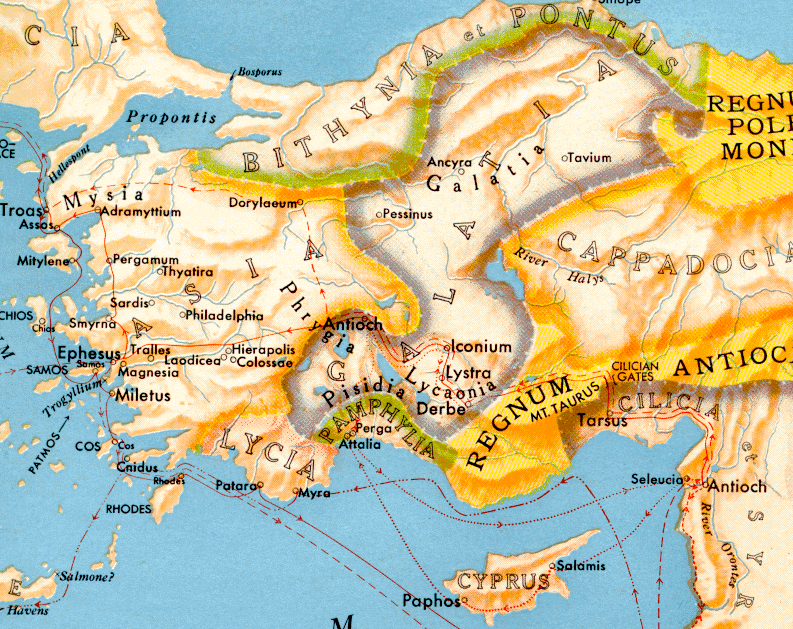
Paul wrote this letter to followers of Christ living in the southern portion of the Roman province of Galatia. The churches there were likely founded by Paul on his first missionary journey, so he had a vested interest in the spiritual well-being of their congregations. Since these relatively new churches were located in a Greek-speaking Roman province, they would have consisted primarily of Gentile converts to Christianity. This is not to say that there were no Jews in their fellowships, but it seems more likely that Paul is writing to those who had little or no understanding of Judaism Jesus’ role as the long-awaited Jewish Messiah.

Based on the content of Paul’s letter, it appears that these Gentile converts to Christianity had come under the influence of Judaizers. These were individuals of Jewish descent who expressed belief in Jesus as the Messiah, but who also demanded strict adherence to all Jewish religious laws and customs. Paul refers to these individuals throughout the letter and not in flattering terms.

But when I saw that their conduct was not in step with the truth of the gospel, I said to Cephas before them all, “If you, though a Jew, live like a Gentile and not like a Jew, how can you force the Gentiles to live like Jews?” – Galatians 2:14 ESV

The word Judaizer comes from the Greek verb Ἰουδαϊκῶς (ioudaikōs) which means “as do the Jews.” The Greek word for Jew is Ἰουδαῖος (ioudaios) and the similarity is obvious. In the verse above, Paul is setting up a contrast between the lifestyles of Gentiles and Jews but his primary point is the not-so-subtle teaching of these Judaizers who were demanding that true faith in Christ required conversion to Judaism and adherence to all its laws and customs.

Since Paul’s last visit to the region, these men had infiltrated the churches in Galatia, claiming to be Christ-followers but teaching a different brand of salvation than the one Paul had proclaimed on his first missionary journey.  These Judaizers seem to have popped up wherever Paul planted churches and their presence caused much confusion and consternation to the new converts that Paul left behind. And because of Paul’s constant travels, he was left with no other recourse than to address this issue through the use of letters.

Because of the vital importance of his letter’s content, Paul opens up with a brief defense of his apostleship. There seemed to be no shortage of individuals who were willing to question or even deny the validity of his claim to being an apostle. After all, every other apostle had been a disciple of Jesus. They had been personally chosen by Him and spent three years of their lives following and learning from Him. But Paul was a latecomer who claimed to have been appointed an apostle by the resurrected Lord. Luke records the testimony of Paul as he shared it before King Agrippa:

“I journeyed to Damascus with the authority and commission of the chief priests. At midday, O king, I saw on the way a light from heaven, brighter than the sun, that shone around me and those who journeyed with me. And when we had all fallen to the ground, I heard a voice saying to me in the Hebrew language, ‘Saul, Saul, why are you persecuting me? It is hard for you to kick against the goads.’ And I said, ‘Who are you, Lord?’ And the Lord said, ‘I am Jesus whom you are persecuting. But rise and stand upon your feet, for I have appeared to you for this purpose, to appoint you as a servant and witness to the things in which you have seen me and to those in which I will appear to you, delivering you from your people and from the Gentiles—to whom I am sending you to open their eyes, so that they may turn from darkness to light and from the power of Satan to God, that they may receive forgiveness of sins and a place among those who are sanctified by faith in me.’” – Acts 26:12-18 ESV

Paul’s fantastic “Damascus road experience” was constantly coming under question by those who opposed him. They denied he had the right to speak on behalf of Christ as one of His apostles. It’s likely they raised doubts about the veracity of Paul’s claims and peppered him with questions. They probably demanded verification and evidence that any of Paul’s “testimony” ever took place.

Their rejection of Paul’s claim of apostolic authority led them to deny his credentials and reject his right to preach a gospel that was based on faith alone in Christ alone. As Jews, they saw Paul as a traitor to his Jewish heritage and the religion of Abraham, Isaac, and Jacob. It seems likely that these men also raised suspicions about Paul’s trustworthiness by reminding the believers in Galatia about his former life as a member of the Pharisees and a persecutor of the church.

But Paul vehemently defended his apostleship in virtually every one of his letters, and this one is no exception. He opens up by describing himself as “Paul, an apostle.” The title “apostle” means “a delegate, messenger, one sent forth with orders” (“G652 – apostolos (KJV) :: Strong’s Greek Lexicon.” Blue Letter Bible. http://www.blueletterbible.org).

It was a common Greek word and was not unique to Christianity. This is why Paul quickly clarified that he was an apostle “not from men nor through men” (Galatians 1:1 ESV). In other words, he had not been sent by men or had not received his message from men. What he shared he received directly from the lips of Jesus Himself. Just a few verses later in this letter, Paul explains, “I did not receive it [the gospel] from any man, nor was I taught it, but I received it through a revelation of Jesus Christ” (Galatians 1:12 ESV).

Luke records that immediately after Paul’s conversion, Jesus appeared to a disciple named Ananias and told him to go to the house where Paul staying and lay hands on him so that he might regain his sight. Jesus told Ananias, “Go, for he is a chosen instrument of mine to carry my name before the Gentiles and kings and the children of Israel” (Acts 9:15 ESV).

There was no doubt in Paul’s mind that he was a messenger sent from Jesus. This is why he boldly claimed that he was an apostle “through Jesus Christ and God the Father, who raised him from the dead” (Galatians 1:1 ESV). The Greek preposition Paul used is dia and it can mean “by reason of” or “on account of” (“G1223 – dia (KJV):: Strong’s Greek Lexicon.” Blue Letter Bible. http://www.blueletterbible.org).

Paul was not a self-proclaimed apostle, but a God-ordained one, by virtue of his commissioning by the resurrected Jesus. His salvation had been made possible by God and the content of his message had come directly from the Son of God. He will spend the rest of this letter defending not only his apostleship but the gospel itself. Paul was less concerned about his reputation or identity than he was with the integrity of the gospel message. He wasn’t out to win friends and influence enemies. Just a few verses later Paul denies any desire to engage in a popularity contest with the Judaizers.

I’m not trying to win the approval of people, but of God. If pleasing people were my goal, I would not be Christ’s servant. – Galatians 1:10 NLT

The gospel was under attack and Paul was ready to go to war to protect it. And this deep desire to preserve the simple message of the good news compelled Paul to go on the offensive.

But there was another desire that motivated Paul. He wanted the recipients of his letter to enjoy the grace and peace of God. He wanted them to comprehend the magnitude of the remarkable gift they had received. Jesus Christ had given Himself for their sins so that they might be delivered from the present evil age. The world in which these new believers lived was hostile, anti-Christian, and intolerant of their beliefs. Many of them had already suffered persecution for having placed their faith in Christ. Some had been rejected by family members and ostracized from society. Others were under constant pressure to give up their faith or simply compromise it.

We face the same threat today. But we must remember that we have been delivered from this age. Yes, we’re still here and surrounded by increasing levels of animosity and pressure to compromise our convictions, but we are not alone. We have been given the indwelling presence of the Holy Spirit and the promise of our future eternal state.  God has promised us an eternal existence in His presence, free from the effects of sin that brought pain, sorrow, and death to the world.

Yet as we wait for that day, we are to live as children of God. The apostle John reminds us, “Dear friends, we are already God’s children, but he has not yet shown us what we will be like when Christ appears. But we do know that we will be like him, for we will see him as he really is. And all who have this eager expectation will keep themselves pure, just as he is pure” (1 John 3:2-3 NLT).

Paul’s call to his readers will be for them to remain steadfast. He wanted them to remain committed to the truth of the gospel and faithful to the call of Christ on their lives. It would not be easy, but it would be well worth the effort in the long run. Regardless of what they might be experiencing, they could rest in the fact that they were right in the middle of God’s will for their lives.

English Standard Version (ESV) The Holy Bible, English Standard Version. ESV® Permanent Text Edition® (2016). Copyright © 2001

New Living Translation (NLT) Holy Bible, New Living Translation, copyright © 1996, 2004, 2015 by Tyndale House Foundation. Used by permission of Tyndale House Publishers Inc., Carol Stream, Illinois 60188. All rights reserved.

Stand Your Ground. Stay the Course.

26 “You shall not eat any flesh with the blood in it. You shall not interpret omens or tell fortunes. 27 You shall not round off the hair on your temples or mar the edges of your beard. 28 You shall not make any cuts on your body for the dead or tattoo yourselves: I am the Lord.

29 “Do not profane your daughter by making her a prostitute, lest the land fall into prostitution and the land become full of depravity. 30 You shall keep my Sabbaths and reverence my sanctuary: I am the Lord.

31 “Do not turn to mediums or necromancers; do not seek them out, and so make yourselves unclean by them: I am the Lord your God.

32 “You shall stand up before the gray head and honor the face of an old man, and you shall fear your God: I am the Lord.

33 “When a stranger sojourns with you in your land, you shall not do him wrong. 34 You shall treat the stranger who sojourns with you as the native among you, and you shall love him as yourself, for you were strangers in the land of Egypt: I am the Lord your God.

35 “You shall do no wrong in judgment, in measures of length or weight or quantity. 36 You shall have just balances, just weights, a just ephah, and a just hin: I am the Lord your God, who brought you out of the land of Egypt. 37 And you shall observe all my statutes and all my rules, and do them: I am the Lord.” Leviticus 19:26-37 ESV

When the Israelites finally arrived in the land of Canaan, they would find themselves facing a myriad of temptations that would put a strain on their relationship with Yahweh. This section of laws was designed to regulate the choices they would make when they inevitably had to interface with the pagan nations of Canaan. They would be entering a land whose preexisting occupants were not followers of Yahweh. According to Deuteronomy 7, when Israel was preparing to enter Canaan for the first time, the land contained seven different nations: The Hittites, Girgashites, Amorites, Canaanites, Perizzites, Hivites, and Jebusites.

These distant relatives of the Israelites were the descendants of Ham, one of the sons of Noah, but they had long ago abandoned their worship of Yahweh. As Moses prepared the people of Israel to enter Canaan for the first time, he warned them about the “detestable customs” of the land’s occupants.

“When you enter the land the Lord your God is giving you, be very careful not to imitate the detestable customs of the nations living there. For example, never sacrifice your son or daughter as a burnt offering. And do not let your people practice fortune-telling, or use sorcery, or interpret omens, or engage in witchcraft,  or cast spells, or function as mediums or psychics, or call forth the spirits of the dead. Anyone who does these things is detestable to the Lord. It is because the other nations have done these detestable things that the Lord your God will drive them out ahead of you. 13 But you must be blameless before the Lord your God. The nations you are about to displace consult sorcerers and fortune-tellers, but the Lord your God forbids you to do such things.” – Deuteronomy 18:9-14 NLT

So, God took time to reemphasize those laws that specifically dealt with the problems associated with Canaan. Verses 26-28 cover behaviors that God has already addressed but that would prove to be very tempting in the land of Canaan because they were prevalent among the seven nations that lived there. God’s ban on the consumption of blood was not practiced by the Hittites, Girgashites, Amorites, Canaanites, Perizzites, Hivites, or Jebusites. In fact, many of these groups had their own elaborate religious rituals where they offered blood sacrifices to false gods like Baal and Molech. As part of these rites, the drinking of blood was actually encouraged because it was believed that the blood could endue the worshiper with energy or power. 

God warned the Israelites about incorporating any of these cultic practices into their worship or daily lives. Each of the admonitions contained in this passage deals with behaviors that were common practice among the Canaanites and were associated with the worship of their false gods.

“Do not eat meat that has not been drained of its blood. Do not practice fortune-telling or witchcraft. Do not trim off the hair on your temples or trim your beards. Do not cut your bodies for the dead, and do not mark your skin with tattoos. I am the Lord.” – Leviticus 19:26-28 NLT

Superstition and an obsession with the dead pervaded the Canaanite mindset, taking the form of fortune-telling and witchcraft. Ancestor worship and attempts to communicate with the dead were common among the Canaanites. But the Israelites were to have nothing to do with such practices. They were not even to emulate the fashion and hairstyles of their Canaanite neighbors. The reference to trimming the hair of their temples and beards was probably a warning against copying the look of the cultic priests. The Israelites were forbidden to take on the outward characteristics of the pagans, including disfiguring their bodies through ritual scarring or the use of tattoos. All of these things were closely associated with the idolatrous worship of the Canaanites.

“According to Babylonian-Assyrian religion, gods who represented the superior natural forces could be directly influenced by charms and spells to direct their power against evil demons who sought to work ill. This was sacred magic, and embraced under its scope, enchantment, sorcery, incantation, and witchcraft” – W. Carleton Wood, “The Religion of Canaan: From the Earliest Times to the Hebrew Conquest,” Journal of Biblical Literature, 1916, Vol. 35, No. 1/2 (1916), pp. 1-133

Magic, potions, bodily disfigurement, worship of the dead, and the consumption of blood were just a few of the pagan rituals the Israelites would find themselves confronting in the land of Canaan. And God knew they would be tempted to incorporate many of these pagan practices into their worship of Him. But God demanded distinctiveness among His people. He found the practices of the Canaanites abominable and unacceptable because they were associated with the worship of false gods. Everything about these rituals and rites was an affront to Yahweh’s status as the one true God and His chosen people were to have nothing to do with them.

God even had to go so far as to ban Israelite fathers from allowing their daughters to become prostitutes. This is most likely a reference to the practice of cult prostitution that was prevalent among the Canaanites.

“A peculiar feature of the Mesopotamian and Canaanite culture was ritualistic prostitution. To the temples of the goddesses of fertility (Inanna, Ishtar, Astarte) were attached bordellos served by consecrated women who represented the goddess, the female principle of fertility… The existence of sacred prostitutes shows that the individual worshipers received in this way communion with the divine principle of life and a renewal of their life forces.” – Eugene J. Fisher, Cultic Prostitution in the Ancient Near East? A Reassessment. Biblical Theology Bulletin

That Israelite fathers might even consider doing such a thing is an affront to our modern sensibilities. But it simply reveals the moral decline that had taken place among the nations of the earth by that time. In humanity’s flight from God, they had abandoned all reason and made the pursuit of personal pleasure their highest priority. The apostle Paul describes this moral descent in far-from-flattering terms.

Claiming to be wise, they instead became utter fools. And instead of worshiping the glorious, ever-living God, they worshiped idols made to look like mere people and birds and animals and reptiles.

So God abandoned them to do whatever shameful things their hearts desired. As a result, they did vile and degrading things with each other’s bodies. They traded the truth about God for a lie. So they worshiped and served the things God created instead of the Creator himself, who is worthy of eternal praise! Amen. That is why God abandoned them to their shameful desires. – Romans 1:22-26 NLT

God knew that anything done in the name of religion could become a gateway to all kinds of sins and excesses. Cultic prostitution would not stop at the temple but would make its way into the very fabric of Israelite life. If one could justify sin by spiritualizing it, it was just a matter of time before it pervaded every sphere of daily life.

That’s why God reemphasized His law concerning the Sabbath. That one day of the week had been set apart for the exclusive worship of Yahweh. It was to be a regular reminder that He was the one and only God, and He alone was worthy of worship, glory, and honor. There was no place for mediums or necromancers among God’s people. They didn’t need witches and diviners. They had the all-powerful God of the universe dwelling in their presence and providing for their every need. There was nothing they could gain from the pagan magicians and cultic priests of Canaan.

Instead, God’s people were to honor the elderly, show care and concern for the foreigners living among them, and treat one another with honor and respect. There was no room for deceit or dishonesty among God’s chosen people. Those were the ways of the pagans. Their false sense of piety was marked by moral decay and pervasive sin. But God had given His people His law so that they might stand out from the crowd. That’s why God ends this section with the admonition: “You must be careful to keep all of my decrees and regulations by putting them into practice. I am the Lord” (Leviticus 19:37 NLT).

The real test would come when the Israelites entered the land of Canaan. When that day came, the true battle would be for the hearts and souls of God’s people and not for the land. Gaining control of Canaan would be relatively easy because God would give His people victory over their enemies. But winning the battle against moral compromise and ethical accommodation would be far more difficult. To defeat the urge to concede moral ground to the enemy was going to require obedience to God’s commands. The Israelites were going to have to pursue holiness more than their own happiness. They would need to make pleasing God a higher priority than seeking personal pleasure. The world of Canaan would offer a host of alluring options but the people of God would have to stand their ground and stay the course. They would need to heed the words God used to open this chapter: “You shall be holy, for I the Lord your God am holy” (Leviticus 19:2 ESV).

English Standard Version (ESV) The Holy Bible, English Standard Version. ESV® Permanent Text Edition® (2016). Copyright © 2001

New Living Translation (NLT) Holy Bible, New Living Translation, copyright © 1996, 2004, 2015 by Tyndale House Foundation. Used by permission of Tyndale House Publishers Inc., Carol Stream, Illinois 60188. All rights reserved.

Set Apart to Stand Out, Not Blend In

19 “You shall keep my statutes. You shall not let your cattle breed with a different kind. You shall not sow your field with two kinds of seed, nor shall you wear a garment of cloth made of two kinds of material.

20 “If a man lies sexually with a woman who is a slave, assigned to another man and not yet ransomed or given her freedom, a distinction shall be made. They shall not be put to death, because she was not free; 21 but he shall bring his compensation to the Lord, to the entrance of the tent of meeting, a ram for a guilt offering. 22 And the priest shall make atonement for him with the ram of the guilt offering before the Lord for his sin that he has committed, and he shall be forgiven for the sin that he has committed.

23 “When you come into the land and plant any kind of tree for food, then you shall regard its fruit as forbidden. Three years it shall be forbidden to you; it must not be eaten. 24 And in the fourth year all its fruit shall be holy, an offering of praise to the Lord. 25 But in the fifth year you may eat of its fruit, to increase its yield for you: I am the Lord your God.” Leviticus 19:19-25 ESV

In the following section. God emphasizes the distinctive nature of holiness, calling His people to their lives in such a way that their set-apart status as His children is clear for all to see. There was to be no blurring of the lines; no compromising of His holy standards, in a vain attempt to blend in with the culture of Canaan. These verses seem to focus on Israel’s eventual entrance into the land of Canaan when they would find themselves surrounded by pagan nations whose morals and ethical standards were far different than those found in the Decalogue and the Book of the Covenant.

So, God highlighted various laws that were intended to differentiate the Israelites from all the other nations living in the land of Canaan. To our modern sensibilities, these laws may sound arbitrary and even strange. But it is important to consider the context of Canaan and the need for God’s people to remain distinctively different and set apart from all the people groups who currently occupied the land. For the Israelites to conquer and occupy the land promised to them by God, they would have to remain faithful to His calling to be a holy nation and a royal priesthood. There could be no compromising or accommodating, no bending of the rules, or lowering of God’s standards – especially when it came to worship.

That’s why God starts out this section with the five-word command: “You shall keep my statutes” (Leviticus 19:19 ESV). His rules were not up for debate or discussion, and He would not tolerate any effort by the Israelites to blend in and get along with their pagan neighbors. God knew that His people would be tempted to accommodate and make concessions in an effort to get along with the Canaanites. Yet, He was not calling the Israelites to blend in; He was commanding them to stand out. In fact, when it came time for the people of Israel to begin their conquest of Canaan, Moses would deliver a powerful reminder of God’s expectations.  

“When you enter the land the Lord your God is giving you, be very careful not to imitate the detestable customs of the nations living there. For example, never sacrifice your son or daughter as a burnt offering. And do not let your people practice fortune-telling, or use sorcery, or interpret omens, or engage in witchcraft, or cast spells, or function as mediums or psychics, or call forth the spirits of the dead. Anyone who does these things is detestable to the Lord. It is because the other nations have done these detestable things that the Lord your God will drive them out ahead of you. But you must be blameless before the Lord your God. The nations you are about to displace consult sorcerers and fortune-tellers, but the Lord your God forbids you to do such things.” – Deuteronomy 18:9-14 NLT

What stood behind God’s call to distinctiveness was the unique relationship the Israelites enjoyed with their Creator-God. They alone had been set apart to be His chosen people. They alone had been given His law to regulate their lives and the sacrificial system to guarantee their ongoing relationship with Him. He had promised to dwell among them and had designated the Tabernacle as His earthly dwelling place.

In the very next chapter, God will reiterate His call to holiness, reminding the Israelites that they enjoy a one-of-a-kind status as His chosen people.

“You must be holy because I, the LORD, am holy. I have set you apart from all other people to be my very own.” – Leviticus 20:26 NLT

Everything about the Israelites was to be different and distinct, down to the way they bred their animals, sowed their crops, and fashioned their fabrics. Notice how God emphasizes His prohibition against mixing things that don’t belong together.

“Do not mate two different kinds of animals. Do not plant your field with two different kinds of seed. Do not wear clothing woven from two different kinds of thread. – Leviticus 19:19 NLT

There was an order to God’s creation, and He expected His chosen people to adhere to it. Mankind has a propensity for taking shortcuts and making compromises. But, as a principle, this tendency to take the easy way tends to violate God’s way. Making concessions and compromises may appear to be the right thing to do but it makes a life of distinctiveness difficult to maintain. God knew that full-blown apostasy began with small and seemingly innocent concessions.

In verses 20-22, God deals with another improper form of “blending” or “mating;” that of an Israelite man and a slave girl. There are a number of issues at play here. First of all, the man is guilty of having sex with a slave girl who is probably a pagan. To make matters worse, the girl has been betrothed to another man. So, the situation involves several layers of impropriety. The man has had sex outside of the bonds of marriage. On top of that, he has committed this sin with a pagan slave. But because the woman was betrothed to another man, the sin involves adultery. So, God demands that the man pay compensation to the woman’s husband-to-be, and then offer the proper sacrifice in the Tabernacle to pay for his guilt and to receive atonement.

Israelites were not free to have sex with whomever they wished. There were rules and standards. Though the girl was a slave, she still had rights. Her diminished social status did not render her open game for another man’s inappropriate sexual advances. This was the kind of “detestable customs” Moses was talking about. While the Canaanites might approve of such conduct, God did not.

From this rather blatant example of inappropriate “mating,” God shifts His focus to the topic of planting and harvesting. When the Israelites arrived in Canaan, they would be expected to cultivate the land so that it might be fruitful and productive. But God wanted His people to depend upon Him for all their needs. God was giving them a land that was extremely bountiful. There would be no lack of food or water. And Moses knew that the blessings of the land would tempt the people to forget about the provision of God. So, he later warned them:

“So obey the commands of the LORD your God by walking in his ways and fearing him. For the LORD your God is bringing you into a good land of flowing streams and pools of water, with fountains and springs that gush out in the valleys and hills. It is a land of wheat and barley; of grapevines, fig trees, and pomegranates; of olive oil and honey. It is a land where food is plentiful and nothing is lacking. It is a land where iron is as common as stone, and copper is abundant in the hills. When you have eaten your fill, be sure to praise the LORD your God for the good land he has given you.” – Deuteronomy 8:6-10 NLT

God wanted them to plant trees, but He also wanted them to trust Him for all their needs. So, He implemented a five-year moratorium on eating any fruit that the tree produced. For the first three years, the fruit was to go unharvested. In the fourth year, the fruit was to be dedicated to God. And finally, in the fifth year, the fruit of the tree was available for the owner to harvest and enjoy. This five-year delay was intended to teach God’s people to wait on Him. It was also meant to eliminate the risk of self-sufficiency.

“Beware that in your plenty you do not forget the LORD your God and disobey his commands, regulations, and decrees that I am giving you today. For when you have become full and prosperous and have built fine homes to live in, and when your flocks and herds have become very large and your silver and gold have multiplied along with everything else, be careful! Do not become proud at that time and forget the LORD your God…” – Deuteronomy 8:11-14 NLT

God was to be their provider and protector. But because He was giving them a land that was naturally fruitful and filled with all kinds of wonderful things to eat, they would find it easy to become self-reliant and no longer in need of His help. The very blessings of God could end up distracting them from their dependence upon Him.

One of the things that would set apart the people of God from their pagan neighbors was their complete and utter reliance upon God for all their needs. And that reliance began with their unwavering commitment to keep His commands. God would not tolerate compromise or complacency among His chosen people. The greatest risk they faced was allowing the richness of the land to diminish their reliance upon the Lord. And this was the very charge Jesus leveled against the church of Laodicea.

“You say, ‘I am rich. I have everything I want. I don’t need a thing!’ And you don’t realize that you are wretched and miserable and poor and blind and naked.” – Revelation 3:17 NLT

Jesus saw this church as having made unacceptable compromises. It wasn’t that they were living in complete rebellion, but that they had made harmful concessions that had left them with a “lukewarm” and ineffective faith. They weren’t living set apart and distinctive lives in the midst of the culture. So Jesus warned them to alter the trajectory of their faith and return to Him.

“I correct and discipline everyone I love. So be diligent and turn from your indifference.” – Revelation 3:19 NLT

And God was calling His chosen people to avoid the need for His discipline by living in keeping with His commands. That’s why He opened this section with the words, “You shall keep my statutes” (Leviticus 19:19 ESV). God didn’t want His people to become lukewarm and ineffective. His desire was that they remain obedient, dependent, and faithful so that the rest of the world might see His presence and power made manifest through their lives. They had been set apart to stand out, not blend in.

English Standard Version (ESV) The Holy Bible, English Standard Version. ESV® Permanent Text Edition® (2016). Copyright © 2001

New Living Translation (NLT) Holy Bible, New Living Translation, copyright © 1996, 2004, 2015 by Tyndale House Foundation. Used by permission of Tyndale House Publishers Inc., Carol Stream, Illinois 60188. All rights reserved.

The Flawed Hope of Self-Salvation

11 When he was about to enter Egypt, he said to Sarai his wife, “I know that you are a woman beautiful in appearance, 12 and when the Egyptians see you, they will say, ‘This is his wife.’ Then they will kill me, but they will let you live. 13 Say you are my sister, that it may go well with me because of you, and that my life may be spared for your sake.” 14 When Abram entered Egypt, the Egyptians saw that the woman was very beautiful. 15 And when the princes of Pharaoh saw her, they praised her to Pharaoh. And the woman was taken into Pharaoh’s house. 16 And for her sake he dealt well with Abram; and he had sheep, oxen, male donkeys, male servants, female servants, female donkeys, and camels.

17 But the Lord afflicted Pharaoh and his house with great plagues because of Sarai, Abram’s wife. 18 So Pharaoh called Abram and said, “What is this you have done to me? Why did you not tell me that she was your wife? 19 Why did you say, ‘She is my sister,’ so that I took her for my wife? Now then, here is your wife; take her, and go.” 20 And Pharaoh gave men orders concerning him, and they sent him away with his wife and all that he had.  Genesis 12:11-20 ESV

Due to a severe famine in the land of Canaan, Abram was forced to seek refuge in Egypt. But upon his arrival, Abram immediately began to second guess the wisdom of his decision. He was far from home and way out of his comfort zone. Find himself in unfamiliar surroundings yet again. Abram quickly recognized that his new neighbors looked and sounded nothing like him. And his reaction to these uncomfortable circumstances reveals a great deal about Abram’s current mindset.

Even before arriving in the land, Abram began to develop a plan for dealing with what he believed would be a far-from-friendly welcome. Just as he was about to cross the border into Egypt, he came up with a strategy for dealing with what he expected would be a culture of questionable morals.

he said to Sarai his wife, “I know that you are a woman beautiful in appearance, and when the Egyptians see you, they will say, ‘This is his wife.’ Then they will kill me, but they will let you live.” – Genesis 12:11-12 ESV

Abram feared that his wife’s stunning beauty would make her an object of desire to the Egyptians. And he feared that once they discovered that Sarai was his wife, one of them would simply kill him so he could have her as his own. In ancient cultures, women were often seen as little more than the personal property of their husbands. It was usually considered illegal to take a man’s wife. But if the husband were to die “unexpectedly,” then she would become available for purchase.

So, fearing the worst, Abram orders Sarai to tell anyone who asks that she is his sister.

“Say you are my sister, that it may go well with me because of you, and that my life may be spared for your sake.” – Genesis 12:13 ESV

Notice Abram’s self-obsessed outlook. He can’t stop talking about the need to protect his personal well-being. He wanted things to “go well” for him, but he shows little concern for how his little ruse might impact the life of Sarai. And as soon as they crossed the border into Egypt, Abram’s worst fears were realized.

When Abram entered Egypt, the Egyptians saw that the woman was very beautiful. And when the princes of Pharaoh saw her, they praised her to Pharaoh. And the woman was taken into Pharaoh’s house. – Genesis 12:14-15 ESV

Now, to be fair, when Abram commanded Sarai to say that she was his sister, it was technically true. According to Genesis 20:12, Sarai was Abram’s half-sister because they shared the same father but different mothers. And Abram would use this convenient half-truth as a clever means of self-protection when dealing with those of less scrupulous character. But little did Abram know that his plan would backfire in such a dramatic fashion. Pharaoh himself developed an eye for the lively Sarai and had her taken into his house. And, strangely enough, Abram actually benefited from his self-centered strategy.

And for her sake he [Pharaoh] dealt well with Abram; and he had sheep, oxen, male donkeys, male servants, female servants, female donkeys, and camels. – Genesis 12:16 ESV

Believing Abram to be Sarai’s older brother and official guardian, Pharaoh offered Abram what was essentially a bride price for having taken Sarai into his harem. She became Pharoah’s property and Abram was reward for it. All along, it had been Abram’s hope that things would “go well” for him, and now it had. He had benefited greatly from Sarai’s compromising situation.

But, as has been the case all along in the book of Genesis, God was operating in the background, unseen by Abram, Sarai, or Pharaoh. But it wasn’t long before He made His presence known.

…the Lord afflicted Pharaoh and his house with great plagues because of Sarai, Abram’s wife. – Genesis 12:17 ESV

This leader of the nation of Egypt had used his great power and wealth to purchase another trophy for his harem. And Abram had experienced a sizeable boost to his financial net-worth. But both of these men were in for a shock. Pharaoh suddenly found  his royal house facing a series of devastating plagues. Unknowingly, he had taken the bride of Abram and enslaved her as one of his servants. She had gone from being the wife of Abram to just one of the many concubines in Pharaoh’s royal harem.

Once again, the original Jewish audience to whom Moses wrote this book would have sat up and taken notice upon hearing this story from the lives of Abram and Sarai. They would have immediately seen the parallels between the enslavement of Sarai and that of their ancestors. Years later, 70 descendants of Abram would seek refuge in the land of Egypt, attempting to escape a famine in the land. They would enter Egypt as the “bride” of Yahweh. But in time, they would become the personal slaves of Pharaoh. And God would bring upon Pharaoh and his royal house a series of ten plagues, each designed to force the release of His people. The prophet Isaiah would later remind the nation of Israel of their unique status as God’s bride.

For your Maker is your husband,
    the Lord of hosts is his name;
and the Holy One of Israel is your Redeemer,
    the God of the whole earth he is called. – Isaiah 54:5 ESV

So, there are tremendous similarities between the story found in Genesis 12 and that of the Israelites recorded in the book of Exodus. Unlike his successor, the Pharaoh in Abram’s day proved to be teachable and ready to rectify the grave mistake he has made.

So Pharaoh called Abram and said, “What is this you have done to me? Why did you not tell me that she was your wife? Why did you say, ‘She is my sister,’ so that I took her for my wife? Now then, here is your wife; take her, and go.” – Genesis 12:18-19 ESV

Pharaoh, suffering under the judgment of God, was ready to repent and make restitution. Rather than punishing Abram for his deceitfulness and the pain he had brought upon the royal house, Pharaoh released Sarai, and sent Abram on his way with his wife restored and his newly acquired wealth intact.

You would think that Abram learned a valuable lesson from this potentially devastating encounter with Pharaoh. But, amazingly, he would live to lie another day. Just a few chapters later, Moses records yet another incident where Abram pulled this highly flawed strategy out of his bag of tricks. Despite its highly questionable efficacy, Abram would utilize this same plan  years later when dealing with Abimelech, the king of Gerar. He seems to have learned nothing from his former attempt at self-preservation.

And Abraham said of Sarah his wife, “She is my sister.” And Abimelech king of Gerar sent and took Sarah. – Genesis 20:2 ESV

As before, God intervened and delivered a terrifying message to Abimelech in a dream.

“Behold, you are a dead man because of the woman whom you have taken, for she is a man’s wife.” – Genesis 20:3 ESV

Fearful for his life, Abimelech declared his innocence to God and was told to return Sarai to Abraham. Essentially, God told the petrified king, “No harm done.” He had sovereignly protected Abimelech from doing anything to Sarai. But when the king confronted Abram and demanded to know why he had done such a thing, Abram was quick to justify his actions and explain his warped rationale.

“Besides, she is indeed my sister, the daughter of my father though not the daughter of my mother, and she became my wife. And when God caused me to wander from my father’s house, I said to her, ‘This is the kindness you must do me: at every place to which we come, say of me, “He is my brother.”’” – Genesis 20:12-13 ESV

And like the earlier story, Abram walks away blessed rather than chastened by God.

Then Abimelech took sheep and oxen, and male servants and female servants, and gave them to Abraham, and returned Sarah his wife to him.  And Abimelech said, “Behold, my land is before you; dwell where it pleases you. – Genesis 20:14-15 ESV

God was not rewarding Abram for his deception and dishonesty. Nor was He condoning Abram’s methods. He was simply fulfilling the promise He had made to bless Abram (Genesis 12:2). And he was slowly teaching His stubborn servant a much-needed lesson about divine sovereignty and providential care. Even Abram’s ill-fated attempts to act as his own god could not jeopardize God’s plans or prevent God’s promise from being fulfilled. This was so much bigger than Abram. He was simply a conduit through whom God would bring a blessing to all the nations of the earth. And God was not going to allow Abram to derail the divine plan for mankind’s redemption.

Mankind’s constant attempts at self-salvation will always fall short. But God’s promise of future blessing will never fail to come to fruition.

English Standard Version (ESV) The Holy Bible, English Standard Version. ESV® Permanent Text Edition® (2016). Copyright © 2001 by Crossway Bibles, a publishing ministry of Good News Publishers.

New Living Translation (NLT) Holy Bible, New Living Translation, copyright © 1996, 2004, 2015 by Tyndale House Foundation. Used by permission of Tyndale House Publishers Inc., Carol Stream, Illinois 60188. All rights reserved.

New English Translation (NET)NET Bible® copyright ©1996-2017 by Biblical Studies Press, L.L.C. http://netbible.com All rights reserved.