A Change For the Better

51 Behold! I tell you a mystery. We shall not all sleep, but we shall all be changed, 52 in a moment, in the twinkling of an eye, at the last trumpet. For the trumpet will sound, and the dead will be raised imperishable, and we shall be changed. 53 For this perishable body must put on the imperishable, and this mortal body must put on immortality. 54 When the perishable puts on the imperishable, and the mortal puts on immortality, then shall come to pass the saying that is written:

“Death is swallowed up in victory.”
55 “O death, where is your victory?
    O death, where is your sting?”

56 The sting of death is sin, and the power of sin is the law. 57 But thanks be to God, who gives us the victory through our Lord Jesus Christ.

58 Therefore, my beloved brothers, be steadfast, immovable, always abounding in the work of the Lord, knowing that in the Lord your labor is not in vain. – 1 Corinthians 15:51-58 ESV

Paul lived with a sense of eminence and an eager anticipation of the Lord’s return. He fully expected to be alive when Jesus returned for His bride, the church. This attitude of expectation, coupled with his strong belief in the resurrection of the body, is what drove him to live his life to please God and make the most of the time he had on this earth. When the Son returned, which Paul believed would be soon, he wanted to be doing the will of God. So he told the Corinthians, “Therefore, my beloved brothers, be steadfast, immovable, always abounding in the work of the Lord, knowing that in the Lord your labor is not in vain” (1 Corinthians 15:58 ESV).

All that he discusses in these closing verses of Chapter 15 concerns what he calls “a mystery,” which remains hidden from view, unrevealed, and unknown as to the day of its occurrence. No one knows the day of the Lord’s return. But just because we are ignorant of its timing does not mean we should doubt its validity. The events surrounding that day, including the resurrection of our bodies, though mysterious and unknown in exactly how they will occur, are to be believed and eagerly anticipated. Paul says that not every believer will undergo death; some will be alive and well when the Lord returns. And both the living and the dead will experience the resurrection of their earthly bodies.

Paul does not explain how this will happen because he doesn’t know. He simply reveals that it will happen unquestionably and instantaneously, “in a moment, in the twinkling of an eye” (1 Corinthians 15:52 ESV). He says, “the dead will be raised imperishable” and those who are alive on that day, “shall be changed” (1 Corinthians 15:52 ESV). Both groups will receive their new spiritual bodies, made in “the image of the man of heaven” (1 Corinthians 15:49b ESV).

The apostle John informs us, “Dear friends, we are already God’s children, but he has not yet shown us what we will be like when Christ appears. But we do know that we will be like him, for we will see him as he really is” (1 John 3:2 NLT). Instantaneously, we will all undergo a miraculous transformation, receiving our new resurrected bodies, created by God for our new home and designed to exist for eternity.

For our dying bodies must be transformed into bodies that will never die; our mortal bodies must be transformed into immortal bodies. – 1 Corinthians 15:53 NLT

And when that happens, Paul says, it will be a slap in the face to death. Death is the wage or payment for a life of sin (Romans 6:23). When sin entered the world at the fall, it brought with it death.

When Adam sinned, sin entered the world. Adam’s sin brought death, so death spread to everyone, for everyone sinned. – Romans 5:12 NLT

For the sin of this one man, Adam, caused death to rule over many. But even greater is God’s wonderful grace and his gift of righteousness, for all who receive it will live in triumph over sin and death through this one man, Jesus Christ. – Romans 5:17 NLT

Because of Jesus, death has lost its sting, meaning it no longer has its power over us. Those who have placed their faith in Jesus no longer need to fear death. That does not mean that we are immune to death; even believers die. But the real “sting” of death, its power to separate men from their God, is no longer valid. All men die, but not all men will experience eternal separation from God. At death, those who have placed their faith in His Son will find themselves immediately transferred into the presence of God the Father. Paul alludes to this reality in his second letter to the Corinthians:

So we are always of good courage. We know that while we are at home in the body we are away from the Lord, for we walk by faith, not by sight. Yes, we are of good courage, and we would rather be away from the body and at home with the Lord. – 2 Corinthians 5:6-8 ESV

Well-versed in the Old Testament, Paul paraphrases Hosea 13:14 and uses it to taunt death. Because of Jesus, death’s power over us has been broken. It is like a toothless, declawed lion, intimidating and with a scary roar, but devoid of any real power to do us harm.

But Paul’s real message seems to be that the future assurance of the Lord’s return and the certainty of the resurrection of our bodies should embolden us to live godly lives as we wait. We are to remain “steadfast, immovable, always abounding in the work of the Lord” (1 Corinthians 15:538 ESV).

Rather than wasting our time arguing over spiritual gifts and debating who follows whom, we need to share the good news of Jesus Christ with the lost and extend the love of God to our brothers and sisters in Christ. Rather than worrying about death, we need to focus on living for God and making the most of every moment He gives us on this earth. We are His servants and exist for His glory. He has called us to do His will and to spread the message of salvation made possible through His Son’s death on the cross.

But now you are free from the power of sin and have become slaves of God. Now you do those things that lead to holiness and result in eternal life. For the wages of sin is death, but the free gift of God is eternal life through Christ Jesus our Lord. – Romans 6:22-23 NLT

Father, thank You for this much-needed reminder that Your Son is going to return some day. But we’re not to sit around waiting for the eventuality of that day; we are to be busy doing the work He gave us to do. We are to be disciple-makers who carry on His ministry of reconciliation. We are to be good-new bearers, spreading the message of salvation by faith alone in Christ alone to the ends of the earth. His return should serve as our motivation, because it reminds us that His work is not done. He has yet to establish His earthly Kingdom, but He will. And when He returns to do so, we will receive our glorified bodies and finally escape the sting of death. But that is not to be our sole motivation. Our ministry on this earth should be in response to Your gracious love and in obedience to His commission. I want to be a faithful steward (1 Corinthians 4:1-2), carrying out Your will to my final breath or until Your Son returns. Amen

English Standard Version (ESV) The Holy Bible, English Standard Version. ESV® Permanent Text Edition® (2016). Copyright © 2001 by Crossway Bibles, a publishing ministry of Good News Publishers.

New Living Translation (NLT) Holy Bible, New Living Translation, copyright © 1996, 2004, 2015 by Tyndale House Foundation. Used by permission of Tyndale House Publishers Inc., Carol Stream, Illinois 60188. All rights reserved.

A Belief Worth Dying For

29 Otherwise, what do people mean by being baptized on behalf of the dead? If the dead are not raised at all, why are people baptized on their behalf? 30 Why are we in danger every hour? 31 I protest, brothers, by my pride in you, which I have in Christ Jesus our Lord, I die every day! 32 What do I gain if, humanly speaking, I fought with beasts at Ephesus? If the dead are not raised, “Let us eat and drink, for tomorrow we die.” 33 Do not be deceived: “Bad company ruins good morals.” 34 Wake up from your drunken stupor, as is right, and do not go on sinning. For some have no knowledge of God. I say this to your shame. – 1 Corinthians 15:29-34 ESV

In verse 29, Paul takes a rather interesting but confusing diversion from his primary topic. He is simply trying to emphasize his point regarding the reality of the resurrection. To do so, he brings up another practice that was evidently common in Corinth. It involved proxy baptism or baptism for the dead. It’s likely that this practice was common in the pagan community, and some recent converts to Christianity retained their belief in it. Over the years, this verse has received as many as 40 different interpretations.

“They included that Christians in Corinth were being “baptized into the ranks of the dead” by martyrdom (thinking of “baptism” in the light of Mark 10:38; Luke 12:50), that this was ordinary Christian baptism that took place “over” the grave of the dead, or that new Christians were baptized to “replace” Christians who had died. Though interesting, these proposals lack credibility. The most plausible interpretation is that some in Corinth were getting baptized vicariously for the dead. Several factors, however, put this into perspective. Although Paul does not explicitly condemn the practice, neither does he endorse it.” – Christianity Today, August 10 1998, Vol. 42, No. 9

The most likely explanation is that Paul was referring to a practice common among the mystery religions in and around Corinth. These pagan religions encouraged their followers to be baptized on behalf of and in place of their deceased relatives in order to assure their “salvation.” It is the same belief held today by the Church of Jesus Christ of Latter-day Saints (Mormons). But Paul is not endorsing this practice. Notice that he says, “What do people mean by being baptized on behalf of the dead? If the dead are not raised at all, why are people baptized on their behalf (1 Corinthians 15:29 ESV)?”

He is pointing out what others, outside the church, were doing. This was a practice familiar to the Corinthian believers, and Paul uses it to demonstrate that even pagan mystery religions held to the resurrection of the dead. Otherwise, their practice of proxy baptism would have been pointless. Paul was using this bizarre pagan practice to assert his belief in the resurrection of the dead. He is not condoning proxy baptism, but simply illustrating that even false religions embrace the concept of the resurrection. For Paul, the real danger was that a Christ follower would reject or refuse to believe in it, because that would be to reject the gospel.

Paul insists that his preaching of the resurrection of Christ had caused him great difficulty. On his missionary journeys, he had repeatedly put his life on the line to preach the death, burial, and resurrection of Jesus. In almost every city he entered, Paul would make a beeline for the synagogue, where he would deliver his message about Jesus as the Messiah.

As was Paul’s custom, he went to the synagogue service, and for three Sabbaths in a row he used the Scriptures to reason with the people. He explained the prophecies and proved that the Messiah must suffer and rise from the dead. He said, “This Jesus I’m telling you about is the Messiah.” – Acts 17:2-3 NLT

When he had first come to Corinth, he preached the same message.

I passed on to you what was most important and what had also been passed on to me. Christ died for our sins, just as the Scriptures said. He was buried, and he was raised from the dead on the third day, just as the Scriptures said. – 1 Corinthians 15:3-4

In Thessalonica, Paul and Silas had to run for their lives because the Jews had reacted to his “resurrection” message by stirring up a riot among the citizens. In Athens, “when they heard Paul speak about the resurrection of the dead, some laughed in contempt” (Acts 17:32 NLT). In Corinth, when he “testified to the Jews that Jesus was the Messiah…they opposed and insulted him” (Acts 18:5-6 NLT). 

When Paul met with the elders of the church in Ephesus, he reminded them, “I have done the Lord’s work humbly and with many tears. I have endured the trials that came to me from the plots of the Jews. I never shrank back from telling you what you needed to hear, either publicly or in your homes. I have had one message for Jews and Greeks alike—the necessity of repenting from sin and turning to God, and of having faith in our Lord Jesus” (Acts 20:19-21 NLT). That message was built upon the reality of the resurrection. Jesus had died and been raised back to life, as proof that He was the Christ, the long-awaited Messiah.

Paul had suffered greatly as a result of his belief in the resurrection. The resurrection of Jesus was a major cause of persecution of the disciples in the early church. When Paul asked, “Why are we in danger every hour?” (1 Corinthians 15:30 ESV), it was a rhetorical question. The answer was clear: the message of the resurrection was the cause of their suffering.

In Acts chapter 4, Luke records that Peter and John, after sharing the gospel in Solomon’s Portico in Jerusalem, were arrested.

And as they were speaking to the people, the priests and the captain of the temple and the Sadducees came upon them, greatly annoyed because they were teaching the people and proclaiming in Jesus the resurrection from the dead. And they arrested them and put them in custody until the next day, for it was already evening. But many of those who had heard the word believed, and the number of the men came to about five thousand. – Acts 4:1-4 ESV

They were arrested for proclaiming that Jesus had risen from the dead. It was this message that riled the Jewish religious leaders. The next day, as they stood before the high priest and his religious cohorts, Peter and John were asked to explain by what power or authority they had healed a crippled man the day before. And Peter responded, “Let it be known to all of you and to all the people of Israel that by the name of Jesus Christ of Nazareth, whom you crucified, whom God raised from the dead—by him this man is standing before you well” (Acts 4:10 ESV).

It is the resurrection of Jesus that gave the gospel its power and made possible the coming of the Holy Spirit. To reject the resurrection simply because you can’t explain it would be absurd. That is why Paul asks the Corinthians, “And what value was there in fighting wild beasts—those people of Ephesus—if there will be no resurrection from the dead? And if there is no resurrection, ‘Let’s feast and drink, for tomorrow we die!’” (1 Corinthians 15:32 NLT).

If there is no resurrection of the dead, then Jesus was not raised from the dead, and we have no hope of future resurrection. This life is all there is. If that’s the case, let us enjoy our lives while we can and stop worrying about eternity. But Paul rejects that logic. In fact, he tells the Corinthians, “Wake up from your drunken stupor, as is right, and do not go on sinning. For some have no knowledge of God. I say this to your shame” (1 Corinthians 15:34 ESV). It was as if their senses had been numbed by too much alcohol, affecting their ability to think clearly. So, Paul demanded that they “sober up” and start listening to God rather than their pagan friends and neighbors. The resurrection of Jesus was just as much a part of God’s plan as His death. When the women had come to the tomb to anoint the body of Jesus, they were met by two angels, who said to them:

“Why do you seek the living among the dead? He is not here, but has risen. Remember how he told you, while he was still in Galilee, that the Son of Man must be delivered into the hands of sinful men and be crucified and on the third day rise.” And they remembered his words, and returning from the tomb they told all these things to the eleven and to all the rest. – Luke 24:5-9 ESV

We need to wake up and recognize the reality of the resurrection. It is the resurrection of Jesus that gives us hope and assures us of our future resurrection. It is because Jesus rose again that we can believe He will one day come again. In the meantime, as we wait for that day, Paul would have us remember, “The Spirit of God, who raised Jesus from the dead, lives in you. And just as God raised Christ Jesus from the dead, he will give life to your mortal bodies by this same Spirit living within you” (Romans 8:11 NLT).

Father, the very fact that Paul had to spend so much time defending the reality of Christ’s resurrection proves that it was under attack. And the same thing is true today. The world can’t fathom the concept of a man dying for the sins of humanity and then rising back to life. It sounds far-fetched and more like a fairy tale. But for those of us who have placed our faith in Jesus, we see the resurrection as not only a reality, but a necessity. If Jesus did not rise from the dead, then our hope in eternal life is vain. Without the resurrection, there is no salvation, sanctification, or future glorification. But thank You, Father, that Your redemptive plan not included Your Son’s sacrificial death but also His supernatural resurrection. He is alive and seated by Your side in heaven and, one day, He is coming back. His mission is not yet complete, but He will finish what He began because You are a promise-keeping God. Amen

English Standard Version (ESV) The Holy Bible, English Standard Version. ESV® Permanent Text Edition® (2016). Copyright © 2001 by Crossway Bibles, a publishing ministry of Good News Publishers.

New Living Translation (NLT) Holy Bible, New Living Translation, copyright © 1996, 2004, 2015 by Tyndale House Foundation. Used by permission of Tyndale House Publishers Inc., Carol Stream, Illinois 60188. All rights reserved.

The Reality of the Resurrection

20 But in fact Christ has been raised from the dead, the firstfruits of those who have fallen asleep. 21 For as by a man came death, by a man has come also the resurrection of the dead. 22 For as in Adam all die, so also in Christ shall all be made alive. 23 But each in his own order: Christ the firstfruits, then at his coming those who belong to Christ. 24 Then comes the end, when he delivers the kingdom to God the Father after destroying every rule and every authority and power. 25 For he must reign until he has put all his enemies under his feet. 26 The last enemy to be destroyed is death. 27 For “God has put all things in subjection under his feet.” But when it says, “all things are put in subjection,” it is plain that he is excepted who put all things in subjection under him. 28 When all things are subjected to him, then the Son himself will also be subjected to him who put all things in subjection under him, that God may be all in all. – 1 Corinthians 15:20-28 ESV

Whether or not some of the Corinthians wanted to believe in the possibility of the resurrection of the dead, Paul was unequivocally certain that Jesus had done just that. As far as he was concerned, it was a non-contestable fact, and he had firsthand knowledge of its reality. Paul had personally encountered the risen Christ on the road to Damascus, and it had radically changed his life (Acts 9:1-7).

As Paul stated earlier, after Jesus was resurrected, He appeared to hundreds of individuals and, “Last of all, as to one untimely born, he appeared also to me. For I am the least of the apostles, unworthy to be called an apostle, because I persecuted the church of God” (1 Corinthians 15:8-9 ESV. When Mary Magdalene and Mary visited Jesus’ burial site that fateful Sunday morning, they found the stone had been rolled away and the tomb empty. But their shock and dismay was quited by the words of the angel. 

“Don’t be afraid!” he said. “I know you are looking for Jesus, who was crucified. He isn’t here! He is risen from the dead, just as he said would happen. Come, see where his body was lying. And now, go quickly and tell his disciples that he has risen from the dead, and he is going ahead of you to Galilee. You will see him there. Remember what I have told you.” – Matthew 28:5-7 NLT

As far as Paul was concerned, this was not a point open to discussion or debate; it was a fact, and one for which Paul was willing to give his life.

It was the resurrection of Jesus that made it possible for sinful men and women to be restored to a right relationship with a holy God. His resurrection proved that His sacrifice had been accepted by God, and because God was satisfied with His Son’s payment, He was able to justify sinful men and women, forgive their sins, and declare them righteous in His eyes. The resurrection of Jesus is essential to the gospel message.

The first Adam, through his sin, brought death into the world, but Jesus came to rectify that problem. Paul clarifies the difference between Adam and Jesus in his letter to the Romans.

For if, because of one man’s trespass, death reigned through that one man, much more will those who receive the abundance of grace and the free gift of righteousness reign in life through the one man Jesus Christ.

Therefore, as one trespass led to condemnation for all men, so one act of righteousness leads to justification and life for all men. For as by the one man’s disobedience the many were made sinners, so by the one man’s obedience the many will be made righteous. – Romans 5:17-19 ESV

Adam brought sin and condemnation to humanity; his transgression resulted in death for all. But Jesus, through His death, made possible new life and forgiveness of sins. But had He not risen from the dead, none of that would have been possible. He would have been nothing more than a martyr, not the Messiah and Savior of the world. But Jesus was physically resurrected from the dead. The tomb was empty. He had a physical body and was seen and recognized by many who talked with Him and even shared a meal with Him. He was not a spirit without a body. However, His body, in its resurrected state, was different than before. But He ate with the disciples and could be touched by them. He had a tangible, corporeal body.

Paul’s point is that we will one day experience the very same thing when we receive our new resurrected bodies. Will our bodies appear just as they did at the point of our death? If I die at 80, will I be eternally an octogenarian in heaven? If a child dies at seven, will he or she bear that likeness throughout eternity? The Scriptures don’t answer these questions. But we are told that we will receive new bodies.

Later in the same chapter, Paul elaborates on the idea of our new, resurrected bodies. He wants to address the confusion and concerns the Corinthians have over the whole idea of dead bodies being given new life.

 But someone may ask, “How will the dead be raised? What kind of bodies will they have?” What a foolish question! When you put a seed into the ground, it doesn’t grow into a plant unless it dies first. And what you put in the ground is not the plant that will grow, but only a bare seed of wheat or whatever you are planting. – 1 Corinthians 15:35-37 NLT

The point is that there is a body made for this earth and a body that God has intended for eternity. Our earthly bodies are designed to wear out, die, and decompose. But our heavenly bodies will be eternal and indestructible. He goes on to explain the difference.

Our earthly bodies are planted in the ground when we die, but they will be raised to live forever. Our bodies are buried in brokenness, but they will be raised in glory. They are buried in weakness, but they will be raised in strength. They are buried as natural human bodies, but they will be raised as spiritual bodies. For just as there are natural bodies, there are also spiritual bodies. – 1 Corinthians 15:43-44 NLT

The designated day on which we will receive our heavenly bodies is at the resurrection of the dead, an event that has yet to take place. It is on that occasion that God will consummate His redemptive plan. Paul states that the “last enemy to be destroyed is death” (1 Corinthians 15:26 ESV). With the resurrection of our bodies, we will no longer be susceptible to death. We will experience eternal life, free from all fear of death, physical or spiritual.

In his letter to the Thessalonian believers, Paul offered them hope regarding the reality of the resurrection of the dead.

And now, dear brothers and sisters, we want you to know what will happen to the believers who have died so you will not grieve like people who have no hope. For since we believe that Jesus died and was raised to life again, we also believe that when Jesus returns, God will bring back with him the believers who have died.

We tell you this directly from the Lord: We who are still living when the Lord returns will not meet him ahead of those who have died. For the Lord himself will come down from heaven with a commanding shout, with the voice of the archangel, and with the trumpet call of God. First, the Christians who have died will rise from their graves. Then, together with them, we who are still alive and remain on the earth will be caught up in the clouds to meet the Lord in the air. Then we will be with the Lord forever. So encourage each other with these words. –
1 Thessalonians 4:13-18 NLT

When Paul refers to the dead believers rising from their graves, he is talking about their newly resurrected bodies, not their souls. Their souls have been with God in heaven since their death. But they, along with all those who are alive when the Lord returns, will be given their newly glorified bodies that are imperishable and incorruptible.

For our dying bodies must be transformed into bodies that will never die; our mortal bodies must be transformed into immortal bodies. – 1 Corinthians 15:53 NLT

The truth is, there will be a resurrection from the dead, and Jesus was the firstfruits, “the first of a great harvest of all who have died” (1 Corinthians 15:20 NLT). His resurrection gives us confidence and hope that we, too, will share that same fate. We will experience resurrection just as He did, and that will take place when He returns for His church at the rapture. Paul described the scene in his first letter to the Thessalonians.

…we who are still alive and remain on the earth will be caught up in the clouds to meet the Lord in the air. Then we will be with the Lord forever. – 1 Thessalonians 4:17 NLT

This will be followed by the seven years of the Tribulation, which will culminate with the second coming of Christ. Then the millennial Kingdom of Christ will begin, when He will rule for a thousand years on earth, bringing everyone and everything under His subjection. At the end of that period of time, He will turn over all power and authority to God the Father. Satan will be defeated once and for all, and the reign of sin and death will end.

That is the truth, and it should bring us hope, joy, and confidence in the future. God’s will will be done. Christ’s mission will be completed. And we will be resurrected.

Father, Paul said that “in this tent we groan, longing to be clothed with our heavenly dwelling” (2 Corinthians 5:2 BSB). He’s right. The older I get, the more I realize that my earthly body is nothing more than a temporary vessel that houses my eternal soul. It isn’t meant to last and that becomes increasingly clear with each passing birthday. Sickness, injury, disease, and death are constant realities. But You have another reality in store for those of us who have placed our faith in the death, burial, and resurrection of Your Son. We will experience the same miraculous resurrection and glorification that He did. He was the first, but we will be part of the countless host of faithful followers who will be as He is. “He will take our weak mortal bodies and change them into glorious bodies like his own” (Philippians 3:21 NLT). Thank You for the assurance and hope we have in Jesus because You raised Him from the dead and one day He is coming back. Amen

English Standard Version (ESV) The Holy Bible, English Standard Version. ESV® Permanent Text Edition® (2016). Copyright © 2001 by Crossway Bibles, a publishing ministry of Good News Publishers.

New Living Translation (NLT) Holy Bible, New Living Translation, copyright © 1996, 2004, 2015 by Tyndale House Foundation. Used by permission of Tyndale House Publishers Inc., Carol Stream, Illinois 60188. All rights reserved.

He Arose!

12 Now if Christ is proclaimed as raised from the dead, how can some of you say that there is no resurrection of the dead? 13 But if there is no resurrection of the dead, then not even Christ has been raised. 14 And if Christ has not been raised, then our preaching is in vain and your faith is in vain. 15 We are even found to be misrepresenting God, because we testified about God that he raised Christ, whom he did not raise if it is true that the dead are not raised. 16 For if the dead are not raised, not even Christ has been raised. 17 And if Christ has not been raised, your faith is futile and you are still in your sins. 18 Then those also who have fallen asleep in Christ have perished. 19 If in Christ we have hope in this life only, we are of all people most to be pitied. – 1 Corinthians 15:12-19 ESV

Jesus’ resurrection from the dead is essential to the gospel message. Paul spent the entire opening paragraph of this chapter making that point clear. He claims that the Corinthians had believed the gospel message, including the part concerning Christ’s resurrection. Yet some in the Corinthian church rejected the doctrine of the resurrection of the dead. This may have been due to their dualistic background. In their minds, the body was deemed to be evil and non-spiritual. So the idea of the body someday being resurrected or redeemed made no sense to them. Yet Paul regularly taught the resurrection of the body. In his second letter to the believers in Corinth, he wrote:

For we know that when this earthly tent we live in is taken down (that is, when we die and leave this earthly body), we will have a house in heaven, an eternal body made for us by God himself and not by human hands. We grow weary in our present bodies, and we long to put on our heavenly bodies like new clothing. For we will put on heavenly bodies; we will not be spirits without bodies. While we live in these earthly bodies, we groan and sigh, but it’s not that we want to die and get rid of these bodies that clothe us. Rather, we want to put on our new bodies so that these dying bodies will be swallowed up by life. God himself has prepared us for this, and as a guarantee he has given us his Holy Spirit. – 2 Corinthians 5:1-15 NLT

He assured the believers in Rome:

…we ourselves, who have the firstfruits of the Spirit, groan inwardly as we wait eagerly for adoption as sons, the redemption of our bodies. For in this hope we were saved. – Romans 8:23-24 ESV

As far as Paul was concerned, the resurrection would involve both our body and soul. We will be glorified. We will be resurrected from the dead just as Jesus was. And yet, there were some of the Corinthians who rejected that idea. They had a difficult time believing that God would redeem and glorify their bodies. So Paul attempts to address their concerns and misconceptions in a logical and methodical manner. He delivers his defense of the resurrection in a simple, matter-of-fact way.

For if there is no resurrection of the dead, then Christ has not been raised either. And if Christ has not been raised, then all our preaching is useless, and your faith is useless. – 1 Corinthians 15:13-14 NLT

In other words, if they wanted to reject the idea of the resurrection of the body from the dead, they would be contradicting the firsthand testimony of more than 500 eyewitnesses, including Paul himself. Paul has already reminded them that when stated Jesus walked from the tomb with a resurrected body, He was seen and recognized by hundreds of individuals, including Paul himself. He had seen Jesus in His resurrected body on the road to Damascus (Acts 9).

Earlier in this letter, Paul stated what was of “first importance.” Jesus died, was buried, was raised on the third day, then He appeared to Peter, the disciples, more than 500 believers at one time, to James, and to all the apostles. And He did all this in His resurrected body, which was recognizable to all who saw Him. Even the wounds from the nails and spear were still visible (John 20:27). To deny the doctrine of the resurrection of the body was to reject the resurrection of Jesus. And without the resurrection, there is no gospel. There is no good news. Paul exposed the serious consequences of their logic.

If the dead are not raised, not even Christ has been raised. – 1 Corinthians 15:16 ESV

But it gets even worse than that.

And if Christ has not been raised, then your faith is useless and you are still guilty of your sins. – 1 Corinthians 15:17 NLT 

In that case, all who have died believing in Christ are lost! – 1 Corinthians 15:18 NLT

The resurrection of Jesus proved that His death had satisfied the just demands of God. His substitutionary sacrifice atoned for humanity’s sins, and God affirmed His acceptance of it by raising His Son back to life.

In his letter to the church in Philippi, Paul wrote:

…he humbled himself by becoming obedient to the point of death, even death on a cross. Therefore God has highly exalted him and bestowed on him the name that is above every name, so that at the name of Jesus every knee should bow, in heaven and on earth and under the earth,  and every tongue confess that Jesus Christ is Lord, to the glory of God the Father. – Philippians 2:9-11 ESV).

The resurrection of Jesus was essential to His glorification.

Christ Jesus is the one who died—more than that, who was raised—who is at the right hand of God, who indeed is interceding for us. – Romans 8:34 ESV

Because Jesus was raised from the dead and sits at the right hand of the Father, we have hope. We have assurance that there is more to life than this temporary earthly existence. Jesus’ death, resurrection, and ascension demonstrated that our future glorification will not take place in this life, but in the one to come.

In his kindness God called you to share in his eternal glory by means of Christ Jesus. So after you have suffered a little while [in this life], he will restore, support, and strengthen you, and he will place you on a firm foundation. – 1 Peter 5:10 NLT

But if we reject the reality of the resurrection, we have no hope. Paul puts it in blunt terms: “if our hope in Christ is only for this life, we are more to be pitied than anyone in the world” (1 Corinthians 15:19 NLT). We are to be pitied because we still face death and the condemnation that comes as a result of our sins. Without the resurrection, our sin debt remains unpaid, and a death sentence still hangs over our heads.

We may not be able to explain the resurrection. We may have difficulty understanding exactly how God will bring it about. But its reality is assured, and our hope in it is essential. That is why the author of Hebrews described faith as “the assurance of things hoped for, the conviction of things not seen” (Hebrews 11:1 ESV). It is the resurrection of Jesus that enables us to have faith in what we hope for—our own future resurrection. It allows us to believe in what we can’t see – the future redemption of our bodies. Because He lives, we can trust that we will one day live with Him.

God sent His son, they called Him, Jesus;
He came to love, heal and forgive;
He lived and died to buy my pardon,
An empty grave is there to prove my Savior lives!

Because He lives, I can face tomorrow,
Because He lives, all fear is gone,
Because I know He holds the future,
And life is worth the living,
Just because He lives! –  Bill Gaither, Because He Lives

Father, the concept of the resurrection is difficult for our finite, earthbound minds to grasp. In this life, we watch our bodies decay and we witness the daily reminder that death is inevitable and avoidable. Yet, You have provided a way for us to have victory over death. Through the death, burial, and resurrection of Your Son, You have not only paid the penalty for sins of mankind, but You have proven that the promise of eternal life is real. As the old hymn states, “Up from the grave He arose with a mighty triumph o’er His foes. He arose a Victor from the dark domain and He lives forever with His saints to reign.” That is our hope and we count on it because You are a faithful, covenant-keeping God. With Peter, I say, “All praise to You, the Father of our Lord Jesus Christ. It is by Your great mercy that we have been born again, because You raised Jesus Christ from the dead. Now we live with great expectation, and we have a priceless inheritance—an inheritance that is kept in heaven for us, pure and undefiled, beyond the reach of change and decay. And through our faith, You are protecting us by Your power until we receive this salvation, which is ready to be revealed on the last day for all to see” (1 Peter 1:3-5 NLT). Amen

English Standard Version (ESV) The Holy Bible, English Standard Version. ESV® Permanent Text Edition® (2016). Copyright © 2001 by Crossway Bibles, a publishing ministry of Good News Publishers.

New Living Translation (NLT) Holy Bible, New Living Translation, copyright © 1996, 2004, 2015 by Tyndale House Foundation. Used by permission of Tyndale House Publishers Inc., Carol Stream, Illinois 60188. All rights reserved.
The Sole Simple Solution

1 Now I would remind you, brothers, of the gospel I preached to you, which you received, in which you stand, 2 and by which you are being saved, if you hold fast to the word I preached to you—unless you believed in vain.

3 For I delivered to you as of first importance what I also received: that Christ died for our sins in accordance with the Scriptures, 4 that he was buried, that he was raised on the third day in accordance with the Scriptures, 5 and that he appeared to Cephas, then to the twelve. 6 Then he appeared to more than five hundred brothers at one time, most of whom are still alive, though some have fallen asleep. 7 Then he appeared to James, then to all the apostles. 8 Last of all, as to one untimely born, he appeared also to me. 9 For I am the least of the apostles, unworthy to be called an apostle, because I persecuted the church of God. 10 But by the grace of God I am what I am, and his grace toward me was not in vain. On the contrary, I worked harder than any of them, though it was not I, but the grace of God that is with me. 11 Whether then it was I or they, so we preach and so you believed. – 1 Corinthians 15:1-11 ESV

After spending three chapters on the issues surrounding the use of spiritual gifts, Paul now shifts his attention to what he says is “of first importance.” The Corinthians had lost sight of the overwhelming significance of their salvation made possible by the death, resurrection, and appearance of Christ. In other words, they had allowed the gospel and its life-changing message to take a back seat to what they believed was the more significant role of the spiritual gifts. So Paul reminds them of the gospel he preached to them.

It is the gospel message they received by grace, and that allows them to stand justified before God as His adopted children. It is the same gospel that makes possible their daily sanctification – their transformation into Christ-likeness. The spiritual gifts do not accomplish any of this for them. It is the gospel and the gospel alone that redeems, justifies, sanctifies, and guarantees our future glorification. The gospel encompasses the entirety of our salvation experience. And just to make sure they understand what he means by the gospel, Paul provides them with a summary statement that contains the key ingredients to its power and significance.

“Jesus died” – the death of Jesus is central to the gospel message. It was necessary for Jesus to die so that the penalty for our sins could be paid and God could be satisfied. Otherwise, we would still be guilty and under condemnation for our sins against God. But Jesus did die in our place. He took our sins upon Himself and suffered the death we deserved.

“according to the Scripture” – Jesus’ death was not happenstance or just a run of bad luck. It wasn’t the result of the Jewish leadership and their behind-the-scenes plotting against Jesus. It wasn’t even the result of Pilate’s orders or the Roman government’s power. It was preordained by God. The Old Testament prophets spoke of His death hundreds of years before it took place.

Surely he has borne our griefs
    and carried our sorrows;
yet we esteemed him stricken,
    smitten by God, and afflicted.
But he was pierced for our transgressions;
    he was crushed for our iniquities;
upon him was the chastisement that brought us peace,
    and with his wounds we are healed. – Isaiah 53:4-5 ESV

Jesus was sent by God to die. The penalty for mankind’s sins against God was death, and God, because He is just, required that the penalty be paid in full. But in a divine display of mercy, He provided His own Son as a substitute to satisfy the just and holy requirement for a sinless sacrifice. The author of the Book of Hebrews explains the need for this blood sacrifice.

…without the shedding of blood there is no forgiveness of sins. – Hebrews 9:22 ESV

“he was buried” – Jesus’ death was real; He did not swoon or pass out. He was not placed in the grave barely alive, only to later revive and escape. The Romans oversaw His burial and were convinced of His death. His burial paved the way for His resurrection. The rolling of the stone across the opening to His tomb and then sealed by the Roman guards convinced the disciples that their Messiah was dead and their hopes for a new kingdom were gone. They went into mourning and hiding. And the words of the two disciples whom Jesus encountered along the road after His resurrection reveal just how dejected they were.

“He was a prophet who did powerful miracles, and he was a mighty teacher in the eyes of God and all the people. But our leading priests and other religious leaders handed him over to be condemned to death, and they crucified him. We had hoped he was the Messiah who had come to rescue Israel. This all happened three days ago.”– Luke 24:19-21 NLT

“he was raised on the third day” – Jesus was not a martyr; He was the Messiah, the anointed one of God, who died and was raised back to life through the power of the Holy Spirit. He was raised to new life and walked out of the tomb in His resurrected body, proving that He had accomplished what He had come to do and had satisfied the just demands of His Father in heaven. Just a few verses later in this chapter, Paul writes, “If Christ has not been raised, your faith is futile and you are still in your sins” (1 Corinthians 15:17 ESV). He follows that up with the good news that “In fact Christ has been raised from the dead, the firstfruits of those who have fallen asleep” (1 Corinthians 15:20 ESV). It is His resurrection that assures us of our future hope of eternal life and the glorification of these earthly bodies. The apostle John assures us, “We are God’s children now, and what we will be has not yet appeared; but we know that when he appears we shall be like him, because we shall see him as he is” (1 John 3:2 ESV).

“in accordance with the Scriptures” – Once again, the Scriptures predicted Christ’s death, but also His resurrection. The prophet Isaiah wrote:

Yet it was the will of the Lord to crush him;
    he has put him to grief;
when his soul makes an offering for guilt,
    he shall see his offspring; he shall prolong his days;
the will of the Lord shall prosper in his hand.
    Out of the anguish of his soul he shall see  and be satisfied;
by his knowledge shall the righteous one, my servant,
    make many to be accounted righteous,
    and he shall bear their iniquities. – Isaiah 53:10-11 ESV

He was crushed, but He was also resurrected and restored. His days were prolonged. As a result of His death and resurrection, many have been accounted as righteous.

“and that he appeared” – During the days after His resurrection, Jesus was seen by more than 500 people. His appearances to His disciples renewed their hopes and revived their commitment to follow Him. He gave them their marching orders, commissioning them to carry on His work and to take the gospel to the ends of the earth. He appeared to Paul on the road to Damascus, calling him from a life marked by persecution of the church to a new mission of taking the gospel to the Gentiles. Paul’s work and words were given to Him by the resurrected Christ. And he proved faithful to do what Christ had called him to do.

Jesus died, was buried, resurrected, and appeared. That is the heart of the gospel message. And when anyone accepts the reality of those facts, placing his or her faith in the saving work of Jesus Christ, they experience salvation. They are born again and given new life in Christ. Their sins are forgiven, they are given a new nature, and they are made children of God and heirs to the Kingdom of God. They stand before Him as righteous, not because of anything they have done or accomplished, but because of the blood of Christ.

Father, thank You for the gospel, the good news of new life found in the sacrifice of Your Son. But I thank You as well for the simplicity of the gospel’s message. You took a very difficult and impossible to solve problem and provided a simple solution. You sent Your Son as the substititionary atonement for the debt we owed. He died so would not have to. He paid the penalty for our sins and satisfied Your righteous judgment against us. And I am eternally grateful for the glorious gift of Your grace, mercy, and love. Amen

English Standard Version (ESV) The Holy Bible, English Standard Version. ESV® Permanent Text Edition® (2016). Copyright © 2001 by Crossway Bibles, a publishing ministry of Good News Publishers.

New Living Translation (NLT) Holy Bible, New Living Translation, copyright © 1996, 2004, 2015 by Tyndale House Foundation. Used by permission of Tyndale House Publishers Inc., Carol Stream, Illinois 60188. All rights reserved.

Completion, Not Competition Is the Goal

24 Do you not know that in a race all the runners run, but only one receives the prize? So run that you may obtain it. 25 Every athlete exercises self-control in all things. They do it to receive a perishable wreath, but we an imperishable. 26 So I do not run aimlessly; I do not box as one beating the air. 27 But I discipline my body and keep it under control, lest after preaching to others I myself should be disqualified. – 1 Corinthians 9:24-27 ESV

The Christian life is not a competition. It does not pit one believer against another in some kind of race for spiritual supremacy or religious recognition. Christians are not to compare themselves with one another to prove that they are somehow more spiritually superior or further along in their faith. So, Paul’s words in these closing verses of chapter nine are not intended to encourage a spirit of competition between brothers and sisters in Christ. Instead, he is calling believers to strive in the “race” of life. But his emphasis is on completion, not competition.

Paul wants the Corinthians to live their lives with purpose, keeping the ultimate goal of their salvation in mind. It was the way he lived his own life and the reason he told Timothy, “I have fought the good fight, I have finished the race, I have kept the faith. Henceforth there is laid up for me the crown of righteousness, which the Lord, the righteous judge, will award to me on that day, and not only to me but also to all who have loved his appearing” (2 Timothy 4:7-8 ESV).

Paul knew there was more to existence than his earthly, temporal life. He had a strong sense of the eternal and lived with the constant awareness that his days on earth were numbered. The older he got, the more he realized the end of his earthly existence was drawing closer. He even told Timothy, “The time of my departure has come” (2 Timothy 4:6 ESV). He knew that he would die one day and be called to stand before God, where his efforts at running the race on this earth would be judged and rewarded. So as long as he drew breath, he ran with purpose, with his eyes on the ultimate goal. He wanted to finish the race well and was unconcerned about whether he came in first or last place. He simply wanted to give his all for the cause of Christ.

When Paul talks about “the prize”, he is referring to the award given to the victor who participated in the Greek games. It was typically a crown of garlands, but Paul is using the word metaphorically to refer to our heavenly prize: eternal life. It is the same word he used when writing to the Philippian believers.

But one thing I do: forgetting what lies behind and straining forward to what lies ahead, I press on toward the goal for the prize of the upward call of God in Christ Jesus. –Philippians 3:13-14 ESV

The goal of our existence is eternal in nature and is not about earthly superiority, comfort, convenience, pleasure, recognition, or temporal rewards. Our reward doesn’t come in this life; it is reserved for the life to come. We may experience God’s blessings here, but the best is yet to come. So, Paul tells us to run with our eyes fixed on the prize, keeping the proper goal in mind.

This requires self-discipline and a determination to not let yourself be distracted or deterred from your goal. It requires training and persistent practice. Again, Paul encouraged his young protégé, Timothy, to remain committed to the cause of Christ.

Endure suffering along with me, as a good soldier of Christ Jesus. Soldiers don’t get tied up in the affairs of civilian life, for then they cannot please the officer who enlisted them. And athletes cannot win the prize unless they follow the rules. – 2 Timothy 2:3-5 NLT

We have to stay focused because distractions are a constant threat to those of us who are running the race of life as believers. The world would have us pursue other goals and tempt us with different finish lines. We could easily make our lives all about success or significance. We could spend all our time pursuing pleasure and prosperity. We could be driven to win the prize of temporal happiness rather than eternal joy. So Paul tells us to run purposefully, not aimlessly. He encourages us to remain committed to crossing the finish line that God has set for us. The author of Hebrews gives us similar words of encouragement.

Therefore, since we are surrounded by such a huge crowd of witnesses to the life of faith, let us strip off every weight that slows us down, especially the sin that so easily trips us up. And let us run with endurance the race God has set before us. – Hebrews 12:1 NLT

Competitive runners have every right to eat what they want. After all, they expend far more calories than the average person. And because they put so much stress and strain on their bodies, they have the right to sleep in and take it easy. But the most dedicated and determined runners don’t do those things. Instead, they discipline their bodies and forego their rights so that they may gain the prize. To achieve victory, they give up their temporal desires, and that is how it should be with us as believers. We should never let our earthly rights and privileges get in the way of the pursuit of our eternal reward. And because our life on this earth is to be done in the context of community, we are to run the race collectively, not independently.

Paul wanted all the Corinthians to finish strong. He was their coach and cheerleader, running alongside them, urging them on, and keeping them focused on the prize. We are to do the same for one another.

This mindset was demonstrated at the 2016 Summer Olympic Games in Brazil. During one of the longer races in the track and field competition, two young ladies were inadvertently tripped up as all the competitors jockeyed for position. They both fell to the track, ending their hopes of advancing to the next round of competition. But then, in a demonstration of sportsmanship, one of the runners got up and reached down to help her fallen competitor get to her feet. Together, they made their way slowly and painfully around the track until they were able to cross the finish line together.

That is the picture that comes into my mind when I read these words from Paul. At some point, we have to focus our attention on completing rather than competing. We have to make it our aim to finish the race, whatever the cost, because the reward that awaits us is well worth the effort. But along the way, we need to care for those who are running at our side. We should desire to see them make it to the end as well.

Paul would have us run with endurance the race God has set before us, but never to run while ignoring all those who run beside us. Our obsession with crossing the finish line should never be at the expense of other believers who might need our encouragement and assistance along the way.

Father, sometimes we become so focused on the prize that we forget that we need to run the race to receive it. We know that our eternal salvation has been paid for by Christ and is guaranteed by God the Father. But that assurance of salvation can lead to apathy and spiritual laziness in this life. I think that is why Paul stresses the idea of running the race. It is not that I have to earn or win my salvation; that was taken care of by Christ. But I can’t afford to rest on my laurels and live as if there is nothing more for me to do. Paul is calling me to a life marked by determination and a commitment to honor Christ in all that I do. Eternity is the prize and it awaits me at the end of my life. But I want to live like the prize matters. I want it to motivate and determine my actions and attitudes. Help me to run hard and finish well. But never let me ignore all those who are running alongside me in the race of life. Amen

English Standard Version (ESV) The Holy Bible, English Standard Version. ESV® Permanent Text Edition® (2016). Copyright © 2001 by Crossway Bibles, a publishing ministry of Good News Publishers.

New Living Translation (NLT) Holy Bible, New Living Translation, copyright © 1996, 2004, 2015 by Tyndale House Foundation. Used by permission of Tyndale House Publishers Inc., Carol Stream, Illinois 60188. All rights reserved.

A Light in the Darkness

25 When the man of God saw her coming, he said to Gehazi his servant, “Look, there is the Shunammite. 26 Run at once to meet her and say to her, ‘Is all well with you? Is all well with your husband? Is all well with the child?’” And she answered, “All is well.” 27 And when she came to the mountain to the man of God, she caught hold of his feet. And Gehazi came to push her away. But the man of God said, “Leave her alone, for she is in bitter distress, and the LORD has hidden it from me and has not told me.” 28 Then she said, “Did I ask my lord for a son? Did I not say, ‘Do not deceive me?’” 29 He said to Gehazi, “Tie up your garment and take my staff in your hand and go. If you meet anyone, do not greet him, and if anyone greets you, do not reply. And lay my staff on the face of the child.” 30 Then the mother of the child said, “As the LORD lives and as you yourself live, I will not leave you.” So he arose and followed her. 31 Gehazi went on ahead and laid the staff on the face of the child, but there was no sound or sign of life. Therefore he returned to meet him and told him, “The child has not awakened.”

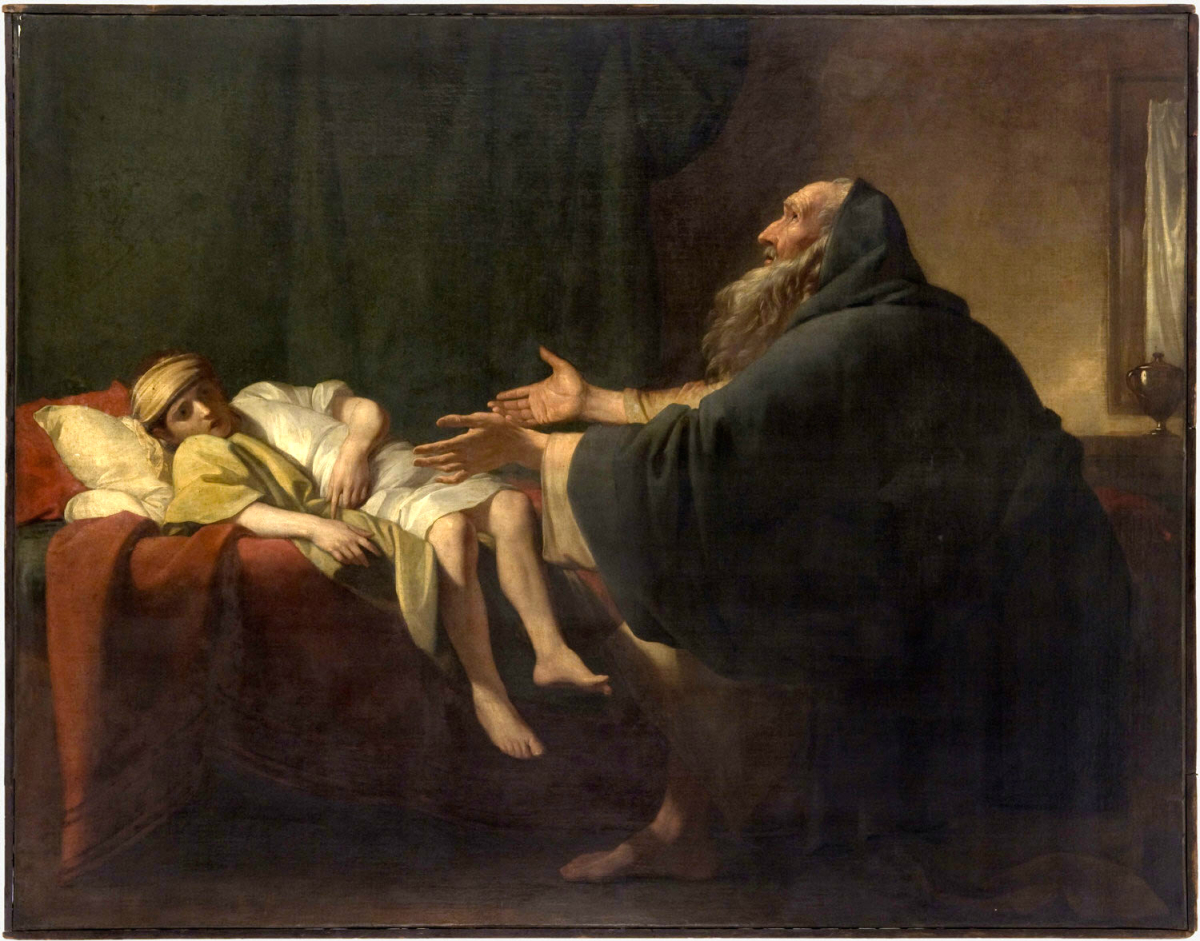
32 When Elisha came into the house, he saw the child lying dead on his bed. 33 So he went in and shut the door behind the two of them and prayed to the LORD. 34 Then he went up and lay on the child, putting his mouth on his mouth, his eyes on his eyes, and his hands on his hands. And as he stretched himself upon him, the flesh of the child became warm. 35 Then he got up again and walked once back and forth in the house, and went up and stretched himself upon him. The child sneezed seven times, and the child opened his eyes. 36 Then he summoned Gehazi and said, “Call this Shunammite.” So he called her. And when she came to him, he said, “Pick up your son.” 37 She came and fell at his feet, bowing to the ground. Then she picked up her son and went out. – 2 Kings 4:25b-37 ESV

Oftentimes, when reading the stories contained in the Scriptures, we find ourselves trying to ascertain their meaning or attempting to discover some helpful point of application. We desperately search for some relevant truth that we might apply to our own lives. And while this is a worthy goal, our relentless quest for a personalized point of application can leave us missing the primary message of the passage. This can be especially true when we extract these stories from their surrounding context. When we attempt to turn the stories of the Bible into Sunday School lessons, we tend to rob them of their Scriptural context and meaning.

In reading the story of the Shunammite woman, it would be easy to focus our attention on the loss of her child and the faith she exhibited by seeking out the prophet. And while there are lessons to be learned from her actions, the author seems to have a far greater and more significant point of emphasis. This entire story takes place in the context of Israel’s ongoing apostasy. It is a time of spiritual darkness and moral apathy. The kings of Israel have consistently led the nation away from the worship of Yahweh by promoting their own replacement deities. From the golden calves erected by Jeroboam to the Canaanite gods promoted by Ahab and Jezebel, the people of Israel have had a host of idols from which to choose. But through it all, Yahweh has remained faithful and all-powerful, and He has continued to reveal Himself through His prophets. First, He spoke and exhibited His power through Elijah. Then, upon Elijah’s death, God revealed Himself through Elijah’s former servant, Elisha.

But the stories involving Elijah and Elisha are not intended to focus our attention on these two men; they are designed to draw our eye to the God who worked through them. They were messengers of Yahweh and human conduits of His grace, mercy, power, and, at times, His judgment. They were the human representatives of God Almighty, speaking and acting on His behalf, and displaying His divine attributes before the people.

So, when the Shunammite woman discovers her son is dead and seeks out the prophet of God, it is less a statement about her faith than it is about God’s invasion of the darkness of Israel. All that takes place in this story is intended to point to Yahweh, not the woman, Gehazi the servant, or Elisha the prophet. But because we’re human, we tend to focus all our attention on the human actors in the drama and, in doing so, we run the risk of minimizing the role of the lead actor in the play: God Himself.

If we isolate this story from its context, we miss out on all that the author has been trying to reveal about God. Earlier, in Chapter 17 of 1 Kings, the author told the story of Elijah and the widow of Zarephath. After his decisive victory over the 450 prophets of Baal, Elijah had been threatened with death by Queen Jezebel, so he ran for his life. But God intercepted His fearful prophet and sent him to the town of Zarephath in Sidon. There, Elijah met a poor widow who was gathering wood to cook a final meal for herself and her son. But Elijah performed a miracle, providing the woman with a seemingly endless supply of flour that would sustain their lives for a long time to come. Sound familiar? It should. A very similar scene occurred when Elisha encountered the prophet’s widow in 2 Kings 4. This woman was about to lose her boys to slavery because of an unpaid debt. She was destitute and down to her last jar of oil. But Elisha intervened and miraculously multiplied her oil so that she had enough to satisfy her debt and sustain her and her sons for years to come.

But the similarities don’t stop there. The feel-good story of the widow of Zarephath also contains a less-than-happy plot twist. Her young son died unexpectedly, and she confronted Elijah about this devastating turn of events.

“O man of God, what have you done to me? Have you come here to point out my sins and kill my son?” – 1 Kings 17:18 NLT

Even Elijah was at a loss to understand why this tragedy had occurred, and he expressed his exasperation to Yahweh.

“O LORD my God, why have you brought tragedy to this widow who has opened her home to me, causing her son to die?” – 1 Kings 17:20 NLT

But the point of the passage is not the woman’s anger or Elijah’s disappointment with God. It is the divine intervention of Yahweh.

And he stretched himself out over the child three times and cried out to the LORD, “O LORD my God, please let this child’s life return to him.” The LORD heard Elijah’s prayer, and the life of the child returned, and he revived! – 1 Kings 17:21-22 NLT

Remember, both Elijah and Elisha had been chosen by God to be the human vessels through whom He revealed Himself to the people of Israel. They were nothing more than men, but God had set them apart for His use. He spoke and acted through them and, oftentimes, despite them.

However, don’t miss the significant parallels that can be found in all of these stories. The Shunammite woman, like the widow of Zarephath, suddenly finds her joy interrupted by the death of her child, so she seeks out the prophet of God. This time, it’s Elisha, and she confronts him about this devastating turn of events. Her worst nightmare has come true.

“Did I ask you for a son, my lord? And didn’t I say, ‘Don’t deceive me and get my hopes up’?” – 2 Kings 4:28 NLT

She was justifiably angry, and her appearance caught Elisha off guard; he had been given no prior insight from God concerning the death of her child. Yahweh had not revealed the nature of her distress or provided the prophet a solution to remedy it. But once Elisha discovered what had happened, he acted promptly. This former servant of Elijah would have been intimately familiar with the story of the widow of Zarephath. Most likely, he had been there to witness the miraculous death-to-life transformation that had taken place.

So, fully trusting that God would intervene yet again, he commanded his servant to take his staff and lay it on the body of the dead child. But this “remedy” proved ineffective. That was not the way God was going to restore the boy’s life. He wanted Elisha to be personally and physically involved in the miracle. It was not that God could not or would not operate through a staff. He had done so before and could do so again – if He so chose. Consider all the miracles God performed through the staff of Moses. However, on this occasion, God was going to require that Elisha be intimately involved in delivering the miracle. Just as Elijah had “stretched himself out over the child” (1 Kings 17:21 NLT), so Elisha “lay down on the child’s body” (2 Kings 4:34 NLT). In both cases, these men acted as God’s hands-on representatives, illustrating His intimate concern for His people through their own physical touch and personal involvement.

In a sense, the God of the universe had required both Elijah and Elisha to have some skin in the game. They became active agents in delivering God’s miracle. However, neither of these men was intended to be the focus of the story or viewed as the source behind the miracle. They were simply instruments in the hands of God. Yet, their personal touch made the transcendent God more knowable and relatable. Through their intimate involvement, they made the care and concern of God tangible and visible. God chose to revive the lives of these two boys through the hands-on touch of His chosen prophets.

Once again, let us not overlook the overall context of Scripture. These two stories point to an even greater display of God’s love and intimacy that was to come. Centuries later, God would send His own Son as His anointed messenger, delivering a message of repentance and renewal to the rebellious people of Israel. Jesus would become the final prophet of God, who would make the power and presence of God known through His incarnation.

No one has ever seen God. But the unique One, who is himself God, is near to the Father’s heart. He has revealed God to us. – John 1:18 NLT

“Not that anyone has ever seen the Father; only I, who was sent from God, have seen him.” – John 6:46 NLT

Christ is the visible image of the invisible God. – Colossians 1:15 NLT

Jesus was God in human flesh, delivering the divine message of redemption and spiritual rejuvenation. Like Elijah and Elisha, Jesus was required to personally engage with the nation of Israel. However, His involvement in restoring life to the spiritually dead nation would require a far greater price than either Elijah or Elisha had paid. Jesus was required to sacrifice His own life so that many might live. He stretched out His hands on a cruel Roman cross, paying the penalty for mankind’s sin by offering His own sinless life as a substitute for sinful humanity. He died so that we might live, and paid the ultimate price so that those who were dead in their trespasses and sins might experience new life and enjoy a new relationship with God.

Elijah and Elisha both restored life to dead children, but Jesus came to provide eternal life to those who were condemned to death for their sins. Neither of the women in these stories deserved to see their sons resurrected to life. They had done nothing to earn the miracle of new life for their boys. If anything, they stand as symbols of the spiritual state of the nation of Israel. One was rich while the other was poor. Yet, they both lived in a time of spiritual apathy and apostasy. Their sons represent the next generation of Israelites who would grow up under the death-producing influence of idolatry. Yet, Yahweh graciously broke through the darkness of Israel’s apostasy and delivered life to the dead, just as He would through His Son generations later.

Nevertheless, that time of darkness and despair will not go on forever. The land of Zebulun and Naphtali will be humbled, but there will be a time in the future when Galilee of the Gentiles, which lies along the road that runs between the Jordan and the sea, will be filled with glory.

The people who walk in darkness
    will see a great light.
For those who live in a land of deep darkness,
    a light will shine. – Isaiah 9:1-2 NLT

English Standard Version (ESV) The Holy Bible, English Standard Version. ESV® Permanent Text Edition® (2016). Copyright © 2001 by Crossway Bibles, a publishing ministry of Good News Publishers.

New Living Translation (NLT) Holy Bible, New Living Translation, copyright © 1996, 2004, 2015 by Tyndale House Foundation. Used by permission of Tyndale House Publishers Inc., Carol Stream, Illinois 60188. All rights reserved.

All Is Well

8 One day Elisha went on to Shunem, where a wealthy woman lived, who urged him to eat some food. So whenever he passed that way, he would turn in there to eat food. 9 And she said to her husband, “Behold now, I know that this is a holy man of God who is continually passing our way. 10 Let us make a small room on the roof with walls and put there for him a bed, a table, a chair, and a lamp, so that whenever he comes to us, he can go in there.”

11 One day he came there, and he turned into the chamber and rested there. 12 And he said to Gehazi his servant, “Call this Shunammite.” When he had called her, she stood before him. 13 And he said to him, “Say now to her, ‘See, you have taken all this trouble for us; what is to be done for you? Would you have a word spoken on your behalf to the king or to the commander of the army?’” She answered, “I dwell among my own people.” 14 And he said, “What then is to be done for her?” Gehazi answered, “Well, she has no son, and her husband is old.” 15 He said, “Call her.” And when he had called her, she stood in the doorway. 16 And he said, “At this season, about this time next year, you shall embrace a son.” And she said, “No, my lord, O man of God; do not lie to your servant.” 17 But the woman conceived, and she bore a son about that time the following spring, as Elisha had said to her.

18 When the child had grown, he went out one day to his father among the reapers. 19 And he said to his father, “Oh, my head, my head!” The father said to his servant, “Carry him to his mother.” 20 And when he had lifted him and brought him to his mother, the child sat on her lap till noon, and then he died. 21 And she went up and laid him on the bed of the man of God and shut the door behind him and went out. 22 Then she called to her husband and said, “Send me one of the servants and one of the donkeys, that I may quickly go to the man of God and come back again.” 23 And he said, “Why will you go to him today? It is neither new moon nor Sabbath.” She said, “All is well.” 24 Then she saddled the donkey, and she said to her servant, “Urge the animal on; do not slacken the pace for me unless I tell you.” 25 So she set out and came to the man of God at Mount Carmel. – 2 Kings 4:8-25 ESV

When Elijah had been the prophet of God to Israel, his ministry seemed to focus on the royal household. Virtually all his interactions had been with King Ahab or his wife, Jezebel. While Elisha had begun his own prophetic ministry with a confrontation between himself and King Jehoram, he seems to have been a prophet to the people. In the last story, Elisha came to the aid of a recently widowed woman who was facing the prospect of having her two sons sold into slavery because of an unpaid debt. In a sense, this woman represented the nation of Israel. She had been left destitute by her husband, a former prophet of God. While alive, this man of God had incurred a sizeable debt, and had he made no plans for its repayment in the case of his death. In a real sense, the people of Israel found themselves spiritually destitute and owing an enormous debt to God Almighty. Their kings had taken advantage of God’s love and mercy, using His resources to fund their own profligate lifestyles. They had lived for the moment, never considering what would happen when God called their debt due. Jeroboam, Ahab, Ahaziah, and now Jehoram, all led the people into idolatry, leaving them with a debt they could not repay.

But Elisha had intervened on the widow’s behalf, providing her with a miracle that eliminated her debt, spared her sons, and met her needs for a long time to come. Through the actions of His faithful prophet, Yahweh revealed His love and concern for His covenant people. Now, the story shifts to yet another encounter between Elisha and a woman in need. But this time, the woman wasn’t even aware that she had a need.

For some unspecified reason, Elisha and his servant, Gehazi, made regular trips to the northern region of Israel that took them to the city of Shunem. In this city, Elisha made the acquaintance of a local woman who offered the prophet and his servant the use of her home so they could rest. Realizing that Elisha was a prophet of Yahweh, she showed him hospitality and even had her husband construct a room on the roof of their home where the two men could stay when they were in town.

Unlike the widow in the previous story, this woman was apparently wealthy and well taken care of. She had a husband and enjoyed a comfortable lifestyle. But she was also generous and willing to share what she had with others. The gracious hospitality she extended to the prophet of God reveals that, despite the apostasy all around her, she had maintained her dedication to Yahweh.

Desiring to thank the woman for her courtesy and care, Elisha sent his servant to inquire what they could do for her. He wanted to repay her for her kindness. But it’s interesting to note that he offered to speak a good word to the king or the commander of the army on her behalf. Why would the prophet of Yahweh offer to act as an intermediary between this woman and these two apostate leaders of Israel? Perhaps it was a test, designed to see if the woman was a faithful follower of Yahweh. Would his offer of access to the king pique her interest and reveal a self-aggrandizing side to her personality? Or, instead, would she ask the prophet of God to appeal to Yahweh on her behalf?

But the woman simply responded, “I dwell among my own people” (2 Kings 4:13 ESV). This rather cryptic-sounding statement was her way of saying, “I’m just fine. I’m well-taken care of and in need of nothing.”

Yet, Elisha somehow senses that her answer was not quite honest. She was hiding something. It was Gehazi who made the keen observation that she and her husband were childless. She had a husband and enjoyed a comfortable lifestyle, but Gehazi recognized that her husband was advanced in years, and she had no sons to carry on the family name.

While the woman in the previous story had been without a husband, she had been blessed with two sons. But the Shunnamite woman had a husband and no children. For the moment, the woman had no perceived need, but the day was coming when her husband would die with no male heirs to whom he could leave his land and estate. In that culture, the inheritance could not be passed on to the wife. So, without a son, she would be left with nothing. She didn’t realize it, but her predicament was far more precarious than she imagined.

So, Elisha called the woman in and informed her, “Next year at this time you will be holding a son in your arms!” (2 Kings 4:16 NLT). Her reaction to this news reveals that she had long ago given up hope of ever having a son.

“No, my lord!” she cried. “O man of God, don’t deceive me and get my hopes up like that.” – 2 Kings 4:16 NLT

When Elisha asked the woman what he could do for her, she had hidden her heart’s desire. She gave the impression that she had no need and was perfectly fine, but she had lied. Her heart longed for a son, but she had become convinced that her dream would never come true. So, she lived with a constant fear of the future. What would happen to her when her husband died? How would she survive?

But, once again, Elisha, operating on behalf of Yahweh, spoke a word of blessing over the woman, predicting that she would give birth to a son, and his words proved true. God performed a miracle and granted the woman her heart’s desire; she conceived and gave birth to a son. But the story doesn’t stop there. In the space of just a few verses, the author reveals that the storybook ending was about to take a dark turn. This precious gift from God was going to be suddenly and unexpectedly taken away.

One day, while visiting his father in the fields, the young boy complained of a headache. He was rushed home and, later that same day, he passed away in the arms of his mother. Every detail of this story makes the reader want to ask, “Why?” None of this makes sense. Why would God give this woman a son and then allow him to die? What good did it do for her to give birth to a son if he would never live long enough to become the heir? The woman was no better off than she had been before. If anything, her sorrow was only intensified by the loss of her long-awaited son.

But the actions of the woman reveal something about her faith. Upon her son’s death, she took the body and laid it on the prophet’s bed. Then she ordered her husband to saddle a donkey so she could fetch the prophet. At this point, it seems that the boy’s father was unaware that his son had died. For whatever reason, the woman chose to keep him in the dark, assuring him, “All is well” (2 Kings 4:23 ESV). Her son was dead, but she still had hope. She knew that the very same man who had predicted the birth of her son would know what to do. This time, rather than hide her need, she sought the one who could do something about it. And she found Elisha at Mount Carmel, the site of Elijah’s victory over the prophets of Baal.

The location where she found the prophet of God is vital because it provides the reader with a direct link to Elisha’s mentor, the prophet Elijah. The story of the wealthy woman from Shunem and the untimely death of her son is intended to recall the story of Elijah raising the dead son of the widow of Zarephath. Elijah had provided the impoverished widow and her young son with a miracle supply of oil and flour that would last until the drought in the land had ended. But this blessing was followed by what appeared to be a curse.

Some time later the woman’s son became sick. He grew worse and worse, and finally he died. Then she said to Elijah, “O man of God, what have you done to me? Have you come here to point out my sins and kill my son?” – 1 Kings 17:17-18 NLT

The distraught woman accused Elijah of taking the life of her son as judgment for her own sin. But the prophet “took the child’s body from her arms, carried him up the stairs to the room where he was staying, and laid the body on his bed. Then Elijah cried out to the LORD, ‘O Lord my God, why have you brought tragedy to this widow who has opened her home to me, causing her son to die?’” (1 Kings 17:19-20 NLT). Three times Elijah prayed over the child and “the Lord heard Elijah’s prayer, and the life of the child returned, and he revived!” (1 Kings 17:22 NLT). The woman’s response to this miraculous event was simple and yet profound. She stated, “Now I know for sure that you are a man of God, and that the LORD truly speaks through you” (1 Kings 17:24 NLT). 

The story from 1 Kings 17 is intended to inform the reader’s interpretation of the events found in 2 Kings 4. The death of the Shunnamite woman’s son should produce a sense of déjà vu, a feeling of having been here before. It is unclear whether the Shunnamite woman had heard the story of Elijah’s healing of the widow of Zarephath’s dead child, but the reader has. Therefore, there should be a growing sense of anticipation and expectation about what is about to happen. Yahweh is moving behind the scenes and is orchestrating the events with divine precision and perfect timing. The attentive reader can sense that something miraculous is about to happen because the need is dire, but Yahweh is great.

English Standard Version (ESV) The Holy Bible, English Standard Version. ESV® Permanent Text Edition® (2016). Copyright © 2001 by Crossway Bibles, a publishing ministry of Good News Publishers.

New Living Translation (NLT) Holy Bible, New Living Translation, copyright © 1996, 2004, 2015 by Tyndale House Foundation. Used by permission of Tyndale House Publishers Inc., Carol Stream, Illinois 60188. All rights reserved.

The Well-Deserved Death of Ahab

29 So the king of Israel and Jehoshaphat the king of Judah went up to Ramoth-gilead. 30 And the king of Israel said to Jehoshaphat, “I will disguise myself and go into battle, but you wear your robes.” And the king of Israel disguised himself and went into battle. 31 Now the king of Syria had commanded the thirty-two captains of his chariots, “Fight with neither small nor great, but only with the king of Israel.” 32 And when the captains of the chariots saw Jehoshaphat, they said, “It is surely the king of Israel.” So they turned to fight against him. And Jehoshaphat cried out. 33 And when the captains of the chariots saw that it was not the king of Israel, they turned back from pursuing him. 34 But a certain man drew his bow at random and struck the king of Israel between the scale armor and the breastplate. Therefore he said to the driver of his chariot, “Turn around and carry me out of the battle, for I am wounded.” 35 And the battle continued that day, and the king was propped up in his chariot facing the Syrians, until at evening he died. And the blood of the wound flowed into the bottom of the chariot. 36 And about sunset a cry went through the army, “Every man to his city, and every man to his country!”

37 So the king died, and was brought to Samaria. And they buried the king in Samaria. 38 And they washed the chariot by the pool of Samaria, and the dogs licked up his blood, and the prostitutes washed themselves in it, according to the word of the LORD that he had spoken. 39 Now the rest of the acts of Ahab and all that he did, and the ivory house that he built and all the cities that he built, are they not written in the Book of the Chronicles of the Kings of Israel? 40 So Ahab slept with his fathers, and Ahaziah his son reigned in his place. – 1 Kings 22:29-40 ESV

Despite being warned by the prophet Micaiah that his attack on Ramoth-gilead would end in disaster and his own death, Ahab went ahead with his ill-fated plan. But in an attempt to thwart the will of God, Ahab came up with the brilliant idea to wear a disguise that would prevent the Syrians from recognizing him as the king. He knew he would be a target of Ben-Hadad’s wrath because his attack on Ramoth-gilead was in violation of their long-standing peace agreement. And he was right to be worried because Ben-hadad had commanded his troops to focus their attention on Ahab.

Now the king of Syria had commanded the thirty-two captains of his chariots, “Fight with neither small nor great, but only with the king of Israel.” – 1 Kings 22:31 ESV

Ahab’s decision to go through with the battle despite Micaiah’s warning clearly indicates the rebellious nature of his heart and his blatant disregard for the will of Yahweh. He truly believed he could devise a plan that would allow him to escape God’s wrath and accomplish his own will at the same time. Ahab was conniving and manipulative, and evidently quite persuasive, as he was able to convince King Jehoshaphat of Judah to go into battle wearing his royal armor while he wore a disguise. He hoped that, in the heat of battle, the Syrians would mistake Jehoshaphat as the king of Israel and focus all their attention on him. Somehow, he convinced the king of Judah to go along with this blatant display of brazen self-preservation.

And his plan almost worked. As the battle began, the Syrians spotted Jehoshaphat and gave chase, but they soon realized they were pursuing the wrong man. Ahab had managed to fool the Syrians, but he would not be able to hide his identity from God Almighty. His clever plan would not protect him from the judgment that God had decreed against him.

As the battle raged, one of the Syrian archers loosed an arrow that flew through the air and struck Ahab “between the scale armor and the breastplate” (1 Kings 22:34 ESV). The text describes this unnamed individual as “a certain man,” who “drew his bow at random” (1 Kings 22:34 ESV). His name is not provided, and the target of his arrow is undisclosed. In the heat of the battle, he discharged an arrow in the general direction of the enemy, but without aiming at anyone in particular. But his shot ended up piercing between the scale armor and the breastplate of Ahab’s armor. The king had refused to wear his royal robes, but not his protective armor. He could hide, but he could not get away from the all-seeing eye of Yahweh.

The seemingly lucky shot loosed by an unidentified Syrian soldier was sovereignly ordained and directed by the hand of God. Ahab had tried to avoid God’s will but failed. His disguise didn’t fool Yahweh, and his armor proved to be insufficient protection from the divine judgment leveled against him.

As the battle continued all around him, Ahab slumped in his chariot, his blood pouring from his wound and his life slowly ebbing away. At sunset, he took his last labored breath and died, and the news of his demise quickly spread across the battlefield.

 …as evening arrived he died. Just as the sun was setting, the cry ran through his troops: “We’re done for! Run for your lives!” – 1 Kings 22:35-36 NLT

Micaiah had warned Ahab that his death was inevitable because his actions were in direct violation of God’s will. If he chose to go through with his attack on Ramoth-gilead, Ahab would suffer the divine consequences. When Ahab died, lying in a pool of his own blood on the floor of his chariot, his troops abandoned the battle. The sheep found themselves without a shepherd, so they returned to their homes in peace, just as God had predicted they would.

“I saw all Israel scattered on the mountains, as sheep that have no shepherd. And the Lord said, ‘These have no master; let each return to his home in peace.’” – 1 Kings 22:17 ESV

With Ahab’s death, the battle for Ramoth-gilead came to an abrupt end, and the armies of Syria, Israel, and Judah abandoned the field and returned home. Ahab’s body, still lying in his chariot, was returned to Samaria. Amazingly, this wicked and rebellious king was given the honor of a royal burial. But the author describes a rather macabre scene that stands in stark contrast to the state funeral given to this unrepentant and undeserving king. As Ahab’s body was interred with all the pomp and circumstance of a royal funeral, his servants went about the unpleasant task of cleaning up the grisly scene his death left behind.

…his chariot was washed beside the pool of Samaria, and dogs came and licked his blood at the place where the prostitutes bathed, just as the Lord had promised. – 1 Kings 22:38 NLT

This scene took place in direct fulfillment of the words of the prophet Elijah. He had warned King Ahab that his complicity in the death of Naboth would result in his own demise.

“And you shall say to him, ‘Thus says the LORD: “In the place where dogs licked up the blood of Naboth shall dogs lick your own blood.”’” – 1 Kings 21:19 ESV

The place where the servants chose to wash Ahab’s blood from his chariot was the exact spot where the innocent Naboth had been stoned to death. Ahab’s body was buried in a royal tomb, but his life’s blood was unceremoniously poured out in a place recognized for its sin and degradation. It was a site within the walls of Samaria inhabited by those who were considered unclean and immoral. Wild dogs licked up the king’s blood, and the prostitutes of Samaria unknowingly bathed themselves in the blood-stained waters of the pool where Ahab’s blood was spilled.

Ahab’s reign as king of Israel came to an abrupt and violent end. While he would be remembered for his many achievements, he would go down in history as one of the most wicked of all Israel’s kings. His legacy would be marked by apostasy, rebellion, idolatry, and immorality. He proved to be a competent king, but his stubborn refusal to honor God would forever mar his reputation and leave a permanent stain on the northern kingdom of Israel. When the author states that “Ahab slept with his fathers” (1 Kings 22:40 ESV), it is a thinly veiled inference that Ahab died unrepentant and unforgiven, just like his predecessors. While alive, Ahab made no place for God in his kingdom. In death, he would discover that he had no place in God’s heavenly kingdom. In life, he chose to replace Yahweh with false gods, and that decision would prove to have eternal consequences.

English Standard Version (ESV) The Holy Bible, English Standard Version. ESV® Permanent Text Edition® (2016). Copyright © 2001 by Crossway Bibles, a publishing ministry of Good News Publishers.

New Living Translation (NLT) Holy Bible, New Living Translation, copyright © 1996, 2004, 2015 by Tyndale House Foundation. Used by permission of Tyndale House Publishers Inc., Carol Stream, Illinois 60188. All rights reserved.

The Power to Revive and Restore

17 After this the son of the woman, the mistress of the house, became ill. And his illness was so severe that there was no breath left in him. 18 And she said to Elijah, “What have you against me, O man of God? You have come to me to bring my sin to remembrance and to cause the death of my son!” 19 And he said to her, “Give me your son.” And he took him from her arms and carried him up into the upper chamber where he lodged, and laid him on his own bed. 20 And he cried to the LORD, “O LORD my God, have you brought calamity even upon the widow with whom I sojourn, by killing her son?” 21 Then he stretched himself upon the child three times and cried to the LORD, “O LORD my God, let this child’s life come into him again.” 22 And the LORD listened to the voice of Elijah. And the life of the child came into him again, and he revived. 23 And Elijah took the child and brought him down from the upper chamber into the house and delivered him to his mother. And Elijah said, “See, your son lives.” 24 And the woman said to Elijah, “Now I know that you are a man of God, and that the word of the LORD in your mouth is truth.” – 1 Kings 17:17-24 ESV

God used Elijah to deliver His message of judgment against King Ahab and his foreign queen, Jezebel. In marrying this princess from Sidon, Ahab had also adopted her false god, Baal, and built a temple for its worship. He also erected a shrine to honor Asherah, the moon-goddess and supposed mother of this pagan deity. Angered by these blatant acts of rebellion and apostasy, God had sent Elijah to tell the royal couple that their kingdom would suffer under a great drought. Their disrespect and disregard for God had brought His discipline.

But after Elijah successfully delivered his message, God sent him away. He ended up at a cave, where God graciously and miraculously arranged for ravens to provide all the food he needed to survive. But eventually, Elijah became a victim of the very drought he predicted. Soon, the brook dried up, and the daily deliveries of bread and meat no longer appeared. So, God sent Elijah to the Sidonian town of Zarephath, where he took up residence with a poor widow and her son. She, too, was suffering from the effects of the drought. But, once again, Yahweh proved Himself to be the one true God by causing her meager supply of flour and oil to miraculously multiply and never run out.

In the midst of a drought and severe famine, she had more than enough to sustain herself, her son, and God’s prophet. Through it all, Elijah learned to trust God for all His needs. But even more importantly, Elijah discovered that his God was greater than the gods of Ahab and Jezebel. While Baal, the so-called fertility god, was powerless to stop the drought or reverse the effects of the famine, Yahweh turned “a handful of flour in a jar and a little oil in a jug” (1 Kings 17:12 ESV) into a never-ending food supply for Elijah and his gracious hostess.

Then suddenly, the story takes a dramatic turn for the worse. The woman’s young son dies unexpectedly. Faced with this devastating change in her circumstances, the woman vented all her anger and frustration on the prophet of God.

“O man of God, what have you done to me? Have you come here to point out my sins and kill my son?” – 1 Kings 17:18 NLT

It seems that the woman had falsely assumed that her son’s death was a form of divine retribution for a former sin she had committed. Perhaps by this time, Elijah had shared the details of his encounter with Ahab and Jezebel, explaining that he had been the one to predict the drought as a punishment for their sin. So, when her son suddenly died, she would have naturally reasoned that God was using the prophet to deliver yet another judgment for sin – that of her own.

But ignoring her despair-driven accusation, Elijah took the lifeless body of her son and placed it on his own bed. Then Elijah turned his attention to God. But notice the tone of His prayer. He seems to echo the words of the widow, passing the blame up the food chain and questioning the goodness and graciousness of God.

“O LORD my God, why have you brought tragedy to this widow who has opened her home to me, causing her son to die?” – 1 Kings 17:20 NLT

Elijah’s response reveals his firm belief that God is sovereign over all things, but he is perplexed and confused by the seeming injustice of it all. In his frustration, He accuses God of doing something wicked. The Hebrew word is rāʿaʿ, which is most often translated as “evil.” The boy’s death makes no sense to Elijah; it seems unnecessary and completely nonproductive. When Elijah first met the woman, she had been fully expecting her son to die of starvation because of the drought. But God had intervened and provided more than enough food to keep all three of them alive. So, to Elijah, the boy’s death seemed pointless and, if anything, it appeared to be an act of cruelty.

But while Elijah was having a difficult time understanding the ways of God, he remained convinced of the power of God. Three times, he lay across the dead body of the boy and cried out, “O LORD my God, please let this child’s life return to him” (1 Kings 17:21 NLT). And the fact that Elijah repeated this process three separate times demonstrates both his persistence and dependence upon God.

It’s important to consider that Elijah had no precedent on which to base his prayer. He was asking Yahweh to do the impossible – to raise a dead body back to life. There is no indication that Elijah had ever seen or heard of God doing such a thing. Elijah was not basing his request on some past miracle recorded in the Hebrew scriptures. The Pentateuch, the first five books of the Bible, contains no instance of God raising the dead back to life. So, Elijah was asking God to do something that had never been done before. His request was a tremendous act of faith.

In a classic example of understatement, the author simply records, “The LORD heard Elijah’s prayer, and the life of the child returned, and he revived!” (1 Kings 17:22 NLT). One can only imagine Elijah’s shock and surprise when the lifeless body of the boy was suddenly reanimated. Two times, nothing had happened. But on the third try, God chose to intervene and answer Elijah’s prayer. We’re not told why God didn’t answer Elijah’s prayer the first time. Perhaps it was a test of Elijah’s faith to see if he would continue to ask and believe even when his request went unanswered. But God had heard, and He ultimately answered, and in a truly remarkable way. Elijah’s unbridled excitement and enthusiasm were on display as he announced the news to the boy’s grieving mother.

“See, your son lives.” – 1 Kings 17:23 ESV

It would be easy to misread this statement and assume that Elijah is saying something like, “See, I told you so!” It almost appears as if he is chastising the woman for her lack of faith. But at no point in the story did Elijah tell the woman that her son would live. He had no way of knowing whether God would answer his prayer or not. At least two times, God failed to do so. But when God had finally provided the miracle for which Elijah was asking, the prophet couldn’t contain his enthusiasm. The New Living Translation provides a much more accurate rendering of Elijah’s response.

“Look!” he said. “Your son is alive!” – 1 Kings 17:23 NLT

No one was as shocked as Elijah, and his joy overflowed in a display of emotional celebration. He most likely walked into the room, carrying the boy in his arms, and then handed him over to the smothering embrace of his overjoyed mother. And, through tears mixed with laughter, the woman managed to express her gratitude to the prophet by declaring her belief in his God.

“Now I know for sure that you are a man of God, and that the LORD truly speaks through you.” – 1 Kings 17:24 NLT

While Yahweh had been keeping the widow and her son alive, she must have had her doubts about Elijah and his God. But now, as she clutched her resurrected son in her arms, she finally recognized and confessed the sovereignty of God and the authority of His prophet. Her son had been dead but was now alive. Her devastating loss had been miraculously reversed with the return of her son. Her sorrow had been turned to joy.

It is easy to overlook the fact that this miracle took place in an obscure village in the region of Sidon. While Jezebel had brought her false god from Sidon to the land of Israel, Elijah had brought the God of Israel to the land of Sidon. The arrival of Baal had been accompanied by drought and famine. But when Yahweh made His appearance in the pagan land of the Sidonians, He had turned a widow’s poverty into plenty and had replaced death with life. In doing so, He had proved Himself to be the one and only God of the universe.

And God intended this powerful lesson to prepare His prophet for all that was about to happen. Elijah didn’t know it yet, but the most significant test of his faith was in his future. After three years of a debilitating and devastating famine, God was going to send Elijah back to the land of Israel to go face-to-face with the king and queen and toe-to-toe with their false god. If Yahweh could revive the dead son of the Sidonian widow, He was powerful enough to restore the stagnant spiritual state of the people of Israel. But would Elijah continue to believe in Yahweh’s power when the odds were stacked against him and the forces of evil threatened his very existence? Only time would tell.

English Standard Version (ESV) The Holy Bible, English Standard Version. ESV® Permanent Text Edition® (2016). Copyright © 2001 by Crossway Bibles, a publishing ministry of Good News Publishers.

New Living Translation (NLT) Holy Bible, New Living Translation, copyright © 1996, 2004, 2015 by Tyndale House Foundation. Used by permission of Tyndale House Publishers Inc., Carol Stream, Illinois 60188. All rights reserved.