Out With the Old

1 Now the Philistines were fighting against Israel, and the men of Israel fled before the Philistines and fell slain on Mount Gilboa. 2 And the Philistines overtook Saul and his sons, and the Philistines struck down Jonathan and Abinadab and Malchi-shua, the sons of Saul. 3 The battle pressed hard against Saul, and the archers found him, and he was badly wounded by the archers. 4 Then Saul said to his armor-bearer, “Draw your sword, and thrust me through with it, lest these uncircumcised come and thrust me through, and mistreat me.” But his armor-bearer would not, for he feared greatly. Therefore Saul took his own sword and fell upon it. 5 And when his armor-bearer saw that Saul was dead, he also fell upon his sword and died with him. 6 Thus Saul died, and his three sons, and his armor-bearer, and all his men, on the same day together. 7 And when the men of Israel who were on the other side of the valley and those beyond the Jordan saw that the men of Israel had fled and that Saul and his sons were dead, they abandoned their cities and fled. And the Philistines came and lived in them. – 1 Samuel 31:1-7  ESV

While David and his men were pursuing and defeating the Amalikites, Saul and the Israelites were doing battle with the Philistines. David had sought the help of God and found success. Saul had sought the help of a witch and died in battle, along with his three sons. As a result of his God-ordained victory, David celebrated by distributing the spoils among his men and the elders of Judah. Yet, Israel’s defeat at the hands of the Philistines resulted in Saul’s death as well as the mass evacuation of Israelite cities near the scene of the battle. The Israelites’ loss would be the Philistines’ gain as they took occupation of those abandoned cities.

Two men and two completely different outcomes, yet both taking place at exactly the same time. What is interesting to note is the easy-to-miss reference to King Saul’s armor bearer. Verse six reads: “Thus Saul died, and his three sons, and his armor-bearer, and all his men, on the same day together.” This verse stands out because, at one time, David had been Saul’s armor bearer.

And David came to Saul and entered his service. And Saul loved him greatly, and he became his armor-bearer. – 1 Samuel 16:21 ESV

While just a passing reference in the text of 1 Samuel 31, it is significant to realize that David’s somewhat difficult-to-understand exile from the palace of Saul had been a literal godsend. God had ordained David’s disassociation from Saul to spare David the same fate as Saul. All those close to Saul, including his son, Jonathan, died as a result of his stubborn rebellion against the will of God. Had God not removed His Spirit from Saul and allowed an evil spirit to torment him, David could have remained in his service. David could have been a part of that battle with the Philistines, serving alongside the king as his armor bearer. But it had been God’s plan to separate David from Saul so that he might be spared and prepared to be Saul’s eventual replacement.

This entire scenario was the work of God; He had even warned Saul that it would happen. In fact, when Saul sought the aid of the witch of Endor and asked her to conjure up the departed spirit of Samuel the prophet, God intervened. Much to her surprise and shock, she successfully called up the dead prophet who delivered a chilling prediction to Saul.

“Because you did not obey the voice of the Lord and did not carry out his fierce wrath against Amalek, therefore the Lord has done this thing to you this day. Moreover, the Lord will give Israel also with you into the hand of the Philistines, and tomorrow you and your sons shall be with me. The Lord will give the army of Israel also into the hand of the Philistines.” – 1 Samuel 28:18-19 ESV

The end of Saul’s reign was at hand. As part of His divine plan, God determined the time had come for Saul’s reign to end so that David’s could begin. However, the transition of power did not take place immediately. Saul remained on the throne and David was forced to go into hiding – all part of God’s sovereign plan.

Despite David’s earlier defeat of Goliath and his successful battles against the Philistines, this powerful pagan nation still posed a threat to the kingdom of Israel. So, on this occasion, when Saul went up against them in yet another battle, he did so without the aid of David. This time, no young shepherd boy stepped up to save the day. There was no miraculous defeat of the Philistine champion or a rousing defeat of the enemy.

Forced to go into battle without his greatest warrior and without the assistance of the Lord, Saul witnessed the complete destruction of his army by the enemies of God. It should not escape our attention that Saul, while wounded in battle, was not killed as part of the battle. He lived to witness the executions of his sons and had to watch as his kinsmen were either slaughtered in front of him or deserted the battlefield in fright.

Saul was not allowed the dignity of falling in battle at the hands of his enemies. There would be no songs celebrating his valiant last-gasp stance against the enemy. He didn’t go down in a hail of arrows, his blood-soaked sword clutched in his hand and the lifeless bodies of his enemies lying at his feet; he impaled himself on his own sword. Fearing what the Philistines would do to him if they took him alive, Saul chose to end his own life and with that last act of desperation and defeat, Saul’s nearly 40-year reign over Israel (1 Samuel 13:1) came to an abrupt and ignominious end.

Even in the moments before his death, Saul feared man more than he feared God. He was more concerned with falling into the hands of the Philistines than with having to answer to his God. Had Saul been able to read the words of James, he might have had second thoughts about his life-ending decision.

For we know the one who said, “I will take revenge. I will pay them back.” He also said, “The LORD will judge his own people.” It is a terrible thing to fall into the hands of the living God. – Hebrews 10:30-31 NLT

Perhaps Saul had deluded himself into believing he had been a faithful king and obedient servant of God. Maybe he was convinced that he was a man of integrity. Whatever the case, Saul faced a judgment far worse than anything the Philistines could do to him. It was Jesus who warned, “Don’t be afraid of those who want to kill your body; they cannot touch your soul. Fear only God, who can destroy both soul and body in hell” (Matthew 10:28 NLT).

Saul died, just as the prophet had foretold. Israel was defeated and the Philistines were victorious. But God was still sovereign. He was not surprised by the outcome. He didn’t panic. No knee-jerk reaction or spur-of-the-moment decision was necessary to deal with this significant setback. It had all been part of His divine plan and sovereign will.

God had given the people what they demanded: A king. But not just any king. He gave them a king like all the other nations, just as they had requested. Little did they know that their demand would come back to haunt them. They would get what they wanted and much more. God could see into their hearts and knew that their request for a king was actually a rejection of Him as their sovereign. He even told Samuel the prophet, “Obey the voice of the people in all that they say to you, for they have not rejected you, but they have rejected me from being king over them” (1 Samuel 8:7 ESV).

The people’s 40-year experiment with the world’s brand of leadership had come to an abrupt end, and God was preparing to replace their king with a far better one – a man after his own heart. Not a perfect man. Not a sinless man. But a man whose heart had been trained to rely upon and rest in the will of God. A man who had learned the invaluable lessons of trusting God rather than relying upon himself. A man who had experienced the futility of self-preservation and learned the value of reliance upon the Lord.

Saul was done, but God was not. Israel was down, but not out. Their best days lie ahead of them. The king they had longed for was dead but God had his replacement in the wings. The days ahead looked dark and bleak, but a ray of hope shone on the horizon. God had a plan and He was working it to perfection. With Israel’s defeat and Saul’s death, the nation mourned but, little did they know that their best days were ahead of them.

English Standard Version (ESV) The Holy Bible, English Standard Version. ESV® Permanent Text Edition® (2016). Copyright © 2001 by Crossway Bibles, a publishing ministry of Good News Publishers.

New Living Translation (NLT) Holy Bible, New Living Translation, copyright © 1996, 2004, 2015 by Tyndale House Foundation. Used by permission of Tyndale House Publishers Inc., Carol Stream, Illinois 60188. All rights reserved.
No Confidence in the Flesh

4 If anyone else thinks he has reason for confidence in the flesh, I have more: 5 circumcised on the eighth day, of the people of Israel, of the tribe of Benjamin, a Hebrew of Hebrews; as to the law, a Pharisee; 6 as to zeal, a persecutor of the church; as to righteousness under the law, blameless. 7 But whatever gain I had, I counted as loss for the sake of Christ. 8 Indeed, I count everything as loss because of the surpassing worth of knowing Christ Jesus my Lord. For his sake I have suffered the loss of all things and count them as rubbish, in order that I may gain Christ 9 and be found in him, not having a righteousness of my own that comes from the law, but that which comes through faith in Christ, the righteousness from God that depends on faith— 10 that I may know him and the power of his resurrection, and may share his sufferings, becoming like him in his death, 11 that by any means possible I may attain the resurrection from the dead. – Philippians 3:4b-11 ESV

To understand what Paul means by “confidence in the flesh,” you must remember the context. He has just warned the believers in Philippi to “look out for the dogs, look out for the evildoers, look out for those who mutilate the flesh” (Philippians 3:2 ESV). This was a direct broadside delivered against the Judaizers, a group comprised of Jewish converts to Christianity who were attempting to bring the legalism associated with the Mosaic Law into the church. They were demanding that Gentile believers be circumcised and then agree to keep the Jewish laws, religious festivals, and sacrificial requirements. In other words, they had to become Jews before their salvation experience could be considered legitimate.

So, when Paul mentions having confidence in the flesh, he is stressing the teachings of this group. They believed that their human efforts, those things done in their own strength, somehow earned them favor with God. As Jews, they put a high priority and value on the rite of circumcision; it was an outward sign of their unique relationship as God’s chosen people. They were of the strong opinion that circumcision was necessary for anyone who hoped to enjoy the salvation offered by Jesus Christ. But for Paul, this was nothing less than another gospel; it was a false gospel, and it was to be exposed for what it was: a dangerous heresy.

The Greek word Paul used for “flesh” is sarx and, while it was often used to refer to the physical body, it could also be used in a metaphorical sense, as in human nature. The Judaizers put a lot of stock in human nature and their own physical abilities, believing that they were able to keep the laws of God and live up to the holy standards of God. But Paul rejects that mindset, stating that believers were to “glory in Christ Jesus and put no confidence in the flesh” (Philippians 3:3 ESV). Salvation was based on the work of Christ, not the works of men.

But Paul chose to use their own argument against them. He rather sarcastically portrays himself as the poster boy for stellar human character and self-achievement, to demonstrate the kind of credentials that might earn someone favor with God. Paul boldly states:

If someone thinks he has good reasons to put confidence in human credentials, I have more… – Philippians 3:4 NLT

It is as if Paul is saying, “So, you think you can earn a right standing with God based on your accomplishments and status? Well, check this out!”

What follows is a laundry list of Paul’s off-the-chart human credentials.

  • He was a card-carrying member of the nation of Israel
  • He was from the tribe of Benjamin
  • He had been circumcised according to the Mosaic Law
  • He was a Hebrew of Hebrews (a hard-core traditionalist)
  • He had been a member of the Pharisees, an elite religious sect
  • He had been a passionate and zealous persecutor of the church
  • He had been painstakingly dedicated to keeping the law

Even a short glance at that list reveals that Paul was not so subtly comparing himself with the Judaizers. He was placing himself in direct competition with them and declaring himself to be the model Jew. If they thought they were somehow better than everybody else because of their Jewish heritage and law-keeping ability, they had nothing on Paul. His resume made them look like third-string players trying to win a spot on the varsity squad.

But notice what Paul says next. He takes his list of accomplishments and credentials and describes them “as liabilities because of Christ” (Philippians 3:7 NLT). His relationship with Christ, based solely on faith in the work of Christ done on his behalf, made any of his so-called assets amount to nothing. They earned him no credibility with God and bought him no favor from God. Paul understood that his so-called righteous deeds were of no value when it came to his salvation. He firmly believed what the text in Isaiah clearly states:

We are all infected and impure with sin.
    When we display our righteous deeds,
    they are nothing but filthy rags. – Isaiah 64:6 NLT

Paul’s lofty list of accomplishments and personal assets were worthless. That is why he could say, “I now regard all things as liabilities compared to the far greater value of knowing Christ Jesus my Lord” (Philippians 3:8 NLT). Rather than placing any stock in human nature or his ability to produce righteous-looking deeds, Paul saw those things as hindrances to his spiritual walk. they were liabilities because they were all tainted by sin. So, Paul had given them all up. He had decided to treat them like what they were; liabilities, rather than assets, all so he could know Christ better.

Paul gets a bit graphic when trying to describe his new relationship with all those things he once held near and dear. They were like dung to him now, to be tossed aside and treated for what they were: worthless and detestable.

The bottom line for Paul was righteousness. A holy and righteous God demanded that His people live holy, righteous lives. But man’s sinful nature made that impossible, and no amount of law-keeping, ritual-observing, or efforts at God-pleasing were going to make a difference. Paul states, “I have the righteousness that comes by way of Christ’s faithfulness—a righteousness from God that is in fact based on Christ’s faithfulness” (Philippians 3:9 NLT). In other words, Paul’s righteousness was not based on self-effort, but on Christ’s faithfulness. Jesus died a sinner’s death to satisfy the just demands of a holy and righteous God. As Paul explained to the Corinthian believers: “For our sake he [God] made him to be sin who knew no sin, so that in him we might become the righteousness of God” (2 Corinthians 5:21 ESV).

Earlier in this letter, Paul pointed out that Jesus “humbled himself by becoming obedient to the point of death, even death on a cross” (Philippians 2:8 ESV). His faithfulness to do the will of His Father resulted in righteousness for us.

The Judaizers were not right before God because they had been circumcised. They were not right before God because they were Jews. They could not claim a right standing before God because they kept the law. In fact, Paul vaporized that idea in his letter to the Galatians.

So it is clear that no one can be made right with God by trying to keep the law. For the Scriptures say, “It is through faith that a righteous person has life.” – Galatians 3:11 NLT

He said the same thing to the believers in Rome.

For no one can ever be made right with God by doing what the law commands. The law simply shows us how sinful we are. – Romans 3:20 NLT

We have no reason to boast. We have no ground on which to stand and from which to proclaim our own self-righteousness. Our righteousness is actually Christ’s righteousness imputed to us when we placed our faith in Him. When Christ died on the cross, He paid in full the debt that was owed for the sins of mankind. He died in our place, bearing the penalty we deserved, and that act justified us before God. He now sees us as righteous and just, not sinful and worthy of death. We have been cleansed by the blood of Christ. With that thought in mind, Paul refocuses the attention of his readers on that which is really important; not effort and earning, but the pursuit of an ongoing and always growing relationship with Jesus Christ.

My aim is to know him, to experience the power of his resurrection, to share in his sufferings, and to be like him in his death, and so, somehow, to attain to the resurrection from the dead. – Philippians 3:10-11 NLT

Paul is not talking about cognitive knowledge. He’s not suggesting a purely academic understanding of who Jesus was and is. He is describing a deep and intimate relationship that features an ever-intensifying awareness of all that Jesus Christ has done and will do for him. In the immediate context, Paul wanted to experience all the power that Christ’s resurrection had made available to him. Jesus had been raised back to life by the power of the Holy Spirit, and each and every believer has that same power present within them.

But Paul knew that the resurrection power he so desired to see is most often revealed in the context of suffering. Just as Jesus had to suffer and die before He could experience the resurrection, we will find ourselves suffering so that we might experience the resurrection power of God’s Spirit in our own lives. Just as Jesus experienced humiliation before His glorification, so will we. And then, Paul reminds us, it will all end in death. The ultimate form of suffering we all face is our own physical death. But Paul wants us to remember that there is a resurrection of the dead. Death is not the end. It is really the beginning of something greater, and Paul told the believers in Corinth what they could expect when death finally came.

For our dying bodies must be transformed into bodies that will never die; our mortal bodies must be transformed into immortal bodies.

Then, when our dying bodies have been transformed into bodies that will never die, this Scripture will be fulfilled:

“Death is swallowed up in victory. O death, where is your victory? O death, where is your sting?” – I Corinthians 15:53-55 NLT

Why put confidence in the flesh? It’s of no value and will ultimately be left behind. And why put stock in our own worthiness before God? Without Christ, we have no righteousness of our own. As Paul told the Colossian believers, it all boils down to this: “Christ in you, the hope of glory” (Colossians 1:27 ESV).

English Standard Version (ESV) The Holy Bible, English Standard Version. ESV® Permanent Text Edition® (2016). Copyright © 2001 by Crossway Bibles, a publishing ministry of Good News Publishers.

New Living Translation (NLT) Holy Bible, New Living Translation, copyright © 1996, 2004, 2015 by Tyndale House Foundation. Used by permission of Tyndale House Publishers Inc., Carol Stream, Illinois 60188. All rights reserved.

The Message (MSG) Copyright © 1993, 1994, 1995, 1996, 2000, 2001, 2002 by Eugene H. Peterson

The Mind and the Mission of Christ

5 Have this mind among yourselves, which is yours in Christ Jesus, 6 who, though he was in the form of God, did not count equality with God a thing to be grasped, 7 but emptied himself, by taking the form of a servant, being born in the likeness of men. 8 And being found in human form, he humbled himself by becoming obedient to the point of death, even death on a cross. 9 Therefore God has highly exalted him and bestowed on him the name that is above every name, 10 so that at the name of Jesus every knee should bow, in heaven and on earth and under the earth, 11 and every tongue confess that Jesus Christ is Lord, to the glory of God the Father. – Philippians 2:5-11 ESV

So, how are the Philippians believers supposed to live in unity, “being of the same mind, having the same love, being in full accord and of one mind”? How will they prevent self-ambition and conceit from destroying their personal relationships and corporate witness? Where will they find the motivation and strength to live humbly, considering others as more important than themselves?

Paul doesn’t leave them on their own to figure out the answers to these pressing questions; he provides them with a succinct and simple answer: “Have this mind among yourselves, which is yours in Christ Jesus…” (Philippians 2:5 ESV).

He reminds them that Christ was the key to their salvation and He will be the key to their ongoing sanctification – as individuals and as a congregation. The only way they will be able to experience the kind of unity Paul has prescribed is if they learn to think as Christ did. They are to have the mind of Christ. The Greek word Paul used is phroneō and it is actually in its verb form, transforming it into an action. The original word can be translated as “to think.” Paul is telling them to think on Christ and consider His life.  They are to be of the same mind as Christ, considering their circumstances and responding to them as He would. And notice the environment in which the mind of Christ was to be put to use: “Among yourselves.” The task of thinking and reacting like Christ is to be applied within the body of Christ.

Christ-likeness that masquerades as self-preservation or self-satisfaction is not Christ-likeness at all. To claim to have the mind of Christ, but to think only of one’s own self-interest is to be nothing like Christ. To prove that point, Paul ensures that the Philippian believers understand what he means by sharing the mindset and behavior of Christ. And don’t miss the very important point that Paul makes. This mindset is already available to them because of their relationship with Christ Jesus; it is not something they have to seek or produce on their own. It became theirs at the point of their salvation.

But we don’t always live with the mind of Christ. Too often, we see things from our sinful and self-centered vantage point, making even our relationship with Christ all about us. In doing so, we forget that Christ redeemed us from a life of self-destructive narcissism. We have been placed within the body of Christ so that we might display the character of Christ among our fellow brothers and sisters in Christ.

At one point, Paul wrote to the believers in Ephesus and expressed his strong desire for them to fully comprehend the extent of Christ’s love for them. But he suggests that this could only be accomplished within the context of the body of Christ. As they selflessly loved one another, as an expression of their grateful love for God, they would experience Christ’s remarkable love for them.

I pray that from his glorious, unlimited resources he will empower you with inner strength through his Spirit. Then Christ will make his home in your hearts as you trust in him. Your roots will grow down into God’s love and keep you strong. And may you have the power to understand, as all God’s people should, how wide, how long, how high, and how deep his love is. May you experience the love of Christ, though it is too great to understand fully. Then you will be made complete with all the fullness of life and power that comes from God. – Ephesians 3:16-19 NLT

And just how much did Christ love us? Enough to die for us. But before Christ went to the cross, He had to come to earth, and Paul makes sure his audience understands that as horrific as the cross was, Christ’s incarnation was also an act of humiliation and shame.

Though he was God,
    he did not think of equality with God
    as something to cling to.
Instead, he gave up his divine privileges;
    he took the humble position of a slave
    and was born as a human being. – Philippians 2:6-7 NLT

Christ left the glory of heaven and His rightful place of honor at His Father’s side and willingly came to earth. But He couldn’t come in His glorious, heavenly form; He had to become a human being. Not only that, Jesus didn’t arrive on earth as a fully-formed man, He became a fetus in Mary’s womb and, nine months later, entered the world as a helpless infant. Yet, in doing so, He became Immanuel, God with us. But no one would have recognized Him as God. He no longer exhibited the trappings of deity. Rather than a royal robe, He was wrapped in a swaddling cloth. Instead of angels and cherubim surrounding His throne proclaiming His glory, sheep and cattle stood around His manger in disinterest. Rather than appearing as the all-powerful Son of God, Jesus came in the form of a child, a status that left him with little honor and no rights. Paul goes on to emphasize that Jesus, the Son of God and the very image of God, became in appearance as a man, even a slave. He humbled Himself. But why? So, that He might give His life as a ransom for the sins of mankind. What He did, He did for the good of others. A point that Jesus Himself made very clear.

“For even the Son of Man came not to be served but to serve others and to give his life as a ransom for many.” – Mark 10:45 NLT

The truly amazing thing is that Jesus gave up all His heavenly prerogatives so that He might live on this earth as a human being. This does not mean that Jesus became any less God during His time on earth. He remained fully God during the entirety of His incarnation. But He willingly relinquished the independent use of His divine attributes. He became fully dependent upon God the Father during His earthly ministry. He still retained His divine power and all of the characteristics of His deity but He submitted them fully to the will of God. During His incarnation, Jesus operated under the influence of and by virtue of the power of the Holy Spirit.

Stop and think about that. The entire time Jesus walked this earth, He had the power of God residing in Him and the full ability to access that power at any moment. But He refused to do so. Which is Paul’s point. He emphasizes that Jesus “humbled himself in obedience to God” (Philippians 2:8 NLT). He did what the Father wanted, and His obedience was so precise and complete that He was willing to go to the cross where he “died a criminal’s death.” 

This is the attitude that Paul was encouraging the Philippian believers to have. They were to share the same way of thinking as Jesus. He didn’t consider Himself too good to do the will of God. He didn’t think of Himself as too important to sacrifice His life for the good of others. The prospect of humiliation was not off-limits to Jesus. The thought of dying on behalf of those who actually deserved to die was not off-putting to Jesus. He did it willingly and lovingly. All that Jesus did was an expression of His love.

And we are to share that same way of thinking. We are to exhibit that same mindset when it comes to those around us – especially our brothers and sisters in Christ. But we are all prone to seek our own self-exaltation. We are driven by pride and ego. Our sin natures tend to make everything all about us. And, even as believers, we can begin to think that we are somehow better than others because we are in Christ. We are redeemed. We are children of God. We are “a chosen race, a royal priesthood, a holy nation, a people for his own possession” (1 Peter 2:9 ESV). But if we’re not careful, we begin to think too highly of ourselves and end up drowning in our own perceived self-importance. But as Paul told the believers in Rome, “Don’t think you are better than you really are” (Romans 12:3 NLT).

Paul would have us consider Christ. If anyone deserved to be exalted, it was Him. After all, He was God. Yet, Jesus humbled Himself; He even allowed Himself to be humiliated by the very ones He created. He suffered death at the hands of sinful men. But Paul reminds us that God exalted Him.

God elevated him to the place of highest honor
    and gave him the name above all other names… – Philippians 2:9 NLT

But it’s important to note that the exaltation of Jesus came after His humiliation. His resurrection followed His crucifixion. His ascension could not have happened without His death and burial in a borrowed grave.

We can waste all our time seeking to be exalted in this life, or we can share the thinking of Christ and pursue a life of selfless service to others. We can humble ourselves as He did, enduring potential humiliation and the seeming loss of our status as God’s children, or we can make ourselves the center of attention. We can pursue self-exaltation or humbly serve and love one another, allowing God to exalt us according to His timing. The words of Peter are appropriate here.

…all of you, dress yourselves in humility as you relate to one another, for

“God opposes the proud
    but gives grace to the humble.”

So humble yourselves under the mighty power of God, and at the right time he will lift you up in honor. – 1 Peter 5:5-6 NLT

English Standard Version (ESV) The Holy Bible, English Standard Version. ESV® Permanent Text Edition® (2016). Copyright © 2001 by Crossway Bibles, a publishing ministry of Good News Publishers.

New Living Translation (NLT) Holy Bible, New Living Translation, copyright © 1996, 2004, 2015 by Tyndale House Foundation. Used by permission of Tyndale House Publishers Inc., Carol Stream, Illinois 60188. All rights reserved.

The Message (MSG) Copyright © 1993, 1994, 1995, 1996, 2000, 2001, 2002 by Eugene H. Peterson

A Matter of Life or Death

18 Yes, and I will rejoice, 19 for I know that through your prayers and the help of the Spirit of Jesus Christ this will turn out for my deliverance, 20 as it is my eager expectation and hope that I will not be at all ashamed, but that with full courage now as always Christ will be honored in my body, whether by life or by death. 21 For to me to live is Christ, and to die is gain. 22 If I am to live in the flesh, that means fruitful labor for me. Yet which I shall choose I cannot tell. 23 I am hard pressed between the two. My desire is to depart and be with Christ, for that is far better. 24 But to remain in the flesh is more necessary on your account. 25 Convinced of this, I know that I will remain and continue with you all, for your progress and joy in the faith, 26 so that in me you may have ample cause to glory in Christ Jesus, because of my coming to you again. – Philippians 1:18-26 ESV

Paul opens this section of his letter by reconfirming his determination to rejoice in his circumstances. While news of his imprisonment had been disconcerting to the believers in Philippi, for Paul it had been just another God-ordained opportunity to spread the gospel. If others were attempting to take advantage of his situation by filling the role of messenger in his absence, so be it. As long as Christ was being lifted up, Paul was perfectly okay with it all, even if some of these people were motivated by envy rather than a sincere love for the lost.

Paul knew that any success he had enjoyed in his ministry had not been because of his powers of persuasion, but was due to the power of the gospel. In writing to the believers in Thessalonica, Paul reminded them of the treatment he and Silas had suffered in Philippi because of their preaching of the gospel. Not long after their arrival there, they had cast out a demon from a young slave girl. With the exorcism of the demon, she lost her ability to act as a fortune teller for her masters and they lost a much-needed source of revenue. In an act of revenge, they grabbed Paul and Silas and dragged them before the magistrates of the city, where the two men were severely beaten and thrown in jail. Paul reminds the Thessalonian believers that all of this had taken place just before he arrived in their town.

You yourselves know, dear brothers and sisters, that our visit to you was not a failure. You know how badly we had been treated at Philippi just before we came to you and how much we suffered there. Yet our God gave us the courage to declare his Good News to you boldly, in spite of great opposition. So you can see we were not preaching with any deceit or impure motives or trickery.

For we speak as messengers approved by God to be entrusted with the Good News. Our purpose is to please God, not people. He alone examines the motives of our hearts. Never once did we try to win you with flattery, as you well know. And God is our witness that we were not pretending to be your friends just to get your money! As for human praise, we have never sought it from you or anyone else. – 1 Thessalonians 2:1-6 NLT

Despite all that had happened in Philippi, Paul and his companions boldly declared the gospel in Thessalonica, even in the face of opposition. They did so, not for money or the praise of men, but to please God as His faithful messengers. So, Paul was not concerned with the motives of others; as long as they were preaching salvation by faith alone in Christ alone, he was satisfied and could rejoice. He had never been in the ministry for what he could get out of it. For him, it was a calling, not a job, and He never saw himself as this gifted spokesman using his talents to further the Kingdom of God. He even describes himself as nothing more than a fragile clay jar containing the great treasure of the gospel message (2 Corinthians 4:7). When he wrote to the Corinthian believers, he reminded them that their conversions were due to the power of the Spirit, not his own eloquence.

When I first came to you, dear brothers and sisters, I didn’t use lofty words and impressive wisdom to tell you God’s secret plan. For I decided that while I was with you I would forget everything except Jesus Christ, the one who was crucified. I came to you in weakness—timid and trembling. And my message and my preaching were very plain. Rather than using clever and persuasive speeches, I relied only on the power of the Holy Spirit. I did this so you would trust not in human wisdom but in the power of God. – 1 Corinthians 2:1-5 NLT

But as Paul writes to the Philippian believers from his house arrest in Rome, he shares with them the tremendous internal conflict he was having. It had nothing to do with a fear of death; he knew that was a possible outcome of his pending trial before Nero and he was perfectly at peace with that. In fact, he flatly stated, “My desire is to depart and be with Christ” (Philippians 1:23 ESV). He saw death as a reward, not a punishment. But he also struggled with the desire to continue his ministry among the Philippians and other congregations he had helped to start. As much as he longed to be with the Lord, he felt that his work on Christ’s behalf was far from over. That’s why he told the Philippians, “I am convinced that I will remain alive so I can continue to help all of you grow and experience the joy of your faith” (Philippians 1:25 NLT).

One thing motivated Paul’s actions and attitudes – bringing glory to the name of Christ. If he could do that through deliverance from prison and a continuation of his ministry, so be it. But if his trial resulted in a death sentence, he saw that as a gracious deliverance by God from this sin-marred world. When all was said and done, Paul simply wanted to honor Christ in all that he did, which is why he stated, “I trust that my life will bring honor to Christ, whether I live or die” (Philippians 1:20 NLT).

Paul was not making much of himself. He was not bragging about his superior spirituality or attempting to set himself up as some icon of righteousness and religious virtue. He was attempting to encourage the believers in Philippi to share the same perspective on life that he had. He didn’t view his arrest and imprisonment as a setback or a sign of God’s disfavor with him. He sincerely believed that it was all a part of God’s will for his life. By maintaining his focus on Christ and trusting in the will of God for his life, Paul had “learned to be content whatever the circumstances” (Philippians 4:11 NLT). So, he could say, “I have learned the secret of being content in any and every situation” (Philippians 4:12 NLT).

He knew that the Philippian believers were facing their own set of difficulties. They were going to have struggles in their faith journey, just as he had, and he wanted them to stay strong, to remain committed to the cause of Christ, and to see the sovereign hand of God in all that happened in and around their lives.

Paul was convinced that he would be released and would one day see them again. But in the meantime, he wanted to encourage them to keep on keeping on. Later on in this letter, Paul writes these powerful words of testimony and encouragement.

I press on to reach the end of the race and receive the heavenly prize for which God, through Christ Jesus, is calling us… – Philippians 3:14 NLT

Then he follows up this statement of personal conviction and commitment with a call for them to follow his lead.

Dear brothers and sisters, pattern your lives after mine, and learn from those who follow our example. – Philippians 3:17 NLT

In the verses that follow, Paul provides the Philippians with specific details concerning the conduct of all those who claim heavenly citizenship as God’s children. Their journey of faith was not going to be easy or trouble-free, but God had equipped each of them with the indwelling Holy Spirit and placed them in the body of Christ so that they had all the resources they needed to thrive, not just survive what lay ahead.

Paul was torn between two opinions; he was ready to see his Lord and Savior face to face, but he was also anxious to continue his ministry of exhortation and evangelization around the world. He was prepared to face the ongoing struggles of doing God’s will in a fallen world but, should his life end in death, he saw that as a promotion, not a punishment. So, whether he faced a long life serving God that was marked by pain, persecution, and opposition, or if his next step was heaven, he could rejoice because he was in God’s good and gracious hands.

English Standard Version (ESV) The Holy Bible, English Standard Version. ESV® Permanent Text Edition® (2016). Copyright © 2001 by Crossway Bibles, a publishing ministry of Good News Publishers.

New Living Translation (NLT) Holy Bible, New Living Translation, copyright © 1996, 2004, 2015 by Tyndale House Foundation. Used by permission of Tyndale House Publishers Inc., Carol Stream, Illinois 60188. All rights reserved.

The Message (MSG) Copyright © 1993, 1994, 1995, 1996, 2000, 2001, 2002 by Eugene H. Peterson

Look and Live

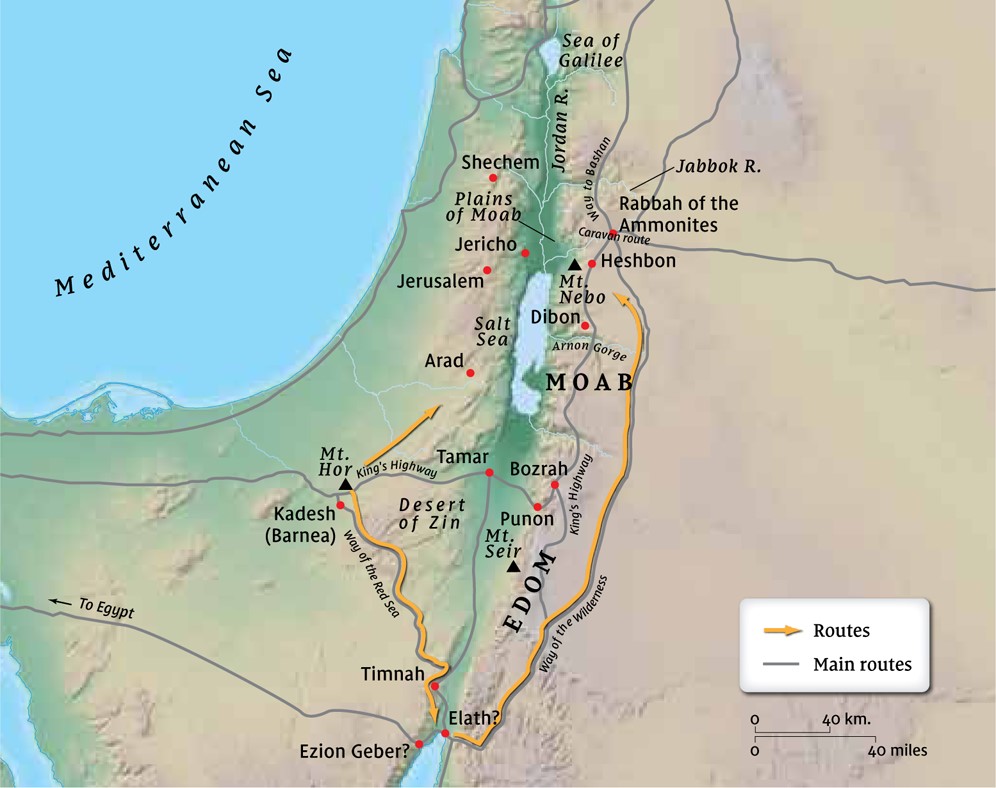
1 When the Canaanite, the king of Arad, who lived in the Negeb, heard that Israel was coming by the way of Atharim, he fought against Israel, and took some of them captive. 2 And Israel vowed a vow to the Lord and said, “If you will indeed give this people into my hand, then I will devote their cities to destruction.” 3 And the Lord heeded the voice of Israel and gave over the Canaanites, and they devoted them and their cities to destruction. So the name of the place was called Hormah.

4 From Mount Hor they set out by the way to the Red Sea, to go around the land of Edom. And the people became impatient on the way. 5 And the people spoke against God and against Moses, “Why have you brought us up out of Egypt to die in the wilderness? For there is no food and no water, and we loathe this worthless food.” 6 Then the Lord sent fiery serpents among the people, and they bit the people, so that many people of Israel died. 7 And the people came to Moses and said, “We have sinned, for we have spoken against the Lord and against you. Pray to the Lord, that he take away the serpents from us.” So Moses prayed for the people. 8 And the Lord said to Moses, “Make a fiery serpent and set it on a pole, and everyone who is bitten, when he sees it, shall live.” 9 So Moses made a bronze serpent and set it on a pole. And if a serpent bit anyone, he would look at the bronze serpent and live. – Numbers 21:1-9 ESV

One of the things the Israelites seemed to quickly forget was that their presence in the wilderness was their own fault. God had led them from Egypt to the edge of the land of promise 40 years earlier, but they had decided that entrance into the land was way too risky. The 12 spies they had sent in to reconnoiter the land had returned with a conflicting report concerning conditions in Canaan.

“We entered the land you sent us to explore, and it is indeed a bountiful country—a land flowing with milk and honey. Here is the kind of fruit it produces. But the people living there are powerful, and their towns are large and fortified. We even saw giants there, the descendants of Anak!” – Numbers 13:27-28 ESV

The second half of their report left the Israelites dejected and demoralized. Despite the news that this land was fertile and filled with abundant fruit, the presence of “giants” was too much for the Israelites, and the spies fed their doubts and anxieties by confirming their worst fears.

“We can’t go up against them! They are stronger than we are!” So they spread this bad report about the land among the Israelites: “The land we traveled through and explored will devour anyone who goes to live there. All the people we saw were huge. We even saw giants there, the descendants of Anak. Next to them we felt like grasshoppers, and that’s what they thought, too!” – Numbers 13:31-33 ESV

These rumors succeeded in convincing the Israelites that God’s promise of victory over their enemies was impossible. Rather than enter the land and risk certain death, they decided it would make more sense to return to Egypt. This bit of twisted logic earned them the wrath of God. He made the fateful decision to allow that entire generation to spend the rest of their lives wandering aimlessly in the wilderness until none of them was left. They would not be allowed to enter Canaan or return to Egypt. Instead, they would spend the remaining days of their lives in a kind of existential limbo that lasted four decades.

During that time, both Miriam and Aaron died. Many of their friends and family members succumbed to the effects of old age and illness, and they all discovered that life in the wilderness was no picnic. Their persistent presence near the borders of Canaan had attracted the attention of the land’s occupants. These nations had heard the rumors about this massive host of people who had escaped from Egypt and were headed their way. It is likely that they knew the Israelites to be the descendants of Jacob and were afraid that they would be looking for a place to live. This was a migrant problem of epic proportions. The thought of two million-plus Israelites invading their borders caused these nations to react with fear and brute force.

The last chapter revealed that the Edomites sent a large army to dissuade the Israelites from attempting to pass through their land; they wanted nothing to do with them. Now, “The Canaanite king of Arad, who lived in the Negev, heard that the Israelites were approaching on the road through Atharim. So he attacked the Israelites and took some of them as prisoners” (Numbers 21:2 NLT). Nothing was going well for the Israelites. As a nation, they were persona non grata in Canaan. They had no homeland and were even finding the nations outside the borders of Canaan to be just as dangerous as the “giants“ they had refused to confront. Their refusal to enter the land had come with serious repercussions.

Yet, there is one glimmer of hope in this dark period of Israel’s existence. Their self-inflicted troubles caused them to call out to God. When some of their people were captured by the forces of the king of Arad, the Israelites begged God to come to their aid. What’s interesting to note is that these are the very same people who had seen their odds of defeating the occupants of Canaan as insurmountable, yet they were suddenly ready to take on all comers. They even made a vow to completely annihilate the opposition if God would come to their aid.

“If you will hand these people over to us, we will completely destroy all their towns.” – Numbers 21:2 NLT

What makes this even more fascinating is that the Israelites had been here before. Thirty-eight years earlier, after having refused to enter the land of Canaan the first time, God had sentenced them to a life of wandering in the wilderness. In response to this death sentence from God, they quickly changed their minds and decided to enter the land after all. But Moses warned them that it was too late.

“Why are you now disobeying the Lord’s orders to return to the wilderness? It won’t work. Do not go up into the land now. You will only be crushed by your enemies because the Lord is not with you. When you face the Amalekites and Canaanites in battle, you will be slaughtered. The Lord will abandon you because you have abandoned the Lord.” – Numbers 14:41-43 NLT

But the people refused to listen, and “defiantly pushed ahead toward the hill country, even though neither Moses nor the Ark of the Lord’s Covenant left the camp” (Numbers 14:44 NLT). The result was a rout. The Israelites were soundly defeated because they attempted to take on their enemies without God’s permission or help.

Now, 38 years later, they decided to seek God’s assistance, and He “heard the Israelites’ request and gave them victory over the Canaanites. The Israelites completely destroyed them and their towns” (Numbers 22:3 NLT). Amazingly, what they had feared was impossible four decades earlier, was actually quite easy when they did it God’s way. Their victory was assured when they chose to seek God’s permission and assistance.

But even after that exhilarating display of God’s power, they quickly reverted to their old habit of complaining about their lot in life. While they had enjoyed a great victory, they were not allowed to occupy the towns they had conquered. Instead, they had to backtrack to Mount Hor and then travel further south and east to skirt the borders of Edom. They had gotten a taste of success, but still found themselves cursed to wander through the wilderness. Those conquered cities and villages were not theirs to occupy.

As the people made the long trek around Edom, the thrill of victory soon gave way to the agony of defeat and despair.

…the people grew impatient with the long journey, and they began to speak against God and Moses. “Why have you brought us out of Egypt to die here in the wilderness?” they complained. “There is nothing to eat here and nothing to drink. And we hate this horrible manna!” – Numbers 21:4-5 NLT

Even though they had brought all of this on themselves, they were still adept at casting blame on others. Their seemingly neverending trek through the wilderness soon led to discontentment with God’s will. They were unhappy with the way things were going and they let Moses know about it. But in response to their complaining, God let them have it. He sent a plague of poisonous snakes among them, and soon the bodies of the dead began to pile up. Suddenly, the people were singing a different tune.

“We have sinned by speaking against the Lord and against you. Pray that the Lord will take away the snakes.” – Numbers 21:7 NLT

God’s judgment produced a confession. The people repented of their sin and begged Moses to intercede with God on their behalf, asking for the removal of the curse of the snakes. When Moses complied and sought God, he was given the following instructions.

“Make a replica of a poisonous snake and attach it to a pole. All who are bitten will live if they simply look at it!” – Numbers 21:8 NLT

This rather strange command makes it appear as if God was asking Moses to make an idol. But the serpent on a stick was not meant to be worshiped;. it was intended to be a test of their faith.

God did not answer their request to eradicate the snakes. In fact, He indicated that the snakes would continue to do what He had sent them to do. They would keep inflicting pain, suffering, and death upon the Israelites as punishment for their ingratitude and their disregard for His holiness. What God did was create a rather bizarre plan for receiving deliverance over certain death. The snakes were sent from God as punishment for Israel’s sin. Their bite produced death, and the only way to escape that outcome was to look at the image of the serpent on the pole and they would be healed. But that simple glance would require faith.

God did not remove the penalty for their sins; they would still be bitten by the snakes. But now they had a means of escaping the penalty of death. The bite of the snakes would no longer prove deadly but only if the victim displayed faith in God. They were required to believe that the God they had offended could and would heal them. But that faith required the one who had been bitten to look their death sentence in the face. They had to turn their eyes to the pole and see their condemnation on public display. If they refused, they would die.

The apostle John would later record the words of Jesus where He stated that this entire scene in the wilderness was meant to foreshadow His coming and His substitutionary death on the cross.

…the Son of Man has come down from heaven. And as Moses lifted up the bronze snake on a pole in the wilderness, so the Son of Man must be lifted up, so that everyone who believes in him will have eternal life. – John 3:13-15 NLT

When a sinner looks at the cross, he sees the wrath of God poured out on the sins of mankind. Jesus was not the cause of our death but the means of our victory over it. He bore our sins so that we might not have to pay for them with our own lives. And that is exactly what the apostle Paul told the believers in Corinth.

God made Him who knew no sin to be sin on our behalf, so that in Him we might become the righteousness of God. – 2 Corinthians 5:21 BSB

And Peter would state the same blessed hope.

He himself bore our sins in his body on the tree, that we might die to sin and live to righteousness. By his wounds you have been healed. – 1 Peter 2:24 ESV

The key to victory over death is faith. One must “believe in Him” to be saved. The Israelites had only to look at the serpent on the pole to be saved from death. This scene in the wilderness foreshadowed the death of Christ, when He gave His life as a payment for the sins of humanity. The apostle Paul described the universal nature of mankind’s sin problem.

For we have already charged that all, both Jews and Greeks, are under sin, as it is written: “None is righteous, no, not one…” – Romans 3:9-10 ESV

…all have sinned and fall short of the glory of God. – Romans 3:23 ESV

Paul also declared that “the wages of sin is death” (Romans 6:23 ESV). Every Israelite deserved to be bitten and every sinful human being deserves God’s penalty of death. As the sovereign God of the universe, Hee is just and right when He punishes those who rebel against His authority. But in His mercy and grace, He provided a way for all those under the penalty of death to escape their sentence by looking to the cross of Christ. That simple act of faith produces life rather than death.

It should be noted that this entire scene began with the people complaining about the manna that God had graciously given as a source of life. Their ingratitude was met with God’s judgment. They had refused His offer of the bread that could sustain life and, as a result, they faced the sting of death. The only means of salvation would be faith in His mercy and grace.

“The bread is a picture of Jesus; as the Bread of Heaven he is the proper nourisher of his people. The bronze snake is a picture of Jesus, who became sin for us as he hung on that awful tree. The manna had to be eaten. The snake had to be seen. The commands of Scripture are for doing. The manna was no good if left to rot. The metal snake would not avail if none looked at it. The manna and the snake are twin aspects of the grace of God.” – Ronald B. Allen, “Numbers.” In Genesis—Numbers. Vol. 2 of The Expositor’s Bible Commentary

The anecdote to the Israelite’s death sentence was simple: Look and live. If they would only trust God and cast their eyes upon the bronze serpent, they would experience God’s mercy and grace. As long as they looked at their wound, they would die. If they attempted to heal themselves, they would fail. But if they would face their sin and trust that only God could save them, their lives would be spared. What an amazing picture of God’s gracious gift of eternal life made possible through His Son.

For the wages of sin is death, but the free gift of God is eternal life in Christ Jesus our Lord. – Romans 6:23 ESV

English Standard Version (ESV) The Holy Bible, English Standard Version. ESV® Permanent Text Edition® (2016). Copyright © 2001

New Living Translation (NLT) Holy Bible, New Living Translation, copyright © 1996, 2004, 2015 by Tyndale House Foundation. Used by permission of Tyndale House Publishers Inc., Carol Stream, Illinois 60188. All rights reserved.

Our Gracious God

1 Now the Lord spoke to Moses and to Aaron, saying, 2 “This is the statute of the law that the Lord has commanded: Tell the people of Israel to bring you a red heifer without defect, in which there is no blemish, and on which a yoke has never come. 3 And you shall give it to Eleazar the priest, and it shall be taken outside the camp and slaughtered before him. 4 And Eleazar the priest shall take some of its blood with his finger, and sprinkle some of its blood toward the front of the tent of meeting seven times. 5 And the heifer shall be burned in his sight. Its skin, its flesh, and its blood, with its dung, shall be burned. 6 And the priest shall take cedarwood and hyssop and scarlet yarn, and throw them into the fire burning the heifer. 7 Then the priest shall wash his clothes and bathe his body in water, and afterward he may come into the camp. But the priest shall be unclean until evening. 8 The one who burns the heifer shall wash his clothes in water and bathe his body in water and shall be unclean until evening. 9 And a man who is clean shall gather up the ashes of the heifer and deposit them outside the camp in a clean place. And they shall be kept for the water for impurity for the congregation of the people of Israel; it is a sin offering. 10 And the one who gathers the ashes of the heifer shall wash his clothes and be unclean until evening. And this shall be a perpetual statute for the people of Israel, and for the stranger who sojourns among them. – Numbers 19:1-10 ESV

One of the things to keep in mind when reading these verses is the recent judgment that God had enacted upon the people of God. As a result of Korah’s rebellion, nearly 15,000 Israelites died from a plague that God had sent among the people. This large-scale pandemic had left the survivors with a massive clean-up task. The bodies of the fallen had to be gathered and properly buried, which rendered unclean all those who participated in the operation. Having come into contact with the bodies of the dead, these individuals would have been considered defiled and in need of purification, and God had already provided clear instructions regarding the treatment of the unclean.

“Command the people of Israel that they put out of the camp everyone who is leprous or has a discharge and everyone who is unclean through contact with the dead. You shall put out both male and female, putting them outside the camp, that they may not defile their camp, in the midst of which I dwell.” And the people of Israel did so, and put them outside the camp; as the Lord said to Moses, so the people of Israel did. – Numbers 5:2-4 ESV

Due to the sheer number of volunteers necessary to dispose of nearly 15,000 corpses, the Israelites would have needed a tent city to house all those who had become defiled and ceremonially unclean. So, God instituted a new command that would bring a quick resolution to the problem.

“Tell the people of Israel to bring you a red heifer, a perfect animal that has no defects and has never been yoked to a plow. Give it to Eleazar the priest, and it will be taken outside the camp and slaughtered in his presence. Eleazar will take some of its blood on his finger and sprinkle it seven times toward the front of the Tabernacle.” – Numbers 19:2-4 NLT

This was to be a corporate endeavor, with the entire congregation participating, whether they were personally unclean or not. They were to choose a red heifer that was free from defects and had never been used to pull a plow. This means it would have been a highly valuable animal in the prime of health; they were not free to bring a maimed or diseased heifer. There was no option to offer an older, less valuable animal or one that was worn out by a lifetime of hard work. This sacrifice was going to cost them something.

The whole point of this ceremony was to protect the holiness of the Tabernacle. The deaths of the rebels would have ended up defiling the entire congregation, and their defilement posed a very real and present danger to the holiness of the Tabernacle itself. But the death of the heifer was not meant for atonement. In other words, its death was not intended to provide cleansing from sin but to purify from defilement.

Notice the detailed instructions God provided for Aaron. First, the animal was to be slaughtered and some of its blood was to be used for purification.

Eleazar will take some of its blood on his finger and sprinkle it seven times toward the front of the Tabernacle. – Numbers 19:4 NLT

Eleazar was one of the four sons of Aaron and served as a priest alongside his father and brothers. His job was to supervise the entire process, ensuring that the remains of the heifer were taken outside the camp and burned. As the body was cremated, Eleazar was to add a stick of cedar, a hyssop branch, and some scarlet yarn.

“Cedar wood was not as subject to decay as most other woods and so represented the continuance of life. It was also aromatic when burnt and was probably either the common brown-berried cedar or the Phoenician juniper. Hyssop stood for purification from corruption, and the priests used it to apply blood, as in the Passover ritual. Scarlet wool symbolized the strong vital energy connected with blood (cf. Lev. 14:6). All of these elements combined to signify all that strengthened life. The person in charge added these elements to the heifer ashes as the heifer was burning.” – Thomas L. Constable, Notes on Numbers

The leftover ashes were to be collected and kept in a specific location outside the camp. All those involved in the sacrifice of the heifer were required to go through a special purification process before they could return to the camp. The ashes were to be maintained for the future purification of any who became defiled through contact with the dead; the ashes were to be mixed with water and used as a purifying agent. The death of the innocent and unblemished heifer was required for the cleansing properties of the water to be effective. The ashes mixed with water would provide purification from defilement and restore the guilty to a state of holiness. They could once again enter the camp and enjoy access to the Tabernacle and all the rites associated with it.

While all the imagery in this passage is difficult for us to understand, and the burning of the red heifer seems rather strange to our modern sensibilities, the entire process provides a beautiful illustration of God’s patience, grace, and mercy. Even after all that the Israelites had done to offend Him, God provided a means for the guilty to receive forgiveness and the unclean to be purified from the devastating effects of sin and death. Korah’s rebellion had been a direct attack on God’s sovereignty, and the perpetrators had suffered the ultimate consequence for their efforts: Death. Their actions had not only left the people of Israel with a massive clean-up effort but also the problem of how to deal with a community-wide defilement. Sin always has consequences; it impacts and infects far more than the guilty party. Rectifying the negative ramifications of Korah’s actions was going to take time and would require the efforts of the entire community. But the very one whom Korah and his cohorts had chosen to disobey was the one who graciously provided a path to purification and restoration for the people of Israel. God intervened, yet again.

English Standard Version (ESV) The Holy Bible, English Standard Version. ESV® Permanent Text Edition® (2016). Copyright © 2001

New Living Translation (NLT) Holy Bible, New Living Translation, copyright © 1996, 2004, 2015 by Tyndale House Foundation. Used by permission of Tyndale House Publishers Inc., Carol Stream, Illinois 60188. All rights reserved.

Redemption in the Face of Rebellion

36 Then the Lord spoke to Moses, saying, 37 “Tell Eleazar the son of Aaron the priest to take up the censers out of the blaze. Then scatter the fire far and wide, for they have become holy. 38 As for the censers of these men who have sinned at the cost of their lives, let them be made into hammered plates as a covering for the altar, for they offered them before the Lord, and they became holy. Thus they shall be a sign to the people of Israel.” 39 So Eleazar the priest took the bronze censers, which those who were burned had offered, and they were hammered out as a covering for the altar, 40 to be a reminder to the people of Israel, so that no outsider, who is not of the descendants of Aaron, should draw near to burn incense before the Lord, lest he become like Korah and his company—as the Lord said to him through Moses.

41 But on the next day all the congregation of the people of Israel grumbled against Moses and against Aaron, saying, “You have killed the people of the Lord.” 42 And when the congregation had assembled against Moses and against Aaron, they turned toward the tent of meeting. And behold, the cloud covered it, and the glory of the Lord appeared. 43 And Moses and Aaron came to the front of the tent of meeting, 44 and the Lord spoke to Moses, saying, 45 “Get away from the midst of this congregation, that I may consume them in a moment.” And they fell on their faces. 46 And Moses said to Aaron, “Take your censer, and put fire on it from off the altar and lay incense on it and carry it quickly to the congregation and make atonement for them, for wrath has gone out from the Lord; the plague has begun.” 47 So Aaron took it as Moses said and ran into the midst of the assembly. And behold, the plague had already begun among the people. And he put on the incense and made atonement for the people. 48 And he stood between the dead and the living, and the plague was stopped. 49 Now those who died in the plague were 14,700, besides those who died in the affair of Korah. 50 And Aaron returned to Moses at the entrance of the tent of meeting, when the plague was stopped. – Numbers 16:36-50 ESV

God cleaned house. He purged the wickedness from the midst of the camp of Israel by swallowing the households of Korah, Dathan, and Abiram. Then He consumed the 250 co-conspirators with fire as they attempted to offer unacceptable sacrifices to Him. When the smoke had lifted, all that was left were their bronze censers lying among the ashes with their charred bones.

This macabre scene was the result of a test that Moses had arranged to determine who among the Israelites was truly holy to the Lord.

“Korah, you and all your followers must prepare your incense burners. Light fires in them tomorrow, and burn incense before the Lord. Then we will see whom the Lord chooses as his holy one.” – Numbers 16:6-7 NLT

God had declared the outcome of the test in no uncertain terms; the guilty and unholy had been punished. Yet, their destruction produced a rather strange result. The incense burners these rebels had been carrying at the time of their destruction had been purified in the process. The Lord ordered Moses to have them gathered and hammered into a covering for the altar.

“Tell Eleazar son of Aaron the priest to pull all the incense burners from the fire, for they are holy. Also tell him to scatter the burning coals. Take the incense burners of these men who have sinned at the cost of their lives, and hammer the metal into a thin sheet to overlay the altar. Since these burners were used in the Lord’s presence, they have become holy. Let them serve as a warning to the people of Israel.” – Numbers 16:37-38 NLT

Those men had presented their censers filled with burning incense to the Lord, but He had consumed them with flames because they were guilty of rebelling against Him. But because their incense burners had been presented to God, they had become holy or set apart for His use.

“As we think about the notion of the ‘holy,’ we recognize that things are made holy in Scripture, not because people are holy, but because the things are presented to the Lord, who is holy. Since these wicked men presented their censers to the Lord, the censers are holy, despite the men’s own wickedness.” – Ronald B. Allen, “Numbers.” In Genesis—Numbers. Vol. 2 of The Expositor’s Bible Commentary

This entire story provides a powerful reminder of the ever-present danger of doubt in the life of the follower of God. Doubt has a way of turning into disobedience, and disobedience against God is nothing more than rebellion against His Word and His will.

In chapter eight of Numbers, this pattern was lived out in the lives of Korah, Dathan, Abiram, and On. These men were descendants of Levi and, as such, they were responsible for the care and upkeep of the tabernacle of God. God had set them apart as His servants and their jobs were essential to the spiritual well-being of the people of Israel. However, they were dissatisfied with God’s plan and wanted to debate His distribution of roles and responsibilities; they wanted more authority and a recognition of their own importance.

“You take too much upon yourselves, seeing that the whole community is holy, every one of them, and the Lord is among them. Why then do you exalt yourselves above the community of the Lord?” – Numbers 16:3 NLT

Korah’s thinly veiled expression of care for the entire community was nothing more than a ruse to cover his own desire for a greater role in the affairs of Israel. He and his companions aspired to supplant Moses and Aaron as the designated leaders of the nation. In their estimation, those two men were no better than they were. As citizens of the nation of Israel and members of the tribe of Levi, they felt they were just as qualified for leadership as Moses and his brother.

They doubted God’s order of things and demanded a restructuring of responsibilities and duties. Like Miriam in chapter 12, these men expressed their doubt in God’s preordained order of things and it led to their open disobedience and rebellion.

As a holy, righteous King, God was unwilling to tolerate the blatant actions of these men. While the actions of Korah, Dathan, and Abiram were more pronounced and worthy of God’s wrath, the truth is that the entire congregation was guilty of turning against God. They had allowed the inflammatory words of Korah to sway their thinking and turn them against Moses and Aaron.

Korah assembled the whole community against them at the entrance of the tent of meeting… – Numbers 16:19 NLT

In response to this open display of communal solidarity and insurrection, God swore to pour out His divine judgment, telling Moses, “Separate yourselves from among this community, that I may consume them in an instant” (Numbers 16:21 NLT). But Moses and Aaron interceded and begged God to spare the congregation and punish only the ring leaders. Yet God would not tolerate rebellion among His people because He knew it was like cancer that, if left unchecked, would spread and infect the entire community. So He set out to eradicate it but, in keeping with Moses’ request, He chose to spare the people.

But despite Moses’ intercession and God’s gracious acquittal of the people, the text reveals that “on the next day all the congregation of the people of Israel grumbled against Moses and against Aaron, saying, ‘You have killed the people of the Lord’” (Numbers 16:41 ESV). Unwilling to express gratitude for God’s sparing of their lives, they once again display their ignorance of God’s ways. Refusing to believe that the previous day’s events had been God’s will, they openly rebelled against God’s representatives and accused them of murder.

Once again, God warned Moses and Aaron to separate themselves from the people because He was about to destroy them. But Moses interceded yet again, telling Aaron to take his censer and “carry it quickly to the congregation and make atonement for them, for wrath has gone out from the Lord; the plague has begun” (Numbers 16:36 ESV).

The judgment of God had already begun, and Moses’ quick thinking and Aarons’ immediate response spared the lives of many. Despite the brothers’ rapid response, 14,700 people died that day – at the hand of God. Yet, the number would have been much higher had Moses and Aaron not taken immediate steps to intercede. The rebellion of the people had been a sin against God, and only the atoning work of Aaron, the high priest, had been able to satisfy the righteous judgment of God against them.

Doubt is inevitable and, if left unchecked, it will always result in disobedience and rebellion against God. Mankind is prone to unfaithfulness, even those who call themselves followers of God. Disobedience is in our nature and the risk of rebellion is a constant threat for each of us.

In the gospel of Luke, there is another story of the people of God rebelling against the will of God. He had sent His Son as the Savior of the world but Jesus didn’t come in the form the Israelites had expected. He failed to measure up to the standards they had set for their long-awaited Messiah. Rather than appearing as a conquering king on a white horse leading a powerful army, Jesus had shown up as a carpenter from the small hamlet of Nazareth, accompanied by a rag-tag group of disciples. Instead of revering Jesus as their long-awaited Messiah, the religious leaders of Israel responded with revulsion. As His popularity spread, their desire to eliminate Him grew stronger; they longed to rid themselves of His presence. Eventually, they had Him arrested and dragged before Pilate, the Roman governor. Their goal was to convince Pilate that Jesus was a potential threat to Roman rule by portraying Him as an insurrectionist and troublemaker. Their hope was for a speedy trial and the execution of this upstart Rabbi from Nazareth. But much to their surprise and disappointment, Pilate found Jesus to be innocent of any wrongdoing. He tried repeatedly to release Him, but the Jewish leaders convinced the people to demand His crucifixion. Out of fear that the people would stage a riot, Pilate gave in to their demands.

Their doubt led to disobedience, which resulted in rebellion, and led to the death of the One whom God had sent. They doubted God’s Word and rejected His will. Writing more than 750 years before the events of the crucifixion, the prophet Isaiah predicted, “But he was pierced for our rebellion, crushed for our sins. He was beaten so we could be whole. He was whipped so we could be healed” (Isaiah 53:5 NLT).

God sent His Son to deal with the rebellion of mankind. Yet, Jesus did not come to pour out the wrath of His Father on sinful humanity. In fact, He declared, “I did not come to judge the world but to save the world” (John 12:47 ESV). His incarnation was the first step in God’s grand redemptive plan to restore humanity to a right relationship with Himself. Jesus provided a means by which sinful men and women could be healed and made whole. He paid the debt that humanity’s sin had incurred. He suffered the death that was the penalty for mankind’s rebellion against His Father. He took on the penalty for our rebellion against God.

It’s interesting to note that Aaron was able to atone for the sins of the people by taking fire from the altar of God and using it to ignite incense in a censer. The same fire that had consumed the 250 leaders who had rejected God’s will was used to atone for and spare the rebellious Israelites. An incense burner in the hand of God’s anointed was how God redeemed the unholy and undeserving. The all-consuming fire of God actually averted the deaths of tens of thousands of Israelites who had been deserving of God’s judgment. The plague was averted and the people were spared.

In much the same way, Jesus, the Son of God and the second person of the Trinity provides healing and atonement for sinful humanity. The Light of the world did not come to condemn and consume but to enlighten the darkness and provide life to those living under the penalty of death. As Jesus told the woman accused of adultery, “…neither do I condemn you,” Jesus declared. “Now go and sin no more.” Once again, Jesus spoke to the people and said, “I am the light of the world. Whoever follows Me will never walk in the darkness, but will have the light of life” (John 8:11-12 BSB).

Even in the face of man’s ongoing rebellion, God is gracious to provide a way of redemption.

English Standard Version (ESV) The Holy Bible, English Standard Version. ESV® Permanent Text Edition® (2016). Copyright © 2001

New Living Translation (NLT) Holy Bible, New Living Translation, copyright © 1996, 2004, 2015 by Tyndale House Foundation. Used by permission of Tyndale House Publishers Inc., Carol Stream, Illinois 60188. All rights reserved.

God’s Hatred for Hidden Sin

11 And the Lord spoke to Moses, saying, 12 “Speak to the people of Israel, If any man’s wife goes astray and breaks faith with him, 13 if a man lies with her sexually, and it is hidden from the eyes of her husband, and she is undetected though she has defiled herself, and there is no witness against her, since she was not taken in the act, 14 and if the spirit of jealousy comes over him and he is jealous of his wife who has defiled herself, or if the spirit of jealousy comes over him and he is jealous of his wife, though she has not defiled herself, 15 then the man shall bring his wife to the priest and bring the offering required of her, a tenth of an ephah of barley flour. He shall pour no oil on it and put no frankincense on it, for it is a grain offering of jealousy, a grain offering of remembrance, bringing iniquity to remembrance.

16 “And the priest shall bring her near and set her before the Lord. 17 And the priest shall take holy water in an earthenware vessel and take some of the dust that is on the floor of the tabernacle and put it into the water. 18 And the priest shall set the woman before the Lord and unbind the hair of the woman’s head and place in her hands the grain offering of remembrance, which is the grain offering of jealousy. And in his hand the priest shall have the water of bitterness that brings the curse. 19 Then the priest shall make her take an oath, saying, ‘If no man has lain with you, and if you have not turned aside to uncleanness while you were under your husband’s authority, be free from this water of bitterness that brings the curse. 20 But if you have gone astray, though you are under your husband’s authority, and if you have defiled yourself, and some man other than your husband has lain with you, 21 then’ (let the priest make the woman take the oath of the curse, and say to the woman) ‘the Lord make you a curse and an oath among your people, when the Lord makes your thigh fall away and your body swell. 22 May this water that brings the curse pass into your bowels and make your womb swell and your thigh fall away.’ And the woman shall say, ‘Amen, Amen.’

23 “Then the priest shall write these curses in a book and wash them off into the water of bitterness. 24 And he shall make the woman drink the water of bitterness that brings the curse, and the water that brings the curse shall enter into her and cause bitter pain. 25 And the priest shall take the grain offering of jealousy out of the woman’s hand and shall wave the grain offering before the Lord and bring it to the altar. 26 And the priest shall take a handful of the grain offering, as its memorial portion, and burn it on the altar, and afterward shall make the woman drink the water. 27 And when he has made her drink the water, then, if she has defiled herself and has broken faith with her husband, the water that brings the curse shall enter into her and cause bitter pain, and her womb shall swell, and her thigh shall fall away, and the woman shall become a curse among her people. 28 But if the woman has not defiled herself and is clean, then she shall be free and shall conceive children.

29 “This is the law in cases of jealousy, when a wife, though under her husband’s authority, goes astray and defiles herself, 30 or when the spirit of jealousy comes over a man and he is jealous of his wife. Then he shall set the woman before the Lord, and the priest shall carry out for her all this law. 31 The man shall be free from iniquity, but the woman shall bear her iniquity.” – Numbers 5:11-31 ESV

It was literally impossible for the Israelites to maintain their holiness and purity before God. Sin and sickness, both inevitable outcomes of living in a fallen world, were going to be a constant part of their lives. And because God dwelt in their midst, the ramifications of their sinfulness and sickness were serious. Disease and disobedience both separated the people from God. The very existence of disease was a direct result of sin’s entrance into the world.

Ultimately, disease and disobedience both lead to death. God gave Moses strict instructions about what to do with those who found themselves suffering from potentially contagious diseases; they were to be removed from the camp. This was not an indication that their illness was due to a specific sin they had committed, but a recognition that sickness was the inevitable byproduct of sin’s presence in the world. God expected His people to remain pure, both spiritually and physically, if they wanted to enter into His presence. But as always, God provided a means by which they could be restored to a right relationship with Him, despite sickness or sin.

In today’s passage, we see that God even expected the marriages of His people to be pure and above reproach. To our modern sensibilities, these verses contain some rather bizarre and somewhat disturbing counsel concerning marital unfaithfulness. But while it may be easy to fixate on the almost cultic nature of God’s instructions, it’s important that we not miss the motivation behind them.

God provided Moses with detailed instructions for determining whether a man’s wife was guilty of adultery. It’s interesting to note that in the “test” God provided, the hidden sin of the woman when revealed, would result in sickness. In this case, her sickness would be proof of her sin. It’s no coincidence that the resulting sickness attacked the very organs that had been used to commit the sin in the first place. There is much about this passage that is difficult to understand, but it is clear that God was dealing with sin among His chosen people in a powerful and pronounced way. This “test,” when witnessed by others, would prove to be an effective deterrent to further adultery in the camp.

In the closing part of chapter 6, God gave Moses a blessing to pronounce over the people.

The Lord bless you and keep you; the Lord make his face to shine upon you and be gracious to you; the Lord lift up his countenance upon you and give you peace. – Numbers 6:24-26 ESV

This simple, yet profound blessing reminds us that it was God’s ultimate desire to bless His people and one of the greatest blessings He could bestow on them was the guarantee of His abiding presence. But for God to remain within their midst, He had to deal justly and firmly with the sins committed by them. It was up to God to provide them with peace when their repeated sins and inevitable exposures to disease would leave them alienated from Him.

God alone is the instigator, arbiter, and maintainer of the relationship He has with mankind. It is He who seeks us and not the other way around. Left to our own devices, we will always seek a god of our own choosing, and we will tend to measure our relationship with that god based on our own performance and acts of self-righteousness.

Humanity has always lived under the delusion that life can be lived apart from the one true God. Even those who long for God, believe that He is little more than an objective to be pursued; a giver of gifts whose favor must be earned. They make God the means rather than the end. He becomes little more than a resource to get what they really want: peace, prosperity, contentment, happiness, fulfillment, and significance. This is why men tend to make gods out of anything that might offer them the hope of happiness or a better life.

But we can’t earn favor with God, and we can’t turn Him into some kind of divine lottery ticket that we hope will grant us our heart’s wildest desires. It was impossible for the people of Israel to live up to God’s exacting standards. They would and did continually fail. But God had provided a means of atoning for their inevitable sins and dealing with the inescapable reality of sickness. Sickness is difficult to hide. Skin disorders and diseases would inevitably reveal themselves to the rest of the faith community and, as soon as the sickness became apparent, it had to be dealt with. But sin can remain hidden for a long time, where it is unobserved and invisible to everyone around us. Sin is like cancer that can go undetected among the people of God, slowly spreading and infecting the body over time.

The passage in Numbers 6 contains some rather disturbing and difficult-to-understand directives for dealing with marital unfaithfulness. What God commands almost sounds like a form of witchcraft. It involves the mixing of strange potions and the incantation of curses. There are offerings made and mystical symptoms to be observed.

The whole thing comes across as something the pagan nations might practice. But this was the will of God for His people. It was a divinely ordained process for exposing sin in a marriage that could easily infect the entire faith community.

“Marital deceit is a matter of such seriousness that the truth must be discovered. It is harmful to the sanctity of the community at large, and destructive of one of the bases of community life.” – Philip J. Budd, Numbers

God takes sin seriously and He expected His children to do the same. There was no place for sinful activity among the people of God and yet He knew it would inevitably take place. That is why He established strict guidelines for exposing sin so that the people might continue to enjoy His abiding presence and power in their midst.

“. . . this particular case law is included here because it gives another illustration of God’s personal involvement in the restitution for the sin of the nation. Within God’s covenant with Israel, there could be no hidden sin among God’s people nor any hidden suspicion of sin.

“The law of jealousy shows that through the role of the priest, God was actively at work in the nation and that no sin of any sort could be tolerated among God’s holy people.” – John H. Sailhamer, “The Mosaic Law and the Theology of the Pentateuch.” Westminster Theological Journal 53 (Fall 1991):241-61.

Sin carries a cost. It promises joy and fulfillment but rarely delivers, and hidden sin is the most egregious and dangerous of all. It may lie undetected but its influence continues to spread throughout the body of Christ. We may fool all those around us, but our all-knowing, all-seeing God cannot be deceived or duped. And because He cares for His people, He will see that sin is exposed and expunged. Out of His deep desire to bless His children, God lovingly purifies their lives from the damaging effects of sin.

English Standard Version (ESV) The Holy Bible, English Standard Version. ESV® Permanent Text Edition® (2016). Copyright © 2001

New Living Translation (NLT) Holy Bible, New Living Translation, copyright © 1996, 2004, 2015 by Tyndale House Foundation. Used by permission of Tyndale House Publishers Inc., Carol Stream, Illinois 60188. All rights reserved.

The Hope of Resurrection

1 “Man who is born of a woman
    is few of days and full of trouble.
2 He comes out like a flower and withers;
    he flees like a shadow and continues not.
3 And do you open your eyes on such a one
    and bring me into judgment with you?
4 Who can bring a clean thing out of an unclean?
    There is not one.
5 Since his days are determined,
    and the number of his months is with you,
    and you have appointed his limits that he cannot pass,
6 look away from him and leave him alone,
    that he may enjoy, like a hired hand, his day.

7 “For there is hope for a tree,
    if it be cut down, that it will sprout again,
    and that its shoots will not cease.
8 Though its root grow old in the earth,
    and its stump die in the soil,
9 yet at the scent of water it will bud
    and put out branches like a young plant.
10 But a man dies and is laid low;
    man breathes his last, and where is he?
11 As waters fail from a lake
    and a river wastes away and dries up,
12 so a man lies down and rises not again;
    till the heavens are no more he will not awake
    or be roused out of his sleep.
13 Oh that you would hide me in Sheol,
    that you would conceal me until your wrath be past,
    that you would appoint me a set time, and remember me!
14 If a man dies, shall he live again?
    All the days of my service I would wait,
    till my renewal should come.
15 You would call, and I would answer you;
    you would long for the work of your hands.
16 For then you would number my steps;
    you would not keep watch over my sin;
17 my transgression would be sealed up in a bag,
    and you would cover over my iniquity.

18 “But the mountain falls and crumbles away,
    and the rock is removed from its place;
19 the waters wear away the stones;
    the torrents wash away the soil of the earth;
    so you destroy the hope of man.
20 You prevail forever against him, and he passes;
    you change his countenance, and send him away.
21 His sons come to honor, and he does not know it;
    they are brought low, and he perceives it not.
22 He feels only the pain of his own body,
    and he mourns only for himself.” – Job 14:1-22 ESV

Job has reached the far-from-optimistic conclusion that life is short and then you die. Through the pain-clouded lens of his own life, he has determined that the time span from birth to death is a relatively short one and the period in between is filled with troubles of all kinds. But his dour assessment does not provide an accurate reflection of his own life. Up until recently, he had enjoyed a trouble-free existence, complete with wealth, good health, and a vibrant family life. He had been a respected member of the community and was considered “the greatest of all the people of the east” (Job 1:3 ESV). But then tragedy struck. In a series of bizarre disasters, Job endured the loss of his fortune, the deaths of his ten children, and the failure of his health. And the sheer emotional weight of these unexpected and unexplained losses led Job to reach his inaccurate but very heartfelt conclusion.

Because of all that had happened in his life, Job was having a difficult time remembering the “good old days.” His memory was clouded by his pain. His ability to recall the many years of blessing had been greatly diminished by the severity of his most recent losses. He was living in the moment and evaluating the success of his entire life through tear-stained eyes and a broken heart. We may judge his view as myopic and self-centered but his words were coming from a place of pain. That is what led him to be so brutally blunt with God.

“You have decided the length of our lives.
    You know how many months we will live,
    and we are not given a minute longer.
So leave us alone and let us rest!
    We are like hired hands, so let us finish our work in peace.” – Job 14:5-6 NLT

His unabashed honesty with God makes us uncomfortable. We can’t imagine getting away with that kind of in-your-face approach to God. Yet, there have probably been times when we have thought what Job dared to say. On those occasions, we felt the desire to shake our fists in the face of God and declare our dissatisfaction with His handling of our lives. But lacking the boldness of Job, we just kept our thoughts to ourselves and weathered the storm.

But Job wasn’t willing to back down or shut up. He felt like he had been backed into a corner and was being falsely attacked by his friends. His integrity was under assault. Not only had he lost everything near and dear to him, but he was being systematically robbed of his reputation. Still reeling from his most recent losses, Job was having to sit back and listen as his name was dragged through the mud by his supposed friends. And it was all too much for him to bear. That’s what drove him to take his case to God. That’s what emboldened him to say things that make us gasp in shock.

“I wish you would hide me in the grave
    and forget me there until your anger has passed.
    But mark your calendar to think of me again!” – Job 14:13 NLT

Job was asking God to kill him. He would rather die than continue to endure the sorrow and suffering that marked his earthly existence. He saw no light at the end of the tunnel. There was no silver lining to the dark cloud that had settled over his life. He had lost all hope and was desperately pleading with God to intervene; to do something, anything to relieve his pain. Even death would be preferable to more despair.

In his monologue, Job reveals a rather embryonic and as-yet-incomplete understanding of the afterlife. He seems to believe in a life after death but is not quite sure what it entails. His mention of Sheol is a reference to the grave. He knows his life will end in death but is not certain of what will happen next. He hints at a belief in some kind of resurrection or release from Sheol or the grave.

“Can the dead live again?
    If so, this would give me hope through all my years of struggle,
    and I would eagerly await the release of death.” – Job 14:14 NLT

If he could be certain of life after death, he would have reason to hope. But for Job, death was like a door that opened into an unknown realm. He didn’t know what was beyond the threshold of death, so all he could do was focus his attention on this life. And from his vantage point, the future was far from bright.

Job wanted to believe in a resurrection from the dead. The concept was comforting and encouraging.

“You would call and I would answer,
    and you would yearn for me, your handiwork.
For then you would guard my steps,
    instead of watching for my sins.
My sins would be sealed in a pouch,
    and you would cover my guilt.” – Job 14:15-17 NLT

He envisioned God calling him from the grave and restoring him to life. He imagined his past sins being forgiven and forgotten by God as he began his new resurrected life in the presence of God. But then his pessimism kicks back in and he reverts to his old tried-and-true, dark-and-gloomy view of life.

“But instead, as mountains fall and crumble
    and as rocks fall from a cliff,
as water wears away the stones
    and floods wash away the soil,
    so you destroy people’s hope.” – Job 14:18-19 NLT

Job couldn’t bring himself to see past the present. His world was relegated to the here and now, which kept him from believing in any kind of hereafter. With his myopic outlook on life, he couldn’t imagine a better tomorrow or the possibility of a blessed eternal state.

This poor man had reached rock bottom. He was depressed, distressed, disappointed, and totally devoid of all hope. His final statement in this morbid monologue reflects the depth of his despair.

“You always overpower them, and they pass from the scene.
    You disfigure them in death and send them away.
They never know if their children grow up in honor
    or sink to insignificance.
They suffer painfully;
    their life is full of trouble.” – Job 14:20-22 NLT

As far as Job could tell, death was a dead end. He had no assurance of a future resurrection, so he assumed the worst. For Job, death was a black hole from which he would lose all touch with this world. From his gloomy perspective, Job assumes that the dead can’t look back and see what happens to their loved ones. From their vantage point in Sheol, the dead don’t have access to this world. They can’t watch their grandchildren grow up. They don’t have the hope of looking back and seeing their loved ones carry on after their deaths. This sullen outlook about the future led Job to view his current circumstances with even greater despair.

Job saw the grave as his only escape from the pain of this life but, at the same time, it filled him with fear because he didn’t know what lay beyond death’s door. Job didn’t know what the apostle Paul knew. He wasn’t privy to the hope of eternal life through Jesus Christ. He was living on the other side of the cross. But as New Testament believers, we can find hope, assurance, and peace in the words that Paul penned.

But let me reveal to you a wonderful secret. We will not all die, but we will all be transformed! It will happen in a moment, in the blink of an eye, when the last trumpet is blown. For when the trumpet sounds, those who have died will be raised to live forever. And we who are living will also be transformed. For our dying bodies must be transformed into bodies that will never die; our mortal bodies must be transformed into immortal bodies.

Then, when our dying bodies have been transformed into bodies that will never die, this Scripture will be fulfilled:

“Death is swallowed up in victory.
O death, where is your victory?
    O death, where is your sting?”

For sin is the sting that results in death, and the law gives sin its power. But thank God! He gives us victory over sin and death through our Lord Jesus Christ. – 1 Corinthians 15:51-57 NLT

English Standard Version (ESV) The Holy Bible, English Standard Version. ESV® Permanent Text Edition® (2016). Copyright © 2001

New Living Translation (NLT) Holy Bible, New Living Translation, copyright © 1996, 2004, 2015 by Tyndale House Foundation. Used by permission of Tyndale House Publishers Inc., Carol Stream, Illinois 60188. All rights reserved.

Trust in the Midst of Trials

1Again there was a day when the sons of God came to present themselves before the Lord, and Satan also came among them to present himself before the Lord. 2 And the Lord said to Satan, “From where have you come?” Satan answered the Lord and said, “From going to and fro on the earth, and from walking up and down on it.” 3 And the Lord said to Satan, “Have you considered my servant Job, that there is none like him on the earth, a blameless and upright man, who fears God and turns away from evil? He still holds fast his integrity, although you incited me against him to destroy him without reason.” 4 Then Satan answered the Lord and said, “Skin for skin! All that a man has he will give for his life. 5 But stretch out your hand and touch his bone and his flesh, and he will curse you to your face.” 6 And the Lord said to Satan, “Behold, he is in your hand; only spare his life.”

7 So Satan went out from the presence of the Lord and struck Job with loathsome sores from the sole of his foot to the crown of his head. 8 And he took a piece of broken pottery with which to scrape himself while he sat in the ashes.

9 Then his wife said to him, “Do you still hold fast your integrity? Curse God and die.” 10 But he said to her, “You speak as one of the foolish women would speak. Shall we receive good from God, and shall we not receive evil?” In all this Job did not sin with his lips. – Job 2:1-10 ESV

Satan was not satisfied. Despite Job’s surprising response to the last round of devastating calamities, Satan refused to believe that Job would not eventually break. This man had lost everything but had maintained his hope and faith in Yahweh.

“Naked I came from my mother’s womb, and naked shall I return. The Lord gave, and the Lord has taken away; blessed be the name of the Lord.” – Job 1:21 ESV

So, on the next occasion that Satan found himself in the presence of God Almighty, he once again questioned the sincerity of Job’s professed allegiance and vehemently objected to God’s glowing assessment of His suffering servant.

“Have you noticed my servant Job? He is the finest man in all the earth. He is blameless—a man of complete integrity. He fears God and stays away from evil. And he has maintained his integrity, even though you urged me to harm him without cause.” – Job 2:3 NLT

Satan simply wrote off Job’s display of “integrity” as nothing more than a case of self-preservation. As far as Satan could see, Job was content because he had remained physically unscathed. He had lost his fortune and his family but he was still alive and well. From Satan’s pride-filled perspective, it appeared as if Job was giving God praise because he was glad to be alive. But if God would remove the protective clauses from His previous command, Satan knew he could get Job to cave.

“Skin for skin! A man will give up everything he has to save his life. But reach out and take away his health, and he will surely curse you to your face!” – Job 2:4-5 NLT

In the earlier test that Satan proposed, God had prohibited any direct assault on Job’s physical well-being.

“Do whatever you want with everything he possesses, but don’t harm him physically.” – Job 1:12 NLT

This led Satan to conjecture that the real key to destroying Job’s faithfulness to God would be a frontal assault on his personal comfort. The rather enigmatic phrase, “skin for skin” has been much debated over the centuries and we will have no way of knowing exactly what it means. But from the context, it would appear that Satan is demanding that God give him permission to get under Job’s skin – literally.

While Job had lost a lot in the first test, he still had his health. He and his wife could have more children and, in time, he could rebuild his lost fortune. But Satan believed that Job would crumple like a cheap suit if the gloves came off and the pain became physical rather than emotional in nature.

For Satan, the goal remained the same. He was out to get Job to curse God.

“…stretch out your hand and touch all that he has, and he will curse you to your face.” – Job 1:11 ESV

“…stretch out your hand and touch his bone and his flesh, and he will curse you to your face.” – Job 2:5 ESV

Satan was convinced that he knew the secret to Job’s faithfulness and would be able to expose the self-centered nature of Job’s apparent “blamelessness.” But God knew better. He knew Job well and was not afraid to see His servant face another test of his integrity. Yet, once again, God added a prohibition.

“Behold, he is in your hand; only spare his life.” – Job 2:6 ESV

Satan, though powerful, was prevented from doing outside the prescribed will of God. He could test Job but would be unable to kill Job. Whatever physical attack Satan conjured up in his mind could not lead to Job’s death. He could make Job wish for death but he was prohibited from taking Job’s life.

Satan wasted no time. The text states that he “struck Job with terrible boils from head to foot” (Job 2:7 NLT). No timeline is given but Job’s period of mourning after the loss of his ten children was followed by a sudden bout with a crippling skin disease. Job is described as sitting among the ashes, where he “scraped his skin with a piece of broken pottery” (Job 2:8 NLT). This once prominent patron of his community is pictured sitting in the midst of the town dump where the refuse was burned. His diseased condition has left him a social pariah with no friends or family members willing to provide him with comfort or care. In fact, even his wife encourages him to throw in the towel and end it all.

“Are you still trying to maintain your integrity? Curse God and die.” – Job 2:9 NLT

She was essentially telling Job to give up the charade. From her vantage point, she viewed Job’s stubborn attempt to keep a stiff upper lip as a waste of time. She believed Job to be under a curse from God and the sooner her husband admitted it, the sooner his suffering would stop.

Yet, even when he found himself covered with sores from head to foot, Job responded, “Should we accept only good things from the hand of God and never anything bad?” (Job 2:10 NLT). Through it all, Job held on to his integrity and His God. He understood something about the character of Yahweh. He knew that God was good and that there was a purpose behind all that had happened. It didn’t make it any less painful or any easier to accept, but it provided Job with a sense of peace and a semblance of sanity in the midst of all the suffering.

But that did not mean that Job was out of the woods. All the events that had taken place would provide him with ample opportunity to wrestle with his concept of God, and he would receive unsolicited help from his well-meaning friends. Job’s suffering was going to reveal a lot about himself and a lot about his God. He would wrestle with concepts regarding God’s sovereignty and His love. He would have to come to grips with whether God could be trusted.

As his suffering continues, Job will go from resting in God to blaming God. He will even accuse God of wronging him (Job 19:6-7). But God never blasts him for his doubt or punishes him for his hasty words. Instead, He comforts Job and eventually restores him.

All throughout this story, we see a picture of a faithful, loving God who is active behind the scenes. He is aware of our suffering and has a plan for them. He is not caught off guard or found asleep at His post. He is fully aware and He cares. Suffering is a part of life lived in a fallen world. Will we allow it to change our perception about God, or learn to see Him in the midst of it? “We take the good days from God–why not also the bad days?” (Job 2:10 MSG).

Shall I take from Your hand Your blessings
Yet not welcome any pain
Shall I thank You for days of sunshine
Yet grumble in days of rain
Shall I love You in times of plenty
Then leave You in days of drought
Shall I trust when I reap a harvest
But when winter winds blow, then doubt

Oh let Your will be done in me
In Your love I will abide
Oh I long for nothing else as long
As You are glorified

Are You good only when I prosper
And true only when I’m filled
Are You King only when I’m carefree
And God only when I’m well
You are good when I’m poor and needy
You are true when I’m parched and dry
You still reign in the deepest valley
You’re still God in the darkest night

© 2008 Sovereign Grace Praise (BMI)

English Standard Version (ESV) The Holy Bible, English Standard Version. ESV® Permanent Text Edition® (2016). Copyright © 2001

New Living Translation (NLT) Holy Bible, New Living Translation, copyright © 1996, 2004, 2015 by Tyndale House Foundation. Used by permission of Tyndale House Publishers Inc., Carol Stream, Illinois 60188. All rights reserved.