Yahweh Reigns

16 In the fifth year of Joram the son of Ahab, king of Israel, when Jehoshaphat was king of Judah, Jehoram the son of Jehoshaphat, king of Judah, began to reign. 17 He was thirty-two years old when he became king, and he reigned eight years in Jerusalem. 18 And he walked in the way of the kings of Israel, as the house of Ahab had done, for the daughter of Ahab was his wife. And he did what was evil in the sight of the LORD. 19 Yet the LORD was not willing to destroy Judah, for the sake of David his servant, since he promised to give a lamp to him and to his sons forever.

20 In his days Edom revolted from the rule of Judah and set up a king of their own. 21 Then Joram passed over to Zair with all his chariots and rose by night, and he and his chariot commanders struck the Edomites who had surrounded him, but his army fled home. 22 So Edom revolted from the rule of Judah to this day. Then Libnah revolted at the same time. 23 Now the rest of the acts of Joram, and all that he did, are they not written in the Book of the Chronicles of the Kings of Judah? 24 So Joram slept with his fathers and was buried with his fathers in the city of David, and Ahaziah his son reigned in his place.

25 In the twelfth year of Joram the son of Ahab, king of Israel, Ahaziah the son of Jehoram, king of Judah, began to reign. 26 Ahaziah was twenty-two years old when he began to reign, and he reigned one year in Jerusalem. His mother’s name was Athaliah; she was a granddaughter of Omri king of Israel. 27 He also walked in the way of the house of Ahab and did what was evil in the sight of the LORD, as the house of Ahab had done, for he was son-in-law to the house of Ahab.

28 He went with Joram the son of Ahab to make war against Hazael king of Syria at Ramoth-gilead, and the Syrians wounded Joram. 29 And King Joram returned to be healed in Jezreel of the wounds that the Syrians had given him at Ramah, when he fought against Hazael king of Syria. And Ahaziah the son of Jehoram king of Judah went down to see Joram the son of Ahab in Jezreel, because he was sick. 2 Kings 8:16-29 ESV

At this point in the narrative, the author provides a brief summary of the dynastic legacies of the two divided kingdoms. While much of his time has been spent on the interactions between the two prophets of God and the kings of Israel, he now provides an overview of the most recent lines of succession in both kingdoms.

Given the extended emphasis he has placed on the northern kingdom of Israel, the author seems compelled to step back and revisit the complex, overlapping nature of the two kingly lines. In 1 Kings 15, Jehoshaphat, the king of Judah, was first introduced. He had succeeded his father, Asa, to the throne. But from 1 Kings 16 to 2 Kings 8, the vast majority of the content focuses on the northern kingdom of Israel, detailing King Ahab’s rise to power, his wicked reign, and the long line of kings who followed him. However, the author wants his readers to know that things had not fared any better in the southern kingdom. While Jehoram ruled in Israel, a young man with the same name reigned in Judah. He was the son of Jehoshaphat, and he served for five years as his father’s coregent. He would rule for an additional eight years once the crown was his alone, but his reign would be marked by apostasy, just like the wicked kings of Israel.

Jehoram followed the example of the kings of Israel and was as wicked as King Ahab, for he had married one of Ahab’s daughters. So Jehoram did what was evil in the Lord’s sight. – 2 Kings 8:18 NLT

Jehoram had married into the ungodly and wicked family of King Ahab, taking as his wife Athaliah, a young woman who would prove to be just as evil as her mother, Jezebel. In fact, 2 Kings 11 will chronicle how she rose to power, crowning herself queen of Judah after slaughtering all her sons, who were legitimate heirs to the throne.

This woman had a powerful influence over Jehoram. His less-than-stellar choice of a marriage partner contributed to the downward spiral of his reign. Yet the author reminds his readers that a greater power was at work behind the scenes. Despite Jehoram’s wickedness and his stubborn refusal to honor the God of Abraham, Isaac, and Jacob, Yahweh was keeping the promise He had made to King David.

Yet the LORD was not willing to destroy Judah, for the sake of David his servant, since he promised to give a lamp to him and to his sons forever. – 2 Kings 8:19 ESV

Yahweh was faithfully preserving the line of David, not because they deserved it, but because He had a much longer-term plan to fulfill. That is what He had told David long before Solomon succeeded him to the throne.

“When your days are fulfilled and you lie down with your fathers, I will raise up your offspring after you, who shall come from your body, and I will establish his kingdom. He shall build a house for my name, and I will establish the throne of his kingdom forever. I will be to him a father, and he shall be to me a son. When he commits iniquity, I will discipline him with the rod of men, with the stripes of the sons of men, but my steadfast love will not depart from him, as I took it from Saul, whom I put away from before you. And your house and your kingdom shall be made sure forever before me. Your throne shall be established forever.” – 2 Samuel 7:12-16 ESV

This promise was partially fulfilled in Solomon, who would later build the temple of God in Jerusalem. But while he was blessed by God with great wisdom and wealth, in his later years, he proved to be unfaithful, succumbing to the influence of his many pagan wives and their false gods. It was because of his apostasy that God eventually split his kingdom in two, creating the northern kingdom of Israel and leaving Solomon’s son, Rehoboam, as king over the southern kingdom of Judah.

With each successive king of Judah, the problem seemed to worsen. Now Jehoram was king over Judah, and his apostasy deserved God’s divine judgment. But rather than destroy Jehoram, God graciously disciplined him by causing the neighboring nations of Edom and Libnah to revolt. His entire reign would be marked by warfare.

And the LORD stirred up against Jehoram the anger of the Philistines and of the Arabians who are near the Ethiopians. And they came up against Judah and invaded it and carried away all the possessions they found that belonged to the king’s house, and also his sons and his wives, so that no son was left to him except Jehoahaz, his youngest son. – 2 Chronicles 21:16-17 ESV

His final days in office would be excruciatingly painful due to a divinely ordained disease that eventually took his life.

…after all this the LORD struck him in his bowels with an incurable disease. In the course of time, at the end of two years, his bowels came out because of the disease, and he died in great agony. – 2 Chronicles 21:18-19 ESV

Upon his death, his son, Ahaziah, ascended to the throne. This 21-year-old king proved to be just as wicked as his father. “He also walked in the way of the house of Ahab and did what was evil in the sight of the Lord, as the house of Ahab had done” (2 Kings 8:27 ESV). But this should come as no surprise because he was the grandson of Ahab. Wickedness was in his DNA. The fact that his mother was Ahab’s daughter ensured that Ahaziah maintained a close, and ultimately deadly, relationship with the northern kingdom. He would join King Jehoram of Israel in an ill-fated attack on the Syrian stronghold of Ramoth-gilead. King Jehoram was eventually wounded in that battle and forced to return to Jezreel to recuperate. King Ahaziah would make a fateful decision to visit his uncle, but little did he know that this was part of God’s providential plan to bring an end to his wicked reign.

But it was ordained by God that the downfall of Ahaziah should come about through his going to visit Joram. – 2 Chronicles 22:7 ESV

God was in control. The kings of Israel and Judah could sit on their royal thrones, issue decrees, flaunt their power, and revel in their sovereign authority, but they were no match for Yahweh. Ultimately, their wickedness would come head-to-head with His holiness. Their rebellion would result in His judgment, because the sovereign will of Yahweh cannot be avoided or thwarted.

English Standard Version (ESV) The Holy Bible, English Standard Version. ESV® Permanent Text Edition® (2016). Copyright © 2001 by Crossway Bibles, a publishing ministry of Good News Publishers.

New Living Translation (NLT) Holy Bible, New Living Translation, copyright © 1996, 2004, 2015 by Tyndale House Foundation. Used by permission of Tyndale House Publishers Inc., Carol Stream, Illinois 60188. All rights reserved.

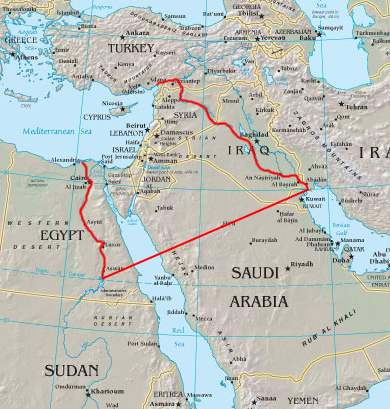
The Kingdom Shall Be the LORD’s

19 Those of the Negeb shall possess Mount Esau,
    and those of the Shephelah shall possess the land of the Philistines;
they shall possess the land of Ephraim and the land of Samaria,
    and Benjamin shall possess Gilead.
20 The exiles of this host of the people of Israel
    shall possess the land of the Canaanites as far as Zarephath,
and the exiles of Jerusalem who are in Sepharad
    shall possess the cities of the Negeb.
21 Saviors shall go up to Mount Zion
    to rule Mount Esau,
    and the kingdom shall be the Lord‘s. Obadiah 1:19-21 ESV

In a final stinging rebuke, God announces that the land He had graciously given to Esau as his inheritance would become the property of the Israelites, the descendants of Esau’s brother, Jacob. The around Mount Seir had been God’s gift to the Edomites, a fact revealed by Joshua when he began to lead the Israelites in their conquest of the land of Canaan.

“This is what the Lord, the God of Israel, says: Long ago your ancestors, including Terah, the father of Abraham and Nahor, lived beyond the Euphrates River, and they worshiped other gods. But I took your ancestor Abraham from the land beyond the Euphrates and led him into the land of Canaan. I gave him many descendants through his son Isaac. To Isaac I gave Jacob and Esau. To Esau I gave the mountains of Seir, while Jacob and his children went down into Egypt. – Joshua 2:1-4 NLT

Joshua, who had replaced Moses as the leader of the Israelites, had heard his predecessor s the same instructions.

“Then at last the Lord said to me, You have been wandering around in this hill country long enough; turn to the north. Give these orders to the people: “You will pass through the country belonging to your relatives the Edomites, the descendants of Esau, who live in Seir. The Edomites will feel threatened, so be careful. Do not bother them, for I have given them all the hill country around Mount Seir as their property, and I will not give you even one square foot of their land. – Deuteronomy 2:4-5 NLT

But because of the way the Edomites had treated their blood relatives, God was going to destroy them and reward their land to the Israelites. God had made it clear that “every man from Mount Esau will be cut off by slaughter” (Obadiah 1:9 ESV). Now, He reveals that the Edomites’ former homeland will become His chosen people’s property. The land that God originally declared to be off-limits for the Israelites would become vacant and available for occupation. The “lofty dwelling” (Obadiah 1:3 ESV) of Edom would become the property of Jacob’s descendants.

Israelites living in the southern region of Israel, known as the Negeb, would move into  “the clefts of the rock” (Obadiah 1:3 ESV) vacated by the Edomites. What had once been the mountain fortress of Esau’s descendants would protect and preserve God’s chosen people. The Edomites had used their impenetrable and seemingly invincible mountain hideout as a base of operations for their ongoing raids against Israelitestowns and villages in the Negeb. Now, the tables would be turned as the victims moved into the abandoned homes of the victimizers.

In this closing section of his prophecy, Obadiah records the fulfillment of the promise God made to Abraham centuries earlier.

I will bless those who bless you and curse those who treat you with contempt. – Genesis 12:3 NLT

Obadiah describes a day when the Israelites will expand their borders far beyond anything David or Solomon accomplished in their day. Along with the former Edomite land holdings, God would add territory once occupied by the Philistines. The land of Ephraim, Gilead, and Samaria would also become the rightful possessions of God’s people. Despite the centuries of suffering they had endured, the Israelites would enjoy unprecedented expansion because of God’s gracious intervention.

This “day of the Lord” would occur sometime in the distant future but God describes it as near.

“The day is near when I, the Lord,
    will judge all godless nations!
As you have done to Israel,
    so it will be done to you.
All your evil deeds
    will fall back on your own heads. – Obadiah 1:15 NLT

Because God is eternal and operates outside the bounds of time and space, He can simultaneously view the past, present, and future. Events that appear distant to men are as close as the next morning to God Almighty. He views them as if they have already taken place because, in His omniscience, He is certain of their outcome.

So, as Obadiah wraps up his brief but vital prophecy, he ends on a high note, describing the day when ”the LORD himself will be king” (Obadiah 1:21 NLT) over the land of Israel. Yahweh, the God of Israel will rule and reign over His chosen people in the land of their inheritance. This prophetic glimpse into the future describes the arrival of God’s Kingdom on earth. The apostle John was given a more detailed preview of coming attractions which he recorded in the Book of Revelation.

Then I saw a new heaven and a new earth, for the old heaven and the old earth had disappeared. And the sea was also gone. And I saw the holy city, the new Jerusalem, coming down from God out of heaven like a bride beautifully dressed for her husband.

I heard a loud shout from the throne, saying, “Look, God’s home is now among his people! He will live with them, and they will be his people. God himself will be with them. He will wipe every tear from their eyes, and there will be no more death or sorrow or crying or pain. All these things are gone forever.” – Revelation 21:1-4 NLT

At the end of the Great Tribulation, Jesus will set up His earthly Kingdom in Jerusalem, where He will reign for a thousand years. But when the Millennial Kingdom comes to a close, Satan will stage one last rebellion against God but will fail miserably and be judged and condemned along with all those who joined his cause. Then God will destroy and recreate the heavens and the Earth and send down the celestial city of New Jerusalem. The apostle Paul describes what will take place at that time.

After that the end will come, when he will turn the Kingdom over to God the Father, having destroyed every ruler and authority and power. For Christ must reign until he humbles all his enemies beneath his feet. And the last enemy to be destroyed is death. For the Scriptures say, “God has put all things under his authority.” (Of course, when it says “all things are under his authority,” that does not include God himself, who gave Christ his authority.) Then, when all things are under his authority, the Son will put himself under God’s authority, so that God, who gave his Son authority over all things, will be utterly supreme over everything everywhere. – 1 Corinthians 15:24-28 NLT

Or, as Obadiah puts it, “the kingdom shall be the LORD’s” (Obadiah 1:21 ESV).

English Standard Version (ESV)
The Holy Bible, English Standard Version. ESV® Permanent Text Edition® (2016). Copyright © 2001 by Crossway Bibles, a publishing ministry of Good News Publishers.

New Living Translation (NLT)
Holy Bible, New Living Translation, copyright © 1996, 2004, 2015 by Tyndale House Foundation. Used by permission of Tyndale House Publishers Inc., Carol Stream, Illinois 60188. All rights reserved.

The Message (MSG)Copyright © 1993, 1994, 1995, 1996, 2000, 2001, 2002 by Eugene H. Peterson

The Day of the Lord is Near

15 For the day of the Lord is near upon all the nations.
As you have done, it shall be done to you;
    your deeds shall return on your own head.
16 For as you have drunk on my holy mountain,
    so all the nations shall drink continually;
they shall drink and swallow,
    and shall be as though they had never been.
17 But in Mount Zion there shall be those who escape,
    and it shall be holy,
and the house of Jacob shall possess their own possessions.
18 The house of Jacob shall be a fire,
    and the house of Joseph a flame,
    and the house of Esau stubble;
they shall burn them and consume them,
    and there shall be no survivor for the house of Esau,
for the Lord has spoken. Obadiah 1:15-18 ESV

The text of the prophecy now turns from Edom to Israel, with the author conveying God’s plans to redeem and restore His chosen people. While the descendants of Esau would suffer judgment for their unjust treatment of the Israelites, God would bless the descendants of Jacob. The “day of the Lord” is a common prophetic phrase that refers to God intervening in human affairs to carry out His will and enact justice on Earth.

Declaring His intent to enact the law of lex talionis, God warns all of Israel’s enemies, including the Edomites, “As you have done to Israel, so it will be done to you. All your evil deeds will fall back on your own heads.” (Odadiah 1:15 NLT). No one will escape God’s wrath or avoid His coming judgment.

This coming day of the Lord was a future event but it would have present implications for the people of Edom. Their demise would come soon and swiftly. Because of the violence they had inflicted on Israel, they faced imminent destruction. God’s predictions concerning their fall were graphic and detailed.

“I will bring you crashing down…” – Obadiah 1:4 NLT

“…your enemies will wipe you out completely! – Obadiah 1:5 NLT

Every nook and cranny of Edom will be searched and looted.” – Obadiah 1:6 NLT

“Every treasure will be found and taken.” – Obadiah 1:6 NLT

All your allies will turn against you. They will help to chase you from your land.” – Obadiah 1:7 NLT

Your trusted friends will set traps for you…” – Obadiah 1:8 NLT

I will destroy everyone who has understanding. – Obadiah 1:8 NLT

God’s judgment would be complete and inescapable.

“…everyone on the mountains of Edom will be cut down in the slaughter. – Obadiah 1:9 NLT

This devastating prediction of Edom’s fall was near rather than far away. Like all biblical prophecies, this one has a now-not-yet dimension. It is impossible to know what future event God had in mind but most biblical scholars generally agree that it has already been fulfilled. One option is the rebellion of the Edomites during the reign of King Jehoram.

During Jehoram’s reign, the Edomites revolted against Judah and crowned their own king. So Jehoram went with all his chariots to attack the town of Zair. The Edomites surrounded him and his chariot commanders, but he went out at night and attacked them under cover of darkness. But Jehoram’s army deserted him and fled to their homes. So Edom has been independent from Judah to this day. – 2 Kings 8:20-22

Others believe Obadiah’s prophecy concerns the Babylonian invasion of Judah in 586 B.C. As the people of Judah suffered defeat at the hands of Nebuchadnezzar’s forces, the Edomites took advantage of the confusion by attacking their blood brothers and enriching themselves with the spoils from their towns and villages. The prophet Ezekiel recorded God’s warning of the judgment they would face for their treachery.

“Your eternal hatred for the people of Israel led you to butcher them when they were helpless, when I had already punished them for all their sins. As surely as I live, says the Sovereign Lord, since you show no distaste for blood, I will give you a bloodbath of your own. Your turn has come! I will make Mount Seir utterly desolate, killing off all who try to escape and any who return. I will fill your mountains with the dead. Your hills, your valleys, and your ravines will be filled with people slaughtered by the sword. I will make you desolate forever. Your cities will never be rebuilt. Then you will know that I am the Lord. – Ezekiel 35:5-9 NLT

Regardless of which event God had in mind, the prophecy contained in Obadiah would take place sooner rather than later. The Edomites were minor players in God’s end-times drama. They would disappear from the scene only to be replaced by other nations that would treat God’s people with the same scorn and disdain. But God warns that these nations will also “drink and stagger and disappear from history” (Obadiah 1:16 NLT).

The hatred for God’s people would continue with successive waves of attack being carried out by a seemingly endless stream of hostile forces aligned against the descendants of Jacob. This prophecy is still being fulfilled today as the nation of Israel and the Jewish people endure a never-ending onslaught of hatred and calls for genocide against them. Yet God informs His people that their elimination is not an option; He will not allow it. In His providence, He will bring about their protection and preservation as a nation.

“But in Mount Zion there shall be those who escape,
    and it shall be holy,
and the house of Jacob shall possess their own possessions.” – Obadiah 1:17 NLT

Mount Zion refers to the mountain range on which Jerusalem sits. Though the capital city of Israel will continue to come under siege and face ongoing opposition, God will spare a remnant of His people and ensure the city’s role as a refuge for the people of God.

“But Jerusalem will become a refuge for those who escape;
    it will be a holy place.
And the people of Israel will come back
    to reclaim their inheritance. – Obadiah 1:17 NLT

As the prophecy makes clear, the nation of Edom would eventually meet its demise. To this day, there is no nation of Edom. But their elimination would not end the persecution of God’s people. Over the centuries, other nations have appeared on the scene whose goal has been the persecution and eventual eradication of God’s people. But God has promised to sustain His people and maintain His covenant commitments to them.

“The people of Israel will be a raging fire,
    and Edom a field of dry stubble.
The descendants of Joseph will be a flame
    roaring across the field, devouring everything.
There will be no survivors in Edom.
    I, the Lord, have spoken!” – Obadiah 1:18 NLT

Edom serves as a stand-in for all the other antagonistic and godless nations that will dare to stand opposed to God’s chosen people. Their efforts will be thwarted by God Almighty. Any attempt to destroy Israel will be unsuccessful and, ultimately, futile. God has plans for His people and nothing will prevent Him from fulfilling those plans and carrying out His sovereign will. As He told the Israelites living in exile in Babylon, “When seventy years are completed for Babylon, I will visit you, and I will fulfill to you my promise and bring you back to this place. For I know the plans I have for you, declares the Lord, plans for welfare and not for evil, to give you a future and a hope” (Jeremiah 29:10-11 ESV).

English Standard Version (ESV)
The Holy Bible, English Standard Version. ESV® Permanent Text Edition® (2016). Copyright © 2001 by Crossway Bibles, a publishing ministry of Good News Publishers.

New Living Translation (NLT)
Holy Bible, New Living Translation, copyright © 1996, 2004, 2015 by Tyndale House Foundation. Used by permission of Tyndale House Publishers Inc., Carol Stream, Illinois 60188. All rights reserved.

The Message (MSG)Copyright © 1993, 1994, 1995, 1996, 2000, 2001, 2002 by Eugene H. Peterson

Divine Payback

10 Because of the violence done to your brother Jacob,
    shame shall cover you,
    and you shall be cut off forever.
11 On the day that you stood aloof,
    on the day that strangers carried off his wealth
and foreigners entered his gates
    and cast lots for Jerusalem,
    you were like one of them.
12 But do not gloat over the day of your brother
    in the day of his misfortune;
do not rejoice over the people of Judah
    in the day of their ruin;
do not boast
    in the day of distress.
13 Do not enter the gate of my people
    in the day of their calamity;
do not gloat over his disaster
    in the day of his calamity;
do not loot his wealth
    in the day of his calamity.
14 Do not stand at the crossroads
    to cut off his fugitives;
do not hand over his survivors
    in the day of distress. Obadiah 1:10-14 ESV

The feud between the Israelites and Edomites had deep roots, going back to the births of their two patriarchs, Jacob and Esau. Their father Isaac had asked God to allow his wife Rebekah to conceive and these twin sons resulted from God’s miraculous intervention. But even in the womb, Jacob and Esau exhibited their propensity for conflict.

The children struggled together within her, and she said, “If it is thus, why is this happening to me?” So she went to inquire of the Lord. And the Lord said to her,

“Two nations are in your womb,
    and two peoples from within you shall be divided;
the one shall be stronger than the other,
    the older shall serve the younger.” – Genesis 25:22-23 ESV

Even at birth, their competitive nature was on full display.

The first came out red, all his body like a hairy cloak, so they called his name Esau. Afterward his brother came out with his hand holding Esau’s heel, so his name was called Jacob. – Genesis 25:25-26 ESV

A later incident confirmed God’s earlier prediction, “the older shall serve the younger” (Genesis 25:23). After a long day of hunting, Esau encountered his “younger” brother making stew. Overcome by hunger, he begged Jacob to give him a bowl of the delicious-smelling stew. Taking advantage of the situation, Jacob offered to sell the stew for the price of his brother’s birthright. Without hesitation, Esau agreed, and in doing so, he treated his rights as the firstborn son with disdain.

Jacob said, “Sell me your birthright now.” Esau said, “I am about to die; of what use is a birthright to me?” Jacob said, “Swear to me now.” So he swore to him and sold his birthright to Jacob. Then Jacob gave Esau bread and lentil stew, and he ate and drank and rose and went his way. Thus Esau despised his birthright. – Genesis 25:31-34 ESV

Esau’s rash decision was far more costly than he could have imagined. He had forfeited his right to inherit the leadership of his family in the event of Isaac’s death. He had allowed his temporary hunger to dramatically alter his future role and financial standing. As the firstborn son, Esau stood to inherit twice as much as his brother Jacob (Deuteronomy 21:17). But he had squandered it all for a single meal.

Years later, as their father lay on his deathbed, Jacob and Esau proved their mutual disdain yet again. Aided by his conniving mother, Jacob tricked Isaac into giving him the blessing reserved for the firstborn son. In an elaborate ruse, Jacob disguised himself as his brother and convinced his poor-sighted father to bestow on him the blessing of the firstborn. Fooled by Jacob’s impersonation, Isaac unknowingly blessed the wrong son.

“See, the smell of my son
    is as the smell of a field that the Lord has blessed!
May God give you of the dew of heaven
    and of the fatness of the earth
    and plenty of grain and wine.
Let peoples serve you,
    and nations bow down to you.
Be lord over your brothers,
    and may your mother’s sons bow down to you.
Cursed be everyone who curses you,
    and blessed be everyone who blesses you!” – Genesis 27:27-29 ESV

News of this injustice left Esau so enraged that he contemplated killing his own brother.

From that time on, Esau hated Jacob because their father had given Jacob the blessing. And Esau began to scheme: “I will soon be mourning my father’s death. Then I will kill my brother, Jacob.” – Genesis 27:41 NLT

Worried about Jacob’s safety, Rebekah sent him away to prevent Esau from taking his life. She would never see her son again. And while Jacob and Esau would later heal their relationship, the tension between them would transfer to their descendants. Centuries later, when Moses attempted to lead the Israelites through the land of the Edomites, they were rebuffed and threatened with death by the offspring of Esau.

But Edom said to him, “You shall not pass through, lest I come out with the sword against you.” And the people of Israel said to him, “We will go up by the highway, and if we drink of your water, I and my livestock, then I will pay for it. Let me only pass through on foot, nothing more.” But he said, “You shall not pass through.” And Edom came out against them with a large army and with a strong force. Thus Edom refused to give Israel passage through his territory, so Israel turned away from him. – Numbers 20:18-21 ESV

The animosity between Israel and Edom continued for generations. Even during the reigns of Saul and David, the Edomites proved to be a problem.  They used their mountain stronghold as a base of operations to raid and pillage Israelite towns and settlements. Over the years, they joined forces with Israel’s enemies to wage war against their blood relatives. Now, God was warning that He would hold them accountable for their actions.

“Because of the violence you did
    to your close relatives in Israel,
you will be filled with shame
    and destroyed forever. – Obadiah 1:10 NLT

Verse 10 is the summary statement for all that follows in verses 11-14. When Israel was invaded by outside forces, the Edomites not only refused to come to their aid, but they took advantage of their predicament and “acted like one of Israel’s enemies” (Obadiah 1:11 NLT). They were opportunists.

To make matters worse, when the citizens of Judah were taken captive and exiled to foreign lands, the Edomites gloated and rejoiced. They found a perverse sense of joy in watching their blood relatives suffer. As if to drive home the abysmal nature of Judah’s plight, Obadiah refers to their suffering as “the day of his misfortune,” “the day of distress,” “the day of their calamity,” and “the day of their ruin.”

Yet, as Judah suffered, the Edomites rejoiced, gloated, boasted, and looted. They enriched themselves at Judah’s expense and, for this, they would pay dearly.

When God called Abram, one of the things He promised to do was to use this man and his barren wife to produce a great nation. But there was a second aspect to the promise.

I will make of you a great nation, and I will bless you and make your name great, so that you will be a blessing. I will bless those who bless you, and him who dishonors you I will curse…” – Genesis 12:2-3 ESV

The Edomites had made the fatal error of dishonoring the descendants of Abraham, and they had done so despite God’s gracious treatment of them. When Moses prepared to lead the Israelites into the promised land, God made a disclosure about the Edomites that revealed His sovereign care for them.

“You have been wandering around in this hill country long enough; turn to the north. Give these orders to the people: “You will pass through the country belonging to your relatives the Edomites, the descendants of Esau, who live in Seir. The Edomites will feel threatened, so be careful. Do not bother them, for I have given them all the hill country around Mount Seir as their property, and I will not give you even one square foot of their land. If you need food to eat or water to drink, pay them for it.” – Deuteronomy 2:3-6 NLT

God had graciously given the Edomiites the land around Mount Seir. It was their God-given inheritance and He would not allow the Israelites to occupy any of it. Yet, the Edomites refused to aid Moses and the people of God. They rejected Moses’ request to pass through their land and to sell them provisions for their journey. Instead, they threatened the Israelites with physical violence if they came anywhere near their land. In essence, they cursed or dishonored the descendants of Abraham. Now, they would experience the “curse” of God.

God would later tell the Israelites, ““Do not detest the Edomites…because the Edomites are your relatives” (Deuteronomy 23:7 NLT). But this did not prevent God from meting out justice against the Edomites. He had blessed them. He had provided land for them. Despite Esau’s disdain for his birthright, God had ensured that Esau’s progeny were well provided for. They had everything they needed and had they blessed the Israelites by providing food and safe passage, God would have blessed them even more. But they had chosen to treat God’s people harshly and hatefully, and their disrespect would result in God’s discipline.

As you have done, it shall be done to you;
    your deeds shall return on your own head. – Obadiah 1:15 ESV

All those who choose to be enemies rather than allies to God’s people will pay dearly for their decisions. Indifference is no excuse. Refusing to aid God’s chosen people is no less egregious than attacking them. But to take advantage of their misery and suffering is inexcusable and worthy of God’s wrath.

English Standard Version (ESV)
The Holy Bible, English Standard Version. ESV® Permanent Text Edition® (2016). Copyright © 2001 by Crossway Bibles, a publishing ministry of Good News Publishers.

New Living Translation (NLT)
Holy Bible, New Living Translation, copyright © 1996, 2004, 2015 by Tyndale House Foundation. Used by permission of Tyndale House Publishers Inc., Carol Stream, Illinois 60188. All rights reserved.

The Message (MSG)Copyright © 1993, 1994, 1995, 1996, 2000, 2001, 2002 by Eugene H. Peterson

No Match for the Almighty

If thieves came to you,
    if plunderers came by night—
    how you have been destroyed!—
    would they not steal only enough for themselves?
If grape gatherers came to you,
    would they not leave gleanings?
How Esau has been pillaged,
    his treasures sought out!
All your allies have driven you to your border;
    those at peace with you have deceived you;
they have prevailed against you;
    those who eat your bread have set a trap beneath you—
    you have no understanding.

Will I not on that day, declares the Lord,
    destroy the wise men out of Edom,
    and understanding out of Mount Esau?
And your mighty men shall be dismayed, O Teman,
    so that every man from Mount Esau will be cut off by slaughter. Obadiah 1:5-9 ESV

This short book is filled with messages of doom and gloom concerning Edom, but it was intended to bring hope to the people of Jerusalem and Judah. Obadiah was likely a prophet to the southern kingdom of Judah during the reign of Jehoram (848-841 B.C.). The Book of 2 Kings describes a revolt by the Edomites not long after Jehoram took the throne.

In the fifth year of Joram the son of Ahab, king of Israel, when Jehoshaphat was king of Judah, Jehoram the son of Jehoshaphat, king of Judah, began to reign. He was thirty-two years old when he became king, and he reigned eight years in Jerusalem. And he walked in the way of the kings of Israel, as the house of Ahab had done, for the daughter of Ahab was his wife. And he did what was evil in the sight of the Lord. Yet the Lord was not willing to destroy Judah, for the sake of David his servant, since he promised to give a lamp to him and to his sons forever.

In his days Edom revolted from the rule of Judah and set up a king of their own. Then Joram passed over to Zair with all his chariots and rose by night, and he and his chariot commanders struck the Edomites who had surrounded him, but his army fled home. So Edom revolted from the rule of Judah to this day. – 2 Kings 8:16-22 ESV

The Edomites proved to be a problem for the people of God throughout the centuries. These distant relatives of the Israelites were a constant source of irritation and trouble. The ongoing nature of their harassment and God’s decision to punish them for it is reflected by their mention in the writings of four different prophets. Obadiah, Jeremiah, Amos, and Joel all mention God’s plan to deal harshly with the Edomites. There are also glaring similarities between the writings of these four men that seem to indicate that each was familiar with the work of the others.

Jeremiah uses some of the same language as Obadiah in his prophecy concerning Edom.

If grape gatherers came to you,
    would they not leave gleanings?
If thieves came by night,
    would they not destroy only enough for themselves? – Jeremiah 49:9 ESV

The horror you inspire has deceived you,
    and the pride of your heart,
you who live in the clefts of the rock,
    who hold the height of the hill.
Though you make your nest as high as the eagle’s,
    I will bring you down from there,
declares the Lord. – Jeremiah 49:16 ESV

It is unclear which prophet borrowed from the other, but the similarity of their language indicates that they were aware of and referenced one another’s writings. Their common message also reflects the divine inspiration of their prophecies. Each man was receiving the same basic message concerning the nation of Edom and its pending judgment by God.

Both Jeremiah and Obadiah indicate that Edom’s fall was tied to their arrogance and pride.

The horror you inspire has deceived you,
    and the pride of your heart – Jeremiah 49:16 ESV

The pride of your heart has deceived you – Obadiah 1:3 ESV

The Hebrew word translated as “pride” is zāḏôn, and it conveys the idea of insolence and arrogance. It comes from the root word zûḏ, which means “to boil or seeth.” It illustrates the contents of a boiling pot spilling over the edges and onto its surroundings. The pride of the Edomites had gotten the best of them, causing them to exceed their God-given boundaries and “boil over” and onto their neighbors.

The Edomites occupied a virtually impenetrable tract of land near Mount Seir just south of the Dead Sea. This lofty and difficult-to-reach location gave them a false sense of security. They took great pride in their mountain fortress and believed it made them invincible. Located at an elevation of more than 5,700 feet and protected by a series of gorges, their mountain stronghold gave them a false sense of security.

“You have been deceived by your own pride
    because you live in a rock fortress
    and make your home high in the mountains.
‘Who can ever reach us way up here?’
    you ask boastfully.
But even if you soar as high as eagles
    and build your nest among the stars,
I will bring you crashing down,”
    says the Lord. – Obadiah 1:3-4 NLT

You have been deceived
    by the fear you inspire in others
    and by your own pride.
You live in a rock fortress
    and control the mountain heights.
But even if you make your nest among the peaks with the eagles,
    I will bring you crashing down,”
    says the Lord.
– Jeremiah 49:16 NLT

The message is clear; the Edomites could not escape the wrath of God. Their “kingdom in the sky” was no match for the God who reigns in heaven. They could hide from men but they could not hide from God. Their actions against the people of Israel and Judah would require justice and judgment. And God makes it clear that His judgment will be swift and complete.

“…your enemies will wipe you out completely!
Every nook and cranny of Edom
    will be searched and looted.
    Every treasure will be found and taken.” – Obadiah 1:5-6 NLT

“Edom will be an object of horror.
    All who pass by will be appalled
    and will gasp at the destruction they see there. – Jeremiah 49:17 NLT

The epic nature of Edom’s fall will shock their neighbors. The devastation of this once-powerful and seemingly invincible nation will make an impression on the rest of Judah’s enemies. God will make an object lesson of the Edomites and send a powerful message to all those who oppose His chosen people. The Edomites were blood relatives of the Israelites, but their mistreatment of the descendants of Jacob would cost them dearly. Their pride had caused them to overstep their bounds and put them at odds with God Almighty. Now they were going to pay.

Edom was a relatively small nation but they were resourceful. They regularly sent raiding parties from their mountain hideout to plunder the villages and towns in southern Judah. This is why Obadiah mentions thieves who plunder at night. The Edomites were opportunists who took advantage of the weak and defenseless. Lacking in numbers and military strength, they utilized ingenuity and resourcefulness to survive. But they made a huge mistake when they decided to plunder the nation of Judah.

The prophet Amos describes the pending judgment of God against the Edomites.

“The people of Edom have sinned again and again,
    and I will not let them go unpunished!
They chased down their relatives, the Israelites, with swords,
    showing them no mercy.
In their rage, they slashed them continually
    and were unrelenting in their anger.
So I will send down fire on Teman,
    and the fortresses of Bozrah will be destroyed.” – Amos 1:11-12 NLT

According to Obadiah, the Edomites will find themselves all alone with no one to stand by their side. Even their closest allies will abandon them in their time of need.

“All your allies will turn against you.
    They will help to chase you from your land.
They will promise you peace
    while plotting to deceive and destroy you.
Your trusted friends will set traps for you,
    and you won’t even know about it. – Obadiah 1:7 NLT

Alliances and treaties will be of no use. The promises of neighboring states will prove worthless. When God decides to bring judgment against the people of Edom, nothing will stand in His way, including “the wise” and “the mighty.” Human wisdom and strength are of little consequence to the God of the universe. In his first letter to the church in Corinth, Paul wrote, “Where is the one who is wise? Where is the scribe? Where is the debater of this age? Has not God made foolish the wisdom of the world?” (1 Corinthians 1:20 ESV).

The psalmist also speaks of God’s derision and disregard for those who flaunt their power and prestige in His face.

Why are the nations so angry?
    Why do they waste their time with futile plans?
The kings of the earth prepare for battle;
    the rulers plot together
against the Lord
    and against his anointed one.
“Let us break their chains,” they cry,
    “and free ourselves from slavery to God.”

But the one who rules in heaven laughs.
    The Lord scoffs at them.
Then in anger he rebukes them,
    terrifying them with his fierce fury. – Psalm 2:1-5 NLT

The leaders of Edom were too full of themselves and far too confident in their military might. “Professing to be wise, they became fools…” (Romans 1:22 BLB). Their reliance upon human reason and understanding would prove unreliable. Their belief in their invincibility would become their greatest liability. God was about to expose the fallacy of their superiority.

At that time not a single wise person
    will be left in the whole land of Edom,”
    says the Lord.
“For on the mountains of Edom
    I will destroy everyone who has understanding.
The mightiest warriors of Teman
    will be terrified,
and everyone on the mountains of Edom
    will be cut down in the slaughter. – Obadiah 1:8-9 NLT

None of this was good news for the Edomites, but it was meant to encourage the people of Judah. Their God was letting them know He was aware of their circumstances and fully prepared to act. He was sovereign and in full control. The actions of the Edomites had not escaped His attention and the Edomites would not escape His judgment.

God’s message was a not-so-subtle warning to all the enemies of Judah. But, at the same time, it was a powerful word of encouragement to His chosen people. He was on His throne and in full control of world affairs. Nothing escapes His attention. No one operates outside His sovereign will and control. Even the high and lofty Edomites would be brought low by the hand of Almighty God.

English Standard Version (ESV)
The Holy Bible, English Standard Version. ESV® Permanent Text Edition® (2016). Copyright © 2001 by Crossway Bibles, a publishing ministry of Good News Publishers.

New Living Translation (NLT)
Holy Bible, New Living Translation, copyright © 1996, 2004, 2015 by Tyndale House Foundation. Used by permission of Tyndale House Publishers Inc., Carol Stream, Illinois 60188. All rights reserved.

The Message (MSG)Copyright © 1993, 1994, 1995, 1996, 2000, 2001, 2002 by Eugene H. Peterson

Doom, Gloom, and Hope

The vision of Obadiah.

Thus says the Lord God concerning Edom:
We have heard a report from the Lord,
    and a messenger has been sent among the nations:
“Rise up! Let us rise against her for battle!”
Behold, I will make you small among the nations;
    you shall be utterly despised.
The pride of your heart has deceived you,
    you who live in the clefts of the rock,
    in your lofty dwelling,
who say in your heart,
    “Who will bring me down to the ground?”
Though you soar aloft like the eagle,
    though your nest is set among the stars,
    from there I will bring you down,
declares the Lord.” Obadiah 1:1-4 ESV

This book is part of a larger collection of prophetic writings called the Minor Prophets. This designation was meant to highlight the shorter length of the books when compared with the “Major Prophets.” While shorter in length, these books carry no less weight and their authors are no less significant than their more wordy counterparts.

Much scholarship has been conducted over the years to ascertain the identity of the book’s author. The name Obadiah was common among the Hebrews and the Old Testament refers to 13 different characters by this name. Despite the efforts of biblical scholars and historians, no consensus has been reached regarding the identity of the author, making it virtually impossible to determine when the book was written.

“This shortest book in the Old Testament, consisting of only twenty-one verses, bears the distinction of being the most difficult of all the prophecies to date.” – Gleason L. Archer Jr., A Survey of Old Testament Introduction

All we know about the unidentified author of this rather diminutive book is that his name meant “Worshiper of Yahweh” or “Servant of Yahweh.” He was a faithful follower of the God of Abraham, Isaac, and Jacob who received a divine commission to deliver a message to God’s people. But the message he was given did not address the people of Israel or Judah. Instead, it dealt with the nation of Edom, which was comprised of distant relatives of the Israelites. The Edomites were descendants of Esau, the firstborn son of Isaac and the twin brother of Jacob. Esau was the grandson of Abraham, the patriarch of the Hebrew people.

The story of Jacob and Esau as recorded in the Book of Genesis, is a tale filled with deceit, envy, hatred, and division. These twin brothers were born to Isaac and Rebekah. Esau, who came out of the womb first, was the rightful heir to all that Isaac owned. But through a series of events, Esau forfeited his birthright for a bowl of stew, then helplessly watched as his brother deceived their father and stole the blessing of the firstborn. Having been robbed of all that was rightfully his, Esau set out to kill his brother. But Rebekah intervened and sent Jacob away. Years later, the brothers were reunited and the feud between them was settled. But Esau ended up relocating to a region just south of the Dead Sea on the border of what would become the land of Israel.

Centuries later, the descendants of Jacob, now known as the Israelites, were making their way from Egypt to the land that God had promised as their inheritance (the inheritance that had rightfully belonged to Esau). But it has always been God’s plan for Jacob to receive the inheritance. In fact, when the boys were still in the womb, God informed Rebekah, “Two nations are in your womb, and two peoples from within you shall be divided; the one shall be stronger than the other, the older shall serve the younger” (Genesis 25:23 ESV).

In God’s sovereign plan, it had always been Jacob, the second-born, who would receive the blessing and the inheritance. It was Jacob whose name would later be changed to Israel. It was Jacob who would move his small family to Egypt to escape the famine in the land of Canaan. It was Jacob’s son, Joseph, who would rise to power and prominence in Egypt and provide food and shelter to his family. It was the descendants of Jacob (Israel) who would be delivered from their captivity in Egypt and led by Moses to their new home in Canaan.

But on their way to their promised inheritance, they encountered difficulty from their distant relatives, the Edomites. This unfortunate event is recorded in the Book of Numbers.

Moses sent messengers from Kadesh to the king of Edom: “Thus says your brother Israel: You know all the hardship that we have met: how our fathers went down to Egypt, and we lived in Egypt a long time. And the Egyptians dealt harshly with us and our fathers. And when we cried to the Lord, he heard our voice and sent an angel and brought us out of Egypt. And here we are in Kadesh, a city on the edge of your territory. Please let us pass through your land. We will not pass through field or vineyard, or drink water from a well. We will go along the King’s Highway. We will not turn aside to the right hand or to the left until we have passed through your territory.” But Edom said to him, “You shall not pass through, lest I come out with the sword against you.”  – Numbers 20:14-18 ESV

Long before this confrontation took place, God had given the Israelites strict instructions regarding any future encounter with their distant relatives.

“You will pass through the country belonging to your relatives the Edomites, the descendants of Esau, who live in Seir. The Edomites will feel threatened, so be careful. Do not bother them, for I have given them all the hill country around Mount Seir as their property, and I will not give you even one square foot of their land. If you need food to eat or water to drink, pay them for it. For the Lord your God has blessed you in everything you have done.” – Deuteronomy 2:4-7 NLT

The Israelites had been forbidden to take land from their relatives. Yet, when they asked for permission to pass through the land of Edom, the descendants of Esau treated them with disrespect and disdain. Their shared bloodline made no difference. And, as time passed, the Edomites and Israelites would remain sworn enemies.

When Israel finally conquered and occupied the land of Canaan, their first king, Saul, would face ongoing opposition from the Edomites. So would his successor, David( 1 Samuel 14:47, 2 Samuel 8:14, 1 Kings 9:26). Years later, when Jehoshaphat was king of Judah, the Edomites joined forces with the Moabites and Ammonites to attack Judah (2 Chronicles 20:1-27). The Edomites would also rebel against King Jehoram of Judah (2 Kings 8:16-22). Eventually, they would be defeated by King Amaziah of Judah (2 Kings 14:9-11) but their subjugation to the people of Israel would end with their attack on Judah during the reign of King Ahaz (2 Chronicles 28:17).

This love-hate relationship between the Israelites and Edomites went on for centuries. By the time of Obadiah, the Edomites had proven to be a perpetual thorn in the side of God’s chosen people. The message given to Obadiah was addressed to the kingdom of Edom but intended for the ears of the people of Judah. God wanted them to know He would deal with the Edomites justly and effectively. He was well aware of their past actions and would punish them appropriately.

God had bad news for the people of Edom. A prideful people who lived in virtually impregnable conditions in the cliffs south of the Dead Sea, they were about to experience the humbling discipline of God. He was going to breach their defenses (Vs 2-4), plunder their treasure (Vs 5-7), and destroy their leadership (Vs 8-9). But while most of the book of Obadiah seems to be words of warning against the people of Edom, it was written to the people of Judah. This book was meant to be a word of encouragement to the people of God about His sovereign rule and reign over their lives, circumstances, and future.

God was not unaware of or indifferent to the condition of the people of Judah. He knew what was going on and was fully aware of the events taking place around them. This included the behavior of such nations as Edom. It may have appeared to the people of God that He was unsympathetic or preoccupied elsewhere during their times of difficulty, but nothing could have been further from the truth. He was not only aware, He was in control, and He had a plan. The message to Obadiah was one of hope for the people of God because He was about to act on their behalf. He would right all the wrongs, defend the helpless, and keep His covenant promises.

It may get worse before it gets better, but IT WILL get better – much better. Nations like Edom will not be able to stand against the wrath of God. When Christ returns to Earth the second time, He will wage war against the nations that have aligned themselves against God and His people.

It is interesting to note that when Jesus came to earth as a baby, Herod the Great, an Edomite, tried to have Him destroyed when he put to death all the Jewish boys under the age of two. The animosity of the Edomites for the people of God had not abated, even in Jesus’ day. But Herod failed and the plan of God would succeeded.

Even today, there are nations trying to destroy the people of God – the nation of Israel. Jerusalem itself is a battleground of contention and strife between Muslims and Jews. The Palestinians and Iranians would love to see Israel completely eliminated from the face of the earth. But God is their protector. He will not allow that to happen. He is in control and will finish what He began with the people of Israel. He is going to fulfill every promise He has ever made to them. Obadiah is a reminder to us all that God is in control. He knows what is going on around us. He knows our hurts, cares, and concerns, and He has a plan. He will ultimately right every wrong, destroy every one of His enemies, and restore righteousness to the earth. Even amid all the doom and gloom, we can have hope – because our God lives!

English Standard Version (ESV)
The Holy Bible, English Standard Version. ESV® Permanent Text Edition® (2016). Copyright © 2001 by Crossway Bibles, a publishing ministry of Good News Publishers.

New Living Translation (NLT)
Holy Bible, New Living Translation, copyright © 1996, 2004, 2015 by Tyndale House Foundation. Used by permission of Tyndale House Publishers Inc., Carol Stream, Illinois 60188. All rights reserved.

The Message (MSG)Copyright © 1993, 1994, 1995, 1996, 2000, 2001, 2002 by Eugene H. Peterson

The Sometimes Painful Path to the Promise

14 Moses sent messengers from Kadesh to the king of Edom: “Thus says your brother Israel: You know all the hardship that we have met: 15 how our fathers went down to Egypt, and we lived in Egypt a long time. And the Egyptians dealt harshly with us and our fathers. 16 And when we cried to the Lord, he heard our voice and sent an angel and brought us out of Egypt. And here we are in Kadesh, a city on the edge of your territory. 17 Please let us pass through your land. We will not pass through field or vineyard, or drink water from a well. We will go along the King’s Highway. We will not turn aside to the right hand or to the left until we have passed through your territory.” 18 But Edom said to him, “You shall not pass through, lest I come out with the sword against you.” 19 And the people of Israel said to him, “We will go up by the highway, and if we drink of your water, I and my livestock, then I will pay for it. Let me only pass through on foot, nothing more.” 20 But he said, “You shall not pass through.” And Edom came out against them with a large army and with a strong force. 21 Thus Edom refused to give Israel passage through his territory, so Israel turned away from him.

22 And they journeyed from Kadesh, and the people of Israel, the whole congregation, came to Mount Hor. 23 And the Lord said to Moses and Aaron at Mount Hor, on the border of the land of Edom, 24 “Let Aaron be gathered to his people, for he shall not enter the land that I have given to the people of Israel, because you rebelled against my command at the waters of Meribah. 25 Take Aaron and Eleazar his son and bring them up to Mount Hor. 26 And strip Aaron of his garments and put them on Eleazar his son. And Aaron shall be gathered to his people and shall die there.” 27 Moses did as the Lord commanded. And they went up Mount Hor in the sight of all the congregation. 28 And Moses stripped Aaron of his garments and put them on Eleazar his son. And Aaron died there on the top of the mountain. Then Moses and Eleazar came down from the mountain. 29 And when all the congregation saw that Aaron had perished, all the house of Israel wept for Aaron thirty days.  Numbers 20:14-29 ESV

The Israelites were nearing their final destination and as they approached the borders of Canaan, God began to clean house. Chapter 20 opens with the death of Miriam. But the end of the chapter records the death of her brother, Aaron, the high priest of Israel. He too was disciplined by God for his part in the events at Meribah. God had accused both Aaron and Moses of treating Him disrespectfully before the people.

“Because you did not believe in me, to uphold me as holy in the eyes of the people of Israel, therefore you shall not bring this assembly into the land that I have given them.” – Numbers 20:12 ESV

While Moses had been the one to strike the rock three times in anger, Aaron had done nothing to stop his brother from disobeying God’s command. God had clearly communicated His orders to both men.

“You and Aaron must take the staff and assemble the entire community. As the people watch, speak to the rock over there, and it will pour out its water. You will provide enough water from the rock to satisfy the whole community and their livestock.” – Numbers 20:8 NLT

But Moses and Aaron were fed up with the constant bickering and complaining of the people. Despite God’s precise instructions, they decided to use this God-ordained miracle as an opportunity to teach the people a lesson.

Then he and Aaron summoned the people to come and gather at the rock. “Listen, you rebels!” he shouted. “Must we bring you water from this rock?” Then Moses raised his hand and struck the rock twice with the staff, and water gushed out. So the entire community and their livestock drank their fill. – Numbers 20:10-11 NLT

Moses, speaking on behalf of himself and his brother, tried to leave the impression that they were the ones who would meet the Israelite’s needs by providing water from the rock. In essence, they tried to rob God of glory. Then, by striking the rock rather than speaking to it, Moses violated the command of God. And God would hold both men accountable for their actions.

It was on the southern border of the land of Edom that God delivered the devastating news to Aaron and Moses.

“He will not enter the land I am giving the people of Israel, because the two of you rebelled against my instructions concerning the water at Meribah.” – Numbers 20:24 NLT

In a rather sobering ceremony atop Mount Hor, Moses took the priestly robes off of Aaron and gave them to Aaron’s son, Eleazar. It appears from the text that Aaron did not get to live out the rest of his life wandering in the wilderness but died on top of the mountain while Moses and Eleazar looked on. They descended the mountain without him and the people of Israel mourned his death for 30 days.

Now Moses was alone. For nearly 40 years he had led the people of Israel with the help of his brother and sister, but their deaths had left him with the sole responsibility of getting the people of Israel to the land of Canaan. But Moses knew that he was never going to set foot in the land because of his role in the affair at Meribah. Like Aaron, he would be denied access to the land of promise and breathe his last breath in the wilderness.

But Moses continued to fulfill the duties God had given to him some four decades earlier. He mourned the loss of his brother but then set about leading the people of Israel to the border of Canaan. To do so, he had attempted to take a shortcut through the land of Edom.

Edom was located on the southernmost border of Canaan and was occupied by distant relatives of the Israelites. The Edomites were the descendants of Esau, the firstborn son of Isaac and the twin brother of Jacob. When Esau had been cheated out of his birthright by Jacob, he decided to relocate his family to another part of Canaan.

Esau took his wives, his children, and his entire household, along with his livestock and cattle—all the wealth he had acquired in the land of Canaan—and moved away from his brother, Jacob. There was not enough land to support them both because of all the livestock and possessions they had acquired. So Esau (also known as Edom) settled in the hill country of Seir. – Genesis 36:6-8 NLT

Once there, Esau’s descendants prospered and developed a thriving kingdom. During the four centuries that the Israelites were in Egypt, the Edomites lived under a long line of kings (Genesis 36:31) and enjoyed a measure of peace and prosperity.

So, when Moses sent emissaries to the king of Edom seeking permission to pass through their territory, he expected a favorable response.

“This is what your relatives, the people of Israel, say: You know all the hardships we have been through. Our ancestors went down to Egypt, and we lived there a long time, and we and our ancestors were brutally mistreated by the Egyptians. But when we cried out to the Lord, he heard us and sent an angel who brought us out of Egypt. Now we are camped at Kadesh, a town on the border of your land. Please let us travel through your land. We will be careful not to go through your fields and vineyards. We won’t even drink water from your wells. We will stay on the king’s road and never leave it until we have passed through your territory.”– Numbers 20:14-17 NLT

The kingdom of Edom covered a large swath of land and without the right of safe passage through its territory, Moses and the people of Israel would be forced to take a much longer route around it. But no matter how hard Moses pleaded, the king of Edom refused to grant access to their land; he even threatened them with war if they tried. As a further deterrent, the king of Edom “mobilized his army and marched out against them with an imposing force” (Numbers 20:20 NLT). 

Rejected by their own kin, the Israelites were forced to reverse course and take the long detour around Edom. What’s interesting to consider is that the Israelites had always been led by the pillar of cloud by day and the pillar of fire by night. God had used these two phenomena to guide His people throughout their four-decade-long journey. So, was Moses’ attempt to take a shortcut through Edom an unauthorized decision on his part? Had the cloud of God’s presence led him to this point or were his negotiations with Edom something he had come up with on his own? Was Moses trying to shorten the distance to Canaan by taking an unauthorized path through the land of Edom?

It seems unlikely that God would have chosen to use the Edomites to help His chosen people reach the land He had promised to provide for them. These two nations remained in constant conflict with one another long after Israel conquered and occupied the land of Canaan. The book of Obadiah describes God’s anger against Edom for the way it took advantage of Israel’s later misfortunes when the Babylonians conquered them and left the land desolate and depopulated.

“Because of the violence you did
    to your close relatives in Israel,
you will be filled with shame
    and destroyed forever.
When they were invaded,
    you stood aloof, refusing to help them.
Foreign invaders carried off their wealth
    and cast lots to divide up Jerusalem,
    but you acted like one of Israel’s enemies.

“You should not have gloated
    when they exiled your relatives to distant lands.
You should not have rejoiced
    when the people of Judah suffered such misfortune.
You should not have spoken arrogantly
    in that terrible time of trouble.
You should not have plundered the land of Israel
    when they were suffering such calamity.
You should not have gloated over their destruction
    when they were suffering such calamity.
You should not have seized their wealth
    when they were suffering such calamity.
You should not have stood at the crossroads,
    killing those who tried to escape.
You should not have captured the survivors
    and handed them over in their terrible time of trouble.– Obadiah 10-14 ESV

The Israelites received no assistance from their distant relatives and were forced to travel southeasterly toward the Arabian desert. This unexpected setback must have disappointed Moses and it’s clear from the next chapter that it left the people of Israel far from pleased.

From Mount Hor they set out by the way to the Red Sea, to go around the land of Edom. And the people became impatient on the way. – Numbers 21:4 ESV

This was yet another test for God’s people. Their entrance into the land would not be easy and God was not done teaching them the lessons they needed to learn before that day arrived. Their impatience and disappointment with the unexpected detour around Edom left them disappointed and disgruntled, proving that they were not yet ready to enter His rest.

It seems that God knew that, had His stubborn and rebellion-prone people been warmly greeted by their Edomite relatives, they would have been tempted to settle down, intermarry, and forget all about the promised land. But that was not part of God’s plan. Edom was not their destination, so God continued to purge their leadership and purify their hearts in preparation for the day when He would lead them into their promised inheritance. He had something far better in store for His chosen people.

English Standard Version (ESV) The Holy Bible, English Standard Version. ESV® Permanent Text Edition® (2016). Copyright © 2001

New Living Translation (NLT) Holy Bible, New Living Translation, copyright © 1996, 2004, 2015 by Tyndale House Foundation. Used by permission of Tyndale House Publishers Inc., Carol Stream, Illinois 60188. All rights reserved.

A Reversal of Fortunes

“And you, son of man, prophesy to the mountains of Israel, and say, O mountains of Israel, hear the word of the Lord. Thus says the Lord God: Because the enemy said of you, ‘Aha!’ and, ‘The ancient heights have become our possession,’ therefore prophesy, and say, Thus says the Lord God: Precisely because they made you desolate and crushed you from all sides, so that you became the possession of the rest of the nations, and you became the talk and evil gossip of the people, therefore, O mountains of Israel, hear the word of the Lord God: Thus says the Lord God to the mountains and the hills, the ravines and the valleys, the desolate wastes and the deserted cities, which have become a prey and derision to the rest of the nations all around, therefore thus says the Lord God: Surely I have spoken in my hot jealousy against the rest of the nations and against all Edom, who gave my land to themselves as a possession with wholehearted joy and utter contempt, that they might make its pasturelands a prey. Therefore prophesy concerning the land of Israel, and say to the mountains and hills, to the ravines and valleys, Thus says the Lord God: Behold, I have spoken in my jealous wrath, because you have suffered the reproach of the nations. Therefore thus says the Lord God: I swear that the nations that are all around you shall themselves suffer reproach.

“But you, O mountains of Israel, shall shoot forth your branches and yield your fruit to my people Israel, for they will soon come home. For behold, I am for you, and I will turn to you, and you shall be tilled and sown. 10 And I will multiply people on you, the whole house of Israel, all of it. The cities shall be inhabited and the waste places rebuilt. 11 And I will multiply on you man and beast, and they shall multiply and be fruitful. And I will cause you to be inhabited as in your former times, and will do more good to you than ever before. Then you will know that I am the Lord. 12 I will let people walk on you, even my people Israel. And they shall possess you, and you shall be their inheritance, and you shall no longer bereave them of children. 13 Thus says the Lord God: Because they say to you, ‘You devour people, and you bereave your nation of children,’ 14 therefore you shall no longer devour people and no longer bereave your nation of children, declares the Lord God.15 And I will not let you hear anymore the reproach of the nations, and you shall no longer bear the disgrace of the peoples and no longer cause your nation to stumble, declares the Lord God.” Ezekiel 36:1-15 ESV

Twenty fine chapters separate this message from the one Ezekiel received back in chapter six, and a quick perusal reveals their similarities and extreme differences. Back in chapter six, God gave His prophet a message to deliver against the mountains of Israel.

This is what the Sovereign Lord says to the mountains and hills and to the ravines and valleys: I am about to bring war upon you, and I will smash your pagan shrines. All your altars will be demolished, and your places of worship will be destroyed. I will kill your people in front of your idols. – Ezekiel 6:3-4 NLT

God goes on to warn of further judgments upon the land, describing shocking scenes of devastation and death. His chosen people will die from war, famine, and disease, as He pours out His fury upon them. And the land will suffer greatly because of the “idols and altars on every hill and mountain and under every green tree and every great shade tree—the places where they offered sacrifices to their idols” (Ezekiel 6:13 NLT).

The sins of the nation had defiled the land that God had set apart as their inheritance. Through repeated acts of immorality and their unrelenting practice of idolatry, they had desecrated the very place that was to have been their forever home. At one point, God had described Israel as “a land flowing with milk and honey, the most glorious of all lands” (Exodus 20:15 ESV), but it had been polluted by the very presence of His ungrateful and unfaithful children. So, God warned of His plan to “clean house” and purge the land of its primary problem: The people who lived there. And long before the Israelites had ever entered the land of Canaan, God had warned them about picking up the habits of the nations that lived in the land before them. Because of the wickedness of the Canaanites, God said,“ the entire land has become defiled” and “I am punishing the people who live there. I will cause the land to vomit them out” (Leviticus 18:25 NLT). But He went on to warn the Israelites not to make the same mistake. 

“All these detestable activities are practiced by the people of the land where I am taking you, and this is how the land has become defiled. So do not defile the land and give it a reason to vomit you out, as it will vomit out the people who live there now. – Leviticus 18:27-28 NLT

As Ezekiel received the words recorded in chapter 36, the damage had been done. He was living among a contingent of Israelites who had already been “spewed out” of the land of promise and found themselves living as exiles in Babylon. And because of the recent fall of Jerusalem, they would soon be joined by a new wave of displaced refugees.

But chapter 36 provides a diametrically different message concerning the land of Israel. In what is almost a mirror image of the message contained in chapter six, God communicates His future plans for the land of promise. This time He has good news for Ezekiel to deliver to the “mountains of Israel” (Ezekiel 36:1 ESV).

See, I care about you, and I will pay attention to you. Your ground will be plowed and your crops planted. I will greatly increase the population of Israel, and the ruined cities will be rebuilt and filled with people. I will increase not only the people, but also your animals. O mountains of Israel, I will bring people to live on you once again. I will make you even more prosperous than you were before. – Ezekiel 36:9-11 NLT

The very people whom God had vomited from the land would be restored and the land would be renewed. But before that could happen, God was going to have to clean house again. This time, He would remove all those nations who had taken up residence in Israel’s forced absence. All the squatters and land-grabbers would be evicted to make way for the return of God’s chosen people.

Therefore, O mountains of Israel, hear the word of the Sovereign Lord. He speaks to the hills and mountains, ravines and valleys, and to ruined wastes and long-deserted cities that have been destroyed and mocked by the surrounding nations. This is what the Sovereign Lord says: My jealous anger burns against these nations, especially Edom, because they have shown utter contempt for me by gleefully taking my land for themselves as plunder. – Ezekiel 36:4-5 NLT

When the northern kingdom of Israel had fallen to the Assyrians, it didn’t take long for their neighbors to take advantage of their weakened state and enrich themselves by plundering their property and possessions. And the same thing would take place after the fall of the southern kingdom of Judah to the Babylonians. Nearby nations like Edom would use the opportunity to expand their borders at Judah’s expense. Having escaped annihilation at the hands of the Babylonian army, these smaller neighboring states would see Judah’s demise as a windfall and mock its fall.

Israel is a land that devours its own people and robs them of their children!” – Ezekiel 36:13 NLT

But God promises to turn their words against them. They can laugh and ridicule all they want, but the day is coming when God will turn the tables once again. He provides a stern rebuke to Judah’s arrogant enemies and warns them that their days in the land are numbered.

“…this is what the Sovereign Lord says: I have taken a solemn oath that those nations will soon have their own shame to endure. – Ezekiel 36:7 NLT

God was going to wipe the smirk off their faces and eliminate their very presence from the land. This time, they would be spewed out and left homeless. Because God had given the land to His people as their inheritance. The land of milk and honey would be restored to its former glory and filled with the sights and sounds of God’s children enjoying the bounty of His blessings.

I will make you even more prosperous than you were before. – Ezekiel 36:11 NLT

The hills, mountains, ravines, and valleys throughout Israel will once again be places of joy and celebration. The fields will be plowed and deliver an abundance of crops. The pastures will produce more than enough food to feed the flocks of God’s people. The ruined wastes and long-deserted cities will be rebuilt and repopulated as God orchestrates the return of His children.

The prophet, Zechariah, echoes these words of future hope and divine restoration.

“Once more I will cause the remnant in Judah and Israel to inherit these blessings. Among the other nations, Judah and Israel became symbols of a cursed nation. But no longer! Now I will rescue you and make you both a symbol and a source of blessing. So don’t be afraid.” – Zechariah 8:12-13 NLT

And God provided Zechariah with further insight into that future day when He will restore the fortunes of His people and reestablish them as the inheritors of His land.

“This is what the Lord of Heaven’s Armies says: People from nations and cities around the world will travel to Jerusalem. The people of one city will say to the people of another, ‘Come with us to Jerusalem to ask the Lord to bless us. Let’s worship the Lord of Heaven’s Armies. I’m determined to go.’ Many peoples and powerful nations will come to Jerusalem to seek the Lord of Heaven’s Armies and to ask for his blessing. – Zechariah 8:20-22 NLT

Everything will come full circle because God has ordained it. He is faithful to keep His word and determined to finish what He began.

Then you will know that I am the Lord. – Ezekiel 36:11 NLT

English Standard Version (ESV) The Holy Bible, English Standard Version. ESV® Permanent Text Edition® (2016). Copyright © 2001

New Living Translation (NLT) Holy Bible, New Living Translation, copyright © 1996, 2004, 2015 by Tyndale House Foundation. Used by permission of Tyndale House Publishers Inc., Carol Stream, Illinois 60188. All rights reserved.

Divine Payback

1 The word of the Lord came to me: “Son of man, set your face against Mount Seir, and prophesy against it, and say to it, Thus says the Lord God: Behold, I am against you, Mount Seir, and I will stretch out my hand against you, and I will make you a desolation and a waste. I will lay your cities waste, and you shall become a desolation, and you shall know that I am the Lord. Because you cherished perpetual enmity and gave over the people of Israel to the power of the sword at the time of their calamity, at the time of their final punishment, therefore, as I live, declares the Lord God, I will prepare you for blood, and blood shall pursue you; because you did not hate bloodshed, therefore blood shall pursue you. I will make Mount Seir a waste and a desolation, and I will cut off from it all who come and go. And I will fill its mountains with the slain. On your hills and in your valleys and in all your ravines those slain with the sword shall fall. I will make you a perpetual desolation, and your cities shall not be inhabited. Then you will know that I am the Lord.

10 “Because you said, ‘These two nations and these two countries shall be mine, and we will take possession of them’—although the Lord was there— 11 therefore, as I live, declares the Lord God, I will deal with you according to the anger and envy that you showed because of your hatred against them. And I will make myself known among them, when I judge you. 12 And you shall know that I am the Lord.

“I have heard all the revilings that you uttered against the mountains of Israel, saying, ‘They are laid desolate; they are given us to devour.’ 13 And you magnified yourselves against me with your mouth, and multiplied your words against me; I heard it. 14 Thus says the Lord God: While the whole earth rejoices, I will make you desolate. 15 As you rejoiced over the inheritance of the house of Israel, because it was desolate, so I will deal with you; you shall be desolate, Mount Seir, and all Edom, all of it. Then they will know that I am the Lord.” Ezekiel 35:1-15 ESV

In the last chapter, God delivered the good news regarding Israel’s eventual restoration to the land of Canaan. He announced that in the distant future, He will return His people to their former land where will enjoy the blessings of His presence and His gracious provision for all their needs. This as-yet-to-be-fulfilled prophecy includes their reoccupation of the northern kingdom of Israel as well as the southern kingdom of Judah. But God will not stop there. He intends to expand the land of promise back to the original boundaries He had promised to Abraham and had articulated to Moses as the people prepared to conquer Canaan.

“I will send terror ahead of you to drive out the Hivites, Canaanites, and Hittites. But I will not drive them out in a single year, because the land would become desolate and the wild animals would multiply and threaten you. I will drive them out a little at a time until your population has increased enough to take possession of the land. And I will fix your boundaries from the Red Sea to the Mediterranean Sea, and from the eastern wilderness to the Euphrates River. I will hand over to you the people now living in the land, and you will drive them out ahead of you.” – Exodus 23:28-31 NLT

But when the people were preparing to enter the land for the very first time, God gave them strict instructions to not take any land from the Edomites, who were the direct descendants of Esau, the son of Isaac and the twin brother of Jacob.

Give these orders to the people: “You will pass through the country belonging to your relatives the Edomites, the descendants of Esau, who live in Seir. The Edomites will feel threatened, so be careful. Do not bother them, for I have given them all the hill country around Mount Seir as their property, and I will not give you even one square foot of their land. – Deuteronomy 2:4-5 NLT

But now, centuries later, as God delivers His news of future restoration, He informs Ezekiel that the rules of the game will be drastically different. He gives Ezekiel a message to deliver to Mount Seir, but the recipient is really the Edomites, the people who occupied the land of Seir.

While God had chosen Isaac’s son, Jacob over his brother Esau to be the son of the promise, God had awarded Esau’s descendants the land of Seir as their homeland.

He had done the same for the descendants of Esau who lived in Seir, for he destroyed the Horites so they could settle there in their place. The descendants of Esau live there to this day. – Deuteronomy 2:22 NLT

All during the reigns of David and Solomon, the Edomites had occupied the land of Seir. This region just south and east of the Dead Sea remained under Edomite control even after God had divided Israel into two kingdoms. And during the Babylonian occupation of Judah and while Ezekiel and his fellow Jews lived in exile in Babylon, the Edomites maintained their control of the land.

Over the centuries, the descendants of Jacob and the descendants of Esau had endured an ongoing love-hate relationship. They were like the Hatfields and McCoys, blood relatives who just couldn’t get along, and this fraternal conflict was predicted by God even before the two patriarchs of these people groups were born. While Isaac’s wife, Rebekah, was carrying Jacob and Esau in her womb, God informed her, “The sons in your womb will become two nations. From the very beginning, the two nations will be rivals. One nation will be stronger than the other; and your older son will serve your younger son” (Genesis 25:23 NLT).

This conflict that began in the womb continued after the birth of the two boys and expanded into an internecine battle between their descendants. Bad blood existed between the Israelites and Edomites for generations, and even when the nation of Judah was under attack by the Babylonians, the Edomites would take advantage of Judah’s vulnerable state by conducting raids against their towns and villages. So, there was no love loss between the two nations.

But for God to fulfill His promise of future restoration as outlined in chapter 34, He reveals that even the Edomites will have to relinquish their land. It belonged to His chosen people, the descendants of Jacob. So, He gives Ezekiel as far-from-promising message for the Edomites.

“I am your enemy, O Mount Seir,
    and I will raise my fist against you
    to destroy you completely.
I will demolish your cities
    and make you desolate.
Then you will know that I am the Lord. – Ezekiel 35:3-4 NLT

They had aligned themselves against God’s chosen people and now they would pay the price for their misguided decision. From God’s perspective, the Edomites were guilty of piling on. While He was bringing judgment against His chosen people, the descendants of Esau decided to exploit the situation for their own advantage.

“Your eternal hatred for the people of Israel led you to butcher them when they were helpless, when I had already punished them for all their sins. – Ezekiel 35:5 NLT

God had not ordered them to do this. It was not part of His disciplinary protocol for the rebellious people of Judah. The Edomites had acted on their own accord and sought to enrich themselves at Judah’s expense. And the day was coming when they would be held accountable for their mistake. The land God had graciously given them would be taken away and awarded to the people of Israel.

Their real crime was their open disdain for God. As the descendants of Abraham and Isaac, they should have understood the sovereignty and power of Yahweh. They should have had an awe and respect for Him but, instead, they flaunted their will right in His face. They arrogantly declared, “The lands of Israel and Judah will be ours. We will take possession of them. What do we care that the Lord is there!” (Ezekiel 35:10 NLT). And God states that their hubris will be their undoing.

I will make myself known to Israel by what I do to you.” – Ezekiel 35:11 NLT

Some day in the future, the descendants of Jacob will recognize the greatness of God when they watch Him destroy the Edomites and make the land of Seir part of the inheritance of Israel. At this point in human history, the nation of Edom no longer exists. They would eventually fall to the Babylonians, then to the Medo-Persians, and, ultimately to the Hasmoneans in 126 B.C.

But to date, the land of Edom remains outside of Israel’s control. It is not currently a part of the modern state of Israel but lies within the borders of southwestern Jordan, located between the Dead Sea and the Gulf of Aqaba. But God is not done yet. His plan is far from finished and His promise to restore His people to the land will one day be accomplished. Their enemies will be defeated. The land will become theirs, “from the Red Sea to the Mediterranean Sea, and from the eastern wilderness to the Euphrates River” (Exodus 23:31 NLT). 

English Standard Version (ESV) The Holy Bible, English Standard Version. ESV® Permanent Text Edition® (2016). Copyright © 2001

New Living Translation (NLT) Holy Bible, New Living Translation, copyright © 1996, 2004, 2015 by Tyndale House Foundation. Used by permission of Tyndale House Publishers Inc., Carol Stream, Illinois 60188. All rights reserved.

Lord of All

17 In the twenty-seventh year, in the first month, on the first day of the month, the word of the Lord came to me: 18 “Son of man, Nebuchadnezzar king of Babylon made his army labor hard against Tyre. Every head was made bald, and every shoulder was rubbed bare, yet neither he nor his army got anything from Tyre to pay for the labor that he had performed against her. 19 Therefore thus says the Lord God: Behold, I will give the land of Egypt to Nebuchadnezzar king of Babylon; and he shall carry off its wealth and despoil it and plunder it; and it shall be the wages for his army. 20 I have given him the land of Egypt as his payment for which he labored, because they worked for me, declares the Lord God.

21 “On that day I will cause a horn to spring up for the house of Israel, and I will open your lips among them. Then they will know that I am the Lord.” Ezekiel 29:17-21 ESV

Some 17 years later, Ezekiel received yet another oracle from God concerning Egypt, and this one came sometime around his 50th birthday. The prophet placed it immediately after the prior message to identify Babylon as the source of Egypt’s fall. King Nebuchadnezzar would be the one wielding the sword against Pharaoh and his people. The same nation that brought about the end of Judah and Tyre would sweep down on the unsuspecting citizens of Egypt, “and the land of Egypt shall be a desolation and a waste” (Ezekiel 29:9 ESV).

The amazing thing about this passage is its insistence that Nebuchadnezzar acted as an agent of God Almighty. He was an instrument in the hands of God, carrying out the divine will exactly as God had intended. Unknowingly serving as God’s instrument of judgment, Nebuchadnezzar would lay siege to Tyre for 13 long years, forcing his army to endure a lengthy and costly campaign that resulted in little benefit.

“Son of man, the army of King Nebuchadnezzar of Babylon fought so hard against Tyre that the warriors’ heads were rubbed bare and their shoulders were raw and blistered. Yet Nebuchadnezzar and his army won no plunder to compensate them for all their work.” – Ezekiel 29:18 NLT

This kind of expenditure against a relatively small coastal city made no sense for a global juggernaut like Babylon. It had little to gain from pouring such much time and resources into a single campaign against a city-state that posed little threat to its empire. But Nebuchadnezzar was doing God’s bidding. He was serving as God’s agent of wrath against Tyre, and he would perform the same role against Egypt.

In fact, God makes it clear that the Egyptian campaign would be a form of payback for Nebuchadnezzar’s losses suffered at Tyre.

“Therefore, this is what the Sovereign Lord says: I will give the land of Egypt to Nebuchadnezzar, king of Babylon. He will carry off its wealth, plundering everything it has so he can pay his army.” – Ezekiel 29:19 NLT

The wealth of Egypt made that of Tyre pale by comparison. Nebuchadnezzar’s plunder of the vast Egyptian empire would more than compensate for any losses he suffered in his capture of Tyre.

In ancient days, plunder was one of the primary sources of payment for a nation’s armed forces. A soldier’s base salary was relatively small but the appeal of military service was in the sense of adventure it provided and the potential windfall of booty a successful campaign might bring. The conquest of a wealthy city could result in a sizeable bonus for the average footsoldier. Part of the incentive for defeating their enemies was the right to ransack and loot at will. Victorious soldiers were free to take whatever riches they could carry off as plunder, and the cities and towns of Egypt would prove to be a boon for the Babylonian forces.

“The scant historical data indicates that Egypt and Tyre became allies under Pharaoh Hophra (Apries). The extended siege of Tyre was perhaps due to the aid Tyre received from the Egyptians. In such an act Hophra was going contrary to God’s purposes. Not only was the siege prolonged by Egyptian support, but some also surmise that Egypt’s maritime aid enabled Tyre to send away her wealth for security during the siege. When Tyre surrendered about 573 B.C. . . ., Babylonia gained almost no spoils from the long siege.” – Ralph H. Alexander, Ezekiel

God rewarded Nebuchadnezzar for services rendered. This pagan king and his army would receive ample compensation for their role in the defeat of Tyre and it would come in the form of a successful military campaign against one of the greatest nations on earth at that time: Egypt.

This stunning victory against a perennial powerhouse in the region would be directly attributable to God, and this insight was meant to bring a sense of joy and hope to the exiled people of Judah.

“I have given him the land of Egypt as a reward for his work, says the Sovereign Lord, because he was working for me when he destroyed Tyre.” – Ezekiel 29:20 NLT

As the Jewish refugees living in Babylon heard this oracle from the lips of Ezekiel, they couldn’t help but recall the long and storied history of Israel’s relationship with Egypt. Their ancestors had lived as exiles in the land of the Pharaohs for more than 400 years. In the land of the pyramids and sphinxes, the descendants of Jacob had labored as slaves, building the very edifices that made Egypt the envy of the world (Exodus 1:8-14). They had heard the stories of how the Pharaoh had ordered the enslavement of their forefathers and foremothers. They knew the chilling details concerning the royal edict that ordered the infanticide of all the male children born to the Israelites (Exodus 1:15-22). The stories of Pharoah’s repeated refusals to allow Moses to lead the people of Israel out of Egypt would have been seared into their collective conscience. The people of Judah had no reason to love the Egyptians, so the report of their demise at the hands of the Babylonians should have come as welcome news to the exiles. Any time an oppressor nation got a taste of its own medicine was music to the ears of all those who had suffered at their hand.

And to add a further ray of hope to the exiles’ dark and difficult existence, God informs them that the day is coming when they will experience His undeserved grace and mercy as He restores them to their former glory as a nation.

“And the day will come when I will cause the ancient glory of Israel to revive, and then, Ezekiel, your words will be respected. Then they will know that I am the Lord.” – Ezekiel 29:21 NLT

God had predicted the falls of Ammon, Moab, Edom, Philistia, Tyre, and now, Egypt. The nations would fall like dominoes under the divinely ordained hand of King Nebuchadnezzar. Even Judah would succumb to Babylon’s insatiable and unstoppable quest to expand its empire and secure its place as the world’s most powerful nation.

But the Babylonians wold prove to be just another pawn in God’s strategic unveiling of His sovereign will for mankind. And while Babylon would enjoy its moment in the sunlight, it would prove to be shortlived. God’s real interest was in the well-being of His chosen people, and back in chapter 28, He revealed His intentions to restore them to the land He had given them.

“This is what the Sovereign Lord says: The people of Israel will again live in their own land, the land I gave my servant Jacob. For I will gather them from the distant lands where I have scattered them. I will reveal to the nations of the world my holiness among my people. – Ezekiel 28:25 NLT

God exists outside of time. He is transcendent and all-knowing, possessing the unique ability to see past, present, and future all at the same time. Time means nothing to Him. As the eternal God, a thousand years are like a day (2 Peter 3:8). For the exiles, their stay in Babylon seemed endless and hopeless. They couldn’t see past the next morning. And all this news of Judah’s destruction just seemed to make matters worse. But God was letting them know that He had plans and was working those plans to perfection. He was in control of all things, including their future. The nations were under His rule and operated according to His sovereign will. Their rise and fall were His doing. Their victories and defeats were ordained from His throne room in heaven. And the exiles living in Judah needed to understand that their God was more powerful than their captor. Their circumstance was not a sign of God’s demise. The news of Jerusalem’s pending fall was not to be read as His abandonment of them. He was still on His throne and fully in control of all things at all times. And the day was coming when they would know that He is and will always be the Lord.

English Standard Version (ESV) The Holy Bible, English Standard Version. ESV® Permanent Text Edition® (2016). Copyright © 2001

New Living Translation (NLT) Holy Bible, New Living Translation, copyright © 1996, 2004, 2015 by Tyndale House Foundation. Used by permission of Tyndale House Publishers Inc., Carol Stream, Illinois 60188. All rights reserved.