Divine Payback

1 The word of the Lord came to me: 2 “Son of man, set your face toward the Ammonites and prophesy against them. 3 Say to the Ammonites, Hear the word of the Lord God: Thus says the Lord God, Because you said, ‘Aha!’ over my sanctuary when it was profaned, and over the land of Israel when it was made desolate, and over the house of Judah when they went into exile, 4 therefore behold, I am handing you over to the people of the East for a possession, and they shall set their encampments among you and make their dwellings in your midst. They shall eat your fruit, and they shall drink your milk. 5 I will make Rabbah a pasture for camels and Ammon a fold for flocks. Then you will know that I am the Lord. 6 For thus says the Lord God: Because you have clapped your hands and stamped your feet and rejoiced with all the malice within your soul against the land of Israel, 7 therefore, behold, I have stretched out my hand against you, and will hand you over as plunder to the nations. And I will cut you off from the peoples and will make you perish out of the countries; I will destroy you. Then you will know that I am the Lord.

8 “Thus says the Lord God: Because Moab and Seir said, ‘Behold, the house of Judah is like all the other nations,’ 9 therefore I will lay open the flank of Moab from the cities, from its cities on its frontier, the glory of the country, Beth-jeshimoth, Baal-meon, and Kiriathaim. 10 I will give it along with the Ammonites to the people of the East as a possession, that the Ammonites may be remembered no more among the nations, 11 and I will execute judgments upon Moab. Then they will know that I am the Lord.

12 “Thus says the Lord God: Because Edom acted revengefully against the house of Judah and has grievously offended in taking vengeance on them, 13 therefore thus says the Lord God, I will stretch out my hand against Edom and cut off from it man and beast. And I will make it desolate; from Teman even to Dedan they shall fall by the sword. 14 And I will lay my vengeance upon Edom by the hand of my people Israel, and they shall do in Edom according to my anger and according to my wrath, and they shall know my vengeance, declares the Lord God.

15 “Thus says the Lord God: Because the Philistines acted revengefully and took vengeance with malice of soul to destroy in never-ending enmity, 16 therefore thus says the Lord God, Behold, I will stretch out my hand against the Philistines, and I will cut off the Cherethites and destroy the rest of the seacoast. 17 I will execute great vengeance on them with wrathful rebukes. Then they will know that I am the Lord, when I lay my vengeance upon them.” – Ezekiel 25:1-17 ESV

From the moment the Israelites entered the land of Canaan, they found themselves surrounded by a host of hostile enemies. When they showed up on the scene after their 40-year trek through the wilderness, they were greeted with less-than-open arms by the land’s current occupants. The Israelites numbered in the millions by the time they entered the land, and they were viewed as a threat by the various people groups who lived in the region. But God had granted them a particular portion of the land as their inheritance. Centuries earlier, God had promised Abraham that the land of Canaan would be the possession of his offspring.

“I will always be your God and the God of your descendants after you. And I will give the entire land of Canaan, where you now live as a foreigner, to you and your descendants. It will be their possession forever, and I will be their God.” – Genesis 17:7-8 NLT

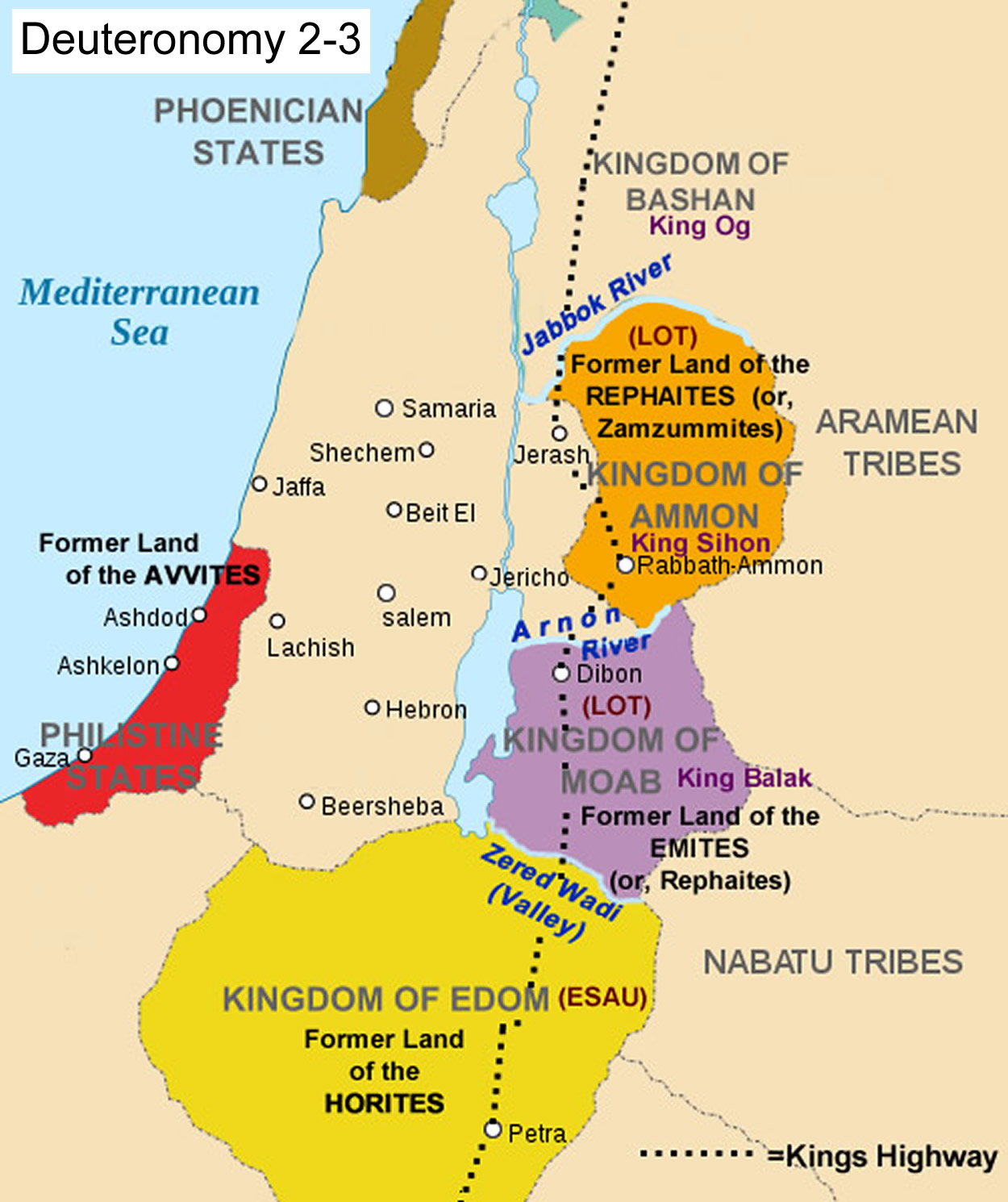
But during the more than 500-year delay between the time when that promise was given and when the people of Israel entered Canaan, the land had not set empty or unoccupied. Its fertile soil and central location made it an attractive piece of real estate. And while the Israelites had been languishing as slaves in Egypt, a host of nations had taken up residence in and around Canaan. This included the nations listed in the chapter: Ammon, Moab, Seir, Edom, and Philistia. These particular groups occupied territory on the edges of the land of Canaan, and God had given Moses instructions about how to deal with them. In order to enter Canaan, the people of Israel would need to pass through some of these outlying territories. Their goal was to do so as peacefully as possible but, if necessary, they were ordered to use force.

“As you approach a town to attack it, you must first offer its people terms for peace. If they accept your terms and open the gates to you, then all the people inside will serve you in forced labor. But if they refuse to make peace and prepare to fight, you must attack the town. When the Lord your God hands the town over to you, use your swords to kill every man in the town. But you may keep for yourselves all the women, children, livestock, and other plunder. You may enjoy the plunder from your enemies that the Lord your God has given you.” – Deuteronomy 20:10-14 NLT

Some of the nations listed in this chapter had an interesting relationship with the people of Israel. They were actually blood relations. In the case of the Ammonites and Moabites, they were the descendants of Abraham’s nephew, Lot. The record of their rather sordid history is found in the book of Genesis. Lot had made the unwise decision to settle his family in Sodom, a city infamous for its immorality. But God graciously rescued Lot and his two daughters before destroying the entire city and all its occupants.

In the immediate aftermath of Lot’s rescue, his daughters took it upon themselves to continue their family line by getting their father drunk and having sexual relations with him. And their depraved plan worked.

…both of Lot’s daughters became pregnant by their own father.  When the older daughter gave birth to a son, she named him Moab. He became the ancestor of the nation now known as the Moabites. When the younger daughter gave birth to a son, she named him Ben-ammi. He became the ancestor of the nation now known as the Ammonites. – Genesis 19:36-38 NLT

So, the Ammonites and Moabites were actually distant relatives of the Israelites. They had settled in the eastern portion of the land of Palestine long before the nation of Israel had been released from its captivity in Egypt. And they both proved to be less-than-accommodating to the Israelites as they attempted to enter the land of Canaan.

But God’s warnings recorded in Ezekiel 25 have to do with their response to the much-later fall of the northern kingdom of Israel, and what will be their gloating response to the fall of Judah and Jerusalem. When the Babylonian finally defeated the southern kingdom of Judah, the Ammonites and Moabites would rejoice. But God warns that they will suffer a similar fate at the hands of “the people of the East” (Ezekiel 25:10 ESV).

And the same thing will happen to the Edomites. This nation enjoyed a close relationship with the Israelites as well. They were the descendants of Esau, the twin brother of Jacob. And while both brothers were in their mother’s womb, God had warned Rebekah, “The sons in your womb will become two nations. From the very beginning, the two nations will be rivals. One nation will be stronger than the other; and your older son will serve your younger son” (Genesis 25:23 NLT).

The Edomites and Israelites never got along. In fact, their history was marked by constant conflict. Despite their blood ties, there was no love lost between these two nations. And because the Edomites would also rejoice at Judah’s demise, God would bring judgment upon them as well.

“I will raise my fist of judgment against Edom. I will wipe out its people and animals with the sword. I will make a wasteland of everything from Teman to Dedan.” – Ezekiel 25:13 NLT

The final nation addressed in God’s message to Ezekiel is Philistia. The Philistines occupied the land along the shore of the Mediterranean Sea, just west of Canaan. They are first listed in the book of Genesis as the descendants of Mizraim, the grandson of Noah.

Mizraim was the ancestor of the Ludites, Anamites, Lehabites, Naphtuhites, Pathrusites, Casluhites, and the Caphtorites, from whom the Philistines came… – Genesis 10:13-14 NLT

So, they too were distant relatives of the Israelites. They were a warring people who posed a perennial problem for the Israelites throughout their history. When God released the Israelites from their captivity in Egypt, He had chosen to send them via a route that would avoid any conflict with the Philistines.

When Pharaoh finally let the people go, God did not lead them along the main road that runs through Philistine territory, even though that was the shortest route to the Promised Land. God said, “If the people are faced with a battle, they might change their minds and return to Egypt.” – Exodus 13:17 NLT

God knew that an encounter with the Philistines might dissuade His people from attempting to enter the land He had promised them, so He sent them on a lengthier and more circuitous way.

As they had done throughout their hostile history with Israel, the Philistines would take advantage of the northern kingdom’s fall to the Assyrians, confiscating their land and plundering their cities. And when Jerusalem came under siege by the Babylonians, the Philistines would use Judah’s suffering as an opportunity to extend their own borders and enrich their coffers. But they would pay dearly for their efforts.

“I will raise my fist of judgment against the land of the Philistines. I will wipe out the Kerethites and utterly destroy the people who live by the sea. I will execute terrible vengeance against them to punish them for what they have done.” – Ezekiel 25:16-17 NLT

Each of these nations had direct ties to the people of God. Yet they had chosen to rejoice at Israel’s suffering and profit from their loss. But when God was done punishing His disobedient people, He would turn His wrath upon their enemies. When the dust settled and the judgment of God had run its course, everyone would know that He alone was God. He warns the Ammonites, Moabites, Edomites, and Philistines, “when I have inflicted my revenge, they will know that I am the Lord” (Ezekiel 25:17 NLT).

And the prophet, Isaiah, predicts a future day when the once-divided nations of Israel and Judah will be reunited and they will wreak vengeance upon all their former enemies.

Then at last the jealousy between Israel and Judah will end.
    They will not be rivals anymore.
They will join forces to swoop down on Philistia to the west.
    Together they will attack and plunder the nations to the east.
They will occupy the lands of Edom and Moab,
    and Ammon will obey them. – Isaiah 11:13-14 NLT

God was going to judge His rebellious people, but He was not done with them. He would not renege on His commitment to them. And while the surrounding nations might see the fall of Israel and Judah as a godsend, they would one day experience the miracle of their complete revitalization and restoration as God’s chosen people. As God told Isaiah, the day was coming when all His promises to His people will be fulfilled and their fortunes will be restored.

In that day the Lord will reach out his hand a second time
    to bring back the remnant of his people—
those who remain in Assyria and northern Egypt;
    in southern Egypt, Ethiopia, and Elam;
    in Babylonia, Hamath, and all the distant coastlands.
He will raise a flag among the nations
    and assemble the exiles of Israel.
He will gather the scattered people of Judah
    from the ends of the earth. – Isaiah 11:11-12 NLT

English Standard Version (ESV) The Holy Bible, English Standard Version. ESV® Permanent Text Edition® (2016). Copyright © 2001

New Living Translation (NLT) Holy Bible, New Living Translation, copyright © 1996, 2004, 2015 by Tyndale House Foundation. Used by permission of Tyndale House Publishers Inc., Carol Stream, Illinois 60188. All rights reserved.
A Vision of Things to Come

15 And he took up his discourse and said,

“The oracle of Balaam the son of Beor,
    the oracle of the man whose eye is opened,
16 the oracle of him who hears the words of God,
    and knows the knowledge of the Most High,
who sees the vision of the Almighty,
    falling down with his eyes uncovered:
17 I see him, but not now;
    I behold him, but not near:
a star shall come out of Jacob,
    and a scepter shall rise out of Israel;
it shall crush the forehead of Moab
    and break down all the sons of Sheth.
18 Edom shall be dispossessed;
    Seir also, his enemies, shall be dispossessed.
    Israel is doing valiantly.
19 And one from Jacob shall exercise dominion
    and destroy the survivors of cities!”

20 Then he looked on Amalek and took up his discourse and said,

“Amalek was the first among the nations,
    but its end is utter destruction.”

21 And he looked on the Kenite, and took up his discourse and said,

“Enduring is your dwelling place,
    and your nest is set in the rock.
22 Nevertheless, Kain shall be burned
    when Asshur takes you away captive.”

23 And he took up his discourse and said,

“Alas, who shall live when God does this?
24     But ships shall come from Kittim
and shall afflict Asshur and Eber;
    and he too shall come to utter destruction.”

25 Then Balaam rose and went back to his place. And Balak also went his way. – Numbers 24:15-25 ESV

Balaam, the seer, had seen and heard all he needed to determine the will of Jehovah. No more altars were necessary and there was no need to spill the blood of another animal. God had made Himself perfectly clear and had left nothing up to doubt or debate. While King Balak was still holding out hope that a curse of the Israelites was forthcoming, In a sense, Balaam was saying, “I can see clearly now!”

“This is the message of Balaam son of Beor,
    the message of the man whose eyes see clearly,
the message of one who hears the words of God,
    who has knowledge from the Most High,
who sees a vision from the Almighty,
    who bows down with eyes wide open…” – Numbers 24:15-16 NLT

There was no further need to consult with the Lord. This newly enlightened soothsayer was transformed into a spokesman of God and given a series of disturbing prophecies to deliver to King Balak. First, true to his reputation as a seer, Balaam spoke of seeing an individual whose arrival was sometime in the foreseeable future.

“I see him, but not now;
    I behold him, but not near…” – Numbers 24:17 ESV

And Balaam informs King Balak that the origins of this coming one would be of a supernatural nature and accompanied by kingly authority.

“…a star shall come out of Jacob,
    and a scepter shall rise out of Israel…” – Numbers 24:17 ESV

From the very people group that Balak had hoped to curse would come a future king.

“That stars could be used metaphorically for kings is suggested by Isaiah 14:12, where the king of Babylon is called ‘Day Star’, and Revelation 22:16, which calls Jesus ‘the offspring of David, the bright morning star.’ That a king is meant here is confirmed by the second line of the couplet: a sceptre shall rise out of Israel, a sceptre being part of the royal insignia (Ps. 45:6; Amos 1:5,8; Gen. 49:10).” – Gordon J. Wenham, Numbers, Tyndale Old Testament Commentaries

And that king will “crush the forehead of Moab” (Numbers 24:17 ESV). This appears to be a reference to the king of Moab, the title held by Balak. This bit of bad news only confirmed Balak’s earlier suspicions and further fueled his desire to see the Israelites cursed. They were a direct threat to his rule and reign.

But the news only gets worse. Balaam goes on to mention the sons of Sheth as well as the kingdoms of Edom and Seir. This coming king would break down and dispossess them all.

“Edom will be taken over,
    and Seir, its enemy, will be conquered,
    while Israel marches on in triumph.” – Numbers 24:18 NLT

No one would be able to stand against God’s appointed leader and His chosen people. That included the Amalekites and the Kenites. This future king would be powerful and successful in leading the Israelites against all the inhabitants of the land of Canaan. And this prophecy was right in line with the blessing that Jacob had given to his son Judah centuries earlier.

“The scepter will not depart from Judah,
    nor the ruler’s staff from his descendants,
until the coming of the one to whom it belongs,
    the one whom all nations will honor.” – Genesis 49:10 NLT

Whether he realized it or not, Balaam was being used by God to confirm that very prophecy. The promise of a future king who would come from the tribe of Judah was still yet to be fulfilled. There is sense in which much of this prophecy was fulfilled under the reign of King David, a member of the tribe of Judah. David would prove to be a warrior-king whose military victories helped put Israel on the map politically speaking. He would expand the boundaries of Israel through military conquest and create one of the most powerful nations on the face of the earth at that time. And he would bequeath that nation to his son, Solomon, who would continue to build and expand the kingdom of Israel. But the day would come when Solomon’s kingdom would be divided in half, never again to enjoy its former glory. So, the final phase of Balaam’s prophecy remains unfulfilled.

“Alas, who can survive
    unless God has willed it?
Ships will come from the coasts of Cyprus;
    they will oppress Assyria and afflict Eber,
but they, too, will be utterly destroyed.” – Numbers 24:23-24 NLT

This appears to be a reference to future kingdoms that will come to power in the region and attempt to overthrow God’s people. But even these powers-to-be will meet a similar fate as the Moabites, Kenites, and Edomites. They will be utterly destroyed by God’s people with the help of the “star” who holds the “scepter” in his hand. And the book of Revelation predicts this coming time when a descendant of Jacob from the tribe of Judah will bring victory over all of Israel’s enemies once and for all.

To all who are victorious, who obey me to the very end,

To them I will give authority over all the nations.
They will rule the nations with an iron rod
    and smash them like clay pots.

They will have the same authority I received from my Father, and I will also give them the morning star! – Revelation 2:26-28 NLT

And in Revelation 22, the apostle John provides insight into the identity of “the morning star.”

“I, Jesus, have sent my angel to give you this message for the churches. I am both the source of David and the heir to his throne. I am the bright morning star.” – Revelation 22:16 NLT

Jesus is the one of whom Balaam prophesied. He is the one who will bring destruction to the enemies of Israel. And the apostle John was given a vision of this end-times event, which he recorded in the book of Revelation.

Then I saw heaven opened, and a white horse was standing there. Its rider was named Faithful and True, for he judges fairly and wages a righteous war. His eyes were like flames of fire, and on his head were many crowns. A name was written on him that no one understood except himself. He wore a robe dipped in blood, and his title was the Word of God. The armies of heaven, dressed in the finest of pure white linen, followed him on white horses. From his mouth came a sharp sword to strike down the nations. He will rule them with an iron rod. He will release the fierce wrath of God, the Almighty, like juice flowing from a winepress. On his robe at his thigh was written this title: King of all kings and Lord of all lords. – Revelation 19:11-16 NLT

There is no way that Balaam understood the full import of his words. He had no way of seeing into the future and identifying this conquering king to come. But once he had delivered his Spirit-inspired message to King Balak, he went on his way. And Balak was left to consider the words of Jehovah and the impact they might have on his life and kingdom.

English Standard Version (ESV) The Holy Bible, English Standard Version. ESV® Permanent Text Edition® (2016). Copyright © 2001

New Living Translation (NLT) Holy Bible, New Living Translation, copyright © 1996, 2004, 2015 by Tyndale House Foundation. Used by permission of Tyndale House Publishers Inc., Carol Stream, Illinois 60188. All rights reserved.

Growing Confidence

10 And the people of Israel set out and camped in Oboth. 11 And they set out from Oboth and camped at Iye-abarim, in the wilderness that is opposite Moab, toward the sunrise. 12 From there they set out and camped in the Valley of Zered. 13 From there they set out and camped on the other side of the Arnon, which is in the wilderness that extends from the border of the Amorites, for the Arnon is the border of Moab, between Moab and the Amorites. 14 Therefore it is said in the Book of the Wars of the Lord,

“Waheb in Suphah, and the valleys of the Arnon,
15 and the slope of the valleys
that extends to the seat of Ar,
and leans to the border of Moab.”

16 And from there they continued to Beer; that is the well of which the Lord said to Moses, “Gather the people together, so that I may give them water.” 17 Then Israel sang this song:

“Spring up, O well!—Sing to it!—
18 the well that the princes made,
that the nobles of the people dug,
with the scepter and with their staffs.”

And from the wilderness they went on to Mattanah, 19 and from Mattanah to Nahaliel, and from Nahaliel to Bamoth, 20 and from Bamoth to the valley lying in the region of Moab by the top of Pisgah that looks down on the desert. – Numbers 21:10-20 ESV

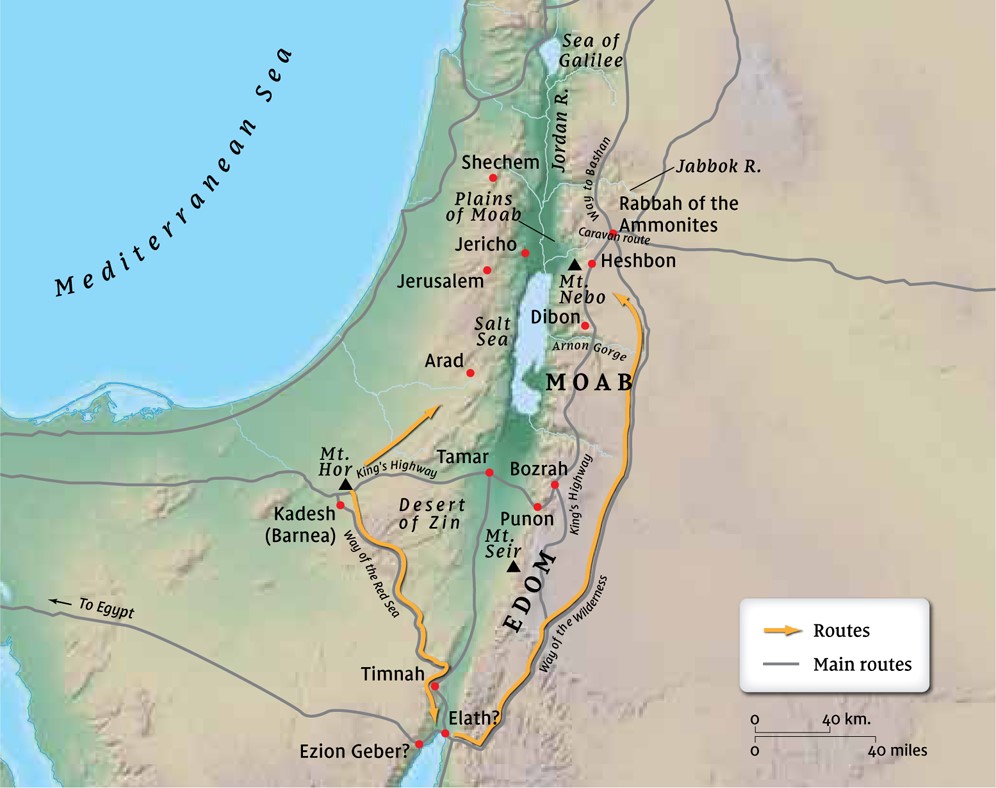
Having been denied safe passage through the land of Edom, the Israelites had attempted to make their way through the Negev. But their efforts were hampered by the Canaanites who occupied that territory. So, they reversed their steps and headed east around the borders of Edom and on to the western borders of Moab. This would have been a long and circuitous journey that left the Israelites frustrated by their slow progress. It was an unexpected and unwelcome detour that required the people of God to extend their time in the wilderness. But there was a reason for this delay. God was waiting for the last of the rebellious generous that had refused to enter Canaan the first time to die off. In the book of Deuteronomy, Moses recalls the nearly 40-year death march the Israelites were forced to make because of their disobedience to God’s command.

“Thirty-eight years passed from the time we first left Kadesh-barnea until we finally crossed the Zered Brook! By then, all the men old enough to fight in battle had died in the wilderness, as the Lord had vowed would happen. The Lord struck them down until they had all been eliminated from the community.” – Deuteronomy 2:14-15 NLT

And as that earlier generation slowly died off, the time was growing closer when the next crop of Israelites would face the decision to obey God and enter the land of Canaan. But as they drew closer to Canaan’s border, God warned the people to give the people of Moab a wide berth.

“Do not bother the Moabites, the descendants of Lot, or start a war with them. I have given them Ar as their property, and I will not give you any of their land.” – Deuteronomy 2:9 NLT

When the very last member of the earlier generation died, the Israelites were given permission to cross the border of Moab and enter the land of Ammon,

“Today you will cross the border of Moab at Ar and enter the land of the Ammonites, the descendants of Lot. But do not bother them or start a war with them. I have given the land of Ammon to them as their property, and I will not give you any of their land.’” – Deuteronomy 2:18-19 NLT

As before, the Israelites were to refrain from taking any land from the Ammonites. These people were close relatives of the Israelites and God declared their property to be off limits. God had awarded Lot’s descendants this land and the Israelites had no claim to it.

But the day came when God ordered the Israelites to begin their conquest of the land of Canaan. The older generation was gone and, after a nearly 40-year delay, it was time for God’s people to obey His command and enter the land of promise.

“Then the Lord said, ‘Now get moving! Cross the Arnon Gorge. Look, I will hand over to you Sihon the Amorite, king of Heshbon, and I will give you his land. Attack him and begin to occupy the land. Beginning today I will make people throughout the earth terrified because of you. When they hear reports about you, they will tremble with dread and fear.’” – Deuteronomy 2:24-25 NLT

Moses attempted to negotiate a treaty with Sihon, the king of the Amorites, but he was not interested in peace talks. That’s when God informed Moses to drop the peace overtures and have the people pick up their weapons.

“Look, I have begun to hand King Sihon and his land over to you. Begin now to conquer and occupy his land.” – Deuteronomy 2:31 NLT

And the victory was overwhelming. Moses indicates that “the Lord our God handed him over to us, and we crushed him, his sons, and all his people.  We conquered all his towns and completely destroyed everyone—men, women, and children. Not a single person was spared” (Deuteronomy 2:33-34 NLT).

Moses refers to “the Book of the Wars of the Lord” (Numbers 21:14 ESV. This was a record of Israel’s victories in the form of songs. The people were just beginning to witness the overwhelming power of God on their behalf. This victory over the Amorites was to be the first of many and it was intended to promote a sense of hope and confidence among the people of God.

After their defeat of the Amorites, the Israelites continued on to Beer, where God quenched the thirst of the people with refreshing water. And the people responded in grateful song.

“Spring up, O well!
    Yes, sing its praises!
Sing of this well,
    which princes dug,
which great leaders hollowed out
    with their scepters and staffs.” – Numbers 21:17-18 NLT

Israel was experiencing a sense of renewed confidence as they witnessed firsthand the power and providence of God. He was graciously preparing them for the days ahead and helping them to understand that anything was possible when they placed their faith in Him.

But while they were getting closer to the land of Canaan, they were not quite ready to take on the challenged that lie across the border. So, God continue to prepare them for the difficult days ahead.

Their enthusiasm, while admirable, would not be enough to bring victory against the nations living in Canaan. What the Israelites really needed was increased confidence in the power of God. Ultimately, the conquest of the land would be up to Him. They were going to need to learn to trust Him implicitly. Cockiness was not an acceptable substitute for confidence in God.

English Standard Version (ESV) The Holy Bible, English Standard Version. ESV® Permanent Text Edition® (2016). Copyright © 2001

New Living Translation (NLT) Holy Bible, New Living Translation, copyright © 1996, 2004, 2015 by Tyndale House Foundation. Used by permission of Tyndale House Publishers Inc., Carol Stream, Illinois 60188. All rights reserved.
No Shortcuts to Holiness

14 Moses sent messengers from Kadesh to the king of Edom: “Thus says your brother Israel: You know all the hardship that we have met: 15 how our fathers went down to Egypt, and we lived in Egypt a long time. And the Egyptians dealt harshly with us and our fathers. 16 And when we cried to the Lord, he heard our voice and sent an angel and brought us out of Egypt. And here we are in Kadesh, a city on the edge of your territory. 17 Please let us pass through your land. We will not pass through field or vineyard, or drink water from a well. We will go along the King’s Highway. We will not turn aside to the right hand or to the left until we have passed through your territory.” 18 But Edom said to him, “You shall not pass through, lest I come out with the sword against you.” 19 And the people of Israel said to him, “We will go up by the highway, and if we drink of your water, I and my livestock, then I will pay for it. Let me only pass through on foot, nothing more.” 20 But he said, “You shall not pass through.” And Edom came out against them with a large army and with a strong force. 21 Thus Edom refused to give Israel passage through his territory, so Israel turned away from him.

22 And they journeyed from Kadesh, and the people of Israel, the whole congregation, came to Mount Hor. 23 And the Lord said to Moses and Aaron at Mount Hor, on the border of the land of Edom, 24 “Let Aaron be gathered to his people, for he shall not enter the land that I have given to the people of Israel, because you rebelled against my command at the waters of Meribah. 25 Take Aaron and Eleazar his son and bring them up to Mount Hor. 26 And strip Aaron of his garments and put them on Eleazar his son. And Aaron shall be gathered to his people and shall die there.” 27 Moses did as the Lord commanded. And they went up Mount Hor in the sight of all the congregation. 28 And Moses stripped Aaron of his garments and put them on Eleazar his son. And Aaron died there on the top of the mountain. Then Moses and Eleazar came down from the mountain. 29 And when all the congregation saw that Aaron had perished, all the house of Israel wept for Aaron thirty days. – Numbers 20:14-29 ESV

The Israelites were nearing their final destination and as they approached the borders of Canaan, God was cleaning house. Chapter 20 opens with the death of Miriam. But the end of the chapter records the death of her brother, Aaron, the high priest of Israel. He too was disciplined by God for his part in the affair at Meribah. God had accused both Aaron and Moses of treating Him disrespectfully before the people.

“Because you did not believe in me, to uphold me as holy in the eyes of the people of Israel, therefore you shall not bring this assembly into the land that I have given them.” – Numbers 20:12 ESV

While Moses had been the one to strike the rock three times in anger, Aaron had done nothing to stop his brother from disobeying God’s command. God had clearly communicated His orders to both men.

“You and Aaron must take the staff and assemble the entire community. As the people watch, speak to the rock over there, and it will pour out its water. You will provide enough water from the rock to satisfy the whole community and their livestock.” – Numbers 20:8 NLT

But Moses and Aaron were fed up with the constant bickering and complaining of the people. Despite what God had ordered them to do, they were going to use this God-ordained miracle as an opportunity to teach the people a lesson.

Then he and Aaron summoned the people to come and gather at the rock. “Listen, you rebels!” he shouted. “Must we bring you water from this rock?” Then Moses raised his hand and struck the rock twice with the staff, and water gushed out. So the entire community and their livestock drank their fill. – Numbers 20:10-11 NLT

Moses, speaking on behalf of himself and his brother, tried to leave the impression that they were the ones who would meet the Israelite’s needs by providing water from the rock. In essence, they tried to rob God of glory. Then, by striking the rock rather than speaking to it, Moses violated the command of God. And God would hold both men accountable for their actions.

It was on the southern border of the land of Edom that God delivered the devastating news to Aaron and Moses.

“He will not enter the land I am giving the people of Israel, because the two of you rebelled against my instructions concerning the water at Meribah.” – Numbers 20:24 NLT

In a rather sobering ceremony atop Mount Hor, Moses took the priestly robes off of Aaron and gave them to Aaron’s son, Eleazar. It appears from the text that Aaron did not get to live out the rest of his life wandering in the wilderness, but died on top of the mountain while Moses and Eleazar looked on. They descended the mountain without him and the people of Israel mourned his death for 30 days.

Now Moses was alone. For nearly 40 years he had led the people of Israel with the help of his brother and sister, but their deaths had left him with the sole responsibility of getting the people of Israel to the land of Canaan. But Moses knew that he was never going to set foot in the land because of his role in the affair at Meribah. Like Aaron, he would be denied access to the land of promise and breathe his last breath in the wilderness.

But Moses continued to fulfill the duties God had given to him some four decades earlier. He mourned the loss of his brother but then set about leading the people of Israel to the border of Canaan. To do so, he had attempted to take a shortcut through the land of Edom.

Edom was located on the southernmost border of Canaan and was occupied by distant relatives of the Israelites. The Edomites were the descendants of Esau, the firstborn son of Isaac and the twin brother of Jacob. When Esau had been cheated out of his birthright by Jacob, he decided to relocate his family to another part of Canaan.

Esau took his wives, his children, and his entire household, along with his livestock and cattle—all the wealth he had acquired in the land of Canaan—and moved away from his brother, Jacob. There was not enough land to support them both because of all the livestock and possessions they had acquired. So Esau (also known as Edom) settled in the hill country of Seir. – Genesis 36:6-8 NLT

Once there, Esau’s descendants prospered and developed a thriving kingdom. During the four centuries that the Israelites were enslaved in Egypt, the Edomites lived under a long line of kings (Genesis 36:31) and enjoyed a measure of peace and prosperity.

So, when Moses sent emissaries to the king of Edom seeking permission to pass through their territory, he expected a favorable response.

“This is what your relatives, the people of Israel, say: You know all the hardships we have been through. Our ancestors went down to Egypt, and we lived there a long time, and we and our ancestors were brutally mistreated by the Egyptians. But when we cried out to the Lord, he heard us and sent an angel who brought us out of Egypt. Now we are camped at Kadesh, a town on the border of your land. Please let us travel through your land. We will be careful not to go through your fields and vineyards. We won’t even drink water from your wells. We will stay on the king’s road and never leave it until we have passed through your territory.”– Numbers 20:14-17 NLT

The kingdom of Edom covered a large swath of land and without the right of safe passage through its territory, Moses and the people of Israel would be forced to take a much longer route around it. But no matter how hard Moses pleaded, the king of Edom refused to grant access to their land. He even threatened them with war if they tried. He even “mobilized his army and marched out against them with an imposing force” (Numbers 20:20 NLT). 

Rejected by their own kin, the Israelites were forced to reverse course and take the long detour around Edom. What’s interesting to consider is that the Israelites had always been led by the pillar of cloud by day and the pillar of fire by night. God had used these two phenomena to guide His people throughout their four-decade-long journey. So, was Moses’ attempt to go through Edom an unauthorized decision on his part? Had the cloud led him to this point or was the negotiations with Edom something he had come up with on his own? Was Moses trying to shorten the distance to Canaan by taking an unauthorized path through the land of Edom?

It seems unlikely that God would have chosen to use the Edomites to help His chosen people reach the land He had promised to provide for them. These two nations remained in constant conflict with one another long after Israel conquered and occupied the land of Canaan. And the book of Obadiah describes God’s anger against Edom for the way it took advantage of Israel’s later misfortunes when the Babylonians conquered them and left the land desolate and depopulated.

“Because of the violence you did
    to your close relatives in Israel,
you will be filled with shame
    and destroyed forever.
When they were invaded,
    you stood aloof, refusing to help them.
Foreign invaders carried off their wealth
    and cast lots to divide up Jerusalem,
    but you acted like one of Israel’s enemies.

“You should not have gloated
    when they exiled your relatives to distant lands.
You should not have rejoiced
    when the people of Judah suffered such misfortune.
You should not have spoken arrogantly
    in that terrible time of trouble.
You should not have plundered the land of Israel
    when they were suffering such calamity.
You should not have gloated over their destruction
    when they were suffering such calamity.
You should not have seized their wealth
    when they were suffering such calamity.
You should not have stood at the crossroads,
    killing those who tried to escape.
You should not have captured the survivors
    and handed them over in their terrible time of trouble.” – Obadiah 10-14 ESV

The Israelites received no assistance from their distant relatives and were forced to travel southeasterly toward the Arabian desert. This unexpected setback must have disappointed Moses and it’s clear from the next chapter that it left the people of Israel far from pleased.

From Mount Hor they set out by the way to the Red Sea, to go around the land of Edom. And the people became impatient on the way. – Numbers 21:4 ESV

God was not done teaching them the lessons they needed to learn. They were not yet ready to enter His rest. So, God continued to purge their leadership and purify their hearts in preparation for the day when He would lead them into their promised inheritance.

English Standard Version (ESV) The Holy Bible, English Standard Version. ESV® Permanent Text Edition® (2016). Copyright © 2001

New Living Translation (NLT) Holy Bible, New Living Translation, copyright © 1996, 2004, 2015 by Tyndale House Foundation. Used by permission of Tyndale House Publishers Inc., Carol Stream, Illinois 60188. All rights reserved.

Learning to Recognize God’s Love

2 “I have loved you,” says the Lord. But you say, “How have you loved us?” “Is not Esau Jacob’s brother?” declares the Lord. “Yet I have loved Jacob 3 but Esau I have hated. I have laid waste his hill country and left his heritage to jackals of the desert.” 4 If Edom says, “We are shattered but we will rebuild the ruins,” the Lord of hosts says, “They may build, but I will tear down, and they will be called ‘the wicked country,’ and ‘the people with whom the Lord is angry forever.’” 5 Your own eyes shall see this, and you shall say, “Great is the Lord beyond the border of Israel!” – Malachi 1:2-5 ESV

Whether we can accurately determine Malachi’s identity or not is irrelevant. What is important is that the author more than lives up to his God-given title of “my messenger.” Every word he has recorded is a message from Yahweh to His covenant people, the nation of Israel. For generations, these descendants of Abraham had enjoyed a unique, one-of-a-kind relationship with God that had made them the beneficiaries of His love and blessings. God had set them apart and declared them to be His prized possession, among all the nations of the earth. When He had successfully freed them from their 400-year captivity in Egypt, God had led them to Mount Sinai, where He spoke to Moses and delivered give the following message:

“Now therefore, if you will indeed obey my voice and keep my covenant, you shall be my treasured possession among all peoples, for all the earth is mine; and you shall be to me a kingdom of priests and a holy nation.’ These are the words that you shall speak to the people of Israel.” – Exodus 19:5-6 ESV

And the people had eagerly responded, “All that the Lord has spoken we will do” (Exodus 19:8 ESV). Even before God had communicated the terms of the covenant, they had agreed to keep it. They liked the idea of being God’s treasured possession, so they wholeheartedly declared their intentions to keep whatever conditions He set forth. But it was three days later that God called Moses up to the top of Mount Sinai and delivered the content of the covenant agreement to which they had already pledged their allegiance.

When Moses returned from the mountaintop, he shared with the people all that God had told him.

Moses came and told the people all the words of the Lord and all the rules. And all the people answered with one voice and said, “All the words that the Lord has spoken we will do.” And Moses wrote down all the words of the Lord. He rose early in the morning and built an altar at the foot of the mountain, and twelve pillars, according to the twelve tribes of Israel. And he sent young men of the people of Israel, who offered burnt offerings and sacrificed peace offerings of oxen to the Lord. And Moses took half of the blood and put it in basins, and half of the blood he threw against the altar. Then he took the Book of the Covenant and read it in the hearing of the people. And they said, “All that the Lord has spoken we will do, and we will be obedient.” And Moses took the blood and threw it on the people and said, “Behold the blood of the covenant that the Lord has made with you in accordance with all these words.” – Exodus 24:3-8 ESV

Moses revealed to the nation of Israel the Ten Commandments and all the associated laws that were intended to regulate their behavior as God’s chosen people. This God-ordained code of conduct was a non-negotiable regulatory document that would distinguish the nation of Israel from all the other nations of the earth. As long as they remained obedient to the covenant, they would be blessed. But should they choose to disobey, they would find themselves suffering severe and inescapable consequences.

But the history of the people of Israel reveals their epic failure at keeping their word. Once God had successfully planted them in Canaan, the land He had promised as their inheritance, they began to reveal their propensity for disobedience and unfaithfulness. They repeatedly violated the terms of the covenant and, despite constant warnings from God, they refused to repent and return to Him. Generation after generation carried on a dangerous love affair with the world and its many false gods, choosing the snub their noses in the face of the one true God. And eventually, God was forced to fulfill His warnings of retribution and destruction. That is why they had spent 70 years living as captives in the land of Babylon. God had warned them time and time again that He would remove them from the land of promise if they continued to violate His covenant and, in 587 B.C., the Babylonians had overrun the city of Jerusalem, destroyed the temple, and taken thousands of its citizens back to Babylon as slaves.

At the time Malachi wrote his message from God, a remnant of the exiles had been living back in Judah for years. The walls of Jerusalem had been rebuilt, the temple had been restored, and the sacrificial system had been renewed, but the people remained just as rebellious and disobedient as ever. So, through His “messenger,” God delivered a powerful reminder of His unrequited love and patience with his stubborn people.

Through Malachi, God declared the reality of His steadfast, unwavering love. Despite all they had suffered over the last 70 years, He had never fallen out of love with them. “I have always loved you,” He reminded them. And even their time in exile had been an expression of His affection because “the LORD reproves him whom he loves, as a father the son in whom he delights” (Proverbs 3:12 ESV).

But the people had a difficult time viewing the destruction of their city and their seven-decade-long internment in Babylon as evidence of God’s love, so they asked, “Really? How have you loved us?” (Malachi 1:2 NLT). From their perspective, it appeared as if God was angry with them and, even now, they suffered constant threats from their enemies and lived in a city that was little more than a shadow of its former glory. They had no king, no standing army, and little hope of ever seeing their fate reversed. As a result, they were distrustful of God, questioning His goodness and doubting His word concerning their wellbeing.

So, God reminded them of how they came to be His chosen people in the first place. He took them back to the births of Esau and Jacob, the twin boys born to Isaac and Rebekah. Malachi’s audience knew the story well. Before the boys were born, God had told Rebekah that the infants inside her womb represented two separate nations.

“Two nations are in your womb,
    and two peoples from within you shall be divided;
the one shall be stronger than the other,
    the older shall serve the younger.” – Genesis 25:23 ESV

God informed Rebekah that the younger of the two boys would become the greater nation. According to tradition, the elder son should have been the recipient of the father’s inheritance and the one to bear the blessing of the firstborn. But, through a series of somewhat underhanded, but clearly God-ordained events, Jacob, the younger of the two siblings, would become the next in line to receive the inheritance that had been passed down through Abraham to Isaac. Jacob had been “loved” by God.

“When He said here that He hated Esau, He meant that He did not choose to bestow His favor on Esau to the extent that He did on Jacob (cf. Psalm 139:21). He made this choice even before they were born…” – Thomas L. Constable, Notes of Malachi

God had chosen to break precedence and set apart Jacob rather than Esau, and it had nothing to do with either boy’s value or worthiness. In fact, the apostle Paul points out the undeserving nature of either child and explains the sovereign nature of God’s will concerning His decision.

…before they were born, before they had done anything good or bad, she received a message from God. (This message shows that God chooses people according to his own purposes; he calls people, but not according to their good or bad works.) She was told, “Your older son will serve your younger son.” In the words of the Scriptures, “I loved Jacob, but I rejected Esau.” – Romans 9:11-13 NLT

From a human perspective, it appears as if God showed greater favor to one son while disfavoring the other. But God did not completely abandon Esau. He simply chose to make His covenant commitment to the descendants of Jacob. God eventually gave Esau the land of the hill country, located around Moun Seir in Edom. In a sense, God blessed Esau by providing him with land as an inheritance, but Esau would prove to be unfaithful and idolatrous. His descendants, the Edomites, would be a constant thorn in the side of the Israelites. And when the Babylonians invaded the region, the Edomite cities and towns were also destroyed.

And when the Edomites declared their intent to reclaim and rebuild their devastated homeland, God warned them that he would prevent them from doing so.

“They may try to rebuild, but I will demolish them again. Their country will be known as ‘The Land of Wickedness,’ and their people will be called ‘The People with Whom the Lord Is Forever Angry.’” – Malachi 1:4 NLT

The Edomites would become an illustration of the futility and hopelessness that faces all those who are not in a covenant relationship with God. The only reason the Israelites had been able to return to the land and rebuild their former capital was that God had ordained it. The decree set forth by King Cyrus of Persia that had allowed a remnant to return to Jerusalem had been God’s doing. He had orchestrated it all. And, in doing so, He had proved His love for His chosen people yet again.

As the Israelites looked around them, they would soon realize that none of the neighboring nations that had fallen to the Babylonians would experience the same degree of revitalization as they had. Not even the Edomites, the descendants of Isaac, would ever rebuild their cities or reestablish their hold on the land. And this should have caused the Israelites to declare, “Truly, the Lord’s greatness reaches far beyond Israel’s borders!” (Malachi 1:5 NLT).

Both the Israelites and the Edomites were descendants of Abraham and Isaac, and both had suffered the judgment of God, having been destroyed by the Babylonians in the sixth century. Yet only Israel had enjoyed restoration after judgment. Despite what appeared to be their less-than-ideal circumstances, the Israelites were experiencing the love of God in the form of His covenant commitment. He had restored them just as He said He would do and He was not yet done blessing them. But, as the following verses will reveal, God did expect to see significant changes among His people.

English Standard Version (ESV) The Holy Bible, English Standard Version. ESV® Permanent Text Edition® (2016). Copyright © 2001 by Crossway Bibles, a publishing ministry of Good News Publishers.

New Living Translation (NLT) Holy Bible, New Living Translation, copyright © 1996, 2004, 2015 by Tyndale House Foundation. Used by permission of Tyndale House Publishers Inc., Carol Stream, Illinois 60188. All rights reserved.
New English Translation (NET)NET Bible® copyright ©1996-2017 by Biblical Studies Press, L.L.C. http://netbible.com All rights reserved.

The Weight of Waiting

20 These are the sons of Seir the Horite, the inhabitants of the land: Lotan, Shobal, Zibeon, Anah, 21 Dishon, Ezer, and Dishan; these are the chiefs of the Horites, the sons of Seir in the land of Edom. 22 The sons of Lotan were Hori and Hemam; and Lotan’s sister was Timna. 23 These are the sons of Shobal: Alvan, Manahath, Ebal, Shepho, and Onam. 24 These are the sons of Zibeon: Aiah and Anah; he is the Anah who found the hot springs in the wilderness, as he pastured the donkeys of Zibeon his father. 25 These are the children of Anah: Dishon and Oholibamah the daughter of Anah. 26 These are the sons of Dishon: Hemdan, Eshban, Ithran, and Cheran. 27 These are the sons of Ezer: Bilhan, Zaavan, and Akan. 28 These are the sons of Dishan: Uz and Aran. 29 These are the chiefs of the Horites: the chiefs Lotan, Shobal, Zibeon, Anah, 30 Dishon, Ezer, and Dishan; these are the chiefs of the Horites, chief by chief in the land of Seir.

31 These are the kings who reigned in the land of Edom, before any king reigned over the Israelites. 32 Bela the son of Beor reigned in Edom, the name of his city being Dinhabah. 33 Bela died, and Jobab the son of Zerah of Bozrah reigned in his place. 34 Jobab died, and Husham of the land of the Temanites reigned in his place. 35 Husham died, and Hadad the son of Bedad, who defeated Midian in the country of Moab, reigned in his place, the name of his city being Avith. 36 Hadad died, and Samlah of Masrekah reigned in his place. 37 Samlah died, and Shaul of Rehoboth on the Euphrates reigned in his place. 38 Shaul died, and Baal-hanan the son of Achbor reigned in his place. 39 Baal-hanan the son of Achbor died, and Hadar reigned in his place, the name of his city being Pau; his wife’s name was Mehetabel, the daughter of Matred, daughter of Mezahab.

40 These are the names of the chiefs of Esau, according to their clans and their dwelling places, by their names: the chiefs Timna, Alvah, Jetheth, 41 Oholibamah, Elah, Pinon, 42 Kenaz, Teman, Mibzar, 43 Magdiel, and Iram; these are the chiefs of Edom (that is, Esau, the father of Edom), according to their dwelling places in the land of their possession. – Genesis 36:20-43 ESV

Moses makes it clear that the land in which Esau and his descendants eventually settled was far from empty. It had been occupied by another group of people known as the Horites. The first mention we have of them is found in Genesis 14, where they are listed among a group of nations that were defeated by an alliance of four kings. This confederation of kings attacked and defeated the people living in the area around Mount Seir,  in the far south of Canaan. They ended up conquering the cities of Sodom and Gomorrah, taking captive all the citizens, including the nephew of Abraham.

When Esau separated from his brother, Jacob, he ended up settling in the very same region as the Horites and, eventually, his sons and their children would supplant the Horites as the official inhabitants of the land. Hundreds of years later, when Moses prepared to lead the people of Israel into the promised land, he would receive instruction from God regarding this southern region and its inhabitants.

“You are about to pass through the territory of your brothers, the people of Esau, who live in Seir; and they will be afraid of you. So be very careful. Do not contend with them, for I will not give you any of their land, no, not so much as for the sole of the foot to tread on, because I have given Mount Seir to Esau as a possession.” – Deuteronomy 2:4-5 ESV

Moses records that Esau and his clan didn’t simply overwhelm the Horites with their superior numbers and strength, but that God orchestrated the transference of the land from one group to the other.

“…he [God] destroyed the Horites before them and they dispossessed them and settled in their place even to this day.” – Deuteronomy 2:22 ESV

The leader of the Horites was a man named Seir, and a large mountain in the region aptly bore his name. The Horites proved to be quite prolific, as the genealogy found in verses 20-43 reflects. But the chiefs of Seir and the chiefs of Esau would end up engaged in an ongoing conflict over control of the land around Mount Seir.

These are the sons of Dishan: Uz and Aran. These are the chiefs of the Horites: the chiefs Lotan, Shobal, Zibeon, Anah, Dishon, Ezer, and Dishan; these are the chiefs of the Horites, chief by chief in the land of Seir. – Genesis 36:28-30 ESV

These are the names of the chiefs of Esau, according to their clans and their dwelling places, by their names: the chiefs Timna, Alvah, Jetheth, Oholibamah, Elah, Pinon, Kenaz, Teman, Mibzar, Magdiel, and Iram; these are the chiefs of Edom (that is, Esau, the father of Edom), according to their dwelling places in the land of their possession. – Genesis 436:40-43 ESV

These two groups of “chiefs” or leaders of their clans would have gone head-to-head in battle with one another over control of the land. But what is interesting is that Moses provides a list of the kings who ruled over the land of Edom, and not one chief among the Horites or Edomites can be found on that list. It contains the name of eight Edomite kings, but none appear to be sons of Esau or Seir. In fact, one is referred to as a Temanite, another hales from Rehoboth, and still another comes from a place called Masrekah.  This sequential order of kings seems to reveal that there was a constant shift of power among the people groups that occupied this region. And Moses points out that the land of Edom had many kings long before the nation of Israel had their first monarch. Part of the reason for this disparity is that the people of Israel would eventually make their way to Egypt where they would remain for 400 years. During that time, the land of Edom would go through a long list of kings, chiefs, and leaders, while the Israelites were biding their time in Egypt. But the land of promise, like Edom, would not go unoccupied during the Israelites’ long absence. Canaan would be filled with nations, and overrun by the sins of idolatry and immorality.

And by the time Moses led the people of Israel back into the land, the  descendants of Esau (the Edomites) would be well established around Mount Seir. In keeping with God’s directive, the Israelites would view Edom as off-limits, restricting themselves to the purchase of food and supplies, but avoiding the confiscation of any Edomite territory because it had been given to them by God. And Moses states, “So we went on, away from our brothers, the people of Esau, who live in Seir, away from the Arabah road from Elath and Ezion-geber” (Deuteronomy 2:8 ESV).

All of this sets up the next section of Moses’ historical record of the people of Israel. While Esau and his descendants were busy making themselves at home in Edom, Israel and his descendants would be continuing the nomadic lifestyle established by Abraham and Isaac. Moses opens up chapter seven with the statement: “Jacob lived in the land of his father’s sojournings, in the land of Canaan” (Genesis 37:1 ESV).

The Hebrew word that Moses used is מָגוּר (māḡûr), which can also be translated “to be a stranger.” That is why the New Living Translation translates verse 1 this way: “So Jacob settled again in the land of Canaan, where his father had lived as a foreigner.”

Isaac, like his father before him, lived in the land of Canaan, more like an alien and a stranger than as a legal citizen. Neither Abraham or Isaac lived in a city or built a permanent dwelling place. They were sojourners, moving from one place to another, and never staying long enough to consider anywhere in the land of Canaan as their true home. And it is the author of the book of Hebrews who explains the reason behind this vagabond existence that was passed down from father to sin to grandson.

It was by faith that Abraham obeyed when God called him to leave home and go to another land that God would give him as his inheritance. He went without knowing where he was going. And even when he reached the land God promised him, he lived there by faith—for he was like a foreigner, living in tents. And so did Isaac and Jacob, who inherited the same promise. Abraham was confidently looking forward to a city with eternal foundations, a city designed and built by God. – Hebrews 11:8-10 NLT

And the author of Hebrews indicates that Abraham, Isaac, and Jacob never got to see that city – in their lifetimes.

All these people died still believing what God had promised them. They did not receive what was promised, but they saw it all from a distance and welcomed it. They agreed that they were foreigners and nomads here on earth. – Hebrews 11:13 NLT

The Edomites had kings and kingdoms. Even the Horites had a long list of chiefs and enjoyed that benefit of living in cities built by human hands. But the people of God would have to wait a long time before they experienced the fulfillment of God’s promise. God had promised to give them the land of Canaan as their inheritance, but neither Abraham, Isaac, or Jacob would make ever find their permanent home in the land of promise because God had something better in store.

Obviously people who say such things are looking forward to a country they can call their own. If they had longed for the country they came from, they could have gone back. But they were looking for a better place, a heavenly homeland. That is why God is not ashamed to be called their God, for he has prepared a city for them. – Hebrews 11:14-15 NLT

The wait would be difficult but well worth it.

English Standard Version (ESV) The Holy Bible, English Standard Version. ESV® Permanent Text Edition® (2016). Copyright © 2001 by Crossway Bibles, a publishing ministry of Good News Publishers.

New Living Translation (NLT) Holy Bible, New Living Translation, copyright © 1996, 2004, 2015 by Tyndale House Foundation. Used by permission of Tyndale House Publishers Inc., Carol Stream, Illinois 60188. All rights reserved.

New English Translation (NET)NET Bible® copyright ©1996-2017 by Biblical Studies Press, L.L.C. http://netbible.com All rights reserved.

Blessed But Not Chosen

1 These are the generations of Esau (that is, Edom). 2 Esau took his wives from the Canaanites: Adah the daughter of Elon the Hittite, Oholibamah the daughter of Anah the daughter of Zibeon the Hivite, 3 and Basemath, Ishmael’s daughter, the sister of Nebaioth. 4 And Adah bore to Esau, Eliphaz; Basemath bore Reuel; 5 and Oholibamah bore Jeush, Jalam, and Korah. These are the sons of Esau who were born to him in the land of Canaan.

6 Then Esau took his wives, his sons, his daughters, and all the members of his household, his livestock, all his beasts, and all his property that he had acquired in the land of Canaan. He went into a land away from his brother Jacob. 7 For their possessions were too great for them to dwell together. The land of their sojournings could not support them because of their livestock. 8 So Esau settled in the hill country of Seir. (Esau is Edom.)

9 These are the generations of Esau the father of the Edomites in the hill country of Seir. 10 These are the names of Esau’s sons: Eliphaz the son of Adah the wife of Esau, Reuel the son of Basemath the wife of Esau. 11 The sons of Eliphaz were Teman, Omar, Zepho, Gatam, and Kenaz. 12 (Timna was a concubine of Eliphaz, Esau’s son; she bore Amalek to Eliphaz.) These are the sons of Adah, Esau’s wife. 13 These are the sons of Reuel: Nahath, Zerah, Shammah, and Mizzah. These are the sons of Basemath, Esau’s wife. 14 These are the sons of Oholibamah the daughter of Anah the daughter of Zibeon, Esau’s wife: she bore to Esau Jeush, Jalam, and Korah.

15 These are the chiefs of the sons of Esau. The sons of Eliphaz the firstborn of Esau: the chiefs Teman, Omar, Zepho, Kenaz, 16 Korah, Gatam, and Amalek; these are the chiefs of Eliphaz in the land of Edom; these are the sons of Adah. 17 These are the sons of Reuel, Esau’s son: the chiefs Nahath, Zerah, Shammah, and Mizzah; these are the chiefs of Reuel in the land of Edom; these are the sons of Basemath, Esau’s wife. 18 These are the sons of Oholibamah, Esau’s wife: the chiefs Jeush, Jalam, and Korah; these are the chiefs born of Oholibamah the daughter of Anah, Esau’s wife. 19 These are the sons of Esau (that is, Edom), and these are their chiefs. – Genesis 36:1-19 ESV

Isaac has died, leaving his son, Jacob (Israel) as the heir of his estate and the recipient of God’s covenant promises and all the blessings it entails. And as Moses prepares to record Israel’s history as the newly designated leader of the covenant community, he provides a brief recap of Esau’s life and lineage. As the firstborn son of Isaac, Esau had been the rightful heir to the birthright and the blessing, but Jacob had managed to manipulate and deceive his brother so that he took possession of both. While time had healed the rift between these two brothers, they would find themselves going their separate ways. This chapter provides insight into Esau’s fate and a brief description of his family tree.

These first 19 verses seem painfully redundant because they repeat the names of Esau’s wives and sons three separate times. The first five verses list the three wives of Esau and the five sons they bore to him. Then, in verses 6-8, Moses list the wives and sons again, but adds the names of the ten grandsons born to Esau.

It’s important to note that Esau was a son of Isaac and, therefore, still a legitimate conduit through whom God would fulfill His promise to Isaac of many offspring.

“I will multiply your offspring as the stars of heaven and will give to your offspring all these lands. And in your offspring all the nations of the earth shall be blessed…” – Genesis 26:4 ESV

The different between Esau’s descendants and those of his brother was that his sons and grandsons would not be considered part of the chosen nation. When Jacob had managed to deceive Isaac and steal his brother’s blessing, it had left Esau with nothing. When he begged Isaac to provide him with a blessing of his own, all he got was a rather weak consolation prize.

“You will live away from the richness of the earth,
    and away from the dew of the heaven above.
You will live by your sword,
    and you will serve your brother.
But when you decide to break free,
    you will shake his yoke from your neck.” – Genesis 27:39-40 NLT

Not exactly the winning number to the lottery. But God would still bless Esau by providing him with five sons and 10 grandsons and, as the text makes clear, most of these men would grow up to be “the chiefs of the sons of Esau” (Genesis 36:15 ESV). They would become powerful leaders in their own right and from them would come many nations, including the Kenizzites, Edomites, and Amalekites.

While Jacob and Esau had mended their relationship, their descendants would never see eye to eye. In fact, a growing hostility would develop between the two groups, as they eventually found themselves fighting over the land of Canaan. It didn’t help that the Edomites, the descendants of Esau, became pagans, worshiping the false gods of the other nations inhabiting the land of promise. Eventually, the prophets Jeremiah and Obadiah issued prophetic pronouncements that warned of God’s judgment against them.

This message was given concerning Edom. This is what the Lord of Heaven’s Armies says:

“Is there no wisdom in Teman?
    Is no one left to give wise counsel?
Turn and flee!
    Hide in deep caves, you people of Dedan!
For when I bring disaster on Edom,
    I will punish you, too!
Those who harvest grapes
    always leave a few for the poor.
If thieves came at night,
    they would not take everything.
But I will strip bare the land of Edom,
    and there will be no place left to hide.
Its children, its brothers, and its neighbors
    will all be destroyed,
    and Edom itself will be no more.” – Jeremiah 49:7-10 NLT

The Lord says to Edom,
“I will cut you down to size among the nations;
    you will be greatly despised.
You have been deceived by your own pride
    because you live in a rock fortress
    and make your home high in the mountains.
‘Who can ever reach us way up here?’
    you ask boastfully.
But even if you soar as high as eagles
    and build your nest among the stars,
I will bring you crashing down,”
    says the Lord.” – Obadiah 1:2-4 NLT

God would bless Esau, resulting in the formation of a variety of nations and people groups. But they would fail to honor God and worship Him alone. Instead, they would seek and serve the false gods of Canaan, resulting in the pouring out of God’s divine wrath.

English Standard Version (ESV) The Holy Bible, English Standard Version. ESV® Permanent Text Edition® (2016). Copyright © 2001 by Crossway Bibles, a publishing ministry of Good News Publishers.

New Living Translation (NLT) Holy Bible, New Living Translation, copyright © 1996, 2004, 2015 by Tyndale House Foundation. Used by permission of Tyndale House Publishers Inc., Carol Stream, Illinois 60188. All rights reserved.

New English Translation (NET)NET Bible® copyright ©1996-2017 by Biblical Studies Press, L.L.C. http://netbible.com All rights reserved.

Like Father, Like Son

1 In the second year of Joash the son of Joahaz, king of Israel, Amaziah the son of Joash, king of Judah, began to reign. 2 He was twenty-five years old when he began to reign, and he reigned twenty-nine years in Jerusalem. His mother’s name was Jehoaddin of Jerusalem. 3 And he did what was right in the eyes of the Lord, yet not like David his father. He did in all things as Joash his father had done. 4 But the high places were not removed; the people still sacrificed and made offerings on the high places. 5 And as soon as the royal power was firmly in his hand, he struck down his servants who had struck down the king his father. 6 But he did not put to death the children of the murderers, according to what is written in the Book of the Law of Moses, where the Lord commanded, “Fathers shall not be put to death because of their children, nor shall children be put to death because of their fathers. But each one shall die for his own sin.”

7 He struck down ten thousand Edomites in the Valley of Salt and took Sela by storm, and called it Joktheel, which is its name to this day.

8 Then Amaziah sent messengers to Jehoash the son of Jehoahaz, son of Jehu, king of Israel, saying, “Come, let us look one another in the face.” 9 And Jehoash king of Israel sent word to Amaziah king of Judah, “A thistle on Lebanon sent to a cedar on Lebanon, saying, ‘Give your daughter to my son for a wife,’ and a wild beast of Lebanon passed by and trampled down the thistle. 10 You have indeed struck down Edom, and your heart has lifted you up. Be content with your glory, and stay at home, for why should you provoke trouble so that you fall, you and Judah with you?”

11 But Amaziah would not listen. So Jehoash king of Israel went up, and he and Amaziah king of Judah faced one another in battle at Beth-shemesh, which belongs to Judah. 12 And Judah was defeated by Israel, and every man fled to his home. 13 And Jehoash king of Israel captured Amaziah king of Judah, the son of Jehoash, son of Ahaziah, at Beth-shemesh, and came to Jerusalem and broke down the wall of Jerusalem for four hundred cubits, from the Ephraim Gate to the Corner Gate. 14 And he seized all the gold and silver, and all the vessels that were found in the house of the Lord and in the treasuries of the king’s house, also hostages, and he returned to Samaria.

15 Now the rest of the acts of Jehoash that he did, and his might, and how he fought with Amaziah king of Judah, are they not written in the Book of the Chronicles of the Kings of Israel? 16 And Jehoash slept with his fathers and was buried in Samaria with the kings of Israel, and Jeroboam his son reigned in his place.

17 Amaziah the son of Joash, king of Judah, lived fifteen years after the death of Jehoash son of Jehoahaz, king of Israel. 18 Now the rest of the deeds of Amaziah, are they not written in the Book of the Chronicles of the Kings of Judah? 19 And they made a conspiracy against him in Jerusalem, and he fled to Lachish. But they sent after him to Lachish and put him to death there. 20 And they brought him on horses; and he was buried in Jerusalem with his fathers in the city of David. 21 And all the people of Judah took Azariah, who was sixteen years old, and made him king instead of his father Amaziah. 22 He built Elath and restored it to Judah, after the king slept with his fathers. – 2 Kings 14:1-22 ESV

When King Jehoash of Judah was assassinated by two of his own servants, his son Amaziah ascended to the throne. He was only 25-years-old when he assumed leadership over the nation of Judah, and one of his first official acts as king was to avenge his father’s death by executing the guilty parties. But Amaziah showed self-restraint and an appreciation for the Mosaic law, by refusing to seek revenge against the families of those who had perpetrated this crime. He could have used his power to wipe out every last descendant of his father’s assassins, but he would have been in clear violation of the law God had given to Moses and the people of Israel.

Fathers shall not be put to death because of their children, nor shall children be put to death because of their fathers. Each one shall be put to death for his own sin. – Deuteronomy 24:16 ESV

His knowledge of the law and his willingness to adhere to it was a good sign and an indication of his desire to follow the will of Yahweh. But it would soon become evident that his dedication to God was impartial and incomplete.

Amaziah did what was pleasing in the Lord’s sight, but not like his ancestor David. Instead, he followed the example of his father, Joash. – 2 Kings 14:3 NLT

Amaziah was his father’s son. He tended to replicate Jehoash’s half-hearted commitment to Yahweh rather than the whole-hearted dedication of his ancestor David. It was said of his father, “All his life Joash did what was pleasing in the Lord’s sight because Jehoiada the priest instructed him. Yet, even so, he did not destroy the pagan shrines, and the people still offered sacrifices and burned incense there” (2 Kings 12:2-3 NLT). As long as Jehoiada the priest remained alive, providing Jehoash with wise and godly counsel, the kind did well. But upon the priest’s death, Jehoash began to listen to the advice of his princes, who encouraged him to introduce idolatry to Judah. With his permission, they “decided to abandon the Temple of the Lord, the God of their ancestors, and they worshiped Asherah poles and idols instead! ” (2 Chronicles 24:18 NLT).

And when God ordered Zechariah, the son of Jehoiada the priest, to deliver a message to Jehoash condemning his actions, the king had him stoned to death. And it was this act that led to his death by assassination.

So, Amaziah tended to mimic his father’s leadership style. He displayed a desire to follow Yahweh but failed to make it a top priority of his administration.

Amaziah did what was pleasing in the Lord’s sight, but not wholeheartedly. – 2 Chronicles 25:2 NLT

At one point during his reign, Amaziah took a census in order to determine the strength of his fighting force. In those days, the nations didn’t always maintain a standing army but relied upon conscription. In the case of war, they would issue a draft that called upon all able-bodied men to come to the defense of their country. Amaziah’s census revealed that his army consisted of “300,000 select troops, twenty years old and older, all trained in the use of spear and shield” (2 Chronicles 25:5 NLT). Deeming this number to be insufficient, Amaziah ordered the hiring of “100,000 experienced fighting men from Israel” (2 Chronicles 25:6 NLT). He used his royal treasury to hire mercenaries. But God sent a prophet who warned him against trusting the Israelites.

“Your Majesty, do not hire troops from Israel, for the Lord is not with Israel. He will not help those people of Ephraim! If you let them go with your troops into battle, you will be defeated by the enemy no matter how well you fight. God will overthrow you, for he has the power to help you or to trip you up.”  – 2 Chronicles 25:7-8 NLT

And, unlike his father, Amaziah listened to the prophet’s advice and dismissed the Israelite troops. These men returned to Israel offended and infuriated by the king’s action. They would later seek their revenge by raiding and plundering towns belonging to Judah that lay along the border between their two countries. These raids resulted in the deaths of 3,000 Judean citizens. 

But meanwhile, Amaziah launched a campaign against the Edomites, who had revolted against Judean control in the region. His troops were successful, killing 10,000 Edomites in the initial battle, and then slaughtering an additional 10,000 captives by throwing them off a cliff.  This decisive victory led Amaziah to set his sights on Israel. He determined that with his army and God’s help, he could defeat the Israelites in battle. So, he sent word to King Jehoash of Israel, issuing him a challenge to meet on the field of battle.

But there was a problem. Amaziah didn’t have God on his side. In fact, his victory over the Edomites had actually angered God because Amaziah had made the fateful mistake of bringing back Edomite idols as part of the spoils of war.

When King Amaziah returned from slaughtering the Edomites, he brought with him idols taken from the people of Seir. He set them up as his own gods, bowed down in front of them, and offered sacrifices to them! This made the Lord very angry… – 2 Chronicles 25:14-15 NLT

This prompted God to send another prophet with another word of warning to the king.

“Why do you turn to gods who could not even save their own people from you?” – 2 Chronicles 25:15 NLT

But this time, rather than heed the prophet’s warning, Amaziah threatened him.

“Since when have I made you the king’s counselor? Be quiet now before I have you killed!” – 2 Chronicles 25:16 NLT

The prophet, undeterred by the king’s threat, warned him that God would bring destruction upon Judah if he proceeded with his plans to do battle with Israel. But Amaziah rejected the word of the Lord, sending his challenge to King Jehoash of Israel. Even Jehoash tried to convince Amaziah that he had become a bit overconfident with his victory over the Edomites. By picking a fight with Israel, Amaziah was biting off far more than he could chew, and it would end in disaster for Judah. But Amaziah rejected the words of King Jehoash and sent his troops into battle against the Israelites. And the results were predictable.

Judah was routed by the army of Israel, and its army scattered and fled for home. King Jehoash of Israel captured Judah’s king, Amaziah son of Joash and grandson of Ahaziah, at Beth-shemesh. Then he marched to Jerusalem, where he demolished 600 feet of Jerusalem’s wall, from the Ephraim Gate to the Corner Gate. He carried off all the gold and silver and all the articles from the Temple of the Lord. He also seized the treasures from the royal palace, along with hostages, and then returned to Samaria. – 2 Kings 14:12-14 NLT

This devastating and humiliating defeat was the handiwork of God. Amaziah’s decision to bring back idols from Edom and set them up in Jerusalem, reveals not only his unfaithfulness but his stupidity. After his defeat and capture, Amaziah must have heard the words of the prophet ringing in his ears: “Why do you turn to gods who could not even save their own people from you?”

He had bowed down to the false gods of Edom and, as a result, was punished severely by the one true God. Yet, even after this decisive defeat, Amaziah would go on to reign over Judah for an additional 15 years. But just as Amaziah had emulated his father’s life, he would end up replicating his death.

There was a conspiracy against Amaziah’s life in Jerusalem, and he fled to Lachish. But his enemies sent assassins after him, and they killed him there. They brought his body back to Jerusalem on a horse, and he was buried with his ancestors in the City of David. – 2 Kings 14:19-20 NLT

His 29-year reign would end with his assassination. And 2 Chronicles seems to indicate that his death was a direct result of his unfaithfulness. There were those in Jerusalem who blamed the loss to the Israelites on Amaziah’s decision to forsake Yahweh, and they decided to take matters into their own hands.

After Amaziah turned away from the Lord, there was a conspiracy against his life in Jerusalem. – 2 Chronicles 25:27 NLT

Amaziah was murdered, given a royal funeral, and then replaced by his 16-year-old son, Uzziah. And the saga continues.

English Standard Version (ESV) The Holy Bible, English Standard Version. ESV® Permanent Text Edition® (2016). Copyright © 2001 by Crossway Bibles, a publishing ministry of Good News Publishers.

New Living Translation (NLT) Holy Bible, New Living Translation, copyright © 1996, 2004, 2015 by Tyndale House Foundation. Used by permission of Tyndale House Publishers Inc., Carol Stream, Illinois 60188. All rights reserved.

The Message (MSG)Copyright © 1993, 1994, 1995, 1996, 2000, 2001, 2002 by Eugene H. Peterson


A God-Ordained Victory

15 “But now bring me a musician.” And when the musician played, the hand of the Lord came upon him. 16 And he said, “Thus says the Lord, ‘I will make this dry streambed full of pools.’ 17 For thus says the Lord, ‘You shall not see wind or rain, but that streambed shall be filled with water, so that you shall drink, you, your livestock, and your animals.’ 18 This is a light thing in the sight of the Lord. He will also give the Moabites into your hand, 19 and you shall attack every fortified city and every choice city, and shall fell every good tree and stop up all springs of water and ruin every good piece of land with stones.” 20 The next morning, about the time of offering the sacrifice, behold, water came from the direction of Edom, till the country was filled with water.

21 When all the Moabites heard that the kings had come up to fight against them, all who were able to put on armor, from the youngest to the oldest, were called out and were drawn up at the border. 22 And when they rose early in the morning and the sun shone on the water, the Moabites saw the water opposite them as red as blood. 23 And they said, “This is blood; the kings have surely fought together and struck one another down. Now then, Moab, to the spoil!” 24 But when they came to the camp of Israel, the Israelites rose and struck the Moabites, till they fled before them. And they went forward, striking the Moabites as they went.  25 And they overthrew the cities, and on every good piece of land every man threw a stone until it was covered. They stopped every spring of water and felled all the good trees, till only its stones were left in Kir-hareseth, and the slingers surrounded and attacked it. 26 When the king of Moab saw that the battle was going against him, he took with him 700 swordsmen to break through, opposite the king of Edom, but they could not. 27 Then he took his oldest son who was to reign in his place and offered him for a burnt offering on the wall. And there came great wrath against Israel. And they withdrew from him and returned to their own land.  – 2 Kings 3:15-27 ESV

Verse 15 opens with the combined armies of Israel and Judah bogged down in the wilderness of Edom. Jehoram and Jehoshaphat had joined forces to attack the kingdom of Moab, but somewhere along the way, their campaign had come to an abrupt halt due to lack of water. There, in the desert-like conditions just south of the Dead Sea, they were forced to seek the aid of Elisha, the prophet of God. And while Elisha was reticent to assist the apostate king of Israel, he agreed to help because of his respect for Jehoshaphat. When Jehoram had taken stock of their precarious circumstance, he had panicked, declaring that Yahweh was out to destroy them. But Jehoshaphat, rather than assuming the worst, recommended that they seek a word from the prophet of God.

And, after having agreed to come to their aid, the first thing Elisha did was call for a musician. No explanation is given for this request, but it seems evident that the music was intended to create a soothing atmosphere, conducive to hearing from God. Much to Jehoram’s surprise, the message Elisha received from Yahweh was positive and not negative.

“This is what the Lord says: This dry valley will be filled with pools of water! You will see neither wind nor rain, says the Lord, but this valley will be filled with water. You will have plenty for yourselves and your cattle and other animals.” – 2 Kings 3:16-17 NLT

God was going to do a miracle. Elisha announced that God would fill the dry valley with water, but they would never see a cloud or watch a single raindrop fall from the sky. Where once there had been nothing but sand as far as the eye could see, there would be refreshing pools of water – enough to satisfy the thirst of every soldier, horse, and pack animal. But, according to Elisha, that would be nothing compared to the real miracle God was going to perform.

“But this is only a simple thing for the Lord, for he will make you victorious over the army of Moab! You will conquer the best of their towns, even the fortified ones. You will cut down all their good trees, stop up all their springs, and ruin all their good land with stones.” – 2 Kings 3:18-19 NLT

Turning a desert into a refreshing oasis filled with fresh drinking water was nothing for God. The real miracle would come in the form of His gracious intervention in the battle against the Moabites. He was going to turn their apparent failure into victory.

God had no love affair with the Moabites. They had been a constant problem for the people of Israel for centuries. And it had all begun when the Israelites were preparing to enter the land of Canaan. The king of Moab had watched as the Israelites had easily defeated the Ammonites, and he was afraid that they would face the same fate. So, he hired the services of Balaam, a local seer, providing him with instructions to curse the Israelites.

“Look, a vast horde of people has arrived from Egypt. They cover the face of the earth and are threatening me. Please come and curse these people for me because they are too powerful for me. Then perhaps I will be able to conquer them and drive them from the land. I know that blessings fall on any people you bless, and curses fall on people you curse.” – Numbers 22:5-6 NLT

But God repeatedly thwarted Balaam’s efforts to curse the people of Israel. So, Balaam ended up coming up with an alternative solution. He advised Balak, the king of Moab, to encourage his women to seduce the men of Israel. His ploy was to use intermarriage between the two nations to encourage an alliance. And, his strategy almost worked.

While the Israelites were camped at Acacia Grove, some of the men defiled themselves by having sexual relations with local Moabite women. These women invited them to attend sacrifices to their gods, so the Israelites feasted with them and worshiped the gods of Moab. In this way, Israel joined in the worship of Baal of Peor, causing the Lord’s anger to blaze against his people. – Numbers 25:1-3 NLT

God ended up judging those Israelites who violated His prohibition against intermarrying with the pagan nations in Canaan. And He placed a permanent curse of the nation of Moab.

“No Ammonite or Moabite or any of their descendants for ten generations may be admitted to the assembly of the Lord.… As long as you live, you must never promote the welfare and prosperity of the Ammonites or Moabites.” – Deuteronomy 23:3, 6 NLT

Despite Jehoram’s apostasy and Jehoshaphat’s unwise alliance with this idolatrous king, God would provide them with a miraculous and decisive victory over the Moabites. He would snatch victory out of the hands of defeat and, in doing so, allow these two prideful and self-possessed kings to reap the reward they didn’t deserve.

The next morning, water began to flow into the camp. Somewhere, out of sight, rain was falling that turned into rivers of water that flowed all the way to the wilderness of Edom. The armies of Israel and Judah woke up to the sight of pools of freshwater as far as the eye could see. But the Moabites, who were encamped along their southern border, woke up to see what they believed to be pools of blood. They immediately assumed that the armies of Israel, Judah, and Edom had turned on one another and a blood bath had ensued. But when they went to investigate what had happened, rather than dead bodies, they encountered a well-rested and fully rejuvenated army. The battle quickly turned into a rout, with the armies of Israel, Judah, and Edom chasing “them into the land of Moab, destroying everything as they went. They destroyed the towns, covered their good land with stones, stopped up all the springs, and cut down all the good trees” (2 Kings 3:24-25 NLT).

In a last desperate attempt to turn the tide of the battle, the king of Moab took his son, the heir to his throne, and offered him up as a living sacrifice to his false god. And his costly offering seemed to have had its intended effect, providing the demoralized Moabite troops with the inspiration they needed to hold off the Israelites and their allies. The author simply states “there came great wrath against Israel” (2 Kings 3:27 ESV). Evidently, the Moabites rallied behind their king and were able to drive off the invaders.

God had put the Moabites in their place. What King Mesha had failed to realize was that, when he had dared to stand opposed to Jehoram, he had actually been picking a fight with God Almighty. And while God did not approve of Jehoram’s lifestyle or leadership as the king of Israel, God was going to defend His covenant people. This victory had clearly demonstrated God’s faithfulness and His unwavering commitment to defend His people, whether they deserved it or not.

English Standard Version (ESV) The Holy Bible, English Standard Version. ESV® Permanent Text Edition® (2016). Copyright © 2001 by Crossway Bibles, a publishing ministry of Good News Publishers.

New Living Translation (NLT) Holy Bible, New Living Translation, copyright © 1996, 2004, 2015 by Tyndale House Foundation. Used by permission of Tyndale House Publishers Inc., Carol Stream, Illinois 60188. All rights reserved.

The Message (MSG)Copyright © 1993, 1994, 1995, 1996, 2000, 2001, 2002 by Eugene H. Peterson

Under God’s Judgment, But Unrepentant

1 In the eighteenth year of Jehoshaphat king of Judah, Jehoram the son of Ahab became king over Israel in Samaria, and he reigned twelve years. 2 He did what was evil in the sight of the Lord, though not like his father and mother, for he put away the pillar of Baal that his father had made. 3 Nevertheless, he clung to the sin of Jeroboam the son of Nebat, which he made Israel to sin; he did not depart from it.

4 Now Mesha king of Moab was a sheep breeder, and he had to deliver to the king of Israel 100,000 lambs and the wool of 100,000 rams. 5 But when Ahab died, the king of Moab rebelled against the king of Israel. 6 So King Jehoram marched out of Samaria at that time and mustered all Israel. 7 And he went and sent word to Jehoshaphat king of Judah: “The king of Moab has rebelled against me. Will you go with me to battle against Moab?” And he said, “I will go. I am as you are, my people as your people, my horses as your horses.” 8 Then he said, “By which way shall we march?” Jehoram answered, “By the way of the wilderness of Edom.”

9 So the king of Israel went with the king of Judah and the king of Edom. And when they had made a circuitous march of seven days, there was no water for the army or for the animals that followed them. 10 Then the king of Israel said, “Alas! The Lord has called these three kings to give them into the hand of Moab.” 11 And Jehoshaphat said, “Is there no prophet of the Lord here, through whom we may inquire of the Lord?” Then one of the king of Israel’s servants answered, “Elisha the son of Shaphat is here, who poured water on the hands of Elijah.” 12 And Jehoshaphat said, “The word of the Lord is with him.” So the king of Israel and Jehoshaphat and the king of Edom went down to him.

13 And Elisha said to the king of Israel, “What have I to do with you? Go to the prophets of your father and to the prophets of your mother.” But the king of Israel said to him, “No; it is the Lord who has called these three kings to give them into the hand of Moab.” 14 And Elisha said, “As the Lord of hosts lives, before whom I stand, were it not that I have regard for Jehoshaphat the king of Judah, I would neither look at you nor see you.” – 2 Kings 3:1-14 ESV

When Ahab’s son, Ahaziah, died just two years into his reign, his brother Jehoram became the next king of Israel. And he proved to be just as evil as his father and brother. Yet, he did use his royal power to eliminate the worship of Baal in Israel. But “he clung to the sin of Jeroboam the son of Nebat, which he made Israel to sin; he did not depart from it” (2 Kings 3:3 ESV). He refused to remove the false gods that Jeroboam had erected in Dan and Bethel, and his failure to do so kept the spirit of idolatry and unfaithfulness alive in the land of Israel. Rather than call the people to repentance and encourage a return to Yahweh, Jehoram simply maintained the status quo, allowing the people to continue to place their hope in the golden calves Jeroboam had created.

But Jehoram soon found himself in need of divine assistance. His father, who had been a wicked and oppressive king, had managed to make a lot of enemies. One of them was the king of Moab. During his reign, Ahab had forced the Moabites to pay an annual tribute that consisted of “100,000 lambs and the wool of 100,000 rams” (2 Kings 3:4 ESV). But the Moabites found this annual levy to be onerous, and, as soon as the king of Moab heard of Ahab’s death, he refused to make any further payments.

Jehoram viewed this as a blatant act of rebellion against his authority as the king of Israel. His primary concern was not with the loss of the annual tribute but with the potential loss of respect he would face if he did not deal decisively with this blatant affront to his royal reputation. So, he determined to teach King Mesha of Moab a lesson. Jehoram mustered all the fighting men of Israel and then called on Jehoshaphat, the king of Judah, to come to their assistance. Jehoram wanted Jehoshaphat to provide troops and access through Judah’s land because he planned to attack Moab from the south.

King Jehoshaphat agreed to assist Jehoram, stating, “I will go. I am as you are, my people as your people, my horses as your horses” ( 2 Kings 3:7 ESV). This was the second time that King Jehoshaphat threw in his lot with the king of Israel. Back when Ahab had been king, he had requested Jehoshaphat’s help in attacking the Syrian-held city of Ramoth-gilead. And Jehoshaphat had responded to Ahab with the very same words of commitment: “I am as you are, my people as your people, my horses as your horses” (1 Kings 22:4 ESV).

Surely, Jehoshaphat had learned a lesson from that first ill-fated alliance with the king of Israel. It had almost cost him his life and had ended with Ahab dying in a pool of his own blood on the floor of his chariot. But the king of Judah proved to be a slow learner. He agreed to Jehoram’s request, providing Israel with military assistance and unhindered access to Moab through the land of Judah. But because the southern approach to Moab would require Jehoram’s forces to pass through the land of Edom, he had successfully coerced the king of Edom to join their expedition.

For seven days, the combined forces of Israel, Judah, and Edom marched around the Dead Sea’s southern tip, an inhospitable region where rain was rare and fresh water was in short supply. And long before they were able to reach their final objective, they ran out of water. They were in the middle of a virtual wasteland, with no means of slaking the thirst of their troops, horses, or pack animals. This mighty military force had come to a screeching halt. And in a state of panic, Jehoram cried out, “The Lord has brought the three of us here to let the king of Moab defeat us” (2 Kings 3:10 ESV).

It’s interesting to note that in his greatest moment of need, Judah’s apostate king utters the name of yᵊhōvâ – Jehovah, the one true God of Israel. He doesn’t call on the golden calves of Jeroboam. He doesn’t mention Baal, the god his father and mother worshiped. Instead, he interpreted their dire circumstances as a divine judgment from the hand of Jehovah. He concluded that God was out to destroy them.

But King Jehoshaphat provided a voice of reason. Rather than assume the worse, he suggested that they seek the aid of a prophet of God to determine what God would have them do. Perhaps God was simply trying to get their attention. It appears Jehoshaphat suddenly realized that they had started this entire endeavor without seeking a word from the Lord. So, he strongly suggested that they do so now.

It just so happened that Elisha, the newly appointed prophet of God, had chosen to accompany the expedition. We’re not told why Elisha was there, but it seems reasonable to assume that his presence had been divinely decreed and ordained. He was there because God, in His providence, had planned it. The very man who had purified the brackish spring water outside the city of Jericho was there in their midst (2 Kings 2:19-22). In their greatest moment of need, when all seemed lost, God had placed His spokesman among them.

So, Jehoram and Jehoshaphat schedule a meeting with Elisha. But the prophet of God took full advantage of Jehoram’s predicament, chiding the idolatrous king of Israel for his apparent lack of faith in his own false gods.

“Why are you coming to me?” Elisha asked the king of Israel. “Go to the pagan prophets of your father and mother!” – 2 Kings 3:13 NLT

It was obvious that Jehoram put no stock in the golden calves of Jeroboam, and he had no faith that Baal or Asherah would come to their aid. And Elisha couldn’t resist the opportunity to rub the king’s nose in the mess he had made of Israel’s spiritual state. Jehoram, like all his predecessors, had stubbornly and arrogantly chosen to reject Yahweh. He had claimed to believe in a new god. But as soon as he found himself in a predicament that called for divine assistance, his faith became as false as his god.

In his desperation, Jehoram ignored the prophet’s stinging rebuke and declared his strong belief that this was all the work of Yahweh.

“No! For it was the Lord who called us three kings here—only to be defeated by the king of Moab!” – 2 Kings 3:13 NLT

Jehoram was convinced that their expedition was doomed to failure. The God of Elisha had it in for them, and there was nothing they could do about it. But there is no sense of repentance or remorse on Jehoram’s part. He does not confess his apostasy and refuses to acknowledge any guilt regarding his idolatry. In his mind, Yahweh was just another God who happened to oppose their plans. And if Jehoram could get Elisha to appeal to his God, perhaps they could be spared. Was there a sacrifice they could make to appease Elisha’s God? Could they do something to make Jehovah happy? Was there a way to get Yahweh to change His mind? That is all Jehoram was interested in and the only reason he was willing to consult with Elisha. And the prophet was not moved by Jehoram’s desperate cries for help. He knew that Jehoram’s interest in Yahweh was motivated by fear and not faith. The threat of divine judgment, while real, had done nothing to draw Jehoram back to God. And Elisha knew that the king of Israel remained unrepentant and unwilling to acknowledge Yahweh as the one true God. He had no respect for Jehoram, but he agreed to intervene because Jehoshaphat, the king of Judah, had been the one to suggest that they call on the name of Yahweh.

“As surely as the Lord Almighty lives, whom I serve, I wouldn’t even bother with you except for my respect for King Jehoshaphat of Judah.” – 2 Kings 3:14 NLT

Here, in the desolate Dead Sea wilderness, the God of Israel was about to show up in might and power. As He had done so many times before, He would intervene in the lives of His rebellious people. In the midst of their unfaithfulness, the always faithful Yahweh would show up and rescue His unrepentant and undeserving people yet again.

English Standard Version (ESV) The Holy Bible, English Standard Version. ESV® Permanent Text Edition® (2016). Copyright © 2001 by Crossway Bibles, a publishing ministry of Good News Publishers.

New Living Translation (NLT) Holy Bible, New Living Translation, copyright © 1996, 2004, 2015 by Tyndale House Foundation. Used by permission of Tyndale House Publishers Inc., Carol Stream, Illinois 60188. All rights reserved.

The Message (MSG)Copyright © 1993, 1994, 1995, 1996, 2000, 2001, 2002 by Eugene H. Peterson