A Glimpse of His Glory

28 Now about eight days after these sayings he took with him Peter and John and James and went up on the mountain to pray. 29 And as he was praying, the appearance of his face was altered, and his clothing became dazzling white. 30 And behold, two men were talking with him, Moses and Elijah, 31 who appeared in glory and spoke of his departure, which he was about to accomplish at Jerusalem. 32 Now Peter and those who were with him were heavy with sleep, but when they became fully awake they saw his glory and the two men who stood with him. 33 And as the men were parting from him, Peter said to Jesus, “Master, it is good that we are here. Let us make three tents, one for you and one for Moses and one for Elijah”—not knowing what he said. 34 As he was saying these things, a cloud came and overshadowed them, and they were afraid as they entered the cloud. 35 And a voice came out of the cloud, saying, “This is my Son, my Chosen One; listen to him!” 36 And when the voice had spoken, Jesus was found alone. And they kept silent and told no one in those days anything of what they had seen. – Luke 9:28-36 ESV

Verse 27 of chapter 9 provides a link or bridge between Jesus’ teachings regarding the cost of discipleship and Luke’s account of the transfiguration.

But I tell you truly, there are some standing here who will not taste death until they see the kingdom of God. – Luke 9:27 ESV

Jesus made this rather cryptic statement immediately after declaring, “For whoever is ashamed of me and of my words, of him will the Son of Man be ashamed when he comes in his glory and the glory of the Father and of the holy angels” (Luke 9:26 ESV). And this had followed close behind Jesus’ rebuke of Peter for refusing to accept God’s will concerning Jesus suffering, death, and resurrection. Peter had confessed that Jesus was the Christ but then had balked at the idea of Jesus dire pronouncement that “The Son of Man must suffer many things and be rejected by the elders and chief priests and scribes, and be killed, and on the third day be raised” (Luke 9:22 ESV). He had actually rebuked Jesus for saying such things.

The discussions recorded in chapter 9 reveal the growing tension among Jesus’ disciples as they try to reconcile their understanding of His identity as the Messiah with His speech and actions. They were confused by all His talk of suffering and death because it made no sense. When they heard Him tell the crowd, “If anyone would come after me, let him deny himself and take up his cross daily and follow me” (Luke 9:23 ESV), they had been stunned.

Jesus knew His disciples well, so He was fully aware of their apprehensions and fears. It’s likely that some of them were having second thoughts about their decision to follow Him. His arguments with the religious leaders had become embarrassing. There were all kinds of rumors circulating about Jesus and His followers. People pointed fingers at them. The disciples must have cringed every time someone said Jesus was crazy or possessed of a demon. His habit of speaking in parables left many confused, including them. So, when Jesus said, “whoever is ashamed of me and of my words in this adulterous and sinful generation, of him will the Son of Man also be ashamed when he comes in the glory of his Father with the holy angels” (Mark 8:38 ESV), it was a not-so-subtle reference to their doubts and fears.

And that is why Jesus quickly added, “I tell you the truth, some standing here right now will not die before they see the Kingdom of God arrive in great power!” (Mark 9:1 NLT). He was not done providing His disciples with further proof of His identity and mission. He was about to confirm Peter’s earlier confession with incontrovertible evidence that He truly was the Messiah. A handful of His disciples were going to get a glimpse behind the curtain, providing them with front-row seats to a spectacular display of Jesus’ glory. Rather than the plainly-clad, thoroughly-human Rabbi they saw every day, they were going to see the glorified Son of God.

Luke’s buildup to this remarkable event is somewhat disappointing. He simply states that about eight days later, Jesus took three of His disciples “and went up on the mountain to pray. And as he was praying, the appearance of his face was altered, and his clothing became dazzling white” (Luke 9:28-29 ESV). Not exactly a riveting description of what must have been a momentous and life-changing experience for Peter, James, and John. Mark simply states that Jesus was transfigured before them. The Greek word is metamorphoō, and it means “to change into another form, to transform.”

Jesus’ appearance was suddenly and radically changed. We’re not told how it happened, or long it took for the transformation to take place. But Mark does give us a brief description of the final result: “his clothes became radiant, intensely white, as no one on earth could bleach them” (Mark 9:3 ESV). This imagery brings to mind John’s description of Jesus in the opening of his gospel.

In him was life, and the life was the light of men. The light shines in the darkness, and the darkness has not overcome it. – John 1:4-5 ESV

The true light, which gives light to everyone, was coming into the world. He was in the world, and the world was made through him, yet the world did not know him. – John 1:9-10 ESV

The fact that John was one of the three disciples who were privileged to experience the transfiguration of Jesus helps to explain the nature of his description of Jesus as light.

And both Luke and Mark’s accounts of the transfiguration seem to provide a subtle link to another spectacular event where God’s glory was put on full display. It is recorded in the book of Exodus.

Then Moses climbed up the mountain, and the cloud covered it. And the glory of the Lord settled down on Mount Sinai, and the cloud covered it for six days. On the seventh day the Lord called to Moses from inside the cloud. To the Israelites at the foot of the mountain, the glory of the Lord appeared at the summit like a consuming fire. Then Moses disappeared into the cloud as he climbed higher up the mountain. – Exodus 24:15-18 NLT

The gospel authors seem to be tying the manifestation of God’s glory to Moses on Mount Sinai to the manifestation of Jesus’ glory to His disciples. Jesus, the Son of God, appeared to them like a dazzling light, like a consuming fire. And accompanying Jesus was Moses himself along with the prophet Elijah.

Just imagine this spectacular scene. The three disciples are looking on in stunned silence as they witness Jesus, ablaze with glory, talking with two of the great patriarchs of the Hebrew people. We’re not told how the disciples recognized these two men, whom they had never seen before. It could be that as the disciples overheard the discussion between Jesus, Moses, and Elijah, their names were mentioned, or some clue was given as to their identity. Luke provides a bit more detail concerning the content of their discussion with Jesus.

Suddenly, two men, Moses and Elijah, appeared and began talking with Jesus. They were glorious to see. And they were speaking about his exodus from this world, which was about to be fulfilled in Jerusalem. – Luke 9:30-31 NLT

Peter, James, and John were given the privilege of listening in as Jesus, Moses, and Elijah discussed His “exodus.” The Greek word Luke used is exodos, and it means “departing.” There were no two people better qualified to discuss the topic of departing than Moses and Elijah. Moses had led the exodus of the people of Israel from Egypt. But He also had “departed” this life in a rather extraordinary manner.

Then Moses went up to Mount Nebo from the plains of Moab and climbed Pisgah Peak, which is across from Jericho…So Moses, the servant of the Lord, died there in the land of Moab, just as the Lord had said. The Lord buried him in a valley near Beth-peor in Moab, but to this day no one knows the exact place. Moses was 120 years old when he died, yet his eyesight was clear, and he was as strong as ever. – Deuteronomy 34:1, 5-7 NLT

When Moses’ work was done and his life’s days were finished, his burial service was conducted by God Himself.

And the account of Elijah’s “exodus” from this life is no less spectacular. The book of 2 Kings records that Elijah was walking along with his successor, Elisha, when something remarkable took place.

As they were walking along and talking, suddenly a chariot of fire appeared, drawn by horses of fire. It drove between the two men, separating them, and Elijah was carried by a whirlwind into heaven. Elisha saw it and cried out, “My father! My father! I see the chariots and charioteers of Israel!” And as they disappeared from sight, Elisha tore his clothes in distress. – 2 Kings 2:11-12 NLT

These two “experts” had personal “exodus” experience and were sharing their insights with Jesus. They discussed with Him the events that would surround His coming exodus from this world. And their words would have supported all that Jesus had told the disciples. They discussed the very events Jesus had predicted would happen in Jerusalem and that Peter had rebuked Him for sharing. And that’s when Peter spoke up. He couldn’t remain silent any longer.

As Moses and Elijah were starting to leave, Peter, not even knowing what he was saying, blurted out, “Master, it’s wonderful for us to be here! Let’s make three shelters as memorials—one for you, one for Moses, and one for Elijah.” – Luke 9:33 NLT

Nervous excitement got the better of him. And whether he realized it or not, Peter stuck his foot in his mouth yet again. In a desire to prolong the moment, Peter suggested that he, James, and John build three small shelters for Jesus, Elijah, and Moses to live in. The Greek word he used is skēnē, which translates into “tabernacle.” It was almost as if Peter wanted to set up three little temples or holy structures to house these three extraordinary individuals. We can only speculate what was going through Peter’s mind, but it could be that he viewed the appearance of Elijah and Moses as the sign that Jesus was about to set up His Kingdom on earth.

The prophet Malachi had recorded the following promise of God:

“Behold, I will send you Elijah the prophet before the great and awesome day of the LORD comes.” – Malachi 4:5 ESV

And Moses had predicted that God would raise up another prophet like him.

“The Lord your God will raise up for you a prophet like me from among your fellow Israelites. You must listen to him…” – Deuteronomy 18:15 NLT

And God gave Moses further insight into the role of this coming prophet.

“I will raise up a prophet like you from among their fellow Israelites. I will put my words in his mouth, and he will tell the people everything I command him. I will personally deal with anyone who will not listen to the messages the prophet proclaims on my behalf.” – Deuteronomy 18:18-19 NLT

The final words in God’s prophecy are particularly pertinent to what happens next. Peter had expressed his misguided desire to prolong this holy convocation on the mountain top. But God interrupts his little speech and declares, This is my Son, my Chosen One; listen to him!” (Luke 9:35 ESV).

In essence, God was telling Peter to shut up and listen to what Jesus was trying to tell him. He had no business rebuking Jesus. There was no need for Peter to build tabernacles. He simply needed to listen.

And just as quickly as it had all started, it was suddenly over. The glory diminished, Elijah and Moses vanished, and the three disciples found themselves standing alone with Jesus. The two Old Testament prophets had made their exodus from the scene. Now, all that was left was for Jesus to face His own exodus from this world. He still had to face the reality of the cross. In a very short period of time, Jesus would find Himself alone. There would be no Elijah or Moses to comfort Him. His disciples would abandon Him. And rather than being cloaked in glory, Jesus would be mockingly draped in a purple robe and a crown of thorns. He would be ridiculed, beaten, and nailed to a wooden cross. And later, He would make His exodus from this life. All according to the sovereign will of His Heavenly Father.

God would have Peter remember: “I will personally deal with anyone who will not listen to the messages the prophet proclaims on my behalf” (Deuteronomy 18:19 NLT). And it seems that Peter and his companions took God seriously because “they kept silent and told no one in those days anything of what they had seen” (Luke 9:36 ESV). This once-in-a-lifetime experience had improved their hearing and increased their receptivity. From that moment forward they couldn’t help but see Jesus in a different light.

English Standard Version (ESV) The Holy Bible, English Standard Version. ESV® Permanent Text Edition® (2016). Copyright © 2001 by Crossway Bibles, a publishing ministry of Good News Publishers.

New Living Translation (NLT) Holy Bible, New Living Translation, copyright © 1996, 2004, 2015 by Tyndale House Foundation. Used by permission of Tyndale House Publishers Inc., Carol Stream, Illinois 60188. All rights reserved.

The Message (MSG)Copyright © 1993, 1994, 1995, 1996, 2000, 2001, 2002 by Eugene H. Peterson

Rejected By His Own

14 And Jesus returned in the power of the Spirit to Galilee, and a report about him went out through all the surrounding country. 15 And he taught in their synagogues, being glorified by all.

16 And he came to Nazareth, where he had been brought up. And as was his custom, he went to the synagogue on the Sabbath day, and he stood up to read. 17 And the scroll of the prophet Isaiah was given to him. He unrolled the scroll and found the place where it was written,

18 “The Spirit of the Lord is upon me,
    because he has anointed me
    to proclaim good news to the poor.
He has sent me to proclaim liberty to the captives
    and recovering of sight to the blind,
    to set at liberty those who are oppressed,
19 to proclaim the year of the Lord’s favor.”

20 And he rolled up the scroll and gave it back to the attendant and sat down. And the eyes of all in the synagogue were fixed on him. 21 And he began to say to them, “Today this Scripture has been fulfilled in your hearing.” 22 And all spoke well of him and marveled at the gracious words that were coming from his mouth. And they said, “Is not this Joseph’s son?” 23 And he said to them, “Doubtless you will quote to me this proverb, ‘“Physician, heal yourself.” What we have heard you did at Capernaum, do here in your hometown as well.’” 24 And he said, “Truly, I say to you, no prophet is acceptable in his hometown. 25 But in truth, I tell you, there were many widows in Israel in the days of Elijah, when the heavens were shut up three years and six months, and a great famine came over all the land, 26 and Elijah was sent to none of them but only to Zarephath, in the land of Sidon, to a woman who was a widow. 27 And there were many lepers in Israel in the time of the prophet Elisha, and none of them was cleansed, but only Naaman the Syrian.” 28 When they heard these things, all in the synagogue were filled with wrath. 29 And they rose up and drove him out of the town and brought him to the brow of the hill on which their town was built, so that they could throw him down the cliff. 30 But passing through their midst, he went away. Luke 4:14-30 ESV

Unlike the first Adam who, along with his wife, fell prey to the temptations of Satan and ate the fruit from the forbidden tree, Jesus resisted the tantalizing offers of the enemy. In doing so, Jesus proved that He was far more than just another man on a mission from God. He was the God-man, the incarnate Son of God. He was the Davidic heir who, as King of the Jews, had come to do battle with Satan and end his monopolistic rule over the earth. Jesus, operating in the power of the Holy Spirit, successfully repulsed Satan’s repeated attempts to distract Him from His mission. Satan was fully aware that Jesus was the Son of God, and he used that knowledge in crafting his plan of attack. The enemy attempted to get Jesus to compromise His God-ordained orders through self-gratification, self-exaltation, and self-glorification. But Jesus refused. He stood firm in His commitment to the Father’s will and walked away victorious over the enemy. But the battle was far from over.

Still empowered and guided by the Spirit of God, Jesus made His way from the wilderness of Judea to the region of Galilee. Luke reports that, as Jesus passed through the towns and villages in the region, He taught in their synagogues. But Luke provides few details about what Jesus said or did on those occasions. In his gospel account, Matthew sheds a bit more light on Jesus’ actions and the impact He had on the people living in Galilee.

And he went throughout all Galilee, teaching in their synagogues and proclaiming the gospel of the kingdom and healing every disease and every affliction among the people. So his fame spread throughout all Syria, and they brought him all the sick, those afflicted with various diseases and pains, those oppressed by demons, those having seizures, and paralytics, and he healed them. And great crowds followed him from Galilee and the Decapolis, and from Jerusalem and Judea, and from beyond the Jordan. – Matthew 4:23-25 ESV

News began to spread and the crowds began to grow. Jesus was developing a reputation and a following. And there’s little doubt that a big part of His attraction was the miracles He performed. But there was also a growing interest in His message. As Matthew records, Jesus was continually proclaiming the gospel of the kingdom. In fact, Jesus had begun His ministry by echoing the words of John the Baptist: “Repent, for the kingdom of heaven is at hand” (Matthew 4:17 ESV).

When John the Baptist had declared that very same message, he had been in the region of Judea near the Jordan River, and Matthew records that “Jerusalem and all Judea and all the region about the Jordan were going out to him” (Matthew 3:5 ESV). But now, Jesus had moved further north, where the people had not yet heard the news of the coming kingdom. Yet, as He began to proclaim the imminent arrival of the kingdom of heaven, the people of Galilee knew exactly what He was talking about. They too had longed for its coming for generations. For hundreds of years, the people of Israel had been praying for the arrival of the long-awaited Messiah, and now the news of His arrival began to spread. Reports of Jesus’ amazing miracles made their way from village to village. And the people began to question whether this stranger named Jesus might be the Messiah the prophets had talked about.

Eventually, Jesus made His way back to Nazareth, the town in which He was raised. News of His return would have been accompanied by the rumors of all that had happened in the surrounding towns and villages. For the people of Nazareth, all of this would have been a shock. They knew Jesus as the son of Mary and Joseph. In all the years they had known Jesus, they had been given no reason to believe that He was someone special, let alone the potential Messiah of Israel.

Yet, upon His return, Jesus did what He had done in every town He had visited: He spoke in their synagogue. It’s likely that the local synagogue ruler invited Jesus to speak because he had heard the rumors about Him addressing the synagogues in other towns in the region. It was not uncommon for traveling rabbis or teachers to speak in the local synagogue. But when Jesus stood up to speak, He chose to read from the scroll of Isaiah, and He chose a particular passage: Isaiah 62:1-12.

“The Spirit of the Lord is upon me,
    because he has anointed me
    to proclaim good news to the poor.
He has sent me to proclaim liberty to the captives
    and recovering of sight to the blind,
    to set at liberty those who are oppressed,
to proclaim the year of the Lord’s favor.” – Luke 4:18-19 ESV

This was a well-known Messianic passage, and the crowd in the synagogue would have been quite familiar with it. They would have noticed that Jesus had left out an important part of the passage: “and the day of vengeance of our God” (Isaiah 61:2b). As Jews, their concept of the Messiah was one of deliverance and vengeance. When the Anointed One of God showed up, He would set the people of Israel free from their oppression by delivering a fateful blow to the Gentiles who ruled over them. They were expecting a King who would defeat the pagan enemies of Israel and re-establish the primacy and superiority of Israel on earth.

But Jesus stopped where He did for a reason and, rolling up the scroll, He took His seat in the synagogue. And Luke reports that “the eyes of all in the synagogue were fixed on him” (Luke 4:20 ESV). They were waiting for some explanation. What was He going to say? Why had He read that particular passage? And Jesus didn’t leave them waiting long. He calmly stated, “Today this Scripture has been fulfilled in your hearing” (Luke 4:21 ESV). You can almost hear the audible gasp that came from the people as they heard Him utter those words. He was claiming to be the Messiah. This would have been a bold and shocking claim for anyone to make, especially someone they had known all their lives. But Luke reports that “all spoke well of him and marveled at the gracious words that were coming from his mouth” (Luke 4:22 ESV). Yet Matthew paints a slightly less favorable response.

When he taught there in the synagogue, everyone was amazed and said, “Where does he get this wisdom and the power to do miracles?” Then they scoffed, “He’s just the carpenter’s son, and we know Mary, his mother, and his brothers—James, Joseph, Simon, and Judas. All his sisters live right here among us. Where did he learn all these things?” And they were deeply offended and refused to believe in him. – Matthew 13:54-57 NLT

Jesus was not surprised by their reaction. He knew He would have a difficult time convincing His own hometown of His identity as the Messiah. He responded to them by saying, “You will undoubtedly quote me this proverb: ‘Physician, heal yourself’—meaning, ‘Do miracles here in your hometown like those you did in Capernaum.’ But I tell you the truth, no prophet is accepted in his own hometown” (Luke 4:23-24 NLT).

In a way, Jesus was using Nazareth as a symbol for the entire nation of Israel. As the apostle John wrote, “He came to his own, and his own people did not receive him” (John 1:11 ESV). Here He was in His own hometown, and they refused to accept Him as who He was: Their Messiah and Savior. Which led Jesus to make a profound and somewhat surprising statement that left His audience offended. 

“Certainly there were many needy widows in Israel in Elijah’s time, when the heavens were closed for three and a half years, and a severe famine devastated the land. Yet Elijah was not sent to any of them. He was sent instead to a foreigner—a widow of Zarephath in the land of Sidon. And many in Israel had leprosy in the time of the prophet Elisha, but the only one healed was Naaman, a Syrian.” – Luke 4:25-27 NLT

Don’t miss what Jesus is saying here. First of all, He compares Himself to the prophets, Elijah and Elisha. His audience would have been highly familiar with these two men. But Jesus focused on two specific incidents involving these prophets of Israel and their interactions with two Gentiles: One a Sidonian widow and the other, a Syrian leper. Jesus infers that God seemingly overlooked the needs of Jews in order to minister to these two non-Jews. This unthinkable idea left His Jewish audience appalled and angry.

When they heard this, the people in the synagogue were furious. Jumping up, they mobbed him and forced him to the edge of the hill on which the town was built. They intended to push him over the cliff – Luke 4:28-29 NLT

Keep in mind, these were His neighbors, the very people with whom He had spent His entire life. But as soon as Jesus placed a preference on Gentiles, they turned on Him like a pack of ravenous dogs.

What the people of Nazareth failed to understand was that their Messiah would be a Savior for all the people of the earth, including the Gentiles, whom they despised. And this bit of unexpected news didn’t fit their concept of the Messiah. They were expecting a Jewish Messiah who would wreak havoc on the pagan nations of the world, much as David did to the Philistines. They were hoping and longing for a Messiah who would deliver a devastating blow to their Roman occupiers and revive the Jewish state. There was no place in their concept of the Kingdom for Gentiles. And their anger with Jesus was so intense that they tried to kill Him. But Luke simply states that Jesus “passed right through the crowd and went on his way” (Luke 4:30 NLT).

This would be the first of many attempts on Jesus’ life. But what sets this one apart is that it came from those who knew Him best. His own friends and neighbors tried to take His life. But it was just a foreshadowing of what was to come as, eventually, the entire nation of Israel would turn against Him.

English Standard Version (ESV) The Holy Bible, English Standard Version. ESV® Permanent Text Edition® (2016). Copyright © 2001 by Crossway Bibles, a publishing ministry of Good News Publishers.

New Living Translation (NLT) Holy Bible, New Living Translation, copyright © 1996, 2004, 2015 by Tyndale House Foundation. Used by permission of Tyndale House Publishers Inc., Carol Stream, Illinois 60188. All rights reserved.

The Message (MSG)Copyright © 1993, 1994, 1995, 1996, 2000, 2001, 2002 by Eugene H. Peterson

Raising the Dead Back to Life

10 In the thirty-seventh year of Joash king of Judah, Jehoash the son of Jehoahaz began to reign over Israel in Samaria, and he reigned sixteen years. 11 He also did what was evil in the sight of the Lord. He did not depart from all the sins of Jeroboam the son of Nebat, which he made Israel to sin, but he walked in them. 12 Now the rest of the acts of Joash and all that he did, and the might with which he fought against Amaziah king of Judah, are they not written in the Book of the Chronicles of the Kings of Israel? 13 So Joash slept with his fathers, and Jeroboam sat on his throne. And Joash was buried in Samaria with the kings of Israel.

14 Now when Elisha had fallen sick with the illness of which he was to die, Joash king of Israel went down to him and wept before him, crying, “My father, my father! The chariots of Israel and its horsemen!” 15 And Elisha said to him, “Take a bow and arrows.” So he took a bow and arrows. 16 Then he said to the king of Israel, “Draw the bow,” and he drew it. And Elisha laid his hands on the king’s hands. 17 And he said, “Open the window eastward,” and he opened it. Then Elisha said, “Shoot,” and he shot. And he said, “The Lord‘s arrow of victory, the arrow of victory over Syria! For you shall fight the Syrians in Aphek until you have made an end of them.” 18 And he said, “Take the arrows,” and he took them. And he said to the king of Israel, “Strike the ground with them.” And he struck three times and stopped. 19 Then the man of God was angry with him and said, “You should have struck five or six times; then you would have struck down Syria until you had made an end of it, but now you will strike down Syria only three times.”

20 So Elisha died, and they buried him. Now bands of Moabites used to invade the land in the spring of the year. 21 And as a man was being buried, behold, a marauding band was seen and the man was thrown into the grave of Elisha, and as soon as the man touched the bones of Elisha, he revived and stood on his feet.

22 Now Hazael king of Syria oppressed Israel all the days of Jehoahaz. 23 But the Lord was gracious to them and had compassion on them, and he turned toward them, because of his covenant with Abraham, Isaac, and Jacob, and would not destroy them, nor has he cast them from his presence until now.

24 When Hazael king of Syria died, Ben-hadad his son became king in his place. 25 Then Jehoash the son of Jehoahaz took again from Ben-hadad the son of Hazael the cities that he had taken from Jehoahaz his father in war. Three times Joash defeated him and recovered the cities of Israel. 2 Kings 13:10-25 ESV

Keeping up with the revolving door of kings who reigned over Israel and Judah is hard enough as it is, but it becomes even more difficult when two kings with the same name end up ruling at the same time. That’s the case in this particular passage. Jehoash ascends to the throne of Israel after the death of his father, Jehoahaz. And it just so happens that the king of Judah bears the same name. It seems only fitting and a bit ironic that these two nations that shared the same predilection for idolatry and apostasy would end up with rulers who shared the same name. And while their reigns would only intersect for a period of about two years, they shared far more than a common name. In the end, both men proved to be ungodly leaders who failed to lead their people back to the worship of Yahweh.

When Jehoash the king of Judah had received a less-than-encouraging message from God, he ordered the stoning of the messenger. It just so happened that the man he executed was Zechariah, the son of Jehoiada the priest. This was the same Jehoiada who had saved Jehoash from the hands of Queen Athaliah by providing him with sanctuary in the temple for six years. On Jehoash’s seventh birthday, Jehoiada had anointed him the king of Judah. But years later, when Jehoiada had died, Jehoash began to listen to the counsel of his ungodly advisors. He ended up forsaking Yahweh and, as a result, suffered defeat at the hands of a much smaller Syrian force. He was wounded in the battle and while recuperating from his injuries, he was assassinated by two of his own officials.

And the king of Israel, who bore the same name, shared a similar story of unfaithfulness and rebellion. The author sums up his 16-year reign with the words: “he did what was evil in the Lord’s sight. He refused to turn from the sins that Jeroboam son of Nebat had led Israel to commit” (2 Kings 13:11 NLT). He too forsook the Lord and led the people to continue their love affair with false gods. And it’s interesting to note that the heir to his throne was his son, Jeroboam II, whom he had named after the first king of the northern kingdom of Israel. His admiration for Jeroboam seems obvious but undeserved. After all, Jeroboam had been responsible for leading the Israelites into idolatry. When God had split the nation of Israel in two after the reign of Solomon, He had given the ten northern ten tribes to Jeroboam as his kingdom. But Jeroboam had responded to this gracious gift from God by erecting two golden calves and encouraging his people to forsake the worship of Yahweh. Yet, Jehoash thought enough of this man that he named his own son after him.

But sometime during his reign, Jehoash of Israel received word that the prophet Elisha was on his deathbed. Surprisingly, the king was grieved over this news and made a personal visit to see the dying prophet. While Jehoash was anything but a faithful worshiper of Yahweh, he knew that Elisha had great power and influence. This elderly prophet had proven time and time again that he spoke on behalf of God and was backed by the power of God. That’s why Jehoash greeted him with the somewhat cryptic statement: “My father, my father! The chariots of Israel and its horsemen!” (2 Kings 13:14 ESV). Evidently, Jehoash had heard the story of Elijah’s miraculous departure and Elisha’s role in it. Perhaps Elisha had shared with the king the details of that fateful day when God had used a whirlwind to  Elijah from the earth.

…as they still went on and talked, behold, chariots of fire and horses of fire separated the two of them. And Elijah went up by a whirlwind into heaven. And Elisha saw it and he cried, “My father, my father! The chariots of Israel and its horsemen!” And he saw him no more. – 2 Kings 2:11-12 ESV

This event had followed Elisha’s request for Elijah to provide him with a double portion of his spirit. He was to be Elijah’s replacement and he felt ill-equipped for the task. It could be that King Jehoash was hoping that Elisha would pour out his spirit on him as well. He understood that Elisha possessed power and had direct access to Yahweh. With the prophet’s death, all of that might be lost.

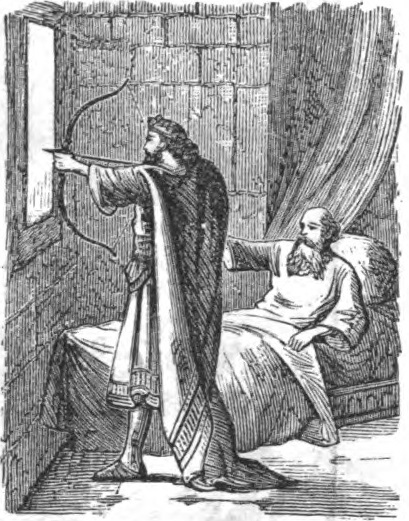
But rather than pour out his spirit on the apostate king, Elisha commanded him to take his bow and shoot an arrow out the window.

Elisha said, “Shoot,” and he shot. And he said, “The Lord‘s arrow of victory, the arrow of victory over Syria! For you shall fight the Syrians in Aphek until you have made an end of them.” – 2 Kings 13:17 ESV

Next, the prophet told the king to take his remaining arrows and shoot them into the ground. Jehoash dutifully obeyed, but when he stopped after the third arrow, Elisha responded in anger.

“You should have struck five or six times; then you would have struck down Syria until you had made an end of it, but now you will strike down Syria only three times.” – 2 Kings 13:19 ESV

In a sense, Elisha had poured out his spirit on King Jehoash. He had placed his hands on those of the king and, together, they had shot the first arrow out the window. He then assured the king of his victory over the Syrians. But the extent of that victory would be based on the faith of Jehoash. By limiting the number of arrows he shot into the ground, Jehoash was unwittingly revealing his lack of faith. The first arrow had symbolized the Lord’s victory over the Syrians. When Elisha had commanded Jehoash to shoot additional arrows, he should have understood that the symbolism remained the same. Each arrow was to have represented the Lord’s victory. But Jehoash had chosen to leave some of his arrows in the quiver. In doing so, he had inadvertently limited his chances of success over his enemy.

Having pronounced his last prophetic message, Elisha died. But the author relates a story that reveals one last miracle associated with the prophet of God. Sometime later, the body of a recently deceased man was inadvertently thrown into the cave containing Elisha’s bones. When the body of the dead man came into contact with Elisha’s remains, he was immediately restored to life. Amazingly, the author provides no further details to the story. We have no idea what happened to this newly resurrected man or how the story became known. But it was meant to reveal that, though Elisha was dead,  Yahweh was alive and well. Elisha’s departure was not meant to be mistaken as the abandonment of Israel by God. He was still fully capable of restoring life to the lifeless. The all-powerful God of Israel used the bones of a dead prophet to restore life to a dead Israelite, a clear symbol of His desire to renew those among His chosen people who were marked by spiritual death.

And the author reminds his readers that God remained faithful to His disobedient people, refusing to abandon them despite their constant rejection of Him.

…the Lord was gracious to them and had compassion on them, and he turned toward them, because of his covenant with Abraham, Isaac, and Jacob, and would not destroy them, nor has he cast them from his presence until now. – 2 Kings 13:23 ESV

The author also reveals that God kept His word concerning the fate of the Syrians. Jehoash experienced three separate victories over his enemy, matching the exact number of arrows he had shot into the ground. No more, no less. God gave allowed Jehoash to recover some of the territory stolen by the Syrians, but the fighting would continue throughout the rest of his reign. The sad reality is that the same God who raised a dead man back to life was fully capable of restoring a spiritually dead nation. But their continued stubbornness and lack of faithfulness would prevent them from experiencing the life-transformative power of Yahweh.

English Standard Version (ESV) The Holy Bible, English Standard Version. ESV® Permanent Text Edition® (2016). Copyright © 2001 by Crossway Bibles, a publishing ministry of Good News Publishers.

New Living Translation (NLT) Holy Bible, New Living Translation, copyright © 1996, 2004, 2015 by Tyndale House Foundation. Used by permission of Tyndale House Publishers Inc., Carol Stream, Illinois 60188. All rights reserved.

The Message (MSG)Copyright © 1993, 1994, 1995, 1996, 2000, 2001, 2002 by Eugene H. Peterson
 

Zeal is No Excuse for Disobedience

1 Now Ahab had seventy sons in Samaria. So Jehu wrote letters and sent them to Samaria, to the rulers of the city, to the elders, and to the guardians of the sons of Ahab, saying, “Now then, as soon as this letter comes to you, seeing your master’s sons are with you, and there are with you chariots and horses, fortified cities also, and weapons, select the best and fittest of your master’s sons and set him on his father’s throne and fight for your master’s house.” But they were exceedingly afraid and said, “Behold, the two kings could not stand before him. How then can we stand?” So he who was over the palace, and he who was over the city, together with the elders and the guardians, sent to Jehu, saying, “We are your servants, and we will do all that you tell us. We will not make anyone king. Do whatever is good in your eyes.” Then he wrote to them a second letter, saying, “If you are on my side, and if you are ready to obey me, take the heads of your master’s sons and come to me at Jezreel tomorrow at this time.” Now the king’s sons, seventy persons, were with the great men of the city, who were bringing them up. And as soon as the letter came to them, they took the king’s sons and slaughtered them, seventy persons, and put their heads in baskets and sent them to him at Jezreel. When the messenger came and told him, “They have brought the heads of the king’s sons,” he said, “Lay them in two heaps at the entrance of the gate until the morning.” Then in the morning, when he went out, he stood and said to all the people, “You are innocent. It was I who conspired against my master and killed him, but who struck down all these? 10 Know then that there shall fall to the earth nothing of the word of the Lord, which the Lord spoke concerning the house of Ahab, for the Lord has done what he said by his servant Elijah.” 11 So Jehu struck down all who remained of the house of Ahab in Jezreel, all his great men and his close friends and his priests, until he left him none remaining.

12 Then he set out and went to Samaria. On the way, when he was at Beth-eked of the Shepherds, 13 Jehu met the relatives of Ahaziah king of Judah, and he said, “Who are you?” And they answered, “We are the relatives of Ahaziah, and we came down to visit the royal princes and the sons of the queen mother.” 14 He said, “Take them alive.” And they took them alive and slaughtered them at the pit of Beth-eked, forty-two persons, and he spared none of them.

15 And when he departed from there, he met Jehonadab the son of Rechab coming to meet him. And he greeted him and said to him, “Is your heart true to my heart as mine is to yours?” And Jehonadab answered, “It is.” Jehu said, “If it is, give me your hand.” So he gave him his hand. And Jehu took him up with him into the chariot. 16 And he said, “Come with me, and see my zeal for the Lord.” So he had him ride in his chariot. 17 And when he came to Samaria, he struck down all who remained to Ahab in Samaria, till he had wiped them out, according to the word of the Lord that he spoke to Elijah. 2 Kings 10:1-17 ESV

Jehu was methodical and ruthless in carrying out God’s judgment against the house of Ahab. After killing King Jehoram and ordering the execution of the queen-mother, Jezebel, he turned his attention to Ahab’s 70 male descendants. Jehu knew that as long as any of them remained alive, his hopes of consolidating the kingdom under his rule would be in jeopardy. These boys and young men were under the care and protection of royal guardians who served in Ahab’s administration. More than likely, they had answered to Jezebel. But now that she was out of the picture, Jehu issued a challenge to these protectors of Ahab’s dynasty.

“…select the best qualified of your master’s sons to be your king, and prepare to fight for Ahab’s dynasty.” – 2 Kings 10:3 NLT

Jehu proposed that they do battle for control of the kingdom. He and his allies would go up against the chosen heir of Ahab and the forces of Israel, and whoever was left standing would become the next king of the northern kingdom. But his offer was quickly rejected. The elders and officials of Samaria recognized that Jehu had the upper hand and any attempt to defeat him in battle would be ill-advised and ill-fated.

So, these men informed Jehu that they had no intentions of protecting or promoting the heirs of Ahab. But he demanded that they prove their loyalty by beheading all 70 of Ahab’s sons. The next day, the elders and officials of Samaria showed up in Jezreel and presented to Jehu their rather macabre coronation gift. He ordered that the 70 heads be placed in two piles beside the city gate, as a gruesome reminder of God’s divine judgment against the house of Ahab. No one who entered or exited the city of Jezreel could miss the message this hideous sight was meant to convey.

But the next morning, Jehu called the nervous citizens of Jezreel together. These people were caught in the middle of a violent and deadly change in administrations. For more than 30 years they had lived under the rule of Ahab and Jezebel. But almost overnight, their way of life had come to an abrupt end. They had witnessed the assassination of their king, the violent death of his mother, and the annihilation of every living male heir to the throne. They had no way of knowing what kind of king Jehu would be. So, in an effort to assuage their fear and apprehension, Jehu took full responsibility for the death of King Jehoram but then vowed that he would avenge the deaths of Ahab’s sons. This rather disingenuous display of righteous indignation was intended to win over the hearts of the people. But he failed to admit that he had been the one who ordered their executions. In his zeal to carry out the command of God, Jehu overstepped his authority. Rather than simply punishing the house of Ahab as God had ordered, Jehu used his newfound power to enact a bloody purging that spread far beyond his original assignment.

Jehu killed all who were left of Ahab’s relatives living in Jezreel and all his important officials, his personal friends, and his priests. So Ahab was left without a single survivor. – 2 Kings 10:11 NLT

We are not told the motivation behind Jehu’s actions, but we are given God’s response to it. Over in the book of Hosea, God provides a glimpse into His displeasure with Jehu’s overzealous and bloody purge. In the opening verses of the book, the prophet Hosea has just discovered that he is a new father. His wife, Gomer, a former prostitute, has given birth to a son. And God informs Hosea that he is to call the boy Jezreel.

And the Lord said to him, “Call his name Jezreel, for in just a little while I will punish the house of Jehu for the blood of Jezreel, and I will put an end to the kingdom of the house of Israel. And on that day I will break the bow of Israel in the Valley of Jezreel.” – Hosea 1:4-5 ESV

The entire book of Hosea is meant to display the unfaithfulness of Israel through the relationship between the prophet and his unfaithful wife. The name given to their son was meant to be a permanent reminder of Jehu’s ungodly actions that day in Jezreel. He had decided to do God’s will his way. By taking the lives of the elders and officials of Samaria, Jehu had overstepped his God-given authority. He had exceeded his role as an instrument of God’s judgment against the house of Ahab. Innocent people had died unnecessarily and he would pay for his costly mistake.

In a sense, Jehu was obedient to the command of God. He had been anointed by the prophet of God and given the task of eliminating the house of Ahab. And he did as he had been told. He killed King Jehoram. He ordered the death of Jezebel. He orchestrated the executions of all of Ahab’s heirs. He had even taken it upon himself to kill King Ahaziah of Judah because he was the grandson of Jezebel. The tentacles of Jezebel’s influence had reached all the way into the southern kingdom, infecting Judah and its people.

At one point, Jehu had an unexpected encounter with some of these royal relatives of Jezebel from Judah. Unaware of all that had transpired in Israel, they were on their way to visit the queen-mother. But when Jehu discovered their identity, he ordered their immediate executions.

“We are relatives of King Ahaziah. We are going to visit the sons of King Ahab and the sons of the queen mother.”

“Take them alive!” Jehu shouted to his men. And they captured all forty-two of them and killed them at the well of Beth-eked. None of them escaped. – 2 Kings 10:14 NLT

His determination to eliminate every last vestige of Ahab’s influence was comprehensive and commendable. He left no stone unturned. This dedicated servant of God did what he had been anointed to do.

…he struck down all who remained to Ahab in Samaria, till he had wiped them out, according to the word of the Lord that he spoke to Elijah. – 2 Kings 10:17 ESV

But in doing so, he had gone above and beyond his official commission, ordering the deaths of the innocent. While Jehu could justify his actions by claiming that the elders and officials had murdered the sons of Ahab, they had only done so because he had given them no other choice. Jehu had delegated to these men a responsibility that had been given to him alone. It was he who should have taken the lives of the 70 sons of Ahab. It was he who should have executed Jezebel. But he had ordered her death by commanding her servants to throw her down from the window of the palace. Jehu had used his newfound power and authority in ways that God had not ordered or ordained. He had chosen to accomplish God’s will according to his ways. And no amount of zeal, enthusiasm, or good intentions can justify disobedience.

Hundreds of years later, the apostle Paul would commend the nation of Israel for its enthusiasm toward the things of God. But he would also point out that their zeal was misplaced and misdirected. In their energetic effort to please God, they were actually living in disobedience to His will and in violation of His ways.

I know what enthusiasm they have for God, but it is misdirected zeal. For they don’t understand God’s way of making people right with himself. Refusing to accept God’s way, they cling to their own way of getting right with God by trying to keep the law. – Romans 10:2-3 NLT

Zeal is never an excuse for disobedience.


English Standard Version (ESV) The Holy Bible, English Standard Version. ESV® Permanent Text Edition® (2016). Copyright © 2001 by Crossway Bibles, a publishing ministry of Good News Publishers.

New Living Translation (NLT) Holy Bible, New Living Translation, copyright © 1996, 2004, 2015 by Tyndale House Foundation. Used by permission of Tyndale House Publishers Inc., Carol Stream, Illinois 60188. All rights reserved.

The Message (MSG)Copyright © 1993, 1994, 1995, 1996, 2000, 2001, 2002 by Eugene H. Peterson
 

God Cleans House

14 Thus Jehu the son of Jehoshaphat the son of Nimshi conspired against Joram. (Now Joram with all Israel had been on guard at Ramoth-gilead against Hazael king of Syria, 15 but King Joram had returned to be healed in Jezreel of the wounds that the Syrians had given him, when he fought with Hazael king of Syria.) So Jehu said, “If this is your decision, then let no one slip out of the city to go and tell the news in Jezreel.” 16 Then Jehu mounted his chariot and went to Jezreel, for Joram lay there. And Ahaziah king of Judah had come down to visit Joram.

17 Now the watchman was standing on the tower in Jezreel, and he saw the company of Jehu as he came and said, “I see a company.” And Joram said, “Take a horseman and send to meet them, and let him say, ‘Is it peace?’” 18 So a man on horseback went to meet him and said, “Thus says the king, ‘Is it peace?’” And Jehu said, “What do you have to do with peace? Turn around and ride behind me.” And the watchman reported, saying, “The messenger reached them, but he is not coming back.” 19 Then he sent out a second horseman, who came to them and said, “Thus the king has said, ‘Is it peace?’” And Jehu answered, “What do you have to do with peace? Turn around and ride behind me.” 20 Again the watchman reported, “He reached them, but he is not coming back. And the driving is like the driving of Jehu the son of Nimshi, for he drives furiously.”

21 Joram said, “Make ready.” And they made ready his chariot. Then Joram king of Israel and Ahaziah king of Judah set out, each in his chariot, and went to meet Jehu, and met him at the property of Naboth the Jezreelite. 22 And when Joram saw Jehu, he said, “Is it peace, Jehu?” He answered, “What peace can there be, so long as the whorings and the sorceries of your mother Jezebel are so many?” 23 Then Joram reined about and fled, saying to Ahaziah, “Treachery, O Ahaziah!” 24 And Jehu drew his bow with his full strength, and shot Joram between the shoulders, so that the arrow pierced his heart, and he sank in his chariot. 25 Jehu said to Bidkar his aide, “Take him up and throw him on the plot of ground belonging to Naboth the Jezreelite. For remember, when you and I rode side by side behind Ahab his father, how the Lord made this pronouncement against him: 26 ‘As surely as I saw yesterday the blood of Naboth and the blood of his sons—declares the Lord—I will repay you on this plot of ground.’ Now therefore take him up and throw him on the plot of ground, in accordance with the word of the Lord.”

27 When Ahaziah the king of Judah saw this, he fled in the direction of Beth-haggan. And Jehu pursued him and said, “Shoot him also.” And they shot him in the chariot at the ascent of Gur, which is by Ibleam. And he fled to Megiddo and died there. 28 His servants carried him in a chariot to Jerusalem, and buried him in his tomb with his fathers in the city of David.

29 In the eleventh year of Joram the son of Ahab, Ahaziah began to reign over Judah. 2 Kings 9:14-29 ESV

Once Jehu had received the news that he was to be the next king of Israel, he wasted no time. Immediately after his anointing by the prophet of God, he departed Ramoth-gilead and headed straight to the winter palace in Jezreel, where King Jehoram was recovering from the injuries he had suffered in his battle against the Syrians.

Jehu had the full support of his fellow generals, so he ordered them to secure the city of Ramoth-gilead and prevent anyone from escaping and leaking his plans to King Jehoram. Jehu mounted his chariot and, accompanied by a contingent of loyal troops, he made his way to Jezreel. Guards posted on the watchtower of the city spotted them from a distance and gave notice to King Jehoram. Assuming it was his own troops returning from the battle against the Syrians, he sent out a messenger to meet them, anxious to know the outcome of the conflict. When the messenger road out to greet the returning soldiers, he asked them, “Is it peace?”, but Jehu gave him a rather cryptic, non-answer, and commanded him to ride along with them to the city.

After sending out a second messenger who failed to return, Jehoram became more anxious than ever to know what had happened. So, despite his wounds, he ordered his chariot and rode out to meet the returning troops. He was accompanied by King Ahaziah of Judah, who had come to visit him as he recuperated in Jezreel. When the two kings intercepted Jehu, Jehoram asked him, “Is it peace?” But Jehu’s response was not what he had been expecting.

“How can there be peace as long as the idolatry and witchcraft of your mother, Jezebel, are all around us?” – 2 Kings 9:22 NLT

Jehu called out King Jehoram, accusing him of allowing his mother, Jezebel, to lead the nation of Israel into apostasy with her idolatry and witchcraft. Though Ahab was long gone, Jezebel still continued to wield a powerful and deadly influence over the nation. Not only had she promoted the worship of false gods, but she had introduced occult practices that included the use of sorcery and incantations. And God had declared these things to be off-limits for the people of Israel.

There shall not be found among you anyone who burns his son or his daughter as an offering, anyone who practices divination or tells fortunes or interprets omens, or a sorcerer or a charmer or a medium or a necromancer or one who inquires of the dead, for whoever does these things is an abomination to the Lord. – Deuteronomy 18:10-12 ESV

Jehu’s mention of Jezebel indicates that he understood just how decisive her role had been in leading the nation away from Yahweh. Any attempt he made to eradicate the evil influence of Ahab and his descendants would have to include her. As long as Jezebel remained alive, the nation would never recover from its state of spiritual apathy and apostasy.

Suddenly aware that his life was in danger, King Jehoram ordered his chariot driver to make a hasty retreat to the safety of the city. But they never made it. Jehu killed the escaping king with a well-placed arrow to the back. And then he ordered that Jehoram’s body be dumped on the land that used to belong to Naboth. This brings the story full-circle, linking the sins of Ahab with those of his son, Jehoram. Back in 1 Kings 21, Jezebel had arranged to illegally confiscate a vineyard that belonged to Naboth so that she could give the property to Ahab. She had Naboth falsely accused and convicted of cursing God and the king. The result was that the innocent man was stoned to death on his very own land. And God had warned King Ahab, “In the place where dogs licked up the blood of Naboth shall dogs lick your own blood” (1 Kings 21:20 ESV). And he had pronounced a similar fate for Jezebel because of her role in the affair.

“The dogs shall eat Jezebel within the walls of Jezreel.” – 1 Kings 21:23 ESV

But Ahab had eventually repented of his role in Naboth’s death and, as a result, God had chosen to spare him.

“Because he has humbled himself before me, I will not bring the disaster in his days; but in his son’s days I will bring the disaster upon his house.” – 1 Kings 21:29 ESV

Now, years later, God was fulfilling His promise to bring disaster upon the house of Ahab. The blood of Jehoram, the son of Ahab and Jezebel, would be poured out on the very same spot where Naboth had been stoned to death. Jehu, who had served as one of King Ahab’s generals, was familiar with the whole sordid affair concerning Naboth. He had even been present when God issued His divine judgment against Ahab through the prophet Elijah.

“Take him up and throw him on the plot of ground belonging to Naboth the Jezreelite. For remember, when you and I rode side by side behind Ahab his father, how the Lord made this pronouncement against him: ‘As surely as I saw yesterday the blood of Naboth and the blood of his sons—declares the Lord—I will repay you on this plot of ground.’ Now therefore take him up and throw him on the plot of ground, in accordance with the word of the Lord.” – 2 Kings 9:25-26 ESV

In all of this, Jehu was acting as God’s hand of judgment against the house of Ahab. He had been anointed by God to deliver divine justice and cleanse the nation of Israel from the pervasive and pernicious influence of Ahab and Jezebel. God had had enough. The time had come to fulfill His pronouncement of judgment against the house of Ahab.

“Behold, I will bring disaster upon you. I will utterly burn you up, and will cut off from Ahab every male, bond or free, in Israel. And I will make your house like the house of Jeroboam the son of Nebat, and like the house of Baasha the son of Ahijah, for the anger to which you have provoked me, and because you have made Israel to sin.” – 1 Kings 21:21-22 ESV

The purge had begun. God was cleaning house. And even King Ahaziah of Judah would not escape the purifying judgment of the Almighty. As he attempted to escape, he was struck by an arrow and only made it as far as Megiddo before he died from his wound. Ahaziah had close familial ties to the house of Ahab. His mother, Athaliah, was the granddaughter of King Omri of Israel. And it appears that he may also have married one of Ahab’s daughters.

He also walked in the way of the house of Ahab and did what was evil in the sight of the Lord, as the house of Ahab had done, for he was son-in-law to the house of Ahab. – 2 Kings 8:27 ESV

He was an unwise and wicked king who had aligned himself with one of the most infamous royal families in Israel’s sordid history. And he paid for his mistake with his life.

Because of the disobedience of Solomon, God had divided Israel into two kingdoms. This had been His punishment for Solomon’s foray into idolatry during the latter years of his life and reign. But the kings of Israel and Judah had decided to take matters into their own hands, attempting to realign the two nations through treaties and marital alliances. But they had neglected to fix the primary problem that had caused God to divide them in the first place: Idolatry. But God was not interested in a reunited nation that remained spiritually rebellious. So, He sent Jehu to bring an abrupt end to the man-made alliance between Israel and Judah by killing their two kings. It was time to start over. But as we will see, Jehu had one last piece of unfinished business.

English Standard Version (ESV) The Holy Bible, English Standard Version. ESV® Permanent Text Edition® (2016). Copyright © 2001 by Crossway Bibles, a publishing ministry of Good News Publishers.

New Living Translation (NLT) Holy Bible, New Living Translation, copyright © 1996, 2004, 2015 by Tyndale House Foundation. Used by permission of Tyndale House Publishers Inc., Carol Stream, Illinois 60188. All rights reserved.

The Message (MSG)Copyright © 1993, 1994, 1995, 1996, 2000, 2001, 2002 by Eugene H. Peterson


The Lord’s Anointed

1 Then Elisha the prophet called one of the sons of the prophets and said to him, “Tie up your garments, and take this flask of oil in your hand, and go to Ramoth-gilead. And when you arrive, look there for Jehu the son of Jehoshaphat, son of Nimshi. And go in and have him rise from among his fellows, and lead him to an inner chamber. Then take the flask of oil and pour it on his head and say, ‘Thus says the Lord, I anoint you king over Israel.’ Then open the door and flee; do not linger.”

So the young man, the servant of the prophet, went to Ramoth-gilead. And when he came, behold, the commanders of the army were in council. And he said, “I have a word for you, O commander.” And Jehu said, “To which of us all?” And he said, “To you, O commander.” So he arose and went into the house. And the young man poured the oil on his head, saying to him, “Thus says the Lord, the God of Israel, I anoint you king over the people of the Lord, over Israel. And you shall strike down the house of Ahab your master, so that I may avenge on Jezebel the blood of my servants the prophets, and the blood of all the servants of the Lord. For the whole house of Ahab shall perish, and I will cut off from Ahab every male, bond or free, in Israel. And I will make the house of Ahab like the house of Jeroboam the son of Nebat, and like the house of Baasha the son of Ahijah. 10 And the dogs shall eat Jezebel in the territory of Jezreel, and none shall bury her.” Then he opened the door and fled.

11 When Jehu came out to the servants of his master, they said to him, “Is all well? Why did this mad fellow come to you?” And he said to them, “You know the fellow and his talk.” 12 And they said, “That is not true; tell us now.” And he said, “Thus and so he spoke to me, saying, ‘Thus says the Lord, I anoint you king over Israel.’” 13 Then in haste every man of them took his garment and put it under him on the bare steps, and they blew the trumpet and proclaimed, “Jehu is king.” 2 Kings 9:1-13 ESV

In 1 Kings 19:15-16, we have the record of God’s final commission to Elijah. He had given the prophet three tasks to accomplish. One of them was to anoint Hazael to be the next king of Syria. A second was to anoint Jehu to be the king of Israel. And the third was to anoint Elisha as his own successor.

It’s clear that Elijah followed God’s instructions regarding Elisha. At this point in the story, the new prophet has fully established himself as Elijah’s God-ordained replacement. It would also appear that Elijah kept God’s command concerning the anointing of Hazael. In 2 Kings 8, the author revealed the morbid details concerning Hazael’s ascension to the throne of Syria. While King Ben-hadad was weak and recovering from a recent illness, Hazael murdered him by suffocating him to death with a wet sheet. And the prophet Elisha had wept when he realized the deadly consequences for Israel that would accompany this man’s rise to power.

“Because I know the evil that you will do to the people of Israel. You will set on fire their fortresses, and you will kill their young men with the sword and dash in pieces their little ones and rip open their pregnant women.” – 2 Kings 8:12 ESV

But as 2 Kings 9 opens up, it becomes apparent that there was one aspect of Elijah’s assignment he had neglected to complete. Either that, or he had chosen to pass on the responsibility to his successor. Jehu had not yet been anointed King of Israel. Jehoram, the son of Ahab and Jezebel, still occupied the throne and was continuing his parents’ legacy of apostasy and unfaithfulness. But the time had come for God’s prophecy concerning Ahab and his descendants to be fulfilled. He had warned Ahab that his stubborn determination to lead the people of Israel into idolatry would not go unpunished.

“So now the Lord says, ‘I will bring disaster on you and consume you. I will destroy every one of your male descendants, slave and free alike, anywhere in Israel! I am going to destroy your family as I did the family of Jeroboam son of Nebat and the family of Baasha son of Ahijah, for you have made me very angry and have led Israel into sin.’” – 1 Kings 21:21-22 NLT

God had used the prophet, Elijah, to deliver this message of pending destruction. He was not going to allow Ahab and Jezebel to go unpunished for their blatant disregard for His law or their arrogant dismissal of His sovereignty over Israel. God would do to them what He had done to Jeroboam and Baasha. He would completely wipe out their hopes for establishing a dynasty by destroying all their male descendants.  When considering this curse that God leveled against Ahab, it is important to compare it with the promise God had made to King David.

“When your days are fulfilled and you lie down with your fathers, I will raise up your offspring after you, who shall come from your body, and I will establish his kingdom. He shall build a house for my name, and I will establish the throne of his kingdom forever. I will be to him a father, and he shall be to me a son. When he commits iniquity, I will discipline him with the rod of men, with the stripes of the sons of men, but my steadfast love will not depart from him, as I took it from Saul, whom I put away from before you. And your house and your kingdom shall be made sure forever before me. Your throne shall be established forever.’” – 2 Samuel 7:12-16 ESV

While Ahab, Jeroboam, and Baasha would all see their dreams of establishing long-lasting dynasties come to an end, God had promised David that his house and throne would be established forever. And God was going to fulfill this promise through the southern kingdom of Judah. Despite the fact that most of the kings who eventually ruled over Judah proved to be just as godless and wicked as the northern kings, God would keep His promise to secure the Davidic dynasty. And He would do so through Jesus Christ, the descendant of David and the Messiah of Israel.

But God had something far less glorious in store for King Jehoram of Israel. As he sat in his summer palace in Jezreel, he had no idea that God was about to remove him from power and bring his father’s wicked legacy to an abrupt and permanent end.

Once again, it would appear that Elijah had never completed his assignment to anoint Jehu as the next king of Israel. So, Elisha was left with the responsibility of completing God’s three-part anointing plan. But even Elisha seems to have delegated this final job to an underling. He selected one of the prophets and gave him very specific instructions: “take this flask of olive oil with you. Go to Ramoth-gilead, and find Jehu son of Jehoshaphat, son of Nimshi. Call him into a private room away from his friends, and pour the oil over his head. Say to him, ‘This is what the Lord says: I anoint you to be the king over Israel.’ Then open the door and run for your life!” (2 Kings 9:1-3 NLT). That last sentence could not have left the young prophet feeling confident and encouraged as he made his way to Ramoth-gilead.

But despite the fact that Elijah had passed the buck to Elisha and Elisha had reassigned the responsibility to someone else, God’s will was going to be done. This young prophet, flask in hand, was going to be used to anoint Jehu as the divine instrument of God’s wrath against Ahab and his descendants.

When the prophet arrived in Ramoth-gilead, he found Jehu in a meeting with his fellow generals. He summoned Jehu into a private room, where he poured the oil on his head and informed the surprised general of his new position and commission.

“This is what the Lord, the God of Israel, says: I anoint you king over the Lord’s people, Israel. You are to destroy the family of Ahab, your master. In this way, I will avenge the murder of my prophets and all the Lord’s servants who were killed by Jezebel. The entire family of Ahab must be wiped out. I will destroy every one of his male descendants, slave and free alike, anywhere in Israel.” – 2 Kings 9:6-8 NLT

All of this was unexpected news to Jehu. There is no indication that he had been plotting Jehoram’s death and his own ascension to the throne. But the shocking news of his kingship had to have been overshadowed by the clear conditions associated with it. He was to completely wipe out every last male descendant of Ahab. Not only that, he was to see to it that Jezebel met her end as well.

Dogs will eat Ahab’s wife Jezebel at the plot of land in Jezreel, and no one will bury her.” – 2 Kings 9:10 NLT

God was commanding Jehu to launch an insurrection against the king and his family. And as Jehu sat with oil running down his head and the prophet’s words racing through his brain, the king’s generals waited with curiosity on the other side of the door. Having completed his assignment, the prophet fled for his life, leaving Jehu to rejoin his fellow generals and face their questions about what had just happened. He attempted to downplay his encounter with the prophet, but they sensed he was hiding something and pressed him for details.

Jehu wisely chose not to divulge all the specifics of his conversation with the prophet. He simply stated, “He said to me, ‘This is what the Lord says: I have anointed you to be king over Israel’” (2 Kings 9:12 NLT). And, must to his relief and surprise, the reaction he received from his peers was positive and encouraging. 

Then they quickly spread out their cloaks on the bare steps and blew the ram’s horn, shouting, “Jehu is king!” – 2 Kings 9:13 NLT

His fellow generals declared their overwhelming support of his anointing as the next king of Israel. Of course, they weren’t aware of the second half of the prophet’s message concerning the complete annihilation of Ahab’s family. But at this point, they were fully on board with Jehoram’s removal and Jehu’s rise to power. Some of their enthusiasm could have been the result of the king’s recent defeat against the Syrians at Ramoth-gilead. Jehoram had been wounded in the battle and was recuperating at Jezreel. These generals could have lost confidence in Jehoram’s leadership ability and welcomed the idea of having a king with a military background. The Syrians remained a threat to the nation and Jehoram had proven himself to be a less-than-reliable commander-in-chief.

But, as always, this was the sovereign hand of God orchestrating every single detail of the storyline so that His divine will might be accomplished. He had pledged to destroy Ahab’s dynasty and now He was about to implement His plan to make it happen. And that plan was going to include Jehu, who found himself in the unexpected but highly important role of the Lord’s anointed.

English Standard Version (ESV) The Holy Bible, English Standard Version. ESV® Permanent Text Edition® (2016). Copyright © 2001 by Crossway Bibles, a publishing ministry of Good News Publishers.

New Living Translation (NLT) Holy Bible, New Living Translation, copyright © 1996, 2004, 2015 by Tyndale House Foundation. Used by permission of Tyndale House Publishers Inc., Carol Stream, Illinois 60188. All rights reserved.

The Message (MSG)Copyright © 1993, 1994, 1995, 1996, 2000, 2001, 2002 by Eugene H. Peterson


Our Sovereign God

1 Now Elisha had said to the woman whose son he had restored to life, “Arise, and depart with your household, and sojourn wherever you can, for the Lord has called for a famine, and it will come upon the land for seven years.” So the woman arose and did according to the word of the man of God. She went with her household and sojourned in the land of the Philistines seven years. And at the end of the seven years, when the woman returned from the land of the Philistines, she went to appeal to the king for her house and her land. Now the king was talking with Gehazi the servant of the man of God, saying, “Tell me all the great things that Elisha has done.” And while he was telling the king how Elisha had restored the dead to life, behold, the woman whose son he had restored to life appealed to the king for her house and her land. And Gehazi said, “My lord, O king, here is the woman, and here is her son whom Elisha restored to life.” And when the king asked the woman, she told him. So the king appointed an official for her, saying, “Restore all that was hers, together with all the produce of the fields from the day that she left the land until now.”

Now Elisha came to Damascus. Ben-hadad the king of Syria was sick. And when it was told him, “The man of God has come here,” the king said to Hazael, “Take a present with you and go to meet the man of God, and inquire of the Lord through him, saying, ‘Shall I recover from this sickness?’” So Hazael went to meet him, and took a present with him, all kinds of goods of Damascus, forty camels’ loads. When he came and stood before him, he said, “Your son Ben-hadad king of Syria has sent me to you, saying, ‘Shall I recover from this sickness?’” 10 And Elisha said to him, “Go, say to him, ‘You shall certainly recover,’ but the Lord has shown me that he shall certainly die.” 11 And he fixed his gaze and stared at him, until he was embarrassed. And the man of God wept. 12 And Hazael said, “Why does my lord weep?” He answered, “Because I know the evil that you will do to the people of Israel. You will set on fire their fortresses, and you will kill their young men with the sword and dash in pieces their little ones and rip open their pregnant women.” 13 And Hazael said, “What is your servant, who is but a dog, that he should do this great thing?” Elisha answered, “The Lord has shown me that you are to be king over Syria.” 14 Then he departed from Elisha and came to his master, who said to him, “What did Elisha say to you?” And he answered, “He told me that you would certainly recover.” 15 But the next day he took the bed cloth and dipped it in water and spread it over his face, till he died. And Hazael became king in his place. 2 Kings 8:1-15 ESV

Hazael meets prophet Elisha and asks for healing for his master, King Ben Hadad of Syria (2 Kings 8). Wood engraving, published in 1886.

It’s difficult to determine exactly when the two stories that open up chapter eight took place. But the author’s decision to include them at this point in his narrative doesn’t appear to have been based on a desire for chronological accuracy. He was trying to make a point about the spiritual conditions in and around Israel, and so he used the stories of two very different characters as illustrations. One we have met before. The Shunammite woman was first introduced to us in chapter four. She was a faithful follower of Yahweh who had shown gracious hospitality to Elisha and his servant, providing them with shelter and food every time they passed through her town. And God had rewarded her generosity to His servant by allowing her to conceive and bear a son, something she had never been able to do. But sometime in his early childhood, her son became ill and died. Her joy turned to sorrow. But the prophet of God intervened and restored the child to life. And now, in chapter eight, the author decides to pick up the story where he left off.

Now Elisha had said to the woman whose son he had restored to life, “Arise, and depart with your household, and sojourn wherever you can, for the Lord has called for a famine, and it will come upon the land for seven years.” – 2 Kings 8:1 ESV

The prophet informed the Shunammite woman about a famine that God was about to bring upon the land because of Israel’s ongoing apostasy. He gave this faithful servant of Yahweh the opportunity to escape and find shelter until the seven years of famine had passed. And she took the prophet’s advice and fled with her family to the land of the Philistines. But seven years later, when the famine was over and she returned to Shunem, she was homeless and landless. It could be that she sold her husband’s inheritance before she left seven years earlier. But it could be that the crown had confiscated her land in her absence. But in either case, the Mosaic law required that she be given the right to reclaim her land at any time (Leviticus 25:23-28). It would have been part of her husband’s inheritance and protected by law.

So, upon her return, she headed straight to the palace to make an appeal to the king. It seems likely that her husband had died. We know from chapter four that he was more advanced in years (2 Kings 4:14). Yet it could be that he was alive but physically incapable of presenting his case before the king, so his wife acted on his behalf.

This is where the story gets interesting. In a display of divinely inspired timing, the woman arrived at the palace at the exact moment when Gehazi, the servant of Elisha, was having a conversation with King Jehoram. The fact that Gehazi was standing before the king would indicate that this story took place before he had been stricken with leprosy (2 Kings 5:20-27). The author doesn’t reveal the purpose behind Gehazi’s appointment with the king, but he does let us know what they discussed.

Now the king was talking with Gehazi the servant of the man of God, saying, “Tell me all the great things that Elisha has done.” – 2 Kings 8:4 ESV

Jehoram’s relationship with Elisha had been anything but cordial. Like all the kings of Israel, he had a love-hate relationship with God’s prophet. Jehoram was the son of Jezebel and, like his wicked mother, he had continued to lead the people of Israel in the practice of idolatry. So, it seems a bit out of character for him to ask Gehazi to regale him with all the exploits of the prophet of God. But, once again, this reveals the divine timing and providential planning behind all that is taking place in the story. God was orchestrating everything, down to the last detail.

It just so happened that as Gehazi was telling Jehoram how Elisha had restored the woman’s son to life, she walked in the door. Gehazi, shocked at seeing the woman show up at just that moment, exclaimed, “My lord, O king, here is the woman, and here is her son whom Elisha restored to life” (2 Kings 8:5 ESV). This wasn’t a case of kismet, karma, fate, or good luck. It was the sovereign will of God Almighty on display. He had pre-ordained and orchestrated it all. And the result was that the king ordered the immediate restoration of the woman’s land, “including the value of any crops that had been harvested during her absence” (2 Kings 8:6 NLT). He richly rewarded her for her faithfulness.

And this sets up the second story. In this one, the location shifts from Samaria, the capital city of Israel, to Damascus, the capital city of Syria. In verses 1-6, the author presented the story of a faithful servant and a curious king. But in verses 7-15, he tells a strikingly different story about an unfaithful servant and a critically ill king. These stories are arranged as they are for a reason. They are meant to stand in stark contrast to one another. But they are also intended to demonstrate the sovereign hand of God over all that takes place. From the palace of the king of Israel to the royal court of the pagan king of Syria, God is in full control of all things. There is nothing that escapes His notice or falls outside His divine jurisdiction.

In another display of divine timing, Elisha has arrived in Damascus at the very same time that Ben-hadad, the king of Syria, has become ill. Upon hearing of Elisha’s presence in his capital, Ben-hadad determines to take advantage of this fortunate opportunity. He sends Hazael, the governor of Damascus, to ask Elisha whether he will recover from his illness. And, in a not-so-subtle attempt to garner a favorable response from the prophet, Ben-hadad includes a lucrative welcome gift. And when Hazael delivers the king’s gift and message to Elisha, the prophet responds with a rather cryptic answer.

“Go and tell him, ‘You will surely recover.’ But actually the Lord has shown me that he will surely die!” – 2 Kings 8:10 NLT

What followed this exchange was a long and awkward staredown between Elisha and Hazael. The prophet knew exactly what was going on in Hazael’s heart. God had revealed to Elisha exactly what the governor was planning to do. So, he locked eyes with Hazael, perhaps hoping that the awkward silence would lead the governor to have second thoughts about his evil plan. But there was no confession from Hazael. Instead, Elisha began to weep. He knew exactly what was going to happen and the long-term ramifications for the people of Israel.

“I know the terrible things you will do to the people of Israel. You will burn their fortified cities, kill their young men with the sword, dash their little children to the ground, and rip open their pregnant women!” – 2 Kings 8:12 NLT

God had given Elisha a glimpse into all that was going to take place. Ben-hadad would recover from his illness but would die at the hands of Hazael. And when Hazael ascended to the throne of Syria, he would wreak havoc and destruction upon the nation of Israel. He would become God’s chosen instrument of judgment upon His unfaithful people. And this had always been part of God’s sovereign plan.

All the way back in chapter 19 of 1 Kings, we have the story of Elijah running from the threat of Jezebel’s revenge. He escaped to the wilderness where he sought shelter in a cave. But while there, he received a visit and a message from God.

And the Lord said to him, “Go, return on your way to the wilderness of Damascus. And when you arrive, you shall anoint Hazael to be king over Syria. And Jehu the son of Nimshi you shall anoint to be king over Israel, and Elisha the son of Shaphat of Abel-meholah you shall anoint to be prophet in your place.” – 1 Kings 19:15-16 ESV

Don’t miss the significance of what is going on here. Years earlier, God had commanded Elijah to anoint Hazael to be the next king of Syria. And Elijah had obeyed that command. This means that long before Elisha showed up in Damascus and had his face-to-face encounter with Hazael, this man already had God’s divine seal of approval to be the next king of Syria. He had already been anointed by Elijah but had not yet assumed the throne. But it was just a matter of time. It was inevitable and unavoidable because it had been ordained by God.

And God had made it clear to Elijah that He would one day use Hazael as His instrument of judgment upon the rebellious people of Israel.

And the one who escapes from the sword of Hazael shall Jehu put to death, and the one who escapes from the sword of Jehu shall Elisha put to death. Yet I will leave seven thousand in Israel, all the knees that have not bowed to Baal, and every mouth that has not kissed him.” – 1 Kings 19:17-18 ESV

Now, that prophecy was about to be fulfilled. God had shown Elisha what was about to happen and the thought of it brought him to tears.

“The Lord has shown me that you are to be king over Syria.” – 2 Kings 8:13 ESV

The judgment of God was about to come upon the people of Israel. And while He had rewarded the Shunammite woman for her faithfulness, He was about to bring death and destruction upon unfaithful Israel. And the author closes his story with the fateful words: “the next day he [Hazael] took the bed cloth and dipped it in water and spread it over his face, till he died. And Hazael became king in his place” (2 Kings 8:15 ESV).

The man whom God had ordered Elijah to anoint years earlier, was now the king. The sovereign will of God had been fulfilled. And the next phase of His plan for the rebellious people of Israel was about to begin.

English Standard Version (ESV) The Holy Bible, English Standard Version. ESV® Permanent Text Edition® (2016). Copyright © 2001 by Crossway Bibles, a publishing ministry of Good News Publishers.

New Living Translation (NLT) Holy Bible, New Living Translation, copyright © 1996, 2004, 2015 by Tyndale House Foundation. Used by permission of Tyndale House Publishers Inc., Carol Stream, Illinois 60188. All rights reserved.

The Message (MSG)Copyright © 1993, 1994, 1995, 1996, 2000, 2001, 2002 by Eugene H. Peterson

When God Is Not Enough

16 But he said, “As the Lord lives, before whom I stand, I will receive none.” And he urged him to take it, but he refused. 17 Then Naaman said, “If not, please let there be given to your servant two mule loads of earth, for from now on your servant will not offer burnt offering or sacrifice to any god but the Lord. 18 In this matter may the Lord pardon your servant: when my master goes into the house of Rimmon to worship there, leaning on my arm, and I bow myself in the house of Rimmon, when I bow myself in the house of Rimmon, the Lord pardon your servant in this matter.” 19 He said to him, “Go in peace.”

But when Naaman had gone from him a short distance, 20 Gehazi, the servant of Elisha the man of God, said, “See, my master has spared this Naaman the Syrian, in not accepting from his hand what he brought. As the Lord lives, I will run after him and get something from him.” 21 So Gehazi followed Naaman. And when Naaman saw someone running after him, he got down from the chariot to meet him and said, “Is all well?” 22 And he said, “All is well. My master has sent me to say, ‘There have just now come to me from the hill country of Ephraim two young men of the sons of the prophets. Please give them a talent of silver and two changes of clothing.’” 23 And Naaman said, “Be pleased to accept two talents.” And he urged him and tied up two talents of silver in two bags, with two changes of clothing, and laid them on two of his servants. And they carried them before Gehazi. 24 And when he came to the hill, he took them from their hand and put them in the house, and he sent the men away, and they departed. 25 He went in and stood before his master, and Elisha said to him, “Where have you been, Gehazi?” And he said, “Your servant went nowhere.” 26 But he said to him, “Did not my heart go when the man turned from his chariot to meet you? Was it a time to accept money and garments, olive orchards and vineyards, sheep and oxen, male servants and female servants? 27 Therefore the leprosy of Naaman shall cling to you and to your descendants forever.” So he went out from his presence a leper, like snow. 2 Kings 5:16-27 ESV

Naaman’s miraculous healing by God made a profound impact on him. His lifelong battle with leprosy had come to an end thanks to the healing power of the God of Israel. Naaman was blown away by the fact that a deity he didn’t even worship had been willing to cleanse him from his disease. And this gracious act and dramatic demonstration of power convinced Naaman that there were no gods but Yahweh. He recognized the God of Israel as the one true God and vowed that he would give up his worship of the gods of Syria.

From now on I will never again offer burnt offerings or sacrifices to any other god except the Lord.” – 2 Kings 5:17 NLT

Naaman was overjoyed and attempted to express his appreciation to Elisha by offering him gifts. But the prophet politely refused to take any kind of compensation for his role in Naaman’s healing. This led Naaman to make a rather strange request of Elisha.

“…please allow me to load two of my mules with earth from this place, and I will take it back home with me.” – 2 Kings 5:17 NLT

It appears that Naaman desired to transfer some of the soil from Samaria back to Syria so that he could worship Yahweh. It was a common belief among the pagans that the gods were geographically bound and ruled over specific regions of the earth. If you recall, when Ben-hadad, the king of Syria had lost a decisive battle against Israel, his advisors convinced him that their defeat had been because they had fought on Yahweh’s home turf.

“The Israelite gods are gods of the hills; that is why they won. But we can beat them easily on the plains.” – 1 Kings 20:23 NLT

The pagans believed that the gods were restricted to certain geographic areas, so Naaman hoped to transfer some of the soil from Samaria back to Damascus. This would give Yahweh a foothold in Syria and provide Naaman a place to worship Him. Elijah made no attempt to correct Naama’s well-intentioned but misguided understanding of Yahweh. He allowed Naaman to load up his donkeys with dirt and then absolved him of any guilt for those times when he would have to join King Ben-hadad in the worship of the false god Rimmon.

At this point, the story takes a dramatic turn. As Naaman turns to leave, Elisha’s servant, Gehazi, decides to take advantage of the situation. Seeking an opportunity to profit personally from Naaman’s generosity, Gehazi approached the Syrian general and told him a completely fabricated story.

“…my master has sent me to tell you that two young prophets from the hill country of Ephraim have just arrived. He would like 75 pounds of silver and two sets of clothing to give to them.”  – 2 Kings 5:22 NLT

Gehazi had been frustrated by the prophet’s rejection of Naaman’s generous offer. So, he concocted a plausible plan that would allow him to enrich himself at Naaman’s expense and without his master’s approval. To Gehazi’s surprise, Naaman doubled the size of his request, providing him with twice as much silver and two additional sets of clothes. And ecstatic over his apparent good fortune, Gehazi promptly hid the ill-gotten gain in his house.

But when Elisha confronted Gehazi about his recent whereabouts, the servant lied yet again. He attempted to deceive the prophet of God but was shocked and dismayed to discover that Elisha knew exactly what had taken place.

But Elisha asked him, “Don’t you realize that I was there in spirit when Naaman stepped down from his chariot to meet you? Is this the time to receive money and clothing, olive groves and vineyards, sheep and cattle, and male and female servants? – 2 Kings 5:26 NLT

Poor Gehazi had failed to consider that Elisha, as the prophet of God, might be able to see through his little ruse. God had given Elisha a vision of Gehazi’s entire conversation with Naaman. He had seen and heard it all. And he knew all about the gifts hidden in Gehazi’s home. Elisha even revealed that he knew what had motivated Gehazi’s actions. The silver was only a means to an end. He had ambitious plans to become a prosperous landowner, complete with groves, vineyards, livestock, and a household full of slaves to serve his every need. Gehazi was not content to remain the servant of Elisha. He wanted more from life. But his discontent revealed that he had no desire to follow in Elisha’s footsteps. At one time, Elisha had been the servant to Elijah. But when God decided to bring Elijah’s prophetic ministry to an end, He chose Elisha to be his replacement. But it seems that Gehazi had no desire to be the next prophet of God. He had his own plans and they did not include taking up Elisha’s mantel of leadership.

But Gehazi’s dreams of possessions, power, and prominence were about to become a living nightmare. Elisha delivered the devastating news that the gifts he received from Naaman would be accompanied by another unexpected surprise: Naaman’s leprosy.

“Because you have done this, you and your descendants will suffer from Naaman’s leprosy forever.” When Gehazi left the room, he was covered with leprosy; his skin was white as snow. – 2 Kings 5:27 NLT

Gehazi still had the silver and fine clothes that Naaman had given him. But his greed and blatant disregard for God had earned him a permanent reminder of God’s disfavor and judgment. Naaman returned home healed, whole, and ready to worship the God of Israel. But Gehazi would spend the rest of his life bearing the mark of God’s divine judgment. And his ill-fated decision to profit from God’s power would have long-lasting implications that would impact his family for generations to come.

There is another powerful lesson to be learned from this story and it comes from the lips of Jesus. Luke records it in his gospel account. Jesus had returned to His hometown of Nazareth where He visited the local synagogue on the Sabbath. While there, He was invited to do the daily reading from the scroll. On this occasion, Jesus read from the book of Isaiah.

“The Spirit of the Lord is upon me,
    for he has anointed me to bring Good News to the poor.
He has sent me to proclaim that captives will be released,
    that the blind will see,
that the oppressed will be set free,
   and that the time of the Lord’s favor has come.” – Luke 4:18-19 NLT

Having finished His reading, Jesus sat down and declared to those in the synagogue, “The Scripture you’ve just heard has been fulfilled this very day!” (Luke 4:21 NLT). This statement surprised them because He seemed to be claiming to be the fulfillment of Isaiah’s prophecy concerning the long-awaited Messiah. They found that hard to imagine because they knew Jesus as the son of Joseph. He had grown up in their town and there was no way that He could be the Messiah. And Jesus sensed their doubt and disbelief. He knew that they would never accept Him as the Messiah unless He agreed to perform miracles that proved who He claimed to be. That’s when He told them, “no prophet is accepted in his own hometown” (Luke 4:24 NLT). Then Jesus reached back into the history of Israel and used Elijah and Elisha as evidence against His neighbors’ stubborn refusal to believe in Him. 

“But I tell you the truth, no prophet is accepted in his own hometown. Certainly there were many needy widows in Israel in Elijah’s time, when the heavens were closed for three and a half years, and a severe famine devastated the land. Yet Elijah was not sent to any of them. He was sent instead to a foreigner—a widow of Zarephath in the land of Sidon. And many in Israel had leprosy in the time of the prophet Elisha, but the only one healed was Naaman, a Syrian.” – Luke 4:24-27 NLT

Jesus reminds His Jewish audience that, back in their day, both Elijah and Elisha were used by God to minister to non-Jews. Elijah rescued the widow of Zarephath, a Sidonian who was suffering from the effects of a famine brought on by the disobedience of the people of Israel. And Elisha had healed a pagan, unbelieving Syrian general, cleansing him from leprosy and restoring him to full health. But it had been Gehazi, the Jewish servant of the prophet of God, who had found himself judged by God and condemned to suffer from leprosy for the rest of his life.

Jesus’ words made an impact on His listeners. They were offended by His inference that they were somehow undeserving of God’s mercy. He seemed to be saying that God would rather show mercy on Gentiles than waste His time with disbelieving Jews. And they were so upset that they attempted to throw Jesus off a nearby cliff. The story that Jesus related concerning Elijah and Elisha had shamed them. They had never made that connection before, and they didn’t like it. In the midst of Israel’s rebellion against Yahweh, the prophets of God had been sent to the Gentiles. And now, Jesus was claiming to be the Son of God and the Messiah of Israel, but His fellow Jews were rejecting His message and ministry. Hundreds of years later, the nation of Israel remained just as stubborn and disobedient as they had been in the days of Elijah and Elisha. So, once again, God would take His offer of salvation and redemption to the Gentiles.

He came to his own, and his own people did not receive him. But to all who did receive him, who believed in his name, he gave the right to become children of God, who were born, not of blood nor of the will of the flesh nor of the will of man, but of God. – John 1:11-13 ESV

English Standard Version (ESV) The Holy Bible, English Standard Version. ESV® Permanent Text Edition® (2016). Copyright © 2001 by Crossway Bibles, a publishing ministry of Good News Publishers.

New Living Translation (NLT) Holy Bible, New Living Translation, copyright © 1996, 2004, 2015 by Tyndale House Foundation. Used by permission of Tyndale House Publishers Inc., Carol Stream, Illinois 60188. All rights reserved.

The Message (MSG)Copyright © 1993, 1994, 1995, 1996, 2000, 2001, 2002 by Eugene H. Peterson

There is No Other God

1 Naaman, commander of the army of the king of Syria, was a great man with his master and in high favor, because by him the Lord had given victory to Syria. He was a mighty man of valor, but he was a leper. Now the Syrians on one of their raids had carried off a little girl from the land of Israel, and she worked in the service of Naaman’s wife. She said to her mistress, “Would that my lord were with the prophet who is in Samaria! He would cure him of his leprosy.” So Naaman went in and told his lord, “Thus and so spoke the girl from the land of Israel.” And the king of Syria said, “Go now, and I will send a letter to the king of Israel.”

So he went, taking with him ten talents of silver, six thousand shekels of gold, and ten changes of clothing. And he brought the letter to the king of Israel, which read, “When this letter reaches you, know that I have sent to you Naaman my servant, that you may cure him of his leprosy.” And when the king of Israel read the letter, he tore his clothes and said, “Am I God, to kill and to make alive, that this man sends word to me to cure a man of his leprosy? Only consider, and see how he is seeking a quarrel with me.”

But when Elisha the man of God heard that the king of Israel had torn his clothes, he sent to the king, saying, “Why have you torn your clothes? Let him come now to me, that he may know that there is a prophet in Israel.” So Naaman came with his horses and chariots and stood at the door of Elisha’s house. 10 And Elisha sent a messenger to him, saying, “Go and wash in the Jordan seven times, and your flesh shall be restored, and you shall be clean.” 11 But Naaman was angry and went away, saying, “Behold, I thought that he would surely come out to me and stand and call upon the name of the Lord his God, and wave his hand over the place and cure the leper. 12 Are not Abana and Pharpar, the rivers of Damascus, better than all the waters of Israel? Could I not wash in them and be clean?” So he turned and went away in a rage. 13 But his servants came near and said to him, “My father, it is a great word the prophet has spoken to you; will you not do it? Has he actually said to you, ‘Wash, and be clean’?” 14 So he went down and dipped himself seven times in the Jordan, according to the word of the man of God, and his flesh was restored like the flesh of a little child, and he was clean.

15 Then he returned to the man of God, he and all his company, and he came and stood before him. And he said, “Behold, I know that there is no God in all the earth but in Israel; so accept now a present from your servant.” 2 Kings 5:1-15 ESV

Elisha appears to have been a prophet to the people. At this point in the narrative, his interactions with the kings of Israel have been few and far between. Yet, we have seen him provide the widow of Zarephath with a miraculous supply of oil that allowed her and her two young sons to escape poverty and avoid possible enslavement. Next, he rewarded the Shunammite woman’s hospitality by replacing the sorrow of her barrenness with the joy of motherhood. But years later, when that young son unexpectedly died, the prophet intervened again, raising him back to life and restoring the joy of his mother. And then there’s the story of the poisoned stew. A young prophet had inadvertently and innocently added wild gourds to a stew that Elisha’s servant had prepared, not knowing that they were poisonous. This deadly concoction could have resulted in the deaths of all the prophets who ate it, but Elisha had intervened, purifying the contents and protecting the lives of God’s messengers.

All of these stories are meant to reveal God’s interest in and interactions with His people. The average Israelite had to live in a land permeated by idolatry and under the judgment of God. On two separate occasions, God had brought famine on the land because of the apostasy of its godless kings. Yet, the stories of Elijah and Elisha reveal how God stepped into the lives of his people, graciously providing them with sustenance in the midst of His divine judgment. These stories are meant to showcase the mercy and love of God. Despite the ongoing unfaithfulness of Israel’s kings, the God of Israel remained committed to the covenant promises He had made to His people.

And in chapter five, we’re given another story that illustrates God’s sovereign hand over not only Israel but all the nations. While the kings of Israel continued to abuse their power by leading the people into idolatry and apostasy, God operated behind the scenes, demonstrating His unparalleled sovereignty over faithless kings, false gods, and even those outside the flock of Israel.

Suddenly, in chapter five, the author expands the scope of his narrative by including the plight of a Syrian general who suffered from the debilitating and potentially deadly disease known as leprosy. This story’s inclusion was meant to shock and surprise the Jewish audience to whom the author originally wrote. Their attention would have been piqued as soon as they read, “Naaman, commander of the army of the king of Syria, was a great man with his master and in high favor, because by him the Lord had given victory to Syria” (2 Kings 5:1 ESV). Why in the world would the God of Israel have given this pagan idol-worshiper a victory of any kind? This would have made no sense. And to make matters worse, this non-Hebrew is described as “a mighty man of valor” (2 Kings 5:1 ESV) who had led raids into Israel and captured and enslaved a young Jewish girl. To the Jewish reader, the only positive aspect of this story would have been that Naaman had leprosy.

Over the centuries, the Syrians had enjoyed a love-hate relationship with the nation of Israel. And ever since God had divided the nation in two, creating the northern kingdom of Israel and the southern kingdom of Judah, the Syrians had made a habit of playing one against the other. Treaties had been signed and then broken. Alliances had been made, only to have been reneged upon. Syria had repeatedly taken advantage of the discord between Israel and Judah, choosing to align itself with one or the other based on what could be gained from the arrangement.

The Syrians were not to be trusted. They were self-promoting opportunists who regularly switch sides and deftly manipulated the strained relationship between Israel and Judah to their advantage. And yet, here we have the unexpected and shocking story about a Syrian general who receives healing from the prophet of God.

Everything about this story is intended to reveal God’s sovereign hand. He is described as the source behind Syria’s victory, and that victory was over the nation of Israel. Not only that, the victory included the capture of a young Jewish girl. But providentially, that same young girl ended up as a servant to Naaman’s wife. Like Moses being adopted into Pharaoh’s family or Joseph ending up serving in Pharaoh’s court, this young, unidentified Jewish girl found herself serving in the home of one of the most powerful men in Syria. Her plight, while difficult, had been God-ordained.

Because of her providential presence in Naaman’s household, she had become aware of his leprosy and was able to tell her mistress about a possible solution to his problem.

“I wish my master would go to see the prophet in Samaria. He would heal him of his leprosy.” – 2 Kings 5:3 NLT

Despite her predicament, she was still a faithful follower of Yahweh, and she believed that her God had the power to provide healing, even to the pagan commander who had enslaved her. Not only does this young girl display an amazing amount of faith, but she reveals a kind and compassionate heart. Rather than rejoicing over her captor’s plight, she expresses her desire that he be healed, even declaring her wish that he could meet the prophet of God.

Once again, God’s sovereignty is revealed through the rather strange chain of events that ensue. Naaman goes to Ben-Hadad II, the king of Syria, and received permission to visit Samaria. The king even provides Naaman with a letter of introduction to Jehoram, the king of Israel. And in an attempt to guarantee Jehoram’s assistance, Ben-Hadad II sends 750 pounds of silver, 150 pounds of gold, and 10 changes of royal apparel. Don’t miss the irony in all of this. At the suggestion of a young Israelite slave girl, a pagan Syrian general has made an appeal to his pagan Syrian king. And that idol-worshiping Syrian king has sent a sizeable tribute to an apostate Israelite king begging that he help his leprosy-stricken general get healing from the God of Israel. You can’t make this stuff up.

When Naaman presented his letter of introduction and the generous gifts from King King Ben-hadad, he was met with both surprise and suspicion. Jehoram thinks the whole thing is a set-up.

“Am I God, that I can give life and take it away? Why is this man asking me to heal someone with leprosy? I can see that he’s just trying to pick a fight with me.” – 2 Kings 5:7 NLT

It never seems to cross Jehoram’s mind to seek the aid of Yahweh or His prophet. He simply panics, assuming the whole thing is a clever ploy by Ben-Hadad to justify military action in the guise of revenge. But while Jehoram decided to leave God out of the equation, Elisha got wind of what was happening and contacted the king.

“Why are you so upset? Send Naaman to me, and he will learn that there is a true prophet here in Israel.” – 2 Kings 5:8 NLT

Once again, God’s prophet came to the rescue. But what happens next is almost humorous. The famous general from Syria had to get in his chariot and, along with his retinue, make his way to Elisha’s humble home. But before Naaman could get there, the prophet sent a messenger to meet him with a rather strange set of instructions.

“Go and wash yourself seven times in the Jordan River. Then your skin will be restored, and you will be healed of your leprosy.” – 2 Kings 5:10 NLT

But the proud military commander, who was used to having all his subordinates report to him, was offended that Elisha didn’t bother to meet him. And it’s clear that he had expected something a bit showier when it came to how he would be healed.

“I expected him to wave his hand over the leprosy and call on the name of the Lord his God and heal me! – 2 Kings 5:11 NLT

But to Naaman’s disappointment, Elisha’s only instructions had been to bathe seven times in the Jordan River. This sounded ridiculous to the general, and he let his frustration be known in no uncertain terms.

Aren’t the rivers of Damascus, the Abana and the Pharpar, better than any of the rivers of Israel? Why shouldn’t I wash in them and be healed?” – 2 Kings 5:12 NLT

But as Naaman was preparing to walk away in a huff, one of his own servants convinced him to do what the prophet had said. After all, what did he have to lose? Yes, the whole bathing-in-the-Jordan thing would be a blow to his pride, but it might very well be worth it. So, Naaman took the advice of his servant and obeyed the command of the prophet. And when he came up out of the water the seventh time, he was completely cleansed of his leprosy. In fact, the author describes the condition of his skin as that of a young child – no scars, scabs, or lesions of any kind. Naaman the Syrian had experienced a miracle, and he clearly recognized that it had been the work of Yahweh, the God of Israel.

“Now I know that there is no God in all the world except in Israel. – 2 Kings 5:15 NLT

That’s an amazing admission to come from the lips of a pagan Syrian general. He had spent his entire life worshiping Baal, and it’s likely that he had often petitioned his god for healing from his condition. But his requests had remained unheeded because they had gone unheard. His leprosy had been real, but his god was not. Yet, here was Naaman standing before Yahweh’s prophet, healed and whole, and declaring his belief in the one true God of Israel.

English Standard Version (ESV) The Holy Bible, English Standard Version. ESV® Permanent Text Edition® (2016). Copyright © 2001 by Crossway Bibles, a publishing ministry of Good News Publishers.

New Living Translation (NLT) Holy Bible, New Living Translation, copyright © 1996, 2004, 2015 by Tyndale House Foundation. Used by permission of Tyndale House Publishers Inc., Carol Stream, Illinois 60188. All rights reserved.

The Message (MSG)Copyright © 1993, 1994, 1995, 1996, 2000, 2001, 2002 by Eugene H. Peterson

Our Great Provider

38 And Elisha came again to Gilgal when there was a famine in the land. And as the sons of the prophets were sitting before him, he said to his servant, “Set on the large pot, and boil stew for the sons of the prophets.” 39 One of them went out into the field to gather herbs, and found a wild vine and gathered from it his lap full of wild gourds, and came and cut them up into the pot of stew, not knowing what they were. 40 And they poured out some for the men to eat. But while they were eating of the stew, they cried out, “O man of God, there is death in the pot!” And they could not eat it. 41 He said, “Then bring flour.” And he threw it into the pot and said, “Pour some out for the men, that they may eat.” And there was no harm in the pot.

42 A man came from Baal-shalishah, bringing the man of God bread of the firstfruits, twenty loaves of barley and fresh ears of grain in his sack. And Elisha said, “Give to the men, that they may eat.” 43 But his servant said, “How can I set this before a hundred men?” So he repeated, “Give them to the men, that they may eat, for thus says the Lord, ‘They shall eat and have some left.’” 44 So he set it before them. And they ate and had some left, according to the word of the Lord. 2 Kings 4:38-44 ESV

Once again, the author provides his readers with two stories that are intended to communicate a message about the spiritual state of apostate Israel and her faithful, all-powerful God. God’s prophet, Elisha, becomes the primary means by which God reveals His power and authority among the people. In this case, Elisha will have to deal with the effects of yet another famine in the land. During the days of Elijah, God had brought a devastating famine on the land of Israel because of the sins of Ahab and Jezebel. Elijah had been forced to deliver God’s message of judgment against the apostate king and his pagan, idol-worshiping wife.

“As the Lord, the God of Israel, lives, before whom I stand, there shall be neither dew nor rain these years, except by my word.” – 1 Kings 17:1 ESV

And that first famine remained on the land until God determined to lift it. But its end came only after Elijah had defeated the 450 prophets of Baal on Mount Carmel. Through His prophet, God delivered a devastating and decisive blow to the false god of Ahab and Jezebel. And only after a demonstrative display of His power and authority did God relent and restore fruitfulness to the land of Israel

And in a little while the heavens grew black with clouds and wind, and there was a great rain. – 1 Kings 18:45 ESV

Yet, despite God’s gracious act of undeserved kindness, the people remained just as committed to their false gods. Ahab had died, but his two sons had carried on his legacy of unfaithfulness, continuing to lead the people of Israel in apostasy and idolatry. As a result, God had brought another famine on the land. In doing so, He was purposefully transforming a “land flowing with milk and honey” (Exodus 33:3) into a wasteland. Because the people of Israel had decided to forsake God and worship the false gods of Canaan, He would withhold the rain and allow their physical conditions to mirror the state of their hearts. Fruitfulness would be replaced with drought.

It would appear that the blessing of rain brought upon the land during the days of Elijah had made little impact on the people. They continued to reject Yahweh as the one true God. So, at some point, God brought yet another famine on the land. And, this time, it was Elisha who had to deal with the effects of this divine judgment.

The scene described in these verses involves the prophets of God who have gathered at a place called Gilgal. The identity of the characters and the location are essential to understanding the story. Elijah had gathered together with other men who served as the spiritual spokesmen for God among the people of Israel. This was a conclave of committed God-followers and they were meeting in a sacred site. Gilgal is significant because it was there that Joshua had erected a stone memorial to commemorate the Israelite’s crossing of the Jordan River.

The people came up out of the Jordan on the tenth day of the first month, and they encamped at Gilgal on the east border of Jericho. And those twelve stones, which they took out of the Jordan, Joshua set up at Gilgal. And he said to the people of Israel, “When your children ask their fathers in times to come, ‘What do these stones mean?’ then you shall let your children know, ‘Israel passed over this Jordan on dry ground.’ For the Lord your God dried up the waters of the Jordan for you until you passed over, as the Lord your God did to the Red Sea, which he dried up for us until we passed over, so that all the peoples of the earth may know that the hand of the Lord is mighty, that you may fear the Lord your God forever.” – Joshua 4:19-24 ESV

We have no way of knowing whether the stones were still standing by the days of Elisha, but these prophets of God would have all known the significance of their surroundings. They were standing on sacred ground.

Elisha ordered his servant, Gehazi, to prepare a stew for the prophets. Keep in mind that there was a famine in the land and food would have been scarce. Even these men of God would have been experiencing the impact of God’s judgment on the land. But Elisha, as the primary representative for Yahweh, took it upon himself to care for his fellow prophets. But one of the men made an innocent, yet potentially deadly mistake. In an effort to assist Gehazi, this unidentified prophet gathered some wild gourds and added them to the stew. But the gourds he picked proved to be poisonous. This young man had tried to help but had made things worse. His ignorance proved to be potentially deadly. The prophet’s inability to recognize a poisonous gourd could have ended in a tragedy. But fortunately, his mistake had been caught, preventing any of his fellow prophets from dying as a result of his error.

The lesson here is clear. As prophets of God, these men were to know the difference between the true and the false. They were God’s spokesmen, commissioned by Him to deliver His message of repentance to the people of Israel. They were to point the people back to God. But if they failed to recognize and revere Yahweh as the one true God, they would run the risk of bringing judgment upon the nation. In a sense, the wild gourd is meant to represent the worship of false gods. The young prophet had been fooled by the apparent similarities between a good gourd and one that contained deadly poison. He had not been equipped to spot the differences and his mistake had almost cost his friends their lives. The false gods the people of Israel were worshiping were particularly deceptive because they tended to look like the real thing. They were promoted as powerful deities who shared traits similar to those of Yahweh. These gods had altars and temples. They were said to have supernatural powers and worshipers would coerce the gods to use those power on their behalf through sacrifices and offerings. But the whole point of the story is that false gods are ultimately deadly. They can’t nourish or feed the people. They are a poison that brings nothing but death and destruction.

But the rest of the prophets of God recognized the presence of the poison, warning one another of the invisible danger before any lives were lost. Then Elisha stepped in and remedied the problem. He took flour and mixed it into the poisoned stew. Just as the wild gourd represents that deadly influence of idolatry, the flour seems to stand for the purifying influence of God’s Word. The truth concerning Yahweh and His commands to worship Him as the one true God were the answer to the deadly influence of Baalism. This entire scene was intended to be a powerful reminder to the prophets of God of their indispensable role as God’s messengers. If they didn’t speak the truth, the people were doomed. If they failed to recognize the deceptive and deadly nature of idolatry, the nation had no hope of survival.

But through the actions of Elisha, God purified the pot of stew, making the poisonous contents not only edible but beneficial. And we shouldn’t miss the similarities between this miracle and one that Elisha performed earlier. Back in chapter two, we have the story of Elisha transforming the brackish waters outside the city of Jericho. He had been told by residents of the city that …the water is bad, and the land is unfruitful” (2 Kings 2:19 ESV). The city had a water source, but it was non-potable. As a result, the land was unfruitful. But Elisha quickly solved the problem, providing yet another decisive demonstration of God’s power and holiness.

“Bring me a new bowl, and put salt in it.” So they brought it to him. Then he went to the spring of water and threw salt in it and said, “Thus says the Lord, I have healed this water; from now on neither death nor miscarriage shall come from it.” So the water has been healed to this day, according to the word that Elisha spoke. – 2 Kings 2:20-22 ESV

Through Elisha, God had made the water drinkable. And He had also made the poisoned stew safe for consumption. God’s presence and power were meant to be tangible and beneficial. He wanted to bless the lives of His people. He alone could bring sustenance and salvation. He was the great provider who could meet all their needs, if only they would turn to Him.

And God gave His prophets one further demonstration of His incomparable power to provide for all their needs. An unidentified man showed up who hailed from the town of Baal-shalishah. The name of the town is significant because it means “thrice great lord.” It was a town named after the false god, Baal, yet a resident of the city was bringing an offering dedicated to Yahweh. He brought 20 loaves of bread as a sacrifice of the first-fruits of his harvest and he gave them to Elisha. The people of Israel had no access to the temple in Jerusalem, so the man had no other way to present his offering to God. When Elisha received the gift, he ordered that it be distributed among his fellow prophets. But Elisha’s servant, Gehazi, informed him that the bread was insufficient to feed the 100 prophets.

Once again, God used Elisha to demonstrate His power to provide. Elisha ordered Gehazi to distribute the bread, telling him “Give them to the men, that they may eat, for thus says the Lord, ‘They shall eat and have some left’” (2 Kings 4:43 ESV). And when Gehazi followed his master’s instructions, a miracle took place. All 100 prophets had more than enough bread to eat and there were even leftovers. This story foreshadows another miracle that would take place centuries later when Jesus fed the 5000 with nothing but three loaves of bread and two fish. Jesus, the final and consummate prophet of God would also demonstrate Yahweh’s power through a miracle of multiplication. And Matthew records that when Jesus had broken the loaves and the fishes, “they all ate and were satisfied. And they took up twelve baskets full of the broken pieces left over” ( Matthew 14:20 ESV). 

In the midst of a famine, God miraculously fed His prophets with stew that He had purified and bread that He had multiplied. And hundreds of years later, when the nation of Israel found itself in a time of spiritual famine, God would send His Son as the Bread of Life, to feed those who hunger and thirst for righteousness.

English Standard Version (ESV) The Holy Bible, English Standard Version. ESV® Permanent Text Edition® (2016). Copyright © 2001 by Crossway Bibles, a publishing ministry of Good News Publishers.

New Living Translation (NLT) Holy Bible, New Living Translation, copyright © 1996, 2004, 2015 by Tyndale House Foundation. Used by permission of Tyndale House Publishers Inc., Carol Stream, Illinois 60188. All rights reserved.

The Message (MSG)Copyright © 1993, 1994, 1995, 1996, 2000, 2001, 2002 by Eugene H. Peterson