A New Sheriff In Town

Now when the LORD was about to take Elijah up to heaven by a whirlwind, Elijah and Elisha were on their way from Gilgal. And Elijah said to Elisha, “Please stay here, for the LORD has sent me as far as Bethel.” But Elisha said, “As the LORD lives, and as you yourself live, I will not leave you.” So they went down to Bethel. And the sons of the prophets who were in Bethel came out to Elisha and said to him, “Do you know that today the LORD will take away your master from over you?” And he said, “Yes, I know it; keep quiet.”

Elijah said to him, “Elisha, please stay here, for the LORD has sent me to Jericho.” But he said, “As the LORD lives, and as you yourself live, I will not leave you.” So they came to Jericho. The sons of the prophets who were at Jericho drew near to Elisha and said to him, “Do you know that today the LORD will take away your master from over you?” And he answered, “Yes, I know it; keep quiet.”

Then Elijah said to him, “Please stay here, for the LORD has sent me to the Jordan.” But he said, “As the LORD lives, and as you yourself live, I will not leave you.” So the two of them went on. Fifty men of the sons of the prophets also went and stood at some distance from them, as they both were standing by the Jordan. Then Elijah took his cloak and rolled it up and struck the water, and the water was parted to the one side and to the other, till the two of them could go over on dry ground.

When they had crossed, Elijah said to Elisha, “Ask what I shall do for you, before I am taken from you.” And Elisha said, “Please let there be a double portion of your spirit on me.” 10 And he said, “You have asked a hard thing; yet, if you see me as I am being taken from you, it shall be so for you, but if you do not see me, it shall not be so.” 11 And as they still went on and talked, behold, chariots of fire and horses of fire separated the two of them. And Elijah went up by a whirlwind into heaven. 12 And Elisha saw it and he cried, “My father, my father! The chariots of Israel and its horsemen!” And he saw him no more.

Then he took hold of his own clothes and tore them in two pieces. 13 And he took up the cloak of Elijah that had fallen from him and went back and stood on the bank of the Jordan. 14 Then he took the cloak of Elijah that had fallen from him and struck the water, saying, “Where is the LORD, the God of Elijah?” And when he had struck the water, the water was parted to the one side and to the other, and Elisha went over. 2 Kings 2:1-14 ESV

For years, the prophet Elijah had faithfully performed his role as God’s spokesman. He had been given the difficult assignment of prophesying on behalf of God during the reign of Ahab, Israel’s most vile and apostate king. To make matters worse, he had been forced to live with a bounty on his head, placed on him by the queen, Jezebel. She had sought to have him killed because he had executed 450 of the prophets to her false god, Baal.

Elijah stood as a beacon of light in the spiritual darkness that pervaded the northern kingdom. It was a land filled with apostasy and evil, where Yahweh had been replaced by the pagan gods of Jezebel. Ahab, the king, and Elijah, the prophet, had become spiritual enemies who each represented the polar extremes of God’s relationship with the people of Israel. Ahab was an ambitious schemer who had long ago abandoned his relationship with Yahweh. He operated according to his own agenda, living to satisfy his personal passions and desires. However, Elijah was a man of intense faith who took great risks to fulfill God’s will. He regularly stood opposed to the wickedness that permeated Israel, sometimes feeling as if he were the last man standing.

I have been very jealous for the LORD, the God of hosts. For the people of Israel have forsaken your covenant, thrown down your altars, and killed your prophets with the sword, and I, even I only, am left, and they seek my life, to take it away.” – 1 Kings 19:10 ESV

But God had proven to Elijah that he was far from alone. Others had refused to bow the knee to Baal, including the young man, Elisha, whom God had chosen to be Elijah’s replacement. Now that Ahab was dead, God made it clear that Elijah’s assignment was complete. He had done his job, and now it was time for him to receive his reward. God was going to call him home.

But Elijah’s departure would be anything but normal. God had something spectacular in store for Elijah’s final day on earth, and it would serve as a sign of God’s approval of Elijah’s faithfulness. But this remarkable event would also provide Elisha with the proof he needed that his all-powerful God would be with him as he began his role as Elijah’s replacement.

It seems evident from the text that God had previously informed Elijah that this would be his last day, and He had told the prophet the nature of his departure.

the LORD was about to take Elijah up to heaven by a whirlwind. – 2 Kings 2:1 ESV

However, Elijah did not seem to know precisely when or how this supernatural event would occur. He and Elisha began their journey in Gilgal, and three separate times, Elijah gave his young protégé the opportunity to remain behind. By offering Elisha the option of staying behind while he continued his God-ordained journey, Elijah was testing the depth of the young man’s commitment. Was Elisha willing to stand beside his mentor as he followed the path God had laid out before him? The answer seems apparent. Elisha repeatedly refused to abandon his mentor, saying, “As the LORD lives, and as you yourself live, I will not leave you” (2 Kings 2:2 ESV).

When they arrived in Bethel, Elisha was met by 50 prophets of Yahweh who questioned whether he knew about Elijah’s imminent departure. He assured them that he was well aware of what was about to happen and asked that they say nothing more about it. One can only imagine the fear and sadness that gripped Elisha as he considered the prospect of losing his friend and mentor. He was faced with the formidable task of filling the sandals of one of Israel’s greatest prophets, and he knew that the wickedness of Israel had not abated with Ahab’s death. Ahaziah had proven to be just as idolatrous and unfaithful as his father. When Ahaziah died after a short, two-year reign, his brother Jehoram became king, and he too followed in the footsteps of Ahab.

He did what was evil in the sight of the LORD, though not like his father and mother, for he put away the pillar of Baal that his father had made. Nevertheless, he clung to the sin of Jeroboam the son of Nebat, which he made Israel to sin; he did not depart from it. – 2 Kings 3:2-3 ESV

So, Elisha was fully aware that he would have his work cut out for him, and Elijah’s repeated suggestions for him to remain behind would have been extremely tempting. But he refused to compromise his convictions or renege on his commitment to stay by Elijah’s side. The two continued their journey from Bethel to Jericho, then on to the banks of the Jordan River. This circuitous route must have confused Elisha because it seemed to have them walking in circles. There appeared to be no clear destination in mind. Yet, Elisha stayed by Elijah’s side every step of the way.

When they arrived at the banks of the Jordan, “Elijah folded his cloak together and struck the water with it. The river divided, and the two of them went across on dry ground!” (2 Kings 2:8 ESV). Elijah’s cloak, like Moses’ staff, was a symbol of his God-given authority and power. Just as Moses used his staff to part the waters of the Red Sea, Elijah used his cloak to provide him and Elisha with a miraculous pathway through the waters of the Jordan. This display of supernatural power was meant to remind Elisha that he served a great God. But for the young prophet, it seems to have had a different impact. He appears to have focused on his own inadequacy and ill-preparedness for what lay ahead. So, when Elijah asked him what he could do for him before departing, Elisha asked for a double portion of his spirit. Whatever divine enablement Elijah possessed, Elisha wanted twice as much of it. This was not a power grab or a sign of greed on Elisha’s part; it was an admission of need. He felt inadequate for the job and didn’t believe he met Elijah’s standards. So, he asked for a double portion of Elijah’s spirit.

Elijah seemed to indicate that the young man’s request, while difficult, was tied to his faithfulness. As long as he remained committed to remaining by Elijah’s side, he would receive that for which he asked.

As they were walking along and talking, suddenly a chariot of fire appeared, drawn by horses of fire. It drove between the two men, separating them, and Elijah was carried by a whirlwind into heaven. – 2 Kings 2:11 NLT

Literally, out of nowhere, a fiery chariot appeared and separated the two men. This sudden and spectacular display of God’s power could have sent Elisha running for his life, but he remained where he was. As he stood watching this remarkable scene, Elisha cried out, “My father! My father! I see the chariots and charioteers of Israel!” (2 Kings 2:12 NLT). But as he stood distracted by the horses and chariots, Elijah was carried away by a whirlwind. God miraculously transported the great prophet into His presence.

When Elisha came to his senses, he realized what had happened. All that was left of his friend and mentor was his cloak. Elijah was gone, and Elisha was on his own. Or was he? As he made his way to the eastern shore of the Jordan, Elisha held the cloak of Elijah in his hand. As he stood facing the waters and the prospect of serving as the prophet of God, he cried out, “Where is the LORD, the God of Elijah?” (2 Kings 2:14 ESV). He knew that any hope he had of surviving his tenure as a prophet would require that he place his trust in the God of Elijah. He was going to need Yahweh’s presence and power to succeed. When he struck the water with Elijah’s cloak, the water parted, and he crossed over on dry ground. Elijah was gone, but Elijah’s God was still there.

The mantle had been passed. Elisha was the God-appointed heir to Elijah, and he possessed the cloak and the double portion of Elijah’s spirit. But, more importantly, he had access to the power of God. As Elisha walked across the dry riverbed, he had no idea what challenges he would face in the days ahead. But he knew beyond a shadow of a doubt that he was God’s chosen vessel to carry on Elijah’s work. Evil still reigned in Israel, darkness still pervaded the land, and the newly commissioned prophet would have his work cut out for him.

English Standard Version (ESV) The Holy Bible, English Standard Version. ESV® Permanent Text Edition® (2016). Copyright © 2001 by Crossway Bibles, a publishing ministry of Good News Publishers.

New Living Translation (NLT) Holy Bible, New Living Translation, copyright © 1996, 2004, 2015 by Tyndale House Foundation. Used by permission of Tyndale House Publishers Inc., Carol Stream, Illinois 60188. All rights reserved.
You Can Run, But You Can’t Hide

1 After the death of Ahab, Moab rebelled against Israel.

Now Ahaziah fell through the lattice in his upper chamber in Samaria, and lay sick; so he sent messengers, telling them, “Go, inquire of Baal-zebub, the god of Ekron, whether I shall recover from this sickness.” But the angel of the LORD said to Elijah the Tishbite, “Arise, go up to meet the messengers of the king of Samaria, and say to them, ‘Is it because there is no God in Israel that you are going to inquire of Baal-zebub, the god of Ekron? Now therefore thus says the LORD, You shall not come down from the bed to which you have gone up, but you shall surely die.’” So Elijah went.

The messengers returned to the king, and he said to them, “Why have you returned?” And they said to him, “There came a man to meet us, and said to us, ‘Go back to the king who sent you, and say to him, Thus says the LORD, Is it because there is no God in Israel that you are sending to inquire of Baal-zebub, the god of Ekron? Therefore you shall not come down from the bed to which you have gone up, but you shall surely die.’” He said to them, “What kind of man was he who came to meet you and told you these things?” They answered him, “He wore a garment of hair, with a belt of leather about his waist.” And he said, “It is Elijah the Tishbite.”

Then the king sent to him a captain of fifty men with his fifty. He went up to Elijah, who was sitting on the top of a hill, and said to him, “O man of God, the king says, ‘Come down.’” 10 But Elijah answered the captain of fifty, “If I am a man of God, let fire come down from heaven and consume you and your fifty.” Then fire came down from heaven and consumed him and his fifty.

11 Again the king sent to him another captain of fifty men with his fifty. And he answered and said to him, “O man of God, this is the king’s order, ‘Come down quickly!’” 12 But Elijah answered them, “If I am a man of God, let fire come down from heaven and consume you and your fifty.” Then the fire of God came down from heaven and consumed him and his fifty.

13 Again the king sent the captain of a third fifty with his fifty. And the third captain of fifty went up and came and fell on his knees before Elijah and entreated him, “O man of God, please let my life, and the life of these fifty servants of yours, be precious in your sight. 14 Behold, fire came down from heaven and consumed the two former captains of fifty men with their fifties, but now let my life be precious in your sight.” 15 Then the angel of the LORD said to Elijah, “Go down with him; do not be afraid of him.” So he arose and went down with him to the king 16 and said to him, “Thus says the LORD, ‘Because you have sent messengers to inquire of Baal-zebub, the god of Ekron—is it because there is no God in Israel to inquire of his word?—therefore you shall not come down from the bed to which you have gone up, but you shall surely die.’”

17 So he died according to the word of the LORD that Elijah had spoken. Jehoram became king in his place in the second year of Jehoram the son of Jehoshaphat, king of Judah, because Ahaziah had no son. 18 Now the rest of the acts of Ahaziah that he did, are they not written in the Book of the Chronicles of the Kings of Israel? 2 Kings 1:1-18 ESV

The Book of 2 Kings continues the chronicle of the kings of Judah and Israel. With Ahab’s death, his son Ahaziah ascended to the throne, and he proved to be cut from the same cloth. “He did what was evil in the sight of the Lord and walked in the way of his father and in the way of his mother…” (1 Kings 22:52 ESV). In other words, he was just as immoral and spiritually bankrupt as every other king who had ruled over the northern kingdom. He not only inherited his father’s kingdom but also his predilection for false gods.  “He served Baal and worshiped him and provoked the LORD, the God of Israel, to anger in every way that his father had done” (1 Kings 22:53 ESV). And, as the opening chapter of 2 Kings reveals, his penchant for idolatry would prove to be his undoing.

But before the author reveals the fate of Ahaziah, he opens the second half of his history of the kings of Israel and Judah with a somewhat parenthetical statement: “After the death of Ahab, Moab rebelled against Israel” (2 Kings 1:1 ESV). It seems that Ahab had been extracting a sizeable annual tribute from the Moabites, literally fleecing his smaller neighbor to the east. But upon Ahab’s death, King Mesha put an end to these debilitating payments. 

Now Mesha king of Moab was a sheep breeder, and he had to deliver to the king of Israel 100,000 lambs and the wool of 100,000 rams. But when Ahab died, the king of Moab rebelled against the king of Israel. – 2 Kings 3:4-5 ESV

Before the very outset of his reign, Ahaziah would find himself having to deal with the sins of his father. Ahab had been a harsh and uncaring king who made a lot of enemies along the way, and Ahaziah would have his hands full trying to manage the royal mess his father had left him.

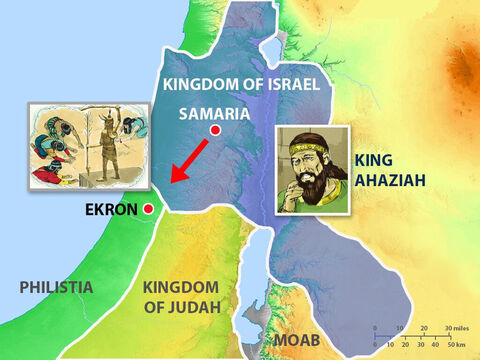
But before Ahaziah had a chance to deal with the rebellious Moabites, he suffered a life-threatening fall that left him confined to his bed in the royal palace in Samaria. His injuries were severe enough that he was concerned about whether he would fully recover. So, he sent messengers to the temple of Baal-zebub, the god of Ekron, seeking a divine prediction concerning his fate. It had been Ahaziah’s parents who had introduced Baal worship to Israel, and he proved to be a faithful adherent to their false religion. In his time of suffering, he sought the counsel of Baal rather than Yahweh, the covenant God of Israel. While Baal worship was rampant throughout the northern kingdom, Ahaziah sent his messengers to Ekron, which was located on Israel’s eastern border with Philistia. Ekron was a renowned occult center, and it was far enough away from Samaria that the news of the king’s injuries might be kept a secret.

However, Ahaziah’s messengers never reached Ekron. They were met along the way by Elijah, the prophet of Yahweh. Ahab’s old nemesis appears on the scene once again, but this time, he has bad news for Ahab’s son. Elijah had received instructions from Yahweh, commanding him to intercept the king’s messengers and inform them of their master’s fate. Ahaziah was hoping to hear a positive word from Baal, but instead, he would receive bad news from the God of Israel.

“Is there no God in Israel? Why are you going to Baal-zebub, the god of Ekron, to ask whether the king will recover? Now, therefore, this is what the LORD says: You will never leave the bed you are lying on; you will surely die.” – 2 Kings 1:3-4 NLT

There is a hint of sarcasm in this message. Yahweh is chiding Ahaziah for sending his messengers all the way to Ekron to seek a word from his false god. Baal worship was rampant within the nation of Israel. There were shrines and high places dedicated to Baal and Asherah all over the northern kingdom. In fact, Ahaziah had access to a Baal temple that his father had built in the capital city of Samaria.

He [Ahab] erected an altar for Baal in the house of Baal, which he built in Samaria. – 1 Kings 15:32 ESV

And there were literally hundreds of priests and prophets who served on behalf of Baal. Yet, Ahaziah had sent his messengers on a field trip all the way to Ekron in hopes of hearing something from his god. Perhaps he had started his search for an answer at the local temple, but had come up empty-handed. This could have led him to his “long-distance-call” to Ekron.

When Ahaziah heard the less-than-positive pronouncement his messengers delivered, he grew suspicious. This was not the news he had been expecting. So, he asked for a description of the man who had predicted his pending death. As soon as he heard what the man looked like, his suspicions were confirmed; it was Elijah the Tishbite. As the son of Ahab and Jezebel, Ahaziah would have grown up hearing the stories of Elijah and his defeat of the prophets of Baal on Mount Carmel. He would have been very familiar with his mother’s intense hatred for this prophet of Yahweh. The ongoing battle of words and will between his father and Elijah would have taken place right in front of him. So, when he discovered that Elijah had once again interjected himself into Israel’s affairs, he sent guards to arrest him. But, just like the messengers he had sent to Ekron, the guards never made it to their destination.

As visible proof of his role as a spokesman for Yahweh, Elijah called down fire from heaven that wiped out all 50 men, including their captain. But this display of power made no impression on the stubborn and unrepentant Ahaziah. He simply sent another 50 guards who suffered the very same fate. The third commander recognized the divine nature of Elijah’s role and wisely chose to beg for mercy.

“O man of God, please spare my life and the lives of these, your fifty servants. See how the fire from heaven came down and destroyed the first two groups. But now please spare my life!” – 2 Kings 1:13-14 NLT

The angel of God intervened, instructing Elijah to spare the lives of these men and accompany them back to Samaria. When he arrived in the capital city, Elijah reiterated his earlier message, but this time, directly to Ahaziah. He confirmed that the king would not recover from his injuries. Ahaziah’s stubborn refusal to seek God even in his time of greatest need would come with a death sentence. His unjustified yet unwavering allegiance to Baal had sealed his fate. As always, the words of Elijah proved to be true.

So Ahaziah died, just as the LORD had promised through Elijah. – 2 Kings 1:17 NLT

Yet another king of Israel met an untimely but well-deserved end. The legacy of unfaithfulness, begun by Jeroboam, had been passed down from generation to generation, infecting each successive king and bringing the just and righteous judgment of God upon them. And because Ahaziah had no male heir to whom he could leave the throne, his brother Jehoram became king of Israel.

Ahaziah, like his predecessors, failed to recognize Yahweh as the one true God. He acted as if Yahweh no longer existed in Israel. But he had been proven wrong. Yahweh was still alive and well, and His power was undiminished. While Ahaziah refused to seek Yahweh’s face, he could not escape Yahweh’s sovereign will. The God of Israel could be ignored, but He would not go away.

Ahaziah had made the fateful mistake of rejecting the one true God. Like his father, Ahaziah had stubbornly refused to acknowledge the supremacy of Yahweh, choosing instead to act as if the God of Israel was non-existent and powerless. But as King David declared in one of his psalms, only a fool would dare deny Yahweh’s existence.

Only fools say in their hearts,
    “There is no God.”
They are corrupt, and their actions are evil;
    not one of them does good!

The LORD looks down from heaven
    on the entire human race;
he looks to see if anyone is truly wise,
    if anyone seeks God.
But no, all have turned away;
    all have become corrupt.
No one does good,
    not a single one!

Will those who do evil never learn?
    They eat up my people like bread
    and wouldn’t think of praying to the Lord.
Terror will grip them,
    for God is with those who obey him.
The wicked frustrate the plans of the oppressed,
    but the LORD will protect his people. – Psalm 14:1-6 NLT

Ahaziah tried to pretend that Yahweh didn’t exist, but he paid for his folly with his life.

English Standard Version (ESV) The Holy Bible, English Standard Version. ESV® Permanent Text Edition® (2016). Copyright © 2001 by Crossway Bibles, a publishing ministry of Good News Publishers.

New Living Translation (NLT) Holy Bible, New Living Translation, copyright © 1996, 2004, 2015 by Tyndale House Foundation. Used by permission of Tyndale House Publishers Inc., Carol Stream, Illinois 60188. All rights reserved.

A Just Fate For Fleecing the Flock of God

17 Then the word of the LORD came to Elijah the Tishbite, saying, 18 “Arise, go down to meet Ahab king of Israel, who is in Samaria; behold, he is in the vineyard of Naboth, where he has gone to take possession. 19 And you shall say to him, ‘Thus says the LORD, “Have you killed and also taken possession?”’ And you shall say to him, ‘Thus says the LORD: “In the place where dogs licked up the blood of Naboth shall dogs lick your own blood.”’”

20 Ahab said to Elijah, “Have you found me, O my enemy?” He answered, “I have found you, because you have sold yourself to do what is evil in the sight of the LORD. 21 Behold, I will bring disaster upon you. I will utterly burn you up, and will cut off from Ahab every male, bond or free, in Israel. 22 And I will make your house like the house of Jeroboam the son of Nebat, and like the house of Baasha the son of Ahijah, for the anger to which you have provoked me, and because you have made Israel to sin. 23 And of Jezebel the LORD also said, ‘The dogs shall eat Jezebel within the walls of Jezreel.’ 24 Anyone belonging to Ahab who dies in the city the dogs shall eat, and anyone of his who dies in the open country the birds of the heavens shall eat.”

25 (There was none who sold himself to do what was evil in the sight of the LORD like Ahab, whom Jezebel his wife incited. 26 He acted very abominably in going after idols, as the Amorites had done, whom the LORD cast out before the people of Israel.)

27 And when Ahab heard those words, he tore his clothes and put sackcloth on his flesh and fasted and lay in sackcloth and went about dejectedly. 28 And the word of the LORD came to Elijah the Tishbite, saying, 29 “Have you seen how Ahab has humbled himself before me? Because he has humbled himself before me, I will not bring the disaster in his days; but in his son’s days I will bring the disaster upon his house.” 1 Kings 21:17-29 ESV

Ahab was busy surveying his newly acquired vineyard when he received a surprise visit from his old arch-nemesis, Elijah the prophet. The king had been making plans to transform Naboth’s vineyard into his own personal garden; however, Elijah was about to transform Ahab’s dream of a personal retreat into a living nightmare.

Speaking on behalf of God, Elijah leveled the charge against Ahab in the form of a condemning question: “Haven’t you committed murder and taken possession of the property of the deceased?” (1 Kings 21:19 NET). Elijah wasn’t looking for a confession from Ahab because his guilt was well-established. Jezebel’s little ploy to falsely accuse Naboth of cursing God and the king had fooled no one, most especially Yahweh. And before Ahab could respond, Elijah delivered the next part of his message.

“This is what the LORD has said: ‘In the spot where dogs licked up Naboth’s blood they will also lick up your blood—yes, yours!’” – 1 Kings 21:19 NET

It’s important to recall that Ahab was already under a curse from God for his refusal to execute Ben-hadad, the king of Syria. After Ahab had decided to spare Ben-hadad so he could sign a trade agreement with him, God sent a prophet with a dire pronouncement:

Because you have spared the man I said must be destroyed, now you must die in his place, and your people will die instead of his people.” – 1 Kings 20:42 NLT

Ahab had spared the life of a man whom God had condemned to death, and then he murdered a man who was undeserving of death. As a result, Ahab found himself under a double-curse from God. The first prophet had told Ahab that he would die for his first act of rebellion against God. Now, Elijah informed Ahab that his murder of Naboth had determined the nature of his death. It would be violent and humiliating, with the king’s blood poured out on the very same spot where Naboth had been unjustly stoned to death. And the only ones present at his death would be the wild dogs that would feast on his blood.

But Elijah’s words appear to have made no impact on Ahab. He simply responded, So, my enemy, you have found me! (1 Kings 21:20 NLT). He expresses no fear. He acknowledges no guilt. So, Elijah provided the stubborn and unrepentant king with further details concerning his fate. The prophet had traveled all the way to Jezreel for this confrontation because Ahab was totally committed to doing evil in the sight of the LORD. He had no morals or scruples and displayed no fear of or respect for Yahweh. He did whatever he wanted without ever considering whether his actions were in line with God’s will. Now he would learn the price he would have to pay for his rebellion. Ahab would face the same fate as two of his predecessors: Jeroboam and Baasha.

“I will bring disaster on you and consume you. I will destroy every one of your male descendants, slave and free alike, anywhere in Israel! I am going to destroy your family as I did the family of Jeroboam son of Nebat and the family of Baasha son of Ahijah, for you have made me very angry and have led Israel into sin.” – 1 Kings 21:21-22 NLT

Ahab’s dream of building a kingdom and a legacy that would last for generations had been forfeited. There would be no dynasty because God was going to eliminate all his male heirs. Ahab would have no sons to sit on his throne after him. And it should be noted that Elijah delivered this message on the very plot of land on which Ahab had hoped to build a garden. His dreams of fruitfulness were being dashed by God. He and his wicked wife, Jezebel, would be the last of their line because God was going to wipe out their heirs and destroy all hope of them propagating their legacy of sin and rebellion. Elijah let the king know that Jezebel would also pay dearly for her role in leading Israel into idolatry and apostasy. In fact, Ahab’s entire household would end up suffering degrading deaths as judgment for his sin.

“Dogs will eat Jezebel’s body at the plot of land in Jezreel. The members of Ahab’s family who die in the city will be eaten by dogs, and those who die in the field will be eaten by vultures.” – 1 Kings 21:23-24 NLT

At this point, the author provides a parenthetical commentary, intended to explain the harshness of God’s judgment. When it came to committing acts of wickedness and evil among the rulers of Israel, Ahab and Jezebel were the poster couple. Despite the abysmally poor track records of Jeroboam and Baasha, Ahab and Jezebel managed to establish a new low in terms of doing evil in the sight of the Lord.

Even for the callous and hard-hearted Ahab, this news was far more than he could bear. When the full scope of God’s judgment had finally registered in hiss brain, he was devastated.

…he tore his clothes and put sackcloth on his flesh and fasted and lay in sackcloth and went about dejectedly. – 1 Kings 21:27 ESV

Evidently, his display of sorrow and repentance was real because God acknowledged it as such.

“Do you see how Ahab has humbled himself before me? Because he has done this, I will not do what I promised during his lifetime. It will happen to his sons; I will destroy his dynasty.” – 1 Kings 21:29 NLT

Because Ahab had finally managed to display a semblance of humility and remorse for his actions, God would show him mercy. He would allow Ahab to live out his life, but Ahab’s son, Joram, would suffer in his place. Joram would have his blood spilled on the ground where Naboth was stoned to death (2 Kings 9:25-26). And there is no indication that Jezebel ever repented, so she would still have to endure the judgment God prescribed for her many sins. Her humiliating and gruesome death is recorded in the book of 2 Kings.

When Jezebel, the queen mother, heard that Jehu had come to Jezreel, she painted her eyelids and fixed her hair and sat at a window. When Jehu entered the gate of the palace, she shouted at him, “Have you come in peace, you murderer? You’re just like Zimri, who murdered his master!”

Jehu looked up and saw her at the window and shouted, “Who is on my side?” And two or three eunuchs looked out at him. “Throw her down!” Jehu yelled. So they threw her out the window, and her blood spattered against the wall and on the horses. And Jehu trampled her body under his horses’ hooves.

Then Jehu went into the palace and ate and drank. Afterward he said, “Someone go and bury this cursed woman, for she is the daughter of a king.” But when they went out to bury her, they found only her skull, her feet, and her hands.

When they returned and told Jehu, he stated, “This fulfills the message from the LORD, which he spoke through his servant Elijah from Tishbe: ‘At the plot of land in Jezreel, dogs will eat Jezebel’s body. Her remains will be scattered like dung on the plot of land in Jezreel, so that no one will be able to recognize her.’” – 2 Kings 9:32-37 NLT

Ahab and Jezebel had lived their lives according to their own standards. They had attempted to replace Yahweh with their own gods, repeatedly violated His commands, and ruled the people of Israel according to their own selfish agenda. But they would pay dearly for their rebellion. Their wickedness would result in Yahweh delivering His righteous and just judgment against them. These two icons of evil had ruled for years with impunity, but Yahweh had seen enough. For her apostasy and apathy toward the people of Israel, Jezebel would suffer a violent and degrading death. For his uncharacteristic display of remorse, Ahab would be spared, but only to realize that the judgment of Yahweh would fall on his son and heir to the throne. Yet, the text provides no response from Ahab. The news that his son would have to bear the brunt of Yahweh’s wrath does not seem to have fazed him. This self-absorbed “shepherd” of Israel showed no sympathy for his son’s fate and no regard for the impact his actions had on the flock of God.

Years later, the prophet Ezekiel would record Yahweh’s indictment against the kings of the northern tribe of Israel, including Ahab and his wicked wife.

Then this message came to me from the LORD: “Son of man, prophesy against the shepherds, the leaders of Israel. Give them this message from the Sovereign LORD: What sorrow awaits you shepherds who feed yourselves instead of your flocks. Shouldn’t shepherds feed their sheep? You drink the milk, wear the wool, and butcher the best animals, but you let your flocks starve. You have not taken care of the weak. You have not tended the sick or bound up the injured. You have not gone looking for those who have wandered away and are lost. Instead, you have ruled them with harshness and cruelty…you abandoned my flock and left them to be attacked by every wild animal. And though you were my shepherds, you didn’t search for my sheep when they were lost. You took care of yourselves and left the sheep to starve. Therefore, you shepherds, hear the word of the LORD. This is what the Sovereign LORD says: I now consider these shepherds my enemies, and I will hold them responsible for what has happened to my flock. I will take away their right to feed the flock, and I will stop them from feeding themselves. I will rescue my flock from their mouths; the sheep will no longer be their prey. – Ezekiel 32:1-4, 8-10 NLT

Yahweh held Ahab and Jezebel to account and delivered the judgment they both deserved. They had abused their authority and fleeced the flock of God. Now, the Great Shepherd was paying them back for their years of selfish and destructive leadership over His people.

English Standard Version (ESV) The Holy Bible, English Standard Version. ESV® Permanent Text Edition® (2016). Copyright © 2001 by Crossway Bibles, a publishing ministry of Good News Publishers.

New Living Translation (NLT) Holy Bible, New Living Translation, copyright © 1996, 2004, 2015 by Tyndale House Foundation. Used by permission of Tyndale House Publishers Inc., Carol Stream, Illinois 60188. All rights reserved.
Yahweh’s Divine Tag Team

15 And the LORD said to him, “Go, return on your way to the wilderness of Damascus. And when you arrive, you shall anoint Hazael to be king over Syria. 16 And Jehu the son of Nimshi you shall anoint to be king over Israel, and Elisha the son of Shaphat of Abel-meholah you shall anoint to be prophet in your place. 17 And the one who escapes from the sword of Hazael shall Jehu put to death, and the one who escapes from the sword of Jehu shall Elisha put to death. 18 Yet I will leave seven thousand in Israel, all the knees that have not bowed to Baal, and every mouth that has not kissed him.”

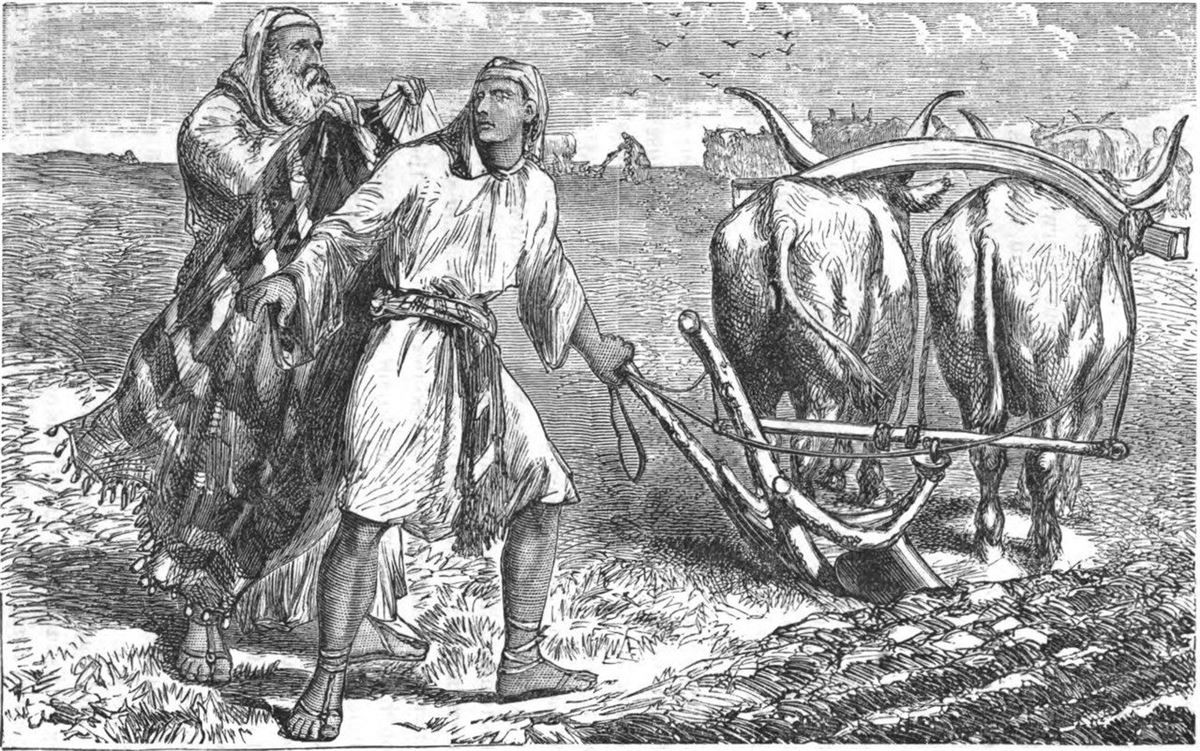
19 So he departed from there and found Elisha the son of Shaphat, who was plowing with twelve yoke of oxen in front of him, and he was with the twelfth. Elijah passed by him and cast his cloak upon him. 20 And he left the oxen and ran after Elijah and said, “Let me kiss my father and my mother, and then I will follow you.” And he said to him, “Go back again, for what have I done to you?” 21 And he returned from following him and took the yoke of oxen and sacrificed them and boiled their flesh with the yokes of the oxen and gave it to the people, and they ate. Then he arose and went after Elijah and assisted him. 1 Kings 19:15-21 ESV

The last three and a half years had taken their toll on Elijah. He had been living in a God-ordained exile in a remote village in the region of Sidon. While God had miraculously cared for him during that time, he had to live with the knowledge that there was a bounty on his head. King Ahab and his queen, Jezebel, had never forgiven him for the drought he had placed on the land of Israel. Elijah must have woken up every morning wondering if that would be the day God called him to confront Ahab and Jezebel one more time.

When that day finally came, Elijah obeyed God and made his way to Mount Carmel, where he challenged King Ahab to pit his 450 prophets of Baal against Yahweh, the one true God. That battle ended up being a lopsided affair, with Elijah’s God as the clear victor and the false god of Ahab and Jezebel exposed as a fraud and a failure. The dead bodies of his 450 prophets, strewn across the Jezreel Valley, were evidence of his decisive defeat.

But Elijah’s hope for revival in the land was soon replaced by fear for his own life. Jezebel had vowed to kill Elijah for his slaughter of the 450 prophets of Baal. And he responded to this news by running away. The prophet of God seemed to have lost all faith in God. Yet, even in his deep state of depression and despondency, Elijah was ministered to by God. Yahweh met Elijah right where he was, in the midst of his doubt and despair, and graciously provided him with a visual demonstration of His power. However, the wind, earthquake, and fire only frightened Elijah, causing him to take refuge in a cave. But it was the quiet whisper of God that drew him out, and the gentle voice of God asked Elijah to explain his presence there. What was the prophet doing so far from the scene of the recent victory over Baal? Why was he hiding? Elijah’s answer revealed his struggle with a lack of faith and a sense of failure.

I have been very jealous for the LORD, the God of hosts. For the people of Israel have forsaken your covenant, thrown down your altars, and killed your prophets with the sword, and I, even I only, am left, and they seek my life, to take it away.” – 1 Kings 19:14 ESV

Elijah described himself as alone and afraid. He had convinced himself that he was the last man standing, with no one to do battle at his side. In the heat of the moment, he had conveniently forgotten about the 100 prophets that God had used Obadiah to protect and preserve (1 Kings 18:13). Elijah felt alienated and alone, but his feelings were not based on reality. God even informed Elijah that He had preserved a remnant of “7,000 others in Israel who have never bowed down to Baal or kissed him!” (1 Kings 19:18 NLT). Elijah was far from alone, and God was far from finished with Elijah. But rather than rebuke His wavering prophet, God gave him his next assignment.

“Go back the same way you came, and travel to the wilderness of Damascus. When you arrive there, anoint Hazael to be king of Aram. Then anoint Jehu grandson of Nimshi to be king of Israel, and anoint Elisha son of Shaphat from the town of Abel-meholah to replace you as my prophet.” – 1 Kings 19:15 ESV

Despite his recent display of faithlessness and fear, Elijah would play a significant role in the next phase of God’s plans for Israel. God gave Elijah three assignments: First, he was to anoint a new king over the Syrians or Arameans. Then, he was to anoint a new king over Israel’s northern kingdom. Finally, he was to anoint his own successor. God provided Elijah little in the way of details. Other than the names of the men he was to anoint, Elijah had no way of knowing what any of this meant or how it would all turn out. But God was letting Elijah know that there were plans in the works of which he was unaware. Whether Elijah realized it or not, Ahab’s days were numbered, and the Syrians would end up playing a part in his eventual demise. There would be a new king in Israel one day. God had defeated the false god, Baal, and now He was going to mete out final judgment on the man responsible for Baal’s presence in Israel.

As if to further convince Elijah that he was not alone and that his mission was far from over, God revealed that the three men Elijah was to anoint would carry on the work that he had started at Mount Carmel. Elijah had killed the 450 prophets of Baal, but there were far more who needed to face the judgment of God for their apostasy and rebellion.

“Anyone who escapes from Hazael will be killed by Jehu, and those who escape Jehu will be killed by Elisha! – 1 Kings 19:17 NLT

Judgment was coming. Yahweh was preparing to purge Israel of all those who had bowed the knee to Baal, and He would start at the top with Ahab and Jezebel. But this divine plan to cleanse Israel would not happen overnight. In fact, it would last long after Elijah was gone. That’s why God informed Elijah that he was to anoint his successor.

“…anoint Elisha son of Shaphat from the town of Abel-meholah to replace you as my prophet. – 1 Kings 19:16 NLT

God already had Elijah’s replacement identified and a strategy in place to carry on His divine plan for Ahab’s punishment and Israel’s purification. A big reason for Elijah’s dejection was that the revival that started at Mount Carmel had stalled. When he had heard the people cry out, “The LORD, he is God; the LORD, he is God” (1 Kings 18:39 ESV), he genuinely believed that God had turned back the hearts of the people, and he expected to see an amazing renewal take place. He may have even thought that Ahab and Jezebel might repent and accept Yahweh as the one true God. But instead, the ever-defiant queen had threatened him with death.

But while Jezebel remained unwavering in her commitment to Baal, Elijah needed to understand that God was unfazed by her actions. As the sovereign, omniscient God of the universe, He had a plan in place to deal with Jezebel, Ahab, and all those who had bent the knee to Baal. And while Elijah might not live to see the final phase of that plan, he would play a decisive role in its implementation.

Revived and encouraged by Yahweh’s news, Elijah made his way to Abel-meholah, located in the Jordan Valley. While God clearly told Elijah to travel to the wilderness of Damascus and anoint Hazael to be king of Aram (1 Kings 19:15), it would appear that this was meant to be his final destination. On his way from Mount Sinai, he had to pass through the Jordan Valley, so it only made sense to stop there first and find the man who would be his replacement. He found Elisha plowing with 12 pairs of oxen in a field. This agrarian scene is significant for several reasons. First, it conveys an image of hope and expectation. After three-and-a-half years of drought, the rain had come, and now Elisha was preparing his formerly sun-baked fields for planting. He was anticipating a fruitful harvest sometime in the future. But Elisha’s presence in the field also reveals that he was a man of the land. He was not an influential figure with great wealth and prominence. He was a nondescript nobody whose only credentials were his calling by Yahweh.

What happens next appears strange to our modern sensibilities. Elijah walked up to this man, placed his cloak across his shoulders, and then simply walked away. What kind of bizarre ritual did this represent? How could Elisha have taken this unexpected action from this unknown stranger? Amazingly, it seems as if Elisha fully understood the significance of Elijah’s symbolic act. The text states that he “left the oxen standing there, ran after Elijah, and said to him, ‘First let me go and kiss my father and mother good-bye, and then I will go with you!’” (1 Kings 19:20 NLT). Perhaps God had already prepared Elisha for this moment, having revealed His plan through a dream or vision. He could have sent an angelic messenger to prepare Elisha for the prophet’s arrival. But whatever the case, Elisha seems to have been unfazed by what transpired and fully aware of what it meant. He immediately stopped his plowing and followed the man of God. His words and actions reveal that he knew who Elijah was and what he was asking him to do. His only request was that he be allowed to say goodbye to his family.

Elijah’s response to his request comes across as rather flippant.

Go back again, for what have I done to you?” – 1 Kings 19:20 ESV

In a sense, Elijah was simply emphasizing that this had all been God’s doing, not his. He was merely the messenger. Elisha was free to do as he pleased, and the young farmer-turned-prophet demonstrated his commitment to accept the call of God. He took the plow, the symbol of his former occupation, and used the wood to build an altar. Then, on that altar, he offered up the oxen with which he had been plowing. Elisha burned every bridge to his former life. He bid his parents and his past goodbye and “arose and went after Elijah and assisted him” (1 Kings 19:21 ESV).

As Elijah and Elisha made their way from the Jordan Valley, the first phase of the second half of God’s plan began. The revival Elijah had longed for and given up on was coming. Yahweh was not yet done. Elijah had been a key player in God’s renewal plans for Israel, but his part was coming to an end. The LORD had another man ready to take the baton and finish the race. God would use this divine tag team to accomplish His will concerning Israel and usher in a period of much-needed spiritual renewal among His covenant people. The apostle Paul would later explain his understanding of how God uses a team approach to accomplish His divine will.

What then is Apollos? What is Paul? Servants through whom you believed, as the Lord assigned to each. I planted, Apollos watered, but God gave the growth. So neither he who plants nor he who waters is anything, but only God who gives the growth. He who plants and he who waters are one, and each will receive his wages according to his labor. For we are God’s fellow workers. You are God’s field, God’s building. – 1 Corinthians 3:5-9 ESV

Elijah had planted; now it was Elisha’s turn to water. But the harvest would be the LORD’s.

English Standard Version (ESV) The Holy Bible, English Standard Version. ESV® Permanent Text Edition® (2016). Copyright © 2001 by Crossway Bibles, a publishing ministry of Good News Publishers.

New Living Translation (NLT) Holy Bible, New Living Translation, copyright © 1996, 2004, 2015 by Tyndale House Foundation. Used by permission of Tyndale House Publishers Inc., Carol Stream, Illinois 60188. All rights reserved.

Why Are You Here?

But he himself went a day’s journey into the wilderness and came and sat down under a broom tree. And he asked that he might die, saying, “It is enough; now, O LORD, take away my life, for I am no better than my fathers.” And he lay down and slept under a broom tree. And behold, an angel touched him and said to him, “Arise and eat.” And he looked, and behold, there was at his head a cake baked on hot stones and a jar of water. And he ate and drank and lay down again. And the angel of the LORD came again a second time and touched him and said, “Arise and eat, for the journey is too great for you.” And he arose and ate and drank, and went in the strength of that food forty days and forty nights to Horeb, the mount of God.

There he came to a cave and lodged in it. And behold, the word of the LORD came to him, and he said to him, “What are you doing here, Elijah?” 10 He said, “I have been very jealous for the LORD, the God of hosts. For the people of Israel have forsaken your covenant, thrown down your altars, and killed your prophets with the sword, and I, even I only, am left, and they seek my life, to take it away.” 11 And he said, “Go out and stand on the mount before the LORD.” And behold, the LORD passed by, and a great and strong wind tore the mountains and broke in pieces the rocks before the LORD, but the LORD was not in the wind. And after the wind an earthquake, but the LORD was not in the earthquake. 12 And after the earthquake a fire, but the LORD was not in the fire. And after the fire the sound of a low whisper. 13 And when Elijah heard it, he wrapped his face in his cloak and went out and stood at the entrance of the cave. And behold, there came a voice to him and said, “What are you doing here, Elijah?” 14 He said, “I have been very jealous for the LORD, the God of hosts. For the people of Israel have forsaken your covenant, thrown down your altars, and killed your prophets with the sword, and I, even I only, am left, and they seek my life, to take it away.” 1 Kings 19:4-14 ESV

While everything had gone exceptionally well for Elijah on Mount Carmel, he soon found himself disappointed in how things turned out. His challenge of the false prophets of Baal had proven to be successful, and, from the immediate reaction of the people, it appeared that revival had come to the land. This spiritual renewal of the people seemed to be symbolized by the torrential rain that had brought an end to the three-and-a-half years of drought. It appeared as if the nation was headed in the right direction. As a prophet of God, Elijah longed to see the repentance and restoration of the people of God.

But upon his triumphant return to Jezreel, he was met with intense opposition from the very woman who had begun all this trouble in Israel. Queen Jezebel was incensed when she heard what Elijah had done to the 450 prophets of her god. So, she sent Elijah a life-threatening message.

“So may the gods do to me and more also, if I do not make your life as the life of one of them by this time tomorrow.” – 1 Kings 19:2 ESV

She swore an oath to her gods that she would avenge the deaths of the prophets of Baal by killing Elijah. She gave the prophet less than 24 hours to live and vowed to sacrifice her own life if she failed to take his life. Despite the abject failure of her god to defeat Yahweh on Mount Carmel, she was still very much a believer. She exhibited no remorse or repentance but instead warned Elijah that while he had won the battle on Mount Carmel, the war was far from over. She was willing to fight to the death – either his or her own.  And Elijah did not take this news well.

…he was afraid, and he arose and ran for his life and came to Beersheba, which belongs to Judah, and left his servant there. – 1 Kings 19:3 ESV

The man who had run from Mount Carmel to Jezreel after his victory over the prophets of Baal was now running for his life. But this time, he was powered by fear, not faith. And Elijah didn’t stop running until he had reached Beersheba, the last town of any size in the southernmost region of Judah. Then, leaving his servant behind in the city, Elijah traveled another day’s journey into the wilderness, where he finally stopped to rest.

In a state of deep depression and disillusionment, Elijah asked God to take his life. Since Ahab and Jezebel remained fully committed to their false gods, Elijah had concluded that his prophetic mission had been an abysmal failure. There would be no revival in Israel as long as those two wielded all the power and influence over the people. They were calling the shots and determining the nation’s religious affiliation.

Elijah had run out of faith and energy. He was physically, emotionally, and spiritually spent. In his despondent state, he cried out to God, saying, “I have had enough, LORD.…Take my life, for I am no better than my ancestors who have already died” (1 Kings 19:4 NLT). Exhausted, he fell asleep. But he was soon awakened by an angel who commanded him to eat. There beside him was a loaf of bread and a jar of water. Rather than taking Elijah’s life, Yahweh provided his faith-famished prophet with sustenance, miraculously delivered by the hand of an angel. Elijah may have decided that he was done, but God was not done with Elijah. The prophet ate and fell back asleep. 

However, his rest was disturbed yet again by a second visit from the angel, who had brought more food and a message.

“Get up and eat some more, or the journey ahead will be too much for you.” – 1 Kings 19:7 NLT

Elijah’s plan had been to die alone in the wilderness, but Yahweh informed His disillusioned prophet that he had not yet reached his final destination. He had run, but not far enough. When Elijah abruptly fled Jezreel, he did so because he thought his life was over. Since Jezebel had vowed to kill him, Elijah determined to have Yahweh take his life. But the LORD had other plans. He sent Elijah on a 40-day journey further south, all the way to Mount Sinai. The food the angel provided miraculously sustained Elijah for this long and arduous journey.

…the food gave him enough strength to travel forty days and forty nights to Mount Sinai, the mountain of God. – 1 Kings 19:8 ESV

This trip should have taken no more than 15-20 days on foot, but Elijah found himself wandering in the wilderness for 40 days and nights. This number is significant because it corresponds to the 40 years that the disobedient Israelites had spent wandering in the wilderness. When they failed to obey God and enter the land of Canaan (Numbers 13-14), He doomed them to spend the next 40 years in the wilderness of Sinai, until that disobedient generation died off.

So the Lords anger burned against Israel, and He made them wander in the wilderness for forty years, until the entire generation of those who had done evil in the sight of the Lord came to an end. – Numbers 32:13 NLT

When they had heard the report of the spies that the land of Canaan was full of giants and well-fortified cities, the people of Israel refused to trust God and made plans to return to Egypt.

“If only we had died in Egypt, or even here in the wilderness!” they complained. “Why is the LORD taking us to this country only to have us die in battle? Our wives and our little ones will be carried off as plunder! Wouldn’t it be better for us to return to Egypt?” – Numbers 14:2-3 NLT

Now, centuries later, Elijah, the prophet of God, had chosen death in the wilderness rather than face the “giants” in his day. He had determined that Jezebel was too big for God. But Yahweh ordered Elijah to go to the very place where He had revealed Himself to the people of Israel. It had been at Mount Sinai that God gave His law to Moses. It had been on Mount Sinai that God displayed His glory and demonstrated His unparalleled power.

So it came about on the third day, when it was morning, that there were thunder and lightning flashes and a thick cloud over the mountain and a very loud trumpet sound, so that all the people who were in the camp trembled. And Moses brought the people out of the camp to meet God, and they stood at the foot of the mountain. – Exodus 19:16-17 NLT

When Yahweh had safely sequestered Elijah in the recesses of a cave, He asked His doubting prophet a question: “What are you doing here, Elijah?” (1 Kings 19:9 ESV). He wanted Elijah to explain the motivation behind his most recent actions, and the prophet responded with a pitiful portrait of his Don-Quixote-like quest to defeat the enemies of God. He deemed himself the last man standing, the sole survivor of an ill-fated battle against the forces of evil.

“I have zealously served the LORD God Almighty. But the people of Israel have broken their covenant with you, torn down your altars, and killed every one of your prophets. I am the only one left, and now they are trying to kill me, too.” – 1 Kings 19:10 NLT

Elijah threw himself a pity party and invited Yahweh to attend, but the LORD was not interested in celebrating Elijah’s accomplishments or validating his woe-is-me mentality. Instead, God instructed His despondent prophet to step out of the cave and into the shadow of Mount Sinai. As Elijah stood at the base of the mountain, God revealed Himself. At first, He displayed His glory in the form of a fierce windstorm so mighty that it blew boulders off the face of the mountain. This dramatic display was followed by a massive earthquake that shook the ground under Elijah’s feet. Finally, Elijah watched as the peak of the mountain was consumed by fire. The pitiful prophet was witnessing the same jaw-dropping spectacle the Israelites had seen.

Now Mount Sinai was all in smoke because the LORD descended upon it in fire; and its smoke ascended like the smoke of a furnace, and the entire mountain quaked violently. – Exodus 19:18 NLT

But Elijah was to discover that, while these dramatic revelations of God were impressive, they were not meant to represent His presence. The text clearly states that the LORD was not in the wind, the earthquake, or the fire. Yes, they were manifestations of His greatness, but they were not how God was going to speak to His prophet. After the ear-piercing blast of the wind, the earth-shaking rumble of the earthquake, and the roar of the fire, Elijah heard “the sound of a low whisper” ( 1 Kings 19:12 ESV). Evidently, the three previous displays of God’s power had driven Elijah back into the recesses of the cave. But upon hearing the gentle sound of the whisper, he timidly made his way back outside. There, in the quiet of the moment, he heard Yahweh repeat His previous question: “What are you doing here, Elijah?” (1 Kings 19:13 NLT). 

Once again, Elijah gave the same well-rehearsed reply. He reiterated his claim to have zealously served Yahweh and re-emphasized his status as the last faithful Israelite. It was all about him. He alone had zealously served Yahweh. While everyone else in Israel had turned their backs on God, Elijah had remained faithful and fully committed. He was the last line of defense against the forces of evil, and now he was as good as dead.

But where was God? Even after the dramatic displays of divine power on Mount Sinai, Elijah had been unable to get his mind off himself. For some reason, he believed that the future of Israel had been dependent upon him, and he had failed and let God down. Despite his victory over the prophets of Baal, Ahab and Jezebel were firmly entrenched and in charge of the affairs of the nation, or so Elijah thought. From his perspective, all was lost. But God had news for Elijah, and He had plans for Ahab and Jezebel that the defeated prophet knew nothing about.

In a still, small voice, Yahweh was about to whisper His sovereign secret for Israel’s future in the ear of his self-consumed prophet. When God had asked Elijah, “What are you doing here?”, the prophet had given his answer. Now it was God’s turn. He would explain the real purpose behind Elijah’s seeming failure and his fear and flight. Elijah thought it was all over, but Yahweh was just getting started. 

English Standard Version (ESV) The Holy Bible, English Standard Version. ESV® Permanent Text Edition® (2016). Copyright © 2001 by Crossway Bibles, a publishing ministry of Good News Publishers.

New Living Translation (NLT) Holy Bible, New Living Translation, copyright © 1996, 2004, 2015 by Tyndale House Foundation. Used by permission of Tyndale House Publishers Inc., Carol Stream, Illinois 60188. All rights reserved.

The Fateful Journey From Faith to Fear

41 And Elijah said to Ahab, “Go up, eat and drink, for there is a sound of the rushing of rain.” 42 So Ahab went up to eat and to drink. And Elijah went up to the top of Mount Carmel. And he bowed himself down on the earth and put his face between his knees. 43 And he said to his servant, “Go up now, look toward the sea.” And he went up and looked and said, “There is nothing.” And he said, “Go again,” seven times. 44 And at the seventh time he said, “Behold, a little cloud like a man’s hand is rising from the sea.” And he said, “Go up, say to Ahab, ‘Prepare your chariot and go down, lest the rain stop you.’” 45 And in a little while the heavens grew black with clouds and wind, and there was a great rain. And Ahab rode and went to Jezreel. 46 And the hand of the LORD was on Elijah, and he gathered up his garment and ran before Ahab to the entrance of Jezreel. 

1 Ahab told Jezebel all that Elijah had done, and how he had killed all the prophets with the sword. Then Jezebel sent a messenger to Elijah, saying, “So may the gods do to me and more also, if I do not make your life as the life of one of them by this time tomorrow.” Then he was afraid, and he arose and ran for his life and came to Beersheba, which belongs to Judah, and left his servant there. 1 Kings 18:41-19:3 ESV

Chapter 18 opened up with the words God spoke to Elijah: “Go, show yourself to Ahab, and I will send rain upon the earth” (1 Kings 18:1 ESV). This statement contains a command as well as a promise from God. After his three-and-a-half-year absence, Elijah was to return to Israel from Sidon and confront King Ahab one more time. But while this command would likely involve significant risk to the prophet, his obedience would result in a tremendous blessing on the people. God would end the prolonged drought and restore rain to the land.

It is impossible to know if Elijah was aware of all that would have to happen before the rain returned. There is no indication as to when God divulged the rest of His plan and Elijah’s role in it. But before the physical drought could end, the spiritual drought afflicting the people would have to come to a decisive conclusion that involved a dramatic confrontation between Elijah and the 450 prophets of Baal. However, the real battle would be between Yahweh, the God of Israel, and Baal, the god of Ahab and Jezebel.

Yahweh had won the day, displaying His power by sending fire from heaven that “consumed the burnt offering and the wood and the stones and the dust, and licked up the water that was in the trench” (1 Kings 18:38 ESV). This demonstrative exhibition of God’s omnipotence brought the people to their knees in fear and worship. What they had just witnessed left them thoroughly convinced that Yahweh was the one true God, and that newly revived awareness left them crying out, “The LORD, he is God; the LORD, he is God” (1 Kings 18:39 ESV). And as if to put an exclamation point on the whole scene, Elijah ordered the capture and execution of all 450 of Baal’s so-called prophets. Their god had remained silent when they cried to him for help. Now the prophet of Yahweh silenced them for good. They would no longer deceive and mislead the people of Israel with fallacious promises concerning their false god.

But there was still one thing missing: The rain that Yahweh had promised. Baal had been discredited, his prophets had been eliminated, and the peoples’ reverence for Yahweh had been rejuvenated. But the land remained under the God-ordained drought that had turned Israel into a dust bowl where water and food were scarce and daily survival was a challenge. The land that God had once described as “flowing with milk and honey” (Exodus 33:3 ESV) had become fruitless and lifeless, reflecting the spiritual state of the people who occupied it.

Hundreds of years earlier, long before the people of Israel took possession of the land of Canaan, Moses warned what would happen if they proved unfaithful.

“And if you will indeed obey my commandments that I command you today, to love the LORD your God, and to serve him with all your heart and with all your soul, he will give the rain for your land in its season, the early rain and the later rain, that you may gather in your grain and your wine and your oil. And he will give grass in your fields for your livestock, and you shall eat and be full. Take care lest your heart be deceived, and you turn aside and serve other gods and worship them; then the anger of the LORD will be kindled against you, and he will shut up the heavens, so that there will be no rain, and the land will yield no fruit, and you will perish quickly off the good land that the LORD is giving you.” – Deuteronomy 11:13-17 ESV

Years later, when God’s people continued to display their propensity for unfaithfulness, His prophet, Joel, would offer this promise of divine restoration even in the face of their disobedience.

Surely the LORD has done great things!
    Don’t be afraid, O land.
Be glad now and rejoice,
    for the LORD has done great things.
Don’t be afraid, you animals of the field,
    for the wilderness pastures will soon be green.
The trees will again be filled with fruit;
    fig trees and grapevines will be loaded down once more.
Rejoice, you people of Jerusalem!
    Rejoice in the LORD your God!
For the rain he sends demonstrates his faithfulness.
    Once more the autumn rains will come,
    as well as the rains of spring.
The threshing floors will again be piled high with grain,
    and the presses will overflow with new wine and olive oil.

The LORD says, “I will give you back what you lost…” – Joel 2:20-25 ESV

That day on Mount Carmel, the people had seen the fire of God fall from heaven, completely consuming the altar, sacrifice, and water. But they had not yet seen or felt His blessing. As Joel stated, “the rain he sends demonstrates his faithfulness.” Their land was in desperate need of restoration and rejuvenation, and so were they. After three-and-a-half years of spiritual drought, their hearts were parched and hardened. They had lost the capacity for fruitfulness and faithfulness and needed an outpouring of God’s grace and mercy.

Elijah knew what God had in store. So, he informed the shell-shocked king to “Go get something to eat and drink, for I hear a mighty rainstorm coming!” (1 Kings 18:41 NLT). There was a blessing on the horizon. Despite Ahab and Jezebel’s wickedness, God was about to pour out His goodness on the land.

The fact that Ahab had food to eat is symbolic of his self-centered approach to leadership. His sins had brought God’s curse upon the nation, but while the people suffered severely from the lack of rain, Ahab and Jezebel lived in royal comfort and ease. God would later issue an indictment against the leaders of Israel, warning them of their blatant disregard for the care of His people.

“What sorrow awaits you shepherds who feed yourselves instead of your flocks. Shouldn’t shepherds feed their sheep?” – Ezekiel 34:2 NLT

As Ahab was busy satisfying his own needs, Elijah interceded on behalf of the people of Israel. He “climbed to the top of Mount Carmel and bowed low to the ground and prayed with his face between his knees” (1 Kings 18:42 NLT). At one point during his prayer, he stopped and sent his servant to look toward the Mediterranean Sea in the east. But the servant saw nothing. This pattern repeated itself five more times with the same disappointing result. But the seventh time, the servant returned with a different report.

“I saw a little cloud about the size of a man’s hand rising from the sea.” – 1 Kings 18:44 NLT

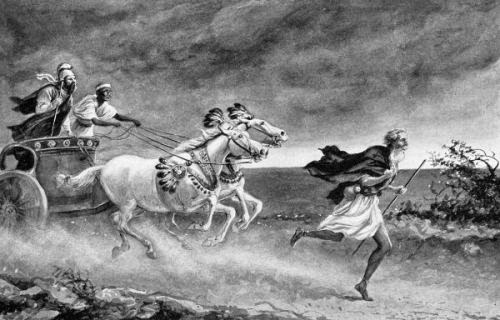
Out on the distant horizon, the servant saw what appeared to be a glimmer of hope. It was a small and seemingly insignificant cloud, but Elijah knew what it meant. The blessing of God was about to fall and, when it did, it would come in torrents. So, he instructed his servant to warn Ahab to leave immediately, or he may not make it back to his winter palace in Jezreel. When Elijah’s servant looked to the east, he saw only a faint possibility. But through his eyes of faith,  Elijah saw something altogether different. He perceived the imminent arrival of the outpouring of God’s blessing, and before long, that small cloud developed into a massive storm that brought strong winds and torrential rains. As Ahab tried to outrun the storm in his chariot, “the LORD gave special strength to Elijah. He tucked his cloak into his belt and ran ahead of Ahab’s chariot all the way to the entrance of Jezreel” (1 Kings 18:46 NLT).

Because Jezreel was anywhere from 10 to 20 miles east of Mount Carmel, some commentators attempt to explain this last verse by saying that Ahab’s chariot got caught in the mud and delayed his arrival. Others speculate that Elijah simply took a shortcut over the ridge of Mount Carmel. But everything about this story has been focused on the matchless power of God, and it should not seem out of the question that God might endow his prophet with a supernatural capacity to outrun the chariot of his arch-nemesis. God had defeated Baal. Now, the prophet of God had defeated the benefactor of Baal.

But while Elijah had won the victory at Mount Carmel and the race to Jezreel, he would have little time to celebrate. Upon hearing the unexpected news of all that had transpired on Mount Carmel, Jezebel was outraged and directed all her anger at Elijah.

“May the gods strike me and even kill me if by this time tomorrow I have not killed you just as you killed them.” – 1 Kings 19:2 NLT

Despite all that Ahab told her about the day’s events, she remained unconvinced of Yahweh’s power. She even called on Baal and his queen mother, Asherah, to come to her aid so that she might avenge the deaths of the prophets by killing Elijah. She was still putting her hope and trust in her false gods. Even the sudden arrival of long-awaited rain did nothing to diminish her misplaced trust in her lifeless and powerless gods. Baal, Jezebel’s beloved fertility god, had done nothing to eliminate the drought that had plagued the land.

But even more surprising than Jezebel’s stubborn belief in Baal and her resistance to God was Elijah’s sudden display of fear and doubt. This man, who had called down fire from heaven and had singlehandedly executed 450 prophets of Baal, found himself intimidated by the idle threats of this self-absorbed, idol-worshiping queen. Her vow to avenge her false god should have made Elijah laugh with scorn. Her god had proven himself to be speechless, powerless, and utterly helpless in the face of Yahweh. Yet, the formerly faithful Elijah was suddenly fearful, and this time, rather than running to the problem in the strength of God, he took flight and tried to escape it. He fled for his life, covering the 25 miles from Jezreel to Beersheba, motivated by fear and in the strength of his own flesh. Faced with the threats of Jezebel, Elijah took his eyes off God and took his fate into his own hands. 

This faithful man of God allowed the words of an idol-obsessed queen to dishearten and defeat him. He had bravely faced off against the 450 prophets of Baal, but now, with Jezebel’s words ringing in his ear, Elijah ran all the way to Beersheba, located on the southern border of Judah. From there, he would enter the Judean wilderness, the very same place where the disobedient and doubtful Israelites had wandered for 40 years when they refused to enter the promised land. And, in no time at all, the once faith-filled Elijah would find himself racked by fear and desiring death rather than face the vengeful anger of Jezebel.

English Standard Version (ESV) The Holy Bible, English Standard Version. ESV® Permanent Text Edition® (2016). Copyright © 2001 by Crossway Bibles, a publishing ministry of Good News Publishers.

New Living Translation (NLT) Holy Bible, New Living Translation, copyright © 1996, 2004, 2015 by Tyndale House Foundation. Used by permission of Tyndale House Publishers Inc., Carol Stream, Illinois 60188. All rights reserved.
The LORD Is God

22 Then Elijah said to the people, “I, even I only, am left a prophet of the LORD, but Baal’s prophets are 450 men. 23 Let two bulls be given to us, and let them choose one bull for themselves and cut it in pieces and lay it on the wood, but put no fire to it. And I will prepare the other bull and lay it on the wood and put no fire to it. 24 And you call upon the name of your god, and I will call upon the name of the LORD, and the God who answers by fire, he is God.” And all the people answered, “It is well spoken.” 25 Then Elijah said to the prophets of Baal, “Choose for yourselves one bull and prepare it first, for you are many, and call upon the name of your god, but put no fire to it.” 26 And they took the bull that was given them, and they prepared it and called upon the name of Baal from morning until noon, saying, “O Baal, answer us!” But there was no voice, and no one answered. And they limped around the altar that they had made. 27 And at noon Elijah mocked them, saying, “Cry aloud, for he is a god. Either he is musing, or he is relieving himself, or he is on a journey, or perhaps he is asleep and must be awakened.” 28 And they cried aloud and cut themselves after their custom with swords and lances, until the blood gushed out upon them. 29 And as midday passed, they raved on until the time of the offering of the oblation, but there was no voice. No one answered; no one paid attention.

30 Then Elijah said to all the people, “Come near to me.” And all the people came near to him. And he repaired the altar of the LORD that had been thrown down. 31 Elijah took twelve stones, according to the number of the tribes of the sons of Jacob, to whom the word of the LORD came, saying, “Israel shall be your name,” 32 and with the stones he built an altar in the name of the LORD. And he made a trench about the altar, as great as would contain two seahs of seed. 33 And he put the wood in order and cut the bull in pieces and laid it on the wood. And he said, “Fill four jars with water and pour it on the burnt offering and on the wood.” 34 And he said, “Do it a second time.” And they did it a second time. And he said, “Do it a third time.” And they did it a third time. 35 And the water ran around the altar and filled the trench also with water.

36 And at the time of the offering of the oblation, Elijah the prophet came near and said, “O LORD, God of Abraham, Isaac, and Israel, let it be known this day that you are God in Israel, and that I am your servant, and that I have done all these things at your word. 37 Answer me, O LORD, answer me, that this people may know that you, O LORD, are God, and that you have turned their hearts back.” 38 Then the fire of the LORD fell and consumed the burnt offering and the wood and the stones and the dust, and licked up the water that was in the trench. 39 And when all the people saw it, they fell on their faces and said, “The LORD, he is God; the Lord, he is God.” 40 And Elijah said to them, “Seize the prophets of Baal; let not one of them escape.” And they seized them. And Elijah brought them down to the brook Kishon and slaughtered them there. 1 Kings 18:22-40 ESV

The battle for the hearts of the people of Israel was about to begin. Having accepted Elijah’s challenge, King Ahab had decreed that the people assemble at nearby Mount Carmel. He also ordered the 450 prophets of Baal to come, ready to prove the power of their god. But as Elijah stood before the gathered assembly, he issued them a stern challenge.

“How long will you go limping between two different opinions? If the LORD is God, follow him; but if Baal, then follow him.” – 1 Kings 18:21 ESV

His words are reminiscent of those spoken by Joshua hundreds of years earlier, as he addressed the nation of Israel near the end of his life. He, too, had called the people to choose who they were going to serve, the one true God or the false gods of Egypt and Canaan.

“Now therefore fear the LORD and serve him in sincerity and in faithfulness. Put away the gods that your fathers served beyond the River and in Egypt, and serve the LORD. And if it is evil in your eyes to serve the LORD, choose this day whom you will serve, whether the gods your fathers served in the region beyond the River, or the gods of the Amorites in whose land you dwell. But as for me and my house, we will serve the LORD.” – Joshua 24:14-15 ESV

The fickle nature of the Israelites had not changed much over the centuries. They remained prone to chasing after any and every god who came along. They were equal-opportunity idolaters who seemed to have no sense of guilt or shame. Their willingness to accept and affirm any and all gods placed before them had been a problem from the beginning. While they never entirely abandoned their worship of Yahweh, they were constantly trying out new gods in a vain attempt to cover all their bases. Their syncretistic approach to religion and worship was driven by self-interest and greed. In a sense, they seemed to operate on the belief that two gods were better than one. But Elijah was demanding that they make up their minds. He would not allow them to play the field and continue to offend Yahweh with their spiritual adultery.

In an attempt to stress the lopsided nature of the battle that was about to ensue, Elijah claimed that he was the only prophet of Yahweh still standing in Israel. But he was wrong, and he knew it. In his earlier encounter with Obadiah, he had learned that there were at least 100 prophets whom God had spared through Obadiah’s actions. But Elijah chose to ignore this detail so that he could paint as bleak a picture as possible. At that moment, the odds were 450 to one. He was the sole prophet of God, preparing to face the overwhelming numbers of the prophets of Baal.

But Elijah knew that this day was not about a battle between him and the more numerous adversaries on the other side; it would be a divine display of Yahweh’s power and Baal’s impotence. Just as Baal had been unable to stop the ravages of the drought that had devastated the land for three years, he would prove incapable of hearing and answering the desperate cries of his prophets.

Elijah set the rules of the contest. Each side was to select an appropriate sacrifice, then offer it up on an altar before their respective god. Then they were to cry out to their deity of choice, and whichever god responded by consuming the offering with fire would prove to be the true god.

In describing the ensuing scene, the author clearly attempts to lampoon the efforts of the prophets of Baal. Their energetic and somewhat odd behavior displays their desperate hope that their god will show up.

…they called on the name of Baal from morning until noontime, shouting, “O Baal, answer us!” But there was no reply of any kind. Then they danced, hobbling around the altar they had made. – 1 Kings 18:26 NLT

The harder they tried to garner the attention of their seemingly distant and disinterested god, the more Elijah taunted their efforts.

“You’ll have to shout louder,” he scoffed, “for surely he is a god! Perhaps he is daydreaming, or is relieving himself. Or maybe he is away on a trip, or is asleep and needs to be wakened!” – 1 Kings 18:27 NLT

In desperation and growing frustration, they resort to shedding their own blood, vainly hoping that their self-mutilation might appease and awaken their god to action. But the author summarizes their prolonged and ineffective efforts with the simple statement: “there was no sound, no reply, no response” (1 Kings 18:29 NLT). Their god remained silent and unresponsive.

Broken and bloodied by their hours-long effort to call down fire from their god, they finally gave up. Then it was Elijah’s turn. After rebuilding the altar to Yahweh that Jezebel had ordered destroyed, Elijah had the altar and the sacrifice drenched in water. He purposefully stacked the deck against Yahweh, creating what would appear to be impossible odds. Elijah used 12 stones to build the altar and then drenched the altar and the sacrifice with 12 large jars of water. Even though this event was taking place among the ten tribes of the northern kingdom, Elijah wanted them to realize that Yahweh was the God over the 12 tribes of Israel. They were a divided nation because of idolatry. But in God’s eyes, they were still His chosen people.

Elijah’s simple prayer illustrates his belief that Yahweh longed to restore His covenant people. The God of Abraham, Isaac, and Jacob still loved His people and greatly desired that they would repent and return to Him.

“O LORD, God of Abraham, Isaac, and Jacob, prove today that you are God in Israel and that I am your servant. Prove that I have done all this at your command. O LORD, answer me! Answer me so these people will know that you, O LORD, are God and that you have brought them back to yourself.” – 1 Kings 18:36-37 NLT

No histrionics. No desperate displays of emotional cajoling and pleading. Elijah simply asked God to display His power so that the people might know He was there and that He cared. Elijah was asking God to demonstrate His covenant faithfulness despite their years of unfaithfulness. And, unlike Baal, God heard and responded.

Immediately the fire of the LORD flashed down from heaven and burned up the young bull, the wood, the stones, and the dust. It even licked up all the water in the trench! – 1 Kings 18:38 NLT

The impact of this divine demonstration of power was immediate. Blown away by this supernatural display, the people fell on their faces and cried out, “The LORD—he is God! Yes, the LORD is God!” (1 Kings 18:39 NLT). The altar to Baal remained untouched, just as the prophets had left it. But the altar to Yahweh was consumed entirely, rocks and all. God had more than accepted the sacrifice that Elijah had offered. In doing so, He demonstrated His power, reconfirmed His covenant commitment, and validated His prophet. He was the one true God, and Elijah was His chosen messenger.

As a final demonstration of God’s unparalleled greatness and His prophet’s authority to act on His behalf, Elijah ordered the capture of every single prophet of Baal. The people obeyed his command and brought all 450 of these false prophets to the Kishon Valley, where Elijah meted out divine judgment and justice on every one of them. These men had played a significant role in the nation’s spiritual decline. They were the visual representation of their false god, and their lies and deception had caused the people of Israel to abandon Yahweh for a god that was nothing more than a figment of man’s fertile imagination.

Looking on as this unexpected scene unfolded before their eyes, King Ahab and his wife Jezebel had to have been reeling from the shock of it all. Not only had their god not shown up, but the prophets who observed this false deity were destroyed. But, as we will see, rather than repent for their sins against God, the royal couple will respond in anger and resentment, attempting to take out their wrath on God’s messenger. This arrogant and self-consumed pair will continue to reject Yahweh, stubbornly refusing to admit, “The LORD—he is God! Yes, the LORD is God!”

English Standard Version (ESV) The Holy Bible, English Standard Version. ESV® Permanent Text Edition® (2016). Copyright © 2001 by Crossway Bibles, a publishing ministry of Good News Publishers.

New Living Translation (NLT) Holy Bible, New Living Translation, copyright © 1996, 2004, 2015 by Tyndale House Foundation. Used by permission of Tyndale House Publishers Inc., Carol Stream, Illinois 60188. All rights reserved.

The Power to Revive and Restore

17 After this the son of the woman, the mistress of the house, became ill. And his illness was so severe that there was no breath left in him. 18 And she said to Elijah, “What have you against me, O man of God? You have come to me to bring my sin to remembrance and to cause the death of my son!” 19 And he said to her, “Give me your son.” And he took him from her arms and carried him up into the upper chamber where he lodged, and laid him on his own bed. 20 And he cried to the LORD, “O LORD my God, have you brought calamity even upon the widow with whom I sojourn, by killing her son?” 21 Then he stretched himself upon the child three times and cried to the LORD, “O LORD my God, let this child’s life come into him again.” 22 And the LORD listened to the voice of Elijah. And the life of the child came into him again, and he revived. 23 And Elijah took the child and brought him down from the upper chamber into the house and delivered him to his mother. And Elijah said, “See, your son lives.” 24 And the woman said to Elijah, “Now I know that you are a man of God, and that the word of the LORD in your mouth is truth.” 1 Kings 17:17-24 ESV

God used Elijah to deliver His message of judgment against King Ahab and his foreign queen, Jezebel. In marrying this princess from Sidon, Ahab had also adopted her false god, Baal, and built a temple for its worship. He also erected a shrine to honor Asherah, the moon-goddess and supposed mother of this pagan deity. Angered by these blatant acts of rebellion and apostasy, God had sent Elijah to tell the royal couple that their kingdom would suffer under a great drought. Their disrespect and disregard for God had brought His discipline.

But after Elijah successfully delivered his message, God sent him away. He ended up at a cave, where God graciously and miraculously arranged for ravens to provide all the food he needed to survive. But eventually, Elijah became a victim of the very drought he predicted. Soon, the brook dried up, and the daily deliveries of bread and meat no longer appeared. So, God sent Elijah to the Sidonian town of Zarephath, where he took up residence with a poor widow and her son. She, too, was suffering from the effects of the drought. But, once again, Yahweh proved Himself to be the one true God by causing her meager supply of flour and oil to miraculously multiply and never run out.

In the midst of a drought and severe famine, she had more than enough to sustain herself, her son, and God’s prophet. Through it all, Elijah learned to trust God for all His needs. But even more importantly, Elijah discovered that his God was greater than the gods of Ahab and Jezebel. While Baal, the so-called fertility god, was powerless to stop the drought or reverse the effects of the famine, Yahweh turned “a handful of flour in a jar and a little oil in a jug” (1 Kings 17:12 ESV) into a never-ending food supply for Elijah and his gracious hostess.

Then suddenly, the story takes a dramatic turn for the worse. The woman’s young son dies unexpectedly. Faced with this devastating change in her circumstances, the woman vented all her anger and frustration on the prophet of God.

“O man of God, what have you done to me? Have you come here to point out my sins and kill my son?” – 1 Kings 17:18 NLT

It seems that the woman had falsely assumed that her son’s death was a form of divine retribution for a former sin she had committed. Perhaps by this time, Elijah had shared the details of his encounter with Ahab and Jezebel, explaining that he had been the one to predict the drought as a punishment for their sin. So, when her son suddenly died, she would have naturally reasoned that God was using the prophet to deliver yet another judgment for sin – that of her own.

But ignoring her despair-driven accusation, Elijah took the lifeless body of her son and placed it on his own bed. Then Elijah turned his attention to God. But notice the tone of His prayer. He seems to echo the words of the widow, passing the blame up the food chain and questioning the goodness and graciousness of God.

“O LORD my God, why have you brought tragedy to this widow who has opened her home to me, causing her son to die?” – 1 Kings 17:20 NLT

Elijah’s response reveals his firm belief that God is sovereign over all things, but he is perplexed and confused by the seeming injustice of it all. In his frustration, He accuses God of doing something wicked. The Hebrew word is rāʿaʿ, which is most often translated as “evil.” The boy’s death makes no sense to Elijah; it seems unnecessary and completely nonproductive. When Elijah first met the woman, she had been fully expecting her son to die of starvation because of the drought. But God had intervened and provided more than enough food to keep all three of them alive. So, to Elijah, the boy’s death seemed pointless and, if anything, it appeared to be an act of cruelty.

But while Elijah was having a difficult time understanding the ways of God, he remained convinced of the power of God. Three times, he lay across the dead body of the boy and cried out, “O LORD my God, please let this child’s life return to him” (1 Kings 17:21 NLT). And the fact that Elijah repeated this process three separate times demonstrates both his persistence and dependence upon God.

It’s important to consider that Elijah had no precedent on which to base his prayer. He was asking Yahweh to do the impossible – to raise a dead body back to life. There is no indication that Elijah had ever seen or heard of God doing such a thing. Elijah was not basing his request on some past miracle recorded in the Hebrew scriptures. The Pentateuch, the first five books of the Bible, contains no instance of God raising the dead back to life. So, Elijah was asking God to do something that had never been done before. His request was a tremendous act of faith.

In a classic example of understatement, the author simply records, “The LORD heard Elijah’s prayer, and the life of the child returned, and he revived!” (1 Kings 17:22 NLT). One can only imagine Elijah’s shock and surprise when the lifeless body of the boy was suddenly reanimated. Two times, nothing had happened. But on the third try, God chose to intervene and answer Elijah’s prayer. We’re not told why God didn’t answer Elijah’s prayer the first time. Perhaps it was a test of Elijah’s faith to see if he would continue to ask and believe even when his request went unanswered. But God had heard, and He ultimately answered, and in a truly remarkable way. Elijah’s unbridled excitement and enthusiasm were on display as he announced the news to the boy’s grieving mother.

“See, your son lives.” – 1 Kings 17:23 ESV

It would be easy to misread this statement and assume that Elijah is saying something like, “See, I told you so!” It almost appears as if he is chastising the woman for her lack of faith. But at no point in the story did Elijah tell the woman that her son would live. He had no way of knowing whether God would answer his prayer or not. At least two times, God failed to do so. But when God had finally provided the miracle for which Elijah was asking, the prophet couldn’t contain his enthusiasm. The New Living Translation provides a much more accurate rendering of Elijah’s response.

“Look!” he said. “Your son is alive!” – 1 Kings 17:23 NLT

No one was as shocked as Elijah, and his joy overflowed in a display of emotional celebration. He most likely walked into the room, carrying the boy in his arms, and then handed him over to the smothering embrace of his overjoyed mother. And, through tears mixed with laughter, the woman managed to express her gratitude to the prophet by declaring her belief in his God.

“Now I know for sure that you are a man of God, and that the LORD truly speaks through you.” – 1 Kings 17:24 NLT

While Yahweh had been keeping the widow and her son alive, she must have had her doubts about Elijah and his God. But now, as she clutched her resurrected son in her arms, she finally recognized and confessed the sovereignty of God and the authority of His prophet. Her son had been dead but was now alive. Her devastating loss had been miraculously reversed with the return of her son. Her sorrow had been turned to joy.

It is easy to overlook the fact that this miracle took place in an obscure village in the region of Sidon. While Jezebel had brought her false god from Sidon to the land of Israel, Elijah had brought the God of Israel to the land of Sidon. The arrival of Baal had been accompanied by drought and famine. But when Yahweh made His appearance in the pagan land of the Sidonians, He had turned a widow’s poverty into plenty and had replaced death with life. In doing so, He had proved Himself to be the one and only God of the universe.

And God intended this powerful lesson to prepare His prophet for all that was about to happen. Elijah didn’t know it yet, but the most significant test of his faith was in his future. After three years of a debilitating and devastating famine, God was going to send Elijah back to the land of Israel to go face-to-face with the king and queen and toe-to-toe with their false god. If Yahweh could revive the dead son of the Sidonian widow, He was powerful enough to restore the stagnant spiritual state of the people of Israel. But would Elijah continue to believe in Yahweh’s power when the odds were stacked against him and the forces of evil threatened his very existence? Only time would tell.

English Standard Version (ESV) The Holy Bible, English Standard Version. ESV® Permanent Text Edition® (2016). Copyright © 2001 by Crossway Bibles, a publishing ministry of Good News Publishers.

New Living Translation (NLT) Holy Bible, New Living Translation, copyright © 1996, 2004, 2015 by Tyndale House Foundation. Used by permission of Tyndale House Publishers Inc., Carol Stream, Illinois 60188. All rights reserved.

Repentance, Reconciliation, and Restoration

13 Is anyone among you suffering? Let him pray. Is anyone cheerful? Let him sing praise. 14 Is anyone among you sick? Let him call for the elders of the church, and let them pray over him, anointing him with oil in the name of the Lord. 15 And the prayer of faith will save the one who is sick, and the Lord will raise him up. And if he has committed sins, he will be forgiven. 16 Therefore, confess your sins to one another and pray for one another, that you may be healed. The prayer of a righteous person has great power as it is working. 17 Elijah was a man with a nature like ours, and he prayed fervently that it might not rain, and for three years and six months it did not rain on the earth. 18 Then he prayed again, and heaven gave rain, and the earth bore its fruit.

19 My brothers, if anyone among you wanders from the truth and someone brings him back, 20 let him know that whoever brings back a sinner from his wandering will save his soul from death and will cover a multitude of sins. James 5:13-20 ESV

Back in the previous chapter, James wrote, “You do not have, because you do not ask” (James 4:2 ESV). He accused his readers of two sins. The first had to do with allowing their unfulfilled passions to turn into covetousness and greed. Unable to get what they believed to be rightfully theirs, they were attempting to get it by force, even expressing a willingness to kill for it. But that raises the second sin of which they were guilty. They never made their request known to God.

These people were fighting amongst themselves because their unmet desires were producing uncontrollable jealousy and envy. Rather than expressing their so-called needs to God, they were taking matters into their own hands. And, on those rare occasions when they did manage to ask God for what they craved, they did so with the wrong motives.

You ask and do not receive, because you ask wrongly, to spend it on your passions. – James 4:3 ESV

James accused them of spiritual adultery because they displayed a greater love for the things of this world than they did for God. The things they so greatly desired were of more value to them than their relationship with God.

In his letter to the church in Philippi, Paul addressed a conflict between two women in the congregation.

Now I appeal to Euodia and Syntyche. Please, because you belong to the Lord, settle your disagreement. – Philippians 4:2 NLT

These two godly women were experiencing some kind of personal disagreement that had become apparent to the rest of the church members. And Paul called on the church to come to their aid so that their dispute could be resolved and their relationship restored. Then he addressed the entire faith community.

Always be full of joy in the Lord. I say it again—rejoice! Let everyone see that you are considerate in all you do. Remember, the Lord is coming soon. Don’t worry about anything; instead, pray about everything. Tell God what you need, and thank him for all he has done. Then you will experience God’s peace, which exceeds anything we can understand. His peace will guard your hearts and minds as you live in Christ Jesus. – Philippians 4:4-7 NLT

There was no place for quarreling and fighting within the body of Christ. Jealousy and greed should not exist among believers because we serve a God who is fully capable of meeting all our needs. But we must never forget that God is not obligated to fulfill all our desires. At times, we treat God like a cosmic genie in a bottle by demanding that He give us whatever we wish for. But God does not exist to obey our every command and to fulfill our deepest cravings and desires.

Notice that Paul told the Philippians to make their requests known to God, but he didn’t promise them that all those requests would be fulfilled. Instead, he assured them that God would give them the one thing they needed more than anything else: peace of mind. God would replace their craving with contentment. Oftentimes, the things for which we ask God reveal that our hope is misplaced. We wrongly believe that our answered prayer will bring us joy, fulfillment, and satisfaction. If we’re sick, we become convinced that healing is what we need most. If we are having financial difficulties, a sudden influx of cash will surely make all our problems go away. If we’re experiencing a relational conflict, we convince ourselves that if God would only change the other person, everything would be better.

But prayer is less about getting what we want from God than it is about us learning to trust Him. Prayer is the believer’s primary form of communication with the Father and it is intended to be a conversation, not a monologue. Too often, we craft our list of petitions and methodically communicate them to God, fully expecting Him to fulfill each and every request. And we base our belief in this make-a-wish approach to prayer on the words of Jesus. After all, didn’t He say, “Ask, and it will be given to you…” (Matthew 7:7 NLT)? And wasn’t it Jesus who promised, “If two of you agree here on earth concerning anything you ask, my Father in heaven will do it for you” (Matthew 18:19 NLT)? And didn’t He tell His disciples, “whatever you ask in prayer, you will receive, if you have faith” (Matthew 21:22 NLT)?

But Jesus was not offering His followers carte blanche when it came to prayer. He wasn’t providing them with a blank check that obligated Him to give them whatever their heart desired. There is a sense in which our requests need to line up with the will of God and demonstrate faith in His greatness and goodness. We are not free to dictate to God what we have determined to be best for our lives. He is sovereign over all things, including our desires. Only He knows what we truly need at any given moment. In making our requests known to God, we are expressing our hearts and desires to Him, but we are also placing our hope in His providential plans for our lives. We are trusting Him to do what He deems best.

And that is the gist of James’ closing words to his audience. He wraps up his letter by calling them to pray. Rather than fighting amongst themselves, they were to take their problems to the Lord. If they were suffering, they were to pray rather than figure out ways to get out of it on their own. On the other hand, if they were experiencing joy and contentment, they were to offer up prayers of praise to God for His goodness and grace. If they were experiencing poor health, they were to call on the elders of the church and seek their wisdom and prayers.

James seems to be suggesting that there are some illnesses that are spiritually related. His instructions to call on the elders would indicate that there are times when there is more to a physical illness than meets the eye. Verse 15 seems to suggest that the one who is suffering may have unconfessed sin in their life?

Such a prayer offered in faith will heal the sick, and the Lord will make you well. And if you have committed any sins, you will be forgiven. – James 5:15 NLT

We must be careful to not assume that all sickness is the result of sin. That was a false perception of Jesus’ own disciples. One day, they encountered a man who had been blind since birth, and they asked Jesus, “why was this man born blind? Was it because of his own sins or his parents’ sins?” (John 9:2 NLT).

They wrongly assumed that this man’s condition had been the direct result of somebody’s sin. He was suffering because someone had offended God. But Jesus corrected their misconception by stating, “It was not because of his sins or his parents’ sins…This happened so the power of God could be seen in him” (John 9:3 NLT). According to Jesus, this man’s blindness was nothing more than a perfect opportunity to display God’s power through healing, and Jesus went on to restore his sight. 

But James makes it clear that there can be a direct correlation between continued sickness and unconfessed sin.

Confess your sins to each other and pray for each other so that you may be healed. The earnest prayer of a righteous person has great power and produces wonderful results. – James 5:16 NLT

James has already accused this congregation of committing spiritual adultery. They were displaying jealousy and greed, fighting and quarreling amongst themselves, and manifesting an inordinate love for the things of this world. They had offended one another. They were guilty of treating one another with contempt and unjust discrimination. Feelings had been hurt. The poor had been mistreated. The name of Christ had been damaged in the community. And repentance, reconciliation, and restitution was required.

And James insists that their less-than-ideal spiritual state could be changed for the better – through the power of prayer. And he used the story of the Old Testament prophet, Elijah, as an example.

Elijah was as human as we are, and yet when he prayed earnestly that no rain would fall, none fell for three and a half years! Then, when he prayed again, the sky sent down rain and the earth began to yield its crops. – James 5:17-18 NLT

This story ties into James’ earlier statement: “The earnest prayer of a righteous person has great power and produces wonderful results” (James 5:16 NLT). Elijah was a righteous man who made his request known to God and his prayer was answered – in a spectacular and supernatural way. This one man, praying in tune with the will of God, had been able to summon a three-and-a-half-year drought. And then, at just the right time and in keeping with God’s will, Elijah brought down much-needed rain.

In order to understand James’ use of Elijah as an example of a righteous and prayerful man, you have to go back to 1 Kings. There we can see the spiritual conditions that led Elijah to pray for a devastating drought, and it all had to do with the ungodly leadership of the king.

Ahab son of Omri began to rule over Israel in the thirty-eighth year of King Asa’s reign in Judah. He reigned in Samaria twenty-two years. But Ahab son of Omri did what was evil in the Lord’s sight, even more than any of the kings before him. And as though it were not enough to follow the sinful example of Jeroboam, he married Jezebel, the daughter of King Ethbaal of the Sidonians, and he began to bow down in worship of Baal. First Ahab built a temple and an altar for Baal in Samaria. Then he set up an Asherah pole. He did more to provoke the anger of the Lord, the God of Israel, than any of the other kings of Israel before him. – 1 Kings 16:29-33 NLT

The drought was intended as punishment for the unfaithfulness of Ahab. The king had sinned against God by leading the people of Israel to commit idolatry. By withholding rain, God was punishing His rebellious people and encouraging them to repent and return to Him. And the restoration of the rain was God’s gracious attempt to remind them of His goodness.

And James ends his letter with a similar call to repentance and restoration, so that the church to whom he wrote might experience the grace and goodness of God.

My dear brothers and sisters, if someone among you wanders away from the truth and is brought back, you can be sure that whoever brings the sinner back from wandering will save that person from death and bring about the forgiveness of many sins. – James 5:19-20 NLT

It’s clear from the rest of the letter, that there were some who had wandered away from the truth of God’s Word. They were living apart from the will of God and damaging the spiritual well-being of the body of Christ. And it was up to the entire congregation to take seriously the sin within their midst and call one another to repentance and reconciliation. Because unconfessed sin can result in spiritual death or separation from God and the community of faith. But repentance can bring forgiveness and restoration.

English Standard Version (ESV) The Holy Bible, English Standard Version. ESV® Permanent Text Edition® (2016). Copyright © 2001

New Living Translation (NLT) Holy Bible, New Living Translation, copyright © 1996, 2004, 2015 by Tyndale House Foundation. Used by permission of Tyndale House Publishers Inc., Carol Stream, Illinois 60188. All rights reserved.
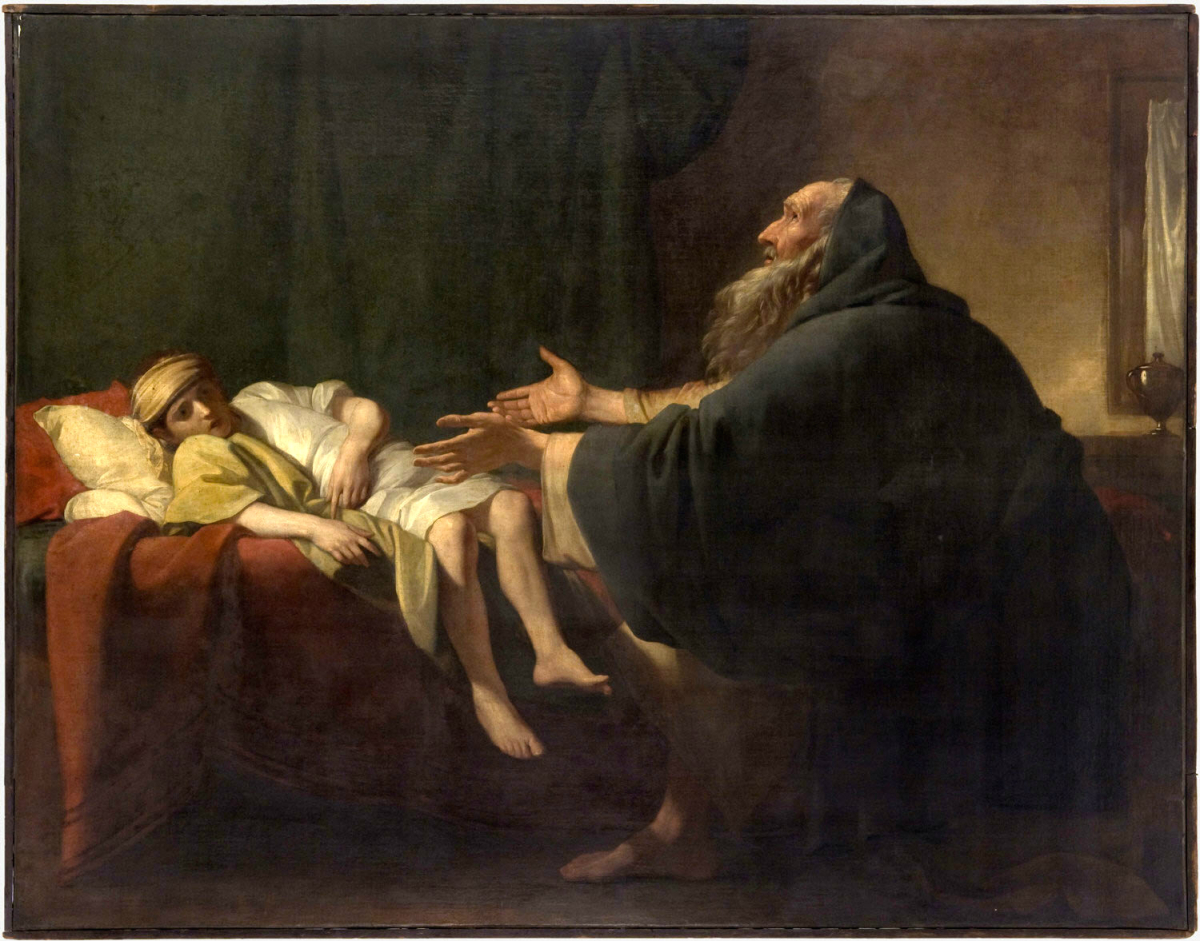
Cleansed As By Fire

1 “Behold, I send my messenger, and he will prepare the way before me. And the Lord whom you seek will suddenly come to his temple; and the messenger of the covenant in whom you delight, behold, he is coming, says the Lord of hosts. But who can endure the day of his coming, and who can stand when he appears? For he is like a refiner’s fire and like fullers’ soap. He will sit as a refiner and purifier of silver, and he will purify the sons of Levi and refine them like gold and silver, and they will bring offerings in righteousness to the Lord. Then the offering of Judah and Jerusalem will be pleasing to the Lord as in the days of old and as in former years.

“Then I will draw near to you for judgment. I will be a swift witness against the sorcerers, against the adulterers, against those who swear falsely, against those who oppress the hired worker in his wages, the widow and the fatherless, against those who thrust aside the sojourner, and do not fear me, says the Lord of hosts. – Malachi 3:1-5 ESV

The Israelites had dared to question the justice of God. They had willingly violated His commands and had suffered no consequences. So, in their minds, He was either impotent or indifferent to their behavior. But they were in for a rude awakening. Just because God had not yet punished them for their sins did not mean He was powerless to do so. He was the very same God who had sent them into exile 70 years earlier for having committed many of the very same sins against Him. He was gracious and merciful, but He was also righteous and just and determined to hold His people to their covenant commitments. God could not and would not leave their sins unpunished.

These verses deal with the present spiritual condition of the people of Israel by pointing to a future judgment to come. Through His messenger, Malachi, God warns of another messenger who will appear on the scene in the future, declaring the coming of the Lord.

“Look! I am sending my messenger, and he will prepare the way before me. – Malachi 3:1 NLT

The God they seem to believe was distant and disinterested was going to show up in their city and make an appearance in the temple.

Then the Lord you are seeking will suddenly come to his Temple. – Malachi 3:1 NLT

The Lord was going to make His presence known in the very place where they were offering blemished and unworthy offerings to Him. Malachi warns the people that the day was coming when Yahweh would make a personal appearance in His holy temple. And it’s important to note that the people of Israel had expressed their sorrow and confusion over His seeming absence and silence when they had offered their sacrifices to Him.

You cover the Lord’s altar with tears, with weeping and groaning because he no longer regards the offering or accepts it with favor from your hand. – Malachi 2:13 ESV

God would not always remain silent or hidden. He would one day respond to their sins and reveal Himself in all His might and power. But God states that His appearance will be preceded by “my messenger” (malʾakhi). While this is a variation of the prophet’s name, it does not refer to Malachi. Verse 5 of chapter 4 reveals this messenger’s identity.

“Behold, I will send you Elijah the prophet before the great and awesome day of the Lord comes. – Malachi 4:5 ESV

Malachi is recording a prophetic pronouncement from God that has a now-not-yet aspect to it. The reference to this future messenger and his designation as Elijah are all cleared up by a series of statements made by Jesus concerning John the Baptist.

“This is he of whom it is written,

“‘Behold, I send my messenger before your face,
    who will prepare your way before you.’” – Matthew 11:10 ESV

And Jesus went on to explain that John the Baptist was the “Elijah” of whom the prophets spoke.

“For all the Prophets and the Law prophesied until John, and if you are willing to accept it, he is Elijah who is to come. – Matthew 11:13-14 ESV

In a later exchange with His disciples, Jesus further clarified John the Baptist’s role as the “messenger” of God who would prepare the way for His coming.

And the disciples asked him, “Then why do the scribes say that first Elijah must come?” He answered, “Elijah does come, and he will restore all things. But I tell you that Elijah has already come, and they did not recognize him, but did to him whatever they pleased. So also the Son of Man will certainly suffer at their hands.” Then the disciples understood that he was speaking to them of John the Baptist. – Matthew 17:10-13 ESV

And even before John the Baptist’s birth, an angel of the Lord had appeared to Zechariah the priest, declaring that his barren wife would bear him a son.

“And he will turn many of the children of Israel to the Lord their God, and he will go before him in the spirit and power of Elijah, to turn the hearts of the fathers to the children, and the disobedient to the wisdom of the just, to make ready for the Lord a people prepared.” – Luke 1:16-17 ESV

The people of Israel longed for a divine “messenger” who would appear on the scene and reestablish the glory days of Israel. They were familiar with all the prophetic passages that spoke of a coming one who would be a son of David and set up His kingdom on earth. They dreamed of the day when this mighty warrior-king would make his appearance and put Israel back on the geopolitical map. They had no king and were living in the shadows of their more powerful pagan neighbors. So, they would have understood Malachi’s mention of  “the messenger of the covenant in whom you delight” as a reference to this long-hoped-for Messiah or savior.

And while God assures them that the Messiah is coming, He warns that His appearance will not be quite as joyful for them as they had hoped.

“But who will be able to endure it when he comes? Who will be able to stand and face him when he appears? For he will be like a blazing fire that refines metal, or like a strong soap that bleaches clothes. He will sit like a refiner of silver, burning away the dross. He will purify the Levites, refining them like gold and silver, so that they may once again offer acceptable sacrifices to the Lord.” – Malachi 3:2-3 NLT

Their idea of the messenger of the covenant was a deliverer who would fulfill all of the blessings that God had promised as part of His covenant commitment. But they failed to remember that the covenant was bi-lateral in nature. God’s blessings were contingent upon their obedience.

“And if you faithfully obey the voice of the Lord your God, being careful to do all his commandments that I command you today, the Lord your God will set you high above all the nations of the earth. And all these blessings shall come upon you and overtake you, if you obey the voice of the Lord your God.” – Deuteronomy 28:1-2 ESV

But as Malachi has already pointed out, they had not kept their part of the agreement. Like their ancestors, they had continued to disregard God’s laws and dishonor His holiness by bowing down to false gods. So, when this messenger of the covenant appears, He will come to purify and cleanse the people. He will be like a refining fire that purges all the dross from the gold so that what remains is pure and undefiled. This agent of God will perform a miraculous cleansing of God’s people so that they are able to come before Him in sinless purity.

“Then once more the Lord will accept the offerings brought to him by the people of Judah and Jerusalem, as he did in the past.” – Malachi 3:4 NLT

God will do for them what they were incapable of doing for themselves. He will purify and cleanse their hearts. The prophet Ezekiel spoke of this coming day of the Lord and the miraculous life-altering ministry of the Messiah.

“Therefore say to the house of Israel, Thus says the Lord God: It is not for your sake, O house of Israel, that I am about to act, but for the sake of my holy name, which you have profaned among the nations to which you came. And I will vindicate the holiness of my great name, which has been profaned among the nations, and which you have profaned among them. And the nations will know that I am the Lord, declares the Lord God, when through you I vindicate my holiness before their eyes. I will take you from the nations and gather you from all the countries and bring you into your own land. I will sprinkle clean water on you, and you shall be clean from all your uncleannesses, and from all your idols I will cleanse you. And I will give you a new heart, and a new spirit I will put within you. And I will remove the heart of stone from your flesh and give you a heart of flesh. And I will put my Spirit within you, and cause you to walk in my statutes and be careful to obey my rules.” – Ezekiel 36:22-27 ESV

In order for cleansing to take place, judgment will have to be leveled against all those who stand before God as impure and defiled by their sins. That is why God warns that, in the future, when the Messiah comes, He will “draw near to you for judgment” (Malachi 3:5 ESV). This cannot be speaking of Jesus’ first coming because Jesus clearly stated, “I did not come to judge the world but to save the world” (John 12:47 ESV). But at His second coming, Jesus will come as judge. In His righteousness, He will expose all sin and deal a blow to Satan and his demons.

In the present, Malachi is warning the Israelites that their sins are offensive to a holy God. And in the future, those sins will be exposed and dealt with. In order for cleansing to take place, all their sins will need to be revealed, confessed, and burned away. God wanted His people to understand that their current sins will one day face a future judgment. Their unrighteousness was a problem that needed to be addressed. They couldn’t ignore it or continue to justify it. Because God’s judgment of sin is inevitable and inescapable.

English Standard Version (ESV) The Holy Bible, English Standard Version. ESV® Permanent Text Edition® (2016). Copyright © 2001 by Crossway Bibles, a publishing ministry of Good News Publishers.

New Living Translation (NLT) Holy Bible, New Living Translation, copyright © 1996, 2004, 2015 by Tyndale House Foundation. Used by permission of Tyndale House Publishers Inc., Carol Stream, Illinois 60188. All rights reserved.

New English Translation (NET)NET Bible® copyright ©1996-2017 by Biblical Studies Press, L.L.C. http://netbible.com All rights reserved.