From Enemies to God’s Elect

28 As regards the gospel, they are enemies for your sake. But as regards election, they are beloved for the sake of their forefathers. 29 For the gifts and the calling of God are irrevocable. 30 For just as you were at one time disobedient to God but now have received mercy because of their disobedience, 31 so they too have now been disobedient in order that by the mercy shown to you they also may now receive mercy. 32 For God has consigned all to disobedience, that he may have mercy on all. – Romans 11:28-32 ESV

This is a fascinating and difficult passage that presents a somewhat confusing picture of God’s grace, which could easily lead us to accuse Him of injustice. But Paul’s is attempting to explain God’s plan concerning His chosen people, the Jews. For the time being, the Jews are experiencing “a partial hardening” until “the fullness of the Gentiles has come in” (Romans 11: 25 ESV). While the Israelites had been trying to earn a right standing with God, they had been going about it the wrong way, by attempting to keep the law in their own strength. When Jesus revealed Himself to be the true path to righteousness, they rejected Him. So, “God gave them a spirit of stupor, eyes that would not see and ears that would not hear, down to this very day” (Romans 11:8 ESV).

But God did not cause their hardening or spiritual callousness; He simply allowed their hearts to go where they were naturally bent to go. He did not intervene by extending them mercy. But if we conclude that God’s treatment of the Jews was unfair or unjust, we misunderstand mercy. God is not obligated to show mercy to anyone. By definition, mercy is a gift, not a requirement. However, justice is required. In a sense, mercy is non-justice. In other words, when God determines to extend mercy to anyone, He is choosing NOT to enact justice or to give them what they truly deserve.

The Old Testament Scriptures repeatedly show God extending mercy to the unrepentant and undeserving people of Israel. Their track record of disobedience and unfaithfulness to Him condemns them and warrants that justice be served. Their willful sin against Him deserved His righteous and holy sentence of just punishment. But instead, God graciously chose to show them mercy, His undeserved kindness, goodness, favor, and compassion. And to do so is God’s prerogative.

For God said to Moses, “I will show mercy to anyone I choose, and I will show compassion to anyone I choose.” – Romans 9:15 NLT

When God shows mercy, we have no cause to complain or to cry foul. What should amaze us is that God, in His patience and love, chooses to show anyone mercy. Because mercy is never deserved and can never be earned. Paul has made it clear that all men deserve God’s justice.

…for all have sinned and fall short of the glory of God. – Romans 3:23 ESV

…the wages of sin is death. – Romans 6:23 ESV

So if God chooses to extend His mercy to some, can we accuse Him of injustice? Paul would say, “No!”

Are we saying, then, that God was unfair? Of course not! For God said to Moses,

“I will show mercy to anyone I choose,
    and I will show compassion to anyone I choose.”

So it is God who decides to show mercy. We can neither choose it nor work for it. – Romans 9:14-16 NLT

Which brings us back to our passage. Paul contends that, as it pertains to the good news regarding salvation through Christ, the Jews were essentially enemies of God. Their rejection of Jesus as their Messiah had opened the door for the gospel to be preached to the Gentiles. But when it came to God’s sovereign election or choosing of the nation of Israel, they were still beloved in His eyes.

At this point, it appears that Paul is talking about the future state of Israel as a nation or a people. He is not referring to individual Jews or individual Gentiles in these verses. At one time in history, the Gentile nations had been alienated from God. They were separated from Him because of their sin. Paul reminded the Gentile believers in Ephesus of their former state of alienation from God.

Don’t forget that you Gentiles used to be outsiders. You were called “uncircumcised heathens” by the Jews, who were proud of their circumcision, even though it affected only their bodies and not their hearts. In those days you were living apart from Christ. You were excluded from citizenship among the people of Israel, and you did not know the covenant promises God had made to them. You lived in this world without God and without hope. – Ephesians 2:11-12 NLT

As non-Jews, they were excluded from citizenship among God’s chosen people. They could not claim the covenant promises God had made to Abraham. But Paul says that something changed all that.

But now you have been united with Christ Jesus. Once you were far away from God, but now you have been brought near to him through the blood of Christ. – Ephesians 2:13 NLT

Notice that he addresses them as a whole, as Gentiles. This does not mean that ALL Gentiles have come to faith in Christ, but that God has extended His undeserved mercy to “outsiders,” to non-Jews.

And Paul’s point is that God will do the same thing for the nation of Israel. While they are currently experiencing a hardness of heart and a spiritual callousness toward God and His offer of salvation through belief in His Son, the day is coming when He will show them mercy just as He has done for the Gentiles.

Once, you Gentiles were rebels against God, but when the people of Israel rebelled against him, God was merciful to you instead. Now they are the rebels, and God’s mercy has come to you so that they, too, will share in God’s mercy. – Romans 11:30-31 NLT

Paul wants us to understand that this is not a case of Gentiles replacing Jews as God’s favored people; it is about God extending mercy to those whom He sovereignly chooses. God’s mercy knows no prejudice. He is magnanimous and equitable when it comes to His mercy.

For God has imprisoned everyone in disobedience so he could have mercy on everyone. – Romans 11:32 NLT

Again, this does not mean that all will be saved, but that all share a common state of disobedience and alienation from God. If He does not choose to show mercy, no one will be saved, either Jew or Gentile.

Israel’s rejection of the Messiah did not put them beyond God’s mercy, and His inclusion of the Gentiles was not a sign of His exclusion of the Jews. It is a matter of timing. At present, during the period of the Gentiles, His focus is on bringing the full number of “outsiders” to faith in His Son. When that happens, He will turn His attention to the nation of Israel.

While this is difficult for us to understand, Paul is trying to explain the nature of God’s ways, which he admits are beyond our capacity for comprehension.

Oh, how great are God’s riches and wisdom and knowledge! How impossible it is for us to understand his decisions and his ways! – Romans 11:33 NLT

We may not understand God’s mercy, but we can certainly appreciate it and recognize that it is a gift freely given and never deserved.

Father, Your ways are beyond my capacity to understand. I don’t fully comprehend the magnitude of Your mercy. In fact, far too often I take it for granted and treat it with an attitude of complacency. But Paul would have me remember that mercy is a priceless gift that You pour out on the undeserving and unworthy. I did not choose You; it was the other way around. In my original sinful and self-centered state, I was incapable of recognizing the value of Your Son’s sacrifice on my behalf. I did not see myself as a sinner in need of a Savior. But through the power of the Holy Spirit, You opened my eyes to the truth of the gospel and allowed me to accept the gift of Your marvelous mercy. I deserved death, but You gave me life. I deserved justice and judgment, but You gave me justification, a right standing with You that I could never have earned or deserved. Oh, how great are you riches and wisdom and knowledge. Amen

English Standard Version (ESV) The Holy Bible, English Standard Version. ESV® Permanent Text Edition® (2016). Copyright © 2001 by Crossway Bibles, a publishing ministry of Good News Publishers.

New Living Translation (NLT) Holy Bible, New Living Translation, copyright © 1996, 2004, 2015 by Tyndale House Foundation. Used by permission of Tyndale House Publishers Inc., Carol Stream, Illinois 60188. All rights reserved.22
Weak, Unworthy, and Without Hope

For while we were still weak, at the right time Christ died for the ungodly. For one will scarcely die for a righteous person—though perhaps for a good person one would dare even to die— but God shows his love for us in that while we were still sinners, Christ died for us. Since, therefore, we have now been justified by his blood, much more shall we be saved by him from the wrath of God. 10 For if while we were enemies we were reconciled to God by the death of his Son, much more, now that we are reconciled, shall we be saved by his life. 11 More than that, we also rejoice in God through our Lord Jesus Christ, through whom we have now received reconciliation. – Romans 5:6-11 ESV

Peter tells us, “For Christ also suffered once for sins, the righteous for the unrighteous, that he might bring us to God, being put to death in the flesh but made alive in the spirit” (1 Peter 3:18 ESV).

The sinless one died for sinners. The innocent died for the guilty. The righteous sacrificed His life for the unrighteous, and not after we got our proverbial act together. Paul emphasizes the out-of-the-ordinary nature of this selfless, substitutionary act.

…most people would not be willing to die for an upright person, though someone might perhaps be willing to die for a person who is especially good. – Romans 5:7 NLT

As human beings, we would find it difficult, if not impossible, to give our lives even for someone whom we deemed to be righteous. We might do it, but we would have to give it some serious thought. But Jesus died for us while we were mired in our sinfulness. He didn’t die for us because we were righteous, but so that we might become righteous. In fact, when Jesus was asked why He hung out with tax collectors and sinners, He replied, “Those who are well have no need of a physician, but those who are sickFor I came not to call the righteous, but sinners” (Matthew 9:12, 13 ESV). That was the scope of His mission.

The implications of this are staggering. We live in a world where justice is defined as everyone getting what they deserve. We are taught that any good we experience in this life is ultimately earned and a direct result of our good behavior. But Paul turns that philosophy on its head, saying that our salvation was the result of God’s mercy and love, as expressed through the sacrificial death of His own Son. Rather than giving us what we deserved: death, God gave us what we didn’t deserve: eternal life through faith in His Son.

We deserved condemnation, but He provided pardon. We merited alienation from Him, but He made us His sons and daughters. We had earned His righteous wrath and just judgment, but He poured out His grace and forgiveness. And the amazing thing is that He did it out of love.

God showed his great love for us by sending Christ to die for us while we were still sinners. – Romans 5:8 NLT

In his late-night discussion with the Pharisee, Nicodemus, Jesus attempted to explain His God-given mission to save the world.

“…this is how God loved the world: He gave his one and only Son, so that everyone who believes in him will not perish but have eternal life. God sent his Son into the world not to judge the world, but to save the world through him.” – John 3:16-17 NLT

Years later, the apostle John would record his post-resurrection understanding of what Jesus accomplished through His death.

God showed how much he loved us by sending his one and only Son into the world so that we might have eternal life through him. This is real love—not that we loved God, but that he loved us and sent his Son as a sacrifice to take away our sins. – 1 John 4:9-10 NLT

Christ died for the ungodly. However, despite this gracious act of kindness, humanity refuses to come to grips with its own ungodliness. We struggle with the idea that we are sinners in need of a Savior. We hate the thought of being helpless, weak, and unable to save ourselves. We desperately want to believe that we can somehow earn our way into God’s good graces. But Paul will have none of it, because God refuses to grade on the curve or lower His standards in order to allow men to squeeze in under the bar.

It was the death of Jesus, His shed blood and broken body, that makes our right standing with God possible. Through the willing sacrifice of His own life, Jesus provided a way for sinful men to be made right with God and freed from ever having to face His righteous, holy wrath again. As Paul writes later in this same letter, “There is therefore now no condemnation for those who are in Christ Jesus” (Romans 8:1 ESV).

We have been reconciled with God. At one point, we were His enemies, but now we are His children. Because of Christ’s death, we have had our broken relationship with God restored — in this life. Because of Christ’s resurrection and ascension, we are assured a permanent right standing with God — for eternity. We are saved from the eternal wrath of God; that is the eventual lot of all men who refuse to accept His gift of salvation made possible through the death and resurrection of His Son.

Paul tells us that this reality should cause us to rejoice because “we have now received reconciliation” (Romans 5:11 ESV). It was the ancient writer, Origen, who said, “Paul stresses the now in order to indicate that our rejoicing is not merely a future hope but also a present experience” (Origen, Commentary on the Epistle to the Romans). We are reconciled with God. We are free from His wrath. We are righteous in His eyes. We are no longer His enemies. We are justified by God. All these things are present realities that hold future significance.

Ambrosiaster, a Christian author who lived in the middle to late fourth century, provides a wonderful analysis of Jesus’ gracious act of kindness on our behalf.

“If Christ gave himself up to death at the right time for those who were unbelievers and enemies of God … how much more will he protect us with his help if we believe in him! He died for us in order to obtain life and glory for us. So if he died for his enemies, just think what he will do for his friends!” – Ambrosiaster, Commentary on Paul’s Epistles

God loved us while we were still mired in our sin. Christ died for us because we were sinners. And we can trust God’s love to carry us through to the very end. We can rest on the truth of Paul’s declaration, “God, who began the good work within you, will continue his work until it is finally finished on the day when Christ Jesus returns” (Philippians 1:6 NLT).

Father, it is so easy to overlook and underappreciate the significance of the gospel. Even as a believer, I am tempted to minimize my own sinfulness and elevate my self-righteousness. But before I came to faith in Christ, there was nothing redeemable about me. I had done nothing worthy of Your love, grace, and mercy. I was unworthy of being saved but fully deserving of Your righteous condemation. Yet, out of love, You opened my eyes to the truth of the gospel and my need for a Savior. You helped me see the wretchedness of my condition and my inability to do anything about it. Through Your grace, I was transformed from a sinner into a saint, from being Your enemy to being Your adopted son. And one day, You will complete the process of my sanctifaction with my glorification so that I can spend eternity with You. That truly is amazing!   Amen

English Standard Version (ESV) The Holy Bible, English Standard Version. ESV® Permanent Text Edition® (2016). Copyright © 2001 by Crossway Bibles, a publishing ministry of Good News Publishers.

New Living Translation (NLT) Holy Bible, New Living Translation, copyright © 1996, 2004, 2015 by Tyndale House Foundation. Used by permission of Tyndale House Publishers Inc., Carol Stream, Illinois 60188. All rights reserved.22

No Restoration Without Repentance

A Maskil of Asaph.

1 O God, why do you cast us off forever?
    Why does your anger smoke against the sheep of your pasture?
Remember your congregation, which you have purchased of old,
    which you have redeemed to be the tribe of your heritage!
    Remember Mount Zion, where you have dwelt.
Direct your steps to the perpetual ruins;
    the enemy has destroyed everything in the sanctuary!

Your foes have roared in the midst of your meeting place;
    they set up their own signs for signs.
They were like those who swing axes
    in a forest of trees.
And all its carved wood
    they broke down with hatchets and hammers.
They set your sanctuary on fire;
    they profaned the dwelling place of your name,
    bringing it down to the ground.
They said to themselves, “We will utterly subdue them”;
    they burned all the meeting places of God in the land.

We do not see our signs;
    there is no longer any prophet,
    and there is none among us who knows how long.
10 How long, O God, is the foe to scoff?
    Is the enemy to revile your name forever?
11 Why do you hold back your hand, your right hand?
    Take it from the fold of your garment and destroy them!

12 Yet God my King is from of old,
    working salvation in the midst of the earth.
13 You divided the sea by your might;
    you broke the heads of the sea monsters on the waters.
14 You crushed the heads of Leviathan;
    you gave him as food for the creatures of the wilderness.
15 You split open springs and brooks;
    you dried up ever-flowing streams.
16 Yours is the day, yours also the night;
    you have established the heavenly lights and the sun.
17 You have fixed all the boundaries of the earth;
    you have made summer and winter.

18 Remember this, O LORD, how the enemy scoffs,
    and a foolish people reviles your name.
19 Do not deliver the soul of your dove to the wild beasts;
    do not forget the life of your poor forever.

20 Have regard for the covenant,
    for the dark places of the land are full of the habitations of violence.
21 Let not the downtrodden turn back in shame;
    let the poor and needy praise your name.

22 Arise, O God, defend your cause;
    remember how the foolish scoff at you all the day!
23 Do not forget the clamor of your foes,
    the uproar of those who rise against you, which goes up continually! Psalm 74:1-23 ESV

In the previous psalm, Asaph sought help and hope in the sanctuary of God, where his disgruntled outlook about the prosperity of the wicked was altered by a glimpse of God’s goodness and glory.

I tried to understand why the wicked prosper.
    But what a difficult task it is!
Then I went into your sanctuary, O God,
    and I finally understood the destiny of the wicked. – Psalm 73:16-17 NLT

Now, in Psalm 74, Asaph is no longer talking about the prosperity of the wicked; he is questioning the fall of Jerusalem and the destruction of the sanctuary. This unexpected and inexplicable tragedy has left Asaph shaken and questioning God’s presence and power. Israel’s beloved sanctuary, the dwelling place of Yahweh, has been destroyed, leaving Asaph and his fellow Israelites in a state of shock and dismay. Still reeling from this devastating calamity, Asaph calls on God to remedy the situation.

Remember that we are the people you chose long ago,
    the tribe you redeemed as your own special possession!
    And remember Jerusalem, your home here on earth.
Walk through the awful ruins of the city;
    see how the enemy has destroyed your sanctuary. – Psalm 74:2-3 NLT

While no timeline or details are provided that might explain what Asaph is describing, it seems safe to assume he is writing about the fall of Jerusalem to the Babylonians in 586 BC. The Book of Jeremiah provides graphic details concerning this fateful event, and its record corroborates Asaph’s description of Jerusalem’s fall.

On August 17 of that year, which was the nineteenth year of King Nebuchadnezzar’s reign, Nebuzaradan, the captain of the guard and an official of the Babylonian king, arrived in Jerusalem. He burned down the Temple of the Lord, the royal palace, and all the houses of Jerusalem. He destroyed all the important buildings in the city. Then he supervised the entire Babylonian army as they tore down the walls of Jerusalem on every side. Then Nebuzaradan, the captain of the guard, took as exiles some of the poorest of the people, the rest of the people who remained in the city, the defectors who had declared their allegiance to the king of Babylon, and the rest of the craftsmen. But Nebuzaradan allowed some of the poorest people to stay behind to care for the vineyards and fields. – Jeremiah 52:12-16 NLT

The Babylonians were methodical in their plunder and destruction, using axes to completely obliterate the Temple’s ornate interior. Anything of value was carted off to fill the treasury of the Babylonian king. Then, Asaph states, “they burned down all the places where God was worshiped” (Psalm 74:8 NLT). With the Temple’s destruction, the sacrificial system was effectively eliminated, leaving the people of Israel with no way to receive atonement for their sins and reconciliation with God. And as if that was not bad enough, Asaph informs God that the news just kept getting worse.

We no longer see your miraculous signs.
    All the prophets are gone,
    and no one can tell us when it will end.
How long, O God, will you allow our enemies to insult you?
    Will you let them dishonor your name forever?
Why do you hold back your strong right hand?
    Unleash your powerful fist and destroy them. – Psalm 74:9-11 NLT

It was as if God had completely abandoned His people, leaving them without a place for His presence to dwell and providing them with no communication as to when their fate would improve. Asaph can’t fathom why the sovereign, all-powerful God of Israel would allow their enemies to destroy the Temple, defame His name, and turn His chosen people into chattel.

In verses 12-17, Asaph reminisces about God’s past displays of power and deliverance. He uses creation imagery to describe Yahweh’s victory over the chaos that ruled over the universe.

In the beginning God created the heavens and the earth. The earth was formless and empty, and darkness covered the deep waters. And the Spirit of God was hovering over the surface of the waters.

Then God said, “Let there be light,” and there was light. – Genesis 1:1-3 NLT

But Asaph seems to be using the creation account as a metaphor for God’s victory over the Egyptians when He parted the waters of the Red Sea and destroyed the army of Pharaoh.

You split the sea by your strength
    and smashed the heads of the sea monsters.
You crushed the heads of Leviathan
    and let the desert animals eat him.
You caused the springs and streams to gush forth,
    and you dried up rivers that never run dry. – Psalm 74:13-15 NLT

Yahweh was all-powerful and fully capable of destroying Israel’s enemies, but in this case, Asaph felt as if God was doing nothing. He not only allowed the Babylonians to invade and destroy Jerusalem, but He also did nothing to pay them back for their actions. Asaph and his fellow Israelites waited for God to remember His covenant promises and act. He couldn’t understand God’s apparent apathy and inactivity. What was He waiting for? Why wouldn’t He avenge His people and defend the holiness of His name?

See how these enemies insult you, Lord.
    A foolish nation has dishonored your name.
Don’t let these wild beasts destroy your turtledoves.
    Don’t forget your suffering people forever. – Psalm 74:18-19 NLT

In his desire to see God intervene, Asaph conveniently overlooked Israel’s role in their own destruction. God had repeatedly warned them that their destruction was imminent and could only be avoided if they would repent of their idolatry and faithfully serve Him alone.

The Lord gave another message to Jeremiah. He said, “Go to the entrance of the Lord’s Temple, and give this message to the people: ‘O Judah, listen to this message from the Lord! Listen to it, all of you who worship here! This is what the Lord of Heaven’s Armies, the God of Israel, says:

“‘Even now, if you quit your evil ways, I will let you stay in your own land. But don’t be fooled by those who promise you safety simply because the Lord’s Temple is here. They chant, “The Lord’s Temple is here! The Lord’s Temple is here!” But I will be merciful only if you stop your evil thoughts and deeds and start treating each other with justice; only if you stop exploiting foreigners, orphans, and widows; only if you stop your murdering; and only if you stop harming yourselves by worshiping idols. Then I will let you stay in this land that I gave to your ancestors to keep forever.

 “‘Don’t be fooled into thinking that you will never suffer because the Temple is here. It’s a lie! Do you really think you can steal, murder, commit adultery, lie, and burn incense to Baal and all those other new gods of yours, and then come here and stand before me in my Temple and chant, “We are safe!”—only to go right back to all those evils again? Don’t you yourselves admit that this Temple, which bears my name, has become a den of thieves? Surely I see all the evil going on there. I, the Lord, have spoken! – Jeremiah 7:1-11 NLT

But the people had failed to heed God’s warnings, and He sent the Babylonians to carry out His judgment. While Asaph is persistent in his pleas for God’s mercy and intervention, he makes no mention of Israel’s sin and their need to repent. There are no words of confession or signs of contrition. He wants God to keep His covenant promises, but never admits that the Israelites had failed to hold up their end of the agreement.

Arise, O God, and defend your cause.
    Remember how these fools insult you all day long.
Don’t overlook what your enemies have said
    or their growing uproar. – Psalm 74:22-23 NLT

Asaph seems to have conveniently forgotten the words that God spoke to Solomon at the dedication of the Temple hundreds of years earlier. Yahweh made it painfully clear that His presence, power, and provision would be tied to the Israelites’ covenant faithfulness. He would dwell among them as long as they remained faithful to Him and Him alone.

“But if you or your descendants abandon me and disobey the commands and decrees I have given you, and if you serve and worship other gods, then I will uproot Israel from this land that I have given them. I will reject this Temple that I have made holy to honor my name. I will make Israel an object of mockery and ridicule among the nations. And though this Temple is impressive now, all who pass by will be appalled and will gasp in horror. They will ask, ‘Why did the Lord do such terrible things to this land and to this Temple?’” – 1 Kings 9:6-8 NLT

Asaph wanted to see God work. He longed for the Almighty to use His vast power to rectify their problem, but he never acknowledged their role in their own destruction. He wanted deliverance without confession and restored fellowship without repentance. But God had made His requirements known. At the dedication of the Temple, He told Solomon what the people would need to do if they wanted to receive forgiveness and experience restoration.

“…if my people who are called by my name will humble themselves and pray and seek my face and turn from their wicked ways, I will hear from heaven and will forgive their sins and restore their land. – 2 Chronicles 7:14 NLT

Father, what a sobering reminder that my sin has consequences and while I am free to call on Your to deliver me from the suffering sin produces, You demand my contrition and confession. You have told us that if we confess our sins, You are faithful and just to forgive them and to cleanse us from all unrighteousness. But we tend to want the cleansing without confession. We want restoration without repentance. Help me to understand that my sins, while forgiven, can never be overlooked or treated as irrelevant. You still demand faithfulness. You still require humility of Your people. And when we take ownership for our sin, You always keep Your promise to restore and renew us. Thank you! Amen

English Standard Version (ESV) The Holy Bible, English Standard Version. ESV® Permanent Text Edition® (2016). Copyright © 2001 by Crossway Bibles, a publishing ministry of Good News Publishers.

New Living Translation (NLT) Holy Bible, New Living Translation, copyright © 1996, 2004, 2015 by Tyndale House Foundation. Used by permission of Tyndale House Publishers Inc., Carol Stream, Illinois 60188. All rights reserved.

Our Hope Is In God

To the choirmaster: according to Shushan Eduth. A Miktam of David; for instruction; when he strove with Aram-naharaim and with Aram-zobah, and when Joab on his return struck down twelve thousand of Edom in the Valley of Salt.

1 O God, you have rejected us, broken our defenses;
    you have been angry; oh, restore us.
You have made the land to quake; you have torn it open;
    repair its breaches, for it totters.
You have made your people see hard things;
    you have given us wine to drink that made us stagger.

You have set up a banner for those who fear you,
    that they may flee to it from the bow. Selah
That your beloved ones may be delivered,
    give salvation by your right hand and answer us!

God has spoken in his holiness:
    “With exultation I will divide up Shechem
    and portion out the Vale of Succoth.
Gilead is mine; Manasseh is mine;
    Ephraim is my helmet;
    Judah is my scepter.
Moab is my washbasin;
    upon Edom I cast my shoe;
    over Philistia I shout in triumph.”

Who will bring me to the fortified city?
    Who will lead me to Edom?
10 Have you not rejected us, O God?
    You do not go forth, O God, with our armies.
11 Oh, grant us help against the foe,
    for vain is the salvation of man!
12 With God we shall do valiantly;
    it is he who will tread down our foes. Psalm 60:1-12 ESV

The Book of 2 Samuel records a series of military victories that King David and his army achieved. Among his many conquests are his defeats of the Philistines and the Moabites and a lopsided victory over Hadadezer, son of Rehob, king of Zobah. On that occasion, his troops “captured 1,000 chariots, 7,000 charioteers, and 20,000 foot soldiers” (2 Samuel 8:4 NLT), as well as 22,000 Aramean mercenaries who fought on behalf of Hadadezer.

With each victory, David’s reputation grew, and his wealth increased. Through the taking of plunder and the receipt of tributes from the defeated nations, Israel’s royal treasury was greatly enriched. But the king recognized that his success on the battlefield had been God’s doing, not his own.

King David dedicated all these gifts to the Lord, as he did with the silver and gold from the other nations he had defeated—from Edom, Moab, Ammon, Philistia, and Amalek—and from Hadadezer son of Rehob, king of Zobah. – 2 Samuel 8:11-12 NLT

David gratefully honored Yahweh as the source behind Israel’s many victories over their enemies. He humbly recognized that his growing list of conquests was due to God’s presence, power, and provision. The following two verses reveal that David’s humility actually enhanced his reputation because God continued to honor him for his submission and reverence.

So David became even more famous when he returned from destroying 18,000 Edomites in the Valley of Salt. He placed army garrisons throughout Edom, and all the Edomites became David’s subjects. In fact, the Lord made David victorious wherever he went. – 2 Samuel 8:13-14 NLT

Psalm 60 refers to this victory, but the discrepancy in the number of Edomites defeated is unexplained. But whether the number was 12,000 or 18,000, the battle was a rousing success. Yet, David opens up Psalm 60 on a rather negative note.

You have rejected us, O God, and broken our defenses.
    You have been angry with us; now restore us to your favor.
You have shaken our land and split it open.
    Seal the cracks, for the land trembles.
You have been very hard on us,
    making us drink wine that sent us reeling.
But you have raised a banner for those who fear you—
    a rallying point in the face of attack. – Psalm 60:1-4 NLT

Evidently, the battle didn’t initially go in Israel’s favor. The Israelites marched out under the banner of the LORD, only to have their defenses broken and their morale shattered. This was not the outcome David expected, and he voiced his concern to God. He begged God to intervene and rescue His people, and reminded God of His previous promise to defeat their enemies.

God has spoken in his holiness:
    “With exultation I will divide up Shechem
    and portion out the Vale of Succoth.
Gilead is mine; Manasseh is mine;
    Ephraim is my helmet;
    Judah is my scepter.
Moab is my washbasin;
    upon Edom I cast my shoe;
    over Philistia I shout in triumph.” – Psalm 60:6-8 ESV

This temporary defeat made no sense. It was unexpected and demoralizing. But David knew that he could count on God to hear his prayer and turn their failure into victory.

Oh, please help us against our enemies,
    for all human help is useless.
With God’s help we will do mighty things,
    for he will trample down our foes. – Psalm 60:11-12 NLT

I can’t imagine what it was like to have been king of the nation of Israel. While I’m sure the job had its perks, it also came with its fair share of headaches. Ruling any country is difficult, but trying to lead a people group who happened to be the hand-picked possession of God Himself was no easy task. First, you had God for your employer. Forget about Congress, your cabinet, or even your constituents. At the end of the day, every action you took was being carefully critiqued by none other than God. Now that’s pressure.

On top of that, you had the unenviable task of trying to lead a people who greatly disliked being led. Leading the nation of Israel was like herding cats – nearly impossible. By God’s own opinion, these people were inherently stiff-necked, stubborn, rebellious, and had foreheads of iron. In other words, they were obstinate. As the king of Israel, you weren’t free to make up your own rules as you went along, but were obligated to enforce the laws of God. Of course, some of Israel’s kings ignored that part and suffered the consequences. But for David, obeying God was a high priority, and maintaining His laws, decrees, and commands was job number one.

Then there was the problem of Israel’s enemies, and there were a lot of them. This little land was surrounded on all sides by nations intent on its destruction. Philistines, Moabites, Ammonites, Aramaens, Edomites, Jebusites, and just about every other nation that existed at that time, both large and small. They all had it in for Israel, and were a constant threat to the nation’s existence.

As king, David had to constantly be prepared to defend the kingdom and the reputation of God. Even though David was “a man after God’s own heart,” things didn’t always go his way. He didn’t always win every battle. His exploits didn’t always meet with success. This Psalm was written with one of those times in mind. David opens up the Psalm describing what was an apparent defeat at the hands of his enemies. They had broken through his defenses and driven Israel back in defeat. Because David was so strongly dependent on God, he couldn’t help but wonder if all this was some form of divine punishment. He viewed this latest military setback as coming from the hand of God. So, he appealed to God for mercy and begged Him to rescue the nation from the hands of their enemies.

Now rescue your beloved people.
    Answer and save us by your power. – Psalm 60:5 NLT

David was a mighty warrior and a highly successful king, but he knew where his strength came from: God. One of David’s greatest fears was that God might ever reject him and remove His favor from him. He even asks God, “Have you rejected us, O God? Will you no longer march with our armies?” (Psalm 60:11 NLT).

David knew the ramifications if that were ever to happen. He understood that their existence was solely based on the favor and power of God. Without God, David was nothing, and he knew it. Without God, the nation of Israel was nothing, and David understood that sobering fact as well. So he called out to God, “Oh, please help us against our enemies, for all human help is useless” (Psalm 60:11 NLT).

There is much we can learn from David’s humble awareness of his need for God. Without God’s help, we are helpless and hopeless. We are His people and He is our King and it is He who protects us, provides for us, gives us victory, keeps us safe, and meets all our needs. It is to Him we should turn in both the good times and the bad times. All human help is useless. Placing our hope in anyone or anything other than God will always prove dangerous and highly disappointing. We may win the battle, but we will end up losing the war. But David knew that “with God’s help we will do mighty things, for he will trample down our foes” (Psalm 60:12 NLT). Even this powerful king knew that he was nothing without the help of his all-powerful God.

Father, how ludicrous it is to think that I can somehow save myself. How silly for me to imagine that I can come up with a plan to save myself from all the enemies I face every day. Without You I am nothing. I have no strength without You. I have no wisdom apart from You. I have no future unless You provide it. I have no hope other than You. But with Your help I will do mighty things! Amen

English Standard Version (ESV) The Holy Bible, English Standard Version. ESV® Permanent Text Edition® (2016). Copyright © 2001 by Crossway Bibles, a publishing ministry of Good News Publishers.

New Living Translation (NLT) Holy Bible, New Living Translation, copyright © 1996, 2004, 2015 by Tyndale House Foundation. Used by permission of Tyndale House Publishers Inc., Carol Stream, Illinois 60188. All rights reserved.

God of the Impossible

1 The oracle of the word of the LORD is against the land of Hadrach
    and Damascus is its resting place.
For the Lord has an eye on mankind
    and on all the tribes of Israel,
and on Hamath also, which borders on it,
    Tyre and Sidon, though they are very wise.
Tyre has built herself a rampart
    and heaped up silver like dust,
    and fine gold like the mud of the streets.
But behold, the Lord will strip her of her possessions
    and strike down her power on the sea,
    and she shall be devoured by fire.

Ashkelon shall see it, and be afraid;
    Gaza too, and shall writhe in anguish;
    Ekron also, because its hopes are confounded.
The king shall perish from Gaza;
    Ashkelon shall be uninhabited;
a mixed people shall dwell in Ashdod,
    and I will cut off the pride of Philistia.
I will take away its blood from its mouth,
    and its abominations from between its teeth;
it too shall be a remnant for our God;
    it shall be like a clan in Judah,
    and Ekron shall be like the Jebusites.
Then I will encamp at my house as a guard,
    so that none shall march to and fro;
no oppressor shall again march over them,
    for now I see with my own eyes. – Zechariah 9:1-8 ESV

Yahweh now delivers an oracle to Zechariah. The Hebrew word translated as “oracle” is maśśā’, which means “to lift up” or “to bear up.” Figuratively, it could refer to a pronouncement or prophecy that had a “burden” or “weight” associated with it. In this case, Yahweh is predicting the coming destruction of Israel’s many enemies. At the same time, He is announcing the coming of Israel’s long-awaited King and Messiah. The first eight verses paint a bleak and inescapable future for the nations that have stood opposed to Israel’s well-being for centuries. Zechariah is informed that each of these pagan nations will suffer the consequences for their treatment of God’s chosen people.

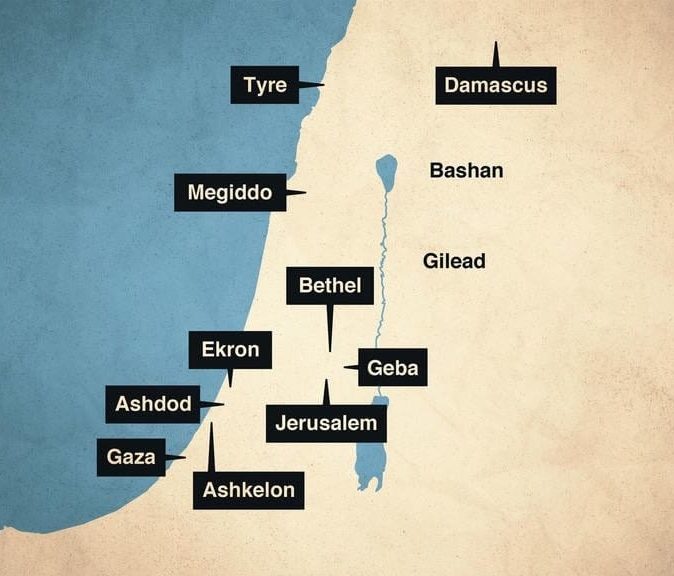
Yahweh lists a variety of cities surrounding Jerusalem, from Damascus in the north to Ashkelon in the south. He begins His list in the north in the region known as Hadrach, but He focuses His oracle on the city of Damascus. From there, Yahweh moves south, listing the names of additional doomed cities as He makes His way to Ashdod, Ashkelon, and Gaza. This north-to-south route is significant because it mirrors the path the Assyrians and Babylonians took when they conquered Israel and Judah. Earlier prophets had predicted the coming destruction of the northern and southern kingdoms by these two nations, a fate ordained by God for His people’s continued rebellion against Him.

“But I have stirred up a leader who will approach from the north.
From the east he will call on my name.
I will give him victory over kings and princes.
He will trample them as a potter treads on clay. – Isaiah 41:25 NLT

“Yes,” the Lord said, “for terror from the north will boil out on the people of this land. Listen! I am calling the armies of the kingdoms of the north to come to Jerusalem. I, the Lord, have spoken!

“They will set their thrones
at the gates of the city.
They will attack its walls
and all the other towns of Judah.
I will pronounce judgment
on my people for all their evil—
for deserting me and burning incense to other gods.
Yes, they worship idols made with their own hands! – Jeremiah 1:14-16 NLT

“This is what the Sovereign Lord says: From the north I will bring King Nebuchadnezzar of Babylon against Tyre. He is king of kings and brings his horses, chariots, charioteers, and great army. First he will destroy your mainland villages. Then he will attack you by building a siege wall, constructing a ramp, and raising a roof of shields against you.He will pound your walls with battering rams and demolish your towers with sledgehammers. The hooves of his horses will choke the city with dust, and the noise of the charioteers and chariot wheels will shake your walls as they storm through your broken gates. His horsemen will trample through every street in the city. They will butcher your people, and your strong pillars will topple. – Ezekiel 7:7-11 NLT

Yahweh is announcing His intention to take the same path of destruction to mete out judgment upon the enemies of His people. He will begin in the north with Damascus and work His way down the coast to the land of the Philistines.

This prophecy was partially fulfilled in 333 B.C. when Alexander the Great passed through the region on his way to Egypt. He focused his attention on the coastal cities, destroying all ports used by the Achaemenid Empire but leaving the Jews relatively undisturbed. Alexander’s march to the south left many of these same cities destroyed but they would eventually rise from the ashes and continue their mistreatment of the people of Israel. What Yahweh has in store for them will be far more destructive and permanent than anything they suffered at the hands of the Greeks.

The English Standard Version translates verse 1 as “the LORD has an eye on mankind and on all the tribes of Israel.” While it is obvious that the all-knowing, all-seeing Yahweh is always watching over the affairs of men, most translators render this verse differently.

…the eyes of humanity, including all the tribes of Israel, are on the LORD. – NLT

…the eyes of men and of all the tribes of Israel are upon the LORD. – BSB

…for the eyes of mankind, especially of all the tribes of Israel, are toward the LORD. – NASB

This human-based perspective is important because it indicates that all will know and understand that this future judgment is the work of Yahweh. Everyone will comprehend the divine nature of the destruction. This won’t be the work of some world super-power, it will be the hand of Adonai, the LORD of Hosts.

the Lord will strip away Tyre’s possessions
and hurl its fortifications into the sea,
and it will be burned to the ground.– Zechariah 9:4 NLT

The city of Ashkelon will see Tyre fall
and will be filled with fear.
Gaza will shake with terror,
as will Ekron, for their hopes will be dashed.
Gaza’s king will be killed,
and Ashkelon will be deserted.– Zechariah 9:4 NLT

These powerful, wealthy, and influential cities will suffer fear, humiliation, and elimination at the hands of Israel’s God. Their wealth will do them no good. Their armies will be impotent and unable to defend them. The once-great Philistine empire that had plagued the people of Israel for centuries would fall, never to rise again. The oracle even predicts the conversion of any Philistines who manage to make it out alive.

Then the surviving Philistines will worship our God
    and become like a clan in Judah.
The Philistines of Ekron will join my people,
    as the ancient Jebusites once did. – Zechariah 9:7 NLT

The content of this oracle must have been difficult for Zechariah to get his head around. It was good news but it all sounded so far-fetched and impossible. It didn’t get any more believable when God claimed, “I will guard my Temple and protect it from invading armies. I am watching closely to ensure that no more foreign oppressors overrun my people’s land” (Zechariah 9:8 NLT).

God was telling Zechariah incredible news regarding Israel’s future. Not only will Israel be restored, Jerusalem rebuilt, and the Temple completed, but the people of Israel will prosper, filling the land, and serving Him faithfully. Things were going to be radically different. Instead of punishing His people as He had done in the past, God was going to bless them abundantly and restore them to favor. This news had to be difficult for Zechariah to comprehend as he looked around at a partially completed foundation on the Temple, the broken-down walls, and the demoralized remnant who struggled to fulfill the task God had given them due to the scope of the project and the presence of opposition. Yet, Yahweh had assured Zechariah that He was the God of the impossible.

“This is what the Lord of Heaven’s Armies says: All this may seem impossible to you now, a small remnant of God’s people. But is it impossible for me? says the Lord of Heaven’s Armies.” – Zechariah 8:6 NLT

It’s as if God said, “I know this doesn’t look so good right now, but don’t judge Me based on what you see.” Yahweh wanted Zechariah to focus on His promises, not the pressing problems that seemed to never go away.

Yahweh knew that Zechariah and the beleaguered people of Judah were struggling to keep the faith. They were growing weary and questioning whether all their hard work would be worth it. So, God pointed them to the future. He predicted a brighter tomorrow that was beyond their powers of comprehension. But He had proven Himself faithful in the past and could be trusted to fulfill His plans for the future.

Yet, God’s people have always struggled with doubt and the inability to take God at His word. Even today, those who claim to believe in an all-powerful, promise-keeping God, find themselves wondering where He is and what He is doing. They take a look at their current circumstances and make sweeping judgments regarding everything from God’s faithfulness and presence to His love and power. When things don’t go well, God’s people automatically assume that He is either angry or oblivious to their needs. He is upset and punishing them. He is out of touch and ignorant of them. Their prayers don’t get answered, so they conclude He does not hear or does not care.

In time, their view of life begins to influence their view of God. In a sense, Yahweh tells Zechariah, “I know this all seems impossible to you right now. After all, there’s just a handful of you and the job is far from complete. BUT THIS ISN’T ABOUT YOU!”

The point of it all was that God could do the impossible. He knew what was going on and was well aware of the situation taking place in Jerusalem. He had a full grasp of the facts regarding the status of the Temple, the presence of opposition, the size of the workforce, and the condition of their hearts. Which explains the depth and detail of His message to Zechariah.

He told Zechariah, “Be strong and finish the task!” (Zechariah 8:9 NLT) and “Don’t be afraid. Be strong, and get on with rebuilding the Temple” (Zechariah 8:13 NLT). It wasn’t about their strength and ability to get things done, it was about their faith and trust in a God who could do ANYTHING. They just needed to do what He had called them to do and leave the rest up to Him. God had returned them to the promised land, provided a royal edict to secure their work, and secured the funds to pay for the entire restoration project. He had done His part but they had failed to complete theirs. It was far too easy for them to look at their relative lack of success and the overwhelming size of the task and become disillusioned.

The same thing can be true of us. We get overwhelmed by circumstances and begin to feel we are in over our heads. We start to wonder if God is with us at all. But whenever we think it’s all up to us, we miss the point. Nothing is impossible for God. There is nothing He can’t handle. There is nothing we face that is outside of His sovereign control and divine will. Like Zechariah and the people of Judah, we must constantly remind ourselves that nothing is impossible for God. That’s the message we need to hear. There is nothing that He can’t do. There is not a single circumstance that is out of His ability or power to handle. And not only that, but nothing is impossible for God. That’s the message of the Bible. It is all about God, not us. It is about His power, His will, His promises, His faithfulness, His salvation, His Kingdom, and His ability to finish what He has begun and restore what is broken. Nothing is impossible for Him.

English Standard Version (ESV)
The Holy Bible, English Standard Version. ESV® Permanent Text Edition® (2016). Copyright © 2001 by Crossway Bibles, a publishing ministry of Good News Publishers.

New Living Translation (NLT)
Holy Bible, New Living Translation, copyright © 1996, 2004, 2015 by Tyndale House Foundation. Used by permission of Tyndale House Publishers Inc., Carol Stream, Illinois 60188. All rights reserved.

To God Be the Glory

1 Now when Sanballat and Tobiah and Geshem the Arab and the rest of our enemies heard that I had built the wall and that there was no breach left in it (although up to that time I had not set up the doors in the gates), Sanballat and Geshem sent to me, saying, “Come and let us meet together at Hakkephirim in the plain of Ono.” But they intended to do me harm. And I sent messengers to them, saying, “I am doing a great work and I cannot come down. Why should the work stop while I leave it and come down to you?” And they sent to me four times in this way, and I answered them in the same manner. In the same way Sanballat for the fifth time sent his servant to me with an open letter in his hand. In it was written, “It is reported among the nations, and Geshem also says it, that you and the Jews intend to rebel; that is why you are building the wall. And according to these reports you wish to become their king. And you have also set up prophets to proclaim concerning you in Jerusalem, ‘There is a king in Judah.’ And now the king will hear of these reports. So now come and let us take counsel together.” Then I sent to him, saying, “No such things as you say have been done, for you are inventing them out of your own mind.” For they all wanted to frighten us, thinking, “Their hands will drop from the work, and it will not be done.” But now, O God, strengthen my hands.

10 Now when I went into the house of Shemaiah the son of Delaiah, son of Mehetabel, who was confined to his home, he said, “Let us meet together in the house of God, within the temple. Let us close the doors of the temple, for they are coming to kill you. They are coming to kill you by night.” 11 But I said, “Should such a man as I run away? And what man such as I could go into the temple and live? I will not go in.” 12 And I understood and saw that God had not sent him, but he had pronounced the prophecy against me because Tobiah and Sanballat had hired him. 13 For this purpose he was hired, that I should be afraid and act in this way and sin, and so they could give me a bad name in order to taunt me. 14 Remember Tobiah and Sanballat, O my God, according to these things that they did, and also the prophetess Noadiah and the rest of the prophets who wanted to make me afraid.

15 So the wall was finished on the twenty-fifth day of the month Elul, in fifty-two days. 16 And when all our enemies heard of it, all the nations around us were afraid and fell greatly in their own esteem, for they perceived that this work had been accomplished with the help of our God. 17 Moreover, in those days the nobles of Judah sent many letters to Tobiah, and Tobiah’s letters came to them. 18 For many in Judah were bound by oath to him, because he was the son-in-law of Shecaniah the son of Arah: and his son Jehohanan had taken the daughter of Meshullam the son of Berechiah as his wife. 19 Also they spoke of his good deeds in my presence and reported my words to him. And Tobiah sent letters to make me afraid. Nehemiah 6:1-19 ESV

After nearly two months of back-breaking, round-the-clock effort, the citizens of Jerusalem could see the fruits of all their hard work. The walls were nearing completion and the next step was to hang the gates on their hinges. Nehemiah must have experienced a deep sense of relief and satisfaction as he considered the magnitude of what they had accomplished. The last 52 days had been difficult and filled with setbacks, threats of violence, bitter infighting, and moments of doubt and despair. But despite the odds and with the help of God, the people remained focused, committed to their cause, and completed the project in record time.

This rag-tag group of returned exiles accomplished a project of herculean proportions, a job that should have taken years even under the best of circumstances. But their joy at having completed this massive defensive structure would be shortlived. Even when the gates were hung and everyone was snuggled safely inside the walls, their enemies would remain relentless in their attacks. No swords were drawn and no blood was spilled, but the animus of their enemies never dissipated. In fact, it only increased and took on a more clever and clandestine form.

As the last stones were placed on the wall, the enemies of Judah became more frightened and demoralized than ever, but why? Because they sensed that this project had been divinely ordained. Yahweh, the God of Judah was somehow involved; there was no other explanation. They had done everything in their power to stop the work, but it continued unabated. They had tried to discourage Nehemiah and the people from finishing their work but had failed. Their conclusion? The deity of Judah had somehow been involved. They could recognize that the completion of the wall in just 52 days was the result of divine intervention. This had been no ordinary construction project.

Desperate to forestall the hanging of the gates which would finalize the project, Sanballat and Geshem the Arab sent a message to Nehemiah requesting a meeting at an off-site location. These men were desperate to put an end to Nehemiah’s efforts and devised a plan to lure him out of Jerusalem under the guise of a peaceful parley. The invited him to join them at a small village in the plain of Ono located about 25 miles northwest of Jerusalem, close to the border of Samaria.

Nehemiah saw through their ploy and turned down their invitation, stating, “I am engaged in a great work, so I can’t come. Why should I stop working to come and meet with you?” (Nehemiah 6:3 NLT). He knew their intentions were evil so he refused their deceptive request for a “peaceful” conclave. But these men refused to take no for an answer and sent four additional requests that produced the same results. Finally, they sent a servant with a handwritten message intended to frighten Nehemiah.

“There is a rumor among the surrounding nations, and Geshem tells me it is true, that you and the Jews are planning to rebel and that is why you are building the wall. According to his reports, you plan to be their king. He also reports that you have appointed prophets in Jerusalem to proclaim about you, ‘Look! There is a king in Judah!’

“You can be very sure that this report will get back to the king, so I suggest that you come and talk it over with me.” – Nehemiah 6:6-7 NLT

Sanballat tried to portray himself as a concerned subject of the king and a well-meaning friend who was trying to inform Nehemiah of a potential problem. According to Sanballat, a vicious rumor was going around that accused Nehemiah of fostering insurrection and fomenting rebellion among the Jews. Sanballat suggests that he doubts the accusations but will have to share them with the king unless Nehemiah agrees to meet with him. This was a form of blackmail plain and simple. These trumped-up charges are completely fabricated but they are dangerous nonetheless.

But Nehemiah is unphased by Sanballat’s poorly veiled ploy. He matter-of-factly responded, “There is no truth in any part of your story. You are making up the whole thing” (Nehemiah 6:8 NLT). Although the rumors were lies, Nehemiah knew these men would not hesitate to follow through with their threat and present these slanderous accusations about him to the king. But he refused to be intimidated or deterred and continued to encourage the people to complete the project “with even greater determination” (Nehemiah 6:9 NLT).

But Sanballat and his co-conspirators would not give up. They enlisted the aid of a local citizen of Judah named Shemaiah. This man was confined to his home for some undisclosed reason. It could have been for the fulfillment of a vow or ceremonial uncleanness. Perhaps he had sustained injury while working on the wall. But whatever the case, he invited Nehemiah to come to his home where he shared a “prophecy” he had received. This man claims to have received a word from God that Nehemiah’s life is in danger and he must seek shelter in the Temple.

“Let us meet together inside the Temple of God and bolt the doors shut. Your enemies are coming to kill you tonight.” – Nehemiah 6:10 NLT

Nehemiah knew Shemaiah well and had no reason to doubt his sincerity and concern. But Shemaiah’s “prophecy” made no sense. His recommendation for Nehemiah to seek shelter in the Temple directly violated the Mosaic Law. No one but the Levitical priests was allowed access to the inner recesses of the Temple, upon penalty of death (Numbers 1:51; 3:10; 18:7). Shemaiah’s solution to the supposed assassination attempt on Nehemiah’s life was non-sensical. To escape death, Nehemiah would come under a death sentence from God. This ploy was the handiwork of Sanballat and his friends. They were hoping to induce Nehemiah to seek shelter in the Temple and violate the laws of his God.

It seems that Sanballat was attempting to discredit Nehemiah among the Jews by getting him to violate the Mosaic Law. If Nehemiah had taken Shemaiah’s advice, he would have shown that his life was more important than God’s commands. This would have tarnished his reputation among the people and given credence to the rumor that he was a self-centered and self-promoting aspirant to the throne of Judah.

But Nehemiah recognized Shemaiah as a pawn in their thinly veiled plot to discredit him.

They were hoping to intimidate me and make me sin. Then they would be able to accuse and discredit me. – Nehemiah 6:13 NLT

Sanballat and his companions were pulling out all the stops. They were using their financial resources to buy informants and grease the palms of greedy prophets who were willing to use their positions for personal gain. But their efforts failed.

After 52 days, the walls were completed and the gates were hung. But this didn’t prevent the letters, accusations, payoffs, and personal attacks on Nehemiah from continuing unabated. God’s work will always face opposition. The enemy will always attack and do everything in his power to thwart the will of God.

But the efforts of God’s people brought God glory.

When our enemies and the surrounding nations heard about it, they were frightened and humiliated. They realized this work had been done with the help of our God. – Nehemiah 6:14 NLT

On how many occasions does our work bring God glory? Do the projects we take on reflect the power of God or simply our own initiative and self-sufficiency? God wants to reveal His glory through His people. He wants to demonstrate His power despite our weakness. He wants to display His might through us as we accomplish His will.

God is not interested in seeing what we can do. He is not impressed with our strength and organizational abilities. That doesn’t mean we don’t have to do our part but we always have to remember, when all is said and done, God is the one who should receive the glory. The rebuilding of the wall was God’s idea. He had predicted it long in advance through the words of Daniel (Daniel 9:25). God had arranged for the people to return to the land of Judah. He had led Nehemiah to request permission from King Artaxerxes to lead back a group of exiles to rebuild the walls. God had protected and provided for them all along the way and now the work was done.

Yes, the people had worked hard. They had sore muscles, aching backs, and blistered hands to prove it. But all their efforts would have been nothing without the help of God, and even their enemies knew it. Nehemiah had led the people well, orchestrated their work flawlessly, and encouraged their efforts successfully, but without God, none of it would have mattered.

We do the work. God gets the glory. That’s the way it’s intended to be.

English Standard Version (ESV)
The Holy Bible, English Standard Version. ESV® Permanent Text Edition® (2016). Copyright © 2001 by Crossway Bibles, a publishing ministry of Good News Publishers.

New Living Translation (NLT)
Holy Bible, New Living Translation, copyright © 1996, 2004, 2015 by Tyndale House Foundation. Used by permission of Tyndale House Publishers Inc., Carol Stream, Illinois 60188. All rights reserved.

God of the Impossible

Then I came to the governors of the province Beyond the River and gave them the king’s letters. Now the king had sent with me officers of the army and horsemen. 10 But when Sanballat the Horonite and Tobiah the Ammonite servant heard this, it displeased them greatly that someone had come to seek the welfare of the people of Israel.

11 So I went to Jerusalem and was there three days. 12 Then I arose in the night, I and a few men with me. And I told no one what my God had put into my heart to do for Jerusalem. There was no animal with me but the one on which I rode. 13 I went out by night by the Valley Gate to the Dragon Spring and to the Dung Gate, and I inspected the walls of Jerusalem that were broken down and its gates that had been destroyed by fire. 14 Then I went on to the Fountain Gate and to the King’s Pool, but there was no room for the animal that was under me to pass. 15 Then I went up in the night by the valley and inspected the wall, and I turned back and entered by the Valley Gate, and so returned. 16 And the officials did not know where I had gone or what I was doing, and I had not yet told the Jews, the priests, the nobles, the officials, and the rest who were to do the work.

17 Then I said to them, “You see the trouble we are in, how Jerusalem lies in ruins with its gates burned. Come, let us build the wall of Jerusalem, that we may no longer suffer derision.” 18 And I told them of the hand of my God that had been upon me for good, and also of the words that the king had spoken to me. And they said, “Let us rise up and build.” So they strengthened their hands for the good work. 19 But when Sanballat the Horonite and Tobiah the Ammonite servant and Geshem the Arab heard of it, they jeered at us and despised us and said, “What is this thing that you are doing? Are you rebelling against the king?” 20 Then I replied to them, “The God of heaven will make us prosper, and we his servants will arise and build, but you have no portion or right or claim in Jerusalem.” Nehemiah 2:9-20 ESV

The time came for Nehemiah to leave behind his comfortable life in Persia and begin the 800-mile journey to Jerusalem. Nehemiah was accompanied by a contingent of royal guards who provided protection for the traveling party, which appears to have been small in number. Once they crossed the Euphrates River and entered “the province Beyond the River” (Nehemiah 2:7), Nehemiah presented the governors of the region with the letters of safe passage Artaxerxes provided.

Once Nehemiah arrived in Jerusalem, two local officials, Sanballat the Horonite and Tobiah the Ammonite, disclosed their displeasure.

they were very displeased that someone had come to help the people of Israel. – Nehemiah 2:10 NLT

When these two men became aware of Nehemiah’s intentions to rebuild the walls of Jerusalem, they couldn’t hide their anger. As Nehemiah’s building plans progressed, they would be joined by a third governor, Geshem the Arab, who assisted them in mocking the Jews.

But when Sanballat, Tobiah, and Geshem the Arab heard of our plan, they scoffed contemptuously. “What are you doing? Are you rebelling against the king?” they asked. – Nehemiah 2:19 NLT

These disgruntled governors were hoping to demoralize the Jews by accusing them of insurrection. They were hoping to turn the local Jewish population against Nehemiah by questioning the wisdom of his actions. If they could raise doubt concerning the viability of Nehemiah’s plans, he would lose his labor force. This intense pressure to intimidate and discourage the Jews was relentless. Chapter Four reveals that Sanballat and his fellow governors continued to ridicule Nehemiah and his grandiose plans.

Sanballat was very angry when he learned that we were rebuilding the wall. He flew into a rage and mocked the Jews, saying in front of his friends and the Samarian army officers, “What does this bunch of poor, feeble Jews think they’re doing? Do they think they can build the wall in a single day by just offering a few sacrifices? Do they actually think they can make something of stones from a rubbish heap—and charred ones at that?” – Nehemiah 4:1-2 NLT

Tobiah joined in the sarcasm-laced rhetoric, stating, “That stone wall would collapse if even a fox walked along the top of it!” (Nehemiah 4:3 NLT). When their words failed to dissuade the Jews, they would begin to consider violence as their only other option.

…when Sanballat and Tobiah and the Arabs, Ammonites, and Ashdodites heard that the work was going ahead and that the gaps in the wall of Jerusalem were being repaired, they were furious. They all made plans to come and fight against Jerusalem and throw us into confusion. – Nehemiah 4:7-8 NLT

But just three days after his arrival, Nehemiah and a few companions made a late-night inspection tour of the city’s walls. He had not yet disclosed his plans to anyone, including the local Jewish leaders, so this excursion was a fact-finding mission designed to determine the scope of the project. As he carefully navigated the rubble-strewn passage around the long-fallen walls, he could have become discouraged at the extent of the damage. At one point, the debris field was so dense that his donkey was unable to pass through. But despite the abysmal condition of the walls, Nehemiah did not lose heart. Upon completing his inspection, he gathered “the priests, the nobles, the officials, or anyone else in the administration” (Nehemiah 2:16 NLT) and presented them with an unexpected and unprecedented challenge.

“You know very well what trouble we are in. Jerusalem lies in ruins, and its gates have been destroyed by fire. Let us rebuild the wall of Jerusalem and end this disgrace!” – Nehemiah 2:17 NLT

For these men, Nehemiah’s words must have sounded like madness. What Nehemiah was suggesting was impossible. Had the darkness prevented him from seeing the full extent of the situation? Did he really believe he could do what no one else had done for nearly 150 years? The walls of Jerusalem had lain in ruins since 586 B.C. when Nebuchadnezzar’s forces leveled them as part of their long-standing siege and eventual takeover of the city.

on January 15, during the ninth year of Zedekiah’s reign, King Nebuchadnezzar of Babylon led his entire army against Jerusalem. They surrounded the city and built siege ramps against its walls. Jerusalem was kept under siege until the eleventh year of King Zedekiah’s reign. – 2 Kings 25:1-2 NLT

On August 14 of that year, which was the nineteenth year of King Nebuchadnezzar’s reign, Nebuzaradan, the captain of the guard and an official of the Babylonian king, arrived in Jerusalem. He burned down the Temple of the Lord, the royal palace, and all the houses of Jerusalem. He destroyed all the important buildings in the city. Then he supervised the entire Babylonian army as they tore down the walls of Jerusalem on every side. – 2 Kings 25:8-10 NLT

It had been 142 years since the walls fell and during that time, no attempt had been made to rebuild them. It was a project of such epic proportions that no one ever dared to take it on – until Nehemiah showed up on the scene.

This newcomer brought with him a renewed sense of hope and expectation. He told the people about his plans but made sure to disclose God’s role in it all. He wanted them to know that he was on a mission sanctioned by Yahweh Himself. The sovereign LORD had even moved the heart of King Artaxerxes to put the full weight of his royal authority behind the project. Nehemiah’s words had an immediate impact on his audience, causing them to declare, “Let us rise up and build” (Nehemiah 2:18 ESV). They were pumped and ready to begin. Nehemiah’s pep talk had left them so enthused that they conveniently overlooked the sheer size of the project and the relentless determination of their enemies.

But as verse 19 reveals, the enthusiastic Jews were soon reminded that their efforts would not come without opposition. Sanballat, Tobiah, and Geshem launched an immediate public relationship campaign designed to discourage and dissuade the Jews from accomplishing their God-ordained task. Yet, Nehemiah countered their attacks with a reminder of God’s presence and power.

“The God of heaven will help us succeed. We, his servants, will start rebuilding this wall. But you have no share, legal right, or historic claim in Jerusalem.” – Nehemiah 2:20 NLT

Nehemiah saw Sanballat, Tobiah, and Geshem as what they were – enemies of God who had no right to question God’s people and no claim on the land that He had given to the Israelites as their inheritance. These men weren’t just opposing the efforts of Nehemiah and his fellow Jews, they were directly violating the will of God Almighty.

Sanballat was probably a Moabite from Horonaim, a city of Moab. Tobiah was an Ammonite. Geshem was an Arab who governed over the region south of Judah. It is interesting to note that these three men represent three distinct people groups that had a love-hate relationship with Israel. The Moabites were descendants of Moab, the son born to Lot as a result of his incestuous relationship with his eldest daughter (Genesis 19:37). The Ammonites were descendants of Ben-ammi, the son born to Lot through his incestuous relationship with his younger daughter (Genesis 19:38). The “Arabs” mentioned in this passage is likely a reference to the Edomites who controlled an area east of the Arabah, from the Zered to the Gulf of Aqaba. They were the descendants of Esau, the twin brother of Jacob. So each of these nations was made up of people who were blood relatives of the Jews but they were not heirs of the promise God made to Abraham, Isaac, and Jacob.

As Nehemiah makes clear, they had “no portion or right or claim in Jerusalem” (Nehemiah 2:20 ESV). These nations had long ago compromised their spiritual standards and comingled with the pagan nations that lived in and around Canaan. They were idolatrous and polytheistic. During Israel’s 70-year exile in Babylon, each of these groups had taken advantage of the situation by claiming Israelite land as their own, and for the last 142 years, they had done everything in their power to oppose the Israelite’s repatriation of the land.

But Nehemiah had come to set things straight. The walls would be rebuilt and the security of Jerusalem would be restored. Despite the odds, Nehemiah knew they had Yahweh on their side.

“The God of heaven will make us prosper, and we his servants will arise and build…” – Nememiah 2:20 ESV

English Standard Version (ESV)
The Holy Bible, English Standard Version. ESV® Permanent Text Edition® (2016). Copyright © 2001 by Crossway Bibles, a publishing ministry of Good News Publishers.

New Living Translation (NLT)
Holy Bible, New Living Translation, copyright © 1996, 2004, 2015 by Tyndale House Foundation. Used by permission of Tyndale House Publishers Inc., Carol Stream, Illinois 60188. All rights reserved.

The Message (MSG)Copyright © 1993, 1994, 1995, 1996, 2000, 2001, 2002 by Eugene H. Peterson

Persecution and Promise

1 Now when the adversaries of Judah and Benjamin heard that the returned exiles were building a temple to the Lord, the God of Israel, they approached Zerubbabel and the heads of fathers’ houses and said to them, “Let us build with you, for we worship your God as you do, and we have been sacrificing to him ever since the days of Esarhaddon king of Assyria who brought us here.” But Zerubbabel, Jeshua, and the rest of the heads of fathers’ houses in Israel said to them, “You have nothing to do with us in building a house to our God; but we alone will build to the Lord, the God of Israel, as King Cyrus the king of Persia has commanded us.”

Then the people of the land discouraged the people of Judah and made them afraid to build and bribed counselors against them to frustrate their purpose, all the days of Cyrus king of Persia, even until the reign of Darius king of Persia.

And in the reign of Ahasuerus, in the beginning of his reign, they wrote an accusation against the inhabitants of Judah and Jerusalem.

In the days of Artaxerxes, Bishlam and Mithredath and Tabeel and the rest of their associates wrote to Artaxerxes king of Persia. The letter was written in Aramaic and translated. Ezra 4:1-7 ESV

The returning remnant of Judah got off to a great start by reinstituting the sacrificial system and celebrating the feasts that Yahweh had ordained. But it would not be long before they had trouble with the local residents. During the 70 years the exiles spent in Babylon, the land of Judah and Jerusalem had been overrun with squatters. These unwelcome invaders took advantage of the situation by moving into the abandoned towns and villages. Even the vacated homes of Jerusalem became rent-free housing for whoever wanted to occupy them. So, when the exiles began to return in ever-increasing numbers, the local occupants viewed them as unwanted invaders. Their presence was not wanted or welcomed.

In 722 B.C., the Assyrians captured Samaria, the capital city of the northern kingdom of Israel. The fall of Samaria marked the end of a 20-year campaign against the Israelites that had been sanctioned by Yahweh Himself. The fall of the northern kingdom was His punishment for their ongoing unfaithfulness and refusal to repent. He had sent countless prophets to plead with the people to change their ways and return to the worship of Him alone. But the calls to repent and the warnings of coming judgment fell on deaf ears and during the 20-year-long Assyrian conquest, tens of thousands of Israelites were captured and deported to serve as slaves to their new masters. As the Book of 2 Kings reveals, the former occupants of Israel were replaced with people from a variety of different nations.

Israel was exiled from their own land to Assyria until this day. And the king of Assyria brought people from Babylon, Cuthah, Avva, Hamath, and Sepharvaim, and placed them in the cities of Samaria instead of the people of Israel. And they took possession of Samaria and lived in its cities. – 2 Kings 17:23-24 ESV

The text goes on to reveal that “at the beginning of their dwelling there, they did not fear the Lord. Therefore the Lord sent lions among them, which killed some of them” (2 Kings 17:25 ESV). God was going to protect the integrity of the land He had given to the Israelites as their inheritance. He would not allow it to become a spiritual wasteland occupied only by pagans who worshiped false gods. So, He used natural means to torment the land’s new occupants with supernatural judgment. The news of this “natural” disaster reached the ears of the king of Assyria.

“The nations that you have carried away and placed in the cities of Samaria do not know the law of the god of the land. Therefore he has sent lions among them, and behold, they are killing them, because they do not know the law of the god of the land.” – 2 Kings 17:26 ESV

In response, the king sent an Israelite priest to “teach them the law of the god of the land” (2 Kings 17:27 ESV). The common belief among the ancient polytheistic nations was that gods were localized deities who ruled over specific geographic domains. So, Yahweh was seen as the local God of Israel and was to be treated with dignity and honor. The Book of 2 Kings reveals that the king’s plan was only partially successful.

But every nation still made gods of its own and put them in the shrines of the high places that the Samaritans had made, every nation in the cities in which they lived.

They also feared the Lord and appointed from among themselves all sorts of people as priests of the high places, who sacrificed for them in the shrines of the high places. So they feared the Lord but also served their own gods, after the manner of the nations from among whom they had been carried away. – 2 Kings 17:29, 32-33 ESV

These equal-opportunity idolaters were the ones who had moved into the villages and homes of the people of Judah during their absence. They would have intermarried with the Judahites left behind after the Babylonian invasion. The author of Ezra describes them as “enemies” (Ezra 4:1 ESV), and while they initially display a desire to cooperate with the returning exiles, it doesn’t take long for their true colors to show.

The first interaction between the Judahites and their “enemies” appears cordial. After watching the Judahites offer sacrifices to Yawheh, “the people of the land” approached and presented themselves as fellow God-followers.

“Let us build with you, for we worship your God just as you do. We have sacrificed to him ever since King Esarhaddon of Assyria brought us here.” – Ezra 4:2 NLT

They failed to acknowledge that they were actually pagan idolaters who only worshiped Yahweh as one more god among many. They had no allegiance to the God of Abraham, Isaac, and Jacob. Most of these people were non-Hebrews who had merely adopted the Israelite God out of duress. If He could protect them from the ravaging lions, then they were more than willing to add him to their long list of deities.

But Zerubbabel and Jeshua wisely turned down the offer of these pagan posers. They could tell that “the people of the land” were not the people of God, so they rejected any overtures of cooperation and cohabitation. The remnant that returned was made up of card-carrying members of the tribe of Judah and they were not about to jeopardize their chances of rebuilding and reoccupying the land of promise by joining forces with the opportunistic people of the land. The leaders of the remnant were unapologetic and uncompromising in their response.

“You may have no part in this work. We alone will build the Temple for the Lord, the God of Israel, just as King Cyrus of Persia commanded us.” – Ezra 4:3 NLT

This was not the answer the local residents wanted to hear and it didn’t take long for their disappointment to turn to outright disdain.

Then the local residents tried to discourage and frighten the people of Judah to keep them from their work. They bribed agents to work against them and to frustrate their plans. This went on during the entire reign of King Cyrus of Persia and lasted until King Darius of Persia took the throne. – Ezra 4:4-5 NLT

They viewed the returning Judahites as a threat to their way of life and were willing to do anything to thwart their relocation efforts.

What makes this scenario so interesting is that God had sovereignly ordained the return of His people. He had orchestrated all the events leading up to their arrival in the land, including Cyrus’ decree and the funding of their relocation plans. When they arrived in the land, they immediately revealed their faithfulness by reinstituting the sacrificial system and the annual festivals. They offered sacrifices to Yahweh and laid the foundation of the Temple. So why would God allow them to undergo the constant harassment they endured at the hands of their enemies?

From the moment they returned, they suffered a daily barrage of verbal attacks. They were libeled, slandered, and falsely accused by their enemies. As will become evident, the verbal campaign would only intensify, as the local residents became increasingly more frustrated by the Judahites and their relentless rebuilding campaign. And, with each passing day, new caravans arrived bearing additional exiles who added to the numbers and increased the chances that the Judahites would be successful.

This animosity for the people of Judah would last for decades and increase in intensity. Verse 5 mentions that subversive efforts of the people of the land “went on during the entire reign of King Cyrus of Persia and lasted until King Darius of Persia took the throne” (Ezra 4:5 NLT), a period of nearly four decades. Verses 6 and 7 reveal that the opposition campaign extended through the reigns of two additional Persian kings: Xerxes (Ahasuerus) and Artaxerxes.

Years later when Xerxes began his reign, the enemies of Judah wrote a letter of accusation against the people of Judah and Jerusalem.

Even later, during the reign of King Artaxerxes of Persia, the enemies of Judah, led by Bishlam, Mithredath, and Tabeel, sent a letter to Artaxerxes in the Aramaic language… – Ezra 4:6-7 NLT

This was a long-term and relentless effort to demoralize and defeat the people of Judah. Their enemies used words, bribes, threats, and official letters to undermine God’s plans for His people. Yet, under the leadership of Zerubbabel and Jeshua, the people remained committed to the cause. They continued to build even in the face of ongoing opposition. The work was difficult and, at times, discouraging. At times, the people would lose heart and become distracted by the constant harassment. The presence of resistance sometimes overwhelmed God’s promise of success. There must have been days when the weary Judahites wondered if it was all worth the pain and persecution. Would they ever complete the Temple? Would the persecution ever stop? Was Yahweh not powerful enough to deal with this ragtag collection of idol-worshiping pagans?

The people of God could not envision what He had in store for them. But the apostle John shares an insight that would have been an encouragement to them in their plight.

Little children, you are from God and have overcome them, for he who is in you is greater than he who is in the world. They are from the world; therefore they speak from the world, and the world listens to them. We are from God. Whoever knows God listens to us; whoever is not from God does not listen to us. By this we know the Spirit of truth and the spirit of error. – 1 John 4:4-6 NLT

The Judahites would continue to face opposition and endure moments of desperation but they could eventually learn that God was in control. The persecution they faced will only make their eventual success that much sweeter and more significant.

“Without this foretaste of history to reveal the full seriousness of the opposition, we would not properly appreciate the achievements recorded in the next two chapters (5 and 6) nor the dangers hidden in the mixed marriages which Ezra would set himself to stamp out (chaps. 7-10).” – Derek Kidner, Ezra and Nehemiah. Tyndale Old Testament Commentaries series

English Standard Version (ESV)
The Holy Bible, English Standard Version. ESV® Permanent Text Edition® (2016). Copyright © 2001 by Crossway Bibles, a publishing ministry of Good News Publishers.

New Living Translation (NLT)
Holy Bible, New Living Translation, copyright © 1996, 2004, 2015 by Tyndale House Foundation. Used by permission of Tyndale House Publishers Inc., Carol Stream, Illinois 60188. All rights reserved.

The Message (MSG)Copyright © 1993, 1994, 1995, 1996, 2000, 2001, 2002 by Eugene H. Peterson

When God’s People Lose Sight of God’s Calling

1 After this the king of the Ammonites died, and Hanun his son reigned in his place. And David said, “I will deal loyally with Hanun the son of Nahash, as his father dealt loyally with me.” So David sent by his servants to console him concerning his father. And David’s servants came into the land of the Ammonites.’ But the princes of the Ammonites said to Hanun their lord, “Do you think, because David has sent comforters to you, that he is honoring your father? Has not David sent his servants to you to search the city and to spy it out and to overthrow it?” So Hanun took David’s servants and shaved off half the beard of each and cut off their garments in the middle, at their hips, and sent them away. When it was told David, he sent to meet them, for the men were greatly ashamed. And the king said, “Remain at Jericho until your beards have grown and then return.”

When the Ammonites saw that they had become a stench to David, the Ammonites sent and hired the Syrians of Beth-rehob, and the Syrians of Zobah, 20,000 foot soldiers, and the king of Maacah with 1,000 men, and the men of Tob, 12,000 men. And when David heard of it, he sent Joab and all the host of the mighty men. And the Ammonites came out and drew up in battle array at the entrance of the gate, and the Syrians of Zobah and of Rehob and the men of Tob and Maacah were by themselves in the open country.

When Joab saw that the battle was set against him both in front and in the rear, he chose some of the best men of Israel and arrayed them against the Syrians. 10 The rest of his men he put in the charge of Abishai his brother, and he arrayed them against the Ammonites. 11 And he said, “If the Syrians are too strong for me, then you shall help me, but if the Ammonites are too strong for you, then I will come and help you. 12 Be of good courage, and let us be courageous for our people, and for the cities of our God, and may the Lord do what seems good to him.” 13 So Joab and the people who were with him drew near to battle against the Syrians, and they fled before him. 14 And when the Ammonites saw that the Syrians fled, they likewise fled before Abishai and entered the city. Then Joab returned from fighting against the Ammonites and came to Jerusalem.

15 But when the Syrians saw that they had been defeated by Israel, they gathered themselves together. 16 And Hadadezer sent and brought out the Syrians who were beyond the Euphrates. They came to Helam, with Shobach the commander of the army of Hadadezer at their head. 17 And when it was told David, he gathered all Israel together and crossed the Jordan and came to Helam. The Syrians arrayed themselves against David and fought with him. 18 And the Syrians fled before Israel, and David killed of the Syrians the men of 700 chariots, and 40,000 horsemen, and wounded Shobach the commander of their army, so that he died there. 19 And when all the kings who were servants of Hadadezer saw that they had been defeated by Israel, they made peace with Israel and became subject to them. So the Syrians were afraid to save the Ammonites anymore. – 2 Samuel 10:1-19 ESV

Chapter 10 provides a glimpse into King David’s role as the defender and protector of his kingdom. One of his primary responsibilities as king was to finish what Joshua and the people of Israel had begun when they first entered the Land of Promise. Chapter 8 chronicled David’s victories against the Philistines, Moabites, Amalekites, Edomites, Ammonites, and Syrians. But chapter 10 describes David as having to go to war yet again because the newly crowned king of the Ammonites chose to reject David’s offer of peace.

David sent emissaries to Hanun, the new king of the Ammonites, offering his condolences over the death of Hanun’s father. But Hanun’s princes and advisors suspected that David’s representatives were spies who had been sent to gather intel about the city’s defenses. Having listened to the counsel of his skeptical advisors, Hanun chose to send King David a very different message. He ordered that the men be arrested and publicly humiliated.

So Hanun seized David’s ambassadors and shaved off half of each man’s beard, cut off their robes at the buttocks, and sent them back to David in shame. – 2 Samuel 10:4 NLT

Upon discovering the fate of his loyal servants, David was infuriated and declared war on the Amonites. In response, Hanun sought out the services of Syrian mercenaries to assist them in their coming battle with Israel.

What is noteworthy about this entire scenario is what it reveals about David’s actions as commander-in-chief of Israel’s military forces. Most likely, this event took place early on in David’s reign. He spent the formative years of his rule dealing with the enemies that surrounded Israel and found himself constantly having to go to battle with one nation or another. David was a warrior-king who recognized that military conflict was a big part of his job description. He took to it naturally and managed Israel’s forces successfully.

But in this case, David set a dangerous precedent. In response to Hanun’s treatment of his men, David chose to send Joab to do battle with the Ammonites, while he remained behind. It is also notable that David did not seem to seek the counsel of God before implementing his payback strategy. It appears that he took Hanun’s debasing treatment of his men as a personal affront and determined to protect his own personal honor by declaring war. David did not seek the counsel of his advisors or turn to God for divine guidance. Instead, he ordered Joab to lead the Israelite forces into battle against the combined armies of the Ammonites and Syrians.

Upon his arrival on the battlefield, Job discovered that he was not only out-manned but facing a battle on two fronts. It would only be through his skillful leadership that the enemy was defeated. But even Joab recognized that any hopes of victory were up to God. Just before the battle, he told his men, Be courageous! Let us fight bravely for our people and the cities of our God. May the Lord’s will be done” (2 Samuel 10:12 NLT).

Joab had faithfully followed David’s order and led his men into battle, but he displayed a remarkable awareness that their success was completely dependent upon God. Amazingly, all during this intense confrontation between Israel and the Ammonites, David remained safely ensconced in his royal palace in Jerusalem. He would only enter the fight after the Ammonites and Syrians were routed by Joab and the forces of Israel. When he received word that the Syrians had mustered their own army against Israel, he personally led his troops into battle, ultimately defeating the Syrians.

What is the significance of this particular military campaign? What is it even recorded in the Scriptures? The easy answer is that it serves as a fitting preface for the infamous events recorded in chapter 11. Once again, David, the warrior-king, will find himself facing armed conflict with one of Israel’s many enemies, but rather than leading his troops into battle, he will choose to stay behind in Jerusalem. It seems that after his successful routing of the Ammonites and Syrians, David established a very unwise habit.

Chapter 11 will open with the seemingly innocuous words, “In the spring of the year, the time when kings go out to battle, David sent Joab, and his servants with him, and all Israel. And they ravaged the Ammonites and besieged Rabbah. But David remained at Jerusalem” (2 Samuel 11:1 ESV). Yet again, David will send Joab and his troops into battle while he remains safe behind in Jerusalem. Due to favorable weather conditions, Spring was the prime season of the year for military operations. It was in the Spring that kings led their troops into battle – but not David. He would stay behind and delegate his duties to Joab.

David’s primary responsibility as king was to secure the land and eradicate the threat posed by the pagan nations that surrounded Israel. As God’s designated sovereign, David was charged with the duty to carry out the command given to Moses and then passed on to Joshua.

“…but you shall devote them to complete destruction, the Hittites and the Amorites, the Canaanites and the Perizzites, the Hivites and the Jebusites, as the Lord your God has commanded, that they may not teach you to do according to all their abominable practices that they have done for their gods, and so you sin against the Lord your God.” – Deuteronomy 20:17-18 ESV

As long as nations were threatening the physical and spiritual well-being of Israel, David had one job to do. He was to lead Israel’s armies into battle against the enemies of God and he wasn’t to delegate that responsibility to anyone else. But David appears to have had a problem with shirking responsibility, and not just when it came to military matters. You can see it in his role as a father. Time and time again, David failed to lead his growing family well. His obsession with women had resulted in a growing household filled with countless sons and daughters. But it is one thing to bring children into the world and another thing to father and lead them well. David appears to have delegated the upbringing of his children to his many wives. But this abdication of his God-given responsibility as the head of his home would come back to haunt him.

David enjoyed victories over the Ammonites and the Syrians, in large part due to the leadership and faith of Joab. But David’s decision to remain at home while his armies went into battle was going to prove to be a bad habit that produced even worse results. When we fail to do what God has called us to do because we are distracted by the cares of this world, we may experience success in life, but the time will come when our victories turn into defeats.

In his letter to the Ephesians, Paul reminds them that their salvation had been for a purpose. They had been saved by God, not because they were good people who deserved to be saved, but because God had something for them to do.

God saved you by his grace when you believed. And you can’t take credit for this; it is a gift from God. Salvation is not a reward for the good things we have done, so none of us can boast about it. For we are God’s masterpiece. He has created us anew in Christ Jesus, so we can do the good things he planned for us long ago. – Ephesians 2:8-10 NLT

David had been hand-selected by God and given a one-of-a-kind opportunity to serve as His appointed representative. David was to be a unifier of the 12 tribes and the undisputed champion of Israel’s future success.

“I took you from the pasture, from following the sheep, to be ruler over My people Israel. I have been with you wherever you have gone and have cut off all your enemies from before you; and I will make you a great name, like the names of the great men who are on the earth. – 2 Samuel 7:8-9 NLT

But somewhere along the way, David had become distracted with the cares of this world. He had lost sight of his priorities and allowed other, more pressing matters to interfere with his primary responsibilities.

As followers of Christ, we can be guilty of the same thing. Like David, we are here for a reason. We have a God-given job to do, and we can’t afford to shirk our responsibilities or decide to delegate our job to someone else. When we fail to do what God has called us to do, we risk His discipline. He won’t fall out of love with us, but He will allow us to experience the painful lessons that come with disobedience. The author of Hebrews reminds us to “strip off every weight that slows us down, especially the sin that so easily trips us up. And let us run with endurance the race God has set before us” (Hebrews 12:1 NLT).

We have a mission to accomplish. We have a race to run. And the author of Hebrews would have us remember that any attempt to avoid our calling with result in the loving discipline of God; a lesson that David would eventually have to learn.

…don’t make light of the LORD’s discipline, and don’t give up when he corrects you. For the LORD disciplines those he loves, and he punishes each one he accepts as his child. As you endure this divine discipline, remember that God is treating you as his own children. – Hebrews 12:5-7 NLT

The apostle Paul understood the need for believers to embrace their God-given commission. He knew that salvation was a calling to something far greater than an escape from sin and condemnation. It was a divine enlistment into the Host of Heaven and a lifelong commitment to the cause of Christ.

Endure suffering along with me, as a good soldier of Christ Jesus. Soldiers don’t get tied up in the affairs of civilian life, for then they cannot please the officer who enlisted them. And athletes cannot win the prize unless they follow the rules. And hardworking farmers should be the first to enjoy the fruit of their labor. – 2 Timothy 2:3-6 NLT

English Standard Version (ESV) The Holy Bible, English Standard Version. ESV® Permanent Text Edition® (2016). Copyright © 2001 by Crossway Bibles, a publishing ministry of Good News Publishers.

New Living Translation (NLT) Holy Bible, New Living Translation, copyright © 1996, 2004, 2015 by Tyndale House Foundation. Used by permission of Tyndale House Publishers Inc., Carol Stream, Illinois 60188. All rights reserved.

God Showed Up

41 And the Philistine moved forward and came near to David, with his shield-bearer in front of him. 42 And when the Philistine looked and saw David, he disdained him, for he was but a youth, ruddy and handsome in appearance. 43 And the Philistine said to David, “Am I a dog, that you come to me with sticks?” And the Philistine cursed David by his gods. 44 The Philistine said to David, “Come to me, and I will give your flesh to the birds of the air and to the beasts of the field.” 45 Then David said to the Philistine, “You come to me with a sword and with a spear and with a javelin, but I come to you in the name of the Lord of hosts, the God of the armies of Israel, whom you have defied. 46 This day the Lord will deliver you into my hand, and I will strike you down and cut off your head. And I will give the dead bodies of the host of the Philistines this day to the birds of the air and to the wild beasts of the earth, that all the earth may know that there is a God in Israel, 47 and that all this assembly may know that the Lord saves not with sword and spear. For the battle is the Lord‘s, and he will give you into our hand.”

48 When the Philistine arose and came and drew near to meet David, David ran quickly toward the battle line to meet the Philistine. 49 And David put his hand in his bag and took out a stone and slung it and struck the Philistine on his forehead. The stone sank into his forehead, and he fell on his face to the ground.

50 So David prevailed over the Philistine with a sling and with a stone, and struck the Philistine and killed him. There was no sword in the hand of David. – 1 Samuel 17:41-50 ESV

As usual, it would be so easy to make this passage all about David. But while he is the narrative’s central character, he is far from its central focus. Even David himself will not allow us to make him the leading man. He goes out of his way to place the attention where it rightly belongs: On God. Repeatedly, Samuel draws the reader’s attention to David’s words as he stands to face the giant, Goliath:

“I come to you in the name of the Lord of Heaven’s Armies—the God of the armies of Israel, whom you have defied.” – 1 Samuel 17:45 NLT

Today the Lord will conquer you…” – 1 Samuel 17:46a NLT

“…the whole world will know that there is a God in Israel! – 1 Samuel 17:46b NLT

“…everyone assembled here will know that the Lord rescues his people…” – 1 Samuel 17:47a NLT

This is the Lord’s battle, and he will give you to us! – 1 Samuel 17:47b NLT

Yet, the temptation exists to focus on David, his sling, and the five smooth stones. We could even spend time conjecturing why he chose five stones when only one was needed. Was this a sign of a lack of faith on David’s part? But while the details provided to us by Samuel are important, we should not allow them to overshadow what is going on in the narrative. David, the man after God’s own heart who has been anointed to be the next king of Israel, has stepped into a situation where he has found the armies of Israel in an awkward stalemate with the Philistines. They have been offered a challenge by the Philistine champion to send out a warrior to do battle with him, man to man. But Saul, who has been rejected by God as king, is gripped by fear and unwilling to do what needs to be done. He has no faith – in himself or His God. And his lack of faith in God was not a recent development. Early on in Saul’s reign, Samuel had warned the people of Israel:

“And when you saw that Nahash the king of the Ammonites came against you, you said to me, ‘No, but a king shall reign over us,’ when the Lord your God was your king. And now behold the king whom you have chosen, for whom you have asked; behold, the Lord has set a king over you. If you will fear the Lord and serve him and obey his voice and not rebel against the commandment of the Lord, and if both you and the king who reigns over you will follow the Lord your God, it will be well. But if you will not obey the voice of the Lord, but rebel against the commandment of the Lord, then the hand of the Lord will be against you and your king.” – 1 Samuel 12:12-15 ESV

Several years later, Saul found himself in a predicament. The Philistines had gathered to do battle with the Israelites – “thirty thousand chariots and six thousand horsemen and troops like the sand on the seashore in multitude” (1 Samuel 13:5 ESV). When his “crack” troops discovered the size of the Philistine force, they scattered.

When the men of Israel saw that they were in trouble (for the people were hard pressed), the people hid themselves in caves and in holes and in rocks and in tombs and in cisterns. – 1 Samuel 13:6 ESV

The soldiers who remained with Saul were petrified at the prospect of facing the Philistines, even though Saul’s son Jonathan had just defeated the Philistines in a battle.

Saul had been instructed by Samuel to go to Gilgal and to wait seven days. On the seventh day, Saul became anxious because the prophet had not shown up, so he decided to take matters into his own hands and offer a burnt offering to God. But as soon as he had done so, Samuel arrived and expressed his anger with Saul at his impetuosity and disobedience.

You have done foolishly. You have not kept the command of the Lord your God, with which he commanded you. For then the Lord would have established your kingdom over Israel forever. But now your kingdom shall not continue. The Lord has sought out a man after his own heart, and the Lord has commanded him to be prince over his people, because you have not kept what the Lord commanded you.” – 1 Samuel 13:13-14 ESV

Saul lacked faith in God. When confronted with a desperate situation, he panicked and tried to remedy the problem by attempting to do God’s will his way. Yes, he offered a sacrifice to God, but he did so more out of a sense of superstition or as a form of good luck than anything else. Like rubbing a rabbit’s foot, Saul hoped that offering a burnt offering to God would somehow obligate Him to provide victory. But notice the difference between his actions and those of David. Both encountered the same enemy and, like Saul, David was out-manned and facing a well-trained Philistine champion. But unlike Saul, David was fully confident in the face of overwhelming odds because he placed his hope on God, not himself. This wasn’t going to be his battle, it would be God’s. And the coming victory would not be his doing, it would be God’s. The Philistines were not his enemies; they stood opposed to God, and the taunts and jeers of Goliath weren’t directed at David, they were a declaration of war against David’s God. Whether he realized it or not, Goliath had defied the Lord of hosts, the God of the armies of Israel, and now he was going to have to face the consequences.

The real lesson here is that the conflict between the enemies of God and the people of God is always up to the Lord; it is His battle. Yes, we may have to get involved, but our participation is not what guarantees the victory. David’s sling and stone were used by God to defeat Goliath, but they were not the primary cause of the victory; God was. He always is.

When the people of Judah had faced the Moabites and Ammonites, God had told them:

“Do not be afraid and do not be dismayed at this great horde, for the battle is not yours but God’s. Tomorrow go down against them. Behold, they will come up by the ascent of Ziz. You will find them at the end of the valley, east of the wilderness of Jeruel. You will not need to fight in this battle. Stand firm, hold your position, and see the salvation of the Lord on your behalf, O Judah and Jerusalem. Do not be afraid and do not be dismayed. Tomorrow go out against them, and the Lord will be with you.”– 2 Chronicles 20:15-17 ESV

Years later, when the people of Judah faced the Assyrians, King Hezekiah encouraged them with these words:

“Be strong and courageous. Do not be afraid or dismayed before the king of Assyria and all the horde that is with him, for there are more with us than with him. With him is an arm of flesh, but with us is the Lord our God, to help us and to fight our battles.” – 2 Chronicles 32:7-8 ESV

David understood that this was more than just another battle. They were being confronted by the enemies of God and, as the people of God, they had an obligation to place their faith in the superiority of the Lord of Heaven’s Armies. This wasn’t about a young shepherd boy facing a well-armed and formidable adversary; this was about the God of Israel doing battle with those who would defy and dishonor His name. David had all the confidence in the world that his God could snatch victory out of the jaws of defeat with a lowly shepherd boy, a simple sling, and a few smooth stones.

Without the benefit of a sword, Saul’s armor, or years of military experience, David struck down the Philistine giant. As the Philistine and Israelite armies looked on, this young shepherd boy stepped onto the field of battle and delivered a shocking victory that no one had seen coming. As Goliath fell to the ground, jaws dropped and eyes opened in surprise. No one could believe what they had just witnessed, except David and His God. Standing over the fallen Philistine, David knew the victory had been the Lord’s.  He had been nothing more than a willing instrument in the hands of God.

This faith-filled young man had entered the fray with every confidence that his God could and would come through. He knew from experience that Jehovah was reliable, powerful, and fully capable of delivering his people from the greatest difficulties.

“The Lord who delivered me from the paw of the lion and from the paw of the bear will deliver me from the hand of this Philistine.” – 1 Samuel 17:37 ESV

God showed up. Goliath dropped dead. David prevailed. But, more importantly, the people of Israel learned a valuable lesson about the faithfulness and omnipotence of their God.

English Standard Version (ESV) The Holy Bible, English Standard Version. ESV® Permanent Text Edition® (2016). Copyright © 2001 by Crossway Bibles, a publishing ministry of Good News Publishers.

New Living Translation (NLT) Holy Bible, New Living Translation, copyright © 1996, 2004, 2015 by Tyndale House Foundation. Used by permission of Tyndale House Publishers Inc., Carol Stream, Illinois 60188. All rights reserved.