A Spiritual Battle

31 When the words that David spoke were heard, they repeated them before Saul, and he sent for him. 32 And David said to Saul, “Let no man’s heart fail because of him. Your servant will go and fight with this Philistine.” 33 And Saul said to David, “You are not able to go against this Philistine to fight with him, for you are but a youth, and he has been a man of war from his youth.” 34 But David said to Saul, “Your servant used to keep sheep for his father. And when there came a lion, or a bear, and took a lamb from the flock, 35 I went after him and struck him and delivered it out of his mouth. And if he arose against me, I caught him by his beard and struck him and killed him. 36 Your servant has struck down both lions and bears, and this uncircumcised Philistine shall be like one of them, for he has defied the armies of the living God.” 37 And David said, “The Lord who delivered me from the paw of the lion and from the paw of the bear will deliver me from the hand of this Philistine.” And Saul said to David, “Go, and the Lord be with you!”

38 Then Saul clothed David with his armor. He put a helmet of bronze on his head and clothed him with a coat of mail, 39 and David strapped his sword over his armor. And he tried in vain to go, for he had not tested them. Then David said to Saul, “I cannot go with these, for I have not tested them.” So David put them off. 40 Then he took his staff in his hand and chose five smooth stones from the brook and put them in his shepherd’s pouch. His sling was in his hand, and he approached the Philistine. – 1 Samuel 17:31-40 ESV

For most of us, the story of David and Goliath has become little more than a motivational lesson used to conjure up images of facing the giants in our lives. Like David, we can stand up against the formidable foes we face and come out victorious – as long as we have faith. And while there may be aspects of this story that can be used to encourage our personal faith and motivate us to stand up to the seemingly insurmountable obstacles in our lives, I don’t think that was intended as the primary takeaway.

To grasp the significance of this story, it must be read in its appropriate context. When we isolate biblical stories from their surrounding narrative, we can arrive at interpretations that fail to meet the author’s original intentions. When all is said and done, this is a story about God and the people of Israel, who have had a less-than-stellar relationship with the One who chose them out of all the other nations of the world. He had rescued them out of captivity in Egypt. He had faithfully led them through the wilderness. He had given them the land of Canaan just as he had promised. But they had failed to eliminate all the nations that occupied the land. As a result, they found themselves surrounded by hostile enemies who constantly harassed them and tempted them to abandon their commitment to God by embracing their pantheon of false gods.

The period of the judges that followed their occupation of the land of Canaan was a time of turmoil, marked by repeated cycles of sin, judgment, repentance, and deliverance. This drama repeated itself in a seemingly never-ending loop as God used His hand-picked judges to deliver His rebellious people from their self-induced suffering. Because they failed to remain faithful to Him and worshiped the false gods of Canaan, God used their enemies to deliver His just and well-deserved judgment. But their suffering produced repentance and a renewed awareness of their need for God. His response to their cries for forgiveness and restoration was to send a judge to deliver them. Yet, despite God’s gracious interventions, the unfaithful people of Israel never seemed to learn from their mistakes; this cycle repeated itself over and over again. Then it ended when the people demanded that Samuel provide them with a king just like all the other nations. Their solution to their sin problem wasn’t renewed dependence upon God Almighty, but the appointment of a human king who would lead them to victory over their enemies.

So God gave them Saul. This tall, good-looking young man fit the bill and met all the requirements they had asked for. But Saul proved to be a royal disappointment. He had all the physical requirements to be a successful king but was deficient in faithfulness and obedience. So, God determined to replace him with a man after His own heart, a young shepherd boy named David. This story, recorded in chapter 17 is the first glimpse we are given of this young man’s faith and the stark contrast it provides to the unfaithfulness of Saul.

As during the period of the judges, an enemy of God has aligned itself against the people of God. The powerful Philistine army has shown up in force and threatens the safety and security of the people of God. For 40 days, the Philistine champion has issued a direct challenge to King Saul, demanding a winner-takes-all dual between himself and the Israelite’s best warrior. This pagan, idol-worshiping Philistine has repeatedly mocked the Israelites, referring to the soldiers in Saul’s army as nothing more than slaves and bondservants. They are untrained conscripts drafted into military service just as God had warned they would be (1 Samuel 8:11-13).

Goliath is challenging Saul to face him in battle but the king is cowering far from the front lines, unwilling to take on the giant. In fact, he has offered an attractive reward to anyone who will step up and serve as his surrogate. But there have been no takers.

Then David arrives on the scene. As Saul’s armor bearer, he had direct access to the king and was able to tell him to his face, “Let no man’s heart fail because of him. Your servant will go and fight with this Philistine” (1 Samuel 17:32 ESV). Saul attempted to dissuade David, reminding him that he was no match for this veteran warrior. But David simply recounted his own exploits while serving as a shepherd over his father’s flocks.

“Your servant used to keep sheep for his father. And when there came a lion, or a bear, and took a lamb from the flock, I went after him and struck him and delivered it out of his mouth. And if he arose against me, I caught him by his beard and struck him and killed him. Your servant has struck down both lions and bears, and this uncircumcised Philistine shall be like one of them, for he has defied the armies of the living God.” – 1 Samuel 17:34-36 ESV

David was less concerned about the size of the foe he faced than he was with the responsibility to do the right thing. As a shepherd, it was his duty to protect the flock and he was willing to do whatever it took to fulfill that responsibility. Why would this situation be any different? This uncircumcised Philistine was defying the armies of the living God. He was treating the king of Israel, and therefore the God of Israel, with disrespect. In David’s mind, this had nothing to do with Goliath’s size or the odds against victory. It was about obedience. Someone had to stand up to the enemy of God and if no one else was willing to step up, David would. And he would do so in the strength of the Lord.

The Lord who delivered me from the paw of the lion and from the paw of the bear will deliver me from the hand of this Philistine. – 1 Samuel 17:37 ESV

Saul reluctantly agreed, telling David, “Go, and the Lord be with you!” (1 Samuel 17:37 ESV). But Saul had little hope that David would be successful. So he devised a plan to make the most of David’s doomed venture. He would dress David in his own armor hoping this might convince the Philistines that the king of Israel had finally agreed to do battle with their champion. In the unlikely case that David won, the glory would go to Saul. Should he lose, it would be easy for Saul to disappear into the crowd and live to fight another day.

But Saul’s armor was much too large for David and he removed it. He would face Goliath with the very same weapons with which he had faced the lion and the bear: A sling and a few stones. But David’s real weapon of choice was God Himself. He had told Saul, “The Lord … will deliver me from the hand of this Philistine.” To David, Goliath was nothing more than another enemy of God. He didn’t mention his height or the weight of his weapons. He didn’t dwell on the size of the task or the odds against his victory. He simply recognized an enemy of the living God and the need for someone to do something about him.

David didn’t see Goliath as his own personal enemy but as an adversary of God Almighty. This Philistine had done nothing to David. He doesn’t represent a personal problem that David encountered or an insurmountable obstacle in the young shepherd boy’s life. Goliath is presented in the story as the epitome of the ungodly and unrighteous enemy of God and His people. He is formidable and seemingly invincible. He is loud and brash. He questions the bravery of God’s people and the power of God Himself. He is self-assured and confident of victory. He sees Saul as a coward and the people of God as nothing more than slaves of their king. So he taunts and ridicules them and, sadly, they refuse to do anything about it.

But not David. He is a man after God’s own heart, and as such, he is unwilling to sit back and listen to this Philistine demean the honor of God’s name. He fully believed that the living God of Israel was fully capable of bringing victory over Goliath and that He could and would do it through him.

English Standard Version (ESV) The Holy Bible, English Standard Version. ESV® Permanent Text Edition® (2016). Copyright © 2001 by Crossway Bibles, a publishing ministry of Good News Publishers.

New Living Translation (NLT) Holy Bible, New Living Translation, copyright © 1996, 2004, 2015 by Tyndale House Foundation. Used by permission of Tyndale House Publishers Inc., Carol Stream, Illinois 60188. All rights reserved.

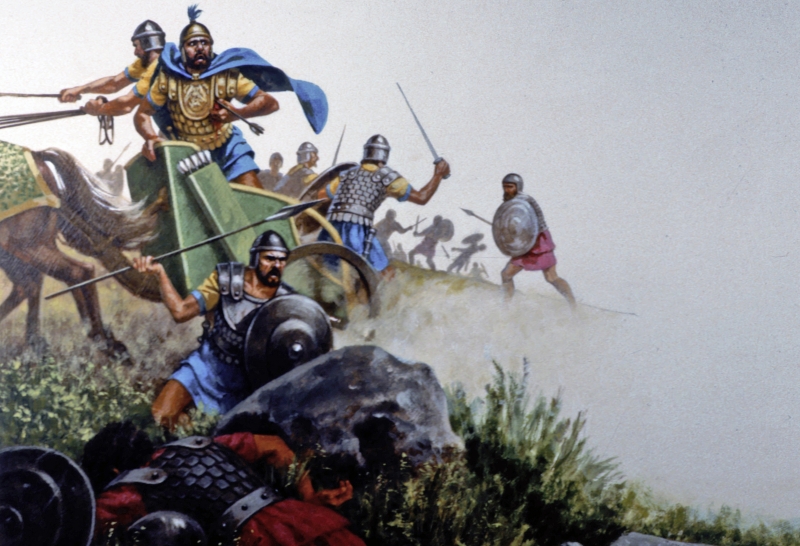
At Just the Right Time…God

1 I mean that the heir, as long as he is a child, is no different from a slave, though he is the owner of everything, but he is under guardians and managers until the date set by his father. In the same way we also, when we were children, were enslaved to the elementary principles of the world. But when the fullness of time had come, God sent forth his Son, born of woman, born under the law, to redeem those who were under the law, so that we might receive adoption as sons. And because you are sons, God has sent the Spirit of his Son into our hearts, crying, “Abba! Father!” So you are no longer a slave, but a son, and if a son, then an heir through God. – Galatians 4:1-7 ESV

Captive. Imprisoned. Under the authority of another. Incapable of setting yourself free and unable to escape from the wrath of God and His just condemnation. That was the former state of those to whom Paul wrote. At one time they had been unbelievers and enemies of God. Long before Jesus came and died, all mankind had been held captive by sin. God had provided the law through Moses to the people of Israel to make known to them His requirements for living in obedience to His righteous will. But as Paul has already made abundantly clear, the law was not intended to provide a means of justification for the Jews. It simply made clear to them God’s revealed will and exposed their complete inability to live up to it.

In his letter to the Romans, Paul wrote, “For all who have sinned without the law will also perish without the law, and all who have sinned under the law will be judged by the law” (Romans 2:12 ESV). The Gentiles were held captive by sin even though they did not have the law of God. But the Jews, who had been the recipients of God’s law, found themselves in the same sad state. Paul explained why: “For it is not the hearers of the law who are righteous before God, but the doers of the law who will be justified” (Romans 2:13 ESV). Simply having knowledge of the law was not enough. It had to be obeyed – perfectly and completely, and the Jews had failed. So, all men were under God’s condemnation for their rebellion against Him. But through the law, He had given the Jews a description of what they would have to do to justify themselves before Him. The reality was, they would never be able to pull it off and God knew it. He had a better, more perfect means of justification prepared.

He would one day send His Son to take on human flesh, live a sinless life, and die a sinner’s death as a sacrifice and substitute for men. His death would satisfy God’s need as a holy, righteous judge to pronounce judgment and allow Him to pour out His wrath as a punishment for mankind’s sin.

Paul uses the statement, “Now before faith came…” (Galatians 3:23 ESV). He is referring to the coming of Christ and, more specifically, to His death, burial, and resurrection. Jesus provided a means by which men could be made right with God, but it was only available through faith in Him. Paul says, “the law was our guardian until Christ came” (Galatians 3:24 ESV). The law functioned as a kind of tutor or teacher, educating the Jews as to God’s expectations for holy and acceptable living. It was intended to show them what God demanded of them and provide them with boundaries for life until “the coming of faith would be revealed” (Galatians 3:23 ESV). But once Jesus came and accomplished His God-given task of dying on behalf of sinful men, the law took a backseat. Justification with God became a reality, not a pipe dream. Through faith in Jesus Christ as their sin substitute, men and women could be made right with God.

Five times in these verses Paul uses the word, “faith.” The entire redemption plan of God, including man’s salvation, justification, and sanctification, is according to faith, not works. It is by faith that we move from enemies to sons and daughters of God. It is by faith that our sins are transferred to Christ and we receive His righteousness. It is by faith that we inherit the riches of eternal life. It is by faith that our sins are forgiven. It is by faith that we receive the indwelling presence of the Holy Spirit. It is by faith that we become heirs of the promises of God.

Faith has come. Jesus has accomplished the will of His Father and provided a means by which men can be saved. And now that faith has come, we are to live by faith. There is no going back to religious rule-keeping. Those who have been made righteous by God through faith in Christ are to live by faith. Now that faith has come, faith is to be our sole means of living. As Paul stated earlier in this same letter, “I have been crucified with Christ. It is no longer I who live, but Christ who lives in me. And the life I now live in the flesh I live by faith in the Son of God, who loved me and gave himself for me” (Galatians 2:20 ESV). We are saved by faith. We are to live by faith. We are to do all by faith. We are to be a people of faith.

So then, those who are of faith are blessed along with Abraham, the man of faith. – Galatians 3:9 ESV

And yet, as people of faith, we can find ourselves living by sight rather than by faith. We can easily fall back into the trap of thinking that maintaining our right standing before God is somehow up to us. While we can easily accept the concept of salvation by faith, we find it difficult to understand that even our sanctification is a byproduct of faith. This doesn’t mean we play no role. It simply means that even any works of righteousness we do in this life are totally dependent upon our ongoing faith in Christ and His Spirit’s work within us. This is why Paul said the life he lived after coming to faith in Christ, he lived by faith in Christ. Now that faith has come, faith is all we need.

Here in chapter four, Paul continues to contrast law and grace. More specifically, he shows how faith alone is how men must be saved. And to make his point, he uses yet another analogy. He has already compared the law to a jail, imprisoning everything under sin (Galatians 2:22). He also referred to it as a guardian, watching over us and managing our affairs until Christ came. The Greek word he used was παιδαγωγός (paidagōgos), which “was applied to trustworthy slaves who were charged with the duty of supervising the life and morals of boys belonging to the better class” (“G3807 – paidagōgos – Strong’s Greek Lexicon (KJV).” Blue Letter Bible).

Here in chapter four, he uses the term, “guardian” again, but it is a different Greek word. It is ἐπίτροπος (epitropos) and it refers to “one to whose care or honor anything has been instructed” (“G2012 – epitropos – Strong’s Greek Lexicon (KJV).” Blue Letter Bible). It was commonly used to refer to a steward or overseer of one’s estate or children.

Paul also compares the law to a manager. He uses the Greek word, οἰκονόμος (oikonomos), which refers to a steward, manager, or superintendent, who was responsible for overseeing the affairs of another (“G3623 – oikonomos – Strong’s Greek Lexicon (KJV).” Blue Letter Bible).

In Paul’s day, this guardian or overseer was appointed by a father and given the responsibility to oversee the well-being of a child and manage his inheritance. This, as Paul points out, was to be the arrangement “until the date set by his father” (Galatians 4:2 ESV). In a sense, the son was no different than a slave as long as he was under the responsibility of his guardian or steward. He was expected to do exactly what the guardian told him to do. He had no access to his inheritance, except through the guardian, who managed all his affairs. He was under the watchful eye of his guardian at all times, until the day set by his father arrived.

Paul tells his readers that this was their former situation. They were under the guardianship of the law until faith came (Galatians 3:23). Up until the time that Jesus came, they had been “enslaved to the elementary principles of the world” (Galatians 4:3 ESV). Paul does not explain what he means by this phrase, but it most certainly conveys the idea of the limited understanding available to men without the help of God. In his letter to the Corinthians, Paul wrote, “Now we have received not the spirit of the world, but the Spirit who is from God, that we might understand the things freely given us by God” (1 Corinthians 2:12 ESV).

Without the assistance of the indwelling Spirit of God, men cannot understand the truths of God. They are incapable. Paul went on to say, “The natural person does not accept the things of the Spirit of God, for they are folly to him, and he is not able to understand them because they are spiritually discerned” (1 Corinthians 2:14 ESV). Those without Christ are limited in their understanding, incapable of grasping the truth about God or the mysteries of spirituality. In speaking of the coming Holy Spirit, Jesus told His disciples, “He is the Holy Spirit, who leads into all truth. The world cannot receive him, because it isn’t looking for him and doesn’t recognize him” (John 14:17 NLT). Paul also said that “God in his wisdom saw to it that the world would never know him through human wisdom” (1 Corinthians 1:21 NLT).

Man, no matter how smart he may be, cannot understand or comprehend the truth regarding God. He is “enslaved to the elementary principles of the world.” But Paul reminds his readers that, “when the fullness of time had come, God sent forth his Son” (Galatians 4:4 ESV). At just the right time, according to His eternal plan, God sent Jesus “to redeem those were under the law, so that we might receive adoption as sons” (Galatians 4:5 ESV). The amazing thing is that God, in His mercy and kindness, chose to adopt those who were not even His own. The audience to whom Paul was writing was made up primarily of Gentiles who had not been part of the chosen people of God. They were outsiders, aliens, and strangers to the family of God.

Paul told the Gentile believers in Ephesus, “…remember that you were at that time separated from Christ, alienated from the commonwealth of Israel and strangers to the covenants of promise, having no hope and without God in the world” (Ephesians 2:12 ESV). But he went on to tell them the good news that “you are no longer strangers and aliens, but you are fellow citizens with the saints and members of the household of God” (Ephesians 2:19 ESV).

Paul wants the Galatian believers to be blown away by the fact that they were now sons and daughters of God. Because He had sent His Son into the world, “born of woman, born under the law” (Galatians 4:4 ESV), and His Son had kept the law to perfection, He had qualified Himself to be the sinless substitute to die in the place of sinful men. He took our place on the cross and died the death we deserved so that we might be redeemed and restored to a right relationship with God. And those who place their faith in Christ become sons of God and receive the Spirit of God, which gives them the right to call on God as their Father.

They are miraculously transformed from slaves to sons. They become princes, instead of paupers, and heirs of all the riches of God’s grace. But Paul’s point was that none of this was possible through the keeping of the law. Sonship was not achievable through hard work. The inheritance was not accessible through diligent rule-keeping. It was the gift of God made possible through faith in the Son of God and His sacrificial death on the cross. Man cannot earn a right standing with God. He cannot merit God’s favor through hard work. In fact, Paul will go on to say that, before placing their faith in Christ, his audience didn’t even know God (Galatians 4:8). They had been incapable of comprehending or coming to a true knowledge of God. In fact, they were his enemies.

You cannot pursue that which you do not know. The natural man cannot know the things of God. Sinful men cannot seek the things of God. But God, in His great mercy and kindness, sent His Son to make Himself known.

No one has ever seen God. But the unique One, who is himself God, is near to the Father’s heart. He has revealed God to us. – John 1:18 NLT

English Standard Version (ESV) The Holy Bible, English Standard Version. ESV® Permanent Text Edition® (2016). Copyright © 2001

New Living Translation (NLT) Holy Bible, New Living Translation, copyright © 1996, 2004, 2015 by Tyndale House Foundation. Used by permission of Tyndale House Publishers Inc., Carol Stream, Illinois 60188. All rights reserved.

The Lord Is My Banner

Then Amalek came and fought with Israel at Rephidim. So Moses said to Joshua, “Choose for us men, and go out and fight with Amalek. Tomorrow I will stand on the top of the hill with the staff of God in my hand.” 10 So Joshua did as Moses told him, and fought with Amalek, while Moses, Aaron, and Hur went up to the top of the hill. 11 Whenever Moses held up his hand, Israel prevailed, and whenever he lowered his hand, Amalek prevailed. 12 But Moses’ hands grew weary, so they took a stone and put it under him, and he sat on it, while Aaron and Hur held up his hands, one on one side, and the other on the other side. So his hands were steady until the going down of the sun. 13 And Joshua overwhelmed Amalek and his people with the sword.

14 Then the Lord said to Moses, “Write this as a memorial in a book and recite it in the ears of Joshua, that I will utterly blot out the memory of Amalek from under heaven.” 15 And Moses built an altar and called the name of it, The Lord Is My Banner, 16 saying, “A hand upon the throne of the Lord! The Lord will have war with Amalek from generation to generation.” – Exodus 17:8-16 ESV

After miraculously providing water for His disgruntled and dissatisfied people at Rephidim, God followed that gracious act with a much more dangerous and deadly demonstration of His power that also served to validate Moses’ role as His chosen leader. To quench their thirst and assuage their anger, God ordered Moses to use his staff to strike “the rock” so that it gushed forth water. This blatant demonstration of divine authority, accomplished through God’s official spokesman, was intended to bolster Moses’ credibility and credentials among the people.

“Pass on before the people, taking with you some of the elders of Israel, and take in your hand the staff with which you struck the Nile, and go. Behold, I will stand before you there on the rock at Horeb, and you shall strike the rock, and water shall come out of it, and the people will drink.” – Exodus 17:5-6 ESV

God allowed Moses to play a significant role in meeting the people’s need for water. It would have been just as easy for God to cause water to spring up from the dry ground, but He chose to deliver this miracle through Moses. And one of the lessons God wanted the Israelites to learn was that Moses was His personal representative. Moses spoke and acted on behalf of God. And by questioning the quality of Moses’ leadership, they were actually raising doubts about the reliability of Yahweh Himself. In a sense, their anger-filled rants against Moses were really a vocalization of their lack of faith in God.

the people of Israel argued with Moses and tested the Lord by saying, “Is the Lord here with us or not?” – Exodus 17:7 NLT

So, with the people’s thirst temporarily satisfied, God brought a new and even more demanding trial for the people to endure. This time, the problem wouldn’t be a lack of water or meat, but it would be an overabundance of enemies.

While the people of Israel were still at Rephidim, the warriors of Amalek attacked them. – Exodus 17:8 NLT

The timing of this attack is impeccable and thoroughly ordained by God. The people had just satisfied their thirst with water from the rock when suddenly and as if out of nowhere, a force of Amalckite warriors descended upon them.

The Amalekites were a nomadic people who had descended from Esau, the son of Isaac and the twin brother of Jacob.

These are the descendants of Esau who became the leaders of various clans:

The descendants of Esau’s oldest son, Eliphaz, became the leaders of the clans of Teman, Omar, Zepho, Kenaz, Korah, Gatam, and Amalek. – Genesis 36:15-16 NLT

These descendants of Esau were close relatives of Israelites who had settled in the southern region of Canaan, between the border of Egypt and Mount Sinai. During the Israelites’ 400-year sojourn in Egypt, the Amalekites had grown in number and considered the wilderness of Sin as their homeland. The scene of millions of Hebrew refugees setting up camp on their home turf must have alarmed the Amalekites. Water rights and pasture land would have been of great value in that arid part of the world. So, the Amalekites decided to give the Israelites ample reason to move on.  But rather than ordering the Israelites to run, Moses put together a battle plan, formed a makeshift army, and assigned a young man named Joshua to serve as commander. Then he gave this new general his strange-sounding strategy for achieving victory.

“Choose some men to go out and fight the army of Amalek for us. Tomorrow, I will stand at the top of the hill, holding the staff of God in my hand.” – Exodus 17:9 NLT

The Israelites were shepherds, not warriors. None of them had any military training or battle experience. Yet, Moses was ordering them to go up against an Amalekite force comprised of seasoned and well-equipped warriors.

So, the next day, as Joshua led his rag-tag group of citizen soldiers into battle, Moses ascended a nearby hill in the company of Aaron and Hur. There on the mountaintop, Moses took the very same staff he had used to strike the rock and raised it above his head with both arms. The text states that, as long as he held the staff aloft, the Israelites were able to get the upper hand in the battle taking place in the valley below. But as time wore on, Moses’ arms grew weary, and as he lowered them to rest, the battle went in favor of the Amalekites. The key to victory over the Amalekites was directly tied to God’s chosen leader raising his staff over the enemies of Israel.

In the heat of the battle taking place in the valley, Joshua had no way of knowing what was happening on the mountaintop. One minute his forces gained the advantage, only to find themselves retreating in apparent defeat. It was a touch-and-go affair that could go either way.

But Moses’ two companions could see exactly what was going on and knew that they were going to have to intervene or the battle would end in tragedy. Moses was insufficient for the task. He had the heart and possessed the staff through which the power of God was displayed, but he lacked the stamina necessary to stay the course.

Moses’ arms soon became so tired he could no longer hold them up. So Aaron and Hur found a stone for him to sit on. Then they stood on each side of Moses, holding up his hands. So his hands held steady until sunset. – Exodus 17:12 NLT

The power of God was more than sufficient to meet the need. What was lacking was Moses’ ability to serve as the unwavering conduit through whom God’s power could flow unchecked. God’s chosen leader was well into his 80s when this battle took place and the physical demands on his elderly body proved to be too much. He understood that victory hinged on his ability to keep the staff aloft but he lacked the personal strength to do his part. That’s when Aaron and Hur stepped in. These two men immediately understood the role they were there to play.

First, they provided a stone on which Moses could rest. The exhausted octogenarian was completely worn out from the physical exertion and the emotional toll he suffered every time he lowered his arms and watched the battle turn against Joshua and his troops.

Next, they each stood alongside Moses, lifting his arms into the air and using their combined strength to serve as conduits of the power of God. The staff remained aloft, the power of God flowed, and the army of Israel won the day.

Joshua overwhelmed the army of Amalek in battle. – Exodus 17:13 NLT

In the aftermath of this great victory, God ordered Moses to make a permanent record of this victory, along with a promise regarding the eventual destruction of the Amalekites.

“Write this down on a scroll as a permanent reminder, and read it aloud to Joshua: I will erase the memory of Amalek from under heaven.” – Exodus 17:14 NLT

God specifically told Moses to deliver this divine promise to Joshua. It was as if God was letting Joshua know that this battle was far from over. They had not destroyed the Amalekites but had simply defeated them in battle. That meant they would live to fight another day. But God wanted Joshua to know that he would lead one more battle against these enemies of Israel and, when that day came, Joshua would have the pleasure of wiping them off the face of the earth.

This promise would not take place until long after the Israelites had entered the land of Canaan and made it their own. Some forty years later, Moses would pull out his written record of God’s promise and read it to Joshua again.

Therefore, when the Lord your God has given you rest from all your enemies in the land he is giving you as a special possession, you must destroy the Amalekites and erase their memory from under heaven. Never forget this! – Deuteronomy 25:19 NLT

And at the scene of the battle, Moses erected another record of their decisive victory. He erected an altar and named it Yahweh-Nissi (which means “the Lord is my banner”). This memorial or tribute to God’s faithfulness celebrated His sovereign role in Israel’s victory. Moses, Aaron, and Hur were simply instruments in God’s hands. Joshua and the men who fought alongside him, each served under the banner of the King of kings. They were the army of God Almighty. But the victory was God’s alone.

And Moses recognized that the Amalekites would pay dearly for their decision to stand against the God of the universe. Their assault on the Israelites was a direct attack on the sovereignty of Yahweh, the ruler of heaven and earth. And God would hold the Amalekites accountable for their actions.

“They have raised their fist against the Lord’s throne, so now the Lord will be at war with Amalek generation after generation.” – Exodus 17:16 NLT

English Standard Version (ESV) The Holy Bible, English Standard Version. ESV® Permanent Text Edition® (2016). Copyright © 2001

New Living Translation (NLT) Holy Bible, New Living Translation, copyright © 1996, 2004, 2015 by Tyndale House Foundation. Used by permission of Tyndale House Publishers Inc., Carol Stream, Illinois 60188. All rights reserved.
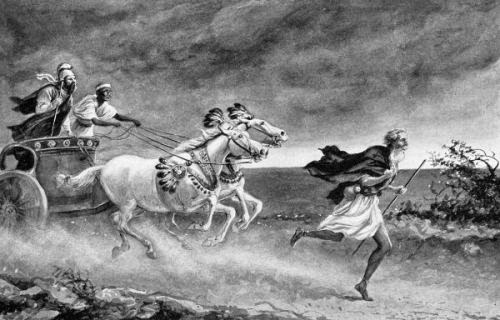
Getting to Know God the Hard Way

16 And they went out at noon, while Ben-hadad was drinking himself drunk in the booths, he and the thirty-two kings who helped him. 17 The servants of the governors of the districts went out first. And Ben-hadad sent out scouts, and they reported to him, “Men are coming out from Samaria.” 18 He said, “If they have come out for peace, take them alive. Or if they have come out for war, take them alive.”

19 So these went out of the city, the servants of the governors of the districts and the army that followed them. 20 And each struck down his man. The Syrians fled, and Israel pursued them, but Ben-hadad king of Syria escaped on a horse with horsemen. 21 And the king of Israel went out and struck the horses and chariots, and struck the Syrians with a great blow.

22 Then the prophet came near to the king of Israel and said to him, “Come, strengthen yourself, and consider well what you have to do, for in the spring the king of Syria will come up against you.”

23 And the servants of the king of Syria said to him, “Their gods are gods of the hills, and so they were stronger than we. But let us fight against them in the plain, and surely we shall be stronger than they. 24 And do this: remove the kings, each from his post, and put commanders in their places, 25 and muster an army like the army that you have lost, horse for horse, and chariot for chariot. Then we will fight against them in the plain, and surely we shall be stronger than they.” And he listened to their voice and did so. 

26 In the spring, Ben-hadad mustered the Syrians and went up to Aphek to fight against Israel. 27 And the people of Israel were mustered and were provisioned and went against them. The people of Israel encamped before them like two little flocks of goats, but the Syrians filled the country.

28 And a man of God came near and said to the king of Israel, “Thus says the Lord, ‘Because the Syrians have said, “The Lord is a god of the hills but he is not a god of the valleys,” therefore I will give all this great multitude into your hand, and you shall know that I am the Lord.’”1 Kings 20:16-28 ESV

King Ahab found himself in a strange predicament. His capital city, Samaria, was under attack by a confederation of 32 kings, led by King Ben-hadad of Syria. But much to Ahab’s surprise, a prophet of Yahweh had appeared with a plan for Israel’s deliverance.

“Thus says the Lord, Have you seen all this great multitude? Behold, I will give it into your hand this day, and you shall know that I am the Lord.” – 1 Kings 20:13 ESV

The very God whom Ahab and Jezebel had attempted to replace with their false gods had announced that He was going to rescue His disobedient and unfaithful people. And God had told Ahab exactly how the victory would take place.

By the servants of the governors of the districts.” – 1 Kings 20:14 ESV

God was not going to utilize Ahab’s army to fight the Syrians. This is significant because Ahab, like all his predecessors, had assembled a large military force. There is even evidence to that fact, found on an ancient Assyrian stone tablet. It bears an inscription describing the battle of Qarqar between Ahab and his enemy King Shalmaneser III of Assyria. The tablet records the size of the army that assembled to do battle that day: “2,000 chariots and 10,000 men of Ahab king of Israel.”

But on this occasion, God chose to place Ahab’s formidable resources in a secondary position, choosing instead to use “servants” – a group of common people who, when assembled, amounted to only 7,000 in number.

Confident that he would defeat the Israelites, Ben-hadad and his vassal kings were drinking themselves drunk in a pre-victory celebration. So, when scouts arrived with a report that Israelite forces had been seen leaving the city, Beh-hadad had assumed they were bringing news of Israel’s surrender or their decision to continue the battle. While he and his military commanders continued to toast their inevitable victory, the 7,000 servants made their way to the Syrian camp, followed by Ahab and his army.

This surprise attack caught the Syrian forces completely unawares and unable to respond. Led by the 7,000 servants, Ahab’s army quickly routed the Syrians, forcing them to abandon camp and run for their lives. Quickly sobered by this unexpected reversal of fortunes, Beh-hadad managed to escape. But the rest of his forces didn’t fare as well.

And the king of Israel went out and struck the horses and chariots, and struck the Syrians with a great blow. – 1 Kings 20:21 ESV

Notice that the author conveniently eliminates any mention of Ahab’s name. He simply refers to him as “the king of Israel.” He repeats this obvious slight in the very next verse, refusing to give Ahab any credit for the victory. He simply warns him that the battle may be done, but the war is from over.

“Come, strengthen yourself, and consider well what you have to do, for in the spring the king of Syria will come up against you.” – 1 Kings 20:22 ESV

Ben-hadad would be back. He had suffered a devastating defeat, but once he had time to assess what had happened that day, the Syrian king would return, more determined than ever to avenge his loss by destroying the Israelites. And his advisors encouraged his plans by suggesting that his loss had been divinely ordained. In their pagan way of thinking, the only thing that could explain a loss of this magnitude was the intervention of the gods. They rationalized away their defeat by concluding that they had chosen the wrong place to do battle.  They absolved Beh-hadad of any responsibility for the loss by assuring him, “Their gods are gods of the hills, and so they were stronger than we. But let us fight against them in the plain, and surely we shall be stronger than they” (1 Kings 20:23 ESV).

Little did they know how right they were. Their defeat had been the result of divine intervention, but geographic location had played no role in it. Yahweh was the God of the hills and the valleys. He was sovereign over all the earth. Unlike their false gods, Yahweh was unbound by time and space. The extent of His power was limitless. To the God of Israel, the location and the size of the opposing army made no difference. And so, when Ben-hadad’s advisors counseled him to rebuild his army and restructure his military command, it would prove to be futile advice. They had no idea what they were dealing with and their ignorance led them to make some very dangerous assumptions. First, they assumed that the God of Israel was similar to their own gods – limited in power and vulnerable to defeat. After all, their gods had failed to deliver them. So, if they could find Yahweh’s weak spots, the next battle would go their way.

And Ben-hadad, eager to avenge his loss, took their advice and spent the winter rebuilding his army. He replaced the 32 kings with seasoned military commanders. He ordered the construction of new chariots. And he made plans to take the fight to the valley, where the God of Israel would have no power and play no role in the outcome of the battle.

It is fascinating to consider that all of this was in the sovereign will of God. He had orchestrated all the details concerning the original battle, including Ben-hadad’s escape. God had even told Ahab that the Syrians would return. Ben-hadad’s rebuilding and reconfiguring of his army had been part of God’s plan. The original battle had been intended to restore the Israelites’ belief in God. Prior to their victory, God had told them, “I will give it into your hand this day, and you shall know that I am the Lord” (1 Kings 20:13 ESV).

But God knew that little had changed in Israel. Even after their miraculous defeat of the Syrians, the people still remained unconvinced of Yahweh’s status as the one true God. When spring rolled around, they found themselves facing their former foe again. This time, Beh-hadad showed up with a much larger and better-equipped army than before, and rather than laying siege to the city, they gathered in the Valley of Aphek. Ben-hadad had brought a bigger, better army and had chosen a battleground that was outside the reach of Yahweh’s power. Or so he thought.

The stage was set. The enemy of Israel had returned. And the author paints a rather bleak and foreboding picture of the situation.

Israel then mustered its army, set up supply lines, and marched out for battle. But the Israelite army looked like two little flocks of goats in comparison to the vast Aramean forces that filled the countryside! – 1 Kings 20:27 NLT

Here was Israel, outnumbered and underequipped yet again. They were no match for the Syrians. And this time, they would not have the walls of the city to protect them. They would be fighting on open terrain, facing an army equipped with chariots and horses and motivated by revenge.

But God sent another prophet with a promise of His presence and power.

“Thus says the Lord, ‘Because the Syrians have said, “The Lord is a god of the hills but he is not a god of the valleys,” therefore I will give all this great multitude into your hand, and you shall know that I am the Lord.’” – 1 Kings 20:28 ESV

Despite the overwhelming odds, God would provide another victory over their enemy. By the time this day was over, they would know that He was the one true God. But notice that in verse 28, the author leaves out Ahab’s name again. He simply refers to him as “the king of Israel.” God was going to deliver this victory despite Ahab, not because of him. Not only did Ahab deserve to lose this battle, but he also deserved to die for his blatant rebellion against God. But God was acting on behalf of His covenant people. He was doing this to protect the integrity and honor of His name. He had made covenant promises to Abraham, Isaac, and Jacob. He had given His word to Moses and David. And while Ahab had failed to use his position as the shepherd of Israel to lead them in faithful obedience, God would prove Himself true to His word and committed to His covenant promises.

English Standard Version (ESV) The Holy Bible, English Standard Version. ESV® Permanent Text Edition® (2016). Copyright © 2001 by Crossway Bibles, a publishing ministry of Good News Publishers.

New Living Translation (NLT) Holy Bible, New Living Translation, copyright © 1996, 2004, 2015 by Tyndale House Foundation. Used by permission of Tyndale House Publishers Inc., Carol Stream, Illinois 60188. All rights reserved.

The Message (MSG)Copyright © 1993, 1994, 1995, 1996, 2000, 2001, 2002 by Eugene H. Peterson

The Faithful Few

1 Ben-hadad the king of Syria gathered all his army together. Thirty-two kings were with him, and horses and chariots. And he went up and closed in on Samaria and fought against it. And he sent messengers into the city to Ahab king of Israel and said to him, “Thus says Ben-hadad: ‘Your silver and your gold are mine; your best wives and children also are mine.’” And the king of Israel answered, “As you say, my lord, O king, I am yours, and all that I have.” The messengers came again and said, “Thus says Ben-hadad: ‘I sent to you, saying, “Deliver to me your silver and your gold, your wives and your children.” Nevertheless I will send my servants to you tomorrow about this time, and they shall search your house and the houses of your servants and lay hands on whatever pleases you and take it away.’”

Then the king of Israel called all the elders of the land and said, “Mark, now, and see how this man is seeking trouble, for he sent to me for my wives and my children, and for my silver and my gold, and I did not refuse him.” And all the elders and all the people said to him, “Do not listen or consent.” So he said to the messengers of Ben-hadad, “Tell my lord the king, ‘All that you first demanded of your servant I will do, but this thing I cannot do.’” And the messengers departed and brought him word again. 10 Ben-hadad sent to him and said, “The gods do so to me and more also, if the dust of Samaria shall suffice for handfuls for all the people who follow me.” 11 And the king of Israel answered, “Tell him, ‘Let not him who straps on his armor boast himself as he who takes it off.’” 12 When Ben-hadad heard this message as he was drinking with the kings in the booths, he said to his men, “Take your positions.” And they took their positions against the city. 

13 And behold, a prophet came near to Ahab king of Israel and said, “Thus says the Lord, Have you seen all this great multitude? Behold, I will give it into your hand this day, and you shall know that I am the Lord.” 14 And Ahab said, “By whom?” He said, “Thus says the Lord, By the servants of the governors of the districts.” Then he said, “Who shall begin the battle?” He answered, “You.” 15 Then he mustered the servants of the governors of the districts, and they were 232. And after them he mustered all the people of Israel, seven thousand. 1 Kings 20:1-15 ESV

With the opening of chapter 20, both Elijah and Elisha, his newly commissioned replacement, suddenly disappear from the scene. Elijah will not be mentioned again until verse 17 of chapter 21. It would appear that he and his young protégé were busy fulfilling the command of God.

“Go, return on your way to the wilderness of Damascus. And when you arrive, you shall anoint Hazael to be king over Syria. And Jehu the son of Nimshi you shall anoint to be king over Israel, and Elisha the son of Shaphat of Abel-meholah you shall anoint to be prophet in your place.” – 1 Kings 19:15-16 ESV

After Elijah had cast his cloak on Elisha, the two of them must have spent a significant amount of time searching for Hazael and Jehu. They would have begun their journey in Abel-meholah, Elisha’s hometown, located about 25 miles south of the Sea of Galilee. As they made their way north to Damascus in Syria, the sovereign plan of God continued to unfold in the land of Israel. In his former state of disillusionment and despair, Elijah had thought he was the last prophet alive in Israel, but he was about to be proven wrong. While he and Elisha were busy searching for the new kings of Syria and Israel, God was going to raise up other prophets to act as His spokesmen to King Ahab.

God’s miraculous defeat of Baal on Mount Carmel had left Ahab and Jezebel unphased and unrepentant. The loss of their 450 prophets had not diminished their enthusiasm for their false god. And they had failed to acknowledge the sudden end of the three-and-a-half-year drought as a gracious act of God. This arrogant and prideful couple remained stubbornly opposed to the God of Israel. But just as the prophets of Baal had been no match for Yahweh, so Ahab and Jezebel would soon discover that their power and prominence would provide them no protection against the judgment of God.

With the end of the drought, the famine that had plagued the land slowly abated. But now, Ahab found himself facing a threat of a different sort. Any sense of relief he felt from the drought’s ending and Elijah’s sudden disappearance quickly faded when the Syrians laid siege to the capital city of Samaria. Surrounded and facing a confederation of forces that greatly outnumbered Israel’s army, Ahab found himself in a difficult situation. And the terms of surrender he received from King Ben-hadad made things far worse.

“Your silver and gold are mine, and so are your wives and the best of your children!” – 1 Kings 20:3 NLT

Operating from a position of weakness, Ahab was forced to agree to Ben-hadad’s terms but stubbornly refused to comply. Perhaps he was trying to buy time. But his delay only aggravated the problem, causing Ben-hadad to up the ante.

“I have already demanded that you give me your silver, gold, wives, and children. But about this time tomorrow I will send my officials to search your palace and the homes of your officials. They will take away everything you consider valuable!” – 1 Kings 20:5-6 NLT

Ahab had been able to survive the drought, living in luxury as his people suffered and died. But now, he was facing the loss of everything he held near and dear. Ben-hadad was threatening to steal Ahab’s glory, and for a man whose identity was derived from what he possessed, this message got his attention.

Ahab, desperate to preserve his status and prevent the loss of everything he considered of value, consulted his advisors. They convinced him to refuse any further negotiations with the Syrians. Their advice was that he keep his original commitment to give up his wives and children and pay Ben-hadad a large tribute of silver and gold. But he was not to allow the Syrians access to the capital so they could plunder all his possessions. Eager to protect his personal domain, Ahab took their counsel and sent word to Ben-hadad. But his message was not well-received. Ben-hadad reacted with anger and issued his final word on the matter in the form of a vow.

“The gods do so to me and more also, if the dust of Samaria shall suffice for handfuls for all the people who follow me.” – 1 Kings 20:10 ESV

The words of Ben-hadad are eerily similar to those delivered by Queen Jezebel to Elijah after he had destroyed the 450 prophets of Baal. She, too, had made an oath to her false gods, swearing to kill Elijah or face their judgment.

“So may the gods do to me and more also, if I do not make your life as the life of one of them by this time tomorrow.” – 1 Kings 19:2 ESV

It’s interesting to note that Ben-hadad, a pagan, believed that his gods were real and capable of giving him success in battle. Yet, Ahab, king over the chosen people of Yahweh, makes no mention of any gods whatsoever, including the gods of his wife. He was operating in his own strength and according to the wisdom of men. And he displays his arrogance and over-confidence in his response to Ben-hadad.

“A warrior putting on his sword for battle should not boast like a warrior who has already won.” – 1 Kings 20:11 NLT

As would be expected, Ben-hadad was infuriated by Ahab’s boastful message and ordered an immediate attack on the city. He was done negotiating with this pompous and pride-filled fool. And, as those reading this story, we fully expect and even hope that God will allow Ahab to get what he so justly deserves.

But God’s ways are not our ways. While we see the Syrians’ attack as the hand of God against wicked King Ahab, the author reveals that God has other plans altogether. As Ahab and the citizens of Samaria brace themselves for the coming attack, God sends a prophet with a message of hope.

“This is what the Lord says: Do you see all these enemy forces? Today I will hand them all over to you. Then you will know that I am the Lord.” – 1 Kings 20:13 NLT

This statement shocks and surprises us. It seems so unexpected and undeserved. Why in the world would God do such a thing for an arrogant and egotistical man like Ahab? He was idolatrous and had led the entire nation of Israel into apostasy. Among all the kings of Israel, he was the poster boy for wickedness and immorality. And yet, here was God giving him a message of divine deliverance.

Ahab responds with a series of questions rather than drop to his knees in humble repentance and gratitude for God’s gracious intervention. First, he asks, “By whom?” He demanded details. Ahab wanted to know who would get the credit for the victory. And the prophet replied, “By the servants of the governors of the districts” (1 Kings 20:14 ESV). Much to Ahab’s disappointment, God was not going to use him as the means of delivering the decisive blow to the Syrians. That prompted Ahab to ask, “Who shall begin the battle?” (1 Kings 20:14 ESV). He desperately wanted to know if he would have any part to play in this divine deliverance. And, once again, to our surprise and dismay, God informs Ahab that he will have the privilege of putting God’s plan into play.

With God’s plan clearly articulated, Ahab set about putting the pieces together to make it happen.

Then he mustered the servants of the governors of the districts, and they were 232. And after them he mustered all the people of Israel, seven thousand. – 1 Kings 20:15 ESV

This verse should bring to mind the promise God had made just before He sent Elijah on his mission to anoint the future kings of Syria and Israel.

“I will preserve 7,000 others in Israel who have never bowed down to Baal or kissed him!” – 1 Kings 19:18 NLT

God had promised His reluctant prophet that He would raise up a remnant from among the apostate people of Israel, and He would use these faithful few to accomplish His will. Now God was using Ahab, the apostate king of Israel, to choose the 7,000 faithful whom God would use to defeat the Syrians in battle. Ahab would begin the battle, but he would not secure the victory. That privilege would fall to those who had not bowed down to Baal.

None of this was about Ahab. He was the king, but, in reality, he was nothing more than a bit player in God’s sovereign plan for the redemption and restoration of His people. Ahab may have worn the crown, but God was King over Israel. And while Ben-hadad’s superior numbers appeared to give him the advantage, God had the faithful few. He was going to bring about a great victory, using those few who had refused to bow their knees to Baal.

God was about to reveal His power through weakness. And He would do so through those whose presence was unknown but whose faith had remained unwavering. With God on their side, this faithful remnant would defeat the enemy, and their unexpected victory would bring great glory to God. And in the Song of Moses recorded in the Book of Deuteronomy, we’re given an explanation for the kind of victory God is about to bring.

How could one person chase a thousand of them,
    and two people put ten thousand to flight,
unless their Rock had sold them,
    unless the Lord had given them up?
But the rock of our enemies is not like our Rock… – Deuteronomy 32:30-31 NLT

English Standard Version (ESV) The Holy Bible, English Standard Version. ESV® Permanent Text Edition® (2016). Copyright © 2001 by Crossway Bibles, a publishing ministry of Good News Publishers.

New Living Translation (NLT) Holy Bible, New Living Translation, copyright © 1996, 2004, 2015 by Tyndale House Foundation. Used by permission of Tyndale House Publishers Inc., Carol Stream, Illinois 60188. All rights reserved.

The Message (MSG)Copyright © 1993, 1994, 1995, 1996, 2000, 2001, 2002 by Eugene H. Peterson

When Faith Turns to Fear

41 And Elijah said to Ahab, “Go up, eat and drink, for there is a sound of the rushing of rain.” 42 So Ahab went up to eat and to drink. And Elijah went up to the top of Mount Carmel. And he bowed himself down on the earth and put his face between his knees. 43 And he said to his servant, “Go up now, look toward the sea.” And he went up and looked and said, “There is nothing.” And he said, “Go again,” seven times. 44 And at the seventh time he said, “Behold, a little cloud like a man’s hand is rising from the sea.” And he said, “Go up, say to Ahab, ‘Prepare your chariot and go down, lest the rain stop you.’” 45 And in a little while the heavens grew black with clouds and wind, and there was a great rain. And Ahab rode and went to Jezreel. 46 And the hand of the Lord was on Elijah, and he gathered up his garment and ran before Ahab to the entrance of Jezreel. 

1 Ahab told Jezebel all that Elijah had done, and how he had killed all the prophets with the sword. Then Jezebel sent a messenger to Elijah, saying, “So may the gods do to me and more also, if I do not make your life as the life of one of them by this time tomorrow.” Then he was afraid, and he arose and ran for his life and came to Beersheba, which belongs to Judah, and left his servant there. 1 Kings 18:41-19:3 ESV

Chapter 18 opened up with the words God spoke to Elijah: “Go, show yourself to Ahab, and I will send rain upon the earth” (1 Kings 18:1 ESV). This statement contains a command as well as a promise from God. After his three-and-a-half-year absence, Elijah was to return to Israel from Sidon and confront King Ahab one more time. But while this command would likely involve great risk to the prophet, his obedience would result in a tremendous blessing on the people. God would end the long drought and restore rain to the land.

It is impossible to know if Elijah was aware of all that would have to happen before the rain returned. There is no indication as to when God divulged the rest of His plan and Elijah’s role in it. But before the physical drought could end, the spiritual drought afflicting the people would have to come to a decisive conclusion that involved a dramatic confrontation between Elijah and the 450 prophets of Baal. But the real battle would be between Yahweh, the God of Israel, and Baal, the god of Ahab and Jezebel.

And God had won the day. He displayed His power by sending fire from heaven that “consumed the burnt offering and the wood and the stones and the dust, and licked up the water that was in the trench” (1 Kings 18:38 ESV). This demonstrative exhibition of God’s omnipotence brought the people to their knees in fear and worship of God. What they had just witnessed left them thoroughly convinced that Yahweh was the one true God, and that newly revived awareness left them crying out, “The Lord, he is God; the Lord, he is God” (1 Kings 18:39 ESV). And as if to put an exclamation point on the whole scene, Elijah had ordered the capture and execution of all 450 of Baal’s so-called prophets. When they had cried out to their god, he had remained silent. Now the prophet of Yahweh silenced them – for good. They would no longer deceive and mislead the people of Israel with fallacious promises concerning their false god.

But there was still one thing missing: The rain that God had promised. Baal had been discredited, his prophets had been eliminated, and the peoples’ reverence for Yahweh had been rejuvenated. But the land remained under the God-ordained drought that had turned Israel into a dust bowl where water and food were scarce and daily survival had become critical. The land that God had once described as “flowing with milk and honey” (Exodus 33:3 ESV) had become fruitless and lifeless, reflecting the spiritual state of the people who occupied it.

Hundreds of years earlier, long before the people of Israel took possession of the land of Canaan, Moses had warned them what would happen if they proved unfaithful.

“And if you will indeed obey my commandments that I command you today, to love the Lord your God, and to serve him with all your heart and with all your soul, he will give the rain for your land in its season, the early rain and the later rain, that you may gather in your grain and your wine and your oil. And he will give grass in your fields for your livestock, and you shall eat and be full. Take care lest your heart be deceived, and you turn aside and serve other gods and worship them; then the anger of the Lord will be kindled against you, and he will shut up the heavens, so that there will be no rain, and the land will yield no fruit, and you will perish quickly off the good land that the Lord is giving you.” – Deuteronomy 11:13-17 ESV

And years later, when God’s people continued to display their propensity for unfaithfulness, His prophet, Joel, would offer this promise of divine restoration even in the face of their disobedience.

Surely the Lord has done great things!
    Don’t be afraid, O land.
Be glad now and rejoice,
    for the Lord has done great things.
Don’t be afraid, you animals of the field,
    for the wilderness pastures will soon be green.
The trees will again be filled with fruit;
    fig trees and grapevines will be loaded down once more.
Rejoice, you people of Jerusalem!
    Rejoice in the Lord your God!
For the rain he sends demonstrates his faithfulness.
    Once more the autumn rains will come,
    as well as the rains of spring.
The threshing floors will again be piled high with grain,
    and the presses will overflow with new wine and olive oil.

The Lord says, “I will give you back what you lost…” – Joel 2:20-25 ESV

That day on Mount Carmel, the people had seen the fire of God fall from heaven, completely consuming the altar, sacrifice, and water. But they had not yet seen or felt His blessing. As Joel stated, “the rain he sends demonstrates his faithfulness.” Their land was in desperate need of restoration and rejuvenation, and so were they. After three-and-a-half-years of spiritual drought, their hearts were parched and hardened. They had lost the capacity for fruitfulness and faithfulness and they needed an outpouring of God’s grace and mercy.

Elijah knew what God had in store. So, he informed the shell-shocked king to “Go get something to eat and drink, for I hear a mighty rainstorm coming!” (1 Kings 18:41 NLT). There was a blessing on the horizon. In spite of Ahab and Jezebel’s wickedness, God was about to pour out His goodness on the land.

The fact that Ahab had food to eat is symbolic of his self-centered approach to leadership. His sins had brought God’s curse upon the nation. But while they suffered severely from the lack of rain, Ahab and Jezebel lived in royal comfort and ease. God would later issue an indictment against the leaders of Israel, warning them of their blatant disregard for the care of His people.

“What sorrow awaits you shepherds who feed yourselves instead of your flocks. Shouldn’t shepherds feed their sheep?” – Ezekiel 34:2 NLT

And as Ahab was busy satisfying his own needs, Elijah interceded on behalf of the people of Israel. He “climbed to the top of Mount Carmel and bowed low to the ground and prayed with his face between his knees” (1 Kings 18:42 NLT). At one point during his prayer, he stops and sends his servant to look toward the Mediterranean Sea in the east. But the servant sees nothing. This pattern repeats itself five more times with the same disappointing result. But the seventh time, the servant returns with a different report.

“I saw a little cloud about the size of a man’s hand rising from the sea.” – 1 Kings 18:44 NLT

Out on the distant horizon, the servant had seen what appeared to be a small glimmer of hope. It was a small and seemingly insignificant cloud. But Elijah knew what it meant. The blessing of God was about to fall and, when it did, it would come in torrents. So, he instructed his servant to warn Ahab to leave immediately or he may not make it back to his winter palace in Jezreel. When Elijah’s servant had looked to the east, he only saw a faint possibility. But through his eyes of faith,  Elijah saw something altogether different. He perceived the imminent arrival of the outpouring of God’s blessing. And before long that small cloud had developed into a massive storm that brought strong winds and torrential rains. And as Ahab tried to outrun the storm in his chariot, “the Lord gave special strength to Elijah. He tucked his cloak into his belt and ran ahead of Ahab’s chariot all the way to the entrance of Jezreel” (1 Kings 18:46 NLT).

Because Jezreel was anywhere from 10-20 miles east of Mount Carmel, some commentators attempt to explain this last verse by saying that Ahab’s chariot got caught in the mud and delayed his arrival. Others speculate that Elijah simply took a shortcut over the ridge of Mount Carmel. But everything about this story has been focused on the matchless power of God. And it should not seem out of the question that God might endow his prophet with a supernatural capacity to outrun the chariot of his arch-nemesis. God had defeated Baal. Now, the prophet of God had defeated the benefactor of Baal.

But while Elijah had won the victory at Mount Carmel and the race to Jezreel, he would have little time to celebrate. Upon hearing the unexpected news of all that had transpired on Mount Carmel, Jezebel was outraged and directed all her anger at Elijah.

“May the gods strike me and even kill me if by this time tomorrow I have not killed you just as you killed them.” – 1 Kings 19:2 NLT

Despite all that Ahab told her about the day’s events, she remained unconvinced of Yahweh’s power. She even called on Baal and his queen mother, Asherah, to come to her aid so that she might avenge the deaths of the prophets by killing Elijah. She was still putting her hope and trust in her false gods. Even the sudden arrival of long-awaited rain did nothing to diminish her misplaced trust in her lifeless and powerless gods.

But even more surprising than Jezebel’s stubborn resistance to God was Elijah’s sudden display of fear and doubt. This man who had called down fire from heaven and had singlehandedly executed 450 prophets of Baal found himself intimidated by the idle threats of this self-absorbed, idol-worshiping queen. Her vow to avenge her false god should have made Elijah laugh with scorn. Her god had proven himself to be speechless, powerless, and utterly helpless in the face of Yahweh. Yet, the formerly faithful Elijah was suddenly fearful, and this time, rather than running to the problem in the strength of God, he ran away from it. He fled for his life, covering the 25 miles from Jezreel to Beersheba motivated by fear and in the strength of his own flesh. Faced with the threats of Jezebel, Elijah took his eyes off of God and took his fate into his own hands.

English Standard Version (ESV) The Holy Bible, English Standard Version. ESV® Permanent Text Edition® (2016). Copyright © 2001 by Crossway Bibles, a publishing ministry of Good News Publishers.

New Living Translation (NLT) Holy Bible, New Living Translation, copyright © 1996, 2004, 2015 by Tyndale House Foundation. Used by permission of Tyndale House Publishers Inc., Carol Stream, Illinois 60188. All rights reserved.

The Message (MSG)Copyright © 1993, 1994, 1995, 1996, 2000, 2001, 2002 by Eugene H. Peterson

Divine Opposition.

Desolate! Desolation and ruin!
    Hearts melt and knees tremble;
anguish is in all loins;
    all faces grow pale!
Where is the lions’ den,
    the feeding place of the young lions,
where the lion and lioness went,
    where his cubs were, with none to disturb?
The lion tore enough for his cubs
    and strangled prey for his lionesses;
he filled his caves with prey
    and his dens with torn flesh.

 Behold, I am against you, declares the Lord of hosts, and I will burn your chariots in smoke, and the sword shall devour your young lions. I will cut off your prey from the earth, and the voice of your messengers shall no longer be heard. Nahum 2:10-13 ESV


You don’t want to be on God’s bad side. You don’t want Him for an enemy. And the one thing no human being should ever want to hear God say is, “I am against you.” Any time we see that statement, it is usually followed by some very unpleasant circumstances. The people of Judah themselves would eventually hear God say those same words:

“Behold, I am against you, O inhabitant of the valley,
    O rock of the plain,
declares the Lord;
you who say, ‘Who shall come down against us,
    or who shall enter our habitations?’
14 I will punish you according to the fruit of your deeds,
declares the Lord;
    I will kindle a fire in her forest,
    and it shall devour all that is around her.” – Jeremiah 21:13-14 ESV

Babylon, one of the nations that God would use to defeat the Assyrians, would also hear those four words:

“Behold, I am against you, O proud one,
    declares the Lord God of hosts,
for your day has come,
    the time when I will punish you.
The proud one shall stumble and fall,
    with none to raise him up,
and I will kindle a fire in his cities,
    and it will devour all that is around him.” – Jeremiah 50:30-31 ESV

God would one day say of the great city of Tyre:

“Behold, I am against you, O Tyre, and will bring up many nations against you, as the sea brings up its waves. They shall destroy the walls of Tyre and break down her towers, and I will scrape her soil from her and make her a bare rock.” – Ezekiel 26:3-4 ESV

God makes a great friend, but He is a formidable enemy. And Nahum, speaking on behalf of God, makes it quite clear that the Assyrians had overstepped their bounds and exceeded the limits of God’s patience. The Assyrians had more than met their match. While they were known for leaving a wake of destruction in their path, God was going to completely annihilate them. Their fall would leave nothing but desolation behind. Their once great city would be reduced to rubble, their vast horde of plunder and treasure would be removed. Their citizens would be taken captive or scattered to the four winds. And even their infamous chariots would be burned to ashes.

People will be left wondering what ever happened to Nineveh. Comparing the Assyrian king to a lion and Nineveh to his den, Nahum sarcastically asks, “Where is the lions’ den, the feeding place of the young lions, where the lion and lioness went, where his cubs were, with none to disturb?” (Nahum 2:11 ESV). In time, the rubble of the city will look like just another part of the landscape. It will be difficult to tell that it was once the great capital of the mighty Assyrian empire. There had been a day when the king of Assyrian had “filled his caves with prey and his dens with torn flesh” (Nahum 2:12 ESV), but that was about to change. Because God was against him. He had made an enemy of the Lord of Hosts. That term, Lord of Hosts, is a title for God that refers to His military might. It “pictures God as the sovereign king who has at his disposal a multitude of attendants, messengers, and warriors to do his bidding” (NET Study Bible notes). God commands the hosts of heaven, a countless force made up of angelic beings.

There is a wonderful story chronicled for us in the book of 1 Kings. It involves the prophet Elisha. It seems that the King of Aram had been setting traps and ambushes for the forces of Israel, and Elisha was prophetically warning the King of Israel about these situations before they happened. Of course, when the King of Aram found out what Elisha had been doing, it enraged him, so he sent troops to capture Elisha. One morning, Elisha’s servant woke up to find they were surrounded by troops.

When the servant of the man of God got up early the next morning and went outside, there were troops, horses, and chariots everywhere. “Oh, sir, what will we do now?” the young man cried to Elisha. – 2 Kings 6:15 ESV

But rather than panic, Elisha simply told his servant, “Don’t be afraid!” Then he calmed his anxious servant with the news: “For there are more on our side than on theirs!” (1 Kings 6: 16 ESV). But he could tell that his servant’s sense of panic was not exactly assuaged by this announcement. Because all his servant could see was one thing: The armies of Aram. There was nobody else in sight. What was Elisha talking about? And then Elisha prayed: “O Lord, open his eyes and let him see!” (1 Kings 6:17 ESV). And we’re told that God opened the young man’s eyes, and when he looked up, he saw that the hillside around Elisha was filled with horses and chariots of fire. In other words, he got a glimpse of the host of heaven.

God has more than enough resources to enforce His will and to accomplish His sovereign plan. In the case of Elisha and his servant, God used the hosts of heaven to rescue them. In the case of the Assyrians, God would call upon the Medes and the Babylonians to attack and destroy the Assyrians. God used the waters of the Red Sea to destroy the armies of Pharaoh. He brought down fire and brimstone to destroy the cities of Sodom and Gomorrah. There is no limit to God’s capabilities. That is why it is a dangerous thing to find yourself on the receiving end of His wrath. In the case of Egypt, God sent a single angel to take the lives of all the first born males in the nation. God can use His heavenly host or He can utilize human resources to accomplish His will. But the bottom line is, once the Assyrians found themselves on the wrong side of God’s wrath, their days were numbered. Daniel reminds us:

He changes times and seasons; he removes kings and sets up kings; he gives wisdom to the wise and knowledge to those who have understanding… – Daniel 2:21 ESV

The Assyrians were no match for God. And those who would set themselves against the people of God will always find themselves as the enemies of God. It is one thing for God to sovereignly choose to use a nation to accomplish His divine will and mete out His just judgment on His own people. But when a nation independently assumes the right to attack what rightly belongs to God, they will find themselves opposed by Him. There will always be nations like Assyria to wreak havoc and demand their way in the world. Wicked nations will rise up and force their will on others. Their will be dictators and tyrants. There will be always be despots and megalomaniacs who use force to build and maintain their empires. And from our human perspective, it will always look to use as it did to Elisha’s servant. We will see ourselves surrounded by the forces of evil. We will feel like the odds are against us, and we will cry out to God, “Oh, sir, what will we do now?” But God would have us remember that we have the Lord of Hosts on our side. He is in control. As bad as things might appear, our God is still on His throne. He is still the Lord of Hosts and has the resources of heaven at His disposal. Not only that, He is in full and ultimate control of all that goes on around us, whether it seems like it or not. Nothing happens outside of His sovereign will. No king, president, or dictator ascends to power without His permission. We may not understand why God does what He does, but we should never question His motives. All those who stand opposed to His will eventually find themselves hearing those very same words the Assyrians heard: “I am against you.” And the apostle Paul would have us remember: “If God is for us, who can ever be against us?” (Romans 8:31 NLT). Not only that, but, “nothing can ever separate us from God’s love. Neither death nor life, neither angels nor demons, neither our fears for today nor our worries about tomorrow—not even the powers of hell can separate us from God’s love. No power in the sky above or in the earth below—indeed, nothing in all creation will ever be able to separate us from the love of God that is revealed in Christ Jesus our Lord” (Romans 8:38-39 NLT).

English Standard Version (ESV)
The Holy Bible, English Standard Version. ESV® Permanent Text Edition® (2016). Copyright © 2001 by Crossway Bibles, a publishing ministry of Good News Publishers.

New Living Translation (NLT)
Holy Bible, New Living Translation, copyright © 1996, 2004, 2015 by Tyndale House Foundation. Used by permission of Tyndale House Publishers Inc., Carol Stream, Illinois 60188. All rights reserved.

The Message (MSG)Copyright © 1993, 1994, 1995, 1996, 2000, 2001, 2002 by Eugene H. Peterson

Radical Surgery.

After this David defeated the Philistines and subdued them, and David took Metheg-ammah out of the hand of the Philistines.

And he defeated Moab and he measured them with a line, making them lie down on the ground. Two lines he measured to be put to death, and one full line to be spared. And the Moabites became servants to David and brought tribute.

David also defeated Hadadezer the son of Rehob, king of Zobah, as he went to restore his power at the river Euphrates. And David took from him 1,700 horsemen, and 20,000 foot soldiers. And David hamstrung all the chariot horses but left enough for 100 chariots. And when the Syrians of Damascus came to help Hadadezer king of Zobah, David struck down 22,000 men of the Syrians. Then David put garrisons in Aram of Damascus, and the Syrians became servants to David and brought tribute. And the Lord gave victory to David wherever he went. And David took the shields of gold that were carried by the servants of Hadadezer and brought them to Jerusalem. And from Betah and from Berothai, cities of Hadadezer, King David took very much bronze.

When Toi king of Hamath heard that David had defeated the whole army of Hadadezer, Toi sent his son Joram to King David, to ask about his health and to bless him because he had fought against Hadadezer and defeated him, for Hadadezer had often been at war with Toi. And Joram brought with him articles of silver, of gold, and of bronze. These also King David dedicated to the Lord, together with the silver and gold that he dedicated from all the nations he subdued, from Edom, Moab, the Ammonites, the Philistines, Amalek, and from the spoil of Hadadezer the son of Rehob, king of Zobah.

And David made a name for himself when he returned from striking down 18,000 Edomites in the Valley of Salt. Then he put garrisons in Edom; throughout all Edom he put garrisons, and all the Edomites became David’s servants. And the Lord gave victory to David wherever he went.– 2 Samuel 8:1-14 ESV

Chapter five ended with the words: “And David did as the Lord commanded him, and struck down the Philistines from Geba to Gezer” (2 Samuel 5:25 ESV). And chapter eight begins with the words: “After this David defeated the Philistines and subdued them, and David took Metheg-ammah out of the hand of the Philistines” (2 Samuel 8:1 ESV). It is believed by many commentators that chapters six and seven are parenthetical and not chronological in nature. They deal with more religious-oriented aspects of David’s reign, while chapters five and eight deal with his military conquests. Chapter six describes David’s efforts to bring the Ark of the Covenant into the city of Jerusalem. Chapter seven covers God’s giving of His covenant to David. And chapter seven opens with the words: “Now when the king lived in his house and the Lord had given him rest from all his surrounding enemies…” (2 Samuel 7:1 ESV). It is that second half of the sentence that leads most Old Testament scholars to believe the covenant was given to David later in his reign, after he had ceased from war with the enemies of Israel. Therefore, like chapter six, chapter seven is out of chronological order. These two chapters were placed where they are in the story because they provide a spiritual context to David’s reign. They reveal his zeal and dedication for the Lord, a key motivating force in his military efforts. They also shed light on the real source behind David’s military success: God. And that point is made clear in chapter eight.

And the Lord gave victory to David wherever he went. – 2 Samuel 8:15 ESV

Chapter eight picks up where chapter five left off. David, as God’s hand-picked king, was finishing what Joshua and the people of Israel should have done when they entered the Promised Land years earlier. They were to destroy the inhabitants and take over the land that God had provided for them. God had told Joshua:

“Moses my servant is dead. Therefore, the time has come for you to lead these people, the Israelites, across the Jordan River into the land I am giving them. I promise you what I promised Moses: ‘Wherever you set foot, you will be on land I have given you— from the Negev wilderness in the south to the Lebanon mountains in the north, from the Euphrates River in the east to the Mediterranean Sea in the west, including all the land of the Hittites.’ No one will be able to stand against you as long as you live. For I will be with you as I was with Moses. I will not fail you or abandon you.” – Joshua 1:2-5 ESV

God had clearly told Moses what the people were to do when they entered the land He had promised to Abraham and his descendants. And Moses had passed the words of God on to the people.

“In those towns that the Lord your God is giving you as a special possession, destroy every living thing. You must completely destroy the Hittites, Amorites, Canaanites, Perizzites, Hivites, and Jebusites, just as the Lord your God has commanded you. This will prevent the people of the land from teaching you to imitate their detestable customs in the worship of their gods, which would cause you to sin deeply against the Lord your God.” – Deuteronomy 20:16-18 ESV

But the people of God had disobeyed and failed to purge the land of its inhabitants. They had been half-hearted in their efforts and had allowed the majority of the nations that occupied the land of Canaan to remain. And, just as God had predicted, the people of the land ended up infecting the people of God with their idolatry, immorality and “detestable customs.” This is what led to the period of the judges. In fact, the opening chapters of the book of Judges reveals exactly what had happened.

 The Lord was with the people of Judah, and they took possession of the hill country. But they failed to drive out the people living in the plains, who had iron chariots. – Judges 1:19 ESV

The tribe of Benjamin, however, failed to drive out the Jebusites, who were living in Jerusalem. So to this day the Jebusites live in Jerusalem among the people of Benjamin. – Judges 1:21 ESV

The tribe of Manasseh failed to drive out the people living in Beth-shan, Taanach, Dor, Ibleam, Megiddo, and all their surrounding settlements  – Judges 1:27 ESV

The tribe of Ephraim failed to drive out the Canaanites living in Gezer, so the Canaanites continued to live there among them. – Judges 1:29 ESV

The tribe of Zebulun failed to drive out the residents of Kitron and Nahalol, so the Canaanites continued to live among them. – Judges 1:30 ESV

And the list goes on and on. It got so bad, that God ended up sending an angel to give the people of Israel some bad news:

“I brought you out of Egypt into this land that I swore to give your ancestors, and I said I would never break my covenant with you. For your part, you were not to make any covenants with the people living in this land; instead, you were to destroy their altars. But you disobeyed my command. Why did you do this? So now I declare that I will no longer drive out the people living in your land. They will be thorns in your sides, and their gods will be a constant temptation to you.” – Judges 2:1-3 ESV

So by the time David had become king, the nations surrounding Israel had become far more than just thorns in their side. They were a real threat to the future existence of Israel as a nation. So, David, as the king and commander-in-chief of Israel]s armies, determined to finish what Joshua had started, but the people of God had failed to carry through.

David defeated the Philistines, Moabites, Syrians, Edomites, Amalekites, Ammonites, and the armies of Zobah. And the author makes it clear that David’s military successes were the result of God’s blessing on him. God was giving David victories over his enemies. The very fact that David was forced to fight so many battles reflects just how unsuccessful the Israelites had been in their efforts to rid the land of its inhabitants. Their disobedience had allowed these nations to not only survive, but thrive. They had grown in numbers and strength. They were no longer just an irritant to the people of Israel, but a real threat to their existence. But David was doing everything in his power to subdue and destroy them.

It’s almost impossible to read this chapter and God’s words found in Deuteronomy 20 where He commanded the complete annihilation of the inhabitants of the land of Canaan, and not be shocked at what appears to be God’s callous and seemingly capricious outlook on human life. How can the loving, creator-God call for the destruction of entire people groups, including men, women, and innocent children? This question has caused many to doubt the veracity of the Old Testament. It has led others to reject the very idea of God Himself. Richard Dawkins, a proudly professing atheist and staunch opponent of Christianity has described the God of the Bible as, “a vindictive, bloodthirsty ethnic cleanser; a misogynistic, homophobic, racist, infanticidal, genocidal, filicidal, pestilential, megalomaniacal, sadomasochistic, capriciously malevolent bully” (Richard Dawkins, The God Delusion).  He goes on to say, “The tragi-farce of God’s maniacal jealousy against alternative gods recurs continually through the Old Testament.”

For someone like Dawkins, the issue has less to do with the destruction of the people of Canaan, than it does with his desire for proof that the God of the Bible is a farce. He simply uses the Old Testament record of God’s call for the destruction of the inhabitants of Canaan as proof that this so-called “God” of the Israelites, even if He did exist, would not be worth following. But he misses the whole point of the story and the true nature of mankind’s tragic situation. The Bible makes it painfully clear that all men (women and children included) are sinners and stand before God as guilty and worthy of death. Because of sin, they are in rebellion against a holy God. And His holiness, which consists of justice, must deal with the sins of men. He cannot simply overlook them. And God recognizes that sin, like an infectious disease, is contagious and capable of spreading from one person to another. Sin contaminates and destroys, like cancer cells in the human body. Sin is non-discriminatory and without mercy. God’s call for the destruction of the inhabitants of the land was based on His understanding of the true danger of indwelling sin. Left unchecked, the sinful dispositions of the inhabitants of the land would gradually infect and influence the people of God. And that is exactly what happened. Slowly, but surely, the Israelites became just like the nations around them. The cancer of sin spread among them, destroying their relationship with God. And the same thing happens to believers today, as we allow the sins of the world to contaminate our lives. Rather than doing radical surgery and removing the sin that so easily entangles us (Hebrews 12:1), we embrace it, welcoming it with open arms. We end up loving the world and the things of the world (1 John 12:15). We become friends of the world, failing to recognize that the world hates us (John 15:18-19).

The removal of the sinful influences in our lives is difficult. Sometimes it is painful. It may cause us to lose friends who have a negative influence on our lives. It may demand that we pull away from those individuals whose influence in our lives is unhealthy and potentially destructive. David knew just how dangerous sin could be, both externally and internally. And he was willing to whatever it took to remove both. In Psalm 139, he offers a compelling and heart-felt prayer to God.

O God, if only you would destroy the wicked!
    Get out of my life, you murderers!
They blaspheme you;
    your enemies misuse your name.
O Lord, shouldn’t I hate those who hate you?
    Shouldn’t I despise those who oppose you?
Yes, I hate them with total hatred,
    for your enemies are my enemies.

Search me, O God, and know my heart;
    test me and know my anxious thoughts.
Point out anything in me that offends you,
    and lead me along the path of everlasting life. – Psalm 139:19-24 NLT


English Standard Version (ESV)
The Holy Bible, English Standard Version. ESV® Permanent Text Edition® (2016). Copyright © 2001 by Crossway Bibles, a publishing ministry of Good News Publishers.
New Living Translation (NLT)
Holy Bible, New Living Translation, copyright © 1996, 2004, 2015 by Tyndale House Foundation. Used by permission of Tyndale House Publishers Inc., Carol Stream, Illinois 60188. All rights reserved.

The Message (MSG)Copyright © 1993, 1994, 1995, 1996, 2000, 2001, 2002 by Eugene H. Peterson

A King to Come.

So David prevailed over the Philistine with a sling and with a stone, and struck the Philistine and killed him. There was no sword in the hand of David. Then David ran and stood over the Philistine and took his sword and drew it out of its sheath and killed him and cut off his head with it. When the Philistines saw that their champion was dead, they fled. And the men of Israel and Judah rose with a shout and pursued the Philistines as far as Gath and the gates of Ekron, so that the wounded Philistines fell on the way from Shaaraim as far as Gath and Ekron. And the people of Israel came back from chasing the Philistines, and they plundered their camp. And David took the head of the Philistine and brought it to Jerusalem, but he put his armor in his tent.

As soon as Saul saw David go out against the Philistine, he said to Abner, the commander of the army, “Abner, whose son is this youth?” And Abner said, “As your soul lives, O king, I do not know.” And the king said, “Inquire whose son the boy is.” And as soon as David returned from the striking down of the Philistine, Abner took him, and brought him before Saul with the head of the Philistine in his hand. And Saul said to him, “Whose son are you, young man?” And David answered, “I am the son of your servant Jesse the Bethlehemite.” – 1 Samuel 17:50-58 ESV

David had just conquered the enemy of the Lord. He had slain Goliath and cut off the giant’s head with his own sword. As a result, the Philistines ran rather than face the prospect of becoming slaves to their much-hated enemies, the Jews. It had been Goliath who had set the conditions for the battle, guaranteeing the enslavement of the army of the losing combatant; but his troops, never expecting him to lose, were unwilling to keep the terms he had established. They turned and ran. But David’s unexpected victory gave the troops of Israel new life and the boldness to pursue the Philistines, all the way back to Goliath’s home town. One man’s faith in God had revealed the power of God, and provided the people of God with the incentive they needed to fight the enemies of God.

David, fresh off his victory, still carrying the severed head of Goliath in his hand, was brought before King Saul. It seems that, while David was already in the employment of Saul, acting as his armor bearer and court musician, the king knew little about him. Neither Saul or his commander, Abner, knew who David’s father was. Which is interesting, because chapter 16 makes it quite clear that Saul had been well-informed about David before he conscripted him into service.

One of the servants said to Saul, “One of Jesse’s sons from Bethlehem is a talented harp player. Not only that—he is a brave warrior, a man of war, and has good judgment. He is also a fine-looking young man, and the Lord is with him.”

So Saul sent messengers to Jesse to say, “Send me your son David, the shepherd.” Jesse responded by sending David to Saul, along with a young goat, a donkey loaded with bread, and a wineskin full of wine. – 1 Samuel 16:18-19 NLT

But enough time had passed so that Saul had forgotten all about how David had come into his service. And it would seem that Saul was not in the habit of concerning himself with the life details of the men who he forced into service as his soldiers. God had warned the people of Israel just what kind of king Saul would become.

The king will draft your sons and assign them to his chariots and his charioteers, making them run before his chariots. Some will be generals and captains in his army, some will be forced to plow in his fields and harvest his crops, and some will make his weapons and chariot equipment. The king will take your daughters from you and force them to cook and bake and make perfumes for him. – 1 Samuel 8:11-13 NLT

So it’s not surprising that Saul had no idea who David really was. But it was important that he learn the name of David’s father so that he could fulfill his promise of the reward.

The king has offered a huge reward to anyone who kills him. He will give that man one of his daughters for a wife, and the man’s entire family will be exempted from paying taxes! – 1 Samuel 17:25 NLT

When Saul asked David who his father was, he responded, “I am the son of your servant Jesse the Bethlehemite” (1 Samuel 17:58 ESV). In answering Saul’s question, David was revealing something even more significant. This young shepherd boy was from the village of Bethlehem. This somewhat obscure and insignificant spot on the map would one day become the most important destination in the world. It is there that the future Messiah of the Jews would be born.

And because Joseph was a descendant of King David, he had to go to Bethlehem in Judea, David’s ancient home. He traveled there from the village of Nazareth in Galilee. – Luke 2:4 NLT

The prophet Micah prophesied regarding the village of Bethlehem:

But you, O Bethlehem Ephrathah, are only a small village among all the people of Judah. Yet a ruler of Israel will come from you, one whose origins are from the distant past. – Micah 5:2 ESV

While David’s defeat of Goliath seems to be the central focus of the story, there is far more going on than initially meets the eye. God is actually paving the way for a much greater victory over a much greater enemy. He is setting the stage for not only David’s kingship, but also that of His Son, the future Messiah and the King of kings and Lord of lords. David slew one man and provided his people with temporary relief from slavery. But Jesus Christ would defeat sin and death, providing men and women with the means by which they might be free from slavery to both. David’s victory breathed new life into the Israelite army. But the victory accomplished by Jesus brought eternal life to all those who place their faith in Him. David defeated Goliath. Jesus defeated Satan. David’s victory was temporary. Jesus’ victory was permanent. The victory David accomplished required the life of a Philistine. The victory Jesus accomplished required His own life. Goliath died for his own sins, having defied the armies of the living God. Jesus died for the sins of others, so that He might become the propitiate or satisfy the just demands of a holy God.

The story surrounding the life of David is intended to foreshadow and point towards the life of Jesus. The young shepherd boy from Bethlehem serves as a representation of the Good Shepherd who was to come.

David was about to find out that his victory, while good news to many, was going to end up creating bad news for him. His conquering of the giant, Goliath, was going to make him a household name and a hero among the people of Israel. And his growing reputation was going to result in a growing rift between he and King Saul. David’s greatest conflicts were ahead of him, not behind him. And his most formidable enemy would prove to be none other than the king of Israel, Saul himself. David’s victory would produce in Saul a growing jealousy, resentment and animosity.

The Battle Is the Lord’s.

And the Philistine moved forward and came near to David, with his shield-bearer in front of him. And when the Philistine looked and saw David, he disdained him, for he was but a youth, ruddy and handsome in appearance. And the Philistine said to David, “Am I a dog, that you come to me with sticks?” And the Philistine cursed David by his gods. The Philistine said to David, “Come to me, and I will give your flesh to the birds of the air and to the beasts of the field.” Then David said to the Philistine, “You come to me with a sword and with a spear and with a javelin, but I come to you in the name of the Lord of hosts, the God of the armies of Israel, whom you have defied. This day the Lord will deliver you into my hand, and I will strike you down and cut off your head. And I will give the dead bodies of the host of the Philistines this day to the birds of the air and to the wild beasts of the earth, that all the earth may know that there is a God in Israel, and that all this assembly may know that the Lord saves not with sword and spear. For the battle is the Lord‘s, and he will give you into our hand.”

When the Philistine arose and came and drew near to meet David, David ran quickly toward the battle line to meet the Philistine. And David put his hand in his bag and took out a stone and slung it and struck the Philistine on his forehead. The stone sank into his forehead, and he fell on his face to the ground. – 1 Samuel 17:41-49 ESV

As usual, it would be so easy to make this passage about David. And while he is the central character of the narrative, he is far from the central focus. Even David himself will not allow us to make him the leading man. He goes out of his way to place the attention where it rightly belongs: On God. Repeatedly, the author, Samuel, draws the reader’s attention to the word’s of David as he stands to face the giant, Goliath:

“I come to you in the name of the Lord of Heaven’s Armies—the God of the armies of Israel, whom you have defied.” – 1 Samuel 17:45 NLT

Today the Lord will conquer you…” – 1 Samuel 17:46a NLT

“…and the whole world will know that there is a God in Israel! – 1 Samuel 17:46b NLT

And everyone assembled here will know that the Lord rescues his people…” – 1 Samuel 17:47a NLT

This is the Lord’s battle, and he will give you to us! – 1 Samuel 17:47b NLT

It is so easy for us to focus on David, his sling and the five smooth stones. We could even spend time trying to conjecture why he chose fives stones when only one was needed. Was this a sign of a lack of faith? But while the details provided to us by Samuel are important, we should not allow them to overshadow what is going on in the narrative. David, the man after God’s own heart, who has been anointed to be the next king of Israel, has stepped into a situation where he has found the armies of Israel in an awkward stalemate with the Philistines. They have been offered a challenge by the Philistine champion to send out a warrior to do battle with him, man to man. But Saul, who has been rejected by God as king, is gripped by fear and unwilling to do what needs to be done. He has no faith – in himself or His God. And his lack of faith in God was not a recent development. Early on in Saul’s reign, Samuel had warned the people of Israel:

“And when you saw that Nahash the king of the Ammonites came against you, you said to me, ‘No, but a king shall reign over us,’ when the Lord your God was your king. And now behold the king whom you have chosen, for whom you have asked; behold, the Lord has set a king over you. If you will fear the Lord and serve him and obey his voice and not rebel against the commandment of the Lord, and if both you and the king who reigns over you will follow the Lord your God, it will be well. But if you will not obey the voice of the Lord, but rebel against the commandment of the Lord, then the hand of the Lord will be against you and your king.” – 1 Samuel 12:12-15 ESV

Several years later, Saul found himself in a predicament. The Philistines had gathered to do battle with the Israelites – “thirty thousand chariots and six thousand horsemen and troops like the sand on the seashore in multitude” (1 Samuel 13:5 ESV). And his “crack” troops scattered when the heard the news. “When the men of Israel saw that they were in trouble (for the people were hard pressed), the people hid themselves in caves and in holes and in rocks and in tombs and in cisterns” (1 Samuel 13:6 ESV). The soldiers who remained with Saul were petrified at the prospect of having to face the Philistines. And this was after Jonathan, Saul’s son, had just defeated the Philistines in a battle.

Saul had been instructed by Samuel to go to Gilgal and to wait seven days. On the seventh day, Saul became anxious because the prophet had not shown up, so he decided to do the prophet’s job and offer a burnt offering to God. But as soon as he had done so, Samuel arrived and expressed his anger with Saul at his impetuosity and disobedience.

You have done foolishly. You have not kept the command of the Lord your God, with which he commanded you. For then the Lord would have established your kingdom over Israel forever. But now your kingdom shall not continue. The Lord has sought out a man after his own heart, and the Lord has commanded him to be prince over his people, because you have not kept what the Lord commanded you.” – 1 Samuel 13:13-14 ESV

Saul lacked faith in God. When confronted with a desperate situation, he took matters into his own hands. Yes, he offered a sacrifice to God, but he did more out of a sense of superstition or as a form of good luck than anything else. Like rubbing a rabbit’s foot, Saul hoping that offering a burnt offering to God would somehow obligate Him to provide victory. But notice the different between his actions and those of David. He faced the very same enemy: The Philistines. And he was greatly out-manned, a shepherd boy facing a well-trained Philistine champion. But unlike Saul, David was fully confident in the face of overwhelming odds because he wasn’t focusing on himself, but on God. This wasn’t going to be his battle, but God’s. And the victory that was coming would not be his doing, but God’s. The Philistines were not his enemies, but God’s. And the taunts and jeers of Goliath weren’t really directed at David, but against God. Whether he realized it or not, Goliath had defied the Lord of hosts, the God of the armies of Israel. And now he was going to have to face the consequences.

The real lesson here is that the battle between the enemies of God and the people of God is always the Lord’s battle. Yes, we may have to get involved, but our participation is not what guarantees the victory. David’s sling and stone were used by God to defeat Goliath, but they were not the primary cause of victory. God was. And He always is.

When the people of Judah had faced the Moabites and Ammonites, God had said to them:

“Do not be afraid and do not be dismayed at this great horde, for the battle is not yours but God’s. Tomorrow go down against them. Behold, they will come up by the ascent of Ziz. You will find them at the end of the valley, east of the wilderness of Jeruel. You will not need to fight in this battle. Stand firm, hold your position, and see the salvation of the Lord on your behalf, O Judah and Jerusalem.” Do not be afraid and do not be dismayed. Tomorrow go out against them, and the Lord will be with you. – 2 Chronicles 20:15-17 ESV

Years later, when the people of Judah faced the Assyrians, King Hezekiah encouraged them with these words:

“Be strong and courageous. Do not be afraid or dismayed before the king of Assyria and all the horde that is with him, for there are more with us than with him. With him is an arm of flesh, but with us is the Lord our God, to help us and to fight our battles.” – 2 Chronicles 32:7-8 ESV

David understood that this was far more than just another battle. They were being confronted by the enemies of God and, as the people of God, they had an obligation to place their faith in the superiority of the Lord of Heavens Armies. This wasn’t about a shepherd boy facing a well-armed, well-trained soldier. This was about the God of Israel doing battle with those who would defy His name and His honor. And David had all the confidence in the world that his God could snatch victory out of the jaws of defeat with a shepherd boy, a sling and a few smooth stones.

English Standard Version (ESV)
The Holy Bible, English Standard Version. ESV® Permanent Text Edition® (2016). Copyright © 2001 by Crossway Bibles, a publishing ministry of Good News Publishers.

New Living Translation (NLT)
Holy Bible, New Living Translation, copyright © 1996, 2004, 2015 by Tyndale House Foundation. Used by permission of Tyndale House Publishers Inc., Carol Stream, Illinois 60188. All rights reserved.