Resources to Resist the Enemy

10 Finally, be strong in the Lord and in the strength of his might. 11 Put on the whole armor of God, that you may be able to stand against the schemes of the devil. 12 For we do not wrestle against flesh and blood, but against the rulers, against the authorities, against the cosmic powers over this present darkness, against the spiritual forces of evil in the heavenly places. 13 Therefore take up the whole armor of God, that you may be able to withstand in the evil day, and having done all, to stand firm. Ephesians 6:10-13 ESV

Having just addressed the topic of godly submission by illustrating its impact and influence on three different relationship settings, Paul now makes a somewhat jarring shift in thought as he brings up the seemingly unrelated topic of spiritual warfare. But upon closer examination, it seems clear that Paul is simply continuing the same train of thought he began when he called the Ephesians to walk in a manner worthy of the calling to which they had been called. Throughout two chapters, Paul has been emphasizing the need for believers to live out their faith in everyday life. He has called them to put off their old selves and to be renewed in the spirit of their minds. They were to put on their new natures, created after the likeness of God in true righteousness and holiness (Ephesians 4:24). They were to walk in love, as children of light. There were to submit to one another out of reverence for Christ and willingly sacrifice their rights in order to selflessly love others as Christ had loved them.

But this was not going to be easy, and it wasn’t going to come naturally. Paul knew that their old sin nature or flesh would fight them every step of the way. Their natural inclination would be to lord it over one another, rather than submit. They would be prone to pride and self-exaltation, not humility and selfless service. Submitting to those who don’t appear to deserve it or loving those who don’t seem worthy of it are not easy things to do. And to make matters worse, Paul knew that believers have an enemy at work behind the scenes to make their walk of faith as difficult as possible.

He was keenly aware that there was an unseen spiritual battle taking place to which most of us as Christians were blissfully oblivious. What Paul was asking the Ephesians to do was impossible to pull off in their own strength. They were not equipped for it. Their fallen human nature, apart from the help of God, was not suited for spiritual warfare. Without the assistance of God, they would be like someone bringing a knife to a gunfight. So Paul tells encourages them to “be strong in the Lord and in the strength of his might” (Ephesians 6:10 ESV).

He doesn’t tell them to gut it up or get busy. Paul doesn’t berate or belittle them for their lack of effort and determination. No, he calls them to place their hope and trust in the all-sufficient strength of God. Earlier in this letter, Paul told the Ephesian believers that he prayed for them regularly. His request was God would empower them so that might be “strengthened with all power, according to his glorious might, for all endurance and patience with joy” (Ephesians 3:16 ESV). He prayed the same thing for the believers on Colossae.

May you be strengthened with all power, according to his glorious might, for all endurance and patience with joy. – Colossians 1:11 ESV

When Paul called the believers in Ephesus to “be imitators of God” and to “walk in love as Christ has loved us” (Ephesians 5:1), he knew that he was asking them to do the impossible. But not if they did it in the strength that comes from God. Not if they recognized their insufficiency and God’s all-sufficiency. The impossibility of the task should drive them to the reliability of their Father. The life to which God had called them was only possible through the power He had graciously provided for them.

And the good news is that the very same power is available to us today. Paul calls it the whole armor of God. Notice that he refers to it as whole or complete armor. We can’t afford to be selective or picky about it. Not a single piece of the armor was to be left off or left behind. It is only as we are wholly equipped with the divine protection God has provided that we will “be able to stand against the schemes of the devil” (Ephesians 6:11 ESV). God has given us the armor but we still need to put it on. And we must always keep in mind that his “armor” is spiritual in nature because “we are not fighting against flesh-and-blood enemies” (Ephesians 6:12 NLT). In other words, our battle is not against other people. Our enemies are not those on the left or the right, the liberals or conservatives, the Muslims or the atheists, the irreligious or the immoral.

Paul reminds us we are fighting “against evil rulers and authorities of the unseen world, against mighty powers in this dark world, and against evil spirits in the heavenly places” (Ephesians 6:12 NLT). Sound scary? It’s meant to be because it’s true and the enemies are very real. What we see happening all around us today is an orchestrated effort on the part of the enemy of God to subvert His will and supplant His authority. Satan stands opposed to all that is godly, and that includes every single believer because the Spirit of God lives within them. As Jesus Himself warned, “The thief comes only to steal and kill and destroy” (John 10:10 ESV).

So what are we to do? Paul is quite clear.

Therefore, put on every piece of God’s armor so you will be able to resist the enemy in the time of evil. – Ephesians 6:13 NLT

Notice that Paul says, “to resist,” not go on the attack. Our job is not to destroy Satan, but to resist His efforts to destroy us. James gives us some invaluable insight into how this is all supposed to work. He writes:

So humble yourselves before God. Resist the devil, and he will flee from you. – James 4:7 NLT

Humility before God comes before the resistance of Satan. Acknowledgment of your need for God’s strength must precede any attempt to withstand the enemy’s attack. By putting on the armor God has provided, you are acknowledging your need for Him. The reason so many of us fail as Christians is that we refuse to put on the whole armor of God. We think we can survive without it.

But God has provided a complete set of armor that must be put on and depended upon. Each piece is designed to work in concert with every other. They are spiritual resources designed to fight a spiritual battle. Paul told the Corinthian church, “For the weapons of our warfare are not of the flesh but have divine power to destroy strongholds” (2 Corinthians 10:4 ESV).

We live in evil days. We have a formidable enemy whose mission is to destroy us. We still have our old sin-prone nature, weak and worthless when it comes to resisting a spiritual enemy. But we have not been left defenseless or devoid of help. Our gracious, all-powerful God has given us His divinely empowered armor to protect us and the indwelling presence of His Spirit to do battle beside us. Like Paul, we need to recognize our own insufficiency, the enemy’s reality, and God’s gracious provision for our security.

So now I am glad to boast about my weaknesses, so that the power of Christ can work through me. That’s why I take pleasure in my weaknesses, and in the insults, hardships, persecutions, and troubles that I suffer for Christ. For when I am weak, then I am strong. – 2 Corinthians 12:9-10 NLT

English Standard Version (ESV) The Holy Bible, English Standard Version. ESV® Permanent Text Edition® (2016). Copyright © 2001 by Crossway Bibles, a publishing ministry of Good News Publishers.

New Living Translation (NLT) Holy Bible, New Living Translation, copyright © 1996, 2004, 2015 by Tyndale House Foundation. Used by permission of Tyndale House Publishers Inc., Carol Stream, Illinois 60188. All rights reserved.

New English Translation (NET)NET Bible® copyright ©1996-2017 by Biblical Studies Press, L.L.C. http://netbible.com All rights reserved.
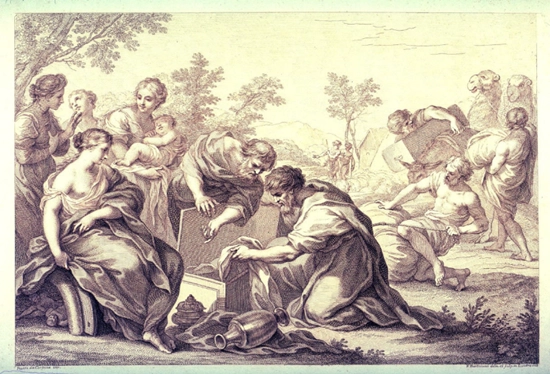
 

A Fight to the Finish

33 So Laban went into Jacob’s tent and into Leah’s tent and into the tent of the two female servants, but he did not find them. And he went out of Leah’s tent and entered Rachel’s. 34 Now Rachel had taken the household gods and put them in the camel’s saddle and sat on them. Laban felt all about the tent, but did not find them. 35 And she said to her father, “Let not my lord be angry that I cannot rise before you, for the way of women is upon me.” So he searched but did not find the household gods.

36 Then Jacob became angry and berated Laban. Jacob said to Laban, “What is my offense? What is my sin, that you have hotly pursued me? 37 For you have felt through all my goods; what have you found of all your household goods? Set it here before my kinsmen and your kinsmen, that they may decide between us two. 38 These twenty years I have been with you. Your ewes and your female goats have not miscarried, and I have not eaten the rams of your flocks. 39 What was torn by wild beasts I did not bring to you. I bore the loss of it myself. From my hand you required it, whether stolen by day or stolen by night. 40 There I was: by day the heat consumed me, and the cold by night, and my sleep fled from my eyes. 41 These twenty years I have been in your house. I served you fourteen years for your two daughters, and six years for your flock, and you have changed my wages ten times. 42 If the God of my father, the God of Abraham and the Fear of Isaac, had not been on my side, surely now you would have sent me away empty-handed. God saw my affliction and the labor of my hands and rebuked you last night.” Genesis 31:33-42 ESV

Reading this portion of the story is like watching a fight between two heavyweight boxers. Both Laban and Jacob are seasoned veterans of the ring, with an arsenal of well-honed skills at their disposal. And they each have proven themselves more than willing to resort to cheating if the circumstances call for it. They’re not afraid to fight dirty if that is what it will take to come out victorious.

So, as the angry and offended Laban confronts his nemesis, Jacob, tempers are at an all-time high. Upon discovering that Jacob had stolen away in the night, carrying his daughters, grandchildren, and personal household gods, Laban had set out in hot pursuit. Now, he was standing in front, full of fury and righteous indignation, accusing his son-in-law of everything from ingratitude and insensitivity to outright theft. But Jacob countered with a declaration of innocence and a vow to put to death anyone found in possession of Laban’s property.

Convinced of Jacob’s guilt, Laban ordered a thorough search of Jacob’s belongings. He began in the tents of Leah, Bilhah, and Zilpah. But his efforts proved fruitless. He could find no trace of the missing household gods. And there is a certain sense of irony in all of this because Laban was in the strange and helpless position of having to “search” for his own gods. All the while he looked, they remained hidden and silent, because they were powerless and incapable of speech. Laban’s gods couldn’t reveal, much less, save themselves. All during this story, they remain invisible and impotent, hidden away and unable to come to Laban’s aid. And it is not surprising that God’s Word has much to say about the idiocy of idols.

“What good is an idol carved by man,
    or a cast image that deceives you?
How foolish to trust in your own creation—
    a god that can’t even talk!
What sorrow awaits you who say to wooden idols,
    ‘Wake up and save us!’
To speechless stone images you say,
    ‘Rise up and teach us!’
    Can an idol tell you what to do?
They may be overlaid with gold and silver,
    but they are lifeless inside.” – Habakuk 2:18-19 NLT

“Don’t go back to worshiping worthless idols that cannot help or rescue you—they are totally useless!” – 1 Samuel 12:21 NLT

Their idols are merely things of silver and gold,
    shaped by human hands.
They have mouths but cannot speak,
    and eyes but cannot see.
They have ears but cannot hear,
    and noses but cannot smell.
They have hands but cannot feel,
    and feet but cannot walk,
    and throats but cannot make a sound.
And those who make idols are just like them,
    as are all who trust in them. – Psalm 115:4-8 NLT

One can only imagine Laban’s growing frustration as his search for his “lost” gods came up empty-handed. But his stubbornness would not allow him to give up and admit defeat. So, the search continued, this time to Rachel’s tent. And while Laban had been busy ransacking the tents of Leah, Bilhah, and Zilpah, Rachel had taken the household gods she had stolen and hid them in the saddle of her camel. Then, as Laban approached, she took a seat on the saddle. Verse 25 indicates that Jacob “had pitched his tent in the hill country,” so it seems likely that the saddle was lying on the ground near Rachel’s tent. And her pilfering of her father’s household gods seems to suggest that Rachel shared her father’s reverence for them. While the names of these gods are not revealed, it is readily apparent that they were of great value to Laban. He had traveled for three days in an attempt to recover them. And Rachel was willing to risk her life in order to keep them. The idols would have represented hope for future blessings and fruitfulness. Perhaps Rachel was hoping that one of these household gods could help her produce another son. Up to this point in the story, Rachel has only been able to conceive one time, and at the birth of that son, she had exclaimed, “May the Lord add yet another son to my family” (Genesis 30:24 NLT).

Perhaps Rachel believed that her first pregnancy had been the work of her father’s gods and she hoped that they would bring her further good fortune. It is clear that she was willing to risk a great deal in order to keep the gods in hiding and in her possession.

Firmly seated upon the saddle, with the idols hidden underneath her, Rachel begged her father’s forgiveness for not rising to greet him, using “the way of women” as her excuse. Laban remained unsuspecting of his daughter’s treachery and continued his search, “but he could not find the household idols” (Genesis 31:35 NLT).

And Jacob, completely oblivious to what his wife had done, must have been gloating on the inside as he watched his father-in-law’s frustration reach a fever pitch. But at some point, he lost his patience and demanded that the search end.

“What’s my crime?” he demanded. “What have I done wrong to make you chase after me as though I were a criminal? – Genesis 31:35 NLT

Jacob had endured enough of his father-in-law’s insulting behavior and demanded an apology for the last 20 years of abuse he had been forced to endure.

“For twenty years I have been with you, caring for your flocks. In all that time your sheep and goats never miscarried. In all those years I never used a single ram of yours for food. If any were attacked and killed by wild animals, I never showed you the carcass and asked you to reduce the count of your flock. No, I took the loss myself! You made me pay for every stolen animal, whether it was taken in broad daylight or in the dark of night.” – Genesis 31:38-39 NLT

Jacob had Laban on the ropes and he was pulling no punches. With each powerful blow, Jacob attempted to deliver the knock-out punch that would send his opponent to the mat. He recounted his tireless and selfless efforts to serve Laban. He reveled in his sense of self-righteousness, detailing the many ways he had treated Laban with nothing but respect. Jacob paints himself as the consummate victim, even describing himself as a helpless slave.

“Yes, for twenty years I slaved in your house! I worked for fourteen years earning your two daughters, and then six more years for your flock. And you changed my wages ten times!” – Genesis 31:41 NLT

He had Laban staggering under a steady barrage of accusations. Those watching this epic battle would have observed that Laban was about to go down for the count. And them, Jacob delivered the final blow that would bring this fight to an end.

“In fact, if the God of my father had not been on my side—the God of Abraham and the fearsome God of Isaac—you would have sent me away empty-handed. But God has seen your abuse and my hard work. That is why he appeared to you last night and rebuked you!” – Genesis 31:42 NLT

Jacob’s decisive one-two punch was Yahweh, the God of Abraham and the fearsome God of Isaac. Laban’s household gods had been no match for the Almighty. For 20 long years, as these two men had done battle, Jacob had enjoyed the blessings of Yahweh. Jacob concedes that all his success had been the work of Yahweh. And Jacob wanted Laban to know that Yahweh could and would undermine any attempts to keep him from returning to Canaan. There was no going back. Jacob would not be tricked again. And the scene seems to end with Jacob standing over his defeated foe as Yahweh raises his gloved hand in victory. That match is over but, for Jacob, the real fight is about to begin.

English Standard Version (ESV) The Holy Bible, English Standard Version. ESV® Permanent Text Edition® (2016). Copyright © 2001 by Crossway Bibles, a publishing ministry of Good News Publishers.

New Living Translation (NLT) Holy Bible, New Living Translation, copyright © 1996, 2004, 2015 by Tyndale House Foundation. Used by permission of Tyndale House Publishers Inc., Carol Stream, Illinois 60188. All rights reserved.

New English Translation (NET)NET Bible® copyright ©1996-2017 by Biblical Studies Press, L.L.C. http://netbible.com All rights reserved.

It Is Enough

31 “Simon, Simon, behold, Satan demanded to have you, that he might sift you like wheat, 32 but I have prayed for you that your faith may not fail. And when you have turned again, strengthen your brothers.” 33 Peter said to him, “Lord, I am ready to go with you both to prison and to death.” 34 Jesus said, “I tell you, Peter, the rooster will not crow this day, until you deny three times that you know me.”

35 And he said to them, “When I sent you out with no moneybag or knapsack or sandals, did you lack anything?” They said, “Nothing.” 36 He said to them, “But now let the one who has a moneybag take it, and likewise a knapsack. And let the one who has no sword sell his cloak and buy one. 37 For I tell you that this Scripture must be fulfilled in me: ‘And he was numbered with the transgressors.’ For what is written about me has its fulfillment.” 38 And they said, “Look, Lord, here are two swords.” And he said to them, “It is enough.”  Luke 22:31-38 ESV

It’s clear from Mark’s account that, immediately after their celebration of the Passover meal,, Jesus and His disciples had left the upper room and made their way to the Mount of Olives, just across the Kidron Valley, east of Jerusalem.

And when they had sung a hymn, they went out to the Mount of Olives. – Mark 14:26 ESV

It was there that Jesus made yet another disturbing announcement.

And Jesus said to them, “You will all fall away, for it is written, ‘I will strike the shepherd, and the sheep will be scattered.’ But after I am raised up, I will go before you to Galilee.” – Mark 14:27-28 ESV

This foreboding prediction caught the disciples off-guard and caused the always quick-to-speak Peter to defend his own honor.

“Even though they all fall away, I will not.” – Mark 14:29 ESV

He was separating himself from the rest by declaring his undying commitment to remain by Jesus’ side no matter what happened. It was probably at this point in the conversation that Jesus spoke the words that Luke records.

“Simon, Simon, behold, Satan demanded to have you, that he might sift you like wheat, but I have prayed for you that your faith may not fail. And when you have turned again, strengthen your brothers.” – Luke 22:31-32 ESV

Jesus knew Simon well. He had spent more than three years attempting to disciple this impulsive and rather self-absorbed fisherman from Galilee. Peter was an over-confident over-achiever who regularly viewed himself as the unofficial and self-declared spokesman for the twelve. He had a strong competitive streak and a tendency to put his mouth in gear before his brain was fully engaged. This propensity often led him to say things he would later regret. And this would prove to be one such occasion.

Peter refused to accept Jesus’ assessment of his future faithfulness, but instead he argued that he was more than willing to lay his life on the line.

“Lord, I am ready to go with you both to prison and to death.” – Luke 22:33 ESV

These boastful words would come back to haunt Peter. He truly believed he was completely sold-out to the cause and willing to sacrifice anything to ensure that Jesus’ kingdom came to fruition. But what he didn’t know was the state of his own heart. Peter refused to accept the fact that he might be some kind of traitor or turncoat. Jesus must have had him confused with one of the other disciples. Yet Jesus made it clear that He had the right man by describing the exact nature of his wrong choice .

“I tell you, Peter, the rooster will not crow this day, until you deny three times that you know me.” – Luke 22:34 ESV

This must have hit Peter like a freight train. Jesus’ dire prediction left him stunned, embarrassed, and more than a bit defensive. Mark records that Peter immediately refuted Jesus’ accusation.

“If I must die with you, I will not deny you.” – Mark 14:31 ESV

In a desperate attempt to protect his own reputation, Peter essentially accused Jesus of being a liar. He denied Jesus’ assertion that he would be a denier. It’s important to remember that this entire conversation took place within earshot of the other disciples because when Peter made this bold claim, the other disciples echoed his words.

And they all said the same. – Luke 22:31 ESV

But at this point, Jesus redirected the topic of conversation by reminding them of their earlier mission when He had “sent them out to proclaim the kingdom of God and to heal” (Luke 9:2 ESV). Jesus asked them, “When I sent you out with no moneybag or knapsack or sandals, did you lack anything?” (Luke 22:35 ESV), and they responded, “Nothing!”

Then, Jesus made a shocking statement that must have left the disciples in a state of confusion.

“But now let the one who has a moneybag take it, and likewise a knapsack. And let the one who has no sword sell his cloak and buy one. – Luke 22:36 ESV

With this rather strange pronouncement, Jesus was letting them know that things were about to take a radical change. Earlier, when He had sent them out by twos, they had been instructed to provide nothing for their own care. Instead, they were to rely on the gracious support of others. But with Jesus’ approaching death and eventual resurrection, the spiritual battle around them was about to enter a new and much-darker phase. Little did they know that the days ahead would be marked by increasing hostility and resistance. This is what Jesus had tried to explain to them on a much earlier occasion.

“Don’t imagine that I came to bring peace to the earth! I came not to bring peace, but a sword.

‘I have come to set a man against his father,
    a daughter against her mother,
and a daughter-in-law against her mother-in-law.
    Your enemies will be right in your own household!’” – Matthew 10:34-36 NLT

Jesus had not been suggesting that His mission was that of a physical revolution fought with swords and spears. He was letting them know that the gospel of the Kingdom of God was going to end up having a polarizing affect on humanity. Those who embrace the gospel would find themselves facing the anger and animosity of their own loved ones. Jesus went on to tell them that their decision to follow Him would come with a high cost.

“If you love your father or mother more than you love me, you are not worthy of being mine; or if you love your son or daughter more than me, you are not worthy of being mine. If you refuse to take up your cross and follow me, you are not worthy of being mine.” – Matthew 10:37-38 NLT

Commitment to the cause of Christ would require a drastic change in priorities and alliances. Nothing was to stand in the way of their sold-out allegiance to Him. They would have to be willing to sacrifice everything for the cause. But Jesus assured them it would be well worth the effort.

“If you cling to your life, you will lose it; but if you give up your life for me, you will find it.” – Matthew 10:39 NLT

But was Jesus really suggesting that the disciples sell their possession order to purchase weapons? Was He condoning self-defense and physical violence? Some would suggest that is exactly what Jesus was doing. They point to Jesus’ response when one of the disciples indicated that they already had two swords in their possession. He said, “It is enough” (Luke 22:38 ESV). And if we fast-forward to later in the evening, when the soldiers came to arrest Jesus in the Garden of Gethsemane, Luke reports that one of the disciples responded to the intrusion by asking, “Lord, shall we strike with the sword?” (Luke 22:49 ESV). And before Jesus could say a word, one of them struck the servant of the high priest and cut off his right ear” (Luke 22:50 ESV). It seems apparent that the disciples had taken Jesus’ admonition to arm themselves quite literally. And yet, Matthew reveals that Jesus did not approve of their actions.

“Put away your sword,” Jesus told him. “Those who use the sword will die by the sword. Don’t you realize that I could ask my Father for thousands of angels to protect us, and he would send them instantly? But if I did, how would the Scriptures be fulfilled that describe what must happen now?” – Matthew 26:52-54 NLT

The whole reference to swords was meant to be a metaphor that let them know that they were about to go into battle. But as the apostle Paul would later explain, the battle was going to be spiritual, not physical in nature.

For we are not fighting against flesh-and-blood enemies, but against evil rulers and authorities of the unseen world, against mighty powers in this dark world, and against evil spirits in the heavenly places. – Ephesians 6:12 NLT

And Jesus inferred that this was spiritual conflict that could only be won by spiritual means. He clearly indicates that if physical protection was the objective, He could have made a personal request to His heavenly Father and thousands of angels with flaming swords would have descended in an instant. But Jesus never made that request and those angels never appeared. This wasn’t case of a lack of weaponry. It was matter of God’s will.

When Jesus had said, “It is enough,” He wasn’t suggesting that two swords would be sufficient to defend the kingdom. He was letting His disciples know that God can do much with little. Just as Jesus had fed the multitude with five loaves of bread and two fish, God could and would accomplish great things through 11 men who were ill-equipped and unprepared for the raging battle that loomed before them.

And the apostle Paul went on to describe the nature of the armor and the arsenal the disciples would eventually use to wage war in the spiritual realm.

Therefore, put on every piece of God’s armor so you will be able to resist the enemy in the time of evil. Then after the battle you will still be standing firm. Stand your ground, putting on the belt of truth and the body armor of God’s righteousness. For shoes, put on the peace that comes from the Good News so that you will be fully prepared. In addition to all of these, hold up the shield of faith to stop the fiery arrows of the devil. Put on salvation as your helmet, and take the sword of the Spirit, which is the word of God. – Ephesians 6:13-17 NLT

It is enough.

English Standard Version (ESV) The Holy Bible, English Standard Version. ESV® Permanent Text Edition® (2016). Copyright © 2001 by Crossway Bibles, a publishing ministry of Good News Publishers.

New Living Translation (NLT) Holy Bible, New Living Translation, copyright © 1996, 2004, 2015 by Tyndale House Foundation. Used by permission of Tyndale House Publishers Inc., Carol Stream, Illinois 60188. All rights reserved.

The Message (MSG)Copyright © 1993, 1994, 1995, 1996, 2000, 2001, 2002 by Eugene H. Peterson

All Swept and In Order

24 “When the unclean spirit has gone out of a person, it passes through waterless places seeking rest, and finding none it says, ‘I will return to my house from which I came.’ 25 And when it comes, it finds the house swept and put in order. 26 Then it goes and brings seven other spirits more evil than itself, and they enter and dwell there. And the last state of that person is worse than the first.”

27 As he said these things, a woman in the crowd raised her voice and said to him, “Blessed is the womb that bore you, and the breasts at which you nursed!” 28 But he said, “Blessed rather are those who hear the word of God and keep it!” – Luke 11:24-28 ESV

The Jewish religious leaders, who greatly despised Jesus, had effectively spread the rumor that his power to cast out demons came from Satan himself. They couldn’t deny the fact that Jesus performed inexplicable miracles, so they attempted to cast doubt on their efficacy by raising concerns about their source. Not only had they accused Jesus of casting out demons by the power of Satan, but they had also regularly tried to expose Jesus as a violator of the Sabbath laws. Jesus had a habit of performing many of His miracles on the Sabbath, and this proclivity provided the Pharisees with plenty of evidence to accuse Him of being a law-breaker.

But Jesus had refuted their charges, stating, “the Son of Man is lord of the Sabbath” (Matthew 12:8 ESV). The term, “son of man” was Jesus’ favorite appellation when referring to Himself and it is a direct reference to the prophecy found in Daniel 7.

As my vision continued that night, I saw someone like a son of man coming with the clouds of heaven. He approached the Ancient One and was led into his presence. He was given authority, honor, and sovereignty over all the nations of the world, so that people of every race and nation and language would obey him. His rule is eternal—it will never end. His kingdom will never be destroyed. – Daniel 7:13-14 NLT

Every time Jesus referred to Himself by that moniker, He was declaring His identity as the Messiah of Israel, the long-awaited descendant of King David who would rule and reign in righteousness and for eternity. Jesus was the Son of Man and yet, the people of Israel were having a difficult time believing His claim. And the religious leaders were even attributing His miraculous powers to Satan. But Matthew records that Jesus refuted their accusation, claiming instead that His power came from the Spirit of God.

“But if it is by the Spirit of God that I cast out demons, then the kingdom of God has come upon you. – Matthew 12:28 ESV

Jesus was about to use this important distinction to level a serious charge against the Pharisees and their fellow members of the Sanhedrin. Whether they realized it or not, they were actually committing blasphemy against the Spirit of God by attributing His works to Satan.

And whoever speaks a word against the Son of Man will be forgiven, but whoever speaks against the Holy Spirit will not be forgiven, either in this age or in the age to come. – Matthew 12:32 ESV

They could say what they wanted about Jesus. They could reject Him and spread all kinds of lied about Him. But when they boldly declared Jesus’ Spirit-empowered miracles to be the work of Satan, they were sealing their eternal fate.

These men had determined to oppose Jesus’ claim to be the Son of Man. And, in doing so, they had become His adversaries and enemies of God Almighty.

Whoever is not with me is against me, and whoever does not gather with me scatters. – Luke 11:23 ESV

What these self-righteous men failed to understand was that Jesus came to do far more than free those who suffered from demon possession. The many miracles Jesus performed, while profound in nature, were all short-term solutions to temporal problems. Those whom He healed from disease would still be capable of contracting yet another ailment. The lame who received the ability to walk would one day find themselves crippled by the ravages of old age. The eyes of the blind whose sight He restored would eventually develop cataracts. And Jesus even reveals that the formerly demon-possessed were far from out of the woods when it came to their former state.

“When an evil spirit leaves a person, it goes into the desert, searching for rest. But when it finds none, it says, ‘I will return to the person I came from.’ So it returns and finds that its former home is all swept and in order.” – Luke 11:24-25 NLT

In a sense, Jesus is saying that casting out a demon is the easy part. But creating an environment where the demon is no longer welcome is much more difficult. Notice that Jesus emphasizes a home that “is all swept and in order” (Luke 11:25 NLT). He paints a picture of someone doing all they can to put their life back together so that the demon finds their “home” an unwelcome place to occupy.

This seems to be a direct slam against the Pharisees and their legalistic devotion to law-keeping and outward displays of righteousness. In fact, just a few verses later, Jesus exposes their obsession with appearances.

“You Pharisees are so careful to clean the outside of the cup and the dish, but inside you are filthy—full of greed and wickedness!” – Luke 11:39 NLT

Casting out a demon does nothing to change the heart of a man, no more than washing the outside of a cup removes the dirt contained within it. When Jesus cast out demons, He was demonstrating His power and authenticating His identity as the Messiah. He was proving that He had God-given authority to oppose and depose Satan and His minions. But had Jesus cast out every demon In Israel and healed every individual suffering from sickness and disease, the fate of mankind would have remained unchanged. He had come to do far more than clean the outside of the cup. He came to provide cleansing from sin and deliverance from the condemnation of death.

Having their ability to walk restored was of no real benefit if the person refused to follow Jesus and have their sin-damaged heart made new. A blind person who had their eyes opened by Jesus would still find themselves living in darkness if they failed to recognize Him as the Son of God and their sole source of salvation from sin. And the individual who basked in the joy of being demon-free would soon discover that it was their unrepentant and unchanged heart that made their life the perfect habitat for evil spirits. If Jesus didn’t occupy their heart, something else would.

It’s likely that these comments from Jesus elicited a range of responses from the crowd who heard them. The Pharisees would have been enraged and offended by what they heard. They knew Jesus was accusing them of blasphemy. And they were more convinced than ever that He was a threat to their way of life and had to be eliminated. But Luke records that one anonymous woman spoke up and declared, “God bless your mother—the womb from which you came, and the breasts that nursed you!” (Luke 11:27 NLT). This unnamed woman, most likely a mother herself, expressed her deep admiration for Jesus by pronouncing a blessing on the woman who bore Him for nine months and then brought Him into this world. Had Mary, the mother of Jesus, not brought her son to full term, this woman would not have enjoyed the privilege of sitting under His teaching and benefiting from His wisdom.

But Jesus took the woman’s kind and gracious statement and used it to emphasize the need for belief.

“But even more blessed are all who hear the word of God and put it into practice.” – Luke 11:28 NLT

Yes, Mary was blessed for having brought Jesus into the world. But how more blessed are all those who invite Jesus into their hearts. As grateful as that woman may have been, she needed to hear what Jesus had to say and do what He was calling her to do: Believe.

This all goes back to the heart. The formerly demon-possessed needed to have their hearts cleansed. The formerly lame needed to walk in a manner worthy of the Lord. The blind whose sight had been restored needed to see the glory of God’s grace made possible through the gift of His Son. And the apostle John records a conversation that took place between Jesus and the crowd whom He had just miraculously fed.

“I tell you the truth, you want to be with me because I fed you, not because you understood the miraculous signs. But don’t be so concerned about perishable things like food. Spend your energy seeking the eternal life that the Son of Man can give you. For God the Father has given me the seal of his approval.” – John 6:26-27 NLT

Jesus told them to seek the eternal life that only He could give. Physical bread could only sustain physical life. But Jesus, as the bread that comes down from heaven, could provide them with eternal life. Yet the people failed to understand what Jesus was saying and expressed their desire to emulate His divine works.

They replied, “We want to perform God’s works, too. What should we do?” – John 6:28 NLT

They were asking for the power to miraculously multiply bread and fish. In other words, they were looking for a spiritual power that they could use to meet physical needs. But Jesus was offering them so much more, and the only way they could access the gift He was offering was through belief. They didn’t need more bread, they needed the bread of life.

Jesus told them, “This is the only work God wants from you: Believe in the one he has sent.” – John 6:29 NLT

The woman in the crowd blessed Mary, but Jesus wanted to bless her with the gift of eternal life. And the only requirement was faith. The key to true life change was heart transformation and only faith in Jesus could leave a heart “all swept and in order.”

English Standard Version (ESV) The Holy Bible, English Standard Version. ESV® Permanent Text Edition® (2016). Copyright © 2001 by Crossway Bibles, a publishing ministry of Good News Publishers.

New Living Translation (NLT) Holy Bible, New Living Translation, copyright © 1996, 2004, 2015 by Tyndale House Foundation. Used by permission of Tyndale House Publishers Inc., Carol Stream, Illinois 60188. All rights reserved.

The Message (MSG)Copyright © 1993, 1994, 1995, 1996, 2000, 2001, 2002 by Eugene H. Peterson

The Stronger Man

14 Now he was casting out a demon that was mute. When the demon had gone out, the mute man spoke, and the people marveled. 15 But some of them said, “He casts out demons by Beelzebul, the prince of demons,” 16 while others, to test him, kept seeking from him a sign from heaven. 17 But he, knowing their thoughts, said to them, “Every kingdom divided against itself is laid waste, and a divided household falls. 18 And if Satan also is divided against himself, how will his kingdom stand? For you say that I cast out demons by Beelzebul. 19 And if I cast out demons by Beelzebul, by whom do your sons cast them out? Therefore they will be your judges. 20 But if it is by the finger of God that I cast out demons, then the kingdom of God has come upon you. 21 When a strong man, fully armed, guards his own palace, his goods are safe; 22 but when one stronger than he attacks him and overcomes him, he takes away his armor in which he trusted and divides his spoil. 23 Whoever is not with me is against me, and whoever does not gather with me scatters.” – Luke 11:14-23 ESV

After recording Jesus’ instructions to His disciples on the subject of prayer, Luke seems to make a rather abrupt shift in the topic. There were a lot of rumors concerning Jesus. Some believed Him to be the Messiah, while others speculated that He might be Elijah or one of the other prophets, resurrected from the dead. His miracles and messages had made a powerful impression on many people, but there were those who took exception to this enigmatic Rabbi from Nazareth. And their speculation regarding His identity had been heavily influenced by the rumors the religious leaders had begun to spread.

We know from the gospel accounts of Matthew and Mark that the Sanhedrin had begun to circulate the rumor that Jesus was demon-possessed. Even while He had been ministering in Galilee, a contingent of Pharisees had been sent from Jerusalem to the region around the northern shore of the Sea of Galilee. It was on this occasion that these men pronounced their verdict regarding the source of Jesus’ miraculous powers.

“He’s possessed by Satan, the prince of demons. That’s where he gets the power to cast out demons.” – Mark 3:22 NLT

Matthew seems to record a similar, yet different situation in which Jesus cast a demon out of a man and was immediately accused by the Pharisees of having done so by the power of Satan.

“No wonder he can cast out demons. He gets his power from Satan, the prince of demons.” – Matthew 12:24 NLT

These men had been trying to counteract the enthusiasm of the crowd. Some of those who had witnessed this miraculous healing had begun to wonder out loud if Jesus really was their long-awaited Messiah.

Could it be that Jesus is the Son of David, the Messiah?” – Matthew 12:23 NLT

The Pharisees could not tolerate this kind of speculation, so they began to accuse Jesus of being in league with Satan. Unable to deny His power, they decided to question its source. And in all three cases, Jesus strongly refuted their accusations, exposing the illogical nature of their claim.

In Luke’s account, it appears that the Pharisees had been successful in circulating their rumor concerning the satanic source of Jesus’ power. They had planted the seed of doubt and it had begun to take root. On this occasion, it was not a Pharisee who leveled the accusation against Jesus, but one of the onlookers.

“He casts out demons by Beelzebul, the prince of demons…” – Luke 11:15 ESV

The Jewish people commonly used the name, Beelzebul, when referring to Satan. It is derived from two words, Baal, which was the name for the chief Canaanite deity, and Zebul, which means “exalted dwelling.” In the Greek New Testament, it is sometimes spelled Beelzeboul, which can be translated as “lord of dung.” It was a commonly used euphemism for Satan himself, the prince of demons.

So, on this occasion, you have some in the crowd accusing Jesus of being a tool of Satan, while others are demanding that He show them some kind of heavenly sign to prove He is the Messiah. It was a volatile and intensely polarized scene. But, just as He had done before, Jesus calmly and patiently addressed the unsubstantiated and blasphemous rumors being leveled against Him.

None of it made any sense. Why in the world, Jesus asked, would Satan cast out one of his own? That would not only be illogical but highly unproductive. And to drive home His point, Jesus forces His accusers to consider the absurd nature of their argument.

“Any kingdom divided by civil war is doomed. A family splintered by feuding will fall apart. You say I am empowered by Satan. But if Satan is divided and fighting against himself, how can his kingdom survive?” – Luke 11:17-18 NLT

It would be totally irrational for Satan to provide Jesus with the power to cast out demons. To do so would be self-defeating and self-destructive. And those who had witnessed Jesus cast out demons would have recognized that the demons never left willingly or without a fight. On many occasions, they opposed Jesus, verbally acknowledging Him as the Son of God. Luke records an earlier situation in which Jesus was confronted by a disgruntled demon and his companions who fully recognized and confessed His divine power and authority.

“Why are you interfering with us, Jesus of Nazareth? Have you come to destroy us? I know who you are—the Holy One of God!” – Luke 4:34 NLT

Jesus’ ability to cast out demons was a clear indication of His sovereign power and validation of His identity as the Messiah. He was the King and, in exorcising demons, He was exercising His divinely ordained power and authority over the enemy. The demons clearly recognized this fact, but the Pharisees could not or simply would not.

And Jesus points out the hypocrisy of it all. The exorcism of demons was not uncommon among the Jewish people. And Jesus raises the logical question that since there were others who claimed to possess the power to cast out demons, were they also in cooperation with Satan? They couldn’t have it both ways. Either exorcism was divinely empowered or it was not. It was a work of God or it was a work of Satan. But Jesus points out the most logical and significant conclusion.

“But if I am casting out demons by the power of God, then the Kingdom of God has arrived among you.” – Luke 11:20 NLT

Whether they realized it or not, those in the crowd who had demanded a sign had already received one. Jesus was operating by the power of God and, in doing so, was giving evidence that He was the King of Israel. And His arrival was proof that the long-awaited promise of the kingdom was being fulfilled. He was the Messiah, the stronger man who was defeating the strong man (Satan) by the power of God. He was the chosen one who had been sent to bring release to all those held captive by the enemy. Ever since the fall, Satan had operated as the prince of this world, enslaving and controlling mankind, and waging a relentless war against God. Even at the incarnation, Satan had attempted to destroy the Son of God through the demon-possessed efforts of Herod (Matthew 2:1-18). Immediately after Jesus’ baptism, He was led by the Holy Spirit into the Judean wilderness, where Satan launched an all-out assault designed to derail Jesus from His God-ordained mission. But he failed.

And now Jesus was waging war on Satan. With every exorcism He performed, Jesus was giving evidence that Satan’s power was waning and his days were numbered. In Jesus, Satan, the strong man, had more than met his match. And Jesus informs His accusers that their disbelief was tantamount to insurrection. By accusing Jesus of operating by the power of Satan, they were actually illustrating their own cooperation with the enemy.

“Anyone who isn’t with me opposes me, and anyone who isn’t working with me is actually working against me. – Luke 11:23 NLT

This is essentially the same message Peter had received when he had rebuked Jesus for speaking of His coming suffering and death in Jerusalem. Jesus had strongly admonished His well-meaning but misinformed friend, “Get away from me, Satan! You are a dangerous trap to me. You are seeing things merely from a human point of view, not from God’s” (Matthew 16:23 NLT). In opposing Jesus’ declaration of God’s will, Peter had unknowingly aligned himself with the aims of the enemy. He had essentially become the tool of Satan, trying to thwart the redemptive plan that God had ordained for His Son. What Peter failed to realize was that Jesus’ death was going to be the key to breaking Satan’s power over mankind. With Jesus’ crucifixion, Satan would assume he had won the victory. But he would be wrong – dead wrong. The sacrificial death of Jesus would bring about the emancipation of all those who were held captive by the enemy. The author of Hebrews reminds us:

Because God’s children are human beings—made of flesh and blood—the Son also became flesh and blood. For only as a human being could he die, and only by dying could he break the power of the devil, who had the power of death. Only in this way could he set free all who have lived their lives as slaves to the fear of dying. – Hebrews 2:14-15 NLT

And the apostle John adds, “the Son of God came to destroy the works of the devil” (1 John 3:8 NLT). While Jesus walked this earth, He demonstrated His power over the enemy. But it was on the cross, as He breathed His last breath, that Jesus delivered the death blow to Satan. With the willful sacrifice of His life, Jesus fulfilled the curse that God had placed upon Satan as a result of his temptation of Adam and Eve.

“And I will cause hostility between you and the woman, and between your offspring and her offspring. He will strike your head, and you will strike his heel.” – Genesis 3:15 NLT

Jesus, the stronger man, has defeated Satan. Yes, he still wields his power and displays an open disdain for God and His people, but he is a defeated foe. His days are numbered and his future is sealed. He fights a futile war with a preordained outcome. All because Jesus, the Son of God, fulfilled the will of God and gave His life as a ransom for many.

English Standard Version (ESV) The Holy Bible, English Standard Version. ESV® Permanent Text Edition® (2016). Copyright © 2001 by Crossway Bibles, a publishing ministry of Good News Publishers.

New Living Translation (NLT) Holy Bible, New Living Translation, copyright © 1996, 2004, 2015 by Tyndale House Foundation. Used by permission of Tyndale House Publishers Inc., Carol Stream, Illinois 60188. All rights reserved.

The Message (MSG)Copyright © 1993, 1994, 1995, 1996, 2000, 2001, 2002 by Eugene H. Peterson

Where Are the Gods?

26 Then Eliakim the son of Hilkiah, and Shebnah, and Joah, said to the Rabshakeh, “Please speak to your servants in Aramaic, for we understand it. Do not speak to us in the language of Judah within the hearing of the people who are on the wall.” 27 But the Rabshakeh said to them, “Has my master sent me to speak these words to your master and to you, and not to the men sitting on the wall, who are doomed with you to eat their own dung and to drink their own urine?”

28 Then the Rabshakeh stood and called out in a loud voice in the language of Judah: “Hear the word of the great king, the king of Assyria! 29 Thus says the king: ‘Do not let Hezekiah deceive you, for he will not be able to deliver you out of my hand. 30 Do not let Hezekiah make you trust in the Lord by saying, The Lord will surely deliver us, and this city will not be given into the hand of the king of Assyria.’ 31 Do not listen to Hezekiah, for thus says the king of Assyria: ‘Make your peace with me and come out to me. Then each one of you will eat of his own vine, and each one of his own fig tree, and each one of you will drink the water of his own cistern, 32 until I come and take you away to a land like your own land, a land of grain and wine, a land of bread and vineyards, a land of olive trees and honey, that you may live, and not die. And do not listen to Hezekiah when he misleads you by saying, “The Lord will deliver us.” 33 Has any of the gods of the nations ever delivered his land out of the hand of the king of Assyria? 34 Where are the gods of Hamath and Arpad? Where are the gods of Sepharvaim, Hena, and Ivvah? Have they delivered Samaria out of my hand? 35 Who among all the gods of the lands have delivered their lands out of my hand, that the Lord should deliver Jerusalem out of my hand?’”

36 But the people were silent and answered him not a word, for the king’s command was, “Do not answer him.” 37 Then Eliakim the son of Hilkiah, who was over the household, and Shebna the secretary, and Joah the son of Asaph, the recorder, came to Hezekiah with their clothes torn and told him the words of the Rabshakeh. 2 Kings 18:26-37 ESV

This entire scene is filled with a sense of nervous anticipation. The people of Judah are lining the eastern walls of the city, overlooking the Kidron Valley, where the Assyrian army lies spread out before them in numbers too great to count. But their eyes are locked on the three emissaries whom King Hezekiah commissioned to discuss terms of peace with the Assyrians. Eliakim, Shebnah, and Joah hold the fate of the nation in their hands. The people know that the negotiating skills of these three men will determine whether Judah stands or falls. So, all eyes are fixed on the momentous scene taking place at the base of the walls of the city.

But the Rabshakeh, or supreme commander of the Assyrian army, is not interested in peace negotiations. He has come to demand the unconditional surrender of the city and its inhabitants. He and his troops have repeatedly proven their superior power and he is confident that the city of Jerusalem will be one more domino to fall as they continue their conquest of Palestine. Speaking on behalf of his commander-in-chief, the Rabshakeh declares Hezekiah’s rebellion to be ill-conceived and ill-fated.

“This is what the great king of Assyria says: What are you trusting in that makes you so confident? Do you think that mere words can substitute for military skill and strength? Who are you counting on, that you have rebelled against me? – 2 Kings 18:19-20 NLT

With the citizens of Jerusalem looking on and listening in, this arrogant military commander summarily dismisses any likelihood that the Egyptians will come to the aid of the city. The last-minute military alliance that King Hezekiah made with Pharaoh will prove disappointingly insufficient. The Rabshakeh sarcastically compares Pharaoh to a cane or walking stick made from a reed. It may appear to give support, but it will shatter as soon as any weight is placed upon it.

And the overly confident Assyrian commander informs the Jewish emissaries that if they are holding out hope that Yahweh will come to their rescue, they will find themselves sorely disappointed. Their deity will join a long list of other gods who proved unsuccessful in stopping the Assyrian juggernaut. And, hoping to further undermine their faith in divine rescue, the Rabshakeh announces to the people of Judah that Yahweh had ordered their destruction.

“What’s more, do you think we have invaded your land without the Lord’s direction? The Lord himself told us, ‘Attack this land and destroy it!’”  2 Kings 18:25 NLT

Eliakim, Shebna, and Joah could sense that all this boastful rhetoric was having its intended effect. The Rabshakeh had purposefully delivered his message in Hebrew so that all the people on the wall could hear what he had to say. And they were growing increasingly more concerned. When the king’s three emissaries asked that the conversation be switched to Aramaic, the Rabshakeh refused and called out in a loud voice, “Do you think my master sent this message only to you and your master? He wants all the people to hear it, for when we put this city under siege, they will suffer along with you. They will be so hungry and thirsty that they will eat their own dung and drink their own urine” (2 Kings 18:27 NLT).

At this point, the Rabshakeh turns his attention to the people on the walls of the city. He begins to sow seeds of doubt and suspicion by raising questions concerning King Hezekiah’s intentions and trustworthiness. By addressing the people directly, the Rabshakeh hopes to foment an uprising within the walls of the city, inciting the citizens to turn on their king and demand that he spare their lives by surrendering to the Assyrians. And to help sweeten the pot, the Rabshakeh offers them tempting promises of peace and prosperity.

“Don’t listen to Hezekiah! These are the terms the king of Assyria is offering: Make peace with me—open the gates and come out. Then each of you can continue eating from your own grapevine and fig tree and drinking from your own well. Then I will arrange to take you to another land like this one—a land of grain and new wine, bread and vineyards, olive groves and honey. Choose life instead of death! – 2 Kings 18:31-32 NLT

Look closely at what the Assyrian king is offering the people of Judah. Essentially, this pagan king is putting himself in the place of God, promising to meet all their needs. He will supply them with ample food and drink. He will provide them with fresh water. And he will take them to “a land of grain and new wine, bread and vineyards, olive groves and honey.” That should sound familiar. When God had called Moses to rescue the people of Israel from their captivity in Egypt, He had promised to lead them to a “fertile and spacious land…a land flowing with milk and honey” (Exodus 3:8 NLT). And after God had successfully freed them from their captivity and led them to the land of Canaan, He had reminded them again of His promise to give them “a good land of flowing streams and pools of water, with fountains and springs that gush out in the valleys and hills. It is a land of wheat and barley; of grapevines, fig trees, and pomegranates; of olive oil and honey. It is a land where food is plentiful and nothing is lacking” (Deuteronomy 8:7-9 NLT).

Now, centuries later, here was the pagan king of Assyria offering to replicate what God had done for His chosen people. If they would only turn their backs on Yahweh and trust in King Sennacherib, he would provide for all their needs and take them to a new “promised land.”

Sennacherib was placing himself in the role of God, declaring himself to be the source of life and death. By placing their trust in him, they would be assured of peace, prosperity, and life. But centuries earlier, Moses had delivered a much different message to the people of Israel. As they stood on the banks of the Jordan River, preparing to enter the land of promise for the very first time, he had warned them:

“Today I have given you the choice between life and death, between blessings and curses. Now I call on heaven and earth to witness the choice you make. Oh, that you would choose life, so that you and your descendants might live! You can make this choice by loving the LORD your God, obeying him, and committing yourself firmly to him. This is the key to your life. And if you love and obey the LORD, you will live long in the land the LORD swore to give your ancestors Abraham, Isaac, and Jacob.” – Deuteronomy 30:19-20 NLT

Sennacherib was playing God. This over-confident king with an overactive ego was daring to place himself on equal standing with God Almighty. And he was attempting to persuade the people of Judah to abandon their hope and trust in Yahweh by offering them a “better” promised land.

But while the people on the wall were disturbed by what they heard, they obeyed King Hezekiah’s command and remained silent. And the three emissaries, their clothes torn in an act of mourning, returned to the king and reported all that they had heard. It was a dark day in Judah. The enemy was at the gate. The allies of Judah were nowhere to be found. But despite the boasts of the Rabshakeh, the God of Judah was still on His throne and in complete control of all that was happening. He alone held the power of life and death in His hands. And King Sennacherib and his overconfident military commander were about to discover the painful lesson that they were no match for the all-powerful God of Judah.

English Standard Version (ESV) The Holy Bible, English Standard Version. ESV® Permanent Text Edition® (2016). Copyright © 2001 by Crossway Bibles, a publishing ministry of Good News Publishers.

New Living Translation (NLT) Holy Bible, New Living Translation, copyright © 1996, 2004, 2015 by Tyndale House Foundation. Used by permission of Tyndale House Publishers Inc., Carol Stream, Illinois 60188. All rights reserved.

The Message (MSG)Copyright © 1993, 1994, 1995, 1996, 2000, 2001, 2002 by Eugene H. Peterson

Faith in the Face of Affliction

1 Therefore when we could bear it no longer, we were willing to be left behind at Athens alone, and we sent Timothy, our brother and God’s coworker in the gospel of Christ, to establish and exhort you in your faith, that no one be moved by these afflictions. For you yourselves know that we are destined for this. For when we were with you, we kept telling you beforehand that we were to suffer affliction, just as it has come to pass, and just as you know. For this reason, when I could bear it no longer, I sent to learn about your faith, for fear that somehow the tempter had tempted you and our labor would be in vain. 1 Thessalonians 3:1-5 ESV

We know from Luke’s account of Paul’s second missionary journey, recorded in the book of Acts, that Paul and Silas had been forced to flee Thessalonica because of threats against their lives. They left under the cover of night and made their way to Berea. Their initial reception in Berea was positive and Luke records that the Jews there “received the word with all eagerness, examining the Scriptures daily to see if these things were so” (Acts 17:11 ESV). But before long, the Jews in Thessalonica got word that Paul and Silas were in Berea and sent men to stir up the local Jews against them. Once again, Paul was forced to leave, but he asked Silas and Timothy to remain behind in Berea (Acts 17:14). Paul then made his way to Athens by boat. Once there, he immediately went to work sharing the gospel, even preaching in the Areopagus, an outdoor arena located on a small hill northwest of the city of Athens. The term,  Areopagus referred to the place and the council of rulers who met there to debate and discuss important topics. Paul addressed this learned group, using the local shrine to the “unknown god” to discuss with them the truth regarding Jesus Christ. And all went well until he mentioned Jesus being raised from the dead.

Now when they heard of the resurrection of the dead, some mocked. But others said, “We will hear you again about this.” So Paul went out from their midst. But some men joined him and believed, among whom also were Dionysius the Areopagite and a woman named Damaris and others with them. – Acts 17:31-33 ESV

In spite of the negative response of the council, there were those who heard Paul’s message and believed.

In his letter to the Thessalonian believers, Paul picks up the recounting of his travel itinerary right at this point.

Therefore when we could bear it no longer, we were willing to be left behind at Athens alone, and we sent Timothy, our brother and God’s coworker in the gospel of Christ, to establish and exhort you in your faith… – 1 Thessalonians 3:1-2 ESV

Paul had left Silas and Timothy back in Berea, but a further decision had been made to have Timothy return to Thessalonica to continue the work of building up the local congregation there. In a series of letters he had written to Timothy, Paul provided his young friend and ministry partner with some specific instructions regarding his work among these fledgling congregations.

Don’t let anyone think less of you because you are young. Be an example to all believers in what you say, in the way you live, in your love, your faith, and your purity. Until I get there, focus on reading the Scriptures to the church, encouraging the believers, and teaching them. – 1 Timothy 4:12-13 NLT

Preach the word of God. Be prepared, whether the time is favorable or not. Patiently correct, rebuke, and encourage your people with good teaching. – 2 Timothy 4:2 NLT

Paul reminds the Thessalonian believers that Timothy had been sent to encourage and instruct them, but also to strengthen their faith as they wrestled with the persecution they were facing.

We sent him to strengthen you, to encourage you in your faith, and to keep you from being shaken by the troubles you were going through. – 1 Thessalonians 3:2-3 NLT

If you recall, a year earlier, when Paul and Silas had been in Thessalonica, a mob attacked the home of Jason, one of the members of the local congregation. He and a few other Christians had been dragged before the city council where they had been falsely accused of insurrection against the Roman government.

“They are all guilty of treason against Caesar, for they profess allegiance to another king, named Jesus.” – Acts 17:7 NLT

Jason and his companions were forced to post bond and released, but the pressure on this small congregation did not let up. The Jews living in Thessalonica saw them as a threat and continued to stir up trouble for them. The Gospel was having an impact, resulting in the conversions of some of the members of the local synagogue. And this resulted in a spirit of jealousy and resentment among the Jews. And the city council, answerable to the Roman government, was not about to tolerate anyone or anything that caused a spirit of dissent or discord in their community. So, this small congregation of Christ-followers was under increasing pressure and growing persecution.

But Paul reminds them:

…you know that we are destined for such troubles. Even while we were with you, we warned you that troubles would soon come—and they did, as you well know. – 1 Thessalonians 4:3-4 NLT

He had warned them that trouble would come, and it had shown up as promised. Evidently, this had been the motivation behind Paul’s decision to send Timothy back to Thessalonica. He was concerned that the pressure being placed upon the believers there would cause them to consider reneging on their commitment to Christ.

Paul had a strong commitment to the spiritual well-being of the local church and, knowing that persecution was to be expected, he had sent Timothy to provide godly leadership in the face of opposition. And he had already provided Timothy with ample instructions regarding his role as an elder/shepherd of the people of God.

I am writing these things to you now, even though I hope to be with you soon, so that if I am delayed, you will know how people must conduct themselves in the household of God. This is the church of the living God, which is the pillar and foundation of the truth. – 1 Timothy 3:14-15 NLT

The church was to be the pillar and foundation of the truth. The local congregation in Thessalonica was meant to conduct itself in keeping with the truth of the Gospel, exhibiting its life-transforming power even in the face of persecution. Paul was well aware of the fact that Satan would do everything in his power to discourage and demoralize the young believers in Thessalonica. In fact, he confessed to them his fear that they would give in to the enemy’s attacks on their faith.

I was afraid that the tempter had gotten the best of you and that our work had been useless. – 1 Thessalonians 3:5 NLT

Paul had expressed similar concerns to the believers in Ephesus and had provided them with insights into the nature of the spiritual battle in which they were engaged.

Be strong in the Lord and in his mighty power. Put on all of God’s armor so that you will be able to stand firm against all strategies of the devil. For we are not fighting against flesh-and-blood enemies, but against evil rulers and authorities of the unseen world, against mighty powers in this dark world, and against evil spirits in the heavenly places. – Ephesians 6:10-12 NLT

Faith in Christ had resulted in salvation for the believers in Thessalonica. But it had also resulted in persecution. Their commitment to Christ had placed a bullseye on their backs and made them tempting targets for the enemy. And Paul knew that the constant presence of trials and tribulations would cause some to lose faith. Their strength to stand firm in the face of opposition would grow weak and the temptation to return to their old way of life would be great.

Paul had warned Timothy that this would happen, so he had encouraged him to “fight the good fight, holding on to faith and a good conscience, which some have rejected and thereby shipwrecked their faith” (1 Timothy 1:18-19 BSB).

The local church is meant to be the pillar and foundation of the truth. It is within the local fellowship that the miracle of the Gospel shows up in transformed lives and a loving community of Christ-centered people who love God and each other. But for that local church to be impactful, it will require individual believers who remain committed to the cause of Christ regardless of any persecutions or problems they may face.

Paul knew that the Thessalonian believers were suffering, but he also knew that they could survive and thrive. His answer to their problem of persecution was simple. It was the very same thing he had told the believers in Corinth.

Be on guard. Stand firm in the faith. Be courageous. Be strong. And do everything with love. – 1 Corinthians 16:13 NLT

And God had not left them ill-equipped or on their own. He had provided them with ample resources to fight the good fight of faith.

Therefore, put on every piece of God’s armor so you will be able to resist the enemy in the time of evil. Then after the battle you will still be standing firm. Stand your ground, putting on the belt of truth and the body armor of God’s righteousness. For shoes, put on the peace that comes from the Good News so that you will be fully prepared. In addition to all of these, hold up the shield of faith to stop the fiery arrows of the devil. Put on salvation as your helmet, and take the sword of the Spirit, which is the word of God. – Ephesians 6:13-17 NLT

English Standard Version (ESV)
The Holy Bible, English Standard Version. ESV® Permanent Text Edition® (2016). Copyright © 2001 by Crossway Bibles, a publishing ministry of Good News Publishers.

New Living Translation (NLT)
Holy Bible, New Living Translation, copyright © 1996, 2004, 2015 by Tyndale House Foundation. Used by permission of Tyndale House Publishers Inc., Carol Stream, Illinois 60188. All rights reserved.

The Message (MSG)Copyright © 1993, 1994, 1995, 1996, 2000, 2001, 2002 by Eugene H. Peterson

The Lord Their God

For Gaza shall be deserted,
    and Ashkelon shall become a desolation;
Ashdod’s people shall be driven out at noon,
    and Ekron shall be uprooted.

Woe to you inhabitants of the seacoast,
    you nation of the Cherethites!
The word of the Lord is against you,
    O Canaan, land of the Philistines;
    and I will destroy you until no inhabitant is left.
And you, O seacoast, shall be pastures,
    with meadows for shepherds
    and folds for flocks.
The seacoast shall become the possession
    of the remnant of the house of Judah,
    on which they shall graze,
and in the houses of Ashkelon
    they shall lie down at evening.
For the Lord their God will be mindful of them
    and restore their fortunes. Zephaniah 2:4-7 ESV

God now turns His attention to the nations surrounding Judah. He has already warned that one aspect of the great day of the Lord will be His judgment of all humanity. He will “cut off mankind from the face of the earth” (Zephaniah 1:3 ESV).

Judah must face its future judgment, but God is not going to overlook the sins of the rest of mankind. And in this passage, He will point out five different nations that surround Judah and outline His plans for their future demise. Located north, south, east, and west of Judah, these neighboring countries become surrogates or stand-ins for all the nations of the earth. While they could not claim to be the people of God, they will still experience the judgment of God.

Each of them is marked by the worship of false gods represented by a litany of fabricated idols, the byproduct of man’s fertile imagination and creative capabilities. As the psalmist points out, they are not gods at all, and stand in stark contrast to the God of the universe.

For all the gods of the peoples are worthless idols,
    but the Lord made the heavens.
Splendor and majesty are before him;
    strength and beauty are in his sanctuary.

Ascribe to the Lord, O families of the peoples,
    ascribe to the Lord glory and strength!
Ascribe to the Lord the glory due his name;
    bring an offering, and come into his courts!
Worship the Lord in the splendor of holiness;
    tremble before him, all the earth!

Say among the nations, “The Lord reigns!
    Yes, the world is established; it shall never be moved;
    he will judge the peoples with equity.” – Psalm 96:5-10 ESV

The one true God will judge all the people and nations who have chosen to worship their many false gods while ignoring His invisible, yet undeniable attributes.

For his invisible attributes, namely, his eternal power and divine nature, have been clearly perceived, ever since the creation of the world, in the things that have been made. So they are without excuse. For although they knew God, they did not honor him as God or give thanks to him, but they became futile in their thinking, and their foolish hearts were darkened. Claiming to be wise, they became fools, and exchanged the glory of the immortal God for images resembling mortal man and birds and animals and creeping things. – Romans 1:20-23 ESV

They will all answer for the same sin: Their rejection of God as the one true God.

And Zephaniah begins by listing four cities located in the region of Philistia, located just to the west of Judah: Gaza, Ashkelon, Ashdod, and Ekron.  Except for Ekron, these are all coastal cities, providing access to the Mediterranean Sea. It is believed that the Philistines originated from the island of Crete (Caphtor) and migrated to the western coast of Canaan.

Their name derives from the Hebrew word Philistia. In Greek, that word became palaistinei, and it is why the land of Canaan is sometimes referred to as Palestine. The Philistines are sometimes referred to as the “Sea Peoples” because of their close ties with and dependence upon the sea. Their ships would have plied the waters of the Mediterranean, making the inhabitants of the ports of Gaza, Ashkelon, and Ashdod quite profitable. Each of the cities mentioned in verse four were governed by a “king” or “lord.” They were independent and autonomous realms, but when the need arose, the kings would form alliances in order to defend their lands or attack their common enemies.

Yet, God pronounces judgment on these five cities, addressing them indirectly, but very specifically.

Gaza shall be deserted (`azab – forsaken, abandoned)
Ashkelon shall become a desolation (shĕmamah – devastation, waste)
Ashdod’s people shall be driven out at noon (garash –cast out, expelled)
Ekron shall be uprooted (`aqar – plucked up, rooted out)

The news is not good. Even the prophet Jeremiah wrote of God’s coming judgment against the Philistines.

For the time has come
to destroy all the Philistines.
The time has come to destroy all the help
that remains for Tyre and Sidon.
For I, the Lord, will destroy the Philistines,
that remnant that came from the island of Crete. – Jeremiah 47:4 NET

These “inhabitants of the seacoast” were going to discover the unmistakable and inescapable severity of God’s righteous wrath.

The word of the Lord is against you,
    O Canaan, land of the Philistines;
    and I will destroy you until no inhabitant is left. – Zephaniah 2:5 ESV

These are words that warn of annihilation, not just discipline. God was not going to punish them. He was going to eliminate them altogether.

And it is only natural to question the reasoning behind God’s harsh treatment of these people. What had they done to deserve such drastic judgment at the hand of God? For nearly two centuries, the Philistines had played a major role in the lives of God’s people, using their advanced weaponry and superior military power to harass and hinder the Israelites in their quest to possess the land given to them by God as an inheritance.

Through the prophet, Amos, God provided further proof of the Philistines’ guilt and well-deserved judgment.

“The people of Gaza have sinned again and again,
    and I will not let them go unpunished!
They sent whole villages into exile,
    selling them as slaves to Edom.
So I will send down fire on the walls of Gaza,
    and all its fortresses will be destroyed.
I will slaughter the people of Ashdod
    and destroy the king of Ashkelon.
Then I will turn to attack Ekron,
    and the few Philistines still left will be killed,”
    says the Sovereign Lord. – Amos 1:6-8 NLT

And Ezekiel records more divine justification for the Philistines’ destruction, directly from the lips of God Himself.

“This is what the Sovereign Lord says: The people of Philistia have acted against Judah out of bitter revenge and long-standing contempt. Therefore, this is what the Sovereign Lord says: I will raise my fist of judgment against the land of the Philistines. I will wipe out the Kerethites and utterly destroy the people who live by the sea. I will execute terrible vengeance against them to punish them for what they have done. And when I have inflicted my revenge, they will know that I am the Lord.” – Ezekiel 25:15-17 NLT

The day would come when their coastal communities would become inhabited by Israelite shepherds, grazing their flocks on pasturelands that had formerly been the sites of prominent and powerful Philistine cities. God will remove the Philistines and replace them with the remnant of His chosen people.

The remnant of the tribe of Judah will pasture there. – Zephaniah 2:7 NLT

And this remnant will find shelter in the abandoned homes of the former residents of Ashkelon. The image of shepherds pasturing their flocks carries the idea of peace, tranquility, safety, and security. The day will come when a remnant of God’s people will once again occupy the land of Canaan. But on that day, they will no longer have to deal with the Philistines, Moabites, Ammonites, and all the other pagan residents of the land. These nations had become thorns in their sides and their false gods had become a constant snare to the people of God (Judges 2:3).

God is not done. His redemptive plan is not quite completed. His Son came and died on the cross in order to pay for the sins of mankind. But He must return. He has to come back again and complete the final stage of His Father’s divine will for the restoration of creation and the redemption of a remnant of sinful humanity.

English Standard Version (ESV)
The Holy Bible, English Standard Version. ESV® Permanent Text Edition® (2016). Copyright © 2001 by Crossway Bibles, a publishing ministry of Good News Publishers.

New Living Translation (NLT)
Holy Bible, New Living Translation, copyright © 1996, 2004, 2015 by Tyndale House Foundation. Used by permission of Tyndale House Publishers Inc., Carol Stream, Illinois 60188. All rights reserved.

The Message (MSG)Copyright © 1993, 1994, 1995, 1996, 2000, 2001, 2002 by Eugene H. Peterson


Surviving and Thriving

17 But since we were torn away from you, brothers, for a short time, in person not in heart, we endeavored the more eagerly and with great desire to see you face to face, 18 because we wanted to come to you — I, Paul, again and again — but Satan hindered us. 19 For what is our hope or joy or crown of boasting before our Lord Jesus at his coming? Is it not you? 20 For you are our glory and joy. 

1 Therefore when we could bear it no longer, we were willing to be left behind at Athens alone, and we sent Timothy, our brother and God’s coworker in the gospel of Christ, to establish and exhort you in your faith, that no one be moved by these afflictions. For you yourselves know that we are destined for this. For when we were with you, we kept telling you beforehand that we were to suffer affliction, just as it has come to pass, and just as you know. For this reason, when I could bear it no longer, I sent to learn about your faith, for fear that somehow the tempter had tempted you and our labor would be in vain. – 1 Thessalonians 2:17-3:5 ESV

Paul’s great love for the believers in Thessalonica can be seen in his words expressing his deep desire to see them again. Ever since he and Silas had been forced to leave the city under the cover of darkness due to threats against them, he had been longing to return. And while Paul had been ministering in other cities, he doesn’t give busyness as his excuse. He blames Satan. He provides no clarification or explanation, but seems to be indicating that spiritual warfare was involved. Paul was well acquainted with the reality of Satan and had first-hand experience with the invisible battle taking place in “the heavenly places.” He told the believers in Ephesus:

…we are not fighting against flesh-and-blood enemies, but against evil rulers and authorities of the unseen world, against mighty powers in this dark world, and against evil spirits in the heavenly places. – Ephesians 6:12 NLT

There were a lot of places Paul wanted to go, but he wasn’t always able to squeeze them into his plans. He told the Romans:

I want you to know, dear brothers and sisters, that I planned many times to visit you, but I was prevented until now. – Romans 1:16 NLT

But in this case, Paul doesn’t blame his absence on Satan. He simply states that he had been busy sharing the gospel in places where it had not yet been heard.

I make it my ambition to preach the gospel, not where Christ has already been named, lest I build on someone else’s foundation, but as it is written,

“Those who have never been told of him will see,
and those who have never heard will understand.”

This is the reason why I have so often been hindered from coming to you. –Romans 15:20-22 ESV

But, for whatever reason, Paul felt that his delay in returning to Thessalonica was a blatant case of spiritual warfare. The enemy didn’t want him to go back and had set up obstacles in his path. Again, while Paul provides no specifics, he does shed light on his outlook regarding the invisible war taking place around him. The intensity of his love for the Thessalonian believers was offset by Satan’s intense hatred for them. Paul knew that they were under attack as well, and longed to return in order that he might encourage and strengthen them in their faith. He describes them as “our hope or joy or crown of boasting before our Lord Jesus” (1 Thessalonians 2:19 ESV). They were his whole reason for existence, and their spiritual well-being was his greatest concern. Paul wanted each and every believer to remain firm in their faith all the way to the end. Their spiritual survival and success would one day bring Paul great joy and provide him with reason for “boasting before our Lord Jesus.” Their presence in heaven will give him great pride. Paul isn’t taking credit for their salvation or saying that he will deserve honor from God for all his efforts on their behalf. He’s simply indicating that nothing means more to him than accomplishing the work given to him by God – the spreading of the gospel and the spiritual development of the church.

Paul’s apparent delay didn’t prevent him from sending Timothy in his place. He had his young disciple return to Thessalonica with instructions “to establish and exhort” them in their faith. The two Greek words Paul used provide us with insight into Timothy’s responsibilities. The first is stērizō and it means “to strengthen or make stable.” The second word is parakaleō and it means “to comfort or encourage.” This is one of the functions of the Holy Spirit Himself, whom Jesus referred to as the paraklētos or comforter. Paul wanted Timothy to build up the church in Thessalonica by establishing them in their faith and comforting them as they encountered persecution.

Paul knew that trials could easily shake the church, leaving them discouraged and disillusioned in their faith. They were going to need to proper instruction and ongoing emotional support. So, he sent Timothy to provide the church with everything from sound doctrinal instruction to much-needed encouragement to stay the course. Paul wanted them to know that affliction was to be expected. He reminds them that “we are destined for this” (1 Thessalonians 3:3 ESV). When he had been with them, he had told them that trials were coming. And they had arrived just as he had predicted.

Paul had not been caught off guard by the presence of trials among the believers in Thessalonica. But he was concerned that they would allow those trials to negatively impact their walk with Christ. He knew that “the tempter” was going to do everything in his power to deceive, distract, and defeat them. Satan was going to use the presence of difficulties to cause doubts about the goodness of God and the efficacy of the Christian faith. He would be whispering in their ears, “What kind of God lets these kinds of things happen to those He claims to love?”

Paul’s greatest fear was that any believer would allow the difficulties of life to draw he or she away from God. Faith requires perseverence in the face of the inevitable trials of life. Walking with Christ will have its ups and downs. Living in a fallen world will bring its fair share of difficulties, and Paul worried about the Thessalonians taking their eyes off the prize and focusing on the temporal nature of their trials. And he knew that every believer faced the very real threat of having their faith weakened by the presence of unexpected and unwanted trials. Which is why he reminded the Roman believers not allow present suffering to distract them from the promise of future glory.

And since we are his children, we are his heirs. In fact, together with Christ we are heirs of God’s glory. But if we are to share his glory, we must also share his suffering.

Yet what we suffer now is nothing compared to the glory he will reveal to us later. – Romans 8:17-18 NLT

Seeing the lost come to faith was a passion for Paul. But he was unwilling to stop there. He knew that the post-conversion life of the believer was a difficult one. Coming to faith was just the beginning. Growing in faith and confidence in the promises or God took time. Standing firm in storms of life was not easy. The spiritual battle was real and enemy’s efforts to destroy the believer’s faith would be intense and unrelenting. So, Paul sent Timothy to strengthen and encourage them in their faith. The Christian life requires endurance. The walk of faith demands steadfastness in the face of difficulty, and unwavering determination to stand against the inevitable attacks of the enemy.

English Standard Version (ESV) The Holy Bible, English Standard Version. ESV® Permanent Text Edition® (2016). Copyright © 2001 by Crossway Bibles, a publishing ministry of Good News Publishers.

New Living Translation (NLT) Holy Bible, New Living Translation, copyright © 1996, 2004, 2015 by Tyndale House Foundation. Used by permission of Tyndale House Publishers Inc., Carol Stream, Illinois 60188. All rights reserved.

The Message (MSG) Copyright © 1993, 1994, 1995, 1996, 2000, 2001, 2002 by Eugene H. Peterson

The Mystery Explained.

18 “Hear then the parable of the sower: 19 When anyone hears the word of the kingdom and does not understand it, the evil one comes and snatches away what has been sown in his heart. This is what was sown along the path. 20 As for what was sown on rocky ground, this is the one who hears the word and immediately receives it with joy, 21 yet he has no root in himself, but endures for a while, and when tribulation or persecution arises on account of the word, immediately he falls away. 22 As for what was sown among thorns, this is the one who hears the word, but the cares of the world and the deceitfulness of riches choke the word, and it proves unfruitful. 23 As for what was sown on good soil, this is the one who hears the word and understands it. He indeed bears fruit and yields, in one case a hundredfold, in another sixty, and in another thirty.” – Matthew 13:18-23 ESV

Things are heating up. The confrontations between Jesus and the religious leaders of Israel are becoming more frequent and intense. They have officially rejected Him as their Messiah and are looking for ways to destroy Him. For them, tolerance is no longer an option. And Jesus is aware that the majority of the Jewish people are going to reject Him as their Messiah, refusing to accept His role as the suffering servant. And their rejection of Jesus was going to open the door to the Gentiles. Little did they know that the Messiah’s kingdom would be all-inclusive, embracing people of every tribe, tongue, and nation. And in this section of his gospel account, Matthew records Jesus addressing His disciples about that kingdom through the means of parables.

These somewhat simplistic-sounding stories left the disciples confused and wondering why Jesus chose to speak in such a cryptic manner. While the imagery He used was familiar to them, the meaning behind His words was lost to them. So, they had asked Him, “Why do you speak to them in parables?” (Matthew 13:10 ESV). And Jesus had responded, To you it has been given to know the secrets of the kingdom of heaven, but to them it has not been given” (Matthew 13:11 ESV).

This answer must have left the disciples shaking their heads because, if there had been a secret made known, they had missed it. They were just as clueless as everyone else. And yet, Jesus was about to reveal to them what would remain hidden to the rest of the nation. Because of their faith in Him, Jesus was going to give them insights into His coming kingdom that were a mystery to the people of Israel. 

Jesus told these men that their unique relationship with Him would yield even more significant benefits as time passed.  

For to the one who has, more will be given, and he will have an abundance…”  – Matthew 3:12 ESV

When these men had decided to follow Jesus, there was much they did not know. They were operating on scant details and stepping out in faith. But over time, Jesus had begun to reveal aspects about Himself that further clarified His role and solidified their faith in Him.  They had each left all to follow Him and, while they did not fully grasp the significance of who He was and what He had come to do, they eagerly listened to what He had to say. This is what led Jesus to say of them, “blessed are your eyes, for they see, and your ears, for they hear” (Matthew 13:16 ESV).

And it was their child-like faith in Him that prompted Jesus to explain the secret of the parable to them. The story was simple, relating the efforts of a single sower who sowed one kind of seed on four different types of soil. And, as the parable reveals, the outcome of the sower’s efforts was mixed. Some of the seeds were eaten by birds, never having time to germinate. Some seed fell on rocky ground and, lacking the necessary depth of soil, they sprang up but quickly withered. Other seeds fell among thorns and, while these seeds were able to germinate and grow, they could not survive the harsh environment. Finally, a portion of the seeds actually made it into good soil where they not only survived, but thrived, producing an abundance of grain.

But what’s the point? That’s what the disciples wanted to know. They could fully understand the various scenarios described by Jesus but had no idea what it had to do with the “secrets of the kingdom of heaven.” So, Jesus explained the meaning behind the story.

The seed represented the message regarding the kingdom. If you recall, both John the Baptist and Jesus had proclaimed, “Repent, for the kingdom of heaven is at hand.” They had been referring to the kingdom of the Messiah, the one of whom the Old Testament Scriptures prophesied, and God had promised to send. And Jesus was the fulfillment of those prophecies and the promise. He was the long-awaited Messiah. But He had not come to set up an earthly kingdom. At least, not yet. As Messiah, He had not come to save the Jews from the tyranny and taxation of the Romans, but from slavery to sin. His arrival was not to mark their release from Roman oppression, but from the condemnation of death they all faced as a result of their rebellion against God.

But that message, while widely disseminated, would not always find receptive “soil.” What’s interesting in the story is that the sower seemed to know that his seed was falling in places where it would prove unfruitful. He doesn’t seem to worry about the outcome as much as he did about getting the seed distributed. The apostle Paul understood the significance of this thought.

After all, who is Apollos? Who is Paul? We are only God’s servants through whom you believed the Good News. Each of us did the work the Lord gave us. I planted the seed in your hearts, and Apollos watered it, but it was God who made it grow. It’s not important who does the planting, or who does the watering. What’s important is that God makes the seed grow. – 1 Corinthians 3:5-7 NLT

The sower simply sowed and left the results up to God. And the seed, or the message of the kingdom, made its way to the various soils, but with varying degrees of success. There was nothing wrong with the seed, but the receptivity of the four types of soil would play a significant part in the ultimate success of the sower’s efforts.

The seed that fell along the path was quickly devoured by birds. Jesus compares the birds with Satan, who snatches up the message of the kingdom before it can take root in the heart of those who hear it. The apostle Paul describes Satan’s efforts in stark terms:

Satan, who is the god of this world, has blinded the minds of those who don’t believe. They are unable to see the glorious light of the Good News. They don’t understand this message about the glory of Christ, who is the exact likeness of God. – 2 Corinthians 4:4 NLT

Jesus’ reference to “the path” seems to indicate an uncultivated, unprepared heart that is unfit to receive the Word. The path is worn down and compacted, providing an unwelcome environment for the Gospel. And the enemy uses “the desires of the flesh and the desires of the eyes and pride of life” (1 John 2:16 ESV) to distract the hearer, while his “birds” carry away the message of hope contained in the Gospel.

The seed that fell on the rocky soil represents those who hear the message and respond favorably to its content, but their enthusiasm is short-lived. As soon as they encounter the first sign of persecution because of the message, they bail. The Greek word translated as “falls away” can also mean “to stumbles.” These people find it difficult to maintain their walk with Christ because they find the trials and tribulations that come with the message too difficult to bear. Jesus is not describing true believers who lose their salvation, but those who find the Gospel message appealing, but who fail to commit to Christ because His call is accompanied by trials and difficulties.

The third scenario involved seed that fell among thorns. Once again, there appears to be a brief period of receptivity. The seed takes root, but there no fruit is produced because “the cares of the world and the deceitfulness of riches choke the word” (Matthew 13:22 ESV). These people hear the Gospel, respond to it favorably, but because of their love affair with the world, they never experience the fruitfulness the message was intended to produce. Jesus promised to give abundant life (John 10:10), but these people never experience it in their lives because they allow worldly things to choke out the message before it’s had time to produce fruit.

Finally, there are some who hear the message and allow it to take root in the soil of their lives. They are receptive to it and fully embracing of it. They hear and believe. They listen and receive. And their lives produce fruit because they allow the message to take root. The degree of their fruitfulness varies, but that is the work of God.

The primary point of the parable has to do with receptivity to the message of the kingdom. That is why Jesus told His disciples, “For to the one who has, more will be given, and he will have an abundance” (Matthew 13:12 ESV). Those who receive the message of the kingdom and allow it to take root in their lives will see their lives produce abundant fruit. The seed or message will end up multiplying into far more than they could have ever imagined. Their willing receptivity to the message of Jesus Christ and His kingdom will result in abundant life and a growing understanding of all that He has come to offer.

The Pharisees and scribes had refused the message. The majority of the Jews who made up the crowds that flocked to hear Jesus speak and watch Him perform miracles would also refuse the message. But there were some who, like the good soil in the parable, would respond favorably, allowing the seed of the Gospel to take root in their lives. And they would experience the joy of watching God produce His fruit in their lives.

English Standard Version (ESV)
The Holy Bible, English Standard Version. ESV® Permanent Text Edition® (2016). Copyright © 2001 by Crossway Bibles, a publishing ministry of Good News Publishers.

New Living Translation (NLT)
Holy Bible, New Living Translation, copyright © 1996, 2004, 2015 by Tyndale House Foundation. Used by permission of Tyndale House Publishers Inc., Carol Stream, Illinois 60188. All rights reserved.

The Message (MSG)Copyright © 1993, 1994, 1995, 1996, 2000, 2001, 2002 by Eugene H. Peterson