The LORD Has Spoken

1 At that time Abijah the son of Jeroboam fell sick. 2 And Jeroboam said to his wife, “Arise, and disguise yourself, that it not be known that you are the wife of Jeroboam, and go to Shiloh. Behold, Ahijah the prophet is there, who said of me that I should be king over this people. 3 Take with you ten loaves, some cakes, and a jar of honey, and go to him. He will tell you what shall happen to the child.”

4 Jeroboam’s wife did so. She arose and went to Shiloh and came to the house of Ahijah. Now Ahijah could not see, for his eyes were dim because of his age. 5 And the LORD said to Ahijah, “Behold, the wife of Jeroboam is coming to inquire of you concerning her son, for he is sick. Thus and thus shall you say to her.”

When she came, she pretended to be another woman. 6 But when Ahijah heard the sound of her feet, as she came in at the door, he said, “Come in, wife of Jeroboam. Why do you pretend to be another? For I am charged with unbearable news for you. 7 Go, tell Jeroboam, ‘Thus says the LORD, the God of Israel: “Because I exalted you from among the people and made you leader over my people Israel 8 and tore the kingdom away from the house of David and gave it to you, and yet you have not been like my servant David, who kept my commandments and followed me with all his heart, doing only that which was right in my eyes, 9 but you have done evil above all who were before you and have gone and made for yourself other gods and metal images, provoking me to anger, and have cast me behind your back, 10 therefore behold, I will bring harm upon the house of Jeroboam and will cut off from Jeroboam every male, both bond and free in Israel, and will burn up the house of Jeroboam, as a man burns up dung until it is all gone. 11 Anyone belonging to Jeroboam who dies in the city the dogs shall eat, and anyone who dies in the open country the birds of the heavens shall eat, for the LORD has spoken it.”’ 12 Arise therefore, go to your house. When your feet enter the city, the child shall die. 13 And all Israel shall mourn for him and bury him, for he only of Jeroboam shall come to the grave, because in him there is found something pleasing to the LORD, the God of Israel, in the house of Jeroboam. 14 Moreover, the LORD will raise up for himself a king over Israel who shall cut off the house of Jeroboam today. And henceforth, 15 the LORD will strike Israel as a reed is shaken in the water, and root up Israel out of this good land that he gave to their fathers and scatter them beyond the Euphrates, because they have made their Asherim, provoking the LORD to anger. 16 And he will give Israel up because of the sins of Jeroboam, which he sinned and made Israel to sin.”

17 Then Jeroboam’s wife arose and departed and came to Tirzah. And as she came to the threshold of the house, the child died. 18 And all Israel buried him and mourned for him, according to the word of the LORD, which he spoke by his servant Ahijah the prophet. – 1 Kings 14:1-18 ESV
God had spoken His word of judgment against the false gods of Israel, and used a young, unnamed prophet to deliver it. This unidentified servant of God spoke his divine message directly to the altar itself. In the presence of King Jeroboam and the people of Israel, he addressed the sacred site itself, the place they had set up to worship and seek the favor of their man-made god. This shrine was located in the city of Bethel, in the southern region of the land belonging to the ten tribes. Jeroboam had constructed a second altar just like it in the northern city of Dan. In an attempt to prevent his people from returning to Judah to offer sacrifices to Yahweh at the temple in Jerusalem, he provided them with two new and more convenient worship sites. But these alternate sites and the altars they contained were adorned with golden calves, the man-made symbols of Jeroboam’s false gods. So, Yahweh had His prophet deliver a stinging indictment against one of these pseudo-sacred sites.

“O altar, altar! This is what the LORD says: A child named Josiah will be born into the dynasty of David. On you he will sacrifice the priests from the pagan shrines who come here to burn incense, and human bones will be burned on you.” – 1 Kings 13:2 NLT

Even these inanimate places of worship would be judged by God for the role they played in Israel’s apostasy. These carefully constructed sites made of handcrafted stones would end up desecrated and dishonored. The golden idols to which they were dedicated would be exposed for what they were: lifeless and powerless lumps of metal. The psalmist sardonically described the utter futility of these false gods.

Their idols are merely things of silver and gold,
    shaped by human hands.
They have mouths but cannot speak,
    and eyes but cannot see.
They have ears but cannot hear,
    and noses but cannot smell.
They have hands but cannot feel,
    and feet but cannot walk,
    and throats but cannot make a sound.
And those who make idols are just like them,
as are all who trust in them. – Psalm 115:4-8 NLT

Since Jeroboam had been responsible for the creation of these altars and the gods they contained, he too would experience the judgment of God. While he had been forced to stand and watch as the prophet destroyed one of his sacred shrines, he walked away unscathed. He was still the king, and his life went on just as it had before. After ordering the reconstruction of the altar, Jeroboam went about his business and soon forgot all that had happened at Bethel. But God had not forgotten the sins of Jeroboam.

Somewhere along the way, Jeroboam’s wife gave birth to a son, ensuring that he would have an heir to his throne to perpetuate his dynasty. But this joy was soon overshadowed by the news that Jeroboam’s son had become seriously ill. Concerned for his son’s health and his dynasty’s future, Jeroboam sent his wife to ask the prophet Ahijah for a divine prognosis. He wanted to know if his son would live or die.

Jeroboam likely chose to send his wife to Ahijah because the prophet had been the one to pronounce his kingship. Years earlier, Ahijah had been sent by Yahweh to inform Jeroboam that he had been selected to be the first king of the northern kingdom of Israel.

One day as Jeroboam was leaving Jerusalem, the prophet Ahijah from Shiloh met him along the way. Ahijah was wearing a new cloak. The two of them were alone in a field, and Ahijah took hold of the new cloak he was wearing and tore it into twelve pieces. Then he said to Jeroboam, “Take ten of these pieces, for this is what the LORD, the God of Israel, says: ‘I am about to tear the kingdom from the hand of Solomon, and I will give ten of the tribes to you!” – 1 Kings 11:29-31 NLT

The prophet made it clear that Jeroboam’s reign was the result of Solomon’s sin. The son of David had refused to remain faithful to Yahweh, having erected shrines and altars to the false gods of his many wives. As a result, God would divide his kingdom and establish ten of the 12 tribes as a separate nation-state. Jeroboam had done nothing to deserve his rise to power and prominence; it was the sovereign will of God.

The prophet also informed Jeroboam that Jerusalem would remain the place where Yahweh was to be worshiped. The two nations were to remain devoted to the worship of Yahweh and use the Temple in Jerusalem as their sole sacred site. As the newly installed king of Israel, Jeroboam would need to follow David’s example and encourage the ten northern tribes to remain faithful to Yahweh.

“I will place you on the throne of Israel, and you will rule over all that your heart desires. If you listen to what I tell you and follow my ways and do whatever I consider to be right, and if you obey my decrees and commands, as my servant David did, then I will always be with you. I will establish an enduring dynasty for you as I did for David, and I will give Israel to you.” – 1 Kings 11:37-38 NLT

But Jeroboam had failed to heed the prophet’s warning, and now he was suffering the consequences. Yet, when his son became ill, he chose to send his wife to the only man he believed could help him.

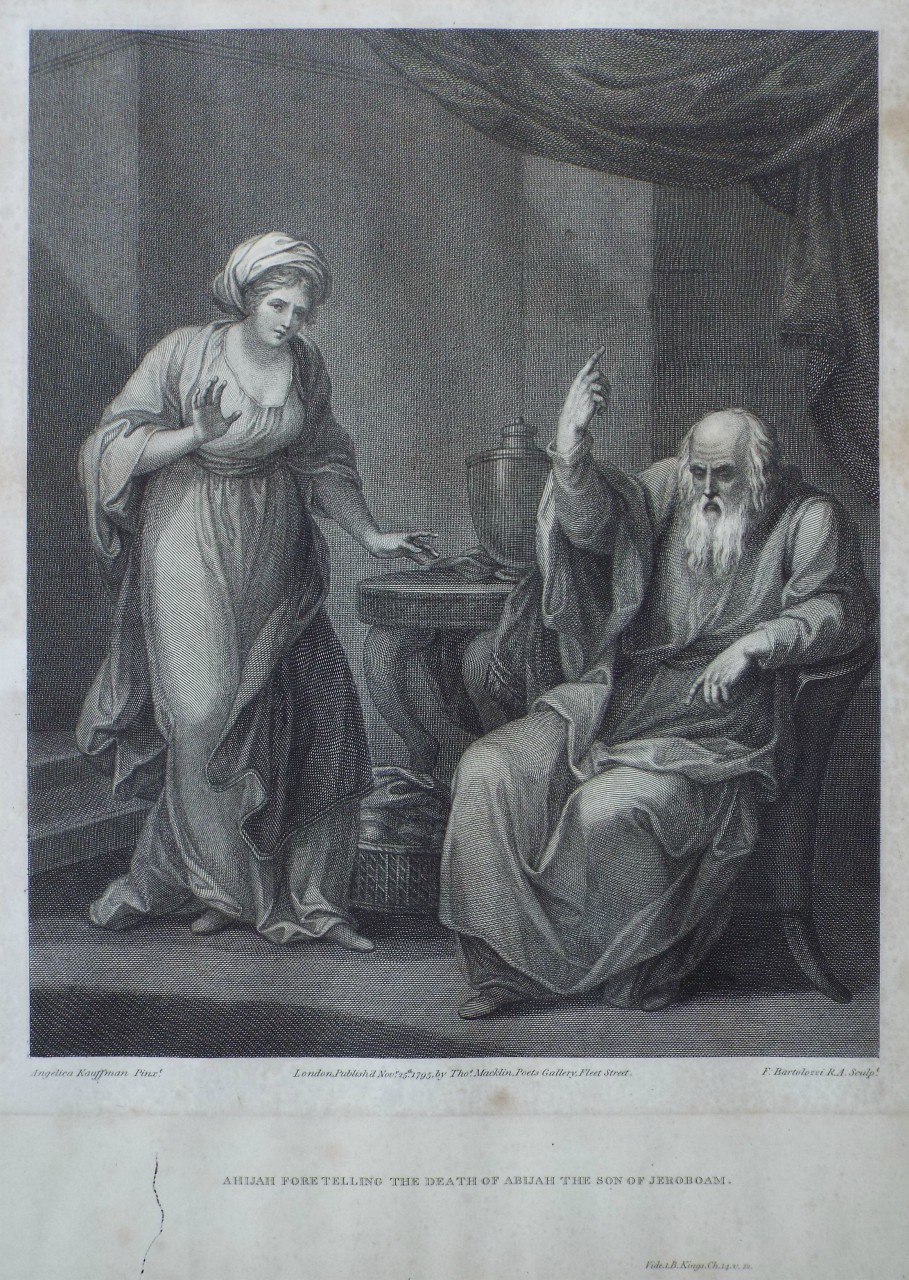
Even though Jeroboam’s wife had disguised herself to hide her identity as the queen, the old, blind prophet knew who she was as soon as she walked in the door. Ahijah had been given a divine “heads-up,” informing him of her visit and its purpose.

“Jeroboam’s wife will come here, pretending to be someone else. She will ask you about her son, for he is very sick. Give her the answer I give you.” – 1 Kings 14:5 NLT

As soon as this worried and grieving mother walked in the door, she was met with devastating news. Before she could speak a word, the prophet delivered a message of divine judgment against the house of Jeroboam. The woman who had delivered to Jeroboam an heir to his throne would now be charged with delivering a grim message of his dynasty’s destruction.

“Give your husband, Jeroboam, this message from the LORD, the God of Israel:…I will bring disaster on your dynasty and will destroy every one of your male descendants, slave and free alike, anywhere in Israel. I will burn up your royal dynasty as one burns up trash until it is all gone.” – 1 Kings 14:7, 10 NLT

The prophet made sure she understood that her husband’s reign had been a gift from God. Yahweh had “ripped the kingdom away from the family of David” and given it to Jeroboam (1 Kings 14:8 NLT), and Jeroboam had returned the favor by turning his back on God and causing the ten northern tribes to worship false gods. Just as God had predicted the future destruction of Jeroboam’s altars, He now decreed the destruction of Jeroboam’s heirs.

“The members of Jeroboam’s family who die in the city will be eaten by dogs, and those who die in the field will be eaten by vultures. I, the LORD, have spoken.” – 1 Kings 14:11 NLT

And much to his wife’s dismay, it would all begin with the death of his son.

“Go on home, and when you enter the city, the child will die.” – 1 Kings 14:12 NLT

It’s impossible to fathom the level of grief this woman felt upon hearing this devastating news. In just a matter of minutes, she had been informed that her entire world was about to collapse. Her husband’s kingdom was going to be destroyed, and her young son would die. The prophet made it painfully clear that it was all her husband’s fault. The message she had been given to deliver to Jeroboam left no doubts as to his culpability and sole responsibility for all that was about to happen.

“…you have not been like my servant David, who obeyed my commands and followed me with all his heart and always did whatever I wanted. You have done more evil than all who lived before you. You have made other gods for yourself and have made me furious with your gold calves.” – 1 Kings 14:8-9 NLT

But while this poor woman was still trying to process all that she had heard, Ahijah continued to deliver more bad news.

“In addition, the LORD will raise up a king over Israel who will destroy the family of Jeroboam. This will happen today, even now!” – 1 Kings 14:14 NLT

Jeroboam’s sin was going to have long-lasting consequences. His decision to lead the people of Israel into apostasy would be replicated by his successors, creating a lengthy lineage of spiritual adulterers among God’s chosen people. He had set the tone for their future rebellion, ensuring their eventual removal from the land of promise and their exile “beyond the Euphrates River” (1 Kings 14:15 NLT). Centuries later, God would use the nation of Assyria as His agents of judgment against the northern kingdom of Israel.

In 722 BC, this pagan nation conquered Israel and turned the chosen people of God into slaves. More than 200 years would pass before this devastating event took place. In the meantime, the kings of Israel would follow the pattern established by Jeroboam, leading the people of God into increasing rebellion and wickedness.

But at this point in the story, Jeroboam remains on the throne of Israel. For the moment, God allowed him to maintain his kingdom, but the die had been cast. The damage had been done, and the judgment of God had been decreed.

When Jeroboam’s poor wife returned home, the message of the prophet was confirmed.

“…as she came to the threshold of the house, the child died.” – 1 Kings 14:17 ESV

The judgment of God had begun.

English Standard Version (ESV) The Holy Bible, English Standard Version. ESV® Permanent Text Edition® (2016). Copyright © 2001 by Crossway Bibles, a publishing ministry of Good News Publishers.

New Living Translation (NLT) Holy Bible, New Living Translation, copyright © 1996, 2004, 2015 by Tyndale House Foundation. Used by permission of Tyndale House Publishers Inc., Carol Stream, Illinois 60188. All rights reserved.
Sovereign Over All

1 And behold, a man of God came out of Judah by the word of the LORD to Bethel. Jeroboam was standing by the altar to make offerings. 2 And the man cried against the altar by the word of the LORD and said, “O altar, altar, thus says the LORD: ‘Behold, a son shall be born to the house of David, Josiah by name, and he shall sacrifice on you the priests of the high places who make offerings on you, and human bones shall be burned on you.’” 3 And he gave a sign the same day, saying, “This is the sign that the LORD spoken: ‘Behold, the altar shall be torn down, and the ashes that are on it shall be poured out.’” 4 And when the king heard the saying of the man of God, which he cried against the altar at Bethel, Jeroboam stretched out his hand from the altar, saying, “Seize him.” And his hand, which he stretched out against him, dried up, so that he could not draw it back to himself. 5 The altar also was torn down, and the ashes poured out from the altar, according to the sign that the man of God had given by the word of the LORD. 6 And the king said to the man of God, “Entreat now the favor of the LORD your God, and pray for me, that my hand may be restored to me.” And the man of God entreated the LORD, and the king’s hand was restored to him and became as it was before. 7 And the king said to the man of God, “Come home with me, and refresh yourself, and I will give you a reward.” 8 And the man of God said to the king, “If you give me half your house, I will not go in with you. And I will not eat bread or drink water in this place, 9 for so was it commanded me by the word of the LORD, saying, ‘You shall neither eat bread nor drink water nor return by the way that you came.’” 10 So he went another way and did not return by the way that he came to Bethel. – 1 Kings 13:1-10 ESV

In an effort to preserve the kingdom given to him by God, Jeroboam made a boneheaded decision that ended up offending God. He knew that the members of the ten northern tribes were religious people and feared that they would continue to travel to Judah to offer sacrifices at the Temple Solomon had built in Jerusalem. This continued spiritual connection to the holy city might influence them to restore their relationship with Rehoboam and the people of Judah. So, to prevent this from happening, Jeroboam made the fateful decision to create an alternate religion for the ten tribes of Israel, complete with priests and golden idols made to look like calves, which he had placed in the cities of Dan and Bethel. Then he convinced the people to turn their backs on Yahweh by offering their sacrifices to the two golden calves.

“It is too much trouble for you to worship in Jerusalem. Look, Israel, these are the gods who brought you out of Egypt!”

He placed these calf idols in Bethel and in Dan—at either end of his kingdom. But this became a great sin, for the people worshiped the idols, traveling as far north as Dan to worship the one there. – 1 Kings 12:28-30 NLT

In following Jeroboam’s lead, the people no longer sought forgiveness, cleansing, and blessing from God Almighty, but placed their hopes in lifeless statues made by human hands. Years later, the prophet Isaiah would describe the futility of worshiping false gods.

How foolish are those who manufacture idols.
    These prized objects are really worthless.
The people who worship idols don’t know this,
    so they are all put to shame.
Who but a fool would make his own god—
    an idol that cannot help him one bit?
All who worship idols will be disgraced
    along with all these craftsmen—mere humans—
    who claim they can make a god.
They may all stand together,
    but they will stand in terror and shame. – Isaiah 44:9-11 NLT

But to Jeroboam, his decision made all the sense in the world. He was a pragmatist who was more interested in preserving his newfound status as king than in promoting the ongoing worship of the one who had made him king. And his decision, while initially successful, was about to prove seriously flawed.

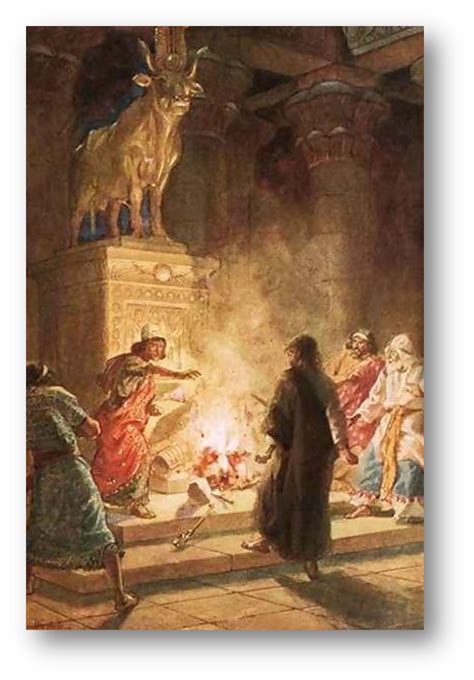
Jeroboam had traveled to Bethel to offer sacrifices to one of his false gods. But while there, he received a visit from a prophet of the one true God. This unnamed man had come from Judah with a message from Yahweh. So, as Jeroboam was about to offer sacrifices to his visible, but lifeless god, he was given a word from the invisible, yet all-powerful God of Israel. And the prophet, seemingly ignoring Jeroboam, directed his message at the altar the king had constructed. In a sense, this was one deity speaking to another. Yahweh was challenging the false god of Jeroboam by delivering a prophecy concerning its coming destruction.

“O altar, altar! This is what the LORD says: A child named Josiah will be born into the dynasty of David. On you he will sacrifice the priests from the pagan shrines who come here to burn incense, and human bones will be burned on you.” – 1 Kings 13:2 NLT

Jeroboam’s god was going to meet an untimely end. When faced with the power of God Almighty, Jeroboam’s false god proved incapable of defending itself. It remained speechless because it was lifeless. And the warning delivered by the prophet of God carried long-term ramifications. It would be 290 years later before God fulfilled His word, and all during that time, the nation of Israel would continue to worship their false gods. But eventually, God would raise up a king over the southern kingdom of Judah named Josiah, and he would institute a series of religious reforms in both Judah and Israel. In doing so, he would fulfill God’s prophecy against the altar of Jeroboam’s false god.

The king also tore down the altar at Bethel—the pagan shrine that Jeroboam son of Nebat had made when he caused Israel to sin. He burned down the shrine and ground it to dust, and he burned the Asherah pole. Then Josiah turned around and noticed several tombs in the side of the hill. He ordered that the bones be brought out, and he burned them on the altar at Bethel to desecrate it. (This happened just as the LORD had promised through the man of God when Jeroboam stood beside the altar at the festival.) – 2 Kings 23:15-16 NLT

The very fact that this altar was still in existence and in use nearly 300 years later reveals the level of apostasy in Israel. Jeroboam’s decision to replace Yahweh with false gods was going to have long-lasting consequences. In an effort to preserve his kingdom, Jeroboam had been willing to sacrifice the spiritual well-being of his own people.

And to demonstrate that the words he had spoken were true, “the man of God gave a sign to prove his message” (1 Kings 13:3 NLT).

He said, “The LORD has promised to give this sign: This altar will split apart, and its ashes will be poured out on the ground.” – 1 Kings 13:3 NLT

God was going to validate His word with a powerful sign. There would be an immediate judgment on Jeroboam’s apostasy. His shrine and the golden calf it contained would be destroyed. But, once again, Jeroboam attempted to preserve his kingdom by rejecting the will of God. After the prophet had spoken his word of warning, Jeroboam commanded that he be arrested. He wrongly assumed that he could thwart the will of God by binding the messenger of God. In doing so, Jeroboam would establish a precedent that would carry over for generations. His successors to the throne of Israel would continue to reject the will of God by resisting and refusing the messengers of God. Rather than repent and return in humble submission to Yahweh, they would each cling stubbornly to their false gods, dooming their people to the judgment of God.

But Jeroboam’s attempt to stop God’s prophet proved ineffective and injurious. He still ended up with a shattered altar and a paralyzed hand. Suddenly convinced of the prophet’s position as God’s spokesman, Jeroboam begged him to intercede with Yahweh on his behalf.

“Entreat now the favor of the LORD your God, and pray for me, that my hand may be restored to me.” – 1 Kings 13:6 ESV

The prophet prayed and God responded, restoring full mobility to Jeroboam’s paralyzed hand. But Jeroboam’s response to this miracle is revealing. Having just witnessed the miraculous destruction of the altar to his false god and having had his hand paralyzed by God, you would think that Jeroboam would have begged for forgiveness. But instead, he tries to win over the favor of the prophet by inviting him to dinner and offering him a reward. Perhaps Jeroboam feared that the prophet might turn his attention to Dan and destroy the altar there. So, in another attempt to preserve his kingdom, he tried to bribe the prophet of God.

But God, knowing the true nature of Jeroboam’s heart, had warned the prophet not to accept any invitation from this conniving and calculating king.

“Even if you gave me half of everything you own, I would not go with you. I would not eat or drink anything in this place. For the Lord gave me this command: ‘You must not eat or drink anything while you are there, and do not return to Judah by the same way you came.’” – 1 Kings 13:8-9 NLT

Jeroboam was a man who, for the sake of his kingdom, had been willing to compromise his faith in God. And he assumed that this unnamed prophet would be just as willing to make concessions in exchange for monetary gain. But he was wrong. This unnamed prophet of Yahweh refused to compromise his convictions for personal gain. Even when faced with Jeroboam’s offer of a reward, this faithful servant remained uncompromising in his commitment to the will of God. He recognized Yahweh as the one true God and refused to be tempted by Jeroboam’s thinly veiled offer of monetary gain in exchange for spiritual infidelity. His actions reflect his firm and unwavering belief in his God, and echo the words Yahweh spoke through the prophet Isaiah.

This is what the LORD says—
    your Redeemer and Creator:
“I am the LORD, who made all things.
    I alone stretched out the heavens.
Who was with me
    when I made the earth?
I expose the false prophets as liars
    and make fools of fortune-tellers.
I cause the wise to give bad advice,
    thus proving them to be fools.
But I carry out the predictions of my prophets!” – Isaiah 44:24-26 NLT

Jeroboam’s reign over the ten northern tribes had been the work of God, not the result of his own ambition and ingenuity. Yahweh had ordained his rise to power as part of a judgment against Solomon for his spiritual infidelity that resulted in the proliferation of false gods in Israel. But rather than honor Yahweh for His providential role in his rise to power, Jeroboam had created his own religion, complete with its own gods, priestly caste, and sacrificial system. In a vain attempt to solidify his kingdom, Jeroboam led the ten northern tribes to abandon Yahweh and place their hope in the golden calves he had made.

Despite Jeroboam’s actions, the young prophet’s appearance serves as a sign that Yahweh was still in control. Jeroboam could create his own gods and erect shrines in their honor, but he could not escape the sovereign will of Yahweh. According to the word of the prophet, Jeroboam’s altar was destroyed and the ashes poured out. His god proved to be powerless before the one true God, and Jeroboam’s attempt to have the prophet arrested proved futile. As he pointed his finger at the prophet and ordered his arrest, Yahweh intervened, paralyzing Jeroboam’s arm and forcing him to watch as his precious altar was destroyed. Ironically, the rebellious Jeroboam was forced to beg the prophet to call on Yahweh for healing. Rather than appeal to his own self-manufactured god, Jeroboam knew that Yahweh was his only hope.

The prophet prayed, and the LORD answered. Despite his track record of unfaithfulness, Jeroboam received grace and mercy from Yahweh. The recalcitrant king’s hand was restored, and his kingdom was preserved because Yahweh had a much larger plan in place that Jeroboam or any other king could not oppose.

English Standard Version (ESV) The Holy Bible, English Standard Version. ESV® Permanent Text Edition® (2016). Copyright © 2001 by Crossway Bibles, a publishing ministry of Good News Publishers.

New Living Translation (NLT) Holy Bible, New Living Translation, copyright © 1996, 2004, 2015 by Tyndale House Foundation. Used by permission of Tyndale House Publishers Inc., Carol Stream, Illinois 60188. All rights reserved.
The Danger of Divided Allegiance

10 At the end of twenty years, in which Solomon had built the two houses, the house of the LORD and the king’s house, 11 and Hiram king of Tyre had supplied Solomon with cedar and cypress timber and gold, as much as he desired, King Solomon gave to Hiram twenty cities in the land of Galilee. 12 But when Hiram came from Tyre to see the cities that Solomon had given him, they did not please him. 13 Therefore he said, “What kind of cities are these that you have given me, my brother?” So they are called the land of Cabul to this day. 14 Hiram had sent to the king 120 talents of gold.

15 And this is the account of the forced labor that King Solomon drafted to build the house of the LORD and his own house and the Millo and the wall of Jerusalem and Hazor and Megiddo and Gezer 16 (Pharaoh king of Egypt had gone up and captured Gezer and burned it with fire, and had killed the Canaanites who lived in the city, and had given it as dowry to his daughter, Solomon’s wife; 17 so Solomon rebuilt Gezer) and Lower Beth-horon 18 and Baalath and Tamar in the wilderness, in the land of Judah, 19 and all the store cities that Solomon had, and the cities for his chariots, and the cities for his horsemen, and whatever Solomon desired to build in Jerusalem, in Lebanon, and in all the land of his dominion. 20 All the people who were left of the Amorites, the Hittites, the Perizzites, the Hivites, and the Jebusites, who were not of the people of Israel— 21 their descendants who were left after them in the land, whom the people of Israel were unable to devote to destruction—these Solomon drafted to be slaves, and so they are to this day. 22 But of the people of Israel Solomon made no slaves. They were the soldiers, they were his officials, his commanders, his captains, his chariot commanders and his horsemen.

23 These were the chief officers who were over Solomon’s work: 550 who had charge of the people who carried on the work.

24 But Pharaoh’s daughter went up from the city of David to her own house that Solomon had built for her. Then he built the Millo.

25 Three times a year Solomon used to offer up burnt offerings and peace offerings on the altar that he built to the LORD, making offerings with it before the LORD. So he finished the house.

26 King Solomon built a fleet of ships at Ezion-geber, which is near Eloth on the shore of the Red Sea, in the land of Edom. 27 And Hiram sent with the fleet his servants, seamen who were familiar with the sea, together with the servants of Solomon. 28 And they went to Ophir and brought from there gold, 420 talents, and they brought it to King Solomon. – 1 Kings 9:10-28 ESV

Solomon doesn’t realize it, but he is at the midway point of his 40-year reign. He has just completed the construction of the Temple, his royal palaces, and all the buildings that will house his administrative offices.

With these projects behind him, Solomon turns his attention to other pressing matters. First, he makes an attempt to compensate King Hiram of Phoenicia for all the material and financial aid he provided over the years. Early in his reign, Solomon made an agreement with Hiram that provided all the lumber he needed for his many construction projects, while Hiram received much-needed grain and olive oil in return.

So Hiram supplied as much cedar and cypress timber as Solomon desired. In return, Solomon sent him an annual payment of 100,000 bushels of wheat for his household and 110,000 gallons of pure olive oil. – 1 Kings 5:10-11 NLT

This agreement had lasted for 20 years, and during that time, Solomon compensated King Hiram for all the lumber and paid wages to all the Phoenician wood-workers who helped with the various construction projects (1 Kings 5:6). But now that all the work was done, Solomon wanted to make a gesture of goodwill to his friend in Phoenicia. So, he gave Hiram 20 cities located in the land of Galilee along the border between Israel and Phoenicia. This appears to be a gracious act of generosity on Solomon’s part, but it quickly becomes apparent that his gift was a bit disingenuous. When Hiram personally inspected the cities Solomon had given him, his response reveals his deep disappointment.

“What kind of towns are these, my brother?” he asked. So Hiram called that area Cabul (which means “worthless”), as it is still known today. – 1 Kings 9:13 NLT

Evidently, these towns were located in a region of Galilee that was not conducive to agricultural production. Since Phoenicia occupied a narrow strip of land along the Mediterranean Sea, they were woefully deficient in arable farmland. That’s why Solomon’s compensation for the lumber had taken the form of grain and olive oil. At first glance, it would appear that Solomon had given them what they had always needed: Land on which to grow crops. But Hiram described Solomon’s gift as “Cabul,” a word that means “bound” or “sterile.” And while these 20 towns expanded the range of Hiram’s kingdom, they were essentially worthless. They provided no practical value. What makes Solomon’s gift that much more egregious is that, over the years, Hiram had given Solomon 120 talents of gold. To put that in perspective, that’s nearly 5 tons of gold.

One could almost draw the conclusion that Solomon was somewhat of a Scrooge, a financial tightwad who was more than willing to spend money on himself but was somewhat stingy when it came to others. It is also interesting to note that Solomon had given away land that had been part of the inheritance given by God to the people of Israel.

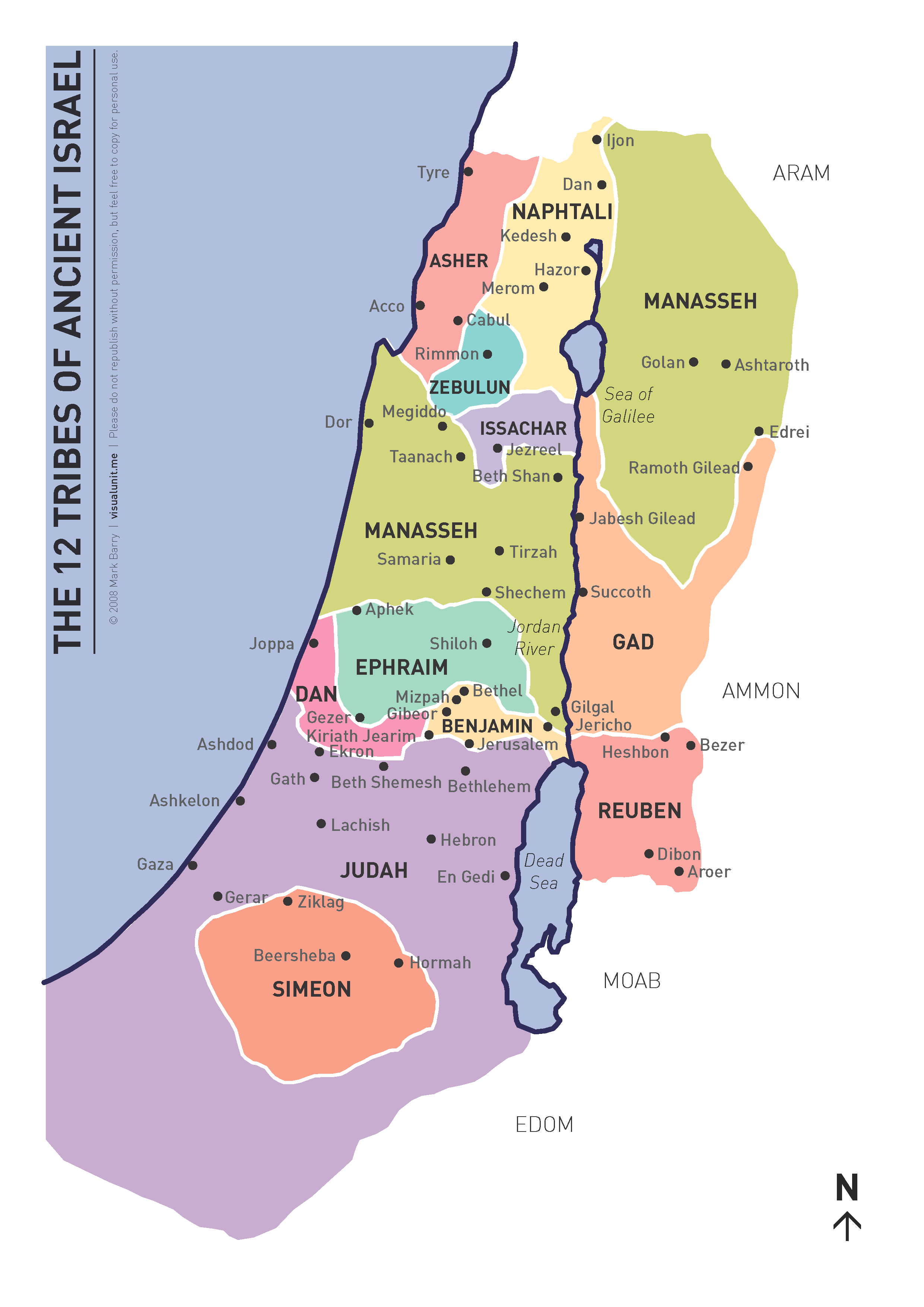
It’s most likely that the 20 towns were located in territory that belonged to the tribes of Asher, Naphtali, and Zebulun. In awarding these cities to Hiram, Solomon was guilty of giving away land that belonged to the people of God. His willingness to turn over possession of the land, coupled with Hiram’s poor assessment of it, reveals that it held no real value to Solomon.

One of the things that can be learned from studying the history of the Israelites is that every decision they made had long-term ramifications. The Book of Judges reveals that, at one point, the tribes of Asher, Naphtali, and Zebulun were told to conquer and occupy the land allotted to them by God, but they failed.

The tribe of Zebulun failed to drive out the residents of Kitron and Nahalol, so the Canaanites continued to live among them. But the Canaanites were forced to work as slaves for the people of Zebulun.

The tribe of Asher failed to drive out the residents of Acco, Sidon, Ahlab, Aczib, Helbah, Aphik, and Rehob. Instead, the people of Asher moved in among the Canaanites, who controlled the land, for they failed to drive them out.

Likewise, the tribe of Naphtali failed to drive out the residents of Beth-shemesh and Beth-anath. Instead, they moved in among the Canaanites, who controlled the land. Nevertheless, the people of Beth-shemesh and Beth-anath were forced to work as slaves for the people of Naphtali. – Judges 1:30-33 NLT

One of the reasons the Phoenicians even existed was because of the failure of these three tribes to do what God had commanded them to do. As a result of their inability to drive out the inhabitants of the land, the Phoenicians occupied territory that was supposed to belong to the people of God. Now, Solomon had just awarded the Phoenicians with even more of Israel’s God-given inheritance.

Solomon’s primary focus was the city of Jerusalem. Having willingly forfeited the towns located in the north, Solomon poured his time and energy into expanding his royal capital. To do so, Solomon enslaved thousands of non-Jews to work as laborers on his various rebuilding and enlargement projects. He conscripted Amorites, Hittites, Perizzites, Hivites, and Jebusites who were living in the land of Israel to provide slave labor for his ambitious expansion program. These people were used to extend the walls of Jerusalem, connecting the Old City of David with the newer area surrounding the Temple complex, the royal palaces, and administrative headquarters. They “built towns as supply centers and constructed towns where his chariots and horses could be stationed” (1 Kings 9:19 NLT). Solomon was constructing a virtual theme park dedicated to his greatness, complete with palaces, terraces, stables for his numerous horses, and barracks for his expanding army. 

And it’s essential to recall that God had warned the people of Israel that their kings were not to rule like the kings of other nations.

The king must not build up a large stable of horses for himself… – Deuteronomy 17:16 NLT

The king must not take many wives for himself… – Deuteronomy 17:17 NLT

And he must not accumulate large amounts of wealth in silver and gold for himself… – Deuteronomy 17:17 NLT

Solomon violated each of these commands. And while at this point, it appears that the daughter of Pharaoh was his only wife, it wouldn’t be long before he expanded his household greatly.

Now King Solomon loved many foreign women. Besides Pharaoh’s daughter, he married women from Moab, Ammon, Edom, Sidon, and from among the Hittites. The LORD had clearly instructed the people of Israel, “You must not marry them, because they will turn your hearts to their gods.” Yet Solomon insisted on loving them anyway. He had 700 wives of royal birth and 300 concubines. And in fact, they did turn his heart away from the LORD. – 1 Kings 11:1-3 NLT

Whether it was wives and concubines or horses and chariots, Solomon always seemed to be in expansion mode. Enough was never enough. He even built a fleet of boats and initiated an aggressive trading venture that yielded 16 tons of gold. For Solomon, bigger was always better. Yet, late in his life, he would make a sad but telling admission.

I increased my possessions:
I built houses for myself;
I planted vineyards for myself.
I designed royal gardens and parks for myself,
and I planted all kinds of fruit trees in them.
I constructed pools of water for myself,
to irrigate my grove of flourishing trees.
I purchased male and female slaves,
and I owned slaves who were born in my house;
I also possessed more livestock—both herds and flocks—
than any of my predecessors in Jerusalem.
I also amassed silver and gold for myself,
as well as valuable treasures taken from kingdoms and provinces.
I acquired male singers and female singers for myself,
and what gives a man sensual delight—a harem of beautiful concubines.
So I was far wealthier than all my predecessors in Jerusalem,
yet I maintained my objectivity.
I did not restrain myself from getting whatever I wanted;
I did not deny myself anything that would bring me pleasure.
So all my accomplishments gave me joy;
this was my reward for all my effort.
Yet when I reflected on everything I had accomplished
and on all the effort that I had expended to accomplish it,
I concluded: “All these achievements and possessions are ultimately profitless—
like chasing the wind!
There is nothing gained from them on earth.” – Ecclesiastes 1:4-11 NLT

They say, “hindsight is 20-20,” and that maxim would prove to be true in Solomon’s life. He would one day discover that his obsession with constant expansion, endless pleasure, and rampant materialism would never satisfy. But at the midway point of his reign, he didn’t know any better. So, he continued to strive to balance his affection for the things of this world with his devotion to God.  He continued to accumulate material goods while simultaneously offering sacrifices to God. Without even realizing it, he was worshiping two gods. Solomon was living out the very thing Jesus would later warn His disciples about.

“No one can serve two masters. For you will hate one and love the other; you will be devoted to one and despise the other. You cannot serve God and be enslaved to money.” – Matthew 6:24 NLT

There was a reason Yahweh forbade His kings from accumulating wealth, wives, and material possessions. They were to place their hope and trust in Him alone. Marital alliances with foreign nations were off-limits for Israel’s kings because of the risk of idolatry. Yahweh knew that these pagan women would bring their foreign gods with them, providing a dangerous influence on Israel’s kings. He also prohibited the kings of Israel from establishing fighting forces that used military tactics borrowed from foreign powers. Horses and chariots were off limits because they would give the Israelites a false sense of superiority based on something other than Yahweh. King David had warned about the danger of misplaced hope.

Some nations boast of their chariots and horses,
    but we boast in the name of the LORD our God. – Psalm 20:7 NLT

Solomon’s kingdom was growing along with his reputation, and it would seem that his ego was expanding at an equally rapid rate. His unbridled power and influence led him to make decisions that would have unexpected consequences. His enslavement of the former inhabitants of the land and his forced conscription of Israelite citizens would come back to haunt him (1 Kings 12:1-4). But for now, Solomon was living the dream, unaware that his decisions would have long-term ramifications.

English Standard Version (ESV) The Holy Bible, English Standard Version. ESV® Permanent Text Edition® (2016). Copyright © 2001 by Crossway Bibles, a publishing ministry of Good News Publishers.

New Living Translation (NLT) Holy Bible, New Living Translation, copyright © 1996, 2004, 2015 by Tyndale House Foundation. Used by permission of Tyndale House Publishers Inc., Carol Stream, Illinois 60188. All rights reserved.

The Danger of Misplaced Priorities

1 Solomon made a marriage alliance with Pharaoh king of Egypt. He took Pharaoh’s daughter and brought her into the city of David until he had finished building his own house and the house of the LORD and the wall around Jerusalem. 2 The people were sacrificing at the high places, however, because no house had yet been built for the name of the LORD.

3 Solomon loved the LORD, walking in the statutes of David his father, only he sacrificed and made offerings at the high places. 4 And the king went to Gibeon to sacrifice there, for that was the great high place. Solomon used to offer a thousand burnt offerings on that altar. – 1 Kings 3:1-4 ESV

Chapter two ended with the words, “So the kingdom was established in the hand of Solomon” (1 Kings 2:36-46 ESV). He had successfully completed his purging of those who had played a part in the failed coup attempt that would have robbed him of his right to the throne. He had also kept his father’s dying wish and brought to justice a small list of individuals whom David had declared worthy of judgment.

However, the opening verses of Chapter 3 introduce a shift in tone and purpose to the historical narrative. David has died, and the reign of his son has begun. The last vestiges of David’s influence have been removed, and Solomon has the opportunity to start his rule on his own terms. It is interesting to note that the author records Solomon’s first official act as king as an alliance he made with the Egyptians. The Pharaoh of Egypt sealed their agreement by giving Solomon the hand of his daughter in marriage.

The matter-of-fact manner in which this news is conveyed gives the impression that it was nothing more than an official act of business on the part of the royal administration. Making treaties and alliances was a necessary part of being a king, and marital alliances were commonplace among the nations of the world at that time. But there is something ominous and prophetic about the news of Solomon’s first official act as king. Any Jew who read this historical record would have recognized it.

Long before Israel had a king, God provided His chosen people with a list of prohibitions concerning the behavior of any man who would rule over them. He knew that the kingly role would come with all kinds of temptations and snares. The power and prestige that accompanied the crown would prove to be addictive and dangerous. Therefore, God provided His people with non-negotiable rules to govern and regulate the actions of the kings of Israel.

“You are about to enter the land the LORD your God is giving you. When you take it over and settle there, you may think, ‘We should select a king to rule over us like the other nations around us.’ If this happens, be sure to select as king the man the LORD your God chooses. You must appoint a fellow Israelite; he may not be a foreigner.

“The king must not build up a large stable of horses for himself or send his people to Egypt to buy horses, for the LORD has told you, ‘You must never return to Egypt.’ The king must not take many wives for himself, because they will turn his heart away from the LORD. And he must not accumulate large amounts of wealth in silver and gold for himself.” – Deuteronomy 17:14-17 NLT

As a precautionary measure, God commanded that any man who ruled as king over Israel was to have a personal copy of the Mosaic Law, which he was to read from daily.

“This regular reading will prevent him from becoming proud and acting as if he is above his fellow citizens. It will also prevent him from turning away from these commands in the smallest way. And it will ensure that he and his descendants will reign for many generations in Israel.” – Deuteronomy 17:21 NLT

Notice that the king was prohibited from accumulating all the usual trappings of kingly success. All Israelite kings were to be different, refusing to model their administration on the nations around them. Stables filled with fine horses, treasuries overflowing with great wealth, and palaces full of wives and concubines were off-limits to the kings of Israel. Yahweh also forbade His kings from doing any business with Egypt, even denying them the right to buy horses from their former enemies. Yet, one of the first decisions Solomon made as king was to broker a deal with the Pharaoh of Egypt that would set a dangerous precedent for his reign.

While the author provides no immediate commentary regarding Solomon’s actions, he later reveals the sinister and infectious nature of this decision.

Now King Solomon loved many foreign women. Besides Pharaoh’s daughter, he married women from Moab, Ammon, Edom, Sidon, and from among the Hittites. The LORD had clearly instructed the people of Israel, “You must not marry them, because they will turn your hearts to their gods.” Yet Solomon insisted on loving them anyway. He had 700 wives of royal birth and 300 concubines. And in fact, they did turn his heart away from the LORD. – 1 Kings 11:1-3 NLT

Something is foreboding in the statement that Solomon “brought her into the city of David until he had finished building his own house and the house of the LORD and the wall around Jerusalem” (1 Kings 3:1 ESV). One of his very first acts as king was to bring this foreign-born, pagan princess into the city of David, where her presence would have a profound impact not only on him but also on the entire kingdom. Solomon had not even taken the time to build a palace or begun construction on the Temple for Yahweh, for which his father had provided the funding. He had taken no action to expand and protect the city of Jerusalem through the construction of defensive walls.

But the author clearly states that “Solomon loved the LORD, walking in the statutes of David his father” (1 Kings 3:3 ESV). Yet, it will become increasingly more apparent that Solomon suffered from divided allegiances. Notice the critical contrast between the following verses.

Solomon loved the LORD… 1 Kings 3:3

King Solomon loved many foreign wives… – 1 Kings 11:1

God had warned that any king who accumulated many wives for himself would run the risk of having his heart turned away from the LORD. His love for Yahweh would be distracted and diminished. Because Solomon prioritized forming an alliance with Egypt over building a house for God, he ultimately had to make offerings and sacrifices on the high places (1 Kings 3:3). As a result, his worship became diluted and polytheistic. As will become evident, many of these high places were actually the former sites of pagan shrines to false gods. The Israelites had repurposed them for the worship of Yahweh, but God had given Solomon the responsibility and privilege of constructing a permanent Temple where all worship and sacrifices were to be made. David had provided Solomon with everything he needed to build the Temple, from the construction plans to the financial resources to pay for it. And David had warned Solomon to make this task a high priority.

“So take this seriously. The LORD has chosen you to build a Temple as his sanctuary. Be strong, and do the work.”

Then David gave Solomon the plans for the Temple and its surroundings, including the entry room, the storerooms, the upstairs rooms, the inner rooms, and the inner sanctuary—which was the place of atonement. David also gave Solomon all the plans he had in mind for the courtyards of the LORD’s Temple, the outside rooms, the treasuries, and the rooms for the gifts dedicated to the LORD. The king also gave Solomon the instructions concerning the work of the various divisions of priests and Levites in the Temple of the LORD. And he gave specifications for the items in the Temple that were to be used for worship. – 1 Chronicles 28:10-13 NLT

But Solomon had established other priorities. He chose to align himself with Egypt, making what he believed would be an essential treaty with this once-powerful nation. But in doing so, Solomon placed his hope and trust in something other than God Almighty. At this point in history, Solomon was reigning over one of the most powerful nations in the known world. His father, David, had built Israel into a formidable force in the region, having expanded its boundaries and secured its peace through his victories over the surrounding nations.

Solomon had inherited this kingdom and was privileged to rule during a time of relative peace and security. David had virtually eliminated any threat from the Philistines, Moabites, Edomites, Arameans, Ammonites, and Amalekites.

King David dedicated all these gifts to the Lord, as he did with the silver and gold from the other nations he had defeated—from Edom, Moab, Ammon, Philistia, and Amalek—and from Hadadezer son of Rehob, king of Zobah. – 2 Samuel 8:11-12 NLT

Solomon did not need to make a treaty with Egypt. Their days as a world power were over, and they had nothing to offer Solomon. David had left his son with clear instructions as to the pressing priorities of his reign.

“Realize now that the LORD has chosen you to build a temple as his sanctuary. Be strong and do it!”

“Be strong and brave! Do it! Don’t be afraid and don’t panic! For the LORD God, my God, is with you. He will not leave you or abandon you before all the work for the service of the LORD’s temple is finished.” – 1 Chronicles 28:10, 20 NLT

But rather than heeding his father’s counsel to construct a house for Yahweh, Solomon went about building his kingdom according to his own terms and agenda.

The prophet Isaiah would later warn the people of Israel about their propensity to seek alliances with and assistance from Egypt.

“What sorrow awaits my rebellious children,”
    says the LORD.
“You make plans that are contrary to mine.
    You make alliances not directed by my Spirit,
    thus piling up your sins.
For without consulting me,
    you have gone down to Egypt for help.
You have put your trust in Pharaoh’s protection.
    You have tried to hide in his shade.” – Isaiah 30:1-2 NLT

Without even realizing it, Solomon was stepping outside the protective boundaries of God and pursuing what he believed to be the best strategy for building his kingdom. But through it all, Solomon maintained a love and devotion for God, even offering thousands of sacrifices to Him on the high place in Gibeon. The book of 1 Chronicles provides us with the reason why Solomon chose Gibeon as the place to offer his sacrifices to God.

For the tabernacle of the LORD, which Moses had made in the wilderness, and the altar of burnt offering were at that time in the high place at Gibeon. – 1 Chronicles 21:29 ESV

This location had been designated by God. Formerly the site of a threshing floor, David had purchased it and transformed it into the nation of Israel’s primary worship center. It would be at this critical location that Solomon would receive a gracious and undeserved gift from God. Despite his impulsiveness and blatant disobedience to God’s commands, he would be given the one thing that would set his reign apart from all those who would come after him. It would become the defining characteristic of his life. Solomon didn’t need more horses, wives, wealth, or treaties with his enemies. What he really needed was something only God could provide: Wisdom.

English Standard Version (ESV) The Holy Bible, English Standard Version. ESV® Permanent Text Edition® (2016). Copyright © 2001 by Crossway Bibles, a publishing ministry of Good News Publishers.

New Living Translation (NLT) Holy Bible, New Living Translation, copyright © 1996, 2004, 2015 by Tyndale House Foundation. Used by permission of Tyndale House Publishers Inc., Carol Stream, Illinois 60188. All rights reserved.

Praise the LORD!

1 Praise the LORD!
Praise the LORD, O my soul!
2 I will praise the LORD as long as I live;
    I will sing praises to my God while I have my being.

3 Put not your trust in princes,
    in a son of man, in whom there is no salvation.
4 When his breath departs, he returns to the earth;
    on that very day his plans perish.

5 Blessed is he whose help is the God of Jacob,
    whose hope is in the LORD his God,
6 who made heaven and earth,
    the sea, and all that is in them,
who keeps faith forever;
7     who executes justice for the oppressed,
    who gives food to the hungry.

The LORD sets the prisoners free;
8     the LORD opens the eyes of the blind.
The LORD lifts up those who are bowed down;
    the LORD loves the righteous.
9 The LORD watches over the sojourners;
    he upholds the widow and the fatherless,
    but the way of the wicked he brings to ruin.

10 The LORD will reign forever,
    your God, O Zion, to all generations.
Praise the LORD! – Psalm 146:1-10 ESV

The last five psalms are anonymous and form the final Hallel (praise) section of the Psalter. Due to the similarity of their content, they were likely written by the same author. Each begins with the same call to action: “Praise the LORD.” This imperative statement is not intended as a suggestion, but as a command to give Yahweh all the dignity, honor, worship, and praise He rightly deserves. The psalmist calls for wholehearted worship on the part of the people of God, and he sets the tone by declaring his sold-out allegiance to the Almighty.

I will praise the LORD as long as I live;
    I will sing praises to my God while I have my being. – Psalm 146:2 ESV

His statement of devotion to Yahweh is reminiscent of the address Joshua gave to the Israelites near the end of his life. Ever since the death of Moses, Joshua had served as the God-appointed leader of the Israelites, helping them cross the Jordan River and begin their conquest of the land of Canaan. Over the years, Joshua led the Israelites in their effort to conquer the inhabitants of the land so they could take possession of the inheritance promised to them by Yahweh. They had fought and won many battles, and successfully occupied a large portion of Canaan, but Yahweh reminded them that He had been behind it all.

“It was not your swords or bows that brought you victory. I gave you land you had not worked on, and I gave you towns you did not build—the towns where you are now living. I gave you vineyards and olive groves for food, though you did not plant them.” – Joshua 24:12-13 NLT

Despite his leadership role, Joshua knew that he had been little more than an instrument in Yahweh’s hands. He had led the people into battle, but the victories had been the LORD’s doing. So, Joshua commanded the Israelites to show their gratitude to Yahweh by treating Him with honor and unadulterated reverence.

“So fear the LORD and serve him wholeheartedly. Put away forever the idols your ancestors worshiped when they lived beyond the Euphrates River and in Egypt. Serve the LORD alone. But if you refuse to serve the LORD, then choose today whom you will serve. Would you prefer the gods your ancestors served beyond the Euphrates? Or will it be the gods of the Amorites in whose land you now live? But as for me and my family, we will serve the LORD.” – Joshua 24:14-15 NLT

Like the psalmist, Joshua tried to spur the people’s obedience by using himself as an example. He declared his intention to live out his final days in total submission to and reliance upon Yahweh, and he committed his family to follow his lead.

Joshua warned the Israelites about the dangers of idolatry because he knew their history of spiritual infidelity. He had been there when Aaron made the golden calf in the wilderness, and he had witnessed the people’s response to this false god they had crafted from the plunder taken from the Egyptians.

The people got up early the next morning to sacrifice burnt offerings and peace offerings. After this, they celebrated with feasting and drinking, and they indulged in pagan revelry. – Exodus 34:6 NLT

Yahweh had delivered them from slavery in Egypt and given them victory over their enemies, but they gave their allegiance to a nonexistent god they had made with their own hands.

The psalmist stressed a different problem facing his peers. He was less concerned about idolatry and the worship of false gods than their tendency to worship men.

Don’t put your confidence in powerful people;
    there is no help for you there.
When they breathe their last, they return to the earth,
    and all their plans die with them. – Psalm 146:3-4 NLT

While idolatry continued to be a problem for the Israelites throughout their existence as a nation, their real struggle was the worship of men. Ever since the day they rejected Samuel’s leadership and demanded, “Give us a king to judge us like all the other nations have” (1 Samuel 8:5 NLT), the people of Israel had exhibited a preference for human kings over the King of kings. Yahweh would repeatedly warn them about their tendency to replace His authority with that of mere men.

This is what the Lord says:
“Cursed are those who put their trust in mere humans,
    who rely on human strength
    and turn their hearts away from the Lord.
They are like stunted shrubs in the desert,
    with no hope for the future.
They will live in the barren wilderness,
    in an uninhabited salty land.” – Jeremiah 17:5-6 NLT

The psalmist knew his people well and wanted them to think twice about putting their trust in powerful men who could never measure up to Yahweh’s standards. As far as the psalmist was concerned, there was no comparison between mortal men and the infinite, all-powerful God of the universe.

He made heaven and earth,
    the sea, and everything in them.
    He keeps every promise forever.
He gives justice to the oppressed
    and food to the hungry.
The LORD frees the prisoners.
   The LORD opens the eyes of the blind.
The LORD lifts up those who are weighed down.
    The LORD loves the godly.
The LORD protects the foreigners among us.
    He cares for the orphans and widows,
    but he frustrates the plans of the wicked. – Psalm 146:6-9 NLT

No man could ever hope to compete with Yahweh. No king who ever lived could claim to hold a candle to Yahweh’s glory and greatness. The anonymous author of Psalm 2 exposed the futility of earthly kings trying to oppose the one true King.

Why are the nations so angry?
    Why do they waste their time with futile plans?
The kings of the earth prepare for battle;
    the rulers plot together
against the LORD
    and against his anointed one.
“Let us break their chains,” they cry,
    “and free ourselves from slavery to God.”

But the one who rules in heaven laughs.
    The LORD scoffs at them.
Then in anger he rebukes them,
    terrifying them with his fierce fury. – Psalm 2:1-5 NLT

The prophet Isaiah declared Yahweh’s superiority and supremacy over all mankind.

God sits above the circle of the earth.
    The people below seem like grasshoppers to him!
He spreads out the heavens like a curtain
    and makes his tent from them.
He judges the great people of the world
    and brings them all to nothing. – Isaiah 40:22-23 NLT

In Isaiah’s estimation, the worship of men was unwarranted and a waste of time. They would always be poor substitutes for Yahweh because they couldn’t measure up to His glorious standards. Even Yahweh declared Himself to be incomparable and irreplaceable.

“To whom will you compare me?
    Who is my equal?” asks the Holy One. – Isaiah 40:25 NLT

The psalmist understood that Yahweh’s immensity and eternality set Him apart from all false gods and every man with god-like aspirations. He deserved man’s praise because He was praiseworthy. Yahweh wasn’t a figment of man’s fertile imagination and had not been formed by human hands. He was the maker of “heaven and earth, the sea, and everything in them” (Psalm 146:6 NLT). Yahweh is the uncreated Creator of the universe who has no beginning and end. He is eternal and all-powerful. He is holy and wholly righteous. He is “the same yesterday and today and forever” (Hebrews 13:8 ESV). With those thoughts in mind, the psalmist closes his song in the same way he opened it, with a call to praise the eternal, always-present, forever faithful God.

The LORD will reign forever.
    He will be your God, O Jerusalem, throughout the generations.

Praise the Lord! – Psalm 146:10 NLT

Father, I must confess that I do not always recognize and honor Your greatness. I say I believe in it but, far too often, my actions and attitudes reflect something altogether different. I don’t praise You enough. I fail to trust You fully. I tend to put my hope in men, even in myself, rather than trusting in Your proven track record of greatness and goodness. While I could easily deny any worship of false gods, I know it would be a lie. My idols are far more subtle than those of the Israelites, but they are idols all the same. Anything I turn to instead of You is a false god that will always provide false hope. No man or human institution can replace you. No idealogy, political party, or human leader can replace You or hope to compete with You. Yet, it is so easy to put my trust in those things that will always prove untrustworthy. Help me to heed the psalmist’s call and learn to praise You for who You are and all that You have done. Amen

English Standard Version (ESV) The Holy Bible, English Standard Version. ESV® Permanent Text Edition® (2016). Copyright © 2001 by Crossway Bibles, a publishing ministry of Good News Publishers.

New Living Translation (NLT) Holy Bible, New Living Translation, copyright © 1996, 2004, 2015 by Tyndale House Foundation. Used by permission of Tyndale House Publishers Inc., Carol Stream, Illinois 60188. All rights reserved.

The LORD Reigns

1 Oh sing to the LORD a new song;
    sing to the LORD, all the earth!
2 Sing to the LORD, bless his name;
    tell of his salvation from day to day.
3 Declare his glory among the nations,
    his marvelous works among all the peoples!
4 For great is the LORD, and greatly to be praised;
    he is to be feared above all gods.
5 For all the gods of the peoples are worthless idols,
    but the LORD made the heavens.
6 Splendor and majesty are before him;
    strength and beauty are in his sanctuary.

7 Ascribe to the LORD, O families of the peoples,
    ascribe to the LORD glory and strength!
8 Ascribe to the LORD the glory due his name;
    bring an offering, and come into his courts!
9 Worship the LORD in the splendor of holiness;
    tremble before him, all the earth!

10 Say among the nations, “The LORD reigns!
    Yes, the world is established; it shall never be moved;
    he will judge the peoples with equity.”

11 Let the heavens be glad, and let the earth rejoice;
    let the sea roar, and all that fills it;
12     let the field exult, and everything in it!
Then shall all the trees of the forest sing for joy
13     before the LORD, for he comes,
    for he comes to judge the earth.
He will judge the world in righteousness,
    and the peoples in his faithfulness. – Psalm 96:1-13 ESV

This psalm is prominently cited in a song ascribed to King David when he brought the Ark of the Covenant into Jerusalem. As the centerpiece of Israel’s worship, the Ark represented the presence of God. During their days wandering through the wilderness, the Israelites were comforted by the fact that Yahweh’s Shekinah glory rested above the mercy seat, which served as the lid for the Ark. So, when David relocated the Ark into his capital city, he wrote a celebratory song that reminded the people of Israel of the goodness and greatness of their God.

In penning the words to his song, David borrowed heavily from Psalm 96, incorporating some of its most memorable lines to encourage the heartfelt worship of Yahweh among his people. God’s presence among them was not to be taken lightly or for granted. As the sovereign King of the universe, Yahweh demanded honor, reverence, and unwavering allegiance from His covenant people. Their obedience to His commands was not optional, and their steadfast devotion to Him alone was not up for debate. He had clearly communicated the terms of His relationship with the people of Israel, and He expected wholehearted compliance on their part.

“I, the LORD your God, am a jealous God who will not tolerate your affection for any other gods.” – Exodus 20:5 NLT

If they wanted to experience Yahweh’s presence, power, and provision, they would need to be faithful. By bringing the Ark into Jerusalem, David was relocating God’s presence into the heart of his capital and reminding his people of their complete reliance upon Him for all their needs. He alone could protect them from their enemies, provide for all their needs, and pour out forgiveness and redemption for their sins. Without Yahweh, they would be just another nation striving to preserve their existence in a world marked by hostility and mired in sin.

Psalm 96 opens with the words, “Sing to the Lord a new song.” This was a call for the people of Israel to praise Yahweh, not just for His past acts of deliverance but for His present activity in their lives. He was present and moving powerfully in their midst. The God who created the universe and delivered their ancestors from their captivity in Egypt was still moving mightily in their lives. That is why the psalmist states, “Each day proclaim the good news that he saves. Publish his glorious deeds among the nations. Tell everyone about the amazing things he does” (Psalm 96:2-3 NLT).

As David celebrated the arrival of the Ark into Jerusalem, he used the words of Psalm 96 to encourage faithfulness among his people. He wanted them to understand their need for God and their obligation to declare His glory to the nations around them. Every time Yahweh moved among His people, they were to declare His majesty, power, and sovereignty to the surrounding nations. His glorious deeds among His people were to be a testimony to His greatness and evidence of His role as the one true God. That is why the psalmist addresses the pagan nations and calls on them to reject their false gods and worship Yahweh alone.

O nations of the world, recognize the LORD;
    recognize that the LORD is glorious and strong.
Give to the LORD the glory he deserves!
    Bring your offering and come into his courts.
Worship the LORD in all his holy splendor. – Psalm 96:7-9 NLT

But their acknowledgment of Yahweh depended on the Israelites’ faithfulness and willingness to declare His glory. If God’s people don’t see Him as active in their lives and refuse to declare His power and presence, the nations will continue to seek help and hope from false gods. God’s people were to declare, “The Lord reigns!” (Psalm 96:10 ESV). But this was to be more than lip service or pious-sounding rhetoric. It was to come from the heart and express their own personal experience. 

This psalm provides a glimpse of what it means to worship God. It is less an activity than an awareness of God’s character and attributes. It is a recognition of who He is, what He has done, and what He will do because of His unchanging character. God is loving and kind. He is holy and righteous. He is powerful and completely in control. What He says, He will do. He can be trusted. He is reliable. Even when things do not appear to be going as expected, and God seems nowhere in sight, He is there.

His character is consistent with His behavior, and it is in keeping with His word. If we don’t understand who God is, we will never truly worship Him. The reality of HIS faithfulness allows us to be faithful to Him. If we view Him as untrustworthy, we will doubt and disobey Him. If we don’t believe His promises, we will never rest in them. And we will never be able to say, “The Lord reigns!” and mean it. Our testimony to God’s goodness and greatness will become second-hand and lack personal evidence that He is alive and active in our lives. This lack of firsthand experience with Yahweh will weaken our testimony and fail to impress a lost and dying world that our God rules and reigns.

Our worship of God is fickle and feeble at best. It tends to be based on present circumstances. If things are going well, our God is good and worthy of praise. If things are going poorly, we begin to doubt Him and even complain about our lot in life. When we do, we portray Yahweh as a fickle, fairweather God who can’t be trusted or relied upon.

Even when we worship Him, our efforts can portray a half-hearted commitment that paints God as an add-on to our lives rather than the sole focus of our affection. We turn worship into an activity that we only participate in on Sundays. Our devotion to Him is relegated to a worship hour and a particular music style. The entire endeavor becomes more about us than Him. We judge the effectiveness of our worship based on our personal tastes. If we enjoy our worship service of choice and like the music and the message we hear, we believe we’ve worshiped. But we can go through that process and never acknowledge God’s lovingkindness, faithfulness, righteousness, truth, and strength. We can feel good, but leave without having grown closer to God. In essence, the worship service becomes more about us than Him.

This psalm reminds us that God is to be our focus. Not because of what He is currently doing for us, but simply because of who He is. He is God, and there is no one else like Him. He is God, and He is entirely trustworthy and true. He is God, and is all-powerful, and capable of doing whatever He chooses to do. If He is not doing what we THINK He should be doing, He has a very good reason. If He allows difficulty into our lives, He is not asleep, apathetic, or impotent; He has a plan.

Yahweh has made us, and we are His sheep. We belong to Him, and He knows what is best for us. But do we trust Him? Do we believe He is strong enough to meet any and all of our needs? Do we comprehend just how much He loves us? The psalmist reminds us that when God made a promise to David that his kingdom would endure forever, even the people’s unfaithfulness and disobedience could not alter that promise’s reality and reliability. God’s word endures. His faithfulness is unfailing. His lovingkindness is everlasting. His truth never falters. His strength never diminishes.

Tell the nations about his splendor.
Tell all the nations about his amazing deeds.
For the LORD is great and certainly worthy of praise;
he is more awesome than all gods. – Psalms 96:3-4 NET

Father, so often I attempt to worship You in ignorance. I try to sing Your praises but I don’t fully understand or appreciate who You are. I tend to sing only when I feel like it. I praise You only when You’ve done something for me. Yet You are worthy of praise all the time. You are loving, kind, righteous, holy, trustworthy, and powerful to save. Help me come to know You better so that I might better worship You rightly. Not just for what You do but just because of who You are. And may I be able to declare to the nations, “The LORD reigns!” and truly mean it because I have experienced it in my own life. Amen

English Standard Version (ESV) The Holy Bible, English Standard Version. ESV® Permanent Text Edition® (2016). Copyright © 2001 by Crossway Bibles, a publishing ministry of Good News Publishers.

New Living Translation (NLT) Holy Bible, New Living Translation, copyright © 1996, 2004, 2015 by Tyndale House Foundation. Used by permission of Tyndale House Publishers Inc., Carol Stream, Illinois 60188. All rights reserved.

The Self-Delusions of a Self-Made Man

1 “King Nebuchadnezzar to all peoples, nations, and languages, that dwell in all the earth: Peace be multiplied to you! 2 It has seemed good to me to show the signs and wonders that the Most High God has done for me.

3 How great are his signs,
    how mighty his wonders!
His kingdom is an everlasting kingdom,
    and his dominion endures from generation to generation.

4 I, Nebuchadnezzar, was at ease in my house and prospering in my palace. 5 I saw a dream that made me afraid. As I lay in bed the fancies and the visions of my head alarmed me. 6 So I made a decree that all the wise men of Babylon should be brought before me, that they might make known to me the interpretation of the dream. 7 Then the magicians, the enchanters, the Chaldeans, and the astrologers came in, and I told them the dream, but they could not make known to me its interpretation. 8 At last Daniel came in before me—he who was named Belteshazzar after the name of my god, and in whom is the spirit of the holy gods—and I told him the dream, saying, 9 “O Belteshazzar, chief of the magicians, because I know that the spirit of the holy gods is in you and that no mystery is too difficult for you, tell me the visions of my dream that I saw and their interpretation.” – Daniel 4:1-9 ESV

The content of this chapter appears to cover events that happened much later in Nebuchadnezzar’s reign, perhaps near its end. Some scholars propose that a significant gap exists between the close of chapter three and the opening of chapter four. If correct, Daniel would be a much older man and Nebuchadnezzar’s kingdom would have had time to reach the height of its glory. Babylon would have become a formidable world power with its opulent capital city reflecting Nebuchadnezzar’s dreams of unbridled success and significance.

The chapter opens with what appears to be a written testimony from the king himself. He begins by praising the greatness of ‘ĕlâʿillay – the God most high. This is clearly a reference to the God of Daniel, Shadrach, Meshach, and Abednego. Nebuchadnezzar was not declaring his allegiance to the Hebrew God but was simply acknowledging Yahweh’s supremacy over all other gods. The king had ample evidence to reach this conclusion, having witnessed the miraculous salvation of Shadrach, Meshach, and Abednego from the fiery furnace. He also experienced Yahweh’s power when Daniel interpreted his dream, something none of his magicians, sorcerers, or astrologers could do. Nebuchadnezzar was impressed with the God of the Hebrews and had promoted Him to a premier position among all the gods of the Babylonians.

Nebuchadnezzar was an equal opportunity idolater, choosing to include the gods of the nations he had conquered. Since Yahweh had proved Himself powerful and useful, Nebuchadnezzar was willing to promote His worship. He had even issued an official decree that made it illegal to denigrate or disparage the God of the Hebrews.

“If any people, whatever their race or nation or language, speak a word against the God of Shadrach, Meshach, and Abednego, they will be torn limb from limb, and their houses will be turned into heaps of rubble. There is no other god who can rescue like this!” – Daniel 3:29 NLT

Even years later, as the king reflected on his power and prominence, he was willing to give Yahweh some of the credit. Verses 1-3 are intended to set up what Nebuchadnezzar is about to relate. In the verses that follow, the king recalls yet another incident involving a dream, Daniel, and Yahweh. Decades have passed and the prophecy contained in the first dream has not yet been fulfilled. His kingdom remains intact and his power has not diminished. He even begins his testimony with the pride-filled statement, “I, Nebuchadnezzar, was living in my palace in comfort and prosperity” (Daniel 4:4 NLT).

He was enjoying all the perks and benefits that accompanied the crown. He was rich, revered, and greatly feared. He ruled over a kingdom that had conquered much of the known world. But Nebuchadnezzar couldn’t control his unconscious thoughts. As he lay on his richly appointed bed, his mind was filled with nightmares that left him agitated and confused. Unable to sleep and anxious to know the meaning of the dream, Nebuchadnezzar sent for his wise men, a distinguished group of trusted advisors that included “magicians, enchanters, astrologers, and fortune-tellers” (Daniel 4:7 NLT). But as before, these self-proclaimed prophets men proved powerless to help the king.

“I told them the dream, but they could not tell me what it meant.” – Daniel 4:7 NLT

This time, Nebuchadnezzar took it easy on them. He didn’t require them to use their powers to determine what he dreamed, he simply asked them to explain its meaning. But they were clueless.

Then Daniel showed up. The text doesn’t explain Daniel’s late arrival but according to chapter two, he was the highest-ranking wise man in the kingdom.

…the king appointed Daniel to a high position and gave him many valuable gifts. He made Daniel ruler over the whole province of Babylon, as well as chief over all his wise men. – Daniel 2:48 NLT

Perhaps Daniel had been occupied with matters of state. But whatever the case, his timing could not have been better. He arrived just in time to hear the king’s dream and provide its interpretation. Nebuchadnezzar recounts Daniel’s entrance into the royal court by using his Hebrew and Babylonian names. It is unclear what Belteshazzar means but the king states that it has ties to one of his gods. He also adds the note that Daniel was filled with “the spirit of the holy gods” (Daniel 4:8 ESV). It seems unlikely that Nebuchadnezzar, a pagan polytheist, would have been referring to the Holy Spirit. He was simply acknowledging that Daniel possessed supernatural powers of a divine origin.

Desperate to know what his dream meant, Nebuchadnezzar begged Daniel to use his powers to solve the mystery.

“Belteshazzar, chief of the magicians, I know that the spirit of the holy gods is in you and that no mystery is too great for you to solve. Now tell me what my dream means.” – Daniel 4:9 NLT

While Nebuchadnezzar doesn’t mention Yahweh by name, he knows that Daniel is a devout follower of the God of the Hebrews. Throughout this chapter, Yahweh’s superiority will be proclaimed. Even in the opening verses, Nebuchadnezzar declares His greatness.

“How great are his signs,
    how powerful his wonders!
His kingdom will last forever,
    his rule through all generations.” – Daniel 4:3 NLT

But as the chapter unfolds, Yahweh’s supremacy will be repeatedly stated.

“…the Most High rules the kingdom of men and gives it to whom he will and sets over it the lowliest of men.” – Daniel 4:17 ESV

“…this is the interpretation, O king: It is a decree of the Most High, which has come upon my lord the king.” – Daniel 4:24 ESV

“…the Most High rules the kingdom of men and gives it to whom he will.” – Daniel 4:25 ESV

“…the Most High rules the kingdom of men and gives it to whom he will.” – Daniel 4:32 ESV

“I blessed the Most High, and praised and honored him who lives forever,

for his dominion is an everlasting dominion,
    and his kingdom endures from generation to generation…” – Daniel 4:34 ESV

“…he does according to his will among the host of heaven
    and among the inhabitants of the earth…” – Daniel 4:35 ESV

“I, Nebuchadnezzar, praise and extol and honor the King of heaven, for all his works are right and his ways are just; and those who walk in pride he is able to humble.” – Daniel 4:37 ESV

This entire chapter is intended to provide a stark contrast between the powers of this world and the sovereign majesty and might of God Almighty. Nebuchadnezzar is meant to represent human authority in all its prideful arrogance. He is the consummate self-made man who dares to shake his fist in the face of God and declare his autonomy and independent authority. Surrounded by all the trappings of his own success, he dares to see himself as a deity in his own mind. But his dream mocks and rocks his confidence.

Nebuchadnezzar had conquered the world, but he couldn’t win the battle going on inside his head. Things were happening that he could not control or explain. There was a dimension to the world he could not see and over which he was powerless. Despite his posse of prophetic posers, he could not see the future. Regardless of his power, he had no way of controlling his fate. But the King of Heaven was not only aware of Nebuchadnezzar’s future, but He was in control of it.

Nebuchadnezzar was going to learn a powerful and painful lesson about God’s sovereignty and man’s inadequacy. His might was minimal when compared to that of God. His rule was impermanent when compared to that of God. His autonomy was non-existent when compared with the providential power of God Most High.

…all the nations of the world
    are but a drop in the bucket.
They are nothing more
    than dust on the scales.
He picks up the whole earth
    as though it were a grain of sand. – Isaiah 40:17 NLT

God sits above the circle of the earth.
    The people below seem like grasshoppers to him!
He spreads out the heavens like a curtain
    and makes his tent from them.
He judges the great people of the world
    and brings them all to nothing. – Isaiah 40:22-23 NLT

The king’s heart is like a stream of water directed by the Lord;
    he guides it wherever he pleases. – Proverbs 21:1 NLT

Nebuchadnezzar was surrounded by wealth, power, prestige, and a team of worldly wisemen who offered to provide him with insights into the future. But all the pomp and prophetic promises of this world are no match for God Most High.

English Standard Version (ESV) The Holy Bible, English Standard Version. ESV® Permanent Text Edition® (2016). Copyright © 2001 by Crossway Bibles, a publishing ministry of Good News Publishers.

New Living Translation (NLT) Holy Bible, New Living Translation, copyright © 1996, 2004, 2015 by Tyndale House Foundation. Used by permission of Tyndale House Publishers Inc., Carol Stream, Illinois 60188. All rights reserved.

New English Translation (NET)NET Bible® copyright ©1996-2017 by Biblical Studies Press, L.L.C. http://netbible.com All rights reserved.

A Nightmare Scenario

1 In the second year of the reign of Nebuchadnezzar, Nebuchadnezzar had dreams; his spirit was troubled, and his sleep left him. 2 Then the king commanded that the magicians, the enchanters, the sorcerers, and the Chaldeans be summoned to tell the king his dreams. So they came in and stood before the king. 3 And the king said to them, “I had a dream, and my spirit is troubled to know the dream.” 4 Then the Chaldeans said to the king in Aramaic, “O king, live forever! Tell your servants the dream, and we will show the interpretation.” 5 The king answered and said to the Chaldeans, “The word from me is firm: if you do not make known to me the dream and its interpretation, you shall be torn limb from limb, and your houses shall be laid in ruins. 6 But if you show the dream and its interpretation, you shall receive from me gifts and rewards and great honor. Therefore show me the dream and its interpretation.” 7 They answered a second time and said, “Let the king tell his servants the dream, and we will show its interpretation.” 8 The king answered and said, “I know with certainty that you are trying to gain time, because you see that the word from me is firm— 9 if you do not make the dream known to me, there is but one sentence for you. You have agreed to speak lying and corrupt words before me till the times change. Therefore tell me the dream, and I shall know that you can show me its interpretation.” 10 The Chaldeans answered the king and said, “There is not a man on earth who can meet the king’s demand, for no great and powerful king has asked such a thing of any magician or enchanter or Chaldean. 11 The thing that the king asks is difficult, and no one can show it to the king except the gods, whose dwelling is not with flesh.”

12 Because of this the king was angry and very furious, and commanded that all the wise men of Babylon be destroyed. 13 So the decree went out, and the wise men were about to be killed; and they sought Daniel and his companions, to kill them. 14 Then Daniel replied with prudence and discretion to Arioch, the captain of the king’s guard, who had gone out to kill the wise men of Babylon. 15 He declared to Arioch, the king’s captain, “Why is the decree of the king so urgent?” Then Arioch made the matter known to Daniel. 16 And Daniel went in and requested the king to appoint him a time, that he might show the interpretation to the king. – Daniel 2:1-16 ESV

Daniel and his three companions have been elevated to positions of honor and distinction within Nebuchadnezzar’s court. Having excelled at their training and passed their oral exam with flying colors, they are part of the royal retinue and in the king’s employment. Their rise to prominence is part of Yahweh’s strategic plan and positions them perfectly for the next task He has for them to do.

The timing of this chapter is difficult to discern. The text describes it as “the second year of the reign of Nebuchadnezzar” (Daniel 1:1 ESV). History records that he assumed the throne in 605 B.C., the same year his father died. But his official reign did not begin until the following spring on the first of Nisan, 604 B.C. The prior year was credited to his father’s reign. Therefore, the second year of his reign would have begun in 603 B.C. and ended in 602 B.C. This would have allowed Daniel and his friends to complete their training and enter Nebuchadnezzar’s employment as the text suggests.

It is also possible that the four Hebrew young men excelled at their studies and “graduated” early, having caught their instructor’s eyes and garnered the king’s favor. But regardless of the timing, it would appear that they were officially trusted advisors to the king when the events of this chapter begin.

It is important to recall what the author stated in the opening chapter: “God gave them learning and skill in all literature and wisdom, Daniel had understanding in all visions and dreams” (Daniel 1:17 ESV). This almost comes across as a parenthetical statement that has no context. The reader is forced to question why God would have given Daniel this supernatural ability when no dreams or visions are mentioned in chapter one. But the author knows where the story is going and he is preparing his audience for the events of chapter two.

It just so happens that Nebuchadnezzar becomes plagued by a series of repeated dreams that disturb his sleep and unsettle his mind. These vivid and realistic dreams left him sleep-deprived and anxious to know their meaning, so he sent for his “enchanters, the sorcerers, and the Chaldeans” (Daniel 2:2 ESV). These are the same men mentioned in chapter 1.

The king talked with them, and no one impressed him as much as Daniel, Hananiah, Mishael, and Azariah. So they entered the royal service. Whenever the king consulted them in any matter requiring wisdom and balanced judgment, he found them ten times more capable than any of the magicians and enchanters in his entire kingdom. – Daniel 1:19-20 NLT

But chapter two mentions another group of individuals called the Chaldeans. The Chaldeans were a semi-nomadic tribe that lived in the southern part of Babylon. Over the centuries, several Chaldeans served as kings in Babylon, including Nebuchadnezzar and his father. In time, the term Chaldean became interchangeable with Babylon. As a Chaldean himself, Nebuchadnezzar probably filled his administration with members from this elite, well-educated ruling class. It would appear that these men were known for their wisdom, not for their skills in magic, sorcery, or the dark arts. The king included them in all matters of state and commanded them to come to his chambers to help discern the meaning of his dreams.

When these wise men and their occult-practicing companions appeared before the king, they had no idea what awaited them. Exhausted from lack of sleep and the disturbing nature of his dreams, the king commanded that his counselors provide him with an explanation. He was convinced these nightmares were premonitions about the future and was determined to know their meaning.

It seems that the Chaldeans were the first to speak up. These wise men offered to interpret the king’s dream but only on the condition that he divulge the content. The text indicates that the rest of the conversation between the king and his advisors was in Aramaic, the lingua franca of the land. From verse 3 to the end of the chapter, the dialogue is in Aramaic, not Hebrew. This note seems intended to highlight the stark difference between the four Hebrew men and their Babylonian peers. While is it certain that Daniel and his friends learned to read, write, and speak Aramaic as part of their 3-year training program, they were not in the room when these conversations took place. Despite their superior “wisdom and understanding” (Daniel 1:20), they had not been summoned to the king’s presence. The entire exchange was an in-house matter, between the king and his fellow Babylonians.

But these men were caught in a dilemma. They could not tell the king the meaning of the dreams unless he told them the content. This is especially noteworthy considering that these men were renowned for their ability to speak with the dead, read the stars, and predict the future. These self-proclaimed fortune tellers were stumped.

“Please, Your Majesty. Tell us the dream, and we will tell you what it means.” – Daniel 2:7 NLT

But Nebuchadnezzar wasn’t buying what they were selling. He demanded that they prove their powers of perception by providing the content of the dream and its meaning – under penalty of death.

“I know what you are doing! You’re stalling for time because you know I am serious when I say, ‘If you don’t tell me the dream, you are doomed.’ So you have conspired to tell me lies, hoping I will change my mind. But tell me the dream, and then I’ll know that you can tell me what it means.” – Daniel 2:8-9 NLT

Their reaction? Panic. Despite their illustrious titles, they know they can’t do what the king demands. They couldn’t know what the king dreamed unless he told them. But King Nebuchadnezzar stuck to his original plan, threatening to kill them if they failed to do what he said. Under the threat of death, they finally own up and confess the obvious.

“No one on earth can tell the king his dream! And no king, however great and powerful, has ever asked such a thing of any magician, enchanter, or astrologer! The king’s demand is impossible. No one except the gods can tell you your dream, and they do not live here among people.” – Daniel 2:10-11 NLT

What a perfect set-up. Faced with the impossible task of discerning the king’s dreams and their meaning, they admit that the request is way above their pay grade. They are out of their league. Fearing for their lives, they tell the king that this is a job for the gods, who don’t inhabit the realm of men. This admission speaks volumes because it reveals the sad reality of their theology. Their gods were distant and disinterested in the affairs of men. They were inaccessible and out of reach. Amazingly, none of these men suggested that their gods be consulted or considered as the logical solution to the dilemma. Instead, they use the gods as an excuse.

But their ploy failed. Instead of releasing these men from their obligation, the king doubled down on his threat and sentenced them all to death. But this is where the story gets interesting. The king’s edict was all-inclusive, condemning every magician, enchanter, astrologer, and Chaldean in his realm. News of this fateful death sentence spread fast and reached the ears of Daniel, who was informed that his name and those of his friends were included on the list of those to die.

When the captain of the king’s guard appeared at Daniel’s door to carry out his execution, Daniel didn’t panic. Instead, he “handled the situation with wisdom and discretion” (Daniel 2:14 NLT). Unaware of what precipitated his death sentence, Daniel asked the captain for an explanation. When he heard the details behind the king’s edict, he immediately requested an audience with the king.

There is no indication that Daniel has used his God-ordained gift of interpreting dreams and visions. Verse 17 of chapter one seems to be a premonition or prediction of things to come. It prepares the reader to expect something to happen in the chapters ahead. Daniel has never interpreted dreams before and, from the gist of the story, it is not even clear that Daniel is aware of his special gift. But he is nonplused by the king’s decree and appears confident that he can decipher the dream’s meaning.

Unlike his Babylonian counterparts, Daniel knows that his God is accessible and fully capable of assisting him in his time of need. He doesn’t panic or fly off the handle in a fit of rage. He reasons wisely and discerningly with his executioner, buying time to seek the will of God. Faced with the threat of death, Daniel will gather his three friends and seek the favor of Yahweh. Daniel and his companions would have been well-versed in the Hebrew Scriptures, including the Psalms. So, as they considered the life-threatening nature of their circumstances, they may have turned to the words of the psalmist for encouragement.

In my distress I prayed to the Lord,
    and the Lord answered me and set me free.
The Lord is for me, so I will have no fear.
    What can mere people do to me?
Yes, the Lord is for me; he will help me.
    I will look in triumph at those who hate me.
It is better to take refuge in the Lord
    than to trust in people.
It is better to take refuge in the Lord
    than to trust in princes. – Psalm 118:5-9 NLT

English Standard Version (ESV) The Holy Bible, English Standard Version. ESV® Permanent Text Edition® (2016). Copyright © 2001 by Crossway Bibles, a publishing ministry of Good News Publishers.

New Living Translation (NLT) Holy Bible, New Living Translation, copyright © 1996, 2004, 2015 by Tyndale House Foundation. Used by permission of Tyndale House Publishers Inc., Carol Stream, Illinois 60188. All rights reserved.

New English Translation (NET)NET Bible® copyright ©1996-2017 by Biblical Studies Press, L.L.C. http://netbible.com All rights reserved.

Jehovah-Elyon

1 The LORD reigns, let the earth rejoice;
    let the many coastlands be glad!
2 Clouds and thick darkness are all around him;
    righteousness and justice are the foundation of his throne.
3 Fire goes before him
    and burns up his adversaries all around.
4 His lightnings light up the world;
    the earth sees and trembles.
5 The mountains melt like wax before the LORD,
    before the LORD of all the earth.

6 The heavens proclaim his righteousness,
    and all the peoples see his glory.
7 All worshipers of images are put to shame,
    who make their boast in worthless idols;
    worship him, all you gods!

8 Zion hears and is glad,
    and the daughters of Judah rejoice,
    because of your judgments, O LORD.
9 For you, O LORD, are most high over all the earth;
    you are exalted far above all gods. – Psalm 97:1-9 ESV

YHWH–ʿelyôn – “The LORD Most High.” Here, the Psalmist combines two names for God designed to set Him apart from all the other “gods” (‘ĕlōhîm). This is not an admission of the existence of other gods, but a declaration that there is only one true God. All other gods are imposters, the fabrication of men’s fertile imaginations.

The ancient Hebrews used one word, ‘ĕlōhîm,  to refer to all gods, but they also used it to refer to their own deity, the God of Abraham, Isaac, and Jacob. The ubiquitous nature of this name could make things confusing because the different variations of the word ‘ĕlōhîm were widely used to refer to any and all gods. The name ‘ĕlōhîm is the plural form of ‘ĕlôha, which was commonly abbreviated to ‘ēl. Each of these names originates from the Hebrew root ‘ālā, which can be translated as “exalted one.” Two of these words are used in verse 9 alongside the personal name of Israel’s God, Yahweh or Jehovah. There is one other designation for God in this verse; elyôn or “the most high.”

For you, O LORD (Yahweh), are most high (ʿelyôn) over all the earth;
    you are exalted (‘ālā) far above all gods (‘ĕlōhîm). – Psalm 97:9 ESV

The first use of this name for God is found in Genesis 14, where Abram encounters  Melchizedek, the king of Salem. The text refers to him as a “priest of God (‘ēl) Most High (ʿelyôn). This priest-king ended up pronouncing a blessing on Abram in the name of ‘ēl ʿelyôn – God Most High.

“Blessed be Abram by God Most High,
    Possessor of heaven and earth;
and blessed be God Most High,
    who has delivered your enemies into your hand!” – Genesis 14:19-20 ESV

Melchizedek was affirming the superiority of the God who had called Abram out of Ur and led him to the land of Canaan. Prior to Abram’s first encounter with this ‘ĕlōhîm, he had worshiped other ‘ĕlōhîm. Now, Melchizedek was letting Abram know that this deity was ʿelyôn – the supreme ‘ĕlōhîm who had no equal and was worthy of Abram’s worship. According to Melchizedek, it was ‘ēl elyôn who had given Abram the victory over Chedorlaomer king of Elam, Tidal king of Goiim, Amraphel king of Shinar, and Arioch king of Ellasar. In a sense, Melchizedek was declaring that ‘ēl elyôn had defeated the ‘ĕlōhîm of these pagan kings. Their gods had been no match for God Most High.

The Psalmist picks up on this name for God but adds another important distinction. He adds the name Yahweh. Five times in nine verses, he uses the personal name of Israel’s God, the name God used to refer to Himself when He spoke to Moses from the burning bush. On this momentous occasion, Moses received a commission from God, commanding him to return to Egypt and deliver the Israelites from their captivity and lead them to the land of Canaan. Upon hearing the details of this assignment, Moses replied, “If I come to the people of Israel and say to them, ‘The God of your fathers has sent me to you,’ and they ask me, ‘What is his name?’ what shall I say to them?” (Exodus 3:13 ESV). Moses knew that the Israelites had long ago turned their backs on the ‘ĕlōhîm of Abraham, Isaac, and Jacob. They had been in Egypt for four centuries and had gradually adopted the ‘ĕlōhîm of their masters. Now, Moses was expected to show up and inform the Israelites that the ‘ĕlōhîm of their fathers expected him to lead them out of Egypt and back to Canaan. So, he asked God for a name. If he simply used the term, ‘ĕlōhîm, the Israelites might become confused and assume that he is talking about one of the many Egyptian gods they worshiped.

God’s response was simple but not exactly clear. He told Moses, “I am who I am” (Exodus 3:14 ESV). In Hebrew it reads, hāyâ ‘ăšer hāyâ. The word, “hāyâ” is where the name Yahweh comes from. The Hebrews did not include vowels when putting their language in writing. So, the name Yahweh became YHWH. The Latinized version became JHVH, from which the name Jehovah is derived.

When God called Himself, “I am,” He spoke of the nature of His being or existence. He is the “existing one,” which refers to His eternal, non-created state. God is, was, and ever shall be. He is self-existent, having no predecessor or creator. He is self-sufficient and dependent upon no one.

To further clarify His identity, God told Moses to inform the people of Israel, “The LORD (Yᵊhōvâ), the God (‘ĕlōhîm) of your fathers, the God (‘ĕlōhîm) of Abraham, the God (‘ĕlōhîm) of Isaac, and the God (‘ĕlōhîm) of Jacob, has sent me to you” (Exodus 3:15 ESV). In other words, this wasn’t just any ‘ĕlōhîm, it was Jehovah-God, the one true God of Abraham, Isaac, and Jacob. He was the intimate and personal God who had heard their cries and responded to their suffering by providing a means of deliverance.

This was the same God the Psalmist wrote about and each time He mentioned this God, he used the name Yᵊhōvâ or Yahweh.

The LORD (Yᵊhōvâ) reigns – vs 1

The mountains melt like wax before the LORD (Yᵊhōvâ),
    before the LORD (Yᵊhōvâ) of all the earth. – vs 5

Zion hears and is glad,
    and the daughters of Judah rejoice,
    because of your judgments, O LORD (Yᵊhōvâ).
For you, O LORD (Yᵊhōvâ), are most high over all the earth;
    you are exalted far above all gods. – vs 8-9

Yahweh is superior and supreme. He rules over all, and He does so with righteousness and justice (vs 2). The very heavens which He created declare His righteousness (vs 6). Yahweh is elevated high above all the gods (‘ĕlōhîm) of the earth. These man-made gods are impotent and no match for YHWH–ʿelyôn – The LORD Most High. They stand no chance against the God of Israel, the ‘ĕlōhîm of Abraham, Isaac, and Jacob. Therefore, they are unworthy of man’s adoration and attention. That’s why the Psalmist closes with a call to worship.

O you who love the LORD, hate evil!
    He preserves the lives of his saints;
    he delivers them from the hand of the wicked.
Light is sown for the righteous,
    and joy for the upright in heart.
Rejoice in the LORD, O you righteous,
    and give thanks to his holy name! – Psalm 97:10-11 ESV

He is exalted. He is high and lifted up. He is superior and without equal. And He is worthy of honor, reverence, and worship.

In his gospel account, the apostle John records a heated exchange between Jesus and the Jewish religious leaders. It began with a simple statement that Jesus delivered to a group of Jews who had “believed in Him” (John 8:30 ESV).

“If you abide in my word, you are truly my disciples, and you will know the truth, and the truth will set you free.” – John 8:31-32 ESV

This led them to respond, “We are offspring of Abraham and have never been enslaved to anyone. How is it that you say, ‘You will become free’?” (John 8:33 ESV). Jesus, knowing that the Jewish religious leaders were in the crowd and sensing their growing animosity, responded, “I know that you are offspring of Abraham; yet you seek to kill me because my word finds no place in you. I speak of what I have seen with my Father, and you do what you have heard from your father” (John 8:37-38 ESV).

His words hit their mark, incensing His adversaries and sparking a heated interchange. What they didn’t know was that Jesus’ use of the term “father” was a reference to Satan. He was accusing them of being in league with the enemy and not with Yahweh. Unaware of His slight, they declared their status as the sons of Abraham; he was their “father.” By declaring their descendence from Abraham, they claimed their status as heirs to the promises God made to Abraham’s seed. But that’s when Jesus dropped the bombshell that left them reeling and enraged.

“You are of your father the devil, and your will is to do your father’s desires. He was a murderer from the beginning, and does not stand in the truth, because there is no truth in him. When he lies, he speaks out of his own character, for he is a liar and the father of lies. But because I tell the truth, you do not believe me.” – John 8:44-45 ESV

Angered by His words, the religious leaders declared him to be demon-possessed. In doing so, they not only rejected His words but defamed His ministry. Yet Jesus calmly replied, “Your father Abraham rejoiced that he would see my day. He saw it and was glad” (John 8:56 ESV). This made no sense to them. Jesus was a young man and had not lived long enough to see or be seen by Abraham, who was long dead. 

This is when Jesus shocked them by making a claim that they would view as blasphemy and worthy of death.

Jesus said to them, “Truly, truly, I say to you, before Abraham was, I am.” – John 8:58 ESV

It’s clear how angry this statement made them because they immediately attempted to stone Him to death. But what did Jesus say that escalated their anger to such a high degree? Why were they intent on killing Him? The answer is found in those two simple words: “I am.”

They knew exactly what Jesus was saying and claiming. He used the very words that God spoke to Moses at the burning bush. He claimed to be Yahweh and, in so doing, set Himself up as YHWH–ʿelyôn – The LORD Most High. He wasn’t just a man, an itinerant rabbi from the backwater village of Nazareth. He was Jehovah God, the self-existent one and the most high (‘ĕlōhîm) of all.

Just minutes earlier, Jesus had made the claim, “If I glorify myself, my glory is nothing. It is my Father who glorifies me, of whom you say, ‘He is our God’” (John 8:54 ESV). With this statement, Jesus claimed His divine sonship and declared that God considered Him glorious and worthy of worship, honor, and obedience.

Everything the Psalmist said about Jehovah was true of Jesus.

…you, O LORD, are most high over all the earth;
    you are exalted far above all gods. – Psalm 97:9 ESV

When John the Baptist was preparing the Israelites for the coming of Jesus, he told them, “I am the voice of one crying out in the wilderness, ‘Make straight the way of the LORD,’ as the prophet Isaiah said” (John 1:23 ESV). He claimed to be fulfilling the prophecy of Isaiah recorded in Isaiah 40:3-5.

A voice cries:
“In the wilderness prepare the way of the LORD (Yᵊhōvâ);
    make straight in the desert a highway for our God (‘ĕlōhîm).
Every valley shall be lifted up,
    and every mountain and hill be made low;
the uneven ground shall become level,
    and the rough places a plain.
And the glory of the LORD (Yᵊhōvâ) shall be revealed,
    and all flesh shall see it together,
    for the mouth of the LORD (Yᵊhōvâ) has spoken.” – Isaiah 40:3-5 ESV

Jesus was the Son of God and the Lord Most High, and after His death, burial, resurrection, and ascension, He returned to His Father’s side where He sits enthroned and awaits His return. The Book of Revelation contains a vivid description of that day when Jesus, the LORD Most High, will make His appearance and set up His Kingdom on earth.

Then I saw heaven opened, and behold, a white horse! The one sitting on it is called Faithful and True, and in righteousness he judges and makes war. His eyes are like a flame of fire, and on his head are many diadems, and he has a name written that no one knows but himself. He is clothed in a robe dipped in blood, and the name by which he is called is The Word of God. And the armies of heaven, arrayed in fine linen, white and pure, were following him on white horses. From his mouth comes a sharp sword with which to strike down the nations, and he will rule them with a rod of iron. He will tread the winepress of the fury of the wrath of God the Almighty. On his robe and on his thigh he has a name written, King of kings and Lord of lords. – Revelation 19:11-16 ESV

English Standard Version (ESV) The Holy Bible, English Standard Version. ESV® Permanent Text Edition® (2016). Copyright © 2001 by Crossway Bibles, a publishing ministry of Good News Publishers.

New Living Translation (NLT) Holy Bible, New Living Translation, copyright © 1996, 2004, 2015 by Tyndale House Foundation. Used by permission of Tyndale House Publishers Inc., Carol Stream, Illinois 60188. All rights reserved.

New English Translation (NET)NET Bible® copyright ©1996-2017 by Biblical Studies Press, L.L.C. http://netbible.com All rights reserved.

The Greatness of God

We serve a great God who is worthy of our praise, worship, devotion, and obedience. He is the one true God whose character is flawless and whose interactions with mankind are always just and righteous. In our efforts to define and understand God, we tend to minimize His greatness by making Him more approachable and manageable. We domesticate Him by fashioning Him in an image that makes Him more “human” and, therefore, more tolerable and relatable. But in our attempt to transform God into our own likeness, we end up worshiping an idol of our own making.

“The god of American popular culture is an indulgent heavenly spirit who is little threat to our lifestyles and luxuries – a god consistent with a consumer culture and rampant immorality. This god might wish that human beings would behave, but he is powerless when they do not.

“A vast majority of American claims to believe in God, but most believe in an idol of their own imaginations. This deity is always there to be called upon in times of trouble, but he would never intrude upon our own personal space, judge our sins, or hinder our happiness.” – R. Albert Mohler, Foreward to Made in Our Image by Steven J. Lawson

The sad reality is that many evangelical Christians have bought into the devastatingly dangerous God-rehabilitation plan without even knowing it. Slowly and subtly, we have ended up with an emasculated and virtually impotent deity who looks very little like the God of the Bible. We have turned Shaddai, the Almighty who permeates the pages of Scripture into a “user-friendly” god who is little more than a slightly improved version of ourselves. And this downsized god exists for our glory rather than the other way around. But this is not the God that David, Moses, Abraham, and the prophets worshiped. Isaiah understood the immensity and incomparability of God.

Who else has held the oceans in his hand?
    Who has measured off the heavens with his fingers?
Who else knows the weight of the earth
    or has weighed the mountains and hills on a scale?
Who is able to advise the Spirit of the Lord?
    Who knows enough to give him advice or teach him?
Has the Lord ever needed anyone’s advice?
    Does he need instruction about what is good?
Did someone teach him what is right
    or show him the path of justice? – Isaiah 40:12-14 NLT

God sits above the circle of the earth.
    The people below seem like grasshoppers to him!
He spreads out the heavens like a curtain
    and makes his tent from them.
He judges the great people of the world
    and brings them all to nothing.
They hardly get started, barely taking root,
    when he blows on them and they wither.
    The wind carries them off like chaff.

“To whom will you compare me?
    Who is my equal?” asks the Holy One. – Isaiah 40:22-25 NLT

God has no equal. He is incomparable and incapable of being domesticated, downsized, or diminished in any way. We can attempt to recreate Him in our own image, but it will only produce a false god who offers false hope. We don’t need a slightly improved version of us; we need the God of the Bible. Our world doesn’t need a politically correct and socially relevant God; it needs the fear-inducing, holiness-demanding, universe-creating God whom the prophets and apostles worshiped. 

The apostle Paul also grasped the greatness of God and refused to allow his fellow believers to minimize Him in any way.

Oh, how great are God’s riches and wisdom and knowledge! How impossible it is for us to understand his decisions and his ways!

For who can know the Lord’s thoughts?
    Who knows enough to give him advice?
And who has given him so much
    that he needs to pay it back?

For everything comes from him and exists by his power and is intended for his glory. All glory to him forever! Amen. – Romans 11:33-36 NLT

We cannot even begin to comprehend the greatness of God, but we should try. While He remains far beyond our capacity to fully understand, He still expects us to desire and pursue an ever-increasing awareness of Himself. The apostle Paul prayed regularly that the Colossian believers would grow in their knowledge of God.

So we have not stopped praying for you since we first heard about you. We ask God to give you complete knowledge of his will and to give you spiritual wisdom and understanding. Then the way you live will always honor and please the Lord, and your lives will produce every kind of good fruit. All the while, you will grow as you learn to know God better and better. – Colossians 1:9-10 NLT

Paul prayed a similar prayer for the believers in Ephesus.

I have not stopped thanking God for you. I pray for you constantly, asking God, the glorious Father of our Lord Jesus Christ, to give you spiritual wisdom and insight so that you might grow in your knowledge of God. I pray that your hearts will be flooded with light so that you can understand the confident hope he has given to those he called—his holy people who are his rich and glorious inheritance. – Ephesians 1:16-18 NLT

God is infinite and eternal, having no beginning or end. To attempt a study of God is to attempt the impossible. We will never fully know Him. We will never plumb the depths of His greatness. But that does not make it an exercise in futility. The pursuit of the knowledge of God is the calling of every child of God. The Bible is the Word of God, His revelation of Himself to mankind. Every page contained in the Scriptures provides a glimpse of His glory and goodness. He desires that we read His Word, not as some kind of self-help manual full of tips for living the good life, but as an indispensable resource for discovering Him. But the Bible isn’t just a compendium of helpful insights into God’s character; it’s a divinely inspired roadmap to redemption and restoration. Man was made for God’s glory but sin destroyed that relationship and drove a wedge between the Maker and the masterpiece of His creation. Ever since that fateful day when Adam and Eve sinned against Him, God’s plan for restoring fallen humanity to a right relationship with Himself has been in place, culminating in the arrival of His Son in human flesh. This great, majestic, holy, and transcendent God already had a plan in place to fix the problem that sin created. But God wasn’t interested in restoring man’s knowledge of Him; He wanted to restore man’s broken relationship with Him.

It’s interesting to note what Jesus prayed in the garden on the night He was betrayed. In one of His last moments on earth before His crucifixion and death, Jesus spent time alone with His heavenly Father pouring out His heart.

“Father, the hour has come; glorify your Son that the Son may glorify you, since you have given him authority over all flesh, to give eternal life to all whom you have given him. And this is eternal life, that they know you, the only true God, and Jesus Christ whom you have sent.” – John 17:1-3 ESV

Jesus came that we might have eternal life. But eternal life is far more than just a promise of a life free from death. While the thought of a place where there will be “no more death or sorrow or crying or pain” (Revelation 21:4) sounds very appealing, those things are not what makes eternal life well worth the wait. No, Jesus makes it quite clear. He states that “this is eternal life, that they may know you, the only true God, and Jesus Christ whom you have sent.”

The essence of eternal life is an intimate knowledge of God and His Son. Heaven will remove the blinders and barriers that prevent us from knowing God well. The presence of sin in our lives prevents us from seeing and knowing God clearly. It is like looking at a beautiful landscape through a dirty window or trying to view a beautiful sunset through a pair of glasses with foggy lenses. The glorious view is obscured and distorted by our flawed vision. The apostle Paul reminds us that the day is coming when those limitations will be removed, leaving us completely free to know God in all His glory.

Now we see things imperfectly, like puzzling reflections in a mirror, but then we will see everything with perfect clarity. All that I know now is partial and incomplete, but then I will know everything completely, just as God now knows me completely. Three things will last forever—faith, hope, and love—and the greatest of these is love. – 1 Corinthians 13:12-13 NLT

Getting to know God better should be the overarching desire of every child of God – to know the One who made us, saved us, and has an eternity in store for us. This all-knowing, all-powerful God has planned a future for us in which we will enjoy unbroken fellowship with Him. Yes, it will be a place free from pain, sin, sorrow, and death. But the real joy of heaven will be found in our ability to know God intimately and fully.

The truly amazing thing is that God considers us His children right here, right now. Despite our ongoing struggle with sin and our persistent habit of disobeying His will, God calls us His own. He is the forever faithful, always loving, ever gracious, and consistently merciful God who never fails to keep His promises. The apostle John would have us remember that our loving heavenly Father has adopted us into His family and has great things in store for us.

See how very much our Father loves us, for he calls us his children, and that is what we are! But the people who belong to this world don’t recognize that we are God’s children because they don’t know him. Dear friends, we are already God’s children, but he has not yet shown us what we will be like when Christ appears. But we do know that we will be like him, for we will see him as he really is. And all who have this eager expectation will keep themselves pure, just as he is pure. – 1 John 3:1-13 NLT

So, why wouldn’t we want to know our great God better? The alternative is not attractive because, as Steven J. Lawson points out, it will produce a less-than-powerful God and a far-from-impactful church.

“We need a vision of God who is different from us, someone who is truly worthy to be worshiped and adored. In short, we are in need of a fresh dose of the majesty of God. Only as we return to our principle calling, that of displaying the true greatness of God, will people eagerly return to Him – and to church. Such a fresh vision of God will transform us from the inside out and empower us to fulfill His calling upon our lives. That is what is missing in this day of trendy, low-commitment, user-friendly Christianity. And until we recover the true picture of God, we will languish in spiritual impotence.” – Steven J. Lawson, Made In Our Image

English Standard Version (ESV)
The Holy Bible, English Standard Version. ESV® Permanent Text Edition® (2016). Copyright © 2001 by Crossway Bibles, a publishing ministry of Good News Publishers.

New Living Translation (NLT)
Holy Bible, New Living Translation, copyright © 1996, 2004, 2015 by Tyndale House Foundation. Used by permission of Tyndale House Publishers Inc., Carol Stream, Illinois 60188. All rights reserved.