Plague Number Four

20 Then the Lord said to Moses, “Rise up early in the morning and present yourself to Pharaoh, as he goes out to the water, and say to him, ‘Thus says the Lord, “Let my people go, that they may serve me. 21 Or else, if you will not let my people go, behold, I will send swarms of flies on you and your servants and your people, and into your houses. And the houses of the Egyptians shall be filled with swarms of flies, and also the ground on which they stand. 22 But on that day I will set apart the land of Goshen, where my people dwell, so that no swarms of flies shall be there, that you may know that I am the Lord in the midst of the earth. 23 Thus I will put a division between my people and your people. Tomorrow this sign shall happen.”’” 24 And the Lord did so. There came great swarms of flies into the house of Pharaoh and into his servants’ houses. Throughout all the land of Egypt the land was ruined by the swarms of flies.

25 Then Pharaoh called Moses and Aaron and said, “Go, sacrifice to your God within the land.” 26 But Moses said, “It would not be right to do so, for the offerings we shall sacrifice to the Lord our God are an abomination to the Egyptians. If we sacrifice offerings abominable to the Egyptians before their eyes, will they not stone us? 27 We must go three days’ journey into the wilderness and sacrifice to the Lord our God as he tells us.” 28 So Pharaoh said, “I will let you go to sacrifice to the Lord your God in the wilderness; only you must not go very far away. Plead for me.” 29 Then Moses said, “Behold, I am going out from you and I will plead with the Lord that the swarms of flies may depart from Pharaoh, from his servants, and from his people, tomorrow. Only let not Pharaoh cheat again by not letting the people go to sacrifice to the Lord.” 30 So Moses went out from Pharaoh and prayed to the Lord. 31 And the Lord did as Moses asked, and removed the swarms of flies from Pharaoh, from his servants, and from his people; not one remained. 32 But Pharaoh hardened his heart this time also, and did not let the people go. – Exodus 8:20-32 ESV

As a result of Pharaoh’s stubbornness, the Egyptians have already had to endure rivers of blood, the stink of dead and rotting fish, an infestation of frogs, and the frustration of billions of irritating gnats. With each judgment, God increased the intensity of the suffering and pain, but Pharaoh remained unwaveringly committed to resisting the demands of Moses and the will of his God. He was not going to give in. Even when his magicians confessed to him that this latest affliction was “the finger of God” (Exodus 8:19 ESV), Pharaoh continued to dig in his heels like a spoiled toddler.

But Pharaoh’s heart remained hard. He wouldn’t listen to them, just as the Lord had predicted. – Exodus 8:19 NLT

Everything was going according to God’s preordained plan. Each of these devastating displays of God’s power was intended to demonstrate His status as Lord and the one true God. And it should not be overlooked that these signs were all direct attacks on the false gods of the Egyptians.

The Egyptians had a plethora of deities, most of whom were tied directly to the natural world. Many of their gods were displayed with animal features used to illustrate their particular power or area of domain. Egyptian deities, even those that featured human heads, often had animal-like characteristics. It was not uncommon for these hybrid images to appear on statues and in the hieroglyphics that adorned the walls of their palaces and burial places. Virtually every animal indigenous to Egypt was linked to one or more of their gods. And their deification of the animal and insect kingdom is in keeping with the assessment of fallen humanity that Paul gives in his letter to the Romans.

They traded the truth about God for a lie. So they worshiped and served the things God created instead of the Creator himself, who is worthy of eternal praise! – Romans 1:25 NLT

Even the lowly fly was afforded god-like status in Egypt.

Even the humble fly (called aff in Egyptian) was worn as a homopoeic amulet. Fly amulets were distinctly v-shaped, emphasizing the head and wings of the insect. They varied in size but most were 2cm or smaller and could be strung on a single necklace or bracelet, often interspaced by beads. Small fly amulets have been found in Egypt made from gold, silver, bone, lapis lazuli, faience, carnelian, and amethyst. Wearing a fly amulet was probably believed to protect the wearer from insect bites or ward off pesky flying creatures through apotropaic magic. – http://www.nilescribes.org

The Hebrew word translated as “flies” is ʿārōḇ, and it literally means “swarm.” It could refer to any of a number of swarming insects, including flies and mosquitos. But whatever it was, it was larger in size that a gnat and far more vicious in its attacks. The book of Psalms contains a description of these flying insects that reveals that they were far more than just a nuisance.

He sent swarms of biting insects against them,  as well as frogs that overran their land. – Psalm 78:45 NET

From stinging gnats to biting flies, the Egyptians were getting no rest from God’s judgment. And no amulet with the image of an insect was going to immunize the Egyptians against the wrath of God. Their magic was no match for Jehovah. But that didn’t phase the recalcitrant king of Egypt.

So, God ordered Moses to deliver a “stinging” message of His own to Pharaoh.

“Let my people go, so they can worship me. If you refuse, then I will send swarms of flies on you, your officials, your people, and all the houses. The Egyptian homes will be filled with flies, and the ground will be covered with them.” – Exodus 8:21 NLT

But this time, God added a rather novel addendum to His warning of pending judgment. When the flies came, they would somehow avoid the land of Goshen, where the people of Israel lived. In other words, God was going to supernaturally protect His own people. No amulets or good luck charms would be necessary.

“…this time I will spare the region of Goshen, where my people live. No flies will be found there. Then you will know that I am the Lord and that I am present even in the heart of your land.” – Exodus 8:22 NLT

God Almighty was going to put a hedge of protection around His children so that the flies would only affect the people of Egypt. Even the flocks and herds of the Israelites would be supernaturally spared when this judgment came upon the land of Egypt. And God lets Pharaoh know that this seemingly impossible dome of protection around Goshen will prove that He is not some regional deity relegated to the land of Canaan. No, He insists, “you will know that I am the Lord and that I am present even in the heart of your land” (Exodus 8:22 NLT). In a sense, God is stating that He will be the protector of His people. His presence will provide all the immunization they need from the coming judgment. And this miraculous display of divine differentiation between one group and another was meant to be a powerful reminder to the people of Israel that they belonged to God, and He was more than capable of caring for them.

And God delivered on His word.

“A thick swarm of flies filled Pharaoh’s palace and the houses of his officials. The whole land of Egypt was thrown into chaos by the flies.” – Exodus 8:24 NLT

Notice that God did this. There is no indication that either Aaron or Moses did anything to bring about this plague. No staff was raised. No words were spoken. Moses simply states, “And the Lord did so” (Exodus 8:24 ESV). This was all the handiwork of God. No help or assistance was necessary. Moses and Aaron simply stood back and watched as God did His thing.

And God’s actions brought about apparent results. Pharaoh finally gave in and gave his permission for the Israelites to offer sacrifices to their God, but with one caveat. They had to do so within the land of Egypt. He forbade them to cross the border.

But Moses rejected Pharaoh’s last-minute revision to the plan.

“That wouldn’t be right. The Egyptians detest the sacrifices that we offer to the Lord our God. Look, if we offer our sacrifices here where the Egyptians can see us, they will stone us. We must take a three-day trip into the wilderness to offer sacrifices to the Lord our God, just as he has commanded us.” – Exodus 8:26-27 NLT

Under great duress, Pharaoh finally caved into Moses’ demands, allowing them to make the 3-day journey into the wilderness to worship their God. But he insisted that they hurry and that they offer up a prayer for him before they go. Moses agreed to the terms and promised to bring the plight of Pharaoh and his Egyptians to the attention of God. Yet he warned him not to renege on his agreement.

“As soon as I leave you, I will pray to the Lord, and tomorrow the swarms of flies will disappear from you and your officials and all your people. But I am warning you, Pharaoh, don’t lie to us again and refuse to let the people go to sacrifice to the Lord.” – Exodus 8:29 NLT

And Moses kept his end of the bargain. Immediately after leaving the palace, he prayed and, within minutes, God removed every last fly from the land. It was yet another supernatural display of God’s power and authority. Yet while the people of Egypt must have breathed a sigh of relief when the flies finally disappeared, Pharaoh sank back into his dark and defiant black hole of arrogant intransigence.

But Pharaoh again became stubborn and refused to let the people go. – Exodus 8:32 NLT

English Standard Version (ESV) The Holy Bible, English Standard Version. ESV® Permanent Text Edition® (2016). Copyright © 2001

New Living Translation (NLT) Holy Bible, New Living Translation, copyright © 1996, 2004, 2015 by Tyndale House Foundation. Used by permission of Tyndale House Publishers Inc., Carol Stream, Illinois 60188. All rights reserved.
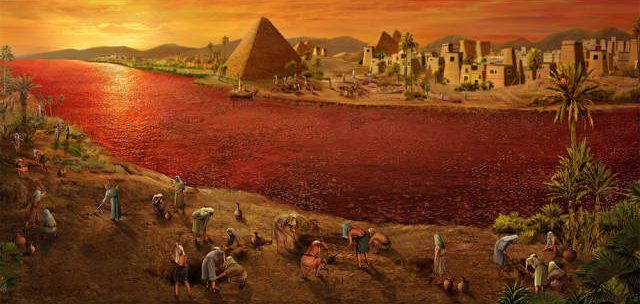
Plague Number One

14 Then the Lord said to Moses, “Pharaoh’s heart is hardened; he refuses to let the people go. 15 Go to Pharaoh in the morning, as he is going out to the water. Stand on the bank of the Nile to meet him, and take in your hand the staff that turned into a serpent. 16 And you shall say to him, ‘The Lord, the God of the Hebrews, sent me to you, saying, “Let my people go, that they may serve me in the wilderness.” But so far, you have not obeyed. 17 Thus says the Lord, “By this you shall know that I am the Lord: behold, with the staff that is in my hand I will strike the water that is in the Nile, and it shall turn into blood. 18 The fish in the Nile shall die, and the Nile will stink, and the Egyptians will grow weary of drinking water from the Nile.”’” 19 And the Lord said to Moses, “Say to Aaron, ‘Take your staff and stretch out your hand over the waters of Egypt, over their rivers, their canals, and their ponds, and all their pools of water, so that they may become blood, and there shall be blood throughout all the land of Egypt, even in vessels of wood and in vessels of stone.’”

20 Moses and Aaron did as the Lord commanded. In the sight of Pharaoh and in the sight of his servants he lifted up the staff and struck the water in the Nile, and all the water in the Nile turned into blood. 21 And the fish in the Nile died, and the Nile stank, so that the Egyptians could not drink water from the Nile. There was blood throughout all the land of Egypt. 22 But the magicians of Egypt did the same by their secret arts. So Pharaoh’s heart remained hardened, and he would not listen to them, as the Lord had said. 23 Pharaoh turned and went into his house, and he did not take even this to heart. 24 And all the Egyptians dug along the Nile for water to drink, for they could not drink the water of the Nile.

25 Seven full days passed after the Lord had struck the Nile. – Exodus 7:14-25 ESV

Things were about to get busy for God’s two elderly representatives. At an age when most men would be slowing down, Moses and Aaron had been assigned the God-ordained task of delivering His people from their captivity in Egypt. And this formidable responsibility wasn’t made any easier by the recalcitrant Pharaoh. As God had warned, the king of Egypt would do everything in his considerable power to keep the Israelites enslaved.

God was not surprised by Pharaoh’s actions. He had actually predicted it and claimed that He was the motivating factor behind Pharaoh’s stubborn resistance.  The Almighty knew the king’s heart and was using his predispositions and natural tendencies to bring about the preordained plan for Israel’s exodus from Egypt. Pharaoh’s “hard heart” would play a major role in God’s redemptive plan.

Having enacted their first sign in the presence of Pharaoh, Moses and Aaron were given instructions to take things to the next level. Araon’s staff turning into a snake was a mere parlor trick compared to what God was about to do. Pharaoh’s arrogant refusal to accept the terms of God’s demands would be met with severe judgment. God was going to strike at the heart of Egypt’s economic, religious, and cultural life: The Nile.

This vast river was the source of all life for the people of Egypt. Its annual flood cycle ensured the dissemination of nutrient-rich silt on the shorelines, providing fertility and prosperity to the land. The Egyptians believed the Nile to be a gift of the gods and they associated a number of their deities with the river itself.

There were Apis and Isis, the god and goddess of the Nile. Khnum was considered the guardian of the Nile. There were at least two gods who were deemed responsible for the Nile’s flooding. The first was the crocodile-like deity Sobek, whose domain consisted of the Nile’s waters. The second was Hapi, who was sometimes referred to as “Lord of the River Bringing Vegetation.” Because of his role in the annual flood cycle, Hapi was also considered a god of fertility.

It makes perfect sense that God would choose this revered natural resource to be the site of His first judgment. He sent Moses and Aaron to meet Pharaoh on the banks of the river the next morning. The omniscient God of Israel foreknew that Pharaoh would be making a morning visit to the river’s banks and He instructed His two agents to get there early and be ready to confront the king upon his arrival.

Moses was instructed to have Aaron take the same staff that God had transformed into a snake and use it to strike the waters of the Nile. But before doing so, Moses was to deliver to Pharaoh the following short speech from God.

So this is what the Lord says: “I will show you that I am the Lord.” Look! I will strike the water of the Nile with this staff in my hand, and the river will turn to blood. The fish in it will die, and the river will stink. The Egyptians will not be able to drink any water from the Nile.’” – Exodus 7:17-18 NLT

It is likely that Pharaoh was accompanied by a royal retinue of armed guards, servants, and administrative officials. Perhaps his visit had religious overtones and there were priests to assist him in making sacrifices to one or more of the gods of the Nile.

But at the sight of these two elderly Hebrews standing on the bank of the river, Pharaoh must have been more than a bit surprised and irritated. And to hear them pronounce their far-fetched plan to turn the river to blood must have left him bemused. Who did these men think they were? Did they not know they were dealing with one of the most powerful men in the world?

But Moses and Aaron did as God had instructed them.

As Pharaoh and all of his officials watched, Aaron raised his staff and struck the water of the Nile. Suddenly, the whole river turned to blood! The fish in the river died, and the water became so foul that the Egyptians couldn’t drink it. There was blood everywhere throughout the land of Egypt. – Exodus 7:20-21 NLT

In a matter of minutes, the entire river had been transformed into blood. This supernatural display of God’s power was meant to demonstrate His superiority and sovereignty. The God of creation was giving irrefutable evidence of His status as the one true God. Hapi, Khnum, Apis, and Isis were all defenseless before the majesty and might of Jehovah. They could not protect their own domain from the devastating judgment of the God of the Hebrews. And all Pharaoh could do was stand back and watch.

According to the text, the effects of this miracle were not localized but widespread throughout Egypt, impacting “all its rivers, canals, ponds, and all the reservoirs” (Exodus 7:19 NLT). Every source of drinking water was affected. And, not only that, the fish that served as a primary source of food for the Egyptians were wiped out as a result of this nationwide catastrophe. 

In what will become a rather strange and repeated scene, Pharaoh’s magicians responded to this devastating display of God’s judgment by replicating it. In other words, they mimicked the actions of God and actually made matters worse. If they had the power to turn water into blood, why did they not choose to do the opposite? Once again, God seems to be using these so-called magicians as instruments of His sovereign will. It is ironic that they display similar power to that of Moses and Aaron, but they cannot repair or resist what God’s agents have done. They can only replicate it and increase the suffering of their own people.

Seven days would pass. During that time, Pharaoh would go about his business as if nothing had happened. He refused to think about the devastation brought upon his nation by the God of Moses and Aaron. Safely ensconced in his palace, he was unaware that his people were busy digging wells in a vain attempt to find fresh drinking water.  And little did Pharaoh know that this was just the beginning. The book of Psalms records the litany of miraculous judgments that were headed Pharaoh’s way.

They did not remember his power
    or the day when he redeemed them from the foe,
when he performed his signs in Egypt
    and his marvels in the fields of Zoan.
He turned their rivers to blood,
    so that they could not drink of their streams.
He sent among them swarms of flies, which devoured them,
    and frogs, which destroyed them.
He gave their crops to the destroying locust
    and the fruit of their labor to the locust.
He destroyed their vines with hail
    and their sycamores with frost.
He gave over their cattle to the hail
    and their flocks to thunderbolts.
He let loose on them his burning anger,
    wrath, indignation, and distress,
    a company of destroying angels.
He made a path for his anger;
    he did not spare them from death,
    but gave their lives over to the plague.
He struck down every firstborn in Egypt,
    the firstfruits of their strength in the tents of Ham.
Then he led out his people like sheep
    and guided them in the wilderness like a flock. – Psalm 78:42-52 ESV

The blood-filled Nile was only the precursor to so much more that God had planned for the nation of Egypt. And when He was done, they would know that He alone was Lord.

English Standard Version (ESV) The Holy Bible, English Standard Version. ESV® Permanent Text Edition® (2016). Copyright © 2001

New Living Translation (NLT) Holy Bible, New Living Translation, copyright © 1996, 2004, 2015 by Tyndale House Foundation. Used by permission of Tyndale House Publishers Inc., Carol Stream, Illinois 60188. All rights reserved.
Sickness of Heart

15 “But you trusted in your beauty and played the whore because of your renown and lavished your whorings on any passerby; your beauty became his. 16 You took some of your garments and made for yourself colorful shrines, and on them played the whore. The like has never been, nor ever shall be. 17 You also took your beautiful jewels of my gold and of my silver, which I had given you, and made for yourself images of men, and with them played the whore. 18 And you took your embroidered garments to cover them, and set my oil and my incense before them. 19 Also my bread that I gave you—I fed you with fine flour and oil and honey—you set before them for a pleasing aroma; and so it was, declares the Lord God. 20 And you took your sons and your daughters, whom you had borne to me, and these you sacrificed to them to be devoured. Were your whorings so small a matter 21 that you slaughtered my children and delivered them up as an offering by fire to them? 22 And in all your abominations and your whorings you did not remember the days of your youth, when you were naked and bare, wallowing in your blood.

23 “And after all your wickedness (woe, woe to you! declares the Lord God), 24 you built yourself a vaulted chamber and made yourself a lofty place in every square. 25 At the head of every street you built your lofty place and made your beauty an abomination, offering yourself to any passerby and multiplying your whoring. 26 You also played the whore with the Egyptians, your lustful neighbors, multiplying your whoring, to provoke me to anger. 27 Behold, therefore, I stretched out my hand against you and diminished your allotted portion and delivered you to the greed of your enemies, the daughters of the Philistines, who were ashamed of your lewd behavior. 28 You played the whore also with the Assyrians, because you were not satisfied; yes, you played the whore with them, and still you were not satisfied. 29 You multiplied your whoring also with the trading land of Chaldea, and even with this you were not satisfied.

30 “How sick is your heart, declares the Lord God, because you did all these things, the deeds of a brazen prostitute, 31 building your vaulted chamber at the head of every street, and making your lofty place in every square. Yet you were not like a prostitute, because you scorned payment. 32 Adulterous wife, who receives strangers instead of her husband! 33 Men give gifts to all prostitutes, but you gave your gifts to all your lovers, bribing them to come to you from every side with your whorings. 34 So you were different from other women in your whorings. No one solicited you to play the whore, and you gave payment, while no payment was given to you; therefore you were different. – Ezekiel 16:15-34 ESV

The city of Jerusalem stood as a symbol of God’s blessings upon the people of Israel. It was a magnificent walled city filled with beautiful homes, stunning palaces, and the renowned temple Solomon had built for Yahweh. When the Queen of Sheba made a royal visit to Jerusalem, she had been blown away by all that she had seen.

…when she saw the palace he had built, she was overwhelmed. She was also amazed at the food on his tables, the organization of his officials and their splendid clothing, the cup-bearers and their robes, and the burnt offerings Solomon made at the Temple of the Lord.

She exclaimed to the king, “Everything I heard in my country about your achievements and wisdom is true! I didn’t believe what was said until I arrived here and saw it with my own eyes. In fact, I had not heard the half of your great wisdom! It is far beyond what I was told. How happy your people must be! What a privilege for your officials to stand here day after day, listening to your wisdom! Praise the Lord your God, who delights in you and has placed you on the throne as king to rule for him. Because God loves Israel and desires this kingdom to last forever, he has made you king over them so you can rule with justice and righteousness.” – 2 Chronicles 9:3-8 NLT

Yet, God did not share the Queen of Sheba’s glowing assessment of the city. He found it to be a moral and spiritual cesspool filled with people who were more than happy to enjoy all the physical benefits He provided, but who refused to keep His commands. They were so unfaithful that God was forced to describe them as little more than spiritual prostitutes.

These people had committed the very crime that Moses had warned them about long before they ever entered the land of Canaan.

“The Lord your God will soon bring you into the land he swore to give you when he made a vow to your ancestors Abraham, Isaac, and Jacob. It is a land with large, prosperous cities that you did not build. The houses will be richly stocked with goods you did not produce. You will draw water from cisterns you did not dig, and you will eat from vineyards and olive trees you did not plant. When you have eaten your fill in this land,  be careful not to forget the Lord, who rescued you from slavery in the land of Egypt. You must fear the Lord your God and serve him. When you take an oath, you must use only his name.

“You must not worship any of the gods of neighboring nations, for the Lord your God, who lives among you, is a jealous God. His anger will flare up against you, and he will wipe you from the face of the earth.” – Deuteronomy 6:10-15 NLT

Now, generations later, God was declaring their guilt and describing the abysmal spiritual conditions within the city of David. They had grown perversely proud of their vaunted position as God’s chosen people. They had allowed their set-apart status as God’s prized possession to go to their heads and give them the misguided impression that they could do no wrong. In their minds, they were invincible and immune to failure. Their status as descendants of Abraham and heirs of God’s covenant promises had made them overconfident and cocky.

The brazen nature of their crimes against God is difficult to comprehend. All that they enjoyed had been given to them by God and yet they turned around and used those resources to manufacture idols to which they offered sacrifices. And not only did they offer these false gods the very gifts God had given them, but they also practiced child sacrifice, offering up their own children as tributes to their pagan deities.

“Then you took your sons and daughters—the children you had borne to me—and sacrificed them to your gods. Was your prostitution not enough? Must you also slaughter my children by sacrificing them to idols?” – Ezekiel 16:20-21 NLT

One of the greatest gifts God had given the people of Israel was their offspring. The psalmist declares, “Behold, children are a heritage from the LORD, the fruit of the womb a reward” (Psalm 127:3 ESV). And yet the unfaithful and ungrateful citizens of Jerusalem were guilty of having treated God’s precious gift of children with blatant disregard. They had dared to deem the offspring promised by God as a sign of His covenant commitment as expendable and disposable.

But as egregious as child sacrifice may be, God also accuses them of spiritual adultery. They had erected idols, high places, altars, and shrines to their false gods all over the city. They had become equal opportunity idolaters, willingly bowing their knees to any and all false gods that came along. And when God brought judgment upon them for their unfaithfulness, they turned to foreign powers for rescue. Rather than acknowledging their sin and returning to Him in humble contrition, they sought the aid of the superpowers of their day. In an attempt to escape God’s judgment for their unfaithfulness, they made things worse by seeking help from countries like Egypt, Assyria, and Babylon.

“You have prostituted yourself with the Assyrians, too. It seems you can never find enough new lovers! And after your prostitution there, you still were not satisfied. You added to your lovers by embracing Babylonia, the land of merchants, but you still weren’t satisfied.” – Ezekiel 16:18-19 NLT

And it’s interesting to note that God used the Assyrians as His instruments of destruction when punishing the northern kingdom of Israel. And, eventually, He would use the Babylonians to destroy the rebellious southern kingdom of Judah. The allies the people of Israel turned to for help would become their enemies and the means of their destruction.

The situation in Jerusalem was far worse than Ezekiel could have imagined. God discloses that the citizens of the city suffer from a deadly heart condition.

“What a sick heart you have, says the Sovereign Lord, to do such things as these, acting like a shameless prostitute. You build your pagan shrines on every street corner and your altars to idols in every square. In fact, you have been worse than a prostitute, so eager for sin that you have not even demanded payment.” – Ezekiel 16:30-31 NLT

They suffered from a compulsive disorder that made them far worse than spiritual prostitutes. Rather than selling themselves for whatever benefit they could get in return, they were guilty of paying others for the privilege of committing adultery.

“Prostitutes charge for their services—but not you! You give gifts to your lovers, bribing them to come and have sex with you. So you are the opposite of other prostitutes. You pay your lovers instead of their paying you!” – Ezekiel 16:33-34 NLT

The false gods they worshiped were incapable of bestowing any favors or blessings, but the people of Judah worshiped them anyway. The nations they turned to for rescue were powerless to deliver any aid, but the citizens of Jerusalem repeatedly sought their help. And all the while, they spurned God’s calls to repent and be restored to their former condition as His chosen people. And, as Ezekiel was about to discover, God’s long-suffering patience had finally run out. They suffered from a fatal heart condition and the remedy was as deadly as the disease.

English Standard Version (ESV) The Holy Bible, English Standard Version. ESV® Permanent Text Edition® (2016). Copyright © 2001

New Living Translation (NLT) Holy Bible, New Living Translation, copyright © 1996, 2004, 2015 by Tyndale House Foundation. Used by permission of Tyndale House Publishers Inc., Carol Stream, Illinois 60188. All rights reserved.

It’s Worse Than You Thought

1 In the sixth year, in the sixth month, on the fifth day of the month, as I sat in my house, with the elders of Judah sitting before me, the hand of the Lord God fell upon me there. 2 Then I looked, and behold, a form that had the appearance of a man. Below what appeared to be his waist was fire, and above his waist was something like the appearance of brightness, like gleaming metal. 3 He put out the form of a hand and took me by a lock of my head, and the Spirit lifted me up between earth and heaven and brought me in visions of God to Jerusalem, to the entrance of the gateway of the inner court that faces north, where was the seat of the image of jealousy, which provokes to jealousy. 4 And behold, the glory of the God of Israel was there, like the vision that I saw in the valley.

5 Then he said to me, “Son of man, lift up your eyes now toward the north.” So I lifted up my eyes toward the north, and behold, north of the altar gate, in the entrance, was this image of jealousy. 6 And he said to me, “Son of man, do you see what they are doing, the great abominations that the house of Israel are committing here, to drive me far from my sanctuary? But you will see still greater abominations.”

7 And he brought me to the entrance of the court, and when I looked, behold, there was a hole in the wall. 8 Then he said to me, “Son of man, dig in the wall.” So I dug in the wall, and behold, there was an entrance. 9 And he said to me, “Go in, and see the vile abominations that they are committing here.” 10 So I went in and saw. And there, engraved on the wall all around, was every form of creeping things and loathsome beasts, and all the idols of the house of Israel. 11 And before them stood seventy men of the elders of the house of Israel, with Jaazaniah the son of Shaphan standing among them. Each had his censer in his hand, and the smoke of the cloud of incense went up. 12 Then he said to me, “Son of man, have you seen what the elders of the house of Israel are doing in the dark, each in his room of pictures? For they say, ‘The Lord does not see us, the Lord has forsaken the land.’” 13 He said also to me, “You will see still greater abominations that they commit.”

14 Then he brought me to the entrance of the north gate of the house of the Lord, and behold, there sat women weeping for Tammuz. 15 Then he said to me, “Have you seen this, O son of man? You will see still greater abominations than these.”

16 And he brought me into the inner court of the house of the Lord. And behold, at the entrance of the temple of the Lord, between the porch and the altar, were about twenty-five men, with their backs to the temple of the Lord, and their faces toward the east, worshiping the sun toward the east. 17 Then he said to me, “Have you seen this, O son of man? Is it too light a thing for the house of Judah to commit the abominations that they commit here, that they should fill the land with violence and provoke me still further to anger? Behold, they put the branch to their nose. 18 Therefore I will act in wrath. My eye will not spare, nor will I have pity. And though they cry in my ears with a loud voice, I will not hear them.” – Ezekiel 8:1-18 ESV

At some point during Ezekiel’s lengthy, non-verbal prophetic demonstration, he received a vision from God. He was seated in his home with a contingent of elders from the Jewish exiles in Babylon. He does not give a reason for their visit but it is safe to say that this was not a cordial or friendly affair. They were likely upset with the nature of his dramatic performance and the negative impact it was having on the community. His visual illustration predicting Jerusalem’s fall would have greatly disturbed his fellow exiles, who had been hoping that God would eventually return them to their homeland. But Ezekiel had ruled out that possibility.

When God had finally given Ezekiel permission to speak, He didn’t exactly give him an easy message to deliver. Chapter seven records the dire warning Ezekiel was commanded to share with the exiles in Babylon, and what he had to say did nothing to help him win friends and influence enemies.

God told them, “Soon I will pour out my fury on you and unleash my anger against you. I will call you to account for all your detestable sins” (Ezekiel 7:8 NLT). God was fed up. He had had enough. He saw that His chosen people had become proud, wealthy, self-sufficient, and over-confident. They didn’t need Him. They had become affluent and apathetic toward God, even using their wealth to create their own gods. They no longer knew God or feared Him. And to prove to Ezekiel just how bad things were back home in Jerusalem, God gave him a special “birds-eye” tour of the holy city that sounds like something straight out of Dicken’s A Christmas Carol.

While seated with the elders in his home Ezekiel received a vision from God. There is no indication that the other men in the room were aware of what was happening, but for Ezekiel, this proved to be a disturbing and eye-opening adventure.

In his vision, an angel picked up Ezekiel by his hair and transported him to Jerusalem. His first stop? The northern gate of the inner courtyard of the temple. And what did he see? An idol to a false god. He describes it as “the seat of the image of jealousy, which provokes to jealousy” (Ezekiel 8:3 ESV). A huge idol sitting directly in the middle of the temple courtyard. Ezekiel does not give the name of this god, but it could have been a statue of Asherah, the Canaanite goddess of fertility, whose worship encouraged sexual immorality and promoted self-gratification.

Yet, Ezekiel noted that “the glory of the God of Israel was there” (Ezekiel 8:4 ESV). Despite the unexpected sight of an idol in the temple, he recognized the presence of God’s glory and majesty, just as he had seen in his previous vision.

Ezekiel must have been shocked by what he saw, but God assured them that this magical mystery tour of Judah’s sins was just getting started.

“Son of man,” he said, “do you see what they are doing? Do you see the detestable sins the people of Israel are committing to drive me from my Temple? But come, and you will see even more detestable sins than these!” – Ezekiel 8:6 NLT

Next, the angel took him to the door of the temple courtyard. In the adjacent wall was a small hole, which the angel commanded Ezekiel to expand. Upon enlarging the hole, Ezekiel discovered a hidden door. After entering the now-exposed passage, Ezekiel discovered 70 civic leaders of Israel conducting themselves as if they were priests. But they weren’t worshiping Yahweh. The walls of the hidden room were covered with “engravings of all kinds of crawling animals and detestable creatures” (Ezekiel 8:9 NLT), and there were idols of all of the false gods of Israel. Ezekiel had stumbled upon a secret sanctuary dedicated to the practice of pagan idolatry, right in the middle of the temple of God.

And their excuse for their actions? “The Lord doesn’t see us, he has deserted our land” (Ezekiel 8:12b NLT). They blamed God, accusing Him of having abandoned them, and forcing them to worship other gods in the hope of finding a solution to their problem. But they were the problem.

Ezekiel must have been appalled by what he saw, but God assured him that the worst was yet to come.

“Come, and I will show you even more detestable sins than these!” – Ezekiel 8:13 NLT

The angel brought Ezekiel to the north gate of the temple where he saw women weeping for the god Tammuz, the Babylonian god of spring. It was believed that he died at the beginning of every summer, only to resurrect again in the spring. The mournful nature of these women reflects the pervasive presence of idolatry within Israel. But, once again, God assured the slack-jawed Ezekiel that this was just the tip of the iceberg.

“I will show you even more detestable sins than these!” – Ezekiel 8:15 NLT

The angel to the inner courtyard of the Lord’s temple, where he saw 25 men standing with their backs to the sanctuary of God. They were facing east and worshiping the sun. The symbolism of the scene is difficult to miss. These unidentified men had turned their backs on God and were worshiping the creation rather than the Creator. They were guilty of the very thing Paul outlines in his letter to the Romans.

Claiming to be wise, they became fools, and exchanged the glory of the immortal God for images resembling mortal man and birds and animals and creeping things… they exchanged the truth about God for a lie and worshiped and served the creature rather than the Creator, who is blessed forever! – Romans 1:22-23, 25 ESV

They had replaced God. They had turned their backs on Him and were placing their hopes elsewhere. Rather than trust God for their future and return to Him in repentance over their sins, they were searching high and low for a solution to their predicament. Unwilling to admit their own culpability, they refused to own their sins and repent. Instead, they looked for another way to resolve their issues. They searched for another savior. They prayed for another deliverer.

God had given Ezekiel ample evidence of the wickedness of the people of Israel. It seems that the timing of this vision was tied to the presence of the elders in Ezekiel’s home. Evidently, they had come with the intent to convince Ezekiel that things were not that bad back in Jerusalem. They had probably tried to persuade him that his assessment of Israel’s sinfulness was overblown and his message of God’s pending judgment was inaccurate.

But God assured Ezekiel that things were far worse than he could have imagined, and He was determined to do something about it.

“Have you seen this, son of man?” he asked. “Is it nothing to the people of Judah that they commit these detestable sins, leading the whole nation into violence, thumbing their noses at me, and provoking my anger?” – Ezekiel 8:17 NLT

God was done warning His rebellious people. They had turned their backs on Him and now, He was going to return the favor.

But what about us? As we look around the world today and see all that is happening, what is our response? When we witness the physical and spiritual drought taking place in our country, do we turn to God in repentance, or do we pursue other solutions? Do we put our hope in politicians? Do we turn to science? Do we rely on our own wealth and distract ourselves with entertainment and affluence?

Paul went on to describe the stark outcome of a life lived in disobedience and unfaithfulness to God, and it isn’t a pretty picture. But it is the fate of all those who fail to acknowledge Him for who He is.

Since they thought it foolish to acknowledge God, he abandoned them to their foolish thinking and let them do things that should never be done. Their lives became full of every kind of wickedness, sin, greed, hate, envy, murder, quarreling, deception, malicious behavior, and gossip. They are backstabbers, haters of God, insolent, proud, and boastful. They invent new ways of sinning, and they disobey their parents. They refuse to understand, break their promises, are heartless, and have no mercy. They know God’s justice requires that those who do these things deserve to die, yet they do them anyway. Worse yet, they encourage others to do them, too. – Romans 1:28-32 NLT

Men can deny God’s existence, but they will never escape His judgment.

English Standard Version (ESV) The Holy Bible, English Standard Version. ESV® Permanent Text Edition® (2016). Copyright © 2001

New Living Translation (NLT) Holy Bible, New Living Translation, copyright © 1996, 2004, 2015 by Tyndale House Foundation. Used by permission of Tyndale House Publishers Inc., Carol Stream, Illinois 60188. All rights reserved.

We Can Do This the Hard Way

1 The word of the Lord came to me: 2 “Son of man, set your face toward the mountains of Israel, and prophesy against them, 3 and say, You mountains of Israel, hear the word of the Lord God! Thus says the Lord God to the mountains and the hills, to the ravines and the valleys: Behold, I, even I, will bring a sword upon you, and I will destroy your high places. 4 Your altars shall become desolate, and your incense altars shall be broken, and I will cast down your slain before your idols. 5 And I will lay the dead bodies of the people of Israel before their idols, and I will scatter your bones around your altars. 6 Wherever you dwell, the cities shall be waste and the high places ruined, so that your altars will be waste and ruined, your idols broken and destroyed, your incense altars cut down, and your works wiped out. 7 And the slain shall fall in your midst, and you shall know that I am the Lord.

8 “Yet I will leave some of you alive. When you have among the nations some who escape the sword, and when you are scattered through the countries, 9 then those of you who escape will remember me among the nations where they are carried captive, how I have been broken over their whoring heart that has departed from me and over their eyes that go whoring after their idols. And they will be loathsome in their own sight for the evils that they have committed, for all their abominations. 10 And they shall know that I am the Lord. I have not said in vain that I would do this evil to them.”

11 Thus says the Lord God: “Clap your hands and stamp your foot and say, Alas, because of all the evil abominations of the house of Israel, for they shall fall by the sword, by famine, and by pestilence. 12 He who is far off shall die of pestilence, and he who is near shall fall by the sword, and he who is left and is preserved shall die of famine. Thus I will spend my fury upon them. 13 And you shall know that I am the Lord, when their slain lie among their idols around their altars, on every high hill, on all the mountaintops, under every green tree, and under every leafy oak, wherever they offered pleasing aroma to all their idols. 14 And I will stretch out my hand against them and make the land desolate and waste, in all their dwelling places, from the wilderness to Riblah. Then they will know that I am the Lord.” – Ezekiel 6:1-14 ESV

Four separate times in 14 verses, God insists that when He is done, the rebellious people of Israel “will know that I am the Lord.” God is a relational being and He had chosen the nation of Israel to enjoy a unique relationship with Him. He had set them apart as His own prized possession with the intent of revealing to them His glory and goodness. Even all the way back in Egypt, long before Moses had delivered them from their captivity, God had promised to reveal Himself to them in powerful and highly tangible ways.

“I am the Lord, and I will bring you out from under the burdens of the Egyptians, and I will deliver you from slavery to them, and I will redeem you with an outstretched arm and with great acts of judgment. I will take you to be my people, and I will be your God, and you shall know that I am the Lord your God, who has brought you out from under the burdens of the Egyptians. I will bring you into the land that I swore to give to Abraham, to Isaac, and to Jacob. I will give it to you for a possession. I am the Lord.” – Exodus 6:6-8 ESV

Their miraculous deliverance was intended to demonstrate the power, majesty, and sovereignty of God. He was greater than the Egyptians and their plethora of false gods. He was the covenant-keeping God who could be trusted to keep every promise He had made to Abraham, whose descendants would eventually escape captivity in Egypt and find themselves safely ensconced in the promised land of Canaan.

All along their journey from captivity to Canaan, God revealed Himself to His people. After miraculously delivering them across the Red Sea on dry ground and defeating the forces of Egypt, He had led them by a pillar of cloud by day and a pillar of fire by night. He had sustained them with manna from heaven and water from a rock. And during their four-decade-long journey through the wilderness of Sinai, He had even kept their clothes from wearing out. He had given them His law to reveal His holy expectations of them and regulate their behavior. And knowing that they would fail to keep His law perfectly, He provided them with the sacrificial system to atone for the sins they would commit so that they might be able to restore their broken relationship with Him.

God had repeatedly proven His greatness, and they should have known that He alone was the one true God. He had no equals. In His deliverance of the Israelites, He had exposed the gods of the Egyptians as frauds and nothing more than the figments of the imaginations of men. And when they began their conquest of the land of Canaan, God was with them, providing them with victories over much larger armies. The Canaanites and their gods proved to be powerless before Yahweh, the God of Abraham, Isaac, and Jacob.

And even before their conquest of the land had begun, God had warned them about adopting the religious practices of the Canaanites. They were not to emulate their pagan ways or worship their gods.

“When the Lord your God goes ahead of you and destroys the nations and you drive them out and live in their land, do not fall into the trap of following their customs and worshiping their gods. Do not inquire about their gods, saying, ‘How do these nations worship their gods? I want to follow their example.’ You must not worship the Lord your God the way the other nations worship their gods, for they perform for their gods every detestable act that the Lord hates. They even burn their sons and daughters as sacrifices to their gods.” – Deuteronomy 12:29-31 NLT

But the people of Israel would fail to keep God’s commands. Over the centuries, they developed an unhealthy love affair with the false gods of the Canaanites. The kings of Israel had a track record of adopting the false gods of their enemies and adulterating their worship of Yahweh with unacceptable practices that He found deplorable.

And all along the way, God had warned His people about the dangers of their rebellious ways. He was a jealous God who would not tolerate their unfaithfulness and spiritual infidelity. By this time, they should have known that He alone was God. But they were still prone to seek the help and favor of any pagan god who might be able to give them a leg up on their enemies. They had become equal-opportunity idolators, willing to cozy up to any god who might provide them with an advantage or satisfy their insatiable lust for power, possessions, and pleasure. For them, Yahweh was not enough. They wanted more. And they were willing to prostitute themselves before the false gods of the Canaanites in order to satisfy what the apostle John described as “a craving for physical pleasure, a craving for everything we see, and pride in our achievements and possessions” (1 John 2:16 NLT).

Their blatant unfaithfulness had resulted in the Babylonian invasion of Judah. God informed the prophet, Jeremiah, that King Nebuchadnezzar had been handpicked by God to serve as His agent of judgment against His rebellious people.

“I will send for all the tribes of the north, declares the Lord, and for Nebuchadnezzar the king of Babylon, my servant, and I will bring them against this land and its inhabitants, and against all these surrounding nations. I will devote them to destruction, and make them a horror, a hissing, and an everlasting desolation.” – Jeremiah 25:9 ESV

And by the time Ezekiel penned his book, King Nebuchadnezzar had already defeated Judah and taken thousands of its citizens captive. But God was not done. The people of Judah remained unrepentant and unwilling to give up their love affair with false gods. That is why God gave Ezekiel a message for the people living back in Judah. He was to declare God’s pending judgment against the “mountains of Israel” (Ezekiel 6:3). This reference most certainly included the most prominent and important mountain range in all of Israel: Mount Moriah. This mountain range included Mount Zion on which Jerusalem sat and within whose walls the temple of God was located.

But God made it clear that His holy mountain was surrounded by altars and shrines to false gods. The land of Judah was literally filled with sacred worship sights dedicated to the gods of the Canaanites, and God was not pleased.

“I am about to bring war upon you, and I will smash your pagan shrines. All your altars will be demolished, and your places of worship will be destroyed. I will kill your people in front of your idols. I will lay your corpses in front of your idols and scatter your bones around your altars. Wherever you live there will be desolation, and I will destroy your pagan shrines. Your altars will be demolished, your idols will be smashed, your places of worship will be torn down, and all the religious objects you have made will be destroyed. The place will be littered with corpses, and you will know that I alone am the Lord.” – Ezekiel 6:3-7 NLT

It’s as if God is saying, “We can do this the hard way or we can do this the easy way.” God is a relational God. He chose the people of Israel to have a relationship with Him and to get to know Him – intimately and personally. He chose to dwell among them. He gave them His law to follow. He led them, directed them, protected them, and even spoke to them. He revealed Himself to them through miracles and divine intervention. He won battles for them. He rescued and rewarded them. All so that they might know Him. But the people of Israel decided to reject this personal God for a litany of impersonal, impotent, man-made gods.

Instead of recognizing and appreciating the power and presence of Yahweh, they turned their attention and affections elsewhere. So, God decided to reveal Himself differently. They were going to get to know Him the hard way. They would experience the power of God moving in their midst, but it would bring destruction, not blessing. He was going to smash their pagan shrines, demolish their altars, and destroy the places of worship where they pursued other gods.

When all the dust had settled, they were going to know that God had been in their midst. They were going to know that He had spoken and He always does what he says He will do. They were going to know that God was powerful and deadly serious about His people living lives that were set apart and distinctive from those of the other nations.

“You people have behaved worse than your neighbors and have refused to obey my decrees and regulations. You have not even lived up to the standards of the nations around you.” – Ezekiel 5:7 NLT

One way or the other, the people of God were going to get to know their God. But they were choosing the hard way. They were making it difficult on themselves. God had wanted to reveal Himself through blessing and abundance. He had wanted to have an intimate relationship with them that was characterized by care and compassion. In His grace and mercy, He had chosen them from among all the nations, not because they deserved it, but because He wanted to reveal Himself in a special way to a very specific people. He had intended to use them to showcase His love. They were to be His living illustration to the world.

But they refused to accept His love and obey His commands. He pursued them, but they rejected Him. So now they were going to get to know God the hard way.

But this chapter provides a powerful lesson for every child of God. Why do we make it so hard on ourselves? Why do we force God to reveal Himself through discipline and prove Himself to us by rebuking us? God has given us His Son. He has chosen us for a personal, intimate relationship with Him. He wants us to know Him closely and deeply. But far too often, we choose the hard way over the easy way.

English Standard Version (ESV) The Holy Bible, English Standard Version. ESV® Permanent Text Edition® (2016). Copyright © 2001

New Living Translation (NLT) Holy Bible, New Living Translation, copyright © 1996, 2004, 2015 by Tyndale House Foundation. Used by permission of Tyndale House Publishers Inc., Carol Stream, Illinois 60188. All rights reserved.

Don’t Take Your Eye Off the Prize

1 There is an evil that I have seen under the sun, and it lies heavy on mankind: 2 a man to whom God gives wealth, possessions, and honor, so that he lacks nothing of all that he desires, yet God does not give him power to enjoy them, but a stranger enjoys them. This is vanity; it is a grievous evil. 3 If a man fathers a hundred children and lives many years, so that the days of his years are many, but his soul is not satisfied with life’s good things, and he also has no burial, I say that a stillborn child is better off than he. 4 For it comes in vanity and goes in darkness, and in darkness its name is covered. 5 Moreover, it has not seen the sun or known anything, yet it finds rest rather than he. 6 Even though he should live a thousand years twice over, yet enjoy no good—do not all go to the one place?

7 All the toil of man is for his mouth, yet his appetite is not satisfied. 8 For what advantage has the wise man over the fool? And what does the poor man have who knows how to conduct himself before the living? 9 Better is the sight of the eyes than the wandering of the appetite: this also is vanity and a striving after wind.

10 Whatever has come to be has already been named, and it is known what man is, and that he is not able to dispute with one stronger than he. 11 The more words, the more vanity, and what is the advantage to man? 12 For who knows what is good for man while he lives the few days of his vain life, which he passes like a shadow? For who can tell man what will be after him under the sun? – Ecclesiastes 6:1-12 ESV

From Solomon’s unique vantage point as king, he has been able to see and experience a great deal of what life has to offer. Some of his observations are more objective in nature, providing the perspective of an impartial outsider, viewing the lives of the people in his kingdom. He has been able to witness first-hand the oppression of the poor. As a judge over his people, he has had to preside over countless cases involving injustice and abuse. He has listened to the cries of the destitute and needy, as they have begged for someone to help them in their time of need.

But some of Solomon’s most powerful insights come from his willingness to look at his own life and share his more subjective and personal observations. In this chapter, he continues to speak from his own personal experience, revealing his frustrations over what he sees and fears.

First of all, he starts with what he describes as a form of evil or wickedness that he has observed “under the sun” or in this life. He writes from a human perspective, presenting his earth-bound opinion concerning a prevalent problem among mankind. There are those whom God has obviously blessed with great wealth, but He has also denied them the power or capacity to enjoy all that they have been given.

God gives some people great wealth and honor and everything they could ever want, but then he doesn’t give them the chance to enjoy these things. – Ecclesiastes 6:2 NLT

These people have all that their hearts desire, except contentment and joy. And to make matters even worse, when they die, “someone else, even a stranger, ends up enjoying their wealth!” (Ecclesiastes 6:2 NLT). And Solomon deems it all as “meaningless—a sickening tragedy” (Ecclesiastes 6:2 NLT). But is he right?

First of all, Solomon’s viewpoint reflects the prevailing attitude of his day. It was commonly believed that anyone who enjoyed great wealth had obviously been blessed by God. And if they had been blessed by God, their lives must have been pleasing to God. This is why it made no sense that God would withhold the one thing these people wanted and needed: The ability to enjoy what He had given them.

Solomon was right when he concluded that all good things come from God. In fact, he would have based his view on the Scriptures themselves.

Truth springs up from the earth,
    and righteousness smiles down from heaven.
Yes, the Lord pours down his blessings.
    Our land will yield its bountiful harvest. – Psalm 85:11-12 ESV

Even the New Testament author, James, echoes this view.

Every good gift and every perfect gift is from above, coming down from the Father of lights… – James 1:17 ESV

But where Solomon missed the point was in his assumption that wealth and material goods were to be the sole source of his enjoyment. In other words, he wrongly assumed that it was the blessings of God that brought joy, contentment, satisfaction, and significance. He misunderstood the true nature of their purpose and the significance of their source. The gifts had become the priority rather than the Giver. God was to have been the primary focus of Solomon’s life but not as the giver of good things. In fact, God should have been the only Solomon or anyone else needed in their life. God should have been enough. The apostle Paul expressed this viewpoint when he said:

Not that I was ever in need, for I have learned how to be content with whatever I have. I know how to live on almost nothing or with everything. I have learned the secret of living in every situation, whether it is with a full stomach or empty, with plenty or little. For I can do everything through Christ, who gives me strength. – Philippians 4:11-13 NLT

It didn’t really matter to Paul whether he had a little or a lot. All that really mattered was his relationship with Christ. Yet Solomon and his contemporaries placed their emphasis on the tangible and temporal. For them, the proof of God’s love was in the presence of material goods and the ability to enjoy them. Solomon’s misguided and misplaced emphasis on material goods and earthly pleasures left him with a sense of emptiness and frustration. He was experiencing the very painful lesson that nothing satisfies man’s inner longings and desires like God Himself.

For Solomon, the measurement of a successful life was based on both quantity and quality. He pessimistically observed that if a man ended up fathering hundreds of children (and he had), and lived a long life (which he did), but his soul was not satisfied with life’s good things (and his wasn’t), then his life was a waste.

A man might have a hundred children and live to be very old. But if he finds no satisfaction in life and doesn’t even get a decent burial, it would have been better for him to be born dead. – Ecclesiastes 6:3 NLT

That is a grim assessment. But notice what he is saying. He is measuring the significance of life using a quantitative matrix. He operated on the commonly held maxim: The more, the merrier. It was long life and lots of kids that brought joy. But having hundreds of children, none of whose names you know will ever bring satisfaction. And living a long life, but without a relationship with the Giver of life will never satisfy. Acquiring much wealth and accomplishing great deeds cannot make anyone truly happy or content if they fail to seek the One from whom all good things come.

Every good gift and every perfect gift is from above, coming down from the Father of lights… – James 1:17 ESV

For Solomon, nothing was more futile or frustrating than the thought of living a long life devoid of contentment. He states that a man “might live a thousand years twice over but still not find contentment. And since he must die like everyone else—well, what’s the use?” (Ecclesiastes 6:6 NLT).

And, sadly, this aptly describes Solomon’s own life. When he wrote this verse, he was at the end of life looking back, and while he could claim to have fathered hundreds of children and lived many years, he could say as Paul did, “I have learned to be content.” He had discovered the painful lesson that more was not merrier.

In his mind, it was all about satisfaction. Even the poor, who spend their days trying to scratch out a living and provide food for their next meal, end up discovering that they’re hungry again. The wise, the wealthy, the foolish, and the poor are all faced with the same grievous problem: Enough is never enough. Satisfaction and contentment are elusive. And the only advice Solomon can come up with is “Enjoy what you have rather than desiring what you don’t have” (Ecclesiastes 6:9 NLT).

But again, his emphasis is misplaced. He is not recommending that we find our satisfaction in God, but that we simply resign ourselves to enjoying what little we have been given by God. He has missed the point. And in doing so, he misses out on the real meaning and purpose of life. It is not about gaining and getting. It is not about acquiring and accumulating. It is about learning to seek satisfaction, significance, joy, and contentment from a relationship with the God of the universe.

But Solomon had a warped perspective about God. He euphemistically refers to God as “one stronger than he” (Ecclesiastes 6:10 ESV). He doesn’t see God as his Father but as an enforcer. Rather than approaching God as the gracious giver of good things, Solomon views Him as a capricious tyrant who withholds the ability to enjoy what has been given. And while he rightly understands that God knows all and sees all, Solomon seems to resent the fact that God keeps man’s future fate a mystery. To Solomon, this leaves man stuck in the here-and-now, trying to make the most out of what he has before his life comes to an abrupt end.

What Solomon describes in this chapter is the sad state of all men and women who refuse to see God as the central source of all that is good in their lives. God does bless. God does give good things. God is the author of life and the source of all that we can see. But God is not to be viewed as some disembodied purveyor of presents, like a cosmic Genie in a bottle. He is the gift. He is the good. He is the satisfaction and significance that man so desperately seeks. The apostle Paul summarized it well when he spoke to the people of Athens, describing the nature of the “unknown god” to whom they offered sacrifices, but with whom they had no relationship.

“He is the God who made the world and everything in it. Since he is Lord of heaven and earth, he doesn’t live in man-made temples, and human hands can’t serve his needs—for he has no needs. He himself gives life and breath to everything, and he satisfies every need. From one man he created all the nations throughout the whole earth. He decided beforehand when they should rise and fall, and he determined their boundaries.

“His purpose was for the nations to seek after God and perhaps feel their way toward him and find him—though he is not far from any one of us. For in him we live and move and exist. – Acts 17:24-28 NLT

God created man to have a relationship with Him. His purpose was for the nations to seek after Him. But sin changed all that. Because of the fall, the blessings of God became substitutes for Him. We made idols out of the good gifts He had given us. The apostle Paul describes the subtle shift that took place among humanity as they took their eyes off the Giver and began to seek satisfaction and significance from the good things He had given.

They traded the truth about God for a lie. So they worshiped and served the things God created instead of the Creator himself… – Romans 1:25 NLT

Solomon’s relentless quest to find meaning in life had taken him away from the very One who had given him life. He had made false gods out of the good and perfect gifts that had come down from the Father of lights…and he found himself unfulfilled and discontented with life and anxious about death.

In the few days of our meaningless lives, who knows how our days can best be spent? Our lives are like a shadow. Who can tell what will happen on this earth after we are gone? – Ecclesiastes 6:12 NLT

English Standard Version (ESV) The Holy Bible, English Standard Version. ESV® Permanent Text Edition® (2016). Copyright © 2001

New Living Translation (NLT) Holy Bible, New Living Translation, copyright © 1996, 2004, 2015 by Tyndale House Foundation. Used by permission of Tyndale House Publishers Inc., Carol Stream, Illinois 60188. All rights reserved.

Compromise and the Loss of Conviction

10 Have we not all one Father? Has not one God created us? Why then are we faithless to one another, profaning the covenant of our fathers? 11 Judah has been faithless, and abomination has been committed in Israel and in Jerusalem. For Judah has profaned the sanctuary of the Lord, which he loves, and has married the daughter of a foreign god. 12 May the Lord cut off from the tents of Jacob any descendant of the man who does this, who brings an offering to the Lord of hosts!

13 And this second thing you do. You cover the Lord’s altar with tears, with weeping and groaning because he no longer regards the offering or accepts it with favor from your hand. 14 But you say, “Why does he not?” Because the Lord was witness between you and the wife of your youth, to whom you have been faithless, though she is your companion and your wife by covenant. 15 Did he not make them one, with a portion of the Spirit in their union? And what was the one God seeking? Godly offspring. So guard yourselves in your spirit, and let none of you be faithless to the wife of your youth. 16 “For the man who does not love his wife but divorces her, says the Lord, the God of Israel, covers his garment with violence, says the Lord of hosts. So guard yourselves in your spirit, and do not be faithless.

17 You have wearied the Lord with your words. But you say, “How have we wearied him?” By saying, “Everyone who does evil is good in the sight of the Lord, and he delights in them.” Or by asking, “Where is the God of justice?” – Malachi 2:10-17 ESV

As verses 1-9 revealed, Israel had a leadership problem. Its priests were not living up to their role as the nation’s God-appointed shepherds. They were defiling the sacrificial system by offering unacceptable animals and, therefore, robbing the people of the atonement for sin they so desperately needed. On top of that, they had neglected their God-given responsibility to accurately teach the Mosaic Law to the people. They had twisted God’s words and taken liberties with God’s law, causing the people to stumble because of their deceptive instruction.

Through their immoral and unethical behavior, these unreliable leaders had caused irreparable damage to the nation. And now, Malachi turns his attention to the remnant of Israel who had returned to the land of promise but who were not living up to the covenant commitments God had established for them. In these verses, Malachi becomes the spokesperson, addressing his fellow citizens as brothers and sisters.

Are we not all children of the same Father? Are we not all created by the same God? Then why do we betray each other, violating the covenant of our ancestors? – Malachi 2:10 NLT

Malachi was the prophet or messenger of God but, evidently, he was also a member of the tribe of Judah and part of the local community there in Jerusalem. He had a right to address his fellow citizens and remind them of their covenant commitment to God and one another. What he had witnessed taking place in the capital city was shocking and unacceptable to him. The people of Israel were not only turning away from God, but they were turning on one another. And he sums up their actions in one verse.

Judah has been unfaithful, and a detestable thing has been done in Israel and in Jerusalem. The men of Judah have defiled the Lord’s beloved sanctuary by marrying women who worship idols. – Malachi 2:11 NLT

They were guilty of idolatry and adultery, and both sins were examples of unfaithfulness. Centuries earlier, when the people of Israel were preparing to enter the land of Canaan for the first time, God had warned them about intermarrying with the nations that occupied the land.

“When the Lord your God brings you into the land you are about to enter and occupy, he will clear away many nations ahead of you: the Hittites, Girgashites, Amorites, Canaanites, Perizzites, Hivites, and Jebusites. These seven nations are greater and more numerous than you. When the Lord your God hands these nations over to you and you conquer them, you must completely destroy them. Make no treaties with them and show them no mercy. You must not intermarry with them. Do not let your daughters and sons marry their sons and daughters, for they will lead your children away from me to worship other gods.” – Deuteronomy 7:1-4 NLT

But the people of Israel had failed to honor God’s ban on intermarriage. Almost as soon as they entered the land, they began to give their sons and daughters in marriage to the pagan nations that occupied Canaan. They had hoped that these marriage alliances would lead to peace with their enemies but instead, their actions led to a mingling of their religions and a growing compromise of their allegiance to Yahweh. And now, centuries later, the people were back in the land and still attempting to win over their enemies by intermarrying with them. But these marriages of convenience resulted in spiritual compromise and led to further unfaithfulness on the part of the people of Israel.

Evidently, Israelite men were committing adultery by abandoning their Hebrew wives and marrying foreign women. In doing so, they were willingly breaking the marriage vows they had made before God, and Malachi calls them out for it.

…you have been unfaithful to her, though she remained your faithful partner, the wife of your marriage vows. – Malachi 2:14 NLT

Through it all, their wives had remained faithful and unwilling to give up on their marriage. But these faithless men had been driven by their desires, not the will of God. And then they wondered why God was not accepting their offerings or answering their prayers. They had broken their marriage vows and violated God’s commands but still expected His blessings.

You cover the Lord’s altar with tears, weeping and groaning because he pays no attention to your offerings and doesn’t accept them with pleasure. You cry out, “Why doesn’t the Lord accept my worship?” – Malachi 2:13-14 NLT

They were guilty of double unfaithfulness. Not only had they left their wives for foreign women and taken on the false religions of their new spouses, but they were attempting to worship Yahweh and idols at the same time. They dared to enter His temple and present offerings as if they were faithful followers who loved and adored Him alone.

This was a serious problem during the days of Malachi. Ezra, one of his contemporaries and a leader of the nation of Israel after their return to Canaan, had been informed just how blatant and widespread this problem was.

“Many of the people of Israel, and even some of the priests and Levites, have not kept themselves separate from the other peoples living in the land. They have taken up the detestable practices of the Canaanites, Hittites, Perizzites, Jebusites, Ammonites, Moabites, Egyptians, and Amorites. For the men of Israel have married women from these people and have taken them as wives for their sons. So the holy race has become polluted by these mixed marriages. Worse yet, the leaders and officials have led the way in this outrage.” – Ezra 9:1-2 NLT

Don’t miss that last line. It would appear that even the priests of Israel were guilty of this crime against God. They were leading the way in adultery and even idolatry. And yet, Ezra had recognized the extent of the problem and the need for the people to repent.

“Now we are being punished because of our wickedness and our great guilt. But we have actually been punished far less than we deserve, for you, our God, have allowed some of us to survive as a remnant. But even so, we are again breaking your commands and intermarrying with people who do these detestable things. Won’t your anger be enough to destroy us, so that even this little remnant no longer survives? O Lord, God of Israel, you are just. We come before you in our guilt as nothing but an escaped remnant, though in such a condition none of us can stand in your presence.” – Ezra 9:13-15 NLT

But evidently, the people had not joined Ezra in his call for repentance. This led Malachi to point out the ongoing problem of adultery and idolatry that still plagued the land of Judah. Everyone was doing what was right in their own eyes. They were living according to their own passions and pleasures and refusing to obey the commands of God. That led Malachi to remind them of their covenant commitment and God’s non-negotiable requirements regarding marriage and divorce.

Didn’t the Lord make you one with your wife? In body and spirit you are his. And what does he want? Godly children from your union. So guard your heart; remain loyal to the wife of your youth. “For I hate divorce!” says the Lord, the God of Israel. – Malachi 2:15-16 NLT

The actions of the people of Israel stand in stark contrast to the faithfulness of God as displayed in His unwavering commitment to their wellbeing. Despite all they had done to betray and abuse His love, He had remained committed to His covenant promises. Yes, He had punished them for their sins against Him, but He had also shown them undeserved mercy and grace by returning them to the land of promise so that they could restore their relationship with Him and display their renewed commitment to Him. But this was how they had repaid Him for His love.

In verse 17, Malachi gets to the heart of the matter. Not only were the people displaying unfaithfulness to one another and to God, but they were justifying their actions as good.

You have wearied him by saying that all who do evil are good in the Lord’s sight, and he is pleased with them. – Malachi 2:17 NLT

God was angered by their blatant displays of unfaithfulness but also by their self-righteous justification of their behavior. They were actually trying to claim that their behavior was in keeping with God’s will. Through some inexplicable leap of logic, they had convinced themselves that God was pleased with their actions. Because they had not experienced any direct consequences for their sins, they assumed that God must have approved of their behavior. But Malachi assured them that God was “wearied” by their in-your-face display of disobedience and disrespect.

Their moral compromises had led to a loss of conviction. They were no longer able to discern right from wrong. And since God seemed to have remained silent about their behavior, they regarded his silence as approval. In doing so, they questioned the very nature of God’s justice. To a certain degree, the people had begun to question the very presence of God. While they had successfully returned to the land and completed the building of the walls, the construction of the temple, and the repopulating of the city of Jerusalem, they were having a difficult time seeing the hand of God. From their perspective, there had been no supernatural display of His glory. Their return to the land had required a lot of hard work and they had little to show for all their efforts. They still had no king, no army, and found themselves surrounded by nations much larger and more powerful than themselves. So, they had taken matters into their own hands by intermarrying with their enemies and accomodating themselves to their worship of their false gods. And, since God had not struck them down, they assumed their decisions had His blessings. But they were about to discover just how wrong their assumptions really were.

English Standard Version (ESV) The Holy Bible, English Standard Version. ESV® Permanent Text Edition® (2016). Copyright © 2001 by Crossway Bibles, a publishing ministry of Good News Publishers.

New Living Translation (NLT) Holy Bible, New Living Translation, copyright © 1996, 2004, 2015 by Tyndale House Foundation. Used by permission of Tyndale House Publishers Inc., Carol Stream, Illinois 60188. All rights reserved.

New English Translation (NET)NET Bible® copyright ©1996-2017 by Biblical Studies Press, L.L.C. http://netbible.com All rights reserved.

The Land of “Evil” and Blessing

7 Then Joseph brought in Jacob his father and stood him before Pharaoh, and Jacob blessed Pharaoh. 8 And Pharaoh said to Jacob, “How many are the days of the years of your life?” 9 And Jacob said to Pharaoh, “The days of the years of my sojourning are 130 years. Few and evil have been the days of the years of my life, and they have not attained to the days of the years of the life of my fathers in the days of their sojourning.” 10 And Jacob blessed Pharaoh and went out from the presence of Pharaoh. 11 Then Joseph settled his father and his brothers and gave them a possession in the land of Egypt, in the best of the land, in the land of Rameses, as Pharaoh had commanded. 12 And Joseph provided his father, his brothers, and all his father’s household with food, according to the number of their dependents. 

13 Now there was no food in all the land, for the famine was very severe, so that the land of Egypt and the land of Canaan languished by reason of the famine. 14 And Joseph gathered up all the money that was found in the land of Egypt and in the land of Canaan, in exchange for the grain that they bought. And Joseph brought the money into Pharaoh’s house. 15 And when the money was all spent in the land of Egypt and in the land of Canaan, all the Egyptians came to Joseph and said, “Give us food. Why should we die before your eyes? For our money is gone.” 16 And Joseph answered, “Give your livestock, and I will give you food in exchange for your livestock, if your money is gone.” 17 So they brought their livestock to Joseph, and Joseph gave them food in exchange for the horses, the flocks, the herds, and the donkeys. He supplied them with food in exchange for all their livestock that year. 18 And when that year was ended, they came to him the following year and said to him, “We will not hide from my lord that our money is all spent. The herds of livestock are my lord’s. There is nothing left in the sight of my lord but our bodies and our land. 19 Why should we die before your eyes, both we and our land? Buy us and our land for food, and we with our land will be servants to Pharaoh. And give us seed that we may live and not die, and that the land may not be desolate.” – Genesis 47:7-19 ESV

Joseph settled his family in the land of Goshen, which was located in the northern-most region of Egypt. As the text reveals, it was also known as  “the land of Rameses.” It seems likely that Moses used this name because his readers would have been more familiar with that designation. Rameses was the name of a modern city in the region and it means, “Ra [the sun god] has created it.” Moses wanted his readers to understand exactly where their ancestors had settled with they first entered Egypt. The mention of Rameses gave them a much clearer idea of where Jacob and his family began what would become a four-century long stay for the people of Israel.

Moses provides a brief description of what was probably Jacob’s only encounter with Pharaoh. Due to his son’s position of high rank in Pharaoh’s court, Jacob was given an audience before this powerful world leader and Pharaoh treated Jacob with dignity and respect. When he inquired as to Jacob’s age, the patriarch stated, “The days of the years of my sojourning are 130 years” (Genesis 47:9 ESV).

It’s fascinating to consider why Moses included this verbal exchange between the all-powerful Pharaoh and the weak and elderly father of Joseph. One man was the epitome of power and influence, while the other was in the latter stages of his life and completely dependent upon his son’s kindness and Pharaoh’s mercies. And when Jacob answered Pharaoh’s question, it’s interesting to note the specific words he used. Jacob stated that, while he had lived to be 130-years old, “few and evil have been the days of the years of my life” (Genesis 47:9 ESV). In comparison to his father and grandfather, Jacob considered himself to be a youngster. Abraham had died at the ripe old age of 175, and Isaac had died at 180. 

But Jacob referred to his relatively short life as having been “evil.” The Hebrew word he used is רַע (raʿ), which, in the Scriptures, is most often translated as “evil,” but can also mean painful and full of sorrow. But it seems ironic that Jacob used this particular Hebrew word to describe his life on earth because it was very similar to the name of the Egyptian god for whom the region known as Rameses was named.

“Ra is the Egyptian word for ‘sun’. As a solar deity, Ra embodied the power of the sun but was also thought to be the sun itself, envisioned as the great god riding in his barge across the heavens throughout the day and descending into the underworld at sunset.

“According to scholar Richard H. Wilkinson, Ra is “arguably Egypt’s most important deity” not only because of his association with the life-giving sun but also through his influence on the development of later gods

“He was known as the Self-Created-One who appears in creation myths as the deity (interchangeably known as Atum) who stands on the primordial mound amidst the swirling waters of chaos and establishes order, gives birth to the other gods, and creates the world.” – Mark, Joshua J.. “Ra (Egyptian God).” World History Encyclopedia

It doesn’t seem to be a coincidence that Jacob described his life on earth as having been raʿ or evil, and the name for the land in which he was about to relocate was named for an Egyptian god named Ra. And each word is pronounced “rah,” in either Hebrew or Egyptian. Was Jacob using this word on purpose, or did Moses choose to use it in order to express an opinion to his readers.

There may be a bit of foreshadowing taking place. Moses knew the rest of the story and, in choosing to use this word, he may have been hinting that the coming days the Israelites would spend in Rameses (Ra [the sun god] has created it) would also be filled with evil. While Goshen would prove to be a hospitable sight in the early days of Jacob’s sojourn, Moses appears to be telegraphing that the good graces of Pharaoh would soon turn evil. The land that Ra had created would eventually become inhospitable and unwelcoming.

But this rather short aside by Moses is followed by his description of Jacob’s settlement in the land.

Joseph settled his father and his brothers and gave them a possession in the land of Egypt, in the best of the land, in the land of Rameses, as Pharaoh had commanded… – Genesis 47:11 ESV

And having successfully relocated his family to Goshen, Joseph ensured that they had plenty of food to eat because the famine was far from over.

In the following verses, Moses shifts his attention on the leadership skills of Joseph, outlining his ongoing plan to provide for the ongoing needs of the people of Egypt while successfully enhancing the power and wealth of Pharaoh.

It is essential to remember that the famine was widespread. Egypt was no better off than Canaan, but because of Joseph had been blessed by God and equipped with divinely inspired leadership, he had been able to set up a strategy that took advantage of the seven years of fruitfulness that had preceded the seven years of famine. He had overseen the creation of a vast supply network of storehouses filled with grain. So, when the famine came and no one was able to grow crops, the people could come and buy grain from Pharaoh’s well-stocked granaries.

Moses goes out of his way to describe the gravity of the situation.

…there was no food in all the land, for the famine was very severe… – Genesis 47:13 ESV

But because of Joseph’s ingenuity and planning, the people were able to purchase all the grain they needed, with the profits going directly into Pharaoh’s royal treasury. God was blessing the nations just as He had promised to Abraham, and He was doing it through Joseph, the great-grandson of Abraham. The God of Abraham, Isaac, and Jacob was blessing Pharaoh, who worshiped the false god, Ra.

According to the World History Encyclopedia, “Ra’s presence on earth was recognized by sunlight and the growth of crops as well as the changing seasons.” And yet, the survival of the Egyptians was based on the good graces of the Joseph’s God, the true creator of heaven and earth. Ra had proved incapable of sustaining the food supply of the very people who worshiped and offered sacrifices to him. But the God of Joseph had managed to provide more than enough food to feed the people of Egypt, with plenty left over to meet the needs of Jacob’s family.

As the years passed and the famine continued, the people eventually ran out of money, so they were forced to exchange their livestock for grain. When the famine failed to end, they were left with nothing to trade except their land and their own bodies. Desperate for food, they essentially sold themselves into servitude to Pharaoh.

What’s fascinating to consider is that, all the while the Egyptians were exhausting their savings, selling of all their livestock, and sacrificing their land and their freedom in order to survive, Joseph was caring for the needs of Jacob and his family. Their livestock and land remained their own. They were never required to pay for a single ounce of grain. So, they prospered and their flocks flourished while everyone else around them was forced into penury and servitude.

The people of Egypt, in a desperate attempt to survive the relentless effects of the famine, relinquished all rights to their property,  possessions, and personal rights.

“Why should we die before your eyes, both we and our land? Buy us and our land for food, and we with our land will be servants to Pharaoh. And give us seed that we may live and not die, and that the land may not be desolate.” – Genesis 47:19 ESV

And one can only imagine how they felt about the Israelites who were prospering in the land of Goshen, which had been created by their god, Ra.

English Standard Version (ESV) The Holy Bible, English Standard Version. ESV® Permanent Text Edition® (2016). Copyright © 2001 by Crossway Bibles, a publishing ministry of Good News Publishers.

New Living Translation (NLT) Holy Bible, New Living Translation, copyright © 1996, 2004, 2015 by Tyndale House Foundation. Used by permission of Tyndale House Publishers Inc., Carol Stream, Illinois 60188. All rights reserved.

New English Translation (NET)NET Bible® copyright ©1996-2017 by Biblical Studies Press, L.L.C. http://netbible.com All rights reserved.

A Fight to the Finish

33 So Laban went into Jacob’s tent and into Leah’s tent and into the tent of the two female servants, but he did not find them. And he went out of Leah’s tent and entered Rachel’s. 34 Now Rachel had taken the household gods and put them in the camel’s saddle and sat on them. Laban felt all about the tent, but did not find them. 35 And she said to her father, “Let not my lord be angry that I cannot rise before you, for the way of women is upon me.” So he searched but did not find the household gods.

36 Then Jacob became angry and berated Laban. Jacob said to Laban, “What is my offense? What is my sin, that you have hotly pursued me? 37 For you have felt through all my goods; what have you found of all your household goods? Set it here before my kinsmen and your kinsmen, that they may decide between us two. 38 These twenty years I have been with you. Your ewes and your female goats have not miscarried, and I have not eaten the rams of your flocks. 39 What was torn by wild beasts I did not bring to you. I bore the loss of it myself. From my hand you required it, whether stolen by day or stolen by night. 40 There I was: by day the heat consumed me, and the cold by night, and my sleep fled from my eyes. 41 These twenty years I have been in your house. I served you fourteen years for your two daughters, and six years for your flock, and you have changed my wages ten times. 42 If the God of my father, the God of Abraham and the Fear of Isaac, had not been on my side, surely now you would have sent me away empty-handed. God saw my affliction and the labor of my hands and rebuked you last night.” – Genesis 31:33-42 ESV

Reading this portion of the story is like watching a fight between two heavyweight boxers. Both Laban and Jacob are seasoned veterans of the ring, with an arsenal of well-honed skills at their disposal. And they each have proven themselves more than willing to resort to cheating if the circumstances call for it. They’re not afraid to fight dirty if that is what it will take to come out victorious.

So, as the angry and offended Laban confronts his nemesis, Jacob, tempers are at an all-time high. Upon discovering that Jacob had stolen away in the night, carrying his daughters, grandchildren, and personal household gods, Laban had set out in hot pursuit. Now, he was standing in front, full of fury and righteous indignation, accusing his son-in-law of everything from ingratitude and insensitivity to outright theft. But Jacob countered with a declaration of innocence and a vow to put to death anyone found in possession of Laban’s property.

Convinced of Jacob’s guilt, Laban ordered a thorough search of Jacob’s belongings. He began in the tents of Leah, Bilhah, and Zilpah. But his efforts proved fruitless. He could find no trace of the missing household gods. And there is a certain sense of irony in all of this because Laban was in the strange and helpless position of having to “search” for his own gods. All the while he looked, they remained hidden and silent, because they were powerless and incapable of speech. Laban’s gods couldn’t reveal, much less, save themselves. All during this story, they remain invisible and impotent, hidden away and unable to come to Laban’s aid. And it is not surprising that God’s Word has much to say about the idiocy of idols.

“What good is an idol carved by man,
    or a cast image that deceives you?
How foolish to trust in your own creation—
    a god that can’t even talk!
What sorrow awaits you who say to wooden idols,
    ‘Wake up and save us!’
To speechless stone images you say,
    ‘Rise up and teach us!’
    Can an idol tell you what to do?
They may be overlaid with gold and silver,
    but they are lifeless inside.” – Habakuk 2:18-19 NLT

“Don’t go back to worshiping worthless idols that cannot help or rescue you—they are totally useless!” – 1 Samuel 12:21 NLT

Their idols are merely things of silver and gold,
    shaped by human hands.
They have mouths but cannot speak,
    and eyes but cannot see.
They have ears but cannot hear,
    and noses but cannot smell.
They have hands but cannot feel,
    and feet but cannot walk,
    and throats but cannot make a sound.
And those who make idols are just like them,
    as are all who trust in them. – Psalm 115:4-8 NLT

One can only imagine Laban’s growing frustration as his search for his “lost” gods came up empty-handed. But his stubbornness would not allow him to give up and admit defeat. So, the search continued, this time to Rachel’s tent. And while Laban had been busy ransacking the tents of Leah, Bilhah, and Zilpah, Rachel had taken the household gods she had stolen and hid them in the saddle of her camel. Then, as Laban approached, she took a seat on the saddle. Verse 25 indicates that Jacob “had pitched his tent in the hill country,” so it seems likely that the saddle was lying on the ground near Rachel’s tent. And her pilfering of her father’s household gods seems to suggest that Rachel shared her father’s reverence for them. While the names of these gods are not revealed, it is readily apparent that they were of great value to Laban. He had traveled for three days in an attempt to recover them. And Rachel was willing to risk her life in order to keep them. The idols would have represented hope for future blessings and fruitfulness. Perhaps Rachel was hoping that one of these household gods could help her produce another son. Up to this point in the story, Rachel has only been able to conceive one time, and at the birth of that son, she had exclaimed, “May the Lord add yet another son to my family” (Genesis 30:24 NLT).

Perhaps Rachel believed that her first pregnancy had been the work of her father’s gods and she hoped that they would bring her further good fortune. It is clear that she was willing to risk a great deal in order to keep the gods in hiding and in her possession.

Firmly seated upon the saddle, with the idols hidden underneath her, Rachel begged her father’s forgiveness for not rising to greet him, using “the way of women” as her excuse. Laban remained unsuspecting of his daughter’s treachery and continued his search, “but he could not find the household idols” (Genesis 31:35 NLT).

And Jacob, completely oblivious to what his wife had done, must have been gloating on the inside as he watched his father-in-law’s frustration reach a fever pitch. But at some point, he lost his patience and demanded that the search end.

“What’s my crime?” he demanded. “What have I done wrong to make you chase after me as though I were a criminal?” – Genesis 31:35 NLT

Jacob had endured enough of his father-in-law’s insulting behavior and demanded an apology for the last 20 years of abuse he had been forced to endure.

“For twenty years I have been with you, caring for your flocks. In all that time your sheep and goats never miscarried. In all those years I never used a single ram of yours for food. If any were attacked and killed by wild animals, I never showed you the carcass and asked you to reduce the count of your flock. No, I took the loss myself! You made me pay for every stolen animal, whether it was taken in broad daylight or in the dark of night.” – Genesis 31:38-39 NLT

Jacob had Laban on the ropes and he was pulling no punches. With each powerful blow, Jacob attempted to deliver the knock-out punch that would send his opponent to the mat. He recounted his tireless and selfless efforts to serve Laban. He reveled in his sense of self-righteousness, detailing the many ways he had treated Laban with nothing but respect. Jacob paints himself as the consummate victim, even describing himself as a helpless slave.

“Yes, for twenty years I slaved in your house! I worked for fourteen years earning your two daughters, and then six more years for your flock. And you changed my wages ten times!” – Genesis 31:41 NLT

He had Laban staggering under a steady barrage of accusations. Those watching this epic battle would have observed that Laban was about to go down for the count. And them, Jacob delivered the final blow that would bring this fight to an end.

“In fact, if the God of my father had not been on my side—the God of Abraham and the fearsome God of Isaac—you would have sent me away empty-handed. But God has seen your abuse and my hard work. That is why he appeared to you last night and rebuked you!” – Genesis 31:42 NLT

Jacob’s decisive one-two punch was Yahweh, the God of Abraham and the fearsome God of Isaac. Laban’s household gods had been no match for the Almighty. For 20 long years, as these two men had done battle, Jacob had enjoyed the blessings of Yahweh. Jacob concedes that all his success had been the work of Yahweh. And Jacob wanted Laban to know that Yahweh could and would undermine any attempts to keep him from returning to Canaan. There was no going back. Jacob would not be tricked again. And the scene seems to end with Jacob standing over his defeated foe as Yahweh raises his gloved hand in victory. That match is over but, for Jacob, the real fight is about to begin.

English Standard Version (ESV) The Holy Bible, English Standard Version. ESV® Permanent Text Edition® (2016). Copyright © 2001 by Crossway Bibles, a publishing ministry of Good News Publishers.

New Living Translation (NLT) Holy Bible, New Living Translation, copyright © 1996, 2004, 2015 by Tyndale House Foundation. Used by permission of Tyndale House Publishers Inc., Carol Stream, Illinois 60188. All rights reserved.

New English Translation (NET)NET Bible® copyright ©1996-2017 by Biblical Studies Press, L.L.C. http://netbible.com All rights reserved.

False Gods = False Hope

1 When Ephraim spoke, there was trembling;
    he was exalted in Israel,
    but he incurred guilt through Baal and died.
2 And now they sin more and more,
    and make for themselves metal images,
idols skillfully made of their silver,
    all of them the work of craftsmen.
It is said of them,
    “Those who offer human sacrifice kiss calves!”
3 Therefore they shall be like the morning mist
    or like the dew that goes early away,
like the chaff that swirls from the threshing floor
    or like smoke from a window.
– Hosea 13:1-3 ESV

Hosea continues to give the tribe of Ephraim a special designation as the premier tribe among the other nine that made up the northern kingdom of Judah. And this was appropriate considering the words of Jacob, spoken when he had blessed his two grandsons, Ephraim and Manasseh, the sons of Joseph.

“Manasseh will also become a great people, but his younger brother will become even greater. And his descendants will become a multitude of nations.”

So Jacob blessed the boys that day with this blessing: “The people of Israel will use your names when they give a blessing. They will say, ‘May God make you as prosperous as Ephraim and Manasseh.’” In this way, Jacob put Ephraim ahead of Manasseh. – Genesis 48:19-20 NLT

The tribe of Ephraim was the largest of the tribes within the northern kingdom and it played a significant leadership role within the nation. In fact, the very first king who ruled over the northern kingdom of Israel had been Jeroboam, a member of the tribe of Ephraim (1 King 11:26). And it was Jeroboam who, after being given the responsibility by God to rule over the ten northern tribes, had made the fateful decision to create his own gods and religion. He had created two golden calf idols and decreed them to be the gods of Israel, even setting up temples for their worship in Dan and Bethel.

So on the advice of his counselors, the king made two gold calves. He said to the people, “It is too much trouble for you to worship in Jerusalem. Look, Israel, these are the gods who brought you out of Egypt!”

He placed these calf idols in Bethel and in Dan—at either end of his kingdom. But this became a great sin, for the people worshiped the idols, traveling as far north as Dan to worship the one there. – 1 Kings 12:28-30 NLT

The ten northern tribes had not gotten off to a great start, and their downward spiritual trajectory never fully recovered. Jeroboam had created a fertile environment in which apostasy and idolatry could grow, and his successors continued to lead the people away from worshiping Yahweh as the one true God. Eventually, this led to the worship of Baal, the god of the Canaanites. And Jezebel, the wife of Ahab, one of Israel’s future kings, would aggressively promote Baal as the primary god of the northern kingdom.

Ahab son of Omri did what was evil in the LORD’s sight, even more than any of the kings before him. And as though it were not enough to follow the sinful example of Jeroboam, he married Jezebel, the daughter of King Ethbaal of the Sidonians, and he began to bow down in worship of Baal. First Ahab built a temple and an altar for Baal in Samaria. Then he set up an Asherah pole. He did more to provoke the anger of the LORD, the God of Israel, than any of the other kings of Israel before him. – 1 Kings 16:30-33 NLT

It should not be surprising to learn that Ahab was also a member of the tribe of Ephraim.

The seventh king of Israel, Ahab (reigned c. 874–c. 853 bc), was also an Ephraimite. His generally peaceful reign was marred by the worship of the Canaanite god Baal by his wife, Jezebel. From about 745 bc, the northern kingdom was often referred to as the Kingdom of Ephraim, a reflection of the tribe’s importance. – Britannica, The Editors of Encyclopaedia. “Ephraim”. Encyclopedia Britannica, https://www.britannica.com/topic/Ephraim-Jewish-tribe. Accessed 19 June 2021.

So, Hosea’s calling out of this particular tribe was well deserved. They had played a major role in Israel’s spiritual decline and would be held responsible.

the people of Ephraim sinned by worshiping Baal
    and thus sealed their destruction. – Hosea 13:1 NLT

They used their access to the throne to promote idolatry and, in doing so, led the people of Israel to forsake God. And according to Hosea, this one tribe encouraged a spirit of unfaithfulness among the other nine tribes.

Now they continue to sin by making silver idols,
    images shaped skillfully with human hands. – Hosea 13:2 NLT

The practice of idolatry became prolific and profitable. The making of idols became a cottage industry, providing a lucrative business opportunity for many in Israel. And it wasn’t long before the Israelites added a host of new gods to their growing pantheon of false gods. One could find shrines, altars, and high places dedicated to these deities all over the kingdom of Israel. And each was served by its own priests and warranted its own set of rules and rituals to regulate proper worship and to ensure its adherents received a favorable response.

But in order to worship these false gods, the Israelites had to turn their backs on the one true God. In bowing down before the idols they had made with their own hands, they were abandoning their hope and trust in Yahweh. They were seeking help from pieces of stone and metal that were incapable of hearing or responding to their requests. And the prophet Isaiah recorded God’s sarcastic assessment of idolatry’s absurdity.

You are my witnesses—is there any other God?
    No! There is no other Rock—not one!”

How foolish are those who manufacture idols.
    These prized objects are really worthless.
The people who worship idols don’t know this,
    so they are all put to shame.
Who but a fool would make his own god—
    an idol that cannot help him one bit?
All who worship idols will be disgraced
    along with all these craftsmen—mere humans—
    who claim they can make a god.
They may all stand together,
    but they will stand in terror and shame. – Isaiah 20:8-11 NLT

Later on, in Isaiah’s book, there is another unflattering statement by God that reflects the sheer stupidity behind the practice of idolatry. Yahweh paints a ridiculous-looking portrait of a craftsman cutting down a tree and going through the process of creating his god.

…he uses part of the wood to make a fire.
    With it he warms himself and bakes his bread.
Then—yes, it’s true—he takes the rest of it
    and makes himself a god to worship!
He makes an idol
    and bows down in front of it!
He burns part of the tree to roast his meat
    and to keep himself warm.
    He says, “Ah, that fire feels good.”
Then he takes what’s left
    and makes his god: a carved idol!
He falls down in front of it,
    worshiping and praying to it.
“Rescue me!” he says.
    “You are my god!” – Isaiah 44:15-17 NLT

And the prophet Jeremiah provides yet another one of God’s stinging indictments against the absurd practice of idolatry.

“Their ways are futile and foolish.
    They cut down a tree, and a craftsman carves an idol.
They decorate it with gold and silver
    and then fasten it securely with hammer and nails
    so it won’t fall over.
Their gods are like
    helpless scarecrows in a cucumber field!
They cannot speak,
    and they need to be carried because they cannot walk.
Do not be afraid of such gods,
    for they can neither harm you nor do you any good.” – Jeremiah 10:3-5 NLT

But while these false gods can do neither harm nor good, Yahweh can. And Hosea points out the unsettling fact that all those who choose to worship other gods will be judged by the one true God.

Therefore, they will disappear like the morning mist,
    like dew in the morning sun,
like chaff blown by the wind,
    like smoke from a chimney. – Hosea 13:3 NLT

They were about to learn a painful but invaluable lesson. When the wrath of Yahweh fell, their false gods would be proven helpless and defenseless. Their sacrifices would accomplish nothing. Their cries for deliverance would go unheard and unanswered. While Yahweh was a “refuge and strength, a very present help in trouble” (Psalm 46:1 ESV), their false gods would be exposed as worthless and, ultimately, totally unreliable.

English Standard Version (ESV) The Holy Bible, English Standard Version. ESV® Permanent Text Edition® (2016). Copyright © 2001 by Crossway Bibles, a publishing ministry of Good News Publishers.

New Living Translation (NLT) Holy Bible, New Living Translation, copyright © 1996, 2004, 2015 by Tyndale House Foundation. Used by permission of Tyndale House Publishers Inc., Carol Stream, Illinois 60188. All rights reserved.

The Message (MSG)Copyright © 1993, 1994, 1995, 1996, 2000, 2001, 2002 by Eugene H. Peterson