A Change for the Better

17 Only let each person lead the life that the Lord has assigned to him, and to which God has called him. This is my rule in all the churches. 18 Was anyone at the time of his call already circumcised? Let him not seek to remove the marks of circumcision. Was anyone at the time of his call uncircumcised? Let him not seek circumcision. 19 For neither circumcision counts for anything nor uncircumcision, but keeping the commandments of God. 20 Each one should remain in the condition in which he was called. 21 Were you a bondservant when called? Do not be concerned about it. (But if you can gain your freedom, avail yourself of the opportunity.) 22 For he who was called in the Lord as a bondservant is a freedman of the Lord. Likewise he who was free when called is a bondservant of Christ. 23 You were bought with a price; do not become bondservants of men. 24 So, brothers, in whatever condition each was called, there let him remain with God. 1 Corinthians 7:17-24 ESV

Three times in this passage, Paul tells the Corinthians to remain as they were when God called them. He is really addressing the issue of contentment, of remaining in the circumstances of life in which they found themselves when they first came to faith in Christ. The change that God is looking for in the lives of His followers is an internal one. Divorcing your spouse because they are an unbeliever will not make you more spiritual. For a believing slave to somehow get out from under his master’s rule would not make him any freer than he already is in Christ.

God is interested in heart change. But as human beings, we tend to focus on external changes that have little or no impact on our spiritual development. We think a change of circumstances is the answer to all of life’s problems. If our marriage is less-than-satisfactory, divorce seems to be the best option for us. If our job is not as fulfilling as we would like, a change in employment must be the answer. This mindset was especially true for the believers in Corinth who seemed to believe that their new faith in Christ was a license to start all over.

Social status was an important concept within the Greek community. It would have been easy for a recently saved slave to immediately assume that his salvation gave him the right to experience freedom just like all the other believers in the church. But Paul wanted them to understand that their “calling” had nothing to do with their career choice, social standing, marital status, financial outlook, or any other circumstantial condition. God’s call on their life was to live in obedience and submission to Him, regardless of what their external circumstances might be. If God called them while they were a slave, He had a perfectly good reason for doing so. His Son did not die to set them free from physical slavery, but from bondage to sin. If they were married when they came to Christ, they should remain so, regardless of whether their spouse shared their faith in Christ.

Jesus did not sacrifice His life so that they might experience freedom from the demands of marriage, but so that they might love their spouse sacrificially and selflessly. Their calling was to Christ-likeness, a radical change in their heart that would have a dramatic impact on their behavior. Paul told the church in Ephesus, “I therefore, a prisoner for the Lord, urge you to walk in a manner worthy of the calling to which you have been called, with all humility and gentleness, with patience, bearing with one another in love, eager to maintain the unity of the Spirit in the bond of peace” (Ephesians 4:1-3 ESV).

He prayed for the Colossian believers that they would “be filled with the knowledge of his will in all spiritual wisdom and understanding, so as to walk in a manner worthy of the Lord, fully pleasing to him: bearing fruit in every good work and increasing in the knowledge of God” (Colossians 1:9-10 ESV).

The Corinthians were convinced that a change in circumstances was the key to contentment. But Paul wanted them to understand that God called them where they were so they He might change who they are. His Son died so that they might be new creations and experience a new nature, not get a new lease on life through a change in circumstances. After coming to faith in Christ, the Philippian jailer most likely remained a jailer. After accepting Christ as his Savior, the Ethiopian eunech was no less a eunech than he was before. Zacchaeus didn’t give up being a tax collector after having met Jesus; he simply became an honest one.

The most important line in this passage is the first one:

Only let each person lead the life that the Lord has assigned to him, and to which God has called him. – 1 Corinthians 7:17 ESV

This has nothing to do with our career path. Paul isn’t talking about job titles or employment opportunities. God has a unique calling on each of our lives as believers. He has redeemed us for a reason, and rather than worrying so much about what we do for a living, we would do well to think about what God has for us to do on behalf of His Kingdom. Our jobs are simply opportunities to live out our faith in daily life. Our marriages are to be less about self-satisfaction than they are about self-sacrifice and the contexts within which we can model our Christ-likeness in tangible ways.

A new job may make you happy, but it won’t make you a better Christian. The idea of a new marriage partner may sound appealing, but God would rather make you a godly husband or wife and teach you to selflessly and sacrificially love your current spouse just as He has loved you.

Father, we are always looking for external changes as the key to our contentment or happiness. But Jesus didn’t die so we could have our best life now. He didn’t sacrifice Himself so that we could escape an unhappy marriage or walk away from an unfulfilling career. His death on our behalf was intended to pay the debt for our sins and restore us to a right relationship with You. The circumstances of life are to be the backdrop upon which the transformed nature of our lives are to be displayed for all the world to see. May we learn to embrace the outlook that Paul had. “I have learned how to be content with whatever I have. I know how to live on almost nothing or with everything. I have learned the secret of living in every situation, whether it is with a full stomach or empty, with plenty or little. For I can do everything through Christ, who gives me strength” (Philippians 4:11-13 NLT). Amen

English Standard Version (ESV) The Holy Bible, English Standard Version. ESV® Permanent Text Edition® (2016). Copyright © 2001 by Crossway Bibles, a publishing ministry of Good News Publishers.

New Living Translation (NLT) Holy Bible, New Living Translation, copyright © 1996, 2004, 2015 by Tyndale House Foundation. Used by permission of Tyndale House Publishers Inc., Carol Stream, Illinois 60188. All rights reserved.
You Can Count On God

1 Again I lifted my eyes and saw, and behold, four chariots came out from between two mountains. And the mountains were mountains of bronze. The first chariot had red horses, the second black horses, the third white horses, and the fourth chariot dappled horses—all of them strong. Then I answered and said to the angel who talked with me, “What are these, my lord?” And the angel answered and said to me, “These are going out to the four winds of heaven, after presenting themselves before the Lord of all the earth. The chariot with the black horses goes toward the north country, the white ones go after them, and the dappled ones go toward the south country.” When the strong horses came out, they were impatient to go and patrol the earth. And he said, “Go, patrol the earth.” So they patrolled the earth. Then he cried to me, “Behold, those who go toward the north country have set my Spirit at rest in the north country.” Zechariah 6:1-8 ESV

In this final vision, Zechariah is shown what appears to be four chariots pulled by teams of red, black, white, and dappled horses. As Zechariah looks on, these instruments of war pass between two bronze mountains without the aid of any charioteers. They appear to be driverless but are not without a sense of direction or purpose. In fact, the angel asserts that they have come from the presence of the LORD and are on a mission. There are obvious similarities between this last vision and the first one Zechariah was shown. Both include horses of different colors.

“I saw in the night, and behold, a man riding on a red horse! He was standing among the myrtle trees in the glen, and behind him were red, sorrel, and white horses.” – Zechariah 1:8 ESV

In this opening vision, Zechariah was shown a heavenly messenger sent by Yahweh “to patrol the earth” (Zechariah 1:10 ESV). The mission had been completed because Zechariah heard the announcement, “We have patrolled the earth, and behold, all the earth remains at rest” (Zecharaiah 1:11 ESV). Their work was done and they rested in a grove of myrtle trees. But in the last of the eight visions, the horses have left the presence of Yahweh and just beginning their mission.

“These are the four spirits of heaven going out after presenting themselves before the Lord of all the earth.” – Zechariah 6:10 NET

They are described as rûaḥ, a Hebrew word that can be translated as “winds” or “spirits.” Given the context, it makes sense to view these chariots as divine emanations from God. They have been sent by Yahweh and commanded to “Go, patrol the earth” (Zechariah 6:7 ESV). As Zechariah looks on, the chariots head north and south. The chariots pulled by the black and white horses head to the north country, while the chariot pulled by the team of dappled horses makes its way to the south country.

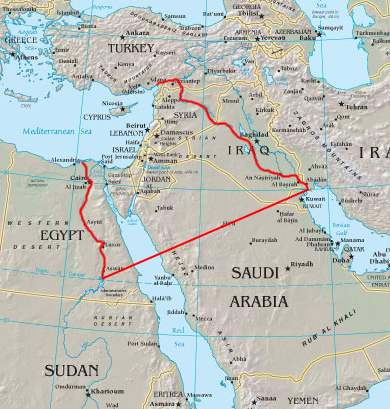
The nation of Israel occupied a narrow sliver of land between the Mediterranean Sea on the west and the Arabian Desert on the east. Over the centuries, Israel’s enemies had invaded its borders from one of these two directions. So, the chariots were sent to the north and south but were expected to extend their mission beyond Israel’s borders. Their “patrol” would eventually take them to Egypt, Babylon, and Assyria, all sworn enemies of Israel. The mission of the horseman in Chapter 1 resulted in a pronouncement of peace. All was well in the land of Judah. But the chariots of the eighth vision appear to be on a mission of a different sort. They will bring peace but only after divine judgment is carried.

The angel describes the horses as strong and “impatient to go and patrol the earth” (Zechariah 1:7 ESV). They are literally chomping at the bit. In antiquity, the horse was revered for its power and ferocity in battle. These beautiful creatures could transform into devastating weapons of mass destruction, wreaking havoc against enemy infantry. Harnessed to a chariot, horses were the equivalent of a tank in modern warfare. 

The Book of Job records God’s eloquent description of the horse’s unique affinity and disposition for combat.

“Have you given the horse its strength
    or clothed its neck with a flowing mane?
Did you give it the ability to leap like a locust?
    Its majestic snorting is terrifying!
It paws the earth and rejoices in its strength
    when it charges out to battle.
It laughs at fear and is unafraid.
    It does not run from the sword.
The arrows rattle against it,
    and the spear and javelin flash.
It paws the ground fiercely
    and rushes forward into battle when the ram’s horn blows.
It snorts at the sound of the horn.
    It senses the battle in the distance.
    It quivers at the captain’s commands and the noise of battle. – Job 39:19-25 NLT

That these horses and their chariots were intended to carry out God’s judgment is made clear by verse 8.

“Look, those who went north have vented the anger of my Spirit there in the land of the north.” – Zechariah 6:8 NLT

Twenty years earlier, in 539 B.C., the Babylonians had fallen to the Persians. God had already meted out His wrath against the nation that had invaded and destroyed Judah. But His judgment was not yet complete. The Egyptians and Medo-Persians would also have to pay for their constant harassment of God’s people.

It’s interesting to note that the black, white, and dappled horses convey their chariots on their assigned routes but the chariot pulled by the red horses is not mentioned. The angel doesn’t announce its destination. There has been much speculation as to the meaning of the horses’ colors. Some have suggested that the red horses stand for war and bloodshed, while the black horses symbolize death. The white horses represent victory and the dappled horses stand for plague and disease. Together, these horses and their chariots display the multifaceted and devastating nature of God’s pending judgment against the nations.

As Zechariah looks on, the chariots and their horses are just beginning their assignments. They have passed between the two bronze mountains on their way to their final destinations. Some have speculated that these mountains represent Mount Zion and the Mount of Olives. But the more logical explanation is found in chapter 14 of Zechariah’s prophecy.

Watch, for the day of the Lord is coming when your possessions will be plundered right in front of you! I will gather all the nations to fight against Jerusalem. The city will be taken, the houses looted, and the women raped. Half the population will be taken into captivity, and the rest will be left among the ruins of the city.

Then the Lord will go out to fight against those nations, as he has fought in times past. On that day his feet will stand on the Mount of Olives, east of Jerusalem. And the Mount of Olives will split apart, making a wide valley running from east to west. Half the mountain will move toward the north and half toward the south. You will flee through this valley, for it will reach across to Azal. Yes, you will flee as you did from the earthquake in the days of King Uzziah of Judah. Then the Lord my God will come, and all his holy ones with him. – Zechariah 14:1-7 NLT

The Mount of Olives was where Jesus ascended back into heaven after His final post-resurrection appearance to His disciples (Acts 1:9-12). The angels assured the disciples that Jesus would one day return to that very same spot and complete the mission He had been given by His Heavenly Father. While His departure from earth had been in relative obscurity with only His disciples as witnesses, His return will be so impactful that the Mount of Olives will split in two. His second coming will bring judgment to the earth as God’s heavenly army dispenses divine wrath on all those who rejected His Son’s offer of salvation and opposed His right to rule and reign.

Zechariah was given a glimpse into the distant future when God will send His Son to earth a second time. On this occasion, Jesus will not come as an innocent baby in a manger, but as a conquering King riding a white horse and meting out judgment against the enemies of God. Centuries later, the apostle John was given a vision of this end times event.

Then I saw heaven opened, and a white horse was standing there. Its rider was named Faithful and True, for he judges fairly and wages a righteous war. His eyes were like flames of fire, and on his head were many crowns. A name was written on him that no one understood except himself. He wore a robe dipped in blood, and his title was the Word of God. The armies of heaven, dressed in the finest of pure white linen, followed him on white horses. From his mouth came a sharp sword to strike down the nations. He will rule them with an iron rod. He will release the fierce wrath of God, the Almighty, like juice flowing from a winepress. On his robe at his thigh was written this title: King of all kings and Lord of all lords. – Revelation 19:11-16 NLT

Zechariah was not privileged to know all the details concerning God’s coming judgment. The explanations he received from the angel were cryptic and incomplete but he could rest assured that God had a plan in place that would be fulfilled in a timely manner. Later in this book, Zechariah will receive and record a powerful promise from God concerning the nation of Israel and the city of Jerusalem.

And the Lord will be king over all the earth. On that day there will be one Lord—his name alone will be worshiped.

All the land from Geba, north of Judah, to Rimmon, south of Jerusalem, will become one vast plain. But Jerusalem will be raised up in its original place and will be inhabited all the way from the Benjamin Gate over to the site of the old gate, then to the Corner Gate, and from the Tower of Hananel to the king’s winepresses. And Jerusalem will be filled, safe at last, never again to be cursed and destroyed. – Zechariah 14:9-11 NLT

The Temple still needed to be completed. The land of Judah remained under foreign control. Jerusalem was still a relative ghost town with a small population and no protective walls. Yet, God was at work because He had plans for His people.

“I know the plans I have for you,” says the Lord. “They are plans for good and not for disaster, to give you a future and a hope. In those days when you pray, I will listen. If you look for me wholeheartedly, you will find me. I will be found by you,” says the Lord. “I will end your captivity and restore your fortunes. I will gather you out of the nations where I sent you and will bring you home again to your own land.” – Jeremiah 29:11-14 NLT

They were back in the land but God had far more in store for them than they could ever have imagined. The days ahead would be fraught with difficulty but God wanted Zechariah to know that the future was bright because His will would be done. His plan promises would be fulfilled and His plans for the people of God would be carried out just as He had said.

English Standard Version (ESV)
The Holy Bible, English Standard Version. ESV® Permanent Text Edition® (2016). Copyright © 2001 by Crossway Bibles, a publishing ministry of Good News Publishers.

New Living Translation (NLT)
Holy Bible, New Living Translation, copyright © 1996, 2004, 2015 by Tyndale House Foundation. Used by permission of Tyndale House Publishers Inc., Carol Stream, Illinois 60188. All rights reserved.

Days Yet to Come

1 In the third year of Cyrus king of Persia a word was revealed to Daniel, who was named Belteshazzar. And the word was true, and it was a great conflict. And he understood the word and had understanding of the vision.

In those days I, Daniel, was mourning for three weeks. I ate no delicacies, no meat or wine entered my mouth, nor did I anoint myself at all, for the full three weeks. On the twenty-fourth day of the first month, as I was standing on the bank of the great river (that is, the Tigris) I lifted up my eyes and looked, and behold, a man clothed in linen, with a belt of fine gold from Uphaz around his waist. His body was like beryl, his face like the appearance of lightning, his eyes like flaming torches, his arms and legs like the gleam of burnished bronze, and the sound of his words like the sound of a multitude. And I, Daniel, alone saw the vision, for the men who were with me did not see the vision, but a great trembling fell upon them, and they fled to hide themselves. So I was left alone and saw this great vision, and no strength was left in me. My radiant appearance was fearfully changed, and I retained no strength. Then I heard the sound of his words, and as I heard the sound of his words, I fell on my face in deep sleep with my face to the ground.

10 And behold, a hand touched me and set me trembling on my hands and knees. 11 And he said to me, “O Daniel, man greatly loved, understand the words that I speak to you, and stand upright, for now I have been sent to you.” And when he had spoken this word to me, I stood up trembling. 12 Then he said to me, “Fear not, Daniel, for from the first day that you set your heart to understand and humbled yourself before your God, your words have been heard, and I have come because of your words. 13 The prince of the kingdom of Persia withstood me twenty-one days, but Michael, one of the chief princes, came to help me, for I was left there with the kings of Persia, 14 and came to make you understand what is to happen to your people in the latter days. For the vision is for days yet to come.”

15 When he had spoken to me according to these words, I turned my face toward the ground and was mute. 16 And behold, one in the likeness of the children of man touched my lips. Then I opened my mouth and spoke. I said to him who stood before me, “O my lord, by reason of the vision pains have come upon me, and I retain no strength. 17 How can my lord’s servant talk with my lord? For now no strength remains in me, and no breath is left in me.”

18 Again one having the appearance of a man touched me and strengthened me. 19 And he said, “O man greatly loved, fear not, peace be with you; be strong and of good courage.” And as he spoke to me, I was strengthened and said, “Let my lord speak, for you have strengthened me.” 20 Then he said, “Do you know why I have come to you? But now I will return to fight against the prince of Persia; and when I go out, behold, the prince of Greece will come. 21 But I will tell you what is inscribed in the book of truth: there is none who contends by my side against these except Michael, your prince. – Daniel 10:1-21 ESV

These closing chapters of the Book of Daniel contain some of the most important prophecies in the Scriptures. It all began with Daniel reading the words of Jeremiah the prophet concerning Israel’s 70-year exile in Babylon. Through the prophet, God promised that there would be an expiration date for the banishment of the people from the land. God had sent them into exile at the hands of the Babylonians but He would also return them to land. From what Daniel could ascertain, the time was drawing near for that promise to be fulfilled. Encouraged by what he read, Daniel was also concerned that this promise might not be fulfilled because of the disobedience of the people of Israel. He immediately set out to rectify the problem. Entering into a period of fasting and prayer, Daniel confessed the sins of his people and begged God to forgive them so that they might return to the land and restore it to its former glory.

O Lord, hear; O Lord, forgive. O Lord, pay attention and act. Delay not, for your own sake, O my God, because your city and your people are called by your name.” – Daniel 9:19 ESV

This is when Daniel was visited by Gabriel, a messenger from God sent to give him “insight and understanding” (Daniel 9:23 ESV) into the future events concerning the nation of Israel. Daniel had primarily been concerned about the exiles’ upcoming return to the land. After all, the 70 years were just about to expire. But God wanted Daniel to know that He had far greater plans in store for His chosen people.

Gabriel began to unveil God’s plans concerning a period of seventy weeks or seventy sevens. To understand the meaning of this strange phrase, it is important to remember that Daniel had just read about the 70 years of captivity coming to an end. He was thinking in terms of years. So, when Gabriel mentioned the seventy sevens, Daniel would have recognized it as a reference to 490 years.

Gabriel was letting Daniel in on the details of God’s longer-term plans for Israel. This 490-year timeline would bring about six significant outcomes concerning Jerusalem and the people of Israel.

First, the 490 years will finally end Israel’s rebellion against God, eliminate all sin, provide atonement for their guilt, usher in a time of everlasting righteousness, confirm all the biblical prophecies, and result in the anointing of the Most Holy Place. These six byproducts would have caught Daniel’s attention. After his impassioned prayer and painfully honest confession of Israel’s sin, the thought of a day when their transgression and guilt would come to an end would have been music to his ears. But there were other, less appealing aspects to the prophecy that had to happen before the good news could be fulfilled.

Gabriel spoke of Jerusalem being rebuilt and then destroyed, along with the Temple. He warns of floods, wars, and miseries. He reveals that a powerful ruler will appear on the scene who will make a treaty with Israel and then break it. This same leader will desecrate the Temple and outlaw the observance of the sacrificial system.

As chapter 10 opens, three years have passed and the prophecy Daniel read in the Book of Jeremiah has already begun to be fulfilled. The year is 536 B.C. and Daniel is an old man – well into his 80s. He has spent most of his adult life living in exile in the land of Babylon. Two years earlier in 538 B.C., Cyrus the Medo-Persian king issued a decree that permitted the Jews to return to their land so they could rebuild the Temple under the leadership of a man named Zerubbabel. The Book of Ezra reveals that by 537 B.C. they had reinstituted the sacrificial system and by 536 B.C., they had begun work on the Temple.

Yet Daniel remained in Babylon, perhaps too old to make the long trip back to the Judah. He was in retirement by now, having served in the administrations of a succession of different kings. But even in his old age and despite the fact that the real action was taking place back in Judah, Daniel was still hearing from his God. Daniel’s advancing years and decreased activity had not prevented him from receiving additional insights from God concerning the future of Israel.

God sent Daniel a special messenger – “a man dressed in linen clothing, with a belt of pure gold around his waist. His body looked like a precious gem. His face flashed like lightning, and his eyes flamed like torches. His arms and feet shone like polished bronze, and his voice roared like a vast multitude of people” (Daniel 10:5-6 NLT).

Daniel had been in mourning for three weeks when this vision came to him. It’s likely he had received the news of the difficulties facing the remnant of Jews who had returned to the land. They faced extensive opposition from those who had taken over the land in their absence. While progress had been made, it had not been without great difficulty. They were under spiritual and physical attack from their enemies, and Daniel was likely interceding on their behalf. It was during this extended time of prayer that Daniel received a “visit” from God’s messenger.

When Daniel encountered this divine messenger, he reacted with fear. At the sound his voice, Daniel fainted. Yet two times, the messenger assured Daniel he was “greatly loved” (Daniel 10:11 ESV). This was not just a reference to Daniel’s status as one of God’s chosen people; it was meant to let Daniel know he was precious to God. Daniel had faithfully served God all the years he had lived in Babylon and remained obedient to God’s will and reliant upon God’s power.

Through Gabriel, God encouraged Daniel to take courage and be strong because what he was about to hear was going to be difficult to accept. God revealed to Daniel that a great spiritual war was going on, unseen by men, and impacting the world in which Daniel lived. He also told Daniel that things were going to get worse before they got better. The conflicts the people of Israel faced back in Judah were nothing compared with what was to come. Much to Daniel’s surprise and disappointment, there would continue to be conflicts on earth and in the heavens until God decided it was time to bring it all to an end.

This elderly servant of God was getting a glimpse into the future of Israel and the world. For Daniel, these events would have been disturbing and not encouraging. But despite the negative nature of the news, God wanted Daniel to be encouraged and remain strong. God was not trying to scare Daniel; He was revealing His sovereign, unstoppable will concerning His chosen people and the world He had made. God wanted Daniel to know that He was in complete control of all that was happening back in Jerusalem and well into the future.

Gabriel reveals that his appointment with Daniel had been delayed because of spiritual warfare. He had been dispatched by God the moment Daniel had begun to pray but on his way he had encountered “the prince of the kingdom of Persia” (Daniel 10:13 ESV). This is likely a reference to a demon, not a human king. Jesus referred to Satan as “the prince of this world” (John 14:30). Paul called him the “prince of the power of the air” (Ephesians 2:2). So, it only makes sense that this “prince” that Gabriel encountered was one of the fallen angels who had joined Satan in his rebellion against God (Jude 1:6).

This demonic creature tried to keep Gabriel from accomplishing his God-ordained task. This cosmic battle in the unseen realms reminds us that spiritual warfare is taking place all around us at all time. God has a plan and his enemies are doing everything in their power to prevent that plan from taking place. But God is in control. His will cannot be circumvented, sidelined, or supplanted. The apostle John provides a stirring reminder of God’s supremacy and ultimate victory over the enemy.

Little children, you are from God and have overcome them, for he who is in you is greater than he who is in the world. – 1 John 4:4 ESV

Before departing and returning to his battle with “the prince of Persia,” Gabriel promises to tell Daniel all that is “written in the Book of Truth” (Daniel 10:21 NLT). This statement is meant to assure Daniel of the message’s veracity and reliability. Gabriel was assuring Daniel that these things must happen because God had ordained it to be so. They were all part of His divine plan and recorded in the Book of Truth. Nothing has happened or ever will happen that is outside the sovereign will of God Almighty.

Daniel could be encouraged and remain strong even in the face of coming struggles. He could hear bad news concerning the remnant in Judah but could rest easy knowing God was in control. When he heard that Gabriel was returning to do war with the prince of Persia, he had no reason to worry or panic. The realization that spiritual warfare was taking place in the unseen realms was meant to remind Daniel that his God was working behind the scenes to ensure that His will was done.

Daniel’s God was all-powerful and in full control. Because Daniel prayed and received an answer from God, we have been given a glimpse into the future. One of first things we should realize is that most of the six outcomes that Gabriel outlined in his message to Daniel have yet to take place. Israel’s rebellion against God has not come to an end. Despite Jesus’ incarnation, the Jewish people rejected Him as their long-awaited Messiah. Rather than worship Him as King, they had Him crucified.

It is also painfully clear that sin has not ended or been eradicated. Jesus came to be the Lamb of God who takes away the sin of the world (John 1:29), yet sin remains because there are those who refuse to accept Him as their sin substitute and Savior. And because of their rejection of the Savior, their guilt and condemnation remain. Sin’s penalty of death still hands over their heads like the sword of Damocles.

It is obvious that we are not living in a time of everlasting righteousness. Wickedness and evil abound and unrighteousness rules the day. It is also self-evident that many of the prophecies contained in the Scriptures remain unfulfilled. Jesus promised to return but has not yet done so. Finally, the anointing of the Most Holy Place has yet to happen because there is no Temple.

Yet, Daniel was given a glimpse into the future and a fleeting and rather fuzzy view of things to come. Because we have been given the completed canon of Scripture, we know how the story ends. By combining the writings of Daniel with John’s fantastic insights recorded in the Book of Revelation, we can begin to piece together God’s incredible plans for Israel’s future and the fate of the world.

We know that things will get worse before they get better. We know the enemy will fight until the end. But we also know that our side wins. God’s will will be accomplished. His plan will be fulfilled. So there is no need to be afraid. Like Daniel, we are precious to God. He has chosen us and He will protect us. We can take courage. We can be strong.

English Standard Version (ESV) The Holy Bible, English Standard Version. ESV® Permanent Text Edition® (2016). Copyright © 2001 by Crossway Bibles, a publishing ministry of Good News Publishers.

New Living Translation (NLT) Holy Bible, New Living Translation, copyright © 1996, 2004, 2015 by Tyndale House Foundation. Used by permission of Tyndale House Publishers Inc., Carol Stream, Illinois 60188. All rights reserved.

New English Translation (NET)NET Bible® copyright ©1996-2017 by Biblical Studies Press, L.L.C. http://netbible.com All rights reserved.

Do As You Have Spoken

16 Then King David went in and sat before the Lord and said, “Who am I, O Lord God, and what is my house, that you have brought me thus far? 17 And this was a small thing in your eyes, O God. You have also spoken of your servant’s house for a great while to come, and have shown me future generations, O Lord God! 18 And what more can David say to you for honoring your servant? For you know your servant. 19 For your servant’s sake, O Lord, and according to your own heart, you have done all this greatness, in making known all these great things. 20 There is none like you, O Lord, and there is no God besides you, according to all that we have heard with our ears. 21 And who is like your people Israel, the one nation on earth whom God went to redeem to be his people, making for yourself a name for great and awesome things, in driving out nations before your people whom you redeemed from Egypt? 22 And you made your people Israel to be your people forever, and you, O Lord, became their God. 23 And now, O Lord, let the word that you have spoken concerning your servant and concerning his house be established forever, and do as you have spoken, 24 and your name will be established and magnified forever, saying, ‘The Lord of hosts, the God of Israel, is Israel’s God,’ and the house of your servant David will be established before you. 25 For you, my God, have revealed to your servant that you will build a house for him. Therefore your servant has found courage to pray before you. 26 And now, O Lord, you are God, and you have promised this good thing to your servant. 27 Now you have been pleased to bless the house of your servant, that it may continue forever before you, for it is you, O Lord, who have blessed, and it is blessed forever.” – 1 Chronicles 17:16-27 ESV

One of the keys to understanding David’s lasting legacy as Israel’s greatest king is found in this marvelous prayer he offers to God. As the Scriptures make painfully clear, David was far from perfect. Yes, according to God’s own estimation, David was a man after His own heart, but he also had a heart that was strongly attracted to the opposite sex and led him to violate God’s command against multiplying wives for himself. David had an impulsive streak that continually got him into trouble and an equal predisposition toward inaction that caused him great difficulty. But when all is said and done, and the evaluation of David’s life is complete, it is difficult not to conclude that he was a man who loved God and understood the unique nature of their relationship.

In this prayer, David repeatedly refers to himself as the servant of God and another eight times he calls God his master. This speaks volumes regarding David’s comprehension of his role and God’s rule. David may have been the king of Israel but God was the King of the universe. David understood that he served at the behest of the sovereign Lord and he had been the unworthy recipient of God’s grace and mercy. His rise from a lowly shepherd boy to the most powerful position in the land had been totally undeserved and David acknowledged that fact. His humility shines through as he expresses his amazement that God had chosen to use him.

Who am I, O Lord God, and what is my family, that you have brought me this far? – 1 Chronicles 17:16 NLT

As David reflected on the charmed nature of his current life and considered the implications of God’s promise of an everlasting dynasty, he couldn’t help but acknowledge the fact that none of it had been his own doing. He was not responsible for his own success.

For the sake of your servant, O Lord, and according to your will, you have done all these great things and have made them known. – 1 Chronicles 17:19 NLT

David didn’t see his elevation to the throne as something he deserved or had earned. It had been in fulfillment of God’s promise and was an outward demonstration of God’s faithfulness and sovereign power. He had been the recipient of God’s unmerited love and favor, and David’s past experience confirmed that the Almighty always fulfills what He promises because He is the faithful, covenant-keeping God.

As king, David enjoyed all the benefits that came with the job. He was a man who wielded great power and influence. He was revered by his own people and feared by the enemies of Israel. He possessed great wealth and a reputation as a mighty warrior. But David was far more impressed with the greatness of God.

O Lord, there is no one like you. We have never even heard of another God like you! – 1 Chronicles 17:21 NLT

This man who helped put Israel on the map militarily and politically knew that God was ultimately responsible for its existence. It had all been according to His sovereign will. David understood that the only reason he had a nation over which to rule and reign was because God had ordained it. There would have been no Israel had God not chosen an obscure pagan named Abraham to whom He promised to form a great nation. There would have been no exodus unless God had chosen to step in and rescue His people from their slavery in Egypt.

What other nation on earth is like your people Israel? What other nation, O God, have you redeemed from slavery to be your own people? You made a great name for yourself when you redeemed your people from Egypt. – 1 Chronicles 17:21 NLT

David knew that God had been the one to lead the people of Israel out of bondage, across the wilderness, and into the land of Canaan. It was God who had performed miracles along the way and provided victories over the inhabitants of Canaan.

You performed awesome miracles and drove out the nations that stood in their way. – 1 Chronicles 17:21 NLT

It is easy to understand why the chronicler included this prayer in his message to the returned remnant of Israel. He wanted them to hear the words of David himself as he praised the greatness and goodness of God. Growing up in Babylon, they had heard the stories of David’s exploits. They were familiar with his feats of greatness and longed for the day when they too would have a king as powerful and successful as David. But as they heard the humble and reverent words of David reflected in this prayer, they would have been encouraged to trust the God who made his reign and their existence as a people possible.

You chose Israel to be your very own people forever, and you, O Lord, became their God. – 1 Chronicles 17:22 NLT

It did not escape David that there would have been no land for him to rule over had God not made it possible, and he was blown away by it all. To top it all off, God promised to “build a house” for him. This wasn’t about a residential upgrade; God wasn’t guaranteeing David the promise of a grand palace made with great stones, massive wooden beams, precious metals, and rare jewels. No, God was promising to expand David’s kingdom and extend his dynasty for generations to come. His would not be a one-and-done reign like that of Saul, whose dynasty died with him. David would see his kingdom thrive and flourish under the leadership of his own son, Solomon. And while David’s reign would eventually come to an end, God promised that his fame and renown would long outlast him.

Now I will make your name as famous as anyone who has ever lived on the earth! – 1 Chronicles 17:8 NLT

I declare that the Lord will build a house for you—a dynasty of kings! For when you die and join your ancestors, I will raise up one of your descendants, one of your sons, and I will make his kingdom strong. – 1 Chronicles 17:10-11 NLT

What an amazing promise. The staggering significance of those words did not escape David because he knew just how fleeting a king’s reign could be. He had personally watched his predecessor’s reign whither and die and knew that kingdoms could end just as easily as they began. David understood that the key to his kingdom’s longevity was tied directly to God’s sovereignty. So David asked God to graciously extend his kingdom forever. 

now, it has pleased you to bless the house of your servant, so that it will continue forever before you. For when you grant a blessing, O Lord, it is an eternal blessing! – 1 Chronicles 17:27 NLT

God made the promise and now David was humbly asking Him to graciously fulfill it. This was not an expression of doubt on David’s part. He was not questioning the faithfulness of God but was simply acknowledging his fear of doing anything that might jeopardize its outcome.  He knew that the length of his legacy was tied directly to the depth of his dependency upon God. As long as he recognized God as the ultimate King of Israel, his kingdom would flourish and his legacy would last. David knew that the blessings of God were bound to his own obedience as king. He stood as the representative for God’s people, serving as their proxy or stand-in. His faithfulness was to reflect the hearts of the people; his leadership would inform and influence the entire nation.

And this message would not have been lost on the audience to whom the chronicler addressed his letter. Centuries after the reign of David ended, this small rag-tag group of Israelites had returned to the land of promise and to the city of Jerusalem where David had prayed these words. By including David’s prayer in his record, the chronicler was recalling their rich heritage while, at the same time, reminding them of God’s faithful promises.

For you are God, O Lord. And you have promised these good things to your servant. – 1 Chronicles 17:26 NLT

There is an old proverb that says, “As the king, so are the subjects.” The truth of this statement is reflected in the lives of Israel’s kings. The record of their reigns is recorded in the books of First and Second Kings. In these ancient texts, a repeated pattern emerges that chronicles the disobedience and unfaithfulness of Israel’s kings. Time and time again, these men chose to worship false gods and, in so doing, they led their subjects away from the one true God. They sacrificed their dependence upon God in exchange for the false assurances of idols and unreliable alliances with foreign nations. They turned their backs on God and, eventually, God was forced to turn His back on them. Despite His repeated calls to repent, the kings refused to obey. Their stubborn resistance to His will resulted in the northern kingdom of Judah being conquered and enslaved by the Assyrians. Hundreds of years later, the southern kingdom of Judah suffered a similar fate, falling to the Babylonians and having to endure seven decades of enslavement and subjugation.

The readers of 1 Chronicles were very familiar with the last part of this story because they had lived it. They were the generation that had been born in exile in Babylon. But they had recently returned to the land of promise and needed to be reminded that, despite all the unfaithfulness of their forefathers, their God was faithful to keep His covenant promise to David. The throne of David may have been unoccupied and they were longing for a king to rule over them. But they needed to know that they still had the King of the universe on their side and operating on their behalf. He had not forgotten them.

This same message applies to all of us living millennia after this book was written. At this moment, Israel still has no king sitting on the throne of David. But God is not done. Every promise He made to David will be fulfilled and the King who will reign has come and will come again. One day, Jesus Christ, the Messiah and descendant of David will return to claim His rightful place as the King of kings and Lord of lords. He will establish His throne in Jerusalem, ruling as the rightful heir of David the King, and His reign will be an everlasting one. Not only that, but His rule will be marked by righteousness, justice, and holiness. When that day comes, there will be no other kings and no other kingdoms to stand against His because there is no God beside Him. Jesus Christ will be the final fulfillment of God’s promise to David.

I will never take my favor from him as I took it from the one who ruled before you. I will confirm him as king over my house and my kingdom for all time, and his throne will be secure forever. – 1 Chronicles 17:13-14 NLT

The greatest news is that David’s kingdom did not end with his death or that of his son Solomon. It didn’t end with the captivities of Judah or Israel. It didn’t end with the fall of Jerusalem or the destruction of the Temple. There is a day coming when God will fulfill His covenant with David. He will send His Son back to earth to take His rightful position as the heir to David’s throne, where He will rule and reign in righteousness. And it is to the promise of that day God’s people look and hope.

As my vision continued that night, I saw someone like a son of man coming with the clouds of heaven. He approached the Ancient One and was led into his presence. He was given authority, honor, and sovereignty over all the nations of the world, so that people of every race and nation and language would obey him. His rule is eternal—it will never end. His kingdom will never be destroyed. – Daniel 7:13-14 NLT

English Standard Version (ESV)
The Holy Bible, English Standard Version. ESV® Permanent Text Edition® (2016). Copyright © 2001 by Crossway Bibles, a publishing ministry of Good News Publishers.

New Living Translation (NLT)
Holy Bible, New Living Translation, copyright © 1996, 2004, 2015 by Tyndale House Foundation. Used by permission of Tyndale House Publishers Inc., Carol Stream, Illinois 60188. All rights reserved.

Divine Payback

1 The word of the Lord came to me: “Son of man, set your face against Mount Seir, and prophesy against it, and say to it, Thus says the Lord God: Behold, I am against you, Mount Seir, and I will stretch out my hand against you, and I will make you a desolation and a waste. I will lay your cities waste, and you shall become a desolation, and you shall know that I am the Lord. Because you cherished perpetual enmity and gave over the people of Israel to the power of the sword at the time of their calamity, at the time of their final punishment, therefore, as I live, declares the Lord God, I will prepare you for blood, and blood shall pursue you; because you did not hate bloodshed, therefore blood shall pursue you. I will make Mount Seir a waste and a desolation, and I will cut off from it all who come and go. And I will fill its mountains with the slain. On your hills and in your valleys and in all your ravines those slain with the sword shall fall. I will make you a perpetual desolation, and your cities shall not be inhabited. Then you will know that I am the Lord.

10 “Because you said, ‘These two nations and these two countries shall be mine, and we will take possession of them’—although the Lord was there— 11 therefore, as I live, declares the Lord God, I will deal with you according to the anger and envy that you showed because of your hatred against them. And I will make myself known among them, when I judge you. 12 And you shall know that I am the Lord.

“I have heard all the revilings that you uttered against the mountains of Israel, saying, ‘They are laid desolate; they are given us to devour.’ 13 And you magnified yourselves against me with your mouth, and multiplied your words against me; I heard it. 14 Thus says the Lord God: While the whole earth rejoices, I will make you desolate. 15 As you rejoiced over the inheritance of the house of Israel, because it was desolate, so I will deal with you; you shall be desolate, Mount Seir, and all Edom, all of it. Then they will know that I am the Lord.” Ezekiel 35:1-15 ESV

In the last chapter, God delivered the good news regarding Israel’s eventual restoration to the land of Canaan. He announced that in the distant future, He will return His people to their former land where will enjoy the blessings of His presence and His gracious provision for all their needs. This as-yet-to-be-fulfilled prophecy includes their reoccupation of the northern kingdom of Israel as well as the southern kingdom of Judah. But God will not stop there. He intends to expand the land of promise back to the original boundaries He had promised to Abraham and had articulated to Moses as the people prepared to conquer Canaan.

“I will send terror ahead of you to drive out the Hivites, Canaanites, and Hittites. But I will not drive them out in a single year, because the land would become desolate and the wild animals would multiply and threaten you. I will drive them out a little at a time until your population has increased enough to take possession of the land. And I will fix your boundaries from the Red Sea to the Mediterranean Sea, and from the eastern wilderness to the Euphrates River. I will hand over to you the people now living in the land, and you will drive them out ahead of you.” – Exodus 23:28-31 NLT

But when the people were preparing to enter the land for the very first time, God gave them strict instructions to not take any land from the Edomites, who were the direct descendants of Esau, the son of Isaac and the twin brother of Jacob.

Give these orders to the people: “You will pass through the country belonging to your relatives the Edomites, the descendants of Esau, who live in Seir. The Edomites will feel threatened, so be careful. Do not bother them, for I have given them all the hill country around Mount Seir as their property, and I will not give you even one square foot of their land. – Deuteronomy 2:4-5 NLT

But now, centuries later, as God delivers His news of future restoration, He informs Ezekiel that the rules of the game will be drastically different. He gives Ezekiel a message to deliver to Mount Seir, but the recipient is really the Edomites, the people who occupied the land of Seir.

While God had chosen Isaac’s son, Jacob over his brother Esau to be the son of the promise, God had awarded Esau’s descendants the land of Seir as their homeland.

He had done the same for the descendants of Esau who lived in Seir, for he destroyed the Horites so they could settle there in their place. The descendants of Esau live there to this day. – Deuteronomy 2:22 NLT

All during the reigns of David and Solomon, the Edomites had occupied the land of Seir. This region just south and east of the Dead Sea remained under Edomite control even after God had divided Israel into two kingdoms. And during the Babylonian occupation of Judah and while Ezekiel and his fellow Jews lived in exile in Babylon, the Edomites maintained their control of the land.

Over the centuries, the descendants of Jacob and the descendants of Esau had endured an ongoing love-hate relationship. They were like the Hatfields and McCoys, blood relatives who just couldn’t get along, and this fraternal conflict was predicted by God even before the two patriarchs of these people groups were born. While Isaac’s wife, Rebekah, was carrying Jacob and Esau in her womb, God informed her, “The sons in your womb will become two nations. From the very beginning, the two nations will be rivals. One nation will be stronger than the other; and your older son will serve your younger son” (Genesis 25:23 NLT).

This conflict that began in the womb continued after the birth of the two boys and expanded into an internecine battle between their descendants. Bad blood existed between the Israelites and Edomites for generations, and even when the nation of Judah was under attack by the Babylonians, the Edomites would take advantage of Judah’s vulnerable state by conducting raids against their towns and villages. So, there was no love loss between the two nations.

But for God to fulfill His promise of future restoration as outlined in chapter 34, He reveals that even the Edomites will have to relinquish their land. It belonged to His chosen people, the descendants of Jacob. So, He gives Ezekiel as far-from-promising message for the Edomites.

“I am your enemy, O Mount Seir,
    and I will raise my fist against you
    to destroy you completely.
I will demolish your cities
    and make you desolate.
Then you will know that I am the Lord. – Ezekiel 35:3-4 NLT

They had aligned themselves against God’s chosen people and now they would pay the price for their misguided decision. From God’s perspective, the Edomites were guilty of piling on. While He was bringing judgment against His chosen people, the descendants of Esau decided to exploit the situation for their own advantage.

“Your eternal hatred for the people of Israel led you to butcher them when they were helpless, when I had already punished them for all their sins. – Ezekiel 35:5 NLT

God had not ordered them to do this. It was not part of His disciplinary protocol for the rebellious people of Judah. The Edomites had acted on their own accord and sought to enrich themselves at Judah’s expense. And the day was coming when they would be held accountable for their mistake. The land God had graciously given them would be taken away and awarded to the people of Israel.

Their real crime was their open disdain for God. As the descendants of Abraham and Isaac, they should have understood the sovereignty and power of Yahweh. They should have had an awe and respect for Him but, instead, they flaunted their will right in His face. They arrogantly declared, “The lands of Israel and Judah will be ours. We will take possession of them. What do we care that the Lord is there!” (Ezekiel 35:10 NLT). And God states that their hubris will be their undoing.

I will make myself known to Israel by what I do to you.” – Ezekiel 35:11 NLT

Some day in the future, the descendants of Jacob will recognize the greatness of God when they watch Him destroy the Edomites and make the land of Seir part of the inheritance of Israel. At this point in human history, the nation of Edom no longer exists. They would eventually fall to the Babylonians, then to the Medo-Persians, and, ultimately to the Hasmoneans in 126 B.C.

But to date, the land of Edom remains outside of Israel’s control. It is not currently a part of the modern state of Israel but lies within the borders of southwestern Jordan, located between the Dead Sea and the Gulf of Aqaba. But God is not done yet. His plan is far from finished and His promise to restore His people to the land will one day be accomplished. Their enemies will be defeated. The land will become theirs, “from the Red Sea to the Mediterranean Sea, and from the eastern wilderness to the Euphrates River” (Exodus 23:31 NLT). 

English Standard Version (ESV) The Holy Bible, English Standard Version. ESV® Permanent Text Edition® (2016). Copyright © 2001

New Living Translation (NLT) Holy Bible, New Living Translation, copyright © 1996, 2004, 2015 by Tyndale House Foundation. Used by permission of Tyndale House Publishers Inc., Carol Stream, Illinois 60188. All rights reserved.

Faith in the Future

1 Cast your bread upon the waters,
    for you will find it after many days.
Give a portion to seven, or even to eight,
    for you know not what disaster may happen on earth.
If the clouds are full of rain,
    they empty themselves on the earth,
and if a tree falls to the south or to the north,
    in the place where the tree falls, there it will lie.
He who observes the wind will not sow,
    and he who regards the clouds will not reap.

As you do not know the way the spirit comes to the bones in the womb of a woman with child, so you do not know the work of God who makes everything.

In the morning sow your seed, and at evening withhold not your hand, for you do not know which will prosper, this or that, or whether both alike will be good. Ecclesiastes 11:1-6 ESV

As Solomon returns to a theme he has addressed before: The uncertainty of the future and man’s inability to discern what it may hold. To a certain degree, Solomon finds himself between a rock and a hard place. He has discovered that there is nothing in this life that really brings true joy and meaningful satisfaction, and he has tried it all. He is wise beyond belief. He has wealth beyond measure. He has experimented with every imaginable form of pleasure and self-gratification. And none of it has brought any sense of purpose or fulfillment. He describes it as little more than chasing the wind or trying to catch smoke in your hands.

So, his less-than-optimistic conclusion has been that chasing after all the material things you can see and touch is ultimately an exercise in futility. Wine, women, and song are not enough. Palaces, gardens, vast orchards, and fruitful vineyards cannot produce contentment. Enough is never enough. Life, even with all its pleasure-producing pursuits, ends in death.

And that raises the other distressing issue for Solomon: Nobody knows what happens next. Death is like a door behind which lies a foreboding and forbidden future. Only God knows what awaits man at the end of life. So, he is left to experience futility in life and uncertainty in death. Back in chapter nine, Solomon shared his somewhat pessimistic view of the future.

It seems so wrong that everyone under the sun suffers the same fate. Already twisted by evil, people choose their own mad course, for they have no hope. There is nothing ahead but death anyway. There is hope only for the living. As they say, “It’s better to be a live dog than a dead lion!” – Ecclesiastes 9:3-4 NLT

For Solomon, death was an unknown. But life, in spite of its inherent problems and potential risks, was at least something over which you could have influence. This is what led him to share the proverbial statements found in the opening part of this chapter. He concludes that there are certain rewards that come as a result of living life.

Solomon was a horticulturalist who possessed many vineyards and orchards. As king, he had thousands of acres of farmland that produced abundant harvests used to feed his people and fill his treasury with gold when exported to other countries.  And he acknowledges that if you “cast your bread upon the waters”, it will eventually come back to you. In other words, if you export your grain in ships and sell it to other nations, you will eventually reap a financial reward. Your diligence to plant and harvest will come back in the form of profit.

And when you make that profit, you should invest it wisely and diversely. In other words, don’t put all your eggs in one basket.

Give a portion to seven, or even to eight,
    for you know not what disaster may happen on earth. – Ecclesiastes 11:2 ESV

Diversification makes for a good investment strategy. You don’t want to have all your wealth in one place, because you never know what may happen. Disasters come. The market can drop like a rock. Be prudent. Invest wisely. And take advantage of the opportunities as they present themselves.

If the clouds are full of rain,
    they empty themselves on the earth – Ecclesiastes 11:3 ESV

In other words, learn to read the signs. Plant in a timely fashion. If you misread the clouds, you may fail to plant before the rains come. If you procrastinate, you’ll miss the window of opportunity. Once again, Solomon is encouraging prudence and wisdom. You may not be able to control the future, but you can take advantage of the present situation. Plant before the rain, not after it. And don’t let the threat of storms keep you from doing what you know needs to be done. Conditions will rarely be perfect in this life. There will be few times when the stars align and the circumstances turn out just as you had hoped. So don’t delay. Yet, some of us seem to live by the tongue-in-cheek advice of Mark Twain: “Never put off till tomorrow what may be done day after tomorrow just as well.”

Solomon would strongly disagree with Mr. Twain, instead sharing the insight he gained from years of living and working on this planet.

Farmers who wait for perfect weather never plant. If they watch every cloud, they never harvest. – Ecclesiastes 11:4 NLT

If you fail to take advantage of the moment, it may just pass you by. This is what he seems to be inferring when he writes, “if a tree falls to the south or to the north, in the place where the tree falls, there it will lie” (Ecclesiastes 11:3 ESV). Once the tree has fallen, you can’t plant it back in the ground. Once the rain has fallen, it makes no sense to plant. If you wait for everything to be just right, you’ll never accomplish anything.

Life is full of mysteries and inexplicable situations, and there are certain things we may never fully comprehend.

Just as you cannot understand the path of the wind or the mystery of a tiny baby growing in its mother’s womb, so you cannot understand the activity of God, who does all things. – Ecclesiastes 11:5 NLT

Even with all the advancements in science, we still don’t know exactly how a baby forms in the womb of its mother. We can watch the progress through the use of sonograms, but we can’t see or explain how God has ordained the process of birth, from the moment of conception all the way to delivery. Even with all our technology and scientific know-how, much of it remains hidden from us.

Solomon was wise enough to know that he would never understand the ways of God. There are things that happen in life which only God can explain, and He is not obligated to share all that He knows with us. He often leaves us in the dark, wrestling with our questions and struggling to understand His ways.

The bottom line for Solomon was to work wisely and diligently. Start sowing your seed in the morning and don’t stop until the sun goes down. Do what you can do and then leave the rest up to God. You don’t know the results your efforts will produce but rather than worry about it, do what you can to impact that outcome positively. Work hard. Be diligent. Act wisely. Use common sense. Don’t procrastinate. In some sense, Solomon is promoting the idea behind the old adage, “make hay while the sun shines.” None of us knows how long we have to live on this earth, but God does. And since He chooses not to divulge the length of our days, we should do all that we can to make the most of every moment. Moses put it this way: “Teach us to realize the brevity of life, so that we may grow in wisdom” (Psalm 90:12 NLT).

Solomon’s own father, David, also understood that man’s lifespan was relatively short when compared with eternity. So, he asked God to never let him forget the fleeting nature of his own existence.

Lord, remind me how brief my time on earth will be.
    Remind me that my days are numbered—
    how fleeting my life is.
You have made my life no longer than the width of my hand.
    My entire lifetime is just a moment to you;
    at best, each of us is but a breath. – Psalm 39:4-5 NLT

Death is an inevitable reality for all of us. David ultimately died. So did Solomon. And so will you. You can attempt to prolong your life but God already knows your expiration date. Solomon would recommend that you spend more time enjoying the life you have, rather than futilely chasing after unfulfilled dreams and desires. Find joy in today, rather than wasting time pursuing a tomorrow that may never come. Solomon is not dismissing the idea of setting goals for the future. He is not discounting the need for planning or demonizing the pursuit of unrealized dreams. He is simply reminding us that the present is all we have. We can’t change the past and we can’t know the future, so we should live with a sense of immediacy.

And even more importantly, for those of us who are believers in Jesus Christ, we have no need to worry about the future, because it has already been taken care of for us. Our future is secure. Our eternity is set. So, we are free to live our lives free from anxiety, focusing our efforts on doing the work for which God has created us.

For we are God’s masterpiece. He has created us anew in Christ Jesus, so we can do the good things he planned for us long ago. – Ephesians 2:10 NLT

Solomon had an inordinate fear of the future. He let the uncertainty of death rob him of peace. He found himself forced to find all his joy and satisfaction in this life, using the limited resources at his disposal. Occasionally, he caught glimpses of the blessings of God in the form of a loving relationship or the fruit of his labor. He was able to enjoy a good meal with a close friend, or a deep sleep after a hard day’s labor. But he lived with an unhealthy fear of the unknown. He had lived his whole life pursuing more, but the one thing he really needed was confidence in God’s sovereign control over all things, including the past, the present, and the future. What Solomon really needed was faith.

English Standard Version (ESV) The Holy Bible, English Standard Version. ESV® Permanent Text Edition® (2016). Copyright © 2001

New Living Translation (NLT) Holy Bible, New Living Translation, copyright © 1996, 2004, 2015 by Tyndale House Foundation. Used by permission of Tyndale House Publishers Inc., Carol Stream, Illinois 60188. All rights reserved.

Don’t Take Your Eye Off the Prize

1 There is an evil that I have seen under the sun, and it lies heavy on mankind: a man to whom God gives wealth, possessions, and honor, so that he lacks nothing of all that he desires, yet God does not give him power to enjoy them, but a stranger enjoys them. This is vanity; it is a grievous evil. If a man fathers a hundred children and lives many years, so that the days of his years are many, but his soul is not satisfied with life’s good things, and he also has no burial, I say that a stillborn child is better off than he. For it comes in vanity and goes in darkness, and in darkness its name is covered. Moreover, it has not seen the sun or known anything, yet it finds rest rather than he. Even though he should live a thousand years twice over, yet enjoy no good—do not all go to the one place?

All the toil of man is for his mouth, yet his appetite is not satisfied. For what advantage has the wise man over the fool? And what does the poor man have who knows how to conduct himself before the living? Better is the sight of the eyes than the wandering of the appetite: this also is vanity and a striving after wind.

10 Whatever has come to be has already been named, and it is known what man is, and that he is not able to dispute with one stronger than he. 11 The more words, the more vanity, and what is the advantage to man? 12 For who knows what is good for man while he lives the few days of his vain life, which he passes like a shadow? For who can tell man what will be after him under the sun? Ecclesiastes 6:1-12 ESV

From Solomon’s unique vantage point as king, he has been able to see and experience a great deal of what life has to offer. Some of his observations are more objective in nature, providing the perspective of an impartial outsider, viewing the lives of the people in his kingdom. He has been able to witness first-hand the oppression of the poor. As a judge over his people, he has had to preside over countless cases involving injustice and abuse. He has listened to the cries of the destitute and needy, as they have begged for someone to help them in their time of need.

But some of Solomon’s most powerful insights come from his willingness to look at his own life and share his more subjective and personal observations. In this chapter, he continues to speak from his own personal experience, revealing his frustrations over what he sees and fears.

First of all, he starts with what he describes as a form of evil or wickedness that he has observed “under the sun” or in this life. He writes from a human perspective, presenting his earth-bound opinion concerning a prevalent problem among mankind. There are those whom God has obviously blessed with great wealth, but He has also denied them the power or capacity to enjoy all that they have been given.

God gives some people great wealth and honor and everything they could ever want, but then he doesn’t give them the chance to enjoy these things. – Ecclesiastes 6:2 NLT

These people have all that their hearts desire, except contentment and joy. And to make matters even worse, when they die, “someone else, even a stranger, ends up enjoying their wealth!” (Ecclesiastes 6:2 NLT). And Solomon deems it all as “meaningless—a sickening tragedy(Ecclesiastes 6:2 NLT). But is he right?

First of all, Solomon’s viewpoint reflects the prevailing attitude of his day. It was commonly believed that anyone who enjoyed great wealth had obviously been blessed by God. And if they had been blessed by God, their lives must have been pleasing to God. This is why it made no sense that God would withhold the one thing these people wanted and needed: The ability to enjoy what He had given them.

Solomon was right when he concluded that all good things come from God. In fact, he would have based his view on the Scriptures themselves.

Truth springs up from the earth,
    and righteousness smiles down from heaven.
Yes, the Lord pours down his blessings.
    Our land will yield its bountiful harvest. – Psalm 85:11-12 ESV

Even the New Testament author, James, echoes this view.

Every good gift and every perfect gift is from above, coming down from the Father of lights… – James 1:17 ESV

But where Solomon missed the point was in his assumption that wealth and material goods were to be the sole source of his enjoyment. In other words, he wrongly assumed that it was the blessings of God that brought joy, contentment, satisfaction, and significance. He misunderstood the true nature of their purpose and the significance of their source. The gifts had become the priority rather than the Giver. God was to have been the primary focus of Solomon’s life but not as the giver of good things. In fact, God should have been the only Solomon or anyone else needed in their life. God should have been enough. The apostle Paul expressed this viewpoint when he said:

Not that I was ever in need, for I have learned how to be content with whatever I have. I know how to live on almost nothing or with everything. I have learned the secret of living in every situation, whether it is with a full stomach or empty, with plenty or little. For I can do everything through Christ, who gives me strength. – Philippians 4:11-13 NLT

It didn’t really matter to Paul whether he had a little or a lot. All that really mattered was his relationship with Christ. Yet Solomon and his contemporaries placed their emphasis on the tangible and temporal. For them, the proof of God’s love was in the presence of material goods and the ability to enjoy them. Solomon’s misguided and misplaced emphasis on material goods and earthly pleasures left him with a sense of emptiness and frustration. He was experiencing the very painful lesson that nothing satisfies man’s inner longings and desires like God Himself.

For Solomon, the measurement of a successful life was based on both quantity and quality. He pessimistically observed that if a man ended up fathering hundreds of children (and he had), and lived a long life (which he did), but his soul was not satisfied with life’s good things (and his wasn’t), then his life was a waste.

A man might have a hundred children and live to be very old. But if he finds no satisfaction in life and doesn’t even get a decent burial, it would have been better for him to be born dead. – Ecclesiastes 6:3 NLT

That is a grim assessment. But notice what he is saying. He is measuring the significance of life using a quantitative matrix. He operated on the commonly held maxim: The more, the merrier. It was long life and lots of kids that brought joy. But having hundreds of children, none of whose names you know will ever bring satisfaction. And living a long life, but without a relationship with the Giver of life will never satisfy. Acquiring much wealth and accomplishing great deeds cannot make anyone truly happy or content if they fail to seek the One from whom all good things come.

Every good gift and every perfect gift is from above, coming down from the Father of lights… – James 1:17 ESV

For Solomon, nothing was more futile or frustrating than the thought of living a long life devoid of contentment. He states that a man “might live a thousand years twice over but still not find contentment. And since he must die like everyone else—well, what’s the use?” (Ecclesiastes 6:6 NLT).

And, sadly, this aptly describes Solomon’s own life. When he wrote this verse, he was at the end of life looking back, and while he could claim to have fathered hundreds of children and lived many years, he could say as Paul did, “I have learned to be content.” He had discovered the painful lesson that more was not merrier.

In his mind, it was all about satisfaction. Even the poor, who spend their days trying to scratch out a living and provide food for their next meal, end up discovering that they’re hungry again. The wise, the wealthy, the foolish, and the poor are all faced with the same grievous problem: Enough is never enough. Satisfaction and contentment are elusive. And the only advice Solomon can come up with is “Enjoy what you have rather than desiring what you don’t have” (Ecclesiastes 6:9 NLT).

But again, his emphasis is misplaced. He is not recommending that we find our satisfaction in God, but that we simply resign ourselves to enjoying what little we have been given by God. He has missed the point. And in doing so, he misses out on the real meaning and purpose of life. It is not about gaining and getting. It is not about acquiring and accumulating. It is about learning to seek satisfaction, significance, joy, and contentment from a relationship with the God of the universe.

But Solomon had a warped perspective about God. He euphemistically refers to God as “one stronger than he” (Ecclesiastes 6:10 ESV). He doesn’t see God as his Father but as an enforcer. Rather than approaching God as the gracious giver of good things, Solomon views Him as a capricious tyrant who withholds the ability to enjoy what has been given. And while he rightly understands that God knows all and sees all, Solomon seems to resent the fact that God keeps man’s future fate a mystery. To Solomon, this leaves man stuck in the here-and-now, trying to make the most out of what he has before his life comes to an abrupt end.

What Solomon describes in this chapter is the sad state of all men and women who refuse to see God as the central source of all that is good in their lives. God does bless. God does give good things. God is the author of life and the source of all that we can see. But God is not to be viewed as some disembodied purveyor of presents, like a cosmic Genie in a bottle. He is the gift. He is the good. He is the satisfaction and significance that man so desperately seeks. The apostle Paul summarized it well when he spoke to the people of Athens, describing the nature of the “unknown god” to whom they offered sacrifices, but with whom they had no relationship.

“He is the God who made the world and everything in it. Since he is Lord of heaven and earth, he doesn’t live in man-made temples, and human hands can’t serve his needs—for he has no needs. He himself gives life and breath to everything, and he satisfies every need. From one man he created all the nations throughout the whole earth. He decided beforehand when they should rise and fall, and he determined their boundaries.

“His purpose was for the nations to seek after God and perhaps feel their way toward him and find him—though he is not far from any one of us. For in him we live and move and exist. – Acts 17:24-28 NLT

God created man to have a relationship with Him. His purpose was for the nations to seek after Him. But sin changed all that. Because of the fall, the blessings of God became substitutes for Him. We made idols out of the good gifts He had given us. The apostle Paul describes the subtle shift that took place among humanity as they took their eyes off the Giver and began to seek satisfaction and significance from the good things He had given.

They traded the truth about God for a lie. So they worshiped and served the things God created instead of the Creator himself… – Romans 1:25 NLT

Solomon’s relentless quest to find meaning in life had taken him away from the very One who had given him life. He had made false gods out of the good and perfect gifts that had come down from the Father of lights…and he found himself unfulfilled and discontented with life and anxious about death.

In the few days of our meaningless lives, who knows how our days can best be spent? Our lives are like a shadow. Who can tell what will happen on this earth after we are gone? – Ecclesiastes 6:12 NLT

English Standard Version (ESV) The Holy Bible, English Standard Version. ESV® Permanent Text Edition® (2016). Copyright © 2001

New Living Translation (NLT) Holy Bible, New Living Translation, copyright © 1996, 2004, 2015 by Tyndale House Foundation. Used by permission of Tyndale House Publishers Inc., Carol Stream, Illinois 60188. All rights reserved.

A Sign of Things to Come

20 The word of the Lord came a second time to Haggai on the twenty-fourth day of the month, 21 “Speak to Zerubbabel, governor of Judah, saying, I am about to shake the heavens and the earth, 22 and to overthrow the throne of kingdoms. I am about to destroy the strength of the kingdoms of the nations, and overthrow the chariots and their riders. And the horses and their riders shall go down, every one by the sword of his brother. 23 On that day, declares the Lord of hosts, I will take you, O Zerubbabel my servant, the son of Shealtiel, declares the Lord, and make you like a signet ring, for I have chosen you, declares the Lord of hosts.” Haggai 2:20-23 ESV

In these closing verses of Haggai’s prophecy, he records a somewhat enigmatic statement made by God concerning Zerubbabel. Up to this point, all that has been revealed about Zerubabbal is his role as the governor of Judah (Haggai 1:1, 14; 2:2, 21). But Haggai has repeatedly described Zerubbabel as “the son of Shealtiel” (Haggai 1:1, 12, 14; 2:2). While it was not uncommon to describe someone’s patriarchal lineage in this manner, Haggai’s repeated mention of Zerubbabel’s “father” is particularly interesting and will take on greater significance as we examine these closing verses.

Zerubbabel’s designation as the son of Shealtiel establishes him as a grandson of King Jehoiachin of Judah. Jehoiachin was a direct descendant of King David and one of the last kings to sit on the Davidic throne ruling over the southern kingdom of Judah. Jehoiachin shared David’s bloodline, but not his great-great grandfather’s love for Yahweh. The book of 2 Chronicles describes his short reign and ignoble end.

Jehoiachin was eighteen years old when he became king, and he reigned three months and ten days in Jerusalem. He did what was evil in the sight of the Lord. In the spring of the year King Nebuchadnezzar sent and brought him to Babylon, with the precious vessels of the house of the Lord, and made his brother Zedekiah king over Judah and Jerusalem. – 2 Chronicles 36:9-10 ESV

According to the book of 1 Chronicles, Jehoiachin had a number of sons. Two of them play important roles in Haggai’s narrative. One was Shealtiel and the other was Pedaiah. A close look at the following passage reveals an important clue to Zerubbabel’s identity and provides insights into the final four verses of Haggai’s prophecy.

The sons of Jehoiachin, who was taken prisoner by the Babylonians, were Shealtiel, Malkiram, Pedaiah, Shenazzar, Jekamiah, Hoshama, and Nedabiah.

The sons of Pedaiah were Zerubbabel and Shimei. – 1 Chronicles 3:17-19 NLT

Zerubbabel was actually the son of Pedaiah, the brother of Shealtiel. This would have made Zerubbabel the nephew of Shealtiel. But it would appear that there is something else going on here. In ancient days, it was important that the family name be preserved because the inheritance was passed down from father to son. In Deuteronomy 25:5-6, the Mosaic Law describes what is often referred to as levirate marriage.

“If brothers dwell together, and one of them dies and has no son, the wife of the dead man shall not be married outside the family to a stranger. Her husband’s brother shall go in to her and take her as his wife and perform the duty of a husband’s brother to her. And the first son whom she bears shall succeed to the name of his dead brother, that his name may not be blotted out of Israel.” – Deuteronomy 25:5-6 ESV

The word levirate comes from the Latin word levir, which means “a husband’s brother.” A levirate marriage, therefore, is literally a “marriage with a brother-in-law.” According to the 1 Chronicles 3 passage, it would appear that Pedaiah, the son of Jehoiachin, died not long after his wife gave birth to Zerubbabel. Then his brother, Shealtiel adopted Zerubbabel as his own son, in order to help preserve his brother’s lineage. Or, it could be that Pedaiah died before Zerubbabel was born, and according to the law of levirate marriage, Shealtiel married his brother’s widow and she bore Zerubbabel. Either way, Zerubbabel would have been a direct descendant of King David and a rightful heir to the Davidic throne.

What makes the idea of levirate marriage a likely explanation to Zerubbabel’s heritage is the way God refers to him in these closing verses of Haggai’s book. On the very same day that God vowed to bless the people of Judah, He had Haggai deliver a very specific and highly personal message to Zerubbabel. God tells the governor of a coming day when He will “shake the heavens and the earth” and “overthrow kingdoms” (Haggai 2:21-22 ESV). On that future day, God would “destroy the strength of the kingdoms of the nations, and overthrow the chariots and their riders. And the horses and their riders shall go down, every one by the sword of his brother” (Haggai 2:22 ESV).

It is important to note that God gave this message directly to Zerubbabel and not to Joshua the high priest or the people. For some reason, God has set apart the governor and made him the sole recipient of this message of future divine judgment. What is significant is God’s repeated mention of kings and kingdoms. He promises Zerubbabel that a day is coming when He will overthrow and destroy all the kingdoms of the nations. This message is being given to a man who rules as governor over the disheveled and demoralized nation of Judah. They have no king. They can muster no army. And they are surrounded by enemies who constantly harass and threaten them. But God predicts a day when the tables will turn. And, amazingly, God informs Zerubbabel that he will have a role to play in that future reversal of fortunes takes place.

“On that day, declares the Lord of hosts, I will take you, O Zerubbabel my servant, the son of Shealtiel, declares the Lord, and make you like a signet ring, for I have chosen you, declares the Lord of hosts.” – Haggai 2:23 ESV

This message must have struck Zerubbabel like a ton of bricks. It was unexpected and must have come across as highly unlikely. A simple glance around him would have revealed to Zerubbabel a scene of disarray and disappointment. The city of Jerusalem remained in a state of disrepair. The construction of God’s house was incomplete and the nation was still suffering from the impact of the recent drought. And yet, here was God declaring to Zerubbabel that he was his chosen servant. He describes Zerubbabel as His “signet ring” – the symbol of a king’s authority and power. Affixed to the ring was an emblem that represented the king’s house. That emblem was impressed into wax in order to seal official documents and to designate them as authentic.

God was telling Zerubbabel that he would play the role of a signet ring or the official representation of kingly authority. What makes this so significant is the curse that God had placed on Zerubbabel’s grandfather, Jehoiachin.

“As surely as I live,” says the Lord, “I will abandon you, Jehoiachin son of Jehoiakim, king of Judah. Even if you were the signet ring on my right hand, I would pull you off. I will hand you over to those who seek to kill you, those you so desperately fear—to King Nebuchadnezzar of Babylon and the mighty Babylonian army. I will expel you and your mother from this land, and you will die in a foreign country, not in your native land. You will never again return to the land you yearn for.” – Jeremiah 22:24-27 NLT

Jehoiachin had proven to be an unfaithful king and a lousy bearer of God’s image. He was like a signet ring that no longer bore the image of its owner. Useless as a symbol of God’s authority, power, and honor, Jehoiachin had been set aside by God. But an unlikely descendant of this discarded king would be used by God to bring about the destruction of the kingdoms of the earth.

In this passage, Zerubbabel is presented as a type of Christ. He is a descendant of David and a rightful heir to the throne. And through him would come the Messiah, the one true servant of God who would fulfill all the promises and prophecies concerning Israel and the nations. The gospel of Matthew records the lineage of Jesus, and in it, we find the name of Zerubbabel the son of Shealtiel.

After the Babylonian exile:
Jehoiachin was the father of Shealtiel.
Shealtiel was the father of Zerubbabel.
Zerubbabel was the father of Abiud.
Abiud was the father of Eliakim.
Eliakim was the father of Azor.
Azor was the father of Zadok.
Zadok was the father of Akim.
Akim was the father of Eliud.
Eliud was the father of Eleazar.
Eleazar was the father of Matthan.
Matthan was the father of Jacob.
Jacob was the father of Joseph, the husband of Mary.
Mary gave birth to Jesus, who is called the Messiah. – Matthew 1:12-16 NLT

Zerubbabel appears in the family tree of Jesus, the Son of God and the Savior of the world. And what makes this so remarkable is that God had placed a curse on Zerubbabel’s grandfather, Jehoiachin.

“This is what the Lord says:
‘Let the record show that this man Jehoiachin was childless.
    He is a failure,
for none of his children will succeed him on the throne of David
    to rule over Judah.’” – Jeremiah 22:30 NLT

But remember, according to 1 Chronicles 3:19, Zerubbabel was actually the son of Pedaiah. Yet, according to God’s sovereign will, He had arranged for Zerubbabel to be raised by his uncle, Shealtiel. Rather than Zerubbabel being the result of levirate marriage, it seems more likely that he was born to Pedaiah. But when his father died, Zerubbabel become the ward of his uncle, Shealtiel, and was raised like his son. This would have effectively bypassed the curse placed on Shealtiel by God.

Through Zerubbabel, God would raise up another unlikely heir who would sit on the throne of David and fulfill all the promises found in verses 21-22 of Haggai 2. Like a signet ring in the hand of God Almighty, Zerubbabel would become a seal of divine authority and power, guaranteeing the authenticity of God’s promises for the future.

Zerubbabel would die long before Jesus was born. Yet, his name is memorialized in the lineage of Jesus. He lives on as a symbol of God’s power and authority, like a signet ring that bears the image of its owner and authenticates His sovereign will over all things. God was not done with Judah. He had restored them to the land but He had far greater plans in place for them as a nation. Through the tribe of Judah was come the Lion of Judah. Zerubbabel was another in the long line of unlikely and undeserving individuals whom God used to accomplish His grand redemptive plan of salvation. And one day, God will fulfill His promise “to destroy the strength of the kingdoms of the nations, and overthrow the chariots and their riders” (Haggai 2:22 ESV).

Then I saw heaven opened, and behold, a white horse! The one sitting on it is called Faithful and True, and in righteousness he judges and makes war. His eyes are like a flame of fire, and on his head are many diadems, and he has a name written that no one knows but himself. He is clothed in a robe dipped in blood, and the name by which he is called is The Word of God. And the armies of heaven, arrayed in fine linen, white and pure, were following him on white horses. From his mouth comes a sharp sword with which to strike down the nations, and he will rule them with a rod of iron. He will tread the winepress of the fury of the wrath of God the Almighty. On his robe and on his thigh he has a name written, King of kings and Lord of lords. – Revelation 19:11-16 ESV

English Standard Version (ESV) The Holy Bible, English Standard Version. ESV® Permanent Text Edition® (2016). Copyright © 2001 by Crossway Bibles, a publishing ministry of Good News Publishers.

New Living Translation (NLT) Holy Bible, New Living Translation, copyright © 1996, 2004, 2015 by Tyndale House Foundation. Used by permission of Tyndale House Publishers Inc., Carol Stream, Illinois 60188. All rights reserved.

New English Translation (NET)NET Bible® copyright ©1996-2017 by Biblical Studies Press, L.L.C. http://netbible.com All rights reserved.

God of the Past, Present, and Future

For thus says the Lord of hosts: Yet once more, in a little while, I will shake the heavens and the earth and the sea and the dry land. And I will shake all nations, so that the treasures of all nations shall come in, and I will fill this house with glory, says the Lord of hosts. The silver is mine, and the gold is mine, declares the Lord of hosts. The latter glory of this house shall be greater than the former, says the Lord of hosts. And in this place I will give peace, declares the Lord of hosts.’” Haggai 2:6-9 ESV

God has provided much-needed words of encouragement to His people.

Be strong, all you people of the land, declares the Lord. Work, for I am with you, declares the Lord of hosts.” – Haggai 2:4 ESV

And He has reminded them that because He is a covenant-keeping God, they have no reason to fear. His presence among them is assured because He promised to never leave them or forsake them. God referred to the covenant He had made with their ancestors at Mount Sinai after He had delivered them from their captivity in Egypt.

“Give these instructions to the family of Jacob; announce it to the descendants of Israel: ‘You have seen what I did to the Egyptians. You know how I carried you on eagles’ wings and brought you to myself. Now if you will obey me and keep my covenant, you will be my own special treasure from among all the peoples on earth; for all the earth belongs to me. And you will be my kingdom of priests, my holy nation.’ This is the message you must give to the people of Israel.” – Exodus 19:3-6 ESV

It was on Mount Sinai that Moses had received the Ten Commandments from God, the divine code of conduct that was to regulate their behavior and determine their ongoing relationship with Him. God had set them apart as His own special possession, but He required that they conduct themselves in a manner that was in keeping with their status as His kingdom of priests and His holy nation. He expected them to keep the covenant agreement He was making with them. He would be their God and they would be His people, but that relationship required that they remain faithful to the covenant and obedient to live by all of its commands.

On the day that God had communicated His covenant commands to Moses, He had revealed Himself to the people in a formidable and unforgettable manner.

On the morning of the third day there were thunders and lightnings and a thick cloud on the mountain and a very loud trumpet blast, so that all the people in the camp trembled. Then Moses brought the people out of the camp to meet God, and they took their stand at the foot of the mountain. Now Mount Sinai was wrapped in smoke because the Lord had descended on it in fire. The smoke of it went up like the smoke of a kiln, and the whole mountain trembled greatly. And as the sound of the trumpet grew louder and louder, Moses spoke, and God answered him in thunder. The Lord came down on Mount Sinai, to the top of the mountain. – Exodus 19:16-20 ESV

And this dramatic display of God’s glory had left the people in a state of fear.

Now when all the people saw the thunder and the flashes of lightning and the sound of the trumpet and the mountain smoking, the people were afraid and trembled, and they stood far off and said to Moses, “You speak to us, and we will listen; but do not let God speak to us, lest we die.” – Exodus 20:18-19 ESV

But Moses had assured them that God’s glorious display of His power and might was actually for their good.

“Do not fear, for God has come to test you, that the fear of him may be before you, that you may not sin.” – Exodus 20:20 ESV

It was God’s desire that His people live sinless lives, in keeping with His commands. But in order to receive His covenant blessings, they would be required to keep His covenant commands. Now, centuries later, the people of Judah were hearing from God once again. They had returned to the land of promise after nearly 70 years of captivity in Babylon, a punishment meted out by God because of their failure to keep their covenant agreement with Him. He had graciously kept His promise to restore them to the land and now He was reiterating His commitment to be their God and dwell among them. And God uses imagery that was meant to remind His people of Mount Sinai.

Yet once more, in a little while, I will shake the heavens and the earth and the sea and the dry land. – Haggai 2:6 ESV

Their ancestors had been given a sight and sound show intended to reveal the majesty and power of God Almighty.

…there were thunders and lightnings and a thick cloud on the mountain and a very loud trumpet blast, so that all the people in the camp trembled. – Exodus 19:16 ESV

when all the people saw the thunder and the flashes of lightning and the sound of the trumpet and the mountain smoking, the people were afraid and trembled, and they stood far off – Exodus 20:18 ESV

God was promising to reveal Himself with such power and might that it would shake the heavens, the earth, the sea, and the dry land. This dynamic imagery concerning God’s power can be found throughout the Old Testament Scriptures. King David put the cosmic significance of God’s power in poetic terms.

O God, when you went out before your people,
    when you marched through the wilderness, Selah
the earth quaked, the heavens poured down rain,
    before God, the One of Sinai,
    before God, the God of Israel. – Psalm 68:7-8 ESV

Asaph echoed David’s words in his own psalm.

When the waters saw you, O God,
    when the waters saw you, they were afraid;
    indeed, the deep trembled.
The clouds poured out water;
    the skies gave forth thunder;
    your arrows flashed on every side.
The crash of your thunder was in the whirlwind;
    your lightnings lighted up the world;
    the earth trembled and shook. – Psalm 77:6-18 ESV

In Haggai 2:6-9, God is describing a coming day when the people of Israel will once again experience a powerful display of God’s glory. He will reveal Himself in a supernatural, earth-shaking demonstration of never-before-seen power and might. The prophets had spoken of a great day to come when God would shake the heavens.

Therefore I will make the heavens tremble,
    and the earth will be shaken out of its place,
at the wrath of the Lord of hosts
    in the day of his fierce anger. – Isaiah 13:13 ESV

All living things—the fish in the sea, the birds of the sky, the animals of the field, the small animals that scurry along the ground, and all the people on earth—will quake in terror at my presence. Mountains will be thrown down; cliffs will crumble; walls will fall to the earth. – Ezekiel 38:20 NLT

All of this imagery points to a future day when God will bring about a divine intervention of global and cosmic proportions. His Son will return to earth again and bring about the culmination of the divine plan for the redemption of all things. The author of Hebrews was quoting Haggai 2:6 when he wrote:

“Yet once more I will shake not only the earth but also the heavens.” This phrase, “Yet once more,” indicates the removal of things that are shaken—that is, things that have been made—in order that the things that cannot be shaken may remain. – Hebrews 12:26-27 ESV

God is going to do far more than simply shake the heavens and earth. He is going to destroy and remake them. The prophet Isaiah referred to this great day when he recorded the following promise from God:

“For behold, I create new heavens
    and a new earth,
and the former things shall not be remembered
    or come into mind.
But be glad and rejoice forever
    in that which I create;
for behold, I create Jerusalem to be a joy,
    and her people to be a gladness. – Isaiah 65:17-18 ESV

And centuries later, the apostle John was given a vision of this coming day, which he recorded in the book of Revelation.

Then I saw a new heaven and a new earth, for the first heaven and the first earth had passed away, and the sea was no more. And I saw the holy city, new Jerusalem, coming down out of heaven from God, prepared as a bride adorned for her husband. And I heard a loud voice from the throne saying, “Behold, the dwelling place of God is with man. He will dwell with them, and they will be his people, and God himself will be with them as their God. He will wipe away every tear from their eyes, and death shall be no more, neither shall there be mourning, nor crying, nor pain anymore, for the former things have passed away.” – Revelation 21:1-4 ESV

Haggai is recording a promise from God that spans the centuries and looks far into the future when God will bring about the final phase of His grand redemptive plan for mankind and all creation. Yes, He wanted the people to complete their task of rebuilding the temple. But He also wanted them to understand that their faithfulness to do so was to be based on His faithfulness to fulfill all that He had promised to do. God had far more in mind than they could have ever imagined or believed. Their return to the land and the restoration of the temple was but one chapter in the divine narrative God had in store for His chosen people. Their ongoing existence was guaranteed because God had great plans for them. It would be through His chosen people that the Chosen One would come. His Son would be born a descendant of Abraham and a rightful heir to the Davidic throne. The Son of God would be the Messiah of Israel and the Savior of the world. In His first advent, Jesus offered His life as a ransom for many. But in His second coming, He will as King of kings and Lord of lords, and rule and reign on the throne of David in Jerusalem. And in that day, a new temple will exist that will far outshine the glory of the structure that Solomon had built. And God provides His guarantee of this future reality.

“The latter glory of this house shall be greater than the former, says the Lord of hosts. And in this place I will give peace, declares the Lord of hosts.” – Haggai 2:9 ESV

The people of Haggai’s day had a job to do. They had a role to play. It was their responsibility to rebuild the temple. That’s why God commanded them, “Work, for I am with you” (Haggai 2:4 ESV). They were to be obedient and complete the task assigned to them by God, knowing that He would do His part and fulfill every promise He had made concerning their present and the future.

English Standard Version (ESV) The Holy Bible, English Standard Version. ESV® Permanent Text Edition® (2016). Copyright © 2001 by Crossway Bibles, a publishing ministry of Good News Publishers.

New Living Translation (NLT) Holy Bible, New Living Translation, copyright © 1996, 2004, 2015 by Tyndale House Foundation. Used by permission of Tyndale House Publishers Inc., Carol Stream, Illinois 60188. All rights reserved.

New English Translation (NET)NET Bible® copyright ©1996-2017 by Biblical Studies Press, L.L.C. http://netbible.com All rights reserved.

The Morning Light From Heaven

12 Now when he heard that John had been arrested, he withdrew into Galilee. 13 And leaving Nazareth he went and lived in Capernaum by the sea, in the territory of Zebulun and Naphtali, 14 so that what was spoken by the prophet Isaiah might be fulfilled:

15 “The land of Zebulun and the land of Naphtali,
    the way of the sea, beyond the Jordan, Galilee of the Gentiles—
16 the people dwelling in darkness
    have seen a great light,
and for those dwelling in the region and shadow of death,
    on them a light has dawned.”

17 From that time Jesus began to preach, saying, “Repent, for the kingdom of heaven is at hand.” – Matthew 4:12-17 ESV

Once again, it seems that Matthew fast-forwards his account of the life of Jesus, skipping over about a years worth of ministry. A comparison with John’s Gospel reveals that not long after His baptism and temptation, Jesus had made His way to Galilee (John 1:19-2:12), where He began His public ministry. But then He returned to Judea in order to attend the Passover in Jerusalem (John 2:13-3:21). John reveals that sometime after Passover, Jesus made His way into the Judean wilderness, where He performed baptisms, just as John had been doing.

After this Jesus and his disciples went into the Judean countryside, and he remained there with them and was baptizing. John also was baptizing at Aenon near Salim, because water was plentiful there, and people were coming and being baptized (for John had not yet been put in prison). – John 3:22-24 ESV

After this brief time in the Judean wilderness, Jesus and His disciples made their way through the region of Samaria, where Jesus encountered the woman at the well (John 3:22-4:42). It was after this that they returned to Galilee, and this is the point at which Matthew picks up the story.

Now when he heard that John had been arrested, he withdrew into Galilee. – Matthew 4:12 ESV

It seems rather significant that Matthew would choose to begin His recounting of Jesus’ earthly ministry with the arrest of John the Baptist. The arrest and imprisonment of this well-known cult figure would have been the talk of all Judea. If you recall, John had amassed quite a following.

Then Jerusalem and all Judea and all the region about the Jordan were going out to him, and they were baptized by him in the river Jordan, confessing their sins. – Matthew 3:5-6 ESV

Even the religious leaders of the Jews had been showing up in the Judean wilderness, seeking to be baptized by John. So, his arrest would have caused quite a stir, especially when you consider the reasons behind it.

…it was Herod who had sent and seized John and bound him in prison for the sake of Herodias, his brother Philip’s wife, because he had married her. For John had been saying to Herod, “It is not lawful for you to have your brother’s wife.” And Herodias had a grudge against him and wanted to put him to death. But she could not, for Herod feared John, knowing that he was a righteous and holy man, and he kept him safe. When he heard him, he was greatly perplexed, and yet he heard him gladly. – Mark 6:17-20 ESV

This has all the trappings of a modern soap opera script. Herod had married his brother’s wife, and John had called him out on it in public. And while Herod had a healthy fear of John, Herodias wanted him silenced. So, Herod had him imprisoned. And this is the point at which Matthew picks up the story. But why?

The apostle John provides us with at least a partial answer, and he does so by relaying the words of John the Baptist himself.

At this time John the Baptist was baptizing at Aenon, near Salim, because there was plenty of water there; and people kept coming to him for baptism. (This was before John was thrown into prison.) A debate broke out between John’s disciples and a certain Jew over ceremonial cleansing. So John’s disciples came to him and said, “Rabbi, the man you met on the other side of the Jordan River, the one you identified as the Messiah, is also baptizing people. And everybody is going to him instead of coming to us.”

John replied, “No one can receive anything unless God gives it from heaven. You yourselves know how plainly I told you, ‘I am not the Messiah. I am only here to prepare the way for him.’ It is the bridegroom who marries the bride, and the bridegroom’s friend is simply glad to stand with him and hear his vows. Therefore, I am filled with joy at his success. He must become greater and greater, and I must become less and less.” – John 3:23-30 NLT

It’s unlikely that  John the Baptist knew the prophetic nature of his words. He fully understood that Jesus was the Messiah and that his own role was subordinate and subservient. He knew his job had been to prepare the way for the anointed one. Yet, when John the Baptist found himself in jail and heard all that Jesus was doing, he seemed to have second thoughts or at least some doubts about Jesus’ actions.

John the Baptist, who was in prison, heard about all the things the Messiah was doing. So he sent his disciples to ask Jesus, “Are you the Messiah we’ve been expecting, or should we keep looking for someone else?” – Matthew 11:2-3 NLT

Perhaps John was a bit surprised and disappointed that Jesus was not displaying the characteristics of a Messiah. Like the rest of the Jews of his day, John may have been expecting a slightly more regal demeanor from the long-anticipated Messiah. But Jesus seemed to be doing the very same things John had done before His arrest. He was even preaching the very same message: “Repent, for the kingdom of heaven is at hand” (Matthew 4:17 ESV).

But the arrest of John the Baptist provided an immediate end to his ministry. He was removed from the scene, and his followers would now be forced to choose between following him or Jesus. John had performed his role faithfully and well. He had done what he had been sent to do. Now, the focus was shifting from the preparatory work of John the Baptist, who heralded the coming King, to the King Himself. The Messiah had come.

And Matthew records that this inaugural phase of Jesus’ ministry was accompanied by a change in ministry headquarters.

And leaving Nazareth he went and lived in Capernaum by the sea, in the territory of Zebulun and Naphtali… – Matthew 4:12 ESV

Once again, Matthew wastes no time in linking the details of Jesus’ life with the Old Testament prophecies that told of a miraculous future for the nation of Israel. He picks up a key passage found in the writings of Isaiah and associates it with Jesus’ decision to relocate His ministry headquarters to Capernaum.

Nevertheless, that time of darkness and despair will not go on forever. The land of Zebulun and Naphtali will be humbled, but there will be a time in the future when Galilee of the Gentiles, which lies along the road that runs between the Jordan and the sea, will be filled with glory.

The people who walk in darkness
    will see a great light.
For those who live in a land of deep darkness,
    a light will shine. – Isaiah 9:1-2 NLT

And the apostle John would recognize and relate this prophetic link between Jesus and the light.

The one who is the true light, who gives light to everyone, was coming into the world. – John 1:9 NLT

And Jesus would pick up this theme, describing Himself in terms that reflect His understanding of His prophetic mission.

“I am the light of the world. If you follow me, you won’t have to walk in darkness, because you will have the light that leads to life.” – John 8:12 NLT

“I have come as a light to shine in this dark world, so that all who put their trust in me will no longer remain in the dark.” – John 12:46 NLT

But Jesus provides a sobering assessment of the world’s response to His arrival.

“God’s light came into the world, but people loved the darkness more than the light, for their actions were evil.” – John 3:19 NLT

The Light of the world had come, but the residents of the world preferred the darkness over the Light. And Jesus makes it clear that there will be those who will run from the Light out of fear of having their sins exposed. But there will be others who will find life in the Light invigorating and liberating.

All who do evil hate the light and refuse to go near it for fear their sins will be exposed. But those who do what is right come to the light so others can see that they are doing what God wants.” – John 3:20 NLT

In a sense, John the Baptist’s light was fading. His job was complete, and now it was time for Jesus to shine. Even Zechariah, the father of John the Baptist, had been given a Spirit-inspired insight into his son’s future role. At the news of his son’s birth, Zechariah had prophesied:

“And you, my little son,
    will be called the prophet of the Most High,
    because you will prepare the way for the Lord.
You will tell his people how to find salvation
    through forgiveness of their sins.
Because of God’s tender mercy,
    the morning light from heaven is about to break upon us,
to give light to those who sit in darkness and in the shadow of death,
    and to guide us to the path of peace.” – Luke 1:76-79 NLT

English Standard Version (ESV) The Holy Bible, English Standard Version. ESV® Permanent Text Edition® (2016). Copyright © 2001 by Crossway Bibles, a publishing ministry of Good News Publishers.

New Living Translation (NLT) Holy Bible, New Living Translation, copyright © 1996, 2004, 2015 by Tyndale House Foundation. Used by permission of Tyndale House Publishers Inc., Carol Stream, Illinois 60188. All rights reserved.
The Message (MSG) Copyright © 1993, 1994, 1995, 1996, 2000, 2001, 2002 by Eugene H. Peterson