Heirs of the Promise

1 Adam, Seth, Enosh; Kenan, Mahalalel, Jared; Enoch, Methuselah, Lamech; Noah, Shem, Ham, and Japheth.

The sons of Japheth: Gomer, Magog, Madai, Javan, Tubal, Meshech, and Tiras. The sons of Gomer: Ashkenaz, Riphath, and Togarmah. The sons of Javan: Elishah, Tarshish, Kittim, and Rodanim.

The sons of Ham: Cush, Egypt, Put, and Canaan. The sons of Cush: Seba, Havilah, Sabta, Raamah, and Sabteca. The sons of Raamah: Sheba and Dedan. 10 Cush fathered Nimrod. He was the first on earth to be a mighty man.

11 Egypt fathered Ludim, Anamim, Lehabim, Naphtuhim, 12 Pathrusim, Casluhim (from whom the Philistines came), and Caphtorim.

13 Canaan fathered Sidon his firstborn and Heth, 14 and the Jebusites, the Amorites, the Girgashites, 15 the Hivites, the Arkites, the Sinites, 16 the Arvadites, the Zemarites, and the Hamathites.

17 The sons of Shem: Elam, Asshur, Arpachshad, Lud, and Aram. And the sons of Aram: Uz, Hul, Gether, and Meshech. 18 Arpachshad fathered Shelah, and Shelah fathered Eber. 19 To Eber were born two sons: the name of the one was Peleg (for in his days the earth was divided), and his brother’s name was Joktan. 20 Joktan fathered Almodad, Sheleph, Hazarmaveth, Jerah, 21 Hadoram, Uzal, Diklah, 22 Obal, Abimael, Sheba, 23 Ophir, Havilah, and Jobab; all these were the sons of Joktan.

24 Shem, Arpachshad, Shelah; 25 Eber, Peleg, Reu; 26 Serug, Nahor, Terah; 27 Abram, that is, Abraham. – 1 Chronicles 1:1-27 ESV

I know what you’re thinking. Why in the world did God include this chapter in the Bible? What could possibly be the purpose of this mind-numbing list of hard-to-pronounce names? But we have to keep in mind the original author’s intent and who his original audience would have been.

For us, as modern-day Christians, these names mean next to nothing, except for the occasional reference to Adam, Abraham, and Isaac. But even though we know who these men were, we aren’t exactly sure what they have to do with us. But the Chronicler was writing to a particular audience for whom this list would have had real significance. It is believed that the books of Chronicles were the last books written in the Old Testament. They would have been penned after the people of Israel had returned to the Promised Land from Babylon where they had been exiled by God for their disobedience. Upon their return, they would have been suffering from a kind of identity crisis. Many of them would have been born in exile, having never set foot in the land of Canaan before. Now here they were, living in the land of “promise.” What did that mean to them? Where was the promise? They would have returned weak and powerless to a land that was desolate with the vast majority of its cities decimated and in disrepair.  This would have been a whole new land to them and they would have felt like strangers in their own home. Their collective experience would have been much like that of a prisoner released after 70 years in confinement and allowed to return home. He would feel like an alien even in his own home.

So the writer of Chronicles begins by reminding his readers of their heritage. They needed to remember their rich heritage and their unique relationship to the God of their ancestors. Yahweh had a plan for them.

During their lengthy stay in Babylon, God had sent them a message through Jeremiah the prophet.

This is what the Lord says: “You will be in Babylon for seventy years. But then I will come and do for you all the good things I have promised, and I will bring you home again. 11 For I know the plans I have for you,” says the Lord. “They are plans for good and not for disaster, to give you a future and a hope.” – Jeremiah 10-11 NLT

Now that plan had come to fruition. Their detour into captivity had not changed God’s original plan. Beginning with Adam, the author takes them through the genealogy of Adam, Abraham, and Isaac, all the way to David, all the while giving them a history lesson in who they were and what God was doing in their midst. He reminds them that as the descendants of Abraham and Isaac, they were the chosen people of God. He is also going to remind them about the former Temple and the sacrificial system God ordained to take place there. He is going to remind them of their covenant relationship with God as descendants of Abraham. David was their covenant king whom God had placed over them and through his lineage would come the ultimate Shepherd/King, the Messiah.

“The purpose of these two volumes [1 and 2 Chronicles] is to review the history of Israel from the dawn of the human race to the Babylonian captivity and Cyrus’ edict of restoration. This review is composed with a very definite purpose in mind, to give to the Jews of the Second Commonwealth the true spiritual foundations of their theocracy as the covenant people of Jehovah. This historian’s purpose is to show that the true glory of the Hebrew nation was found in its covenant relationship to God, as safeguarded by the prescribed forms of worship in the temple and administered by the divinely ordained priesthood under the protection of the divinely authorized dynasty of David. Always the emphasis is upon that which is sound and valid in Israel’s past as furnishing a reliable basis for the task of reconstruction which lay ahead. Great stress is placed upon the rich heritage of Israel and its unbroken connection with the patriarchal beginnings (hence the prominence accorded to genealogical lists).” – Gleason L. Archer Jr., A Survey of Old Testament Introduction

Having just recently returned from exile in Babylon, the ragtag remnant of Israelites to whom the Chronicler wrote had their work cut out for them. They were facing the daunting task of rebuilding their cities and homes. The land was filled with foreign invaders who had taken advantage of their absence and claimed ownership rights over their inheritance. Their reclamation of the land was going to be long and arduous and the Chronicler knew they were going to need a refresher course in their history and a reminder of their status as God’s chosen people.

For modern readers, the first nine chapters of 1 Chronicles can be a tough read because they are essentially one long-running genealogical record. But for the original audience, these lengthy lists of names carried important significance. Each Israelite who had made the long journey from Babylon back to the Land of Promise could trace his heritage back to one of the names contained in these opening chapters. Their roots and rich heritage were on display as a not-so-subtle reminder of their status as heirs of God’s covenant promises.

Their story could be traced all the way back to Adam. That is where God’s unique relationship with mankind began. But sin destroyed that relationship, resulting in God’s judgment and His destruction of humanity.

But the Lord saw that the wickedness of humankind had become great on the earth. Every inclination of the thoughts of their minds was only evil all the time. The Lord regretted that he had made humankind on the earth, and he was highly offended.  So the Lord said, “I will wipe humankind, whom I have created, from the face of the earth—everything from humankind to animals, including creatures that move on the ground and birds of the air, for I regret that I have made them.” – Genesis 6:5-7 NET

Yet, despite all the wickedness that filled the earth, there was one man who found favor with God. The Genesis account states that “Noah was a godly man; he was blameless among his contemporaries. He walked with God. Noah had three sons: Shem, Ham, and Japheth” (Genesis 6:9-10 NET).

With this one godly man and his three sons, God started over again. After saving them from the devastating effects of the flood, God gave them the same mandate He had given to Adam and Eve.

Then God blessed Noah and his sons and told them, “Be fruitful and multiply. Fill the earth. All the animals of the earth, all the birds of the sky, all the small animals that scurry along the ground, and all the fish in the sea will look on you with fear and terror. I have placed them in your power.” – Genesis 9:1-2 NLT

The sons of Noah would become the patriarchs of all the nations of the earth, including the Israelites.

The sons of Noah who came out of the boat with their father were Shem, Ham, and Japheth. (Ham is the father of Canaan.) From these three sons of Noah came all the people who now populate the earth. – Genesis 9:18-19 NLT

And that is where the author of 1 Chronicles picks up the story. In the first four verses, he collapses the timeline and moves from Adam to Noah and his three sons. Then he begins to unpack the lineage of each of Noah’s sons until he reaches the one name that resonated with his Israelite audience: Abraham.

Abraham was the revered patriarch of the Israelite people, the father of their nation and the original recipient of God’s covenant promises. It was to Abraham that God made the promise to multiply his seed and produce a great nation, and the genealogical record contained in the first nine chapters of this book provides proof that God kept that promise. The very fact that the Israelites were still in existence was evidence that Yahweh was a covenant-keeping God. Despite their disobedience and God’s judgment, they had been allowed to return to the land of promise and begin again. Yahweh had promised to restore them and He had kept His word.

This is what the Lord says: “You will be in Babylon for seventy years. But then I will come and do for you all the good things I have promised, and I will bring you home again…I will be found by you,” says the Lord. “I will end your captivity and restore your fortunes. I will gather you out of the nations where I sent you and will bring you home again to your own land.” – Jeremiah 29:10, 14 NLT

They were home but nothing was familiar. The land was desolated. Many of their cities were occupied by foreign invaders. They had no king or standing army. They were powerless, leaderless, and facing an uphill battle to reclaim what was rightfully theirs. But the Chronicler wanted them to know they were sons and daughters of the one true God. They had Yahweh on their side. The God of Abraham, Isaac, and Jacob was not only their advocate, He was their protector and provider.

Sometimes we can forget who we are. As we live in this fallen world, surrounded by sin and bombarded by the false lies of the enemy, we can too often lose sight of who we are and forget the promises of God. Like the Israelites, we are children of the promise. We are heirs of God and joint heirs with Jesus Christ. We have been chosen by God and He has a plan for our lives.

While our circumstances may not be the best and we may sometimes feel as if we are anything but saints, we must constantly remind ourselves of the truth of God’s Word and His promises found in it. While this first chapter may be hard to read, and even harder to find something spiritually life-changing to pull out of it, we can walk away knowing that we too are children of Abraham, with access to all the promises made to him.

So that’s why faith is the key! God’s promise is given to us as a free gift. And we are certain to receive it, whether or not we follow Jewish customs, if we have faith like Abraham’s. For Abraham is the father of all who believe. – Romans 4:16 NLT

English Standard Version (ESV)
The Holy Bible, English Standard Version. ESV® Permanent Text Edition® (2016). Copyright © 2001 by Crossway Bibles, a publishing ministry of Good News Publishers.

New Living Translation (NLT)
Holy Bible, New Living Translation, copyright © 1996, 2004, 2015 by Tyndale House Foundation. Used by permission of Tyndale House Publishers Inc., Carol Stream, Illinois 60188. All rights reserved.

God’s Plan and God’s Man

14 These are the heads of their fathers’ houses: the sons of Reuben, the firstborn of Israel: Hanoch, Pallu, Hezron, and Carmi; these are the clans of Reuben. 15 The sons of Simeon: Jemuel, Jamin, Ohad, Jachin, Zohar, and Shaul, the son of a Canaanite woman; these are the clans of Simeon. 16 These are the names of the sons of Levi according to their generations: Gershon, Kohath, and Merari, the years of the life of Levi being 137 years. 17 The sons of Gershon: Libni and Shimei, by their clans. 18 The sons of Kohath: Amram, Izhar, Hebron, and Uzziel, the years of the life of Kohath being 133 years. 19 The sons of Merari: Mahli and Mushi. These are the clans of the Levites according to their generations. 20 Amram took as his wife Jochebed his father’s sister, and she bore him Aaron and Moses, the years of the life of Amram being 137 years. 21 The sons of Izhar: Korah, Nepheg, and Zichri. 22 The sons of Uzziel: Mishael, Elzaphan, and Sithri. 23 Aaron took as his wife Elisheba, the daughter of Amminadab and the sister of Nahshon, and she bore him Nadab, Abihu, Eleazar, and Ithamar. 24 The sons of Korah: Assir, Elkanah, and Abiasaph; these are the clans of the Korahites. 25 Eleazar, Aaron’s son, took as his wife one of the daughters of Putiel, and she bore him Phinehas. These are the heads of the fathers’ houses of the Levites by their clans.

26 These are the Aaron and Moses to whom the Lord said: “Bring out the people of Israel from the land of Egypt by their hosts.” 27 It was they who spoke to Pharaoh king of Egypt about bringing out the people of Israel from Egypt, this Moses and this Aaron.

28 On the day when the Lord spoke to Moses in the land of Egypt, 29 the Lord said to Moses, “I am the Lord; tell Pharaoh king of Egypt all that I say to you.” 30 But Moses said to the Lord, “Behold, I am of uncircumcised lips. How will Pharaoh listen to me?” – Exodus 6:14-30 ESV

In the second half of Genesis 6, Moses includes his own genealogy. This listing of obscure and difficult-to-pronounce names seems out of place and unnecessary, but it provides the reader with validation of Moses’ role as Israel’s deliverer. In it, Moses traces his ancestry back to Levi, one of the 12 sons of Jacob, who himself was a grandson of Abraham. This direct line back to the patriarch of the Hebrew people provides an essential link to the covenant promises made to Abraham by God.

Not long after Abraham had arrived in the land of Canaan from Haran, God had made a covenant commitment to him. He promised to produce from Abraham a great nation. But there was one problem; Moses was childless and his wife was barren. And this apparent setback prompted Moses to ask God to accept Eliezer, his man-servant, as his heir. But God had other plans.

“This man shall not be your heir; your very own son shall be your heir.” And he brought him outside and said, “Look toward heaven, and number the stars, if you are able to number them.” Then he said to him, “So shall your offspring be.” – Genesis 15:4-5 ESV

God was not going to accomplish His covenant promises through Eliezer. He would produce a long line of descendants through a son of Abraham who would be born through Sarah, the patriarch’s barren wife.

But this promise of a miraculous provision of a son and numberless descendants was accompanied by a rather dire prediction of future suffering.

“Know for certain that your offspring will be sojourners in a land that is not theirs and will be servants there, and they will be afflicted for four hundred years. Genesis 15:13 ESV

Abraham’s progeny would end up spending four centuries living in a foreign land where they would suffer great affliction and pain. In time, Abraham’s yet-to-be-born son, Isaac, would bear a son named Jacob, whose own 12 sons and their families would be forced to relocate to the land of Egypt in order to escape the devastating effects of a worldwide famine. Once there, their number would increase greatly and strike fear into the heart of the Pharaoh, causing him to institute a systematic program of persecution and extermination of the Hebrew people. But God promised Abraham that this period of suffering had an end date. There would be a time of great deliverance.

But I will bring judgment on the nation that they serve, and afterward they shall come out with great possessions. As for you, you shall go to your fathers in peace; you shall be buried in a good old age. And they shall come back here in the fourth generation…” – Genesis 15:14-16 ESV

And though, at the time, God did not reveal the nature of this deliverance, Moses provides the evidence that the long-awaited release from bondage would take place through another descendant of Abraham: Himself.

This book, like the other four books of the Pentateuch, was written by Moses long after the events it records took place. Its content was originally intended for the benefit of the second generation of Israelites who were preparing to enter Canaan, the land promised to them by God as their inheritance. These were the sons and daughters of the very people that Moses and Aaron were trying to convince to leave Egypt.

When Moses showed up in Egypt with a message declaring Yahweh’s intentions to deliver His people out of bondage, he was originally met with eager excitement. But when he floated the idea by Pharaoh, he got a rather icy reception. The king of Egypt was unwilling to let the Israelites go, even for a few days. Instead, he intensified their workload and increased their suffering. And this unexpected reaction from Pharaoh caused the people of Israel to turn on Moses and his brother.  Little did they know at the time, that Moses was a direct descendant of Abraham and God’s chosen instrument of deliverance.

But this genealogical record, placed as it is rather awkwardly in the middle of the historical narrative, is meant to remind the reader that this entire episode is the work of God. Moses is not some arrogant, self-appointed savior who assigned himself the responsibility of delivering the people of Israel from bondage. He is God’s preordained, hand-picked deliverer who just happens to be a descendant of Levi, one of the 12 sons of Jacob. His entire life story is a testimony to the sovereign hand of God. The author of the book of Hebrews reveals God’s providential plan for this man’s life and the role that faith played all along the way.

By faith Moses, when he was born, was hidden for three months by his parents, because they saw that the child was beautiful, and they were not afraid of the king’s edict. By faith Moses, when he was grown up, refused to be called the son of Pharaoh’s daughter, choosing rather to be mistreated with the people of God than to enjoy the fleeting pleasures of sin. – Hebrews 11:23-25 ESV

And Moses follows up his own family tree with the summary statement: “These are the Aaron and Moses to whom the Lord said: ‘Bring out the people of Israel from the land of Egypt by their hosts.’ It was they who spoke to Pharaoh king of Egypt about bringing out the people of Israel from Egypt, this Moses and this Aaron” (Exodus 6:26-27 ESV).

These men were destined for their roles. Their lives were the divinely ordained outcome of God’s predetermined will and their arrival in Egypt was in direct fulfillment of God’s sovereign plan. He had a job for them to do.

But when Moses and his brother were attempting to carry out the assignment God had given them, things were not looking up. Their impressive genealogical background was not providing them with confidence or assurance that their task was going to work. Being a legitimate descendant of Abraham was all well and good, but Pharaoh couldn’t care less. And the people of Israel, suffering under the oppressive hand of this powerful despot, had a lot more to worry about than the genealogy of Moses. And, at the time, even Moses was less than impressed with his own pedigree. His good genes and stellar ancestral roots were proving to be of no use in his confrontations with Pharaoh.

“Behold, I am of uncircumcised lips. How will Pharaoh listen to me?” – Genesis 6:30 ESV

Moses was living out his greatest fear. He had warned God that he was a lousy speaker and had no business serving as a mouthpiece for the Almighty. His reference to “uncircumcised lips” was a rather clever way of claiming that his words were unacceptable and unworthy. The message may have been God’s, but it was coming out of the mouth of a man who was unworthy to speak on God’s behalf. At least, that was Moses’ take on it, and this is the second time he has used this excuse (Exodus 6:12).

But as the genealogy was meant to prove, God had not made a mistake. Moses had been born for this role and would be used by God to accomplish His sovereign will for the descendants of Israel. One of Abraham’s offspring would become the designated savior who would redeem God’s people from slavery and lead them to freedom. But that role would not be easy and those whose lives he had come to deliver would prove to be less than receptive to his message. But, in time, God would harden the heart of Pharaoh and soften the hearts of His chosen people. His will would be done and His deliverer would be successful. All in God’s own time.

English Standard Version (ESV) The Holy Bible, English Standard Version. ESV® Permanent Text Edition® (2016). Copyright © 2001

New Living Translation (NLT) Holy Bible, New Living Translation, copyright © 1996, 2004, 2015 by Tyndale House Foundation. Used by permission of Tyndale House Publishers Inc., Carol Stream, Illinois 60188. All rights reserved.
The Unlikely Purpose of Perez

20 When Judah sent the young goat by his friend the Adullamite to take back the pledge from the woman’s hand, he did not find her. 21 And he asked the men of the place, “Where is the cult prostitute who was at Enaim at the roadside?” And they said, “No cult prostitute has been here.” 22 So he returned to Judah and said, “I have not found her. Also, the men of the place said, ‘No cult prostitute has been here.’” 23 And Judah replied, “Let her keep the things as her own, or we shall be laughed at. You see, I sent this young goat, and you did not find her.”

24 About three months later Judah was told, “Tamar your daughter-in-law has been immoral. Moreover, she is pregnant by immorality.” And Judah said, “Bring her out, and let her be burned.” 25 As she was being brought out, she sent word to her father-in-law, “By the man to whom these belong, I am pregnant.” And she said, “Please identify whose these are, the signet and the cord and the staff.” 26 Then Judah identified them and said, “She is more righteous than I, since I did not give her to my son Shelah.” And he did not know her again.

27 When the time of her labor came, there were twins in her womb. 28 And when she was in labor, one put out a hand, and the midwife took and tied a scarlet thread on his hand, saying, “This one came out first.” 29 But as he drew back his hand, behold, his brother came out. And she said, “What a breach you have made for yourself!” Therefore his name was called Perez. 30 Afterward his brother came out with the scarlet thread on his hand, and his name was called Zerah.  Genesis 38:20-30 ESV

Reading through the book of Genesis reminds us that God’s are incomparable and, at times, inconceivable. There are times when He accomplishes His divine will in the most extraordinary ways and through the most unlikely of people. Consider His choice of Abram and Sarah. Why would God set apart a man from the land of Chaldea, who had done nothing to deserve the right to be the father of a great nation? And why would God choose to make that great nation using a man who had a barren wife? Why did God choose Jacob over Esau, knowing that Esau was a natural-born con man who would go out of his way to defraud his own brother and deceive his elderly father?

In this chapter, we see additional evidence of God’s sometimes strange and difficult-to-understand ways. And as we read this story, we must remember the words of the apostle Paul: “How impossible it is for us to understand his decisions and his ways!” (Romans 11:33 NLT). And God Himself reminds us, “…my ways are far beyond anything you could imagine” (Isaiah 55:8 NLT).

Judah had refused to honor his commitment to allow his third-born son, Shelah, to father a son through Tamar, the widowed wife of his two older brothers. Er and Onan had both been wicked men whom God had punished by death. This had left Tamar not only a widow but childless. And Judah had agreed to honor the practice of levirate marriage by requiring his third son to marry Tamar and father a son who would carry on the family name. But when the time came, Judah changed his mind. But Tamar never forgot the vow he had made, and when the time was right, she took matters into her own hands and attempted to right the wrong that had been done to her.

Through a rather remarkable set of circumstances, Judah had sexual relations with Tamar, believing her to be a cult prostitute. And he had agreed to compensate her for her services by giving her a goat. Since he didn’t have the goat with him when the salacious act took place, he offered three items as collateral. Later on, he sent a friend to pay the “prostitute” and retrieve his personal effects, but the woman was nowhere to be found. Anxious to put this indiscretion behind him, Judah calls off the search for the woman and writes off his personal items as a loss.

But little did Judah know that his one-night fling would come back to haunt him. Three months later, he received word that Tamar had become pregnant, and he was furious. He saw this as an unacceptable act of immorality on her part and demanded that she be put to death. But in the heat of his righteous indignation, Jacob received a shocking message from his daughter-in-law that turned his anger into anxiety.

“The man who owns these things made me pregnant. Look closely. Whose seal and cord and walking stick are these?” – Genesis 38:25 NLT

There in his hands, Jacob held the proof of his own sin. He had impregnated his own daughter-in-law. This news must have been a shock to his system, tempting him to come up with some way to cover up his sin and save face among his people. But it appears that Judah owned up to his role in the affair and declared Tamar as the undeserving victim.

“She is more righteous than I am, because I didn’t arrange for her to marry my son Shelah.” – Genesis 38:26 NLT

Tamar went on to give birth to twin sons: Perez and Zerah. And the nature of their births was similar to that of Jacob and Esau. When Zerah attempted to exit the womb first, a midwife tied a scarlet thread to his wrist. But when the babies were finally born, it was Perez who came out first, much to the surprise of the midwife. To all those watching, Zerah should have been the firstborn. Since his hand had come out first, he must have been closest to the birth canal. But inside the womb, the two babies switched positions at the last second, and Perez came out first. He became the unexpected and unlikely firstborn. And it would be through this son that God would fulfill His commitment to Abraham.

I will make of you a great nation, and I will bless you and make your name great, so that you will be a blessing. I will bless those who bless you, and him who dishonors you I will curse, and in you all the families of the earth shall be blessed.” – Genesis 12:2-3 ESV

In his letter to the believers in Galatia, the apostle Paul unpacks this divine promise and clarifies the nature of its meaning.

Know then that it is those of faith who are the sons of Abraham. And the Scripture, foreseeing that God would justify the Gentiles by faith, preached the gospel beforehand to Abraham, saying, “In you shall all the nations be blessed.” So then, those who are of faith are blessed along with Abraham, the man of faith. – Galatians 3:7-9 ESV

According to Paul, when God made that promise to Abraham, He was predicting the coming of the Messiah. It would be through the offspring of Abraham that “the blessing” of the nations would come. And Paul reveals that this blessing would come in the form of Jesus the Messiah of Israel.

Now the promises were made to Abraham and to his offspring. It does not say, “And to offsprings,” referring to many, but referring to one, “And to your offspring,” who is Christ. – Galatians 3:16 ESV

This amazing fact is in keeping with the way God continued to reiterate the promise to Abraham and his descendants.

“Behold, my covenant is with you, and you shall be the father of a multitude of nations. No longer shall your name be called Abram, but your name shall be Abraham, for I have made you the father of a multitude of nations. I will make you exceedingly fruitful, and I will make you into nations, and kings shall come from you.  And I will establish my covenant between me and you and your offspring after you throughout their generations for an everlasting covenant, to be God to you and to your offspring after you. – Genesis 17:4-7 ESV

Not only would Abraham father a great nation, but from his offspring would come great kings, including King David. And the book of Ruth reveals that God would use an unlikely candidate named Perez as the conduit through whom the great King David would come.

Now these are the generations of Perez: Perez fathered Hezron, Hezron fathered Ram, Ram fathered Amminadab, Amminadab fathered Nahshon, Nahshon fathered Salmon, Salmon fathered Boaz, Boaz fathered Obed, Obed fathered Jesse, and Jesse fathered David. – Ruth 4:18-22 ESV

And if we fast-forward to the gospel of Matthew, we see that Jesus would come through the line of Perez as well. That is why He is referred to as the Son of David. Matthew opens up his gospel with the genealogy of Jesus.

Abraham was the father of Isaac, and Isaac the father of Jacob, and Jacob the father of Judah and his brothers, and Judah the father of Perez and Zerah by Tamar, and Perez the father of Hezron, and Hezron the father of Ram, and Ram the father of Amminadab, and Amminadab the father of Nahshon, and Nahshon the father of Salmon, and Salmon the father of Boaz by Rahab, and Boaz the father of Obed by Ruth, and Obed the father of Jesse, and Jesse the father of David the king. – Matthew 1:2-6 ESV

And the very next line of the genealogy provides another reminder of God’s unfathomable ways.

And David was the father of Solomon by the wife of Uriah – Matthew 1:7 ESV

David had committed adultery with Bathsheba and then ordered the death of her husband so that he could take her as his wife. The child born to them as a result of their immoral act was taken by the Lord. But God replaced that child with Solomon, who would become the heir to David’s throne. And it would be through the line of Solomon that Jesus came. Matthew ends the lineage with the words, “and Jacob the father of Joseph the husband of Mary, of whom Jesus was born, who is called Christ” (Matthew 1:16 ESV). From Abraham to Judah to Perez to David to Joseph to Jesus.

And while Joseph was not the biological father of Jesus, the throne of David rightfully belonged to Jesus as the king’s legally-justified descendant and heir. God had chosen to bring salvation to the world through the most unlikely of circumstances and by using the least likely people. Despite the immorality of Judah, the trickery of Jacob, the deceit of Tamar, and the other egregious acts of countless other individuals, God’s divine will was being accomplished according to His perfect and righteous plan.

English Standard Version (ESV) The Holy Bible, English Standard Version. ESV® Permanent Text Edition® (2016). Copyright © 2001 by Crossway Bibles, a publishing ministry of Good News Publishers.

New Living Translation (NLT) Holy Bible, New Living Translation, copyright © 1996, 2004, 2015 by Tyndale House Foundation. Used by permission of Tyndale House Publishers Inc., Carol Stream, Illinois 60188. All rights reserved.

New English Translation (NET)NET Bible® copyright ©1996-2017 by Biblical Studies Press, L.L.C. http://netbible.com All rights reserved.

Meanwhile, Back In Canaan

1 It happened at that time that Judah went down from his brothers and turned aside to a certain Adullamite, whose name was Hirah. There Judah saw the daughter of a certain Canaanite whose name was Shua. He took her and went in to her, and she conceived and bore a son, and he called his name Er. She conceived again and bore a son, and she called his name Onan. Yet again she bore a son, and she called his name Shelah. Judah was in Chezib when she bore him.

And Judah took a wife for Er his firstborn, and her name was Tamar. But Er, Judah’s firstborn, was wicked in the sight of the Lord, and the Lord put him to death. Then Judah said to Onan, “Go in to your brother’s wife and perform the duty of a brother-in-law to her, and raise up offspring for your brother.” But Onan knew that the offspring would not be his. So whenever he went in to his brother’s wife he would waste the semen on the ground, so as not to give offspring to his brother. 10 And what he did was wicked in the sight of the Lord, and he put him to death also. 11 Then Judah said to Tamar his daughter-in-law, “Remain a widow in your father’s house, till Shelah my son grows up”—for he feared that he would die, like his brothers. So Tamar went and remained in her father’s house.

12 In the course of time the wife of Judah, Shua’s daughter, died. When Judah was comforted, he went up to Timnah to his sheepshearers, he and his friend Hirah the Adullamite. 13 And when Tamar was told, “Your father-in-law is going up to Timnah to shear his sheep,” 14 she took off her widow’s garments and covered herself with a veil, wrapping herself up, and sat at the entrance to Enaim, which is on the road to Timnah. For she saw that Shelah was grown up, and she had not been given to him in marriage. 15 When Judah saw her, he thought she was a prostitute, for she had covered her face. 16 He turned to her at the roadside and said, “Come, let me come in to you,” for he did not know that she was his daughter-in-law. She said, “What will you give me, that you may come in to me?” 17 He answered, “I will send you a young goat from the flock.” And she said, “If you give me a pledge, until you send it—” 18 He said, “What pledge shall I give you?” She replied, “Your signet and your cord and your staff that is in your hand.” So he gave them to her and went in to her, and she conceived by him. 19 Then she arose and went away, and taking off her veil she put on the garments of her widowhood. Genesis 38:1-19 ESV

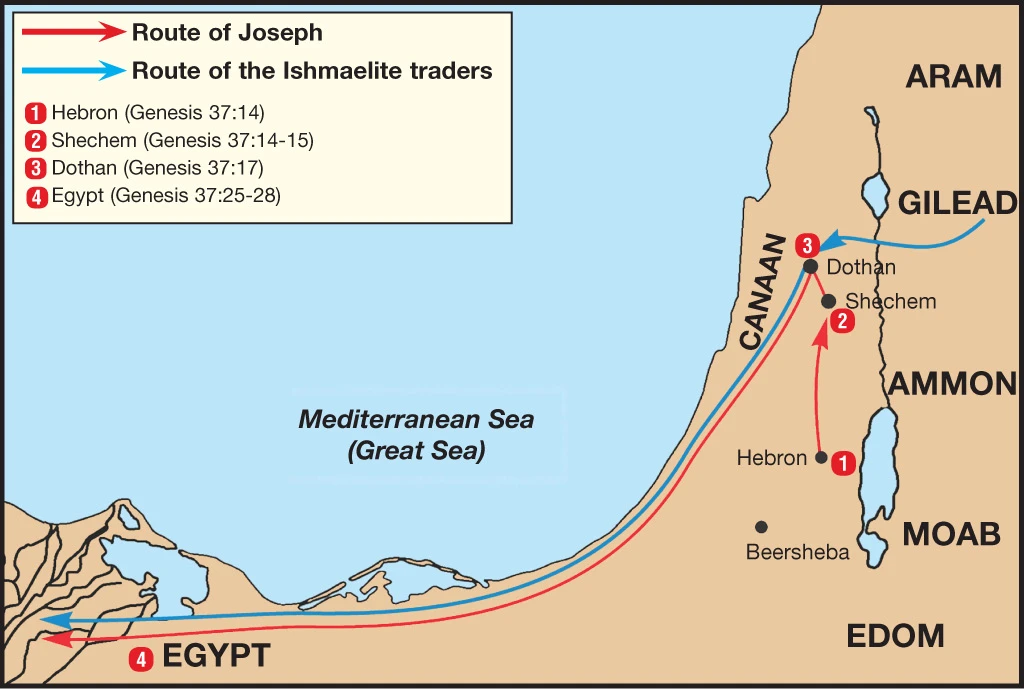
While Joseph was carted off to Egypt as a slave, his wicked brothers went on with their lives as if nothing had ever happened. It was Judah, one of Joseph’s half-brothers, who had come up with the plan to cash in by selling Joseph as a slave rather than spilling innocent blood.

“What will we gain by killing our brother? We’d have to cover up the crime. Instead of hurting him, let’s sell him to those Ishmaelite traders. After all, he is our brother—our own flesh and blood!” – Genesis 37:26 NLT

With their 20 pieces of silver in hand, the brothers had left Dothan and returned home to Hebron.  Once there, they delivered the devastating news of Joseph’s death with their father. Their carefully crafted lie devastated Jacob, but these men showed no remorse or regret. They had managed to eliminate their nemesis and were glad of it.

For Joseph’s brothers, it was business as usual. They went on with their lives, seemingly giving no thought to the fate of their younger brother. While visiting with a friend from Adullam, Judah met a Canaanite woman named Shua whom he eventually married. There is no indication that he ever consulted Jacob about this marriage, and it is probably because he knew his father would disapprove. When Jacob had been a young man, his father Isaac had sent him to Mesopotamia to find a wife from among his own clan.

“You must not marry any of these Canaanite women. Instead, go at once to Paddan-aram, to the house of your grandfather Bethuel, and marry one of your uncle Laban’s daughters. May God Almighty bless you and give you many children. And may your descendants multiply and become many nations! May God pass on to you and your descendants the blessings he promised to Abraham. May you own this land where you are now living as a foreigner, for God gave this land to Abraham.” – Genesis 28:1-4 NLT

But Judah had decided to do things his own way. And his decision to marry a Canaanite woman seemed to bear fruit, in the form of three sons: Er, Onan, and Shelah. When Er became a man, Judah arranged for him to marry a woman named Tamar. But according to Moses, Er was a wicked man and God took his life. That left Tamar a widow. According to a common practice of the time, a brother of the deceased man was expected to marry his brother’s widow so that she could bear a son and carry on her husband’s name. This was referred to as levirate marriage. So, Judah approached Onan and convinced him to do the right thing.

“Go and marry Tamar, as our law requires of the brother of a man who has died. You must produce an heir for your brother.” – Genesis 38:8 NLT

This practice would eventually become part of the Mosaic law for the people of Israel.

“If two brothers are living together on the same property and one of them dies without a son, his widow may not be married to anyone from outside the family. Instead, her husband’s brother should marry her and have intercourse with her to fulfill the duties of a brother-in-law. The first son she bears to him will be considered the son of the dead brother, so that his name will not be forgotten in Israel.” – Deuteronomy 25:5-6 NLT

But Onan was not interested in fathering a child that, technically, would not be his own. “So whenever he had intercourse with his brother’s wife, he spilled the semen on the ground. This prevented her from having a child who would belong to his brother” (Genesis 38:9 NLT). He purposefully refused to impregnate his brother’s wife, denying him the right of an heir to carry on his name. And God found this to be a crime worthy of death.

But the Lord considered it evil for Onan to deny a child to his dead brother. So the Lord took Onan’s life, too. – Genesis 38:10 NLT

This left Tamar a widow for the second time. And because Judah’s third son was too young for marriage, he convinced Tamar to wait until Shelah grew up, promising her that he would fulfill the levirate commitment. But Judah failed to keep his word because he feared that, if Shelah married Tamar, he too might die. Perhaps Judah thought Tamar was cursed. He even refused to allow Tamar to live among his clan, choosing instead for her to return home to her parents where she was to stay until Shelah was of marrying age. But like the story of Joseph’s “death” that Judah had told to Jacob, his words to Tamar were all a lie.

This left Tamar in a very difficult position. She had no husband, no rights, and, without a son, she had no hope for the future. As a woman living in that culture, she was completely dependent upon a husband or son to care for her needs. Now, she was forced to return to her parents’ home, where she was forced to wait for Shelah to fulfill his commitment to her.

The years would pass by and life would go on as usual. Shelah grew up and Tamar continued to wait. Eventually, Jacob’s wife died, leaving him a widow as well. After mourning his wife’s death, he joined his Adullamite friend again for the annual sheering of the sheep. Somehow, Tamar learned that her father-in-law was headed to Timnah, and she made arrangements to confront him there. She was well aware that Shelah was now a man and that Judah was preventing him from marrying her.

Disguising herself with a veil, Tamar sat outside the gate of Timnah, waiting for the chance to confront her father-in-law. When Judah arrived and saw her, he mistook her for a prostitute and propositioned her. To make matters worse, Judah believed Tamar to be a cult prostitute (Genesis 38:21), a woman who offered sexual favors as part of the worship of Canaanite false gods. Judah was making poor choices that would come back to haunt him.

It seems unlikely that Tamar was purposefully portraying herself as a temple prostitute, but once Judah mistook her for one, she played along. She asked Judah what he was willing to pay to have sex with her, and he offered her the price of a young goat. But Tamar knew Judah well and demanded that he provide some form of proof of payment. So, at Tamar’s request, Judah left behind his identification seal, its cord, and his staff. Each of these things would have been unique to Judah and would have been of great value. She knew he would want them back and this would force him to keep his word.

That Judah would give up those particular reveals much about his lack of discernment. He was letting his desires and passions control his decisions. And Moses indicates that not only did Judah have sex with Tamar, but he impregnated her. When they were done, she returned home to her father’s house and Judah went on his way, completely oblivious as to the ramifications of his actions. The deceiver had been deceived. And the one who had refused to keep his promise would actually be the one through whom God would fulfill His promise to Abraham. Because the child within Tamar’s womb would eventually be the one through whom the Messiah would come. In his gospel, Matthew records the genealogy of Jesu, and it prominently features the name of Tamar, the widowed wife of Er.

This is a record of the ancestors of Jesus the Messiah, a descendant of David and of Abraham:

Abraham was the father of Isaac.
Isaac was the father of Jacob.
Jacob was the father of Judah and his brothers.
Judah was the father of Perez and Zerah (whose mother was Tamar). – Matthew 1:1-3 NLT

God had allowed Joseph to be sold into slavery by his brothers. God had taken two of Tamar’s husbands before she could bear them children. God had stood back and watched as Judah deceived Tamar by refusing to allow his third son to marry her. But all of it had been part of His divine plan. There were things happening behind the scenes that no one was aware of – but God. Joseph must have felt like a helpless victim as he made his way to Egypt. Judah must have believed himself to be, not only clever but a wise and caring father. And Tamar was a spurned woman in search of revenge and restitution for the injustices she had endured. But little did any of them know that God was orchestrating every facet of their lives – for their good and His glory.

English Standard Version (ESV) The Holy Bible, English Standard Version. ESV® Permanent Text Edition® (2016). Copyright © 2001 by Crossway Bibles, a publishing ministry of Good News Publishers.

New Living Translation (NLT) Holy Bible, New Living Translation, copyright © 1996, 2004, 2015 by Tyndale House Foundation. Used by permission of Tyndale House Publishers Inc., Carol Stream, Illinois 60188. All rights reserved.

New English Translation (NET)NET Bible® copyright ©1996-2017 by Biblical Studies Press, L.L.C. http://netbible.com All rights reserved.

The Fine Line From Cursing to Blessing

10 These are the generations of Shem. When Shem was 100 years old, he fathered Arpachshad two years after the flood. 11 And Shem lived after he fathered Arpachshad 500 years and had other sons and daughters.

12 When Arpachshad had lived 35 years, he fathered Shelah. 13 And Arpachshad lived after he fathered Shelah 403 years and had other sons and daughters.

14 When Shelah had lived 30 years, he fathered Eber. 15 And Shelah lived after he fathered Eber 403 years and had other sons and daughters.

16 When Eber had lived 34 years, he fathered Peleg. 17 And Eber lived after he fathered Peleg 430 years and had other sons and daughters.

18 When Peleg had lived 30 years, he fathered Reu. 19 And Peleg lived after he fathered Reu 209 years and had other sons and daughters.

20 When Reu had lived 32 years, he fathered Serug. 21 And Reu lived after he fathered Serug 207 years and had other sons and daughters.

22 When Serug had lived 30 years, he fathered Nahor. 23 And Serug lived after he fathered Nahor 200 years and had other sons and daughters.

24 When Nahor had lived 29 years, he fathered Terah. 25 And Nahor lived after he fathered Terah 119 years and had other sons and daughters.

26 When Terah had lived 70 years, he fathered Abram, Nahor, and Haran.

27 Now these are the generations of Terah. Terah fathered Abram, Nahor, and Haran; and Haran fathered Lot. 28 Haran died in the presence of his father Terah in the land of his kindred, in Ur of the Chaldeans. 29 And Abram and Nahor took wives. The name of Abram’s wife was Sarai, and the name of Nahor’s wife, Milcah, the daughter of Haran the father of Milcah and Iscah. 30 Now Sarai was barren; she had no child.

31 Terah took Abram his son and Lot the son of Haran, his grandson, and Sarai his daughter-in-law, his son Abram’s wife, and they went forth together from Ur of the Chaldeans to go into the land of Canaan, but when they came to Haran, they settled there. 32 The days of Terah were 205 years, and Terah died in Haran. Genesis 11:10-32 ESV

With the opening verses of chapter 11, Moses provides an explanation of an earlier comment he made regarding Peleg, a descendant of Shem.

To Eber were born two sons: the name of the one was Peleg, for in his days the earth was divided – Genesis 10:25 ESV

Bookending the story of the tower of Babel are two genealogical lists. In chapter 10, beginning in verse 11, Moses provides an abbreviated version of Shem’s lineage, because it provides no branch for Peleg, the son of Eber. In reference to Peleg simply states: “in his days the earth was divided” (Genesis 10:25 ESV). The story of Babel is what follows. When humanity decided to settle down in the land of Shinar, build a city, and erect a tower as a monument to their own glory, God took action. They shared a common ancestry and enjoyed the benefits of a common language. This unified connection gave them a sense of invincibility and fueled their desire for autonomy. That is why God said, “Behold, they are one people, and they have all one language, and this is only the beginning of what they will do. And nothing that they propose to do will now be impossible for them” (Genesis 11:6 ESV). 

Rather than obeying God’s mandate to fill the earth, they had determined to remain in one place and construct a city that would reflect their own greatness. Rather than honor God, they chose to glorify themselves. So, God stepped in and “confused” their language. He miraculously divided their number by creating a barrier to further communication. Suddenly, they found themselves unable to understand one another. This God-enforced diversity resulted in their dispersal across the face of all the earth.

And it is at this point, that Moses picks back up the genealogical record of Shem’s descendants. With the story of Babel explained, Moses is able to reveal what happened to Peleg after “the earth was divided” (Genesis 10:25 ESV).

Back in chapter five, Moses recorded another genealogical record that began with Adam and ended with Noah and his three sons. This list contains the names of all those who descended from Adam and Eve and vividly portrays the life-altering consequences of the first couple’s sin and the divine curse it incurred.

First of all, it states that Adam “fathered a son in his own likeness, after his image” (Genesis 5:3 ESV). This statement stands in stark contrast to the creation account where God had said, “Let us make man in our image, after our likeness” (Genesis1:26 ESV). Because of the entrance of sin into the perfect environment of Eden, mankind was permanently damaged. Adam and Eve would pass on to their descendants their proclivity for sin and the divine decree of death as its punishment. The original man and woman were to be God’s image-bearers. But like a marred mirror, this first couple and all their progeny would be incapable of perfectly reflecting the glory of God – all because of sin. Their children would be born in their image and bear their likeness. 

And the list found in chapter five contains another sober reminder of the consequences of the fall. With each successive generation, Moses repeatedly and intentionally states “he fathered” and “he died.” While the creation story in chapter one emphasizes the glory and wonder of new life, the genealogical list in chapter five provides the new post-fall reality of death.

But Moses leaves out that dark and depressing aspect of mankind’s fate in the genealogy of Shem recorded in chapter 11. While the age of each father is listed, there is no mention of death. This distinction is subtle, yet significant. Moses is attempting to paint a more hopeful future for humanity. Even after the debacle of Babel, when “the earth was divided” by God (Genesis 10:25) because of the pride and arrogance of man, this second genealogy of Shem is intended to reveal a new line of humanity that will result in another new beginning.

The first part of this list is much like the one found in chapter 10. But this time, Moses traces the branch of Eber’s family tree through his son, Peleg. According to the list, Eber had other sons and daughters. In other words, there were other branches to his family tree that could have been traced, but Moses concentrated all his attention on Peleg and the line of descent that flowed through his son, Reu. Moses is very specific and has an end in mind. His methodical record of Peleg’s lineage has actually been reverse-engineered and intended to trace the ancestral pedigree of a particular offspring of Adam. Notice where the genealogy ends.

When Terah had lived 70 years, he fathered Abram, Nahor, and Haran. – Genesis 11:26 ESV

After listing generations of descendants from Shem, the list suddenly stops. Moses has reached his desired destination. And the name of Abram would have caught the attention of Moses’ Hebrew audience. After all, he was their revered patriarch, the father of the Hebrew nation. This entire exercise in genealogical authentication was meant to validate Abram as a descendant of Noah and an offspring of Adam. And one of the reasons this is so important is because of the curse God had leveled against the serpent for his role in the fall of man.

And I will cause hostility between you and the woman,
    and between your offspring and her offspring.
He will strike your head,
    and you will strike his heel.” – Genesis 3:15 NLT

Of all the genealogical lists contained in Genesis, this one is intended to provide a sense of hope and anticipation. The world is broken and marred. And with the birth of each new generation, mankind is slowly moving further away from God. And yet, here in chapter 11, an offspring of Eve is born who will play a significant role in fulfilling the divine curse that God had leveled on the enemy. Satan would pay dearly for his attempt to dethrone God by deceiving and damaging His image-bearers. Despite the subsequent generations that flowed from the first couple and the track record of wickedness that plagued them, God had a plan for restoring them. He had a preconceived strategy for redeeming fallen humanity even before He had breathed life into the first man.

This chapter is intended to be a turning point in what has been a somewhat bleak story. Moses is preparing to reveal the next chapter in his history of mankind by introducing a new character who will play a vital role in God’s redemptive plan. Up to this point in the Genesis account, there have been two primary protagonists: Adam and Noah. One represents humanity in its pre-fall and post-fall states. The other spans the pre-flood and post-flood periods of mankind’s existence. But now, Moses introduces a third character whose life will greatly influence the unfolding story of God’s redemptive plan.

What should stand out in all of this is God’s sovereignty. He is operating behind the scenes, orchestrating and overseeing every aspect of His creation. Nothing escapes His notice or happens outside of His sovereign and providential will. The birth of Abram was not a case of blind luck, fate, or cosmic karma. It was the preordained will of God Almighty. God had predetermined the birth of Abram because He had always planned to use this one man as a conduit through whom He would one day pour out His blessings on humanity. As will become evident as the story unfolds, God had grand plans for this seemingly insignificant descendant of Adam. The One who ordained Abram’s birth would one day divulge Abram’s calling.

“Go from your country and your kindred and your father’s house to the land that I will show you. And I will make of you a great nation, and I will bless you and make your name great, so that you will be a blessing. I will bless those who bless you, and him who dishonors you I will curse, and in you all the families of the earth shall be blessed.” – Genesis 12:1-3 ESV

That last line speaks volumes. God was going to use a solitary offspring of Eve to reverse the curse and pour out His blessings on all the families of the earth. This one man, Abram, would prove to be the divinely ordained conduit thought whom God would bring hope to a sin-damaged world and the gift of life to all those living under the curse of death.

And Moses ends chapter 11 with Abram moving from his home in Ur to the distant land of Haran. Moses describes Abram’s slow but steady migration east, bringing him ever closer to the land of Canaan. And Moses intended this far-from-subtle insight into Abram’s former home and ultimate destination to remind his Jewish readers of their roots. They hailed from the land of Shinar, the infamous site of Babel and the future home of Babylon. Their patriarch was a Chaldean and not a Jew. And their distinct Hebraic language had been the result of God’s judgment against the rebellious people of Babel. Their heritage was marred. Their patriarch was far from pristine. But their God had a plan that would put all these pieces together to form a perfect plan so that He might bless the nations of the earth.

English Standard Version (ESV) The Holy Bible, English Standard Version. ESV® Permanent Text Edition® (2016). Copyright © 2001 by Crossway Bibles, a publishing ministry of Good News Publishers.

New Living Translation (NLT) Holy Bible, New Living Translation, copyright © 1996, 2004, 2015 by Tyndale House Foundation. Used by permission of Tyndale House Publishers Inc., Carol Stream, Illinois 60188. All rights reserved.

New English Translation (NET)NET Bible® copyright ©1996-2017 by Biblical Studies Press, L.L.C. http://netbible.com All rights reserved.

The Hidden Hope of Salvation

21 To Shem also, the father of all the children of Eber, the elder brother of Japheth, children were born. 22 The sons of Shem: Elam, Asshur, Arpachshad, Lud, and Aram. 23 The sons of Aram: Uz, Hul, Gether, and Mash. 24 Arpachshad fathered Shelah; and Shelah fathered Eber. 25 To Eber were born two sons: the name of the one was Peleg, for in his days the earth was divided, and his brother’s name was Joktan. 26 Joktan fathered Almodad, Sheleph, Hazarmaveth, Jerah, 27 Hadoram, Uzal, Diklah, 28 Obal, Abimael, Sheba, 29 Ophir, Havilah, and Jobab; all these were the sons of Joktan. 30 The territory in which they lived extended from Mesha in the direction of Sephar to the hill country of the east. 31 These are the sons of Shem, by their clans, their languages, their lands, and their nations.

32 These are the clans of the sons of Noah, according to their genealogies, in their nations, and from these the nations spread abroad on the earth after the flood.  Genesis 10:21-32 ESV

Compared to his younger brother’s genealogy, Shem’s lineage is far more pedestrian in nature. It contains no names that might raise eyebrows or elicit a sense of shock. And yet, within this list of obscure and difficult to pronounce names Moses provided a subtle, yet powerful, reminder of God’s sovereign authority over the affairs of mankind.

For most modern readers, this list of names seems rather superfluous. The individuals listed are unknown to us and, therefore, carry little weight. Yet, for the Jewish audience to whom Moses penned the book of Genesis, these names would have had a great deal of significance. At the mention of Arpachshad, Shelah, Eber, and Peleg, Moses would have had his reader’s undistracted attention, because these men were part of the family tree of Abraham, the father of the Hebrew nation. In fact, Moses will provide a more detailed and complete genealogy of Abraham in the very next chapter. He will go on to trace the lineage of Shem through the line of Peleg, all the way to the man who would become the patriarch of the Jewish people.

But in chapter nine, Moses chose to ignore the line of Peleg and traced the lineage of his brother, Joktan instead. Moses provides a rather strange aside when describing these two brothers.

To Eber were born two sons: the name of the one was Peleg, for in his days the earth was divided, and his brother’s name was Joktan. – Genesis 10:25 ESV

There has been much debate regarding the meaning of the phrase, “the earth was divided.” The Hebrew word is פָּלַג (pālaḡ), and it means “to split, cleave, or divide.” Based on the context of chapter 11, the most logical explanation is that Moses is referring to God’s dividing of the nations by the creation of languages. It seems that the events recorded in Genesis 11:1-9 occurred during the lifetime of Peleg. It was in Peleg’s lifetime that God decided to “divide or split” the earth by confusing the languages of the people. And Moses provides a detailed description of God’s momentous decision.

“Behold, they are one people, and they have all one language, and this is only the beginning of what they will do. And nothing that they propose to do will now be impossible for them. Come, let us go down and there confuse their language, so that they may not understand one another’s speech.” – Genesis 11:6-7 ESV

And Moses goes on to describe how God “dispersed them from there over the face of all the earth” (Genesis 11:8 ESV). God literally “divided” or “split” the earth by creating new people groups with different languages. Their inability to communicate with one another caused an immediate parting of the ways, indirectly fulfilling God’s command that mankind “fill the earth.” In “dispersing” them, God was breaking humanity in pieces and scattering them abroad. That is the literal meaning of the Hebrew word, פּוּץ (pûṣ).

It would appear that Moses split the genealogy found in chapter 10 at the juncture of Peleg and Joktan because he was going to provide further details about Peleg’s lineage in the following chapter. During the lives of these two brothers, something significant and earth-shattering took place. And Moses will provide further insights into that momentous occasion. But it seems safe to conclude that when Moses states “in his days the earth was divided,” he is referring to the events surrounding the tower of Babel, as described in the opening verses of chapter 11. Another reason for reaching this conclusion is found in a psalm written by David. In it, he uses the very same word, (pālaḡ), to describe the dividing and confusion of languages.

Destroy, O Lord, divide (pālaḡ) their tongues;
    for I see violence and strife in the city. – Psalm 55:9 ESV

So, hidden within this somewhat meaningless and uninteresting genealogy is a subtle reminder of God’s sovereign will. As the sons of Noah procreate and populate the planet, God is operating behind the scene, sovereignly orchestrating His divine will. With the birth of each new son, another branch in the human family tree begins. Peleg and Joktan, while brothers, would produce two distinctively different progeny.  From Joktan would come the various Arabic tribes, the Yemenites, Assyrians, Lydians, and Aramaens. These “clans of the sons of Noah, according to their genealogies, in their nations, and from these the nations spread abroad on the earth after the flood” (Genesis 10:32 ESV).

God was orchestrating the creation of all those nations that were destined to play vital roles in His future plans for the world. By sovereignly forming such diverse groups as the Egyptians, Assyrians, Babylonians, and Canaanites, God was putting in place all the pieces to His divine plan for mankind’s redemption. There was a method to the seeming madness. God had a reason for creating each of these distinct people groups. And Moses wanted his readers to understand that the existence of each of these nations had been decreed by God’s will. They didn’t just happen. They were planned by God Almighty. And while each of them would eventually become an enemy of Israel, God had a divinely ordained role for them to play.

There is no cosmic karma in the universe. Nothing happens by chance. Nations rise and fall by the sovereign will of God. The existence of languages was part of God’s plan. The birth of great nation-states was His idea. Each of the men listed in the genealogy of chapter 10 would go on to father a multitude of descendants. And these people would eventually form various nations, representing a diverse mix of ethnicities with each speaking their own unique language and displaying their own cultural distinctiveness. And it would be into this diverse and divisive milieu that God would sovereignly raise up a single man who would become the next “Adam” in the story of mankind’s eventual redemption from the fall.

This all takes us back to the protoevangelium (first gospel) found in Genesis 3:15. In pronouncing His curse against the serpent, God provided the promise of an offspring or seed, that would come from the woman.

“I will put enmity between you and the woman,
    and between your offspring and her offspring;
he shall bruise your head,
    and you shall bruise his heel.” – Genesis 3:15 ESV

There is far more to this statement than the prediction of mutual hatred between mankind and snakes. This was a divinely decreed promise of payback for Satan’s role in Adam and Eve’s rebellion against God. There would one day come a descendant of Eve who would restore fallen mankind to a right relationship with God. Jesus Christ, as outlined in the gospel of Luke, would be born a descendant of Adam (Luke 3:23-38). But as Matthew records in his gospel account, Jesus would also be the descendant of Abraham, who would be born from the line of Peleg.

…Jesus Christ, the son of David, the son of Abraham. – Matthew 1:1 ESV

Hidden within these somewhat obscure genealogical lists is the message of God’s sovereign plan to restore what Satan had attempted to destroy. When God sent the flood as a form of judgment against the wickedness of humanity, He could have destroyed Noah and his sons, and been completely just and right in doing so. While Noah found favor with God, he was not sinless. While Moses describes him as righteous and blameless “in his generation” (Genesis 6:9 ESV), this was intended as a statement of comparison, not commendation. In other words, Noah had not earned his salvation from God. God did not spare Noah because he was righteous. No, according to the book of Hebrews, God spared Noah because he believed and obeyed. He took God at His word and heeded the warning that judgment was coming.

By faith Noah, being warned by God concerning events as yet unseen, in reverent fear constructed an ark for the saving of his household. By this he condemned the world and became an heir of the righteousness that comes by faith. – Hebrews 11:7 ESV

Noah’s faith was in the salvation of God. Despite the fact that none of God’s commands made much sense or the likelihood of a worldwide flood seemed remote at best, Noah believed and obeyed. He put his faith in God’s promise of deliverance. But in stepping on the ark he had helped to construct, Noah was foreshadowing a greater deliverance to come. And the author of Hebrews ends chapter 11, his great “Hall of Faith,” with the following words of encouragement and insight.

All these people earned a good reputation because of their faith, yet none of them received all that God had promised. For God had something better in mind for us, so that they would not reach perfection without us. – Hebrews 11:39-40 NLT

Out of all the offspring born to Adam and Noah, there would eventually come one “seed” that would provide a means of restoring broken humanity to a right relationship with its Creator.

English Standard Version (ESV) The Holy Bible, English Standard Version. ESV® Permanent Text Edition® (2016). Copyright © 2001 by Crossway Bibles, a publishing ministry of Good News Publishers.

New Living Translation (NLT) Holy Bible, New Living Translation, copyright © 1996, 2004, 2015 by Tyndale House Foundation. Used by permission of Tyndale House Publishers Inc., Carol Stream, Illinois 60188. All rights reserved.

New English Translation (NET)NET Bible® copyright ©1996-2017 by Biblical Studies Press, L.L.C. http://netbible.com All rights reserved.

Son of Man – Son of God

23 Jesus, when he began his ministry, was about thirty years of age, being the son (as was supposed) of Joseph, the son of Heli, 24 the son of Matthat, the son of Levi, the son of Melchi, the son of Jannai, the son of Joseph, 25 the son of Mattathias, the son of Amos, the son of Nahum, the son of Esli, the son of Naggai, 26 the son of Maath, the son of Mattathias, the son of Semein, the son of Josech, the son of Joda, 27 the son of Joanan, the son of Rhesa, the son of Zerubbabel, the son of Shealtiel, the son of Neri, 28 the son of Melchi, the son of Addi, the son of Cosam, the son of Elmadam, the son of Er, 29 the son of Joshua, the son of Eliezer, the son of Jorim, the son of Matthat, the son of Levi, 30 the son of Simeon, the son of Judah, the son of Joseph, the son of Jonam, the son of Eliakim, 31 the son of Melea, the son of Menna, the son of Mattatha, the son of Nathan, the son of David, 32 the son of Jesse, the son of Obed, the son of Boaz, the son of Sala, the son of Nahshon, 33 the son of Amminadab, the son of Admin, the son of Arni, the son of Hezron, the son of Perez, the son of Judah, 34 the son of Jacob, the son of Isaac, the son of Abraham, the son of Terah, the son of Nahor, 35 the son of Serug, the son of Reu, the son of Peleg, the son of Eber, the son of Shelah, 36 the son of Cainan, the son of Arphaxad, the son of Shem, the son of Noah, the son of Lamech, 37 the son of Methuselah, the son of Enoch, the son of Jared, the son of Mahalaleel, the son of Cainan, 38 the son of Enos, the son of Seth, the son of Adam, the son of God.Luke 3:23-38 ESV

Both Luke and Matthew include a genealogy of Jesus in their gospel accounts, but there are distinct differences between the two. Most obviously, Matthew chose to place his version of Jesus’ genealogy at the very beginning of his gospel, while Luke reserved his until later in the story, when Jesus began His public ministry. But upon closer examination, there are other glaring differences that appear and that have caused no end of speculation and explanation.

The first major difference is that Matthew traces the genealogy of Jesus back to Abraham, while Luke provides evidence of Jesus’ descent from Adam. Obviously, Matthew is attempting to prove that Jesus was of the seed of Abraham, a descendant of the great patriarch of the Hebrew people. But Luke wanted to reveal that Jesus was also a direct descendant of the first man created by God: Adam.

But if you were to place these two genealogies side by side, you would find further discrepancies. In fact, you would discover that they appear to be two completely different genealogies altogether. For instance, Matthew states that the name of Joseph’s father was Jacob (Matthew 1:16), while Luke records that it was Heli (Luke 3:23). In Matthew’s version, he traces the hereditary line of Jesus through David’s son Solomon (Matthew 1:6), while Luke has Jesus descending through David’s son Nathan (Luke 3:31). If you look closely, you will find that the two genealogies only share two names in common: Shealtiel and Zerubbabel. Yet even these appear to be different individuals who just happen to share the same names.

So, which genealogy is the right one? Is this proof of a contradiction in the Word of God? Is it evidence of an error? There has been much debate about the seeming discrepancies found in these two genealogical lists. But the most common explanation among conservative Bible scholars has been that each man was tracing a different genealogy for Jesus. Luke was recording the genealogy of Mary, while Matthew was recording that of Joseph. Each man had a different purpose in mind. Matthew was tracing the line of Joseph through David’s son Solomon. He was attempting to show that while Joseph was not the biological father of Jesus, he was his adoptive and, therefore, legal father.

Luke followed the line of Mary through David’s son Nathan. In Koine Greek, there was no word for “son-in-law,” so Luke listed Joseph as the “son of Heli” because he was married to Mary, Heli’s daughter. The belief is that these two distinct genealogies provide evidence that Jesus is a descendant of David, whether you trace His line through Mary or Joseph. As Joseph’s legally adoptive son, Jesus was an heir of David. But because He was born to Mary, Jesus was also the rightful heir of David through blood. Luke seems to hint at the key difference in his genealogy when he writes that Jesus was the son of Joseph, “as was supposed” (Luke 3:23 ESV).

Another explanation is that both genealogies are tracing the line of Joseph, but that Luke’s version takes into account a case of levirate marriage. Thomas L. Constable explains it this way:

One solution to this problem is that the custom of levirate marriage in the ancient Near East permitted the widow of a childless man to marry his (unmarried) brother. It was common to consider a child of the second marriage as the legal son of the deceased man to perpetuate that man’s name. In genealogies, the ancients sometimes listed such a child as the son of his real father but at other times as the son of his legal father. This may be the solution to the problem of Joseph’s fathers. It is a very old explanation that the third-century church father Africanus advocated. Evidently either Jacob or Eli (Heli) was Joseph’s real father, and the other man was his legal father. This may also be the solution to the problem of Shealtiel’s two fathers (Matt. 1:12; Luke 3:27). This is only an adequate explanation, however, if Jacob and Eli were half-brothers, specifically the sons of the same mother but not the same father. Jacob’s father was Matthan and his grandfather was Eleazar whereas Eli’s father was Matthat and his grandfather was Levi. – Dr. Thomas L. Constable, Notes on Luke: 2010 Edition

Regardless of which explanation you choose to believe, it is important to recognize that the Jews were meticulous when it came to maintaining their genealogical records. Proof of legal heritage was vital because of inheritance laws regarding the land. Detailed records were maintained to provide evidence of tribal affiliation and legal proof of Hebrew citizenship. For Matthew, tracing the line of Jesus back to Abraham was vital in order to prove that Jesus was the ultimate fulfillment of the promises made in the Abrahamic covenant. Yet Luke wanted to provide evidence that Jesus’ lineage went all the way back to the very beginning, to the creation account. Jesus was the son of Adam and, therefore, a Son of God.

Both Matthew and Luke were out to prove that Jesus was a man.

“That the genealogy is recorded at all shows Him to be a real man, not a demi-god like those in Greek and Roman mythology. That it goes back to David points to an essential element in His messianic qualifications. That it goes back to Adam brings out His kinship not only with Israel but with the whole human race. That it goes back to God relates Him to the Creator of all. He was the Son of God.” – Morris, Leon. The Gospel According to St. Luke. Tyndale New Testament Commentaries series. Grand Rapids: Wm. B. Eerdmans Publishing Co., 1974.

In both genealogies, it is clear that Jesus is a legal descendant of King David. He is the rightful heir to the Davidic throne and the fulfillment of the promise that God had made to David.

“Your house and your kingdom will continue before me for all time, and your throne will be secure forever.” – 2 Samuel 7:16 NLT

But Jesus could also be traced all the way back to Abraham, making Him a fulfillment of the promise God had made centuries earlier.

“Go from your country and your kindred and your father’s house to the land that I will show you. And I will make of you a great nation, and I will bless you and make your name great, so that you will be a blessing. I will bless those who bless you, and him who dishonors you I will curse, and in you all the families of the earth shall be blessed…To your offspring I will give this land. – Genesis 12:1-3, 7 ESV

And the apostle Paul would later clarify and explain how Jesus was the ultimate fulfillment of God’s covenant promise.

Now the promises were made to Abraham and to his offspring. It does not say, “And to offsprings,” referring to many, but referring to one, “And to your offspring,” who is Christ. – Galatians 3:16 ESV

So, as Jesus prepared to begin His earthly ministry, He did so as the son of Adam, the son of Abraham, the son of David, and most importantly, the Son of God. He checked all the boxes. He was the legitimate and bonafide Messiah of Israel.

English Standard Version (ESV) The Holy Bible, English Standard Version. ESV® Permanent Text Edition® (2016). Copyright © 2001 by Crossway Bibles, a publishing ministry of Good News Publishers.

New Living Translation (NLT) Holy Bible, New Living Translation, copyright © 1996, 2004, 2015 by Tyndale House Foundation. Used by permission of Tyndale House Publishers Inc., Carol Stream, Illinois 60188. All rights reserved.

The Message (MSG)Copyright © 1993, 1994, 1995, 1996, 2000, 2001, 2002 by Eugene H. Peterson

A Son Has Been Born

13 So Boaz took Ruth, and she became his wife. And he went in to her, and the Lord gave her conception, and she bore a son. 14 Then the women said to Naomi, “Blessed be the Lord, who has not left you this day without a redeemer, and may his name be renowned in Israel! 15 He shall be to you a restorer of life and a nourisher of your old age, for your daughter-in-law who loves you, who is more to you than seven sons, has given birth to him.” 16 Then Naomi took the child and laid him on her lap and became his nurse. 17 And the women of the neighborhood gave him a name, saying, “A son has been born to Naomi.” They named him Obed. He was the father of Jesse, the father of David.

18 Now these are the generations of Perez: Perez fathered Hezron, 19 Hezron fathered Ram, Ram fathered Amminadab, 20 Amminadab fathered Nahshon, Nahshon fathered Salmon, 21 Salmon fathered Boaz, Boaz fathered Obed, 22 Obed fathered Jesse, and Jesse fathered David. Ruth 4:13-21 ESV

When reading the closing verses of Ruth’s story, it is essential that we not miss the statement, “and the Lord gave her conception” (Ruth 4:13 ESV). First of all, those six simple words reinforce the underlying theme of God’s redemption that runs throughout the entire book. Ruth, Boaz, and Naomi are nothing more than actors in the divine drama, written by the hand of God and directed according to His sovereign will. Nothing in this story has been the result of luck, fate, kismet, karma, or blind chance.

It all began with Elimelech’s decision to escape the famine in Judah by moving his family to Moab. But his plan had not included any thought of his unexpected death. He never dreamed he would leave his wife a widow living in a foreign land. But that’s exactly what happened. And Naomi’s two sons, unsure of when they might be able to return to Bethlehem, decided to find wives among the Moabites and begin their families. But little did they know that, ten years later, they too would suffer unexpected deaths, leaving two more widows in the land of Moab.

But eventually, the famine subsided in Judah, and Naomi was able to return home, accompanied by her daughter-in-law, Ruth. Now, through a series of divinely-ordained encounters, Ruth is married to a wealthy relative of Naomi’s, a man named Boaz, who rescued these two widows by faithfully executing his obligations as their kinsman-redeemer.

All the way back in chapter 1, the author recorded Naomi’s words to her two daughters-in-law, as she prepared to return to Judah. She fully expected that they would choose to stay in Moab, remarry, and begin their lives anew.

“The Lord grant that you may find rest, each of you in the house of her husband!” – Ruth 1:9 ESV

But Ruth had chosen to remain with Naomi, and now that blessing had come to pass. Ruth had found a husband, but not just any husband. By God’s gracious will, she had found Boaz, who proved to be Naomi’s kinsman-redeemer and a man of integrity, honor, and compassion.

Back in Moab, when Ruth had expressed her intentions to remain with Naomi and follow her back to the land of Judah, she had no idea what the future held. But she was willing to accept whatever came her way.

“…where you go I will go, and where you lodge I will lodge. Your people shall be my people, and your God my God…” – Ruth 1:16 ESV

And Ruth had proved true to her word. Now, God had rewarded her faithfulness with a loving husband, a home of her own, and a son. In buying Elimelech’s land, then marrying Ruth, Boaz had done far more than fulfill his responsibility as the kinsman-redeemer. Yes, he had redeemed Naomi and Ruth out of their helpless and seemingly hopeless predicament. But, unbeknownst to him, he had played a major role in God’s redemptive plan for the world.

The women in the city, upon hearing of Ruth’s delivery of her new son, pronounced a blessing that had far greater implications than they could have ever imagined.

“Blessed be the Lord, who has not left you this day without a redeemer, and may his name be renowned in Israel! He shall be to you a restorer of life and a nourisher of your old age, for your daughter-in-law who loves you, who is more to you than seven sons, has given birth to him.” – Ruth 4:14-15 ESV

They gave God glory. But little did they know just how much glory their God deserved. This birth was going to have life-changing ramifications, and not just for Ruth and Boaz. Their words were directed at Naomi and were meant to remind her just how blessed she was. She had found a redeemer, who had restored her life and given her hope in her old age. But more than that, she had found a daughter-in-law who loved her deeply. And now, she had a new son-in-law, who had given her a grandson and the assurance that Elimelech’s line would be continued.

But, in the midst of all the joy and celebration, we have to stop and ask a difficult question: How could God approve of and bless a union between an Israelite and a Moabite when the law seems to have prohibited it?

“No Ammonite or Moabite may enter the assembly of the Lord. Even to the tenth generation, none of them may enter the assembly of the Lord forever, because they did not meet you with bread and with water on the way, when you came out of Egypt, and because they hired against you Balaam the son of Beor from Pethor of Mesopotamia, to curse you.” – Deuteronomy 23:3-4 ESV

The answer can be found in the pledge that Ruth made to Naomi back in the land of Moab: “Your people shall be my people, and your God my God” (Ruth 1:16 ESV). Ruth was stating her intentions to become an Israelite, giving up her Moabite citizenship along with her allegiance to her god. With her words, Ruth was expressing her intentions to become a proselyte to Judaism.

The ancient Hebrews had no concept of “conversion”, although they did practice assimilation of non-Israelites into the Israelite community, either through marriage or acceptance of the beliefs and practices of the community. Having agreed to make Yahweh her God and the Israelites her people, Ruth would have been accepted into the faith community as one of their own. She would have been considered a gerim (Hebrew for “strangers”). And with her marriage to Boaz, a Hebrew in good standing, she would have become a permanent resident and given equal rights and responsibilities as a member of the community. The Israelites were commanded by God to love the gerim, for, at one time, they had been gerim in Egypt.

This inclusion of Ruth into the family of God is critical. And the author reveals its true significance by recording the following words: “A son has been born to Naomi.” Notice that it does not say, “A son has been born to Ruth.” The emphasis is on the lineage of Elimelech, the husband of Naomi. This son was going to carry on the family name. And the author goes on to state that “They named him Obed. He was the father of Jesse, the father of David” (Ruth 4:17 ESV).

Obed means “redeemer,” which fits in with the whole kinsman-redeemer motif found throughout the story. The goʾel or kinsman-redeemer was, in essence, “a guardian of the family interests.” And Obed, this brand new baby was named “Redeemer” because his birth had redeemed Naomi’s life and restored her husband’s lineage. But he would prove to be an even greater “Redeemer,” as the closing verses of the chapter make clear.

Now these are the generations of Perez: Perez fathered Hezron, Hezron fathered Ram, Ram fathered Amminadab, Amminadab fathered Nahshon, Nahshon fathered Salmon, Salmon fathered Boaz, Boaz fathered Obed, Obed fathered Jesse, and Jesse fathered David. – Ruth 4:18-21 ESV

It seems a bit odd that the author chose to end his narrative with a genealogical record. But there is a divine method to his madness. It reveals God’s sovereign plan and makes clear that God does not operate according to man’s ways or in accordance to expected protocols. Dr. Thomas L. Constable points out the relevance of this genealogical record.

Why does the genealogy start with Perez? He was the founder of the branch of Judah’s family that took his name, to which Elimelech and Boaz belonged. Perez was the illegitimate son of Judah who, like Jacob, seized the initiative to stand in the line of messianic promise from his twin brother. This genealogy emphasizes how God circumvented custom and tradition in providing Israel’s great redeemer, David. Like Perez, Boaz was the descendant of an Israelite father, Salmon, and a Canaanite harlot, Rahab. Both Tamar and Rahab entered Israel because they believed and valued God’s promises to Israel, as Ruth did. David himself was the youngest rather than the eldest son of Jesse. (NET Bible study notes).

And if we fast-forward to the gospel of Matthew, we find within his genealogy of Jesus the same list of names.

Abraham was the father of Isaac, and Isaac the father of Jacob, and Jacob the father of Judah and his brothers, and Judah the father of Perez and Zerah by Tamar, and Perez the father of Hezron, and Hezron the father of Ram, and Ram the father of Amminadab, and Amminadab the father of Nahshon, and Nahshon the father of Salmon, and Salmon the father of Boaz by Rahab, and Boaz the father of Obed by Ruth, and Obed the father of Jesse, and Jesse the father of David the king. – Matthew 1:2-6 ESV

And Matthew goes on to point out that Jesus would be born a descendant of Abraham, through the line of David the king of Israel. The birth of Obed, “the redeemer,” would result in the birth of Jesus, the ultimate Redeemer of mankind. When the angel appeared to Joseph with news of Mary’s conception, he announced, “She will bear a son, and you shall call his name Jesus, for he will save his people from their sins” (Matthew 1:21 ESV). Jesus would be the ultimate kinsman-redeemer. He would serve as the Savior, the one who takes away the sins of the world. His redemption would provide far more than release from widowhood, poverty, despair, or rejection. He would provide the means by which sinful men and women could be restored to a right relationship with God Almighty.

The story of Ruth is the story of redemption. But it’s true significance reaches far beyond the borders of Bethlehem and the period of the Judges. The redemption of God spans borders, boundaries, time, and space. His plan for mankind is not limited to a single nation and is not limited by the passing of years or centuries. The pages of the book of Ruth are filled with the presence of God and the reminder of His unwavering promise to send His Son as the King of kings and Lord of lords.

But you, O Bethlehem Ephrathah,
    are only a small village among all the people of Judah.
Yet a ruler of Israel,
    whose origins are in the distant past,
    will come from you on my behalf. – Micah 5:2 NLT

English Standard Version (ESV)
The Holy Bible, English Standard Version. ESV® Permanent Text Edition® (2016). Copyright © 2001 by Crossway Bibles, a publishing ministry of Good News Publishers.

New Living Translation (NLT)
Holy Bible, New Living Translation, copyright © 1996, 2004, 2015 by Tyndale House Foundation. Used by permission of Tyndale House Publishers Inc., Carol Stream, Illinois 60188. All rights reserved.

The Message (MSG)Copyright © 1993, 1994, 1995, 1996, 2000, 2001, 2002 by Eugene H. Peterson

Naomi the Negative. Ruth the Resilient.

So the two of them went on until they came to Bethlehem. And when they came to Bethlehem, the whole town was stirred because of them. And the women said, “Is this Naomi?” She said to them, “Do not call me Naomi; call me Mara, for the Almighty has dealt very bitterly with me. I went away full, and the Lord has brought me back empty. Why call me Naomi, when the Lord has testified against me and the Almighty has brought calamity upon me?”

So Naomi returned, and Ruth the Moabite her daughter-in-law with her, who returned from the country of Moab. And they came to Bethlehem at the beginning of barley harvest.

Now Naomi had a relative of her husband’s, a worthy man of the clan of Elimelech, whose name was Boaz. And Ruth the Moabite said to Naomi, “Let me go to the field and glean among the ears of grain after him in whose sight I shall find favor.” And she said to her, “Go, my daughter.” So she set out and went and gleaned in the field after the reapers, and she happened to come to the part of the field belonging to Boaz, who was of the clan of Elimelech. And behold, Boaz came from Bethlehem. And he said to the reapers, “The Lord be with you!” And they answered, “The Lord bless you.” Then Boaz said to his young man who was in charge of the reapers, “Whose young woman is this?” And the servant who was in charge of the reapers answered, “She is the young Moabite woman, who came back with Naomi from the country of Moab. She said, ‘Please let me glean and gather among the sheaves after the reapers.’ So she came, and she has continued from early morning until now, except for a short rest.” – Ruth 1:19-2:7 ESV

These verses are filled with contrasts. The most obvious one is the difference between the two women: Naomi and her daughter-in-law, Ruth. They both arrive in Bethlehem, but with radically different outlooks. Naomi had left during a famine, but arrived back during the barley harvest. Conditions back home had obviously improved. But she is so busy dwelling on all that had happened to her in Moab, that she fails to notice or appreciate the improved conditions in Bethlehem. In fact, she is so despondent over the loss of her husband and two sons, that she informs everyone her name will no longer be Naomi, but Mara. Naomi means, “my pleasantness” and Mara means, “bitterness.” She is so upset with her lot in life that she goes so far as to change her name to reflect her outlook. She is bitter and hold God responsible, claiming,  “I left here full, but the Lord has caused me to return empty-handed” (Ruth 1:27 NLT). In her mind, it was God who had opposed her and the El Shaddai, God Almighty, who had caused her to suffer. Her reference to God using the Hebrew name, Shaddai, reveals her belief in God’s all-powerful, sovereign nature. She rightly understands God’s omnipotence, but fails to grasp His lovingkindness. She views God as an all-powerful and somewhat angry deity who wields His power unfairly and unjustly. She sees no purpose in her losses and can find no silver lining to the dark cloud of her despair. She believes her fate is in the hands of God, but she finds no comfort there.

But Ruth, the Moabitess, seems to have a different perspective. Of the two women, it would seem that she had even more justification to be negative about her new circumstances. She too had lost her husband. She had also left behind her family and friends and moved to a new country with nothing more than her widowed mother-in-law as a companion. She found herself an outsider, a non-Jew living in the land of Israel. And on top of that, she was a woman and a widow, two things that would not be in her favor in the male-dominated society of the ancient Middle East. And yet, Ruth proves to be a beacon of light in the midst of Naomi’s darkened outlook.

With no means of providing for themselves, Naomi and Ruth are left with no other option than to search for grain in the fields after barley harvesters were done. This was called gleaning and it was a God-ordained policy meant to assist the needy. God had commanded the Israelites:

“When you reap the harvest of your land, you shall not reap your field right up to its edge, neither shall you gather the gleanings after your harvest. And you shall not strip your vineyard bare, neither shall you gather the fallen grapes of your vineyard. You shall leave them for the poor and for the sojourner: I am the Lord your God. – Leviticus 19:9-10 ESV

Rather than wallow in self-pity, Ruth determined to do whatever was necessary to provide for she and her mother-in-law. She asked Naomi for permission to do something about their dire circumstances, saying, “Let me go to the fields so I can gather grain behind whoever permits me to do so” (Ruth 2:2 NLT). With Naomi’s permission, she headed into the fields. And this is where the story gets interesting. The author gives us a not-so-subtle clue that there is more going on here than good luck. “Now she just happened to end up in the portion of the field belonging to Boaz, who was from the clan of Elimelech” (Ruth 2:3 NLT). Chapter two began with a brief parenthetical introduction to Boaz, telling us that “Naomi had a relative on her husband’s side of the family named Boaz. He was a wealthy, prominent man from the clan of Elimelech” (Ruth 2:1 NLT). When Ruth went into the fields, she knew nothing of Boaz or his fields. She simply went to glean. Her objective was to find food, not a husband. Her only motivation was survival. But again, the author lets us know that there is something providential going on here. He writes, “And behold, Boaz came from Bethlehem” (Ruth 2:4 ESV). It just so happened that Ruth decided to glean in the field belonging to Boaz. It just so happened that Boaz showed up at the very same time Ruth was gleaning in his field. What a coincidence. What incredible timing.

It would be so easy to read the book of Ruth as a fanciful love story, a kind of screenplay  for a Hebrew Hallmark movie, where the down-and-out country girl meets the well-to-do city boy and their lives end happily ever after. But there is so much more going on here than a cheesy boy-meets-girl scenario with a sappy everything-turns-out-okay ending. This is about the sovereign will of God regarding His covenant promise to Abraham, Isaac and Jacob. Ruth, this widowed, helpless non-Jewish woman is going to become a major player in the divine plan of redemption. In his genealogical record of the birth of Jesus, Matthew writes, “Boaz the father of Obed by Ruth, and Obed the father of Jesse, and Jesse the father of David the king” (Matthew 1:5-6 ESV). Spoiler alert: Ruth and Boaz do end up together. They get married and have a son named Obed, who would become the grandfather of King David. And from King David’s lineage would come Jesus Christ. God would end up making a covenant with David, saying, “And your house and your kingdom shall be made sure forever before me. Your throne shall be established forever” (2 Samuel 7:16 ESV). That promise would be fulfilled in Jesus, whose rule and reign on the throne of David will take place in the millennial kingdom.

Ruth went into the field to find grain. But God sent her into the field to find her purpose in life. She would become a major player in God’s divine plan for the redemption of the world and the eventual birth of the One who will reign as King of kings and Lord of lords. Ruth, like Mary, was going to be a vessel in the hands of God to bring about His divine will and accomplish His sovereign plan of salvation. The message given to Mary by the angel, Gabriel, sums up the real story behind the story of Ruth. God had far more in mind than providing grain or even a husband for Ruth. He was out to provide salvation to a lost and dying the world.

“Don’t be afraid, Mary,” the angel told her, “for you have found favor with God! You will conceive and give birth to a son, and you will name him Jesus. He will be very great and will be called the Son of the Most High. The Lord God will give him the throne of his ancestor David. And he will reign over Israel forever; his Kingdom will never end!” – Luke 1:30-33 NLT


The Wonderful Ways of God.

In the days when the judges ruled there was a famine in the land, and a man of Bethlehem in Judah went to sojourn in the country of Moab, he and his wife and his two sons. The name of the man was Elimelech and the name of his wife Naomi, and the names of his two sons were Mahlon and Chilion. They were Ephrathites from Bethlehem in Judah. They went into the country of Moab and remained there. But Elimelech, the husband of Naomi, died, and she was left with her two sons. These took Moabite wives; the name of the one was Orpah and the name of the other Ruth. They lived there about ten years, and both Mahlon and Chilion died, so that the woman was left without her two sons and her husband. – Ruth 1:1-5 ESV

Like many of the Old Testament books, this one bears the name of one of the primary characters whose life makes up a great portion of the narrative. But while Ruth plays a significant role in the story, she was not intended to be the main focus of the story. The special honor goes to God. He is the silent, unseen protagonist of this book, moving behind the scenes and orchestrating events in such a way so that His divine will is accomplished and His plan for the redemption of mankind, developed in eternity past, would come to pass just as He preordained it. This story must be read with a searching eye, looking for the invisible hand of God. And it should be read with an understanding of the larger, overarching story contained in the Bible. Otherwise, it becomes nothing more than a story about a widowed Moabite girl and her somewhat serendipitous and fortuitous marriage to a well-to-do Hebrew man. But there is so much more going on here.

We are told that the story takes place, “In the days when the judges ruled…” This refers to the period of the judges before Israel had a king. In the Hebrew Bible the book of Judges and the book of Ruth were companion books. Many believe they were written by the same author: Samuel. But there is no solid evidence for the authorship of Ruth. All we know is that it chronicles a period of time when God was using judges to rule over His people. This was a period of extreme turmoil and instability. The book of Judges records the up-and-down nature of the Israelites and their relationship with God. Their faithfulness to Him ebbed and flowed. Their obedience was spotty at best and when they turned their back on Him, God would send judgment in the form of foreign nations. When the people cried out to Him in desperation, God would raise up a judge to lead and deliver them. This would result in a period of relative peace and spiritual solidarity. But in time, the people would rebel again and the cycle would repeat itself. It was during this rather unstable and spiritually volatile period that the story of Ruth took place.

The opening verses introduce us to Elimelech and provide us with an extremely important detail about his life that can be easily overlooked, but that would have been like a red flashing light to the books original Hebrew audience. We are told that Elimelech was “a man of Bethlehem in Judah” and he and his sons were “Ephrathites from Bethlehem in Judah.” This is an extremely important point and is vital to understanding the true import of this story.

On his deathbed, Jacob blessed each of his twelve sons, but gave the following blessing to his son, Judah:

The scepter shall not depart from Judah,
    nor the ruler’s staff from between his feet,
until tribute comes to him;
    and to him shall be the obedience of the peoples. – Genesis 49:10 ESV

His words carried a prophetic pronouncement of a king who would come from the tribe of Judah. While this blessing would be realized in the life of David, a descendant of Jacob, the prophet Micah, long after David was dead and gone, provided details regarding another king who would be born in Bethlehem just as David was, and rule over the nation of Israel.

But you, O Bethlehem Ephrathah,
    who are too little to be among the clans of Judah,
from you shall come forth for me
    one who is to be ruler in Israel,
whose coming forth is from of old,
    from ancient days.
Therefore he shall give them up until the time
    when she who is in labor has given birth;
then the rest of his brothers shall return
    to the people of Israel.
And he shall stand and shepherd his flock in the strength of the Lord,
    in the majesty of the name of the Lord his God.
And they shall dwell secure, for now he shall be great
    to the ends of the earth.
And he shall be their peace. – Micah 5:2-5 ESV

The prophet, Jeremiah, would give further details regarding this future king:

Behold, the days are coming, declares the Lord, when I will raise up for David a righteous Branch, and he shall reign as king and deal wisely, and shall execute justice and righteousness in the land. – Jeremiah 23:5 ESV

So when we read that Elimelech was a member of the tribe of Judah and a native of the city of Bethlehem, it should gives us pause. It should act as a warning sign that there is something going on in this story that is far greater than might normally be expected. Elimelech and his wife, Naomi, are forced to leave their homeland because of a famine. The mention of this natural disaster should remind us of supernatural and sovereign oversight of God over His creation. This is not the only time in Scripture that a famine has played a significant role in God’s providential plan. A famine was the cause of Abraham’s flight into Egypt (Genesis 12:10). His son, Isaac, would also find himself facing a famine, but would be commanded by God not to go to Egypt (Genesis 26:1-5). Years later, Isaac’s son, Jacob, would be commanded by God to take his entire family to Egypt to escape the famine in the land (Genesis 46:3-4).

Now we find Elimelech and his family facing yet another famine and being forced to flee for their lives – this time to the land of Moab. The Moabites were close relatives of the Jews, since Moab was the son of Lot, the nephew of Abraham (Genesis 19:37). Moab was located to the east of Judah, on the other side of the Dead Sea. It was evidently a very fertile land. In fact, we read in the book of Genesis, that when Abraham gave his nephew, Lot, the father of the Moabites, the first choice of all the land, he chose well.

And Lot lifted up his ” eyes and saw that the Jordan Valley was well watered everywhere like the garden of the Lord, like the land of Egypt, in the direction of Zoar. (This was before the Lord destroyed Sodom and Gomorrah.) So Lot chose for himself all the Jordan Valley, and Lot journeyed east. Thus they separated from each other. – Genesis 13:10-11 ESV

So Elimelech, his wife Naomi, and their two sons, Mahlon and Chilion, leave Judah for Moab and settle there, intending to wait out the famine in Judah. But Elimelech dies, leaving his wife a widow, living in a foreign land. In time, her two adult sons take wives from among the Moabites – “one was Orpah and the name of the other Ruth” (Ruth 1:4 ESV). And then, ten years later, the two sons die, leaving Naomi and her two daughter-in-laws alone and without any source of provision of protection.

These opening lines are a divine setup for what is to come. This is not a case of fate or bad karma. This is not about three unlucky women and their series of unfortunate events. It is the story of God and His divine, supernatural, all-powerful and providential plan for the coming of the Messiah. In the middle of the genealogy of Jesus provided in the first chapter of the book of Matthew, we read, “Salmon the father of Boaz, whose mother was Rahab, Boaz the father of Obed, whose mother was Ruth, Obed the father of Jesse, and Jesse the father of King David” (Matthew 1:5-6 ESV). Then it concludes: “Thus there were fourteen generations in all from Abraham to David, fourteen from David to the exile to Babylon, and fourteen from the exile to the Messiah” (Matthew 1:17 ESV). Jesus was a descendant of David, but He was also a descendant of Ruth, a widow from Moab. And the book of Ruth provides us with a glimpse into God’s orchestration of His sovereign will and unstoppable plan for the future redemption of a list and dying world.