The Wondrous Ways of God

33 Oh, the depth of the riches and wisdom and knowledge of God! How unsearchable are his judgments and how inscrutable his ways!

34 “For who has known the mind of the Lord,
    or who has been his counselor?”
35 “Or who has given a gift to him
    that he might be repaid?”

36 For from him and through him and to him are all things. To him be glory forever. Amen. – Romans 11:33-36 ESV

Paul sums up the last three chapters regarding Israel’s rejection of God, their partial hardening, and their ultimate restoration as His chosen people with a statement about His incomparable character. He marvels at God’s riches, wisdom, and knowledge. He confesses that God’s ways and judgments are unsearchable and inscrutable. But what is Paul’s point? What is he attempting to say about God?

I think the New American Standard Version has a more accurate rendering of Paul’s opening line: “Oh, the depth of the riches both of the wisdom and knowledge of God!” The word “riches” refers to abundance or fullness. Paul says that God is overflowing with wisdom and knowledge.

“God’s ‘wisdom’ is His ability to arrange His plan so it results in good for both Jews and Gentiles and His own glory. His ‘knowledge’ testifies to His ability to construct such a plan.” – Dr. Thomas L. Constable, Notes On Romans, 2009 Edition

We may not always understand what God is doing, but we can always trust that whatever He does is right and good. Paul goes on to say that God’s judgments are unsearchable. The Greek word “judgment” carries a judicial sense. It can mean “condemnation of wrong, the decision (whether severe or mild) which one passes on the faults of others” (Outline of Biblical Usage).

We have no right to judge God for what He does, including His judgment of mankind’s sins or His choosing to show mercy to some who deserve His judgment. His “ways” or actions are beyond our comprehension. His thought processes exceed our limited capacity of understanding. Isaiah confirmed this reality when he wrote, “‘My thoughts are nothing like your thoughts,’ says the Lord. ‘And my ways are far beyond anything you could imagine. For just as the heavens are higher than the earth, so my ways are higher than your ways and my thoughts higher than your thoughts’” (Isaiah 55:8-9 NLT).

Paul continues to quote Isaiah to support his point.

Who is able to advise the Spirit of the Lord? Who knows enough to give him advice or teach him? Has the Lord ever needed anyone’s advice? Does he need instruction about what is good? Did someone teach him what is right or show him the path of justice? – Isaiah 40:13-14 NLT

In verse 35, Paul resorts to quoting Elihu, one of Job’s well-meaning but ultimately unhelpful friends.

If you are good, is this some great gift to him [God]? What could you possibly give him? – Job 35:7 NLT

He also quotes the words God spoke in response to Job’s questioning of His ways.

Who has given me anything that I need to pay back? Everything under heaven is mine.” – Job 41:11 NLT

God is not to be questioned or placed under the microscope of our finite minds. While His ways may seem strange or even distasteful to us, they are always right, just, and good. There is always a method and a meaning behind what appears to us as madness. God doesn’t need our advice and does not seek our counsel. He doesn’t owe an explanation for His actions, and we certainly don’t deserve His.

God is not obligated to redeem anyone and is not required to extend His saving grace to any man or woman. That He does so at all should astound and amaze us. It should leave us in awe of His incredible love, patience, and faithfulness. When Paul wrote, “For God has consigned all to disobedience” (Romans 11:32 ESV), he was saying that God was justly passing sentence on all men for their sin and rebellion against Him “for all have sinned and fall short of the glory of God” (Romans 3:23 ESV).

Every human being is guilty of disobedience or “obstinate opposition to the divine will” (Outline of Biblical Usage), and that includes both Jews and Gentiles. But God has decided to show mercy to some, but not because they deserved it. As Paul explains, God shows “mercy on whomever he will, and he hardens whomever he wills” (Romans 9:18 ESV). His mercy and compassion have nothing to do with human will or self-effort (Romans 9:16), but are His sole prerogative. Which is why Paul concludes, “For from him and through him and to him are all things” (Romans 11:36 ESV). The New Living Translation puts it this way: “For everything comes from him and exists by his power and is intended for his glory.”

Salvation is a gift of God and is based solely on His mercy. It has nothing to do with anything inherently good in the one who receives it. No one deserves God’s mercy. What He chooses to do in regard to sinful mankind is completely up to Him. As God, He is free to do whatever He deems to be just and good, and all that He does, He does for His own glory. His actions always reveal His character in a way that illustrates and accentuates His glorious nature. Whenever He acts, He expresses His judgment, and He does so in a perfectly just and righteous manner. When He punishes, He never does so unjustly; it is always deserved. When He shows mercy, it is never at the expense of His justice. In other words, it is never unjust or unfair.

When God pardons the sins of those who believe in His Son, He doesn’t just turn His back on their sins and act as if they never happened; that would be unjust and unrighteous. Their sins deserve punishment. Their crimes require sentencing and payment of the penalty due. So God took care of the penalty with the death of His Son. He paid the price for our sins by sending His Son to die in our place. And as Paul declares, “How unsearchable are His judgments and how inscrutable are His ways! How wonderful are the ways of God!”

Father, You are the just judge who always rules rightly and without partiality. You are the righteous Law-Giver and the flawless Law-Keeper. You are light and in You there is no hint of darkness (1 John 1:5). I may not always understand Your ways, but that gives me no right to question Your motives or character. You are always in control and Your plans are always perfect, righteous, and good. In the moment, when the circumstances of life appear difficult and even unbearable, I can sometimes question Your goodness and greatness. I can begin to doubt Your love for me. But Paul reminds me that all things come from You; they pass through Your sovereign hands and are intended for my good and Your glory. 

“…everything comes from him and exists by his power and is intended for his glory” (Romans 11:36 NLT).

Paul’s imprisonments were part of Your will for him. It was from those prison cells he penned the majority of his letters. Some of his most encouraging words came during what must have been his most discouraging moments. Yet, he didn’t allow his suffering to stifle his faith or keep Him from trusting Your will for his life. I want to make his prayer my own, asking that I might live my life in submission to Your marvelous, mind-boggling, and fully reliable will for my life.

For I fully expect and hope that I will never be ashamed, but that I will continue to be bold for Christ, as I have been in the past. And I trust that my life will bring honor to Christ, whether I live or die. For to me, living means living for Christ, and dying is even better. But if I live, I can do more fruitful work for Christ. – Philippians 1:20-22 NLT. Amen

English Standard Version (ESV) The Holy Bible, English Standard Version. ESV® Permanent Text Edition® (2016). Copyright © 2001 by Crossway Bibles, a publishing ministry of Good News Publishers.

New Living Translation (NLT) Holy Bible, New Living Translation, copyright © 1996, 2004, 2015 by Tyndale House Foundation. Used by permission of Tyndale House Publishers Inc., Carol Stream, Illinois 60188. All rights reserved.22

Worthy of Glory and Honor

14 So Solomon built the house and finished it. 15 He lined the walls of the house on the inside with boards of cedar. From the floor of the house to the walls of the ceiling, he covered them on the inside with wood, and he covered the floor of the house with boards of cypress. 16 He built twenty cubits of the rear of the house with boards of cedar from the floor to the walls, and he built this within as an inner sanctuary, as the Most Holy Place. 17 The house, that is, the nave in front of the inner sanctuary, was forty cubits long. 18 The cedar within the house was carved in the form of gourds and open flowers. All was cedar; no stone was seen. 19 The inner sanctuary he prepared in the innermost part of the house, to set there the ark of the covenant of the LORD. 20 The inner sanctuary was twenty cubits long, twenty cubits wide, and twenty cubits high, and he overlaid it with pure gold. He also overlaid an altar of cedar. 21 And Solomon overlaid the inside of the house with pure gold, and he drew chains of gold across, in front of the inner sanctuary, and overlaid it with gold. 22 And he overlaid the whole house with gold, until all the house was finished. Also the whole altar that belonged to the inner sanctuary he overlaid with gold.

23 In the inner sanctuary he made two cherubim of olivewood, each ten cubits high. 24 Five cubits was the length of one wing of the cherub, and five cubits the length of the other wing of the cherub; it was ten cubits from the tip of one wing to the tip of the other. 25 The other cherub also measured ten cubits; both cherubim had the same measure and the same form. 26 The height of one cherub was ten cubits, and so was that of the other cherub. 27 He put the cherubim in the innermost part of the house. And the wings of the cherubim were spread out so that a wing of one touched the one wall, and a wing of the other cherub touched the other wall; their other wings touched each other in the middle of the house. 28 And he overlaid the cherubim with gold.

29 Around all the walls of the house he carved engraved figures of cherubim and palm trees and open flowers, in the inner and outer rooms. 30 The floor of the house he overlaid with gold in the inner and outer rooms.

31 For the entrance to the inner sanctuary he made doors of olivewood; the lintel and the doorposts were five-sided. 32 He covered the two doors of olivewood with carvings of cherubim, palm trees, and open flowers. He overlaid them with gold and spread gold on the cherubim and on the palm trees.

33 So also he made for the entrance to the nave doorposts of olivewood, in the form of a square, 34 and two doors of cypress wood. The two leaves of the one door were folding, and the two leaves of the other door were folding. 35 On them he carved cherubim and palm trees and open flowers, and he overlaid them with gold evenly applied on the carved work. 36 He built the inner court with three courses of cut stone and one course of cedar beams.

37 In the fourth year the foundation of the house of the LORD was laid, in the month of Ziv. 38 And in the eleventh year, in the month of Bul, which is the eighth month, the house was finished in all its parts, and according to all its specifications. He was seven years in building it. 1 Kings 6:14-38 ESV

According to 1 Chronicles 28, David provided his son with detailed plans for constructing the Temple. He left nothing to chance, even leaving precise instructions for the duties of the priests and Levites, and outlining the various utensils to be used in the worship of Yahweh.

Then David gave Solomon the plans for the Temple and its surroundings, including the entry room, the storerooms, the upstairs rooms, the inner rooms, and the inner sanctuary—which was the place of atonement. David also gave Solomon all the plans he had in mind for the courtyards of the LORD’s Temple, the outside rooms, the treasuries, and the rooms for the gifts dedicated to the LORD. – 1 Chronicles 28:11-12 NLT

It is apparent from the descriptions given in these verses that David was modeling the Temple according to the plans of the Tabernacle that God had given to Moses. The Tabernacle, while a beautiful and ornate structure, was actually little more than a glorified tent designed for easy tear-down and set-up, so that it could be transported from one place to another. Yet David had intended the temple to be a permanent structure that would stand as a perpetual monument to God’s greatness.

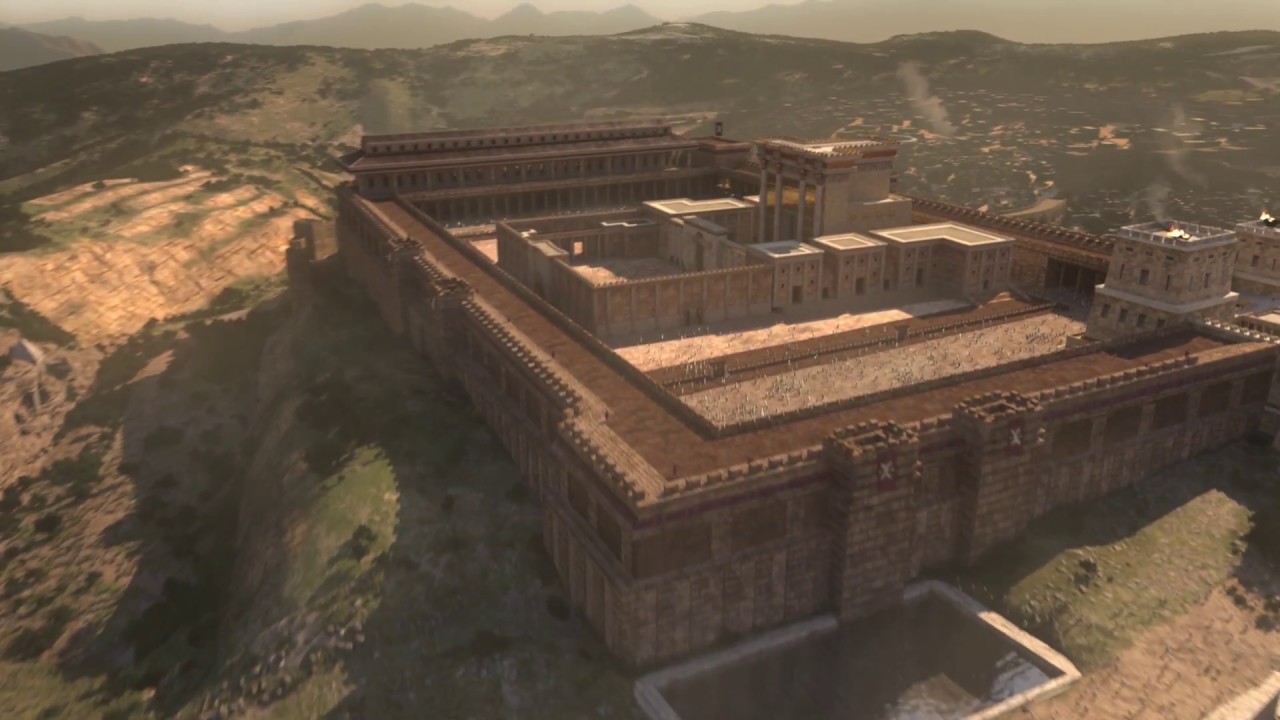
Solomon spared no expense in creating this “house” for the God of Israel. He lined the walls and ceilings with imported cedar wood. He had the floors adorned with hand-crafted planks made from the finest cypress. He commissioned skilled craftsmen to carve doors made from olivewood. Following the pattern of the Tabernacle and the plans provided by his father, Solomon ensured that the temple featured a Holy Place and a Most Holy Place, also known as the Holy of Holies. Each of these rooms had special significance and purpose, and was designed to mirror the glory and greatness of God. Eight separate times, the author mentions the prominent use of solid gold in the construction. The entire building was filled with intricately carved reliefs featuring cherubim, palm trees, and open flowers.

This structure was meant to be a feast for the eyes. It was designed to create a virtual overload on the senses, drawing the attention of the onlooker upward and inward, into the inner recesses of the Most Holy Place where the Ark of the Covenant and the Mercy Seat of God were located. Everything about the building was meant to be symbolic or representative of a greater reality. This was intended to be the dwelling place of God on earth, and Solomon did everything in his power to ensure that this building, though built with human hands, declared the incomparable greatness of God.

For nearly seven and a half years, Solomon oversaw and underwrote this ambitious project. He poured countless hours into its planning. He spent endless days orchestrating all the details surrounding its construction and allocated vast sums of money to see that, when it was finally completed, it would be without equal. This was not a side project for Solomon. While he still had a kingdom to run, he never allowed the Temple to become a second-tier priority. Although he likely delegated many of the responsibilities related to its construction, he always maintained control over every aspect of its creation.

This was a labor of love that reveals Solomon’s determination to honor the God of his father. However, it also demonstrates Solomon’s own dedication to glorifying the God of Israel by constructing the finest Temple that money could afford and human ingenuity could create. Solomon wanted this to be a showplace, not to stroke his own ego, but to exalt Yahweh as the one true God. It was to be a house fit for a King – the King of the universe. Solomon’s unwavering determination to spare no expense in its construction reflects his grasp of Yahweh’s unparalleled supremacy. Ultimately, he knew that his efforts to construct a house worthy of God would prove woefully inadequate because, like the psalmist, he understood the incomparable nature of its occupant.

O LORD my God, how great you are!
    You are robed with honor and majesty.
    You are dressed in a robe of light.
You stretch out the starry curtain of the heavens;
    you lay out the rafters of your home in the rain clouds.
You make the clouds your chariot;
    you ride upon the wings of the wind.
The winds are your messengers;
    flames of fire are your servants. – Psalm 104-1-4 NLT

Solomon did everything he could to create an earthly dwelling place that was worthy of the incomparable and transcendent God of the universe. For seven years, he spared no expense and drove his workers relentlessly to ensure that the final product would be acceptable to God. Yet, despite all his efforts, Solomon knew that no structure built by flawed human hands would ever measure up to God’s glorious standards. In his prayer of dedication for the completed Temple, Solomon admitted that his grand “house,” while a sight to behold, was sorely inadequate to serve as Yahweh’s dwelling place.

“But will God really live on earth? Why, even the highest heavens cannot contain you. How much less this Temple I have built! – 1 Kings 8:27 NLT

Solomon was a realist. He knew from the moment his father assigned him the task of building the Temple that he was faced with an impossible assignment. When he contracted with King Hiram of Tyre to supply all the lumber for the project, he admitted, “This must be a magnificent Temple because our God is greater than all other gods. But who can really build him a worthy home? Not even the highest heavens can contain him! So who am I to consider building a Temple for him, except as a place to burn sacrifices to him?” (2 Chronicles 2:5-6 NLT). 

Solomon seemed to understand that the Temple would serve as a focal point of Israel’s worship, providing a tangible and visible place where heaven and earth met. In his prayer of dedication, he expresses his understanding that the Temple was meant to serve as a lifeline to Yahweh.

“May you hear the humble and earnest requests from me and your people Israel when we pray toward this place. Yes, hear us from heaven where you live, and when you hear, forgive. – 1 Kings 8:30 NLT

Solomon was under no delusion that Yahweh would actually take up residence in the Temple. As he repeatedly makes clear in his prayer of dedication, the Temple was built to honor God’s name. It was an earthly structure dedicated solely to Yahweh and set apart for worshiping Him alone. As long as it stood, it would draw the people of God into His presence and focus their attention on His glory, righteousness, holiness, and power. The Temple was to be a tangible reminder of Yahweh’s unrivalled majesty and perfection. It was intended to be a dim reflection of God’s glorious heavenly throne room.

In the Book of Revelation, the apostle John attempted to record his vision of the throne room of God in heaven. Hampered by the limits of human language, John did his best to describe the indescribable.

“Come up here, and I will show you what must happen after this.” And instantly I was in the Spirit, and I saw a throne in heaven and someone sitting on it. The one sitting on the throne was as brilliant as gemstones—like jasper and carnelian. And the glow of an emerald circled his throne like a rainbow. Twenty-four thrones surrounded him, and twenty-four elders sat on them. They were all clothed in white and had gold crowns on their heads. From the throne came flashes of lightning and the rumble of thunder. And in front of the throne were seven torches with burning flames. This is the sevenfold Spirit of God. In front of the throne was a shiny sea of glass, sparkling like crystal. – Revelation 4:1-6 NLT

This was what Solomon attempted to replicate with his construction of the Temple, but he never had the benefit of seeing what John saw. Left to his imagination, he filled the Temple with expensive wood, precious metals, and elaborate stonework. He patterned it after the plans for the Tabernacle and included images of gourds, flowers, palm trees, and cherubim, angelic beings involved in the worship and praise of God. Everything was intended to accentuate and illustrate the glory of God. It was an earthly building meant to mirror a heavenly reality that was beyond human comprehension.

Yahweh was great and greatly to be praised. His name was worthy of honor and glory. His power was incomparable, and His majesty was unmatched by anything in the universe. The Temple was meant to reflect God’s greatness, and Solomon spent seven years and untold riches seeing that it would be a house worthy of bearing Yahweh’s name.

English Standard Version (ESV) The Holy Bible, English Standard Version. ESV® Permanent Text Edition® (2016). Copyright © 2001 by Crossway Bibles, a publishing ministry of Good News Publishers.

New Living Translation (NLT) Holy Bible, New Living Translation, copyright © 1996, 2004, 2015 by Tyndale House Foundation. Used by permission of Tyndale House Publishers Inc., Carol Stream, Illinois 60188. All rights reserved.

Praise God for Who He is, Not Just For What He Has Done

1 Praise the LORD!
Praise God in his sanctuary;
    praise him in his mighty heavens!
Praise him for his mighty deeds;
    praise him according to his excellent greatness!

Praise him with trumpet sound;
    praise him with lute and harp!
Praise him with tambourine and dance;
    praise him with strings and pipe!
Praise him with sounding cymbals;
    praise him with loud clashing cymbals!
Let everything that has breath praise the LORD!
Praise the LORD! – Psalm 150:1-6 ESV

After 150 entries, the psalter comes to a close and a crescendo with this relatively short but emphatic psalm that contains 13 calls to praise Yahweh for His transcendence, mighty deeds, and excellent greatness. This psalm contains a simple message delivered in a rapid-fire form that leaves no question as to the author’s feelings about his God.

He views Yahweh through awe-inspired eyes and doesn’t even bother to provide specific reasons for his relentless calls for unbridled praise. For him, Yahweh’s praiseworthiness required no explanation or basis of proof. He felt no compulsion to defend Yahweh’s honor or elaborate on His praiseworthy attributes or actions. What other being occupied the holy sanctuary located in the heavenly realm? While the psalmist had never seen Yahweh’s throneroom, he had read descriptions of its glory and majestic splendor from the pages of Scripture.

It was in the year King Uzziah died that I saw the LORD. He was sitting on a lofty throne, and the train of his robe filled the Temple. Attending him were mighty seraphim, each having six wings. With two wings they covered their faces, with two they covered their feet, and with two they flew. They were calling out to each other,

“Holy, holy, holy is the LORD of Heaven’s Armies!
    The whole earth is filled with his glory!”

Their voices shook the Temple to its foundations, and the entire building was filled with smoke. – Isaiah 6:1-4 NLT

The prophet Isaiah was so shaken by this vision of Yahweh in His heavenly throneroom that he responded, “It’s all over! I am doomed, for I am a sinful man. I have filthy lips, and I live among a people with filthy lips. Yet I have seen the King, the LORD of Heaven’s Armies” (Isaiah 6:5 NLT). 

The prophet Ezekiel was also given a similar, virtually indescribable glimpse of Yahweh in all His glory.

On July 31 of my thirtieth year, while I was with the Judean exiles beside the Kebar River in Babylon, the heavens were opened and I saw visions of God.… – Ezekiel 1:1 NLT

He saw a great storm that glowed with fire and emanated flashes of lightning. This spectacular display of divine power was accompanied by the appearance of “four living beings that looked human, except that each had four faces and four wings” (Ezekiel 1:5-6 NLT). These strange-looking creatures “looked like bright coals of fire or brilliant torches, and lightning seemed to flash back and forth among them. And the living beings darted to and fro like flashes of lightning” (Ezekiel 1:13-14 NLT). 

As they flew, their wings sounded to me like waves crashing against the shore or like the voice of the Almighty or like the shouting of a mighty army. When they stopped, they let down their wings.  As they stood with wings lowered, a voice spoke from beyond the crystal surface above them. – Ezekiel 1:24-25 NLT

This incredible scene must have left Ezekiel in a state of awestruck wonder. He had difficulty putting into words what he saw, and his description takes on a surreal and distinctively ethereal tone. It seems far-fetched and out of this world. But Ezekiel wasn’t fabricating this scene; it was a divinely inspired vision of Yahweh in His heavenly sanctuary. In his limited human vocabulary, Ezekiel described seeing a surface that glittered like crystal.

Above this surface was something that looked like a throne made of blue lapis lazuli. And on this throne high above was a figure whose appearance resembled a man. From what appeared to be his waist up, he looked like gleaming amber, flickering like a fire. And from his waist down, he looked like a burning flame, shining with splendor. All around him was a glowing halo, like a rainbow shining in the clouds on a rainy day. This is what the glory of the Lord looked like to me. When I saw it, I fell face down on the ground, and I heard someone’s voice speaking to me. – Ezekiel 1:26-28 NLT

Daniel also provided his own first-person description of Yahweh in all His heavenly glory.

I watched as thrones were put in place
    and the Ancient One sat down to judge.
His clothing was as white as snow,
    his hair like purest wool.
He sat on a fiery throne
    with wheels of blazing fire,
and a river of fire was pouring out,
    flowing from his presence.
Millions of angels ministered to him;
    many millions stood to attend him.
Then the court began its session,
    and the books were opened. – Daniel 7:9-10 NLT

These incredible depictions of Yahweh are the desperate attempts of mortal men trying to use human language to describe the inconceivable and inexpressible. The apostle John had a similar experience when he was given his own vision into the heavenly realm. In his case, he was privileged to see his resurrected Lord and Savior, Jesus Christ.

When I turned to see who was speaking to me, I saw seven gold lampstands. And standing in the middle of the lampstands was someone like the Son of Man. He was wearing a long robe with a gold sash across his chest. His head and his hair were white like wool, as white as snow. And his eyes were like flames of fire. His feet were like polished bronze refined in a furnace, and his voice thundered like mighty ocean waves. He held seven stars in his right hand, and a sharp two-edged sword came from his mouth. And his face was like the sun in all its brilliance.

When I saw him, I fell at his feet as if I were dead. – Revelation 1:12-17 NLT

John had no difficulty recognizing his former Rabbi, teacher, and friend, but he saw him in a whole new light and from a dramatically different perspective. His vision of Jesus left him awestruck and speechless.

In chapter four of the Book of Revelation, John records another vision he received, this one of the throneroom of God.

I saw a throne in heaven and someone sitting on it. The one sitting on the throne was as brilliant as gemstones—like jasper and carnelian. And the glow of an emerald circled his throne like a rainbow.From the throne came flashes of lightning and the rumble of thunder. – Revelation 4:2-3, 5 NLT

In front of the throne, John saw the same “living creatures” that Ezekiel described. But John adds an important detail.

Day after day and night after night they keep on saying,

“Holy, holy, holy is the Lord God, the Almighty—
    the one who always was, who is, and who is still to come.” – Revelation 4:8 NLT

Accompanying these praise-singing creatures were 24 elders who fell down before the throne and worshiped, saying, “You are worthy, O Lord our God, to receive glory and honor and power. For you created all things, and they exist because you created what you pleased” (Revelation 4:11 NLT).

The psalmist begins his song by properly locating Yahweh in His heavenly realm. Yahweh is “in his sanctuary…in his mighty heavens” (Psalm 150:1 ESV). The psalmist’s depiction was not meant to make Yahweh unapproachable or distant, but to remind his audience of Yahweh’s transcendence, holiness, and distinctiveness. The “otherness” of God should never be taken lightly.  He is worthy to receive glory, honor, and power. That is why the 24 elders took off their crowns and laid them before the throne of God. That is why the four living creatures declare God’s glory “day after day and night after night” (Revelation 4:8 NLT). 

They say familiarity breeds contempt. But over-familiarity with God can produce a far worse outcome. In humanity’s desperate attempt to make God approachable and knowable, He becomes less God than a slightly improved version of man. We tend to reduce the Almighty’s glory so we can feel more comfortable in His presence. But John fell at Christ’s feet as if dead. When Ezekiel saw the glory of God, he fell to his face in fear. Isaiah put words to his encounter with the Almighty.

“It’s all over! I am doomed, for I am a sinful man. I have filthy lips, and I live among a people with filthy lips. Yet I have seen the King, the LORD of Heaven’s Armies.” – Isaiah 6:5 NLT

The psalmist’s call for praise was predicated on an awareness of Yahweh’s splendor, majesty, glory, transcendence, and holiness. Proper praise begins with a proper perspective. That is what the psalmist meant when he wrote, “praise his unequaled greatness” (Psalm 150:2 NLT). When the psalmist speaks of Yahweh’s mighty deeds, he provides no specifics. He doesn’t bother to give examples because all that Yahweh does is mighty and beyond compare. 

What the psalmist calls for is unapologetic, full-throated, heartfelt, and boisterous praise that knows no bounds because Yahweh has no equal and deserves the praises of His people. It was David who said of Yahweh, “You are holy, enthroned on the praises of Israel” (Psalm 21:3 NLT). The Hebrew word translated as “enthroned” is yāšaḇ, which means “to dwell, inhabit, sit or abide.” In a sense, God inhabits the praises of His people. In other words, when people offer sincere and heartfelt praise to God, He manifests His presence among them. The transcendent God becomes immanent. He draws near. 

That is the message of this psalm. The unidentified author calls his audience to sing Yahweh’s praises so that they might better experience His abiding presence. They were to use every means at their disposal to enhance their praise, including lyres, harps, tambourines, strings, flutes, cymbals, and even dancing. They were to hold nothing back in their impassioned praise of Yahweh’s glory and greatness. This psalm portrays equal measures of intentionality and intensity. Thirteen times, the psalmist calls for praise, but he goes out of his way to ensure that the praise comes from the heart and is based on an awareness of God’s unquestionable worthiness.

Let everything that breathes sing praises to the LORD! Praise the LORD! – Psalm 150:6 NLT

Father, what better way to end the psalter than with a call to praise You. Too often, I reserve my praise of You for those times when I think You have done something praiseworthy. In other words, I wait until I have something to praise You for. But You are praiseworthy all the time because of who You are, not just for what You do. The psalmist provides no examples of praiseworthy acts on Your part. He doesn’t mention Your creation of the heavens and earth. He doesn’t point out Your past acts of deliverance. He simply states, “Praise the LORD!” That is how I want to live my life. I desire to praise You, not for what You’ve done but for who You are. When I praise You for Your character, I am focusing on what really matters. When I praise You for the good things You have done for me, I tend to focus on the gift rather than the Giver. Show me how to praise You properly and, like the four living creatures, regularly. Because You are worthy. Amen

English Standard Version (ESV) The Holy Bible, English Standard Version. ESV® Permanent Text Edition® (2016). Copyright © 2001 by Crossway Bibles, a publishing ministry of Good News Publishers.

New Living Translation (NLT) Holy Bible, New Living Translation, copyright © 1996, 2004, 2015 by Tyndale House Foundation. Used by permission of Tyndale House Publishers Inc., Carol Stream, Illinois 60188. All rights reserved.

Beyond Compare

Of David.

1 Blessed be the LORD, my rock,
    who trains my hands for war,
    and my fingers for battle;
he is my steadfast love and my fortress,
    my stronghold and my deliverer,
my shield and he in whom I take refuge,
    who subdues peoples under me.

O LORD, what is man that you regard him,
    or the son of man that you think of him?
Man is like a breath;
    his days are like a passing shadow.

Bow your heavens, O LORD, and come down!
    Touch the mountains so that they smoke!
Flash forth the lightning and scatter them;
    send out your arrows and rout them!
Stretch out your hand from on high;
    rescue me and deliver me from the many waters,
    from the hand of foreigners,
whose mouths speak lies
    and whose right hand is a right hand of falsehood.

I will sing a new song to you, O God;
    upon a ten-stringed harp I will play to you,
10 who gives victory to kings,
    who rescues David his servant from the cruel sword.
11 Rescue me and deliver me
    from the hand of foreigners,
whose mouths speak lies
    and whose right hand is a right hand of falsehood.

12 May our sons in their youth
    be like plants full grown,
our daughters like corner pillars
    cut for the structure of a palace;
13 may our granaries be full,
    providing all kinds of produce;
may our sheep bring forth thousands
    and ten thousands in our fields;
14 may our cattle be heavy with young,
    suffering no mishap or failure in bearing;
may there be no cry of distress in our streets!
15 Blessed are the people to whom such blessings fall!
    Blessed are the people whose God is the LORD! – Psalm 144:1-15 ESV

Perspective can be an elusive thing. It is easy to have a one-dimensional view of life and its surrounding circumstances. We can end up seeing things from our point of view and lose sight of reality, easily viewing ourselves as somehow special, our talents as genuinely unique, and our inherent value as greater than it really is.

For David, God provided a different and more accurate perspective on life. He found Yahweh to be the central focus of all life and meaning. He was the creator and sustainer of life. The world exists for Him and not the other way around. He was the one who conceived the idea of humanity and then brought it to life. David was blown away that this all-powerful God would even bother to waste a single second dealing with the likes of men. The Message paraphrases verse three quite clearly and frankly: “I wonder why you care, GOD – why do you bother with us at all?”

This psalm is an amalgam of thoughts borrowed from other psalms written by David, including Psalm 18. He begins with a series of one-word descriptions that reflect his experience with Yahweh. He refers to Yahweh as his rock, ally, fortress, tower, rescuer, shield, and refuge. Each of these terms carries a military connotation, revealing David’s background as a warrior and king. In his experience, he has found Yahweh to be a powerful ally and reliable source of safety, security, and strength.

As David surveyed his life, he could recount the many ways Yahweh had not only prepared him for the conflicts of life, but had also protected and preserved him in the midst of them. Yahweh served as David’s instructor, training him for battle and equipping him with the skills he would need to gain the upper hand over his enemies. However, when things didn’t go quite the way David expected, he found Yahweh to be a source of comfort and refuge —a place to regroup and recover for the fight ahead. Yahweh was like a strong tower or fortress that David could return to when the battle took a turn for the worse.

David found the thought of Yahweh’s intimate interactions with him to be unfathomable. He was grateful but legitimately perplexed that the God of the universe would waste any time thinking about him.

Man is like a breath;
    his days are like a passing shadow. – Psalm 144:4 ESV

“O LORD, make me know my end
    and what is the measure of my days;
    let me know how fleeting I am!
Behold, you have made my days a few handbreadths,
    and my lifetime is as nothing before you.
Surely all mankind stands as a mere breath! – Psalm 39:4-5 ESV

As for man, his days are like grass;
    he flourishes like a flower of the field;
for the wind passes over it, and it is gone,
    and its place knows it no more. – Psalm 103:15-16 ESV

David had a healthy perspective of life because he had an accurate view of God. He understood the greatness of God and the pitifully powerless condition of man. This king, who ruled over a rapidly expanding nation, did not allow his victories and vast empire to go to his head. When compared with Yahweh, he was nothing, and his kingdom was impotent and unimpressive when likened to the heavenly domain of the Almighty. David could muster human forces to fight his battles, but Yahweh was equipped with supernatural resources that no physical army could stand against.

Open the heavens, Lord, and come down.
    Touch the mountains so they billow smoke.
Hurl your lightning bolts and scatter your enemies!
    Shoot your arrows and confuse them!
Reach down from heaven and rescue me… – Psalm 144:5-7 NLT

David could look back over his life and see the evidence of Yahweh’s handiwork. There were so many instances David could recall where Yahweh had snatched victory from the jaws of defeat. Losing battles had been transformed into triumphant celebrations because Yahweh had shown up at just the right time and done what only He could do. These unexpected outcomes led David to praise Yahweh.

I will sing a new song to you, O God!
    I will sing your praises with a ten-stringed harp.
For you grant victory to kings!
    You rescued your servant David from the fatal sword. – Psalm 144:9-10 NLT

And these past victories led David to pray for more of the same in the future.

Save me!
    Rescue me from the power of my enemies. – Psalm 144:11 NLT

David lived dependent on God — gladly and willingly. He viewed God as his rock, his source of stability and strength. He saw God as his personal trainer and reliable ally. When David ran into trouble, Yahweh was who David ran to for help, hope, and healing. He didn’t become too full of himself or let his position, possessions, or power distort his perspective on life. He knew he needed Yahweh at all times and in every way. His strength came from Yahweh. His victories were due to Yahweh. His rescue from trouble was totally up to Yahweh. His success or failure was in Yahweh’s hands. His present prosperity and future posterity were up to Yahweh. Which is why he could say, “Yes, joyful are those who live like this! Joyful indeed are those whose God is the Lord” (Psalm 144:15 NLT).

Living with a clear perspective of life and Yahweh’s role in it is essential to experiencing joy. When we understand who God is, we will gladly place our hope on Him, and refuse to see ourselves as more than what we are — mere mortals. A God-focused perspective can bring peace even amid difficulty, hope in the face of heartache, and confidence even when surrounded by confusion and chaos. A healthy perspective of God gives us a healthy view of life.

David closed his psalm with a hopeful and heartfelt prayer that reflects his understanding of Yahweh’s supremacy and man’s dependency. David understood that life on this planet was a gracious gift from God and that any hope of future blessings, fruitfulness, victory, or peace came from Him alone.

May our sons flourish in their youth
    like well-nurtured plants.
May our daughters be like graceful pillars,
    carved to beautify a palace.
May our barns be filled
    with crops of every kind.
May the flocks in our fields multiply by the thousands,
    even tens of thousands,
    and may our oxen be loaded down with produce.
May there be no enemy breaking through our walls,
    no going into captivity,
    no cries of alarm in our town squares. – Psalm 144:12-14 NLT

Father, it is amazing that You, the God of the universe, would take time to even think about me, a mere man. But You do. You created me, care for me, sent Your Son to die for me, and You have a plan that includes me. You are great, powerful, holy, sinless, righteous, and yet You choose to care for me. Thank You! Amen

English Standard Version (ESV) The Holy Bible, English Standard Version. ESV® Permanent Text Edition® (2016). Copyright © 2001 by Crossway Bibles, a publishing ministry of Good News Publishers.

New Living Translation (NLT) Holy Bible, New Living Translation, copyright © 1996, 2004, 2015 by Tyndale House Foundation. Used by permission of Tyndale House Publishers Inc., Carol Stream, Illinois 60188. All rights reserved.

Singing God’s Praises

A Prayer of Moses, the man of God.

1 Lord, you have been our dwelling place
    in all generations.
Before the mountains were brought forth,
    or ever you had formed the earth and the world,
    from everlasting to everlasting you are God.

You return man to dust
    and say, “Return, O children of man!”
For a thousand years in your sight
    are but as yesterday when it is past,
    or as a watch in the night.

You sweep them away as with a flood; they are like a dream,
    like grass that is renewed in the morning:
in the morning it flourishes and is renewed;
    in the evening it fades and withers.

For we are brought to an end by your anger;
    by your wrath we are dismayed.
You have set our iniquities before you,
    our secret sins in the light of your presence.

For all our days pass away under your wrath;
    we bring our years to an end like a sigh.
10 The years of our life are seventy,
    or even by reason of strength eighty;
yet their span is but toil and trouble;
    they are soon gone, and we fly away.
11 Who considers the power of your anger,
    and your wrath according to the fear of you?

12 So teach us to number our days
    that we may get a heart of wisdom.
13 Return, O LORD! How long?
    Have pity on your servants!
14 Satisfy us in the morning with your steadfast love,
    that we may rejoice and be glad all our days.
15 Make us glad for as many days as you have afflicted us,
    and for as many years as we have seen evil.
16 Let your work be shown to your servants,
    and your glorious power to their children.
17 Let the favor of the LORD our God be upon us,
    and establish the work of our hands upon us;
    yes, establish the work of our hands! Psalm 90:1-17 ESV

This psalm is attributed to Moses, making it the oldest of all the psalms recorded in the Psalter. In this eloquent prayer, Moses addresses God’s faithfulness by focusing on His eternality. He is the ever-present Creator God who not only formed the universe but also faithfully cares for it.

For Moses, God’s eternal nature was a comfort and a concern. He knew God personally and had spent countless hours on top of Mount Sinai receiving instructions to pass on to the people of Israel. Moses had performed miracles in the power of God. He stood before Pharaoh and spoke on behalf of God. This former murderer and sheep herder had delivered the people of God from their slavery in Egypt and then led them across the wilderness to Canaan. During the 40 years he served as Israel’s guide, judge, and counselor, Moses saw the power of God on display. He had witnessed God destroy the Egyptian army at the Red Sea. But he had also seen God punish His own people for their disobedience. The Almighty was a force to be reckoned with and not taken lightly or treated flippantly.

You sweep people away like dreams that disappear.
    They are like grass that springs up in the morning.
In the morning it blooms and flourishes,
    but by evening it is dry and withered. – Psalm 90:5-6 NLT

Moses had observed firsthand the wrath of God. He had been an eyewitness to God’s destruction of Korah and his co-conspirators (Numbers 16:1-40). He had seen God consume Aaron’s disobedient sons with fire (Leviticus 10:1-20). He was forced to stand back and watch as God inflicted his sister Miriam with leprosy (Numbers 12:1-10). From his perspective, God’s power was awe-inspiring and fear-producing.

We wither beneath your anger;
    we are overwhelmed by your fury.
You spread out our sins before you—
    our secret sins—and you see them all.
We live our lives beneath your wrath,
    ending our years with a groan. – Psalm 90:7-9 NLT

Moses began his ministry of deliverance at the age of 40 and served another 40 years as Israel’s God-appointed leader. During that time, he experienced all the ups and downs that come with leadership. He was constantly questioned, doubted, accused, ignored, and blamed. He endured a failed coup attempt. His leadership skills were ridiculed, his sense of direction was questioned, and his calling by God was regularly doubted by those he was supposed to lead. So, by the time he reached his seventies, Moses was a worn-out, doubt-filled man who struggled with a lack of confidence and a fear of failure.

Seventy years are given to us!
    Some even live to eighty.
But even the best years are filled with pain and trouble;
    soon they disappear, and we fly away. – Psalm 90:10 NLT

Moses had been reluctant to serve as God’s deliverer, but now that he had spent nearly half his life attempting to lead a stubborn people to the “land of promise,” he was worn out and questioning God’s reliability and his own competency. He felt alone and deserted. The people fought him at every turn, and it appeared as if God had abandoned him somewhere along the way.

O LORD, come back to us!
    How long will you delay?
    Take pity on your servants! – Psalm 90:13 NLT

Leading God’s people was difficult work and came with few perks. Moses didn’t receive many thanks or commendations along the way. The people were always quick to complain but rarely expressed gratitude for his selfless service. He labored and toiled without pay and little in the way of remuneration for his efforts. In his weariness and depression, Moses called out to God and begged for His intervention.

Satisfy us each morning with your unfailing love,
    so we may sing for joy to the end of our lives.
Give us gladness in proportion to our former misery!
    Replace the evil years with good. – Psalm 90:14-15 NLT

When Moses received his calling from God on Mount Sinai, he had been reluctant to accept God’s commission. He felt he was the wrong man for the job and was ill-equipped to pull off such a daunting task. But God assured him, “I will be with you” (Exodus 3:12 NLT). Yahweh would go with him and before him. The great Creator God would lead the way and provide Moses all the power he needed to accomplish his mission. 

But decades later, Moses was running out of steam and losing motivation. The journey had taken much longer than expected, and the people of Israel proved to be far more stubborn and difficult to lead than Moses could have imagined. Yes, there had been victories along the way. God had stepped in and provided manna and quail when the people grew hungry. He had provided water when the people’s thirst caused them to complain. During their years wandering in the wilderness, their clothes and sandals had not worn out. Yahweh had provided for all their needs.

But as the people neared the end of their journey and Moses approached the end of his life, he was begging God to show up yet again. He desperately desired to see Yahweh demonstrate His power and display His glory one more time.

Let us, your servants, see you work again;
    let our children see your glory.
And may the Lord our God show us his approval
    and make our efforts successful.
    Yes, make our efforts successful! – Psalm 90:16-17 NLT

This song of Moses stands in stark contrast to another song he wrote decades earlier. Immediately after the miraculous crossing of the Red Sea, Moses penned the following words:

“I will sing to the Lord,
    for he has triumphed gloriously;
he has hurled both horse and rider
    into the sea.
The Lord is my strength and my song;
    he has given me victory.
This is my God, and I will praise him—
    my father’s God, and I will exalt him!
The Lord is a warrior;
    Yahweh is his name!
Pharaoh’s chariots and army
    he has hurled into the sea.
The finest of Pharaoh’s officers
    are drowned in the Red Sea.” – Exodus 15:1-4 NLT

Moses was stoked. His excitement was palpable and contagious. He had seen God perform an epic miracle, and he wanted everyone to know about it. But by the time we get to Psalm 90, Moses is a much older and wilderness-wearied man who had long forgotten the miracle of the Red Sea. For Moses, his best days were in the rearview mirror. The future was unsure, and the presence of God was in question.

But there is yet another song that Moses wrote. It came near the end of his life as he prepared to turn over the reins of leadership to Joshua. Moses was 80 years old and had spent half his life guiding the people of Israel from Egypt to Canaan. But despite his age, Moses was far from weak and not the least bit pessimistic. It is almost as if his prayer in Psalm 90 had been answered. Even in old age, he had a renewed sense of faith and hope in Yahweh.

“Listen, O heavens, and I will speak!
    Hear, O earth, the words that I say!
Let my teaching fall on you like rain;
    let my speech settle like dew.
Let my words fall like rain on tender grass,
    like gentle showers on young plants.
I will proclaim the name of the Lord;
    how glorious is our God!
He is the Rock; his deeds are perfect.
    Everything he does is just and fair.
He is a faithful God who does no wrong;
    how just and upright he is!

“But they have acted corruptly toward him;
    when they act so perversely,
are they really his children?
    They are a deceitful and twisted generation.
Is this the way you repay the Lord,
    you foolish and senseless people?
Isn’t he your Father who created you?
    Has he not made you and established you?” – Deuteronomy 32:1-6 NLT

Even as he anticipated his death, Moses expressed his faith in Yahweh. His days had been numbered by God, and the end was near. Yet, Moses was not bitter or disappointed. He did not moan about his lot in life or express frustration over his inability to enter the land of promise with the rest of the Israelites.

No, Moses encouraged the people of Israel to remember God for who He was and for all that He had done. He also reminded them to own their own rebellion and recognize their unfaithfulness to God. Over the last 40 years, Yahweh had given them what they deserved but had also showered them with unmerited favor and grace. They were about to enter the land of promise and enjoy all the blessings of Yahweh, and Moses wanted them to know that obedience would be a non-negotiable requirement.

So, he ended his last song with a call to rejoice in the Lord. He wanted the people of Israel to acknowledge God’s goodness and greatness.

“Rejoice with him, you heavens,
    and let all of God’s angels worship him.
Rejoice with his people, you Gentiles,
    and let all the angels be strengthened in him.
For he will avenge the blood of his children;
    he will take revenge against his enemies.
He will repay those who hate him
    and cleanse his people’s land.” – Deuteronomy 32:43 NLT

Three songs written by the same man. But the greatest of the three is the last one because it reflects the faithfulness of a man who spent 80 years serving and worshiping Yahweh. As he approached the end of his life, he could still sing God’s praises and call the people of Israel to remain faithful.

Father, it is so easy to lose sight of Your faithfulness. Sometimes we can look back and see Your acts of power and mercy. But other times, we tend to forget and allow our thinking to become clouded and memories to become blurred. But You are always faithful. Your goodness and greatness never fade or falter. Your love remains the same no matter the circumstances. I want to be able to sing Your praises and I want to do so more loudly and joyously the older I get. May I have the perspective of Moses and be able to look back on my life and see Your handiwork woven throughout the fabric of my existence – from beginning to end. Because You are forever faithful. Amen

English Standard Version (ESV) The Holy Bible, English Standard Version. ESV® Permanent Text Edition® (2016). Copyright © 2001 by Crossway Bibles, a publishing ministry of Good News Publishers.

New Living Translation (NLT) Holy Bible, New Living Translation, copyright © 1996, 2004, 2015 by Tyndale House Foundation. Used by permission of Tyndale House Publishers Inc., Carol Stream, Illinois 60188. All rights reserved.

Fools and the Faithless

To the choirmaster. Of David.

1 The fool says in his heart, “There is no God.”
    They are corrupt, they do abominable deeds;
    there is none who does good.

The Lord looks down from heaven on the children of man,
    to see if there are any who understand,
    who seek after God.

They have all turned aside; together they have become corrupt;
    there is none who does good,
    not even one.

Have they no knowledge, all the evildoers
    who eat up my people as they eat bread
    and do not call upon the Lord?

There they are in great terror,
    for God is with the generation of the righteous.
You would shame the plans of the poor,
    but the Lord is his refuge.

Oh, that salvation for Israel would come out of Zion!
    When the Lord restores the fortunes of his people,
    let Jacob rejoice, let Israel be glad. Psalm 14:1-7 ESV

This Psalm is virtually a mirror copy of Psalm 53. Both are attributed to David and their slight variations may indicate that they were penned at different times in David’s life. They reflect David’s somewhat pessimistic yet thoroughly accurate outlook on humanity. From his unique vantage point as king, he views the world through the eyes of a God-appointed authority figure who must deal with people from all walks of life. He has the citizens over which he rules and the nations with whom he must broker peace agreements or do battle. In his role as king, David was admired by some and hated by others. He was looked up to and depended upon by his people, but there were always those who conspired to take him down. Every day, he witnessed the best and worst of humanity and his assessment was less than flattering.

The Lord looks down from heaven
    on the entire human race;
he looks to see if anyone is truly wise,
    if anyone seeks God.
But no, all have turned away;
    all have become corrupt.
No one does good,
    not a single one! – Psalm 14:2-3 NLT

For David, there were two types of people in the world: Fools and the faithless. According to David, the fool was marked by a rejection of God.

Only fools say in their hearts,
    “There is no God.” – Psalm 14:1 NLT

David used the Hebrew word, nāḇāl, which refers to someone who is senseless and has no perception of ethical and religious claims. Their lack of common sense and moral awareness of divine authority causes them to live depraved and self-consumed lives. David describes them as corrupt and prone to committing acts of evil all the time. Nothing they do is good or godly.

This is the most dangerous type of fool because they are stubborn and unteachable. A stubborn fool rejects God and His ways. He is self-confident and closed-minded and serves as his own god, freely gratifying his sinful nature. His goal is to entice others into following his ways. Only God can reprove a stubborn fool.

But while David doesn’t classify all men as fools, he does suggest that they all act foolishly. According to him, no one is wise or seeks after God. The Almighty scans humanity for any sign of wisdom or insight, to see if anybody really wants to worship and obey Him. And His conclusion? Every single person has rebelled against Him. As a race, they are morally filthy. Nobody does what God wants them to do. Not a single soul!

That’s a bleak assessment by any standard. But David was an avid student of humanity, and he had seen the best and worst that men have to offer. His conclusion was that fools and the faithless were everywhere. There were some who lived as if God didn’t exist and others who claimed belief in God but whose behavior didn’t measure up. Either way, they harmed God’s people and damaged His reputation. For David, that was unacceptable and worthy of God’s judgment.

Despite his pessimistic outlook, David maintained his faith in God. He knew that God was aware of the conditions on earth and would deal with the fools and the faithless in a just and timely manner. While these individuals chose to reject God’s existence or presence, David believed that God would not allow them to get away with their behavior indefinitely.

Terror will grip them,
    for God is with those who obey him.
The wicked frustrate the plans of the oppressed,
    but the Lord will protect his people. – Psalm 14:5-6 NLT

The world is full of fools – those individuals who act and live as if there is no God. Even those who claim to know Him act as if He doesn’t care about what they do or is too powerless to do anything about it. Then some just refuse to believe in Him altogether. These people “are corrupt, and their actions are evil; not one of them does good!” (Psalm 14:1 NLT). From God’s perspective, man is inherently wicked and in open rebellion against Him. Yet God is still reaching out to man, offering His mercy and forgiveness. He will ultimately be forced to punish all those who refuse to accept His offer of new life through His Son, but until then, He keeps providing opportunities for them to repent and return to Him.

While the world is a less-than-ideal place, full of people obsessed with their own agendas, consumed by their own importance, and controlled by their sinful natures, David gives us a glimpse of God’s goodness as he reminds us that God is always there, even amid all the evil that surrounds us. David put it this way in Psalm 54:

But God is my helper.
    The Lord keeps me alive! – Psalm 54:4 NLT

David appealed to God’s power and placed himself at God’s mercy to rescue him from his enemies. Those who care nothing for God were making David’s life miserable, but he knew he could call out to God, and not only would his prayer be heard, but it would be answered.

David had seen the goodness of God time and time again in his life, delivering him from troubles and trials, and rescuing him from every conceivable kind of predicament. While he firmly believes that “no one does good, not a single one,” David knows that God can and does do good for those who love Him. That is why he boldly states, “the Lord will protect his people” (Psalm 14:6 NLT). Despite his negative view of humanity, David had a deep and abiding trust in God’s divinity. He knew that God was the one true King who ruled over the universe. Nothing escaped God’s notice. The fools and the faithless all have to answer to the sovereign God who reigns in justice and truth.

So David ends his Psalm with a prayer of hopeful anticipation.

Oh, that salvation for Israel would come out of Zion!
    When the Lord restores the fortunes of his people,
    let Jacob rejoice, let Israel be glad. – Psalm 14:7 NLT

All that God does is good, even when He has to deal with those who are bad. God is just and righteous, and can be trusted to do the right thing at the right time – each and every time. He never does wrong. He is just in all His actions towards men. He never punishes unjustly or unfairly. because He is good and gracious. It doesn’t matter whether men reject Him, ignore Him, or attempt to deny His existence. God remains good even when things appear bad.

Father, we live in a world that is sick and dying. It is filled with people who refuse to love and serve You. Many refuse to even believe in You. And yet, You remain good. You continue to make the sun shine on all men, showering them with Your common grace. You make the crops grow, the rain to fall, and the air breathable. You constantly offer the free gift of grace available through Your Son. And You care for Your own, providing them with a listening ear and a powerful hand to rescue and restore them. You are indeed a good God. Amen

English Standard Version (ESV) The Holy Bible, English Standard Version. ESV® Permanent Text Edition® (2016). Copyright © 2001 by Crossway Bibles, a publishing ministry of Good News Publishers.

New Living Translation (NLT) Holy Bible, New Living Translation, copyright © 1996, 2004, 2015 by Tyndale House Foundation. Used by permission of Tyndale House Publishers Inc., Carol Stream, Illinois 60188. All rights reserved.

The Glory of God

To the choirmaster: according to The Gittith. A Psalm of David.

1 O LORD, our Lord,
    how majestic is your name in all the earth!
You have set your glory above the heavens.
    Out of the mouth of babies and infants,
you have established strength because of your foes,
    to still the enemy and the avenger.

When I look at your heavens, the work of your fingers,
    the moon and the stars, which you have set in place,
what is man that you are mindful of him,
    and the son of man that you care for him?

Yet you have made him a little lower than the heavenly beings
    and crowned him with glory and honor.
You have given him dominion over the works of your hands;
    you have put all things under his feet,
all sheep and oxen,
    and also the beasts of the field,
the birds of the heavens, and the fish of the sea,
    whatever passes along the paths of the seas.

O LORD, our Lord,
    how majestic is your name in all the earth! Psalm 8:1-9 ESV

The opening description of this Psalm refers to the “Gittith.” There is no consensus on the meaning of this Hebrew word but some have speculated that it relates to a Gittite harp. It is likely a musical notation meant to provide instructions concerning the song’s tempo or style. Perhaps it was meant to be played by the accompaniment of a certain instrument.

But while this notation is unclear as to its meaning, the Psalm itself is straightforward and impossible to miss. In eight short verses, David praises God’s glory and majesty. He opens his Psalm by using two of the primary names for God: LORD and Lord. The first is God’s personal name used by the Israelites alone. He is Yahweh, the ever-present God who has made an unbreakable covenant with His chosen people. He is also Adonai, the sovereign, all-powerful ruler of all creation, including His covenant people. The name of God figures prominently in this Psalm as David calls out to His majestic LORD and Lord.

But unlike the previous Psalms, this one is reverential rather than penitential. David is not petitioning Yahweh for anything. Instead, he glorifies God for His unparalleled greatness. He refers to God as “majestic” using the Hebrew word ‘adîr, which carries the idea of immensity, power, glory, might, and excellence.

David uses this rich and multifaceted word to describe the name of God. Having never seen God face to face, David can only speak of His name (šēm), which encompasses His reputation or fame. Everywhere David looked, he saw the evidence of God’s glory. It was visible and tangible, but you had to be able to recognize it all around you. This former shepherd could see it throughout the earth and even in the night sky.

O LORD, our Lord, your majestic name fills the earth!
    Your glory is higher than the heavens. – Psalm 8:1 NLT

Even children have the innate capacity to recognize God’s glory and greatness in the world around them. Jesus spoke of His Heavenly Father’s intention to make Himself knowable to the innocent and pure.

“O Father, Lord of heaven and earth, thank you for hiding these things from those who think themselves wise and clever, and for revealing them to the childlike. Yes, Father, it pleased you to do it this way! – Matthew 11:25-26 NLT

David’s awareness of God’s majesty revealed in the world around him produced a sense of humility and awe-struck wonder.

When I look at the night sky and see the work of your fingers—
    the moon and the stars you set in place—
what are mere mortals that you should think about them,
    human beings that you should care for them? – Psalm 8:3-4 NLT

God’s glory – His reputation, renown and fame – was all-pervasive to David. He couldn’t look out the window and not see the majesty of God revealed. He couldn’t look up into the night sky and not be reminded of the greatness of God. To David, God’s reputation was not only based on His miraculous interventions in the affairs of Israel—His victories in battle, divine provision, and protection—but was also evident in the everyday affairs of life. Everything around David screamed the praise of God, because that is the way God designed it. Even Jesus understood what David was talking about when He quoted this Psalm in an exchange with the religious leaders.

The leading priests and the teachers of religious law saw these wonderful miracles and heard even the children in the Temple shouting, “Praise God for the Son of David.” But the leaders were indignant. They asked Jesus, “Do you hear what these children are saying?” “Yes,” Jesus replied. “Haven’t you ever read the Scriptures? For they say, ‘You have taught children and infants to give you praise.’” – Matthew 21:15-16 NLT

From birth, man was made to praise God. We are appointed for that purpose. But the effects of the fall and the influence of sin have a way of hijacking our purpose and blinding us to the majesty and greatness of God. We lose the ability to see Him all around us. Our eyes become blind to His presence and power.

When Jesus entered Jerusalem just days before His crucifixion, the crowd of disciples following Him cheered wildly, proclaiming, “Blessings on the King who comes in the name of the Lord! Peace in heaven, and glory in highest heaven!” (Luke 19:38 NLT). The Pharisees were appalled at what they heard and demanded that Jesus tell His disciples to cease and desist. Instead, Jesus replied, “If they kept quiet, the stones along the road would burst into cheers!” (Luke 19:40 NLT).

Jesus knew what David knew. Everything in creation shouts God’s praise and glory. While all men were created to praise God, most do not, but creation does. God’s glory is not relegated to man’s recognition of it. God’s reputation is on permanent display in His creation—at all times.

David found it difficult to comprehend that this glorious, majestic, mighty, all-powerful God would give any thought to men. We are insignificant when compared to creation. Yet God not only takes note of us, He has given us a job to do. He has appointed us as stewards of His creation, with the responsibility to care for all that He has made. In doing so, God shared a bit of His glory with humanity. Made in His image, we have the capacity to display His creativity and caretaking abilities, and that gives us glory and honor. We get to care for what He has created—an honor and privilege that no other created being shares.

Yet you made them only a little lower than God
    and crowned them with glory and honor.
You gave them charge of everything you made,
    putting all things under their authority—
the flocks and the herds
    and all the wild animals,
the birds in the sky, the fish in the sea,
    and everything that swims the ocean currents. – Psalm 8:5-8 NLT

The recognition of that vital role given to us by a mighty God should rock our world and cause us to exclaim with David, “O Lord, our Lord, your majestic name fills the earth!” (Psalm 8:9 NLT). We should recognize the greatness of God’s reputation and desire to do everything in our power to protect it, proclaim it, and live up to it.

Father, give me eyes to see You all around me. Don’t let me look past Your divine presence in creation as I search for You elsewhere. Like David, may I be able to look out the window or up into the sky and see You. Let me be blown away by Your majesty, might, and glory. Amen

English Standard Version (ESV) The Holy Bible, English Standard Version. ESV® Permanent Text Edition® (2016). Copyright © 2001 by Crossway Bibles, a publishing ministry of Good News Publishers.

New Living Translation (NLT) Holy Bible, New Living Translation, copyright © 1996, 2004, 2015 by Tyndale House Foundation. Used by permission of Tyndale House Publishers Inc., Carol Stream, Illinois 60188. All rights reserved.

The Most Important Thing About You

What do you know about God? If someone asked you to describe your understanding of who God is and how He operates in the world, what would you tell them? It was A. W. Tozer who wrote, “What comes into our minds when we think about God is the most important thing about us” (A. W. Tozer, The Knowledge of the Holy). But far too often, we think far too little about God. Even when He comes to mind our thoughts about Him can be inaccurate or simply incomplete.
Tozer goes on to say, “It is impossible to keep our moral practices sound and our inward attitudes right while our idea of God is erroneous or inadequate. If we would bring back spiritual power to our lives, we must begin to think of God more nearly as He is” (A. W. Tozer, The Knowledge of the Holy).
So, the question before us is “What is the nature of our God?” This is not the kind of question one should take lightly because the answer will reveal much about an individual’s moral well-being. Our view of God is the lens through which we view and understand the world. Once again, Tozer provides insight into this matter.

“…no people has ever risen about its religion, and man’s spiritual history will positively demonstrate that no religion has ever been greater than its idea of God. Worship is pure or base as the worshiper entertains high or low thoughts of God.” (A. W. Tozer, The Knowledge of the Holy)

Determining our view of God is a worthy exercise that will pay dividends in the future. It will force us to face our errant ideas about the Almighty and bring them into alignment with what the Scriptures have to say about Him. Interestingly, God’s Word is one of the places where humanity is encouraged to question His identity and character.

To whom then will you liken God,
    or what likeness compare with him? Isaiah 40:18 ESV

“To whom will you liken me and make me equal, and compare me, that we may be alike?” – Isaiah 46:5 ESV

Who is like you, O LORD, among the gods? Who is like you, majestic in holiness, awesome in glorious deeds, doing wonders? – Exodus 15:11 ESV

Who is a God like you, pardoning iniquity and passing over transgression for the remnant of his inheritance? – Micah 7:18 ESV

If we’re honest, there is much about God of which we are ignorant or, perhaps, indifferent. Some of us have known Him for decades but, if put to the test, there would be little we could share that could give evidence that we knew Him intimately. So much of what we know about God is academic in nature, a compilation of disconnected bits of information that bear little resemblance to the one true God.

If I asked you if you knew the President of the United States, you would probably respond by telling me his name. If pressed, you could probably tell me the year he was elected, his political party affiliation, his wife’s name, and your personal assessment of his administration’s policies and programs. Your knowledge of him would have been gleaned from news reports, the op-ed section of the local paper, and from the opinions of others. You would have had no personal encounters with him. No one-on-one conversations would have taken place between the two of you. Any claim to truly know him would be a stretch of the imagination.

Sadly, it’s likely that the average Christian has more familiarity with the Commander-in-Chief of our nation than they do with God. Some of us spend far more time keeping up with the Kardashians than we do with the Creator God. We live in the information age, a time when access to knowledge about virtually any topic or individual is at our fingertips. And yet, we suffer from a lack of intimacy with and intelligence about God.

The goal of this series of posts is to help us get to know our God better. To do so, we will explore the attributes of God that He alone possesses. As the verses above so clearly state, our God is without equal and totally incomparable. He is not one among many; He is the solitary and sovereign God of the universe whose power, knowledge, and all-pervading presence are unparalleled and non-reproducible. God can be mimicked but never matched. He is, to put it mildly, one of a kind. Yet, how easy it is to treat Him with a familiarity that borders on contempt.

To know God. That was the divinely ordained objective when God created Adam and Eve in the garden. They were made so that they might enjoy unbroken fellowship and undiminished intimacy with Him. But sin changed all that. Because the first man and woman chose to disobey God, they were banned from His presence. They found themselves cast from the garden and operating in isolation far from the one who had made them. And with each succeeding generation, humanity moved further and further away from the garden and, at the same time, far from the presence of God.

But God still desires for men to know Him, not just cognitively but intimately and personally. As the apostle Paul points out, God has revealed Himself in the universe He created. He has placed signs of His presence and proofs of His character all around us. Yet, most of humanity has remained blind to the evidence and oblivious concerning the God to whom it points.

They know the truth about God because he has made it obvious to them. For ever since the world was created, people have seen the earth and sky. Through everything God made, they can clearly see his invisible qualities—his eternal power and divine nature. So they have no excuse for not knowing God.

Yes, they knew God, but they wouldn’t worship him as God or even give him thanks. And they began to think up foolish ideas of what God was like. As a result, their minds became dark and confused. Claiming to be wise, they instead became utter fools. And instead of worshiping the glorious, ever-living God, they worshiped idols made to look like mere people and birds and animals and reptiles. – Romans 1:19-23 NLT

Despite the sobering nature of Paul’s words, the prophet Jeremiah points out that God still longs for mankind to know Him, and he intimates that this relationship with God is not only possible but preferable.

This is what the Lord says:
“Don’t let the wise boast in their wisdom,
    or the powerful boast in their power,
    or the rich boast in their riches.
But those who wish to boast
    should boast in this alone:
that they truly know me and understand that I am the Lord
    who demonstrates unfailing love
    and who brings justice and righteousness to the earth,
and that I delight in these things.
    I, the Lord, have spoken!” – Jeremiah 9:23-24 NLT

God is knowable but He is also irreplicable. There is nothing in all creation that remotely resembles Him. Even men, who are made in the image of God, are not mini versions of God. We can reflect His glory but are incapable of sharing it.  Even in His thought processes, God remains distinctly different from humanity.

“My thoughts are nothing like your thoughts,” says the Lord.
    “And my ways are far beyond anything you could imagine.
For just as the heavens are higher than the earth,
    so my ways are higher than your ways
    and my thoughts higher than your thoughts.” – Isaiah 55:8-9 NLT

Yet, we tend to view God as little more than a slightly more powerful version of ourselves. Because of the finite nature of our minds, we are incapable of fully grasping the “otherness” of God. Unable to comprehend His transcendence, we try to transform the incomparable God into a new and improved version of ourselves. The psalmist alludes to this common misconception when he quotes God’s assessment of man’s dumbing down of His divine image.

“…you thought that I was one like yourself.” – Psalm 50:21 ESV

The French agnostic, Voltaire is reported to have said, “God created man in His own image, and man returned the favor.” And his rather sarcastic statement supports what Paul wrote in his letter to the Romans.

…they knew God, but they wouldn’t worship him as God or even give him thanks. And they began to think up foolish ideas of what God was like. As a result, their minds became dark and confused. Claiming to be wise, they instead became utter fools. And instead of worshiping the glorious, ever-living God, they worshiped idols made to look like mere people and birds and animals and reptiles. – Romans 1:21-23 NLT

Failure to know and recognize God for who He is creates a vacuum in the soul of man that must be filled. When we neglect a proper understanding of God, we end up with false views of His character. We fabricate our own version of Him, leaving us with an emasculated, impotent deity who looks nothing like the God of the Bible.

Psalm 97:9 describes God as “most high over all the earth” and as “exalted far above all gods.” He is transcendent. That simply means that He is totally distinct from all that He has made. He cannot be reproduced and there is nothing that remotely mirrors His likeness. Psalm 99:2 adds that God “is exalted over all the peoples.” Men are not mini-gods. Being made in His image does not infer that we resemble God. That is why Isaiah 40:18 asks the rhetorical question: “To whom then will you liken God, or what likeness compare with him?” The answer is “No one and nothing!” God alone is God.

God needs nothing. He has no lack or insufficiencies. He requires no complement or counterpart to complete Himself. He did not create humanity because He was lonely or needed companionship. Nothing was missing in God’s character; His being is whole and holy. The apostle John reminds us, “God is light, and in him is no darkness at all” (1 John 1:5 ESV). Timothy adds, “He alone is immortal and dwells in unapproachable light” (1 Timothy 6:16 BSB).

Yet, God has made Himself known to men. He has displayed His divine attributes through the universe He has made. We are surrounded by the evidence of His power, glory, wisdom, creativity, grace, mercy, and love. Our very existence is proof that He exists. Even man, with his vast knowledge and scientific discoveries, has been unable to explain the universe’s existence. Our most educated and well-reasoned theories are little more than shots in the dark.

In the book of Job, we have recorded the words of God as He confronts the arrogance and audacity of mere humans who question His will and His work.

“Who is this that questions my wisdom
    with such ignorant words?
Brace yourself like a man,
    because I have some questions for you,
    and you must answer them.

“Where were you when I laid the foundations of the earth?
    Tell me, if you know so much.
Who determined its dimensions
    and stretched out the surveying line?
What supports its foundations,
    and who laid its cornerstone
as the morning stars sang together
    and all the angels shouted for joy?

“Who kept the sea inside its boundaries
    as it burst from the womb,
and as I clothed it with clouds
    and wrapped it in thick darkness?
For I locked it behind barred gates,
    limiting its shores.
I said, ‘This far and no farther will you come.
    Here your proud waves must stop!’” – Job 38:2-11 NLT

Man has no business questioning God or trying to explain the existence of the universe apart from God. Everything, both the invisible and the visible, exists by the expressed will of God. He spoke and it came into being, and all that He made God reveals His glory and greatness. But that points out one of the most important aspects of God’s nature. He must reveal Himself to man to be known by man. Humanity cannot discover God on its own. Left to his own devices, no man would even attempt to find God. According to the apostle Paul, “no one seeks for God” (Romans 3:11 ESV), and his assessment echoes the words of David.

God looks down from heaven
    on the entire human race;
he looks to see if anyone is truly wise,
    if anyone seeks God.
But no, all have turned away;
    all have become corrupt. – Psalm 53:2-3 NLT

Amazingly enough, this transcendent, invisible, and unfathomable God has chosen to reveal Himself to man. And we will see more of His divine attributes on display as we continue our quest to know God better.

English Standard Version (ESV)
The Holy Bible, English Standard Version. ESV® Permanent Text Edition® (2016). Copyright © 2001 by Crossway Bibles, a publishing ministry of Good News Publishers.

New Living Translation (NLT)
Holy Bible, New Living Translation, copyright © 1996, 2004, 2015 by Tyndale House Foundation. Used by permission of Tyndale House Publishers Inc., Carol Stream, Illinois 60188. All rights reserved.

A Vision of God’s Glory

As I looked, behold, a stormy wind came out of the north, and a great cloud, with brightness around it, and fire flashing forth continually, and in the midst of the fire, as it were gleaming metal. And from the midst of it came the likeness of four living creatures. And this was their appearance: they had a human likeness, but each had four faces, and each of them had four wings. Their legs were straight, and the soles of their feet were like the sole of a calf’s foot. And they sparkled like burnished bronze. Under their wings on their four sides they had human hands. And the four had their faces and their wings thus: their wings touched one another. Each one of them went straight forward, without turning as they went. 10 As for the likeness of their faces, each had a human face. The four had the face of a lion on the right side, the four had the face of an ox on the left side, and the four had the face of an eagle. 11 Such were their faces. And their wings were spread out above. Each creature had two wings, each of which touched the wing of another, while two covered their bodies. 12 And each went straight forward. Wherever the spirit would go, they went, without turning as they went. 13 As for the likeness of the living creatures, their appearance was like burning coals of fire, like the appearance of torches moving to and fro among the living creatures. And the fire was bright, and out of the fire went forth lightning. 14 And the living creatures darted to and fro, like the appearance of a flash of lightning. – Ezekiel 1:4-14 ESV

It was while Ezekiel was exiled to Babylon, living near the Kebar River, that God came to visit him in a vision. Little did Ezekiel know that his role as a priest was about to be expanded to that of a prophet. A long way from home and far from the ruins of the temple in Jerusalem that had been destroyed by the Babylonians, Ezekiel was going to receive a vision and a commission from God Almighty.

Ezekiel would later describe this life-changing event in very intimate terms.

the hand of the Lord was upon me there – Ezekiel 3:22 ESV

…the hand of the Lord God fell upon me there. – Ezekiel 8:1 ESV

Such was the appearance of the likeness of the glory of the Lord. And when I saw it, I fell on my face, and I heard the voice of one speaking. – Ezekiel 1:28 ESV

God revealed Himself to Ezekiel in an unforgettable and virtually indescribable manner. This was no burning bush encounter like the one Moses experienced in the wilderness. Ezekiel was given a much more intense and comprehensive glimpse of the Almighty, and it began with a vision of what the dumbfounded prophet describes as four living beings.

As I looked, I saw a great storm coming from the north, driving before it a huge cloud that flashed with lightning and shone with brilliant light. There was fire inside the cloud, and in the middle of the fire glowed something like gleaming amber. From the center of the cloud came four living beings – Ezekiel 1:4-5 NLT

One can only imagine Ezekiel’s shock as he witnessed these strange-looking apparitions appear before his eyes. The text does not reveal whether this bizarre vision took place while Ezekiel was awake or came upon him in the form of a dream. But the strange and surrealistic nature of what Ezekiel saw must have left him shaken and more than a bit scared.

A powerful thunderstorm suddenly appeared on the northern horizon, accompanied by lightning and brilliant light. This was no ordinary storm and that face was quickly confirmed by the sudden appearance of the four creatures. Ezekiel’s attempt to describe these bizarre beings reveals just extraordinary they were. He had never seen anything like them before and was at a loss as to how to describe them. To his eyes, they were an other-worldly amalgam of human and animal characteristics that were beyond belief.

At first glance, they appeared to be human but, upon closer examination, Ezekiel saw that they each had one head with four faces. “Each had a human face in the front, the face of a lion on the right side, the face of an ox on the left side, and the face of an eagle at the back” (Ezekiel 1:10 NLT).

Ezekiel is given no explanation for this disturbing combination of facial features. But it would seem that each was meant to represent something significant about God’s creative order. Man was meant to be the apex of all the living creatures God created. The lion was the king of the beasts, the most powerful of all the wild animals. The ox was the most valuable of all the domesticated animals, a creature equipped with great strength and intelligence. And the eagle was considered the king of the skies, a majestic bird of prey whose keen vision and powerful talons made him a mighty hunter.

According to Ezekiel, these four-faced creatures each had four wings and human hands. They used one pair of wings to cover their bodies, while the other pair of wings were fully extended with the tips touching the wings of the creature next to them. It seems that the four creatures formed a square so that “each one moved straight forward in any direction without turning around” (Ezekiel 1:9 NLT).

But even as mesmerizing as these creatures were, Ezekiel’s attention was drawn to something that appeared in the midst of them.

In the middle of the living beings was something like burning coals of fire or like torches. It moved back and forth among the living beings. It was bright, and lightning was flashing out of the fire. – Ezekiel 1:13 NET

It is difficult to ascertain whether this light emanated from the creatures themselves or from something else. But it seems as if the vision was meant to draw Ezekiel’s eye ever higher, exposing him to something far more significant than the creatures themselves. As fantastic as these heavenly beings appeared to be, they were not the focus of the vision. They were simply a preview of what was to come.

“These spiritual beings who were part angel, part human, and part animal were fitting representatives of the whole created order. Their activity affirmed the relationship of God to his creation as Lord of all things. This idea was vital in helping Ezekiel and the captives in exile and the people in Judah understand that in the midst of the storms of life, God was still on his throne. He was not oblivious to their circumstances.” – L. E. Cooper Sr., Ezekiel

God was setting the stage for what was to come. These divine apparitions were meant to get the prophet’s attention and prepare him to receive the message God had in store for him. God could have just appeared to Ezekiel, but He chose to preface His appearance with a supernatural outpouring of signs that accentuated His power and glory. In the midst of all the doom and gloom of captivity in Babylon, Ezekiel was being given a veritable light show designed to remind him of Yahweh’s majesty and holiness.

The God of Israel was manifesting His presence in the midst of His exiled people. He had not forgotten or forsaken them. He had always promised to remember and redeem them, and He had communicated those intentions to the prophet Jeremiah.

“When the time for them to be rescued comes,”
says the Lord of Heaven’s Armies,
“I will rescue you from foreign subjugation.
I will deliver you from captivity.
Foreigners will then no longer subjugate them.
But they will be subject to the Lord their God
and to the Davidic ruler whom I will raise up as king over them. – Jeremiah 30:8-9 NLT

As Ezekiel’s vision will make clear, God was still on His throne and fully in command of all that was going on in the world. The captivity of His chosen people had been part of His plan, and their future redemption would also come about just as He had promised. Ezekiel was being given a much-needed reminder of God’s glory and greatness so that he might receive, believe, and deliver God’s message for the helpless and hopeless living in exile in Babylon.

English Standard Version (ESV) The Holy Bible, English Standard Version. ESV® Permanent Text Edition® (2016). Copyright © 2001

New Living Translation (NLT) Holy Bible, New Living Translation, copyright © 1996, 2004, 2015 by Tyndale House Foundation. Used by permission of Tyndale House Publishers Inc., Carol Stream, Illinois 60188. All rights reserved.

True Greatness

1 Jesus looked up and saw the rich putting their gifts into the offering box, and he saw a poor widow put in two small copper coins. And he said, “Truly, I tell you, this poor widow has put in more than all of them. For they all contributed out of their abundance, but she out of her poverty put in all she had to live on.”

And while some were speaking of the temple, how it was adorned with noble stones and offerings, he said, “As for these things that you see, the days will come when there will not be left here one stone upon another that will not be thrown down.” Luke 21:1–6 ESV

Jesus and His disciples remain in the temple courtyard, where He underwent a series of confrontations with the religious leaders who had been attempting to entrap Him. In a bold affront to their arrogant sense of superiority, Jesus had labeled their displays of self-righteousness as nothing more than hypocrisy.

Beware of these teachers of religious law! For they like to parade around in flowing robes and love to receive respectful greetings as they walk in the marketplaces. And how they love the seats of honor in the synagogues and the head table at banquets.” – Luke 20:46 NLT

These men were addicted to fine clothes and flattery. They craved recognition and demanded the respect of all those whom they considered their inferiors. And almost as if to provide a glaring contrast to their style of behavior, Jesus directs the attention of His disciples to a poor widow. He has positioned Himself opposite the temple treasury where He is silently observing the various people bringing their offerings and placing them in one of the 13 trumpet-shaped receptacles arranged around the perimeter of the Courtyard of the Women.

As Jesus looks on, a variety of people drop their freewill offerings into the boxes, many of whom are wealthy and can be seen donating large sums of money. Luke’s inference seems to be that their actions were intended to attract attention. The size of their contributions was intended to be noticed. Since all currency was in the form of coins, their gift would have made a great deal of noise as it clanged on the metal trumpet that topped the offering box. All heads would have turned to see who was giving such a generous amount.

But Jesus takes note of “a poor widow put in two small copper coins” (Luke 21:2 ESV). This woman’s small gift would have garnered little attention from the people who crowded the temple courtyard, but she caught the eye of Jesus. She was exactly the kind of person He had mentioned in His diatribe against the scribes.

“…they shamelessly cheat widows out of their property and then pretend to be pious by making long prayers in public. – Luke 20:47 NLT

This widow was someone the scribes and other religious leaders would have taken advantage of in order to line their own pockets. Yet, to Jesus, she represented the truly righteous. Her two small coins would have made little noise as they descended into the offering box, but to Jesus, her actions spoke volumes. So, He pointed her out to His disciples and said, “Truly, I tell you, this poor widow has put in more than all of them” (Luke 21:3 ESV).

It was not the size of her gift that mattered, but it was the state of her heart. She had not given to be noticed. Her gift had not been meant to impress. But Jesus knew that her gift had been a great sacrifice because she had “given everything” she had to live on (Luke 12:4 NLT). This entire scene is a visual demonstration of Jesus’ lesson from His sermon on the mount.

“Watch out! Don’t do your good deeds publicly, to be admired by others, for you will lose the reward from your Father in heaven. When you give to someone in need, don’t do as the hypocrites do—blowing trumpets in the synagogues and streets to call attention to their acts of charity! I tell you the truth, they have received all the reward they will ever get.” – Matthew 6:1-2 NLT

This woman, though poor, had sacrificed everything in order to give her freewill offering to God. But the others had given “out of their abundance” (Luke 21:4 ESV). It had cost them nothing. Their gifts, while impressive in size, had required no sacrifice on their part. They had actually profited from their efforts, having garnered the praise and admiration of others for their obviously generous contributions.

By pointing out this widow to His disciples, Jesus had been trying to continue His lesson on greatness in the Kingdom of God. But it seems that His disciples remained stubbornly oblivious to all that He was trying to teach them. In fact, as they made their way out of the temple courtyard, none of the disciples mention the widow and her sacrificial gift. But one of them takes note of the grandeur and opulence of the temple.

“Look, Teacher, what wonderful stones and what wonderful buildings!” – Mark 13:1 ESV

The temple was a magnificent complex that made an impressive sight from its prominent location atop Mount Zion. The Jews took great pride in this grand structure and the disciples were rightfully proud of and impressed by its sheer size and beauty. After all, it was the dwelling place of God.

The image of the poor widow had faded from their collective memories. Now, as they made their way out of the temple and back to the Mount of Olives, their attention was fixated on the structure that Herod the Great had helped expand and improve. The original temple, built by King Solomon, had been destroyed by the Babylonians in 587 B.C. Seventy years later, God had allowed a remnant of the people who had been exiled to Babylon to return and rebuild the temple. But, when completed, the new temple was just a shadow of its former glory. Herod the Great, in an attempt to win over the people, had decreed a massive rebuilding program that resulted in the grand structure that now dominated the landscape and captivated the attention of the disciples.

But Jesus, always ready to turn every moment into a teaching opportunity, told His disciples, “The time is coming when all these things will be completely demolished. Not one stone will be left on top of another!” (Luke 21:6 ESV). This news will shock the disciples. They couldn’t believe what they were hearing. How could God allow His beautiful house to be destroyed? But as hard as it was to fathom, everything Jesus said eventually came true. In A.D. 70, the Roman army, under the leadership of Titus, besieged Jerusalem in an effort to put an end to a long-standing Jewish revolt against Roman rule. After a three-month standoff, the Romans invaded the city, destroying and eventually burning the temple to the ground. They left no stone upon another.

The disciples had been unimpressed with the generous widow, but they couldn’t help but notice the grandeur of the temple. But Jesus ended up commending the woman and condemning the temple. She was elevated as an icon of righteousness and virtue, while the temple was declared to be the symbol of all that was wrong with Israel. As Jesus had declared earlier, the temple of God had become a “den of robbers” (Mark 11:17 ESV). The dwelling place of God had been desecrated by the very ones who were responsible for its care and protection.

Jesus was reminding His disciples of the words of God, spoken centuries earlier through Isaiah the prophet and directed at the rebellious people of Israel.

“‘Don’t be fooled into thinking that you will never suffer because the Temple is here. It’s a lie! Do you really think you can steal, murder, commit adultery, lie, and burn incense to Baal and all those other new gods of yours, and then come here and stand before me in my Temple and chant, “We are safe!”—only to go right back to all those evils again? Don’t you yourselves admit that this Temple, which bears my name, has become a den of thieves? Surely I see all the evil going on there. I, the LORD, have spoken!” – Jeremiah 7;8-11 NLT

Nothing had changed. Just as the original temple had been destroyed by God, so would this remarkable structure come under His judgment. Because the people of God failed to live in obedience to the will of God.

English Standard Version (ESV) The Holy Bible, English Standard Version. ESV® Permanent Text Edition® (2016). Copyright © 2001 by Crossway Bibles, a publishing ministry of Good News Publishers.

New Living Translation (NLT) Holy Bible, New Living Translation, copyright © 1996, 2004, 2015 by Tyndale House Foundation. Used by permission of Tyndale House Publishers Inc., Carol Stream, Illinois 60188. All rights reserved.

The Message (MSG)Copyright © 1993, 1994, 1995, 1996, 2000, 2001, 2002 by Eugene H. Peterson