If Not For God

1 And you were dead in the trespasses and sins in which you once walked, following the course of this world, following the prince of the power of the air, the spirit that is now at work in the sons of disobedience— among whom we all once lived in the passions of our flesh, carrying out the desires of the flesh and the mind, and were by nature children of wrath, like the rest of mankind. But God, being rich in mercy, because of the great love with which he loved us, even when we were dead in our trespasses, made us alive together with Christ—by grace you have been saved— and raised us up with him and seated us with him in the heavenly places in Christ Jesus, so that in the coming ages he might show the immeasurable riches of his grace in kindness toward us in Christ Jesus. For by grace you have been saved through faith. And this is not your own doing; it is the gift of God, not a result of works, so that no one may boast. 10 For we are his workmanship, created in Christ Jesus for good works, which God prepared beforehand, that we should walk in them. – Ephesians 2:1-10 ESV

But God…

Those two little words contain so much power and hold the key to the hopes of all mankind. In these verses, Paul expounds on the incredible gift of grace that made possible man’s redemption from hopeless enslavement to sin and his restoration to a right relationship with God. But the grace of God can be so overlooked and underappreciated.

Most people who believe in God foster the delusion that they somehow deserve His grace. While they are willing to admit that they are far from perfect, they take pride in the fact that they aren’t as bad as some other people. They somehow believe that God grades on the curve. But those kinds of thoughts are a reflection of either an over-inflated sense of self-worth or a very poor memory.

Even those of us who have placed our faith in Christ can suffer from memory lapses, conveniently forgetting our pre-salvation condition. Time has a way of sanitizing our memories and whitewashing our minds, eliminating any traces of our life before Christ.

But Paul was determined to remind believers of their past, not to demoralize or shame them, but to help them understand the glory of God’s grace. He wanted them to understand that their salvation was entirely undeserved and the result of God’s unmerited favor and love, and he used stark imagery to make his point.

And you were dead… – Ephesians 2:1 ESV

Whether they realized it or not, that was their pre-conversion state: dead, lifeless, helpless, and hopeless. God didn’t look down and see some who were better than others. He didn’t choose the more worthy ones. The Book of Genesis records God’s assessment of mankind not long after the fall.

The LORD observed the extent of human wickedness on the earth, and he saw that everything they thought or imagined was consistently and totally evil. – Genesis 6:5 NLT

David made a similar evaluation of humanity’s condition.

The Lord looks down from heaven on the children of man,
    to see if there are any who understand,
    who seek after God.

They have all turned aside; together they have become corrupt;
    there is none who does good,
    not even one. – Psalm 14:2-3 ESV

And in his letter to the believers in Rome, Paul stated, “Everyone has sinned; we all fall short of God’s glorious standard” (Romans 3:23 NLT). Jews, Gentiles, rich, poor, males, females, slaves, and freemen are all dead, and dead men are incapable of doing anything to change their condition. But Paul went on to write, “Yet God, in his grace, freely makes us right in his sight” (Romans 3:23 NLT). That is the good news. All men, apart from God, are spiritually dead and headed to an eternity separated from God, which is the definition of spiritual death.

This death metaphor was very popular with Paul. He wrote the very same thing in his letter to the Colossians.

And you, who were dead in your trespasses and the uncircumcision of your flesh, God made alive together with him, having forgiven us all our trespasses… – Colossians 2:13 ESV

In the next part of chapter two, Paul reminded the Ephesians that before coming to faith in Christ, they had “no hope and without God in the world…” (Ephesians 2:12 ESV). But why would Paul use such demoralizing language, and what was the explanation he gave for declaring them spiritually dead and hopeless? It was because of disobedience and many sins. They had been following the course of this world, living according to its rules and obeying the commands of its prince, Satan himself. That’s a sobering and unflattering assessment of every believer’s pre-conversion condition and is difficult to accept. But that is the truth, whether we like it or not.

Just to make sure his audience fully got his point, Paul bluntly told them they were once sons of disobedience, enslaved to their desires and passions and controlled by their sinful natures.

All of us used to live that way, following the passionate desires and inclinations of our sinful nature. By our very nature we were subject to God’s anger, just like everyone else. – Ephesians 2:3 NLT

None of them were righteous, not one. All were separated from God because of their sins, and each deserved death; not a pretty picture. But Paul has good news.

But God, being rich in mercy, because of the great love with which he loved us, even when we were dead in our trespasses, made us alive together with Christ… – Ephesians 2:4-5 ESV

When we read Paul’s description of our condition prior to coming to faith in Christ, our natural response is to say, “But I didn’t…”, “But I wasn’t…”, or “But how could You?” We want to justify ourselves or explain that we weren’t that bad. Yet the painful reality is that, unless God had intervened, we would have remained just as we were: Dead. But the good news is that God stepped in. He did what we could never have done on our own. In His mercy and grace, He “showed his great love for us by sending Christ to die for us while we were still sinners” (Romans 5:8 NLT).

Two times in these verses, Paul emphatically states, “by grace you have been saved.” We were not saved based on our merits. God did not reward us with salvation because of our good deeds. We were not saved because we managed to meet God halfway, and He took it from there. We were saved despite our sinful condition. We were dead, and God gave us life through Jesus Christ. Not only that, God “raised us up with him and seated us with him in the heavenly places in Christ Jesus” (Ephesians 2:6 ESV). Our salvation is so secure that Paul states that we already have a place reserved for us in Christ’s Kingdom. It is as if we are already there, and nothing can change that reality. Paul put it this way:

I am convinced that nothing can ever separate us from God’s love. Neither death nor life, neither angels nor demons, neither our fears for today nor our worries about tomorrow—not even the powers of hell can separate us from God’s love. No power in the sky above or in the earth below—indeed, nothing in all creation will ever be able to separate us from the love of God that is revealed in Christ Jesus our Lord. – Romans 8″38-39 NLT

By grace we have been saved and sanctified, and by grace we will one day be glorified. It is all by grace.

For by grace you have been saved through faith. And this is not your own doing; it is the gift of God, not a result of works, so that no one may boast. – Ephesians 2:8-9 ESV

No one can stand at the gates of heaven saying, “I deserve to be here!” No one can claim admittance based on their own effort or hard work. Just as it is impossible for a dead man to make himself alive, it is impossible for anyone to make themselves more holy. Having a quiet time does not make you more righteous. Praying does not make you more godly. Going to church will never make you more like Christ. These spiritual disciplines are simply the means God uses to accomplish His sanctifying work in us. In and of themselves, they are incapable of transforming us. More knowledge of Scripture can lead to pride. An attitude of prayerfulness can actually lead to pridefulness. But when God is at work within us, He can use anything and everything to accomplish His work in us.

For we are God’s masterpiece. He has created us anew in Christ Jesus, so we can do the good things he planned for us long ago. – Ephesians 2:10 NLT

God has done great things, and He is far from done. One day, He will culminate His redemptive plan for our lives and finish what He began. All because of His matchless, marvelous grace.

“But God…” That phrase should always be on our hearts and minds, constantly reminding us of our need for Him. Without Him, we were dead. With Him, we are alive. But God is not done yet. There is far more to come. And even though we struggle with trials, temptations, and difficulties in this life, we are loved by God, and He remains the source of all our hope and help.

Father, I could never repay You for all You have done for me, but I am grateful. The older I get, the more I realize my need for You and my hopeless condition without You. Yes, I still try to run my own life and make decisions without You, but I am quick to recognize the ignorance of my ways. I used to think I was somehow responsible for my sanctification; that I had to do my part. But I realize that, without You, I can do nothing. Any spiritual growth I have experienced in my life was Your doing, not mine. When I reflect on my faith journey, I can’t help but acknowledge Your grace and mercy. There were so many times I strayed and wandered, but You never let me go. I can’t count the many times I tried to take back control of my life, but You patiently put up with my stubbornness and stupidity. I have doubted You repeatedly, disappointed You regularly, and disobeyed You willingly, but You never stopped loving me. Thank You for all You have done and all that You are going to do. I am grateful. Amen

English Standard Version (ESV) The Holy Bible, English Standard Version. ESV® Permanent Text Edition® (2016). Copyright © 2001 by Crossway Bibles, a publishing ministry of Good News Publishers.

New Living Translation (NLT) Holy Bible, New Living Translation, copyright © 1996, 2004, 2015 by Tyndale House Foundation. Used by permission of Tyndale House Publishers Inc., Carol Stream, Illinois 60188. All rights reserved.
Help Is On the Way

A Song of Ascents.

1 I lift up my eyes to the hills.
    From where does my help come?
My help comes from the LORD,
    who made heaven and earth.

He will not let your foot be moved;
    he who keeps you will not slumber.
Behold, he who keeps Israel
    will neither slumber nor sleep.

The LORD is your keeper;
    the LORD is your shade on your right hand.
The sun shall not strike you by day,
    nor the moon by night.

The LORD will keep you from all evil;
    he will keep your life.
The LORD will keep
    your going out and your coming in
    from this time forth and forevermore. Psalm 121:1-8 ESV

This psalm, the second in the songs of ascent, celebrates Yahweh’s undeniable and unfailing intervention in the lives of His chosen people. The author begins with a personal testimony to Yahweh’s faithfulness in his own life.

My help comes from the LORD,
    who made heaven and earth! – Psalm 121:2 NLT

He lifts his eyes to the hills surrounding Jerusalem, where the city sits on the heights of Mount Zion. That is where his help comes from because that is where the God of Israel chose to dwell in the Temple built by Solomon.

“I have heard your prayer and your plea, which you have made before me. I have consecrated this house that you have built, by putting my name there forever. My eyes and my heart will be there for all time.” – 1 Kings 9:3 ESV

When Solomon finished his prayer of dedication for the newly opened Temple, Yahweh gave His new home His Good Housekeeping Seal of Approval in a dramatic and jaw-dropping fashion.

As soon as Solomon finished his prayer, fire came down from heaven and consumed the burnt offering and the sacrifices, and the glory of the LORD filled the temple. And the priests could not enter the house of the LORD, because the glory of the LORD filled the LORD‘s house. When all the people of Israel saw the fire come down and the glory of the LORD on the temple, they bowed down with their faces to the ground on the pavement and worshiped and gave thanks to the LORD, saying, “For he is good, for his steadfast love endures forever.” 2 Chronicles 7:1-3 ESV

The psalmist viewed the Temple as God’s dwelling place on earth, and Jerusalem was the city honored to contain this glory-filled residence of the Almighty. As he made his way to Jerusalem, he could see the Temple in all its glorious splendor, a fitting reminder of Yahweh’s persistent presence and power. Poised on the precipice of Mount Zion, the Temple overlooked the Kidron Valley and stood as a symbol of hope and help to all who gazed upon it.

But the psalmist wanted his audience to know that the Temple’s “royal resident” was more impressive than the building that housed His glory. Without Yahweh’s glory, the Temple was just another building. Its elaborate design and fixtures of gold and silver made it a sight to behold, but it was Yahweh who set the Temple apart. It was His presence that made the Temple holy and worthy of reverence. The occupant of their place of worship was not an idol made by human hands. He was not fashioned from clay, stone, or precious metal, but He was the one “who made heaven and earth” (Psalm 121:2 ESV).

The psalmist notes that Yahweh isn’t a God who needs sleep or takes vacations. He doesn’t require assistance or periodic rest periods to regain His strength. This declaration by the psalmist echoes the words of the prophet Elijah, spoken to the prophets of Baal on Mount Carmel. As they cried out to their false god in a hopeless attempt to elicit his aid, Elijah mocked their futile efforts.

“You’ll have to shout louder,” he scoffed, “for surely he is a god! Perhaps he is daydreaming, or is relieving himself. Or maybe he is away on a trip, or is asleep and needs to be wakened!” – 1 Kings 18:27 NLT

The psalmist knew that Yahweh could be counted on. He reassuringly states, “He will not let you stumble” (Psalm 121:3 NLT). This somewhat obvious statement seems to point to the idiocy of idolatry. The Israelites didn’t worship a false god fashioned from wood that must be transported from one place to another by human hands. The God of Israel was a living being who was independent, transcendent, and all-powerful. He was unlike the gods of the pagans that the prophet Isaiah ridiculed mercilessly.

How foolish are those who manufacture idols.
    These prized objects are really worthless.
The people who worship idols don’t know this,
    so they are all put to shame.
Who but a fool would make his own god—
    an idol that cannot help him one bit?
All who worship idols will be disgraced
    along with all these craftsmen—mere humans—
    who claim they can make a god.
They may all stand together,
    but they will stand in terror and shame.

The blacksmith stands at his forge to make a sharp tool,
    pounding and shaping it with all his might.
His work makes him hungry and weak.
    It makes him thirsty and faint.
13 Then the wood-carver measures a block of wood
    and draws a pattern on it.
He works with chisel and plane
    and carves it into a human figure.
He gives it human beauty
    and puts it in a little shrine.
He cuts down cedars;
    he selects the cypress and the oak;
he plants the pine in the forest
    to be nourished by the rain.
Then he uses part of the wood to make a fire.
    With it he warms himself and bakes his bread.
Then—yes, it’s true—he takes the rest of it
    and makes himself a god to worship!
He makes an idol
    and bows down in front of it!
He burns part of the tree to roast his meat
    and to keep himself warm.
    He says, “Ah, that fire feels good.”
Then he takes what’s left
    and makes his god: a carved idol!
He falls down in front of it,
    worshiping and praying to it.
“Rescue me!” he says.
    “You are my god!” – Isaiah 44:9-17 NLT

Yahweh is reliable and fully capable of rescuing His children at all times. He watches over them constantly, protecting them from harm and providing all they need to survive in a dangerous world. In a harsh environment where the heat of the sun could kill a man, Yahweh served as a source of shade and comfort. He stood between His children and anything that could harm them.

The LORD himself watches over you!
    The LORD stands beside you as your protective shade.
The sun will not harm you by day,
    nor the moon at night. – Psalm 121:5-6 NLT

Day and night, Yahweh stood like a sleepless sentinel, watching over His chosen people. This imagery conjures up His appearance before the Israelites during their escape from Egypt and their journey to the promised land.

The LORD went ahead of them. He guided them during the day with a pillar of cloud, and he provided light at night with a pillar of fire. This allowed them to travel by day or by night. And the LORD did not remove the pillar of cloud or pillar of fire from its place in front of the people. – Exodus 13:21-22 NLT

Then the angel of God, who had been leading the people of Israel, moved to the rear of the camp. The pillar of cloud also moved from the front and stood behind them. The cloud settled between the Egyptian and Israelite camps. As darkness fell, the cloud turned to fire, lighting up the night. But the Egyptians and Israelites did not approach each other all night. – Exodus 14:19-20 NLT

The same God who delivered the Israelites from their bondage in Egypt was still watching over His people centuries later. His glory and power had not diminished, and His presence was just as palpable and reliable as ever.  This truth led the psalmist to end his song with an uplifting stanza that celebrates Yahweh’s unwavering capacity to care for His people.

The LORD keeps you from all harm
    and watches over your life.
The LORD keeps watch over you as you come and go,
    both now and forever. – Psalm 121:7-8 NLT

“The spirit of the psalm is to evoke trust in Yahweh, the Keeper of the pilgrim, and the Keeper of Israel, the Maker of heaven and earth. Often things that happen in the life of the pilgrim would not be his or her choice. But the psalm is not pointing in this direction. The direction is upward, toward God. The believer must recognize that life is a gift from God, the Giver of life. The pilgrim can rest confidently, knowing that God’s glory will prevail, and that justice . . . and righteousness . . . will ultimately rule.” – David G. Barker, “‘The Lord Watches over You’: A Pilgrimage Reading of Psalm 121, Bibliotheca Sacra 152:606 (April-June 1995):180-81.

The psalmist does not promise a trouble-free, blessing-filled life where all difficulties are eliminated. He does not promote a heaven-on-earth theology that guarantees your best life now. He simply reminds his audience that their God is trustworthy, powerful, and fully present. He isn’t a lifeless, sightless, powerless idol but the God of the universe. He is alive, alert, and prepared to intervene at a moment’s notice. Nothing escapes His attention. No circumstance proves too difficult for Him to handle. Trials will come. Suffering will still be a regular occurrence. But God’s children can count on Him to be with them day and night through thick or thin. Help is always on the way because Yahweh is always close at hand.

Father, You are my help at all times. Yet, so often I turn elsewhere when facing difficulties. I tend to forget all that You have done for me in the past and allow panic to set in at the first sign of trouble. But I want to learn to embrace the words of the psalmist and turn my eyes to the hills, where my hope comes from. You have not gone anywhere. You have not abandoned me. You are always there and You are always powerful. Give me the strength to trust You because You are trustworthy. When tough times come, help me focus on You and not my problem. Let me remember that You will keep me from harm and watch over my life. Always, and forever. Amen

English Standard Version (ESV) The Holy Bible, English Standard Version. ESV® Permanent Text Edition® (2016). Copyright © 2001 by Crossway Bibles, a publishing ministry of Good News Publishers.

New Living Translation (NLT) Holy Bible, New Living Translation, copyright © 1996, 2004, 2015 by Tyndale House Foundation. Used by permission of Tyndale House Publishers Inc., Carol Stream, Illinois 60188. All rights reserved.

A Reliable Rock of Escape

15 David saw that Saul had come out to seek his life. David was in the wilderness of Ziph at Horesh. 16 And Jonathan, Saul’s son, rose and went to David at Horesh, and strengthened his hand in God. 17 And he said to him, “Do not fear, for the hand of Saul my father shall not find you. You shall be king over Israel, and I shall be next to you. Saul my father also knows this.” 18 And the two of them made a covenant before the Lord. David remained at Horesh, and Jonathan went home.

19 Then the Ziphites went up to Saul at Gibeah, saying, “Is not David hiding among us in the strongholds at Horesh, on the hill of Hachilah, which is south of Jeshimon? 20 Now come down, O king, according to all your heart’s desire to come down, and our part shall be to surrender him into the king’s hand.” 21 And Saul said, “May you be blessed by the Lord, for you have had compassion on me. 22 Go, make yet more sure. Know and see the place where his foot is, and who has seen him there, for it is told me that he is very cunning. 23 See therefore and take note of all the lurking places where he hides, and come back to me with sure information. Then I will go with you. And if he is in the land, I will search him out among all the thousands of Judah.” 24 And they arose and went to Ziph ahead of Saul.

Now David and his men were in the wilderness of Maon, in the Arabah to the south of Jeshimon. 25 And Saul and his men went to seek him. And David was told, so he went down to the rock and lived in the wilderness of Maon. And when Saul heard that, he pursued after David in the wilderness of Maon. 26 Saul went on one side of the mountain, and David and his men on the other side of the mountain. And David was hurrying to get away from Saul. As Saul and his men were closing in on David and his men to capture them, 27 a messenger came to Saul, saying, “Hurry and come, for the Philistines have made a raid against the land.” 28 So Saul returned from pursuing after David and went against the Philistines. Therefore that place was called the Rock of Escape. 29 And David went up from there and lived in the strongholds of Engedi. – 1 Samuel 23:15-29  ESV

Verse 14 of this same chapter states that Saul sought David every day. He was on a relentless, obsessive mission to destroy David because he knew that as long as David was alive, his crown was in jeopardy. He had even warned his son, Jonathan, “For as long as the son of Jesse lives on the earth, neither you nor your kingdom shall be established” (1 Samuel 20:31 ESV).

It seems that Jonathan had taken those words to heart. He risked the wrath of his father and his own life by covertly arranging to see David one more time. And at that reunion with his best friend, he disclosed to David, “My father will never find you! You are going to be the king of Israel, and I will be next to you, as my father, Saul, is well aware” (1 Samuel 23:17 NLT). Jonathan had seen the handwriting on the wall. He somehow knew that David was to be the next king and that it would be the will and work of God. The text tells us that Jonathan “strengthened his [David’s] hand in God” (1 Samuel 23:16 ESV). He encouraged David to trust God. Not even his father, Saul, was going to be able to stop what God had ordained. Jonathan knew his father was in the wrong and would eventually fail in his attempt to thwart the will of God. It had become increasingly clear to him that Saul’s obsession to put David to death was not only uncalled for but would prove to be unsuccessful. These words from his best friend and the rightful heir to the throne had to have encouraged David greatly. Jonathan was abdicating any right he had to be the next king because he believed David to be God’s choice for the role.

It is interesting how God sometimes uses others to reveal information concerning us that has escaped our notice. All David seemed to know was that Saul was out to kill him. It would seem that he had not yet put two and two together and arrived at the conclusion that Saul’s obsessive-compulsive behavior toward him did have a reason. Saul knew David was God’s choice to be the next king. It took Jonathan to add up the facts and present David with what should have been an obvious conclusion: He was God’s choice to be the next king of Israel.

Jonathan assured David that even Saul was well aware of this fact. We’re not given insight into David’s reaction to this news, but it had to have been an epiphany for him, a light-bulb-illuminating-over-the-head moment. Suddenly, it all began to make sense. The anointing, spear-throwing, raging, and running all began to come together into a clear picture of what God was doing. The last time the two of them had met, David had asked  Jonathan, “What have I done? What is my guilt? And what is my sin before your father, that he seeks my life?” (1 Samuel 20:1 ESV). Now he knew the answer. He was Saul’s God-appointed replacement. No wonder Saul was acting the way he was.

But even with this eye-opening, riddle-solving news, David’s lot in life didn’t undergo any kind of remarkable change. Jonathan would return home and David would find himself still living as a wanted man. In fact, it wouldn’t take long for reality to set back in as David’s location in the wilderness of Ziph was disclosed to Saul by the area’s residents. They ratted David out, informing Saul of his whereabouts, and promising to turn him over to the king.

To get an idea of what David was thinking at this stage of his life, all we have to do is turn to Psalm 54, which was written at this very time. In this psalm, David bears his heart to God. He calls on God to save him, and he promises to offer sacrifices to God when He does finally provide him with deliverance.

O God, save me by your name,
    and vindicate me by your might.
O God, hear my prayer;
    give ear to the words of my mouth.

For strangers have risen against me;
    ruthless men seek my life;
    they do not set God before themselves. Selah

Behold, God is my helper;
    the Lord is the upholder of my life.
He will return the evil to my enemies;
    in your faithfulness put an end to them.

With a freewill offering I will sacrifice to you;
    I will give thanks to your name, O Lord, for it is good.
For he has delivered me from every trouble,
and my eye has looked in triumph on my enemies. – Psalm 54:1-7 ESV

One of the revealing statements in this psalm is David’s conclusion that those who were seeking him and those who would betray him “do not set God before themselves.” The New Living Translation phrases it this way: “They care nothing for God.” Saul and the Ziphites were operating outside of and opposed to the will of God. Yet, they were still instruments in His sovereign hands. Despite their efforts to thwart His divine plan for David, God would use them to accomplish His purposes.

David describes them as strangers, ruthless, and enemies; and he refers to their actions as evil. David realized that this was a spiritual battle between those who care nothing for God and God Himself. So David calls on God to do what only He can do. He pleads with God to save and vindicate him, to avenge and deliver him, to hear and help him. David knew that his life was in God’s hands. God had anointed him and it would be God who would have to protect and deliver him.

David would receive yet another timely example of God’s ability to deliver. When Saul heard that David and his men had relocated to the wilderness of Moan, he set out in hot pursuit. The passage tells us, “Saul and David were now on opposite sides of a mountain. Just as Saul and his men began to close in on David and his men, an urgent message reached Saul that the Philistines were raiding Israel again” (1 Samuel 23:26-27 NLT).

Just in the nick of time, God stepped in. It would be tempting to write this off as nothing more than a very timely coincidence. But for David, it would have been the very well-timed, miraculous intervention of God. Just when Saul and his men were closing in, God stepped in and provided a way of escape, and God would use the enemies of Israel to deliver the next king of Israel. The Philistines had chosen that particular moment in time to raid Israel, forcing Saul to abandon his pursuit of David and return home. The name of that place became known as the Rock of Escape. God had become a rock of escape for David, protecting him from his enemies and providing a miraculous, perfectly timed deliverance from his enemies. But notice that God did not eliminate Saul. He did not provide a permanent victory over Saul by allowing David to kill him in battle. He simply removed the immediate threat and gave David a glimpse of His capacity to save. God was not interested in removing the difficulties from David’s life as much as He was in getting David to trust the One for whom no problem was too difficult.

Saul was not going to go away, but neither was God. David’s life was not going to be problem-free, but David was going to learn that nothing that happened in his life was free from God’s all-seeing eye. Which is why David, years later, would later be able to write these words:

You are my rock and my fortress.
    For the honor of your name, lead me out of this danger.
Pull me from the trap my enemies set for me,
    for I find protection in you alone.
I entrust my spirit into your hand.
    Rescue me, Lord, for you are a faithful God. – Psalm 31:3-5 NLT

English Standard Version (ESV) The Holy Bible, English Standard Version. ESV® Permanent Text Edition® (2016). Copyright © 2001 by Crossway Bibles, a publishing ministry of Good News Publishers.

New Living Translation (NLT) Holy Bible, New Living Translation, copyright © 1996, 2004, 2015 by Tyndale House Foundation. Used by permission of Tyndale House Publishers Inc., Carol Stream, Illinois 60188. All rights reserved.

The Light On the Horizon

22 And over the people who remained in the land of Judah, whom Nebuchadnezzar king of Babylon had left, he appointed Gedaliah the son of Ahikam, son of Shaphan, governor. 23 Now when all the captains and their men heard that the king of Babylon had appointed Gedaliah governor, they came with their men to Gedaliah at Mizpah, namely, Ishmael the son of Nethaniah, and Johanan the son of Kareah, and Seraiah the son of Tanhumeth the Netophathite, and Jaazaniah the son of the Maacathite. 24 And Gedaliah swore to them and their men, saying, “Do not be afraid because of the Chaldean officials. Live in the land and serve the king of Babylon, and it shall be well with you.” 25 But in the seventh month, Ishmael the son of Nethaniah, son of Elishama, of the royal family, came with ten men and struck down Gedaliah and put him to death along with the Jews and the Chaldeans who were with him at Mizpah. 26 Then all the people, both small and great, and the captains of the forces arose and went to Egypt, for they were afraid of the Chaldeans.

27 And in the thirty-seventh year of the exile of Jehoiachin king of Judah, in the twelfth month, on the twenty-seventh day of the month, Evil-merodach king of Babylon, in the year that he began to reign, graciously freed Jehoiachin king of Judah from prison. 28 And he spoke kindly to him and gave him a seat above the seats of the kings who were with him in Babylon. 29 So Jehoiachin put off his prison garments. And every day of his life he dined regularly at the king’s table, 30 and for his allowance, a regular allowance was given him by the king, according to his daily needs, as long as he lived. – 2 Kings 25:22-30 ESV

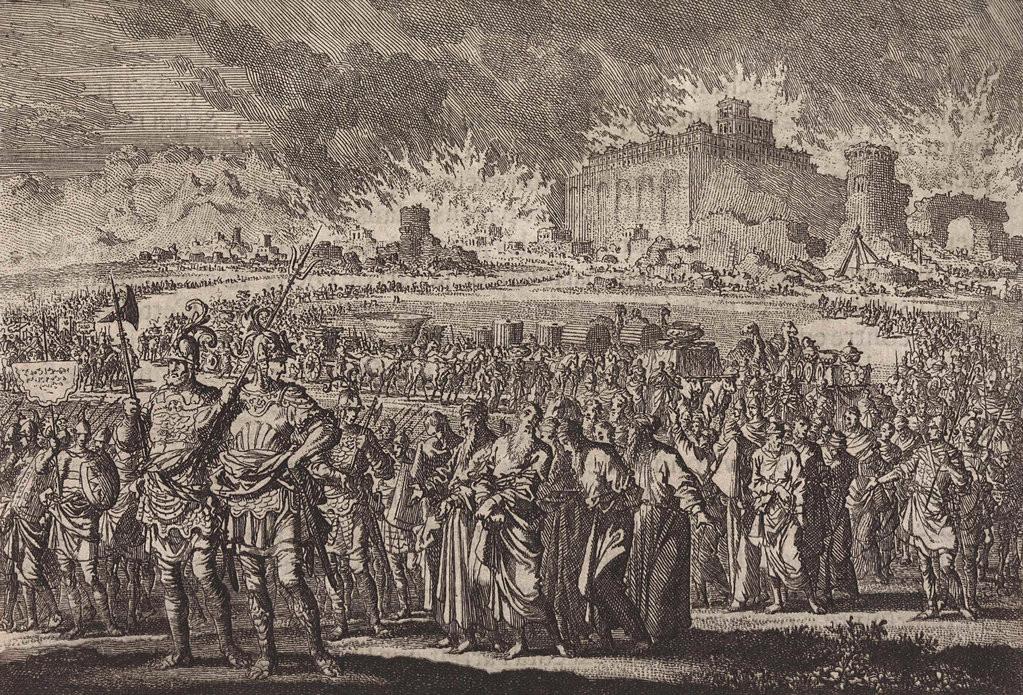
The scene in Jerusalem was one of utter destruction and devastation. The once-formidable walls of the city had been reduced to rubble. The massive doors that stood at the gates into Jerusalem had been torn from their hinges and burned. The homes of both the rich and the poor had been destroyed, leaving the city virtually uninhabitable. Even the king’s royal palace had been ransacked and turned into a smoldering ruin. And the Babylonians had not spared the house of God either. It had become a place of refuge for many trying to flee from the bloodthirsty Babylonians, but they found no help or hope within the walls of the temple they had long neglected.

The Babylonians killed Judah’s young men, even chasing after them into the Temple. They had no pity on the people, killing both young men and young women, the old and the infirm. – 2 Chronicles 36:17 NLT

The grand house that Solomon had constructed, the long-standing symbol of God’s presence and power among His people, was desecrated and then destroyed.

The king took home to Babylon all the articles, large and small, used in the Temple of God, and the treasures from both the Lord’s Temple and from the palace of the king and his officials. Then his army burned the Temple of God… – 2 Chronicles 36:18 NLT

And none of this should have come as a surprise to the people of Judah. On the very day that Solomon had consecrated the newly opened temple, God had warned him:

“I have answered your prayer and your request for help that you made to me. I have consecrated this temple you built by making it my permanent home; I will be constantly present there. You must serve me with integrity and sincerity, just as your father David did. Do everything I commanded and obey my rules and regulations. Then I will allow your dynasty to rule over Israel permanently, just as I promised your father David, ‘You will not fail to have a successor on the throne of Israel.’

“But if you or your sons ever turn away from me, fail to obey the regulations and rules I instructed you to keep, and decide to serve and worship other gods, then I will remove Israel from the land I have given them, I will abandon this temple I have consecrated with my presence, and Israel will be mocked and ridiculed among all the nations. This temple will become a heap of ruins; everyone who passes by it will be shocked and will hiss out their scorn, saying, ‘Why did the Lord do this to this land and this temple?’ Others will then answer, ‘Because they abandoned the Lord their God, who led their ancestors out of Egypt. They embraced other gods whom they worshiped and served. That is why the Lord has brought all this disaster down on them.’” – 2 Kings 9:3-9 NLT

More than three-and-a-half centuries had passed since God had issued that warning to King Solomon. And during that time, the majority of the kings of Judah had chosen to abandon Yahweh for the false gods of the nations around them. They had led the nation into idolatry and apostasy and now, as the people of Judah made their way in chains to Babylon, they could look over their shoulders and see the fiery fulfillment of God’s words to Solomon.

As Nebuchadnezzar and his forces departed Judah, they left a destroyed city and decimated populace behind.

King Nebuchadnezzar took all of Jerusalem captive, including all the commanders and the best of the soldiers, craftsmen, and artisans—10,000 in all. Only the poorest people were left in the land. – 2 Kings 24:14 NLT

And he appointed a man named Gedaliah as governor over the greatly diminished and demoralized citizenry of Jerusalem. There would no longer be a king to rule over Judah. Gedaliah was a Jew, but not a descendant of Solomon. He had no royal blood and would wield no kingly authority. He served at the behest of Nebuchadnezzar and was under the watchful eye of the ever-present Babylonian garrison. His was a thankless job that was more managerial than magisterial. And in time, he would come to be seen as nothing more than a puppet of the occupying Babylonian forces.

The commanders of Judah’s army who had fled from the city of Jerusalem when the walls were breached, returned when they heard that Gedaliah had been appointed governor. But they didn’t like the pro-Babylonian rhetoric that Gedaliah was spouting.

Gedaliah vowed to them that the Babylonian officials meant them no harm. “Don’t be afraid of them. Live in the land and serve the king of Babylon, and all will go well for you,” he promised. – 2 Kings 25:24 NLT

This compromising stance would ultimately cost Gedaliah his life. One of the former military commanders, a man named Ishmael, orchestrated the assassination of Gedaliah. It’s not exactly clear what Ishmael had hoped to accomplish by the murder of the Babylonian-appointed governor. But it seems obvious that this was an act of rebellion against the occupying forces. Along with Gedaliah and his Jewish officials, Ishmael murdered members of the Babylonian garrison, and this resulted in a swift reprisal from Nebuchadnezzar. Ishmael’s attempt to drive the Babylonians out of Judah backfired on him. Instead, “all the people of Judah, from the least to the greatest, as well as the army commanders, fled in panic to Egypt, for they were afraid of what the Babylonians would do to them” (2 Kings 25:26 NLT).

This scene is intended to convey a strong sense of irony. The disobedient people of God were returning to the very place from which He had free them centuries earlier. While some of their friends and family members had been deported to Babylon as slaves, this remnant of God’s chosen people would seek refuge in the land where their forefathers had been captives for more than 400 years.

Once again, all of this had been predicted by God. Centuries earlier, as the people of Israel stood on the shore of the River Jordan, preparing to enter the land of promise, God had given them a word of warning through Moses. He had told them that if they would faithfully obey Him, they would experience His blessings. But if they chose to disobey God, Moses warned them that they would experience “long-lasting afflictions and severe, enduring illnesses. He will infect you with all the diseases of Egypt that you dreaded, and they will persistently afflict you. Moreover, the Lord will bring upon you every kind of sickness and plague not mentioned in this scroll of commandments, until you have perished” (Deuteronomy 28:59-61 NLT).

And Moses had been very specific when outlining the devastating nature of the curses they would encounter should they failed to “fear this glorious and awesome name, the Lord your God” (Deuteronomy 28:58 NLT).

The Lord will scatter you among all nations, from one end of the earth to the other. There you will worship other gods that neither you nor your ancestors have known, gods of wood and stone. Among those nations you will have no rest, nor will there be a place of peaceful rest for the soles of your feet, for there the Lord will give you an anxious heart, failing eyesight, and a spirit of despair. Your life will hang in doubt before you; you will be terrified by night and day and will have no certainty of surviving from one day to the next. In the morning you will say, ‘If only it were evening!’ And in the evening you will say, ‘I wish it were morning!’ because of the things you will fear and the things you will see. Then the Lord will make you return to Egypt by ship, over a route I said to you that you would never see again. There you will sell yourselves to your enemies as male and female slaves, but no one will buy you.” – Deuteronomy 28:64-68 NLT

Some 850 years after God had redeemed the people of Israel from their captivity in Egypt, a remnant of their still rebellious descendants would return. But it’s interesting to note that these poor disheveled exiles will find no hope in Egypt. They won’t even be able to sell themselves as slaves. They will become paupers and aliens living outside the land of promise and under the curse of the God they had chosen to reject.

But despite all the dire imagery portrayed in this closing chapter of the book of 2 Kings, there is a silver lining on the dark cloud of Judah’s history. The author ends his book with a new king ascending to the throne of Babylon. These closing verses seem to be a mirror image of the scene found in the book of Genesis that preceded Israel’s 400-year enslavement in Egypt. Exodus 1:8 records, “Now there arose a new king over Egypt, who did not know Joseph.” This new Pharaoh came to power and, having no first-hand knowledge of Joseph and the people of Israel, decided that they were a threat to his administration. So, he launched a campaign to afflict and enslave them. This would lead to four centuries worth of unprecedented misery and maltreatment.

But when Evil-merodach replaced Nebuchadnezzar as the ruler over the Babylonian empire, he made a decision to release King Jehoiachin of Judah from his enslavement. He released him from prison and “spoke kindly to Jehoiachin and gave him a higher place than all the other exiled kings in Babylon” (2 Kings 25:28 NLT). For the remainder of his life in Babylonian, Jehoiachin lived like a king. He was given royal robes to wear and allowed to dine at Evil-merodach’s table.

But why is this important? Because it foreshadows something highly significant. Back in the book that bears his name, the prophet Jeremiah pronounced a curse on Jehoiachin, who was also known as Coniah.

“Why is this man Jehoiachin like a discarded, broken jar?
    Why are he and his children to be exiled to a foreign land?
O earth, earth, earth!
    Listen to this message from the Lord!
This is what the Lord says:
‘Let the record show that this man Jehoiachin was childless.
    He is a failure,
for none of his children will succeed him on the throne of David
    to rule over Judah.’”– Jeremiah 22:28-30 NLT

And yet, if we fast-forward to the gospel of Matthew, we find the following words in his genealogy of Jesus.

Josiah was the father of Jehoiachin and his brothers (born at the time of the exile to Babylon).
After the Babylonian exile:
Jehoiachin was the father of Shealtiel.
Shealtiel was the father of Zerubbabel.
Zerubbabel was the father of Abiud.
Abiud was the father of Eliakim.
Eliakim was the father of Azor.
Azor was the father of Zadok.
Zadok was the father of Akim.
Akim was the father of Eliud.
Eliud was the father of Eleazar.
Eleazar was the father of Matthan.
Matthan was the father of Jacob.
Jacob was the father of Joseph, the husband of Mary.
Mary gave birth to Jesus, who is called the Messiah. – Matthew 1:11-16 NLT

Here, in the genealogy of Jesus, we find the name of the Jehoiachin. The very man who was told that none of his children would succeed him as king is listed as a progenitor of the King of kings. Of Jehoiachin’s seven sons, not one of them would ascend to the throne of David. But Jesus would. God would graciously reverse the curse, producing a royal heir who would reign in righteousness and deliver His people from their enslavement to sin and death.

Notice one more name in the lineage of Jesus: Zerubbabel. This descendant of Jehoiachin would later become the governor of Judea when the exiles returned from their captivity in Babylon. And the prophet Haggai would pronounce a blessing on Zerubbabel that foreshadowed a great reversal of fortunes for the people of God.

“Speak to Zerubbabel, governor of Judah, saying, I am about to shake the heavens and the earth, and to overthrow the throne of kingdoms. I am about to destroy the strength of the kingdoms of the nations, and overthrow the chariots and their riders. And the horses and their riders shall go down, every one by the sword of his brother. On that day, declares the Lord of hosts, I will take you, O Zerubbabel my servant, the son of Shealtiel, declares the Lord, and make you like a signet ring, for I have chosen you, declares the Lord of hosts.” – Haggai 2:21-23 NLT

The book of 2 Kings ends on a positive note because God’s will concerning the people of Israel was far from done. The story of the redemption of His chosen people and the restoration of the world He created was not yet over. The Messiah, the Savior of the world, would one day come. And His arrival would usher in a new day and a new hope for the people of God and the nations of the world.

English Standard Version (ESV) The Holy Bible, English Standard Version. ESV® Permanent Text Edition® (2016). Copyright © 2001 by Crossway Bibles, a publishing ministry of Good News Publishers.

New Living Translation (NLT) Holy Bible, New Living Translation, copyright © 1996, 2004, 2015 by Tyndale House Foundation. Used by permission of Tyndale House Publishers Inc., Carol Stream, Illinois 60188. All rights reserved.

The Message (MSG)Copyright © 1993, 1994, 1995, 1996, 2000, 2001, 2002 by Eugene H. Peterson

Smoke and Mirrors

12 These are hidden reefs at your love feasts, as they feast with you without fear, shepherds feeding themselves; waterless clouds, swept along by winds; fruitless trees in late autumn, twice dead, uprooted; 13 wild waves of the sea, casting up the foam of their own shame; wandering stars, for whom the gloom of utter darkness has been reserved forever. – Jude 1:12-13 ESV

Jude continues his unrelenting barrage against the false teachers, and he uses symbolic imagery from the realm of nature to do it. These less-than-flattering comparisons leave no doubt as to his opinion of these individuals and the negative influence they were having on local congregations.

His reference to them as hidden reefs reveals his concern that they were operating out-of-sight which made them all that more dangerous. Like a reef lying just beneath the surface of the water, unseen by the pilot of a ship, these individuals existed within the body of Christ, but somewhat hidden from view. And, for Jude, it was important that their presence be exposed so that the church could avoid spiritual shipwreck. It is often the case that those who promote false doctrines choose to remain in the background, quietly promoting their error in relative obscurity. Rather than seeking the main stage and the power of the pulpit, they wield their influence one-on-one, slowly spreading their lies like cancer.

Jude describes them as using the love feast as a platform for their propaganda. The love feast was a regularly occurring feature of the New Testament church. It was a time when the church gathered to share a common meal, centered around the celebration of the Lord’s Supper or Communion. This intimate gathering provided the perfect venue for these people to share their views in a relaxed and unassuming atmosphere of mutual love. People would have naturally let their guard down on these occasions because they were gathered together with those they loved and with whom they shared a mutual love for Christ. And these false teachers used those regular gatherings to disseminate their views with no reverence or regard for the Lord’s Table itself. For them, it was nothing more than an opportunity to make their views known. Rather than celebrating and commemorating the truth surrounding Christ’s sacrificial death, they were interested in promoting their lies.

Their interests were purely selfish. Which made their presence at the love feast all that more egregious. They were self-promoters who only cared about making their views known so they could increase their influence over the flock of Jesus Christ for their own personal gain. Which is why Jude refers to them as shepherds who feed themselves. They had no care or concern for the flock. Their actions were motivated by love of self, not love for others. This imagery of the selfish shepherd would have resonated in the agrarian culture. And it would have been very familiar to any of the Jews within the congregation because of its use in the Old Testament Scriptures. God had used this same indictment against the spiritual leaders of Israel.

“Son of man, prophesy against the shepherds, the leaders of Israel. Give them this message from the Sovereign LORD: What sorrow awaits you shepherds who feed yourselves instead of your flocks. Shouldn’t shepherds feed their sheep?” – Ezekiel 34:2 NLT

“What sorrow awaits the leaders of my people–the shepherds of my sheep–for they have destroyed and scattered the very ones they were expected to care for,” says the LORD. – Jeremiah 23:1 NLT

These men cared more about their views than they did for the people of God. They had a higher regard for their own personal opinions than they did for the flock of God.

Next, Jude compares them to waterless clouds. In a land where rain could be rare, the presence of a cloud was a sign of hope. It carried with it the possibility of refreshment. But the kind of cloud to which Jude is referring was one that came and went without offering a single drop of rain. They were blown by the wind and disappeared almost as quickly as they came. Their words sounded good, and their teaching seemed to offer hope but, in time, the truth would be known. They were all talk with no substance. They were like clouds that brought no rain. While they might offer temporary relief from the scorching heat of the sun, they would eventually blow over, leaving nothing but parched ground and spiritual thirst in their wake. What a hateful thing it is to offer hope, but no help. What could be crueler than teasing the spiritual thirsty with thoughts of relief, only to leave them in disappointment and despair?

God had strong words regarding all those who attempt to slake spiritual thirst through man-made means.

“For my people have done two evil things: They have abandoned me–the fountain of living water. And they have dug for themselves cracked cisterns that can hold no water at all!” – Jeremiah 2:13 NLT

The false teaching of these individuals offered false hope. Their words were like a hand-dug cistern riddled with cracks that made it incapable of offering any form of relief.

And Jude is far from done. He calls them fruitless trees. Once again, the point seems to be that they offered hope, but without delivering. A tree, barren of fruit, was of little use. And to make their uselessness obvious, Jude describes them as “doubly dead, for they bear no fruit and have been pulled up by the roots” (Jude 1:12 NLT). In other words, they will never bear fruit. His reference to the Autumn was intended to convey the thought that they were in the wrong season for producing fruit. It was impossible. But what made matters even worse was that these “trees” had been pulled up by the roots and were physically incapable of fruit-bearing, regardless of the time of year. The church was never going to receive any benefit because these false teachers were spiritually dead.

As far as Jude was concerned, these people were nothing more than trouble-makers. They stirred up dissension and discord like waves stir up debris and throw it onto the shore. These people were relentless in their efforts, like the repetitive nature of waves breaking on the sand. With each successive wave of their teaching, more lies get deposited into the hearts and minds of the people, with no sign of relief.

Finally, Jude refers to them as wandering stars. Unlike fixed stars that provided seaman and travelers with a constant source of guidance and direction in their journeys, these individual were like planets whose position in the sky was constantly changing. They had the appearance of stars but were unreliable as a navigational point of reference. Depending on the season, they could appear in different locations in the sky, making them completely useless for determining your location or reaching your destination.  Jude describes them as being “doomed forever to blackest darkness” (Jude 1:13 NLT). They were going nowhere. Their fate was sealed, sand the future was certain. Their lies and deceit would leave them marred in their own falsehood and deception, incapable of seeing the truth and experiencing the joy that God offered.

The danger was real, but it was subtle and sinister in its appearance. It tended to remain hidden from view, and when it did appear, it was attractive, offering what appeared to be true hope and help. But it was all smoke and mirrors. And Jude wanted his audience to recognize the false teaching of these people for what it was: A dangerous and deadly threat to the spiritual well-being of the church.

English Standard Version (ESV) The Holy Bible, English Standard Version. ESV® Permanent Text Edition® (2016). Copyright © 2001 by Crossway Bibles, a publishing ministry of Good News Publishers.

New Living Translation (NLT) Holy Bible, New Living Translation, copyright © 1996, 2004, 2015 by Tyndale House Foundation. Used by permission of Tyndale House Publishers Inc., Carol Stream, Illinois 60188. All rights reserved.

The Message (MSG) Copyright © 1993, 1994, 1995, 1996, 2000, 2001, 2002 by Eugene H. Peterson

You Are God Alone

14 Hezekiah received the letter from the hand of the messengers, and read it; and Hezekiah went up to the house of the Lord, and spread it before the Lord. 15 And Hezekiah prayed to the Lord: 16 “O Lord of hosts, God of Israel, enthroned above the cherubim, you are the God, you alone, of all the kingdoms of the earth; you have made heaven and earth. 17 Incline your ear, O Lord, and hear; open your eyes, O Lord, and see; and hear all the words of Sennacherib, which he has sent to mock the living God. 18 Truly, O Lord, the kings of Assyria have laid waste all the nations and their lands, 19 and have cast their gods into the fire. For they were no gods, but the work of men’s hands, wood and stone. Therefore they were destroyed. 20 So now, O Lord our God, save us from his hand, that all the kingdoms of the earth may know that you alone are the Lord.” – Isaiah 37:14-20 ESV

Faced with the threat of annihilation at the hands of the Assyrians, Hezekiah, the king of Judah, had taken the situation directly to God. He had entered the temple to pray and sent his key officials to plead with Isaiah to intercede with God on behalf of the nation. And Isaiah had sent the king a reassuring message from God.

“Do not be afraid because of the words that you have heard, with which the young men of the king of Assyria have reviled me.” – Isaiah 37:6 ESV

God promised to save Jerusalem from the threat of Assyrian invasion. King Sennacherib would receive a divinely inspired message that forced him to return home, where he would be assassinated by his own sons. So, God has provided the king of Judah with His personal guarantee that none of the boastful threats of the Assyrian king will come to fruition. Yet, in spite of God’s assurances, King Hezekiah still has the Assyrians camped outside the walls of his city and the threats of the Assyrian emissary ringing in his ears.

“Do not let your God in whom you trust deceive you by promising that Jerusalem will not be given into the hand of the king of Assyria. Behold, you have heard what the kings of Assyria have done to all lands, devoting them to destruction. And shall you be delivered? – Isaiah 37:10-11 ESV

The problem persisted. The enemy was still outside the city walls. And Hezekiah was left with two options: Believe the words of King Sennacherib or those of God Almighty. At this point in the story, that is all he has to go on. The words of a man and the words of His God. One was visible, his power manifested in the sizeable army camped outside the walls of Jerusalem. His words were backed by a well-documented reputation for accomplishing what he set out to do.

“Has any of the gods of the nations delivered his land out of the hand of the king of Assyria? Where are the gods of Hamath and Arpad? Where are the gods of Sepharvaim? Have they delivered Samaria out of my hand? Who among all the gods of these lands have delivered their lands out of my hand, that the Lord should deliver Jerusalem out of my hand?” – Isaiah 36:18-20 ESV

Hezekiah could see the power of Sennacherib with his own eyes. It was all around him. And it was clear that the forces of Judah were outmanned and ill-equipped to deal with the circumstances facing them.

To make matters worse, Hezekiah’s God was invisible. Yes, the king believed in Him. He even spoke to Him. But he couldn’t see Him. And, unlike the gods of the pagans, there were no statues or figurines representing Yahweh that Hezekiah could turn to for assurance. His God was transcendent and hidden from human view.

But while God was invisible, He was far from unknowable or imperceptible. He had a reputation as well. Yahweh had a long track record of intervening in the affairs of mankind, especially on behalf of His chosen people. From the day He had called Abram out of Ur, God had chosen to reveal Himself in a variety of ways, to reassure His people of His imminence or nearness. He spoke to Abraham audibly and regularly. He appeared to Moses in the form of a burning bush. He revealed Himself to the people of Israel as a flame of fire and a cloud, leading them across the wilderness for 40 years. And God had repeatedly intervened on behalf of His people, accomplishing great victories on their behalf, even when they faced more formidable foes and insurmountable odds.

Hezekiah was faced with a dilemma familiar to all believers of all times. He could allow the presence of a tangible trial to influence his decision-making, or he could rely on the promises of a God he couldn’t see but who had proven Himself faithful time and time again. And the text tells us that Hezekiah made the right choice. He took his problem to God.

Hezekiah received the letter from the hand of the messengers, and read it; and Hezekiah went up to the house of the Lord, and spread it before the Lord. And Hezekiah prayed to the Lord – Isaiah 37:14-15 ESV

He took the enemy’s message to the only one he could trust: God. And he opened his prayer to God with a series of appellations that seemed designed to remind himself of God’s power and distinctiveness.

“O Lord of Heaven’s Armies, God of Israel, you are enthroned between the mighty cherubim! You alone are God of all the kingdoms of the earth. You alone created the heavens and the earth. – Isaiah 37:16 NLT

He addresses God as the divine warrior-God. He leads the innumerable hosts of heaven, a supernatural army that far surpasses any earthly or human foe, including the Assyrians. He describes God as Israel’s God, a not-so-subtle reminder that God had chosen the nation of Israel as His own. They belonged to Him, and He was responsible for their well-being. Hezekiah goes on to describe God as sitting on a throne, but unlike any earthly throne occupied by a human king. God sits enthroned between cherubim – supernatural, angelic beings who are unlike anything of this earth. This designation of God’s glory and magnitude is borrowed from the psalms.

Please listen, O Shepherd of Israel,
    you who lead Joseph’s descendants like a flock.
O God, enthroned above the cherubim,
    display your radiant glory
    to Ephraim, Benjamin, and Manasseh.
Show us your mighty power.
    Come to rescue us! – Psalm 80:1-2 NLT

The Lord is king!
    Let the nations tremble!
He sits on his throne between the cherubim.
    Let the whole earth quake! – Psalm 99:1 NLT

And Hezekiah acknowledges that Yahweh alone is God of all the kingdoms of the earth, including the kingdom of Assyria. He is sovereign over all. In fact, Hezekiah admits that God created all that exists. He made the heavens and the earth and every living creature. While Sennacherib could brag about his creation of a mighty kingdom, only God could claim the title of Creator. Hezekiah was bringing his problem to the source and the solution of all things.

And Hezekiah begs the great, majestic, transcendent, all-powerful God of the universe to intervene on Judah’s behalf.

Incline your ear, O Lord, and hear; open your eyes, O Lord, and see; and hear all the words of Sennacherib, which he has sent to mock the living God. – Isaiah 37:17 ESV

Hezekiah acknowledges that Assyria had successfully defeated the other nations, but only because the gods of those nations were lifeless and impotent. They were fabricated by men and, unlike Yahweh, had no power to save.

For they were no gods, but the work of men’s hands, wood and stone. Therefore they were destroyed. – Isaiah 37:19 ESV

False gods provide faulty help in times of trouble. They can’t deliver the necessary aid because they lack the necessary ingredient to do so: Life. But not so with Yahweh. He is alive and well. He is all-powerful and fully capable of providing the hope and help we need in life’s darkest moment. There is no challenge too great. There is no enemy too strong. There is no challenge we will face that is beyond His awareness or outside His ability to provide a solution. So, Hezekiah asks his Sovereign for salvation.

So now, O Lord our God, save us from his hand, that all the kingdoms of the earth may know that you alone are the Lord. – Isaiah 37:20 ESV

Selfishly, Hezekiah wants to see Jerusalem saved. But he also wants to see God glorified. And he knows that the seriousness of the situation will require the power of God for any hope of salvation. He longs to see God work so that the nations will see that God is sovereign over all. He wants His God to receive the glory He deserves. And so, he begs God to save. When we trust God to do what only God can do, He alone gets the glory. When we turn to Him as our sole source of help and hope, we get to see Him work, and the world gets to see the one true God in action. Our reliance upon Him gives proof of His reliability. Our trust in Him demonstrates before the world the trustworthiness of God.

English Standard Version (ESV)
The Holy Bible, English Standard Version. ESV® Permanent Text Edition® (2016). Copyright © 2001 by Crossway Bibles, a publishing ministry of Good News Publishers.

New Living Translation (NLT)
Holy Bible, New Living Translation, copyright © 1996, 2004, 2015 by Tyndale House Foundation. Used by permission of Tyndale House Publishers Inc., Carol Stream, Illinois 60188. All rights reserved.

The Message (MSG)
Copyright © 1993, 1994, 1995, 1996, 2000, 2001, 2002 by Eugene H. Peterson


False Help and Hope.

1 In the year that the commander in chief, who was sent by Sargon the king of Assyria, came to Ashdod and fought against it and captured it— at that time the Lord spoke by Isaiah the son of Amoz, saying, “Go, and loose the sackcloth from your waist and take off your sandals from your feet,” and he did so, walking naked and barefoot.

Then the Lord said, “As my servant Isaiah has walked naked and barefoot for three years as a sign and a portent against Egypt and Cush, so shall the king of Assyria lead away the Egyptian captives and the Cushite exiles, both the young and the old, naked and barefoot, with buttocks uncovered, the nakedness of Egypt. Then they shall be dismayed and ashamed because of Cush their hope and of Egypt their boast. And the inhabitants of this coastland will say in that day, ‘Behold, this is what has happened to those in whom we hoped and to whom we fled for help to be delivered from the king of Assyria! And we, how shall we escape?’” – Isaiah 20:1-6 ESV

Map-of-Assyrian-Expansion.jpgAs has already been stated, this whole section of the book of Isaiah is designed to expose the futility of Judah placing their hope in other nations. Faced with formidable foes threatening to destroy them, the people of Judah were quick to turn to other nations for assistance. Their first line of defense was to make an alliance with a pagan nation like Egypt or Cush.  They had even considered aligning themselves with the Assyrians. But God wanted them to know that He alone was to be their source of safety and security. They had long ago abandoned Him, turning to the false gods of the nations around them and even when faced with His divine judgment in the form of foreign invaders, they remained obstinate, refusing to repent and turn to Him. They thought they could evade and escape His punishment by placing their fate in the hands of a foreign king.

And yet, they watched as, one by one, other nations and cities fell before the unrelenting power of the Assyrian army, including the city of Ashdod. Ashdod was the northern-most Philistine city, located only 35 miles to the west of Jerusalem and, in 713 BC, its king, Ahimiti, had decided to rebel against the the Assyrians, prompted by the promise of aid from the Egyptians. As a result of his rebellion, Ahimiti was replaced by the Assyrians. When the people of Ashdod continued to rebel, the King Sargon II turned the city into an Assyrian province. And the Egyptians never lifted a finger to help them. In fact, the people of Ashdod had pleaded for help from Judah, Moab and Edom, but none ever materialized.

At the time of the fall of Ashdod, God gave Isaiah a strange assignment. He told him to “Go, and loose the sackcloth from your waist and take off your sandals from your feet” (Isaiah 20:2 ESV). He was to remove his outer garment as well as his shoes and the text says, “he did so, walking naked and barefoot.” But before we jump to conclusions and assume that Isaiah was being forced by God to expose himself to all those around them, it is important to know that the Hebrews word translated as “naked” is`arowm and can refer to complete or partial nudity. In many cases it was used to refer to someone who had taken off their outer garment, only to reveal their tunic or undergarment. It seems unlikely that God would have required Isaiah to expose himself completely. But, in demanding that Isaiah strip down to his undergarments and walk the streets of Jerusalem, God would have been demonstrating the shame that Judah would soon experience. Isaiah’s condition would provide a visual demonstration of the humiliation and shame coming to all the nations on Judah’s list of potential allies. Like someone stripped of his possessions by thieves, Isaiah would be a walking reminder of the fate of Judah’s false saviors. And he would do this for three long years.

But Isaiah’s three-year-long dramatic display was intended to send a message to the people of Judah. God wanted them to know that their refusal to place their trust in Him would prove to be a poor decision.

“As my servant Isaiah has walked naked and barefoot for three years as a sign and a portent against Egypt and Cush, so shall the king of Assyria lead away the Egyptian captives and the Cushite exiles, both the young and the old, naked and barefoot, with buttocks uncovered, the nakedness of Egypt.” –  Isaiah 20:3-4 ESV

They Egyptians and Cushites would fall, just as the city of Ashdod did. Their people would be led away, their fine garments and sandals removed, looking more like slaves than the citizens of a once-powerful nation. While Isaiah’s dramatic performance was nothing more than theater in the round, what God describes as happening to the people of Egypt and Cush will be real and not an act.

And God reveals that it will be only then, as their two allies are led away as captives, that people of Judah “shall be dismayed and ashamed because of Cush their hope and of Egypt their boast” (Isaiah 20:5 ESV). It is going to take the fall of these two nations to bring the people of Judah to the point of brokenness. The two Hebrew words used to describe their emotional state at that time are chathath and buwsh, and they paint a picture of confusion, fear and loss of hope. They will have placed all their hope and trust in these two nations, believing that they would be the ones to protect them from their enemies. But their hopes will be dashed when their allies fall.

Isaiah is told to warn the people that when this prophecy takes place, it will leave them wondering what happened. It will leave them in a state of hopelessness and helplessness.

“Behold, this is what has happened to those in whom we hoped and to whom we fled for help to be delivered from the king of Assyria! And we, how shall we escape?” – Isaiah 20:6 ESV

And in 701 BC, God’s warning came to fruition. The Assyrians defeated Egypt at Eltekeh, leaving the people of Judah were left without help or hope. Or so they thought. But God was there. He always had been. And God was ready to help them, to provide them with hope in the midst of the darkness and despair surrounding them. But they would have to turn to Him. They would have to place their trust in Him. And later on in this same book, Isaiah describes the goodness and greatness of the God who stood ready to assist those who will call out to Him in their time of need.

He gives power to the faint,
    and to him who has no might he increases strength.
Even youths shall faint and be weary,
    and young men shall fall exhausted;
but they who wait for the Lord shall renew their strength;
    they shall mount up with wings like eagles;
they shall run and not be weary;
    they shall walk and not faint. – Isaiah 40:29-31 ESV

God possesses power greater than that of any nation. And He offers that power to those who find themselves suffering from physical, emotional and spiritual weakness. But He requires that we wait on Him. That means we must allow Him to operate on His time schedule, not ours. We must not allow our impatience with His seeming delays to tempt us to turn to other forms of help. The key to enjoying the benefits of God’s strength is learning to trust His timing. Notice that those described in this passage are faint, lacking in strength, weary, and exhausted. They can’t take another step. They are on their last legs. In other words, they have come to an end of their own strength. And it is at that very moment, that we tend to start looking for outside sources of strength. But will we turn to God? Will we wait on Him? Will we place all our hope in His ability to provide the very help we need? God calls out to us as He did to the people of Judah.

“…fear not, for I am with you;
    be not dismayed, for I am your God;
I will strengthen you, I will help you,
    I will uphold you with my righteous right hand.” – Isaiah 41:10 ESV

He is our help and our hope.

English Standard Version (ESV)
The Holy Bible, English Standard Version. ESV® Permanent Text Edition® (2016). Copyright © 2001 by Crossway Bibles, a publishing ministry of Good News Publishers.

New Living Translation (NLT)
Holy Bible, New Living Translation, copyright © 1996, 2004, 2015 by Tyndale House Foundation. Used by permission of Tyndale House Publishers Inc., Carol Stream, Illinois 60188. All rights reserved.

The Message (MSG)
Copyright © 1993, 1994, 1995, 1996, 2000, 2001, 2002 by Eugene H. Peterson

Who Is Your God?

Return, O Israel, to the Lord your God, for you have stumbled because of your iniquity. Take with you words and return to the Lord; say to him, “Take away all iniquity; accept what is good, and we will pay with bulls the vows of our lips. Assyria shall not save us; we will not ride on horses; and we will say no more, ‘Our God,’ to the work of our hands. In you the orphan finds mercy.” – Hosea 14:1-3 ESV

In verse 16 of chapter 13, God warned of the gruesome manner in which many of the Israelites would die at the hands of the Assyrians:

Samaria shall bear her guilt, because she has rebelled against her God; they shall fall by the sword; their little ones shall be dashed in pieces, and their pregnant women ripped open. – Hosea 13:16 ESV

Many would die in battle against the Assyrians, but their deaths would be in vain. Pregnant women and innocent children would suffer tragic and hideous deaths as the Assyrians attempted to wipe out the next generation of Israelites in order to prevent future rebellion.  The judgment that was coming would be devastating and impossible to escape. So Hosea pleaded with his fellow Israelites to return to the Lord.

Return, O Israel, to the Lord your God, for you have stumbled because of your iniquity. – Hosea 14:1 ESV

The Hebrew word he used is שׁוּב (shuwb) and it means “to turn back (to God), repent” (“H7725 – shuwb – Strong’s Hebrew Lexicon (KJV).” Blue Letter Bible). It carries the idea of restoration and point to a future day in which God would reestablish His covenant relationship with His people. It is interesting to note that the Hebrew word can also mean “to bring back, refresh, restore.”  There is a sense in which God is calling His people back to a right relationship with Himself, but its ultimate fulfillment will be His responsibility, not theirs. At the same time, God was calling them to acknowledge their sin. He wanted to hear them say, “Forgive all our sins and graciously receive us, so that we may offer you our praises” (Hosea 14:2b NLT). The acknowledgement of their sins against Him was an essential part of their return to Him. They would also have to recognize and repent of their misplaced trust in things other than God. “Assyria cannot save us, nor can our warhorses. Never again will we say to the idols we have made, ‘You are our gods’” (Hosea 14:3a NLT).

One of the hardest things for us to do as God’s people is to admit our unfaithfulness to God. It is not that we lack faith. It is that our faith is misplaced. Our trust is misappropriated. Rather than relying solely on God, we turn to other sources for assurance, comfort, security and salvation. For some, their own intellect becomes the go-to source of their rescue. They learn to think their way out of any troubles or trials. For others, financial resources become the means of their salvation. They learn to buy their way out of moments of distress, discomfort and dissatisfaction. Money and materialism become their gods of choice. And yet, God would have us acknowledge our false gods. He desires that we admit our wandering hearts and prodigal faith. But that will not happen until we learn the sometimes painful lesson that our bank accounts, portfolios, talents, resources, careers, or friends cannot save us. They make lousy gods and even worse saviors. But as long as we think they can provide us with any sliver of hope and help, we will never fully return to and place our faith in God.

The whole point behind God’s coming judgment against Israel was to get them to realize that their salvation was in Him alone. He wanted them to come to the conclusion that He was the soul source of salvation. He desired to hear them say, “No, in you alone do the orphans find mercy” (Hosea 14:3b NLT). That statement carries with it a recognition of need. Orphans are inherently needy. They have no resources, no means of self-reliance. And that is exactly the attitude that God desires in us. But like the church in Laodicea, we can arrogantly claim, “I am rich. I have everything I want. I don’t need a thing!” (Revelation 3:17a NLT). But the reality is, “you don’t realize that you are wretched and miserable and poor and blind and naked” (Revelation 3:17b NLT). We can wrongly assume we are spiritually healthy and in no need of a healing. But Jesus would remind us, “I have come to call not those who think they are righteous, but those who know they are sinners” (Matthew 9:13b NLT). If you don’t think you need God, you will not return to Him. And why would you? As long as you think you have another trick up your sleeve, another option available to you, you will not seek God’s help. In fact, for most of us, God can become an option of last resort. We turn to Him only when all else has failed. We call on Him only when our other sources of salvation have run out or proven unreliable.

But God longs for us to see Him as David did. “The Lord is my rock, my fortress, and my savior; my God is my rock, in whom I find protection. He is my shield, the power that saves me, and my place of safety” (Psalm 18:2 NLT). God longs that we see Him in those same terms. That we would be able to say, “He is the Rock; his deeds are perfect. Everything he does is just and fair. He is a faithful God who does no wrong; how just and upright he is!” (Deuteronomy 32:4 NLT). But instead, we can become like Israel, who “became fat and unruly; the people grew heavy, plump, and stuffed! Then they abandoned the God who had made them; they made light of the Rock of their salvation” (Deuteronomy 32:15 NLT). And sadly, the same can be said of us that was said of them: “You neglected the Rock who had fathered you; you forgot the God who had given you birth” (Deuteronomy 32:18 NLT).

But God’s desire is that we return to Him. He wants us to abandon our other sources of salvation and to rely solely on Him. He wants to be our rock, shield, and tower. But if we don’t think we need Him, we will never fully return to Him. As long as our faith is focused on anything other than Him, we will never fully recognize our need for Him.


False Gods. False Hope.

They do not cry to me from the heart, but they wail upon their beds; for grain and wine they gash themselves; they rebel against me. Although I trained and strengthened their arms, yet they devise evil against me. They return, but not upward; they are like a treacherous bow; their princes shall fall by the sword because of the insolence of their tongue. This shall be their derision in the land of Egypt. – Hosea 7:14-16 ESV

These three verses paint a very pitiful picture of the state of the people of Israel. They had become so addicted to their worship of Baal and other false gods, that even in their times of greatest need, they continued to turn to the very gods that were the cause of their problem. Like a addict who takes more drugs to stem off the tremors caused by withdrawal from those drugs, the Israelites couldn’t bring themselves to turn away from their false gods. God describes them as wailing upon their beds in agony and discomfort, but refusing to call on Him. And in order to convince the god, Baal, to give them abundant harvests of wine and grain, they gashed themselves as part of their worship. This should remind us of the encounter between the prophet, Elijah and the prophets of Baal on Mount Carmel. Elijah had challenged the 450 prophets of Baal to a contest to prove whose god was the one true God.

Let two bulls be given to us, and let them choose one bull for themselves and cut it in pieces and lay it on the wood, but put no fire to it. And I will prepare the other bull and lay it on the wood and put no fire to it. And you call upon the name of your god, and I will call upon the name of the Lord, and the God who answers by fire, he is God.” And all the people answered, “It is well spoken.” – 1 Kings 18:23-24 ESV

Elijah allowed the prophets of Baal to go first, reminding them, “Choose for yourselves one bull and prepare it first, for you are many, and call upon the name of your god, but put no fire to it” (1 Kings 18:25 ESV). And we read, “they took the bull that was given them, and they prepared it and called upon the name of Baal from morning until noon, saying, ‘O Baal, answer us!’ But there was no voice, and no one answered. And they limped around the altar that they had made” (1 Kings 18:26 ESV). As Elijah mocked their efforts and the seeming indifference of their god, they amped up their efforts.

And they cried aloud and cut themselves after their custom with swords and lances, until the blood gushed out upon them. And as midday passed, they raved on until the time of the offering of the oblation, but there was no voice. No one answered; no one paid attention. – 1 Kings 18:28-29 ESV

As part of their religious ritual, they cut themselves, mutilating their bodies in an attempt to get the attention of their god. But no one answered. No one paid attention. There was no voice and no response, because there was no god. And God accused the Israelites of calling on Baal in the same pitiful way, cutting and gashing their bodies in an effort to get the attention of a non-existent god. And the sad reality was – all they had to do was call on God in repentance and He would have answered them. He was the one who had “trained and strengthened their arms” (Hosea 7:15 ESV) and yet they refused to turn to Him. In fact, they were guilty of turning to anyone but God in their moments of need. They appealed to their false gods and they sought the aid of pagan nations, in the hopes that these unhealthy alliances would protect them from the threat posed by Assyria.

It would be easy to roll our eyes in disbelief at the stubbornness and stupidity of the Israelites. We could wonder how they could be so hardheaded as to refuse to turn to God when He was the one disciplining them for their rebellion against them. But before we shake our fingers in judgment, we need to take stock of our own lives and see if we are not guilty of the same thing. How many times have we turned to our own “gods” of comfort, and convenience when we have faced difficulty? How often have we looked to something other than God when confronted when confronted with a need of some kind? We find it so easy to turn to our own capabilities and rely on our own intelligence. If we’re sad or despondent, we turn on the TV in the hopes of finding relief, even if just for a moment. If we face a financial need, we find it easier to go into debt to get what we need rather than to ask God for help. And in doing so, we end up worse off than when we started. Our false “saviors” never alleviate or eliminate the problem, they only enhance it. Our sophisticated “gods” give us the same response as the prophets of Baal received: No voice. No answer.

One of the saddest outcomes of all of this is that the lost world laughs at those who call themselves followers of Christ, because our beliefs seem to make no difference in our lives. We claim to believe in God, but we tend to turn to anything and anyone other than God for our help and hope. We go to church on Sunday, but the rest of the week we put our faith in the gods of this world: government, money, materialism, entertainment, health, wealth, work, pleasure, and human reasoning. We chase these false gods, spiritually mutilating and harming ourselves in an effort to make them respond to our calls for help. But God wants us to call on Him. He wants us to trust Him and rely on Him for all our needs. God will not tolerate our affections for other gods. He will not compete for our love. He has proven Himself faithful and loving. He will allow us to chase after our false gods until we realize that they provide neither help or hope, and we return to Him in humble repentance.


A Holy Helper.

If you love me, you will keep my commandments. And I will ask the Father, and he will give you another Helper, to be with you forever, even the Spirit of truth, whom the world cannot receive, because it neither sees him nor knows him. You know him, for he dwells with you and will be in you. – John 14:15-17 ESV

I think Jesus knew the disciples loved Him. I think He believed they truly wanted to keep His commandments. But He knew that they would find that task impossible in the days ahead, especially after His death, burial and resurrection. Which is why Jesus said He was going to send them a Helper – someone to assist them. The Greek word Jesus used was paraklētos and, like most Greek words, it is rich and multifaceted in its meaning. It refers to someone who is summoned or called to the aid and assistance of another. In the literal sense it meant “one who pleads another’s cause before a judge, a pleader, counsel for defense, legal assistant, an advocate” (www.blueletterbible.org).  Jesus used this common Greek word to refer to the Holy Spirit who would “lead them to a deeper knowledge of the gospel truth, and give them divine strength needed to enable them to undergo trials and persecutions on behalf of the divine kingdom” (www.blueletterbible.org).

Jesus knew that His disciples loved Him and would be eager to keep His commandments, but they would find both tasks impossible to fulfill without divine help. Their love was going to be tested. Their desire to be obedient would weaken. And without Jesus by their side, they would find it difficult to remain motivated. So Jesus promised to send help in the form of a divine advocate or aid. They would not be left alone. They would not be left powerless. The same Spirit of God who they had seen actively present in the life of Jesus would be given to them. They would soon find themselves not only living in the presence of the Spirit of God, but living with the Spirit of God present within them. God the Son would ask God the Father to send God the Holy Spirit to come to their aid. What an incredible thought. What a remarkable reality. But one that we either take for granted or treat with a sort of doubt or incredulity. Our own experience seems to suggest that this Holy Helper is either absent in our lives or not nearly as helpful as Jesus seemed to suggest.

Jesus told His disciples that the Holy Spirit would live in them. The power and presence of God would no longer be an external force they witnessed, but an internal reality that would set them apart from the rest of the world. When Jesus performed miracles everyone was able to witness them and see the power of God at work. Anyone could hear the words of Jesus and be amazed at His teaching. But with the coming of the Holy Spirit, the followers of Jesus would find themselves possessed of a power that allowed them to not only hear the words of Jesus, but obey them. No longer would they simply be witnesses to the power of God, they would be the very conduits through which that power flowed.

As believers in Jesus Christ, we have the Holy Spirit living within us. Our ability to love Christ consistently is not left up to our own strength. We have a helper. Our capacity to remain obedient to His commands is not based on our will power and inner resolve, but on the indwelling presence of God. Jesus referred to the Spirit as the “Spirit of truth”. Because He is the Spirit of God and God is truth, the Holy Spirit speaks truth. He doesn’t bring new truth, but helps believers understand and apply the truth of God as revealed in the Word of God. We might wonder how the disciples of Jesus were able to remember all the things that He said and taught. Did they take copious notes and spend every evening writing down all that He said. Jesus Himself gives us the explanation. “But the Helper, the Holy Spirit, whom the Father will send in my name, he will teach you all things and bring to your remembrance all that I have said to you” (John 14:26 ESV). Not only would the Spirit give them the capacity to remember the words of Jesus, they would be able to understand them and apply them to their lives.

This “help” we have been given is not to be viewed like some kind of divine Cliff Notes or study aid. He is the very essence of God Himself. He is the third person of the Trinity and He lives within all who have accepted the free gift of salvation made possible through Christ’s death on the cross. Because He lives within us, we have all the help we need to live the life we have been called to live. We can love consistently. We can obey fully. Not because we have the capacity to do so on our own, but because we have the presence of God within us. Jesus didn’t leave us defenseless, helpless or hopeless. He sent the Spirit of God to live in us, to help us, to empower us and transform us as we live our lives in anticipation of His return. We have all the help we need to prove our love for Jesus by living in obedience to His commands.